Scott Lord Mystery Film
Shared posts
01 Aug 03:42
Basil Rathbone in Sherlock Holmes and the Secret Wea...
by noreply@blogger.com (Scott Lord on Silent Film, Swedish Silent Film, Danish Silent Film,)
Scott Lord, Scott Lord Mystery Film and 2 others like this
01 Aug 03:42

 While heralding "Ben Hur" as "the biggest movie spectacle since Intolerance", Classics of the Silent Screen, published by author Joe Franlkin in 1959 notes that its two large scale production scenes take place during the first half of the film, too early in the narrative in regard to audience interest and reception, "Part two not only moved slowly but had no spectacular action highlights." The actual chatiot race takes place after an hour and a half of film, but there is in fact another hour left to the complete film. Classics of the Silent Screen claimed the film trailed off to follow an incidental character with leprosy.
Starring in the film with Romon Navarro were actresses Kathleen Kay, Betty Bronson, Myrna Loy and Colleen Moore.
Silent Film
Ben Hur
While heralding "Ben Hur" as "the biggest movie spectacle since Intolerance", Classics of the Silent Screen, published by author Joe Franlkin in 1959 notes that its two large scale production scenes take place during the first half of the film, too early in the narrative in regard to audience interest and reception, "Part two not only moved slowly but had no spectacular action highlights." The actual chatiot race takes place after an hour and a half of film, but there is in fact another hour left to the complete film. Classics of the Silent Screen claimed the film trailed off to follow an incidental character with leprosy.
Starring in the film with Romon Navarro were actresses Kathleen Kay, Betty Bronson, Myrna Loy and Colleen Moore.
Silent Film
Ben Hur
Scott Lord Silent Film: Biblical Drama, Ben Hur (Fred Niblo, 1925)
by noreply@blogger.com (Scott Lord on Silent Film, Scott Lord on Mystery Film)


Scott Lord, Scott Lord and one other like this
26 Jul 03:24
Scott Lord Silent Film: Silent Film Studio Tour (M.G.M, 1925)
Silent Film


The 1925 Studio Tour of Metro Goldwyn Mayer, true to the extratextual discourse of its magazine advertisements that boasted of a firmament full of stars, featured a dozen of the studios directors that were then present on the backlot filming that year, inluding Victor Sjostrom, Dimitri Buchowerski, Monta Bell, Rupert Holmes, Eric von Stroheim, Fred Niblo, King Vidor, Joseph von Sternberg, Christy Cabanne, Tod Browning, William A. Wellman, Jack Conway, Edmund Goulding and Marcel de Sarno. Actors and actresses featured in the studio tour included Zazu Pitts, Roman Novarro, Aileen Pringle, Gertrude Olmstead, Norma Shearer, Mae Murray, Lew Cody, Estelle Clark, Conrad Nagel, and Lon Chaney
Silent Film


The 1925 Studio Tour of Metro Goldwyn Mayer, true to the extratextual discourse of its magazine advertisements that boasted of a firmament full of stars, featured a dozen of the studios directors that were then present on the backlot filming that year, inluding Victor Sjostrom, Dimitri Buchowerski, Monta Bell, Rupert Holmes, Eric von Stroheim, Fred Niblo, King Vidor, Joseph von Sternberg, Christy Cabanne, Tod Browning, William A. Wellman, Jack Conway, Edmund Goulding and Marcel de Sarno. Actors and actresses featured in the studio tour included Zazu Pitts, Roman Novarro, Aileen Pringle, Gertrude Olmstead, Norma Shearer, Mae Murray, Lew Cody, Estelle Clark, Conrad Nagel, and Lon Chaney
Silent Film
Scott Lord, Scott Lord and 3 others like this
26 Jul 03:24
Scott Lord Silent Film: Cabiria (Pastrone, 1914)
Scott Lord, Scott Lord and 3 others like this
26 Jul 03:24
Scott Lord Mystery: Strangers on a Train (Alfred Hitchcock, 1946)
Scott Lord, Scott Lord and 3 others like this
26 Jul 03:24
 I usually don't update this blog and usually do update my other blog on film, but this morning the guide that welcomes people to either the Freedom Trail or to the Park Street Church began a conversation about our lack of books on William Lloyd Garrison. There was one that we had. The photo above is our library card catalog that has internet- as an assistant church librarian I could pull up the sermons that William Lloyd Garrison delivered in this room twenty years after the church was erected (in the same way that if you were at Harvard College you would have poems that Oliver Wendall Holmes had delivered there.) Our welcomer referred to the stautue from the previous entry, and you can notice that there was not yet any snow, as "The Image" and judging from her age I really think she meant "the blessed image of the late Dr. and Mrs King". She couldn't just say statue even though there is a statue of J.F.K (the blessed, but more than that the still legally elected) at the Boston State House, but that is something polite, and nice. There was a class today- Tammy (Harvard Divinity) gave me permission to "jump in" in the middle of it or be added to it next week. It is titled Lenten Discipleship Initiative.
-----:-----::-----:::-----::-----:
I usually don't update this blog and usually do update my other blog on film, but this morning the guide that welcomes people to either the Freedom Trail or to the Park Street Church began a conversation about our lack of books on William Lloyd Garrison. There was one that we had. The photo above is our library card catalog that has internet- as an assistant church librarian I could pull up the sermons that William Lloyd Garrison delivered in this room twenty years after the church was erected (in the same way that if you were at Harvard College you would have poems that Oliver Wendall Holmes had delivered there.) Our welcomer referred to the stautue from the previous entry, and you can notice that there was not yet any snow, as "The Image" and judging from her age I really think she meant "the blessed image of the late Dr. and Mrs King". She couldn't just say statue even though there is a statue of J.F.K (the blessed, but more than that the still legally elected) at the Boston State House, but that is something polite, and nice. There was a class today- Tammy (Harvard Divinity) gave me permission to "jump in" in the middle of it or be added to it next week. It is titled Lenten Discipleship Initiative.
-----:-----::-----:::-----::-----:
Below is my original blog entry on "The Image" and I myself quake in many ways:
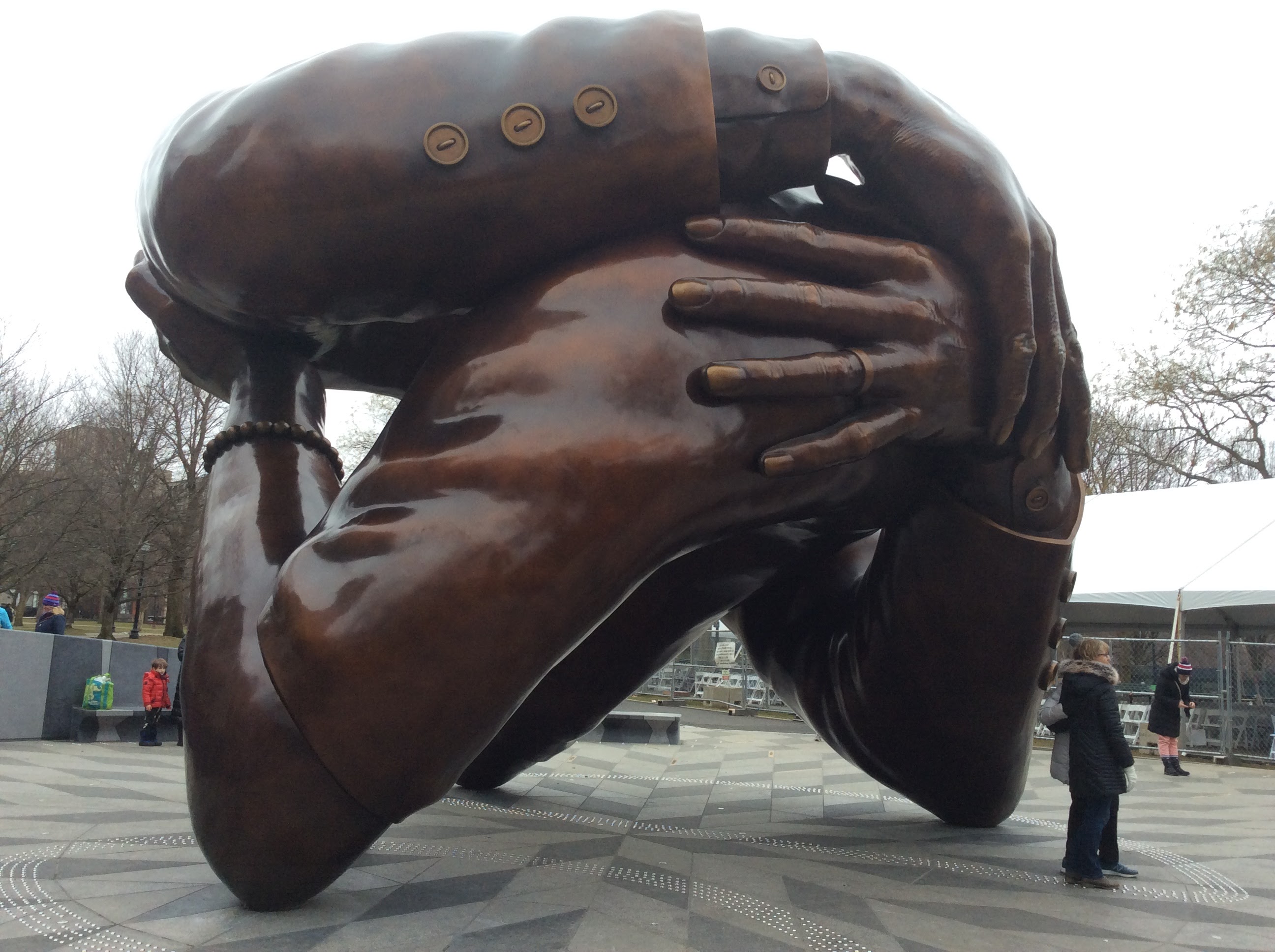
Although the Boston Freedom Trail is meant to be a tour of the Revolutionary War and the grave of Crispus Attucks, a stevadore killed in the Boston Massacre, is directly outside the Church window where I am right now, the new statue of Martin Luther King holding his wife, Coretta Scott King has been unveiled on Boston Common. Another piece of history, ourchurch ran a film on this week marking the one hundreath year of radio broadcasting of the church service, there having been a shop that sold radios across the street on Tremont Street. The service is in progreess upstairs and on WEZE while I am in my wife's library. Donna, please accept these photos as symbolic of our spending our Sundays together.


 photos: Scott Lord
 photo: Scott Lord
Postscript:The Girl on the Flying Trapeze
I spend every Sunday on the Freedom Trail, which our church is on, and I listen to the ministers conduct tours in case I'm needed when in the library or if I think I should point out the Granary Burial Ground. This morning we had a new addition, a sculpture where the usually have a Christmas Star. The other Christmas lights are still in Boston Common. As it is Freedom Trail art, I thought I would add it here, but it takes a couple of photos to conquer the height distance and perspective.
It is an installation- a sculture of a girl on a swing put into an envirornment where art meets reality.
photo: Scott Lord
Postscript:The Girl on the Flying Trapeze
I spend every Sunday on the Freedom Trail, which our church is on, and I listen to the ministers conduct tours in case I'm needed when in the library or if I think I should point out the Granary Burial Ground. This morning we had a new addition, a sculpture where the usually have a Christmas Star. The other Christmas lights are still in Boston Common. As it is Freedom Trail art, I thought I would add it here, but it takes a couple of photos to conquer the height distance and perspective.
It is an installation- a sculture of a girl on a swing put into an envirornment where art meets reality.


 Girl on a Swing photos: Scott Lord
Postscript: Embrace: Dr. Martin Luther and Coretta Scott King Statue added to Boston Freedom Trail

Below is my original blog entry on "The Image" and I myself quake in many ways:
Although the Boston Freedom Trail is meant to be a tour of the Revolutionary War and the grave of Crispus Attucks, a stevadore killed in the Boston Massacre, is directly outside the Church window where I am right now, the new statue of Martin Luther King holding his wife, Coretta Scott King has been unveiled on Boston Common. Another piece of history, ourchurch ran a film on this week marking the one hundreath year of radio broadcasting of the church service, there having been a shop that sold radios across the street on Tremont Street. The service is in progreess upstairs and on WEZE while I am in my wife's library. Donna, please accept these photos as symbolic of our spending our Sundays together.




Scott Lord, Scott Lord and 3 others like this
26 Jul 03:23
Scott Lord Mystery: Held for Ransom (Clarence Bricker, 1938)
Scott Lord, Scott Lord and 3 others like this
26 Jul 03:23
Silent Film Silent Film
Silent Film: Sherlock Holmes, The Devil’s Foot (Elvey, 1921)
scottlordpoet
shared this story
from  Scott Lord shared items on The Old Reader (RSS). Scott Lord shared items on The Old Reader (RSS).
|
Silent Film Silent Film
Scott Lord, Scott Lord and one other like this
26 Jul 03:23
Boston skyline from Donna’s Cambridge terrace,...
Scott Lord, Scott Lord and 2 others like this
24 Jul 04:27
silent film silent film
Scott Lord Silent Film: Harold Lloyd in Haunted Spooks (Hal Roach, 1920)
by noreply@blogger.com (Scott Lord on Silent Film, Scott Lord on Mystery Film)
scottlordpoet
shared this story
from  Haunted Lighthouse/ Haunted As Lighthouse, When Lighthouse. Haunted Lighthouse/ Haunted As Lighthouse, When Lighthouse.
|
silent film silent film
Scott Lord, Scott Lord and one other like this
27 Jun 02:03
Scott Lord Horror Comedy: One Frightened Night (Christy Cabanne, 1935)
by Scott Lord on Silent Film, Swedish Silent Film, Danish Silent Film,
Scott Lord, Scott Lord and 2 others like this
27 Jun 02:03
Scott Lord Horror Comedy: Scared Stiff (McDonald, 1945)
by Scott Lord on Silent Film, Swedish Silent Film, Danish Silent Film,
Scott Lord, Scott Lord and 3 others like this
26 Jun 23:22
Scott Lord Silent Film: Mary Pickford in What The Daisy Said (D.W. Griff...
by noreply@blogger.com (Scott Lord on Silent Film, Scott Lord on Mystery Film)
During 1910 D.W. Griffith directed actress Mary Pickford in the short film "What The Daisy Said", photographed by G.W. Bitzer for the Biograph Film Company. Peter Cowie, in his volume Eighty Years of Cinema, gives the 1910 film "Simple Charity", directed by Griffith, as one of the earliest on screen appearances made by Mary Pickford.
Silent Film
Biograph
Silent Film
Scott Lord, Scott Lord and 2 others like this
26 Jun 23:22
Mac Ahlberg (Bert Torn) with Marie Forsa
by noreply@blogger.com (Unknown)
Justine and Juliette (Mac Ahlberg as Bert Torn, 1975) with Marie Forsa and Anne Bie Wargurg is more explicit than the films of exploitation and sexploitation. My copy is in Swedish and, whereas my first copy of Exposed (Exponerad, 1971) was entirely in Swedish, the earlier film contains only nudity without depicting the sexual act. The swith from Something Weird video to dvd has made some films unavailable to me.
The films screenplay was written by its director. There is the use of an expository retrospective voice over during exterior shots of Marie Forsa during exterior shots; the character being an omnicient she already knows the plotline's denoument. The technique could have been used more fully , near beautifully,had the film been more of a serious drama. The plot turns when Juliette brings Justine to a party, which becomes a quiet orgy. She is then introduced an older man, who brings her home with him and she is brought from liscentiousness to romance. The motif is underdeveloped by the film's levity- that Justine is decieved into a love affair is left as a plot gimmick rather than as a moral theme, but in that way the decadence is supported by its its own hedonist theme rather than a plot theme like The Rise and Fall of Susan Lennox where love is the morality.
The bedroom is darkened as he unfastens her bra and the director uses closeshots and superimposures to depict their making love. The voice over connects adjacent scenes, but the motif of sex in the darkness and erotic moviegoing in the darkness is subtle when connected with later scenes. Only through the tenderness of his lovemaking can the bedroom and movie theater (screening room) be connected thematiclly He photographs her nude of the beach and then, as spectator, screens the film in a projection room. During a dinner party, she undresses while, dancing, being shown nude in profile and over the shoulder. She uses voice over to explain that the two are in love and yet he is more intellectually concerned with dabating free love and morality-the open marriage. He then brings her to the projection room to screen one of his films, the camera cutting back and forth between a close shot of her as vouyer and explicit sex scenes on the screen- the direction is reversed one hundred and eighty degress, from screen to spectator. He underesses her from behind in the darkened room and makes love to her slowly from that position. The use of the vouyer is supradiegetic rather than infradiegetic and positions the subject as spectator.
There is an amazing slightly low angled close shot of her lifting her dress in a subsequent scene. her lover returns her to the orgy from the beginning of the film, where she appears with Juliette- she is now a woman.
Mac Ahlberg had photographed the Swedish film Cats (Kattorna, Henning Carlsen) in 1965.
Marie Forsa appeared in the Joseph Sarno films Veil of Blood, Girl Meets Girl (1974) and Butterflies.
Inga silent film
The films screenplay was written by its director. There is the use of an expository retrospective voice over during exterior shots of Marie Forsa during exterior shots; the character being an omnicient she already knows the plotline's denoument. The technique could have been used more fully , near beautifully,had the film been more of a serious drama. The plot turns when Juliette brings Justine to a party, which becomes a quiet orgy. She is then introduced an older man, who brings her home with him and she is brought from liscentiousness to romance. The motif is underdeveloped by the film's levity- that Justine is decieved into a love affair is left as a plot gimmick rather than as a moral theme, but in that way the decadence is supported by its its own hedonist theme rather than a plot theme like The Rise and Fall of Susan Lennox where love is the morality.
The bedroom is darkened as he unfastens her bra and the director uses closeshots and superimposures to depict their making love. The voice over connects adjacent scenes, but the motif of sex in the darkness and erotic moviegoing in the darkness is subtle when connected with later scenes. Only through the tenderness of his lovemaking can the bedroom and movie theater (screening room) be connected thematiclly He photographs her nude of the beach and then, as spectator, screens the film in a projection room. During a dinner party, she undresses while, dancing, being shown nude in profile and over the shoulder. She uses voice over to explain that the two are in love and yet he is more intellectually concerned with dabating free love and morality-the open marriage. He then brings her to the projection room to screen one of his films, the camera cutting back and forth between a close shot of her as vouyer and explicit sex scenes on the screen- the direction is reversed one hundred and eighty degress, from screen to spectator. He underesses her from behind in the darkened room and makes love to her slowly from that position. The use of the vouyer is supradiegetic rather than infradiegetic and positions the subject as spectator.
There is an amazing slightly low angled close shot of her lifting her dress in a subsequent scene. her lover returns her to the orgy from the beginning of the film, where she appears with Juliette- she is now a woman.
Mac Ahlberg had photographed the Swedish film Cats (Kattorna, Henning Carlsen) in 1965.
Marie Forsa appeared in the Joseph Sarno films Veil of Blood, Girl Meets Girl (1974) and Butterflies.
Inga silent film
Scott Lord, Scott Lord and one other like this
26 Jun 23:22
Scott Lord The Moonstone
by noreply@blogger.com (Scott Lord on Silent Film, Scott Lord on Mystery Film)
Scott Lord, Scott Lord and 3 others like this
26 Jun 23:21
 Tommorow is our thirteenth Anniversary. I took Donna to lunch on Temple Street again to a restararaunt we go to once a month and decided to take a short cut across Boston Common and down Beacon Hill. Once a month I also aske her if she would like to visit the Old State House. Today, she passed the entrace to Massachusetts State House and asked if we could go inside. We've been to the Boston Antheneum, and there were marble statues inside the State House as well. She particularly like a statue of a nurse treating a wounded soldier (I have had a coronary bypass several years ago) and my favorite was of John Adams.
Happy Anniversay Donna and Thank You for a wondeful date this afternoon.
Tommorow is our thirteenth Anniversary. I took Donna to lunch on Temple Street again to a restararaunt we go to once a month and decided to take a short cut across Boston Common and down Beacon Hill. Once a month I also aske her if she would like to visit the Old State House. Today, she passed the entrace to Massachusetts State House and asked if we could go inside. We've been to the Boston Antheneum, and there were marble statues inside the State House as well. She particularly like a statue of a nurse treating a wounded soldier (I have had a coronary bypass several years ago) and my favorite was of John Adams.
Happy Anniversay Donna and Thank You for a wondeful date this afternoon.
Happy Thirteenth Anniversary, Donna
by noreply@blogger.com (Scott Lord on Silent Film, Scott Lord on Mystery Film)
|
scottlordpoet
shared this story
from Scott Lord shared items on The Old Reader (RSS).
|

Scott Lord, Scott Lord and one other like this
24 Jun 15:01
Scott Lord Mystery: Murder in Times Square (Lew Landers, 1943)
by noreply@blogger.com (Scott Lord on Silent Film, Swedish Silent Film, Danish Silent Film,)
Scott Lord, Scott Lord and 3 others like this
24 Jun 15:01
Film Art
by Scott Lord on Silent Film, Swedish Silent Film, Danish Silent Film,


Scott Lord, Scott Lord and 3 others like this
21 Jun 22:29
Scott Lord Silent Film: La Vie et la passion de Jésus Christ (1903) - YouTube
Scott Lord, Scott Lord and 4 others like this
21 Jun 22:18
The Moonstone
by Scott Lord on Silent Film, Swedish Silent Film, Danish Silent Film,
Scott Lord, Scott Lord and 3 others like this
21 Jun 22:17
Silent Film: Silent Horror
by Scott Lord on Silent Film, Scott Lord on Mystery Film
Scott Lord, Scott Lord and 3 others like this
21 Jun 22:09
Film Art
by noreply@blogger.com (Scott Lord on Silent Film, Swedish Silent Film, Danish Silent Film,)


Scott Lord, Scott Lord Mystery Film and 2 others like this
21 Jun 22:09
Film Art
by noreply@blogger.com (Scott Lord on Silent Film, Swedish Silent Film, Danish Silent Film,)
Scott Lord, Scott Lord Mystery Film and 2 others like this
21 Jun 22:09
Art
by noreply@blogger.com (Scott Lord on Silent Film, Swedish Silent Film, Danish Silent Film,)


Scott Lord, Scott Lord and 3 others like this
21 Jun 22:08
---------- Forwarded message ----------
From: My Jewish Learning <community@myjewishlearning.com>
Date: Friday, December 8, 2023
Subject: This Hanukkah Prayer Is About Courage and Miracles
To: scottlordnovelist@gmail.com

--
A Hanukkah Card for Donna that has been coming all year; I try to read it every day and please feel invited to subscrbe
---------- Forwarded message ----------
From: My Jewish Learning <community@myjewishlearning.com>
Date: Friday, December 8, 2023
Subject: This Hanukkah Prayer Is About Courage and Miracles
To: scottlordnovelist@gmail.com
Al Hanisim reminds us of the role we play in our own modern miracles.
If you are having trouble viewing this email, click here.
|










| This email was sent to scottlordnovelist@gmail.com by community@myjewishlearning.com 70 Faces Media | 520 Eighth Avenue, 4th Floor | New York, NY 10018 |
--
Scott Lord, Scott Lord and 3 others like this
21 Jun 02:07
Scott Lord Mystery: E.G. Marshall in CBS Radio Mystery Theater The Adven...
by noreply@blogger.com (Scott Lord on Silent Film, Scott Lord on Mystery Film)
Scott Lord Mystery Film likes this
21 Jun 02:00
--
http://sites.google.com/site/scottlorderoticnovel/home
Scott Lord
Inga's Veil, Evening chapter one Blue White Rainbow erotic novel, film poem was updated
by noreply@blogger.com (Unknown)
---------- Forwarded message ----------
From: scottlordnovel <noreply@google.com>
Date: Thu, Jun 23, 2011 at 11:31 AM
Subject: [scottlordnovel] Inga's Veil, Evening chapter one Blue White Rainbow erotic novel, film poem was updated
To: scottlordnovelist@gmail.com
From: scottlordnovel <noreply@google.com>
Date: Thu, Jun 23, 2011 at 11:31 AM
Subject: [scottlordnovel] Inga's Veil, Evening chapter one Blue White Rainbow erotic novel, film poem was updated
To: scottlordnovelist@gmail.com
Scott Lord updated the page Inga's Veil, Evening chapter one Blue White Rainbow erotic novel, film poem. View the changes below.
Color key: Insertion | Deletion
 Wife in Mirror, 1966 by William Stilson The painted was kept in a gallery on Bearskin Kneck when the present author lived there. She is, for the most part, "the real Inga", though only a painting. She is the only direct subject of the first scene of the film: there is the use of voice over narrative and flashforward. In the opening shot she is seen in mediuum full shot, her having finished her correspondence. Depending upon what hour she had begun, there previously had been added to that an infrequent journal entry in epistolary form addressed to her lover more often than not rather than to herself. Despite its seeming to be too early in the evening, she appears to be putting a manuscript into the top drawer of her desk, which she closes with her right hand. If it can be said that as an actress she will be drifting and that her instructions are to dress off to the right of her chair, on film the sequence is an on camera turn-her directions to sit into the set have been precluded in that later within the scene there is the use of retrospective narrative cut in shots of her sitting at the desk from within a half hour of her having risen from her chair, the camera intriguing the spectator by suprisingly creating a voyouerism within discourse throught its third person omniscient voice, the transdiegetic aspect of its having omniprescence being temporal rather than spatial as it returns to a cutback shot in the present tense. There is a cup of coffee on the desk, the height of which is above her knees while below her stomach. At first, the tight closeups, close ups and medium close shots are lensed from behind the desk, from a vantage point not thought possible for the camera to acquire, as though there were physically no wall behind it, much like a three wall set, whereas the medium shots are near to being filmed over the shoulder and in three quarter profile. Near to the right of the chair, she has already skimmed the contents of the drawer before closing it and has brought her glance to the horizontal plane, the subjective high angle withheld from the film as she is to lower her view to reassure herself that the objects on the desk are neatly placed, her not necessarily imediately having noticed the telephone having had been being now more to the left within the square created by what is either a computer or a television with a digital video recorder within the polished wooden rectangle . The script given to the actress includes description as to whether or not there is an object on the desk that ostensibly belongs to him, it appearing during the course of the scene that there is the disclosure that they could more than live together or that they were seeing each other frequently. The script has also withheld information from the actress untill shooting. If one or more of the items are his, they could include a gift that she had brought back as a present still waiting for him or older articles they had acquired together, the emotional content of the spatial object within the filmed frame subject to the look and actions of the character. Were the films use of multiple cameras to include her surveying the desk, watching her eyes would have relayed a sentimental look in her having accomplished having written the particular letter or poem and in their sense of immediacy and yet there is an urgency that has concluded or transformed, something indicative of her being unfailiar with a newly felt emotion, one different than she previously had concieved it would be were she to ever experience it. As she slowly, only gradually lowers her eyelids, it is not according to a personal, solipstic fascination, but more so her lips are only slightly apart, her having ostensibly precluded opening them any wider as her unspoken response to something she had remembered his having said and would not allow herself to answer, to quote or to reiterate, she herself only having heard it said only once, only by him on that occaision, it cloistered within her memory-laden femininity as she looked to him to kiss her eyelids again. There was now a smoothness, or ease to her movements, one in part self acknowledgement, there being a look of introspective holiness, or spiritual beauty derived from that which is known intimately, and known as being particularly singular or unique to her own experience; there is a sensuality to her being in reflection and yet her herself being an an emotive image as a softness impinged her sensibility and her sensibility of self awareness. Within the transcription of her moving image into the dramaturgical significance it would acquire positioned within the linear visual plotline, projected onto, and or projected for the ideal viewer of an implied or disembodied spectator is her solitude projected as not only a mobilized gaze, but as an act of prayer that can be taken as a metaphor for what not only would be tacit between them when they later would meet, but also for her present need to speak to him at that moment- female desire as transcendental. It is discernable, before viewing the retrospective interdiegetic shots of her penning what she had only then finished writing, that it may hvae been only after her having recieved, or found, an earlier letter of his, or a volume of poetry on the shelf in which he had written something in the margins and had telephoned her about in hope she would have time to thumb through the book to find it. Was it that belief, and accordingly beauty, was the desire for union with something that found the fondness of appreciation? "I can't say a word on this telephone untill your finished telling me everything." "Why did you stop using words while we were making love?" The shot at present is stationary. An as objectification of pleasure, her body, and any beauty inherent within the erotic object as a quality and its accompanying position of belief as the desire for a transcendental love and ideal beauty, in its femininity is beauty as is modified, her nudity and its foreshadowing of its possible later reoccurrence in the film beuaty that as an objectification of pleasure takes action rather than being only transitory, beauty as perpetual, truth, searched for as being absolute, held by her spontaneity; as an aethetic continuum there is a sensuality to the narrative-spatial dimensions of the scene in which its motifs are encased as she is the center of the vertical composition, the spatial planes of the room limited to the vertical frameline untill divulged by her horizontal movement. Within the spectatorial address or any consequent objectification of spectatorial pleasure or desire, including viewer identification as desire for an erotic subjectivity as erotic object, the sequence, itself designed as thematicly autonomous, is not an autonomous single shot in that there is a cutting for continuity that includes reframings and cutting to similar angles. There is a thematic unity of context within the interframe narrative that, in being centered around her and her movement, her movement and or action theatrical space in relation to object positions that within their spatial proximity to her and within their spatial contiguity to each other are measured by linear perspective as non-moving height or width, is becoming increasingly interested in her. Within narrative as a mode of address, the viewer is not only interpellated but reproduced, transmogrified or reconfigured, as subject and, within a unfied ideal spectatorial position is brought into a suture pattern of characterization, there being a suture pattern to identification, an appearance dissappearance within the relationship of protagonist observer, an absence presence of emotion, the emotion involved in reception, each relsolution of narrative action holding a lack of closure in the presence and absence of future event, particularly in that the view has constructed an imaginary eroticism which is either supported by the object of fantasy, or brought to a greater excitement than that which the viewer had been looking forward to while waiting. There is, casually, an erotic relationship of hers, whether erotic action or fantasy, contained in what she is doing that becomes seemingly more singular, which at first seems almost ordinary, the viewer only omniscient in that the left shot is left as imaginary and as being among the possible movements she could make within the limited space of the frame, and then in turn, within each framing, there being a diegetic logic of the erotic, there a suture relationship between the camera's decisions and selections, the individual's agency,or fate, or urgency within her particular position in the narratvie core and the viewer as fantasisizing desire to act as protagonist while vouyer. As to create a shot to shot contrast of spatial configuration, the spatial distance she is kept from the camera and each object brings a diegetic connontation that the action of the scene is her desire, or her desire to transcend sexual gratification. There is a discursive organization to the contiguous images that lends them a figurative context, a cutting for emotional effect with legnthy static shots that bring to poin her meditations and continuous shots of varying, yet measurably comparable, duration; each reframing a perspectival acknowledgement of each slight purient motion on her part and each decision as to how long they are to continue, the suprise of the nymph elapsed; each a deigetic reference to each postition her body acquires to create spatial temporality while creating vanishing points with off-screen space that had previously been onscreen and with space eroticlly hidden inhabited by the image in the shot to follow;each a reference to her moving without being as near to him as she could be. YouTube Video erotic trailer written in between revisionsAn Erotic Trailer Reel Two Scott Lord |
Go to page: Inga's Veil, Evening chapter one Blue White Rainbow erotic novel, film poem
-------------
You requested this notification from Google Sites. You can unsubscribe at any time.
Don't want to get notification of your own changes? Change your settings.
--
http://sites.google.com/site/scottlorderoticnovel/home
Scott Lord
Scott Lord, Scott Lord Mystery Film likes this