
I’m looking for dignity, but there just isn’t any.
I’m looking for dignity, but there just isn’t any.
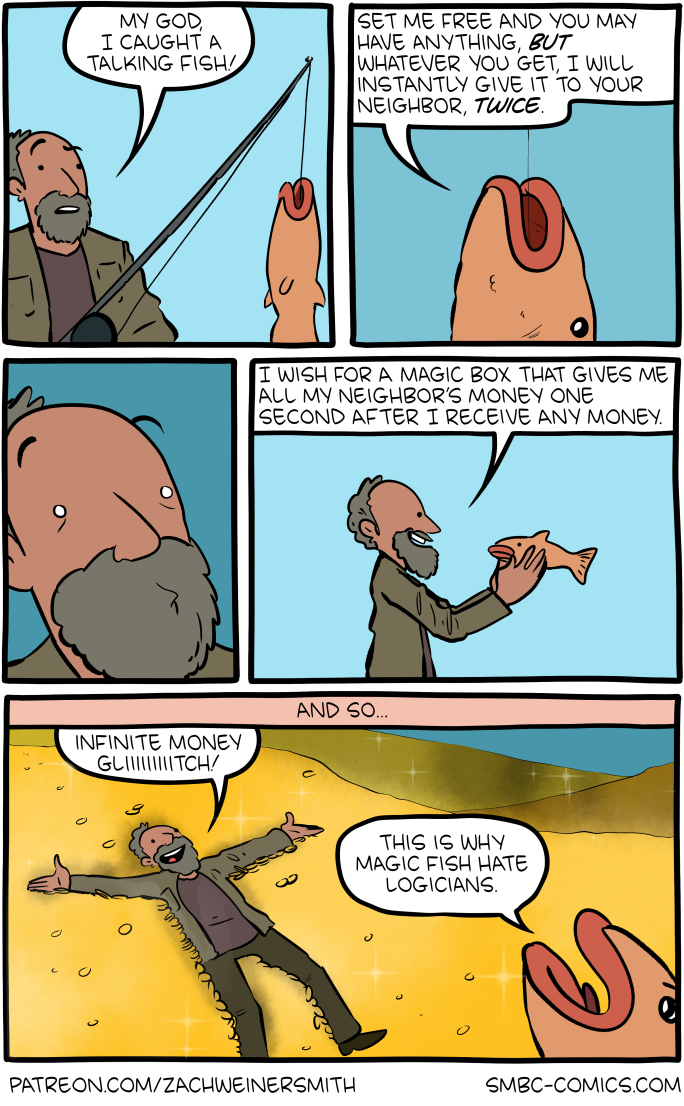
Hovertext:
This is more easily executable with a three-wish genie, but it's good to be prepared for all circumstances.
Within twenty-four hours of Republicans getting crushed in elections they’d convinced themselves were winnable, Fox News deployed the counter-move.
Not denial—the losses were too visible for that. Bret Baier had already explained to Fox & Friends viewers how bad it was. “It’s a big loss,” he said. Not just the results, but “the spreads are surprising.”
Not acceptance—that would threaten the narrative that MAGA represents the inevitable American future.
Instead, on Wednesday night’s edition of The Ingraham Angle, Laura Ingraham offered viewers a reframe so brazen it became an on-screen graphic:
“By Winning, Democrats Are Actually Losing.”
The emperor has no clothes. And what makes this moment pedagogically valuable is that lots of people are noticing simultaneously. The propaganda is at its most naked. Which means we can analyze how it works precisely when it’s failing to work.
Propaganda works by being invisible. The best propaganda doesn’t feel like propaganda—it feels like common sense, like the way things obviously are, like what everyone already knows.
When propaganda becomes visible as propaganda, it loses most of its power. Once you can see the strings, the puppet stops being convincing.
Ingraham just made the strings visible. Not through some subtle slip, but by putting “By Winning, Democrats Are Actually Losing” on screen as a graphic. This is propaganda’s nightmare scenario: the mechanism exposed precisely when it’s most desperately needed.
Let’s break down the structure so you can recognize it when it’s less obvious:
The Core Move: Reality Inversion
When observable reality contradicts your narrative decisively, you have limited options. Denial becomes impossible when the contradiction is too visible. Acceptance destroys the narrative you need to maintain.
So you invert: acknowledge the reality while controlling what it means. Transform the evidence that contradicts your narrative into evidence that confirms it.
Ingraham’s version:
Good propaganda makes this subtle. It spends weeks establishing premises. It lets viewers do the inversion themselves through implication.
But Ingraham had twenty-four hours. The fracture was fresh. The narrative needed immediate repair. So she just… said it. Put it on screen. Made it a graphic.
That’s not sophisticated propaganda. That’s desperate propaganda. And desperate propaganda exposes its mechanics because it doesn’t have time for subtlety.
Here’s what you need to understand about what this moment means for Laura Ingraham, for Fox News, for the entire propaganda infrastructure:
Their power depends on invisibility.
Not invisibility of the network—everyone knows Fox News exists, knows it’s conservative. That’s not the invisibility that matters.
The invisibility that matters is the machinery itself. The mechanisms through which they shape perception, manufacture consensus, control interpretation. Those need to be invisible or they stop working.
When you can see someone trying to make you believe something, you become resistant to believing it. Persuasion operates through the illusion of discovery—you think you’re arriving at conclusions independently when really you’re being guided there. Once you see the guidance, the spell breaks.
Ingraham just made the guidance visible. And this is terrifying for propagandists because once people see the machinery, they start seeing it everywhere.
If you can see Ingraham inverting reality to maintain narrative, you might start asking: what else has been inverted? When they said the economy was terrible while data showed recovery—was that reality inversion too? When they said protests weren’t representative—was that the same move? When they said Trump’s felony conviction would help him—was that the same desperate gymnastics?
One visible instance threatens to illuminate the entire structure. Recognition cascades backward through everything you’ve believed. This is the propagandist’s nightmare.
But it gets worse for them. Because propaganda doesn’t just require individual belief—it requires collective suspension of disbelief. It needs to be socially reinforced. Your family believes it, your neighbors believe it, your social media feed confirms it. When everyone around you accepts the frame, questioning it feels crazy. That social reinforcement is what makes propaganda sticky.
But when lots of people simultaneously notice the emperor has no clothes, that reinforcement fractures. If you think you’re alone in seeing the absurdity, you might doubt yourself. But if you suspect lots of people are simultaneously recognizing it—if Twitter is mocking it, if even conservative commentators seem skeptical, if your Fox-watching uncle texts you “that was weird”—then the collective suspension of disbelief cracks.
That’s what propagandists fear most. Not individual disbelief—that can be isolated, dismissed. But mass simultaneous recognition that the machinery is visible, the narrative is constructed, the consensus is manufactured.
When lots of people at once see the strings, the puppet show ends.
Laura Ingraham trying to convince viewers that Democratic victories are actually defeats would be merely pathetic if it existed in isolation. But it doesn’t.
She’s performing this desperate reality inversion while Tim Cook presents a gold-plated tribute in the Oval Office like some feudal vassal paying homage to his lord. While Zuckerberg congratulates Trump. While Bezos killed the Post endorsement then offered “extraordinary” praise. While Marc Andreessen proclaims “morning in America”—liberation from the terrible oppression of having to pretend to care about other people at dinner parties.
The propagandists and the prostrators serve the same master: the simulation of MAGA inevitability. Ingraham maintains it through reality inversion. The tech oligarchs maintain it through strategic submission.
And both have soiled their reputations into the annals of history with the same calculation: that bending the knee is wisdom, that accommodation is strategy, that surrendering dignity is just being realistic about power.
They’re wrong. And Tuesday night proved it.
Let’s be clear about what happened after November 2024. These weren’t small business owners protecting their livelihoods. These were some of the wealthiest, most powerful people on the planet—people with resources to resist, with platforms to speak truth, with security that ordinary people don’t have—choosing to prostrate themselves.
Tim Cook didn’t need to perform feudal tribute. Apple has more cash reserves than most countries’ GDP. Cook could have maintained dignified distance. He chose submission instead.
Bezos owns the Washington Post—a paper with “Democracy Dies in Darkness” as its motto. He killed their endorsement, then offered extraordinary praise to Trump. He has wealth that makes him effectively untouchable. He chose to touch his forehead to the ground anyway.
These aren’t victims. These are people who looked at Trump’s explicit authoritarianism and decided their wealth and power would be safer if they signaled submission early.
They made a bet: MAGA represents the inevitable future, resistance is futile, accommodation is wisdom.
Tuesday night, reality called that bet. And they lost.
What links Ingraham’s desperate propaganda and Cook’s feudal tribute is the same fundamental miscalculation: they thought everyone would become what they are.
The propagandists thought everyone would accept obvious inversions if delivered confidently enough. The prostrators thought everyone would bend the knee once they demonstrated it was safe to do so. Both groups convinced themselves that cynicism is realism, that principles are obstacles, that most people are just waiting for permission to abandon dignity.
They were shocked to discover: no. Most people aren’t sociopaths. Most people won’t accept that winning means losing. Most people won’t prostrate themselves to authoritarians just because billionaires did it first.
The propagandists control the platforms. The prostrators control the wealth. Together they manufacture consensus, shape information flows, fund the campaigns, own the infrastructure.
And they still lost. Because manufactured consensus only works until lived experience contradicts it. Because reality has veto power. Because most people can still recognize that two plus two equals four even when Laura Ingraham explains otherwise and Tim Cook nods along.
The propagandists are scrambling to repair the simulation because their credibility depends on narrative maintenance. But what about the prostrators?
It means their bet is failing. The calculation that MAGA inevitability made accommodation wise—that’s looking shaky.
Because here’s the thing about authoritarian systems: they don’t reward early submission. They despise it. Trump publicly humiliated Musk despite Musk’s hundreds of millions in support. You think Tim Cook’s golden tribute bought him security? It bought him contempt—Trump’s and ours.
The prostrators thought they were being strategic. They were being cowards. And now they’re trapped. Having soiled their reputations through public submission, they can’t easily reverse course. Having signaled that they’ll bend to power, they’ve marked themselves as bendable.
And the simulation they bent to support is fracturing. Which means they prostrated themselves to a future that might not arrive. They surrendered dignity for security in an order that’s proving less inevitable than claimed.
This moment is valuable precisely because the propaganda is so naked. When you can see the machinery clearly in one instance, you can start recognizing it everywhere:
Watch for acknowledgment followed by inversion. “Yes that happened, but it actually means the opposite because…”
Notice predictions stated as certainties. “Will fail” becomes “are failures.” Grammar converts uncertainty into inevitability.
Track coherence debt. How many special exceptions does accepting this require? How much explaining away of observable reality?
Test predictions. Inversions depend on future consequences. Did those consequences happen? When they don’t, does the framework adjust or create new explanations?
Check alternative frameworks. Does this interpretation require believing this source exclusively? What would someone outside this information silo conclude?
Ask what’s being protected. Inversions happen when reality threatens something desperately needed. What narrative does this inversion protect?
These aren’t just tools for analyzing Fox News. They’re tools for analyzing all propaganda—including propaganda that aligns with your values, that comes from sources you trust, that feels like common sense.
Because left-wing propaganda exists too. Technocratic propaganda. Progressive propaganda. The structure is the same even when the content differs.
Learning to see propaganda when it’s naked—when it’s obviously desperate—teaches you to see it when it’s sophisticated.
There are truths that survive every inversion, every sophisticated reframing, every attempt to make reality mean its opposite.
Democrats won elections in New Jersey, Virginia, and New York. That’s what winning is—getting more votes, your candidates taking office.
You can predict those victories will lead to bad governance. You can work to defeat those officials in future elections. You can argue their policies will fail.
But you cannot make victory into defeat through definitional gymnastics. You cannot invert observable reality through prediction about what it might eventually mean.
When Fox News puts “By Winning, Democrats Are Actually Losing” on screen, they’re not offering analysis. They’re attempting reality maintenance for viewers whose framework just got contradicted.
The sophistication of the attempt doesn’t make it true. The confidence with which it’s delivered doesn’t make it coherent. The fact that some people accept it doesn’t make it correspond to reality.
Two plus two equals four. Democrats winning elections means Republicans lost. And no amount of propagandistic inversion changes that, no matter how desperately the simulation needs it to.
The simulation fractured when Republicans lost decisively. Laura Ingraham’s attempt to repair it through naked reality inversion is evidence of fragility, not strength.
You don’t need to tell people that winning is actually losing unless losing threatens your entire framework. You don’t make the propaganda machinery visible unless you’re desperate enough that visibility is worth the risk.
The terror for propagandists isn’t that this particular inversion might fail. It’s that lots of people are simultaneously seeing the machinery. That once you see propaganda as propaganda, you start seeing it everywhere. That recognition cascades backward through everything you’ve believed.
The wire is holding. Not because Fox News isn’t powerful—they are. The inversion will work on some viewers. The simulation will partially reconstruct.
But when propaganda becomes naked, when the machinery is visible, when lots of people simultaneously notice the emperor has no clothes—that’s when resistance becomes possible. Not because you’ve won, but because you can finally see clearly what you’re fighting.
And understanding their desperation—seeing how scared they are—is strategic intelligence. They’re not operating from strength. They’re scrambling. The propagandists are deploying naked reality inversion. The prostrators are doubling down on bets that are already failing.
That’s when they’re most dangerous. Desperation produces escalation. But it’s also when they’re most vulnerable. Because every desperate move that fails to restore the simulation reveals further fragility.
The cognitive technology for recognizing propaganda isn’t just intellectual—it’s grounded in love for what’s real.
Love for truth that withstands inversion. Love for your own capacity to see clearly even when powerful forces try to make you doubt what you observe. Love for people trying to maintain coherence in hostile information environments.
That love is what makes you resist when Laura Ingraham explains that winning is losing. Not because propaganda doesn’t work on you—it works on everyone sometimes. But because when it becomes visible, when you can see someone trying to make you believe the impossible, love for truth is what lets you say: no. I see what you’re doing. And I choose reality instead.
The machinery is visible. The emperor has no clothes. Lots of people are noticing simultaneously. And that recognition—that moment when propaganda reveals itself as propaganda—is where resistance begins.
Not in never being manipulated. But in seeing manipulation when it happens. Not in being immune to propaganda. But in recognizing it when the machinery becomes visible and choosing truth over the inversion.
Two plus two equals four. Winning means winning. And we can see you trying to tell us otherwise, Laura. We can see the strings. And once you see them, you can’t unsee them.
The circus continues. But this time, we’re watching the performance with clear eyes. And that clarity—that refusal to accept obvious inversion—is how the wire holds.
Mike Brock is a former tech exec who was on the leadership team at Block. Originally published at his Notes From the Circus.
Soon, you'll be reading a copy of wide world of news! #CowboyWho
WASHINGTON—As fewer air traffic controllers show up for work amid a government shutdown that has halted their pay, the Federal Aviation Administration issued a recommendation Friday advising commercial pilots to “just go with their gut.” “You’ve done this plenty of times by now, so, you know, go ahead and feel free to trust your instincts when landing without visibility,” said FAA administrator Bryan Bedford, assuring concerned pilots that there were no wrong answers when it came to flying an airplane and that the worst thing they could do was overthink it. “Look, you’ve probably got a good feel for which runways are open by now, and if you see another plane headed your way, just do what feels natural—go up, turn sideways. You’d know better than us. Planes have computers now, so you can probably let the computers do a lot of stuff for you. Just close your eyes and hope for the best.” The FAA assured pilots not to worry, suggesting that the “sky is pretty huge” and that they would probably be okay.
The post Understaffed FAA Recommends Pilots Just Go With Their Gut appeared first on The Onion.
For years, the annual edition of the Old Farmer’s Almanac hung from a nail in my grandparents’ downstairs bathroom, and I was very upset to briefly believe on Friday that it was shutting down after more than 200 years of publication. Except, good news, it’s not.
The one shutting down is the Farmer’s Almanac, a different publication that is also more than 200 years old, also publishes an annual weather forecast, and in this reporter’s opinion was possibly not the one some national news outlets were thinking of when they published a bunch of articles about it ceasing publication. (iHeartRadio, for instance, published a story titled “Farmers’ Almanac To Stop Publishing After More Than Two Centuries,” illustrated with a photo of someone holding the Old Farmer’s Almanac.)
One outlet that had the story right from the start: The Sun Journal of Lewiston, Maine. The shutting-down Farmer’s Almanac is based in Lewiston. (The Old Farmer’s Almanac is based in New Hampshire and is owned by Yankee Publishing.)
“This decision was honestly heartbreaking,” David Geiger, the fifth-generation family owner of the Farmer’s Almanac, told the Sun Journal’s Mark La Flamme. “While the Farmers’ Almanac represents a small part of our overall business, it has always been a meaningful part of our family’s legacy. However, readers now access information and answers differently, and the trajectory of newsstand sales made this decision necessary.”
A post in the Facebook group Illinois Storm Community (which has more than 411,000 members) read “#Breaking The Farmer’s Almanac is ending after the 2026 edition. Growing up, the Almanac was something I’d read and eagerly looked forward to their seasonal forecasts. Truly an end of a 200+ year era.” The post had received nearly 3,000 shocked or sad reactions as of press time (“Another American institution gone by the wayside!“), but commenters hastened to note that this isn’t the Almanac most people care about for strong, nostalgic, in-the-Christmas-stocking reasons (“There are TWO. This is not The OLD Farmer’s Almanac that has been around since 1792. Everything is fine. Just chill guys“; “can you edit your post to include the info that has to be repeated over and over– it’s not the OLD farmer’s almanac with the yellow cover?”)
The Old Farmer’s Almanac reassured readers Thursday:
You may have heard that the Farmer’s Almanac, based out of Lewiston, ME, is ceasing publication after an incredible 200+ year run.
Over the years, there has been some confusion between different almanacs, so to be clear: The OLD Farmer’s Almanac isn’t going anywhere. As we have since 1792, during George Washington’s presidency, we will continue to publish our annual edition, while educating and entertaining readers online at Almanac.com.
In a further flex, the Old Farmer’s Almanac released its Christmas forecast this week.

While I formulated the idea of enshittification to refer to digital platforms and their specific technical characteristics, economics and history, I am very excited to see other theorists extend the idea of enshittification beyond tech and into wider policy realms.
There's an easy, loose way to do this, which is using "enshittification" to refer to "things generally getting worse." To be clear, I am fine with this:
https://pluralistic.net/2024/10/14/pearl-clutching/#this-toilet-has-no-central-nervous-system
But there's a much more exciting way to broaden "enshittification," which starts with the foundation of the theory: that the things we rely on go bad when the system stops punishing this kind of deliberate degradation and starts rewarding it. In other words, the foundation of enshittification is the enshittogenic policy environment:
https://pluralistic.net/2025/09/10/say-their-names/#object-permanence
That's where Pavlina Tcherneva comes in. Tcherneva is an economist whose work focuses on the power of a "job guarantee," which is exactly what it sounds like: a guarantee from the government to employ anyone who wants a job, by either finding or creating a job that a) suits that person's talents and abilities and b) does something useful and good. If this sounds like a crazy pipe-dream to you, let me remind you that America had a job guarantee and it was wildly successful, and created (among other things), the system of national parks, a true jewel in America's crown:
https://pluralistic.net/2020/10/23/foxconned/#ccc
Tcherneva's latest paper is "The Death of the Social Contract and the Enshittification of Jobs," in which she draws a series of careful and compelling parallels between my work on enshittification and today's employment crisis, showing how a job guarantee is the ultimate disenshittifier of work:
https://www.levyinstitute.org/wp-content/uploads/2025/11/wp_1100.pdf
Tcherneva starts by proposing a simplified model of enshittification, mapping my three stages onto three of her own:
- Bait: Lure in users with a great, often subsidized, service.
Trap: Use that captive audience to attract businesses (sellers, creators, advertisers).
Switch: Exploit those groups by degrading the experience for everyone to extract maximum profit.
How do these map onto the current labor market and economy? For Tcherneva, the "bait" stage was "welfare state capitalism," which was "shaped by post–Great Depression government reforms and lasted through the 70s." This was the era in which the chaos of the Great Depression gave rise to fiscal and monetary policy that promoted macroeconomic stability. It was the era of economic safety nets and mass-scale federal investment in American businesses, through the Reconstruction Finance Corporation, a federal entity that expanded into directly funding large companies during WWII. After the war, the US Treasury continued to play a direct role in finance, through procurement, infrastructure spending and provision of social services.
As Tcherneva writes, this is widely considered the "Golden Age" of the US economy, a period of sustained growth and rising standard of living (she also points out that these benefits were very unevenly distributed, thanks to compromises made with southern white nationalists that exempted farm labor, and a pervasive climate of misogyny that carved out home work).
The welfare state capitalism stage was celebrated not merely for the benefits that it brought, but also for the system it supplanted. Before welfare state capitalism, we had 19th century "banker capitalism," in which cartels and trusts controlled every aspect of our lives and gave rise to a string of spectacular economic bubbles and busts. Before that, we had the "industrial capitalism" of the Industrial Revolution, where large corporations seized power. Before that, it was "merchant capitalism," and before that, feudalism – where workers were bound to a lord's land, unable to escape the economic and geographic destiny assigned to them at birth.
So welfare state capitalism was a welcome evolution, at least for the workers who got to reap its benefits. But welfare state capitalism was short-lived. To understand what came next, Tcherneva cites Hyman Minsky (whose "theory of capitalist development" provides this epochal nomenclature for the various stages of capitalism over the centuries).
Minsky calls the capitalism that supplanted welfare state capitalism "money manager capitalism," the system that reigned from the Reagan revolution until the Great Financial Crisis of 2008. This was an era of "deregulation, eroding worker power, rapid increase in inequality, and a rise of the money manager class." It's the period of financialization, which favored the creation of gigantic conglomerates that wrapped banking services (loans, credit cards, etc) around their core offerings, from GE to Amazon.
Then came the crash of 2008, which gave us our current era, the era of "international money manager capitalism," which is the system in which gigantic, transnational funds capture our economy pumping and dumping a series of scammy bubbles, like crypto, metaverse, blockchain, and (of course) AI:
https://pluralistic.net/2025/09/27/econopocalypse/#subprime-intelligence
Welfare state capitalism was the "bait" stage of the enshittification of labor. Public subsidies and regulation produced an environment in which (many) workers were able to command a large share of the fruits of their labor, securing both a living wage and old-age surety. This was the era of the "family wage," in which a single earner could supply all the necessities of life to a family: an owner-occupied home, material sufficiency, and enough left over for vacations, Christmas presents and other trappings of "the good life."
During this stage, the "social contract" meant the government training a skilled workforce (through universal education) and public goods like roads and utilities. Companies got big contracts, but only if they accepted collective bargaining from their unions. Governments and corporations collaborated to secure a comfortable requirement for workers.
But this arrangement lacked staying power, thanks to a key omission in the social contract: the guarantee of a good job. Rather than continuing the job guarantee that brought America out of the Depression, all the post-New Deal order could offer the unemployed was unemployment insurance. This wasn't so important while America was booming and employers were begging for workers, but when growth slowed, the lack of a job guarantee suddenly became the most important fact of many workers' lives.
This was foreseen by the architects of the New Deal. FDR's "Second Bill of (Economic) Rights" would have guaranteed every American "national healthcare, paid vacation, and a guaranteed job":
https://en.wikipedia.org/wiki/Second_Bill_of_Rights
These guarantees were never realized, and for Tcherneva, this failure doomed welfare state capitalism. Unions were powerful during an era of tight labor markets and able to wring concessions out of capital, but once demand for workers ebbed (thanks to slowing growth and, later, offshoring), bosses could threaten workers with unemployment, breaking union power.
The social contract was bait, promising "economic security and decent jobs" through cooperation between the government, corporations and unions.
The switch came from Reagan, with mass-scale deregulation, a hack-and-slash approach to social spending, and the enshrining of a permanently unemployed reserve army of workers whose "job" was fighting inflation (by not having a job). Trump has continued this, with massive cuts to the federal workforce. Today, "job insecurity is not an unfortunate consequence of shifting economic winds, it is the objective of public policy."
For money manager capitalism, unemployment is a feature, not a bug – literally. Neoliberal economists invented something called the NAIRU ("non-accelerating inflation rate of unemployment"), which deliberately sets out to keep a certain percentage of workers in a state of unemployment, in order to fight inflation.
Here's how that works: if the economy is at full employment (meaning everyone who wants a job has one), and prices go up (say, because bosses decide to increase their rate of profit), then workers will demand and receive a pay-rise, because bosses can't afford to fire those "greedy" workers – there are no unemployed workers to replace them.
This means that if bosses want to maintain their rate of profit, they will have to raise prices again to pay those higher wages for their workers. But after that, workers' pay no longer goes as far as it used to, so workers demand another raise and then bosses have to hike prices again (if they are determined not to allow the decline of their own profits). This is called "the wage-price spiral" and it's what happens when bosses refuse to accept lower profits and workers have the power to demand that their wages get adjusted to keep up with prices.
Of course, this only makes sense if you think that bosses should be guaranteed their profits, even if that means that workers' real take-home pay (measured by purchasing power) declines. You aren't supposed to notice this, though. That's why neoliberal economists made it a sin to ask about "distributional effects" (that is, asking about how the pie gets divided) – you're only supposed to care about how big the pie gets:
With the adoption of NAIRU, joblessness "was now officially sanctioned as necessary for the health of the economy." You could not survive unless you had a job, not everyone could have a job, and the jobs were under control of a financialized, concentrated corporate sector. Companies merged and competition disappeared. If you refused to knuckle under to the boss at your (formerly) good factory job, there wasn't another factory that would put you on the line. The alternative to those decaying industrial jobs were "unemployment and low-wage service sector work."
That's where the final phase of the enshittification of labor comes in: the "trap." For Tcherneva, the trap is "the brutal fact of necessity itself." You cannot survive without a roof over your head, without electricity, without food and without healthcare. As these are not provided by the state, the only way to procure them (apart from inherited wealth) is through work, and access to work is entirely in the hands of the private sector.
Once corporations capture control of housing (through corporate landlords), healthcare (though corporate takeover of hospitals, pharma, etc), and power (through privatization of utilities), they can squeeze the people who depend on these things, because there is no competitor. You can't opt out of shelter, food, electricity and healthcare – at least, not without substantial hardship.
In my own theory of enshittification, platforms hunt relentlessly for sources of lock-in (e.g., the high switching costs of losing your social media community or your platform data) and, having achieved it, squeeze users and businesses, secure in the knowledge that users can't readily leave for a better service. This is compounded by monopolization (which reduces the likelihood that a better service even exists) and regulatory capture (which gives companies a free hand to squeeze with). Once a company can squeeze you, it will.
Here, Tcherneva is translating this to macroeconomic phenomena: control over the labor market and capture of the necessaries of life allows companies to squeeze, and so they do. A company rips you off for the same reason your dog licks its balls: because it can.
Tcherneva describes the era of money manager capitalism as "the slow, grinding enshittification of daily life." It's an era of corporate landlords raising the rent and skimping on maintenance, while hitting tenants with endless junk fees. It's an era of corporate hospitals gouging you on bills, skimping on care, and screwing healthcare workers. It's an era of utilities capturing their public overseers and engaging in endless above-inflation price hikes:
https://pluralistic.net/2025/02/24/surfa/#mark-ellis
This is the "trap" of Tcherneva's labor enshittification, and it kicked off "a decades-long enshittification of working life." Enshittified labor is "low-wage jobs with unpredictable schedules and no benefits." Half of American workers earn less than $25/hour. The federal minimum wage is stuck at $7.25/hour. Half of all renters are rent-burdened and a third of homeowners are mortgage-burdened. A quarter of renters are severely rent-burdened, with more than half their pay going to rent.
Money manager capitalism's answer to this is…more finance. Credit cards, payday loans, home equity loans, student loans. All this credit isn't nearly sufficient to keep up with rising health, housing, and educational prices. This locks workers into "a lifetime of servicing debt, incurred to simulate a standard of living the social contract had once promised but their wages could no longer deliver."
To manage this impossible situation, money manager capitalism spun up huge "securitized" debt markets, the CDOs and ABSes that led to the Great Financial Crisis (today, international money manager capitalism is spinning up even more forms of securitized debts).
In my theory of enshittification, there are four forces that keep tech platforms from going bad: competition, regulation, a strong workforce and interoperability. For Tcherneva, these forces all map onto the rise and fall of the American standard of living.
Competition: Welfare state capitalism was born in a time of tight labor markets. Workers could walk out of a bad job and into a good one, forcing bosses to compete for workers (including by dealing fairly with unions). This was how we got the "good job," one with medical, retirement, training and health care benefits.
Regulation: The New Deal established the 40-hour week, minimum wages, overtime, and the right to unionize. As with tech regulation, this was backstopped by competition – the existence of a tight labor market meant that companies had to concede to regulation. As with tech regulation, the capture of the state meant the end of the benefits of regulation. With the rise of NAIRU, regulation was captured by bosses, with the government now guaranteeing a pool of unemployed workers who could be used to terrorize uppity employees into meek acceptance.
Interoperability: In tech enshittification, the ability to take your data, relationships and devices with you when you switch to a competitor means that the companies you do business with have to treat you well, or risk your departure. In labor enshittification, bosses use noncompetes, arbitration, trade secrecy, and nondisparagement to keep workers from walking across the street and into a better job. Some workers are even encumbered with "training repayment agreement provisions (TRAPs) that force them to pay thousands of dollars if they quit their jobs:
https://pluralistic.net/2022/08/04/its-a-trap/#a-little-on-the-nose
Worker power: In tech enshittification, tech workers – empowered by the historically tight tech labor market – were able to hold the line, refusing to enshittify the products they develop, blocking their bosses' enshittifying impulses up with the constant threat that they can walk out the door and get a job elsewhere. In labor enshittification, NAIRU, combined with corporate capture of the necessaries of life and the retreat of unionization, means that workers have very little power to demand a better situation, which means their bosses can worsen the products and services they provide to their shriveled hearts' content.
As with my theory of enshittification, the erosion of worker power is an accelerant for labor enshittification. Weaker competition for workers means weaker labor power, which means weaker power to force the government to regulate. This sets the stage for more consolidation, weaker workers, and more state capture. This is the completion of the bait-trap-switch of the postwar social contract.
For Tcherneva, this enshittification arises out of the failure to create a job guarantee as part of the New Deal. And yet, a job guarantee remains very popular today:
https://www.jobguarantee.org/resources/public-support/
How would a job guarantee disenshittify the labor market? The job guarantee means a "permanent, publicly provided employment opportunity to anyone ready and willing to work, it establishes an effective floor for the entire labor market."
Under a job guarantee, any private employer wishing to hire a worker will have to beat the job guarantee's wages and benefits. No warehouse or fast-food chain could offer "poverty wages, unpredictable hours, and a hostile environment." It's an incentive to the private sector to compete for labor by restoring the benefits that characterized America's "golden age."
What's more, a job guarantee is administrable. A job guarantee means that workers can always access a safe, good job, even if the state fails to adequately police private-sector employers and their wages and working conditions. A job guarantee does much of the heavy lifting of enforcing a whole suite of regulations: "minimum wage laws, overtime rules, safety standards—that are constantly subject to political attack, corporate lobbying, and enforcement challenges."
A job guarantee also restores interoperability to the labor market. Rather than getting trapped in a deskilled, low-waged gig job, those at the bottom of the labor market will always have access to a job that comes with training and skills development, without noncompetes and other gotchas that trap workers in shitty jobs. For workers this means "career advancement and mobility." For society, "it delivers a pipeline of trained personnel to tackle our most pressing challenges."
And best of all, a job guarantee restores worker power. The fact that you can always access a decent job at a socially inclusive wage means that you don't have to eat shit when it comes to negotiating for your housing, health care and education. You can tell payday lenders, for-profit scam colleges (like Trump University), and slumlords to go fuck themselves.
Tcherneva concludes by pointing out that, as with tech enshittification, labor enshittification "is a political choice, not an economic inevitability." Labor enshittification is the foreseeable outcome of specific policies undertaken in living memory by named individuals. As with tech enshittification, we are under no obligation to preserve those enshittificatory policies. We can replace them with better ones.
If you want to learn more about the job guarantee, you can read my review of her book on the subject:
https://pluralistic.net/2020/06/22/jobs-guarantee/#job-guarantee
And the interview I did with her about it for the LA Times:
Tcherneva and I are appearing onstage together next week in Lisbon at Web Summit to discuss this further:
And I assume that the video will thereafter be posted to Websummit's Youtube channel:
https://www.youtube.com/@websummit

Complaint v Ireland to European Commission re process appointing ex-Meta lobbyist as Data Protection Commissioner https://www.iccl.ie/digital-data/complaint-v-ireland-to-european-commission-re-process-appointing-ex-meta-lobbyist-as-data-protection-commissioner/
Budget 2025 talks a big competition game but lacks punch https://www.donotpassgo.ca/p/budget-2025-talks-a-big-competition
Snug Plug https://snugplugstore.com/
Comparing the Industries Who Have Routinely Sued Their Regulators with the Industries Who Rarely Have https://papers.ssrn.com/sol3/papers.cfm?abstract_id=5620230
#20yrsago PATRIOT Act secret-superwarrants use is up 10,000 percent https://www.washingtonpost.com/wp-dyn/content/article/2005/11/05/AR2005110501366_pf.html
#10yrsago Protopiper: tape-gun-based 3D printer extrudes full-size furniture prototypes https://www.youtube.com/watch?v=beRA4sIjxa8
#10yrsago EFF on TPP: all our worst fears confirmed https://www.eff.org/deeplinks/2015/11/release-full-tpp-text-after-five-years-secrecy-confirms-threats-users-rights
#10yrsago TPP will ban rules that require source-code disclosure https://www.keionline.org/39045
#10yrsago Publicity Rights could give celebrities a veto over creative works https://www.eff.org/deeplinks/2015/11/eff-asks-supreme-court-apply-first-amendment-speech-about-celebrities-0
#10yrsago How TPP will clobber Canada’s municipal archives and galleries of historical city photos https://www.geekman.ca/single-post/2015/11/the-tpp-vs-municipal-archives.html
#5yrsago HP ends its customers' lives https://pluralistic.net/2020/11/06/horrible-products/#inkwars
#1yrago Every internet fight is a speech fight https://pluralistic.net/2024/11/06/brazilian-blowout/#sovereignty-sure-but-human-rights-even-moreso

Lisbon: A post-American, enshittification-resistant internet, with Rabble (Web Summit), Nov 12
https://websummit.com/sessions/lis25/92f47bc9-ca60-4997-bef3-006735b1f9c5/a-post-american-enshittification-resistant-internet/
Cardiff: Hay Festival After Hours, Nov 13
https://www.hayfestival.com/c-203-hay-festival-after-hours.aspx
Oxford: Enshittification and Extraction: The Internet Sucks Now with Tim Wu (Oxford Internet Institute), Nov 14
https://www.oii.ox.ac.uk/news-events/events/enshittification-and-extraction-the-internet-sucks-now/
London: Enshittification with Sarah Wynn-Williams and Chris Morris, Nov 15
https://www.barbican.org.uk/whats-on/2025/event/cory-doctorow-with-sarah-wynn-williams
London: Downstream IRL with Aaron Bastani (Novara Media), Nov 17
https://dice.fm/partner/tickets/event/oen5rr-downstream-irl-aaron-bastani-in-conversation-with-cory-doctorow-17th-nov-earth-london-tickets
London: Enshittification with Carole Cadwalladr (Frontline Club), Nov 18
https://www.eventbrite.co.uk/e/in-conversation-enshittification-tickets-1785553983029
Virtual: Enshittification with Vass Bednar (Vancouver Public Library), Nov 21
https://www.crowdcast.io/@bclibraries-present
Toronto: Jailbreaking Canada (OCAD U), Nov 27
https://www.ocadu.ca/events-and-exhibitions/jailbreaking-canada
San Diego: Enshittification at the Mission Hills Branch Library, Dec 1
https://libraryfoundationsd.org/events/doctorow
Seattle: Neuroscience, AI and Society (University of Washington), Dec 4
https://www.eventbrite.com/e/neuroscience-ai-and-society-cory-doctorow-tickets-1735371255139
Madison, CT: Enshittification at RJ Julia, Dec 8
https://rjjulia.com/event/2025-12-08/cory-doctorow-enshittification
Enshittification and How To Fight It (ILSR)
https://www.whoshallrule.com/p/enshittification-and-how-to-fight
Big Tech’s “Enshittification” & Bill McKibben on Solar Hope for the Planet
https://www.writersvoice.net/2025/11/cory-doctorow-on-big-techs-enshittification-bill-mckibben-on-solar-hope-for-the-planet/
Enshittification and the Rot Economy with Ed Zitron (Clarion West)
https://www.youtube.com/watch?v=Tz71pIWbFyc
Amanpour & Co (New Yorker Radio Hour)
https://www.youtube.com/watch?v=I8l1uSb0LZg
"Enshittification: Why Everything Suddenly Got Worse and What to Do About It," Farrar, Straus, Giroux, October 7 2025
https://us.macmillan.com/books/9780374619329/enshittification/
"Picks and Shovels": a sequel to "Red Team Blues," about the heroic era of the PC, Tor Books (US), Head of Zeus (UK), February 2025 (https://us.macmillan.com/books/9781250865908/picksandshovels).
"The Bezzle": a sequel to "Red Team Blues," about prison-tech and other grifts, Tor Books (US), Head of Zeus (UK), February 2024 (the-bezzle.org).
"The Lost Cause:" a solarpunk novel of hope in the climate emergency, Tor Books (US), Head of Zeus (UK), November 2023 (http://lost-cause.org).
"The Internet Con": A nonfiction book about interoperability and Big Tech (Verso) September 2023 (http://seizethemeansofcomputation.org). Signed copies at Book Soup (https://www.booksoup.com/book/9781804291245).
"Red Team Blues": "A grabby, compulsive thriller that will leave you knowing more about how the world works than you did before." Tor Books http://redteamblues.com.
"Chokepoint Capitalism: How to Beat Big Tech, Tame Big Content, and Get Artists Paid, with Rebecca Giblin", on how to unrig the markets for creative labor, Beacon Press/Scribe 2022 https://chokepointcapitalism.com
"Enshittification, Why Everything Suddenly Got Worse and What to Do About It" (the graphic novel), Firstsecond, 2026
"The Memex Method," Farrar, Straus, Giroux, 2026
"The Reverse-Centaur's Guide to AI," a short book about being a better AI critic, Farrar, Straus and Giroux, 2026
Today's top sources:
Currently writing:
A Little Brother short story about DIY insulin PLANNING

This work – excluding any serialized fiction – is licensed under a Creative Commons Attribution 4.0 license. That means you can use it any way you like, including commercially, provided that you attribute it to me, Cory Doctorow, and include a link to pluralistic.net.
https://creativecommons.org/licenses/by/4.0/
Quotations and images are not included in this license; they are included either under a limitation or exception to copyright, or on the basis of a separate license. Please exercise caution.
Blog (no ads, tracking, or data-collection):
Newsletter (no ads, tracking, or data-collection):
https://pluralistic.net/plura-list
Mastodon (no ads, tracking, or data-collection):
Medium (no ads, paywalled):
Twitter (mass-scale, unrestricted, third-party surveillance and advertising):
Tumblr (mass-scale, unrestricted, third-party surveillance and advertising):
https://mostlysignssomeportents.tumblr.com/tagged/pluralistic
"When life gives you SARS, you make sarsaparilla" -Joey "Accordion Guy" DeVilla
READ CAREFULLY: By reading this, you agree, on behalf of your employer, to release me from all obligations and waivers arising from any and all NON-NEGOTIATED agreements, licenses, terms-of-service, shrinkwrap, clickwrap, browsewrap, confidentiality, non-disclosure, non-compete and acceptable use policies ("BOGUS AGREEMENTS") that I have entered into with your employer, its partners, licensors, agents and assigns, in perpetuity, without prejudice to my ongoing rights and privileges. You further represent that you have the authority to release me from any BOGUS AGREEMENTS on behalf of your employer.
ISSN: 3066-764X


For former governor Andrew Cuomo’s corporate allies and ultrawealthy megadonors, purchasing New York City’s 2025 mayoral race should have been business as usual. But thanks to the city’s little-celebrated public campaign finance system, Zohran Mamdani, a thirty-four-year-old democratic socialist and state assembly member, was able to defeat the moneyed and powerful Cuomo political dynasty. And he was victorious despite record-shattering political spending from the former governor’s fundraising apparatus, including the biggest super PAC in New York City’s history.
A 1986 anti-corruption commission convened by Andrew Cuomo’s own father, then New York governor Mario Cuomo, found that “candidates in New York elections frequently collect and spend grossly excessive amounts of money on campaigns. . . . The huge sums involved create vast opportunities for abuse, influence peddling, and other improprieties.”
New York City’s subsequent public campaign financing system, which matches small-dollar donations at an eight-to-one rate, has given populist challengers like Mamdani the resources to take on corporate-backed establishment candidates.
Public campaign financing is “incredibly important,” Mamdani told the Lever this summer, because it “[amplifies] the voice of ordinary New Yorkers as opposed to the billionaires who have grown used to buying our elections.”
It’s no wonder that New York City’s ultrawealthy — who have spent the last year manufacturing panic by threatening to flee the city over Mamdani’s proposed 5.9 percent income tax on residents making more than $1 million — helped fuel tens of millions in pro-Cuomo PAC spending this election cycle. That includes $9.8 million from former Democratic mayor Mike Bloomberg, $1.75 million from hedge fund manager Bill Ackman, $2.6 million from cosmetics heirs Ronald and William Lauder, and $500,000 from Fox News cofounder and IAC chairman Barry Diller.
Billionaires who don’t live in New York City but who have major business interests before the city council have also poured cash into Cuomo’s campaign coffers. Airbnb cofounder, Tesla board member, and Trump administration official Joe Gebbia gave $3 million to pro-Cuomo PACs as Airbnb fights to roll back NYC’s strict short-term rental ban.
Cuomo’s largest corporate donation came from DoorDash, which has recently descended on City Hall to try to “throttle” bills securing better benefits for NYC delivery drivers.
In the final days before the election, Cuomo also received endorsements from President Donald Trump and billionaire Trump ally Elon Musk — whose businesses previously benefited from nearly $1 billion in state subsidies that Cuomo carved out as governor.
With the help of the city’s matching funds, Mamdani was able to walk a different path. His campaign raised $4 million in donations and received $12.8 million in public matching funds. After reaching fundraising and spending caps in September, Mamdani stopped soliciting donations, telling supporters, “I am once again asking you to stop sending us money.”
Mamdani also received support from a PAC, New Yorkers for Lower Costs, which raised nearly $1.2 million during the election.
“For as long as we can remember, the working people of New York have been told by the wealthy and the well-connected that power does not belong in their hands,” Mamdani said in his acceptance speech Tuesday night. “Thank you to the next generation of New Yorkers who refused to accept that the promise of a better future was a relic of the past.”
This article was first published by the Lever, an award-winning independent investigative newsroom.
I returned to the Texas Panhandle this summer for an overdue survey: the region is rather remote, but that means that the local organizations supply necessary humanities resources for the many outlying rural communities. As a result, there are some surprises that are not only valuable to the region, but in some cases rival the resources found in larger cities across Texas.
In this coverage, I’ve narrowed my focus on makerspaces, as well as museum libraries and reading room resources for artists.

The Amarillo Public Library, Central Branch
Amarillo Central Library
413 Southeast 4th Avenue, Amarillo, TX 79101
The Amarillo Central Library makerspace mimics the Dallas Library’s fabric workroom in that it is an enclosed room stocked with materials and supplies. Some materials — like fabric samples, paper, etc. — are sourced via donations.
This library makerspace operates on a trust-based system, combining basic training with staff oversight to ensure safe and effective use of equipment. To access the space and its resources, visitors must have a valid library card. The card is also used for a liability system; patrons who damage equipment may be charged, and staff records are updated to track who is certified to use the space.

The Amarillo Public Library Makerspace
For most equipment, staff provide initial training on the basics. Afterward, patrons are monitored for proper usage, with staff intervening as needed. More expensive or advanced equipment, such as the Crown Jewel long-arm quilting machine, requires more intensive, hands-on training to ensure it is used correctly. The makerspace also has a policy that children 13 and under must be accompanied by an adult 18 or older. Some equipment, especially heavy machinery, requires that the child and the adult be trained in order to operate it.
Currently, the makerspace relies on in-person interactions rather than a digital booking system. It has limited online outreach and does not offer the ability to reserve equipment in advance.
Available facilities and materials:
—Textile and Sewing: Sergers, sewing machines (Janome, Singer), and clothing patterns.
— 3D Printing: 3D printers for both resin and filament. Users can bring in STL files to print projects for a small fee.
— Paper and Crafts: A Cricut machine and tools for paper quilling.
— General Tools: Fabric scissors, jewelry-making tools, a Dremel, woodburning kit, and soldering tools.
— Leatherworking: A dedicated cabinet with tools.
— Specialized Equipment: A foam cutter, mannequins, polymer clays, and a toaster oven.
— Safety: A fire safety cabinet with safety gear and flammable liquids.
****

The Tom Green County Library, Stephens Central Library
Tom Green County Library, Stephens Central Library
33 West Beauregard Avenue, San Angelo, TX 76903
The Tom Green County Library’s STEAM Central makerspace is located downstairs at the Central Library in San Angelo. This space was formerly used as storage until it was converted into a multipurpose space for library patrons. Inspired by the Fayetteville Free Library’s innovative “Fabulous Laboratory” in New York, Assistant Director Wanda Green returned to the Tom Green County Library with a vision to address gaps in STEM education and provide resources for local innovators. What began as a plan to expand services evolved into a multiyear project to establish a community makerspace.
The initial phase focused on securing small grants, acquiring the library’s first 3D printer, and making Chromebooks available for checkout.
After receiving approval from the County’s Commissioner’s Court in 2016, the library was awarded a $75,000 annual grant from the Texas State Library and Archives Commission. With this funding, a Maker-in-Residence was hired to acquire equipment and create educational programs.
The makerspace officially launched on March 23, 2017, making it the third of its kind in Texas. Its success led to high demand for classes and equipment. The program has since expanded to support other communities, providing materials to 18 rural libraries across the state to host engineering camps.

The Tom Green County Library STEAM Central makerspace
The makerspace offers a wide variety of resources and programming for artists and makers. The librarian mentioned that their offerings are diverse and change frequently, often based on what the staff members, whom they describe as artists who teach, are currently interested in. Programs range from scheduled meet-ups like a “sitting stitch” event on Saturdays to specific classes on topics like an introduction to sewing machines, stained glass, button making, and board games. They also run unique, intensive programs like an Adult Rocket Camp, which allows for more powerful construction than the children’s version. The team, including the librarian, their supervisor, and another staff member, has flexibility to offer whatever classes they think will be of interest, so the schedule is constantly changing. What’s unique about this facility is that it issues library cards to any Texas resident with valid forms of identification. Most library systems across the United States will issue library membership for a fee.
Regarding 3D printing services, the process is primarily staff-managed. A patron submits a request online, and the librarian handles the technical file preparation. The staff then determines the estimated cost, based on the material in grams used for the print, and emails the patron the price for approval. Once the patron agrees to the cost, the print is executed. The librarian noted that the printer is primarily a tool for execution, so the patron is responsible for making the design. The staff assists with choosing print colors and making technical changes. The makerspace staff is separate from the rest of the library, and has its own operating hours. Finished prints are typically placed upstairs for pickup.
****

The Amarillo Museum of Art Pool Resource Library
Amarillo Museum of Art Pool Resource Library
2200 South Van Buren Street, Amarillo, TX 79109
The library at the Amarillo Museum of Art (AMoA) functions as a special collections library contained within the museum setting, providing a quiet atmosphere with ample seating and study tables — a welcome change from typical public libraries. Its robust collection includes unique resources, such as old art encyclopedias and various serial book collections not often found elsewhere. While there is a focus on regional art history, the collection extends broadly, offering an assortment of books that serve as comprehensive resources on specific artists, art schools, and time periods.
The holdings are strong in large volumes on art movements, particularly modern art, and specialty reference books on subjects like Coptic fabrics. Essential reference materials, including an unabridged dictionary of the 20th century and several art dictionaries, are also available.
Please note that the Asian books collection is secured in a cabinet, so visitors should reach out in advance to arrange access. Though the policy for hosting external groups is not confirmed, the quiet environment suggests it would be an excellent organizing or meeting space for affiliated artist groups.
****

The Scripps-Howard Library and Bob and Doris Johnston Foundation Reading Room at the San Angelo Museum of Fine Art
San Angelo Museum of Fine Art, The Scripps-Howard Library and Bob and Doris Johnston Foundation Reading Room
1 Love Street, San Angelo, TX 76903
While smaller than the AMoA’s library, a static PDF of the San Angelo Museum of Fine Art’s library holdings is available on a dedicated computer, making the collection navigable using a simple text-find function — a helpful resource not found in all art libraries.
The holdings are similar to the Amarillo collection, featuring compendiums, large volumes on art movements, and entire encyclopedia sets. A notable strength is the selection of books focusing on cultural and artistic production in Texas and the American Southwest. For instance, the collection includes a compelling paperback catalog of decorative arts in Houston, 1945–1965, published by The Heritage Society, The Center for Advancement & Study of Early Texas Art, and The Houston Earlier Texas Art Group. Furthermore, the library maintains subscriptions to a variety of relevant magazines, such as Dwell, Preservation, PleinAir, and Metropolis.
The post Artist Resources at Texas Public Libraries: Panhandle Libraries & Makerspaces appeared first on Glasstire.
In brief: Get ready for a wild ride in the temperature department. Houston will threaten our all-time November high temperature tomorrow before a cold front knocks 20 degrees off things for Sunday, followed by morning lows in the 30s and 40s. Don’t get too comfortable because 80s should return later next week.
The main story the next two days will be temperatures. Hot temperatures. Typical early November daytime highs are in the mid-70s. We’ll easily jump 10 to 15 degrees above that today and Saturday. Can we do our first official 90 degree November day on record? If I were in Vegas, I would take the under, but not by much. My guess is we hit 86 to 88 today and 87 to 89 tomorrow at IAH.

Upper air temperatures do support highs as close to 90 as we’ll ever see in November, so the chance is definitely there. Either way, it will be close to a record for the date (89 both days). Dewpoints crept back into the mid-60s on Thursday. Look for more of that today and tomorrow, with a chance for dews to get into the 70s (very humid) tomorrow night ahead of the front.
The cold front itself should hit the Houston area between about 2 to 6 AM on Sunday, give or take. It will come with perhaps a handful of light showers, especially south and east of the city. But for the most part the only way you’ll know is by the increase in wind. Wind gusts of 25 to 30 mph, with a few 35 mph gusts as well are likely Sunday and Sunday night. This won’t be quite as windy as the front that hit us right before Halloween but you will notice it out there.
As far as temperatures go, Sunday will be interesting. We may see temps drop for a few hours on Sunday morning after sunrise before stabilizing and warming back to near 70 degrees Sunday afternoon. Either way, it will be roughly 15 to 20 degrees cooler on Sunday than it will be Saturday, so break out the pumpkin spice latte. Have some weight to stabilize your Texans tailgate canopies in the breezy conditions and perhaps a light jacket before the game against the Jags. It’ll be sunny otherwise.
More sun Monday and Tuesday. It appears that the coldest morning will be Tuesday, with the best combination of clear skies and light winds.

We should see numerous 40s everywhere on Monday and then 40s with many upper-30s peppered in on Tuesday morning. Tuesday’s record low of 32 degrees seems comfortably safe for Houston, but a few spots could push the freezing mark well outside of the Metro area. Highs on Monday may not even get much past 60 degrees in spots. Time to get up the Christmas lights.
If you thought this was it, that this was winter arriving for the season, Charlie Brown would like a word.

You are probably going to be surprised to know that high temperatures may push back into the low to mid-80s by late next week. If they don’t hate you already, I assure you that your sinuses will hate you by next weekend.

CORVALLIS, OR—As he tried to avert his gaze from the stress-inducing pile of letters seeking money, local man Todd Fincher remarked Tuesday that the ransom notes on his coffee table were really beginning to pile up. “I’ve been procrastinating on these for months because I just don’t want to deal with them, and now I’ve got a huge stack,” said Fincher, who explained that it was always easier to convince himself that mowing the lawn or cleaning the kitchen was more pressing, and that he could wait until the next day to withdraw 10 grand in cash from the bank. “Look at these. One for my son, one for my assistant at work, another for my mom. You just can’t get ahead in this economy. You pay to get your daughter back, and then two weeks later you get yet another picture of your wife locked up in someone’s basement. I keep saying I’ll get around to getting everyone back, but some of these notes are six months old or more, and I’m honestly just embarrassed. Some are addressed to the previous resident, too, even though I’ve written back to explain they haven’t lived here in years.” “What’s crazy is that I know I’ll feel better the second I don’t have Cara’s fate hanging over my head, and yet I still let it go month after month,” he continued. “I can’t even check the mailbox anymore, because it’s getting too depressing. It’s also starting to stink, and I’m worried there could be a severed finger or something in one of those packages.” Fincher admitted that while all the random notes were overwhelming, it might make things less stressful if he at least paid to get his dog back.
The post Ransom Notes Really Starting To Pile Up appeared first on The Onion.
LOS ANGELES—Preparing fans to jump back into the beloved world of Oz, Wicked: For Good director Jon M. Chu revealed this week that the upcoming movie would pick up right where the first branded tumbler left off. “Wicked part two is a seamless continuation of the original Target-exclusive stainless steel tumbler with detachable straw,” said the filmmaker, emphasizing that anyone who loved the first $34.99 green-and-pink beverage container would be equally blown away by the second one. “Anyone is welcome to jump right into For Good, but I’d definitely recommend familiarizing yourself with last year’s insulated cup since there will be some important callbacks. We’ll wrap up storylines and go further than we ever could have in just one 40-oz lidded vessel.” At press time, Chu added that the film would also contain Easter eggs for fans of the 1939 Tin Man lunch box.
The post ‘Wicked’ Director Reveals Sequel Will Pick Up Right Where First Branded Tumbler Left Off appeared first on The Onion.
CRAWFORD, TX—Lashing out at the overbearing former vice president seated motionless in a rocking chair by the attic window, a distraught George W. Bush shouted, “Shut up, Mother! Shut up!” at the skeleton of Dick Cheney dressed in a suit, sources confirmed Friday. “I’m not your little boy anymore, Mother, so why must you constantly criticize me?” said the trembling 43rd president of the United States, accusing Cheney’s remains of cruelly mocking his paintings as “girlish” and “unbecoming of a boy his age.” “Don’t look at me that way, Mother! You always look at me that way! Go ahead and laugh, laugh that shrill old laugh of yours, but I can make my own decisions now because you don’t control me! Fine Mother, bring up bin Laden, just like you always do. You’ve spent your whole life trying to make me feel small, but I’m grown now. I’m a man, Mother, a man ! Hush now, I didn’t mean to raise my voice, Mother, honest. Let Georgie come and give you a kiss.” At press time, the former president was reportedly guiding Laura Bush toward the attic while murmuring, “Mother’s finally ready to meet you.”
The post ‘Shut Up, Mother! Shut Up!’ Pleads George W. Bush To Dick Cheney Skeleton Dressed In Suit appeared first on The Onion.
More than 71 million Americans are enrolled in Medicaid for healthcare. The Onion dispels common myths surrounding the program’s new work requirements, which go into effect after next year’s midterm elections.
MYTH: Most people on Medicaid already work.
FACT: Whatever.
MYTH: An 80-hour-per-month work requirement is a lot.
FACT: Eighty hours of work on Earth is actually only 35 hours of work on Saturn.
MYTH: Disabled veterans are exempt.
FACT: Attempting to navigate the VA system counts as a full-time job.
MYTH: The burden of reporting work hours will cause mass confusion and delays in coverage.
FACT: Diabetics are well-versed at rationing out their insulin at this point.
MYTH: “Able-bodied” is a vague term that ignores the complexities of many illnesses.
FACT: “Able-bodied” is a massive improvement from the term they wanted to use.
MYTH: The free market will correct for reduced Medicaid spending.
FACT: The Grim Reaper will correct for reduced Medicaid spending.
MYTH: Work requirements are confusing to navigate and hard to verify.
FACT: Your family lawyer should be able to take care of it without much fuss.
MYTH: Millions of people will lose benefits.
FACT: That’s only Phase One.
MYTH: Pregnant women are exempt out of a special concern for their well-being.
FACT: After birth, the vessel may be discarded.
MYTH: This will hurt countless innocent people.
FACT: It’s broad enough it will probably get a couple real bastards, too.
The post Medicaid Work Requirements Myth Vs. Fact appeared first on The Onion.
France announced that it will suspend Shein’s online marketplace after listings of sex dolls with child-like features emerged, coming as the brand opens its first brick-and-mortar store in Paris. What do you think?

“Why, what’s the age of consent for sex dolls in France?”
Dion Kerr, Soda Distiller

“Anyone who’s serious about their sex dolls would never buy one from Shein anyway.”
Beth Polonsky, Cactus Trimmer

“All my sex dolls are well into their 50s.”
Eddie Fermin, Unemployed
The post France Suspends Shein Over Sex Dolls appeared first on The Onion.
It’s Dad’s weekend. Try to make him feel like you want to be there.
Reference #19887
The post Dad’s House appeared first on The Onion.
Hannah Pike, 27, died Monday after learning it was indeed that kind of cult.
The post Hannah Pike appeared first on The Onion.
THIS SUMMER
![[img]:lgilnl](https://analognowhere.com/_/lgilnl/lgilnl.png)
daemon: "see? I can put in as much whitespace as I want!"
kornboy: "But can you print the output of a command inside heredocs?"
daemon: "Who do you think would win in a fight?" Tom Duff or David Korn?"
kornboy: "Don't ask questions you don't want answered!"
https://analognowhere.com/_/lgilnl






 ALT
ALT