[Note that this article is a transcript of the video embedded above.]
This is the Forth and Clyde Canal in central Scotland. Completed in 1790, it was the first canal to cross any part of the British Isles. There are a lot of geographical terms for coastal features where the sea indents into the land: sounds, inlets, fjords, lochs, coves, bays, and so on. They all have subtly different meanings that can vary by location, but in Scotland, a lot of them are called “firths,” and they’re pretty important when it comes to navigation. The Forth and Clyde Canal, as its name strongly suggests, connects the Firth of Forth to the Firth of Clyde. It also has a branch into the heart of Glasgow. When it was built, this canal dramatically shortened the transit times for goods in the region, and it also served as the testing waters for the very first steam-powered boats.
Not long after the Forth and Clyde opened, another important canal was completed in Scotland. The Union Canal connected the cities of Falkirk and Edinburgh, opening up a route for coal and other minerals from the mines and quarries around Lanarkshire to the capital. Along the way, it passes over some pretty impressive aqueducts, including the Avon Aqueduct near Linlithgow. A connection to the Forth and Clyde Canal in Falkirk would provide a direct waterway link between the two largest cities in the country (Edinburgh and Glasgow) without ships needing to navigate the hazardous Firth of Forth. But there is the challenge of elevation. Union Canal sits about 115 feet or 38 meters above the level of the Forth and Clyde.
Moving people and goods by boat has a lot of advantages: it’s cheap, it’s efficient, it usually takes less infrastructure, and it allows for connectivity across the globe. But there is a major disadvantage: the waterways that ships and boats traverse have to be pretty much level. Boats don’t climb hills like cars, trucks, and trains. This is the main purpose of a lock: raising or lowering a vessel to navigate elevation changes in waterways. In fact, locks are pretty much the only solution to this engineering challenge… except in a few rare cases.
You’ve seen the title. You know where I’m headed with this. But the story of the Falkirk Wheel - the only rotary boat lift in the world - is fascinating, not just because of the mechanisms, but also how it came to be in the first place. It’s not easy to accomplish projects like this. The Falkirk Wheel is not the passion project of some lone eccentric billionaire. This is public infrastructure, which means a vast array of stakeholders had to come together and agree that this bizarre structure was worth the resources that went into building it. It’s got some very clever engineering under the hood, and a lot of lessons in its creation that, I think, apply to other challenges we face today. I’m Grady, and this is Practical Engineering.
Of course, the original connection between the Forth and Clyde and Union canals did use locks. A lot of locks. This map from 1898 shows the flight of 11 locks required to get boats up and down between the two. You can imagine the time, resources, and effort involved in navigating this staircase. The process took the better part of a day, and not only that, it used a lot of water from the Union Canal. Even though boats can move through locks in both directions, water only moves through in one. Each structure always fills from the upper canal, and always drains to the lower one. That’s just gravity. But, it’s important to realize that even though most locks don’t use pumps, the energy required to raise and lower boats through isn’t free. Each passage through costs roughly one “lock-full” of water from the upper canal.
In addition to the inconvenience and water usage, other factors eventually drove these canal systems in Scotland into disrepair and abandonment. The canals were small, and as ships got larger, the narrow and shallow passages became less useful for transporting materials and goods. The railroads also started competing with the canals, offering faster connections between major cities. By 1930, the canals were barely used, and by 1960, they were choked with vegetation and debris. Motorway construction disconnected several segments, and authorities decided to close them for good. That could have been the end of the story, and honestly, it wouldn’t be too surprising. It’s been the fate of many of the world's great canals and inland waterways as transportation technologies and overland shipping have passed them by. But then the year 2000 happened.
Maybe you remember this. It was a weird time to be alive. There was this strange tension between excitement about the new century and fear that all our computer systems would crash into an apocalypse. The programmers and IT professionals took good care of us on the computer side, but there were people working hard on the celebrations, too. One of those organizations was the United Kingdom’s Millennium Commission. The idea was simple: take some of the money from the National Lottery and direct it toward interesting and impactful projects that would help mark the turn of the century.
In Scotland, a large consortium of organizations - public, private, and volunteers - got together and applied for a grant from the Millennium Commission. In 1997, funding was awarded to cover approximately half of the cost of the Millennium Link: a massive undertaking to revitalize and reopen the canals that once connected Scotland from coast to coast, restore locks, build hike-and-bike trails, and rehabilitate bridges. The work included The Kelpies, a sculpture of two huge horse heads that serve as the gateway to the Forth and Clyde canal. That was a pretty fascinating civil engineering project in its own right. But of course, the Millennium Link’s flagship project was reconnecting the Forth and Clyde to the Union Canal.
But rather than do it with locks, the group wanted a 21st-century landmark, or I guess, more of a watermark. A fast, efficient connection that would serve as a capstone to the canal revitalization, draw tourists from around the world, and serve as a symbol of the region that was once a hub of transportation and commerce in Scotland. And, in fact, a hub is a good metaphor for what they came up with. The Falkirk Wheel opened for traffic in May 2002, and now, more than two decades later, it’s pretty clear that they nailed the idea. Here’s how it works:
Boats bound for the Union Canal enter a circular turning basin at the bottom. The Wheel has two opposed arms, each with water-filled gondolas (or caissons) spanning between them. Those gondolas are mounted on bearings that ride on circular rails. When one goes up, the other comes down, so traffic can move both ways. The wheel is driven at its center using hydraulic motors that keep the motion smooth and slow. Idler pinions mesh between two identical ring gears: one fixed and centered on the shaft; the other surrounding each gondola. This arrangement enables the gondolas to counter-rotate as the wheel moves, maintaining their perfect upright position throughout the full range of motion.
The elegance of the Falkirk Wheel hides some fairly complicated systems that make it function. At the top and bottom, each gondola has to be able to open and close to let boats in and out. And the aqueduct at the top needs the same capability so water doesn’t just flow off the edge when the wheel is moving. The docking and undocking procedure is a delicate dance. When a gondola reaches the top position, stow pins extend to lock it in place. Then an extendable lance connects it to a hydraulic power unit. A U-shaped seal extends to bridge the gap between the two structures, and pipes fill the gap between the gates with water, balancing the pressure. Finally, hydraulic rams open the gates on both sides, allowing boats to enter or leave. The whole process happens in reverse, and then the wheel is free to move again.
Part of the engineering genius of the Falkirk Wheel is that it’s always balanced, whether there are boats inside the gondolas or not. This is one of those confusing things about buoyancy: a floating vessel always displaces its own weight in water. Theoretically, as long as the water level stays the same, when a boat floats over an aqueduct, there is no change in forces on the columns. The displaced water flows away, balancing the new force of the boat. Same thing for the gondolas. When a boat floats in, its weight in water flows out, maintaining a balance between the two sides. As a result, the Falkirk Wheel doesn’t really require a lot of power to operate. It’s about one-and-a-half kilowatt-hours for a half turn of the wheel, often compared to the power required to boil eight kettles of water. Where I live, that’s less than 25 cents in electricity. And unlike the day-long climb of the industrial-revolution-era locks, the Wheel moves boats between levels in about five minutes.
The Scottish Canals see almost no commercial shipping these days. They’re still too small, and the road and rail networks are still faster. But the canals do see a lot of traffic. There’s a whole class of vessels specifically designed for navigating the unique and historic canals of the UK. Similar to RV culture in the US, narrowboats ply the inland waters across England, Wales, Scotland, and beyond, used for holidays, touring, and even as long-term homes. During the early Industrial Revolution, boats like this were pulled along canals by horses or donkeys from towpaths that ran alongside them. Modern narrowboats are self-propelled and often equipped with domestic comforts, including bathrooms, kitchens, heating, and internet. The number of boats has been steadily increasing over the past decade, offering the freedom and lower cost of a nomadic lifestyle on the canals.
Even for those not living on narrowboats, cruises and tours along the canals offer something unique. It’s a totally different way to experience the landscape in some of Great Britain’s most beautiful areas, and it offers insights into the history of the region that you can’t get anywhere else. And of course, you also get to see the fascinating infrastructure, including a boat lift that you won’t find anywhere else in the world.
But it doesn’t go all the way up. When a segment of the canal was relocated as part of the Millennium Link, it needed to cross the Antonine Wall, a Roman-era defensive perimeter and UNESCO World Heritage Site. Rather than disturb it, the new canal was built into a tunnel below. From the aqueduct at the top of the Wheel, two new locks raise boats the remaining distance once they pass underneath the wall to the top of the Union Canal.
The Antonine Wall marked the far northern border of the Roman Empire. On another edge, just a handful of decades before it was built, Mount Vesuvius erupted, burying the city of Pompeii in ash. But there’s a twist to that story. My friends at the podcast, RadioLab, are just about to premiere a fantastic video about the survivors of Pompeii and how we discovered that some people actually escaped. This simultaneous release is part of a collaboration with the Independent Media Initiative to highlight some of the best educational and artistic creators on the internet. I’m really thankful for the award the channel won this year for my Practical Construction special, and I’m so excited to hand off to one of my favorite shows on the internet, RadioLab, for the next video in this collaboration. Go check it out after this!
When I was a kid, my dad used to tell me, “If the only reason you want something is because it’s cool, you probably don’t need it.” You can look at me and probably tell I took that advice to heart. But there are situations where it’s worth doing something just because it’s going to be impressive. The Falkirk Wheel is a perfect example. Locks are a perfectly functional solution to get boats up and down to different elevations. There are thousands of them around the world diligently serving our inland waterways. Scotland wanted something special, something that would spark a resurgence in their canal system and revitalize the sense of pride in the communities along them. It took guts to try something completely different, and it paid off. Millions of people have visited to watch it turn or travel through it. The Falkirk Wheel didn’t just reconnect two canals. It reconnected people with the idea that infrastructure can be both useful and pretty cool.
1. My coworker accidentally linked her nudes to our team Photoshop account
My coworker was using our team’s Photoshop account for a personal project (which our manager is aware of and okay with) and somehow she accidentally linked her phone camera roll to the account so all of her personal photos were visible on the team account. This might have been a nonissue, but my coworker has numerous sexually explicit photos on her phone that were then linked to Photoshop without her knowledge. The way she found out about this was our manager calling her after hours and letting her know she needed to unlink her phone photos immediately. Manager did not mention anything about the content of the photos.
Clearly, my coworker is now embarrassed and freaking out about what this means for her job. Could she be fired over this?
It’s possible, but it’s far more likely that her manager will just have a serious conversation with her about being more careful in the future — or might assume the embarrassment has already handled teaching her the lesson (which it probably has). Your coworker could help things along by thanking for the manager for calling her right away and saying that she’s mortified and it will never happen again.
2. Not telling an intern the real reason she was fired
I am in middle management at a company that takes on a fair number of interns every year. At a recent meeting (just middle managers and our boss), my coworker mentioned some very inappropriate behavior from an intern. Apparently, Coworker and Intern were working with a client and Intern started talking about marijuana use at length — how it’s so helpful for her, how much fun it is, but sometimes the way she acts while high is scary to her — while Client laughed along and encouraged the conversation. We all agreed that the internship needed to be ended early, both because of this and because Intern is late more often than not.
Coworker asked us not to tell Intern that we knew about the inappropriate conversation. Boss said that was fine, and that he’d tell Intern she was being fired for arriving late too many times. I suggested it might be a good idea for Intern to know that what she said in front of the client was not okay, for her professional growth if nothing else. Coworker never discussed it with her, so she wouldn’t know. Nevertheless, she was fired for “tardiness.”
Do you think this was the right way to handle it? I understand Boss wanting to respect Coworker’s request not to tell Intern that he knew what Intern said, but at the same time, I feel like Intern deserves to know. What do you think?
I’m with you. Part of the point of an internship is to learn about how work works, and it’s a disservice to the intern not to tell her that that conversation was firing-level inappropriate. It’s far better for her to learn that lesson as an intern than at a regular job where the stakes will be higher. In asking your boss not to share the info, the coworker was prioritizing her own (extremely mild) issues of comfort over what’s actually best for the intern, and it’s too bad that your boss agreed to handle it that way.
3. How do we ask for extra pay for overnight events when we’re working for a friend?
I work part-time as an assistant event planner. The company is owned by one main planner, Jane, who does this full-time and brings in three assistants to help on the day of events. The three of us all have separate full-time 9–5 jobs during the week, so this is side work for us. Event days are long, physical, and often outside in hot weather, but we all genuinely enjoy working together and have become good friends.
As the business has grown, Jane has started taking on more events that are farther away, which often means overnight travel. We’re paid hourly for the event work itself and reimbursed for expenses while on the road, but the travel adds a lot of extra logistical work for us — arranging time off or remote days from less-than-ideal locations for our regular jobs, managing childcare and pet care, packing for several days, etc. It’s starting to feel like we should be getting some additional compensation for that extra burden, maybe a flat bonus for overnight events or something similar.
The tricky part is: I don’t think Jane realizes how much of an extra ask these overnights are. She’s a workhorse who will happily go from 5 a.m. to midnight, and when she’s in the zone she can get tunnel vision about what the event needs, without realizing that not everyone can or wants to operate that way or that we have other responsibilities outside her business.
Jane genuinely enjoys these trips and I think sees them as friend time as much as work time. To be fair, we do too! We don’t want to damage the good vibe we have, but we also want to feel fairly compensated for the extra effort that goes into supporting her growing business. How can we raise this without hurting the relationship?
Be straightforward and explain that the overnight trips require more from you than the local ones do, and ask to revisit the payment rate in light of that. For example: “Can we revisit the payment rate for overnight trips? Our current payment rate was arranged when all the events were local, but overnight events require a lot more, like time off from our regular jobs or arranging remote work and managing child care and pet care. Could we figure out a different rate for overnight trips that takes those factors into account?”
If she resists that, it’s completely fair and reasonable to say that you can only do local events. And since there’s a friendship element here that you’re worried about too, you can acknowledge that by saying something like, “I do have a great time on the trips and like doing them, but realistically it’s not something I can make work with my regular job at the current rate. So I will sit those out, but if you ever change the way they pay, I’d be interested in doing them again.”
4. Who should really be in the “to” field vs. the “cc” field?
The VP at my work requests that we copy his assistant when emailing him to make sure he responds. Often, if I am scheduling a meeting with him, his assistant will be the right person to respond. I feel weird CC’ing her and addressing the email to VP when the assistant is going to respond.
I have been addressing the emails to both of them and talking about the VP in third person when scheduling meetings. The VP needs information on the topic of the meeting, and the assistant is the one that works out the scheduling. I feel like I should actually be emailing the assistant and CC’ing the VP, but that may not be appropriate given his position either. What are your thoughts?
Either one is fine, and different offices do it differently — and in most cases, no one is really analyzing the to/cc fields that closely (there are some exceptions to that, but they’re rare) and you’re probably putting too much worry into it.
In this case, since the VP has specifically asked that you copy his assistant, you should do it that way. And it’s very, very normal to do it that way! The idea is that you’re emailing the VP about the need, but his assistant is copied in so she can handle the set-up. But most likely, they don’t really care which way you do it as long as you’re sending the info to both of them.
5. I’m on leave and just saw my company advertising my job
I work in middle management at a mid-sized office. There have been a lot of money troubles and management drama here in the past year, and I recently went on FMLA to address health issues I’ve been ignoring. The stress of the job was definitely a contributing factor to my declining health.
I will return to work this winter and have communicated my expected return-to-work date to HR, but I was scrolling a job board and noticed that my employer posted an opening for my job. It has a different title than mine but is exactly what I do in my day-to-day. I’m trying to not freak out and tell myself that maybe management has realized how overworked I was previously, so they’re hiring help for me. But I can’t help but think that they are trying to blatantly replace me. Management is known to hold grudges toward people who go on leave. I know that technically my employer can move me to the “same or equivalent position” when I return from FMLA, but I also know there is quite literally no money or space to hire a Second Me for the office.
Is there any way to interpret this non-maliciously? My current thought is to continue with my current return-to-work plan and see what happens, but the uncertainty is killing me.
It’s possible that they can’t leave the work undone and so they’re hiring for it now, with the plan of moving you to an equivalent role when you return or of having there be two people doing the work or at least of having overlap. Or it’s possible that they’re planning to flagrantly violate federal law and push you out for taking FMLA.
One option, if you want to, is to email your manager and say you saw the job posting and ask if they’re adding a second role or envisioning you returning to a different one. But it also wouldn’t be a bad idea to make sure you have a lawyer to contact if they do indeed try to push you out.
The U.S. government issued new guidance that would deny visas to applicants with certain chronic health conditions such as diabetes or obesity if they may pose a financial burden on public resources. What do you think?
“The stuff they’re calling diabetes over there just isn’t up to our standards.”
Jake Mather, Sandwich Assembler
“But they shouldn’t be too healthy either.”
Shane Asplund, Unemployed
“Aw c’mon, there’s plenty of medical debt for everyone.”
OTTAWA – The Prime Minister’s Office has issued a directive that all staffers and civil servants must bow before speaking to Prime Minister Carney. “Upon entering a room in which his excellence, Mark Carney is located, you will enter, bow at the neck (not the waist you ignorant Prussian), then proceed three steps and face […]
Super-cheap EVs exist in other parts of the world, as advances in battery tech and manufacturing are making new cars significantly cheaper. But the US market presents unique challenges for automakers.
Internet Archive’s Community Webs program has received a grant from the Council on Library and Information Resources (CLIR) and their Digitizing Hidden Collections program to digitize and provide open access to thirty local history collections from six partner organizations across the US and Canada.
“This grant lets us expand access outside of our building and really showcase the stories and lived experience of people and organizations that have been fighting for equality and doing important work throughout Atlanta,” said Derek T. Mosley, Archives Division Manager of the Auburn Avenue Research Library (AARL) on African American History and Culture in Atlanta, Georgia. AARL will receive digitization support for collections documenting leaders, artists, scholars, and advocacy groups in Atlanta. The personal papers of scholars and community leaders Duncan E. Teague, Craig Washington, Anthony “Tony” Daniels, and Dr. Shirlene Holmes will also be digitized.
The Pomo Afro Homos Records from the San Francisco Public Library will be digitized with support from CLIR
Four collections will be digitized from Colorado’s Pikes Peak Library District including the records of the Colorado Springs Pride Center, The Citizens Project, and the Pikes Peak Lavender Film Festival. A selection of related photographs from the Colorado Springs Gazette will also be made available digitally.
Invisible Histories will partner with the Birmingham Public Library to complete digitization of the papers of prominent leaders in the lesbian communities of Mississippi and Alabama. “Invisible Histories is thrilled to be able to make these very rare and important examples of Southern Lesbian history available for everyone,” Invisible Histories Co-Executive Director Joshua Burford stated.
The Marge Ragona Papers from the holdings of Invisible Histories/Birmingham Public Library will be digitized
Collections to be digitized from the San Francisco Public Library include the papers of local authors and activists Barbara M. Cameron and Christopher Hewitt as well as the records of the local theater group Pomo Afro Homos. The ArQuives, based in Canada, will digitize the personal papers of early figures in Canada’s gay liberation movement.
Photograph from the Gerald Hannon fonds from project partner The ArQuives
The Rochester Public Library will digitize the personal papers of Rochester-based gay rights communities and the records of related cultural organizations. “The eight collections chosen for digitization as part of this grant are a treasure trove for researchers seeking to understand how LGBTQIA+ life and activism has evolved outside of major centers such as New York City and San Francisco,” explained Shalis Worthy, Historical Services Coordinator for the Rochester Public Library.
Once digitized, these collections will be accessible to local communities and researchers all over the world, providing valuable evidence of community history and culture.
Map of Oz; John R. Neill – Tik-Tok of Oz, first published in the United States in 1914.
The Wonderful Wizard of Oz is the American fairy tale. Like other fairy tales that resonate across time and cultures, this story has seen retellings time and again that morph, recontextualize, and expand the story. This phenomena continues with the second half of the Wicked film duology releasing this November with Wicked: For Good. Let’s explore some of the stories and lore of this American fairy tale that now live in the public domain. All these different stories crafted the lore and world of Oz in the imaginations of audiences around the world.
Books and Literature
Cover to the original 1900 Oz novel
Oz originates in L. Frank Baum’s The Wonderful Wizard of Oz, published in 1900. Its basic plot is well known: Dorothy of Kansas is swept away to Oz via cyclone. There she meets an exotic cast of characters including the Scarecrow, Tin Woodman, and the Cowardly Lion. Along her journey she faces many challenges in an episodic style as she seeks to return home with the Wizard’s help.
Many fans might believe the Wicked Witch is the novel’s central antagonist, but in fact she appears in just one chapter in the original text. Her larger role in the plot is an association with the 1939 film, an interpretation that became highly influential, as nearly every later Oz story riffs on this idea, including Wicked. Baum would not reuse the Wicked Witch in later novels.
Beyond this original tale are numerous other novels, including another 13 by Baum and 19 by his immediate successor, Ruth Plumly Thompson. Of these 32 tales, 23 were published by the end of 1929 and are in the public domain, including all of Baum’s output. On January 1, 2026, another Plumly Thompson novel, The Yellow Knight of Oz, will join that group. Plumly Thompson’s output ultimately surpassed Baum’s, though her imaginative contributions, including introducing a new main focal character—Peter Brown—remain underappreciated today.
Cover to the first sequel Oz novel
Among Baum’s sequels, The Marvelous Land of Oz (1904), his first sequel, stands out for introducing Princess Ozma and expanding the mythology of Oz. It is the only one of Baum’s works to not feature Dorothy as a character in the story. Due to popular demand, she would return in Ozma of Oz (1907). In this tale she would be referred to as Dorothy Gale for the first time in the novels, although the name originated in the 1902 musical revue.
Check out all of the Oz books in the public domain in our collections!
Musicals and Sound Recordings
Promotional image for the 1902 musical
Part of Baum’s core campaign in expanding Oz’s reach was his ability to spread it into multi-media. In 1902, he penned the book for a musical revue that differed from his original text and introduced many more characters, including Imogen the Cow. Notable among the work are the plethora of songs created for it that were cycled in and out as the production shifted locations.
By 1913, Baum had penned another two successful stage productions: The Woggle-Bug (1905), and The Tik-Tok Man of Oz (1913). This latter work exhibits Baum’s multi-media synergy as the play was based on prior Oz novels, Ozma of Oz (1907) and The Road to Oz (1909). He then adapted this musical into his 1914 book, Tik-Tok of Oz.
A selection of items related to the Oz musicals
While these original Oz musical productions are unable to be viewed now, due to the impermanent nature of theatre, we can still connect to them through sound recordings. While not recordings of the actual shows, these auditory oddities act as gateways to the past. They unlock a direct link to tangible creative expression that also reflects the artistic and performing sensibilities of the time. Surviving from the time is a 1913 recording from The Tik-Tok Man of Oz: My Wonderful Dream Girl.
Explore the many elements of these productions, including sheet music, visual imagery, and sound recordings in our collections.
Film
Rightly remembered for its masterful execution and translation of the fairytale Oz to the big screen, MGM’s The Wizard of Oz (1939) remains the primary association with Oz for most audiences. However, despite its iconic status, that version was preceded by multiple filmed adaptations. Between 1908 and 1925, at least six silent adaptations brought Oz to life, some now lost, others surviving in fragments that reveal inventive visual interpretations often drawn from the stage musicals of the era.
The first—in 1910—acts as a loose adaptation of the stage musical featuring Imogen the cow. In 1914, under Baum’s own supervision, His Majesty, the Scarecrow of Oz stands out for recycling narrative elements and characters that Baum later reshaped into his book The Scarecrow of Oz. A 1925 film, The Wizard of Oz, went feature-length with slapstick sensibility and large deviations from the source material. It was directed by and starred Larry Semon and featured Oliver Hardy in a pre-Laurel and Hardy role as the Tin Man.
Title card of the 1933 cartoon
Deviation from the source material was common into the 1930s with a 1933 short cartoon aptly titled The Wizard of Oz. Directed by Ted Eshbaugh, this cartoon is the first instance of an Oz film in sound and color. Building on the adaptation oddities, this film includes no dialogue, sans a simple song refrain, and it trades out a plot for lively 1930s animation and fantastical moments that fit into the inventive world of Oz. The short features an element inspired by the first book by having Kansas be monochromatic before Oz radiates with color. This shift in color would again be utilized in the 1939 Oz film. Oddly, the short does not end with Dorothy returning to Kansas, similarly to the end of the 1902 musical. Rather it ends on an inconclusive button with a giant egg hatching a tiny chicken for comedic effect. A charming oddity, it shows just how wildly Oz’s world could be reinterpreted even then. Learn more about its history and restoration process over at Cartoon Research.
Oz is ingrained in American culture and remains a global icon. Today, most audiences encounter it through the 1939 film, contemporary interpretations like Wicked, or by revisiting Baum’s original 1900 classic. But beyond those familiar touchstones lies a much broader creative and cultural legacy. We hope this brief journey into the roots of Oz inspires you to explore its forgotten corners and rediscover the wonder that made it timeless in the first place.
This week, I had to fix some equipment. It wasn’t a big fix; a lever had fallen out of alignment with its little sensor and needed to be moved 2 mm back in place so the software would stop claiming that the lever had vanished from the face of the earth. This fix took me around 4 hours, divided up into: opening the box (3 minutes), moving the sensor (30 seconds), watching one of the screws fall onto the floor (5 seconds), scrabbling around trying to find the stupid screw (3 hours, 56 minutes and 35 seconds… ish). No time is included for putting the panel back on because the screw remains missing, and the sensor is now operating ‘alfresco’.
Given this, I think it’s fair to say that I suspect that tiny screws are ruining my life.
Now, I hope you understand that I do appreciate tiny screws. They are invaluable little things that are very well-designed at screwing two things together. As technology has grown more compact and smaller, screw technology has, obviously, worked hard to keep up, and screws have got smaller and more compact to match. I’m sure as you read this within arm’s reach, you can see five different devices that are only possible because of the tiny screws. But with great smallness comes great ability to get lost, and with what I suspect is malicious intent, they do.
They are so tiny that no amount of careful placement on the table can save them. All it takes is a jumper sleeve, a light breeze, or a slightly overcharged static surface nearby and off the table, and they jump into something akin to the screw equivalent of the backrooms. Of course, losing tiny screws is only the first problem. The next is caused by actually finding them.
It’s pretty rare that you find the screw at the same time you drop it. Generally, the screw that goes missing is found some weeks later, long after you’ve forgotten what it goes with. But it’s not uncommon that for every screw you search for, you find 2-3 previously lost screws. This appears to break the laws of conservation, but tiny screws don’t concern themselves with such silly things.
Having spent so much time searching for screws, you know how important any found screws might be, even if they might be the ones you are looking for. And so into a drawer of other assorted tiny screws which you are keeping ‘just in case,’ these re-found screws go and slowly build up a giant collection of tiny screws. None of the tiny screws will ever work as a replacement for your newly lost tiny screw, and they are inexplicably unique to whatever they were holding together.
This is now where I find myself. In a world where tiny screws are missing from equipment all around me, and owning an ever-growing and inexplicable large box of tiny screws that fit no equipment I’ve ever owned. I fear that I am now doomed to spend hours searching for even more tiny screws and constantly simultaneously searching for ever bigger boxes to put the tiny screws I have.
While writing this article, I realised a small screw is missing from the bottom of my Macbook… if you have a 0.8 mm screw with a star-shaped head in your personal giant box of tiny screws, please do get in touch. Maybe together we can beat them.
NEW YORK—Faced with backlash against comments she made last week downplaying the sex trafficking crimes of Jeffrey Epstein, an anxious Megyn Kelly appeared on her podcast Monday waiting for everyone else to start condoning pedophilia too. “I can’t be the only person who thinks having sex with a teenager isn’t all that bad, so don’t leave me hanging here, guys,” a visibly distraught Kelly said to her producer and camera operator, moments before she began cold-calling past guests of her show in search of anyone willing to agree on the record that 15 was “plenty old enough.”“We all thought this was where the messaging was going, right? We all like pictures of young girls, who gives a crap. Hey, Steve, can you call Ben Shapiro again? Let’s get Glenn Beck on the phone. All these clapbacks are going to look really, really silly once everyone starts saying they love pedophilia! Why don’t we all just shout it together? It’s like that movie Spartacus. All right, three, two, one: I love pedophilia!” At press time, Kelly had reappeared on her podcast in a wig and was saying in a British accent that she also condoned pedophilia.
Early in President Trump’s first term, McSweeney’s editors began to catalog the head-spinning number of misdeeds coming from his administration. We called this list a collection of Trump’s cruelties, collusions, corruptions, and crimes, and it felt urgent to track them, to ensure these horrors—happening almost daily—would not be forgotten. Now that Trump has returned to office, amid civil rights, humanitarian, economic, and constitutional crises, we felt it critical to make an inventory of this new round of horrors. This list will be updated monthly between now and the end of Donald Trump’s second term.
- - -
These lists, along with everything McSweeney’s publishes on this site, are offered ad-free and at no charge to our readers. If you are moved to make a donation in any amount or subscribe to our website’s Patreon, please do. This will help support this project and our other work.
- - -
ATROCITY KEY
– Constitutional Illegalities, Collusion, and/or Obstruction of Justice – Environment – Harassment, Bullying, Retribution, and/or Sexual Misconduct – Lies and Misinformation – Musk Madness – Policy – Public Statements and Social Media Posts – Trump Family Business Dealings – Trump Staff and Administration – White Supremacy, Racism, Misogyny, Homophobia, Transphobia, and/or Xenophobia
– October 1, 2025 – Vice President JD Vance laughed off two racist AI-generated videos of House Minority Leader Hakeem Jeffries that Trump posted earlier in the week. “Oh, I think it’s funny,” he said. "The president’s joking, and we’re having a good time.” The videos portrayed Jeffries, who is Black, with a mustache and sombrero while mariachi music played in the background; the first video also falsely accused Democrats of trying to give free healthcare to undocumented immigrants. When asked to respond to Jeffries’s statement that the videos were racist and bigoted, Vance responded, “I don’t even know what that means.”
Trump’s Post of Rep. Jeffries with Sombrero is ‘Funny,’ Vance Says (PBS)
– October 1, 2025 – In retaliation for the government shutdown, the Trump administration canceled over $27 billion in funds for Democratic states. The denied funds included $8 billion in climate-related funding and $18 billion for two major transportation projects primarily in New York City. Voice of America broadcasts were also suspended, and its journalists were placed on furlough. Partisan language blaming “the Radical Left Democrat Shutdown” for slow responses was also inserted onto federal agency websites and into the out-of-office email replies of furloughed federal workers, a possible violation of both the First Amendment and the Hatch Act. “Unfortunately, Democrat Senators are blocking passage of H.R. 5371 in the Senate, which has led to a lapse in appropriations,” read one version of the message. Matthew Lawrence, a law professor at Emory University, said Trump’s response to the shutdown was unprecedented: “I can’t think of a historical parallel of an administration cutting funds in a shutdown like this,” added Don Kettl, an emeritus professor at the University of Maryland, “We have had lots of shutdowns … [but] never before have top officials tried to use their employees as human shields in a partisan battle.”
– October 2, 2025 – The New York Timesreported that Health Secretary Robert F. Kennedy, Jr. fired Dr. Jeanne Marrazzo from the NIH three weeks after Marrazzo filed a whistle-blower complaint. In her whistle-blower complaint, Dr. Marrazzo, who had directed the National Institute of Allergy and Infectious Diseases, had claimed she was demoted after objecting to Trump administration actions that endangered research subjects, defied court orders, and undermined vaccine research. “The Trump administration terminated Dr. Marrazzo for her advocacy on behalf of critical health research and for her support of the overwhelming body of evidence that shows vaccines are safe and effective,” said Debra S. Katz, a lawyer for Dr. Marrazzo, who argued that her client’s removal was retaliatory. Three other NIH directors and one NIH deputy director—Diana Bianchi, Eliseo Pérez-Stable, Shannon Zenk, and Tara Schwetz—were first placed on administrative leave and then fired. Some of the fired directors claimed they were targeted because their institutions funded studies related to diversity, equity, and inclusion, as well as HIV.
– October 2, 2025 – Facing pressure from the Trump administration, Apple removed ICEBlock and similar apps that alert people about ICE sightings in their area. Apple told ICEBlock’s creator, Joshua Aaron, that the app violated app store guidelines and that its “purpose is to provide location information about law enforcement officers that can be used to harm such officers individually or as a group,” a claim Aaron called “patently false.” Aaron has said that the app, which had over 1 million users, was instead intended to help people avoid contact with ICE. “Our mission has always been to protect our neighbors from the terror this administration continues to (rain) down on the people of this nation,” said Aaron. “ICEBlock is no different from crowdsourcing speed traps, which every notable mapping application, including Apple’s own Maps app, implements as part of its core services. This is protected speech under the First Amendment.”
– October 2, 2025 – President Trump referred to Project 2025, a radical right-wing policy plan he claimed he “had nothing to do with” and had not read while running for office. “I have a meeting today with Russ Vought, he of PROJECT 2025 Fame, to determine which of the many Democrat Agencies, most of which are a political SCAM, he recommends to cut, and whether or not those cuts will be temporary or permanent,” Trump wrote on social media. Although the president appointed Vought to lead his budget office and quickly began implementing a number of Project 2025 proposals, he never directly admitted he was involved with Project 2025 until the social media post. “This was always the plan. Project 2025 was Donald Trump’s blueprint to seize unchecked power within the federal government and restrict Americans’ freedoms. And he is implementing it right in front of our eyes,” Kamala Harris wrote on social media.
– October 2, 2025 – The Trump administration sent letters to nine universities asking them to pledge support for Trump’s political agenda in exchange for access to federal research funds. A “compact” attached to the letters outlined the administration’s education policy goals, including freezing tuition, providing free tuition to students studying “hard sciences” at select schools, capping international student enrollment, committing to binary definitions of gender, and prohibiting pushback against conservative ideas on campus. “This is a power play, and it’s designed to divide the higher education community," said Ted Mitchell, president of the American Council on Education. “I hope institutions do not sign this compact. I do not think it’s in their best interests individually, and collectively, it’s a horrible precedent to cede power to the federal government.”
– October 2, 2025 – Todd Arrington, the head of the Dwight D. Eisenhower Presidential Library, resigned following a fight with the Trump administration over a sword. State Department officials wanted to gift King Charles III an original Eisenhower sword from the library, but Arrington pushed back, arguing that the sword had been donated and was the property of the American people. He offered to find an alternative gift or a replica, but was eventually told to “resign or be fired.” “Apparently, they believed I could no longer be trusted with confidential information,” said Arrington, who previously worked for the National Park Service and National Archives and Records Administration.
– October 2, 2025 – The Trump administration sent a confidential notice to Congress stating that the United States was engaged in a formal “armed conflict” with “terrorist” drug cartels and that it considered suspected smugglers for such groups to be “unlawful combatants.” The notice set the stage for Trump to claim extraordinary wartime powers as a legal rationale for the American strikes on three Venezuelan boats that killed seventeen people. Geoffrey S. Corn, who formerly served as the Army’s senior advisor for law-of-war-issues, said drug cartels were not engaged in “hostilities,” the legal standard for an armed conflict, because selling dangerous drugs is not the same as an armed attack; Corn also noted that it was illegal for the military to deliberately target civilians, even suspected criminals, not directly participating in hostilities. “This is not stretching the envelope,” said Corn. “This is shredding it. This is tearing it apart.”
– October 3, 2025 – The United States struck a fourth Venezuelan boat allegedly carrying drugs, killing four. “The strike was conducted in international waters just off the coast of Venezuela while the vessel was transporting substantial amounts of narcotics—headed to America to poison our people," Defense Secretary Pete Hegseth wrote on social media without providing evidence for his claims. "Our intelligence, without a doubt, confirmed that this vessel was trafficking narcotics, the people onboard were narco-terrorists, and they were operating on a known narco-trafficking route. These strikes will continue until the attacks on the American people are over!!!” In his own social media post, Trump also claimed without evidence that the boat was carrying enough drugs “to kill 25 to 50 thousand people.” Former government officials and legal experts have questioned the legality of the deadly strikes.
– October 3, 2025 – The Washington Post reported that the Trump administration was offering migrant children $2500 to self-deport. Although DHS officials defended the program as “strictly voluntary,” immigration rights advocates swiftly pushed back, arguing that the administration was violating federal law by pressuring minors to surrender their rights to immigration proceedings and humanitarian protections; further, many of the children had fled oppressive regimes, violence, or hunger in their home countries. “Safe voluntary departure requires legal counsel—not government marketing or what amounts to cash bribes for kids,” said Melissa Adamson, senior attorney at the National Center for Youth Law. “This administration’s actions again prove it cannot be trusted to protect children.” During Trump’s first term, more than 4,000 migrant children were separated from their parents, and over Labor Day Weekend, the administration attempted to deport dozens of Guatemalan children in the middle of the night.
– October 3, 2025 – FEMA said it was withholding more than $300 million in grants from states until they could verify their population estimates accounted for recent deportations. “This grant is awarded based solely on population data, and FEMA must ensure it is awarding the corrected funding levels,” wrote Daniel Llargues, a FEMA spokesman. It is unclear whether deportations have led to meaningful population changes or how states will confirm the number of deported immigrants. A group representing state emergency management agencies said the move would result in “further delaying resources intended to strengthen disaster preparedness and emergency response.”
– October 4, 2025 – A Chicago woman was shot by federal agents during an immigration enforcement operation in Brighton Park, where agents also fired chemical irritants and stun grenades into a crowd of protesters. Many of the agents had arrived in unmarked cars without license plates. After driving herself to a hospital, the woman, a U.S. citizen, was taken into custody by the FBI. Several hours later, against Illinois Governor JB Pritzker’s wishes, Trump authorized the activation of 300 National Guard troops in Chicago. “President Trump will not turn a blind eye to the lawlessness plaguing American cities,” a White House spokesperson said. Pritzker pushed back against that narrative, arguing that the move was more about “control” than “safety.” “They will pull hardworking Americans out of their regular jobs and away from their families all to participate in a manufactured performance—not a serious effort to protect public safety,” said Pritzker.
– October 5, 2025 – A federal judge blocked the Trump administration from deploying hundreds of out-of-state National Guard troops to Oregon. The Trump administration had previously tried to send hundreds of California National Guard troops to Portland. California and Oregon quickly filed lawsuits to stop the administration’s move. Immergut told Justice Department lawyers that “The relocation, federalization or deployment of members of the National Guard of any state or the District of Columbia in the state of Oregon … was in direct contravention” of her order. California attorney general Rob Bonta, told reporters, “It’s our National Guard—California’s National Guard. Not Trump’s Royal Guard, as he seems to think.”
– October 6, 2025 – Trump told reporters that he would consider invoking the Insurrection Act. “I’d do it if it was necessary,” he said. "If I had to enact it, I’d do it, if people were being killed and courts were holding us up, or governors or mayors were holding us up.” The Insurrection Act of 1807 allows the president to mobilize the U.S. military to conduct civilian law enforcement activities under certain circumstances. Trump stated, “If you take a look at what’s been going on in Portland,” Trump said. “it’s been going on for a long time, and that’s insurrection. I mean, that’s pure insurrection.” Outside the Portland ICE facility the previous day, about seventy protesters chanted, barbecued, and passed out bottled water as passing motorists honked in mutual disapproval of the Trump administration.
Protests outside Portland ICE building (KATU News)
– October 6, 2025 – According to a report from consumer advocacy and ethics nonprofit Public Citizen and corporate watchdog group The Revolving Door Project, the Trump administration placed 111 employees deemed “fossil fuel insiders and renewable energy opponents” in his administration. Among them are senior officials such as Energy Secretary Chris Wright, the former CEO of the fracking company Liberty Energy. Report author and Revolving Door Project senior researcher Toni Aguilar Rosenthal said, “It is often specific actors coming from specific moneyed interests that are carrying out this disastrous deregulatory agenda.” Interior Department spokesperson Aubrie Spadie said of the report: “it’s clear that this progressive group pushing an entire climate cult program, among other radical policies, would like to see American taxpayer dollars wasted on the Green New Scam.” Fossil fuel donors poured $96 million into Trump’s 2025 presidential campaign and contributed $11.8 million to Trump’s second inauguration.
– October 8, 2025 – Trump said that Illinois Governor JB Pritzker and Chicago Mayor Brandon Johnson, both Democrats, should be jailed for their opposition to his deployment of National Guard troops to Chicago. Johnson declared, “This is not the first time Trump has tried to have a Black man unjustly arrested. I’m not going anywhere.” On X, Pritzker wrote, “Trump is now calling for the arrest of elected representatives checking his power. What else is left on the path to full-blown authoritarianism?” When asked what crimes the president believed Pritzker and Johnson had committed, White House spokeswoman Abigail Jackson failed to identify any.
– October 9, 2025 – A federal grand jury charged New York Attorney General Letitia James with bank fraud and making false statements to a financial institution in connection with a home purchase in Norfolk, Virginia in 2020. The indictment came after steady pressure from Trump to prosecute one of his longtime political foes. James denied any wrongdoing and said the charges were “baseless.” In 2022, James investigated and sued Trump and his company for inflating the value of some of its properties. The civil business fraud case jury awarded New York over $450 million. While the conviction was upheld, the financial penalty was later thrown out on appeal. Since taking office, Trump has been persistent in his calls that James “be arrested and punished accordingly.” In a recent Truth Social post directed at U.S. Attorney General Pam Bondi, Trump wrote, "JUSTICE MUST BE SERVED.”
– October 10, 2025 – Despite Trump’s lobbying, his bid for a Nobel Peace Prize fell short. The Nobel committee awarded the prize to the Venezuelan opposition politician María Corina Machado. On hearing the news, Trump said, “The person who actually got the Nobel Prize called me and said, ‘I’m accepting this in honor of you because you really deserved it.’” He added, “I didn’t say, ‘Then give it to me.’ I think she might have. She was very nice.” Rep. Buddy Carter, R-Ga., said he would introduce a resolution in Congress saying Trump deserves the honor in 2026. Carter said, “He’ll be a strong candidate, and he should have been a slam dunk this year, but unfortunately, the committee got it wrong.” Foreign policy analysts weren’t so sure about Trump’s chances. Nina Graeger, director of the Peace Research Institute Oslo, said if the recent peace deal in Gaza doesn’t hold, Trump isn’t likely to get credit for raising false hopes. She also said it didn’t help Trump that he threatened to acquire Canada, Greenland, and the Panama Canal.
Trump Says Nobel Peace Prize Winner Machado Accepted the Award for Him (NBC News)
– October 10, 2025 – According to a court filing, more than 4,000 federal employees received layoff notices as part of the Trump administration’s effort to reshape the government during the shutdown. On X, Office of Management and Budget Director Russell Vought posted, “The RIFs (Reductions in Force) have begun.” According to department spokespeople and union representatives, RIF notices had gone out to employees at the departments of Commerce, Education, Energy, Health and Human Services, Housing and Urban Development, Homeland Security and Treasury. Trump said that he planned to fire “a lot” of federal workers in retaliation for the government shutdown, vowing to target those aligned with the Democratic Party. “We figure they started this thing, so they should be Democrat-oriented,” he said without providing details on what qualified the affected workers as “...
WASHINGTON—Taking the vice president aside to discuss the administration’s response to the upcoming House of Representatives vote to release the Epstein files, President Donald Trump reportedly instructed JD Vance on Monday to say that he had stolen Trump’s face in the 1990s. “Here’s the plan: If you just come out and say that, in 1992, you made a hyperrealistic silicone mask of my face and wore it to a bunch of sex parties hosted by the New York elite, it would really help me out,” said Trump, who put his arm around Vance’s shoulders and promised that doing this one small favor for him now would pay off “big time” in the future. “Look, I’m going to need you to just do this for me, all right? It’s simple, JD. If anyone asks, just casually drop that from the early ’90s until, honestly, let’s just say, to be safe, 2019, you walked around in a perfect replica of my likeness. But this part is important. You gotta make sure to stress that all of the real estate deals and TV appearances I did were the real me. It’s only all the times I was caught hanging out with Jeffrey Epstein that were actually you wearing a mask of my face. Got it? Fantastic. I totally owe you one, buddy.” White House sources later confirmed plans to release a statement claiming the vice president composed all of Trump’s written correspondence to Jeffrey Epstein using a bionic glove to perfectly mimic the president’s handwriting.
I work for a local government office that is being affected by the federal chaos. We currently have a hiring freeze and expect to lose several key positions when Congress finally passes a budget. Best case scenario is that the dozen or so positions we have open will be eliminated. Worst case is that one of our largest departments will be shuttered and another will be severely downsized. My team is not federally funded but is taking on a lot of the work previously done by the vacant positions.
My grandboss, who came to us from the private sector just this year, feels bad that he can’t give us raises or bonuses to reward us for all the extra work we’re doing. He wants to start personally Venmo’ing us an extra couple hundred dollars each month. While I appreciate the gesture, this feels inappropriate to me. At the same time, I really could use the money — my partner and I have been doing a lot of gig work on the side to help pay down our debt. Is there anything legally wrong with accepting this money? Could it come back to bite me in some way?
Yeah, it’s not really appropriate — but that’s more on your grandboss than you. If it’s going to cause problems, those problems much more likely to be for him than for you. In general, employers don’t want managers paying people from their own personal money, even if they want to, for a whole bunch of reasons: (1) it removes their ability to guard against things like illegal discrimination (for example, if he were paying you extra but not someone doing similar work who was a different race, sex, or religion), (2) it creates weird issues of loyalty toward the manager over the employer (and creates potential conflicts down the road if there are issues with the manager you should report but hesitate to because he was so generous with you, or if it creates pressure for favors he shouldn’t be asking for), (3) the manager shouldn’t be using personal funds to alter the employer’s resource allocation decisions (and it masks the true cost of having that work done / retaining people, although that’s murkier given the current situation with government work than it is elsewhere), and (4) it has tax implications for everyone if they want to do it legally.
A good litmus test: would he feel you need to hide it from higher-level management? If so, that’s a sign it’s a problem.
That said, on your end of things, the only legal issue is a tax one; the money should be reported and taxes withheld, and it likely won’t be. (That’s required even though it’s a “gift” from him; it’s still money you’re being paid for doing your job.) In theory, that could come up at some point, although it probably won’t. Still, it would be smart to set aside some of the money for taxes. Also, you should look at your ethics policy, which might explicitly prohibit accepting it.
Beyond that … it’s really up to you if you feel comfortable with it. It’s easy to say “don’t accept it,” but I think most people would understand why you might choose to.
Object permanence: Sony DRM nonpology; Misprinted prefab houses; Canada's repair law can't be fixed; BNL's USB-stick release; Pornoscanners vs pleats; The Internet will always suck.
The games industry's self-induced traumatic brain injury (permalink)
Words have power. In 1991, I read "The Wonderful Power of Storytelling," the transcript of Bruce Sterling's keynote speech for that year's Game Developers Conference in San Jose, CA, and within a year, I'd dropped out of university to become a programmer:
Bruce's speech wasn't the only reason I dropped out, but it's certainly been the most durable, and I frequently return to it in my mind as I navigate the difficult and turbulent waters of art and technology. In particular, I've had much cause to ponder Sterling's ideas about the very weird way that game developers relate to their art-form's history:
My art, science fiction writing, is pretty new as literary arts go, but it labors under the curse of three thousand years of literacy. In some weird sense I’m in direct competition with Homer and Euripides. I mean, these guys aren’t in the SFWA, but their product is still taking up valuable rack-space. You guys on the other hand get to reinvent everything every time a new platform takes over the field. This is your advantage and your glory. This is also your curse. It’s a terrible kind of curse really…
…A lot of our art aspires to the condition of software, our art today wants to be digital… But our riches of information are in some deep and perverse sense a terrible burden to us. They’re like a cognitive load. As a digitized information-rich culture nowadays, we have to artificially invent ways to forget stuff. I think this is the real explanation for the triumph of compact disks…
…The real advantage of CDs is that they allow you to forget all your vinyl records. You think you love this record collection that you’ve amassed over the years. But really the sheer choice, the volume, the load of memory there is secretly weighing you down…
…By dumping the platform you dump everything attached to the platform and my god what a blessed secret relief. What a relief not to remember it, not to think about it, not to have it take up disk-space in your head…
…I’ve noticed though that computer game designers don’t look much to the past. All their idealized classics tend to be in reverse, they’re projected into the future. When you’re a game designer and you’re waxing very creative and arty, you tend to measure your work by stuff that doesn’t exist yet…
… I can see that it’s very seductive, but at the same time I can’t help but see that the ground is crumbling under your feet. Every time a platform vanishes it’s like a little cultural apocalypse…
…I can imagine a time when all the current platforms might vanish, and then what the hell becomes of your entire mode of expression?
Even by the high standards of a Bruce Sterling keynote, this is a very good one, and Sterling does that amazing thing where he's iterating different ways of making this point, examining it from every angle, and it makes it hard to excerpt it for an article like this. I mean, you should just go and read the whole thing and then come back, honestly:
But the reason I quote those specific excerpts above is because of what they say about the strange terror and exhilaration of working without history, of inhabiting a world shorn of all object permanence. This was a very live question in those days. In 1993, Wired's Jargon Watch column ran a definition for "Pickling":
Archiving a working model of a computer to read data stored in that computer's format. Apple Computer has pickled a shrink-wrapped Apple II in a vault so that it can read Apple II software, perhaps in the not-too-distant future.
In 1996, Brewster Kahle founded the Internet Archive, with the mission to save every version of every web-page, ever, forever. Today, the Archive holds more than a trillion pages:
Digital media are paradoxical: on the one hand, nothing is easier to copy than bits. That's all a computer does, after all: copy things. What's more mass storage gets cheaper and faster and smaller every year, on a curve that puts Moore's Law to shame.
After dropping out of university, I got a job programming multimedia CD ROMs for The Voyager Company, and they sent me my first 1GB drive, which was the size of a toaster, weighed 3lbs and cost $4,000.
30 years later, I've just upgraded my laptop's SDD from 2TB to 4TB: it cost less than $300, and is both the size and weight of a stick of gum. It's 4,000 times larger, at least 10,000 times faster, is 98% lighter, and cost 97% less.
We can store a hell of a lot of data for not very much money. And at that price, we can back it up to hell and back: I rotate two backup drives at home, keeping one off-site and swapping them weekly; I also have another drive I travel with and do a daily backup on. Parts of my data are also backed up online to various cloud systems that are, themselves, also backed up.
And while drives do fail, drives that are attached to computers that people use every day tend to fail gracefully in that their material defects typically make themselves felt over time, giving ample warning (at least for attentive users) that it's time to replace them.
Given the spectacular improvements in mass storage, there's also no problem migrating data from one system to the next. Back in the 1990s, I stored a ton of my data offline and near-line, on fragile media like floppies, Zip cartridges and DAT cassettes. I pretty much never conducted a full inventory of these disks, checking to see if they were working, much less transferring them to new media. That meant that at every turn, there was the possibility that the media would have rotted; and with every generation, there was the possibility that I wouldn't be able to source a working drive that was capable of reading the old media.
But somewhere in there, storage got too cheap to meter. I transferred all those floppies – including some Apple ][+ formatted 5.25" disks I'd had since the early 1980s – to a hard drive, which was subsequently transferred to a bigger hard drive (which, paradoxically, was much smaller!) and thence to another bigger (and smaller) drive and so on, up to the 4TB drive that's presently about 7mm beneath my fingers as I type these words.
This data may not be immortal, but it's certainly a lot more loss-resistant than any comparable tranche of data in human history.
Data isn't the whole story, of course. To use the data, you have to be able to open it in a program. There, too, the problems of yesteryear have all but vanished. First came the interoperable programs, which reverse-engineered these file formats so they could be read and written with increasing fidelity to the programs they were created in:
But then came the emulators and APIs that could simply run the old programs on new hardware. After all, computers are always getting much faster, which means that simulating a computer that's just a few years old on modern hardware is pretty trivial. Indeed, you can simulate multiple instances of the computer I wrote CD ROMs for Voyager on inside a browser window…on your phone:
Which meant that, for quite some time, Bruce's prophecy of games living in an eternal ahistorical now, an art form whose earlier works are all but inaccessible, was dead wrong. Between emulators (MAME) and API reimplementations (WINE), a gigantic amount of gaming history has been brought back and preserved.
What's more, there's a market for this stuff. Companies like Good Old Games have gone into business licensing and reviving the games people love. But it keeps getting harder, because of a mix of "Digital Rights Management" (the "copy-protection" that games companies pursue with a virulence that borders on mania) and the difficulty of tracking down rightsholders:
And doing this stuff without permission is a fraught business, because the big games companies hate games preservation and wage vicious war on their own biggest fans to stamp it out:
Which means that the games preservation effort is coming full circle, back to Bruce Sterling's 1991 description of "the ground crumbling under your feet"; of an endless series of "little cultural apocalypses."
It doesn't have to be this way. The decades since Bruce's talk proved that games can and should be preserved, that artists and their audiences need to continue to access these works even if the companies that make them would rather "reinvent everything every time a new platform takes over the field" and not have to be "in direct competition with Homer and Euripides."
The "Stop Killing Games" consumer movement is trying to save the library that games publishers have been trying to burn down since the 1990s:
It's a good tactical goal. After all, it's manifestly "unfair" to charge you money for a game and then take the game away later, whether that's because you don't want to pay to keep the servers on (or let someone else run them), or because you don't want the old game to exist in order to coerce your customers into buying a new one.
Or both.
No matter the reason, there is nothing good about the games industry's decades-long project of erasing its own past. It's bad for gamers, it's bad for game developers, and it's bad for games. No art form can exist in a permanent, atemporal now, with its history erased as quickly as it's created.
"Red Team Blues": "A grabby, compulsive thriller that will leave you knowing more about how the world works than you did before." Tor Books http://redteamblues.com.
"Chokepoint Capitalism: How to Beat Big Tech, Tame Big Content, and Get Artists Paid, with Rebecca Giblin", on how to unrig the markets for creative labor, Beacon Press/Scribe 2022 https://chokepointcapitalism.com
"The Reverse Centaur's Guide to AI," a short book for Farrar, Straus and Giroux about being an effective AI critic. FIRST DRAFT COMPLETE AND SUBMITTED.
A Little Brother short story about DIY insulin PLANNING
This work – excluding any serialized fiction – is licensed under a Creative Commons Attribution 4.0 license. That means you can use it any way you like, including commercially, provided that you attribute it to me, Cory Doctorow, and include a link to pluralistic.net.
Quotations and images are not included in this license; they are included either under a limitation or exception to copyright, or on the basis of a separate license. Please exercise caution.
"When life gives you SARS, you make sarsaparilla" -Joey "Accordion Guy" DeVilla
READ CAREFULLY: By reading this, you agree, on behalf of your employer, to release me from all obligations and waivers arising from any and all NON-NEGOTIATED agreements, licenses, terms-of-service, shrinkwrap, clickwrap, browsewrap, confidentiality, non-disclosure, non-compete and acceptable use policies ("BOGUS AGREEMENTS") that I have entered into with your employer, its partners, licensors, agents and assigns, in perpetuity, without prejudice to my ongoing rights and privileges. You further represent that you have the authority to release me from any BOGUS AGREEMENTS on behalf of your employer.
As the year winds down, my mind drifts to artists and arts professionals who have passed. Notably, Jackie Ferrara, whose beautiful, stacked wooden sculptures have always been an inspiration, is on my mind following her recent physician-assisted suicide death. It is hard to fathom why a person who was in reasonably good health would make such a decision. However, Ferrara was clear that after a few recent falls this year, at the age of 95, she was determined to end her life before she became dependent on other people. Perhaps I can understand that. Dependency, to a fiercely independent person, can be its own kind of death.
Jackie Ferrara, “A213 Symik,” 1980, pine, 81 3/4 x 79 x 15 inches. Dallas Museum of Art, anonymous gift
After three and half years of writing obituaries (and end-of-the-year “In Memoriam” articles) for Glasstire, in my previous position of News Editor, I suppose my brain is wired to reflect on death during this time of year. Writing obituaries was not a part of the job I had considered deeply when I accepted. Though, to be fair, that is not the fault of the institution, as Brandon Zech, Glasstire’s Publisher, and I spoke about that component of the work before my hiring. During my time as News Editor, I wrote more than 40 obituaries, including articles about significant artists whom I admire, patrons I did not know much about before their deaths, people I met through my work at Glasstire, and art figures I knew personally and cared about immensely. While crafting an obituary is emotionally heavy work, it is also an honor to learn about the depths of a person’s life, speak with people who loved them, and document their personal and professional legacies.
Obituary writing has made me more aware of the necessity to document artists’ legacies before their death. Of course, death cannot always be predicted, and there are many whom I have written about that died young and/or unexpectedly. But, there are various ways to begin capturing an artist’s legacy throughout their lifetime, and, over the last decade, artists and institutions are seemingly thinking about these things more than ever before. Earlier this year, Brandon and I reflected on artist legacies on Glasstire’s podcast. We talked about Damien Hirst’s paintings planned to be produced 200 years after his death, artists like Jeff Koons and Amoako Boafo launching their work into space, and even the more traditional legacy building of artist foundations.
“Cindy Sherman” at the Dallas Museum of Art, 2013.
In what felt like cosmic timing, the day after that podcast aired, photographer Cindy Sherman launched the Cindy Sherman Legacy Project (CSLP), an initiative that establishes a process to assess the condition of her photographs, in private collections and museums, and replace damaged prints, in effect ensuring a greater longevity of her work. As a photographer, this gave me pause. Is a reprint made 20 or 30 years after the original equivalent to the original? In the case of CSLP, Sherman plans to be directly involved in both the evaluation of existing photographs and the reprinting process, so the artist’s hand is still very much involved. But, is it the same? Will a Sherman original in pristine condition be valued the same as a Sherman reprint? With photography, this concept of date of capture versus date of print has been around for a long time. Museum wall labels often differentiate these dates with a simple comma or forward slash. Perhaps, in this way, the CSLP isn’t much different from Hirst’s posthumous artworks — notebooks filled with designs to be fabricated in the future — with the negative acting as the idea and the print as the later fabrication.
Having worked in museums, I am keenly aware of the potential degradation of photographic prints and works on paper. Many institutions keep photography in cold storage and only have these works on view for three to six months. Once the works are deinstalled, they should return to storage for the same number of years as the months they were on view — three to six years. For museums with the proper storage capacity, caring for these artworks is a delicate but relatively easy task; however, I imagine collectors may face more challenges. While the CSLP process charges a $10,000 administration fee, it adds a lifetime to the work, and could shape new standards around photographic conservation and care.
Though Sherman is ahead of the curve in considering photographic conservation, conversations between institutions and artists about how to care for an artwork are not new. The Hirshhorn Museum and Sculpture Garden began interviewing artists in 2013 about their work, with a focus on the artists’ process and materials, details on installation and display, and thoughts regarding preservation strategies. Throughout the history of conservation, the people tasked with assessing, cleaning, and repairing artworks have often had little to no input from artists, who may be long deceased at the time a painting or sculpture is in the hands of a conservator. Interviews like the ones the Hirshhorn has undertaken provide important context for conservators, revealing how an object was made and how an artist envisions the life of the work.
Nam June Paik, “Video Flag,” 1995, 70 video monitors, 4 laser disc players, computer, timers, electrical devices, 94 3/8 x 139 3/4 x 47 3/4 inches. Pictured on view at the Hirshhorn Museum and Sculpture Garden, 1996
Time-based media presents an additional challenge, as technology seems to be rendered obsolete at astonishing rates. I’ve seen Nam June Paik’s Video Flag installed in various museums, and each time it has been nonfunctioning. The Smithsonian’s website has a detailed accounting of preservation efforts around this work, including transferring the video content from LaserDisc to DVD and adding fans to and rewiring the television monitors. Were those efforts worth it? Has something been lost in the restoration? I can’t say for sure since I’ve never seen the piece in action, but maybe there is something more poignant about the inability of Video Flag — a depiction of the U.S. flag — to display as expected or to function forever.
Should an artwork be conserved, repaired, or updated to newer technology? Some artists might say the degradation of the work is part of the work itself. There is something precious about letting a thing exist for the lifetime it is granted and then letting it go, reveling in its ephemerality. I am reminded of William Basinski’s The Disintegration Loops or Ragnar Kjartansson / The National’s A Lot of Sorrow, both profound pieces about atrophy, though of course, both are also records of change over time, documenting deterioration and letting others experience it through their recordings.
Ragnar Kjartansson, “A Lot of Sorrow,” 2013, single-channel video. 6 hours and 9.35 minutes. Performance by The National of their song ‘Sorrow’. Performance at the VW Dome, MoMA PS1, New York as part of Sunday Sessions Photo: Elisabet Davidsdottir. Courtesy of the artist, Luhring Augustine, New York and i8 Gallery, Reykjavik
I’m grateful for the opportunity to revisit these pieces; they are reminders of the limits we all face, and they ask us to bear witness to and embrace decay. While conservation is an act of care, so is letting go and allowing an art object, or even a person, to remain as a memory that is echoed in our minds, our conversations, and the way we move through the world, having been affected by them.
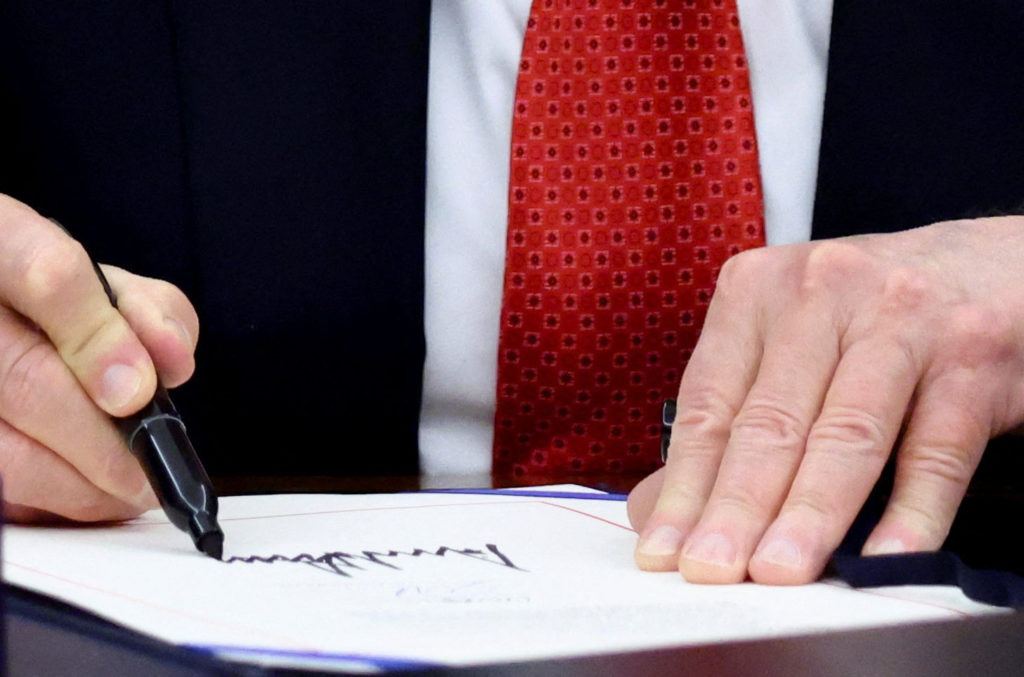
The Justice Department posted pardons online bearing identical copies of President Donald Trump’s signature before quietly correcting them this week after what the agency called a “technical error.”
I started my job in 2023 and became good friends with Ellie. We have similar roles, but different divisions, so rarely overlapped. We bonded over being unhappy in our roles and having a shared male “mentor,” who turned out to be quite the creep (he ended up leaving before we did). We both ultimately made plans to leave that job, she a little before me.
During our friendship, I did sometimes notice she could be a bit immature (framing everything in terms of “high-school cliques”) which I just sort of laughed off/ignored. I also got the sense she was pushing me to leave my job, less so because it was good for me, but because she wanted our office to “take the hit” of my departure (I’m not that important) and feel like she was “starting a movement” of getting people to leave. She hated our office much, much more than I ever did. I did leave, not because of her advice but because it was genuinely the right move for me.
At the end of my job, I met with one of our supervisors, Paula. Paula is maybe not the best mentor, but she’s been overall fine to me. Paula began almost right away asking if Ellie “influenced me to leave” and shared that Ellie was one of the “most toxic” people she’s ever met and was very difficult to work with. It was awkward; I explained Ellie helped me a lot with our similar roles, which I will always be grateful for, but I did recognize we had different approaches to issues/conflict.
I feel bad now, because I know I was disloyal to Ellie in that conversation. Selfishly, I want to leave on good terms with my office. Paula’s words have made me look back and see the immaturity that I had ignored differently. I recognize it says something about me that Ellie was the person I bonded with in the office, and that’s made me reflect that I do not like, nor want to be, that type of person.
How do I navigate my friendship with Ellie now — or how much weight do I give to Paula’s words? I can let the friendship naturally fade, but I feel guilty given how much I relied on Ellie initially.
Right now, we text frequently (once or twice a week) but we now live in different states. I would say we are still close, but even before my conversation with Paula, I noticed Ellie is still embroiled in the politics of our old job. For example, some of our most recent conversations were her bringing up things were said at the monthly meeting (no idea how she heard what was said there) and trying to recruit someone at our old job to her new place of work (which is legally not advisable, which I told her and she sort of begrudgingly acquiesced).
Secondly, do you have advice on the type of people/“green flags” to look for when making friends in the office?
This is actually much easier because you and Ellie are no longer working together!
The question for you is: do you like Ellie outside of work? If you enjoy the friendship that you have with her now, there’s no reason you need to let the relationship fade. Some people are terrible (or just not-great) coworkers but can still be good friends, and now that you don’t work together, you might find that the relationship is easier to navigate. If that’s the case, you don’t need to change it … although it would be smart to tell her you don’t want to talk about what’s happening at your old job because you’ve left and need more of a clean break.
But if you’re realizing that you don’t really like or respect Ellie, it’s okay to let the friendship fade! It’s actually very normal for work friendships to fade once you’re no longer colleagues; when you no longer have work in common, there often isn’t enough of a connection to keep the relationship going. (That’s not always the case! But it happens a lot.)
For what it’s worth, I don’t think you were particularly disloyal to Ellie when you talked with Paula. “We had different approaches to conflict” is actually quite diplomatic. It’s okay for you to want to differentiate yourself from Ellie, because those differences are real ones! If you had been engaging in a lot of toxic behavior with Ellie yourself, it would be hypocritical to act as if you had nothing to do with it (although still a smart thing to do from a professional standpoint), but it sounds like it’s true that your approach to conflict is different from hers. It’s okay to say that! Loyalty to work friends doesn’t mean you have to pretend not to see serious issues with how they operate at work or get tarnished by association with a label you don’t deserve.
As for green flags for potential friends at work, here are a few:
integrity — you don’t see them lying or looking for ways to game the system
respected by people you respect
when you’re new, they go out of their way to be warm and welcoming to you, while simultaneously preserving appropriate boundaries with someone they don’t yet know well (so for example, they don’t unload all their complaints about the company on you during your first week)
not mired in negativity (this doesn’t mean they don’t acknowledge real issues or ever do normal work venting, but they don’t get bogged down in complaining to the point it impacts your or their quality of life in significant ways; they don’t seem to take pleasure in criticizing others; and, where possible, they look for ways to make things better)
realistic — they know not every job will be ideal, and they have a decent understanding of office politics and what is and isn’t realistic to expect or ask for
supportive — they recognize and applaud your successes rather than resenting them
honest but kind — they’ll tell you when you’re wrong but in a way that doesn’t make you feel bad about it
an aversion to gossip — this doesn’t necessarily mean they never gossip, but it’s not a major focus and they have some discretion and sensitivity
they understand and respect your boundaries and that you’re there to work — which means everything from understanding when you can’t talk because you need to focus to not expecting you to fight their battles as your own
they don’t use you to push their own agenda (like Ellie wanting you to quit just so your office would “take the hit”)
FAYETTEVILLE, NC—Acknowledging that he was on a long and ongoing process of reintegration, former Army sniper Clint Meadows told reporters Monday that he was struggling to readjust to being near stuff. “When my superiors pushed me into training as a sniper, not a single one of them warned me how tough it would be to go back to being a civilian who was really close to things,” said the Iraq War veteran, adding that his marriage had become severely strained as he insisted on sleeping in a tree across the street from his home instead of in bed with his wife. “I can’t tell you how hard it is to have my son think I’m missing his soccer games when really I’m watching every goal through a scope from a window 500 meters away. My therapist is helping me slowly reintroduce proximity into my life, beginning with controlled exposure to furniture and then moving up to people, but I’m still at the point where I can only handle a folding chair at 30 yards. Every day is a battle; I just want to hug my wife without screaming. I tried standing next to a lamp the other night, but I had to get down on my stomach in a field just to stop the vertigo.” At press time, a binoculars-wielding Meadows reportedly nodded solemnly as he was awarded a Distinguished Service Cross for marksmanship at a ceremony held half a mile away.
While prices at the grocery store continue to rise, more Americans are turning to shelf-stable preservation methods to save money on food. The Onion shares tips for home canning.
Enter an economic recession.
Procure at least one can.
Slowly introduce bacteria to other parts of your diet first.
Start calling everyone Maw and Paw.
Ask the kids what they want to eat for 20 years of nuclear winter.
Grow several bushels of blueberries on your apartment balcony.
Decide whether you want to die from botulism or shigella.
Make sure to purée the meat lover’s pizza before canning.
The sudden departure of the BBC’s director general and head of news marks a moment of real consequence for British public service broadcasting.
Tim Davie and Deborah Turness’s resignations followed controversy over an inaccurately edited clip in a BBC Panorama documentary about Donald Trump. Opponents of the BBC seized on this as further evidence of widespread bias at the broadcaster. It has now become a flashpoint in the wider political and cultural battles surrounding the corporation.
The resignations come as the BBC enters a decisive period. The renewal of its royal charter in 2027 will define the corporation’s funding model and public purpose for the next decade. At the same time, the BBC faces a hostile political climate, sustained financial pressure, and a rapidly fragmenting audience.
Recent controversies — from the Panorama edit to earlier disputes over social media conduct and political coverage — have reignited debate about the broadcaster’s duty of “impartiality.” Yet in today’s febrile information climate, it is fair to ask whether that duty remains fit for purpose.
British Media regulator Ofcom defines impartiality as “not favoring one side over another”, but also as ensuring “due weight” is given to the evidence. That distinction matters: Impartiality is not the same as neutrality. It demands that news be fair, accurate, and proportionate — not that every claim be treated as equal.
Impartiality under pressure
The BBC’s crisis, as academic and commentator Adrian Monck observes, is not simply a matter of poor governance, but “the sinking of a ship of the 20th-century British state, dependent on conditions that no longer really exist.”
Impartiality as a professional norm took shape in the mid-20th century, when it became central to the BBC’s mission under its 1947 royal charter. It emerged in a period when there was still broad agreement on shared facts, and a civic space where citizens could reason together even when they disagreed.
This era has broken down over the past 20 to 25 years, with the rise of digital platforms and populist politics that eroded traditional journalistic gatekeeping. Today’s information environment is shaped by technology companies, populist leaders, political strategists, and partisan media outlets. All have strong incentives to create confusion and distrust. When political figures deny evidence, distort facts, or lie as strategy, reporting their claims as equal to verified facts is not neutrality or impartiality — it is distortion.
Yet the organization, like many news outlets worldwide, is caught in a bind, accused of bias from both the left and the right — and while in the past this might suggest a fair balance, in today’s climate it is often weaponized.
As the sociologist Niklas Luhmann has noted, the function of news is to create a shared reality, a minimal consensus about what exists and what matters. When that consensus collapses, the public sphere itself begins to fragment and journalism loses the ground on which democratic discourse depends.
Younger audiences, who are more likely to access news mediated through influencers they perceive as authentic and relatable, are less engaged with traditional news brands. A Reuters Institute for the Study of Journalism study found that young people are increasingly turning to personalities rather than established outlets, or avoid news altogether because they see it as untrustworthy or biased.
The broader global trend is unmistakable. Public service broadcasters in the U.S., Australia, Canada, and across Europe are facing declining audiences, reduced funding, politicized attacks and competition from platforms that prioritize outrage and identity performance. The BBC is not unique in this struggle, but because of its scale and cultural importance, the stakes are higher.
Public service media under siege
The BBC is imperfect. It suffers from institutional caution, uneven performance, and a reluctance at times to confront its own errors. Yet it remains one of the few media organizations in the world still committed to verification rather than performance.
Its public service mandate, however strained, is one of the last structural defenses against the current media culture: one dominated by outrage merchants and ideological broadcasters whose business model is provocation rather than truth.
Once a public sphere is shaped primarily by rumor and outrage, it becomes almost impossible to restore a shared sense of reality. The alternative is visible already in GB News, Fox News, and Breitbart, where conflict and grievance have displaced evidence.
The question now is not whether the BBC should continue to defend impartiality, but which version of impartiality it intends to defend. If impartiality means placing all claims side by side regardless of evidential grounding, it becomes a mechanism for laundering falsehood into public discourse. But if it means rigorous truth-telling, proportionate scrutiny, and transparency about what we know and how we know it, then it remains both viable and essential.
BBC chair Samir Shah has apologized for the Panorama edit, describing it as an “error of judgment.” But it has exposed how fragile impartiality has become as both a principle and a perception. In an environment where trust is brittle, even minor lapses are magnified into institutional political positions. Impartiality is now judged as much by perception as by practice.
The resignations at the top of the BBC make this moment all the more precarious. The next leadership will determine whether the BBC becomes a smaller, defensive organization that avoids offense, or a confident public service broadcaster that accepts that truth-telling will sometimes be mistaken for taking sides. Only the latter approach offers any chance of sustaining public relevance.
Tom Felle is an associate professor of journalism at the University of Galway. This article is republished from The Conversation under a Creative Commons license.
A record 40% of American women aged 15–44 say they would like to move abroad permanently, more than twice the share of men, due to a lack of faith in national institutions stemming from Donald Trump’s presidency and the overturning of Roe v. Wade. What do you think?
“I hear abroad is nice this time of year.”
Carrie Sharpe, Systems Analyst
“Fine. More discrimination for me.”
Gerard Osgood, Retired Jogger
“They’ll come running back when they see how much we’re spending on AI.”
NEW WESTMINSTER, B.C. – For the ninth year in a row, celebrations were held at TransLink headquarters after Metro Vancouver won the “Least Worst Public Transit” award from the International Association of Public Transport. “We take great pride in how just barely adequate public transportation is in the Metro Vancouver area,” said Kevin B. Quinn, […]
Everyone’s got their thing. For some, it’s baking. Others, gardening. Me? I like to take a modified Honda Accord, drive over 100 mph, and swerve between cars, almost killing entire families, babies, men, women, whoever.
That’s my thing. Gets my balls rolling. Sometimes I’ll almost kill a family by swerving in front of them at 125 mph with just barely enough room to squeeze in, and then I’ll immediately swerve all the way over to the right and get off at the exit. I could have just slowed down and changed lanes and calmly exited, not almost killing anyone, but then I wouldn’t have almost killed an innocent family, and almost killing them is what gives me something to do when I’m bored.
By the way, I’m not trying to actually kill one. That’s not my thing at all. If that’s what you’re getting from this, then I don’t know what you’re reading or how you thought that, but you’re totally off base.
My thing is that they’re thinking they might die, but really I’m just driving as fast as possible because I don’t fully understand the purpose of life. I have, like, a general sense? I know we’re supposed to have money and live somewhere, and we need to eat food, but after that, I don’t really get the rest of it.
But the one thing that really makes sense to me is coming out of nowhere in my jacked-up Honda Accord with purple lights, serving so fast in front of cars that people have mini heart attacks where they die, but it’s so fast they don’t actually have time to die, and when they come out of it, I’m already a mile away.
I’ve done this to, like, twelve families so far.
One thing I should make clear, though, is that I’m not a jerk. I don’t have to have my way. I’ll do this in a Kia Forte too. In fact, I have. My buddy has a Kia Forte, and he likes to almost kill families, too. So we’ll go out together, and sometimes we switch cars.
I don’t vote in elections. That feels relevant for some reason. I’m also not a good boyfriend. I try to be, but honestly? I don’t. She’s always saying things like “You care about your Honda Accord more than me.”
This court-ordered therapist I had to see once said I had trauma, and I was like… so? The therapist told me that I drive fast on the highway because I’m searching for an identity. File that one under “who gives a shit.” The therapist asked me how I feel when I swerve fast between cars, nearly killing people, and I said, “happy.”
It really is my happy place. My meditation. If I’m almost killing you in my modified Accord (or Toyota Corolla or Nissan Sentra), then I feel happy. You might be thinking, “Why doesn’t he just go to a race track if he wants to drive that fast?” Look. Put a few families with young kids on the track, let me swerve around them at 125 mph, and I’ll gladly drive on a track.
I can only imagine when I fly past a family, who is now catching their breath and feeling the fleeting nature of life, they think, “How did he get that Honda Accord to go so fast???” Well, I had a dream, and when you have a dream, you do what it takes. So I stopped paying child support or my rent, stole parts from other cars, and now I’m living the dream. My dream.
Oh, before I forget, I also like to go as fast as possible on an off ramp where it’s going from two lanes to one and I have a narrow opportunity to speed past the person in front of me to get in front of them before we both stop at the red light shortly thereafter, and almost make them crash into the side wall and go up in flames, myself included. Sometimes life gives you an opportunity to almost die in a heap of fire and wreckage, and I’ll take that opportunity. I’m willing to throw it all away and destroy someone else’s life in the process if I can get in front of them before the red light, even if we both have to burn to death.
Why? Can’t say. It just feels right. And it’s something to do.
WASHINGTON—In an effort to bring an end to what he described as an anti-American trend in filmmaking, President Donald Trump signed an executive order Monday imposing a 100% tax on the profits of movies that depict people escaping from slavery. “For too long, liberal Hollywood has pushed its false narratives of unhappy slaves desiring freedom,” said Trump, who criticized what he called the “violent extremism” of films in which enslaved people break free from their shackles, claiming such stories were “racist” against slave owners. “We want our slaves whistling, and we want them doing hard work with a spring in their step. No more with the America-hating uprisings, the emancipations. And we will be doing tax breaks for the good films—especially ones where a slave learns about love from their white master.” At press time, the president was reportedly in talks with members of Congress to provide federal subsidies for movies in which an escaped slave comes back.





– October 1, 2025 – Vice President JD Vance laughed off two racist AI-generated videos of House Minority Leader Hakeem Jeffries that Trump posted earlier in the week. “Oh, I think it’s funny,” he said. "The president’s joking, and we’re having a good time.” The videos portrayed Jeffries, who is Black, with a mustache and sombrero while mariachi music played in the background; the first video also falsely accused Democrats of trying to give free healthcare to undocumented immigrants. When asked to respond to Jeffries’s statement that the videos were racist and bigoted, Vance responded, “I don’t even know what that means.”
– October 1, 2025 – In retaliation for the government shutdown, the Trump administration canceled over $27 billion in funds for Democratic states. The denied funds included $8 billion in climate-related funding and $18 billion for two major transportation projects primarily in New York City. Voice of America broadcasts were also suspended, and its journalists were placed on furlough. Partisan language blaming “the Radical Left Democrat Shutdown” for slow responses was also inserted onto federal agency websites and into the out-of-office email replies of furloughed federal workers, a possible violation of both the First Amendment and the Hatch Act. “Unfortunately, Democrat Senators are blocking passage of H.R. 5371 in the Senate, which has led to a lapse in appropriations,” read one version of the message. Matthew Lawrence, a law professor at Emory University, said Trump’s response to the shutdown was unprecedented: “I can’t think of a historical parallel of an administration cutting funds in a shutdown like this,” added Don Kettl, an emeritus professor at the University of Maryland, “We have had lots of shutdowns … [but] never before have top officials tried to use their employees as human shields in a partisan battle.”
– October 2, 2025 – The New York Times reported that Health Secretary Robert F. Kennedy, Jr. fired Dr. Jeanne Marrazzo from the NIH three weeks after Marrazzo filed a whistle-blower complaint. In her whistle-blower complaint, Dr. Marrazzo, who had directed the National Institute of Allergy and Infectious Diseases, had claimed she was demoted after objecting to Trump administration actions that endangered research subjects, defied court orders, and undermined vaccine research. “The Trump administration terminated Dr. Marrazzo for her advocacy on behalf of critical health research and for her support of the overwhelming body of evidence that shows vaccines are safe and effective,” said Debra S. Katz, a lawyer for Dr. Marrazzo, who argued that her client’s removal was retaliatory. Three other NIH directors and one NIH deputy director—Diana Bianchi, Eliseo Pérez-Stable, Shannon Zenk, and Tara Schwetz—were first placed on administrative leave and then fired. Some of the fired directors claimed they were targeted because their institutions funded studies related to diversity, equity, and inclusion, as well as HIV.
– October 2, 2025 – Facing pressure from the Trump administration, Apple removed ICEBlock and similar apps that alert people about ICE sightings in their area. Apple told ICEBlock’s creator, Joshua Aaron, that the app violated app store guidelines and that its “purpose is to provide location information about law enforcement officers that can be used to harm such officers individually or as a group,” a claim Aaron called “patently false.” Aaron has said that the app, which had over 1 million users, was instead intended to help people avoid contact with ICE. “Our mission has always been to protect our neighbors from the terror this administration continues to (rain) down on the people of this nation,” said Aaron. “ICEBlock is no different from crowdsourcing speed traps, which every notable mapping application, including Apple’s own Maps app, implements as part of its core services. This is protected speech under the First Amendment.”
– October 2, 2025 – The Trump administration sent letters to nine universities asking them to pledge support for Trump’s political agenda in exchange for access to federal research funds. A “compact” attached to the letters outlined the administration’s education policy goals, including freezing tuition, providing free tuition to students studying “hard sciences” at select schools, capping international student enrollment, committing to binary definitions of gender, and prohibiting pushback against conservative ideas on campus. “This is a power play, and it’s designed to divide the higher education community," said Ted Mitchell, president of the American Council on Education. “I hope institutions do not sign this compact. I do not think it’s in their best interests individually, and collectively, it’s a horrible precedent to cede power to the federal government.”
– October 2, 2025 – Todd Arrington, the head of the Dwight D. Eisenhower Presidential Library, resigned following a fight with the Trump administration over a sword. State Department officials wanted to gift King Charles III an original Eisenhower sword from the library, but Arrington pushed back, arguing that the sword had been donated and was the property of the American people. He offered to find an alternative gift or a replica, but was eventually told to “resign or be fired.” “Apparently, they believed I could no longer be trusted with confidential information,” said Arrington, who previously worked for the National Park Service and National Archives and Records Administration.
– October 6, 2025 – According to a report from consumer advocacy and ethics nonprofit Public Citizen and corporate watchdog group The Revolving Door Project, the Trump administration placed 111 employees deemed “fossil fuel insiders and renewable energy opponents” in his administration. Among them are senior officials such as Energy Secretary Chris Wright, the former CEO of the fracking company Liberty Energy. Report author and Revolving Door Project senior researcher Toni Aguilar Rosenthal said, “It is often specific actors coming from specific moneyed interests that are carrying out this disastrous deregulatory agenda.” Interior Department spokesperson Aubrie Spadie said of the report: “it’s clear that this progressive group pushing an entire climate cult program, among other radical policies, would like to see American taxpayer dollars wasted on the Green New Scam.” Fossil fuel donors poured $96 million into Trump’s 2025 presidential campaign and contributed $11.8 million to Trump’s second inauguration.