23 Apr 09:58
Chem. Soc. Rev., 2021, Advance Article
DOI: 10.1039/D1CS00200G, Tutorial Review
Haiwen Xiao, Zhenzhen Zhang, Yewen Fang, Lin Zhu, Chaozhong Li
Radical trifluoromethylation has been emerging as a versatile tool for the synthesis of trifluoromethylated compounds that play increasingly important roles in pharmaceuticals, agrochemicals and materials science.
To cite this article before page numbers are assigned, use the DOI form of citation above.
The content of this RSS Feed (c) The Royal Society of Chemistry

23 Apr 06:50
by Banono, N. S.
22 Apr 16:29
Green Chem., 2021, Accepted Manuscript
DOI: 10.1039/D1GC01157J, Communication
Yuqi Miao, Jiaxin Kang, Yan-Na Ma, Xuenian Chen
Herein, a mild photocatalytic deoxygenative amidation protocol using readily available amine borane and carboxylic acids was uncovered. This approach features mild conditions, moderate to good yields, easy scale-up, and up...
The content of this RSS Feed (c) The Royal Society of Chemistry

22 Apr 10:29
Org. Chem. Front., 2021, Accepted Manuscript
DOI: 10.1039/D1QO00183C, Research Article
Jitan Zhang, Qiaoqiao Xu, Jian Fan, Lan Zhou, Nannan Liu, Li Zhu, Jiaping Wu, Meihua Xie
Herein, we present the first Pd(II)-catalyzed atroposelective dual C-H annulative strategy for the assembly of axially chiral aldehyde frameworks using commercially available amino acid as the transient auxiliary and chiral...
The content of this RSS Feed (c) The Royal Society of Chemistry
22 Apr 06:08
by Annelies Stevaert, Besir Krasniqi, Benjamin Van Loy, Tien Nguyen, Joice Thomas, Julie Vandeput, Dirk Jochmans, Volker Thiel, Ronald Dijkman, Wim Dehaen, Arnout Voet, and Lieve Naesens

Journal of Medicinal Chemistry
DOI: 10.1021/acs.jmedchem.0c02124

22 Apr 06:05
by Baihui Zheng, Xiaotong Li, Yang Song, Shuyang Meng, Yifei Li, Qun Liu, and Ling Pan

Organic Letters
DOI: 10.1021/acs.orglett.1c00915

21 Apr 06:16
by Milena L. Czyz, Mitchell S. Taylor, Tyra H. Horngren, and Anastasios Polyzos

ACS Catalysis
DOI: 10.1021/acscatal.1c01000

20 Apr 14:28
by Dat Phuc Tran, Yuki Sato, Yuki Yamamoto, Shin-ichi Kawaguchi, Shintaro Kodama, Akihiro Nomoto and Akiya Ogawa
Abstract
The homolytic cleavage of the PV(O)–PIII bond in tetraphenyldiphosphine monoxide simultaneously provides both pentavalent and trivalent phosphorus-centered radicals with different reactivities. The method using V-40 as an initiator is successfully investigated for the regio- and stereoselective phosphinylphosphination of terminal alkynes giving the corresponding trans-isomers of 1-diphenylphosphinyl-2-diphenylthiophosphinyl-1-alkenes in good yields. The protocol can be applied to a wide variety of terminal alkynes including both alkyl- and arylalkynes.
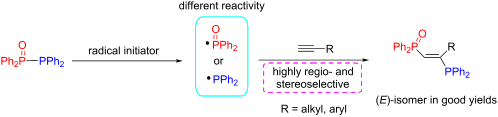
Beilstein J. Org. Chem. 2021, 17, 866–872. doi:10.3762/bjoc.17.72
20 Apr 14:24
Isodesmic C–H
functionalization reactions are extremely rare. Herein
we report the first Pd(II)-catalyzed isodesmic C–H iodination of arenes using
2-nitrophenyl iodides as the mild iodinating reagents. Unusual C–I reductive
elimination occurred in preference to
competing C–C coupling in this reaction. Assisted by aliphatic carboxyl
directing groups, a range of hydrocinnamic acids and related arenes could be
selectively iodinated at either meta- or ortho-positions of the
phenyl ring. Remote diastereoselective C–H activation was also promising. This
method may open up a new way to iodinate challenging substrates.
20 Apr 14:24
Org. Biomol. Chem., 2021, Advance Article
DOI: 10.1039/D1OB00392E, Paper
Andreas Krause, Eric Sperlich, Bernd Schmidt
Itaconic acid esters and hemiesters undergo Pd-catalyzed coupling reactions with arene diazonium salts in high to excellent yields.
To cite this article before page numbers are assigned, use the DOI form of citation above.
The content of this RSS Feed (c) The Royal Society of Chemistry

20 Apr 14:22
Chem. Commun., 2021, Advance Article
DOI: 10.1039/D1CC01179K, Communication
J. R. Alexander, P. V. Kevorkian, J. J. Topczewski
The treatment of propargylic azides with silver(I) fluoride in acetonitrile was found to yield α-fluorinated NH-1,2,3-triazoles via the Banert cascade.
To cite this article before page numbers are assigned, use the DOI form of citation above.
The content of this RSS Feed (c) The Royal Society of Chemistry

20 Apr 09:38
by Shaw, Jessica L.
Synthesis
DOI: 10.1055/a-1472-7578

A new synthetic methodology has been developed for the synthesis of sulfinate alkyl and aryl esters. The methodology involves the combination of p-toluenesulfinic acid and 1,1′-carbonyldiimidazole (CDI) to create the putative reagent sulfinylimidazole. The process spontaneously releases carbon dioxide upon the addition of the CDI to the acid suggesting the rapid formation of the proposed reagent. Reaction of this reagent with a series of alcohols (primary, secondary, and tertiary) afforded the corresponding sulfinate alkyl esters in good to excellent yields by the addition of alcohols. It was also possible to form the related sulfinate aryl esters by treating the proposed sulfinylimidazole with selected phenols (phenol, p-tert-butylphenol, and thymol). The aryl esters were formed in excellent conversion based on analysis of the 500 MHz 1H NMR spectra of the crude reaction mixtures.
[...]
Georg Thieme Verlag KG Rüdigerstraße 14, 70469 Stuttgart, Germany
Article in Thieme eJournals:
Table of contents | Abstract | Full text
20 Apr 06:51
Green Chem., 2021, Accepted Manuscript
DOI: 10.1039/D1GC00736J, Communication
V. kishore Kumar Pampana, Vaibhav Pramod Charpe, Arunachalam Sagadevan, Deb Kumar Das, Chun-Cheng Lin, Jih Ru Hwu, Kuo Chu Hwang
We report the first literature example using visible light-induced trimethylsilyl azide (TMSN3)-assisted copper-catalyzed oxy-sulfonylation of terminal C≡C bond to form β-keto sulfones (C-S bond formation). TMS-N3 promotes the reaction by...
The content of this RSS Feed (c) The Royal Society of Chemistry

20 Apr 06:46
by Igor Reva, A. J. Lopes Jesus, Cláudio M. Nunes, José P. L. Roque, and Rui Fausto

The Journal of Organic Chemistry
DOI: 10.1021/acs.joc.0c02970

20 Apr 06:46
by Benjamin G. Davis(The Rosalind Franklin Institute and Department of Chemistry, University of Oxford)
ACS Central Science
DOI: 10.1021/acscentsci.1c00377
19 Apr 12:19
by McCartney, M.
19 Apr 08:58
Green Chem., 2021, Accepted Manuscript
DOI: 10.1039/D1GC00374G, Communication
Zeqin Yuan, Simin Wang, Miaomiao Li, Tian Chen, Jiaye Fan, Fuying Xiong, Qianggen Li, Ping Hu, Bi-Qin Wang, Peng Cao, Yang Li
An air and water insensitive visible light induced hydrophosphinylation of unactivated alkenes is reported. A small amount of simple and cheap compound, salicylaldehyde, is used as photo sensitizer. The reaction...
The content of this RSS Feed (c) The Royal Society of Chemistry

19 Apr 08:55
by Hiroki Matsumoto, Tetsuo Okujima, Shigeki Mori, Ana C. C. Bacilla, Masayoshi Takase, Hidemitsu Uno, and Nagao Kobayashi

Organic Letters
DOI: 10.1021/acs.orglett.1c00899

19 Apr 08:53
by Jian Luo,
Guo‐Shu Chen,
Shu‐Jie Chen,
Zhao‐Dong Li,
Yun‐Lin Liu

The development of catalytic enantioselective isocyanide‐based reactions leading to products, which are valuable in organic synthesis, pharmacological chemistry, and materials science is currently of great interest. Recent achievements in this rapidly growing area according to the reaction types, with special attention being paid to the advantages, limitations, possible mechanisms, and synthetic applications of each reaction is given in the Review by Y.‐L. Liu et al. on page 6598.
19 Apr 08:52
by Lukas Bauer, Maximilian Benz, Thomas M. Klapötke, Tobias Lenz, and Jörg Stierstorfer

The Journal of Organic Chemistry
DOI: 10.1021/acs.joc.1c00216

16 Apr 16:03
Org. Biomol. Chem., 2021, Accepted Manuscript
DOI: 10.1039/D1OB00393C, Paper
Liangliang Luo, Xiao-Pan Chen, Zhao-Feng Li, Yuan Zhou, You-Cai Xiao, Fener Chen
Palladium-catalyzed aerobic oxidative cyclizations of substituted 2-(1H-pyrrol-1-yl)phenols with isocyanides via O-H/C-H insertion cascade have been developed. This strategy provides a facile access to pyrrolo[2,1-c][1,4]benzoxazine derivatives in good to excellent yields...
The content of this RSS Feed (c) The Royal Society of Chemistry

16 Apr 16:02
Green Chem., 2021, Advance Article
DOI: 10.1039/D0GC04273K, Paper

Open Access
Tijana Todorovic, Emelie Norström, Farideh Khabbaz, Jörg Brücher, Eva Malmström, Linda Fogelström
The current study demonstrates how hemicelluloses in sidestreams from the pulp industry can be valorised to substitute fossil-based materials in wood-adhesive applications in the quest for a more sustainable society.
To cite this article before page numbers are assigned, use the DOI form of citation above.
The content of this RSS Feed (c) The Royal Society of Chemistry

16 Apr 15:59
by Xiaolin Shi,
Zemin Wang,
Yuxiu Li,
Xiaowei Li,
Xiangqian Li,
Shi Dayong

A palladium-catalyzed remote phosphonylation for the indole C4- and C6-positions was achieved by a radical approach. The preliminary mechanistic studies indicated that the reactions may proceed via a C7-palladacycle/remote-activation process.
Abstract
Palladium-catalyzed direct C−H activation of indole benzenoid moiety has been achieved in the past decade. However, palladium-catalyzed remote C−H activation of indoles is rare. Herein, we report a challenging palladium-catalyzed remote C4-H phosphonylation of indoles by a radical approach. The method provides access to a series of C4-phosphonylated indoles, including tryptophan and tryptophan-containing dipeptides, which are typically inaccessible by direct C4-H activation due to its heavy reliance on C3 directing groups. Notably, unexpected C6-phosphonylated indoles were obtained through blocking of the C4 position. The preliminary mechanistic studies indicated that the reactions may proceed via a C7-palladacycle/remote-activation process. Based on the strategy, examples of remote C4-H difluoromethylation with BrCF2COOEt are also presented, suggesting that the strategy may offer a general blueprint for other cross-couplings.
16 Apr 15:57
by Robin F. Weitkamp,
Beate Neumann,
Hans‐Georg Stammler,
Berthold Hoge

Non‐coordinated phenolate anions: By deprotonation of phenol with the strong tetraphosphazene Schwesinger base a salt of the so far unknown free phenolate anion was formed. In contrast to that, the deprotonation with a less basic monophosphazene base leads to a phenol–phenolate salt with an additional hydrogen bond to the phosphazenium cation. Applying electron‐rich phenolate salts we further present the two‐electron reduction of SF6 leading to [SF5]− and F− salts.
Abstract
The reaction of the strong monophosphazene base with the weakly acidic phenol leads to the formation of a phenol–phenolate anion with a moderately strong hydrogen bond. Application of the more powerful tetraphosphazene base (Schwesinger base) renders the isolation of the corresponding salt with a free phenolate anion possible. This compound represents the first species featuring the free phenolate anion [H5C6‐O]−. The deprotonation of phenol derivatives with tetraphosphazene bases represents a great way for the clean preparation of salts featuring free phenolate anions and in addition allows the selective syntheses of hydrogen bonded phenol‐phenolate salts. This work presents a phosphazenium phenolate salt with a redox potential of −0.72 V and its capability for the selective activation of the chemically inert greenhouse gas SF6. The performed two‐electron reduction of SF6 leads to phosphazenium pentafluorosulfanide ([SF5]−) and fluoride salts.
16 Apr 15:57
by Thaddäus Thorwart,
Daniel Roth,
Lutz Greb

The extremely electron-deficient tetratrifluorocatechol is synthesized and installed at silicon, providing a Lewis superacid that ranks among the strongest fluoride ion acceptors accessible in the condensed phase. The compound enables silicon-catalyzed deoxygenation of ketones, aldehydes, amides and phosphine oxides and the first silicon catalyzed carbonyl-olefin metathesis.
Abstract
Given its earth abundance, silicon is ideal for constructing Lewis acids of use in catalysis or materials science. Neutral silanes were limited to moderate Lewis acidity, until halogenated catecholato ligands provoked a significant boost. However, catalytic applications of bis(perhalocatecholato)silanes were suffering from very poor solubility and unknown deactivation pathways. In this work, the novel per(trifluoromethyl)catechol, H2catCF3, and adducts of its silicon complex Si(catCF3)2 (1) are described. According to the computed fluoride ion affinity, 1 ranks among the strongest neutral Lewis acids currently accessible in the condensed phase. The improved robustness and affinity of 1 enable deoxygenations of aldehydes, ketones, amides, or phosphine oxides, and a carbonyl-olefin metathesis. All those transformations have never been catalyzed by a neutral silane. Attempts to obtain donor-free 1 attest to the extreme Lewis acidity by stabilizing adducts with even the weakest donors, such as benzophenone or hexaethyl disiloxane.
16 Apr 15:54
by Yuxiu Li, Xiangqian Li, Xiaowei Li, and Dayong Shi

The Journal of Organic Chemistry
DOI: 10.1021/acs.joc.1c00490

16 Apr 15:54
by Xiaojie Zhang and Christopher M. Beaudry

The Journal of Organic Chemistry
DOI: 10.1021/acs.joc.1c00341

16 Apr 15:52
by Marshall, C. R., Latorre, D. V., Wilson, C. J., Frank, T. M., Magoulick, K. M., Zimmt, J. B., Poust, A. W.
Although much can be deduced from fossils alone, estimating abundance and preservation rates of extinct species requires data from living species. Here, we use the relationship between population density and body mass among living species combined with our substantial knowledge of Tyrannosaurus rex to calculate population variables and preservation rates for postjuvenile T. rex. We estimate that its abundance at any one time was ~20,000 individuals, that it persisted for ~127,000 generations, and that the total number of T. rex that ever lived was ~2.5 billion individuals, with a fossil recovery rate of 1 per ~80 million individuals or 1 per 16,000 individuals where its fossils are most abundant. The uncertainties in these values span more than two orders of magnitude, largely because of the variance in the density–body mass relationship rather than variance in the paleobiological input variables.
16 Apr 15:50
by Lei Pan, Joseph Elmasry, Tomas Osccorima, Maria Victoria Cooke, and Sébastien Laulhé

Organic Letters
DOI: 10.1021/acs.orglett.1c00831

16 Apr 15:49
by Shaozhen Nie, Alexander Lu, Erin L. Kuker, and Vy M. Dong

Journal of the American Chemical Society
DOI: 10.1021/jacs.1c00939


