
Organic Letters
DOI: 10.1021/acs.orglett.1c01553


Nature Reviews Chemistry, Published online: 23 June 2021; doi:10.1038/s41570-021-00308-y
Recent findings on the skeletal rearrangement of polycyclic aromatics under oxidative and acidic conditions are envisioned to help development of these Scholl reactions into a more useful and versatile method for synthesizing polycyclic aromatics on the basis of rational design rather than luck.Nature Reviews Chemistry, Published online: 22 June 2021; doi:10.1038/s41570-021-00288-z
State-of-the-art synthetic methods regularly encounter challenges associated with cost, safety and/or efficiency when proposed for large-scale applications. This Review highlights recent applications of novel reactions/technologies (e.g. photoredox, electrochemistry, C–H activation, reductive coupling and flow chemistry) on the process scale.
Nature Communications, Published online: 21 June 2021; doi:10.1038/s41467-021-24032-9
Allylic amines are versatile building blocks in organic synthesis and exist in bioactive compounds, but efficient catalytic systems for hydroaminoalkylation of alkynes are needed. Here, the authors report a late transition metal‐catalyzed hydroaminoalkylation of alkynes with N‐sulfonyl amines, providing a series of allylic amines in up to 94% yield.Nature Reviews Chemistry, Published online: 21 June 2021; doi:10.1038/s41570-021-00307-z
A disilagermirene is a cyclopropene analogue with an unsaturated Si=Ge moiety. Such rings can be generated and stabilized in the presence of Ni, which the Si=Ge group binds through its σ-bond rather than π-bond.

Synthesis
DOI: 10.1055/a-1511-0382

P(O)–H compounds like H-phosphites, H-phosphinates, and H-phosphine oxides are widely used as nucleophiles. Herein, their reactions with unsaturated compounds, C–H activation, the Hirao reaction, P–C, P–S, P–O, P–N, and P–F couplings are thoroughly discussed and summarized. This review will focus on their reactions with alkenes, alkynes, enamides, propynoic acids, epoxide, arynes, arenes, quinones, isothiocyanates, diazo compounds, aldehydes, ketones, imines, pyridines, acid derivatives, carbocations, aryl halides, dibromoalkenes, disulfides, thiosulfates, sulfonyl chlorides, iodonium salts, amines, alcohols, and thiols.1 Introduction2 Addition to Alkenes/Alkynes3 Addition to Other Unsaturated Compounds4 Coupling with Carbocations5 Phosphorylation of Aryl C–H Bonds6 Hirao Reaction7 P–S, P–O, P–N, or P–F Coupling8 Conclusions
[...]
Georg Thieme Verlag KG Rüdigerstraße 14, 70469 Stuttgart, Germany
Article in Thieme eJournals:
Table of contents | Abstract | Full text


Abstract
1,5-Disubstituted indole-2-carboxaldehyde derivatives 1a–h and glycine alkyl esters 2a–c are shown to undergo a novel cascade imination-heterocylization in the presence of the organic base DIPEA to provide 1-indolyl-3,5,8-substituted γ-carbolines 3aa–ea in good yields. The γ-carbolines are fluorescent and exhibit anticancer activities against cervical, lung, breast, skin, and kidney cancer cells.
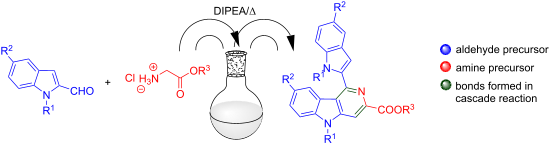
Beilstein J. Org. Chem. 2021, 17, 1453–1463. doi:10.3762/bjoc.17.101

Flow Chemistry The generation of sodium metal free, hexane-soluble (2-ethylhexyl)sodium using a sodium-packed-bed reactor in a continuous flow set-up is reported by Paul Knochel et al. in their Communication on page 14296.

The production of synthetically valuable ArCF2X and ArCX3 compounds from ArCF3 using catalytic iron(III)halides is described, which constitutes the first iron-catalyzed halogen exchange of non-aromatic C−F bonds. Theoretical calculations suggest direct activation of C−F bonds by iron coordination. To optimize for mono-exchange, a statistical analysis called Design of Experiments was used. Optimized parameters were successfully applied to both electron-rich and electron-deficient aromatic substrates, and to the late-stage diversification of flufenoxuron, a commercial insecticide.
The facile production of ArCF2X and ArCX3 from ArCF3 using catalytic iron(III)halides is reported, which constitutes the first iron-catalyzed halogen exchange for non-aromatic C−F bonds. Theoretical calculations suggest direct activation of C−F bonds by iron coordination. ArCX3 and ArCF2X products of the reaction are synthetically valuable due to their diversification potential. In particular, chloro- and bromodifluoromethyl arenes (ArCF2Cl, ArCF2Br respectively) provide access to a myriad of difluoromethyl arene derivatives (ArCF2R). To optimize for mono-halogen exchange, a statistical method called Design of Experiments was used. Optimized parameters were successfully applied to electron rich and electron deficient aromatic substrates, and to the late stage diversification of flufenoxuron, a commercial insecticide. These methods are highly practical, being run at convenient temperatures and using inexpensive common reagents.
 Open Access
   This article is licensed under a Creative Commons Attribution-NonCommercial 3.0 Unported Licence.

Tailored cationic RuII complexes are highly effective precatalysts for ruthenium-catalyzed azide–thioalkyne cycloaddition (see scheme). These reactions can now be carried out under very dilute conditions and in complex biorelevant media; they are also compatible with and mutually orthogonal to CuAAC. Moreover, ruthenium–arene sandwich complexes function as photoactivatable precatalysts, providing for temporal control of the reactivity.
Tailored ruthenium sandwich complexes bearing photoresponsive arene ligands can efficiently promote azide–thioalkyne cycloaddition (RuAtAC) when irradiated with UV light. The reactions can be performed in a bioorthogonal manner in aqueous mixtures containing biological components. The strategy can also be applied for the selective modification of biopolymers, such as DNA or peptides. Importantly, this ruthenium-based technology and the standard copper-catalyzed azide–alkyne cycloaddition (CuAAC) proved to be compatible and mutually orthogonal.

Synthesis
DOI: 10.1055/s-0037-1610775

The copper/di-tert-butyl peroxide-catalyzed regioselective hydroxyphosphorylation of 1,3-enynes is described. The advantages of the reported radical reactions are excellent functional group tolerance, the use of a catalytic amount of copper and di-tert-butyl peroxide (
t
BuOO
t
Bu) as a radical initiator, and mild reaction conditions. The desired products are obtained in moderate to excellent yields after purification.
[...]
Georg Thieme Verlag KG Rüdigerstraße 14, 70469 Stuttgart, Germany
Article in Thieme eJournals:
Table of contents | Abstract | Full text


