03 Sep 09:42
Dalton Trans., 2021, 50,13407-13411
DOI: 10.1039/D1DT02508B, Paper

Open Access
Elizabeth C. Trodden, Matthew P. Delve, Christian Luz, Robert J. Newland, John M. Andresen, Stephen M. Mansell
The first ruthenium dihydride stabilised with phosphinine ligands is described. Formed in situ, it was shown to catalyse the acceptorless dehydrogenation (AD) of benzyl alcohol to benzyl benzoate.
The content of this RSS Feed (c) The Royal Society of Chemistry

03 Sep 05:59
by Smriti Mallapaty
Nature, Published online: 02 September 2021; doi:10.1038/d41586-021-02385-x
The ZyCoV-D vaccine heralds a wave of DNA vaccines for various diseases that are undergoing clinical trials around the world.

02 Sep 15:54
by Jiahao Li,
Hongqiang Liu,
Haiyan Zhu,
Wei Yao,
Dawei Wang

A POP-star: A novel porous organic polymer supported iridium catalysts (POP-MBTS-Ir) revealed high catalytic activity for ten different kinds of borrowing hydrogen and dehydrogenation reactions in water with good recovery performance. Furthermore, several control reactions and preliminary mechanism explorations were carried out to better understand this POP-MBTS-Ir and the synthesis of triazine derivatives.
Abstract
Benzothiazole-doped porous organic polymers (POP-MBTS) were synthesized from a copolymerization reaction of 2-(6-(4-vinylphenyl)pyridin-2-yl)benzo[d]thiazole with divinylbenzene. The corresponding POP-MBTS-Ir was obtained and fully characterized using SEM, TEM, EDS, TGA, XPS, and N2 sorption isotherms, which disclosed that this catalyst has a high surface area, hierarchical porosity, and thermodynamic stability. Importantly, this catalyst revealed a high catalytic activity for ten different kinds of borrowing hydrogen and dehydrogenation reactions in water with a good recovery performance. Furthermore, mechanistic investigations were conducted for the synthesis of triazine derivatives.
02 Sep 10:16
by Zhiqi Zhang
Nature Communications, Published online: 02 September 2021; doi:10.1038/s41467-021-25562-y
It is still challenging to engineer single-atom catalysts for electrocatalytic methanol oxidation. Here, the authors design Pt single atom supported on RuO2 for highly active methanol oxidation in contrast to the inert Pt single atom supported on carbon.

02 Sep 10:15
by Chih-Yu Wu,
Sivan Perumal Murugan,
Yu-Wei Wang,
Hao-Wei Pan,
Bing-Jian Sun,
Yu-Ting Lin,
Siti Fatimah,
Agnes H. H. Chang,
Chinpiao Chen,
Gene-Hsian Lee

Abstract
This study has developed a method to prepare diastereo- and regio-selective indoline-fused 2,5-diketopiperazine scaffolds. The synthetic process involved an Ugi four-component reaction in which readily available starting materials were used and a metal-free intramolecular post-Ugi tandem consecutive 5-exo-trig/6-exo-dig cyclization under basic conditions. The plausible mechanism and substrate structures were elucidated by single-crystal X-ray diffraction analysis and supported by density functional theory calculations.
02 Sep 06:23
by Maksym V. Stambirskyi, Tetiana Kostiuk, Serhii I. Sirobaba, Alexander Rudnichenko, Dmytro L. Titikaiev, Yurii V. Dmytriv, Halyna Kuznietsova, Iryna Pishel, Petro Borysko, and Pavel K. Mykhailiuk

The Journal of Organic Chemistry
DOI: 10.1021/acs.joc.1c01413

02 Sep 06:11
by Matthias Westerhausen,
Philipp Schüler,
Helmar Görls,
Sven Krieck

Cyclopentadienylmagnesium bromides are accessible with high yields by a fast and smooth one-pot synthesis. In hydrocarbons and in ethereal solvents a dissociative Schlenk equilibrium is operative interconverting heteroleptic compounds into homoleptic congeners.
Abstract
In the in situ Grignard metalation method (iGMM), the addition of bromoethane to a suspension of magnesium turnings and cyclopentadienes [C5H6 (HCp), C5H5-Si(iPr)3 (HCpTIPS)] in diethyl ether smoothly yields heteroleptic [(Et2O)Mg(CpR)(μ-Br)]2 (CpR=Cp (1), CpTIPS (2)). The Schlenk equilibrium of 2 in toluene leads to ligand exchange and formation of homoleptic [Mg(CpR)2] (3) and [(Et2O)MgBr(μ-Br)]2 (4). Interfering solvation and aggregation as well as ligand redistribution equilibria hamper a quantitative elucidation of thermodynamic data for the Schlenk equilibrium of 2 in toluene. In ethereal solvents, mononuclear species [(Et2O)2Mg(CpTIPS)Br] (2’), [(Et2O)nMg(CpTIPS)2] (3’), and [(Et2O)2MgBr2] (4’) coexist. Larger coordination numbers can be realized with cyclic ethers like tetrahydropyran allowing crystallization of [(thp)4MgBr2] (5). The interpretation of the temperature-dependency of the Schlenk equilibrium constant in diethyl ether gives a reaction enthalpy ΔH and reaction entropy ΔS of −11.5 kJ mol−1 and 60 J mol−1, respectively.
02 Sep 06:10
by Karunanidhi Murali,
Luana A. Machado,
Renato L. Carvalho,
Leandro F. Pedrosa,
Rishav Mukherjee,
Eufrânio N. Da Silva Júnior,
Debabrata Maiti

Directing groups play an important role in synthetic chemistry, especially with regard to C−H bond activation. Synthetic routes for the successful synthesis and incorporation of directing groups which are frequently used in different C−H activation methodologies together with a discussion of advantages and disadvantages of different types of directing groups are provided in the Review article by E. N. Da Silva Júnior, D. Maiti et al on page 12453 ff.
02 Sep 05:53
by Surendar Karwasara, Leonard R. Maurer, Benjamin Peerless, Gregor Schnakenburg, Ujjal Das, and Alexander C. Filippou

Journal of the American Chemical Society
DOI: 10.1021/jacs.1c06628

01 Sep 06:43
by Lusina Mantry, Rajaram Maayuri, Vikash Kumar and Parthasarathy Gandeepan
Abstract
Catalytic C‒H functionalization has become a powerful strategy in organic synthesis due to the improved atom-, step- and resource economy in comparison with cross-coupling or classical organic functional group transformations. Despite the significant advances in the metal-catalyzed C‒H activations, recent developments in the field of metallaphotoredox catalysis enabled C‒H functionalizations with unique reaction pathways under mild reaction conditions. Given the relative earth-abundance and cost-effective nature, nickel catalysts for photoredox C‒H functionalization have received significant attention. In this review, we highlight the developments in the field of photoredox nickel-catalyzed C‒H functionalization reactions with a range of applications until summer 2021.
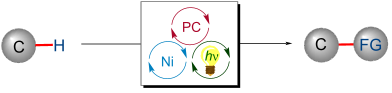
Beilstein J. Org. Chem. 2021, 17, 2209–2259. doi:10.3762/bjoc.17.143
01 Sep 05:46
by Kevser Harmandar
Journal of Porphyrins and Phthalocyanines,
Volume 26, Issue 01, Page 78-83, January 2022.
In this study, a novel asymmetrically meso-substituted AB3 porphyrins derivative including one triazole group to enhance the anticancer activity of the molecule and three bromophenyl groups to improve photochemical properties has been synthesized and characterized. Our objectives were to generate a system with triazole and bromophenyl groups that enhance the singlet oxygen generation and exhibits an anti-cancer effect. Therefore, photophysical and photochemical properties of this asymmetric porphyrin derivative (AB[math] and the symmetric derivative (B[math] were investigated in THF. The substituent effect on fluorescence quantum yield and singlet oxygen generation was evaluated for efficiency in photodynamic therapy (PDT) as a photosensitizer. The molecules exhibited no aggregation tendency, solubility in common organic solvents and high singlet oxygen quantum yield in THF therefore these favorable properties make them good candidates as a photosensitizer for PDT.
01 Sep 05:45
by Jing Shi, Xue-Wang Gao, Qing-Xiao Tong, and Jian-Ji Zhong

The Journal of Organic Chemistry
DOI: 10.1021/acs.joc.1c01610

31 Aug 11:04
by Almaz A. Zagidullin
Molecules, Vol. 26, Pages 5283: Nickel Complexes in C‒P Bond Formation
Molecules doi: 10.3390/molecules26175283
Authors:
Almaz A. Zagidullin
Il’yas F. Sakhapov
Vasili A. Miluykov
Dmitry G. Yakhvarov
This review is a comprehensive account of reactions with the participation of nickel complexes that result in the formation of carbon–phosphorus (C‒P) bonds. The catalytic and non-catalytic reactions with the participation of nickel complexes as the catalysts and the reagents are described. The various classes of starting compounds and the products formed are discussed individually. The several putative mechanisms of the nickel catalysed reactions are also included, thereby providing insights into both the synthetic and the mechanistic aspects of this phosphorus chemistry.
31 Aug 05:51
by Laura Buglioni, Marko Beslać, and Timothy Noël

The Journal of Organic Chemistry
DOI: 10.1021/acs.joc.1c01409

31 Aug 05:47
by Yvonne Grell, Xiulan Xie, Sergei I. Ivlev, and Eric Meggers

ACS Catalysis
DOI: 10.1021/acscatal.1c02901

31 Aug 05:46
by Andressa Neves Marchesan, Jean Felipe Leal Silva, Rubens Maciel Filho, and Maria Regina Wolf Maciel

ACS Sustainable Chemistry & Engineering
DOI: 10.1021/acssuschemeng.1c03447
30 Aug 06:21
by Tanaka, Ryoko
Synthesis
DOI: 10.1055/s-0040-1720865

The atropisomeric and conformational properties of 1,4-benzodiazepin-2-ones were investigated by freezing the conformation with a methyl group at the C9 of 1,4-benzodiazepine. It was revealed that 1,4-benzodiazepin-2-ones exist only as a pair of enantiomers [(a1
R, a2
S) and (a1
S, a2
R)], which was confirmed by X-ray analysis. The absolute configuration of each atropisomer was deduced by comparing the [α]D and CD data with those of (–)-N-methoxycarbonylmethylated 9-methyl-5-phenyl-1,4-benzodiaepin-2-one derivative. It was elucidated that the corresponding N-methylated derivative showed similar CD spectra, although the rotational direction of [α]D was opposite to that of others.
[...]
Georg Thieme Verlag KG Rüdigerstraße 14, 70469 Stuttgart, Germany
Article in Thieme eJournals:
Table of contents | Abstract | Full text
30 Aug 06:12
by Tomáš Neveselý, Max Wienhold, John J. Molloy, and Ryan Gilmour

Chemical Reviews
DOI: 10.1021/acs.chemrev.1c00324

27 Aug 05:57
by Yeston, J.
27 Aug 05:56
by Xiao-Hong Wei, Chun-Yuan Bai, Ai-Jun Wang, Qiao-Liang Feng, Lian-Biao Zhao, Ping Zhang, Zhen-Hua Li, Qiong Su, and Yan-Bin Wang

Organic Letters
DOI: 10.1021/acs.orglett.1c02504

27 Aug 05:53
by Chen-Xu Liu, Wen-Wen Zhang, Si-Yong Yin, Qing Gu, and Shu-Li You

Journal of the American Chemical Society
DOI: 10.1021/jacs.1c07635

27 Aug 05:52
by Alam, Ryan M.
Synthesis
DOI: 10.1055/s-0037-1610783

Pyrazolo[3,4-b]pyridine is a privileged scaffold found in many small drug molecules that possess a wide range of pharmacological properties. Efforts to further develop and exploit synthetic methodologies that permit the functionalization of this heterocyclic moiety warrant investigation. To this end, a series of novel 1,3-disubstituted pyrazolo[3,4-b]pyridine-3-carboxamide derivatives have been prepared by introducing the 3-carboxamide moiety using palladium-catalyzed aminocarbonylation methodology and employing CO gas generated ex situ using a two-chamber reactor (COware®). The functional group tolerance of this optimized aminocarbonylation protocol is highlighted through the synthesis of a range of diversely substituted C-3 carboxamide pyrazolo[3,4-b]pyridines in excellent yields of up to 99%.
[...]
Georg Thieme Verlag KG Rüdigerstraße 14, 70469 Stuttgart, Germany
Article in Thieme eJournals:
Table of contents | Abstract | Full text
26 Aug 09:59
by Daniel J. Mindiola,
Mehrafshan Jafari,
Bimal Pudasaini,
Yerin Park,
Takashi Kurogi,
Patrick Carroll,
David Kaphan,
Jeremy Kropf,
Massimiliano Delferro,
Mu-Hyun Baik

The reactivity of sodium phosphaethynolate, Na(OCP), with vanadium alkylidynes is reported. Metathesis of V≡C and P≡C multiple bonds occurs, followed by carbonyl migration to the metal, overall resulting in a direct P-atom transfer from Na(OCP) to an alkylidyne ligand to yield vanadium-bound phosphaalkyne complexes.
Abstract
A low-spin and mononuclear vanadium complex, (Menacnac)V(CO)(η2-P≡C
t
Bu) (2) (Menacnac−=[ArNC(CH3)]2CH, Ar=2,6-
i
Pr2C6H3), was prepared upon treatment of the vanadium neopentylidyne complex (Menacnac)V≡C
t
Bu(OTf) (1) with Na(OCP)(diox)2.5 (diox=1,4-dioxane), while the isoelectronic ate-complex [Na(15-crown-5)]{([ArNC(CH2)]CH[C(CH3)NAr])V(CO)(η2-P≡C
t
Bu)} (4), was obtained via the reaction of Na(OCP)(diox)2.5 and ([ArNC(CH2)]CH[C(CH3)NAr])V≡C
t
Bu(OEt2) (3) in the presence of crown-ether. Computational studies suggest that the P-atom transfer proceeds by [2+2]-cycloaddition of the P≡C bond across the V≡C
t
Bu moiety, followed by a reductive decarbonylation to form the V−C≡O linkage. The nature of the electronic ground state in diamagnetic complexes, 2 and 4, was further investigated both theoretically and experimentally, using a combination of density functional theory (DFT) calculations, UV/Vis and NMR spectroscopies, cyclic voltammetry, X-ray absorption spectroscopy (XAS) measurements, and comparison of salient bond metrics derived from X-ray single-crystal structural characterization. In combination, these data are consistent with a low-valent vanadium ion in complexes 2 and 4. This study represents the first example of a metathesis reaction between the P-atom of [PCO]− and an alkylidyne ligand.
26 Aug 05:56
by Suren J. Nemat and Konrad Tiefenbacher

Organic Letters
DOI: 10.1021/acs.orglett.1c02426

25 Aug 05:50
by Sandra M. da Silva, André P. Lang, Ana Paula F. dos Santos, Maidileyvis C. Cabello, Luiz Francisco M. L. Ciscato, Fernando H. Bartoloni, Erick L. Bastos, and Wilhelm J. Baader

The Journal of Organic Chemistry
DOI: 10.1021/acs.joc.1c00929

25 Aug 05:48
by Huifeng Meng,
Chentong Liao,
Min Deng,
Xiopeng Xu,
Liyang Yu,
Qiang Peng

A robust hole transporting layer based on cobalt(II) acetate was developed by aqueous solution processing technology, low temperature thermal annealing and UV-ozone treatment, which enabled a record high-power conversion efficiency of 18.77 % of binary blend organic solar cells.
Abstract
A robust hole transporting layer (HTL), using the cost-effective Cobalt(II) acetate tetrahydrate (Co(OAc)2⋅4 H2O) as the precursor, was simply processed from its aqueous solution followed by thermal annealing (TA) and UV-ozone (UVO) treatments. The TA treatment induced the loss of crystal water followed by oxidization of Co(OAc)2⋅4 H2O precursor, which increased the work function. However, TA treatment differently realize a high work function and ideal morphology for charge extraction. The resulting problems could be circumvented easily by additional UVO treatment, which also enhanced the conductivity and lowered the resistance for charge transport. The optimal condition was found to be a low temperature TA (150 °C) followed by simple UVO, where the crystal water in Co(OAc)2⋅4 H2O was removed fully and the HTL surface was anchored by substantial hydroxy groups. Using PM6 as the polymer donor and L8-BO as the electron acceptor, a record high PCE of 18.77 % of the binary blend OSCs was achieved, higher than the common PEDOT:PSS-based solar cell devices (18.02 %).
24 Aug 09:43
by Qifan Xue
Journal of Porphyrins and Phthalocyanines,
Volume 25, Issue 10n12, Page 1033-1038, October & December 2021.
Panchromatic dyes covering the visible and near-infrared (Vis/NIR) region are of considerable interest in the fields of DSSCs and OPVs as well as infrared sensing due to their efficient solar energy harvesting. Herein, we report two BODIPY dyes displaying a panchromatic absorption with an extension to the near-infrared range, by the introduction of bis(4-methoxyphenyl)aminophenylvinyl unit at 3,5-position of BODIPY core through Knoevenagel condensation reactions. The optoelectronic properties were fully investigated by spectroscopy, cyclic voltammetry (CV) measurements and DFT calculations. Our research provides a simple strategy to broaden the absorption spectrum of BODIPY dyes.
24 Aug 07:37
by Dimitrios Andreou, Nsikak B. Essien, Cristina Pubill-Ulldemolins, Michael A. Terzidis, Athanasios N. Papadopoulos, George E. Kostakis, and Ioannis N. Lykakis

Organic Letters
DOI: 10.1021/acs.orglett.1c02251

24 Aug 07:35
by David Philip Day, Jorge Andrés Mora Vargas, and Antonio Carlos Bender Burtoloso

The Journal of Organic Chemistry
DOI: 10.1021/acs.joc.1c01441

24 Aug 07:35
by Serhii Trofymchuk, Maksym Bugera, Anton A. Klipkov, Volodymyr Ahunovych, Bohdan Razhyk, Sergey Semenov, Andrii Boretskyi, Karen Tarasenko, and Pavel K. Mykhailiuk

The Journal of Organic Chemistry
DOI: 10.1021/acs.joc.1c01518


   This article is licensed under a Creative Commons Attribution 3.0 Unported Licence.