Click here for the full episode, including the extended interview with Matt Taibbi: Matt and Aaron ask why hasn’t Hillary Clinton been questioned for her Russiagate involvement, Matt remembers pranking General Secretary Gorbachev, and we take Matt’s new media quiz.
Once a Useful Idiot, always a Useful Idiot.
Matt Taibbi, who’s taken a hiatus from this pod to write his next book (he gives a sneak peek in the extended interview), just can’t stay out of the game. He’s back to talk about Democrats and Republicans sucking, the weird and terrible media, and the scary stories that are ignored by the mainstream.
His newest article on taint teams sheds like on a dark new phenomenon. The FBI has given itself the power to raid lawyers, take all of their documents, and then give itself permission to use the stolen documents in unrelated cases. It’s an easy way to skip getting a search warrant, and gives the government unprecedented power to bury its enemies. Matt explains the ominous story in detail.
And subscribe for the full interview: Matt and Aaron ask why hasn’t Hillary Clinton been questioned for her Russiagate involvement, Matt remembers pranking General Secretary Gorbachev, and we take Matt’s new media quiz.
Taibbi’s back this week, and you’re not gonna want to miss it. Check it out.
excellent short Baker blast against elite-promoted fake economic history
There is a common myth that Germany’s hyperinflation led to the collapse of democracy in Germany and the rise of Hitler. That is a nice story for pushing the inflation hawks’ agenda, but it doesn’t correspond to reality.
The hyperinflation had ended by 1924 and Germany’s economy stabilized with moderate rates of inflation and unemployment. The economic event that most directly was associated with Hitler’s rise to power was the Great Depression and surge in unemployment that followed the crash of the US stock market in 1929.
This reality didn’t stop Jonathan Wiseman, in a NYT “political memo,” from invoking this myth in a piece on the political consequences of inflation.
“’From bitter historical experience, we know how quickly inflation destroys confidence in the reliability of political institutions and ends up endangering democracy,’ Helmut Kohl, the chancellor of Germany, said in 1995, harking back to the hyperinflation of the Weimar Republic.”
The piece also blames Jimmy Carter’s failed re-election effort on the inflation in 1979 and 1980.
“Four years later, Jimmy Carter’s dreams of a second term were vaporized by 13.5 percent inflation.”
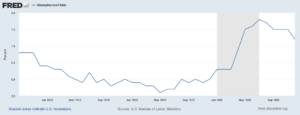
While high inflation surely hurt Carter’s re-election prospects, we also had a severe recession in 1980.
The unemployment rate soared from 6.0 percent in December of 1979, to 7.8 percent in July of 1980. This was one of the fastest surges of unemployment in the country’s history. The run-up in unemployment, just months before the election, surely had a large impact on Carter’s prospects. It is very misleading to imply that it was just inflation that sank Carter.
EXCELLENT--I disagree with Zogby's committment to the (wholly-owned by corporate America) Democratic Party, but he makes the case for CorpDem collaboration about as well as can be done.
This week Briahna sppeaks to DNC member, senior advisor to Jesse Jackson, & founder of the Arab American Institute James Zogby about the DNC's latest betrayal: Their failure to even debate a resolution, introduced by Dr. Zogby, to get dark money out of Democratic Party primaries. After seeing how hostile the Democratic Party is to progressives from Jesse Jackson to Summer Lee, does Zogby still see the Democratic Party as a party in which progressives can effect change? Briahna asked him about the structure of the DNC, whether he'd support the "dirty break" strategy, and what it would've looked like if Bernie went 3rd party in 2016.
not all-time-great Chapo, but if there's one thing The Guys can do well, it's crush the alien evil that is The Clintons
In this edition of 'Come and See TV' the boys are joined by official Gutsy woman, Katherine Krueger to discuss Hillary and Chelsea Clinton's new AppleTV series "Gutsy." HIldawg and Chels investigate topics such as: are women funny? How to refuse hate, can women be clowns? in what amounts to vanity project that is the Democratic party equivalent of OJ's "If I Did It" memoir.
nothing to listen to here, but note that News Quiz restarts this week (F 16 Sep), but unfortunately rather restrained
Friday Night Comedy returns 23 September wherever you listen to podcasts. Or listen to episodes of The News Quiz and Party's Over now, before anywhere else, first on BBC Sounds.
excellent section on how to judge the legitimacy and academic credentials of an allegedly-scientific conference, with link to [Think. Check. Attend.](https://thinkcheckattend.org/)
Thorough evaluation and expert peer review of research are at the core of academic and scientific integrity. When researchers attend a conference or cite a paper, they do so with confidence that these events and publications are operated in good faith and have undergone a trusted review process to ensure, as much as possible, that the content they distribute is sound. Scientists who present their work at these conferences similarly trust that doing so enhances, rather than detracts from, their professional reputations. Meanwhile, media outlets that report on conferences expect that not only do the proceedings offer fresh insights on new research, but also the research has been vetted for its methodology and significance.
Unfortunately, it is no longer safe to assume that a conference is genuine without doing proper background research into its organizers and sponsors.
These expectations and assumptions about the legitimacy of publications and events organized by well-intentioned, competent groups with genuine interest in advancing science were long safe. However, predatory journals began to appear in the early 2000s and have become more common over the past decade, signaling that there are unscrupulous organizations willing to push scientific integrity aside for the sake of profit. These journals offer researchers easy access to publishing, for a fee, while dismissing typical quality controls like rigorous peer review or checks for plagiarism.
More recently, there has been an increase in the occurrence of similarly predatory (or “fake”) conferences across numerous scientific disciplines, including in the Earth and space sciences. Unfortunately, it is no longer safe to assume that a conference is genuine without doing proper background research into its organizers and sponsors.
My colleagues and I have witnessed the growing trend of predatory conferences both firsthand and through discussions with clients. Our company provides technology and software solutions that help scientific conference organizers manage elements of their event planning, from participant registration to the peer review process. Admittedly, we have a vested interest in the success of legitimate conferences, with whom we do business, so the growth of predatory conferences has repercussions for us as a company. More important, however, is that these activities harm researchers who fall prey to them, and they threaten to damage public perceptions of and trust in science.
The Growing Problem of Fake Conferences
For most academics, attending scholarly conferences is a conventional part of advancing one’s research and growing one’s career. For early-career researchers especially, these events are an important way to build CVs, develop professional brands, share research, and gather valuable feedback. Conferences also present unique opportunities to network with like-minded people who may later become colleagues, research partners, employers, or funders. Researchers and others in academia, industry, government, and nonprofit organizations can mingle and share ideas during formal sessions and gatherings, in hallways and lobbies between sessions, over dinner, or, more recently, in online discussions hosted as part of remote or hybrid conferences.
In short, such meetings are organized to bring together scholars whose work overlaps and to create an environment for idea-sharing and research development. This is not the case when it comes to fake conferences, which unfortunately often look and sound superficially like standard academic conferences. Their websites boast of renowned speakers, and they advertise events hosted at reputable venues and backed by high-profile sponsors.
As of 2017, there were reportedly more predatory conferences available to scientific researchers than there were genuine events held by scholarly groups.
Although the term “fake” may suggest that these are not real events, they actually do take place. However, they are typically not nearly as well organized as advertised, nor does their content live up to the billing. Participants often find ill-attended events that lack the prestigious keynote speakers advertised and have few learning or networking opportunities.
Predatory academic conferences are more common than you may think. Even as of 2017, there were reportedly more such conferences available to scientific researchers than there were genuine events held by scholarly groups that follow standard peer review processes.
In a recent study conducted over a 2-year period by the InterAcademy Partnership (IAP), of more than 1,800 researchers working in 112 countries who were surveyed anonymously, 80% reported that predatory journals and conferences either were a serious problem in their country already or were becoming a serious problem. Of those surveyed, 11% acknowledged having published in a predatory journal, 2% knowingly and 9% who were completely unaware at the time. Meanwhile, 4% acknowledged having participated in a predatory conference, with 1% attending knowingly and 3% unaware. Another 6% of respondents were uncertain whether they had attended a predatory conference.
Predatory conferences are big business, organized with the primary goal of profit generation. In particular, they are set up to scam people out of registration and publishing fees, and as a result, organizers are known to accept every proposed submission regardless of merit, as long as it is accompanied by a registration fee. The conferences thus lack the scientific and editorial integrity required of a legitimate academic meeting.
These events are being organized mostly by a relatively small number of large, international organizations, although smaller companies have recently entered the industry. Senthil Gopinath, CEO of the International Congress and Convention Association, a trade group for the association meetings industry, has commented on the scale and impact of predatory conferences: “Tens of thousands of terrible quality and sometimes fraudulent conferences are today being promoted around the world, which presents an industrial-scale challenge to bona fide associations and their quality education programs. It’s a global phenomenon, which today impacts negatively on almost every scientific discipline.”
Wasted Resources, Bad Science, and Eroded Trust
Extrapolating from its recent survey results, the IAP estimated that at least 1 million researchers globally have fallen prey to predatory journals and conferences, and that these activities have wasted billions of dollars in research funding—for example, on time and materials spent on research published in predatory journals as well as on registration and travel expenses to attend predatory conferences. The IAP report also noted that significant reputational damage and emotional stress for scientists sometimes accompany the realization that they’ve been “duped or scammed.”
While researchers at all career levels are susceptible to falling prey to these predatory practices, early-career academics may be particularly at risk, lured by tempting opportunities to gain experience presenting their work and build their resumes and careers amid competitive “publish or perish” environments. These researchers, who are often struggling to find funding, waste their scarce and hard-earned money on expenses related to attending or presenting at a fake conference. Furthermore, the IAP report points out that “researchers in low- and middle-income countries were more likely to report they had used predatory practices, or not know if they had, than those in higher-income ones.” This trend could be explained by predatory conference organizers targeting countries where there are fewer opportunities for researchers, among other reasons.
The more these people’s work, lives, and decisions are undermined by bad science, the less faith they are likely to have in credible research.
The existence of predatory conferences and journals—and the unvetted science they present—risks damaging the legitimacy of academia and the scientific enterprise in the eyes of policymakers, community leaders, and those in the public who rely on scientific expertise but may not be equipped to distinguish what is or is not solid science. The more these people’s work, lives, and decisions are undermined by bad science, the less faith they are likely to have in credible research. And if they do not trust the work being published by academic sources, where will they turn for information?
The growth of predatory conferences and journals may also offer more opportunities for underqualified and underinformed commentators to pass off bad science as legitimate, whether on purpose or not. This is especially true in an era when misinformation is rampant, the trustworthiness of unbiased, reliable sources of scientific information is increasingly questioned, and anyone with a social media account can potentially build an audience of millions. In this environment, the sanctity of research-based, peer-reviewed scientific findings is vitally important.
Considering these costs to researchers and to research integrity, it’s clear the academic community must face predatory conferences head-on.
In a few isolated incidents, legal action has been taken against the organizers of predatory conferences. For example, in 2016, the U.S. Federal Trade Commission (FTC) filed charges against several companies, alleging that they lied to researchers about their conferences and publications. And in 2019, a federal court found that the companies’ claims that research submissions underwent a rigorous peer review process and review by editorial boards made up of well-respected academics were false, ordering them to pay more than $50 million to resolve the charges.
Despite the occasional legal and financial penalties doled out to predatory conference organizers for their practices, not much can be done from an institutional perspective to protect the academic community. Perhaps the most effective means to tackle the problem is for individual researchers to recognize and avoid predatory conferences for themselves.
Recognizing and Avoiding Predatory Conferences
There are steps researchers can take and telltale signs to look for that will help determine whether an event is worth their time and money.
Predatory conferences can be difficult to differentiate from legitimate conferences. However, there are steps researchers can take and telltale signs to look for that will help determine whether an event is worth their time and money. The following approaches may be especially useful:
Research the organization putting on the event. Chances are you know of the major think tanks and organizations that would organize legitimate events in your field of expertise. If a conference organizer is a private company or an organization you don’t know about, or you’re considering an event outside your primary field, do some digging. Research the organization online and search for lists of predatory conferences that have been identified. Even if the event you’re considering is not listed, if the organization hosting it has been called out for organizing predatory conferences in the past, it’s reasonable to be suspicious. You can also check the website Think. Check. Attend., which aims to help researchers judge the legitimacy and academic credentials of conferences to help them determine whether they are legitimate and worthy of pursuit.
Spend some time on the event website.Legitimate academic conferences will build a website that’s an extension of their main site. If a conference’s website URL is completely unrelated to an academic or reputable professional organization, that’s a red flag.
Consider the sponsors.Some predatory conferences will list big-name sponsors to create the appearance of a well-funded, well-planned event. But are the sponsors mentioned relevant to the topic of the conference? If you’re considering attending a conference in the Earth and space sciences but the main sponsors appear to be medical or biotechnology companies, for example, it would be a good idea to investigate further, perhaps by contacting the supposed sponsoring organizations to verify their participation.
Predatory conferences must not deter us from participating in conferences as a whole, but it is increasingly vital to do our research before sending off that registration fee.
Connect with the event organizers.If you’re skeptical about the legitimacy of an event, reach out to the organizers. Ask about their peer review process and details related to the venue and agenda. Organizers of a legitimate conference will be communicative and happy to clarify any questions you have about their event. If their reply is suspicious, or they don’t reply at all, chances are you’re better off sitting out the event.
Academic and professional conferences offer important avenues to gain experience, learn about cutting-edge research, gather feedback about one’s own work, and network with peers and potential collaborators, employers, and funders. Predatory conferences must not deter us from participating in conferences as a whole, but it is increasingly vital to do our research before sending off that registration fee. Funding for scientific and technical innovation, researchers’ reputations, and public trust in the reliability of science are all at stake.
Author Information
Matthieu Chartier (matt@fourwaves.com), Fourwaves, Quebec City, Que., Canada
Citation: Chartier, M. (2022), The alarming rise of predatory conferences, Eos, 103, https://doi.org/10.1029/2022EO220449. Published on 15 September 2022.
This article does not represent the opinion of AGU, Eos, or any of its affiliates. It is solely the opinion of the author.
both worthy listens, esp Fredman (2nd segment) on the bad and the good of the Biden student debt relief plan, plus the hell Biden made with his 2005 bankruptcy deform
Just added to my radio archive (click on date for link):
September 8, 2022 Chilean political activist Antonia Atria explains why that country’s voters rejected a proposed new constitution • Juliana Fredman, a public interest lawyer in the Bay Area, analyzes Biden’s student debt relief plan
EXCELLENT: despite the title, not a movie episode. Rather, it's 2 readers (after long bant): 1st on Chasid school failures subsidized by NY State (and--though The Guys don't say it--until now covered up by elite US Jews, though now the NYT is "going to war"), 2nd another installment from the insane Jon Kass (this time, Chicago monarchism)
The boys start with a roundtable discussion of 9/11 and modern fashion trends. Then, we take a look at the New York Times new in-depth reporting on Yeshiva schools in NYC failing to teach children basic skills, and how that relates to the state & purpose of public education in general. Finally, Will has sourced an exquisite reading series on the passing of the Queen by Chicago’s own Jon Kass.
The topic of “regular expressions” in Vim and Emacs is well suited for a functional comparison across the four different scenarios covered in the above articles to which I refer for a description of the syntax.
As explained in the article on Emacs, what you type is not what you see.
Below is a brief summary table for the operation of “reducing”
blank lines, the third and fourth formulas in the above table, by distinguishing the keys pressed from the characters
displayed.
Type
Visualize
^C-qC-j\{2,\} <RET> C-qC-j <RET>
^^J\{2,\} → ^J
^\(^C-q<SPC>*C-qC-j\)\{2,\}<RET> C-qC-j <RET>
^\(^ *^J\)\{2,\} → ^J
Short summary
The subject of regular expressions in Vim and Emacs shows several differences between the two editors.
I am unable to determine which implementation is the best one.
It is necessary, in any case, to consider that Emacs has a very good emulator of Vim, called Evil, that allows one to use the same regular expression language as the source editor.
good illustration of the sort of things every SaaS/platform provider should know about automating online processes
When I worked at Facebook, I worked on making cross-region failover for source control more effective and automated.
Before my work, when we were doing a cross-region failover, we brought the whole team in a room for the day. We also brought food and coffee and ran through the commands as a group to add extra-safety and make sure we didn't cause an incident. We ran together through a list of 20 different commands to run and expectations/check about what they would do. The whole process was slow and error-prone because of how complex the commands were and the number of context dependent substitution in those commands (like the name of the regions)
In one of the most defining moment of my career, one of my colleague ran a command in the wrong terminal window during a failover and it caused an incident. The incident review that followed was really tough for me and I was scared of participating in another failover. It was the nudge I needed to automate the processes. Here is how I proceeded:
(1) Turn the runbook into a script printing text
(2) Replace the steps with commands gradually
(3) Add a lot of assertion
(4) Add a dry-run mode
(5) (Optional) Create a model of the system
(6) Convincing others and going live
Step 1: Turn the runbook into a script printing text
This step is key to get started. Take all the steps in your runbook, commands or not, and turn them into a script. A minimal example looks like:
def step(txt):
    print(txt)
    print('Press enter when done')
    input()

step('Create an empty file for the report')
step('Check disk space on your computer')
step('Add the date to the report file')
step('Log in to the primary server')
step('Check the disk space')
This shift the source of truth from a document to code. So when someone knows how to automate one of those steps, they can just replace the step call with some code to perform the check.
Step 2: Replace the steps with commands gradually
At this point you have a script that contains all the steps of your manual procedure. You can start making the script more automated by replacing the calls to step with actual code performing the steps. What's great is that you don't have to know how to automate everything to make an impact, even automating one step is making progress.
Step 3: Add a lot of assertion
Shifting from a manual workflow to an automated one causes angst. You may we worried that you are going to break the system, that it was much safer when you followed the runbook because it could "always be stopped" or was "not running too fast". Fear drives this way of thinking, and one of the way to tame your fear is to add assertions about the system. Think about every step and what could be asserted before and after the test to make sure that it ran correctly, add those to your code.
Step 4: Add a dry-run mode, make it the default
The script you wrote may be performing a really major function. For example in the case I mentioned above, the script was failing over source control function. For example in the case I mentioned above, the script was failing over source control from one region to the next. It came with major impact on several systems and it would have been a blunder to run it unintentionally. Therefore I made the script "dry-run" by default. When running in dry-run mode, your script should not perform any writes, it should not change the state of the underlying system. This way if someone runs the script by mistake it will not perform the operation.
Building a dry-run mode requires you to think for each step, which one will be a write and which one will be a read. As a shortcut you can wrap the code that run commands to be aware of the dry-run mode:
from dataclasses import dataclass
import os
import subprocess

import fire

def step(txt):
    print(txt)
    print('Press enter when done')
    input()


@dataclass(frozen=True)
class CommandRunner:
    dry_run:bool=True
    def __call__(self, command):
        if self.dry_run:
            print(f"Would run {command}")
        else:
            print(f"Running: {command}")
            subprocess.check_output(command, shell=True)

class SourceControlFailover(object):
    def failover(self, dry_run=True):
        run = CommandRunner(dry_run)
        print('Create an empty file for the report')
        run('touch /tmp/report.csv')
        if not dry_run:
            assert os.path.exists("/tmp/report.csv")
        step('Check disk space on your computer')
        step('Add the date to the report file')
        step('Log in to the primary server')
        step('Check the disk space')


if __name__ == '__main__':
  fire.Fire(SourceControlFailover)
You can run the script with:
python script.py failover
And when you are ready for the commands to run for real:
python script.py failover --dry-run=False
Here I used the Fire python library which makes it easy to build command line tools.
Step 5: (Optional) Create a model of the system
Let's say that you automated a few steps but you are still scared of running the script, you should start testing it against a test environment (also called QA, or pre-prod environment). Another strategy you can reach out to is building a model of how the system under test behaves based on what you observed. For example you can create a model of a server and put in code the assumption you have about the system. This idea is very similar to the fake gmail service I used in my post Mail merge in 100 lines of clojure.
Step 6: Convincing others and going live
The hardest part of automating existing processes is convincing others that it will work and will be worth it. Running commands feels manually provide a false sense of safety, and giving control to automation feels extremely scary to some people. At Facebook, when I ran the script for cross region failover for the first time it felt scary, it felt like I could cause an incident and it felt like I could be making a terrible mistake.
Years later, dozens of such script written I have yet to encounter a case when it was not worth automating. I hope that the approach above can convince you to automate some of the tasks that you are performing at work, the scarier the better. Happy automating!
Mark Steel is back with the 12th series of his award winning show that travels around the country visiting towns that have nothing in common but their uniqueness. After thoroughly researching each town, Mark writes and performs a bespoke evening of comedy for a local audience.
In this second episode Mark travels to Tring in Hertfordshire, home of the Natural History Museum, former private museum of Walter Rothschild, where he goes to see the exhibit of fleas dressed as Mexicans.
In this series, Mark will also be popping to Nottingham, The Isles of Scilly, Salisbury, Newport and Paris. And for the first time, there will be extended versions of each episode available on BBC sounds.
Written and performed by Mark Steel
Additional material by Pete Sinclair
Production co-ordinator Sarah Sharpe
Production co-ordinator Katie Baum
Sound Manager Jerry Peal
Producer Carl Cooper
A BBC Studios production for BBC Radio 4
VERY EXCELLENT dissection of US empire in Africa (esp Africom and main regional partner/vassal=France), and US deepstate war against PRC but esp Russian involvement in Africa.
What does the US Cold War with China and Russia mean for Africa? Can China’s rise benefit the continent, providing it leverage and another partner to rely on? Or is the State Department correct that China is engaging in neocolonialism and that African countries should be cautious and prioritize their relationship with the US?
To discuss this and more, Rania Khalek was joined by Kambale Musavuli, an activist, writer, and analyst with the Center for Research on the Congo-Kinshasa.
As I’ve said before, I do almost all my writing in Org-mode so entering special characters is easy. I can either use the built-in Org characters or drop into TeX input mode. But, of course, I’m not always in Org-mode. Sometimes I want a special character when entering a Git description—most often → but occasionally others—and there are other situations where I need them as well.
My solution—that I learned from Xah Lee—is to use the abbrev system that’s built into Emacs. Thus, I have the abbreviation /ra for →. The other day, I saw this post by The Emacs Cat on using abbrev for inputting special characters anywhere within Emacs. It’s basically the same system that I use except that I depend on hippie expand to resolve my abbreviations rather than having them expand automatically, which I find jarring.
The Emacs Cat begins each of the abbreviation keys with 8 to avoid having accidental expansions. That’s a good solution and one that many may prefer. Regardless of which method you employ, using abbrev-mode to enter special characters that you need frequently is a win. You can always drop back to insert-char, bound to Ctrl+x8Return, to enter those that you don’t use often.
Take a look at The Emacs Cat’s post for the details on how to set things up.
Jeremy Friesen over at Takes on Rules has an interesting post on using Org-mode for his workflow. The exact situation is a bit more complex but it’s best thought of a way of time tracking.
Rather than use a packaged solution like Org-roam, Friesen rolls his own using the Org-capture template system. The basic idea is that he has projects and tasks in support of those projects. As he starts work on a project, he captures that project and further tasks are all accumulated under that project.
At the end of the month he runs org-clock-report to generate a time report for all the projects and tasks. It’s a nice workflow. One could, of course, prompt for the project for each task entry but whether that’s optimal or not depends on the individual workflow. Either way, it’s a good way of capturing the details of a workflow.
VERY EXCELLENT--this will probably provide the single most important/useful overview you have heard this week (or month!) of what's happening in (aka [dynamics](https://en.wikipedia.org/wiki/Dynamical_system) of) the current global (esp US) economy, and the forces (dynamics again!) that have brought us to this point over the past ~50 years
Economist Michael Hudson joins Multipolarista host Ben Norton to discuss partial student debt relief in the US, inflation and the Fed, disaster capitalism in Ukraine, and China's challenge to the petrodollar.
VIDEO: https://youtube.com/watch?v=AEZBOaPKWjw
TRANSCRIPT: https://multipolarista.com/2022/09/08/michael-hudson-debt-inflation-ukraine-petrodollar
Prof. Hudson's official website: https://michael-hudson.com
VERY EXCELLENT interview with Brian Hochman (@ Georgetown U), much too short
Wire-tapping in the US dates back to the 1860s and where it was once seen as a dirty business that crooks were into, it is now a begrudgingly accepted tool in fighting crime.
excellent movie episode (on new hitpiece/biopic "My Son Hunter") following brief but funny obit for Da Queen (esp the callout to "our Irish audience" :-)
We pay our respects to Her Majesty Queen Elizabeth II, then give our review of Breitbart’s new Hunter Biden biopic “My Son Hunter”.
This week, Briahna has an intimate, soulful conversation with one of America's top public intellectuals, and a favorite guest of the pod: Dr. Cornel West. They discussed Biden's "MAGA Republican" speech and the utility of calling voters fascist, whether Biden also qualifies as one, how the left should handle the calls to abolish the FBI, the Mississippi water crisis and more. This is a top 10 all time Bad Faith ep.
An analysis of the deeply undemocratic structure of the US government, exploring the academic research on the concepts of the dual state and double government.
This is PART 7 of the Empire and the Deep State series I am co-hosting with historian Aaron Good, of the American Exception podcast, along with producer Seamus McGuinness.
VIDEO: https://youtube.com/watch?v=siGbth6AwtA
EXCELLENT: just bant, but funny, esp riffs on Trump in prison
Contained within: Joe Biden’s red light speech, Donald Trump’s Special Master, another new British PM, Pope fights the Catholic Deep State, French president sex gossip, Rick Scott blows election fund, Keffals vs. Kiwi Farms, and more!
Das always an interesting listen, even when his economics is much worse than in this piece (which is consistently good)
Germany has announced a €65 billion relief package as inflation heads towards ten percent. But will more government spending help? And how effective are Reserve Banks at controlling inflation anyway?
VERY EXCELLENT deepdive into Pakistan politics, esp the deepstate war on the PTI
An update on the unfolding post-coup in Pakistan. Talking to Waqas Ahmad again about the threat to arrest Imran Khan, the remarkable result of the election in Punjab where PTI won 15/20 seats, the arrest and torture of Shehbaz Gill and many others, the articles in the NYT and Time Magazine about how the coup … Continue reading "AER 113: Pakistan government threatens to arrest Imran Khan"
EXCELLENT: this longer-than-usual (58 min) 'Comedy of the Week' episode has lotsa performers doing very short bits (~3 min) of mostly-solo standup (1 song, IIRC) with a few interviews interspersed. Consistently funny.
A recording for BBC Radio 4's gala show spotlighting the nominees for the 40th Edinburgh Comedy Awards. The prestigious awards recognise a Best Newcomer and a Best Show, and in this gala, hosted by 2010 Best Show winner Russell Kane, we'll pack in as many of the nominees as possible to give listeners around the UK the chance to hear the cream of this year’s Edinburgh crop. The gala was recorded at the Pleasance, one of the Edinburgh Fringe’s iconic comedy venues.
Nominated for Best Show are
Alfie Brown, Colin Hoult, The Delightful Sausage, Jordan Gray, Josh Pugh, Larry Dean, Lauren Pattison, Liz Kingsman, Seann Walsh & Sam Campbell.
Nominated for Best Newcomer are
Amy Gledhill, Emily Wilson, Emmanuel Sonubi, Josh Jones, Lara Ricote, Leo Reich & Vittorio Angelone.
Hosted by Russell Kane
Additional Material by Jade Gebbie
Production Coordinator - Caroline Barlow
Recorded by Sean Kerwin and edited by Chris Maclean
Assistant Producer - Sasha Bobak
Producer - Gwyn Rhys Davies
A BBC Studios Production
VERY EXCELLENT piece on topics including - differences between risk and uncertainty - differences between algorithmic optimization, heuristics, and intuition - how true uncertainty (i.e., lack of knowledge about the consequences and probabilities of future events) increases the utility (not just 'performance' in the (e.g.) execution-time sense) of heuristics and intuition vs algorithms
LISTEN TO GERD GIGERENZER NOW!
Quite often the ideas of ‘risk’ and of ‘uncertainty’ get bandied about interchangeably, but there’s a world of difference between them and it matters greatly when that distinction gets lost.
That’s a key message from psychologist Gerd Gigerenzer, who has created an impressive case for both understanding the distinction and then acting appropriately based on the distinction.
“A situation with risk,” he tells interviewer David Edmonds in this Social Science Bites podcast, “is one where you basically know everything. More precisely, you know everything that can happen in the future … you know the consequences and you know the probabilities.” It is, as Bayesian decision theorist Jimmie Savage called it, “a small world.”
As an example, Gigerenzer takes us a spin on a roulette wheel – you may lose your money on a low-probability bet, but all the possible options were known in advance.
Uncertainty, on the other hand, means that all future possible events aren’t known, nor are their probabilities or their consequences. Rounding back to the roulette wheel, under risk all possibilities are constrained to the ball landing on a number between 1 and 36. “Under uncertainty, 37 can happen,” he jokes.
“Most situations in which we make decisions,” says Gigerenzer, “involve some sort of uncertainty.”
Dealing with risk versus dealing with uncertainty requires different approaches. With risk, all you need is calculation. With uncertainty, “calculation may help you to some degree, but there is no way to calculate the optimal situation.” Humans nonetheless have tools to address uncertainty. Four he identifies are heuristics, intuition, finding people to trust, and adopting narratives to sustain you.
In this podcast, he focuses on heuristics, those mental shortcuts and rules of thumb that often get a bad rap. “Social science,” he says, “should take uncertainty seriously, and heuristics seriously, and then we have a key to the real world.”
When asked, Gigerenzer lauds Daniel Kahneman and Amos Tversky for putting “the concept of heuristics back on the table.” But he disagrees with their fast-slow thinking model that gives quick, so-called System 1 thinking less primacy than more deliberative thinking.
“We have in the social sciences a kind of rhetoric that heuristics are always second best and maximizing would be always better. That’s wrong. It is only true in a world of risk; it is not correct in a world of uncertainty, where by definition you can’t find the best solution simply because you don’t know the future.”
Researchers, he concludes, should “take uncertainty seriously and ask the question, ‘In what situations do these heuristics that people use (and experts use) actually work?’ and not just say, ‘They must be wrong because they are a heuristic.’”
Gigerenzer is the director of the Harding Center for Risk Literacy at the University of Potsdam and partner at Simply Rational – The Institute for Decisions. Before that he directed the Center for Adaptive Behavior and Cognition at the Max Planck Institute for Human Development and at the Max Planck Institute for Psychological Research.
His books include general titles like Calculated Risks, Gut Feelings: The Intelligence of the Unconscious, and Risk Savvy: How to Make Good Decisions, as well as academic books such as Simple Heuristics That Make Us Smart, Rationality for Mortals, Simply Rational, and Bounded Rationality.
Awards for his work include the American Association for the Advancement of Science Prize for Behavioral Science Research for the best article in the behavioral sciences in 1991, the Association of American Publishers Prize for the best book in the social and behavioral sciences for The probabilistic revolution, the German Psychology Award, and the Communicator Award of the German Research Foundation. He was a 2014 fellow at the SAGE Center for the Study of the Mind University of California, Santa Barbara (SAGE Publishing is the parent of Social Science Space) and a fellow of the Association for Psychological Science in 2008.
Join the debate and discuss this episode with fellow listeners on our Multytude conversation. Multytude is a new social media app that aims to make sense of the online conversation. With support from the SAGE Concept Grant, the Multytude team is working to create a new method of qualitative research for social scientists to better understand what people are saying about the big issues of today.
For a complete listing of past Social Science Bites podcasts, click HERE. You can follow Bites on Twitter @socialscibites and David Edmonds @DavidEdmonds100.
EXCELLENT explainer on complex Iraqi politics, esp why Iraqi elites continue to acquiesce to US occupation while officially protesting against it
Panel: Kyle Anzalone, Joanne Leon, Elijah Magnier, Dan Wright.
Discussion about the protests and political crisis in Iraq and the Iran deal JCPOA.
Elijah Magnier is a veteran war correspondent and political analyst with over 35 years of experience covering the Middle East and North Africa (MENA). Kyle Anzalone is the opinion editor of Antiwar.com, news editor of the Libertarian Institute, and co-host of Conflicts of Interest. Dan Wright is a writer and podcaster and the co-founder of Around the Empire.
FOLLOW Elijah on Twitter @ejmalrai. Find and support his work on his website https://ejmagnier.com where you can subscribe and donate.
Russia and Ukraine agreed to a negotiated settlement to end the conflict in April, but British Prime Minister Boris Johnson intervened to stop the peace deal, and the US and EU escalated the proxy war to try to weaken Moscow.
VIDEO: https://youtube.com/watch?v=LpJMqs1yG1A
SOURCES: https://multipolarista.com/2022/09/03/west-peace-proposal-ukraine-russia
“It’s been said there are three kinds of people in the world, those who can count and those who can’t count.” So reads a sentence in the book Innumeracy in the Wild: Misunderstanding and Misusing Numbers, published by Oxford University Press in 2020.
The author of Innumeracy in the Wild is Ellen Peters, Philip H. Knight Chair and director of the Center for Science Communications Research at the University of Oregon. In this Social Science Bites podcast, Peters – who started as an engineer and then became a psychologist – explains to interviewer David Edmonds that despite the light tone of the quote, innumeracy is a serious issue both in scale and in effect.
As to scale, she notes that a survey from the Organisation for Economic Co-operation and Development found 29 percent of the US adult population (and 24 percent in the UK) can only do simple number-based processes, things like counting, sorting, simple arithmetic and simple percentages. “What it means,” she adds, “is that they probably can’t do things like select a health plan; they probably can’t figure out credit card debt,” much less understand the figures swirling around vaccination or climate change.
Peters groups numeracy into three (a real three this time) categories: Objective numeracy, the ability to navigate numbers that can be measured with a math test; subjective numeracy, which is “not your actual ability, but your confidence in your ability to understand numbers and to use numeric kinds of concepts;” and intuitive or evolutionary numeracy, a human being’s natural ability to do things like quickly determine if a quantity is bigger or smaller than another quantity.
That middle type of numeracy, the subjective, is measured by self-reporting. “The original reasons for developing some of these subjective numeracy scales had to do with them just being a proxy for objective numeracy,” says Peters. “But what’s really interesting is that having numeric confidence seems to free people to be able to use their numeric ability.” While freedom is generally reckoned to be good – and objective results back this up – that’s not the case for those confident about their abilities but actually bad with numbers. Similarly, those who have high ability but are underconfident also do poorly compared to high ability and high confidence individuals.
“There are some very deep psychological habits that people who are very good with numbers have that people who are not as good with numbers don’t have,” Peters explains. “It is the case that people who are highly numerate are better at calculations, but they also just simply have a better, more developed set of habits with numbers.”
Less numerate people “are kind of stuck” with the numeric information as presented to them, rather than transforming the information into something that might better guide their decisions. Peters offered the example of a person with a serious disease being told that a life-saving treatment still has a 10 percent chance of killing them. Highly numerate people recognize that that means it has a 90 percent survival rate, but the less numerate might just fixate on the 10 percent chance of dying.
Closing out the podcast, Peters offers some tips for addressing societal innumeracy. This matters because, she notes, research shows that despite high rates of innumeracy, providing numbers helps people make better decisions, with benefits for both their health and their wealth.
Join the debate and discuss this episode with fellow listeners on our Multytude conversation. Multytude is a new social media app that aims to make sense of the online conversation. With support from the SAGE Concept Grant, the Multytude team is working to create a new method of qualitative research for social scientists to better understand what people are saying about the big issues of today.
For a complete listing of past Social Science Bites podcasts, click HERE. You can follow Bites on Twitter @socialscibites and David Edmonds @DavidEdmonds100.