Tom Roche
Shared posts
The rise of US dollar imperialism, and why it failed - with Radhika Desai & Michael Hudson
Tom RocheVERY EXCELLENT
Betrayal of BREXIT complete with Ursula, King Charles and Rishi
Tom Rochegood UK politics breakdown--I don't share their Farage love, but clearly the UK is now dominated by a Globalist Party (with 2 wings, Starmer and Sunak) in much the same manner as the Corporate Party dominates US politics
Ukraine War, China and the Decline of US Hegemony Under Biden
Tom RocheEXCELLENT--I don't completely agree with Bessner or Khalek, but it's an interesting hour of conversation with ~0 'conventional wisdom'
Two years into his presidency, Biden’s foreign policy has been defined by the war in Ukraine and a weakening American hegemony, one that also characterized Trump’s time in office. Some argue the American empire is in decline no matter which party is in control. So where will U.S. foreign policy go from here as the new Cold War era drags on? Does it even matter which party is in charge anymore? How are anxieties of a U.S. decline playing out in the media and in popular culture? And where does that leave the left?
To discuss this and more Rania Khalek joined by historian Daniel Bessner, an associate professor of international studies at the University of Washington, a non-resident fellow at the Quincy Institute for Responsible Statecraft and co-host of the podcast American Prestige.
You can listen to all episodes of Rania Khalek Dispatches anywhere you get podcasts.
Spotify: https://spoti.fi/3za9DRK
Apple: https://apple.co/3zeYpeW
A New Coupled Modeling System Improves Forecast Skills
Tom Rochepullquote from this interesting [paper](https://doi.org/10.1029/2022JD037757) (edited, links added):
> To [improve] subseasonal forecast skill, a coupled [GEFS](https://www.ncei.noaa.gov/products/weather-climate-models/global-ensemble-forecast) [archived [here](http://web.archive.org/web/20230101021839/https://www.ncei.noaa.gov/products/weather-climate-models/global-ensemble-forecast)] was built up on the [Unified Forecast System](https://ufscommunity.org/) prototype version 5 that fully couples [atmosphere, land surface, ocean, ice, and wave models]. It significantly improved probabilistic forecast skills in many categories, such as precipitation, tropical storms, Madden-Julian Oscillation (MJO), etc.

Editors’ Highlights are summaries of recent papers by AGU’s journal editors.
Source: Journal of Geophysical Research: Atmospheres
Improving the skills of weather forecasts with longer lead time is a perpetual challenge to the scientific and operational weather forecast community. In a new study, Zhu et al. [2023] describe one milestone of the forecasting system at the National Centers for Environmental Prediction (NCEP) with lead time of one to two four weeks.
Built on top of the current operational Global Ensemble Forecast System version 12 (GEFSv12), a new system is developed by fully coupling the atmosphere, land, ocean, ice and waves. Forecasting skills are assessed by using anomalies of 500 hectopascals geopotential height, atmospheric zonal winds at different heights, tracks and intensity of tropical cyclones, and the Madden-Julian Oscillation (MJO) among others. The new system is shown to have better forecast skills at different lead times than the uncoupled system.
Citation: Zhu, Y., Fu, B., Yang, B., Guan, H., Sinsky, E., Li, W., et al. (2023). Quantify the coupled GEFS forecast uncertainty for the weather and subseasonal prediction. Journal of Geophysical Research: Atmospheres, 128, e2022JD037757. https://doi.org/10.1029/2022JD037757
—Minghua Zhang, outgoing Editor in Chief, JGR: Atmospheres
Text © 2023. The authors. CC BY-NC-ND 3.0
Except where otherwise noted, images are subject to copyright. Any reuse without express permission from the copyright owner is prohibited.

Savings, Taxes, Share Buybacks: Fun with National Income Accounts
Tom Rochepullquotes (lightly edited):
> The key point in this story is the definition of savings in the national income accounts [(NIA)]. Savings is simply disposable income (income minus taxes) that is not spent on consumption. From the standpoint of the national income accounts, it doesn’t matter what you did with the money that you didn’t spend on consumption. As long as you didn’t spend it on the consumption of a newly produced good or service, it is treated as being saved. [Furthermore,] income in the national income accounts is money generated from services provided in the current year. [But] capital gains [on sales of stocks, property, etc] do not count as income [for NIA purposes].
> Suppose that a household [(call it 'H')] has a [usual] income of $200,000 from wages. If [H] sold stock last year for $300,000, with a capital gain of $100,000, [H] would have lots of money in the bank. However, from the standpoint of the national income accounts, [H's] income is still just $200,000. If [H's] consumption was unchanged, then their measured saving would be the same in the year they realized these capital gains as it had been before. [But the difference between the ordinary sense of 'savings' and the NIA sense gets even larger.] If [H pays] capital gains tax at the 20 percent rate, [that] $20,000 [tax payment reduces] their disposable income [(defined as income minus taxes), so H's] savings would [by the NIA definition] be $20,000 lower[.] For the country as a whole, if we have a large sell-off of stock after a big run-up [in stock markets], we will see an increase in taxes, which will mean a lower saving rate, other things equal. We did in fact see a big jump in tax payments in 2022, which explains most, but not all, of the drop in savings last year. (The saving rate rose in January, despite the big jump in consumption, due to a sharp drop in tax payments.) [Another NIA-definition-induced problem] is that households may increase their consumption based on their capital gains. If [H] used some of their gains to remodel their house, buy a new car, or [whatever, by the NIA definition, H] would have increased their consumption and reduced their savings. Undoubtedly, this is part of the story of the decline in savings reported for 2022.
Many people who should know better have been saying silly things about households running down their savings and being forced to cut back consumption. The problem with these sorts of comments is that savings in our national income accounts have little to do with how most of us think about savings in our lives. Less of the former does not necessarily mean that people will have less money to buy things.
Before going into the specifics, let me just make a point to orient people. Saving in the national income accounts is almost entirely a story of the top half of the income distribution, and largely the top 10 percent.
I recognize that there are tens of millions of people who are struggling to get by, and in many cases not getting by. These people are either not saving at all or, insofar as they are, it has a minimal impact on aggregate saving numbers. The saving rate is not about their story.
Aggregate saving is about the people who have the money and the choice of whether to spend it or not. That is not a good picture, it would be great if we had a far more equal distribution of income so that most people did have the option to save, but we don’t. In an economy where the richest 10 percent of households get more than 40 percent of income, aggregate savings is the story of what these people are doing with their money.
Saving by Burning Money
The key point in this story is the definition of savings in the national income accounts. Savings is simply disposable income (income minus taxes) that is not spent on consumption. From the standpoint of the national income accounts, it doesn’t matter what you did with the money that you didn’t spend on consumption. As long as you didn’t spend it on the consumption of a newly produced good or service, it is treated as being saved.
Savings includes all of the things people typically do with their money that we would think of as saving. So, putting money in the bank counts as saving, as does buying a government bond. Buying shares of stock or a plot of land would also count as saving. We may colloquially describe these purchases as “investment” but we are not buying a newly produced good or service, we are just trading assets (cash for shares of stock or a deed to land), so these purchases do not count as investment in the national income accounts.
People may also save in ways that they don’t think of as saving. If they cashed their paycheck and put a few hundred dollars aside to buy a television or some other appliance, but didn’t get around to doing it, then they have saved this money from the standpoint of the national income accounts.
The same would be the case if they pulled a few hundred dollars out of the bank that they intended to spend but somehow lost the money. If the money remains lost, it is saved from a national accounting standpoint.
This is even true if they deliberately destroyed the money. If someone cashes their paycheck and then burns $1,000 to protest George Santos being in Congress, this will be treated as savings in the national income accounts. They did not buy a newly produced good or service.
Capital Gains are Not Income, Therefore They Don’t Increase Savings
If saving is defined as income that is not spent on a newly produced good or service, then we also need a definition of income. Income in the national income accounts is money generated from services provided in the current year. Most obviously, this would be the wages people get from working. It would also be rent paid on land or housing. It also would include interest and dividends paid on bonds or shares of stock.
However, the capital gains on stock do not count as income. (The same applies to capital gains on houses.) The idea here is that stock prices fluctuate month to month and year to year. If we envision a situation where we had the exact same stock of capital on January 1, 2023, as we did on January 1, 2022, and the same labor force, but the value of the market was 10 percent greater (roughly $4 trillion), there would be no asset (tangible or intangible) that corresponds to this $4 trillion increase in value. Therefore, it does not count as income.
If that sounds strange, consider the opposite situation where the market falls by 10 percent over the course of a year. Would it make sense to deduct $4 trillion from national income as a result?
This is important in the current context because many people sold stock after the large pandemic run-up in the market, and have substantial capital gains as a result. Suppose that a household has a normal income of $200,000 from wages. (Yes, this is a rich household.) If they sold stock last year for $300,000, with a capital gain of $100,000, they would have lots of money in the bank.
However, from the standpoint of the national income accounts, their income is still just $200,000. If their consumption was unchanged, then their measured saving would be the same in the year they realized these capital gains as it had been before.
Actually, the situation is somewhat worse than this. They are supposed to pay capital gains tax on this money. If they pay capital gains tax at the 20 percent rate, then they will pay an additional $20,000 in income taxes as a result of their capital gains.[1] This would reduce their disposable income, which is defined as income, minus taxes.
If their consumption is unchanged, their savings would be $20,000 lower because their after-tax income is $20,000 lower. For the country as a whole, if we have a large sell-off of stock after a big run-up, we will see an increase in taxes, which will mean a lower saving rate, other things equal. We did in fact see a big jump in tax payments in 2022, which explains most but not all, of the drop in savings last year. (The saving rate rose in January, despite the big jump in consumption, due to a sharp drop in tax payments.)
The other part of the story is that households may increase their consumption based on their capital gains. If they used some of their gains to remodel their house, buy a new car, or take a vacation, this would mean they have increased their consumption and reduced their savings. Undoubtedly, this is part of the story of the decline in savings reported for 2022.
This is not sustainable in the sense that we would not expect households will have large amounts of capital gains to draw on every year. But this is not a story of households drawing down their savings in any meaningful sense. If the household with the $100,000 gain, spent on extra $20,000 on one-time expenditures, after paying an extra $20,000 in capital gains taxes, their reported savings would be $40,000 lower than in the prior year, but they would still have $260,000 in the bank from selling their stock. This is to a large extent the story of the decline in the saving rate that we saw in 2022.
Dividends and Share Buybacks: An Inconsistency in the National Income Accounts
While households cannot anticipate large capital gains every year, corporate share buybacks is one case where this view would be wrong. The basic story is that share buybacks are a way for companies to give out money to shareholders as an alternative to paying dividends. Buybacks are desirable from the standpoint of shareholders since the money paid out is not immediately subject to taxes, as is the case with dividends. Shareholders will only pay taxes when they sell the stock at a gain.
This situation leads to an inconsistency in the national income accounts. Suppose corporations pay out $200 billion in dividends to shareholders. This money counts as income for shareholders and as an expense for the companies, which reduces their profits and corporate savings.
However, if they instead pay out this $200 billion by buying back shares, this money is not treated as income for shareholders. That is true even if the shareholders immediately sell their stock and take advantage of the higher prices resulting from the buybacks. From the companies’ standpoint, this $200 billion in buybacks does not count as an expense and reduce their profits. Instead, it is treated as though they purchased an asset (their own stock), just as if they had bought land or shares in another company.
This matters when we look at household saving rates since companies can in fact indefinitely pay out the money that would otherwise go to dividends, in the form of share buybacks. For consistency, we really should count this money as part of household income. This would raise disposable income and therefore increase savings.
The Whole Picture
The figure below shows the reported saving rate from the national income accounts from 2015 to 2023. It also shows the ratio of saving, plus taxes, to total income in the years since 2015. While the Trump tax cut did change this relationship in 2017 and 2018, since 2019 we have had no major changes to the tax code. That means that changes in the relationship between tax collections and income were driven mostly by changes in household income, most notably capital gains income. (There were timing issues associated with the pandemic, but using annual data eliminates most of this effect.)
The third line uses a measure of savings if we count share buybacks as part of personal income. This adds dollar to dollar to savings, since its inclusion does not affect consumption. It also raises income (the denominator), since we have to add share buybacks to the measure of personal income in the National Accounts.
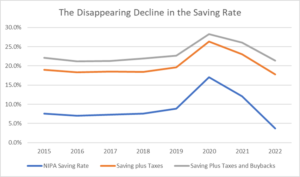
Source: BEA, S&P, and author’s calculations.
As can be seen, including personal taxes (Table 2.1, Line 6) eliminates most of the drop in saving reported for 2023. While the official saving rate shows a drop of 3.6 percentage points from the average for the four years prior to the pandemic to 2023 (7.3 percent to 3.7 percent), using the combined taxes plus savings measure the drop is just 0.7 percentage points (18.6 percent to 17.9 percent). Calculating a saving rate that includes share buybacks as income, there is a drop of just 0.3 percentage points (21.7 percent to 21.4 percent).
In short, if we use measures of saving that are more consistent with both what households actually see, and economic logic, there is very little to the idea that the saving rate is falling through the floor. The plunging saving rate is almost entirely an illusion caused by the failure to think about the issue clearly.
[1] Much of these gains would in fact be taxed at a rate lower than 20 percent for a family earning $200k.
The post Savings, Taxes, Share Buybacks: Fun with National Income Accounts appeared first on Center for Economic and Policy Research.
China condemns ‘US hegemony’, war crimes, CIA coups, 400 foreign interventions
Tom RocheBen Norton gives a succinct (<35 min) audio summary of [/US Hegemony and Its Perils/](https://www.fmprc.gov.cn/mfa_eng/wjbxw/202302/t20230220_11027664.html) (archived [here](https://archive.is/aLFPI) and [here](http://web.archive.org/web/20230225151225/https://www.fmprc.gov.cn/mfa_eng/wjbxw/202302/t20230220_11027664.html)), which in turn is a quite succinct print summary of the past and present crimes of US empire
Democracy Now! 2023-02-23 Thursday
Tom Rocheskip the US-NATO-Ukraine-simping Perekhoda-Khrushcheva interview, go straight to 39:07 for the [Ho-fung Hung](https://www.democracynow.org/2023/2/23/russia_china_ukraine_anniversary#transcript) and [Nanjala Nyabola](https://www.democracynow.org/2023/2/23/africa_ukraine_neutrality#transcript) interviews
Democracy Now! 2023-02-23 Thursday
- Headlines for February 23, 2023
- "A War of Imperial Aggression": How Russia's Invasion One Year Ago Changed Ukraine & the World
- Scholar Ho-fung Hung on China-Russia Relations & Whether Beijing Could Mediate Ukraine Peace Deal
- Kenyan Writer: History Explains Why Much of Africa Chooses Neutrality Over West's Support of Ukraine
The News Quiz - 27th January
Tom Rocheconsistently amusing, esp Chris McCausland
Andy Zaltzman is joined by Geoff Norcott, Chris McCausland, Isabel Hardman and Maisie Adam. This week they discuss a taxing week for Nadhim Zahawi, a downer week for levelling up, and the small matter of the end of the world.
Hosted and written by Andy Zaltzman with additional material from Alice Fraser, Davina Bentley, Simon Alcock, and Cameron Loxdale.
Producer: Sam Holmes Executive Producer: Pete Strauss Production Co-ordinator: Becky Carewe-Jeffries Sound Editor: Marc Willcox
A BBC Studios Production
Episode 254 - A History of Corporate Capture
Tom RocheVERY EXCELLENT interview with (BJG's former professor) Jon D. Hanson @ Harvard Law on the corruption of US corporate law, esp
* damning (the still alive, though just barely) Richard Posner and his 'Law and Economics' movement, esp IHBR v. American Cyanamid
----* ... along with the corruptions given/served by Milton Friedman, Robert Bork, George Stigler, but especially ...
----* ... Lewis Powell and the Powell Memo
* revealing image/metaphor of corporations as wealth unions
* how US 1% financed US academic right, e.g., 'Law and Economics' and the tort-reform (actually tort-deform) movement
* how US corporate law corruptly serves wealth and power
----* deliberately, e.g., via competition (won by Delaware) between US states to provide law systems most friendly to corporations, wealth, and power
----* externalizing harms from those who dominate markets
Subscribe to Bad Faith on Patreon to instantly unlock our full premium episode library: http://patreon.com/badfaithpodcast
Harvard Law & Economics Professor (and Briahna's favorite teacher) Jon Hanson joins Bad Faith to offer a firsthand lesson on the legal theories, economic principles, and social psychology that explain how our legal system and our democracy became so corrupted. In a sweeping conversation, Hanson explains how low liability standards all but ensure disasters like the East Palestine derailment occur, and what could be done to change that reality. As Briahna has mentioned on the podcast time and time again, Professor Hanson's Corporate Law & Tort Law classes were formative moments in her political evolution. She's thrilled to share some of those lessons on today's pod. She paid 180k for law school so you could get these lessons for free.
Subscribe to Bad Faith on YouTube for video of this episode. Find Bad Faith on Twitter (@badfaithpod) and Instagram (@badfaithpod).
Produced by Armand Aviram.
Theme by Nick Thorburn (@nickfromislands).
Moldova tensions rise, new Prime Minister wants Transnistria demilitarized
Tom Rocheexcellent dive into Moldova geopolitics
2/23/23: Biden in Ukraine Marks 1 Year of War, Georgia Trump Indictment Goes Awry, Trump In East Palestine, Biden Not Decided 2024, Sean Hannity National Divorce, Trump's Foreign Policy Record, Abysmal Credit Scores, Louis DeAngelis From StatusCoup
Tom Rocheanother BP with highly variable segment quality (following in order):
1. {NATO proxy war on Russia, Russia-Ukraine war, RUW}: long opener in which KB and SE still side with Ukraine and attribute blame to Russia (though they have in the past crossed over to the 'Russia is wrong but they were provoked' side), but they here (and in the last few RUW segments) explain that Ukraine is losing and will lose. KB/SE still makes *lots* mistakes, but they're getting better on matters including Russia, geoeconomics, and geopolitics. (Notably, SE seems to have realized--though not admitted--the astonishingly unempirical clownishness of his 2019-2022 'Russia is a gas station with a tiny economy' line.)
2. Fulton County (GA) grand jury vs Trump: timewaste. As even KB/SE note, it's a *special* grand jury, which cannot make indictments in GA, so it's even less consequential than a *real* grand jury, which everyone knows is just windowdressing for US prosecutors.
3. EXCELLENT piece on Trump vs {Biden, Buttagieg, US Corporate Party} in East Palestine (OH), plus how Biden could have used this (et al) health emergency to expand {Medicaid, Medicare for All}, plus ...
4. {VERY EXCELLENT, must-listen, 45:10-56:34} interview with Louis DeAngelis @ Status Coup News on the East Palestine debacle, including health consequences of the toxic release, and how Norfolk Southern Railroad is not only running over the same tracks again, but is running double-stacked!
5. VERY SKIPPABLE, overlong segment on US 2024 presidential candidates. Major problem with Breaking Points: KB/SE waste way too much time on horserace waaay too early.
6. VERY SKIPPABLE rehash of T 21 Feb's condemnation of MTG 'national divorce' meme: only difference is, today it's Krystal and Saagar, Tuesday it was KB and Emily.
7. EXCELLENT SE radar on the contradictions between Trump's foreign/military policy rhetoric (2016 and currently) vs foreign/military policy implementation during his presidency.
8. {VERY EXCELLENT, must-listen, 81:50-86:57} KB radar on the spatial distribution of debt (esp medical) across US, and how that maps to state health-financing policies (esp red-state rejection of ACA/Obamacare Medicaid expansion).
Krystal and Saagar discuss Biden's visit to Kyiv marking a year since the start of the Ukraine War, polling from different countries on the Ukraine conflict, the Jury in Georgia Trump Inquiry recommend Multiple Indictments but a Fulton County grand jury forewoman's odd appearances on TV might threaten the process, Saagar looks into Trump's record on Foreign Policy during his administration, Krystal looks into why people in The South have abysmal credit scores, and we're joined by Louis DeAngelis (@louisd217) from Status Coup News (@StatusCoup) to talk about his interviews with residents in East Palestine, Ohio.
To become a Breaking Points Premium Member and watch/listen to the show uncut and 1 hour early visit: https://breakingpoints.supercast.com/
To listen to Breaking Points as a podcast, check them out on Apple and Spotify
Apple: https://podcasts.apple.com/us/podcast/breaking-points-with-krystal-and-saagar/id1570045623
Spotify: https://open.spotify.com/show/4Kbsy61zJSzPxNZZ3PKbXl
Merch: https://breaking-points.myshopify.com/
Learn more about your ad choices. Visit megaphone.fm/adchoices
Veteran NYT journalist Jeff Gerth exposes US media's Russiagate debacle
Tom RocheVERY EXCELLENT interview
Hell on Earth: Episode 7 - HELL
Tom RocheVERY EXCELLENT--transitions from diplomatic, military, and religious history to the more social side of civilian and Kriegsvolk/soldier life (and suffering, and death)
The apocalyptic effects of years of war on the population transform central Europe into Hell on Earth.
Interactive atlas, bibliography and credits for the series can be found at: hellonearth.chapotraphouse.com
Hosted on Acast. See acast.com/privacy for more information.
4. The Punisher
Tom RocheVERY EXCELLENT (except for lots of advertisements)
Mickey is obsessed with The Punisher, the Marvel Comics antihero who delivers his own brand of arbitrary, violent justice. In this episode, we talk to Casandra Windecker, Mickey’s ex-wife. Cassie met Mickey through the Denver Hearse Association, a community where Mickey was well known for his participation in zombie apocalypse cosplay events and a bit part in a locally produced grindhouse movie. But their relationship quickly turned toxic, and Cassie began to wonder where Mickey was getting thousands of dollars in cash that he’d spread out on the bed.
See omnystudio.com/listener for privacy information.
3. Black Identity Extremism
Tom RocheVERY EXCELLENT (except for lots of advertisements)
Today, the FBI has more than 15,000 registered informants, and in the summer of 2020, Mickey is one of them. He’s getting paid a lot of money to expose crimes committed by activists. But his official motivation? “To fight terrorists.” The FBI thinks the same way — that racial justice activists are “anti-government extremists.”
See omnystudio.com/listener for privacy information.
2. All the Way Uptown
Tom Rocheexcellent (except for lots of advertisements)
Michael Adam Windecker II, or Mickey, returns to Denver after fighting ISIS in the Middle East. Mickey claims he trained real antifa warriors, that he represents the Kurdish government, and that he has diplomatic immunity. He puts himself right in the middle of the Denver protests. Activist Zebb Hall is enthralled with Mickey’s message — that the fight against racism needs to escalate. “If that's what you want,” Mickey tells Zebb, “I can make it happen.”
See omnystudio.com/listener for privacy information.
1. Summer of Rage
Tom Rocheexcellent (though be warned--lots of advertisements)
It’s the summer of 2020. After the brutal killings of unarmed Black Americans by law enforcement, the nation is a tinderbox of anger. The pandemic is raging. Protestors and police are violently going toe-to-toe in cities across America. Denver sees some of the most intense protests. Amid the clashes, a new guy rolls into town. He’s got a cigar dangling from his lips and he’s driving a silver hearse filled with guns.
See omnystudio.com/listener for privacy information.
Irreal: Webdriver
Tom Rochepullquote (somewhat edited):
> [[emacs-webdriver](https://gitlab.com/maurooaranda/emacs-webdriver) is] a way of controlling your browser from Emacs. Webdriver is a general API that’s not restricted to Emacs and can do much more than simply capture the current URL or title of the current Web page.
One of the most useful capabilities I have on my computer is the ability to capture the URL of the current page in my browser. That doesn’t sound too exciting but I use it many times a day when I’m writing blogs posts or annotating code, or doing anything else where I want to reference a Web page.
This is particularly easy on macOS as I’ve previously recounted. Since then, I’ve tried to find ways of doing this in other OS environments. None of them are as easy as macOS but I’ve recently come across something that may solve the problem once and for all. That something is emacs-webdriver.
It’s a way of controlling your browser from Emacs which is what Applescript allows you to do on macOS. If you’re an Emacs user and often want to incorporate a URL from your browser this is a real boon. You can, of course, switch context to the browser, capture the current URL in the title bar, and switch back to Emacs but it’s a lot easier to simply invoke an Emacs command with a key shortcut.
Webdriver is a general API that’s not restricted to Emacs and can do much more than simply capture the current URL or title of the current Web page. Even if you don’t need all its capabilities, just being able to grab a URL from your browser is a useful capability. Again, I use this capability everyday in macOS and it’s something you may want to enable it on your own systems.
Munich drama and red lines between China and collective west
Tom Rocheflop sweat @ MSC 2023 as "US-led" collective West realizes they're strengthening the once-merely-potential Eurasian alliance
708 - Sydney 9000 (2/20/23)
Tom Rochejust bant (the initial discussion regarding the evil of Jimmy Carter's presidency never quite rises above badinage), but consistently amusing
Hosted on Acast. See acast.com/privacy for more information.
Fresh audio product: Ukraine, Indian capitalism
Tom RocheSkip Lieven (doing his usual both-sides shtick on NATO's proxy war vs Russia and proxy-war-in-the-making with PRC) to 21:38 for (after music break) EXCELLENT dive into capitalism in India 1949-2023, with special focus on the Ambanis and now the Adanis (and deepdive into the Hindenburg revelations)
Just added to my radio archive (click on date for link):
February 16, 2023 Anatol Lieven on the slim prospects for peace in Ukraine and growing bellicosity towards China • Jairus Banaji, author of this Phenomenal World article, on the politicized structure of Indian capitalism generally, and the scandal surrounding Gautam Adani (Hindenburg report here)
Episode 252 - Does MMT End the "Debt Ceiling" Debate? (w/ Stephanie Kelton)
Tom RocheVERY EXCELLENT (though kinda shallow) dive into Modern Monetary Theory. Unfortunately does not discuss the implications of dedollarization, trade/forex, and currency reserves, but does the fiscal side of MMT very well
Subscribe to Bad Faith on Patreon to instantly unlock our full premium episode library: http://patreon.com/badfaithpodcast
Briahna got tons of feed back on the Richard Wolff episode about the debt ceiling debate from Modern Monetary Theory heads who objected to Wolff treating the US economy like a household budget. So Briahna asked the foremost MMT economist & author of "The Deficit Myth," Professor Stephanie Kelton, on to explain what the left's approach to the debt ceiling discourse should be in her view. Also, Professor Kelton, who advised Senator Sanders in 2020, talks about her frustration with Bernie's reliance on "pay for" rhetoric, and argues that the left can't avoid teaching the public about MMT forever.
Subscribe to Bad Faith on YouTube for video of this episode. Find Bad Faith on Twitter (@badfaithpod) and Instagram (@badfaithpod).
Produced by Armand Aviram.
Theme by Nick Thorburn (@nickfromislands).
World War Civ 12: The 1908 Revolution in Turkey
Tom RocheJustin and Dave excellent as usual. Note this ep actually covers Ottoman history from ~1839 (Tanzimat) /through/ the 1908 crisis (plus immediate aftermath), not just 1908
The Villages Crush a Grassroots Revolt
Tom RocheVERY EXCELLENT--astonishing perversion of justice and prosecutorial misconduct serving straight-up plutocracy deep in the heart of Florida
In 2019, residents of The Villages, an iconic retirement community in Florida, were suddenly hit with a 25 percent hike in their property taxes. In the master-planned community of 130,000 across the state’s Sumter, Lake, and Marion counties, many residents are on fixed incomes. The tax hikes were intended to subsidize new developments south of the community, rather than cover new amenities or upgrades for current residents. The entity known locally either as “the developer” or “the family” benefited from the tax hike and could then escape paying fees associated with the expansion of their development. This week on Deconstructed, host Ryan Grim takes us to The Villages to meet residents who banded together to rollback the tax hike but who were ultimately blocked by powerful players. Florida Gov. Ron DeSantis and the local political machine run by The Villages fought the residents, leading to one of their champions being thrown in jail.
If you’d like to support our work, go to theintercept.com/give, where your donation, no matter what the amount, makes a real difference.
And if you haven’t already, please subscribe to the show so you can hear it every week. And please go and leave us a rating or a review — it helps people find the show. If you want to give us additional feedback, email us at Podcasts@theintercept.com
Hosted on Acast. See acast.com/privacy for more information.
Chris Hedges interviews Matt Taibbi on Hamilton 68
Tom Rocheexcellent
The 'globalization' myth, US hegemony, and crisis of capitalism, with Radhika Desai
Tom RocheDesai VERY EXCELLENT as usual
Marcin Borkowski: My approach to TODOs
Tom Rochesimple ontology for TODOs, with code! archived @ https://archive.is/ekrWz , http://web.archive.org/web/20230218215536/https://mbork.pl/2023-02-18_My_approach_to_TODOs
Chris Hedges Rallies for a Left-Right Coalition Against War
Tom RocheHedges EXCELLENT as usual, also the preceding '4 food groups' (at least, the 1st 2), just skip the opening banter
Subscribe for the full episode at the bottom of the page. Watch a free preview of our interview here:
“If we do not build left-right coalitions on issues such as militarism, health care, a living wage and union organizing,” warns Chris Hedges, “we will be impotent in the face of corporate power and the war machine.”
Award-winning journalist Chris Hedges returns to the show to argue for a left-right alliance and explain why he’s speaking at the Rage Against The War Machine rally on Sunday.
The stakes are too high to not form a coalition: “We’re flirting with a nuclear holocaust.”
“The Democrats made a conscious decision to become the Republican Party,” he says. They consciously and very cynically decided to sell out the underclass for political expediency. But the damage they did, the hundreds of thousands, maybe millions of families that they destroyed, we don’t talk about it. There’s just no accountability.”
But people, on both the left and right, who were terrorized by these policies, know who hurt them.
“They know what the Democrats did to their neighborhoods by militarizing police and creating internal armies of occupation. I teach at a prison and half the students wouldn’t be there but for Clinton. They know who did that to them.”
But fighting the powerful from just one side has shown not to work: “It’s much scarier for politicians when you have people from both sides of the political spectrum making demands than it is from just one side.” A left-right coalition can’t be bought off, it can’t be smeared as partisan. It’s a movement.
This is why Chris Hedges is joining activists from all across the political spectrum to rally this weekend to Rage Against the War Machine. If you can get to DC this weekend, your voice can make a difference.
Watch the extended episode where Chris Hedges discusses how the silence on the Nord Stream story is an indication of how degraded the media has become, how mainstream consumers may never learn the truth of Russiagate, and his disgust for the leaders in our government:
“These people are really frightening, amoral, they cover themselves in the veneer of Ivy League degrees and cloying snobbery, but they’re very limited intellectually. They’re drunk with their own power and hubris, and of course they have made a very good living being shills for weapons manufacturers. They’re pimps of war.”
Plus, catch this week’s Thursday Throwdown where the White House takes a break from covering up the chemical explosion that devastated East Palestine, Ohio to cover up the other major story (not) in the news: Pulitzer-prize winning journalist Seymour Hersh’s groundbreaking reporting that the US blew up the Nord Stream pipeline.
And join the Absurd Arena live discussion board with Katie and Aaron every Tuesday at 12pm est.
It’s all this, and more, on this week’s episode of Useful Idiots. Check it out.
Watch the full interview here:
Hope strategy at Munich Security Conference
Tom RocheUS empire realizing that Ukraine was overreach
The News Quiz – 20th January
Tom Rocheamusing--not News Quiz at its very best, but definitely a good ~30 min listen
Andy Zaltzman is joined by Geoff Norcott, Shaparak Khorsandi, Helen Lewis and Ian Smith. This week they discuss Keir Starmer's plans for the NHS, teachers' strikes and the political row over Scotland's gender recognition reform bill.
Hosted and written by Andy Zaltzman with additional material from Alice Fraser, Mike Shephard, Katie Storey, Vicky Richards and Cameron Loxdale.
Producer: Georgia Keating Executive Producer: James Robinson Production Co-ordinator: Becky Carewe-Jeffries Sound Editor: Marc Willcox
A BBC Studios Production