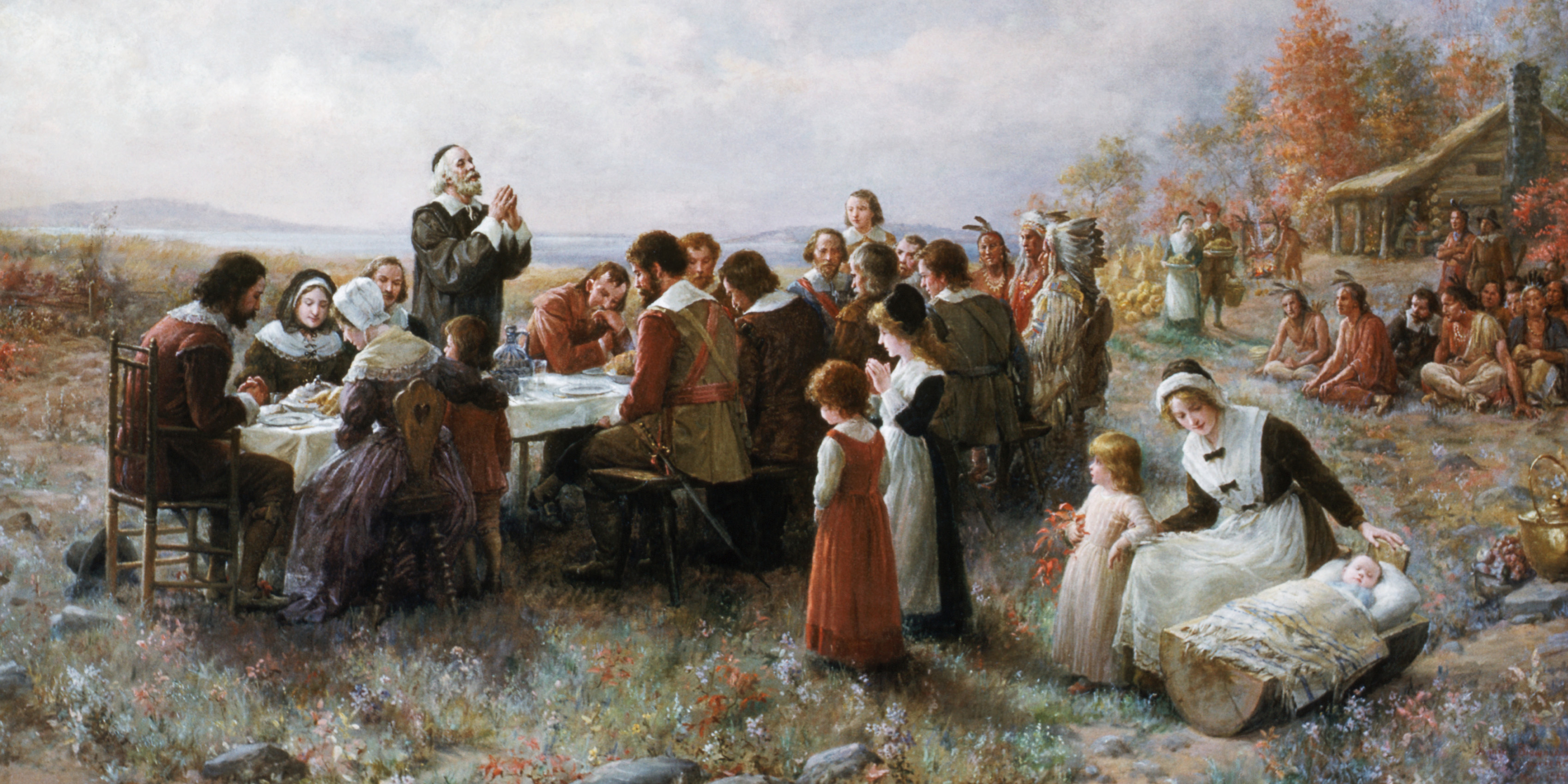
Adams - Jefferson - Madison - Monroe - Quincy Adams
The first party system comes crashing down on JQA's nerdy shoulders.
Get bonus content on PatreonHosted on Acast. See acast.com/privacy for more information.
Tom Rochebelated post regarding Hell O' Presidents: I downloaded all of 14 of the main HoP episodes (not the extras--gotta get those) whileback, so this is just from memory, but ... if you never did much serious study of US history (e.g., AP American History), or even if you did but longtime ago, you will learn something from HoP. Even if you /do/ have some depth on US history, you will still find the Christman/Wade treatment entertaining.
Adams - Jefferson - Madison - Monroe - Quincy Adams
The first party system comes crashing down on JQA's nerdy shoulders.
Get bonus content on PatreonHosted on Acast. See acast.com/privacy for more information.
Tom Rochebelated post regarding Hell O' Presidents: I downloaded all of 14 of the main HoP episodes (not the extras--gotta get those) whileback, so this is just from memory, but ... if you never did much serious study of US history (e.g., AP American History), or even if you did but longtime ago, you will learn something from HoP. Even if you /do/ have some depth on US history, you will still find the Christman/Wade treatment entertaining.
Constitution - Washington
Get in the Presidency, George.
Chris and Matt's Hell of Presidents series comes to the Patreon. Over the next weeks, we'll be posting the entire series here to be permanently available for all subscribers.
Get bonus content on PatreonHosted on Acast. See acast.com/privacy for more information.
Tom Roche1st half (GG on NATO's proxy war on Russia) is excellent. 2nd half (Cooper on Israel-Palestine) is skippable--it's not particularly bad by US standards, but it's quite adjacent to the kinda softcore-Zionism that the dominant ideologues (for now) tolerate.
Watch full episodes on Rumble, streamed LIVE 7pm ET: https://rumble.com/c/GGreenwald
Become part of our Locals community: https://greenwald.locals.com/
- - -
Follow Glenn:
Twitter: https://twitter.com/ggreenwald
Instagram: https://www.instagram.com/glenn.11.greenwald/
Follow System Update:
Twitter: https://twitter.com/SystemUpdate_
Instagram: https://www.instagram.com/systemupdate__/
TikTok: https://www.tiktok.com/@systemupdate__
Facebook: https://www.facebook.com/systemupdate.tv/
LinkedIn: https://www.linkedin.com/company/systemupdate/
Learn more about your ad choices. Visit megaphone.fm/adchoices
Tom RocheEXCELLENT
Ciaran, Julia and Nick reflect on the new German constitution, the Bild manifesto.
This bonus was originally released Nov 4th. For more bonus episodes like this, support us on Patreon to get an extra episode a week.
HOW TO SUPPORT US:
https://www.patreon.com/cornerspaeti
HOW TO REACH US:
Corner Späti https://twitter.com/cornerspaeti
Julia https://twitter.com/KMarxiana
Rob https://twitter.com/leninkraft
Nick https://twitter.com/sternburgpapi
Uma https://twitter.com/umawrnkl
Ciarán https://twitter.com/CiaranDold
Tom RocheVERY EXCELLENT, tho you probably wanna increase playback speed ~20% as NF tends to speak slowly. (Also note: this was recorded M 20 Nov 2023)
Krystal sits down with political scientist, author, and activist Norman Finkelstein to discuss the conflict in Israel Palestine.
BP Holiday Merch LIVE NOW (Use code BLACKFRIDAY for 15% off Non-Holiday Items): https://shop.breakingpoints.com/collections/breaking-points-holiday-collection
See omnystudio.com/listener for privacy information.
Tom RocheVERY EXCELLENT
Tom RocheOK, but your time is better spent listening to [Ben Norton on Argentina's political economy](https://feeds.soundcloud.com/stream/1670653032-geopoliticaleconomy-javier-milei-argentina-debt-economy.mp3)

Washington Post (11/19/23)
This week on CounterSpin: The new president of Argentina opposes abortion rights, casts doubt on the death toll of the country’s military dictatorship, would like it to be easier to access handguns and calls climate change a “lie of socialism.” Many were worried about what Javier Milei would bring, but, the Washington Post explained: “Anger won over fear. For many Argentines, the bigger risk was more of the same.”
But if you want to dig down into the roots of that “same,” the economic and historic conditions that drove that deep dissatisfaction, US news media will be less helpful to you there. Milei is not a landslide popular president, and thoughtful, critical information and conversation could help clarify peoples’ problems and their sources, such that voters—in Argentina and elsewhere—might not be left to believe that the only way forward is a man wielding a literal chainsaw.
We’ll learn about Javier Milei and what led to his election from Mark Weisbrot, co-director of the Center for Economic and Policy Research and author of the book Failed: What the “Experts” Got Wrong About the Global Economy.
Plus Janine Jackson takes a quick look at FAIR’s recent study on the Sunday shows’ Gaza guests.
The post Mark Weisbrot on Argentina’s Javier Milei appeared first on FAIR.
Tom RocheEXCELLENT. pullquote @ end:
> As disconcerting as it is that authors like [Keir Giles in Politico] are writing fascist propaganda—and that [Heather Mallick in the Toronto Star] veers perilously close to the same—it’s even more alarming that editors at outlets like the Star, CBC and Politico deem such intellectually and morally bankrupt material worthy of publication.

Canadian House Speaker Anthony Rota (Politico, 9/24/23) said of the SS veteran, “He’s a Ukrainian hero, a Canadian hero, and we thank him for all his service.”
Media coverage of the Canadian Parliament’s standing ovation in September for Yaroslav Hunka, a 98-year-old Ukrainian Canadian who fought for the Nazis in World War II, has included egregious Holocaust revisionism.
On September 22, following Ukrainian President Volodymyr Zelenskyy’s address to the Canadian parliament, Canada’s then–Speaker of the House Anthony Rota introduced Hunka:
We have here in the chamber today a Ukrainian-Canadian veteran from the Second World War who fought for Ukrainian independence against the Russians and continues to support the troops today.
Rota went on to call Hunka “a Ukrainian hero, a Canadian hero, and we thank him for all his service” (Politico, 9/24/23). Parliamentarians of all political parties gave Hunka two standing ovations, and Zelenskyy raised his fist to salute the man (Sky News, 9/26/23).
Then the New York–based Forward (9/24/23) pointed out that Hunka had fought for the 14th Waffen Grenadier Division, also known as the Galicia Division, of the SS. (The SS, short for Schutzstaffel, “Protection Squadron,” was the military wing of Adolf Hitler’s Nazi Party.)

“You have to tread softly on these issues,” said the main expert used by the CBC (9/28/23) to discuss the topic of Ukraine and Nazism.
Covering the subsequent controversy, the CBC (9/28/23) ran the headline, “Speaker’s Honoring of Former Nazi Soldier Reveals a Complicated Past, Say Historians.” In the context of the Holocaust, “complicated” functions as a hand-waving euphemism that gets in the way of holding perpetrators accountable: If a decision is “complicated,” it’s understandable, even if it’s wrong.
Digital reporter/editor Jonathan Migneault, who wrote the piece, soft-pedaled the Galicia Division in other ways too. He said that some of the Ukrainians who joined it did so “for ideological reasons, in opposition to the Soviet Union, in hopes of creating an independent Ukrainian state.”
That’s quite a whitewashing of the ideological package that goes with signing up for the SS, leaving out that this vision for an “independent Ukrainian state” included the extermination of Jewish, LGBTQ, Roma and Polish minorities. As far as the “hopes of creating an independent Ukrainian state” alibi, the Per Anders Rudling (Journal of Slavic Military Studies, 2012) documents that “there is no overt indication that the unit [of Ukrainian Waffen-SS recruits] in any way was dedicated to Ukrainian statehood, let alone independence.”

Toronto Star columnist Heather Mallick (9/26/23) mocked Poland for wanting to extradite Hunka, whose unit massacred Poles during World War II, because “Poland has a notorious history of antisemitism.”
Toronto Star columnist Heather Mallick (9/26/23) also used the word “complicated” to diminish Nazi atrocities, and mock the Polish government’s interest in having Hunka extradited for war crimes:
Funny, they’ve had 73 years to ask Canada for him. It’s almost as if Poland has a notorious history of antisemitism but that’s crazy talk….
Rota should have understood how complicated history is, how, post-Holodomor, a Ukrainian caught between Hitler and Stalin made a fatal choice.
We can hate Hunka for that now. I do.
But would every Canadian MP have made immaculate choices inside Stalin’s “Bloodlands” in 1943? Of course you and I would have been heroic, joined the White Rose movement, been executed for our troubles. But everyone?
Mallick refers to Ukraine as “Stalin’s ‘Bloodlands,’” citing the Holodomor, the 1930s famine in the Soviet Union that killed an estimated 3.5 million Ukrainians, as well as millions in other parts of the USSR. Yet her link takes readers to a review of the book Bloodlands: Europe Between Hitler and Stalin, which—its own flaws notwithstanding (Jacobin, 9/9/14)—discusses the killings in Ukraine and elsewhere by Stalin and, on a significantly more egregious scale, Hitler. Acknowledging that the phrase she’s borrowing refers to both Soviet crimes and the Nazis’ genocides would have made the choice of joining the Nazis seem rather less sympathetic.
Meanwhile, Mallick’s baffling comments about Poland erase the Nazis’ systematic killing of Polish people. Polish history has indeed been marred by horrific antisemitism, with many Polish people complicit in the Holocaust, as she glibly references; this does not erase the fact that the Nazis also murdered 1.8 million non-Jewish Poles, or negate Poland’s desire to see their killers brought to justice. As Lev Golinkin (Forward, 9/24/23) pointed out, the Galicia Division that Hunka belonged to
was visited by SS head Heinrich Himmler, who spoke of the soldiers’ “willingness to slaughter Poles.” Three months earlier, SS Galichina subunits perpetrated what is known as the Huta Pieniacka massacre, burning 500 to 1,000 Polish villagers alive.

Keir Giles (Politico, 10/2/23) advances the argument that joining the SS and swearing “absolute obedience to the commander in chief of the German Armed Forces Adolf Hitler” doesn’t make you a Nazi.
An old cliché uses the analogy of gradually boiling a frog to explain how fascism takes hold in societies, but readers of Keir Giles’ intervention (Politico, 10/2/23) will feel like they are eyes-deep in a bubbling cauldron.
Giles, who said the relevant history is “complicated” four times and “complex” twice, wrote an article entitled “Fighting Against the USSR Didn’t Necessarily Make You a Nazi.” That’s a dubious claim in a piece focused on World War II, when the Soviet Union was the main force fighting Nazi Germany, and thus fighting the Soviets made you at least an ally of Nazis.
More to the point, the unit Hunka belonged to was a formal division of the SS, trained and armed by Nazi Germany (Forward, 9/27/23), which “fought exclusively to serve Nazi aims” (National Post, 9/25/23).
Giles, however, opened by writing:
Everybody knows that a lie can make it halfway around the world before the truth has even got its boots on.
And the ongoing turmoil over Canada’s parliament recognizing former SS trooper Yaroslav Hunka highlights one of the most important reasons why.
Something that’s untrue but simple is far more persuasive than a complicated, nuanced truth….
In the case of Hunka, the mass outrage stems from his enlistment with one of the foreign legions of the Waffen-SS, fighting Soviet forces on Germany’s eastern front.
Setting aside that Giles omits “and butchering innocent people” when he describes Waffen-SS activities as “fighting Soviet forces,” his suggestion that calling Hunka a Nazi is a “lie” does not withstand even minimal scrutiny. For instance, Rudling (Journal of Slavic Military Studies, 2012) documents that, from August 29, 1943, onward, Ukrainian Waffen-SS recruits were sworn in with the following oath:
I swear before God this holy oath, that in the battle against Bolshevism, I will give absolute obedience to the commander in chief of the German Armed Forces Adolf Hitler, and as a brave soldier I will always be prepared to lay down my life for this oath.
Vowing “absolute obedience” to Hitler, and swearing that you’re willing to die for him, makes you as root and branch a Nazi as Rudolf Hess or Hermann Göring.

SS commander Heinrich Himmler inspecting troops from the Galicia Division.
After drawing these bogus distinctions between the Nazis and their units, Giles moved on to genocide denial:
The idea that foreign volunteers and conscripts were being allocated to the Waffen-SS rather than the Wehrmacht on administrative rather than ideological grounds is a hard sell for audiences conditioned to believe the SS’s primary task was genocide….
Repeated exhaustive investigations—including by not only the Nuremberg trials but also the British, Canadian and even Soviet authorities—led to the conclusion that no war crimes or atrocities had been committed by this particular unit.
Giles doesn’t name any investigations by British or Soviet officials, so it’s unclear what he’s talking about on those points, but he’s lying about Nuremberg. The Nuremberg Tribunals did not specifically address the Galicia Division (Guardian, 9/25/23), but found that the combat branch of which they were a part, the Waffen-SS, “was a criminal organization”:
In dealing with the SS, the Tribunal includes all persons who had been officially accepted as members of the SS, including the members of the Allgemeine SS, members of the Waffen-SS, members of the SS Totenkopfverbaende, and the members of any of the different police forces who were members of the SS.
Giles asserted that “simple narratives like ‘everybody in the SS was guilty of war crimes’ are more pervasive because they’re much simpler to grasp”—but everybody in the SS was, quite literally, guilty of war crimes.

The Ottawa Citizen (9/27/23), citing B’nai Brith, reported that “the Canadian government’s approach to Nazi war criminals had been marked with ‘intentional harboring of known Nazi war criminals.'”
The Canadian investigation Giles refers to is a 1986 Canadian government report that claims that membership in the Galicia Division did not in and of itself constitute a war crime. This conclusion is highly suspect when read against the Nuremberg tribunal’s judgment, and the report also has to be understood in the broader context of Canadian state investigations into Nazis in the country. As the Ottawa Citizen’s David Pugliese (9/27/23) explained:
The federal government has withheld a second part of a 1986 government commission report about Nazis who settled in Canada. In addition, it has heavily censored another 1986 report examining how Nazis were able to get into Canada. More than 600 pages of that document, obtained by this newspaper and other organizations through the Access to Information law, have been censored.
Neither Giles nor any other member of the public knows what the Canadian government is hiding about its investigation, or why it’s concealing this information, so it’s disingenuous for him to present the fraction of the government’s conclusions to which he has access as if it is the final word on the Galicia Division or anything else.
As to Giles’ jaw-dropping complaint that people are “conditioned to believe the SS’s primary task was genocide,” the Nuremberg Trial concluded that the SS carried out
persecution and extermination of the Jews, brutalities and killings in concentration camps, excesses in the administration of occupied territories, the administration of the slave labor program, and the mistreatment and murder of prisoners.
Perhaps the public is “conditioned to believe the SS’s primary task was genocide” because the SS carried out genocide.
As disconcerting as it is that authors like Giles are writing fascist propaganda—and that Mallick veers perilously close to the same—it’s even more alarming that editors at outlets like the Star, CBC and Politico deem such intellectually and morally bankrupt material worthy of publication.
The post Media Holocaust Revisionism After Canada’s Standing Ovation for an SS Vet appeared first on FAIR.
Tom RocheVERY EXCELLENT empirical analysis of US Social Security and Medicare costs and benefits, esp how they vary by income. Baker's main points (as chosen by me--there's lotsa data here) are
1. US Social Security (SS) taxes are arbitrarily capped at 160 kUSD--and for wage income only. IOW, if you have 3 people whose respective yearly wage incomes in US dollars are $160k, $16M, and $16G (== billion $), they all pay the same SS tax. Furthermore, if one of them (probably the billionaire) "earns" /only/ capital gains (and no income classified as wages), s/he pays /no/ SS tax! By contrast, US Medicare taxes are not only /not/ capped, Medicare taxes also apply to capital gains. Why? IMHO (Baker does not say this, but the implication is clear), because Medicare spending does not actually go to 'recipients': they are just a 'passthrough'. Medicare spending /actually/ goes to the US healthcare industry, esp insurers and doctors. (See following point.)
2. To the extent that US Medicare spending is redistributive (ignoring the fact that 'Medicare recipients' don't actually /receive/ Medicare spending), that effect is mostly due to US overpayment for healthcare--i.e., the US spends a far larger proportion of national income on healthcare than do peer nations. (And gets worse results, but that's another topic. pullquote:
> If we assume Canadian health care costs, a [US] high-earning [for this study defined as 105.8 kUSD/yr] male has a [lifetime] net Medicare tax penalty of $21,000, while a high-earning woman has a [lifetime] net tax penalty of just under $1,000. For those earning at the Social Security maximum [== 160 kUSD/yr], the [lifetime] net tax penalty for men is $111,000, and for women it’s $91,000. [Hence,] the seemingly large subsidies that Medicare provides to [US] retirees is not due to the generosity of benefits, it is due to the fact that we overpay for our healthcare. Medicare is not providing a large subsidy to retirees, it is providing a large subsidy for drug companies, medical equipment suppliers, insurers, and [doctors](http://web.archive.org/web/20230914001501/https://www.washingtonpost.com/business/2023/08/04/doctor-pay-shortage/). (In case you are wondering, people in the U.S. are not generally paid much more than people in other wealthy countries. Our manufacturing workers get [considerably lower pay](https://www.bls.gov/news.release/archives/ichcc_12192012.htm) [archived [here](http://web.archive.org/web/20231008234249/https://www.bls.gov/news.release/archives/ichcc_12192012.htm)].)
As a Thanksgiving present to readers, Washington Post columnist Catherine Rampell decided to tell us again how old-timers are robbing from our children with their generous Social Security and Medicare benefits. This is always a popular theme at the WaPo, especially around the holiday season.
The story is infuriating for four reasons:
Social Security
The Social Security program has always been reasonably well-funded, even as slower growth and the upward redistribution of income over the last five decades have hurt the program’s finances. It is now projected to face a shortfall in a bit over a decade, but the gap between scheduled benefits and taxes is not exceptionally large, as calculated by Gene Steurele and Karen Smith, Rampell’s source.

Source: Steurele and Smith, 2023.
The chart below above shows Steurele and Smith’s calculations for lifetime Social Security benefits and taxes, for people turning 65 in 2025, for men and women at different earnings levels. There are a few points worth noting on these calculations.
First, they are highly stylized, assuming that a worker puts in 43 years from age 22 to age 65 always earning the same wage relative to the overall average. This means that their wage rises year by year in step with inflation and the increase in average wages. No one actually would follow this pattern.
They are likely to earn less early in their career and more later in their career. They also are likely to have some years of little or no earnings. This is especially the case for women who are likely to spend some time outside of the paid labor force caring for children or parents. These adjustments would generally lead to higher benefits relative to taxes.
The second point is that the calculations assume that everyone lives to age 65 at which point they start to collect benefits. Some people will die before they can collect benefits, so we are looking at the benefits for workers who survive to collect benefits. (Social Security also has survivors’ benefits that go to spouses and minor children of deceased workers, so their tax payments are not necessarily a complete loss.)
The third point is that Steurele and Smith have opted to use a 2.0 percent real (inflation-adjusted) interest rate to discount taxes and benefits. This is a standard rate to use in this sort of analysis, but one could argue for a higher or lower rate. A higher rate would make the program seem less generous, while a lower rate would raise benefits relative to taxes.
As can be seen, low earners are projected to receive more in benefits than they pay in taxes. An important qualification here is that there is a large and growing gap in life expectancies between low and higher earners. These calculations assume that everyone of the same gender has the same life expectancy regardless of their income. This means that the benefits will be somewhat overstated for low earners and understated for high earners.
Ignoring the life expectancy issue, the chart shows that projected benefits end up being less than taxes once we get to high earners ($105,800 in 2023). For men projected lifetime taxes exceed benefits by $106,000. For women the gap is smaller at $49,000, reflecting their longer life expectancy.
Moving to maximum earners, people who earn the income at which the payroll tax is capped ($160,200 in 2023), the gaps become larger. In the case of men, projected lifetime taxes exceed benefits by $319,000. For women, projected lifetime taxes are $249,000 more than benefits.
There are some simple takeaways we can get from the Steurele and Smith analysis. First, for low and middle-wage earners Social Security does indeed pay out more in benefits than workers pay in taxes. However, the gap is not very large. For average earners, who got $66,100 in 2023, (not shown to keep the size of the graph manageable), the gap is $3,000 for men and $46,000 for women.
For higher income earners taxes actually exceed benefits. In the case of maximum earners, these excess payments are actually fairly large, as noted $319,000 for men and $249,000 for women.
This raises an interesting issue, if we are looking to cut benefits to reduce the “subsidy” to the elderly provided by Social Security. We can cut back benefits by a substantial percentage for low earners to bring their lifetime benefits more closely in line with their lifetime taxes, but do we really want to reduce retirement benefits for people who had average earnings of $29,700?
We can make some cuts for more middle-income workers, but someone earning $66,100 during their working lifetime was not terribly comfortable, and there is not much subsidy here to start, especially with men. When we get to higher earners, taxes already exceed benefits. We can still make cuts to their benefits, but we would not be taking back a subsidy by this calculation, we would be increasing their net overpayment to the program.
It’s also worth noting who is a high earner in this story. The high earner had annual earnings of $105,800 in 2023. President Biden promised that he would not raise taxes on couples earning less than $400,000. That puts his cutoff of $200,000 at almost twice the high earner level, and the calculation of lifetime benefits and taxes turns negative at a considerably lower income than the stylized high earner.
These calculations show that if we just take Social Security in isolation and want to reduce the subsidy implied here we either have to cut benefits for people who are not living comfortably by most standards, or we have to cut benefits for people who are not currently receiving a subsidy. We may decide that the latter is good policy, but we should be clear that it is not taking back a subsidy.
There is an important qualification to this discussion. Married couples will generally do better in these calculations than single workers. This is because the spousal benefit allows the spouse to collect the greater of their own benefit or half of their spouse’s benefit. Also, a surviving spouse will receive the greater of their own or their deceased spouse’s benefit. For these reasons, lifetime benefits for couples will generally be higher relative to taxes than for single individuals.
The Medicare Subsidy and the Broken Healthcare System Story
The Steurele and Smith analysis shows much larger subsidies for the Medicare program, as shown below.

There are a few qualifications to these calculations that should be noted. First, the same caveats about earnings patterns that were noted with the Social Security calculations also apply to the projected value of Medicare taxes.
Second, the differences in life expectancies by income matter here also when assessing the size of the tax penalty or subsidy. The program is less generous for low earners than shown in this figure and more generous for high earners.
The third point is that, unlike with the designated Social Security tax, the Medicare tax is not capped. This means that people earning above the Social Security cap will be paying more taxes to support the program. For very high earners ($185,000 for men and $207,000 for women), projected taxes would exceed benefits. The size of the tax penalty increases further up the income scale.
Finally, high-income people also pay a designated Medicare tax on capital income, like dividends and capital gains. For these people, it is virtually guaranteed that their Medicare taxes exceed their projected benefits.
With these caveats, we see the same general story as with Social Security, where there is more of a subsidy for lower earners than higher earners. While the overall gaps are larger for Medicare, projected benefits exceed taxes by a larger amount, this changes less with income than in the case of Social Security.
This is due to the fact that, unlike Social Security, the payout is not designed to be progressive, with all retirees getting in principle the same benefit.[1] This is qualified by the fact that higher-income retirees can expect to receive benefits for a considerably longer period of time, making the benefit regressive.
I have added a third bar to this graph, labeled “Benefits-Canada.” This is a calculation of what the cost of benefits would be if we paid the same amount per person for our healthcare as Canada does. The Medicare program appears as a huge subsidy to beneficiaries primarily because we pay so much more for our health care than people in other wealthy countries.
According to the OECD, we pay 57 percent more per person than Germany, 107 percent more than France, and 99 percent more than Canada. This sort of massive gap can be shown with U.S. costs relative to every other wealthy country. We don’t get any obvious benefit in terms of better healthcare outcomes from this additional spending. Life expectancy in the United States is considerably shorter than in most other wealthy countries.
The “Benefits-Canada” bar allows us to assess the value of Medicare benefits if our healthcare costs were more in line with those in other countries. It multiplies the projected value of Medicare benefits by the ratio of per person health care costs in Canada to costs in the United States (50.3 percent).
As can be seen, if we calculate Medicare benefits assuming that we pay as much for our health care as people in Canada, most of the calculated subsidy goes away. Low earners still receive a substantial subsidy, $102,000 for men and $122,000 for women, but this quickly goes away higher up the income ladder.
If we assume Canadian health care costs, a high-earning male has a net Medicare tax penalty of $21,000, while a high-earning woman has a net tax penalty of just under $1,000. For those earning at the Social Security maximum, the net tax penalty for men is $111,000, and for women it’s $91,000.
The implication of this calculation is that the seemingly large subsidies that Medicare provides to retirees is not due to the generosity of benefits, it is due to the fact that we overpay for our healthcare. Medicare is not providing a large subsidy to retirees, it is providing a large subsidy for drug companies, medical equipment suppliers, insurers, and doctors. (In case you are wondering, people in the U.S. are not generally paid much more than people in other wealthy countries. Our manufacturing workers get considerably lower pay.)
We pay roughly twice as much in all of these categories as people in other wealthy countries. It is misleading to imply that these overpayments are generous to retirees. While all of these interest groups have powerful lobbies, which makes it politically difficult to bring their compensation in line with other wealthy countries, we should at least be honest about who is getting subsidized by the high cost of our Medicare program.
What Do Subsidies Mean, When the Government Structures the Market?
There is another aspect of these calculations that should have jumped out at people when I noted that the designated Medicare tax is not capped and also applies to capital income. The taxes that are designated for these programs are arbitrary. We can designate other taxes that people pay as being Social Security and Medicare taxes, and apparent subsidies will disappear.
In fact, the idea that we can make a clear distinction between income that people have somehow earned, and income that is given to them by the government, is in fact an illusion. The government structures the markets in ways that allow some people to get very wealthy and keep others on the edge of subsistence.
Those who make big bucks in the healthcare industry are just one example. While our trade policy was quite explicitly designed to open the door to cheap manufactured goods, we actually have increased the barriers that make it difficult for foreign-trained doctors to practice in the United States.
We have made patent and copyright monopolies longer and stronger. The government subsidizes bio-medical research and then gives private companies monopoly control over the product. In a recent example, we paid Moderna to develop a COVID vaccine and then gave them control over it, creating at least five Moderna billionaires.
We have allowed our financial sector to become incredibly bloated, creating many millionaires and billionaires, even as we demand efficiency elsewhere. We give Elon Musk and Mark Zuckerberg Section 230 protection against defamation suits that their counterparts in print and broadcast media do not enjoy.
And, as was recently highlighted with the UAW strike, our CEOs make far more than the CEOS of comparably sized companies in other wealthy countries. The difference is as much as a factor of ten in the case of Japanese companies. This is not due to the natural workings of the market, this is the result of a corrupt corporate governance structure that allows the CEOs to have their friends set their pay.
Yes, I am again talking about my book (it’s free). It is absurd to obsess about tax and transfer policy while ignoring the ways in which the government structures the market to determine winners and losers. It is understandable that the right would like tax and transfer policy to be the focus of public debate, since the default is a market outcome that leaves most money with the rich.
However, it is beyond absurd that people who consider themselves progressive would accept this framing. We can structure the market differently to get more equitable market outcomes. This should be front and center in public debate. Unfortunately, the right wants to hide the fact that we can structure the market differently, and progressives are all too willing to go along.
Future of the Planet
There is a final point on the sort of generational scorecard implied by these calculations of Social Security and Medicare benefits. We don’t just hand our children a tax bill, we hand them an entire economy, society, and planet.
If we experience anything resembling normal economic growth, average wages will be far higher twenty or thirty years from now than they are today. Will the typical worker see these wage gains? That will depend on distribution within generations, not between generations.
We also see costs from items like the military. When I was growing up in the 1960s we paid a much larger share of our GDP to support the Cold War. (Young men were also drafted.) We will again pay lots more money for the military if we have a new Cold War with China. The implied taxes don’t figure into the Social Security and Medicare calculations, but will be every bit as much of a drain on the income of people in the future as taxes for these programs.
And, we should always have global warming front and center. If we paid off the national debt and eliminated the programs to support retirees, but did nothing to restrain global warming, our children and grandchildren would not have much reason to thank us. First and foremost, we must give them a livable planet.
Phony Answers to a Phony Question
The whole subsidy to retiree story is a diversion from the many important issues facing the country. Even the core idea, that we don’t adequately support the young because we give too much to the elderly is wrong.
We saw this very clearly in the debate over the extension of the child tax credit. As with everything in Congress, much is determined by narrow political considerations. Republicans had no interest in giving President Biden and the Democrats a win, but the bill could have passed without Republican votes.
The deciding factor was the refusal of West Virginia Senator Joe Manchin to support the bill. Senator Manchin was very clear on his concerns. He didn’t argue that we were spending too much on retirees, he didn’t want low-income people to have the money.
This is in general the story as to why we don’t have adequate funding for early childhood education, children’s nutrition, day care and other programs that would benefit children. There is a substantial political bloc that does not want to fund these programs. And, they still would not want to fund these programs even if we didn’t pay a dime for Social Security and Medicare.
[1] This is not strictly true, since the premium payment that retirees make for Part B and Part D of the Medicare program depends on income in retirement.
The post Social Security and Medicare: Fun with Numbers Time appeared first on Center for Economic and Policy Research.
Tom Rocheexcellent
Tom Rocheanother VERY EXCELLENT history ep from Christman (hoping to hear his voice again)
In this 14th installment of Matt’s (increasingly un-) Inebriated Past series, we begin what should be a 4 part look at the Spanish Civil War. In this installment, Matt guides from through the decaying Spanish Empire of the 19th century, through the social classes of village and city, the attempts for liberal reform in the early 20th century, the roots of Spanish anarchism and socialism, and finally the establishment of the 2nd Spanish Republic setting the stage for apocalyptic conflict.
Special thanks to Travis from the (great) band Activity for the Spanish Bombs cover that anchors this ep. Check out their latest release here: https://activity.bandcamp.com/album/spirit-in-the-room
Get bonus content on PatreonHosted on Acast. See acast.com/privacy for more information.
Tom RocheJon Schwarz delightful /and/ insightful as usual. pullquote (mildly edited):
> The “first Thanksgiving” took place in 1621, when 90 Wampanoag and 52 English settlers came together in present-day Massachusetts to celebrate a successful harvest by the colonists — one made possible by the Wampanoag sharing their knowledge. The English always fondly remembered this assistance, although not so fondly that they didn’t kill 40 percent of the Wampanoag later in the 17th century and then sell many surviving Wampanoag into slavery. [Accordingly,] Yale academics [and Abraham Accords stans] Jeffrey Sonnenfeld and Steven Tian [recently] organized “an Arab-Israeli diplomatic dialogue on campus that harkens to the first Thanksgiving, a dialogue that promoted harmony across cultural divides.” You can imagine how excited [Palestinians] will be to learn they are playing the role of Native Americans circa 1620 and what this portends for their bright future ahead. With leaders as wise and self-aware as Sonnenfeld and Tian, we are surely on the right course.

In both 2021 and 2022, I wrote a Thanksgiving article listing 10 things for which Americans should be grateful. Now I have 10 more things, 21 through 30, for which we can give thanks this holiday.
Scientific studies have found that focusing on gratitude doesn’t just make you more pleasant to be around. It’s good for you, physically and psychologically. It even makes you sleep better.
One thing for which I’m personally grateful is that I can get away with writing pieces like this. I’m actually paid money to do it, which I then exchange for broccoli seeds. (See No. 3 below.) Did you know there are approximately 137,600 individual seeds in one pound of broccoli seeds? Please write to my editors and tell them how much you value this kind of information, so I can continue producing these pieces and buying broccoli seeds indefinitely.
The “first Thanksgiving” took place in 1621, when 90 Wampanoag and 52 English settlers came together in present-day Massachusetts to celebrate a successful harvest by the colonists — one made possible by the Wampanoag sharing their knowledge. The English always fondly remembered this assistance, although not so fondly that they didn’t kill 40 percent of the Wampanoag later in the 17th century and then sell many surviving Wampanoag into slavery.
For this reason, positive references to the first Thanksgiving are bleakly funny. For instance, Yale academics Jeffrey Sonnenfeld and Steven Tian are big supporters of the Trump administration’s Abraham Accords. In the midst of the current Israeli assault on Gaza, they just organized an attempt in New Haven, Connecticut, to revive the agreements between Israel and various Arab states. As they describe it, “Yale hosted an Arab-Israeli diplomatic dialogue on campus that harkens to the first Thanksgiving, a dialogue that promoted harmony across cultural divides.”
You can imagine how excited people across the Mideast will be to learn they are playing the role of Native Americans circa 1620 and what this portends for their bright future ahead. With leaders as wise and self-aware as Sonnenfeld and Tian, we are surely on the right course.
Vaccines prime your immune system to recognize bacteria or viruses as foreign bodies to be destroyed. But humanity also suffers from autoimmune disorders, such as Type 1 diabetes, multiple sclerosis, and rheumatoid arthritis, in which our immune system mistakenly believes some of our own cells are foreign, and so attacks them.
Right now, there are promising “inverse vaccines” that remove the immune system’s conviction that the relevant tissue is its enemy. This kind of human creativity and intelligence makes me want to run up to the scientists responsible and embrace them. Then I will awkwardly stand nearby so I end up in pictures taken of them when they win a bunch of prizes.
I have a family member whose blood pressure was much too high, even though they’re on medication. So I started making them a daily smoothie with every food I could find that reportedly can reduce hypertension: broccoli sprouts, moringa powder, flax seeds, and blueberries.
The results were dramatic. Their systolic blood pressure number dropped quickly by about 40 points. Their blood pressure is now so low that their doctor may take them off some of their prescription drugs. Moreover, some of these ingredients also appear to have cancer-suppressive properties. Don’t take it from me; take it from researchers at Johns Hopkins.
I would like to become the world’s most peculiar dictator and force everyone to drink this every day. But there’s a problem with my potential reign of terror: Broccoli sprouts are hard to find in stores and expensive, about $5 per daily dose. The good news is that you can buy broccoli seeds and easily grow your own at home for one-tenth the cost. Please contact me if you’d like to have an intense, detailed conversation on this subject.
Flaco is a Eurasian eagle-owl who escaped from Manhattan’s Central Park Zoo last February after a lifetime of captivity. Zoo personnel initially tried to recapture him but failed, and he’s been living in the 843-acre park ever since (with a short detour to the Lower East Side). I like to imagine him belting out “Free Bird” as he swoops around his new domain.
Flaco the Eurasian Eagle-Owl peering through the leaves of his favorite oak tree last week in Central Park. ? ?? ? ? pic.twitter.com/PK5esE83ik
— Manhattan Bird Alert (@BirdCentralPark) November 20, 2023
Flaco appears extremely wise, but owl brains only weigh two grams and have limited processing power. However, he is strikingly beautiful. If you are a tourist visiting New York who sees Flaco, remember that while he is one of the city’s many celebrities, he is also just a Eurasian eagle-owl like any other Eurasian eagle-owl. Please try to be cool and don’t hassle him.
Regular history concentrates on nations and kings and therefore misses 99.9 percent of most people’s experience of being alive. On the other hand, oral histories capture what normal humans think of as they live through shattering catastrophes. It’s generally less about shifting geopolitical alliances and more about starving and/or having severe diarrhea.
For instance, if you want to understand World War II, skip the History Channel and try the Nobel Prize-winning work of Svetlana Alexievich. Her oral histories “The Unwomanly Face of War” and “Last Witnesses” will convince you that war is an extremely bad idea that should be avoided at almost any cost.
I have one older sister, plus a longtime friend whom we recently forcibly incorporated into our family without asking. We decided that, while he may not be genetically related to us, we are all spiritually and intellectually related and he should be our brother. Whether this adoption turns out to be a positive thing for him remains to be seen, but it’s too late for him to do anything about it now.
My sister supported this despite the fact she felt one brother, me, was already too many brothers. During family gatherings, she prefers to quietly read a book or teach herself Hungarian via her phone’s Duolingo app. But I have A LOT ON MY MIND that I need to interrupt whatever she’s doing to tell her. I suspect our family’s future will involve her and our new brother forming an alliance against me.
The point here is that siblings are wonderful because they’re stuck with you, so you can irritate them to the end of all of your lives and there’s nothing they can do about it.

John Ralston Saul is a Canadian writer whose books are passed around in obscure corners of the world like samizdat. I first heard of his odd masterpiece “Voltaire’s Bastards: The Dictatorship of Reason in the West” from my fellow temp word processor at a giant, evil law firm in midtown Manhattan as we both worked the midnight to 8 a.m. shift finalizing a weapons contract between the federal government and Lockheed Martin.
In it, Saul argues, “It seems the word is a fragile blossom. But one step back from this immediacy is enough to reveal the power of language. Nothing frightens those in power so much as criticism. … Even the fool has been banished from the castles of modern power.”
That’s why it’s important to learn how to use words. The process of doing that will also make you sensitive to how the powerful hate words and try to empty them of meaning to control you.
My personal favorite form of words is jokes. Everyone’s head is full of white noise about getting their 6-year-old to a doctor’s appointment, how much their elbow itches, and something intensely embarrassing they did in eighth grade. You may hear perhaps one out of every four words other people say to you.
Jokes are unique because if you can make someone laugh, you know you’ve pierced the mental haze in which we’re all enveloped and successfully communicated with them. Real laughter is involuntary and can only happen if other people understand what you’re saying and have had their worldview suddenly shifted.
In an 1820 letter, Thomas Jefferson said this about slavery: “We have the wolf by the ear, and we can neither hold him, nor safely let him go. Justice is in one scale, and self-preservation in the other.” This is a universal attitude among “enlightened” people committing great evil: What we’re doing may be bad, but we can’t stop doing it, because our victims will then immediately seek revenge.
One of the most incredible things about human beings is that this is wrong. People who’ve been hurt have an almost infinite capacity for forgiveness — if those who hurt them stop doing it, genuinely consider what they’ve done, and repent. Go ahead and let the wolf go. You’ll be fine, as long as you recognize that this wasn’t a wolf after all, but just people like yourself.
Humans must have this capacity in order to survive, because every single one of us, if you go back far enough, is the descendant of both perpetrators and victims of genocide.
It’s true that we’re a hard species to get behind. The unique creativity and intelligence that we use to come up with inverse vaccines also makes it possible for us to create 20-foot long tungsten rods to drop on other people from space.
The good news, sort of, is that we don’t have any alternative but to endorse humanity. There’s only one option on this menu. Moreover, we’re at our most inventive when our backs are to the wall, which is where they are right now. This Thanksgiving, let’s be grateful for that, and get started.
The post 10 More Things to Be Grateful for This Thanksgiving appeared first on The Intercept.
Tom RocheEXCELLENT KB-only short updates
Krystal discusses the news that Israel and Hamas have reached a tentative deal on Hostages with a 4 day pause in fighting, a former Obama adviser is caught on camera repeatedly harassing Halal vendors, and Hollywood ignites a McCarthy-esque Witch Hunt for wrong think on Palestine as lead star of the SCREAM series is fired for posting about genocide.
BP Holiday Merch LIVE NOW (Use code BLACKFRIDAY for 15% off Non-Holiday Items): https://shop.breakingpoints.com/collections/breaking-points-holiday-collection
To become a Breaking Points Premium Member and watch/listen to the show uncut and 1 hour early visit: https://breakingpoints.supercast.com/
See omnystudio.com/listener for privacy information.
Tom RocheEXCELLENT
Melvyn Bragg and guests discuss Emile Zola's greatest literary success, his thirteenth novel in a series exploring the extended Rougon-Macquart family. The relative here is Etienne Lantier, already known to Zola’s readers as one of the blighted branch of the family tree and his story is set in Northern France. It opens with Etienne trudging towards a coalmine at night seeking work, and soon he is caught up in a bleak world in which starving families struggle and then strike, as they try to hold on to the last scraps of their humanity and the hope of change.
With
Susan Harrow Ashley Watkins Chair of French at the University of Bristol
Kate Griffiths Professor in French and Translation at Cardiff University
And
Edmund Birch Lecturer in French Literature and Director of Studies at Churchill College & Selwyn College, University of Cambridge
Producer: Simon Tillotson
Reading list:
David Baguley, Naturalist Fiction: The Entropic Vision (Cambridge University Press, 1990)
William Burgwinkle, Nicholas Hammond and Emma Wilson (eds.), The Cambridge History of French Literature (Cambridge University Press, 2011), particularly ‘Naturalism’ by Nicholas White
Kate Griffiths, Emile Zola and the Artistry of Adaptation (Legenda, 2009)
Kate Griffiths and Andrew Watts, Adapting Nineteenth-Century France: Literature in Film, Theatre, Television, Radio, and Print (University of Wales Press, 2013)
Anna Gural-Migdal and Robert Singer (eds.), Zola and Film: Essays in the Art of Adaptation (McFarland & Co., 2005)
Susan Harrow, Zola, The Body Modern: Pressures and Prospects of Representation (Legenda, 2010)
F. W. J. Hemmings, The Life and Times of Emile Zola (first published 1977; Bloomsbury, 2013)
William Dean Howells, Emile Zola (The Floating Press, 2018)
Lida Maxwell, Public Trials: Burke, Zola, Arendt, and the Politics of Lost Causes (Oxford University Press, 2014)
Brian Nelson, Emile Zola: A Very Short Introduction (Oxford University Press, 2020)
Brian Nelson (ed.), The Cambridge Companion to Emile Zola (Cambridge University Press, 2007)
Sandy Petrey, Realism and Revolution: Balzac, Stendhal, Zola, and the Performances of History (Cornell University Press, 1988)
Arthur Rose, ‘Coal politics: receiving Emile Zola's Germinal’ (Modern & contemporary France, 2021, Vol.29, 2)
Philip D. Walker, Emile Zola (Routledge, 1969)
Emile Zola (trans. Peter Collier), Germinal (Oxford University Press, 1993)
Emile Zola (trans. Roger Pearson), Germinal (Penguin Classics, 2004)
Tom Rocheskippable
Tom RocheVERY EXCELLENT: one of the best Chapos ever, funny /and/ informative
Hosted on Acast. See acast.com/privacy for more information.
Tom RocheEXCELLENT
Listen to the full interview on Patreon: https://www.patreon.com/posts/full-audio-un-in-92827009
Craig Mokhiber worked at the UN for three decades and recently resigned from the Office of the High Commissioner for Human Rights over its failure to address what he called a “textbook case of genocide in Gaza.” He joined Rania Khalek to discuss what prompted him to leave when he did, the current Israeli assault on Gaza, the genocide label, challenges inside the UN on the issue of Palestine, and more.
This is just part of this episode. The full interview is available for Breakthrough News Members only. Become a member at https://www.Patreon.com/BreakthroughNews to access the full episode and other exclusive content.
Read Craig’s resignation letter here: https://www.documentcloud.org/documents/24103463-craig-mokhiber-resignation-letter
Tom Rochesee elisp for running a shell in the root of a Projectile project (and presumably also a [project.el](https://www.gnu.org/software/emacs/manual/html_node/emacs/Projects.html) project)
After reading Andrey Listopadov's You don't need a terminal emulator (mentioned
at Irreal too) I decided to give up on using Emacs as a terminal for my shell.
In my experience Emacs simply isn't a very good terminal to run a shell in
anyway. I removed the almost completely unused shell-pop from my configuration
and the keybinding with a binding to async-shell-command. I'm keeping
terminal-here in my config for the time being though.
I realised projectile didn't have a function for running it in the root of a
project, so I wrote one heavily based on project-async-shell-command.
(defun mep-projectile-async-shell-command ()
  "Run `async-shell-command' in the current project's root directory."
  (declare (interactive-only async-shell-command))
  (interactive)
  (let ((default-directory (projectile-project-root)))
    (call-interactively #'async-shell-command)))
I quickly found that the completion offered by Emacs for shell-command and
async-shell-command is far from as sophisticated as what I'm used to from Z
shell. After a bit of searching I found emacs-bash-completion. Bash isn't my
shell of choice, partly because I've found the completion to not be as good as
in Z shell, but it's an improvement over what stock Emacs offers. The
instructions in the repo was good, but had to be adjusted slightly:
(use-package bash-completion
  :straight (:host github
             :repo "szermatt/emacs-bash-completion")
  :config
  (add-hook 'shell-dynamic-complete-functions 'bash-completion-dynamic-complete))
I just wish I'll find a package offering completions reaching Z shell levels.
Tom RocheYet another Emacs package manager I knew nothing about. Fortunately, the [Straight guy](https://github.com/raxod502) has kept his [Emacs package-management compare/contrast review](https://github.com/radian-software/straight.el#tldr-1) (archived [here](http://web.archive.org/web/20231118145638/https://github.com/radian-software/straight.el#readme) JIC GitHub paywalls) still reasonably up-to-date and fair-looking (not that I know nearly enough about Emacs package managers to judge beyond that)
I use use-package and wanted to use it to bootstrap quelpa and loading quelpa-use-package. The project pages had instructions without use-package. Here is what I had to do.
(require 'package)
(setq package-archives
'(("melpa" . "https://melpa.org/packages/"))
use-package-always-ensure t)
(package-initialize)
(require 'use-package-ensure)
(use-package quelpa
:ensure)
(use-package quelpa-use-package
:demand
:config
(quelpa-use-package-activate-advice))
;; Now, you can take advantage of the :quelpa keyword.
(use-package copilot
:quelpa (copilot :fetcher github
:repo "zerolfx/copilot.el"
:branch "main"
:files ("dist" "*.el"))
:hook (prog-mode . copilot-mode)
:bind (:map copilot-completion-map
("<tab>" . copilot-accept-completion)))
Tom RocheEXCELLENT (excepting for the pre-, inter-, and post-content ads that have massively increased since BP switched from Megaphone to Omny Studio). Krystal Ball can't /quite/ bring herself to state that Israel's /policy/ is genocide, but she's getting closer by the day. This could be a problem for
* KB's [past (and hoped-for-future?) funders](https://indienewsnetwork.substack.com/p/pierre-omidyar-buying-independent-corporate) (e.g., Reid Hoffman) (archived [here](https://indienewsnetwork.substack.com/p/pierre-omidyar-buying-independent-corporate))
* KB's now-husband (having dumped the father of her children) Kyle Kulinski, who (despite drama with Cenk Uygur et al) remains part of the The Young Turks cinematic universe, and hence probably wants to keep getting a piece of Jeffrey Katzenberg's katzenbucks (see above link).
Krystal breaks down the latest in Gaza after Israel raided the Al Shifa hospital and moves on to escalate attacks in the south.
To become a Breaking Points Premium Member and watch/listen to the show uncut and 1 hour early visit: https://breakingpoints.supercast.com/
Merch Store: https://shop.breakingpoints.com/
See omnystudio.com/listener for privacy information.
Tom Rochefor text version of highlights, see [irreal](https://irreal.org/blog/?p=11780) (archived [here](http://web.archive.org/web/20231118224453/https://irreal.org/blog/?p=11780))
Raw link: https://www.youtube.com/watch?v=pSvsAutseO0
In this ~15 minute video, I show how to inspect the differences between two or three files in a side-by-side comparison. Ediff lets you merge changes from one file to another while retaining all the text editing capabilities of Emacs (e.g. further edit the buffer and/or undo changes).
Tom RocheEXCELLENT, esp regarding
* [Schulenburg-Funke-Kujat report](https://braveneweurope.com/michael-von-der-schulenburg-hajo-funke-harald-kujat-peace-for-ukraine) (archived [here](http://web.archive.org/web/20231117210809/https://braveneweurope.com/michael-von-der-schulenburg-hajo-funke-harald-kujat-peace-for-ukraine)) on March 2022 Russia-Ukraine peace negotiations, and how the Istanbul process was deliberately sabotaged by US-UK-Germany to prolong NATO proxy war (aka RUW, SMO)
* potential German-globalist (e.g., SPD (Scholz), Greens (Baerbock, Habeck), CDU (von der Leyen)) complicity in 2022 Nord Stream attack
Tom Rocheboth 1st/Zedlacher and 2nd/Williams segments amusing
Tom RocheVERY EXCELLENT
Tom RocheEXCELLENT: funny /and/ informative, esp Ames' account of ADL ratfuckery (and that of US-Zionist generally)
Radio War Nerd’s Mark Ames joins us to discuss his takes on propaganda efforts around the war in Gaza and generational changes in opinions on Israel and Zionism. Then, Mark relays his personal experiences with, and work reporting on, an astounding story of domestic spying and espionage by the ADL in support of such entities as apartheid South Africa. Finally, we look at the IDF’s effort to publicize their special post-mortem semen retrieval unit.
Find all things Radio War Nerd at: https://www.patreon.com/radiowarnerd
Get bonus content on PatreonHosted on Acast. See acast.com/privacy for more information.
Tom Roche(mostly) excellent
Tom Rochefull article [here](https://realpython.com/using-jupyterlab/) archived [here](http://web.archive.org/web/20231114184510/https://realpython.com/using-jupyterlab/)
Maybe you’ve already worked with Jupyter Notebooks from Project Jupyter to create documents containing runnable code. You can achieve even more with JupyterLab, a tool kit that you can use to document and share your research, teaching, and learning activities. It’s useful in a wide range of disciplines, from data analysis and data visualization to scientific study.
JupyterLab enhances your notebooks by providing a browser-based interface that allows you to use multiple notebooks together effectively. In addition, it offers you a comprehensive Markdown editor, file manager, file viewer, and an infrastructure that enables you to run code from a wide range of files.
In this tutorial, you’ll learn how to:
Jupyter is a portmanteau word blended from the three programming languages Julia, Python, and R. Although you’ll focus on Python in this tutorial, you can use Jupyter with the other languages as well. Plus, this free application works on macOS, Linux, and Windows environments.
JupyterLab takes Jupyter Notebook usage to a different level, so you’ll get the most out of this tutorial if you’re already familiar with Jupyter Notebook.
Free Bonus: Click here to download notebooks and files that you can play with in JupyterLab.
The cleanest way of installing JupyterLab on a computer is to use a virtual environment. This will ensure that your JupyterLab work doesn’t interfere with any other Python projects or environments that you may already have. For this tutorial, you’ll create a new virtual environment named jl_venv. Select your operating system to get JupyterLab up and running:
If you haven’t already done so, download and install Python on your Windows computer. Then fire up a Windows PowerShell(Admin) or Terminal(Admin) prompt depending on the version of Windows that you’re using. Now type in the following commands:
PS> mkdir jupyterlab_projects
PS> cd jupyterlab_projects
PS> python -m venv jl_venv
PS> jl_venv\Scripts\activate
(jl_venv) PS> python -m pip install jupyterlab
To keep things neat, you first create a new jupyterlab_projects folder for all of your JupyterLab work. Later you’ll create individual subfolders for each of your projects to keep everything organized.
Next, you create a virtual environment named jl_venv within this folder, which you then activate. If the activation is successful, then the virtual environment’s name will precede your Powershell prompt. If not, see the alert box below. Finally, you install JupyterLab into this virtual environment.
Note: When you run the activation script, you may receive an error stating that your system can’t run the script. Modern versions of Windows don’t allow you to run scripts downloaded from the Internet. This is a security feature.
To fix this, you need to type the command Set-ExecutionPolicy RemoteSigned, then answer Y to the question. Your computer will now run scripts that Microsoft has verified. Once you’ve done this, retry the jl_venv\Scripts\activate command, which should now work.
As you can see above, you have a PowerShell prompt that’s preceded by (jl_venv). This means anything you do from this point forward will stay in this environment and remain separate from any other Python work that you may have elsewhere.
Finally, for neatness, you’ll create a new folder named tutorial_project. This will serve as a working area for this tutorial. Then you start up JupyterLab from within it:
(jl_venv) PS> mkdir tutorial_project
(jl_venv) PS> cd tutorial_project
(jl_venv) PS> jupyter lab
To install JupyterLab, fire up a terminal and run the following commands:
$ mkdir jupyterlab_projects
$ cd jupyterlab_projects
$ python3 -m venv jl_venv
$ source jl_venv/bin/activate
(jl_venv) $ python -m pip install jupyterlab
To keep things neat, you first create a new jupyterlab_projects directory for all of your JupyterLab work. Later you can create individual subdirectories for each of your projects to keep things organized.
Next, you create a virtual environment named jl_venv. If this command fails, see the alert box below. You then activate your virtual environment by running its activation script. Once the virtual environment is activated, its name precedes your terminal prompt. You install JupyterLab into this virtual environment.
Note: To create a virtual environment on Linux, you need to have the python3-venv package installed on your computer. If you don’t have this, then run the command sudo apt-get install python3-venv before running the python3 -m venv jl_venv command once more.
Your terminal prompt now shows that (jl_venv) is the active environment. This means anything you do from this point forward will happen in this environment and remain separate from any other Python work that you may have elsewhere.
Finally, for neatness, you’ll create a new directory named tutorial_project and then start up JupyterLab from within it:
(jl_venv) $ mkdir tutorial_project
(jl_venv) $ cd tutorial_project
(jl_venv) $ jupyter lab
To install JupyterLab, fire up a terminal and run the following commands:
$ mkdir jupyterlab_projects
$ cd jupyterlab_projects
$ python -m venv jl_venv
$ source jl_venv/bin/activate
(jl_venv) $ python -m pip install jupyterlab
To keep things neat, you first create a new jupyterlab_projects folder for all of your JupyterLab work. Later you can create individual subfolders for each of your projects to keep things organized.
Next, you create a virtual environment named jl_venv. You then activate your virtual environment by running its activation script. Once the virtual environment is activated, its name precedes your terminal prompt. You install JupyterLab into this virtual environment.
Finally, for neatness, you’ll create a new folder named tutorial_project and then start up JupyterLab from within it:
(jl_venv) $ mkdir tutorial_project
(jl_venv) $ cd tutorial_project
(jl_venv) $ jupyter lab
Of course, once you’ve finished this tutorial, you can delete tutorial_project and add in your own project-specific folders instead.
Note: If you wish, you could create a Samples subfolder within tutorial_project and save this tutorial’s downloadable files into it. These include completed versions of the notebooks that you’ll create later on, as well as some other files. This will also give you some files to play around with and will allow you to fully participate in the tutorial.
JupyterLab will start in your web browser, all ready for you to use. But before you dive in, you might want to know how to end your session:
To shut JupyterLab down, make sure everything is saved, and then use File → Shut Down to close the application before closing your browser. This will close everything down cleanly. Closing the browser alone doesn’t close the server, while crashing the server may cause data loss.
To restart, open either Powershell or your terminal, navigate to your jupyterlab_projects folder, then activate jl_venv. Finally, create or enter your specific project’s folder then start JupyterLab as before.
To deactivate your virtual environment, use the deactivate command. Your command prompt will return to normal.
Once you’ve installed and started JupyterLab, its server will start, along with a web browser connection to it. It may take a moment, but soon you’ll be looking at its main interface:

Because this is your first time running JupyterLab, the front screen shown above contains only a single Launcher window. This is where you can access everything else that’s on offer.
Note: Before you start using JupyterLab, you may like to change its appearance to make it easier for you to use. There are several options available to you:
You can hide or display various screen regions using View → Appearance. This is useful if you have a small monitor.
You can change the overall theme of the interface by opening Settings → Theme. Themes may help you see more clearly.
You can also increase and decrease various font sizes using the options under Settings and Settings → Theme. These may help clarify text.
You can even use your favorite coding font by accessing Settings → Settings Editor and then scrolling down the list of settings on the left until you reach Notebook. Once you’re there, fill out the font family and font size according to your preferences. Then close the Settings tab:

As you can see from the screenshot, you’ve updated the font within your notebooks. If you don’t like your adjustments, then click the big red Restore to Defaults button that appears at the top-right of the Settings screen, and no harm done.
In the upcoming sections, you’ll perform a range of tasks highlighting how JupyterLab’s tools enhance the capability of notebooks. You’ll also see some other interesting features as well.
JupyterLab’s tools support you in your work. Although the tools are self-contained, by using some of them together, you get more out of them. This integration is probably JupyterLab’s most powerful feature.
A good starting point when learning JupyterLab is for you to know what its basic components are and how to make them work together. The diagram below shows an overview of these:
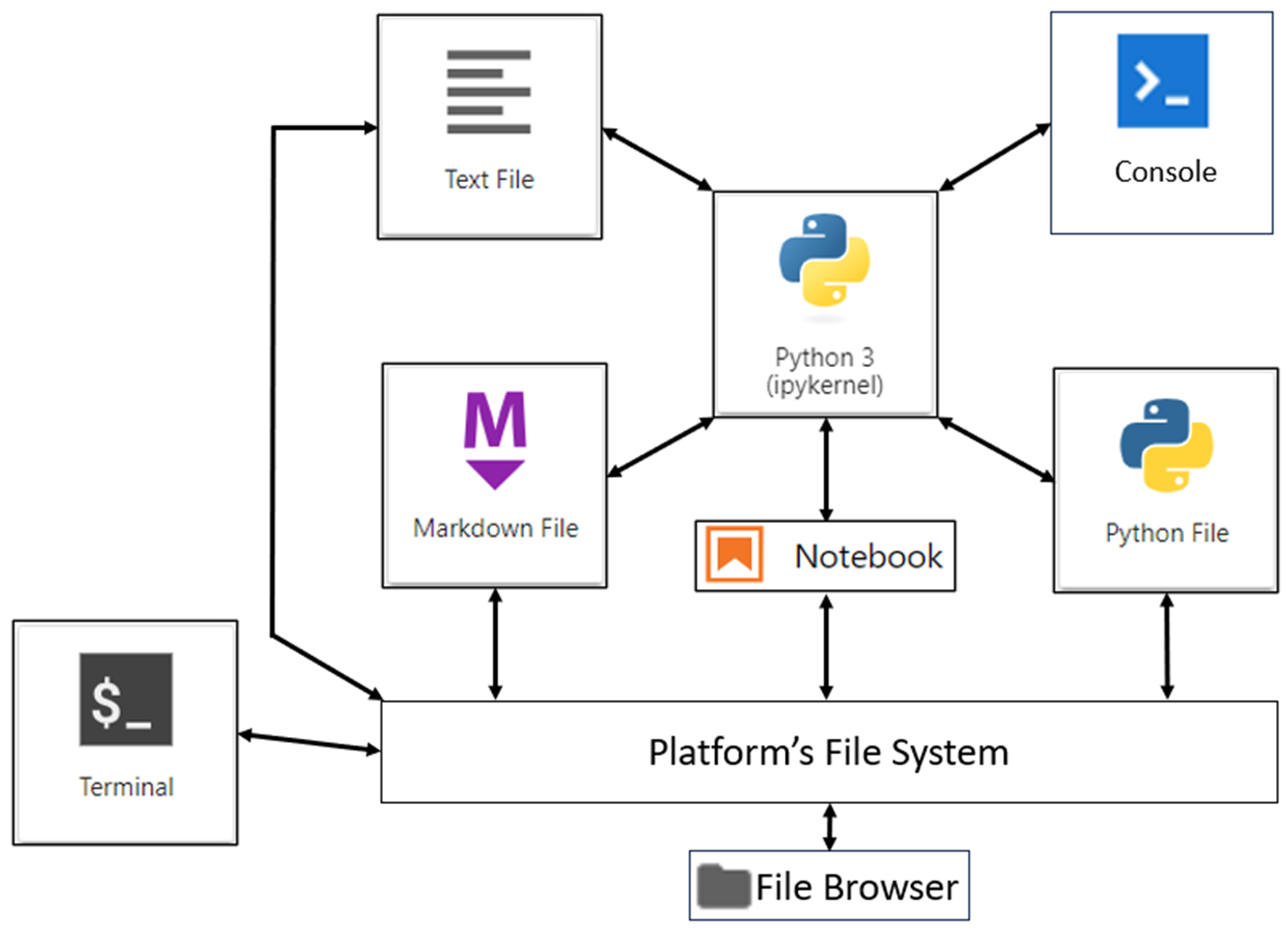
This diagram may look overwhelming at first because there are several parts. Don’t worry, you’ll soon see their relevance. The arrows show how various components interact. These interactions are one of the great benefits of JupyterLab. You’ll start with the central part of the application and the diagram: the kernel.
[ Improve Your Python With 🐍 Python Tricks 💌 – Get a short & sweet Python Trick delivered to your inbox every couple of days. >> Click here to learn more and see examples ]
Tom RocheVERY EXCELLENT--funny, great analysis. Still missing Matt but it's great to hear Amber Frost again
Will, Felix and Amber pick up a few stories we missed last week, including Tim Scott girlfriend reveal (and campaign end), and Speaker of the House Mike Johnson’s father/son porn monitoring. We then look at a litany of increasingly absurd bungles and PR disasters from the Israeli government, all from just the last week.
Pick up your copy of Amber’s new book Dirtbag here: https://us.macmillan.com/books/9781250269621/dirtbag
And find all the new Chapo offerings at our digital shop here: https://www.patreon.com/chapotraphouse/shop
Get bonus content on PatreonHosted on Acast. See acast.com/privacy for more information.
Tom Rochepromo only
Subscribe to Bad Faith on YouTube to access our full video library. Find Bad Faith on Twitter (@badfaithpod) and Instagram (@badfaithpod).
Produced by Armand Aviram. Theme by Nick Thorburn (@nickfromislands)Tom Roche[Eat==Emulate A Terminal](https://codeberg.org/akib/emacs-eat) in elisp for `emacs-version` >= 26.1
I’m running a little experiment. Even though I recently realized that I hardly ever use a terminal emulator, I was intrigued by this shoutout to the eat terminal emulator package. Except for the usual ankle biters, who don’t appear to have even used the package, the comments were all very supportive, some even saying that it significantly enhanced the commenter’s workflow.
I checked the README at the project’s GitHub repository and I was again impressed. It’s pretty speedy considering that it’s implemented in Elisp. It has several modes. One of those modes lets you move around the buffer and use the usual Emacs editing commands. That’s something that’s missing in vterm so it seems an improvement.
Installing eat is a simple one step process using the package manager. After that, you simply invoke it with Meta+x eat to start a terminal.
As I said, I don’t use terminal emulators very much anymore but I am going to try to use it as much as I can. I still have to refer to the README for the keybindings but I’m sure they’ll soon be absorbed into my muscle memory. There is, in any event, a manual (also available in Info) that covers everything. I’ll report back later with my impressions after I gain a bit more experience with it.