Shared posts

21 Oct 02:15

Democracy Now! 2015-10-16 Friday

Tom Roche

The Intercept's Jeremy Scahill, Cora Currier, and Ryan Devereaux on the newly-leaked "Drone Papers": inner workings of US military assassination in Afghanistan, Yemen and Somalia. Includes "The Kill Chain" by which the Obama administration chooses targets, and an assessment of the drone war in Afghanistan based on (unapproved) government leaks (following Obama's choice to continue that Forever War, following his previous choice to renege on ending US war in Iraq).

Democracy Now! 2015-10-16 Friday

  • Headlines for October 16, 2015
  • Drone War Exposed: Jeremy Scahill on U.S. Kill Program's Secrets & the Whistleblower Who Leaked Them
  • "The Drone Papers" Reveals How Faulty Intel & Secret "Kill Chain" Mark Suspects, Civilians for Death
  • The Longest U.S. War, Prolonged: After Vowing Afghan Pullout, Obama Extends Occupation Indefinitely

Download this show

20 Oct 05:20

Obama apologizes for bombing of Mayo Clinic

by Jen Sorensen
Tom Roche

follow the title/link to the cartoon

Apologies to the Mayo Clinic for this one. They were on my mind because my aunt recently had heart surgery there (I hear she received excellent care).

While the U.S. may not blow up civilians in foreign lands every single day, many civilians do fear air strikes by the U.S. and our allies every day. These massacres keep happening over and over and over again. Would Americans tolerate drone strikes and other aerial bombings in their neighborhoods because someone thinks a terrorist might be hiding in a nearby house? Can you imagine living this way for years on end?

This case is particularly bad since it seems to be a deliberate strike on a Doctors Without Borders hospital. Glenn Greenwald does a good job summing up the shifting arguments coming out of the military.

20 Oct 05:13

The Coming Revolution in 'Data Access and Research Transparency' in Social Scientific Research [Audio]

Tom Roche

Fascinating application of Open Science to qualitative social science. Moravcsik does make some bizarre offhand assertions, such as that dead links are a huge problem: hasn't he heard of DOIs? or the Internet Archive? or am I missing something?

Speaker(s): Professor Andrew Moravcsik | Advances in qualitative sources' accessibility are transforming the way these sources are used—and cited. Professor Andrew Moravcsik will discuss the multidisciplinary, multi-institutional effort to generate new standards in this digital age. Andrew Moravcsik is Professor of Politics and International Affairs, and Director of the European Union Program in the Department of Politics and Woodrow Wilson School at Princeton University. James Morrison is Assistant Professor in the Department of International Relations at LSE. The International Relations Department at LSE (@LSEIRDept) is now in its 87th year, making it one of the oldest as well as largest in the world.
20 Oct 05:10

Behind the News, 10/15/15

Tom Roche

Greg Grandin on his new book "Kissinger's Shadow." Grandin goes beyond listing Kissinger's many crimes (like, famously, Hitchins) to detail K's intellectual and political bankruptcy and its continuing harm to today's US international relations and military strategy.

Behind the News, 10/15/15 - guest: Greg Grandin on Henry Kissinger - Doug Henwood
20 Oct 05:10

Behind the News – October 15, 2015

Tom Roche

Greg Grandin on his new book "Kissinger's Shadow." Grandin goes beyond listing Kissinger's many crimes (like, famously, Hitchins) to detail K's intellectual and political bankruptcy and its continuing harm to today's US international relations and military strategy.

17 Oct 17:12

Sun 10/11/15 JBS Author: Cycles of Time: An Extraordinary New View of the Universe by Roger Penrose

by The John Batchelor Show
Tom Roche

Great interview. Batchelor may be a rightwing nut regarding economics, but he was able to interview Penrose rather more intelligently than most talkshow hosts. Penrose's conformal cyclic cosmology is a fascinating application of Second Law of Thermodynamics to the end and beginning of universe.

Sun 10/11/15 JBS Author: Cycles of Time: An Extraordinary New View of the Universe by Roger Penrose

15 Oct 05:52

Phyllis Bennis on US Bombing of Afghan Hospital

by CounterSpin
Tom Roche

Bennis is excellent as usual. She is one of the best {war, peace, "national security"} pundits available, let alone one of the best female ones--up there with Naomi Klein, IMHO.

Play
Stop
pop out
X

MP3 Link

KunduzThis week on CounterSpin: The Pentagon has declared the bombing of a hospital in Kunduz, Afghanistan, a “mistake.” But it will investigate itself to determine how US bombs came to destroy the Doctors Without Borders facility, killing at least 22 people.  Doctors Without Borders is calling for an independent investigation—and you would think journalists would, too, since who knows better than they the administration’s history of changing its story? The hospital attack is not the first of its kind, nor—if we are to understand the advice of generals that the incident means the US should increase its military presence in the country—will it likely be the last. After 14 years—as of this week—of war on Afghanistan, what has the US achieved? We’ll hear from Phyllis Bennis of the Institute for Policy Studies.

Play
Stop
pop out
X

MP3 Link

And first we take a look back at the week’s press, including the Oregon shooting, TPP and the upcoming Democratic presidential debate.

Play
Stop
pop out
X

MP3 Link

LINK:

  • “The Real Meaning of ‘Collateral Damage’: US Bombs Hit a Doctors Without Borders Hospital in Afghanistan, Leaving at Least 22 Dead” (Institute for Policy Studies, 10/5/15)
14 Oct 06:03

How Celtic are We?

Tom Roche

I thought the bit at the end was esp interesting: the Celtic languages (today found along the Atlantic seaboard from Galicia to Scotland) may not be survivals of the languages of the ancient, pan-European Celts, but may have evolved as maritime lingua franca.

Cultural historian Dai Smith interrogates the Celtic myth.
09 Oct 16:38

Behind the News – October 1, 2015

Tom Roche

first part of a talk by Steve Fraser on themes from his book "The Age of Acquiescence: The Life and Death of American Resistance to Organized Wealth and Power" full talk (video only) @ http://www.roosevelthouse.hunter.cuny.edu/events/steve-fraser-the-age-of-acquiescence/

24 Sep 15:08

The Forgotten Angolan Massacre

Tom Roche

Very good piece, with lots of Portuguese and Angolan history. 3 quibbles:

1. Lara Pawson (the author of "In the Name of the People: Angola’s Forgotten Massacre," refers to "General Salazar" when discussing the Portuguese colonial (and fascist) regime. However António Salazar was never (except trivially/ceremonially) a military officer: he was a lawyer and economist! Portuguese fascism (the Estado Novo) was a very different beast from Spanish fascism, whose leader Franco was indeed thoroughly military.

2. Pawson and Stasio (the interviewer) mention but do not (IMHO) sufficiently emphasize the extent to which the FNLA and UNITA were proxies for outside powers: UNITA briefly for China, then South Africa and the US; the FNLA for Mobutu, then China, then the US.

3. Stasio says early on that Angola in 1977 may seem to have "nothing to do" with his predominantly-North-Carolinian listeners. But in fact (and especially for those of his listeners who voted for Jesse Helms), these events (and the rest of the southern African wars of the 1970-90s) are very largely "your tax dollars at work."

On May 27, 1977, an uprising within Angola’s ruling Marxist-Leninist party, MPLA, turned into a national massacre. Hundreds and possibly thousands of...
23 Sep 15:57

The Smile Revolution

Tom Roche

Interesting piece, esp on the horrors of premodern "dental care." The bit about the experiences of Louis XIV is astonishing, almost disturbing.

In France in the eighteenth century, two political upheavals were underway. One was against an ancient regime, the other against its unsmiling, sardonic visage. The smile revolution had arrived and its effects were spectacular.
23 Sep 12:22

Sunday Feature: You're Tearing Me Apart: Rebel without a cause at 60

Tom Roche

Interesting doc, nicely done! Topics include

* "Rebel Without a Cause" the movie: various elements including the plot and cinematography

* James Dean: the star and his cult

* Nicholas Ray: the director (quite a backstory, though he implodes not long after

* Stewart Stern: the screenwriter (though the co-credited adaptor is not mentioned) and his WW2 experience

* the rest of the mostly-young cast (which was apparently busily having sex with each other and Nick Ray)

* the moment in time: 1950s US, the legacy of WW2, prosperity and its anxieties

Drawing on rare archive Alan Dein explores the making & meanings of Rebel Without a Cause
22 Sep 12:36

For Renters, a Bleak Future

by Gillian B. White
Tom Roche

More on the affordable housing crisis, but as usual, immigration is ignored as a factor.

Image Albert Gea / Reuters
Albert Gea / Reuters

Things haven’t been easy for renters over the past few years. Low vacancy rates—as more people move into rentals and fewer people move out—have meant skyrocketing prices. Add in years of stagnant wages, and it’s easy to comprehend why making rent is becoming a more difficult prospect for many families. And according to a new report, things may only get worse in the decade to come.

Recent research from the Harvard Joint Center for Housing Studies and Enterprise Community Partners, a real-estate research and investment organization, suggests that over the next 10 years, the rental population in the U.S. will climb by about 4 million people. (That’s actually a conservative estimate compared to the Urban Institute’s projections.)

The researchers estimate that the current rental crunch—the one where vacancies are around 7 percent, about half of renters spend more than 30 percent of their salaries on housing, and one quarter spend 50 percent or more—is only going to get worse over the next decade. Even if housing prices and income rise as quickly as inflation (about 2 percent annually) the number of severely rent-burdened Americans (those paying 50 percent or more) would increase by 11 percent over the decade, to over 13 million people in 2025.

To get those numbers, Allison Charette, Chris Herbert, Andrew Jakabovics, Ellen Tracy Marya, and Daniel T. McCue, the authors of the paper, took a look at estimated population growth, household formation, and patterns in homeownership in order to figure out how many more households will form over the next decade, and how many of them will rent instead of buying. According to their estimates, the current trend—where fewer Americans opt for homeownership—will continue. And that could be bad news for household finances, since a greater number of Americans will wind up using a major chunk of their income just to pay for housing.

The number of Americans spending 50 percent or more of their income on rent could increase by 11 percent over the next decade.

The authors ran several scenarios and only in the most optimistic one, when they estimated that household incomes outpaced inflation by 1 percentage point every year, does the number of burdened renters decrease at all. And even then, the decline was only 1.4 percent.

And an affordable housing shortage persists—both in existing structures and when it comes to the building pipeline, which means that even though construction seems to be happening everywhere in most major cities, much of that won’t help those struggling to make monthly payments.

Also of concern is how this renting crisis will coincide with the shifting demographics of the country. During the next decade, the minority population in the U.S. will continue to grow, but minorities are also much more likely to have difficulty making their paychecks stretch to accommodate growing rental prices—about one-quarter of minority renters have financial burdens compared to less than 20 percent for white households, according to the paper from Harvard.

And there’s bad news for the two largest generation populations, too. Stagnant wages, high rental prices, and decreased employment opportunities during (and following) the recession may continue to play out over the next decade for Millennials. Since the generation hasn’t been able to accumulate much wealth, they’re less likely to be prepared to buy homes or to have savings or other investments that can defray some of the burden of rental costs.

The outlook is especially troubling for the elderly. As the massive Boomer population ages, their financial limitations will likely mean more rent-burdened older Americans. Already, the report notes, 30 percent of elderly renters use more than half of their income on housing, that’s more than the national average. When it comes to aging, renters are often in a much worse financial position than their peers who were able to purchase homes. According to the study, the median American over the age of 65 who owns their own home, has enough wealth to afford 42 months of care in a nursing home. But the median renter over the age of 65 wouldn’t have enough wealth on hand to cover even one.

These findings are especially distressing given the fact that substantial economic gains feel like wishful thinking after years of  mostly stagnant incomes. And if current patterns persist, with rent prices increasing more quickly than incomes, each 0.25 percentage point increase in rent will mean an additional 400,000 Americans who are spending half of their pay on housing, leaving them little money to spend on their other basic needs.

This story originally appeared on The Atlantic.


20 Sep 21:09

Sat 9/19/15 JBS Author: The Lost Bank: The Story of Washington Mutual-The Biggest Bank Failure in American History, by Kirsten Grind.

by The John Batchelor Show
Tom Roche

Excellent presentation of one of the triggers of the US housing bubble and the global financial crisis. Batchelor seems like a rather rightwing guy (looking at his guest list), but this piece is refreshingly free of the usual rightwing blather blaming the housing bubble on irresponsible or greedy borrowers: he and Grind talk frankly of fraud. The one downside is that both Batchelor and Grind want to blame "the regulators" at the time, notably John Reich (director of the Office of Thrift Supervision (OTS)) and Sheila Bair (chairperson of the Federal Deposit Insurance Corporation (FDIC)). But, by their own account, the FDIC wants and tries to "do the right thing," but is fought every step of the way by OTS. So don't blame "the regulators," blame the non-regulator, Reich.

Sat 9/19/15 JBS Author: The Lost Bank: The Story of Washington Mutual-The Biggest Bank Failure in American History, by Kirsten Grind.

20 Sep 17:51

Sat 9/19/15 JBS Author: 1177 B.C.: The Year Civilization Collapsed by Eric H. Cline.

by The John Batchelor Show
Tom Roche

More accurately, "a year in the Late Bronze Age around which time several Eastern Mediterranean empires (but not the Egyptians) collapsed." But ya gotta sell books :-) and it is a quite interesting tale of how a "hypercoherent" and "globalized" (to use 2 terms of which Batchelor and Cline seem quite fond) web of trading empires can suddenly unravel. The talk emphasizes a few developments: lotsa earthquakes, climate-change induced famines, the interruption of tin imports from present-day Afghanistan, and the mysterious "Sea Peoples."

Sat 9/19/15 JBS Author: 1177 B.C.: The Year Civilization Collapsed by Eric H. Cline.

20 Sep 15:50

Lords of Secrecy: The National Security Elite and America’s Stealth Warfare

by contact@opensocietyfoundations.org
Tom Roche

Unusually excellent talk for Open Society Institute, plus very unusually excellent Q&A. OSI talks tend to be (IMHO) too dull and insider-oriented: see their previous panel on whistleblowing and security-classification for an example. By contrast, Horton is clear, willing, and able to speak truth to power (whose views are amply represented by moderator Amrit Singh). Horton's positions are not completely admirable/mine, but they are refreshing in the context of US corporate-funded media discourse.

Scott Horton discusses his new book, Lords of Secrecy, which explores national security debates including the turn to private security contractors, sweeping surveillance methods, and the use of robotic weapons such as drones. Speakers: Scott Horton, Amrit Singh. (Recorded: May 21, 2015)
18 Sep 17:05

GDP RIP

Tom Roche

Excellent talk (though skippable Q&A) on the problematic history and utility of GDP as econometric and (more importantly, which Philipsen stresses) ideology. http://www.dirkphilipsen.com/

GDP is seen as the universal yardstick of progress and the highest goal of politics. But economic historian Dirk Philipsen argues that the world can no longer afford GDP rule, and it’s time now for a different measure.
18 Sep 13:53

The Hunt for the Fat Gene

Tom Roche

great talk about the evolution of biochemistry of uric acid, and why that matters to humans and other apes

Medical researcher Richard Johnson, of the University of Colorado Anschutz Medical Campus, talks about his October Scientific American article "The Fat Gene," co-authored by anthropologist...

-- Read more on ScientificAmerican.com
18 Sep 01:06

With Virtual Machines, Getting Hacked Doesn’t Have To Be That Bad

by Micah Lee
Tom Roche

installing secure VMs on Ubuntu: a completely-worked (looking :-) example

All major consumer operating systems, including Windows, Mac OS X, and Linux, are way too easy to hack. One mishap — opening the wrong email attachment, installing malware that pretends to be Flash, not updating your software quickly enough — and you’ve given the keys to the kingdom to an attacker.

If that attacker gets the ability to run programs of their choice on your computer, as they often aim to do, they have access to all of your files. They can start logging your keystrokes, taking screenshots, and even listening to your microphone and watching through your webcam.

But it’s possible to isolate the most risky files and programs from other parts of your computer. Using virtualization software, the same technology that powers much of so-called “cloud computing,” it’s possible for you to protect your system even as you open attachments that might be sketchy, visit websites that you’re not too sure about — porn sites, torrent sites, pirated TV and sports sites — or test out software downloaded from random websites. You can also use this technology to ensure that your anonymous online activity remains anonymous, safeguarding the privacy protections offered by Tor by ensuring that absolutely all internet traffic gets routed through it — even if your software, like Tor Browser or Pidgin, gets hacked specifically to bypass Tor.

In this column, I’m going to start with a simple primer on virtual machines, including how to install the Ubuntu distribution of Linux in one of them, and I encourage you to follow along. Then I’m going to outline a handful of ways you can use virtual machines to reduce your risk of getting hacked, and go over some security caveats. Then I’m going to show off Whonix, an operating system you can run in a virtual machine to maximize your online anonymity; it’s ideal for maintaining a secret identity. And finally I’m going to give a brief overview of Qubes, an operating system that’s more secure than most anything currently available, and takes isolation security to its logical limits.

Virtual machines 101

A virtual machine (VM) is a fake computer running inside your real computer. Each VM gets to use a chunk of your computer’s memory while it’s running and has its own virtual hard drive, which is just a file on your real hard drive. You can install operating systems in them and you can install and run software in them. You can save snapshots before you do something potentially dangerous and restore the snapshot when you’re done, returning your VM to its previous state.

In virtualization lingo, the operating system that you’re running right now is called your “host,” and every VM that you run is a “guest.” If a guest VM gets hacked, your host remains safe. For this reason, security researchers often use VMs to study viruses: They unleash them on their guest VMs to safely monitor what they’re trying to do and how they work, without risking their host computer. They “isolate” the viruses from the rest of their computer.

Courtesy XKCD

For this article I’m going to be using virtualization software called VirtualBox. It’s open source and free to download. VirtualBox is available for Windows, Mac OS X, and Linux. Go ahead and download and install a copy if you’d like to follow along.

I’m using a Mac host, and I’m going to start by installing the Ubuntu operating system, version 15.04 to be precise, in my VM. Generally speaking, it’s simpler to start off by installing a Linux distribution in your virtual machine, since Linux is free software. You can install as many Linux virtual machines as you want, wherever you want — an easy setup to deal with.

If you want to test a piece of software for Windows or Mac OS X inside a virtual machine to see if it’s malicious, you can also install those operating systems inside of a VM. But there are legal restrictions. For example, while OS X can be installed on up to two virtual machines for free, you have to be on a Mac when you do so. On Windows, you’ll likely need to buy separate Windows licenses for each VM. Here are instructions for installing Mac OS X in a VM and for installing Windows 10 in a VM.

While the steps below are written and illustrated using an Ubuntu virtual machine on a Mac, you can still follow along if you’re running Windows or Linux. And don’t worry about breaking anything; you can always delete your VM and start over. That’s the beauty of VMs: You get infinite lives, in the parlance of videogames, so it’s a great way to experiment and learn.

Creating a VM and installing Ubuntu

Hopefully you’ve already downloaded and installed VirtualBox as instructed above. Next, hop on over to Ubuntu’s website and download a copy of Ubuntu.

Now open VirtualBox and click “New” to create a new VM. I’m calling my VM “ubuntu-test.”

You get to choose how much memory your new VM will have and you get to create a new virtual hard disk for it. Whatever resources you allocate to your VM will not be available to other programs on your computer. I’m sticking with the defaults, 768MB of memory and an 8GB hard drive. You can just click through with all of the default options too if you want, or you can give your VM more resources. Finally, click “Create” to create your new VM.

The next step is to install Ubuntu. With my “ubuntu-test” VM selected, I click “Start” to boot it up. Since the virtual machine is brand new, it prompts me to insert an operating system installation disk. Of course, I don’t actually need a “disk.” Instead I can just find and select the disk image file (in this case, “ubuntu-15.04-desktop-amd64.iso”) and click “Start.”

Now the VM begins to boot to the Ubuntu disk. Notice that if you click in the virtual machine window, VirtualBox will warn you that the VM will “capture” your mouse and keyboard input, which means that when you move the mouse and type on your keyboard you’ll be doing this inside your guest VM rather than on your host machine. You can press the “host key” to make your mouse and keyboard control your regular computer again. On a Mac the host key is the left “Command” key, and on Windows and Linux it’s the right “Ctrl” key.

The Ubuntu disk has finished booting. I’m going to click “Install Ubuntu” and follow the simple instructions. I’m choosing “Erase disk and install Ubuntu” (don’t worry, I’m only erasing the virtual machine’s virtual disk, not my actual hard drive). I’m going to make up a username and password to login to this VM, and then I’m going to let it finish installing. When it’s finally done, the VM will reboot into my freshly installed operating system. (After installing Ubuntu, my VM failed to shut down all the way while it was rebooting. If that happens to you as well, click the Machine menu and choose Reset to force your VM to restart.)

Updating software inside the VM

Now that I’ve booted up and logged in to my Ubuntu VM, I’m going to update all of the software. Always keep your software up to date, even in VMs!

To update all of the software in Ubuntu, I’m running the “Software Updater” program, typing my password, and letting it do its thing. Since I just installed this operating system and have never done updates, it might take awhile to download and install everything.


Installing “Guest Additions”

When it’s finally done updating the existing software, it’s time to install VirtualBox “Guest Additions.” Guest Additions aren’t required, but they allow you to do some nice things, like resize your VM window, share your clipboard between your host machine and your guest machine, and set up shared folders so that your guest VM can access specific files on your host.

In order to install Guest Additions you need to insert a virtual CD, which contains the software, into your VM. You can do this by clicking the “Devices” menu at the very top of the screen, from within the VirtualBox program, and chose “Insert Guest Additions CD image.” It will pop up a dialog asking for permission to install. Click “Run” on the pop-up dialog, and VirtualBox will open a new window showing the install progress. When it’s finished, reboot your VM. You can do this by clicking the gear in the top right, clicking Shut Down, and then clicking Restart.

With “Guest Additions” installed in my VM, I can resize the window like any other windows on my host machine.

I can also share the clipboard between the host and guest VM by clicking the “Devices” menu at the top of my screen, from within the VirtualBox program, and going to “Shared Clipboard.” The choices are “Disabled,” “Host to Guest,” “Guest to Host,” or “Bidirectional.” It’s best to keep this set to “Disabled” unless you need to copy and paste between your guest VM and your host. You can always temporarily enable clipboard sharing and then disable it again when you’re done.

Sharing folders

Sharing files is slightly more complex. First, you need to add your user to the “vboxsf” group in your VM (don’t worry if you don’t understand what this means). Click on the Ubuntu logo in the top left, type “terminal,” and click on the Terminal icon to open a terminal in your VM. Then type:

sudo usermod -a -G vboxsf $(whoami)

You’ll also have to type the password for your user account in Ubuntu in the VM, the one you set up earlier. Then shut down your VM all the way.

In the VirtualBox window, choose your VM and click “Settings,” and move to the “Shared Folders” tab. Click the “+” icon to add a folder to share with your VM. I’m sharing a folder called vbox_share in my Documents folder. This way, if I need to copy files to or from my VM, I have a place to drop those files.

Inside my Ubuntu VM, I can access the shared folder by viewing “/media/sf_vbox_share”. I can get to that by opening the Files app (there’s a launcher icon for it on the left), clicking Computer in the left panel, double-clicking the “media” folder, then double-clicking the “sf_vbox_share” folder. Inside my OS X host machine I can access the same folder by viewing “vbox_share” in my “Documents” folder.


Isolating risky behavior inside of VMs

Now that we have a VM, let’s start doing some things that might be risky if we weren’t isolating them.

Before doing something that you think might break your VM, or might infect it with malware, you might want to save a snapshot of it so you can restore it when you’re done. You can save a snapshot by clicking VirtualBox’s “Machine” menu at the top of your screen, and choosing “Take Snapshot.”

Below are just a few examples of some ways you can use VMs to increase the security of your computer. In the end, virtualization is a tool that has many different uses, so feel free to be creative.

Opening documents that you don’t trust

One of the easiest ways to get hacked is by opening a malicious document. Attackers might email you a booby-trapped “document” hoping that you’ll open it. If you do, the file would exploit a flaw in your operating system or in software like Adobe Reader or Microsoft Word, thus allowing the attacker to take over your computer.

It’s not always clear which documents are safe and which are malicious. A clever attacker could pretend to invite you to a conference that you’re interested in, and attach a malicious file masquerading as the schedule to that conference, or they could pretend to recruit you for your dream job, and attach something that looks like a job description — or they could entice you in any number of other ways. It’s safest to simply not open any attachments or click on any links in emails, but this isn’t feasible, especially for journalists or activists who are actively soliciting sources.

These attacks are not theoretical. My colleague Morgan Marquis-Boire pointed out a few real-world examples that he helped analyze: Vietnamese democracy activist Ngoc Thu‘s computer was hacked when she opened malware she found in her email; the Committee to Protect Journalists’s executive director Joel Simon was also emailed malware, though he didn’t install it; the Moroccan news website Mamkafinch.com received an enticing tip through their contact form that included a link that, when opened, took over the journalist’s computer using Hacking Team malware; and a report from 2014 showed that journalists from 21 of the world’s top 25 news organizations were likely emailed malware by state-sponsored hackers.

You might also find files online that you’d really like to look at but aren’t sure are safe. For example, documents in the Hacking Team email archive. You probably shouldn’t trust those, but you might want to look at them anyway.

Here’s an email where Hacking Team employees appear to be discussing giving a demo of their hacking services to an Egyptian defense contractor. I don’t speak Italian so I don’t entirely understand what this email thread is about, but the attachment is called “Exploit.docx.” Seems legit (*cough*).

If I try opening this dubious file in Chrome, my browser throws a security warning, and for good reason! Any attachments downloaded from the Hacking Team archive might try to, ahem, hack you.

Instead, I’m going to right-click on the document and save it to my vbox_share folder (clicking through Chrome’s warning, because I plan to view this documents in isolation).

Now, back in my VM, I can see the document.

To be extra safe, before opening this documents I’m going to disconnect my VM from the internet. I click the “Devices” menu at the top of the screen, choose “Network,” and uncheck “Connect Network Adapter.” This way, when I open the document, if it tries to hack my VM and connect to a command and control server, or even just phone home to alert the document owner that it’s been opened, it won’t be able to. It’s a good idea to do this whenever you open a suspicious document inside a VM.

Here it is. The document actually appears just to be an email thread pasted into Word. Regardless, I’m glad I didn’t open it on my host machine.

Visiting sketchy websites

On your regular computer, for day-to-day use, it’s always a good idea to harden your web browser. Installing browser add-ons that block ads and malware, and making Flash click-to-play, goes a long way toward blocking software that might try to take over your computer through your web browser.

But even doing all of these things, there’s no guarantee that you won’t get hacked just by loading a website. If you’re going to visit a website that you think might put you at higher risk of getting hacked, you might want to visit that website inside of a VM. You can even set up a dedicated VM just for this purpose. (If you turned networking off in the previous step, you can enable it again by clicking the “Devices” menu, going to “Network,” and checking “Connect Network Adapter.”)

Inside my VM I decided to search for “Mr. Robot streaming” and found myriad pirated streaming websites. Here’s a screenshot of one of them. See that box that’s telling me my Flash Player is out of date, with a helpful link to update it? That’s not actually a real Flash update, that’s malware.

When I clicked through to install this “Flash update,” it ended up installing a Firefox add-on called “Free Games Zone” that changed my browser’s search engine to Ask.com. When I pulled this add-on apart to see how it works I discovered code that injects JavaScript into web pages that I load, and code that tries to prevent me from uninstalling it.

In the scheme of things, this malware is on the tame side — it’s not trying to read my email or watch through my webcam, but it’s still nothing that anyone would ever actually want installed on their computers. But even if it were way worse, it would first have to escape from the VM that it’s trapped in before it could do those things. To completely get rid of it I can restore my VM from a snapshot, or I can delete the VM altogether and create a new one.

Running vulnerable software that you rely on

All programs contain bugs, and these bugs can get exploited to take over our computers. The easiest way not to get hacked is not to use computers, but that’s not an option; we still have to run programs.

Some programs have much bigger attack surfaces than others. For example, libpurple, the underlying code that powers the encrypted chat programs Pidgin and Adium, has been heavily criticized for its old, bloated, and likely buggy source code that was originally written in 1998 (many critical libpurple bugs have been fixed in recent years, so it’s currently in much better shape than it used be). Yet if you want to have encrypted chat conversations on a computer, you don’t have a lot of options but to use it.

If there’s a piece of software that you depend on, but you think running it on your host machine will increase your chances of getting hacked, you can set up a dedicated VM for running that program.

If your dedicated chat VM gets hacked through a Pidgin exploit, for example, the attack will be contained. The attacker will be able to spy on the encrypted chat conversation you have in Pidgin, but that’s it. They won’t be able to access other files on your computer. They won’t be able to see what passwords you’ve saved in your web browser, or listen through your microphone, or read your email, or anything else.

You still have to be careful

All software has bugs, and this includes virtualization software. While isolating dangerous activity inside of a VM considerably reduces the chance of getting your regular computer system hacked, it doesn’t make it impossible.

If your VM gets hacked, it’s feasible that the attacker could then escape your VM in order to run and alter programs freely on your host machine. In order to do this, your attacker must have an exploit against your virtualization software. These bugs are rare but do happen.

You should also be careful with how you use the VirtualBox clipboard sharing and file sharing features I described above. For example, if someone has hacked a VM that has Shared Clipboard set to “Host to Guest” or “Bidirectional,” the attacker could spy on what you’ve copied to your clipboard on your host machine — for example, a password.

Staying anonymous with Whonix

Whonix is an operating system that you can install on your existing computer inside VirtualBox, and that forces all network traffic to go over the anonymity network Tor.

Tor’s flagship product, Tor Browser, does an excellent job of hiding your IP address from websites you visit and hiding what websites you’re visiting from anyone monitoring your internet activity.

But Tor Browser, like all other software, has bugs. If you visit a website in Tor Browser, the website could hypothetically exploit a severe bug to force your computer to make an internet connection to the attacker outside of the Tor network, letting them learn your real IP address and identity. This is exactly how the FBI deanonymized Tor Browser users who visited websites hosted by Freedom Hosting in September 2013. The FBI exploited a bug that was present in older versions of Tor Browser (it didn’t work against users who promptly update their software) in order to hack them and ultimately deanonymize them. (In this case, the FBI was attempting to attack people who allegedly had links to child pornography, but they also presented Tor Browser-hacking malware to users of legitimate websites hosted by Freedom Hosting, including the free anonymous email service TorMail.)

Whonix uses two VMs, called Whonix-Gateway and Whonix-Workstation, to maximize anonymity protections. The gateway VM acts as the upstream internet provider for the workstation VM, and it forces all network traffic to go over the Tor network. The workstation VM is where you use Tor Browser, as well as any other software that you wish to use anonymously. If you get hacked, for example with a Tor Browser exploit like the one that the FBI used, not only is the attacker contained inside of this VM and unable to access your host machine, but the attacker can’t deanonymize you either. All network connections that the attacker makes will go through the gateway VM, which forces them to go through Tor.

Whonix is great because you can be confident that everything you do in the workstation VM is anonymously going through the Tor network. That means that hackers won’t be able to deanonymize you, unless they can escape from your VM. You can use chat software like XChat to connect to IRC servers anonymously, or Pidgin to connect to Jabber servers for anonymous encrypted chats, or Icedove and Enigmail to send anonymous, encrypted email.

But keep in mind that Whonix, like other virtual machine-based security, can’t protect you if your host machine gets hacked or seized. If you are using Whonix to anonymously send documents to a journalist, and you become a suspect in a leak investigation, your Whonix VMs might contain evidence that can be used against you.

Installing and configuring Whonix

It’s slightly complicated to get started with Whonix, but there’s a lot of documentation on the Whonix website, and if you have questions feel free to post them in the comments. Let’s get started!

Head over to the Whonix VirtualBox download page and download a copy of Whonix-Gateway and Whonix-Workstation (a total of 3.1GB, so it might take some time). It’s also a good idea to verify the PGP signatures, but that’s outside the scope of this post.

Once you’ve downloaded them, open VirtualBox, click the “File” menu at the top, and click “Import Appliance.” Browse for the Whonix-Gateway file you just downloaded, and click “Continue.”

Now click “Import,” read the warnings, and click “Agree.” Your Whonix gateway VM will automatically get set up. Repeat these same steps with the Whonix-Workstation. When you’re done, you’ll have two new VMs in VirtualBox.

Start both Whonix-Gateway and Whonix-Workstation. You need to leave the gateway VM open in the background or else the workstation VM won’t have internet access, but you’ll do most of your work in the workstation.

When the gateway VM has finished booting for the first time, you’ll need to configure it. Click through the “Whonix Setup Wizard” to enable Tor and automatic updates.

Click through the “Whonix Setup Wizard” in the workstation VM as well. And in both VMs, change the default password and update the software.

Now it’s time to starting using Whonix. In the workstation VM, go ahead and open Tor Browser. It will automatically download and install it the first time you try opening it. Once it opens, you can browse the web anonymously, and remain anonymous even if Tor Browser gets hacked.

Qubes: Taking isolation security to its logical limits

Since all software has bugs, wouldn’t it be safest to isolate each program in its own VM? Qubes is an operating system that does just that, and does it in a way that’s much more usable and more secure than is possible using virtualization software like VirtualBox or VMWare in a traditional operating system.

In Qubes, your host machine runs a graphical desktop environment, and that’s just about it — your host machine doesn’t even have internet access. You run all of the rest of your software inside of Linux or Windows VMs. Qubes also has great support for Whonix. If you use Whonix inside of Qubes, your host machine has a much smaller attack surface than if you were using a traditional operating system.

Qubes makes it easy to manage separate VMs for your different “security domains.” For example, you can create a work VM that you use to check your work email and login to work-related accounts, and a separate personal VM that you use to login to Facebook and keep track of your photos. You can create an untrusted VM that you use for everyday web surfing, and a vault VM (that doesn’t have networking enabled) that you use to store sensitive files like your password database, or secret documents that you’re working on. And you can right-click on any document to open it in a “disposable VM,” a VM that gets created simply to view this document, and then deleted again when you close the document.

I’ve written about Qubes in the past, and I encourage you to read more about it if you’re interested. But it’s not for the faint of heart. Not yet, at least. For one thing, you can’t test it in a VM like you can most operating systems because it needs to run VMs of its own, and you don’t want to accidentally break the universe (just kidding; it just doesn’t work).

And while it has an active development community and a growing user base, Qubes is not easy to use for non-power users. I don’t recommend you switch to it yet unless you’re already comfortable troubleshooting Linux problems from the command line. In Qubes, simple problems like how to install a new program or take a screenshot can have steep learning curves for the uninitiated. But all that said, if you are using Qubes, you can turn your computer into an incredibly intricate and secure fortress unlike anything that’s possible with a traditional operating system.

Finally, all software has bugs, and this includes Qubes as well as Xen, the virtualization software that powers Qubes. Even if you’re running Qubes, and promptly update all your software, and carefully isolate everything, and only open documents in disposable VMs, and do all of your browsing in Tor Browser inside of a Whonix workstation, it’s still possible for your host machine to get hacked if your attacker has lots of resources, patience, and zero day exploits.

Conclusion

Normally it’s cheap and easy for an attacker to take over your computer. But by isolating the parts of your computer that get attacked within VMs, you can make taking over your computer difficult, expensive, and, with any luck, not worth it.

The post With Virtual Machines, Getting Hacked Doesn’t Have To Be That Bad appeared first on The Intercept.

18 Sep 00:54

Putinism

Tom Roche

Seems like the only folks talking sanity about Russia today in Anglosphere media are Stephen F. Cohen and Walter Laqueur. I suspect latter's publishers chose the name "Putinism," because, as Laqueur points out, there's nothing particularly new about this brand of conservative Russian nationalism.

Why Putinism will survive Putin.
15 Sep 16:45

Democracy Now! 2015-09-15 Tuesday

Tom Roche

4 great pieces:

* Kevin Moore (who recorded arrest of Freddie Gray) on Copwatch and police and life in Baltimore

* Seattle teachers strike and public support

* Operation Naked King: DEA smear on Evo Morales

* Julian Assange on Snowden, Maduro, and the illegal downing of Morales' plane: violating the Vienna Convention in Vienna!

Democracy Now! 2015-09-15 Tuesday

  • Headlines for September 15, 2015
  • Man Who Filmed Freddie Gray's Arrest: Power of a Copwatch Camera is "Almost Like Live Bullets"
  • Seattle Strike Enters Fifth Day as Teachers Protest Testing Policies, Racial Inequity & Low Wages
  • Operation Naked King: Secret DEA Sting in Bolivia Confirms Evo Morales' Fears About U.S. Meddling
  • Julian Assange: U.S. Spying on WikiLeaks Led to Mistaken Downing of Morales Plane in Snowden Hunt

Download this show

14 Sep 17:18

John Hockenberry: Why I'm done with the 9/11 ritual

Tom Roche

Hockenberry objects to using 9/11 for militarism abroad and surveillance at home. Definitely one of his better pieces ... but not perfect:

- "heroin kills and destroys lives": no, John, drug *wars* do that.

- the usual US corporate-funded media use of the term "defense" to refer to the US *military*.

The following essay is by Takeaway Host John Hockenberry. Click on the player above to hear the audio version.

I don't look at the calendar anymore this time of year. I dread this day. But not because of anything that might happen. It’s the ritual of 9/11 that I am through with.

I was actually done with the whole 9/11 thing sometime between the famous and politically disastrous "Mission Accomplished" moment from George W. Bush after the Iraq invasion, and the empty announcement by Barack Obama that this feeble terrorist mastermind, Osama bin Laden, had been killed by Navy SEALS in Pakistan.

I'm done with the whole heroes thing. Aren't we over this? There’s the American tragedy story and the talk of America as the preeminent victim of terrorism—America isn't even close to being the most victimized nation by terrorism.  If anything, we are more of a victim of our own domestic terrorism than from any foreign enemies, even though it’s easy and convenient to fear them more than kids with guns who wander into churches to kill.

I cannot deny people's grief who lost loved ones that day. The people who were in the towers—I cannot deny the tragedy of those who couldn't make it out.

But I think the 9/11-ization of American life has been a kind of poison for all of us. We had our moment when the whole world was with us after 9/11, and we squandered it.  

We spent trillions on two wars that turned a battlefield into a killing field for ISIS and gave us a refugee tidal wave from Syria and Iraq. And another battlefield in Afghanistan was turned into a fragile puppet government that rules over the biggest opium crops in the history of the world. Some of that Afghan heroin finds its way into our cities where it kills and destroys lives much more easily than flying planes into towers.

I'm just done with 9/11. If you don't agree, or if you think I'm being disrespectful, I'm sorry, and I don't begrudge other's feelings about this. But I can't help feeling a little cheated by the whole thing.

I can't get over this remark George W. Bush made back in 2003, trying to explain how 9/11 had changed America:

“It was very difficult to link a terrorist network and Saddam Hussein to American soil. As a matter of fact, it very difficult to link any attack on the American soil because, prior to September 11th, we were confident that two oceans could protect us from harm.”

We spend hundreds of billions of dollars on defense and it was the oceans that were protecting us? That was it? That was why no fancy fighter jets defended our airspace on September 11th? We bought the F16s for show, or to bomb and strafe other people?

The oceans were for us. Great plan.

One of my teenage daughters came to me last night. She was worried that I, as a somewhat public person, might get in trouble if she posted this statement on Facebook:

“I grieve for the thousands of innocents who died on 9/11, if I can also grieve for the hundreds of thousands of innocent civilians who died in Iraq after 2003."

I paused.

“Don't worry about me,” I said. “If that's your experience and how you feel, go for it.”

By the way, her first memory as a child on her first day of preschool was seeing a plane hit the towers and asking her mother who saw nothing, “Why would a plane do that?”

Now 14 years later, we are still working on that question from an innocent little girl.

Follow @JHockenberry

12 Sep 19:05

Living on Earth: September 11, 2015

Tom Roche

best pieces:
* Paul Barrett on how Ohio utility FirstEnergy wanted deregulation, but now wants subsidies for coal and nuclear.
* Marc Levy (Columbia University Earth Institute) on how global warming drives global conflict drives refugee flows in Syria, Mali, etc (including US). Climate as threat multiplier for global insecurity.

Undoing Deregulation to Keep Coal Alive / Beyond the Headlines / Global Warming Linked to Syrian Refugee Crisis / Fighting Today's Invaders In Boston Harbor / A Prayer to Share Earth as a Commons
12 Sep 18:28

Behind the News – September 10, 2015

Tom Roche

Megan French-Marcelin (historian of 20th-century urban policy and planning) on neoliberalizing and gentrifying New Orleans; Josh Bivens (Economic Policy Institute) on productivity and income trends since 1973, and issues regarding their calculation and relation.

11 Sep 15:35

It's the Economists, Stupid

by podcasting@cbc.ca
Tom Roche

Richard Denniss and Julie Nelson on how many (probably most) contemporary Anglosphere economists have abandoned empirical science to serve wealth and power

Interest rates. Unemployment. GDP. Markets. Austerity measures. Economists tell us what we, as societies, can and can't afford. But how do they decide? What values are at play?
11 Sep 12:59

Can We Talk About Urban Violence Without the Word 'Black'?

by Brentin Mock
Tom Roche

good to see black folk pushing back with AllLivesMatter

Image REUTERS/Richard Clement
Former Baltimore Ravens star Ray Lewis, center (REUTERS/Richard Clement)

It seems that people will continue riding the “black-on-black crime” train, and the wheels may never fall off of it. But if we can’t get rid of the tortured phrase, the least we can do is bring some clarity to why it’s used. That’s what legendary NFL Hall of Famer/movie star/social activist Jim Brown tried to do Wednesday during the Redefining Public Safety Summit in Newark, which was set up to address violence in marginalized communities. Brown told reporters at the event:

Either you have compassion for your community or you don’t. It’s not ‘black-on-black’ crime. It’s really people killing other people. I would hope you would not center your response around ‘black-on black.’

Brown said this while flanked by Ras Baraka, the Newark mayor who apparently surprised The New York Times by actually being an effective public servant, and former Baltimore Ravens star Ray Lewis. Despite Brown’s comments, he participated in a panel discussion with Lewis and Baraka at the summit entitled “The Real Root Causes of the National Epidemic of Gangs/Black-on-Black Violence.”

The fact that Brown repudiated the named premise of the panel testifies to both how troubling and how ingrained this term is in the American lexicon. He had to further break the term down on the All in With Chris Hayes, where he and Baraka spoke on a segment entitled “What About Black-On-Black Crime?” Responding to Hayes’ question about the term, Brown said, “It isn’t that the people are black, it’s that there are certain people living in certain conditions, and if you don’t change those conditions, the people are not going to change.”

Those conditions needing change, as Brown explained to Hayes, are, that “If the jobs are not there, and you don’t emphasize the education, and the fathers are not there, and those of us like myself and the mayor don’t substitute, then what are the kids supposed to do?”

Baraka twice mentioned an “unresolved trauma” among black communities in his responses to Hayes’ questions about violence. It was a vague reference that he explained to some extent as “a cycle of violence initiated by poverty and five decades of unemployment.” You could tell, though, that there was more to this “unresolved trauma” diagnosis that Mayor Baraka couldn’t go into, but that perhaps a pre-elected official Baraka could.

That’s no shade— all politicians have to temper their personal discourse around third-rail issues. This perhaps goes especially for black politicians (or else certain Key and Peele sketches wouldn’t be so funny, and so enjoyably endorsed by President Obama).

It’s those often-buried issues of white privilege and white supremacy implicit in Baraka’s invocation of “unresolved trauma” that Black Lives Matter activists are trying to extract. And it’s that kind of digging from Black Lives Matter disruptors that is frustrating politicians, from members of Congress, like Bernie Sanders, to mayors, like D.C.’s Muriel Bowser.

Baraka would have been a front-and-center spokesman for the Black Lives Matter movement had it started before he took office. Few would argue that spirit is not still in him. The challenge he has now, as mayor, is converting that Black Lives Matter energy into local policies that illuminate the obfuscated trauma he speaks of in ways the city can rally around—and resolve it in the process.

Brown has been working at this challenge for decades, though never from an elected office. He convened a summit in Cleveland in 1967, which gathered sports greats like NBA star Kareem Abdul-Jabbar and boxer Muhammad Ali with community leaders to pursue solutions to urban violence.

At the Newark summit, Brown said that he was passing his social-activist torch to former NFL star Ray Lewis, who is credited with helping broker peace in Baltimore during the riots. (Though some might argue that Lewis was more of a scold than a change agent.)

Where was Ray Lewis' Baltimore riot critique in 2013 after the Ravens won Super Bowl XLVII? Retirement riots are okay?

— Anderson Campbell (@andycampbell) April 28, 2015

Lewis probably didn’t help himself in comments to the press from the summit. Like Brown, he also wanted to omit “black” from the discussion around urban violence, but for different reasons.

“Remove the word ‘Black’ and say ‘Lives Matter,'” said Lewis.

The New York Daily News reported Lewis saying, “I walk around, I see black-on-black lives. If black-on-black lives really matter, I'm sending a world call out to all black people: Stop killing each other then."

That probably won’t resonate well with the Black Lives Matter movement. And Lewis isn’t the only high-profile African American taking this position. Actress Nia Long recently caught a flurry of dissent when she invoked #AllLivesMatter on her Instagram page.  

But as historian Michael Javen Fortner notes in his new book Black Silent Majority, there is a sizable black population that is moved by this kind of inward-looking troubleshooting. And they vote on Election Day—as do the protestors and disruptors—which is why Baraka stood by Lewis when he made the comments, but hasn’t shied away from Black Lives Matter, despite his perch.

As Baraka told NPR, “I think some people take offense to people saying ‘black lives matter.’ … It doesn't mean that you have no respect for other people's life. What it means is that you want black people to have justice in the community just like everybody else.”


10 Sep 23:02

Hillary Clinton Goes to Militaristic, Hawkish Think Tank, Gives Militaristic, Hawkish Speech

by Glenn Greenwald
Tom Roche

evil twins: Haim Saban backs the US Democrats, and Sheldon Adelson backs the Republicans

Leading Democratic presidential candidate Hillary Clinton this morning delivered a foreign policy speech at the Brookings Institution in Washington. By itself, the choice of the venue was revealing.

Brookings served as Ground Zero for centrist think tank advocacy of the Iraq War, which Clinton (along with potential rival Joe Biden) notoriously and vehemently advocated. Brookings’ two leading “scholar”-stars — Kenneth Pollack and Michael O’Hanlon — spent all of 2002 and 2003 insisting that invading Iraq was wise and just, and spent the years after that assuring Americans that the “victorious” war and subsequent occupation were going really well (in April 2003, O’Hanlon debated with himself over whether the strategy that led to the “victory” in his beloved war should be deemed “brilliant” or just extremely “clever,” while in June 2003, Pollack assured New York Times readers that Saddam’s WMD would be found).

Since then, O’Hanlon in particular has advocated for increased military force in more countries than one can count. That’s not surprising: Brookings is funded in part by one of the Democratic Party’s favorite billionaires, Haim Saban, who is a dual citizen of the U.S. and Israel and once said of himself: “I’m a one-issue guy, and my issue is Israel.” Pollack advocated for the attack on Iraq while he was “Director of Research of the Saban Center for Middle East Policy.” Saban became the Democratic Party’s largest fundraiser — even paying $7 million for the new DNC building — and is now a very substantial funder of Hillary Clinton’s campaign. In exchange, she’s written a personal letter to him publicly “expressing her strong and unequivocal support for Israel in the face of the Boycott, Divestment and Sanction movement.”

So the hawkish Brookings is the prism through which Hillary Clinton’s foreign policy worldview can be best understood. The think tank is filled with former advisers to both Bill and Hillary Clinton, and would certainly provide numerous top-level foreign policy officials in any Hillary Clinton administration. As she put it today at the start: “There are a lot of long-time friends and colleagues who perch here at Brookings.” And she proceeded to deliver exactly the speech one would expect, reminding everyone of just how militaristic and hawkish she is.

The context for her speech was the Iran Deal, which Clinton supports. It would be virtually impossible for her not to do so — there is no way anyone could win the Democratic nomination while opposing a key foreign policy legacy of the sitting Democratic president — but, regardless of the motives, she has the right position on that. But that deal is vehemently opposed by AIPAC and of grave concern to the hawkish foreign policy circles on which she has long depended, and so the core purpose of the speech was to assure those nervous precincts that, despite the Iran Deal support, she’s still the same aggressive, war-threatening, obsessively Israel-devoted, bellicose hawk they’ve grown to know and love.

To achieve that, Clinton repeatedly invoked the Netanyahu-cartoon image of Iran as a Grave and Evil Terrorist Menace. This was her formulation of the issue she seeks to address: “how to prevent Iran from acquiring a nuclear weapon and more broadly, how to protect ourselves and our allies from the full range of threats that Iran poses.” She even compared the country to the Supreme Villain of the Moment: “Iran, like ISIS, benefits from chaos and strife.”

Clinton proclaimed that she “too [is] deeply concerned about Iranian aggression and the need to confront it. It’s a ruthless, brutal regime that has the blood of Americans, many others and including its own people on its hands.” Even worse, she said, “Its political rallies resound with cries of ‘Death to America.’ Its leaders talk about wiping Israel off the face of the map, most recently just yesterday, and foment terror against it. There is absolutely no reason to trust Iran.” She repeated that claim several times for emphasis: “They vow to destroy Israel. And that’s worth saying again. They vow to destroy Israel.”

She vowed that in dealing with Iran, she will be tougher and more aggressive than Reagan was with the Soviet Union: “You remember President Reagan’s line about the Soviets: Trust but verify? My approach will be distrust and verify.” She also explicitly threatened Iran with war if they fail to comply: “I will not hesitate to take military action if Iran attempts to obtain a nuclear weapon, and I will set up my successor to be able to credibly make the same pledge.” She even depicted the Iran Deal as making a future war with Iran easier and more powerful:

Should it become necessary in the future having exhausted peaceful alternatives to turn to military force, we will have preserved and in some cases enhanced our capacity to act. And because we have proven our commitment to diplomacy first, the world will more likely join us.

As for Israel itself, Clinton eagerly promised to shower it with a long, expensive, and dangerous list of gifts. Here’s just a part of what that country can expect from the second President Clinton:

I will deepen America’s unshakeable commitment to Israel’s security, including our long standing tradition of guaranteeing Israel’s qualitative military edge. I’ll increase support for Israeli rocket and missile defenses and for intelligence sharing. I’ll sell Israel the most sophisticated fire aircraft ever developed. The F-35. We’ll work together to develop and implement better tunnel detection technology to prevent arms smuggling and kidnapping as well as the strongest possible missile defense system for Northern Israel, which has been subjected to Hezbollah’s attacks for years.

She promised she “will sustain a robust military presence in the [Persian Gulf] region, especially our air and naval forces.” She vowed to “increase security cooperation with our Gulf allies” — by which she means the despotic regimes in Saudi Arabia, United Arab Emirates and Qatar, among others. She swore she will crack down even further on Hezbollah: “It’s time to eliminate the false distinction that some still make between the supposed political and military wings. If you’re part of Hezbollah, you’re part of a terrorist organization, plain and simple.”

Then she took the ultimate pledge: “I would not support this agreement for one second if I thought it put Israel in greater danger.” So even if the deal would benefit the U.S., she would not support it “for one second” if it “put Israel in greater danger.” That’s an unusually blunt vow to subordinate the interests of the U.S. to that foreign nation.

But when it comes to gifts to Israel, that’s not all! Echoing the vow of several GOP candidates to call Netanyahu right away after being elected, Clinton promised: “I would invite the Israeli prime minister to the White House during my first month in office to talk about all of these issues and to set us on a course of close, frequent consultation right from the start, because we both rely on each other for support as partners, allies and friends.” She then addressed “the people of Israel,” telling them: “Let me say, you’ll never have to question whether we’re with you. The United States will always be with you.” For good measure, she heaped praise on “my friend Chuck Schumer,” who has led the battle to defeat the Iran Deal, gushing about what an “excellent leader in the Senate” he will make. What’s a little warmongering among friends?

Just as was true in her book, she implicitly criticized Obama — who boasts that he has bombed seven predominantly Muslim countries — of being insufficiently militaristic, imperialistic, and violent. She said she wanted more involvement in Syria from the start (though did not call for the U.S. to accept any of its refugees). In a clear rebuke to the current president, she decreed that any criticisms U.S. officials may utter of Israel should be done only in private (“in private and behind, you know, closed doors”), not in public, lest “it open[] the door to everybody else to delegitimize Israel to, you know, pile on in ways that are not good for the — the strength and stability, not just of Israel.” About Russia, she said, “I think we have not done enough” and put herself “in the category of people who wanted us to do more in response to the annexation of Crimea and the continuing destabilization of Ukraine.”

The speech wasn’t all heinous. As I indicated, she did advocate for the Iran Deal and criticized GOP candidates for vowing to tear it up. More impressively, she offered a rare but needed admission that much of the world’s extremism comes not from Iran but from the U.S.’s second most cherished ally in the region: “Much of the extremism in the world today is the direct result of policies and funding undertaken by the Saudi government and individuals. We would be foolish not to recognize that.” That tracks Tom Friedman’s column from this week in which he admitted that “the title greatest ‘purveyors of radical Islam’ does not belong to the Iranians. Not even close. That belongs to our putative ally Saudi Arabia.”

But overall, the picture that the stern Iraq and Libya war advocate painted of herself was as clear as it was unsurprising and alarming: She resides on the hawkish, militaristic end of the Democratic Party when it comes to most foreign policy questions. But the real significance is this: If Hillary Clinton is already this hawkish and war-threatening while trying to fend off Bernie Sanders in the Democratic Party primary while bolstering her liberal credentials, imagine what she’s going to be doing and saying about all of this once she’s the Democratic nominee running against a Republican in the general election and, even scarier, once she occupies the Oval Office and, as far as the U.S. military is concerned, assumes the title of Commander-in-Chief.

* * * * *

Two words that did not come out of Clinton’s mouth during the entire event: “Palestinians” (do they exist?) and “Libya” (that glorious war she supported that was going to be the inspiring template for future “humanitarian interventions” before it predictably destroyed that whole country).

The post Hillary Clinton Goes to Militaristic, Hawkish Think Tank, Gives Militaristic, Hawkish Speech appeared first on The Intercept.

10 Sep 22:56

Jeb Bush — and Rest of GOP — Court Adviser Who’s “Not a Big Believer in Democracy”

by Jon Schwarz
Tom Roche

Republican candidates kiss ass of guy who's on-camera saying "Capitalism is a lot more important than democracy. I’m not even a big believer in democracy." Good to know where they stand ...

Before Jeb! Bush unveiled his tax! plan! on Wednesday, he met in Manhattan with Stephen Moore, an economist at the conservative Heritage Foundation. Also there were Steve Forbes (whose family owned Forbes Magazine until they sold it last year to Hong Kong-based investors) and Larry Kudlow (a CNBC contributor and the worst economic prognosticator since Irving Fisher).

Moore, Forbes and Kudlow wield real power in parts of the Republican Party, and together with economist Arthur Laffer have created something called the Committee to Unleash Prosperity. According to the Washington Post, Bush was there “seeking their counsel” and “courting the party’s tax-cutting enthusiasts [as] a gesture of goodwill and a signal to the party’s business wing.” Other GOP presidential candidates, including Ohio Gov. John Kasich, Wisconsin Gov. Scott Walker and Kentucky Sen. Rand Paul, have also traveled to New York to audition for them.

What’s particularly notable about this is that Moore is honestly, straightforwardly dismissive of the importance of democracy. In the 2009 movie Capitalism: A Love Story, Moore went on camera to say, “Capitalism is a lot more important than democracy. I’m not even a big believer in democracy.” (Capitalism was directed by Michael Moore, no relation to Stephen, but my former boss.)

Moore’s stature is a testament to how prioritizing capitalism over democracy is a perfectly acceptable position in the current U.S. political system.

Transcript from the movie:

MOORE: Capitalism is a lot more important than democracy. I’m not even a big believer in democracy. I always say that democracy can be two wolves and a sheep deciding on what to have for dinner. … Look, I’m in favor of people having the right to vote and things like that. But there are a lot of countries that have the right to vote and they’re still poor. Democracy doesn’t always lead to a good economy or even a good political system.

The post Jeb Bush — and Rest of GOP — Court Adviser Who’s “Not a Big Believer in Democracy” appeared first on The Intercept.

05 Sep 23:08

The Syrian Refugee Crisis and the ‘Do Something’ Lie

by Adam Johnson
Tom Roche

"there’s some serious fudging going on by the Guardian. While there’s no doubt many of the refugees are escaping Assad’s bombing of cities, the boy in question, Aylan Kurdi, wasn’t: He was escaping ISIS and the US bombing of his hometown of Kobani[1], far from anything the Assad government is doing. A no-fly zone would not have saved his hometown. An absence of fueling jihadists by the United States[2] and the subsequent bombing of said jihadists by the United States? Perhaps."

[2]: http://www.theguardian.com/world/2015/jan/31/kobani-kurdish-forces-retake-isis-destroyed-power-sanitation-bombs-residents-hopes
[3]: http://www.businessinsider.com/us-arming-jihadists-syria-2012-10

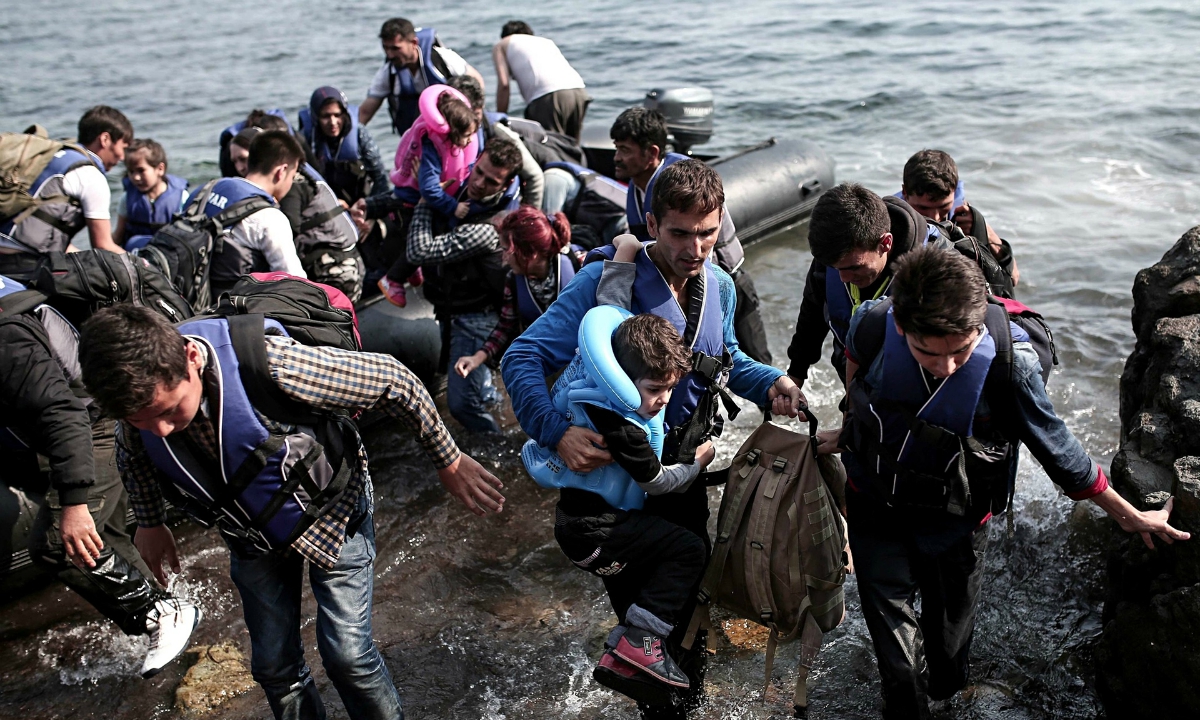
Syrian refugees coming ashore in Greece (photo: Angelos Tzortzinis/Getty)

Photo of Syrian refugees coming ashore on the Greek island of Lesbos that accompanied the Guardian‘s editorial (9/3/15) condemning “the refusal to intervene against Bashar al-Assad.” (photo: Angelos Tzortzinis/Getty)

It didn’t take long for the universal and entirely justified outrage over a picture of a dead three-year-old to be funneled by the “do something” pundits to justify regime change in Syria. The “do something” crowd wants us to “do something” about the refugee crisis and “solve” the “bigger problem,” which, of course, involves regime change. To create the moral urgency and to tether the refugee crisis to their long-standing warmongering, these actors have to insist the US has “done nothing” about Syria. Here’s the Guardian editorial from Thursday:

The optimism of the Arab spring is spent. Colonel Gaddafi was a tyrant, yet Libya has unravelled violently in the aftermath of his removal. The refusal to intervene against Bashar al-Assad gave the Syrian president permission to continue murdering his people.

Here’s London Mayor Boris Johnson in the Telegraph:

I perfectly accept that intervention has not often worked. It has been a disaster in Iraq; it has been a disaster in Libya. But can you honestly say that non-intervention in Syria has been a success? If we keep doing nothing about the nightmare in Syria, then frankly we must brace ourselves for an eternity of refugees, more people suffocating in airless cattle trucks at European motorway service stations, more people trying to climb the barbed wire that we are building around the European Union.

And here’s an op-ed by Michael Gerson in the Washington Post from the same day:

At many points during the past four years, even relatively small actions might have reduced the pace of civilian casualties in Syria. How hard would it have been to destroy the helicopters dropping barrel bombs on neighborhoods? A number of options well short of major intervention might have reduced the regime’s destructive power and/or strengthened the capabilities of more responsible forces. All were untaken.

But this is all a fantasy. The US has been “intervening” in the Syrian civil war, in measurable and significant ways, since at least 2012—most notably by arming, funding and training anti-Assad forces. According to a report in the Washington Post from June:

At $1 billion, Syria-related operations account for about $1 of every $15 in the CIA’s overall budget, judging by spending levels revealed in documents the Washington Post obtained from former US intelligence contractor Edward Snowden.

US officials said the CIA has trained and equipped nearly 10,000 fighters sent into Syria over the past several years — meaning that the agency is spending roughly $100,000 per year for every anti-Assad rebel who has gone through the program.

In addition to this, the Obama administration has engaged in crippling sanctions against the Assad government, provided air support for those looking to depose him, incidentally funneled arms to ISIS, and not incidentally aligned the CIA-backed Free Syrian Army with Al Qaeda. Regardless of one’s position on Syria—or whether they think the US is somehow secretly in alliance with Assad, as some advance—one thing cannot be said: that the US has “done nothing in Syria.” This is historically false.

Most of those advocating for the removal of Assad probably know this, but can’t say “the US should do more,” or “they haven’t done enough,” because this would raise the uncomfortable question of what they have done already. And the answer to that, as is with most US meddling in other countries, is a lot of covert programs US officials—and thus their court press—can’t openly acknowledge. So those in the establishment media are left to do a strange dance: at once ignoring all the US has already done while insisting the US should join a fight it’s been a party to for over three years.

Another idea being advanced, for instance in the Guardian op-ed above, is the creation of a no-fly zone to help stem the tide of refugees:

To begin restoring that hope will inevitably mean international intervention of some kind. The establishment of credible safe havens and the implementation of a no-fly zone must be on the table for serious consideration.

Two things before discussing this further:

A) A no-fly zone would only be applied to Assad because anti-Assad forces don’t have an air force.

B)  While it may sound like a simple humanitarian stop gap—and that’s no doubt how it’s being sold—literally every no-fly zone in history has eventually led to regime change. Which is fair enough, but those pushing for one should at least be honest about what this means: the active removal of Assad by foreign forces. Indeed, if one recalls the NATO intervention in Libya was originally sold as a no-fly zone to prevent a potential genocide, but within a matter of weeks, NATO leaders had pivoted to full-on regime change.

But here again, there’s some serious fudging going on by the Guardian. While there’s no doubt many of the refugees are escaping Assad’s bombing of cities, the boy in question, Aylan Kurdi, wasn’t: He was escaping ISIS and the US bombing of his hometown of Kobani, far from anything the Assad government is doing. A no-fly zone would not have saved his hometown. An absence of fueling jihadists by the United States and the subsequent bombing of said jihadists by the United States? Perhaps.

Once again, the disease becomes the cure, because a holistic diagnosis is not being advanced by Western media—only an evil dictator vs. freedom fighter cartoon. And why wouldn’t it? These nuances complicate the messy narrative of “If we get rid of Assad we can solve the crisis,” which has been US and UK orthodoxy since 2011. But the Guardian still has all their work ahead of them: If the West removes Assad, then what? Will the tens of thousands of radical, medieval wahabbists that have flooded in simply go away? Will the US bombing of ISIS simply stop?

The US funded, armed and fueled the very crisis its partisan media are now calling for it to swoop and in save. The moral ADD required by those pushing further US involvement in the Syrian civil war in the face of this fact is severe. That some in the media, eager to settle old scores, would so blatantly ignore history to indulge this fantasy is as pernicious as it is predictable.

03 Sep 02:43

Did ‘Ferguson Effect’ Cause Murder Wave? No. Is There a Murder Wave? Unclear

by Jim Naureckas
Tom Roche

on the severe inadequacies of US crime data, and the even worse lack of basic data-science hygeine in US elite corporate-funded media (e.g., NYT)

Milwaukee crime scene (photo: Mark Hoffman/Milwaukee Journal Sentinel)

The New York Times knows that if you’re going to run a story about out-of-control crime, you need a photo of some crime-scene tape. (photo: Mark Hoffman/Milwaukee Journal Sentinel)

The New York Times (8/31/15) wondered on its front page whether criticism of police violence was responsible for “cities across the nation…seeing a startling rise in murders after years of declines.”

“Among some experts and rank-and-file officers, the notion that less aggressive policing has emboldened criminals — known as the ‘Ferguson effect’ in some circles — is a popular theory for the uptick in violence,” wrote reporters Monica Davey and Mitch Smith. “Some officials say intense national scrutiny of the use of force by the police has made officers less aggressive and emboldened criminals, though many experts dispute that theory.”

The Times story points out a basic problem with this theory: In St. Louis, where one would most expect a “Ferguson effect” to manifest, a rise in murders was visible before the heightened scrutiny of police violence:

Richard Rosenfeld, a criminologist from the University of Missouri/St. Louis, said homicides in St. Louis, for instance, had already begun an arc upward in 2014 before a white police officer killed an unarmed teenager, Michael Brown, in nearby Ferguson. That data, he said, suggests that other factors may be in play.

Ta-Nehisi Coates (Atlantic, 9/1/15) criticizes the Times story taking seriously the idea that protests against police violence caused a rise in homicides that began before the protests, calling it an example of “false equivalence”:

“False equivalence” runs contrary to the mission to journalism—it obscures where journalists are charged with clarifying. A reasonable person could read the Times’ story and conclude that there is as much proof for the idea that protests against police brutality caused crime to rise, as there is against it. That is the path away from journalism and toward noncommittal stenography: Some people think climate change is real, some do not. Some people believe in UFOs, others doubt their existence. Some think brain cancer can be cured with roots and berries, but others say proof has yet to emerge.

But there’s a more fundamental problem with the Times story than suggesting that criticizing police violence is (maybe) responsible for a rise in homicides: It’s not clear that the rise in homicides that the story is pegged to actually exists as a nationwide phenomenon.

The evidence for this supposed murder wave seems to be the responses the Times got when it called police departments across the country. After the story’s lead detailed a rise in homicides in Milwaukee, the story continued: “More than 30 other cities have also reported increases in violence from a year ago.” That’s 30 out of a number that the New York Times does not disclose, making it a numerator without a denominator—though the story makes reference to the (steady) crime rate in Newark, which is the 69th largest city in the country, so depending on how thorough the Times‘ survey was, it’s possible that half or more of the cities it contacted did not report any increase in violence.

And when the story rephrases the data, it’s clear that “increases in violence” is a flexible concept: “Yet with at least 35 of the nation’s cities reporting increases in murders, violent crimes or both, according to a recent survey, the spikes are raising alarm among urban police chiefs.” How many cities actually had a rise in homicides–the statistic that justifies the story’s lead about “cities across the nation…seeing a startling rise in murders”? Remarkably, the Times story doesn’t say.

As a report from the Sentencing Project noted in response to an earlier wave of “Ferguson effect” claims:

Is there evidence that crime rates are, in fact, increasing around the country? It depends on where you look. In some cities, some types of crime are up over last year and other types are not, while other cities have not recorded increases in any major crime category. Unfortunately, we cannot rely on the nation’s leading crime data systems for a comprehensive view of recent crime changes. The Bureau of Justice Statistics’ National Crime Victimization Survey does not produce city-level crime data. The FBI’s Uniform Crime Reports does provide crime data for individual cities, but the data are not timely enough for monitoring crime changes over the past several months. So, everybody’s data is anecdotal, a cherry picker’s delight. If you want to tell a story of crime increases, you can. If not, just pick from a different tree.

After acknowledging that experts dispute the claim that protests against police violence have unleashed a countrywide wave of murders, the Times article asserted: “Less debated is the sense among police officials that more young people are settling their disputes, including one started on Facebook, with guns.” Maybe that needs to be more debated—because there is, as yet, no real evidence that it’s true.


Jim Naureckas is the editor of FAIR.org.

You can send a message to the New York Times at letters@nytimes.com, or write to public editor Margaret Sullivan at public@nytimes.com (Twitter:@NYTimes or @Sulliview). Please remember that respectful communication is the most effective.