Shared posts

01 Jul 23:13

Behind the News – June 30, 2016

Tom Roche

unfortunately (and inexplicably) this is the same as the previous week

01 Jul 16:04

The Secret of Our Success [Audio]

Tom Roche

excellent

Speaker(s): Professor Joseph Henrich | The ability of human groups to socially interconnect and learn from one another has allowed us to create ingenious technologies, sophisticated languages, and complex institutions that have enabled successful expansion into myriad environments. Drawing insights from lost European explorers, clever chimpanzees, mobile hunter-gatherers, neuroscience, ancient bones, and the human genome, Joseph Henrich, author of The Secret of Our Success, will discuss how our collective intelligence has propelled our species’ evolution. Joseph Henrich (@JoHenrich) is a professor at Harvard University in the Department of Human Evolutionary Biology, and holds a Canada Research Chair at UBC, where he's a professor in both Economics and Psychology. His research focuses on cultural evolution, and culture-driven genetic evolution. He’s conducted fieldwork in Peru, Chile and in the South Pacific. In 2004 he won the Presidential Early Career Award (USA). Timothy Besley is School Professor of Economics and Political Science & W. Arthur Lewis Professor of Development Economics at LSE. STICERD (@STICERD_LSE) brings together world-class academics to put economics and related disciplines at the forefront of research and policy. Founded in 1978 by the renowned Japanese economist Michio Morishima, with donations from Suntory and Toyota, we are a thriving research community within the LSE.
30 Jun 15:16

Blaming Putin after BREXIT. Stephen F. Cohen, NYU, Princeton University, EastWestAccord.com.

by The John Batchelor Show
Tom Roche

At end, Cohen discusses the March 1991 USSR referendum ( sketched here https://en.wikipedia.org/wiki/Soviet_Union_referendum,_1991 ) and its aftermath, rarely mentioned in USCFM.

06-28-2016 (Photo: Cameron and Putin, 2013) http://JohnBatchelorShow.com/contact http://JohnBatchelorShow.com/schedules http://johnbatchelorshow.com/blog Twitter: @BatchelorShow Blaming Putin after BREXIT. Stephen F. Cohen, NYU, Princeton University, EastWestAccord.com. "Brexit is a win for Putin," announced Michael McFaul, a former U.S. ambassador to Russia. Writing in The Washington Post, McFaul said: "Putin, of course, did not cause the Brexit vote, but he and his foreign policy objectives stand to gain enormously from it." • But at least publically, that's not how Putin sees it. Shortly after the vote, the Russian president told reporters that Brexit brought both "positives and negatives." European reaction to Brexit vote 03:41 Putin, along with his prime minister, both warned of the unsettling effects of the vote on the financial markets. Despite EU sanction on Russia over Ukraine, the EU remains Russia's biggest trading partner. "If the EU falls apart at the seams, this will affect our trade relations," warned Konstantin Kosachev, head of the Russian Parliamentary Foreign Affairs Committee. It would, however, be naive to think Russia's hardline president, locked in a bitter rivalry with the West, isn't allowing himself a wry smile as a key European institution fragments. There may be economic benefits for a start. One new report suggests that trade between Britain and Russia could actually be boosted by the Brexit vote, especially with the British pound in free fall. "Sterling's weakness against the euro creates opportunities for UK exporters to take market share from EU competitors," said Chris Weafer, senior partner at Macro Advisory, which provides investment analysis. And then there are sanctions. Russia is currently suffering under tough measures imposed on it by the EU over Ukraine. Britain, along with the nations of Eastern Europe, has been among the strongest voices to keep the sanctions in place. But even Moscow's Mayor, Sergei Sobyanin, can see how Brexit may have a positive impact for Russia. "Without Great Britain in the EU, there is no longer anyone so stridently standing up for sanctions against us," he tweeted after the result. Even if sanctions are not eased, the Kremlin may turn Europe's troubles to its advantage. The scenes of chaos likely to emerge from Britain and the EU in the coming weeks and months will provide a stark contrast to the image of stability at home -- Russia strong under Putin, that the Kremlin strives to portray. http://www.cnn.com/2016/06/27/europe/brexit-eu-putin-chance/ http://edition.cnn.com/2016/05/17/europe/cameron-eu-exit/ https://www.theguardian.com/world/2016/jun/27/kremlin-says-erdogan-apologises-russian-jet-turkish https://www.washingtonpost.com/opinions/global-opinions/russia-is-harassing-us-diplomats-all-over-europe/2016/06/26/968d1a5a-3bdf-11e6-84e8-1580c7db5275_story.html
30 Jun 15:09

Democracy Now! 2016-06-29 Wednesday

Tom Roche

esp last piece, James Steele from Center for Investigative Reporting on "Who Got Rich Off the Student Debt Crisis" on the privatization of Sallie Mae. Amy said there will be a web part 2.

Democracy Now! 2016-06-29 Wednesday

  • Headlines for June 29, 2016
  • "A Dark Day for the People of Puerto Rico": U.S. Senate Moves to OK "Colonial Control Board"
  • Meet the Attorney Who Just Won the Historic Abortion Rights Case at the Supreme Court
  • Former Chilean Army Officer Found Liable for 1973 Murder of Víctor Jara After U.S.-Backed Coup
  • Who Is Getting Rich Off the $1.3 Trillion Student Debt Crisis?

Download this show

26 Jun 21:18

How do we learn better: digital or print?

Tom Roche

Interesting paper by Kauffman (CMU HCII) and Flanagan (Dartmouth Tiltfactor) claims high-level evaluation/construal (~= global/abstract assessment) of material is better when presented in hardcopy (print on paper) than softcopy (pixels on screens). See blog post @ http://www.americanradioworks.org/how-do-we-learn-better-digital-or-print/ (archived @ http://web.archive.org/web/20160626211739/http://www.americanradioworks.org/how-do-we-learn-better-digital-or-print/ ) which also links to the paper, which is unfortunately paywalled.

Do you understand facts better online or in print? New research has massive implications for teaching in the 21st century.
25 Jun 23:59

Acting 101: Country and language need not match!

by podcasting@cbc.ca
Tom Roche

Foad HP is marginally better (at least, more different) than Lianne Mauladin (who does straight-up standup about as well as it can be), but both are excellent.

Newcomer Foad HP pulls back the curtain on the the audition of the ethnic actor and Lianne Mauladin gives us a day in her life which includes riding the bus and fightin' in the pharmacy
25 Jun 23:56

Reinventing “wife beaters” and tackling dyslexia.

by podcasting@cbc.ca
Tom Roche

Excellent episode. Starts with Todd Butler doing his festival-season song, then Phil Hanley (no songs), then DeAnne Smith (who mostly does her "no worries" song), then Todd Butler does his "Car Tune."

From the Winnipeg Comedy Festival, former special ed student Phil Hanley shares the possible origins of the short bus….and DeAnne Smith dusts off her ukulele to sing a song about Australia. Sort of.
25 Jun 23:52

The Politicians and the Egalitarians: The Hidden History of American Politics by @seanwilentz. @Princeton

by The John Batchelor Show
Tom Roche

Unfortunately no discussion of Wilentz' new book. Fortunately, interesting compare/contrast of the US Whig party in the 1850s and the Republicans since ~2010.

Author (Photo: "A ceremonial cruise down the Potomac River was held aboard the newly built USS Princeton on February 28, 1844, the day after completion of the annexation treaty. Aboard the ship were 400 guests, including Tyler and his cabinet, as was the world's largest naval gun, the "Peacemaker." The gun was ceremonially fired several times in the afternoon to the great delight of the onlookers, who then filed downstairs to offer a toast. Several hours later, Captain Robert F. Stockton was convinced by the crowd to fire one more shot. As the guests moved up to the deck, Tyler paused briefly to watch his son-in-law, William Waller, sing a ditty.[114] At once an explosion was heard from above: the gun had malfunctioned. Tyler was unhurt, having remained safely below deck, but a number of others were killed instantly, including his crucial cabinet members, Gilmer and Upshur. Also killed or mortally wounded were Virgil Maxcy of Maryland, Rep. David Gardiner of New York, Commodore Beverly Kennon, Chief of Construction of the United States Navy, and Armistead, Tyler's black slave and body servant. The death of David Gardiner had a devastating effect on his daughter, Julia, who fainted and was carried to safety by the president himself.[114] Julia later recovered from her grief and married President Tyler.[115] For Tyler, any hope of completing the Texas plan before November (and with it, any hope of re-election) was instantly dashed. Historian Edward P. Crapol later wrote that "Prior to the Civil War and the assassination of Abraham Lincoln," the Princeton disaster "unquestionably was the most severe and debilitating tragedy ever to confront a President of the United States."[113]" https://en.wikipedia.org/wiki/John_Tyler ) http://JohnBatchelorShow.com/contact http://JohnBatchelorShow.com/schedules http://johnbatchelorshow.com/blog Twitter: @BatchelorShow The Politicians and the Egalitarians: The Hidden History of American Politics by Sean Wilentz. @seanwilentz. “A shrewd and engaging assessment of the variable American tradition of egalitarianism, particularly as manifested in the political lives of Thomas Jefferson, John Quincy Adams, John Brown, Abraham Lincoln, right up through Lyndon Johnson and his Great Society―scrupulously detailed, elegantly written, incisively argued, and effectively combative.” (Philip Roth) “A bracing and persuasive defense of political partisanship as essential to a functioning democracy, and a timely reminder that from the country’s earliest days, political struggle has been the most effective mechanism for moving America toward the egalitarian ideals enunciated in its founding documents. It is a message that American citizens should never forget.” (Annette Gordon-Reed) “Sean Wilentz is a rare historian who writes with confidence about the entire scope of American history and who does so in a way accessible to a broad reading public. The Politicians & the Egalitarians, like his previous books, is sure to command attention.” (Eric Foner) “Wilentz evinces a vast knowledge of the American past while exploring, in his unique way, the interplay between raw party politics and the ebb and flow of reform efforts. In offering his take on pivotal figures from Jefferson to Du Bois, Lincoln to LBJ, Wilentz challenges us to debate history and ideas in a way that honors the best of the democratic system he has written about so provocatively throughout his career. Even when I most disagree with him, his arguments are always vigorous and passionate, lively and engaging.” (Henry Louis Gates, Jr.) “This stimulating book provides a major new interpretation of the alliance between egalitarian social movements and partisan politics to achieve some of the most notable liberal victories in the American past. Sean Wilentz has done more than anyone else to blend social and political history in a manner that offers powerful new insights.” (James M. McPherson) https://www.amazon.com/Politicians-Egalitarians-History-American-Politics/dp/0393285022/ref=sr_1_1?s=books&ie=UTF8&qid=1466812441&sr=1-1&keywords=EGALITARIANS+AND+POLITICIANS
25 Jun 16:58

Welcome to the age of Trump

Whether he wins the US presidency or not, his rise reveals a growing attraction to political demagogues – and points to a wider crisis of democracy
19 Jun 15:52

Alternatives to Austerity? [Audio]

Tom Roche

At best, mostly the yammering of anthropologists; at worst, destructive talk. Bear, Muehlebach, and Schuster are the anthropologists. Coote is from the New Economics Foundation, which makes some interesting points, but only as goals--no policy here. The worst was when one of them valorized Dubliners who are objecting not merely to privatizing water (which is right and just) but even to metering water use and billing for it by use, rather than socializing the cost. This is of course not "sticking it to the man," but sticking it to the *planet*.

Speaker(s): Dr Laura Bear, Anna Coote, Dr Andrea Muehlebach, Dr Carly Schuster | This panel discussion will look beyond the present into a future without austerity. Participants will discuss the proposals for a social calculus to be applied to government policy and sovereign debt relations as proposed in Laura Bear’s recent book, Navigating Austerity: currents of debt along a South Asian River (Stanford University Press 2015). How can we develop new forms of policy and politics that prioritise social rather than financial aims for government spending? How might we reform financial institutions so as to give precedence to longer-term goals than those set by market? What can be done to reduce the inequality generated by austerity policies in the UK and across the world? Can we imagine utopian institutions and social movements that could generate abundance, mutual and environmental protection? Laura Bear is Associate Professor of Anthropology at LSE and author of Navigating Austerity: Currents of Debt along a South Asian river. Anna Coote is Head of Social Policy at the New Economics Foundation. Andrea Muehlebach is Associate Professor of Anthropology at the University of Toronto and author of The Moral Neoliberal: Welfare and Citizenship in Italy. Carly Schuster is a lecturer and researcher at Australian National University. Her Chicago PhD in Anthropology won the Richard Saller Prize for most distinguished dissertation in the Division of Social Sciences. Deborah James (@djameslse) is Professor of Anthropology at LSE and author of Money from Nothing: indebtedness and aspiration in South Africa. LSE's Anthropology Department (@LSEAnthropology), with a long and distinguished history, remains a leading centre for innovative research and teaching. We are committed to both maintaining and renewing the core of the discipline, and our undergraduate teaching and training of PhD students is recognised as outstanding.
18 Jun 17:11

How an aggressive interrogation can make you a murderer

Tom Roche

begins well, but then 'To continue reading this premium article, subscribe for unlimited access.'

More than a quarter of those exonerated by DNA evidence have made a false confession or incriminating statement at some point. Why on earth would you do that?
18 Jun 17:05

Democrats scored. Foodies scolded. Egyptians empowered. States judged. @DanHenninger. @HenryIMiller @EricTrager18. Eileen Norcross, @Mercatus.

by The John Batchelor Show
Tom Roche

Delete first half (Dan Heinninger's diatribe about Orlando Massacre and the Democrats), but Henry Miller on problems with Whole Foods (beginning @ 9:30) will confirm everything you suspected about libertarian John Mackey's empire. Unfortunately it ends with Batchelor and Miller moaning about organic and anti-GMO hysteria and "foodie authoritarianism," but that's the price one pays for listening to JBS.

06-17-2016 (Photo: The Whole Foods Market on Bowery, in Manhattan, is the largest grocery store in New York City. [17]) http://JohnBatchelorShow.com/contact http://JohnBatchelorShow.com/schedules http://johnbatchelorshow.com/blog Twitter: @BatchelorShow Democrats scored. Foodies scolded. Egyptians empowered. States judged. @DanHenninger, WSJ Editorial. @HenryIMiller, @HooverInst. @EricTrager18, @WashInstitute. Eileen Norcross, @Mercatus. _____________ http://www.wsj.com/articles/are-democrats-soft-on-terror-1466029974?tesla=y __________ The 70,000-square foot North Atlantic kitchen facility supplies prepared foods and other products to 74 stores across eight states, including Massachusetts, Connecticut, Maine, Rhode Island, New York and New Jersey, the company said. The FDA, in its June letter, said the company’s previous response was inadequate, adding that the company failed to mention steps it would take to supervise food processing operations and compliance going forward. It said Whole Foods also didn’t provide documentation for review. The agency cited Whole Foods for failing to keep its equipment in acceptable conditions, saying a sample it took from a machine used to chop vegetables tested positive for a non-pathogenic form of listeria. The pathogen’s presence suggests conditions exist in Whole Food’s plant that support the growth of dangerous forms of listeria and indicate the company’s methods of cleaning and sanitation may not be up to snuff. “Your firm should consider improving your environmental monitoring program to verify the adequacy of your cleaning and sanitation operation,” the FDA said in the letter. Listeria is a potentially deadly bacteria. http://www.wsj.com/articles/whole-foods-must-clean-up-its-act-fda-says-1465936379 ___________ http://www.washingtoninstitute.org/policy-analysis/view/egypts-costly-nuclear-project http://mercatus.org/statefiscalrankings
18 Jun 16:54

NATO Baits Russia. Michael Vlahos, John Hopkins. @JHUWorldCrisis.

by The John Batchelor Show
Tom Roche

bad link: it actually downloads the following Heinninger et al piece

06-17-2016 (Photo: "Cartoon showing British lion, Russian bear toying w Persian cat - the Great Game, 1907 #twitterstorians http://t.co/4bSahaQhqf") http://JohnBatchelorShow.com/contact http://JohnBatchelorShow.com/schedules http://johnbatchelorshow.com/blog Twitter: @BatchelorShow NATO Baits Russia. Michael Vlahos, John Hopkins. @JHUWorldCrisis. “Good morning. In just a few weeks, we will hold our NATO Summit in Warsaw. And our countries face unprecedented security challenges. From the east and from the south. So at this landmark Summit, we will take decisions to strengthen our deterrence and defence across the Alliance against threats from any direction. And we will also step up our efforts to project stability beyond our borders. Over the next two days, we will pave the way for Summit decisions. We will agree on the deployment by rotation of four robust multinational battalions to Estonia, Latvia, Lithuania, and Poland. We will take decisions on a tailored presence for the south-east region, with a land element built around a multinational framework brigade in Romania. We will also adopt a framework for NATO’s further adaptation to the challenges from the South. We will look at ways to further improve the freedom of movement for NATO forces across Europe. We will strengthen our cyber defences. And we will review progress on ensuring the necessary resources for our defence. For the first time in many years, in 2015 we registered a small increase in defence spending amongst European Allies and Canada. And our estimates for 2016 indicate a further increase of 1.5 % in real terms this year. This is progress. But I will call on Allies to keep the momentum, and to do more. Because we need to match our defence spending with the security challenges we face….” http://www.nato.int/cps/en/natohq/opinions_132351.htm
18 Jun 01:48

Behind the News, 6/16/16

Tom Roche

I guess it had to happen: a wasted hour of Behind the News. Richard Seymour seems to want to make a left case for Brexit, but mostly just digresses. (For a truly left case for Brexit, listen to Chris Bickerton's "The European Union: a citizen's guide" @ http://media.rawvoice.com/lse_publiclecturesandevents/richmedia.lse.ac.uk/publiclecturesandevents/20160615_1830_theEuropeanUnion.mp3 ) Virginia Heffernan (a Harvard PhD in English lit with a NYT Magazine column!) wants to make a lit-crit-sorta valorization of "the Internet," but mostly just makes casual misunderstandings: the technology behind the Internet and the Web, confusing the DIY technology/stance behind hip-hop with that which was *not* behind disco, etc.

Behind the News, 6/16/16 - guests: Richard Seymour on Brexit, Virginia Heffernan on the internet as a work of art - Doug Henwood
17 Jun 02:40

Behind the News – June 16, 2016

Tom Roche

I guess it had to happen: a wasted hour of Behind the News. Richard Seymour seems to want to make a left case for Brexit, but mostly just digresses. Virginia Heffernan (a Harvard PhD in English lit with a NYT Magazine column!) wants to make a lit-crit-sorta valorization of "the Internet," but mostly just makes casual misunderstandings: the technology behind the Internet and the Web, confusing the DIY technology/stance behind hip-hop with that which was *not* behind disco, etc.

14 Jun 22:32

What Sir John Kerr did after The Dismissal

Tom Roche

sleazier and sleazier ... not just Kerr but also Queen Elizabeth!

Jenny Hocking has updated her book 'The Dismissal Dossier' to cover Kerr's activities after the Dismissal
13 Jun 02:12

The Kennedy Assassination Tapes by Max Holland. @washdecoded

by The John Batchelor Show
Tom Roche

Good piece, but has nothing to do with the Kennedy Assassination Tapes. Rather, Holland and Batchelor discuss the Zapruder film, and particularly why other evidence shows that the film's famous 6 seconds show only the 2nd and 3rd shots Oswald fired, not all 3.

AUTHOR (PHOTO: JFK and Texas' John Connally shared a fateful day and fragile past | Dallas Morning News) HTTP://JOHNBATCHELORSHOW.COM/CONTACT HTTP://JOHNBATCHELORSHOW.COM/SCHEDULES HTTP://JOHNBATCHELORSHOW.COM/BLOG TWITTER: @BATCHELORSHOW The Kennedy Assassination Tapes by Max Holland. MONDAY, FEBRUARY 20, 1967, 9:40 A.M. Call to Acting Attorney General Ramsey Clark CLARK: I think that what he [Jim Garrison] is workin' on must be the associations that Oswald had in the three or four months that he was down there [in New Orleans] in '62 [and] '63. I doubt ... I think it'd just be incredible if he [Garrison] had anything that went beyond that. I think this subject is so volatile and emotional, though, that it could get confused and obscured. [Uncomfortably and hesitantly] I had heard that Hale Boggs was sayin' [that] he—Garrison—was sayin' that ... or privately around town [was saying] that it [the assassination] could be traced back [to you] ... or that you could be found in it someplace, which ... I can't believe he's been sayin' that. The Bureau says they haven't heard any such thing, and they got lots of eyes and ears. 'Course, that was a [credible] fella like Hale Boggs. But Hale gets pretty emotional about people [like Garrison] that he really doesn't like, and people who have fought him and been against him, and I would be more inclined to attribute it to that. Either that, or this guy Garrison [is] just completely off his rocker. JOHNSON: Who did Hale tell this to? CLARK [somewhat in disbelief]: Apparently Marvin [Watson].1 JOHNSON [aside to Watson, who was in the room]: [Did] Hale tell you that—Hale Boggs—that this fella [Garrison, this] district attorney down there, said that this is traced to me or somethin'? WATSON: Privately he [Garrison] was using your name as having known about it [the assassination]. I said [to Boggs], Will you give this information to Barefoot Sanders?2 Ramsey was out of town—this was Saturday night. [Boggs] said, I sure will. So I asked the operator to get Barefoot and Ramsey together, and they did. JOHNSON [to Clark]: Yeah, I don't know about it. They don't ever let me in on it, Marvin and Jake [Jacobsen] over here, so you have to call me direct.3 CLARK: Well— JOHNSON: They just think this stuff's for them. CLARK: Such nutty things that ... it's awfully explosive but ... The press, really, has quite a jaundiced eye about it ... and about Garrison, so far.4 I had several press interviews out in Des Moines [on] Saturday evening and afternoon, and the thrust of their questions is, What kind of nut is this? JOHNSON: Two things I think. You know [there's] this story going around about the CIA and their tryin' to get ... sendin' in the folks to get [Fidel] Castro. CLARK: To assassinate Castro. JOHNSON: Have you got that full story laid out in front of you, and [do you] know what it is? Has anybody ever told you all the story? CLARK: No. JOHNSON: I think you oughta have that. I don't ... it's incredible. I don't believe there's a thing in the world to it, and I don't think we oughta seriously consider it. But I think you oughta know about it. CLARK: Who would I get it from? JOHNSON: I've had it from three or four [sources]. I've forgotten who's come in here. I'll have to check it. CLARK: Does the Bureau have it? JOHNSON: No, I don't think so. You might ask 'em. Pearson—Drew Pearson—came [in] and gave it to me. [Pearson] said [Edward] Morgan5 told him ... [Morgan is James] Hoffa's lawyer. He [Morgan] says that they have a man that was involved, that was brought in to the CIA, with a number of others, and instructed by the CIA and the Attorney General [Robert Kennedy] to assassinate Castro after the Bay of Pigs [in 1961].6 CLARK [uncomfortably]: I've heard that ... you know, I've heard that much. I just haven't heard [any] names, and places, and ... JOHNSON: Well, let's see who it is ... let's see. I think it would be—[it would] look very bad on us if we'd had it reported to us [a] number of times and we just didn't pay any [attention]—just laughed ... if this is true. He [Morgan] says that his [client's] limitation—let's check it and see if [the statute of] limitation[s] does run out in November ... they say that the limitation runs out in November.7 I don't know about this conspiracy, or how much—how many years [the statute of limitations runs]— CLARK: [It'd] be six years, all right, which would be November, probably. But it [the statute of limitations would] not [run out] for a concealed situation. JOHNSON: Well, that's what I'd think. But anyway, he [Pearson] says in November he's [Rosselli's] going to tell it. And that— CLARK: Mr. Pearson is [going to publish the story]? JOHNSON: No. This individual [Rosselli].8 CLARK: This individual? JOHNSON: Yeah. And these lawyers [Morgan, for one] have it. There's just all kinds of things that come to me every day. I don't pay any attention to 'em, but maybe I was a little worried this mornin' because one of my lawyer friends told me I oughta call you and talk to you about it.9 So [that] you'll have a file that protects you, that you just don't look like they report these things to us and we just throw 'em overboard and say, Well, we don't like 'em and it['s] not what we wanna hear. So we're not gonna do anything about it. But anyway, [the story is] that following this, Castro said—they [the plotters] had these pills, and they're supposed to take 'em when they caught 'em, and they didn't get to take their pills—so he [Castro] tortured 'em. And they told him all about it, and who was present and why they did it. So he [Castro] said, okay. We'll just take care of that. So then he called Oswald and a group in, and told them to ... about this meetin', and go set it up and get the job done..." http://www.theatlantic.com/magazine/archive/2004/06/the-assassination-tapes/302964/ https://www.amazon.com/Kennedy-Assassination-Tapes-Max-Holland/dp/1400042380?ie=UTF8&qid=1465695957&ref_=la_B001H6MB44_1_4&s=books&sr=1-4
11 Jun 01:54

How Uber conquered London

To understand how the $60bn company is taking over the world, you need to stop thinking about cars
09 Jun 04:54

The gangsters on England's doorstep

In the bleak flatlands of East Anglia, migrant workers are controlled by criminal gangs, and some are forced to commit crimes to pay off their debts. This is what happens when cheap labour is our only priority
08 Jun 20:51

The Enright Files - The Donald Trump Phenomenon

by podcasting@cbc.ca
Tom Roche

David Frum (first guest) is surprisingly insightful.

Conversations about the Donald Trump phenomenon and what it says about the GOP and the American polity.
04 Jun 17:58

How the Pentagon punished NSA whistleblowers

Tom Roche

Excellent piece by Mark Hertsgaard, see {transcript, original article} @ http://www.theguardian.com/us-news/2016/may/22/how-pentagon-punished-nsa-whistleblowers

Long before Edward Snowden went public, John Crane was a top Pentagon official fighting to protect NSA whistleblowers. Instead their lives were ruined – and so was his
04 Jun 17:50

Media Trumpwash Clinton’s Reckless Foreign Record

by Adam Johnson
Tom Roche

Adam Johnson covers HRC's past transgressions relatively well (absent Haiti, which was mostly absent from this piece, as well as lesser sins like Paraguay and the Maldives), but misses the most important, most dangerous part of Hillary's current foreign/military policy. Obama, with Clinton's active support both in and out of DoS and on this campaign, is pushing toward war with both China and Russia. Aside from being a breathtakingly stupid imperial overreach (comparable to Hitler declaring war on both the US and the Soviet Union), Hillary (and the Democratic establishment that loves her) flirts with a nuclear WW3.

Hillary Clinton's support for regime change in countries like Iraq, Libya, Syria and Honduras is seldom recalled when comparing her foreign policy to Donald Trump's. (photo: David J. Marshall/US Army)

Hillary Clinton’s support for regime change in countries like Iraq, Libya, Syria and Honduras is seldom recalled when comparing her foreign policy to Donald Trump’s. (photo: David J. Marshall/US Army)

Former Secretary of State Hillary Clinton gave a much-anticipated “foreign policy” speech (6/2/16) in which she took presumptive Republican nominee Donald Trump to task for what she called his “dangerously incoherent” foreign policy stances. The speech was widely met with praise from the pundit class:

Almost all of the praise was premised on two assumptions: A) Trump presents a horrific risk to the planet and B) Clinton is the antidote to this, a “steady hand” in a dangerous world.

Point A, it’s worth emphasizing, is true. Trump’s Muslim immigration ban and his claim that climate change is an “expensive hoax” that was “created by and for the Chinese” are certifiable and racist. His plan to seize the natural resources of other countries reverts us back to outright 19th century colonialism. His violent and inciting rhetoric presents a clear danger to immigrants, women and people of color.

But B, the idea that Clinton is, by contrast, a prudent foreign policy moderate, is an establishment media assertion with little or no supporting evidence.

Clinton has a long, objectively verifiable track record of acting recklessly on matters of foreign policy that seems to have slipped into a memory hole as the prospect of a Trump presidency looms overhead. While one would expect this rewriting of history to come from Clinton surrogates, it’s increasingly bizarre coming from nominally independent media pundits.
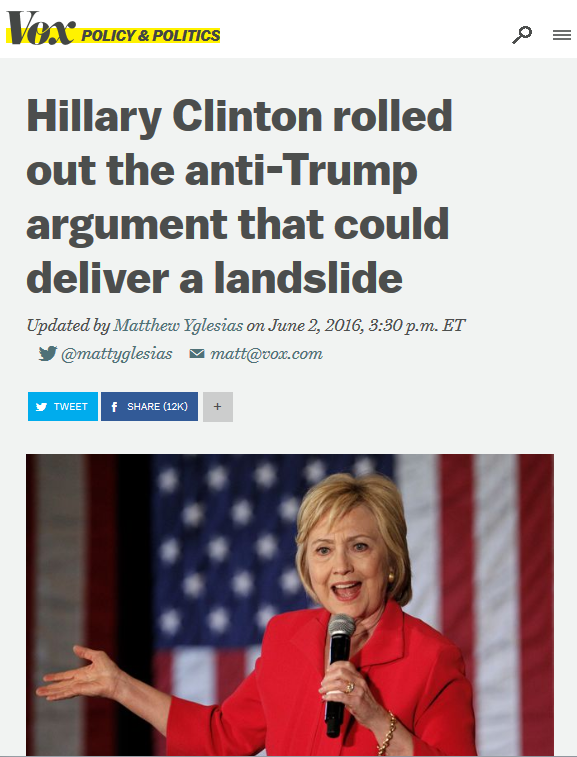
Vox: Hillary Clinton rolled out the anti-Trump argument that could deliver a landslide

Matthew Yglesias in Vox (6/2/16): “You can at least be sure that a Clinton presidency won’t lead to some enormous unforeseen cataclysm.”

Over at Vox, Matt Yglesias has positioned Clinton as the sensible, reliable choice on foreign policy and, in doing so, failed to mention Iraq, Libya, Syria, Honduras or any other of the list of nations that Clinton has helped to make, in some capacity or another, much worse off. When comparing the high stakes of statecraft, Yglesias even laid out this ahistorical comparison:

But at the end of the day, even though real estate is a game for risk takers, it’s also a game where the downside risk is very limited. At the absolute worst, you can’t repay your debts and it becomes a bit harder to get a loan the next time.

Running a country isn’t like that. If you make a big mistake, you can’t just go to court and have the slate wiped clean. A casino bankruptcy hurts the bottom line of a few banks. A sovereign default of the United States — something Trump has floated — would destroy the global economy.

But “wiping the slate clean” is exactly what Iraq War boosters have done. Bush and Rumsfeld are currently playing golf, while those who supported the war, like Clinton, continue to hold positions of power. Clinton issued a belated and perfunctory apology—and that was it. And that’s just the one “mistake” she’s been called to answer for. Clinton’s support of a right-wing coup in Honduras, or the disastrous regime change in Libya, are seldom brought up, much less apologized for.

Perhaps Yglesias is referencing the material consequences to the world, rather than to the politician, but if this is the case, then why not address the hundreds of thousands of dead Iraqis resulting from the war Clinton pushed? Why not bring up the disastrous government she forced upon Haiti? Yglesias is right: The stakes are high, and, time and time again, Clinton has made decisions that resulted in material harm.

Slate’s Fred Kaplan and Bloomberg View’s Eli Lake also neglected to mention the Iraq War when recapping Clinton’s “experience.” It could be because they, like Yglesias, also pushed for that particular disaster. Indeed, as we’ve seen before, to indemnify Clinton for her past “bad judgments,” is to do the same for most of the pundit class who also followed Bush off the cliff. Her rebranding is their rebranding. This may serve immediate political interests—especially if one views Trump as existentially dangerous—but it doesn’t serve history, and it certainly doesn’t serve readers.

The media has a duty to vet the foreign policy record and plans of the respective candidates. As such, the pundits are right to pinpoint some of Trump’s more dangerous plans. Where they’ve consistently fallen short—and this was on full display in response to Thursday’s speech—is also contextualizing and harshly critiquing Clinton’s brand of measured, polite recklessness.

On this we have some pretty stark examples. The right-wing coup Clinton backed in Honduras in 2009 eventually led to the assassination of indigenous leaders and displacement of thousands of Hondurans as they fled right-wing violence.

One email from her aide Sid Blumenthal in March 2011 informed then-Secretary Clinton that a Libyan rebel commander told him that “his troops continue to summarily execute all foreign mercenaries captured in the fighting.” (“Foreign mercenaries” being code for black Africans loyal to Gaddafi). In response, the State Department continued to support the rebels without any clear concern for their war crimes. A BBC report that December detailed how 30,000 black Libyans were ethnically cleansed from the town of Misrata. A report the following year in the New York Times detailed how US arms “fell into the hands of jihadis” in an effort to overthrow Gaddafi.

Clinton’s eagerness to back dubious groups in the interest of regime change wouldn’t stop there. For years, the State Department watched  Qatar and Saudi Arabia arm jihadists in Syria while pledging millions to overthrow the Syrian government themselves. Time and time again, Clinton’s desire to overthrow unfriendly governments resulted in arms “ending up in the hands” of designated terrorist organizations.

As for the former Secretary’s famous “wonkishness,” there’s evidence, as Peter Beinart noted in The Atlantic in 2014, that Clinton didn’t even review the NIE report on Iraqi weapons of mass destruction before voting to authorize the war in October 2002.

Unlike Trump’s rhetoric, these were actual reckless decisions that affected real people. Of course, media should critique Trump’s outlandish, ofttimes cartoonish campaign promises. But they don’t have to whitewash Clinton’s foreign policy record to do so.


Adam Johnson is a contributing analyst for FAIR.org. He’s on Twitter at @AdamJohnsonNYC.

03 Jun 14:47

Iraqi, U.S.-Led Forces Push to Retake Fallujah

by Michael Krasny
Tom Roche

Guests seem to skew rightwing:
- John Arquilla, chairman of the defense analysis department, Naval Postgraduate School; author of "Insurgents, Raiders and Bandits: How Masters of Irregular Warfare Have Shaped Our World"
- James Jeffrey, fellow, Washington Institute for Near East Policy; U.S. ambassador to Iraq from 2010 to 2012
- Ahmed Maher, Baghdad correspondent, BBC World Service
- Michael Pregent, adjunct fellow, Hudson Institute; former intelligence advisor to General David Petraeus

Fighting is intensifying in the Iraq city of Fallujah as the Iraqi military and U.S.-led forces attempt to wrest control from ISIS militants. Aid groups report that at least 50,000 civilians remain trapped in Fallujah, which is facing extreme food, water and medicine shortages. We discuss the offensive and U.S. policy in the region.

03 Jun 02:55

Behind the News – June 2, 2016

Tom Roche

Keeanga-Yamahtta Taylor on Black Lives Matter and black liberation

02 Jun 23:44

Behind the News – May 19, 2016

Tom Roche

fundraiser

02 Jun 23:44

Behind the News – May 26, 2016

Tom Roche

fundraiser

31 May 20:41

The inside story of Facebook’s biggest setback

Tom Roche

Excellent exposure of the frauds that are Mark Zuckerberg, Facebook, and this particular scam to advance Facebook's market share while destroying net neutrality (which Indians have upheld much more straightforwardly than have Americans). Read the transcript @ https://www.theguardian.com/technology/2016/may/12/facebook-free-basics-india-zuckerberg

The social network had a grand plan to connect millions of Indians to the internet. Here’s how it all went wrong
30 May 02:16

Where The Presidential Candidates Stand On Key Issues

Tom Roche

Some truly appalling Bernie-bashing from guests Norman Ornstein (probably the least partisan member of AEI, but still AEI), Ruth Marcus (WaPo, aka "Fox News Print Edition"), and Byron York (Washington Examiner, apparently a clone of the Washington Times minus the Unification Church). Even York (who occasionally remembers he's there for pro-Trump balance) is obviously in the tank for Hillary.

Now that only three major candidates remain in the 2016 race for the White House, attention turns to the details of their policy proposals. Where the presidential candidates stand on key issues like job creation, healthcare, taxes and education.
26 May 16:42

Democracy Now! 2016-05-26 Thursday

Tom Roche

Good first piece (after headlines) with Michael Tracey on how Hillary Clinton's email scandal is certainly a bigger deal than has been portrayed either by her campaign or by the corporate-funded media, and is the subject of an ongoing FBI investigation. Tracey exposes false and contradictory statements made by Hillary and her campaign, esp regarding whistleblowers.

Democracy Now! 2016-05-26 Thursday

  • Headlines for May 26, 2016
  • "Significant Security Risks": State Department Says Clinton Broke Rules Using Private Email Server
  • Granddaughter of Exxon Scientist Confronts CEO over Oil Giant’s Decision to Fund Climate Lies
  • Bill McKibben on Exxon, the Power of Divestment, and Being Targeted by Shadowy Right-Wing Group
  • Keep Oil in the Soil: Bill McKibben on Being Named by Sanders to DNC Platform Committee
  • Texas and 10 Other States Escalate Attacks on Trans People with "Political Stunt" Bathroom Lawsuit

Download this show

26 May 03:05

Tudormania: Why can’t we get over it?

Tom Roche

Interesting piece on the "Merrie England shtick" and good and bad history. See full {transcript, original article} @ http://www.theguardian.com/news/2016/may/04/tudormania-why-can-we-not-get-over-it

Our fixation with the sexy powerplays of the Tudor court shows no signs of fading. What is it about this 16th-century dynasty that still obsesses us?