Shared posts

27 Aug 14:49

Interest Payments on the Debt Have Fallen to 0.8 Percent of GDP, So WaPo Wants to Cut Social Security and Medicare

by dean.baker1@verizon.net (Dean Baker)
Tom Roche

pullquote from end of piece:

It is unbelievably hypocritical of the Post and other deficit hawks to claim that they are concerned about the threat that deficits post to our children's future when they completely ignore the extent to which the policies they have demanded (lower deficits) actually impose a far higher cost. It is quite clear that the agenda of the Post and their fellow deficit hawks is redistributing income upward.

Both parts of the that headline are true, although the Post did not connect them in exactly this way. It's editorial instead highlighted the debt-to-GDP ratio, trying to hide from readers the fact that the real burden of the debt is near a post-World War II low.

This is a classic case of the ends justifying the means. The end here is to cut the Social Security and Medicare benefits of middle income retirees. The Post sees this as the obvious policy option to pursue in a context where there has been a massive upward redistribution of income over the last four decades. And if they have to use a bit of deception to get there, well that's okay.

The piece begins by telling us the horror story that the Congressional Budget Office projects that the deficit will rise this fiscal year from its 2015 level, the paragraph ending:

"The bigger deficit will push the national debt to 77 percent of gross domestic product, the highest level since 1950, this year."

Of course if we didn't have hysterical editorials from the Post and the professional deficit hawks we would never have any clue of the fact that we are seeing the highest debt-to-GDP level since 1950. A large debt can have negative effects in two ways.

First, it can mean a high interest burden. This means that we would be diverting a substantial portion of GDP from other purposes to pay interest to the owners of government bonds. This issue is assessed not by looking at the size of the debt, but rather the size of the interest rate payments. Currently interest payments measured as a share of GDP are a bit less than 0.8 percent, after subtracting the interest payments that are refunded by the Federal Reserve Board to the Treasury. By comparison, the interest burden was over 3.0 percent of GDP in the early and mid-1990s. In other words, that one doesn't come close to passing the laugh test. (This information is available in the same CBO report cited by the Post.)

Read More ...

27 Aug 04:37

Behind the News – August 25, 2016

Tom Roche

rerun

26 Aug 20:22

Living on Earth: August 26, 2016

Tom Roche

rerun

Losing Frozen Earth Could Cook the Planet / U.S. Methane Emissions Drastically Underestimated / Turning up the Heat on Frigid Offices / Better Office Air Makes For Better Thinking / Pawpaw: America's Forgotten Fruit
23 Aug 17:07

Embers of War: The Fall of an Empire and the Making of America's Vietnam by Fredrik Logevall.

by The John Batchelor Show
Tom Roche

Note this piece only really covers 1945-1958 in detail. Too short, should have been a multi-part covering this book.

Author (Photo: Dien Bien Phu battlefield in 1954) http://JohnBatchelorShow.com/contact http://JohnBatchelorShow.com/schedules http://johnbatchelorshow.com/blog Twitter: @BatchelorShow Embers of War: The Fall of an Empire and the Making of America's Vietnam by Fredrik Logevall. WINNER OF THE PULITZER PRIZE Written with the style of a great novelist and the intrigue of a Cold War thriller, Embers of War is a landmark work that will forever change your understanding of how and why America went to war in Vietnam. Tapping newly accessible diplomatic archives in several nations, Fredrik Logevall traces the path that led two Western nations to tragically lose their way in the jungles of Southeast Asia. He brings to life the bloodiest battles of France’s final years in Indochina—and shows how, from an early point, a succession of American leaders made disastrous policy choices that put America on its own collision course with history. An epic story of wasted opportunities and deadly miscalculations, Embers of War delves deep into the historical record to provide hard answers to the unanswered questions surrounding the demise of one Western power in Vietnam and the arrival of another. Eye-opening and compulsively readable, Embers of War is a gripping, heralded work that illuminates the hidden history of the French and American experiences in Vietnam. ONE OF THE MOST ACCLAIMED WORKS OF HISTORY IN RECENT YEARS Winner of the Francis Parkman Prize from the Society of American Historians • Winner of the American Library in Paris Book Award • Winner of the Council on Foreign Relations Arthur Ross Book Award • Finalist for the Cundill Prize in Historical Literature NAMED ONE OF THE BEST BOOKS OF THE YEAR BY The Washington Post • The Christian Science Monitor • The Globe and Mail “A balanced, deeply researched history of how, as French colonial rule faltered, a succession of American leaders moved step by step down a road toward full-blown war.”—Pulitzer Prize citation “This extraordinary work of modern history combines powerful narrative thrust, deep scholarly authority, and quiet interpretive confidence.”—Francis Parkman Prize citation “A monumental history . . . a widely researched and eloquently written account of how the U.S. came to be involved in Vietnam . . . certainly the most comprehensive review of this period to date.”—The Wall Street Journal “Superb . . . a product of formidable international research.”—The Washington Post “Lucid and vivid . . . [a] definitive history.”—San Francisco Chronicle “An essential work for those seeking to understand the worst foreign-policy adventure in American history . . . Even though readers know how the story ends—as with The Iliad—they will be as riveted by the tale as if they were hearing it for the first time.”—The Christian Science Monitor “A remarkable new history . . . Logevall skillfully explains everything that led up to Vietnam’s fatal partition in 1954 [and] peppers the grand sweep of his book with vignettes of remarkable characters, wise and foolish.”—The Economist “Fascinating, beautifully written . . . Logevall’s account provides much new detail and important new insights. . . . It is impossible to read the book without being struck by contemporary parallels.”—Foreign Policy “[A] brilliant history of how the French colonial war to hang on to its colonies in Indochina became what the Vietnamese now call ‘the American war.’”—Esquire “An excellent, valuable book.”—The Dallas Morning News https://www.amazon.com/Embers-War-Empire-Americas-Vietnam/dp/B007EED4P8/ref=sr_1_sc_2?s=books&ie=UTF8&qid=1471828579&sr=1-2-spell&keywords=logeval#nav-subnav
22 Aug 19:59

Democracy Now! 2016-08-22 Monday

Tom Roche

The last segment (interview with Alison Flowers and Sarah Macaraeg) is rather mislabeled. It's not about a single incident, but many. It's mostly about how a legal doctrine, the felony murder rule, and its widespread misuse to coverup killings by police. The template is:

1. One or more persons commit a crime.

2. In pursuit, police kill one of the criminals.

3. Prosecutors then use the felony murder rule to charge one or more of the dead criminal's associates with murder for the killing of the criminal--despite the acknowledged fact that the criminal was killed by police.

Democracy Now! 2016-08-22 Monday

  • Headlines for August 22, 2016
  • As Kerry Plans to Visit Saudi Arabia, Activists & NGOs Demand U.S. Stop Funding War Crimes in Yemen
  • "This is Our War & It is Shameful:" Journalist Andrew Cockburn on the U.S. Role in the War in Yemen
  • A Shocking Story of How a Chicago Cop Killed a Teen -- Then Locked Up His Best Friend for the Murder

Download this show

22 Aug 19:32

The Ultimate Simplicity of Everything (Encore Mar 14, 2016)

by podcasting@cbc.ca
Tom Roche

try to find the underlying Perimeter Institute talk--this interview is much too unfocused and pop-sci

Neil Turok, Director of the Perimeter Institute for Theoretical Physics believes that the universe "invites" us to figure it out, by giving us clues about its composition. And when we follow its clues, we discover that it's ultimately quite simple.
21 Aug 00:41

Eurasian Guns of August, 2016. The World According to Obama. Michael Vlahos, Johns Hopkins.

by The John Batchelor Show
Tom Roche

Vlahos believes (IMHO correctly) that the end of the neoliberal world order is imminent, despite happytalk from the likes of Obama and Susan Rice (whose recent piece in the Clinton vehicle Vox is referenced). The relative economic and (therefore) military power of the US wanes as it continues to provoke Eurasian powers like China, Russia, and Iran in the latters' backyards. Failure to recognize the spheres of influence of lesser powers seems likely to drive US leaders (esp Hillary) into self-destructive (and perhaps globally destructive) acts of imperial overreach.

08-19-2016 (Photo: Leopoldville (now Kinshasa) Belgian Congo: The Hotel ABC under construction in 1913: the year before the European Order of Civilization ended.) http://JohnBatchelorShow.com/contact http://JohnBatchelorShow.com/schedules http://johnbatchelorshow.com/blog Twitter: @BatchelorShow Eurasian Guns of August, 2016. The World According to Obama. Michael Vlahos, Johns Hopkins. “…How the Obama administration sees the world The basic starting point, according to Rice, is that the world is better than it ever has been — and it’s getting better still: We are in an era where, as the president has often said, if you didn’t know who you were going to be, or whether you were going to be male or female; white, black, Asian, Native American, Latino, [or] something else; if you didn’t know if you were going to be straight or gay — if you didn’t know anything about who you were going to be and you had to pick a time in which to be born… You would pick this time. Because the odds of success for any individual are much higher in the aggregate than they’ve ever been. Rice’s support for this theory was a series of rattled-off metrics. "More people are free of poverty than ever before, conflict between states is less than ever before, technology is providing extraordinary opportunities for advancement, and health and agriculture and well-being," Rice says. "Compare the era we’re living in today to the losses we suffered in World War II or even in the Vietnam War, or compare the economic challenges we face now to the Great Depression." Rice is right on the evidence. The number of people living at $1.25 per day or less declined by roughly 1.1 billion people between 1990 and 2015. The number of war deaths per 100,000 people worldwide has increased in the past three years, owing largely to the war in Syria, but is still far lower than it was even 20 years ago. Average global life expectancy worldwide was 48 in 1950; it was 71.4 in 2015. Obama and his advisers see these improvements as the product of a network of global institutions and dominant ideas — things like the global free trade regime, the United Nations, America’s alliance networks in Europe and East Asia, and the like. They believe this basic international order has worked to make the world a much better place than it’s ever been. Because Team Obama sees the world’s basic institutions through this very positive lens, they’re focused on protecting them. The most important foreign policy task, for Team Obama, is to make sure the world keeps getting better. That means, first and foremost, protecting the current system from things that threaten it. "We can renew the international system that has enabled so much progress, or we can allow ourselves to be pulled back by an undertow of instability," Obama said in a 2014 address to the United Nations. "We can shape the course of this century, as our predecessors shaped the post-World War II age." Think about the Obama administration’s stated priorities over the years: the pivot to Asia, the push for global climate change agreements, the nuclear negotiations with Iran. Each was designed to address something that could at least theoretically threaten important parts of the system: a conflict-ridden relationship with China, catastrophic climate change, a nuclear Iran. In those cases, the Obama administration was willing to take risks and spearhead ambitious new policy initiatives, because the tail risk of inaction was extremely high. The administration is less willing to act, by contrast, when it comes to immediate crises — significant problems that nonetheless don’t pose systemic threats. The Obama administration has been very wary of getting pulled into a major involvement in Syria, for example, or a large-scale troop deployment to fight ISIS….” http://www.vox.com/2016/8/18/12387600/susan-rice-vox ________________ By Olesya Astakhova and Andrew Osborn | BELBEK AIR BASE, CRIMEA/MOSCOW Vladimir Putin flew into annexed Crimea on Friday a day after staging war games there, and said he hoped Ukraine would see "common sense" when it came to resolving a diplomatic crisis over the peninsula. http://www.reuters.com/article/us-ukraine-crisis-putin-idUSKCN10U16R?feedType=RSS&feedName=worldNews&utm_source=twitterfeed&utm_medium=twitter&utm_campaign=Feed%3A+Reuters%2FworldNews+%28Reuters+World+News%29 ________ Russia’s long-range bombers Tupolev-22M3 and frontline bombers Sukhoi-34 have dealt another strike against Islamic State targets in Syria’s Deir ez-Zor province from bases in Russia and Iran, the Russian Defense Ministry said. "On August 18, 2016 long-range bombers Tupolev-22M3 and frontline bombers Sukhoi-34 took off from bases in Russia and Iran to deal a massive strike against the facilities of the Islamic State group (outlawed in Russia) in Syria’s Deir ez-Zor province," the Defense Ministry said in a news release. https://in.rbth.com/news/2016/08/18/russias-bombers-make-third-raid-from-airdrome-in-iran-to-attack-is_622171 https://in.rbth.com/news/2016/08/18/russias-bombers-make-third-raid-from-airdrome-in-iran-to-attack-is_622171
20 Aug 23:39

Behind the News – August 18, 2016

Tom Roche

Dvora Meyers on women's gymnastics; Arun Gupta on the Fight for 15's exploited organizers

20 Aug 14:54

Behind the News, 8/11/16

Tom Roche

Both excellent pieces. 1st, Sharon Higgins (charterschoolscandals.blogspot.com) is an anti-charter-school activist who has stumbled upon the Gülen movement in the US (and elsewhere), which in the US is funding itself largely from public funds extracted via corrupt charter-school-based contractor networks. She also discusses Gülen, Gulenism, and its movement (Hizmet by its followers, Cemaat by the broader Turkish public) internationally. 2nd, Robert Pollin (peri.umass.edu) examines the economic-policy proposals of the Trump and Hillary 2016 campaigns from a left perspective. Pollin and Henwood also discuss more general aspects of current and recent political economy (e.g., austerity, "trade deals" and terms of trade, and the migration of Larry Summers and similar from the Washington Consensus). Particularly, Pollin usefully punctures nostalgia for 1990s Clinton economic policy and performance: notably, poverty reduction was minimal, and failed even to rollback to Carter-era levels

Behind the News, 8/11/16 - guests: Shannon Higgins on the Gulen cult, Robert Pollin on Trump-o-nomics - Doug Henwood
19 Aug 16:00

NYT Reveals Think Tank It’s Cited for Years to Be Corrupt Arms Booster

by Adam Johnson
Tom Roche

more on the truly New Cold War in the Arctic

NYT: How Think Tanks Amplify Corporate America's Influence

The New York Times (8/7/16) reveals the corporate influence behind some of its most-used sources.

A recent New York Times article (8/7/16) detailed, in often scathing terms, what many media critics already knew: that think tanks are frequently not objective, neutral arbiters of information, but corporate- and government-funded agenda-promoters with an academic veneer to give the appearance of impartiality.

One of the two think tanks the Times’ Eric Lipton and Brooke Williams raked over the coals was the Center for Strategic and International Studies, which published a report advocating the expansion of drone sales while being funded by drone makers, namely General Atomics (emphasis added):

As a think tank, the Center for Strategic and International Studies did not file a lobbying report, but the goals of the effort were clear.

“Political obstacles to export,” read the agenda of one closed-door “working group” meeting organized by Mr. Brannen that included Tom Rice, a lobbyist in General Atomics’ Washington office, on the invitation lists, the emails show.

Boeing and Lockheed Martin, drone makers that were major CSIS contributors, were also invited to attend the sessions, the emails show. The meetings and research culminated with a report released in February 2014 that reflected the industry’s priorities.

“I came out strongly in support of export,” Mr. Brannen, the lead author of the study, wrote in an email to Kenneth B. Handelman, the deputy assistant secretary of State for defense trade controls.

But the effort did not stop there.

Mr. Brannen initiated meetings with Defense Department officials and congressional staff to push for the recommendations, which also included setting up a new Pentagon office to give more focus to acquisition and deployment of drones. The center also stressed the need to ease export limits at a conference it hosted at its headquarters featuring top officials from the Navy, the Air Force and the Marine Corps….

“CSIS will not represent any donor before any government office or entity, including congressional lawmakers and executive branch officials,” Mr. Hamre, the chief executive, said in his statement to the Times. “We do not lobby.”

The result was a victory for General Atomics.

As the Times also notes, CSIS is funded largely by Western and Gulf monarchy governments, arms dealers and oil companies, such as Raytheon, Boeing, Shell, the United Arab Emirates, US Department of Defense, UK Home Office, General Dynamics, Exxon Mobil, Northrop Grumman, Chevron and others.

Anyone with a seven-year-old’s understanding of causality can conclude that CSIS would, in the aggregate, promote the expansion of the military and surveillance state, since that’s who pays their bills; what the Times did was reveal a specific, rather direct example, using heretofore secret documents.

New York Times readers didn’t need a smoking gun in any event, since CSIS’s agenda can be seen with simple inference. Since it was the Times that broached the topic, let’s use what CSIS fellows have written or said in the Times over the past year, and see if they ever called for the defunding or de-escalation of the military state:

  • CSIS op-ed (12/3/15) hyping the threat of ISIS and by implication calling for more surveillance of Americans
  • CSIS op-ed (2/18/16) calling for an “international precedent” for an encryption backdoor
  • CSIS op-ed (2/23/16) calling for an encryption backdoor
  • CSIS senior fellow (5/17/16) helping the US military with its pro-LGBT (a/k/a “woke imperialism”) rebranding efforts
  • CSIS fellow (5/27/16) saying that Africa was no longer seen by the US through a “peacekeeping lens” but was now a battlefield with enemies that could potentially threaten the US
  • CSIS “military budget expert” (6/10/16) criticizing Secretary of Defense Ashton Carter for not moving fast enough on its new cybersecurity recruitment initiative
  • CSIS op-ed (7/5/16) calling for more biometric security and dismissing privacy concerns as “irrational” “nervous dystopian projections”
  • CSIS fellow (7/8/16) saying the White House hasn’t “fully acknowledged” the shift in Europe and how it could damage NATO
  • CSIS senior fellow (7/9/16) insisting nuclear weapons remain in Europe due to increased threats from Russia
  • CSIS fellow (8/5/16) insisting Boko Haram is “increasingly unstable”

One of the starkest examples, one that FAIR noted at the time, was a New York Times article (8/20/15) last year, warning about the US “lagging behind” Russia in the Arctic Ocean, that was based almost entirely on a CSIS report warning of “Russia’s strategic reach” near the north pole. As we noted in September, the piece failed to mention Russia has 14 times the Arctic coast of the US, and thus it made sense it would have roughly that many more icebreaker ships. The “gap” was just asserted, based primarily on US military say-so and a CSIS report that breathlessly insisted Russia was getting the better of the US in the Arctic. The New York Times even helped out, using a wildly deceptive map implying Arctic parity where none existed:
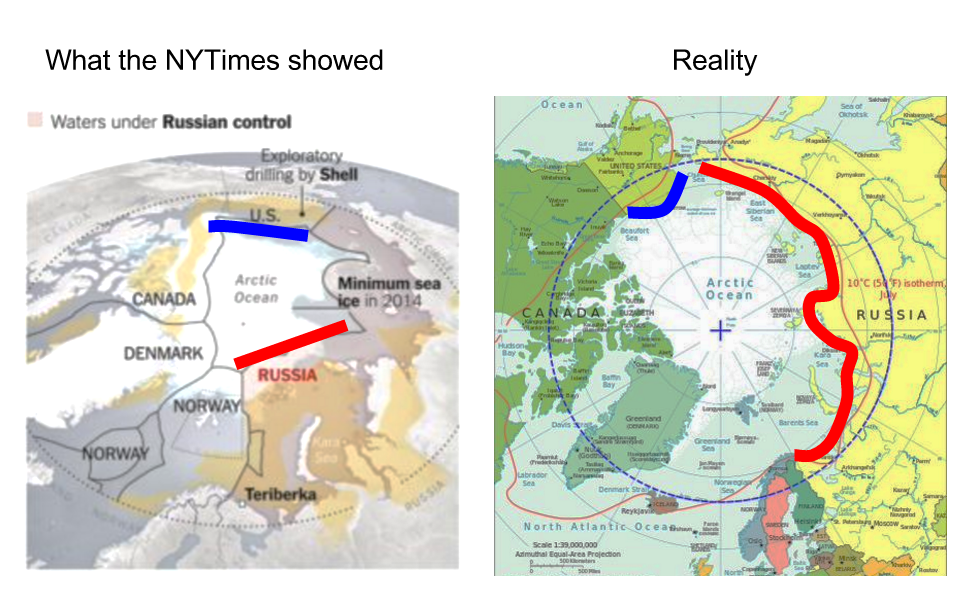
Arctic Maps

In May, the torrent of media articles hyping the “Arctic gap” asserted by CSIS and the US military paid dividends, with Congress allocating an additional $1 billion to the Navy’s budget to pay for icebreaker ships. Another bill, the Icebreaker Recapitalization Act, calling for Congress to fully fund “six heavy-duty polar icebreaker ships,” has been introduced by Sen. Maria Cantwell (D.–Wash.).

While the contracts are not awarded yet, Lockheed Martin—one of CSIS’s top donors–is said by market analyst The Motley Fool to be an “obvious choice” to build the new fleet. Their runner up to build the new icebreakers? Huntington Ingalls Industries, who also donated generously to CSIS.

No instances of CSIS calling for the defunding or de-escalation of the military state in the New York Times could be found by FAIR. FAIR reached out to CSIS spokesperson Andrew Schwartz, asking him to cite any examples of CSIS ever saying the threat of Russia or Islamic extremism was overestimated, or advocating for less surveillance or military spending. He did not respond at the time of publishing.

It could be a coincidence that CSIS always errs on the side of more military spending, more surveillance, more hyping of threats from Russia and ISIS, and that these conclusions were reached based on a dispassionate examination of the facts. Or the New York Times could read its own reporting, and treat deep-state think tank war-boosters as just that. At the very least, if they are to be cited, the paper could note that they are funded by interests heavily invested in promoting the expansion of a NATO/GCC-led military apparatus, so the reader can know that the bespectacled quasi-academic being interviewed or proffering charts and maps is not entirely without strings. (Noting that someone commenting on war is funded by those who profit from war seems entirely reasonable, no?).

The media would understandably be hard-pressed to drop think tanks altogether. Their insta-pundits lend gravitas to articles for writers on deadline and, just as they do for lawmakers, think tanks do much of the research heavy-lifting. But the think tank industry, as the internal emails New York Times revealed make clear, is often based on laundering influence through ostensibly neutral-sounding “institutes” or “centers,” with the fact that the average media consumer won’t know who funds them being part of the service offered to donors.

This is true not just in the military field, but in every policy area that affects corporations’ bottom lines, as is suggested by the Times‘ reporting on the even more ubiquitous Brookings Institution promoting the JPMorgan bank’s image:

JPMorgan, in a document dated a month before the agreement was signed, said the pending donation to Brookings “deepens/extends relationships with important client base among business and civic leaders both in the US and abroad.”

And Brookings was ready to do its part.

“Our events, which in part target these audiences,” said an internal 2014 Brookings memo, referring to the Global Cities Initiative and federal and state leaders, “have yielded 100+ media hits, with 97 percent of them referencing GCI and 90 percent referencing JPMorgan; by the end of this year, we will have held events in 13 domestic markets and nine international markets.

At times, Brookings officials seemed worried they were not doing enough for the bank.

“No one wants to create overt marketing opportunities for JPMC, but we need to carve out roles and thought leadership opportunity for market presidents,” said a 2013 Brookings memo, referring to a dinner with the bank’s executives. “We need to do a better job tying it back to JPMC.”

These “media hits” would not be possible if the corporate agenda wasn’t laundered through the pseudo-academic credibility of a think tank, whether it’s a giant bank trying to improved its image via Brookings or an arms manufacturers trying to promote the war industry via CSIS.

“John Smith, funded by Raytheon, the Department of Defense and Chevron, says Russian aggression is unprecedented” sounds far less credible than “John Smith, senior fellow at CSIS, says Russian aggression is unprecedented”—even though they are, in effect, the same thing. In light of the New York Times report, perhaps it’s time for media to start spelling out what’s happening for readers.


Adam Johnson is a contributing analyst for FAIR.org. Follow him on Twitter at @AdamJohnsonNYC.

19 Aug 01:38

Irreal: Get Xah's Emacs Tutorial for Free

by jcs
Tom Roche

~/docs/software/Emacs/Xah_Lee_emacs_tutorial_20160815/index.html

Xah Lee is giving his Emacs tutorial away for free for the next few days. Read down in the comments to get the link to download the files.

Xah's tutorial is a good resource. I learned Elisp mostly through his Elisp tutorial. Here's your chance to get your own copy. Of course, it's always available on-line

18 Aug 15:40

Tales of the New Cold War: Ukraine Commandos in Crimea. Russian Warplanes in Iran. Stephen F. Cohen, NYU, @Princeton EastWestAccord.com.

by The John Batchelor Show
Tom Roche

Should have devoted more time (just a bit at end) to the important and empirical point that Putin did not back Yanukovych in Ukraine; rather, Putin must defend ethnic Russians in eastern Ukraine because popular opinion (and the electorate) in Russia demand it.

08-16-2016 (Photo: Tupolev Tu-22M3 at Ryazan Dyagilevo: now also reported deployed in Iran in order to attack Aleppo. http://www.ynetnews.com/articles/0,7340,L-4842214,00.html) http://JohnBatchelorShow.com/contact http://JohnBatchelorShow.com/schedules http://johnbatchelorshow.com/blog Twitter: @BatchelorShow Tales of the New Cold War: Ukraine Commandos in Crimea. Russian Warplanes in Iran. Stephen F. Cohen, NYU, @Princeton EastWestAccord.com. "PRESIDENT VLADIMIR PUTIN of Russia is again playing with fire. This time, it may be a summer bluff, or it may be a pretext to escalation of war with Ukraine. Either way, it reflects Mr. Putin’s determination to deceive and subvert whenever it suits his goals, at home and abroad, taking advantage of a distracted United States and Europe. The Russian Federal Security Service, or FSB, claimed Wednesday that one of its officers was killed over the weekend near the de facto border between Crimea and Ukraine. Russia seized Crimea from Ukraine in early 2014, then backed a violent uprising in Ukraine’s eastern provinces of Donetsk and Luhansk. The latter continue to simmer with deadly force, but the line between Crimea and Ukraine had been relatively calm. According to the FSB, the infiltrators were armed with bombs and ammunition, intending to destroy infrastructure in Crimea, and a second attempt occurred Monday with support from Ukrainian artillery, killing a Russian army soldier. Ukraine responded that it was all “fantasy,” a provocation from Russia. There is precious little evidence of what really happened, and this conflict has given new meaning to the old adage that in war, truth is the first casualty. But the FSB announcement sounds suspiciously like a gambit by Mr. Putin, who swiftly vowed revenge. On Thursday, Ukraine’s president, Petro Poroshenko, put his troops on combat alert...." https://www.washingtonpost.com/opinions/global-opinions/while-the-world-is-distracted-putin-escalates-his-war-in-ukraine/2016/08/11/7c6c44ac-5fed-11e6-9d2f-b1a3564181a1_story.html?utm_term=.62fdad2a819a http://www.wsj.com/articles/russias-putin-discusses-additional-security-measures-for-crimea-1470908089 MOSCOW - Russian bombers based in Iran struck militant targets inside Syria, the Russian Defense Ministry said on Tuesday, after Moscow deployed Russian aircraft to an Iranian air force base to widen its campaign in Syria. The ministry said the strikes by Tupolev-22M3 long-range bombers and Sukhoi-34 fighter bombers were launched from Iran's Hamadan air base. It is thought to be the first time Russia has struck targets inside Syria from Iran since it launched a bombing campaign to support Syrian President Bashar al-Assad in September last year. http://www.ynetnews.com/articles/0,7340,L-4842214,00.html
17 Aug 19:50

The taboo secret to better health | Molly Winter

by contact@ted.com (TED Conferences LLC)
Tom Roche

mostly about decentralizing human-waste disposal

Our poop and pee have superpowers, but for the most part we don't harness them. Molly Winter faces down our squeamishness and asks us to see what goes down the toilet as a resource, one that can help fight climate change, spur innovation and even save us money.
16 Aug 22:33

Hillary Clinton Picks TPP and Fracking Advocate To Set Up Her White House

by Zaid Jilani
Tom Roche

yet so many Nice White Liberals want to believe that Hillary is progressive ...

Two big issues dogged Hillary Clinton during the Democratic primary: the Trans-Pacific Partnership trade agreement (TPP) and fracking. She had a long history of supporting both.

Under fire from Bernie Sanders, she came out against the TPP and took a more critical position on fracking. But critics wondered if this was a sincere conversion or simply campaign rhetoric.

Now, in two of the most significant personnel moves she will ever make, she has signaled a lack of sincerity.

She chose as her vice presidential running mate Tim Kaine, who voted to authorize fast-track powers for the TPP and praised the agreement just two days before he was chosen.

And now she has named former Colorado Democratic Senator and Interior Secretary Ken Salazar to be the chair of her presidential transition team — the group tasked with helping set up the new administration should she win in November. That includes identifying, selecting, and vetting candidates for over 4,000 presidential appointments.

As a senator, Salazar was widely considered a reliable friend to the oil, gas, ranching and mining industries. As interior secretary, he opened the Arctic Ocean for oil drilling, and oversaw the botched response to the BP oil spill in the Gulf of Mexico. Since returning to the private sector, he has been an ardent supporter of the TPP, while pushing back against curbs on fracking.

The TPP would enhance the ability of corporations to sue to overturn environmental regulations, but Salazar helped a pro-TPP front group, the “Progressive Coalition for American Jobs,” argue the opposite.

In a November 2015 USA Today op-ed that Salazar co-wrote with Bruce Babbitt, the two men argued that the TPP would be the “the greenest trade deal ever” by promoting sustainable energy. Both Salazar and Babbitt cited their former positions as interior secretaries to boost their credibility.

The following month, Salazar authored a Denver Post op-ed with two former Colorado governors also affiliated with PCAJ, arguing that the agreement would protect the state’s scenic beauty: “And as a state rich with natural wonder and a long history of conservation, Colorado can be proud that the TPP includes the highest environmental standards of any trade agreement in history.”

Shortly after leaving his post at the Obama administration, Salazar appeared at an oil and gas industry conference to argue in favor of fracking.

“We know that, from everything we’ve seen, there’s not a single case where hydraulic fracking has created an environmental problem for anyone,” Salazar told the attendees, who included the vice president of BP America, another keynote speaker at the conference. “We need to make sure that story is told.”

The EPA acknowledged in 2015 that fracking has contaminated drinking water wells. And methane, a gas with a climate impact 86 times that of carbon dioxide, is known to leak from fracked gas infrastructure.

Salazar is on the leadership team of a business group in Colorado fighting against a pair of ballot initiatives that could limit fracking. The Denver Post referred to the group as the “political equivalent of a tested military reserve unit that the [Denver Chamber of Commerce] calls into action when it believes business interests in the state face a serious threat.”

Environmentalists are alarmed. “If Clinton plans to effectively tackle climate change, the last thing her team needs is an industry insider like Ken Salazar. Salazar’s track record illustrates time and again that he is on the side of big industry, and not of the people,” Greenpeace USA Democracy Campaign Director Molly Dorozenski said in a statement.

Salazar currently works as partner at WilmerHale, a D.C.-based law and lobbying firm. His clients are not public, but his firm lists his job as giving “policy advice to national and international clients, particularly on matters at the intersection of law, business and public policy.” Staff at the firm have been involved in TPP negotiations.

Members of the presidential transition team are not required to disclose their finances — meaning we may never know if and how much Salazar is paid for all of the advocacy outside his salary at WilmerHale.

Salazar has long been criticized for his connections to the industries he regulates. For example, in a 2010 Salon post, Intercept co-founding editor Glenn Greenwald highlighted Salazar’s connections to BP, noting that “even as BP continues to spew oil in unfathomable quantities into the Gulf,” Salazar was waiving environmental reviews and approving new wells in the Gulf of Mexico.

Top photo: Then-Secretary of the Interior Ken Salazar on Capitol Hill in 2010.

Sign up for The Intercept Newsletter here.

The post Hillary Clinton Picks TPP and Fracking Advocate To Set Up Her White House appeared first on The Intercept.

16 Aug 15:13

New York Times Investigation Finds Think Tanks Influenced by Corporate Donations

by Mina Kim
Tom Roche

unfortunately dominated by a Brookings guy and an academic thinktank flack

Cash from developers, drone makers and other corporations is influencing research and political agendas at the Brookings Institution and other large think tanks, according to a New York Times investigation. The report, which Brookings and other think tanks strongly dispute, found that think tanks sometimes do not disclose their funding sources or the industry affiliations of their researchers, and in some cases confer “nonresident scholar” status on lobbyists. We discuss how think tanks are funded and their role in public discourse.

Related Stories

14 Aug 14:24

Historian Mary Beard Tackles Myths About Ancient Rome

Tom Roche

rerun

From Julius Caesar's last words to what Gladiator duels were actually like, classicist Mary Beard sets the record straight. Her book 'SPQR' is now out in paperback. Also, film critic David Edelstein reviews 'Hell or High Water.'
13 Aug 16:51

Behind the News – August 11, 2016

Tom Roche

Both excellent pieces. 1st, Sharon Higgins (charterschoolscandals.blogspot.com) is an anti-charter-school activist who has stumbled upon the Gülen movement in the US (and elsewhere), which in the US is funding itself largely from public funds extracted via corrupt charter-school-based contractor networks. She also discusses Gülen, Gulenism, and its movement (Hizmet by its followers, Cemaat by the broader Turkish public) internationally. 2nd, Robert Pollin (peri.umass.edu) examines the economic-policy proposals of the Trump and Hillary 2016 campaigns from a left perspective. Pollin and Henwood also discuss more general aspects of current and recent political economy (e.g., austerity, "trade deals" and terms of trade, and the migration of Larry Summers and similar from the Washington Consensus). Particularly, Pollin usefully punctures nostalgia for 1990s Clinton economic policy and performance: notably, poverty reduction was minimal, and failed even to rollback to Carter-era levels.

13 Aug 04:54

A balcony collapse killed 6 people. Will anything change? Plus: Ben Ehrenreich

Tom Roche

The 2nd piece--interview with Ben Ehrenreich, for most of the hour--is excellent. Ehrenreich discusses the history of Israel's occupation of Palestine, and discusses Palestinian resistance at small scale, particularly Bassem Tamimi and the struggle for water ("he Way to the Spring") in Nabi Saleh, and the settlers' slow-motion conquest of Hebron. He's particularly good on the USCFM fraud regarding violence and nonviolence ("where is the Palestinian Gandhi?"), and the corruption of the PLO and Palestinian Authority.

13 Aug 02:13

Factchecking Gail Collins

by Doug Henwood

Gail Collins wrote this ludicrous paragraph in her New York Times column today:

The bottom line on Hillary Clinton is that she’s spent her life championing women and their issues. She began her career with the Children’s Defense Fund, fought for better schools in Arkansas, for children’s health care as first lady and for reproductive rights as the senator from New York. As secretary of state she spent endless — endless — days and weeks flying to obscure corners of the planet, celebrating the accomplishments of women craftsmen, championing the causes of women labor leaders, talking with and encouraging women in government and politics.

These assertions bear a rather casual relation with the truth:

  • Yes, Hillary did “begin her career” at the Children’s Defense Fund, but the job lasted only about a year. She graduated from Yale Law School in 1973, and by 1974 was off working on the Nixon impeachment committee. She joined the Rose Law Firm, representing the elite of corporate Arkansas, in 1977, and became a partner in 1979. While at Rose, Wal-Mart—a company for whom sex discrimination has long been a way of life—was among her clients, and she later joined the retailer’s board of directors. Hillary gets a lot of mileage out of this brief “first job.” CDF’s founder, Marian Wright Edelman, broke with Hillary over her support of welfare reform during Bill’s administration. Though they’ve since reconciled, as recently as 2007, Edelman said this: “Well, you know, Hillary Clinton is an old friend, but they [sic] are not friends in politics. We have to build a constituency, and you don’t—and we profoundly disagreed with the forms of the welfare reform bill, and we said so.”
  • Hillary’s fight for “better schools in Arkansas” included a war on the state’s teachers’ union, making her a pioneer of neoliberal education reform, which holds teachers’ unions in deep contempt. The school reform initiative, which Hillary led, imposed competency tests on teachers. That act that was widely seen as racist because the teaching corps was disproportionately black, earning the enmity of civil rights organizations in the state. According to Carl Bernstein, this criticism “deeply pained” Bill and Hillary, but not enough to make them rethink the struggle. As for making the union the enemy, Bernstein noted that “the ASTA [Arkansas State Teachers Association] was not exactly the antichrist, and in fact had done some pretty good things in a state where the legislature had typically accorded more attention to protecting the rights of poultry farmers to saturate half of Arkansas’s topsoil with chicken feces than providing its children with a decent education.”
  • Hillary is widely seen as a staunch advocate of reproductive rights, but she’s got an immense capacity for equivocation. At a 2005 event in Albany, on the same day as the annual anti-abortion rally in Washington, Hillary described abortion as a “sad, even tragic choice to many, many women,” talked up abstinence education and “teenage celibacy,” and sought common ground with right-to-lifers. She has often said she wants to make abortion “rare,” a characterization that stigmatizes a medical procedure that should bear no stigma at all.
  • Her efforts on behalf of women while Secretary of State were mostly in the realm of symbolism, not actual policy. As I wrote in an earlier post: “[J]ust what did Hillary do to “elevat[e] women and girls as Secretary of State…”? There’s a rather sympathetic book—so sympathetic that the foreword is written by someone who declares a twenty-plus-year friendship with Hillary—on the topic by Valerie Hudson and Patricia Leidl, The Hillary Doctrine: Sex & American Foreign Policywhich is rather long on citing directives and rather short on reporting accomplishments.” There’s one preposterous anecdote about a “Bees for Widows” program in Iraq—see the link for the full quote—but little to justify the hype. Hillary did, however, help quash a minimum wage increase in Haiti, which would have benefited women garment workers in that country (so much for “championing the causes of women labor leaders”) and supported the coup against Honduran president Manuel Zelaya, who, among other things, fought to make the morning-after pill available in a socially conservative Catholic country. In a 2014 interview, Berta Cáceres, the indigenous rights and environmental activist who was murdered by forces that the coup helped promote, blamed Hillary for legitimating and institutionalizing Zelaya’s overthrow. So much for encouraging women in politics.

But when you’re writing about Hillary for the newspaper of record, you can stuff a lot of baseless nonsense into a single paragraph, and few readers will doubt you.


12 Aug 15:18

Behind the News – August 4, 2016

Tom Roche

fundraiser

11 Aug 15:51

Is Donald Trump an Isolationist?

Tom Roche

2nd piece (starts ~21 min, continues after news break) is excellent interview with historian Laurence Shoup on the Council on Foreign Relations and the creation of Anglo-American neoliberalism after WW1. Mostly about 1976-2014 and Shoup's new book, "Wall Street's Think Tank: The Council on Foreign Relations and the Empire of Neoliberal Geopolitics, 1976-2014"

08 Aug 19:52

What Happened to the Arab Spring?

Tom Roche

Joel Beinin interviewed for the hour (minus news) on his new book "Workers and Thieves" about organized labor and protest movements in Egypt and Tunisia, before and after the Arab Spring

07 Aug 20:25

Democracy Now! 2016-08-04 Thursday

Tom Roche

part 2 of the Lee Fang piece on foreign money in US campaigns is above @ https://traffic.libsyn.com/democracynow/2016-0804_POSTSHOW_Lee_Fang-podcast.mp3

Democracy Now! 2016-08-04 Thursday

  • Headlines for August 04, 2016
  • Chris Hedges vs. Robert Reich on Clinton, Third Parties, Capitalism & Next Steps for Sanders Backers
  • First Evidence Surfaces of Foreign Money Pouring into U.S. Elections After Citizens United

Download this show

07 Aug 20:25

Lee Fang on How Citizens United Opened Floodgates for Foreign Corporate Money in U.S. Elections

Part 2 of our conversation with Lee Fang of The Intercept. His new series, "Foreign Influence," reveals how a company owned by Chinese nationals donated $1.3 million to Jeb Bush's super PAC after receiving advice from a prominent Republican lawyer.

Watch Part 1 || First Evidence Surfaces of Foreign Money Pouring into U.S. Elections After Citizens United

07 Aug 20:22

Reflections on 15 Years of the War on Terror

What are some of the foreign policy challenges that the incoming U.S President will immediately face?  
05 Aug 22:19

Living on Earth: August 5, 2016

Tom Roche

"encore edition"

Pre-Natal Exposure to DDT Boosts Breast Cancer Risk / BPA Exposure Linked To Poor Parenting / Poachers Slip through Underfunded Wildlife Enforcement / Wildlife Drones Stymie South African Poachers / Drones are the Future of Agriculture / Planting the Seeds for Women Farmers
03 Aug 20:55

Democracy Now! 2016-08-03 Wednesday

Tom Roche

1st and 2nd segments (Christina Heatherton and Darius Charney) on the Bratton exit from NYC police: "broken windows" policing as neoliberalism at urban scale, and Bratton's ties to the Clintons. 3rd segment (with Danielle Ivory): Wall Street and private equity privatizing services and infrastructure. Ivory is part of the NYT series='Bottom Line Nation' @ http://www.nytimes.com/series/private-equity-bottom-line-nation , and she's the lead author on article='When You Dial 911 and Wall Street Answers' @ http://www.nytimes.com/2016/06/26/business/dealbook/when-you-dial-911-and-wall-street-answers.html

Democracy Now! 2016-08-03 Wednesday

  • Headlines for August 03, 2016
  • Amid City Hall Protests, NYPD Chief Bill Bratton Resigns, But "Broken Windows" Continues Nationwide
  • NYPD Chief Bill Bratton's Next Stop: Private Consulting Firm Tied to the Clintons
  • "When You Dial 911 and Wall Street Answers": How Private Equity Profits off Our Daily Lives
  • Chelsea Manning Faces Indefinite Solitary Confinement & Extra Prison Time After Suicide Attempt

Download this show

03 Aug 18:00

Episode 95: The Repugnance of Repugnance

by david pizarro
Tom Roche

dunno about the audio, but great Cthulhu 2016 graphic (which doesn't seem to be on their website=cthulhuforamerica.com )

We all remember the famous iTunes review calling David and Tamler "repugnant." (And the T-shirt/mugs are coming soon, we promise!) But what did the reviewer mean by that? Was he calling us "immoral"? Did he actually feel disgust when he listened to the podcast? And if so, was there wisdom in his repugnance--did the feeling offer any moral insight about the podcast's value? How did an emotion that originally evolved for pathogen avoidance get into moralizing business anyway? And why do white people kiss their dogs? Plus, an illuminating two week old discussion about the election, and Tamler finally comes around to defending a Kantian position—“the cart-egorical imperative” 

Links

Support Very Bad Wizards

03 Aug 01:10

Episode 85: Bryce Huebner discusses race and cognitive science

Tom Roche

Unfortunately this talk seems to have almost nothing to do with race and cognitive science, at least not by halfway when I bailed. Huebner and host start by bemoaning low minority representation among US philosophers. Huebner argues this can be rectified by teaching philosophy of Aztecs and Africans--at least, as extensively reconstructed, though he fails to acknowledge this. He gets more bizarre when he wants to claim that minority neighborhoods are only *perceived* as threatening/crimeridden and aesthetically unpleasant, because they are unfamiliar or challenging to white visitors. Host very gently challenges him on that, but Huebner saunters on. This is the sort of "caucasian guilt" mocked by 70s punks, and I gave up ~halfway. Quite possibly the worst Elucidations yet.

In this episode, Bryce Huebner argues that our implicit racial biases are shaped by the physical environments we inhabit.

Hosted on Acast. See acast.com/privacy for more information.

02 Aug 01:19

Hillary Clinton Will Be Good for Business, Predicts Chamber of Commerce Lobbyist

by Alex Emmons
Tom Roche

Increasingly clear that voting Hillary ~= voting Romney.

When Jennifer Pierotti Lim strode up to the podium on the final day of the Democratic National Convention, she was identified as the co-founder of Republican Women for Hillary, a group of conservative activists supporting Hillary Clinton.

Lim focused her brief comments on Donald Trump’s history of sexist comments, telling the audience that “Trump’s loathsome comments about women and our appearances are too many to list and too crass to repeat.”

But what was even more significant is her day job as a top lobbyist for the U.S. Chamber of Commerce; she’s the Chamber’s director of health policy.

It was the latest indication that the U.S. big-business community may be preparing to back Hillary Clinton, which would be a truly tectonic shift.

Although the Chamber may present itself as the champion of small businesses, it essentially functions as a money laundry for the world’s largest multi-national corporations, who want to keep their political activity at arm’s length.

The Chamber’s $85 million lobbying budget in 2015 dwarfs all others in D.C., and that doesn’t include the over $35 million it spent on political ads in both the 2012 and 2014 election cycles.

That money has almost always gone directly into supporting Republicans and trying to unseat Democrats.

In an interview with The Intercept after her remarks Thursday night, Lim said she could not speak for her colleagues at the Chamber, but said she hears from a lot of Republicans who increasingly support Clinton on account of her pro-corporate policies.

“I think [Clinton] is going to be a moderate policy maker, especially for the general election. She’s clearly going back towards the middle,” said Lim. “She wants to reduce the red tape and regulation on America’s small businesses, and I think that’s a starting point for a lot of Republicans.”

It also may not be a coincidence that, as CNN reported in early July, her husband Tim Lim has worked for the Clinton campaign and is a partner at Bully Pulpit Interactive, which has a multimillion-dollar contract with the Clinton campaign.

Nevertheless, Jennifer Lim’s comments coincide with increasing evidence that the lobbying group is warming up to Clinton.

Earlier this month, Chamber President Tom Donohue told Fox Business News that he was undecided between the two major party’s candidates. Donohue criticized Trump for his opposition to pro-corporate trade deals, like the Trans-Pacific Partnership (TPP), and North American Free Trade Agreement (NAFTA).

When The Intercept asked Lim if she thought Clinton would support the TPP, she said that was likely. “That’s a great question. I know that she has changed her position a little bit recently on it,” Lim said, “but I think that she will go back towards the middle on TPP.”

As secretary of state, Clinton called the TPP “the gold standard in trade agreements,” but then avoided taking a firm position during her primary campaign against Sen. Bernie Sanders, whose opposition to the agreement resonated with working class voters.

After negotiations for the treaty ended in October, Clinton told PBS that the TPP would not meet “the high bar I have set,” leaving open the possibility that she might support the agreement if something changed.

People close to Clinton have doubted her commitment to opposition. Virginia Gov. Terry McAuliffe, a close ally of Clinton, told Politico Tuesday that he expected her to change her position on the agreement after the election. Clinton’s campaign quickly denied McAuliffe’s comments, and McAuliffe told Gawker early Friday morning that Clinton had “never supported it and never would.”

Chamber head Tom Donohue has also predicted that Clinton would support the TPP after the election.

Sign up for The Intercept Newsletter here.

The post Hillary Clinton Will Be Good for Business, Predicts Chamber of Commerce Lobbyist appeared first on The Intercept.