Tom Roche
Shared posts
Episode 1: Rev. William Barber
Tom Rochegood interview, though audio is initially poor
How to Think Like a 21st Century Economist
Tom Rochenot worth the time, unless you have next to no exposure to these issues.
When it's okay to say no to child sponsoring.
Tom RocheTodd Ness is excellent, Sterling Scott is good.
Ireland 1916: how 800 years of British rule led to violent rebellion
Tom Rochererun
Thoughts on Friday's Jobs Report
Tom Rochefor EPOP data, see, e.g., https://data.bls.gov/pdq/SurveyOutputServlet
There was probably too much made out of the slowing in payroll employment growth in the March jobs numbers reported yesterday. This was likely driven in large part by the unusually good weather in January and February that brought a lot of spring hiring forward. However, there were a couple of items that did not get the attention they deserve.
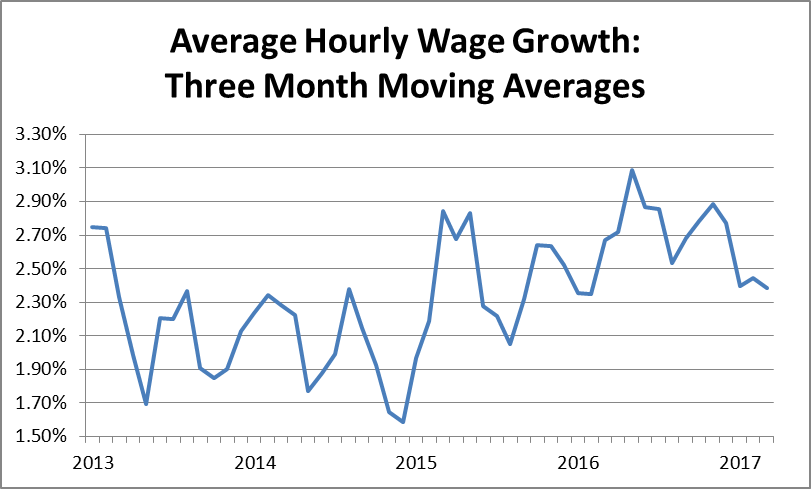
First, there is some limited evidence that wage growth is slowing. Typically, the year-over-year change in the average hourly wage is reported. While the growth in this measure slowed slightly last month, a problem with the year-over-year rate is that it reflects wage growth over the last year, not just recent months. I prefer taking the annualized rate of growth for the average of the last three months compared with the average of the prior three months. This measure can be sensitive to erratic month-to-month changes, but at least it focuses on a more recent period, rather than telling us about the wage growth from nine or ten months ago.
Here's the picture using this series since the start of 2013.
Source: Bureau of Labor Statistics.
As the figure shows, there was some very modest increase in the rate of wage growth in early 2016, with a peak of 3.1 percent in May of 2016. Since then, the general direction has been downward, with the rate over the last three months being less than 2.5 percent. This matters hugely for the Fed's interest rate policy, since a main issue for those looking to raise rates is that inflation could start rising above target levels. That seems unlikely if the rate of wage growth is stable or slowing.
In this respect it is also worth noting that the Employment Cost Index (ECI), a broader measure of compensation that includes non-wage benefits like health care, shows zero evidence of acceleration over this period. Over the last twelve months the ECI has risen 2.2 percent. That is the same rate of increase as we saw in this index three years earlier.
In short, you really can't find any evidence of accelerating wage growth in the data. The evidence of deceleration is too weak to say anything conclusive, but if anything, wage growth is going in the wrong direction to make the case for the inflation hawks.
The other item that deserved more attention in the jobs report was the rise in the employment rate (EPOP) of prime-age workers. This rose by 0.2 percentage points to 78.5 percent. This number is 0.5 percentage points above its year-ago level, although still 1.8 percentage points below the pre-recession peak and almost 4.0 percentage points below the 2000 peak. This suggests that the EPOP could still rise much further before we can say that we have reached full employment.
There was also an interesting gender split to the rise in the EPOP. While the EPOP for prime-age women is up a full percentage point from its year, the EPOP for prime-age men is unchanged. This could begin to look like the widely hyped problem with men story, if the trend continues.
However, there are two important caveats. First, the monthly data are erratic. If we take three month averages, the year over year increase in EPOPs for men would be 0.2 percentage points and for women it would be 0.8 percentage points. This is still a substantial difference, but at least the rate for men is moving in the right direction.
The other issue is that, at least from the summary data, it does not appear to be an issue with less-educated men. Over the last year, the EPOP for people with college degrees is actually down by 0.3 percentage points in the first three months of 2017 compared to 2016. By contrast, the EPOP for people with just a high school degree is up by 0.3 percentage points. It is possible that a further analysis would show large gender differences, but it seems unlikely that the weakness in EPOPs could be concentrated among less educated men, given these numbers. This seems especially unlikely given that the retirement of baby boomers would be primarily affecting the EPOPs of people with just a high school degree.
The inside story of the Tory election scandal – podcast
Tom Rocheoriginal article/transcript by Ed Howker and Guy Basnett @ https://www.theguardian.com/news/2017/mar/23/conservative-election-scandal-victory-2015-expenses
U.S. Weighs “Saturation Strike” Against Syrian Government in Response to Chemical Attack
Tom Rochenote comments to that piece about the US Tomahawk attack on the Shayrat base
The Pentagon has developed plans for an airstrike against Syrian government targets in response to this week’s apparent chemical attack by Syrian government forces, according to two U.S. military officials.
Secretary of Defense James Mattis will present the proposals to Donald Trump later today at the president’s Mar-a-Lago estate in Florida.
One of the proposals drawn up is a “saturation strike” using dozens of cruise missiles designed to hit Syrian military targets — including military air fields — in an effort to limit future Syrian Air Force attacks on rebel positions, according to the two U.S. military officials.
The officials asked for anonymity to discuss classified plans.
The proposed strike would involve launching Tomahawk cruise missiles to overwhelm Russian air defense systems used by the Syrian military. The Russian government currently helps maintain the air defense sites and advises the Syrian military.
According to both U.S. military officials, the current proposal would likely result in Russian military deaths and mark a drastic escalation of U.S. force in Syria.
One U.S. military official said the decision to allow the strikes, which would kill Russians, signals a significant change in policy by the Trump administration. A decision by Trump to go forward with the plan would be a reversal from the Obama administration, which denied multiple airstrike proposals that would likely cause Russian personnel casualties in Syria.
The Bashar al-Assad government placed many of its air defense systems in civilian areas, putting Syrian civilians at risk, according to the U.S. military and intelligence sources.
President Trump said yesterday that the Syrian government “crossed many, many lines” by conducting an apparent chemical weapons attack in Idlib on Tuesday. The attack has killed as many as 100 Syrians.
The proposed airstrike was prepared by U.S. Central Command, which oversees U.S. military operations in Syria, where a civil war has resulted in an estimated 500,000 Syrians killed, millions displaced, and an ongoing refugee crisis.
Neither the Pentagon nor CENTCOM responded to requests for comment.
Top photo: Children being treated at a hospital after a suspected chemical gas attack by Assad regime forces on the town of Khan Sheikhoun in Idlib, Syria, April 4, 2017.
The post U.S. Weighs “Saturation Strike” Against Syrian Government in Response to Chemical Attack appeared first on The Intercept.
Behind the News – April 6, 2017
Tom RocheNick Srnicek and Alex Williams (together--a 3-way interview with Henwood) discuss the topic which is the title of their new book, "Post-capitalism in a world without work." Unfortunately, it's just noodling. Not only do they fail to address problems of production (as Henwood points out--more below), but there's also absolutely nothing empirical (unlike the all-too-short interview on UBI with Rutger Bregman in yesterday's LNL
http://www.abc.net.au/radionational/programs/latenightlive/is-utopia-possible/8418342
) This is a shame, because some of what they discuss is just timewasting (most caring or social-reproduction labor is probably inherently not automatable, but that's OK, because that's the sort of labor humans frequently enjoy doing), and the problem of production (as posed by Henwood, that not all production will be readily automatable, and some of that human work will just suck) is easily addressed by labor markets (i.e., improve working conditions, and pay the workers more).
Behind the News, 4/6/17
Tom RocheNick Srnicek and Alex Williams (together--a 3-way interview with Henwood) discuss the topic which is the title of their new book, "Post-capitalism in a world without work." Unfortunately, it's just noodling. Not only do they fail to address problems of production (as Henwood points out--more below), but there's also absolutely nothing empirical (unlike the all-too-short interview on UBI with Rutger Bregman in yesterday's LNL
http://www.abc.net.au/radionational/programs/latenightlive/is-utopia-possible/8418342
) This is a shame, because some of what they discuss is just timewasting (most caring or social-reproduction labor is probably inherently not automatable, but that's OK, because that's the sort of labor humans frequently enjoy doing), and the problem of production (as posed by Henwood, that not all production will be readily automatable, and some of that human work will just suck) is easily addressed by labor markets (i.e., improve working conditions, and pay the workers more).
1177 B.C.: The Year Civilization Collapsed (Turning Points in Ancient History) by Eric H. Cline. PART 2 of 2
Tom Rochererun
Is empathy always a good thing?
Tom Rochererun
The destruction of Hillary Clinton
Tom RocheSusan Bordo continues the excuses.
Before the Flood – a review by Kevin Anderson
Tom Rocheexcellent equation of carbon offsets with indulgences
This is my review of Leornardo DiCaprio’s film Before the Flood
February 2017
Twitter @KevinClimate
There is much to commend this film – not least Leonardo DiCaprio’s natural propensity to see through unsubstantiated optimism along with his evident appreciation of the science of climate change and the beauty & fragility of our time on this planet. Ok, he’s an actor with an elaborate film crew – but nevertheless something genuine and important shines through. He deserves credit for what he has been part of – and that is not something I find easy to say. Celebrities, including DiCaprio, both epitomise and fuel our greed for evermore consumption. They are the metaphorical Jones family next door with the bigger car, larger house, private jet and obscene carbon footprint – the pinnacle of the increasingly ubiquitous American dream. And in my judgement it is here that the film is weakest – and to an extent disingenuous.
The solutions touched on are far too seductive and make no reference to the carbon budget concept that translates the Paris Agreement’s temperature commitments into the scale and timeframe for reducing emissions. Carbon budgets are simple to understand, but their repercussions are profound, evidently too profound for this film.
So instead we have Gregory Mankiw, a Harvard economics professor, and technology entrepreneur Elon Musk, asserting the only way forward is though a carbon tax gently “nudging” us towards a technical utopia. Just one hundred of Musk’s “gigafactories” will see the world’s energy supply magically transformed away from fossil fuels. Certainly, if a significant upstream price is put on carbon, investors will begin to shift away from fossil-fuel energy. Moreover, the Musks of this world indeed have a role to play. But they are not our silver-bullet saviours – they’re one part of complex and dynamic puzzle.
Only Sunita Narain, from Delhi’s Centre for Science and Environment is prepared to point to the elephant in the room, the carbon-profligate lifestyle to which DiCaprio, the Koch Brothers, climate elites and professors have grown all too accustomed. Combine this with Johan Rockström’s fear that we are making the transition to a sustainable future all “too slowly” and the plot for a follow-up film begins to emerge.
Certainly huge strides towards low carbon energy could be achieved now with existing energy supply and demand technologies. The research, development and deployment of promising new technologies, including Musk’s solar-battery future, could be accelerated. But Paris and carbon budgets frame an urgent problem far beyond the multi-decadal timeframe of deploying sufficient new energy technologies to displace fossil fuels. Deep and early mitigation through reduced fossil-fuel use by high emitters is key to both extending the window for this technology-transition and for leaving sufficient emission space for those in poverty to have near-term access to fossil fuel energy.
Finally, having suspended my antipathy towards individuals with carbon footprints greater than that of many African towns, I was brought rudely back to reality with the film’s closing statement – reiterated on its accompanying website. “The carbon emissions from Before The Flood were offset through a voluntary carbon tax.” Worse still it then extols the virtues of offsetting by encouraging other high emitters to “Learn how you can offset your own carbon emissions by going to [link omitted]”
I really doubt that the Pope, whose Encyclical makes more systems-level sense than the plethora of glossy reports dispensed by green-growth ‘think’ tanks (and who was interviewed for the film), would sanction the ongoing “buying of indulgences”. For that’s what it is. The emissions from first-class flights, grand hotel rooms and travelling film crews are changing the climate now – and will for the next ten thousand years. The deed’s been done – and no amount of conscience-salving finance can assuage the climate impact. Ok, the projects funded may have real and important value – but asking someone else to diet whilst we binge on high-carbon fun is simply fraudulent.
The Paris commitments cannot be delivered through well meant technocratic tweaks – even large ones. Technology and new economic rules are certainly prerequisites for delivering on “well below 2°C” – and DiCaprio does an adequate job of making this case. But they fall far short, in both delivery and scale, of what’s needed to stay within the rapidly dwindling carbon budgets accompanying Paris. Here, DiCaprio’s film serves to reinforce the misguided view that clever scientists, engineers and economists have the solutions to hand – just the evil oil companies are in the way.
Despite my entrenched prejudice against our celebrity culture, I nevertheless recommend DiCaprio’s Before the Flood. If seen in conjunction with Robert Kenner’s wonderful and engaging film of Conway & Oreskes’ superb book, Merchants of Doubt, then a real sense of just what we’re up against emerges. But for a complete picture there needs to be a trilogy, with the final film focusing in on its audience. Unfortunately, as self-portraits are always the most revealing of art forms, this final film will be the most challenging to fund and difficult to produce.
__________
- Naomi Oreskes’ seminar on Merchants of Doubt
- For an account of why I object to offsetting, see: The inconvenient truth of carbon offsets and Offsetting under pressure (a pre-edit of both of these is also available)
1177 B.C.: The Year Civilization Collapsed (Turning Points in Ancient History) by Eric H. Cline. PART 1 of 2.
Tom Rocheexcellent but rerun
Mixed modern marriages...
Tom Rocheexcellent
Behind the News – March 30, 2017
Tom Roche1st segment=Jodi Dean on the perils of populism (not so great). 2nd segment=Jane McAlevey on real organizing not fake organizing (quite good).
Boiling Frogs and Black Swans
Tom RocheNOTE: both pieces available as separate downloads (as well as single show download). The Rupert Read piece seemed platitudinous, so I bailed after ~10 min. TODO: followup with Safa Motesharrei regarding (specifically) coupled human-climate-hydrology model over Phoenix mentioned at end of piece, and (generally) coupling planning-AQ/climate models.
Conspiracy Theorists Welcome in Corporate Media–if They Have the Right Targets
Tom Rochebtw, the conspiracy-theorist who wrote an entire book peddling "The Connection" between Saddam Hussein and al-Qaeda is Stephen F. Hayes

Louise Mensch on Real Time
Former British Conservative MP Louise Mensch has become something of a celebrity of late in anti-Trump media. In the past two weeks, Mensch has been touted by former head of the Democratic National Committee Donna Brazile and prominent Harvard Law Professor Laurence Tribe, and appeared on MSNBC (3/11/17), the New York Times op-ed page (3/17/17) and HBO’s Real Time With Bill Maher (3/24/17). All this despite the fact that she routinely traffics in the most bizarre and unfounded conspiracy theories.
With her rise to prominence as a commentator on the Trump/Russia story, and seemingly dozens of editors and producers giving her their tacit approval, one is compelled to ask: What exactly would Louise Mensch have to say to be discredited?
Here is an incomplete list of outlandish claims made by Mensch over the past six months, mostly on Twitter, that have thus far not removed her from polite society:
- ProPublica and Democracy Now! “ARE [Steve] BANNON” and are “Russian shills” (1/28/17).
- Putin may have killed Andrew Breitbart (2/24/17).
- Russia is secretly operating the public wifi networks in her neighborhood (3/3/17).
- Anthony Weiner wasn’t sexting with a 15-year-old but was set up by a Russian hacker (Patribotics, 2/24/17).
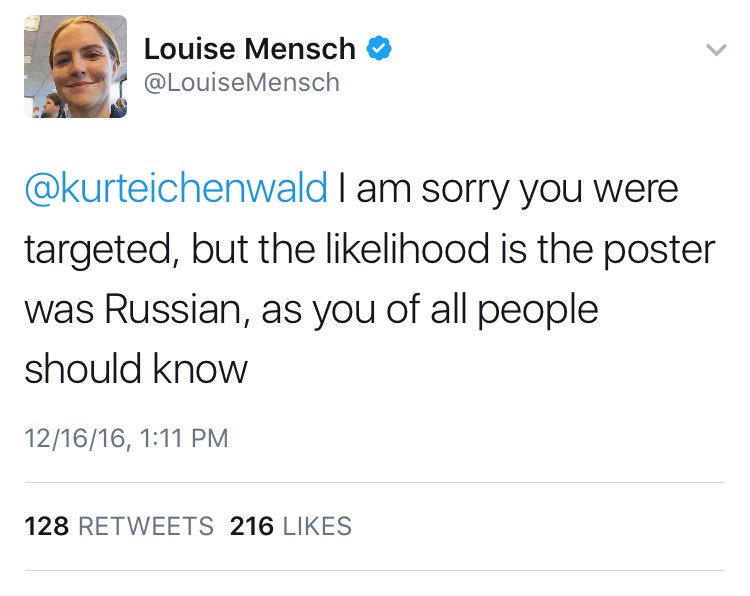
- It was probably a Russian Twitter account that sent a strobe gif to Newsweek journalist Kurt Eichenwald, causing a seizure (12/16/16).
- Putin had his own ambassador killed in Turkey in a false-flag operation (3/23/17).
- Putin played a role in the March 22 London attack (3/23/17).
- “Russian partisans were out in the street” after London attack blaming illegal immigrants (Real Time, 3/24/17).


When confronted by BBC host Andrew Neil (3/12/17) about her more outlandish claims, Mensch insists that what she tweets is simply a “belief” and not a “report” of the sort which appear on her website—the Dow Jones-owned Heat Street.
“Just to be clear,” Neil asked incredulously. “If it’s Twitter we don’t believe, but if it’s on your website, we should.” He then insisted that claims “should be backed up by evidence,” to which Mensch replied: “Really? Do you have a faith?”
Avoidance of unsubstantiated conspiratorial speculation is seen as a requirement for respectable news outlets. When Russia Today critics want to distinguish RT from other government-funded networks, for example, they insist that the others don’t give credence to conspiracy theorists. “Russia Today’s second mission is to spread conspiracy theories,” lamented the Guardian’s Nick Cohen in 2014, “that help Russian power and provide sensational audience-grabbing stories.”
As an example, Cohen offers the claim that “Ukrainians who oppose Putin are fascists.” Despite the fact that this is partly based on a truth—there were, in fact, fascists involved in the 2014 overthrow of the Ukrainian government (FAIR.org, 3/7/14)—this is a drop in the ocean compared to Mensch’s increasingly sprawling web of Putin’s global puppeteering. What does her rise as a credible source on all things Trump/Russia say about US media?

Chris Hayes did seem a bit nonplussed on Real Time when Louise Mensch claimed “Russian partisans” were spreading Islamophobia in the streets of London.
On Real Time, Mensch insisted, without an ounce of evidence or follow-up from the host, that “Russian partisans were out in the streets” blaming immigrants for the London attack, and hardly anyone in the media batted an eye.
The reality is the acceptability of conspiracy theories depends on whom the theory is directed at. The greatest, most consequential conspiracy theory of our generation was that Saddam Hussein had a secret Weapons of Mass Destruction program and was plotting to attack the US. The narrative met all the criteria for a good conspiracy theory—cherry-picked evidence, spurious dot-connecting, the rejection of inconvenient facts—but was widely embraced by most of the Western pundit class. Indeed, those who peddled it the hardest were not only allowed to remain in polite society, they were elevated to the highest positions in US media.
And someone who operated on the most radical fringes of this conspiracy—arguing that Saddam Hussein was secretly in league with Al Qaeda—is today held up by the New York Times (3/26/17; FAIR.org, 3/28/17) as a clear champion of truth in the age of “fake news.”

New York Times illustration of Louise Mensch’s op-ed “connecting the dots” between Kremlin and White House. But is she coloring outside the lines? (image: Francis Ben)
Which brings us back to Louise Mensch, who often appears to be openly hucksterish. As Current Affairs‘ Nate Robinson and Alex Nichols (3/22/17) note in their excellent breakdown of her grift, Mensch is somewhat self-aware at how unhinged she has become, telling the Times of London the following anecdote earlier this month:
These days when anything goes wrong in our house, one of my kids will say: “Is it the Russians?” It’s a standing joke. “Pizza went cold. Is it the Russians?”
When asked on Twitter to list things Russia isn’t responsible for, Mensch responded, “The designated hitter.”
Like Trump, Mensch occasionally lets out a wink and a nod that she’s in on the scam, and, also like Trump, she knows her loyal, hyper-partisan followers don’t really care. She tells them what they want to hear, and they in turn feed off her increasingly tantalizing dot-connecting, each legitimizing the other.
Which would be relatively harmless if she remained in the confines of her Twitter echo chamber, but Mensch is increasingly being legitimized by mainstream centrist and liberal media, whose standards for claims of Russian skullduggery have sunk to tabloid levels. The question is: How far down the speculative rabbit hole does Mensch have to go, how extreme a conspiracy does she have to peddle, to once and for all be discredited?
Adam Johnson is a contributing analyst for FAIR.org. He can be found on Twitter at @AdamJohnsonNYC.
Blitzkrieg
Tom Rocheexcellent
Can we trust the Rorschach test? – podcast
Tom Rocheoriginal article/transcript by Damion Searls @ https://www.theguardian.com/science/2017/feb/21/rorschach-test-inkblots-history
Doug Henwood in conversation with Mark Blyth
Tom Roche... on neoliberalism and international Trumpism, and hilarious as usual
Behind the News – March 16, 2017
Tom RocheSteffie Woolhandler on Trumpcare is excellent; Cinzia Arruzza on the women's strike is skippable
Behind the News – March 23, 2017
Tom RocheChris Arnade on the busted heartland, James Livingston against work
Carpets, Drapes, and everything in between!
Tom RocheMayce Galoni is great, Laurie Elliott not so much
Neil Gorsuch and The Nazi and the Pyschiatrist
Tom Roche1st half (after 1st break for news headlines) is skippable. 2nd half (after 2nd break for news headlines) is an interview with Jack El-Hai about his book "The Nazi and the Psychiatrist," about Douglas Kelley, his assessments of Nuremberg Trial Nazis, particularly Göring, and the effects this encounter had on Kelley's later life.
Mike Driscoll: Python 101 Online Course is FREE for 48 Hours!
Tom Roche"lifelong access to this course" @ https://www.educative.io/collection/5663684521099264/5707702298738688 : full coursename='Python 101: Interactively learn how to program with Python 3'
My Python 101 online course will be completely FREE for the next 48 hours on Educative’s website. Be sure to go get yourself a copy.
It is based on my Python 101 book. When you get it from Educative, it will be yours to keep for life. Note that this is an interactive online course, not a video course. If you enjoy the Python 101 online course, you can get my second online course, Python 201 for 50% off just by using the following coupon: au-promo-py201.
Links:
- Python 101 Online course (FREE for 48 Hours)
- Python 201 Online course (50% off with au-promo-py201 coupon
You can also get my eBooks for 50% off the suggested price with the following links:
- Python 201: Intermediate Python
- wxPython Cookbook
Tony Collins, “The Oval World: A Global History of Rugby” (Bloomsbury, 2015)
Tom RocheThe interview covers much more than just rugby, also the interesting histories of
* how rugby was actually more popular than "soccer" (better known as FA or Association football) in UK from ~1850s but declined when Rugby Union decided to stay "amateur" while FA teams first went semi-pro (allowing workingmen to be paid for time missing work) then professional then formed leagues
* how rugby's popularity surge related to "muscular Christianity" and the novel "Tom Brown's School Days"
* how rugby's mid-19c popularity led to the dominance of rugby-style football codes (as opposed to FA football) in the rest of the Anglosphere
* how the schism between Rugby Union and Rugby League weakened English rugby, but enhanced rugby's international spread, since foreign teams (including Wales, but esp the Afrikaners) could beat the English Rugby Union team
* rugby's commercialization, including the Australian "Super League war" between Rupert Murdoch and Kerry Packer
Song of Wrath: The Peloponnesian War Begins by J. E. Lendon
Tom Rochererun
Richard Weikart, “Hitler’s Religion: The Twisted Beliefs that Drove the Third Reich” (Regnery History, 2016)
Tom Rocheexcellent. net: Hitler was a pantheist, opposed both to organized religion and to atheism.
Russian spies are the new new. @LarryCJohnson Noquarterusa.net
Tom Rocheexcellent blog post @ https://www.noquarterusa.net/blog/79647/anti-russian-disinformation/ (archived @ https://web.archive.org/save/_embed/https://www.noquarterusa.net/blog/79647/anti-russian-disinformation/ )