Tom Roche
Shared posts
Facebook’s war on free will – podcast
Tom Rochesome interesting bits about Zuckerberg and Facebook, interspersed with uninformed and occasionally ludicrous "explanations" of computer-science topics. Instead, just skim the original article/transcript by Franklin Foer @ https://www.theguardian.com/technology/2017/sep/19/facebooks-war-on-free-will
Behind the News, 10/5/17
Tom Rochethe Schalit piece is good, rest (after ~21 min) is deletable
The inside story of Labour’s election shock – podcast
Tom Rocheoriginal article/transcript by Heather Stewart @ https://www.theguardian.com/politics/2017/sep/22/the-inside-story-of-labours-election-shock-jeremy-corbyn
William Taubman | Gorbachev with Yuri Slezkine | House of Government
Tom Rocheas is so often the case with PFL, one part (here, Taubman on Gorbachev) is great, and the other is ehh
Stephen Pimpare, “Ghettos, Tramps, and Welfare Queens: Down and Out on the Silver Screen” (Oxford UP, 2017)
Tom Rocheexcellent. TODO: watch more of these movies
Harry Bennett, “The Royal Navy in the Age of Austerity, 1919-1922: Naval and Foreign Policy under Lloyd George” (Bloomsbury Academic, 2016)
Tom Rochevery excellent, not only about UK politics ~1900-1945 but also foreign/military relations with US and Japan, and also the post-WW1 implications of UK naval privatization (begun well pre-WW1). Basically, imperial overreach and domestic plutocracy bit the Royal Navy (and the British Empire) in the ass.
At $50 a barrel, billions in tax breaks keep many oil projects profitable
Tom RocheAs I note @ https://arstechnica.com/science/2017/10/at-50-a-barrel-billions-in-tax-breaks-keep-many-oil-projects-profitable/?comments=1&post=34091589#comment-34091589
* this Ars article reviews the original Nature Energy article, and links to it @ https://dx.doi.org/10.1038/s41560-017-0009-8 ... but that leads to a $59 paywall
* there is an open-access link (currently) @ http://rdcu.be/wnN1 from the SEI-US page @ https://www.sei-international.org/publications?pid=3223 archived @ https://web.archive.org/web/20171003181233/http://rdcu.be/wnN1

Enlarge / MIDLAND, TX - JANUARY 20: A pumpjack sits on the outskirts of town at dawn in the Permian Basin oil field on January 21, 2016 in the oil town of Midland, Texas. (Photo by Spencer Platt/Getty Images) (credit: Getty Images)
At $50 a barrel, the low price of crude oil has slowed some of the oil production in the US, especially in regions that are costly to develop, like the Arctic. But US oil producers aren't bearing the whole brunt of low prices, because federal and state governments provide tax breaks that stimulate oil production despite low prices.
The tax situation isn’t unique to the US—China, the EU, and India also offer a variety of flavors of tax breaks to fossil fuel producers, despite their recognition of the need to address climate change. Although the US has signaled its intent to withdraw from the Paris Agreement, tax breaks that fund more fossil fuel production don't help the rest of the globe to limit warming to 2 degrees Celsius.
The latest research offers some hard numbers on just how much tax policy is supporting extra CO2 emissions. “Federal tax subsidies to the oil and gas industry alone cost US taxpayers at least US$2 billion each year,” write researchers from the Stockholm Environment Institute and Earth Track in a recent Nature Energy article. That $2 billion in uncollected taxes is helping some oil fields go from "unprofitable" to "profitable," increasing the amount of oil that's available for consumption. (The researchers broadly used the term "subsidies" to indicate different types of tax-based support that "confer a financial benefit from government to oil producer.")
Read 10 remaining paragraphs | Comments
The Safe Way to Build a Smart City
Tom Rochesee also the cited paper 'Protecting Privacy Using k-Anonymity' @ https://dx.doi.org/10.1197%2Fjamia.M2716
You don’t have to dig deep to find out what can go wrong with open data initiatives. Just look back to 2014, when the New York City Taxi and Limousine Commission released hundreds of millions of records on taxi trips in the city, with data anonymized to protect identifiable details—at least in theory. In reality, the data was recorded in a format that allowed a software engineer to re-identify the license numbers of the taxis and drivers. A Gawker journalist then linked this to celebrities taking cab rides across the city months after the initial release, speculating on the routes they had taken and even how much they tipped.
It’s certainly not the most sensitive data to ever be leaked or hacked, but it is an important illustration of the risks cities face in releasing data from their many constituent agencies; the implications aren’t always apparent until long after the information is out in the public domain.
In recent years, as the Seattle metro area has grown into a thriving tech hub, the city has been pioneering a progressive, carefully considered approach to releasing public data. Slowly but surely, city authorities are crafting what they hope can serve as a model for “smart cities” around the world. One key part of this plan came in 2016, when the city adopted a resolution that all civic data would be “open by preference,” rather “open by default.” As David Doyle, Open Data Program Manager for Seattle Information Technology, explains, this extra layer of caution aims to make the city more deliberate about its data practices from the start.
“Policies were first developed with ‘open by default’ in mind, but that isn't really feasible when you consider factors like privacy,” he says. “Seattle took a more nuanced approach of being open by preference: This means we can be open [with data] once we mitigate for privacy risks, release of personally identifying information, and other kinds of harm.”
Essentially, an open by default policy would mean “publish first, ask questions later”: datasets collected by all city government agencies—police department, housing authority, department of transportation, etc.—would be released online unless and until there was a clear reason not to. Open by preference speaks to a more measured approach: Civic datasets are evaluated proactively with a view to releasing them wherever possible, but only after they’ve been reviewed by city officials.
In one example, Doyle explains that data from the city’s Aging and Disability Service was released to support a hackathon focused on solving accessibility challenges. Since the data on disability, income, ethnicity, and exact location were extremely sensitive, teams from multiple departments worked together to group it into neighborhood segments and age brackets, reducing the identifiability while still providing a useful resource to participants in the event.
As part of the 2016 resolution on open data, Seattle also committed to an annual, publicly released risk assessment of its open data program. This year the privacy-focused nonprofit Future of Privacy Forum (FPF) was commissioned to undertake the task, which culminated in the release of a draft report in August that is currently open to public input.
The report aims not only to analyze the city’s progress with data release, but also to develop a framework for evaluating the risks of open data initiatives overall. The idea is to lay out clear criteria for judging the benefits and drawbacks of publishing a certain dataset, leading to a score that can inform a decision on how to proceed.
Still, correctly gauging the risks of a privacy breach is a difficult task: Some personal data is easy to classify as too sensitive for public release—Social Security numbers are one example, or at least should be. But other data fall into a gray area. Making some medical information public is important for epidemiological research, for example, but details on specific medical conditions should not be traceable back to individual patients.
In order to reap the potential benefits of the sensitive-but-not-secret category, data is usually anonymized before being released—but truly guaranteeing anonymity is much easier said than done. In a widely cited study from 2000, Harvard professor Latanya Sweeney (then at Carnegie Mellon) found that 87 percent of Americans could be uniquely identified in a dataset by only gender, date of birth, and ZIP code. That can then be cross-referenced with voter records to identify each individual by name.
This is the central problem that cities like Seattle face when trying to release anonymized data: Details that are non-identifying when isolated can easily become unique in combination.
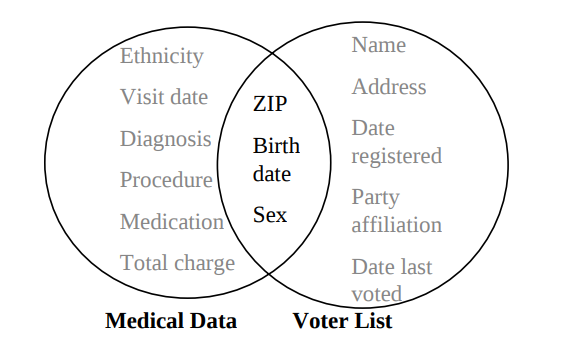
Given the abundant need for privacy controls in the digital age, it might come as a surprise to learn that legal definitions of personally identifying information have not been updated for decades. In the U.S., “Personally Identifying Information” is a legal term with specific meaning in the Privacy Act of 1974; but the law draws the line between identifying and non-identifying information in a way that ignores the realities of modern information security.
“The problem is, as an actual technical matter, this is a distinction without meaning,” says Joseph Jerome, a policy counsel at the Center for Democracy and Technology. “When you look at open data policy, there's a question over how many different indirect identifiers can be put into data before you have something that completely identifies someone. So in some respects, this is a legal policy debate, but it's also a technical debate... and the answer isn't clear.”
The debate is complicated by the need to release information that will be useful for analysis while also being protective of user privacy, two factors that are often in direct opposition. Technically data is at its least identifying if every individual in the group has exactly the same score for every variable—but then the data is effectively meaningless. By definition, useful data must be identifying to some degree, and a judgement must be made over where to draw the line between the two.
As a guideline, statistical de-identification expert Khaled El Emam has suggested that no more than six to eight indirect identifiers should be included in any dataset, which should also be modified so as to ensure a certain threshold of “k-anonymity:” A term meaning that even by combining the indirect identifiers, a minimum number of individuals will always share the same values, so that no one record is completely unique.
All of these technical and legal constraints can make it difficult for cities to know when data has been processed well enough to be safely released. It can be even harder for citizens to know whether they could be identified from a given dataset. Compounding this problem is the fact that municipal governments, unlike private corporations, can also be compelled to disclose information under public records laws.
It was exactly this situation that led New York’s Taxi and Limousine Commission to release the insufficiently anonymized data on taxi trips. Had it not been for a request from a freedom of information activist, would not have been publicly disclosed in the first place.
***
Dan Bevarly is executive director of the National Freedom of Information Coalition (NFOIC), an alliance of civil society groups advocating for open government. Though his organization lobbies for greater transparency, he is also conscious of the need for caution, and suggests that budgeting more time and resources for public record requests could help strike that balance without limiting access to information.
“We see an area that requires more specialization, and that's the public records steward,” Bevarly says. “We think that much more formal training has to be provided, mainly because of the changing legislation and the increasing use of technology to manage information and communicate.”
He also believes public institutions could be more proactive in releasing properly sanitized information ahead of time, reducing the risk of a badly handled disclosure in response to a public records request. But while Bevarly and other experts have a key role in shaping the debate on open data, it's also crucial to solicit input from the largest party involved: the general public.
The public release and consultation period for FPF's evaluation in Seattle is one step toward this, and in practice, is paired with in-person outreach, too. Program Manager David Doyle often makes speaking appearances at conferences and other events, like the Seattle Public Library's open data literacy series. Nonetheless, he concedes, “It’s a difficult topic to explain to the public, for sure.”
And according to policy counsel Joseph Jerome, if we want to promote openness, we should also respect the choice of those who do not want to participate.
“I think we need to facilitate the ability not of individuals, but of communities, to opt out of this type of thing: I think that's the level where an opt-out would work,” he says.
Still, Jerome says that the practicalities of this are unclear; there has not yet been any large-scale opt-out of open data, perhaps an indication of the difficulties involved in doing so.
With the open data movement gathering momentum, it's important that debates around the pros and cons can take place with a transparency appropriate to the topic. Not all city governments will have the financial resources or technical know-how of a city like Seattle, but smaller governments across the country may yet learn from the successes and failures of the bigger players.
How a tax haven is leading the race to privatise space – podcast
Tom Rochefull article/transcript by Atossa Araxia Abrahamian @ https://www.theguardian.com/news/2017/sep/15/luxembourg-tax-haven-privatise-space
My review of HRC’s book
Tom Roche"Doug Henwood Dispatches Hillary and Her New Book to Remainder Bin of History" @ http://washingtonbabylon.com/3128-2/ (archived @ https://web.archive.org/web/20171001155014/http://washingtonbabylon.com/3128-2/ ) pullquote:
> buried in this soporific and dishonest book is an admission that the entire modern history of the Democratic Party—from the creation of the Democratic Leadership Council in the early 1990s, in which she was an active participant, onwards—was a mistake. All their targeted microinitiatives are weak tea next to ideas like “Medicare for all” and “free college.”



No, Urban Tech Startups Aren't Transforming All American Cities
Tom RocheNoAppFee @ https://noappfee.com/noappfee/ is a great idea
Few issues in urban tech today are as controversial as the impact of short-term rental startups like AirBnB and VRBO on neighborhood housing. The battle lines are clear: Do these startups help residents earn much-needed extra dollars on the side, or are they so constricting housing supply and raising rents so high that locals are forced to move out? Billions of dollars—and the livelihoods of vibrant communities—are at stake in this debate, and regulatory battles royale have already been waged in cities like Washington, D.C., and Austin. Of course, urban housing isn’t the only bedrock element of city life undergoing rapid and controversial change: Public officials have wrestled for years with how to handle ride-hailing’s destabilizing effect on taxi service, and potentially on public transit as well.
If you live in a place like San Francisco or New York where urban tech startups (and, ahem, national media) are concentrated, these conflicts seem to be reshaping cities throughout the country. But if you dig a little deeper, it’s clear that’s hardly the case. With fewer than twenty new homes built in a city of 200,000 last year, Akron recently abated property taxes for new housing as a way to prop up the construction market. Many of Akron’s leaders would love to have the problem of excessive housing demand that Airbnb has allegedly created.
And although Uber and Lyft are available in almost all American cities at this point, their use is concentrated in big, dense regions. It’s extremely unlikely that the ride-hailing industry’s piece of the mobility pie in a place like Topeka or Louisville comes close to the 20% of vehicle miles seen in San Francisco.
In fact, urban tech innovations—as well as the narrative surrounding the field—disproportionately focus on a handful of cities that are already winning the competition for mobile workers and tourists. Urban tech’s relevance and impact are much more limited in the many mid-sized cities that are spread across the country. Why is that?
Well, for one thing, urban tech startups are often launched by the well-educated young people clustered in thriving “unicorn cities” like New York, Boston, San Francisco, and Austin. They also happen to be the places where venture capital firms concentrate, ready to finance growth (such firms tend to fund startups near their headquarters to keep a close eye on investments and minimize travel).
It’s natural that these entrepreneurs would draw ideas from their own experiences. Tired of lugging around your laundry through the Mission in San Francisco? Enter Rinse. Tough to find a parking spot in Manhattan? SpotHero can help with that. Inconveniences like these are most felt in growing, dense cities chock full of affluent people willing to open their wallets to make their lives a little easier. But they are just that—inconveniences.
As a counterexample, look at Tyrone Poole, the founder of NoAppFee who was profiled in CityLab earlier this year. Several years ago Poole found himself living in a homeless shelter as a result of an incapacitating leg injury. He spent days walking the streets of Portland, Oregon, his hometown, trying to find an apartment building with a vacancy that would accept someone with his financial profile. It took him months of fruitless searching before he found a place to live.
Poole turned his frustration into a business opportunity, launching NoAppFee in Portland as a software platform that instantly gives prospective tenants a list of available apartments where they will be approved based on their finances. The platform is now deployed in three states.
NoAppFee addresses the need for affordable housing—a fundamental urban need—in a way that will resonate most in mid-sized cities. This is because the software’s ability to match prospective tenants with available homes relies on a steady stock of available apartments at the lower end of the market, a rare situation in unicorn cities like San Francisco or New York that have very low vacancy rates.
NoAppFee has found one challenge of mid-sized city life that is ripe for an innovative solution. There are many others. Consider the opioid crisis, which was the focus of a recent startup gathering in Portland, Maine, where opioid deaths have spiked. But entrepreneurs in places like Portland, Maine, (or Portland Oregon, for that matter) struggle to get growth capital from venture capital firms that increasingly direct funding to Bay Area startups.
And so we end up with an urban tech sector creating innovations that are not just relevant for a certain class of city residents; they are also relevant for only a small subset of American cities. Airbnb has more than 8,000 listings in tech and tourist mecca Austin, but only a few hundred in El Paso, which has almost as many residents. Rinse’s promise for dry cleaning delivery or SpotHero’s ability to reserve a parking space have limited appeal in cities like El Paso. But an easier way for a homeless person to find an affordable apartment? That would be get people’s attention. So would a technology solution to the opioid crisis.
There is no single culprit for urban tech’s myopic focus on the unicorn cities. Regional wealth, labor force migration, venture capital preferences, and media biases all play a part. And there is unlikely to be a silver bullet to fix it. But the 21st to 100th largest metro areas in the United States are collectively home to 92 million people, no small market. An enterprising venture capital firm or community fund could finance solutions specifically developed for cities of that scale. Or a collective of mid-sized city leaders could commit to ensuring a technology solution that proves to be effective in one such city can scale easily to the others.
But until something changes, those of us working in urban tech should harbor no false illusions that our innovations are helping urban America writ large. They’re not. In fact, they’re focused on a subset of places that are already magnets for talent. Urban tech has much less to offer mid-sized cities that have their own urgent challenges to cope with.
For Whom the Trump Trolls
Tom RocheTranscript of full Fernandez interview (this piece has only an excerpt) @ https://theintercept.com/2017/09/30/the-americans-who-fought-fascism-before-wwii/ (archived @ ... currently unavailable )
This week on Intercepted, physicist David Wright from the Union of Concerned Scientists explains how easy it would be for Trump to launch a nuclear strike. Professor James Fernandez of NYU talks about the Abraham Lincoln Brigade, the 3,000 Americans who tried to stop fascism before it spread in Europe. We speak with the directors of a haunting new film about a terror attack in an Israeli bus station that leads to the brutal mob killing of an innocent Eritrean immigrant. And Donald Trump gets a visit from the two Bobs in his Office Space.
The News Quiz 290917
Tom RocheHolly Walsh is good, Andrew Maxwell is great
What are Iran's ambitions?
Tom Rochesame download as previous
In the Hour of Victory: The Royal Navy at War in the Age of Nelson by Sam Willis. PART 1 of 2.
Tom Rochererun
In the Hour of Victory: The Royal Navy at War in the Age of Nelson by Sam Willis. PART 2 of 2.
Tom Rochererun
The Invention of Nature: Alexander von Humboldt's New World by Andrea Wulf. PART 1 OF 4.
Tom Rochererun
The Invention of Nature: Alexander von Humboldt's New World by Andrea Wulf. PART 2 OF 4.
Tom Rochererun
The Obamacare Fight Is Over — Now It’s Onto Universal Medicare
Tom Rochesee links to the bill and executive summary
In June, as the fight over the repeal of the Affordable Care Act reached its climax, then-White House spokesperson Sean Spicer delivered a warning. “It’s not a question of Obamacare versus the AHCA,” he said, referring to the GOP alternative, the since-failed American Health Care Act. The question, Spicer said, was between repealing Obamacare and moving to single payer.
History may prove him right. The battle over the ACA is over. The fight for what comes next will begin in earnest on Wednesday with the introduction of Sen. Bernie Sanders’s bill to create a universal Medicare program, the most fleshed-out single-payer proposal ever introduced in Congress.
The campaign for the Vermont independent’s bill will start with the backing of at least 15 Democratic co-sponsors and 24 progressive and health care advocacy groups, numbers that will only grow in the coming days and weeks.
Read a chapter-by-chapter summary here or the executive summary here. See the funding options here.
The bill starts by sweetening the pot for seniors who may be wary about welcoming the rest of the country into their warm pool. It eliminates copays and deductions, except for name-brand drugs when generics are available, and adds dental, vision, and hearing aid coverage to Medicare — huge benefits that have long been a goal of public health advocates.
At the same time, people up to age 18 would be eligible for coverage in the first year. In year two, the eligibility age of 65 would be lowered to 45. The next year, it would drop again to 35. In year four, the age restrictions would be eliminated.
Importantly, Sanders’s bill repeals the Hyde Amendment, which restricts federal funding for abortions, as it relates to universal Medicare. That means that those covered would have full access to the entire suite of reproductive health care services, including abortions. His is the only single-payer legislation currently on the table that moves so strongly in the direction of reproductive freedom.
The history of the New Deal expansion shows that once benefits have been enacted, they are difficult to take away. Opponents of Social Security, Medicare, and Medicaid have been working to cut or privatize all three since the day each was enacted, but instead all have grown over time. (The major exception was Aid to Families with Dependent Children, better known as welfare, which was repealed in 1996.)
By phasing in coverage, Sanders makes universal Medicare harder to repeal and easier for the public to understand. Everyone gets that transitioning to Medicare when one turns 65 is a relatively painless process. Under Sanders’s plan, people would begin transitioning after the first year, at age 45 instead of 65. That’s not complicated.
The coverage for dental care will also be life-changing for millions of people who live in pain — some of whom, unable to afford proper dental care, are even forced to change their diets.
The new Medicare bill leaves the Veterans Administration in place and allows tribal health care systems to continue operations. It would allow doctors and providers to opt out of the system on an annual basis, meaning that a private system would exist alongside the public system.
The bill does not include an explicit funding mechanism. However, on Wednesday afternoon, Sanders’s office released a document laying out several options for financing the plan. The document is more or less a menu of various revenue mechanisms for the federal government to choose from. As the bill is debated in committee, Sanders said, senators can debate the various funding ideas.
The list includes, for instance, both household and employer-based premiums. The document proposes a 7.5 percent income-based premium on employers and a 4 percent income-based premium on households. Together, it estimates these two proposals would raise $7.4 trillion over ten years.
The document also notes that Medicare for All would eliminate various tax breaks that currently subsidize our current health financing system. This would raise $4.2 trillion over a decade.
Then there’s a large list of non-health care related taxes: everything from making the estate tax more progressive to taxing large financial institutions to establishing a wealth tax on the top 0.1 percent.
Sanders’s bill already has the backing of Democratic Sens. Elizabeth Warren of Massachusetts, Kamala Harris of California, Cory Booker of New Jersey, Al Franken of Minnesota, and Kirsten Gillibrand of New York, suggesting that the Democratic nominee for president — if they come from the ranks of politicians rather than Hollywood (Oprah, The Rock, etc.) — will more than likely back Sanders’s bill.
Presuming the Senate won’t move on the bill, its first real legislative debate would come if Democrats take the House of Representatives in 2018. Democratic members would face pressure in 2019 to study the bill in House committees and pass a version of it as something of a dry run. If Democrats follow a midterm wave by taking the White House in 2020, they’ll be positioned to move early on health care.
In 1993 and again in 2009, taking on health care at the front end of a Democratic administration turned out badly from an electoral perspective, but Democrats, if Wednesday is any indication, may believe the third time is a charm.
Update: September 13, 2017
This story was updated to include Sanders’s financing plan.
Top photo: Sen. Bernie Sanders, I-Vt., speaks during a news conference on Capitol Hill in Washington on Dec. 7, 2016.
The post The Obamacare Fight Is Over — Now It’s Onto Universal Medicare appeared first on The Intercept.
Washington Post Says Republicans Believe in the Tooth Fairy and That Tax Cuts Will Spur Growth
Tom RocheBaker points to what IMHO is a *huge* problem in USCFM "journalism": the pretense that no powerful American is lying. (Unlike designated US enemies, who we are regularly told point-blank are lying.) pullquote:
> So while it is possible that Republicans believe in something that is not true, it is possible that they are deliberately deceiving the public. It is also possible that they have no clue whatsoever about the impact of tax cuts on the economy, just as they have no clue about the impact of their health care proposals. They are simply voting as their funders are telling them to.
I have a hot tip for Washington Post reporters: politicians aren't always honest. As a result when they say they believe something, it doesn't mean they really believe it.
This means that the Washington Post likely misled its readers in a discussion of Republican tax cut proposals when it told them:
"Republicans believe the corporate rate cut and other incentives will stimulate economic growth, offsetting the revenue loss."
The reality is the Washington Post's reporters have no clue what the Republicans pushing tax cuts really believe about the impact of tax cuts on growth. If these Republicans were at all familiar with with the evidence, they would not expect their tax cuts to have much, if any, positive impact on growth.
So while it is possible that Republicans believe in something that is not true, it is possible that they are deliberately deceiving the public. It is also possible that they have no clue whatsoever about the impact of tax cuts on the economy, just as they have no clue about the impact of their health care proposals. They are simply voting as their funders are telling them to.
Newspapers are supposed to report the facts, not make them up, as the Post is doing here.
An Evening With Glenn Greenwald And David Miranda
Tom Rochedisappointingly platitudinous
Order-obsessed Germany aims to overtake liberty-obsessed US as the world's leading democracy. Russell Berman @HooverInst
Tom Rochebad link: actually downloads inteview with Russell Berman on German politics
An Empire on the Edge: How Britain Came to Fight America by Nick Bunker. PART 5 of 6.
Tom Rochererun
Christianity and the classical world
Tom Rochevery excellent
Elisabeth Rosenthal on the Single-Payer System and the Future of Health care
Tom RocheMostly quite a generic discussion, and I only address it to point out that it's occasionally egregiously bad. Its main stupidity is the repeated claim that we cannot know what Sanders' Medicare-for-All bill will mean, despite the fact that
* we have Medicare (and have for 50 years).
* there is a bill. In writing.
This seems mostly to be in service of caricaturing Sanders' and similar efforts, as both Rosenthal and host Rachael Myrow (a cute white Berkeley graduate--and Marketplace graduate, confirming everything any right-thinking person knows about the egregiousness of that corporate-funded media outfit) as being an attempt
* as Rosenthal says (not quite about the Sanders bill) ~4:44 "giving people the option to have everything and anything at no cost"
* as Myrow says ~10:32: "are we willing to deal with [this] as grownups? Because you see polls where people [say] 'Single-payer healthcare sounds good to me' [but] there seems to be a desire, perhaps like Bernie Sanders' plan, to have it all without paying for it."
But the main reason I have share this is for Myrow's hilarious stupid statement ~20:14:
Rosenthal: "And [US healthcare and finance is] very complicated!"
Myrow: "It's incredibly complicated. This is like something out of, I dunno, Algebra II"
This piece is not uniformly bad, but it's uniformly unenlightening.
On Wednesday, Senator Bernie Sanders presented his “Medicare for All” bill to promote single-payer health care. We’ll discuss Sanders’ bill, the arguments for and against the single-payer system and the plausibility of it ever coming to fruition in the United States. We’ll also discuss the larger topic of health care markets with medical doctor and Kaiser Health News editor Elisabeth Rosenthal.
Guest:
Elisabeth Rosenthal, medical doctor and editor-in-chief, Kaiser Health News; author of “An American Sickness: How Healthcare became Big Business and How You Can Take it Back”
More Information:
Here’s What’s in Bernie Sanders’ ‘Medicare For All’ Bill (NPR)
Keri Leigh Merritt, “Masterless Men: Poor Whites in the Antebellum South” (Cambridge UP, 2017)
Tom Rocheyet another potentially excellent review/interview ruined by host James P. Stancil II
Bruce Cumings | The Korean War with Chang-rae Lee | The Surrendered
Tom RocheMuch too little time for Bruce Cumings: the other guy is a novelist, with not much to add.
Fortran workshop files available on GLADE
Tom RocheTODO: subscribe to the [Fortran Interest Group][fig@ucar.edu] mailing list for updates and to contact [Dan Nagle][dnagle@ucar.edu] in the CISL Consulting Services Group with questions or comments. note from previous post (in this feed)
> The Fortran Interest Group mailing list is managed by Dan Nagle, CISL Consulting Services Group software engineer and a member of the U.S. Fortran Standards Technical Committee. Individuals interested in joining the mailing list and participating in discussions should email the group.
Course material for a self-paced Fortran workshop is being made available on GLADE for easy access by Cheyenne users. Files for the Scalar Fortran portion of the workshop are ready now, to be followed by Array Fortran, Object-Oriented Fortran, and Parallel Fortran material.
Users are encouraged to copy the files from this directory to their own GLADE space, where they can read, compile, and execute the examples:
/glade/u/apps/ch/opt/ftools/workshop/
Taken in order, the examples show how definition and scope work in Fortran. Declarations, control flow, bit models, interacting with the operating system, input/output transfers, and formats are covered.
Those interested are encouraged to subscribe to the Fortran Interest Group mailing list for updates and to contact Dan Nagle in the CISL Consulting Services Group with questions or comments.
Hillary Clinton Doesn’t Understand Why the Corporate Media Is So Bad
Tom Rochepullquote (lightly edited):
Getting angry at the corporate media for not telling America the truth is like getting angry at chainsaws for doing a terrible job brushing your teeth. Sure, the chainsaw company may run lots of [ads about how its latest model] is essential for your dental health. And maybe you have the right to get mad at the manufacturer the first time you jam it in your mouth and turn it on. But if you keep doing it, at a certain point that’s on you.
Hillary Clinton has every right to be infuriated by the performance of the press during the 2016 election. In her new book “What Happened,” Clinton mainly indicts television news for abandoning coverage of any actual public policy issues in favor of its berserk obsession with her use of a private email server. Subsidiary malefactors include Matt Lauer, for asking her about almost nothing else at NBC’s September 2016 Commander-in-Chief Forum on national security, and the New York Times, for its spasmodic freakout when FBI Director James Comey declared he was re-opening the bureau’s investigation into her emails just before the election.
But here’s where Clinton and I part ways:
In an interview Tuesday, she said, “I don’t think the press did their job in this election, with very few exceptions.” She believes the problem is something new, and the fault of bad individuals.
Clinton’s problem is obvious: At 69 years old and after a lifetime in politics, she somehow still doesn’t understand what the corporate media’s job is.
Generally speaking, when people fail to do their jobs in a spectacular way, they get fired. When they do their jobs, they’re not.
Who exactly in the corporate media has been fired for failing to provide the United States with in-depth, sober, fair-minded coverage of the Joint Comprehensive Plan of Action with Iran and the minutia of the Patient Protection and Affordable Care Act?
No one.
Which suggests that the media did do its job. Moreover, I think the media performed incredibly well.
The New York Times, CBS, NBC, ABC, CNN, et al., are gigantic corporations — in most cases owned by even larger ones. And the job of giant corporations is not to inform American citizens about reality. It’s not to play a hallowed role in the history of a self-governing republic. It’s to make as much profit as possible. That in turn means the corporate media will never, ever be “liberal” in any genuine sense and will be hostile to all politicians who feint in that direction.
From that perspective, the media’s performance in 2016 was a shining, glorious success. As Les Moonves effused just as the primaries were starting, Donald Trump’s campaign was “good for us economically. … Go Donald! Keep getting out there!” The entire Hieronymus Bosch-like nightmare, said Moonves, “may not be good for America, but it’s damn good for CBS.” CNN made $1 billion in profits during the election year, far more than ever before.
With that in mind, read this passage from Clinton’s book about her experience with Lauer, who asked her five questions in a row about her private email server:
Finally, after learning absolutely nothing new or interesting, Lauer turned to a question from one of the veterans NBC had picked to be in the audience. He was a self-described Republican, a former Navy lieutenant who had served in the first Gulf War, and he promptly repeated the right-wing talking point about how my email use would have landed anyone else in prison. Then he asked how could he trust me as President “when you clearly corrupted our national security?”
NBC knew exactly what it was doing here. The network was treating this like an episode of The Apprentice, in which Trump stars and ratings soar. Lauer had turned what should have been a serious discussion into a pointless ambush.
That’s Clinton’s problem right there. Of course NBC “knew exactly what it was doing.” What Lauer and his co-workers were doing was their job: to make as much money as humanly possible for NBC.
By contrast, fostering “serious discussion” is not part of their job. Serious discussion about politics is time-consuming and expensive. Serious discussion makes advertisers, executives, and shareholders angry. It’s unprofitable.
Getting angry at the corporate media for not telling America the truth is like getting angry at chainsaws for doing a terrible job brushing your teeth. Sure, the chainsaw company may run lots of promotional ads about how its latest model, the Scytherate 9000, is essential for your dental health. And maybe you have the right to get mad at the manufacturer the first time you jam it in your mouth and turn it on. But if you keep doing it, at a certain point that’s on you. You should be able to figure out that getting your teeth minty fresh is in fact not what chainsaws are designed to do.
Clinton’s inability to grasp this fundamental point is the central mystery of her condemnation of the media. No American politician has been personally brutalized for longer by the press’s relentless garbage tornado. Yet she somehow was surprised when it happened again in 2016 and came through that painful experience still believing the corporate media’s propaganda about itself.
For instance, Clinton makes a big deal out of a study that found the nightly news on CBS, NBC, and ABC devoted just 32 minutes to real issues in the presidential race during the first 10 months of 2016. By contrast, she points out, “In 2008, the major networks’ nightly newscasts spent a total of 220 minutes on policy. In 2012, it was 114 minutes.”
Okay, 220 minutes on policy is better than 32 minutes. But 220 minutes of policy coverage is still just seven minutes per network per month. That’s not a golden era to look back upon with great nostalgia. Moreover, Clinton doesn’t mention election years like 1996, when the networks devoted just 96 minutes to issues.
Likewise, Clinton claims that the media’s disinclination to pin Trump down on any of his endless lies in real time, particularly during their debates, “was not just a slight shift; this was a ground-shaking shift.” But no one who lived through Ronald Reagan’s constant excursions to a fantasy world, and the media acquiescence to it, could believe that Trump is qualitatively new. Indeed, then-Vice President George H.W. Bush’s Press Secretary Peter Teeley told the New York Times in 1984 that campaign operatives knew they could get away with lying during debates. “You can say anything you want during a debate and 80 million people hear it,” Teeley explained, and if the media later documents that what the candidate said was false, “So what? … Maybe 200 people read it or 2,000 or 20,000.”
Then there’s Clinton’s peculiar affection for the New York Times. Yes, she says, it has often viewed her “with hostility and skepticism,” but “I’ve read the Times for more than 40 years and still look forward to it every day. I appreciate much of the paper’s terrific non-Clinton reporting.” She doesn’t mention the paper’s terrific assistance to the George W. Bush administration’s campaign of deceit about Iraq, which might suggest the paper has some baked-in flaws.
Since Clinton has no structural critique of the press, why does she believe she was so badly mauled in 2016? The only explanation she presents is that the rules are different for her personally:
I don’t think I’m held to the same standard as anybody else. I believed that if I were to say … “Let’s do single-payer tomorrow” … unlike either my primary opponent or my general election opponent, I would’ve been hammered all the time. “OK, how are you going to do that? How are you going to pay for it? Where’s the money going to come from?”
If Clinton’s right, no one would be asking those questions this week about Bernie Sanders’s Medicare for All bill. But if she’s wrong, if the corporate media is fundamentally hostile not to her specifically but to progressive policies in general, reporters will in fact demand answers on this from Sanders repeatedly. All you need to do is open your computer browser to see it’s going to be the latter.
In the end, Clinton’s ideas about the media demonstrate that, more than anything, she badly needed to watch the Noam Chomsky documentary “Manufacturing Consent” or get a subscription to the Fairness and Accuracy in Reporting newsletter. Then she could have approached her campaign with fewer illusions and with a much greater chance of winning.
Instead, she’s left with the bitter observation that the press “want me to stop talking. If it’s all my fault, then the media doesn’t need to do any soul searching.” But that’s the whole point: The corporate media doesn’t have a soul. It just has a balance sheet.
The post Hillary Clinton Doesn’t Understand Why the Corporate Media Is So Bad appeared first on The Intercept.
Using Python and virtual environments on Cheyenne
Tom Rochehttps://www2.cisl.ucar.edu/resources/computational-systems/cheyenne/software/python (archived @ https://web.archive.org/web/20170916083909/https://www2.cisl.ucar.edu/resources/computational-systems/cheyenne/software/python ) is a good quick-howto for {venv, virtualenv, virtual environment} setup. TODO: something similar for localhost and other hosts.
CISL’s documentation for Cheyenne supercomputer users now includes details regarding how to load Python modules and custom-built Python packages as well as how to set up and maintain a Python virtual environment.
Setting up a virtual environment is particularly important for those who want to avoid version conflicts when using CISL-built Python packages along with packages that they install or develop themselves. The step-by-step process is described here.