Tom Roche
Shared posts
#664 Remembering Aretha Franklin
Tom Rochebest of the Aretha obit/biographies I've heard
BDS: how a controversial non-violent movement has transformed the Israeli-Palestinian debate
Tom RocheVERY EXCELLENT. original article/transcript by Nathan Thrall @ https://www.theguardian.com/news/2018/aug/14/bds-boycott-divestment-sanctions-movement-transformed-israeli-palestinian-debate
Behind the News, 8/30/18
Tom RocheRaven Rakia, a journalist with The Appeal, on the nationwide prison strike (more here and here) • Asad Haider, author of Mistaken Identity, on race and class
Crashed: how a decade of financial crises changed the world [Audio]
Tom Rochevery excellent! TODO: get slides
Venezuelan refugee and financial crisis deepens
Tom Rocheeven-handed Alejandro Velasco @ NYU
Behind the News, 8/23/18
Tom RocheRob Larson (@ Tacoma Community C, author of "Bleakonomics" and "Capitalism vs. Freedom") explores how the “free market” is a realm of unfreedom, and Keith Gessen (@ Columbia and n+1) discusses his new novel about contemporary Russia, "A Terrible Country"
Beware the Race Reductionist
Tom Rochegives excellent pullquotes from (and IDS of) identity-politics extremists
A hostage situation has emerged on the left. And progressive policies like “Medicare for All,” a $15 minimum wage, free public education, a “Green New Deal,” and even net neutrality, are the captives.
The captors? Bad faith claims of bigotry.
According to an increasingly popular narrative among the center-left, a dispiriting plurality of progressives are “class reductionists” — people who believe that economic equality is a cure-all for societal ills, and who, as a result, would neglect policy prescriptions which seek to remedy identity-based disparities.
Of course, race and class are so interwoven that any political project that aims to resolve one while ignoring the other does a disservice to both. As Sen. Bernie Sanders, I-Vt., presumptive leader of the progressive movement, put it this spring when I asked him about the never-ending race versus class debates: “It’s not either-or. It’s never either-or. It’s both.”
The fear that identity-based issues might be “thrown under the bus” in favor of more populist, “universal” policies is legitimate: The Democratic Party has certainly done as much in the recent past for causes less noble than class equality. But the irony is that anxiety over class reductionism has led some to defensively embrace an equally unproductive and regressive ideology: race reductionism.
If you’re #online, like I am, you’re probably already familiar with the main argument. It goes something like this: If a policy doesn’t resolve racism “first,” it’s at worst racist, and at best not worth pursuing.
According to one popular iteration of this theme, “Medicare For All” is presumptively racist or sexist because it won’t eliminate discriminatory point-of-service care or fully address women’s reproductive needs if it’s not thoughtfully designed. Perhaps you remember Rep. James Clyburn’s claim that a free college and university plan would “destroy” historically black colleges and universities. Maybe you’ve heard that the minimum wage is “racist” because it “Kills Jobs and Doesn’t Help The Poor,” or that it’s an act of privilege to care about Wall Street corruption, because only the wealthy could possibly mind what the banks do with the mortgages and pensions of millions of Americans. Perchance you’ve even been pitched on the incredible notion that rooftop solar panels hurt minority communities.
Libertarian journalist Conor Friedersdorf recently entered the fray with a piece titled, “Democratic Socialism Threatens Minorities.” His argument? That “top-down socialism” (which progressives want just about as badly as they want top-down capitalism) would create a tyranny of the majority and put minorities at risk. Completely ignoring the market failures of our current system, and eliding the widespread prejudice and violence black Americans face under capitalism, he concern-trolls by imagining a world in which black women struggle to find suitable hair products. Of course, this is a world we already live in.
Friedersdorf, though, was merely building an addition on a house of cards first constructed by Hillary Clinton during the 2016 presidential primary campaign: “If we broke up the big banks tomorrow,” she famously asked, “would that end racism? Would that end sexism? Would that end discrimination against the LGBT community? Would that make people feel more welcoming to immigrants overnight?”
It was a daring and adroit deception: Ignore this structural salve that would upset the status quo, she implied, because it won’t resolve that more personal, more visceral issue which goes straight to the heart of your identity.
Notice that this trick is aimed at policies which would threaten significant corporate or entrenched interests: the insurance industry, the banking industry, the energy sector, lenders. As the University of California, Berkeley, law professor and leading scholar on race Ian Haney-López observed as we discussed the motives behind this framing, mainstream Democrats, like Republicans, “are funded by large donors. Of course they’re concerned about the interests of the top 1 percent.” It’s almost as if the real agenda here isn’t ending racism, but deterring well-meaning liberals from policies that would upset the Democratic Party’s financial base.
It’s almost as if the real agenda here isn’t ending racism, but deterring well-meaning liberals from policies that would upset the Democratic Party’s financial base.
The cruel irony is that, as much as it wouldn’t have ended racism, breaking up the banks and properly regulating them would have a positive effect on the economic, and consequently, the social status of black and Hispanic Americans. Banks, left to their own devices, systematically give blacks worse loans with higher interest rates than whites with worse credit histories. Yet there was little talk of those racial impacts when, this spring, 33 Democrats — including nine Congressional Black Caucus members — joined with Republicans to roll back protections contained in the Dodd-Frank Wall Street Reform Act.
African-Americans are disproportionately victimized by predatory lending, and as a result, we were among the worst affected by the 2008 housing crisis (from which the bottom still hasn’t recovered). Of course, the goal of breaking up banks was to avoid a repeat of the collapse which wiped out 40 percent of black wealth — hardly an incidental issue to African-Americans, who rank the economy, jobs, health care, and poverty above race relations when asked to rate our chief political concerns.
Clyburn’s claim that free college and university would “kill” historically black colleges is similarly a misdirection. HBCUs are facing a funding squeeze, and might suffer somewhat if tuition-paying applicants go elsewhere. But Clyburn’s defense of black institutions ignores that black students have the most to gain from college debt relief.
Although there is a black-white college graduation gap, black Americans actually apply to and enroll in college at higher rates than white Americans. Why don’t we matriculate? An inability to pay ranks high among the reasons. And black students carry a disproportionate amount of scholastic debt — more than any other group. The idea that free college would hurt HBCUs is intended to suggest it’s “bad for blacks,” and therefore regressive (or even racist). Given that the opposite is true, it would be easy to interpret Clyburn’s spin as cynical politicking against the interests of the very community he’s presumed to faithfully represent. Affording him the benefit of the doubt earned by his storied legacy of advocacy for the black community, his comments were, at best, a mistake.
Moreover, although immigration is coded as the “Hispanic issue” by the media, only 1 in 10 Latinos are undocumented, while 1 in 3 non-elderly Hispanics are uninsured — that’s the largest uninsured demographic group in the country.
Over-policing is a critical issue, but while approximately 1 in 6 blacks will be incarcerated in our lifetimes, 1 in 4 non-elderly black Americans is uninsured — that’s compared to 13 percent of non-Hispanic white Americans. Even the Black Lives Matter platform, which calls for universal health care, recognizes that health care is not a peripheral issue, but an existential one for black Americans. The reason it’s not perceived as a “person of color issue” is a matter of marketing, not substance.
So will “Medicare for All” cure racism? No. Will it completely eliminate point-of-care discrimination? It won’t. But neither will doubling down on the status quo. Those who admonish these broad economic policies on the grounds that they won’t end bigotry rarely, if ever, propose alternatives that will; nor do they suggest reforms to make flawed universal programs more perfect. This fact, more than anything, exposes the bad faith motives of at least some race reductionists.
Our Revolution president and former Bernie Sanders surrogate Nina Turner described race reductionism as “ludicrous.” “Identity can be used in a positive way to say, ‘Hey, we must recognize that there’s an undergirding concern across all issues in this country,’” for which race is a “major variable,” she told me. “But it is entirely another different story to say we’re going to use some of the most progressive ideas and advancements in this country and say we can’t do them because they hurt [marginalized people]. To me, it’s just asinine.”
She’s right.

Crowds in front of the Lincoln Memorial during the March for Jobs and Freedom, also known as the March on Washington, Aug. 28, 1963.
AP
It was not always this way. Before the 1980s, the party of the left was the party of labor, and the civil rights movements of the 1950s, ‘60s, and ‘70s were inextricably linked to class. A. Philip Randolph and Bayard Rustin collaborated on the 1966 “Freedom Budget for All Americans,” which attacked black poverty by addressing its source: a paucity of well-paying jobs for low-skilled workers. Colloquially described as the March on Washington, the historic rally’s official name was the March for Jobs and Freedom. And five years later, Martin Luther King Jr. was famously murdered after declaring a war on poverty and U.S. imperialism — far-reaching and institutionally threatening movements that implicated not just how resources were distributed across racial lines, but the legitimacy of our capitalist economic system itself.
But those days are behind us, killed by corporate interests who feared the people’s momentum and derived a strategy to defeat it. Attacks on labor laws gutted unions just as people of color were gaining access to them and reaping incredible benefits from collective action. And following the embarrassing loss of George McGovern in the 1972 presidential election, the Democratic Party committed to corporations as a more reliable source of support. After all, with the right staking out their claim as pro-white so clearly, where did the more melanated “base” have to go?
When Republicans pivoted to the Southern strategy in the 1960s — uniting rich and poor whites on the premise that they’d always have racial superiority — the Democrats positioned their party as a refuge for everyone else. Identity, consequently, has become centrally important to liberals. It’s not just a useful way to frame experiences which stem from broadly shared characteristics, nor is its political relevance limited to its significant organizing value. Today, identities other than white, cis, straight, and male are foundational to the Democratic Party’s understanding of itself and its ability to persist. Like the clumsy signifier “people of color,” the party defines itself via its relationship to a white male status quo. The coalition, by its very nature, depends on it.
No wonder, then, that identity has become such a lightening rod and critiques of identity politics are so polarizing.
Just look at presumed 2020 hopeful Sen. Kamala Harris’s recent defense of identity politics at the Netroots conference earlier this month.
Seeming to either misunderstand or ignore the critique of identity politics from the left, she argued that the term “identity politics” is used to “divide and it is used to distract. Its purpose is to minimize and marginalize issues that impact all of us.” “It is used to try to shut us up,” she said.
This is certainly true of the political right, which generally rejects identity politics because acknowledging its validity would require them to admit that identities are politicized in response to systemic oppression (which they deny is real), rather than a rejection of individualism.
But the left’s critique of identity politics is not really a critique of identity politics at all, but of the cynical weaponization of identity for political ends. By conflating the two, Harris managed to delegitimize the left’s critique, and strengthen the Democratic Party’s ability to continue to weaponize identity with impunity — whether or not that was her intent.
This shoring up of identity politics is not just a defense against attacks on substantive equality from the right. It’s preparation for a war against leftist candidates sure to enter the ring in 2020.
Harris averred that she wouldn’t be dissuaded from talking about immigrant rights, women’s rights, equal justice, or other concerns relating to marginalized groups. Nor should she. But I suspect that this shoring up of identity politics is not just a defense against attacks on substantive equality from the right. It’s preparation for a war against leftist candidates sure to enter the ring in 2020.
The root of why some Democrats have adopted this approach feels obvious. Faced with a challenge from the left, the Democratic Party’s usual tactic of comparing itself favorably to Republicans, doesn’t work. Where the establishment offered a $12 minimum wage in 2016, Bernie Sanders argued that $15 was better. When Hillary Clinton sought to protect the ACA, Bernie Sanders said it didn’t go far enough.

The growing popularity of left movements among blacks prompted the KKK to use the threat of violence to deter blacks from communist meetings, as evidenced by this flyer from the 1930s.
Images: Alabama Department of Archives and History
In her 2017 book “What Happened,” Clinton was explicit about how frustrating she found running against Sanders to be:
Jake Sullivan, my top policy advisor, told me it reminded him of a scene from the 1998 movie There’s Something About Mary. A deranged hitchhiker says he’s come up with a brilliant plan. Instead of the famous “eight-minute abs” exercise routine, he’s going to market “seven-minute abs.” It’s the same, just quicker. Then the driver, played by Ben Stiller, says, “Well, why not six-minute abs?” That’s what it was like in policy debates with Bernie. We would propose a bold infrastructure investment plan or an ambitious new apprenticeship program for young people, and then Bernie would announce basically the same thing, but bigger.
Today, most 2020 hopefuls seem to have responded to the popularity of the progressive movement by simply embracing many of its policy prescriptions. (They kind of have to: Medicare for All has gone from something that Clinton insisted would “never, ever” happen, to a policy which has the backing of a majority of the American public — including Republicans.)
But some still employ a mixed strategy, which pairs a shift to the left with an attack on progressivism under the pretext of anti-bigotry. This needs to end, before it ends badly.

The organization Progressive Democrats of America holds a news conference to announce the launch of a Medicare for All Caucus at the Capitol on July 19, 2018.
Photo: Bill Clark/CQ Roll Call via AP
Now, the concern that broad-based material policies will replicate, reinforce, or worsen patterns of discrimination is legitimate. It is true that in the past, “universal” programs have been distributed in an inequitable and, at times, racist manner.
But that’s not a reason to forestall initiatives aimed at economic equality until some far off time at which racism is cured. Rather, it’s incentive to improve upon them.
Rhiana Gunn-Wright, the policy director for former Michigan gubernatorial candidate Dr. Abdul El-Sayed, and the brains behind his comprehensive suite of policy proposals, understands this. In a recent interview, she explained that she takes an “intersectional” approach to policy — a reference to Columbia University law professor Kimberlé Crenshaw’s insight that identities intersect, overlap, and diversify the priorities of individuals within broad identity-group categories.
Gunn-Wright believes that “universal” programs are rightly criticized when they adopt a rising-tide-raises-all-ships philosophy, which can ignore or reinforce disparities across groups. But she says that policy makers can work to avoid that outcome. “The analysis of intersectionality was all about how systems are designed with either a deep inattention to all identities or attention to one identity at a time, and therefore ignoring people who lived at the intersections of those identities,” she told me. But that’s a design problem — not an argument against broad economic programs.
“I think it’s very interesting intersectionality has become such a buzzword now, and you can tell alot of people have picked it up without ever reading the black women who created the concept,” Gunn-Wright said. “I can never imagine Kimberlé Crenshaw being like: ‘You know what? We definitely should not have single-payer until we figure out race.’”
“I can never imagine Kimberlé Crenshaw being like: ‘You know what? We definitely should not have single-payer until we figure out race.'”
No identity should ever be sidelined. As Haney-López told me, “there’s a danger to thinking exclusively in race terms. But you kind of want to be balanced about what that danger is and how it relates to dominant political dynamics and what the resolution is, because at the same time that there’s a risk to talking about race, there’s an enormous risk to erasing it.” He’s right. But while I understand where concerns about “de-centering” race are coming from, by definition, there is no fixed “center” in intersectionality. It’s not a zero sum game.
“We think that race, in particular, is a purely social issue and not connected to economics or reproductive justice or criminal justice,” said Gunn-Wright, arguing that, in fact, both class and race are always part of the equation. “I think identities are incredibly important and shape the way we move throughout the world, and they shape the way that people treat us and the way our government treats us. . . It’s just been deployed in this way that shuts down progress instead of embracing it, and also assumes in a very strange way that black people wouldn’t want this sort of progress, or wouldn’t benefit from it.”
Dr. Touré Reed, professor of 20th Century U.S. and African American History at Illinois State University, observed that the presumption that black Americans aren’t equally or more invested in economic interventions as white Americans is “pregnant, of course, with class presumptions” which work well for the black and Latinx professional middle class — many of whom play a significant role in defining public narratives via their work in politics or media. Since “the principal beneficiaries of universal policies would be poor and working class people who would disproportionately be black and brown,” he told me, “dismissing such policies on the grounds that they aren’t addressing systemic racism is a sleight of hand of sorts.”
“Dismissing such policies on the grounds that they aren’t addressing systemic racism is a sleight of hand of sorts.”
Intersectionality, the “buzzword” taken up so faithfully by mainstream Democrats in 2016, requires an acknowledgment that like race and sexual identity, class is a dimension that mediates one’s perspective. That means the hashtag #trustblackwomen shouldn’t collapse the interests of Oprah, a billionaire, with, well, anyone else’s. Similarly, not all blacks or latinos should be presumed to speak equally to the interests of poor and working class people of color. This is a truth easily internalized when Democrats consider figures like Ben Carson or Ted Cruz. It’s a more difficult reality to swallow when considering one of our own.
None of this is to say that in every scenario, race, gender, sexuality, and class are equal inputs. Affluent black athletes are still tackled by cops despite their wealth, and black Harvard professors are arrested trying to unlock their own front doors. But the fact that racism hurts even those with economic privilege is not “proof” that class doesn’t matter, as some race reductionists have claimed. It’s simply affirmation that racism matters too.
Consider, for instance, my colleague Zaid Jilani’s review of comprehensive police shooting data in 2015, in which he found that 95 percent of police shootings had occurred in neighborhoods where the household income averaged below $100,000 a year. Remember that Philando Castile was pulled over, in part, because he was flagged for dozens of driving offenses described as “crimes of poverty” by local public defender Erik Sandvick. Failure to show proof of insurance, driving with a broken taillight — these are hardly patrician slip ups. If anything is privileged, it’s the fiction that there’s no difference between the abuses suffered by wealthy black athletes and working class blacks like Philando Castile. Race can increase your odds of being targeted and abused. Money can help you survive abuse and secure justice — something which sadly eluded Castile.
“There is a tendency to reduce issues that have quite a bit to do with the economic opportunities available to all Americans, African Americans among them, and in some instances overrepresented among them, to matters of race,” explained Dr. Reed, who is currently writing a book on the conservative implications of race reductionism. He pointed to the water crisis in Flint, Michigan, as well as the mass incarceration crisis, as examples. “In both those instances, Flint and the criminal justice system, whites are 40 percent, or near 40 percent, of the victims,” he said. And that’s an awfully high number for collateral damage.” He went on: “There’s something systemic at play. But it can’t be reduced, be reducible, to race.”
About a month ago, in anticipation of writing this, I asked Twitter to remind me of any tweets or articles that had unfairly framed progressive policies as negative because they would not end bigotry. I expected maybe a dozen responses. But that thread is now at over 200 posts, and has been retweeted over 2,000 times. The scale of this is unnerving.
Sally Albright, a Democratic Party communications consultant, argues often that free college is “racist” because mostly white people go to college and it reinforces the status quo.
Senior Legal Analyst at Rewire News and popular Twitter personality Imani Gandy suggested to her 124,000 followers that caring about Wall Street is evidence of white privilege, writing: “I would love to wake up in the morning and have my first thought be ‘I hate Wall Street.’ That’s the whitest thing I’ve ever heard.”
In a similar vein, Deray McKesson, popular podcastor, charter school advocate, and Black Lives Matter icon, retweeted a tweet which read: “Wall Street didn’t nominate a Sec of Education that believed guns and bibles have more place in schools than LGBT and disabled students,” implying that because Wall Street isn’t to blame for anti-LGBT policies, the financial industry doesn’t merit critique from black and/or LGBT Americans at all.
When someone pointed out that New York Times columnist Charles Blow shouldn’t be uncomfortable with a 50-plus percent tax rate for rich because taxes were even higher in the New Deal era, Blow tweeted back: “You can feel free to return to the 30s. Wasn’t so great for my folks” — as though a high tax rate necessitates a return to Jim Crow terrorism.
An anonymous, but popular, Twitter personality disparaged a job guarantee program because black people “had 100% employment for 250 years,” meaning slavery, and it “didn’t help” racism.
In a Vice article, Monica Potts claims to support single-payer health care while cautioning against Sanders’s plan on the basis that it would destroy jobs worked by low income women — never mind that it would provide those women with health care they disproportionately lack. (Her point that any job-eliminating programs would cause less harm if a strong social safety net were in place is a sound one, but it ignores that Sanders’s plan is being proposed in conjunction with exactly the types of social safety net fortifications she seeks.)
Terrell Jermaine Starr, a journalist at The Root with a history of writing articles on the theme of Sanders’s alleged black problem, wrote a begrudging acknowledgment of the Senator’s new bill addressing the inequities of cash bail in a piece ungenerously titled: “Bernie Sanders Takes on Unjust Cash Bail System, but Still Doesn’t Make Direct Connection to Institutional Racism.”
Sally Albright distilled the essence of this dominant strain of criticism when she tweeted: “Sorry kids, no way around it, if you say a policy ‘helps all Americans equally,’ that policy is racist. Structural racism must be addressed.”
Some of the worst of these interlocutors aren’t mainstream, thank goodness, even though they have significant influence on Twitter. The anonymous Twitter user who argued that we have to maintain capitalism because “Ending capitalism WILL displace people of color. Money is what keeps us in the game,” or Sally Albright’s tweet that “Income inequality’ is only a priority for cis white men,” ultimately don’t matter. But I’m concerned that the growing popularity of this framing will make it that much easier for politicians to exploit the left’s good faith concern about identity-based disparities in order to disperse enthusiasm for policies that seek to transform the economic status quo.
Ending racism is a necessary, critical goal. But that goal should be pursued in tandem with efforts to address the effects of racism. The wage gap, the health care gap, the education gap, the debt gap — all these disparities would be narrowed by progressive, intersectional economic programs. As popular opinion coalesces around these policies, it’s crucial that we not let our best impulses be weaponized against our interests, any more than conservatives weaponize the worst impulses of their constituents against theirs.
The post Beware the Race Reductionist appeared first on The Intercept.

Black Agenda Radio - 08.20.18
Tom Rochethe Peter James Hudson and Stephen Dillon interviews are both excellent
Welcome to the radio magazine that brings you news, commentary and analysis from a Black Left perspective. I’m Glen Ford, along with my co-host Nellie Bailey. Coming up: a Black historian reports on how U.S. banks stole the resources and sovereignty of whole nations in the Caribbean and Latin America; a new book explores the political culture spawned by the radical movements of the Sixties and Seventies; and, supporters of Mumia Abu Jamal believe upcoming hearings provide a real chance for freedom for the nation’s best known political prisoner.
The Black Is Back Coalition for Social Justice, Peace and Reparations recently held a national conference in St. Louis. The theme of the gathering was, “There is No Peace: Africa and Africans are at War.” Black Is Back chairman Omali Yeshitela told the audience
President Donald Trump angered much of the world when he called nations in the Caribbean and Africa “feces-holes.” In an article for Black Agenda Report, historian Peter James Hudson pointed out that U.S. banks played a key role in making countries in the Caribbean, Latin America and Africa into places of poverty and oppression. Hudson is author of the book, “Bankers of Empire: How Wall Street Colonized the Caribbean.”
The radical movements of the 1960s and 70s produced a unique and compelling political culture, according to a new book titled, “Fugitive Life: The Queer Politics of the Prison State,” by Stephen Dillon. The book is featured in the Black Agenda Report Book Forum, edited by Roberto Sirvent. Stephen Dillon’s work is rooted in the writings and actions of the hundreds of activists that tried to stay one step ahead of U.S. law enforcement, four decades ago. Dillon says these activists produced a political culture of “fugitivity.”
This is the month of Black August, which always means increased efforts to free political prisoners in the U.S. The next days and weeks will see a flurry of activity to end the long incarceration of the nation’s best known political prisoner, Mumia Abu Jamal. Orie Lumumba is a member of the MOVE Family, and of Family and Concerned Friends of Mumia Abu Jamal.
That was prison abolition activist Orie Lumumba. From his place of incarceration in Pennsylvania, Mumia Abu Jamal files this Prison Radio report on the passing one of the Greats of Black American culture.
Lords of the Desert: Britain's struggle with America to dominate the Middle East
Tom Rocheexcellent, much too short
The Dig: Russia Beyond Caricature
Tom Rochevery excellent
Russia: the more your average American thinks about it, the less they seem to know. National security-state enthused liberals blame Putin and for creating what is an obviously-if-incomprehensibly made-in-America monster. Trump, in turn, cannot seem to contain his giddy enthusiasm for Putin's brand of hyper-masculine authoritarianism. Meanwhile, Russia, an actual country where roughly 144 million people live, has become mostly invisible to Americans—because it has been replaced by a caricature. Sean Guillory, the host of the SRB podcast and author of seansrussiablog.org, explains it all.
Thanks to Verso Books. Check out New Dark Age: Technology and the End of the Future by James Bridle versobooks.com/books/2698-new-dark-age And The Amateur: The Pleasures of Doing What You Love by Andy Merrifield versobooks.com/books/2765-the-amateur
Carbon impact of ancient Maya farming may still be felt
Tom Rochepullquote
> Planting new trees is a popular form of carbon offset—an effort by a company or country to make up for some of its carbon footprint by doing things to help reduce the amount of carbon going into the atmosphere. But if it turns out that just letting the forest grow back doesn’t restore soil’s ability to sequester carbon for thousands of years, then reforestation may not be as much of a carbon offset as we think. That’s something to take into account when designing offset programs, suggests Douglas.
study @ http://dx.doi.org/10.1038/s41561-018-0192-7

Enlarge (credit: Fernando Tomás / Wikimedia Commons)
Soils, especially those in tropical forests, play an important role in absorbing carbon and keeping it out of the atmosphere; the world’s soil currently holds about twice as much carbon as the air. Tropical forests account for about a third of the carbon sequestered in soils worldwide, and a significant portion of that carbon resides in subsoils, buried 20cm to 30cm deep, where it usually spends thousands of years before returning to the atmosphere.
Deforestation leads to soil erosion, and it can change the chemistry that keeps carbon molecules bound to other minerals in the soil. A new study suggests that people have been damaging carbon reservoirs in tropical forests for much longer than we thought.
The Maya began farming in the lowlands of northern Central America around 4,000 years ago. By about 2,500 years ago, the civilization was at its peak, clearing away jungle to make room for farms and cities. Maya civilization began to decline shortly before Spanish conquest brought about a final, massive population crash 500 years ago. Today, the jungle has reclaimed most of the land once farmed by the Maya, and many of their cities now lie hidden beneath dense foliage. But the soil turns out to have a much longer memory.
Read 14 remaining paragraphs | Comments
Elizabeth Warren Unveils Radical Anti-Corruption Platform
Tom Rochepullquote
> “I am a capitalist to my bones,” [Elizabeth] Warren said recently, in response to the conversation around democratic socialism.
above links to https://www.businessinsider.com/capitalist-elizabeth-warren-has-the-right-antidote-to-socialism-and-trumpism-2018-7
Elizabeth Warren on Tuesday unveiled a sweeping set of reforms that would radically restrict and publicly expose corporate lobbying in Washington.
In a major speech at the National Press Club, she laid out the parameters of what she is calling the “Anti-Corruption Act.” If just half of it were implemented, it could transform the political economy of Washington and fundamentally upend the lawmaking process as it currently exists.
Warren began her speech by noting that only 18 percent of the American people now say that they have trust in the government. “This is the kind of crisis that leads people to turn away from democracy,” she said. “The kind of crisis that creates fertile ground for cynicism and discouragement. The kind of crisis that gives rise to authoritarians.”
In broad strokes, Warren is attempting to take the profit motive out of public service by making it extremely difficult for former lawmakers and government officials to cash in on their government experience, while simultaneously giving Congress and federal agencies the resources needed to effectively govern without the motivated assistance of K Street.
In 1995, when Newt Gingrich and the “Republican Revolution” took over Congress, he systematically dismantled the intellectual infrastructure of the institution, defunding major functions of Congress and slashing budgets for staff. The public-facing explanation was to cut back on wasteful spending, but the true intent was to effectively privatize lawmaking, forcing Congress to outsource much of the work of crafting legislation to K Street. What followed was an explosion in the lobbying industry in Washington.
Warren proposes much stricter restrictions on the revolving door between public service and lobbying, but, more fundamentally, flat-out bans on any lobbying on behalf of foreign governments, an industry that has come under increased scrutiny as a result of the trial of Paul Manafort, who made his fortune carrying water for foreign governments in Washington, often whose interests ran against those of the U.S.
Under current law, foreign agents must register and disclose any contacts with government officials — they would now be banned and under Warren’s law, all lobbyists would have to do what foreign agents do now.
Her bill would also mandate that the IRS release tax returns for candidates, and that the president and vice president be subject to conflict-of-interest laws. She would create a new Office of Public Integrity to enforce the new ethics laws.
The new proposal comes on the heels of the Accountable Capitalism Act, and is a window into what she sees as one of the main functions of government, to be a check against runaway capitalism but in significant ways to strengthen, rather than challenge, the free market. “I am a capitalist to my bones,” Warren said recently, in response to the conversation around democratic socialism.
Where some on the left view markets with deep skepticism, Warren’s ideology sees concentrations of corporate power as a great threat, but views functioning markets as a check against that consolidated power. For markets to function properly, she has long argued, robust government regulation and serious enforcement of laws must be in place, otherwise fraudsters and monopolists ripoff both consumers and investors. That ideology led to the Consumer Financial Protection Bureau, and undergirds her more recent proposals.
The vision is not in conflict with democratic socialist reforms such as Medicare for all (which she supports) or free public college (which she also supports), but it’s more a matter of emphasis. Where Bernie Sanders made eliminating college tuition central to his campaign, Warren has for years focused on exposing abuses by student lenders. Where Sanders has become synonymous with Medicare for all, Warren this year unveiled a plan she argued should be implemented if the loftier goal is out of reach, relying heavily on cracking down on insurance companies and expanding subsidies for purchasers of insurance.
Corporate interests are ideologically opposed to proposals like Medicare for all, and will rally resources to oppose it if and when Congress considers it in a serious way. But Warren’s use of government and law enforcement to reshape the political economy hits corporate America in a visceral way. The animosity for the CFPB is difficult to overstate, as the agency was empowered to launch investigations into corrupt firms that had the capacity to destroy those companies. Bringing the hammer of the law down on Washington corruption will likely be met with an equally visceral reaction.
When it comes to Warren’s proposal, the elephant in the Senate is Supreme Court nominee Brett Kavanaugh. If Warren were able to ultimately implement some of her anti-corruption agenda, it’s near certain those impacted would challenge elements of it in federal court — courts that Donald Trump is busy stacking with right-wing ideologues. That Warren is pushing forward nonetheless also goes to the heart of her approach to government, which is never to shy from a fight.
“I’m not here to describe the death of democracy. I’m here to talk about fighting back,” she said Tuesday.
Top photo: Sen. Elizabeth Warren, D-Mass., holds a news conference in the Capitol on banking deregulation legislation on March 6, 2018.
The post Elizabeth Warren Unveils Radical Anti-Corruption Platform appeared first on The Intercept.
How Matteo Salvini pulled Italy to the far right
Tom Rocheoriginal article/transcript by Alexander Stille @ https://www.theguardian.com/news/2018/aug/09/how-matteo-salvini-pulled-italy-to-the-far-right
John H. McWhorter, “The Creole Debate” (Cambridge UP, 2018)
Tom Rochevery excellent
Behind the News, 8/16/18
Tom RocheChristina Gerhardt (@ U Hawaii Manoa) author of Screening the Red Army Faction, on the RAF’s history and artistic reception in the context of the German 1960s and 1970s
ACTION ALERT: It’s Been Over a Year Since MSNBC Has Mentioned US War in Yemen
As FAIR has noted before (1/8/18, 3/20/18), to MSNBC, the carnage and destruction the US and its Gulf Monarchy allies are leveling against the poorest country in the Arab world is simply a non-issue.
On July 2, a year had passed since the cable network’s last segment mentioning US participation in the war on Yemen, which has killed in excess of 15,000 people and resulted in over a million cases of cholera. The US is backing a Saudi-led bombing campaign with intelligence, refueling, political cover, military hardware and, as of March, ground troops. None of this matters at all to what Adweek (4/3/18) calls “the network of the Resistance,” which has since its last mention of the US’s role in the destruction of Yemen found time to run over a dozen segments highlighting war crimes committed by the Syrian and Russian governments in Syria.

PBS NewsHour (7/3/18) examining the remains of US-made cluster bombs in Yemen.
By way of contrast, as MSNBC was marking a year without mentioning the US role in Yemen, the PBS NewsHour was running a three-part series on the war, with the second part (7/3/18) headlined, “American-Made Bombs in Yemen Are Killing Civilians, Destroying Infrastructure and Fueling Anger at the US.” The NewsHour’s Jane Ferguson reported:
The aerial bombing campaign has not managed to dislodge the rebels, but has hit weddings, hospitals and homes. The US military supports the Saudi coalition with logistics and intelligence. The United States it also sells the Saudis and coalition partners many of the bombs they drop on Yemen.
MSNBC chat show/Starbucks commercial Morning Joe did run one segment (4/25/18) that vaguely mentioned the war on Yemen, but failed to note the US’s role in it at all, much less that Washington is arming and backing the conflict’s primary aggressor. Instead, they did the perverse inversion––previously mastered by Washington Post’s Jackson Diehl (FAIR.org, 6/27/17)—of not only ignoring the US’s major role in killing thousands, but painting the US as a noble haven for refugees. The schlocky segment, an interview with writer Mohammed Al Samawi, was a shallow mixture of “interfaith” pablum, poverty porn and self-congratulations to the US for taking in refugees (without, of course, acknowledging that they’re seeking refuge from a crisis the US has created).
 For a bit more context, in the time period of July 3, 2017, to July 3, 2018, MSNBC dedicated zero segments to the US’s war in Yemen, but 455 segments to Stormy Daniels. This isn’t to suggest the Stormy Daniels matter isn’t newsworthy—presidential corruption is per se important. But one has to wonder if this particular thread of venality is 455 stories more important than Trump aggressively supporting a war that’s killing hundreds of people a month, injuring thousands, and subjecting millions to famine and cholera. Did MSNBC editors, poring over the latest academic foreign policy literature, really come to the conclusion Trump’s war in Yemen isn’t important? Or is MSNBC simply fueled by partisan Russia dot-connecting and stories that allow them to say “porn star” as much as possible?
What seems most likely is MSNBC has found that attacking Russia from the right on matters of foreign policy is the most elegant way to preserve its “progressive” image while still serving traditional centers of power—namely, the Democratic Party establishment, corporate sponsors, and their own revolving door of ex-spook and military contractor-funded talking heads (3/26/18). After all, Obama backed the war on Yemen—though not nearly as aggressively as Trump has—and it’s difficult to make a coherent left-wing, anti-war criticism when the current Republican in office is simply carrying out your guy’s policy, but on steroids.
In any event, it’s not like any Yemenis are going to pull ads, turn down appearances, or phone Comcast higher-ups complaining. So, who cares? To be poor and brown—to say nothing of not serving the immediate partisan interests of the Democratic party—is evidently to not matter much in the eyes of MSNBC producers and on-air talent.
ACTION ALERT:
Please tell MSNBC to pay serious attention to the US role in the ongoing humanitarian disaster in Yemen.
Contact: Deb Finan, Senior VP, Programming and Production
Email: debbie.finan@nbcuni.com
Twitter: @MSNBC
The Washington Post Thinks It Is a New Idea to Tell People to Worry About Mobility and Not Inequality
Tom Rochearchived @ https://web.archive.org/web/20180723065250/http://cepr.net/blogs/beat-the-press/the-washington-post-thinks-it-is-a-new-idea-to-tell-people-to-worry-about-mobility-and-not-inequality . pullquote:
> Suppose that someone, we'll call them Jeff Bezos or Mark Zuckerberg, was really good at printing counterfeit bills. Imagine that they printed up trillions of these counterfeit bills. This would make them incredibly rich[, so they would be] creating demand for goods and services with their consumption. If the economy is below full employment this would be good news, since any source of demand will generate more output and jobs. However, if we are near full employment, or the Federal Reserve Board thinks we are near full employment, then this demand comes at the expense of the paychecks of ordinary workers.
> Prices like house prices and rents are driven up by our counterfeiters and the demand created by their servants. The Fed raises interest rates to slow growth and employment and lessen the ability of ordinary workers to get pay increases since the labor market will be weaker.
> Now, folks may object that Bezos and Zuckerberg are not like counterfeiters, they actually generate value for the economy. While this undoubtedly partly true, it is also the case that much of Bezos' wealth came from avoiding the requirement that retailers collect state and local sales taxes. Zuckerberg's wealth came from control of a monopoly platform and Blankfein's wealth came from running a too big to fail institution with friends in high places. [Since] productivity has been growing at an incredibly slow rate for the last dozen years (just over 1.0 percent annually) it seems in aggregate that these incredibly rich folks are much better at generating wealth for themselves than for the economy as a whole. This makes the rent-seeker story look very plausible.
> While Lowenstein's plea for greater mobility is about as old as capitalism and has been incredibly unsuccessful, let me propose something considerably more original that you probably won't see in the Washington Post. Since we have so completely bombed at providing anything like equal opportunity, and no serious person can think this is about to change in the decades ahead, how about we structure our economy so that it makes less difference whether someone ends up at the top end like Jeff Bezos or at the bottom, earning the minimum wage?
Just when you thought economic commentary in the Washington Post couldn't get any more insipid, Roger Lowenstein proves otherwise. In a business section "perspective" he tells readers:
"But what if inequality is the wrong metric. Herewith a modest proposition: economic inequality is not the best yardstick. What we should be paying attention to is social mobility."
Wow, what a novel new idea, as though right-wingers have not been pushing this line since the dawn of time: "don't worry that your standard of living is awful, the important thing is that your kids will be able to get rich." (It doesn't help his story that his poster child for the rich being good is Lloyd Blankfein, who made his fortune shuffling financial assets at Goldman Sachs and benefitted from a massive government bailout.)
But let's be generous and try to take Lowenstein's story seriously. He goes on:
"Rising inequality, although a fact, is also very hard to find a culprit for. Not that economists haven’t tried."
Really? There are plenty of really good explanations for rising inequality, many of which are in my [free] book Rigged. I suppose in the Age of Trump it is appropriate that the Post has a business columnist determined to flaunt his ignorance.
Jeff Bezos’ Paper Tells You Not to Worry About Those Billionaires

Washington Post
Just when you thought economic commentary in the Washington Post couldn’t get any more insipid, Roger Lowenstein proves otherwise. In a business section “perspective” (7/20/18), he tells readers:
But what if inequality is the wrong metric. Herewith a modest proposition: economic inequality is not the best yardstick. What we should be paying attention to is social mobility.
Wow, what a novel idea, as though right-wingers have not been pushing this line since the dawn of time: “Don’t worry that your standard of living is awful, the important thing is that your kids will be able to get rich.” (It doesn’t help his story that his poster child for the rich being good is Lloyd Blankfein, who made his fortune shuffling financial assets at Goldman Sachs, and benefited from a massive government bailout.)
But let’s be generous, and try to take Lowenstein’s story seriously. He goes on: “Rising inequality, although a fact, is also very hard to find a culprit for. Not that economists haven’t tried.”
Really? There are plenty of really good explanations for rising inequality, many of which are in my (free) book Rigged. I suppose in the Age of Trump, it is appropriate that the Post has a business columnist determined to flaunt his ignorance.
But then we get the real payday:
It’s also far from proved—to me, it’s not even intuitive—that high incomes on Wall Street and elsewhere are the reason for, say, flatter wages in manufacturing. The fact that Mark Zuckerberg is so rich is annoying, and his separateness from Main Street may not be a great thing socially, but in an economic sense, his fortune did not “come from” the paychecks of ordinary workers.
OK, let’s explain this one so that even someone profoundly ignorant of economics can understand. Suppose that someone, we’ll call them Jeff Bezos or Mark Zuckerberg, were really good at printing counterfeit bills. Imagine that they printed up trillions of these counterfeit bills. This would make them incredibly rich, if they could get away with it. But, as Lowenstein says, how does this make anyone else worse off?
While Lowenstein doesn’t see any problem with our incredibly rich counterfeiters, in the real world, we have the problem that they are creating demand for goods and services with their consumption. If the economy is below full employment, this would be good news, since any source of demand will generate more output and jobs. However, if we are near full employment, or the Federal Reserve Board thinks we are near full employment, then this demand comes at the expense of the paychecks of ordinary workers.
Prices like house prices and rents are driven up by our counterfeiters and the demand created by their servants. The Fed raises interest rates to slow growth and employment, and lessen the ability of ordinary workers to get pay increases, since the labor market will be weaker.
Now, folks may object that Bezos and Zuckerberg are not like counterfeiters; they actually generate value for the economy. While this undoubtedly partly true, it is also the case that much of Bezos’ wealth came from avoiding the requirement that retailers collect state and local sales taxes. Zuckerberg’s wealth came from control of a monopoly platform, and Blankfein’s wealth came from running a too-big-to-fail institution with friends in high places.
Insofar as people get incredibly wealthy from being successful in earning rents at the expense of others in the economy, rather than generating wealth, they are very much like counterfeiters. Furthermore, since productivity has been growing at an incredibly slow rate for the last dozen years (just over 1.0 percent annually), it seems in aggregate that these incredibly rich folks are much better at generating wealth for themselves than for the economy as a whole. This makes the rent-seeker story look very plausible.
While Lowenstein’s plea for greater mobility is about as old as capitalism and has been incredibly unsuccessful, let me propose something considerably more original that you probably won’t see in the Washington Post. Since we have so completely bombed at providing anything like equal opportunity, and no serious person can think this is about to change in the decades ahead, how about we structure our economy so that it makes less difference whether someone ends up at the top end, like Jeff Bezos, or at the bottom, earning the minimum wage?
That one is almost certainly far too simple for the great minds to ever consider.
A version of this post originally appeared on CEPR’s blog Beat the Press (7/23/18).
Messages can be sent to the Washington Post at letters@washpost.com, or via Twitter @washingtonpost. Please remember that respectful communication is the most effective.
Reveal metal objects with Wi-Fi; overexcited engineers think security
Tom Rocheexcellent pullquote on basics of RF detection:
> [The researchers] used the phase and amplitude [of reflected wifi signals] to detect “concealed” objects. Amplitude is essentially how [strong] the Wi-Fi channel is, while relative phase describes where in the oscillation cycle one signal is compared to its neighbor. So, in a sense, the phase holds information about the relative difference in distance that the signal from two different channels has travelled, while amplitude tells us how much signal was lost.
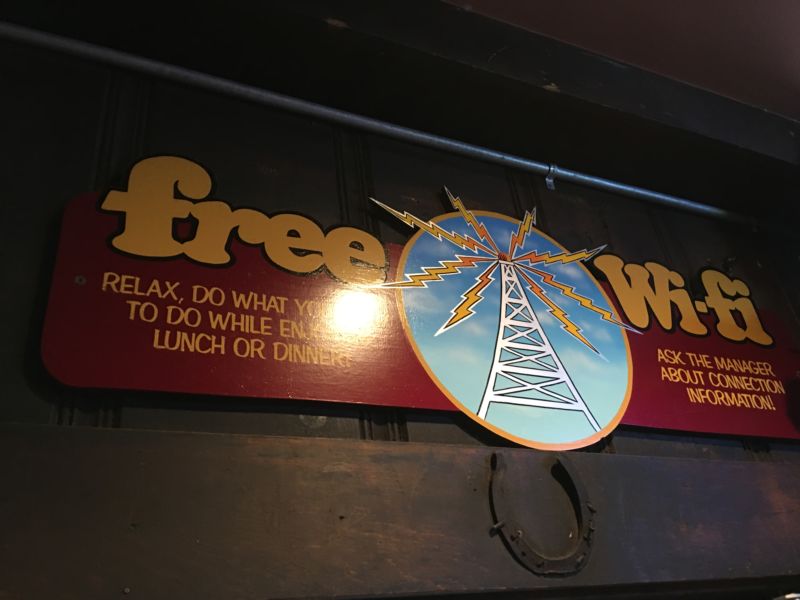
Enlarge / Even in 2018, there's still a wooden sign proudly advertising "Free Wi-Fi." (credit: Cyrus Farivar)
One of the least fun jobs when writing a scientific paper is coming up with a motivation. It should be easy and fun: look at this awesomely cool thing we did—aren’t the results interesting? Instead, we typically have to claim to reveal the secrets of the Universe, cure cancer, or protect the public. Preferably all three at the same time.
A recent paper (PDF) on using Wi-Fi as an environmental sensor has some really exciting results. But my heart shrank three sizes after reading the following: “Traditional baggage check involves either high manpower for manual examinations or expensive and specialized instruments, such as X-ray and CT. As such, many public places (i.e., museums and schools) that lack of strict security check are exposed to high risk.”
As I said, the research is totally cool. It's just not likely to ever help with security unless molesting people with hip replacements is your version of improved security.
Read 11 remaining paragraphs | Comments
The Nature of Security Clearance & A Case to Impeach the President
Tom Rochehttps://kpfa.org/episode/letters-and-politics-august-16-2018/
Melvin Goodman @ JHU on security clearances and Trump revoking Brennan's
Ben Clements on The Case for the Impeachment of Donald Trump
Thomas Frank LIVE: What's the Matter with Liberals?
Tom Rochevery excellent, but skip 1st 9:42
Jacobin Radio: Katie Halper; Murray Mednick and Maury Sterling
Tom Rochethe Katie Halper interview is especially excellent
Suzi and Alan Minsky talk to Katie Halper of WBAI's The Katie Halper Show about the role of independent media and politics in the Trumpian landscape we inhabit. Then Suzi speaks to prolific, award-winning playwright Murray Mednick, whose enigmatic "Mayakovsky and Stalin" runs until August 19 at the Lounge Theatre in Hollywood. The play examines two lives and two suicides, related but distant, responding to the liberating freedom of revolution in the Soviet Union, but then increasingly strangled and suffocated by the top down brutal dictatorship of Stalin, played by actor Maury Sterling (best known as Max on Homeland), who joins the conversation. The play traces the parallel stories of the giant of Russian poetry, Vladimir Mayakovsky, and his relationship to his love and muse, Lilya Brik (darling of Russia’s avant garde) and her husband, the literary critic Osip Brik. Their relationship exemplifies the freedom from conventional mores in the early years of the revolution. The second life and suicide is that of Nadezhda Alliluyeva, Stalin's young wife who committed suicide during a state dinner in 1932, renouncing her husband and his horrific policies, reflecting her despair and suffocation being married to the supreme dictator while millions perished.
Duane W. Roller, “Cleopatra’s Daughter: And Other Royal Women of the Augustan Era” (Oxford UP, 2018)
Tom Rochevery excellent
Remarkable Manuscripts
Tom Rochererun
Lost Alternatives of Gorbachev: 1 of: 3: Thirty years later. Stephen F. Cohen @NYU @Princeton (August 2017)
Tom Rochererun
AUTHOR.
(Photo:C44173-23, President Reagan and Soviet General Secretary Gorbachev checking their watches while waiting for their wives in the White House Diplomatic Reception room. 12/9/87.
Date 9 December 1987
Source http://www.reagan.utexas.edu/archives/photographs/gorby.html
Author Fed Govt )
http://JohnBatchelorShow.com/contact
http://JohnBatchelorShow.com/schedules
Twitter: @BatchelorShow
Lost Alternatives of Gorbachev: 1 of: 3: Thirty years later. Stephen F. Cohen @NYU @Princeton (August 2017)
"...His father was a combine harvester operator and World War II veteran, named Sergey Andreyevich Gorbachev. His mother, Maria Panteleyevna Gorbacheva (née Gopkalo), was a kolkhoz worker.[8] He was brought up mainly by his Ukrainian maternal grandparents. In his teens, he operated combine harvesters on collective farms. He graduated from Moscow State University in 1955 with a degree in law.
In 1967 he qualified as an agricultural economist via a correspondence master's degree at the Stavropol Institute of Agriculture. While at the university, he joined the Communist Party of the Soviet Union (CPSU) and soon became very active within the party.
Gorbachev met his future wife, Raisa Titarenko, daughter of a Ukrainian railway engineer, at Moscow State University. They married in September 1953 and moved to Stavropol upon graduation. She gave birth to their only child, daughter Irina Mikhailovna Virganskaya (Ири́на Миха́йловна Вирга́нская), in 1957. Raisa Gorbacheva died of leukemia in 1999.[9] Gorbachev has two granddaughters (Ksenia and Anastasia) and one great granddaughter (Aleksandra)...."
https://en.wikipedia.org/wiki/Mikhail_Gorbachev
"Many and ludicrous are the stories of the Greeks!" "Battling the Gods: 1 of 3: Atheism in the Ancient World" by Tim Whitmarsh (Author)
Tom Rochererun
AUTHOR.
(Photo:Echo and Narcissus (1903), a Pre-Raphaelite interpretation by John William Waterhouse )
http://JohnBatchelorShow.com/contact
http://JohnBatchelorShow.com/schedules
Twitter: @BatchelorShow
"Many and ludicrous are the stories of the Greeks!" "Battling the Gods: 1 of 3: Atheism in the Ancient World" by Tim Whitmarsh (Author)
https://www.amazon.com/Battling-Gods-Atheism-Ancient-World/dp/0307948773 How new is atheism? Although adherents and opponents alike today present it as an invention of the European Enlightenment, when the forces of science and secularism broadly challenged those of faith, disbelief in the gods, in fact, originated in a far more remote past. In Battling the Gods, Tim Whitmarsh journeys into the ancient Mediterranean, a world almost unimaginably different from our own, to recover the stories and voices of those who first refused the divinities. Whitmarsh provides a bracing antidote to our assumptions about the roots of freethinking. By shining a light on atheism’s first thousand years, Battling the Gods offers a timely reminder that nonbelief has a wealth of tradition of its own, and, indeed, its own heroes.
The Yazidis: "Heirs to Forgotten Kingdoms: 1 of 4: Journeys Into the Disappearing Religions of the Middle East" by Gerard Russell.
Tom Rochererun
AUTHOR.
(Photo:
English: A French post card showing Yezidi leaders meeting with a cChaldean clergyman in Mesopotamia.
Date 19th century
Source http://mideastimage.com/result.aspx
Author Unknown)
http://JohnBatchelorShow.com/contact
http://JohnBatchelorShow.com/schedules
Twitter: @BatchelorShow
The Yazidis: "Heirs to Forgotten Kingdoms: 1 of 4: Journeys Into the Disappearing Religions of the Middle East" by Gerard Russell.
Despite its reputation for religious intolerance, the Middle East has long sheltered many distinctive and strange faiths: one regards the Greek prophets as incarnations of God, another reveres Lucifer in the form of a peacock, and yet another believes that their followers are reincarnated beings who have existed in various forms for thousands of years. These religions represent the last vestiges of the magnificent civilizations in ancient history: Persia, Babylon, Egypt in the time of the Pharaohs. Their followers have learned how to survive foreign attacks and the perils of assimilation. But today, with the Middle East in turmoil, they face greater challenges than ever before.
In Heirs to Forgotten Kingdoms, former diplomat Gerard Russell ventures to the distant, nearly impassable regions where these mysterious religions still cling to survival. He lives alongside the Mandaeans and Ezidis of Iraq, the Zoroastrians of Iran, the Copts of Egypt, and others. He learns their histories, participates in their rituals, and comes to understand the threats to their communities. Historically a tolerant faith, Islam has, since the early 20th century, witnessed the rise of militant, extremist sects. This development, along with the rippling effects of Western invasion, now pose existential threats to these minority faiths. And as more and more of their youth flee to the West in search of greater freedoms and job prospects, these religions face the dire possibility of extinction.
Drawing on his extensive travels and archival research, Russell provides an essential record of the past, present, and perilous future of these remarkable religions.
Capitalism Killed Our Climate Momentum, Not “Human Nature”
Tom Rochecomment @ https://theintercept.com/2018/08/03/climate-change-new-york-times-magazine/?commentId=bf4d0131-e140-42a4-bcb7-5eac56c2eb19
[start Klein] humans are capable of organizing ourselves into all kinds of different social orders, including societies with much longer time horizons and far more respect for natural life-support systems. Indeed, humans have lived that way for the vast majority of our history and many Indigenous cultures keep earth-centered cosmologies alive to this day.[end Klein]
To be fair--and accurate--we should note that technological level probably influences ecodestruction at least as much as ideology. American archaeology demonstrates that, shortly after their arrival, and with only Neolithic technology, the ancestors of the indigenous Americans drove much of the even-more-indigenous megafauna to extinction. Were their ancestors "just like us," or did their culture not do the work implied by Klein? More recently, Diné (and, to a lesser extent, Hopi) elites have enabled and supported coal mining and burning on the Black Mesa. (The latter generating stations are shutting down, but due to excess economic cost, not "earth-centered cosmologies.")
The better explanatory hypothesis seems to be, "power tends to corrupt"; the confirmation is, given access to advanced technology, indigenous peoples tend to behave like other humans. (For another example, consider the Comanche Empire.) Contrapositively, it's much harder to destroy your environment when you lack large populations, draft animals, and (non-jewelry) metallurgy.
[start Klein] socialism isn’t necessarily ecological, but that a new form of democratic eco-socialism, with the humility to learn from Indigenous teachings about the duties to future generations and the interconnection of all of life, appears to be humanity’s best shot at collective survival.[end Klein]
Mysticism can be interesting, and probably rhetorical useful for some people, but earth-system science beats "Indigenous teachings" for understanding and protecting those connections. No mythology required, just (for want of a better term) "earth-system socialism."

The skyline of Manhattan at sunset in New York, May 23, 2018.
Photo: Saul Loeb/AFP/Getty Images
This Sunday, the entire New York Times Magazine will be composed of just one article on a single subject: the failure to confront the global climate crisis in the 1980s, a time when the science was settled and the politics seemed to align. Written by Nathaniel Rich, this work of history is filled with insider revelations about roads not taken that, on several occasions, made me swear out loud. And lest there be any doubt that the implications of these decisions will be etched in geologic time, Rich’s words are punctuated with full-page aerial photographs by George Steinmetz that wrenchingly document the rapid unraveling of planetary systems, from the rushing water where Greenland ice used to be to massive algae blooms in China’s third largest lake.
The novella-length piece represents the kind of media commitment that the climate crisis has long deserved but almost never received. We have all heard the various excuses for why the small matter of despoiling our only home just doesn’t cut it as an urgent news story: “Climate change is too far off in the future”; “It’s inappropriate to talk about politics when people are losing their lives to hurricanes and fires”; “Journalists follow the news, they don’t make it — and politicians aren’t talking about climate change”; and of course: “Every time we try, it’s a ratings killer.”
None of the excuses can mask the dereliction of duty. It has always been possible for major media outlets to decide, all on their own, that planetary destabilization is a huge news story, very likely the most consequential of our time. They always had the capacity to harness the skills of their reporters and photographers to connect abstract science to lived extreme weather events. And if they did so consistently, it would lessen the need for journalists to get ahead of politics because the more informed the public is about both the threat and the tangible solutions, the more they push their elected representatives to take bold action.

The Aug. 5, 2018, issue of the New York Times Magazine.
Image: Courtesy of the New York Times
That’s also why it is so enraging that the piece is spectacularly wrong in its central thesis.
According to Rich, between the years of 1979 and 1989, the basic science of climate change was understood and accepted, the partisan divide over the issue had yet to cleave, the fossil fuel companies hadn’t started their misinformation campaign in earnest, and there was a great deal of global political momentum toward a bold and binding international emissions-reduction agreement. Writing of the key period at the end of the 1980s, Rich says, “The conditions for success could not have been more favorable.”
And yet we blew it — “we” being humans, who apparently are just too shortsighted to safeguard our future. Just in case we missed the point of who and what is to blame for the fact that we are now “losing earth,” Rich’s answer is presented in a full-page callout: “All the facts were known, and nothing stood in our way. Nothing, that is, except ourselves.”
Yep, you and me. Not, according to Rich, the fossil fuel companies who sat in on every major policy meeting described in the piece. (Imagine tobacco executives being repeatedly invited by the U.S. government to come up with policies to ban smoking. When those meetings failed to yield anything substantive, would we conclude that the reason is that humans just want to die? Might we perhaps determine instead that the political system is corrupt and busted?)
This misreading has been pointed out by many climate scientists and historians since the online version of the piece dropped on Wednesday. Others have remarked on the maddening invocations of “human nature” and the use of the royal “we” to describe a screamingly homogenous group of U.S. power players. Throughout Rich’s accounting, we hear nothing from those political leaders in the Global South who were demanding binding action in this key period and after, somehow able to care about future generations despite being human. The voices of women, meanwhile, are almost as rare in Rich’s text as sightings of the endangered ivory-billed woodpecker — and when we ladies do appear, it is mainly as long-suffering wives of tragically heroic men.
All of these flaws have been well covered, so I won’t rehash them here. My focus is the central premise of the piece: that the end of the 1980s presented conditions that “could not have been more favorable” to bold climate action. On the contrary, one could scarcely imagine a more inopportune moment in human evolution for our species to come face to face with the hard truth that the conveniences of modern consumer capitalism were steadily eroding the habitability of the planet. Why? Because the late ’80s was the absolute zenith of the neoliberal crusade, a moment of peak ideological ascendency for the economic and social project that deliberately set out to vilify collective action in the name of liberating “free markets” in every aspect of life. Yet Rich makes no mention of this parallel upheaval in economic and political thought.

In this May 9, 1989 file photo, James Hansen, director of NASA’s Goddard Institute for Space Studies in New York, testifies before a Senate transportation subcommittee on Capitol Hill in Washington, D.C., a year after his history-making testimony telling the world that global warming was here and would get worse.
Photo: Dennis Cook/AP
When I delved into this same climate change history some years ago, I concluded, as Rich does, that the key juncture when world momentum was building toward a tough, science-based global agreement was 1988. That was when James Hansen, then director of NASA’s Goddard Institute for Space Studies, testified before Congress that he had “99 percent confidence” in “a real warming trend” linked to human activity. Later that same month, hundreds of scientists and policymakers held the historic World Conference on the Changing Atmosphere in Toronto, where the first emission reduction targets were discussed. By the end of that same year, in November 1988, the United Nations’ Intergovernmental Panel on Climate Change, the premier scientific body advising governments on the climate threat, held its first session.
But climate change wasn’t just a concern for politicians and wonks — it was watercooler stuff, so much so that when the editors of Time magazine announced their 1988 “Man of the Year,” they went for “Planet of the Year: Endangered Earth.” The cover featured an image of the globe held together with twine, the sun setting ominously in the background. “No single individual, no event, no movement captured imaginations or dominated headlines more,” journalist Thomas Sancton explained, “than the clump of rock and soil and water and air that is our common home.”
(Interestingly, unlike Rich, Sancton didn’t blame “human nature” for the planetary mugging. He went deeper, tracing it to the misuse of the Judeo-Christian concept of “dominion” over nature and the fact that it supplanted the pre-Christian idea that “the earth was seen as a mother, a fertile giver of life. Nature — the soil, forest, sea — was endowed with divinity, and mortals were subordinate to it.”)
When I surveyed the climate news from this period, it really did seem like a profound shift was within grasp — and then, tragically, it all slipped away, with the U.S. walking out of international negotiations and the rest of the world settling for nonbinding agreements that relied on dodgy “market mechanisms” like carbon trading and offsets. So it really is worth asking, as Rich does: What the hell happened? What interrupted the urgency and determination that was emanating from all these elite establishments simultaneously by the end of the ’80s?
Rich concludes, while offering no social or scientific evidence, that something called “human nature” kicked in and messed everything up. “Human beings,” he writes, “whether in global organizations, democracies, industries, political parties or as individuals, are incapable of sacrificing present convenience to forestall a penalty imposed on future generations.” It seems we are wired to “obsess over the present, worry about the medium term and cast the long term out of our minds, as we might spit out a poison.”
When I looked at the same period, I came to a very different conclusion: that what at first seemed like our best shot at lifesaving climate action had in retrospect suffered from an epic case of historical bad timing. Because what becomes clear when you look back at this juncture is that just as governments were getting together to get serious about reining in the fossil fuel sector, the global neoliberal revolution went supernova, and that project of economic and social reengineering clashed with the imperatives of both climate science and corporate regulation at every turn.
The failure to make even a passing reference to this other global trend that was unfolding in the late ’80s represents an unfathomably large blind spot in Rich’s piece. After all, the primary benefit of returning to a period in the not-too-distant past as a journalist is that you are able to see trends and patterns that were not yet visible to people living through those tumultuous events in real time. The climate community in 1988, for instance, had no way of knowing that they were on the cusp of the convulsive neoliberal revolution that would remake every major economy on the planet.
But we know. And one thing that becomes very clear when you look back on the late ’80s is that, far from offering “conditions for success [that] could not have been more favorable,” 1988-89 was the worst possible moment for humanity to decide that it was going to get serious about putting planetary health ahead of profits.

President Ronald Reagan signs legislation implementing the U.S.-Canada free trade agreement during a ceremony at the White House, Sept. 28, 1988.
Photo: Scott Stewart/AP
Recall what else was going on. In 1988, Canada and the U.S. signed their free trade agreement, a prototype for NAFTA and countless deals that would follow. The Berlin wall was about to fall, an event that would be successfully seized upon by right-wing ideologues in the U.S. as proof of “the end of history” and taken as license to export the Reagan-Thatcher recipe of privatization, deregulation, and austerity to every corner of the globe.
It was this convergence of historical trends — the emergence of a global architecture that was supposed to tackle climate change and the emergence of a much more powerful global architecture to liberate capital from all constraints — that derailed the momentum Rich rightly identifies. Because, as he notes repeatedly, meeting the challenge of climate change would have required imposing stiff regulations on polluters while investing in the public sphere to transform how we power our lives, live in cities, and move ourselves around.
All of this was possible in the ’80s and ’90s (it still is today) — but it would have demanded a head-on battle with the project of neoliberalism, which at that very time was waging war on the very idea of the public sphere (“There is no such thing as society,” Thatcher told us). Meanwhile, the free trade deals being signed in this period were busily making many sensible climate initiatives — like subsidizing and offering preferential treatment to local green industry and refusing many polluting projects like fracking and oil pipelines — illegal under international trade law.
I wrote a 500-page book about this collision between capitalism and the planet, and I won’t rehash the details here. This extract, however, goes into the subject in some depth, and I’ll quote a short passage here:
We have not done the things that are necessary to lower emissions because those things fundamentally conflict with deregulated capitalism, the reigning ideology for the entire period we have been struggling to find a way out of this crisis. We are stuck because the actions that would give us the best chance of averting catastrophe — and would benefit the vast majority — are extremely threatening to an elite minority that has a stranglehold over our economy, our political process, and most of our major media outlets. That problem might not have been insurmountable had it presented itself at another point in our history. But it is our great collective misfortune that the scientific community made its decisive diagnosis of the climate threat at the precise moment when those elites were enjoying more unfettered political, cultural, and intellectual power than at any point since the 1920s. Indeed, governments and scientists began talking seriously about radical cuts to greenhouse gas emissions in 1988 — the exact year that marked the dawning of what came to be called “globalisation.”
Why does it matter that Rich makes no mention of this clash and instead, claims our fate has been sealed by “human nature”? It matters because if the force that interrupted the momentum toward action is “ourselves,” then the fatalistic headline on the cover of New York Times Magazine – “Losing Earth” — really is merited. If an inability to sacrifice in the short term for a shot at health and safety in the future is baked into our collective DNA, then we have no hope of turning things around in time to avert truly catastrophic warming.
If, on the other hand, we humans really were on the brink of saving ourselves in the ’80s, but were swamped by a tide of elite, free-market fanaticism — one that was opposed by millions of people around the world — then there is something quite concrete we can do about it. We can confront that economic order and try to replace it with something that is rooted in both human and planetary security, one that does not place the quest for growth and profit at all costs at its center.
And the good news — and, yes, there is some — is that today, unlike in 1989, a young and growing movement of green democratic socialists is advancing in the United States with precisely that vision. And that represents more than just an electoral alternative — it’s our one and only planetary lifeline.
Yet we have to be clear that the lifeline we need is not something that has been tried before, at least not at anything like the scale required. When the Times tweeted out its teaser for Rich’s article about “humankind’s inability to address the climate change catastrophe,” the excellent eco-justice wing of the Democratic Socialists of America quickly offered this correction: “*CAPITALISM* If they were serious about investigating what’s gone so wrong, this would be about ‘capitalism’s inability to address the climate change catastrophe.’ Beyond capitalism, *humankind* is fully capable of organizing societies to thrive within ecological limits.”
Their point is a good one, if incomplete. There is nothing essential about humans living under capitalism; we humans are capable of organizing ourselves into all kinds of different social orders, including societies with much longer time horizons and far more respect for natural life-support systems. Indeed, humans have lived that way for the vast majority of our history and many Indigenous cultures keep earth-centered cosmologies alive to this day. Capitalism is a tiny blip in the collective story of our species.
But simply blaming capitalism isn’t enough. It is absolutely true that the drive for endless growth and profits stands squarely opposed to the imperative for a rapid transition off fossil fuels. It is absolutely true that the global unleashing of the unbound form of capitalism known as neoliberalism in the ’80s and ’90s has been the single greatest contributor to a disastrous global emission spike in recent decades, as well as the single greatest obstacle to science-based climate action ever since governments began meeting to talk (and talk and talk) about lowering emissions. And it remains the biggest obstacle today, even in countries that market themselves as climate leaders, like Canada and France.
But we have to be honest that autocratic industrial socialism has also been a disaster for the environment, as evidenced most dramatically by the fact that carbon emissions briefly plummeted when the economies of the former Soviet Union collapsed in the early 1990s. And as I wrote in “This Changes Everything,” Venezuela’s petro-populism has continued this toxic tradition into the present day, with disastrous results.
Let’s acknowledge this fact, while also pointing out that countries with a strong democratic socialist tradition — like Denmark, Sweden, and Uruguay — have some of the most visionary environmental policies in the world. From this we can conclude that socialism isn’t necessarily ecological, but that a new form of democratic eco-socialism, with the humility to learn from Indigenous teachings about the duties to future generations and the interconnection of all of life, appears to be humanity’s best shot at collective survival.
These are the stakes in the surge of movement-grounded political candidates who are advancing a democratic eco-socialist vision, connecting the dots between the economic depredations caused by decades of neoliberal ascendency and the ravaged state of our natural world. Partly inspired by Bernie Sanders’s presidential run, candidates in a variety of races — like Alexandria Ocasio-Cortez in New York, Kaniela Ing in Hawaii, and many more — are running on platforms calling for a “Green New Deal” that meets everyone’s basic material needs, offers real solutions to racial and gender inequities, while catalyzing a rapid transition to 100 percent renewable energy. Many, like New York gubernatorial candidate Cynthia Nixon and New York attorney general candidate Zephyr Teachout, have pledged not to take money from fossil fuel companies and are promising instead to prosecute them.
These candidates, whether or not they identify as democratic socialist, are rejecting the neoliberal centrism of the establishment Democratic Party, with its tepid “market-based solutions” to the ecological crisis, as well as Donald Trump’s all-out war on nature. And they are also presenting a concrete alternative to the undemocratic extractivist socialists of both the past and present. Perhaps most importantly, this new generation of leaders isn’t interested in scapegoating “humanity” for the greed and corruption of a tiny elite. It seeks instead to help humanity — particularly its most systematically unheard and uncounted members — to find their collective voice and power so they can stand up to that elite.
We aren’t losing earth — but the earth is getting so hot so fast that it is on a trajectory to lose a great many of us. In the nick of time, a new political path to safety is presenting itself. This is no moment to bemoan our lost decades. It’s the moment to get the hell on that path.
The post Capitalism Killed Our Climate Momentum, Not “Human Nature” appeared first on The Intercept.


China and the United States: Who Has More Innovation to "Steal?"
Tom Rochepullquote:
> The vast majority of us don't own any substantial amount of intellectual property that is being compromised by China's practices, Somehow we are supposed to be concerned that Boeing, Microsoft, Pfizer, Disney, and the rest are seeing lower profits because China doesn't follow the rules they want them to follow. [...] These are huge multinationals that have made their largest shareholders and top executives incredibly rich. The rest of us are supposed to want to stick it to China to make these people even richer?
> It's actually even worse. The simple story is that if China has to pay less money to Boeing et al. for their intellectual property claims they will have more money to buy other things from the United States, like soybeans and whiskey. Tell me again about "our" intellectual property.
One of the truly amazing aspects of Donald Trump's trade war with China is how all the pundits agree that we have a legitimate beef with China over stealing "our" intellectual property. This is true pretty much across the board, even among the harshest critics of Trump and his tariffs. As I have argued almost alone, this one needs a bit more thought.
First, the "our" part of the story needs some examination. The vast majority of us don't own any substantial amount of intellectual property that is being compromised by China's practices, Somehow we are supposed to be concerned that Boeing, Microsoft, Pfizer, Disney, and the rest are seeing lower profits because China doesn't follow the rules they want them to follow.
Sorry folks, these are not the homes teams that we are supposed to root for in baseball. These are huge multinationals that have made their largest shareholders and top executives incredibly rich. The rest of us are supposed to want to stick it to China to make these people even richer?
It's actually even worse. The simple story is that if China has to pay less money to Boeing et al. for their intellectual property claims they will have more money to buy other things from the United States, like soybeans and whiskey. Tell me again about "our" intellectual property.