Batch jobs that fail tend to have much in common. While some fail for reasons that are beyond users’ control, many failures can be prevented with minor changes to batch scripts or by adopting best practices. This CISL web page – Common causes of job failures – points out several actions users can take to identify potential problems and ensure that jobs run successfully.
Tom Roche
Shared posts
10 Apr 23:20
Common causes of job failures and how to avoid them
by davidf
Tom Roche likes this
09 Apr 23:28
Congress In The Trump Era
Jake Sherman and Anna Palmer, who cover Congress for 'Politico,' discuss the power dynamics of Capitol Hill during the Trump Presidency. Their new book is 'The Hill To Die On.'
Also, book critic Maureen Corrigan reviews the novel 'Normal People' by Sally Rooney.
Also, book critic Maureen Corrigan reviews the novel 'Normal People' by Sally Rooney.
06 Apr 20:26


#697 Shoegaze & Opinions on Priests
by podcasts@chicagopublicradio.org (WBEZ Chicago)
Tom Rocheexcellent genre dissection
Hosts Jim DeRogatis and Greg Kot dive into "Shoegaze." In the late '80s and early '90s, this sound developed in the U.K. and was typified by lots of guitar, atmosphere and noise. But while the height of Shoegaze only lasted a few years, its influence looms large today. Plus, Jim and Greg review the new album from Priests and learn what song got David Bazan "Hooked on Sonics."
Tom Roche likes this
06 Apr 16:05
Why Israel is quietly cosying up to Gulf monarchies
Tom Rocheoriginal article/transcript by Ian Black @ https://www.theguardian.com/news/2019/mar/19/why-israel-quietly-cosying-up-to-gulf-monarchies-saudi-arabia-uae
After decades of hostility, a shared hatred of Iran – and a mutual fondness for Trump – is bringing Israel’s secret links with Gulf kingdoms out into the open • Read the text version here. Help support our independent journalism at theguardian.com/longreadpod
06 Apr 16:02
preview: 200- Biden's Black Pride with Branko Marcetic
Tom Rocheruntime=57 sec ???
You can find the full episode where Biden tries to justify his opposition to school desegregation by citing Black is Beautiful here: www.patreon.com/posts/bidens-busing-25863870
05 Apr 16:44
Preview: 200- Biden's Busing Battle with Branko Marcetic
Tom Roche404s as of 0945 5 Apr
You can find the full episode where Biden tries to justify his opposition to school desegregation by citing Black is Beautiful here: https://www.patreon.com/posts/bidens-busing-25863870
04 Apr 14:16
Mumbai terror attack remembered
Tom Rochererun
In November 2008, group of young men rode a rubber dinghy into Mumbai's harbour and launched a series of devastating attacks on India's commercial capital.
04 Apr 03:30
Learning from Data: the art of statistics [Audio]
Tom Rochevery good
Speaker(s): Professor David Spiegelhalter | In his new book, The Art of Statistics, David Spiegelhalter guides us through the essential principles we need in order to derive knowledge from data, showing us why data can never speak for itself. He explains the basic concepts, from regression to P-values (without using mathematics), and introduces the intellectual ideas that underpin statistics. Drawing on numerous real world examples, he shows us how statistics can help us determine the luckiest passenger on the Titanic, whether serial killer Harold Shipman could have been caught earlier, and if the skeleton in the Leicester car park really was Richard III. Sir David Spiegelhalter is a British statistician and Chair of the Winton Centre for Risk and Evidence Communication in the Statistical Laboratory at the University of Cambridge. Spiegelhalter is one of the most cited and influential researchers in his field, and was elected as President of the Royal Statistical Society for 2017-18. Fiona Steele is a Professor of Statistics and Deputy Head of the Department of Statistics at LSE. Fiona first joined in LSE in 1996 as Lecturer in Statistics and Research Methodology. She then worked at the Institute of Education, University of London 2001-2005, followed by the University of Bristol 2005-2013 where she was Professor of Social Statistics and Director of the Centre for Multilevel Modelling. She returned to LSE in 2013. The Department of Statistics (@StatsDeptLSE) offers a vibrant research environment and a comprehensive programme of undergraduate and postgraduate degrees.
Tom Roche likes this
02 Apr 19:07
Opportunity: ACM SIGHPC fellowships in computational and data science
by davidf
Tom Rochebeyond these fellowships: see ACM SIGHPC at (e.g.) https://www.sighpc.org/for-our-community/newsletter
Students who are studying data science or computing applications and who are women or members of an underrepresented group can be nominated this month for graduate fellowships that carry a stipend of $15,000 per year through an international ACM SIGHPC and Intel program.
The goal of the program is to increase the diversity of students pursuing graduate degrees in data science and computational science, including women as well as students from racial/ethnic backgrounds that have not traditionally participated in the computing field. The program supports students pursuing degrees at institutions anywhere in the world.
Submissions are now open. Interested faculty advisors and students can find more information on the fellowships, including a description of the online nomination process, on this web page. Nominations close April 30. Contact fellowships@sighpc.org if you have questions.
01 Apr 00:19
The Dig: Strike! with Jane McAlevey
by Jacobin magazine
Tom Rochevery excellent
The strike is back, and big time. Teachers in particular have been walking off the job not only to demand higher wages but also to fight for an end to privatization and for a transformation of the educational system for their students. These strikes, often led by women, are no doubt inspiring, and they have won important victories for workers and the communities they serve. We are, in other words, beginning to head in the right direction—but we're not heading there even close to fast enough. Winning working class power is not only necessary to meet people's immediate material needs. It is necessary if we are to accomplish a profound democratization of this country, which is what we must do if we are to implement a just energy transition that heads off what scientists have determined to be imminent climate catastrophe. Dan talks to Jane McAlevey about the labor movement and strikes.
Jane's Catalyst article The Strike as the Ultimate Structure Test.
And her Jacobin article Organizing to Win a Green New Deal.
Thanks to Verso. Check out their huge selection of left-wing titles at www.versobooks.com
Please support this podcast with your money at Patreon.com/TheDig
Tom Roche likes this
31 Mar 03:58
How Russiagate hacked the brains of America's elite w/ Aaron Maté (E38)
Tom Rochevery excellent
Russiagate has collapsed, with Robert Mueller's investigation finding no proof of collusion. Max Blumenthal and Ben Norton speak with journalist Aaron Maté, who documented from the beginning how the Trump-Russia conspiracy was not based on evidence — and hacked the brains of US political and media elites.
Moderate Rebels episode 38
Tom Roche likes this
29 Mar 06:27
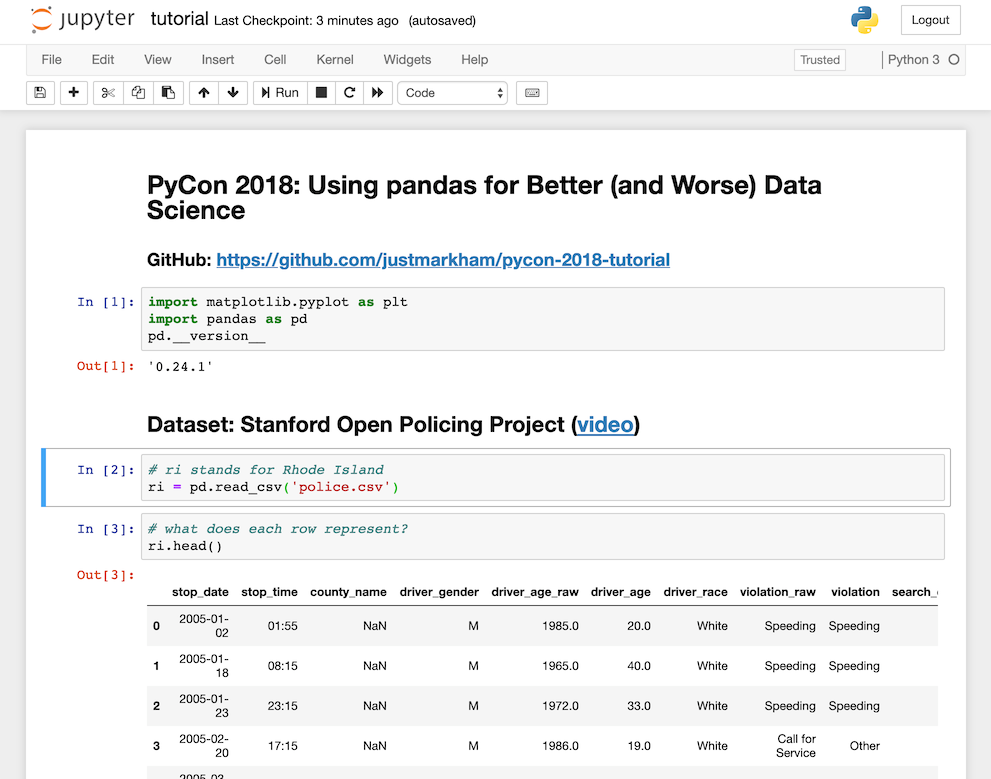
Data School: Six easy ways to run your Jupyter Notebook in the cloud
Tom Rocheexcellently-formatted comparison of available services!
There are many ways to share a static Jupyter notebook with others, such as posting it on GitHub or sharing an nbviewer link. However, the recipient can only interact with the notebook file if they already have the Jupyter Notebook environment installed.
But what if you want to share a fully interactive Jupyter notebook that doesn't require any installation? Or, you want to create your own Jupyter notebooks without installing anything on your local machine?
In this post, I'm going to review six services you can use to easily run your Jupyter notebook in the cloud. All of them have the following characteristics:
- They don't require you to install anything on your local machine.
- They are completely free (or they have a free plan).
- They give you access to the Jupyter Notebook environment (or a Jupyter-like environment).
- They allow you to import and export notebooks using the standard .ipynb file format.
- They support the Python language (and most support other languages as well).
Since all of these are cloud-based services, none of them will work for you if you are restricted to working with your data on-premise.
Table of Contents
- Criteria for comparison
- In-depth reviews:
- How to choose the right service for you
- Similar services which were not reviewed
- My fact-checking process
Note: If you just want a quick summary, check out the comparison table.
Criteria for comparison
Here are the criteria on which I compared each of the six services:
Supported languages: Does this service support any programming languages other than Python?
Ability to install packages: Does this service allow you to install additional packages (or a particular version of a package), beyond the ones that are already installed?
Interface similarity: If the service provides a "Jupyter-like" interface (rather than the native Jupyter interface), how similar is its interface to Jupyter? (This makes it easier for existing Jupyter users to transition to this service.)
Keyboard shortcuts: Does this service use the same keyboard shortcuts as the Jupyter Notebook?
Missing features: Is there anything that the Jupyter Notebook can do that this service does not support?
Added features: Is there anything this service can do that the Jupyter Notebook does not support?
Ease of working with datasets: How easy does this service make it to work with your own datasets?
Internet access: Does this service give you Internet access from within the Notebook, so that you can read data from URLs when necessary?
Ability to work privately: Does this service allow you to keep your work private?
Ability to share publicly: Does this service provide a way for you to share your work publicly?
Ability to collaborate: Does this service allow you to invite someone to collaborate on a notebook, and can the collaboration occur in real-time?
Performance of the free plan: What computational resources (RAM and CPU) does this service provide? Does it give you access to a GPU (which is useful for deep learning)? How much disk space is included? How long can a session run?
Ability to upgrade for better performance: Can you pay for this service in order to access more computational resources?
Documentation and technical support: Is the service well-documented? Can you get in touch with someone if you run into a problem?
1. Binder
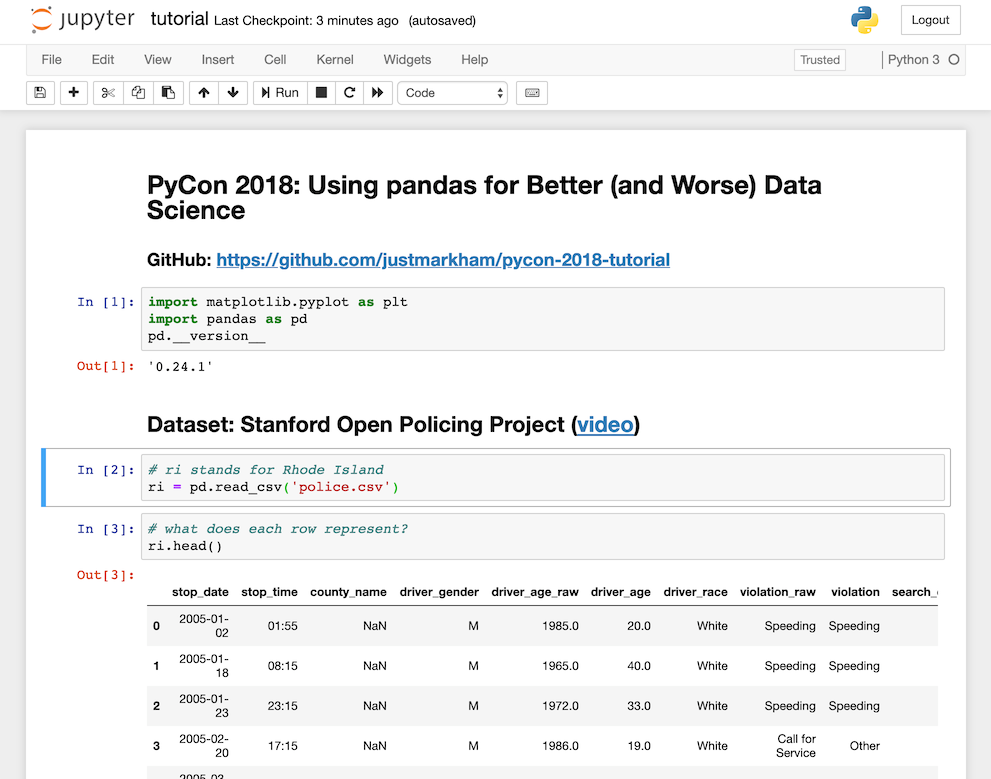
Binder is a service provided by the Binder Project, which is a member of the Project Jupyter open source ecosystem. It allows you to input the URL of any public Git repository, and it will open that repository within the native Jupyter Notebook interface. You can run any notebooks in the repository, though any changes you make will not be saved back to the repository. You don't have to create an account with Binder and you don't need to be the owner of the repository, though the repository must include a configuration file that specifies its package requirements.
Supported languages: Python (2 and 3), R, Julia, and any other languages supported by Jupyter.
Ability to install packages: You can specify your exact package requirements using a configuration file (such as environment.yml or requirements.txt).
Interface similarity: Binder uses the native Jupyter Notebook interface.
Keyboard shortcuts: Binder uses all of the same keyboard shortcuts as Jupyter.
Missing features: None.
Added features: None.
Ease of working with datasets: If your dataset is in the same Git repository, then it will automatically be available within Binder. If your dataset is not in that repository but is available at any public URL, then you can add a special file to the repository telling Binder to download your dataset. However, Binder does not support accessing private datasets.
Internet access: Yes.
Ability to work privately: No, since it only works with public Git repositories.
Ability to share publicly: Yes. You can share a URL that goes directly to your Binder, or someone can run your notebooks using the Binder website (as long as they know the URL of your Git repository).
Ability to collaborate: No. If you want to work with someone on the same notebook and your repository is hosted on GitHub, then you can instead use the normal pull request workflow.
Performance of the free plan: You will have access to up to 2 GB of RAM. There is no specific limit to the amount of disk space, though they ask you not to include "very large files" (more than a few hundred megabytes). Binder can be slow to launch, especially when it's run on a newly updated repository. Sessions will shut down after 20 minutes of inactivity, though they can run for 12 hours or longer. Binder has other usage guidelines, including a limit of 100 simultaneous users for any given repository.
Ability to upgrade for better performance: No. However, you do have the option of setting up your own BinderHub deployment, which can provide the same functionality as Binder while allowing you to customize the environment (such as increasing the computational resources or allowing private files).
Documentation and technical support: Binder has extensive documentation. Community support is available via Gitter chat and a Discourse forum, and product issues are tracked on GitHub.
Conclusion: If your notebooks are already stored in a public GitHub repository, Binder is the easiest way to enable others to interact with them. Users don't have to create an account, and they'll feel right at home if they already know how to use the Jupyter Notebook. However, you'll want to keep the performance limitations and user limits in mind!
2. Kaggle Kernels
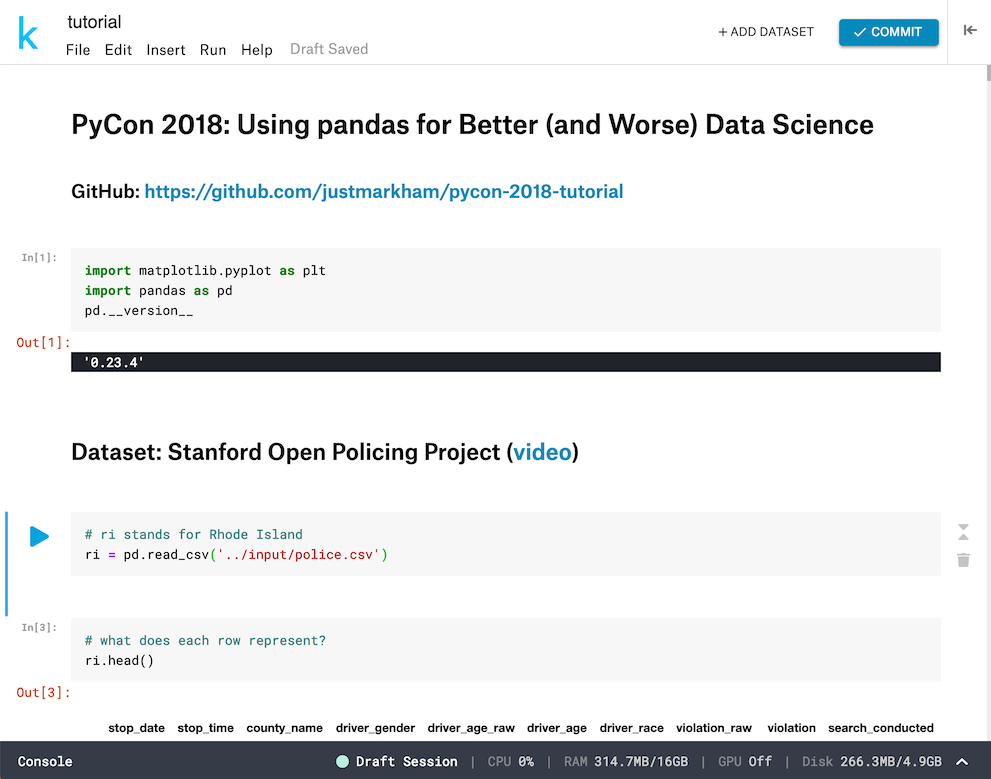
Kaggle is best known as a platform for data science competitions. However, they also provide a free service called Kernels that can be used independently of their competitions. After creating a Kaggle account (or logging in with Google or Facebook), you can create a Kernel that uses either a notebook or scripting interface, though I'm focusing on the notebook interface below.
Supported languages: Python (3 only) and R.
Ability to install packages: Hundreds of packages come pre-installed, and you can install additional packages using pip or by specifying the GitHub repository of a package. However, any additional packages you install will need to be reinstalled at the start of every session. Alternatively, you can ask Kaggle to include additional packages in their default installation.
Interface similarity: Visually, the Kernels interface looks quite different from the Jupyter interface. There's no menu bar or toolbar at the top of the screen, there's a collapsible sidebar on the right for adjusting settings, and there's a console docked below the notebook. However, working in the Kernels notebook actually feels very similar to working in the Jupyter Notebook, especially if you're comfortable with Jupyter's keyboard shortcuts. Also, note that a redesigned interface (shown in the screenshot above) will soon be released, which is more similar to the Jupyter interface and includes a simple menu bar.
Keyboard shortcuts: Kernels uses all of the same keyboard shortcuts as Jupyter.
Missing features:
- Because Kernels doesn't (yet) include a menu bar or a toolbar, many actions can only be done using keyboard shortcuts or the command palette.
- You can't download your notebook into other useful formats such as a Python script, HTML webpage, or Markdown file.
Added features:
- Kernels includes a lightweight version control system. Every time you want to save your work, there's a "commit" button which runs the entire notebook from top to bottom and adds a new version to the history. (You can keep working while this process takes place, which is essential for long-running notebooks.) Although you can't name the versions, you can display the "diff" between any two versions.
- Kernels allows you to selectively hide the input and/or output of any code cell, which makes it easy to customize the presentation of your notebook.
Ease of working with datasets: You can upload a dataset to Kaggle from your local computer, a URL, or a GitHub repository, and it will be hosted for free by another Kaggle service called Datasets. You can make the dataset private or public. Any dataset you upload, as well as any public dataset uploaded by a Kaggle user, can be accessed by any of your Kernels. The maximum size of each dataset is 20 GB, and a single Kernel can access multiple datasets.
Internet access: Yes.
Ability to work privately: Yes.
Ability to share publicly: Yes. If you choose to make your Kernel public, anyone can access it without creating a Kaggle account, and anyone with a Kaggle account can comment on your Kernel or copy it to their own account. Additionally, Kaggle also provides you with a public profile page, which displays all of your public Kernels and datasets.
Ability to collaborate: Yes. You can keep your Kernel private but invite specific Kaggle users to view or edit it. There's no real-time collaboration: It's more like working on separate copies of the Kernel, except that all commits are added to the same version history.
Performance of the free plan: You can access either a 4-core CPU with 17 GB of RAM, or a 2-core CPU with 14 GB of RAM plus a GPU. You will have 5 GB of "saved" disk space and 17 GB of "temporary" disk space, though any disk space used by your dataset does not count towards these figures. Sessions will shut down after 60 minutes of inactivity, though they can run for up to 9 hours.
Ability to upgrade for better performance: No.
Documentation and technical support: Kernels has adequate documentation. Support is available via a contact form and a forum.
Conclusion: As long as you're comfortable with a slightly cluttered interface (which has already been improved in the redesign), you'll have access to a high-performance environment in which it's easy to work with your datasets and share your work publicly (or keep it private). The included version control and collaboration features are also nice additions, though neither are fully-featured.
3. Google Colaboratory (Colab)
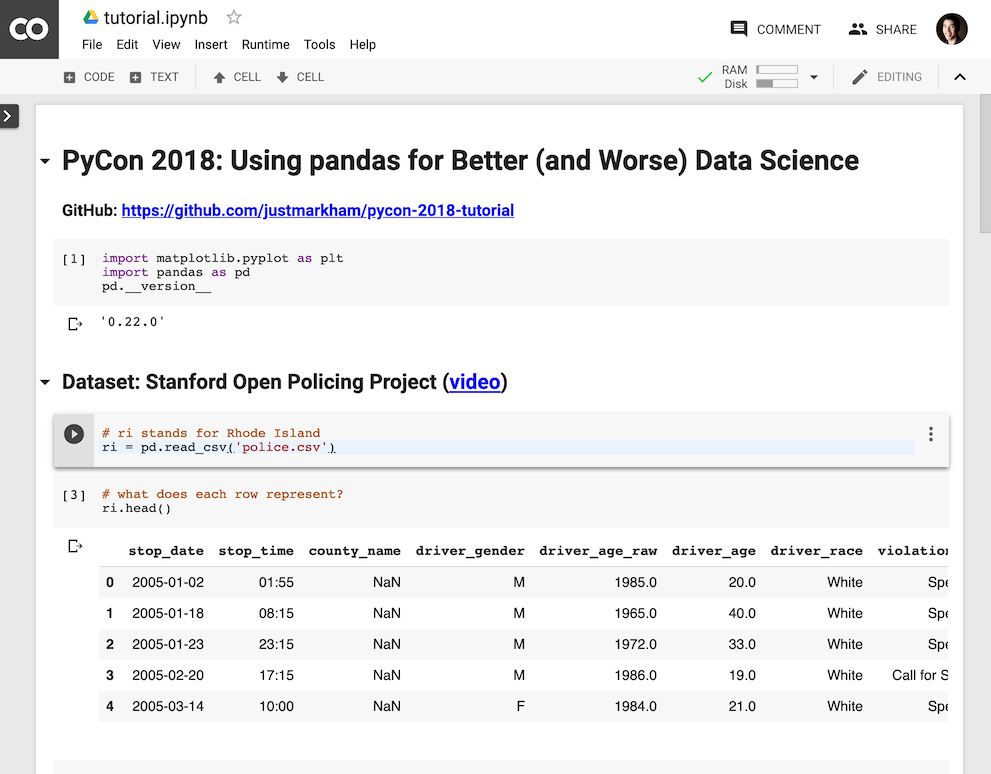
Google Colaboratory, usually referred to as "Google Colab," is available to anyone with a Google account. As long as you are signed into Google, you can quickly get started by creating an empty notebook, uploading an existing notebook, or importing a notebook from any public GitHub repository. Your Colab notebooks are automatically saved in a special folder in your Google Drive, and you can even create new notebooks directly from Drive.
Supported languages: Python (2 and 3) and Swift (which was added in January 2019). Kernels can also be installed for other languages, though the installation process varies by language and is not well-documented.
Ability to install packages: Hundreds of packages come pre-installed, and you can install additional packages using pip. However, any additional packages you install will need to be reinstalled at the start of every session.
Interface similarity: Visually, the Colab interface looks quite similar to the Jupyter interface. However, working in Colab actually feels very dissimilar to working in the Jupyter Notebook:
- Most of the menu items are different.
- Colab has changed some of the standard terminology ("runtime" instead of "kernel", "text cell" instead of "markdown cell", etc.)
- Colab has invented new concepts that you have to understand, such as "playground mode."
- Command mode and Edit mode in Colab work differently than they do in Jupyter.
Keyboard shortcuts: In Colab, most of the single letter keyboard shortcuts used by Jupyter (such as "a" to "insert cell above") have been changed to a multi-step process ("Ctrl+m" followed by "a"), though Colab does allow you to customize the shortcuts.
Missing features:
- Because the Colab menu bar is missing some items and the toolbar is kept very simple, some actions can only be done using keyboard shortcuts.
- You can't download your notebook into other useful formats such as an HTML webpage or Markdown file (though you can download it as a Python script).
Added features:
- Colab includes a lightweight version control system. It frequently saves the current state of your notebook, and you can browse through the revision history. However, you can't display the "diff" between versions, which means that you would have to do any comparisons manually.
- Colab allows you to add form fields to your notebook, which enables you to parameterize your code in an interactive way. However, these fields only work within Colab.
- When you create a section heading in your notebook, Colab makes every section collapsible and automatically creates a "table of contents" in the sidebar, which makes large notebooks easier to navigate.
Ease of working with datasets: You can upload a dataset to use within a Colab notebook, but it will automatically be deleted once you end your session. Alternatively, you can allow Colab to read files from your Google Drive, though it's more complicated than it should be. Colab also includes connectors to other Google services, such as Google Sheets and Google Cloud Storage.
Internet access: Yes.
Ability to work privately: Yes.
Ability to share publicly: Yes. If you choose to make your notebook public and you share the link, anyone can access it without creating a Google account, and anyone with a Google account can copy it to their own account. Additionally, you can authorize Colab to save a copy of your notebook to GitHub or Gist and then share it from there.
Ability to collaborate: Yes. You can keep your notebook private but invite specific people to view or edit it (using Google's familiar sharing interface). You and your collaborator(s) can edit the notebook at the same time and see each other's changes, as well as add comments for each other (similar to Google Docs), though there's a 30-second lag between when you make changes and when collaborators will see them. Also, you are not actually sharing your environment with your collaborators (meaning there is no syncing of what code has been run), which significantly limits the usefulness of near real-time collaboration.
Performance of the free plan: Colab does give you access to a GPU or a TPU. Otherwise, Google does not provide any specifications for their environments. If you connect Colab to Google Drive, that will give you up to 15 GB of disk space for storing your datasets. Sessions will shut down after 60 minutes of inactivity, though they can run for up to 12 hours.
Ability to upgrade for better performance: No. However, you do have the option of connecting to a local runtime, which allows you to execute code on your local hardware and access your local file system.
Documentation and technical support: Colab has minimal documentation, which is contained within an FAQ page and a variety of sample notebooks. Support is available via GitHub issues, and community support is available via Stack Overflow.
Conclusion: The greatest strength of Colab is that it's easy to get started, since most people already have a Google account, and it's easy to share notebooks, since the sharing functionality works the same as Google Docs. However, the cumbersome keyboard shortcuts and the difficulty of working with datasets are significant drawbacks. The ability to collaborate on the same notebook is useful, but less useful than it could be since you're not sharing an environment.
4. Microsoft Azure Notebooks
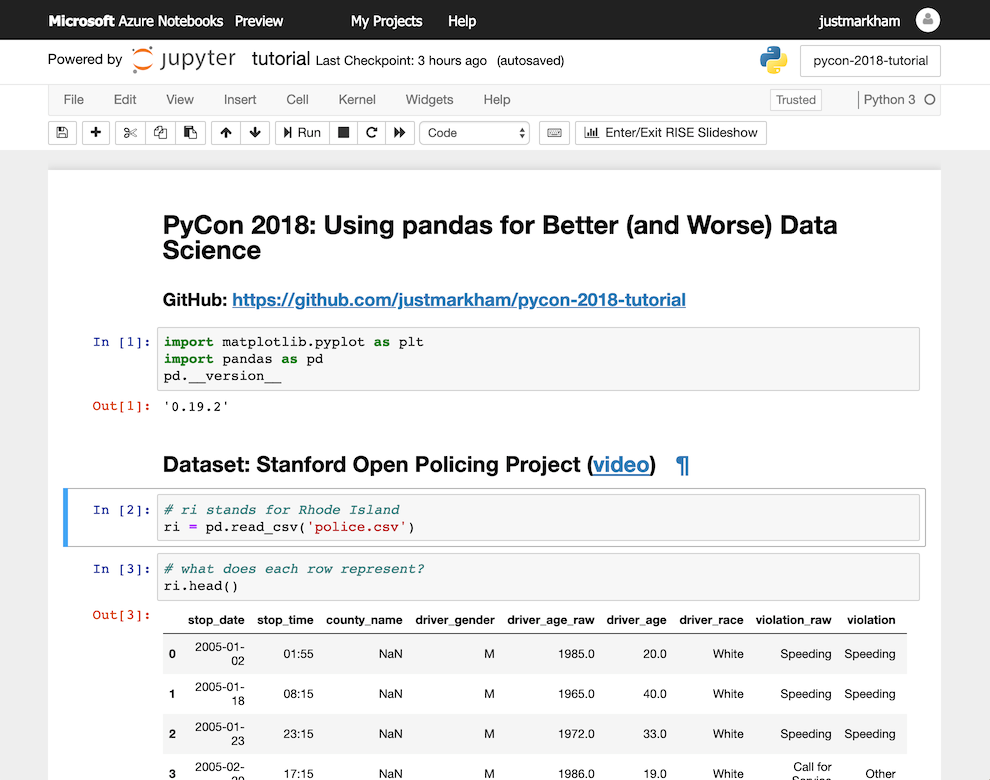
To get started with Azure Notebooks, you first sign in with a Microsoft or Outlook account (or create one). The next step is to create a "project", which is structured identically to a GitHub repository: it can contain one or more notebooks, Markdown files, datasets, and any other file you want to create or upload, and all of these can be organized into folders. Also like GitHub, you can initialize a project with a README file, which will automatically be displayed on the project page. If your work is already stored on GitHub, you can import the entire repository directly into a project.
Supported languages: Python (2 and 3), R, and F#.
Ability to install packages: Hundreds of packages come pre-installed, you can install additional packages using pip or conda, and you can specify your exact package requirements using a configuration file (such as environment.yml or requirements.txt).
Interface similarity: Azure uses the native Jupyter Notebook interface.
Keyboard shortcuts: Azure uses all of the same keyboard shortcuts as Jupyter.
Missing features: None.
Added features:
- The RISE extension comes pre-installed, which allows you to instantly present your notebook as a live reveal.js-based slideshow.
- The jupyter_contrib_nbextensions package comes pre-installed, which gives you easy access to a collection of 50+ Jupyter Notebook extensions for enhancing the notebook interface.
Ease of working with datasets: You can upload a dataset to your project from your local computer or a URL, and it can be accessed by any notebook within your project. Azure also includes connectors to other Azure services, such as Azure Storage and various Azure databases.
Internet access: Yes.
Ability to work privately: Yes.
Ability to share publicly: Yes. If you choose to make your project public, anyone can access it without creating a Microsoft account, and anyone with a Microsoft account can copy it to their own account. Additionally, Azure also provides you with a public profile page (very similar to a GitHub profile), which displays all of your public projects.
Ability to collaborate: No, though this is a planned feature.
Performance of the free plan: You will have access to 4 GB of RAM and 1 GB of disk space (per project). Sessions will shut down after 60 minutes of inactivity, though they can run for 8 hours or longer.
Ability to upgrade for better performance: Yes. You can pay for an Azure subscription, though the setup process is non-trivial and the pricing is complicated.
Documentation and technical support: Azure has extensive documentation. Support is available via GitHub issues.
Conclusion: The greatest strength of Azure Notebooks is its ease of use: the project structure (borrowed from GitHub) makes it simple to work with multiple notebooks and datasets, and the use of the native Jupyter interface means that existing Jupyter users will have an easy transition. However, the RAM and disk space are not particularly generous, and the lack of collaboration is a big gap in the functionality.
5. CoCalc
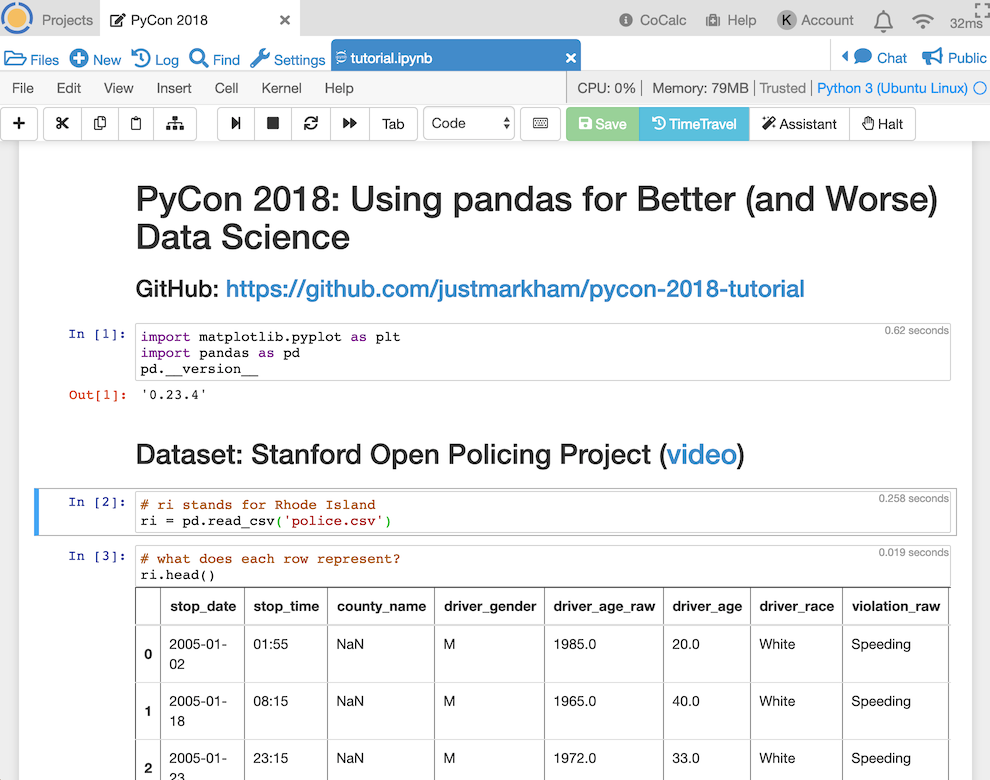
CoCalc, short for "collaborative calculation", is an online workspace for computation in Python, R, Julia, and many other languages. It allows you to create and edit Jupyter Notebooks, Sage worksheets, and LaTeX documents. After creating a CoCalc account, the first step is to create a "project", which can contain one or more notebooks, Markdown files, datasets, and any other file you want to create or upload, and all of these can be organized into folders. The project interface is a bit overwhelming at first, but it looks much more familiar once you create or open a notebook.
Supported languages: Python (2 and 3), R, Julia, and many other languages.
Ability to install packages: Hundreds of packages come pre-installed. You can install additional packages using pip, but this is not available when using a free plan. Alternatively, you can ask CoCalc to include additional packages in their default installation.
Interface similarity: Although CoCalc does not use the native Jupyter Notebook interface (they rewrote it using React.js), the interface is very similar to Jupyter, with only a few minor modifications. You can actually switch to using the native Jupyter Notebook from within CoCalc, though it's not recommended since you would lose access to the most valuable CoCalc features ("time travel" and real-time collaboration, which are discussed below).
Keyboard shortcuts: CoCalc uses almost all of the same keyboard shortcuts as Jupyter.
Missing features: CoCalc does not currently support interactive widgets.
Added features:
- CoCalc includes a powerful version control feature called time travel, which records all of your changes to the notebook in fine detail, and allows you to browse those changes using an intuitive slider control.
- CoCalc saves a backup of all of your project files every few minutes, which means you can recover older versions of your files if needed.
- CoCalc includes additional features for instructors, such as the ability to distribute and grade assignments, and the ability to watch students while they work and chat with them about the assignment.
Ease of working with datasets: You can upload a dataset to your project from your local computer, and it can be accessed by any notebook within your project.
Internet access: No, this is not available when using a free plan.
Ability to work privately: Yes.
Ability to share publicly: Yes. If you choose to make your notebook public and you share the link, anyone can access it without creating a CoCalc account, and anyone with a CoCalc account can copy it to their own account.
Ability to collaborate: Yes. You can keep your notebook private but invite specific people to edit it. You and your collaborator(s) can edit the notebook at the same time and see each other's changes (and cursors) in real-time, as well as chat (using text or video) in a window next to the notebook. The status and the results of all computations are also synchronized, which means that everyone involved will experience the notebook in the same way.
Performance of the free plan: You will have access to a 1-core shared CPU with 1 GB of shared RAM, and 3 GB of disk space (per project). Sessions will shut down after 30 minutes of inactivity, though they can run for up to 24 hours.
Ability to upgrade for better performance: Yes. You can pay for a CoCalc subscription, which starts at $14/month. Alternatively, you can install the CoCalc Docker image on your own computer, which allows you to run a private multi-user CoCalc server for free.
Documentation and technical support: CoCalc has extensive documentation. Support is available via email and a contact form, and product issues are tracked on GitHub.
Conclusion: The most compelling reasons to use CoCalc are the real-time collaboration and the "time travel" version control features, as well as the course management features (if you're an instructor). Although the interface is a bit cluttered, existing Jupyter users would have a relatively easy time transitioning to CoCalc. However, the free plan does have some important limitations (inability to install additional packages or access the Internet), and the performance of the free plan is modest.
6. Datalore

Datalore was created by JetBrains, the same company who makes PyCharm (a popular Python IDE). Getting started is as easy as creating an account, or logging in with a Google or JetBrains account. You can either create a new Datalore "workbook" or upload an existing Jupyter Notebook. Datalore workbooks are stored in a proprietary format, though it does support importing and exporting the standard .ipynb file format.
Supported languages: Python 3 only.
Ability to install packages: Hundreds of packages come pre-installed, and you can install additional packages using pip or conda, or by specifying the GitHub repository of a package.
Interface similarity: When you open Datalore, the interface does resemble a Jupyter Notebook in the sense that there are code and Markdown cells as well as output below those cells. However, there are some important differences between the Datalore and Jupyter interfaces:
- Cells (which Datalore calls "blocks") are not numbered, because the ordering of cells is enforced. In other words, all of your code must be written in the order in which you ultimately want it to run.
- The notebook (which Datalore calls a "workbook") can have multiple worksheets, similar to Google Sheets, which is a convenient way to break long workbooks into logical sections. If you create multiple worksheets in a workbook, all of the worksheets share the same environment. Because cell order is important in Datalore, the cells in the second worksheet are treated as coming after the cells in the first worksheet, the third worksheet comes after the second worksheet, and so on.
- There are many other interface differences, which are explained in the "added features" section.
Keyboard shortcuts: Keyboard shortcuts are available for most actions in Datalore, but the shortcuts are wildly different from those used by Jupyter.
Missing features:
- Datalore does not use the IPython kernel, and thus IPython magic functions and shell commands are not available. (However, optional access to the IPython kernel is a planned feature.)
- Because the Datalore menu bar is kept very simple and there's no toolbar, many actions can only be done using keyboard shortcuts.
- You can't download your workbook into other useful formats such as a Python script, HTML webpage, or Markdown file.
- Datalore does not support all of the commonly supported Markdown features in its Markdown cells. (However, improved Markdown support is a planned feature.)
- Datalore does not support interactive widgets.
- Datalore does not include multicursor support.
Added features:
- Cells are automatically run as you write them, which Datalore calls "live computation". This actually makes it easier to debug code as you write it, since you can see the results of your code immediately. (Live computation can be disabled, in which case you can manually trigger cells to run.)
- Because cells will always run in the order in which they are arranged, Datalore can track cell dependencies. This means that when a given cell is edited, Datalore will determine which cells below it are potentially affected and will immediately re-run those cells (assuming live computation is enabled). If the edit causes an error in a dependent cell, those errors will immediately be flagged.
- Datalore allows you to display cell inputs and outputs sequentially (like in Jupyter) or in "split view", in which case the inputs and outputs are in two separate panes. When using sequential view, Datalore also makes it easy to hide all inputs or hide all outputs.
- Datalore includes more "intelligence" than Jupyter in its code completion.
- As you write code, Datalore provides context-aware suggestions (called "intentions") for which actions you might want to take. For example, after typing the name of a DataFrame, the intentions might include "drop string columns", "histogram", and "train test split". When you click an intention, Datalore actually generates the code for you, which can be a useful way to learn the code behind certain tasks.
- Datalore includes a well-designed version control system. It frequently saves the current state of your workbook, and you can quickly browse the diffs between the current version and any past versions. You can also choose to add a message when saving the workbook, and then filter the list of versions to only include those versions with a message.
- Datalore gives you access to a plotting library called datalore.plot, which is very similar to R's ggplot2, though you can only use it inside of Datalore.
Ease of working with datasets: You can upload a dataset to your workbook from your local computer or a URL, but it can only be accessed by that particular workbook. This would be a significant annoyance if you work with the same dataset(s) across many workbooks. (However, sharing datasets between workbooks is a planned feature.)
Internet access: Yes.
Ability to work privately: Yes.
Ability to share publicly: No.
Ability to collaborate: Yes. You can keep your workbook private but invite specific people to view or edit it. You and your collaborator(s) can edit the notebook at the same time and see each other's changes (and cursors) in real-time. The status and the results of all computations are also synchronized, which means that everyone involved will experience the notebook in the same way.
Performance of the free plan: You will have access to a 2-core CPU with 4 GB of RAM, and 10 GB of disk space. Sessions will shut down after 60 minutes of inactivity, though there is no specific limit on the length of individual sessions. You can use the service for up to 120 hours per month.
Ability to upgrade for better performance: No, though there will soon be a paid plan which offers more disk space and a more powerful CPU (or GPU).
Documentation and technical support: Datalore has minimal documentation, which is contained within sample workbooks. Support is available via a Discourse forum.
Conclusion: Rather than being an adaptation of the Jupyter Notebook, Datalore is more like a reinvention of the Notebook. It includes an innovative feature set, including live computation, dependency tracking, real-time collaboration, and built-in version control. However, existing Jupyter users may have a challenging time transitioning to Datalore, especially since cell ordering is enforced and all of the keyboard shortcuts are quite different. As well, Datalore currently includes some notable limitations, namely that workbooks can't be shared publicly and uploaded datasets can't be shared between workbooks.
How to choose the right service for you
Out of the six options presented, there's not one clear "winner". Instead, the right choice for you will depend on your priorities. Below are my suggestions for what you should choose, based on your particular needs. (Note: You can also view this as a comparison table.)
You use a language other than Python: Binder and CoCalc support tons of languages. Azure supports Python, R and F#, Kernels supports Python and R, Colab supports Python and Swift, and Datalore only supports Python.
You need to use Python 2: Binder, Colab, Azure, and CoCalc all support Python 2 and 3, whereas Kernels and Datalore only support Python 3.
You work with non-standard packages: Binder and Azure allow you to specify your exact package requirements using a configuration file. CoCalc and Datalore allow you to install additional packages, which will persist across sessions, though this is not available with CoCalc's free plan. Kernels and Colab also allow you to install additional packages, though they do not persist across sessions. Kernels and CoCalc accept user requests for which packages should be included in their default installation.
You love the existing Jupyter Notebook interface: Binder and Azure use the native Jupyter Notebook interface, and CoCalc uses a nearly identical interface. Kernels is visually different from Jupyter but works like it, whereas Colab is visually similar to Jupyter but does not work like it. Datalore is the furthest from the existing Jupyter Notebook.
You are a heavy user of keyboard shortcuts: Binder, Kernels, and Azure use the same keyboard shortcuts as Jupyter, and CoCalc uses almost all of the same shortcuts. Datalore uses completely different keyboard shortcuts, and Colab uses cumbersome multi-step keyboard shortcuts (though they can be customized).
You prefer a point-and-click interface: Binder, Azure, and CoCalc allow you to perform all actions by pointing and clicking, whereas Kernels, Colab, and Datalore require you to use keyboard shortcuts for certain actions.
You want an integrated version control system: CoCalc and Datalore provide the best interfaces for version control. Kaggle's version control system is more limited, and Colab's system is even more limited. Binder and Azure do not provide a version control system.
You work with a lot of datasets: Kernels works seamlessly with Kaggle Datasets, a full-featured (and free) service for hosting datasets of up to 20 GB each. CoCalc offers 3 GB of disk space per project, and any dataset you upload can be accessed by any notebook in your project. Azure has similar functionality, except it offers 1 GB of disk space per project. Datalore offers 10 GB of total disk space, though every dataset you upload has to be linked to a particular workbook. Colab will discard any datasets you upload when your session ends, unless you link Colab to your Google Drive. Binder is best for small datasets that are either stored in your Git repository or located at a public URL.
Your project is already hosted on GitHub: Binder can run your notebooks directly from GitHub, Azure will allow you to import an entire GitHub repository, and Colab can import a single notebook from GitHub. Kernels, CoCalc, and Datalore don't provide any similar functionality.
You need to keep your work private: All of the options except for Binder support working in private.
You need to keep your data on-premise: None of these cloud-based services allow you to keep your data on-premise. However, you can set up Binder or CoCalc on your own server, since BinderHub and the CoCalc Docker image are both open source, which would allow you to keep your data on-premise.
You want to share your work publicly: Binder creates the least friction possible when sharing, since people can view and run your notebook without creating an account. Kernels, Colab, Azure, and CoCalc allow you to share a URL for read-only access, while requiring users to create an account if they want to run your notebook. Kernels and Azure make sharing even easier by providing you with a public profile page. Datalore does not allow for public sharing.
You need to collaborate with others: CoCalc and Datalore support real-time collaboration. Colab supports collaborating on the same document, though it's not quite real-time and you're not sharing the same environment. Kernels supports a form of collaboration in which you're sharing a version history. Binder and Azure don't include any collaboration functionality, though with Binder it could easily occur through the normal GitHub pull request workflow.
You want a high performance environment: Kernels provides the most powerful environment (4-core CPU and 17 GB RAM), followed by Datalore (2-core CPU and 4 GB RAM), Azure (4 GB RAM), Binder (up to 2 GB RAM), and CoCalc (1-core CPU and 1 GB RAM). Colab does not provide specifications for its environment.
You need access to a GPU: Kernels and Colab both provide free access to a GPU. GPU access is available to paying customers of Azure and (soon) Datalore. GPU access is not available through Binder or CoCalc.
You prefer to use a non-commercial tool: Binder is the only option that is managed by a non-commercial entity.
Similar services which were not reviewed
The following services are similar to the six options above, but were not included in my comparison:
- I didn't include any service that only provides access to JupyterLab, such as Notebooks AI, Kyso, and CyVerse. (Note that Binder, Azure, and CoCalc all allow you to use JupyterLab instead of Jupyter Notebook if you prefer.)
- I didn't include IBM Watson Studio Cloud because the process of getting started is cumbersome, the interface is overly complicated, the free plan has lots of limitations, and there were lots of error messages during my testing.
- I didn't include Gryd because the free plan requires an academic email address, and I didn't include Code Ocean because the free plan is severely limited without an academic email address.
- I didn't include ZEPL because it doesn't allow you to export notebooks using the standard .ipynb format.
- I didn't include any paid services, such as Saturn Cloud, Crestle.ai, Paperspace, and Salamander.
My fact-checking process
This article is the result of 50+ hours of research, testing, and writing. In addition, I shared drafts of this article with the relevant teams from Binder, Kaggle, Google, Microsoft, CoCalc, and Datalore in March 2019. I received detailed feedback from all six companies/organizations (thank you!), which I incorporated into the article before publishing.
That being said, these services are constantly changing, and it's likely that some of this information will become outdated in the future. If you believe that something in this article is no longer correct, please leave a comment below, and I'd be happy to consider updating the article.
P.S. Want to master the Jupyter Notebook? Subscribe to the Data School newsletter to find out when my new course launches!
Tom Roche likes this
28 Mar 14:24
White Supremacy History USA
Tom Rochererun
White lives matter: how America's loss in Vietnam served as a rallying point for survivalists, Ku Klux Klansmen, radical tax resisters, neo-Nazis, local militia groups and the Christian Identity movement.
28 Mar 14:20
The influence of Australian philosophy
Tom Rocheexcellent short review
Despite some outdated perceptions of Australians as anti-intellectual, the influence of our philosophers is still felt around the globe.
Tom Roche likes this
26 Mar 02:12
 Shortly after the bankruptcy, Chung felt an even deeper sting. One of the lawyers she consulted asked how many employees worked at Gymboree headquarters, and so Chung put the question to Lu. “She was laughing and said, ‘I’ll call you when I land, I’m going to Sundance,’” Chung says. Chung wrote to the trustee that Lu and three other members of the executive leadership team — Tricia Lesser, Shelly Walsh, and Parnell Eagle — had decamped to the Sundance Film Festival, weeks after being given a retention bonus to stay on at Gymboree. Thompson corroborated that Gymboree executives were at Sundance, though she didn’t name names.
 Chung tracked down the emails of board members and fired off a second letter, expressing her intention to publicly expose the severance termination and the secret bonus payment. Schickedanz, the head of HR, wrote her an email in response that read like a form letter. “The Company’s cash position was so constrained that Gymboree Group had to begin immediately reducing the Company’s workforce,” Schickedanz wrote. “While we wish the circumstances were different, there are not sufficient resources available to provide severance.” The disguised severance to the executive leadership team was not referenced.
“She Lied to My Face”: Inside the Hectic Last Days of Gymboree’s Retail Bankruptcy
by David Dayen
Tom Rochepullquote:
> [The Gymboree management severance plan] was an employee benefits plan, established under the auspices of the Employee Retirement Income Security Act. This has become popular, particularly with large companies, says Jim Keenley, an ERISA attorney in Berkeley, California. The statute provides protections to workers if they aren’t given what’s promised in the severance plan. It offers no protection, however, if the plan is terminated. “It’s an illusory contract,” says Keenley. “It’s very common for severance plans to have language in them that say, here’s your severance but we can take it away at any time for any reason.” No advance warning is needed for termination, under current law. While retirement benefits under ERISA are better protected, severance plans are considered a welfare benefit, and the funds do not vest. So employees have no recourse if a termination occurs. And most of them don’t read the fine print allowing companies like Gymboree to pull that trigger.
Mera Chung had known for weeks that her 30-year career in retail was coming to an end. But Chung, a vice president of design for Crazy 8, a division of Gymboree Group Inc., wasn’t prepared for what CEO Shaz Kahng and human resources chief Bridget Schickedanz would tell her late on a Wednesday afternoon in mid-January.
They had called Chung in to inform her of an imminent bankruptcy filing, Gymboree’s second in two years, which would accompany the liquidation of two of the company’s three brands, including Crazy 8, which caters to lower-income parents. Chung was ready for that; the closure of Crazy 8 was announced in December, and the bankruptcy was long rumored. But then Schickedanz dropped the bomb.
“She said, ‘We had to make some other decisions and you’ve been impacted,’” Chung explains. “‘We had to terminate the severance plan.’”
The severance plan, according to Chung and two of her close friends, was a key reason why she decided to move to Gymboree from Old Navy five years earlier. The retail sector’s volatility has boiled over recently, with rapid-fire bankruptcies and store closures emptying malls across the country, much of it driven by private-equity firms busting out otherwise profitable companies. But Chung, a single parent caring for an elderly father, came to Gymboree because she knew she’d be due a year’s worth of salary if the company ever went belly-up.
Instead, on the same day as the bankruptcy filing, Gymboree’s board triggered Article VII of the severance plan, a self-destruct button that enabled the company to terminate the plan “at any time in any respect” via a majority vote from the board of directors. As a result, none of the roughly 400 staff members at Gymboree headquarters in San Francisco would receive severance, to say nothing of the nearly 10,000 clerks at 800 Gymboree and Crazy 8 locations, who would now be managing going-out-of-business sales without the promise of assistance in the aftermath.
Kahng told Chung that there just wasn’t enough cash available to pay severance. But Chung said she had information, which she would later share with the U.S. bankruptcy trustee overseeing the case, that at least a few executives would leave Gymboree with golden parachutes.
A few weeks earlier, she had learned about a confidential deal between the board and eight members of Gymboree’s executive leadership team. According to Chung, those executives received paper checks with a “retention bonus” equal in value to their severance payouts. The board, which includes representatives from hedge funds and private equity firms, told the executives to deposit the checks immediately. Bankruptcy experts often call this type of payment a “disguised severance.”
Chung heard this firsthand from one of the bonus recipients. Chung had an equivalent title to most of the members who she was told received the bonuses, but she was left out. She would later tell the bankruptcy trustee in a letter that she watched as four of those bonus recipients jetted off to the Sundance Film Festival, just days after Gymboree declared bankruptcy.
In the meeting, Chung had asked, “What about the retention bonuses the others have, including you?” referring to Schickedanz, a member of the executive leadership team. Kahng would only reply, “That is not an appropriate question and I will not comment on it.”
Chung said she had replied, “The answer is what’s not appropriate.”
Gymboree, founded in 1976, is on its way to history. Children’s Place, a rival retailer, paid $76 million for the rights to the Gymboree and Crazy 8 brands, and the Gap is purchasing Gymboree’s 139-store luxury chain, Janie and Jack. But the disguised severance maneuver Chung has alleged reveals how in corporate America, the winners at the top can win even in failure. And nobody else is safe — certainly not the line-level workers, but not even vice presidents like Mera Chung.
The Intercept has reviewed documents confirming the termination of the severance plan on the day of the bankruptcy. Chung made her allegations about the disguised severance to friends, attorneys, and bankruptcy officials in the weeks after Gymboree’s filing, according to interviews and documents. And Julie Thompson, a vice president of product integrity and compliance for Gymboree, also said in a separate interview that bonus payouts were made to the executive leadership team.
Moreover, Chung alleged to the trustee that Gymboree underreported the extent of the retention bonus payments in a filing with the bankruptcy court. In that filing, Gymboree acknowledges “discretionary bonus payments of $270,000 to two employees,” but Chung asserts that eight executives received bonuses totaling an estimated $2.1 million.
Gymboree, its executives, and board members have failed to respond to numerous requests for comment through email, phone, and LinkedIn. Calls to the company’s media relations department have gone directly to voicemail. Three calls to personal cellphones of members of Gymboree’s executive leadership team were answered, but the individuals refused to comment.
The situation at Gymboree echoes other recent retail bankruptcies in which executives got a king’s ransom while everyone else got a firm handshake. Toys “R” Us and Sears were approved for millions in executive bonuses, a fact that has enraged advocates for line-level workers. “These are the same handful of people who couldn’t run our company successfully, and they’re being rewarded while everyone’s severance is taken away?” asked Lily Wang, deputy director for Organization United for Respect’s Rise Up Retail campaign.
You can make a case for retention bonuses for top executives in some bankruptcies. They are usually justified as a way to keep the leadership from decamping to other jobs as soon as the bankruptcy is filed. “The rationale is by giving good people retention bonuses so they will stay, the company will have much greater likelihood of reorganizing and getting back on its feet,” said Brett Weiss, a bankruptcy attorney in Maryland.
But in this case, Gymboree was knowingly liquidating most of its business before the bankruptcy was ever filed, making retention bonuses less urgent. “This was a liquidation chapter 11, the executives are not going to be in these positions a year from now,” Weiss said. “Maybe they said, ‘How can we get more money out without having the trustee claw it back? What’s the greatest number of people we can do this for without raising red flags? How about the executive leadership team?’” Gymboree’s lawyers in the bankruptcy case did not respond to a request for comment.
Moreover, while some executives do need to be in place to wind down operations, the alleged bonuses were not uniformly given to executives who had that role. For example, the VP of marketing allegedly got a bonus, even though marketing operations effectively ceased. Meanwhile, Thompson’s job involved regulatory compliance, which any retailer still selling products (even in a going-out-of-business sale) needs to maintain. Yet she was denied a bonus and fired without severance.
The situation has left Chung devastated. “Me and this other woman were the altar sacrifices for the others to get paid,” she says. “People have to understand how vulnerable they are.”
Chung was recruited to Gymboree five years ago by her former boss at Old Navy, where she was the vice president of kids and baby clothing design. She was told that she would have the run of an entire brand, the low-price Crazy 8. “It was their only brand that was relevant,” Chung says. She took the job.
At the time, Gymboree was under the control of Bain Capital, Mitt Romney’s old private-equity firm. The private-equity business model involves engaging in buyouts with borrowed money and putting that mountain of debt on the company it purchases, all the while extracting profits from the company through management fees. Few companies, particularly in the high-risk retail sector, can deal with such a debt burden — it makes it difficult to invest in stores, personnel, or better products.
Chung says this showed in how Gymboree ran the business. “Instead of investing in creative talent, they promoted design and merchandising from within,” she says. “Merchandisers became complacent with wanting product they knew would sell from the year before. There were years upon years of awful clothes with poodles and trucks on them.” She also complains that Crazy 8 had no marketing budget, and her work to break with standard fare was practically hidden.
By 2017, Gymboree couldn’t hold out any longer and went into bankruptcy. The business was put in control of its largest creditors, who were private equity and investment firms. The seven-member board included then-CEO of Gymboree, Daniel Griesemer; Ron Beegle, CEO of investment consultant Carriage House Capital Advisers; Matt Perkal, a partner at hedge fund Brigade Capital Management; Brian Hickey from mutual fund firm OppenheimerFunds; and Eric Sondag, a partner at private-equity firm Searchlight Capital, who was made board chair. Other members of the board were not disclosed, and since Gymboree is not a public company, they have no requirement to do so. Apollo Global Management, Marblegate, Nomura Securities, and Tricadia Capital Management also had a share of the company.
Though Gymboree emerged from bankruptcy in decent financial shape, Thompson described the new board as uninterested. “There was zero involvement in what was going on day to day,” she says. “They just let the CEO do whatever he wanted.”
Griesemer decided to invest in a complete redesign of Gymboree’s clothing line. It was a high-cost gamble off the bankruptcy, and it failed; when the new clothes hit stores last summer, parents called them “complete garbage.” Says Thompson: “I started paying attention to sales, and I was like, ‘Oh my god, this is so bad.’ It was negative 20 to 30 percent [compared to the previous year] every single day.”
By November, Griesemer was fired, and Kahng, the new CEO, came in. She had started her career as a food scientist at Kraft and was an independent member of the board prior to being named CEO, according to her LinkedIn page.
“She thought they were going to try to rehab the brand, that this was her career-defining moment,” Chung says. She described one meeting in which Kahng pronounced that Gymboree needed to be a “disruptor” like Apple. “She said, ‘What does every parent experience?’” Chung recalls. “‘Every parent in the world feeds their child strained carrots. When my children were babies, there were carrot stains on everything. We could do something so simple, an orange bib.’ She was 100 percent serious. I barely got through the meeting.”
The disruption didn’t take. By early December, the company announced that it would shutter all Crazy 8 stores after the holidays and significantly reduce the Gymboree footprint. Chung says that in the month after the announcement, Kahng never formally addressed Crazy 8 employees, leaving them confused about their roles. If the brand was closing, there was no need to design or purchase product for the next season. “My team of 20 said, what do we do?” Chung recalls. “They said keep showing up until further notice. They didn’t want to let us go because then they would have to pay severance.”
The Gymboree management severance plan was not a package negotiated individually. It was an employee benefits plan, established under the auspices of the Employee Retirement Income Security Act. This has become popular, particularly with large companies, says Jim Keenley, an ERISA attorney in Berkeley, California. The statute provides protections to workers if they aren’t given what’s promised in the severance plan. It offers no protection, however, if the plan is terminated.
“It’s an illusory contract,” says Keenley. “It’s very common for severance plans to have language in them that say, here’s your severance but we can take it away at any time for any reason.” No advance warning is needed for termination, under current law. While retirement benefits under ERISA are better protected, severance plans are considered a welfare benefit, and the funds do not vest.
So employees have no recourse if a termination occurs. And most of them don’t read the fine print allowing companies like Gymboree to pull that trigger. “I didn’t have anyone look at it,” says Thompson. “I was naïve.”
Both Thompson and Chung were told after the 2017 bankruptcy that the severance plan remained active. And both sought further assurances after it was clear that Gymboree would slide into bankruptcy again. Chung says she had asked three colleagues — the general counsel, the VP of human resources, and the general manager of her brand, Crazy 8 — whether her severance would be honored. None gave a straight answer. But Thompson said that when she approached the general counsel, Kimberly MacMillan, in early January, MacMillan reassured her, “Don’t worry, we will file it as a first-day motion.”
In bankruptcy-speak, MacMillan was saying that the severance plan would be one of the payouts that Gymboree would seek to get approved when it filed. Pending court approval, all employees eligible for the severance plan would be compensated. The severance plan was approved in the 2017 bankruptcy, so Thompson trusted MacMillan that the same would happen the second time around. “I had good working relationship with [MacMillan],” Thompson says. “She fucking lied to my face.”
MacMillan, in a short phone call with The Intercept, said that “we [Gymboree employees] follow a strict no-comment policy” with the media, and hung up.
Around the same time, Chris Lu, general manager of Crazy 8, was commuting home with Chung. “She would always disclose things to me, she would blab them to me,” Chung says. In her letter to the trustee, Chung writes that Lu told her that members of the executive leadership team were “paid their severance,” after demanding assurances from the board of directors. The board arranged for a “retention bonus contract” in the amount of the severance pay. “She said I couldn’t tell anyone about it,” Chung recalls. “I said, ‘Why did you tell me that if I cannot say anything?’”
In a brief phone conversation with The Intercept, Lu would only say, “I can’t talk to you. … I’m going to hang up now.”
According to Chung’s trustee letter, members of the executive leadership team who may have received retention bonuses included Lu, MacMillan, Schickedanz, Chief Financial Officer Jon Kimmons, VP of Information Technology David Sondergeld, VP of Logistics Dana Todorovic, VP of Sourcing Patricia Lesser, and VP of Marketing Parnell Eagle. Those in the “next level down” like Chung were left out, even though she had the same VP title as several of the recipients. Chung and Thompson were not formally part of the executive leadership team.
Thompson had also heard about the not-so-secret retention bonuses. “Nobody officially told me, but I heard rumors,” she says. She talked it over with Chung just before the bankruptcy. But when Thompson asked MacMillan about the executive leadership team meeting with the board, MacMillan told her that she couldn’t comment on it.
Both Thompson and Chung were told about the severance termination on the same evening. That day, everyone in the office figured out who was being let go, because human resources had cleared out the layoff victims’ time-off balance from the payroll processing system. “Everyone compared notes, mine’s not cleared out, mine is,” Thompson says. “Everyone zeroed out is going to get let go. Mine was zeroed out at end of Wednesday.”
Thompson was told by phone that she would be terminated without severance. Kahng, who as CEO was also a member of the board, told her that “it wasn’t our decision. Goldman Sachs is running the show now, we couldn’t do anything about it.”
Goldman Sachs was the lead creditor on Gymboree’s remaining loans, which it used for cash flow. The investment bank was the first in line to get paid from the bankruptcy. “It’s like when you get on an airplane — Goldman was group 1,” says Chung.
The next day, staff was packed into a tiny conference room. Chung decided to wear a vintage Sex Pistols T-shirt to the meeting with the words “No Future” scrawled on the front. Schickedanz, the human resources chief, read a prepared statement through tears. Everyone had to turn in their ID badges, laptops, and corporate credit cards, and vacate the building by the end of the day. Employees would get their last paycheck and paid time off, and that was it.
Schickedanz, in a phone call with The Intercept, said, “Oh, I thought you were someone else calling. … I’m going to jump off [the phone],” and hung up.
One employee, Katherine Pocrass, filed a class-action lawsuit against Gymboree, alleging that the company did not provide 60 days’ advance notice of the mass firing, as required under the Worker Adjustment and Retraining Notification Act. Attorneys for that case did not respond to a request for comment.
The WARN Act case is ongoing, and Chung would be eligible to be a member in the class-action, which could yield up to 60 days of back pay. But her severance was for a year.
Chung says she met with 17 different attorneys seeking legal recourse for her full severance. Each of them said that while Gymboree’s actions were unconscionable, they were technically legal; the severance plan entitled the company to terminate at any time. Eugene Pak, a business litigator in the Bay Area, said that the situation struck him as “unethical.” Added Keenley, the ERISA attorney: “I think Mera felt that it was unfair. … I’ve been looking for ways to find that it was not lawful, but I have not found them.”
Ron Tyler, a friend of Chung’s and a law professor at Stanford, provided her with several legal contacts. “I think her devastation comes from the fact that she, after very carefully and persistently creating this extremely successful career, to have it end so dramatically and intentionally by her company,” Tyler says. “And she saw the writing on the wall. Had it not been for that [severance] agreement, she would have left before.”
A Facebook post, since taken down, from Gymboree executive Chris Lu, showing that she was at the Sundance Film Festival in Park City, Utah, days after the Gymboree bankruptcy.
Screenshot: Courtesy of Mera Chung
Pictures from Lu’s Facebook account, since removed, place her in Park City, Utah, at the time of the film festival. One check-in still on Facebook places her there as well.
“It’s like a B-grade Netflix movie,” Chung says. “If they were so needed for retention, why were they able to go to Sundance?”
Chung began to write letters to members of the board of directors through LinkedIn. “In your decision to Terminate my Severance Plan on the same day you filed for Chapter 11, you have succeeding in destroying my career, and the financial security it took me over 30 years to build,” she wrote. “I ask you to search your conscience and let me know how you sleep at night.”
According to Chung, she received vague assurances from Kahng and board member Beegle. Both later blocked Chung as a contact on LinkedIn, so she can no longer access these responses.
A week later, Lu texted Chung: “Shaz [Kahng] asked me to tell you to ‘hold tight & not do anything rash.’”
A Feb, 7, 2019, text message from Chris Lu advises Mera Chung to “hold tight & not do anything rash.” Shaz refers to Shaz Kahng, then the CEO of Gymboree Group Inc.
Screenshot: Courtesy of Mera Chung
“What this letter does NOT explain is why the company’s ‘cash position’ was different approximately 3 weeks prior to Jan 16, when the ELT (executive leadership team) received the now widely known ‘confidential’ retention bonus,” Chung replied. Schickedanz did not respond.
Shelly Walsh, general manager of Janie and Jack, the viable brand that Gymboree was attempting to sell, was not present at the executive leadership team meeting where bonuses were allegedly distributed. She negotiated a subsequent agreement for a $400,000 bonus to remain with the company through the sale, which Gymboree had to get bankruptcy court to approve.
In February, the U.S. bankruptcy trustee for the eastern district of Virginia, where Gymboree’s bankruptcy was filed, objected to a motion to approve an additional $2.2 million in incentive and retention bonuses to 52 key employees. This included the $400,000 to Walsh.
“These employees comprise less than 0.5 % of Debtors’ total workforce of over 10,000 employees, many of whom – the true rank-and-file and hourly employees – are literally working themselves out of jobs in connection with the Debtors’ going out of business sales,” wrote the U.S. trustee, a neutral governmental party that operates in the interest of the process. The filing also notes: “In the 90-days prior to the Petition Date, the Debtors and their non-Debtor affiliates made discretionary bonus payments to two other employees who are also participants under the Employee Programs in the aggregate amount of approximately $270,000.00.”
This appears to refer to the retention bonuses to the executive leadership team, which Gymboree was required to disclose to the bankruptcy court because they occurred 90 days before the filing. But both Chung and Thompson doubt the figures. On March 11, Kahng resigned as CEO. She did not return a request for comment through LinkedIn.
In her letter to the bankruptcy trustee, Chung estimated that the $270,000 represented the average annual salary of each of the eight executive leadership team members who received the disguised severance. That would put the total at $2.1 million.
Chung received a response from the U.S. trustee’s office, asking if her email could be shared with the unsecured creditor’s committee, which can seek clawbacks of the bonuses if they were found to be paid out and undisclosed. Chung agreed. A Justice Department spokesperson told The Intercept that the U.S. trustee does not comment on internal communications or deliberations regarding pending cases.
In addition to clawbacks, other sanctions could include “anything from jail time to a stern speaking-to and anything in between,” said Weiss, the bankruptcy attorney. “It could be perfectly innocent or it could be criminal.” So far, a prison sentence seems unlikely. Despite the U.S. trustee’s filing, bankruptcy court Judge Keith Phillips approved Gymboree’s additional bonus payouts, with some minor modifications. The biggest change was that a pre-petition retention payment of $52,500 for one undisclosed employee was cut in half.
Weiss expressed some surprise that the payments were approved over the U.S. trustee’s objections. But “judges don’t typically dig into monthly operating reports in large corporate entities,” he says. And even the trustee is resource-constrained. “They have some forensic accounting experience, but they’re not forensic accountants. They don’t have the staff and expertise to go after fraud at that [high] level.”
Creditors can afford to investigate secret payouts, but the time and expense of proving a case over a few million dollars may not be worth it to them. In addition, the 2005 bankruptcy bill includes some restrictions on bonus and severance payments to senior officers and managers, but it’s up to judges to make the determinations on which bonuses are reasonable to retain executives and which are excessive. “The 2005 amendments are garbage,” says Weiss. “It doesn’t surprise me in the least that they were not written in a way that makes it easy to prevent this sort of stuff.”
The upshot of this is that top executives have a relatively free hand to extract cash from a dying company — a particular problem in retail, where Payless Shoes and numerous others have closed shop. And that comes at the expense of both creditors and their fellow employees, even people high up in the organization like Mera Chung.
“The Goldman Sachses of the world are going to do whatever they want,” Chung says. While the firing didn’t leave her destitute, the combination of an uncertain future in retail and the need to care for her father makes things far more treacherous than it would have been with the severance. She worries about fellow creative directors, who are unaccustomed to legalese, not knowing the risks of losing their safety net if the business goes under. And she wants people to know what was done to her.
Referring to her colleagues and board members, she tells me, “You are going to have to answer to scrutiny for being a scumbag. I’m not going to walk away until your face is on a fucking billboard.”
The post “She Lied to My Face”: Inside the Hectic Last Days of Gymboree’s Retail Bankruptcy appeared first on The Intercept.

Tom Roche likes this
25 Mar 04:47

Robert Mueller May Not Have Found Evidence of Collusion, but His Report Proves the System Worked
by James Risen
Tom Rocheass-covering twaddle from Risen as Russiagate collapses
Special counsel Robert Mueller walks with his wife, Ann Mueller, in Washington, D.C., on March 24, 2019.
Photo: Tasos Katopodis/Getty Images
Brian Frosh is no Robert Mueller.
The little-known Maryland state attorney general lacks Mueller’s resume and gravitas. But Frosh is one of a legion of government officials, both in Washington and around the country, who are prepared to continue the fight against President Donald Trump as Mueller’s special counsel probe comes to an end.
On Sunday, William Barr, Trump’s new attorney general, issued a summary of the Mueller investigation’s findings, saying that the special counsel did not establish that the Trump campaign had colluded with Russia to win the 2016 presidential election.
While Trump predictably declared himself exonerated, the most important fact was that Mueller was able to complete his investigation. That the special counsel conducted a comprehensive inquiry and followed it through to its natural end is an important sign that the U.S. system of checks and balances is bouncing back, and that the slide into a Trump autocracy has been halted.
That was not always a sure thing. Early in his presidency, Trump appeared eager to bulldoze the traditions, norms, and checks and balances that regulate the U.S. government and limit presidential power. And it had looked like he might just get away with it. Trump fired FBI Director James Comey to try to get rid of the Trump-Russia investigation, and then considered firing Mueller after he was named special counsel.
Eventually, Trump realized that would cause a firestorm of protest, and he backed down.
In hindsight, that seems to have been a watershed moment in the Trump presidency. Mueller was able to hang on by his fingernails and went on to investigate some of the most troubling questions ever raised about a president, including whether Trump had conspired with a foreign power to gain the White House.
While he ultimately concluded that there was no collusion between the Trump campaign and Russia, Mueller’s investigation still led to a series of guilty pleas and convictions of a number of high-profile people in Trump’s orbit.
Yet Mueller’s most important legacy may be that he helped keep the system of checks and balances from dying just long enough for others to take up the mantle.
That leaves plenty of room for officials like Frosh, who, along with the attorney general of the District of Columbia, has filed a lawsuit against Trump, arguing that the president’s continued business dealings — specifically, the operation of Trump’s hotel in Washington — violate the Constitution by enabling the president to receive “emoluments,” or payments, from foreign governments and states. Frosh and D.C. Attorney General Karl Racine argue that even as president, Trump has continued to have a financial interest in the hotel, which has become a cesspool of lobbyists and other favor-seekers, including foreign officials who stay there when they are visiting Trump.
“I got a quick education in emoluments after Trump got elected,” Frosh told The Intercept. “It is very clear. The framers of the Constitution were very concerned that the president would be for sale, both to foreign governments and to others. These are bright lines, and no other president has tested these lines. Trump just blew through them.”
Frosh’s lawsuit has received a mixed reception in the courts, but it is just one of a growing number of signs that Trump is being curbed.
Mueller’s full report has not been made public, but in his letter to congressional leaders summarizing the special counsel’s findings, Barr wrote that Mueller found that the Russians did try to intervene in the 2016 election through two main avenues. The Internet Research Agency, a Russian organization, conducted a social media disinformation campaign to interfere in the election, while the Russian government conducted computer hacking operations against the Democrats and then leaked Democratic emails through intermediaries, including WikiLeaks.
However, Barr wrote, “The Special Counsel did not find that the Trump campaign, or anyone associated with it, conspired or coordinated with the Russian government in these efforts, despite multiple offers from Russian-affiliated individuals to assist the Trump campaign.”
Barr also said that Mueller didn’t decide whether Trump should be prosecuted for obstruction of justice as part of the inquiry. He said that Mueller laid out the evidence but “did not draw a conclusion — one way or the other — as to whether the examined conduct constituted obstruction.” Mueller didn’t conclude that Trump had committed a crime, but also did not exonerate him, Barr wrote. Since Mueller didn’t make a decision, Barr noted, he and Deputy Attorney General Rod Rosenstein concluded that there is not enough evidence to charge Trump with obstruction of justice.
One factor in their decision was Mueller’s conclusion that the evidence didn’t show that Trump was guilty of an underlying crime related to Russian meddling in the election, Barr wrote. His letter provided very few other details about Mueller’s findings.
Trump supporters will see the special counsel’s report as a vindication of the president, but its completion can also be read another way. Trump now faces a whole series of other inquiries, some of which stemmed from Mueller’s original investigation. Those other investigations likely include inquiries resulting from the case against Trump’s former lawyer Michael Cohen, as well as a probe of Trump’s inaugural committee.
Even as federal prosecutors have continued those inquiries, state officials have also joined the fray. In addition to Frosh from Maryland and Racine from D.C., other Democratic law enforcement officials, including Letitia James, New York’s newly elected attorney general, have vowed to aggressively confront Trump. Earlier this month, meanwhile, the Manhattan District Attorney’s Office indicted former Trump campaign manager Paul Manafort on charges related to mortgage fraud, after Manafort had already been convicted in Mueller’s investigation.
Of course, one critical reason that the system of checks and balances is recovering is that the Democrats regained control of the House of Representatives in the 2018 midterm election. Democratic control of the House means that there can be aggressive congressional investigations into Trump for the first time. For the first two years of Trump’s presidency, the Republican-controlled Congress enabled Trump, and Republican leaders allowed themselves to become Trump’s lackeys. But now the House Intelligence, Oversight, and Judiciary committees are all ready to pick up where Mueller left off.
“I think Congress is roaring back to life,” observed Kim Wehle, a law professor at the University of Baltimore.
Of course, Trump still has lots of advantages as he faces the next round of prosecutorial investigations and congressional inquiries. The Justice Department’s longstanding legal opinion is that a sitting president cannot be indicted in a federal criminal case, and any federal prosecutor who seeks to charge Trump will have to overcome that legal advice. (State prosecutors, however, would not face the same obstacle.) In addition, the Republicans still control the Senate, which makes impeachment virtually impossible, even if prosecutors find evidence of serious wrongdoing by Trump.
And hanging over everything is the 2020 presidential election. If Trump wins, he may be emboldened once again to try to destroy the nation’s system of checks and balances.
The post Robert Mueller May Not Have Found Evidence of Collusion, but His Report Proves the System Worked appeared first on The Intercept.

22 Mar 00:47
Authenticity
Tom Rocheexcellent
Melvyn Bragg and guests discuss what it means to be oneself, a question explored by philosophers from Aristotle to the present day, including St Augustine, Kierkegaard, Heidegger and Sartre. In Hamlet, Polonius said 'To thine own self be true', but what is the self, and what does it mean to be true to it, and why should you be true? To Polonius, if you are true to yourself, ‘thou canst not be false to any man’ - but with the rise of the individual, authenticity became a goal in itself, regardless of how that affected others. Is authenticity about creating yourself throughout your life, or fulfilling the potential with which you were born, connecting with your inner child, or something else entirely? What are the risks to society if people value authenticity more than morality - that is, if the two are incompatible?
The image above is of Sartre, aged 8 months, perhaps still connected to his inner child.
With
Sarah Richmond
Associate Professor in Philosophy at University College London
Denis McManus
Professor of Philosophy at the University of Southampton
and
Irene McMullin
Senior Lecturer in Philosophy at the University of Essex
Producer: Simon Tillotson
Tom Roche likes this
22 Mar 00:15
Episode 66: Whataboutism - The Media's Favorite Rhetorical Shield Against Criticism of US Policy
Tom Rochevery excellent
Since the beginning of what’s generally called ‘RussiaGate’ three years ago, pundits, media outlets, even comedians have all become insta-experts on supposed Russian propaganda techniques. The most cunning of these tricks, we are told, is that of “whataboutism” – a devious Soviet tactic of deflecting criticism by pointing out the accusers’ hypocrisy and inconsistencies. The tu quoque - or, “you, also” - fallacy, but with a unique Slavic flavor of nihilism, used by Trump and leftists alike in an effort to change the subject and focus on the faults of the United States rather than the crimes of Official State Enemies.
But what if "whataboutism" isn’t describing a propaganda technique, but in fact is one itself: a zombie phrase that’s seeped into everyday liberal discourse that – while perhaps useful in the abstract - has manifestly turned any appeal to moral consistency into a cunning Russian psyop. From its origins in the Cold War as a means of deflecting and apologizing for Jim Crow to its braindead contemporary usage as a way of not engaging any criticism of the United States as the supposed arbiter of human rights, the term "whataboutism" has become a term that - 100 percent of the time - is simply used to defend and legitimizing American empire’s moral narratives.
We are joined by Jeremy Scahill, co-founder of The Intercept.
Tom Roche likes this
20 Mar 16:32
The Aldi effect: how one discount supermarket transformed the way Britain shops
Tom Rocheoriginal article/transcript By Xan Rice @ https://www.theguardian.com/business/2019/mar/05/long-read-aldi-discount-supermarket-changed-britain-shopping (archived @ https://web.archive.org/web/20190319165204/https://www.theguardian.com/business/2019/mar/05/long-read-aldi-discount-supermarket-changed-britain-shopping )
When Aldi arrived in Britain, Tesco and Sainsbury’s were sure they had nothing to worry about. Three decades later, they know better • Read the text version here. Help support our independent journalism at theguardian.com/longreadpod
Tom Roche likes this
20 Mar 16:29
Concrete: the most destructive material on Earth
Tom Rocheoriginal article/transcript by Jonathan Watts @ https://www.theguardian.com/cities/2019/feb/25/concrete-the-most-destructive-material-on-earth (archived @ https://web.archive.org/web/20190319124405/https://www.theguardian.com/cities/2019/feb/25/concrete-the-most-destructive-material-on-earth )
After water, concrete is the most widely used substance on the planet. But its benefits mask enormous dangers to human health – and to culture itself Read the text version here. Help support our independent journalism at theguardian.com/longreadpod
Tom Roche likes this
20 Mar 16:27
Spain’s Watergate: inside the corruption scandal that changed a nation
Tom Rocheoriginal article/transcript By Sam Edwards @ https://www.theguardian.com/news/2019/mar/01/spain-watergate-corruption-scandal-politics-gurtel-case (archived @ https://web.archive.org/web/20190319104538/https://www.theguardian.com/news/2019/mar/01/spain-watergate-corruption-scandal-politics-gurtel-case )
The Gürtel case began with one Madrid mogul. Over the next decade, it grew into the biggest corruption investigation in Spain’s recent history, sweeping up hundreds of corrupt politicians and businessmen – and shattering its political system • Read the text version here. Help support our independent journalism at theguardian.com/longreadpod
Tom Roche likes this
19 Mar 16:24
The Monroe Doctrine and the Justification of U.S. Current Involvement in Venezuela
Tom Roche likes this
19 Mar 16:24
The Ebb of the Pink Tide: The Decline of the Left in Latin America
Tom Roche likes this
18 Mar 16:49

12: The Fall of the Ottomans: 12 of 12: The Great War in the Middle East. by Eugene Rogan
by The John Batchelor Show
Tom Rochererun
Photo:Ottoman sipahis in battle, holding the crescent banner (by Józef Brandt)
Józef Brandt - Image source: http://www.pinakoteka.zascianek.pl/Brandt/Brandt_5.htm
Sipahis of the Ottoman Empire at Vienna. Ottoman Sipahis in battle holding the Crescent Banner (by Józef Brandt). "Battle over the Turkish banner", oil on canvas 1905. Probably 16th-17th century, during one of the conflicts between Polish-Lithuanian Commonwealth and the Ottoman Empire.
Public Domain
File:Walka o sztandar turecki.jpg
Created: 1905date QS:P571,+1905-00-
The Fall of the Ottomans: 12 of 12: The Great War in the Middle East. by Eugene Rogan
https://www.amazon.com/Fall-Ottomans-Great-Middle-East/dp/0465097421/ref=sr11?s=books&ie=UTF8&qid=1524072317&sr=1-1&keywords=rogan+ottomans
"To have written a page-turner as well as an accurate and comprehensive history of the Ottoman struggle for survival is a remarkable achievement." --Wall Street Journal
By 1914 the powers of Europe were sliding inexorably toward war, and they pulled the Middle East along with them into one of the most destructive conflicts in human history. In The Fall of the Ottomans, award-winning historian Eugene Rogan brings the First World War and its immediate aftermath in the Middle East to vivid life, uncovering the often ignored story of the region's crucial role in the conflict. Unlike the static killing fields of the Western Front, the war in the Middle East was fast-moving and unpredictable, with the Turks inflicting decisive defeats on the Entente in Gallipoli, Mesopotamia, and Gaza before the tide of battle turned in the Allies' favor. The postwar settlement led to the partition of Ottoman lands, laying the groundwork for the ongoing conflicts that continue to plague the modern Arab world. A sweeping narrative of battles and political intrigue from Gallipoli to Arabia, The Fall of the Ottomans is essential reading for anyone seeking to understand the Great War and the making of the modern Middle East.
18 Mar 16:49

11: The Fall of the Ottomans: 11 of 12: The Great War in the Middle East. by Eugene Rogan
by The John Batchelor Show
Tom Rochererun
Photo:The Ottoman Imperial Army in 1900
Unknown - From French encyclopedia "Nouveau Larousse Illustre", 1902 edition
The Imperial Ottoman army in circa 1900
Permission details
This work was published before January 1, 1924 and it is anonymous or pseudonymous due to unknown authorship. It is in the public domain in the United States as well as countries and areas where the copyright terms of anonymous or pseudonymous works are 95 years or less since publication.View more
Public Domainview terms
File:Soldiers 1900.png
The Fall of the Ottomans: 11 of 12: The Great War in the Middle East. by Eugene Rogan
https://www.amazon.com/Fall-Ottomans-Great-Middle-East/dp/0465097421/ref=sr11?s=books&ie=UTF8&qid=1524072317&sr=1-1&keywords=rogan+ottomans
"To have written a page-turner as well as an accurate and comprehensive history of the Ottoman struggle for survival is a remarkable achievement." --Wall Street Journal
By 1914 the powers of Europe were sliding inexorably toward war, and they pulled the Middle East along with them into one of the most destructive conflicts in human history. In The Fall of the Ottomans, award-winning historian Eugene Rogan brings the First World War and its immediate aftermath in the Middle East to vivid life, uncovering the often ignored story of the region's crucial role in the conflict. Unlike the static killing fields of the Western Front, the war in the Middle East was fast-moving and unpredictable, with the Turks inflicting decisive defeats on the Entente in Gallipoli, Mesopotamia, and Gaza before the tide of battle turned in the Allies' favor. The postwar settlement led to the partition of Ottoman lands, laying the groundwork for the ongoing conflicts that continue to plague the modern Arab world. A sweeping narrative of battles and political intrigue from Gallipoli to Arabia, The Fall of the Ottomans is essential reading for anyone seeking to understand the Great War and the making of the modern Middle East.
18 Mar 16:49

10: The Fall of the Ottomans: 10 of 12: The Great War in the Middle East. by Eugene Rogan
by The John Batchelor Show
Tom Rochererun
Photo:A German postcard depicting the Ottoman Navy at the Golden Horn in the early stages of World War I. At top left is a portrait of Sultan Mehmed V.
Unknown - may have been http://www.deutsche-schutzgebiete.de/mittelmeerdivisionsouchon.htm > File
The Ottoman Navy at the Golden Horn in Istanbul, with the image of Sultan Mehmed V at top left. German postcard from the beginning of World War I.
Public Domain
File:Ottoman Navy at the Golden Horn.jpg
The Fall of the Ottomans: 10 of 12: The Great War in the Middle East. by Eugene Rogan
"To have written a page-turner as well as an accurate and comprehensive history of the Ottoman struggle for survival is a remarkable achievement." --Wall Street Journal
By 1914 the powers of Europe were sliding inexorably toward war, and they pulled the Middle East along with them into one of the most destructive conflicts in human history. In The Fall of the Ottomans, award-winning historian Eugene Rogan brings the First World War and its immediate aftermath in the Middle East to vivid life, uncovering the often ignored story of the region's crucial role in the conflict. Unlike the static killing fields of the Western Front, the war in the Middle East was fast-moving and unpredictable, with the Turks inflicting decisive defeats on the Entente in Gallipoli, Mesopotamia, and Gaza before the tide of battle turned in the Allies' favor. The postwar settlement led to the partition of Ottoman lands, laying the groundwork for the ongoing conflicts that continue to plague the modern Arab world. A sweeping narrative of battles and political intrigue from Gallipoli to Arabia, The Fall of the Ottomans is essential reading for anyone seeking to understand the Great War and the making of the modern Middle East.