Tom Roche
Shared posts
When Jeremy Hardy Spoke to the Nation
Tom Rocheexcellent 2-part, but BBC really should release the whole damn series
Ed Reardon's Week
Tom Rocheexcellent patter comedy
The Day After Mueller
Tom Rocheexcellent
Naomi Klein analyzes the epic media failure on Trump-Russia and discusses the agenda for change and resistance that should have been.
Rolling Stone’s Matt Taibbi details how on Trump-Russia the media failed to do its job.
Ali Abunimah, of the Electronic Intifada, lays out the scandal in plain sight: Israeli collusion with Trump and the broader U.S. political power structure.
The Intercept’s Jon Schwarz tells the bizarre tale of China’s illegal influence over the presidential campaign of Jeb Bush.
And Alison Klayman talks about her film "The Brink," a look at the past year of Steve Bannon’s project to bring his white nationalist agenda global.
See acast.com/privacy for privacy and opt-out information.
The Management of Savagery: Max Blumenthal's book on how US wars fueled Al-Qaeda, ISIS, and Trump
Tom Rochevery excellent
Moderate Rebels LIVE - Max Blumenthal discusses his new book "The Management of Savagery: How America's National Security State Fueled the Rise of Al Qaeda, ISIS, and Donald Trump" with Ben Norton. We address US wars in Afghanistan, Iraq, Libya, and Syria; blowback from CIA covert operations; and the failure of Russiagate.
Stronger than aluminum, a heavily altered wood cools passively
Tom Rochesource: http://dx.doi.org/10.1126/science.aau9101 this-article pullquote:
> The sugars in cellulose are effective emitters of infrared radiation, and they do so in two areas of the spectrum where none of our atmospheric gases is able to reabsorb it. The end result is that, if the treated wood absorbs some of the heat of a structure, wood can radiate it away so that it leaves the planet entirely. And the wood is able to do so even while it's being blasted by direct sunlight; the researchers confirmed this by putting a small heater inside a box made of the treated wood and then sticking it in the sunlight in Arizona. In the heat of the day, a square meter of the wood could radiate away about 16W of power. At night, that figure shot up to 63W, for a 24-hour average of 53 Watts per square meter. At mid-day, if there was no source of heat in the box, its ambient temperature was over 4°C lower than the surrounding air. This is all the result of the fact that the treated wood emits energy in the infrared more efficiently than it absorbs energy in the visible wavelengths.

Enlarge / A look at the lignin-free compressed wood. (credit: University of Maryland)
Most of our building practices aren't especially sustainable. Concrete production is a major source of carbon emissions, and steel production is very resource intensive. Once completed, heating and cooling buildings becomes a major energy sink. There are various ideas on how to handle each of these issues, like variations on concrete's chemical formula or passive cooling schemes.
But now, a large team of US researchers has found a single solution that appears to manage everything using a sustainable material that both reflects sunlight and radiates away excess heat. The miracle material? Wood. Or a form of wood that has been treated to remove one of its two main components.
With the grain
Wood is mostly a composite of two polymers. One of these, cellulose, is made by linking sugars together into long chains. That cellulose is mixed with a polymer called lignin, which is not really a single polymer. The precise chemical formula of its starting material can vary among species, and it typically contains multiple places where chemical bonds can form, turning the polymer into a chaotic but extremely robust mesh.
Read 12 remaining paragraphs | Comments
The Confederate Flag: Tony Horwitz
Tom Rochererun
Best practice: Organize files for efficiency
Tom Rochemost-recent version archived @ https://web.archive.org/web/20190529211250/https://www2.cisl.ucar.edu/user-support/cisl-best-practices
Keeping your files organized in a system like GLADE can greatly simplify your life and save you lots of time and trouble. Say you have 20 TB of Mount Pinatubo volcanic aerosols data. Keep those files in a subdirectory such as /glade/u/home/$USER/pinatubo rather than scattered among unrelated files or in multiple directories. Specialized trees are easier to share with other users and to transfer to other users or projects as necessary.
White light: the tragedy of gun violence in Chicago
Tom Rocheincludes (near end) good vindication of Assange
Assange Is Indicted for Exposing War Crimes While Trump Considers Pardons for War Criminals
Tom Rocheexcellent part-2 with Scahill and Ellsberg (from part1==full show, above plus Jennifer Robinson)
Democracy Now! 2019-05-24 Friday
Tom Rochevery excellent! promised online-only part 2 upcoming (now preceding in this feed), again with Scahill and Ellsberg
Democracy Now! 2019-05-24 Friday
- Headlines for May 24, 2019
- Exclusive: Julian Assange's Attorney Decries Espionage Charges as "Grave Threat to Press Freedom"
- Daniel Ellsberg: Espionage Charges Against Assange Are Most Significant Attack on Press in Decades
- Jeremy Scahill: New Indictment of Assange Is Part of a Broader War on Journalism & Whistleblowers
Democracy Now! 2019-05-27 Monday
Tom Rochererun
Democracy Now! 2019-05-27 Monday
- Noam Chomsky: We Must Confront the "Ultranationalist, Reactionary" Movements Growing Across Globe
- Chomsky: Nuclear Weapons, Climate Change & the Undermining of Democracy Threaten Future of Planet
- Chomsky: Arrest of Assange Is "Scandalous" and Highlights Shocking Extraterritorial Reach of U.S.
- Chomsky: Trump Radically Interfered with Israel's Election to Help Re-elect Netanyahu
- Noam Chomsky: The Green New Deal Is Exactly the Right Idea
- Chomsky: By Focusing on Russia, Democrats Handed Trump a "Huge Gift" & Possibly the 2020 Election
Why smart people do stupid things
Tom Rochetranscript @ https://www.abc.net.au/radionational/programs/allinthemind/why-smart-people-do-stupid-things/11108336#transcript
Kinetic Theory
Tom Rocheexcellent!
209- Desanctifying the Defense State with Marcie Smith and Max Blumenthal
Tom Rocheboth talks very excellent--too bad filesize is so huge
Trump’s Trade War with China and “Our” Intellectual Property
Tom Rochepullquote:
> Most economists probably believe some version of the skills biased technical [explanation for recent rising wage inequality] – that new technologies have placed a greater premium on skills like math, science, and engineering – while reducing the value of less-educated workers. Trump’s trade war gives us an insight into the real story. It was not technology that led him to focus his efforts on protecting intellectual property to the neglect of currency issues; it was a political decision made in response to the political power of the most affected groups. And, Boeing, GE, and the rest have far more political power than the workers who labor in their factories or indeed, less-educated workers as a class. Trump and the political [and media] elites more generally are prepared to have a trade war to protect the intellectual property of large U.S. corporations, and indirectly to benefit the more highly paid segment of the labor force. They would not do the same to increase the employment and wage prospects for less-educated workers, the two-thirds of the labor force without a college degree.
(This post first appeared on my Patreon page.)
Some events give extraordinary insights into the biases of the economics profession. The trade war with China clearly fit the bill.
The origins of the trade war can be traced to campaign promises Trump made to go after China over its large trade surplus with the United States, which he attributed to “currency manipulation.” The argument was that by intervening in currency markets (buying up U.S. dollars), China was propping up the value of the dollar against its own currency.
This makes Chinese goods and services relatively cheaper to U.S. consumers and makes U.S. goods more expensive to Chinese purchasers. The net effect is to increase U.S. imports of Chinese goods and reduce U.S. exports to China, thereby leading to a large trade deficit.
While most economists now acknowledge that China was intervening in currency markets in the last decade (they did not acknowledge the currency intervention at the time), they insist that this is no longer an issue. China is no longer a large net buyer of dollar denominated assets, so the argument goes, therefore it is not currently keeping down the value of its currency against the dollar.
As I have argued elsewhere, this argument ignores the effect of China holding well in excess of $3 trillion worth of dollar denominated assets. Its decision to hold a massive stock of dollar assets depresses the value of the Chinese yuan against the dollar, thereby maintaining the competitive advantage from a lower valued currency.
This is the same logic that applies with the Fed’s decision to hold trillions of dollars worth of assets that it acquired as part of its quantitative easing program. Even though the Fed is not currently buying assets, most economists argue that its holding of assets still works to keep down interest rates. Perhaps in the next decade they will acknowledge that the same relationship holds with China’s massive stock of dollars and the relative value of the dollar and the yuan, but for now they insist that currency intervention was only an issue in the past.
This is important background, because currency values will directly affect our trade balance with China, and thereby impact the number of manufacturing jobs in the United States. While reducing the trade deficit will not get back most of the relatively high paying manufacturing jobs that were lost in the last decade, it would likely still be a plus for relatively less-educated workers who still rely on manufacturing as a source of higher paying jobs.
Episode 76: The Anti-War Rebranding of Rhodes and Power and the Moral Hazard of Faux Mea Culpas
Tom Rocheexcellent (as usual)
In the lead up to the 2020 presidential election, two of the Obama administration's most consistently hawkish advisors, former Deputy National Security Advisor Ben Rhodes and former US Ambassador to the UN Samantha Power have rebranded themselves as anti-war voices in a world turned upside down by Trump’s radical foreign policy and what we’ve been told is an global environment of rising "authoritarianism."
With a perfunctory “we could have done more” gesture towards accountability for their role in an administration that turned Libya into a broken state and assisted the destruction of Yemen before they move on to positioning themselves as truth-tellers on behalf of a kinder, gentler machine gun hand in the run up to a potential Warren, Sanders or Harris administration, Rhodes and Power have tested the limits of liberal amnesia.
On this episode, we take a closer look at their rebranding and what it says about the so-called “foreign policy” debate in the 2020 democratic primary and what actual accountability looks like beyond empty tweets and self-serving “I was trying to change things from the inside” revisionism.
Our guest is Dr. Shireen Al-Adeimi of Michigan State University.
Radio Ecoshock: Faint Hope Amid Rising Despair
Tom Rocheexcellent Kalmus interview
Authoritarians Like Us
Tom Rocheboth interviews excellent
National Security Adviser John Bolton is more powerful than ever and is obsessed with regime change in Tehran. His boss is threatening to bring the “end of Iran” as some news outlets help spread the administration’s unveiled attempt to gin up a Gulf of Tonkin-style justification for war. Iranian author and analyst Hooman Majd explains how we got here and how Iran’s leaders view the Trump administration.
Trump loves to talk about locking up his political opponents and with William Barr as his attorney general, it may not be unthinkable. That is precisely what the former President of Brazil, Luiz Inácio Lula da Silva, is charging happened to him. Lula, the once popular leftist president of Brazil, is serving a 12-year prison sentence on corruption charges. But, in an exclusive prison interview with The Intercept’s Glenn Greenwald, Lula says his prosecution was an attempt to destroy him and the Workers Party he built. Greenwald discusses his interview and plays highlights of his conversation with Lula.
See acast.com/privacy for privacy and opt-out information.
Into the pharaoh's chamber: how I fell in love with ancient Egypt
Tom Rocheoriginal article/transcript by Peter Hessler @ https://www.theguardian.com/news/2019/apr/26/ancient-egypt-amarna-akhenaten-rebel-king-arab-spring-revolution (archived @ https://web.archive.org/web/20190520235515/https://www.theguardian.com/news/2019/apr/26/ancient-egypt-amarna-akhenaten-rebel-king-arab-spring-revolution )
Behind the News, 5/16/19
Tom Roche[back after KPFA fundraising hiatus] Eric Blanc (@ Jacobin, The Nation, and The Guardian), author of Red State Revolt, on the teachers’ strikes • Catherine Millas Kaiman @ Earthjustice on community-based reparations (paper here)
George Packer | Our Man: Richard Holbrooke and the End of the American Century
Tom Rocheshallow and conventional, yet still a good listen if only in a gossipy way
Law and Disorder May 13, 2019
Tom RocheSkenazy is great, Lessig is OK
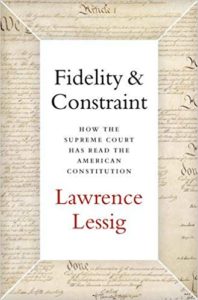
Fidelity and Constraint: How the Supreme Court Has Read the American Constitution
The U.S. Constitution is the oldest written constitution in the world. Interpreters of the Constitution are faced with the challenge of how, over time, to read a document that’s not only old but also inflexible.
In his new book Fidelity & Constraint, by Oxford University Press, Lawrence Lessig, one of the nation’s leading legal minds, explains that a fundamental approaches to interpreting the constitution is a process he calls translation. In fact, some of the most significant shifts in constitutional doctrine are products of the evolution of the translation process over time. In each new era, judges understand their translations as instances of “interpretive fidelity,” framed within each new temporal context.
Throughout American history, there has been a second fidelity in addition to interpretive fidelity: what Lessig calls “fidelity to role.”
In each of the cycles of translation the role of the judge — the ultimate translator – has also evolved. Old ways of interpreting the text now become illegitimate because they don’t match up with the judge’s perceived role.
When that conflict occurs, the practice of judges within our tradition has been to follow the guidance of a fidelity to role. Ultimately, Lessig not only shows us how important the concept of translation is to constitutional interpretation, but also exposes the institutional limits on this practice.
The first work of both constitutional and foundational theory by one of America’s leading legal minds, Fidelity & Constraint maps strategies that both help judges understand the fundamental conflict at the heart of interpretation whenever it arises and work around the limits it inevitably creates.
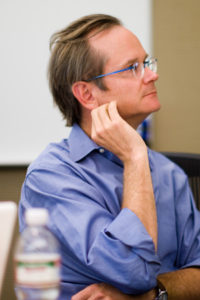
Guest – Lawrence Lessig is the Roy L. Furman Professor of Law and Leadership at Harvard Law School. Prior to rejoining the Harvard faculty, Lessig was a professor at Stanford Law School, where he founded the school’s Center for Internet and Society, and at the University of Chicago. He clerked for Judge Richard Posner on the 7th Circuit Court of Appeals and Justice Antonin Scalia on the United States Supreme Court. Lessig serves on the Board of the AXA Research Fund, and on the advisory boards of Creative Commons and the Sunlight Foundation.
—-


You may have heard about the shaming of parents who let their son or daughter walk to school by themselves, or ride public transportation alone. They’re often ridiculed on social media and cast as neglectful. But in some instances, the consequences have gone beyond public shaming.
In 2015 parents in Silver Spring, Maryland made national headlines they were investigated for child neglect for letting their children, ages 6 and 10, walk home from a park by themselves.
In another case Lenore Skenazy, a former New York Daily News columnist was called America’s worst mom after writing a column in 2008 about why she let her 9-year-old son ride the subway by himself.
Last year, Utah passed a law making it not a crime for parents to let their children play in a park without supervision or walk home alone from school. This is hopeful news for our guest Lenore Skenazy who has been advocating for so-called free range parenting laws for many years.
Under the law, neglect does not include allowing a child, whose basic needs are met and who is of sufficient age and maturity to avoid harm or unreasonable risk of harm, to engage in independent activities such as going to and from school by walking, running or bicycling, going to nearby stores or recreational facilities and playing outside.
A recent U.S. Census showed that 7 million of the nation’s 38 million children between the ages of 5 and 14 are left home alone on a regular basis, while the average time spent alone is six hours per week. Only a few states legislate an age under which kids may not be home alone.
Guest – Lenore Skenazy – New York City columnist-turned-reality TV show host got that title after letting her 9-year-old son take the subway, alone. In response to the enormous media blowback, she founded the book and blog, “Free-Range Kids,” which launched the anti-helicopter parenting movement. She has lectured internationally, including talks at Microsoft Headquarters and the Sydney Opera House, and has written for everyone from The Wall Street Journal to Mad Magazine. Yep. The Mad Magazine. And she’s a graduate of Yale.
———————
———————
The Meritocracy Trap [Audio]
Tom Rochevery excellent! TODO: get slides
Elections matter
Tom Roche'highlights of a discussion originally broadcast 1st November 2018'
Hugo Rifkind's Search For Power
Tom Rocheexcellent! see rest of series @ https://www.bbc.co.uk/programmes/m0004nl9/episodes/player
Distorting ‘Democracy’ in Venezuela Coverage
Writing of the failed US-sponsored coup attempt in Venezuela on April 30, Uri Friedman of The Atlantic (5/1/19) referred to the Venezuelan branch of the coup as Juan “Guaidó’s pro-democracy movement.” The logical contradiction could scarcely be more pronounced: A wave of Friedman’s wand transforms a political force seeking the military overthrow of Venezuela’s elected government into a “pro-democracy movement.”
The Venezuelan government’s current mandate comes from winning an election on May 20, 2018 that was observed by more than 150 members of theInternational Electoral Accompaniment Mission. In a joint report, the observers said of the agency that organizes the country’s electoral process, “The technical and professional trustworthiness and independence of the National Electoral Council of Venezuela are uncontestable.” The Council of Electoral Experts of Latin America, one of the groups that participated in the observer mission, reported that the “results communicated by the National Electoral Council reflect the will of the voters who decided to participate in the electoral process.”
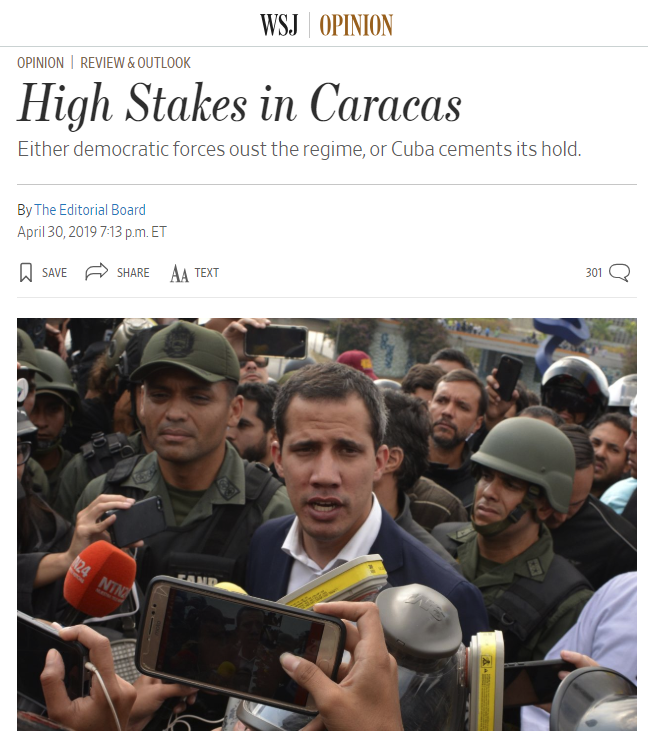
A subhead from the Wall Street Journal (5/1/19) refers to self-proclaimed president Juan Guaidó’s regime-change cohort as “democratic forces.”
The Wall Street Journal (5/1/19) performed the same trick, writing that “Venezuela’s democratic leaders launched a revolt against Cuban-backed dictator Nicolas Maduro.” In the Journal’s universe, Maduro is a “dictator” despite heading a country with a legislative branch controlled by the opposition, where in October 2017 the opposition won five governorships, and which has thus far declined to arrest a politician agitating for a military putsch in open collaboration with hostile foreign powers, to the extent of entertaining the possibility of supporting a US invasion and supporting US-led sanctions that are devastating the country’s economy.
Imagine what the US would do with, say, someone acting in concert with a similarly energetic Iranian or Chinese effort to oust the US government. It’s not an exact analogy, since Iran and China have no history of ruthlessly dominating the region in which the US is located, but the point should be clear.
For the Journal, “Venezuela’s democratic leaders” are those who sat out the country’s election, claimed it was unfair and then declined to file an appeal with the country’s National Electoral Council (CNE). One is hard-pressed to imagine a more soundly democratic practice than Guaidó not running for president and then declaring himself president even as 80 percent of Venezuelans had never heard of him at the time. According to historian Tony Wood (London Review of Books, 2/21/19):
Maduro won 68 per cent of the vote, on a turnout of 46 percent—more or less par for the democratic course in the US, but low by Venezuelan standards.
Guaidó’s claim to power rests on the idea that, since this vote was invalid, not only is Maduro not the legitimate president but, according to a Transition Law the opposition released on 8 January, there is no president. Constitutionally, this is shaky ground. Article 233 of the 1999 Venezuelan constitution specifies the circumstances under which a president can be replaced: death, resignation, removal by the supreme court, physical or mental incapacity, abandonment of post. The National Assembly has a supervisory role to play in each of these scenarios, but nowhere does the constitution say that the legislature can claim executive power for itself. This is why the opposition instead cites Article 333, a provision that exhorts citizens to help re-establish constitutional order in the event that it is derogated by an act of force. In other words, the opposition is claiming the constitution no longer applies but that in the resulting “state of exception” the National Assembly is empowered to bring it into effect once more, as soon as Maduro—whom it calls a “usurper”—is removed. Another significant detail: Article 233 requires new elections within 30 days, but the opposition’s Transition Law makes no such specific commitment.
It’s hard to conceive of a case for considering such actions “democratic,” yet this is the record of those whom the Journal calls “Venezuela’s democratic leaders.”
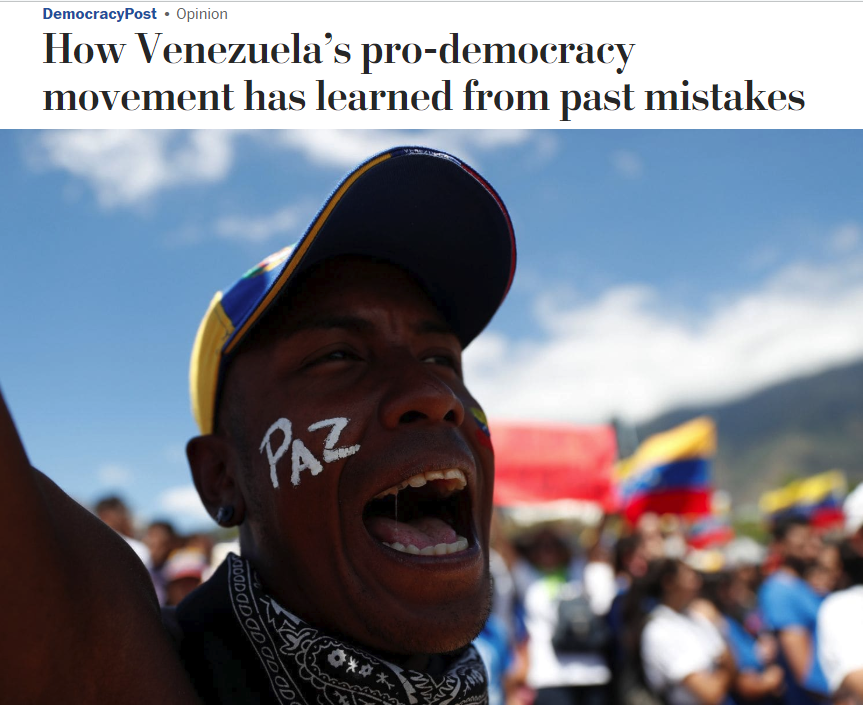
In its DemocracyPost blog, the Washington Post (2/26/19) published an article that refers to Venezuela’s self-proclaimed president as part of a “pro-democracy movement.”
In February, the Washington Post (2/26/19) ran an article headlined “How Venezuela’s Pro-Democracy Movement Has Learned From Past Mistakes.” It says that
since January 5, when Juan Guaidó was sworn in as [the National Assembly’s] president, he and its members have used the “Cabildo Abierto” (or open town meetings) to engage communities, communicating a message of inclusion for this new stage of the pro-democracy movement….
Many in the pro-democracy movement are successfully arguing that nonviolent discipline is a key to success. Guaidó, along with other political leaders and civil society organizations, has repeatedly called for the struggle to be assertive but peaceful.
This too mischaracterizes Guaidó as being part of a “pro-democracy movement.” The description is ill-fitting, considering that Guaidó’s movement has rejected the Venezuelan government’s proposal for dialogue, as well as Mexico and the Vatican’s offers to mediate talks, in favor of siding with the global empire that has unleashed widespread violence and poverty in the region and that, according to a study by two US economists, killed an estimated more than 40,000 Venezuelans between 2017–18 in the course of preventing the country’s economic recovery.
Perhaps even more absurd is when international attacks on Venezuela are cast as exercises in democracy. Nicholas Kristof of the New York Times (2/6/19) described one of the countries involved in the aggression, Canada, as “a moral leader” of something called “the free world.” Evidently it wasn’t enough for Kristof to write the same article two years earlier, almost to the day (2/4/17), under the headline “Canada, Leading the Free World.” In the more recent piece, Kristof’s case rests not only on such matters of world historic importance as Canada’s “traffic safety laws,” but also on Venezuela:
Trump gets headlines with his periodic threats to invade Venezuela to topple President Nicolás Maduro, but Canada has been quietly working since 2017 to help organize the Lima Group of 14 nations pushing for democracy in Venezuela. When Canada recognized the opposition leader Juan Guaidó as interim president, he won credibility because nobody sees Ottawa as an imperialist conspirator.
Lost on Kristof was that that Canada’s “moral leader[ship]” and status as a member of whatever “the free world” is was exposed as smoke and mirrors not even a month earlier, when Canadian police armed with military-level assault gear invaded Unist’ot’en, an indigenous territory whose people never ceded control of their land to Canada in any treaty, and arrested 14 people who had set up a checkpoint to defend the land from construction of a natural gas pipeline. Far from “nobody see[ing] Ottawa as an imperialist conspirator,” many scholars have shown that Canada is an imperialist power in its own right, notably as an oppressive and exploitative force in countries in the same region as Venezuela, such as Honduras and Haiti.

NACLA (3/7/19) pointed out that Colombia, a Lima Group member, is number one in the world of recorded human rights defenders assassinations.
Kristof, however, takes for granted that the Lima Group is committed to democracy in Venezuela, even though its members have subverted democracy in other parts of Latin America and the Caribbean. Also in the Lima Group is Colombia, which, according to NACLA (3/7/19),
has the highest number of recorded assassinations of human rights defenders in the world. In the first 15 days of January 2019 alone, nine social leaders were murdered.
Honduras is a member too, and after its sham elections in November 2017, the Honduran government “used excessive force to suppress the wave of demonstrations that followed” (Amnesty International, 6/13/18), detaining hundreds of people and denying the right of due process in several cases. Lima Group countries violate democratic principles at home, but Kristof assures us that they are “pushing for democracy in Venezuela.”
More to the point is the cognitive dissonance in describing an unelected organ of outside powers like the Lima Group, who are in no way accountable to Venezuelans, as “pushing for democracy in Venezuela.” In Kristof’s worldview, a non-democratic body forcing out Venezuela’s elected government in violation of international law will magically have a democratic outcome.
Maybe the most ridiculous article on this subject came from TownHall.com editor Katie Pavlich, writing in The Hill (4/30/19), who asserted that Maduro, who
has been able to maintain power throughout years of fraudulent “elections” in the country, is backed by Russia, China, Iran and personally protected by Cuban gangs. Guaidó is backed by US allies Brazil, the United Kingdom, Germany, France, Spain, Israel, Canada and others. For the sake of democracy alone, the choice here is obvious.
The author went on to write:
The United States and much of the pro-democracy global community have backed Guaidó, but serious enemies looking to gain a stronger foothold in the hemisphere aren’t backing down from Maduro. What happens now will be definitive and will determine a free or tyrannical future for the country.

Fascist president Jair Bolsonaro of Brazil, a member of “the pro-democracy global community.” (cc photo: Marcelo Camargo/Agência Brasil)
One can infer that the countries who are resisting the nonexistent “Cuban gangs” and backing Guaidó enumerated in the first paragraph of this middle-school essay are the ones that Pavlich considers “the pro-democracy global community”—a list that includes Brazil, another Lima Group freedom fighter, which is governed by a fascist who was only elected because the country’s most popular leader was a political prisoner; Israel, which governs nearly 5 million Palestinians who have no right to vote on who rules them or how; the colonial Canadian state that oppresses indigenous peoples as brutally as the US does African-Americans; and the US itself, which imprisons people at a higher rate than any other country, and is less a democracy than an oligarchy.
At every turn, Guaidó and his backers have taken steps that have nothing to do with democracy, and everything to do with what Oscar Guardiola-Rivera (Independent, 5/1/19), who teaches human rights and philosophy at the University of London, aptly labeled “a white supremacist foreign intervention.” That corporate media manage to portray this as a “pro-democracy movement” is both a tragedy and a farce.
Featured image: Depiction of Juan Guaidó in The Atlantic (5/1/19). (photo: Fernando Llano/AP)
Updated: 5/11/19
Why Deutsche Bank Loaned Donald Trump Billions When No One Else Would
Tom Rochetranscript @ https://www.npr.org/2019/05/09/721723204/deutsche-bank-is-the-rosetta-stone-to-unlock-trump-finances-journalist-says (archived @ https://web.archive.org/web/20190510121128/https://www.npr.org/2019/05/09/721723204/deutsche-bank-is-the-rosetta-stone-to-unlock-trump-finances-journalist-says )
How Oligarchs, Kleptocrats & Crooks Stash Fortunes
Tom Rochetranscript @ https://www.npr.org/2019/05/01/719001286/moneyland-reveals-how-oligarchs-kleptocrats-and-crooks-stash-fortunes (archived @ https://web.archive.org/web/*/https://www.npr.org/2019/05/01/719001286/moneyland-reveals-how-oligarchs-kleptocrats-and-crooks-stash-fortunes )
Also, Ken Tucker reviews Lizzo's first major label album, 'Cuz I Love You.'
John Bolton's Push For 'Aggressive Use' Of U.S. Power
Tom Rochetranscript @ https://www.npr.org/2019/05/02/719536645/journalist-explains-john-boltons-push-for-aggressive-use-of-american-power (archived @ https://web.archive.org/web/20190510234715/https://www.npr.org/2019/05/02/719536645/journalist-explains-john-boltons-push-for-aggressive-use-of-american-power )
Also, TV critic David Bianculli reviews 'Dead To Me,' a new black comedy series on Netflix starring Linda Cardellini and Christina Applegate.
Red Hat Developers: Python in RHEL 8
Tom Rochegood quick guide to using virtual environments (as well as using either 2 or 3 on RHEL)
Ten years ago, the developers of the Python programming language decided to clean things up and release a backwards-incompatible version, Python 3. They initially underestimated the impact of the changes, and the popularity of the language. Still, in the last decade, the vast majority of community projects has migrated to the new version, and major projects are now dropping support for Python 2.
In Red Hat Enterprise Linux 8, Python 3.6 is the default. But Python 2 remains available in RHEL 8.
Using Python in RHEL 8
To install Python, type yum install python3.
To run Python, type python3.
If that doesn’t work for you, or you need more details, read on!
Python 3
In RHEL 8, Python 3.6 is the default, fully supported version of Python. It is not always installed, however. Similarly to any other available tool, use yum install python3 to get it.
Add-on package names generally have the python3 prefix. Use yum install python3-requests to install the popular library for making HTTP connections.
Python 2
Not all existing software is ready to run on Python 3. And that’s OK! RHEL 8 still contains the Python 2 stack, which can be installed in parallel with Python 3. Get it using yum install python2, and run with python2.
Why not just “Python”?
Okay, okay, so there’s python3 and python2. But what if I use just python? Well…
$ python
-bash: python: command not found
There is no python command by default.
Why? Frankly, we couldn’t agree what python should do. There are two groups of developers. One expects python to mean Python 2, and the other Python 3. The two don’t always talk to each other, so you might be a member of one camp and not know anyone from the other – but they do exist.
Today, in 2018, the python == python2 side is more popular, even among those that prefer Python 3 (which they spell out as python3). This side is also backed by an official upstream recommendation, PEP 394. However, we expect that this viewpoint will become much less popular over the lifespan of RHEL 8. By making python always mean Python 2, Red Hat would be painting itself into a corner.
Unversioned Python command
That said, there are applications that expect a python command to exist and that assumption might be hard to change. That’s why you can use the alternatives mechanism to enable the unversioned python command system-wide, and set it to a specific version:
alternatives --set python /usr/bin/python3For Python 2, use /usr/bin/python2 instead. For details on how to revert the changes or do the setup interactively, see man unversioned-python.
Note, We do not recommend this approach. We recommend you explicitly refer to python3 or python2. That way, your scripts and commands will work on any machine that has the right version of Python installed.
Note that this works only for the python command itself. Packages and other commands don’t have configurable unversioned variants. Even if you configure python, the commands yum install python-requests or pip won’t work.
Always use the explicit version in these cases. Better yet, don’t rely on the wrapper scripts for pip, venv and other Python modules that you call from the command line. Instead use python3 -m pip, python3 -m venv, python2 -m virtualenv.
Third-party packages
Not all Python software is shipped with RHEL 8 – there’s only so much that Red Hat can verify, package and support.
To install a third-party package, many sources on the Internet will suggest using sudo pip install. Do not do this! This command translates to “download a package from the internet, and run it on my machine as root to install it”.
Even if the package is trustworthy, this is a bad idea. A large part of RHEL 8 relies on Python 3.6. If you throw in another package, there’s no guarantee that it will co-exist peacefully with the rest of the system. There are some protections in place, but you should generally assume that sudo pip will break your system.
(Not to mention it won’t work as-is: the command name is pip3 or pip2.)
If you want to use third-party packages, create a virtual environment using python3 -m venv --system-site-packages myenv (or for Python 2, install python2-virtualenv and run python2 -m virtualenv --system-site-packages myenv). Then, activate the environment using source myenv/bin/activate, and install packages into it using pip install. The packages will then be available as long as the environment is activated. While this does not protect you against malicious packages, it does protect the system from unexpected breakage.
When a virtual environment is active, unversioned commands like python and pip will refer to the Python version that created the virtual environment. So, to install the Requests package, run pip install requests (or if you prefer being explicit, python -m pip install requests).
The --system-site-packages switch makes the environment re-use libraries installed system-wide. Leave it out to get an isolated environment, where all libraries outside Python’s standard library need to be installed explicitly.
Another possibility is installing user-specific packages with pip’s --user switch. The command python3 -m pip install --user flake8 will make the flake8 linter available to you personally, leaving system tools like yum unaffected.
If you truly need something installed system-wide, build a RPM package and use yum install.
Obligatory note: Third-party packages installed with pip are not reviewed or supported by Red Hat.
Platform-Python: The Python behind the curtain
Careful readers might have noticed a discrepancy here: Python is not installed by default, but yum is, and yum is written in Python. What magic makes that possible?
It turns out there is an internal Python interpreter called “Platform-Python”. This is what system tools use. It only includes the parts of Python needed for the system to function, and there are no guarantees that any particular feature won’t be removed from it in the future.
However, libraries for Platform-Python are shared with the “user-visible” Python 3.6. This conserves disk space, and it also means that, for example, yum extensions built for Python 3.6 will work for the system tool.
If you are not re-building the distro, do not use Platform-Python directly. Install python3 and use that.
Porting to Python 3
It won’t be in RHEL 8, but there will come a day when support for Python 2 will end. If you maintain Python 2 code, you should think about porting it to Python 3.
Python 3 was first released in 2008. For over a decade, it has been improving in features, performance and – ironically – compatibility with Python 2. You might have heard horror stories and urban legends about porting code to Python 3.0 or 3.2 that would be much less scary nowadays.
I’m not saying porting is trivial now, but it’s definitely gotten easier. As with any other change to a system, porting to Python 3 mainly requires knowledge of your codebase, good tests – and some time.
What’s the reward? Python 3 is a better language – after all, it’s the language Python 2 developers choose to use! For enterprise applications, the main feature is reduced risk of hard-to-debug, input-dependent bugs when handling non-ASCII text such as people’s names (or emoji).
There are many community resources that document and help with porting to Python 3.
If you are reading this blog, you are probably working on a large, conservative code base. We ported a few of those, and distilled our experience in the the Conservative Porting Guide, a hands-on walkthrough that focuses on compatibility and keeping working code throughout the porting process. Give it a try, and if you find that something is not covered, let us know – or even send a pull request to it!
If you maintain Python C extensions, a similarly focused guide is part of the py3c project.
Takeaways
To install or run Python on RHEL 8, use python3 – unless you have a different version in mind.
Do not use sudo pip.
Do not use platform-python for your applications. However, use platform-python if you are writing system/admin code for RHEL 8.
And if you have some code for Python 2, now is a great time to start modernizing it.
Enjoy Python in RHEL 8!


The post Python in RHEL 8 appeared first on Red Hat Developer Blog.