Tom Roche
Shared posts
Jane Mayer On The Case Of Al Franken
Tom Rochevery excellent
10: State Treasurer Is the Most Exciting Political Office You Never Pay Attention To
Tom RocheSarah Godlewski in Wisconsin
The invention of Essex: how a county became a caricature
Tom Rocheoriginal article/transcript by Tim Burrows @ https://www.theguardian.com/news/2019/jun/27/the-invention-of-essex-how-a-county-became-a-caricature (archived @ https://web.archive.org/web/20190723122400/https://www.theguardian.com/news/2019/jun/27/the-invention-of-essex-how-a-county-became-a-caricature )
The Women in the Cutting Room... and Elsewhere
Tom Roche403s as of 1945 UTC 20 Jul 2019
James Ellroy | This Storm
Tom RocheEXCELLENT rants, very funny
Behind the News, 7/18/19
Tom RocheBernat Tort @ U Puerto Rico-Rio Piedras https://www.hercampus.com/school/upr/philosophy-professor-bernat-tort on Puerto Rico’s economic and political crisis • Sahan Karatasli @ UNC Greensboro https://skaratasli.org/ on Turkey’s economic and political crisis
The battle against the gangs of El Salvador
Tom RocheMark Lowen's neoliberal gloating over the demise of (the admittedly fake-left, which Lowen labels "populist") Syriza is quite egregious.
Behind the News, 7/11/19
Tom RocheDavid Adler, policy director at DiEM25, on Syriza’s loss in Greece (Guardian article @ https://www.theguardian.com/commentisfree/2019/jul/08/syriza-demise-greece-alexis-tsipras) • Joel Whitney, author of https://www.poetryfoundation.org/articles/150472/on-the-run , on Pablo Neruda and his flight from the CIA
‘A zombie party’: the deepening crisis of conservatism
Tom Rocheoriginal article/transcript by Andy Beckett @ https://www.theguardian.com/politics/2019/may/28/a-zombie-party-the-deepening-crisis-of-conservatism (archived @ https://web.archive.org/web/20190628030707/https://www.theguardian.com/politics/2019/may/28/a-zombie-party-the-deepening-crisis-of-conservatism )
The battle of Trafalgar
Tom Rocheexcellent debunkings and clarifications
Historian Sam Willis describes the dramatic 1805 British victory against French and Spanish fleets, while challenging misconceptions about the role of Nelson and the importance of the battle in the war against Napoleon. Historyextra.com/podcasts
For information regarding your data privacy, visit acast.com/privacyDead Ringers
Tom RocheMore consistently excellent than usual, though still marred by the inevitably lame anti-Semitism attacks on Corbyn and Labour. Great parodies of BBC Today, Fox News, One Show, Villanelle, Stranger Things, Downton Abbey, Trump, Boris, Louis Theroux, Jeremy Hunt, Jeremy Kyle, Gyles Brandreth, and many more
The price of plenty: how beef changed America
Tom Rocheoriginal article/transcript by Joshua Specht @ https://www.theguardian.com/environment/2019/may/07/the-price-of-plenty-how-beef-changed-america (archived @ https://web.archive.org/web/20190617140146/https://www.theguardian.com/environment/2019/may/07/the-price-of-plenty-how-beef-changed-america )
El Chapo: what the rise and fall of the kingpin reveals about the war on drugs
Tom Rocheoriginal article/transcript by Jessica Loudis @ https://www.theguardian.com/world/2019/jun/07/el-chapo-the-last-of-the-cartel-kingpins (archived @ https://web.archive.org/web/20190709032423/https://www.theguardian.com/world/2019/jun/07/el-chapo-the-last-of-the-cartel-kingpins )
The mindfulness conspiracy
Tom Rocheoriginal article/transcript by Ronald Purser @ https://www.theguardian.com/lifeandstyle/2019/jun/14/the-mindfulness-conspiracy-capitalist-spirituality (archived @ https://web.archive.org/web/20190710180140/https://www.theguardian.com/lifeandstyle/2019/jun/14/the-mindfulness-conspiracy-capitalist-spirituality )
Podcast Ep 7: Behind Israel's troll army
Tom Rocheaudio link is actually https://api.soundcloud.com/tracks/645309108/download?client_id=LBCcHmRB8XSStWL6wKH2HPACspQlXg2P'
Michael Bueckert joins us to discuss Act.IL.
A Little Honesty May Help Sell the Green New Deal
Tom Rocheexcellent article with well-put points on US and French political economy. pullquote:
> We know that the rich will never like giving up much of their money, and the relatively well-to-do policy types will never want to acknowledge that their material comfort has more to do with rigging the system than [with] their intellect and hard work, but it seems better to challenge this crew than the vast majority of the population that has been losers over the last four decades. Honesty may not always work in politics, but it is better than lying and losing.
(This post originally appeared on my Patreon site.)
The Washington Post had two columns last week that told us much more than their authors likely intended. The first was a piece by E.J. Dionne, that told readers about the need to “tame” capitalism, because of the damage caused in recent decades by the untamed version.
The second piece was by Catherine Rampell. From France, she told us of the difficulties of imposing taxes on carbon, even in a country that is ostensibly fully committed to the Paris Agreement and reducing greenhouse gas emissions. Both pieces were fascinating for what they left out of the picture.
While Dionne’s piece is focused on the need to address the growing inequality of the last four decades (its theme is the pseudo-mea culpa of the Wall Street funded group, Third Way), the gist of it is that it was a mistake to let the market run amuck. In other words, the upward redistribution of the last four decades was something that happened, not something that folks like the Third Wayers did.
This is an important distinction from a logical, moral, and most importantly, political standpoint. It matters hugely whether most of the country was left behind due to the natural development of the market, as opposed to being left behind because the folks with political power structured the market to redistribute income upward.
People familiar with my writing know that I have long argued that the upward redistribution was by design. Just to take the most obvious example, we are routinely told that manufacturing workers in the United States and other wealthy countries were destined to get whacked for the simple reason that there are hundreds of millions of people in the developing world who are willing to do the same work for a fraction of the pay.
In that story, the downward pressure on the wages of manufacturing workers was an inevitable outcome of globalization. Unless we want to block globalization, we can’t have manufacturing workers in the U.S. and Europe getting $40 and $50 an hour in pay and benefits when workers in China, Vietnam, and elsewhere will do the same work for less than one tenth of this amount.
The loss of these high-paying jobs for workers with less education is just an unfortunate side effect of globalization. The downward pressure on the wages of less-educated workers more generally that results from the loss of manufacturing jobs is also just another bad side-effect. But hey, these people are all better off than the under-employed workers in the developing world, so it would be greedy and wrongheaded to try to stop globalization to protect less-educated workers in rich countries.
The fact that there are hundreds of millions of workers in the developing world who are prepared to work for much lower pay than our manufacturing workers is true, but there are also millions of bright and ambitious people in the developing world who would be happy to train to U.S. standards and work as doctors, dentists, lawyers and other elite professions at a small fraction of the pay of the people who currently hold these jobs.
Bad News: Guardian Tells Us China is Running Out of Workers
Tom Rochepullquote:
> In 1975, China's population was roughly 50 percent larger than India's population. Currently, they are almost the same, with India projected to pass China in the next decade. If China's population had grown at the same pace as India's since 1975 there would be another 650 million people on the planet. This would make the prospect of limiting the damage from greenhouse gas emissions hugely more difficult.
Seriously, that's what a piece on the state of China's economy told readers.
"Another headache is China’s demographic problem, namely that it is running out workers thanks to the failure of its now-abandoned one-child policy. With growth slowing, China faces a race to avoid the dreaded “middle-income trap” where the economy of developing countries stagnates once the low-hanging fruit of industrialisation has been picked but before income has been spread widely enough around the population. China is expanding its technology industry as fast as it can to build-up high-value manufacturing but, as the Huawei standoff shows, the policy is bringing conflict with the west."
Fans of logic and arithmetic know that countries don't "run out of workers." In a tight labor market, workers move from lower paying lower productivity jobs to higher paying higher productivity jobs. This means that we are likely to see fewer people working the late-night shift in convenience stores or as valets in restaurants. They will instead work at better-paying jobs. Of course, the people who depend on low-paid workers (the "hard to get good help" crowd) will suffer. (Also, don't forget that we are supposed to be worried about robots taking all the jobs.)
While there are serious human rights issues associated with China's one-child policy (these are hugely exaggerated, the killing of female infants happened throughout the region in countries that did not have a one-child policy), the slowing of China's population growth was a great thing for the environment. In 1975, China' population was roughly 50 percent larger than India's population. Currently, they are almost the same, with India projected to pass China in the next decade.
If China's population had grown at the same pace as India's since 1975 there would be another 650 million people on the planet. This would make the prospect of limiting the damage from greenhouse gas emissions hugely more difficult.
Slurm maintenance outage rescheduled for today
Tom RocheTODO: research SLURM esp deltas with TORQUE/PBS, Moab/Maui and other job/resource management software
The Casper cluster’s Slurm workload manager will be unavailable today from 11 a.m. until approximately 1 p.m. MDT to allow CISL system administrators to perform maintenance.
During that period, new Slurm job submissions from Casper or Cheyenne will not be possible and the “execdav” command will not work. However, users will be able to log in directly to Casper to access the GLADE file system and HPSS. No interruptions are expected to existing Casper login sessions or batch jobs that are already running or queued for execution.
Users will be informed via the CISL Notifier service when the maintenance is complete and Casper is returned to service.
What Micro-Mapping a City's Density Reveals
Tom Rocheexcellent spatial data science, and a serious (and short!) contribution to critical urban studies
Density is one of the most important urban characteristics. A high-density city like New York looks, feels, and functions differently than a low-density city like Des Moines. Yet the textures of density within a single city can be just as varied as average densities between cities. Pockets of intense concentration or islands of relatively thin settlement sometimes bear little resemblance to the overall density of an urban area.
Since most people experience a city at the scale of a neighborhood or district, rather than the scale of metropolitan regions, paying attention to these fine-grained variations in urban form is more useful than broad-stroke statistics for understanding the everyday realities of population density. A new visualization I’ve put together helps picture these local patterns by examining density in American cities one square kilometer at a time. (Technically, these rectangles are 30 arc-second cells, which are roughly, but not exactly, one square kilometer.) This perspective lets us drill down to the micro-geography of density in American cities, with oftentimes surprising results, as in the densest grid cell of greater Salt Lake City (below), which isn’t high-rises but mobile home parks.
Salt Lake City
Most statistics that try to capture a single average measure, after all, tell us fairly little about spread or distribution. Consider economic indicators: If we know that the average income in a country is, say, $55,000, we don’t know anything about whether that country has a lot of middle-class earners or whether it’s polarized between extreme wealth and extreme poverty.
The same problem holds with density. Imagine one city where 50,000 people live in a 5-square-kilometer superblock of high-rises, surrounded by 20 square kilometers of parks, and another city where 50,000 people live in 25 square kilometers of low-density single-family homes. Both cities would have an average density of 2,000 people per square kilometer, but their actual morphologies could hardly be more different.
Density statistics can be even more misleading than averages like income or age, because the divisor in the equation is a geographic unit that’s inevitably drawn with debatable boundaries. For instance, the Los Angeles metropolitan statistical area (MSA) contains hundreds of square miles of mountains in the San Gabriel National Forest where nobody lives—so why shouldn’t the Boston MSA also include the hundreds of square miles of ocean in Boston Harbor where nobody lives? The Minneapolis–Saint Paul urbanized area includes several large lakes and even a National Wildlife Refuge, so why shouldn’t the Miami urbanized area include some chunk of the Everglades?
There’s no consistent principle about whether to include uninhabited water, mountains, and deserts when calculating density—not to mention airport tarmacs, railroad classification yards, or central business districts with few residences.
One alternative way of measuring density involves dividing space up into a regular pattern of equally sized cells, without regard to the underlying physical or administrative features, and then tallying up the population in each cell. That’s exactly what’s available in the Gridded Population of the World dataset produced by NASA. (The European Commission also has a similar dataset called the Global Human Settlement Layer.)
Although there are still some statistical flukes worth keeping in mind in regard to gridded population data (which I’ve noted in the visualization’s information page), this method of measuring population and density allows us, first of all, to set aside the problems of arbitrary boundary drawing and, second, to zoom in on small-scale patterns without having to fall back on broad averages.
In the interactive visualization, I’ve taken GPW data for a curated selection of American cities. Some have old, historic cores, and others are dominated by more recent development; some have constricting physical geographies and others lie on relatively flat, open plains; some were built for horse transportation and others for the automobile era. I’ve also included one rural region, the Upper Valley of New Hampshire and Vermont, where I currently live and work. For each area, I’ve selected out the 200 most highly populated grid cells from the GPW and matched these up with aerial photography.
One of the first things that stands out is how much the variation in the top 200 cells differs from city to city. The bottom of the visualization shows a “pyramid” of the square-kilometer cells in a given city, with the largest on the left.
San Francisco–Oakland has a strikingly top-heavy pyramid: Ranking #1 is an extremely dense cell of more than 25,000 people in the Tenderloin, but by the time we reach the #6 most dense cell, we’ve already more than halved the density, and by the time we reach rank 100, we’re down below 5,000 people.
San Francisco–Oakland
Quite by contrast, Salt Lake City has a remarkably even spread of population. The densest cell is only a little more than twice as dense as the 200th most dense cell, and cells 40 through 143 are all within a range of 500 people from one another.
In this sense, San Francisco is an extremely unequal urban area in terms of density: It has a tight core of extreme density, but, outside of that limited area, its local-scale density isn’t very remarkable, and so life in most of the city isn’t significantly different from life in a city which has a lower average density overall. Other cities with historic cores constrained by geography, like Boston and Washington D.C., show similarly top-heavy density pyramids, as does Chicago, where the Loop and Near North Side stand out from the rest of the region.
The opposite is the case for cities like Salt Lake City, Minneapolis, and Detroit, which lack hyper-centralized downtown areas for both historical and geographical reasons, and consequently have a much more gradual contrast between core and periphery.
Even more remarkably top-heavy than San Francisco–Oakland is the rural Upper Valley region, where the densest cell, on Dartmouth College’s campus, has a density more similar to a major city than to its thinly populated immediate surroundings. (The #3 cell in this region is also on the Dartmouth campus, and the #2 cell is on the campus of Plymouth State University.) This raises the question of what we actually mean when we talk about the lived experience of density.
Upper Valley of New Hampshire and Vermont
College dorms, where each person might have just a few square feet of living area, are some of the most densely packed places in the country, and we can even see that phenomenon in larger cities. The 18th-densest cell in all of San Francisco–Oakland, which is also the densest in the East Bay, lies on the edge of the University of California, Berkeley, campus. Does that mean that the dorm clusters of college towns should therefore be the places that first come to mind when we think about big-city life?
There’s another, more sinister, phenomenon where we sometimes find highly localized spikes in density. The #2 most dense cell in Dallas (below) looked like an error to me at first, since it’s centered on the flood corridor of the Trinity River. But it turns out that the very eastern edge of this cell just overlaps the Lew Sterret Jail, a high-rise detention facility serving all of Dallas County. Famously sprawly Dallas, it turns out, does have a “neighborhood” that’s almost as dense as a coastal city—but the residents are all behind bars.
Dallas
That should pose a question about whether the benefits of density are really just about a lot of people living in close quarters, or whether some other phenomenon is at play. Prisons and refugee camps, after all, are some of the world’s most astonishingly dense communities, yet it’s hard to imagine these as sites of rich intercultural dialogue, incubators of technological innovation, or seedbeds of economic opportunity, despite the role that density is supposed to play in promoting these virtues, according to many offhand theorists. Density, as a raw statistic shorn of context, can be deceptive.
Even among cells with similar population and density, the built environment can look strikingly different, the result of different cultural and economic factors in city-building across the country, and a tour of aerial photography gives us a window into the morphological diversity of American urbanity.
Denver, Minneapolis, and Los Angeles have endless neighborhoods of medium-scale residential neighborhoods following arterial roads and rectilinear streets. In Boston and Washington, D.C., leafy but still relatively dense inner suburbs like Arlington (Massachusetts) or Arlington (Virginia) are more typical. Atlanta’s top 200 cells are strikingly heterogeneous, and Miami’s include immigrant enclaves, beach developments, and even resort communities.
Arlington, Massachusetts
Arlington, Virginia
Another conclusion that we can pick up from this visualization is that New York City really is unlike all of its American peers—its density patterns belong in a category all their own.
The plot shows the population of the top 200 grid cells in six representative cities, and here you can see just how much of an outlier New York is. The city’s 200th densest cell is denser than the most dense cells of Boston, the Twin Cities, or Dallas. Even Los Angeles and Chicago’s densest areas barely crack into the bottom half of New York’s top 200.
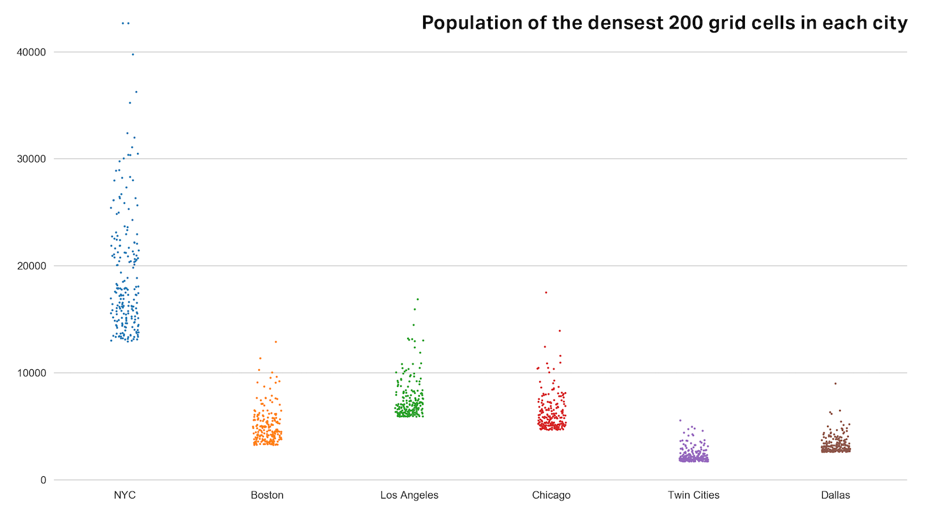
From this perspective, it’s obvious both how extraordinary New York’s patterns are and also how varied the city is within itself. The #1 most dense cell, containing more than 42,000 people in Manhattan, is twice as dense as the #53 densest cell, with 21,000 people in Queens. Yet even that cell is still denser than the densest parts of Los Angeles or Chicago.
Exploring urban density on a cell-by-cell scale is also useful for exploring cities outside of the United States. European cities, for example, have density patterns that have much to do with historical trends in urban settlement, as my colleague Alasdair Rae has shown. The data designers at The Pudding have also visualized gridded density all across the world, allowing for a striking view of just how many people live in the arc stretching from Pakistan around to China and Japan.
The most provocative lesson to be drawn from thinking about population at the grid scale, however, is that it forces us to think about what we really mean when we talk about dense urban life. Is urban density about tall buildings, traffic congestion, and sharing the name of a city on your mailing address with millions of other people? Or is it more about the small-scale experience of everyday life, the number of neighbors you can reach within walking distance, the form and structure of a local community?
Just as average wealth and income statistics can’t take us very far in explaining how to fairly structure the distribution of economic gain in our society, the average population density of a vast metropolitan area does little to capture the many different ways that we might want to structure our cities and neighborhoods.
Black Agenda Radio - 07.08.19
Tom Rochenote the actual download link (to the audio--current link is a JPG) is https://mcdn.podbean.com/mf/download/x2awnn/BAR_070819.mp3
Welcome to the radio magazine that brings you news, commentary and analysis from a Black Left perspective. I’m Glen Ford, along with my co-host Nellie Bailey. This is one of the most difficult shows we have ever done, coming in the wake of the death of Bruce Dixon, a co-founder of Black Agenda Report. We’ll have comments and commentary by his colleagues. A committee in Congress has been collecting powerful testimony on the need for Reparations for the descendants of enslaved persons in the United States. And, Mumia Abu Jamal confronts the soul-chilling fact that he may be going blind.
Bruce Dixon, the managing editor of Black Agenda Report, was scheduled to speak at a number of panels at the Left Forum, the yearly conference of left-wing activists in New York City. However, Dixon succumbed to blood cancer only days before the event. The entire conference was in mourning for Dixon, the former Black Panther and lifelong activist who co-founded BAR in 2006, and was a key force in the Green Party. BAR executive editor Glen Ford remembered his comrade.
That was BAR executive editor Glen Ford. Margaret Kimberley is an editor and senior columnist of Black Agenda Report. She and Glen Ford co-founded the publication along with Bruce Dixon, 13 years ago. Kimberley paid her respects to Dixon. She also found some comic relief in the antics of New York City mayor Bill De Blasio, who is one of the 20-something Democratic candidates for president. At the debates in Miami, De Blasio seemed to be channeling the ghost of Che Guevera.
Danny Haiphong is a regular contributor to BAR, and co-author of a new book, titled, “American Exceptionalism and American Innocence: A People’s History of Fake News, From the Revolutionary War to the War on Terror. Haiphong was part of the BAR panel at the Left Forum. He began with some words on the dearly departed Bruce Dixon.
That was BAR contributor Danny Haiphong. BAR executive editor Glen Ford followed Haihong on the panel. He talked about why its necessary to have publications like Black Agenda Report.
Back in 1989, Congressman John Conyers first introduced his bill calling for a study of the question of reparations for the Black descendants of people enslaved in the United States. The HR 40 legislation languished with few co-sponsors for decades. But this year, reparations is an issue in the Democratic presidential race, and co-sponsors are popping up all over the place. Plus, HR 40 now has a companion bill in the U.S. Senate, which means it is finally a serious piece of legislation. Last week, the House committee holding hearings on reparations heard from Katrina Browne, who produced and directed the Emmy-nominated film, “Traces of the Trade: A Story from the Deep North.”
Mumia Abut Jamal, the nations best known political prisoner, has been incarcerated by the state of Pennsylvania for the past 39 years in the death of a Philadelphia policeman. Abu Jamal has suffered a number of health crises due to atrocious medical treatment in prison, including a battle with Hepatitis C contracted in prison and left untreated for years. Now the prolific author and journalist is losing his sight. He files this report for Prison Radio. It’s titled, “Walking in the Dark.”
Democracy Now! 2019-07-05 Friday
Tom Rochererun from April
Democracy Now! 2019-07-05 Friday
- An Hour with Noam Chomsky on Fascism, Nuclear Weapons, Climate Change, Julian Assange & More
The Vast Majority: “Elizabeth Warren Can and Should Do Better on Foreign Policy" with Sarah Lazare
Tom Rocheexcellent
Black Agenda Radio - 07.01.19
Tom Rochenote the actual download link (to the audio, not the JPG above) is https://mcdn.podbean.com/mf/download/36i9d2/BAR_070119.mp3
Welcome to the radio magazine that brings you news, commentary and analysis from a Black Left perspective. I’m Glen Ford, along with my co-host Nellie Bailey. Coming up: Lots of mostly Black school districts are returning to local control, after years of state takeovers, but a recent article shows that these public schools are still starved for money; We’ll hear from Howie Hawkins, who wants to run for president on the Green Party ticket; a Move member is finally freed from a Pennsylvania prison; and, a former Black Panther who’s spent 48 years in prison is hoping to be paroled, in September.
Hundreds of left activists and scholars gathered in Brooklyn, New York, this past weekend, for the Left Forum, the biggest annual gathering of leftist activists and scholars in the nation. Black Agenda Report senior columnist Margaret Kimberley was on hand. We asked Kimberley to make sense of the never-ending warfare between the corporate media and president Trump. Trump threatened to attack Iran after that nation shot down a spy drone, but then called off the attack. The corporate media were not pleased, since they only praise Trump when he attacks other countries.
Jeff Bryant is a journalist who has been following the plight of urban school systems for many years. Bryant is senior correspondent for Our Schools, a project of the Independent Media Institute. His latest article is titled, “Why Many Urban School Districts are Being Set Up for Fiscal Failure.” He says that, as schools became more Black and Brown, State governments seized control from local school boards and put appointed consultants in charge. Now many of these school districts are returning to local control. But Bryant says the damage has already been done.
Howie Hawkins is running for the Green Party’s presidential nomination. Hawkins came up with a detailed plan for a massive Green New Deal, nearly a decade ago. The Green Party adopted the Green New Deal as its own. But now Democrats like Congresswoman Alexandria Ocasio Cortez have put forward their own Green New Deal, and put it before Congress. Hawkins says they’ve watered the Deal down, and made it ineffective.
Eddie Africa, of the MOVE organization, has been released from the Pennsylvania prison system. Mumia Abu Jamal, the nation’s best known political prisoner, filed this report for Prison Radio.
Jalil Abdul Muntaqim is a former Black Panther who has been imprisoned for the past 48 years, in the killing of two police officers in 1971. Muntaqim’s co-defendant, Herman Bell, was released on parole last year, despite the loud opposition of the Governor, New York City’s mayor, and of course, the police unions. Jalil Muntaqim has had 10 parole hearing since he became eligible for release in 2002, but has been turned down each time. His next appearance before the parole board is in September. We spoke with a person that has stuck by Jalil Muntaqim every day of nearly half century of incarceration – his mother, 85-year old Billie Bottoms Brown, who lives outside Atlanta, Georgia.
There are Still Good Paying Jobs for People Without Skills, Just Read the Washington Post Opinion Page
Tom Rochepullquotes:
> if the Washington Post was owned by people who were not rich Steven Pearlstein, Charles Lane, and Fred Hiatt would not be getting paid to spout ignorance on its opinion pages.
> [Charles] Lane says not a word about the trillions of dollars of patent/copyright rents (much of it for prescription drugs) that the government has committed the public to pay with its grant of monopolies. If Lane doesn't understand that these rents are equivalent to future taxes then he is far too ignorant to take seriously on the topic of debt. Alternatively, he is simply a dishonest propagandist.
> [Fred] Hiatt's big punch line is that people actually are better off than they were fifty years ago, so what is everyone complaining about? Sure, the median wage has risen around 10 percent in the last forty five years, while productivity has more than doubled, but hey, 10 percent is not zero.
No folks, it's not a rerun of the Three Stooges, it is Washington Post columnists pretending to say wise things about economic policy. They apparently decided to work overtime to criticize the more progressive Democratic candidates, which is what Jeff Bezos pays them to do. (No, I have no idea if Bezos is especially pernicious among rich people, but if the Washington Post was owned by people who were not rich Steven Pearlstein, Charles Lane, and Fred Hiatt would not be getting paid to spout ignorance on its opinion pages.) I don't have time to deal with all the misinformation in these three columns, but let me just take some highlights from each.
Pearlstein is very unhappy about the Democrats' big plans. For example, he is upset that a Medicare for All program will lead to some inefficient hospitals closing and some people losing jobs. Of course, we will not be getting less health care, so this is just a story of people moving from one hospital to another facility.
That can be traumatic, I would never minimize the seriousness of job loss, but almost 1.8 million people lose their job every month, and this is in an economy with 3.6 percent unemployment. How much does Pearlstein think Medicare for All will add to this?
Similarly, he is angered about the job loss from a Green New Deal. He tells us that the new jobs won't replace the lost jobs in the coal mines. This is true, and we currently have just over 50,000 people working in coal mines. We lost 3.4 million manufacturing jobs due to the explosion of the trade deficit in the last decade, sparking very little concern on the Post's opinion pages, but the risk to 50,000 jobs in coal mining is worth berating the Democratic contenders over.
Of course, the loss of jobs attributable to the trade deficit was associated with an upward redistribution of income. A Green New Deal may lead to more equality.
Charles Lane is lecturing us again about the debt and deficits. Let's just deal with this one quickly. Lane says not a word about the trillions of dollars of patent/copyright rents (much of it for prescription drugs) that the government has committed the public to pay with its grant of monopolies. If Lane doesn't understand that these rents are equivalent to future taxes then he is far too ignorant to take seriously on the topic of debt. Alternatively, he is simply a dishonest propagandist.
John Finnemore's Souvenir Programme
Tom Rocheexcellent
Dead Ringers
Tom Roche403s as of 0315 S 29 Jun 2019, again 1630, 2100