Shared posts

30 Sep 03:48

145: Israel is MAH WIFE, with Briahna Joy Gray

Tom Roche

EXCELLENT

Matt and Daniel are joined by the host of the Bad Faith podcast, Briahna Joy Gray to speak on the UN committee report recognizing a genocide by Israel in Gaza, as well as Charlie Kirk’s dispatch from the AI beyond, and Ambassador Mike Huckabee doing Netanyahu’s act like the Gallagher II of international relations.


Please donate to Pal Humanity: http://palhumanity.com/


Send us an email or leave us a voice message for our next mailbag. badhasbara@gmail.com / (747) 348-5259. 100 words, 20 seconds, make it count.


Get the Bad Faith podcast at https://podcasts.apple.com/us/podcast/bad-faith/id1531192509


Join the patreon at https://www.patreon.com/badhasbara


Bad Hasbara Merch Store:

https://estoymerchandise.com/collections/bad-hasbara-podcast


Get tickets for Francesca Fiorentini and Matt Lieb at the Ice House in Pasadena October 1: https://www.showclix.com/event/new-world-disorder-10-01-25-7-45-pm


Get tickets for Francesca Fiorentini, Matt Lieb and friends with Daniel Maté October 13 in Brooklyn: https://bit.ly/mattfranbellhouse


Subscribe to the Patreon https://www.patreon.com/badhasbara


What’s The Spin playlist: https://open.spotify.com/playlist/50JoIqCvlxL3QSNj2BsdUR


Subscribe/listen to Bad Hasbara wherever you get your podcasts.


Spotify https://spoti.fi/3HgpxDm


Apple Podcasts https://apple.co/4kizajt


Support this podcast at — https://redcircle.com/bad-hasbara/donations

Privacy & Opt-Out: https://redcircle.com/privacy
27 Sep 16:12

The News Quiz: Ep 3. Crossing the Pond, Crossing the Floor

Tom Roche

sub-median NQ == just amusing

Andy Zaltzman is joined by Hugo Rifkind, Pierre Novellie, Sara Barron and Lucy Porter to break down the week in news. The panel unpack Trump's second state visit, the reserve banquet of seat fillers, foreign investment from the US, Ed Davey's Ancient Greek punishment, chimps drunk on fruit, and why Penny Mordaunt thinks it's no fun to be a Conservative anymore.

Written by Andy Zaltzman.

With additional material by: Cody Dahler, Ruth Husko, Sam Lake and Laura Major. Producer: Rajiv Karia Executive Producer: Richard Morris Production Coordinator: Jodie Charman Sound Editor: Marc Willcox

A BBC Studios Production for Radio 4.

24 Sep 16:09

S6 Episode 1 - "The Dead Myth"

Tom Roche

Blowback returns! excellent as usual

An introduction to and overview of our sixth season: the story of Angola, Cuba, and apartheid South Africa's Cold War showdown.


Advertising Inquiries: https://redcircle.com/brands

Privacy & Opt-Out: https://redcircle.com/privacy

Learn more about your ad choices. Visit megaphone.fm/adchoices

23 Sep 23:57

971 - The Years of Whatever feat. Will Sommer (9/22/25)

Tom Roche

amusing and insightful

Will Sommer of The Bulwark returns to Chapo to talk about the right’s reaction to the assassination of Charlie Kirk as well as his funeral proceedings in Arizona. We recap the Groyper War that preceded the assassination and the pressure it put on Kirk to move right, as well as the conspiracies surrounding his shooting. Was Israel involved? Why was there no exit wound? Did Charlie have a late-in-life conversion to Catholicism? And which faction of the right will be able to define the man’s legacy? Follow Will Sommer on Twitter/X: https://x.com/willsommer
23 Sep 19:22

Used EVs have never been cheaper. But are they a good deal?

by Tik Root
Tom Roche

[original article](https://grist.org/culture/used-evs-have-never-been-cheaper-but-are-they-a-good-deal/) (archived [here](http://web.archive.org/web/20250923191221/http://web.archive.org/screenshot/https://grist.org/culture/used-evs-have-never-been-cheaper-but-are-they-a-good-deal/)). pullquote (heavily edited, near end of article):

> it’s not uncommon for dealers to either not have, or not know, how to access battery health information, though that process may become more standardized in coming years. [Meanwhile,] the used car auction that [[Cox Automotive](https://www.coxautoinc.com/)] operates—Manheim—rates batteries on a scale of 1 to 100. It’s the largest auction network in North America and is used by many dealers, which may be able to pass along any information they receive about the battery. “Definitely you want something that’s going to be above 80 percent,” [Stephanie Valdez Streaty at Cox Automotive] said.

> The other option is to ignore range or depreciation and buy the cheapest car possible and drive it into the ground. This works well for people who only need a car for around town—most people don’t drive more than 40 miles a day—and don’t care about features. This is what [John Helveston at George Washington University] did when he bought a ten-year-old Leaf off Facebook Marketplace for $5,000. It had a remaining range of just 60 miles, but he drives no more than 30 per day.

The deals on used electric vehicles right now are shocking. 

In 2017, a brand-new Nissan Leaf carried a price tag of about $35,000; today, that same car is yours for less than $6,500. This story repeats across the market. A Hyundai Kona that rolled off the showroom floor in 2021 for more than $43,000 has fallen below $16,000. Even newer models aren’t spared from this kind of depreciation. Take the 2024 Hyundai Ioniq 5: it debuted with a sticker close to $62,000, but after 8,000 miles and less than 12 months on the road, at least one is selling for around $37,000. The drops are even starker in the luxury segment. An Audi e-Tron GT supercar that cost about $124,000 just three years ago is now offered at $52,000. All of this is before government incentives that could bring costs even lower. 

In August, plummeting prices sparked a 59 percent year-over-year surge in used EV sales, according to the research firm Cox Automotive. But the trend also begs the question whether even well-priced used EVs are a bad investment in an asset that will continue to depreciate at an alarming rate. Experts say that depends on the car, and on how the buyer would use it. 

“I would buy one now,” said Stephanie Valdez Streaty, director of industry insights at Cox Automotive. In August, used electric cars typically cost about $900 more than similar gas-powered ones, she added, which is the lowest gap on record. It’s a premium that is likely easily made up in gas savings and far lower maintenance costs because an EV won’t need, say, oil changes. “There’s a really strong value proposition to buying a used EV,” Valdez Streaty said.

But even a deep discount may not be enough for some people to shake off their earlier experiences, or perceptions, about electric cars, said John Helveston, an engineer and professor at George Washington University who studies technology adoption. As he put it, “If you bought a used Leaf even a few years ago, your experience was likely not great.”

That’s because until recently, batteries often deteriorated rapidly, which led to untenable driving ranges and often regrettable purchases. But Helveston said the landscape has changed dramatically, with a trend toward more efficient technologies and bigger packs that don’t degrade as fast. Still, most warranties only kick in once the capacity has fallen below 70 percent. So, Helveston said, the car’s original range remains critical and is one of the best indications of how quickly it might depreciate. 

“If you’re sub-200 miles as your new starting range, they don’t hold their value very well,” he said. Conversely, that’s why Teslas — with ranges in the 300- or 400-mile realm — have historically depreciated considerably more slowly. 

Although research by Helveston and others has shown that EVs depreciate much more quickly than gas-powered vehicles in the first two to three years, the good news is that after that the rates of decline converge and all cars lose value at a similar pace.

Incentives are another factor to consider. Right now an income-qualified buyer can get up to $4,000 federal tax credit on a used EV costing under $25,000 or as much as $7,500 for a new one. Many states, municipalities, and utilities offer rebates as well. But the federal credits go away at the end of month, which could cause electric car prices to inch upward. On the other hand, a loophole in those incentives led to a glut of leased electric vehicles — more than a million of which are set to hit the used market within the next few years, which could exert downward pressure on prices. It’s unclear how all those elements will interact. 

“There’s no crystal ball on this,” said Kevin Roberts, director of economic and market intelligence at the website CarGurus, via e-mail. “But given recent trends, we don’t expect to see the price volatility in used EVs that we’ve seen in the past.”

The bad news is that shopping for used EVs can be a bit of black box. 

“With a gas car, between age and mileage you know a lot about that car. In the EV, people have no clue,” said Helveston. Battery health, he explained, is more linked to how the car was used than its age or mileage. If, for example, an owner only used super-fast Level 3 chargers, the battery would take much more of a beating than someone who primarily charged in their garage. Plus, even with recent improvements in battery tech, it’s still hard to predict exactly how a battery will perform five or 10 years out. 

“There is this huge gap of information and because of that there’s a hesitance to buy it,” said Helveston. There are, however, some things people can do to mitigate those concerns. The first is to ask the dealer or seller to charge a car to 100 percent capacity before the test drive. Then compare the range on the dashboard to the manufacturer’s stated figure when the car was new. That should provide a rough approximation of remaining battery capacity. After a few years, the pack should retain 90 to 95 percent of its rating. 

Valdez Streaty said that it’s not uncommon for dealers to either not have or not know how to access battery health information, though that process may become more standardized in coming years. In the meantime, she said, the used car auction that Cox operates — Manheim — rates batteries on a scale of 1 to 100. It’s the largest auction network in North America and is used by many dealers, which may be able to pass along any information they receive about the battery. 

“Definitely you want something that’s going to be above 80 percent,” she said.

The other option is to ignore range or depreciation and buy the cheapest car possible and drive it into the ground. This works well for people who only need a car for around town — most people don’t drive more than 40 miles a day — and don’t care about features. This is what Helveston did when he bought a 10-year-old Leaf off Facebook Marketplace for $5,000. It had a remaining range of just 60 miles, but he drives no more than 30 per day. 

“The miles are double what I need,” he said, and he doesn’t have to pay for gas or oil changes, either. “If it dies on me, I only invested five grand in it and I’ll buy another one.”

This story was originally published by Grist with the headline Used EVs have never been cheaper. But are they a good deal? on Sep 23, 2025.

23 Sep 16:19

Civ 1919: Treaty of Versailles 13 – The Economic Consequences of the Peace

Tom Roche

Dave and Justin EXCELLENT as usual

The second-last episode on the Treaty of Versailles 1919 is about Keynes’s critique of the treaty, the Economic Consequences of the Peace. What he got right, what he got wrong, critics of him at the time, and the impact of his book on the way the Interwar period unfolded.
23 Sep 16:18

Treaty of Versailles 12: German, English, American critics

Tom Roche

Dave and Justin EXCELLENT as usual (saving Keynes for next-ep special focus)

Was the treaty too hard on Germany? German, English, and American reactions after 1919.
23 Sep 03:02

The Scams Minister

by The Späti Boys
Tom Roche

another excellent, wideranging Ciarán+Nick+Uma Späti, but note that (at least on my download) the 1st 65 sec of audio is "dead air"--just fast-forward past.

23 Sep 00:10

TDS Time Machine | The Trump-Epstein Saga

Tom Roche

consistently EXCELLENT--over 72:15 of audio, minus quite short {intro, outro, 2 inset ads} of monologs from Ronny Chieng, Michael Kosta, Jon Stewart, Jordan Klepper, and Josh Johnson

From the moment Trump brought up the idea of declassifying the Epstein files, the president has been under pressure to explain his relationship with the pedophile financier. Here's a deep dive into Donald Trump's history with Jeffrey Epstein.

Get caught up on Elon's Epstein bomb, FBI chief Kash Patel stating this case was "not his lane," and MAGA demanding answers from the president.

As more information comes to light about Trump's history with Jeffrey Epstein, the president breaks up with his MAGA supporters, gets called out for "bawdy" doodles to the financier in a birthday card, and finds a new distraction in former President Barack Obama. Plus, the DOJ reaches out to convicted sex trafficker Ghislaine Maxwell and informs Donald Trump he's in the Epstein files.

America learns that Pam Bondi's DOJ informed Donald Trump he was in the Epstein files back in May 2025, MAGA Karens and the QAnon Shaman demand answers, and folksy GOP loyalists use their twang to defend the president’s questionable past.

Learn more about your ad choices. Visit podcastchoices.com/adchoices

22 Sep 22:34

Reminder - SEA Seminar on Code Review and Testing with Codee

Tom Roche

pullquote:
> [Codee](https://www.codee.com/) is intended to simplify and accelerate code review and testing for Fortran/C/C++ code

The UCAR Software Engineering Assembly is hosting a virtual seminar and demonstration of the Codee code review and testing platform at 9 AM MT on Wednesday, September 24th. We will welcome developers from Codee, who will demonstrate the platform and answer any questions you have. Codee is intended to simplify and accelerate code review and testing for Fortran/C/C++ code. The platform finds opportunities to secure, correct, modernize, port and optimize software, enforcing coding guidelines, streamlining integration, and ensuring portability. For more information on Codee, see this brochure.

The developers intend to demonstrate Codee using a relevant Weather and Climate code. Use this event link to add the seminar to your Google Calendar.
21 Sep 21:46

‘Greater Israel’ Exposed: The Existential Threat to Lebanon & the Levant

Tom Roche

VERY EXCELLENT

Israel and its U.S. backers are advancing a clear project: Greater Israel. That means weakening every state in the Levant, fueling sectarianism, and pressuring Lebanon to disarm — leaving the south of the country defenseless.

But disarming resistance in the middle of Israel’s expansion isn’t peace. It’s surrender. So how should the Levant respond?

Rania Khalek speaks with Antoun Issa, co-founder of DeepCut News, about the rise of “Greater Israel,” why disarmament would be catastrophic for Lebanon, the targeting of journalists, Syria’s instability, his resignation from The Guardian, and what a real sovereign vision for the region could look like.

👉 Full episode available for Breakthrough News members at Patreon.com/BreakthroughNews

21 Sep 17:20

Manuel Uberti: Insert date at point

by Manuel Uberti
Tom Roche

TODO: pullquote:
> formatting the current date in four different ways with format-time-string and then offering them as options to completing-read.

I don’t know why I haven’t shared this little helper before, but here it is.

(defun mu-date-at-point (date)
  "Insert current DATE at point via `completing-read'."
  (interactive
   (let* ((formats '("%Y%m%d" "%F" "%Y%m%d%H%M" "%Y-%m-%dT%T"))
          (vals (mapcar #'format-time-string formats))
          (opts
           (lambda (string pred action)
             (if (eq action 'metadata)
                 '(metadata (display-sort-function . identity))
               (complete-with-action action vals string pred)))))
     (list (completing-read "Insert date: " opts nil t))))
  (insert date))

What mu-date-at-point does is formatting the current date in four different ways with format-time-string and then offering them as options to completing-read.

The interesting part is how opts is built. It’s a nice trick to ensure its content is always sorted according to the order in formats. Without leveraging completion-metadata the completion system would take care of sorting the items for me.

For the record, I learned how to tweak completion-metadata on Emacs StackExchange. I suggest reading C-h f completing-read and C-h f completion-metadata to know more.

19 Sep 21:48

The News Quiz: Ep 2. Cards revealed and Reshufffle

Tom Roche

NQ excellent as usual

Andy Zaltzman is joined by Daliso Chaponda, Susie McCabe, Geoff Norcott and Ash Sarkar to break down the week in news. Expect discussion on the Labour Deputy Leader Election, the return of the Mandelson, strikes on Qatar, Russian drones in Poland and telepathic Google searches. Written by Andy Zaltzman. With additional material by: Simon Alcock, Carwyn Blayney, Ruth Husko and Alex Kealy. Producer: Rajiv Karia Executive Producer: James Robinson Production Coordinator: Caroline Barlow Sound Editor: Marc Willcox A BBC Studios Production for Radio 4.

19 Sep 17:49

969 - Pablo Torre Fucks Around and Finds Out feat. Pablo Torre (9/15/25)

Tom Roche

excellent

In today’s two-parter, we start off with more coverage of the assassination of Charlie Kirk: what it means, possible motives, and the tidal wave of right-wing cancel culture it has wrought. Will then interviews journalist Pablo Torre of Pablo Torre Finds Out about recently unearthed collusion in the NFL, with a story that starts with Deshaun Watson and goes all the way up to the Carlyle Group and Hollywood pedophilia. What can a conflict between millionaire jocks and billionaire owners tell us about American labor relations? And why is Kawhi Leonard getting paid $28 million to plant trees? Subscribe to Pablo Torre Finds Out on YouTube: https://www.youtube.com/@PabloTorreFindsOut And wherever you get your podcasts: https://feeds.acast.com/public/shows/68b1d0ea993d10acb9c3fe4f And follow him on Twitter: https://x.com/pablotorre/
18 Sep 17:47

Right-wing political violence is more frequent, deadly than left-wing violence

by Art Jipson and Paul J. Becker, The Conversation

After the Sept. 10, 2025, assassination of conservative political activist Charlie Kirk, President Donald Trump claimed that radical leftist groups foment political violence in the US, and “they should be put in jail.”

“The radical left causes tremendous violence,” he said, asserting that “they seem to do it in a bigger way” than groups on the right.

Top presidential adviser Stephen Miller also weighed in after Kirk’s killing, saying that left-wing political organizations constitute “a vast domestic terror movement.”

Read full article

Comments

18 Sep 17:30

Introducing Fiasco: Benghazi — The Dictator

Tom Roche

notes on this ep:
* covers ~1969 (Gaddafi overthrows Idris) to just before 2011 "Arab Spring"
* is a bit globalist: notably, when discusses Islamists vs Gaddafi (notably LIFG), fails to discuss the fact that such groups were being actively supported by the empire (esp UK). Which leads to following note:
* interestingly, Wikipedia's LIFG page /also/ fails to discuss their UK shelter, and even to discuss their role in the 2017 Manchester Arena bombing (though their page on that bombing admits the LIFG link)

Here’s a preview from a podcast you might enjoy, Fiasco:

Slow Burn co-creator Leon Neyfakh transports listeners into the reality of America’s most pivotal historical events, bringing life to the forgotten twists and turns of the past while shedding light on the present. In his new season, Leon looks at the 2012 Benghazi attack that left four Americans dead—and the ensuing political storm, which raised questions about America’s role in the world, established a playbook to weaponize attention in the social media age, and ultimately changed the course of U.S. history. Find Fiasco: Benghazi wherever you get podcasts and binge the entire season with a Pushkin plus subscription – sign up on the Fiasco Apple Podcasts show page or at pushkin.fm/plus.

Learn more about your ad choices. Visit megaphone.fm/adchoices

17 Sep 20:31

Sacha Chua: Getting a Google Docs draft ready for Mailchimp via Emacs and Org Mode

by Sacha Chua
Tom Roche

another Sacha post combining practical and awesome. pullquote (barely edited):
> I think this is a good combination of Google Docs for getting other people's feedback and letting them edit, and Org Mode for keeping myself sane as I turn it into whatever Mailchimp wants. [Potential] next step for improving this workflow[:] check out other e-mail providers in case I can get Emacs to make the whole template.

: Got it to include the dates in the TOC as well

I've been volunteering to help with the Bike Brigade newsletter. I like that there are people who are out there helping improve food security by delivering food bank hampers to recipients. Collecting information for the newsletter also helps me feel more appreciation for the lively Toronto biking scene, even though I still can't make it out to most events. The general workflow is:

  1. collect info
  2. draft the newsletter somewhere other volunteers can give feedback on
  3. convert the newsletter to Mailchimp
  4. send a test message
  5. make any edits requested
  6. schedule the email campaign

We have the Mailchimp Essentials plan, so I can't just export HTML for the whole newsletter. Someday I should experiment with services that might let me generate the whole newsletter from Emacs. That would be neat. Anyway, with Mailchimp's block-based editor, at least I can paste in HTML code for the text/buttons. That way, I don't have to change colours or define links by hand.

The logistics volunteers coordinate via Slack, so a Slack Canvas seemed like a good way to draft the newsletter. I've previously written about my workflow for copying blocks from a Slack Canvas and then using Emacs to transform the rich text, including recolouring the links in the section with light text on a dark background. However, copying rich text from a Slack Canvas turned out to be unreliable. Sometimes it would copy what I wanted, and sometimes nothing would get copied. There was no way to export HTML from the Slack Canvas, either.

I switched to using Google Docs for the drafts. It was a little less convenient to add items from Slack messages and I couldn't easily right-click to download the images that I pasted in. It was more reliable in terms of copying, but only if I used xclip to save the clipboard into a file instead of trying to do the whole thing in memory.

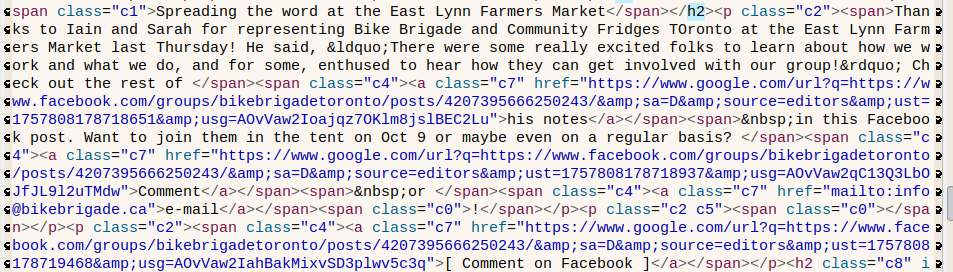
I finally got to spend a little time automating a new workflow. This time I exported the Google Doc as a zip that had the HTML file and all the images in a subdirectory. The HTML source is not very pleasant to work with. It has lots of extra markup I don't need. Here's what an entry looks like:

2025-09-17_09-22-35.png
Figure 1: Exported HTML for an entry

Things I wanted to do with the HTML:

  • Remove the google.com/url redirection for the links. Mailchimp will add its own redirection for click-tracking, but at least the links can look simpler when I paste them in.
  • Remove all the extra classes and styles.
  • Turn [ call to action ] into fancier Mailchimp buttons.

Also, instead of transforming one block at a time, I decided to make an Org Mode document with all the different blocks I needed. That way, I could copy and paste things in quick succession.

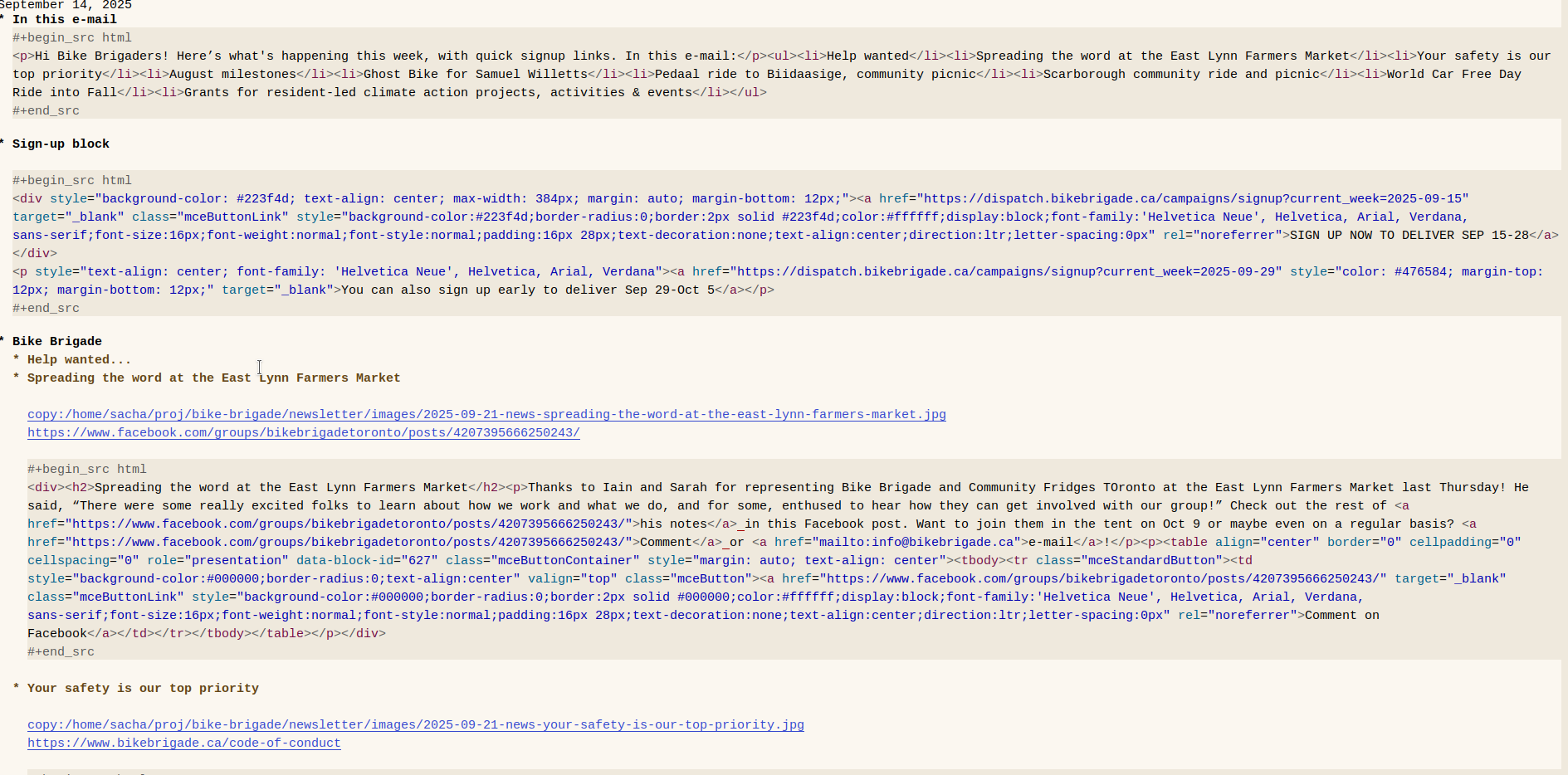
Here's what the result looks like. It makes a table of contents, adds the sign-up block, and adds the different links and blocks I need to paste into Mailchimp.

2025-09-17_10-03-27.png
Figure 2: Screenshot of newsletter Org file with blocks for easy copying

I need to copy and paste the image filenames into the upload dialog on Mailchimp, so I use my custom Org Mode link type for copying to the clipboard. For the HTML code, I use #+begin_src html ... #+end_src instead of #+begin_export html ... #+end_export so that I can use Embark and embark-org to quickly copy the contents of the source block. (That doesn't work for export blocks yet.) I have C-. bound to embark-act, the source block is detected by the functions that embark-org.el added to embark-target-finders, and the c binding in embark-org-src-block-map calls embark-org-copy-block-contents. So all I need to do is C-. c in a block to copy its contents.

Here's the code to process the newsletter draft
(defun my-brigade-process-latest-newsletter-draft (date)
  "Create an Org file with the HTML for different blocks."
  (interactive (list (if current-prefix-arg (org-read-date nil t nil "Date: ")
                       (org-read-date nil t "+Sun"))))
  (when (stringp date) (setq date (date-to-time date)))
  (let ((default-directory "~/Downloads/newsletter")
        file
        dom
        sections)
    (call-process "unzip" nil nil nil "-o" (my-latest-file "~/Downloads" "\\.zip$"))
    (setq file (my-latest-file default-directory))
    (with-temp-buffer
      (insert-file-contents-literally file)
      (goto-char (point-min))
      (setq dom (my-brigade-simplify-html (libxml-parse-html-region (point-min) (point-max))))
      (my-brigade-save-newsletter-images dom)
      (setq sections
            (my-html-group-by-tag
             'h1
             (dom-children
              (dom-by-tag
               dom 'body)))))
    (with-current-buffer (get-buffer-create "*newsletter*")
      (erase-buffer)
      (org-mode)
      (insert
       (format-time-string "%B %-e, %Y" date) "\n"
       "* In this e-mail\n#+begin_src html\n"
       "<p>Hi Bike Brigaders! Here’s what's happening this week, with quick signup links. In this e-mail:</p>"
       (replace-regexp-in-string
        "<li>" "\n<li>"
        (with-temp-buffer
          (svg-print
           (apply 'dom-node
                  'ul nil
                  (append
                   (my-brigade-toc-items (assoc-default "Bike Brigade" sections 'string=))
                   (my-brigade-toc-items (assoc-default "In our community" sections 'string=)))))
          (buffer-string)))
       "\n<br />\n"
       (my-brigade-copy-signup-block date)
       "\n#+end_src\n\n")
      (dolist (sec '("Bike Brigade" "In our community"))
        (insert "* " sec "\n"
                (mapconcat
                 (lambda (group)
                   (let* ((item (apply 'dom-node 'div nil
                                       (append
                                        (list (dom-node 'h2 nil (car group)))
                                        (cdr group))))
                          (image (my-brigade-image (car group))))
                     (format "** %s\n\n%s\n%s\n\n#+begin_src html\n%s\n#+end_src\n\n"
                             (car group)
                             (if image (org-link-make-string (concat "copy:" image)) "")
                             (or (my-html-last-link-href item) "")
                             (my-transform-html
                              (delq nil
                                    (list
                                     'my-transform-html-remove-images
                                     'my-transform-html-remove-italics
                                     'my-brigade-simplify-html
                                     'my-brigade-format-buttons
                                     (when (string= sec "In our community")
                                       'my-brigade-recolor-recursively)))
                              item))))
                 (my-html-group-by-tag 'h2 (cdr (assoc sec sections 'string=)))
                 "")))
      (insert "* Other updates\n"
              (format "#+begin_src html\n<h2>Other updates</h2>%s\n#+end_src\n\n"
                      (my-transform-html
                       '(my-transform-html-remove-images
                         my-transform-html-remove-italics
                         my-brigade-simplify-html)
                       (car (cdr (assoc "Other updates" sections 'string=))))))
      (goto-char (point-min))
      (display-buffer (current-buffer)))))

(defun my-brigade-toc-items (section-children)
  "Return a list of <li /> nodes."
  (mapcar
   (lambda (group)
     (let* ((text (dom-texts (cadr group)))
            (regexp (format "^%s \\([A-Za-z]+ [0-9]+\\)"
                            (regexp-opt '("Mon" "Tue" "Wed" "Thu" "Fri" "Sat" "Sun"))))
            (match (when (string-match regexp text) (match-string 1 text))))
       (dom-node 'li nil
                 (if match
                     (format "%s: %s" match (car group))
                   (car group)))))
   (my-html-group-by-tag 'h2 section-children)))

(defun my-html-group-by-tag (tag dom-list)
  "Use TAG to divide DOM-LIST into sections. Return an alist of (section . children)."
  (let (section-name current-section results)
    (dolist (node dom-list)
      (if (and (eq (dom-tag node) tag)
               (not (string= (string-trim (dom-texts node)) "")))
          (progn
            (when current-section
              (push (cons section-name (nreverse current-section))  results)
              (setq current-section nil))
            (setq section-name (string-trim (dom-texts node))))
        (when section-name
          (push node current-section))))
    (when current-section
      (push (cons section-name (reverse current-section))  results)
      (setq current-section nil))
    (nreverse results)))

(defun my-html-last-link-href (node)
  "Return the last link HREF in NODE."
  (dom-attr (car (last (dom-by-tag node 'a))) 'href))

(defun my-brigade-image (heading)
  "Find the latest image related to HEADING."
  (car
   (nreverse
    (directory-files my-brigade-newsletter-images-directory
                        t (regexp-quote (my-brigade-newsletter-heading-to-image-file-name heading))))))

Some of the functions it uses are in my config, particularly the section on Transforming HTML clipboard contents with Emacs to smooth out Mailchimp annoyances: dates, images, comments, colours.

Along the way, I learned that svg-print is a good way to turn document object models back into HTML.

When I saw two more events and one additional link that I wanted to include, I was glad I already had this code sorted out. It made it easy to paste the images and details into the Google Doc, reformat it slightly, and get the info through the process so that it ended up in the newsletter with a usefully-named image and correctly-coloured links.

I think this is a good combination of Google Docs for getting other people's feedback and letting them edit, and Org Mode for keeping myself sane as I turn it into whatever Mailchimp wants.

My next step for improving this workflow might be to check out other e-mail providers in case I can get Emacs to make the whole template. That way, I don't have to keep switching between applications and using the mouse to duplicate blocks and edit the code.

This is part of my Emacs configuration.

You can comment on Mastodon or e-mail me at sacha@sachachua.com.

17 Sep 17:47

Episode 509 Promo - The Canonization of Charlie Kirk

Tom Roche

note BF has a 25-min Kirk-focused excerpt their YouTube channel, but ... kinda shouty

Subscribe to Bad Faith on Patreon to instantly unlock this episode and our entire premium episode library: http://patreon.com/badfaithpodcast

Last week's assassination of right wing personality Charlie Kirk last week was a shock -- and so was the choice of many left and liberal media outlets to publish pieces that lauded the openly supremacist activist for his contribution to American political life. Ezra Klein wrote in The New York Times that Kirk was "practicing politics the right way." Rachel Cohen wrote in Vox that she was "sitting shiva" for a man she described as saying "blatantly antisemitic things," and Ben Burgis offered that at least Kirk "didn't descend into personal attacks." Briahna, who also debated Kirk, felt differently. She discusses the hagiography of Charlie Kirk with journalist Zaid Jilani and whether the left is troublingly indifferent to anti-Black racism if delivered "politely." Note that this episode was supposed to include a lengthy conversation about Matt Taibbi's refusal to cover censorship by right-leaning institutions, but, alas, the conversation didn't get that far. Fortunately, Brie has recorded a separate follow-up interview on that topic to be relased shortly -- stay tuned.

Subscribe to Bad Faith on YouTube for video of this episode. Find Bad Faith on Twitter (@badfaithpod) and Instagram (@badfaithpod).

Produced by Armand Aviram.

Theme by Nick Thorburn (@nickfromislands).

17 Sep 15:36

John Finnemore's Souvenir Programme: 2025 Special

Tom Roche

VERY EXCELLENT: consistently-very-funny sketch comedy (with some songs!) The Monty Python Tradition lives ...

2025's instalment of John Finnemore's Souvenir Programme is forty-five minutes of the funniest things John thought of in the last year, performed by John and his regular cast of Margaret Cabourn-Smith, Simon Kane, Lawry Lewin and Carrie Quinlan, with composer Susannah Pearse at the piano and Sally Stares on the cello.

Please note that listening to these sketches about seahorses, time travel and sirens may cause side effects, unless you're listening to the placebo version of the show.

Written and performed by … John Finnemore Ensemble … Margaret Cabourn-Smith Ensemble … Simon Kane Ensemble … Lawry Lewin Ensemble … Carrie Quinlan

Original music … Susannah Pearse Piano … Susannah Pearse Cello … Sally Stares

Recording … Jerry Peal & Jon Calver Editing … Rich Evans

Production Manager … Katie Baum Executive Producer … Richard Morris

Producer … Ed Morrish

John Finnemore’s Souvenir Programme is a BBC Studios Production for Radio 4.

14 Sep 21:10

The Fall of Philadelphia

by Jarrett
Tom Roche

pullquote:
> historian Steven Cohn’s book [Americans against the City](https://archive.org/details/americansagainst0000conn) [is] a history of anti-urbanism the explains how foundational hating cities has been to America’s sense of itself. None of which changes the fact that cities are engines of prosperity[.] Cities need more transit. Rural areas need more roads. Let’s let everyone pay for what they value.

The Pennsylvania State Senate has decided that the transit system of America’s fifth largest city should be substantially destroyed.  Similar dramas are playing out in Illinois, Oregon, and Rhode Island.  Each crisis has arisen from the state legislature’s refusal to find new funding to save public transit, but Pennsylvania is the first state to actually push its biggest transit agency over the cliff.

(Oregon will be next to decide, at a special legislative session in late August.  Look for action in Illinois later this fall.)

In the Philadelphia area, SEPTA is making a 20% service cut but will eventually have to cut service 45%.  Cutting almost half of a transit system is not a way to make it more efficient.  It more like asking whether you’d like to keep your heart or your lungs.  Back in 2018 our firm did a detailed study of the Philadelphia network, and while we found many things to improve, none of those things would save even 10%, even if there weren’t unmet needs on which any savings should be spent.

So this will be a disaster with far reaching consequences.  A city whose high density makes transit essential for the city’s functioning will soon not function very well.  Service cuts will push transit riders back into cars (either as drivers or as people being given rides) triggering increased congestion.  It will also cause people to lose jobs and opportunities due to lack of transportation.

From what I can tell, the Republican-controlled Pennsylvania State Senate seems to be motivated by pure cultural animus toward urban life.  One state representative has already replied with a proposal to return tax revenues to the county from which they came, to make the point that the rural counties are actually net recipients of government spending that is funded by urban -generated prosperity.

This raises one of the most insidious aspects of how many US states have constructed the powers of local governments.  Conservative state leaders appear to be nearly unanimous in their view that big cities should be prevented from governing themselves.  In particular, they are committed to denying local governments the freedom to ask their own voters to raise their own taxes to pay for things that they value.  The idea is to make city governments helpless while continuing to blame them for everything that goes wrong in cities.  It plays well in conservative media, but it’s not fair and it’s certainly not democracy.  When dense cities are not allowed to fund their services in a way that reflects their needs and values, it guarantees that the city will be a site of failure — failure that will be especially visible to the media because in dense cities everything is more visible.

A good backgrounder on this, which I’m reading now, is historian Steven Cohn’s book Americans against the City.  It’s a history of anti-urbanism the explains how foundational hating cities has been to America’s sense of itself.  None of which changes the fact that cities are engines of prosperity, and that to hate the city is to hate your own prosperity.

Cities need more transit.  Rural areas need more roads.  Let’s let everyone pay for what they value.

The post The Fall of Philadelphia appeared first on Human Transit.

13 Sep 21:45

9/10/25: Trump Responds To Israel Qatar Strike, Saagar Breaks Down Full Epstein Book

Tom Roche

One of the most /consistently/ EXCELLENT BPs in recent weeks (certainly of the non-Grim-BPs), makes (though doesn't spend enough time developing) the connection between

- Israel cucks Trump by (et many al) bombing Qatar
- Trump (et many al) appears in the [very-sick 2003 superfriends' Birthday Book for Jeffrey Epstein](https://www.youtube.com/watch?v=CgcsnQIwhik)

Emily and Saagar discuss Trump responds to Israel Qatar strike, Saagar breaks down full Epstein book.


To become a Breaking Points Premium Member and watch/listen to the show AD FREE, uncut and 1 hour early visit: www.breakingpoints.com

Merch Store: https://shop.breakingpoints.com/

See omnystudio.com/listener for privacy information.

13 Sep 20:03

The Robo-Therapist Will See You Now (with Maggie Harrison Dupré), 2025.08.18

Talking to chatbots can have serious mental health consequences — fueling delusions and leading users away from consensus reality. Futurism writer Maggie Harrison Dupré joins us to unpack the hype around AI therapists, based on her groundbreaking reporting on "AI psychosis."

Maggie Harrison Dupré is an award-winning tech journalist at Futurism who’s reported extensively on the rise of AI as a cultural and business force shaping media, information, humans, and our real and digital lives.


References:

How AI Is Expanding The Mental Health Market

He Had Dangerous Delusions. ChatGPT Admitted It Made Them Worse.

OpenAI: What we're optimizing ChatGPT for


Also referenced:

Gov Pritzker Signs Legislation Prohibiting AI Therapy in Illinois

People Are Becoming Obsessed with ChatGPT and Spiraling Into Severe Delusions

Stanford: New study warns of risks in AI mental health tools


Fresh AI Hell:

Bluesky post about DEI by chatbot

How AI is being used by police departments to help draft reports

Politico's recent AI experiments shouldn’t be subject to newsroom editorial standards, its editors testify

UK Asks People to Delete Emails In Order to Save Water During Drought

Sam Altman says 'yes,' AI is in a bubble

Google's AI pointed him to a customer service number. It was a scam.

Mastodon post about Dieter Roth's Literaturwürste

Check out future streams on Twitch. Meanwhile, send us any AI Hell you see.

Find our book The AI Con here, and MAIHT3k merch here.

Subscribe to our newsletter via Buttondown.

Follow us!

Emily

Alex

Music by Toby Menon.
Artwork by Naomi Pleasure-Park
Production by Ozzy Llinas Goodman.

13 Sep 03:55

Kirk Coverage Downplayed MAGA’s Culture of Violence

by Ari Paul
Tom Roche

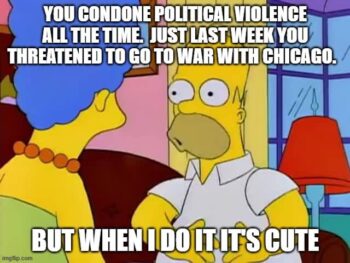
pullquote: /Simpsons/ meme from /Rancho Relaxo/:
> [Marge to Homer:] 'You condone political violence all the time. Just last week, you threatened to go to war with Chicago.' [Homer responds:] 'But when I do it, it's cute!'

Atlantic: Political Violence Could Devour Us All

The Atlantic‘s Graeme Wood (9/11/25) expressed doubt that “this disgusting scene of high-definition murder…will restore the moral senses of all those who have hitherto been casually pro-violence.”

The assassination of far-right podcaster and political activist Charlie Kirk in Utah was truly shocking in every sense. It happened in the open, at a college campus in broad daylight with 3,000 onlookers. Graphic and close-up video footage of his final moment, showing a bullet placed precisely at his carotid artery at the very second Kirk was questioned about mass shootings, seemed out of a movie. The man who once said gun deaths were worth the price of the Second Amendment (Newsweek, 4/6/23) became an illustration of what that price looks like before our eyes.

Flags at half mast. A moment of silence at Yankee Stadium. The vice president skipped a 9/11 memorial event to be with Kirk’s family (USA Today, 9/11/25), and Kirk’s body was transported back to his home state on the vice president’s aircraft (CBS, 9/11/25). He was no mere pundit or activist, but a valued capo in the Trump political machine.

“Charlie Kirk’s murder was one of the worst moments in recent American history,” read the subhead of an Atlantic piece (9/11/25) by Graeme Wood. (It was apparently much worse than US support for killing thousands of children in Gaza, about which Wood shrugged, “war is ugly,” arguing that it’s “possible to kill children legally”—Atlantic, 5/17/24.)

Wood was not alone in the press, as much of the coverage has framed the murder as a moment where the United States crossed the Rubicon when it comes to political violence. While Kirk’s murder was bad news for democracy—as no one ever deserves to be killed for their speech—the media reaction glossed over the role that President Donald Trump and his Make America Great Again movement, and Kirk himself, as a prominent supporter of that movement, have helped to legitimize the kind of political violence that Kirk apparently fell victim to.

‘Epidemic of leftist violence’

NY Post: Charlie Kirk’s assassination is latest evidence that US is suffering an epidemic of leftist violence

The assassination of Minnesota lawmaker Melissa Hortman in June 2025 was one of several right-wing attacks that New York Post columnist Miranda Divine (9/11/25) ignored in order to claim that “political violence is almost exclusively from the left.”

The right-wing press, as expected, has whipped itself into a frenzy over a wave of domestic terrorism that is only coming from the left, though the motives of the killer at the time were unknown. “We are suffering through an epidemic of leftist violence,” said Miranda Divine of the New York Post (9/11/25), adding that Kirk’s killing is “the latest manifestation of the hateful rhetoric aimed at President Trump and his MAGA movement.”

President Trump has fanned the flames. As the New Yorker (9/11/25) noted:

Trump denounced his perceived enemies. “For years, those on the radical left have compared wonderful Americans like Charlie to Nazis and the world’s worst mass murderers and criminals,” he said, and vowed to find those he deemed responsible for “political violence, including the organizations that fund it and support it.”… Trump made no gesture toward common national feeling; he limited his litany of victims to those with whom he is aligned.

Elsewhere, coverage didn’t blame the left, but did suggest that Kirk’s killing had brought US society to an inflection point. The New York Times (9/11/25) said that before Kirk’s killing, “there were signs of a looming political crisis” and increased “polarization and the coarsening of public discourse.” While there have been other acts of political violence, reporters Richard Fausset, Ken Bensinger and Alan Feuer wrote, the “killing of Mr. Kirk on a Utah college campus…raises the possibility that the country has entered an even more perilous phase.”

The Times quoted Newt Gingrich, the former Republican speaker of the House of Representatives, saying “I think that you have a cultural civil war underway.” (Gingrich has been waging cultural civil war for a long time now; in 1990, he put out a memo urging Republican candidates to tar their opponents with words like “sick…pathetic…traitors”—Extra! Update, 2/95).

The Washington Post editorial board (9/10/25) noted, while listing off other instances of political violence:

Months before Charlie Kirk was shot and killed, the conservative activist warned about the spread of “assassination culture.” He cited the attempt on President Donald Trump’s life, as well as the killing of a healthcare CEO. And now it seems all too likely that he himself became a victim of that violent fervor while speaking on Wednesday at Utah Valley University.

The Post’s news side featured a report (9/11/25) claiming that the nation is “facing a new era of political violence reminiscent of some of its most bitter, tumultuous eras, including the 1960s.” The paper summoned memories of the “assassinations of President John F. Kennedy, Sen. Robert F. Kennedy and the Rev. Martin Luther King Jr.”

CNN’s Stephen Collinson (9/10/25) said Kirk’s murder “will unleash unknown consequences in a nation that is angry and already confronting a fractured political future.”

‘More frequent and deadly’

Truth Social: Chicago about to find out why it's called the Department of WAR

Donald Trump posted an image of himself as an Apocalypse Now character as he declared war on Chicago.

Most of these pieces rightly situated Kirk’s murder with other acts of political violence that targeted both Democrats and Republicans. But what these pieces miss—or actively try to hide—is how much this dangerous era escalated when Trump came into the White House. The president and his allies in right-wing media not only provided the rhetoric that inspired an enormous amount of political violence, but worked actively to normalize it.

From Trump’s calls for violence against protesters who disrupted his rallies (FAIR.org, 3/12/16) to official presidential social media posts depicting Trump as Robert Duvall’s napalm-loving colonel from Apocalypse Now, MAGA is a political agenda that celebrates violence (FAIR.org, 11/1/19).

PBS’s Frontline (4/21/21) reported:

“We’ve seen a rising tide of attacks by far-right extremists in recent years,” Seamus Hughes, deputy director of the Program on Extremism at George Washington University, told Frontline. “The threat is coming from a host of ideologies, from white supremacists to incels, to everything in between. Unfortunately, the attacks are becoming both more frequent and deadly.”

To track that change, Frontline analyzed data from the Center for Strategic and International Studies. CSIS defines terrorism as the “deliberate use—or threat— of violence by non-state actors in order to achieve political goals and create a broad psychological impact,” a similar definition to the one used by the FBI.

According to a CSIS database, there were 405 such terror attacks or plots in the US from 2015 through 2020—more than double the total number in the previous decade. And in the last five years, those attacks or plots were predominantly carried out by white supremacists, militias and other far-right extremists: 63% and increasing. Far-left incidents are also on the rise but made up a smaller portion of the whole, 13% from 2015 to 2020, according to Frontline’s analysis. Religious extremists accounted for 19%, with the remaining 5% linked to “ethnonationalist” or “other” ideologies, per CSIS categorizations.

Marge Simpson: You condone political violence all the time. Just last week you threatened to go to war with Chicago.Homer Simpson: But when I do it it's cute.

Meme from Rancho Relaxo.

Political violence is of course nothing new in American culture; deadly extremism, coming mainly though not exclusively from the right, was rampant both before (Extra!, 3–4/95, 7–8/95; Extra! Update, 10/96) and after September 11, 2001 (FAIR.org, 4/16/13, 6/13/14). But MAGA has moved what was once far-right rhetoric and tactics to the center of the US right. As the Brookings Institution (3/12/21) pointed out, many right-wing tactics of the Trump era were pioneered by self-styled militia groups that have operated along the US’s southern border since the 1980s:

Many of the right-wing armed groups’ tactics exhibited during Trump’s presidency—harassment of minorities, purposeful recruitment of military veterans, cultivation of allies in law enforcement forces and among politicians, and efforts to influence elections—had years of beta testing at the US/Mexico border.

Five years ago, the Guardian (3/18/20) also painted a frightening picture:

White nationalist hate groups in the US have increased 55% throughout the Trump era, according to a new report by the Southern Poverty Law Center (SPLC), and a “surging” racist movement continues to be driven by “a deep fear of demographic change.” Nationally, there were 155 such groups counted last year, and they were present in most states. These groups were counted separately from Ku Klux Klan groups, racist skinheads, Christian Identity groups and neo-Confederate groups, all of which also express some version of white supremacist beliefs.

‘Bring a gun with you’

NYT: Charlie Kirk Was Practicing Politics the Right Way

The New York Times‘ Ezra Klein (9/11/25) wrote admiringly of Kirk’s “moxie and fearlessness.”

Charlie Kirk was a central actor in the right-wing hate machine that fomented violence. He encouraged violence against immigrants (Media Matters, 3/22/24):

At what point is it time to start to at least use rubber bullets, or use some sort of tear gas, to prevent this and quell this invasion?… And at what point do we use real force?. . . Of course you should be able to use whips against foreigners that are coming into your country. Why is that controversial?

He incited partisan division and hatred, and encouraged the purchase and use of weapons in that context (Media Matters, 10/12/23):

You have a government that hates you, you have a traitor as the president. Buy weapons, I keep on saying that. Buy weapons. Buy ammo. if you go into a public place, bring a gun with you…. Thank goodness in Arizona we can carry, and we carry.

Where the New York Times (9/10/25) saw “a charismatic right-wing activist” who “showed a genius for using social media and campus organizing,” those who found themselves targets of Kirk’s “genius” saw something entirely different.

Kirk’s “Professor Watchlist” doxxed academics Kirk claimed “advanced leftist propaganda”; those listed quickly found themselves and their universities subject to a torrent of abuse—including racial slurs and death threats—from Kirk’s followers, at times requiring universities to offer those academics extra security. Journalism professor Stacey Patton, who experienced this harassment firsthand when she was put on the list in 2024, observed:

Kirk’s Watchlist has terrorized legions of professors across this country. Women, Black faculty, queer scholars, basically anyone who challenged white supremacy, gun culture, or Christian nationalism suddenly found themselves targets of coordinated abuse.

This is the activism that the New York Times‘ Ezra Klein (9/11/25) described as “practicing politics in exactly the right way”:

He was showing up to campuses and talking with anyone who would talk to him. He was one of the era’s most effective practitioners of persuasion…. A taste for disagreement is a virtue in a democracy. Liberalism could use more of his moxie and fearlessness.

‘Throbbing middle finger to God’

Charlie Kirk denouncing trans people

Charlie Kirk (X, 9/11/23): ““The one issue that I think is so against our senses, so against the natural law, and dare I say a throbbing middle finger to God is the transgender thing happening in America.”

Kirk referred to LGBTQ identity as a “social contagion,” and called trans people an “abomination” and a “throbbing middle finger to God” (Erin in the Morning, 9/11/23).

He said that Black women like Joy Reid, Michelle Obama, Sheila Jackson Lee and Ketanji Brown Jackson “had to go steal a white person’s slot” through affirmative action, because they “do not have the brain processing power to otherwise be taken really seriously.” “We made a huge mistake when we passed the Civil Rights Act in the 1960s,” he declared (Wired, 1/12/24).

Upon Zohran Mamdani’s victory in the New York City mayoral primary, Kirk posted: “Twenty-four years ago, a group of Muslims killed 2,753 people on 9/11. Now a Muslim socialist is on pace to run New York City.” “When we think of what it means to be an American, is [it] someone by the name of Islami Mohamed?” he remarked on another occasion (Media Matters, 8/19/25): “I don’t think so.”

“You cannot have liberty if you do not have a Christian population,” Kirk insisted (Religion News, 1/7/25). He also claimed (Media Matters, 8/19/25) that “the philosophical foundation of anti-whiteness has been largely financed by Jewish donors in the country.”

‘Disgracefully ill-timed’

Guardian: MSNBC fires analyst Matthew Dowd over Charlie Kirk shooting remarks

MSNBC‘s Rebecca Cutler said it was ““inappropriate, insensitive and unacceptable” to connect Kirk’s murder to his hate speech (Guardian, 9/11/25).

In the wake of Kirk’s murder, it was taboo to point out that his politics, and those of the MAGA movement he embraced, contributed to a culture of hatred and demonization. MSNBC pundit Matthew Dowd was promptly fired by the cable network after he observed:

Hateful thoughts lead to hateful words, which then lead to hateful actions…. You can’t stop with these sort of awful thoughts you have and then saying these awful words and then not expect awful actions to take place.

When Illinois Gov. JB Pritzker, in condemning violence, remarked that “I think the president’s rhetoric often foments it,” the Washington Post (9/10/25) editorialized that this was “a disgracefully ill-timed comment.”

In fact, there is no better time to point out that the right-wing movement Kirk was a crucial part of has played the leading role in dehumanizing others and normalizing violence. Failure to honestly examine the politics that are driving extremism will steer us away from the kind of analysis and action that are needed to prevent more tragedies.


Research assistance: Caitlin Scialla

12 Sep 23:01

The News Quiz: Ep 1. Flags out, stamp duty. Stamped out, off duty.

Tom Roche

The world /might/ be going to hell, but at least /The News Quiz/ is back for season#=118, and Andrew Maxwell is excellent as usual

Andy Zaltzman is joined by Alasdair Beckett-King, Andrew Maxwell, Lucy Porter and Coco Khan to break down the week in news. Topics include Angela Rayner skipping out on stamp duty, Xi Jinping's summit, the decline in cement, a new leader for the Green Party, and the rapid multiplication of St George's flags. Written by Andy Zaltzman. With additional material by: Rebecca Bain, Milo Edwards, Ruth Husko and Mike Shephard. Producer: Rajiv Karia Executive Producer: Richard Morris Production Coordinator: Jodie Charman Sound Editor: Marc Willcox A BBC Studios Production for Radio 4

12 Sep 02:41

Treatyof Versailles 11: Ataturk wins again

Tom Roche

Justin and (mostly) Dave excellent as usual

Details of how Ataturk foiled the imperialists’ final plans to partition Anatolia. Once he secured Turkey, he modernized it and it became a model that other Central Asian countries tried to emulate (with varying degrees of success). Here’s why this secular leader is still revered in Turkey a century later.
11 Sep 16:04

967 - Whitehat feat. Derek Davison (9/8/25)

Tom Roche

excellent

Chapo Senior Foreign Policy correspondent Derek Davison is back once again to talk about the escalating possibility of war in Venezuela. We discuss the recent strike on a Venezuelan boat by Trump and his newly-Christened Department of War, a botched raid into North Korea, our collapsing relationship with India, China’s SCO summit with Russia, and conflict on the Thai-Cambodia border. Plus: a Matt Christman prediction comes true… Find all of Derek’s foreign policy coverage at: www.foreignexchanges.news www.americanprestigepod.com
08 Sep 20:54

Germans against Stickers (feat. Michael Sappir)

by The Späti Boys
Tom Roche

EXCELLENT exploration of Antideutsch scheiß. See the actual stickers in [Sappir's /Diasporist/ article](https://thediasporist.de/stickers-against-germany/) (archived [here](https://archive.today/2udPt))

07 Sep 17:14

Episode 495 Promo - The Epstein-Trump-Israel Connection Unpacked (w/ Whitney Webb)

Tom Roche

note: as of 7 Sep 2025, this ep is unlocked on YouTube (so why not here/audio?)

Subscribe to Bad Faith on Patreon to instantly unlock this episode and our entire premium episode library: http://patreon.com/badfaithpodcast

Independent investigative journalist and author of One Nation Under Blackmail: The Sordid Union between Intelligence & Crime That Gave Rise to Jeffrey Epstein Whitney Webb returns to Bad Faith to weigh in on Donald Trump's unwillingness to release the Epstein files and the connection between Trump, Epstein, Israeli intelligence, and America's unwillingness to break from Israel as it escalates its genocide in Palestine. Webb clarifies that Epstein provided secret info to the FBI in 2008 as part of his plea deal, making him an informant (as was Trump-booster Peter Thiel) and connects the dots among key players. She also unpacks her new bombshell reporting on Italy's Donald Trump Flavio Briatore, his connection to Epstein benefactor & Victoria's Secret owner Les Wexner, & offers evidence that Trump may be a material witness to Epstein's sex crimes.

Subscribe to Bad Faith on YouTube for video of this episode. Find Bad Faith on Twitter (@badfaithpod) and Instagram (@badfaithpod).

06 Sep 19:31

Hugo van Kemenade: Ready prek go!

Tom Roche

pullquote:
> using [prek](https://prek.j178.dev/) recently as a drop-in replacement for [pre-commit](https://pre-commit.com/) [for managing and maintaining multi-language pre-commit hooks]

I’ve been using prek recently as a drop-in replacement for pre-commit.

It uses uv for managing Python virtual environments and dependencies, is rewritten in Rust (because of course) and uses the same .pre-commit-config.yaml as pre-commit.

Its homepage says it’s not yet production ready, but several projects like Apache Airflow and PDM are already using it. I’ve been using it for a while and reporting issues as I find them; the maintainer is quick with fixes and releases. All the hooks I need are now supported.

Getting started #

First install using one of the many methods, then:

cd my-repo
pre-commit uninstall # remove the old hooks
prek install # install the new hooks
prek run --all-files # run all lints on all files
git commit -m "my commit" # run on the changed files in a commit

Benchmarks #

prek is noticeably quicker at installing hooks.

  • ⚡ About 10x faster than pre-commit and uses only a third of disk space.

This 10x is a comparison of installing hooks using the excellent hyperfine benchmarking tool.

Here’s my own comparison.

  • In the first test, I initially ran pre-commit clean or prek clean to clear their caches. I then ran each tool with run --all-files in serial on the 126 repos I have cloned right now, 84 of which have a .pre-commit-config.yaml file. Each then downloads and installs the hooks when needed, then runs the lint tools.

  • Second, because running the lint tools should be independent and constant time for both tools, the next test ran install-hooks instead of run --all files.

    To get an idea of the amount of work for these two tests, pre-commit reported initialising environments 217 times.

  • Finally, let’s run hyperfine on the Pillow config, which installs hooks from 14 repos:

❯ hyperfine \
--prepare 'rm -rf ~/.cache/prek/ && rm -rf ~/.cache/pre-commit && rm -rf ~/.cache/uv' \
--setup 'prek --version && pre-commit --version' \
'prek install-hooks' \
'pre-commit install-hooks'

Results #

pre-commit prek Times faster
run --all-files 17m13s 7m59s 2.16
install-hooks 10m48s 2m24s 4.50
hyperfine 39.841s 5.539s 7.19

The hyperfine results:

Benchmark 1: prek install-hooks
 Time (mean ± σ): 5.539 s ± 0.176 s [User: 8.973 s, System: 5.692 s]
 Range (min … max): 5.231 s … 5.834 s 10 runs

Benchmark 2: pre-commit install-hooks
 Time (mean ± σ): 39.841 s ± 2.017 s [User: 19.760 s, System: 8.203 s]
 Range (min … max): 36.930 s … 43.976 s 10 runs

Summary
 prek install-hooks ran
 7.19 ± 0.43 times faster than pre-commit install-hooks

Give it a try and give it a !

Bonus #

These are the aliases I have set for pre-commit and prek:

alias pci="pre-commit install --allow-missing-config"
alias pcu="pre-commit uninstall"
alias pca="pre-commit autoupdate --jobs 0"
alias pcr="pre-commit run --all-files"
alias pki="prek install --allow-missing-config"
alias pku="prek uninstall"
alias pka="prek autoupdate --jobs 0"
alias pkr="prek run --all-files"

Where:

  • install’s --allow-missing-config prevents failing with an error code when a repo has no config file
  • autoupdate’s --jobs 0 uses all the available threads to make it faster

Header photo: AH-1G Aircraft Maintenance Test Flight Handbook and handwritten checklist for helicopters in the San Diego Air and Space Museum Archive, with no known copyright restrictions.

05 Sep 22:31

Why No Military Intervention Against Israel? Hypocrisy of ‘Responsibility to Protect’

Tom Roche

VERY EXCELLENT

The Western elite once claimed ignorance during the Holocaust. Today, Israel’s genocide in Gaza unfolds in full view, yet nothing is done. The most powerful states arm the perpetrator while the “Responsibility to Protect” doctrine they have long celebrated is now ignored, except where it continues to serve the U.S. empire.

Historian Tarik Cyril Amar joins Rania Khalek to discuss the hypocrisy of R2P, why no coalition has formed to intervene, the weaponization of Holocaust memory, Europe’s empty gestures on Palestinian statehood, and the complicity of Western media in genocide. You can follow his work at https://www.tarikcyrilamar.com/ and his weekly analysis of world events at Syriana Analysis. 

Listen to the full episode of this program and support independent media: https://www.patreon.com/BreakthroughNews