Shared posts

02 Dec 19:44

Democracy Now! 2020-12-02 Wednesday

Tom Roche

note the 3rd segment on the new Malcolm X biography by (deceased) Les Payne and (daughter/interviewee) Tamara Payne is part 1, with promised part 2 via web-exclusive

Democracy Now! 2020-12-02 Wednesday

  • Headlines for December 02, 2020
  • Where Are the Progressives? Briahna Joy Gray on Neera Tanden & Other Biden Picks for Economic Team
  • The New Goldman Sachs? BlackRock Sees Clout Growing as Biden Taps Two Execs to Top Economic Posts
  • "The Dead Are Arising": New Biography on Malcolm X's Childhood, Killing & Secret Meeting with KKK

Download this show

02 Dec 19:42

Democracy Now! 2020-11-27 Friday

Tom Roche

rerun

Democracy Now! 2020-11-27 Friday

  • Four Days in Occupied Western Sahara — A Rare Look Inside Africa's Last Colony as Ceasefire Ends

Download this show

01 Dec 19:42

Podcast Ep 25: The Muslim Zionists

by Nora Barrows-Friedman

Steven Salaita and Ali Abunimah discuss Emgage, faithwashing and what is needed for principled action for Palestine.

01 Dec 19:42

Podcast Ep 26: Why Labour won't deliver socialism

by Nora Barrows-Friedman

The Labour Party is over, says former MP Chris Williamson.

30 Nov 16:17

Dig: Anti-Populism with Thomas Frank

by Jacobin magazine
Tom Roche

very excellent (esp since Frank less rambling/digressive than usual)

Guest host Astra Taylor interviews Thomas Frank about his book The People, No: A Brief History of Anti-Populism.

29 Nov 19:05

New studies confirm weakening of the Gulf Stream circulation (AMOC)

by stefan
Tom Roche

indirectly links to large infographic title="Nine ‘tipping points’ that could be triggered by climate change" @ https://tomprater.github.io/tipping-points/

Many of the earlier predictions of climate research have now become reality. The world is getting warmer, sea levels are rising faster and faster, and more frequent heat waves, extreme rainfall, devastating wildfires and more severe tropical storms are affecting many millions of people. Now there is growing evidence that another climate forecast is already coming true: the Gulf Stream system in the Atlantic is apparently weakening, with consequences for Europe too.

The gigantic overturning circulation of the Atlantic water (dubbed AMOC) moves almost 20 million cubic meters of water per second – almost a hundred times the Amazon flow. Warm surface water flows to the north and returns to the south as a cold deep current. This means an enormous heat transport – more than a million gigawatts, almost one hundred times the energy consumption of mankind. This heat is released into the air in the northern Atlantic and has a lasting effect on our climate.

But since the 1980s, climate researchers have been warning of a weakening or even a cessation of this flow as a result of global warming. In 1987, the famous US oceanographer Wally Broecker titled an article in the scientific journal Nature “Unpleasant surprises in the greenhouse”. Even Hollywood took up the subject in 2004 in the film “The Day After Tomorrow” by the German director Roland Emmerich. However, there were no measurement data that could prove an ongoing slowdown.

Only since 2004 has there been continuous monitoring at 26°N in the Atlantic (RAPID project). Although the data show a weakening of the current system, the measurement series is still too short to distinguish a possible climate trend from decadal variability. For the longer-term development of the Gulf Stream system, we must therefore rely on indirect evidence.

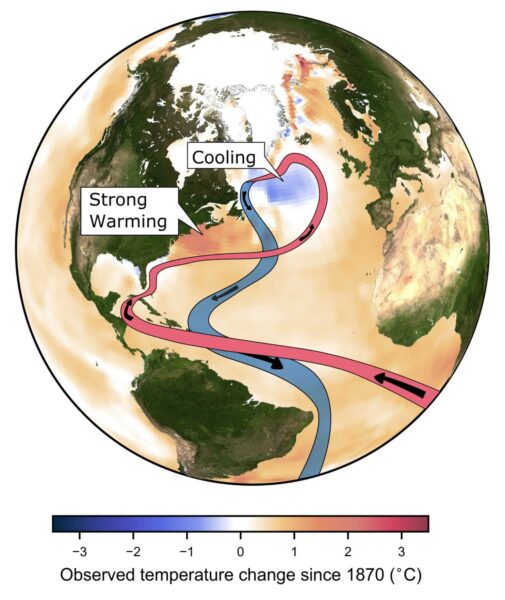
A long-term AMOC weakening should lead to a cooling in the northern Atlantic. Such a regional cooling in the middle of global warming has been predicted by climate models for a long time. And indeed, the evaluation of data on sea surface temperatures shows that the northern Atlantic is the only region of the world that has escaped global warming and has even cooled down since the 19th century (see graph). In addition, one can see a particularly strong warming off the North American coast, which according to model simulations is part of the characteristic “fingerprint” of a weakening of the Gulf Stream circulation.

Diagram of the Gulf Stream system with the warm surface current and the cold deep current. The actual Gulf Stream off the US coast is a part of this more comprehensive circulation system. The color shading shows the measured temperature trend since the late 19th century. This diagram is based on Caesar et al., Nature 2018 and first appeared in the Washington Post.

This fingerprint is regarded as important evidence, and not least because of this, the Intergovernmental Panel on Climate Change (IPCC) stated for the first time a year ago in the Summary for Policy Makers of its Special Report on the Oceans:

 “Observations, both in situ (2004–2017) and based on sea surface temperature reconstructions, indicate that the Atlantic Meridional Overturning Circulation (AMOC) has weakened relative to 1850–1900.”

New studies support long-term weakening

Two new studies now provide further independent evidence of this weakening. In August a paper by Christopher Piecuch of the Woods Hole Oceanographic Institution on the Florida Current – the part of the Gulf Stream system along the Florida coast – was published. Although continuous measurements of the current have only been available since 1982, Piecuch was able to reconstruct the strength of the Florida Current over the last 110 years from measurements of the sea level difference between the two sides of the current. To do so, he used 46 tide gauge stations in Florida and the Caribbean as well as a simple physical principle: the Coriolis force deflects currents in the northern hemisphere to the right, so that the water on the right side of a current stands higher than on the left. The stronger the current, the greater the difference in sea level. Comparison with measurements since 1982 shows that the method works reliably.

The result: the Florida current has weakened significantly since 1909 and in the last twenty years has probably been as weak as never before. Piecuch’s calculations also show that the resulting reduction of heat transport is sufficient to explain the ‘cold blob’ in the northern Atlantic.

This Monday, in Nature Climate Change a further study appeared, of researchers of Peking University and Ohio State University (Chenyu Zhu and Zhengyu Liu). For the first time, their paper provides evidence for an AMOC slowdown based on data from outside the North Atlantic. Model simulations show that a weakening of the AMOC leads to an accumulation of salt in the subtropical South Atlantic. This is due to the fact that strong evaporation in this region constantly increases the salinity, while the upper branch of the ocean circulation drains the salty water northwards, continually bringing in less salty water from the south. When this current weakens, the water in this region becomes saltier. This is exactly what the measured data show, in accordance with computer simulations. The authors speak of a “salinity fingerprint” of the weakening Atlantic circulation.

Video animation of ocean currents in the CM2.6 climate model of the Geophysical Fluid Dynamics Lab in Princeton:

In addition to these oceanographic measurements, a number of studies with sediment data indicate that the Gulf Stream circulation is now weaker than it has been for at least a millennium.

These current changes also affect Europe, because the ‘cold blob’ out in the Atlantic also influences the weather. It sounds paradoxical when you think of the shock frost scenario of the Hollywood blockbuster The Day After Tomorrow: but British researchers found that in summer the jet stream in the atmosphere likes to take a route around the south side of the cold blob – this then brings warm winds from the southwest into Europe, leading to heat waves there, as in the summer of 2015. Another study found a decrease in summer precipitation in northern Europe and stronger winter storms. What exactly the further consequences will be is the subject of current research.

However, the latest generation (CMIP6) of climate models shows one thing: if we continue to heat up our planet, the AMOC will weaken further – by 34 to 45% by 2100. This could bring us dangerously close to the tipping point at which the flow becomes unstable.

This article appeared originally in German in Der Spiegel: Das Golfstromsystem macht schlapp

29 Nov 18:33

How Obama shattered any hope for change - and Biden will continue his warmongering neoliberal legacy

Tom Roche

excellent

US president-elect Joe Biden has filled his transition team with hawkish neoliberal war-profiteering holdovers from the Barack Obama administration. Max Blumenthal and Ben Norton speak with Ali Abunimah of the Electronic Intifada about how the specter of Obama haunts America - and controls the Democratic Party.

We review passages from Obama's new memoir "A Promised Land," and how they expose his sociopathic imperial worldview. We also discuss how Rahm Emanuel's neoliberal model in Chicago is being copied nationwide.

And we address Biden's cabinet picks, including liberal interventionist Antony Blinken and neocon Michele Flournoy, as well as Democratic support for Israeli apartheid.

Links and show notes: moderaterebels.com/obama-biden-warmongering-neoliberal

Part 1 of 2

(Episode recorded November 25, 2020)

29 Nov 18:24

Thinking, small and big

by rasmus
Tom Roche

NOTE: regional modeling, downscaling, and the importance of statistics as CORDEX (COordinated Regional Downscaling EXperiment) from the pre-2021 WCRP (World Climate Research Program) becomesRifS (Regional information for society) in the 'relaunched' WCRP

The point that climate downscaling must pay attention to the law of small numbers is no joke.

The World Climate Research Programme (WCRP) will become a ‘new’ WCRP with a “soft launch” in 2021. This is quite a big story since it coordinates much of the research and the substance on which the Intergovernmental Panel on Climate Change (IPCC) builds.  


Until now, the COordinated Regional Downscaling EXperiment (CORDEX) has been a major project sponsored by the WRCP. CORDEX has involved regional modelling and downscaling with a focus on the models and methods rather than providing climate services. In its new form, the activities that used to be carried out within CORDEX will belong to the WCRP community called ‘Regional information for society’ (RifS). This implies a slight shift in emphasis.


With this change, the WCRP signals a desire for the regional modelling results to become more useful and relevant for decision-makers. The change will also introduce a set of new requirements, and hence the law of small numbers.


The law of small numbers is described in Daniel Kahneman’s book ‘Thinking, fast and slow‘ and is a condition that can be explained by statistical theory. It says that you are likely to draw a misleading conclusion if your sample is small.  


I’m no statistician, but a physicist who experienced a “statistical revelation” about a decade ago. Physics-based disciplines, such as meteorology, often approach a problem from a different angle to the statisticians, and there are often some gaps in the understanding and appreciation between the two communities.


A physicist would say that if we know one side of an equation, then we also know the other side. The statistician, on the other hand, would use data to prove there is an equation in the first place.


One of the key pillars of statistics is that we have a random sample that represents what we want to study. We have no such statistical samples for future climate outlooks, but we do have ensembles of simulations representing future projections.


We also have to keep in mind that regional climate behaves differently to global climate. There are pronounced stochastic variations on regional and decadal scales that may swamp the long-term trends due to greenhouse gases (Deser et al., 2012). These variations are subdued on a global scale since opposite variations over different regions tend to cancel each other.


CORDEX has in the past produced ensembles that can be considered as small, and Mezghani et al., (2019) demonstrated that the Euro-CORDEX ensemble is affected by the law of small numbers.

Even if you have a perfect global climate model and perfect downscaling, you risk getting misleading results with a small ensemble, thanks to the law of small numbers. The regional variations are non-deterministic due to the chaotic nature of the atmospheric circulation.


My take-home-message is that there is a need for sufficiently large ensembles of downscaled results. Furthermore, it is the number of different simulations with global climate models that is key since they provide boundary conditions for the downscaling.


Hence, there is a need for a strong and continued coordination between the downscaling groups so that more scientists contribute to building such ensembles.


Also, while CORDEX has been strong on regional climate modelling, the new RifS community needs additional new expertise. Perhaps a stronger presence of statisticians is a good thing. And while the downscaled results from large ensembles can provide a basis for a risk analysis, there is also another way to provide regional information for society: stress-testing.

References

  1. C. Deser, R. Knutti, S. Solomon, and A.S. Phillips, "Communication of the role of natural variability in future North American climate", Nature Climate Change, vol. 2, pp. 775-779, 2012. http://dx.doi.org/10.1038/nclimate1562
  2. A. Mezghani, A. Dobler, R. Benestad, J.E. Haugen, K.M. Parding, M. Piniewski, and Z.W. Kundzewicz, "Subsampling Impact on the Climate Change Signal over Poland Based on Simulations from Statistical and Dynamical Downscaling", Journal of Applied Meteorology and Climatology, vol. 58, pp. 1061-1078, 2019. http://dx.doi.org/10.1175/JAMC-D-18-0179.1
29 Nov 16:15

NYT Wants to Talk About Higher Wages, but Doesn’t Want to Talk About the Real Reasons Wages are Low

by Dean Baker
Tom Roche

pullquote:
> rising profit share only explains about 10 percent of the gap between [US] productivity growth and the median wage since 1979. The overwhelming majority of the gap is explained by rising high end wages — the money earned by CEOs and other top execs, high pay in the financial sector, the earnings of some workers in STEM areas, and high-end professionals, like doctors and dentists. [But] the NYT never wants to talk about the laws and structures that allow for the explosion of pay at the top. This would include factors like our corrupt corporate governance structure that essentially lets CEOs determine their own pay, a bloated financial sector that uses its political power to steer ever more money in its direction, longer and stronger patent and copyright monopolies, and protectionist barriers that largely shield our most highly paid professionals from both foreign and domestic competition.

It’s good to see the New York Times making the case for higher wages in an editorial. Unfortunately, they get much of the story confused.

First off, the essence of the case is that higher wages will lead to more consumption, which will spur growth. This is true, but higher pay is not the only way to generate more demand. We also get more demand with larger budget deficits, lower interest rates, and a smaller trade deficit.

But that is the less important problem with the piece. The bigger problem is the assertion that the failure of pay to keep pace with productivity growth over the last four decades is due to higher profits.

“Wages are influenced by a tug of war between employers and workers, and employers have been winning. One clear piece of evidence is the yawning divergence between productivity growth and wage growth since roughly 1970. Productivity has more than doubled; wages have lagged far behind.”

In fact, a rising profit share only explains about 10 percent of the gap between productivity growth and the median wage since 1979. The overwhelming majority of the gap is explained by rising high-end wages — the money earned by CEOs and other top execs, high pay in the financial sector, the earnings of some workers in STEM areas, and high-end professionals, like doctors and dentists.

For some reason, the NYT never wants to talk about the laws and structures that allow for the explosion of pay at the top. This would include factors like our corrupt corporate governance structure, that essentially lets CEOs determine their own pay, a bloated financial sector that uses its political power to steer ever more money in its direction, longer and stronger patent and copyright monopolies, and protectionist barriers that largely shield our most highly paid professionals from both foreign and domestic competition. (Yes, this is all covered in Rigged [it’s free].)

Readers can speculate on why these topics are almost entirely forbidden at the NYT, but if we want to be serious about addressing low wages, we have to look where the money is, and most of it is not with corporate profits. And, just to remind people why this matters, the minimum wage would be $24 an hour today if it had kept pace with productivity growth since 1968.

The post NYT Wants to Talk About Higher Wages, but Doesn’t Want to Talk About the Real Reasons Wages are Low appeared first on Center for Economic and Policy Research.

28 Nov 16:45

Stop goofing around and fall for my joke already!

Tom Roche

*possibly* not the worst LOL ever, but it's gotta be close

Recently recorded at a safe distance in Winnipeg, Comedian Matt Falk has some bones to pick with a number of animals who wronged him...and Edmonton's Dan Taylor contemplates his options for when someone insults his mother. They all end in bad news for the other guy.
28 Nov 03:09

Black Radicalism and the USSR

by Sean Guillory
Tom Roche

excellent


Guests: Meredith Roman and Minkah Makalani on Black radicalism, the Comintern, and Soviet antiracism.

The post Black Radicalism and the USSR appeared first on SRB Podcast.

28 Nov 03:07

2020: The historians’ verdict

Tom Roche

very skippable

From debates about colonialism to lessons from previous pandemics, a panel of historians discuss how the past has shaped 2020 – and how the events of this momentous year should change our understanding of the past


From debates about colonialism to lessons from previous pandemics, history has repeatedly made the headlines this year. We invited historians Kerri Greenidge, Tom Holland, Suzannah Lipscomb and Michael Wood to discuss how the past has shaped 2020 – and how the events of this momentous year should change our understanding of the past.


See acast.com/privacy for privacy and opt-out information.

28 Nov 03:07

Sarah Chayes: How Corrupt Elites Extract Wealth From Ordinary Americans

Tom Roche

VERY EXCELLENT on several levels

National security expert Sarah Chayes discusses her new book, On Corruption in America: and What Is at Stake. Chayes explores how corruption in U.S. state and society furthers and deepens inequality.
27 Nov 16:06

#782 Bob Mould & The Story of Hawkwind

by jimdero@jimdero.com (Greg Kot, Jim DeRogatis, Andrew Gill, Alex Claiborne)
Tom Roche

skip to 28:44 (the Mould interview is much too fanboy) for the Hawkwind "mini-dissection"

Since his days fronting Hüsker Dü, Bob Mould has been one of hosts Jim DeRogatis and Greg Kot's favorite politically-minded artists. His latest album may be his most directly political and he returns to the show to discuss it. Then we hear the story of the English space rock band Hawkwind from author Joe Banks.


Bob Mould, "American Crisis," Blue Hearts, Merge, 2020

Bob Mould, "Camp Sunshine," Sunshine Rock, Merge, 2019

Bob Mould, "Heart On My Sleeve," Blue Hearts, Merge, 2020

Tom Robinson Band, "Glad to be Gay," Rising Free, EMI, 1978

Stiff Little Fingers, "Suspect Device," Suspect Device (Single), Rigid Digits, 1978

D.O.A., "The Enemy," Something Better Change, Alternative Tentacles, 1980

Bob Mould, "Next Generation," Blue Hearts, Merge, 2020

Bob Mould, "Leather Dreams," Blue Hearts, Merge, 2020

Hawkwind, "Silver Machine," Silver Machine (Single), United Artists, 1972

Hawkwind, "Master of the Universe," In Search of Space, United Artists, 1971

Hawkwind, "Seven By Seven," In Search of Space, United Artists, 1971

Hawkwind, "Paranoia, Pt. 1," Hawkwind, Liberty, 1970

Hawkwind, "Hurry On Sundown," Queens of the Stone Age, Loosegroove, 1998

Hawkwind, "Orgone Accumulator," Space Ritual, United Artists, 1973

Hawkwind, "The Awakening," Space Ritual, United Artists, 1973

Sleep, "Jerusalem," Jerusalem, The Music Cartel, 1999

Queens of the Stone Age, "Spiders and Vinegaroons," Queens of the Stone Age, Loosegroove, 1998

beabadoobee, "Worth It," Fake It Flowers, Dirty Hit, 2020

27 Nov 15:58

Anti-war US Army veteran warns of hawks in Biden transition team

Tom Roche

excellent

President-elect Joe Biden's transition team is full of war hawks and weapons industry shills. We speak with US Army veteran Danny Sjursen, who fought in Iraq and Afghanistan before becoming an anti-imperialist activist and journalist, about what a Biden-Harris administration foreign policy would look like.

Sjursen, who previously taught at the United States Military Academy, also discusses how warmongering members of the West Point Mafia dominate the US government and military-industrial complex.

Follow Sjursen on Twitter at https://twitter.com/skepticalvet

Sjursen's website: https://skepticalvet.com

Sjursen's The Nation article "How the 'West Point Mafia' Runs Washington": https://www.thenation.com/article/politics/esper-pompeo-west-point

27 Nov 06:00

#783 Review Roundup & Pylon

by jimdero@jimdero.com (Greg Kot, Jim DeRogatis, Andrew Gill, Alex Claiborne)
Tom Roche

excellent mini-dissection on great overlooked Athens (GA) 70s-80s punk-ish-New-Wave-ish band Pylon. Yes, R.E.M. was a Band For The Ages, but the "Athens scene" c1975-c1985 was so much more ...

It's time for another review roundup. Hosts Jim DeRogatis and Greg Kot give their opinions on new records by AC/DC, Beabadoobee and more. Plus, a conversation with members of the Georgia post-punk band Pylon.


Featured Songs:

Pylon, "Cool," Cool (Single), DB, 1979

AC/DC, "Shot in the Dark," Power Up, Columbia, 2020

AC/DC, "Through The Mists Of Time," Power Up, Columbia, 2020

AC/DC, "Wild Reputation," Power Up, Columbia, 2020

Sturgill Simpson, "Turtles All The Way Down," Cuttin' Grass, Vol. 1: The Butcher Shoppe Sessions, High Top Mountain, 2020

Sturgill Simpson, "Breakers Roar," Cuttin' Grass, Vol. 1: The Butcher Shoppe Sessions, High Top Mountain, 2020

Sturgill Simpson, "Turtles All The Way Down," Metamodern Sounds in Country Music, High Top Mountain, 2014

Sturgill Simpson, "I Don't Mind," Cuttin' Grass, Vol. 1: The Butcher Shoppe Sessions, High Top Mountain, 2020

beabadoobee, "Dye It Red," Fake It Flowers, Dirty Hit, 2020

beabadoobee, "Care," Fake It Flowers, Dirty Hit, 2020

beabadoobee, "Sorry," Fake It Flowers, Dirty Hit, 2020

beabadoobee, "Horen Sarrison," Fake It Flowers, Dirty Hit, 2020

Low Cut Connie, "Take a Little Ride Downtown," Private Lives, Contender, 2020

Low Cut Connie, "Look What They Did," Private Lives, Contender, 2020

Low Cut Connie, "Tea Time," Private Lives, Contender, 2020

Low Cut Connie, "Nobody Else Will Believe You," Private Lives, Contender, 2020

Low Cut Connie, "Now You Know," Private Lives, Contender, 2020

Pylon, "Crazy," Chomp, DB, 1983

Pylon, "Feast On My Heart," Box, New West, 2020

Pylon, "Modern Day Fashion Woman (Version 1)," Box, New West, 2020

Pylon, "Dub," Dub (Single), DB, 1979

Grace Jones , "On Your Knees," Muse, Island, 1979

Parliament, "Give Up the Funk (Tear the Roof off the Sucker)," Mothership Connection, Casablanca, 1975

Grandmaster Flash, "The Adventures of Grandmaster Flash and the Wheels of Steel," The Adventures of Grandmaster Flash and the Wheels of Steel (Single), Sugar Hill, 1981

Pylon, "Beep," Chomp, DB, 1983

Pylon, "Altitude," Chomp, DB, 1983

Pylon, "Italian Movie Theme," Chomp, DB, 1983

Radiohead, "The National Anthem," Kid A, Parlophone, 2000
 

26 Nov 03:47

Germans who resisted the Nazis

Tom Roche

very good

Author and filmmaker Catrine Clay discusses her new book, The Good Germans, which explores German opposition to Nazism through the lives of six people who stood up to the Third Reich.


See acast.com/privacy for privacy and opt-out information.

25 Nov 17:17

Michael and Us: RudyLeaks

by Jacobin magazine
Tom Roche

excellent as usual

A podcast about political cinema and our crumbling world. Hosted by Will Sloan and Luke Savage.

Before he was the President's attorney, he was America's Mayor. Made not long after 9/11 briefly turned Giuliani into one of the most beloved men in America, RUDY: THE RUDY GIULIANI STORY (2003) still can't hide the stone cold fact that its subject (played by James Woods!) is a complete piece of shit. We discuss Giuliani's long and sordid career, up to and including his recent hijinx. PLUS: learning to love the Snyder Cut, remembering Obama's 2009 message to David Brooks, and the loss of a beloved Toronto landmark.

24 Nov 15:43

F*ck Pollsters & Neoliberalism with Adolph Reed & Jane McAlevey

Tom Roche

VERY EXCELLENT but huge file (for ~2 hr audio)

Dr. Adolph Reed, professor emeritus at the University of Pennsylvania, political scientist, and editor of Nonsite (https://nonsite.org/) and Jane McAlevey (https://twitter.com/rsgexp), organizer, author, and scholar join the show to talk about neoliberalism, identity politics, labor, the election, what happened, what's happening, and what needs to happen. Anders Lee guest co-hosts!(https://twitter.com/andersleehere). Adolph Reed writes about and works around racial and economic inequality; American and African-American politics and political thought; urban politics, and American political development. Jane McAlevey (https://janemcalevey.com/) is currently a Senior Policy Fellow at the University of California at Berkeley’s Labor Center, part of the Institute for Labor & Employment Relations. Her third book, A Collective Bargain: Unions, Organizing, and the Fight for Democracy, argues that despite, if not because of, the withering attacks on working people from the US Supreme Court, conservative state and local governments, and the corporate class, the survival of American democracy depends on rebuilding unions. Her first book, Raising Expectations (and Raising Hell), published by Verso Press, was named the “most valuable book of 2012” by The Nation Magazine. Her second book, No Shortcuts: Organizing for Power in the New Gilded Age, published by Oxford University Press, was released late in 2016. From 2010-2015, she earned a Ph.D., followed by a two-year Post Doc at the Harvard University Law School. She is a regular commentator on radio and TV.
22 Nov 03:30

Behind the News, 11/12/20

Tom Roche

Quite good: [Andrew Bacevich @ Quincy I](https://quincyinst.org/author/abacevich/) on Biden’s likely foreign policy. Other: totally skippable

Behind the News, 11/12/20 - guests: Andrew Bacevich on Biden's foreign policy, Alyson Spurgas on female desire - Doug Henwood
22 Nov 03:29

Behind the News, 11/19/20

Tom Roche

both quite good

Behind the News, 11/19/20 - guests: Jennifer Berkshire on school reform; Kate Sykes on left victories in Portland, Maine - Doug Henwood
22 Nov 03:28

Young Scholars Initiative: What Are the Most Important Economic Questions?

Tom Roche

totally skippable

INET's Young Scholar's Initiative (YSI) is holding its third plenary conference this November, this time all online. However, unlike most online conferences, the 2020 YSI Plenary is a true workshop for young scholars to get to know each other and to identify the most important economic questions for the near future. Rob Johnson discusses the project with YSI's coordinators Jay Pocklington, Heske van Doornen, and Thomas Vass.
22 Nov 03:27

Pink Floyd’s Roger Waters on Biden, Trump, Assange & Censorship

Tom Roche

not one of their better episodes: pre-interview not great, Waters still a good listen but rambly and still beefing with the Old Band

Legendary rock musician Roger Waters joins the show for a wide-ranging conversation on U.S. foreign policy, what happens after Trump, Julian Assange and more.


Merch Link: https://teespring.com/stores/useful-idiots


Learn more about your ad choices. Visit podcastchoices.com/adchoices

22 Nov 03:26

Biggest trade deal in history excludes United States

Tom Roche

excellent

Red Lines host Anya Parampil speaks with Beijing-based journalist Ian Goodrum about the recent signing of the Regional Comprehensive Economic Partnership in Asia. The agreement includes countries representing one-third of the global GDP and population, yet excludes the United States. They discuss the implications the deal will have for the world economy. ** Correction: At 1:41 Ian remarks that six countries representing 35% of GDP in the agreement must now ratify RCEP, however this is a provision in the Trans-Pacific Partnership, not the Regional Comprehensive Economic Partnership. Apologies for the error.
22 Nov 03:24

Ep 193 Sudan and Red Sea Region feat Isa Blumi

Tom Roche

excellently informative

Guest: Isa Blumi. We discuss the recent lifting of sanctions in Sudan, the development of the strategic Red Sea region and the  historical trends, wars, economic collapse, exploitation, violence and political engineering that led up to it as part of a much larger strategy and ambitions. In a bonus question we discuss the likelihood that the 2020 elections cleared the way for multinational factions to resume imperial enterprises and transformations and the way that politics, media and pandemic are employed. 

Dr. Isa Blumi is an historian, an author and Professor of Global History, Islamic World, Ottoman Empire, Yemen, Albania. His very prescient book, titled Destroying Yemen: What Chaos in Arabia Tells Us about the World tells the story of the wars in Yemen but also “ultimately tells an even larger story of today’s political economy of global capitalism, development, and the war on terror as disparate actors intersect in Arabia.”  

FOLLOW Isa Blumi @IsaBlumi and find his work at Google Scholar and his latest book at UCPress.edu

Around the Empire is listener supported, independent media. Pitch in at Patreon: patreon.com/aroundtheempire or paypal.me/aroundtheempirepod. Find all links at aroundtheempire.com

SUBSCRIBE on YouTube. FOLLOW @aroundtheempire and @joanneleon.  SUBSCRIBE/FOLLOW on iTunes, iHeart, Spotify, Google Play, Facebook or on your preferred podcast app.

Recorded on November 12, 2020. Music by Fluorescent Grey.

Reference Links:

  1. Trump lifts sanctions on Sudan as he announces deal between African nation and Israel, ABC News


19 Nov 21:53

Biden "chief propagandist" opposes free press

Tom Roche

excellent

Red Lines host Anya Parampil speaks with The Grayzone's Ben Norton about his recent article investigating the Biden transition team's appointment of Richard Stengel to oversee a review of the United States Center for Global Media. They discuss his disturbing views regarding the first amendment as well as what his appointment means for alternative media and future social media censorship.
19 Nov 03:36

Politics at the extremes

Tom Roche

very orthodox/mainstream

Politics has never been a gentle pursuit, but these days the gloves are well and truly off. How did we get here? What are the implications for political philosophy, and for politics in general? As for where we might be headed, there are fascinating – if rather terrifying – clues in the work of French thinker René Girard.
18 Nov 21:25

Key Mueller witness exposes key Russiagate lies

Tom Roche

VERY EXCELLENT

Former Trump 2016 campaign deputy chair Rick Gates was once widely portrayed as the key Mueller witness who would expose Trump-Russia collusion. Gates' testimony ended up seriously undermining the collusion conspiracy theory, but that has done little to undo the media narrative. Gates joins Pushback to debunk several key Russiagate conspiracy theories: that Konstantin Kilimnik is a Russian spy; that Paul Manafort served Russian interests in Ukraine; and that Roger Stone gave the Trump campaign advance notice on Wikileaks' release of stolen Democratic Party emails. Guest: Rick Gates. Former Trump 2016 deputy campaign chairman, cooperating witness in the Mueller investigation, and author of "Wicked Game: An Insider's Story on How Trump Won, Mueller Failed, and America Lost." Support Pushback at Patreon: www.patreon.com/aaronmate
18 Nov 19:08

Michael and Us: Red and Blue

by Jacobin magazine
Tom Roche

excellent as usual (despite 'Blue Velvet' being admittedly quite apolitical)

A podcast about political cinema and our crumbling world. Hosted by Will Sloan and Luke Savage. We travel to Lumberton to plumb the dark depths of David Lynch's BLUE VELVET (1986), in which good and evil are forces that are intertwined - and not a strict dichotomy. We discuss how critics then and now have received the film's provocations, and our own relationships to Lynch's work. PLUS: red states vs blue states, Joe Biden's cabinet, and Tim Allen's discovery of Marxism.

18 Nov 02:42

Newest climate models shouldn’t raise future warming projections

by Scott K. Johnson
Newest climate models shouldn’t raise future warming projections

Enlarge (credit: Brunner et al./ESD)

One notable storyline in the climate system over the past year or two has been the effort to make sense of the latest generation of climate models. In service of the next Intergovernmental Panel on Climate Change (IPCC) report, the world’s climate models have submitted their simulations to the latest database, known as CMIP6. These submissions showed that updates to a number of models had made them more sensitive to greenhouse gases, which means they project greater amounts of future warming.

Apart from diagnosing the behavior responsible for that change, climate scientists have also wrestled with the implications. Should we be alarmed by the results, or are they outliers? Climate models are only one tool among many for estimating Earth’s true “climate sensitivity,” so their behavior has to be considered in the full context of all the other evidence.

For a number of reasons, research is converging on the idea that the high temperature projections are outliers; these hotter models seem to be too hot. That will present a challenge for the scientists working on the next IPCC report: how much influence should these outliers have on projections of future warming?

Read 9 remaining paragraphs | Comments