1st/Wyman segment is VERY EXCELLENT, the 2nd/Nguyen segment is very skippable
Doug speaks with Patrick Wyman, author of this article (and this earlier Substack version) on provincial elites. Plus: Duc Hien Nguyen on queerness, social reproduction, and capitalism.
Behind the News, hosted by Doug Henwood, covers the worlds of economics and politics and their complex interactions, from the local to the global. Find the archive here: https://www.leftbusinessobserver.com/Radio.html
VERY EXCELLENT though mostly just question-raising, links to evidence and discussion above are VERY useful
Panelists: Peter Castagno, Gumby, Joanne Leon, Dan Wright. A panel discussion about the questions that are still unanswered 20 years after 9/11. This is part one of a series. There is an “after hours” bonus segment where we talk about turning this into a series, the fact that dissent from the official 9/11 story is (finally) being discussed more openly and there is strong pressure to make it less taboo, and more.
Joanne Leon and Dan Wright are co-founders of Around the Empire. Peter Castagno is the co-owner of the Citizen Truth independent media website covering international politics. He is an independent writer & researcher with an MA in International Conflict Resolution.
Gumby is an independent researcher, well known for his research threads on Twitter and podcast appearances under the pseudonym @gumby4christ (a handle that he chose years ago in jest but then became a brand).
Detecting Abnormal Trading Activities in Option Markets, Marc Chesney (University of Zurich - Department of Banking and Finance), Remo Crameri (University of Zurich - Swiss Banking Institute ISB), Loriano Mancini (USI Lugano - Institute of Finance; Swiss Finance Institute)
In late September, the World Health Organization announced that it had assembled a new team of scientists to revive its investigation into the origins of the virus that causes Covid-19. The new group will be tasked with examining whether the virus could have originated in a lab, months after its predecessor deemed the possibility too unlikely for serious consideration.
This week on Intercepted: Intercept investigative reporters Sharon Lerner and Mara Hvistendahl join editor Maia Hibbett to discuss the competing theories on the origins of Covid-19. The Intercept obtained documents that shed new light on controversial lab experiments, raising questions about the origins of the coronavirus pandemic. With neither of the main theories — natural spillover versus a lab leak — yet proved true, the Intercept is seeking answers as to how much officials knew about proposed behind-the-scenes experiments. As the University of Saskatchewan and Georgetown virologist Angela Rasmussen, a staunch critic of the lab-leak theory, said after the first WHO investigation, “There are still major stones that need to be unturned.”
[Intro music.]
Jeremy Scahill: This is Intercepted.
Maia Hibbett: I’m Maia Hibbett, editor with The Intercept.
It’s been a year and a half since the World Health Organization labeled Covid-19 a pandemic.
Harris Faulkner: Alright, we have breaking news now. Let’s get to it. It has to do with Covid-19 and the World Health Organization has just declared a global coronavirus. It is a pandemic at this point.
WHO Director-General Dr. Tedros Adhanom Ghebreyesus: And we’re deeply concerned both by the alarming levels of spread and severity, and by the alarming levels of inaction. We have therefore made the assessment that Covid-19 can be characterized as a pandemic.
MH: But when the novel coronavirus started spreading across the world, most people were more concerned with whether they were going to catch it than where it came from. But there was one unhinged executive who quickly found a culprit.
President Donald J. Trump: But you don’t hear them talking about Covid. Covid — to be specific, Covid-19. That name gets further and further away from China as opposed to calling it “the Chinese virus.” [Audience boos.]
MH: Like so many of his comments, Trump’s claims were not only racist, xenophobic, and stupid, but they were also an unfortunate flattening force. The former president’s supporters and subscribers in the government and media spread this rhetoric — and the notion that the pandemic-causing disease was cooked up in a Chinese lab spread on the right, almost as quickly as the virus itself did.
Tucker Carlson: China, the same country that controls 96 percent of antibiotics we use in this nation, the same country that is wanting to cut off drug exports to the U.S. to kill Americans, is now trying to hide the reality of where coronavirus came from.
MH: And on the left, the notion’s dismissal as a conspiracy theory happened just as quickly, with just as little scrutiny from the majority of people who peddled it.
Peter Daszak: Well, I’m a scientist, and what I do is I look at the evidence around a hypothesis. There is a huge amount of evidence that these viruses repeatedly emerge into people from wild animals in rural areas through things like hunting and eating wildlife. There is zero evidence that this virus came out of a lab in China.
MH: The partisan divide had done it again: There was almost no room for serious inquiry or debate.
But what Trump didn’t realize — or maybe just didn’t care about — was that if the coronavirus did emerge from a lab in Wuhan, China, there were members of his government in Washington, D.C., who could arguably be complicit.
The National Institutes of Health had provided funding to the Wuhan Institute of Virology and the nearby Wuhan University Center for Animal Experiment — two institutions that wound up uncomfortably close to the presumed genesis of the pandemic. The money had often come through the EcoHealth Alliance, a New York-based nonprofit that administers federal grants for a variety of scientific projects.
But what’s striking is the scientific community’s swift and complete dismissal in the mainstream of the possibility that the virus could’ve originated from a lab.
In science, you’re not really supposed to eliminate a possibility until you’ve proven that it doesn’t work. But so many of the world’s top virologists seemed not at all interested in asking the question.
Recent reporting has revealed that not only was the type of work happening that could, hypothetically, have taught a bat coronavirus to infect people, but there were some pretty specific plans that laid out just the type of experiment that could’ve done it.
In the past month, The Intercept has gotten a hold of some of those plans — and we don’t know how much more there might be.
Mara Hvistendahl, an investigative reporter with The Intercept, spent eight years as a science reporter in China, three of those as the China bureau chief for Science.
Mara Hvistendahl: One of the things I learned during that time is that there’s been this expectation and fear, for many years, that a pandemic could arise in Asia.
MH: And Sharon Lerner, also an investigative reporter with The Intercept, agrees:
Sharon Lerner: Yeah. And there was this early presumption, right, because we’d seen with SARS, that outbreak in 2003, traced directly to that natural spillover from a bat.
MH: “Natural spillover from a bat.” That’s what we knew — or thought we knew — about the origins of the Covid-19 pandemic. But it’s messier than that. Much messier.
SL: Well, we have these two opposing theories. The natural spillover theory, and the lab leak theory, which is shorthand. But basically, what they’re both trying to answer is: How did this virus get from bats to people? There’s an agreement there.
MH: I recently sat down with Mara and Sharon to discuss their latest reporting on documents they’ve obtained, raising more questions about the origins of the coronavirus than we previously thought.
Mara Hvistendahl: So, I think, early on, there was not much surprise that a virus like this could have come out of China, because there had been this expectation for so many years that something like this could happen. And previous outbreaks have largely had a natural origin. That was the case with the first SARS virus in the early 2000s. So there was, I think, a presumption among many scientists that that can be the case here.
As time went on, it became clear that this is not a typical outbreak of infectious diseases. We haven’t had a pandemic on this scale.
SL: There was also, I think, pretty early on a recognition that as — Jon Stewart has famously called attention to — that there was a lab in Wuhan, the very city that was the place where the pandemic began, that was looking into the very viruses that were similar to the one that had caused the pandemic. And just that geographic coincidence — or not coincidence — I think, alone, had some people thinking from the very beginning, people who were aware that labs like this sometimes have a history of having incidents that can cause disease; that that could be a question: Was there a role for the Wuhan Institute of Virology in this pandemic? And I think that also was a question that arose early.
Mara Hvistendahl: Right, and that while there was this expectation, or fear, for many years, that you could have an outbreak of natural origin in China, the focus was really on Southern China. So one of the closest known ancestors of SARS-CoV-2, the virus that causes the pandemic, was found in southwestern China, in Yunnan Province; scientists also recently identified other close ancestors in Southeast Asia. And Wuhan is in central China, there is a wildlife trade there, but it’s not the region where people were really looking at, closely, as a hotspot for the emergence of new infectious diseases of this sort.
MH: And so what is the idea behind the so-called lab-leak theory, centered on that lab in Wuhan?
SL: Well, with the natural spillover folks, the idea is that it did spillover naturally from it; that there was no intervention basically, that it went from from a bat and from maybe a bat biting a human into becoming a human pathogen. And, on the other side, you have this idea that that the virus enters humans through some of the work that was going on in the lab, and it isn’t necessarily that it was an accident, which you often hear a lab accident, though it certainly could be that — that someone working in the lab didn’t follow proper procedures, or there was some sort of an accident, a spill or something like that. There’s also been lots of attention to the fact that the Wuhan Institute of Virology was involved in the collection of bat viruses, sampling thousands of viruses going to these remote locations, and actually bringing them back with them to Wuhan, to the lab. And the process of collecting them, and storing them, and gathering them in itself is a risky thing.
And then there’s kind of the third part of this which is so called gain-of-function research of concern, which is something that we have written about. And this is research that was going on in the Wuhan Institute of Virology that takes viruses and does experiments with them in which they alter how they are and behave.
MH: Let’s back up a little bit, because you mentioned gain-of-function research of concern. And gain-of-function is this very broad term that has been misused in many cases. So let’s define what gain-of-function research is, and what makes it so-called “of concern” to the U.S. government.
SL: Yeah. So gain-of-function, I think the term basically means that you’re changing how a virus functions. And the “gain” is that you make it more, perhaps, transmissible, or virulent, or pathogenic, right? And so these are experiments where you change a virus, and perhaps it ends up having more of one of these functions. And that’s gain of function.
When you have gain-of-function research of concern, this is a particular subset of gain-of-function research. And the concern is that it involves a potential pandemic pathogen — or something that’s likely to become a potential pandemic pathogen — so something that could start in a pandemic and we know that SARS-CoV-2 is not just a potential pandemic pathogen, but a pandemic pathogen.
So when you start dealing with viruses that could impact humans the way we have seen SARS-CoV-2 impact humans, then that’s a concern.
Mara Hvistendahl: And it’s important to note that there was a huge controversy surrounding this research before the start of the pandemic. That controversy was mainly within the scientific community — it wasn’t an issue that most Americans or most people in the world had thought about in any way — but there was an enormous debate around the topic. And there U.S. government committees that were convened to consider what the appropriate protocols surrounding this research should be.
It went all the way back to 2011, when there were these studies published involving research on flu viruses to make them potentially more transmissible to humans. And essentially, the scientific community divided into two camps. There were, and there still are today, virologists who maintain that it’s important to do these experiments, because by understanding how viruses can be more easily transmitted, we can prevent a pandemic; we can prevent a major outbreak.
But then there’s another camp, which tends to be more filled with biosafety experts, with people who are kind of tasked with monitoring science who say: Hold on, these experiments could also start a pandemic.
And so you have these two very different worldviews that were there before the pandemic. And I think this is one of the things that many have not understood in the context of the debate surrounding the origins of the pandemic, that this was a very political issue before 2020 and that many scientists had a stake in the outcome of the origins of the pandemic.
MH: For this 2011 study that Mara mentioned, these experiments had to do with passaging the avian flu within ferrets, so that was having mammals be able to transmit a bird flu, just through the air. It was the kind of enhanced transmissibility that those experiments demonstrated that raised alarms for all these people in the scientific community and actually led to a temporary pause on funding gain-of-function research, especially when it involves these potential pandemic pathogens.
So since that pause, let’s discuss how the government regulates this research and how it decides whether or not something is worth funding?
SL: So it’s interesting because the pause was lifted in 2017. And the grant that Mara and I got through the FOIA was ongoing during that period: It started in 2014 and went through 2019. And in the documents we got there is this description of a particular experiment. Many of the experts we spoke with said that they believe this experiment qualified as gain-of-function research of concern — and, in particular, I should say, have met the National Institutes of Health’s definition of gain-of-function research of concern.
And basically in this experiment, what they did is that they took bat coronaviruses, and they put together different parts of other viruses to make chimeric viruses, these sort of hybrids. And they injected those viruses into mouse cells that had been genetically engineered to respond like human cells. And when they did that, they saw that the viruses reproduced far more quickly within the humanized mice.
The experts we spoke with said that even when you kind of take away the question of whether it was gain of function research of concern, which is a much-contested term — overwhelmingly, they said, whether or not it was gaining function research, it was dangerous.
So when the pause was lifted in 2017, what they did was they said that they were going to institute these guidelines that would govern and oversee any kind of gain-of-function research. And yet, when we reached out to NIH about this experiment, it turned out that they said that they just decided that it did not need to be regulated under those guidelines. I was pretty amazed by that. Because what that means is that we have these policymakers who spent years putting together these guidelines that are designed to very carefully protect us from dangerous research of this kind. And what the NIH was saying, essentially, is like: Well, we decided we didn’t have those guidelines didn’t apply here. What we’re really not clear about is why.
One of the things we learned, though, is that these guidelines, again, that took years to come up with, only three experiments actually wound up being considered under them and regulated under them. So it’s a pretty big loophole, I would say — which is, it’s not even really a loophole. But what they’ve said [is] that: We have all these great minds that came up with these ways to safeguard against disaster. And basically what happened, it looks like, in this case, is that they drove right around it and they just bypassed the guidelines altogether.
So moving forward, the question is: How are we going to oversee this research if it’s going to continue at all?
Mara Hvistendahl: Before we obtained these documents from NIH through a FOIA lawsuit, there was this prominent critique among people who advocated for better biosafety, that the very comprehensive protocol that had been developed to try to ensure that research was safe was just not being applied; that in some cases, you had the fox guarding the henhouse. And that you had these robust guidelines that just weren’t being implemented. And the grant documents, after we did obtain them, just sort of underscores that point.
MH: Some scientists in the virology community, and people who are proponents of gain-of-function research, have argued that the inquiry into whether the pandemic could have originated in a lab is just totally off-base, because the people who are inquiring don’t have the base of knowledge to understand what they’re talking about to kind of like interpret and analyze the evidence effectively.
So I think we should define a few things before we proceed: Sharon, you mentioned the humanized mice used in the experiment. What that term means is that there are mice that have been genetically engineered to express an enzyme in their lungs called ACE2. And that enzyme is what a lot of respiratory coronaviruses, including SARS-CoV-2, use in order to bind to human lung cells.
The SARS-CoV-2 virus also has something called a furin cleavage site, which is on the spike protein and essentially helps the virus break into the cell.
We already discussed the types of experiments outlined in the NIH proposal you obtained through the FOIA lawsuit. But then we also reported on another grant proposal to the Defense Agency known as DARPA, which DARPA rejected. Could you talk a little about what the project proposed to do?
SL: So that proposal, as you mentioned, was not funded. And it was a proposal that was first released by the online group DRASTIC, which is this kind of group of — some anonymous, some not — researchers who have been looking into the origins of the virus.
So they released this proposal, which was from the EcoHealth Alliance with many sub-awardees, to DARPA, and there are a number of interesting things in this proposal, which basically laid out a plan to vaccinate bats. But as part — there are a number of different sections and different plans they had that were outlined in this proposal and one of the things described inserting this furin cleavage site we’ve been talking about into chimeric viruses. This really caught a lot of people’s attention because this furin cleavage site has for a long time now been a focal point in this debate over the origins of the pandemic. And that’s because it’s a very rare thing in this type of bat coronavirus. And so people were speculating: Where did this come from? How did this furin cleavage site get into this virus?
So there was the question of like: Well, could it perhaps have been inserted there? Could it have been engineered? And many on the natural spillover side of things dismissed this idea as — well — crazy, and also sort of a conspiracy theory. And the gist was: Why would anyone ever do that? And what was notable, one of the notable things about this proposal was that it outlined this exact thing, the insertion of the furin cleavage site into a bat coronavirus. And so you know, there are a lot of questions about it. We still don’t know what — if any — of the work that was outlined in the proposal was done, because again, it wasn’t funded. Many people told us that when researchers put together this kind of proposal, often some of the work that they’re describing has already been done. And, of course, they don’t just have one funding source. So even though DARPA didn’t fund them, it doesn’t mean that they didn’t have money from elsewhere to do this work.
Here is this question: Could someone have done it? Well, certainly someone considered doing it. And the folks who were on this grant, among them Peter Daszak, who is the head of the EcoHealth Alliance, and another researcher named Linfa Wang, who is a subawardee on the proposal, it really struck a lot of the people who we spoke to, their silence on this issue. So even though it’s been a really focal point in the debate, and many people on the spillover side were saying this would never happen, the two of these guys knew that there was a proposal that described this very experiment, and didn’t mention it.
Again, the DARPA proposal was not funded. But it raised really important questions about not only what do we not know, but what some people know and refuse to share. And I think, in some ways, [it] sort of deepened the divide among some of the scientific community about this, and deepened some of the mistrust. Because people said to me: OK, well, how is it that they could have been embarking — or at least thinking about embarking on this research — and not disclosed it when it’s so central to the questions that we’re all trying to answer right now.
Mara Hvistendahl: And just to give you a sense of the politics around the furin cleavage site, earlier this year, the Nobel laureate, the eminent virologist David Baltimore, told the science writer Nicholas Wade that when he saw the furin cleavage site, learned about it, he told his wife that it was the smoking gun for the origin of the pandemic. And that caused a huge controversy within the scientific community, to the point where Dr. Baltimore eventually said that he overstated the importance of the furin cleavage site and somewhat walked back to his quote.
And it was at the point where it was so controversial for someone to say something like that. And yet there was this plan for this experiment that several people knew about that they did not mention at that time.
MH: So Peter Daszak, the president of the EcoHealth Alliance and his silence on the issue, for those who are not aware of his position and the amount of influence he’s had over inquiries into the origins of the pandemic, what’s his role and kind of what has he done in the past year and a half?
Mara Hvistendahl: So very early in the pandemic, in January and February 2020, Peter Daszak became a leading voice in the media and elsewhere on the coronavirus. He had, of course, a big conflict of interest for people who thought that there was a possible lab origin, because he had led the team that oversaw work at the Wuhan Institute of Virology. But he organized a group of scientists to publish a letter in The Lancet decrying the idea of lab origin as a conspiracy theory. And he went on “60 Minutes” in the spring of 2020, to talk about how he was being attacked, how his research was actually critical to preventing outbreaks and to preventing the pandemic. And he was able to very deftly get himself portrayed as being unfairly attacked by the Trump administration — which there was an element of truth to it, because Trump, and Pompeo, and several others, of course, went completely overboard in their critiques of the Wuhan Institute of Virology and of people associated with it. So he very quickly won sympathy from the left and from the scientific community, and managed to emerge as a supposed voice of reason in the debate.
SL: And not only that, so he’s the voice of reason, but he’s also portraying everyone else who disagrees with him as completely nuts.
PD: They’re coming at this with a belief system that there is a cabal of mysterious international folks who are trying to kill people, design a vaccine to make money, or it’s a nefarious government who’s working to release a virus for their own political purposes, to subjugate the West, etc. So they’re coming at it with a belief system to start off with, so logic drops out of the window at that level.
SL: But I mean, partly, to be fair, this quote is from 2020. And I think partly what it shows is how much has changed since then. Because it was pretty easy in a sentence or two to dismiss anyone who thought differently from him as a conspiracy theorist back then, and it’s not so easy now. Much harder.
Mara Hvistendahl: Peter Daszak was aided, and has made an effort to become the voice of reason in the pandemic by the politics at the time. You had Trump and Pompeo accusing China of making a bioweapon, which is something that very few scientists believe is a possible origin of the pandemic. And so you had genuine conspiracy theories out there in the ecosystem that unfortunately got conflated with a possible lab accident or with research that we know commonly happens at labs. And that was happening at the Wuhan Institute of Virology — all of that got mixed together. And Trump was just spouting so many crazy ideas at the point that I think there was this reflex among the left and among people who felt like they are rational believers in science to immediately kind of veer in the other direction.
MH: The crazy and partisan narrative, we didn’t leave it in 2020 entirely. There’s that infamous moment this summer, when Rand Paul accused Anthony Fauci of lying about whether or not the U.S. had funded gain-of-function research at the Wuhan Institute of Virology.
Sen. Rand Paul: Dr. Fauci knowing that it is a crime to lie to Congress, do you wish to retract your statement of May 11, where you claimed that the NIH never funded gain-of-function research in Wuhan?
Dr. Anthony Fauci: Sen. Paul, I have never lied before the Congress, and I do not retract that statement. This paper that you’re referring to, was judged by qualified staff up and down the chain as not being gain-of-function — let me finish.
RP: You pick an animal virus, and you increase its transmissibility to humans, you’re saying that’s not gain-of-function?
AF: Yeah, that is correct. And Sen. Paul, you do not know what you are talking about, quite frankly. And I want to say that officially. You do not know what you are talking about.
MH: This is still largely an issue of the right and in many circles, and I wanted to bring that up because we haven’t really addressed the question of Fauci and the NIH and the NIAID, National Institutes of Allergy and Infectious Diseases, which Fauci directs and heads. And in that moment when Rand Paul accused Fauci of lying, was Fauci lying, and what do the NIH documents that you two obtained, how do they inform that conversation?
SL: I don’t know he has a leg to stand on the question of whether it was not gain-of-function research. But I think there are real questions about what he knew, as an individual, as opposed to what his staff knew. But that, again, speaks to me to this real lack of transparency. It’s been very hard to figure out who knew what exactly. Who was doing the reviewing; who signed off on these things; who again decided that it didn’t have to go through and meet the guidelines. We don’t know if Fauci was involved with that. We just don’t know.
MH: As we’ve been talking about some of these proposals, it’s important to note that the actual genetic manipulation of the viruses, the experiment to insert the furin cleavage site into the spike protein, was supposed to occur first at the University of North Carolina, not in Wuhan. This doesn’t mean that if it was done, that they couldn’t essentially print out the genome sequence, or send the instructions to do that to the Wuhan Institute of Virology. But we have to remember that these experiments weren’t just happening in Wuhan. There were also prominent U.S.-based virologists potentially working on this project.
Mara Hvistendahl: Yeah, in 2020, the debate around the origin of the pandemic was often: Did work in a Chinese lab lead to the pandemic, or was it of natural origin? And the Trump administration did everything they could to blame China for the outbreak. There was, of course, a huge uptick in hate crimes against Asian Americans. And it’s been a very unfortunate outgrowth of this entire controversy.
And what we see is, in fact, a much more complicated picture; it’s that if there is a connection to a lab, it would be a project that was potentially funded by the United States, by the U.S. government, that involves U.S. researchers working in collaboration with Chinese researchers and researchers from elsewhere. And so it’s not such a clear-cut issue of blame.
MH: And just to further complicate things even a little more, in the NIH grant documents that you obtained via FOIA, I understand that there was a date on one of the annual progress reports that was inconsistent with what it was supposed to be. So could you tell us a little bit about, first of all, what an annual progress report is, and what it’s supposed to tell us, and then what the potential significance of the changed date is?
Mara Hvistendahl: I mean, this would be unusual with any project, but the fact that it happened with this grant, and that there was an is this controversy surrounding equal Health Alliance at the time that the progress report was submitted, means that it is worth understanding what happened in that case. And we went to NIH and EcoHealth Alliance several times with questions about this progress report; they did not get back to us. So we then went to scientists who have knowledge of the NIH grant process, who, you know, confirmed to us that this is unusual.
So the context is that this is just the latest in a string of examples of missing or incomplete or deleted data from the early days of the pandemic. You know, there have been genetic sequences taken from people in Wuhan in 2019 that were found to be mysteriously deleted, and then later recovered. The WHO had to recently revise data on early patients from Wuhan following a report in the Washington Post that pointed out discrepancies. So this is not something that they did on their own. They did it only following critical journalism, and that pattern has played out again and again. And so it does raise questions about what happened with this report. Is there a benign explanation, or what’s going on?
SL: From my end, the more I think about this, and the more I write about it, the more questions I have. I don’t know how many questions we’re answering here, but we’re sort of in the business of collecting questions right now, and there are so many of them, and there are so many good minds thinking about this. And a lot of people have said: There’s no way to answer this question of how the pandemic began. And that may be true. But we’re definitely not done amassing and asking questions.
And I think the politics have made it really uncomfortable for many journalists to try to get to the bottom of it. I’m really glad to be part of a group that’s asking these questions. Whether or not we’re going to get them answered in a definitive way they should be asked in the best way possible.
Mara Hvistendahl: We’ve spent the past few months talking to a wide variety of sources. And there are scientists who tilt toward a natural origin, who think that the pandemic likely grew out of close contact between people and animals in the wild or at a market, who nonetheless think that these experiments raise very important questions about biosafety and that EcoHealth Alliance’s work deserves scrutiny, whether or not it led to the pandemic. And I think that’s an important point. And so the question for me is not just: Did EcoHealth Alliance cause a pandemic? But it’s a larger question of how can we ensure that laboratories are safe going forward; we know that there have been lab accidents, we know that this sort of research has been highly contentious — how can we address that issue going forward and prevent a possible pandemic arising from that research in the future, regardless of the origin of the current pandemic?
SL: Maia, you and I have talked to people, scientists who work very closely on these issues, whose opinions have shifted as a result of seeing these documents. It’s not just the political landscape that’s shifting; I think that some scientific opinion is shifting to, because they’re learning about details about what has occurred that they did not know or understand before.
MH: Yeah, I agree that that’s significant.
And I also think it’s worth noting that, for all the scientists who believe that lab origin is technically possible, even if it’s not the most plausible explanation, in their view, for the most part, people do at least concede that it’s a possible explanation. And it’s doubly concerning when a scientist who’s supposed to kind of make a living asking questions and never be satisfied until they’ve come up with a concrete answer decides to just rule out one set of possibilities entirely and shuts themselves off to an entire line of inquiry, just because it’s either politically inconvenient or professionally inconvenient, perhaps.
SL: Yeah. And I keep coming back to when the consequences of that sort of irresponsible shift, I mean, we’re talking about a pandemic that’s caused four and a half million deaths; you want to be really sure when you roll something out. The stakes are high.
Mara Hvistendahl: At this point, President Biden convened the intelligence community to investigate the origin of the pandemic for three months. In August, they came back with inconclusive results, and were split on what could have happened and did not have high confidence in any possible origin. So it’s not something the intelligence community has been able to solve. The WHO committee, the Lancet Committee, have clear problems and there’s a recognition even at the WHO that that tactic is not working.
But there are a lot of people who said: Well China’s not going to let in another committee to investigate in any serious way. We may never know the origin of the pandemic. So what’s the point? What can we do?
And what these documents show is that we can uncover useful information by looking at what U.S. federal agencies have funded. There’s a lot of information available in the United States, using just the Freedom of Information Act. Or if Congress were to subpoena documents, they would be able to obtain a lot more. And that information is freely available and deserves to be examined.
In the end, it may point toward a natural origin. Who knows, as more information comes out. But the documents that we’ve already obtained have pushed the discussion already much further than it was.
MH: Sharon, Mara, thanks for joining us.
Mara Hvistendahl: Thank you for having us.
SL: Yeah, thank you.
[Credits music.]
MH: And that does it for this episode of Intercepted. Follow us on Twitter @Intercepted and on Instagram @InterceptedPodcast.
Intercepted is a production of First Look Media and The Intercept. Lead producer is José Olivares. Supervising producer is Laura Flynn. Betsy Reed is editor in chief of The Intercept. And Rick Kwan mixed our show. Our theme music, as always, was composed by DJ Spooky.
There's a fantasy about Canada’s role in the Vietnam War: that from the beginning, Canada was the conscience of America, taking a stand against conflict, welcoming war resisters, and opening the doors for refugees. But historian John Boyko picks apart that fantasy, showing how divisive the war was in Canada, in his book 'The Devil's Trick.'
Nine years after the bombings of Hiroshima and Nagasaki, cinema's most enduring symbol of the perils of nuclear proliferation first crawled out of Tokyo Bay. We discuss how the original GODZILLA (1954) channeled the mood of its time. PLUS: how the media talks about the congressional wrangling over the reconciliation bill.
Michael and Us is a podcast about political cinema and our crumbling world hosted by Will Sloan and Luke Savage. To hear weekly bonus episodes, subscribe to the Patreon: https://www.patreon.com/michaelandus/
Mostly excellent piece, marred by massive own-goal:
> There is no evidence the pandemic originated from the Wuhan Institute of Virology
In Western media’s latest anti-China crusade, unsubstantiated allegations of a Chinese disinformation campaign—which the reports themselves admit have had little engagement on social media, and nonexistent impact offline—supposedly represent a very serious threat to the US.
FAIR (3/9/17, 11/29/17, 4/9/20) has repeatedly pointed out how governments like to decry “fake news” or “disinformation” to discredit sources of unfavorable information, or to use those nebulous accusations as a cynical pretext to outright censor perspectives they dislike. Corporate media reports of “bots” or fake social media accounts alleged to be from foreign governments (like Russia) that Washington dislikes are oftentimes themselves fake news (FAIR.org, 4/5/18).
‘Explosion of activity’
Here are a few of the latest reports:
“Pro-China Social Media Campaign Hits New Countries, Blames US for Covid” (Reuters, 9/8/21)
“Experts See ‘Explosion of Activity’ by Pro-China Group to Mobilise Protests and Exploit Divisions in US” (Independent, 9/9/21)
“Pro-China Online Network Used Fake Accounts to Urge Asian Americans to Attend Protests, Researchers Say” (Wall Street Journal, 9/8/21)
“Pro-China Misinformation Operation Attempting to Exploit US Covid Divisions, Report Says” (CNN, 9/8/21)
The CNN story (9/8/21) described a “new report” from cybersecurity firm Mandiant and “experts at Google,” claiming that a
pro-Chinese government online influence operation is targeting Americans in an effort to exploit divisions over the Covid-19 pandemic and “physically mobilize protestors in the US in response.”
CNN made it sound as if this supposed operation has a truly impressive scope and outreach:
The operation, which initially attempted to discredit pro-democracy protests in Hong Kong in 2019, has expanded into a “global campaign that’s operating in seven languages, on at least 30 social media platforms and across 40+ website & forums,” experts at Mandiant and Google say, noting parallels to the Russian disinformation campaign around the 2016 presidential election.
A misinformation campaign on social media in support of Chinese government interests has expanded to new languages and platforms, and it even tried to get people to show up to protests in the United States…. This expansion suggests Chinese interests have made a deeper commitment to the sort of international propaganda techniques Russia has used for several years, experts said.
The Independent (9/9/21) depicted a sinister internet army of Chinese propagandists trying to deceive Americans and impact US politics:
Experts are seeing an “explosion of activity” by a pro-China group to mobilize physical protests in the US and spread disinformation, according to a report…. The campaign has now reportedly expanded its mission and spread from Twitter, Facebook and Google to “thousands of handles on dozens of sites around the world.”
The Wall Street Journal (9/8/21) propagated perhaps the most sensationalist innuendo:
A network of fake social-media accounts linked to the Chinese government has attempted to draw Americans out to real-world protests against anti-Asian-American racism and popular but unsubstantiated allegations that China engineered the virus that caused the Covid-19 pandemic, according to US security firms.
Assuming Beijing’s role
The Independent (9/9/21) used a photo of people carrying Chinese flags in China to illustrate a story about Twitter accounts that “did not appear to achieve any success” in encouraging people to attend a protest in the US.
Some questions should spring to mind when reading these innuendo-filled reports of a supposed Chinese disinformation campaign. Perhaps the most important one: Is there evidence the Chinese government is behind this? As one reads further into these reports, one quickly discovers there is no such evidence. The source of the report, Mandiant, doesn’t even attribute responsibility for this supposed Chinese disinformation to the Chinese government.
Reuters ironically implied that this supposed disinformation campaign, because it echoed claims made by Chinese state media, might be evidence the Chinese government is behind this. It cited evidence-free claims from Chinese media, such as the charge that the Covid-19 pandemic might have originated from the US’s Fort Detrick:
Many of the posts echo claims in state-controlled Chinese media, and they are consistent with other government propaganda efforts. The researchers do not have proof of involvement by a specific arm or ally of Beijing. The Chinese embassy in Washington did not respond to a request for comment.
This argument is especially funny coming from Reuters, as the Grayzone (2/20/21) exposed them and the BBC as participants in a covert information warfare campaign aimed at “countering Russia” by effecting “attitudinal change,” in an effort to “weaken the Russian state’s influence.”
There is no evidence the pandemic originated from the Wuhan Institute of Virology, either, so by Reuters’s own logic, Americans spouting baseless speculations on social media that the pandemic originated from the Wuhan lab would count as a US disinformation campaign, since it’s being promoted by the US government and media (FAIR.org, 6/28/21; MintPress News, 9/15/21; 9/29/21).
Speculation as evidence
Reuters (9/8/21) used a blurry photo of Chinese President Xi Jinping, although the report its story is based on does not claim to have evidence that the Chinese government is behind the social media campaign.
The Journal reported speculation from the vice president of analysis at Mandiant, John Hultquist—”In addition to aligning with China’s strategic interests, the campaign appears to involve ‘significant resources, based on the growing scale of this operation,’ Mr. Hultquist said”—even as it noted that the report itself doesn’t offer proof the Chinese government is behind it, when Beijing denied responsibility. Such reports are tantamount to accusing the Chinese government of lying without any proof.
CNN implied that anonymous US officials believing something constitutes evidence:
US officials believe the operation is linked to the Chinese government and have been monitoring its evolution, according to one source familiar with the situation.
The cable channel even cited previous evidence-free allegations from US officials, laundered by Western media outlets like the New York Times (7/24/20), BBC (8/8/20), Reuters (8/9/20) and Fox (10/13/20), that China was trying to meddle in the 2020 election. The fact that, according to US intelligence agencies (Business Insider, 3/16/21), China did not in fact intervene in the election seemed to be offered by CNN as evidence that it could have if it wanted to:
During the 2020 election, US officials were watching to see if the operation might be used to spread disinformation, but ultimately assessed that the Chinese government avoided doing so because it did not want to provoke a response, the source added.
FAIR (7/3/20) has repeatedly pointed out that anonymous officials are notoriously unreliable sources who often lie or make unproven claims, with the most recent example makingheadlines being the evidence-free “Havana Syndrome” (FAIR.org, 12/16/20). Ironically, one could argue that the CNN report provided more evidence that CNN was operating as a US government propaganda agent—because it plainly gives credence to evidence-free statements from anonymous US officials—than it offered for the supposed disinformation campaign being linked to the Chinese government.
Little impact online or IRL
Though equally evidence-free, the accusation that Covid escaped from a Chinese lab will not receive the “baseless…conspiracy theory” label from CNN (9/8/21).
Yet another question one could ask is whether this alleged disinformation campaign had any significant impact on US politics offline. But when one reads these reports, one quickly discovers that not only did it have little effect on real life, it had almost no online engagement. Why are Western media spreading sensationalist innuendo when their own source, Mandiant, admits the program it claims to have uncovered had virtually no effect online or offline? CNN noted that the Mandiant report acknowledged
while this attempt did not appear to achieve any success, we believe it is critical that observers continue to monitor for such attempts in case greater degrees of organic engagement are later realized by the network.
Reuters acknowledged comical statements from Mandiant and Google staff:
So far, the accounts on the main US platforms and major networks elsewhere, such as Russia-based VKontakte, have gained little interaction with authentic users, the researchers said.
“A lot of it is tweeting into the void,” said John Hultquist, vice president of intelligence analysis at FireEye… “It’s almost like they are being paid by volume,” instead of engagement, said Shane Huntley, director of the threat analysis group at Google.
Discrediting anti-racist protests
The Wall Street Journal (9/8/21) accompanied a story about protests that “appear not to have taken place” with a photo of actual anti-racism protests.
Reports and headlines imply that Asian-Americans have been attending multiple anti-racism protests because of this disinformation campaign. Reuters claimed that this “misinformation campaign on social media in support of the Chinese government” tried to “get people to show up to protests in the United States.”
However, when one reads the actual Mandiant report, it cites only one instance of this supposed incitement to attend a protest on April 24 this year in New York City, and it wasn’t even successful at that. Yet reports managed to turn the only example in the Mandiant report into several in their audience’s imagination by implying there were others cited, as they reported: “In one example, the network encouraged Asian Americans to show up to a protest on April 24 in New York City,” the Journal reported, while CNN had:
In April, for example, experts saw thousands of fake accounts calling on Asian-Americans to protest racial injustice in the US, and “disinformation about the virus’ origins.”
Reports like these can potentially serve to discredit all anti-racist protests by Asian Americans as merely being duped by “Chinese propaganda.”
FAIR (4/5/18) has previously reported how corporate media have been spreading evidence-free claims of “Russian bots” on social media like Twitter trying to “sow discord” or “exploit tensions,” even as their own primary source for those claims acknowledged they were “overdone.” A lot of these stories were described as “total bullshit” in a report interviewing the primary source for those claims, Hamilton 68, because not all bots are in Russia (many are based in the US), and journalists might just be confusing people genuinely passionate about promoting Russia with fake accounts. Twitter is already clogged with bots, which makes it extremely difficult to tell which accounts are inauthentic, let alone whether they’re under the command of the Russian government.
The eerily familiar evidence-free narrative about this supposed Chinese disinformation campaign might lead the most cynical people to conclude these almost formulaic reports will be used as a pretext for American social media companies like Twitter to ban accounts on behalf of the US government that echo claims made by the Chinese government and media, regardless of whether they’re fake or not. Journalists and FAIR contributors like Alan MacLeod and Ben Norton have reported how giant American social media companies like Twitter and Reddit already have executives from Western governments, and how these companies have already acted to censor foreign perspectives that challenge narratives and disinformation from the US government under the pretext of combating foreign disinformation.
What news topic do you want to hear the Useful Idiots dissect? It could be something we’ve never talked about, or a longer look at something we have. Doesn’t need to be top story news either, we can make Wilson dig for info.
EXCELLENT, though the context setting (time pre-1899, geopolitics of southern Africa) is insufficient
Saul Dubow responds to listener questions on Victorian Britain’s bitter conflict with two southern African republics
What triggered the Boer War? Why did it take Britain so long to bring its enormous resources to bear? And how did the war puncture the people of Britain’s confidence in the power of their armed forces? Professor Saul Dubow answers your questions on the bitter imperial conflict.
1st banter quite good, 2-4 (14:26-52:24 in the audio) skippable, good interview
Josiah Zayner wants to teach you genetic engineering. For two reasons: 1. He thinks it’d be awesome. And 2: It would hurt Big Pharma.
“Gene therapies can cure and treat diseases,” he explains. “We can engineer animals and plants to make fuels and food and crazy stuff. The applications are limitless. We just need people working on it. And the only reason people aren't is because there's that knowledge gap.”
But the knowledge gap is something that can be fixed, right? All we have to do is educate people. And that’s the mission of Odin, Josiah’s company that helps you become a scientist without huge grants and a PhD.
And if regular people learn how to make this stuff for themselves, we can stop relying on pharma companies.
“The drug market is so messed up. These companies are only trying to make drugs that make money,” he laments.
“We literally have a cure for a disease that is not being provided to people because drug companies think they can't get the price they deserve for it. How fucked up is that?”
Josiah’s latest venture, which got him heavily censored on the internet, was engineering a Covid vaccine.
“We found that those who had the vaccine were protected. And it was pretty crazy because I was like, wow, that's amazing data, right? Why isn't everybody jumping on this?”
He and his team created a DNA (easier and cheaper than mRNA) vaccine and proved its effectiveness. This was in the summer of 2020. But it wasn’t the big drug companies’ vaccine. So they suppressed him. And only now, over a year later, are other countries finally starting to use it. About time, right?
It’s one of our most interesting interviews with a curious experimenter who wants to teach us all to be scientists. It’s worth a listen.
Plus, new Russiagate docs, Trump’s toad penis, and throwing shit at politicians.
It’s all this, and more, on this week’s episode of Useful Idiots. Check it out.
Melvyn Bragg and guests discuss the Greek writer known as the father of histories, dubbed by his detractors as the father of lies. Herodotus (c484 to 425 BC or later) was raised in Halicarnassus in modern Turkey when it was part of the Persian empire and, in the years after the Persian Wars, set about an inquiry into the deep background to those wars. He also aimed to preserve what he called the great and marvellous deeds of Greeks and non-Greeks, seeking out the best evidence for past events and presenting the range of evidence for readers to assess. Plutarch was to criticise Herodotus for using this to promote the least flattering accounts of his fellow Greeks, hence the 'father of lies', but the depth and breadth of his Histories have secured his reputation from his lifetime down to the present day.
With
Tom Harrison
Professor of Ancient History at the University of St Andrews
Esther Eidinow
Professor of Ancient History at the University of Bristol
And
Paul Cartledge
A. G. Leventis Senior Research Fellow at Clare College, University of Cambridge
This has been part of my dotemacs
for several months now and I thought it was right to turn it into its
own package. No ELPA package is planned for the foreseeable future.
Excerpt from its documentation:
This package provides a single command for setting a timer: tmr.
The command prompts for a unit of time, which is represented as a string
that consists of a number and, optionally, a single character suffix
which specifies the unit of time.
Valid formats:
Input
Meaning
5
5 minutes
5m
5 minutes
5s
5 seconds
5h
5 hours
If tmr is called with an optional prefix argument (C-u), it also asks
for a description which accompanies the given timer. Preconfigured
candidates are specified in the user option tmr-descriptions-list,
though any arbitrary input is acceptable at the minibuffer prompt.
When the timer is set, a message is sent to the echo area recording the
current time and the point in the future when the timer elapses. Echo
area messages can be reviewed with the view-echo-area-messages which is
bound to C-h e by default.
Once the timer runs its course, it produces a desktop notification and
plays an alarm sound. The notification’s message is practically the
same as that which is sent to the echo area. The sound file for the
alarm is defined in tmr-sound-file, while the urgency of the
notification can be set through the tmr-notification-urgency option.
The tmr-cancel command cancels the last tmr. Note that for the time
being it has no notion of multiple timers—just the last one.
As with every piece of Elisp I produce for my private needs, this is all
done for recreational and/or educational purposes. Though I believe
tmr.el can be used by others as well, provided they are willing to
install it manually.
The initial release notwithstanding, there are a couple of user-facing
improvements to be made:
Make the tmr-cancel command prompt with completion for a timer
object when more than one is present.
Create a tmr-list command which lists all tmr objects (yes, I
know about list-timers, but I want something more specific).
Kenyan-born comedian Njambi McGrath goes on a challenging journey of self-discovery, as she traces the roots of her upbringing and the British influences that shaped her life.
In this episode, Njambi explores the history of British colonisation of her home country and how it directly impacted her father's life, and subsequently her own. Njambi shares the story of meeting her husband, starting a family and moving to the UK and becoming the talk of the town.
Produced by Julia Sutherland
A Dabster production for BBC Radio 4
Kathy Manning--the Democrat pressuring UNC-CH from outside the district--is of course a Jewish Zionist.
This August, Israeli consular officials in the southeast U.S. arranged meetings with a dean at the University of North Carolina at Chapel Hill to discuss a graduate student teaching a course on the Israeli-Palestinian conflict. According to two UNC professors with knowledge of the meetings, who asked for anonymity for fear of retribution, the Israeli official accused the Ph.D. student of antisemitism and said she was unfit to teach the course.
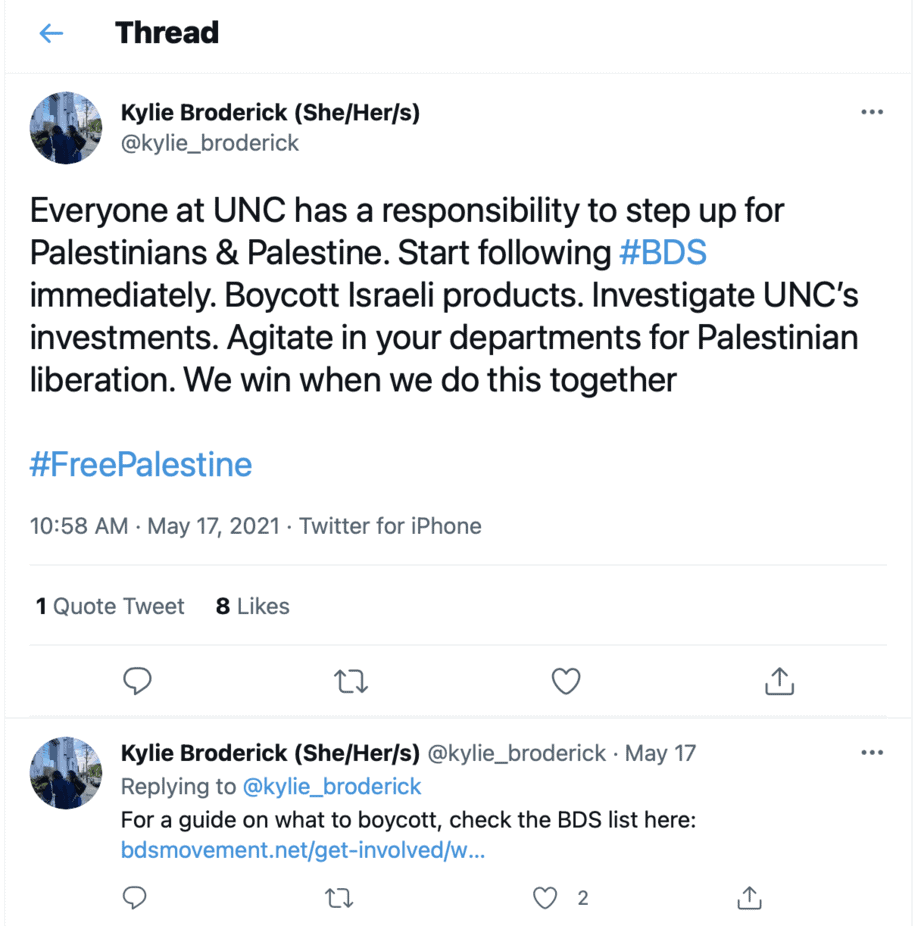
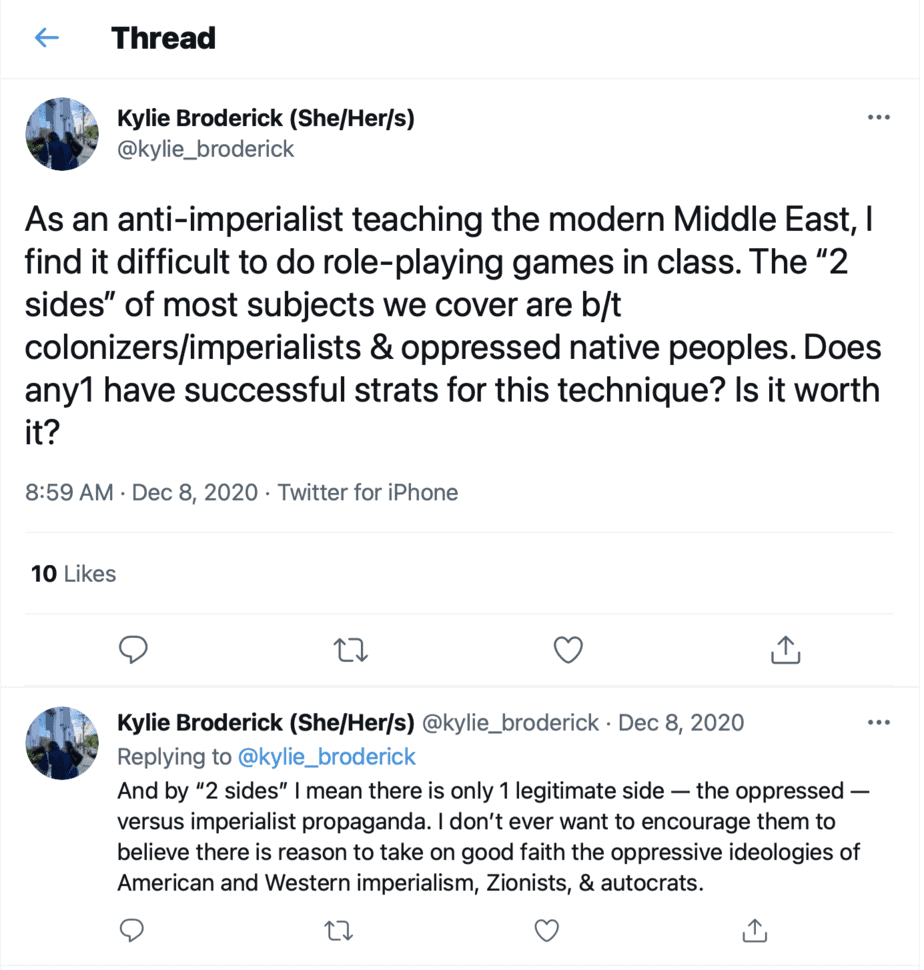
The intervention by an Israeli government official, Consul General to the Southeastern United States Anat Sultan-Dadon, followed a pressure campaign by right-wing pro-Israel websites and an advocacy group to remove the graduate student, Kylie Broderick, from teaching the history department course called “The Conflict over Israel/Palestine.” The websites and pro-Israel advocacy group pointed to postingsBroderickhadmade on Twitter that criticized Israel and Zionism and, without evidence, cited the postings as evidence of antisemitism.
UNC Ph.D. student Kylie Broderick.
Photo: Courtesy of Kylie Broderick
In addition to the intervention by the Israeli government, the school faced pressure from a member of the U.S. House of Representatives, the two UNC professors told The Intercept. The professors said Rep. Kathy Manning, D-N.C., also met with the dean of the College of Arts and Sciences to exert pressure over Broderick’s course.
“It is not a new phenomenon where outside parties have tried to stifle academic freedom on this subject,” Broderick said. “But these people have never seen me teach, never seen my past evaluations which have said that I treat students fairly, and thus have no right to dictate what I say inside the classroom.”
Israel-Palestine has become one of the most politicized areas of academia, with periodic firings of professors, prosecutions of students, and even the maintenance of public blacklists helping impose an atmosphere of fear and self-censorship over the topic. Even by that standard, the intervention of Israeli government officials directly with an American university over the teaching of a course represents a troubling new threat to academic freedom.
“I think that a representative of a foreign government attempting to police an academic class is, in the first place, ridiculous, and an obvious overreaction to what is essentially an issue that started on Twitter,” Broderick said. “I also think it is strange that the Israeli consulate general was granted an audience. If this was a class on Hungary or Australia, would the university have permitted the attempted interference of a foreign government? The fact that this meeting happened at all is clearly a threat to academic freedom.”
“The fact that this meeting happened at all is clearly a threat to academic freedom.”
The controversy started over several tweets sent by Broderick that were highly critical of Israel and U.S. foreign policy, including support for the Boycott, Divestment, and Sanctions movement against Israel. Broderick rejected accusations leveled by Israeli consular officials that her criticisms of Israel on social media constituted antisemitism. “A critique of Israel and the political ideology of Zionism does not constitute bigotry any more than a critique of Iran, which calls itself an Islamic Republic, constitutes an Islamophobic attack,” Broderick said. ”States are not religions, nor are states a people.”
Broderick had expected scrutiny of some of her teaching, as Israel is always a hot-button issue in the United States. What she did not was the degree to which the smear campaign against her would balloon, up to and including interventions from officials of two governments.
In a statement to The Intercept, Sultan-Dadon confirmed the meeting with the dean of UNC’s College of Arts and Sciences about Broderick. Though Sultan-Dadon declined to comment on the specifics of the discussion, she doubled down on her view that Broderick was antisemitic and unfit to teach a course on the history of the Israeli-Palestinian conflict.
“Regarding the matter of the course ‘The Conflict over Israel/Palestine’ at UNC Chapel Hill taught by PhD student Ms. Broderick, I do have significant concerns regarding public statements that have been made by Ms. Broderick on this subject matter, some of which are not only heavily biased, but fall clearly under what is defined as antisemitic by the IHRA working definition of antisemitism,” Sultan-Dadon said, referring to the International Holocaust Remembrance Alliance’s heavily contested definition of antisemitism.
The consul general went on: “I think it should be of concern to anyone who stands against antisemitism, and for academic freedom, that an individual who has not only made public antisemitic statements in reference to Israel and the Israeli Palestinian conflict, but also publicly stated that she does not believe there are two sides to this conflict and does not want to teach her students both sides, is the selected teacher for a course on ‘The Conflict over Israel/Palestine.’”
Manning’s congressional office did not respond to a request for comment on the meetings with UNC officials. Manning’s website is short on foreign policy positions but says that support for Israel is a key issue for the U.S. House member.
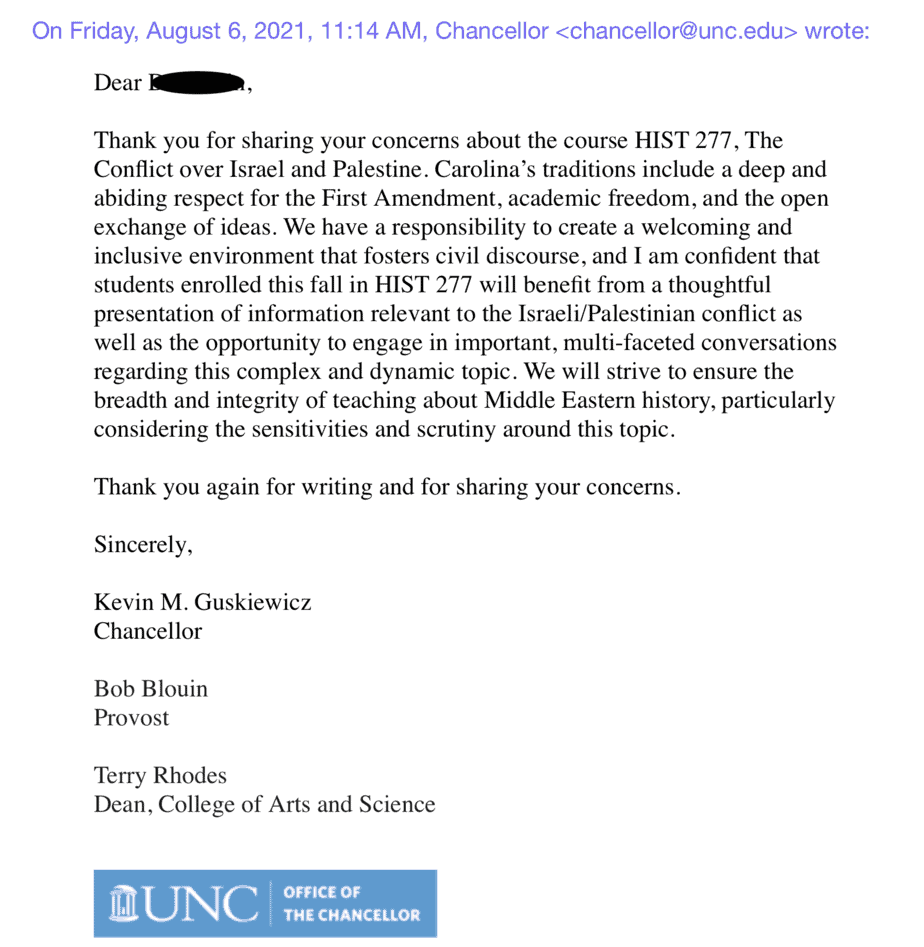
The dean’s office and UNC declined to comment on the meeting with officials. However, UNC officials appear to be holding firm despite the heavy outside pressure over Broderick’s teaching of the course. An email from the chancellor’s office this August, circulated online by pro-Israel groups, indicated that the course would go forward as planned, and Broderick has since begun teaching without controversy or complaints from students.
The controversy over Broderick’s teaching of the course began this summer, after the pro-Israel website Algemeiner did a story focused on a series of tweets Broderick had made that were highly critical of Israel or deemed by the author, Peter Reitzes, to have been “crass.”
The issue snowballed from there as other activist news websites picked up the issue and began spreading it in their networks — even reaching mainstream news. In August, a local ABC affiliate broadcasted an investigative story by journalist Jonah Kaplan. Kaplan quoted students saying that Broderick’s tweets criticizing Israel were reminiscent of the rhetoric that fomented the Holocaust, describing them as a “new mutation of what anti-Semitism is today.” Another student told Kaplan, regarding Broderick’s tweets, “Just replace Zionist with Jew and it’s pretty obvious it’s anti-Semitic.”
Similar campaigns, accusing critics of Israel of antisemitism despite a lack of direct evidence, have long become commonplace in U.S. academia.
“In a weird way, what is interesting about Broderick’s case is that in all likelihood she is going to be fine, and that is a massive change from what would have happened even a decade ago.”
“Academic courses all over the U.S. have been taught for a long time with a massive bias in favor of Israel, and if people in a classroom or faculty are pro-Israel, they should be allowed to make that argument. But what all this outside pressure on academics is trying to do is prevent the same from happening from the Palestinian perspective,” said Jonathan Brown, a professor of Islamic civilization at Georgetown University. “There are fundamental questions at stake here about academic freedom and whether academics are expected to teach according to donor or even foreign government preferences.”
In many ways, however, the discourse over the conflict is changing, with polls showing growing sympathy for the Palestinian cause and openness to criticism of Israeli government policy among Americans, including among liberal, progressive, and Jewish organizations that also prioritize the fight against domestic antisemitism. The intense pushback, even against graduate students critical of Israel teaching courses on the subject with the Israeli government itself directly involved, is seen by some as a way of trying to maintain a slanted status quo that is now going out of favor.
“When I was in college 20 years ago, if someone said something critical of Israel in class, you could hear a pin drop. It was frightening. Things are very different now,” said Brown. “In a weird way, what is interesting about Broderick’s case is that in all likelihood she is going to be fine, and that is a massive change from what would have happened even a decade ago.”
Correction: September 28, 2021, 2:08 p.m. ET Due to an editing error, an earlier version of this story misstated North Carolina Rep. Kathy Manning’s political party. She is a Democrat.
During the early Cold War, the US security establishment was desperate to contain the rise of communism in Indonesia. When President John F. Kennedy took a different tact, it triggered an ideological showdown with the CIA.
Matthew Stevens tackles listener questions on the history of the Welsh regions during the Middle Ages
Matthew Stevens tackles listener questions and popular search queries on the history of Wales and the Welsh regions during the Middle Ages, from the Norman invasion and Edward I’s conquest to the Welsh roots of the Tudor dynasty.
Kristen Ghodsee joins Long Reads to discuss the lost world and "progressive spirit" of Bulgarian Communism. Kristen is professor of Russian and East European Studies at the University of Pennsylvania and the author of several books, including Why Women Have Better Sex Under Socialism: And Other Arguments for Economic Independence. Long Reads is a Jacobin podcast looking in-depth at political topics and thinkers, both contemporary and historical, with the magazine’s longform writers. Hosted by Features Editor Daniel Finn.
The index, the bit at the back of a book you mostly only turn to for reference, has a bit of a dowdy reputation – and it’s an unfair one. Dennis Duncan discusses the index’s surprising history – one that has saved heretics from the stake, kept politicians from office and proved a battleground for snarky academic rivalries.
Chelsea Manning goes seriously, literally insane against Assange, Wikileaks, and Glenn Greenwald
Since leaving prison in 2017, former intelligence analyst and whistleblower Chelsea Manning has been busy. She ran unsuccessfully for senate in her home state of Maryland, became a Twitch streamer, and was jailed for contempt after refusing to testify in a US government case against Wikileaks and its founder, Julian Assange. Manning joins Ryan Grim and Intercept reporter Ken Klippenstein to talk about prison, prospects for whistleblowers in the Biden era, and what she’s been up to since her release.
The Python programming language comes with its own built-in Integrated Development Environment (IDE) called IDLE. The name, IDLE, supposedly came from the actor, Eric Idle, who was a part of the Monty Python troupe, which is what Python itself is named after.
IDLE comes with Python on Windows and some Linux variants. You may need to install IDLE separately on your particular flavor of Linux or on Mac if you plan to use the Python that came with the operating system. You should check out the Python website for full instructions on how to do so as each operating system is different.
Here are some of the reasons that Integrated Development Environments are useful:
They provide syntax highlighting which helps prevent coding errors
Autocomplete of variable names and built-in names
Breakpoints and debugging.
On that last point, breakpoints tell the debugger where to pause execution. Debugging is the process of going through your code step-by-step to figure out how it works or to fix an issue with your code.
IDLE itself has other attributes that are useful, such as access to Python documentation, easy access to the source code via the Class Browser, and much more. However, IDLE is not the only way to code in Python. There are many useful IDEs out there. You can also use a text editor if you prefer. Notepad, SublimeText, Vim, etc., are examples of text editors. Text editors do not have all the features that a full-fledged IDE has, but tend to have the advantage of being simpler to use.
Here is a shortlist of IDEs that you can use to program in Python:
PyCharm
Wing Python IDE
VS Code (also called Visual Studio Code)
Spyder
Eclipse with PyDev
PyCharm and WingIDE both have free and paid versions of their programs. The paid versions have many more features, but if you are just starting out, their free offerings are quite nice. VS Code and Spyder are free. VS Code can also be used for coding in many other languages. Note that to use VS Code effectively with Python, you will need to install a Python extension. You can also use the PyDev plugin for Eclipse to program in Python.
Other popular editors for Python include SublimeText, vim, emacs, and even Notepad++. These editors may not be 100% up-to-date on the syntax of the language, but you can use them for multiple programming languages.
But let’s back up a bit and talk about Python’s basic console, also known as the REPL, which stands for Read Evaluate Print Loop.
What About the REPL?
REPL or READ, EVAL, PRINT, LOOP is basically Python’s interpreter. Python allows you to type code into an interpreter which will run your code live and let you learn about the language. You can access the interpreter, or REPL, by running Python in your terminal (if you are on Mac or Linux) or command console (if you are on Windows).
On Windows, you can go to the Start menu and search for cmd or “Command Prompt” to open the console or terminal:
Once you have the terminal open you can try typing python. You should see something like this:
If this doesn’t work and you get an “Unrecognized Command” or some other error, then Python may not be installed or configured correctly. On Windows, you may need to add Python to your system’s path or you can just type out the full path to Python in your command console. For example, if you installed Python in C:\Python\Python38, then you can run it using cmd.exe like you did above, but instead of typing python, you would type C:\Python\Python38\python.
If you need to get help in the REPL, you can type help():
You can type live Python code into the REPL and it will be immediately evaluated, which means the code will run as soon as you press enter.
Here’s how you would print out “Hello World” and add some numbers in the REPL:
Python comes with its own code editor called IDLE. Let’s learn about that next!
Getting Started with IDLE
IDLE is a good place to start learning Python. Once you have it installed, you can start it up and the initial screen will look like this:
This is a REPL. You can enter code here and it will be evaluated as soon as you press the Return or Enter key.
If you want to actually write a full program, then you will need to open up the editor view by going to File –> New.
You should now have the following dialog on your screen:
You can enter your code here and save it.
Running Your Code
Let’s write a small bit of code in our code editor and then run it. Enter the following code and then save the file by going to File –> Save.
print('Hello World')
To run this code in IDLE, go to the Run menu and choose the first option labeled Run Module:
When you do this, IDLE will switch to the Shell and show you the output of your program, if there is any:
You can also use the Run menu’s Check Module option to check your code for syntax errors.
Accessing Help / Documentation
Sometimes you need help. Fortunately IDLE has some built-in help about itself and the Python language, too! You can access help about IDLE by going to the Help menu and choosing IDLE Help:
If you’d rather look up how something works in the Python language, then go to the Help menu and choose Python Docs or press F1 on your keyboard:
This will show you Python’s official documentation. Depending on your O/S this may load local help files, or start a browser to show the official on-line help documents.
Restarting the Shell
Let’s go back to the Shell screen of IDLE rather than the editor. It has several other functions that are worth going over. The first is that you can restart the shell.
Restarting the shell is useful when you need to start over with a clean slate but don’t want to close and reopen the program. To restart the shell, go to the Shell menu and choose Restart Shell:
If you haven’t restarted the shell before, then your screen will look like this:
This tells you that your shell has restarted.
Module Browser
IDLE comes with a handy tool called the Module Browser. This tool can be found in the File menu.
When you open it, you will see the following:
Modules in Python are code that the Python core development team has created for you. You can use the Module Browser to browse the source code of Python itself.
Try entering the following into the dialog above: os. Then press OK.
You should now see the following:
This allows you to browse the source code for os.py. You can double-click anything in the Module Browser and it will jump to the beginning of where that code is defined in IDLE’s code editor.
Path Browser
Another useful tool that you can use in IDLE is the Path Browser. The Path Browser allows you to see where Python is installed and also what paths Python uses to import modules from. You will learn more about importing and modules later on in this book.
You can open it by going to File and then Path Browser:
The Path Browser is a good way to diagnose issues with importing modules. It can show you that you might not have Python configured correctly. Or it might show you that you have installed a 3rd party module in the wrong location.
Getting Started with PyCharm Community Edition
PyCharm is a commercial Python IDE from a company called JetBrains. They have a professional version, which costs money, and a community edition, which is free. PyCharm is one of the most popular choices for creating and editing Python programs.
PyCharm Professional has tons of features and is a great debugger. However, if you are a beginner, you may find all the functionality in this software to be a bit overwhelming.
To get a copy of PyCharm Community Edition, you can go to the following website:
The Community Edition does not have all the features that PyCharm Professional has. But that is okay when you are new to Python. If you would like to try PyCharm, go ahead and download and install the software.
When you run PyCharm it may ask you to import settings. You can ignore that or import settings if you have used PyCharm previously and already have some.
Next, you will probably need to accept their privacy policy / EULA. Depending on the operating system, you may also get asked what theme to apply. The default is Darkula on Windows.
At this point you should see the following Welcome banner:
PyCharm prefers that you work in a project rather than opening a simple file. Projects are typically collections of related files or scripts. You can set up a new project here or open a pre-existing one.
Once you have gone through that process, your screen should look like this:
Creating a Python Script
To create a new Python script in PyCharm, you can go to File and choose New. Then pick Python File from the choices presented:
Give the file a name, such as hello.py. Now PyCharm should look like this:
Running Code in PyCharm
Let’s add some code to your file:
print('Hello PyCharm')
To run your code, go to the Run menu and choose Run. PyCharm might ask you to set up a debug configuration before running it. You can save the defaults and continue.
You should now see the following at the bottom of PyCharm:
PyCharm Features
PyCharm has tons of features. In fact, it has so many that you could write an entire book on them. For the purposes of this book, you should know that PyCharm will give you suggestions about your code based on PEP8, which is Python’s code style guide. You will learn more about that in the next chapter. It will also highlight many other things about your code.
You can usually hover over any code that looks weird to you and a tooltip will appear that will explain the issue or warning.
The debugger that ships with PyCharm is useful for figuring out why your code doesn’t work. You can use it to walk through your code line-by-line.
PyCharm’s documentation is quite good, so if you get stuck, check their documentation.
Getting Started with Wing Personal
Wingware’s Python IDE is written in Python and PyQt. It is my personal favorite IDE for Python. You can get it in Professional (paid), Personal (free) or 101 (really stripped-down version, but also free). Their website explains the differences between the 3 versions.
After you have downloaded and installed the software, go ahead and run it. You will need to accept the License Agreement to load up the IDE.
Once it is fully loaded, you will see something like this:
Running Code in Wingware
Let’s create some code in Wing. You can open a new file by going to the File menu and choosing New:
Now enter the following code:
print('Hello Wingware')
Save the code to disk by going to File and then Save.
To run this code, you can go to the Debug menu, press F5 or click the green “play” button in the toolbar. You will see a debug message dialog:
Hit OK and the code will run. You will see the output in the Debug I/O tab if there is any.
Note that Wing does not require you to create a project to run a single Python file. You can create projects if you want to though.
Wing Features
Wing has an incredible debugger. However, you cannot use it to its full extent in the free versions of the software. But there is a Source Assistant tab in the Personal edition that is very useful. It will show you information about the functions / modules that you have loaded as you use them. This makes learning new modules much easier.
Wing will also show you various issues with your code while you type, although PyCharm seems to do more in this area than Wing does.
Both products have plugins and you can write your own for both IDEs as well.
Getting Started with Visual Studio Code
Visual Studio Code, or VS Code for short, is a general-purpose programming editor. Unlike PyCharm and WingIDE, it is designed to work with lots of languages. PyCharm and WingIDE will let you write in other languages too, but their primary focus is on Python.
VS Code is made by Microsoft and it is free. You can download it here:
Once you have it downloaded and installed, you will need to install support for Python from the VS Code marketplace.
If you open up VS Code, the screen will look something like this:
Under Customize you can see there is an option for installing Python. If that isn’t there, you can click on the Extensions button that is on the left and search for Python there:
Go ahead and install the Python extension so that VS Code will recognize Python correctly.
Running Code in VS Code
Open a folder in the File Explorer tab and then you can right-click in there to create a new file. Alternatively, you can go to the File menu and choose New File and do it that way.
Once that is done, you can enter the following code and save it:
print('Hello VS Code')
Then right-click anywhere in the editor and select the Run Python File in Terminal selection. This will cause your code to run and you will see the following:
Note: I didn’t have the PSReadline module installed when I ran this code which is why you see the error in the console above.
VS Code Features
VS Code can run all kinds of different languages. However, for the purposes of Python, Microsoft has a team of Python developers that are constantly improving this IDE and adding new features. There are tons of extensions that you can install to enhance the editor’s functionality.
One of the coolest extensions that you can install is Live Share, which lets you do real-time collaboration between developers. It basically shares your coding session with others. Since this IDE is the newest of the bunch and its feature set is changing a lot, you will need to research it on your own time.
Wrapping Up
There are lots of Python code editors to choose from. IDLE is nice in that it comes with Python and is written in Python, so you can actually learn a lot just by looking at its source code. PyCharm and VS Code are very popular right now. Wing IDE used to be more popular than it is today, but I think it is still really great. All of these tools are good, but you should give them a try to see which one works the best for you.
Related Reading
Want to learn more Python basics? Then check out the following tutorials:
back to sequence of listenable but very skippable banter (4 food groups) followed by an excellent interview (starting @ 40:09)
During the first Gulf War, there was a transformation to an era of constant new news. The face of this change was CNN reporter and Useful Idiots Hero Charles Jaco.
Viewers went from checking the news once or twice a day to constantly staying plugged in, anchors got famous, and the whole thing became a spectacle. Jaco’s response?
“What the devil is going on?”
Jaco, who’s the star of the weekly UI segment "Jaco of the Week,” discussed the negative impacts of unending news.
“We should've put up slides that said, ‘Look, this is being brought live. The first draft of history is always wrong. Take this with a grain of salt and we'll try to sort this out.’” With the need to always have fresh news, time for fact-checking went out the window. And since the early 90s, trust in media has plummeted. Jaco says that’s why.
We also discuss the shift from focusing on in-the-field reporters to idolizing talking heads in the studio:
“One of the things that really annoys me now is that you've got these platforms that can give you 24-hour news, but on the three major channels, CNN, MSNBC, and Fox, it's degenerated into just talking heads rather than using the expertise of the reporters in the field.
It's irritating as hell to those of us who did it for so long.”
It’s a fun interview with our charming and funny UI hero. And check back on Monday for the extended interview where Charles discusses teabaggers, conspiracy theories, and the impending US civil war (sense a trend?)
Plus, we find out just how much Dems and Republicans suck as Biden lets Haitian migrants get whipped and McConnell plans to let the government default. Ugh.
It’s all this, and more, on this week’s episode of Useful Idiots. Check it out.
In 2008, many of Barack Obama’s supporters hoped he would bring the global war on terror to a close. Instead, he expanded it – and his successors have done nothing to change course. By Samuel Moyn. Help support our independent journalism at theguardian.com/longreadpod
To every age dogged with pollution, accidents and congestion, the transport solution for the next generation seems obvious – but the same problems keep coming back. By Tom Standage. Help support our independent journalism at theguardian.com/longreadpod
The effects of ‘weird weather’ were already being felt in the 1960s, but scientists linking fossil fuels with climate change were dismissed as prophets of doom. By Alice Bell. Help support our independent journalism at theguardian.com/longreadpod
Neil Faulkner reveals how the Anglo-Arab Wars of 1870-1920 helped give rise to the first modern jihad
Neil Faulkner, author of Empire and Jihad, describes how Britain’s entanglements in the Middle East and north Africa in the decades leading up to the First World War helped trigger a radical Islamic insurgency.
Tucker Carlson reigns as the most-watched personality on cable news. How did he get that way? How important is he really? And what does he actually believe? To answer these questions, he enlist the help of Tucker scholar and returning guest Alex Shephard, who guides us through Carlson's trajectory from a Tom Wolfe-ish magazine scribe to a Jon Stewart punching-bag to the living embodiment of the GOP's hard-right turn.
Michael and Us is a podcast about political cinema and our crumbling world hosted by Will Sloan and Luke Savage. To hear weekly bonus episodes, subscribe to the Patreon: https://www.patreon.com/michaelandus/