Tom Roche
Shared posts
Did the CIA kill JFK? Oliver Stone on his explosive new film
Tom Roche1st Anya after 9 months (hmm...) is unfortunately very skippable
But Is It Composable? (SC Roundup)
Tom Rocheexcellent: not much banter, Newman's end piece short (but interesting as usual). Major downside: Shahin Khan has departed RFHPC. Upside: he's started a new podcast @ https://insidehpc.com/category/resources/podcast/
Michael and Us: The Outsider
Tom RocheVERY EXCELLENT
See acast.com/privacy for privacy and opt-out information.
The Now Show - 26th November - feat Athena Kugblenu, Geoff Norcott, and Huge Davies
Tom Rochenot their best episode (and IMHO both Now Show and Dead Ringers are generally not as good as News Quiz) but definitely listenable
The Now Show - 5th November ft Glenn Moore, Daliso Chaponda and Stiff & Kitsch
Tom RocheEXCELLENT
The Now Show - 12th November ft Gareth Gwynn, Michael Spicer, Priya Hall and Ignacio Lopez
Tom RocheEXCELLENT, esp the Ignacio (misspelled above) Lopez song
The Now Show - 19th November ft Ria Lina, Josh Pugh and Beardyman
Tom Rochedefinitely skip Ria Lina, rest is OK
Introducing: Tony Ho - Season 3
Tom Rochevery dark
To learn some really useful stuff about divorce, consult a comedian!
10 Things for Americans to Be Grateful for This Thanksgiving
Tom Rochesome excellent links, including to this short/punchy interview with Dean Baker @ https://join.substack.com/p/economics-on-trial (archived @ https://web.archive.org/web/20210627043019/https://join.substack.com/p/economics-on-trial )

In a postcard, circa 1950, entitled “Thanksgiving Day,” a young boy with a hatchet chases a turkey across a field.
Photo: Hulton Archive/Getty Images
Today is the 400th anniversary of the first Thanksgiving in 1621. The American mythology about Thanksgiving is almost completely fabricated, down to the fact that the Pilgrims did not wear hats with buckles on them. Moreover, if you think about it for a second, you’ll understand why. Even if there were weirdly high winds in 1600s North America, and you needed to cinch your hat on super-tight, it wouldn’t help to have a buckle so high it was where your head ended.
Meanwhile, Thanksgiving is embedded in a history of cruelty toward the continent’s Indigenous people so grim it’s enough to make you give up on humans as a species. Long ago, the filmmaker Adam McKay performed in a show at Second City in Chicago where he played Noam Chomsky as a substitute teacher who horrified kindergarteners by telling them the real story of the holiday.
So let’s concentrate instead today on the general subject of thankfulness. Science tells us that focusing on gratitude for the positive aspects of your life improves your sleep and somehow strengthens your immune system. Science also tells us it’s figured out how to weaponize anthrax, so not all of its discoveries are so hot, but the gratitude one is worth being grateful about. Here are some aspects of life today in America for which we can sincerely give thanks.
Food
Say what you want about the United States, but we’ve definitely cracked the age-old human problem of having enough food. In fact, we’ve grown so bored with the subject that we’ve moved onto creating the food-adjacent. Do you want to eat mango-chipotle-Oreo-flavored pizza? Who knows, but in America today you have that option.
If you’re tempted to take this for granted, recall that some European colonists around the time of the first Thanksgiving faced starvation and were forced “to digge upp deade corpes outt of graves and to eate them.” However frustrating you may find your relatives today, give thanks that you do not have to consume their rotting flesh.
It’s undeniable that America’s berserk overabundance of food makes the continuing existence of hunger here a brutal crime. But we could stop committing this crime any time we want, so let’s be grateful for that opportunity and seize it.
Not Being Food
If we could talk to animals, they’d be astonished that we spend zero percent of our lives worrying about being eaten. Being constantly hunted is a core aspect of life for essentially every animal on Earth except us, and it used to be true for us too. No longer being anxious about lions ripping our children to shreds may perhaps remove a certain amount of zest from the human experience. But on net this seems like a big improvement.
Libraries
If you read fantasy books as a kid, you may have been disappointed to grow up and find out the world is not full of dragons in underground lairs sitting on huge hoards of gold. But giant storehouses of wealth do exist: They’re called libraries.
This is not a metaphor or a ploy to flatter The Intercept’s librarian-heavy readership. The foundation of all societal wealth is not individuals like Elon Musk, which is clear from the fact he spends most of his time screwing around on Twitter. Rather, it’s the knowledge, generated painstakingly over centuries, of how to manipulate physical reality and best order civilization. This is the common inheritance of everyone, it’s located in libraries, and the dragon librarians love when you check out as much wealth as possible.
Antibiotics
Infections from minor injuries used to kill people constantly, and no amount of power could protect you. President Calvin Coolidge’s son got a blister on his toe in 1924 from playing tennis on the White House courts without socks. A week later, he was dead from sepsis.
The difference between then and now was brought home to me recently when I got an infected hangnail on my thumb, which swelled up alarmingly. But one prescription for antibiotics, and I no longer have to worry about my imminent demise. The instructions warn “DO NOT LIE DOWN FOR AT LEAST 10 MINUTES AFTER TAKING THIS MEDICATION,” and also that you may experience voluminous diarrhea months later, but I’m fine with this trade-off.
We should especially appreciate antibiotics right now because we haven’t understood their miraculous nature, and thanks to overuse, their effectiveness is waning precipitously. The famous writer Tom Wolfe published a book in 2016 denying the reality of evolution, and then soon afterward died of an infection caused by bacteria which had evolved to become resistant to antibiotics. This is awful, but you have to admit, also a little bit funny.
Sexy Times of All Genres
If you’re ever confused by human behavior, remember that we’re the descendants of thousands of generations of history’s horniest monkeys. This has a lot of explanatory power in almost every situation.
American culture used to be terrified by this, and tried, King Canute-like, to order the horny tide not to come in. Now we seem to be getting more relaxed about it, accepting that as long as all parties consent, anything people get up to is fine. This can only be positive in the long run — and indeed may be the only thing that can prevent global thermonuclear war.
Mites on Your Face
Almost everyone has lots of teeny-tiny, translucent mites living on their face. They nestle in your hair follicles and eat the oil your skin exudes. But you aren’t born with them; most people pick them up from close contact with their parents. The touching upside here is that when your grandparents and parents die, you can contemplate that the distant descendants of their mites live on, on your face, right now.
Dean Baker
Dean Baker is an economist with the Center for Economic and Policy Research, a progressive think tank in Washington, D.C. If you’re not familiar with him you are absolutely missing out. He would be one of America’s foremost public intellectuals, if we cared about things such as intellect or the public.
Baker did incredible work to prevent the privatization of Social Security 20 years ago. He also was one of the few economists to warn about the housing bubble that caused the 2008 economic collapse. Most importantly, he constantly imagines creative ways to use the tools of economics and rationality to construct a better world for everyone. Given how few other economists do this, it might as well be illegal.
If you want to know more about Baker’s perspective, this interview — with someone who describes him as “one of the most important economists in the entire world” — is a good place to start.
Solar Power
This sounds made up, but in 1931 Thomas Edison apparently told friends this about the future: “I’d put my money on the sun and solar energy. What a source of power! I hope we don’t have to wait until oil and coal run out before we tackle that.”
The recent plummet in the cost of solar power is absolutely stunning and thrilling. If global warming destroys human civilization, at least it will be because we chose destruction, rather than because a zero-carbon civilization is technologically impossible.
Economic Possibilities for Us, Keynes’s Grandchildren
The great economist John Maynard Keynes wrote a profound article in 1930 called “Economic Possibilities for Our Grandchildren.” In it, he predicted that within 100 years, humanity’s challenge since we arrived on the scene — i.e., the brute struggle to physically survive — would be solved.
At that point, Keynes said, “man will be faced with his real, his permanent problem — how to use his freedom from pressing economic cares, how to occupy the leisure, which science and compound interest will have won for him, to live wisely and agreeably and well.”
Right on time, the U.S. is reaching that point. We are more than wealthy enough to provide food, shelter, and medical care for absolutely everyone. We also clearly have enough television and podcasts. Indeed, we may need to invent artificial intelligence just so something can consume all of them.
The question now is whether we’re wise enough to give everyone the chance to face Keynes’s “permanent problem” and the tools to deal with it. Maybe or maybe not, but we’re about to find out.
Little Peer Pressure About Cranberries
Thank God we’re only expected to eat this dreadful bog fruit once a year.
… And So Much More
Once you get started thinking about gratitude, it’s hard to stop seeing things to be grateful for everywhere. Frankly, you should be grateful this article isn’t 10 times as long. If you have something that you’re particularly thankful for today, please visit me on Twitter, where I’d love to share your thoughts with the (mixed) blessing of the internet.
The post 10 Things for Americans to Be Grateful for This Thanksgiving appeared first on The Intercept.

Inside the Pandora Papers / Michael Hudson
Tom Rochenote this is the Michael Hudson @ ICIJ, not the economist @ UMKC
578 - Assassination Day feat. Oliver Stone & Aaron Good (11/22/21)
Tom RocheVERY EXCELLENT
Influencers
Tom RocheVERY SKIPPABLE--at least, *nothing* funny in 1st 10 minutes.
Laura Tingle's Canberra
Tom Rocheexcellent as usual
Hinge Points Episode 3: Reconstructing Reconstruction
Tom RocheEXCELLENT esp the Benjamin Butler segment (~2nd half) of the episode
Matt and Danny Bessner, from the American Prestige podcast, explore one of history's most important hinge points: the American Civil War, when the United States decided to fully embrace the northern form of industrial capitalism, setting the stage for hemispheric and eventually global expansion. Matt and Danny discuss a multitude of issues, from the various crises of the pre-Civil War era to the war's diplomacy to one of the great "What If" questions: namely, what if Benjamin Butler, not Andrew Johnson, had been Lincoln's Vice President, and how might this have informed Reconstruction's direction?
EDIT: Aware there was something fucked up with original file. Sorry, played fine everywhere on my end, sometimes these things slip through. New file uploaded, should be working now. Sorry for the inconvenience and let me know if any issues persist. -cw
Democracy Now! 2021-11-23 Tuesday
Tom Rocheskip from headlines (ending 14:36) to Chomsky (starting 50:35)
Democracy Now! 2021-11-23 Tuesday
- Headlines for November 23, 2021
- Nikole Hannah-Jones on "The 1619 Project," Teaching Critical Race Theory & White Supremacy on Trial
- Is China Really a Threat? Noam Chomsky Slams Biden For Increasingly Provocative Actions in Region
Keeping science reproducible in a world of custom code and data
Tom RocheVERY EXCELLENT! archived @ https://arstechnica.com/science/2021/11/keeping-science-reproducible-in-a-world-of-custom-code-and-data/ . Among a number of potential pullquotes (this one org-ified):
> To make it easy to create new containers, the [[https://stenci.la/][Stencila project]]'s [[https://github.com/stencila/dockta][Dockta]] system reads requirements for analyses using the Python or R platforms and builds a container around them with all the required versions of all the required packages in place. Stencila's latest project aims to make things still simpler by putting the code in the paper itself. Every figure in [[https://elife.stencila.io/article-57067/][this journal article]] on open-access publications has a 'run' button, as does every statistic [[https://elifesciences.org/articles/60287/executable][in this article]] on ants swallowing antimicrobial poisons.

Enlarge (credit: Degui Adil / Getty Images)
It is often said that the difference between science and superstition is that science is reproducible. Unfortunately, many scientific papers aren't, making them about as reliable as superstition.
Since the mid-1600s, the output from a typical scientific study has been an essay-style journal article describing the results. But today, in fields ranging from astronomy to microbiology, much of the technical work for a journal article involves writing code to manipulate data sets. If the data and code are not available, other researchers can't reproduce the original authors' work and, more importantly, may not be able to build upon the work to explore new methods and discoveries.
Thanks to cultural shifts and funding requirements, more researchers are warming up to open data and open code. Even 100-year-old journals like the Quarterly Journal of Economics or the Journal of the Royal Statistical Society now require authors to provide replication materials—including data and code—with any quantitative paper. Some researchers welcome the new paradigm and see the value in pushing science forward via deeper collaboration. But others feel the burden of learning to use distribution-related tools like Git, Docker, Jupyter, and other not-quite words.
Read 29 remaining paragraphs | Comments
Gretzuni: EmacsConf2021: Emacs as design pattern learning
Tom RocheEmacsConf 2021 0900 (EST) S 27 Nov to ~1730 U 28 Nov: https://emacsconf.org/2021/schedule/
I will be giving a talk at this year’s EmacsConf2021 that was an indirect exercise in considering the new wave of programming that is upon us.
Hinge Points Episode 1: Social Democratic Party Poopers
Tom RocheVERY EXCELLENT
Welcome to our new mini-series Hinge Points, a tour of historical “what-ifs.” We’re publishing the first episode free to all. Subsequent episodes will post on Fridays exclusively to subscribers on patreon.com/chapotraphouse.
Matt and Danny Bessner, from the American Prestige podcast, take you on a tour of the history of the Social Democratic Party of Germany and explore the importance of the party's decision to vote to fight World War I. They examine the party's structure and history, the clash between party elites and workers, and the importance of nationalism, exploring why World War I represented such a devastating blow against international socialism.
Hinge Points Episode 2: So You Say You Want a Revolution
Tom RocheVERY EXCELLENT
Matt and Danny Bessner, from the American Prestige podcast, do a deep dive into the German Revolutions of 1918-1919. They compare the revolutions to what was going on in the Soviet Union, explore the splits within the socialist camp, and analyze the various events of the revolutions, asking whether or not the revolutions provided a real potential "road not taken" in 20th century history. Would things have been different if the international left had found a home in Germany instead of the Soviet Union?
Hinge Points Episode 1: Social Democratic Party Poopers
Tom RocheVERY EXCELLENT
Biden Shills for Oil Drills
Tom Rocheall banter, no interview. listenable (has good bits) and skippable.
*This week, we had tech issues during out international interview, so we had to reschedule for next week. Now enjoy your food groups.*
Can you guess what eco-friendly-back-to-normal-Earth-loving-diplomatic Joe Biden is doing? That’s right! Reopening oil drilling in the Gulf of Mexico. We’re not saying Let’s Go Brandon, but we won’t yell at you if you say it in the comments.
And while Joe and the Dems are doing bad things, at least their work is consequential. The Republicans are all in on their newest “futile and stupid gesture.” And it’s really “let’s”ing stupid.
And if we weren’t already annoyed enough, we have Corporate Media’s next attempt to bury Substack and independent journalism. Are the “Substack Scaries” over? Or are we just beginning to take them down. Join us and we’ll topple Big Media together.
It’s all this, and more, on this week’s episode of Useful Idiots. Check it out.
And click here for the ad-free version of the episode, which helps independent journalists through the Reporters Committee for the Freedom of the Press.
576 - The Wonder Twins (11/15/21)
Tom Rocheconsistently excellent banter with some great lines, one of which is (TODO: get exact quote and timestamp) from Will Menaker towards the end: something like "The only thing bleaker than [the Netflix doc "Mayor Pete"] is our future." (IIRC Menaker actually says "our political future," but of course the bleakness of US politics is a function of its inability to address even-bleaker threats to our global environment (including, but not limited to, climate change) and the US economy.)
Iris Murdoch
Tom Rochemostly interesting for Murdoch stans (who will no doubt delight in the hagiographic treatment from esp Gomes), skippable for the rest of us
Melvyn Bragg and guests discuss the author and philosopher Iris Murdoch (1919 - 1999). In her lifetime she was most celebrated for her novels such as The Bell and The Black Prince, but these are now sharing the spotlight with her philosophy. Responding to the horrors of the Second World War, she argued that morality was not subjective or a matter of taste, as many of her contemporaries held, but was objective, and good was a fact we could recognize. To tell good from bad, though, we would need to see the world as it really is, not as we want to see it, and her novels are full of characters who are not yet enlightened enough to do that.
With
Anil Gomes Fellow and Tutor in Philosophy at Trinity College, University of Oxford
Anne Rowe Visiting Professor at the University of Chichester and Emeritus Research Fellow with the Iris Murdoch Archive Project at Kingston University
And
Miles Leeson Director of the Iris Murdoch Research Centre and Reader in English Literature at the University of Chichester
Producer: Simon Tillotson
The Media Discover Real Wages
Tom Rochepullquote:
> There was a surge in real wage growth at the start of [COVID-19 in 2020]. This was a composition effect. Many of the lower-paid workers lost their jobs, which raised the average wage for people who were still working. This year we are seeing this composition effect in reverse. The lower-paid workers are getting rehired, bringing down average pay. This is why the year-over-year change in the real wage was -3.4 percent in April. This was not a story of workers taking massive pay cuts, it was a story of lower-paid workers getting rehired and bringing down the average. We are still seeing this story. The wage in October of 2020 was boosted by the fact that many lower-paid workers had not yet gotten back their jobs. Now, most of those lower-paid workers are back on the job.
Those of us who have spent decades trying to call attention to the situation of ordinary workers, and their stagnant wages over the last four decades, are glad to see the media’s newfound interest in real wages (the difference between wage growth and price growth). They have been anxious to highlight the fact that inflation has exceeded the rate of wage growth over the last year.
While that is unfortunate, it is also the case that this is not unusual. Here’s the picture over the last four decades.
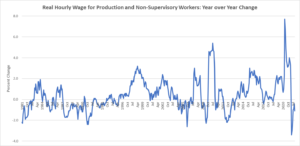
Source: Bureau of Labor Statistics.
As can be seen, there are many periods in which wage growth has not kept up with inflation. Starting in the 1980s, wages lagged inflation through most of the decade. This is the period that was known in the media as the “Reagan Boom,” or “morning in America.” Wages did exceed inflation from the mid-1990s to the early 2000s. They then fell behind inflation just before President Bush’s reelection campaign, although the media generally didn’t prominently highlight falling real wages in that election.
Wages again fell behind inflation in the weak recovery from the Great Recession. As the unemployment rate fell, workers again began to see real wage gains in the middle and last part of the decade. There was a surge in real wage growth at the start of the pandemic. This was a composition effect. Many of the lower-paid workers lost their jobs, which raised the average wage for people who were still working.
This year we are seeing this composition effect in reverse. The lower-paid workers are getting rehired, bringing down average pay. This is why the year-over-year change in the real wage was -3.4 percent in April. This was not a story of workers taking massive pay cuts, it was a story of lower-paid workers getting rehired and bringing down the average.
We are still seeing this story. The wage in October of 2020 was boosted by the fact that many lower-paid workers had not yet gotten back their jobs. Now, most of those lower-paid workers are back on the job.
If we look at wage growth over the last two years, it comes out to 2.1 percent, or an average of 1.05 percent annually. That’s not great, but that’s much better than workers did through most of the last four decades, especially the years when Republicans were in the White House.
Just to be clear, we absolutely should be concerned about inflation and real wage growth. Workers should be sharing in the benefits of the economy’s growth, and if wages are not keeping pace with inflation, then most likely they are not. (Benefits like the child tax credit do change the picture somewhat.)
But, we should try to look at these numbers carefully. One year-over-year comparison does not tell us much. If we are still looking at 6.0 percent year-over-year inflation in the spring, and there has been no uptick in wage growth, then we should be asking seriously about how workers are faring. But given the media’s decades of ignoring the plight of ordinary workers, it is hard to take the newfound concern very seriously.
The post The Media Discover Real Wages appeared first on Center for Economic and Policy Research.
New US war on Nicaragua's Sandinistas: OAS rejects elections, Biden imposes sanctions
Tom Rochealso discusses international-oligarch-backed "press freedom" groups, UK politics (esp Labour from Corbyn to Starmer), et al
Max Blumenthal and Ben Norton discuss Washington's new hybrid war on Nicaragua's Sandinista government, the US/EU/OAS refusing to recognize the election results, Congress passing the RENACER Act, and Biden imposing sanctions.
We speak with British journalist Steve Sweeney of the newspaper Morning Star, who was due to travel to Nicaragua to observe the election, but was detained in Mexico in mysterious circumstances.
Follow Steve on Twitter at twitter.com/SweeneySteve
Read Ben's report from inside Nicaragua's elections: thegrayzone.com/2021/11/11/nicaragua-2021-elections
The Main Driver of Inflation Is a Murderous Maniac in Riyadh
Tom Rochepullquote:
> The Saudi intervention in U.S. politics on behalf of the GOP could have profound implications for clean energy policies, as Democrats increasingly have powerful incentives to move away from an oil-based economy that can fall victim to puppeteering by political adversaries.
... but I guarantee that the Corporate Democrats will have almost nothing to say about Saudi (or UAE, or Israeli) "interference in US democracy," very unlike their "Pearl Harbor" freakouts during the Russiagate hoax.
Saudi Crown Prince Mohammed bin Salman is enacting revenge on Democrats in general and President Joe Biden specifically for the party’s increasingly standoffish attitude toward the kingdom — by driving up energy prices and fueling global inflation.
Biden himself seemed to allude to this at a town hall event with CNN last month, during which he attributed high gas prices to a certain “foreign policy initiative” of his, adding, “There’s a lot of Middle Eastern folks who want to talk to me. I’m not sure I’m going to talk to them.”
Biden was making a not-so-veiled reference to his refusal to meet with the crown prince and acknowledge him as Saudi Arabia’s de facto ruler due to his role in the grisly murder of journalist Jamal Khashoggi in October of 2018. The move came after Biden vowed during a debate with President Donald Trump to make MBS, as he’s known, “a pariah” and represented a stark departure from Trump’s warm relations with the desert kingdom and the crown prince.
In 2017, Trump broke with tradition by choosing Riyadh, the capital of Saudi Arabia, for his first foreign visit and soon announced a record arms sale to the kingdom. Later, after Khashoggi, a contributor to the Washington Post, was brutally dismembered in a Turkish consulate, Trump cast doubt on MBS’s involvement, saying, “Maybe he did, maybe he didn’t.” After his own CIA director briefed Congress on MBS’s culpability, Trump reportedly boasted about his efforts to protect the crown prince, saying, “I saved his ass.” Since then, a senior adviser to Trump’s campaign, Tom Barrack, has been indicted for allegedly working as an unregistered agent of the United Arab Emirates — Saudi Arabia’s closest ally.
In June 2018, heading into the midterms, Trump requested that Saudi Arabia and its cartel, the Organization of the Petroleum Exporting Countries, lower energy prices by increasing output, and the kingdom complied. Prices bottomed out in 2020 amid the coronavirus pandemic, and usage sank to record lows. Prices surged once the pandemic waned and the economy reopened, and this August Biden requested that OPEC again increase output.
This time MBS refused, angry at having yet to be granted an audience with Biden and contemptuous of the U.S. pullback from the war in Yemen. As one of his first pieces of business, Biden had ordered the end of American support for Saudi Arabia and the UAE’s war, though caveated it by barring only the backing of “offensive operations.” Saudi Arabia nevertheless received it as a grievous blow.
Ali Shihabi, a Saudi national who is considered a voice for MBS in Washington, made that clear in October, tweeting, “Biden has the phone number of who he will have to call if he wants any favours.”
Biden has the phone number of who he will have to call if he wants any favours: @CroftHelima "OPEC will come under increasingly intense pressure from Washington to open the production release valve and cap the upside” https://t.co/d09aml1JcT via @markets
— Ali Shihabi ??? ??????? (@aliShihabi) October 2, 2021
Shihabi wrote in a statement to The Intercept, “Saudi has put a lot of work into getting a cohesive OPEC+ to work over the past 15 months since the crisis that dropped oil futures below zero so will not break ranks with the consensus or Russia on this. Also the Kingdom resents being blamed for what is essentially a structural problem not of its own making in the US which has hampered its own energy production. Finally, I hear that the price of Thanksgiving Turkeys has doubled in the US so why can oil prices also not inflate?” Shihabi added a winking emoji to the end of his comment.
The American economy is heavily dependent on fossil fuels, and on top of the prices consumers pay directly at the pump and for energy at home, the costs of food and manufactured goods are also heavily susceptible to swings in energy prices.
“Gas prices relate to a foreign policy initiative that is about something that goes beyond the cost of gas,” Biden said at the town hall last month. “And we’re about $3.30 a gallon most places now when it’s up from — it was down in the single digits — I mean single digits, a dollar-plus. And that’s because of the supply being withheld by OPEC. And so there’s a lot of negotiation that is — there’s a lot of Middle Eastern folks who want to talk to me. I’m not sure I’m going to talk to them. But the point is, it’s about gas production.”
Since the town hall, gas prices have risen further, now standing at around $3.40, a seven-year high.
“There’s a possibility to be able to bring it down,” he continued. “[It] depends a little bit on Saudi Arabia and a few other things that are in the offing.”
Biden made similar comments at the G-20 summit in October, saying that Russia, Saudi Arabia, and others were withholding their capacity to produce more. “It has a profound impact on working-class families just to get back and forth to work,” he said.
“The United States, through our own policies, has essentially empowered MBS to impose economic sanctions on us,” a senior Senate aide, who was not authorized to speak on the record, told The Intercept.
MBS’s refusal to bail Biden out by opening the spigot is calculated, said Jon Hoffman, a Middle East analyst who recently penned a critical article on the UAE and Mohammed bin Zayed, the crown prince of UAE capital Abu Dhabi and the country’s de facto ruler, in Foreign Policy. “They definitely know what they’re doing, and those who play innocent and act like this is not a coordinated strategy are either just ignorant or in the pockets of MBS or MBZ,” Hoffman said.
The politics of oil, the economy, and foreign policy played out this week as the Biden administration moved ahead with a major arms sale to Saudi Arabia for its war in Yemen while taking heat from a leading Saudi critic, Rep. Ilhan Omar, D-Minn.
Agree. Selling weapons to Saudi Arabia while they continue to slaughter Yemenis is unacceptable. If we truly believe in putting human rights at the center of our foreign policy we would not be arming human rights abusers. Working on legislation to stop this sale this week. https://t.co/b0b33Eyasz
— Ilhan Omar (@IlhanMN) November 10, 2021
The arms sale underscores Biden’s Saudi dilemma, as MBS doesn’t just want the arms — he wants a thank you, without a word of dissent from any Democrat.
Trita Parsi, executive vice president of the Quincy Institute and a critic of Saudi Arabia, said the move by MBS is aimed at boosting Republicans, whom the crown prince sees as a more reliable ally. “As I see it, it is part of a broader Saudi strategy to favor the GOP as MBS calculates that a Republican president will reinvest in the idea of dominating the Middle East militarily, which makes the relationship with Saudi Arabia critical once more,” Parsi said.
Regional political realignments have led many key leaders in the Middle East to favor Republican leadership. Following former Democratic President Barack Obama’s pursuit of the Iran nuclear deal in the face of opposition from Saudi Arabia, the UAE, and Israel, an alliance tightened between the three nations.
Parsi said MBS wants to return to the days when Saudi Arabia was fully immune from any criticism and had U.S. support with no questions asked. ”While Biden has clearly not broken fully with these policies, despite his rhetoric, the Dems — particularly progressives — are adding friction to it and are more hesitant about rehabilitating MBS,” said Parsi. “So for MBS specifically, as well as the Likud [a right-wing Israeli political party] and the leaders in Abu Dhabi, a Republican president and Congress is much preferred. And all three of these states have already shown a significant propensity to interfere in American politics.”
The Saudi intervention in U.S. politics on behalf of the GOP could have profound implications for clean energy policies, as Democrats increasingly have powerful incentives to move away from an oil-based economy that can fall victim to puppeteering by political adversaries. “The answer ultimately is — ultimately meaning the next three or four years — is investing in renewable energy,” Biden said during his town hall, outlining an unrealistically optimistic time frame but describing the direction Democrats plan to go.
Republicans, meanwhile, could have a steady grip on a lever — oil output — that can easily move approval ratings or congressional generic ballots up or down at will. All it takes is looking the other way.
The post The Main Driver of Inflation Is a Murderous Maniac in Riyadh appeared first on The Intercept.

Truth and Reconciliation
Tom RocheVERY EXCELLENT
Much of President Joe Biden’s agenda rests on the minutiae of Senate rules and parliamentary procedures. This has led to renewed interest in the obscure but enormously consequential role of the Senate parliamentarian, Elizabeth MacDonough. An unelected official, she nonetheless has an extraordinary amount of influence over the current budget negotiations. Ari Rabin-Havt, former deputy campaign manager for Bernie Sanders, joins Ryan Grim to discuss the parliamentarian’s role in the legislative process.
[Introductory music.]
Ryan Grim: This coming week, the House of Representatives is scheduled to vote on the sweeping Build Back Better Act, which includes everything from climate investments to immigration reform to major rewrites of the social contract.
It’s been whittled down drastically from the $6 trillion opening bid from Budget Committee Chairman Bernie Sanders, and whittled down further from the $3.5 trillion topline that passed through the initial budget resolution. And now it’s hanging by a thread.
Senator Joe Manchin remains a holdout, though says he’s committed to getting to a final deal. In the House, centrists succeeded in breaking the bipartisan infrastructure bill away from the Build Back Better Act last week, in exchange for a promise to vote for the latter bill if the coming score from the Congressional Budget Office matches the White House analysis that was shared with those centrists. The CBO is saying it’s not sure when its assessment will be done, but crucially, the holdouts pledged to vote “in any event no later than the week of November 15.”
We’ll find out next week if they stick to their word.
If they do, that leaves Joe Manchin as the final boss before this game is beaten. Along the way, though, the bill will have to continue to run the arcane gauntlet of the Senate’s Reconciliation rules.
Those rules have their origin in the neoliberal era’s fetish for slashing deficits, and have had a profound and distorting effect on the working of the Senate. Ari Rabin Havt, who was until recently a senior aide to Sanders, has spent years grappling with those rules and with the parliamentarian who the Senate allows to enforce them. For a wild romp through the world of budget reconciliation, we’re joined now by Ari Rabin Havt.
Ari Rabin Havt: This podcast is brought to you by Diet Dr. Brown’s Natural Flavor Black Cherry.
Let me tell you, Ryan, when I sit down for a podcast, there’s nothing I drink more than Diet Dr. Brown’s Natural Flavor Black Cherry, the drink of every Jewish youth since 1952.
RG: The way that the podcast world is going, 100 percent of listeners would believe that that was a real ad opening, opening the podcast. There’s no product that is too off the wall.
ARH: Are you not the magic spoon?
RG: I mean, hey, if Diet Dr. Brown’s reaches out.
ARH: That’s a product that you can stand behind.
RG: Who are we?
ARH: They send you free Diet Dr. Brown’s, woof!
RG: There you go. Alright, so Ari Rabin Havt, welcome to Deconstructed.
ARH: Thank you, Ryan.
RG: So Ari was a senior aide for Bernie Sanders during his presidential campaign in 2020; he also served as a senior aide — was it in his personal office or in the committee or was it kind of both, when he was chairman of the Budget Committee?
ARH: I always worked in the personal office, but it’s a very close combination of people at the senior level. The kind of staff all works in one coordinated fashion.
RG: Now, for people who have read my book, Ari was a major character in that book, was it Chapter five, or something like that?
ARH: I believe it was. It’s a great chapter.
RG: Great. The best chapter in the book for people who haven’t read that chapter, can you talk to people about your career path and how you wound up a senior aide to Sanders and dealing so much with reconciliation?
ARH: Yeah. How far do I go back? Because I’m old now.
I came to D.C. to fight against hunger in America, came down, interned at a hunger nonprofit, realized that that specific world was not the path to change. There were some weird idiosyncrasies about the nonprofit that I was at. It was in a day before the internet, I kind of walked onto Capitol Hill with my resume, which is what you used to do in 2000, which is amazing — you literally printed out your resume, walked around —
RG: — handed it out at different nonprofits and congressional offices.
ARH: — to congressional office. And look, I had a friend interning here and you’d use that kind of thing. I got an internship at Ed Markey’s office. And they basically said: If you can answer our constituent mail backlog, we’ll get you a job in six weeks.
And I ended up as a legislative correspondent, which is the person who answers the mail in Strickland’s office, and was there for about a year and a half. Instead of kind of taking the path up Capitol Hill, which is legislative correspondent to legislative assistant, I decided that I wanted to kind of learn other aspects of politics. And the thing that interested me most was polling. I ended up at a polling firm, kind of randomly, and was there for about a year. During my time at the polling firm, the internet started to play this major role in politics, and with a friend went to this guy Wes Boyd at the nascent end of MoveOn, when MoveOn was like six people and said: I have this idea for this online organization called MoveOn.
And then John Kerry won the primary.
RG: It’s 2004.
ARH: And John Kerry’s campaign came to MoveOn and said: We need more expertise in this internet thing. And actually, Zach Exley and I ended up moving from MoveOn over to the Kerry campaign during the general election. The idea was that it was the place to beat George W. Bush.
From there I ended up in Harry Reid’s office post the campaign, in the same realm of the most important thing in the world was beating up on George Bush, and Harry Reid seemed to be the place that was willing to let people beat up on George Bush.
RG: He was throwing haymakers.
ARH: Yeah, he didn’t care.
RG: He was calling him a liar and a loser, loser.
ARH: Yeah. And he apologized for “loser,” saying that was inappropriate. But he wasn’t gonna apologize for “liar.”
RG: Wasn’t untrue.
ARH: It’s interesting, I think back to those days about what a controversy was in D.C. So it was like a giant controversy that Harry Reid called George Bush a liar. Can you imagine today a politician calling another politician a liar at being like, weeks of —
RG: Ted Cruz just called Joe Biden a liar just the other day. It was a blip.
ARH: I didn’t even notice.
RG: So that your time and in Harry Reid’s office first familiarized you with Senate customs and Senate rules, which are basically in some ways the same thing.
ARH: The first time I arrived for my interview in the Senate office, I interviewed with Reid actually and Susan McHugh, but then I had to interview with Jim Manley — who, Jim, if you’re listening: Hi!
Jim will confirm the story. Jim drags me up to Ted Kennedy’s hideaway for the interview.
RG: And hideaway is a little kind of closet basically — usually in the basement, but I bet he has a much nicer one.
ARH: No, his was a beautiful hideaway, and his hideaway was decorated with all JFK stuff, including the JFK’s rocking chair, which Jim had me sit in. So I’m sitting there scared I’m going to break JFK’s rocking chair. But Jim sat me down and said was: You’re this online person, you’re native to online, but you have to learn the customs and practices of the United States Senate. This building is a building that runs on customs and practices and you have to learn them.
RG: Right.
And so you come to work for Bernie Sanders after his 2016 presidential campaign.
ARH: Right. I was working in SiriusXM at the time, hosting a radio show, and decided I wanted to get back into politics. You’ve known me for a long time, I’ve always been more left of the people I’ve worked for in DC. I’ve always been kind of a lefty irritant inside mainstream entities. And I met Bernie basically after the election, introduced by a few people, and we hit it off, and he was like: Come work in my Senate office.
RG: So one of the first things you end up doing then is the tax cut bill in late 2017. Trump’s tax cut goes through a reconciliation process. I mean, you didn’t do it, obviously.
ARH: Well, the first was the health care bill getting killed in reconciliation.
RG: Oh, that’s right. They tried to do that through reconciliation.
ARH: They tried to do that.
RG: And so what is reconciliation? Give us a little —
ARH: Yeah, sure.
Reconciliation is a process created by the Congressional Budget Act. What it basically says is — during the ’70s and ’80s, it increased during the ’80s, there were all these designs on we have to have these processes available to us that would make life harder for people to vote to increase the deficit. And because there was a huge deficit fetish.
Actually, what’s always been interesting to me about the deficit fetish is Republicans were clearly always political with it. Like for Republicans, it was always like when Democrats are in charge — oh, my god deficits. But as soon as they got in power, they were like: No! Whatever. Deficits don’t matter. The Dick Cheney quote.
For Democrats, there was a group of Democratic senators — Kent Conrad is the one that comes hardest to mind —
RG: — Budget Committee chair at one point.
ARH: — Budget Committee chair at one point — who legitimately, in their heart of hearts, thought deficits were evil thought we had to deal with the budget deficit, thought it was the greatest problem in the world. Pete Peterson, who was a billionaire, who spent half his fortune, I think it was like $500 million on deficit think tanks in D.C. and convinced the entirety of the Democratic Caucus, more than even conservatives, that deficits and the problems of deficits were the most important element. And one of the things they tried to do especially in the ’70s and ’80s was to create processes to make it more difficult to raise the deficit. That’s the point of the Budget Committee structure. That’s the point of the CBO. And the reconciliation process was this idea that you could have this process for things for budgetary items that would cut the deficit, it would easily fast-track them, and then they could vote to add things on that would raise the deficit. But it required this procedural process in budget reconciliation that basically allowed you to pass a budget, which then, oh, they’ll have to pass a budget that’s balanced, right?
RG: And in the spirit of that influence, the so-called super committee that emerged during the Obama administration where the idea behind it was if this super committee could agree on a bunch of budget cuts, that it could go through a majority-only vote, up or down. So the idea was: We need to make it hard to spend money, easy to slash.
ARH: Yes. And the problem is, at the creation of these processes, they never viewed tax cuts in the straight way Republicans did as part of budget reconciliation. That was created during the George W. Bush years.
RG: Right. And didn’t they fire somebody over it?
ARH: They fired a parliamentarian over it.
RG: Bob Dove. Right.
ARH: Yeah. So basically what the reconciliation rules are: There’s rules that govern the budget process called the Byrd Rule. And there’s stuff in the Byrd Rule that is fairly simple and non-controversial. Like the reason Republicans have never cut Social Security in reconciliation — I actually have been asked that question numerous times — is because in the Byrd Rule, you can’t touch Social Security in reconciliation, so it spares Social Security, that puts that over here. But it has to be significantly budgetary, which, who knows what that means?
RG: Right.
ARV: So basically, in the process, there’s a budget resolution.
RG: Which we’ve already done for this particular bill.
ARH: That was the $3.5 trillion bill passed in July. And that bill says, the Senate Finance Committee shall be allowed to spend X; the Senate Judiciary Committee, which is reconciled in this case, so you could do immigration, shall be allowed to spend Y. And programs fit into committees in a fairly non-controversial — by the way, this is what the parliamentarian spends a lot of time doing that is a necessary and useful function is Senator Warren introduces a bill, the parliamentarian’s office says: OK, let me read that bill quickly, that goes into the HELP Committee.Occasionally, there are fights about that. But it’s very rare. And it’s pretty standard where things go. And some things surprise people: like Medicare goes in the Finance Committee and not in the HELP Committee, for example.
So the budget resolution lays out and it says, OK, you have $3.5 trillion to spend. These are the committees by which you will spend it in. And then you do a budget reconciliation bill that says where that money is actually going to be spent. And the budget reconciliation bill has to come in under the number in — and by committee, by the way — the budget resolution, which makes it fairly complicated and esoteric and horrible.
RG: Right. So in the early 2000s, Republicans decide that they want to use this vehicle to drive through their tax cuts. They get resistance from the parliamentarian who says: No, it’s not what it’s intended for.
ARH: They’ve twice canned people for this.
RG: Right. And because they did this through reconciliation, that’s why in 2011, you wind up having a new fight over the Bush tax cuts, because they expired after the 10-year window. And so, in 2017 Republicans run on repealing Obamacare — repeal and replace allegedly — but the first step is repeal. So they write a reconciliation bill.
ARH: Because pieces of Obamacare were passed through reconciliation, so you could go back and take them out to reconciliation. Pretty non-controversial there, actually.
RG: Right, because the history of that was wild. First, they passed it with their 60 votes supermajority. And then they lost the Massachusetts Senate race to Scott Brown, that special election, they now have only 59 and they hadn’t quite finished everything. So they figured out ways to tweak it through reconciliation.
And so now they’re going to try to repeal it through reconciliation. And now Elizabeth MacDonough comes into play, because they have to take to her their provisions.
ARH: Yeah.
RG: How did she approach that?
ARH: I mean, what I remember from that fight, and these reconciliation bills, I was much more central to, for a number of reasons. One, when you’re in the minority, it’s very different in terms of how you’re dealing with it. And two, my position shifted, so I was much more central to the legislative process this time. The precedent set under the Bush years was you could just do the tax stuff under it and the Obamacare preferences were set, and there were there were some things around the edges — my favorite one, I don’t know if you remember this, that Democrats pulled, they had a title to the bill, and the title section of the bill was not Byrd-able. So they had to go back —
RG: Right. Like, basically this comma doesn’t count.
ARH: Yeah, it was like you can’t have a short title — having a short title doesn’t comply with the Byrd Rule. So they had to go back —
RG: Which just cost them days.
ARH: It drove it all the way to —
RG: It was just to mess with them.
ARH: It was just to mess with them a bit. Which, you know, what? Fine. There were little things like that. But, ook, the problem with the reconciliation process as it stands is Republicans can do all the tax cutting they want, but Democrats can’t do the policies we want. It’s designed in this way.
RG: And not just designed in that way, built in that way by Republicans kind of breaking the rules to rebuild it in their image.
ARH: Right. And firing a parliamentarian —
RG: — in order to do it.
ARH: And the thing Republicans got away with more than anything else, the Anwar decision, the CBO scores it and says it would raise around $1 billion if we opened Anwar to drilling. So, let’s talk about it — that year, there were two reconciliation bills. There was the Obamacare one, which went down with McCain — McCain’s thumb was voting down the reconciliation package.
Then they went back and we’re like: OK, we didn’t get Obamacare killed. Let’s do what Republicans do, which is cut taxes. In this one, they needed every Republican on board, they needed Lisa Murkowski’s vote. And her price was Anwar, which is something she has wanted — and the Alaska Congressional Delegation has wanted — for a long time, drilling in the Arctic National Wildlife Refuge. When I was in Ed Markey’s office as an intern, that was actually his biggest issue in 2001.
So it had been swimming around for a long time. So they tried to put in reconciliation, and it scored at $1 billion, which sounds weird that the parliamentarian ruled that was significantly budgetary when, let’s say, minimum wage was not significantly budgetary. But leaving that to the side, to get to today’s problem, which I’m sure we’re gonna get to, the CBO scores that at $1 billion. Now we know the actual retail price. Basically, they scored it $1 billion and they’re 99 percent off on the score —
RG: It was like nothing, right?
ARH: It didn’t raise anything. And the CBO totally biffed the score when it came to the real world.
RG: And they’ve been flirting with blocking drilling through this reconciliation package. Which would be ironic if she said: Well, actually, the CBO was wrong, so now you can’t do it through reconciliation anymore, you can approve the drilling, but you can’t block it.
ARH: It would be quite ironic which, by the way, under the rubric would actually weirdly be the correct ruling of this insane process. But I also think it would further delegitimize the office.
But I think the biggest problem with the reconciliation process is that it’s based in a different time in Washington. All of these processes are based on the idea that these institutions are not political: the parliamentarian’s office, the CBO, the courts are non-political entities, that all of these processes are based on the idea that these institutions exist above politics — it’s from a time, which is not that long ago, from my first trip to the Hill, where Ted Kennedy and the Bush administration would get together to pass major education policy. That’s not the world we exist in. Everything is political. There is no institution above politics. And the idea that this week, we’re waiting for the CBO to make sure their scores align with this — like scoring is one of those processes held up as a scientific process where the economists are going to put it in the magic machine.
RG: As you just mentioned, they missed Anwar by $1 billion.
ARH: Well, it’s not just that it’s scoring itself is inherently political. And the example I’d like to give is everyone’s favorite question from the 2020 presidential campaign, which is: How are you going to pay for that Medicare For All Act? Which gets to: How much does it cost?
How much does Medicare For All cost, Ryan?
RG: According to all of the George Mason economists, they’ll tell you it costs $33 trillion over ten years.
ARH: But that’s George Mason University. What does UMass Amherst say? I think they said like $12 trillion. I think Rob Pollin’s score was $12 trillion — and then there was an Urban Institute score of $26 trillion. And I’m pointing this out in that each of these institutions scored it differently.
RG: They all employ PhDs with laptops.
ARH: And they all employ people who are quite — like Robert Pollin at UMass is a noted economist. Why is he wrong? And why is George Mason right? Why is the Urban Institute right, and George Mason wrong? And what would the CBO say? My hands are up in the air!
My point is: scoring in and of itself is a subjective process, unless the bill says you shall spend $1 billion. And even then, there are subjective elements that go into that process. So scoring is subjective. You end up with this process that is based on institutions that are supposed to not be political. And now we reach a point in this reconciliation process where Democrats are waiting for a score from a former George W. Bush Treasury Department official appointed by Republican senators to his position, because CBO is a four-year position appointed by the chair of the Budget Committee, rotating between the House and Senate; Phil Swagel was appointed by the last Republican Chair of the Senate Budget Committee.
And look, you get these: “How dare you?” vapors in D.C. How dare you suggest that Phil Swagel is anything —
RG: That there might be gambling in this casino?
ARH: Yes. How dare you suggest there might be gambling in this casino? How dare you suggest a lifelong Republican economist might come up with a score that I would disagree with?
And look, the weird thing is Ryan, it’s not even that I think he’s dishonest or I think he’s even thumbing the scale. These scores are based on biases, and subjective political biases, in terms of what inputs you put into the system. Sorry, we jumped way ahead here. But I think that’s where you were going.
RG: Yes. And before we get there, though, let’s just run over the individual mandate fight from the Affordable Care Act, because Elizabeth MacDonough, the parliamentarian, and she talked about this in a commencement address she gave in 2018, being under a lot of pressure and facing a lot of tough questions. And she ends up ruling that Republicans —
ARH: Can we not use that? Advising.
RG: Yes. Yes. Sorry. Thank you. I’m saying it from her perspective right now. She thinks of her ruling.
ARH: Yeah, that’s why she should be fired.
RG: Yes. And we definitely want to get to that. She thinks of her rulings as rulings, especially as she delivers them in sometimes in one word — rulings. That’s not an opinion at that point. That’s just: Here’s my edict.
So she talked about how she had to struggle with these difficult decisions. One of the ones she made was saying that you cannot repeal the individual mandate or the employer mandate through reconciliation. So why doesn’t Mitch McConnell, at that point, fire her? Because I think, online a lot of people think: Well, Republicans always fire the parliamentarian. But they don’t always.
ARH: Well, they went back, always she gave them an out. And they went back and took it, which was the dumbest out in the history of outs where, in conversations this year, there was a lot of anger expressed that that would even be questioned that that was not appropriate. What she said is you can’t get rid of the individual mandate. But what the individual mandate did was say you have to have health insurance, or you pay this fine through the tax code. What you could do is reduce the fine to zero.
RG: And that was her volunteering that solution.
ARH: That I actually don’t know. But the way it works is there are lots of conversations with the parliamentarian’s office on both sides. And she didn’t even have to say it, there was another way around it. Who knows what she and the Republicans were saying? We just don’t.
But it would not be out of line for her even — she’s an advisor! Like that’s what an advisor actually should. That’s what a lawyer and advisor does. I don’t know if she did that. She probably didn’t, actually. But also there are a lot of smart people who work on these committees who are like: OK, if you’re gonna say no to that, here’s my thing in my back pocket, maybe you’ll say yes to this.
RG: Right. And so let’s talk about the advice versus verdict distinction. So why is it that a staffer has come to have her opinions treated as rulings? Like when did that start to become the custom?
ARH: It’s interesting, because I think it’s more recent. First off, there have been times in the past, in the 60s and 70s, where the chair has basically said: You’re an advisor, shut up, like I’m gonna do what I want.
RG: And if they do that, just to be clear, if they do that, that’s the ruling. A chair who is a Senator or the Vice President.
ARH: Here’s the way to think about it. There are officers of the Senate, right? So if you’re emailing the secretary of the Senate, it’s @secretary.senate.gov. There’s no @parliamentarian.senate.gov — it’s under a different department. I’m not going to give away her email address, but it’s under a different department.
RG: Right.
ARH: Which goes to the structure of the building. Like if you emailed Bernie’s office, it is sanders.senate.gov. She is not an officer of the Senate.
She’s not even like the CBO director who there’s a statutory process in law. The parliamentarian works for the secretary of the Senate, the secretary of the Senate, who works for the majority leader, can fire the parliamentarian whenever they want, for whatever reason they want. Every Senate employee has to sign a nice statement saying: You’re at will and you won’t form a union, which should change by the way. That’s a whole different subject.
But the point is, she’s an employee, she’s an advisor. She’s no better than another senior adviser to Chuck Schumer or the president of the Senate. She’s giving advice.
Now, there are reasons to respect that advice, when it is based on knowledge, etc. There are reasons to look to that advice, as senators should listen to their advisors. But there are times when senators say: You know what? I know better. You know why? In the words of Bill Dauster, who’s kind of a legendary lawyer in the Senate, there are certain people who have certificates. And people who have certificates get to make decisions.
RG: And by that, he means senators.
ARH: Right. It means an election certificate from their state secretary of state.
So you come to the parliamentarian and say: Can I do this? Can I do Medicare? Can I raise the minimum wage in reconciliation?
The advice of the parliamentarian can be: Yes, I believe you can.
It can be: No, I believe you can’t.
But there’s a third option, which has been used a lot historically — the last time it was used, that I recall, that was a major moment, was on the Yemen War Powers Act resolution, actually — this piece of advice from the parliamentarian — which is: I believe that question should be put to the Senate.
Which means: The Senate has to kind of come up with its own precedent here.
RG: Right. You can say: Here’s the closest precedent that I with my training in Senate history have been able to find.
ARH: But there’s not one. So I’m going to put this to the Senate.
RG: Right. And so the apex of this notion, or hopefully it is the apex of this notion of the parliamentarian as judge, to me was the minimum wage decision, in which she released a one-line ruling that basically said no. The one line was: you can’t do this. I don’t remember the exact quote, because the entire affair was somewhat traumatizing.
The other judicial aspect to this feels like the process itself. Talk about all that. Don’t you guys brief and argue?
ARH: So the process itself —
RG: Like, she ought to be wearing a robe, it feels like.
ARH: The thing that was so insulting about the one line at the time was the process that staff was made to go through?
So first, there are a bunch of a bunch of lawyers, mainly located in the different committees. The current process, because this is a kind of up to the parliamentarian, by the way, there’s no statute for this process, there’ll be a partisan meeting, meaning Democrats will sit down with her and kind of go over their things — and by the way, in the course of a reconciliation bill, these meetings last days, because it’s not just minimum wage, it’s thousands of pages, and every line gets torn over. There’s briefs, there’s literal briefs drawn up for the parliamentarian’s office, and these briefs run dozens of pages sometimes. And the briefs are legal briefs, they say: Here are the precedents. Here’s why, here’s why this comports under the Byrd Rule, here’s the law. They’re legal briefs.
And then there’s a kind of bipartisan meeting, where the Republicans and the Democrats send in their staff, they sit in the parliamentarian’s office, or in another room in the Capitol. And each side kind of presents, and the parliamentarian asks some questions, and they have a little back and forth. And then the parliamentarian says: Great, I will do this —
RG: How did that argument go? Like how did you feel about how it went?
ARH: Generally, every single person on our side walked out of there — there was no question that our side had the arguments. It felt like the literal equivalent of we were going into the Supreme Court and having a great litigator argue and Republicans were armpit farting at the parliamentarian.
RG: [Laughs.]
ARH: And there was one moment where I remember I was on the phone listening. And the Republicans made an argument, but they completely misread the CBO score.
RG: Like just had the numbers wrong.
ARH: No had like what it was about wrong.
RG: OK.
ARH: Like, just a complete misread of the CBO score. And another staffer who was kind of widely known as an aggressive, loud individual jumped out —
RG: I think I might know who that might be.
ARH: — was like, “What the hell? No! You’re just wrong.” It was such a basic mistake and showed a lack of care and preparation and that and the general sense was that our faith in doing minimum wage went up in those moments. And then that ruling came down, it was in the evening, and it was just what was offensive about it was if you’re an advisor, like: Hey, this doesn’t comport with the precedent. Let me explain why I don’t think this comports with the precedent, because I’m advising — instead it was a one line, I’m paraphrasing here — was something like: Minimum wage is not significantly budgetary.
Boom, done.
RG: What was the reaction from senators to that?
ARH: Well, I can tell you at a staff level and I can say certain senators were quite upset. At a staff level, I think the reaction was — it wasn’t shock, it was just like, this is the problem with the process. And the other problem is, they’re also trying to juggle this entire bill with the parliamentarian’s office at that moment. So it becomes even more important, and then staffers get into this realm where like: Well, we don’t want to offend her. If we offend her, we’re going to lose rulings on these other 10 things. This is 12 committees involved, a lot of senior staff in the Senate involved in these things. Well, if we offend her on this, are we going to lose the ruling on X,Y, and Z if we start —?
And the problem is we call them rulings. They’re not! They’re advisory. They’re advice. And that advice can be ignored. But first off, the media has elevated this level of ruling.
RG: The parliamentarian says X, is the headline.
ARH: Yeah.
RG: Done.
ARH: This is a person who has no statutory authority at all. [Does a mocking voice.] The parliamentarian is the most powerful person in Washington.
That’s so ridiculous. That’s like saying the most powerful person in Washington is, I don’t know —
RG: Chuck Schumer’s Chief of Staff.
ARH: Well, even that makes a little bit more sense. Like, that would make slightly more sense if Mike Lynch were the most powerful person in Washington, like it’s an advisor on this one tiny realm of thing, and that is controlling the entirety of the Biden agenda? That’s ridiculous.
[Musical interlude.]
RG: And so they decide to accept her advice, strip it out, Bernie puts it up for vote, but that requires 60 votes, because they’ve already accepted her.
ARH: We didn’t even get advice.
RG: And you felt well, short. 42, I think?
ARH: Yeah.
RG: So why? What is it about the Senate’s customs and culture and politics that made it — as far as I could tell, it was barely even entertained, or maybe not even entertained at all, that they would just say: Thank you for this advice. We’re gonna move forward.
ARH: There are a few things. I think first we had a process need to have that accepted by the parliamentarian. There was a strategic plan that could have passed minimum wage, avoiding an up or down vote on minimum wage itself.
RG: Right. So what you’re basically saying is there are people that did not want to vote to raise the minimum wage —
ARH: — but would have voted for the entire bill. But if the parliamentarian put it in the bill, said it’s OK to be in the bill, there were ways to have it get into a final version of the bill, without any member of the Senate having to take an up or down vote on that specific provision.
RG: Right. Like Maggie Hassan and Tom Carper are not going to take down the entire bill.
ARH: And there were two layers, I would suggest. The other suggestion I would make is, there would have been some level of negotiation that didn’t exist because of this.
RG: Right. Because once once it’s gonna happen —
ARH: How much tax credits are we going to put in for small businesses to make the moderates happy? Are there certain provisions of the bill that need to be slightly different? What needs to be different in the tipped provisions?
But that negotiation never got to get started, because it cuts it out of the loop. And the only way to take it back into the loop is now to have a vote — an up or down vote on: Do we overrule the parliamentarian which Democrats did not have the votes for?
RG: Right.
ARH: And by the way, can I say, as a staff member who was one of the kind of leading staff members both on the bill and on this minimum wage process on a bunch of other things, when Bernie insisted on a vote on minimum wage, because in vote-a-rama, any senator can insist on any vote, the amount of screaming I got at me by other staff I have never felt that before.
And let me be clear, none from leadership. Schumer’s office never — but rank and file, senators, some of whom are very supportive of the minimum wage, one of whom was on a group call with me and I’m not going to dime him out because that’s not I really do think that’s unfair — literally four letter-word cursing at me on a Senate call about why was my boss doing this thing to force this vote? Why was he forcing people into this tough vote? And I was like: It’s not a tough vote. Just vote yes. It’s a very easy vote.
RG: Yeah. What was driving the anger? Because it feels like, like you said, not that tough. What makes this so tough for them?
ARH: I think a number of these senators like to get money from the NRA — the National Restaurant Association, not the National Rifle Association. I think there were issues there. I think these people are very process driven, so why are you making us do this? It’s why Rand Paul’s unpopular on the Republican side, he’s constantly caught forcing them to take votes they don’t like. These guys, all they want to do is not take dangerous votes. And they want to be protected by leadership from not having to take dangerous votes.
RG: And protected by the parliamentarian. So that might answer my next question, which is: If Democrats really wanted to move this ambitious agenda through reconciliation, why not fire the parliamentarian and hire somebody more pliant right away, or after the first ARP?
First, let’s take it right away. Schumer takes office in early January.
ARH: And I think, I think the reason there, I would have argued, personally, to tear the band aid off then. The Senate doesn’t ever move like that. And then you’re right in an impeachment trial, which is where the parliamentarian actually does play a very critical advisory role in keeping this very rare procedure in line, moving forward. Everybody kind of does the things they’re supposed to be doing. And, to her credit, let’s be clear, Elizabeth MacDonough, on all accounts, did a very, very good job.
RG: She ran a good impeachment.
ARH: She ran a good impeachment, which is actually one of the more important roles. That’s what the job is supposed to be. Pat Leahy, you’re now sitting in this chair, you have to do this, this and this; John Roberts, when he was sitting in a chair, you had to do this — this is the flow of procedure, this is how it works. It allows the process to move forward without getting jammed up with procedural garbage. And she, by all accounts, did a very, very good job with that.
And she has been around the Senate for a long, long time.
RG: Late ’90s.
ARH: Late ’90s. She was appointed to her seat by Reid. She is just well-liked in the Senate world. And I think Schumer was worried that if he fired the parliamentarian because you wanted to put in somebody more pliant, I think there was a belief that you would have run into problems with Manchin and Sinema, if you did something solely to game the system. And I think that’s the belief.
RG: And January 14 is when Biden unveils his American Rescue Plan before he even takes office. So before the impeachment trial is even over, they’re already beginning negotiations on ARP.
ARH: So that was a weird time because the Senate was barely open. Also, you had the fences around the Senate, which made life a pain in the butt. And every day, a group of like 30 to 40 Senate staff would get on a conference call. And I think that started the week before Biden unveiled the agenda. And it was: Budget Committee, writing the reconciliation bill, what is the number, how are we going to do this? Finance Committee — everybody has to get their final text to CBO by this date. And that work started even before January 14, as I recall. That reconciliation process moved in six weeks.
RG: So let’s say you can’t get it done before that? What about afterwards? And what good is having a U.S. Senate majority leader who’s nicknamed Wall Street Chuck if he can’t find some Wall Street CEO to come in and bribe her with a $1 million job?
ARH: I don’t think she wants that. I’m gonna be honest, I don’t think she’d take it.
RG: She loves it.
ARH: That job is her dream. I don’t think that’s what she wants. If she wanted that, there are a bunch of staffers on the Hill, who sometimes get pegged with like: I’ll give you a staffer that’s a favorite of yours, that gets pegged as: He’s just selling out to the corporations. Wendell Primus. No! He believes the stuff he believes.
RG: Wendell resigned in protest from the Clinton administration.
ARH: Right?
RG: For people who don’t know he’s half-jokingly referred to as Speaker Wendell in the house. He’s Nancy Pelosi’s long-, long-, long-time serving aide who resigned from the Clinton administration in the ’90s over welfare reform, saying that it would increase child poverty, and he couldn’t do that on his watch.
ARH: And Wendell is one of those staffers who — Ryan has written about this — he opposes Medicare for All. He’s kind of vocal about it. But it’s not that he’s selling out to some corporation.
He’s in his 70s, I think — I don’t want to age him. But he’s gonna retire after this. He’s not selling out. He believes in this institutional process crap that I don’t. But it’s not a sellout thing. And there are a number of staffers in the Senate who could have sold out 10 years ago for a million dollars.
RG: Right.
ARH: And then they’re just not going to. That’s not what they want. If she wanted that, she could have had that two years ago and live a much nicer life. Because the parliamentarian’s job: it’s a hard job. You have to be there when the Senate is there. And that includes the times when nobody’s sitting on the floor doing anything. Until the Senate gavel’s out, you’re there. I mean, your life is not controlled by you. It’s not the funnest job in the world.
So yeah, I don’t think that works. I think his feeling, Schumer’s feeling, and I can’t speak for Schumer obviously, was it would have caused others in the caucus —
And, at the time, once the first bill passed, the worry about the second bill wasn’t just Manchin and Sinema internally. It was Mark Warner, there were a number of other deficit hawks, who were worried about leadership at that point.
And I think any move like that they would have regarded, right or wrong — look, I have been privately and publicly for firing the parliamentarian I think since the first day. Literally I just think you should roll that position. And the reason I am for firing her, by the way, is not about a particular ruling. It goes back to something we said before; it’s that it’s called a ruling. That she views it as a ruling.
If you watch that speech at Vermont Law School, that is the reason she should be fired — not because of anything she said about a particular ruling. But because she views herself as above elected officials, as opposed to an advisor to elected officials. She views herself as more important than representative democracy. And that’s why she should be fired, because there is no staff member of the United States Senate who should be more powerful than anybody who has been elected to the United States Senate. And if somebody thinks they are, they should be fired that day.
And, by the way, the CBO score on minimum wage was also problematic.
RG: How so?
ARH: So, for years, all the academic literature, and there was new studies from Berkeley, every time it was studied, everybody said it’s patently obvious that raising the minimum wage saves the federal government money. Why? Well, it will cost a little bit because you’ll have to raise some contractor wages up to $15. But Biden was going to $15 in contractor wages anyway. So that’s moot.
If a Walmart employee is making $15 an hour, they’re not getting food stamps anymore. They’re not on SNAP. A bunch of the health care provisions switch over, you switch from Medicaid to Obamacare, like Obamacare provisions — depending on the state, there are a number of instances that happen if you raise —
RG: Right, because now companies are paying people more, which means the federal government subsidizes those companies’ wages less.
ARH: Yes. And by the way, those people pay taxes, who aren’t paying, because people who make $10 an hour don’t actually pay federal income tax in the end. And it’s not just the $15 — it’s the guy making $15 now goes to $18, the guy making $18 — there’s a general upward surge, which causes taxes to increase, housing subsidies go down, like a bunch of federal subsidies go away. It’s why the child tax credit is so successful. You’re paying one end, but you’re actually saving on the other end somewhere.
Everyone had been in there; the CBO came back and said: No, no, no, raising minimum wage increases the deficit.
RG: And this is the Bush official.
ARH: This is Phil Swagel. Now his rationale. And look, it might be right by the way, their version might be right versus every academic version published before. But their model said that there’s one group of people whose wages will rise that will substantially impact the federal budget: home health care workers. Medicaid pays home health care workers, most home health care workers make under $15 an hour, which by the way, is fucking travesty. It is a moral blight on this country that the people caring for our elderly and our sick —
RG: It also leads to elder abuse and a lot of theft for elderly people
ARH: Yeah. It’s terrible. Let’s be clear, raising their wages is actually one of the most moral and fundamental arguments for why you need a minimum wage raise because it is disgusting that that is going on.
His argument was that because of that modeling increase, and then he reduced the savings in the social programs down, it increased the federal budget.
Now for our point, by the way, the amount it increased the federal budget was enough that we thought we were getting a better argument for the parliamentarian, actually. We had to find ways to pay for it, which we found, but because of how it works. But the point is that the score was way out of line — everybody estimated that it would be x. I think that score was in the $70 billion range.
RG: Sounds right.
ARH: The other thing that was interesting was it was way out of line with what the CBO for the weeks before was kind of telling us, signaling. CBO will signal like: We will be about here, we don’t know yet. They were signaling in a $10 billion range either way.
RG: Right.
ARH: They ended up with a $70 billion score, which was insane.
RG: Which is, we’ll get this later, that’s nerve-racking for Democrats who are now relying on the CBO, from signaling that they got from the CBO, that it’s going to be in line with what their estimates were, which is what’s required then to get these moderates, Gottheimer and the others, to vote for it next week, which now they’re saying they might not even get it.
Anyway, we can return to that. But I wanted to ask the immigration question, because after the criticism that followed from her ruling on the minimum wage, she released a — I have it right here, how many pages is it? Two-and-a-half-pages —
ARH: And that was just as inappropriate, by the way.
RG: Right. So let me read you the first line, because I think this really tells you and underscores your point. This is how she begins her opinion. “The question before us is whether a series of proposed amendments to the Immigration and Nationality Act” — it feels like a Supreme Court justice is writing that. “The question before us.”
ARH: The question before who? Yeah, because this is actually the exact problem: the us isn’t her. The us is Kamala Harris. On a legal, technical, and every single way it is Kamala Harris’s decision. Us is Kamala Harris. Not Elizabeth MacDonough.
RG: And so then, because she’s required to list out her reasons for rejecting this. And, by the way, it’s not a final rejection, because they’re coming back to her with more.
ARH: Yeah, as we talked about before with Obamacare, the individual mandate, you’ll have backup ideas in your pockets sometimes.
RG: So they’re coming back to her with some other narrowly tailored ideas. But this is one part I wanted to read to you and get your reaction to this. So she writes: “The reasons that people risked their lives to come to this country to escape religious and political persecution, famine, war, unspeakable violence and lack of opportunity in their home countries cannot be measured in federal dollars. The same is true of the value of having the security of LPR status in this country” — lawful permanent residents.
This is somebody who was an INS trial attorney and deported people from New Jersey detention centers, as far as people can tell. She’s saying it’s so profoundly important — the policy is so profoundly positive for these people — that therefore the beauty of it outweighs any budgetary impact.
ARH: So then all health care should be, all education should be. It was beautiful in the last reconciliation bill that we were able to give kids after school programs.
RG: How about cutting child poverty in half is rather profound?
ARH: Everything at that size has a rather profound impact —
RG: Drilling in Anwar.
ARH: That probably is not rather profound.
RG: Well, it probably wrecks the profound beauty of the National Wildlife Refuge.
ARH: Right — I mean, but that’s also not her job. Her job isn’t to weigh the profound — there actually is a CBO score on immigration. And by the way, in 2005, John Cornyn put immigration in a reconciliation bill. There’s precedent there.
RG: But, and this again goes to the point of her usurpation, she argues in this ruling that well, that doesn’t count because nobody challenged it. In other words, the Senate decided that immigration was okay to go in 2005.
ARH: Yeah.
RG: But the staffer, the parliamentarian, did not weigh in on that. And so therefore, it doesn’t count as precedent. It’s only precedent to this parliamentarian if she or a previous parliamentarian has directly weighed in, which is just bonkers.
ARH: Yeah, completely bonkers. And my bet is there was some sort of parliamentary maneuvering around that.
RG: Right.
ARH: My bet is because of the politics of that immigration status, there was probably a meeting and the parliamentarian said: No, this is fine. This is acceptable and it was done behind the scenes.
RG: And that parliamentarian was probably not a former INS trial attorney.
ARH: Yeah. And who knows — ?
RG: And I don’t say that to say that she hates immigrants.
ARH: No, but it gives a biases towards —
RG: It gives a bias around how important you think an issue is.
ARH: Look, I had a fight with a reporter like two months ago. Not unusual for me, as Ryan can say.
And they were basically saying: I’m a non-biased reporter. And, look, you can attempt to be a fair reporter, there are good reporters in D.C., who move beyond their biases. You know what the signal to me is of a reporter who can’t move beyond their biases? A reporter who can’t acknowledge that they are biased.
Because we all have intrinsic biases built into us, based on our histories, based on our experience, based on our education, based on a million things. And whenever anyone proclaims they are constitutionally above bias, guess who the most biased person in the room is?
RG: Right. And so, here we are, let’s say that they do manage to, next week, move the reconciliation package through the House of Representatives, because technically the statement that Gottheimer and his gang signed said in no event later than the week of November 15, even if the score is not ready. We’ll see if they stick to that. Dates have not been very firm throughout this entire process.
ARH: You know, legislative days can —
RG: Right there is a rule in the Senate and the House that you can extend a day beyond a day. In fact, the October 26 Rules Committee hearing only ended last week.
ARH: Yes. So, it’s October 26. Days can last a long time, Ryan.
RG: Right. So let’s say they do pass it though, because Manchin seems to be the bigger issue. So what remains controversial from a reconciliation perspective? Immigration.
ARH: We haven’t heard about prescription drugs and where she’s gonna land on that. Right?
Unless — I could be behind.
RG: That would be wild. The point is to impact the budget.
ARH: I know. But I think there’s a chance she could say certain portions of it are not significantly budgetary. I don’t think she’d be right. But I also don’t think a number of her rulings have been right.
RG: Right.
ARH: Now, if she did that, I don’t even know what you do at that point. But I think she could. Now, if you look at her statements on minority rights — and by minority, I mean, Senate Minority Rights, not racial minority or ethnic minority rights — it would be well in line with her kind of statements to do something like that. To say: Yes, this is significantly budgetary. But saying Medicare can negotiate is one thing, but doing this thing where you limit it to this and do this deal in this functional way, that takes it off of significantly budgetary. And I don’t know what the current language is, actually, I’d have to look at it. But I think you can always come up with an excuse that something isn’t compliant with the Byrd Rule.
RG: Now, we’ve spent a lot of time criticizing her for the role that she’s taken on. But in some ways —
ARH: Not her fault. It’s the institution’s fault. I can’t blame somebody wholly when the institution has allowed them to do this.
RG: Senators almost appreciate this, I would guess. It feels like they like having somebody that they can point to.
ARH: There’s the concept that I think is often overused: the rotating villain concept. I often think that’s not true. The rotating villain isn’t a rotating villain. It’s just a lot of villains. There are a lot of villains who have a lot of different points in their villainy.
The institutionalists in the Senate, of which there are a number, I think, appreciate having an institutionalist parliamentarian — and by institutionalist, it’s a dedication to like the ’70sSenate, which doesn’t exist.
I’m jumping around here, but on my first day in the Senate, in 2004, I did a presentation for a number of very senior members, senior staffers, chiefs of staff, etc, on how the Internet was going to change how you could think about things politically. And one of my points that I made was that local groups will be as informed as national groups about legislative maneuvering. And you can’t depend on national organizations to give you a cover with the local organizations anymore — that the local organizations will have instant access to all the information national organizations have. And local organizations tend to be much more activist-y, have no relationships in D.C., so they don’t care, but they care about this issue. And the national group, which was their funnel of information, will no longer be able to cover for you.
And I gave this whole presentation. And this Chief of Staff walked up to me, who I think has passed on so I’m going to leave him out of this, and he said: Ari, this building got real fucked up when CSPAN turned their cameras on; you’re gonna fuck it up even more.
And I was like: Well, it’s not me.
Like, when people say: Oh, I wish Chuck Schumer were like Lyndon Johnson.
Well, OK. I think that’s a misreading of both the Senate, who Lyndon Johnson was, etc. But also the world is different — if Lyndon Johnson were Senate majority leader today, he wouldn’t be able to do the things he did in the ’60s. First off, the blatant corruption
RG: He would be indicted.
ARH: Yes, he would be indicted. He would be #MeTooed.
RG: He would not last a week.
ARH: You couldn’t have a Lyndon Johnson-type leader.
RG: But the institution itself has changed. It’s no longer a geographic institution, meaning Southern Democrats and southern Republicans aligned against, you know, where you have Rockefeller in West Virginia and northeast — other than Susan Collins. But even Susan Collins is mainly a Republican, and Joe Manchin, as much as he annoys us, mainly votes in line with Chuck Schumer and then annoys on a bunch of issues. There’s much more partisan alignment than there was. Real debate doesn’t exist. And the legislative process itself is broken, in that there’s no real giant committee process.
And to Schumer’s credit, he’s actually tried to bring some of the committee processes back into function. But for probably around a decade, you can probably tell me better than I can tell me, a lot of the legislative functions, leadership just did them. They stopped allowing the committees to do them. Members stopped having a voice in legislation, especially in the House, but also in the Senate.
And there’s a procedure in the Senate called “filling the tree,” which basically prevents the minority from offering amendments to any piece of legislation. And basically, that’s what’s done on most legislation — now, though, Schumer has actually been much more open to allowing Republicans to amend bills and allowing Democrats to amend bills on the floor, in these process things outside of vote-a-ramas. There was like the China trade bill that they did where it was like a two-week open amendment process.
But the point is, there was a Senate that existed; that Senate doesn’t exist, and institutionalists are trying to pull us back into that Senate. And it’s a fool’s game. It’s not just the argument that the filibuster will go away when McConnell wants it to go away. The filibuster will eventually go away, because it’s not the Senate. The Senate’s non-functional, its software is broken.
RG: And, like you said, there are people who are fine with that. Mitch McConnell is in some ways, one of them.
ARH: He gets his tax cuts, he gets his judges.
RG: And not only does it make it harder for Democrats to pass any social policy, but it makes it harder for Republicans to pass the kind of unpopular, broadly social policy that Mitch McConnell might say he supports, but actually would prefer to just stay as a messaging vehicle.
ARH: Yeah.
RG: Democrats do the same.
ARH: Yeah. The difference is the broad democratic social policies broadly, the stuff that would pass the Senate with 50 votes, broadly — let’s say you get 53 Democrats.
RG: Minimum wage is a great example. The person who was cussing you out for forcing them to take a vote on the minimum wage —
ARH: By the way, who works for a member that is very publicly for minimum wage.
RG: Right. And that right there is why they like the parliamentarian, because the parliamentarian can rescue them from some of those votes.
ARH: Well, I think in the case of their member, no, because their member is out there. Like, I don’t think the NRA is contributing to that member. That member is very for minimum wage: oh, you protect the members from difficult votes, we gather together, we circle the wagons, yada, yada, yada.
RG: Upset vicariously for other —
ARH: Yes, upset vicariously for the institution, and for others — Why are you making Maggie Hassan? This person didn’t work for Maggie Hassan. Why are you making her take this difficult vote?
RG: Right. So how do you see this ending up, to wrap up? You’ve been very generous with your time. But so let’s say it does make it back to the Senate.
ARH: I mean, I don’t know. I left the Senate in July, so I’ve been kind of outside this — but to me what I have seen the play that is being run is: Get it down to one person, either Manchin or Sinema, opposed. And then it’s very difficult for one person to stand. It’s just not gonna happen. There’s not going to be a singular senator that objects.
People will be like: What about John McCain? Well, no, he was the singular vote, but there were three other Republicans who voted —
RG: And people also forget that that skinny repeal bill was DOA in the conference committee that it was headed to. It didn’t have a shot at getting through the house. And so they were still gonna vote it down if it came back from the Congress Committee back to the Senate. So like, in some ways, it was a ceremonial no vote.
ARH: Yeah. In this case, it’s very difficult for a member to stand by themselves.
And I think the plan has always seemed to be: First, get most of the moderates in the caucus on board — the Warners, the Testers, etc. — get them on board. Which, look, to Schumer’s credit, all of them came on board pretty early at $3.5 billion with everything. And I think really on board, not in a rotating villain stance.
And this is the problem with cutting it to $1.9 or $1.7 billion, or whatever it’s at now, is every senator has a piece of it they really like, and as they cut it, they’re cutting senators’ pieces out.
I think the plan was always to get down to one, isolate that one — and I’m obviously speaking for myself here — and help the hope to push it through. I think the problem is there are, first off, too. And there are two with separate and diverse motivations. One of whom you can kind of understand their motivations, which is Manchin, and the other you can’t understand her motivations, because she doesn’t talk about them.
Manchin is actually fairly transparent. Like, he’ll tell you months in advance: I don’t like this, I don’t like this, I don’t like this.
Sinema doesn’t talk to the press. She doesn’t talk to activists, she certainly doesn’t talk to Bernie Sanders people. I don’t know who understands what her motivations are here. And if you don’t understand the motivations, it’s very difficult to get to a deal.
And neither one of them are people who can easily be bought with earmarks or anything like that. There was the joke: all we have to do is just rename every bridge in West Virginia from Robert Byrd to Joe Manchin, and we’re good, but that doesn’t really motivate Manchin.
And with Sinema, do you know what motivates her?
RG: I do not.
ARH: And you’ve been reporting on it for months?
RG: I’ve known her for a very long time. Yeah, I do not know. I think she’s there. Like, I think she’s basically there.
ARH: Well, then it’ll pass. If she’s there, my bet is it passes.
RG: I’ve heard that she is still making noise about the pharmaceutical provision, even though she’s agreed to it. But I don’t think that she can maintain that noisemaking quietly since she has already publicly agreed to it.
ARH: It’s also the toughest one, because just from a raw politics perspective, everybody hates pharma.
RG: Right. She promised. She campaigned on it.
ARH: I don’t see anybody publicly standing up and saying: The reason I voted against this bill was drug prices.
RG: Right. Need to keep them high.
ARH: Like you seniors, you’re not paying enough. Especially since it’s not even direct drug prices, it’s how much the government is paying for drug prices. And when people hear it, even the rationale, the government can’t negotiate drug prices with drug companies? It sounds stupid. Like you can’t …?
RG: So they can just charge whatever they want, and you pay it? That sounds crazy.
ARH: I mean, there’s a complex system with these pharmaceutical benefit managers. Like all things in American healthcare, it is insane and complex and doesn’t make any sense.
The point is, it’s politically indefensible. And you can see not just a primary challenger, but if I were a Republican, I’d get to the right of her.
But by the way, there’s a huge danger in the drug price thing — and it’s why you need to do the vision, and dental, and hearing as part of it — and the huge danger is Republicans, if you just do the Medicare prescription drug price cut, and let’s say CBO says: I don’t know what CBO is gonna score this new one, I know the original one was like $400 billion.
RG: They’re now down to $250 billion.
ARH: $250 billion. You better take every dollar of that and put it into hearing, dental, and vision.
RG: Or else they’ll run on you cutting Medicare.
ARH: Boom.
RG: They were gonna do it anyway.
ARH: Right, but this way, it doesn’t even work. All you did was take the dollars from here and put them here — and by the way, gave them something.
Like, when I was in the Senate advocating for this, a lot of members were like: Well, we should put that money in the Obamacare subsidies. And I was on calls telling people that’s the dumbest thing I’ve ever heard. For a few reasons: One, just raw numbers, right? How many people get Obamacare subsidies in America?
RG: Like 10 million.
ARH: 10 million. Right.
How many people are on Medicare in America?
RG: Tens of millions.
ARH: It’s 80 million now? Or 50 million are on Medicare, 80 million are on Medicaid.
I was like: You know how you win an election, make sure every elderly person in America walks into that voting booth with a pair of glasses that was paid for by Medicare. Guess what you’re gonna do? You are going to win an election.
RG: And also we know the politics of this. They cut Medicare provider payments in 2009-2010, in order to fund Obamacare.
ARH: And Russ Feingold lost his seat.
RG: And Republicans ran on: You cut Medicare!
ARH: Even though it was bullshit! And that’s why you just have to put every dollar out.
And it’s not like there isn’t a need, like the idea that dental, and vision, and hearing aren’t covered in Medicare is also — it’s stupid. It’s like where we were when George Bush passed prescription drugs — which let’s be clear, that’s the other piece, is Democrats have not expanded Medicare, which is our program. George Bush expanded the prescription drug program, which was necessary and great, but a lot of Democrats voted against that bill. Because, by the way, of exactly what we’re talking about now, which is the Billy Tauzin special in there. Billy Tauzin was a member of the House who went to head PhRMA after inserting the days later, like inserting this provision that basically gave billions to PhRMA.
RG: A former Democratic who became a Republican —
ARH: One of the Southern dems —
RG: Right, but then pushed it through and then immediately went and ran the pharmaceutical lobby.
ARH: Which, by the way, is a cultural thing I think people miss about the Senate a lot, is that class of people is kind of gone. The Trent Lotts.
RG: Richard Shelby is the only one left, I think.
ARH: And he’s retiring.
RG: Right.
ARH: I think he’s the last former southern Democrat to switch and become a Republican. Yeah, I think he’s the last one. Right?
RG: Yeah.
ARH: And he’s retiring. But that’s a cultural difference — that you had people who nominally were Democrats for at least the formative parts of their lives, who — that culture doesn’t exist anymore.
RG: Yep. Well, Ari, thank you so much for joining us. Really appreciate it.
ARH: Thank you, Ryan.
[Credits music.]
RG: That was Ari Rabin Havt, and that’s our show.
Deconstructed is a production of First Look Media and The Intercept. Our producer is Zach Young. Laura Flynn is our supervising producer. The show was mixed by Bryan Pugh. Our theme music was composed by Bart Warshaw. Betsy Reed is The Intercept’s editor in chief.
And I’m Ryan Grim, D.C. bureau chief of The Intercept. If you’d like to support our work, go to theintercept.com/give — your donation, no matter what the amount, makes a real difference.
If you haven’t already, please subscribe to the show so you can hear it every week. And please do leave us a rating or review — it helps people find the show. If you want to give us feedback, email us at Podcasts@theintercept.com. Thanks so much!
See you next week.
The post Truth and Reconciliation appeared first on The Intercept.



Indictment of Steele dossier source humiliates its media, intel cheerleaders
Tom Rocheexcellent (though Meier continues to keep the USCFM "party line" that Russia interfered in 2016)
Mini Show #12: Sinema's Cash, Kamala Tanks, McDonald's Workers, Coal Miners, Getty Wedding, and More!
Tom Rocheall segments excellent
Krystal and Saagar look at the pharma money behind Kyrsten Sinema, Kamala Harris's terrible polling numbers, McDonald's workers quitting, coal miners striking, Pelosi's wealth friends, and more!
To become a Breaking Points Premium Member and watch/listen to the show uncut and 1 hour early visit: https://breakingpoints.supercast.com/
To listen to Breaking Points as a podcast, check them out on Apple and Spotify
Apple: https://podcasts.apple.com/us/podcast/breaking-points-with-krystal-and-saagar/id1570045623
Spotify: https://open.spotify.com/show/4Kbsy61zJSzPxNZZ3PKbXl
Merch: https://breaking-points.myshopify.com/
Daily Poster: https://www.dailyposter.com/
Kim Kelly's Book: https://www.simonandschuster.com/books/Fight-Like-Hell/Kim-Kelly/9781982171056
Coal Miner Strike Pantry: https://www.paypal.com/paypalme/umwastrikepantry
Learn more about your ad choices. Visit megaphone.fm/adchoices