+ Amazon Labor Union win celebrated, but not by ... + former unionbuster Jen Psaki as she sashays through revolving door to MSNBC + Obama guys on US healthcare and Russia-Ukraine + how US data capitalism fails, esp vs EU + Jennifer Rubin in WaPo gives stupid advice to US CorpDems on midterms + US healthcare fail, esp Rick Scott's not-so-much fail-up as crime-up into Florida governor + need for US coup by low-level military officer(s) + NBC News THINK claims Morbius is homophobic, anti-disability, and anti-marginalized + how US popculture should do dragons
The boys discuss outgoing press secretary Jen Psaki and her history with Amazon’s anti-union consulting company, some former Obama guys and their good opinions, and Jenifer Rubin’s advice for helping Dems in the midterms. Then, we take a look at a piece taking Morbius to task for failing to live up to Vampires’ potential as maligned outsiders.
Breaking Points returns to consistent goodness after some recent shows with noticeable segment-farts
Krystal and Saagar talk about the Amazon Labor Union victory, the company's fight back against the workers, media freakout, Ukraine updates, hawkish rhetoric, Russia's economy, cable news corruption, Taylor Lorenz blackmail, fake friends of workers, and an interview with Christian Smalls!
* Madison Cawthorn (on GOP orgies) * Trump (hole-in-one, return to active culture war) * Disney vs Florida {Republicans, de Santis} vs gays * Oscars slap (Will Smith vs Chris Rock), particularly ... * ... Roxane Gay in NYT in praise of 'thin skin'
We’re back from tour and catching up on the news. Madison Cawthorn spills the beans on Republican cocaine orgies, Trump hits a hole in one, Florida vs. The Mouse in anti-Gay bills, and the slap seen ‘round the world…folks, welcome to the Age of Morbius.
Sincere thanks to all who hung out with us on tour, and especially everyone who gave excellent recs on the road. We had a blast hanging with you in the South, see the rest of you soon!
1. Levitz and Marcetic on Ukraine (bout 1, ends ~60 min IIRC) is skippable, esp Levitz 2. bout 2 on importance of ideology in promoting/sustaining capitalism is better, esp Chibber, who is VERY EXCELLENT. Žižek as usual is amusing, but does not contribute much here.
Eric Levitz and Branko Marcetic debate how the left in the US should understand and respond to the Russian invasion of Ukraine. Slavoj Žižek and Vivek Chibber debate the role of ideology in promoting capitalist stability.
The Jacobin Show offers socialist perspectives on class and capitalism in the twenty-first century, the failures of liberalism, and the prospects of rebuilding a left labor movement in the US. This is the podcast version of the show from March 30, 2022.
Our GDPR privacy policy was updated on August 8, 2022. Visit acast.com/privacy for more information.
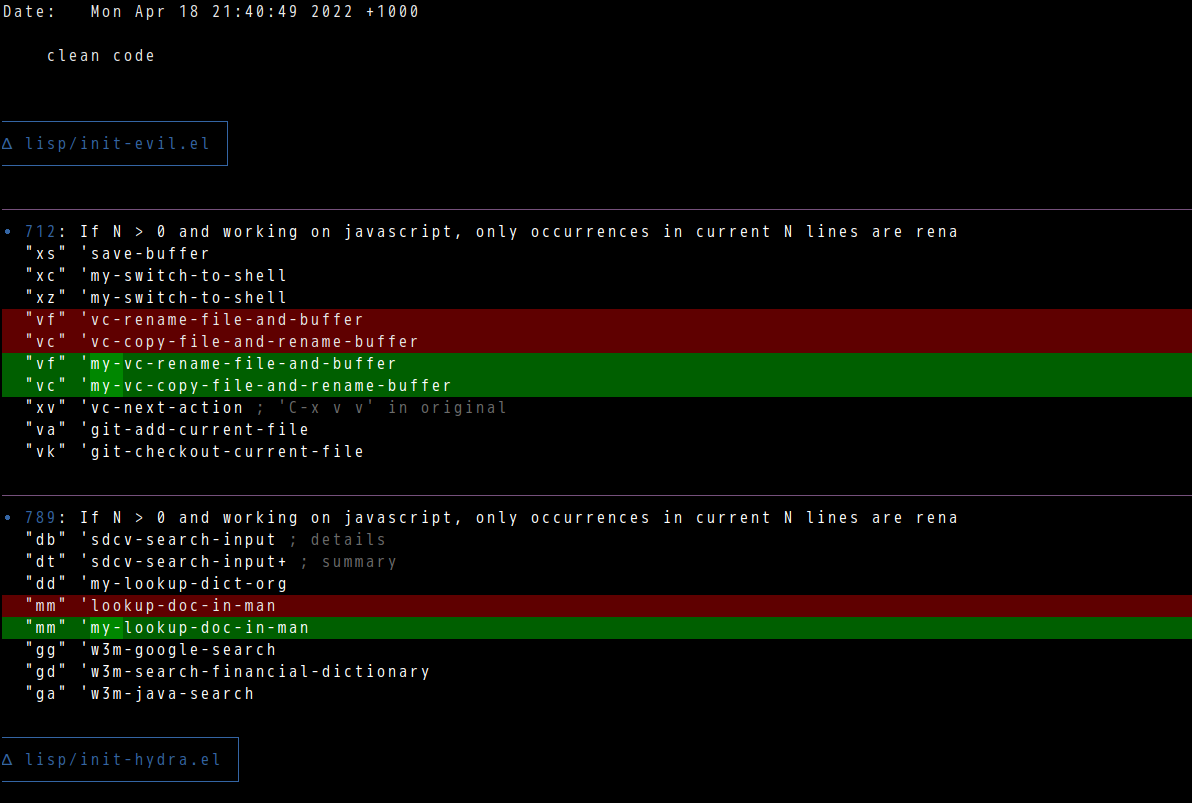
In Using a File as a Template in Emacs, I wrote about the end of week reports that my supervisor tasked me with writing. I want to expand a bit on one of the scripts I uses to help me fill out that report.
The Script
The following script is one of the tools I use to help me write my end of week report. It only considers the Forem code base.
The first section are the commits authored by members of the Content Experience Pod.
The second section are the commits in which pod members contributed one or more commits to the PR but were not the initiating author; Git registers these as Co-authors.
In other words, the script shows what code my team helped ship for the week.
Where to File Away that Script?
For a week or two I was running a simpler version of the above script; I would search through my shell command history, find the one that looked right, and adjust the date.
That worked but I’d prefer to not rely on that workflow. I added the script to my Content Experience Pod’s Org-Roam node; a document that is part of my
Knowledge Management System (PKM 📖) system.
It’s a little different, because I’ve written it using Org-Mode’s Babel syntax.
The first line (e.g. #+Begin_src sh :results output :cmdline (org-read-date)) declares:
A code-block with sh syntax
To write results as raw output
To pass the results of the (org-read-date) function as $1 to the script
The remaining lines are almost verbatim of what I previously wrote; except instead of the “hard-coded” date of I’m using the results of the org-read-date function.
To run the report, I set point (e.g. the cursor) in that code block, type C-c C-c and
Emacs 📖 evaluates the Babel block.
First it calls the org-read-date function, prompting me to select a date. Then it runs the shell command. And outputs the results just below the Babel block.
From there, I can see one aspect of the work my team has done for the week.
Conclusion
Prior to adopting Emacs, and Org-Mode specifically, I would’ve floundered on where to put this. It would’ve remained in my shell history.
But now that I’ve associated this with a group of people, written it in a less ephemeral file, and written about it, I will be more likely to remember both it’s existence and what it did.
I learned about
Git 📖’s commit trailers and how to find the Co-authors of a commit. Which helps make visible the work that folks do to help another person get their pull request merged.
I also learned a bit more about passing arguments from Babel into the script it’s executing.
And last, because I wrote this blog post in my PKM system, I have a reference from the published blog post, to the Content Experience Pod.
In other words, I’m doing my best to create breadcrumbs to help me find the particulars of a script I wrote.
installing emacs in highly-managed environments e.g. HPC and scientific computing
At work, I frequently use a high performance computing cluster (300 nodes, 1000 CPU, 44 TB of RAM). It is an amazing environment. Many users access the system via Jupyter Hub and Virtual Research Environments where many tools for development are available. However the recommended editor is VSCode and I need Emacs.
I access the system via ssh on a terminal and run Emacs without the GUI. This is enough for me, since I have all I need:
This is great, since I can use the same tools I use on my laptop, with the same configuration and be really efficient.
Unfortunately, a couple of months ago, the web proxy that we have to go through to access the internet from the cluster was upgraded and the old Emacs version available on the system was not able to fetch packages.
Doing some research, I found that Emacs 27 could be configured to work. Since I did not want to bother the sysadmins without being sure that it would work, I decided to compile Emacs from source as I do on my laptop.
Unfortunately, I couldn't manage to get all dependencies working. So I needed to find another way to have a recent Emacs on the system.
On the cluster, we use Conda to build virtual environments for scientific computing. With Conda, we can install whatever package we want at the user level without any particular privilege.
So I just did:
conda install emacs
and I got the last stable Emacs release, which is 27.2 at the time of this writing.
So if you need to use Emacs in a system where you can't install system wide packages and you don't want or can't build it yourself, Conda can be a good solution. Installing Conda does not need particular privileges.
quick survey of Albanian history from c1912 (Ottoman independence) to 1991 (neoliberal transition)
Lea Ypi joins Long Reads for a discussion about Albanian history. Lea is a professor of political theory at the London School of Economics and the author of several books. Her most recent work is Free: Coming of Age at the End of History. It'saccount of her experience growing up in the last years of Albanian Communism and the first phase of the country's new capitalist order.
Long Reads is a Jacobin podcast looking in-depth at political topics and thinkers, both contemporary and historical, with the magazine’s longform writers. Hosted by Features Editor Daniel Finn.
Melvyn Bragg and guests discuss the ancient Sanskrit text the Arthashastra, regarded as one of the major works of Indian literature. Written in the style of a scientific treatise, it provides rulers with a guide on how to govern their territory and sets out what the structure, economic policy and foreign affairs of the ideal state should be. According to legend, it was written by Chanakya, a political advisor to the ruler Chandragupta Maurya (reigned 321 – 297 BC) who founded the Mauryan Empire, the first great Empire in the Indian subcontinent. As the Arthashastra asserts that a ruler should pursue his goals ruthlessly by whatever means is required, it has been compared with the 16th-century work The Prince by Machiavelli. Today, it is widely viewed as presenting a sophisticated and refined analysis of the nature, dynamics and challenges of rulership, and scholars value it partly because it undermines colonial stereotypes of what early South Asian society was like.
With
Jessica Frazier
Lecturer in the Study of Religion at the University of Oxford and a Fellow of the Oxford Centre for Hindu Studies
James Hegarty
Professor of Sanskrit and Indian Religions at Cardiff University
And
Deven Patel
Associate Professor of South Asia Studies at the University of Pennsylvania
VERY EXCELLENT: part 3 of the GHW Bush saga and the American Century of Empire
Live from Dallas and Houston, we finally deliver the third part of our investigation into the life and times of President George H.W. Bush. This installment looks at his time as head of the C.I.A., his involvement with various figures associated with the Kennedy assassination and its investigation, and his business dealings with various shady Houston financial institutions.
Note: I’m splitting this ep into two parts just to make it easier to keep all the Poppy material separated in case I want to collect them down the line, but 614a & b are one ep for all the Chapo archivists out there.
finally > We discuss the great Phoenix Suns at length
We open with the slap heard 'round the world, then talk about the Robert Williams III injury and its implications, and LeBron's injury and performance with the Lakers. We discuss the great Phoenix Suns at length and fail to figure out who and what Kyrie Irving missed most of the season for. Plus a quick run through Will Smith's filmography, where Matthew confesses his life-long Will Smith secret to Jonah. This episode was recorded on Monday, March 28th.
Follow the Jacobin Sports Show on Twitter: @JacobinSports
EXCELLENT parody of Texas culture, extreme US Christianity, woke shitlib-ery, AND reform Judaism, with great line readings
Live from Houston, we’re joined by Jake and Thomas from the Pendejo Time podcast for another movie pitch. This time we’re attempting to break into the evangelical Christian film market (think God’s Not Dead and The Reliant) with a moral fable about a boy discovering the true magic of Uncles.
Note: I’m splitting this ep into two parts just to make it easier to keep all the Poppy material separated in case I want to collect them down the line, but 614a & b are one ep for all the Chapo archivists out there.
The great Homer Simpson once said, "What is mind? No matter. What is matter? Never mind." In that spirit, we watched Andrei Tarkovsky's masterpiece SOLARIS (1972), which imagines outer space as a manifestation of our inner life. PLUS: checking in on that most important issue of our time, the Oscars.
Michael and Us is a podcast about political cinema and our crumbling world hosted by Will Sloan and Luke Savage.
EXCELLENT discussion of this bizarre, and probably failing, little state, and esp its surprisingly (and frighteningly) powerful rightwing.
Anton Jäger joins Long Reads for a discussion about modern Belgium and its recent history. The country's image as a harmonious center of European integration, as host of the European Union and NATO, has given way to talk of outright separation between Flanders in the north, and Wallonia in the south. Anton is a Belgian historian of political thought who’s written for a number of publications, including Jacobin and New Left Review.
Long Reads is a Jacobin podcast looking in-depth at political topics and thinkers, both contemporary and historical, with the magazine’s longform writers. Hosted by Features Editor Daniel Finn. Produced by Conor Gillies, music by Knxwledge.
Our GDPR privacy policy was updated on August 8, 2022. Visit acast.com/privacy for more information.
Keith Lowe talks to Matt Elton about the ways in which today’s conflict between Russia and Ukraine can be traced back to the Second World War and decisions made in the years that followed.
Keith will be giving a five-part masterclass series on the aftermath of the Second World War beginning on 4 March – find out more at historyextra.com/masterclass.
unfortunately does not much discuss the actual--and abundant--evidence demonstrating Churchill's mis- and malfeasance. Mostly Mizen semi-confronts Wheatcroft (à la "everybody loves Churchill, yet you say ...") and Wheatcroft says that the cult is unhealthy.
Winston Churchill looms large in the modern imagination. Everyone from Fidel Castro to George W Bush have cited him as an exemplar in times of crisis. Historian Geoffrey Wheatcroft talks to Spencer Mizen about the world’s fixation with the wartime leader, arguing that this obsession is neither healthy, nor necessarily merited.
(Ad) Geoffrey Wheatcroft is the author of Churchill’s Shadow: An Astonishing Life and a Dangerous Legacy (Vintage, 2021). Buy it now from Waterstones:
still very conventionally pro-Ukraine, but at least voicing sanity regarding how nuclear war with Russia would be *very bad*. Especially good to hear from Klippenstein and Sirota is that their contacts inside the US military are very concerned to avoid *direct* war; rather disconcerting is their contacts' concern that their deepstate bosses seem to be either insane or so incompetent as to be effectively insane
This week, President Joe Biden is visiting European nations — including Poland — as the war in Ukraine rages on. This follows on the heels of Biden pledging to send $800 million worth of weapons to Ukraine, on top of an additional $13.8 billion approved by Congress. This week on Intercepted: associate editor Maia Hibbett discusses the details behind the U.S. support for Ukraine with investigative reporter Ken Klippenstein and associate reporter Sara Sirota. As Klippenstein and Sirota explain, the U.S. has been sending ISR — or intelligence, surveillance, and reconnaissance — assistance to Ukraine, without being fully involved in the conflict. The aid, however, could be seen as an escalation to the conflict, despite major news organizations and think tanks pushing for an even more aggressive stance. Klippenstein and Sirota explain that the way out of the conflict is to assist in diplomacy between Ukraine and Russia — not add fuel to the fire. join.theintercept.com/donate/now
The 'van trip' is just a conceit motivating a quick romp through the weirdness European politics as of late Mar 2022. After celebrating spring in Berlin (and German politics), the Späti Boys do Bulgaria, Serbia, Italy, and Lithuania.
Rob and Nick pack up their converted diesel, top off the gas tank with sunflower oil and travel around Europe giving little updates on how European countries are reacting to the Russian invasion that may have been overlooked by others.
Usually-excellent and -provocative [Chas Freeman](https://en.wikipedia.org/wiki/Chas_W._Freeman%2C_Jr.) does not disappoint on this survey of geopolitics (OK, mostly just Europe plus Gulf monarchies, PRC, Russia, US--but that's a lot :-) as of late Mar 2022 (not sure when this was actually recorded). Starts with a Russia-Ukraine-war overview, mixture of good, conventional (pro-forma denunciation of Putin), and just plain odd takes. (Latter: Freeman compares the 224 Russian invasion to ... he claims Nicholas II started the Russo-Japanese War. Which is bizarre on a few levels:
- Japan started the war (sneak attack 8 Feb 1904), though ... - ... the Nicholas II regime was certainly planning for war in the indefinite future (like, /after/ finishing the Trans-Siberian Railroad)
So, if anything, if comparing 20220224 to 19040208,
- Putin is like the pro-war Genro, who felt provoked by aggressive Czarist expansion - Nicholas II == NATO+Zelensky, who were/are planning future war but got caught out
But mostly Freeman is very good and insightful (though quite slow and lowkey--ya might wanna increase playback speed :-) Following points in approximate order of presentation:
1. US-NATO want a prolonged war, for which they will 'fight to the last Ukrainian'
2. Europe needs a new security framework that includes all of - Russia and its ~ally Belarus - neutrals like Hungary, and--for now, at least--Finland, Sweden, Switzerland, Austria - Russophobes in Ukraine, Poland, and the Baltics - ... and "the nations that really matter": esp Germany, but also France and UK (who may be very minor powers, but who also have nuclear weapons) If an 'inclusive security framework' is not achieved, something like WW1+nukes seems likely
3. why/how US expanded NATO, esp under Clinton regime - good side point on how the "core of NATO" is standardization, which "allows a Portuguese soldier to die for Poland, and vice versa" - US politics in 1994 and 1996, esp (Bill) Clinton's duplicitous presentations to Russia and to US Russophobes (esp weaponized immigrant communities) - US policy fundamentally (~19:35) is to maintain 'a global sphere of influence for the United States modeled on the Monroe Doctrine'
4. how Ukraine fits in US-NATO policy - (~19:50) "[Ukraine] was not neutral after 2014. That was the purpose of the [2014 Maidan] coup: to prevent neutrality, or [to prevent] a pro-Russian government in Kiev, and to replace it with a pro-American government that would bring Ukraine into [the US] sphere [of influence]." - since 2015, and esp since 2017, (~20:50) "US has been arming and training Ukrainians against Russia" - 2022 step-change to outright NATO proxy war with Russia (@20:23) 'is essentially cost-free for the United States'
5. PRC alliance with Russia 'will grow' despite its reservations - Freeman claims PRC opposes spheres of influence. I have my doubts about that: cf. Mearsheimer on PRC IR establishment as (IIRC, as spoken by Mearsheimer) "my kind of [19th-century] people" - PRC is (@26:17) 'the last citadel of Westphalianism' so formally opposes Russian violation of territorial integrity, and will probably attempt to mediate the war - regarding the 4 Feb 2022 Putin-Xi Beijing meeting (~26:58): "I don't believe [that Putin] told Mr Xi that he planned to invade Ukraine."
6. Ending Russia-Ukraine War will involve (@30:28) "something variant of the Austrian State Treaty of 1955," with guarantees for - Ukrainian independence - rights of minorities within Ukraine - Ukrainian neutrality but US deepstate will actively oppose not just such a peace, but will continue to provoke/continue war, notably through Zelensky, who is effectively a US sockpuppet. (Side note from ~34:45: Freeman makes clear that it is ridiculous to infer that the Ukrainian state cannot be in any way neo-Nazi from the fact that Zelensky is (at least nominally) Jewish.)
7. US allegations of Russian false-flag preparations as replay of US support for Syrian rebels, in which the Syrian rebels conducted false-flag operations in Douma et al.
8. Geopolitics: - Saudi (and Gulf monarchies) - US as (current) oil competitor - Biden and US deepstate vs MBS - UAE, Saudi et al see US as declining/retreating power - BRICS geopolitics: will seek neutrality, will not obey 3rd-party sanctions - US sanctions as risking dollar supremacy for de-dollarization - the now-repeated thefts by US (and UK and EU) banks of their opponents' deposits is forcing the rest of the world to seek financial alternatives
Support Pushback: https://www.patreon.com/aaronmate
Chas Freeman, a retired senior US diplomat, analyzes Russia's invasion of Ukraine, the US role, and the geopolitical fallout. "Everything we are doing, rather than accelerate an end to the fighting and some compromise, seems to be aimed at prolonging the fighting," Freeman says.
Guest: Chas Freeman. Veteran U.S. diplomat and public servant who has served in many senior positions, including as Assistant Secretary of Defense for International Security Affairs, U.S. Ambassador to Saudi Arabia, Director for Chinese Affairs at the U.S. Department of State, and as the principal US interpreter during President Nixon’s historic visit to China in 1972.
VERY EXCELLENT--the single best piece I've yet heard on Russia-Ukraine and 2022 geopolitics generally. It's long (154 min), but VERY worth your time
Support Pushback: https://www.patreon.com/aaronmate
The Grayzone's Max Blumenthal and Aaron Mate speak live with ex-UN weapons inspector and military expert Scott Ritter about the Russia-Ukraine war. Ritter provides a detailed analysis of the battlefield that stands in stark contrast to the rose-colored perspective of most Western analysts, and offers his perspective on the political follies that drove the conflict.
Guest: Scott Ritter. Former UN Weapons Inspector and Marine Corps Intelligence Officer.
EXCELLENT: necessarily thin addition to the big-topic-overview 'everything you wanted to know' series, but Cooijmans covers the people, place, and period c300-987 well
Dr Christian Cooijmans answers listener questions on the medieval world of the Franks. Speaking to David Musgrove, he discusses long-lasting Frankish dynasties, renowned rulers and the Franks’ connections with the wider world.
where is the Android equivalent? (Not that I'd welcome much typing on my phone, but I can definitely see the usecase.)
27 March 2022 Plain Org v1.2.1 released
Plain Org v1.2.1 is now available on the App Store. The update receives minor features, bug fixes, and improvements.
If you haven't heard of Plain Org, it gives you access to org files on iPhone while away from your beloved Emacs.
I love org markup, but we (iPhone + org users) are a fairly niche userbase. If you're finding Plain Org useful, please help support this effort by getting the word out. Tell your friends, tweet, or blog about it.
On to v1.2.1 release notes…
Render LOGBOOK
State transitions and LOGBOOK drawers are now recognized and rendered as such.
Either of the following snippets are rendered as togglable LOGBOOK drawers.
* TODO Feed the fish
- State "DONE" from "TODO" [2022-03-11 Fri 12:23]
* TODO Feed the cat
:LOGBOOK:
- State "DONE" from "TODO" [2022-03-11 Fri 12:23]
:END:
Add task to top/bottom
Up until now, tasks were always appended to the bottom of things. This didn't work so well if you like seeing recent items bubbling up to the top.
This version adds a new setting: Settings > Add new tasks to > Top/Bottom, giving you the choice.
Note: Top is the new default value, please change this setting if you'd like to keep the previous behaviour.
Checking for changes
Local file changes aren't always detected via state change notifications, so additional checks are now in place to offer reloading files.
Open inactive files
After adding new tasks via iOS's share sheet, if the item was added to a file other than the active one, offer to open that instead.
Other improvements
Color keyword red/green depending on #+TODO: position.
Round-trip planning order (SCHEDULED, CLOSED, DEADLINE).
Improve tag alignment to match org mode behaviour (best effort, sorry).
Improve vertical spacing prior to lists.
Improve share sheet reliability.
Fix opening local links from list items.
Fix indent for list items without previous content.
Fix race condition in adding TITLE and ID to new files.
Fix incorrect keyword color selection in search toolbar.
This episode (recorded 24 Mar 2022) doesn't start well. The Nerds Russia-Ukraine war-status checkup is definitely less credulous (WRT Anglophone {corporate-funded, state-aligned} media) than last week's, but still takes those reports as their starting point, and remains rather speculative.
However, 'after the musical break' @ 52:38, they (except it's overwhelmingly Mark Ames) start on part 2 of their Chechen Wars series, where they do the kinda history at which they excel. Contrary to the show notes, they start with the 1st known Russian-Chechen contact (forces of Ivan IV) c1559, and continue with the history of Chechnya, the Vainakh peoples (of whom the Chechens are but one), the northern Caucausus (and its other peoples), Russia (mostly as it involves itself in the region, esp Russian armies), and the USSR, ending just on the eve of Russian independence (but crucially /not/ Chechnya independence--Ames discusses that, and how that emerges from Yeltsin's defeat of Gorbachev) in Dec 1990.
Probably still worth 104 min of your time, but feel free to skip to 52:38 and halve the time requirement.
Ben Aris @ BNE Intellinews (or bne Intellinews, not sure about their branding) is an odd guy (in the following sense--I know nothing about him as a person) who's been on several excellent podcasts lately, pushing the same line. 1st, he's very good on the size and complexity of the Russian economy, and its integration into the global economy. E.g., Aris will mock the old John McCain line about how Russia is 'a gas station with an army'. (Not unlike the newer Saagar Enjeti line about it being 'a dying petrostate'.) But /then/ he turns around (figuratively speaking) and says that US-NATO-EU sanctions on Russia, and 3rd parties trading with it, will crater that economy. Which is just /ridiculous/: too much of the global economy is both
- too dependent on Russia (esp for bulk materials) to give it up - too large (or otherwise important) for US-NATO-EU to sanction them
And we're already seeing this: India, for example, is already--post-sanctions--buying Russian wheat, oil, and coke (i.e., metallurgical coal). Furthermore, to a 1st approximation, the PRC, Japan, and Germany (3 of the world's 5 largest economies) are export-led manufacturers: they import relatively-large amounts of relatively low-economic-value (LEV) bulk materials, and export relatively-small amounts of relatively high-economic-value (HEV) manufactured goods. (It's a /very/ simple model of these complex economies, but useful.) The PRC will /not/ forego Russian LEV materials: not only do their manufacturers need them, but the PRC wants a stable, friendly Russia on its northern border (and BTW will therefore fight any US-EU-NATO regime change there). And eventually, Germany and Japan will realize that
- observing US sanctions is a choice (not enforceable by the US-EU-NATO, because Germany and Japan are too big to sanction) - that choice is forcing /their/ manufacturers to consume more expensive LEV materials from the rest of the world - ... while competing with PRC manufacturers, who are effectively being subsidized (since the prices for Russian LEV materials will decline to the extent sanctions decrease demand) - as well as losing exports /to/ Russia, which is 3.1% of the global economy in PPP terms
... at which point German and Japanese economic elites (who dominate their polities, much like, though less than, US economic elites dominate US politics) will slowly, quietly, but firmly walk away from the US-EU-NATO "international order" and resume trading with Russia.
We spoke with founder and editor of BNE Intellinews, Ben Aris, on the sanctions on Russia, Russia's economic role in the world and Europe and the big question, is there any coming back from this? Also Nick says MOFA and Rob thinks its funny (correct).