18 Apr 13:52
J. Mater. Chem. A, 2016, 4,7943-7949
DOI: 10.1039/C6TA00679E, Paper
Jingjing Chang, Hai Zhu, Juanxiu Xiao, Furkan Halis Isikgor, Zhenhua Lin, Yue Hao, Kaiyang Zeng, Qing-Hua Xu, Jianyong Ouyang
The presence of excess PbI2 can affect the structure of perovskites and photovoltaic performance of perovskite solar cells. Increased open-circuit voltage could be achieved by introducing proper PbI2. However, shorter carrier lifetime and increased recombination and resistance were observed when an excess of PbI2 was used.
The content of this RSS Feed (c) The Royal Society of Chemistry
18 Apr 13:51
Chem. Soc. Rev., 2016, 45,2937-2975
DOI: 10.1039/C5CS00831J, Review Article
Kai Wang, Chang Liu, Tianyu Meng, Chao Yi, Xiong Gong
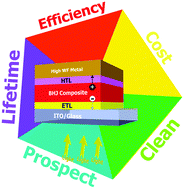
Recent progresses in device structures, working mechanisms, functions and advances of each component layer, as well their correlations with the efficiency and stability of inverted OPVs, are reviewed and illustrated.
The content of this RSS Feed (c) The Royal Society of Chemistry

18 Apr 01:02
by Frances E. Lennon
Unique fractal evaluation and therapeutic implications of mitochondrial morphology in malignant mesothelioma
Scientific Reports, Published online: 15 April 2016; doi:10.1038/srep24578

18 Apr 01:02
by Yuxiao Deng
Article
Human mesenchymal stem cells (hMSC) expressing paracrine factors may enhance therapeutic benefits when transplanted. Here, the authors show that hMSCs stably expressing prostacyclin enhance host regeneration and muscle mass gain in a mouse hindlimb ischaemia model, mediated by the long noncoding RNA H19.
Nature Communications doi: 10.1038/ncomms11276
Authors: Yuxiao Deng, Zhongwei Yang, Toya Terry, Su Pan, Darren G. Woodside, Jingxiong Wang, Kehe Ruan, James T. Willerson, Richard A. F. Dixon, Qi Liu

16 Apr 00:50
by Daniel Ramirez, Mario Alejandro Mejía Escobar, Juan F. Montoya and Franklin Jaramillo

The Journal of Physical Chemistry C
DOI: 10.1021/acs.jpcc.6b02808

16 Apr 00:47
by Yunlong Guo, Wataru Sato, Kazutaka Shoyama and Eiichi Nakamura

Journal of the American Chemical Society
DOI: 10.1021/jacs.6b02130

16 Apr 00:46
by Constantinos C. Stoumpos, Duyen H. Cao, Daniel J. Clark, Joshua Young, James M. Rondinelli, Joon I. Jang, Joseph T. Hupp and Mercouri G. Kanatzidis

Chemistry of Materials
DOI: 10.1021/acs.chemmater.6b00847

15 Apr 10:39
by Hong Fang and Puru Jena

The Journal of Physical Chemistry Letters
DOI: 10.1021/acs.jpclett.6b00435

14 Apr 10:55
by Antonio Guerrero, Germà Garcia-Belmonte, Ivan Mora-Sero, Juan Bisquert, Yong Soo Kang, T. Jesper Jacobsson, Juan-Pablo Correa-Baena and Anders Hagfeldt

The Journal of Physical Chemistry C
DOI: 10.1021/acs.jpcc.6b01728

14 Apr 10:48
by Hu Chen, Daniel Bryant, Joel Troughton, Mindaugas Kirkus, Marios Neophytou, Xiaohe Miao, James R. Durrant and Iain McCulloch

Chemistry of Materials
DOI: 10.1021/acs.chemmater.6b00858

11 Apr 00:43
by Xiao Liu, Kai-Wei Tsai, Zonglong Zhu, Ye Sun, Chu-Chen Chueh, Alex K.-Y. Jen
Although tin oxide (SnO2) has been employed recently as an efficient electron-transporter to realize highly efficient organometal halide perovskite solar cells (PVSCs), it is still quite challenging to apply it through facile solution-based synthesis at low enough temperature (<150 °C) to be compatible with the roll-to-roll printing on polymer substrates. In this work, a dual-fuel combustion method has been successfully adapted to modulate the exothermic characteristics and processing temperature (140 °C) of SnO2 to achieve homogeneous and crystalline thin film as efficient electron-transporting layer for PVSCs. The fabricated SnO2 film not only has high transparency (from 350 nm to near-infrared region) but also possesses good electron extraction ability, as evidenced by the efficient PL quenching in bilayered SnO2/CH3NH3PbI3 film. By passivating SnO2 surface with a C60-containing self-assembled monolayer (C60-SAM), a high power conversion efficiency (PCEmax) of >15% with negligible hysteresis can be achieved in PVSC. This demonstrates the great potential of applying this dual-fuel combustion process to improve processability and charge-transporting properties of metal oxides for organic electronics applications.

A low-temperature (<150 °C), solution processible SnO2 electron-transporting layer is prepared via a dual-fuel combustion method. The fabricated SnO2 shows a decent charge-collecting capability from perovskite absorber to realize a maximium power conversion efficiency (PCEmax) of ≈13% of the derived device. By further passivating the SnO2 surface with C60-containing self-assembled monolayer, an improved PCEmax of >15% with negligible hysteresis is demonstrated.
11 Apr 00:43
by Yunus Sevinchan, Paul E. Hopkinson, Artem A. Bakulin, Julia Herz, Marcus Motzkus, Yana Vaynzof

In article number 1500616, Y. Sevinchan and co-workers investigate the photo-induced charge separation process at a metal oxide/polymer interface. Incorporation of a Cs dopant in the metal oxide reduces the density of gap states at the oxide surface, thus lowering the number of bound charge pairs formed at the organic/inorganic interface. This reduction in interfacial trapping suppresses the recombination and enhances the photocurrent in hybrid photovoltaic cells.
09 Apr 05:19
by Daniel L. Jacobs, Michael A. Scarpulla, Chen Wang, Benjamin R. Bunes and Ling Zang

The Journal of Physical Chemistry C
DOI: 10.1021/acs.jpcc.5b11973

09 Apr 05:17
by Jing Zhang, Zhihua Liu and Zhifeng Liu

ACS Applied Materials & Interfaces
DOI: 10.1021/acsami.6b00429

07 Apr 00:50
by Yang Zhou
Article
The photophysics of lead halide perovskites is under intense investigation. Here, the authors use force microscopy on single crystals to show that light induces drastic lattice changes, and propose that the weakening of the hydrogen coupling under illumination is responsible for the lattice dilatation.
Nature Communications doi: 10.1038/ncomms11193
Authors: Yang Zhou, Lu You, Shiwei Wang, Zhiliang Ku, Hongjin Fan, Daniel Schmidt, Andrivo Rusydi, Lei Chang, Le Wang, Peng Ren, Liufang Chen, Guoliang Yuan, Lang Chen, Junling Wang

07 Apr 00:48
by Shi Liu, Fan Zheng, Ilya Grinberg and Andrew M. Rappe

The Journal of Physical Chemistry Letters
DOI: 10.1021/acs.jpclett.6b00527

07 Apr 00:48
by Fangzhou Liu, Qi Dong, Man Kwong Wong, Aleksandra B. Djurišić, Annie Ng, Zhiwei Ren, Qian Shen, Charles Surya, Wai Kin Chan, Jian Wang, Alan Man Ching Ng, Changzhong Liao, Hangkong Li, Kaimin Shih, Chengrong Wei, Huimin Su, Junfeng Dai

In article number 1502206, Aleksandra B. Djurišić and co-workers discuss whether excess PbI2 is beneficial for perovskite solar cell performance. The presence of unreacted PbI2 is commonly believed to be beneficial to the efficiency of perovskite solar cells. However, it results in an intrinsic instability of the illuminated film even in inert atmosphere, leading to accelerated film degradation under illumination.
07 Apr 00:47
by Wu-Qiang Wu, Fuzhi Huang, Dehong Chen, Yi-Bing Cheng, Rachel A. Caruso

In article number 1502027, Dehong Chen, Yi-Bing Cheng, Rachel A. Caruso and co-workers demonstrate the structural tuning of titania, producing films of nanoparticles, nanowires or nanosheets for perovskite solar cells. The porous network and fast electron transfer of the nanowire and nanosheet thin films enable perovskite infiltration, facilitate charge extraction and suppress charge recombination.
06 Apr 01:30
by Qana A. Alsulami, Banavoth Murali, Yara Alsinan, Manas R. Parida, Shawkat M. Aly, Omar F. Mohammed
In organic donor–acceptor systems, ultrafast interfacial charge transfer (CT), charge separation (CS), and charge recombination (CR) are key determinants of the overall performance of photovoltaic devices. However, a profound understanding of these photophysical processes at device interfaces remains superficial, creating a major bottleneck that circumvents advancements and the optimization of these solar cells. Here, results from time-resolved laser spectroscopy and high-resolution electron microscopy are examined to provide the fundamental information necessary to fabricate and optimize organic solar cell devices. In real time, CT and CS are monitored at the interface between three fullerene acceptors (FAs) (PC71BM, PC61BM, and IC60BA) and the PTB7-Th donor polymer. Femtosecond transient absorption (fs-TA) data demonstrates that photoinduced electron transfer from the PTB7-Th polymer to each FA occurs on the sub-picosecond time scale, leading to the formation of long-lived radical ions. It is also found that the power conversion efficiency improves from 2% in IC60BA-based solar cells to >9% in PC71BM-based devices, in support of our time-resolved results. The insights reported in this manuscript provide a clear understanding of the key variables involved at the device interface, paving the way for the exploitation of efficient CS and subsequently improving the photoconversion efficiency.

A complete understanding of the charge transfer, charge separation, and charge recombination at D/A interfaces is integral for boosting solar cell photoconversion efficiency (PCE). Time-resolved laser spectroscopy and high-resolution electron microscopy provide a basis for accomplishing the high performance solar cell. The device optimization enhanced the PCE from 2% in IC60BA-based to >9% in PC71BM-based solar cells.
06 Apr 01:30
by Chenghao Cao, Chujun Zhang, Junliang Yang, Jia Sun, Shuping Pang, Han Wu, Runsheng Wu, Yongli Gao and Chengbin Liu

Chemistry of Materials
DOI: 10.1021/acs.chemmater.6b00429

02 Apr 11:53
by F. Guillain, J. Endres, L. Bourgeois, A. Kahn, L. Vignau and G. Wantz

ACS Applied Materials & Interfaces
DOI: 10.1021/acsami.6b00356

02 Apr 11:52
by Wenqing Liu, Tao Liang, Qi Chen, Zhikai Yu, Yingying Zhang, Yujing Liu, Weifei Fu, Feng Tang, Liwei Chen and Hongzheng Chen

ACS Applied Materials & Interfaces
DOI: 10.1021/acsami.6b00327

30 Mar 02:13
by Po-Shen Shen, Jia-Shin Chen, Yu-Hsien Chiang, Ming-Hsien Li, Tzung-Fang Guo, Peter Chen
Vapor-based deposition technique is considered as a promising approach for preparing a high-quality and uniform perovskite thin film. With evolution from coevaporation deposition to a low-pressure vapor-assisted solution process, both energy budget and reaction yield for perovskite film fabrications are improved. In this paper, a low-pressure hybrid chemical vapor deposition (LPHCVD) method is applied to fabricate CH3NH3PbI3 perovskite films. The crucial dependence of working pressure on the perovskite formation is revealed. Moreover, the reaction time plays an important role in controlling the quality of the synthesized perovskite film. Efficient perovskite solar cells of 14.99% (mesoscopic), 15.37% (planar), and perovskite modules (active area of 8.4 cm2) of 6.22% are achieved by this LPHCVD method.

Highly efficient perovskite solar cells are made by low-pressure hybrid chemical vapor growth with superior uniformity. Small-area planar and mesoscopic devices obtain 15% power conversion efficiency with submodule of 6.22%.
30 Mar 02:12
by Viktor V. Brus, Christopher M. Proctor, Niva A. Ran, Thuc-Quyen Nguyen
The light intensity dependence of the main photoelectrical parameters of the nonfullerene small-molecule bulk heterojunction (BHJ) solar cells p-DTS(FBTTh2)2:perylene diimide (T1:PDI) shows that the nongeminate recombination losses play an important role in this system. A simple approach for the quantitative analysis of capacitance spectroscopy data of the organic BHJ solar cells, which allows to determine the density of free charge carriers as a function of applied bias under standard working conditions, is demonstrated. Using the proposed capacitance spectroscopic technique, the nongeminate recombination losses in the T1:PDI solar cells are quantitatively characterized in the scope of the bimolecular- and trap-assisted recombination mechanisms. Their contributions are separately analyzed within a wide range of the applied bias.

A simple method for the determination of the density of free charge carriers and quantification of nongeminate recombination losses in organic-bulk heterojunction solar cells, based on the analysis of capacitance spectroscopy data, is presented. The proposed method is applied to the analysis of nongeminate recombination losses in nonfullerene T1: perylene diimide small-molecule solar cells in the scope of bimolecular- and trap-assisted recombination mechanisms under 1 sun illumination.
30 Mar 02:12
by Michael Corazza, Nicholas Rolston, Reinhold H. Dauskardt, MichailJ. Beliatis, Frederik C. Krebs, Suren A. Gevorgyan
The role of the common stress factors such as high temperature, humidity, and UV irradiation on interface adhesion of roll-to-roll fabricated organic photovoltaic (OPV) devices is investigated. The samples range from bare front electrodes to complete devices. It is shown that applying single stress or combinations of stresses onto the samples variably affect the adhesion properties of the different interfaces in the OPV device. It is revealed that while the exposure of the complete devices to the stresses results in the loss of photovoltaic performance, some interfaces in the devices present improved adhesion properties. Depth profiling analysis on the fractured samples reveals interdiffusion of layers in the structure, which results in the increase of adhesion and change of the debond path. It is shown that through diffusion and intermixing of internal interfaces coupled stresses can increase the adhesion of OPV interfaces by over tenfold. The results are additionally compared to the photovoltaic performance of the complete devices.

The effect of high temperature, humidity, and UV irradiation on the interface adhesion of roll-to-roll fabricated organic photovoltaic (OPV) devices is investigated. The samples range from bare front electrodes to complete devices. It is shown that applying single stress or combinations of stresses onto the samples variably affects the adhesion properties of the different interfaces in the OPV device.
29 Mar 12:00
J. Mater. Chem. A, 2016, 4,6158-6166
DOI: 10.1039/C6TA00835F, Paper
Yuanpeng Xie, Weihua Zhou, Jingping Yin, Xiaotian Hu, Lin Zhang, Xiangchuan Meng, Qingyun Ai, Yiwang Chen
The tremendous loss in open-circuit voltage (Voc) upon solvent annealing in p-DTS(FBTTh2)2:PC71BM could be recovered by subsequent post-thermal annealing.
The content of this RSS Feed (c) The Royal Society of Chemistry
29 Mar 02:49
by Kai Wang, Yuliar Firdaus, Maxime Babics, Federico Cruciani, Qasim Saleem, Abdulrahman El Labban, Maha A. Alamoudi, Tomasz Marszalek, Wojciech Pisula, Frederic Laquai and Pierre M. Beaujuge

Chemistry of Materials
DOI: 10.1021/acs.chemmater.6b00131

29 Mar 00:49
by Gwendolyn D. Blanco, Arto J. Hiltunen, Gary N. Lim, Chandra B. KC, Kimmo M. Kaunisto, Tommi K. Vuorinen, Vladimir N. Nesterov, Helge J. Lemmetyinen and Francis D’Souza

ACS Applied Materials & Interfaces
DOI: 10.1021/acsami.6b00561

29 Mar 00:48
by Seog Joon Yoon, Kevin G. Stamplecoskie and Prashant V. Kamat

The Journal of Physical Chemistry Letters
DOI: 10.1021/acs.jpclett.6b00433

28 Mar 00:44
by Minchao Qin, Junjie Ma, Weijun Ke, Pingli Qin, Hongwei Lei, Hong Tao, Xiaolu Zheng, Liangbin Xiong, Qin Liu, Zhiliang Chen, Junzheng Lu, Guang Yang and Guojia Fang

ACS Applied Materials & Interfaces
DOI: 10.1021/acsami.5b12849