Shared posts

05 Sep 00:47

Five of cultural appropriation’s greatest hits

by Tamara Winfrey Harris

Miley Cyrus neither invented twerking nor cultural appropriation in music. What follows is a crowd-sourced list of some “great” moments in musical cultural appropriation.

“Vogue,” Madonna

Said one contributor to this list, “[Madonna] owes her whole career to appropriation, POC props and GLBT props, too…The idea that people associate her with vogueing is pretty much the textbook definition of appropriation of marginalized cultures, gay and black.”


“Waiting on a Friend,” The Rolling Stones

You know what makes New York City look extra gritty? Black people. You know you’ve hit the big time when you can get reggae legend Peter Tosh to serve as a random black extra hanging on a stoop.


“Luxurious,” Gwen Stefani

Gwen Stefani is the patron saint of icky cultural appropriation since that time she tried to keep a posse of Japanese women as pets. Here she kicks it Cali-style with her best Latino friends.

This fuckery committed with her bandmates in No Doubt cannot go unmentioned.


“Save a Prayer,” Duran Duran

I was a “Nick girl” back in the mid-80s when every self-respecting teenage girl was a Duranie. It failed to occur to me then how often the band illustrating their jet set coolness by frolicking in front of exotic flora, fauna and, y’know, brown people.


“We Can’t Stop,” Miley Cyrus

Would that we could stop this hot mess. If you haven’t read Tressie McMillan Cottom’s piece on the black female bodies Cyrus chose to foreground her whiteness. Do it. Now.

05 Sep 00:38

What if America Also Elevated Malcolm X, John Brown, Ida B. Wells Barnett, Nat Turner and Other Black Freedom Fighters to American Royalty Just Like Dr. Martin Luther King Jr.?

by noreply@blogger.com (chaunceydevega)
[My most recent series of essays on the March on Washington anniversary have brought quite a few new readers to We Are Respectable Negroes. As I do during such moments, I inaugurate an informal fundraising drive.

I do not advertise or monetize my work here on WARN. I also choose not to run advertisements or sponsorship because I want to remain independent. Instead, I have a twice a year fundraiser, and moments such as this one, where I extend the hand on high traffic posts.

Random monies thrown into the tip jar Paypal bucket are however always appreciated. My work here and elsewhere are labors of love. However, I never refuse encouragement.]
.
.
.
Private rituals provide comfort through routine. Public rituals deploy the same logic on a mass scale by creating a sense of community through a shared experience.

Today's celebration of the 50th anniversary of The March on Washington is a ritual that is designed to cement America's memory of itself as an exceptional nation above all others. Consider the trajectory and narrative arc: the United States held millions of people in bondage, fought a Civil War over the issue of chattel slavery, was led to a third revolution by Dr. King, and then elected a black man as President.

The story sells itself.

This same public ritual involves the dual creation and reinforcement of a mythology which creates a version of Dr. King that is robbed of all of his radicalism, and where he is made into an easily digestible figure for a public that yearns for consensus politics.

As I alluded to here, the anti-war, anti-poverty, radical, provocative, challenging, and explicitly pro-black Dr. King who loved black and brown people and would die for them in the fight against White Supremacy, is not an acceptable public figure for post racial, post civil rights America.

The United States is a "corporateocracy" where its citizens have been taught that democracy is synonymous with capitalism. The United States has circulated a myth of origin wherein she imagines herself as a nation of immigrants--as opposed to a nation of white settlers who showed up, displaced the people already living here, and then created a racially tiered "democracy".

And with Jim and Jane Crow being formally vanquished, the American (white) public could be self-congratulatory, pronounce white racism dead, and the work of the Civil Rights Movement done...and damn any black, brown, or white folks who continue to call out the existence of both day-to-day and institutional white supremacy, for they are now the "real racists" by daring to engage in such truth-telling enterprises.

The celebration of the truncated and abridged "I have a Dream Dr. King" is a result of a need by elites and many in the public to integrate those competing impulses and political projects.

The Dr. King who is feted and worshiped in the Age of Obama is a wax museum come to life. He is a post racial version of Santa Claus for all of those good boys and girls who want to imagine that white supremacy is a thing of the past. Consequently, because Dr. King is now a type of cultural and political Santa Claus, he can be re-purposed by the White Right and claimed as their cheerleader with little consequence for their willful lies in the service of white supremacist fantasies.

The particularly lazy and intellectually vacuous type of public memory that has been created around Dr. Martin Luther King Jr. in post civil rights America encourages such fictions and delusions.

Who is to be blamed?

However, the real Dr. King would be putting much coal in the stockings of the American people for their failure to continue his work. In the year 2013, the American people have not created an economic democracy, are in many ways surrendering to white supremacy, have not fixed broken public schools, unions and labor are weak and dying, and American militarism is shrugged at with little complaint.

The public ritual wants, and even perhaps needs, a great man or great woman, a singular figure on which to focus its attention. Among proper students of the Civil Rights Movement and American history--as opposed to the one created by the dream merchants of multicultural market/corporate democracy neoliberal America--it is understood the Brother Dr. Martin Luther King Jr. was but one player among many other freedom fighters in the centuries-long Black Freedom Struggle.

Counterfactuals and thought experiments are very useful devices here.

What would happen, if on this 50th anniversary of The March on Washington, men and women such as Brother Malcolm X, Robert Williams, Ida B. Wells Barnett, Toussaint Louverture, The Deacons for Defense, The Black Panthers, Nat Turner, Denmark Vessey, David Walker, Sojourner Truth, Marcus Garvey, Amy Jacques Garvey, John Brown, and the many other black (and some white) Americans who fought for the  rights, human dignity, and liberty of African-Americans, by any means necessary, as well as in quotidian ways (and usually without acknowledgement) were also elevated to American sainthood?

Is American public memory capable of including such voices in an honest way?

And must the Civil Rights Movement's public narrative necessarily be about black "surrender" to white violence in order to fit into a politically correct version of American history that is approved by the white racial frame?

27 Aug 14:42

The Rape of Harriet Tubman

by Guest Contributor

2367518607_22757244da

By Guest Contributor Janell Hobson; originally published at Ms. Magazine blog

This year marked the 100th anniversary of the passing of Harriet Tubman. I had the opportunity to celebrate that fact when organizing a special symposium back in March, resulting in some thought-provoking critical papers on her legacy of resistance, which I’m currently guest-editing for Meridians: Feminism, Race, Transnationalism.

One of the more interesting conversations that came out of this event questioned why, on the anniversary of her death, we have yet to experience an epic cinematic treatment of her life.  She certainly qualified for that great Hollywood biopic. Against all odds, as a disabled enslaved woman, she escaped to freedom–having learned of the Underground Railroad network that included support from black and white allies–and once she made it to the other side returned to slavery 17 more times to free countless other slaves.

Tubman used all sorts of wit and trickery to enable her dangerous journey in this secretive network, and even believed in her divine right and power to engage in liberation. She collaborated with John Brown on the raid at Harper’s Ferry, recruiting slaves for the project, but her illness at the time prevented her from taking part in the uprising. During the Civil War, she served as a Union army spy, nurse and soldier, and in 1863, she led a successful military campaign on Combahee River in South Carolina, resulting in the liberation of 750 slaves.

In short, she’s the stuff of legend–for black history, women’s history, American history. The fictional Django from Django Unchained ain’t got nothing on her!

But on the year of her centennial anniversary, what does Tubman get instead of the great Hollywood biopic? She gets a “sex tape.”

You read that correctly. Recently, in an internet launch of his new YouTube channel, All Def Digital, rap media mogul Russell Simmons featured a failed comedic video titled Harriet Tubman Sex Tape–the first in the line-up of this new series. It didn’t take long for black audiences on social media to utterly denounce this video and petition against it. Within 24 hours, Simmons removed the video from his channel and issued this apology:

My first impression of the Harriet Tubman piece was that it was about what one of the actors said in the video, that 162 years later there’s still tremendous injustice. And with Harriet Tubman outwitting the slave master? I thought it was politically correct. Silly me. I can now understand why so many people are upset.

It is amazing that Simmons could not have predicted the outrage upon seeing such a video–which infers that, in order to build an Underground Railroad network to free the slaves, Tubman basically used blackmail against her white slaveowner by conniving with a fellow male slave to create a “sex tape” of their sexual encounter that she could later use as “leverage.” Then again, this is what porn culture will do to one’s perspective–something Simmons has perpetuated in his decades-long involvement with sexist rap music and culture.

Just reading the video’s premise was enough to make my blood boil, but sometimes, especially when you do media analysis as part of your scholarship, you just have to be a witness. So I viewed the video, and I don’t believe I am exaggerating when I say that, on this centennial anniversary, Harriet Tubman got raped.

Most of Tubman’s biographers have argued that there is no documentation that Tubman experienced sexual abuse while enslaved.  She was definitely physically abused–routinely beaten, and at one point as an adolescent suffered a head injury caused by an overseer who threw a two-pound weight against her head, breaking her skull and nearly killing her. The injury impacted her throughout her 91 years of life, as she was often given to sleeping spells (which Tubman claimed brought on various dreams and prophetic visions).

Slavery was “hell,” Tubman described in her narrative, dictated to Sarah Bradford since she could neither read nor write. She experienced a great deal of trauma while enslaved, but if there were any experiences with rape–which marked the experiences of far too many enslaved women–Tubman remained silent on the issue. It’s still also possible that, as hellish as her experience might have been, she was spared from a deeper hell that sexual violence brings to the picture. Which is why Simmons’ “sex tape” adds insult to injury.

It’s a hell of a sobering reality to realize that, 100 years after Tubman’s passing, our porn culture–intertwined inextricably with rape culture–would produce such a demeaning narrative about one of our great American heroes. It happened not because there is any basis in history for such an imagined scenario (Tubman simply would not engage in sexual leverage–it’s not part of the essence of who she was) but because our culture continues to trivialize rape (which is what we must categorize any unequal encounter between a slaveowner and slave, regardless of “consent”) and debase women’s experiences.  Ironically, the horrendous truth about sex tapes is that they tend to be used as leverage not against men but against women! It is women who are often blackmailed or demeaned when sex tapes are made available on the Internet. Women are the ones who have everything to lose, considering the slut-shaming that still clings to female sexuality. Sure, some celebrities might parlay such “porn” videos into a career, but the intention of sex tapes is public humiliation.

The Harriet Tubman Sex Tape publicly humiliates one of our great icons, and if she–whom many believe is inviolable, sacred, untouchable–can be debased, then not one of us is safe.

I don’t mean to suggest that Tubman, more than anyone else, deserves “hands off” treatment. The backlash against the video has already produced a troubling discourse around the desecration of our “ancestor, our great Mother Tubman,” which is steeped in respectability politics. We should be outraged when any woman is demeaned in this manner.

And before anyone accuses me of being too sensitive, consider this: In order for satire or parody to work (whether it’s funny or not), there has to be a kernel of truth to the punch line. This atrocious video bases its insults on historical lies:

Lie #1–Tubman is sexually conniving

As I already mentioned, it’s just not part of Tubman’s character to engage in sexual leverage. She was deeply religious, and if she were given to any kind of negotiation out of slavery, it was when she married a free black man, John Tubman, whom she eventually left when circumstances that would cause her to be sold away from her family propelled her escape. The portrayal of Tubman aggressively using sex as a bargaining chip, or even including dialogue suggesting that her previous rejections of her owner’s sexual advances were based on a lie (i.e. rape victims really enjoy it), feeds into the worst stereotypes of hypersexual Jezebels–a trope slaveowners used as a cover for their rapes of enslaved women.

Lie #2–Tubman is a Big Woman

This may seem a trivial point, but the real punch line of the video is the size of the body of “Tubman” undergoing different sex positions. The actor, Shanna Malcolm, may have signed up to portray Tubman outwitting her owner, but Malcolm’s the one who seems to have been outwitted (she admitted as much on Twitter when she saw the final cut). The humor is at her expense. In reality, Tubman was a tiny five-foot woman, whose smallness amazed everyone because of her physical and emotional strength. As such, the heavier actor portraying her is depicted not to capture the historical Tubman, but instead to capture a stereotypical distortion of enslaved black womanhood. She’s the asexual Mammy, a different stereotype that slaveowners constructed as a deflection from accusations that they were raping enslaved women. If Mammy is depicted as big, dark and aggressive–in contrast to the cultural feminine ideal of small, fair and passive–then slaves posed no sexual threat (meaning that rapes didn’t happen).

Hopefully, we all know what a lie that perpetuates, since rape is based on power, not desire.

In addressing the physical portrayal of Tubman in the video, this is not to suggest that bigger, darker women are not attractive–only that attraction is not a prerequisite for rape. But that has never stopped rapists from promoting this lie through stereotypes that cover up their guilty tracks. The very fact that the different sex acts featured in the video serve as a visual “gag” (the supposed incongruity of a white man with a plus-sized black woman) feeds this racist, sexist and fatphobic trope, which was used during the antebellum period and continued throughout Jim Crow and present-day porn culture.

Lie #3–A slaveowner could be bribed into supporting the Underground Railroad

The absurdity of this premise is steeped in historical and cultural ignorance. Ignoring for the moment that we are not to take seriously the joke because of the anachronistic use of a video camera, some other impossibilities abound: Not only would Tubman not be able to gain leverage with a “sex tape” (on the premise that her “massa” would give in to supporting her escape plans if she showed said tape to his wife), but, in reality, most mistresses knew of their husbands’ transgressions. This knowledge didn’t always help slaves; sometimes it made the situation worse as they then suffered physical abuse under their mistresses, who resented the situation as they, too, did not have power (sexual or otherwise) to stop their husbands’ abuses. They were all operating under a system supporting white male supremacy.

Finally, no slaveowner would willingly support a network that would deprive him of the free labor his economy depended on–hence slaveowners lobbying in Congress for the passage of the Fugitive Slave Law, which would return captured fugitives living in the free states back to their owners. Again, one could only find this “joke” funny if there were a kernel of truth in the premise.

Most African Americans (especially black feminists) who reacted swiftly to this demeaning portrayal understand the lies the video tells, which are far more dangerous than any failed humor. At the end of the day, the existence of this video–pulled by Simmons or not (actually, others have already downloaded the video and republished it elsewhere)–reinforces the pain of a history that many of us still refuse to acknowledge in its entirety.

Which isn’t to say that a comedy based on Harriet Tubman couldn’t be funny. Pierre Bennu’s Black Moses Barbie actually demonstrates how one can be hilarious about Tubman’s legacy while maintaining the basic integrity of what she represented. But there does need to be some truth-telling (even when obvious anachronisms and exaggerations are added) to the comical story. The great comedic geniuses–think Richard Pryor or Dave Chapelle– understood as much.

Tubman deserves an epic biopic, not this trash, and our present-day culture is far too steeped in amoral, ahistorical, corporatized impulses that produce, distribute, promote and recycle garbage. Its toxins have polluted our cultural environment with ideologies of misogyny and white supremacy.

That’s what porn culture does: It debases us all, while rape culture reinforces the debasement.

Photo of Harriet Tubman courtesy of manchestergalleries via Creative Commons 2.0.

17 Aug 21:42

Friday Fun: Ava DuVernay Makes Fashion Fair Cosmetics Look Good–And Relevant!

by Andrea
Darlingniki821

Beautiful!

By Andrea Plaid

Via chaudmag.com

Via chaudmag.com

I’ve always given side-eye to Fashion Fair Cosmetics ever since I started wearing make-up. To be a part of the Johnson Publication empire–the people who bring us Ebony (and its online equivalent) and Jet–their make-up was not only too rich for my wallet but never quite fit my skin tone. (You’d think, of allllll the companies, Fashion Fair would have a shade that fit the full spectrum of Black folks and well, right?) And, to be honest, the brand itself made me think of its relevance to my mom’s generation–the fresh-off-the Movement, up-the-corporate-ladder Baby Boomers–not mine.

Of course, it would be award-winning director Ava DuVernay who would make Fashion Fair relevent to my mom, me, and younger generations.

If you remember, DuVernay’s master class in ad-making, The Door, makes you forget that you’re really watching a Miu Miu commercial. And DuVernay–perhaps giving a nod to dream hampton’s damn-I-wish-I-was-there Brooklyn homegurl party vid, “QueenS” by TheeSatisfaction–makes you forget that she just put another ad into our pop-culture cosmos about cosmetics and get us into the celebration of the intergenerational linking of family and friends through love, all in lush colors and shades and hairdos and (once again!) amazing soundtrack. All of the Don Drapers need to bow down before her marketing genius.

Enjoy the short, and enjoy your weekend!

DuVernay | SAY YES from @AFFRM on Vimeo.

10 Aug 15:07

White Privilege Kills: Pennsylvania Mass Shooter Rockne Newell is a White Male Domestic Terrorist. When Will White Folks Clean Up Their Own House?

by noreply@blogger.com (chaunceydevega)

Rockne Newell shot and killed three people yesterday and wounded several others during an attack on a municipal town board meeting in Pennsylvania.

A white man runs amok again. When will the white community have a serious conversation about the violence of its members? Where are the white Don Lemons and white media elites on Fox News and conservative talk radio showing leadership on the frightening trend that is white men committing acts of mass murder and violence in the United States?

White men are approximately 30 percent of the American public, but they account for 70 percent of mass shootings. The pathological mix that is gun culture and imperiled/aggrieved white masculinity is killing people--most of whom are white--yet, the white community looks the other way.

As my Right-wing friends are fond of saying, "what of personal responsibility?"

Of course, when white people commit politically motivated crimes there is no handwringing, introspection, or generalizations made about white folks in mass. As we saw in the aftermath of the Adam Lanza shooting spree, once more the freedom to be white is the freedom to be an individual and to have none of your negative actions reflect anything about the group to which you belong.

Rockne Newell is a terrorist. Instead of labeling him as such, there will be a national conversation about mental illness and how Rockne Newell is just one of the "crazies." The Right-wing media will try to cast Rockne Newell as an outlier or one of "those people", i.e. an Obama supporter. Thus, his gun mania murder madness will not reflect poorly on conservatives, the NRA, or the policies which they support that in turn make reasonable gun control laws impossible to enforce.

The other option when faced by white criminals who commit acts of mass violence is for white society to find a way to "otherize" them, transforming them into a type of person who is somehow not really "white" and "normal." For example, the silly efforts to kick the Boston Bombers out of the family of Whiteness because they are Muslim and from the Caucasus (the very definition of "white" in the pseudo-scientific race business).

Just as Bill O'Reilly and other white elites did in the aftermath of the Trayvon Martin murder case, where they decided to publicly scold black folks and their "bad culture", we need some black and brown leaders to lecture and truth-tell about the plague of white crime and white domestic terrorism that is imperiling the United States.

Of course, black folks do not have the media platform or authority to lecture white people about the pathological aspects of their culture, or to discuss the reality that is "white crime", as to do so would be "reverse racism" and unkind to the feelings of White America.

White privilege is killing white people. Yet, they choose to stand mute and silent.
10 Aug 15:07

The Last of the Doughboys Talk About World War One While We Think About How 3D Printers May Change the Nature of Future Wars

by noreply@blogger.com (chaunceydevega)
Readers of WARN know that World War One has been my grognard topic of study for these last few years.

I started out with the Harlem Hellfighters, then watched Boardwalk Empire while jotting down notes about how great a resource that TV show is for understanding how race was made during the first part of the 20th century, and then kept reading more about the Great War.

I received a very good public education in high school; that education would have been much improved if we were taught something about how World War One helped to make the present. 

In keeping with my habit these last few weeks, here are a several "found topics" that I would like to share with all of you around the above theme for the weekend.

The Last of the Doughboys by Richard Rubin is a great book which quite literally lets the veterans who fought in World War One speak to us. 

Other voices from the past can speak to us too. To point. African-Americans who were slaves in the 19th century can be heard here

Listening to the veterans of World War One speak touches me in a related way: have we forgotten the horrors of industrial warfare, just to have curiosity encourage us to fight on a mass scale as nation states again using technology that the iron mongers would like to see in action just to satisfy their own morbid curiosities and fatten their wallets?

In an era of unmanned aerial vehicles, resource scarcity, and lessons learned from fighting a counter-insurgency campaign for more than ten years in the Middle East, what will future wars look like for the United States? 

The public assumes American dominance on the battlefield; the experts know better given that her military has not fought a peer competitor in many, many, many years.

Wars, conflicts, battles, and engagements, of maneuver which feature coordinated armor, infantry, artillery, and integrated air support are not the past-present. They are the future. And the United States military is quite rusty in using those most basic of skills.

The book Fighting the Future War is a great read. It is a compilation of science fiction stories from the first three decades of the 20th century, and how their authors thought about "the future". Fighting the Future War contains stories about sentient robots, giant mecha, poison gas, electricity guns, and all manner of dystopic predictions. More than a few of the chapters resonate because of how useful they are for imagining our present 21st century.

3D printers are all of the rage among hobbyists, geeks, and first adopters who are trying to prepare themselves for a future of self-reliance in an era of resource scarcity. I remember first reading about 3D printers in Omni magazine while in elementary school. I was so impressed by how a fax machine-like device could "print" wrenches and other tools for researchers and explorers at the South and North poles. It was like Star Trek made real. 

We get old pretty fast, do we not? Such technology is now maturing. Just as it could help with space exploration, 3D printers will also complicate war-fighting by making logistics and supply chains much easier and simplified.

Writing for the Armed Forces Journal Lt. Commander Michael Llena highlights some of the possibilities:
Three-dimensional printing, a fast-moving technology that is still in its infancy, promises to upend the way we think about supply chains, sea basing and even maritime strategy. But it also requires us to think hard and carefully about the threats it enables and the vulnerabilities it introduces. 
As Massachusetts Institute of Technology’s Neil Gershenfeld puts it, the revolutionary aspect of 3-D printing is that it allows us to make things into data and data back into things. For the Navy, the technology promises to shift inventory from the physical world to the digital one. Instead of actual parts, a ship might carry 3-D printers and bags of various powdered ingredients, and simply download the design files needed to print items as necessary. 
Certainly, today’s ships and subs are not going to make everything they need on board, although it is tempting to imagine better uses for freed-up storage spaces. Today’s printers are generally limited to printing parts made of just one material, and variance is a big issue. But the development of multiple-material devices is well underway, and the technology is racing ahead. Perhaps closer at hand is a distributed global production network in which sailors and Marines send an email with a digital scan or design for a part they need and have it created at the nearest certified printer. 
Thinking bigger, the fleet might convert some Military Sealift Command ships into floating factories that can take print-on-demand orders from the battlegroup. 
The things that might be ordered go far beyond mere parts. Several university labs and at least one defense contractor have turned out UAVs comprised entirely of printed parts, excepting the motor and electronics. A Virginia Tech lab that started printing on a Friday had by Sunday completed an aircraft that could be folded up and stored in a backpack.
3D printers will also introduce their own challenges: how do you supply the resources necessary for those devices to keep functioning? Will that resource chain then become a target like any other, which protecting, will take more than the equivalent resources of what 3D printers can produce in terms of supply?

World War One was, like the Civil War on a smaller scale, an industrial war. What happens when relatively cheap technology like 3D printers are introduced?

3D printers would appear to be a force multiplier for both the attacker and the under-resourced defender if they are similarly equipped. 

World War One, quite literally, ate human beings alive. 

Could 3D printers and other related technology represent a similar paradigm shift that the general public and many war planners are not prepared for? And just how inaccurate are our predictions of future warfare more generally?
09 Aug 10:59

Charlie Rangel is Right: The Evidence is Overwhelming That the Tea Party is in Fact a Group of 'White Crackers'

by noreply@blogger.com (chaunceydevega)
In a recent interview with The Daily Beast, Representative Charlie Rangel stated that the Tea Party is akin to the “crackers” who fought against Dr. Martin Luther King Jr. and the Civil Rights Movement. Predictably, Rangel’s description of the Tea Party was greeted with claims of “reverse racism” by conservatives, the Right-wing media, and their black conservative lapdog apologists.

Precision is important when discussion the relationship between race and language.

Cracker is a word used by African-Americans to describe white people who are racist and bigoted towards them.

While the exact origins of the word cracker (or its other version “cracka”) have not been determined, it was most likely based on the sound that an overseer’s whip would make as it tore and scarred the flesh of black human chattel. Whatever its etymology, the word “cracker” is in no way equivalent to the word “nigger”.

To point: Black folks yelling cracker did not systematically deny whites their civil rights, burn them alive, enslave and rape them by the millions, mutilate their bodies, or leave them hanging from tree during spectacular lynchings. Likewise, African-Americans never enforced a several centuries long regime of racial terrorism against white people, dehumanizing them through the use of language intended to legitimate their oppression and exploitation.

As comedian Louis CK so deftly observes, “is there even a word in the English language that a black person can use to hurt a white man’s feelings?” No.

The feigned offense and hysterical response by the Right-wing media to the use of the word “cracker” by 
African-Americans, as seen several weeks ago during the Trayvon Martin murder trial, and now in the aftermath of Rangel’s interview with The Daily Beast is simply one more example of the White Right crying the victomology blues in order to gin up support for their sick fiction and delusion that white people are now oppressed by racial minorities in the United States during the Age of Obama.

Rangel’s suggestion that the Tea Party is comprised of white crackers is actually a claim that can be empirically evaluated. If a cracker is a white person who holds anti-black animus and feelings—what can range from “old fashioned” open and public bigotry, to “backstage racism” and more subtle types of implicit bias—then what does the actual evidence tell us about the Tea Party GOP and its members’ racial attitudes?

In the most obvious and public examples, Tea Party rallies have featured signs depicting Barack Obama as an African “witchdoctor” or “savage”. Tea Party supporters have also carried signs emblazoned with the Confederate flag, or used monkey and ape imagery to describe the country’s first black president at their rallies.

Silence and complicity is endorsement: the attendees at these rallies were not rejected or condemned by their fellow Tea Party members; rather, their racist message was embraced and supported.

When combined with the Tea Party’s support of Birtherism, a racially degenerative picture is painted which suggests that black people are closer to animals and apes than full human beings. Moreover, from this perspective Barack Obama is not a legitimate president because he is not white, and is thus some type of perennial Other, one who cannot be reconciled within the tradition of White “Real America.”

Leaders in the Tea Party have been caught sending racist emails and other communications to their colleagues and supporters that have contained vicious stereotypes of Barack Obama and his family as primates, the White House overrun with watermelons, and the President as a pimp.

Given the record number of assassination threats against the United States’ first black president, and the rise in the number of White militia groups during his tenure, the repeated association of Barack Obama with ape imagery is highly dangerous: research in social psychology demonstrates how an association between black people and apes subconsciously primes white test-takers to support violence against African-Africans. In this way, racist humor works as an appeal to violence by the White Right, and conservatives more generally, against the United States’ first black president.

Rangel’s claim that the Tea Party is the heir, both metaphorical and literal to those who opposed the Civil Rights Movement, is not empty rhetoric. In fact, there are direct connections between the language, organization, and political philosophy of those who opposed bringing down Jim and Jane Crow of years ago and today’s Tea Party GOP.

Fred Koch, the patriarch of the Koch family, was a founder of the white racist organization known as the John Birch Society, which along with the White Citizens Councils (and other White reactionaries) actively opposed the civil rights of African-Americans.

His sons, Charlie and David Koch, are carrying forward this work through their opposition to school desegregation efforts. In keeping with their elder's politics, the Koch brothers are behind the faux populist Astroturf Tea Party movement.

The Tea Party, and the Republican Party in mass, have embraced the legacy of the Confederacy (and by implication, those who opposed the Civil Rights Movement) by using the rhetoric of “nullification”, “States’ Rights”, and “secession”, as well as advocating for a “Second Civil War” to combat Barack Obama’s policies and (twice) election. It is no coincidence then that appeals to the racial tyranny of the Confederacy by the White Right have accompanied the election of the country’s first African-American president.

The opponents of Dr. King and the Civil Rights Movement also used similar language in their campaign of “massive resistance” against the Black Freedom Struggle.

In addition, the Tea Party recycles and circulates a childish and facile understanding of the framers and the Constitution as a means of gathering and maintaining support. The Confederacy and opponents of the Civil Rights Movement also used the same imagery of Washington, Jefferson, and the Founding to legitimate the righteousness of their anti-democratic struggle against Black Americans' full rights and citrizenship.

Sophisticated public opinion research on the racial attitudes of Tea Party members, as well as those people who identify with that movement, has revealed that both groups are much more likely to harbor anti-black racial attitudes and prejudices. The consensus of these researchers is that the Tea Party is a movement and set of attitudes laced with what social scientists have termed “white racial resentment” and “symbolic racism.”

Recent research by New York University’s Eric Knowles adds an additional level of nuance and detail to our understanding of how white racism is a strong component in Tea Party GOP ideology. As Dr. Knowles explained to the online publication The Raw Story:
Knowles and his colleagues examined 316 white participants’ racial attitudes, ingroup identity, and identification with tea party over a period of nine months. The researchers found identification with the tea party was associated with anti-black prejudice, libertarian ideology, social conservatism, and belief the nation was in decline. 
“It’s important to note that the results concerning racial prejudice are correlational: across all three time points, prejudice was associated with support for the tea party,” Knowles explained. 
Supporters of the Tea Party actually become more “white identified” the longer they are affiliated with the organization. It is not only that racists are attracted to the Tea Party—which they are—but, that the Tea Party is a white identity organization which primes and gives conservatives a vocabulary to project their racism through the use of ostensibly “neutral” and “colorblind” rhetoric. 

Knowles develops this claim more as he observes:
Our evidence tells us that, if anything, getting into the tea party leads to increases in white racial consciousness. As we describe it, the tea party may act as a political ‘racialization’ experience. Whites may get into the movement for race-neutral reasons (e.g., they’re libertarians or social conservatives), but doing so makes being white more important to them.
Harvard University’s Theda Scokpol and Vanessa Williamson interviewed Tea Party members while researching their book The Tea Party and the Remaking of American Conservatism. Their findings suggest that Tea Party members believe that people of color have a “plantation mentality”, are lazy, and lack a proper work ethic. These are the core elements in what is called “modern” or “symbolic racism”.

Conservatism and racism have converged in post-civil rights era America. The Republican Party is the United States’ de facto “White” political party. Consequently, as one of its most extreme factions, it then follows that the Tea Party is the flag bearer for white racial resentment and modern racism in the Age of Obama.

Not all conservatives are racist. But, most racists are conservative…and they have found their natural home in the Tea Party GOP.

To borrow from Rachel Jeantel, a political organization that lures and attracts white racists cannot help but be full of “creepy ass crackas”. Representative Charlie Rangel simply stated a plain on the face truth about the Tea Party that is supported by a critical mass of evidence—anecdotal, systematic, and empirical.
09 Aug 10:59

Shameless Self-Promotion: Chauncey DeVega Will be on the Ed Schultz Radio Show Today Discussing Charlie Rangel's Comments on How the Tea Party is a Group of "White Crackers"

by noreply@blogger.com (chaunceydevega)
I hope you all had a good and restful weekend.

My piece on the truth-telling of Charlie Rangel is making its rounds. Some really kind folks gave it love (including friend of the room Tim Wise over on Twitter) over the weekend.

Mike Papantonio, host of Ring of Fire Radio (and now also with a great show on the Free Speech TV), was one of my earliest backers. He will be guest hosting The Ed Schultz Radio Show today--meaning Tuesday, August 6th. Mike has graciously invited me on to discuss the relationship between the Tea Party GOP, their Jim and Jane Crow bonafides, and the Right-wing's white victimology-laced reaction to Rangel's observations.

Whenever Mike and I chat on the radio we do some good teaching and "connecting the dots" as I like to say.

Plus, given all that has transpired since the last time that Mike and I chatted on the radio, who knows where the conversation will go?

Mike and Ed are both cool folks. And along with the other supporters of WARN, especially those of you who donated during our last fundraiser, I am forever indebted and grateful for their and your support.

I am scheduled for between 2 and 3pm EST. Radio is dynamic. Barring any surprises, i.e. being bumped which does happen from time to time, I should be on during the first half of the hour.

The Ed Schultz Radio Show is part of the Progressive Talk Radio and can be heard in most major cities. The Ed Schultz Radio Show can also be listened to online here.
09 Aug 10:59

R. Kelly vs. Anthony Weiner: A Tale of Two Sexual Deviants

by For Harriet
 photo R-Kelly.jpg
by Stephanie J. Gates

NYC mayoral candidate Anthony Weiner is in the news again for sending sexually explicit texts and photos to women other than his wife, and a writer from the Grio believes that Weiner could learn a lesson or two from disgraced R&B superstar, Robert Kelly, better known as R. Kelly.

In an opinion piece, What Anthony Weiner can learn from R. Kelly, Imani A. Dawson, asks, “What do these very different men have in common?” Both have come under scrutiny twice (three times for Kelly) for inappropriate sexual behavior.” Comparing Weiner to Kelly is not like apples and apples, or apples and bananas even. No! It’s more like apples and broccoli—it may all be food, but it doesn’t belong in the same group. Weiner was sending messages to consenting women, where as Kelly was seducing under-aged girls. Comparing the two, trivializes the seriousness of Kelly’s actions.

Kelly the self-proclaimed Pied Piper of R & B lived up to his moniker and lured the children away. He tried to make us believe that ain’t nothing wrong with a little bump and grind, and maybe it ain’t. But he was a grown man sticking his key into the ignition of girls not even old enough to have a driver’s license not banging out explicit messages on a keyboard. The comparison reminds me of how little we value Black women and girls in our society.

The rumors about Kelly had been floating around for years, and anyone who knew him didn’t deny that he had a fetish for young girls. So, when charges were brought against him, I was as happy as Kim Kardashian when she thought she hit the Kanye jackpot! He was the anti-Christ to my born-again Christianity and I don’t even go to church! I was a One Woman anti-everything R. Kelly Movement. When his songs came on in my car, much to my teenage niece’s dismay, I turned the station. When he was performing in the midst of the allegations against him, I had another niece (who was grown) ask me to charge her tickets to the concert if she gave me cash. Ha, ha, ha, ha, ha—I laughed in her face. It was no secret to anyone who knew me how I felt.

I would go to verbal blows with anyone who blamed R. Kelly’s situation on anyone but Mr. Kelly himself. I couldn’t believe how many people who told me it was the girl’s fault, her parents’ fault, his entourage’s fault—anybody and everybody except him! I made crude jokes. A friend of mine is friends with Kelly, and he told me they were going to hang out to celebrate Kelly’s birthday, and I asked them if they were going to Chuck E. Cheese. A co-worker said something sideways about my anti R. Kelly stance, and I told her unless she put her hair in two ponytails and sucked her thumb, she was out of his league.

Kelly’s case was personal to me. I lived in Chicago and worked in the area where he was known to be cruising for girls. My students used to confide in me that they didn’t like him years before the story hit the news because they would see him riding around the neighborhood talking to girls at the elementary schools in the area. The two girls who filed suits against him and were settled out of court, both went to Kelly’s old high school. It was the secret that wasn’t a secret.

As a Black woman, I have seen my share of Black girls and women thrown under the bus to save face when the perpetrator of a sexual assault is a Black boy or man. I bear witness to their broken bodies, their broken hearts, and their broken spirits crushed by our silence and complicity in the crimes against them. And while I understand to a limited degree, the reasoning behind it—the Black bodies of boys and men swinging from trees convicted on hear say—I get it. But it does not erase the crime against Black women and girls by perpetrators who look like them.

I prayed that the jury would find him guilty and send a message not only to celebrities who thought they were above the law, but also to Black men who preyed on Black girls. I was hoping that the case would shed light on the twisted sense of loyalty to Black men and boys that exists in the Black community when it comes to Black women and girls.

By the time the verdict was announced, I had made my peace with the situation by strengthening my resolve to continue speaking out against sexual assault committed against Black women and girls. Though I would have been happy if Kelly had served jail time, I wonder if it would have done anything to alter the widely-held misperceptions of the sexuality of Black females. Look what happened with Anita Hill and Desiree Washington. Clarence Thomas was selected to the highest court, and Mike Tyson received a hero’s homecoming. I couldn’t continue to vilify R. Kelly without acknowledging that his actions were symptomatic of a larger problem. He wasn’t the first person to piss on a Black girl, and he wouldn’t be the last.

And while I get the gist of the article about working for forgiveness vs. demanding it, I disagree with it based on the actions of both men. Their crimes might both warrant public forgiveness, but I think that Kelly needs to take a bigger bite out humble pie to work his way back. Dawson believes that Kelly has been “rebuilding his reputation from the ground up.” But what I think he has been rebuilding is his career. I haven’t seen any stories on Kelly doing any type of community service around sexual assault awareness. The author admits to still having issues with the 2002 Kelly video incident, but she respects the fact that unlike Weiner, Kelly isn’t demanding forgiveness.

There is nothing for Weiner to learn from Kelly. Weiner is an arrogant adulterer and pervert. But Kelly was a predator—apples and broccoli.

Related:

29 Jul 18:00

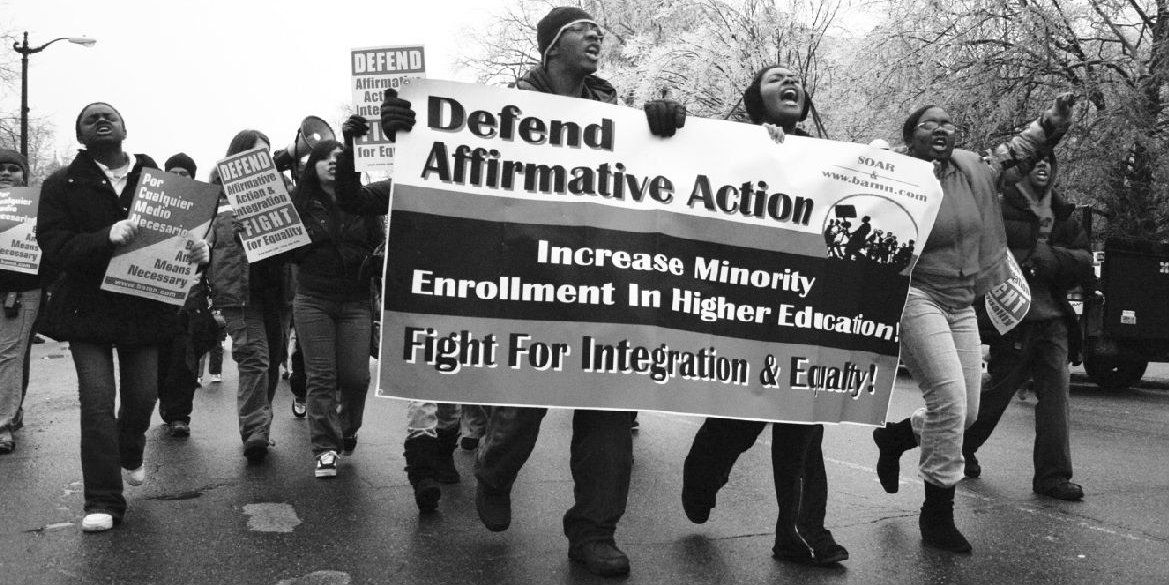
The Unending Attack on Affirmative Action

by Tania L. Balan-Gaubert
 photo affirmativeaction.jpg
Nearly 60 years after Brown v. Board of Education eliminated the “separate but equal” doctrine that legalized segregation in the United States, proponents for preserving the gains of the milestone victory are still fighting.

The Supreme Court ruled recently on the reverse discrimination case, Fisher v. University of Texas, sending it back to the lower courts. In 2008, Abigail Noel Fisher filed against the University of Texas claiming that she was denied admittance because she is white.
The Supreme Court decision neither supports nor denounces affirmative action in practice, but it strongly encourages the lower courts to reconsider the initial ruling, which was in favor of the university. This raises several questions: what will be the result of further review by the lower courts? Does the Supreme Court’s ruling implicitly affirm the presence of reverse discrimination in the case? Is this the end of affirmative action?

Reverse discrimination is unequivocally the red herring in all anti-affirmative action discussions. It attempts to draw sympathies for white people through the argument that affirmative action has subjected them to the same degree of racial prejudice and discrimination historically exacted on people of color.

In a YouTube video posted by Fair Representation, a nonprofit organization that funds pro bono litigation against affirmative action policies, Fisher spoke on her supposed experience of discrimination:
There were people in my class with lower grades who weren't in all the activities I was in, who were being accepted into UT, and the only other difference between us was the color of our skin…I was taught from the time I was a little girl that any kind of discrimination was wrong. And for an institution of higher learning to act this way makes no sense to me. What kind of example does it set for others?
Fisher’s plea and question are met with a resounding WTF from people of color and in particular, women of color who are subjected to double and triple jeopardy. Critical race feminists in particular, have argued how women of color are erased from discourse on race, sex and gender. Affirmative action debates continue this practice in the omission of women of color.

Laura M. Padilla’s article for Fordham Law Review, “Intersectionality and Positionality: Situating Women on Color in the Affirmative Action Dialogue,” addresses women of color and their erasure, the realities of their discrimination, the constitutionality of affirmative action and why women of color deserve support.

In general, women of color continue to be economically disenfranchised. Lower wages, poverty and single-headed households all contribute to their remaining at the bottom. Education provides the most viable means to attain economic security.

Yet, while women are pursuing higher education in larger numbers, women of color still fall behind white women. The costs for college persistently skyrockets and further excludes women of color who cannot afford to pay. And if acquiring an education without an income is difficult, advancement to higher paying jobs without an education is even more challenging.

Therefore, one of the goals of affirmative action is to make opportunities to attend college more accessible to women of color. Claims of reverse discrimination insult the struggles women of color endure simply to have a fighting chance.

Reverse discrimination assertions endeavor to de-legitimize affirmative action by painting it as “racial preference” or “racial entitlement,” while ignoring the reality that white privilege is the embodiment of both. Civil rights think tanks like the African American Policy Forum demonstrate through animation how historical discrimination, i.e. white privilege creates an unequal playing field in favor of whiteness. Organizations like Understanding Prejudice, an educational resource site, aim to address the myths surrounding affirmative action.

Coded language like "racial preference" and "racial entitlement" attempts to conceal the hostility and anger many whites feel, in addition to masking the perception that affirmative action poses a threat to their legacy of privilege.

Consequently, white privilege stands on its privatized soapbox and delivers the news that it will not be moved. White privilege ideology asserts that it will remain central to the discussion on race relations, by any means necessary; white people will not be left out.

At the moment, this is cause for alarm because by any means necessary includes conservatives appropriating methods from past civil rights cases to argue against affirmative action. As ProPublica astutely argues, conservatives have built the image of the perfect plaintiff in Fisher. Taking cues from NAACP, which used the same tactic to appeal to public opinion and challenge Jim Crow laws. This strategy carried over into the Civil Rights Movement in the form of nonviolent resistance and politics of respectability.

In truth, reverse discrimination stands in as a more benign term for diminished overrepresentation. If diminished white overrepresentation were the preferred term over reverse discrimination, attacks against affirmative action would not nearly be so strong. The power to construct coded language like “racial preference” instead of affirmative action or “reverse discrimination” instead of diminished overrepresentation galvanizes assaults on race conscious programs.

The concept of diminished overrepresentation illustrates how white people remain the overwhelming majority. As a result, any call for a colorblind Constitution will not diminish the significance of race. It will not dismantle the structure that created and sustains race. It will not make voting, education, contracts, or employment more accessible for women and people of color.

A colorblind approach to the Constitution will not do these things because there is an inherent racism within colorblind policy. Colorblind racism or the “new racism” simply rearticulates racist ideology in a way that shields prejudice and the agenda for white supremacy. As Eduardo Bonilla-Silva articulates in Racism without Racists: Color-Blind Racism and the Persistence of Racial Inequality in the United States, the use of coded language like “work ethic,” “merit,” “equal opportunity” and “individualism” are used persuasively to “softly” maintain racial order:
Much as Jim Crow racism served as the glue for defending a brutal and overt system or racial oppression in the pre-Civil Rights era, color-blind racism serves today as the ideological armor for a covert and institutionalized system in the post-Civil Right era. And the beauty of this new ideology is that is aids in the maintenance of white privilege without fanfare, without naming those who is subjects and those who it rewards…Thus whites enunciate positions that safeguard their racial interests without sounding “racist.”
Under this mindset, holistic approaches to college applications would be desirable to white people if it meant they were entirely merit-based and everyone was evaluated on their grades, test scores, essays, extra-curricular activities and legacy. Socioeconomic status, family structure, language, gender and races – all considered in applications to UT – would be completely disregarded without affirmative action.

The University of Texas awards automatic acceptance to all applicants who graduate at the top 10 percent of their class. Because Fisher didn't make the cut, she was bumped into the pool of applicants who are evaluated based on two areas: 1) grades and test scores, 2) personal achievement index (essays, leadership, activities, service and “special circumstances” which includes socioeconomic background, family structure, language and race).

It is not true that Fisher was not admitted to UT because she is white. ProPublica points out that according to court filings, even if Fisher had received points on her application for her race, UT still would have denied her admission.

Moreover, 47 students whose test scores and grades were lower than Fisher’s that year, were offered provisional admittance. Only 5 of those applicants were black or Latino, while the remaining 42 were white.

However, Fisher and Fair Representation did not mention these details in interviews, nor did they mention the 168 black and Latino students whose grades were as good or higher than Fisher’s, but were still denied admittance.

Fisher is in fact, a perfect example of a white woman who did not get into her first choice school, the school where she expected to continue familial legacy, but was admitted to her second choice school. Fisher attended Louisiana State University, graduated and works in finance.

So what has Fisher lost as a result of her not getting into the University of Texas?

She stated to a reporter that her losses amount to not being able to utilize UT’s alumni network and perhaps a chance at a better first job out of college. The damages Fisher seeks if she wins the case amount to $100, the cost of her application and housing deposit.

And just when it seems that enough salt has been thrown on affirmative action’s battle scars, what do the latest statistics and studies show us on who really benefits from affirmative action?

The answer, without hesitation, is white women.

While people of color have benefited from affirmative action, white women have disproportionately excelled as a result of their “preferential treatment.” How ironic, that Fisher, the perfect plaintiff is arguing she has been victimized by the system, when she is included among these statistical successes.

Affirmative action is not only a racial remedy for current and historical racism, it also challenges patriarchy. Women of color and white women have benefited from affirmative action because of this challenge. Fisher and others like her however, deal a double blow in attacking affirmative action. Their accusations should be viewed as symbolic acts of racial violence as well as violence against all women.


Tania L. Balan-Gaubert is a Haitian American native of Chicago. She received her master’s degree in African American Studies from Columbia University and currently resides in Brooklyn. You can find her on Twitter and Instagram @tanialaure.

29 Jul 16:20

Dear Vibe Magazine, About Your Twitter After Dark Chat

by Luvvie

The other night, Vibe Magazine’s Twitter account turned was turned over to radio personality, Angela Yee, for an hour for a “Twitter After Dark” chat. And I’m here to tell them to sit down for this decision. Because it was terrible, in my opinion. So here’s a sternly worded letter for the Vibe Magazine team.

Vibe-logo

Dear Vibe Magazine,

Ok what was that? Seriously. What was that Twitter chat about because I don’t understand. For many reasons. And it was terrible. For many reasons.

First of all, you’re a music and entertainment magazine that WAS cutting edge, and the go-to for young folks who loved to be in the know. What in the good world are you doing by having a crass sex-focused Twitter chat? It doesn’t e’em GO with what you represent. Not one bit. It was so damb irrelevant and I took it to mean you’re rebranding. You MUST want us to start thinking of you differently if you allow your corporate account to become smutville for a full hour.

Angela Yee, your moderator of choice, had me wanting to attack your account with bleach because it was gross and weird. I get it that we’re adults and sex is natural, but like with everything else, HOW you talk about something matters.

We were blessed with such gems as:

Buss

I’ve seen people tweet like this but not on an account with 390,000 followers. And not on a major brand’s channel. Not even on Playboy Magazine’s Twitter will you find this type of discussion.

And as if just that stuff wasn’t side-eye worthy enough. The tweets that were being posted on the account were so reductive of women. AND THEY WERE BY A WOMAN! I mean, what the hell?!?

Vibe-Magazine-Tweets

Yes, because what we don’t have is enough conversations about “hoes.” Surely. O_O

This is what I call that boolsheet. This basic ass conversation with these basic ass questions only showed that Vibe was cosigning trite and stupid crap that did nothing to advance conversations about sex. These questions are the same things those wack relationship experts would ask. And the fact that they’re coming from a woman is doubly sad.

If you wanna talk about number of partners and you wanna talk about head or whatever else and you’re this once-classic magazine, then you find a better way to do it. You don’t have to create codenames of stuff but you also don’t have to paint this gross picture.

Did y’all even vet Angela Yee before this convo? Did you create guidelines? Clearly not, because she got on that account and ran ALL the amoks on there. And you let her. And I don’t e’em blame her because she did what y’all told her to do. And maybe it wouldn’t have been so bad if it wasn’t smack dab in the middle of primetime.

side-eye 4 gif

Y’all talmbout “Twitter After Dark” and it was 9pm when this chat kicked off. It’s summertime. The sun JUST ended its shift and the moon was just clocking in. It’s barely time for that. Y’all coulda waited til 11pm for this trash or e’em midnight. Thirst.

It was a bad idea and I wonder how the team meeting that led to this chat went. Who are the people who thought a gutter chat like this was the move that the magazine needed?

If your mission was to get attention, then congratulations. And if your goal was to get folks replying to your tweets, kudos. However, all attention isn’t good and all engagement isn’t quality. Do I wanna read your publication more right now? Absolutely not. I’d rather read an essay by Joseline Hernandez.

As a company, you whored yourself out for retweets and used social media coupons that expired. Shame on you. Go have a seat and re-assess the judgment of the team that approved this decision. ALL’EM need to go sit in a corner and face the wall until they figure out what they did wrong.

Because FAIL.

Yours in side-eyedom,

LuvBug

So what did you think of Vibe’s tweets? Am I a prude for being like “ew?”

Follow the Awesomely Luvvie FB page | The post Dear Vibe Magazine, About Your Twitter After Dark Chat appeared first on Awesomely Luvvie.

21 Jul 19:50

Fun With Definitions: Pat Buchanan Says that President Obama's Speech on Trayvon Martin was "Insidious"

by noreply@blogger.com (chaunceydevega)

I just saw one of the marches in support of Trayvon Martin making its way through downtown Chicago. Kudos to them. I am always pleased when I see folks exercising their right to free speech and assembly as they bring awareness to an issue of important public and personal concern.

We call that good citizenship. Right-wingers and Zimmerman supporters call such gatherings "riots". Politics clouds empirical reality for conservatives--again.

Yes, there are a few responsible conservatives who politely and intelligently responded to President Obama's comments on the Trayvon Martin case. They are outliers among the Right-wing pundits. To point. On The McLaughlin Group, Pat Buchanan described President Obama's comments as being "insidious".

Most certainly, this is a bit of projection on Buchanan's part as he is a noxious presence in America's public discourse. I am a fan of first principles. I also enjoyed reading the dictionary as a child.

Thus, my natural question is what exactly does the word "insidious" actually mean?

From dictionary.com:

1. intended to entrap or beguile: an insidious plan.
2. stealthily treacherous or deceitful: an insidious enemy.
3. operating or proceeding in an inconspicuous or seemingly harmless way but actually with grave effect: an insidious disease. 

Presuming that Buchanan actually means what he says, and believes that his claims are true, how can one work with the above definitions and apply them to President Obama's heartfelt and reasonable observations about the tragedy of a young person robbed of their live by an adult with a gun who was an overzealous street vigilante?

For Pat Buchanan, as well as Zimmerman's defenders in mass, perhaps there is something inherently "insidious" about black folks and our humanity. Therefore, anything that Obama does--or any other black person with who they disagree with politically--is therefore "insidious" by definition. Likewise, Trayvon Martin and all other black folks (except for their pet conservatives) are insidious as well.

Thus, a presumption of guilt exists over us, and our achievements are made suspect in all areas of life, until we prove our bonafides to Buchanan and his ilk's satisfaction.

Now, that sounds pretty insidious to me.
19 Jul 01:43

Killing Trayvon Martin: How White America Has Maintained Control of Its History of Racial Violence

by noreply@blogger.com (chaunceydevega)

The divides between the response of black folks to the George Zimmerman "not guilty" verdict and that of his overwhelmingly white and conservative defenders (and those who idolize him as a patron saint of white vigilantism and the way of the gun) are a function of a divergence in life experience, political attitudes, personalities, and values. What we see is often a function of where we sit.

The co-mingling of white conservatism, gun culture, and a Right-wing media which has legitimated a belief that white folks are oppressed in America by people of color, generated a worldview in which a young black man shot dead by a white vigilante is a just act.

The White Right's vantage point cannot escape the shadow of black humanity as something its sees as violent and barbarous. Racism is a mania which they have normalized as central to their cognitive map. A fish does not apologize for swimming in the water; Zimmerman's supporters de facto see black men as criminals until proven otherwise to the former's satisfaction.

I am more interested in those good and decent white folks (and others) who simply do not get what the "big deal" is about Zimmerman's murder of Trayvon Martin, and how so many people of color are hurt, upset, and enraged both by the verdict, as well as how it took a national outcry to even bring the case to trial.


I would suggest that part of the indifference and perhaps even legitimate surprise at black pain and loss in the Trayvon Martin murder case by some white people is caused by a lack of empathy for non-whites. Recent experimental research supports this claim.

Social distance is a variable as well. Most white people do not actually know, in an intimate or personal way, any African-Americans. Black people are omnipresent in the mass media. However, most white folks do not know us as full human beings. Going to see a Denzel movie, hanging a poster of Lil Wayne or Lebron James on the wall, or "following" a person of color on Twitter, is not friendship. Embracing two-dimensional caricatures of black and brown humanity does not deeply humanize people of color for those who happen to be white.

The shock and surprise by some white folks in response to black folks' anger at Zimmerman's ability to now walk free after murdering Trayvon Martin--and how he is feted by the Right for gunning down a person "armed" with Skittles and iced tea--is rooted in willful ignorance.

As the essential BBC documentary Racism: A History observes, America is beset by collective amnesia in regards to the centuries of violence by the White State and White Society towards people of color. This is no accident.

Because the victors write the history, thus generating the dominant narrative, Whiteness is able to commit "intellectual colonialism" by quite literally white washing away America's long history as a racial dictatorship, and trying to destroy the connective tissue which reaches back from slavery, to Jim and Jane Crow, and into the present.

The Whiteness of memory works through historical erasure. Black folks' justice claims and upsetness about the George Zimmerman case are robbed of their continuity. The slave patrol, the lynching tree, and the extrajudicial killing of Trayvon Martin by a white Hispanic who over-identifies with White Authority and white racism are part of a larger continuity in American history and life.

If one does not know this history, then black folks are made to look as though they are hysterical and irrational. Such a frame is not accidental: it does the work of white racism by marginalizing black and brown people's concerns as irrelevant because our citizenship and full humanity are not to be respected by the white racial frame and a dominant culture which, as Sister Jane Elliot has pointedly described, is still sick with racism.

Sister Jane Elliot also observed how white people's number one privilege is the luxury and ability to remain ignorant of racism and the life experiences of people of color.

Will Trayvon Martin's murder and George Zimmerman's exoneration (what is a de facto endorsement of extra-judicial murder by whites against black men and boys) be a moment where those white folks who are willfully ignorant of the realities of white racism in the Age of Obama will now have their eyes opened to some plain on their face truths, or instead will they double down on a narrative of black hyper-emotionality and white innocence?

It is difficult if not impossible to have a "teachable moment" about race when the parties most in need of being educated are content to remain ignorant--or have decided they know more about the subject matter than those who are unfairly asked to educate them.
16 Jul 18:25

Who Will March for Marissa Alexander?

by For Harriet
 photo Marissa-Alexander.jpg
by Marissa Jackson

On the morning after the Morning After, the racial tension in this country could be popped with a needle. If the prevailing narrative is to be believed, Black America is furious, outraged and depressed about George Zimmerman’s acquittal while White America is, through the mouthpiece that is Ann Coulter, screaming “Hallelujah” in jubilant celebration that white supremacy in America has won one more battle.

In reality, the reaction to the verdict has been much more complex, perhaps too complex for news cycles who simply don’t have the time for in-depth reporting and disaggregation if they are to successfully catch the next big story. The massive Bastille Day protests, in the streets of New York City and San Francisco, on blogs, Twitter and Facebook, represent an outrage and dismay that has transcended race, creed, sex, gender, sexual orientation, class and nationality. While post-racial America, it has been proven, is a cruel and violent myth that is perpetuated in order to further disarm racial minorities even in the sphere of discourse, multicultural America is a very real reality.

Much of the outrage may be coming from a sense of disappointment and betrayal that the nearly all-white Southern jury, the victim-shaming and posthumous character assassination of Trayvon Martin, the impunity, the right-wing glee over the death of a black teenager should not be possible in Obama’s America. According to the post-racial script, racism died on November 4, 2008. Every bad thing that happens to black Americans now can be attributed to some internal failing of the black community. Racism is over. Get over it.

Then again, much of the outrage may be coming from a culmination of frustrations and confusions that people of all backgrounds have felt since Barack Obama’s election. It has become painfully clear to them that post-racial America is a lie, that racism has become more potent, more angry, more violent since 2008, justified as defenses of the country’s American values. These frustrations mounted when Trayvon Martin was assassinated and over 40 days passed before George Zimmerman was even arrested.

They became more potent with every racist assault-- the Birther movement; the banning of African-American hairstyles by an Ohio school; Sheriff Joe Arpaio’s crusade against Latinos and Latinas; the arrest of 14 year old Tremaine McMillan for allegedly giving Miami police officers “dehumanizing stares”; the Supreme Court’s recent rulings on employment rights, affirmative action, the Indian Child Welfare Act, and voting rights. For many, perhaps the not guilty verdict was simply the final straw, and that is why broad swaths of the American population are now mobilizing in memory of Trayvon Martin, in protest of George Zimmerman and the Stand Your Ground law, and in disgust at what feels like the pervasiveness and permanence of systematic racism in the United States.

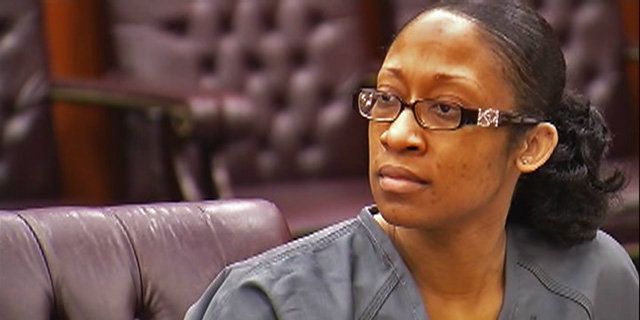
Where was this outrage in 2012, when then-31 year old Marissa Alexander was sentenced to 20 years of imprisonment for firing a warning shot in order to defend herself against her abusive husband? How many people had even heard of her until yesterday, when stories of her conviction went viral, causing many to think she had been convicted on the same weekend as Zimmerman was acquitted? Why is her case only considered in comparison to Trayvon Martin’s killing? Why is there still no petition on her behalf, still no midnight marches through Union Square in her name?

Women’s rights activists have long complained about the indifference that society and the media have towards women’s issues. Black women have long noted that there is an exception to this reality--that young white girls who go missing are highlighted in the news for days and days (this phenomenon is known by social scientists as missing white woman syndrome), while missing black girls and women go entirely unnoticed. But not only by the mainstream media and white America, but also by black American men and women. The NYPD’s stop and frisk policy is controversial and newsworthy because it is bound up with black and Latino masculinity, but what of the systematic underreporting of sex crimes by the NYPD? What of the all too pervasive issue of street sex harassment in the inner-cities by black men of black women? Where were the protests for Romona Moore? Where is the outrage there?

I, too, stewed and brewed in the immediate wake of George Zimmerman’s acquittal. I worried a lot, as I always have, about my two burly black younger brothers, knowing that their prestigious college degrees and multicultural groups of friends will not save them should some vigilante feel intimidated by their existence and decide to shoot them to death. I worry about my husband, who speaks mostly French and recently arrived in the United States from a country where blackness is the norm--what would happen to him if he were stopped and frisked? Would he know how to behave, or would he freak out, unintentionally committing suicide-by-cop? But I also felt in my stomach a deep grief for black womanhood, and a jealousy of sorts, that our oppressions will never mean as much as those of our brothers. I felt absolutely browbeaten over the sobering reality that if Trayvon Martin’s life meant nothing, than the lives of my sister and I mean less than nothing--even to members of my own community.

The stereotypes about black women and men are not so overwhelming different. Black men are assumed to be criminal. They are stereotyped as dangerous, as sexual threats to white women, as intimidating. Even when they are slight and young, they are viewed as big and bad. Their mere existence is a violence upon social order. They must be controlled, and put down if necessary.

Black women are also assumed to be criminals, and we are also assumed to be shiftless welfare queens, exploiting a system into which we invest nothing. We are stereotyped as angry, emasculating, intimidating. Even when we are physically fit, we are viewed as fat and sloppy. We are stereotyped as sexually insatiable, wild and exotic in the bedroom. Our mere existence is viewed as a cantankerous, loud and unruly disruption. We, too, must be controlled, and neutered if necessary. Consider the characterizations of Rachel Jeantel, of Serena Williams, of First Lady Michelle Obama. Consider the recent revelation that California prisons sterilized up to 250 women--many of them black and brown--without approval between 1996 and 2010. Consider the relative silence from just about everyone when the story broke just a few days before the Zimmerman verdict was announced: Twitter did not go ablaze, the NAACP did not send around a petition, and there were no marches.

I have dedicated much of my professional life to the advancement of human rights, and in particular, to lobby African Americans--and all Americans--to engage the international human rights community. As Professor Carol Anderson helps to explain in Eyes Off the Prize, that there is very little human rights discourse and culture in the United States is not quite accidental. In the United States, we talk about civil rights, and as soon as the words “civil rights” are uttered, blackness (likely embodied as Dr. Martin Luther King) is imagined.

In post-racial America, the concept of civil rights is sneered at, associated with race-baiting and the playing of the race card by ungrateful gimme gimme African-Americans who want handouts instead of a chance to stand on their own feet. It is passe, retrograde, and racist in reverse. It is easily ignored. Meanwhile women’s rights are associated with Elizabeth Cady Stanton and Gloria Steinem, and opponents of women’s rights activists label them insultingly as feminazis and lesbians (the latter label assumed to be an insult by the insulter), characterizing them as shrill and frigid and possibly in need of a violent rape to sufficiently pacify them. They, too, are easily disregarded. If black women are to get any attention, would we need a Black Women’s Civil Rights Movement? Given the extreme racism and sexism black women experience from within and without the black community, would such a movement even register on America’s political Richter scale?

The answer to both questions, I believe, is “no”. The last thing that black women, black men, or Americans at large need is more civil rights, at least as civil rights have been imagined and narrated and effectuated up until today. What we need is a complete paradigm shift. What we need are human rights.


Not only have advocates of conservative postracialism and colorblindness pegged the Civil Rights movement to years gone by and subjected well-known black civil rights leaders widely ridicule and dismissal, but they have mountains of state legislation and Supreme Court precedent on their side. Colorblindness--a concept advanced by Dr. King himself 50 years ago in his I Have A Dream speech--is now used against black Americans and other racial minorities as a matter of increasingly settled law and policy.

The American civil rights paradigm itself is hopelessly flawed. The Southern Civil Rights Movement has been irreparably marred by black America’s own demons--misogyny and sexism chief among them. The “I am a Man” campaign was a celebration of black masculinity that was not accompanied by an equivalent celebration of black femininity. More than a few black nationalist leaders mistreated their wives; Eldridge Cleaver famously practiced his rape of white women on black women because he knew that the rape of black women was not considered remarkable or abnormal; Maulana Karenga spent time in prison for viciously torturing a number of black women. The civil rights movement was a bastion of patriarchy, requiring black women to stand behind black men in order to avoid emasculating them, and in so doing, has dehumanized us and underscored our invisibility.

Further, the success of the Southern Civil Rights Movement were largely had in the federal courts, causing black America to look for justice in the courts right up until 6 women pronounced George Zimmerman innocent. This reliance upon the government has stifled greater grassroots, more creative approaches to achieving justice. The reliance upon the courts has necessitated that some cases are heard while others are not. And so, Trayvon Martin became our named plaintiff in 2012, to the exclusion of numerous other stories warranting the nation’s attention and outrage--including Marissa Alexander’s. The chopping down of a young man in his prime--the offense against masculinity--has always been considered more valuable than kidnappings and rapes, murders, sterilizations and wrongful convictions of women of color, by people of all ethnic backgrounds. It has become clear that the civil rights paradigm is simply unsuitable for those of us interested in liberty and justice for all.

Human rights offers to Americans never-before realized possibilities. Human rights encompass civil rights and socioeconomic rights, recognizing that we really cannot have one form of rights without the other. Where civil rights are associated with masculinity, socioeconomic rights--which are largely disregarded and denied by the United States--are associated with femininity. Human rights recognizes that the feminization of poverty is real, and that the realization of the rights to food, health, education, adequate housing are just as important as the rights to vote, freedom from arbitrary arrest, and speech.

Human rights are not a black thing, a white thing, a woman thing, an immigrant thing or a gay thing. Human rights are universal. In the human rights paradigm, racism is not a black problem. Human rights recognize that being black, that being female is not a problem. Human rights recognizes that those who violate a human’s rights--any human’s rights--are the problem, and that violators are to always be held accountable for their violations. Human rights specialize in the interests of the unnamed, unheard, unseen masses rather than picking the case that is the most politically salient, most likely to win, most sexy. In the human rights paradigm, Trayvon Martin does not have to defend himself against George Zimmerman and cable news from the grave; rather, the state has to give account to the world for why its criminal justice system authorizes vigilante white-on-black violence and why it does not better protect women such as Marissa Alexander from domestic violence.

A human rights-based approach to racism in America would take a longitudinal view at American jurisprudence and could potentially hold the assault upon racial minorities by the court and the prison system to be a mass human rights violation. The international community has concerned itself with all the unnamed men and women in the Niger Delta, the thousands of Congolese rape victims, and it has demonstrated a keen interest in the persistence of state-sponsored racial oppression in the United States. Unless we truly wish to languish in the insult of invisibility, with our freedoms, our very breaths, at the mercy of prosecutors, prison physicians, parole boards, and armed neighborhood watch men, we must consider, as Malcolm X suggested decades ago, engaging the global human rights movement and taking our criminals to court. No matter how fervently we black women defend our brothers, sons, husbands, and fathers, it seems certain that under the current paradigm, nobody will ever march for us.

The day after the Zimmerman verdict came down, Melissa Harris Perry reflected upon the relief she felt when she discovered that she was pregnant with a girl and not a boy. In her view, a black girl is safer in the United States than a little black boy. I would submit to her that her opinion is very likely based in her belief in a narrative sustained by politics, some patriarchy, and availability heuristics. Pointing to cases of unlawful acts of violence against black men is easy because crimes against them get attention. We know some of their names: Sean Bell, Amadou Diallo, Oscar Grant, Tremaine McMillan, Rodney King, Medgar Evers, Emmitt Till, Martin Luther King, Trayvon Martin. Professor Harris Perry could easily be forgiven for believing that being a black girl in America is a walk in the park by comparison--and it is always by comparison, even as the 50th anniversary of the 16th Street Church Bombing approaches.

The United States is a very dangerous place for young black men, but at least they have defenders and supporters. I am somewhat encouraged by the widespread outrage expressed over the Zimmerman verdict, because it signifies that unless we are distracted by latest news story or the commencement of football season, that there is a possibility that we will mobilize together as we did in during the 2008 Presidential campaign to make our mark on the world as the United Races of America. But I will never be optimistic until black women become weary of their invisibility and take the steps necessary to march for ourselves, all the way to the General Assembly or the Hague.


Marissa Jackson is a 20-something attorney who will clerk on the United States Court of Appeals for the Sixth Circuit, for the Honorable Damon J. Keith in the fall of 2013. She previously clerked for The Honorable Sterling Johnson, Jr, in the Eastern District of New York, and was most recently a visiting scholar at the West African Research Center in Dakar, Senegal. Marissa is the founder of the 4th World Initiative, an interdisciplinary think tank and grant-making organization dedicated to advancing human rights and development in the pan-African world. She currently lives in Harlem and blogs at www.marissaaljackson.com.
09 Jul 01:43

The Misinterpretation of Ms. Lauryn Hill

by Tania L. Balan-Gaubert
 photo lauryn-hill-tax-sentencing.jpg
Lauryn Hill’s long awaited return to music has been riddled with controversy. Everything from her appearance, to the quality of her performances, to her demand to be referred to as Ms. Lauryn Hill, amasses constant scrutiny. Her tax evasion case and impending incarceration are the most recent highly publicized discussions on the iconic artist.

While people have given their two cents on the artist via social media and other various networks, MLH has used her tumblr to address allegations and public opinion.
MLH’s most recent letter was posted a few days ahead of her reporting for a three-month prison sentence for failing to pay taxes on approximately $1.8 million in income.

Her letter has been called a “rant” that blames historical racism for her legal problems, effectively adding to public chatter that she isn’t exactly mentally stable.

When it comes to black women and mental health, there is a fine line between society’s diagnoses that we are sane versus the label that we are just plain cray cray. Therefore certain choices, beliefs, behaviors and statements are more than likely to earn black women their crazy card and it seems that MLH is guilty of nearly all of them. Here are a few that seem applicable:

1. Resist conformity to social expectations that you must be amicable and accommodating.

2. Speak openly and often about historical wrongdoings and the power of intersectionalism within communities of color, specifically black communities.

3. Refuse to erase yourself nor hate yourself nor forget that racism and sexism demands that you do both.

4. Do not seek acceptance or approval (namely from white people).

5. Speak freely when your freedom hangs in the balance.

In the public eye, MLH has essentially crossed the line between socially acceptable freedom of expression and crazy town. Although it is understandable that many see MLH’s letters as having to do with late or bad timing, perhaps this is more about the threat of having one’s freedom taken away, which oftentimes compels a person to speak more freely than ever before concerning their experience(s).

Getting labeled crazy is an experience that many artists and entertainers are intimately familiar with. In an interview with James Lipton from Inside the Actors Studio in 2006, Dave Chappelle disclosed his feelings on the matter when questioned about fellow comedian Martin Lawrence’s influence on his life. Chappelle took the opportunity to address perceptions of mental weakness and the problem with calling individuals crazy.
The worst thing to call somebody is crazy. It’s dismissive. ‘I don’t understand this person, so they’re crazy.’ That’s bullshit. These people are not crazy, they’re strong people. Maybe the environment is a little sick.
The “environment” Chappelle mentions parallels the historic conditions MLH outlines in her letters. In this sense, a close reading of her most recent letter reveals that her claims are also not so dense or incoherent that they warrant dismissal.

MLH refers to the paradigm of historic racism as a dysfunctional relationship with the individual and his or her surroundings. She contends that:
Anyone forced to live so incredibly diametrically opposed to that which is natural to themselves, will end up in crisis if they don’t successfully find a way to improve or transcend these circumstances! All of which require healing. It is only by the Grace of God and the resilience of the people that things haven’t been worse.
MLH’s points also speak to greater systemic issues that affect black women. In particular, the relationship between black women’s bodies and the economy is one that has evolved from slavery, to peonage, to the now ever-looming crisis of mass incarceration.

This relationship is highlighted in MLH’s account of the prosecutor’s statement during sentencing, noting how she hadn’t given to charity during her years in ‘exile.’
The prosecutor, who was a woman, made a statement during sentencing about me not doing any charity work for a number of years during my ‘exile.’ A) Charity work is not a requirement, but something done because someone wants to. I was clearly doing charitable works way before other people were even thinking about it. And B) Even the judge had to comment that she, meaning I, was both having and raising children during this period. As if that was not challenging enough to do. She sounded like the echo of the grotesque slave master, who expected women to give birth while in the field, scoop the Baby up, and then continue to work. Disgusting.
The expectation that MLH charitably give back a portion of what she earned stems from the historical understanding that black people’s relationship to the state is one of debt and servitude. The court made this relationship even clearer in its language that the IRS “must be made whole,” which MLH also recounts in her letter.

Throughout American history, making the system whole has equated to black people’s indebtedness to the system. Black women in particular have paid the highest debts through their labor and through their children.

Society has historically viewed black women through the prism of their reproductive capacity as part of their general labor capability. In other words, their ability to reproduce plays a central role in their value and what is expected of them in serving the American economic system. Hill's mention of giving birth while in the field is a reminder of this convoluted legacy.

MLH is right to assert that charity work is a choice and not a requirement. In fact, many wealthy people often give to charity as a means to actually avoid paying their taxes, so the prosecutor’s statement is ironic to say the least.

It’s interesting that MLH not paying her taxes garners a spectacle of media attention, while a system that disenfranchises people of color and plays ignorant as Wall Street CEO’s bankrupt citizens (and simultaneously award themselves $20 billion in bonuses) goes unaccounted for as more pressing issues get swept under the rug.

Society unfortunately holds artists accountable for their actions when they fail to impress in a manner that is deemed acceptable and when they fall short of the role model persona many create of them in their heads. Very few formulate intelligent critiques based on their body of work or raise questions on the vision that goes into creating new work, as scholar Monica Miller does in her recent article for BET regarding MLH’s newest single “Neurotic Society.”

People consistently participate in the spectacle when troubled artists show their most vulnerable selves, their humanity, or ask that people question their own. People damn them and turn their backs. On to the next one they go. Hardly taking the time to recognize, this choice says more about them than it does about the artist.

Related:


Tania L. Balan-Gaubert is a Haitian American native of Chicago. She received her master’s degree in African American Studies from Columbia University and currently resides in Brooklyn. You can find her on Twitter and Instagram @tanialaure.

04 Jul 15:59

DECLARATION OF INDEPENDENCE: 13 HIP–HOP SONGS THAT APPLY FREEDOM OF SPEECH

by Marjua

July 4th is upon us again and all Concrete Loop wants to do is provide a radical playlist for your listening pleasure. Whether you’re lighting the grill, watching the dark skies turn radiant with fireworks, or engaging in the debauchery of alcohol (‘Murrica!), don’t let your “Independence Day” pass by without blasting our “Freedom of Speech” playlist at all ig’nant levels.

While some have been criticized for their subject matter, others have been tagged with conspiracy. Some are new and some are old. But much like what Lincoln said about America, Hip-hop is also “by the people, for the people,” and as such, we felt it necessary to assemble a brief list of Hip-Hop tunes we find to be worthy of some attention.

In one way or another, each song portrays how certain emcees have been successful in keeping the crowds bumpin’, while sharing their beliefs and ideas, without any constraint in the rap universe.

–––––––

Nas – I Want to Talk to You

A song in which Nas delivers a letter to the government. He critiques the government officials and people he deems a representative for “Mr. America.” Nas also asks government officials to walk a mile in the shoes of the impoverished.

Grand Master Flash and the Furious Five – The Message

Sampled and imitated all too often, but never matched. “The Message” is arguably the origin of conscious-rap in the early ’80s.

Lupe Fiasco – Words I never Said

Released February 8, 2011 and lives on the Laser album, “Words I Never Said” contains references to controversial political and socioeconomic subject matters, including the September 11 attacks, government fiscal policy, and the occupation of Gaza.

Eminem – Mosh

Liberated prior to the ’04 presidential election, “Mosh” is one of Eminem’s most notable protest songs. It prompts voters to vote George W. Bush out of office. The song was extracted from Eminem’s album, Encore, not yet released at the time the video was debuted to the world.

N.W.A. – Fuck Da Police

“Fuck Da Police” was infamously delivered by gangsta rap crew N.W.A and appears on the group’s album titled, Straight Outta Compton. Regarded as one of the greatest songs of all time, the song itself caused the FBI to warn N.W.A’s record company about its lyrical content. Since its release in ’88, the “Fuck the Police” slogan continues to infiltrate pop culture today (i.e. t-shirts and artwork).

J. Cole – Miss America

The song, which was produced by Cole himself, samples Rue Royale’s “Flightline.” It discusses the corruption of an artist when he has the chance for commercial appeal, and the corruption of government when capitalism is involved.

Public Enemy – Fight the Power

“Fight the Power” incorporates various samples and allusions to African-American culture. It was devised at the request of director Spike Lee, who aimed for a musical theme in his 1989 film Do the Right Thing. It’s regarded as Public Enemy’s best song and has been honored as one of the greatest songs of all time by critics and publications alike.

Kanye West – New Slaves

Prior to the song’s release, it was projected at 66 locations in black-and-white. The song discusses slavery as well as racism in general, materialism, and stereotypes of African Americans in the United States. The song lives on the Yeezus album.

Lauryn Hill – Freedom Time (War In The Mind)

Much like the album it belongs to (2.0) “Freedom Time (War In The Mind)” is a lyrically-driven cut, where Lauryn shares her thoughts on religion, society, God, and love.

KRS-1 – Sound of Da Police

“Sound of da Police” is the second single from rapper KRS-One’s debut solo album, Return of the Boom Bap. The lyrics call out to police in places like Bronx, New York, which carry an intricate history of institutionalized racism, oppression and violence against the black community.

Jadakiss – Why

“Why” was released as the second single from Jadakiss’ second solo LP Kiss of Death. Jada attracted controversy from political commentator Bill O’Reilly, who labeled the rapper as a “smear merchant” due to lyrics in the song, which state Jada’s belief that George W. Bush helped to coordinate the September 11 attacks.

Erik B and Rakim – Teach the Children

A call to teach the future generations, “Teach the Children” is where Rakim discusses matters like unemployment (which we can still relate to today) and explains how he feels in regards to the government playing a role in the drug business.

Wale – Freedom of Speech

The leading single off the Folarin mixtape is produced by NO Credit and samples Willie Hutch’s classic “Brother’s Gonna Work It Out.” The Obama vocal clips complete the raise-your-fist groove.

–––––––


Tell us some of YOUR favorite call-to-action Hip-hop songs!

( PHOTOS: Google )
02 Jul 19:23

What The Continent of Africa Taught Me About Black Womanhood

by For Harriet
 photo africanWoman.jpg
by Viviane Rutabingwa

So, here I am – my 10th month in East Africa – since I left as a teenager 8 years ago. As I reflect on the tapestry of blackness this experience has added to my black woman hood I realize just how dynamic we are as black women and the infinity ways we can define “being black.”

My name is Viviane Mary Kyomgisha Abwoli Rutabingwa – My names a perfect analogy to who I am. Kenyan born, Ugandan raised, British schooled, Canadian educated African/Canadian black woman. As a public health specialist working for a big name international organization, these last 10 months have taught me more lessons that I have learned in my entire life: Professionally, I have learned about the on the ground truths of AID organizations; I have learned about the true impact that we do (and in most cases - do not) have; I have learned the importance of being a student to the community you are serving and most importantly I have learned the harm that can be done when we as “experts” do not humbly listen to the needs and wants of those in the communities that we serve.

Coming back home, after years abroad was an easy decision for me. I am an African after all, I get my people, I speak my language, I understand that corruption is a hindrance to development and yet very deeply rooted, I know that tribalism is an obstruction to democracy but truly embedded in our culture and kneeling down when you speak to your elders is respect. I got this……right?

Not even close.

My most important lessons this year have been personal ones. It has been understanding that the label of being a black woman is far from ubiquitous, deeply dynamic and very much a “living document” being ushered along by the continued movement, vibrancy, flow and dance that exists from those that call them selves west Indians to those that call themselves Africans and all the other women in between.

I have learned that WE are a quilt made of different textures, colors, consistencies, and scents: I have worked under Rita, my boss and now a mentor, a strong, empowered yet gentlewoman from the west Nile area that believes in non-hierarchal leadership, collective decision-making and consensus building. Rita’s African husband cooks, helps take care of the kids, works full time and supports her fully.

I've met Mbambu a community health worker, mother of 6, a lady that survives on $2 a month, believes in discipline and a woman’s role as a caretaker of her husband, disciplinarian and earner. Mbambu lives in the Rwenzori Mountains and climbs up and down them everyday to perform her duties at the local health clinic. I’ve met Kabugho a subsistence farmer that I see carrying wood on her head every day – jolly as ever and always eager and enthusiastic to put down her wood and chat. Kabugho lives to serve her children and cherishes preparing lunch and dinner for them all. These women all call themselves African.

So as I began, it's 10 months in and I am more resilient, stronger, wiser and 10 pounds heavier – yes, I have come home and I have the body to show it! The fresh heartiness of my African food has been good to me, probably too good… but what my continent has done most for me is made me feel comfortable in my blackness. After all, I’m just adding one more piece to the infinity that exist on our beautiful quilt. Related:

Related:


Africa In Vogue: The Exploitative Practice of Selling Culture
Funmilayo Ransome Kuti: Before MLK there was FRK the "Mother of Africa” 
Embracing Who You Are: Growing Up African and African American


Viviane Rutabingwa is a twenty something African-Canadian woman working on public health initiatives in Africa.
01 Jul 20:04

Even the most successful black women are not ‘good enough’

by Kendra James

Beyonce Knowles on her Mrs. Carter World Tour (Yosra El-Essawy/Invision/AP)

By Britt Julious (cross posted from WBEZ.org 91.5 Chicago)

You’re not good enough and you never will be and we need to remind you of this again and again. Do not get comfortable. What you’ve done matters little. For every act is just an act, existing in a vacuum, not representative of the whole, or even a part of who you think you are.

This is what I imagine is being said to someone like Beyonce or Rihanna or Michelle Obama by the media and by society at large. It might not be said explicitly, but it is implied forcefully and continuously. They are three of the most visible black female public figures and they are three of the most controversial. Controversy, I realize now, is largely a manufactured tool, one that is used to control the narratives of the people around us. And the narrative of the black woman – public or not – rarely changes: you will not be good enough. Do not forget.

Regardless of what Beyonce or Rihanna or Michelle Obama does, they will get criticized for their actions. To the public, there is no such thing as a good or respectable black woman. They are women who are almost “good,” but not quite. The ways in which society tries to find and develop these characteristics of “bad” rarely differ from figure to figure.

All of their actions are up for debate, even when they are personal and non-threatening. What has Beyonce done but work hard to be the best performer she could possibly be? Well, for one they say, she is not a good enough feminist. One of my friends said that she was uncomfortable with the fact that Beyonce named her tour “The Mrs. Carter Tour.” But why is a woman’s feminist cred eliminated because she changed her last name? Why do personal decisions that threaten no one eradicate one’s support of equality between the sexes?

My mother changed her last name and I can’t think of a better representation of feminism lived in the everyday world. Her strength, her work effort, her words about hard work and personal achievement, the visibility of shared responsibility … all of these things led me to feminism before I knew what that was.

Beyonce is not a good feminist. She is not feminist at all. This is what they say. A recent Ms.magazine article fueled the flames not for what it said about Beyonce’s feminism, but because anything was said at all. Readers were upset that anyone could try to relate the two. Beyonce is not a feminist because she dresses “provocatively.” Beyonce is not a feminist because she changes her last name, because she shows vulnerability, because she is proud of her motherhood and her marriage. Beyonce is not a feminist because she is not what a feminist looks like. She is not a feminist because we say she is not. If we seek to promote the value in feminism and challenge the negative connotations of feminism in the public eye, tearing down a performer who speaks openly about women doing right for themselves, who literally called herself a feminist, does more harm than good.

When I see Michelle Obama on the screen, I see a woman like the women I grew up around. She is poised and beautiful and intelligent. She is also real. There is an argument to be made about the decorum of the First Lady, but I don’t think Obama has ever questioned this.

Singer Rhianna performs (AP/Abdeljalil Bounhar)

 Perhaps it is because she exists not as a wallflower, but as a powerhouse that we are threatened by an eye roll. Perhaps because she is literal strength that we find her reaction to a heckler as a wrong. As an outsider, these reactions shock me. Why are we upset that Obama reacts? What do we expect of her?

As an insider (an insider of the black female experience), they do not. Black women can’t show their cards. If you have achieved something, the only way to continue rising is to keep one’s head down. Opinions? Emotions? Reflections? Please! Take a seat!

In a recent, ridiculous story for the UK’s Daily Mail, Liz Jones chastised Rihanna for not acting as a perfect role model. Ignore the fact that one of the most consistent things about the singer is that she refuses the label of “role model.” Why do we expect this of her at all? Why is she not allowed to live her life as she chooses? Yes, she has young fans. But why do we act as if good parenting is no longer a viable option in preventing our children from “bad” influences? If we are to talk about the actions of pop stars, why is Rihanna criticized more than her peer, Lady Gaga, who too speaks openly about drug use and recklessness? There exists a double standard, one that has become abundantly clear.

There exists, in the life of a black woman, public or not, the notion that the other shoe will drop. You are waiting for the challenge, the comeuppance, the moment in which others will tell you who you are and how you should live. This extends to the general female experience, too, and the Other experience as a whole. The other shoe waits. You wait.

This is why our interpersonal bonds are so important and public. I’m remembering a man who said that black women are catty. That made no sense to me. The ease in which I build friendships with women who look like me cannot be explained. But perhaps there is the reality of what we must face and what we have been told. One can never overstate the importance of knowing your stories and feelings are important and true.

I am reminded of what my parents – my mother in particular – used to say: You will have to work twice as hard to get half as far. You do not always have the luxury to dress down, to not always be your best, to mess up. Any sign of weakness, of humanity, is a reinforcement of stereotypes we have yet to eradicate. I did not know this to be true then, but I understand it now. The world reveals itself.

28 Jun 00:23

Race and Gender in Doctor Who: Beyond Who Plays The Doctor

by Joseph

By Guest Contributor Joy Ellison

stevenmoffatt

Current executive producer Stephen Moffatt on the Doctor Who set. Image via WhatCulture!

Over the last few weeks, fans have called for a person of color and/or a woman to star in Doctor Who.  If you care about race and gender presentation in Doctor Who, then pay attention to who serves as the show’s next executive producer.

When it comes to who should replace Matt Smith as the next star of the TV show Doctor Who, many fans are hoping for one thing: anyone but another white guy.  

For nearly 50 years, the Doctor, the time-traveling main character of Doctor Who, has been portrayed by white men.  Fans concerned with social justice are right to clamor for a different sort of Doctor.  While the Doctor may be an alien, over the course of the show the character has come to represent the best of humanity.  That’s why it is especially important that the Doctor be portrayed by a person of color or a woman – or, dare we dream, a woman of color, a person with a disability, a queer person, or transgender person, or a combination of all the above.

But while we wait to meet the new incarnation of this beloved sci-fi character, fans should turn their attention to racial and gender representation in an area of Doctor Who that isn’t immediately visible on screen: the executive producer.

Who serves as the executive producer for Doctor Who may affect the show almost as much as who portrays the Doctor.  Since the re-launch of the series in 2005, the executive producer of Doctor Who has also served as showrunner, filling both the roles of producer and lead writer, giving the position tremendous influence on not only the content of the show, but also casting and staffing.

Just as all 11 Doctors have been portrayed by white men, so have all 13 of the show’s executive producers been white.

The impact of Doctor Who’s executive producer is obvious to fans who have watched the revival of the series.  When Russell T. Davies re-launched the show as executive producer, he brought with him an increased commitment to diversity.  Davies cast Christopher Eccleston, a white man, as the 9th Doctor and David Tennent, another (surprise!) white man, as the 10th Doctor.  Nonetheless, under Davies, fans saw a more diverse cast, full of many different types of heroines, as well as queer characters and people of color.  Davies didn’t handle diversity perfectly, but his influence demonstrates just how important an executive producer can be.

Under current showrunner Steven Moffat’s leadership, Doctor Who has become undeniably whiter, straighter, and more sexist.  Moffat hasn’t developed any recurring characters of color and his women characters leave much to be desired.  While both River Song and Amy Pond are competent and spunky, they are defined exclusively in relation to the Doctor and Rory.  In the place of women with independent interests and developed characters, Moffat substitutes bossy women and hopes no one notices.

Moffat presented women in the same way in his previous show Coupling, a situation comedy about dating and romance.  In light of Moffat’s own statements to the press, he seems to write his women characters this way because he actually believes that’s how women behave.  Take a look at this Moffat quote, which is almost breath-taking in its racism, classism, heterosexism, and misogyny:

“There’s this issue you’re not allowed to discuss: that women are needy. Men can go for longer, more happily, without women. That’s the truth. We don’t, as little boys, play at being married – we try to avoid it for as long as possible. Meanwhile women are out there hunting for husbands. The world is vastly counted in favour of men at every level – except if you live in a civilised country and you’re sort of educated and middle-class, because then you’re almost certainly junior in your relationship and in a state of permanent, crippled apology. Your preferences are routinely mocked. There’s a huge, unfortunate lack of respect for anything male.”

Thank you, Steven.  This explains so much.

Contrasting Doctor Who under Moffat and Davies lays bare just how profound an effect the executive producer of Doctor Who has on the show.  It’s not just what the Doctor looks like that matters, though who portrays the Doctor does matter very much indeed.  If the role of the Doctor is finally given to an actor who isn’t a white man, that actor will need to be supported by an executive producer who able to write for such a character and committed to doing justice to a new vision of Doctor Who.

But why does writing matter so much?  Fans hoping for a more diverse Doctor should pause to reflect: A black woman doctor has already saved our planet once.  Remember Dr. Martha Jones?

Despite the consummate acting of the talented Freema Agyeman, Martha is one of the most maligned of the Doctor’s companions.  Some commentators have argued that fans despised Martha because of her race and gender – a well-documented phenomenon in geek culture.  Others have said that the writers didn’t give Doctor Who’s first Black companion a fair shot.  Both analyses are correct.  Martha is a kick-ass character who doesn’t deserve the racist misogyny leveled at her by some fans.  But, she was also written as a rebound for a lovesick Doctor who is still pining for Rose.  Martha, an otherwise brilliant woman with tremendous initiative, nurses an adolescent crush on the Doctor that seems out of character.  The Doctor, portrayed by David Tennant, is shockingly indifferent to her obvious feelings.  This aspect of Martha’s storyline is deeply disappointing.  It also reveals an important truth: diversity is important, but it needs to be supported by good writing.

Storytelling matters.  The problems of Doctor Who won’t be solved simply by casting a new actor in the starring role.  The show needs to tell new stories shaped by new visions.

Current showrunner Steven Moffat and executive producer Brian Minchin will likely be with the show for a while.  When it comes time for a new executive producer to take control of the TARDIS, I hope that fans will pressure the BBC to let what happens to our favorite time-traveler be decided by someone who isn’t white.

Joy Ellison is a writer and activist who is building a full-scale replica of the TARDIS. You can follow Joy on Twitter @j_in_tuwani.

26 Jun 22:01

Injustice For All: Conservative Justices Takes Aim At POC Voters

by Arturo

By Arturo R. García

It took less than two hours for Texas lawmakers to prove the Supreme Court made a mistake on Tuesday.

It’s also important to emphasize that it was Texas lawmakers who pushed to become the first to enact a voter identification law after the high court struck down Section 5 of the Voting Rights Act.

“There is no doubt that these improvements are in large part because of the Voting Rights Act. The Act has proved immensely successful at redressing racial discrimination and integrating the voting process,” Chief Justice John Roberts wrote in the 5-4 majority decision, which broke down along party lines. So the majority’s argument was that the VRA worked too well to be allowed to continue, despite being renewed by an overwhelming margin just seven years ago, for a 25-year extension.

“Congress approached the 2006 reauthorization of the VRA with great care and seriousness. The same cannot be said of the Court’s opinion today,” Justice Ruth Bader Ginsburg wrote in the dissenting opinion. “The Court makes no genuine attempt to engage with the massive legislative record that Congress assembled. Instead, it relies on increases in voter registration and turnout as if that were the whole story.”

It didn’t stop with Texas, of course. And as voters in Ohio and Florida are probably aware, it will not stop with the states formerly covered by Section 5. When the likes of Arizona Gov. Jan Brewer and Rush Limbaugh feel emboldened enough to declare that racial discrimination is “over,” or had been “dealt with,” that points to something uglier.

In another 5-4 decision, the court ruled to send the case of Adoptive Couple v. Baby Girl back to lower courts to decide whether the girl, Veronica Maldonado, should stay with her non-Native adopted parents or her biological father, Neither Brown, a member of the Cherokee Nation.

The South Carolina Supreme Court ruled in July 2012 that the Indian Child Welfare Act entitled Brown’s right to custody. Though Veronica’s biological mother was found to have notified adoption officials that Brown was a member of the Nation while placing her up for adoption, she also misrepresented his name and birthday to the Cherokee Nation’s child welfare division. By the time Brown was aware of the child’s existence, she was already living with the adoptive family in South Carolina. Her adoptive mother, Melanie Capobianco, testified regarding Brown’s heritage that it was “probably … something I read and didn’t think twice about it.”

These rulings followed the high court’s decision to punt on affirmative action, and Wednesday morning will bring with it rulings on both Proposition 8 and the Defense of Marriage Act. 

In closing, it’s best to listen to the words of Rep. John Lewis (D-GA), who can speak first-hand to the history Chief Justice Roberts apparently glossed over in Tuesday’s decision:

We may not have people being beaten today, maybe they’re not being denied the right to participate, to register to vote, they’re not being chased by police dogs or trampled by horses. But in the 11 states of the old Confederacy and even in some of the states outside of the South, there has been a systematic, deliberate attempt to take us back to another period.

And these men that voted to strip the Voting Rights Act of its power, they never stood in unmovable lines, they never had to pass a so-called literacy test. It took us almost a hundred years to get where we are today. So, will it take another hundred years to fix it, to change it?

26 Jun 22:00

It’s Bigger than Paula Deen

by Guest Contributor

By Guest Contributor Dr. David J. Leonard, cross-posted from Dr. David J. Leonard

The fallout from Paula Deen’s deposition and the lawsuit itself is a reminder of the ways that race and gender operate within the restaurant industry.  It’s bigger than Paula Deen.  Yet, as you read media reports, as you listen to various commentaries, you would think this is a story about an older white woman wedded to America’s racist past.  Yes, this is a story about Paula Deen, and her crumbing empire.  But that is the beginning, not the end. This is bigger than one individual, her reported prejudices, or the lawsuit at hand.  This is about a restaurant industry mired by discrimination and systemic inequalities.

Racism pervades the entire industry, as evident in the daily treatment faced by workers, the segregation within the industry, differential wage scale, and its hiring practices.  According to Jennifer Lee, “Racial Bias Seen in Hiring of Waiters:”

Expensive restaurants in New York discriminate based on race when hiring waiters, a new study has concluded. The study was based on experiments in which pairs of applicants with similar résumés were sent to ask about jobs. The pairs were matched for gender and appearance, said Marc Bendick Jr., the economist who conducted the study. The only difference was race, he said.

White job applicants were more likely to receive followup interviews at the restaurants, be offered jobs, and given information about jobs, and their work histories were less likely to be investigated in detail, he said Tuesday. He spoke at a news conference releasing the report in a Manhattan restaurant.

There really should not be a lot of difference in how the two of them are treated,” Mr. Bendick said. He was hired by advocacy groups for restaurant workers as part of a larger report called “The Great Service Divide: Occupational Segregation and Equality in the New York City Restaurant Industry.” He has made a career of studying discrimination, ranging from racism in the advertising industry to sexism in firefighting.

Mr. Bendick said that in industries, such experiments typically found discrimination 20 to 25 percent of the time. In New York restaurants, it was found 31 percent of the time.

A recent report from the ROC (Restaurant Opportunities Center) found that Darden Restaurants (Olive Garden, Red Lobster, Capital Grille, among others) was responsible for creating a racially hostile environment.

The report also outlines recent lawsuits against Darden for employment discrimination based on race, including a 2008 lawsuit that charged that Beachwood, Ohio Bahama Breeze employees of color were repeatedly pelted with racial slurs such as “Aunt Jemima” and “stupid n**ger” by managers. This resulted in a EEOC announcement of a $1.26 million settlement from Darden in 2009. In describing the settlement, EEOC’s acting chairman Stuart J. Ishimaru said “No worker should have to endure a racially hostile work environment in order to earn a paycheck.”

It additionally concluded that it, “fired black servers because they did not ‘fit the company standard’ at their Capital Grille restaurant” and that it “prevents people of color & immigrants from accessing living wage positions, such as server and bartender, at their Capital Grille fine dining restaurant.” It’s bigger than Deen.

A 2007 lawsuit against Daniel Boulud points to another instance:

According to the lawsuit, dining room workers at Daniel have been denied promotion because they were Latino or Bangladeshi. The employees also say that Mr. Boulud and other managers yelled racial slurs. At one point, they say, Spanish was banned among employees; only English and French were allowed. Those are examples, they say, of how the working culture at Daniel favors white Europeans at the expense of other groups.

Here are but a few examples from the EEOC

In March 2008, a national restaurant chain entered a consent decree agreeing to pay $30,000 to resolve an EEOC case charging that the company gave African-American food servers inferior and lesser-paying job assignments by denying them assignments of larger parties with greater resulting tips and income, by denying them better paying assignments to banquets at the restaurant, and by failing on some occasions to give them assignments to any customers. The consent decree enjoins the restaurant from engaging in racial discrimination and requires the chain to post a remedial notice and amend and distribute its anti-discrimination and anti-harassment policies. The amended policies must state that prohibited racial discrimination in “all other employment decisions” includes, but is not limited to, making decisions and providing terms and conditions of employment such as pay, assignments, working conditions, and job duties; also, it must prohibit retaliation. In addition, the company must revise its complaint mechanism and clarify and expand its website and toll-free phone number for the reporting of incidents of employment discrimination. The consent decree also requires the restaurant to provide training in equal employment opportunity laws for all of its employees and to appoint an Equal Employment Office Coordinator, who will be responsible for investigating discrimination complaints. EEOC v. McCormick & Schmick’s Restaurant Corp, No. 06-cv-7806 (S.D.N.Y. March 17, 2008).

In January 2008, a bakery café franchise in Florida entered a two-year consent decree that enjoined the company from engaging in racial discrimination or retaliation and required it to pay $101,000 to the claimants. EEOC had alleged that the company segregated the Black employees from non-Black employees and illegally fired a class of Black employees in violation of Title VII. Under the consent decree, the principal of the company must attend an eight-hour training session on equal employment opportunity laws. The decree also mandated that if the company ever re-opens the franchise in question or any other store, it must distribute its anti-discrimination policy to all employees, post a remedial notice, and report any future complaints alleging race-based discrimination. EEOC v. Atlanta Bread Co., International and ARO Enterprise of Miami, Inc., No. 06-cv-61484 (S.D. Fla. January 4, 2008).

In September 2006, the Korean owners of a fast food chain in Torrance, California agreed to pay $5,000 to resolve a Title VII lawsuit alleging that a 16-year old biracial girl, who looked like a fair-skinned African American, was refused an application for employment because of her perceived race (Black). According to the EEOC lawsuit, after a day at the beach with her Caucasian friends, the teen was asked if she would request an application on her friend’s behalf since the friend was a little disheveled in appearance. The owner refused to give the teen an application and told her the store was not hiring anymore despite the presence of a “Help Wanted” sign in the window. After consultation among the friends, another White friend entered the store and was immediately given an application on request. EEOC v. Quiznos, No. 2:06-cv-00215-DSFJC (C.D. Cal. settled Sept. 22, 2006).

In December 2005, EEOC resolved this Title VII lawsuit alleging that a fast food conglomerate subjected a Black female employee and other non-White restaurant staff members (some of them minors) to a hostile work environment based on race. The racial harassment included a male shift leader’s frequent use of “n**ger” and his exhortations that Whites were a superior race. Although the assistant manager received a letter signed by eight employees complaining about the shift leader’s conduct, the shift leader was exonerated and the Black female employee who complained was fired. The consent decree provided $255,000 in monetary relief: $105,000 to Charging Party and $150,000 for a settlement fund for eligible claimants as determined by EEOC. EEOC v. Carl Karcher Enterprises, Inc., d/b/a Carl’s Jr. Restaurant, No. CV-05-01978 FCD PAW (E.D. Cal. Dec. 13, 2005).

The examples are a plenty. As with every American institution, race matters. Restaurants are immensely segregated: by location, by job, by placement on the floor, by wage, and by clientele. Servers, bartenders, and hosts are white, while runners, bussers, those in the back of the house, and those who make the lowest wages are overwhelming people of color. Of those who have reported earning less than minim wage, 96% are people of color. Workers of color experience racism and microaggressions; they are more likely to be questioned as to their qualifications. It is a world where irrespective of diversity, in terms of both staff and food choices, racism remains a constant on every menu. According to Saru Jayarman, “We tend not to realize that diversity is not the same as equity – that simply seeing a lot of restaurant workers from different backgrounds doesn’t mean that restaurant workers from different backgrounds doesn’t mean that restaurant workers have equal opportunities to advance to jobs that will allow them support themselves and their families.”

The restaurant industry is also rife with sexism – women earn 85 cents on the dollar compared to their male counterparts. Women are also relegated to the lowest-paying jobs with the worst chances of upward mobility. Women are subjected to rampant sexual harassment. Although only 7% of the nations workers can be found in restaurants, in 2011 they accounted for 37% of the sexual harassment complaints to the EEOC.

The relative silence about these daily abuses and horrid conditions is telling. It’s bigger than Deen.  She is not the lone rotten apple but one of many in a rotten barrel. Yet the emergent narrative that once again images racism as the purview of southern whites of a previous generation is revealing.  It’s bigger than Deen.   It’s bigger than Food Network but about an industry that has gotten away with abuse and discrimination yet we rarely get to see “behind the kitchen door.” This lawsuit, and the media fallout have shined a spotlight on a culture of abuse and exploitation.  Yet we cant take our eyes off Deen.

20 Jun 02:13

Circuit Court Judge Calls Minorities "Predisposed to Crimes"

by Tatiana Brown
 photo JudgeEdithJones.jpg
Several civil rights organizations have filed a judicial misconduct complaint against U. S. Federal Judge Edith Jones for allegedly stating minorities are “predisposed to crimes” and other biased comments.

According to “Edith Jones, Federal Judge, Made Racists Remarks, Claimed Minorities “Predisposed to Crime”: Complaint” by Will Weissert for HuffPost Black Voice, Judge Edith Jones, who serves as the 5th U.S. Circuit Court of Appeals, allegedly made these comments at an event at the University of Pennsylvania Law school on February 20th.


The event, Federal Death Penalty Review with Judge Edith Jones (5th Circuit), which was put on by the Penn Law School Federalists Society was designed to be an educational discussion of federal death penalty through the eyes of a federal judge. The event was not recorded, therefore her comments are not on tape; however, five students and one attorney signed affidavits confirming what they heard.

Mexican Capital Legal Assistance Program, the League of United Latin American Citizens, the Texas Civil Rights Project, and the NAACP, Austin and the National Bar Association, Houston filed the complaint. It official alleges that Judge Jones’ conduct, “undermines public confidence in the integrity and impartiality of the judiciary, and creates a strong appearance of impropriety."

According to the complaint, Judge Jones allegedly said, "racial groups like African-Americans and Hispanics are predisposed to crime," and that they are "prone to commit acts of violence" and be involved in more violent and "heinous" crimes than people of other ethnicities. The complaint also states that Jones said defendants' claims of racism, innocence, arbitrariness, and violations of international law and treaties are just "red herrings" used by opponents of the death penalty”.

These comments are disturbing because now we must wonder if, as a judge, she has made biased decisions.

Her use of “predisposed” is questionable. To be “predisposed” is to be susceptible, or likely influenced, or to simply be heading in the direction of crime already. In her speech did she cite the reasons why she believes minorities are “predisposed”? Does she have any facts or studies as to why she believes this? Jones also stated that “minorities” are also more likely to be involved in heinous crimes, which according to the FBI report, Crime in the United States 2011, is false. Although the report did say more blacks commit murder, as far as other violent crimes Whites commit more.

The fate of Judge Edith Judge, who was appointed by Ronald Reagan in 1985, rest in the hands of Current Chief Judge of the 5th U.S. Circuit Court of Appeals, Carl E. Stewart, the first African-American to fill that post. He will decide to dismiss the complaint, speak privately with Jones or launch an investigation into the allegations. However, many are not on the side of Jones, Representative Cedric Richmond (D-LA) has called for a full and swift investigation by the 5th U.S. Circuit Court. Progress of the case will develop in time.


Tatiana M. Brown is a native of Washington, D.C. who is currently pursuing a Bachelors of Arts degree in Broadcast Journalism at Hofstra University. Follow her @TatianaMBrown or check out her website, or contact her at tatiana@forharriet.com
16 Jun 15:27

Gene Driven Breast Cancer Higher in Black Women

by Tatiana Brown
 photo breast_cancer.jpg
A study by the University of Chicago discovered that a high percentage of African-American Women with Breast Cancer have an abnormality in at least one of 18 genes previously linked to the disease. This discovery may have finally answered the question why African-Americans are more likely to develop “triple negative” breast cancer, and will also lead to early diagnosis for many.

“Triple Negative” Breast Cancer is a subtype of breast cancer where three receptors known to fuel most breast cancers are absent. The most successful treatments for breast cancer target these receptors and due to the absent of them chemotherapy is the only viable treatment for this form of breast cancer. Also, Triple Negative Breast Cancer is particularly aggressive and has a greater chance of reoccurrence.

The study analyzed 249 patients at the University of Chicago Medicine’s Cancer Risk Clinic. Two-thirds of the patients were referred to the clinic for genetic evaluation because of family history of breast cancer, while forty percent of patients had no family history. However, despite the diversity among the patients, gene mutations developed in both groups. This is the first comprehensive genetic screening among African-American Women for Breast Cancer.

Researchers discovered that twenty-two percent of the women studied had various damaging gene mutations. This is astounding because currently only five to ten percent of breast cancer cases are linked to genetic causes. A majority of the women diagnosed with gene mutations had mutations in the BRCA1 and BRCA2 genes. A woman’s chance for breast cancer is greatly increased if she inherits a gene mutation in the BRCA genes. Other patients had mutations in the CHEK2, PALB2, ATM, and PTEN.
"For many years, we've seen breast cancer take a heavy toll on African-American women, and this study begins to resolve unanswered questions about what's driving these disparities," study lead author Dr. Jane Churpek said in a news release from the University of Chicago, where she is an assistant professor of medicine.

Churpek stated more research with a larger patient pool is needed to confirm the results of the study. However, this study does reveal that genetic screenings along with mammograms are essential for early diagnosis for Breast Cancer.

The U.S. National Institutes of Health, the Breast Cancer Research Foundation and Komen for the Cure funded the study.

According to “Facts for Life: Racial and Ethic Differences” by Susan G. Komen for the Cure, Breast Cancer is the most common cancer for African-American Women. While Breast Cancer has a higher rate of occurrence in White Women than Blacks, it occurs more frequently in African-American Women under the age of 45 than Whites in the same age group. African American Women are also more likely to have larger tumors, late diagnosis and more likely to die from the disease.


Tatiana M. Brown is a native of Washington, D.C. who is currently pursuing a Bachelors of Arts degree in Broadcast Journalism at Hofstra University. Follow her @TatianaMBrown or check out her website, or contact her at tatiana@forharriet.com
09 Jun 02:08

NEWS: SERENA WILLIAMS WINS 2ND FRENCH OPEN TITLE

by Christine

Tennis icon Serena Williams made her mark in history on Saturday afternoon as she become the newest champion for the annual French Open in Paris!

Held on the clay courts of Roland Garros , the 31 year-old received her 16th career Grand Slam title after defeating her opponent Maria Sharapova after a 6-4,6-4 victory.

Interestingly enough, this is Williams second French Open championship since her victory back in 2002 at the tender age of 20:

“Eleven years. I think it’s unbelievable. Now I have 16 Grand Slam titles. It’s difficult for me to speak because I’m so excited [...] I played a great tournament and I ran into a really tough champion today.”

Interesting Fact: Serena has become the second oldest woman to win a major title since Martina Navratilova’s win at Wimbledon in 1990. With all that said, congratulations to Serena Williams!

( PHOTOS: GETTY IMAGES )
09 Jun 02:06

Peril or Opportunity? If a Person is "White" and "Jobless" They Are More Likely to be Perceived as Being "Black"

by noreply@blogger.com (chaunceydevega)
These changes were not random, as one might expect if the interviewers were just hurrying to finish up or if the data-entry clerks were making mistakes. The racial classifications changed systematically, in response to what had happened to the respondent since the previous interview.
All else being equal, including how they had been racially classified before, respondents who were unemployed, had children outside of marriage, or lived in the inner city were less likely to be classified as white and more likely to be classified as black. Having been incarcerated, unemployed, divorced, or impoverished each reduced the chances by a percentage point or two that someone who was recorded as white by an interviewer one year would be seen as white again the next year.
Race is a way of distinguishing between different types of bodies, and how societies locate them relative to one another.

Some people are naturally understood to be poor and marginalized; other types of bodies and peoples, are through common sense, understood to be dominant, "middle class," or "normal."

As featured in The Boston Reviewnew research from Aliya Saperstein and Andrew Penner would seem to support how race is a type of cognitive map that people then use to determine their social location relative to others. Apparently, for all of the fictions about "post racial" America, race--and by implication other markers such as gender, class, and ethnicity--are useful heuristics for deciding who has power in the country.

How do we parse out causality in thinking through the finding that white folks who have fallen down the class hierarchy are then perceived to be "black?" Which way do the causal arrows go?

Race is a social construct and a fiction. Yet, it does powerful work in determining life chances and opportunities. Race is a lie, a type of property, protection, and resource that individuals, communities, and to which the State, assigns meaning and value.

Thus, is it that white people who fall down the class and status hierarchy are channeling some type of "blackness" because they associate and have internalized certain behaviors with poverty and diminished life chances?

The Boston Review continues:
The studies we have conducted show that while race shapes our life experiences, our life experiences also shape our race. Race and perceptions of difference are not only a cause of inequality, they also result from inequality. Americans’ racial stereotypes have become self-fulfilling prophecies: the mental images Americans have of criminals and welfare queens, or college grads and suburbanites, can literally affect how we see each other.
Or are outside observers drawing conclusions based on how people of color--blacks and Latinos specifically--are more likely to be poor and economically disadvantaged, and then making an error in inference?

Habitus is real. Race and class intersect. People of color are increasingly becoming less hopeful about their futures in the Age of Obama and The Great Recession. White folks are also feeling an even greater sense of diminished hopes, dreams, and possibilities.

What does it mean then that those white folks who have suffered diminished life chances are then perceived to be "black" by researchers? Is this a hopeful possibility for the potential of productive alliances across the color line?

Or alternatively, are these findings about the "blackening" of unemployed white people a powder keg ready to erupt, as the wages of whiteness when handed a check labeled insufficient funds and "black" erupt in defiance and rage?
09 Jun 02:03

Kill the "47 Percent": The New Movie "The Purge" is a Republican Party Fantasy Come True

by noreply@blogger.com (chaunceydevega)
Members of which political party have recently made the following suggestions?

The poor in America have it too easy because they have refrigerators and televisions. Poor black and brown children should be given mops and brooms and put in veritable work houses like Dickensian street urchins. Food stamps should be cut because the Bible tells us that, “for even when we were with you, we gave you this command: Anyone unwilling to work should not eat.” 

America is a country of “takers” and “makers” where “productive” citizens, the “53 percent”, are being exploited by the "47 percent" of the public who are social and economic parasites.

Electric fences should be used to kill “illegal” immigrants.


Discussions of wealth and income inequality are “un-American” because they encourage “class warfare” against the rich.


Liberals, the poor, people of color, “illegal” immigrants, and any arbitrarily decided “Other” are not “real” Americans. As such they should be marginalized in—if not wholly eliminated from—American society.


They cheer death at their national meetings.


If you guessed that prominent members of the Republican Party have said (and done) such things then you would be correct.


The new movie The Purgetakes this Right-wing fantasy one step further and depicts an America where for one night each year it is legal to kill anyone with impunity.


In all, The Purge is both a nightmare and a dream pulled straight out of the political imagination of the Tea Party GOP and the Right-wing political entertainment complex. 

They did not create the evil genius mix of neoliberal/hyper-conservatism mated with Austerity, and a philosophy that privileges profit over people. It was created in think tanks and universities over the course of several decades. However, the Tea Party GOP has made such policies central to its name brand and public policy positions.

The Purge is far from a perfect movie; nevertheless, it is a crystal clear depiction of the politics of cruelty and Austerity that are the beating heart of Ayn Rand conservatism in the Age of Obama.


As depicted in The Purge, a night of cathartic violence has invigorated and reinvented a failing country. This evening has also somehow magically solved the budget deficit and raised America’s levels of self-esteem and patriotism--the country is even led by a single party called "The New Founders of America." Ultimately, and through processes mentioned but not fully explained in the movie, The Purge has created a very Ronald Reagan-like “new day in America.”


In this world, the poor and others who cannot afford private security, to live in gated communities, and arm themselves with all variety of weapons are “liquidated” wholesale on that night. The social contract that ought to promise safety and security between citizens and the State is broken with the agreement of the mass public. Consequently, the financial pressures on the social safety net are lessened precisely because “unproductive” citizens can be culled from the herd


The rich are safe—free or not at their own whim—to decide if they will participate in the country’s national bloodletting.


The plot of The Purge revolves around Ethan Hawke's character named James Sandin, a salesman who leverages the anxiety and fear of his neighbors for his own personal profit and gain. Predictably, his son, played by Max Burkholder, in a moment of mercy and sensitivity for a stranger in peril, disarms the home security system during that year’s night of wanton violence. This act of charity allows a nameless and homeless black man who is fleeing for his life from a white lynch mob to enter their residence.


While The Purge is a high concept movie that in its later acts devolves into typical action fare, there are powerful moments where its writers took real chances, daring to explore provocative and potent questions of race, class, justice, and community.


For example, the homeless man seeking refuge in Sandin’s home could have easily been played by a white actor. By choosing to make him a Black American, The Purge brings to the forefront how questions of race and belonging intersect with fundamental matters of safety and security for people of color in the United States.


The black and brown poor would likely be killed in overwhelming numbers during the movie’s grizzly macabre evening celebration of national reunion and belonging. Our First Nations brothers and sisters would also be easy targets. The white poor in rural Americawould be killed too.


To their credit, the creators of The Purge did not shy away from how certain people are marked as being marginal and disposable. This fact is true both in the movie’s imagined reality and our own present.


From the spectacular lynchings of Jim and Jane Crow America to the Trayvon Martin case, the black body (while an object of fascination, desire, and simultaneous fear and loathing) is viewed as something foreign, an invader in the White community, assumed to be a risk as well as a threat until proven otherwise--and to the satisfaction of the White Gaze.


Here, the process of “niggerization” works through the creation of a type of contingent citizenship where rights are not protected or absolute for certain types of people. Thus, human rights can be violated at anytime by those identified with White authority and White power.


For more than one hundred years, white lynch mobs burned their black victims alive by the thousands, cut them up into pieces, made their victims eat their own genitals, shot black people dozens or even hundreds of times, posed with and photographed the bodies, and then sent those images around the country as postcards because such acts of racial terrorism helped to cement the bonds of Whiteness across lines of class in the United States.


As has often been seen with genocidal violence, historian Daniel Jonah Goldhagen notes how if the primary goal is just to kill a person with maximum efficiency, then no ceremony is necessary to accomplish said goal. By contrast, "overkill" and the spectacle are important—as we see in The Purge—because the ritual has spiritual elements that feed the collective soul of the attackers. Ultimately, the body of the Other represents a pollutant that must be expelled from the body politic.


In The Purge, Sandin's family is offered a bargain: will they surrender a black body to the white lynch mob where the former will be killed for sport, and as a cathartic sacrifice that heals and brings peace to the (White) American political psyche?  Does Sandin's family’s safety matter more than protecting an innocent black man?


As we think through those questions, one cannot forget how The Purge is a product of the sensibilities of post racial Americaand the Age of Obama.


Consequently, while American history suggests that Ethan Hawke's character would readily sacrifice a black homeless man in order to protect his family, in The Purge the main character chooses to take up arms and fight off a lynch mob in defense of a black man. The White Racial Frame, and the companion lie that is “color blind” post civil rights America, imagines itself as benign: in this fantasy, “good white folks”,  more often than not, do the right thing when faced with racism and other types of discrimination.


As the movie concludes, The Purge offers up two transparent moments that exemplify its dualism as a stinging critique of Right-wing ideology while also channeling some of the Tea Party GOP’s anxieties and fears in post racial America.


First, the leader of the white lynch mob is a hybrid preppy, yuppie, country club, preacher, Christian Nationalist evangelical who would find his natural home as president of the College Republicans.


His rhetoric, rage, and channeling of American exceptionalism as reimagined through The Purge is a mix of Right-wing talk points and religious zealotry.


Second, the Sandins' neighbors betray them in the final act of the movie. They are jealous of his financial success: murdering the Sandin family is their act of cathartic violence during the annual Purge event. 

Class envy has resulted in violence and chaos. In The Purge (and in contemporary Right-wing American politics more generally) the rich and other elites are "victims" who are to be pitied and empathized with.

While this is of course absurd, it resonates for those addicted to the mix of White identity politics, racial resentment, and identification with the banksters and plutocrats, who form the base of the Tea Party GOP. And of course, guns save us all in The Purge. They empower women, fight off attackers, and help a family return to a normal state of safety and security.


One does not need to have read authors such as Slavoj Zizek, Judith Butler, Stuart Hall, or Naomi Klein to understand and “read” the politics of The Purge. The movie rewards deep viewing and looking beyond the foreground to the subtext, symbolism, story-telling choices made by its creators, as well as the radio and TV broadcasts in the background, that add richness and context to the film's setting.


Movies such as Batman: The Dark Knight Rises, The East, and Now You See Me, demonstrate how the public and the elite classes’ anxieties about the Great Recession and the future of the United States’ economy are being negotiated and resolved on screen. The Purge captures “the spirit of the age” quite well.

It is a work that reflects the neoliberal national security state, a politics of meanness and cruelty where budgets are balanced on the backs of the poor, and the ways in which certain segments of the American people are marked as disposable human refuse.

Films talk to us, each other, and as such, reflect a society’s worries, fears, and insecurities. The Purge, while not a perfect film, is wonderfully ambitious in its efforts at being socially relevant and politically provocative. 

On those merits, The Purge is a scathing indictment of contemporary American politics, the mass media, and Right-wing politics in the Age of Obama.
30 May 01:34

Black Pulp features Walter Mosley, other black authors

by Tamara Winfrey Harris
black pulp cover

Book cover illustration by Adam Shaw

Publisher Pro Se Productions, dedicated to the “classic fiction of pulp magazines and adventure tales” and “push[ing] the boundaries of modern genre fiction,” has a new offering: Black Pulp. The new book features black characters in leading roles–a departure from the literary genre, popular in the late 19th and early 20th centuries. Glossy pulp magazines, noted for shocking tales of adventure, mystery, crime, horror and mayhem, rarely featured African American characters or other characters of color, and certainly not in heroic positions. In fact, in a review of the book, Hard-Boiled: Working-Class Readers and Pulp Magazines, Andrew Loman notes the conservative ideology of classic pulp, as well as the genre’s “obvious misogyny, homophobia and racism.”

Novelist Gary Philips, who originated the concept for Black Pulp, says, “While revisionism is not history, as Django Unchained signifies, nonetheless historical matters find their way into popular fiction.  This is certainly the case with new pulp as it handles such issues as race with a modern take, even though stories can be set in a retro context.  Black Pulp then offers exciting tales of derring-do and clear-eyed heroes and heroines of darker hues appealing to all.”

Black Pulp features an essay on “the nature of pulp” literature by award-winning author, Walter Mosley.

I’ve got this waiting on my Kindle and I can’t wait to dig in!

24 Apr 19:55

The “Worry Bout Yourself” Baby is Awesome

by Luvvie

This video has been going around Facebook and when I watched it, I straight up CACKLED! Her name is August and she wasn’t trying to get ANY help to buckle her seat belt. She wanted to do it all by herself.

Her little finger pointing at her daddy! “Can I help?” ”No kank you. YOU DRIVE! WORRY bout yoseff!”

She was not here for Daddy’s help and she was determined to do it all by herself. She told him to mind his business. HA! I bet lil August got potty-trained fast since she seems to like to do stuff by herself. And you know she’s been here before.

Next time someone gets all up in your business, feel free to send them this gif.

worry bout yourself gif

Do you love this vid like I do? I’ve watched it at least 10 times. It made me holler each time!

Follow the Awesomely Luvvie FB page | The post The “Worry Bout Yourself” Baby is Awesome appeared first on Awesomely Luvvie.

28 Mar 16:07

The Problematics Of The Fake Harlem Shake

by Guest Contributor

[Editor's note: We know...we know...enough with the Harlem Shake! This dissection by Sezin Koehler was just too good not to share. Consider this a coda to our discussion of the controversy.]

by Guest Contributor Sezin Koehler; originally published at Sociological Images

1

 The Harlem Shake is a syncopated dance form that first appeared on the New York hip-hop scene in the early 1980s.  Here is what it looks like:

In 2012 music producer Baueer created an electronic dance tune, unfortunately calling it The Harlem Shake. Baueer’s song inspired an Internet meme in which people rhythmlessly shake their upper bodies and grind their hips in a tasteless perversion of the original dance.  For example:

This fake Harlem Shake meme has become so ubiquitous that it has been “performed” by the English National Ballet and gone further globally with a video from the Norwegian army, and in Tunisia and Egypt, where the song and imitation dance has become a protest anthem.

The irony of an African-American cultural relic being whitewashed to the point where other people of color perform its bastardized version is not lost, and this takes on a whole new level as teams with majority African-American members such as the Miami Heat and Denver Nuggets add to the fake Shake canon. Personally, I’ve been “video-bombing” anyone I see incorrectly referring to the new version as the Harlem Shake with this:

A major problematic of this meme is that it takes an already marginalized group in America–one whose history and culture has often been appropriated and co-opted in fetishistic ways by the white majority–and makes a mockery of not just them, but an entire dance tradition.  This is not lost on residents of Harlem, many of whom recognize cultural appropriation and malrepresentation when they see it:

In spite of a number of calls online from African-American writers, artists, scholars, and supporters like myself to bring attention to the real Harlem Shake, every day there is instead a new group adding to the misappropriated dance. When you Google “The Harlem Shake” you must scroll through pages before you reach any posts about the actual hip-hop tradition.

This literal erasure of black culture and its replacement with an absurdist movement and meme needs to be considered in light of African-American oppression and institutionalized racism in the United States. Supplanting the sinuous artistry of the Harlem Shake with frenetic styleless arm-flailing and hip-thrusting is yet another brick in a grand wall of symbolic and structural violence that further relegates an entire culture to the margins, both on and offline.

As the Harlem residents said in response to the meme: “Stop that shit.”

P.S. Here’s how to actually do the Harlem Shake. 

Sezin Koehler is a half-American half-Sri Lankan informal ethnographer and novelist living in Lighthouse Point, FL.

28 Mar 15:59

Your Children Will See Color and There's Nothing You Can Do About It

by Kimberly Foster
 photo interracial-adoption.jpg
As much as some folks invest themselves in saying Black women hate to see Black men marry/date/procreate with white women, I don't concern myself with anyone else's partner until I see a Black man telling anyone who will listen why he doesn't desire Black women. At that point, I'm inclined to believe that their "preference" is actually a self-hating pathology. But I digress.

Though the relationships don't bother me, I am often dismayed by how little non-black women with black partners care to know about the realities of life as a Black person in the world. Their Black significant others never seem to get around to that, particular, discussion, and it emboldens them in their claims to post-racialism.

Far too often non-black women with a Black significant other proudly claim "they don't see race" or "race doesn't matter." Worse yet they'll claim expertise on the Black experience because they birthed a child of color much the way Ellen Pompeo of "Grey's Anatomy" did on The View a couple of years back. Pompeo went on to rail against "segregated" black instituions like the NAACP and HBCUs. Ironically, these comments only reveal the combined ignorance and privilege of the woman saying them.

Black people didn't build institutions centered around our blackness for fun. We don't press racial conversations for attention. We do it because they're imperative to addressing systemic discrimination. I've found that those who profess the greatest "color-blindness" are often the first to take advantage of the spoils of whiteness.

Take for example comments by Love and Hip Hop New York's Jen the Pen. Her confidence in her ability to get things done -- going so far as to yell "I'm white"  at a Woman of Color don't gibe with whatever post-racial dream she's selling. It is this breakdown between readily trotting out privilege as a means to an end and disavowing color difference that strikes me as disingenuous.

More recently Kim Kardashian, whose entire career is a testament to (damn-near) white privilege, claimed that she will teach her child not to see color. We could talk about how Kim's comments wholly contradict her own quest to eliminate every trace of her Middle Eastern heritage from her appearance, but, of course, that doesn't count. Perhaps, Kim believes money will insulate her child from discrimination. Even that seems odd considering how frequently Kanye speaks about the racism he faces as a high-achieving Black man.

As a Black women who has endured the alienation of navigating through the world in this body, the arrogance of assuming understanding through association offends. I'm dismayed the failure of women who are mothers of black and brown children to seek understanding. Mothers of multiracial children do their kids a disservice by propagating blatantly false understanding of race relations.We cannot be post-racial until we're post-racism. No matter what you say or do your children will see color. The racial caste system touches the life of every child. Ignoring that solves nothing. The best we can as caretakers is teach kids to recognize and respect the beauty of difference.


Kimberly Foster is the founder and editor of For Harriet. Email or Follow @KimberlyNFoster   .