Jts5665
Shared posts
DC mayor wants National Guard activated to address wave of migrants bused from GOP-led border states
They Thought They Were Free
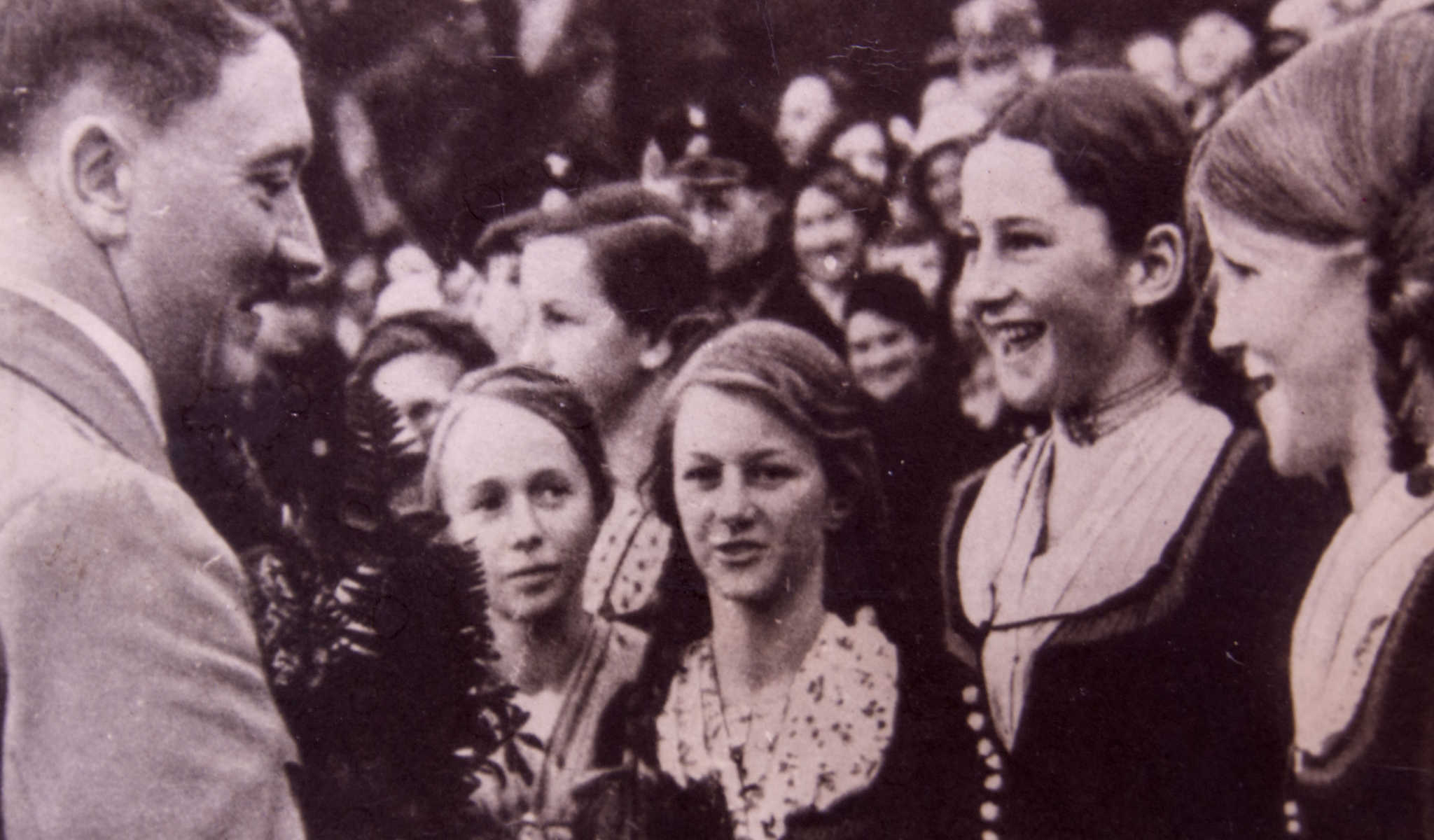
“I came back home a little afraid for my country, afraid of what it might want, and get, and like, under pressure of combined reality and illusion. I felt—and feel—that it was not German man that I had met, but Man. He happened to be in Germany under certain conditions. He might, under certain conditions, be I.” —Milton Mayer, They Thought They Were Free, ix.
It’s been more than seventy-five years since the Nazis were defeated and Auschwitz was liberated. Seventy-five years is a long time—so long, in fact, that while many still learn of the horrors of the Holocaust, far fewer understand how the murder of the Jews happened. How were millions of people systematically exterminated in an advanced Western nation—a constitutional republic? How did such respectable and intelligent citizens become complicit in the murder of their countrymen? These are the questions Milton Mayer sought to answer in his book They Thought They Were Free.
In 1952, Mayer moved his family to a small German town to live among ten ordinary men, hoping to understand not only how the Nazis came to power but how ordinary Germans—ordinary people—became unwitting participants in one of history’s greatest genocides. The men Mayer lived among came from all walks of life: a tailor, a cabinetmaker, a bill-collector, a salesman, a student, a teacher, a bank clerk, a baker, a soldier, and a police officer.
Significantly, Mayer did not simply conduct formal interviews in order to “study” these men; rather, Mayer had dinner in these men’s homes, befriended their families, and lived as one of them for nearly a year. His own children went to the same school as their children. And by the end of his time in Germany, Mayer could genuinely call them friends. They Thought They Were Free is Mayer’s account of their stories, and the title of the book is his thesis. Mayer explains:
“Only one of my ten Nazi friends saw Nazism as we—you and I—saw it in any respect. This was Hildebrandt, the teacher. And even he then believed, and still believes, in part of its program and practice, ‘the democratic part.’ The other nine, decent, hard-working, ordinarily intelligent and honest men, did not know before 1933 that Nazism was evil. They did not know between 1933 and 1945 that it was evil. And they do not know it now. None of them ever knew, or now knows, Nazism as we knew and know it; and they lived under it, served it, and, indeed, made it” (47).
Until reading this book, I thought of what happened in Germany with a bit of arrogance. How could they not know Nazism was evil? And how could they see what was happening and not speak out? Cowards. All of them. But as I read Mayer’s book, I felt a knot in my stomach, a growing fear that what happened in Germany was not a result of some defect in the German people of this era.
The men and women of Germany in the 1930s and 40s were not unlike Americans in the 2010s and 20s—or the people of any nation at any time throughout history. They are human, just as we are human. And as humans, we have a great tendency to harshly judge the evils of other societies but fail to recognize our own moral failures—failures that have been on full display the past two years during the covid panic.
Mayer’s book is frighteningly prescient; reading his words is like staring into our own souls. The following paragraphs will show just how similar the world’s response to covid has been to the German response to the “threat” of the Jews. If we can truly understand the parallels between our response to covid and the situation in Hitler’s Germany, if we can see what lies at the end of “two weeks to flatten the curve,” perhaps we can prevent the greatest atrocities from being fully realized in our own day. But to stop our bent toward tyranny, we must first be willing to grapple with the darkest parts of our nature, including our tendency to dehumanize others and to treat our neighbors as enemies.
Overcoming Decency
“Ordinary people—and ordinary Germans—cannot be expected to tolerate activities which outrage the ordinary sense of ordinary decency unless the victims are, in advance, successfully stigmatized as enemies of the people, of the nation, the race, the religion. Or, if they are not enemies (that comes later), they must be an element within the community somehow extrinsic to the common bond, a decompositive ferment (be it only by the way they part their hair or tie their necktie) in the uniformity which is everywhere the condition of common quiet. The Germans’ innocuous acceptance and practice of social anti-Semitism before Hitlerism had undermined the resistance of their ordinary decency to the stigmatization and persecution to come” (55).
Others have explained the link between totalitarian impulses and “institutionalized dehumanization” and have discussed the “othering” of unvaccinated persons in nations across the world. Mayer shows that such dehumanization does not necessarily begin with prejudice:
“National Socialism was anti-Semitism. Apart from anti-Semitism, its character was that of a thousand tyrannies before it, with modern conveniences. Traditional anti-Semitism . . . played an important role in softening the Germans as a whole to Nazi doctrine, but it was separation, not prejudice as such, that made Nazism possible, the mere separation of Jews and non-Jews” (116-117).
Even if many Germans did not harbor anti-Semitic prejudices (at least not initially), the forced separation of Jews and non-Jews created a devastating rift in German society, tearing the social fabric and paving the way for tyranny. In our day, the separation of the masked and unmasked, the vaccinated and the unvaccinated, has divided populations around the world like nothing we’ve experienced in our lifetimes. And the global scale of this separation has perhaps not happened in recorded history.
How has this separation been made possible? The immense power of propaganda, and particularly propaganda in the digital age. We think we understand how propaganda affects us, but we often don’t realize the truly insidious effects on how we view others until it is too late. Mayer’s friends explained this in great depth. On one occasion, Mayer asked the former bank clerk about one of his Jewish friends. “Did your memory of the peddler make you anti-Semitic?” “No—not until I heard anti-Semitic propaganda. Jews were supposed to do terrible things that the peddler had never done. . . . The propaganda didn’t make me think of him as I knew him but of him as a Jew” (124; emphasis added).
Is there anything we can do to mitigate the dehumanizing effects of propaganda? Mayer describes the power of Nazi propaganda as so intense that all of his friends were affected by it—changed by it—including the teacher who was more aware of such tactics. Nearly seven years after the war, his friends still could not be persuaded that they had been deceived:
“Nobody has proved to my friends that the Nazis were wrong about the Jews. Nobody can. The truth or falsity of what the Nazis said, and of what my extremist friends believed, was immaterial, marvelously so. There simply was no way to reach it, no way, at least, that employed the procedures of logic and evidence” (142).
Mayer’s conclusion is depressing. If we cannot persuade others with logic and evidence, how can we persuade them? How many of us have shared indisputable data that the vaccines carry risks? How many of us have shown videos where public health officials openly admit that the vaccines do not stop transmission and that cloth masks don’t work (and are in fact little more than “facial decorations”)? Yet the evidence does not persuade those who have been captured by propaganda; indeed, it cannot persuade them. This is because the very nature of propaganda does not appeal to logic or reason; it does not appeal to evidence. Propaganda appeals to our emotions, and in a world where many people are led by emotions, propaganda becomes deeply rooted in the hearts of those who consume it.
So what are we to do? Mayer relays a frustrating reality. But understanding how propaganda worked in Nazi Germany and how it works today is essential if we are to have any chance of persuading those who have been shaped by it. Moreover, understanding why many people tend to be led by emotions and to outsource or suspend their critical thinking is perhaps even more essential to forestalling greater tragedies. We cannot expect others to escape the tyranny of propaganda if they do not have time to think or are motivated not to think.
Our Own Lives
Even without the dehumanization of those who were a “threat” to the community, most Germans were too focused on their own lives to consider the plight of their neighbors:
“Men think first of the lives they lead and the things they see; and not, among the things they see, of the extraordinary sights, but of the sights which meet them in their daily rounds. The lives of my nine friends—and even of the tenth, the teacher—were lightened and brightened by National Socialism as they knew it. And they look back at it now—nine of them, certainly—as the best time of their lives; for what are men’s lives? There were jobs and job security, summer camps for the children and the Hitler Jugend to keep them off the streets. What does a mother want to know? She wants to know where her children are, and with whom, and what they are doing. In those days she knew or thought she did; what difference does it make? So things went better at home, and when things go better at home, and on the job, what more does a husband and father want to know?” (48)
The best time of their lives. From where we stand in 2022, this seems like an unbelievable statement. How could they view a society that ostracized and eventually murdered millions of their fellow citizens as a good society? How could they look the other way when the Jews and others were suffering? It’s easy to ask these questions, but in our modern world, are we not also narrowly concerned with the comforts of our own lives and those of our loved ones? If the lives of others are put at risk so that our families can continue to “stay home and save lives”—so that we can feel safe from a deadly virus and “righteous” because of our decisions—would we not choose to do it? Many of us did. But did we even consider that our staying home meant others could not?
The lockdowns destroyed the lives of millions of poor children, both at home and abroad. But the laptop class remained insulated from this suffering, content with delivered groceries, zoom calls, and new episodes of Tiger King. And while many around the world starved or fought over limited supplies of food and water, we battled over the newest iPhones, believing that these devices were necessary to “ride out the pandemic” from our high-rise castles and suburban fortresses. Indeed, for many of us, our biggest concern was whether or not we could quickly have a new 42” TV delivered if ours stopped working. We knew nothing of the suffering of others, and we barely considered that their realities could be different. So also in Germany:
“There were wonderful ten-dollar holiday trips for the family in the ‘Strength through Joy’ program, to Norway in the summer and Spain in the winter, for people who had never dreamed of a real holiday trip at home or abroad. And in Kronenberg ‘nobody’ (nobody my friends knew) went cold, nobody went hungry, nobody went ill and uncared for. For whom do men know? They know people of their own neighborhood, of their own station and occupation, of their own political (or nonpolitical) views, of their own religion and race. All the blessings of the New Order, advertised everywhere, reached ‘everybody’” (48-49).
We quickly forget those who are distanced from us. And in a faceless world of “social distancing,” it’s that much easier to forget the myriad human beings who are suffering beyond what we could bear. The children who have never known their teachers’ faces? Not our concern. The elderly and infirm who’ve been cut off from the rest of the world, deprived of social interaction and human touch? It’s for their health and safety. Both children and adults with disabilities and special needs, those who cannot speak and cannot hear? We must all make sacrifices to slow the spread.
Our Own Fears
Add to our own lives our own fears (real or imagined), and we become even less motivated to consider the hardships of others:
“Their world was the world of National Socialism; inside it, inside the Nazi community, they knew only good-fellowship and the ordinary concerns of ordinary life. They feared the ‘Bolsheviks’ but not one another, and their fear was the accepted fear of the whole otherwise happy Nazi community that was Germany” (52).
The “accepted fear” of the community. The ten men Mayer lived among described the socially acceptable fears they were allowed to express—and the fears by which they must order their lives. But to express fear or even uneasiness about the growing totalitarianism of the Nazi regime? Such concerns were verboten. And so it is today. We are permitted (indeed, encouraged!) to fear the virus. We can fear the collapse of the healthcare system. We can fear “the unvaccinated” and even “anti-maskers.” But dare we express fear of the growing totalitarianism among us? Dare we challenge the “scientific consensus” or question the edicts of public health officials? We dare not, lest we be lumped together with the science-denying anti-vaxxers. We dare not, lest our posts be labeled misinformation or our accounts be permanently suspended.
Our Own Troubles
“It was this, I think—they had their own troubles—that in the end explained my friends’ failure to ‘do something’ or even to know something. A man can carry only so much responsibility. If he tries to carry more, he collapses; so, to save himself from collapse, he rejects the responsibility that exceeds his capacity. . . . Responsible men never shirk responsibility, and so, when they must reject it, they deny it. They draw the curtain. They detach themselves altogether from the consideration of the evil they ought to, but cannot, contend with.” (75-76).
We all have our own lives—the everyday concerns of our families and friends. We also have our own fears—fears of imaginary threats or actual risks. Add to our lives and fears the weight of our own responsibilities, and we can be rendered powerless to consider the troubles of those around us. This was true not only of the Germans of this era but of Americans as well. Mayer describes an interaction with his friend Simon, the bill collector, over the American internment of the Japanese. Simon recounted the forced relocation of more than 100,000 Americans—including children—because of their Japanese ancestry (and supposedly due to the threat they posed to the security of the nation).
Simon asked what Mayer had done to stand up for his fellow citizens who were removed from their homes without any form of due process. “Nothing,” Mayer replied. Simon’s response is sobering:
“‘There. You learned about all these things openly, through your government and your press. We did not learn through ours. As in your case, nothing was required of us—in our case, not even knowledge. You knew about things you thought were wrong—you did think it was wrong, didn’t you, Herr Professor?’ ‘Yes.’ ‘So. You did nothing. We heard, or guessed, and we did nothing. So it is everywhere.’ When I protested that the Japanese-descended Americans had not been treated like the Jews, he said, ‘And if they had been—what then? Do you not see that the idea of doing something or doing nothing is in either case the same?” (81).
We all want to think we would react differently. We all have the best of intentions and believe we would have the courage to stand up for others. We will be the heroes when everyone else is too afraid to act. But when the time comes, what will we actually do? Mayer’s interaction with his friend the teacher is worth quoting at length:
“‘I never got over marveling that I survived,’ said Herr Hildebrandt. ‘I couldn’t help being glad, when something happened to somebody else, that it hadn’t happened to me. It was like later on, when a bomb hit another city, or another house than your own; you were thankful.’ ‘More thankful for yourself than you were sorry for others?’ ‘Yes. The truth is, Yes. It may be different in your case, Herr Professor, but I’m not sure that you will know until you have faced it. . . .
You were sorry for the Jews, who had to identify themselves, every male with “Israel” inserted into his name, every female with “Sarah,” on every official occasion; sorrier, later on, that they lost their jobs and their homes and had to report themselves to the police; sorrier still that they had to leave their homeland, that they had to be taken to concentration camps and enslaved and killed. But—weren’t you glad you weren’t a Jew? You were sorry, and more terrified, when it happened, as it did, to thousands, to hundreds of thousands, of non-Jews. But—weren’t you glad that it hadn’t happened to you, a non-Jew? It might not have been the loftiest type of gladness, but you hugged it to yourself and watched your step, more cautiously than ever” (58-59).
I feel bad for them, but I am unwilling to speak up. I hate that children are denied access to speech therapy, in-person school, or social interaction with their friends. But if I speak up, I may lose my status and influence. I hate that the unvaccinated are losing their jobs and being confined to their homes. But if I speak up, I could lose my job as well. I hate that my fellow citizens are being taken to “quarantine centers” against their will. But if I speak up, I could face criminal penalties. And I hate that the unvaccinated are being excluded from society and treated with contempt by national leaders. But if I speak up, I could be excluded as well. The risk is too great.
The Tactics of Tyrants
“[M]odern tyrants all stand above politics and, in doing so, demonstrate that they are all master politicians” (55).
How often have public officials denounced those who question the narrative as “politicizing covid”? “Stop politicizing masks!” “Stop politicizing vaccines!” And those who dissent are demeaned as “science-denying Trump supporters” or “anti-vax conspiracy theorists.” It’s no wonder so few have questioned the official narratives on masks, lockdowns, and vaccines—to do so is to put oneself in the crosshairs, to draw accusations of caring more about politics and the economy than people’s lives and health. This gaslighting is by no means the only tactic of those who seek greater authoritarian control. In addition to helping us understand what makes us susceptible to totalitarianism—why so many of us will “draw the curtain” in the face of evil—Mayer’s work also exposes the tactics of tyrants, enabling his readers to see and resist.
“This separation of government from people, this widening of the gap, took place so gradually and so insensibly, each step disguised (perhaps not even intentionally) as a temporary emergency measure or associated with true patriotic allegiance or with real social purposes. And all the crises and reforms (real reforms, too) so occupied the people that they did not see the slow motion underneath, of the whole process of government growing remoter and remoter” (166-167).
Many have sounded the alarm over the past two years about the threat of endless emergencies, and we have all seen the goalposts be moved time and again. “It’s just two weeks.” “It’s just a mask.” “It’s just a vaccine.” And on and on it goes. But while most everyone recognizes that “two weeks to flatten the curve” was not just two weeks, too few understand the insidious threat of ongoing “rule by emergency.” But Mayer’s friends understood, and they experienced the catastrophic results.
Before Hitler became chancellor, Germany was still a republic governed by the Weimar Constitution. But Article 48 of this constitution permitted the suspension of civil liberties “[i]f public security and order are seriously disturbed or endangered.” These emergency powers were continually abused, and following the Reichstag Fire in 1933, the Enabling Act transferred all law-making power from the German parliament to the executive branch, allowing Hitler to “rule by decree” until the end of the War in 1945.
While the legislative branches of the States and the federal government in the United States (and other nations around the world) have been in session the past two years, the reality is that legislatures rarely sought to limit the powers of the executive. Under the auspices of the CDC, the WHO, and other health agencies, executives have effectively ruled by fiat. Closing businesses, mandating masks and vaccines, forcing people to stay home—most of these measures were implemented by executives without even consulting legislatures. And what was the justification? The “emergency” of covid. If we could go back in time to 2019 and ask whether executives should be permitted to unilaterally impose such life-altering policies on their people even with legislative consent, the vast majority of people would likely say “No!” So how did we get here in 2022? Mayer’s friends offer valuable insight.
The Common Good
“The community is suddenly an organism, a single body and a single soul, consuming its members for its own purposes. For the duration of the emergency the city does not exist for the citizen but the citizen for the city. The harder the city is pressed, the harder its citizens work for it and the more productive and efficient they become in its interest. Civic pride becomes the highest pride, for the end purpose of all one’s enormous efforts is the preservation of the city. Conscientiousness is the highest virtue now, the common good the highest good” (255).
What has been the reason given for many of the measures implemented over the past two years? The common good. We must wear our masks to protect others. Get vaccinated to love our neighbors. Stay home to save lives. And it’s not just for our neighbors as individuals but for the community as a whole. We must close schools to preserve hospital resources. In the U.K., efforts were being made to “Protect the NHS.” And countless other slogans signaled our common virtue.
To be clear, I’m not opposed to working together for the common good; I do not value my liberties more than the lives of others (this was a common gaslighting tactic employed against those who opposed government overreach). Rather, I simply understand how governments across time have used the “common good” as an excuse to consolidate power and implement authoritarian measures that under normal circumstances would be rejected. This is exactly what happened to Mayer’s friends:
“Take Germany as a city cut off from the outside world by flood or fire advancing from every direction. The mayor proclaims martial law, suspending council debate. He mobilizes the populace, assigning each section its tasks. Half the citizens are at once engaged directly in the public business. Every private act—a telephone call, the use of an electric light, the service of a physician—becomes a public act. Every private right—to take a walk, to attend a meeting, to operate a printing press—becomes a public right. Every private institution—the hospital, the church, the club—becomes a public institution. Here, although we never think to call it by any name but pressure of necessity, we have the whole formula of totalitarianism.
The individual surrenders his individuality without a murmur, without, indeed, a second thought—and not just his individual hobbies and tastes, but his individual occupation, his individual family concerns, his individual needs” (254; emphasis added).
Tyrants understand how to exploit our desire to care for others. We must understand their tendency to exploit our good will. Indeed, to understand this tactic and to resist encroachments on liberty is the way to preserve the actual common good. Tragically, many people do not realize that they have been exploited—that their desire to work for the common good has become obedience without question. Mayer’s description is stunning:
“For the rest of the citizens—95 percent or so of the population—duty is now the central fact of life. They obey, at first awkwardly but, surprisingly soon, spontaneously.” (255)
This type of compliance seems to have happened most clearly with the use of masks. We obey spontaneously, not at the point of a gun. And we obey without thinking about the rationality of what is required. We will wear a mask to walk to a table in a packed restaurant, and we will dine for two hours before donning it again to walk out. We must wear masks on a plane to “stop the spread,” but we can take them off as long as we are eating or drinking. Some even wear masks while driving alone in their cars. To be clear, I am not criticizing those who wear masks in these situations; I am lamenting how propaganda has so affected us that we comply without considering our actions. Or, perhaps worse, we have considered them, but we comply anyway because that’s what others are doing and that’s what we’re expected to do.
Do you see the dangerous parallels between what’s happening today and what happened in Germany? This is not simply about masks (and it never has been). This is about a willingness to comply with government demands, no matter how illogical or insidious. Can you see how these tendencies contribute to the demonization of certain persons, particularly the unvaccinated? Those who do not act to “protect their neighbors” by wearing a mask, or who choose not to get vaccinated “for the sake of the vulnerable,” are a danger to society and a threat to us all. Can you see where this demonization can lead? We know where it led in Germany.
Endless Distractions
“[S]uddenly, I was plunged into all the new activity, as the university was drawn into the new situation; meetings, conferences, interviews, ceremonies, and, above all, papers to be filled out, reports, bibliographies, lists, questionnaires. And on top of that were the demands in the community, the things in which one had to, was ‘expected to’ participate that had not been there or had not been important before. It was all rigmarole, of course, but it consumed all one’s energies, coming on top of the work one really wanted to do. You can see how easy it was, then, not to think about fundamental things. One had no time” (167).
Combine the tyrannical use of the common good with a perpetual state of emergency, and you have a totalitarian regime that cannot be questioned: “[T]his, of all times, is no time for divisiveness” (256). Add to these tactics endless distractions to occupy the citizenry, and no one even has time to question. Listen to one of Mayer’s colleagues:
“The dictatorship, and the whole process of its coming into being, was above all diverting. It provided an excuse not to think for people who did not want to think anyway. I do not speak of your ‘little men,’ your baker and so on; I speak of my colleagues and myself, learned men, mind you. Most of us did not want to think about fundamental things and never had. There was no need to. Nazism gave us some dreadful, fundamental things to think about—we were decent people—and kept us so busy with continuous changes and ‘crises’ and so fascinated, yes, fascinated, by the machinations of the ‘national enemies,’ without and within, that we had no time to think about these dreadful things that were growing, little by little, all around us. Unconsciously, I suppose, we were grateful. Who wants to think?” (167-168).
Is this not what is happening, even as I write this, in the world around us? Over the past two years we have experienced a continual upending of our lives with lockdowns, zooming, online “learning,” mask mandates, “social” distancing, and more. And then we are told we must comply with vaccine mandates or lose our jobs, leaving some of us too weary to resist and others more weary for trying. And for those of us who have chosen to forgo the available vaccines, we must spend time—lots and lots of time—composing exemption requests for the various mandates, explaining in depth our reasons for objecting to the jabs.
And then, when it seems the covid madness is coming to an end (at least for the time being), an “emergency” is declared in Canada that tramples the rights of Canadian citizens, and even now the world has been plunged into crisis because of the conflict in Ukraine. There is so much going on, so many legitimate concerns that demand our attention, that many are unaware of the totalitarian noose that is tightening around us. More than that, we are too exhausted to examine what is happening, too tired to even care. But care we must! Or it will be too late, and there will be no turning back.
Science and Education
“[T]he university students would believe anything complicated. The professors, too. Have you seen the ‘race purity’ chart?” “Yes,” I said. “Well, then, you know. A whole system. We Germans like systems, you know. It all fitted together, so it was science, system and science, if only you looked at the circles, black, white, and shaded, and not at real people. Such Dummheit they couldn’t teach to us little men. They didn’t even try” (142).
“Trust the science.” Or so we have been told the past two years. Yet another tactic used by authoritarians across time is the appeal to science and expertise. Mayer’s friends described how the Nazis used “science” to convince students and others that the Jews were inferior, even diseased. But this was not science; it was scientism. And so it is today.
Science is not dogma; it is not a set of beliefs. Real science is the process by which we discover the truth about the physical world. We begin with a hypothesis that must be rigorously tested through observation and experimentation. But over the past two years, “science” has meant whatever the public health authorities claim to be true, regardless whether the claims are supported by evidence. In fact, much of this so-called science has proved to be demonstrably false.
In addition to using “science” to support its goals, the Reich government also sought to control education. “National Socialism required the destruction of academic independence” (112), replacing truth and the search for truth with allegiance to Nazi doctrine. Notably, the Nazis captured not only the secondary schools but the primary schools as well, even rewriting certain subjects to comport with Nazi propaganda: “In history, in biology, and in economics the teaching program was much more elaborate than it was in literature, and much stricter. These subjects were really rewritten” (198). Mayer’s friend the teacher explained how the Reich would also place “ignorant ‘reliables,’ from politics or business, over the educators”; this was “part of the Nazi way of humiliating education and bringing it into popular contempt” (197). In today’s world, this would likely involve bringing in bureaucrats to control what is taught in the classroom or to control whether there even is a classroom, as so many schools have been perpetually closed “to slow the spread.”
Suppressing Speech and Encouraging Self-Censorship
“Everything was not regulated specifically, ever. It was not like that at all. Choices were left to the teacher’s discretion, within the ‘German spirit.’ That was all that was necessary; the teacher had only to be discreet. If he himself wondered at all whether anyone would object to a given book, he would be wise not to use it. This was a much more powerful form of intimidation, you see, than any fixed list of acceptable or unacceptable writings. The way it was done was, from the point of view of the regime, remarkably clever and effective. The teacher had to make the choices and risk the consequences; this made him all the more cautious” (194).
The Reich’s method of controlling education (and speech more broadly) did not rely on overly specific regulations. In our modern world, this tactic goes well beyond the enforcement of covid protocols, but it certainly includes them. Rare were the institutions that permitted a choice concerning masks; most schools required their students to wear them regardless of personal convictions. The result? Students who quickly learned that they must cover their faces to participate in society, and some who came to believe that they would seriously harm themselves or their classmates if they took them off. And even with most U.S. jurisdictions removing mask requirements in most schools, many students have become so self-conscious of showing their faces that they will voluntarily continue wearing them. What is the cost not only to the mental health of these students but to freedom of speech and expression? We may never fully know.
And it was not only schools. Covid protocols and covid narratives were enforced outside of schools as well. In early 2021, only a small minority of businesses permitted their customers to enter unmasked; still fewer allowed their employees this option. Though rarely acknowledged by most public health officials, masks do interfere with human communication (if they did not, world leaders would not take them off to speak). And if the ability to communicate is hindered, the free exchange of ideas also suffers.
As to speech more broadly, the tactic described by Mayer encourages self-censorship, which any fair-minded person admits is also happening today. Going back decades to speech that was considered “politically incorrect,” we all understand that there are certain accepted positions on a variety of topics, ranging from race and gender to vaccines and covid treatments.
Don’t dare share anything that counters the narrative, on covid or anything else. To share something that comes close to questioning the narrative could have myriad consequences, both personal and professional. You do not want to be accused of spreading misinformation, do you? Or maligned as a conspiracy theorist? So we refrain from sharing counterpoints and evidence, even if that evidence is absolutely legitimate and completely sound.
Uncertainty
“You see,” my colleague went on, “one doesn’t see exactly where or how to move. Believe me, this is true. Each act, each occasion, is worse than the last, but only a little worse. You wait for the next and the next. You wait for one great shocking occasion, thinking that others, when such a shock comes, will join with you in resisting somehow. You don’t want to act, or even talk, alone; you don’t want to ‘go out of your way to make trouble.’ Why not?—Well, you are not in the habit of doing it. And it is not just fear, fear of standing alone, that restrains you; it is also genuine uncertainty.
“Uncertainty is a very important factor, and, instead of decreasing as time goes on, it grows. Outside, in the streets, in the general community, ‘everyone’ is happy. One hears no protest, and certainly sees none. . . . you speak privately to your colleagues, some of whom certainly feel as you do; but what do they say? They say, ‘It’s not so bad’ or ‘You’re seeing things” or “You’re an alarmist.”
“And you are an alarmist. You are saying that this must lead to this, and you can’t prove it. These are the beginnings, yes; but how do you know for sure when you don’t know the end, and how do you know, or even surmise, the end? On the one hand, your enemies, the law, the regime, the Party, intimidate you. On the other, your colleagues pooh-pooh you as pessimistic or even neurotic. You are left with your close friends, who are, naturally, people who have always thought as you have” (169-170).
And so we do nothing. Mayer is right. His colleague was right. What can we say?
One thing we can say is that those who have required masks, whether by accident or design, have made the feeling of uncertainty even greater. We struggle to know what others are thinking, or feeling, because our faces are hidden. In addition to the low-level anxiety and fear that masks induce in everyone (at the very least causing us to view others as threats to our safety and not as persons), we are uncertain why those around us are wearing masks. Is it simply because they are told to do so? Is it out of deference to others? Or because they genuinely desire to wear them?
Let’s say it’s true that the strong majority of workers would choose not to wear masks if their employers did not require them. How are we to know for sure what they prefer if the choice is taken from them? Similarly, if one was required to do various things to show allegiance to the Party, how was one to know whether others were genuinely loyal to the Party or simply going along in order to blend in (and not be taken to the camps)?
Gradually, Then Suddenly
“To live in this process is absolutely not to be able to notice it—please try to believe me—unless one has a much greater degree of political awareness, acuity, than most of us had ever had occasion to develop. Each step was so small, so inconsequential, so well explained or, on occasion, ‘regretted,’ that, unless one were detached from the whole process from the beginning, unless one understood what the whole thing was in principle, what all these ‘little measures’ that no ‘patriotic German’ could resent must some day lead to, one no more saw it developing from day to than a farmer in his field sees the corn growing. One day it is over his head” (168).
Of all the tactics employed by tyrants to achieve their goals, the illusion that we have plenty of time to escape is arguably the most important. If we could all go back to February 2020, how many of us would have predicted we would be here? How did it all happen? Gradually, then all at once. Mayer senses our dilemma:
“How is this to be avoided, among ordinary men, even highly educated ordinary men? Frankly, I do not know. I do not see, even now. Many, many times since it all happened I have pondered that pair of great maxims, Principiis obsta and Finem respice—‘Resist the beginnings’ and ‘Consider the end.’ But one must foresee the end in order to resist, or even see, the beginnings. One must foresee the end clearly and certainly and how is this to be done, by ordinary men or even by extraordinary men? Things might have changed here before they went as far as they did; they didn’t, but they might have. And everyone counts on that might” (168).
Think back to March 2020. We should have resisted then. We should not have tolerated stay-at-home orders or various (and even non-sensical) restrictions on local businesses and private life. Governments had already gone too far. And then came the masks, and some said that masks were the hill. Individuals who shared these concerns were derided as fanatics and conspiracy theorists, but they were right.
Many did not see it, and even fewer resisted. I saw it relatively early, but I did not resist as fiercely as I should, and my failure haunts me to this day. Had we more seriously resisted masks, the prospect of vaccine mandates would have largely collapsed. Indeed, there would be no political, moral, or practical support for vaccine mandates and the more insidious vaccine passports had mask mandates been successfully resisted. But we—but I—did not resist as fiercely as I should have.
Why not? I told myself that it was worth keeping my position of influence at my job. It was a “calculated decision” to continue to help those around me. And I also needed to provide food and shelter for my daughters, to enable them to have a “normal” childhood.
But in my good and noble compromises—they are, in fact, compromises—have I laid the groundwork for further infringements on my family’s lives and liberties? Have I sowed the seeds of an eternal dystopia that will forever terrorize my daughters and their children? Have I made a deal with the devil? More importantly, if I have, is there any way out of this contract?
The Power of Non-Violent Resistance
“It is actual resistance which worries tyrants, not lack of the few hands required to do the dark work of tyranny. What the Nazis had to gauge was the point at which atrocity would awaken the community to the consciousness of its moral habits. This point may be moved forward as the national emergency, or cold war, is moved forward, and still further forward in hot war. But it remains the point which the tyrant must always approach and never pass. If his calculation is too far behind the people’s temper, he faces a palace Putsch; if it is too far ahead, a popular revolution” (56).
We underestimate how much power people have when they choose to resist. Parents across the nation pushed back against mask mandates, and many school boards relented and made masks optional. Many employees refused to comply with vaccine mandates, and many employers relented (or at least granted broad exemptions). Parents and employees did not win in all cases, but they’ve won more battles than many realize, and the war is far from over. Strong and united opposition has also resulted in reversals of government covid policies, and more mandates are being lifted as more pressure is applied. We must continue to resist and help others do the same, recognizing that the costs we bear will be worth it in the end.
The Cost of Dissent
“You are respected in the community. Why? Because your attitudes are the same as the community’s. But are the community’s attitudes respectable? We—you and I—want the community’s approval on the community’s basis. We don’t want the approval of criminals, but the community decides what is criminal and what isn’t. This is the trap. You and I—and my ten Nazi friends—are in the trap. It has nothing to do directly with fear for one’s own or his family’s safety, or his job, or his property. I may have all these, never lose them, and still be in exile. . . . My safety, unless I am accustomed to being a dissenter, or a recluse, or a snob, is in numbers; this man, who will pass me tomorrow and who, though he always said ‘Hello’ to me, would never have lifted a finger for me, will tomorrow reduce my safety by the number of one” (60).
In Hitler’s Germany, to stray from the acceptable concerns, to deviate from the accepted narrative, was to put oneself at risk. And so it is today. Dissenters are looked on as the ones who cause problems. Challenging the accepted narratives or questioning the “consensus” draws the ire of both everyday citizens and cultural elites. Dissent is dangerous, not because one is factually incorrect in his assessments, but because his assessments challenge accepted dogmas.
The Cost of Compliance
There is a cost to being a dissenter. Mayer’s friends were in constant danger of losing their jobs and their freedoms—and possibly their lives. But there is also a cost to compliance, and that cost is far greater than anything we can currently imagine. Listen carefully to Mayer:
“It is clearer all the time that, if you are going to do anything, you must make an occasion to do it, and then you are obviously a troublemaker. So you wait, and you wait. But the one great shocking occasion, when tens or hundreds or thousands will join with you, never comes. That’s the difficulty. If the last and worst act of the whole regime had come immediately after the first and smallest, thousands, yes, millions would have been sufficiently shocked—if, let us say, the gassing of the Jews in ’43 had come immediately after the ‘German Firm’ stickers on the windows of non-Jewish shops in ’33. But of course this isn’t the way it happens. In between come all the hundreds of little steps, some of them imperceptible, each of them preparing you not to be shocked by the next.
“And one day, too late, your principles, if you were ever sensible of them, all rush in upon you. The burden of self-deception has grown too heavy, and some minor incident, in my case my little boy, hardly more than a baby, saying ‘Jew swine,’ collapses it all at once, and you see that everything, everything, has changed and changed completely under your nose. The world you live in—your nation, your people—is not the world you were born in at all. The forms are all there, all untouched, all reassuring, the houses, the shops, the jobs, the mealtimes, the visits, the concerts, the cinema, the holidays. But the spirit, which you never noticed because you made the lifelong mistake of identifying it with the forms, is changed. Now you live in a world of hate and fear, and the people who hate and fear do not even know it themselves; when everyone is transformed, no one is transformed. Now you live in a system which rules without responsibility even to God.”
“You have gone almost all the way yourself. Life is a continuing process, a flow, not a succession of acts and events at all. It has flowed to a new level, carrying you with it, without any effort on your part. On this new level you live, you have been living more comfortably every day, with new morals, new principles. You have accepted things you would not have accepted five years ago, a year ago, things that your father, even in Germany, could not have imagined. Suddenly it all comes down, all at once. You see what you are, what you have done, or, more accurately, what you haven’t done (for that was all that was required of most of us: that we do nothing). You remember those early meetings of your department in the university when, if one had stood, others would have stood, perhaps, but no one stood. A small matter, a matter of hiring this man or that, and you hired this one rather than that. You remember everything now, and your heart breaks. Too late. You are compromised beyond repair.”
“What then? You must then shoot yourself. A few did. Or ‘adjust’ your principles. Many tried, and some, I suppose, succeeded; not I, however. Or learn to live the rest of your life with your shame. This last is the nearest there is, under the circumstances, to heroism: shame. Many Germans became this poor kind of hero, many more, I think, than the world knows or cares to know” (171-172).
I’ve read this section more times than I can count, and as I read it now, I weep for my own failures. My own fears. My own complicity in the slow growth of covid totalitarianism. Of allowing governments and media to set narratives. Of failing to take a stand. But it is not too late! What is coming with digital IDs and digital passports is more insidious, and more ingenious, but there is still time to resist. But we must resolve to stand now. We must resolve to stand together. And we must stand no matter the cost.
“You know,” he went on, “when men who understand what is happening—the motion, that is, of history, not the reports of single events or developments—when such men do not object or protest, men who do not understand cannot be expected to. How many men would you say understand—in this sense—in America? And when, as the motion of history accelerates and those who don’t understand are crazed by fear, as our people were, and made into a great ‘patriotic’ mob, will they understand then, when they did not before?” (175).
The duty is upon us who see what is happening to stand up and resist. We will all bear some cost, either now or in the future. Some of us have experienced the cost of standing up: we have lost jobs, lost friends, even lost freedoms. But all of us have borne the cost of tyrannical overreach in the name of public health. I’ve lost count of the number of people I know who were not permitted to say goodbye to their loved ones. Who were denied access to potentially life-saving treatments. Who were refused medical care in the name of the common good. There is no doubt we’ve all suffered during the past two years, but failing to resist this ever-encroaching tyranny will cost more than we can comprehend. I don’t know exactly what it will cost us to stand for truth and liberty in the coming months and years. But what I can say with near certainty is that the cost of present resistance will be far more tolerable to our consciences and perhaps our lives than failure to resist. More importantly, resisting now will certainly be more tolerable for the lives of our children.
The Choice Before Us
Because of the risks to their lives and their families, many Germans refused to speak openly about what was happening, even when they knew. And their fears were completely justified:
“Those who came back from Buchenwald in the early years had promised—as every inmate of every German prison had always had to promise upon his release—not to discuss his prison experience. You should have broken your promise. You should have told your countrymen about it; you might, though the chances were all against you, have saved your country had you done so. But you didn’t. You told your wife, or your father, and swore them to secrecy. And so, although millions guessed, only thousands knew. Did you want to go back to Buchenwald, and to worse treatment this time? Weren’t you sorry for those who were left there? And weren’t you glad you were out?” (59).
Is this not the case with the many who have escaped the camps in North Korea? Or the Uyghurs who have been released from “re-education facilities” in Xinjiang, China? I dare not judge harshly those who have not spoken up, as I have no way of understanding what they have experienced. But I want to think that I—and that everyone reading this piece—will have the resolve to speak up in these dark hours. To stand shoulder to shoulder, to not shirk from our responsibility to our children, to our neighbors, and to the generations who will come after us. But then I think of my children—my three precious daughters—and I think of the present cost of standing up.
If I speak up, I might be arrested, my bank accounts might be frozen, my professional license suspended or revoked. My ability to provide for my family could be greatly diminished, and my girls might lose their family home. Even more, if I am one day arrested and taken to prison or to a camp (or whatever the facilities are called where people are being held against their will), I will not be present to play catch with my youngest, to watch my second ride her hoverboard, or hear my oldest read to me. I might not be able to tuck them in bed, to sing to them, to pray with them—and not only for a night but for weeks or months (if not years). So I am torn.
Do I speak up, knowing that voicing dissent could upend my daughters’ lives and render them virtually fatherless? Or do I choose to remain silent, with the protests of my heart suppressed until they shrivel to nothing? Do I accept a new normal of dystopian tyranny in order to be physically present with my children, knowing that this choice will consign my daughters (and their families and descendants) to a totalitarianism that may never be overthrown? What would love compel me to do? What is the right thing to do? What will I choose to do? I know what I hope I will choose, but do you see the difficulty?
What Will We Choose?
“Here in Kronenberg? Well, we had twenty thousand people. Of these twenty thousand people, how many opposed? How would you know? How would I know? If you ask me how many did something in secret opposition, something that meant great danger to them, I would say, well, twenty. And how many did something like that openly, and from good motives alone? Maybe five, maybe two. That’s the way men are.” “You always say, That’s the way men are,’ Herr Klingelhöfer,” I said. “Are you sure that that’s the way men are?” “That’s the way men are here,” he said. “Are they different in America?” Alibis, alibis, alibis; alibis for the Germans; alibis, too, for man, who, when he was once asked, in olden time, whether he would prefer to do or to suffer injustice, replied, “I would rather neither.” The mortal choice which every German had to make—whether or not he knew he was making it—is a choice which we Americans have never had to confront” (93-94).
When Mayer wrote his book, Americans had not yet confronted the choices his friends had to make. But for the past two years, we have been staring these choices in the face. Certainly Australians are confronting them, as are the citizens of New Zealand. Austria, Spain, Italy, and Canada—to say nothing of many Eastern nations—are most definitely confronting them. And in many blue cities and states across the nation, our fellow Americans have faced these choices and felt the weight of separation and discrimination.
I often ask my students the following question when we discuss this book each spring: what happens if the United States and other free nations fall into tyranny? In Germany before World War II, it was at least possible to immigrate elsewhere. One could get out if he had means and if he saw it coming in time. But what happens if we give up the fight? Where else can we go? Where can our children flee? If the whole world becomes like China, there is nowhere else to escape the approaching storm.
So what must we do? We must decide today to draw a line that must not be crossed. As others have written, we should have drawn the line at masks. Governments the world over have rendered entire societies more compliant by hiding our faces. In so many cases, we no longer see others as human. We instead view them as threats, as anonymous vectors of disease. But since we didn’t draw the line at masks in 2020, we must regain that ground that was lost. We must fight to end not only the current mask and vaccine mandates (and other remaining covid restrictions), but we must not relent until the possibility of such mandates is viewed not only as politically untenable but morally and ethically indefensible. And no matter the cost, we cannot under any circumstance accept the use of digital passports (this short video shows why). And finally, we must not only be in the business of changing policies; we must strive to change hearts and minds, to wake others to the reality of what is taking place.
Friends, we must act—I must act. There is no more time to wait.
SHOCKING NEWS FROM THE WORLD OF SCIENCE: People who exercise regularly are more likely to live long…
SHOCKING NEWS FROM THE WORLD OF SCIENCE: People who exercise regularly are more likely to live longer.
THE AP THEN: The AP now: I’m guessing this means tomorrow’s reveal of last quarter’s G…
Jts5665The propaganda is getting clunky.
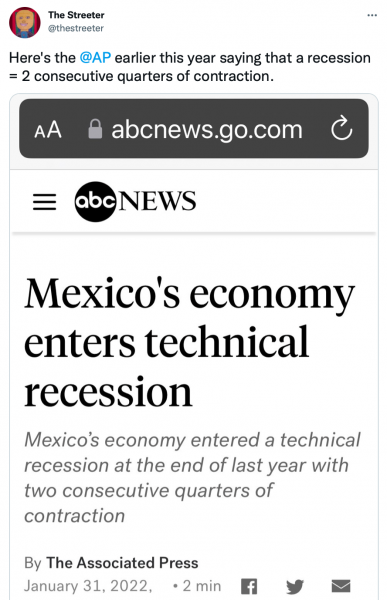
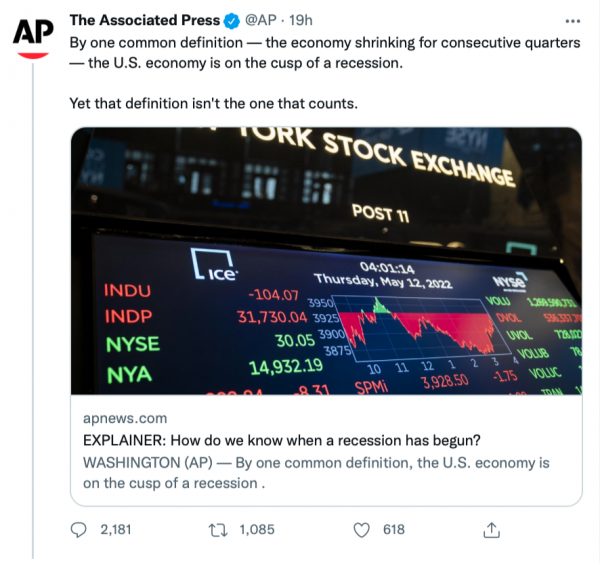
I’m guessing this means tomorrow’s reveal of last quarter’s GDP figure is going to be even worse than expected — and the expected figure is worse than the first quarter’s -1.5% annual rate.
Exit Question: If you ever doubted that the AP had become a government mouthpiece, do you still?
Forer Statements As Updates And Affirmations
The Forer Effect is a trick used by astrologers, psychics, and social psychologists. Given a list of statements like these:
You have a great need for other people to like and admire you.
You have a tendency to be critical of yourself.
You have a great deal of unused capacity which you have not turned to your advantage.
While you have some personality weaknesses, you are generally able to compensate for them.
Your sexual adjustment has presented problems for you.
Disciplined and self-controlled outside, you tend to be worrisome and insecure inside.
At times you have serious doubts as to whether you have made the right decision or done the right thing.
You prefer a certain amount of change and variety and become dissatisfied when hemmed in by restrictions and limitations.
You pride yourself as an independent thinker and do not accept others' statements without satisfactory proof.
You have found it unwise to be too frank in revealing yourself to others.
At times you are extroverted, affable, sociable, while at other times you are introverted, wary, reserved.
Some of your aspirations tend to be pretty unrealistic.
Security is one of your major goals in life.
…most people will agree that the statements accurately describe them. In fact, most people will feel like they’re unusually accurate descriptions, which is how astrologers get you.
What statements show a Forer effect? Wikipedia just says they should be vague and somewhat positive. Can we do better?
A lot of Forer statements above are about the contrast between internal experience and outward behavior - for example “disciplined and self-controlled outside, you tend to be worrisome and insecure inside”. All of this is implicitly comparative - since there’s no objective measure for how disciplined you should be, “disciplined” implicitly means “more disciplined than other people”. Take this into account, and you can rephrase many of these statements as “Although everyone else is really X, you are Y pretending to be X”.
Now the trick is obvious. You can access your internal experience, and you know what kind of things you’re pretending. But you can only access everyone else’s external presentation, which (absent specific evidence otherwise) you mostly believe. So whenever everyone is Y pretending to be X, it will feel like “although everyone else is really X, I am Y pretending to be X”.
Consider the fifth statement above: “Your sexual adjustment has presented problems for you”. Everyone has to go through their own sexual adjustment. But usually they hide it from everyone else except maybe some unlucky early sexual partners. Sexual adjustment is terrible, and so without any opportunity to calibrate, most people assume it can’t possibly be quite that bad for other people. So if an astrologer reads a star-chart and predicts “I bet you had an unusually tough sexual adjustment”, most people will agree the astrologer is right.
The very fact that “your sexual adjustment has presented problems for you” is an effective Forer statement lets you turn it around and discover something new: most people’s sexual adjustments are harder than you previously thought. Phrased differently, you should decrease your confidence that your sexual adjustment was unusually hard.
We can go through the list of Forer statements above, and rephrase each one as a useful potential update you can make to your model of the world:
Most people care more about being liked and admired by other people than you previously thought.
Most people are more critical of themselves than you previously thought.
Most people feel like they have a lot of wasted potential.
Most people are more likely to feel like they’re desperately compensating for personality weaknesses, and less likely to feel like things come naturally to them, than you previously thought.
Sexual adjustment is harder than you previously thought.
Most people are more worrisome and insecure inside than you previously thought.
Most people doubt themselves more than you previously thought.
Most people feel more dissatisfaction at their stable lives than you previously thought.
Most people feel like they use logic and think critically more than other people do.
Most people are more guarded and less open than you previously thought.
Most people are more reactive to conditions than you previously thought (this one is just the fundamental attribution error!)
Most people have more pie-in-the-sky daydreams than you previously thought.
Most people crave security more than you previously thought.
Or you could phrase them as affirmations, or arguments for self-compassion:
I’m not unusual or pathetic for wanting to be liked and admired by others. Even though it might seem like I’m obsessed with this to an unhealthy degree, I should consider the possibility that I am pretty normal in this regard.
I’m not unusually self-critical. Other people probably criticize themselves about this much, they just don’t talk about it (as I may not talk about it).
When I fret about wasting my potential, this is normal. Other people fret just as much.
When I feel like I have deep personality weaknesses that I have to compensate for, that’s fine. Other people also feel this way; I’m not supposed to be naturally good at everything.
Everyone feels weird and awkward during puberty as they first learn about sex and relationships. My level of weirdness and awkwardness probably isn’t unique.
I’m not unusually insecure. Everyone else feels insecure about the same amount that I do.
Most people have a lot of doubts about what they’re dong, including most of the people who are ultimately successful. The fact that I doubt myself a lot doesn’t mean I won’t succeed.
I’m not weird or ungrateful for feeling dissatisfaction about my life even if it’s going okay.
Everyone thinks they’re using logic and thinking independently; I’m not as much better than they are as I would like to think, and I should be wary of ignoring their opinions or dismissing them as sheeple.
I don’t have to feel secretive or ashamed of having secrets that I keep from others. Everybody does that.
I’m not unusual in having trouble maintaining a consistent identity or changing my mind a lot.
I’m not unusual or bad for having lots of daydreams and unrealistic plans.
I’m not unusually boring or too much of a sell-out if I crave security.
These affirmations aren’t foolproof. 50% of people are in the top 50% of most-sexually-awkward people, and 1% of people are in the top 1% most sexually-awkward. When I read these, I feel like most of the time I can think “Ah yes, this is a Forer Effect, good thing I caught myself before I believed it”, and then for one or two of them I think “No, I am just literally objectively in the top 10% of the population on that trait.” This is why I’m calling these “potential updates” instead of “absolutely correct articles of dogma”.
Looking at this list, I can’t help thinking of what 4chan calls “normies” and what Tumblr calls “neurotypical people” (I know there’s a meaningful definition of “neurotypical” as people who don’t have some specific psych condition that you’re talking about, but I claim Tumblr uses it differently, in a way precisely equivalent to 4chan’s use of “normies”.) There’s a material aspect of normiehood - for NEETs, normies are people with jobs and happy relationships; for queers, normies are straight people. But this coexists with a psychological aspect. Normies don’t anxiously beat themselves up about things or fret about wasting their potential. Neurotypicals don’t have deep personality weaknesses they try hard to compensate for, or struggle with awkward sexual adjustments. They’re not unusually insecure, they don’t doubt what they’re doing, they’re not dissatisfied, they’re not logical independent thinkers.
(confession: I had to omit the first Forer statement, the one about seeking the admiration of others, because that does sound like a normie trait)
Is this use of “normie” / “neurotypical” what happens when a bunch of people talk to each other, realize that they all agree Forer statements apply to themselves, and imagine an anti-Forer outgroup?
This would be hilarious, but I’m not sure it’s true. It does feel like (to spin up a stereotypical normie) some extroverted jock in a fraternity is less likely to say they’re self-critical, or pride themselves as an independent thinker. Is this because they really have less interiority? Do they just talk about interiority less, or so differently that people from other cultures don’t notice it? Or do they talk about interiority just as much, but I don’t hang out with enough fraternity jocks to ever hear them? I don’t know.


How Many People Are Dying & Of What These Days
Been a long while since we updated the coronadoom numbers. The big reason for our tardiness is the CDC is always late in reporting numbers, by at least eight weeks, sometimes longer. They compile many early reports, but the full numbers, trickling in as they do in this magnificent country of ours, take time.
Let’s start with the total dead per week: this is dead from all causes.

The thin lines are previous years, as indicated in the margin. Thick red is 2020, green 2021, and blue this year. Those thin lines show a slow and steady increase through the years. That is surely caused by population increase. Therefore, without other changes, such as introduction of the doom, we’d expect the red to be slightly above all the other thin lines, the green slightly above the red, and the blue slightly above the green.
Ignore the dotted lines for a moment. Look at the red early in 2020. It’s lower than we would have guessed, knowing only previous years. Well, 2018-2019 wasn’t a good flu season, and it killed a lot. So perhaps there were fewer old people available to die early in 2020.
The doom, and other things, got going in earnest about week 13 in 2020. Total deaths were much more than we would have otherwise guessed. Had to be something. Like the doom and other changes in the medical system.
We see the initial peak in spring 2020, then the drop. What caused the drop? Can’t have been the vexxines. They weren’t available yet. So again I ask, what caused the drop? Can’t have been masks, because mask mandates didn’t get going, and not even everywhere, until mid summer.
So again I ask, what caused the drop?
Probably summer, in the large. In the north, where people dared going into the germicidal fresh air and life-giving sunshine. In the south, well, many stayed in and out of the heat.
Staying indoors, i.e. locking down, helps spread disease. We have our first clear indication of our rulers and Experts causing harm.
All right, the doom, as expected, peaked in the winter (red to green) of 2020-2021. It got cold and people went inside. Then, as always happens, deaths started dropping in the spring of 2021. Why?
The big vex push was in the spring of 2021, and on through the year. Funnily enough, after the first vex thrust, the doom switched gears and started killing again in late summer early fall (green bump). Oops.
Deaths again peaked in winter, as expected, and even after the vex hersteria. I say even after. Golly.
Now some of you might recall that, using CDC numbers, we predicted that most everybody would be infected sometime in the winter of 2021-2022. Also recall that in summer 2021, even the CDC estimated that about 15% of people infected never even knew it.
Once almost everybody is infected once, we’d expect deaths to drop to regular levels. As we see now in the blue.
Ignore the drop in the blue at the end. That’s the late counts. Start at least eight weeks back from the last point (start before week 22). That blue line looks to be about where we’d expect it, given the other thin lines. Yes?
Here’s a different way to look at it. Same data as a time series.

Same drop off problem here. The dashed green line is a simple model (mine), which only says what it is told to say. I told it to say “Extrapolate the seasonal signal and linear increase”, which it did.
You can see where the model goes awry with the introduction of the doom and its “solutions”. The winter peaks are evident, both for the doom, and for all previous years. It is harder to see here, but the green line now is above the black, even from eight weeks ago.
If we’re back to “normal”, then weekly deaths will continue to drop the next few weeks, and then pick back up again, reaching, say, 65,000 per week this winter.
I emphasize: that more people will start to die is not a reason to re-panic. It is natural, and caused by behavior changing with the coming cold weather.
Let’s look at the first figure again, and those dotted lines, and at the second figure, the dashed black. These are all deaths minus official doom deaths. Recall, too, how anxious authorities were to classify any death they could as a doom death.
Those dotted lines should be in the where the extrapolated thin lines would be if doom was the only new thing killing people. Make sure you understand this. If the dotted lines are above where we’d expect them, it means something else besides the doom was doing extra killing.
The initial red dotted peak surely includes over-zaloused (a word my old sergeant adored) docs cramming ventilators down throats, killing many.
The red dotted stayed a bit high in the summer of 2020, the time of the Great Lock Down, when all sorts of people where frightened into staying away from hospitals. And in ignoring their cancer treatments, and so forth.
But lockdowns ceased by 2021, for the most part. It’s therefore rational to seek other causes to explain why the green dotted line is so high—especially when contrasting it to the blue dotted line, which is about where we’d expect it.
What else could have been killing people in the big panic of the summer and fall of 2021?
Second question: How many readers got fired for not complying with a certain mandate in 2021?
The vex panic has waned, more or less. It’s not entirely absent, but the bug-eyed drooling fervor is gone. Especially after Joe “You Can’t Catch Covid When Double-Boosted Vexxed” Biden announced he got the doom.
Incidentally, if you believe masks work, show us where in this data how they fared.
Here’s some specific causes of death, by week:

Stare at that a while. You’ll notice Alzheimer’s has its usual winter peaks, as well as that spring 2020 peak, so prominent in other causes. We also see that Alzheimer’s has a sort of steady decrease. The explanation is simple: the doom killed mostly old people. Not enough of them were left to be killed by Alzheimer’s.
Look at septicemia. That spring 2020 ventilator peak is there.
You can see the drop in flu and pneumonia. I won’t show it, but flu has finally returned (WHO data sees it). The doom is also now one of the smallest, if not the smallest of the weekly tracked killers. Note that doom deaths are counted much, much faster than other deaths.
Here’s the same data, all together, making comparisons easier:

You can see the late counting affects this plot. Still, the doom hasn’t been important for quite some time. You may now enjoy a death from a heart attack or cancer instead. Or even diabetes.
Let’s break the total all-cause (not just doom) deaths by age. Three plots.


Pay close attention to the y-axes, which change from figure to figure.
This is where the late counts slow us down from making any conclusions about how the vex push for children is going. That really only started a month to two months back, and we need to wait at least two more months to get good body counts. We won’t see any real signal, if there is one, for at least that long. Just the way it is.
Incidentally, these are total deaths. Not “excess deaths”. Excess deaths are always, absolutely always, the result of a model. So to understand them, you must always understand the model used. Which changes from source to source. Don’t go off half cocked, or even full cocked, by any reports of “excess deaths” unless you know all about these models.
That said, it’s obvious the old die more than the young (surprise). And everybody dies more in winter than otherwise.
The 45-54 year olds, and the 35-44 years to a smaller extent, and the 25-34 even smaller, had big peaks in the summer of 2021. Oddly. That was the time of the vex panic. Curious.
The youngest? Well, there doesn’t appear to be much to see in those 24 and younger. This is the group the least vexxed, too. And the group least affected by the doom. Once again, if there’s a vex signal to be seen, we’re going to have to wait to see it.
It isn’t the doom. Since January 2020, just 161 kids 1-4 died of the doom, and 363 from 5-14 (says CDC). More than twice as many died of, oh, pneumonia. There was never a compelling reason to vex kids. Except panic.
Panic kills.
Buy my new book and learn to argue against the regime: Everything You Believe Is Wrong.
Subscribe or donate to support this site and its wholly independent host using credit card or PayPal click here; Or go to PayPal directly. For Zelle, use my email.
JIM TREACHER: #Peson Isn’t the New #Covfefe Because Biden Isn’t a Republican. “Peson”? What…
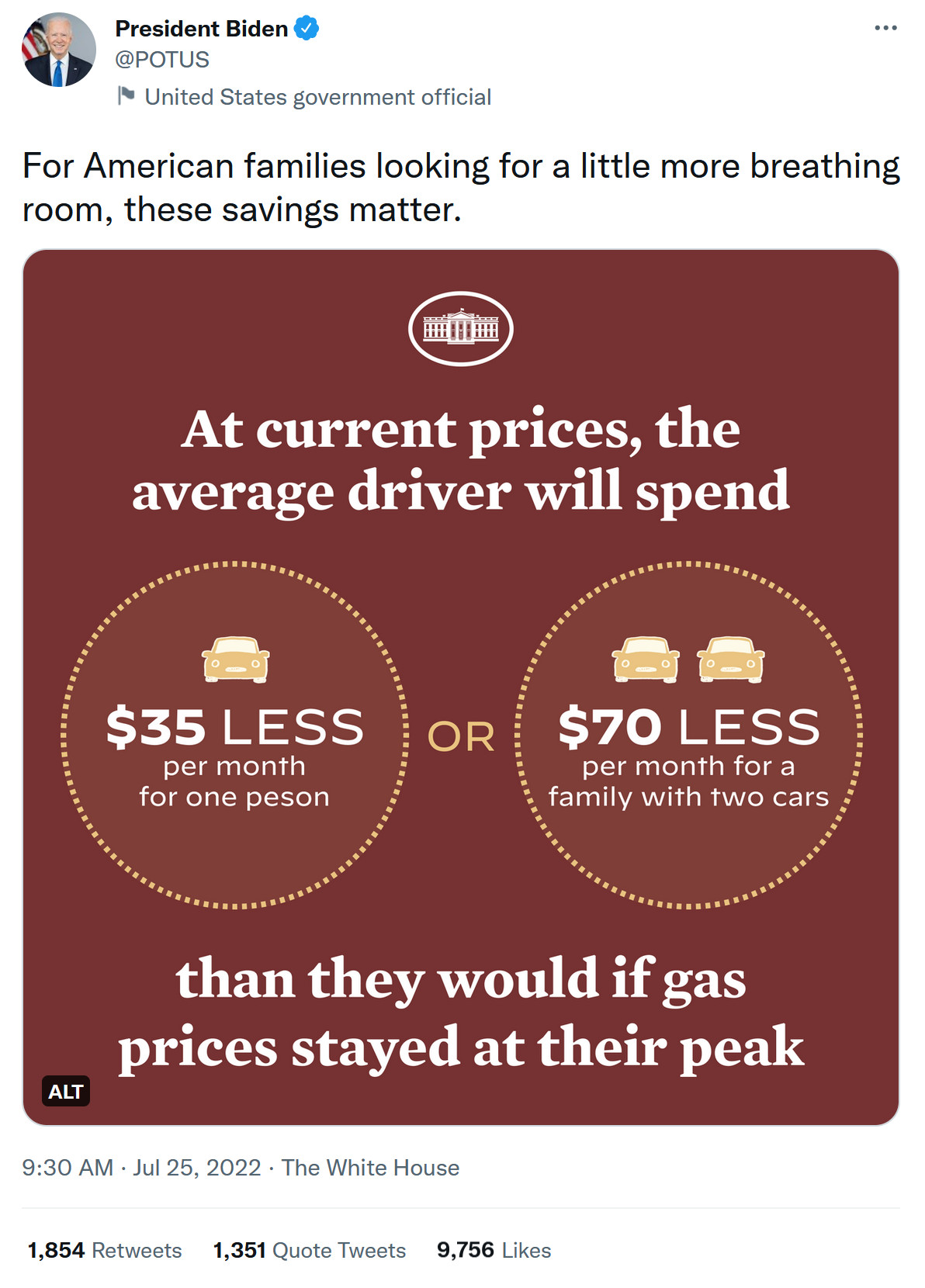
JIM TREACHER: #Peson Isn’t the New #Covfefe Because Biden Isn’t a Republican.
“Peson”? What’s a “peson”? Is that anything like a person? Is that what you meant, Mr. President? Haw haw haw haw haw!!!
Etc.
Does this matter? No. It’s just a typo. So was “covfefe.” Trump made a typo, and five years later some White House staffer made a typo and nobody caught it. Neither one matters.
But the journos attack Republicans and defend Democrats, always and for any reason, and they don’t care how stupid it makes them look.
Then they wonder why we don’t trust them.
And express their wonderment with articles such as this Vanity Fair piece: Will Republicans Shut Out the Press in 2024? GOP politicians are increasingly shirking sit-down interviews, barring journalists from 2022 events, and skipping debates—an aversion to media scrutiny that could upend how the next presidential election cycle is covered.
BEHOLD. MY SHOCKED FACE: Whistleblowers: One of the “Analysts” Who Declared the Hunter Biden Lapto…
The Truth About Madison and Slavery
 Below is my column in the Washington Times responding to the controversy over changes at the home of James Madison. While I have not been to Montpelier since the reported changes, I wanted to respond to the condemnation of Madison as “an enslaver.” He was indeed an enslaver but the truth is far more complex than presented by critics.
Here is the column:
If there is one concept that captured the brilliant vision of President James Madison for government, it was his statement in Federalist 51: “Ambition must be made to counteract ambition.” The use of checks and balances to prevent the concentration of power was key to the stability of the constitutional system that he created. Indeed, his own home at Montpelier may now be an example of what happens when there is such a concentration of power and no check on its excess.
Recently, billionaire David M. Rubenstein gave $10 million to renovate and repair Montpelier. Mr. Rubenstein has given generously through the years to preserve historical documents and buildings. However, he has been accused of unleashing a newly formed, activist board on the property, which has transformed into what critics view as an ideological mission. It is a trend that we have seen at other historical sites, including the National Archives.
Last May, the National Trust for Historic Preservation reportedly pushed the board to accept a new slate of board members with a new agenda. Board member Mary Alexander, a descendant of Madison’s slave Paul Jennings, objected that the new members set out to transform Montpelier into “a black history and black rights organization that could care less about James Madison and his legacy.”
Visitors are greeted with a sign saying that the estate “made Madison the philosopher, farmer, statesman, and enslaver that he was.” Other exhibits discuss how every one of the nation’s first 18 presidents benefited from slavery, including anti-slavery figures like John Adams and Abraham Lincoln.
As a Madisonian scholar and devotee, I have long discussed the contradiction of slavery and the views of the founders, including Madison. It is an important element to highlight for visitors to estates like Monticello and Montpelier. However, history is often more complex than simple condemnations and Montpelier is an example of how the true history of Madison and slavery can be lost to serve current political interests.
Some of the information at Montpelier appears to reflect the claims of the highly controversial 1619 Project led by former New York Times Magazine reporter Nikole Hannah-Jones, which claimed that racism was the driving force behind the entire American political system. The claim has been challenged by academics and even one of the key fact-checkers at the Times. Historians objected that “matters of verifiable fact” that “cannot be described as interpretation or ‘framing.’” They objected that the work represented “a displacement of historical understanding by ideology.”
While the project has commendable elements, the view that the Revolution was primarily fought to further slavery is revisionist tripe. However, while it does not fit the historical evidence, it fits perfectly with contemporary politics.
Whatever the merits of the criticism over these exhibits may be, it is inaccurate and ahistorical to reduce Madison as just another “enslaver.” The true story is far more nuanced and frankly intriguing.
Madison had slaves, and that is a great stain on his legacy.
However, Madison also opposed slavery and sought its elimination. His views often put him at odds with other Virginians. Even during the Revolution, Madison opposed a proposal to offer recruits free slaves for their service and instead proposed giving slaves their freedom in exchange for their military service as “more consonant to the principles of liberty which ought never to be loss sight of in a contest for liberty.”
While Madison wrote early in his career to Edmund Randolph that he wanted “to depend as little as possible on the labor of slaves,” he never made that break with the infamous use of such labor.
Before the Constitutional Convention, Madison wrote a publication entitled “Vices of the Political System of the United States,” which declared that “where slavery exists the republican Theory becomes still more fallacious.”
Madison, however, would forge a compromise with pro-slave delegates in the infamous provision that set representation in one house be based on the number of free inhabitants in each state plus three-fifths of the number of slaves.
Madison would continue to work with those resisting slavery, including the dispatch of an extraordinary letter in 1810 to the American minister to Great Britain, William Pinkney, supporting the British condemnation of an American slave ship — even suggesting arguments to facilitate such condemnation. As president, he pushed Congress to end the slave trade.
The compromise captures much of the conflicted background of Madison and slavery. He often chose compromise while seeking to nudge the country toward banning slavery. He met in his home with abolitionists and free slaves to discuss ending slavery.
Madison resisted selling slaves and sold off property to support his estate instead. In his will, Madison asked that the slaves not be sold and instead be allowed to remain on the property until their deaths. (Dolley Madison would later sell the property and the slaves due to the towering debt).
The fact is that there were better men when it came to slavery. General Marquis de Lafayette was a better man. The fierce abolitionist visited Madison and viewed him as a kindred spirit, but noted the continued presence of slaves on the property. Madison’s aide, Edward Coles, was a better man. With Madison’s praise, Coles freed his slaves shortly after Madison retired from the presidency and gave each of them some land in Illinois.
Madison did not believe that freed slaves could live and thrive in a country given “the prejudices of the whites, prejudices which … must be considered as permanent and insuperable.” He proposed instead the funding of a colony in Africa for freed slaves.
Madison always viewed slavery as the thing that would tear the country (and his Constitution) apart. He would be proved correct in 1861. However, his efforts to compromise in favor of incremental progress sacrificed principle to politics.
That is a far more interesting and instructive history than the misleading portrayal created at Montpelier. Just as Madison too readily yielded to politics in his life, the new board has done so today in this revisionist account of this great but complicated historical figure.
Jonathan Turley is the Shapiro professor of public interest law for George Washington University and served as the last lead counsel during a Senate impeachment trial. He testified as a witness expert in the House Judiciary Committee hearing during the impeachment inquiry of former President Donald Trump.
A wind turbine got struck by lightning and the video footage is simply captivating

This is truly breathtaking.
White House Changing the Definition of Recession Ahead of Possible Dismal Economic Report
Um, what: "both official determinations of recessions and economists’ assessment of economic activity are based on a holistic look at the data."
The post White House Changing the Definition of Recession Ahead of Possible Dismal Economic Report first appeared on Le·gal In·sur·rec·tion.Gretchen Whitmer deletes Michigan’s pro-life budget…
DID THEY STEAL MY SHOCKED FACE? I HAVEN’T LOOKED FOR IT RECENTLY: This is Our Shocked Face: Califo…
DID THEY STEAL MY SHOCKED FACE? I HAVEN’T LOOKED FOR IT RECENTLY: This is Our Shocked Face: California Fentanyl Suspects Don’t Show Up For Court After Release On Own Recognizance.
Oh, look, there it is, and it’s shocked, shocked, shocked!
Dana Carvey fills in for Kimmel and roasts Joe Biden…
IT’S BEEN A SLIP OF A MASK FOR AT LEAST TEN YEARS: Gun control proponents let the mask slip….
Jts5665#dutytodie
IT’S BEEN A SLIP OF A MASK FOR AT LEAST TEN YEARS: Gun control proponents let the mask slip.
I’ll BELIEVE THAT COVID IS STILL AN EMERGENCY WHEN THE PEOPLE TELLING US COVID IS STILL AN EMERGENCY…
OLD AND BUSTED: Sharks with Frickin’ Laser Beams Attached to Their Heads. The New Hotness? Robot …
OLD AND BUSTED: Sharks with Frickin’ Laser Beams Attached to Their Heads.
The New Hotness? Robot dog with machine gun hints of a dystopian future.
The design of the robot looks a lot like Go1 robot dog Unitree Robotics makes. For example, the back side of the device in the video exhibits a distinct pattern on a plastic covering between its hind legs. A similar design is visible on devices in Unitree’s promotional material.
The Hangzhou-based company is selling the Go1 model of the robot for $2,700 on its website, a fraction of over $75k that American-made Spot would cost its owner.
While the robot doesn’t seem to handle recoil very well with the gun on ‘burst fire’ mode, switching to a ‘semi-automatic’ setting allows the robot to hit targets without moving around too much.
The robot in the video has patches on its surfaces with insignia associated with the Russian military: a Russian flag on one side and what seems to be a Wolf, which Russian special forces use.
Cкайнет улыбается.
AN EARTH-SHATTERING KABOOM: A unique stone-skipping-like trajectory of asteroid Aletai….
AN EARTH-SHATTERING KABOOM: A unique stone-skipping-like trajectory of asteroid Aletai.
SLOWLY ROASTING IN HEATWAVE BRITAIN: There’ll always be Rome, Barcelona, Athens — but chances a…
SLOWLY ROASTING IN HEATWAVE BRITAIN:
There’ll always be Rome, Barcelona, Athens — but chances are you haven’t considered [vacationing in] Manchester, the northern English industrial powerhouse that inspired Karl Marx to write The Communist Manifesto and gave the world the Smiths, Joy Division and Oasis (you know, the ones who wrote “Wonderwall”).
Yet as I write from the downtown offices of the Mill, the city’s up-and-coming quality local journalism newsletter, the windows are wide open, two fans are working overtime, the desk plants are shuffling off the mortal coil and the thermometer reads “36 degrees Celsius” — which translates to 97 degrees Fahrenheit.
I know what you’re thinking — “97 degrees? Is that it? No wonder those lily-livered limeys wilted when faced down by Founding Fathers.” In the US, 97 degrees is code for “turn the AC up, dip in the pool and put the extremely watery light beer in the cooler.”
But Manchester was not built for this heat. Buildings here don’t come equipped with air-conditioning units — no one has ever needed them — and in the two local cafes I sampled this afternoon, the baristas were clearly rookies at making iced coffee.
Naturally Britain has been brought to its knees: schools closed early and trains are being canceled (though frankly this happens all the time anyway). The H&M on Market Street is sold out of sunglasses. If you tried to order an AC unit on Amazon Prime on Monday, it likely wouldn’t be with you until Friday. Down in Oxfordshire the Royal Air Force halted flights after the runway at their Brize Norton base “melted.” That makes this the perfect time for President Biden’s allies in Ireland to invade.
Meanwhile, let’s check in on Germany:
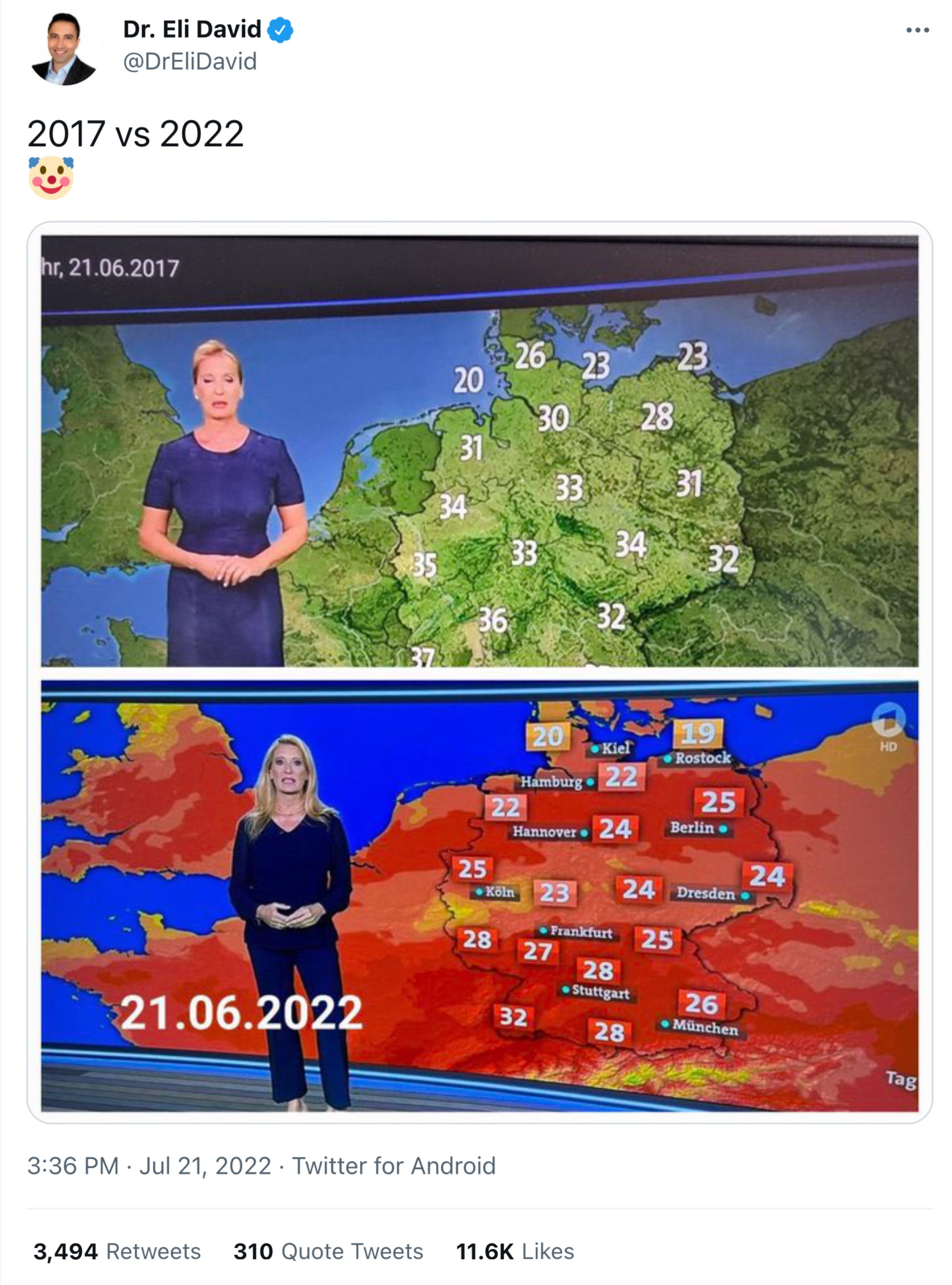
MORE VIOLENCE AGAINST REPUBLICANS: Rep. Lee Zeldin attacked at Perinton campaign stop. “Congressman …
MORE VIOLENCE AGAINST REPUBLICANS: Rep. Lee Zeldin attacked at Perinton campaign stop. “Congressman Lee Zeldin was attacked at a campaign event in Perinton Thursday night. Zeldin is the Republican candidate for governor in New York State. Witnesses say Zeldin was giving a speech about bail reform at the VFW on Macedon Center Road when a man got on stage, started yelling, ‘wrestled with him a bit, and pulled a blade out.’ The alleged attacker was suppressed by AMVETS national Director Joe Chenelly. The Monroe County Sheriff’s Office said he was taken into custody.”
Zeldin wasn’t hurt, and continued his speech. But we all know how the press would treat this with the parties reversed.
UPDATE (From Ed): Speaking of which, I guess we won’t be getting any “dangers of violent rhetoric”-style lectures from the DNC-MSM:
(Updated and bumped.)
Negative incentives in academic research
In the first half of the XXth century, there were relatively few scientists, and these scientists were generally not lavishly funded. Yet it has been convincingly argued that these scientists were massively more productive. We face a major replication crisis where important results in fields such as psychology and medicine cannot be reproduced independently. Academic researchers routinely fail to even fill out the results from clinical trials. We have entered a ‘dark age’ where we are mostly stagnant. It is not that there is no progress per se, but progress is slow, uncommon and expensive.
Why might that be? I believe that it has to do with important ‘negative incentives’ that we have introduced. In effect, we have made scientists less productive. We probably did so through several means, but two effects are probably important: the widespread introduction of research competitions and the addition of extrinsic motivations.
- Prior to 1960, there was hardly any formal research funding competitions. Today, by some estimates, it takes about 40 working days to prepare a single new grant application with about 30 working days for a resubmission, and the success rates is often low which means that for a single successful research grant, hundreds of days might have been spent, purely on the acquisition of funding. This effect is known in economics as rent dissipation. Suppose that I offer to give you $100 to support your research if you enter a competition. How much time are you willing to spend? Maybe you are willing to spend the equivalent of $50, if the success rate is 50%. The net result is that two researchers may each waste $50 in time so that one of them acquire $100 of support. There may be no net gain! Furthermore, if grant applications are valued enough (e.g., needed to get promotion), scientists may be willing to spend even more time than is rational to do so, and the introduction of a new grant competition may in fact reduce the overall research output. You should not underestimate the effect that constant administrative and grant writing might have on a researcher: many graduate students will tell you of their disappointment when encountering high status scientists who cannot seem to do actual research anymore. It can cause a vicious form of accelerated aging. If Albert Einstein had been stuck writing grant applications and reporting on the results from his team, history might have taken a different turn.
- We have massively increased the number and importance of ‘extrinsic motivations’ in science. Broadly speaking, we can distinguish between two types of motivations… intrinsic and extrinsic motivations. Winning prizes or securing prestigious positions are extrinsic motivations. Solving an annoying problem or pursuing a personal quest are intrinsic motivations. We repeatedly find that intrinsic motivations are positively correlated with long-term productivity whereas extrinsic motivations are negatively correlated with long-term productivity (e.g., Horodnic and Zaiţh 2015). In fact, extrinsic motivations even cancel out intrinsic motivations (Wrzesniewski et al., 2014). Extrinsically motivated individuals will focus on superficial gains, as opposed to genuine advances. Of course, the addition of extrinsic motivations may also create a selection effect: the field tends to recruit people who seek prestige for its own sake, as opposed to having a genuine interest in scientific pursuits. Thus creating prestigious prizes, prestigious positions, and prestigious conferences, may end up being detrimental to scientific productivity.
Many people object that the easiest explanation for our stagnation has to do with the fact that most of the easy findings have been covered. However, at all times in history, there were people making this point. In 1894, Michelson said:
While it is never safe to affirm that the future of Physical Science has no marvels in store even more astonishing than those of the past, it seems probable that most of the grand underlying principles have been firmly established and that further advances are to be sought chiefly in the rigorous application of these principles to all the phenomena which come under our notice.
Silverstein in the “The End is Near!”: The Phenomenon of the Declaration of Closure in a Discipline, documents carefully how, historically, many people predicted (wrongly) that their discipline was at an end.
Americans trust armed citizens more than law enforcement to stop mass shooters, poll finds
OOPS: Russia shoots down their own advanced jet just weeks after delivery. Russia took delivery o…
OOPS: Russia shoots down their own advanced jet just weeks after delivery.
Russia took delivery on a handful of advanced Su-34M fighter bombers late last month, and one has already been shot down over Ukraine. It wasn’t Ukrainian forces who managed to down the twin-seat jet, however… It was Russia’s own air defenses.
Over the weekend, video emerged of Russian forces downing a jet operating over Eastern Ukraine, though at the time, it was unclear exactly what type of aircraft they had intercepted. The footage was uploaded to Telegram by a Russian war correspondent with a history of being sanctioned by foreign nations for spreading disinformation and propaganda on behalf of Moscow.
It wasn’t long before the wreckage of the aircraft was located, and upon inspection, it soon became apparent that it was actually one of just ten or fewer Su-34Ms in existence, with a registration number of RF-95890.
It’s war. These things happen. But I can’t help but note that these nine or ten of Russia’s most advanced fighter-bombers are variations on a 1990 design based on the Su-27 airframe that first flew in 1977.
NOT YET THE 21ST CENTURY I’VE BEEN EXPECTING: Paralyzed man marvels at medical miracle: ‘I wiggl…
NOT YET THE 21ST CENTURY I’VE BEEN EXPECTING: Paralyzed man marvels at medical miracle: ‘I wiggled my toes’.
But we’re getting closer!
Only 14% of Stacey Abrams' war chest comes from Georgia: report
NARRATIVES DON’T ESTABLISH THEMSELVES, YOU KNOW: The Journolist didn’t die, it just moved to …
Karl Lauterbach, virus wizard, appears to say antibody prevalence doesn't matter, inadvertently questions the entire premise of vaccination
So, somebody conducted a serology survey of German youth, and found that 95% of have SARS-2 antibodies. Mysteriously, results like this make the Corona astrologers very, very nervous. Thus insufferable Drosten student Isabella Eckerle felt compelled to descend from the virological realm and declare that the DaTA HavEN’t BeEN ProPErlY AnAlYSeD and that investigators need to interpret study results before communicating them, lest we rabble get the wrong idea.
Then, German Health Minister, go-to-eugyppius-villain, and terminal idiot Karl Lauterbach, agreed and amplified:
Many hope a study finding that a large number of people in Germany already have antibodies would spell the end of the pandemic. But that’s wrong, because a positive antibody test is no proof that you’re protected against infection. Even deadly outcomes are still possible.

Just to be clear: Lauterbach, who has repeatedly blamed rising infections on the vaccine refuseniks; who as recently as last September spoke of a “pandemic of the unvaccinated”; and who has been urging a fourth dose on ever younger people (in the process provoking conflict with German vaccine regulatory authorities and even earning a scolding from his fan girl Christina Berndt), now believes that antibodies are not a meaningful metric for determining where we are in the pandemic at all.
Perhaps the time has come to call for a total and complete shutdown of vaccination until our health ministers can figure out what is going on.
eugyppius: a plague chronicle is a reader-supported publication. maybe you subscribe?

NOTHING TO SEE HERE, MOVE ALONG: Dem Staffers Unionize, Citing Poor Pay and Pervasive Sexual Harassm…
NOTHING TO SEE HERE, MOVE ALONG: Dem Staffers Unionize, Citing Poor Pay and Pervasive Sexual Harassment.
WHO WATCHES THE WATCHERS? How the Left Hopes to Seize Control of Local Election Offices. Two big …
WHO WATCHES THE WATCHERS? How the Left Hopes to Seize Control of Local Election Offices.
Two big money liberal operations, ready to spend $80 million each, are trying to determine who controls elections and how in the years ahead.
“The overall objective of the political left is to change the way you conduct overall elections,” Jason Snead, executive director of the Honest Elections Project, which advocates clean elections, told The Daily Signal.
One of the two liberal groups, Run for Something, is a political action committee founded by a former Hillary Clinton campaign staffer. In the spring, Run for Something established its Clerk Work project with the goal of electing clerks, election supervisors, registrars, recorders, and other local officials charged with running elections.
The PAC says it will promote thousands of election administrators in the years ahead. But for 2022, it reports endorsing 11 candidates competing in races in California, Colorado, Illinois, Missouri, Nevada, North Carolina, and Tennessee.
Local election clerks generally are empowered to interpret and enforce state election regulations. They often have discretion on matters such as whether to count absentee ballots that come in after Election Day, how strictly to enforce voter ID or signature-matching requirements, and how closely poll watchers may monitor the ballot counting on Election Day.
Where is the Right on this?