The American Law Institute is a group of 4,000 judges, law profs and lawyers that issues incredibly influential "restatements" of precedents and trends in law, which are then heavily relied upon by judges in future rulings; for seven years they have been working on a restatement of the law of consumer contracts (including terms of service) and now they're ready to publish.
The ALI's restatement affirms that terms of service are enforceable, even when they are not read by the people they affect, and even if they are written in impentrable legalese that no one could be expected to comprehend. The ALI says that so long as people are given "reasonable notice" that there are terms of service and are afforded a "reasonable opportunity to review" the terms, they are binding. That includes terms of service that force you to surrender your right to sue or join class actions, and that require you over to take any claims before binding arbitration, a system of corporate kangaroo courts where the "judge" is literally in the employ of the company you're seeking justice from.
The ALI's plan is so egregious that a bipartisan coalition of 23 state attorneys general have published an open letter to the ALI demanding that it be changed.
John Bergmayer, Senior Counsel at consumer group Public Knowledge, told Motherboard that while restatements may not be legally binding they are hugely influential. He said that the ALI’s reworded interpretation of consumer legal rights is problematic because it would effectively allow corporations to impose contracts on customers without consumer consent.
“To call boilerplate language that consumers never read (or if they did read, could not understand) a “contract” simply has the effect of locking consumers in to terms that are likely to be stacked against them,” he said in an email. Traditionally, "contracts" are legal documents that are mutually agreed to after negotiation between two parties. Functionally, this isn't how Terms of Service, which few people read and few people can be expected to read and understand, work in the real world. “For some reason, everything you learn about contracts in the first year of law school gets tossed out the window when it comes to large companies unilaterally setting terms for consumers,” Bergmayer added.
Trump was elected by old white people who are certain they'll be dead before climate change renders the planet uninhabitable, but who are also seriously invested in continuing to receive Social Security benefits, which is why Trump repeatedly promised to protect Social Security during the 2016 presidential race.
Trump always lies about everything, so of course he recently proposed a budget with billions in Social Security cuts, which the Democratic Congress will almost certainly block.
But that doesn't mean Social Security is safe; although Trump himself is a low-attention-span bungler, he has surrounded himself with villains who've actually paid attention and devised a myriad of ways of transferring wealth from poor people to rich people.
One such measure is redefining the inflation metric used for adjusting the federal definition of poverty. The Trump regime has proposed a unilateral switch to the "Chained Consumer Price Index," which will make it much harder to be officially recognized as poor (though it will have no effect whatsoever on the actual number of poor people). Not only will this deprive many people of access to food, shelter, health care and other benefits, it will also profoundly redefine the Social Security benefit.
Social Security benefits are adjusted for inflation (nominally -- in reality, Social Security loses ground to inflation every year); and under the new inflation index, Social Security benefits will begin an endless real-terms slide, until the already modest benefit that Americans have paid for all their working lives is eroded to a useless nubbin.
Trump's viziers claim they can make this change without Congressional oversight.
Trump thinks that he can get away with executing this long-game attack on Social Security quietly, while the media and public are focused on his tweets, name calling, and scandals. But we must not be distracted. If we do not stop this attack in its tracks, our earned benefits will be next.
If you want to forestall another fight over cutting Social Security through the chained CPI, call your members of Congress, write to your local paper, and tell your friends: No chained CPI! No chained CPI for our earned benefits! No chained CPI for the most vulnerable among us!
This quiet effort to embed the chained CPI is a fight Trump does not want to have, certainly in an election year. But it is one we will bring to him. Grassroots activism defeated the chained CPI before. This time it will be harder because Trump can substitute the chained CPI without legislation. That means we have to simply fight harder. If we stick together, we surely will win. And we must. All of our economic security depends on it.
Without generous financial support of six companies (AT&T, Eli Lily, Walmart, Pfizer, Coca-Cola, and Aetna), the politicians who are enacting bans on legal, safe abortion would not have attained office; these companies don't fund these politicians because they want women to die; they fund them because they're indifferent to the death of women, provided that they get tax breaks and other favorable treatment -- the garden variety get the turkeys to vote for Christmas strategy that exchanges unlimited oligarchy for performative acts of grotesque cruelty against brown people, sexual minorities and (of course) women.
Thanks to monopolism (another legislative favor that was bought at fire-sale prices by the ultra-rich), it may be impossible to boycott these companies.
But to the extent that you would like to avoid funding the death of desperate women, AA Newton presents a guide to maximizing the efficacy of your boycott against these companies.
If you’re not able to stop buying from these corporations—or you’re just feeling a little extra vindictive—focusing on their reputation rather than their bottom line could be more effective. According to Brayden King, a professor of management and organizations at Northwestern University’s Kellogg school, boycotts tend to work best when they’re able to bring sustained mass media coverage to an issue. In a 2017 interview with Northwestern’s Institute of Policy Research, he said that “the no. 1 predictor of what makes a boycott effective is how much media attention it creates, not how many people sign onto a petition or how many consumers it mobilizes.” The longer a corporation spends in the headlines, the more its stock will drops—and the more likely it is to change the behavior that caused it.
If your goal is to hit Coca-Cola in the bottom line, then you need to do everything in your power to keep it in the news as much as possible. One way to do that is by joining a sustained call-out campaign on social media, which many people have already done. However, none of the companies named in the Popular Information post have made a statement about their donations or their position on the bill.
US booksellers and public libraries are reporting strong growth in demand for print books, but research libraries are increasingly serving as archives, rather than references.
Despite this, there is little political will to reorient academic research libraries around electronic materials; attempts to reduce print collections or move them to long-term storage are staunchly opposed by students and faculty who often win their battles...but then fail to patronize the libraries they've saved, a phenomenon documented in an excellent Atlantic article by Dan Cohen, Vice Provost for Information Collaboration at Northeastern University.
Some of this is down to different nature of reading for academic reference and reading for other purposes: Cohen quotes historian Michael O'Malley: "We learn to read books and articles quickly, under pressure, for the key points or for what we can use. But we write as if a learned gentleman of leisure sits in a paneled study, savoring every word." Academics approach books like "sous-chefs gutting a fish."
I'm torn here. I love the idea of long-term preservation of books (the Internet Archive is trying to amass every book ever published, scanning them and then preserving them in giant, climate controlled warehouses), it's also clear that the use-case for research is very different from other forms of reading, and libraries have finite resources that should be oriented around serving their patrons needs -- and what the patrons demonstrate a need for is very different from what they demand.
With the rapidly growing number of books available online, that mode of slicing and dicing has largely become digital. Where students or faculty once pulled volumes off the shelf to scan a table of contents or index, grasp a thesis by reading an introduction, check a reference, or trace a footnote, today they consult the library’s swiftly expanding ebook collection (our library’s ebook collection has multiplied tenfold over the past decade), Google Books, or Amazon’s Look Inside. With each of these clicks, a print circulation or in-house use of a book is lost. UVA’s ebook downloads totaled 1.7 million in 2016, an order of magnitude larger than e-circulations a decade ago. Our numbers at Northeastern are almost identical, as scholars have become comfortable with the use of digital books for many purposes.
Writing in Wired, Zeynep Tufekci (previously) echoes something I've been saying for years: that the use of Digital Rights Management technologies, along with other systems of control like Terms of Service, are effectively ending the right of individuals to own private property (in the sense of exercising "sole and despotic dominion" over something), and instead relegating us to mere tenancy, constrained to use the things we buy in ways that are beneficial to the manufacturer's shareholders, even when that is at the cost of our own best interests.
Tufekci's analysis points out a serious problem in the "Surveillance Capitalism" critique that says that paying for devices and services (rather than getting them through an advertising subsidy) would restore dignity and balance to the tech world. When Apple charges you $1,000 for a phone and then spends millions killing Right to Repair legislation so that you'll be forced to buy repair services from Apple, who will therefore be able to decide when it's time to stop fixing your phone and for you to buy a new one, then it's clear that "if you're not paying for the product" is a serious misstatement, because in a world of Big Tech monopolies, even when you're paying for the product, you're still the product.
My latest book, Radicalized, gets deep on this subject, with the lead story, "Unauthorized Bread," about refugees whose lack of political and economic agency dooms them to living in housing where all the appliances force them to buy authorized bread for the toaster, authorized dishes for the dishwasher, and authorized clothes for the laundry machines, and how they push back by seizing the means of information.
More recently, Apple has reportedly cut a deal with Amazon to remove “unauthorized” refurbishers of Apple products—people who resell repaired machines—from the Amazon marketplace. In return, it will let Amazon sell new Apple products: a win-win for the two giants, but not for consumers. Apple also forces recyclers to shred old iPhones and Macbooks rather than reuse their parts and materials. That's definitely bad not just for consumers but also for the environment.
But this isn't merely a fight over prices and profit margins. What happens when you do something with your car, phone, or other object that corporate headquarters really doesn't like? Our connected devices can simply be bricked on command. Cars have been immobilized, for example, when the ostensible owner fell behind on payments by as little as three days. John Deere tractors with “unauthorized repairs” have been similarly taken out of commission. How long before other devices start behaving as spies and taskmasters in our own home? Will the coffee maker let us have that seventh cup that the doctor advised us against?
We know we should eat less junk food, such as crisps, industrially made pizzas and sugar-sweetened drinks, because of their high calorie content. These “ultra-processed” foods, as they are now called by nutritionists, are high in sugar and fat, but is that the only reason they cause weight gain? An important new trial from the US National Institute of Health (NIH) shows there’s a lot more at work here than calories alone.
Studies have already found an association between junk foods and weight gain, but this link has never been investigated with a randomised controlled trial (RCT), the gold standard of clinical studies.
In the NIH’s RCT, 20 adults aged about 30 were randomly assigned to either a diet of ultra-processed foods or a “control” diet of unprocessed foods, both eaten as three meals plus snacks across the day. Participants were allowed to eat as much as they wished.
After two weeks on one of the diets, they were switched to the other for a further two weeks. This type of crossover study improves the reliability of the results since each person takes part in both arms of the study. The study found that, on average, participants ate 500 calories more per day when consuming the ultra-processed diet, compared to when eating the diet of unprocessed foods. And on the ultra-processed diet, they gained weight – almost a kilogram.
Although we know that ultra-processed foods can be quite addictive, the participants reported finding the two diets equally palatable, with no awareness of having a greater appetite for the ultra-processed foods than for the unprocessed foods, despite consuming 500 calories more of them per day.
Unconscious over-consumption of ultra-processed foods is often attributed to snacking. But in this study, most of the excess calories were consumed during breakfast and lunch, not as snacks.
Slow eating, not fast food
A crucial clue as to why the ultra-processed foods caused greater calorie consumption may be that participants ate the ultra-processed meals faster and so consumed more calories per minute. This can cause excess calorie intake before the body’s signals for satiety or fullness have time to kick in.
An important satiety factor in unprocessed foods is dietary fibre. Most ultra-processed foods contain little fibre (most or all of it is lost during their manufacture) and so are easier to eat fast.
Anticipating this, the NIH researchers equalised the fibre content of their two diets by adding a fibre supplement to the ultra-processed diet in drinks. But fibre supplements are not the same thing as fibre in unprocessed foods.
Fibre in unprocessed food is an integral part of the food’s structure – or the food matrix, as it’s called. And an intact food matrix slows down how quickly we consume calories. For instance, it takes us far longer to chew through a whole orange with its intact food matrix than it does to gulp down the equivalent calories as orange juice.
An interesting message emerging from this and other studies seems to be that to regulate calorie intake, we must retain food structure, like the natural food matrix of unprocessed foods. This obliges us to eat more slowly, allowing time for the body’s satiety mechanisms to activate before we have eaten too much. This mechanism does not operate with ultra-processed foods since the food matrix is lost during manufacture.
Finding time for a meal of unprocessed foods eaten slowly can be a real challenge for many. But the importance of seated mealtimes is an approach vigorously defended in some countries, such as France, where a succession of small courses ensures a more leisurely – and pleasurable – way of eating. And it may also be an important antidote to the weight gain caused by grabbing a quick meal of ultra-processed foods.
Institutional repositories are archives for collecting and disseminating digital copies of the intellectual output of institutions. Linked open data is to expose and connect pieces of data, information, and knowledge on the Semantic Web. This paper studies how BIBFRAME 2.0 can be used to describe objects in institutional repositories, with the goal of bringing together efforts within two communities devoted to openness. We examine a sample of mappings and conversions from Dublin Core to BIBRAME 2.0 ontology to see if BIBFRAME 2.0 will increase visibility of local digital collections on the Web.
I am totally, utterly reliant on Creative Commons images for Boing Boing, and mostly I use Google Image's mediocre search tool for this purpose, but no more! Creative Commons's new search engineis out of beta, and contains more than 300,000,000 images, along with tools to make attribution easier! (via Kottke)
Since 2014, open source hackers have been perfecting the OpenAPS, an "open artificial pancreas" made by modifying the firmware of discontinued Medtronic insulin pumps, which were discontinued due to the very security flaw that makes them user modifiable (that flaw also leaves them vulnerable to malicious modifications).
Once modified, these devices automate the process of monitoring the user's blood sugar, calculating an insulin dose, and administering it, a task that has to be performed with great precision, often while the user is experiencing blood sugar troughs or spikes that can impair cognition. Over- and underdosing with insulin has negative effects in both the short and long term.
In the meantime, people with diabetes (and parents of kids with diabetes) are left to relentlessly scour the internet for used, obsolete Medtronics pumps that can be integrated into user-controlled, open, auditable artificial pancreases. Some new pump models are showing promise, but these are generally not available in the USA, leading to a strange market for pumps imported from overseas.
The looping community is so tight-knit that the person who wrote the code is sometimes the person answering questions. Hilary Koch, whose son loops, remembers spending two hours on the phone with one of the creators of OpenAPS. She tries to do her part too. “How you give back is, if you see somebody ask a question you know you can answer, you answer it,” she says. Boss also scours eBay for Edisons, which have been discontinued, and has given a few to people who want to loop, in return for a small donation to Nightscout, another open-source project used with OpenAPS to remotely access glucose data.
When the creators of OpenAPS, Dana Lewis and Scott Leibrand, shared their code back in 2015, they did so for free. They weren’t in it for money, and that ethos is still very much alive in the looping community today. And so, despite all the people clamoring for loopable Medtronic pumps, attempts to sell one to the highest bidder are met with swift backlash in the online community. The going price is usually about $500. “You’ll see posts for $1,000 to $3,000—and community members are like, ‘Haha, no,’” says Lewis. (The sticker price of new Medtronic pumps runs over $7,000.)
Since OpenAPS first became available, looping options have slowly expanded. Another group developed Loop for iPhone, which is more user-friendly in some ways but still requires an extra piece of hardware called a RileyLink.
Google has augmented its preferences for personal data retention; in addition to choosing to have all your data stored until you delete it, or having no data stored (thus depriving you of the benefits of personalization), the company has a new intermediate option: a rolling deletion program, which lets you specify that any data older than either 3 or 12 months should be autodeleted. That way, if you suffer a breach (or if authorities demand your data from Google), only your recent activity will be exposed.
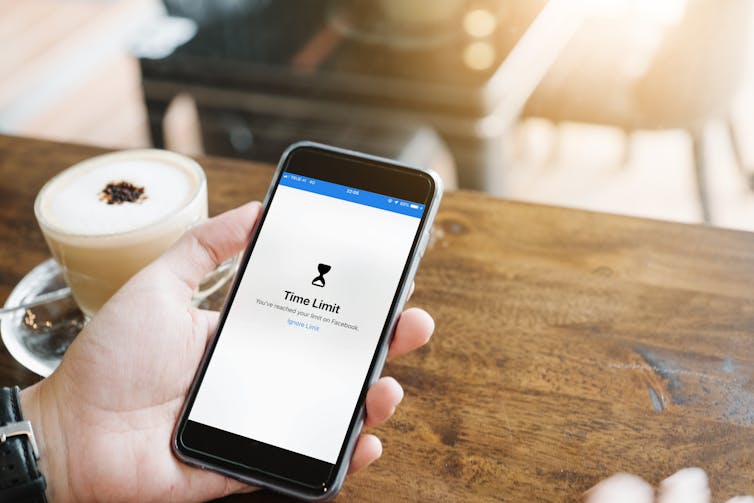
Perhaps ironically, software developers themselves have been on the forefront of efforts to solve this problem by creating apps that aim to help users disconnect from their devices. Some apps reward you for staying off your phone for set periods of time. Others “punish” or block you from accessing certain sites or activities altogether.
But over the past year, Apple has been removing or restricting some of the top screen time or parental control apps from its App Store, according to a New York Times analysis. At the same time, Apple – which cited privacy concerns for removing the apps – launched its own screen-time tracker that comes pre-installed on new iPhones.
Limiting iPhone users’ access to other types of apps is a bad thing because certain ones may work better for some people than others. And research by myself and others shows that excessive technology use can be problematic. In extreme cases, it is linked to depression, accidents and even death.
But what makes some apps work better than others? Behavioral science, my area of expertise, can shed some light.
Why we need help
Technology is designed to be addictive. And a society that is “mobile dependent” has a hard time spending even minutes away from their app-enabled smartphones.
In 2017, U.S. adults spent an average of three hours and 20 minutes a day using their smartphones and tablets. This is double the amount from just five years ago, according to an annual survey of internet trends. Another survey suggests most of that time is spent on arguably unproductive activities like Facebook, gaming and other types of social media.
This addiction has consequences.
The most serious, of course, is when it leads to fatalities, like those that result from distracted driving or even taking selfies.
But it also takes a serious toll on our mental health, as my own research has demonstrated. One experiment I conducted with a colleague found that looking at Facebook profiles of people having fun at parties made new college students feel like they didn’t belong. Another study suggested that people who spent more time using social media were less happy.
Ultimately, our phones’ constant connection to the internet – and our constant connection to our phones – means that we miss out on bonding with those that we care about most, lowering everyone’s happiness in the process.
The good news is that most of us aren’t oblivious to the negative effects of technology and have a strong desire to disconnect.
As you might expect in a market economy, businesses are doing their best to give us what we want. Examples include a Brooklyn-based startup selling bare-bones phones without an internet connection, hotels offering families discounts if they give up their mobiles during their stay, and resorts creating packages built on the idea of creating sacred spaces where consumers leave their devices at home.
And app developers have also risen to the challenge with software aimed at helping us use our phones less.
Goal setting is key
Apple’s screen-time app is a good first step because it shows you how much time you are spending on apps and websites – and possibly raise some red flags. However, many apps go much further.
For example, Moment asks users to set specific technology-limiting goals tied to their daily actions, such as setting up an alert when you pick up the phone during dinner time. Offtime prompts users with warnings when they are about to exceed the limits for an online activity they’ve set.
Apps like Moment, RealizD and ZenScreen can help keep you off your phone.
Flipd takes it a step further and actually completely blocks certain phone apps once users have exceeded pre-determined targets – even if you try to reset the device – making it the ultimate commitment app. Similarly, Cold Turkey Blocker prevents users from accessing literally any other function of their desktop computers for a certain period of time until they have completed self-set goals, like writing. While this might not affect phone use, it could help you be more productive at work.
Defaults are your friend
Another helpful trait in an application involves configuring default settings to encourage less technology use.
In their award-winning book “Nudge,” Nobel Prize winner Richard Thaler and Harvard law professor Cass Sunstein showed how adjusting the default for a company’s retirement plan – such as by requiring employees to opt out rather than opt in – makes it easier to achieve a goal like saving enough for your golden years.
Your phone’s applications can take advantage of that technique as well. Freedom, for example, is an app that automatically blocks users from visiting “distracting” apps and websites, such as social media and video games. Unfortunately, it is one of the apps that Apple removed from its store.
Ransomly alters the default setting of a room – such as the dining room – to be phone and screen free by using a sensor and app to automatically turn off all devices when they’re in the vicinity.
Rewards and punishments
Offering rewards is another strategy that is grounded in behavioral research.
We tend to highly value rewards earned through effort, even when they have no cash value. Indeed, smartphone software frequently takes advantage of this idea, such as in various apps that offer “badges” for hitting certain daily fitness milestones.
Productivity apps incorporate these rewards as well by providing users with points for prizes – such as shopping discounts and yoga experiences – when they meet their screen-time goals. Since static rewards become demotivating over time, choose an application that provides uncertain and surprising rewards.
An even more powerful motivator than earning rewards can be losing them. That’s because research shows that losing has a larger impact on behavior than winning, so if you’re serious about changing your behavior try an application that incurs critical costs. Examples include Beeminder, which takes US$5 from your credit card for every goal you don’t meet, and Forest, which provides you with the chance to grow a beautiful animated tree – or to watch it slowly wither and die – depending on whether or not you meet your technology goals.
Constant connection to technology undermines happiness, relationships and productivity. Applications that take advantage of the latest insights from behavioral science can help us disconnect and get on with living our lives.
This is an updated version of an article originally published on Dec. 4, 2018.
Ashley Whillans receives funding from Harvard University's Mind Brain and Behavioural Interfaculty Initiative and Foundation of Human Behavior Initiative. She is affiliated with the Harvard Kennedy School's Behavioural Insights Group. She consults as a behavioral scientist for Edleman and Maritz. Neither of these organisations directly benefit from this article.
In most states, voting rights are automatically restored after a person is released from prison, or after they finish parole or probation. In comparison, under Florida’s old system, a citizen with a felony conviction would never be allowed to vote again, unless they were granted clemency by a four-member board with a long waitlist.
Florida voters indicated their readiness to change all that in November 2018, when they voted by a 2-1 margin to amend their state’s constitution. Known as Amendment 4, this measure backed by conservative and progressive groups alike automatically restored the voting rights of Floridians with felony convictions “after they complete all terms of their sentence including parole or probation.”
The mediawidelyreported that Amendment 4 restored voting rights to 1.4 million citizens, often likening its impact to the Voting Rights Act.
Not all people with felony convictions will gain voting rights as a result of last year’s constitutional change.
One reason for that is straightforward. Florida’s citizens who have been convicted of committing murder or felony sex crimes were specifically left out of Amendment 4.
Debate about what it means to complete what the amendment calls “all terms” of one’s sentence also could severely limit the number of people who can regain the vote. One question raised in that debate is whether all criminal debt associated with the conviction must be paid off before voting rights are restored.
The Florida House passed a bill in a party-line vote to clarify the ramifications. The legislation, which Republican lawmakers drafted and supported and their Democratic colleagues opposed, specifies that Amendment 4 only restores voting rights after all criminal debt has been repaid. It could block the voting rights of more than 1 million people.
People who got back the right to vote through passage of Amendment 4 have already begun to register to vote. If this legislation becomes law, the state government would need to cancel some of those registrations.
Strangely, the authorities do not expect most of these fees to ever be paid. Florida’s leaders acknowledge this. The state anticipates the receipt of only 9% of that money, versus 90% receipt rates for traffic fines.
Through these fines, Florida courts are trying to generate revenue from a poor population that is largely unable to pay. While the Florida Supreme Court affirmed that the state must evaluate a person’s ability to pay before collection begins, and also before punishing for non-payment, this rarely happens.
If the House bill passes into law, the inability to pay back criminal debt could become the only thing standing between many people and their right to vote.
Prominent politicians like Rep. Alexandria Ocasio-Cortez and Sen. Cory Booker – have denounced the House bill, likening it to a poll tax, fees southern states levied on African Americans to strip them of their right to vote.
So have many Florida leaders, including Miramar Mayor Wayne Messam and House Democratic Leader Kionne McGhee.
Is this legal?
Should similar legislation clear the Florida Senate, the two bills would need to be reconciled before being sent to the governor for his signature.
After that, a U.S. Supreme Court challenge would be likely. The National Association for the Advancement of Colored People argues that the House bill violates the Constitution’s 14th Amendment’s Equal Protection Clause and Due Process Clause, as well as the 24th Amendment’s prohibition of denying or abridging the right to vote through a “poll tax or other tax.”
The Supreme Court previously upheld a similar Arizona law that required citizens to pay back all court charges before having their voting rights restored. But the unique characteristics of Florida’s criminal debt structure could potentially make Florida a new test case.
The electorate’s intent
Did voters expect that the amendment would require people with felony convictions to pay back their criminal debt as a condition for getting back the right to vote?
Including all criminal debt extends far beyond “what any reasonable person would conclude the voters intended when they passed Amendment 4,” said Kara Gross, the American Civil Liberties Union of Florida legislative director.
Whatever voters thought they were asked to consider when Amendment 4 was on the ballot, it’s clear to me what the effect might be of restoring the vote to citizens who have been through the criminal justice system.
In my research, I find that being encouraged to vote causes people to become more informed and more trusting.
I also researched what happened when more than 150,000 Virginians convicted of felonies had their voting rights restored through actions by their governor rather than a statewide referendum. I found that restoring voting rights in Virginia caused newly enfranchised citizens to feel more included in society and to develop stronger trust in government and stronger confidence in themselves.
Based on this research, it appears likely that restoring voting rights to more people in Florida would benefit the state in many ways – among them, having fewer people living behind bars. And any law that restricts this enfranchisement would have the opposite effect.
Victoria Shineman does not work for, consult, own shares in or receive funding from any company or organisation that would benefit from this article, and has disclosed no relevant affiliations beyond their academic appointment.
There's a proposal in the works to replace Notre Dame's dome -- which was a relatively modern addition -- with a new, starchitect-designed "statement" dome, which will be copyrightable under the same French rules that prohibit commercial photos of the Eiffel Tower at night (and other French landmarks).
The copyright would only prohibit "commercial" uses, but this is a very poorly defined term (is a personal photo shared on Twitter, which displays ads, "commercial" or "noncommercial?"), and in any event the new Copyright Directive mandates filters to block infringement, and those filters will not be able to tell whether you are a commercial or noncommercial photographer.
The Copyright Directive initially had a proposal to create a "right of panorama" that would have made it legal to take photos in public places, even if those photos captured copyrighted works (including architecture, which, again, is copyrightable in France), but France blocked that proposal.
A key proposal that the Pirate MEP Julia Reda put forward in her copyright evaluation report, which fed into the Copyright Directive, was to implement a full freedom of panorama right across the EU. The European Parliament backed the idea, as did all the EU nations except one -- France, as Politico later revealed -- so the idea was dropped. That lack of an EU-wide freedom of panorama is yet another example of how the Copyright Directive failed to throw even a tiny crumb to citizens, while handing out even more power for the copyright industry to use and abuse. So if one day your holiday pictures and videos of the re-built Notre Dame cathedral get blocked in the EU, you will know who to blame.
Luke O'Neil put a call out for his readers' stories of their loved ones' capture by Fox News, being overtake by its paranoid, racist conspiracy mindset: he got back a heartbreaking collection of tales of "funny, compassionate" older relatives turning into someone who was "increasingly angry, bigoted, and paranoid" -- some people even found their older relatives dead in front of a TV playing Fox.
The stories mostly involve people who saw themselves as "conservative" but who kept any kind of racial animus or other socially unacceptable views to themselves, but whose conservative worldviews were deepened and weaponized, in part by sprawling and aggressive direct-mail ad campaigns for quack remedies, prepper supplies, gold bullion, and so on.
Many of the people transformed by Fox seemed to begin their transformation in 2008, with the election of America's first Black president, and at the dawn of the financial crisis, when the slow upward redistribution of America's wealth to the 1% took a precipitous leap.
The cause-and-effect here is difficult to nail down. There's racism, there's precarity, there's propaganda, all in the mix together. My view is that people are mixed bags with different proclivities, biases, and vices, but that trauma and anxiety create vulnerability, and that vulnerability can be weaponized by propagandists.
Dozens who responded to my piece talked about the sad lonely twilight of their parents’ or grandparents’ lives, having been spurned by, or having disowned much of their families over political disagreements. Older people, recent studies have shown, are much more likely to share misleading information online, but the anecdotes I was hearing seemed to indicate this behavior wasn’t limited to the internet. Young parents wrote that they don’t want to bring their children to visit aging Fox-brainers. “The worst is when my children go to spend time with their grandparents and come home with Fox News talking points coming out of their mouths,” one told me. “I have to decontaminate them every time.”
I heard from several people that Fox News was a key factor in a divorce. One reader told me about his father, a one-time Trump skeptic turned believer. “He and my mom separated last November. There were other reasons but one of the big ones was his Fox addiction,” he wrote. “I went down to help him get set up in a new apartment. He cried a lot. We found an apartment and furniture and I got the utilities set up but I did not sign up for cable TV. He did that after I left, before he got a job.”
Another person told me that Rush Limbaugh sent his father on the path to isolation before eventually mainlining Fox News on a regular basis. Eventually, out of the blue, his mother filed for divorce. “He was crushed, couldn’t understand why, and took comfort in drinking while watching his friends on TV. She is happier than I have ever seen her and he is sad and angry living in the basement of a rented house, still watching The Five, Tucker Carlson, Jeanine Pirro, etc.”
The Intercept has just released "A Message From the Future," a short science fiction movie narrated by Alexandria Ocasio-Cortez and drawn by Molly Crabapple, describing the coming "Green New Deal Decade," when Americans pulled together and found prosperity, stability, solidarity and full employment through a massive, nationwide effort to refit the country to be resilient to climate shocks and stem the tide of global climate change.
It's an astonishingly moving and beautiful piece, and deploys a tactic that has been surprisingly effective at mobilising large groups of people: creating a retrospective describing the successful project to inspire people to make it a success. Famously, this is the tactic that Jeff Bezos insists on at Amazon for the launch of new internal projects: ambitious internal entrepreneurs must submit a memo describing the project as a fait accompli, and if the description is compelling and exciting enough, they get the resources to make it happen.
But it's not just Amazon: as anthropologist Gabriella Coleman describes in Hacker, Hoaxer, Whistleblower, Spy, her seminal 2014 study of Anonymous, this is how Anon ops get started: an individual Anon makes a video announcing victory in some op that hasn't taken place yet, and if enough other anons are inspired by it to make it happen, then it happens.
In her article accompanying the video, Naomi Klein describes the audacity of other projects on this scale, like FDR's New Deal, and how much skepticism they were met with at their outset -- and how, as the vision caught on, it spread like wildfire through the population, so that something that was once impossible became inevitable.
One reason that elite attacks never succeeded in turning the public against the New Deal had to do with the incalculable power of art, which was embedded in virtually every aspect of the era’s transformations. The New Dealers saw artists as workers like any other: people who, in the depths of the Depression, deserved direct government assistance to practice their trade. As Works Progress Administration administrator Harry Hopkins famously put it, “Hell, they’ve got to eat just like other people.”
Through programs including the Federal Art Project, Federal Music Project, Federal Theater Project, and Federal Writers Project (all part of the WPA), as well as the Treasury Section of Painting and Sculpture and several others, tens of thousands of painters, musicians, photographers, playwrights, filmmakers, actors, authors, and a huge array of craftspeople found meaningful work, with unprecedented support going to African-American and Indigenous artists.
The result was a renaissance of creativity and a staggering body of work that transformed the visual landscape of the country. The Federal Art Project alone produced nearly 475,000 works of art, including over 2,000 posters, 2,500 murals, and 100,000 canvasses for public spaces. Its stable of artists included Jackson Pollock and Willem de Kooning. Authors who participated in the Federal Writers Program included Zora Neale Hurston, Ralph Ellison, and John Steinbeck.
No European politician was more important to the struggle than Julia Reda, the German Pirate Party MEP who is stepping down ahead of European elections next May, after five years of effective, dedicated service.
On the eve of her departure, Reda has published her postmortem on the Directive and what it means. It's an uplifting and important missive, one that draws a distinction between the incredible political malpractice from European politicians who continue to treat the internet as though it were a video-on-demand service, or a jihadi recruiting tool, or a pornography distribution system; and the mass-scale, unprecedented popular perception that the internet is our planetary, species-wide electronic nervous system, whose regulation needs to take account of all that we do online, not just one industry or lobby's corner of it.
We are living through an all-out, global blitz on online free speech, privacy, competition and self-determination, a realtime Chinafication of the western internet, and the past year has set us back a decade or more. But as Reda notes, the difference between the fight now and the fight a decade ago is the size of the army we're fighting with: the cause of online freedom has a self-recruiting mass movement of people, more of whom wake up every day and realize that their future is tied to the internet's future.
A novel alliance of digital rights NGOs, political parties and social media personalities succeeded in politicising and mobilising an entire generation of digital natives. Countless people rose to new challenges: Entertainment YouTubers suddenly found themselves in the role of reporters or political commentators, internet users became activists and organisers, and many participated in the first protests of their lives. These experiences will leave a lasting impact.
The protest was so effective that it compelled both parties in the German government to declare that they would at least mitigate some of the problems in the national implementation of the law. A misguided idea for a Directive that was intended to establish a “digital single market” – that is, to harmonize national laws. Nevertheless, it’s an admission of how well-founded our criticisms were, and an affirmation of how far we have come: Thanks of our efforts, nobody can afford to take political responsibility for upload filters any longer. The initial arrogance of conservative MEPs has been replaced by sheepish concessions – or lip service, at least.
One thing that immediately struck me in Lauren Gambino's excellent analysis of the Democratic nomination campaigns in The Guardian: a quote from GOP never-Trump political consultant Rick Wilson, who counseled Democrats not to select Bernie Sanders and make the election about actual policies, "Democrats have two choices: make this a referendum on Donald Trump or lose. That’s it. There are no other options."
I think every Democrat and Democratic voter loves it when lifelong Republican grandees offer advice on how to win elections, but this is especially rich given that this is exactly the strategy that Republicans used to get their base to vote against Trump during the 2016 primaries and it failed spectacularly.
There is plenty to dislike about Trump, to be sure, but if there's one thing we've learned from the 2018 midterms -- the incredible outpouring of grassroots support, votes and small-money donations for progressive candidates (including longshots like Alexandria Ocasio-Cortez who unseated an establishment Democrat who thought running against Trump, rather than for a better future, would be enough), it's that the American people actually care about policies. They want reform. The much-vaunted polarization is a fiction of the political classes, while there is national, bipartisan consensus on issues of substance, from universal health-care to free tuition to Net Neutrality. These are all policies that progressive candidates support, and policies that Trump will lose debates on.
Candidates like Bernie Sanders (and Elizabeth Warren) want to make the 2020 election a referendum on broadly popular progressive policies that will deliver shared prosperity and a better quality of life to hundreds of millions of Americans -- who are smart enough to understand that and vote for it. (I am a donor to both the Sanders and Warren 2020 campaigns)
At best, campaigning against Trump (the man) will motivate some GOP and swing voters to stay home out of disgust, and scare some independents and Democrats into holding their noses and voting to kick him out. But campaigning for a better world will get people off their sofas, send them knocking on doors, and bring them to the polls.
For Sanders’ most loyal supporters, the Times report was only further proof that despite hard-won changes to party rules and the leftward ideological tilt of the presidential field, the deck is still stacked against their man. They are in a determined mood.
“This has been a galvanizing moment for Bernie’s supporters,” said RoseAnn DeMoro, a former president of National Nurses United. She warned: “You alienate millions of people when you alienate Bernie Sanders.”
Former Obama adviser Dan Pfeiffer, meanwhile, was blunt about what those who do not want a Sanders candidacy must do.
“If you want to have an impact on who the nominee is,” he said on Twitter, “go to Iowa and knock on some fucking doors. Don’t go to a dinner in Manhattan and tell the New York Times about it.”
by oracleeditor@gmail.com (Sam Newlon, Associate Editor)
USF student Cassie Jacobsen placed a miniature vending machine for squirrels next to a traditional vending machine for a class art project. COURTESY OF USF SCHOOL OF ART & ART HISTORY.
Her arms felt like Jell-O after she finally placed her 15-pound creation next to a full-sized vending machine at the Fine Arts Building at USF.
Cassie Jacobsen took a step back to make sure her sculpture was in the best position. The open-faced black box made of wood with a metal exterior had a decal along the right side with a fake keypad and a colorful background with two words across the miniature panel: “Go Nuts!”
Before she left, Jacobsen stocked the box with walnuts. The project for her sculpture class that started as a joke among her friends was now finished — a vending machine for the squirrels at USF.
“The idea came in passing when I was talking with some classmates,” Jacobsen said. “I was like ‘Oh, a vending machine for squirrels,’ because we saw that the squirrels were everywhere.”
While it was simply a joke at first, Jacobsen latched on to the idea and decided to make it for the class. She couldn’t have guessed what happened next. Pictures of Jacobsen’s project started circulating around Facebook pages, Twitter accounts and people throughout the art building were talking about how clever it was.
The USF School of Art and Art History’s Facebook post had more than 4,000 interactions on the post. Jacobsen’s project became so popular, she had strangers complimenting her work.
“Honestly, it was kind of overwhelming the first day that I found out it had blown up,” Jacobsen said. “Now it’s just something that happened and it’s not overwhelming anymore.”
Despite her humorous, popular idea for a sculpture, Jacobsen isn’t interested in pursuing a career in that area of art. She’s most passionate about animation.
Jacobsen transferred to USF this year after taking classes in Green Bay, Wisc. because she simply wanted to get out of the state. Her father lives in Tampa and USF was among one of Jacobsen’s best, most affordable choices, she said.
But even choosing to study art was a risk.
“I feel like art school is kind of a waste of money,” Jacobsen said. “I feel like you can learn things anywhere. You don’t need to go someplace that’s exclusively for art.”
Tuition at FSU’s Ringling College of Art and Design in Sarasota is $42,330, but Jacobsen is able to pay in-state tuition at USF instead. She believes that, although art school can be considered a waste, the degree she is working toward will pay off.
“My dad tells me to make sure I get something good paying in my field,” Jacobsen said. “I feel like nowadays, especially with technology, you use animation for a lot of things. It’s not just movies. Graphic design companies use animation for commercials all the time.”
Jacobsen has tried straying away from art but hasn’t had much success. It seems like she’s always pulled back into this passion of hers.
“Every time I wanted to try something different, I always came back to making art,” she said.
Jacobsen said she will likely leave the squirrel-sized vending machine in its place until the end of the semester, but the cost of stocking the box with walnuts is becoming a nuisance — the vending machine has been a hit with the animals.
“I should retire now because I’m never going to make anything better than this,” Jacobsen joked.
As for her grade on the project, Jacobsen said the only feedback her professor had was a recommendation to put lights inside the vending machine so its contents could be illuminated at night.
“I think I’m going to get a pretty good grade,” she said.
Umair Haque (previously) writes about how the last days of the Soviet Union were filled with "forced apathy" (an inability to care about what was going on because just surviving took everything you had) and "self-referentialism" (an obsession with domestic affairs to the exclusion of everything else going on elsewhere in the world)>
Haque also remembers those days for the "one party rule" and notes that while the US is dominated by a single party (one that cheated its way into control over the presidency, the Senate, the Supreme Court and many state governments), it is technically a two-party system, but any Democrat who offers real progressive policies is marginalized and backstabbed by the Democratic establishment.
Other similarities include "power seeking" or structural corruption (think of the establishment's refusal to enact popular programs like universal health care or network neutrality) and the silencing of dissenting voices and the lack of a real public discourse on the failings of capitalism and the ways that other countries solve their problems.
Friends across the world often ask me: “why don’t Americans do more to fix their crumbling society?” They’re aghast, astonished. I tell them the reality of American life: Americans would, if they could, but they can’t, mostly. Apathy is forced on them by a predatory kind of capitalism that forces them to live something like poor people in a rich country. Breadlines — insulin lines — what’s the difference, really? Americans are forced into being apathetic, weary, drained of energy and ideas and time, by a fatally broken political economy which makes them more and more of them live at the edge of ruin, more and more so every day — but that forced apathy, my friends, is the kind of trap that has led societies throughout history to collapse, whether the USSR or Rome.
What happens if you do try to change the system, though? Well — how exactly are you going to do it? The second way American collapse resembles Soviet collapse is through one party rule. I mean this in a subtle way. It’s true that one party controls most of America’s government — and its society, too — and that party has imploded into the kind of extremism that makes dictators proud. Still, think about the opposition for a moment. What do you notice? They don’t oppose.
Floating communities aren't just for libertarian billionaires looking for places to do things they might not otherwise get away with. A UN partnership is looking into whether they could be part of a sustainable urban development program, for when the floods roll over the lowlands and don't go away.
Oceanix City, or the world's first sustainable floating city, would essentially be groups of hexagonal platforms - anchored to the seabed - that could each house around 300 people, effectively creating a community for 10,000 residents. Cages under the city could harvest scallops, kelp, or other forms of seafood. Marc Collins Chen, the chief executive of Oceanix, said the technology to build large floating infrastructure or housing already exists.
"The biggest question in people's minds is if these cities can actually float," Mr Collins Chen told the BBC.
Still waiting for Sea City 2000, the floating pyramid I was promised by the Usborne books in the 1980s.
Kirstjen Nielsen was Trump's DHS Secretary, where she oversaw the performatively cruel practice of separating thousands of children from their parents, in a calculatedly shambolic and chaotic way, ensuring that many of them will never be reunited with their families.
Nielsen covered up this practice by repeatedly lying about it, delaying public action.
Now, Nielsen has resigned her position, and it's likely that she will be recruited to a think tank, university center, or similar institution. These seem to have a bottomless appetite for welcoming in war criminals and liars who serve under Trump: remember when pathological liar and buffoon Sean Spicer was given a prestigious appointment at Harvard and then deferred to when he insisted that Chelsea Manning's similar appointment be revoked?
Henry Farrell (previously) has created a public pledge: "If Kirstjen Nielsen gets a position at a think-tank, university center or similar, I will not participate on any panel that involves anyone from that think-tank, center or other institution. I will not participate in any event where the institution plays an organizing role, nor will I associate myself in any way that might reasonably be seen as providing active support for that institution."
I've signed it.
Actions have consequences. People who commit crimes against humanity should be shunned and excluded from polite society.
by oracleeditor@gmail.com (Maria Ranoni, MANAGING EDITOR)
USF has recently started to heavily advertise its Finish in Four plan that encourages students to complete their degrees in four years. These advertisements — which state that “Each additional year could cost you nearly $60,000!” — encourage students to take 15 credit hours a semester.
This, of course, would complete a 120-hour degree in 8 semesters, or four years.
Easy, right?
That’s the narrative top USF administration is sticking with. As a result, students are being limited in their academic choices like major changes.
Multiple students have taken to the Facebook class pages with similar complaints. Basically, academic advisors are not allowing students to change majors unless their degree can be finished in four years.
So, even if a student has just decided that they absolutely hate their major and want to switch into another major that would extend their graduation date past that four-year mark, it’s unlikely that their academic advisor will let them.
Simply put, USF has forgotten who pays tuition around here.
USF is instead cornering its students and essentially telling them that any degree, even one they may not love that will limit them to a field of work they are not passionate about, is better than nothing.
Why is USF doing this? The answer is to keep preeminence and the money that comes along with it.
In fact, certain members of USF administration have openly admitted to The Oracle that this recent fervor to increase four-year graduation rates is to keep preeminence, which measures graduation rates as a part of its benchmarks. USF meets 11 of the 12 metrics currently. That fleeting twelfth metric requires a $500 million endowment and USF’s endowment is only at $442 million.
While the prestige — and the over $6 million in additional funding — associated with preeminence is great, USF is selling out its students to be able to call itself a “preeminent research university.”
The reality is students are people. And people make mistakes. They fail classes, they figure out they hate their major after three years and their goals change.
Students are also the people actually paying for that degree, so they should decide what major is best for them, regardless if it takes extra time to graduate.
Not to mention, students also have challenges like having to work full-time in order to support themselves, having kids, getting sick, and the list goes on and on. In addition, some students are just in really difficult majors, like engineering for example, and need that extra semester or two to be successful.
One of the biggest issues is that USF, an institution that prides itself on inclusivity and diversity, has proven it does not understand those challenges. One comment featured in The Oracle’s story about the Finish in Four policy exemplifies this. An administrator said students can get three degrees “if you tried really hard” and utilized the summer, maymester and winter session semesters.
That speaks for itself.
While Finish in Four was probably started with good intentions, its implementation has morphed the policy into a harmful, overreaching standard that results in students not being the drivers of their own education.
USF should take a step back and consider the long-reaching consequences of its policies.
Maria Ranoni is a senior majoring in environmental science and policy.
by Cynthia Wachtell, Research Associate Professor of American Studies & Director of the S. Daniel Abrham Honors Program, Yeshiva University
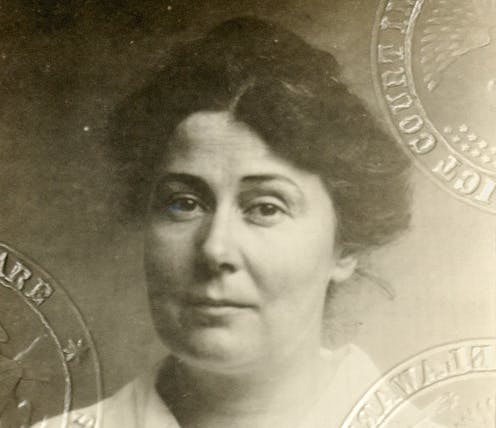
A photograph of Ellen N. La Motte soon after completing 'The Backwash of War' in 1916. Courtesy of the National Archives, College Park, Maryland, Author provided
Virtually everyone has heard of Ernest Hemingway. But you’d be hard-pressed to find someone who knows of Ellen N. La Motte.
People should.
She is the extraordinary World War I nurse who wrote like Hemingway before Hemingway. She was arguably the originator of his famous style – the first to write about World War I using spare, understated, declarative prose.
Long before Hemingway published “A Farewell to Arms” in 1929 – long before he even graduated high school and left home to volunteer as an ambulance driver in Italy – La Motte wrote a collection of interrelated stories titled “The Backwash of War.”
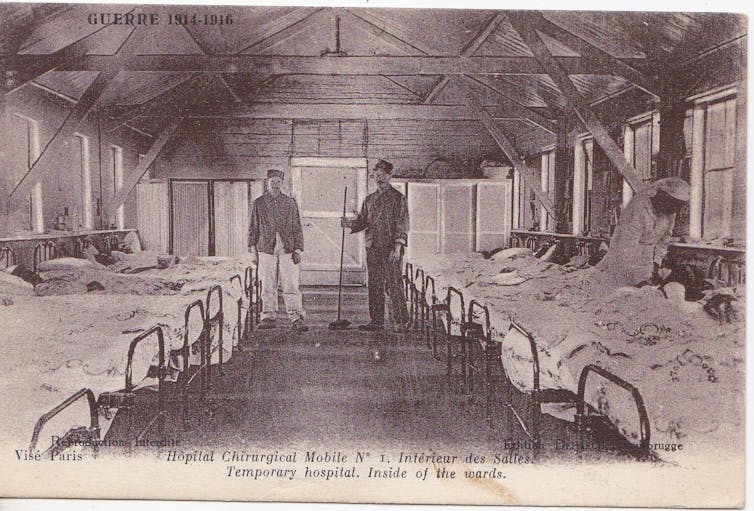
Published in the fall of 1916, as the war advanced into its third year, the book is based upon La Motte’s experience working at a French field hospital on the Western Front.
“There are many people to write you of the noble side, the heroic side, the exalted side of war,” she wrote. “I must write you of what I have seen, the other side, the backwash.”
“The Backwash of War” was immediately banned in England and France for its criticism of the ongoing war. Two years and multiple printings later – after being hailed as “immortal” and America’s greatest work of war writing – it was deemed damaging to morale and also censored in wartime America.
For nearly a century, it languished in obscurity. But now, an expanded version of this lost classic that I’ve edited has just been published. Featuring the first biography of La Motte, it will hopefully give La Motte the attention she deserves.
Horrors, not heroes
In its time, “The Backwash of War” was, simply put, incendiary.
As one admiring reader explained in July 1918, “There is a corner of my book-shelves which I call my ‘T N T’ library. Here are all the literary high explosives I can lay my hands on. So far there are only five of them.” “The Backwash of War” was the only one by a woman and also the only one by an American.
In most of the era’s wartime works, men willingly fought and died for their cause. The characters were brave, the combat romanticized.
Not so in La Motte’s stories. Rather than focus on World War I’s heroes, she emphasized its horrors. And the wounded soldiers and civilians she presents in “The Backwash of War” are fearful of death and fretful in life.
Filling the beds of the field hospital, they are at once grotesque and pathetic. There is a soldier slowly dying from gas gangrene. Another suffers from syphilis, while one patient sobs and sobs because he does not want to die. A 10-year-old Belgian boy is fatally shot through the abdomen by a fragment of German artillery shell and bawls for his mother.
War, to La Motte, is repugnant, repulsive and nonsensical.
The volume’s first story immediately sets the tone: “When he could stand it no longer,” it begins, “he fired a revolver up through the roof of his mouth, but he made a mess of it.” The soldier is transported, “cursing and screaming,” to the field hospital. There, through surgery, his life is saved but only so that he can later be court-martialed for his suicide attempt and killed by a firing squad.
A postcard of the French field hospital where La Motte worked.
Cynthia Wachtell
After “The Backwash of War” was published, readers quickly recognized that La Motte had invented a bold new way of writing about war and its horrors. The New York Times reported that her stories were “told in sharp, quick sentences” that bore no resemblance to conventional “literary style” and delivered a “stern, strong preachment against war.”
The Detroit Journal noted she was the first to draw “the real portrait of the ravaging beast.” And the Los Angeles Times gushed, “Nothing like [it] has been written: it is the first realistic glimpse behind the battle lines… Miss La Motte has described war – not merely war in France – but war itself.”
La Motte and Gertrude Stein
Together with the famous avant-garde writer Gertrude Stein, La Motte seems to have influenced what we now think of as Hemingway’s signature style – his spare, “masculine” prose.
Gertrude Stein – who would go on to mentor Hemingway – was close friends with La Motte.
Library of Congress
La Motte and Stein – both middle-aged American women, writers and lesbians – were already friends at the start of the war. Their friendship deepened during the first winter of the conflict, when they were both living in Paris.
Despite the fact that they each had a romantic partner, Stein seems to have fallen for La Motte. She even wrote a “little novelette” in early 1915 about La Motte, titled “How Could They Marry Her?.” It repeatedly mentions La Motte’s plan to be a war nurse, possibly in Serbia, and includes revealing lines such as “Seeing her makes passion plain.”
Without a doubt Stein read her beloved friend’s book; in fact, her personal copy of “The Backwash of War” is presently archived at Yale University.
Hemingway writes war
Ernest Hemingway wouldn’t meet Stein until after the war. But he, like La Motte, found a way to make it to the front lines.
In 1918, Hemingway volunteered as an ambulance driver and shortly before his 19th birthday was seriously injured by a mortar explosion. He spent five days in a field hospital and then many months in a Red Cross hospital, where he fell in love with an American nurse.
After the war, Hemingway worked as a journalist in Canada and America. Then, determined to become a serious writer, he moved to Paris in late 1921.
In the early 1920s Gertrude Stein’s literary salon attracted many of the emerging postwar writers, whom she famously labeled the “Lost Generation.”
Among those who most eagerly sought Stein’s advice was Hemingway, whose style she significantly influenced.
“Gertrude Stein was always right,” Hemingway once told a friend. She served as his mentor and became godmother to his son.
Much of Hemingway’s early writing focused on the recent war.
“Cut out words. Cut everything out,” Stein counseled him, “except what you saw, what happened.”
Very likely, Stein showed Hemingway her copy of “The Backwash of War” as an example of admirable war writing. At the very least, she passed along what she had learned from reading La Motte’s work.
Whatever the case, the similarity between La Motte’s and Hemingway’s styles is plainly evident. Consider the following passage from the story “Alone,” in which La Motte strings together declarative sentences, neutral in tone, and lets the underlying horror speak for itself.
“They could not operate on Rochard and amputate his leg, as they wanted to do. The infection was so high, into the hip, it could not be done. Moreover, Rochard had a fractured skull as well. Another piece of shell had pierced his ear, and broken into his brain, and lodged there. Either wound would have been fatal, but it was the gas gangrene in his torn-out thigh that would kill him first. The wound stank. It was foul.”
Now consider these opening lines from a chapter of Hemingway’s 1925 collection “In Our Time”:
“Nick sat against the wall of the church where they had dragged him to be clear of machine-gun fire in the street. Both legs stuck out awkwardly. He had been hit in the spine. His face was sweaty and dirty. The sun shone on his face. The day was very hot. Rinaldi, big backed, his equipment sprawling, lay face downward against the wall. Nick looked straight ahead brilliantly…. Two Austrian dead lay in the rubble in the shade of the house. Up the street were other dead.”
Hemingway’s declarative sentences and emotionally uninflected style strikingly resemble La Motte’s.
So why did Hemingway receive all of the accolades, culminating in a Nobel Prize in 1954 for the “influence he exerted on contemporary style,” while La Motte was lost to literary oblivion?
Was it the lasting impact of wartime censorship? Was it the prevalent sexism of the postwar era, which viewed war writing as the purview of men?
Whether due to censorship, sexism or a toxic combination of the two, La Motte was silenced and forgotten. It’s time to return “The Backwash of War” to its proper perch as a seminal example of war writing.
Cynthia Wachtell is the editor of a new edition of:
Johns Hopkins University Press provides funding as a member of The Conversation US.
Cynthia Wachtell does not work for, consult, own shares in or receive funding from any company or organization that would benefit from this article, and has disclosed no relevant affiliations beyond their academic appointment.
After a few false starts and rumors, the classic 1996 teen witch film The Craft will be remade, according to a fresh listing in industry trade Production Weekly. Not a big shock as right now there's a witchcraft resurgence afoot, especially among millennials. (In fact, the directors should hire badass witch Pam Grossman to help them make real magick!) Blumhouse Productions (Paranormal Activity, Get Out, BlacKkKlansman) will produce the remake. Daniel Casey (Fast & Furious 9) and Zoe Lister-Jones (Band Aid) are writing it and Lister-Jones is directing. Here's the synopsis:
A remake of the 1996 supernatural teen thriller. When starting at a new school, Hannah befriends Tabby, Lourdes, and Frankie & quickly becomes the fourth member of their Clique. Hannah soon learns that she somehow brings great power to the quartet.
Tuesday morning at 10am ET the House Communications and Technology subcommittee will meet and vote on the Save the Internet Act – the best bill we have to restore net neutrality. As soon as the hearing begins you’ll be able to watch the livestream here:
Unfortunately telecom lobbyists are working overtime to convince committee lawmakers to add dangerous amendments that could completely gut the bill and leave gaping loopholes for Internet providers to block, throttle, and charge users new fees for access.
To pass a clean bill with no bad amendments we need everyone to call their members of Congress and make sure they know the whole Internet is watching.
If we get the bill out of committee without any bad amendments, then we have a solid shot of winning the next big vote on the House floor in the week of April 8. But if the bill gets gutted, we’re back to square one.
In San Diego, the United States Border Patrol grabbed a girl who is 9 and a U.S. citizen and on her way to school, accused her of lying about her identity, then detained her for 36 hours.
Many families in the San Diego-Tijuana area cross the border routinely for work, school, and shopping. The child and her mother live on the Mexico side, and school is on the U.S. side.
They were reunited after the kid had been held away from her parents for 36 hours, when the Mexican consulate got involved.
It's hard to imagine this sort of thing routinely happening under Trump's white supremacist presidency to families who look differently. Say, blonde and white and wealthy.
Thelma Galaxia said her friend, Michelle Cardenas, was driving each of their two children from Tijuana, where they live, to their schools in San Ysidro Monday morning, as they do nearly every day.
Galexia's 9-year-old daughter, Julia Isabel Amparo Medina, attends fourth grade at Nicoloff Elementary School and her 14-year-old son, Oscar Amparo Medina, attends ninth grade at San Ysidro High School. Both are passport-holding U.S. citizens.
When they got in line at the border at 4 a.m. Monday, traffic was moving slow. Cardenas told the four children to walk across the border instead. She was going to call them an Uber so they could make it to school on time.
But Oscar and Julia Medina never made it across, according to their mother.
Galaxia says CBP officers accused her daughter of lying about her identity. Officers told the girl she didn’t look like the girl in her passport card picture.
Julia Medina told NBC 7 that CBP officers accused her of being someone else, her cousin Melanie. The children said officers also accused Oscar Medina of smuggling and other crimes which he said he didn’t understand.
“My daughter told her brother that the officer told her that if she admitted that she was her cousin, she would be released soon so she could see her mom,” Galaxia said.
“I was scared. I was sad because I didn't have my mom or my brother. I was completely by myself,” Julia Medina said. She said she woke up several times throughout the night, sad because she wasn’t with her family.
Galaxia said officers made Oscar Medina sign a document that said his little sister was his cousin.
“That is not true,” Galaxia said. “She is my daughter. He was told that he would be taken to jail and they were going to charge him for human trafficking and sex trafficking.”
Oscar told NBC 7 he felt terrible for signing the document. He said he just wanted to see his sister.
When CBP officers told Galaxia that Oscar and Julia Medina were detained, she got the Mexican consulate involved.
And after the consulate got involved, the child was released, and the family reunited.
CBP was asked by the San Diego NBC news reporters “why officers detained a 9-year-old U.S. citizen and kept her from her mother for 36 hours,” and a spokesperson said CBP “would respond to questions when it had more details on the case.”
The Mexican consulate told NBC 7 it will also provide more information as to how they were able to reunite the family.
Back in 2016, the Dr Seuss estate won a preliminary court action against "Oh, The Places You'll Boldly Go!" a crowdfunded parody of Dr Seuss's "Oh the Places You'll Go!" and Star Trek, written by veteran Star Trek creator David "Tribble" Gerrold and illustrated by the comics giant Ty Templeton.
In 2017, Comicmix, the publisher, secured a partial legal victory, but the Seuss estate wasn't done -- they have been litigating ever since, but now it appears the fight is done, and Comicmix has prevailed, with a Southern District of California judge declaring, in no uncertain terms, that the mashup was protected by fair use. The judgment is long and well-reasoned and comprehensive, and not the sort of thing that you'd expect to go on appeal to the Supreme Court (though who knows: the court has been terrible on copyright, and Ruth Bader Ginsburg never met an expansive theory of copyright she didn't like).
Timothy Geigner has published a detailed analysis of the judgment on Techdirt. It's quite an amazing read: the judge is very clear that no one is going to mistake Comicmix's parody for the Dr Seuss original, nor would they buy the parody as a substitute for Seuss, and the court is especially down on the Seuss estate's theory that the (terrible) decision in Oracle v Google means that mashups are illegal.
Examining the cover of each work, for example, Plaintiff may claim copyright protection in the unique, rainbow-colored rings and tower on the cover of Go! Plaintiff, however, cannot claim copyright over any disc-shaped item tilted at a particular angle; to grant Plaintiff such broad protection would foreclose a photographer from taking a photo of the Space Needle just so, a result that is clearly untenable under—and antithetical to—copyright law.
But that is essentially what Plaintiff attempts to do here. Instead of replicating Plaintiff’s rainbow-ringed disc, Defendants drew a similarly-shaped but decidedly nonSeussian spacecraft—the USS Enterprise—at the same angle and placed a red-and-pink striped planet where the larger of two background discs appears on the original cover. See Duvdevani Decl. Ex. 31, ECF No. 115-11, at 450. Boldly’s cover also features a figure whose arms and hands are posed similarly to those of Plaintiff’s narrator and who sports a similar nose and eyes, but Boldly’s narrator has clearly been replaced by Captain Kirk, with his light, combed-over hair and gold shirt with black trim, dark trousers, and boots.5 Id. Captain Kirk stands on a small moon or asteroid above the Enterprise and, although the movement of the moon evokes the tower or tube pictured on Go!’s cover, the resemblance is purely geometric. Id. Finally, instead of a Seussian landscape, Boldly’s cover is appropriately set in space, prominently featuring stars and planets. Id. In short, “portions of the old work are incorporated into the new work but emerge imbued with a different character.” See Mattel, Inc. v. Walking Mountain Prods., 353 F.3d 792, 804 (9th Cir. 2003).
During the week of March 25, the European Parliament will hold the final vote on the Copyright Directive, the first update to EU copyright rules since 2001; normally this would be a technical affair watched only by a handful of copyright wonks and industry figures, but the Directive has become the most controversial issue in EU history, literally, with the petition opposing it attracting more signatures than any other petition in change.org’s history.
How did we get here?
European regulations are marathon affairs, and the Copyright Directive is no exception: it had been debated and refined for years, and as of spring 2017, it was looking like all the major points of disagreement had been resolved. Then all hell broke loose. Under the leadership of German Member of the European Parliament (MEP) Axel Voss, acting as "rapporteur" (a sort of legislative custodian), two incredibly divisive clauses in the Directive (Articles 11 and 13) were reintroduced in forms that had already been discarded as unworkable after expert advice. Voss's insistence that Articles 11 and 13 be included in the final Directive has been a flashpoint for public anger, drawing criticism from the world's top technical, copyright, journalistic, and human rights experts and organizations.
Why can no one agree on what the Directive actually means?
"Directives" are rules made by the European Parliament, but they aren't binding law—not directly. After a Directive is adopted at the European level, each of the 28 countries in the EU is required to "transpose" it by passing national laws that meet its requirements. The Copyright Directive has lots of worrying ambiguity, and much of the disagreement about its meaning comes from different assumptions about what the EU nations do when they turn it into law: for example, Article 11 (see below) allows member states to ban links to news stories that contain more than a word or two from the story or its headline, but it only requires them to ban links that contain more than "brief snippets"—so one country might set up a linking rule that bans news links that reproduce three words of an article, and other countries might define "snippets" so broadly that very little changes. The problem is that EU-wide services will struggle to present different versions of their sites to people based on which country they're in, and so there's good reason to believe that online services will converge on the most restrictive national implementation of the Directive.
What is Article 11 (The "Link Tax")?
Article 11 seeks to give news companies a negotiating edge with Google, Facebook and a few other Big Tech platforms that aggregate headlines and brief excerpts from news stories and refer users to the news companies' sites. Under Article 11, text that contains more than a "snippet" from an article are covered by a new form of copyright, and must be licensed and paid by whoever quotes the text, and while each country can define "snippet" however it wants, the Directive does not stop countries from making laws that pass using as little as three words from a news story.
What's wrong with Article 11/The Link Tax?
Article 11 has a lot of worrying ambiguity: it has a very vague definition of "news site" and leaves the definition of "snippet" up to each EU country's legislature. Worse, the final draft of Article 11 has no exceptions to protect small and noncommercial services, including Wikipedia but also your personal blog. The draft doesn’t just give news companies the right to charge for links to their articles—it also gives them the right to ban linking to those articles altogether, (where such a link includes a quote from the article) so sites can threaten critics writing about their articles. Article 11 will also accelerate market concentration in news media because giant companies will license the right to link to each other but not to smaller sites, who will not be able to point out deficiencies and contradictions in the big companies' stories.
What is Article 13 ("Censorship Machines")?
Article 13 is a fundamental reworking of how copyright works on the Internet. Today, online services are not required to check everything that their users post to prevent copyright infringement, and rightsholders don't have to get a court order to remove something they view as a copyright infringement—they just have to send a "takedown notice" and the services have to remove the post or face legal jeopardy. Article 13 removes the protection for online services and relieves rightsholders of the need to check the Internet for infringement and send out notices. Instead, it says that online platforms have a duty to ensure that none of their users infringe copyright, period. Article 13 is the most controversial part of the Copyright Directive.
What's a "copyright filter?"
The early versions of Article 13 were explicit about what online service providers were expected to do: they were supposed to implement "copyright filters" that would check every tweet, Facebook update, shared photo, uploaded video, and every other upload to see if anything in it was similar to items in a database of known copyrighted works, and block the upload if they found anything too similar. Some companies have already made crude versions of these filters, the most famous being YouTube's "ContentID," which blocks videos that match items identified by a small, trusted group of rightsholders. Google has spent $100m on ContentID so far.
Why do people hate filters?
Copyright filters are very controversial. All but the crudest filters cost so much that only the biggest tech companies can afford to build them—and most of those are US-based. What's more, filters are notoriously inaccurate, prone to overblockinglegitimatematerial—and lacking in checks and balances, making it easy for censors to remove material they disagree with Filters assume that the people who claim copyrights are telling the truth, encouraging laziness and sloppiness that catches a lot of dolphins in the tuna-net.
Does Article 13 require "filters?"
Axel Voss and other proponents for Article 13 to remove references to them from the Directive in order to win a vote to remove them in the European Parliament. But the new text of Article 13 still demands that the people who operate online communities somehow examine and make copyright assessments about everything, hundreds of billions of social media posts and forum posts and video uploads. Article 13 advocates say that filters aren't required, but when challenged, not one has been able to explain how to comply with Article 13 without using filters. Put it this way: if I pass a law requiring you to produce a large African mammal with four legs, a trunk, and tusks, we definitely have an elephant in the room.
Will every online service need filters?
Europe has a thriving tech sector, composed mostly of "small and medium-sized enterprises" (SMEs), and the politicians negotiating the Directive have been under enormous pressure to protect these Made-In-Europe firms from a rule that would wipe them out and turn over permanent control over Europe's Internet to America's Big Tech companies. The political compromise that was struck makes a nod to protecting SME's but ultimately dooms them. The new rules grant partial limits on copyright liability only for the first three years of an online service's existence, and even these limits are mostly removed once a firm attains over 5m in unique visitors (an undefined term) in a given month, and once a European company hits annual revenues (not profits!) of €10m, it has all the same obligations as the biggest US platforms. That means that the 10,000,001st euro a company earns comes with a whopping bill for copyright filters. There are other, vaguer exemptions for not-for-profit services, but without a clear description of what they would mean. As with the rest of the law, it will depend on how each individual country implements the Directive. France’s negotiators, for example, made it clear that they believe no Internet service should be exempted from the Article’s demands, so we can expect their implementation to provide for the narrowest possible exemption. Smaller companies and informal organizations will have to prepare to lawyer up in these jurisdictions because that’s where rightsholders will seek to sue. A more precise, and hopefully equitable, solution could finally be decided by the European Court of Justice, but such suits will take years to resolve. Both the major rightsholders and Big Tech will strike their own compromise license agreements outside of the courts, and both will have an interest in limiting these exceptions, so it will come down to those same not-for-profit services or small companies to spend the costs required to win those cases and live in legal uncertainty until they have been decided.
What about "licenses" instead of "filters"?
Article 13 only requires companies to block infringing uses of copyrighted material: Article 13 advocates argue that online services won't need to filter if they license the catalogues of big entertainment companies. But almost all creative content put online (from this FAQ to your latest tweet) is instantly and automatically copyrighted. Despite what EU lawmakers believe, we don’t live in a world where a few large rightsholders control the copyright of the majority of creative works. Every Internet user is a potential rightsholder. All three billion of them. Article 13 doesn't just require online services to police the copyrights of a few giant media companies; it covers everyone, meaning that a small forum for dog fanciers would have to show it had made "best efforts" to license photos from other dog fancier forums that their own users might report—every copyright holder is covered by Article 13. Even if an online platform could license all the commercial music, books, comics, TV shows, stock art, news photos, games, and so on (and assuming that media companies would sell them these licenses), they would still somehow have to make "best effort" to license other user's posts or stop their users from reposting them.
Doesn't Article 13 say that companies shouldn't overblock?
Article 13 has some language directing European countries to make laws that protect users from false copyright takedowns, but while EU copyright sets out financial damages for people whose copyrights are infringed, you aren't entitled to anything if your legitimate posts are censored. So if a company like Facebook, which sees billions of posts a day, accidentally blocks one percent of those posts, that would mean that it would have to screen and rule on millions of users' appeals every single day. If Facebook makes those users wait for days or weeks or months or years for a ruling, or if it hires moderators who make hasty, sloppy judgments, or both, Article 13 gives those users no rights to demand better treatment, and even the minimal protections under Article 13 can be waved away by platforms through a declaration that users' speech was removed because of a "terms of service violation" rather than a copyright enforcement.
Do Article 13's opponents only want to "save the memes?"
Not really. It's true that filters—and even human moderators—would struggle to figure out when a meme crosses the line from "fair dealing" (a suite of European exceptions to copyright for things like parody, criticism and commentary) into infringement, but "save the memes" is mostly a catchy way of talking about all the things that filters struggle to cope with, especially incidental use. If your kid takes her first steps in your living room while music is playing in the background, the "incidental" sound could trigger a filter, meaning you couldn't share an important family moment with your loved ones around the world. Or if a news photographer takes a picture of police violence at a demonstration, or the aftermath of a terrorist attack, and that picture captures a bus-ad with a copyrighted stock-photo, that incidental image might be enough to trigger a filter and block this incredibly newsworthy image in the days (or even weeks) following an event, while the photographer waits for a low-paid, overworked moderator at a big platform to review their appeal. It also affects independent creators whose content is used by established rightsholders. Current filters frequently block original content, uploaded by the original creator, because a news service or aggregator subsequently used that content, and then asserted copyright over it. (Funny story: MEP Axel Voss claimed that AI can distinguish memes from copyright infringement on the basis that a Google image search for "memes" displays a bunch of memes)
What can I do?
Please contact your MEP and tell them to vote against the Copyright Directive. The Copyright Directive vote is practically the last thing MEPs will do before they head home to start campaigning for EU elections in May, so they're very sensitive to voters right now! And on March 23, people from across Europe are marching against the Copyright Directive. The pro-Article 13 side has the money, but we have the people!
It’s no secret that the 1980 comedy movie Airplane! is a parody. But for some reason, I’ve spent my entire life believing that Airplane! was a broad parody of 1970s disaster movies. And while the movie clearly took inspiration from some of those films, it’s actually a very specific parody of a movie from 1957 called …