Buying office supplies for an SMB organization on a regional level is different from buying office supplies for a global Fortune 500 corporation. There are differences regarding processes, volumes, required signatures, etc. But the well-defined and standardized products remain the same. Do these buyers need to talk to a sales professional? Not necessarily, but it’s more likely in the global scenario.
 Buying an application management service, a CRM system or a collaboration platform are, by definition, complex projects, but even more so if scaled from a regional to a global level. It’s the same when buying new robot technology required for a local plant only versus for different regions.
How well informed can a buyer be merely by browsing the Internet? Do these buying teams need to talk to a sales professional? Absolutely.
What does your customers’ buying environment look like? Differentiating between two extremes, a transactional and a complex buying environment, is important before evaluating different opinions that are painting a colorful picture of “Buyer 2.0” as always well informed and self-directed for making a decision. What’s missing is context–the buying environment:
- In a transactional buying environment, it’s about defined products and services that can be configured and ordered online. The problem to be solved is well defined. The people running those buying processes are category or vendor managers. The number of buying influences is small and their focus is budget optimization and efficiency. The decisions have a tactical rather than a strategic character; their business impact is at most moderate. The buying focus is mostly on budget optimization and efficiency. Exactly – think about the example regarding office supplies, about a private cloud service, about the renewal of a phone contract. These buyers can find functions, features, benefits, services, configurations, comparisons, pricing and an order form all online.
- In a complex buying environment, it’s different. Complex challenges have many different dimensions that are all connected to each other. How to approach these challenges has to be developed along the customer journey, and the required products and services have to be derived once the solution is defined. These complex challenges may have similar patterns, but their context is always unique. So are the decision criteria and the buying decisions – always different, every time. Buying influences are cross-functional, with different roles, from different levels with different perspectives. They are involved in these teams as part of their day-to-day job because they are all responsible or impacted stakeholders regarding the outcomes to be achieved. Those buying decisions have strategic relevance and a significant business impact and are focused on effectiveness (recall the above examples on business-process outsourcing or new robot technology for a manufacturing plant).
Completely different worlds.
Some of your buyers may live in a transactional environment, and others may live in a complex environment. And most of your customers may live between both extremes. Understanding and applying the implications of your customers’ specific buying environment is key to achieving World-Class Sales Performance. It requires tailoring customer-management and growth strategies. It also requires tailoring your enablement strategy and your enablement services accordingly. Content, messaging and training requirements are different in transactional and in complex buying environments.
Being conscious about where and how to play the game are decisions of strategic relevance. You cannot play football and baseball with the same team at the same time.


 -
- 



 A client sales manager wanted to coach his reps on effective content sharing practices. However, it was difficult for him to see them. LinkedIn Updates appear on the LinkedIn Home Page in a time-stream like Twitter or the Facebook Wall. Once a post goes by, newer posts replace it. However, unlike Twitter and Facebook, there are not any internal features or external apps that provide a timeline or digest of connections’ LinkedIn Updates. That prompted me to post the following question in a LinkedIn Group for Social Selling:
  Unlike other B2B selling skills, closing gets a disproportionate amount of attention. It continues to surprise me when sales executives tell me their people are poor closers. The question I resist asking is: "Is it possible that they are inept salespeople?" It's not as though a strong final scene can make an otherwise pedestrian play a hit. Successfully completing the steps leading up to closes make the likelihood of getting orders higher.


![Reblog this post [with Zemanta]](http://img.zemanta.com/reblog_e.png?x-id=fc023eb4-dee1-4a1d-94d8-8f2db20ff01d)


 What, exactly, is selling with integrity? Is it about creating great solutions that make a difference in companies and lives? Or respecting and serving our prospects and clients and employees?
 The steps of a buying decision differ from the steps of a sale. The sales model has no way to influence the private decisions and buy-in issues that buyers must address before they can buy.
 Sharon Drew Morgen is the visionary and thought leader behind Buying Facilitation®, the new sales paradigm that focuses on helping buyers manage their buying decision. She is the author of the NYTimes Business Bestseller


 Content has become a beneficial marketing tool for companies of all sizes looking to engage buyers, collect valuable behavioral data and educate prospects. While content can be a precious asset if used correctly, many marketers are struggling to understand its impact on the company’s overall revenue.


 This is an excerpt from our new ebook,


 If you're getting your website visitors to sign up for anything on your website -- an ebook, a whitepaper, a webinar, a newsletter, a blog subscription, etc. -- you need to create a conversion path. A conversion path consists of five elements, four of which live on your website: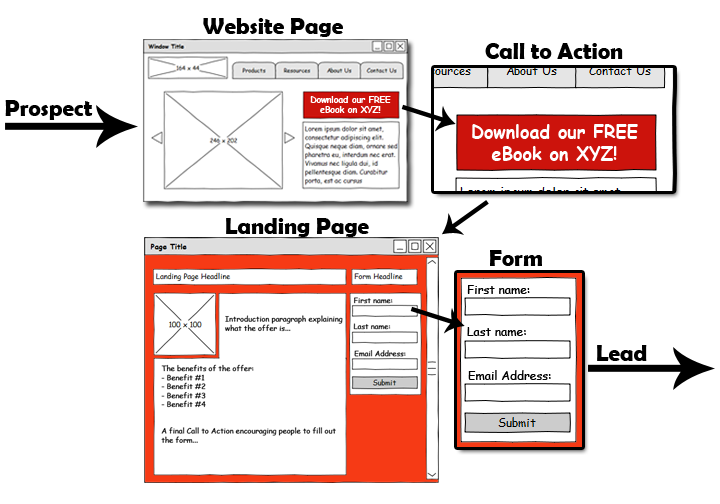





 Social media can turn you into a business-to-business (B2B) marketing superstar by cutting your costs, increasing your leads and helping you earn a measurable return on your marketing investment (ROI). Nearly three of four CEOs mistakenly believe that marketing executives cannot verify the correlation between their activities and their firms’ bottom lines – but with social media, you can.