Shared posts

04 May 21:19

Developing Mindful Leaders for the C-Suite

by Bill George

Time Magazine recently put “The Mindfulness Revolution” on its cover, which could either be seen as hyping the latest business fad, or as signaling a major change in the thinking of executive leaders. I believe it’s the latter.

The use of mindful practices like meditation, introspection, and journaling are taking hold at such successful enterprises as Google, General Mills, Goldman Sachs, Apple, Medtronic, and Aetna, and contributing to the success of these remarkable organizations. Let’s look at a few examples:

  • With support from CEO Larry Page, Google’s Chade-Meng Tan, known as Google’s Jolly Good Fellow, runs hundreds of classes on meditation and has written a best-selling book, Search Inside Yourself.
  • General Mills, under the guidance of CEO Ken Powell, has made meditation a regular practice. Former executive Janice Marturano, who led the company’s internal classes, has left the company to launch the Institute for Mindful Leadership, which conducts executive courses in mindfulness meditation.
  • Goldman Sachs, which moved up 48 places in Fortune Magazine’s Best Places to Work list, was recently featured in Fortune for its mindfulness classes and practices.
  • At Apple, founder Steve Jobs — who was a regular meditator — used mindfulness to calm his negative energies, to focus on creating unique products, and to challenge his teams to achieve excellence.
  • Thanks to the vision of founder Earl Bakken, Medtronic has a meditation room that dates back to 1974 which became a symbol of the company’s commitment to creativity.
  • Under the leadership of CEO Mark Bertolini, Aetna has done rigorous studies of both meditation and yoga and their positive impact on employee healthcare costs.

These competitive companies understand the enormous pressure faced by their employees — from their top executives on down. They recognize the need to take more time to reflect on what’s most important in order to create ways to overcome difficult challenges. We all need to find ways to sort through myriad demands and distractions, but it’s especially important that leaders with great responsibilities gain focus and clarity in making their most important decisions, creativity in transforming their enterprises, compassion for their customers and employees, and the courage to go their own way.

Focus, clarity, creativity, compassion, and courage. These are the qualities of the mindful leaders I have worked with, taught, mentored, and interviewed. They are also the qualities that give today’s best leaders the resilience to cope with the many challenges coming their way and the resolve to sustain long-term success. The real point of leverage — which though it sounds simple, many executives never discover — is the ability to think clearly and to focus on the most important opportunities.

In his new book Focus, psychologist Dr. Daniel Goleman, the father of emotional intelligence (or EQ), provides data that supports the importance of mindfulness in focusing the mind’s cognitive abilities, linking them to qualities of the heart like compassion and courage. Dr. Goleman prescribes a framework for success that enables leaders to build clarity about where to direct their attention and that of their organizations by focusing on themselves, others, and the external world — in that order.  Cultivating this type of focus requires establishing regular practices that allow your brain to fully relax and let go of the anxiousness, confusion, and pressures that can fill the day. (Editor’s note: here is Daniel Goleman’s related HBR article, The Focused Leader.)

I began meditating in 1975 after attending a Transcendental Meditation workshop with my wife Penny, and have continued the practice for the past 38 years. (In spite of this, I still do mindless things like leaving my laptop on an airplane, but I continue to work on staying in the present moment.) All of our family members meditate regularly. Our son Jeff, a successful executive in his own right, believes he would not be successful in his high-stress job were it not for daily meditation and jogging.

Meditation is not the only way to be a mindful leader. In the classes I teach at Harvard Business School, participating executives share a wide range of practices they use to calm their minds and gain clarity in their thinking. They report that the biggest derailer of their leadership is not lack of IQ or intensity, but the challenges they face in staying focused and healthy. To be equipped for the rapid-fire intensity of executive life, they cultivate daily practices that allow them to regularly renew their minds, bodies, and spirits. Among these are prayer, journaling, jogging and/or physical workouts, long walks, and in-depth discussions with their spouses and mentors.

The important thing is to have a regular introspective practice that takes you away from your daily routines and enables you to reflect on your work and your life — to really focus on what is truly important to you. By doing so, you will not only be more successful, you will be happier and more fulfilled in the long run.

Thriving at the Top
An HBR Insight Center
11 Mar 15:03

Spread of temporary foreign workers in B.C. spurs controversy over hiring practices

The number of temporary foreign workers entering B.C. has taken off in recent years, nowhere more so than outside the province’s biggest cities.
11 Mar 15:03

Chuck Chiang: Beijing courts Vancouver’s overseas Chinese

Vancouver’s reputation as being home to a large and growing overseas Chinese community appears to have caught the attention of the government in Beijing. Last month, Qiu Yuanping, the director of the Overseas Chinese Affairs Office (part of the State Council, China’s central administrative branch), made a rare visit to Vancouver as part of a whirlwind, week-long North American tour. Although the Vancouver portion of Qiu’s tour lasted only a day, the fact that she visited at all — the first time someone in her position has done so — indicates Vancouver is more than ever on Beijing’s radar.
11 Mar 15:02

Loblaws to stock salmon certified as responsibly farmed

SFU environmental scientist Rick Routledge: ‘There are good reasons for people to take a careful look at whether they want to eat any farmed salmon, especially produced on the Pacific Coast’
11 Mar 15:02

U.S. company applies to sell genetically modified salmon in Canada

Massachusetts-based biotech company AquaBounty Technologies has applied to the federal government for permission to market genetically engineered farm-grown Atlantic salmon.
11 Mar 15:02

Stephen Hume: The B.C. lose jobs plan

As British Columbia hemorr­hages jobs — another 7,000 in February, 3,600 in construction alone — BC Ferries is considering exporting a thousand shipbuilding jobs that would inject $378 million into the provincial economy and reduce federal and provincial debt by more than $100 million, says a new economic study. Replacement or extensive refits of aging vessels in the ferry fleet could involve more than 25 ships between now and 2030 at a cost of $2.5 billion. However, as the ferry corporation considers bids to build three new intermediate-size ships, only one of five companies that made the shortlist for design and construction was Canadian.
11 Mar 14:47

When everyone says your tech idea is impossible, here’s what you do

by Charu Sharma & Ariel Marcy / Theshiplog.com
When everyone says your tech idea is impossible, here’s what you do
Image Credit: Leigh J/Shutterstock

To celebrate Women’s Day, we hobnobbed with 24 year-old Silicon Valley-based high-tech startup founder Meredith Perry. She’s audacious, persistent, resourceful and a game changer in every sense. Perry’s start-up, uBeam, develops technology using ultrasound to wirelessly charge devices. In 2012, Mike Arrington hailed her demo as the “closest thing to magic” he had seen in a long time. Since, Silicon Valley powerhouses such as Marissa Mayer, Peter Theil, and Andressen Horowitz have invested in uBeam.

Perry designed the early prototypes of uBeam’s technology without any engineering degree, relying on in-depth Internet research and “begging professors to teach her extra concepts after class.” When she first brought her idea to experts and engineers she was met with point-blank responses along the lines of ‘you are trying to do the impossible; it will never work.’

Our three takeaways from Perry’s seemingly unlikely success:

#1 Persist through naysaying by pursuing open-minded research

In her TEDx talk, Perry reported asking herself, “how can I get this to work” rather than a binary, “will this work or not?”

When experts diagnosed her designs with insurmountable challenges, Perry turned to tangentially related research — from acoustic weapons to musical instruments — to find new solutions. For example, a professor told her she could never transmit enough power through sound to charge a phone, but she kept moving forward with the idea because of the research she did on acoustic bombs. After she’d put considerable effort into research and thinking up out of the box solutions, many of the experts she spoke to came back and said, “hmmm, actually that could work.”

Perry was pursuing a degree in Paleobiology with a focus in Astrobiology, and had no background in electrical engineering, but her dedication to thorough and open-minded research embodies the axiom that crazy ideas are revolutionary ideas yet to be fully explored.

#2 Hire the experts

Through persistent, open-minded research, Perry was able to communicate competence and rally engineers to help her realize her designs — beginning with a fellow student who wired the first proof of concept model. She won University of Pennsylvania’s student invention competition. She then found an engineer in Indiana who helped to dramatically increase both the power output as well as the range of her prototype in just under a month to demo on stage at All Things D.

By continuing her dogged research efforts, Perry is now working with engineers at the top of their fields — several of whom were authors of the papers she was reading in her early stages of research. When we interviewed her, she said, “It was most efficient to go directly to the source.  It was relieving to finally be able delegate to people who knew a lot more than me after working on the technology independently for over a year.” Now, uBeam will be able to go beyond parts found on the shelves and create its own specialty parts for its product.

#3 Root out the investors likely to support your vision

Initially, Perry had difficulty finding willing investors for uBeam. In 2013, the New York Times reported that she decided to research investors who had financed “crazy things.”

In her interview with us, she recommended “seek[ing] out specific investors online interested in your startup’s  space versus just trying to get in front of the  ”top investors”. Again, an out of the box approach proved successful. “Prior to raising my first seed round, I went on AngelList and searched for investors that invested in things as unusual and crazy as wireless power (i.e. aerospace startups, hardware startups, etc).” Her efforts paid off, attracting support from Founders Fund, the venture capital fund from former Paypal founder Peter Thiel. Perry soon after gained the support of Yahoo’s CEO, Marisa Mayer within a record-breaking 12 minutes!

In conclusion, as Perry rightly blogs, “Never, never, never give up. If you believe in what you’re doing and you’re not breaking the laws of Physics, then it can be done. It’s just a matter of how and when. Pull as many teeth as needed to get there.”

Charu Sharma is a TEDx Speaker and the author of a forthcoming book on women entrepreneurs, and Ariel Marcy is the Founder & CEO of Silicon Valley-based Edutech startup STEAM Galaxy Studios. They co-curate an entrepreneurship blog theshiplog.com. Follow them on twitter at @charu1603 and @aemarcy.

International Women’s Day (March 8th) began in the early 1900’s as a way to advocate for women’s rights. Now it is a celebration of women’s achievements in order to inspire continued progress towards equality.


VentureBeat and marketing technology analyst David Raab are working on a new Marketing Automation usage and ROI study. If you currently use a marketing automation system, help us out by answering the survey. If you do, we'll share the resulting data with you.


11 Mar 14:45

Self-Serve or Full Service? – Sales eXecution 242

by Tibor Shanto

By Tibor Shanto - tibor.shanto@sellbetter.ca

stake and wine

I overheard an interesting discussion recently at the airport. Two guys talking about eating out a lot, could even have been road warrior sales types. One was waxing poetic about how is sick and tired of seeing tipping jars at staff cafeterias, or fast food places. When his buddy asked why, his reply was that the people in those place do not do anything that merits a tip. They stand at the cash, ring you out, and sometimes even muster a “thank you”. Even at a place like Starbucks, the baristas are nothing more than a short version of a short order cook.

He felt waiters deserve a tip because they create and add to the dining experience, and are often the difference between a great night out experience, and a meal eaten outside the home. He felt that waiters are with you from start to finish, making recommendations, the good ones take time to understand your preference and what you are hoping to get out of the experience and more. They also sell and upsell you from wine to desert and everything between, helping their restaurant sell more profitable items, increasing the size of the bill, their tip, and your experience. In other words earning their tips. To quote “WTF does the guy behind the counter at Starbucks add to the experience?”

This got me to think about some of the current discussions in sales, and how people are confusing roles and outcomes, sometime innocently, sometimes intentionally to drive their own agenda, even at the expense of their buyers and facts. When I read that “buyers are over 60% of the way through their buying process before they reach out to sales person”, I get confused. Sales person, really? I think not, more accurately, the person they call when they are 2/3 of the way through their “buying” process is an order taker, there is no selling taking place here, there is just taking an order the buyer by definition arrived at on their own. Looking at that experience as a sale, is like confusing a sandwich off a stand outside Penn Station with a dinner at Carbone.

Sales people seek out and engage with people who have not started the buying process, had not intention on doing anything different when they went to work that morning. That is why it is a “sales process”, not a “buying process”. Sales people are not standing at the checkout counter waiting for the next buyer to walk up. They study their territory, understand who potentially will benefit from their offering. They segment and prioritize, and develop a pursuit plan based on where they are most likely to engage with potential buyers, buyers who without the seller’s initiative would remain on the sideline, and unnoticed by sales people waiting for a call from someone who has completed 2/3 of their decision. Not to mention the pundits who promote this type of lazy order taking; how can one present an entire “sales” methodology predicated on taking orders rather than making a sale? I am with my man at the airport, let’s not call the combo meal at the local sub shop a four course dinner. Now shut down the browser, and go out and sell, the incoming orders will come anyways, look at them as you bonus, not your goal.

What’s in Your Pipeline?
Tibor Shanto 

Join me - Return On Objectives #Webinar

11 Mar 14:44

The Limits of Value Propositions

by Charles H. Green

(This post first appeared on RainToday.com)

The Real Value PropositionValue propositions are unquestionably important in B2B sales, especially for large, complex, or intangible offerings. Some suggest a value proposition is the key component of successful sales. And most would say a value proposition is a necessary condition for success, if not a sufficient one.

But I think we over-value the value of value propositions. Not only are they not sufficient, but sometimes they’re not even necessary. They are frequently less important than classic issues of needs and wants. And discussing value propositions without overtly addressing client confidence in the capability of the seller is not useful.

Value propositions are unquestionably powerful. But if you think nailing down a clear value proposition is going to solve your sales issues, think again.

Thinking About Value

First, some definitions. I’m using “value” in a simple, narrow way to mean economic value. For example, I might offer a client a value proposition that says, “By using a distinctive approach to account development, I can improve top-line revenue by 10% within six months at virtually no cost to margins.” The “value” in that example is “10% of full-margin top-line revenue,” and the total statement includes reference to how I’m going to achieve it and in what realm of the client’s business.

But usually that’s not how clients start out thinking. In my experience, clients go rather quickly from “we’ve got a revenue problem” to “the biggest reason for our revenue problem is sales force turnover,” from whence it’s a quick hop to “we need a salesforce recruiting solution.” In which case, my highly articulated value proposition about the account development process, even if it’s correct and relevant, doesn’t even get invited to the party.

Their problem (“10% top-line revenue gap”) may rhyme with your value offering (10% top-line revenue growth”), but if the buyer is fixated on sales force turnover, game over. You could argue you need to present your value proposition earlier in the buying cycle, but that’s a problem outside the value proposition per se. Call that the “misaligned diagnosis” problem.

Another problem is relative lack of urgency. A 10% increase in top-line growth, while it sounds great, may produce yawns in organizations that are transfixed by products going off patent, or by R&D rejuvenation, or by M&A activity, or by the urgency of a cost-cutting drive.

A value proposition can work its magic only if the client a) agrees on the issue at hand, b) feels a need to address the issue, and c) wants to use the particular value proposition to address the need.

That is not a radical statement. (The value of a glass of water in the desert is greater than when lakeside.) And yet it is violated all the time. Salespeople keen on articulating value propositions to clients risk making the world look like a nail to match their value proposition hammer. We know better than to sell product vs. solution, but it’s so tempting when the “product” is disguised as a total value proposition.

Note: this can work in sellers’ favor. Over half my clients already see what they want in my offerings by the time they contact me. They articulate my value proposition for themselves. And unless they’ve gotten it quite wrong (not very common), there’s little point in forcing them to tweak it. At that point, the imperative to add value as the opportunity presents itself becomes the key task.

Selling Value And Buying Value

Suppose you haven’t productized the value proposition. You’re engaged in a constructive dialogue with an interested client. You’ve articulated your value proposition, they comprehend it, and it meets their needs. However, the same can be said for two competitors, each of whom isalso talking to your potential client about increasing top-line revenue by changing the account development process.

Several issues then arise, such as the level of detail. (Just how does your approach to changing the account development process differ from theirs?) You could call this a deeper level of value proposition, but below some level it starts to look like just product variations.

But the biggest issue for buyers at this point is often not the value proposition at all, but the confidence or trust the buyer has in the seller. Confidence and trust can not only overcompensate for lower stated value, but they can overturn the value proposition entirely.

Expected Value

Consider two firms competing for a bid, with general agreement on the value proposition that the client is looking for. Let’s say the economic value calculated by each firm is about net $5 million. Sophisticated decision analytics might reveal the client has 90% confidence that firm A will deliver fully on the expected value, but only a 75% level of confidence that Firm B will do so.

That’s 15 percentage points variation in expected value—the same as if one firm had quoted a value of $750,000 more than the other! It’s also a discrepancy often sufficient to entirely wipe out the fees difference between the two sellers. Even greater discrepancies emerge when the issues turn to, “what if things go wrong? What will they be like to work with then?”

Yet this discrepancy virtually never gets talked about—at least not in a direct and quantitative way. The discussions are more along the lines of, “I don’t know. I just don’t feel like when push comes to shove they’re going to be able to get with our program.”

If you lose a bid and are lucky enough to get some post-bid debriefing, you’re not likely to hear, “Well, we just didn’t feel like when the chips were down you’d be able to get with our program.” That would be the corporate version of politically incorrect speech.

Instead, you will hear, “The other guys had a more compelling set of resumes on their team, ” or “We just felt like we had to go with their longer track record in this area.” In other words, the language of value proposition gets cited as post hoc justification even though it was not the basis for the actual decision. More prosaically, people buy with their heart and rationalize it with their brains.

Trust Can Even Overturn a Value Proposition

I’ve been on both ends of this one. I won a job by telling the client they flatly didn’t need to do a significant part of the job they were requesting. I didn’t win because I came up with a better value proposition; I won because I showed I could figure out the right thing to do. And the proof of it was they didn’t bother to solicit other bids around the new value proposition.

Sadly for me, I’ve lost this way, too. It’s not about picking the right game, it’s about picking the person who knows how to pick the right game.

The Role of Value Proposition

Too often it’s assumed that the purpose of the value proposition is so obvious it doesn’t need stating. Doh! We assume clients buy value, clearly expressed, and tightly calculated. After all, that’s what they say they do.

There are seriously valuable roles for a value proposition, of course. They are:

  • To force the seller to have a Point of View: my client may or may not buy what I’m selling, but my statement of it marks a beginning point of discussion, a coherent account—one that suggests other ideas, proves I’ve thought things through, and shows I am worthy of valuable time.
  • To give the buyer “air cover” in justifying a decision internally: a B2B buyer wants to be able to tell anyone who asks, but especially his superiors, that they bought a proven product with a 35% ROI that will provide a 15% CAGR by an experienced-based approach to account management. They do not want to tell everyone they chose vendor A because, gee, they really felt good about them—even if that’s the truth.
  • To undergo a required, universal protocol: like meeting ISO standards, following tax rules, or complying with traffic laws, the tight definitions that come from rigorous thinking about value propositions are an assurance of quality. They may be a little pro forma, they may be subject to some tweaking, and they may not be a guarantee. But if everyone must do them, they form a common denominator by which to compare something of importance—value.

Value propositions are powerful, useful, and often necessary. Typically, however, they are not sufficient. Don’t go to into the sale armed with a value proposition alone.

This post was written by Charles H. Green
Charles H. Green is founder and CEO of Trusted Advisor Associates LLC; read more about Charlie at http://trustedadvisor.com/cgreen/You can follow him on twitter @CharlesHGreen

11 Mar 14:43

What if a Company Maximized Jobs Over Profits?

by Mark Bonchek

All over Silicon Valley, venture capitalists are asking entrepreneurs “How scalable is your business model?” What they really mean is, “Can you grow without having to hire people?”

In our digital economy, value creation and job creation don’t always go together.  Consider that Whatsapp just sold for $19 billion with only 55 employees.  It used to be that business growth led to job growth.  But as machines get smarter, labor becomes a reluctant necessity.  Companies only hire as a last resort.

But what if the purpose of a company was to employ people?  Instead of hiring enough people to make the greatest profit, it would make enough profit to hire the greatest number of people.

Put simply, these “job entrepreneurs” maximize jobs instead of profits.  There is a precedent in this. “Social entrepreneurs” seek to maximize purpose over profits.  They take a social problem, like health, poverty, or the environment, then work on finding a business model that can remedy the problem. They seek to make enough profit to make the greatest social impact.

Job entrepreneurs take a similar approach. They start with a group of people they seek to employ, then work on finding a sustainable business model that leverages their talent and experience. This isn’t about job placement. There are many organizations that help people find jobs in other companies. Job entrepreneurs bring people directly onto their own payroll.

One pioneer in the “job entrepreneur” movement is Dave Friedman. Two years ago, Friedman left his position as a Fortune 100 executive to start a new venture.  His goal was to employ people on the autism spectrum – individuals who have traditionally been unemployable.

Friedman considered creating a traditional startup, but he realized that his goal was different. He didn’t want to maximize profits but rather employment.  Many advised him to setup a non-profit. But Friedman didn’t want to rely on grants and donations. He believed the business needed to generate a sustainable profit to foster discipline and efficiency. He also wanted his employees to know that their jobs weren’t just charity, bringing a source of authentic empowerment.

Some advised Friedman to create a social enterprise, but the models didn’t really apply.  Friedman wasn’t changing how the product was made (e.g. organic or sustainable) or where it was sold (e.g. low-income buyers).  He was focused on changing who gets hired.  Like social entrepreneurs, WHY mattered more than HOW MUCH.  But in this case WHO mattered more than HOW or WHERE.

Without an existing model to guide him, Friedman set out to make his own.  He had a powerful belief that people on the autism spectrum represent an exceptional yet hidden workforce.  But he needed a business model that would turn what others saw as a deficit into a source of competitive advantage.

Friedman found his answer in what he calls “Process Execution” jobs.  These are labor-intensive activities such as website maintenance, data entry, and software testing. Many companies struggle to fill these positions. But the repetitiveness and attention to detail are well-suited to the talents and abilities of people with autism.

As much as possible, Friedman downplays the fact that his employees have autism.  He is not looking for charity.  He wants to compete on the same playing field as other companies providing similar services.  But on the inside, AutonomyWorks is unlike any of its competitors.  Friedman has redesigned the way work is structured, organized, and managed to suit his employees.

With these changes, Friedman has found that not only can AutonomyWorks match traditional competitors, but it can produce better quality at a lower price.  By generating profits, he is able to hire more people and fulfill his mission.  In the process, he has empowered an overlooked workforce and relieved families of the costs of supporting autistic relatives.

Another company following a similar model is Shinola, a Detroit-based manufacturer originally known for its shoe polish.  Shinola has recently reinvented itself to create jobs for unemployed auto workers.  Like AutonomyWorks, Shinola started with jobs and worked backward to the business model.  In this case, auto workers have unique skills in light manufacturing and upholstery.  So Shinola produces watches, leather goods, and handcrafted bicycles.  A traditional entrepreneur wouldn’t set out to make this combination of products.  But for a job entrepreneur in Detroit, it makes all the sense in the world.

So what does it take to be a job maximizer?

  1. Choose Your Talent. Who do you want to employ? AutonomyWorks focuses on people with autism. Shinola focuses on former auto workers. There are many other segments of the labor force who are underemployed or underutilized.
  2. Find Your Market. What products or services can these workers best make or provide?  This is where the entrepreneurial magic comes into play.  You need to find something that suits your people and also generates a sustainable profit.  Friedman recommends looking for markets where work has been off-shored or automated, and that have low capital requirements.
  3. Design Your System. What innovations do you need to meet the unique needs and bring out the best in your workers?  This might involve rethinking hiring, process design, management, or organizational culture.  The key is turning people’s disadvantage in society into your company’s competitive advantage in the marketplace.

Over the last twenty years, we have successfully created an entirely new economic sector in which social entrepreneurs maximize purpose over profit.  It’s time to turn this entrepreneurial spirit on a new goal:  job creation.  We need more people like Dave Friedman and more companies like Shinola — job maximizers and employment entrepreneurs.

11 Mar 14:43

13 Social Media Marketing Trends in 2014 from the Experts

by Julie Hong

2013 was a fruitful year as social media continued its ‘conquest’ of the Internet realm. From the massive surge in viral videos on YouTube to the introduction of Vine and the ever growing popularity of Instagram, Line and Whatsapp; the industry’s veterans Facebook and Twitter are still staying on track, notably with Twitter’s IPO last November.

You might wonder how all of this will affect social media marketing this year. As 2014 will see new social networks, ever more creative marketing concepts and innovative formats popping up everyday, we asked some social media experts about their views of the top trends in social media marketing this year.

See what they have to say so you can prepare ahead!
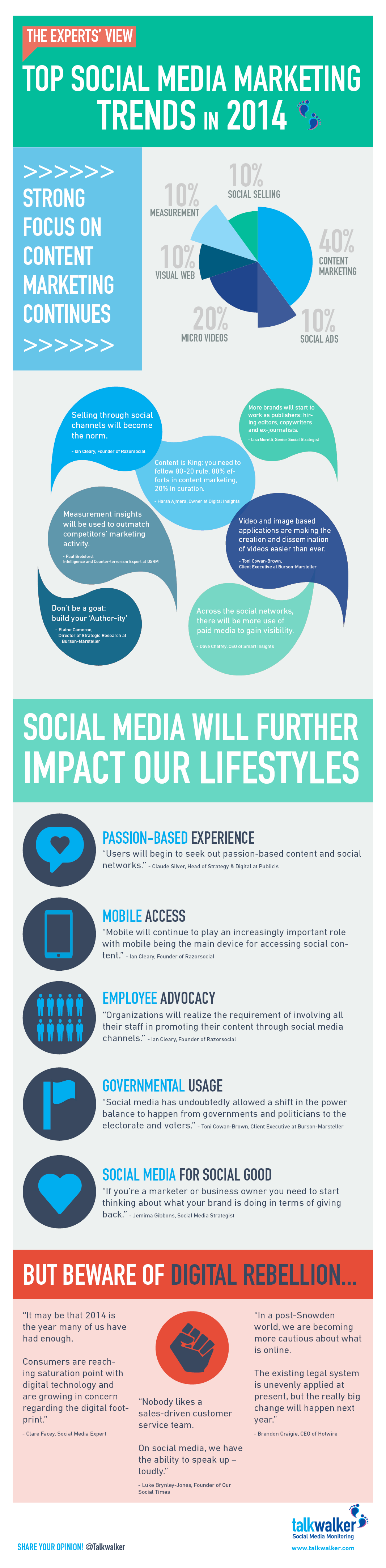
13 Social Media Marketing Trends in 2014 from the Experts image infographics top trends 2014 611

Let’s get into more detail:


Content marketing management at the heart of social media

You shouldn’t consider social media marketing trends without evaluating broader trends in digital marketing and content marketing in particular. Content marketing fuels success in social media marketing and is crucial to many other digital marketing techniques like SEO, SEM, Email marketing and CRO.

A move to a more integrated, managed approach is the main trend I see with content marketing management at the heart. Research from the Content Marketing Institute shows that increasingly companies are creating a defined content marketing strategy and there is specific ownership for content marketing and these plans should also define how social media are used linking to separate resources depending on the size of the organisation.

This is how I see the strategic approach to create branded content as part of an overall communications strategy based on user personas and business objectives:

13 Social Media Marketing Trends in 2014 from the Experts image online value proposition1

At a more practical level, I think companies will realise the potential of networks like Google+ and Pinterest to fuel sharing and interaction and there will be more attention on those. Across the social networks I think there will be more use of paid media to gain visibility and use of remarketing when social network users have already used a site, for example through Google Doubleclick and Facebook Exchange.

13 Social Media Marketing Trends in 2014 from the Experts image dave chaffey for talkwalker1

Dr Dave Chaffey is CEO and co-founder of marketing advice site Smart Insights. He is author of 5 bestselling books on Ecommerce including Digital Marketing: Strategy, Implementation and Practice and has been recognised as one of 50 marketing ‘gurus’ worldwide who have shaped the future of marketing. @DaveChaffey


Mobile, micro videos, employee advocacy and visual web for social selling

Mobile will continue to play an increasingly important role with mobile being the main device for accessing social content. Podcasting will also grow substantially in line with growth of smartphone technology.

Micro Video content will become increasingly popular.  We have seen the recent introduction of Instagram 15 second videos following Vine and I expect more to follow suit.

Employee advocacy (e.g. Addvocate) software will become more widespread as organizations realize that requirement of involving all their staff in promoting their content through social media channels.

Social Selling – As the whole web becomes social, it will not be a case of not being able to sell through social media.  Selling through social channels will become the normal as organizations adapt to how this new social selling model works.

Visual Web – Organizations will invest heavily in visual content which attracts more attention and engagement. The social media platforms will look for ways to develop their platforms in a more visual way.

13 Social Media Marketing Trends in 2014 from the Experts image Ian Cleary for Talkwalker1

Ian Cleary is a mediapreneur, speaker and technology expert who specialises in sharing unbiased information about social media tools through his award-winning website, RazorSocial. A well-respected thought leader in his field, Ian speaks at leading social media conferences around the world and is publishing a book on social media tools and technology in March 2014. @IanCleary


Evolving customer service

In the past year lots of large organisations have launched multi-channel digital strategies that aim to bring marketing, PR, sales and customer service together under a single banner. This makes a lot of sense – since customer-facing teams should all be focused on the same ultimate goal.

The problem is, this only works if your ultimate goal is customer satisfaction. Since most of these strategies are being driven by Marketing Departments with sales as the end point, I see real challenges ahead. Nobody likes a sales-driven customer service team, and on social media, we have the ability to speak up – loudly. I expect the fall-out from these well-meaning but flawed strategies to become widely visible in 2014.
13 Social Media Marketing Trends in 2014 from the Experts image EN Luke Brynley Jones1

Luke Brynley-Jones is the Founder of Our Social Times. He is a regular speaker at conferences around the world. Luke writes for several industry publications and has a Sunday slot on BBC Radio Cambridgeshire. @lbrynleyjones


Focusing on social good

Social media for social good is going to be massive in 2014.  If you’re a marketer or business owner you need to start thinking about what your brand is doing in terms of giving back (to all stakeholders – not just customers but employees, suppliers and local communities) – and how to amplify that message to the max using social channels.

2013 has seen huge steps in terms of meaningful business in the UK with a leading brand like Innocent switching its message (now focusing on social good rather than product lines) and big-thinking, eco-friendly projects from high street names like Wahaca (the Pig Idea) and Top Shop (Reclaim To Wear).

If your brand isn’t already doing good or even worse – causing harm – you need to think about how to change this – the great thing is, if you do find a way to create a genuine positive change to your business in 2014, social media will be the perfect platform to talk about it.
13 Social Media Marketing Trends in 2014 from the Experts image Jemima Gibbons for Talkwalker1

Jemima Gibbons is a social media consultant, author and blogger based in London. @JemimaG


Digital Rebellion

We may see 2014 as the start of the ‘swinging back of the pendulum’ (Randi Zuckerberg 2013) and the beginning of a ‘Digital Rebellion’.  This is being created by not only consumers reaching saturation point with digital technology but more importantly a response to a concern regarding the digital footprint we are all creating.  With a recent report called ‘The Social Habit” showing that 56% of Americans with a Facebook profile commenting that they are concerned about the privacy of their information stored on Facebook, people are starting to consider the impact of their online activity.  An article in a recent Stanford Law Review summarises the issue and calls for “a model where the benefits of data for businesses and researchers are balanced against individual privacy rights.”

If the social media giants dominating the world of online networking cannot achieve such a model quickly and easily we may start to see the beginning of a global digital rebellion in 2014.
13 Social Media Marketing Trends in 2014 from the Experts image EN Clare facey1

Clare Facey, of Social Green, provides expertise in corporate and social communications. @meetonthegreen


Social laws, anonymity and business maturity as next steps in social media marketing

Each year, Hotwire puts out its Digital Trends Report, a look into the year ahead for what the big trends will be for the year ahead. You’ll have to wait until the New Year for this report, but here is a sneak peak at three of the trends we expect in social media marketing for 2014:

Social laws. The existing legal system is unevenly applied at present across the internet and our social networks. Disparate sentences are given out depending on the different crimes. This is beginning to change, but the really big change will happen next year.

Anonymity. In a post-Snowden world, we are becoming more cautious about what is online. The increase in usage of services like Tor and DuckDuckGo shows that this is not just a small trend but something that will develop greatly in coming months.

Business maturity. The number of big corporations ‘doing social right’ is already much, much higher than it’s ever been before. 2014 will be the year that success becomes universal across the board – and if you still aren’t getting it right, you’re going to be in trouble.

13 Social Media Marketing Trends in 2014 from the Experts image EN Brendon Craigie Hotwire for Talkwalker1

Brendon Craigie is Group CEO of Hotwire, the global integrated PR and communications consultancy. He was quoted in a PRWeek profile as “a young man in a hurry” and the same publication has named him a member of the PRWeek PowerBook for several years running. @brendoncraigie


Interest-Based (Social) Networks Rise in Prominence in 2014

We will see users spending more time engaging in more ‘passion-based ‘social networks and content. There has been some noted mainstream social media fatigue in 2013 and more users will crave a more personalized experience than the broad brush-strokes Facebook provides. Social Search will play a part in this paradigm shift as users begin to seek out passion-based content.

Companies such as Say Media own and operate many of these sites, as does Federated Media, AOL/Huff Post.

13 Social Media Marketing Trends in 2014 from the Experts image EN Claude Silver1

Claude Silver is the Digital Strategy Director at Publicis. She is passionate about consumer experience, social & building exceptional teams. @claudesilver


Don’t be a Goat: Build Your Author-ity

When I think about social media, I think about the plethora of platforms and channels that empower and enable us to tell our stories. And to tell a good story, whether you are a brand or a company or an individual, you need content that people like/favourite and want to share/retweet. The challenge for a content writer or author is to cut through the clutter and get your voice heard.

Which is why I am intrigued by Google’s much-hyped concept of Author Rank on its Google+ platform. It has long been a knotty problem for marketers to be able to identify and hone in on those influential bloggers, writers and content creators whose reputation can be trusted. It remains to be seen whether Author Ranking will indeed be able to separate the sheep from the goats but it will certainly be interesting to watch this story unfold in 2014. Even if it doesn’t come to pass, the lessons to be learned from this are to keep creating content on your chosen areas of expertise, link, connect, disseminate, engage and keep all those cogs constantly whirring.

13 Social Media Marketing Trends in 2014 from the Experts image author rank1

Great infographic here.

13 Social Media Marketing Trends in 2014 from the Experts image EN Elaine Cameron

Elaine Cameron is Burson-Marsteller’s Futurist & Director of Strategic Research. Elaine writes, presents and tweets on a wide range of topics such as consumer, technology, healthcare and communications. Specialist subjects include The Future of Death, Leadership & Feminomics and The Future of Storytelling for Business. @FUTUREPersp


Yes for Content Marketing, but how?

As I see it, 2014 will be a year where everybody whether you are an individual or a brand has to focus on Content Marketing. On Social Media, content is the King but if it’s not marketed and distributed properly all your efforts in building that content is waste. You need to follow 80-20 rule, 80% efforts in content marketing, 20% in curation. There are tons of platforms where your customers can get information from, but it’s most important that they get it first from you. Thus it is very important to stay abreast with all the information in your industry.

Analytics and Impact is the second most important thing and I am not only talking about the numbers. It shows you relevant data whether your current marketing strategies are working for you or not. And that is where you do alterations, modifications and clear understanding of the way forward.”

13 Social Media Marketing Trends in 2014 from the Experts image EN Harsh Ajmera

Harsh Ajmera, Owner at Digital Insights, is a social media and web tech enthusiast. He keeps himself busy with building social media strategies, tactics, exploring new platforms and sharing the best of his knowledge online. @ajmeraharsh


Have a long term vision

In 2014, people will start to take content a lot more seriously and view it as a fundamental first step towards launching a successful social media presence. There will be far fewer rookie errors of signing up to a social media channel without knowing what you’ll be saying in that space. As a result, content budgets will grow and more brands will start to work as publishers: hiring editors, copywriters and ex-journalists in the process. It’s not just about quick wins on YouTube, anymore. It’s about implementing a long-term plan on how you plan to inspire/educate/entertain your community with content that best represents your brand’s personality.

With the focus firmly on crafting words/images/videos, I think our ideas behind measurement will also evolve.  More sophisticated metrics will begin to emerge like trying to understand how we audit the output of our content so that it becomes a barometer on trust, authority and advocacy.

13 Social Media Marketing Trends in 2014 from the Experts image Lisa Moretti for Talkwakler

Lisa Talia Moretti has worked as a strategist, digital editor and researcher. She has executed digital initiatives for over 25 global brands and delivered social media workshops in six countries. Lisa is also the resident Digital Sociologist at Affect Lab, a research studio in Amsterdam. One word that describes her best: curious. @LisaTalia


Using social media for competitive intelligence

Social media marketing & intelligence continues to gain in relevance as businesses can no longer afford to tentatively treat social media as the weak division within their marketing channels. Nor can they allow themselves to fall behind the competition’s social media efforts.

As the adoption of mobile and tablet continues to grow, in turn this will drive how potential customers interact with digital channels. As the digital route to market will continue to grow through 2014 so will engagement via social media channels.

This presents digital marketers with many opportunities (and some threats!). Social media offers a rich source of marketing and competitive intelligence information. Beyond managing customer service and building marketing opportunities there is a wealth of competitor intelligence available. This information can find both routes to market from your competitor’s social media activities; and allow you to map the sources and rhythms of your competitor’s online releases.

With the right approach content and marketing can use these insights to gain market share and outmatch competitor releases and marketing activity in the social media domains.

At DSRM we monitor, measure and map the marketing and social media releases of competitors in the security industry. This allows us to adapt strategies and content in social media activity. It also allows us to market to the social media channels and online sources in the spaces where our competitors are operating. Mapping our competitor’s digital route to market enables us to focus our content and deliver our products and services to a relevant audience.
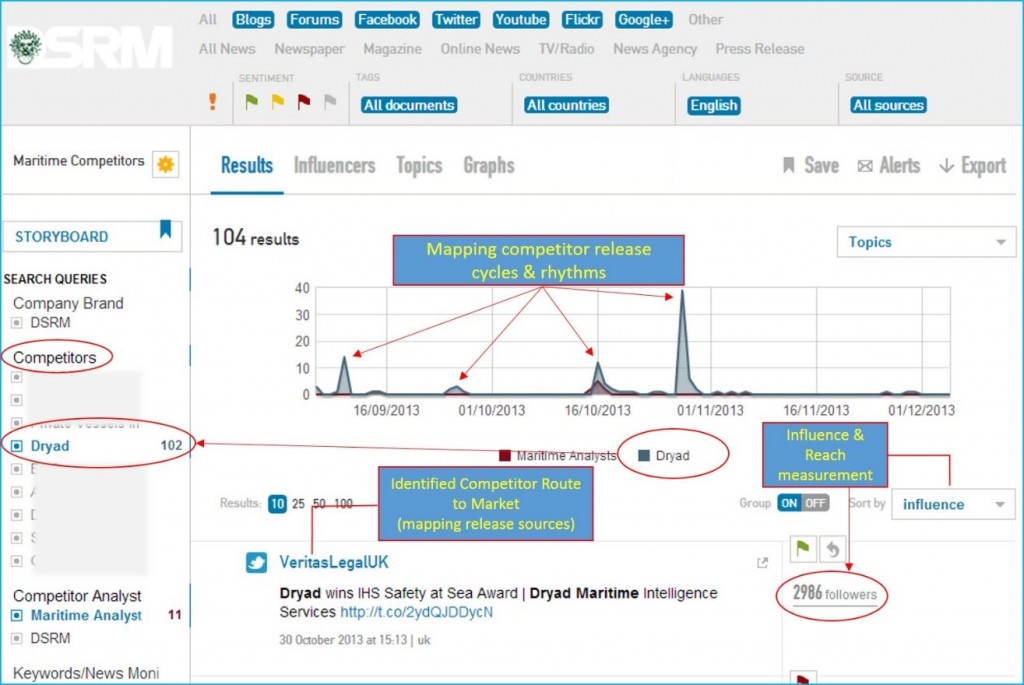
13 Social Media Marketing Trends in 2014 from the Experts image competitive intelligence

Mapping competitor activity

13 Social Media Marketing Trends in 2014 from the Experts image EN paul brelsford

Paul Brelsford is an Intelligence and Counter-terrorism expert at Durham Specialist Risk Management. He is also a former Director of Competitive Intelligence in a strategic management company. @Agile_Edge


Governments will embrace social media

It has already started but in 2014 we will be seeing more European governments and politicians fully embracing social media – especially with the European Elections in May 2014. They will become more comfortable and open to this medium and will hopefully make the most of it, and use it in innovative ways.

Social media has undoubtedly allowed a shift in the power balance to happen – from sellers to buyers, from brands to customers and also from governments and politicians to the electorate and voters. Governments and politicians will need to understand how to make the most of social media to create the necessary awareness around politics in general. And then understand how to turn this awareness into actions – and I am talking about real tangible actions more than a retweet, a ‘like’ or a share.

There are two key elements necessary for the above to happen: hashtags and videos.

Firstly, hashtags will become increasingly important and central as more and more social media channels are incorporating them in order to aggregate content. Harnessing the power of hashtags will allow for increasing awareness to be created around specific campaigns.

Secondly, short and captivating videos will captivate and drive action. Youtube is still as strong as ever and 2013 saw the creation of numerous video and image based applications such as Instagram and Vine making the creation and dissemination of videos easier and more affordable than ever. Videos and images have already been identified as a strong social media marketing tool but I cannot wait for the political world to embrace this effective way to share and tell their ‘stories’.

13 Social Media Marketing Trends in 2014 from the Experts image EN Toni Cowan Brown

Toni Cowan-Brown is client executive at Burson-Marsteller and Author & creator of TheFashionCloud. @Thefashioncloud


Mobile, social ads and videos becoming vital

Online social media sites have reached new levels of popularity. In fact, social networking has become an essential ingredient in the recipe for success in many business niches. Combine this with the fact that mobile devices are expected to exceed the human population at some point within the next year and you end up with an essential business tool!

In 2014, social media platforms such as Facebook, Twitter, Google+, YouTube and Instagram will no longer be optional; they’re going to be essential tools for your company’s success. A social media strategy has never been more essential. Consider the following facts.

1. Mobile usage will increase

Mobile technology is improving at an incredible rate. This means an increasing number of people are using mobile devices to can access the Internet. With each passing year, the number of people who access the web and social media platforms increases exponentially. Therefore, it’s essential to ensure that your company’s marketing approach is mobile-friendly!

2. Social ads are dominating online advertising

Social ads currently dominate the online advertising sphere and by 2014, you can expect to see these social media ads having an even greater influence. Social ads are very efficient – more so than banner ads – because they’re more targeted and more engaging. Social ads are also well-suited to the smartphone industry, since they’re smaller than traditional ads, so they work very well with the smaller screens that you typically find on mobile devices.

3. Film it, don’t tell it

Brief videos are becoming an increasingly important element in the social media marketing world. These videos are perfect for use on Vine, Instagram and fast-rising stars like Snapchat. This is one marketing trend that you can’t ignore! People want information quickly and they also want to be entertained. Videos can fulfill both of these needs!

13 Social Media Marketing Trends in 2014 from the Experts image Jolanta Friis for Talkwalker

Jolanta Friis is a Specialist of Facebook, LinkedIn marketing and social media. She blogs about online marketing on Social Hunter. @JoaFriis


The original article can be found here.

11 Mar 14:43

Business Owner’s Guide: The Power of Online Reviews

by Jan Vels Jensen

You might not think your business needs them, but here’s why you’re wrong.

Business Owners Guide: The Power of Online Reviews image 2014 03 10 11 26 18

Whatever you might think of them, the power of online reviews cannot be ignored. Whether you’re a small e-tailer, an online giant, or a global blue-chip – online reviews have an impact.

Research from Nielsen revealed that recommendations from acquaintances or opinions posted by consumers online are the most trusted forms of ‘advertising.’ A recent blog post from eConsultancy shows that:

  • 61% of customers read online reviews before making a purchase decision

  • Reviews produce an average 18% uplift in sales

  • 47% of Britons have reviewed products online

With the explosion of online shopping – latest figures show that UK shoppers spent £586.9m a week online, on average, in June 2013 (that’s 18.3% up on the same month in 2012) – reviews have taken on a whole new significance. By not allowing customers to rate and comment on your company, you run the risk of online shoppers taking their business straight to competitors that do.

Research from a recent TripAdvisor study also revealed that:

53% of travelers won’t book a hotel if it doesn’t have any reviews. Some 78% say reviews help them to feel more confident in making a booking decision. Whatever way you look at it, if you sell online, then not having online review options is going to have a serious impact on your profits.

5 reasons why you need online reviews

Online reviews are basically a word-of-mouth marketing strategy, which has long been known as the most powerful endorsement a brand can have. Here are 5 reasons you should include reviews on your website:

  • Reason #1 – They help you build consumer confidence and trust.

You’re obviously going to be providing the best products and services that you possibly can, so the vast majority of your reviews will reflect this. This builds confidence and trust in customers who haven’t used you before as the more 3-5 star ratings you have, the more likely they are to believe all those people can’t be wrong.

  • Reason #2 – They increase your click-through rates (CTRs).

Featuring reviews from your happy customers in search results when consumers search for your product gets you more click-throughs and, in turn, more conversions. Find a platform that feeds your reviews straight into your Google Seller Ratings: on average, ads with Seller Ratings get a 17% higher CTR than the same ads without ratings.

  • Reason #3 – They can help improve conversion rates

Businesses that have been using online review solutions show that their online sales have increased anywhere from 7.5% to 60% due to increased trust from sceptical buyers.

  • Reason #4 – They give you great content to share on social media

With 92% of people trusting recommendations from people they know, an online review system that lets you share your reviews easily on Facebook, Twitter and Google+ will enable your customers to spread trust among their peers, increasing your customer base.

  • Reason #5 – They keep your customers engaged

By letting your customers comment on your company and taking the time to respond to them you make them feel valued and wanted. They are more likely to want to become part of the company – PROsumers, not just CONsumers. This goes for negative as well as positive reviews – even if someone is unhappy, by responding quickly and positively you can turn things around.

According to Forbes, where online reviews matter most is in the home electronics market (77% say consumer reviews influence purchase decisions compared to just 23% for editorial reviews) and automotive industries. But they also point out that any business that operates a significant portion of its retail platform online, apart from the FMCG sector, has a lot to lose or gain when it comes to online reviews of products and services.

What next? 5 steps to getting started with reviews

So now that you know why online reviews are a must-have for your business, and how to use them to win more customers and more repeat business, what do you do next?

You need to:

  • Embrace the new world of online reviews and learn how to make them work for your business to increase conversions.

  • Review your online review platform options and choose the one that best suits your needs. Can you respond to reviews? Will it push your reviews to Google and feed them into your Google Seller Ratings? Can it share them easily to social media platforms?

  • Get your platform up and running and start collecting reviews from your existing customers before your competition does.

  • Respond to your reviews, good and bad, and share them across all of your marketing channels.

  • Sit back and watch as your glowing reviews generate more business.

Need help finding a review platform that’s right for you? Download our free eGuide now: Top 5 Questions when Choosing your Online Review Platform

11 Mar 14:42

The “3 Ps” of Killer Drip Campaigns for Sales

by Craig Rosenberg

Editor’s note: Today’s post is from myDocket CEO Jason Wesbecher. If you have read my work or heard me speak, you know I am very excited about sales enablement and in particular, content selling. I asked Jason to write a “how-to” post because I love the approach myDocket is taking to solve the sales engagement challenge. It’s a great post — I hope you enjoy!

content selling, salesIt’s no secret that selling in today’s buying environment is really tough.  Sales cycles are getting longer, more buyer stakeholders are involved in the process, and competition is brutal.  Given the amount of time that can elapse between a first call and a contract, successful sales reps often employ a tactic originally invented by marketing – the drip campaign.

A drip campaign for sales is similar to ones run by the marketing department with two major exceptions.  Campaigns run by sales are highly tailored to the unique deal being worked (think of it as laser focused versus shotgun).  And salespeople have to execute these campaigns via email, because they typically lack access to or knowhow of marketing automation systems.

In my experience selling and managing sellers over the last 17 years, drip campaigns can have a profound impact on maintaining the buyer’s attention during the ebbs and flows of a sales cycle.  And a drip campaign consisting of good content can actually influence the buyer’s thinking about what’s under consideration.  Winning drip campaigns typically adhere to 3 guiding principles: Pace, Personality & Packaging.

Pace

sales, content selling, content marketingWhen customers go “radio silent” it can be a disheartening feeling.  For some it even causes mild paranoia.  The one thing to avoid is telegraphing to the customer how lousy you are feeling.  Remember the John Favreau scene in Swingers?  You know, the one in which he painfully leaves 5 or 6 awkward, consecutive voicemails to a woman he just met?  Don’t be John Favreau in Swingers.

Keep in mind: it’s a marathon not a sprint.  History tells us that it’ll take a few weeks or months for the customer to make a decision.  Take a deep breath and plan a drip campaign that unfolds over the course of an entire quarter.  Plan to drop a dozen pieces of content evenly paced throughout the quarter (roughly 1 per week).  Employ a mix of 4:1 online:offline content.  Which means that for every 4 pieces of digital content you provide, send 1 “old school” item.  It could be a handwritten letter, a reprint of an analyst report, or even a magazine or newspaper clipping with a post-it attached.  This approach will differentiate you from competitors because it signals to the buyer that you are both paying attention & care.

Personality

content marketing, salesThought leadership content can be some of the most effective tools in persuading a customer to ascribe to your point of view.  After all, nobody sells your message like somebody else.  Think about it, the reason that references are so critical is that they are basically delivering your sales message but what gives them credibility is the fact that they have a different business card.  The same goes for content.  In the eyes of your customer, an analyst / journalist / industry luminary has way more credibility than a salesperson because there is no ulterior motive perceived.  So, own that and use it.  Find the blog posts, the YouTube talks, and the contributed articles of the thought leaders in your domain and direct that content to your customer.  Don’t assume that your customer knows how to find it on his or her own.

That being said, your customer is buying into a relationship with YOU!  They are risking internal political capital on this decision based on their read of YOU.  Are you authentic… are you human?  If you are, then behave as such.  There is no reason not to share content not specifically related to “work.”  Is your customer into dogs?  The Westminster Kennel Club is like the Super Bowl of dogs – send them a link to “the TMZ of show dogs”.  Have they mentioned that they own a timeshare in Costa Rica?  Use TripAdvisor and Yelp to find a hot new restaurant near their condo.  Do you not yet know what they’re into?  The awesome “conference call in real life” video instantly appeals to anyone in business.  It’s authentic, relatable & true.  Share it today and win their hearts!

Packaging

sales 2.0, content selling, content marketingBeyond the tone & temp, what are the best ways for salespeople to package up this content?  Email is the default option. But it sucks.  The fact is that the social obligation of email doesn’t exist today like it did 10 years ago.  Customers simply do not feel obligated to respond to emails.  And sales reps know this.  The vast majority of reps we talk to say the send up to 15 customer emails per day and receive a response rate of less than 30%.

Tools like myDocket and Postwire help sales people package their content into beautiful digital galleries rather than cumbersome email attachments.  The benefit to buyers is that they now have a 1-stop, 1-click destination for all of the content they need to make a purchase decision.  The benefit to salespeople is that it’s both (a) massively more scalable and time saving to use templates rather than sending emails each time, and (b) they get analytics on how & when the customer is consuming the content.

This is a great way to repurpose a traditional marketing tactic for the hard realities of today’s B2B sales environment.

mydocket.com, content selling, sales, modern salesAuthor: Jason Wesbecher is the CEO & co-founder of myDocket, a tool that helps salespeople measure the intent of customers based on how they engage with their sales collateral.

11 Mar 14:41

10 Native Behaviors To Build Your Social Business Strategy On

by Gerry Moran

The foundation of a social business-strategy needs to be built on connecting with the customer’s native buying behavior.

My great-grandmother, Michelena, used to say, “I can’t make a great meal unless I know who I am cooking for”. A great social selling, marketing and business lesson from a Polish cook!

Why is this lesson important? If we know how customers natively act, then we will have a better chance to meet business goals; especially if their behavior is leveraged instead of asking them to change. Brands that figure out how to connect the dots among native behaviors and social business-strategy will win the relationship building and sales game.

10 Native Behaviors To Build Your Social Business Strategy On image photo.JPG1

10 Native Behaviors On Which To Build Your Social Business

1. The Desire For Simplicity. KISS – Keep It Simple Seller! Customers tend to do what is simple and is the shortest distance between point A and point B. Complex systems and processes never get a second look. Whatever social business-strategy employed, you will be more successful if it is as simple. A Corporate Executive Board (CEB) study found that the simpler it was for the consumer to engage with a brand, the easier it was for them to trust; making it easier to make a purchase or solve the problem. The CEB found that brands who scored in the top 25% of a “simplicity index” were 86% more likely than those in the bottom quarter to be purchased by the consumers. With 78% of B2B buyers having less time to devote to reading and research (source: DemandGen Report), companies who make it easier will be better off.

2. Always-on Learning. SiriusDecisions states that 67% of the buying journey is done digitally. Forrester states the 70% of the B2B purchase decision is completed before the customer contacts the vendor. And, the 2013 DemandGen Report research indicates that 68% of buyers rely more on content than they did from last year. So, the take-away is the consumer is self-educating and seeking to learn more. So, your social-business strategy should focus on making it easier for your customers to learn with the most relevant information possible.

3. Start Everything Off With Search. Consumers now refer to Google as a noun and a verb; even though Google is unhappy with its transformation into a generic term (a la Xerox or Kleenex!). Whether a noun or verb, companies count on it as a strategy. Many consumers do not make any move until they ‘Google’ it. In fact, 89% of consumers start their buying process with a search engine, says Flieshman-Hillard. Since customers take the first step of their buying process with a search, your social-business strategy needs to enable messaging and content to be easily found.

4. Sharing With Others. We live in a world of sharing buyers and sellers. Think about it, we retweet tweets, share LinkedIn posts, post links on communities and even share our coupon codes in line at Kohls and Victoria’s Secret! Consumers are sharing twice as many videos in 2013 as they did in 2009, reports a Pew Internet & American Life study. Sharing content and knowledge with internal stakeholders and customers is native behavior. 77% of IT and business leaders say their organizations use enterprise social collaboration tools, too. When building a social-business strategy, brands should create a community to facilitate sharing.

5. Watching and Viewing. Some people learn by reading while others by watching and viewing. The Institute for the Advancement of Research in Education (IARE) study indicates that more than 40% of students are visual learners; preferring to be taught through videos, pictures, etc. A recent IDG Research Services’ study makes a compelling case on why video creation needs to be a part of everyone’s social-business strategy. Their findings indicate 23% of IT buyers use a video-sharing channel like YouTube to stay up-to-date on key trends. Also, 42% of B2B buyers have made a purchase after watching tech-related videos online, which makes using videos as part of a social-business strategy, very enticing. Including consumable and bite-sized video and graphics is a must-have when developing your end-to-end strategy.

Looking to learn more about the impact of native consumer behavior on building your social business? I invite you to a the SAP Conversations In New York City on Tuesday, March 25th at The Plaza! I’ll be showing you how to leverage native consumer behavior to create your own social business strategy. Register for this free all-day seminar by clicking this link

6. Voicing Opinions And Problems. 55% of customers share a bad customer-service experience on social media. And, those who request a ‘social service call’ expect a response in under 60 minutes! Including a listening or social intelligence plan, complete with rules of engagement for responding, is a key inclusion in a brand’s strategy. By listening and responding to customer outreach, and using social intelligence tools, a company can turn on-the-fence customers into evangelists.

7. Helping Others. Dimensional Research reports that 88% of customers are influenced by an online product or service review. Given the native behavior of people leaving Yelp reviews, Foursquare check-ins, and community-based reviews (e.g., Amazon, Oyster.com) customers love to help others. Companies incorporating ‘helping’ at the enterprise- or employee-level into their strategy, will have a greater likelihood to succeed in connecting with and truly aiding the customer.

8. Consuming Content. Customers have turned the digital and social landscape into a broadcast channel to consume content. Social media is a pathway to news and educations. Pew Research reports half of Facebook users leverage the channel to consume news. Close to one in ten adults secure their news from Twitter. Social-media channels are not always for engagement. Brands should think about building their social-business strategy around that behavior. Customers use blogs, RSS feeds, Twitter lists and other resources to stay informed. Companies should build out their social-business strategy to broadcast relevant content on the consumer-used social and digital channels.

9. Functional Familiarity. Consumers refer to trusted sources of information and advisors. 40% of LinkedIn members use this networking platform daily. They follow companies on social media whom they think will add value with either a deal or key information. Buyers also bookmark key influencers, sign up for niche newsletters, and use Feedly, or Flipboard to read targeted RSS feeds. A winning social-business strategy will look to become a familiar watering hole for their customers.

10. Making A Decision. People do like to purchase, whether it’s a new outfit or a big data analytics solution! SiriusDecisions reports the average sales cycle has increased by 22% over the past 5 years, attributed to more decision makers involved in the buying process than in previous years. With more people involved in deciding to sign on the dotted line, there are varying agendas and requirements to consider. Paying attention to the first 9 native buying behaviors will help you close the deal more quickly in your favor.

I’d love for you to share an additional native behavior you feel is worth mapping to.

It makes sense to connect native customer behavior with your social-business strategy instead of trying to get your customers to connect with you on your terms, doesn’t it? Place the things you know they will like on the menu and deliver a great buying experience when they order. You’ll make my great-grandmother Michelena proud!

11 Mar 14:41

Google’s paying $15 a head for new Apps for Business users

by Kia Kokalitcheva
Google’s paying $15 a head for new Apps for Business users

Above: Google headquarters.

Image Credit: Jordan Novet/VentureBeat

Google Apps for Business has proven pretty useful in the enterprise, but to sweeten the user-acquisition deal, Google just launched a referral program.

According to the company blog post, users will received $15 for every individual they get to sign up.

This sounds great. So what’s the catch?

It’s not too bad at all: You get credit for referred customers as long as they pay for at least 120 days of use. Additionally, there is no limit to the number of referrals, and you amass credit for every new customer’s first one 100 users (a user is an individual account under the customer’s domain).

Google is also throwing in some coupons for you and your referred customers.

While Google has apparently launched this program because many of its customers joined after learning about Google apps from their own business partners; it’s interesting that it has not thought of this earlier. Referral programs are everywhere, and Google doesn’t really have a brand awareness problem.

But then again, although Google Apps are a no-brainer here in Silicon Valley, they might not be in in many other areas in the U.S.


VentureBeat and marketing technology analyst David Raab are working on a new Marketing Automation usage and ROI study. If you currently use a marketing automation system, help us out by answering the survey. If you do, we'll share the resulting data with you.


11 Mar 14:41

The Seller Beware Economy: Inspired by Daniel Pink

by Dan Newman

Right there next to lawyer, there may be no job title on the planet that is less trusted than that of the sales professional.

Words like slimy, smarmy and manipulative come top of mind. In fact, of the top 30 words that come to mind when people are asked to describe a sales professional, only 1 in 6 is positive.

Throughout times, consumers and businesses were often stuck dealing with sales professionals who controlled the conversation. The more they knew they had what the buyer wanted, the more they could perpetuate the negative stereotypes of sales professionals. This behavior may be the reason that so many people don’t have a positive image of the sales profession.

The Seller Beware Economy: Inspired by Daniel Pink image photo 2

However, whether the word sales is in our professional title or not, which for 1 in every 9 people it is, we are all selling. All of this, according to Daniel Pink is a reflection of selling in the new economy. The economy where informed buyers surrounded by information, choices and ways to talk back to brands control the sales conversation.

No longer buyer beware, we are in the economy of “Seller Beware.”

Perhaps no introduction is required for Daniel Pink, but with such an accomplished background one is certainly deserved, and having the chance to see him present at the NSCA Business and Leadership conference this past week was an absolute pleasure.

Daniel Pink is a multi-time New York Times best selling author including “Drive” and his most recent “To Sell Is Human” and the recognition he has received is well worth it.

The Consumer Has Taken Back The Power; What Sales Can Do About It?

When you have the opportunity to listen to a speaker like Dan Pink speak for nearly 2 hours there isn’t a takeaway, there are takeaways; many in fact. For me, it was all about what the sales professional could do to stand out in a world where information is abundant.

For most businesses, big and small, trying to stand out in a noisy cluttered marketplace, this is a huge challenge. To this, Mr. Pink had some advice.

In an epic shift from “Glen Gary Glen Ross” where Alec Baldwin introduces the ABC’s of selling, “Always Be Closing,” Pink offers a new take on ABC.

Attunement: This is where sales professionals need to get out of their own head and try to see what the customer sees. A combination of empathy and insight where we try to not only consider what the buyer is thinking, but also what they are feeling.

Buoyancy: In sales we don’t face a pond of rejection; we face an ocean. The more you can get over that rejection and move on quickly, the better off you will be.

Clarity: Less about promoting and pushing what you have to offer and more about understanding the customer’s problem and then positioning how your offer can help. Pink furthers this by saying the best at sales are moving from problem solving to problem finding. Stepping ahead of what is obvious and giving clarity to the customer about what is coming next.

I can say first hand that the ability to help the customer better understand not only what the problem is, but provide context around the implications of the problem is the best way to be attuned to the customer; almost as if attunement drives clarity. However, even when we provide near perfect alignment between our offerings and our clients, at times (many times) we will still hear no which is where buoyancy becomes so important.

Another Important Observation From Pink’s Presentation

In a world where storytelling provides immediate connectedness between people, Pink is the ultimate example of how story telling makes important data and information relevant to all.

While there is no question whatsoever that Pink brings tremendous research and experience to the table, much of what he offered when you boil it down is really things we already understood.

Ideas like being genuine, imitation as a form of flattery and being a bit of a “Chameleon” as a way to sell more. This isn’t so much a new idea, but it becomes impressively obvious when learned through a storyteller like Pink.

For brands that want to sell more, better storytelling should be at the center of their strategy. Online and offline, as a way to sell and market, tell a better story and you will captivate more customers.

If you don’t believe me, go see Pink for yourself, I guarantee you will be impressed.

11 Mar 14:41

The Rise of the Marketing Technologist – Part 1

by Jason Stewart

Things really started to get serious when Laura McClellan from Gartner said that thing about marketing technology. You know what I’m talking about…it’s the quote that launched a thousand venture money pitch decks.

By 2017 the CMO will spend more on technology than the CIO.

Forbes columnist Lisa Arthur summed it up really well in her article analyzing the prediction; “1) … marketing is becoming increasingly technology-based 2) Harnessing and mastering Big Data is now key to achieving competitive advantage, and 3) Many marketing budgets already are larger –and faster growing –than IT budgets.”

The Rise of the Marketing Technologist – Part 1 image big data image for Jasons mktg technologist

It’s all so very, very true. And also so very, very problematic.

Consider her first point on how marketing is becoming increasingly technology-based … absolutely true, but not necessarily a good thing. It reminds me of a post I wrote while at Demandbase called Marketing is a Mix Tape which still stands up and speaks to the problem of the perceived “ease” of marketing automation and other marketing technologies. The fact of the matter is that most failed marketing automation implementations we have seen share a striking set of similarities, as both do-it-yourselfers and agency-led deployments are technology-led rather than strategy-led. When you let the architecture of the technology outline the strategy of the program, well, it’s not really a strategy is it? When you paint by the numbers you can sometimes get a decent copy of someone else’s work, but most often it’s just that — a copy that has no real relevance to you, your talents, your needs or most importantly customized to your buyer. It shouldn’t be surprising when a by-the-numbers deployment hits some bumps when applied to your company, because every company’s needs and buyers are unique.

Technology is not the answer, it’s a tool that can be used to enable a successful program. In the wrong hands however, that tool is not worth the investment.

This has not slowed the marketing technology tide, as Marketing Automation Solutions (MAS) was simply one of the most visible waves of serious technology investment, following on the heels of CRM, Web Analytics and Email Marketing technology. Social media monitoring, business intelligence and more have also established a presence at the table, and we now know more than ever before about the behaviors and interests of our prospects. The volume of information we are collecting across all of our technologies and systems is staggering, and is likely the impetus behind Ms. Arthur’s second point on ‘harnessing and mastering Big Data.’ While we know more about what our prospects are clicking on, downloading, and sharing we are still at a loss as to understanding who they are. A factor that is often compounded further by the fact that these buyers are not acting alone, with committees of 3,4, 5 or more people involved in every significant buying decision. Buyer behaviors have changed, contributing to the technology boom but also catching B2Bs off guard as our prospects are also leveraging technology. They are researching and evaluating our products and services in stealth mode, biding their time before (maybe) inviting us to sell to them.

According to the latest Demand Gen Report Buyer Behavior Survey, 46% of buyers make their short list of vendors before inviting contact with a vendor and 58% are spending more time researching vendors than last year. And after they do make contact, more than 30% of them still require at least 8 vendor contacts before they buy — which has remained consistent over the past three years of the study.

That’s a lot of data, about a lot of different (often fleeting) interactions, that is practically never applied to anything useful. It’s all about context and in reality marketers don’t know how to use this data within the proper context. Furthermore, many of their systems are not properly integrated, and/or their strategy did not plan for it. We know both more and less about our prospects than ever before, all because of technology.

Part of the problem is that with the rise of Software as a Service and Cloud-Based Applications, vendors have been doing an absolutely fantastic job at convincing marketers that deployments are fast, integrations are easy, and we don’t need to deal with IT any more. More often than not, however, the CMO has absolutely no experience in software deployment, doesn’t fully understand the enterprise-wide implications involved in software decisions, has no idea how to integrate systems with data or functional parity, and relies too heavily on the vendor’s assurances that it will be quick and easy and painless. On the other hand, many of these systems require a depth of knowledge regarding the inner workings of a marketing campaign or program to optimally leverage the functionality of the systems, and IT typically does not have this skill set.

It’s no wonder that CEO’s are disillusioned with the performance of their marketing departments.

According to a recent study by the Fournaise Marketing Group “80% of CEOs admit they do not really trust and are not very impressed by the work done by Marketers – while in comparison, 90% of the same CEOs do trust and value the opinion and work of CFOs and CIOs.” Even more importantly, “…71% of these CEOs believe that while B2B Marketers are focused on the latest marketing technologies (such as marketing automation, lead management and CRM) supposedly to generate customer demand, they are still failing to deliver the level of incremental customer demand expected of them.” And perhaps my favorite quote from the study:

“These CEOs feel Marketers are too distracted and sucked into the technological flurry (and jargon) related to system integration, funnels, processes and scores, and have forgotten that technology is only a support tool that does not create demand per se – only accurate strategies and campaigns pushing the right products, product benefits, content and customer value propositions do.”

It is no surprise that there has been growing interest in a new “Marketing Technologist” role, one that straddles the technical expertise of the IT department and the process-driven program development and deployment of the marketing team. Indeed, this is the sort of role I have played at a few companies, with my technical know-how (CRM, MAS, ESP, Web Analytics) helping me to execute the programs I was creating, running and measuring. Ms. Arthur pointed out that “…many marketing budgets already are larger –and faster growing –than IT budgets” but is a Marketing Technologist role really the approach we should be taking? Should the marketing technology stack be led across the business, and should marketing technology be strategically managed across marketing, IT, and the C-Suite?

Who is the Marketing Technologist, do we need this role, and what does it really mean? I’ll continue this examination of the Marketing Technologist in part two (Who Owns The Marketing Technology Stack?) and finish with part three (People, Process and Content … then Technology).

11 Mar 14:25

Digital Marketing Glossary, Part 3

by Sherry Lamoreaux

Digital Marketing Glossary, Part 3 image Enclyclolpedia by Todd MecklemHere’s the third and final installment of the Digital Marketing Glossary. Thanks for your comments; please suggest additional terms as you think of them.

Digital Marketing Glossary, Part 3 image P

Paid media: Here, you pay (usually for time or space) to leverage a third-party channel. Tradeshows, outdoor advertising, pay-per-click ads on websites and search engines, newspapers, TV, radio, magazines, signage, movie screens, sponsorships, direct mail, etc., are all paid media. Paid media is often important for creating awareness, an early step in demand generation.

Pay-per-click (PPC, also called cost per click): is an internet advertising model used to direct traffic to websites from search engines, advertising networks, content websites, and blogs. You pay the publisher only when your ad is clicked. With search engine advertising, advertisers typically bid on how much they will pay per click for keyword phrases for their ads. Content sites commonly charge a fixed price per click rather than use a bidding system.

Permission marketing: Explicit permission happens when you disclose how you plan to use a prospective subscriber’s email address (such as when someone subscribes to your newsletter and also checks a box accepting promotional emails). Implied permission happens when someone shares their email address with you in the course of normal business communications (such as filling out a form to register for a webinar). (Adapted from John Arnold’s Email Marketing for Dummies)

Personalization: Traditionally, this has been an email marketing targeting tactic in which an email message appears to have been created for a single specific recipient. Techniques include adding the recipient’s name in the subject line or message body, addressing known concerns, making an offer on a product the recipient has looked at on your website, referring to transaction history, etc.

Privacy policy: “A clear description of how your company uses the email addresses and other information it gathers via opt-in requests for newsletters, company information or third-party offers or other functions. If you rent, sell or exchange your list to anyone outside your company, or if you add email addresses to opt-out messages, you should state so in the privacy policy. State laws may also compel you to explain your privacy policy, where to put the policy statement so people will see it and even in form the policy should be displayed.” (The Email Experience Council) If you’re marketing internationally, note that different countries have different legal requirements for privacy policies.

Progressive profiling: The practice of serving multiple successive forms to the same lead. The first asks for minimal information. Subsequent forms ask for additional information. The goal is to gain a multidimensional picture of a lead without asking for too much information at any one time, so the ask is both less intrusive and more appropriate as the relationship develops.

Digital Marketing Glossary, Part 3 image S

Sales-Accepted Lead: This is a lead that marketing sends to sales which sales agrees is qualified, and agrees to follow up with. In some organizations, there are teams of sales development reps who specialize in qualifying leads further by getting potential customers to take some pre-defined next step(s). Marketing may support this step with nurturing programs for leads that are sales-worthy but not sales-ready. See Marketing-Qualified Lead (in Part 2), Sales-Qualified Lead.

Sales-Qualified Lead: This is a lead that has passed the Sales-Accepted Lead stage with some degree of engagement that allows sales to believe this lead is both qualified and likely to buy within a certain amount of time. Marketing may support this step with bottom-of-funnel materials and other specialized collateral. See Marketing-Qualified Lead.

Search engine optimization (SEO): The name of this practice is actually a mischaracterization; you can’t optimize a search engine, but you can optimize your website to increase the volume and/or quality of traffic directed to your site by search engines. All search engines make their money directly or indirectly by satisfying searchers; this means their number-one goal is to find and return the content that most directly matches a searcher’s intent. Your goal with optimization is to use the methods which will assist Google and other search engines to discover your content. Of all the things you can do (e.g., linking, keywords, schema, authorship, etc.), the one tactic that trumps all is: Create quality content that people want and search for. Recent research indicates that almost 80 percent of B2B buyers use search to begin their information discovery process for a business purchase; SEO is critical to your website being found by those buyers.

Search engine results page (SERP): When someone initiates a search on a search engine, the engine will return pages of results. According to Search Engine Watch, page 1 results garnered 92 percent of all traffic from the average search, with traffic dropping off by 95 percent for page 2.

Search engine marketing (SEM): Using search engine optimization (SEO) to generate organic traffic and/or search engine advertising to generate paid traffic, to your website.

Segment: When used as a verb, this is the action of slicing a list into segments determined by various attributes or factors. You can segment by demographic and firmographic factors (job title, location, company size, industry), behavior (website visits, webinar attendance, email responses, form submissions, purchasing activity), or any other factor that makes sense. Segmentation allows targeted campaigns and supports personalization.

Service Level Agreement (SLA): This term is usually employed as part of a service contract, often in any vendor-customer situation where downtime is critical and can turn contentious (e.g., telcos and internet service providers). Increasingly, sales and marketing teams are using two-way service level agreements to outline mutual understandings of what constitutes a qualified lead, how and when the lead will be handed off, and what efforts sales will put forth to follow up. There are usually time constraints as well, such as: “Sales will follow up a sales-qualified lead within 12 hours.” The goal is to foster mutual understanding, cooperation, reliability, and maximize the potential of as many leads as possible.

Social media: Internet-based applications that allow the creation and exchange of user-generated content, such as Twitter, Facebook, Instagram, Google+, etc.

Social media marketing: Using social media strategically to drive traffic to a website or achieve other marketing goals.

Digital Marketing Glossary, Part 3 image T

Tracking code: Information typically included in a URL (or on a web page or in an email) that allows you to track something. It’s used in advertising to estimate the effectiveness of various aspects of an ad, such as search terms and referring search engines. It’s used in website visitor tracking to identify visitors and their behavior or your site. Note that if you create and track additional URLs for a web page and distribute each different URL to a different channel, you can track the source of visitors more easily.

Trigger email: This is an automated email, sent in response to an action taken by a person or in response to a calendar date. Examples include a welcome message sent to new subscribers as soon as they join your list; instructions sent upon webinar registration; or an email confirming a download. These can be one-offs, or an automated series of emails.

Trump rules: Rules that are put in place which allow for a lead to bypass all lead scoring criteria and be routed directly to sales. A lead who fills out a contact form and indicates a desire to speak with a sales rep is one example.

Digital Marketing Glossary, Part 3 image W

Web form: A form, on a web page or landing page, used to collect information on a buyer or customer. Fields usually include name and email address, and may include other details such as title, company name, company size, physical address, area of interest, readiness to buy, etc.

Website visitor tracking: This is an application that reports who visits your website by IP address and geographic location, and often by company (if the company is large enough to have its own internet service provider). If the IP address is already in your database, the website visitor tracking report will display the visitor’s name. For known visitors, the page-visit data automatically feeds into the lead or contact’s activity history, giving sales and marketing visibility into the person’s specific page visits. If the IP address is not already in your database, you may be able to identify an anonymous visitor through an integration with a business directory (such as Data.com). Many marketing automation systems incorporate website visitor tracking.

White paper: An authoritative report or guide helping readers to understand an issue, solve a problem, or make a decision. White papers are commonly used in B2B and B2G marketing. As to the differences between white papers and eBooks, here’s a list of them from the 2012 book, Content Rules by Ann Handley and C. C. Chapman:

White paper characteristics

  • Long, linear and deeply researched in a single topic
  • Data-centric and based on quantifiable research
  • Text-focused with minimal graphics
  • Formal, almost scholarly in tone

eBook characteristics

  • Formatted into scannable “chunks” of text to accommodate the time-strapped reader
  • Concept-centric, keyed to recent industry trends
  • More visually focused with generous callouts, images and graphics typical of a magazine article
  • Casual and more engaging in tone

If you missed Part 1, you can catch up here. Part 2 is here, and all three parts are being formatted into an eBook.

As always, if you disagree with a definition or think we missed including a useful word…please let us know.

Photo: Encyclopedia, by Todd Meckelm. Used under a Creative Commons 2.0 license.

11 Mar 14:25

Secret to Success: It Starts With Dog Food

by Ryan Holmes
Secret to Success: It Starts With Dog Food image Secret to Success Starts With Dogfood

Image by Buzzfarmers

This post was originally published by HootSuite CEO Ryan Holmes on the LinkedIn Influencer blog. Follow Ryan on LinkedIn:

A few weeks ago PayPal president David Marcus caught some flak for sending out an email to employees at the San Jose headquarters, strongly urging them to use the company’s own products. “[If] you are one of the folks who refused to install the PayPal app or if you can’t remember your PayPal password, do yourself a favor, go find something that will connect with your heart and mind elsewhere,” he wrote in the controversial memo.

After reading David’s email plea in its entirely, I have to say I don’t think he’s totally off the mark.

Like David, I know how important it is to “eat your own dog food” when it comes to business. It’s a key reason why I believe HootSuite has gotten to where it is today.

Eating your own dog food—a phrase popularized in tech circles years ago for using your own tools—is absolutely critical in any startup. It means you don’t just sell your product, you use it too. You trust it with your own livelihood. You know it’s better than anything out there.

HootSuite was our own “dog food” from the start

The whole idea for a social media management tool came about in 2008 because we needed it internally. At the time, the digital media agency I ran had dozens of clients with hundreds of Twitter and Facebook accounts. It just wasn’t practical to be logging into and out of each of these profiles all day long. We needed a tool that would let us manage multiple accounts from one interface.

So we hacked one together. Nothing pretty, but it worked. Before long, our clients were asking us about this new web tool that could handle Twitter, Facebook and LinkedIn all from one screen. We launched an early version as a free app. Within a month, we had thousands and thousands of downloads. It had gone viral.

The benefits of homemade dog food

Over the next several years, our user base grew to the millions. We spent zero on advertising or PR during this phase. Our basic product was free and it turned out there was a huge demand for it. There were a few benefits to this approach. First, lots of these free users eventually became paid ones. But, just as important, our community of free users—who were all eating our dog food along with us—became an invaluable source of feedback. They were just as passionate about HootSuite as we were and helped introduce some of the most critical features of our tool.

All the while, we continued to make sure that all of us were using our own product daily. We also integrated social media across our entire rapidly growing business. If we were going to be selling social media solutions, we knew we had to be the best users of the technology. We had to live and breathe it. Through this process, we discovered something huge: social media can benefit every department across a large organization—from improving customer service to increasing sales leads, amplifying brand awareness and more.

As for PayPal, the response to David’s email rant has so far been mixed, with some praising the president for his passion and others criticizing him for intimidating employees. But one takeaway is clear. PayPal is not some aspiring startup. It’s a global powerhouse, with thousands of employees and billions in revenue. Yet the mantra of “eating your own dog food” is still deeply ingrained. This goes to show how important absolute faith in your product is to success, whether you’re just starting out or—as in PayPal’s case—vying for a share of the$410-billion mobile payments market with behemoths like Apple, Google, Visa and Mastercard.

For more social media insight and to learn more about my company, follow HootSuite on LinkedIn.

11 Mar 14:25

5 Tips for Quality Content Creation That Won’t Bust Your Budget

by Heidi Cohen

bow-arrow image-quality content creationWith more marketers focusing on content creation and more people communicating on social media, every piece of content you distribute has to break through the clutter and grab your audience members in a way that predisposes them to choose your message over one that comes from your competition.

It’s not just about capturing attention — if it were, all you would need to do is consistently post a bunch of cat videos; but that’s not exactly going to help you achieve your key business goals, now is it?

Content quality sets your content marketing apart

While cute cats are great, if your business is serious about attracting more readers — and higher rankings on search engines — you need to focus on content quality.

Research by Disruptive Communications in 2013 revealed that audiences care about the quality of your content. Here are two key findings that underscore that point:

  • Forty percent of respondents admitted that poor spelling and grammar reduced their favorable impression of a brand. Yes that’s right. The writing you studied in grade school really does matter to your target audience.
  • Twenty-five percent of respondents feel that brands’ social media updates are too salesy. What’s surprising here is that the percentage isn’t higher. Both content marketing and social media communications should be void of any promotional message. In other words, skip the sales talk.

As a marketer with a limited budget, the good news about focusing on quality content creation is that you don’t need to think in terms of producing more content but rather in terms of making each piece of content more effective.

Therefore, it may be time to rethink your organization’s processes to enable higher-quality content creation. For example:

  • For larger organizations, this might mean working to bridge your organizational silos. With better team alignment, you can eliminate duplicated efforts and produce content that addresses higher-level marketing goals.
  • For smaller organizations, this might mean planning ahead to find opportunities to create multiple pieces of content simultaneously, which will reduce your content creation costs.

5 tips to improve content quality without busting your budget

Here are five content marketing tips that will help you raise the quality of your content without significantly increasing your costs:

1. Perform a company-wide content audit: The aim here is to determine what effective content your organization has, what content is outdated or needs freshening up, and what information is missing from your existing offerings. To do this well and keep content costs down, think holistically across your entire organization:

  • Catalog all of your content to determine what you have: Include content and communications from outside of the marketing department. You may have useful information in your sales manual, but it’s not going to do your company much good if no one knows it’s there, just waiting to be leveraged.
  • Assess each piece of content to determine what to delete, what to revise, and what works well as-is: Examine your existing content assets with a critical eye. Think about low-cost ways you can enhance what you have or make it have greater impact.
  • Determine where there are gaps in your current content assets: Are there topics you aren’t covering, or information that you aren’t providing for your readers? Based on what you’ve learned during your audit, make a list of new ideas that you might want to focus your next content efforts on.

2. Develop a company-wide editorial calendar: In many companies, only the marketing department uses an editorial calendar to track its content creation efforts. But to improve content quality cost-effectively, it’s helpful to develop a calendar that tracks your content activities across the entire enterprise. This higher-level view of your company’s content creation efforts will help you identify opportunities to unite the efforts and resources of various teams, eliminate waste from duplicated efforts, and extend the value and impact of the content you do create.

In larger firms, coordinating an enterprise-wide calendar may require a chief content officer — someone who would have first-hand knowledge of company-wide goals — and access to the team members who will be most essential in coordinating everyone’s efforts.

To develop an editorial calendar that functions across the entire organization, start with these three steps:

  • Determine what types of content will work best to support your overarching promotion goals
  • Examine the content, social media, and other marketing-related assets you have at your disposal.
  • Identify all areas of your organization where information needs to be shared, such as sales, customer service, product development, website development, human resources, and investor relations. The object is to turn all communications into effective content marketing pieces, thereby increasing your content production without adding costs.

For example, instead of a traditional annual report, Warby Parker found a great way to turn a dull annual report into an engaging piece of content:

image-warby parker history

3. Plan your content creation efforts in advance: The goal is to create multiple pieces on related topics all at the same time. Where appropriate, develop marketing and corporate content simultaneously — this reduces costs since you are combining your efforts. You can also break a larger piece of content down into multiple, smaller pieces, thereby further extending your budget.

For example, Kelly Services repurposed one of its white papers into three different SlideShare presentations, each focusing on a different part of the conversation. In total, these three presentations generated 10,000 views, 1,000 new subscribers and 250 sales-accepted leads. Results that you can take to the bank!
4. Develop a plan for distributing content efficiently and effectively: Don’t just publish! Have a plan to ensure that your content will reach the broadest audience possible:

  • Make each piece of content contextually relevant to the platform on which it will appear: Also, consider whether the content will render well across most commonly used devices and screen sizes (think smartphone and tablets).
  • Include a relevant call-to-action: Remember your goal is to get readers to take the next step in your purchase process.

5. Be prepared to track your content marketing results: Check that your content quality efforts are improving your response and decreasing your costs in other marketing areas. Specifically, consider the number of leads your content is generating, as well as measuring the number of qualified leads and sales against your content marketing expenses.

Streamline your content creation across your organization to ensure that you create top-quality information that your target audience wants and needs, while eliminating duplicate and other wasteful efforts. By doing this you should be able to reduce your content marketing costs considerably.

What has your experience been with streamlining your content creation process across your organization? Has it resulted in lower costs and improved content quality?

For more great tips, ideas, and examples for creating quality content more efficiently, read Epic Content Marketing, by Joe Pulizzi. 

Cover image via Bigstock 

11 Mar 14:25

Is This a Lead, an Opportunity, Or is It …?

by Craig Jamieson

Two off the hottest topics in sales and marketing are finding/generating leads and then turning those into opportunities. Social excels at both. Still, I see a lot of confusion between what constitutes a lead, an opportunity, or something that will most likely be found on a roll in the smallest room of the family home. … Continue Reading

Is This a Lead, an Opportunity, Or is It …? by Craig Jamieson -Maximize Social Business

11 Mar 14:24

Are You On the Wrong Social Networks? (Infographic)

by Pat Owings

Buyer Persona Matters on Social Media

Are You On the Wrong Social Networks? (Infographic) image ID 100235754 2Social media is still a hot marketing platform and doesn’t seem to be losing steam. Experts on all sides scream, “Facebook! Twitter! Pinterest! If you don’t use these, you will FAIL.” So, we all run out and start social media accounts with every platform out there and scramble daily to keep up with some form of posting schedule. We push ourselves to inspire interaction and then drive ourselves crazy trying to keep up with everyone who responds. We curate content, pin everything under the sun, tweet every moment of the day, and suffer over creating thoughtful Facebook posts.

What would you say if you did all this, only to find out you’re not using the right social networks after all? It’s okay; we’re on a 3-second delay. We’ll bleep it out.

Social Media: You’re Doing It Wrong

If you’ve been killing yourself on social media and still don’t see enough improvement to consider the trouble worth it, there’s a chance you’re concentrating on the wrong social networks. Take a look at the infographic below to see what we mean.

Are You On the Wrong Social Networks? (Infographic) image everyday socialusage chart 600

Pay Attention to Your Buyer Personas

As you can see, each of the social media platforms listed reach various ages in different ways. While Facebook is certainly the granddaddy of all social media, the largest percentage of users fall in the 35-54 year-old range. Still trying to reach young professionals with your messages? Your Facebook posts are only reaching 18% of that particular age bracket. Even worse, if you’re marketing to college students, only 8% of Facebook users fall in that category.

If you look at Google+, however, you’ll see 50% of their user base is in the late teens and early twenties. Young professionals likely fill out 28% of Google+ users. If these are your target markets, your posts may gain more traction with this particular platform. Those over the age of 35, however, are much less likely to spend time on this network.

Should You Abandon Social Media?

Of course not. You don’t even need to abandon the ones that don’t reach a large percentage of your buyer personas. Instead, consider a new strategy that focuses on the platforms your buyers do use, according to the infographic above. Consider moving some of your Facebook time to Google+ if you’re trying to reach people in their 20s and early 30s. Spend a bit more time on LinkedIn for professionals between the ages of 35 and 54. As for the broadest reach, Twitter and Pinterest seem to win that prize, so make sure you engage with these on a regular basis, too.

Above all, be ready to back up and try again if what you’re doing doesn’t work. Your buyer persona will let you know if you’re not reaching them because your leads and sales won’t continue to grow. Don’t be afraid to supplement your marketing efforts with other outlets, especially when reaching out to buyers who don’t necessarily fit the social media profiles. For instance, 20% of social network users are in their 50s, but 61% of seniors use email. An email marketing campaign definitely wouldn’t go amiss with this particular demographic.

What We’re Saying Is…

Don’t force it. If social media is working for you, keep doing what you’re doing. If not, quit shoving that square peg into a round hole. Figure out where your buyers are and go there. If that means new social networks, fantastic. If that means moving most of your marketing efforts outside of social media, that’s cool, too. The end result is the most important factor.

Are You On the Wrong Social Networks? (Infographic) image b7ad560e 3695 472e acfe 21d144ae04161

image credit: freedigitalphotos.net/jesadaphorn Are You On the Wrong Social Networks? (Infographic) image

11 Mar 14:24

5 Guidelines for Developing a Solid Website Structure

by Julia Fayre

Shinseungback Kimyonghun, a video maker, has created a 9-minute video called “Click” on Vimeo. The video shows the relationship of a click with our daily lives in front of the computer screen. Now that more and more aspects of our lives are getting translated online, websites are becoming our link with the rest of the world.

The mammoth of web pages now available worldwide means that each user has fewer seconds for your website. How do you build a website that is searchable, engaging and lead generating? It is a lengthy process but here are a few guidelines to help you get started on a good website structure.

1) Too Many Pages Spoil the Broth

If yours is not an e-commerce website, or offers few services, it should typically have 15-20 pages. This number excludes your content marketing pages.

Here’s a starting paradigm for your website:

5 Guidelines for Developing a Solid Website Structure image web structure 148x300

Take-away: Provide concise and complete information and avoid duplication.

Benefits

  • Focus on quality.
  • For every link built, Google passes page rank to all your website’s pages. If they are lesser in number, they will get more value and higher authority.

2) Careful with Keywords!

Creating a separate page for every keyword has already lost value and will continue to do so. If you are still following the old-school techniques and ‘luckily’ have not been hit by Google’s Panda or Penguin algorithms, trust me, this will be the last year for your website to survive on Google.

Take-away: Focus on Conversation Rate Optimization (CRO) to convert as many customers as possible.

Benefits

  • Focus on user interface and user experience to generate leads or convert sales.
  • A hub page allows you to appear on long-tail searches and target a number of keywords at a time.

3) Last Updated in 2000?

Google likes those websites which update regularly with unique, high-quality content. Blogging is one of the best marketing tactics used by all big organizations to keep their website content current and trending.

Take-away Write blog posts on trending topics relevant to your industry.

Benefits

  • Increased genuine traffic
  • Engagement with potential customers
  • Backlinks from cited sources

4) Test Your Website

Broken links are a no-no. So are dysfunctional contact forms, grammatical mistakes, search bars that don’t search well and pop-ups. There is a more detailed post about it on Econsultancy blog and you can also follow the checklist to double-check your website’s quality.

Take-away Test your website on different people before making it public

Benefits

  • Gives you insight on what people want.
  • Decreases chances of users bouncing off your website.

5) Loading… Please Wait

Last and not the least, bear in mind that your website will be seen on desktops and mobile devices running different internet bandwidths. Your website should load fast enough on each platform. Check out the following tools to test your website’s loading time and remove the luggers:

Google’s Chrome browser extension

Google’s Firefox browser extension

Yahoo’s Firefox browser extension

Take-away: Your website should take less than 2 seconds to load.

Benefits

  • Increases website credibility

Visitor is more likely to explore more pages if they load quickly.

Hope you enjoyed the article! Please share your thoughts in the comments below :)

11 Mar 14:23

Which Is Better – Quality Leads or Quantity of Leads?

by Sprout Traffic

Which Is Better – Quality Leads or Quantity of Leads? image marketing funnelOften I hear from clients or sales teams the question of which is better; lower better quality leads or quantity of leads? Some sales teams, in my opinion, get confused. Firstly, they want quantity of leads and when there are too many they can handle then they will say they want lower better quality leads. Has anyone else experienced this?
For B2B tech marketers lead-generation is the single most important objective. Other objectives, such as brand building, brand stewardship, public relations, and corporate communications are also on the list. But, providing a sales team with a steady stream of qualified leads key.

Usually issues arise between sales and marketing is there is a confusion on what a lead is to marketing and what a lead is to sales. That is why it is good to visualise it as funnel (see image).

Sprout Traffic’s advice, is you need to have the best of both. Marketing need to produce a number of leads (dependent on conversion rate) then they have to nurture these leads to provide sales with quality leads.

Marketing automation tools can be used for lead nurturing to help set up triggers and automated touch points. Lead scoring is also a key component, so once a lead meets a quality threshold, it is sent to sales with all the relevant history such as marketing tactics responded to, content viewed, solution interest, budget or timeframe.

Marketing teams needs to be flexible. Remember the definition of marketing: “the action or business of promoting and selling products or services, online or offline”. Therefore, our marketing processes should support our sales colleagues i.e. internal customers. So when our “internal customers” in sales ask for more leads, give them more. When they ask for better leads. Give them leads they can close and then we can all share in the success of hitting the numbers.

If you are looking at generating more, better quality leads then get a free audit of your marketing.

Which Is Better – Quality Leads or Quantity of Leads? image book an inbound marketing audit cta 468 60

11 Mar 14:23

Don't Let Uninspired Compromise Ruin Your Homepage

by rburnes@hubspot.com (Rick Burnes)

tug-of-warQuick: What are the first- and second-most important jobs of your company's homepage?

If you have a clear answer to that question, congratulations. You’re in elite company, and chances are the most important page on your site -- your homepage -- is working well.

If your answer is wishy-washy, you probably have an uninspired compromised on your hands. Your homepage is probably under-performing and you have work to do. 

Why Focus on the 'Job' of Your Homepage?

Harvard Business School professor Clayton Christensen, who created the “jobs-to-be-done” framework, explains the idea using the story of a milkshake.

Christensen and his colleagues were doing a consulting project for a major fast food restaurant, trying to help the company improve milkshake sales. The restaurant chain had already asked customers for feedback on their milkshakes and come up with a range of improvements, most of which had no impact on sales.

When the Christensen team arrived, they decided to ask a different question: What job does the milkshake perform? At first, customers were surprised by the question. But as they thought about it, unexpected new information surfaced: Most of the customers were buying milkshakes in the morning to keep them happy and full on long, boring commutes.

With this information, the fast food company was suddenly able to focus on improvements that made the milkshake better at the job it was hired for. They made it thicker (so it lasted longer), they added fruit chunks (so it was more fun) and sales went up.

Now think about how the jobs-to-be-done framework can help improve your homepage.

Your homepage probably has lots of potential jobs. But if you try to build a page that serves all those jobs you'll end up with an uninspired compromise -- a page with so many competing goals that none of them are achieved.

Just like with milkshakes, if you identify one, maybe two, key jobs for your homepage things will be easier. You'll have a clear measurable goal, and you'll have a good chance of hitting it.

Examples: The Difference a Job Makes

To see the difference between a homepage with a single, clear job, and an uninspired compromise, look at the difference between Google's homepage, and Yahoo's:

 Google Homepage Yahoo! Homepage

The job of Google's homepage is simple: Let the user search. Yahoo, however, is trying to do a lot of different things: Get you to subsections of their site, pull you into news articles, show you advertising, get you to log in, get you to search.

The jobs-to-be-done framework is useful for medium-sized businesses, too. The website of OfficeSpace software, built on HubSpot's CMS, is a great example: 

Screen_Shot_2014-03-07_at_2.09.45_PM

The OfficeSpace site seems to have two main jobs (probably the two most common jobs for business websites): 

  1. Explain what the business does. (Seems to be the first priority.)
  2. Convert the website visitor to a demo. (Seems to be the second priority.)

Many businesses with similar homepage goals stumble into uninspired compromises by letting other priorities compete for homepage attention. OfficeSpace did a good job of avoiding this trap.

The "What is it?" and "Convert" jobs are common on businesses websites, but businesses do pick other jobs. 

Last fall at HubSpot, after we launched new software at our INBOUND conference, our homepage was focused on explaining new features (see below). And some companies, like Dropbox in the second image below, will flip the OfficeSpace prioritization, making conversion job #1 and "What is it?" job #2.

Screen_Shot_2014-03-07_at_2.59.05_PM

Screen_Shot_2014-03-07_at_2.13.09_PM

What Should the Job of Your Homepage Be?

Different jobs make sense for different company homepages. To figure out what makes sense for your company, you need to do three things:

  1. Identify your key buyer personas. Who do you sell to? (Here's a great guide to developing buyer personas.)
  2. Understand their buyer’s journey. How does your buyer persona find you and make their decision? (Here's an ebook that will help you.)
  3. Understand your funnel and the key bottlenecks along your buyer's journey. (Here's a guide that will help you.)

Once you've taken these three steps you'll know who you should be targeting, and how. With that information you'll be able to decide what role your homepage should play in your sales and marketing funnel. 

To see how the job of the homepage can change, consider HubSpot's story: Early in HubSpot's history lead gen (and building our database) was our highest priority. Given that company-wide priority, the homepage's #1 job was lead gen. Explaining the product was the second job.

Today, HubSpot's database has grown, and we’re much more concerned about nurturing leads already in the database. As a result, the #1 job of the homepage has shifted to explaining "What is HubSpot." Lead gen is still a priority, but it's #2.

As your company priorities shift, the job of your homepage should shift, too.

Where the Buck Stops: Measurement

Jobs-to-be-done is a nice conceptual framework to use while you're building a homepage, but on its own it's a little squishy. The real value comes with what it enables: Measurement.

If your homepage has a clear job, chances are good that you can measure it. We measure the success of our current HubSpot homepage with user testing. We test to make sure users can answer the question "What is HubSpot?" Dropbox probably measures their homepage by the conversions, and Google by searches. 

On an uninspired compromise homepage, measurement is impossible, because there's no clear goal to measure. Conversions? The new product you're promoting? Positioning? Who knows. You haven't decided on a job, so you can't measure. And without measurement your homepage will be mediocre.

real homepage design examples

subscribe to the hubspot marketing blog

11 Mar 14:22

Bacon and the Quick and Easy Way to Build Online Relationships with Customers

by Ken Mueller

Bacon and the Quick and Easy Way to Build Online Relationships with Customers image baconFor the past month or so I’ve been helping out some friends three days a week at the stand they have at Lancaster Central Market. It’s the oldest, continuously running farmer’s market in the country, dating back to the 1700′s, with the current building dating back into the 19th century.

The stand has been in the family for decades, and the folks I work for have owned it for about three years now. In fact, if you hear me talking about the #WorldsBestBacon, well, this is the stand it comes from. As I help them, I love watching them engage with the people who come by, both regulars who are there almost every time the market is open, to tourists who are visiting market for the first time. I love watching how the more than 60 standholders interact with each other as well, visiting one another’s stands, and talking across the aisles, even purchasing one another’s goods. It’s something you don’t really see in malls or other facilities where multiple businesses are sharing space.

During my time there I’ve learned a lot about how relationships are formed, and know that I’ll be learning a lot more in the months to come. The fact is, there is no quick and easy way to build relationships, either online or offline. I’ve gotten to know some of the customers, but to varying degrees. So as you build your online presence, here are a few lessons on what it really takes to build relationships, no matter where they exist:

Listen

Listening is almost always the first thing you should do. As people approach the market stand, I not only listen to them, but I listen to hear how my more experienced coworkers speak with them. This gives me a feel for protocol, as well as for what it is that draws people in. I get to hear their questions, and see how they are answered. In short, it helps me learn. A lot.

Engage

Once I’ve listened, and the learning curve kicks in, I can be a bit more bold in engaging them. This might include asking them a question as simple as, “May I help you?” or if they just seem to be browsing, say something like, “Let me know if you have any questions.” It let’s them know I’m there and ready to help. Throughout the entire transaction, engagement and regular communication is important, in order to make sure they get what they want and need.

Take the initiative

This can be difficult for some people, but sometimes engagement means me reaching out first and making sure they know I’ve recognized their presence. This is a tricky one, because we’ve all been in that situation at a store where pushy salespeople seem to be everywhere and in our face. A little bit of boldness, and the right measure of initiative can go a long way.

Ask Questions

Asking questions is one of the best ways to get to know your customers and build a deeper understanding of who they are. We have regular customers who come nearly every day the stand is open. Each time, I learn a little bit more about them, but if I take the initiative, and ask them questions, I can speed up the process. For instance, there’s a young couple that stops by regularly, and we joke around a bit. But I was curious as to their story. Do they live nearby, work nearby, or both? By asking them, I discovered that the guy has a journalism degree from UNC and the woman has undergraduate and graduate degrees in Russian. Neither of them are working in their chosen field at the moment, but it gave me greater insight into them, and opened the door for deeper conversations. Sometimes if I can tell that someone is a tourist, I’ll ask them where they are from, often sparking another great conversation.

Asking questions opens doors, and each open door leads you deeper into a customer/business relationship.

Provide Great Customer Service

This should be a no-brainer, but providing great customer service is a great way of building and deepening relationships. No one wants to be in a relationship of any sort with someone who isn’t helpful. But if you are helpful and accommodating, people are attracted to you. They want to talk to you and about you. They want to tell others, and they want to come back to experience this over and over again.

Know when to go for the sale

At one end of the stand is the area where we display the bacon. It is shown in three forms: slab, thick cut, and regular cut. And it’s funny to watch people walk by and get whiplash from rubbernecking. People see the bacon and stop. And stare. Any bacon lover will understand this. It’s a beautiful thing. When I see this happening, I’ll often engage the person with perhaps the hardest sell I know:

“It’s the World’s Best Bacon, you know…”

And more often than not, it draws them in. I tell them about the bacon, explain that I’ve been a fan for more than a year, much longer than the short time I’ve worked there, and I extol the virtues of this bacon. And while I’m not sure of my success rate, quite a few sales have come from those people who were just planning on walking right by. I convince them of their “need” for this bacon, and they are always happy. I’ve never had anyone come back and tell me otherwise, though a number of those folks have become regular customers. For the bacon.

Tell stories

When I talk to the customers, I’ll often tell them stories about the products. Just a week or so ago, a man came up and said:

“I have a confession to make. I cheated on you. I bought bacon from the grocery store.”

He then went on to tell us that when he served it up for his young kids, they looked at him and told him in no uncertain terms that what he had put in front of them was definitely NOT bacon. And now here he was, returning like the prodigal son to make it right.

I have told that story to a number of customers, and it’s amazing how many of them agree. They understand. And as I hear what they have to say, they are giving me more stories to tell other customers. So I’m not just telling my stories, I’m telling their stories. And it makes my conversations more personal and personable.

Know your products

This is so you can speak intelligently about them, and answer questions when your customers ask them. I get all sorts of questions about the taste and texture of various cheeses, and it helps when I’ve actually tasted the products and can describe them. If they ask about something I haven’t tried, I can turn to my coworkers and have them weigh in with their expertise. Being knowledgeable about your business is important.

But if someone asks a question which you can’t answer, there is a level of magic in admitting that you just don’t know. People love that, especially if you promise to get an answer for them.

Bacon and the Quick and Easy Way to Build Online Relationships with Customers image sm bacon

Truly, there is no quick and easy way to build relationships; it takes time. But with the right amount of effort, you can speed up the process a little bit and cultivate those relationships, rather than just waiting for them to happen on their own. Those same offline methods that you see and use everyday work just as well online.

Oh, and bacon helps. A lot. So if you’re ever in Lancaster, stop on by Riverbound Deli, say “Hi,” and grab a pound or two of bacon.

Have you had difficulty building relationships with your customers online? What methods have you found that work?

11 Mar 14:22

I Ditched Marketing and Hit the Sales Floor for an Hour. Here's What Happened.

by gsoskey@hubspot.com (Ginny Soskey)

undercover_sales_repAs I type this, my brain is in overdrive. My heart is racing. My legs are shaking. I'd like to chalk it up to adrenaline, not fear (but there is a lot of the latter happening).


I've been sitting behind a desk for the past year as a blogger for HubSpot ... but today, I was on the front lines. For an hour, I was a HubSpot sales rep.

I had read through all the sales training documents and shadowed one of our sales reps, Chad Prigmore, who graciously trained me. We even did a roleplay beforehand so I wouldn't be too thrown off guard on the phones. Then, before I knew it, I was smiling and dialing.  

I did this all because even if you have an established SLA between the teams, tensions can run high. And if we want to grow our businesses, we can't let our misconceptions run wild. I decided to go undercover to see how the other side really lives so we all can have some perspective on what a salesperson's day is like. Here's what I learned. 

You need to think on your feet. Fast. 

When I shadowed Chad, he reached mostly voicemails for 45 minutes before actually having the chance to talk with someone ... but when I started making calls, someone picked up on the very first ring of the very first call I made. All of a sudden I was talking with someone about their marketing program.

Here's roughly how the conversation went. I introduced myself, told them I was calling from HubSpot. Someone on the team had downloaded a piece of content from us, so I wanted to reach out to hear how their marketing was going. It was going great, the prospect said. They were doing trade shows and loved it. 

Not exactly the response I was hoping for. I was waiting for them to say that trade shows weren't really paying off for them, so they started to venture into online marketing -- after all, when I researched them, their website looked pretty spiffy.

That conversation clearly didn't happen ... so my mind blanked. 100% completely blank. Blank like when you're asked to spell the hardest word in a spelling bee and you don't even know which letter it starts with. I gaped for a second or two, and then quickly tried to get off the phone.

On a sales call, pretty much anything can happen. Prospects could ask you a question you didn't anticipate, and you could suddenly lose control of the call if you're unprepared. You need to know your product, your company's positioning statements, and most importantly, the prospect like the back of your hand. I'm lucky that in my job, I can look up any fact before I publish it -- sales reps don't always have that luxury while they're on a call. 

It's really easy to be overeager -- be childish instead.

When Chad was training me, we went through one roleplay. He was the prospect and I was the sales rep. During the roleplay, he said this: "Our website is primarily there to help generate leads, but we have no real way of measuring its success." I responded, "Oh really, what kind of analytics software are you using?" 

Chad stopped me. I had gone for the kill way too early. I hadn't even talked to him about their digital lead generation activities. Instead, I went for a more direct HubSpot tie-in ... but scared off a prospect in the process. Instead, I should have taken the time to ask questions and learn about their larger lead generation goals, not just the measurement part of it. 

Chad gave me great advice that he learned from our Director of Training and Development, Andrew Quinn: Act like a five year old. No question is too stupid -- you need to really understand the prospect before you sell something to them. If you jump to conclusions about a prospect, you could 1) miss a huge pain point you could solve, or 2) not see a looming red flag that the prospect isn't a great fit for your company's product. 

Even though I have been called by lots of sales reps before, I still had the tendency to jump in too early to sell, sell, sell. For marketers, keep in mind that you and your sales reps have more in common than you'd think -- you're both concerned with having the right conversation, at the right time, with the right prospects. 

You need to have thick skin.

When I was talking to folks on the sales team about my project as an undercover rep, I was told many, many tales by current and former salespeople.

"I cried at my desk on my second day at the job."  
"Sales is filled with peaks and valleys. When it's good, it's really good. When it's bad, it's really bad."
"Don't take it personally when someone hangs up on you."

Needless to say, I was a little nervous to actually begin calling people. Sure, I can deal with a nasty blog comment or two, but we're separated by screens. On the phone, where you can hear disdain and confusion almost immediately, I was worried it was going to get to me.

Luckily, once I was actually making calls, no one outright hung up on me ... but to endure the hours of unanswered voicemail and email and still treat the next potential customer on the phone with the kindness and patience they deserve seems really hard. It made me really appreciate the level of control I have with blogging, and wonder how I could do my job better to help reps do theirs.

It's a numbers game.

When I first started shadowing Chad, I was astounded at how much time was spent reaching voicemails. He broke down some stats for me -- out of 80 attempts, you should chat with 10, and then book one of those for the next step in the sales process. He also spoke to me about his booking rate -- the percentage of time he could get someone to the next step of the sales process. If he could get someone on the phone, he could book them for another appointment about a third of the time. 

Sales reps are just as obsessed with numbers as marketers are. What's their call connect rate? What's their close rate? How many people can they get to in a day? Will that let them hit their quota? These questions are constantly top of mind. Share your monthly progress with them so they know how many leads to expect in their queue this month. Send them content that'll help take their connect rate up a percentage point. Taking the time to help them means that you'll help close more deals -- which is really everyone's goal at your company, even if you're not directly measured on the number.

It's easy to be a bad sales rep. 

I'm gonna brag about my colleague for a second. Chad's an awesome sales rep -- he really cared about diagnosing a prospect's problems before dialing. He struck the perfect balance of counselor, consultant, and salesman. 

Striking that balance takes time. You can't just smile and dial and get someone to buy something from you. You've got to assess whether you should be calling that prospect at all. If so, you've got to research them. You've got to look up the right contact information. You've got to look at their company and try to learn what it is they do. You've got to look into the contact's history with your company -- what content did they download and which pages on your website did they visit? 

Now it makes sense why I only ended up making four calls in an hour. Doing inbound sales is consultative and research-driven. (Plus, you know, I'm new at it.)

Find the sales reps in your organization that are awesome and talk to them. Sit on calls with them to hear how they talk with prospects -- you could find new content ideas to write. Or just send them a note of congrats next time they close a customer -- chances are, they've put a lot of blood, sweat, and tears into the deal. The key here is to realize that there's a lot more to sales than just picking up a phone and ringing a random number. 

After getting off my calls, I'm feeling really lucky. I'm glad folks like Chad are out there winning deals, because I'm not sure I'd ever be cut out for the job -- but also glad he's willing to help fellow sales reps (and marketers) hone their skills.

Are you in sales, or have you ever been in sales? I'd love to hear your stories and perspective in the comments. 

unifying sales and marketing ebook

subscribe to the hubspot marketing blog

11 Mar 14:22

The One Thing You Should Be Doing on Your Blog to Create More Engagement

by Stacey Roberts

This is a guest contribution from Karl Staib of Domino Connection.

Image via Flickr user realpeopleeatplants

Image via Flickr user realpeopleeatplants

Wouldn’t it be great if you were getting twice as many blog post comments as you do now?

If people would ask you more questions and add comments, it would help build your community. They spur conversation that might even help you to create new content. And as you may know, people who engage with your blog are more likely to become loyal fans who buy from you and share your content with their tribe.

Google also loves a lot of searchable comments. It helps them understand which posts are worth sending people to. Not to mention the social proof that comes along with a post that has a lot of comments.

Finding how to create this powerful engagement is so important to building an audience that cares what you create. So let’s take a look at how we can do this.

Increasing Your Engaged Blog Community

You know how important an engaged community is for your blog. I don’t need to convince you of that.

But what can you do to increase that engagement?

Of course traffic is a big part of how much engagement you generate on your blog, I get that, but we all have to start from one comment to get two, 10 to get 20, and so on.

The one thing you may not be doing is probably the same thing a lot of bloggers make the mistake of not doing.

Let me tell you a little story before we dive deeper.

I have a friend who switched blogging topics. She shut down one site and started another because she wasn’t able to monetize her blog. I was worried she would give up on this new blog too. She was too talented not to help people. I know how hard it is to get people to converse on your blog because I’ve had many blog posts with zero comments.

A funny thing happened though. She got even more comments on the new blog compared to the old blog in less than three months.

Her lighthearted, conversational tone shines through now. She is even more engaging because she enjoys building connections with people in this new topic even more than her old topic.

Small Change, Big Improvement

I noticed a small change she made that I wasn’t sure she was aware that she had made herself. So I asked her, “Why do you think you’re getting more comments?”

“I’m not sure. I think I’m more passionate about the subject I guess. No wait it’s the value. People can’t help reciprocating when something is valuable,” she responded.

Now passion is good and value is even better, but a lot of people are passionate and still don’t get 18 comments per post on a site that doesn’t get a lot of traffic.

So I looked at a few of her old blog posts and I realized the simple change she had made – her older blog posts were passionate, valuable and conversational, but weren’t getting the same engagement. The change she made with this new blog was weaving in open-ended questions and asking for her readers’ ideas throughout her blog. 

When you look at your writing, do you feel it’s open to new ideas?

She is so friendly in her writing that it makes you feel like she is just talking to you. When she asks a question, you pause and take a second or two to think about it. Then when you got to the bottom of the post and the comments section, the seed has already been planted and you don’t have to work hard to think of something unique to say. You already know something that you want to say.

3 Steps to More Engagement

So here’s my “must do” list to create more conversation on your blog:

  • Look at your blog’s tone of voice and if it’s open to new ideas. Do your readers feel like you are talking directly to them? I like to think of writing to just one person in my community. I have a few people I rotate through as I’m writing. Right now I’m thinking of a young man with glasses reading this at the end of his day. That’s why using the word “you” is so important as opposed to “I”, or someone’s name.
  • Are you passionate about your subject? People can feel when you really care about your content. They want to be a part of this passion.
  • Now look at the value that you bring to the table. Can people find this information delivered in this manner on other sites, or is yours special or unique?

Once you’ve got friendliness, passion, and value in your blog post, you just need to ask questions that plant seeds and get your readers’ ideas flowing, then hit them with a final question that they just can’t resist answering when they get to the bottom of your post, and the comment section is just waiting for them to help the community.

What piece of the blog engagement pie do you think is most important? I’d love to hear your opinion in the comment section

Check out Karl Staib of Domino Connection and his value-packed 30 Day Connection Guide and Customer Conversion e-course to Increase Your Leads and Sales. You’ll learn how to find your ideal customers, improve your landing page conversion and what you need to measure so you can convert visitors into buyers.

Originally at: Blog Tips at ProBlogger
Build a Better Blog in 31 Days

The One Thing You Should Be Doing on Your Blog to Create More Engagement

11 Mar 14:22

Five Things You Need to Know About Marketing Automation

by Alexandra Burnett

Marketing automation can take a lot of the weight off your shoulders, but it’s not a magic wand.

Five Things You Need to Know About Marketing Automation image FrBZiGu3YUlP6T4RnwqMzU 4Gm9YXJm0sfnqWZDpm4l0x1Y70Ry7OSI yd71FdOMDOEDv4 gWLd3GspvW9uL88rMItyfxkW7M1WiXAVrt4x5mQMtskiEEU78044CAw1

Marketing automation can be applied to all sorts of processes – from lead generation and nurturing, to relationship marketing and customer retention activities.

Complex series of activities can be triggered by customer behaviour such as responses to emails and website views.

But, despite the name, marketing automation is about more than a set of tools: done the right way, it should help you improve the way you manage all your communications, qualify and nurture prospects and retain customers.

According to IDC, the worldwide market for marketing automation is set to hit $4.8 billion next year, up from $3.2 billion in 2010.

While large enterprises have been using the technology for a while, most growth now comes from the SME sector, led particularly by companies in the high-tech sector – though manufacturing and retail feature strongly too.

At the heart of the process is the customer database, which should include detailed data on customer behaviour and interaction from a variety of sources. A relationship marketing engine coordinates this information to create and manage marketing processes; and analytics allows an organisation to measure the success of particular activities and optimise future strategies.

Marketing automation, though, is not a magic wand.

1. You still need to generate leads

With marketing automation, what you get out is very much about what you put in. It takes a bit of effort but, more importantly, a steady supply of leads. If those leads don’t increase, you’re increasingly trying to mine an ever-smaller seam. It should go without saying that the content you distribute also needs to be good – don’t forget, it can often be re-used.

2. Beware of becoming a spammer

It’s tempting to buy up lists of contacts from outside: after all, the more emails you send, the better, right? Not so. Email marketing is notoriously irritating when it’s unsolicited. Spewing out messages to customers that haven’t requested them will damage your image rather than enhancing it, and leads to a very poor response rate. Even worse, it can lead to your organisation’s IP address being classified by email providers as a source of spam, and potentially blocked.

3. It’s not all about email

While email can be effective, it’s very easy to ignore. It takes just a moment to delete a communication unread andover 30% of bulk email gets blocked. These days, buyers are far more likely to be using Google searches or social media for their research – which means you should be using these channels too and integrating your activities across platforms.

4. Plan a campaign as a whole

Because each action is triggered by another, it’s vital to have the whole campaign mapped out in advance – indeed, it helps to actually plan campaigns in reverse. If, for example, you’re going to send an email in response to a page visit, that email needs to be written at the start.

5. Put thought into implementation

Marketing automation entails changes in processes for both sales and marketing staff, with working tending to become more collaborative. These changes need to be managed, with new working practices defined and communicated clearly to staff.

Discover how to use marketing automation as part of your lifecycle marketing strategy. Get your free eGuide now: Make an impact: key stages in the customer lifecycle

Five Things You Need to Know About Marketing Automation image ReVoSeFqr3ufe4hj5 22rhLXkXcAoxoMx7AKlBvKSifqzA3eBdamHaSfp9QQTZ5fKPnnxKfjVmEL NyxqEGFRmHEXbGrivvOgw7629WgNDnfpBZLKFN6r2EQo4t3g1

11 Mar 14:21

Key Search Engine Marketing Metrics Explained

by Jonathan Long

Key Search Engine Marketing Metrics Explained image search engine marketing

Several business owners that are interested in search engine optimization will often start the conversation by saying, “I want my business to rank #1 on Google, how quickly can that happen?” Ranking #1 is the primary focus of ever business owner when it comes time to discuss a SEO strategy. It is the wrong approach for several reasons, as top rankings alone will not always result in record breaking profits and a crazy high return. There are several other search engine marketing metrics that should be considered along with the rankings that work together to create a profitable search marketing campaign.

Keyword Rankings

As mentioned above, this is what the majority of businesses focus on when they discuss a search marketing objective. Everyone wants top rankings, but just getting a website to the top spot for specific keywords doesn’t automatically result in revenue pouring in. Ranking #1 for keywords that don’t result in conversions and sales is completely useless. It sounds good on paper, but ranking on top for a keyword that isn’t generating revenue provides zero benefit for the business.

This is why a very well thought out search engine optimization strategy is key. Blindly attempting to rank for keywords is a very expensive mistake. It needs to be developed and executed with predetermined conversion and revenue goals that make it profitable and worth the effort.

Building Links

Another common request is business owners reaching out and saying, “My website needs more links, can you get us more links?” Again, misinformed and misguided, business owners think that it is all about the quantity of links. This is why so many websites end up penalized and severely damaged. These website owners get impatient and fall for these offers of thousands of links for a few hundred dollars. They always end up to be very low quality, spammy links that are blasted throughout the internet using automated software.

An unsuspecting business owner can fall for these false claims of high rankings and do more damage than good to his or her website. Backlinks are not the end all to high rankings, and these companies send out millions of spam emails and use auto-dialers to attempt to get in touch with business owners and sell their low quality link services. Unfortunately there are businesses that keep falling for this, because if it weren’t working they wouldn’t be marketing that way.

These businesses fall for SEO snake oil and purchase “packages” that provide a certain quantity of links across different platforms each month. They are purchasing the very same service that hundreds of other websites are buying. Does it result in high rankings? Very rarely will this approach work, and in most situations it will eventually lead to a penalty and a complete mess that someone else will have to clean up.

One link from a high quality website has much more value than thousands of low quality spammy links. Proper search engine optimization is all about quality and should never revolve around quantity. Doing it right the first time can prevent unnecessary costs, as a complete link cleanup can cost several thousands of dollars in the event that a website is penalized for low quality links.

Website Traffic

This is a metric that like keyword rankings, doesn’t necessarily translate to higher being better. What if there were two websites that sold the same exact products for the exact same prices. Website #1 receives 68,250 visitors and converts those into 18 sales. Website #2 receives 950 visitors, but converts them into 32 sales. Sheer traffic numbers are irrelevant without breaking them down and analyzing every point of data possible. Google Analytics provides in-depth details about every visitor that lands on the website. It tells you where they came from, how they got there, and what they did when they arrived all the way until they leave the site. This is a great tool that can also help identify additional keywords and search phrases to target.

Conversions

A conversion is an action that occurs on the website, which is a predetermined goal set by the business. This varies greatly depending on the type of business and what the goal of the website is. An online retailer wants to convert website visitors into purchases directly on the site. A local landscaping company might want to convert visitors into phone calls to their office, and a local law firm might want to convert visitors into leads by having them submit their information through a form located on the site. Each conversion can easily be tracked and compared with the campaign in order to determine the cost of each conversion. From here it can be optimized and changed in order to achieve a lower conversion cost.

SEO campaigns can deliver high rankings and an insane amount of website traffic, but if the conversion numbers are low then it will not be a successful marketing campaign. A lot of this has to do with the website content, layout, and call-to-action location. It requires a lot of split testing and diving into the numbers in order to fine tune a campaign to deliver the highest conversion rate. Even after achieving a high conversion rate the campaign must constantly be evaluated, and changes made if needed.

Revenue

Sure, conversions are great, but sadly website form submits, phone calls and location visits don’t always turn into revenue for the business. This is the ultimate metric of a search engine optimization campaign. It needs to make sense, dollar-wise and if it isn’t returning a profit then changes need to be made, and quickly.

There is no “cookie cutter” formula to follow when planning a search engine marketing campaign and measuring the success. Every business is going to have different conversion goals, different profit margins, and require a different online marketing campaign. Some businesses might have a $5,000 profit margin on a single conversion, while some websites might be selling products that have $18 profit margins. No two businesses are identical, and no two search engine marketing strategies should be the same either.

It is important to take all of these search marketing metrics into consideration while planning a campaign and measuring the overall success. They all work together to provide the data needed to make it successful and most importantly profitable.