Shared posts

05 Jun 16:11

People Will Buy (almost) Anything

by Michael Nick

Buy AnythingPeople Will Buy (almost) Anything, If They Perceive Value. I have been known to visit the occasional swap meet. For those of you who don’t know what a Swap Meet is, it is where a group of people come together and try to sell almost anything. I have seen milk crates, old toys, nuts and bolts, license plates, auto parts like mirrors, and old cassette tapes.

Again, I am amazed at what people will buy. (In case you didn’t know, I live in Wisconsin where farmers sell cow manure) I guess the old adage is true, one mans junk is another man’s treasure.

The key to selling anything is finding the buyer that needs what you have. In our business we look for companies that need sales tools to improve their revenue and increase the number of sales professionals who exceed their quota.

No matter what you sell, I suggest you take the time to identify who your buyer is. I mean to really identify the size of organization, the reasons they should buy, the issues, pains and goals they are facing and create a persona for the buyer.

In other words for each type of buyer that you are selling to create a persona that include who influences their decisions, how they are compensated, what is important to them from both and internal and external standpoint. For example, if the CFO is your buyer, clearly the IRS would impact them, auditors would have a major impact, Sarbanes Oxley would have an influence and no doubt the President of the organization would have a major influence.

When I talk to the people selling at swap meets I ask, what is the key to making money at this? They almost always tell me patience. You need to be patient with the buyers. They are basically buying something they may or may not “need”. Then he smiled and need is the key. You want them to believe they will never find this item anywhere else.

I thought about how do I make a buyer feel like we are the only place they can get ROI Software? Then it came to me. We need to do it better than our competition. “It” means everything. We need to be better at discovery, we need to be better at building the tools, training the end users and supporting what we sold. We simply need to be the best. We need our customers to tell their customers that the sales tools they are using are powered by us.

Here is the bottom line: People buy for all sorts of reasons. You need to understand why as well as learn your competitive edge. Value is a funny thing, yes it is in the eye of the beholder, but it helps to use some sort of logic to drive your prospect to the conclusion.

Value selling is more than just selling something that you think has worth, it is challenging the buyer to find a better solution. When using sales tools like discovery tools, a dashboard and a Business Case you help your buyer make a better strategic buying decisions.


Michael Nick is the author of 3 best selling business books. To book Michael for your sales meeting call us at 262.338.1824 or visit our keynote page at  www.roi4sales.com/keynotes/.


The post People Will Buy (almost) Anything appeared first on ROI4Sales.com.

15 May 17:11

The Search for the “Sales Holy Grail” Continues

by Jonathan Farrington

Frequently, there are two main pitfalls that even experienced salespeople can fall into in terms of activities. First, they simply aren’t doing enough. What’s enough? Enough telephone calls to make appointments, enough face-to-face calls, enough calls that involve or influence the decision-makers. In general, the more focused sales activity salespeople generate, the greater the number of sales opportunities they can create.

But let’s be clear, we can all be busy fools; quality trumps quantity every day of the week.

Poor Quality Activity: Second, but equally important, salespeople often aren’t clear about how to identify the prospects most likely to have a genuine need for their product or service. Without an objective way to priorities which prospects to contact first and/or an efficient strategy for contacting them, salespeople are doomed to waste a large percentage of their time.

Another huge dilemma for many salespeople is how to divide their time between servicing existing clients and generating new business from new prospects. Existing clients frequently make requests for service that could be dealt with by support staff. But salespeople, who lack a disciplined, future-orientated plan for generating new contacts and sales, often find themselves spending more time attending to “urgent” tasks for existing accounts instead.

A common approach among salespeople can be summarized in the saying “If you throw enough mud against the wall, some of it is bound to stick” This approach is exhausting, demoralizing, extremely unproductive, and very expensive in the long term.

Speed of Relaying Customer Information: Marketing now provides another interesting dimension to activity management. Apart from product or service knowledge, salespeople require knowledge about prospects, clients, and market trends. Therefore, if the information those salespeople require is not relayed in an efficient manner, their face-to-face selling activities are dramatically reduced.

Harder Rather Than Smarter: In the book Emerson’s Essays, there is a section on “Law of Compensation” which can be summarized simply as “give more, get more.” This is what most salespeople try to do, so they end up working harder when they could be working smarter.

This begs the question, are your sales activities deciding your strategy or is your strategy deciding your sales activities?

The “Sales Holy Grail?” – Sustained sales growth achieved efficiently, reliably and by design.

23 Apr 14:13

Americans ‘disagree’ with these scientific facts. Somewhere, a Nobel Prize winner weeps

by Gregory Ferenstein
Americans ‘disagree’ with these scientific facts. Somewhere, a Nobel Prize winner weeps

Democracy is a 3,000 year-old experiment in whether the wisdom of the crowds can govern an entire civilization without eventually voting itself into oblivion.

A new public opinion poll [PDF] may cause us to seriously question this system of governance by revealing that a sizable chunk of Americans disagree with scientists and what is — and is not — scientific fact.

More than 30 percent of Americans (enough to stall major legislation) disagree with scientists on a few key items:

  • Global warming
  • Evolution
  • The earth is really, really old

“Science ignorance is pervasive in our society, and these attitudes are reinforced when some of our leaders are openly antagonistic to established facts,” said 2013 Nobel Prize winner Randy Schekman.

A new AP-GfK public opinion poll surveyed about their political values and a range of issues widely believed in the scientific community. Around 37 percent of the American public disagrees about global warming, and 42 percent have no confidence in human evolution. The full table is below:

Screen Shot 2014-04-21 at 11.20.43 AM

So what?

If citizens who disagreed with the scientific community were uniformly distributed throughout the country, this kind of poll wouldn’t much matter. But people tend to cluster in cities, and our democracy elects federal representatives based on geography. Sometimes, they vote in people like Congressman Dr. Paul Broun, who says that evolution and the Big Bang are “lies straight from the pit of Hell.”

Even more troubling, a common clustering point for scientific doubters, Texas, has a disproportionate influence on the content high school textbooks throughout the entire country, since Texas schools constitute one of the biggest blocs of textbook buyers.

It’s not all bad: Nearly everyone knows that smoking causes cancer and there is a thing called DNA. But since the fate of an informed society and, potentially, the survival of the human race depends on a broad consensus on certain scientific facts, this might be poll to cause some worry. And, by “some worry,” I mean lots and lots of worry.


23 Apr 14:12

A freebie can cost you more than money: a reputation for poor customer service

by Hugh Macfarlane
All customers love a freebie! Right? But, what happens when your good intentions backfire, and you’re left looking like the bad guy, as well as being out of pocket? This week, Hugh shares a few personal stories and examines the relationship between discounting and customer service. He looks at the common mistakes companies make when trying to provide deep discounts, and how to offer these discounts without disappointing your customer.

read more

23 Apr 14:12

Content Marketing Is Primed For Disruption

by Sunil Rawlani

Content Marketing Is Primed For Disruption image content marketing landscape cover

Content marketing is becoming an increasingly confusing space. The amount of companies building solutions for content marketing – ranging from scalable content creation companies, to content analytics companies – is staggering. The amount of venture money flowing into the space is reminiscent of the social media boom from the not-too-distant past. So what exactly is content marketing? One of the best definitions comes from the folks at Copyblogger:

“Content Marketing means creating and sharing valuable free content to attract and convert prospects into customers, and customers into repeat buyers.”

Because of the craze around content marketing, we are seeing a lot of brands emulate the behavior of publishers by creating sites to keep their customers engaged – this is widely referred to as “brand publishing.” But while brand publishing is getting a lot of the buzz these days, it’s only a small subset of the content marketing industry. The infographic below is a detailed blueprint of what the content marketing industry is exactly based on my experience in the space.

But Hasn’t This Been Done Before?

There are plenty of infographics that provide a comprehensive look at the content marketing space (Curata put together a great one here) — and many have done a very good job at it — but what we’re doing is a bit different. The following infographic maps out companies in the space, the customers they are serving based on the type of content they are outsourcing. Think of this as a map that matches vendors to whom they serve. What you’ll find is certain companies are focused on segments within content marketing, while others have a more expansive approach.

The main takeaway is that there is tremendous opportunity for disruption within the content marketing space over the next decade (not just limited to brand publishing).

First, Some Ground Rules

We realize content encompasses multiple mediums (including video creation, event-based content and infographics), but for the infographic below we only focused on content marketing companies that are focused on written content since that’s our expertise.

Click below for full-size infographic:

Content Marketing Is Primed For Disruption image Content Marketing Infographic


What are some of the takeaways from all of this?

  1. Within each of the five types of content marketing companies, there will be a winner. Content creation, curation, workflow management, distribution and analytics will each have a winner. We are already starting to see consolidation. For example, oDesk purchased Mediapiston, Hootsuite recently bought an analytics company, Oracle bought Compendium, and Outbrain is set to be the first $1B exit in the space.
  2. Different customer types have different needs. Purchasers of thought leadership content still tend to go with agencies, because they prefer to work with a writer they can iterate with on a frequent basis. Brand publishers tend to want an “end-to-end” solution where they have access to a workflow management tool, distribution, analytics, and other add-ons that helped them measure the ROI of content (Percolate and Newscred have taken the lead in this segment). High-quality universal producers tend to already have content management systems and analytics tools in place, and just need a solution which will help generate a lot of content. Similarly, SEO and product description producers already have measurement and workflow management tools in place, and need a solution that’s extremely cost effective to produce the content.
  3. The market is gigantic. Content marketing doesn’t work like software, where large enterprises tend to spend more than small businesses. We are seeing companies with under a hundred employees with appetites to spend up to several million dollars a year on content. It’s not clear who the customers are, but it’s clear that there are many. Because of that, we are going to see companies and venture capital continue to enter the space. We are still in the early days of the content marketing boom, and many great content marketing companies are going to be born over the next decade.
23 Apr 14:11

Win the RFP by Adding Value

by info@sharondrewmorgen.com (Sharon Drew Morgen)

Years ago I ran a Buying Facilitation® program for a group of Senior Partners at KPMG. Before working with this team, they were using 2-4 people, spending between $500,000 and $1,000,000, to create large, glorious presentations to woo and wow prospects as part of their proposal responses. They won 20% of the business. That means some highly paid professionals wasted 80% of their time.

At the time, my KPMG client Dave told me he and a few others were working ’round the clock on a proposal after receiving an RFP from a large airplane manufacturer who had historically used the now-defunct Arthur Anderson. I asked him why the prospect wasn’t going to use AA again for this job (a $50,000,000 job, btw). He had no answer, but he called them:

DAVE: Why aren’t you using AA for this job?
AIRPLANE COMPANY: We are. We just needed a second bid.

I asked Dave to send me the RFP to see if I could find any issues within it that would provide an opening for KPMG to get the business. I noticed that like most RFPs, it sought an outcome without recognizing the scope of the complex internal issues  involved. Without taking these issues into consideration, the project was en route to disaster. I figured if KPMG could help the potential client

  • understand how to get all relevant stakeholders to buy-in,
  • manage the complex collaboration and management issues the work required before, during, and after implementation,

they would not only be differentiated from the competition, but prove their value as real leaders and win the business.

We carefully went over the unresolved assumptions in the RFP and the areas it didn’t address at all. Knowing they weren’t giving us the business, we wrote a cover letter explaining we understood they were choosing Arthur Anderson. Instead of submitting a proposal we were offering some questions to help them think through what we considered to be problem areas.

I put together a list of Facilitative Questions that would help the client discover the underlying issues that had to be managed during the project.

As a change facilitator, my focus is to help folks leading projects discover and implement their own route to change through their people and policy issues, and then guide them through their own choices. Here are two of the many questions we submitted, asked in such a way to enable them to discover their own answers:

How will you know when you have the right stakeholders, and appropriate buy-in, before you begin? How would you know, before beginning a project of this magnitude (a global undertaking), that one of the vendors would know how to bring together the full stakeholder and management teams to work together once it’s time to implement?

Of course, AA still won the business. But 6 weeks in to the project, they fired AA and called KPMG to come and do the work. Why? Here’s what they told my clients:

When we saw your questions, we realized we had not considered the implications of bringing in this type of change. When AA was not addressing these issues we realized we would potentially have a disaster on our hands as many of our folks weren’t buying-in and we had not properly managed the change. We would like you to take over, and start with the change management issues before you move ahead with the work.

The client needed success more than loyalty to a vendor. When they put together the RFP they hadn’t considered the full fact pattern to insure success. By providing a lens into how KPMG could lead them to discover their own excellence, KPMG won the bid – without even submitting a proposal or discussing price.

And going forward, each time KPMG received an RFP they first submitted Facilitative Questions to ensure the client knew the full scope of the problem. And as a result, they got a lot of business without a proposal at all.

RFPS CAN PROVIDE CLARITY

Sales folks assume that buyers merely need info, competitive price, and a relevancy statement about a solution to respond to the parameters offered by an RFP. But the tables are actually reversed: the companies use the proposals they receive to more fully understand their next steps. After all, they don’t know what they don’t know before the project. But you do, and here is where you can differentiate yourself; you can help them have clarity.

Instead of just responding with your solution and explanation of how great you are, help them discover how to create the right conditions for success by explaining how to ensure appropriate buy-in, and change management and implementation capabilities as part of the proposal process.

In my history of helping clients write winning proposals, I’ve discovered it’s possible to not only offer a good solution, but help their clients define the people and steps necessary for successful change. It then becomes obvious to choose you over the competition.

One more thought: if a buyer knows exactly how to choose one vendor over another, or one vendor has helped them through their steps to buy-in and congruent change, AND has the solution they need, they might not need an RFP.

_________________

Sharon Drew Morgen is a breakthrough innovator and original thinker, having developed new paradigms in sales (inventor Buying Facilitation®, author NYTimes Business Bestseller Selling with Integrity, Dirty Little Secrets: why buyers can’t buy and sellers can’t sell), listening/communication (What? Did you really say what I think I heard?), change management (The How of Change™), coaching, and leadership. Sharon Drew coaches and consults with companies seeking out of the box remedies for congruent, servant-leader-based change in leadership, healthcare, and sales. Her award-winning blog carries original articles with new thinking, weekly. www.sharondrewmorgen.com She can be reached at sharondrew@sharondrewmorgen.com.

The post Win the RFP by Adding Value first appeared on Sharon Drew Morgen.

23 Apr 14:10

Selling The Super Informed Consumer

by Dan Newman

Let’s face it, today’s consumer (read: buyer) has changed a lot.

Customers seem to know more than ever before about your products and services. In this reversal of traditional customer engagement, the paradigm of teaching your customers about what you do has flipped and now customers walk through the door knowing exactly what they want and what they should pay for it.

Begging the question, what is driving this change? Are people getting smarter or are there other forces at play?

Enter the digital economy and the informed consumer

In the digital economy we have entered a world where people want to do their own exploration for the products and services they buy.

While some may suggest that this is a hunch, it is not. This trend is entrenched in hard data that says buyers are often between 70 and 90 percent of the way through the sales process before they ever engage a vendor, according to research firm Forrester.

In many cases the buyer attempts to avoid engaging the vendor all together, and if the vendors would cooperate by allowing an entire transaction to happen online then they would. And often this online, sophisticated marketplace is already in motion.

Today we buy houses, cars, technology and other luxury items with a few mouse clicks. These items are quickly processed and delivered by a person but who knows, some day soon they may be packaged by a robot and delivered by a drone. (This is already being developed.)

This buying behavior isn’t limited to just high-end items, people are turning to technology to purchase everyday products like groceries, household goods and entertainment and have them delivered to their door or their device without so much as a pause.

Indeed, this past year one in five consumers never left the couch to complete their holiday shopping. I speculate this number will rise in the coming year.

With the digital world continuing to evolve and consumers depending more on it for purchases, small businesses will have to embrace these changes and make some of their own. That said, there is good news

The digital economy puts small business on more level of a playing field with their big-corporation counterparts. It allows for the rapid evolution of meeting customer needs through digital, social and commerce platforms.

Think what EBay did for small e-tailers a decade ago and how Amazon rose from anonymity to become the largest retailer in the world. While these stories may be the few, they are possible for all because what these companies did was take advantage of what is possible.

What small businesses need to do

Know your customer. For most businesses it comes down to understanding your ideal customer. If you sell products that people like to buy online, then it is important to be where they are. Whether this is having direct e-commerce on your site or selling through a marketplace like Amazon, CNET or eBay, then be sure to be there.

Get discovered. At this point it comes down to how is your company found? As mentioned before people are doing their research. This is a trend that is being propelled by content marketing, which is often found in the form of blogs, videos and infographics.

Ask yourself this question, is your company generating information that helps buyers through the journey? If so, how are you working to get your content found, seen and heard? Businesses seeking to get in front of their customers need to utilize the content they create and spread the word through inbound, outbound and social-marketing campaigns.

Utilize grassroots tactics. Lastly, don’t forget the power of word of mouth for small business. If you have happy customers, get them to help by spreading the good word. According to Nielsen more than 84 percent of people will trust and act on a positive customer referral. The more you can get your customers to tell your story for you the easier your next sale will be.

Shift happens: Are you ready?

We have entered the age where the buyers’ journey must be as automatic and autonomous as possible. Consumers are telling us this not by their words but by their actions. The more you require human interaction, the more boundaries you are creating to close the sale.

This doesn’t mean that your sales channel or retail presence will perish, but it does mean that you have to change to accommodate a new type of buyer. Those that recognize and respond to the change will be in the driver’s seat when it comes to leading their businesses into the future.

23 Apr 14:10

Neil Rackham: B2B buying behaviour is becoming increasingly polarised

by bob@inflexion-point.com (Bob Apollo)

We’re all very familiar with the idea that modern B2B buyers are increasingly well-informed and far less dependent on individual sales interactions to get hold of the information they need to make buying decisions.

But according to a recent survey revealed by Neil Rackham of SPIN Selling fame, B2B buyers are also demanding more expertise and support from sales people than ever before. How can these two apparent contradictions be rationalised?

It turns out that the answer lies in the increasingly polarised nature of B2B buying behaviour…

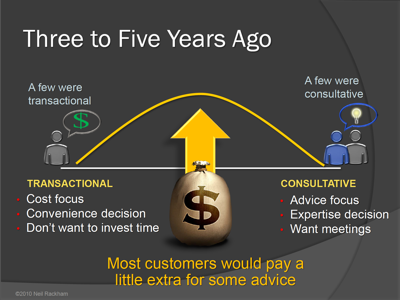
As Rackham revealed in a recent discussion at the University of Portsmouth Business School, until a few years ago, B2B customers were generally prepared to pay a little more for the benefit of getting advice about their purchase.

Transactional vs. consultative buying behaviours

Rackham_ThenThere was until recently a substantial “middle ground” of B2B buyers who were not completely transactional in their buying behaviour but at the same time did not require (and were not prepared to pay for) a full-on consultative selling relationship.

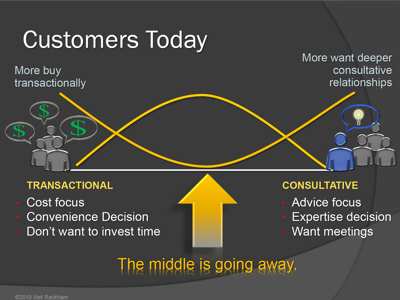
In many markets, this middle-ground-thinking represented the majority of mainstream buyers. But things have changed. B2B buying has become increasingly polarized between the extremes of highly transactional and highly consultative behaviours.

Rackham_NowPerhaps this “squeezed middle” should come as no surprise: we’re seeing exactly the same pressures in many markets. You’ve only got to look at the UK supermarket landscape, where buyers are rapidly polarising towards cost-leader brands (Aldi, Lidl and Asda) and value-based brands (Waitrose and M&S) leaving middle of the road brands like Tesco struggling to maintain their market position.

But just as in B2C, customers don't always make exclusive choices and many behave situationally: B2B customers may choose to buy some things transactionally and other things consultatively, even from the same supplier. In many situations, it’s often impossible (and frequently dangerous) to characterise customers as always being exclusively transactional or consultative.

Avoiding being stuck in the squeezed middle 

So how can B2B sales and marketing organisations adapt? Well firstly, if your customer base exhibits both transactional and consultative buying behaviours, you had better have two separate go-to-market models - a low cost transactional channel and a high value consultative channel.

Trying to “tweak” or stretch what is essentially a single underlying business model a little bit in either direction in an attempt to compromise won’t satisfy anyone involved in the process - one or other party will soon conclude that the cost-value equation is wrong.

Two buying behaviours: two sales models

There’s an inescapable conclusion: if you’re going to have to run two separate go-to-market models, you’re going to have to run two separate sales forces. No sales force can be effective if the same salespeople are pursuing both transactional and consultative opportunities.

There’s an obvious economic explanation for this: Any salesperson that is talented enough to succeed in consultative selling is too expensive to use in transactional sales where customers don’t want, don’t need and won’t pay for high-level sales talent.

But, as Rackham pointed out, there’s also a psychological reason: When salespeople manage both transactional and consultative opportunities, they invariably pay too much attention to the short-cycle low-margin transactional business at the expense of longer-cycle higher consultative opportunities - and they are often unwittingly encouraged in this behavior by the signals they’re getting from quarterly driven sales management.

Concentrating your energies

So the conclusion is obvious: remove responsibility for low-margin transactional sales from your high-cost field sales organisation and switch it to a telesales, web-based or indirect channel. Focus your scarce, hard-to-hire value-creating sales people on high-payoff consultative sales opportunities. Concentrate their energies where they can create the greatest value for both the customer and your organisation.

This is a challenging change management exercise. It’s likely that many of your sales people will resist having opportunities taken away from them. Interestingly, the smartest top performers often see the logic in it more easily than their middle-of-the road-colleagues, particularly if they feel that the company is supporting them by heavily resourcing the most attractive high-value opportunities.

You may need to implement some form of transitional compensation scheme. You may well find that the change exposes weaknesses in some of your existing sales people that may have to be addressed through training or re-assignment to more suitable roles.

Change now or have change forced upon you

It is unlikely to be a completely painless transition. But the alternative - of staying “stuck in the middle” is likely to be increasingly painful, and putting off the transition will almost inevitably mean that your hand will be forced against your will at some future date.

So - where does your current go-to-market approach fit along the transactional - consultative buying curve? And what's the risk that your current model is an increasingly uncomfortable compromise between the two?

Images ©Neil Rackham

23 Apr 14:10

To find focus in a ballooning mobile-ad market, industry leaders focus on data

by Dylan Tweney
To find focus in a ballooning mobile-ad market, industry leaders focus on data

Above: Biz Stone, one of the speakers at the Mobile Summit.

Image Credit: Michael O'Donnell/VentureBeat

Dylan's Desk, a weekly column by executive editor Dylan TweneySign up for our weekly newsletters, and you’ll get the latest insights from our Dylan's Desk and DeanBeat columns before they’re published on VentureBeat.

VentureBeat produces half a dozen events each year, every one focused on a different sector within the technology industry — but one of my favorites is the Mobile Summit.

The annual Mobile Summit, which we held last week, brings about 180 mobile industry executives to the lovely Cavallo Point Resort in Sausalito, Calif., just across the Golden Gate Bridge from San Francisco. The venue offers gorgeous views of the bridge, the bay, and the city across the water.

But mostly, it is a chance for this select group of executives, entrepreneurs, and venture capitalists to network and to problem-solve.

A lot of the action happens at “boardroom sessions” that bring together up to 20 people at a time to talk in a focused, extended way about specific issues within the industry.

The Summit this year — our fourth such event — focused on the mobile advertising industry. That was a deliberate choice given how rapidly this sector has grown in the past year. Spurred in large part by Facebook’s rapid and remarkably successful move to make money off its mobile users, the industry at large has realized that there is a lot of money to be made through advertising to people on their smartphones and tablets.

But the advertising market in mobile is a lot more challenging than the desktop Web advertising market, for several reasons.

Mobile is a different world

Tracking people across different mobile apps and devices is difficult. On the Web, advertisers have learned that it’s easy to drop a cookie on someone’s browser and then use that to identify the person in order to deliver future advertisements to them. Advertising networks may not know your name, but they know a lot about what you’ve done online recently — and that explains why, after you do a little searching for eyeglasses, grills, or underwear, suddenly the ads you see — on seemingly every site you visit — are filled with offers for eyeglasses, grills, or underwear.

That kind of “retargeting,” as it’s known in the web world, is surprisingly effective, so advertisers are willing to pay a lot for it. In the mobile world, however, it doesn’t work as well. Apple’s mobile version of Safari doesn’t support cookies. And if you’re using apps, there’s no consistent way to track what you’re doing anyway: Each app uses its own method for keeping track of its customers and doesn’t share that data with anyone else.

As a result, if you use Amazon’s app on your phone to search for swim goggles, then tweet about your search using the Twitter app, then open up Safari to do some more searching, advertisers have no way to tell that the person visiting websites on Safari is the same person that was just in the apps searching and tweeting for the same thing. They don’t even have access to data that would indicate that these three sessions came from the same device.

From the ordinary consumer’s point of view, this sounds like a bit of a relief, frankly. So advertisers can’t direct ads at me based on everything I’ve been doing — so what? It’s their problem.

But from the advertisers’ point of view, it’s incredibly frustrating. It’s also led to a lot of attempts to get around the limitations of user tracking on mobile devices. One of the companies aiming to solve the mobile retargeting problem, AdRoll, just picked up a $70 investment.

A second issue has to do with tracking the effectiveness of mobile ads. Unlike in the desktop web world, mobile doesn’t have a widespread, consistent way to verify that ads — which may appear on mobile sites or in mobile apps and games — are actually appearing where they are supposed to appear.

And it’s surprisingly difficult to tell whether the ads are even working. Say your company purchases an ad campaign that’s designed to convince people to install your new app. How do you know the campaign inspired any given app download?

What we learned

Discussions in the Summit’s closed, invite-only boardroom sessions tackled such issues as mobile local commerce, ad formats, and targeted advertising. Some of the highlights:

  • Small businesses have access to the same kinds of software tech as enterprises, so your local sub shop now has a better shot of competing with Subway.
  • Consumers have far more control than ever, which means companies need to take personalization a lot more seriously. They also need to devote a lot of effort to figuring out why consumers would care about advertisers’ messages — it’s harder than ever to stand out.
  • Native ads — sponsor messages that appear within the stream of content on publisher sites, social networks, games, and elsewhere — are quite effective. But there’s little standardization on how these ads appear, which makes them more challenging for buyers.
  • Banner ads — those little 320×50- or 320×250-pixel images you see all over the mobile web and mobile apps — are the vast majority of the mobile ad business right now, representing something like 200 billion impressions (views) monthly. But advertisers crave more because the banners are not very effective.
  • Infrastructure is going to be increasingly important as advertisers move toward video ads, which are one of the most effective formats in mobile. Your customers aren’t going to be very happy if you’re trying to deliver video ads to them in HD and their cell networks aren’t up to the task.
  • Wearables could provide tons of data to advertisers to help them target ads more effectively and appropriately. For instance, a wearable device might act as a signal that retail outlets can use to tell when you are actually in a store.
  • Since targeting doesn’t work with 100 percent accuracy in mobile, advertisers might need to be satisfied with probabilistic targeting that works with 80 percent or 90 percent accuracy. That’s going to be a big advantage for advertisers and ad networks that can do effective, real-time data analysis.

A complex and confusing market

Of course, a lot more is going on in mobile advertising. The complexity of the market has given rise to dozens — even hundreds — of networks, brokers, and analytics companies, all of which aim to help customers place their advertisements more effectively across the many available platforms and publishers.

Part of the promise of these brokers is that conducting an effective mobile ad campaign is simply too resource-intensive, if you want to manage it yourself.

In order to do that, some of these networks “rebroker” ad buys to other networks. The result is that there can be as many as half a dozen middlemen between an ad buyer and the publisher on whose site or app the ad actually appears.

As VentureBeat’s Richard Reilly has been reporting, with so many levels of brokering going on, it’s difficult to get very much insight into where advertising spending is going. Buyers may not have any idea where their ads appear, or what results they are deliver.

That leaves a lot of room for shenanigans. One such example came to light a couple weeks ago when VentureBeat reported that Supercell, a successful mobile gaming company that purchases a lot of ads, had blocked one ad partner, Appia, for rebrokering its ads.

While some companies don’t mind if companies like Appia turn to other brokers to fulfill ad placements, Supercell did — and in fact, it had put terms in its insertion orders to limit re-brokering. When it discovered Appia was doing that, Supercell blacklisted Appia from future ad buys.

One dramatic moment at the Mobile Summit happened on the first day, when Appia’s founder, Jud Bowman, stood up to defend his company from the allegations. He subsequently gave an interview to VentureBeat, laying out his case: It wasn’t Appia itself, but another unscrupulous partner, further down the line, that had gone astray.

Such is the complexity of the mobile ad market that the defense is perfectly plausible, even if it may be unsatisfying to the original buyer, Supercell.

For that reason, companies like HasOffers play a particularly important role, as they provide data to ad buyers so the buyers can see how their ads are actually performing. HasOffers, which was itself in the news earlier this year after Facebook decided to stop working with it, came up in several conversations at the Summit. Many companies, it appears, are looking for exactly the kind of accountability that HasOffers promises.

In short, analytics and user tracking seem to be the top concerns for mobile advertisers today. Meanwhile, new ad formats, wearables, and infrastructure issues loom in the wings for all players.

Come what may, it’s clear that the mobile ad economy is just getting started. If the discussions at the Mobile Summit were any indication, we’re going to see a lot of changes in the year to come.

Check out our slideshow of Mobile Summit highlights for more top moments from the event, and see this writeup of the Summit by Nanigans’ Dan Slagen.

Reblog this post [with Zemanta]


23 Apr 14:09

Pssst! Statistics Are Not Insight.

by CEB Sales & Service

This is a guest post by Kevin Starner, VP of Sales Enablement at Iron Mountain.

In my household, it’s a well-known fact: 84% of statistics are made up on the spot. I know this is a fact because I made up the statistic. But instead of focusing on the 84 percent, I’d like you to think about the other side of that statistic. What’s in the 16% that you are not considering? What’s hiding in there that can have an unexpected consequence? Is being able to develop insight something you should be able to do on your own, or expect Marketing to develop it for you?

Let me give you an example:

The average American adult spends 35% of their time searching for stuff they only find half the time. Now, most people would focus on the amount of time spent actually searching and the opportunity cost if you could reduce that time. Why not focus on what happens the other half of the time they don’t find what they need? You can guess what people, including you, do. You recreate it, buy something new, or go without. Think of all the problems and challenges that causes that you may not have otherwise considered.

Too many reps in today’s insight-led selling environment try to pass off an opening statistic as insight, with little regard to what that stat truly means to their buyers. They get excited when their buyer says something like, “I can see that,” or “Yes, I totally agree.” They use it as an icebreaker, a conversation starter. Unfortunately, at the end of the conversation, the rep typically leaves feeling like they’ve established great credibility, not knowing that they’ve missed the mark completely. 

True insight isn’t simply making the buyer aware of the statistic you led with. Anyone can find the stat or article. Your job as a seller is to help the buyer see the other side of that statistic. Change the buyer’s perception by showing them that what they are not thinking about is opening up their organization to risk or significant near- and long-term challenges.

So the big question is: do you teach your sales reps how to develop their own insight or do you have Marketing build it for them? Part of this depends on how talented your sales force is, but most of it depends on how diverse your buyers’ needs are. Transactional selling environments can benefit from a consistent shortened perspective or point of view that is much more scalable. Meanwhile, complex opportunities require a much deeper knowledge of your prospect, their industry, and the individual. In these types of opportunities, a Marketing-built insight straight out of the box will not connect as often. The best messaging requires customization.

So, whether it’s the rep or your Marketing department who is on the hook for developing these perspectives, there is one thing I can tell you for certain: statistics alone do not an insight make. It doesn’t matter if the statistic is made up or legitimately researched. That’s not where you catalyze action or unbalance the buyer’s status quo. It’s your rep’s ability to see the other side of any statistic and relate it back directly to their buyer and their organization. Having said that, be prepared to name your statistical source. 84% of you will remember this article.

CEB Sales Members, register for one of our upcoming workshops on Challenger Messaging. Also, visit the Commercial Teaching topic center and learn more about the Components of World-Class Insight.

23 Apr 14:09

How to Write Simply About Sophisticated Subjects

by Annie Zelm

How to Write Simply About Sophisticated Subjects image writing simple content

Leonardo Da Vinci said it best: “Simplicity is the ultimate sophistication.” It’s a beautiful quote, you say, but his subject matter was humanity and heavenly beings, not manufacturing or software systems. He wasn’t trying to explain the benefits of an executive recruiting firm in a tight market. His job was to create masterpieces for the sake of creating them, not boost revenues by convincing people to buy a product. You have a sophisticated audience, and you need to speak directly to them, not talk down to them.

We hear you.

One of the biggest misconceptions among B2B companies is that the content has to be heavy and unimaginative because the subject matter seems to be. It doesn’t have to be this way. Forget what you’ve learned about writing research papers. Instead, challenge yourself to educate and entertain your readers by using a conversational tone.

Here are six practices that will sharpen your ability to write about dull subjects.

Write for your reader, not for yourself.

Imagine your reader is a hospital patient with severe stomach cramps, and you’re the doctor. In that moment, you could imagine your patient doesn’t want to hear how many studies you’ve published or how your new research on digestive health could impact future treatment. Your patient only wants to hear what you’re going to do to stop the pain— right now.

Think about your buyers— the ones who actually make the purchasing decisions— and ask yourself what keeps them up at night. This is why it’s so important to create buyer personas, or customer profiles based on interviews with those who previously purchased your product or considered a purchase. A quick search of a Q & A site like Quora or Google Bazara can give you clues on what kinds of questions people are actually asking about a specific topic so you can use that to guide your content.

Don’t tell them what you think is most impressive about what you do. Tell them exactly what’s in it for them and how you’ll meet their needs. They’ll be so thankful to you for offering to solve their problems, they’ll put you on their short list when they’re ready to make a decision.

Set the scene.

Let’s say you’re trying to convince your readers to try your recruiting software. Before you fall back into the habit of telling your readers about its benefits, stop right there. Da Vinci knew a picture was worth a thousand words. Your job is to paint one. Let your words take them to a Fortune 500 financial services company that manages more than 40,000 employees. Let your readers imagine what it’s like to be the hiring manager tasked with bringing in 30 employees by the end of the month. Your readers can relate to the feeling of being flooded with emails from candidates who expect to be hired with no prior experience.

Be descriptive. Use active verbs. Whenever possible, use relevant examples and quotes from real people. Use analogies to make a concept more visually interesting, and tie them into current events when you can. Here’s an example of a writer who drew comparisons between marketing and draft day, something any sports fan can visualize.

Imagine you’re talking to your college pals.

Many businesses are afraid to write the way they speak because they want to sound professional. They refuse to use sentence fragments or words that sound too casual. The problem is their “professional” language is sterile and makes them sound like every other business in their industry.

As long as it’s done tastefully, taking some creative liberties won’t undermine your credibility. Use strong language, active verbs and phrases that lend themselves to imagery whenever possible. Consider this introduction on the homepage of a manufacturing company that produces custom parts and equipment for businesses:

“Specializes in the Engineering and Building of Manufacturing Processes and Equipment for Assembly, Welding, Machining, Press Room Automation and Testing! The Talent and Experience we bring to your program, Insures you get the Best Results, Cost Effectively!”

The introduction on this website is a full six paragraphs. Most of the words are capitalized and bolded, and there’s an exclamation point after nearly every sentence. By the time you get through reading it, you realize you’re shrinking into your seat in an instinctive response to all the shouting. I’m willing to bet this is a group of highly talented mechanical and electrical engineers, but they sound like some fast-talking hosts of a late-night informercial hurling one pitch after another. That’s not the worst part. It’s the fact that when you actually take in the words, they really don’t say much about the company’s identity.

This could be the best equipment manufacturer in the Midwest, but it sounds like any other company. There’s nothing here to distinguish what makes it different, although it does mention its location and proclaims, “We Proudly Support our Troops.”

That’s fantastic, but most people would agree they support the troops, as well. I’d like to know what this company is doing specifically to show their support. Do they have a program to hire veterans? Do they partner with the USO? If so, they should emphasize it to illustrate their identity.

Here’s how this company might consider rewriting that paragraph:

“Transform your aging assembly line into a profit-producing machine with specialized equipment designed by the same engineers who built self-propelled artillery for the U.S. Army.”

Now the company is using its engineering and military expertise to build a unique identity.

Use humor.

Yes, your audience may be CEOs, CFOs and medical professionals, but they’re still people. People appreciate a good chuckle now and then. Think about your reader’s biggest source of stress and look for the humor in it when you can. Are they having a hard time attracting qualified candidates? A 30-second video of amusing interviewing faux pas might resonate.

What’s funny to you may not get a laugh from someone else, so think about where your audience goes for a good time. Maybe it’s the golf course or the shooting range. Could you use a hunting analogy to describe the recruiting process?

Here’s a great example of how Cisco used a lighthearted video to show how its company uses technology to target products to the right customers.

Ask a recent college graduate if he or she can grasp the general idea of your piece. Better yet, ask your teenager.

Although your ultimate goal may be a meeting with the C-suite, don’t assume they’re making the decisions about your product. More than likely, it’s going to be a mid-level gatekeeper— perhaps an executive assistant, a human resources manager or department supervisor— who is tasked with obtaining quotes for your product or service.

The first person to visit your website may or may not have a college degree. She may not have any experience with your industry at all. Assume she doesn’t, and it’s her first week on the job. If you’re using industry jargon or unfamiliar acronyms, you’re losing her. That goes for generic business clichés, too. Leave out the talk of core competencies, leveraging and low-hanging fruit.

Take a chisel to your copy. Then go back with a hacksaw.

Like cutting ties with old college friends, editing is a painful but necessary part of your writing’s development. No matter how brilliant your words, you have to part with some of them. Start by losing the least significant: the cliches, the redundancies, the superfluous words. Imagine every “that” or “very” is a curse word infecting your copy, and you’ll see them in a different light.

That’s the easy part. For the harder part that involved hacking away entire sentences or paragraphs that aren’t working, you need the kind of friend or colleague who gets right to the point. Ask this person  to eliminate anything that doesn’t strengthen your piece or isn’t important to your readers.

What works best for you when you’re trying to use a conversational tone to talk about complicated subjects? Share your ideas in the comments below.


How to Write Simply About Sophisticated Subjects image 07d95530 47d2 4975 ad98 07125260daac1
photo credit: Lívia Cristina How to Write Simply About Sophisticated Subjects image

23 Apr 14:09

Sales Presentations That Win Start With Messaging That Works

by John Fakatselis

Sales Presentations That Win Start With Messaging That Works image 482254929

Our last post was about sales and marketing alignment strategies that promote company cohesion, workforce productivity and content creation. But what good is alignment if your sales presentations aren’t … selling? It’s time to take control of your messaging and sales enablement with effective content management.

You need to part with those pre-packaged PowerPoint slides and start hitting home with power and precision.

Winning sales presentations hit home with POWER.

Static slides and stale statistics? Let’s face it: Your sales presentations are boring. And in this age of “sub-goldfish” attention spans and 10 blinking seconds of opportunity to make digital impressions on your buyers, lackluster presentations simply don’t cut it.

Say no more to sales presentations that leave prospects yawning, fidgeting and pleading with time to tick faster. Say yes to presentations that spark an exceptional B2B buyer experience and plant that winning seed of sales enablement.

So, powerful presentations are the only way to go if you really want to win. Now onto the content management software that fuels those potent presentations with hyper-personalized messaging.

Winning sales presentations hit home with PRECISION.

If content is king, then technology is his fiery and efficient queen. Put them together and you’ve got yourself a fully decked court for marketing content that’s precision targeted for each buyer persona.

Content management software puts you in control of your messaging strategy and empowers your reps with persuasive presentations that overhaul their sales game and undercut your competition. Here’s how:

  1. DIFFERENTIATE content.
    All messaging is not created equal.

    Distinguish core messaging from individualized messaging, the latter of which is strategically tailored to each buyer persona.

  2. MANAGE content.
    Different messaging requires different attention.

    Work with core-value materials and persona-personalized materials separately, giving each content camp the scrupulous consideration it deserves.

  3. EVOLVE with buyers.
    Buyers aren’t static, so your messaging must adapt to their ever-changing needs, preferences and perspectives.

    Change applicable messaging and specific content pieces when needed, quickly and seamlessly, without having to scrap it all entirely and start a bulky, drawn-out rewriting process.

  4. EMPOWER sales reps.
    Your sales team must create exceptional buying experiences.

    Make it easy for reps to 1) sift through your pool of core-value messaging, 2) inject the persona information that’s specified for their buyer of interest and 3) feather in any notes, additional resources and “wow” factors to clinch that personalized experience and win over today’s savvy, formidable and information-intensive B2B buyer.

  5. STRENGTHEN the seams.
    You must be nimble in your tactics, but constant at your strategic core.

    Keep your messaging consistent and your brand defined for stable and sustainable sales enablement.

The takeaway? Ditch the passive pitch.

You can no longer afford the passive pitch: treating your buyers as spellbound objects of your sales speak. If you really want to hit your message home, you must make your buyers active players in your sales game.

With the right technology, you’re ready to cut the salesy monologues. You’re ready to truly engage your buyers with precision-targeted messaging and powerful presentations for winning sales enablement.

Stay tuned for our next post on sales portal technology that allows your sales reps to combine the best of their vocal and written skills for captivating, multi-dimensional buyer experiences.

Sales Presentations That Win Start With Messaging That Works image 71275753 d636 42df a032 ed44ae8a27d8

23 Apr 14:09

The New Face of Procurement

The power of data-driven business networks is increasing, but how do enterprises best leverage that intelligence as they seek new services, products and efficiency? The next BriefingsDirect thought-leader panel discussion focuses on the future of business and how companies can benefit from the new insight and analysis that transparent business networks and processes allow. The power of data-driven business networks and the analytics derived from them are increasing, but how do enterprises best leverage that intelligence as they seek new services, products and efficiency? How do automation and intelligence enter the picture for better matching buyers and sellers?

read more

23 Apr 14:08

How do YouTubers fit into YouTube’s “Google Preferred” plans?

by Liz Shannon Miller

YouTube’s most popular creators bring in millions of views. Their audience is young, and should be every marketer’s dream. However, their content has yet to draw the kind of ad rates that will be sustainable in the long-term, which is why during next week’s NewFronts, YouTube is going to highlight thousands of selected channels to potential advertisers.

The question is: How many of these are native YouTubers, and what does this selection tell us about the future of YouTube?

As reported by Tubefilter and the Wall Street Journal, YouTube has curated a selection of channels  that represent the top five percent of YouTube across fourteen categories:

  • Anime/Teen Animation
  • Beauty
  • Cars
  • Comedy
  • Entertainment/Pop Culture
  • Family
  • Food
  • Music
  • News
  • Science
  • Sports
  • Technology
  • Video Games
  • Wellness

The “Google Preferred” initiative, as it’s known, will showcase for advertisers exactly what kind of content they’re buying ads against, and also reserve space for advertisers who commit to buying into top shows. It’s also promised access to a highly desirable demographic — from the Journal:

Ad buyers say YouTube has been making presentations to advertisers with comparisons of the audience makeup of YouTube versus the makeup of audiences of cable networks such as ABC Family. These comparisons showed that YouTube reached more people in highly coveted demographics, such as people aged 18 to 34, than many high-profile cable channels.

The range of content — from online video mainstays like The Young Turks to the official channels for The Ellen Show and Jimmy Kimmel Live to nearly any popular beauty vlogger you might care to mention — is massive.

Using Tubefilter’s list of 400+ channels, which reflect the top one percent of channels involved, I went category by category to see how many came from YouTube-grown talent. The results were a pleasant surprise — with a few exceptions, the split tended to lean towards the YouTuber side.

The categories that were dominated by outside brands weren’t too surprising. Music does showcase some artists who developed audiences through YouTube, including Lindsey Stirling and Pentatonix, but the majority of the channels come from pre-established artists and record labels.

Sports also shows a reliance on pre-existing brands, though it did feature a few YouTubers with unique takes on the genre, such as DevinSuperTramp and Dude Perfect.

And the majority of the News category is dominated by channels for long-standing journalism mainstays like Vice, ABC News, the Associated Press and the New York Times. Even The Young Turks, which has become a true YouTube success story, was originally born as a talk radio show.

The trend I observed — if a category had clearly defined roots in traditional media, the more channels it included from outside brands. Conversely, if a category came from traditions and genres born of YouTube, the more likely it was to be dominated by YouTube originals.

For example, one category was completely dominated by YouTubers — Beauty. All 40 channels, to the best of my knowledge, come from women who have built their followings primarily on the video platform; given how specific the genre is, and how much it owes to the vlog format, this makes a lot of sense.

The Tubefilter list isn’t a complete list of the channels being offered up to advertisers. But it does show that YouTube is not only committed to highlighting the content that’s working, but that by and large the YouTubers who have been a part of the site from the beginning are a major part of its plans. Because making more money off its ads doesn’t mean YouTube needs to stop being YouTube.

Related research and analysis from Gigaom Research:
Subscriber content. Sign up for a free trial.

23 Apr 14:06

4 Great Ways to Collaborate with Sales

by Corey Mull

One thing we’ve heard again and again is that the biggest (surface) failing of existing lead development programs is that Sales doesn’t trust the outputs: in other words, Sales doesn’t believe that they produce ready-to-buy prospects. Marketing, however, is sure that they do. And therein lies the impasse: if Sales won’t act on marketing-generated leads, how can Marketing ever be sure if the leads they’ve generated are worth anything?

I mean, this isn’t Sales’ fault, exactly. In most organizations, a significant part (or the entirety) of their salary is commission-based. Why mess with what works, particularly if it means you can’t pay your bills? But it goes deeper than that: if Sales doesn’t trust Marketing-generated leads, there must be a reason beyond simple inertia: Marketing and Sales simply don’t agree on the way the market works for the products and services they sell.

And so the key to Marketing and Sales collaboration is to build a truly-shared vision of the market and how it works. Here are a few ways we’ve seen this work. It’s not that these are easy – far from it – only that they’re likely to surface the fundamental disconnects between the Sales and Marketing organizations.

  • Collaborate on a shared vision of the customer. In this post we talked about how Marketing mostly endorses – perhaps without realizing it – an information-based vision of the customer. Most of our lead management systems are based in a simple equation: more information consumed = greater likelihood of buying. It stands to reason that if they’re not taking the leads we generate and nurture seriously, Sales must, at some level, disagree with this assessment. Establishing some common principles about who a customer is and how they operate is a start to bridging this gap.
  • Create an inventory of existing customer information. Collectively, commercial organizations know a ton about their customers and how they think and operate – but the information is typically housed in silos. A starting exercise in a more broader collaboration is putting all of this information in one place to the extent possible – and it’s a task that will feed greater collaboration down the road. Learn more about how to do it here.
  • Establish an ongoing information sharing system. It’s not enough to simply share information once and be done with it; there must be an ongoing, formalized system for sharing new information. We’ve seen members do this by establishing knowledge management systems like wikis; but it’s also important that information be actionable and valuable. See how others have done it here. 
  • Find areas for tighter integration. Our Commercial Integration Diagnostic measures your Sales and Marketing team’s integration across 20 key attributes that drive the success of the broader commercial team. Check out where you need to be on the same page, and launch the diagnostic (it’s free!) to find areas where there’s more work to be done.


23 Apr 14:06

Marketing Needs a Chief Marketing Technologist

by Bob Sullivan

Marketing_AutomationToday's technologies have come a long way from green-bar printouts, spreadsheets, bulky calculators, and slow-speed modems. High-tech tools are creating more value and intelligence from ever-increasing data and analytics -- and with a good ROI.

When technologies first arrived at companies, the IT department generally oversaw and managed the software, hardware, systems, and programming for all departments – including marketing.

With increased complexities and the need for fast updates and upgrades to meet specific challenges and opportunities, marketers are finding that they are better off having their own Chief Technologist. According to Gartner, nearly eight out of ten organizations now have the equivalent of a Chief Marketing Technologist (CMT) and over seven out of ten CMTs report directly to the marketing department.

New technology-related strategies and processes, such as marketing automation, CRM, web analytics, and SEO auditing, require that marketers master their own technology.  For this, the marketing department needs a Chief Marketing Technologist who can interface with other C-level functions and bridge the gap with IT.

Six Reasons for a Chief Marketing Technologist


  1. Agility: Having technology and effectively using it are not the same; for example, to get the most from marketing automation or a CRM system, a marketer needs to know how the technology system works so he/she can adapt the technology to all marketing needs.
  2. Speed: The internet, social networking, data communications, and other techniques provide opportunities for marketers to respond quickly. This response is best achieved by someone in marketing – a technologist to handle the technical aspects of agile marketing faster than IT could and without possible misunderstandings between marketing and IT on what is to be done.
  3. Costs: Being responsible for and controlling marketing's technologies, the CMT can budget according to marketing's technical needs. By contrast, IT's priorities for various departments served may not be in line with a given department's requirements.
  4. Marketing's destiny and a company's success: Because digital is transforming both marketing and business, marketing and technology are becoming intertwined. The results: technology takes over marketing and marketing dominates business.
  5. Data quality: Marketing, sales, and other functions depend on up-to-date, clean, and complete data. It is important that marketing, which initially enters leads, be aware of what happens to the data provided to sales.
  6. Customers are using technology, too, researching online for information before talking with a sales rep. This requires that marketing be more involved with sales in the overall lead-to-sale process.


Responsibilities of the Chief Marketing Technologist


  • Consult with and update the CMO about marketing strategies and technologies.
  • Train the marketing team to get the most from marketing technology, relative to marketing and its relationship with sales, customer service, and IT.
  • Work with other C-level functions to assure that all of their company's technologies integrate satisfactorily.
  • Work with IT to assure that marketing's technologies comply with IT's standards.


Qualifications for the Chief Marketing Technologist


  • Beyond accomplishing a company's marketing mission, have a zeal for how technology can help to achieve marketing's goals.
  • Have a working knowledge of technologies.
  • Have good interactions with company officers, especially with IT.
  • Be able to manage projects and teams.


If you would like additional resources on how marketing can be the master of its destiny and, in turn, your business as a whole, please contact us at 800-897-9807, x224.

23 Apr 14:05

How To Run An Influencer Marketing Campaign: 3 Key Steps for Brands to Make The Biggest Splash

by Mila Araujo

The measure of success of a campaign is not how many impressions your hashtag gets.

The measure of success is how much good will, activity, and energy you get buzzing about your brand.

Those who measure influence tend to get this concept and do a good job selling it, but I wonder how much prep and coaching about this they give the brands that buy influence marketing campaigns.

Here are 3 Steps to ensure the success of an influence marketing campaign for brands

Here’s how to do it right:

I’ve spoken up about my views on Klout, and other influence measurement programs in the past. They have come a long way in the past couple of years, and I for one am glad of the potential of the direction I see things going in. With some strategy influencer programs provide the opportunity for some win-win situations for both brands and influencers. Most recently, I offered some advice to brands looking to run successful influence marketing programs on Mark Schaefer’s blog {grow} in my article : A plan to earn your way into the hearts of Internet influencers , here’s an except from that article, which covers Step 1.

STEP 1: Find something that really delivers value

The key to finding influencers is by providing people with value directly related to their field of interest.

  • Give them something that makes their lives or work more efficient (tools, technology, apps)
  • Offer an unusual experience (huge opportunity in the travel and hospitality industry).
  • Solve a problem
  • Create content that will be highly valued by their audience
  • Offer exclusive access. They don;t want to run an infographic or review the same product being sent to a thousand other people.

STEP 2: Make everyone in your company aware of the campaign and gain their support

The moment a marketing campaign goes out over social networks, you can’t just throw it to the wind and see where it goes. You must provide support. The more support you have the better.

Devise your response plan.

Make sure you have set up monitoring tools to monitor the hashtag, and anything else related to your brand. mentions of your brand name, tweets to your brand, Facebook Hashtags, Instagram posts. Do keyword searches! If someone out there is talking about this campaign or anything related to it, have to be all over it.

The campaign does not have to be limited to the influencers participating in the program. There’s a good chance others are dialoging with your influencers as they share the story of their experience – want to make an impression – get in on all the conversaton!

  • Send tweets over the open network so that everyone can see the conversation. Knowing Twitter communication styling helps to understand who can see the tweets you send. Keep the whole dialogue public if its for the campaign.

Did you know you can make a HASHTAG button on your campaign page to help people tweet mentioning the hashtag?

It’s a great way to help people join in on the conversation!

Everyone should get on board.

I recently presented a talk in Quebec City on true Social Business. One of the main points I made in this talk was that the first line of influencers are the people who are talking to your clients every day. These people are not the marketers, they are the inside staff, the customer service people, the sales people, even your receptionist! Make them a part of the campaign by letting them know about it and find a way to share what you are sharing externally, with them as well!

Keep dialogue going!

  • You must set up monitoring on the activity of the influencers you selected to participate in the campaign and keep them engaged.

You think the work went into building the campaign, well think again, this is the moment to shine. It’s show time. You need to ramp up your social activity and monitoring so you can fully mazimize the coverage you get. Influence marketing only works when you’re making an impression. Get out there and help your influencers show you off.

Simple tip: Make it clear to your community management team – if you are mentioned you want a response going out. Shine some light on your stars, give some gratitude!

It’s one thing to see an influencer send out pictures or talk about a brand, it is far more valuable to see your influencer talking to the brand in the public eye. That’s where the consumer starts to take the kind of notice that influences opinion and support.

  • Make sure that your team understand how to respond, draw in more people, and not just simply respond. It’s the art of conversation, are you answering communications with with open ended or closed ended responses?

Jack was determined to be the new #puppy #CTSDrive spokesmodel- he didnt want to give it back :) @CadillacCanada pic.twitter.com/AbJx0sonQ1

— Mila Araujo (@Milaspage) April 14, 2014


Maximize, Maximize, Maximize!

  • If your influencer draws more people into the conversation, pay attention to them too, they are important. If new hashtags are introduced, have some fun with that! Every hashtag represents a potential new community. You have a lot more to monitor than just the one you created.
  • Create a Twitter List of the people who are active, and check in on the list to see what’s going on.

Sometimes people forget hashtags!

Pick up the mentions with your list and hashtag them with your reply or retweet.

  • Create a Google alert with some keywords from your campaign to see what people are talking about online and in blogs, or even news.
  • Finally – Ask your customer service people, your sales people and everyone and anyone in your company to keep their eye on the campaign. You may even want to offer prizes to internal staff who keep things rolling. When you have a whole team behind you, you will see success!

STEP 3: Analysis to steer direction and keep things going.

How To Run An Influencer Marketing Campaign: 3 Key Steps for Brands to Make The Biggest Splash image Powerful Tracking for Hashtags Campaign management tools by @Milaspage

Make sure to set yourself up before this higher activity period to be able to analyze what is going on. Companies like Hashtracking (a personal favorite of mine) can create reports that can really supplement your efforts during the event and afterwards. They can give insight and leads. They also provide insight into how the conversation is shifting around your campaign hashtag so that you can move with the campaign and keep things going.

How To Run An Influencer Marketing Campaign: 3 Key Steps for Brands to Make The Biggest Splash image @Hashtracking offers Powerful Tracking for Hashtags Influencer Campaign Management Tools by @Milaspage

Your campaign is meant as a stepping stone to greater things. Make sure you use this opportunity! You’re going to make an investment when you decide to use influence marketing, the more work you put into it, the greater the returns. Jugnoo is another company that offers some very interesting monitoring and response tools, with their SoMeAnalyzerTM .

How To Run An Influencer Marketing Campaign: 3 Key Steps for Brands to Make The Biggest Splash image Jugnoo Manage Your Social Media Presence

I recently had a chance to explore their platform, and I strongly recommend them as well. With reporting, team management, and listening/sentiment tools they can set you up to not only monitor the campaign, but manage your response team and help keep everyone moving in the same direction to support and maximize the value of your investment in your outreach program. The reporting features are very interesting and the various capabilities they offer not only give you what you need, but can help you springboard onto new ideas. Also noteworthy is that it allows complete management of various campaigns and team creation, and according to Joseph Olewitz, SVP Global Business Development, they are the only engagement tool that also provides both an analytics overlay and visualization of the conversation stream. Definitely worth checking out.

How To Run An Influencer Marketing Campaign: 3 Key Steps for Brands to Make The Biggest Splash image Jugnoo Manage your social media presence with visual and reporting capability by @Milaspage

For more screen shots and examples, click here.

A final note: This is Real Time Marketing Opportunity at it’s best!

Are you ready to make it happen? To end this post on a fun note, below is a collection of the hashtag experience from my #CTSDrive by Cadillac. You can see the variance in energy that is created in tweets and shared across the various platforms.

  • As a brand, how would you maximize these communications?
  • Will the steps outlined above help build stronger and smarter influence marketing programs with more reach and longevity?

I think so, what about you?

23 Apr 14:05

Four Ways Your Sales Team Benefits From Inbound Marketing

by Kevin Page

Four Ways Your Sales Team Benefits From Inbound Marketing image 186404918 resized 600 300x300Inbound marketing can positively impact many areas of an organization, although it is sometimes difficult to see the direct benefit supplied to each.

It is important to understand the encompassing advantage inbound marketing provides to specific functions within the organization; only then can you see the entirety of inbound marketing’s value to the organization. In this post, I’d like to explore the impact of inbound marketing on my specific function – that of the sales team.

If a company embraces inbound marketing techniques, the sales team is surely one of the primary benefactors.  It may seem a bit obvious, although the historical division between sales and marketing has engrained many organizations with a misunderstanding in this important fact.

As a part of the business development unit here at Synecore, I am speaking as one of the principal benefactors consuming the fruits of inbound marketing’s labor.  I am confident when I say that your sales team will be whole-heartedly grateful to do the same.  Don’t believe me?  No bother, I’ll continue to persuade you by sharing the four major ways your sales team benefits from inbound marketing.

Lead Generation

Through the efforts of inbound marketing, your organization will create (either in-house or outsourced)  compelling content optimized with call-to-action buttons that link to landing pages.  These initiatives work to attract prospects and help them easily navigate your website to find the additional resources you offer.

The intent is to provide them with enough value that they will interact and voluntarily give their contact information and thus turn into viable leads.  Throughout this process, the sales team will be fed a list of new leads who are interested in the resources your company has provided. At  this point it is worth noting that your sales reps have yet to lift a finger during this automated lead-generation process.

Establish Initial Contact

Picking up right where I left off from the previous paragraph, thanks to automated lead generation, the sales team has a steadily growing pool of leads that have interacted with the company website.  Now, when the sales rep picks up the phone or sends an email, they already have the foundation of the relationship.

Each lead has initiated the connection with your company, eliminating cold calls and other unsolicited sales efforts.  In addition, your sales rep can now tailor his or her phone call/email message to align with to the lead’s journey through your website. If the lead grabbed a particular eBook, your rep can leverage the eBook download as a context for the initial conversation.

Just like that, your cold call is now a warm call with whom it is much easier to establish credibility and develop a relationship.

Enhance Your Position as an Industry Expert

When I mentioned “establish credibility” in the point above, I was touching on the enhanced position achieved by the sales rep through the inbound marketing efforts of the organization. It is no surprise to find that people tend to put their shield up in defense when they receive a sales call; it is the sales rep’s responsibility to resolve objections and convey your company’s unique message to interested prospects.

When communicating with a warm lead, the objection resolution success rate is much lower than when cold calling. If the sales rep connects with a lead over the phone, they can leverage the fact that the lead was interested in their content online. By simply stating your organization’s name, the lead has no doubt you are a real company. Moreover, the lead already considers your brand somewhat of an expert from the resources they’ve gathered on your website, and they likely will be much more willing to hear how you can benefit them further.

Your sales rep can further enhance this perception by encouraging leads to consume other relevant pieces of content from your website in an attempt to establish your company as the “go-to” source of insight and information.

Build Lasting Relationships

Even after a lead has completed their initial research on your website, they may not be quite ready to buy; they will most likely continue their search elsewhere and gather more resources.

If you’ve established your company as an industry thought-leader, they will be more likely to revisit your website for resources and continue to build a relationship with your brand. Your sales rep will have an easier time building a relationship with a lead who feels like they’ve already built a lasting relationship with your brand.

Through the efforts of inbound marketing and the personal touch of your sales rep, your company should consistently offer insights, suggestions, and more resources to leads in order to increase their trust in the rep and in your brand.

Takeaway

There are many more benefits that inbound marketing provides to an organization’s sales team, although these four stand out in my mind as the most impactful. By establishing initial contact and encouraging interactive behavior on your website, inbound marketing takes a substantial amount of work out of the sales process.

I challenge you to avoid sweeping these many advantages of inbound marketing under the rug and remain stagnant with your traditional marketing efforts; embrace inbound marketing methodology and be sure to analyze its impact. You won’t be disappointed with the results.


Four Ways Your Sales Team Benefits From Inbound Marketing image 52ba53d1 14fb 4d19 9dda abcb8a82b43b28

23 Apr 14:05

If Your Business is Not Using Social Media to Increase Sales, Why Are You There?

by Laura Donovan

If Your Business is Not Using Social Media to Increase Sales, Why Are You There? image Social fingers

A recent blog we read told us that we should NOT use Social Media if we want to sell our stuff. The idea was that you should get to know people personally, help solve their problems and if you never make a dime, you will be more respected. Sounds good. But for most of us, making those dimes is what keeps us in business (and eating … and paying our rent).

While the strategies involved in “inbound” or social media marketing are slightly different than traditional marketing, it is still marketing.  If your participation will not be at least one reason people buy from you, why would you waste your time, effort and money?

While developing personal relationships has been a marketing tactic for centuries, the idea of developing relationships “online” was born at a time when interactive websites became a reality.  Relationships that once relied on geography could now be developed with people all over the world.  (Even hyper local businesses selling to a defined geographic area may find it difficult to meet all potential customers; social media marketing is an opportunity to reach even more local people than would be possible in person.)

While strategies surrounding online Social Media marketing have evolved over the last few years, the basics remain the same:

People do not want to be “sold to,” they want help making their own buying decisions.

It is the job of a good Social Media Marketer to give people the reasons they need to buy – in other words for the business to make a sale.

Here are a few myths that have been put forth by a few Social Media Marketing “experts,” and our answers:

  • Social Media is not for sales

False – 47% of users say Facebook has the greatest impact on their purchasing behavior. (Jay Baer)  Social Media is where people are looking to buy products and services.  Users “friend” a Page to obtain information about products and services. Facebook is often where they make their purchasing decisions. Social media has a 100% higher lead-to-close ratio than outbound marketing. (State of Inbound Marketing, 2012) So tell them what you are selling.

  • Social audiences don’t want your sales messages 

False – 80% of US social network users prefer to connect to brands through Facebook. (HubSpot) People are seeking specific information regarding products and services.   Using Facebook ads gives you the opportunity target very specific markets. In fact, Facebook’s recent changes have been aimed specifically at making their ads bigger and more useful. Because Facebook ads can be so finely targeted, effective AND cost effective, they are one of the best ways for businesses to reach their exact demographic, geographic and psychographic markets.

  • It’s not about you it’s about your customers 

False – 50% of leads are qualified but not yet ready to buy. (HubSpot) Give them a reason to buy. Help them understand why you have the products and services they need. Give them information about your company so they can make an informed decision.  Provide enough details and give them a special discount so you can take those 50% and make them customers.

  • It is better to use the Social Networks to engage not advertise 

False – Social Media is the new advertising platform. Providing useful and interesting information is important to help people make buying decisions. A few amusing cartoons and interesting images will get their attention. While these and other tactics that personalize a business page should definitely be a part of the overall strategy, the bottom line is that Social Media is the New Advertising Platform. It is becoming even more important as print media shrinks, phone books are thrown in the recycler and TV ads can be skipped with a push of a button.  AT&T, Disney, Netflix and Weight Watchers are just a few companies that use Social Media Advertising successfully.  You can too.

    • Social Media is all about personal relationships 

False – To become a trusted business you must have a base of customers who can tell their networks how good you are. These customers want to understand and then purchase your products and/or services. They don’t want to be your personal friend. They want a deal, a discount or a special offer. They want to feel satisfied that they have gotten the best quality product at a fair price. Once that happens, they will tell their friends about you.  Stop trying to be best friends with your followers and give them what they want.

False – To become a trusted business you must have a base of customers who can tell their networks how good you are. These customers want to understand and then purchase your products and/or services. They don’t want to be your personal friend. They want a deal, a discount or a special offer. They want to feel satisfied that they have gotten the best quality product at a fair price. Once that happens, they will tell their friends about you.  Stop trying to be best friends with your followers and give them what they want.want to be your personal friend. They want a deal, a discount or a special offer. They want to feel satisfied that they have gotten the best quality product at a fair price. Once that happens, they will tell their friends about you.  Stop trying to be best friends with your followers and give them what they want.

If Your Business is Not Using Social Media to Increase Sales, Why Are You There? image Smarty cat

The Bottom Line

Social sites like Facebook, Twitter and Pinterest are becoming major players in the world of advertising. Walmart has over 34 million Facebook Friends, Starbucks has over 90,000 followers on Twitter and Target has over 157,000 followers on Pinterest. Ask yourself, would they be using Social Media Marketing if it wasn’t improving their bottom line?

23 Apr 14:05

6 Ways to Boost Brand Awareness Using Facebook

by Kristin Hovde

6 Ways to Boost Brand Awareness Using Facebook image fb marketing 300x105

Facebook has continued to be one of the top social media websites used by small and large businesses alike. Many companies have even increased their digital marketing budgets to allow for more Facebook marketing. In fact, according to Hubspot, 55% of marketers worldwide have increased their digital marketing budgets, while 52% of all marketers have found a customer using Facebook.

If you haven’t quite generated the amount of leads or customers you want from this social media tool, these tips will help you get the website traffic and popularity you are looking for using Facebook.

6 Ways to Boost Brand Awareness Using Facebook image facebook personal page promoted posts 300x182Posts Don’t Always Have to be Company-Related

Instead of constantly posting promotional links or articles, let your audience know about something going on in your personal life to give your Facebook page a more lifelike feel. For example, if you have gone on a trip or had something entertaining happen to you, let your fans know about it through pictures and text. Your audience will be able to connect with you more on a personal level if you remind them that you are more than just an employee or business owner.

Of course, keep most of your posts business-related by following the 80/20 rule: 80% of your posts should be related to your brand or business, while the other 20% should have something to do with your personal life.

6 Ways to Boost Brand Awareness Using Facebook image respond to fb comments 300x162Respond to Comments

Don’t leave your audience hanging by not responding to their comments on your Facebook page. Did someone post how much they like your product? Or did they have a question or concern with your products or services? Whatever may be written on your wall needs to be responded to. Let fans know how important their comments are by writing a simple reply to their post in order to keep the dialogue going and keep your audience engaged.

6 Ways to Boost Brand Awareness Using Facebook image call to actionCreate a Call to Action

Sometimes all it takes is a sense of urgency to give people a reason to visit a website or make a purchase. This could mean telling your audience that the first 100 people to post on their wall, purchase a product, or give their opinion on a specific topic will get a free eBook or other promotional item. Another example would be to host a live podcast that can only be listened to at a certain time. It’s amazing at what people will do when they know their time is limited to respond to a call of action.

6 Ways to Boost Brand Awareness Using Facebook image engaging content facebook 300x206Have Educational and Engaging Content

Articles and videos should not only be to sell a product or service, but should also include helpful content that fans can use. This could include anything that your customers will find interesting in your industry. Your audience will be more likely to read and “like” your posts if it contains useful information.

Make the Most of Word-of-Mouth

One of the most powerful marketing tools is word-of-mouth because most people trust brands or companies that their friends or family recommend. To get people talking about your company, create a contest or reward system that customers can win by spreading the word about your business.

6 Ways to Boost Brand Awareness Using Facebook image monitor fb page 300x219Monitor the Facebook Page

In order to do this, you need to ask yourself what you are trying to achieve on your page. Do you want more leads or likes? Do you want to get a specific amount of sales using the social marketing medium? Once you know what your objective is, track the success of your posts to find out how much traffic is coming to your website.

I predict Facebook will continue to thrive as an in demand marketing tool. With these tips you’ll be making the most of your Facebook campaign, increasing traffic to your website and generating new relationships.

22 Apr 14:55

Keeping your pitch simple

by Corporate Visions

cmmGiving your prospects more choices and options is a natural instinct. You’re thinking that you’re “adding value” to your story and differentiating against your competitors.

 After all, how often have you heard the phrase, “our differentiation is the ‘depth and breadth’ of our product line,” as if having the most products, services, configurations, customizations, and options actually make the case for choosing you.

Customers Are Wary Of Too Many Choices
According to research, adding complexity to your customer story and conversations actually hurts your cause. Analysts call this “choice overload” and it can cause people to avoid choosing you, even when it goes against their own self-interest. In other words: You may be the absolute best choice for your customers, but they may choose your competition because your offerings appear too complicated.

Sheen Iyengar, author of “The Art of Choosing,” gave a great TED talk on this subject a few months back. (If you are a marketer or salesperson and have never seen this talk, I suggest dropping whatever you’re doing right now and spending the next 16 minutes listening to Sheena’s ideas. The video is a must-view.)

The Art Of Choosing
In her talk, The Art of Choosing, Sheena identifies three negative consequences associated with “choice overload.” (The words in italics are my editorial comments.)

1. Buyers are more likely to delay choosing or not choose at all. (You’ll see no decision or the customers will stick with their status quo.)
2. Buyers are more likely to make worse choices for them. (They’ll pick an inferior competitor.)
3. Buyers are more likely to choose things that make them less satisfied. (They’re unconvinced and worried about whether they made the best choice.)

So how do you avoid these overload traps to share enough information with your customers and prospects to be helpful without inundating them? Sheena suggests four simple techniques. (Again, my editorial comments are in italics.)

1. Cut: Get rid of extraneous, perceived redundant offerings and options. (Focus your story on a distinct point of view.)
2. Concretize: Make choices more vivid by showing them the consequences of each choice. (Make your story visual to provide contrast to help solidify the right choice.)
3. Categorize: Segment choices into categories to ease the complexity if you struggle with streamlining the choices you offer. (Show things as “similar, but adjacent” and as a result, a distinct, separate choice.)
4. Condition (for complexity): Ease into complexity by starting with fewer choices and gradually introducing more in the process. (Use simple, concrete messages aimed at the “old brain” decision-maker early, and then add the analytical detail needed by the “new brain” to justify and validate later.)

So, the next time you’re tempted to add another slide to your PowerPoint presentation, or the next time you’re told to introduce a complicated ROI calculator or solution configurator into the early sales discussion, or the next time you see your company touting “the many choices you have to offer” as your biggest virtue, STOP. The research doesn’t lie. Remember that your story is about the “chooser,” not the “choice-maker.”

*This article originally appeared on CMO.com. To read more of Tim’s Marketing Messenger insights, visit http://bit.ly/UY7jGY.

22 Apr 14:55

Content Marketing for Business Services: Data That Proves Emotion Trumps Reason

by Liz O'Neill

Common sense tells us that business buyers are primarily interested in the business value of a product. We think that unlike B2C buyers, who are more emotionally invested in products they use, B2B buyers care more about detailed product specs, competitive differentiators, and value propositions.

Right? Wrong!

Turns out, B2B brands drive significantly more emotional connections that B2C brands.

Of the hundreds of B2C brands researched in this study by Google, the CEB, and Motista, most have emotional connections with 10%-40% of consumers. Meanwhile, B2B brands elicit an emotional connection with more than 50% of their buyers. So much for common sense.

But how, exactly, does emotion impact the purchase decisions of B2B buyers? Take a look.

Content Marketing for Business Services: Data That Proves Emotion Trumps Reason image howemotioninfluencesb2bbuying businessservices

Brought to you by Kapost

So what does this mean for B2B content marketers, exactly? It means that we can squash the misconception that corporate clients crave “corporate” (read: boring) content and start helping B2B buyers—who risk losing time, effort, and even their jobs if a purchase decision goes poorly—make decisions they feel really good about.

By providing content that empathizes with their consumer’s problems and offers solutions in a language they can understand, business marketers can build trust and support buyers—emotionally and practically—in their choices.

While this may sound pretty simple, getting your content marketing operation in shape to execute effective campaigns takes a lot of hard work. That’s why Kapost created a content marketing guide designed specifically for business services professionals.

Download it now and learn how to plan, produce, publish and promote content that converts.

22 Apr 14:54

3 Reasons NOT To Use Social Media

by Brian Basilico

Pick Your Brains

3 Reasons NOT To Use Social Media image iStock 000003635296SmallHow many times have you gotten this call or gone out for this coffee??? “I just want to pick your brains… How can I…” – Translation “I want some free advice to see if I can truly do this myself.” If you are like me you have absolutely no problem with this. Everything you ever wanted to know about anything is on the internet FOR FREE! The real question is to ask is, “How much time do you have to learn it, and are you willing to invest four times that to get it right?”

I had one client that wanted a one page website and was willing to pay $250 to get it done. Then afterwards he had buyers remorse and wanted 5 more pages to tell the REAL STORY. Once the price had risen to over $1000… I was met with a “Harumph… I will do it myself.” Over a month later he did it and it looked great. I met up with him and told him nice job. He said “I got it done in only 40 hours!” I don’t know about you but in most people’s world… that is $2000-4000 in lost business to save $1000?

Pick Your Lanes

3 Reasons NOT To Use Social Media image iStock 000024086772Small

There is a flipside to that coin, “I know you have written a book and have some insight to where our customers are, can you show me (us) how to get to them? (good start) But I really don’t want to spend any money or (staff) time to communicate with them. I just want them to know that we are the best at what we do.” Nobody wants to hear the REAL answer. “If you are not willing to invest in your audience, then you are insignificant to them… You are just another advertisement!” That is what most people (especially experienced business owners) are used to, just put out ads and that grows sales. But, in this new world of social media, it’s about relationships. You have to be willing invest time and knowledge in others to get them to pay attention to you. If you teach them HOW to use you and your products or services better, then you become the go to resource when the needs arise. If all you want to do is “Sell Them Your Stuff”, then you just become more noise in a VERY NOISY WORLD!

You have to pick a lane. Do you want to be a trusted resource that is looking out for them and their business? Or do you want to be another ad hoping for .01 or .1 return on your advertising efforts and budget? Make it about them and you have a better chance of getting much more interaction, engagement and ultimately sales… that’s because you are looking out for their best interests and not just yours. Here is a little more perspective:

  1. I Want To Sell My StuffMyth: There is a ripe and targeted audience in website.com… All I have to do is get my messages to them and they will buy my stuff. Reality: Yes… there are targeted groups on almost every social media site, but they can smell a salesperson a mile away. They don’t go there to be sold… they go there to learn, share and grow. If your only objective is to sell people your stuffDon’t Use Social Media!
  2. I Want To Sell My StuffMyth: If they only see my messages there is no need to convince them anymore, they will get to my website and buy my stuff. Reality: Yes… branding through posts will make you top of mind, but people are only going to engage with useful information that enhances their businesses and really don’t care about yours. Also, you have to guide them back to a website or landing page before they will interact with you on another level. If your only objective is to sell people your stuffDon’t Use Social Media!
  3. I Want To Sell My StuffMyth: I don’t want to interact with people, I just want them to know I am the industry leader and buy my stuff. Reality: Businesses do not do business with other businesses… people do business with people. People do business with people they Know, Like, and Trust, not ads. If they have never met you or someone in your company in person, then you face an uphill battle to earn their trust (and sales). If you are not willing to invest time to post questions, answer questions and interact with people… don’t waste your (and their) time. If your only objective is to sell people your stuffDon’t Use Social Media!

3 Reasons NOT To Use Social Media image iStock 000009178000 ExtraSmallIf all you want to do is get other people to spend money with you, then advertise your way to success. In my business, every time I get tempted and try to advertise, I end up with the wrong clients (tire kickers and price shoppers). These are often people, who even if I do sell them, we often regret the transaction because they can’t communicate what they are REALLY selling, and they don’t understand the value of what I am doing for them.

REAL RELATIONSHIPS are what social media is all about. Have patience, spend the time to get to know people, and do your best to solve their problems… even if you never make a penny. You and your business will be more respected and more valuable to the community for that!

What stories do you have with advertising or social media that you can share? Comment Away

22 Apr 14:48

10 B2B Marketing Lessons from Walt Disney World and Universal Studios

by Tom Pick

A few weeks ago, we took a spring break / time-to-thaw-out trip to Orlando. Five days, the GDP of a small country, and one sun-burnt family later, we returned with happy memories, several gigabytes of photos and video…and the following 10 lessons learned about B2B marketing from two enormously popular theme parks.

10 B2B Marketing Lessons from Walt Disney World and Universal Studios image Disney and UniversalBut first, to answer a couple of obvious questions: yes, theme parks really can teach B2B business lessons (see below); and no, writing a post like this doesn’t enable one to write off the trip as a business expense, unfortunately (I checked).

So, from out of the land of theme parks filled with 20-somethings who appear to have made bad life choices, 40-somethings who’ve obviously made good ones, children, tweens, teens, and the young at heart—come 10 B2B marketing business lessons from Walt Disney World and Universal Studios.

1. Be true to your brand. While few companies in the B2B or B2C worlds go quite to the lengths that Disney does in employee training and management–for example, referring to employees as “cast members” and requiring each cast member “to stay in their land as to not effect the ‘magical’ perspective of the guests (can you even imagine the psychic damage that could result from seeing Snow White hanging out with the ring-tailed lemurs in Animal Kingdom?)—but establishing and maintaining a strong brand is nonetheless vital.

Disney is “wholesome family entertainment,” while Universal Studios is more like “Disney for big kids.” There’s no rock n’ roll, and no alcohol, at Disney; you can find both at Universal.

Similarly, in the B2B marketing world, technology companies can get away with displaying attitude, an edge, even being a bit playful. Those attributes would be far less suitable for patent attorneys or accounting firms. Apple has asked users to “think different” while IBM’s products and services resolve around building a smarter planet.

Establish your brand attributes, then make them permeate every corner of your organization.

2. Know your competition–but don’t fear it. Why is Universal Studios located just miles from Walt Disney World? Wouldn’t it keep more business for itself if were located on the other side of the state, or even in another state?

10 B2B Marketing Lessons from Walt Disney World and Universal Studios image Orlando Theme ParksWell, no. Theme parks (Disney, Universal, SeaWorld, LEGOLAND…) have congregated in and around Orlando for same reason stores cluster in malls; every venue benefits from the increased traffic drawn by giving customers an array of choices in a single location.

As noted above, while there are many similarities between Disney and Universal (rides, movie themes, iconic characters, marginal food), there are also distinct differences both in image (Disney’s Main Street USA has a distinct circa 1928 vibe; Universal is more like 1962) and offerings. Other area parks offer their own unique attractions and experiences.

The key in the B2B world is to understand your core market and make everything about your products and services ideal for that segment. This enables you to distinguish your company from competitors without disparaging them.

As MarketingSherpa recently noted, having no competition can actually be a bad thing. B2B marketers ” should tell customers more about the competition. You should help them make the best choice between you and the competition and provide them with something to compare your company to.” Competition provides a valuable frame of reference in the decision-making process for B2B buyers.

3. Don’t nickel and dime customers; consider “all-inclusive” pricing. Tickets to Disney and Universal are pricey to be sure, but once you are inside the park, pretty much everything other than food or trinkets is “free.”

This pricing model certainly doesn’t fit everywhere in the B2B world, but for products that command a premium price, and which buyers reasonably expect to include a certain “bundle” of additional items or services (e.g., implementation assistance, warranty coverage, some base level of support, etc.), the all-inclusive model can make sense.

This is also the logic behind “free” scheduled maintenance programs offered by some carmakers. The cost is built into the purchase price, but buyers feel as though they are getting a premium offering without being invoiced for every little add-on.

4. Price has many uses. On the other hand, while all-inclusive pricing has its place, it has its limitations and boundaries as well. For example, when buying a car, you wouldn’t expect to pay extra for the engine—that’s assumed to be part of the package. But you would expect to pay more for the larger, upgraded engine (and likely the beefier shocks, transmission and tires that go with it).

Price isn’t merely something you charge in order to generate revenue. It has numerous other uses as well, such as:

- Segmenting a market. For example, if there are two social media monitoring tools, one priced at $300 per month and one at $3,000 per month, you can infer quite a bit without knowing anything more about them. Unless it’s just horrendously mispriced, one would expect that the $3,000 tool is aimed at larger enterprises, more scalable, and with additional and more sophisticated features than the $300 application.

This is also commonly done with “freemium” tools. A free version is offered for those with very basic requirements, while more advanced and feature-rich versions are available for larger companies and more demanding users, at progressively higher price points.

- Guiding behavior. Theme parks are masterful at this. For example, a single-day pass may be priced at $95, while a three-day pass costs $235 and a four-day pass goes for $265. Not only is the price difference between a three-day and a four-day pass very small, the four-day is actually sold for less than the price of three one-day passes—making the fourth day “free!”

No doubt the parks have data showing that this model pays off. One presumes that multi-day visitors are more likely to stay for the entire day each time (thus eating more meals at the park), to buy souvenirs in the gift shops, and to tell their friends wonderful things about the experience.

B2B companies can similarly use price to influence behavior. Online self-service support options are generally free, or very low-cost, to encourage users to find their own answers via that route—while phone support is more expensive, and 24/7 phone support pricier yet. True, this is a reflection of costs, but the magnitude of the price differential is such that there are often behavioral considerations in the mix as well.

Prices can also, of course, be lowered to move excess inventory or speed market adoption of a new product, or raised to shift demand to an alternative offering.

- Capitalizing on value in context. In many instances, products and services have no absolute inherent value; what they are worth depends on the circumstances.

The same glass of wine will cost much more in a trendy upscale urban eatery than in a suburban mall chain restaurant.

A famous experiment in this realm was conducted in 2007 by the Washington Post. Virtuoso violinist Joshua Bell, who regularly sells out concert halls at $100 per seat, played for 43 minutes at a subway stop. He was playing a Stradivarius valued at $3.5 million. His take for 43 minutes of playing? $32.17. Context matters.

10 B2B Marketing Lessons from Walt Disney World and Universal Studios image Disney princess trinketDisney gets this. Know what the item is in this photo? Neither do I. But inside the Disney princess gift shop, these sell for $24.95. Outside the gates of Disney, it’s unlikely one of these would fetch 25 cents.

In the B2B realm, think of what you to have to offer to customers that has unique, high value in the context of your relationship. What is it you do, or can, provide that has special value to customers in the context of using your products or services?

5. Optimize the entire buying experience. Approaching Disney’s Magic Kingdom is, well…magical. After parking and a short tram ride, you board a ferry for a short ride across a lagoon. This is what you see as you approach the other side.

10 B2B Marketing Lessons from Walt Disney World and Universal Studios image Cinderella Castle in Magic Kingdom

While ferry rides and castles would be awkward in the B2B realm, there is still more that B2B vendors can do to welcome new customers than just providing a “Download now” button and maybe sending in a consultant wearing blue jeans and a company polo.

A software company I worked for back in the 90′s shipped the product (at that time on multiple floppy disks) in enameled steel cases (many of which later ended up in customers’ garages—they made excellent tool boxes). As the media shrunk—to a handful of CDs rather than a box full of disks—the company switched to delivering the software, documentation, welcome letter, and a few other items in logo-emblazoned laptop bags, like this.

10 B2B Marketing Lessons from Walt Disney World and Universal Studios image FS laptop bag

There are lots of ways to welcome new customers—be creative! Even ideas that seem corny can be meaningful to a new customer and help start the relationship off on a positive note: a welcome letter, certificate, welcome phone call, email, video, access to a special customers-only community site, even old-fashioned tsotchkes like shirts, mugs, pens, USB drives, and desktop toys.

And just as the “magic’ of the Disney experience continues throughout the park visit, B2B vendors should work to optimize every customer touch point, making the entire customer experience as pleasant, efficient, and friction-free as possible.

6. Partner strategically to expand and extend your offerings. Disney actually appears to do little of this (at least in the Magic Kingdom), while Universal Studios does it extensively and brilliantly.

10 B2B Marketing Lessons from Walt Disney World and Universal Studios image Universal Studios Partners

These partnerships are mutually beneficial, and the brands here both extend the dining options available to Universal visitors as well as support the theme park’s (unofficial) brand image of “Disney for big kids.”

The best B2B partnerships—whether to extend services, technology, or product functionality—similarly should benefit both vendors, enhance both brands, and increase value for buyers.

7. Use content to get people talking. Neither Disney nor Universal need to do much advertising for their theme parks. Their marketing is largely based on content (movies) and word of mouth.

While B2B marketers aren’t Hollywood studios, they can use video (and other content assets) to get people in their market talking. In the B2B realm, these can include free or freemium online tools (like HubSpot’s Marketing Grader); useful and share-worthy content like research findings and how-to guides; customer conferences (with associated SlideShare presentations and videos); online customer community sites; open source sharable components; and other forms of content.

8. Find ways to reward best / most loyal customers—without offending others. Disney does a fantastic job with this. Even single-day pass holders can choose three rides for which they will use the express line, thus bypassing wait times of up to an hour. Multi-day pass holders get additional perks, and families that stay in Disney hotels even more extras (such as early park admission); but the impact of these benefits doesn’t noticeably degrade the experience for day-pass buyers.

In the B2B world, special pricing is one obvious way to reward loyal customers, but be creative in developing other programs as well. For example, access is valuable, and heavy users of a product often have strong opinions of enhancements and changes they’d like to see made. Offerings like “dinner with the CEO” at company or industry conferences, and quarterly calls with a product manager or engineer can be very meaningful perks.

10 B2B Marketing Lessons from Walt Disney World and Universal Studios image Disney wait times app9. Create an app to share timely information. Both Disney and Universal offer free apps that enable park visitors to check current wait times for any ride; a very cool and useful idea.

B2B software (and even hardware, in the internet-of-things era) products often offer opportunities for complementary free (see #3 above) or fee-based (see #4 above) apps. While no one is going to perform sophisticated data analysis on a smartphone, apps can be very useful at sharing key real-time information, such as total sales month-to-date; current inventory levels by item; service requests logged in the past week; or any myriad of other measures, levels, quantities, metrics, or figures.

10. Focus on continual improvement, not perfection. As impressive as the operation of its four Orlando theme parks is (70,000 employees, 40 square miles, 1 million guests per week; $100M year on maintenance; streets steam-cleaned every night) even Disney screws up sometimes.

And perhaps because so much of it done at Disney happens with elegant smoothness; such screw-ups are all the more jarring. One example is positioning visitors during parades. There are apparently very specific areas where guests are and are not permitted to stand or sit during parades, which are known by seemingly every Disney employee—but none of the guests. The result is annoyance on the part of guests (one woman was told she needed to move forward two inches in order to be in front of a specific crack in the sidewalk), and on occasion, rare displays of rudeness by Disney employees (who understandably get tired of having to give sometimes irate guests the same instructions, over and over).

And it’s not likely Disney shouldn’t know how to manage parades; they run several per day, every day, across their parks.

The key to process improvement is to examine the entire customer experience (see #5 above) and redesign processes, where needed, from the customer’s perspective. For example, that automated post-purchase online customer satisfaction survey that you send out by email—the one that has 59 different questions because every department in your business wants to hear “the voice of the customer”—is itself a source of customer dissatisfaction. Redesign it from the buyer’s perspective; what kind of feedback would they view as most important to provide? And keep it short, to respect buyers’ time.

Purchasing and implementing your B2B product or service may not be as much fun as a trip to Disney or Universal, but it will have much more significant, ongoing, long-lasting impacts on daily life for your customers. Use ideas from these phenomenally successful theme parks to enhance the overall experience for your buyers.

22 Apr 14:46

The Science of Marketing: Why Measured Marketing is No Longer Enough

by Sam Elliott

The Science of Marketing: Why Measured Marketing is No Longer Enough image online privacy resized 600

“The time has come when advertising has in some hands reached the status of a science. It is based on fixed principles and is reasonably exact. The causes and effects have been analysed until they are well understood. The correct methods of procedure have been proved and established. We know what is most effective and we act on basic law.“

-Claude Hopkins, The Science of Advertising

Advertising has been practiced as a science by many for decades now, and so has Marketing.

Measurement and analytics are key as they give marketers accountability – not only accountability to revenue and growth targets, but also accountability for any success or failure that marketing delivers.

But, at times, the numbers are not used in the right way.

David Ogilvy was an outspoken fan of Claude Hopkins’ Scientific Advertising and recommended it to all marketers. However, he also went on to make quite a poignant point about how marketers still need to make decisions.

“I notice an increasing reluctance on the part of marketing executives to use judgement; they are coming to rely too much on research, and they use it as a drunkard uses a lamp post for support, rather than for illumination.”

While largely a provocative comment, it holds merit when we examine where to go when scientific marketing is no longer a point of difference. What separates an agency or marketer from their peers is the ability to interpret the data and research they are presented with, combine this with their experience, the client’s wishes and their buyers needs to make informed decisions on effective strategies and tactics. As Ogilvy indicates, data and research are not meant to replace the decision making process. No matter the technological advances that become available there will always be a need for someone to create effective strategies and tactics from the available sources.

Big Data, Big Decisions

One segment of scientific marketing that has had a lot of press and dialogue over the last few years is big data. The power of big data is in using machine learning to search for patterns and insights that are missed by more classical statistical algorithms.

Big data can help find the most actionable leads from sales data, predict churn rates and provide relevant marketing messages to consumers based on their social demographics and web behaviour. Essentially, it can be used to further hone your marketing function.

Its major strength is in creating patterns that are useful and providing information, making marketing more accurate. It gives you the opportunity to call your customers before they leave, understand their problems, help with any issues and then examine your process to prevent future agitation.

This is just one of big data’s potentials and the field will continue to create opportunities for companies to further understand and reach their customers, both present and future, through multiple patterns of significance. As mentioned in a previous article, as the sales and marketing process becomes more automated, it also becomes ironically more personal.

Little Data, Still Big Decisions

Big data is not accessible to some businesses. In these instances, they still need some source of insight and so they resort to numerous marketing automation and analytics platforms that will provide quality data and research to those who need it. Customer Relationship Management (CRM) systems are a perfect example of this, tThe Science of Marketing: Why Measured Marketing is No Longer Enough image neuromarketing resized 600hey provide control over the sales funnel for an individual, while still offering the chance for a larger analysis of groups and trends. Data is accessible and manipulable for any business that wants more clarity and insight.

The beauty of this level of analysis is that it also allows sales and marketing to meet and merge like never before. They can become a single team. The two teams who procure business for the company working as a single integrated unit that understands the different points of the buyer’s journey and work together, swapping information and insight to make that journey as seamless as possible. This is even more important in smaller businesses, where information is often concentrated in individuals.

Let the Customer Do Your Marketing For You

The final part of scientific marketing is the ability for marketing to step back and guide, rather than step forward and direct. As the customer fills the major channels with reviews, comments and even criticism, marketing and sales are there to help and guide customers through their buying journeys.

Think about what you did the last time you bought a new product. You searched the internet, and maybe even took to social media to find out what your friends, followers and family were saying. These online interactions are measureable and provide an opportunity for marketing to assess and interact to a high level of personalisation and get ever closer to the customer.

To learn more about guiding your buyers, refer to our blog on the buyer’s journey. Or to get a more comprehensive look into measuring marketing’s return on investment please download our free eBook below.

The Science of Marketing: Why Measured Marketing is No Longer Enough image c7789391 cd6f 427d ba77 0ff64a63c604

22 Apr 14:42

5 Assumptions Top CEOs Make About Marketing That Might Surprise You

by Tony Lael

In the past 15 years I have been involved with marketing one way or another. Throughout that time, there has been one trait I’ve seen in CEOs and Owners across industries that gives them a distinct advantage – they understand the role of marketing as a critical part of their business’ success. The following outlines the top 5 assumptions I have heard successful CEOs make about their marketing.

1. A Marketing Strategy is Your Plan of Attack to Engage More Qualified Prospects

Marketing your business involves more than putting up a web site or talking about how many leads you need. A well thought out marketing plan that a CEO can evaluate includes some of the following.

  • Strategic marketing campaigns
  • Expected lead volume growth by campaign
  • Conversion
  • Marketing Budget
  • Cost per new customer acquisition

5 Assumptions Top CEOs Make About Marketing That Might Surprise You image Marketing Plans

2. Good Marketing Should Encourage Sales to Happen, but Not Make the Sale

If your marketing campaigns are drawing attention from prospects, shouldn’t they also encourage the sale? A better question to ask is “how can marketing encourage a sale, but not make it happen?”

The following illustrates how a great piece of content can be used to encourage engagement, which ultimately leads to new sales. (P.S. If you’d like to download the Ebook used in this example, we have a link provided at the bottom of this post.)

5 Assumptions Top CEOs Make About Marketing That Might Surprise You image encourage sales updated

Astute CEOs understand that sometimes you must educate new buyers of your product and services and encourage them to learn more about your company. Not everything is meant to be sold through your web site, but since the continuous publication of content is what search engines want, your business needs to capitalize by educating. If you encourage learning, sales will happen… eventually.

3. We Know Our Customer

CEOs who are successful with marketing inherently understand who their customer is, why they buy, and why they buy from their business. From a marketing stand point it boils down to understanding which Personas (or profiles) buy from you and how they engage with your marketing. For example, at Fannit, we know that our CEO Persona is made up of the following information

  • Age 47-65
  • Personally make $200-$300k per year
  • College Educated
  • 54% Male
  • This persona engages Fannit content on an average of 5 times before they contact Fannit to either inquire about services, engage on social media or make a referral

Fannit tracks over 7 main personas of the people who engage our materials on our web site.

5 Assumptions Top CEOs Make About Marketing That Might Surprise You image fannit personas

4. We Should Know What It Costs to Bring in New Qualified Prospects

With the right monitoring of marketing activities and regular review of financial performance, you can absolutely calculate what it costs you to bring in qualified leads to your business. There is some debate in this area of marketing because not all leads can be attributed to only one campaign and, therefore, the expenses for acquiring new leads cannot be accurately calculated by campaign.

Marketing Managers usually get twisted up trying to figure this out, but successful CEOs know that it’s an aggregate effort by multiple campaigns that ultimately secures qualified leads, so they understand to only calculate aggregated marketing costs using lead volumes to get started. The only exception to this rule is when you know specifically which campaigns secured the new leads.

5. Marketing Is Never Something We “Figured Out.” Instead, We Focus On Perfecting The System Of Marketing.

There is no silver bullet in marketing, although you can build a “system of marketing.” This can help you learn what is working, starting to work, or no longer working during a certain time period.

Whenever a CEO tells you they understand what their marketing delivers for them, they are really telling you that they have figured out the following for the latest period of campaign tracking because it fluctuates, just like buying behaviors.

  • How much they are paying for each lead they get
  • Which types of content visitors are engaging with most
  • Which types of content visitors are converting on
  • How many sales will occur from a given number of new leads
  • The dollar value of the new sales they will generate from their current marketing effort

At Fannit, we dig into web site traffic with deep analytical abilities to uncover the answers to these key marketing questions with tools like Google Analytics. Below is an example of part of a custom dashboard we look at to tell us how our content is being engaged by new visitors.

5 Assumptions Top CEOs Make About Marketing That Might Surprise You image custom analytics dashboard

Ask yourself, “what assumptions am I making about my marketing capabilities?” This could tell you which key areas may benefit from deeper marketing analysis, development, and invested help.

5 Assumptions Top CEOs Make About Marketing That Might Surprise You image 053c5b85 d7c0 46a0 bcb0 83ba9f70c6973

22 Apr 14:42

What You Need to Know About Event Technology for User Conferences

by Betsy Zikakis

What You Need to Know About Event Technology for User Conferences image events as brands 300x199Whether you are initiating your first user conference, or are a seasoned veteran putting on the next in a long line of events, the technology you choose is essential to your ability to put on an operationally efficient and effective user conference.

In order to choose the right conference management technology platform to enable your organization to deliver the ultimate attendee experience that builds customer loyalty, solidifies market position, drives new sales, and remains relevant at any scale, you will first need to consider the stage and goals of your conference.

Just taking off? Deploy the basics.

If you are in start-up mode or the early stages of the growth cycle, the technological basics should be enough for you to host a successful event that delivers relevant information and value to your attendees.

Choose management technology based on its ability to ensure fluid registration and event check-in processes. The registration process will set the tone for your attendees’ perception of the entire event. The event check-in will be your attendees’ first interaction with your on-site event. Utilizing technology to help facilitate check-ins will not only eliminate long lines, but allow organizers to track the flow of check-ins, receive alerts when key attendees arrive, and let event staff efficiently respond to attendee questions. Today you can find mobile apps that sync with your event management platform to put the check-in process in the palm of your hands. Give your staff an iPad and they’re ready to start checking in your guests!

Branded email communications and event websites, coupled with event mobile access, will enhance your attendee experience and engagement. Communicate with your event audience before, during, and after the event through an easy to use, targeted, and consistently branded email communication system that offers deliverability, CAN-SPAM compliance, and scalability. Utilize a mobile app to integrate with your event management platform in an easy, low-cost solution to provide the mobile access to your event your attendees will be expecting.

Measuring and understanding your event will happen through post event reporting and attendee session ratings. Considering the sizable investment and strategic importance of your conference, you will want access to real-time insights into these key measurements of success. Measures should be quantitative and qualitative reflecting the overall value of the conference to the organization and its stakeholders.

Session ratings allow you to not only track which sessions attendees have chosen to attend, but the quality of each session. Your attendees can provide the feedback necessary to ensure the continued relevance of your speakers and the content they deliver.

Finally, your infrastructure at this stage needs to support a PCI-compliant payment processing procedure to deal with the ability to safeguard customer, prospect, and sponsor information as the significant financial transactions occur.

What You Need to Know About Event Technology for User Conferences image user conference management 300x194Are you flying steady? It’s time to enhance your conference experience.
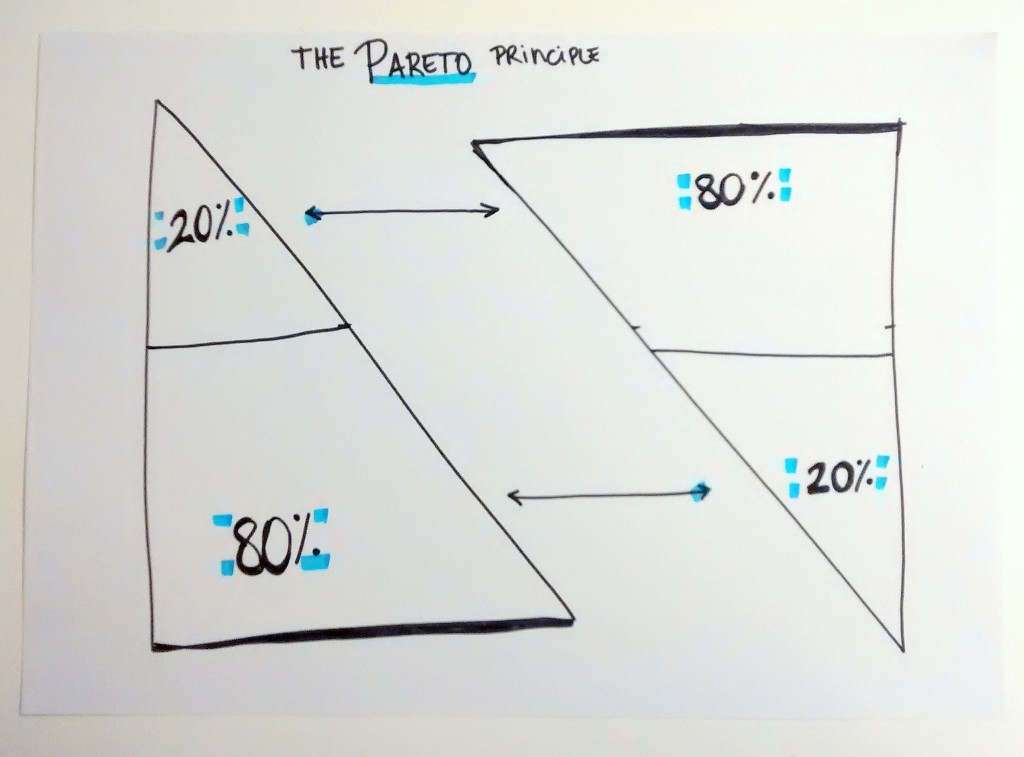
As your conference matures to over 500 attendees and your goals advance, you will want to adopt more sophisticated technological tools and practices.

Beginning with your planning process, you will want to consider technology that offers operational efficiency through a centralized “hub” from which you can manage all the event’s logistics. Budgeting tools will help you understand and control the various costs related to the event as well as compare year to year spending and benchmark against other events and marketing programs.

Next up, delivering quality content. Your user conference needs quality content or it will fall short of attendee expectations. Automate and streamline the process of collecting speaker and paper submissions through technology that can also assist in thoroughly qualifying speakers and content. You will make it easier to draw a large selection of submissions and then focus on qualifying them for the purpose of delivering great content.

Your user conference needs support and dollars, mostly coming from exhibitors and sponsors. A full-featured exhibitor and sponsor management system will help you deliver on the specific needs of these participants, such as the ability to upload assets, access planning resources, or manage leads.

Now is the time to upgrade your engagement technology with the personalization factor. Personalizing event experiences will guide attendees to the most relevant sessions, content, activities, and meetings. This is done through insights gained during the registration process, as well other attendee engagement and core integration with your marketing automation systems.

Personalization is made possible through session recommendations, one on one appointment scheduling, and giving attendees personalized views of their agendas and relevant content. The personalized experience aids attendees in achieving their events goals while organizers can ensure their messages are being delivered to the right attendees at the right time.

Building professional connections through networking is one of the key goals of user conference attendees. Utilize technology that facilitates self-scheduled appointments to provide additional value through the ability for attendees to create their own connections.

Increase your organization’s measurement and understanding of the event through appointment ratings. This qualitative measurement of one-to-one connections provides valuable insights for lead scoring, follow-up communications, and the overall measurement of the effectiveness of the event.

Finally, upgrade your integration and infrastructure technology through integrating your marketing automation platform with your event management technology. You will have the ability to leverage existing profile activity from your marketing automation platform to personalize the attendee experience, capture relevant data, and turn attendee interactions into measurable and actionable insights for sales and marketing follow up.

Are you ready to seriously elevate your conference to the next level?

If your user conference has elevated to an advanced level of over 1,500 attendees, it is time to take another step in increasing your conference technology.

Fully engage your attendees through personalized event views and matched appointments. Provide each attendee with a personalized view of relevant event information that is pertinent to them. Include personalized agendas, appointment schedules, travel and accommodations, and more.

Utilize matched appointment technology as your conference reaches a large scale. Automatically generate thousands of meaningful and productive meetings based on attendee priorities. Helping people schedule the right appointments ahead of time increases attendee engagement and satisfaction.

Finally, upgrade your infrastructure through supporting multi-language, regional, and currency processes. Expanding your presence into other markets requires your technology to adapt to each market’s language, regional protocols, and financial systems.

Conclusion

Be aware of the range of challenges you will face in running your user conference. From successfully managing logistics, to delivering an engaging experience for diverse attendees and stakeholders, to generating more revenue for your organization, you will need the right, robust event management platform.

By utilizing the proper technology, you will be able to address the full spectrum of event challenges involving planning, management, engagement, measurement, understanding, integration, and infrastructure all resulting in you meeting the high expectations of attendees, partners, and other key stakeholders thus maximizing the potential of your user conference.

22 Apr 14:42

The 80-20 Rule for Content – Origins and How to Apply It

by Beatriz Arantes

If you’ve been around for a while, reading about Content Marketing and Social Media best practices, you sure have stumbled with the 80/20 rule. Blog posts, articles, infographics… And every now and then this 80/20 rule would appear. That’s why we decide to do some proper research to find out how did this rule comes out and how does it arrives to social media.

The Origins

Everything started in Economics. In the 1906, Vilfredo Pareto, an Italian sociologist, mathematician and philosopher, discovered that 20% of the Italian population owned 80% of the land. And this proportion repeated in many other countries and many other daily life aspects, such as power distribution, material wealth, etc.

The 80 20 Rule for Content – Origins and How to Apply It image Pareto principle Groupiest

The principle was used to justify, among other things, the fascist ideology. The fascist intervention would ideally break this rule and make society “fairer”.(?!)

In Business

In the 1940′s Dr. Joseph Juran found a similar percentage in Quality Management. Dr. Juran established the difference between the “20% vital few“ and the “80% trivial many”. In his experience, managing quality standards, 20% defects caused 80% of the problems and complaints from clients.

This principle was quickly spread to other aspects of the economy and business. Like, the 80% of a business revenue come from the 20% of their customers. For managers, according to F. John Reh, this means to learn to focus time, resources and energy on the 20% that matters. Opposed to the Pareto principle in sales, there is the long tail theory.

Apparently, Richard Koch, a British author was the responsible for spreading it through other concepts through fields like business management, work/life balance and happiness. Mr. Koch developed an extensive bibliography on this golden rule and how to apply it to every aspect of one’s life.

The principle extended as one of the pillars of the “work smarter” philosophy. The books of Richard Koch influenced and applies to several books that became famous, like the 4-hours work-week.

This matches perfectly with the big trend on outsourcing tasks that are not core for your business/life success. It also goes along with the “do what you love- follow your passion” philosophy, that may not turn to be a good career advice .

The 80-20 rule for contents

The idea get summarized in this:

80% of your outcomes come from the 20% of your inputs

If we go back to the very first principle, the 20% of your content will make 80% of the revenue or leads. Under this perspective, only 20% of the content should be for sales purposes, self-promotion, lead generation and advertisement.

The other 80% should be about your customer: the problems they usually have, interesting data regarding your industry and other things that can be linked to your brand but nor purely sales content.

The 80 20 Rule for Content – Origins and How to Apply It image 80 20 rule Groupiest

Joe Pullizi has a fun story about this: nobody wants to be friends with someone who only talks about oneself. This is and interesting customer-centric approach to the content and how brands should behave in Social Media.

In this scenario, you better have a good content curation tool to help you fuel up those social media profiles. And find, edit and publish effective content in a reasonable time.

The 80/20 rule appears in many compendiums of “best practices” in social media for business, like this piece in the Entrepreneur magazine, and the article that triggered this post: A Content Marketing Manifesto: 10 Principles to Drive Creative Content. Is it really applied by brands? Well, we’ll see it in another post.

The 80 20 Rule for Content – Origins and How to Apply It image social media 8020 rule 522d087a3d4fa w540

Tips for kinds of contents you can fit into your 80/20 fueled content strategy in Social Media. Infographic by Company.com

And there’s another 80/20 rule for content some marketers and blogger have:

Spend 20% of your time creating great content, and the other 80% distributing it. Otherwise the content won’t be found.

This, for some people can mean that more than a writing business, they have a PR business. And outsourcing this task may seem more like an interesting possibility.

Do you have any other Golden rule of proportions you’d like to share with fellow marketers?

22 Apr 14:41

Nurturing Your Sales Leads from Cold to Hot

by livehive

Sales leads often arrive cold. They don't know much about you, they're only somewhat interested, and they'd rather be doing a million other things besides talking to you about your service or product. How do turn cold leads hot? How do you convert prospects into closed deals? Read on to find out how you can heat up your chilly sales leads!
22 Apr 14:41

5 Mid-Funnel Lead Nurturing Mistakes

by Steve Gershik
funnels

Author: Steve Gershik

Most marketers have their eyes on many moving targets — lead generation, conversion rates, new customer acquisition, customer retention, and even customer expansion. And many of the best marketing organizations also align lead generation teams to different stages of their sales funnel — usually divided into top of funnel, middle of funnel, and bottom of funnel (to learn more about mapping lead generation to your sales funnel, check out our cheat sheet here). At the top of your sales funnel, you’re looking to simply educate and entertain your potential customers, laying the foundation for your customer-company relationship. At the bottom of the funnel, prospects are making final sales decisions, and need product-specific info. Mid-funnel prospects are some of the toughest to reach — you want to nurture these leads, and start talking about your products, but your prospects still aren’t ready to buy.

With that in mind, here are five of the most common mid-funnel lead nurturing mistakes:

1. Don’t Let Your Data Go Bad

Has your database been languishing all winter long, pulverized by the polar vortex of decay and desolation?  Tune it up by refreshing your customer information. Career paths are much more fluid these days, which means titles and roles of your buyers will frequently chance. Make sure you are current to increase your chances of getting a response and, just as importantly, not aggravating people who will never buy from you. Read more about cleaning your list here!

2. Don’t Forget to Test

Yes, this is up there with changing your oil and flossing on the list of “Things You Know You Should Do But Probably Don’t Do Enough.”  But seriously, Marketo makes it dead easy to automatically segment your list and send out several different versions of your emails, evaluate results, then dispatch the winning email to the rest of your list. Try it. Not only will this make you a more effective marketer but, unlike flossing, you’ll have fun. Get started with this list of 30 Things to Test for Lead Generation.

3. Don’t Use Jargon in Your Email

It doesn’t impress people. And it can be awfully confusing, even to people who should know what you mean. I’ve seen the term AIDA since the beginning of my marketing career, and I still have to stop and say the individual words to remind myself what the acronym means (Attention Interest Desire Action, if you’re wondering). Always spell out/define acronyms and abbreviations, avoid buzzwords, and err on the side of over-explaining complicated terms.

4. Don’t Talk Like a Robot

This is a companion to the above recommendation, but it’s more about tone than vocabulary. Don’t intimidate (or bore) your audience with long, highly-technical sentences, or with pushy, over-the-top sales pitches. Use a conversational (even a humorous!) tone, and help your audience solve their problems with real words, not gobbledygook. Your customers are human, and you’re one too, right? Right???

5. Don’t Get Too Fancy

So many marketers try to use all of features in their marketing automation platform, all at once — without stopping to think about the point of their technology. You invested in marketing automation so that you could have interesting, relevant conversations with the right people — not so that you could impress them with bells and whistles. So leave the complexity on the cutting room floor, especially when you’re first starting out. Keep it simple.

To paraphrase Seth Godin, the best time to perfect your nurturing programs is two years ago. The second best time is right now. If you’re ready to dive deeper into successful lead nurturing, and you’d like to learn some of Marketo’s secrets for outstanding nurturing programs, be sure to register for Leadspace’s webinar on Thursday, April 24th with Marketo’s VP of Marketing, Jon Miller: Make Your Nurturing Campaigns Sing.


5 Mid-Funnel Lead Nurturing Mistakes was posted at Marketo Marketing Blog - Best Practices and Thought Leadership. | http://blog.marketo.com