Shared posts

15 May 17:11

Job Description of an Account Executive / Sales Hunter / New Business Developer

by Peak Sales

AE Job Description Peak Sales Recruiting is often asked by customers to provide input on sales job descriptions. One of the most important roles on a sales team is the Account Executive, which across various companies and sectors is known by other names such as AE, Account Exec, Sales Hunter, or New Business Development Manager. While the role of Account Executive is almost always focused primarily on the acquisition of new customers, in some sectors, for instance, advertising and new media, the role also includes elements of ongoing customer service delivery and even collections.

Many job descriptions include both a list of duties and qualifications, however Peak endorses job descriptions that are more focused on key metrics, goals, and quantifiable objectives. With that in mind, the following job description can be used as a guide for any Account Executive:

  • Establish relationships with new customers and secure contracts with new customers that achieve assigned sales quotas and targets (this should be quantified against a calendar schedule – see importance of quotas here Top Producing Sales Teams Have Quotas )
  • Drive the entire sales cycle from initial customer engagement to closed sales (and in some cases through delivery and cash receipt as mentioned above)
  • Prospect for potential customers using various direct methods such as calling and face to face meetings, and indirect methods such as networking (this is often accompanied by an identification of the territory in which the AE will prospect)
  • Qualify prospects against company criteria for ideal customers and sales
  • Consult with prospect about business challenges and requirements, as well as the range of options and cost benefits of each.
  • Maintain a high level of relevant domain knowledge in order to have meaningful conversations with prospects.
  • Make presentations to senior managers and decision makers
  • Draft and deliver proposals
  • Work with technical staff and product specialists where required to address customer requirements
  • Develop and maintain territory plans which outline how sales targets will be met on an ongoing basis
  • Develop and maintain key account plans that identify opportunities for company to deliver value, strategic motivators, main stakeholders, buying processes and forecasted sales
  • Report on sales activity (include desired frequency – daily is ideal for accuracy)
  • Keep detailed notes on prospect and customer interactions (include frequency – daily is ideal for accuracy)
  • Provide forecasts on best case and most likely sales volumes over relevant time periods
  • Work with delivery teams to proactively address problems
  • Cultivate strong relationships with third party and partner companies that may be required to deliver full solutions to customers
  • Work with marketing to plan and execute lead generation campaigns
  • Provide feedback to sales management on ways to decrease the sales cycle, enhance sales, and improve company brand and reputation
  • Provide feedback to company management on market trends, competitive threats, unmet needs, and opportunities to deliver greater value to customers by extending company offerings
  • Identify sales support requirements and work with marketing to develop improve sales tools
  • Be a positive representative of the company and its brand in the marketplace
  • Conduct all sales activities with the highest degree of professionalism and integrity

For insight on compensation plans for account executives, see Sales Compensation – Hunters vs. Farmers

To your success!

Image courtesy of  2nix | freedigitalphotos.net

04 May 21:35

Yes, the internet of things will be great, once we get the mess untangled

by Barb Darrow

If you thought the in-house data silos of the client-server era were a nightmare, get ready for the hairball that the internet of things could engender. As tens of billions of “things” — sensors, machines, mobile devices — get connected to the internet and to each other, there will be huge value in the data they generate across applications ranging from agriculture, to senior care, to public works. 

But there’s a lot of heavy lifting to do first. We know we can collect the data — but how to process it, analyze it and share it securely in a way that makes sense and doesn’t give people the heebie-jeebies? These are topics we’ll dive into at Gigaom’s Structure show in June.

Some parts of the internet infrastructure are ready for this IoT onslaught already. “If just 15 to 18 percent of all dark fiber is lit up now, there’s still tremendous amount of capacity available,” said Chad Jones, VP of LogMeIn’s Xively IoT business. “It’s not that we need the pipes, but we do need a ton of infrastructure atop the pipes. The next thing is we’ll need a bunch of clouds meeting different requirements from all these data sources and we’ll need business intelligence and stream processors etc.,” he noted.

And there will be a need for myriad data aggregation points — they could be small 10-rack data centers or smart routers situated close to data sources. Mark Thiele, executive vice president of  data center technology at SUPERNAP, who will also speak at Structure, said there’s going to be a whole lot of tiering going on which distributes smaller collection points that communicate with massive core data centers as needed.

Mark Thiele, Supernap

Overcoming structural barriers

And, if the value in big data lies in bigness, people will need to overcome their need to horde their data and instead share it — in blinded or anonymized form  – to get the biggest bang.  Demographic or health data from one block in the neighborhood is of limited use. To truly fuel demographic research, that data must be combined with city-wide, state-wide and nationwide data.

And the main barrier there is psychological or sociological, not technical. “If you think how hard it is for departments of one company to collaborate and share information, and then look at how hard it is to get agencies within one government to do the same, and then getting governments of different countries to cooperate, you see the problem,” Thiele said.

Structure2014_300x200_in-articleTo foster interoperability and sharing there also has to be a way for companies that collect their own data to monetize it. Forward-thinking companies need to come up with a standard unit of data to foster the ability of that data to be traded, Thiele said.

6Fusion already does this in the Infrastructure as a Service market where it lets customers compare like units of workloads across deployment models. It does this now with what it calls a Workload Allocation Cube (WAC) that factors in compute, storage, disk, WAN I/O and LAN I/O in a single unit of measurement.

The same could be done with data — cutting it up into widely-recognized  measurable units that can be bought and sold like any other commodity, said Rob Bissett, senior vice president of product management for 6Fusion.

Bissett thinks tradeable data units will be a common topic of conversation in 3 to 5 years after some of the infrastructure stuff gets worked out, but it will have to happen. Let’s face it: generating a lot of data that lies fallow in various cloud islands is of limited use. The real value will lie in the ability to parse and manipulate it so that roads and bridges get fixed before they fall apart and jet engines can be attended to before real problems arise.

Related research and analysis from Gigaom Research:
Subscriber content. Sign up for a free trial.

04 May 21:17

Attraction and Repulsion

By Scott Coulter

"There is nothing either good or bad, but thinking makes it so." So said Shakespeare many years ago. I've found that sentence to be a great bit of advice for living with diabetes through the years. It describes the way our own reactivity can make living with this disease even harder than it needs to be or, conversely, how we can understand our own thinking and mitigate the internal suffering we face.

Think of yourself as a magnet. Now imagine that magnet charged so that its attraction is very, very strong. When it comes in contact with other magnets, it will be attracted or repelled, getting pulled off track either way. Everywhere the magnet goes, it gets knocked around like a pinball.

Now, imagine you take away the charge. Imagine that no matter what "your magnet" comes in contact with, whether positive or negative, it can remain centered, on track, undisturbed. That, as far as I can tell, is what Shakespeare was talking about. Our thoughts are the magnet, and they can be geared to react to every bit of good news and bad news by being pulled or pushed around, or they can be tamed by taking away the charge.

These "positive" and "negative" magnets refer to "good news" and "bad news." We respond with repulsion to the bad news (like high numbers, results we don't like, feelings we don't enjoy, or obstacles in our path), and we respond with attraction to the good news (good numbers, results we were shooting for, feelings we enjoy). It's easy to understand how the repulsion we feel causes us suffering, but that attraction to the good news is actually just as guilty.

You see, either way we're letting our feelings be dictated by forces outside of ourselves. Whether we're happy or sad, we are giving up our control, letting forces outside ourselves determine how and what we feel. And even when that feeling is one of being happy, it is fleeting, dependent on whatever magnet we happen to be attracted to in that moment. Once it passes, we lose our ability to feel happy.

So what exactly is the answer, then? If we're not "searching for happiness," what exactly ARE we searching for? I think we're searching for peace. Living with diabetes means facing good news and bad news constantly. Every single blood sugar check is a chance for good news or bad news. Every single A1C result is a chance to receive news of improvement or backsliding. If we're always searching for happiness "out there," we'll just drive ourselves crazy. But we can find peace inwardly no matter what's happening out there.

Finding internal peace means creating a practice that directs our focus in the right direction. It's so easy to get caught up chasing our thoughts that we often do it without even realizing what we're doing. That's why meditation is such a good practice — it takes away all of the distractions and just leaves us with our own thoughts. When we do that, we can see what they're REALLY doing, and finally get ourselves free from them, at least for a few minutes each day. Ultimately, peace is found through sustained mindfulness.

It's that mindfulness that's really the key to living with diabetes, I think. We'll have good news and bad news, happiness and sadness, joy and pain. But as long as we are mindful of ourselves, we can maintain peace no matter what kind of magnets are floating around us.

------------------------

Copyright (C) 2014 R.A. Rapaport Publishing, Inc. All Rights Reserved. See http://www.DiabetesSelfManagement.com/Terms/ for terms and conditions of reuse.

04 May 21:17

Career Advice from the World’s Religions

by Kaitlin Louie

With unemployment statistics still in mediocre territory, 70 percent of American employees disengaged at work, and 41 percent of college grads in jobs that they are academically overqualified for, it’s fairly apparent Americans are feeling professionally discouraged and unfulfilled. Our response to these feelings may be to focus more on factors that are external to us and quantifiable: What graduate degrees yield the highest rate of employment? What jobs garner the highest salaries? How much would I have to earn to afford this big home in that nice neighborhood? During tenuous economic times such as these, internal motivations and authentic passions can fall by the wayside as you search for a way to make ends meet and not fall behind others vying for the same job posts and steady income you desire.

The value of turning inward

Practical concerns such as making a living and climbing the career ladder are valid and will never go away. However, research has also shown that removing yourself from external pressures and turning inward to reflect on your own priorities and goals may help you weather trying times better and ultimately find personal and professional success. One way to accomplish this internal reflection and its associated benefits is through meditation.

According to Inc., a recent study by Harvard Medical School, the University of Massachusetts Medical School, and Germany’s Bender Institute of Neuroimaging found that people who meditated saw significant improvements in emotional regulation, learning and memory capacities, and life perspectives. Similarly, Professor David Levy of the Information School at the University of Washington found that employees who engaged in mindfulness meditation reported feeling much calmer and better able to take on workplace challenges such as multitasking than did people who did not engage in meditation.

Are spiritual people more resilient?

Meditation, which is a central practice of major religions such as Buddhism, is one of several ways in which spirituality and/or religion has been shown to benefit people personally and professionally. According to The British Psychological Society, a small study conducted by Dr. Roxane Gervais in the U.K. found that religious employees were less likely to be afflicted with fatigue, depression and anxiety in the workplace than their non-religious peers.

“Religiosity in the workplace may act as a resource, making people more resilient to cope with the many challenges of working life,” Gervais explained.

Similarly, The Washington Post reported psychology professor Catherine Sanderson’s findings that religious or spiritual individuals were happier overall than their non-religious peers, regardless of the specific religion they followed. Sanderson attributes pious individuals’ enhanced well-being to the “sense of meaning” and “social network” that their religion affords them.

Life and career advice from the world’s religions

Though some of us have perfectly valid reasons not to follow any particular religion, the benefits displayed by people who practice religion or incorporate spiritual practices into their daily routine indicate that the world’s religions may have some useful advice for all of us — religious or not — about approaching challenges, staying focused and maintaining optimism. Below are just three of the numerous tenets that several of the world’s religions have in common — tenets which, if incorporated into your personal life and workday, could yield positive results.

Acceptance

One of the main teachings of Buddhism is that suffering is an undeniable fact of human life. Buddhism encourages its followers to first accept the reality of suffering and then minimize the suffering they experience by relinquishing desires that are attached to external values (such as money and status), and focusing on rightful thinking and meaningful relationships. Acceptance is not just helpful in religious contexts — it can also help you overcome hardships like a rough few months at work, a spell of unemployment or navigating difficult work and personal relationships. Instead of denying, ignoring or becoming angry about a problematic situation, try neutralizing the negativity you might feel by accepting the circumstances and focusing on an action plan to move forward and tackle what is within your control.

Compassion

A quote from the Holy Bible’s Thessalonians reads, “Therefore encourage one another and build one another up, just as you are doing. We ask you, brothers, to respect those who labor among you […], and to esteem them very highly in love because of their work. Be at peace among yourselves […] encourage the fainthearted, help the weak, be patient with them all.” Compassion is at the heart of not only Christianity, but many of the world’s religions. For example, one of the core aims of the Baha’i faith is to discourage prejudice and encourage followers to form a strong understanding of and compassion for all individuals, regardless of their nationality, religion, race or class. Compassion benefits all areas of one’s life, as it helps one to foster strong relationships with others at home, school and the workplace.

Discipline

Nearly all of the world’s religions have practices intended to strengthen their followers’ discipline. From religious fasts such as Lent and Ramadan, to daily rituals of worship, to steering oneself away from negative thoughts and behaviors, discipline and self-regulation permeate the daily lives of many religious and/or spiritual individuals. Whether you are religious or not, fostering discipline can only help your personal life and career growth. Having the discipline to complete work projects, withhold stinging criticism in favor of constructive comments, and refrain from activities that waste your time, money and energy can help you both mature and achieve your goals more quickly.

The link between religious principles and emotional intelligence

The tenets of acceptance, compassion and discipline described above relate to a hot career topic currently buzzing around the media-sphere: emotional intelligence. First coined in the 1990s, emotional intelligence is, according to psychologist Daniel Goleman, comprised of qualities such as self-awareness, self-regulation, internal motivation and empathy. In his piece for the Harvard Business Review, Goleman explains how business leaders require not only conventional intelligence and skills, but also emotional intelligence in order to succeed and inspire others.

The link between emotional intelligence, leadership and spiritual practices may help to explain why, according to Inc., business leaders such as Russell Simmons and Ray Dalio engage in meditation, as did Steve Jobs. Goleman’s assertions that effective professional leaders need compassion, discipline and self-awareness — qualities advocated in and fostered by numerous religions and spiritual practices — help illustrate how applicable certain religious and spiritual wisdom is to our modern daily lives.

This article was originally published on WorldWideLearn.com.

26 Apr 17:01

5 Subtle Content Techniques That Drive Website Sales

by Michael Bird

5 Subtle Content Techniques That Drive Website Sales image 19

There once was a time when advertising gimmicks, fancy GIFs and pop-ups could entice the occasional idiot to purchase from your site (we all did it). Now, even the simplest of beings seem immune to such trickery.

More than 50% of consumers now don’t trust any type of advertising. When you consider that the internet is filled with so many fake products, spam sites and offers that just seem too good to be true, you can’t really blame them.

As a result, managers of website content are looking to find more ways of selling without making the customer feel as though they’re resorting to a hard sell. But how do you do that? Subtlety is the key. Here are five content techniques that can boost sales without being too ‘ad-like’:

Customer Reviews

5 Subtle Content Techniques That Drive Website Sales image 25
People would often look for the opinions of other users in order to make a decision about buying something. This ‘social proof’ gives consumers an affirmation that they won’t be left cheated and embarrassed . It also shows consumers that your product has been tested by other people, and that they’re willing to share their experience with others. In customer reviews, potential buyers will be able to learn more about the product from an honest and unbiased source.

You want to make sure that these reviews are trustworthy, so you should try not to filter out any negative reviews. It is understandable to remove any that are too detrimental to your company’s reputation, but you should definitely try to keep as many in there as possible. This way, consumers are more likely to believe that these are genuine reviews.
Remember, there are buyers out there who specifically look for flaws in order to check if or how they can deal with them, while considering the benefits of the product you’re selling (so these seemingly negative reviews can actually provide a great opportunity for you to show that you are willing to be proactive in responding to any customer issues).

The FAQ Section

5 Subtle Content Techniques That Drive Website Sales image 35
After reading a long product description that sings about the product’s benefits, customers are more likely to have a look at the FAQ section. So what does the FAQ section include? It contains all the typical questions customers are likely to ask when it comes to your product. For instance, you may be selling printers with a bunch of great features. In your FAQ section, you can answer questions like “How do I connect my printer wirelessly?” or “What kind of ink cartridges you I need?” or “Do you accept PayPal?” Even if all this information is already in your site, the FAQ section gives visitors just one place to go in order to answer all their questions or at least to be instantly led to the page where they can find their answers.

It can the further benefit of significantly reducing your customer service enquiries, potentially saving you a lot of money.

If you’re looking to add an FAQ section to your site, you have to keep a couple of things in mind:

  • Write the FAQ in your target market’s language. As much as possible, keep it simple but informative. If possible, answer with bullet points and lists for easier reading.
  • Organise the questions into subcategories so users can easily find the questions they want answered.
  • Add visuals, if possible. If the question to be answered requires a demonstration, adding a few images or a video may be more helpful than just adding text.

Give Facts

5 Subtle Content Techniques That Drive Website Sales image 44
Be as detailed as you can about your product. Make sure that everything the customer may need to know can be read from the product description. So things like weight, the material used, the available sizes, as well as the technical specifications of your product must be in the description.

If your information is lacking, and the customer can’t find what they’re looking for in the FAQ, they will most likely search for answers on other sites. Make sure that you’ve included as much information as you can about your product, so your potential customers don’t stray to your competitors!

Tips and Guides

5 Subtle Content Techniques That Drive Website Sales image 64
Other than the outright facts and specs of the product, you can also enrich the value of your product by giving your customers a how-to guide for how they best benefit from owning your product.

For instance, if you’re selling fashion accessories, you can add outfit guides and suggestions for how they can use the accessories. If you’re selling kitchenware, you can include recipes. If your product is manages events, you can provide information tips on how to ensure the event will be a success, or tips on how to prevent cranky guests.

Show Them How It’s Done

5 Subtle Content Techniques That Drive Website Sales image tieCustomers can choose to read the content, but for those who are more interested in pictures, videos, charts and graphs, give them this option. Infographics are a great way to combine facts and images, and tend to achieve much greater social media engagement. Images and videos, as well as being more likely to be shared, tend (on average) to keep people on the page and your site for longer.

Summary

To drive website sales, you don’t need to be too overt about what you’re selling. Rather than trying to shove your product down the throats of your visitors, try to sell your products more tactfully.

Offering thorough information is a surefire way to ensure that consumers are aware of everything you have to offer. Keep these 5 content types in mind when you next change your website copy. They’ll definitely keep you ahead of the game!

26 Apr 17:01

How Reliable are Review Sites?

by Louis Foong

Did you know that 78% of B2B buyers start their research online and 50% of them turn to social media or peer reviews (source: The Data Behind How B2B Buyers make Purchase Decisions). Have you thought about how significant a role review sites play in the buying decision of your customer? Also, do you know what people are saying about your company, services and products and how have you built reviews into your lead generation strategy?

In an interesting infographic by GetVoIP.com, the use of technology review sites is thoroughly scrutinized, which helps us determine: the differences between customer and expert evaluations; the role these reviews play on technology sales; and the top indicators of “fake” reviews.

I invite you to consider the subsequent information, which was featured in GetVoIP’s infographic, “Can Tech Review Sites Be Trusted?”

Numbers You Need To Know
Within a google search, you will likely find the following number of technology reviews:

  • CMS software – 5, 060, 000
  • ISP – 282, 100
  • Tech support – 214,000
  • Email providers – 62, 100
  • CRM software – 18, 700

Is There A Difference Between Customer And Expert Reviews?
According to the infographic, there are numerous differences:

  • Consumer reviews are more detailed; expert reviews discuss general matters.
  • Some expert reviewers neglect to discuss usability; meanwhile, usability is a major component of customer reviews.

Note: Before settling on final purchases, consumers tend to refer to 11 reviews.

How Do Reviews Play A Role On Technology Sales?

  • According to the infographic, about 79% of customers find online reviews just as dependable as personal references.
  • Approximately 65% of customers will purchase products from a company if the company has positive feedback on the web.
  • Online reviews boost product/service loyalty by 18%.

How To Spot A “Fake” Review
In reality, up to 15% of social media reviews are deceptive. Here’s what you need to know to spot a “fake” tech review:

  • If the review uses the following words, it is questionable: “best ever”, “greatest”, “absolute worst.”
  • The review should discuss both the positive and negative sides of the product/service.
  • The review has no reference to an author.

Therefore, when you are referring to a tech review, it is important to:

  • Read several sources.
  • Ensure there’s a disclosure statement.
  • Consider the date the product/service was reviewed.

Click on the image below to view the full infographic. How do you validate trust when you read technology review sites? I am looking forward to your response.

How Reliable are Review Sites? image getvoip infographic reviews 1

25 Apr 17:34

With vivid memories of Moscow’s rule, Baltic states lead Europe in curbing Russia gas reliance

by CB Staff

VILNIUS, Lithuania – Later this year, a ship the size of an aircraft carrier will arrive at Lithuania’s port of Klaipeda on the Baltic Sea. The 300-meter (984-foot) vessel is not a warship, but a floating natural gas import terminal — aptly named “Independence” — that will be key to the Baltic region’s plan to reduce its reliance on Russia’s energy supplies.

The countries in this northeastern corner of the European Union are among the most dependent on Russia to keep their homes warm and industries running. The three Baltic nations of Latvia, Estonia and Lithuania get all their gas from Russia and lack connections to the wider European pipeline system that would allow them to import from elsewhere. Poland meets 70 per cent of its energy needs with Russian supplies.

As a result, the states, which still have fresh memories of domination by Moscow during the Cold War, have been among the swiftest countries in Europe to act to reduce that dependence.

Moscow’s use of gas supplies as a means of putting pressure on Ukraine — like the Baltics, once part of the Soviet Union — has driven new urgency into projects to diversify energy supplies in the region, even as the full 28-member EU has struggled to come up with a united approach.

Historical factors help make Poland and the Baltic states particularly skeptical about Moscow’s intentions. Latvia, Estonia and Lithuania were forcibly incorporated into the Soviet Union during World War II, and thousands were deported to labour camps. During the Cold War, Poland was ruled by communists installed and backed by Moscow.

The choice of a floating gas terminal is a sign of the urgency felt in the region. It was two years faster to build than on land, and at $330 million, was some 50 per cent cheaper. It will be able to handle 4 billion cubic meters (141 billion cubic feet) of gas a year — well above Lithuania’s annual needs for 3 billion cubic meters — when it becomes operational in January. The ship, owned by Norway’s Hoegh LNG and leased to Lithuania’s SC Klaipedos Nafta terminal operator, has already undergone sea trials after being built at a shipyard in Korea.

Meanwhile, neighbouring Poland is working on a new liquid natural gas terminal on its Baltic Coast that is slated to come on line early next year. The terminal at Swinoujscie will enable Poland to buy some of its gas from Qatar.

And Estonia and Finland are talking about one or possibly two new gas terminals at their end of the Baltic, as well as an undersea pipeline that will connect the two countries.

Other EU countries have been slower about establishing new projects. Germany has stalled on a proposal to set up a liquid natural gas terminal at Wilhelmshafen, on the North Sea.

Although the Baltics are leading Europe in the effort to diversify their energy sources, the solutions are not easy. Seaborne liquid gas — called liquid natural gas, or LNG — can be expensive, costing as much as 50 per cent more in energy-hungry Asian markets. That’s because it needs to be cooled to minus 165 degrees Celsius (minus 265 Fahrenheit) to make it liquid and shrink it to one-six hundredth of the original volume. Insulated tankers can then take it overseas.

As a result of such costs, analysts say, the Baltic states and Poland will likely not become completely independent of Russian imports. Rather, the new import capacity will serve as partial insurance against any cut-off threats. More to the point, it will also give the countries leverage in negotiating prices with Gazprom, Russia’s state gas monopoly. Russia raised the price of gas for Ukraine to $485 per thousand cubic meters from $268.50, and President Vladimir Putin has said Russia may start demanding payment in advance — heavy burdens for a country whose finances are near collapse.

Building the new gas terminals “now means you have alternatives,” said Aleksandra Gawlikowska-Fyk, head of the energy project at the Polish Institute of International Affairs. “Diversity always increases security of supply.”

Other ways to diversify energy supplies are in the works, often supported by EU funds.

These solutions include changing pipelines so they can run west-east and not only east-west. German energy company RWE began such “reverse-flow” supplies on April 1 and says it will sell Ukraine 1 billion cubic meters a year — a symbolic amount, but a start.

The three Baltic countries are working on a new nuclear power plant in Lithuania to replace power lost after the EU forced Lithuania to shut down its Soviet-designed reactor over safety concerns. That project has been slowed by lack of co-operation from Latvia and Estonia, which missed out on hosting the reactor and the jobs that go with it.

Analyst Gawlikowksa-Fyk says the Ukraine crisis and concern from the EU’s executive commission, may raise the pressure to change that.

“The external situation, as well as the commission, may incentivize those countries to co-operate,” she said.

___

Associated Press writers Monika Scislowska in Warsaw and Jari Tanner in Vilnius contributed to this report.

The post With vivid memories of Moscow’s rule, Baltic states lead Europe in curbing Russia gas reliance appeared first on Canadian Business.

25 Apr 17:28

Curiosity and Context: Keys to Engagement for B2B Buyers

by Ardath Albee

Curiosity and Context: Keys to Engagement for B2B Buyers image 6a00d8341c406353ef01a73db36cc7970d 450wi

Many B2B marketers have jumped on the bandwagon about answering their buyers and customers’ questions. There’s a bit more strategy involved to do so in a way that drives momentum, but what I’m not seeing is marketers attempting to promote the curiosity that motivates their buyers to ask the questions they haven’t thought of yet.

Campaigns are dead. Even Forrester says so.

Curiosity and Context are the fuel for engagement. And in B2B, you’re going for the long-term – not the one-off. Consistency and longevity critical. The story must build across stages, pulling buyers forward by building anticipation for what’s next – for them to understand how they get the outcome they want with your help.

So what drives engagement?

Curiosity. A desire to know more. Ideas that reshape the way people think about a concept, inviting them to ask new questions in exploration.

Context that uses stories based on how problems and priorities might be playing out for prospects and customers.

Perception of low effort that makes it stupid simple and appealing to create a dialogue with you.

A sense of empowerment that comes when buyers feel they are driving the conversation, not your agenda.

Anticipation to get what’s next because your story (content) has motivated them to “turn the page.”

Simply making a list of questions and answering them is not the solution to creating lasting engagement that drives revenues for complex sales. Why not? Because there are hidden questions, subconscious needs that buyers don’t think to ask until their curiosity is aroused.

Reasons why content doesn’t create curiosity:

There’s no Open End.

Much of this has to do with corporations thinking that they need to be the definitive answer to prove their expertise. There’s no room left for discussion without the risk of the buyer looking stupid or presenting an outright challenge. Let’s just admit that we don’t know everything – never will – and get it over with already.

It’s not Novel.

A lot of content is a restatement of stuff other people have said so many times that there’s nothing new. If this is a constant, these are the responses you can expect. People will either scan and see they’ve read the same stuff before and leave. Or they’ll finally reach their breaking point and either mark your brand off their resources list or post a comment expressing their irritation. Either way, your value to them has diminished.

It’s trying to talk to Too Many People at once.

When you don’t know your audience well enough or you have limited resources, you try to do too much with one content asset. This usually means that it’s so high level that it doesn’t speak with meaning to anyone.

The Context is Skewed.

You are still using gut instinct to tell you what your audience cares about. But you’ve missed the points that matter to them. Perhaps you nailed the topic, but the angle you’ve taken tells them you really don’t understand their situation or what they care about. In this scenario, there’s just no motivation to engage because the buyer knows you don’t “get” them.

It sounds Too Good To Be True.

You know your Whizz Bang solution is the next best thing to sliced bread. But you’ve emphasized so many upsides without the details, struggles or whatever else it takes to get them that the outcomes sound too good to be true. This immediately arouses disbelief about all the stuff that’s been omitted or the veracity of what you’re saying and results in diminished credibility – even if what you say is true!

I could go on, but I think I’ve made the point. What it comes down to is being human and highly relevant. But it’s also a sense of mirroring – or being seen as a peer. No one likes to be lectured to by someone who thinks they’re the smartest person in the room. If you want to create engagement with an upside, you have to be curious, too.

Buyers are looking for expertise, certainly. But they’re also sure that their situation is unique – which it is. And they want to know that you’re flexible and agile enough to adjust to it while still delivering what you promise.

B2B marketers need to tread the line between using their expertise to mentor buyers and curiosity that shows you’re interested in them and what they need and want. Sometimes this means showing them that you didn’t have all the answers when you started helping a customer, but that you helped them figure it out and overcome the unforseen challenges encountered along the way. In other words, revealing your humanity.

B2B complex sales have inherent risk – both for the company and the buyer. In many of the interviews I do for persona projects, what I hear repeatedly is that buyers want to work with people/companies who they feel care the most about them. I’ve heard many customers say the equivalent of “They just seemed to “get” us.”

When I probe deeper it comes back to an alignment with context and the quality of interactions that the buying team had with the vendor they chose to solve their problem.

What are you doing to show your buyers that you “GET” them?

25 Apr 17:27

The Most Controversial Sales Management Strategies and Tactics

by Peak Sales

Sales ControversyOver the years I have been exposed to many sales management theories and strategies, some of them conventional and some of them less so. I have also seen many unconventional ideas evolve into mainstream practices as the times change, with varying degrees of success. Ultimately, challenging conventional wisdom is a smart move, if it results in taking a step back and looking at what approaches are really working or not working versus passively maintaining old habits or following popular trends.

In this article, we take a look at sales management ideas and approaches that spark vigorous debate over efficacy.

Sales Commissions Don’t Work – Arguably the most sacred of sales management thoughts is that commission systems are explicitly tied to sales results. In recent years, however, perhaps an outcome of the “everyone is a winner” cultural shift, there  is a small but not significant and growing movement towards eliminating commissions from the incentive mix for sales people. Many pundits argue that commission systems prevent sales, including Harvard Business Review contributor and bestselling author Dan Pink who has written about sales teams that have increased production after dropping sales commissions. Norm Brodsky, a seasoned entrepreneur, Inc. contributor and author, has also been very vocal about the fact that commissions systems don’t work. Still there is much research to indicate that sales commission systems absolutely do influence the behavior of sales people and if designed and applied properly will result in increased sales. Whether this continues to be the case over future generations remains to be seen, however the balance of evidence today seems to support the usefulness of commissions in driving sales results.

For more from Peak on money motivation in sales people, see Money and its Influence on Sales Behaviour

Sales People Shouldn’t Cold Call – Another increasingly held belief is that sales people should not cold call. Driven in part by the Internet’s impact on buying behaviors (see Have we reached the death of the salesperson? Well, not quite) and by the general dislike for cold calling, there is a growing number of advocates that champion the notion that sales team should abandon cold calling. I have always been a big fan of cold calling, but the reality is that few buyers answer their phones anymore. It therefore takes  a high degree of persistence and creativity to generate sales leads these days and there are many more effective ways to develop these relationships. Former Salesforce.com sales leader and author of Predictable Revenue, Aaron Ross, argues that sales people should not do their own prospecting and sales results are better served by dedicated teams of highly trained outbound sales teams that identify and qualify new sales opportunities, but do not close deals and instead hand them off to Account Execs to close. As the sales landscape evolves and sales teams become more sophisticated, I expect we will see more of this (see more on how cold calling is evolving here Cold Calling 2.0).

Fire The Worst Performers Regularly – Arguably the most contentious sales management practice is to automatically turnover a certain portion of the sales team each year. High profile leaders like Jack Welch and Andy Grove, led with an iron fist and were very vocal about the need to turnover the bottom 10% of performers annually. Recently business owner, investor and Shark Tank star Barbara Corcoran, talked about how she grew sales by dismissing the bottom 25% of her sales force each year. Critics argue that this practice is not good for morale and/or can negatively impact team work. Regardless of whether this practice is effective or not, in our experience it is the minority of companies that systematically terminate the weakest sales reps. It is intuitive, however, to think that the fear of being fired would have a positive impact on sales performance, and there is a multiplier effect of adding high performers to a sales team (see Building a Culture of Success in Your Sales Team).

Marketing is a Waste of Time – There is an insignificant contingent of sales leaders that don’t perceive value in marketing efforts. Some of this may stem from old school thinking when marketing did not play such a huge role in the shaping of buyer perceptions and behaviors. While I have been on sales teams where a common complaint was that the leads from marketing are useless, I have also been a member of teams where the reps stopped prospecting because the leads were so good. Marketing departments that are properly focussed on contributing to sales results can be extremely powerful and I think that as sales becomes increasingly sophisticated, we will continue to see better marriages between sales and marketing.

Leave Your Ethics at the Door – Perhaps most egregious of all sales theories, but surprisingly common, is the notion that to be successful in sales requires the absence of integrity. There is a reason why sales has a bad reputation in some circles and I have heard of more than one sales leader who told his reps to forget ethics when they arrived at work or to purposely lie to customers. Unfortunately it is not entirely uncommon for reps to fudge on features that don’t exist, secretly channel kickbacks to customers, or even sell used products as new. To be fair, sales and all business interactions for that matter, involve a degree of manipulation by one or all involved parties, but while being dishonest might work in the short term, I have yet to see a sales leader promote shady practices and achieve long term success. As top national sales trainer and Honesty Sells author, Colleen Francis points out that “top sales performers know that the real way to win a customer’s heart (and loyalty) is by building open, honest relationships with them.” Read more about sales and ethics here – Three Ways to Make Ethics a Key Part of Your Sales Effort.

What are some of the controversial sales management practices you are seeing? Add your comments below.

To your success!

References

Forget carrots and sticks, they don’t always work

The Sales Commission Dilemma

Sales Force Compensation: Research Insights and Research Potential

Why Sales People shouldn’t Prospect – An interview with Aaron Ross

Barbara Corcoran: I Used to Fire 25 Percent of My Sales Team Each Year

Should I Rank My Employees?

Honesty Sells


Image courtesy of  franky242 | freedigitalphotos.net

The post The Most Controversial Sales Management Strategies and Tactics appeared first on Peak Sales Recruiting | Sales Recruiter.

25 Apr 17:27

The Truth About Buyers

by S. Anthony Iannarino

The Truth About Buyers is a post from: The Sales Blog | S. Anthony Iannarino

Buyers are researching your product, or service, or solution and have already made a list of sales organizations they are going to consider.

Buyers are too busy to be bothered with salespeople because they already have as much information as the salesperson. Salespeople aren’t so valuable.

Buyers prefer to be warmed up over email and social channels before they will accept a telephone call from a salesperson.

Buyers don’t know what they don’t know and they need someone to teach them and disrupt their thinking to help them produce better business results.

Then There Is This

Buyers don’t have time to research what they need to buy. They’re too busy to even look up, and they need a salesperson to help them understand their needs.

Buyers need a salesperson with business acumen and deep situational knowledge to help them understand the range of choices available to them and the necessary trade-offs involved with those choices. Salespeople create massive value.

Buyers are okay being interrupted when that interruption creates value for them. They see attempts to warm them up as the real nuisance.

Buyers have bought what you sell before, know what they need to produce better results, and need someone to help them get what they need. They don’t need to be taught what they don’t know.

The problem with describing “the” buyer is that there isn’t one. There are many. All generalizations are lies. You take your prospective clients as you find them.


This post was written as part of the IBM for Midsize Business program, which provides midsize businesses with the tools, expertise and solutions they need to become engines of a smarter planet.


25 Apr 17:27

Amazon's Secret Plan To Sell Smartphones Is Revealed, And It's Pretty Much Genius (AMZN)

by Jillian D'Onfro

jeff bezos

Amazon is preparing to release its first smartphone this summer and BGR reports that the company is planning to offer a unique wireless data plan, called Prime Data, as one of the key selling points of the phone. 

Although BGR's sources couldn't confirm exactly what the company has in store for Prime Data, they speculated that it would take advantage of some aspects of AT&T's new "Sponsored Data" program. 

Sponsored Data, announced in January, allows companies to pay for users' data traffic for certain apps and services, meaning that data used up on a designated app wouldn't count towards the user's monthly data cap. 

Amazon could be planning to give smartphone buyers free access to its various Prime-branded services, like TV and movie streaming from Prime Instant Video and its Amazon Cloud music player (it has also been recently rumored that the company might release a Spotify-esque product). 

Another theory from a BGR source was that Amazon could offer a simple discount plan that's cheaper than other smartphone data plans, or that it could give users free data for several months after they buy the phone. 

However Prime Data manifests itself, sources told BGR that it will be a key selling point for the Amazon smartphone.

This will huge for Amazon, which needs a way to differentiate its new phone — which will run a modified version of Android — from all the others on the market. Even if its hardware and software aren't better than other options, if it's cheaper for people to use, Amazon's phone could be a huge hit. 

Smartphones have gotten cheaper and cheaper, but wireless plans remain pretty pricey. If Amazon offers good service at a lower price than the competition, it may have a compelling offer to consumers. 

SEE ALSO: Amazon's New Smartphone Will Have Crazy New Tilt Controls

Join the conversation about this story »

25 Apr 17:26

Social Media Ad Budgets Are Rapidly Shifting To Native, In-Stream Advertising

by Cooper Smith

BII native ad forecast

Depending on who you talk to, native advertising has many definitions. In the context of social media, we define native advertising as: Ads that are seamlessly integrated into a user's feed and are nearly indistinguishable from organic content.

The ads are becoming popular among publishers and other media properties, but social networks are at the forefront of the trend toward ads that work more like content.

For a recent report on the native-social ad rush, BI Intelligence spoke to leaders in the native advertising space, including major ad buyers, investors in up-and-coming social media networks like Pinterest, and social media analytics experts to understand the forces driving the stampede into native-social advertising. We examine the top formats, dig into Facebook's suite of native ad products, and look at how effective native-social ads can be. 

Access The Full Report And Data By Signing Up For A Free Trial Today >>

Here's how native-social advertising is transforming digital advertising: 

The report is full of charts and data that can be easily downloaded and put to use.

In full, the report:

For full access to the report on Social Native Advertising sign up for a free 2-week trial subscription today.

Join the conversation about this story »

25 Apr 17:24

6 Incredibly Insightful Marketing Reports You Should Be Running

by rsprung@hubspot.com (Rachel Sprung)

run-reportsThere are hundreds of reports that you can run to dig into your marketing. But the question is often where to start -- what are those basic reports you can run to help get you comfortable digging into the copious amounts of data at your fingertips?

Some important metrics that you should track are traffic, leads, and customers -- all of these are important to get the full picture of your marketing funnel. But you probably already look at that stuff. Having the ability to dig in even further to see where your traffic and leads are coming from, what content they interacted with, when they converted, and how long it took to close are important to really uncover meaningful, actionable data. This post will help you get at that -- it compiles some of the reports that can get you started on some of the basics in marketing reporting. 

Note that you will need some type of marketing software to do this. You should also be able to export the data from your software and manipulate it in Excel using pivot tables and other functions. (If you need help using Excel, download this offer to teach you some of the basics.)

Since we use HubSpot for our reporting needs, I'll show you how to compile these reports using HubSpot. (Bear in mind that the data below is sample data only, and does not represent actual HubSpot marketing data).

Revenue Reporting

What is it?

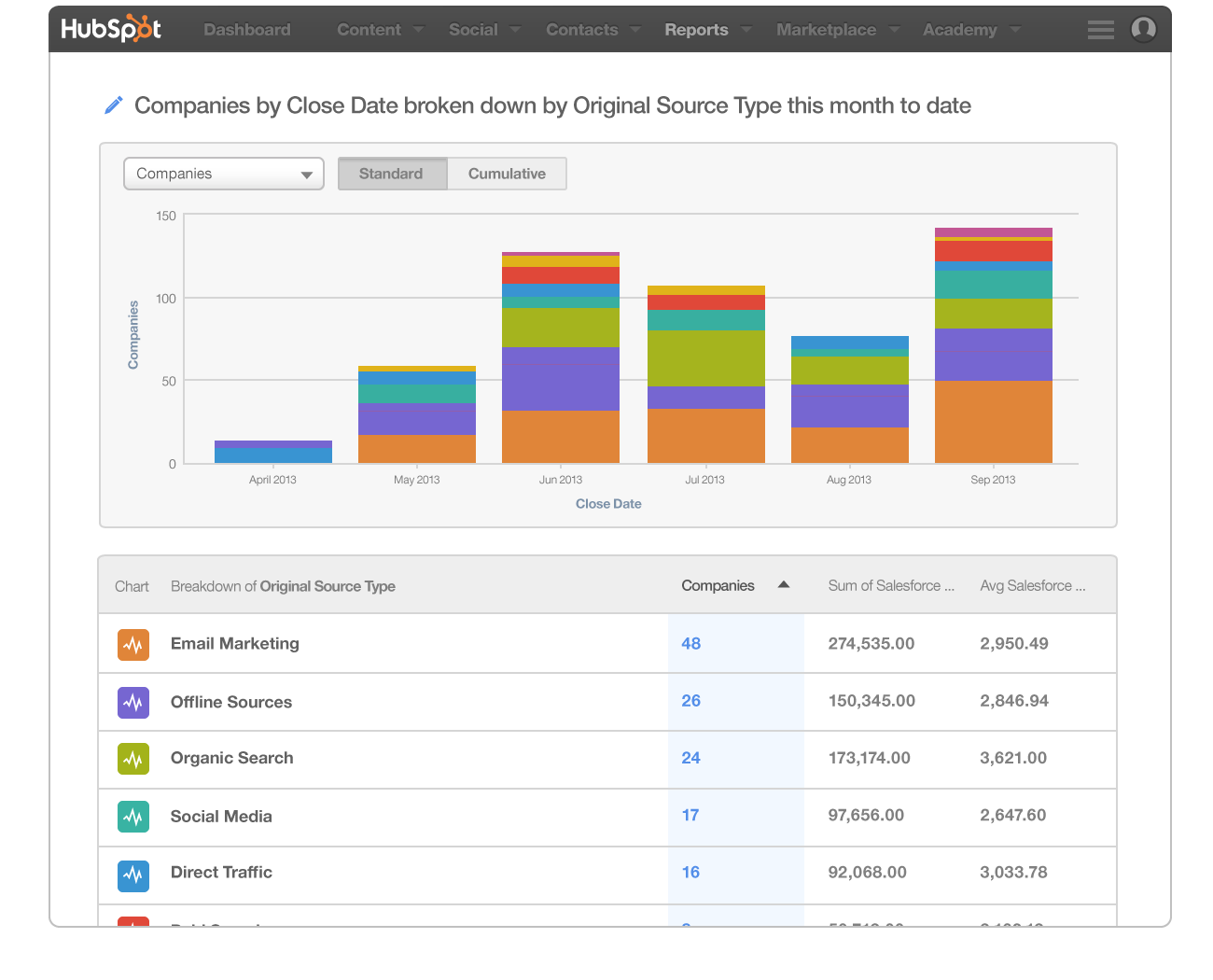
It may be helpful for marketers to be able to tie their marketing efforts back to the amount of revenue their marketing generates from that particular channel. That way marketers can look at the success of certain channels over others and make smarter investments based on what channels generated the most revenue. Note that if you're a B2B business, it may be more important for you to create your reports based on company data instead of individual contact data., so you may use a companies report instead of a contacts report.

HubSpot customers can pull revenue data based on any contact properties they have in HubSpot using the new Companies Report. So if you wanted to pull it based on source, you'd simply select the date range that you want to analyze, choose "Original Source Type" to make up your bar graph, and select "Salesforce Total Revenue" as the last field.

Note: Enterprise HubSpot customers can do this in their software if they have their Salesforce integration set up with Account Sync turned on. 

revenue-reporting

Now what do I do?

Look at the revenue results of different channels, and see where you had the most success. You can use this information to decide what marketing efforts to invest in going forward. For instance, in the example above, offline sources are clearly generating a lot more revenue than direct traffic -- we can make actionable marketing and budget decisions with that knowledge going forward. 

If you're looking at revenue by source, it's also important to keep in mind other factors that may have contributed to the success or failure of a channel. The source is a person's first conversion on your site. But if someone converted on offline sources, and then eventually buys your product as a result of direct traffic or other channels, those other channels or the combination of channels may be the reason for your customer acquisition. This is all to say that revenue reporting is important, but you should dig into some of your other metrics, as well, for a more complete picture.

Channel-Specific Traffic

What is it?

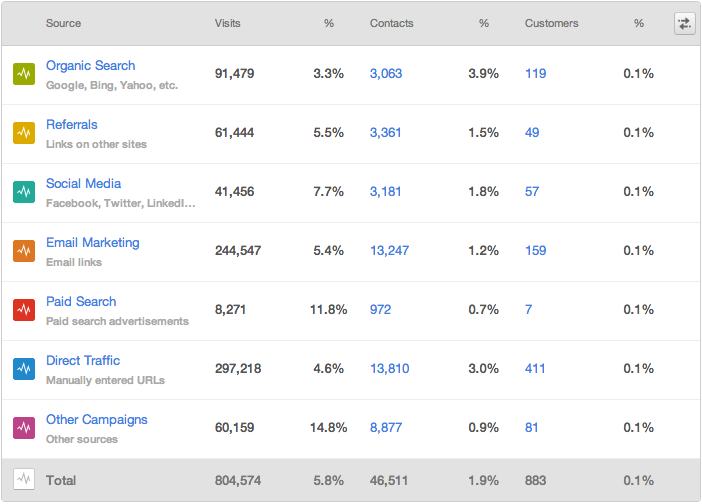
Understanding where your traffic is coming from will help you make strategic decisions as you choose to invest in different channels. In some cases, if you see strong performance from one particular source, you may want to invest more resources in it. On the other hand, you may actually want to invest in some of the weaker channels to get them on pace with some of your other channels. Whatever you decide, the sources data will help you figure that out.

HubSpot customers are probably familiar with the Sources graph to get at this information, but you can actually customize it more. For instance, you could pull a report based on the number of visits coming to the site, you could pull number of visits from a particular list instead of your entire database with the Contacts or Companies Report, and you can (of course) customize those views by date ranges that matter for your reporting.

sources-2

Now what do I do?

After you pull the data, take a look at what channels are performing well. Based on your goals, that could mean looking at the visitor data, or focusing on the visit-to-lead and lead-to-customer conversion rates. Here are a couple different ways to think about your data:

  • If you get a lot of traffic to your site from a certain channel, but the channel is not necessarily helping your visitors move down the funnel, it may mean that you should invest more in other channels or dig into ways to improve your conversion rates.
  • Think about ways you can invest resources in your strongest channels. Did you run a campaign that helped the channel perform well? Was there a piece of content you created that set it off? Consider how you can replicate your past success.
  • If you haven't worked on a particular channel, this could be a good time to test it out. Think about how you can incorporate multiple channels into the same campaign.

Pulling this data weekly will allow you to stay up-to-date on how the channels are performing. If a channel took a turn for the worse, you'll have enough time to remedy the situation before it gets out of control. Pulling the report daily may be a bit overboard since some channels take multiple days to be effective, but pulling it monthly will not help you respond with agility.

Blog Leads Report

What is it?

Blogs have become a marketer's best friend. There is a direct correlation between the number of times a company blogs and not just the amount of traffic they drive, but the number of leads they generate. So it's critical you keep an eye on how well your blog is helping you grow that critical metric.

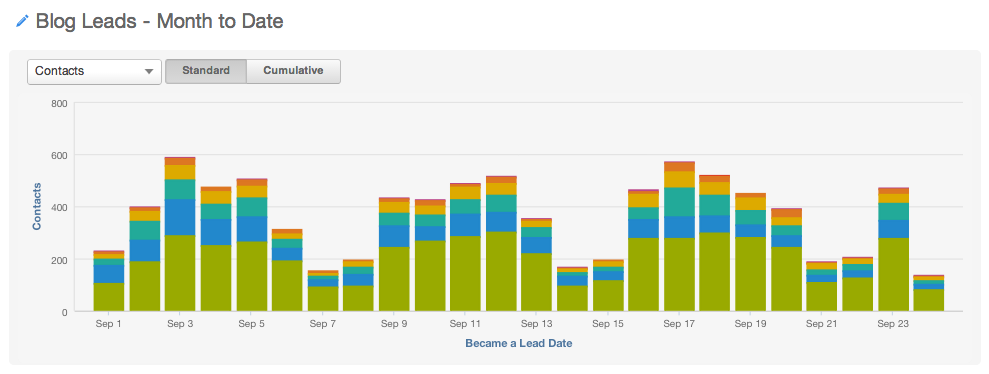
A blog leads report is a quick way to see how many leads you're generating on a daily, weekly, or monthly basis -- and by what channel. This report is a great way to dig into what channels are strongest for your blog, where you should spend more promotion time, and how well your content is performing over time.

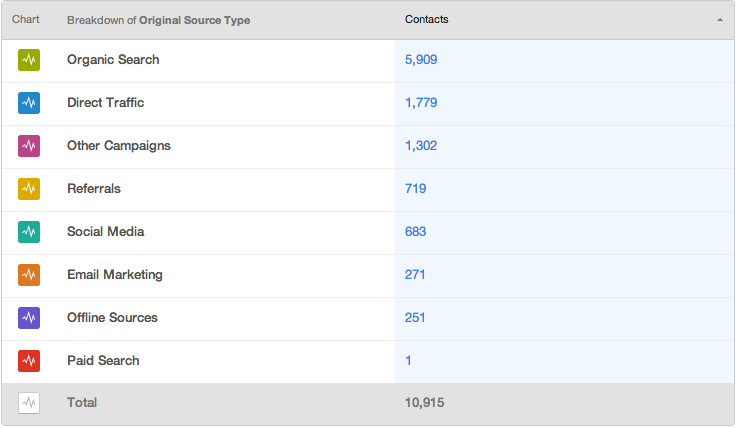
If you're using HubSpot, create a list to gather all of the leads for your blog. The list should have the "Contact Property of First Referring Site," "First Page Seen," and "Original Source" equal to your blog URL, and then use the list to create your contact report. Break down your report by the "Became a Lead Date," and break down the contact properties by "Original Source" if you would like to see the channel they're coming from, not just the leads number. 

blog-leads
blog-leads-graph

Now what do I do?

Take a look to see how people are finding your blog content. Did you run an email campaign that put the content in their hands? Are you doing a lot of promotion on social media? Or are people organically finding your content?

Based on what you uncover from this initial assessment, you can figure out your best channels for promoting your content. In the example above, it's clear that my strongest channel is organic search while email marketing is one of my weaker channels. That tells a resource-strapped marketer to invest more in optimizing my content for search than spending time creating emails.

Take it a step further and look at how many leads you're generating from your blog over a set period of time. If you see spikes in leads generated, you know to dig into your content to see if you're more successful generating leads with certain topics over others. The more you can dig into these reports to figure out what works and what doesn't work, the better off your marketing will be.

This type of data should be pulled on a weekly basis to help you adjust your content strategy for the coming weeks.

All New Contacts by Persona

What is it?

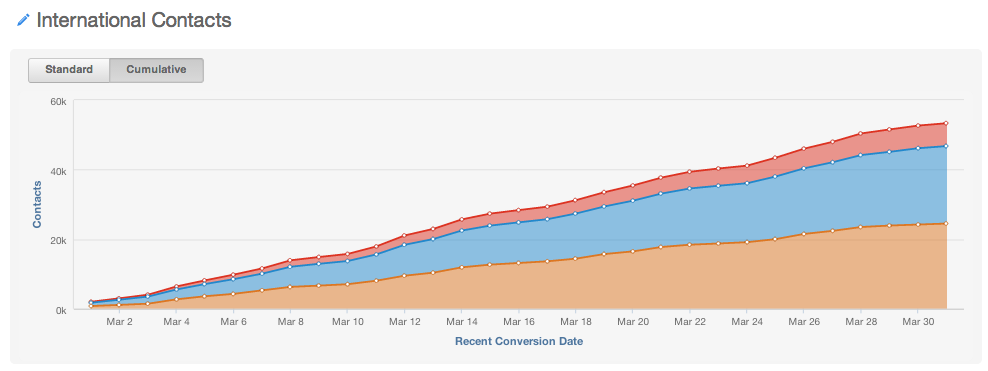
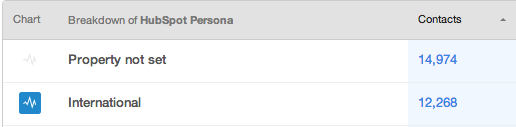
Every marketer needs a good hang of their buyer personas -- but you need to do more than just understand them. It's important to track how many new contacts you're actually adding to your database based on that persona.

To report on this in HubSpot, plot your contacts by create date, which will show the date on which you added a new contact to your database. Then break down your report by persona.

persona

international-chart

Now what do I do?

Pulling this report on a monthly basis can give you insight into how your campaigns affected new contacts by persona -- and might even shed light into an imbalance in resources dedicated to certain personas.

Did you run a marketing campaign around a particular topic? Or did you focus on promoting your content through specific channels? What did you do that led to an increase or decrease in persona acquisition? Digging into this report can help you allocate resources more wisely to grow different segments of your business.

Contacts by Lifecycle Stage

What is it?

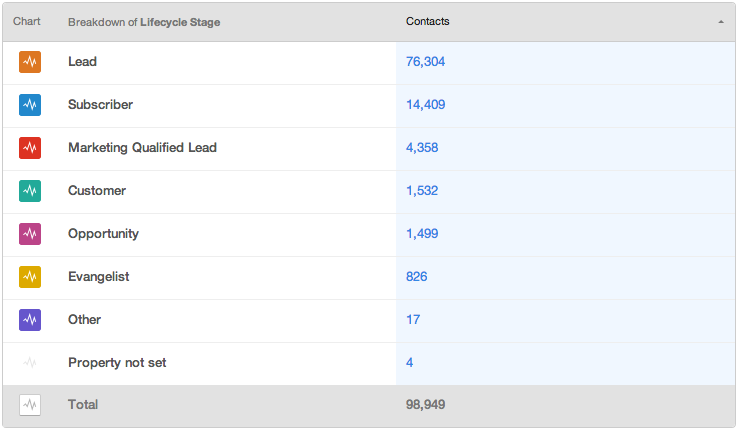
Another way to segment your database is to look at how they appear by lifecycle stage. This will give you a sense of how many leads, subscribers, customers, opportunities, etc. you have in your database in a certain time period. This data will help you understand if you need to generate more leads or if you should be more focused on closing your current leads. It will also give you a general understanding of the quality of your database.

Simply choose if you want daily, weekly, or monthly data, plot your contacts by their "Create Date," and break the report down by their lifecycle stage so you can see a report like the one below.

lifecycle-stage-data

Now what do I do?

This report will give you an overview of how many leads you're generating by each lifecycle stage. It will also give you a visual overview so you can see how these leads are moving through your funnel.

Use this report to see what areas of your funnel you need to address for greater funnel efficiency -- no one likes a clogged funnel, least of all Sales. If you see there are not a lot of marketing qualified leads in your system, for instance, you may want to create a report that digs into the reasons why. Pulling reports of the first conversion date, days to close, and content offers can help you uncover why the contacts in different lifecycle stages may be high or low.

Leads Broken Down by Offer

What is it?

If your company does inbound marketing, chances are you're going to have a lot of content on your website. Figuring out what content performs the best is important as you plan out your content strategy. Maybe certain types of offers like whitepapers are more popular than webinars, for instance. Or certain topics could resonate better with your audience than others. Understanding your audience's content preferences is very valuable information to have so you cater to their interests.

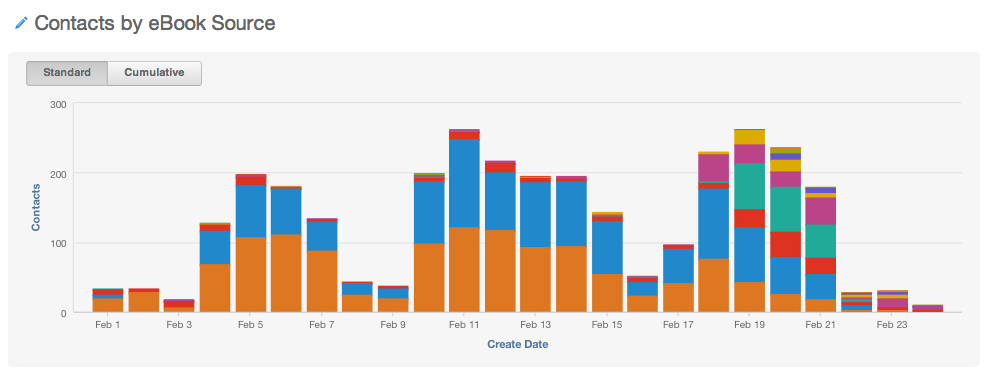
Using HubSpot, you can pull data to show which offers generate the most leads. Let's take ebooks as an example. Create a custom property for ebook source. Then go to your ebook landing page forms, and put a hidden field with the customer property you created for ebook source. Under default value, write the name of your ebook so your contact's record indicates that they downloaded that particular offer.

ebook-source

Now what do I do?

After your ebook has been live for a couple of weeks, take a look at its performance in comparison to some of your other ebooks. See if you can see trends between the different ebooks. Does a certain topic consistently perform well? Did an ebook perform better on social media than via email marketing? Try to find those trends based on the data to figure out which ones you can promote more and which ones should take the back burner.

Alright marketers, what other reports do you think are important to run? Share with us in the comments.

free marketing report template

subscribe to the hubspot marketing blog

                                     
25 Apr 17:24

Common Pitfalls in Demand Generation Strategy

by Jennifer Harmel

The word “strategy” is so over-used these days. No doubt about it we all want to have ground-breaking strategies, be thought of as strategic thinkers, and win awards for our companies or agencies with our strategy of the year. But nine times out of ten when I ask someone about their strategy, what they share with me is just a list of tactics. Not at all what I’d call a strategy.

So how and why are we all missing the boat? It turns out there are some common pitfalls among marketers.

Common Pitfalls in Demand Generation Strategy image Pitfall image

1. Diving straight to tactics
A couple emails, a webinar and three white papers do not make a marketing strategy. Take a step back and think long and hard about your goals. Are you trying to find net new prospects? Are you trying to retain existing customers? Is your company trying to gain market share or drive incremental revenue? Odds are your goals are a combination of all of those things. And you can understand why a list of white papers, tradeshows and webinars as a strategic plan will not alone achieve those goals. Instead, start with the goals and think about how you’ll achieve them.

Do you have the contact data you need? Do you have the technical tools you’ll need? Do you have the right people (both internally and externally) to help you execute your strategy? No strategy, no matter how good, will succeed without these foundational elements in place. And most importantly, your strategy needs to define how you’ll Engage with new prospects, Nurture them to become qualified, and Convert them to sales opportunities. A strategy isn’t about how many content offers you can create. It’s about improving your business results.

2. Lack of buyer-driven content
Content is obviously a key part of any marketing strategy. And most marketers have a great deal of content. The problem is that it’s all internally focused. We love to write about ourselves, our products, our solutions. The truth is that buyers don’t care what you have to say about yourself.

A successful marketing strategy includes content that is driven by the buyer’s needs. It speaks to their current pain points and, just as importantly, it’s posted in ways and locations where they are looking, researching and shopping. Without taking that into consideration, your content will not connect with your buyer.

3. Delivering unqualified leads to sales
This is a classic pitfall. Sales screams at marketing for more leads. Marketing scrambles to deliver more leads, any leads. Sales responds with a resounding “these leads are horrible.” Sound familiar? The issue is all about quantity versus quality. It’s not enough to deliver 1,000 leads a week to sales if 90% of them are no good. Wouldn’t it make more sense to deliver 20 leads to sales that are pre-qualified, allowing for 60% of them to convert to an opportunity?

Today’s marketing automation platforms allow marketers to deliver pre-qualified leads to sales fairly easily, and the details of this are essential to any demand generation strategy. Just because someone attended a webinar does not mean they are ready to talk to a sales person. Take the time to build a process whereby contacts are engaged with buyer-driven content and nurtured until they are ready to speak with a sales rep. That is strategic.

4. No collaboration with sales
No demand generation strategy will succeed without collaboration between marketing and sales. Your colleagues in the sales organization are an excellent resource for generating the buyer-driven content mentioned earlier. After all, they are the “feet on the street” presumably listening to their customers wants and needs. Allow sales to provide input as you craft your audience personas.

Sales is also a must-have for any lead qualification and scoring conversation. After all, how can marketing deliver pre-qualified leads to sales if we don’t know how sales defines “qualified”? Find out who they want to talk to and who they don’t want to talk to and use that to build your lead qualification strategy. (There I go using that word again.)

5. Lack of refinement
As much as we’d all love to think that we can launch a new demand generation program and have it run perfectly, the reality is, this will never be the case. We work for months and months to produce the content, build the process, and align with sales. Yet the work is never done. There is always room for improvement. So before you launch a program, be clear on how you’ll define success and track results accordingly. You may find out that the analysis and tweaking for incremental gains is the most fun of all.

A long list of tactics, no matter how great, does not constitute a Demand Generation Strategy. Marketers need to think about more than how they will deliver their message and when. It takes much more than that to drive real revenue.

25 Apr 17:24

4 Tips to Improve Email Data Quality

by Tom Burke

4 Tips to Improve Email Data Quality image improve email dataYou may be the savviest salesman in the world but, at the end of the day, you’re only as good as your data. And for many companies, data could be a lot better.

In a recent State of Salesforce report by Bluewolf, 25% of companies cited data as their No. 1 business challenge. And as many as one in four B2B databases are inaccurate, according to research by SiriusDecisions. Marketers are clearly having trouble with their data quality.

What’s more, this “data problem” is costing marketers serious money. SiriusDecisions Senior Research Director Jonathan Block points to the 1-10-100 rule: It takes $1 to verify a record as it’s entered, $10 to cleanse and re-duplicate it and $100 if nothing is done. And these costs multiply exponentially as databases grow.

Ultimately, bad data can creep into your database for a variety of reasons, but you can eradicate most of it with a proactive approach. Below are four ways to improve your data quality ASAP.

Ask for More with Less

To effectively target customers, you need more than a name and email address; you just don’t need it all at once. Just as you wouldn’t reveal everything about yourself on a first date, your customers don’t want to feel pressured to share too much too soon. Make it easier for them with smarter, simpler forms.

Your initial sign-up form can be short and sweet, asking for no more than five pieces of information. Then, give your customers the option of filling in more details on a second page or sharing that information later, after you’ve contacted them. To keep learning more, ask them a different set of questions each time they download more content.

For more tips on creating a form that strikes the right balance, read on here

Keep Collection Organized

If your company has several departments using separate databases, you risk racking up redundancies and inconsistencies. There should be a natural flow from marketing to sales to billing and customer service, ideally within the same system. Take a look at how a potential customer is filtered through your company. The more the information has to be re-entered, the more opportunities you have for mistakes along the way.

Use Email Intelligence

An Email Intelligence service allows you to fill in data blanks with new insight from external sources. Having access to your customers’ postal addresses, social media profiles and harder-to-find information such as age, marital status and occupation will help you more accurately identify their needs. You can then personalize your connection with them and create targeted offers, rather than using a one-size-fits-all approach.

Clean it Up

Customers frequently change their email addresses—roughly 30% change them every year, according to some estimates. That means there’s a good chance that almost 1/3 of the addresses in your customer database are no longer valid. You’re wasting time and money each time you send out emails that don’t go anywhere.

What’s worse, you’re missing opportunities to engage with clients who have already shown interest. Email Validation services can identify invalid addresses, correct misspellings and check deliverability to help you clean up your database. Email Validation can remove up to 95% of bad emails so you can start focusing on reaching real people, and using it in your web forms ensures you are not losing any leads due to data entry errors.

Maintaining quality data reduces mailing costs and makes your email marketing more successful. To start improving your data now, contact TowerData today.

4 Tips to Improve Email Data Quality image fdd5e800 d280 4395 a1d6 384579313481

25 Apr 17:24

How Should You Measure Sales Productivity?

by Lauren Licata

8 sales experts share how they measure sales productivity.

Measuring sales productivity has always been important for sales people, and now that businesses are more data-driven, it is crucial for every sales team to have good time and productivity tracking practices. Those who don’t are quickly being left in the dust.

Fortunately, it doesn’t have to be hard to implement productivity tracking practices that can show you where you’re wasting time, and where you should put more energy to get the most out of every minute you spend selling. We talked to some experienced salespeople about how they track their own productivity, and which metrics are the most important for gauging your success. These sales pros track everything from their gross profits to the number of thank you notes they write, and all of this data helps them constantly improve their performance.

We asked each of these accomplished pros how they measure their own success, and which metric they think every other top seller should be paying attention to. Here ’s what they said:

Wendy Weiss

How Should You Measure Sales Productivity? image 150x150xWendyweiss2.png.pagespeed.ic .Cw06KueZjs2

President, ColdCallingResults.com

Q: How do you measure your productivity as a salesperson?

The metrics that are important to measure for telephone prospecting are: Dials, Conversations (with a qualified prospect) and Appointments. Many sales professionals will track their number of Appointments, some will track their Dials and Appointments, very few track the number of Conversations they’re having with qualified prospects. Without that middle number, it’s impossible to know how you’re doing.

Q: How do you collect and analyze data on your own productivity, and how do you use it to improve your sales?

Software. It is amazing to me in 2014 the number of companies that are still not using any kind of software to track prospecting numbers.

Q: What is one productivity metric absolutely every salesperson should be paying attention to?

Dials, Conversations, Appointments. When you track these numbers, it’s then possible to know the conversion of Dials into Conversations and the conversion of those Conversations into Appointments. Once you know conversion numbers, it is possible to tweak and improve results. Absent that information… it’s almost impossible.

Lori Richardson

How Should You Measure Sales Productivity? image 150x150xlori 12.png.pagespeed.ic .P0dKvGGRax2

Founder & CEO, Score More Sales

Q: How do you measure your productivity as a salesperson?

As a consultant, trainer, writer, and sales coach, I have to be very methodical when it comes to our own sales productivity. We do proactive sales pipeline development through working with strategic partners (those who refer multiple opportunities our way, and we do the same), attending conferences, follow up from conferences, and by identifying decision makers through tech tools.

We also have an inbound marketing system that helps bring those further through the sales cycle our direction so that we can have the opportunity to learn what it is they want to fix or change – and see if we can assist them with that.

Q: How do you collect and analyze data on your own productivity, and how do you use it to improve your sales?

We collect and analyze data on our productivity through our inbound lead successes and through several tools we use internally in addition to our CRM system. We have staff meetings twice a week – on Mondays with sales (and other) goals, and on Fridays for review. I have blogged about this a few times and am happy to explain to anyone interested all of the steps. By looking at all of our sales opportunities we can tell if we are focusing time in the right places (our target market is mid-sized technology and distribution companies). When it comes to conferences, we have a rule in the company that we must make more by attending than if we didn’t attend. Meetings are planned in and around conferences – it’s something I’ve done for years.

Q: What is one productivity metric absolutely every salesperson should be paying attention to?

A productivity metric every salesperson should be paying attention to is number of opportunities prospected to qualified to closure. That’s really three metrics, but I want to see what a rep started with (to know if they have enough of the right activity while prospecting), what they move through as “”qualified”” in the pipeline (so I know if they are spending time in the right places, and then of those qualified, how many came to closure – so that I can tell if they are working the right opportunities or if there are other issues, such as lack of urgency or poor messaging.

Jill Konrath

How Should You Measure Sales Productivity? image 150x150xjill konrath2.png.pagespeed.ic .V3dghnw n12

Author, Speaker, Strategist JillKonrath.com

Q: How do you measure your productivity as a salesperson?

By the outcomes. If what needs to get done for the day/week is accomplished, I have been productive.

Q: How do you collect and analyze data on your own productivity, and how do you use it to improve your sales?

To me, quality is my most important productivity tool. I want to have maximum impact with every client interaction, keeping my prospect moving forward. If that didn’t happen, I need to revisit my planning, knowledge, strategy, approach, messaging and more.

Fewer but better interactions with high quality prospects is significantly more productive than tons of calls with marginal prospects.

Q: What is one productivity metric absolutely every salesperson should be paying attention to?

For prospecting, watch your contact to conversation ratio. If it takes you, on average 10 email/phone contacts to set up a meeting (via phone, skype, in person), your goal should be to try to reduce it to 8.

To do that, you need to focus on increasing messaging effectiveness — so we’re back to quality again.

Jeff Sheehan

How Should You Measure Sales Productivity? image 150x150xjeff sheehan1.png.pagespeed.ic .h5uebMFNmG1

Author of “Hired! Paths to Employment in the Social Media Era”

Q: How do you measure your productivity as a salesperson?

No matter how you might want to slice and dice it, the number one measure for sales is the amount of revenue which is generated versus that forecasted. Is the salesperson meeting his or her plan? If so, at what percentage to plan? Any deviations need to be thoroughly explained and corrective actions taken to ensure that the person gets back on track during the upcoming month, quarter or other reporting period.

In addition to actual revenue growth, customer satisfaction is also another way of measuring productivity. In certain instances, revenue growth may be deferred if the customer has some strategic significance. In this case, how satisfied the customer is in its business dealings with the company might be a more critical factor, as a satisfied customer in a strategic area might provide a significant lifetime reward that greatly exceeds the short-term sales revenue growth.

Finally, market share growth or maintenance is another measurement used. Is the company growing share in specific industries or territories or is it losing share. This is extremely important to take into consideration within a number of sales situations.

Q: How do you collect and analyze data on your own productivity, and how do you use it to improve your sales?

Collection and analysis is generally extracted from sales records and compiled in databases for reporting purposes. Further analysis of the data might be done in Excel with pivot table analysis and report generation for management to review and act upon.

Q: What is one productivity metric absolutely every salesperson should be paying attention to?

Sales revenue growth, as well as profitability of the customer. There is no reason to be shipping money with every sale unless there is a significant strategic reason for so doing.

Jim Keenan

How Should You Measure Sales Productivity? image 150x150xjimkeenan1.png.pagespeed.ic .HgptxrAUmv1

Founder, A Sales Guy Consulting

Q: How do you measure your productivity as a salesperson?

Results. Am I achieving what I need to achieve in the time I need to achieve. It’s simple for me. When I’m not being productive, the “big” things are slipping through the cracks and not getting done.

Q: How do you collect and analyze data on your own productivity, and how do you use it to improve your sales?

I don’t collect data. When it comes to my own productivity I focus on results. I find measuring time and productivity to be counter productive. Measuring individual productivity takes me away from what I should be doing. With that said, to ensure I’m being productive, I prioritize my tasks and initiatives to make sure I know what is most important and only work on those things.

Q: What is one productivity metric absolutely every salesperson should be paying attention to?

Nope, no such thing. OK, I take that back. It’s called quota attainment.

Butch Bellah

How Should You Measure Sales Productivity? image 150x150xButch 2.png.pagespeed.ic .QH PF8D12q

Sales, Marketing & Business Coach

Q: How do you measure your productivity as a salesperson?

The obvious answers are conversion rate or closing percentage. But, I think one must go deeper and capture gross profit generated. We sometimes forget that not all sales are good sales and large orders are not the most profitable. Top line sales are great, but bottom line profits keep everyone paid.

Q: How do you collect and analyze data on your own productivity, and how do you use it to improve your sales?

I use a system I’ve taught for years called The Power of Ten. It’s several metrics that are measured weekly or monthly to keep me (and those who use it) focused on drivers that impact sales and profitability. It reminds me constantly of one “can manage what you can measure”

Q: What is one productivity metric absolutely every salesperson should be paying attention to?

No question. Prospecting. If you are not making contact with new people constantly I don’t care how good you are at asking for the sale, overcoming objections, questioning or anything else. You’re not going to have anyone to talk to.

Craig Wortman

How Should You Measure Sales Productivity? image 150x150xcraig1.png.pagespeed.ic .5U9eRS42 q1

Founder & CEO, Sales Engine

Q: How do you measure your productivity as a salesperson?

I measure the usual suspects (revenue, annual growth rate), but I also measure some things that may surprise people. I closely track how many thank-you notes I write to people, because for me that’s a lagging indicator of productivity. If I’m generating leads and pushing those leads into the sales process, chances are that I’ve now got someone to thank. And as I’ve said a million times, a “thank-you” is only a thank-you if it’s done properly. An email will not suffice. So I use tags to measure how many notes I’ve written and mailed in a given month.

I also measure how my database has grown, and where that growth has come from. Again, I use tags so I can sit down on a quarterly basis and determine where I’ve met people, what online activities drove traffic, and how many people came to me through various sources. These more granular metrics are the most important…they measure day-to-day discipline. The top-line measures are vanity metrics…they might make you feel good (or bad!) but they don’t tell you anything. But if I’ve written 37 thank-you notes this month, I can be damn sure that something good is going to happen next month!

Q: What is one productivity metric absolutely every salesperson should be paying attention to?

Thank-you notes, hand-written and mailed through the good old Post Office. How many have you written this month? Do it, track it, and watch good things happen.

Elinor Stutz

How Should You Measure Sales Productivity? image 150x150xelinor1.png.pagespeed.ic .dffDNuSc b1

CEO, Smooth Sale

Q: How do you measure your productivity as a salesperson?

My style is to begin with the end in mind. Professional salespeople should look at their targeted quota and bonuses available for achieving more. Reflect upon how many sales are required, the most likely candidates who will purchase, and the prospecting required to keep the pipeline filled at all times. Come to terms with the number of contacts required, and dedicate yourself to the task in order to make the ultimate sales reality.

This post originally appeared on the Base blog.

25 Apr 17:23

The NEW Conference for Salespeople — #SalesHackerConf

by Brock Heath

The Sales Hacker Conference is bringing hundreds of salespeople, leaders, and sales experts together today in NYC to talk about sales “hacks” — strategies, lessons, and data that help young, growing sales organizations weather the start-up storm and drive their company to the next level without breaking the bank.

And if you missed today’s conference, no worries! There’s going to be another coming up later this year . . . and I’ll be presenting!

Here are a few nuggets from today that set the conference apart:

1) Elay Cohen talks about having great sales managers at Salesforce.com:

Cohen worked at Salesforce for 8 years, when the company grew from $500 million to $4 billion in revenue. His takeaway from that experience: “My message for today is that first-line sales managers make it happen.”

Cohen explains why Salesforce’s sales managers were so wildly successful:

  • They created a great culture. Managers created a values system and made it their team mantra. Everything they did came back to these sales values. Before long, the values were ingrained in their reps’ minds.
  • They established a sales rhythm. Without a rhythm, sales in a start-up can feel like a wild ride of ups and downs with no method. Salesforce’s managers created a monthly system that kept their reps focused and in the game.
  • They encouraged ongoing learning, both for themselves and in their teams. “You can’t just learn at sales events or conferences,” Cohen says. You need to use world-class on-boarding, have ongoing sales meetings, and encourage best-practice sharing among the team.

He concludes with this advice: “Think like a CEO and act like an entrepreneur — first-line sales managers make it happen. you need to own the outcomes.” 

2) Kyle Porter of Salesloft explains why his reps are averaging 370% of quota:

Porter explains how Salesloft succeeded at hiring and managing to create the right sales culture, then equipped the team with the right tools, data, and motivation to take off from there.

3) The always awesome Carolyn Betts of Betts Recruiting tells you how to hire sales talent that “doesn’t suck”:

Getting the right people on board is often a make-or-break issue for a young B2B company. Betts has tons of experience in this area. She says successful companies develop recruiting systems that provide incentives for referrals, generate new hire “leads,” brand the company as an employer, and more.

Check out another great session on hiring by Adam Liebman of SinglePlatorm.

4) Aaron Ross talks Predictable Revenue:

No sales conference could claim to cater to the young start-up crowd and not feature Aaron Ross. His perspective is uniquely start-up oriented and his popular book, Predictable Revenue, breaks sustainable growth down to a basic system. “If your systems are broken,” he reminds the attendees, “then your people cannot be successful.” It’s the perfect companion to a conference built around the same theme.

The post The NEW Conference for Salespeople — #SalesHackerConf appeared first on TeleSmart Communications.

25 Apr 17:23

There Is A Right Way To Do Content Marketing

by Danielle Terreri

Jeni has had Betsy, her faithful car, for over 10 years. Although Betsy is in decent shape, Jeni finds herself daydreaming about a new car. Her co-worker, Jeff, just got his car back from the shop. This is the third time this month his car has broken down. Here is their exchange in the break room:

Jeni: “I’m thinking about buying a new car, but I don’t know if the timing is right.”

Jeff: “This was the final straw for me. I have no choice. I will be purchasing a new car this month.”

Jeni: “I’m going to do some research to see what’s out there.”

Jeff: “I’m a step ahead of you. I have researched best models for my needs and budget and will be spending my evening searching for tips and tricks for financing. I don’t know what my options are and do not want to make a decision blindly.”

It’s clear that Jeni and Jeff are at two different stages on the path to purchase.

High FiveHow can a car dealership market to both Jeni and Jeff effectively? The answer is by having readily available content that is tailored to every stage of the buyer’s journey! This can be achieved by providing a mix of Informational and Decision-Making content, no matter which distribution platform (Videos, Webinars, Ebooks, Blogs, Case Studies, etc.) you deem most appropriate for your messaging.

Providing a mix of Informational and Decision-Making content helps you:

  • Reach buyers at all stages of the buying journey
  • Increase brand awareness, credibility and trust
  • Generate leads
  • Increase customer acquisition and retention
  • Establish yourself as an industry thought leader

So what is the difference between Informational and Decision-Making Content?

Informational Content

This content offers a general overview or introduction to a topic, product or brand. This information will help educate people in the early stages of the sales process, sometimes referred to as the top of the “sales funnel”. The goal of this information to educate and entice people to want to know more.

If you are Karz.com, a blog posts titled “Top 10 Reasons to Buy a New Car” and “5 Things You Need to Know When Looking for a New Car”, would be valuable pieces of Informational content to publish.

Identifying what Informational Content is most valuable

Having valuable Informational content ready for buyers at the beginning of their path to purchase is key. Think of the topics that would benefit the buyer by putting yourself in their shoes. Here are some questions, tailored for Karz.com, to help spark ideas:

  • What are the initial questions people ask when they begin the search for a new car?
  • What information do buyers need first to get on the path to purchase?
  • What misconceptions are out there about the car industry?

While Informational Content sets the stage, helping consumers gain initial insight, Decision-Making Content is what helps make a sale.

Decision-Making Content

This type of content provides detailed information that helps people make a purchasing decision. This information is created to benefit people farther down the “sales funnel” who are ready to make a decision, but need more information. The goal of this information is to provide answers to the final questions one might have before making a purchase from you.

The “Buyer’s Guide to Purchasing a Ford” and “How to Get the Most for Your Money When Buying a Car” are both valuable pieces of Decision-Making content for Karz.com to publish.

Identifying what Decision-Making content will be most valuable  

Providing the right Decision-Making content is very important. To think of valuable information you can address, get in the buyer’s mindset at the later stage of the purchasing process. Here are some questions to ask yourself:

  • What does a potential buyer take into consideration when choosing between my brand and my competitor’s brand?
  • What unique features do I offer?
  • What information does a buyer need to make the ultimate decision to buy what I have?

The secret to reaching customers is to make yourself valuable to them at all stages of the path to purchase. Providing both Informational and Decision-Making content is going to help you get there.


Related Stories

25 Apr 17:22

4 Ways the Best Sales Teams Beat the Market

by Daniel Birke

Customers today use an average of six channels during the buying process, and the number of channels available to them is only increasing. Competition for those customers has also increased as margins have tightened. Digital channels have upended the well-trod ruts of sales and marketing organizations — already, nearly a third of all B2B purchases are done digitally. All of this increased complexity means sales leaders must rethink how they source leads, manage pipelines, and sell more effectively.

Rather than being overwhelmed, the best sales leaders have figured out how to overcome this complexity to drive above-market growth. Our analysis of 73 B2B technology companies shows that across sectors, the top 25% of companies achieve more than twice as much return on sales investment compared to the bottom 25%.

What do they do right? Based on our experience and analysis, they maintain a clear focus on four things:

1. They measure sales ROI differently. The key to smart investing is having good data that highlights where the greatest sales ROI is. That starts by knowing what to measure. Many companies, however, measure sales efficiency in terms of sales cost versus revenue. That metric is misleading because it does not sufficiently reflect the margin differences between sales channels. A more meaningful sales ROI is to measure sales cost against gross margin or profit (EBIT), which helps leaders more effectively align the number of accounts per sales employee with actual and potential revenues. By analyzing the sales ROI potential of various segments, for example, sales leaders uncover different channel approaches for each. In one company, analysis revealed that sales ROI in indirect channels was 50% greater than in direct channels.

The best leaders also achieve such high sales ROI by reducing overall sales costs without giving away too much margin. Approaches include a strong “quality instead of quantity” focus on their highest-performing partners. They also tend to de-emphasize direct discounts, such as rebates and product offerings.

2. They keep sales costs low. While the old adage “it takes money to make money” is popular, it’s not true when it comes to the best sales leaders. The best of them keep their costs lower than their peers do. Some 72% of companies in the top quartile of sales ROI also have the lowest sales costs. Effectively controlling costs requires a clear and objective view of profitability and cost-to-sell by channel, product, and customer.

With this foundation, sales leaders can make better decisions, such as scaling back sales efforts for lower value orders. They also invest in processes and training that cut costs, such as installing technologies that reduce the number of order exceptions and cross-training people to have multiple skills. This level of efficiency not only reduces costs but also allows sales leaders to profitably pursue lower-margin business.

3. They free up their salespeople for selling. Top performing sales organizations have the same percentage of sales staff in sales management roles — around 8% — as lower-performing companies. However, they have about 30% more sales staff in support roles. While this may seem counterintuitive, this approach frees up sales reps from more administrative tasks, such as order management and developing sales collateral, to devote more of their time to customers. The result is that front lines sales reps are three times more productive than their peers.

One leading high-tech equipment business, for example, found that 28% of sales rep time was spent on low value activities like complaint handling. They then shifted about half of these transactional activities into a sales factory and freed up 13% of sales rep time for them to sell.

Sales executives also need to take a hard look at their sales support systems. Some activities can be automated or streamlined, some can be delegated and pooled into back-office sales factories, and others can be cut entirely. Implementing such operational and structural changes requires a clear understanding of just what constitutes low- versus high-value-add activities and what resources are currently devoted to each.

4. They use as many channels as they can. Companies that effectively sell across multiple channels (inside sales, outsourced agents, value-added resellers, third-party retail stores, distributors, or wholesalers) achieve more than 40% higher sales ROI than companies wedded to a single channel model (only key account management and/or field sales). Managing multiple channels calls for effectively addressing selling opportunities based on value versus on volume, and recognizing that not every channel is optimal for every product. For instance, inside sales reps can handle key accounts with low-complexity products, whereas more costly in-person support should be assigned exclusively to key accounts with high-complexity products.

Many companies are understandably afraid to “tinker with” sales, the only part of the organization that actually brings in the revenue. We believe, however, that more aggressive action to match sales resources with sales ROI opportunities is critical if companies are looking to beat the market.

25 Apr 17:19

Beyond Batch and Blast: Launching Your First Lead Nurturing Program

by Scott Thomas

It’s long been said that the squeaky wheel gets the grease. This is no truer than in the marketing space, where every lead wooed and converted translates into increased revenue. However, there’s a commonly used method that exists which proves as the exception to this rule, which we not-so-affectionately refer to as “batch and blast.” This is the practice of sending everyone on your list the very same one-off email at the same time. Essentially, batch and blast is a numbers game, operating with little strategic rhyme or reason and handling leads with a one-size-fits-all approach. But, because no two leads are the same, organizations need to have a program in place that caters to the needs of individual prospects. The solution? Lead nurturing.

Beyond Batch and Blast: Launching Your First Lead Nurturing Program image intelechy graphics  01 01

According to SiriusDecisions, 80% of prospects deemed by sales teams to be “bad leads” go on to buy within 24 months. For your marketing team, this presents an incredible opportunity to cultivate these leads, through lead nurturing. Nurturing can be defined as systematically contacting prospects in a progressive cadence timed to ease them through the buyer’s journey. This process of educating and staying fresh on the minds of prospects who aren’t (yet) ready to buy, allows you to turn otherwise dud leads into added revenue. Many organizations, maybe even your own, are intimidated by the thought of starting a lead nurturing program. While it’s true that getting started is the hardest part, every day that you’re not utilizing lead nurturing is a missed opportunity to turn cold leads hot.

Why Getting Started Is Hard

Lead nurturing is growing increasingly imperative as the landscape of what we consider “traditional marketing” continues to change. Today’s consumers don’t respond to conventional “Mad Men”-style marketing and advertising tactics; instead, they respond to engaging, informative content that speaks to them and not at them. Gone are the days of one-and-done campaigns. Instead, organizations need to have programs in place to satiate consumers’ appetite for information. Yet, herein lies the problem.

Many organizations don’t seem to fully grasp the concept of marketing automation, particularly the many moving parts that a successful program requires. Simply put, in order to automate something you need to have something to automate. What processes are currently in place that could be used as part of your lead nurturing program? Lead nurturing is dependent upon the foundation on which it’s built. Without the building blocks, there is no building.

Assessing the Foundation of Your Lead Nurturing Program

The beauty of lead nurturing is that the possibilities for engaging buyers are limited only by your capacity to do so. The more programs you currently have integrated into your overall marketing strategy, the more ways you can engage with prospects via your lead nurturing program. The following are highly effective fundamentals that can be implemented as part of your lead nurturing program and help you in gaining and maintaining your leads’ hard-won attention.

  • Email Correspondence – Does your organization already use regular email campaigns?
  • Trial Programs – Does your SaaS company offer a trial program that could be utilized by a lead nurturing program?
  • Content Generation – Is your company generating content and if so, is that content engaging and relevant?Beyond Batch and Blast: Launching Your First Lead Nurturing Program image intelechy graphics  02
  • Trigger Programs – Are you properly utilizing if/then sequences as part of your existing email marketing campaigns?
  • Non-Responder Campaigns – How does your organization handle non-responders?

Lead nurturing requires a fair amount of due diligence initially in order to generate any real or lasting results. However, when executed properly, it can result in as many as 50% more sales-ready leads at 33% lower cost. And it scales. Most of the new leads you generate should probably go straight into the nurturing program you’ve already created, where you can keep them engaged and progressing with little effort.


25 Apr 17:19

The Content Deluge And What It Means For B2B Marketers

by Achim Klor

The Content Deluge And What It Means For B2B Marketers image 1361554378b

According to Google Chairman Eric Schmidt, we generate as much information in a couple of days as all of mankind has since the dawn of recorded history up to 2003. Some mathematicians will argue that the true number of days is actually closer to a week, but the point is that our species generates more information today than we have ever before. It’s a staggering statistic.

“Every 2 days we create as much information as we did up to 2003.”

- Eric Schmidt, Executive Chairman, Google

The Content Deluge has also hit the B2B space hard. Big brands with deep pockets have been able to adapt quickly and become big content brands in a relevantly short time. Some smaller brands have had a tougher time of it because resources and cash are already stretched, while others have adapted well because they saw the signs early and prepared accordingly.

However, no one can say they didn’t see this coming.

Well before the digital revolution hit every market in 2008, the alarm bells were already ringing about the coming digital tsunami. Social networks like Facebook started blazing that trail in 2004 and now, here we are.

If inbound traffic to your business is humming and conversion rates are keeping your sales people busier than ever, congratulations! You prepared well and are reaping the rewards for the hard work.

If you’re on the other side of the fence and struggling with generating leads, don’t panic. There is a simple solution, but be warned: generating results today requires more effort and resources than it did in 2008.

Why? Because with every deluge comes massive amounts of debris (aka: crap). The best explanation of the crap that comes along with generating content is the SlideShare below by Doug Kessler (@dougkessler).

Crap. The Content Marketing Deluge. from Velocity Partners

What to do?

How do you deal with the Content Deluge? How do you rise above all the crap? There is no easy answer except to be willing to invest in creating content that engages buyers and helps them make informed decisions. The advice in Doug’s SlideShare above is well worth considering.

“The winners in the Post-Deluge era will be the companies that build something precious. The winners will be those who build great content brands.”

- Doug Kessler, Velocity Partners

Our Three Key Takeaways are based on our own agency experiences but mirror Doug’s sentiments:

  1. Elevate your brand. This is a decision. You either want to be a market leader or you don’t. Gone are the days of “fitting in” or “me too” branding. The B2B marketing landscape has changed drastically in the last five years. It’s much more transparent and instant. You either stand out or become shut out. Everything starts with your brand. Everything from your personality, to your voice, to your promise. Your customers only care about how much you care for them so stake a bold claim that stands for something great and own it. You have to elevate your brand high enough that it will be noticed above the crap.
  2. Identify Subject Matter Experts. Great content is not created in a vacuum. One person or one department cannot do it alone. The content ecosystem spans the entire organization. There are subject matter experts in every corner of your company. Build your content team by seeking them out, empowering them, and helping them actively stay involved in communicating your brand’s promise. An active, social brand is a brand that is top of mind.
  3. Be prepared for the long haul. B2B sales cycles are long. That’s why marketing to B2B buyers is like running a marathon. And like any marathon, preparation and training is critical otherwise you run the risk of crashing and burning. Creating great content that generates and nurtures leads is no different. It takes time and resources to build up content credibility so that your brand is seen as an industry authority. It doesn’t happen in a week, or a month, or even a year. It can take longer if you’re starting from scratch, so don’t expect immediate sales increases. The key is to start with a strategic content marketing plan, because the amount of crap is only going to keep getting bigger. Once you have a plan to work, pool together your internal and external resources so you can execute accordingly.

Truthfully, creating useful content is an overwhelming undertaking. It is difficult and uncomfortable to become a publisher of industry subject matter expertise if you’ve never done it before. But it is absolutely critical in order to show up for today’s savvy self-directed buyer. There are no short-cuts.

Consider this: if you think it’s hard for your company to become a great content brand, think of how hard it is for your buyers to sift through all the crap in order to find you. Can you even hope to show up on their radar if you are not sharing something useful?

Your turn

How is your company dealing with the Content Marketing Deluge? What challenges or successes have you experienced? Share your thoughts and sound off in the comments below or on Twitter (@SterlingKlor).

25 Apr 17:19

How to Reap Revenue from Your Social Media Marketing Campaigns: 3 Case Studies

by Kevin Bobowski

How to Reap Revenue from Your Social Media Marketing Campaigns: 3 Case Studies image How to Reap Revenue from Your Social Media Marketing Campaigns 3 Case Studies

Today’s social media marketing campaigns have a big job to accomplish for brands. They are a vehicle for consumers to discover new products and engage with brands, but companies now expect them to close the deal and drive revenue, converting an online audience into loyal customers.

According to research compiled by MobStac in 2013, 78 percent of consumers rely on social media to guide their purchases, proving that social plays a pivotal role in consumer decisions.

But today consumers are bombarded by marketing messages on television and radio, in magazines and newspapers and on smartphones and laptops. Amidst all this marketing and advertising chatter, brands can increasingly become ignored if they don’t execute a coordinated and cohesive marketing effort that ties television and print advertisements to social media, and eventually convinces consumers to complete a transaction.

The most crucial component of connecting social media and revenue is steering social fans and followers to a website, a process that in theory sounds simple, but in reality requires creativity and well-structured campaigns.

Brands have to build excitement that transforms into buying intention while moving from a Facebook page or Pinterest board to the website. Think of marketing efforts as road signs, traffic lights and billboards all rolled into one effort to inform, direct, and excite your social audience and create momentum toward a purchase.

Case Study #1: JustFab.com

E-commerce subscription company JustFab used an unconventional approach to tie social to their website in a campaign called #JustFabWish. The company asked its network to browse their online collections and Tweet their wishlist link with the traceable and branded hashtag #JustFabWish for a chance to win their ensemble.

The company generated attention for the campaign with an email blast sent to millions of current members and leads. JustFab marketers also promoted the campaign through banner ads onsite, and on Twitter and Facebook.

How to Reap Revenue from Your Social Media Marketing Campaigns: 3 Case Studies image How to Reap Revenue from Social Marketing Campaigns 4 Case Studies

Result: When compared to the prior month, JustFab registered a 140 percent increase in web traffic and a 240 percent increase in revenue from Twitter. The campaign out-performed their second most successful effort by more than 50 percent.

The campaign required that participants go to the website to submit their entry. Once on the website, potential customers were already browsing products, and one click away from making an online purchase.

Case Study #2: Gilt.com

Gilt.com paired digital Ad buys with a giveaway to boost web traffic and partnered with Hanky Panky, a popular retailer of women’s underwear, for a giveaway campaign that highlighted Hanky Panky’s main product on the Gilt.com website.

Sure, it was a simple giveaway, but as the entries increased and daily content and ad budgets were put toward promoting the referral contest, more and more people saw the product and in turn, more people wanted the product.

How to Reap Revenue from Your Social Media Marketing Campaigns: 3 Case Studies image How to Reap Revenue from Social Marketing Campaigns 4 Case Studies 2

Result: More than 45,000 people visited the sweepstakes page during the two-week contest and 21,000 people participated. Gilt.com added 3,000 new social fans that would continue to see their products and be driven back to the point to purchase them. There was more than just one winner in that contest; Hanky Panky earned exposure for a product directly from the retail site.

Case Study #3: Lilly Pulitzer

Fashion retailer Lilly Pulitzer decided to entice the Audience with an Exclusive Offer. They used the power of exclusivity to launch a campaign that granted early access to online sales for those that opted into their newsletter. Their social sign-up program helped create a massive buzz around the launch of the sale.

By the time the early birds had their carts filled, there was another group of fans clamoring to get in on the regular launch. The campaign made their social audience excited to get on their website and actually buy product.

How to Reap Revenue from Your Social Media Marketing Campaigns: 3 Case Studies image How to Reap revenue from social media campaigns 3

Result: Lily Pulitzer ended up collecting thousands of email addresses of potential customers, doubling the size of their email database and giving the brand a lasting connection with a new customer base. The social teasers and following email campaign translated into measurable revenue during the online sale.

It doesn’t matter if brands use their website as the starting or ending point; weaving together social elements such as email campaigns, Facebook landing pages, Hashtags and contests, is an essential tactic for brands to reap revenue during and after a social marketing campaign.

24 Apr 16:50

Why Politicians Care More About Old People Than Young People In One Chart

by Brett LoGiurato

The U.S. Census Bureau is out today with new data on young-adult voting trends in presidential elections since 1964. And though the research finds an uptick in recent young voter engagement, there's still a significant gap between young-adult participation through voting when compared with older age groups.

There's perhaps no better evidence of this than in the disparity between each age group's share of the eligible population in the U.S. compared with the percentage of the age groups that vote.

Here's the chart from the Census:

Census voting chart

In 2012, the most recent presidential election, people aged 18-29 made up only 15.4% of the eligible voting population. However, 18- to 29-year-olds account for 21.2% of the population — a difference of 5.8% reflected in the chart. 

Older age groups, by contrast, account for a much larger share of the voting population than they represent overall. People aged 45-64, for example, account for 35.6% of the eligible population. But they represented 39.1% of the 2012 voting population. Those aged 65 and older made up 19.1% of the eligible population. But they, too, over-represented their age group at the ballot box — 22.3%.

"Overall, younger Americans have consistently under-voted at the polls relative to their eligibility. The magnitude of these differences has fluctuated over time," writes Thom File, the author of the study.

Join the conversation about this story »

24 Apr 16:49

Five Reasons Your Attitude Is Hurting Your Career

by Personal Branding Blog

Five Reasons Your Attitude Is Hurting Your Career image shutterstock 174590441This post is about trying to help you, not about criticizing you. Please consider it in that light.

Your attitude is one of the most important factors in creating your long-term career happiness. As noted in the first chapter of my career book, “Attitude is important in landing a job, keeping a job, and being proactively prepared to change jobs.

Whether you recognize it or not, your attitude IS affecting your career…. either positively or negatively. In this article, I want to help alert you if it could be retarding your progress or standing in the way of achieving the career results you desire.

If you are happy with your boss, your peers, your subordinates, your income, your job title, your career progression, your opportunity for advancement, your profession, your industry, and your employer’s culture, then the odds are high that your attitude is in good shape. If you are not happy with one or more of these items, however, then one or more of the following “yellow flags” could be worth examining:

1. You have a troll for a boss who makes your workdays unpleasant, possibly because you attracted him/her or because you have stayed in your job when you know you should have left long ago.
2. You have jerks on your team who you don’t enjoy, possibly because you lack the self-confidence to professionally confront them or to refer the situation to someone with the authority to correct the situation.
3. You have a troublesome employee who is disruptive to your team, possibly because you feel you do not have the power to replace him or her.
4. Your income has become stagnant or dropped and this is creating financial stress, possibly because you don’t feel comfortable promoting your value within your employer or to other employers.
5. Your job title makes your position sound less responsible than it is and this creates a perception problem on your resume, possibly because you have not advocated strongly enough to have your title corrected/improved.

Yes, Virginia, I actually have the unmitigated gall to suggest that you have created your current career circumstances through your own personal choices and that those choices are likely to have been influenced by your attitude. Conversely, I want to offer you the genuine possibility that you have the power to improve all of these situations. Not by complaining. Not overnight. Not from terrible to fantastic in one fell swoop. But yes. You have the power to improve them.

How? Please stay tuned. I promise to address this in a few weeks. Until then, consider conducting some internet searches and seek out articles that offer ways to improve your attitude. The rewards could be huge!

24 Apr 16:49

What 3 Mobile Marketing Experts Say About Growing Your Business

by Katie Pilot

We recently discussed mobile marketing with three awesome mobile marketing pros: Tim Hayden, Kim Dushinski and Chris Brisson.

They shared their advice on the most important mobile marketing strategies and what companies should work on for the future.

For highlights of their wisdom, plus a little rap song parody, keep reading.

How Do You Define Mobile Marketing?

Mobile marketing can mean a lot of things, which can throw businesses and marketers for a loop.

So what does it really mean to “do” mobile marketing?

Our guest experts explained that it’s any engagement on a smart device, like a smartphone or a tablet. It may incorporate other online marketing strategies, including email, social media and a company website, but the key is that it’s all on the go.

A1. #mobilemarketing is understanding your customers/community, personalized & relevant. Less about technology than behavior. #aweberhour

— Tim Hayden (@TheTimHayden) March 19, 2014

A1: Also, traditional media is in play with #mobile. If you aren't thinking holistic, beyond the device, you're losing, already. #aweberhour

— Tim Hayden (@TheTimHayden) March 19, 2014

I define #mobilemarketing as anytime a business is interacting with their customer via mobile – whether the biz knows it or not #AweberHour

— KimDushinski (@KimDushinski) March 19, 2014

Greatest Benefit of Mobile Marketing?

We all know why smartphones are great – everything we could ever need to know is right there in our hands.

But mobile devices are great for marketers, too, because you can send your audience everything you want them to know – no matter where they might be.

A2: Let's face it… everyone opens up a #SMS text message. 97% open rate :) When combined with #email it's insanely powerful #Aweberhour

— Chris Brisson (@chrisbrisson) March 19, 2014

A2: Being more aware of customer needs/wants. Customer behavior insights are supercharged with #mobile. #aweberhour

— Tim Hayden (@TheTimHayden) March 19, 2014

Just Getting Started? Where to Focus Your Efforts?

The answer to this one is surprisingly clear – everything you put out to the web should be able to go mobile.

If someone visits your website on their phone, you want them to be able to view your site. Otherwise that’s a lost customer.

Equally as important are mobile-friendly emails. You’re reaching out to someone because they already indicated they are interested in what you have to say, so make sure they can see it.

A3: Responsive site, responsive email are 2 immediate needs for all business, today. #aweberhour

— Tim Hayden (@TheTimHayden) March 19, 2014

BTW, a business is already doing #mobilemarketing if their customers have cell phones. #AweberHour

— KimDushinski (@KimDushinski) March 19, 2014

Mobile Marketing Trends for 2014?

Predicting the future is hard to do, but our guest experts gave it a shot.

They said that mobile marketing will continue to grow in scope, importance and capability throughout 2014. It will become more personalized and more specific, hopefully making it more successful.

A5: Mobile commerce: one-click purchasing & mobile wallet use will spread this year. #aweberhour

— Tim Hayden (@TheTimHayden) March 19, 2014

A5: Location-based email – "location" as time+geo+context – along with location-based SMS, is hot in 2014. #aweberhour

— Tim Hayden (@TheTimHayden) March 19, 2014

Q5: The need to have a responsive website is more apparent than ever. It's only going to trend upwards as more people go mobile #AWeberhour

— Chris Brisson (@chrisbrisson) March 19, 2014

One Last Mobile Email Design Tip from Tim

When designing websites and email newsletters for mobile, Tim offers one final tip:

A8: We like big buttons and we cannot lie. (at least our fat thumbs do). #aweberhour

— Tim Hayden (@TheTimHayden) March 19, 2014

To see the whole conversation with Kim, Chris, Tim and others, check out our Storify article.

Also be sure to check out our guest experts’ content below:

How Do You Use Mobile Marketing In Your Business?

Mobile marketing touches so many aspects of your business. We recently teamed up with 60 Second Marketer and surveyed folks from around the globe to find out how businesses are using mobile marketing in 2014.

We’d love to know how you’re using it for your business, and what results you have seen thus far. Comment below with your insight.

24 Apr 16:29

RelateIQ: The startup that turns salespeople’s data crumbs into gold

by Jordan Novet
RelateIQ: The startup that turns salespeople’s data crumbs into gold

Above: The RelateIQ office in Palo Alto, Calif.

Image Credit: RelateIQ

How can big data and smart analytics tools ignite growth for your company? Find out at DataBeat, May 19-20 in San Francisco, from top data scientists, analysts, investors, and entrepreneurs. Register now and save $200!

Many companies invest in fancy software to track sales leads. The trouble is, you have to remember to log in and keep the software up to date.

If you don’t — well, that’s like having a monster truck but forgetting to change the oil.

RelateIQ looks hot in this market, where giants like Microsoft, Oracle, and Salesforce.com operate, because it won’t let valuable bits of data get left behind. The company’s software automatically logs progress on the phone, in email, and inside calendars so salespeople and their bosses retain the most accurate information.

“When professional relationship managers interact with each other, there is a huge amount of kind of data exhaust that is being created and left out there,” RelateIQ cofounder and chief technology officer Adam Evans said in an interview with VentureBeat. His company aims to pick up all that data exhaust.

But it goes further, producing entirely new data products* based on that data.

*Data products help push people toward an end goal with the use of data. They can take the form of new columns in spreadsheets, new features, or even whole new apps.

Suddenly, with RelateIQ’s data products, the software does more than serve up a database of old information. It can solve longstanding problems like rescuing information that can determine whether a deal is won or lost. Or it can identify the right salesperson to hit up a potential customer.

These might seem like obvious features to a regular person, but they’re not easy to pull off in the business of customer relationship management software.

Hundreds of customers are now eating up RelateIQ’s software. Investors continue to show their support. (Palo Alto, Calif.-based RelateIQ started in 2011 and has raised $69 million so far, including a $40 million round that it announced last month.)

And as RelateIQ’s gets more data, its algorithms improve, making the software smarter stilll. What’s more, the company sees a chance to do more than just, as Evans puts it, “supercharging salespeople.”

Altogether, RelateIQ stands out for using data in intelligent ways to generate growth or reduce costs. This is why Evans is scheduled to talk about how companies are benefiting from the software at our DataBeat conference in San Francisco next month. Evans will take the stage with Paul Cheesbrough, the chief technology officer of News Corp.

Raw ingredients for data products

While RelateIQ might not be able to listen to and report on every single word a salesperson uses on the phone, the company can consider information associated with a call, like who’s calling whom, the call’s duration, the title of the person being called, and so on.

“It turns out if you actually look out at the wider story of touchpoints — the frequency, duration, and the direction of phone calls, like who is initiating phone calls — there are a lot of signals in all those interactions,” Evans said.

“If you sum them up, you can kind of describe the relationship.” RelateIQ files this sort of data.

Email contains lots of information worth mining for RelateIQ, too. The company’s technology is “trying to reconstruct a story that really tells what’s happening from more of a [sales] process standpoint in a particular opportunity,” Evans said.

But it also looks out for you by noticing what doesn’t happen. One feature, Follow-Ups, keep tabs on statements you should respond to and set alerts so you or your colleagues end up following through. And it’s not some static widget. “The more people [that] see email and respond to it, the better it gets,” Evans said.

Some Follow-Ups.

Above: Some Follow-Ups.

Image Credit: RelateIQ

RelateIQ also assists with communications with no history. It consults the social media accounts, email accounts, and calendars of people at your company to determine who maintains the best connections to a potential lead.

“Ultimately, the data product comes out of a simple list of your colleagues,” Evans said. And you can expect the company to keep coming out with new data products, too.

Caring for customers

Even when it comes to retaining existing customers — something lots of software-as-a-service (SaaS) companies have to worry about — RelateIQ plays a fresh tune. The company applies labels for individuals who use RelateIQ’s software. Some are super-users who tinker with administrative features. Others are more collaborative.

RelateIQ knows what’s typical for every customer, so when one has an unusually low number of collaborative types — because you need at least two people to collaborate, generally — RelateIQ gets a hint that it needs to take action.

Sometimes an in-app notification is sufficient to get more people onboard. At other times, a member of RelateIQ’s customer-success team can receive information about a possible issue for the customer. “So the next time they pick up the phone or see someone in person or writing an email, they kind of know what to focus on,” Evans said.

And yes, RelateIQ tracks the use of different features inside its software.

“We look at every click, every page view,” Evans said. “We track everything. We look at … what’s being utilized, what’s not.”

As is the case with many other startups today, the company’s data is all sitting on Amazon’s public cloud. RelateIQ maintains a large Hadoop cluster there, Evans said. A bunch of servers running Hadoop can store and process lots of different kinds of data. But that’s not enough. Hadoop isn’t always as fast as some companies want it to be.

“Basically, real time is important to us,” Evans said, “because we’re dealing with things like email.” RelateIQ needs to reflect a key line in an email right away, in seconds, not hours. That’s where the company’s Storm cluster comes in.

Apache Storm, an open-source real-time stream processing framework, can crunch data as it comes in, and can do so much faster than the Hadoop cluster. RelateIQ has built its own signal-processing layer on top of Storm to help produce its data products based on multiple data sources, too, Evans said.

He expects the joint architecture — with real-time and offline processing — to become more common in the future, especially when data products need the freshest data.

Going forward, Evans said, data products will become more critical for sales organizations from a competitive standpoint.

And when software creates those data products without waiting for people to give the okay, it’s all the better. That’s what RelateIQ is aiming for.

“We envision a world where that’s all going to be automated,” he said.

“People don’t enter data in Salesforce as it is, because it’s just too taxing. It can’t be more complex than it already is.”


Are you making or losing money with marketing automation? VB is working with marketing expert Ian Cleary to investigate marketing automation ROI. Help us out by answering a few questions, and we'll help you out with the data.


24 Apr 16:26

6 Tips for Reluctant Negotiators

by Whitney Johnson

I had been hired to do 1-on-1 speed-coaching sessions at the Summit Series at Powder Mountain, and I was confident I could help one person, in particular, to take his career to the next level. Once back in the office, I pinged him: “I would love to coach you. Any interest in exploring?” He responded enthusiastically. Yes! But when I began to talk terms, he demurred. I didn’t realize this would cost money. I thought you were doing this to be nice. I had been so excited. It wasn’t just about money, but I needed to put a value on my expertise.

After this recent exchange, I realized my negotiation skills needed a refresher course. Serendipitously, I had the opportunity to chat with Hannah Riley Bowles, a negotiation expert, who teaches the course Women and Career Negotiations at Harvard’s Kennedy School. Based on our conversation, here’s my updated crib sheet:

Signal that you are transacting. For most people in the corporate world, unless you are in “sales,” it’s a soft sell. The transaction is implicit as you interact with clients, but you may never have to actually ask for their business. When you are in business for yourself, however, you most definitely do — which means you need to give cues that you are talking business rather than engaging in a social nicety.Bowles advises, “One way to signal that you are talking business and not just acting “out of the goodness of your heart,” is to say things like, “This is the kind of advice that I give to my clients. Or, “Call me if you’d like to explore working together.” She also suggests, “Carry business cards and use them.” I didn’t have cards with me at Summit. Next time.

Sit on both sides of the table.  To be successful professionally, you need to command respect – and this involves the ability to negotiate effectively. However, negotiating for oneself makes both men and women less likable – but more so for women. While men who are no-nonsense negotiators are respected and rewarded for this skill, women may be labeled as a tough and unlikeable. (The alternative is being a likeable woman who doesn’t get ahead.) So it’s actually a good sign if women are nervous walking into a negotiation: “It means that you are correctly reading the social environment,” says Bowles.

One way to gain respect while lowering the social cost is to follow the model Sheryl Sandberg used when she negotiated her COO role at Facebook: “I said to Mark [Zuckerberg], ‘You realize you’re hiring me to run our deal teams, so you want me to be good at this.’” Effectively Sandberg told her would-be boss, ‘Don’t hate me because I’m good at negotiating.’ Her follow-up was equally important. “This is the last time I’ll be on the other side of the table.” Bowles dissects her strategy: “Sandberg first explained why negotiating was a legitimate course, and then signaled her concern for organizational relationships.” If you want to negotiate successfully, lay out the logic of what you are proposing within the context of your relationship. Sandberg was effective because she recognized and assuaged the concerns of the other party, and this applies equally for both men and women when negotiating. When it’s not about me, but we, you’re sitting on both sides of the table.

Power up. Overconfident negotiators risk becoming self-centered and oblivious to others’ needs. But underconfident negotiatiors have a different problem: appearing as a supplicant, not a peer. If you’re not yet feeling powerful? Do what Harvard professor Amy Cuddy advises: “Strike a power pose, adopting expansive, non-verbal postures that are strongly associated with power and dominance across the animal kingdom. Think Wonder Woman.” Priming the pump of power allows you to behave as if you expect the deal you are offering will work, which is more likely to result in an optimal agreement for all parties.

Disentangle negotiation from updates. One of the ways you establish your worth is by apprising your counterparts of recent developments. Because reluctant negotiators can be so uncomfortable with touting themselves, even an update can feel self-aggrandizing. The problem is that if you don’t sock away political capital into the bank of your boss’s opinion, you’ll enter a high stakes negotiation at a disadvantage. The question is no longer — how can you be rewarded, but did you achieve?  We further disadvantage ourselves if we store up all of our accomplishments until that one big moment, and then, much like children, fling our arms open, saying, “Look what I’ve done! Reward me.” This seems to be especially common with women. And there’s a certain logic to it; women do need to rack up more accomplishments to prove that they are just as qualified as their male peers. However, saving up all those achievements for one big reveal comes across as neediness, not negotiation. Whether you’re inside a corporation or independent, “establish a monthly check-in with your boss or your clients: here’s what we’re doing, where we’re going,” says Bowles. This signals momentum, and people will pay a premium for momentum.Once you’ve already established your worth, you won’t need to toot your horn at the negotiating table.

Excise emotion. When I want something too much, my emotions can take over. Early in her career, Liz O’Donnell, author of Mogul, Mom and Maid, was advised to try this exercise to prevent that from happening: “Point at the conference room table, and say ‘This is a table.’ The statement was neutral and non-controversial. It was almost impossible to attach any feeling to it. After repeating the phrases several times, the coach had her say what she needed to say to her boss, devoid of emotion.” Intense negative or positive feelings can be instrumental in attaining concessions, but in my case, it means I’m the one giving up ground. I have needed a “just the facts, ma’am” approach, as well.

Look to the horizon. “The most important thing as you negotiate is to look at where you want to go,” says Bowles. On some level, I know this, but I haven’t really applied it to my negotiating technique. I’m discovery-driven, I aver. It’s also a little scary to think too far into the future; that requires a long game and the confidence that you actually can navigate to that future. But understanding where you want to end up is critical, because it gives you power to own your career and to be seen as a strong visionary who knows what she wants and how to get it.

Nothing will improve your bottom line, professionally, personally, and emotionally more consistently than being able to effectively negotiate. It’s something you do every single day of your life and involves essential life skills: defining who you are and what you need in your business and personal relationships; learning to give clear signals about what you want (and being able to read those signals from others); understanding the effective use of “no” and “yes”; and knowing how to enrich your life and the lives of those around you. Some of us are good at the “get,” others at the “give,” but a one-sided approach to negotiation leads to fractured and poisoned relationships. Learn to do both and you can begin to build a career (and relationships) that last a lifetime.

24 Apr 16:26

One Size Does Not Fit All: Creating An SEO Strategy For Your Multi-Location Business

by James Forrest

One Size Does Not Fit All: Creating An SEO Strategy For Your Multi Location Business image Stream Blog Graphics SEO Drive Web Traffic 4 14

Any business owner that has multiple brick-and-mortar locations understands the obstacles they must overcome when it comes to their SEO efforts. With local, and many times, national audiences in mind, it can get tricky to identify a sole SEO strategy that works for each location. Ignoring one or the other can leave leads and sales for your business in no man’s land – which is why I am here to help you create a 3-Step multi-location SEO strategy so you can start driving more quality visitors to your website.

  1. Local Landing Page Optimization

Creating local landing pages for each of your stores is critical to ensure you’re creating SEO value for each location. These landing pages should include specific information about the location, such as contact information (email address and phone number), street address, hours of operation, directions, etc.

Yet, this is just the bare minimum. At Stream, we suggest adding much more substantial strategy for these landing pages in order to drive the high-quality, local traffic to your website.

I am going to use a local pizza shop as an example. This pizza shop has two locations in Hopewell, NJ and two in Philadelphia, PA. Here is a screenshot from one of their location specific landing pages for a Philadelphia store. One Size Does Not Fit All: Creating An SEO Strategy For Your Multi Location Business image james post

As you can see, they’ve covered the basics page elements of a local landing page, but there is still untapped opportunity to build upon this Philadelphia landing page and its overall SEO value.

Including real images of the street view of the store, images of the interior of the store, and images of food or service (if applicable) offered by your business, will help improve the ranking ability and user experience of the landing page.

To break it down, here is a 5-point checklist to ensure your location specific landing page is effectively built to drive quality website traffic:

1. Geo-Targeted URL

2. Unique content, relevant to the location served

3. Optimized Metadata and H1 tags that contain the keyword you are targeting

4. Real images of the business locations street view, staff or interior shots of the business, with location specific alt tags

5. Hours, address & phone number, brief information about the location. A bonus: embed a Google map to help customers find you and enhance their overall experience on the landing page.

  1. Local Business Directories

In addition to the 5-points mentioned above, you’ll want to make sure each store location has specific Yelp, Google+ and local citation listings.

A great tool to find local citations that are not optimized, not claimed or not yet built, is Moz Local (previously GetListed). This tool grades your current performance in local citations and highlights any citation issues that need to be fixed.

It is best practice to make sure all local citations for your businesses locations list the same business name, phone number, address and URL.

For Google+ and Local, it is best practice that each location has its own page, with the listed URL pointing to their location specific landing page.

  1. Local Sponsorships/Partnerships

At Stream, one of the first things I ask my clients is what associations they have within their community. Many have them, but do not see the opportunity in recognizing these relationships within the digital realm. Since you are the business owner, getting this list should be effortless.

Once you get your list or associations together (which will hopefully be specific to the individual locations of your business), ask your contact to help you promote any upcoming events held by the association by linking to, and sharing socially, a page created on your site that highlights the association and the details about the event.

Not only will this help the success of the event, but it also it earns you a natural local backlink to your website, helping Google correlate your business with the locations of its brick-and-mortar stores.

Now that you have a 3-step multi-location SEO strategy, you can start to gain grounds in the local search engines and attract more relevant, local traffic to each of your stores.

For more on SEO and how to get found by your local audience, download this eBook, How Stream Does SEO.

24 Apr 16:26

How To Measure Social Media ROI For Your Business

by Evan LePage

Social media now holds a place alongside print and broadcast as a major, essential marketing channel for businesses. As such, social media now should be held to the same standard as those channels: your social media ROI needs to contribute to your bottom line.

To prove that your social media investment is truly warranted, you need to track how social is influencing every interaction you have with your clients.

The following explains how to measure social media ROI for your business, in 4 easy steps.

1) Connect Your Social media ROI back to your business goals

The first step involves setting social media goals that complement existing business and departmental goals. If you have set a specific number of leads you’re trying to attain this quarter, set the number of leads you want to specifically be driven by social media. If one of your goals is to increase landing page conversion by 10%, ensure that you’re tracking the conversion rate of people who land on the page through social channels. Audit your existing social media performance to establish baseline targets, then set appropriate goals for improvement.

The brand awareness created by social media—seen in vanity metrics including “likes” and “+1s” and “Retweets”—is valuable, but it is not enough. According to Altimeter, only 34% of businesses feel that their social strategy is connected to business outcomes. To demonstrate social media’s value, you need to measure social media ROI as it relates to your broader business goals.

Key examples of social media metrics to track include:

  • Reach
  • Site traffic
  • Leads generated
  • Sign-ups and conversions
  • Revenue generated

It’s important for social data to be relevant to stakeholders within your organization, not just social media practitioners. Tying social media to the big picture by linking it to organizational and departmental goals will help you achieve that.

2) Select Social Media Analytics Tools To Measure Your ROI

Once you’ve established your social media goals, you’ll need to identify and implement the tools and processes required to measure the ROI on your social media. This may involve adding tracking codes to URLs, building custom landing pages, and more.

There are a variety of social media analytics tools which service to track the diverse metrics you are after. Here are some to consider:

Google Analytics: Track website traffic, on-site conversions, and sign-ups originating from social media campaigns.

Salesforce: Add Salesforce tracking codes to the links you share on social networks. When paired with marketing automation software like Marketo, you’ll be able to track sales leads back to specific campaigns or social messages.

HootSuite Analytics: HootSuite offers a variety of analytics tools to help you track your reach, conversions and more. A few noteworthy examples are:

  • uberVU via HootSuite will help you identify your share of voice within your industry on social media, your reach, sentiment around your brand and much more.
  • Custom URL parameters allows you to track which social networks and social messaging did or did not drive traffic to your site, blog or landing page.
  • HootSuite Analytics Reports offer quick snapshots of your reach through metrics like follower growth, total daily URL click-through and per-post stats for Facebook, Twitter and more

3): Calculate Your Social Media ROI

Once you’ve set your goals and chosen your social media analytics tools, it’s time to actually track your social media ROI. The ability to track should be built into everything you do on social media, so you’re never left scrambling to try and prove the success of a campaign.

Creating analytics templates will allow you to track your desired metrics without having to build out custom reports for each campaign. These reports will also present the data in an easily digestible way, allowing you to simply and effectively share your ROI on social media with higher ups in the organization.

You should be checking your various social media metrics frequently, often daily, to ensure that your social media goals are being met. The lifecycle of social media campaigns is often very short, so you need to stay on top of the data as it happens. Choose a timeframe that works for you, and stick to it. You can often have reports sent to your email inbox on specific days of the week so you don’t have to even remember to pull reports yourself.

4) Adjust to Improve

Once you’ve identified what works and what doesn’t work on social, it’s time to adjust your strategy. The point of tracking your social media ROI isn’t just to prove your social campaigns are valuable, it’s to increase their value over time.

Due to the short lifecycle of social media campaigns, a failing campaign should be changed and improved as soon as possible. Social media is never static. To meet your social media ROI goals, you’ll need to constantly update and adapt your strategy taking into account the analytics data you’re tracking.

For more comprehensive, on-demand training on how to leverage HootSuite analytics, and other dashboard functionality, enroll in HootSuite University at learn.hootsuite.com.

To gain more insight on How to Measure Social Media ROI for your business, watch this webinar.

24 Apr 16:26

How to Write Premium Content Your Prospects Will Salivate Over

by Rick Whittington

How to Write Premium Content Your Prospects Will Salivate Over image write great premium content

What if I told you that by investing a few hours and a few resources, you could have a dedicated salesperson on your website bringing you leads and closing them faster, 24/7?

You’d probably think I was talking about taking on an intern and working them to death. But the fact is that far too many B2B businesses overlook a low-cost source of sales and leads that they could create themselves: premium content, such as resource guides and ebooks.

What’s “premium content?”

With a name like “premium content,” you might think that it is something on your website that people have to pay to get. Quite the contrary.

Premium content is something on your website that has such value to your potential customer that they are willing to give you their name, email address, and phone number in order to download it for free.

Here are some examples of premium content:

  • Whitepaper
  • Research paper
  • Product guide
  • Ebook
  • Video
  • Checklist
  • Infographic
  • Calculator
  • and the list goes on.

How does premium content online get you new sales leads?

Premium content does two important things for your business that will bring you more leads and close them faster, 24/7.

First, it establishes your business as an authority. You become — literally — the company that wrote the book on a given topic. If you write the resource guide correctly, you’re engaging the willing prospect with a conversation that highlights how skilled your business is at solving their problem and demonstrating that you’ve helped other companies achieve their goals.

Second, it activates your prospect’s deep need for a relationship. Reciprocity is a driving force of human behavior. Receiving free items — even low-cost or virtual items — activates the sense that we have received a gift and must reciprocate. And even if we don’t feel 100 percent compelled to reciprocate, the sense that we have a relationship with this person remains long after we navigate away from the website.

This reciprocity may play out when the customer first opts-in to your email newsletter, or it may activate when your sales team calls them up to say, “I see you downloaded our eBook – do you have any questions?” Either way, the relationship has been established.

How to write alluring premium content

Premium content is more than a downloadable blog post. Premium content needs to answer the burning question that keeps your prospect up at night without giving away your proprietary information or intellectual property. And it’s that fine line that makes resource guides and premium content worthwhile.

You need to create content that is alluring, exciting, and causes your prospective customer to think “This is what I’ve been looking for! I want this!”

Here’s how to pull together an alluring piece of premium content:

  • Write the headline first. Think of the headline as your main topic, and make it specific to a concept that your ideal customer is interested in.Good headlines do not summarize content, they inspire action. If you aren’t 100 percent confident in your ebook title, do more research to find out what would be interesting to your prospect. Check out LinkedIn groups and forums for commonly asked questions. Use PPC research or customer surveys to find out how your prospective customers phrase their queries.Then craft those keywords into a title that your prospective client can’t refuse to click.
  • Write and design with the customer in mind. Each resource guide needs to speak to a single buyer persona, so pull together your research. The information you have about this ideal customer will decide everything from the tone of your language to the layout of your content. Clients who love tech-heavy manuals, like engineers, likely want data. Use the right template for the right audience, and tweak the content to match.
  • Write with a specific solution in mind. Too many companies write about themselves when creating premium content. There are more “we’s” in the document than information that a reader can use. Rather than run through a play-by-play of information about you and your company, write out the specific customer benefits that your ebook will address.
  • Nail the basics, then go crazy with added value. We recommend you start small with a simple, professional PDF ebook — perhaps even a curated collection of already-published blog posts. But once you get comfortable with the process, there’s no limit to what you can offer your clients. You can add a helpful worksheet, or a private link to a selection of YouTube videos you’ve produced. The possibilities are endless.
  • Add a call-to-action at the end. At the end of your e-book, be sure to add a call to action — a “next step” — that your customer might be interested in. This doesn’t always have to be contacting a sales person, but could be a link to the next piece of premium content that will answer their next question. Put yourself in your customers shoes. What information would you want next?

If you want to generate new business from your website, you need to provide something of value that grabs buyers early in the buying process. Premium content is some of the best lead-generating material you could put on your website.

Don’t have enough time to write your premium content? Having trouble knowing what your ideal customer would want to download?

How to Write Premium Content Your Prospects Will Salivate Over image f7474d50 c825 4604 ab74 1f0b02155a3b1

photo credit