Shared posts

23 Jun 17:45

A call to fix venture funding’s ‘crisis’

by Barry Critchley

Darrin Hopkins is a long time investment adviser based in the Calgary office of Richardson GMP Ltd.

A passionate advocate of the public venture capital markets, he is different from many other advisers: Mr. Hopkins spends considerable time on matters of public policy given that he is on the national and local advisory committees for the TSX-Venture Exchange. He’s also a member of an exempt market advisory group formed by the Ontario Securities Commission to advise that regulator. (The OSC has released for comment three matters: crowd funding, offering memorandum and existing shareholder exemption.)

More importantly, Mr. Hopkins makes a lot of sense given the dire need by many junior companies to raise capital matched against the slowness to act by the regulators.

“The sense of urgency amongst the independent brokerage firms, the law firms that work in that area and the public issuers is very different from the sense of urgency at the regulation level,” said Mr. Hopkins when declaring that there is a “crisis in the public venture capital markets and my worry is that with a national regulator headquartered in Ontario — as proposed by Finance Minister, Joe Oliver — it might take a decade to adopt creative ideas that are out there and are working.”

In his view, something is “broken” in the system “and we have to change it so that people who take risks are rewarded.”

In short, forget the theories and look at the data, which show a dramatic decline in capital raised by TSX-Venture listed companies and a sharp drop in new listings. Over the last three years, according to TSX statistics, the amount of capital raised for TSX-Venture companies has fallen from $10.1-billion in 2011, to $6-billion in 2012 to $3.8-billion in 2013. As for new listings there were 334 in 2011, 240 in 2012 but 158 in 2013.

For Mr. Hopkins — whose key question is how to get capital back into the junior public markets — the numbers are a reflection of “costly regulation, inefficient capital gains structure [he argues capital gains should be lower on companies with a smaller market cap], inefficient exemptions available to retail investors, limited access to U.S. investors, and the concentration of retail investors’ funds in the banks that have abandoned the public venture capital markets.” To those factors can be added “regulations that are making it increasingly difficult to be an independent brokerage firm in Canada.”

Mr. Hopkins argues the rest of the country could learn from developments in the west, generally regarded as the most entrepreneurial part of the country.

He refers to the capital pool program (that grew out of the region’s junior capital pool program) that was operating in that part of the country for more than a decade before coming to Eastern Canada and to special warrants, another fast-to-the-market financing process, that, in time, moved eastward.

“In Alberta and BC we have an incredible amount of dynamic efficiency in our capital markets. If there is a need we come up with a solution,” said Mr. Hopkins, who is no fan of a national securities regulator particularly one that the federal government wants centered in Ontario. “It is the dynamic markets in Western Canada that have pushed the envelope on securities regulation changes,” he added.

23 Jun 17:36

Driving Incremental Service Revenue from Customer Success

by Paul Chilensky

I have participated in several discussions around how to manage your Customer Success organization and the value it brings to your customer base and company. And a question I hear quite often is – is there opportunity to also drive incremental service revenue from your Customer Success staff?

Traditional Professional Services offerings such as training and consulting services will likely always be offered on a cost basis, as these services are key to a successful new customer deployment, as well as ongoing training for new employees or new business processes.

When it comes to your Customer Success organization, we all know the key responsibilities of a CSM is to develop a positive relationship with the customer, track and address issues and ensure full product adoption. Where I believe you will find opportunity is by understanding your customer’s business environment and how using your software creates outcomes that contribute to the success factors of your customers.

Some of the areas to focus on are:

  • Identify your customers Success Criteria – the desired outcomes with your product.
  • Provide training to your Customer Success staff on your customer’s business.
  • Evaluate and determine gaps within your customer that can be filled by your Customer Success team. For example:
    • Instilling and managing best practices with your software
    • Driving and managing your customer’s Key Performance Indicators
    • Monthly or quarterly Executive reviews focused on achievement of your customer’s Success Criteria
  • Consider pricing this service as an annual Customer Success Management offering and depending on your sales model consider multiple offerings that fit your small customers up to the enterprise level.

Things to consider while evaluating new service offerings within your Customer Success organization:

  • Where do we lack skills or capabilities that prevent us from being knowledgeable of our customers business?
  • What services are customers requesting which currently don’t exist?
  • What services are our competitors offering vs our services portfolio?

In addition, solicit input from Product Management, Sales and Engineering on your new offerings while ensuring full evaluation of the following:

  • Benefit
    • Revenue
    • ROI
    • Synergy with current offerings
  • Investment/Costs
    • Training
    • Marketing
    • Recruiting for specific skill-sets
  • Risks
    • Impact to current service offerings
    • Impact to brand and service strategy

These are just a few areas that your organization can start to explore. Have you driven incremental revenue from your customer success department? If so how?

23 Jun 17:35

4 Reasons Why We Don't Need To Freak Out About Inflation

by Calculated Risk

inflatable chicago bear balloon deflate

There are some key questions about inflation right now. Will the recent pickup in inflation continue? Or was it just "noise" (As Fed Chair Janet Yellen said)? This will be important to watch.

Here are some excerpts from an article by Merrill Lynch Global Economist Ethan Harris Inflation: bump up or bust out?

One of the great ironies this year is that even as growth has disappointed to the downside, inflation has surprised to the upside. Most important, in the past three months, core CPI inflation has risen at the fastest rate since before the crisis. Moreover, the pick-up is fairly broad-based. Both goods and services inflation is higher and there appear to be only a couple anomalies—strong apparel price inflation and a huge 41.6% annualized jump in airfares.

Despite the strong numbers, we are reluctant to make significant changes in our inflation call. ... we have incorporated the spring surprises and have raised our sequential forecasts slightly, but that only raises our annual numbers by a few tenths. Why the limited response? To put it simply, the fundamentals don’t support a strong sustained increase. Let’s take a look at the main inflation stories.

Reserved money growth

Since the beginning of the economic recovery, monetarists have argued that with the Fed’s massive balance sheet strong inflation could be just around the corner. Our response has always been: reserves are not money, and unless those reserves stimulate a surge in bank lending and spending, they are not inflationary. ... even with the recent pick up in business lending, overall bank lending is still growing at half the normal pace of a business expansion. ...

Medical mal-pricing?

Another key inflation concern is that special factors have temporarily held inflation in check and are now reversing. There seems to be an element of this in medical inflation. Inflation dipped last year as government payment rates were reduced and as key drugs became generic. Thus the medical PCE price index fell 0.45% in April 2013 and then rose 0.20% this April. That swing alone added more than a tenth to year-over-year core PCE inflation. However, we are reluctant to extrapolate the recent strength going forward. ...

It’s a small world after all

In our view, one of the most underrated factors in recent inflation movements is the impact of global markets. ... In recent months, there have been some signs of a bottoming out of consumer import prices. However, a significant acceleration seems unlikely. The conditions that created the low inflation are still in place: emerging market growth remains low, there is abundant spare capacity in the global economy, the dollar is trending higher and Europe is at risk of sliding into deflation. The main upside risk comes from commodity prices, but usually that takes some time to develop.

Weak wages

While there is a lot of talk about higher wage growth, there is very little evidence. .... In our view, there is still some slack in the labor market; when slack disappears, the rise in wage growth will be very slow, and as Yellen made clear at the press conference, the Fed will welcome the initial rise in wage inflation as a sign of normalization rather than inflation.

... Put it all together, we continue to expect a slow rise in inflation, allowing an equally slow Fed exit.

Join the conversation about this story »

23 Jun 17:35

The Biggest Inhibitors To Sales Success

by Tamara Schenk

Consider this scenario: The first physical meeting with a new customer has been scheduled. To prepare, the account manager invited a colleague from solution sales and an industry expert. A few emails were exchanged and they finally meet for the first time in the customer’s lobby. A quick discussion ensued on who is saying what. All three had a story to tell, but these stories were neither well aligned nor tailored to the customer’s context and concepts. The sales team talked about products and services without having a real conversation with the customer about their issues. Did they provide a winning perspective for the customer? Probably not.

This is just one example of what can get in the way of sales success. There are different inhibitors to sales success in different organizations and in different industries, depending on what and how you sell, and how radically the customers’ expectations changed from buying products to achieving measurable business outcomes. There are several different perspectives that come into play when looking at this issue, but one statement is true without any doubt: It’s never just one inhibitor that stands in the way of sales success.

In our 2013 Sales Performance and Sales Productivity Study, the biggest inhibitors to sales success were:

  • Communicating value messages and competition – 22%
  • Pricing – 22%
  • Challenge of a complex buying requirements with – 19%
  • Inability to attract new clients – 15%

These four inhibitors covered 78 percent of the inhibitor space.

All four are closely connected to each other. If sales professionals are not able to communicate the right value messages to prospects and clients at the right time during the customer’s journey and to the right buyer roles, the other inhibitors are logical consequences.

Value messaging goes south when there is no dynamic messaging framework in place that helps people to tailor messages to the different stages along the customer’s journey and to different buyer roles. When that happens, sales professionals are more likely to find themselves in a competition-driven, price-focused buying process. If customers don’t recognize a significant differentiation in terms of outcomes — which sets a provider apart from the competition — the buying process will make all providers look the same.

Buying environments and requirements become more complex every day due to two elements:
1. an increasing number of impacted stakeholders and, 2. more risk-averse and more financial results driven buying processes. Both elements increase buying complexity and buying dynamic. Product value has to be translated into the buyers’ different worlds regarding business results and wins. If all these challenges exist, the fourth challenge, the inability to attract new customers, follows.

Around this time of the year, sales organizations prepare for their strategic planning process in the fall. Sales performance and sales productivity are key metrics to be improved continuously. Many data points are relevant, e.g. results of your current initiatives, adjusted roadmaps, latest trends in the industry, and specific sales challenges and how they are addressed in other organizations.

Help us to help you and invest a few minutes to participate in our 3rd MHI Research Institute Sales Performance and Productivity Study 2014. The SPPS 2014 is focused on sales operations, sales enablement, sales training and sales technology. We want to learn more about the scope and the trends regarding sales productivity in different functions. Furthermore, we want to understand your current and future investment priorities. A special focus this year is on the role of front line sales managers and how well they are equipped, and on the different initiatives driven in sales enablement and/or sales training.

What you can expect from the study as a participant

The findings of the SPPS 2014 will help you as a participant to understand those sales productivity core themes and trends, as well as the related investments trends. Furthermore, the findings will help you with data to support your strategic planning for 2015 in your organization, regarding trends, scope and investment priorities.

What’s in it for you – immediately?

In return for investing your time to complete this survey, you will have immediate access to a collection of research published by the MHI Research Institute, the Strategic Themes Digest, as well as an invitation to our participants’ webinar that will feature the results in October.

Click here to get to the study – it’s open through August 1, 2014.

Thank YOU very much for participating!


23 Jun 17:35

This psychological trick tempts you to spend more money

by Libby Kane

anchor caribbean ocean

Once you see a price tag, you're sunk.

It all has to do with a psychological principle called anchoring. Essentially, the first number you see colors any numbers that come after it.

Imagine: You see the perfect pair of jeans for $200, and it seems a bit steep. Later, you go online and find that same pair for $150 — $50 less! "What a great deal," you think to yourself.

But is it?

It's no secret that most products, including designer jeans, are produced for much less than they're sold. So when you're basking in the glow of saving $50, you're still spending $150 … you're just much happier about it than you would have been had you seen the same pair of jeans for $100 first. ("$150? What a ripoff!")

The anchoring effect isn't limited to pricing. It's a cognitive bias also used in professional negotiations, where the first person to throw out a number has the advantage, because they provided the figure that will affect any others to follow.

How can you combat this subconscious influence? By creating your own anchor. For example, if you're going shopping in person, set a mental limit for how much you'd be willing to pay for that must-have denim, and then check the tag. If it's more than your limit, you're out of luck (and you'll probably be horrified at the price). If it's less, you can sweep it into your shopping cart with a clear conscience, knowing your budget will thank you later.

Unfortunately, creating your own anchor isn't a magic fix: If your mental anchors and existing prices don't match up, you may want to make a point of doing your research. Once you've seen a dozen or so similar products, you'll have an idea of the best prices available.

SEE ALSO: This Simple Question Could Save You Money On Every Shopping Trip

Join the conversation about this story »

NOW WATCH: Animated map of what Earth would look like if all the ice melted

23 Jun 17:23

Achieving Integrated Digital Marketing

by Alex Heaton

3 key barriers that need to be overcome to help towards better integration of digital media

“Truly Integrated Marketing is the holy grail for the marketeer. ”

Colin Green, Marketing Director, Land Rover UK

Yesterday I saw a PPC advert for a pair of shoes that I’d wanted for a while. I clicked through to find that the product was actually out of stock. The next day I was retargeted by the same retailer advertising the same shoes and but at a different price, I clicked through again, and again found that the price was as it was yesterday and there was still no stock. It’s not the first time I have seen this and imagine you may have too. The experience got me thinking about the dangers of running digital marketing in silos leading to a lack of integration with businesses a long-way from the holy grail of integrated marketing communications. In my experience the PPC, retargeting and the merchandising team were all doing the right things:

  • PPC – Driving relevant traffic on core product search terms
  • Retargeting – Driving personalised repeat visits based on products viewed
  • Merchandising – Automatically updating product stock based on availability.

The problem was that they were doing them in isolation and that lead to a poor consumer experience and a probable reduction in sales in both the short and long-term.

Unfortunately that type of experience is all too common.

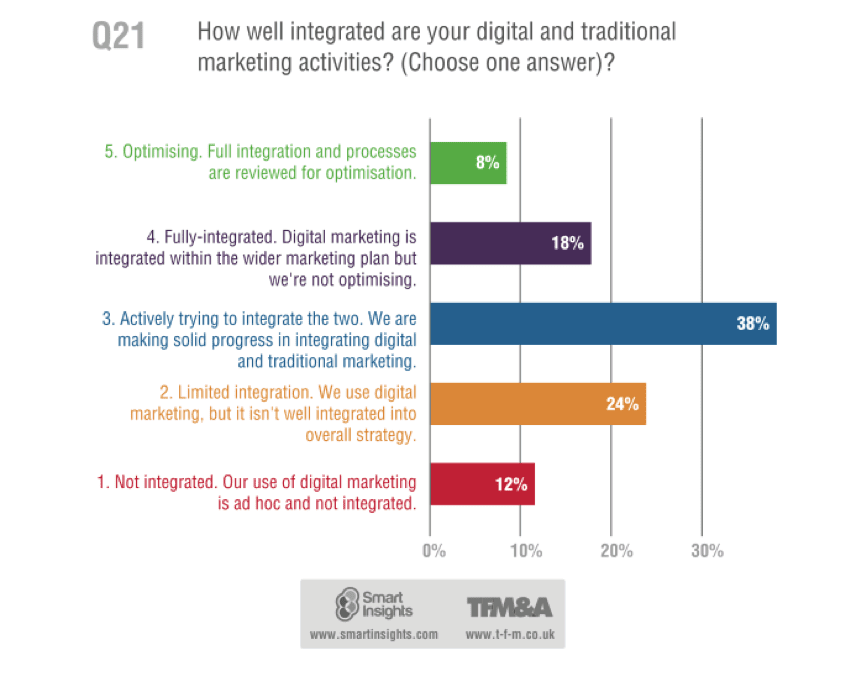
Research carried out by Smart Insights and TFM&A in 2014 found that 56% of businesses describe their digital marketing capabilities as inconsistent, basic or non-existent, and only 44% had advanced or optimised digital marketing capabilities.

So, it’s safe to say that there are significant opportunities for brands that can integrate effectively. What follows is a short exploration of 3 key digital integration challenges. In future posts, I’ll start to explore each of the 3 problems areas in more depth.

Barrier 1. Lack of planning

“Digital Marketing has to be driven by an overall marketing strategy. In the future, I believe that every marketing activity will involve digital technology.”

Ecommerce Manager

Considered planning helps companies to prioritise, set goals and allocate resources to meet targets, yet the research showed that 46% of businesses with digital outputs don’t have a defined digital plan, and 44% also don’t have a defined marketing plan to align digital strategy against.

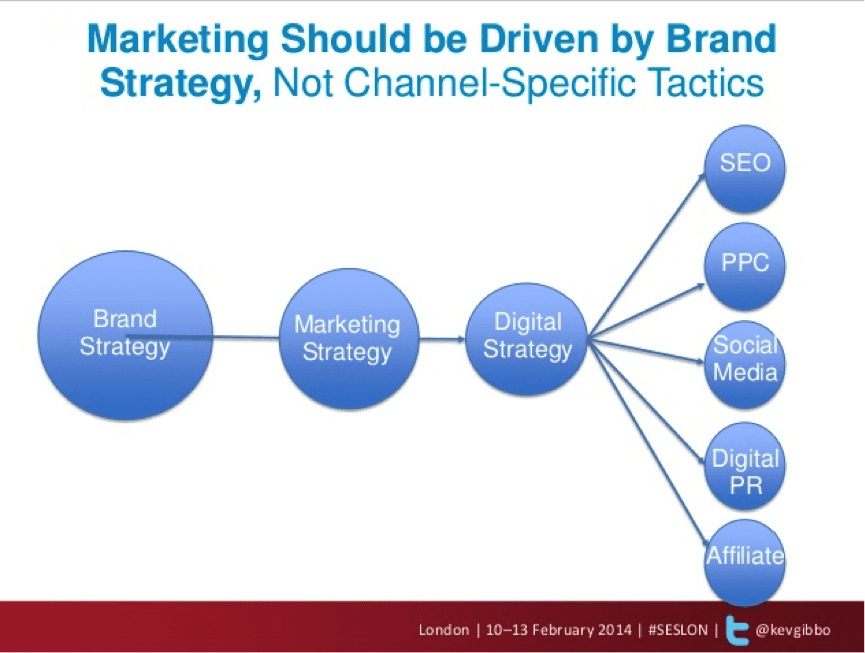
As Steve Forbes said “Your brand is the single most important investment you can make in your business.” Your channel strategies should be aligned to this overall strategy to ensure you are delivering a consistent message and experience for your customers.

This is captured nicely in Kevin Gibbons’ graphic:

Untitled

http://www.slideshare.net/kevgibbo/why-you-need-an-integrated-digital-marketing-strategy

As the graphic shows you may initially need a separate digital plan to help you create a strategy and get buy-in for investment in digital channels. However, it’s important to keep it well integrated by means of supporting common business goals and being consistent with brand and communication strategy. You need to clearly show the linkages between digital and marketing strategy. The long-term aim should be to integrate your digital plan into your marketing communications plan. Please see our Digital Strategy Toolkit for more details on this.

Link to Digital Strategy Toolkit and example marketing plan 

untited1

Barrier 2. Teams working in competing silos

“In today’s fragmented media world, effective marketing cannot be achieved unless it is integrated.”

Andrew Molle, Marketing Director, Specsavers

There’s a risk that having separate digital and traditional marketing teams can lead to competing priorities and separate team silos. So it’s important to think about how you manage your people integration. Having integrated plans is the first step in this process, breaking down established thought processes, hierarchies and functional barriers within an organisation is the next.  Two approaches to solving the silo problem are addressed below.

Brent Gleeson (@brentgleeson) from Internet Marketing Inc suggests the following structure in his article in Forbes.

  1. Create a unified vision
  2. Work towards achieving a common goal
  3. Motivate and incentivise
  4. Execute and measure
  5. Collaborate and create

Tanveer Naseer (@TanveerNaseer) from  has a number of more practical management tips that that show how digital strategy initiatives can be communicated and silos ‘broken down’.

1. Encourage mistakes/failures as opportunities to learn and improve

2. Communicate a common purpose across divisions

3. Redirect the team’s competitive spirit toward external targets

4. Encourage greater flexibility within and between your teams

5. Build trust across your teams/departments

As with all the topics in this post I’m hardly brushing the service but what is clear to me is that integrating your teams, people and processes is just as important as your marketing planning.

Barrier 3. Competing agencies with their own agendas

As marketing budgets are increasingly moved into digital, resourcing the management and optimisation of your internal and external agency teams becomes more important. Agencies, like all business are under pressure to grow their revenues by growing their accounts. In most cases this means taking a larger slice of the pie from other agencies on the roster. It’s no wonder that this leads to a lack of integration between agencies. Just think about how many TV ads you see that don’t have a decent CTA and URL on the end frame!

If we want to integrate our agencies as well as our internal teams and our plans then we need to revaluate how we motivate and reward our agencies.  Darren Woolley (@TrinityP3) Managing Director of TrinityP3 points out

“Imagine if rather than having the agencies competing for their increased share of the pie, you reward them for helping to bake a bigger pie? Rather than simply paying for the volume of what goes in, you pay for success in the size of the outcome. Makes sense. Doesn’t it?”

Performance based rewards is nothing new and is used successfully across many industries. Some criteria that should be considered as part of a mixed reward model are:

  • Brand, agency relationship
  • Working with other agencies
  • Strategy development
  • Delivery
  • Media costs and delivery
  • Campaign execution
  • ROI or key campaign performance metrics

In a future blog post I will look at reward models and how to find the right balance in more detail.

Where next?

I realise that I’ve covered the peaks of a few icebergs here. I suppose the takeout for me is that while integrating digital seams obvious and simple as an idea, it’s obviously very challenging in the real world mostly due to the processes and systems that we’re all used to. But if we recognise the need for Digital Transformation at a top level and work our way down, we can work to achieving the ‘holy grail’ as Colin Green, Marketing Director of Land Rover UK aptly points out.

Chris Ketley, a digital transformation consultant who has advised businesses including Aviva, Bupa Healthcare, HSBC Business and EDF Energy will be sharing his views on integration and digital transformation at Digital Impact 2014. If you’ve found this blog interesting then please take a look.

Learn best practices for integrated digital marketing at the Smart Insights Digital Impact 2014 conference.
23 Jun 17:23

Sales Pipeline Strategies: How to Map Your Content for Better Lead Generation

by Alistair Norman
Successful inbound marketing relies on supplying leads with the right information at the right time. The Internet has made buyers much more self-reliant when making purchasing decisions, so it is essential that your business produces top quality content that is relevant to their business pains.

read more

23 Jun 17:23

Autopilot Launches CoPilot Sales Automation Tool

by Frederic Lardinois
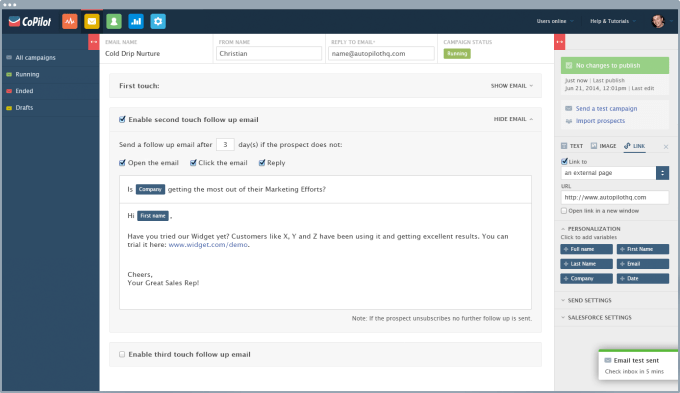
autopilot-copilot-email Any startup worth its salt these days built a mailing list from before it even launched, but what do you do after that? How do you identify the best leads from all of those random people who signed up for your service? Fresh off its $10 million Series B funding round, marketing automation service Autopilot today announced the launch of its CoPilot email sales automation tool, which aims to make… Read More
23 Jun 17:23

How to Create an Email Campaign that Converts

by Trent Dyrsmid

How to Create an Email Campaign that Converts image How to Create an Email Campaign that Converts

Have you started an email marketing campaign for your business yet? Are you worried you might spend hours at your computer trying to figure out what to write?

Email marketing campaigns are a great way to increase leads for small and medium sized businesses. Email campaigns have long been proven to be successful, which is why more and more businesses are trying them.

In order to create an email marketing campaign that converts leads into sales, you’ll have to include a few important elements. Are you ready to learn what these are?

Elements to Avoid

It’s important to understand what an email marketing campaign isn’t when discussing how to create campaigns that will successfully convert. Email marketing campaigns are not:

  • Spam
  • Free
  • Easy

Email marketing campaigns are not designed for you to spam anybody and everybody with the same message. Proper campaigns are permission-based, which means that you need to get customers to supply you with their contact information or “opt-in” to an email list.

There is a cost associated with making sure that emails are well written, properly tested, expertly edited and tracked for the maximum amount of potential and success.

The Goals of Email Marketing Campaigns

If you’ve successfully executed your email marketing campaign, some key things should be happening next:

  • Visitors should be coming to your website in larger numbers.
  • You’re creating a general sense of brand awareness.
  • Your audience is growing thanks to meaningful content.
  • Conversions are being driven to your sales funnel.
  • You’re creating a sense of urgency with your customers to explore even after they’ve purchased products.

If your email marketing campaigns do not see most or all of those results, it’s very likely that your campaign isn’t being executed to the best of its ability. People need to both take the time to read your email messages and act on them. Potential customers and even existing ones aren’t going to do that if your campaign isn’t grabbing their interest.

Step 1: Decide Who to Send Your Emails ToHow to Create an Email Campaign that Converts image Mailbox

One of the most important things to figure out before your email campaign begins is your target audience. You need to think about the types of people that you’re trying to reach and the problem that your product can help them solve.

You should also research buying patterns, slow seasons, related demographics and more. When compiled together, all of this information will serve as your “buyer persona.” It will be a representation of the type of person who is most likely to spend money on what you have to offer.

Step 2: Use Action Language

Email marketing campaigns should guide your reader with action language without being obnoxious. Throughout your email messages you need to make sure that you:

  • Tell the reader where to go to learn more.
  • Tell the reader what they need to do to get what you’re offering.
  • Give them contact information that they can use.
  • Provide them Internet links for easy access to additional information.
  • Let them know when they’re going to receive what you’re promising.
  • Give them a deadline.

Giving a deadline is a great way to provide a sense of urgency to your message. Your readers better act fast before they find themselves left behind.

Step 3: Create Compelling Subject Lines

How many email messages do you wade through every day? A couple hundred? So do your email subscribers!

The first thing that your subscriber sees when they open their email inbox is the subject line. You need to make sure the subject line of your email message is attention grabbing and striking. Doing so will help make sure that the email stands out from the rest of the messages your customers are receiving and increase open rates.

There are two ways you can look at the practice of writing email subject lines: an unforgiving onslaught of repetition that drains your creativity OR an exciting and rewarding challenge [that] helps you become a better marketer and communicator. Alex Williams, Eloqua Blog

Step 4: Watch Trends

One of the biggest parts of staying on top of your target audience involves paying attention to trends. There are so many ways to get this information nowadays. Pick from several of these suggestions:

  • Subscribe to email newsletters from industry peers and competitors.
  • Read online and traditional magazines that cover topics relevant to your industry.
  • Review relevant surveys.
  • Participate in industry topic boards
  • Read blogs that create content for your industry. Set up an application like Feedly to subscribe to multiple RSS feeds and read them from one place.
  • Find and follow Twitter hashtags that focus on conversations your customers are having.
  • Review Google Trends to see what other companies are doing.
  • Visit top news sites like HuffingtonPost and scan for industry related topics.
How to Create an Email Campaign that Converts image Feedly e1401482383784

Feedly RSS Reader Example


Step 5: Be Conversational

For the best results with email marketing campaigns, you should always try to be conversational and intimate. Don’t create a formal marketing campaign that reads like a form letter. Create messages that seem like they’re coming from a friend.

Step 6: Include a Strong Call to Action

The most important element of email marketing campaigns is the call to action. You need to tell your readers what you want them to do and where they need to go to do it. Whether it’s signing up for a newsletter, contacting you for more information about a one time offer or something else, always ask the reader to take further action.

Creating an email campaign is still one of the best ways to drive traffic to your website and get more leads. Pay attention to the steps above and you’ll be able to craft email marketing campaigns that create staggering results.

We’d love to know how email marketing is working for you. What was your most successful email campaign?

How to Create an Email Campaign that Converts image 7b71edba fdf8 4663 8636 64908c3ddba77

23 Jun 17:23

Optimizing the Value of your Professional Email

by Brad2Earth

Since our launch in 2011, Evercontact has analyzed over a billion emails to auto-enrich hundreds of thousands of address books, and we’ve had the chance to interact with thousands of wonderful clients. From time to time they ask us big data questions which certainly get us wondering… What is the average size address book? What is the average size address book? How many people is the average professional in contact with every month, or the past 6 months? Do they have phone numbers for their contacts? Are most emails in their inbox from real people… or robots! What services help to conquer the inbox and stay on top of their contact management, their leads, their sales? To answer these questions, we’ve been digging into our data the past few weeks to better understand how people use their address books, and email in general. Below are the fascinating stats we’ve found and we decided to push them out as an infographic, so hope you enjoy, and feel free to leave any questions/comments below! Oh, and, if you’re not already taking advantage of Evercontact to auto-enrich contact details in your address book/CRM, then definitely check it out for Gmail, Google Apps, Outlook, Chrome, Salesforce, Highrise, Evernote and Connectwise (or as an API).
23 Jun 17:23

Close More B2B Deals with a Digital Lead Management Process

by Tim Asimos

So you’re effectively driving traffic to your website using blogging, SEO and social media. And once you get the traffic, you’re converting visitors into leads through effective lead generation strategies that prompt visitors to take action. But now what?

Close More B2B Deals with a Digital Lead Management Process image FULL blog leadmanagement 600x241

Driving traffic and generating leads is only half the battle and some might argue it’s the easier half. Because remember, the end goal isn’t a database full of names and email addresses or even hundreds of whitepaper downloads; the end goal is new business and paying customers.

The B2B sales cycle can be a long journey

The reality is, most qualified leads aren’t ready to buy, but they will be at some time in the future. Statistics suggest that somewhere between 30% to 50% of the leads that enter a pipeline represent future opportunities. But, for whatever reason, these leads are not yet ready to buy.

And what about unqualified leads? Research from SiriusDecisions suggests that 80% of prospects deemed “bad leads” by sales teams go on to buy within 24 months.

The sales cycle for B2B buyers is typically extended, especially for major purchase decisions. And along that journey, today’s B2B buyers are doing extensive online research, long before they are ready to speak to a salesperson or make a purchase.

Stay engaged with prospects throughout the journey

With a longer sales cycle and heavy competition, B2B companies need to formalize a digital lead management process in order to take advantage of all the leads they are currently generating from their website. Getting that initial conversion is rarely enough to close the deal. What is needed is consistent, timely and relevant communication and engagement.

According to a Genius.com study, 66% of buyers indicate that “consistent and relevant communication provided by both sales and marketing organizations” is a key influence in choosing a solution provider.

And what about “hot” leads that request a quote or another sales-related inquiry? InsideSales.com found that 35-50% of sales go to the vendor that responds first.

Lead nurturing helps educate leads and push them closer to the sale

Lead nurturing is the process B2B marketers use to “nurture” relationships with leads who aren’t yet ready to buy, in order to win their business in the future when they are ready to make a purchasing decision.

The idea is to stay engaged with these leads through each stage of the buying cycle, moving them towards a purchase. By providing valuable information that leads need in order to make a purchasing decision, you’ll stay top of mind and be there when they’re finally ready to commit to buying.

One of the primary ways to nurture leads without being intrusive or overbearing is through setting up lead nurturing email campaigns. These “drip” campaigns are set up to be related to the initial topic of interest and send a series of automated emails at scheduled intervals to qualified, but not sales-ready leads. According to a recent SilverPop/DemandGen Report, lead nurturing emails get 4-10 times the response rate of standalone email blasts.

Lead and prospect intelligence helps you stay in the know

Basic website analytics provides a lot of valuable information, but not necessarily the kind of information that your sales team needs or can use on a daily basis. Website visitor tracking is a common feature found in marketing automation software and helps you go beyond page views to get real-time marketing and sales intelligence.

Marketing automation software allows you to track the following analytics about leads:

- Who is visiting your website
- When they are visiting
- Pages they are viewing
- Content they are downloading
- Campaign response rates (i.e. email opens, clickthroughs, etc.)

Understanding the interests of your leads helps you to be more targeted and relevant and offer the right content in the right context.

Lead scoring helps you focus on the best opportunities

MarketingSherpa defines lead scoring as “the process of adding and subtracting points to a lead’s value over time based on various lead attributes or demographics, and behaviors.”

Typically, your ideal customers fit certain profile characteristics such as job title, industry, etc. and also follow similar steps on their buying journey. Lead scoring is the process of determining what those characteristics and steps are and assigning point values for each.

Utilizing marketing automation makes lead scoring not only easy to do, but also incredibly effective. Each lead gets profiled and their actions are tracked and a score value is assigned to each one in real-time. This allows your sales and business development team to determine sales-readiness and know which leads might be the best opportunities to focus on.

CRM integration helps you close the loop between marketing and sales

While marketing automation is a must-have tool for B2B marketers, a solid customer relationship management (CRM) system that integrates with your marketing automation platform is equally important. There is often a break in communication between marketing and sales teams in many B2B organizations, but when marketing automation and CRM are integrated, the result is a closed-loop between marketing and sales.

This integration allows sales and business development teams to see all of the valuable lead intelligence gathered by the marketing automation platform, send marketing-approved emails and ultimately track every single action and touch point with both leads and customers—without ever having to leave the CRM interface.

Qualified leads need to be engaged after their initial conversion and nurtured through each stage of the buying cycle. Gartner Research found that companies that automate lead management see a 10% or greater increase in revenue in 6-9 months. While this is no easy task, utilizing marketing automation and CRM software make lead management much more effective (and easier).

23 Jun 17:23

The Sales Snapshot: Why You Don’t Want to Ignore Social Media In Your Sales Process

by Rachel Clapp Miller

We’ve scoured the web for the most current and relevant sales studies in order to bring you real-time, actionable insights. This is The Sales Snapshot.

The Sales Snapshot: Why You Dont Want to Ignore Social Media In Your Sales Process image seller searching ipad resizedSocial Media is a powerful tool for sales teams who leverage it as a way to demonstrate their value and differentiation. For today’s Sales Snapshot we pulled together three compelling pieces of content that demonstrate its importance in the sales process.

1.  The Big Spenders Are On Social Media (And They’re Looking To Buy)

IDC recently released a white paper called, “Social Buying Meets Social Selling: How Trusted Networks Improve the Purchase Experience.”

The primary takeaway from this paper is that creating a trusted network on social media (through thought leadership and personal connections) establishes a first layer of trust between you and potential buyers. According to the white paper, these potential buyers are significantly valuable prospects. Here’s some of the eresearch highlights:

  • 75% of B2B buyers and 84% of C-level/vice president executives surveyed use social media to make purchasing decisions.
  • Online professional networks are the number 1 information preference of buyers in the final stage of the purchase process.
  • Social buying correlates with buying influence. The average B2B buyer who uses social media for buying support is a more senior level executive, has a bigger budget, makes more frequent purchases, and has a greater span of buying control than a buyer who does not use social media.
  • B2B buyers find that the greatest benefit of social media is gaining greater confidence in and comfort with their decisions.

2. Social Sellers Create More Opportunities and Close More Deals

LinkedIn conducted a study hoping to get a look into the most inspired sales professionals in the world. They compiled the results of the survey into a newly-released infographic.

According to LinkedIn’s survey::

  • Social sellers create 45% more opportunities per quarter than those who don’t sell socially.
  • Social sellers are 51% more likely to hit quota than social selling laggards.

3. Social Media Is An Extension of Classic Sales Relationships

Social media’s strength for businesses has always been in its ability to scale personal interactions. HubSpot’s new eBook, “How Sales Can Use Social Media To Close More Deals,” demonstrates the importance of adopting a social media strategy with the sales team.

Social media can give sales reps that are hungry for touch-points with their prospects and leads a way to connect and further the relationship without much added financial cost. According to the eBook, salespeople can increase their sales efficiency with social media in four ways:

1. Build credibility

When sales representatives take to social media to elevate themselves as authorities in their specific field, they garner more interest and more trust from their prospects.

2. Find people in the moment they’re looking 

By monitoring social media tools, salespeople can find and engage with prospects who are looking for solutions to their problems in real time.

3. Inform sales calls

By doing a little pre-call research on social media, sellers can learn a lot about a prospect or lead. Sales reps who follow leads on twitter and make connections on Linkedin can gain valuable information that can fuel an effective sales call.

4. Align marketing and sales around social media 

A quote from the eBook states, “Marketing is the matchmaker, but sales needs to do the dating.” When marketing and sales are aligned around a common social media strategy, they have the ability to double the effectiveness of their efforts, while increasing the likelihood of success across both departments. The Sales Snapshot: Why You Dont Want to Ignore Social Media In Your Sales Process image a9bac14a bf77 48da a246 74c1b0223f5b2

23 Jun 17:22

The FYI on ROI for Marketing

by Gail Graham

If you are in a really large company with solid data gathering and a mature marketing analytics process, this might not apply to you. If, however, you are in a small or mid-sized firm where marketing budgets and the associated payoff are less understood, this article is for you.

Most companies lack marketing measurement, so marketing budgets can range from profit-taking money pits to starved categories that are the first to get slashed in hard times. I’m not an expert at mathematical modeling, but I’ve developed some guidelines and opinions from years of wrangling with marketing budgets and return on investment (ROI) in companies both large and small.

Agree on how you’ll be measured

This is how marketing ROI is measured in simplest form:

(Gross revenue from marketing campaigns – Marketing investment) / Marketing investment

The problem is, it is more complicated than that. You may have business objectives from marketing spend that are less easily translated to dollars, like media impressions or PR share of voice. Call that ROBO, or “return on business objectives.” Gross revenues can be misleading—you may want to apply a contribution margin or percentage margin instead, especially if you aren’t a cash-rich firm. Lastly, if you are in a service business like I am, you will want to think about the lifetime value of a customer (CLV), not just one-year revenues.

Here’s the point: Spend time with your CFO and CEO to gain agreement on your measurement stick for non-financial (ROBO) and financial outcomes, making sure the information is easily obtained. Don’t be afraid to use “rules of thumb” and rough estimates for more complex concepts, like discounted cash flows for CLV. Working together with your finance team, you can find a yardstick that’s reasonable.

Know your real marketing investment

Come to an agreement on what goes into the marketing budget, and what doesn’t belong. It’s easy to underestimate real spend when other areas—like product groups or branch offices—have their own marketing dollars. I make a strong argument that if the expense isn’t controlled by your marketing department in some fashion (approval limits, for example) those expenses don’t’ belong in the marketing ROI calculation. When marketing spend is spread everywhere, there’s no way to control costs or drive returns. How much marketing spend should sit outside of your budget? Every company is different, but if it’s more than 20 percent, I’d be worried.

Use it or lose it

I can’t tell you how many marketers I’ve heard complain about their budgets, but then don’t even use the full amount because of poor up-front planning and management. Your budget should tie to a plan that breaks out ongoing costs (your web host, your PR firm, wages, etc.), major initiatives and campaigns, along with work assigned to your team members, agencies, and so forth. Credible marketers have the facts and are organized to deliver. As you are executing your plan, you should use the data and measurement you are gathering to make improvements and adjustments—or kill a bad idea. Banner campaign not working? Tweak your message and see how it performs. Big events with weak attendance and lackluster results? Kill it.

One of my favorite tricks: Keep track of how often each piece of your collateral is produced and used by sales, so you can eliminate the unnecessary costs associated with an ungoverned collateral system. Take it from me, the best way to be a credible manager of a large marketing budget is to show that you know how you will use it, and you are disciplined enough to hold yourself accountable for a responsible spend.

Communicate early and often

When people see the line item “marketing,” it can look big and squishy. Make sure you are providing the voiceover about your spend and how it supports the business. Know what your percentage of marketing spend is, relative to revenues; industries vary, but 3 percent is considered a mature company/low spend, and growth companies typically spend over 10 percent. In addition to your annual marketing plan, develop clear plans for every launch or campaign with specific success measures—near and long term. For instance, if you are launching a digital marketing newsletter, early measures could include an “open rate,” “click-through rate,” subscriptions or return readers. Later you can measure how many prospects were generated, leads converted, and so on. Basically, the more you can measure and educate the business about your marketing plans, the more support you will have in your organization for what you do.

Beware of the “money pit”

We’ve all done it: Fallen in love with the most creative, super cool idea. I once worked on a dazzling guerrilla marketing campaign where the CMO claimed she would gain a million new clients… She lost her job instead. I’ve been swayed by enough of the latest and greatest gimmicks—including a DM piece with embedded video that won me an industry award—to find that old fashioned, simpler campaigns produced better results.

In addition to excessive spend on individual campaigns, there are other money pits including: lavish client appreciation events, print advertising that makes you feel good but rarely draws business (if it doesn’t tie to a much larger effort), and expensive “swag,” or giveaways. On occasion, other senior people will be pushing you with a big idea that takes a big bite out of the budget. Just be sure to take the time to identify clear objectives, size your spend adequately and provide an ROI estimate that you are willing to live up to. Presented with the facts about marketing, you, your team and your business partners will all make better decisions.

23 Jun 17:22

Beware the Gooey Egg Yolk: How to Master Email Nurture Campaigns

by Jean Spencer

Beware the Gooey Egg Yolk: How to Master Email Nurture Campaigns image egg yolk

Think email marketing is a tactic of the past? Not so fast.

New data suggests emails sent via marketing automation drive 18x more revenue than email blasts, and email ad revenue reached $156 million in 2012, making email marketing one of the most powerful sales engines in a marketer’s playbook.

This is due, in part, to nurture-based emails. Nurture email campaigns go beyond the limitations of a typical email marketing platform and use marketing automation features such as list management, automated sends, behavior history, and A/B testing to tailor specific messages to the right consumer.

At Kapost, email nurturing results in significantly higher open rates (~40%) compared to one-off email blasts (~8%).

But while marketing automation software automates outbound marketing, it’s not as simple as turning on a switch and walking away. The best marketers empower their marketing automation software by activating theme-based nurture tracks, monitoring lead behavior, and modifying campaigns to drive the best results.

Here’s are a few pointers to rock email nurture campaigns.

1. Start with Theme-Based Topics

First, you’ve got to discover what irks and works for your prospects. This sets the stage for successful emails that are tailored to your contact’s interests. If you don’t know what motivates or compels your prospects, email nurture tracks can be like playing blind darts. Aim before you shoot.

Beware the Gooey Egg Yolk: How to Master Email Nurture Campaigns image awesome thing

Theme-based nurture campaigns are a good way to do this. Send new contacts two emails, each related to a different theme or topic. By dangling two different themes in front of your prospects, you’re providing them options and asking, “Hey, what are you interested in?” Their engagement behavior with those emails will start to answer that question.

For example, did the contact open on the email? Did they engage with the content by clicking on a link or downloading a resource?

If the answer is yes, set up your marketing automation to move the prospect into an email nurture track dedicated to a similar theme. The lead has shown interest in that topic, and now you can now tailor subsequent emails and content around those interests.

If the prospect doesn’t engage in our first two emails, try sending them another email on a different theme. Keep doing this until you (1) find a topic that works or (2) don’t have any more topics and start over. The goal is to correctly identify what topics your buyer cares about.

2. Give Your Lead What They Want, When They Want It

Once you’ve identified your leads’ interests, start getting altruistic…and give!

Develop nurture emails that deliver highly curated, supplemental content for the identified topic or theme in a personalized fashion.

Personalized subject lines are 22.2% more likely to be opened.

Of course, this requires a healthy amount of content, especially if your campaign has several emails long (like 6-10 emails per track). And it’s not easy. Creating enough content is one of the biggest challenges the modern marketer faces. In fact, lack of content is the number one reason marketers give for being dissatisfied with their marketing automation program.

But it IS important in moving your buyer toward purchase. Ideally, you have a healthy mix of assets to work with, including:

  • several blog posts
  • eBooks
  • whitepapers
  • survey results
  • event videos/presentations

The content should match the genre of the original theme or topic, thereby arming your marketing team with a sampling of content offerings to deliver in emails.

With each email sent, marketing automation software tracks contacts’ behavior, further narrowing in on who the person behind the email address really is, and why they might be interested in your product or service. Moreover, each email sent provides marketers with insights about what move to make next to keep the lead engaged.

For instance, Kapost’s Marketing Operations Manager, Christine Leas, oversees our marketing automation. She says she strategically adjusts email send rates depending on user engagement levels.

“We will speed up or slow down a nurture track based on their response,” she said.

3. Be Wary of the Gooey Egg Yolk

Finally, make sure your delivery takes content type into account.

It’s good to know the things that your leads are interested in, but it’s equally important to understand the specific ways in which they consume content. It’s like eggs. Many people like eggs, but while some love sunny-side up, others gag at the idea of a gooey yolk.

To gain insights on buyer preferences, serve your contacts a mixed bag of content.

To gain insights on buyer preferences, serve your contacts a mixed bag of content. As always, monitor online behavior to develop your understanding: Does the person engage more with shorter content like blog posts or infographics? Or do they seem to prefer longer-form content like eBooks and whitepapers?

Engagement metrics such as open rates and click-through rates will demonstrate the content that is actually resonating with your prospect and moving him or her further down the funnel.

An Example

At Kapost, we might send a buyer an email that links to a blog post about hiring for content marketing, and another one about creating content marketing workflows. If the prospect ignores the email about hiring, yet opens and engages with the workflow email, it tells us that topic is relevant to their current needs. Knowing this, we add them to a nurture track that focuses on building content marketing processes and workflows.

The next email might contain a short video interviewing content marketers on building out workflows. If they watch the video, we could speed up the nurture track to deliver more information more quickly. The next email encourages them to download a full-length eBook with workflow templates. As they continue to engage, we eventually serve up content that ties the challenges of workflow management to our software as the solution.

Connecting the Dots

Sure, there’s plenty more to be said about how to master email nurturing. But in this post we’ve gone over some of the essentials. To recap, to make email nurture campaigns rock you must:

  1. Identify the interests of your contacts
  2. Provide your contacts with supplemental content around those interests
  3. Deliver the content in the medium your contact prefers

Following these steps will activate your email lists, broaden the number of people who are exposed to your company, and drive more users into your sales funnel.

20 Jun 15:59

Russia in secret plot against fracking, warns Nato chief

by Financial Post Staff

Russia is secretly working to undermine fracking with a sophisticated disinformation campaign in an attempt to keep Europe dependent on energy imports from Moscow, the secretary-general of Nato has said.

The Telegraph reports that  Anders Fogh Rasmussen said Russia was working with environmental groups campaigning against fracking, which is a method of removing gas from shale deposits.

Mr. Rasmussen, who spoke at a foreign affairs think-tank in London this week, did not say what form the Russians’ engagement with the environmentalists took or whether groups concerned were aware that they were dealing with Moscow’s agents.

“I have met allies who can report that Russia, as part of their sophisticated information and disinformation operations, engaged actively with so-called non-governmental organizations — environmental organizations working against shale gas — to maintain European dependence on imported Russian gas. That is my interpretation,” Mr. Rasmussen said.

Greenpeace told the Telegraph that Mr. Rasmussen’s comments were “preposterous”.

A spokesman said: “Greenpeace had thirty of its people locked up in Russian prisons last year, threatened with fifteen years in jail.

“The idea we’re puppets of Putin is so preposterous that you have to wonder what they’re smoking over at Nato HQ.

“Mr Rasmussen should spend less time dreaming up conspiracy theories and more time on the facts.”

20 Jun 15:50

Why Canada should recruit thousands more international students every year

by Murad Hemmadi

Canada should set up a new Crown corporation tasked with attracting international students to its universities, according to a new report commissioned by the Canadian Council of Chief Executives (CCCE) and the Canadian International Council (CIC).

Time for a Fresh Curriculum suggests that Canada can capture a larger share of the international student market, with the country currently ranked eighth by number  of students. There’s money to be made from foreign education-seekers: the U.S., for instance, takes in more than twice as many as Canada.

Chart showing economic benefits from international students

Canada has several advantages in the competition for the world’s best and brightest young people, including immigration policies that incentivize higher education and youth. But the report suggests that Canada needs to work harder at attracting and welcoming international students, particularly in light of recent political squabbles over immigration:

Experience has already shown that a steady advance in foreign student numbers cannot be taken for granted. The flow is vulnerable to a number of factors, including unpredictable shifts in public opinion on such emotive issues as immigration and preferential treatment of foreigners in the workplace. Canada has yet to experience such a backlash, but the recent furor over temporary foreign workers and simmering resentment in some quarters against immigrants could sour the mood towards foreign students.

The proposed Education Canada would also be tasked with encouraging more Canadian students to look abroad when considering their post-secondary options. These ‘young ambassadors,’ the report claims, will help improve relations by strengthening education and cultural links between host and home nations. Canada’s post-secondary education system has come under increasing scrutiny in recent times, with questions about the continuing value of a university degree and outrage in some quarters about tuition levels.

Exporting more of our disaffected young people and importing bright young foreign students will not immediately solve those problems, but the report suggests it might just help Canada’s economy, and improve its global standing to boot.

The post Why Canada should recruit thousands more international students every year appeared first on Canadian Business.

20 Jun 15:43

Get Ready to Pay More for Airport Security

by Jessica Plautz
Airport_security
Feed-twFeed-fb

Starting in mid-July, airline passengers will be paying more fees for security at the airport.

Following orders from Congress, the Transportation Security Administration (TSA) is poised to raise the security screening fee to $5.60 each way. This fee, which is included in your ticket price, is up from $2.50 each way for a nonstop flight and $5 for a trip including connections.

Trips with long stopovers — more than four hours on most domestic travel — will have bigger increases because each leg will trigger a new fee.

The fee is used to finance "the increased cost of securing the nation's transportation systems," according to the TSA. In 2013, the security fee on passengers raised more than $1.8 billion for the TSA, or about 20% of its $8 billion annual budget. Read more...

More about Airports, Airlines, Tsa, Us, and Lifestyle
20 Jun 15:43

8 Lesser-Known Strategies to Get More Out of LinkedIn

by Scott Gerber
06-05-14_linkedin_1-2
Feed-twFeed-fb

LinkedIn is a great platform for finding capable employees, but that's only the beginning of its value. Chances are, you are probably not using it to its fullest potential in areas like content marketing and event preparation — yet, anyway.

To find out more, I asked eight entrepreneurs from Young Entrepreneur Council (YEC) to share some lesser-known LinkedIn tips. Here's what they had to say:

1. Get involved in niche groups

Patrick Conley There are specific groups available for many micro-niches on LinkedIn. Becoming active and engaged in these communities is a great way to be seen as an expert and helpful resource. This leads to opportunities for lead generation, networking, partnerships and much more. The key is to give freely in those groups and not expect anything in return. Don't be the person trying to "sell" yourself in the groups. Give value first, receive later.
Patrick Conley, Automation Heroes Read more...

More about Linkedin, Yec, Business, Marketing, and Startups
20 Jun 15:42

This is the One Thing Missing from the New Way of Selling

by Dave Kurlan
Understanding the Sales Force by Dave Kurlan

one thing missingI subscribe to several newsletters written by medical doctors who practice natural medicine.  They not only provide healthy nutritional advice and natural cures, but also expose the mainstream media, doctors, FDA and pharma for pulling the wool over our eyes and publishing so much misinformation.  And the misinformation is killing people!

I read most of the other sales blogs too.  Some of them are from companies within the Inside Sales community which, in an attempt to sell their services, are also publishing misinformation.  And the misinformation is killing sales forces.

I'm all for the new way of selling:

Migration to Inside Salesgreen checkIt's more efficient, less costly and more practical.  And it will work in most industries!

Social Selling green checkIt's one more way to get found, make connections and get introduced.

Sales Tools green checkI'm for any tool that will help salespeople to be more productive and effective.  These tools include gamification, call technology, email marketing and analytics.

Sales Automation green checkThis category includes lead nurturing, pipeline management and CRM.

Customers Already Have the Information They Need green checkSo what must salespeople do?  They must differentiate themselves and their companies by being the value. It's no longer adding value or talking about their value proposition or adding in something.  It's being of value to the customer.  The best way to be of value to the customer is to have the conversation that nobody else has had with them.

The Buyer Journey Instead of Sales Process red x  Understanding the buyer journey is fine, but without a milestone-centric sales process, salespeople cannot confidently move forward the sales process.

Customer-Centric/Customer-Focused Selling red x  Of course salespeople must be more focused on the customer and prospect.  However, that missive is being incorrectly interpreted and morphed into an epidemic of facilitation.  "Tell me what you want and I'll give it to you."  That's just plain stupid!  Anyone can do that.  And companies currently have anyone and everyone doing just that.  Veteran salespeople who have not adapted.  New salespeople who have not learned to sell.  This results in demos galore!  And that's one of the reasons that sales cycles are getting longer and win rates are decreasing so rapidly.  Customer-Centric Selling is the current catchphrase, but it's really consultative selling that makes the big difference.  Consultative Selling, when executed correctly, is a sophisticated form of listening and asking questions.  But's it's about asking the right questions, at the right time, and listening for the right information and following that up with more of the right questions.  Why?  To uncover and be able to discuss their compelling reasons to buy and/or move their business to you!  Anything other than that makes the salesperson appear incompetent. Objective Management Group (OMG) has statistics on this that are just plain ugly.  When it comes to selling consultatively, most salespeople, including the entire bottom 74%, are either not doing this at all or not doing it anywhere near how it should be done.   Of the more than 750,000 salespeople evaluated and assessed to date, salespeople possess, on average, just 22% of the attributes of a consultative seller.

Prospects are Further Along in their Buying Process Before Meeting Salespeople red x

That is the perception and that is what we are being told, but if this is really true, then why are sales cycles increasing in length and win rates decreasing?  It's not really later in the buying process as much as it's later in the research process.  And because of the customer-centric approach, salespeople are acting more like facilitators, gathering even less information than they did a decade ago.  Prospects aren't ready to buy at this point in their process, they're just getting finished with looking at their options!  Salespeople don't have qualified or closable opportunities at this point, but they're acting as if they did, creating and sending unqualified proposals, making assumptions, and hoping for the best.

What's Missing?

So with all that's new and all that's the same, what is missing?  If you have read some of the other articles being pushed and shared, you might notice that they are leaving out the single most important fact about sales.  It's the same misinformation that would have you believe that cold calling is dead, SPIN Selling is dead, Solution Selling is dead, Relationship Selling is dead, Consultative Selling is dead, Baseline Selling is dead, and Salespeople are doomed.  They are completely leaving out the one thing that you need salespeople to do and do well. Without it you will lose, lose hard and lose often.  Someone must change people's minds and persuade them to buy from you and feel good about paying your price.  Salespeople must Sell!

It's probably not you.

Face it.  Only one company can have the lowest price.  Only one company can have the best product or service.  Only one company can provide the best customer service.  Only one company can have the most recognizable brand.  Only one company can have the best and longest track record of success.  Only one company can have the largest and/or happiest installed user base.  If you aren't that company on that day with that customer, you will have to change their mind!  Marketing can't do it.  Inbound can't do it.  Best pricing could do it, but you might be out of business before you get a chance to find out if it worked.  

What to do?

The only way to change people's minds is with very effective, highly-trained, relevant, up-to-date, consultative salespeople [read this article for more on that].  You can't change minds by forcing information, arm wrestling or lecturing.  Demos and presentations don't change minds either.  You can change minds by using gradual perception, asking good, tough, timely questions, and helping prospects come to the realization that buying from you will be the best decision they can make.

Image Copyright: lianna2013 / 123RF Stock Photo(c) Copyright 2014 Dave Kurlan
20 Jun 15:41

CMOs and CEOs Can Work Better Together

by Jean-Baptise Coumau

When Deborah DiSanzo took over as CEO of Philips Healthcare in May 2012, she knew that engineering would continue to drive innovation. But she also realized that the company needed to develop greater marketing muscle to drive a commercial transformation.  As she put it, “Our markets are going through dynamic change. Who should lead our transformation? It must be marketing. Marketers need to know where their markets are going and where their customers are going, and then lead the rest of the organization.”

DiSanzo started by consolidating an astounding 600 different marketing titles into eight consistent job areas with specific and clear areas of responsibility. She also took the unusual step of installing three CMOs who could help provide detailed insights into three of the main business groups of the company. And she put marketing in charge of an organization-wide growth program.

The changes in healthcare – consolidation, restructuring, regulation, spending pressures – that are necessitating a transformation at Philips Healthcare are a subset of a series of powerful forces in the business world that have catapulted marketing from an often-isolated support function to a critical capability for driving above-average growth. Marketing has become increasingly essential for discovering meaningful insights, designing strategies and offers based on them, and delivering them to the marketplace. We have seen these forces at work in many different industries around the world, requiring a decidedly closer working relationship between the CEO and CMO.

The CMOs will need to be much more attuned to the business objectives and strategies of the company in general and the CEO in particular, while the CEO must become more immersed in the customer perspective.  In our experience, there are specific steps CEOs and CMOs can take to develop a working relationship that is dynamic and useful.

Here are our recommendations for the CEO:

Give the CMO a seat at the executive table. The CEO can raise the CMO’s profile and communicate the heightened importance of marketing in a number of both formal and (often just as important) informal ways. Giving the CMO a clear role in the strategic planning process is a good start. It’s a practical way not only to inject a customer perspective into the core planning activities, but it also provides the CMO with the big-picture business perspective. The CEO can also make it a point to elicit marketing’s point of view on customer issues during strategy discussions, and carve out time for one-on-one meetings. “We are always on the agenda of the executive team and are a significant part of the leadership meetings,” says Bert van Meurs, CMO of Philips Healthcare Imaging Systems.

Tariq Shaukat, CMO for Caesars, agrees. “One thing that [CEO] Gary Loveman has done is make it clear to me and to others that he views marketing as a core driver of the business. And as such, marketing is involved with the business reviews, strategy sessions, and financial reviews too.”

Informal practices can be even more helpful. At Essent, the Dutch energy company, CEO Erwin van Laethem provided practical guidance to his CMO. “My CEO could read the company like a book,” says Dorkas Koenen, Essent CMO. “He’d warn me at the right time and place, and say, ‘Hey Dorkas, look out. This will probably happen if you don’t do that.’ That was very helpful.”

These actions alone, however, aren’t enough. While marketing budgets have been steadily rising as a percentage of firm budgets since 2011, many CMOs still lack real authority over decisions that most affect the customer, since most are delivered through touch points not owned by marketing. The CEO can help by putting the CMO in charge of important initiatives and granting veto power on certain decisions that impact customers. For example, at Essent, the CEO changed the reporting structures so that all people in the company with a marketing role reported to the CMO, which in one fell swoop provided the CMO with a significant set of resources. In yet another example, Caesars took the step of centralizing marketing and sales budgets, as well as decision rights, under the CMO.

Make the CMO the “bonding agent” that connects the organization. When making a purchase decision, customers use an average of six different channels, which are often managed by different parts of the organization. That series of interactions – or “customer journeys” – highlights a crucial issue in today’s business world: brands need to work across multiple functions to deliver a coordinated and consistent experience. Companies that excel in delivering on those customer journeys can increase revenue growth 10 – 15 percent and lower costs to serve 15 – 20 percent.

The CEO must establish a method that lets the CMO work effectively with other executives.Phillips Healthcare’s DiSanzo addressed this issue by developing a process that takes a product from concept to the marketplace. That process incorporates operations, customer service, R&D, clinical specialists, sales, supply chain operators, and service teams. Marketing is the “glue” that integrates those elements across the entire process by providing consistent oversight, expertise, and guidance.

Become an active marketer.  “So much of the CEO’s job is actually marketing the company,” says Shaukat of Caesars. “They’re one of the primary people defining the company to consumers, investors and the business community.”

Caesars CEO Loveman participated in a two-day quarterly marketing council session, which brought together all the senior marketers in the company. “It is critical for the CEO to be a part of the creation of our marketing strategies and not just be a recipient of them,” says Shaukat. “He has to invest the time and energy not just reading documents but really problem solving.” Loveman worked with marketers to break through issues, brainstorm solutions, and provide thoughtful feedback on various marketing initiatives.

At Essent, van Laethem took a personal role in finding marketing talent and in many cases interviewed people for senior roles. At Philips Healthcare, DiSanzo meets with her CMOs every two weeks.

While the onus is on the CEO to create the environment and structure that puts the CMO in the best position to succeed, we have found that CMOs can do three things specifically to support his/her CEO and drive above-market growth. 

Develop—and stick to—a marketing blueprint. Most companies have a marketing plan; surprisingly few have a plan for marketing. Done well, however, a marketing blueprint details how marketing will deliver against the company’s business goals. It specifies what gets done, by whom, in support of what, over what period of time, and makes explicit connections among marketing activities, target goals, and corporate business goals. The marketing plan also has explicit links to business and operating plans within the organization so that, for example, manufacturing is prepared to support the volume increase that marketing is planning to spur, or sales forces are staffed and trained to handle new product launches.

When properly formulated, the plan not only tracks progress on near- and medium-term goals but also tracks long-term corporate health. Using brand equity trackers and marketing mix models, for example, the CMO can deliver reasonable estimates of long-term brand effects. This insight is critical in helping the CEO understand corporate health over the longer-term.  For new CMOs, we recommend putting this blueprint in place within 90 days of taking office.

Connect the CEO to the customer. The CMO needs to provide a deep and detailed understanding of the customer to the entire organization based on rigorous analytics.  Key performance indicators (KPIs) that integrate customer insights relevant to growth need to be incorporated into the executive dashboard. In particular, we’ve found that focusing on the consumer decision journey (http://mckinseyonmarketingandsales.com/winning-the-consumer-decision-journey) allows CMOs to develop a clear picture of behaviors, moments of influence, and battlegrounds. That level of insight is invaluable to the organization and particularly to the CEO.

Some CMOs take this notion of connecting the CEO to the customer a step further by making it a point, for example, to include the CEO in at least one customer visit per month—whether at a retail store, or listening in on a call center operation. Ford decided to create a mechanism that lets the head of social media connect directly to Ford’s CEO, Alan Mulally.  One day, this Tweet caught the team’s attention:  “I’m a Volkswagen/Audi guy and I’m driving this new Edge Sport, and I think it’s pretty cool.” The social media head asked the Tweeter for his phone number, and he was still taking the test drive when he received a call from the CEO himself, thanking him for considering Ford’s Edge Sport.

Expand marketing’s  influence across the organization. While the CEO can establish the cross-functional mechanisms across the organization that set the CMO up for success, it’s up to the CMO to make them work. Since the CMO often does not have authority over relevant functions (e.g. sales, operations, IT), it requires being able to work well with other leaders to influence outcomes. That can sometimes be an uphill battle.

Whether deserved or not, marketing often has a reputation as something of a luxury, with an indeterminate “value add.” This is largely because marketing’s contribution to a company’s success is not well understood. “Marketing too often is a black box,” says Essent CMO Koenen. “You should bring all the leaders in and make them owner of a marketing program.  It was particularly important to work with Patrick Lammers, my CCO (Chief Customer Officer), to turn around the organization. I think that’s probably the most important thing that we’ve done here at Essent.”

The marketing team at Starwood Hotels & Resorts Group also offers a good example of cross-functional cooperation in action. The group set out to design the ideal customer experience across its brands (from the St. Regis to Sheraton Four Points) and touch points, from the concierge stationed in the hotel lobby to social media. By coordinating the brand experience across functions, assigning which departments would control the different touch points, customizing content delivery across the company website and mailings, and most importantly holding themselves accountable for the results, Starwood was able to substantially increase share of wallet from their customers.

The C-suite can seem like an unstable place – just look at the high CEO and CMO turnover rates, and the recent proliferation of new roles such as Chief Digital Officer and Chief Customer Officer. But the demands of the business remain unchanged: delivering above-market growth. While roles will need to adapt to the needs of each business, the CEO-CMO partnership should form the foundation of any company’s successful growth strategy.

Special thanks to Tim McGuire, Tim Koller, Liz Hilton Segal, Harald Fanderl, and Jesko Perrey.

20 Jun 15:39

3 Reasons Why Segmentation is Necessary to Understand Customer Lifetime Value

by Brian Sim

Marketing metrics like CPC or CPA only capture the cost part of the profit equation. This seems a bit odd when you think about how often successful marketing campaigns are judged on the revenue portion of the equation. It’s also detrimental over the long-term because it treats your marketing efforts as a cost-center vs. a revenue center.

Incorporating customer lifetime value (CLV) is important because it takes both revenue and costs into account.

Prelude – Get your data ready

A lifetime value model is only as good as the quality of the data you keep. To develop a good CLV model, you’ll need to ensure you’re accurately measuring things like revenue per customer, margin per sale, and retention/churn or repeat purchase rates.

Once you have your data, there are three good reasons why you need to segment your customers to get an accurate understanding of your customer lifetime value.

Reason 1: Average Revenue Per User (ARPU) is incomplete

A simple example can illustrate. Let’s say a business has two customers:

3 Reasons Why Segmentation is Necessary to Understand Customer Lifetime Value image 14.0318 CLV BlogImage1B 600x333

Customer #1 is an unmarried, 25+ y/o librarian, $35K HHI, and buys a hatchback for $15K. Customer #2 is a married, 55 y/o executive with 3 kids, $250K HHI, and bought a sports car for $160K.

Based on this data, the average customer for this business buys $80K cars. Except in reality that $80K car is far outside the price range of Customer #1, and it might not be upscale enough for Customer #2. Furthermore, the average customer’s demographic info based on the details above is basically worthless.

This is why segmentation matters. ARPU tells you that you have paying customers, segmentation can tell you who’s actually driving your business.

Reason 2: Focus your effort on the segments matter most

Go back to the two customers above. Which segment appears to be more valuable to you? Which is the one you want to focus your marketing on?

That’s a trick question. The answer is it depends. If you can convert the hatchback buyer and she buys several cars from you over her lifetime, then she could be worth more than the sportscar buyer. But if you were focusing on a window of 3-5 years, then you’d probably want to focus your marketing efforts on other sportscar buyers.

Either way, you can’t make this decision until you know how different your customers are.

Reason 3: Make better decisions

You might choose to target both customers. And that’s where segmenting for CLVcan be most helpful. Once you can divulge a segment’s CLV, opportunities for acquisition, upsell, and cross-promotion may become more visible. For example, you might leverage retargeting campaigns to upsell to segments with high CLV. Alternatively, you may find that there are cross-promotion opportunities with a segment with lower CLV but potential for growth. Finally, you might decide to cut marketing in channels that consistently acquire customers with low CLV.

Ultimately, understanding your customers’ CLV enable you to be a better marketer.

20 Jun 15:39

Firefly: how exciting is this button?

by Ben Davis

'The Creator, if He exists, has an inordinate fondness for beetles.' But will we, the consumers, fall in love with the Firefly?

Firefly is a feature of, and button on the side of, Amazon's new Fire smartphone.

Simply put, the feature turns the phone's camera into a visual recognition tool (barcodes, products and the like) and the Fire microphone into an audio recognition tool (think Shazam).

Let's mull over what this might mean.

Inputs

The keyboard will never be obsolete as it is important for privacy and accuracy. But it is problematic.

At 2014's Future of Digital Marketing, Jason Mesut discussed user interfaces and highlighted iOS 8's forthcoming SwiftKey-imitator as a sign that we haven't mastered touchscreens yet. We're still struggling with inputting information to an iPhone after seven years with them.

Siri and Google voice search are now really quite sophisticated. Anecdotally I can tell you that many of my friends use them both regularly. I use voice for text messages on a weekly basis.

But what Apple and Google haven't got is a visual recognition system as sophisticated as Firefly.

Two of the functions include:

  • Text recognition e.g. scanning phone numbers and URLs instead of typing them out.
  • Scanning products and objects (the service recognises 100m!) to identify them or buy them on Amazon.

Are we witnessing the beginning of reduced use for the keyboard?

ui

Death of QR codes!

This is a follow on point from above. Lots of people have been willing them dead for years. Some people believe they are dead.

Will visual recognition develop to the point that no ciphers are required? Well, probably not. Blippar and others already work on this less-obvious-cipher premise. The useful part of codes is that they highlight their own use case.

They can also be produced and discarded easily and frequently. Every object may eventually yield its own webpage or secrets when scanned, but offers/promos/info will still be have to be highlighted.

qr code

A glimpse into more showrooming and more pop-ups

At the Future of Digital Marketing 2014, Barney Loehnis, head of digital, APAC, at Ogilvy talked about how Chinese shoppers take pictures of potential purchases and send them via a messaging app to their devils (five or so closest friends).

These friends will then help make the final decision on what item to purchase.

This kind of connected consumer is changing how physical shopping occurs. Shoppers are already using smartphones in the store. Will more start using this kind of Firefly function, whether it be to showroom and buy from Amazon, or using a brand's own app in a pop-up showroom?

ebay pop-up

The end of Dash?

Amazon Dash is the 'magic' wand used in the home that allows for scanning of barcodes when items run low and said item will be added to your AmazonFresh basket (the shopping version of Prime).

In this post I discussed the wand and posited that perhaps the functionality could be added to a phone. Whilst Firefly might sync in with AmazonFresh, I can see the wand continuing as to me it feels like a fairly sensible use case of the connected device that is family-centric.

Of course, Dash may eventually be eminently affordable and AmazonFresh not a subsription service and also rolled out everywhere.

If this happens (apart from Amazon being very happy indeed) then people without an Amazon phone will want a Dash.

amazon dash

Walled garden or open paradise?

The visual recognition system will apparently be able to recognise art work and bring up Wikipedia pages. This kind of use case suggests that Amazon doesn't plan on being too restrictive with Firefly. Whilst barcodes will undoubtedly lead to Amazon, perhaps all roads won't.

Firefly has an SDK, which is already being taken up by some companies for great use cases. This indicates to me that the feature is going to see decent uptake and possibly get incorporated into lifestyle apps but also into brand apps.

I can imagine IKEA enabling the function to allow a similar function to Dash in a pop-up store or out and about in homes, offices, shops.

It will be interesting to see what demographics buy the Amazon Fire.  It could appeal to the media fanatic as it includes Amazon cloud storage and starts at 32GB as opposed to Apple's 16GB.

The Firefly function will allow the quick sourcing of songs and movies from Amazon Prime Instant Video and Amazon Music.

Non-US markets

Will the Amazon Fire be popular beyond the US? One of the problems of handsets tied defiantly to products and ecosystems - think Facebook phone - is that buyers who aren't already married to these services may be sceptical about the handsets.

Android's success with the consumer is down to how agnostic devices on its operating system feel and how easily users can switch between them. Android spread because of its SDK and then converted users.

The iPhone at launch was only synonymous with good design and a music ecosystem, and at that stage we weren't far enough along with smartphones to judge Apple's entry. Apple continues to exude the opposite of Android - exclusivity and 'a leap'. Indeed, some in emerging markets like China go to extraordinary lengths to save money to purchase one. People prioritise great hardware.

With the Amazon Fire at a similar price point to second generation iPhones, I can't see any functionality that would make one choose Fire. That is unless...

Firefly is a competitive edge?

Will Amazon Fire be legitmately a smartphone for the ubershopper or mum? There's no doubt Firefly is pretty sophisticated. Can it prove useful enough or cool enough to get users to switch?

I think it will hoover up Amazon junkies - those that are Kindle and Amazon Prime devotees. But I also think this might just be a feature that many like the look of and hope that Apple will develop some time soon.

20 Jun 15:38

Highlighting 5 Powerhouse Sales Development Leaders

by Greg Klingshirn

SalesDevelopmentLeaderHeader

Sales development is an established model for creating revenue. It’s been evaluated and implemented by fast-growing businesses with flying colors.

Sales Development has gone from a buzzword to an area where all smart SaaS businesses are investing.

— Kyle Porter (@kyleporter) June 14, 2014

As it cements itself in the sales process, users search for ways to champion best practices.

The answer lies in industry leaders that know sales development better than anyone else.

Here are the evangelists to turn to whether you’re seeking advice or looking for tips to boost your performance:

1. Craig Rosenberg

Craig-01

Craig is an influencer in the sales development arena.

Not only is a a co-founder of the wildly successful TOPO, but he also wrote an awesome blog post in October 2013 that ranks one of the best pieces of writing on the subject to date.

He shows us that converting leads to opportunities requires it’s own playbook and will ultimately yield productivity and efficiency.

You can follow him on Twitter @funnelholic to keep up with his frequent publications.

2. Trish Bertuzzi

TrishBertuzzi

Trish is a key player in the inside sales market, who brings a wealth of knowledge and leadership to the table. She’s extremely active on Twitter, sharing quality information from @bridgegroupinc.

As President and Chief Strategist at The Bridge Group, she’s part of an awesome team that publishes great sales content. They recently released an ebook titled The State Of Sales Management focused on leading, motivating and retaining sales reps. It’s a must read.

We can’t wait to speak with her in the upcoming state of sales development webinar.

3. Steve Richard

SteveRichard

Earn the right to every sales conversation.

Steve is one of the most passionate leaders you’ll ever meet. You can see exactly what I mean by reading his exciting blog posts, often including quips from personal experience.

Steve joined us at the Atlanta Tech Village to speak at the very first Ultimate Sales Conference and blew us away. Follow him at @srichardv for live sales development news.

4. Ken Krogue

KenKrogue

Insidesales.com’s President and Founder, Ken is full of sales development knowledge.

He’s a well published author on Forbes (he’s written over 40 posts), where his extensive knowledge is clearly visible. We’ve adopted some of his great ideas, shared some others, and are always excited for him to share new content.

Follow him @kenkrogue for insightful sales updates.

5. Aaron Ross

AaronRoss

Lead generation drives fast growth, not the size of your sales team.

Aaron Ross’ expertise helped predict and scale Salesforce.com’s sales team.

In his bestselling book, Predictable Revenue, Aaron formally introduces and explains the importance of specialization in sales development and how it can help grow your team.

He’s pairing with Jason Lemkin to publish a Predictable Revenue Guide To Tripling Your Sales, in a unique set of publications. They’re asking for your feedback as they publish pdf sections of the book, so don’t miss out on great information and the chance to start a dialogue. Follow his updates @motoceo.

-

These five sales development thought leaders will provide you with current market insights, valuable information, and tips that can help you expand your knowledge and grow your business.

Follow their blogs and social media to keep up with sales development trends.

20 Jun 15:38

Is Outbound Marketing Dead?

by Douglas Burdett

While outbound marketing’s power is a shadow of its former self, it will always play a vital role. Especially when used with inbound marketing.

Is Outbound Marketing Dead? image Is Outbound Marketing Dead resized 600

The false dichotomy of outbound marketing vs. inbound marketing continues. Like an epic showdown of two storied foes, one is contrasted against the other as if they are in a fight to the death where the winner takes all.

It’s not that simple. And a marketer who thinks that only one of the two approaches are all that’s necessary is doing the equivalent of fighting with one hand tied behind their back. Spoiler alert: fighters who tie one hand behind their back lose approximately 100% of the time.

In a nutshell, outbound marketing includes tactics popular during most of the 20th century where people were interrupted while they were consuming media in which they were interested. Examples include advertising, cold calling, direct mail, email spamming, etc.

Is Outbound Marketing Dead? image outbound vs inbound marketing resized 6001

In contrast, inbound marketing is about getting found online, converting a visitor to a lead, and then measuring, analyzing and iterating to refine the process and improve the results.

Marketers are publishing useful, helpful and even entertaining content about solutions to the problems for which their prospective customers are searching online. Keyword research and SEO are a part of this and blogging is the primary method of publishing the information. Social media is used to help spread their content and attract more traffic.

Once on a site, a visitor is offered something valuable related to their research (like an ebook) in return for their email address and contact information.

Now with permission granted, the marketer continues to offer helpful information via email on a regular basis to the prospective customer. If there’s a fit, the prospect takes the marketers “digital hand” as they are guided through their buying experience.

How are they guided through the buying process? Primarily with two things:

  • Content – A continuous stream of helpful content that fills the requirements of their buying research.
  • Context – The right content has to be provided at the right time. For instance, after a lead converts, they are more likely to next want information about your company before getting a price quote or product demo.

Outbound Marketing’s Power Has Faded

Several technological and legislative developments weakened the longstanding power of outbound marketing.

People have always hated being marketed to, and in recent years they have been able to tune out more and more unwanted marketing messages.

These days, consumers can avoid a lot more marketing messages than before. For that we can thank DVRs, satellite radio, MP3 players, Caller ID, Do Not Call Lists, Do Not Mail Lists, CAN-SPAM legislation, Internet ad pop up blockers and RSS readers.

And the trends for outbound marketing are not good:

  • 86% of the population skips TV ads
  • 91% have unsubscribed from email lists
  • 44% of direct mail is never opened
  • Over 200 million phone numbers are on the Do Not Call List

Newspaper revenues in 2012 dropped to 1950 levels. And they’re not coming back.

Is Outbound Marketing Dead? image newspaper revenues resized 600

Inbound Marketing Is On The Ascent

The Google Trends report on inbound marketing:

Is Outbound Marketing Dead? image Google Trends Inbound Marketing resized 6001

The growing effectiveness of inbound marketing is because it responds to the changing way that people want to research purchases and buy.

  • In years past, when a buyer was researching a purchase, they had to contact the seller in order to learn about the product, pricing, options, guarantees, etc. For instance, when someone wanted to buy a car they had to make a trip to the dealership to get most of the information. At that point, the sales person could influence more of the sales process since they had the leverage of information.
  • Now, thanks to the Internet, buyers can research the product without having to first go to the seller. Before visiting a dealership, the car buyer can research what options are available, the selling price (and the dealer’s price), reviews, safety data, etc. The buyer can also use social media to get the opinion of friends and even strangers.

In a B2B buying situation, a study by the Corporate Executive Board found that buyers are now 57%-70% through their purchase before they first contact the seller.

Is Outbound Marketing Dead? image screen shot 2014 05 26 at 3.13.53 pm resized 6001

Does inbound marketing work? According to HubSpot’s annual State of Inbound Marketing Report, companies who are increasing their inbound marketing budgets are enjoying a lower cost per lead, shortening their sales cycles and increasing their sales close rates. And, marketers are moving more of their budgets to inbound marketing from outbound marketing.

Is Outbound Marketing Dead? image inbound marketing budget growth resized 600

Is Outbound Marketing Dead? image inbound marketing cost per lead resized 600

Outbound Marketing Will Never Die

When radio was first introduced in the 1920s, “experts” predicted that it would replace newspapers. Later, in the 1950s there were many who predicted TV would replace radio.

None of that happened. Instead, companies took advantage of the strengths of each medium to refine their marketing strategies. They still do.

Similarly, the notion that inbound marketing might replace outbound marketing is equally unfounded.

A survey by DiscoverOrg showed that outbound marketing is still efficient for driving leads and sales. Top IT executives at a variety of firms indicated the staying power of outbound marketing:

  • 60% said outbound calls or emails have led to an IT vendor’s being evaluated.
  • 75% said they’d decided to attend an event or take an appointment after having received a cold call or email.

The synergy of outbound marketing and inbound marketing brings to mind the notion of a freezer and a microwave. They’re very different appliances. But they work beautifully together.

An example of outbound marketing working well with inbound marketing is American Express. Their advertising targeting small business owners is not about signing up for corporate credit cards, but rather urging them to visit their Open Forum website for valuable resources and advice on running a business. Once on the site, visitors can consume information and sign up for additional free resources. Then, the relationship deepens and the sales magic takes place.

Do you think outbound marketing is dead?

Is Outbound Marketing Dead? image 5e088544 a61d 4f87 b899 1743e2e2145e1

Is Outbound Marketing Dead? image 2ec98568 dda4 498f a943 d9dea2df767e1

photo credit: Evil Erin via photopin cc Is Outbound Marketing Dead? image

20 Jun 15:38

Microcopy: The Tiny Phrases With An Explosive Impact On Conversions

by Tommy Walker

Microcopy: The Tiny Phrases With An Explosive Impact On Conversions image What is microcopy1

POP QUIZ!

When you think about optimizing your website to increase conversions, what are some of the first things that come to mind?

Like Ott had mentioned in the Mastering The Call To Action a study of Visual Website Optimizer’s customers shows most people are testing:

  • CTA Buttons – 30%
  • Headlines – 20%
  • Layout – 10%
  • Copy – 8%

But what if this obsession over headlines and CTA buttons is misplaced?

What if tweaking the small stuff, like the tiny bit of copy next to the credit card field or the wording of a specific link could transform your hesitant visitors into confident leads & buyers?

As Peep stated in the “How To Design an eCommerce Checkout Flow That Converts” article:

Microcopy: The Tiny Phrases With An Explosive Impact On Conversions image Peep Laja1“An eCommerce site that I analyzed recently had a payment page where 84.71% of the traffic proceeded to buy. I calculated that if we can increase that to 90%, that would result in 461 more orders and additional $87,175/month. That would be 23.94% growth in revenue. So yes – “small” gains here can be very big.”

It’s like when Joshua Porter noticed he was getting a ton of form errors on the “enter billing information” page, he added a tiny bit of copy to remind users to enter the billing address associated with their credit card, and noticed the errors went away, “thus saving support time and increasing revenue on the improved conversion”

Microcopy: The Tiny Phrases With An Explosive Impact On Conversions image Form Microcopy 1

Or when Veeam noticed through their on page survey, that many visitors were asking for a price – which they couldn’t display due to partner agreements – so they tested changing the phrase from “request a quote” to “request pricing” and saw a massive 161.66% increase in clicks to their lead gen form.

Control:

Microcopy: The Tiny Phrases With An Explosive Impact On Conversions image veeam control use 1

Variant:

Microcopy: The Tiny Phrases With An Explosive Impact On Conversions image veeam variation use 1

Microcopy – those little words and phrases that enhance the experience, add personality & most importantly have the ability to reduce friction and get people taking action.

You see, microcopy is practically everywhere, and in many scenarios, might influence a user’s decisions more than the big headline or body copy, simply because it’s closer to the point of conversion.

Just look at the difference removing Buffer’s “What do you want to share? “ makes, in how you might feel about interacting with the app.

Microcopy: The Tiny Phrases With An Explosive Impact On Conversions image Buffer Microcopy 1Microcopy: The Tiny Phrases With An Explosive Impact On Conversions image Buffer without microcopy 1

For a software company whose success hinges on whether customers actually use the product, not having those 6 words severs the personal connection with the experience, and makes it feel like you’re using just another piece of software.

Yelp’s microcopy on the other hand, gives the user a very subtle call to action, but one that helps them unlock the full benefit benefit of the site.

Microcopy: The Tiny Phrases With An Explosive Impact On Conversions image Yelp Microcopy 1

Now, before we go any further, I’d like to stress that if you have little to no traffic right now, improving the microcopy won’t “magically fix” that and suddenly make the money start piling in tomorrow.

Yes, it will probably make your user experience more persuasive, but your time will be much better spent focusing on identifying your target market, customer development, and data driven traffic acquisition.

That being said…

Bad microcopy might not break your user experience, but well crafted microcopy can make the UX noticeably better. 

Good Microcopy Comes From Knowing Your User

Microcopy: The Tiny Phrases With An Explosive Impact On Conversions image Facebook 1

As a personal observation, I’ve noticed a great number of user experiences are littered with their companies internal language.

This is mostly because a great number of user experiences are designed without ever involving the users. If I visited your website right now, would you prove me wrong?

Looking at the two examples we’ve already mentioned, Joshua Porter’s form field was added as a response to receiving the same error message over and over again.

The microcopy wasn’t added arbitrarily, but as a direct response to user feedback.

Microcopy: The Tiny Phrases With An Explosive Impact On Conversions image Form Microcopy 1

In this fantastic article about preventing bad microcopy on Smashing Magazine, author Bill Beard talks about running usability tests, and how the test moderator should be paying attention to more than just the interaction between user & site:

Microcopy: The Tiny Phrases With An Explosive Impact On Conversions image Bill Beard“[...]make a point to really listen to — and take notes on — the actual words the user says during testing[...]

Listen to the inflection in their voice as they read microcopy: Did they say that label or term with a question in their voice? Don’t hesitate to have your moderator follow up on copy. Have them go back and ask the user whether they’ve understood that label.”

Listening to user feedback and hearing trepidation in their users voices is likely the reason why Shopify ( screenshot by way of UserOnboard.com) included this tiny bit of text into their signup form – You can change your store name afterwards.

Microcopy: The Tiny Phrases With An Explosive Impact On Conversions image How Shopify Onboards New Users User Onboarding 1

It may seem insignificant, but those 7 words calms the little voice in your head saying things like:

Microcopy: The Tiny Phrases With An Explosive Impact On Conversions image Microcopy Can Calm Self Doubt e1402590642318

image source

“What if I pick the wrong name? The whole future of my online business hinges on this moment, and oh God, what am I doing?

I’m not ready to start a business, I haven’t even picked a name yet. You know what, this is stupid, I’ll come back when I’m more prepared”

Calming that negativity & helping the user feel at ease in their decision is just a glimpse of the power well placed microcopy can have.

How Microcopy Can Improve UX & Conversions

Even though microcopy can be used to “enhance the experience” and character of a site in a number of different areas like:

  • 404 pages
  • “Loading” pages
  • Confirmation pages
  • Welcome Message
  • Error Messages…

… it’s best you start working backwards from the areas where it will have the most impact.

For the sake of keeping the rest of this piece action oriented, I’m going to focus on microcopy examples that helped to improve conversions.

Though, I would highly recommend checking out The Standardistas: The Craft Of Words – Part two: microcopy for deeper reading on microcopy’s role in experience design.

Case Study – 17.18% Increase In Conversions By Adding “View Bundle” Above CTA

Our friend Michael Aagaard published a case study about a Danish eCommerce site who sold car care product kits.

Microcopy: The Tiny Phrases With An Explosive Impact On Conversions image Product Packages1 1

The problem was, with nothing but a image thumbnail & prominent “Add To Basket” button ,it wasn’t clear that you could click through see what was included in the bundle. Potential customers thought they were being asked to buy the entire kit sight unseen.

By adding a simple “View Package” link above the main call to action, Michael was able to increase the amount of people viewing the full bundle, and as a result, increased conversion to sales by 17.18%

Microcopy: The Tiny Phrases With An Explosive Impact On Conversions image View Bundle 1

image source

Case Study – How Yoast.Com Built A Checkout They Could Be Proud Of

Microcopy: The Tiny Phrases With An Explosive Impact On Conversions image Error

While the microcopy alone can’t take the credit for the 11.30% increase in conversions in this case study, it certainly plays a significant role.

Before:

Microcopy: The Tiny Phrases With An Explosive Impact On Conversions image Old cart 1

After:

Microcopy: The Tiny Phrases With An Explosive Impact On Conversions image Cart 1

Adding small bits of text such as (there will be no additional costs) next to the Total, changing “remove” next to the product price to simply “x” and adding a “

20 Jun 15:37

Integrate or Die: Why Unified Marketing Communications Matter More than Ever

by Emily Perry

Any marketing strategist will tell you that integrated communications are crucial to the success of a marketing campaign. What they may not be able to tell you is what “integrated marketing” actually means.

Integrated marketing is a complex field, and it’s changing rapidly. Recent definitions have characterized it as a cohesion of promotional tactics across multiple media, including social media, print advertising, online content, and in-store campaigns. While this designation is accurate, it presents a two-dimensional perspective that doesn’t fully consider a key participant: the consumer.

Even companies that think they have implemented effective integrated marketing communications strategies will miss the mark if they don’t involve the customer. Modern integrated marketing doesn’t only take into account the various channels across which its messaging spans; it takes a holistic view of the entire customer experience from the inside out.

How Companies Accomplish Effective Integrated Marketing

In its simplest form, integrated marketing happens when a company’s online and offline marketing communications present a unified front. But how do businesses achieve this?

1. They do their homework.

Making assumptions about your target audience without hard data often leads to missed opportunities. This is why market research and customer feedback are important.

Consider this example: According to a recent study, 81 percent of millennials still make purchases in physical stores and scour newspapers for coupons. But because of this demographic’s reputation as the “digital generation,” many retailers focus exclusively on online marketing strategies, missing the boat on these consumers.

2. They do some soul-searching.

Before they can implement a killer integrated marketing campaign, a company must determine an overarching philosophy to inform everything they do. It should define the character and style of the company, its target audience, and what effect the company’s product or service has on the customer’s life.

Ultimately, companies won’t achieve true integration through catchy taglines, matching color schemes, or trying to make the same messaging work across disparate media. Once they identify and commit to an all-encompassing brand concept, it will manifest organically in every communication.

3. They treat everything they do as part of the customer experience.

When a business adopts a philosophy, it should saturate everything the company does, whether an operation is customer-facing or not. From web design to customer service hotlines, each department must function with the mission in mind.

When companies allow a disconnect between their marketing and their service or product delivery, they lose customers’ faith quickly. Conversely, when customers’ experience with a company is “as advertised” from start to finish, they become loyal followers.

4. They take their time.

Successful integrated marketing doesn’t happen overnight, over a week, or even over a month. It requires a sustained and consistent effort. With thousands of brands competing for consumers’ attention on a daily basis, the most successful companies aren’t necessarily the ones that launch new marketing initiatives every month; they’re the ones that persist in what they believe.

Give your integrated communications strategy time to soak into customers’ consciousness, and they won’t soon forget you.

Case Studies: Brands that are Winning at Integrated Marketing

Although few and far between, a few companies have successfully adapted their integrated marketing strategies to reflect a mercurial market. Some of these include the following:

  • Pepsi. This iconic beverage brand went back to its roots after falling behind Coke and Diet Coke in sales. Pepsi explored its company’s history and endeavored to discover what differentiated the brand from its fiercest competitor.

Integrate or Die: Why Unified Marketing Communications Matter More than Ever image social media shot 600x336

After determining that its appeal is in “timeliness” (rather than Coke’s “timelessness”), Pepsi launched the “Live for Now” campaign, which appeals to target consumers’ freewheeling ethos. With increased spending on marketing and “reignited” components such as vending machines and licensed items, Pepsi is poised to wrestle its way back to the top of the market.

  • Red Bull. Possibly the king of unified messaging, Red Bull boasts one of the most iconic taglines today: “Red Bull Gives You Wings.” It combines online, TV, and social marketing communications with appropriate sponsorships and endorsements to feature the brand as not only a beverage, but a way of life.

  • BirthdayPak. You may not have heard of it (yet), but BirthdayPak is already making its mark on the direct mail marketing industry. This up-and-coming startup maintains an “offline” (direct mail) strategy when many companies are going completely online.

How it works: BirthdayPak sends direct mail to women during their birthday month, offering a birthday message and gift cards to nearby businesses. Recipients can then visit the BirthdayPak website and sign up for emails. Talk about marketing synergy!

Some Implementation Methods to Consider

Although the hardest part of developing your integrated marketing strategy will be discovering your company’s unique unifying message, you can streamline its application with a few useful tools and techniques.

To extend your reach to customers across multiple channels, consider methods such as the following:

  • Tracking apps. Once customers download your app, track their purchasing behavior and use this information to tailor future marketing efforts.
  • Hybrid print advertisements. To ensure you don’t miss customers looking for deals in newspapers or magazines, continue investing in print ads – but include links or QR codes so they can interact with you online as well.
  • Responsive eCommerce websites. Few things are more frustrating to a consumer than not being able to find and purchase a product from a computer, tablet, or smartphone. Creating a responsive website gives you a blanket policy against customer abandonment.

A Few Final Thoughts about Integrated Marketing

Whatever the size of your company, understanding the importance and implementation of integrated marketing is essential to a healthy bottom line. Copying and pasting the same messaging across multiple channels is no longer enough; you must engage with your company and customers at a deeper level.

The good news is that once you’ve done the hard work of getting to know yourself and your target market, you’ll have built the framework for integrated marketing that will last for the long haul.

How is your company effectively utilizing integrated marketing?

20 Jun 15:37

We Have No Idea If Online Ads Work

by Mitch Joel

Are you doing pure branding or are you trying to make something else happen?

The real issue that threatens online advertising is not the data, the creative, the spend, the marketing mix, the Cannes Lion awards or anything else. The biggest threat to online advertising is treating it (or hoping it acts) like traditional advertising. This isn't a new message. It's a drum I have been banging since the late nineties, and it's an important message to think about if you're managing a brand and trying to figure out what works (and what doesn't). There is way too much misinformation out there. Sadly, some of the coolest and most interesting digital media properties are the perpetrators of such heinous advertising crimes. They're trapped. They're stuck in a position where they are being forced to show brands - by comparison to traditional advertising - metrics like reach and audience instead of looking at the true opportunity: building a relationship.

Relationships don't have to be serious (at first).

I haven't dated in many years (my wife doesn't let me). I'm not sure what the dating scene is like these days (but, if Tinder is any indication, things have changed drastically in the past few decades). Dating is a lot like advertising. You have individuals seeking attention, so they put their messages out there and market themselves in a way to attract the right match (ok, this is being overly simplistic, but bear with me). The point is that while the world is full of one night stands, dating is the first step in the long road towards marriage. Along the way, there are milestones that need to occur (and they're don't always align between the couple, in terms of when they happen). For me, saying that we have no idea if online ads work, is the same as saying that we have no idea if dating leads to marriage.

We know that online ads work.

Slate published a long piece today titled, We Have No Idea If Online Ads Work. From the article: "In 2013, Randall Lewis of Google and Justin Rao of Microsoft released the paper On the Near Impossibility of Measuring the Returns on Advertising. In it, they analyzed the results of 25 different field experiments involving digital ad campaigns, most of which reached more than 1 million unique viewers. The gist: Consumer behavior is so erratic that even in a giant, careful trial, it's devilishly difficult to arrive at a useful conclusion about whether advertisements work." And then there's this: "The problem... is that much of the data websites generate is more or less useless. Some of the problems are practically as old as marketing itself. For instance, companies like to run large ad campaigns during major shopping seasons, like Christmas. But if sales double come December, it's hard to say whether the ad or the holiday was responsible. Companies also understandably like to target audiences they think will like what they're selling. But that always leads to the nagging question of whether the customer would have gone and purchased the product regardless. Economists call this issue 'endogeneity.' Derek Thompson at The Atlantic dubs it the 'I-was-gonna-buy-it-anyway problem.'"

Am I missing something?

Can't every piece of creative (be it a search ad or a display banner) have it's own unique link to better understand what was seen and what was acted upon? Can't every piece of creative that isn't getting a response be dumped, optimized and tested for efficacy? Can't all pieces of creative lead to a unique (and trackable) landing page with a clear call to action? Can't those landing pages offer up multiple opportunities for a brand to date the potential customer instead of marrying them on the first date (get them to watch a video, offer up something compelling for an email address, etc...)? Can't every piece of creative - and the landing pages that it leads to - be looked at and optimized? Can't they take ads and use multivariate testing to see which landing pages respond better? Can't ads be a great engine to lead to content that will keep a consumer's attention? 

Of course we can... but most don't.

The Slate article is actually one hundred percent accurate. Brands will never know if online ads work, if all they're doing is treating them like traditional advertising. It sounds like most brands are still satisfied checking the "online advertising" box in their media buys, by simply pushing for whatever creative looks nice during the agency presentation and ensuring that everything is reported back in a way that may be palpable to a Chief Marketing Officer (one that is most comfortable looking at GRPs). It's sad. The opportunity to build a sales funnel and an engine of conversion in online advertising offers brands an unparalled dating experience. The ability to build little moments of micro-conversions (hat-tip to Avinash Kaushik) and manipulate your online advertising to be more reflective of a consumer's true path to purchase has never been easier.

The problem? The real challenge?

It's not in the brand and agency DNA to do the strategic media planning on the frontend and then have the resources, aptitude and diligence to see it through. If you're looking for simple mass reach, it's going to be hard to tell if online advertising works (and, the Slate article is then validated). What marketers in today's age tend to forget is that advertising is no longer based on a scarcity model. It's now a model of abundance. You can place an ad anywhere (and it's fairly cheap to do so). What the smarter marketers in this day and age do is focus not just on what kind of space they are buying, but how they are going to squeeze every last drop of juice out of the advertising opportunity to not just capture a consumer's attention, but to capture some information in an effort to get a chance at that elusive second date.

And, who knows where things might go from there?

Tags: advertising audience avinash kaushik brand brand management branding call to action cannes lion chief marketing officer cmo creative data derek thompson digital ad digital media display advertising endogeneity google grp justin rao landing page marketing marketing mix media planning micro conversion microsoft multivariate testing online ad online advertising randall lewis reach relationship return on advertising sales funnel slate the atlantic tinder

20 Jun 15:37

The solution to the Great Data Scientist Shortage of 2014 is not more data scientists

by VentureBeat Staff

SPONSORED POST

The solution to the Great Data Scientist Shortage of 2014 is not more data scientists

Above: New Relic CEO Lew Cirne

Image Credit: New Relic

This sponsored post is produced in association with New Relic.

Data is no use without a helping hand to make sense of it all.

Companies of all sizes are starting to drown in the sea of big data, and it’s not hard to see why: The questions you would traditionally have to field with your neighborhood data scientist, like “How many people signed up for our newsletter on its launch date?” are going unanswered.

However, you may be having trouble getting your hands on a capable data scientist these days. The demand for data scientists is so staggering that universities are scrambling to create training programs to put the next generation of data scientists to work. There are even startups like Kaggle whose entire mission is to match data scientists with companies who need them.

In the meantime, to deal with the chronic shortage of data scientists in the market, a lot of startups have created comprehensive solutions that help non-data scientists — especially marketers, product people, and others on the business side of a company — extract actionable answers from their databases.

But one of the most comprehensive data analysis solutions on the market right now comes from New Relic, a company that specializes in tracking application data and analysis for the data-obsessed. Its powerhouse data analytics have already attracted many big-name clients like Nike and Groupon.

The company recently launched New Relic Insights, a real-time data analytics platform that fetches data from your own software using queries like revenue by geography, unique visitors, and new signups with a few clicks. To boil that down into plain English, Insights lets business people quickly visualize and sort through data, all the better to make money-making and money-saving decisions.

The platform runs on a customized version of the SQL language called NRQL (pronounced “Nerkel”) that lets its customers “ask” their massive piles of data meaningful questions. Instead of looking at a list of visit logs that are essentially data points, NRQL users can ask specific questions about data in almost-English.

For instance, if you’re a publisher trying to get traction on a piece of content, you can ask how many page views there have been since the last hour with this SQL-esque command: SELECT * FROM PageView SINCE 1 HOUR AGO

You can also ask for targeted, specific data points — like which potential customers have been on the checkout page more than twice in the past week without making a purchase — and you can even ask for your data points to be visualized in a histogram. The key is that it’s easy to create and share dashboard, and easily modify existing queries to get to the precise information you really need.

Here are some examples of how to use Insights to drill down into the key factors affecting your business:

Let’s say you want to find out how many customers your ecommerce site has in China. To single out this piece of data, you’d use this query:

SELECTuniqueCount(customerID)FROMPageViewWHEREcountryCode=’CN’

The results of that query show that around 15 percent of your business comes from China — time to start optimizing your China-facing web presence! To get started, you might take a look at what features are most popular for your China-based users using a query like this:

SELECTuniqueCount(customerID)FROMPageViewWHEREcountryCode=’CN’FACETfeatureName

You might also want to know exactly how many new leads you get from China on a regular basis — say, last week:

SELECThistogram(leadCount)FROMPageViewWHERECountryCode=’CN’ANDleadCreatedDateLIKE’March%’SINCE1 weekAGO

And to start tallying, tracking, and improving your bottom line, you want to know how much revenue you make every day from your Chinese customers. Here’s how you’d get daily revenue from the previous month:

SELECTaverage(revenue)FROMPageViewWHEREcountryCode=’CN’TIMESERIES1 daySINCE1 monthAGO

For more on how to get those kinds of specific data points out of a massive dataset, New Relic has information on its NRQL documentation page.

New Relic Insights has been in public beta since March 19. New Relic automatically collects data directly from real software/websites run by real businesses and stores it in its cloud-hosted platform for immediate analysis.

The past couple of years have presented a real land grab in the big data analysis market. We’ve seen all-purpose companies emerge, like Scalable Performance Monitoring, as well as specialist players like mobile analytics company Countly. (This list of 42 big data companies “to watch” speaks for itself).

For companies outside Silicon Valley who don’t know where to look for their data analysis, there’s even talk of cobbling together a team of people who might not individually have the requisite skills to be a data scientist but who could work together with others as part of a “team” data scientist.

Then again, better, smarter big-data tools seem like an immediate and intelligent option when you’re faced with a mountain of data and not enough nerds to mine it.


Sponsored posts are content that has been produced by a company that is either paying for the post or has a business relationship with VentureBeat, and they’re always clearly marked. The content of news stories produced by our editorial team is never influenced by advertisers or sponsors in any way. For more information, contact sales@venturebeat.com.


20 Jun 15:37

How Marketers Can Learn to Speak “IT”

by Johnny Cheng
the in crowd

Author: Johnny Cheng

One of my first jobs was as an IT administrator at a tech company. I thought of myself as the technology sheriff. I policed the policies. I secured the security. But more importantly, I made life hard for people like you.

And by “people like you,” I mean people who weren’t in IT. People in sales, people in marketing. You snuck in unauthorized smartphones. You stored files on thumb-drives and somehow misplaced them. You asked me to open firewall ports because you had “important stuff” to do online. You asked if you could use your Mac because “PCs are hard”.

data security comic

Take a look at this cartoon. On one side of the ring, we’ve got our impenetrable security infrastructure. On the other side of the ring, we have a guy named Dave. Dave, with nothing stronger than human error, has the power to completely topple that infrastructure.

In short, this cartoon illustrates why I hated non-IT people (and possibly why I have anger issues today). I said always no, but people like Dave did it anyway. But soon I got an entirely different perspective when I quit IT…and went into marketing.

Shortly after, I had my first epiphany: I didn’t hate non-IT people. I hated myself. I was bad IT.

The Marketing/IT Divide

Now that I’m on the other side, I realize that people in sales and marketing don’t do all those things to spite IT. We do them because IT doesn’t give us the right tools. Back in my IT job, I wasn’t a sheriff — I was a bully who made everyone avoid me. It became a game of cat and mouse. Departments kept bringing in their own tools, but I kept adding roadblocks to make it harder for them to use those tools.

Next, I had my second epiphany: Why the heck didn’t sales and marketing just tell me what they wanted?

On the marketing team, we deal with IT for one of two reasons: 1) something doesn’t work, or 2) we need to update our technology. When it comes to situation number #1, we’re pretty much at IT’s mercy. But for #2, it’s all too easy to bypass IT altogether – especially if there’s a communication problem between the two teams. But implementing tech that hasn’t been approved by IT leads to huge problems down the line.

So here’s my advice for dealing with bad IT: Communicate. But if you’re like Dave in the cartoon, you might not know how to “speak IT.”

Learning to Speak IT

Here are three easy steps to get IT on your side.

  1. Explain objectives. Tell IT what you’re trying to accomplish to help them understand application requirements. IT will map your objectives to theirs and create a two-way checklist. During the selection process IT will send that checklist in the form of a “Request for Information or Proposal” to your preferred vendors.
  2. Handling objections. This step is tricky. Your automatic reaction when IT says “no” is to ignore them. Resist the urge — this will save you headache down the road when you need technical help because “something broke”. Understand why IT is pushing back. Usually it’s an integration or security concern. Sometimes the objective can be handled with a workaround. But other times, the solution is just a horrible fit and you need to find an alternative.
  3. Bribery. But not with cash — with respect. IT are people too. They have the most thankless job of the company. When everything goes right, IT goes unnoticed. When something goes wrong, IT gets the blame. Go thank them with a beer for creating solutions that DO make your lives easier, and maybe next time they’ll be much more inclined to help you look for that next solution.
  4. Speak their language. When IT is evaluating new technology, they want to first understand how it aligns with their existing architecture in place. How does it scale? Does it pass the security standards and practices that have been established? How is data privacy handled? Demo sizzle aside, how much development effort will it take to implement the technology? Ensure that your technology provider is able to answer these questions in a clear, succinct, and proactive manner.  This will go a long way to getting IT’s buy-in on and support with new technologies.

So whether you’re looking for design tools, online file sharing, or marketing automation, don’t bypass IT. Instead, explain your objectives, listen to their feedback, treat them with respect, and speak their language. Believe it or not, IT’s job is to help you be more productive. If they don’t understand what you’re looking for, they’ll implement what’s familiar to them, which you probably won’t end up using, which will then become shelfware, which breeds bad, angry IT like me.


How Marketers Can Learn to Speak “IT” was posted at Marketo Marketing Blog - Best Practices and Thought Leadership. | http://blog.marketo.com

20 Jun 15:37

7 Tips to Score More Sales This Week

by Lori Richardson

7 Tips to score more sales this weekWhether you are ending your week, starting your week or somewhere in between you can put these 7 tips to score more sales into play at any time.

Sales is such a mental game, and being able to tackle your day with an edge will assist you in big ways. Being able to plan and anticipate what is ahead in your selling week is massive when you can put that into play.

This week Hoopla invited me to present on a webinar about this topic and below is a synopsis of what I shared. If this causes you to review your day, plan better for next week, or re-focus on the revenue at hand, then we have done our job here.

FOCUS:

A professional sales position is typically entrepreneurial. That’s a great thing for those who want to create their own destiny – selling can be the greatest opportunity in the world for that. But along with an “entrepreneurial” approach comes many options, new ideas, and diversions which can slow you down from what your professional sales position is. In most cases, your total focus is “supposed to be”  to identify probable new buyers, engage with them in ways that add value, qualify or disqualify, and bring the qualified opportunities forward — ultimately to closure.  What else are you DOING everyday?

Those in sales positions have a job that involves SELLING and closing business.  This is what your 100% focus needs to be on.

Bottom line – anything you are doing today that does not involve the items I just mentioned is fluff – wow – I don’t mean to be harsh, but reality can be harsh sometimes.  If you have co-workers or managers who side-track you from this, you need to learn ways to better protect your selling time and let everyone around you know (or remind them of) what your focus is.

COMPETE WITH YOURSELF:

I love sports like track and field because they teach you to compete with yourself. Being a part of a team can be great – being at or near the top of a sales leader board was where I wanted to be, AND the most important aspect of this to me was in improving my own numbers. I knew that if I improved 1% today I would often gain momentum on my team. For me though I think there is nothing better than finding your best and then beating it.

How many calls do I make before I reach someone and have a conversation?

There is an industry average I just saw on the AA-ISP website for inside sales professionals

In B2B after driving 15M dials for our clients last year, we found it takes 22 dials to have 1 single business conversation with the intended person you are calling. Website leads can be 12:1, cold calls to higher level can be 50:1, on average, 22:1. The best thing to do to learn what your contact rate is – test it! You can manually track on a piece of paper

Will I get that next meeting set up before I end my day?

(only YOU can inspire yourself to do this – your manager can’t – your partner can’t.)

SET MICRO GOALS

Goals can be BIG and INTIMIDATING.  Set your big, hairy, audacious goals (BHAG, coined by Jim Collins in Built to Last) — and THEN break them down into micro steps.

If I’m working to close one more deal by the end of the month, how can I break that down into manageable, do-able steps today, tomorrow, and the rest of the business days until the end of the month?

If I want to master a new sales tool – it take some bandwidth to do that. I can block my calendar for 10 minutes a day and make it happen.

Another example – I know I “should” update my profile online for a number of reasons, but I never make it happen – so I put 20 minutes on my calendar on Friday afternoon and I make that happen. Check it off the list.

TIP – keep a running list of tasks you need to do that lead to more sales open in Evernote or even on a notepad on your desk. Instead of stopping and doing something as soon as you think of it, “park” it in a note to do several tasks like this at once. This works well with personal tasks too –

WORK SMARTER, NOT HARDER

First let me say something about hard work. It takes hard work to make things happen. I have  a video on my LinkedIn profile on how I am an overnight success, 12 years in the making. It take work and hard work to be successful – ask anyone who is. If they say they just got lucky, I’d say baloney.

And as you are putting in the “time” and hard work – see if there are ways to shortcut for the same result.

Example – if marketing and sales are doing any overlapping tasks when it comes to researching potential new buyers for you to work with, see how you can collaborate and perhaps marketing can automate some of that research for you or push it to you once it’s vetted a bit. That ONE smart step could eliminate hours of time from your schedule each week and allow you to have more conversations with potential buyers.

Smarter is looking at your messaging and finding more powerful words to replace the less powerful words – an example is for those who say in a voice mail or email, “so if you have a chance, please give me a call at…..”

Instead, you change that to the more powerful “Call me at ____ “ Simple. Elegant, and something that many sellers do not review.

APPS that HELP:

We use more than 35 apps to run Score More Sales. This is not a webinar about all of that, so instead I’ll just say that the analogy of being the very best seller you can be and THEN adding technology to the mix can make you unstoppable.

A few quick ideas –

Everyone knows about LinkedIn – great sales tool – and you may belong to up to 50 groups to learn about what your buyer’s world is like, and to stay sharp with sales ideas. But do you have the LinkedIn weekly emails going into a single folder in your Outlook or Gmail? Do this, and then set one time weekly to review. Better than no emails or daily emails where you’re constantly getting interrupted.

Alerts – Google Alerts or GageIn

Sales productivity dashboards like Hoopla

PRODUCTIVITY:

On my desk is a banner that says, “NEVER CONFUSE ACTIVITY with ACCOMPLISHMENT” – it’s so true. Selling is not about being busy, but accomplishing all of those tasks and steps that lead to new sales revenue.

What did you do today toward that end? What will you do tomorrow?

RECOMMIT:

Focus on the bigger picture – speaking of pictures – keep pictures of your goals at your desk – on the walls – everywhere to help you recommit each day on what you’re focusing on.

Are you working on the right activities?

Be honest with yourself.

Lori Richardson - Score More SalesLori Richardson is recognized on Forbes as one of the “Top 30 Social Sales Influencers” worldwide. Lori speaks, writes, trains, and consults with inside sales teams in mid-sized companies. Subscribe to the award-winning blog and the “Sales Ideas In A Minute” newsletter for sales strategies, tactics, and tips in selling. Increase Opportunities. Expand Your Pipeline. Close More Deals.

email lori@scoremoresales.com | My LinkedIn Profile | twitter | Visit us on google+

The post 7 Tips to Score More Sales This Week appeared first on Score More Sales.