Shared posts
20 Aug 17:18
Emerging tech firms home in on Mount Pleasant
A change in tenancy this fall at a major office building in Mount Pleasant signals what a commercial real estate expert says is another step for Vancouver’s emerging technology companies as they hunt for office space without downtown prices.

20 Aug 17:05


1+1=3 – How Partner Marketing Defies the Laws of Math
by Julie Ritchie

Author: Julie Ritchie
If you enjoy requesting cars on your smartphone, you were probably excited to learn that Uber has partnered with Google Maps, offering ride estimates along with driving directions, and allowing you to launch the Uber app in one tap. Personally, I was excited about the partnership for another reason – it’s a great example of partner marketing.
In the technology landscape, partnerships rarely make headlines, but they’re everywhere. As the tech industry has learned, partnering with another product or solution can take both parties beyond the sum of their parts – it’s one of the rare cases in which 1+1 equals 3.
Why Partner Marketing Works
At Marketo, I manage and develop communications with our LaunchPoint partners, grow our ecosystem, and help these organizations make the most of our partnership. Here are the three primary benefits of partner marketing, from my observations:
1) You double your audience. Partner marketing increases your audience size, giving you a platform to communicate with a whole new audience. That’s why, as you explore partnerships, it’s important to gain an understanding of each potential partner’s reach. Find out how many users and/or customers they have, how many names their databases contain, and how many people attend their events. These are indicators of how much pipeline you could generate by investing in the partnership.
2) You gain credibility. Partner marketing allows you to leverage the credibility of your partner’s brand, which is especially important if you are just starting out. Partnering with a credible brand in your space sends a strong signal to industry thought leaders and customers about the strength of your product and the potential of your company.
3) You save money. Partner marketing often means you can share the costs of marketing programs. For example, if you are throwing a party at a conference you can share the costs of the space, food, beverages, and giveaways.
Getting Started with Partner Marketing
To get your partner marketing program off the ground, start by identifying a target list of companies that provide a complementary solution or product to yours. If you’re in technology, look for a company whose product integrates with yours, or provides a feature yours doesn’t (but isn’t a direct competitor). In other industries, your potential partner list might not be so obvious – so take a cue from Uber and GoogleMaps, and think outside of the box. Any company who isn’t a competitor, but could potentially be relevant to your audience, is worth consideration.
Another way to brainstorm potential partners is to talk to your sales team. Which companies come up most often in sales deals? This is a good indicator that you have joint customers with these companies, which is the acid test for identifying whether your solutions are complementary. Again, the key is that you’re marketing to the same audiences – or that you should be.
Next, set up exploratory calls with your target list of partners to discuss the joint value proposition. Describe the pain point you’re solving and list the benefits of using the two solutions together. In short, how do you create that “1+1 equals 3”?
If you can identify joint customers, you’ll be opening the door to co-marketing opportunities – event sponsorships, speaking opportunities, joint webinars, guest blogging, case studies, content assets…the sky’s the limit. Any co-marketing done with joint customers will strengthen both of your messages.
Questions about getting started with partner marketing? I’d love to answer them — just leave me a note in the comments below.
1+1=3 – How Partner Marketing Defies the Laws of Math was posted at Marketo Marketing Blog - Best Practices and Thought Leadership. | http://blog.marketo.com
20 Aug 17:02
How High Growth Companies Use Social Media Marketing
by Sylvia Montgomery
In professional services marketing, we still occasionally hear the ghostly echoes: “Cold calling – that’s the way we did it back in the day and we grew our businesses just fine.”
Well, sure. But this millennium is all about online lead generation and social media marketing. In fact, research shows that a firm getting 60% or more of its business leads from online sources is likely to be twice as profitable as firms who generate 20% of their leads online. Take a look:

And let’s take a look at growth rate:

This research, based on a study of over 500 professional services firms, tells a striking story. Getting 12% of your leads online will get you average growth (congratulations), but if 60% or more of your leads are coming from the web, you’re likely growing by leaps and bounds.
And just to be clear, here’s what we mean by “high growth.”

About 15X more growth than firms with “average growth.” Not too shabby.
Now let’s talk about what these firms are doing differently. Check this out:

The firms we studied were asked to rate the relative focus they put on a number of online tools. Across the board, high growth companies are much more focused on using online marketing techniques, particularly social media marketing.
And the focus paid off. Take a look at our next set of data. High growth firms rated every marketing tool higher in effectiveness than their average counterparts. The takeaway here is that there’s a direct correlation between what you put in and what you take out.

Let’s look closer at social media in particular. High growth firms put almost twice as much focus on Facebook and Twitter, and about a point and a half more emphasis on LinkedIn on our scale of 0-8. In practical terms, this pays off on our effectiveness scale by around two full points on each.
As for what we mean by effectiveness, let’s put it this way: social media and other online tools are how prospects research these days. Sure, there will always be referrals, formal references, and other traditional ways of finding out about firms who provide services. But those older methods are quickly taking a backseat to online searches and connections.
In another study, this one of over 1,000 buyers of professional services, we uncovered this trend:

References are in last place. Colleagues still provide significant input, but buyers are very interested in what the web can tell them about services firms. And, back to social media, here’s a look at the relative significance of those:

LinkedIn is by far the winner, as is fitting, given its focus on professional networking. But that’s not to say you should ignore Facebook, Twitter, YouTube, or any others. Remember our high growth firms’ approaches. They focused more, across the board, on every online tool—and saw greater effectiveness from each of them than did their average counterparts.
What will pay off is putting forth a concerted effort, and being consistent. Posting, sharing content, or tweeting once a week won’t accomplish much. But if you come up with a strategy that regularly engages online audiences and connects you with others in your industry and in industries that you serve, you will see results. A good rule of thumb is to spend 10-20 minutes on each social media outlet everyday. This might seem like a big time investment, but if you split the effort among multiple staff members, it will be more than manageable—and well worth the expenditure.
Social media marketing works—and works even better as part of a concentrated online marketing effort. It may take some time to see results like those of our high growth firms, but if you stick to a strategy—partnering with marketing or analytics firms where necessary—you’ll be well on your way to more growth, more profit, and less time spent on last century’s cold calls.
20 Aug 17:02


We're studying digital marketing compensation: how much companies pay CMOs, CDOs, VPs of marketing, and more, with ChiefDigitalOfficer. Help us out by filling out the survey, and we'll share the results with you.


7 new Y Combinator startups that want to make your life easier
by Kia Kokalitcheva
Image Credit: Kia Kokalitcheva
MOUNTAIN VIEW, Calif. — If there’s one thing Silicon Valley is very good at, it’s figuring out a way to take the pain out of just about any “regular life” task or nuisance with the simple tap of a button, usually in an app on your smartphone.
Whether some of these services are solving “hard problems” is debatable, but we thought we’d share the Y Combinator Summer 2014 startups working to make your life that much easier.
MTailor
MTailor lets your order a custom tailored shirt simply with your phone. All you have to do is take a photo of yourself with your phone or tablet, design the shirt you want (fabric, cuffs, collar, etc.), and it will arrive in three weeks, for $69 to $89. If you’re like many dudes, you don’t like to shop or go to a tailor, so this is perfect. And if simplicity and convenience weren’t advantage enough, MTailor is also 20 percent more accurate in measuring you than in-person tailors are, so no more ill-fitting shirts due to human errors. The only downside is that the company is currently only suggesting shirt fits, not colors or patterns, so there’s still a chance that you might buy a funny-looking shirt.
Vatler
Driving can be a pain, but parking is a bigger one. Vatler wants to help people by parking their car for them once they’ve arrived at their job. The company is first targeting commuters — 200,000 drive to San Francisco every day — but the service could be just as useful for events, meetings, restaurants, and really any situation that requires someone to deal with the horrible task of parking. So far, employees at TidePool, Eventbrite, Instacart, and other companies are already using Vatler. But Vatler will have to put up a fight: ValetAnywhere, Zirx, and others are also working to provide this to you.
Carlypso
Carlypso will sell your car for you, and all you have to do is ask it to and then accept the buyer’s money. Here’s how it works: You sign up to sell your car with the startup. It sends you a certified mechanic and inspector to check out and clean your car. Carlypso takes care of suggesting a price (based on data it has gathered) and listing your car on various marketplaces. Prospective buyers can test-drive your car using a digital key card (like you do when picking up a Zipcar), and you just accept or deny offers. Carlypso is not the only company that’s spotted an opportunity here. Beepi, Instamotor, and others are all working to take car selling out of your hands.
Unwind Me
The most relaxing of all “Uber-for-X” services, literally, Unwind Me lets you order a licensed massage therapist right to your door. Apparently, one in six Americans got a massage last year (we must be very stressed from the jobs we work in order to afford this). But this isn’t just a win for customers. Therapists are earning two to three times more than the industry average of therapists working for spas and other businesses.
Fixed
Fixed makes your parking tickets disappear — most of the time. The startup fights your parking tickets on your behalf, largely exploiting the fact that lots of tickets (50 percent of them, according to Fixed) actually have errors and mistakes that render them invalid. And because you’re so grateful to that the company has saved you both money (paying the ticket) and time (fighting it yourself), you pay it 25 percent of what the ticket would have cost you. Fixed is currently processing 400 tickets per week in San Francisco, either a signal that San Franciscans can’t park or that parking maids are out for blood.
Craft Coffee
Why drag yourself to a store to buy coffee when you can buy it online? Y Combinator’s Craft Coffee wants to put coffee shopping in the Interwebs and take a chunk of the $4 billion a year we spend on beans just to make coffee at home. But Craft Coffee doesn’t just sell you coffee, it helps you figure out what coffee you really want. “Tell us what you drink. We’ll sell you the coffee you love,” the startup’s Mike Horn said during his presentation. And why not? You might well already pay Sprig, Munchery, and SpoonRocket to feed you, so why not splurge on Craft Coffee to keep you caffeinated?
Zenamins
Zenamins mails you personalized vitamins. Yep, no more pill packs, big containers of vitamins, and overall confusion around which vitamins you need to take. Apparently, 40 million Americans take three or more vitamins per day — or at least try to, as many forget to or give up, according to Zenamins. To solve that, Zenamins will customize a vitamin regimen based on the profile you create and the health aspects you care about, and then just send you monthly packs of the vitamins you should take. Moreover, Zenamins can enable health professionals, and even celebrities, to brand their own vitamins or mixes — you could someday consume whatever vitamins Kim Kardashian recommends. The company is also building out a database to continue refining recommendations and health data.
We're studying digital marketing compensation: how much companies pay CMOs, CDOs, VPs of marketing, and more, with ChiefDigitalOfficer. Help us out by filling out the survey, and we'll share the results with you.
Y Combinator is a venture fund which focuses on seed investments to startup companies. It offers financing as well as business consulting along with other opportunities to 2-4 person companies looking to take an idea to a product. Y Co... read more »
20 Aug 16:55


Infographic: Create Better Visual Content – 10 Tips from EMC, Cisco, LinkedIn, Microsoft, Tumblr
by Lee Odden

“And what is the use of a book,” thought Alice, “without pictures or conversation?” Alice in Wonderland
Tell me something. When you look at your email inbox, feed reader or favorite social network, are you underwhelmed with information?
I didn’t think so.
It’s funny to think that way back when, you could get up and grab a cup of coffee while your email downloaded though a dial up connection. Today, it’s all information overload wherever you go: laptop, tablet or smartphone. The Cheshire Cat would probably like being able to blend in with all that information noise but we have businesses to run and customers to attract!
That’s why visual content is so important. Content with images gets noticed, is more interesting and people engage with visual content more. But how?
To help us see the light, I connected with 9 other speakers from Content Marketing World and tapped my own brain for some tips for this handy infographic – created by Christie Anderson from my team at TopRank Marketing.
The marketing smarts amongst this group is impressive. Except maybe that fellow with a silent “d” in his last name. They include: Maggie Burke, Tim Washer, Brant McLean, Carla Johnson, Steve Clayton, Mark Schaefer, Lee Odden, Jim Kukral, Jason Miller, and Pam Didner who will be publishing her new book on Global Content Marketing very soon.
The insights from this infographic are all taken from an Visual Content Marketing eBook we created in partnership with the Content Marketing Institute and sponsored by Curata.
As a classic and very visual story, Alice in Wonderland serves as a great theme for this eBook complete with ideas on how to bring more visual awesome to your content marketing. From the power of humor to the impact of video and repurposing visually, this eBook offers a great preview of the insight you’ll get at Content Marketing World.
Maggie Burke, EMC Corporation
Good storytelling is all about what we see. If you know where to look, the stories are there. @MaggieEMCTV Tweet this
Tim Washer, Cisco Systems
The lesson from Lewis Carroll is that nonsense literature has global reach & timeless appeal. Embrace the nonsense! @timwasher Tweet this
Jason Miller, LinkedIn
Visuals are the new headline. Start by adding images to LinkedIn posts to increase comments by 98%. @jasonmillerca Tweet this
Pam Didner, Global Content Marketing
If you need more images in your content, try repurposing existing content in visual ways. @pamdidner Tweet this
Brant McLean, Tumblr
Images are the preferred currency for communication online & sharable content need to align with platforms, make consumption easy & tell a universal story. Tweet this
Carla Johnson, Type A Communications
Buyers need to “see” content before they understand & believe, so make sure your content is visual. @carlajohnson Tweet this
Steve Clayton, Microsoft
In a world of information abundance, it is visuals that break through & create connections with your audience. @stevecla Tweet this
Mark Schaefer, Schaefer Marketing Solutions
Ignite your content online & off by creating highly visual content, strong calls to action & unique visuals. @markwschaefer Tweet this
Lee Odden, TopRank Online Marketing
It’s not enough to inform buyers with content. Content needs to make people feel what the brand stands for. @leeodden Tweet this
Jim Kukral, FunnerVids.com
Give new life to your content by repurposing as video. Data + animation will engage & inform your audience at the same time. @JimKukral Tweet this
Click on the graphic below for the full version of the Visual Content Marketing Infographic (opens a larger pdf file in a new window)

Let’s Get Visual
The Content Marketing World conference is happening Sept 8-11 in Cleveland with over 100 content marketing experts (including actor, producer and content creator Kevin Spacey) giving presentations on all things related to content. And marketing. Aptly named, CMWorld is actually the largest conference dedicated to content marketing in the world!
Learn how TopRank co-creates content with influencers, just like this infographic and the eBook it represents. I will be presenting at Content Marketing World on Sept 9th at 3:30pm on how companies can attract, engage and recruit industry influencers to partner on content projects, just like this one.
Are you a technology or software company? We have good news for you! Susan Misukanis from TopRank Marketing will be hosting a content marketing workshop for Tech/Software companies (Sept 11 from 9:00am to 3:30pm) with co-speakers from LinkedIn (Koka Sexton and Deanna Lazzaroni), Dell (Connie Bensen), and a Pam Didner, a former Intel Global Content Marketing Manager and author of the new book: Global Content Marketing.
If you’re thinking of going to Content Marketing World, here’s a $100 discount code: TopRank
 Gain a competitive advantage by subscribing to the
TopRank® Online Marketing Newsletter.
© Online Marketing Blog - TopRank®, 2014. | Infographic: Create Better Visual Content – 10 Tips from EMC, Cisco, LinkedIn, Microsoft, Tumblr | http://www.toprankblog.com
20 Aug 16:45
5 Inbound Marketing Tactics to Generate Leads For Your Business
by Ben Brannaman

Inbound marketing is a dynamic and constantly evolving process. This makes it hard to nail down a set of comprehensive inbound marketing techniques. With constant changes to search engine algorithms, social media, and industry trends there is no golden rule for inbound marketing. This might sound discouraging, but there is good news.
Despite the constant evolution of inbound marketing, there are a few Inbound marketing tactics that you can build your strategy around. Any inbound marketing strategy should combine these 5 tactics in order to drive traffic and generate high quality leads.
1. Know your buyer persona
If you’re trying to catch a certain fish, it is important to know as much as possible about that fish right? We know your clients aren’t fish (at least we hope not), but this concept is a good metaphor for inbound marketing. Unlike outbound marketing, inbound marketing is implemented to specifically target a particular audience. In order to acquire your ideal leads, it is crucial to know your ideal customer. A buyer persona typically includes information such as:
- age
- location
- job position
- pain points
- social media habits
Determining your buyer persona allows you to create content that appeals to a broad segment of like minded individuals and businesses. Persona’s allow you to place yourself in your target audiences’ shoes and get a glimpse of how they interact with products, media, and problems.
2. Create a marketing strategy
This is one of the most important aspects of the inbound methodology but it is overlooked in many cases. Inbound marketing strategies require a detailed understanding of your target markets pain points, and unique solutions for their problems. Once you have determined solutions, then it is possible to perform more thorough research to best reach your target audience. A sound marketing strategy utilizes deadline driven tasks and goals too accomplish a clearly defined goal.
3. Create interesting content
Many companies are utilizing inbound marketing strategies in some form or another. Naturally, this means you have to create content that stands out from others. Good content is informative, throughtful, and exciting. Make it fun, and make it useful. Nobody wants to read an article or download something that is boring. Spruce your content up with cool designs, unique titles, and attention-grabbing topics. Combine anchor text like “how to” or “reasons why” with attention grabbing language to increase the amount of traffic and interaction with your content.
4. Interact and share with others
Everything in our world is subject to give and take. People are more willing to do things for others, when others are equally willing to do something for them. This is very helpful when utilizing inbound techniques to share your content. Be open to others when sharing. If someone shares your content, return the favor and share content of theirs. When potential customers view your content and see that you share and comment on others it leaves a good impression. It makes you appear more like a thought leader and less self-promotional. If you come across good content similar to yours, comment on it, and share it. Giving others the credit they deserve will make them much more inclined to like, share, and engage your content.
5. Keep on top of the industry trends
Don’t be a dinosaur. When it comes to your industry or your clients, be informed and stay informed. Understanding how trends in marketing, politics, and culture affect your target audience is of paramount importance. For example, if you have a client in the healthcare industry it would be wise to stay on top of new medical technologies, issues, or laws. Staying current, or even being able to predict trends, will allow you to
- Create content that is relevant to new trends or changes
- In some cases will allow you to stay ahead of your competition.
- Give you more exposure
Different industries change at different paces. Staying in the know will help you generate leads and contribute meaningful content to any given topic.
Although inbound marketing tactics change frequently, these 5 basic fundementals can help you create a successful inbound marketing strategy. Despite constant evolution, creating content that is interesting and thoughtful, as well as engaging and sharing other content will always have a place in inbound marketing.

20 Aug 16:45
5 Social Media Myths That Burn Your Bottom Line
by Dave Smitherson
Young whippersnappers getting their feet wet in social media will rave how new, innovative, scalable and engaging these platforms are. If you’re first business transaction was selling lemonade in 1982 (yep, that was me), perhaps you’ll feel like social marketing is a tired concept best left for recipe sharers and mindless banter about politics. Recently, I had a conversation with an older solopreneur about leveraging social media and other online tools to promote his business. He vehemently countered with how Facebook was ‘hogwash’ before confiding in me that his business has been dabbling in social marketing going on 40 years.
Forty years.
Hold onto that idea for four minutes and see how listening to five fables may burn your marketing model.
1. Social successes are gauged solely by social interactions. Joseph Knoop, the infamous Pinterest maven boasting well over 3.8M followers, is a living testimony that Pinterest isn’t just for ingenious types or bored soccer moms. In fact, the percentage of U.S. internet-using men that are on Pinterest runs roughly 5% as of summer, 2014. Sounds like achievements have been gauged on the pinning platform by intriguing pictures, not ‘likes’.
Mattia Perroni, CEO of Jumia, threw me an interesting fact today: Egypt has been the fastest Facebook growing country within Middle East and Africa in the last 3 years, but 3rd overall worldwide. The Middle East’s largest shopping platform has seen immeasurable success over the years, crediting a blend of Twitter, Pinterest and Facebook and an aggressive social content strategy. Case study after case study is proving that social platforms work globally.
All told, the number of interactions you get out of a campaign are more of a KPI, but definitive victory should be dignified by sales opportunities or revenue generated from said engagement. Interactions may enhance the likelihood of increasing sales opportunities, but if you don’t close any of those leads, the campaign is a failure, regardless of how many interactions were generated. Marketing does still exist to drive sales, right?
2. Marketing socially is about consumerism, not mannerisms. Consumers will already expect ‘in your face’ ad pitches, regardless if sitting at the local city bus hub, watching Lifetime or reading articles about Google destroying small businesses through the internet. Putting consumerism ahead of positive mannerisms will not build rapport. Social media is a discovery channel, and part of finding is engaging with customers and putting out regular posts.
Companies that go beyond the normal social media presence understand social marketing, reinforces marketing message and engage their customers efficiently without caring about remuneration received from said efforts. Positive mannerisms such as boosting social media promotions with emails or in-store promotions, or doing follow-up through email or phone, are suggested.
3. Google + isn’t an effective social marketing medium. We’re all increasingly aware how connecting with influencers and thought leaders has unbridled marketing significance. Even though there are a number of ways to social engage consumers, many take time, are quite tedious and have low success rates. Google+, however, isn’t a channel that should be ignored – especially when they’re gracing their search results with your presence. Shared posts in Google+, along with proper search marketing, could very well catapult business listings onto page one without spending one cent on AdWords. So no, you shouldn’t denigrate Google+’s powerfully expansive reach, nor should you digress from using G+ since it may be the only means businesses will have when Panda, Pidgeon or whatevertheheck kind of algorithmic changes beckon next. I discussed surviving the algorithm changes in detail.
4. Social media marketing costs nothing. First of all, if you’re a small business, you will have a tough time putting out enough posts and social media content if you don’t invest. That investment may entail hiring social media managers, writers, additional marketing help, and so forth. Although ad campaigns have an obvious cost-benefit to consider, hidden costs always exist when using Facebook, Twitter, Pinterest or YouTube – even if that cost entails spending your afterhours working outside your CMO role to post content or update subscribers.
An effective social media campaign is much more than one of us simply posting a random blog or FB post when we had time. To create an active and engaging social media campaign, you need someone who prioritizes and implements the plan, manages the messaging, and monitors the mediums for customer feedback. You’ll quickly learn that effective social media campaigns can get quite expensive, the reason many question using social media in the first place.
5. Social campaigns cannot be successful unless all networks are used. Interestingly enough, trying to become too popular may have adverse effects. Besides, not every social media channel will suit every business need. Not to suggest you completely alienate every social network not tied to Twitter or Facebook, either; perhaps building rapport on your more widely used channels should be your first goal since it’s pretty safe to assume a good portion of Facebook users also check other secondary networks like Orkut, Bebo, and others.
You get the point.
In close
Thirty years ago, social marketing was handing newspapers out to passing businessmen (still practiced today). It involved lemonade stands, beauty shop babbling and rumor mongering. While my dear friend, a proud 64 year old solopreneur from the Old School, may not understand the necessity of today’s social marketing sphere, he is definitely still practicing social marketing methods from 1974 while avoiding social myths that bloggers smear across the digital sphere.
He’s even setup a LinkedIn account (against his ‘refined’ judgment, of course). ~
20 Aug 16:45


3 Steps to Building a Better B2B Target Account List
by Eric Wittlake

By Eric Wittlake, {grow} Contributing Columnist
Back when direct mail was a staple of B2B marketing, everyone involved knew your list could make or break your marketing. Yes, your offer, creative and message mattered too, but the list was the biggie.
Today, the right B2B Target Account List is even more important if you are adopting account-based marketing, but it doesn’t spark the same passion that discussions of postal and email list sources did a decade ago. After all, you know what companies to target, right? Sadly, the answer is usually no.
If you are a B2B marketer and you are adopting an account-based approach in any portion of your marketing, it is time to find that passion for “the list” again. Fortunately, the tools and resources are available today to create more effective target account lists than ever before. Here are three categories of accounts you should include, and how to find each one.
1. The elephants you know
 You already know these accounts by name and the list can be cobbled together between sales and marketing with the help of Excel and Salesforce. These are the big potential opportunities that you are already focused on and are the first (and often the only) companies that are included in a target company list and an account-based marketing program.
But if you sell to manufacturers and you identified 300 target manufacturers, you’ve only just begun. These may be the most important long-term targets, but the list is limited to the people you know and often doesn’t even consider if they have a current need for a solution like yours. Stopping here is the mistake many marketers are making today.
2. The prospects that know you
 You don’t hang up on someone who calls you just because they aren’t from one of your 300 target companies. So don’t ignore people that otherwise show they are interested in you!
Here are two ways to identify companies actively showing an interest in you. While they may not be as big as the elephants, you will find many of your best near-term opportunities in this group.
- Identify your best site visitors: Using a solution like Demandbase, you can identify companies viewing key pages or content on your site and that fit your target profile. The best potential fits can be added to your full target account list and marketing program. (Disclosure: Demandbase is a client).
- Find engaged companies in your database: With predictive analytics solutions like Lattice Engines, you can not only score leads but improve your lead scoring with additional data sources and analytics, identifying potential accounts to focus on from within your existing marketing database.
3. Buyers oblivious to you
 If you are looking for a new marketing automation solution, do you start by visiting every potential vendor site? No. Chances are you start with Google or by asking someone your know. Ultimately, your journey takes you to a wide range of sites but only a few vendor sites. Many vendors, particularly smaller or lesser-known providers, can’t count on you knowing them.
However, that journey across the web leaves a trail that some of today’s predictive analytics offerings can follow. When analytics firms combine these trails with additional information about the people and companies making them, they are able to identify the companies most likely to be in market for your solution.
While some of the larger B2B trade publishers have developed these offerings using data from their own properties and databases, some of the most interesting offerings are coming from newer firms like 6Sense that focus exclusively on predictive analytics and draw on a much broader data set.
If you haven’t adopted an account-based approach to your B2B marketing yet, I’ll leave you with links to two brief examples that show why it is a fast growing area of focus for many B2B marketers:
Nuance: Engaged 46% of their targets and delivered a 19-1 ROI.
CenturyLink: 26% of targets won and an 8-1 ROI. (I was fortunate to have had a hand in this program)
What has been your experience creating account lists and account-based marketing programs?
Disclosure: I’ve purchased and/or evaluated the offerings listed here but have no personal or financial interest in any business mentioned in the post.
 Eric Wittlake spends his days working with B2B marketers and shares his marketing views on his personal blog, B2B Digital Marketing. You can find him on Twitter (@wittlake) when he isn’t working with B2B marketers.
Image Credits:
First: David Davies via Flickr cc
Second: TheLizardQueen via Flickr cc
Third: karlrobin via Flickr cc
Fourth: Fishyone1 via Flickr cc
The post 3 Steps to Building a Better B2B Target Account List appeared first on Schaefer Marketing Solutions: We Help Businesses {grow}.

Comments
- Craig, good question. When it comes to building your list of ... by Eric Wittlake
- Eric, Thanks for the excellent examples and resources for ... by Craig Lindberg
- […] À l'époque où le publipostage a été un aliment de ... by 3 Steps to Building a Better B2B Target Account...
- […] Back when direct mail was a staple of B2B marketing, ... by 3 Steps to Building a Better B2B Target Account...
Related Stories
20 Aug 16:44
The complete guide to using quizzes in your marketing strategy
by Josh Haynam
In January 2014, no one had ever heard of Playbuzz, a website that creates viral content, mostly quizzes.
By May of the same year, Playbuzz.com was receiving 45m unique visitors each month.
In this post I go over the insider tips for how to create and implement quizzes into your marketing plan to achieve that kind of results on your site.
Quizzes have the ability to drive massive chunks of traffic, but that’s not the end of the story. For marketers like us, we need a purpose for driving traffic, eyeballs alone are not the goal.
To help connect the dots between quizzes and ROI, here is the complete guide to making and using quizzes. This guide is based on analyzing over 2000 quizzes I've helped brands to create.
Read on as I reveal insider knowledge of quizzes.
Part one: how to make a quiz
Writing quizzes is a different task than most other forms of content. Instead of writing for a mass audience through an article or video, you are communicating directly with one person through the portal of a quiz.
This personal connection is a big part of the reason why quizzes are so popular, but it takes a special set of tools to make the connection real. Here are the pieces that make up a great quiz.
Coming up with quiz topics
Before you even get into creating a quiz, you need a good topic to base it on – here are a couple of things to keep in mind.
-
Be hyper-relevant. Don’t try to reach every person in the world with your first quiz. Identifying with one group (even if it’s a small one) who care about your quiz will end up driving more traffic than creating a quiz that vaguely addresses everyone.
The best example of this comes from the Irish Post, who made a quiz that only applied to the 100,000 Irish people living in London.
The quiz was so specific and applied so directly to that small group of people that is was taken by 10,000 of the 100,000 people in the target audience.

-
Make the primary purpose to show your visitors a good time. Be goofy, be fun, no matter what industry you are in, no one is too good for a laugh.
Inject your personality into the quiz and make it like an enjoyable conversation.
Writing quiz headlines
Just like with text posts, the headline is vital to driving click-through. For quizzes, there are several tactics that work well.
- The 'Actually' title: quizzes can do more than just stating facts, they can issue a challenge. Instead of putting a post in list format with various findings, you can use a quiz to test how much your users really know.
- The 'Which (blank) are you?' title: 'Which social justice advocate are you?' this is a personality quiz with the personalities replaced by people or products. Amnesty International created an awesome quiz using this formula to promote social justice around the world and ended up reaching 25,000 new people.
- The celebrity comparison title: 'Which celebrity should be your roommate?' and all quizzes that incorporate celebrities. We all watch movies and TV shows, so incorporating celebrities is only natural.
- How (blank) are you? 'How Smart are You?' this is a simple altercation of an assessment that’s wrapped in a fun introspective way.

To illustrate just how much a quiz title can impact your content, look at Buzzfeed quiz titles (which average over 1,000,000 views) compared with titles from other sites.
The quizzes on the left from Buzzfeed are much more provocative and engaging than those on the right, even though the core content of the left and right columns are essentially the same.
Follow the formulas above to reach more people with your title and stand out from the noise on social media.

Creating your quiz questions
When writing quiz questions, imagine that you are sitting in a nice pub having drinks with an ideal customer. Make sure every question would be appropriate in that situation and that will set the tone for how your quiz questions get written. Here are some tips on how to achieve that goal.
- Speak directly to a person. Pick one person who you know would really enjoy your quiz and write directly to them. Quizzes are unique because they are a one-to-one medium where you can speak directly to another person so take advantage of that by using a personal tone.
- Pick a tone and stick with it. Buzzfeed uses a snarky tone, Zimbio uses a teenage rebel tone, and you’ll have to come up with your own. Because quizzes are so personal, it helps to come up with a way of posing questions and results that have some fun.
- Don’t drone on. The power of quizzes is that they allow your web visitors to voice their own opinion. Don’t make your questions so long-winded where they take away from the time you give quiz-takers to express themselves.
- Don't ask too many questions. 80% of the top performing quizzes have 6-15 questions. That range of questions will take 2-3 minutes to complete, which is enough time to build some rapport with quiz takers, but not so long that you'll start to bore people.
Building quiz results
Quizzes get shared for two reasons. First, we are all a bit narcissistic and like to talk about ourselves, and second we all like to look good. Quiz results should provide for both of those reasons, here’s how you can accomplish that.
- Make the results generally personal. By using a bit of psychology, it’s possible to make every result feel very personal when in fact it’s not. Say things like “you sometimes like going out, but other times you prefer to stay in with friends”
- Be overwhelmingly positive. We really like looking good on social media. Keep your quiz results positive to feed into that desire.
- Stay honest. Even when you are staying positive, your quiz takers will see right through you if that positivity isn’t based in truth. For every result there is something positive to start with. For example, even if you tell someone they are a truck as their personality, start with how strong and reliable they are.
- Prepare for sharing. There is a specific formula for how quizzes get shared. It goes like this: "I got (my result)(title of the quiz)" so for example "I got Portland Native - what's your Portland IQ?" when writing your quiz results, make sure they are set up for this formula so that when you do get shared you'll maximize traffic back to your site.
- Don't forget a call to action. Once you give people a result based on their answers to your questions, they start to get curious. Quiz results are the perfect place to provide a link to learn more about your result and click through to check out more content.
To sum up my advice for creating quizzes, refer to the Shaq rule. The Shaq rule states that your social media content should be 85% to entertain, 10% to inform, and 5% to sell.
Quizzes should be created primarily to be enjoyed, and the call-to-action should be a natural add-on.
Part two: how to use quizzes on your site
It's great to know how to write a quiz, but it's even better to have a strategy for how quizzes will become part of your overall marketing strategy.
Here are three different ways to use quizzes that will boost your efforts.
1. Use quizzes to drive traffic.
“What’s Your Portland IQ?” was the most popular piece of content for Portland Monthly Magazine for a month running. On a site where the average post sees 500 visits, the quiz received over 30,000.
Additionally, the quiz was shared more than 2500 times across social media sites and sparked discussions among readers. The quiz was effective for a few reasons.

- The topic was perfect. It doesn’t get much better than doing a city IQ quiz for a city magazine.
- The questions were spot on. They have personality, yet remain simple.
- The results were share-able. Each quiz result was fun and unique. "I got Portland Native - What's Your Portland IQ?" is a compelling proposition for any Portland citizen on social media.
- There was no catch. For a quiz to effectively drive traffic just for fun, you should abstain from trying to sell anything.
The pure traffic method is best for content sites that make money off of eyeballs. The key to making an excellent quiz like this is to know your audience.
Portland Monthly knows that Portland people are very passionate about their city, and an IQ quiz was sure to spark controversy and traffic.
2. Use quizzes to generate leads
A second way to use quizzes is for email list growth. Email subscribers are worth anywhere between $35 and $65 depending on your industry, and email marketing remains one of the top ways to drive sales.
Lead generation through quizzes works like this: create a series of quiz questions on your topic of choice. Then, just before the results of the quiz, ask for permission to follow up by email about the topic covered in your quiz.
On average, quizzes receive a 50% opt-in rate. Half of all people who finish a quiz will enter an email address.
How to optimize your quiz for lead generation.
- Have enough questions to provoke thought. To build enough rapport with quiz takers, have at least eight questions which will take two minutes to complete – enough time to create a small bond with the quiz takers.
- Customize your call to action. Quizzes can have hyper-relevant calls to action, take advantage of that.
3. Use quizzes to increase sales
For ecommerce sites, quizzes can be used to offer up personalized product recommendations.
One of my favorite companies, Death Wish Coffee (no affiliation, they are just awesome), created a quiz that helps you find the ideal kind of coffee for you based off of how badly you need a “Death Wish”.

The quiz links back to a sales page for Death Wish. Out of 250 people who took the quiz after finding it on the Death Wish Coffee Facebook page, 25 made coffee purchases, a 10% cohort conversion rate.
If you sell a variety of products in your ecommerce store, you can use a personality quiz to help visitors find the product that matches their interests, then include a link to buy that product with a discount code.
Conclusion: get involved in a smart way
Quizzes can blow up, it happened to Playbuzz and it can happen to you. While there is no way to guarantee success, there are principles to follow to increase your chances at virality.
Now it's time for you to get involved and start creating quizzes as a strategic part of your content marketing strategy.
20 Aug 16:44



How to Sell to a Prospect You Can’t Even See
by John Jantsch
How to Sell to a Prospect You Can’t Even See written by John Jantsch read more at Small Business Marketing Blog from Duct Tape Marketing
Marketing Podcast with Tom Martin
For the last few years I’ve been telling business owners that sales and marketing has changed so much because buying has changed so much.
photo credit: andres.thor via photopin cc
Today’s buyer doesn’t not call up a company and ask for a brochure or salesperson to come calling. Today’s buyer does their homework online, asks their network for suggestions and essentially creates their own brochure.
So much of what we have to do to attract and be found by that buyer is now what we call inbound marketing and sales and it applies across the business in audience development, sales and even service.
That buyer is constantly adding inputs from our creation, their experience and collective experience of our customers and community.
I cover this idea extensively in Duct Tape Selling and for this week’s episode of the Duct Tape Marketing Podcast I visit with Tom Martin, author of The Invisible Sale: How to Build a Digitally Powered Marketing and Sales System to Better Prospect, Qualify and Close Leads to add even more color to the notion.
Martin’s book reinforces many once novel ideas, such as content creation, teaching vs selling and platform building as the foundational sales and marketing tactics they have become.
Any organization, from solopreneur to marketing and sales department, that is not focused on guiding a customer journey through content and personal connection is bound to be left behind in the buyer driven environment we live in today.
Transcript of podcast below from Pro Transcript:
Related posts:
- Rules For Modern Selling Marketing Podcast with Bill Caskey The game of selling has...
- The Best Way to Sell a Service Is . . . I’ve been selling a service for many, many years and...
- 5 Things You Must Do To Sell To a Small Business Owner Small business owners are an odd lot. I can say...
19 Aug 21:32
The Economist Intelligence Unit’s most and least livable cities list
by CB Staff
TORONTO – A quick list of the most and least livable cities according to a survey of 140 cities by the Economist Intelligence Unit:
Top 10 Most Liveable Cities
1. Melbourne, Australia
2. Vienna, Austria
3. Vancouver, Canada
4. Toronto, Canada
5. Adelaide, Australia
5. Calgary, Canada
7. Sydney, Australia
8. Helsinki, Finland
9. Perth, Australia
10. Auckland, New Zealand
The Bottom 10
131. Abidjan, Cote d’Ivoire
132. Tripoli, Libya
133. Douala, Cameroon
134. Harare, Zimbabwe
135. Algiers, Algeria
136. Karachi, Pakistan
137. Lagos, Nigeria
138. Port Moresby, Papua New Guinea
139. Dhaka, Bangladesh
140. Damascus, Syria
The post The Economist Intelligence Unit’s most and least livable cities list appeared first on Canadian Business.
19 Aug 21:20
CLICK HERE to download the Lean Canvas poster
(preferred by thousands of entrepreneurs)


How to Test Whether Your Business Model is Worth Pursuing
by Ash Maurya
Last time I emphasized getting specific on your revenue streams – down to the customer segment, pricing model, and customer lifetime assumptions.

In this post, I’m going to show you how to use these simple inputs to ballpark your business model and test whether it’s worth pursuing.
If you don’t have a “big enough” problem worth solving (that’s not even plausible on paper), then why expend any effort on it.
The traditional top-down approach for doing this is attaching your business model to a “large enough” customer segment. Then the logic goes that if you can capture “just 1%” of this large market, you’ll be all set.
After all, 1% of a billion dollar market is still a lot of zeros…
The problems with this approach are that
- it gives you a false sense of comfort,
- it doesn’t address how to get to this 1% market share with your specific product, and finally
- 1% market share might not even be the right success criteria for you.
For these reasons, I advocate a different approach.
Before you can test whether your business model is worth pursuing, you need to first ballpark the finished story benefit of your business model.
“If you don’t know where you are going, any road will get you there.”
- Lewis Carroll, Alice in Wonderland
I know this sounds a lot like the “exit question” investors ask and I can already sense your uneasiness. Most people hate this question because it feels like arbitrarily picking yet another large number out of thin air (like a $100M exit goal) and then working excel magic to rationalize the number.
First, this number isn’t quite pulled out of thin air.
We need this number to justify the business model story – first to ourselves and then to our internal and external stakeholders (team, investors, budget gatekeepers, etc.).
$100M represents a return on investment a VC needs to justify their investment across a portfolio of highly risky startups. That said, this number doesn’t have to be $100M and is more a function of your business model incubation environment.
If instead of a startup, you were exploring a new business model in an enterprise setting, there would similarly be some expected return (one with a lot of zeros too) to justify the effort expended.
Even as a solo bootstrapper, you probably have (and if not, should have) some ballpark number to justify your return on effort per project. This could very well be a $100M exit, but could just as well also be generating an extra $1,000/mo of passive income.
There is no right or wrong answer but you should have an answer.
I’ll warn you that this can be a deep (and often uncomfortable) thought exercise that gets to your personal “why”, but the constraints it exposes allow for a more actionable strategy.
And that’s the more important message:
While we all need a ballpark destination to justify the journey, it’s not the destination itself but the starting assumptions and milestones along the way that inform whether we are on the right path or need a course-correction.
.
.
Read on to see how to make this number more actionable…
1. Determine your Minimum Success Criteria
Instead of thinking in terms of your business model’s maximum upside potential (like the 1% market share goal), I find it more helpful to think in terms of timeboxed minimum success criteria.
If, for instance, you had asked the Google or Facebook founders when they were first starting out whether they thought they would go on to build billion dollar companies, they would probably have laughed at you.
“We built it and we didn’t expect it to be a company,
we were just building this because we thought it was awesome.”
- Mark Zuckerberg
In the case of Google, we know that despite building a very successful search engine (in terms of usage), they struggled for years to find a sustainable business model and even tried to get themselves sold to yahoo for $1M which got turned down. So at that point in time, we could say that their minimum success criteria morphed from whatever it started at to $1M. That didn’t keep the google founders from going on to build a billion dollar company.
No one penalizes you for revising your goal upwards.
Not only is the minimum success criteria easier to estimate than your maximum upside potential, it also helps you model your progress along the way.
Your minimum success criteria is the smallest outcome that would deem the project a success for you X years from now.
Some notes:
1. I like to use X as 3 years and don’t recommend going over 5 years.
The key is picking a time box just far enough into the future that allows you to demonstrate a small scale working version of your business model.
2. I prefer framing the outcome in terms of a yearly revenue number versus profit or a company valuation.
Yearly revenue has fewer inputs which keeps the model simple. The others are optimized derivations of revenue. So as long as you leave yourself enough room, you should be okay.
3. Finally, the outcome does NOT have to be revenue based.
For instance, I wasn’t driven to write my book, Running Lean, by money but impact. Not-for-profit ventures also fall into this category which I’ll cover in a future post.
.
.
That said, the minimum success criteria is just a number and it’s still somewhat decoupled from the actual specifics in your business model.
Lets see how we tie the two together.
2. Convert your Minimum Success Criteria to a Customer Throughput Number
While money or revenue is easy to measure, money is a terrible measure of progress for a business model.
Here’s why:
Revenue is generally a longer customer lifecycle event
Relying solely on revenue as the measure of progress can mean flying blind for a really long time. Even if you are already generating revenue, unless you can tie back revenue to specific actions or events from the past, you can easily mislead yourself.
For instance, it’s common to see everyone in the company taking credit during a good quarter and pointing fingers during a bad quarter.
Revenue can be gamed
The danger with using money as the measure of progress is that it’s tempting to resort to accounting tricks, strategies, and policies that while good for short term cash flow may actually be detrimental to the overall long term health of your business model.
For example, it may be tempting to license your technology to a bigger company or do some custom development on the side. But if these don’t represent repeatable actions in your business model, they may be one-off cash flow events that distract you from building a scalable model.
.
.
The answer to the problems above is deconstructing your revenue goal into it’s constituent customer throughput metrics.
While revenue can be gamed, it’s harder to game customer behavior.
We can model customer behavior using the sub-steps from the customer factory diagram below:

You’ll see that while revenue is one of these metrics, there are other metrics that come before revenue. These metrics, like retention/engagement, can serve as leading indicators for revenue and more effectively used as a measure progress.
Additionally, by tying back revenue to these leading customer behavior metrics, you avoid the short term gaming and accounting tricks from earlier.
These leading indicators, by the way, also hold the key to modeling multi-sided business models that I’ll cover next time.
But for now, lets keep this simple and see how we can use the simple inputs from your Lean Canvas combined with your minimum success criteria to test whether you have a business model worth pursuing.
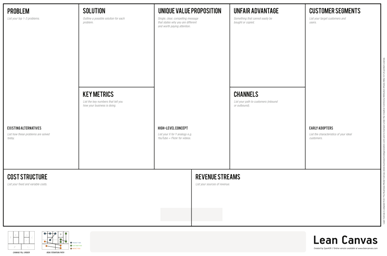
Consider the following Lean Canvas from one of my software products:

The critical inputs I need from the Lean Canvas are:
Goal = $10M/yr revenue
LTV = $200/mo * 2 years = $4,800
The first number I need to calculate is the customer throughput or production rate that I will need to to sustain my model at scale. In other words, I am going to treat the customer factory as a black box for now and only focus on it’s output.

I want to know how many customers I need to continually produce (on the right) to sustain my $10M/yr revenue goal.
Here’s the simple math to do this:

Make sure you work the numbers out for yourself before moving on…
In my workshops, people have no problem calculating the number of active customers needed for $10M/yr revenue which in this case works out to to 4,167 active customers. But the 2,083 new customers/yr isn’t the number of active customers but the number of new customers you need to create in your business model every year to replace older customers that leave due to churn.
Later we’ll model the internals of the customer factory, but this output customer production rate is enough to serve as your first dose of reality for your business model.
3. Test/Refine Your Business Model Against Your Minimum Success Criteria
The purpose of this simple back-of-the-envelope calculation is to turn a big fuzzy revenue number into something real and tangible – like creating customers.
All metrics are people first.
It’s much easier to do a gut test with people than just with numbers. You can now revisit your Lean Canvas and put your customer segment and channel assumptions to test.

- How does having to add ~2,000 new customers every year make you feel?
- Is your customer segment big enough?
- Do you have any scalable channels identified already for building a significant enough path to customers?
The business model above targets SaaS companies as early adopters and more general software companies as the total addressable market at scale. So for me, the 2000 customer production rate doesn’t immediately freak me out.
During a workshop in Paris, however, I ran through a similar exercise with an entrepreneur who intended on charging €5/mo for his product with a 2 year projected customer lifetime and a €5M/yr revenue goal.
Here the math worked out to having to add 40,000+ new customers every year!
This simple math invalidated his model because there weren’t even that many potential customers in all of France.
The solution to this problem is pretty straightforward.
First, you might try growing your customer segment. We had a short discussion on market size. The entrepreneur was already contemplating expansion to other countries. Those plans would need to be accelerated if nothing else was done.
The other options for lowering your required customer production rate are obvious from the formula:

You can either lower your yearly revenue target or raise your customer lifetime value.
Assuming, we don’t want to lower our yearly revenue target (just yet), the way you increase your customer lifetime value is either by increasing your customer life term or raising prices.
1. Increasing your customer life term
Doubling your customer life term from 2 years to 4 years would half your customer product rate. That said, increasing customer life term is non-trivial because it potentially requires you to revamp your value proposition and product.
2. Raising prices
This is by far the most powerful (and under utilized) lever you have in your business model. Doubling pricing from €5/mo to €10/mo also cuts the required customer production rate in half. But unlike increasing life term, a price change may only take a few minutes to implement on your checkout page.
Sure, there is always the danger that increasing pricing will result in fewer customers but what if it doesn’t?
If you could double your pricing, and not lose more than half your customers, you still come out ahead.
I’ll get into why in a future post.
Isn’t this all just funny math anyway?
At this point, you might be wondering whether all this is even worth the trouble. After all, you can easily double or quadruple the pricing model on paper to make the model work. So what?
Let’s go back to this statement from earlier:
While we all need a ballpark destination to justify the journey, it’s not the destination itself but the starting assumptions and milestones along the way that inform whether we are on the right path or need a course-correction.
We started with a big fuzzy money goal (the destination) and first converted it into a customer throughput number. We then further deconstructed this number into a set of input parameters (starting assumptions) that can actually be measured from day one.
While quadrupling your price might have been easy on paper, if you can’t get outside the building and find 10 people that will accept that price (first milestone), then you have a problem!
You don’t need 3 years to figure this out.
Getting accurate customer life time value numbers requires more time. But here also, you can begin to extrapolate customer lifetime value using secondary approximations (like your monthly churn rate). You don’t have to wait the full customer life time to estimate your customer life time value.
Like scientists, our job as entrepreneurs is to first build a model and then test that model through experiments.
If the experiment fails, we need to either adjust the model or more likely adjust the input assumptions into that model.
“It doesn’t matter how beautiful your theory is, it doesn’t matter how smart you are. If it doesn’t agree with experiment, it’s wrong.”
- Richard P. Feynman
CLICK HERE to download the Lean Canvas poster
(preferred by thousands of entrepreneurs)
19 Aug 21:19


Self-publishing startup Blurb signs book distribution deals with Amazon & Ingram
by Tom Cheredar
Image Credit: Blurb
It is the dream of most authors to have their books published and available in retail stores. The reality of this scenario is that publishing a book requires an understanding of the industry and a pile of cash, which is why startup Blurb is trying to do something about it.
Blurb’s service allows authors publish, distribute, and sell both print and ebooks through its platform with relatively little fuss. Authors don’t end up having to learn how to convert their books to ebooks that can be sold on Nook, Amazon, Google Play Store, etc., nor do they have to meet with each individual seller.
Today, the company is rolling out three new trade book sizes (5×8-inch, 6×9-inch, and 8×10-inch; which are basically the sizes most commonly found in bookstores) as well as new options for paper quality. Pricing for the new formats starts at $3 for color books and $2.50 for black and white. Along with the new formats, Blurb also announced that it has signed a new deal to distribute paper books via Ingram Content Group and another deal to convert print books to digital ebooks available on Amazon’s Kindle store.
“A lot of other companies can do part of this puzzle or charge you for conversion of one format to another or don’t totally do this or don’t do it right. It’s messy,” Blurb CEO and founder Eileen Gittins told VentureBeat. She explained that Blurb makes this process much easier so that authors only need to walk through the process of conversion/distribution once.
Gittins said the new trade book sizes available to publishers was necessary because those are the standard sizes for distribution, which opens up Blurbs self-publishing model to a much greater audience. The new distribution partnerships mean people will be able to grab these books on the Kindle store, and 39,000 Ingram booksellers will be able to order print books to satisfy demand, thus putting money directly into the pockets of authors when a sale is made.
Founded in 2005, the San Francisco-based startup has raised a total of $21.6 million in funding. Gittins declined to share revenue growth figures, as well as how much more business these new distribution partnerships will bring to Blurb.
Blurb (www.blurb.com) is an indie publishing platform that lets anyone create and publish professional-looking coffee-table books and fixed-format ebooks via free desktop and online software or integration with Adobe InDesign. Authors ... read more »
19 Aug 21:09

Lean Startup Experiments: Hiring Humans Instead Of Building Technology
by steli@close.io (Steli Efti)
Back in the days when we ran our sales consultancy and sales outsourcing company, we did a lot of cold calling for Silicon Valley technology companies. One of our clients was selling software directly to doctors. And the main challenge we had with this was that doctors are really hard to reach.
So we looked for ways to increase our reach rate. Our clients were spending too much time every day listening to dial tones and then going to voice mail, and not enough time talking to doctors.
That's when we discovered autodialers.
An autodialer is a neat piece of technology that basically calls several phone numbers at the same time, and drop the numbers which continually ring or go to voice mail. It seemed like autodialers were perfect for us - this technology was made to solve the exact problem we were struggling with.
Because we have brilliant technical co-founders Anthony and Thomas on our team, we were able to build our own autodialer. The question was just: should build our own autodialer or not?
Is It Really Worth It?
But we still weren't exactly sure how much value an autodialer would bring us. Would it be worth spending our engineering time to create the software to be able to dial several numbers simultaneously and only put a call through to a sales rep once an actual human being picked up?
So we hacked together a quick experiment in order to...
Test The Idea
We called a staffing agency and called for more manpower. The next day we had five temps in the office, gave each one a headset and made them dial through a bunch of numbers of clinics and hospitals. Their job was just to dial the numbers, hang up when nobody picked up the phone or when it went to voice mail.
If someone picked up the phone, the temp would say: "Hey, my name is John Smith, I'm calling from XYZ, can I talk to the doctor?" If the person on the other end of the line said yes, the temp would hand over the head set to the sales rep, who would then take the conversation from there.
So our office was filled with temps who were basically doing what an autodialer would normally do: dial a lot of numbers at the same time, and put a call through to a sales rep whenever a human being picked up the phone.
This was indeed as chaotic as you probably imagine it, but it also yielded some very valuable data: our sales reps could speak with 3 to 4 times more doctors per day using this system.
Based on this data we decided to invest engineering time into building our own (non-human) autodialer.

Are You Considering A New Technology?
Imperfect experiments are a lot better than refined theories. Whenever you have an idea that you believe could really move the needle, come up with an experiment that you can run really quick to see if the idea stands a reality check.
Don't spend a lot of time looking at different vendors and comparing things, purchasing and implementing technology. Don't spend hours, days or weeks discussing and pondering different options. Hack together a quick test, look at the data you get and then make an informed decision.
19 Aug 21:08
Essential Leadership Skills for Sales Success
by Hugh Liddle
Guest Post by Marian Rothschild, AICI FLC
You know your product or service inside and out. You believe in its benefits and you’re willing to dedicate valuable time, energy and skills to increase your company’s bottom line. You want to get ahead!
But how do you project trustworthiness, respect, confidence, and leadership qualities to keep the customer’s interest from first impressions to the deal-closing handshake?
Here are my twelve powerful points to manifest leadership qualities for sales success.

1) Present yourself confidently, as if you have just made the sale of the century. If you are strong, intuitive and smart, don’t project weak, clueless and uneducated, or that’s how you will be perceived. Express a positive attitude and poise under pressure.
2) Embody your value and your potential for success in posture, voice and all online communication. Communicate clearly with everyone in person, on the phone and online. Ask for confirmation of receipt and understanding. Use positive language and clear vocal tone. If you sound immature, soft-spoken and low energy, you will be perceived as such.
3) Always have a clear, positive answer when you are asked “How ya’ doin’?” and “What’s new?” Influential leaders do not respond with “Not much” or “Nothing.”
4) Be aware of your body language: foot jiggling, leg shaking, hand wringing, gum chewing, playing with hair and other self-grooming are all signs of insecurity and will be perceived as weak.
5) Use elements of wardrobe to your advantage. Know what are your most flattering colors, shapes, wardrobe pieces, and how to use them to project an image with intention. Quality and fit must be impeccable for all business formal and business casual apparel. Do not wear anything distracting like ill-fitting or provocative clothing, loud colors and patterns, or noisy accessories. These will detract from others seeing a polished presence and understanding your message.
6) Ask questions and listen intently to your customers’ answers. Never presume you know their pain. Let them speak at length and explain their predicament thoroughly and in depth. If you are on the phone, take notes. Present a vision of understanding and help your client see that your product or service is the solution to their problem.
 7) Read your client’s facial expression, tone of voice and body language to know what they are feeling. Be sensitive to their emotional state and adjust your plan accordingly. When in doubt, listen and acknowledge their concerns.
8) Do not belittle anyone, including your competition. Your disparaging remarks can kill a sale and ruin your reputation.
9) Pay particular attention to your posture at all times. Whether sitting, standing or walking, your spine should be straight, not caved in, shoulders down and rolled toward your back, not drooped forward. If you stand, sit, or walk with slouching shoulders, you could be perceived as low energy, negative, or apathetic. Good posture and a closed mouth (when not speaking) gives the impression of attention, intelligence and interest.
10) Confident leaders have a firm handshake – both men and women. Use your entire hand to shake, not just the fingers. Make it firm, but not bone-crushing. If you tend to have sweaty palms, keep a handkerchief in your pocket. Just prior to an introduction, inconspicuously wipe your right hand on the handkerchief inside your pocket. Look the person in the eye as introductions are made.
11) Ask for feedback on your image from others whose opinion you trust. Observe people who have amazing leadership qualities and great sales skills. What is it about them that stands out? Watch, learn and practice those skills. Video record yourself speaking or making a presentation as part of the preparation process. Play it back, take notes and adjust accordingly.
12) Bring your leadership skills with you into every situation, event and interaction. Be sensitive. Be genuine. And be confident that you are exactly the right person doing exactly the right thing at exactly the right time.
Marian Rothschild is a certified personal image consultant in Denver, Colorado, speaker and bestselling author. Her book, Look Good Now and Always: a do-it-yourself style makeover for busy women is available on Amazon.com. Marian helps men and women transform their personal brand into a confidant, authentic expression of polished presence for stellar success. CLICK HERE to find out about a Virtual Consultation via Skype and sign up for our free monthly newsletter.
Note from THE Sales Wizard: Marian is an absolute genius at helping clients present the image that exudes success, confidence and self esteem, which draws people to you and helps them feel comfortable making the decision to do business with you. Check out Marian’s website, subscribe to her blog, arrange a consult with her and put her advice into practice. Take massive action NOW and succeed!!
Good selling,
Hugh
THE Sales Wizard at
Red Cap Sales Coaching
You can learn to make selling easy, fun and profitable!

19 Aug 21:08
Answering the ROI Question for Customer Experience Management
by Omer Minkara
 I see customer experience management (CEM) as a glass of finely aged wine. The topic has been in the marketplace for a long time, but it has only become more enriched with age. This is for a good reason; clearly, every business looking to make profits must sell something (a product, service or maybe even a vision). Yet success is often in subtleties such as marketing to and servicing both potential and existing customers well in order to retain their business, grow their spend and create a loyal client base that helps the company survive and thrive financially.
While the importance of CEM from the above analysis is rather obvious, companies have numerous priorities. This means that they must understand the best uses of their limited resources to fund initiatives that achieve the company’s objectives. As a result, the benefits of CEM programs should be quantified and assessed against the benefits of other programs in order to determine how companies will allocate resources accordingly.
As part of my research, I regularly interact with marketing, sales, service and customer experience executives discussing their priorities and challenges, while also sharing best practices that worked for their peers. One of the questions that I receive regularly as part of these interactions is, “What is the ROI of CEM programs?” The most recent inquiry was received just yesterday from a service quality manager within an electronics manufacturer based in the U.S.
I wanted to share a part of my response (see below) in hopes that it will alleviate the challenges companies face when trying to build a business case for a CEM program:
Given that you mentioned you’re looking for concrete return on investment (ROI) data on the value of CEM results, I should share that in addition to the quantifiable performance findings, CEM programs also create indirect business benefits that, in the long run, help companies improve performance. For example, the cost of not delivering better customer service comes with unsatisfied clients potentially sharing their experiences across different social media platforms. This results in damage to the company brand equity and loss of potential customers who might have done business with the organization. These opportunity costs are often hard to quantify, yet have a significant impact on businesses.
Therefore, one can say that the ROI of CEM is also reflected by the cost of what happens when companies don’t satisfy their customers. These consequences range from losing clients, to worsening of brand equity to potential litigations due to not meeting promised service levels.
I’d also like to state that while the opportunity costs of not satisfying customers are sometimes hard to quantify, we were able to quantify the net revenue impact top performing CEM programs have on businesses. Please read my The ROI of Best-in-Class CEM Programs study to see these findings.
Were you challenged with building a business case for CEM programs? Did you overcome it? If so, I’d love to hear your experiences in the comments below.
19 Aug 21:08


Show Me the Money! Why Some Sales Engineers Can't Close
by Jim Lobaito
This week's blog comes from guest blogger, Doug Wick. Doug is President of Positioning Systems.
 Many years ago when my father purchased a new car, he was very self-conscious about it and seldom allowed it outside of the garage. Since he had an hour drive to work and worked very early or late, the car seldom got seen. Years later, I discovered, in speaking to my older brother, that dad didn’t want anyone to see it because he was concerned that people would feel he was making too much money. In many families, the subject of money was and is verboten. You shouldn’t speak about how much something cost or how much income your father or mother made. Either I was naive or unaware as I grew up yet, this was certainly prevalent in my family.
If you grew up in that type of environment, you may have difficulty speaking to your clients and prospects about the subject of money. Objective Management Group recognizes this as one of the hidden weaknesses for sales people. It’s described as: Discomfort with Issues Involving Money (a frequent opposite of Empathy). Many salespeople are uncomfortable escalating a question about budget, or whether a prospect can afford the product or service being offered, to the next level. Their discomfort prevents them from helping a prospect figure out how to pay or even where the money could possibly come from. When prospects don’t have the budget, can’t envision increasing the budget, or don’t know how they can find the money, the salesperson empathizes rather than digging deeper, asking questions, and making suggestions to solve the monetary shortage.
How does one fix a serious money tolerance weakness? Years and years of intense psychological counseling! [Just kidding] Actually, there are several ways including simply speaking out loud about it more often; being more open about money; and carrying more money on you. Robert Kiyosaki books can help as well as his Cash Flow Game. We need to raise our money ceiling in order to help ourselves and the people we are working with to feel comfortable about money. When you are afraid to discuss money, your prospect perceives your product/service to be less value and it also opens your product or service up to more price negotiations.
Here’s the good news. When you become comfortable talking about money, you can expect to increase your effectiveness and your business about 30%.
19 Aug 21:07
Here's How Russian, French, Portuguese, And German Native Speakers Screw Up English
by Gus Lubin
Computer scientists at MIT and Israel's Technion recently developed an algorithm that analyzes quirks and errors in English-as-a-second-language (ESL) essays to predict the author's native tongue, potentially unlocking new tools for translation and teaching and also producing an alternative map of language similarity.
The breakthrough got us thinking: How do native speakers of different languages typically screw up English?
Researchers Dr. Boris Katz and graduate student Yevgeni Berzak offered the following examples over email:
In Russian, there are no determiners (no words equivalent to "a" and "the" in English). As a result, native speakers of Russian tend to omit determiners in English. For example, a native speaker of Russian uses the following sentence in our data: "I was champion of swimming competition in Russia," instead of, "I was the champion of a swimming competition in Russia." Another example is "Everyone has now a car" which would be the correct order of modifiers if translated word-to-word to Russian, instead of the proper form in English "Everyone has a car now."
In French, adjectives follow nouns (in most cases). Consequently, native speakers of French use phrases such as "lessons very important" instead of "very important lessons," "afternoon free" instead of "free afternoon" and so forth. Another pattern that is common with French natives is preference for the construction "noun preposition noun" over "noun noun" compounds which are less frequent in French. Hence, French natives may prefer "licence for sailing" over "sailing licence," and "manager of Bruce Springsteen" instead of "Bruce Springsteen's manager."
With natives of German we have the example "The pollution will more and more increase," which would be the correct position of the verb in German.
Two other types of ESL patterns that are influenced by the native language are prepositions, and count/mass noun distinctions.
ESL learners would often direct-translate the preposition from their native language (for example, Portuguese natives confuse "in" and "on" in a systematic way, based on the usage of the equivalent prepositions in Portuguese).
Different languages have different count/mass noun distinctions. For example "information", "furniture" and "homework" are count nouns in French, and so natives of French may say "informations", "furnitures" and "homeworks" in English.
Here's how the researchers identified and used this information:
The algorithm receives ESL essays by native speakers of different languages as input. It starts by learning linguistic patterns in ESL that are characteristic of each of these languages. The kind of patterns we take into consideration are word order, syntactic relations between words, and morphological suffixes and prefixes.
Using these patterns it is possible to predict the native language of a given ESL document, but in fact our method reveals something even deeper: based on these patterns, the algorithm estimates the similarity between all the language pairs, and clusters them into a tree. It turns out that this tree is very similar to a tree that one would obtain when using similarities according to the linguistic properties of these languages as manually documented by linguists. These linguistic properties are called "typological features" and refer to things like word order, valid syntactic constructions, how to form negation, are there morphological suffixes and prefixes or not, etc.
Finally, the algorithm uses the ESL-based similarity tree for prediction of typological features of languages for which we have no prior linguistic data. For example, imagine that I know nothing about the typological features of Portuguese (I don't know the correct word order, how to form negation etc), but I have a bunch of ESL documents written by natives of Portuguese. Using the similarity tree from ESL, I can determine that Portuguese is in fact similar to Spanish and Catalan. Assuming I do know the typological features for these two languages, I can now predict the typological features of Portuguese based on the features of Spanish and Catalan. Of course, this method is not perfect, but it's a pretty good approximation: in 72% of the cases the predicted typological features are correct.
To sum up, the practical value of the algorithm is the ability to predict native languages, their similarity structure, and their typological features directly from ESL. The fact that we can do this also tells us something new and interesting about language: there is a strong relation between native language typology and second language usage. In other words, the properties of your native language systematically affect the way you use a foreign language.
Based entirely on ESL essays, the researchers were able to create a language similarity tree, showing the close links between, for instance, Japanese and Korean. Their language similarity tree looks remarkably similar to one based on data from The World Atlas of Language Structures (WALS).
“The striking thing about this tree is that our system inferred it without having seen a single word in any of these languages,” Berzak said.
Here's a comparison of the ESL tree and the WALS tree:
And an artistic rendering of the ESL tree:

19 Aug 21:06
Leverage Social Listening for Brand Adaptation vs Losing Identity
by Brian Vickery
As I was growing up, I wanted to eventually own a Jeep, a sports car, and a motorcycle. When I moved to Denver, I bought a Jeep. When my oldest daughter had to take a car to college, we gave her my Jeep – and my INCREDIBLE wife said “why don’t you get a sports car”. So I got a Camaro. And when my youngest daughter came back from college, and we were going to be short one car, I volunteered to get a motorcycle…because it’s all about getting good gas mileage, you know.
I’ve always loved Jeep – the Wranglers, the Renegades, the Cherokees, and even the 2002 Jeep Liberty I bought in its first model year (I couldn’t afford the Grand Cherokee). I like classic ruggedness, and every Jeep owner just “gets it” when they see these driving by them on the highway or trail…


So, imagine my shock when I see THESE so-called Jeeps passing me on the freeway.


Umm…WHAT?!?
In turn, these look like a Honda Element, a Toyota Highlander, and some cross between a Volvo, a Nissan, and a Hyundai! Now, don’t get me wrong – I’ve actually liked all of those vehicles for different reasons (originality, fuel economy, luxury, price, etc). But they are not JEEP. You do not hear about Volvo Jamborees or Honda Element Rocks and Road Tours – you hear about Jeep Jamborees and Jeep Rocks and Road Tours, and you want to put these events on your bucket list. Did Jeep just go from a rugged trailblazer to a copycat nibbling on competitors’ marketshare while trying to be “all things for all people”? Is this brand adaptation or an example of a brand losing its identity?
After seeing a few of these new Jeep models on the road, I did take a quick spin through Twitter, Facebook, and Instagram for “#Jeep”. The large majority of postings had photos of the classic jeep style – other than one that included the picture of the Renegade above with the introduction: What do you think…is the new Renegade a real #Jeep?
Brands like Jeep and Harley Davidson do not have fiercely loyal followers because of their gas mileage, their bells-and-whistles, or even their reliability. They built their fanatical following based upon being one-of-a-kind in their industry versus conforming to their industry’s trends. Will Jeep now have fan attrition because their latest designs make them non-distinguishable from their competitors? When there is no distinction between product features, products become commodities. Then product selection becomes based upon price and convenience versus value and culture.
While evangelizing for our social listening and analytics solution, Pulse Analytics, I always make the following statement: Customers are talking about you, and it’s not in your customer survey (or focus group). Jeep customers are posting pictures on most of the major social platforms, and the really passionate ones are writing blog post product reviews. Jeep should implement a social listening strategy to capture those conversations, to identify the advocates and detractors influencing those conversations, and to score the sentiment on topics important to the consumers. Jeep can then adapt the brand to consumer feedback without losing its identity and potentially alienating their fiercely loyal following. In fact, social listening finds the topics important to consumers; however, social engagement provides the tight feedback loop to crowdsource product improvements. Jeep can accomplish the social engagement via Facebook Fan Pages, Google+ Communities, and Instagram/Vine photos and videos to go along with the already active Jeep Forum (which could also be mined for actionable intelligence by Pulse Analytics).
So here is my Jeep loyalist crowdsource contribution for the day (are you listening, Jeep?): Keep the classic styles of the Jeep Wrangler, Liberty, and Grand Cherokee and focus on how to get 50 miles/gallon while trekking through a foot of snow! It’s tough going from my 50 mpg Harley Davidson to my 17 mpg Jeep Liberty when the snow starts falling in Colorado. Meanwhile, stay original and remain a trailblazer…the world has enough conformists.
Photo Credits in order of appearance:
- Jeep-People – Jeep History – ZJ Grand Cherokee on Flickr
- Chrysler Group – 2011 Jeep Liberty Jet on Flickr
- Jeep-People – Jeep History – 2003-2006 Jeep® Wrangler Rubicon (TJ) on Flickr
- Chrysler Group – 2015 Jeep Renegade Trailhawk on Flickr
- Jeep Compass 2.4 Sport 2014 by order_242 on Flickr
- New Jeep Cherokee by harry_nl on Flickr
19 Aug 21:06
How A/B Testing Strategies Can Help You Make Better Decisions
by Jenny Hunt
A Q&A with Chris Goward, Author of “You Should Test That!”
This week, we are sitting down with Chris Goward, the author of “You Should Test That!”, a book that teaches the processes, frameworks and techniques of scientific marketing to make better decisions and achieve industry-leading results. Featuring case studies of real tests plus many more examples of how companies are succeeding and failing in their websites and their marketing, we’re eager to learn more.
What’s the premise behind your book, “You Should Test That!” ?
Too many businesses still use antiquated methods for decision-making with their marketing. They seek out so-called “best practices”, copy competitors tactics, and redesign their websites without A/B testing, to name just a few examples. I wanted to write a book that would provide a dose of inspiration in the new scientific marketing discipline as well as practical processes and frameworks marketers can apply directly to their marketing strategy. It really does contain detail on a lot of the methods WiderFunnel uses to consistently achieve winning results for our clients.
You’ve become a regular speaker at the top online marketing conferences. How did you get into conversion optimization?

I’ve always questioned current ways of doing things. In the early to mid 2000’s, I wondered why marketers accepted the status quo where ad agencies used their clients’ budgets to create self-serving campaigns aimed solely at winning awards for cleverness. I couldn’t understand why digital agencies were creating websites that ignored direct response principles and really couldn’t be more than poor copies of the old TV world.
I left the agency world in 2007 to create WiderFunnel based on the belief that agencies should prove their value. Since then, we’ve been running thousands of A/B tests on hundreds of websites across all industries to discover consistent persuasion and user experience principles that maximize companies’ online profits.
Related Class: Integrating SEM, Testing, and Analytics for Improved ROI
What are the biggest mistakes you see marketers making today?
There are so many!
- Implementing the latest “tips & tricks” they see on blog posts. I’ve already said many times why tactical marketing tips and “best practices” don’t work. The problem is that they ignore your unique business context.
- Consensus decision-making.
- Getting stuck behind organizational barriers. I’ve seen turf battles, silos and competing priorities hamstring some very promising potential A/B tests.
- Acting on usability testing or other qualitative methods to make website changes without testing those insights. I’ve covered before, the many reasons that usability testing alone is not reliable.
- Testing too conservatively.
- Not prioritizing effort correctly and wasting time optimizing inconsequential areas.
- Using “before & after” testing rather than correct controlled test methods.
- Drawing conclusions from inconclusive data. Often, it’s difficult for the conversion champion to hold off the pressure to make decisions without enough data.
- Taking advice from “experts” who don’t do a ton of testing. If their primary business isn’t testing, testing and more testing, where is their advice coming from? You might be surprised at how little testing some of the industry’s pre-eminent figures actually do.
- Over-emphasizing optimization tool selection before developing a strategy and process for optimization. Tools don’t solve marketing problems. Smart marketers with great strategy and ideas do.

What are the biggest challenges businesses face in adopting marketing optimization as a strategy?
I’ve been running an ongoing poll of marketers asking a similar question since 2012.
Interestingly, in 2012, most respondents said they faced resistance within their organization for conducting testing. This year, that’s the least likely challenge. Companies now know conversion optimization needs to be prioritized and there’s senior-level support for the strategy.
The biggest challenges marketers face in 2014 are in getting great results from their program. They either don’t have staff with deep testing experience, don’t have a reliable process, or face technical barriers. So, it’s good to see the market evolving to having support for the strategy. Now, the challenges are more about how to get consistent results.
eConsultancy did their own survey of companies doing conversion optimization and found that those who reported having a “structured approach” to their program were twice as likely to see large increases in sales. The disciplined, rigorous process alone determines a great deal of the success.
Related Class: eCommerce Testing to Dramatically Lift Sales
What are your favorite website elements to test?
Really, I like any testing any area that gets results. And, that can be different for every website depending on where the conversion barriers are. Every website design, structure and target audience is slightly different. Some companies are adopting WiderFunnel’s PIE Framework for prioritizing tests to answer this question based on their unique context.
That being said, however, we’re having a lot of success this year adding the “Evolutionary Site Redesign” strategy to conversion optimization for our clients.
It’s a strategy any (and I believe every) company should use. Essentially, it means we’re testing the site-wide website templates in a methodical way. It results in a redesigned website without the risks of traditional “flip the switch” epic redesign. Using A/B testing of the overall design elements, companies are finding sometimes huge revenue improvements from improved navigation, information architecture, design credibility, merchandising, etc. and the resulting design changes can be just as dramatic.
In this class, 10 A/B Test Studies, you’ll encounter 10 such tests and can guess which page won. The answers will surprise you and the knowledge you’ll gain about how to conduct these tests and what makes some pages better than others will make you a more effective marketer.
19 Aug 21:04
Lead Nurturing Isn’t a Stage in the Sales Funnel
by Erika Goldwater
There are few things more enticing than reading or engaging in a dialogue about something controversial. We eat it up. Additionally, it really gets us thinking about the topic, which is a great thing. Take a look at an excerpt from a Leadspace Radio via Sales Lead Management Association with Carlos Hidalgo, CEO and founder of ANNUITAS.
 LeadspaceRadio: “You speak around the world – what’s one piece of advice that you think is received as somewhat controversial? Think of something that’s not so evident that people should do, or that there’s just this unnatural resistance to.”
Carlos Hidalgo: “We can’t just focus on a piece of the funnel. First of all, we have to understand that the funnel isn’t a buying process. I’ve said it before. I never heard a Buyer say, ‘I’m in the sale acceptance stage of my buying process.’ Buyers are not linear in their progression often times so we really believe that to focus on any one area upstream which is Engage, midstream which would be nurture or Conversion, if you just focus on any one of those areas, you’re missing a good part of the buying process.”
“How can we STOP DOING lead nurturing campaigns? A campaign is something that has a start point and an end point. It’s not perpetual -which demand generation should be. We should be looking at a holistic buying process and then if we want to align that to a funnel that’s fine, but we should be looking at what does our Engagement content have to say? Is it thought leadership? Is it not necessarily pushing my brand but helping me really educate my Buyer?”
“Nurturing has to be a holistic part of demand generation, connected to nurturing and also connected to content. If not, you’ve got a huge gap in that buying process. We really believe that demand generation includes nurturing and nurturing should not be taken out separately.I have seen organizations say, ‘We’re going to focus squarely middle and do nurturing.’ If you don’t know what your upstream content is like, how do you have that continuity and dialog with the Buyer? That’s number one.”
“Number two is really the way that most organizations do lead scoring today is really, really poor. What we’ve done is we’ve said every white paper is going to be 25 points. If a CEO or CMO downloads it they get more points for their title. We really shouldn’t be basing our lead scoring on the asset type. What we should be doing is taking a lead scoring approach that takes into account where in the Buyer Journey that content is consumed. If I download and consume a white paper in my late stage nurture, shouldn’t that be more valuable than something I downloaded prior to white paper, perhaps in my Engagement content? Why? Because I’ve spent more time with you from a buying perspective. I’ve gone down this content journey with you so the later stages that I’m consuming content, the more valuable that content is. However, most organizations they get in a room, they get on a white board and they say, ‘Okay. White papers, case studies, webinars – how many points should these be?’ That’s irrelevant. It’s really all dependent on where in that buying cycle that content piece is.”
This is just a snippet of the conversation from the interview. Curious to hear more on why lead nurturing isn’t a stage in the sales funnel and more Demand Generation Strategy tips? Listen to the full interview here. For more on the ANNUITAS Demand Generation Strategy, download our eBook, 10 Content Rules for Effective Demand Generation.
Author: Erika Goldwater, CIPP/US @erikawg Director, Marketing for ANNUITAS
19 Aug 21:03
Uses For Your Landing Pages That Aren’t Readily Apparent
by Fernando Florez

Of all the “modern marvels” in today’s digital marketing world, perhaps none is more versatile and useful than the landing page. If you are an online marketer, the landing page is a tool you want in your marketing toolbox.
Landing pages are an ideal (and very necessary) complement to a PPC/SEM campaign. If you are a B2B marketer, they are handy for “selling” prospects on accepting your latest content offering and convincing them to take that next step in the often complicated buying process.
With landing pages, you can convert potential customer from shoppers to buyers. One of the main benefits of landing pages is that they let you reduce or even eliminate a lot of the sales-killing distractions so rampant in the online environment. They let you collect valuable information on potential customers, information you can use to help you make more sales.
In this blog, we’ve talked about using landing pages for PPC and E-Commerce sales. We’ve also discussed in detail about using landing pages to sell B2B prospects on registering for your latest content offering.
Today, we’ll highlight some landing page uses you may be completely unaware of. And we’ll touch on why you would want to use landing pages for these situations.
This Might Help You Get More Email Subscribers
Email is a proven online marketing tool that has helped build many business empires. If you are not leveraging its power to help boost your sales, please consider it.
If you are using it, here’s a way you can gain more email list members: a lot of marketers attempt to gain new email subscribers through a lead capture form on their website homepage (Note – This is an improvement compared to some websites that have the email signup form buried on their contact page, if they have one at all!). Here’s a way you’ll find to be much more effective:
Collect new email subscribers with a dedicated landing page, a landing page whose sole purpose is to help you sign up new email list members. This can increase your email subscriptions by up to 50%! So how can you enjoy such stellar increases in conversion rates by having landing pages dedicated solely to email signups?
It’s simple. Think about it: a website’s homepage is typically not an environment well-suited for conversion. It’s often filled with a lot of different information and distractions. Overwhelmed and distracted site visitors might very well see the email signup form on your website’s homepage and pass right over it because of other elements competing for their attention.
Of course you want to test this with Google or another analytics program, but a much more effective way for you to win new email subscribers might be to have a simple but colorful call to action button with brief but benefit-rich copy on your homepage that takes those interested in finding out more about your email list to a dedicated landing page that has one purpose – to win you new email subscribers.
When you use this tactic, review your landing page thoroughly. Take a look at each individual element and ask yourself if it will enhance or decrease the likelihood of adding email list subscribers.
When we think of using landing pages in online marketing, we often think of PPC ads. That only begins to scratch the surface of how you can use landing pages in your online marketing…
A lot of businesses could seriously benefit from a smartly strategized mobile marketing campaign.
Wow! Let This Sink In…

We’ve talked about mobile marketing on this blog before. And we’ve discussed what may be the most amazing marketing statistic ever: studies show that over 99% of text messages are opened. Over 99%!!
Think about that for a moment. Do you think your business could benefit from a marketing message open rate of 99%? What if you were to include in your next marketing text message a link to a special mobile-optimized landing page?
If you sent the message to a fairly large list, and if you included some very powerful but brief, persuasive copy enticing the message recipient to open the link and check out your killer landing page, you could enjoy some very nice results!
If over 99% of text messages are opened, and if people pay close attention to what’s happening on their smart phones (they do), doesn’t it stand to reason that they would be predisposed to wanting to take a closer look at your landing page in the link you texted them?
Of course it does! Put together an eye-catching, persuasive landing page with an offer that’s hard to resist and you may very well enjoy marketing results like you’ve never experienced before!
Landing pages can be very useful when you want to focus your reader’s attention and persuade him to to take a specific, well-defined action. This action may not be for an E-Commerce sales transaction; it may not be for a B2B content marketing signup.
Here’s a unique way you could use landing page software – as your website’s contact page. Instead of just offering your contact information, why not sell the website visitor on picking up the phone or filling out the contact form to get in touch with you?
Why not have a “Contact call to action?” If you are a consultant or independent service provider, you need potential clients contacting you. Why not take persuasive steps using proven landing page technology to get them to.
Why not place your contact form and contact call to action on a specially designed landing page that’s free of the conversion-killing distractions that plague so many websites?
If your company is trying to win at the competitive game of online marketing, landing pages can be very helpful in your quest for success.
A Boost For Your Career?

Maybe you’ve been out of college for several years and are trying to give your career a shot in the arm. Why not embrace digital technology to help you highlight your skills and accomplishments?
Let’s say you are just out of school and are trying really hard to land your first post-graduation job. In today’s hyper-competitive job market, you need to stand out in a big, bold way from the hordes of job seekers trying to take that job opportunity away from you.
This article gives you simple, actionable steps you can take starting today to use landing pages to build your personal brand.
Here’s an idea: if you are a new college graduate entering the job market, or if you are a few years or more into your career, why not use an eye-grabbing landing page with brief, to-the-point copy to give potential employers a synopsis of yourself and your career?
Although it’s usually not a good idea to include links that take visitors away from your landing page, make an exception to this rule here; put a link to your blog on your personal branding landing page.
Here’s a useful side note for college graduates just entering the job market and those with more career experience: if you don’t have a blog, start one. An authoritative blog loaded with useful, information-rich articles you’ve written can do wonders for your career; if you are fresh out of college, it can make you look very impressive indeed to potential employers. It can help you stand out big time from other recent college graduates who only have degrees and resumes.
Something You Need To Remember
Even if you are using landing pages for a purpose other than B2B content marketing or E-Commerce, you will get the most “mileage” from a landing page when you use it to “sell” page visitors on taking action of some sort. Here, you need to use the same persuasion methods you would use if you were making an actual sales transaction.
Regardless of the purpose you are using it for, you need to keep your landing page as free of distractions as possible. You need to tell the page visitor how he will benefit if he chooses to do the thing you want him to do.
You need a strong, persuasive call to action with a very noticeable button for him to click. You need your graphics to enhance, not detract from your conversion efforts, and you need any images to be relevant to the mission of your page. Also, have captions for your images, captions that feature strong copywriting.
Remember that confusion kills conversions. Make it crystal clear what you want your reader to do. Don’t hint at or make him guess what you want from him, tell him exactly!
Happy Marketing!
19 Aug 20:57
Are You Managing the Right Activities that Drive Sales?
If you’re in inside sales management, then you know all about metrics. In fact, whenever I consult with new clients the owners and managers automatically begin showing me their call monitoring reports. They show me metrics on how many calls a rep is making, how much average time each rep spends on the phone, what their conversion rate is, and on and on.
When they ask me what I think, I tell them I think they’re measuring the wrong things. Now don’t get me wrong – those things are important and they should be monitored. The problem though is that those metrics are not what drive sales.
You see, it isn’t the activity around the sale that’s most important (and that everyone measures), but rather, it’s the activity that happens during the sale that matters most.
In other words, as a manager you need to know exactly what and how your reps are responding and dealing with their prospects and clients during the sales interaction.
There are two times to monitor and coach this:
- You can either monitor your reps while they’re actually on the phone with a prospect or client (by listening in), or:
- You can record the call and spend time reviewing and coaching your rep as you go over their actual sales performance.
Both of these methods will give you the most important information of all: Are your reps using the best practice approaches to successfully handle the sales situations they run into 80% of the time when trying to sell your product or service?
You see, if your reps either don’t know how to best handle these sales situations, or if they simply aren’t using effective techniques and skills, or worse, if they just don’t have the talent or willingness to consistently use proven best practices, then it doesn’t matter how much time they spend on calls, or how many calls they make or how many leads they get out.
Again, it’s how they perform during a sales call that matters most. And your number one goal as a manager is to know how each of your reps performs while in the sale, and then to teach them the most effective, best practice techniques to win more sales.
Once you’ve given your team the skills and techniques to succeed in your selling environment, and you’ve trained them thoroughly on them, then managing simply becomes a job of coaching adherence to these best practices (see numbers one and two above).
Again, it isn’t the activity around the sale that’s most important, but rather, it’s the activity during the sale that matters. And if you’d like help to put a proven system together to measure, monitor and correct that, then either click here, or reach out to me personally: Mike@mrinsidesales.com
19 Aug 20:57
3 Ways To Justify Your Event Spend
by Jennifer Hawkins

Events have traditionally been one of marketing’s biggest spends, but they’re notorious for failing to generate useful information. According to Frost and Sullivan, marketers spend $565 billion on event marketing each year, but the resultant data is often reduced to a stack of business cards and a PDF of scanned leads.
Understandably, this makes it difficult for data-driven marketers to justify expensive events, and to get clear insight into what works best. Here are three techniques for getting the highest ROI from your event investment:
1) Real-Time Data Collection
Every part of your marketing strategy is becoming digitized, including events. Event organizers can now collect and analyze information about attendees before, during, and after their event. This data can be used to improve the event experience, but more importantly, it can be used to qualify sales targets, improve lead generation, and optimize a company’s overall marketing strategy.
One of the most common ways of collecting attendee information is through event apps, which offer marketers and planners access to previously unavailable social data. This can in turn shed light on which attendees are most actively engaged, which speakers are most popular, etc. Even if an attendee never fills out a single feedback form, you can analyze each participant’s app activity – taps, likes, check-ins, comments, bookmarks, etc. These metrics provide actionable information to inform your decisions in real time.
2) Basic Event Metrics
Regardless of the event, you’ll want metrics on how many people registered and attended. If you’re hosting or participating in a tradeshow, you might also note the number of people who visited your booth, watched a demo, or attended a speaking session. If you’re hosting a webinar or virtual event, you might want to know how many people commented or asked a question, viewed the follow-up recording, or clicked an internal link.
You’ll also want to measure social engagement – uses of the event’s hashtag, tweets and posts about speakers and sessions, photos of the event on Instagram, etc. While social engagement can be tricky to connect with ROI, it will still give you insight into what is (and isn’t) working.
3) Revenue Attribution
To get a little more concrete, you’ll want to be able to tie your event to revenue. This is particularly challenging with events, as it can take months before an event’s impact becomes clear. To accurately judge how your event affected pipeline, you’ll need robust reporting.
Some marketing automation platforms can show you how every touch from marketing impacts a deal – events included. If you collect a name at the event, and that name eventually becomes a customer, your event will get a share of credit for the deal. Likewise, if someone who is already in your database attends an event, and then becomes a customer, your event will get credit for that as well.
In Conclusion
Marketing was once widely seen as a cost center, but marketers have begun to increasingly use metrics to build credibility. Events, so often dismissed as a waste of budget, are no exception. By combining real-time event data, basic metrics, and revenue attribution, marketers can now start proving and fine-tuning their investment in events.
How does your company justify investment in marketing events – or justify not investing in them? Leave us your thoughts in the comments below.
19 Aug 20:57
6 Reasons Experts Include Case Studies in Their Blog Posts
by Lewis Crutch

One of the most popular terms used in the world of content marketing is the phrase “evergreen content.”
People get all excited about evergreen content because you only need to put in the work once and you reap the rewards over and over and over again for months if not years to come. Evergreen content keeps on giving, mainly because it is not time sensitive and is going to always be ‘in-date’ regardless of current trends.
This is exciting because producing good content takes time. The problem of course with evergreen content is the time is takes to come up with a concept for your blog posts that will withstand the test of time. But there’s one form of content that doesn’t take too much effort to conceptualise and will continue to produce traffic, leads and sales for the foreseeable: Case Studies!
Case studies not only add a huge level of authority to your website but are also one of those incredible ways of generating long term traffic. Let’s take a closer look at why case studies are as good as I say they are:
1. Case studies are very niche specific
The great thing about case studies is that they are never a filler. In other words, when people go to your website and read your case studies, they are clued in directly to the niche that you are covering. It’s hard for a case study to be a bit vague (if dealt with correctly of course). Case studies go into detail about your experiences of a particular activity. For example, you own a website selling the ultimate car valeting guide book and have a blog. Every month you could publish your method for perfectly cleaning particular elements of a car from the alloy wheels through to the engine bay.
It would be hard to discuss your experiences of cleaning an engine bay without talking about cleaning an engine bay and therefore car. You get the idea.
2. Case studies focus on your audiences problems
The reason why case studies are so respected and sought after in any content marketing strategy is that they are an easy way to link between yourself (and brand) and your audience. You can start your case study off with a story to draw in your audience and ensure you’re not just another brand selling stuff. A properly written case study lays out the issues and lays out principles that are applied to the issues and facts. Formatted this way, case studies are not only easy to read and follow, but it’s also very easy to extract value from them. This is why they are so powerful, popular and effective.
3. Case studies display the process
There are many different people in your audience: Some people in your audience are just looking for answers. Some people in your audience are just looking to be assured that whatever situation they are going through, somebody has experienced that as well. Many are just reassured of the stories that case studies bring to the table. However, a significant number of those people are actually looking for processes. They’re not looking for specific answers because they probably already have the answers, but they’re looking at how the answer was arrived at and why the answer is the answer.
Case studies are excellent sources for these people. Why? Case studies can be written in a process intensive way. Think of a process intensive case study like your Algebra problem sets in high school. Your teacher would always say “show your working”. Your teacher doesn’t care about the answer. Your teacher is more concerned about how you got to the answer. Case studies can walk the audience member through the process that produce an answer which leads us onto…
4. Case studies enable your site to stand out as an authority
Well-written case studies really shine. Anybody can write How-To Guides or FAQs. Anybody can compile interviews. However, case studies take a lot of work. Case studies, at the very least, require paying attention to certain common situations experienced by your audience members.
More importantly, case studies apply a deeper level of analysis so that the process is made clear and options are laid out. This level of detail and analysis help your website truly stand out as a source of authoritative content in your niche.
It goes back to the ‘show your working’ phrase again. Anyone can come up with the answer to a problem (and some will make that answer up solely to sell). If you can come up with a genuine answer and a set of processes (workings) that took you to that answer then your reputation in the niche will certainly sky rocket.
5. Case study presentations are modular and manageable
Another great factor going for a case study as a powerful example of evergreen content is the fact that it’s often formatted in a very modular way.
Since most internet users have a very short attention span, this modular presentation enables them to not just identify the answer quickly, but also wrap their minds effectively around the process that produced that answer. This enables you to present valuable information in a very modular, compact and manageable way.
6. Case study content can be easy to create
As powerful as the case study format is, you might think that it’s intimidating. You might think that it takes a lot of work to create. You might even think that it costs a lot of money to put together. The good news is that with proper tools and proper data gathering strategies, case studies can be put together quite easily.
If you cover a niche that has many established message boards and forums, you can actually base your case study on questions asked by forum members and get your answers from the responses. There are many resources like Yahoo answers that are great sources for case study elements.
The case study template
But here’s a quick template of how you could go about structuring your case studies:
- The Story or Problem: The first part of your case study needs to explain what it is that you’re going to be solving. For example, if you were focussed on the grow your own niche. Your problem could be “Carrot Root Fly” a common problem when growing carrots. You would of course pad this out with your story. Explain that you’ve just started to grow carrots and so on… You could even do this story part as a reader’s question who emailed in.
- The Potential Solutions: You then need to explain the potential solutions you could use. List 3, 4 or 5 ways you’re going to explore solving your issues.
- The Testing: Now you’re going to put those solutions into practice and try each of them out to see what works.
- The Results and Conclusion: This is the meat of your case study. You need to pick the best solution and explain why it is the best solution and also why the other solutions weren’t quite as good.
It’s a simple structure but it works. You could of course break your case study down into multiple parts that are drip fed to your readers over the course of a week or even a month depending on how in-depth you plan on going.
If you are looking to make your blog or website stand out from your competition, you might not need to look any further than the case study format. Case studies enable you to present solid information in your niche, show off your authority and also publish something that will stand the test of time and continue to generate traffic. Keep the considerations above in mind as you craft together your own particular strategy for producing case study content.
19 Aug 20:56
How To Make Your B2B Marketing Content Work Harder (And Smarter)
by Douglas Burdett
You’ve got lots of B2B marketing content for your buyers, but is it “on time and on target” to close more sales? To know, follow the buyer’s journey.

In B2B marketing it’s often said that “Content is king, but context is queen.”
In other words, while you might have great content, if it doesn’t get to the right person at the right time, it’s not likely to be very helpful in closing sales.
This is particularly relevant after you’ve attracted a prospect to your website and want to convert them into a lead and then nurture them toward a sale. For this content marketing-assisted sales approach to work effectively, however, the content needs to synch up with where the buyer is in their research or “buyer’s journey.”
General (USMC, Retired) James Mattis said, “The most important six inches on the battlefield is between your ears.” This can apply to content developed for your buyers. The more your content is able to address what’s going on in your buyers’ heads at the different stages of their journey, the more effective the content will be at helping to close sales.
The buyer’s journey is not the same thing as the sales funnel. A sales funnel, according to HubSpot is “a predictive analytics model used by businesses as a marketing or sales pipeline predictor and tracking mechanism.”
So while sales and marketing people might refer to where a prospect is in the funnel (top, middle, bottom), a buyer doesn’t think that way. Ever.
The buyer’s journey consists of three broad stages:

1. Awareness
This is where a buyer is expressing the symptoms of a problem or an opportunity. The problem doesn’t have a name yet and they aren’t sure what their problem is. They probably need more educational research to get their arms around the problem.
An example would be a company owner with declining sales and a gnawing feeling that their company’s marketing efforts are not generating the number and quality of leads it once did. They might start to research things like “improving sales lead quality” or “modern lead generation methods.”
The type of information that is most helpful at this stage is vendor-neutral information that helps identify problems or symptoms. Examples would be analyst reports, research reports, eBooks, editorial content, educational content, etc.
What he doesn’t want at this point is lots of information about the company that is providing the content (e.g. pricing, testimonials, case studies, etc.). The prospect doesn’t even know what options exist to solve their problem and they probably don’t understand how the content producer could help. Slow down!
2. Consideration
Once the buyer has given a name to their problem or opportunity, they then start to consider all the available approaches/methods to solving their problem (or opportunity).
An example for this business owner with declining sales might be to hire a marketing person, re-assign roles of existing staff, or outsource to a marketing agency or consultant.
Content that is most relevant to the buyer at this stage would help him weigh his options such as comparison white papers, expert guides, webinars, videos, etc.
3. Decision
The buyer has reached this stage when they have defined their solution strategy, method, or approach. They are starting to compile a list of available vendors and products within their solution strategy. Here, they will need supporting documentation, data, benchmarks or endorsements in order to make or recommend a final decision.
The right content for this stage includes vendor (or product) comparisons, case studies, trial download, a live demo, product literature, etc.
Tip: Before producing any marketing content, determine which of the three buyer journey stages it supports. That way you’ll be better able to determine if the content will work hard (and smart).

photo credit: DonkeyHotey via photopin cc // stages graphic: HubSpot 
19 Aug 20:56
How To Increase Qualified Leads Through Content Marketing
by Sylvia Montgomery
New qualified leads are the heart of growth for any company. In our digital world, firms have a cost-effective opportunity to attract new customers through content marketing. Hinge’s research on professional services marketing has found that firms which generate 40-60% of their leads online grow four times faster while being twice as profitable (see the figure below).

Content marketing takes many forms, including blog posts, articles, white papers, webinars, videos, books and more. Regardless of the format, the key to successful content marketing is engaging potential clients through material that is genuinely useful and relevant to them.
This means content that educates. Whether you’re creating a video, podcast, or blog post, it’s important to help your audience solve problems and take advantage of key opportunities in their areas. For a successful content strategy, you have to leave self-promotion behind and put on your teacher hat. What do your clients and prospects want to learn? How can your unique expertise help?
Knowing your audience
In order to attract qualified leads, it is crucial to create educational content specifically targeted to the industry you wish to reach. The more targeted the better. Know your audience, and speak to them in their language. One common mistake is to think about content in terms of your own organizational goals and objectives. Instead, you must make the reader the focal point of everything. Understand their needs, their obstacles, and their buying process. When you demonstrate this understanding, you cultivate credibility and a sense of trust in your brand – even among folks who have never worked with you.
A word of caution, however – you may not know what you think you know about your audience. One great way to create a data-driven content strategy is to conduct marketplace research on your clients’ and prospects’ needs and interests. What are the rising issues and major areas of conversation in their industries? This can help you avoid spending the time and effort on top-notch content that doesn’t quite resonate the way you thought it would.
Research can also help you ensure that you’re sharing content in the formats and on the platforms that your audience actually uses. Hinge’s recent research on professional services buyers found that 80% look at a provider’s website to check them out, and about 60% use social media platforms like LinkedIn.

This makes these important places to share your content. The average buyer used 3.2 of these methods to learn about a firm, so it’s important to make sure your educational content is available everywhere your audiences might look for it. If your content represents your lead generation superhighway, you have to give prospects at every stage of the sales funnel a convenient on-ramp.
As your content marketing evolves, make sure to avoid falling back into promotional or sales-oriented content. This is one of the easiest ways to undermine your credibility and lose the viewer’s attention, so it’s a point worth revisiting over time. Think of it this way: every time you provide content, make sure the reader leaves learning something useful they did not know before.
Qualifying leads through content
Targeted content doesn’t just build your authority in the marketplace – it can also help you qualify leads. As your audience grows more and more familiar with your content, prospective clients develop a deeper understanding of your organization: how you think about industry challenges and the issues on which you are authoritative.
Over time, many potential clients will make the decision to learn more, act to establish a business relationship, or instead pursue other avenues. Some will engage increasingly closely with your content – after reading your blog posts, they may trade their email to download a piece of premium content like an ebook. After reading the ebook, they may be interested in a webinar or free consultation. Targeted email marketing and smart content offers can help these leads qualify themselves.
All of which can save firms substantial time and expense in following unqualified leads. A recent study by Hubspot revealed that the average cost of a lead generated by inbound marketing techniques (those driven by content marketing) was 60% less ($134 vs. $332) than leads generated from more traditional outbound marketing tactics.
Content marketing is timely, available every day and every hour, and ready at the moment of a prospect’s need. Content marketing is not bound by traditional geographic limitations. It is quick to access and cost-effective to deliver. Perhaps most powerfully, it can be shared throughout your industry by prospects, influencers, and others with similar interests, offering firms a tremendous and continuous opportunity to build their brands and grow.
19 Aug 20:56
Write a Standout Case Study: Turn Your Customer’s Success into Your Best Marketing Asset
by Lisa Cannon
Recently, as I was writing a case study about the Greater Philadelphia Chamber of Commerce (GPCC), I started to wonder just how many case studies I’ve written over the years. (Too many to count, it turns out.) I’ve written them about everything from large software companies to small scuba diving schools, global snowmobile manufacturers to local literacy programs. And I’ve enjoyed writing every one of them, because they always provide a wonderful opportunity to tell a story. (I never had a chance to write one about pink ponies, but maybe someday I will. I can always hope.)
Really, it’s not too surprising that as a marketing copywriter, case studies have been a big part of the job description. They’re a fantastic business-to-business marketing tool, and people depend on them to attract new prospects and encourage those prospects to buy. They can be powerful testimonials that clearly demonstrate the value of your brand.
 They also help reassure any company considering doing business with another company that they’re looking at a vendor that can actually handle their business and specific industry challenges. For one example, if any business networking, chamber of commerce, or public policy organization goes shopping for a marketing automation solution, the Greater Philadelphia Chamber of Commerce case study will show them exactly how Act-On solutions can help solve the unique challenges they face. For another example in a completely different vertical market, the Bradley Corporation case study shows how a manufacturer uses Act-On to shorten the sales cycle and improve email open rates. Case studies are essentially detailed third-party testimonials, and that’s pretty powerful stuff.
However, writing a good case study can be difficult. Just asking your customers to participate can be a big hurdle – your customers are busy people, and it’s tough to say, “Please take some time out of your hectic day to tell us nice things about our organization.” Getting reviews and sign-offs from multiple stakeholders, sometimes including the legal department, can be time-consuming too. And getting organizations to disclose specific business results and revenue numbers isn’t easy.
But when you’ve gone through the process of developing a strong case study, you have something truly valuable: a real-world example of how your business can help someone. Here are a few things I’ve learned over the years when it comes to creating a good case study. (I’m sure I’ve missed some, since I’m not done learning yet. Please share your own insights and tips in the comments.)
Remember that this is a story.
Sometimes it’s tempting to jump right to the fantastic results – “700% increase in sales! Costs reduced by a million dollars!” And that’s fine. You can pull those amazing statistics out in a short summary at the beginning, or highlight them in a call-out box. But to write a story that really grabs people’s attention, you need to set up the drama of the situation.
In the case of the GPCC, I brought up the fact, right at the start, that this organization has been around for over 200 years. That’s a lot of history, and it’s something that they should be very proud of. But it’s also part of the challenge they face – that marketing automation is a big change for their sales and marketing teams, and for a traditional organization, change can be a long process. The number of inbound leads was going down, and traditional sales approaches weren’t fixing the issue. These are problems that quite a lot of people can relate to very quickly.
 So when you write a case study, you need a plot. And to do that, you need to establish the problems:
- Sales teams weren’t receiving enough leads.
- Traditional sales strategies weren’t working anymore.
- Change was a long process.
- Competition was heating up.
Once you’ve established the challenges, you can talk about the solutions.
- Marketing automation strategies like drip marketing and lead nurturing help more leads progress through the sales funnel faster.
- Warmer leads make it easier for sales teams to focus, prioritize, and convert.
- Automated campaigns make it easier to do more than less and gain a competitive advantage.
After that, all you have to do is make sure you get specific when you highlight the results. Everyone might not live happily ever after, but at least they’ll have a clear return on investment.
More case study success strategies.
Once you’ve identified the ideal customer for a case study, do your research ahead of the interview. Look at the data, talk to the sales team as well as customer support, professional services, and anyone else who has insights into these people and their business. Create a list of questions in advance of the interview and send it to the customer ahead of time so they can prepare.
If possible, have someone else conduct the interview so you can concentrate of what the customer is actually saying, rather than what you’re planning to say next. You can always interject additional questions and requests for clarification, but I find that having more than one person at the table (or on the phone) is extremely helpful. Record the conversation if the customer is amenable to that. This helps you quote people accurately, and may let you notice a small but important comment that didn’t stand out in the conversation.
When you’ve got all the information you need and it’s time to get down to the business of writing, here are a few tips to help you along:
- Keep the headline short and snappy. Who is the customer, what did they do, and what was the result? It doesn’t have to exactly match the “who-what-results” formula, but it’s best to include those facts in your title.

- Include a short executive summary or abstract of the case study at the top.
- Make sure you have one quote (at the very least) from a named source, but preferably more. This increases credibility and it makes it possible to let other people tell the story of your business for you.
- Include pull quotes, a few statistics, and a visual. Try to make the graphic something from the real world instead of the land of stock photography.
- Break the copy into short paragraphs, include subheads, and add bulleted or numbered lists where possible.
- Be very specific about what it was your product or service did to make a difference.
- Keep it short. Depending on the topic, 1,200 words should be enough to tell the tale.
- Consider including a brief video of a customer testimonial.
According to B2B research from CMI and Marketing Profs, 73% of marketers use case studies, and 65% consider them to be an effective marketing tactic. So in addition to featuring your case study on your website, you may want to repurpose it into a variety of formats like an infographic, video, podcast, or webinar.
Read the case study about the Greater Philadelphia Chamber of Commerce and see if I followed my own best practices. I’m sure I probably missed a few, but as I said … I’m not finished learning yet.
19 Aug 20:56
The Behavior Bending “Dark Matter” of B2B Marketing for Manufacturers
by Ed Marsh
Referrals not cold calls
Senior executives in traditional B2B manufacturing companies typically aren’t Twitter mavens. There’s no news in that, but the fact is important as it frames the perspective with which they view the evolution of sales and marketing.
If you think of “digital marketing” as a collection of functionally irrelevant and generally inane technologies that solve non-existent problems, then you tend to bias your business development thoughts toward traditional behaviors – cold calls and peer referrals for instance.
You certainly may sit around the 19th hole and grouse about the incessant problems you seem to have with your freight scheduling – asking your companions for any recommendations they can make regarding reliable carriers.
But just as no freight company will grow their business strategically relying on that perchance occurrence, neither will you.
Referrals are more important than ever….but they happen differently
 Don’t get me wrong – in a world of overwhelming volumes of information, referrals are potentially more meaningful today. Rather than just a source of contact details, the importance of the associated credibility is enormous.
But very few are the result of a phone call to your accountant; a casual conversation at the Rotary meeting; or an exchange on the golf course.
The mass of referrals are the dark matter of today’s B2B marketing – They massively impact your business, but you’ll never see them or really quantify them. They are the sharing of relevant information between acquaintances, and they never appear on anyone’s analytics reports. (The premise of the analogy originally came from a recent article from @CMOAustralia.)
Today’s referral is the sharing of a web link by email (or maybe by text message or possibly even a LinkedIn message.)
So for companies in traditional industries that rely on referrals for qualified leads, the key is to develop a strategy to foster such sharing of information.
Encouraging sharing
The problem is that most discussion around sharing is presented in the context of social sharing – in other words someone posts a story to their facebook, time line or twitter feed. The hope is often for viral traction, and the motivation (at least from the perspective of senior level execs) is often narcissistic. Neither the platform nor the motivation are conducive to growing industrial sales – and so skepticism abounds.
But that doesn’t mean that sharing is inherently undesirable or irrelevant. Social sharing (some SEO inbound link value and huge potential in LinkedIn aside) may be unimportant, but sharing itself is not.
So what’s the solution? What sort of sharing is beneficial and probable, and how can it be encouraged?
Good content and easy email link sharing
Of course fundamental to any referral – or today’s corollary, the share – is something worth referring/sharing. In other words you have to have expertise and information / content that is solid, informative, relevant and empathetic. Blathering on about your technical specifications is as relevant to your prospects as what type of underwear the Kardashian sisters happen to sport. On the other hand, articles, blog posts, videos, etc. that provide somebody a new perspective on a business challenge with which they have wrestled, are likely to engage them and incline them to share that perspective with others whom they know have similar challenges.
So presuming you have something worthy of a referral, then make it simple to share. Provide an icon/link to spawn an email – even something that says “To share this article with a colleague, click here to open an email” and fill in the subject and content (like this – please share with a friend whose business might benefit.) All they have to do is complete the address.
And don’t forget, as every sales trainer implores, ask for the referral / share!
Not sure you’ve got referral worthy content? Let’s talk. We understand how you and your prospects in the B2B manufacturing world think and talk.
image – ventureneer 
19 Aug 20:56
5 Reasons It’s Time To Hire A New Digital Marketing Agency
by Jonathan Long
Digital marketing has evolved tremendously over the years and now virtually every aspect of an online marketing campaign is measurable. This makes it very easy to pinpoint good spend as well as wasted spend, and adjust the campaign accordingly to deliver a higher ROI.
If your current digital marketing agency isn’t providing you with measurable data that shows you where every dollar is being allocated and what the return is then it might be time to fire then and move on. Here are five reasons that it is time for a change of scenery.

1. They’re Not Running Split Tests
Imagine having the ability to create a single ad or piece of content and have it deliver a ridiculous ROI every single time? Well, that is a nice thought, but it is not reality. No online marketing agency can create a profit driving campaign every single time.
This is where split testing comes into play. This involves using multiple versions of the ad copy of creative to see which one performs the best. After split testing multiple versions a clear winner can be identified and used exclusively.
Even after a clear winner is identified it can always be improved with additional split testing different variables. The slightest conversion increase can result in hundreds of thousands, if not millions of dollars in additional revenue for some larger campaigns. If your agency isn’t constantly split testing it is time to move on.
2. They’re Not Providing Transparent Link Building Reports
SEO is great, and when your website is ranking high it can provide a steady stream of high quality organic traffic. Every search engine optimization agency will provide you with a ranking report, which shows you the current rank and movement of all keywords being targeted in your campaign.
What many WILL NOT show you is the links they have built to get you those rankings. If they claim that their link building is “top secret” or some other nonsense term it is time to walk away quickly, because what they are doing might be harmful to your website and brand.
There is no reason a SEO agency can’t be transparent. If they won’t show you the links they are building to your website there is a very good chance they are not healthy and while your website might rank on top, there is a good chance it will crash down when Google discovers the links used to move your website up. Transparency is something you should demand from your digital marketing agency.
3. They’re Not Creating Segmented Lead Lists
Email marketing is a great way to take potential customers and slowly educate and inform them about the product or service your company offers, with the end goal of converting them into a paying customer.
When building a list it is important to take available data and segment your leads into groups based on their activity and interest level. It is possible to monitor the responsiveness of each lead, such as how often they open your emails and if they interact with the content presented to them.
If a lead is opening every email you send them and clicking over to your website every time wouldn’t you consider them to be a hot lead? The odds of converting them into a customer are much higher than a lead that has never opened any of your emails. Creating segmented email lists and marketing to each appropriately will greatly improve your campaign. If your online marketing agency isn’t doing this it is time to look for another option.
4. They’re Not Giving You Access to Data
We encounter many pay per click clients that had absolutely no idea what was going on in their PPC campaign because they didn’t have access to it. They were sent a generic report every month that showed them how much the campaign spend was and how many clicks they received.
Your data is just that — yours! You should always have direct access and logins to your PPC campaigns. It all boils down to transparency again, and when you have direct access you can look at every single data point available, and not just the ones on a monthly report. The reports are generally structured in a way that makes everything look great, but you can’t confirm that unless you really dive into the account.
If you don’t have access to your PPC accounts then it is time to hire a new PPC management agency.
5. They’re Not Focused on Conversions
Many digital marketing agencies focus on numbers that mean absolutely nothing to your revenue and ROI. Clicks, traffic numbers, Twitter followers, and rankings all sound great, but if they aren’t driving revenue what good are they? They aren’t!
An online marketing agency that knows what they are doing (and has your best interest in mind) will focus on conversion metrics. Phone calls generated, leads obtained, and purchased made are all examples of conversion metrics that matter.
Your agency could be sending you thousands of visitors to your website every day, but if there are no sales how valuable is that traffic? It is worthless. So, if your agency isn’t focused on conversions it is time to make a switch.
Shooting in the dark and guessing doesn’t produce results. With so much technology available there is no excuse for an online marketing agency to leave you in the dark when it comes to the overall performance of your campaign. When you can look at hard data it gives you a clear picture of the overall marketing effort, and it allows the agency to allocate your spend and their time into proven strategies that can be used to grow your business. That is what you are after, right? Nobody runs a business to maintain – growth is the goal!
Rnordman likes this