Shared posts

28 Aug 15:31

Why Canadian businesses should pay their Chinese partners in yuan

by Murad Hemmadi
A teller counts Chinese currency 100 yuan, or renminbi, notes in Beijing

(Frederic J. Brown/AFP/Getty)

Businesses need to learn more about renminbi (RMB), because dealing in China’s currency could save them money according to a study from HSBC.

Trade with China totalled $73 billion in 2013, and a majority of Canadian companies intend to increase the volume of their business in the country. “Canadian Companies Leaving Renminbi on the Table” suggests that 55% of Chinese businesses would be willing to cut their trade partners a break of up to 5% if they denominated deals in yuan. But Canadian firms haven’t caught on to the opportunity:

Canadian companies are the least likely of those surveyed to use RMB for trade settlement. Only 5% of the Canadian businesses surveyed said they had conducted cross border transactions in the local Chinese currency, compared to 22% of global companies and 17% of US companies.

Dealing in the redback is a complicated process—China has historically maintained tight currency controls, and buying and selling yuan has to go through a renminbi exchange. But the Chinese government has liberalized its approach in recent years, lifting restrictions on cross-border trade denominated in RMB. The federal government has indicated its interest in a free trade deal with China, something that would undoubtedly take years to negotiate but would result in closer economic relations.

READ: The Renminbi goes mainstream »

And companies considering transacting in the Chinese currency could have an easier time if plans for an offshore renminibi hub in Vancouver are realized. The Toronto Financial Services Alliance and AdvantageBC today announced a partnership with Ontario, B.C. and federal government officials to promote a Canadian trading centre for the redback.

A RMB clearing centre on our soil could boost trade with China by $500 million a year according to the Asia Pacific Foundation of Canada, and could attract more foreign direct investment from Canada’s second-largest trading partner:

China has a large and expanding pool of savings from its household, private, and government sectors. As capital controls are slowly removed, an important amount of those savings will be invested offshore. Canada has an opportunity to present itself as a destination of choice for Chinese investment.

READ: Here’s half a billion reasons we should build a renminbi trading hub in Vancouver »

But there are already opportunities to work in RMB. Several banks, including HSBC, offer yuan-denominated commercial savings accounts, and B.C. became the first foreign government to issue bonds in the RMB market, raking in $428 million from primarily Asian investors.

Business operating in China should follow premier Christy Clark’s lead and engage with the yuan. There’s money to be made in the redback—if you know how to use it.

The post Why Canadian businesses should pay their Chinese partners in yuan appeared first on Canadian Business.

28 Aug 15:29

Hiring an Online Community Manager? 5 Signs You Found a Good One

by Katie Bapple

Hiring an Online Community Manager? 5 Signs You Found a Good One image hiring online community manager 588x600

Hiring an online community manager is one of the most difficult positions for organizations to fill. Community-based customer relationship strategies are new to many companies, so they don’t have a template for an effective community manager’s skills, experience, and personality traits.

There is so much for hiring managers to wrap their arms around when it comes to planning, launching, growing an online customer or member community that nailing down specific responsibilities is often determined after a hire is made. According to initial data from the Community Roundtable’s 2014 Community Manager Salary Survey research, “22% of community professionals defined their own role before moving into it.”

Matching community management requirements with the people and assets that your company or membership organization already has in place also leads many online community management job descriptions to be very specific to individual organizations and strategies.

However, there are some characteristics that are found in most successful online community managers. These traits are not focus on technical skills, social networking experience, or a special expertise as you might expect.

They are broad personality traits and interests that you can easily surface through in phone and in-person job interviews.

5 Characteristics of Highly Effective Online Community Managers

You know you’ve found a good online community manager if they…

Characteristic #1) Enjoy Working With People

This probably goes without saying, but the ability to interact with people of diverse backgrounds is a non-negotiable skill all community managers must have. Your online community manager is a direct line between your company and your customers, so make sure you choose someone that understands the value of excellent customer service and the importance of representing a brand well.

Characteristic #2) Have an Entrepreneurial Spirit

There are two reasons why this is important. First, a community manager needs to be passionate about the community they serve. In that regard, it’s important that whoever you hire will have the dedication to run the community like it’s their own.

Second, the creative thinking skills that define an entrepreneurial spirit provide the ability to find new ways to solve problems and meet goals. This quality is important as the community landscape changes and needs to adapt to the market over time.

Characteristic #3) Understand the Value (and Meaning!) of Data

Proper community management requires the ability to make data-driven decisions. In fact, data should fuel every move a community manager makes so each task is done with a purpose or goal in mind. When making a hiring decision, focus on candidates who can provide an example of how they have used data to influence business decisions in the past.

Characteristic #4) Demonstrate Time Management Skills

Between content plans, marketing calendars, event production and strategy sessions—among other things—community managers have a lot on their plates. And when you have an entire community counting on you, deadlines are often non-negotiable!

Before making a hiring decision, make sure you feel confident in a candidate’s ability to work efficiently and prioritize to their own to-do list. It might take a lot of pointed questions to get a good understanding of this skill just from conversation, but the extra time will be well worth it.

Characteristic #5) Showcase Strong Communication Skills

Online community managers are relationship builders, between both company to customer or partner, as well as customer to customer. Therefore, the way every email, phone conversation, and event is positioned is important to get right.

Bringing people together online requires the right kind of content that comes off as approachable, accessible, and personable. Pay close attention to a potential community manager’s writing skills, as illustrated in their email communications, cover letter, and resumes.

Try to gauge how well their genuine personality shines through. If you feel an attachment before you even pick up the phone, that’s the kind of person you want for a community manager.

Hiring an Online Community Manager Takeaway

Before you qualify your company’s next online community manager with questions about how they would convert more new members to regular visitors or contributing members, start by uncovering these important underlying traits in your candidates.

Missing any one of these characteristics can be a big red flag during the hiring process. If you are in the middle of hiring an online community manager, these guidelines can help you narrow the field and spotlight the best candidates. If you have already found your new community manager, use these five indicators to validate that you selected a good one.

Hiring an Online Community Manager? 5 Signs You Found a Good One image 38633e2b 4ea2 4c30 aff3 c3109d4293251

28 Aug 15:28

The Most Expensive Tech Acquisitions In History

by Rebecca Borison

HP Compaq

Many people may be astonished when they hear about a startup being acquired for billions of dollars, pointing to a "tech bubble" and questioning the value of these companies. But a couple millions pales in comparison to these massive tech acquisitions.

Granted the acquired companies tend to be a little bigger than the average startup, but these guys sure got a lot of money.

We've rounded up some of the most expensive tech acquisitions of all time to give a glimpse into the massive amount of money being thrown around in the tech industry.

Facebook acquired Instagram in 2012.

Facebook bought Instagram for a mere $1 billion to amp up its photo-sharing capabilities. The app has only grown in popularity in the past two years, with users posting everything from their gourmet home-cooked meals to celebrity selfies.

Accounting for inflation, the deal was worth $1.04 billion.


Yahoo acquired Tumblr in 2013.

Yahoo bought Tumblr for $1.1 billion, leaving David Karp as CEO, and bringing a big, young audience over to Yahoo along with Tumblr's expertise in mobile. This was Marissa Mayer's first big acquisition since becoming CEO.

Accounting for inflation, the deal was worth $1.12 billion.


Facebook acquired Oculus in 2014.

Facebook bought Oculus for $2 billion to develop a platform that goes beyond gaming into other virtual reality experiences. In a conference call following the announcement, Mark Zuckerberg said that he believes virtual reality will be the next big computing platform after smartphones and tablets.


See the rest of the story at Business Insider
28 Aug 15:27

Don’t underestimate Netflix rival Shomi

by Peter Nowak

Shomi screenshot showing the cast of New Girl

There is a tendency to be skeptical, if not downright cynical, about a telecom company launching a new product that is designed to compete with a true technology concern. It’s a deserved doubt, since telcos don’t have a good track record at such things.

There was, for example, Bell’s attempt a while back at an iTunes competitor, or Rogers’ effort to get video calling off the ground. Neither set the world on fire for a variety of reasons, not the least of which is that such software-heavy endeavours are generally outside the companies’ core competencies.

It’s understandable, then, that there’s now skepticism surrounding Rogers’ and Shaw’s joint effort Shomi, a software-intensive TV-and-movie streaming service that aims to take on Netflix. Worried that the Silicon Valley giant is going to increasingly eat their TV lunch, the two cable companies have decided to fight fire with fire.

MORE: Rogers and Shaw announce joint digital video service Shomi to challenge Netflix »

On its surface, Showmi looks and sounds good. The service is promising 14,000 episodes of more than 340 TV shows, plus 1,200 movies, when it launches in November. Like Netflix, it’ll run on a host of devices including tablets, phones, Xbox 360 consoles and set-top TV boxes. In demos on Tuesday in Toronto, the service appeared to work well.

All that will cost $8.99 a month, or a dollar more than what Netflix currently charges, although the service will soon be raising its subscription fee.

The cable companies are almost gleeful in pointing out the advantages their service will have, with the press release asking viewers if they’re tired “of endless scrolling” or “outdated series” – clear digs at Netflix.

Shomi will have exclusive rights to past seasons of hit shows such as Modern Family, Sons of Anarchy, Sleepy Hollow, Shameless, 2 Broke GirlsVikings, New Girl, 24: Live Another DayChicago FireThe Strain, and American Horror Story.

On top of that, humans will also curate the service to suggest other titles that viewers might like, which differs from Netflix’s algorithm-centric recommendation engine. The result will be “more bang, less blah,” the cable companies say.

How all this will work in actuality remains to be seen. One of Netflix’s big advantages is that it is a hot Silicon Valley company, with all the top-notch software talent that goes with that. Netflix works amazingly well, a big reason why people around the world have flocked to it.

And while Rogers and Shaw say their service will have better, more up-to-date content than Netflix has in Canada, that also remains to be seen. All things being equal, the real showdown may come down to who has the better stuff.

Shomi’s biggest disadvantage is the cable companies’ own legacy concerns. At least for the time being, the service will be restricted to their own internet and TV customers, which amounts to about 4.5 million potential customers. Netflix, by way of comparison, has 10 times more subscribers.

“We’ll look at distribution models as we learn from the beta [test],” a spokesperson for Rogers said, which means that non-Rogers and Shaw customers are out of luck, at least for the first six to 12 months that the test will run.

With a slightly higher price than Netflix and the requirement of having an existing connection, Shomi looks like a defensive effort for now, rather than an aggressive attempt to push back Netflix’s encroachment. If Rogers or Shaw were to make the service cheaper than their rival, as well as open it to all Canadians, they could indeed force the U.S. company to break a virtual sweat.

Skeptics may not believe so – that the very reason for Netflix’s success is because it’s not a cable company service – but that’s overstating it.

MORE: Why Netflix won’t conquer Canada »

About 3.6 million households subscribe to Netflix in Canada, according to Toronto-based tracking firm Solutions Research Group, and a large majority of those – three million – also have paid TV service. It is largely a complementary service, with a small minority of subscribers consisting of cord cutters or “cord nevers,” or people who never subscribed to TV.

These are not people who are slavishly loyal to the great emancipator Netflix, nor do they necessarily have a particular burning hatred for their cable provider. In other words, there is indeed an opportunity for Showmi to succeed.

As Kaan Yigit, president of Solutions Research Group, puts it: “I think there is room in the market for an additional service in Canada because the appetite for movie and TV content online is only increasing and Canada is underserved versus the U.S. where there is, for example, Hulu, in addition to a stronger Netflix offer as well as Amazon Prime.”


Watch the Shomi launch video:


The post Don’t underestimate Netflix rival Shomi appeared first on Canadian Business.

28 Aug 15:26

The Top 12 Calls-To-Action You Need for Your Marketing Campaigns

by Lilian Sue

So you’ve created an amazing new website for your company or a cool e-newsletter that you want to share with your loyal customers and maybe get some new ones; but there’s a problem.

You’ve noticed that you’re not getting as many people clicking through to your e-book, your web form or your videos as you would like. But the links are clearly on the front page of your website and on your e-newsletter, so what’s going on?

Well, it could be that your audience has a tough time seeing your calls-to-action. A call-to-action can be a link and/or phrase that connects two very critical pieces in lead generation: incoming traffic and the opportunities to convert these visitors into new leads. In order to drive more traffic to your website and the offers you want them to opt-in to, you need to make call-to-action improvements.

So what kind of improvements should you be making? Here’s a list of the TOP 12 Calls-to-Action that you need to drive more traffic & get more leads.

1) Calls-To-Action Using Contrasting Colors

The Top 12 Calls To Action You Need for Your Marketing Campaigns image freshbooks call to action

The fastest way to grab someone’s attention is by making your CTA stand out from the rest of the page by making it dominant. You can do that by choosing a color for the button or link that contrasts the background.

There’s no rule of thumb or guideline to follow about choosing colors to make your CTA stand out on the page, except THIS ONE: make sure you choose a color that works with your overall website design AND avoid patterns.

If you’re using a background on your website that has a lot of different colors and shapes, consider putting a dark semi-transparent box behind your CTA to make it readable and give it a chance to stand out. Or, use white text for your CTA on top of warm colored (such as red, yellow or orange) boxes to make it stand out.

2) Calls-To-Action Presenting An Incentive

The Top 12 Calls To Action You Need for Your Marketing Campaigns image bauble bar email call to action

If you place a CTA asking someone to download your whitepaper for instance, you might want to mention a bonus that goes along with it. Maybe it’s free, or there’s a discount available or even a bonus offer of a cool template or e-book to go along with it. Sometimes offering a compelling incentive with your CTA can go a long way in having visitors take the next step.

By offering exclusive discounts with your CTA, you’re allowing visitors access to a special club that allows them to experience everything you have to offer and more, easily and efficiently. What also works well is telling them that clicking on the CTA to get started will only take a minute. People respond well to taking action as long as they aren’t a long process.

3) Calls-To-Action Showing Product

The Top 12 Calls To Action You Need for Your Marketing Campaigns image jetsetter full images on1

By showing your product or service with a CTA, you make the offer seem more tangible to visitors; they know exactly what they’re getting. It captures what you’re trying to say and show the value of what visitors will be getting. If it’s compelling enough, they’d click through your CTA

Having a screenshot or video of the product with the CTA gives visitors a visual connection between the two and makes the action more attainable. Placing an animation of a product allows visitors to get a feel for the product and its features themselves and take the next step.

4) Calls-To-Action Using Great Text

The Top 12 Calls To Action You Need for Your Marketing Campaigns image evernote 4

Before you place a CTA, make sure that you have a great description in place on what sets your product/service apart from similar products. You can reinforce the message about your product in your CTA as well.

A great message can also include incentives, add clarity AND set visitors’ expectations on exactly what they’ll be getting. Adding in a teaser to entice visitors to take the next step can also be an integral part of a great message.

5) Calls-To-Action Using Spacial Effect

The Top 12 Calls To Action You Need for Your Marketing Campaigns image teambox

Don’t overcrowd your CTA with other surrounding text or images, you want to give it some space to stand out.

Separating the CTA from the rest of the content on the page means that it’s a separate item. So the rule of thumb is that if you have a tight connection between the CTA and another element on the web page, such as a great message about your product/service, then there should be less white space between them. Only keep the CTA separate from web page elements that have nothing to do with the CTA.

Make sure you have enough breathing room around a CTA to make it stand out and help the reader focus on all the important information on the page.

6) Calls-To-Action Creating a Sense of Direction

The Top 12 Calls To Action You Need for Your Marketing Campaigns image webuybooksuk cta

Some of the most successful CTAs have arrows pointing at them that creates a sense of direction and guides visitors to important elements on the page. This prioritizes information and creates a traffic flow on the website.

Having a CTA with an arrow that points to the right follows the natural step in terms of reading left to right, so putting that on the front page draws visitors’ eyes to the next step.

Other visual effects can also give a sense of direction such as circling the CTA with a handwritten font.

7) Calls-To-Action For Email Generation

The Top 12 Calls To Action You Need for Your Marketing Campaigns image amy porterfield email sign up

You can also use a CTA to capture emails to build your own list of loyal customers that you’ll follow up with, notify them of discounts, promotions or special events and create your own captive audience that can become advocates for your brand and generate some amazing UGC for your marketing campaigns.

An element that can help entice visitors to enter their email addresses can be a great teaser for an event, telling them to sign up for updates on a conference. It would also help to notify visitors exactly what they’ll be receiving when they enter their email addresses, so that your company has complete transparency.

Reiterating what was said earlier about providing a great message with your CTA, don’t be afraid to add that the sign up process will be free and quick and that signing up will be hassle free and offer benefits. Also, by putting the entire sign-up process on one page, you are transparent with visitors and it makes the sign up process easier.

8) Calls-To-Action With Primary and Secondary Options

The Top 12 Calls To Action You Need for Your Marketing Campaigns image air bnb

Sometimes you may have two or three competing actions you’d like visitors to do, such as sign up using their email AND download your white paper.

You can certainly have more than one CTA on a page, but you have to decide which one is most important. Make that one stand out with a more prominent placement, different color and a bigger size so that visitors can differentiate between the two.

You can turn the primary CTA into a button and just make the secondary one a hyperlink to make the primary CTA stand out.

9) Calls-To-Action Facilitating Segmentation

The Top 12 Calls To Action You Need for Your Marketing Campaigns image royal mail cta audience segmentation

When you’re creating CTAs you should be thinking about the people you want clicking on them. Who are your buyer personas and what can you do to make each CTA more targeted to these audiences?

Easy! Let your community identify their own sub-personas by offering them CTAs that facilitate segmentation such as placing two CTAs on the same page but for two different groups (ie. For Students/For Teachers).

You can use bullet points to distinguish between the CTAs as well as images that convey distinct messages on what each segment identifies as.

10) Calls-To-Action That Make Good Use of Video

The Top 12 Calls To Action You Need for Your Marketing Campaigns image capital one venture landing page

Videos are a great format for educating visitors on certain concepts, a new product or what your company is all about and they also have the power to convey strong emotions that can prompt visitors to take action. They can be a great addition to a CTA or the video itself can BE a CTA.

You can add text encouraging people to watch the video and invite visitors to simply press ‘Play’ as a CTA.

11) Calls-To-Action With Unorthodox Shapes

The Top 12 Calls To Action You Need for Your Marketing Campaigns image dollar shave club landing page

Trying out fun shapes such as stars or ovals to outline your CTA with might increase the likelihood of a visitor clicking on it because it looks so different from anything else on the page. Don’t be afraid to experiment with shapes that are asymmetrical or rare.
Using unconventional shapes lets you stand out from the competition that are all using traditional shapes for their CTAs. Ribbons can also catch peoples’ attention because they convey exclusivity. Placing your CTA on the image of a Post-It Note also creates a sense of productivity and puts you in a mindset to take tasks off your list.

12) Calls-To-Action That Reduce Visitors’ Anxiety

The Top 12 Calls To Action You Need for Your Marketing Campaigns image revenizer cta

Sometimes even though your community may be motivated enough to download your resources, you need to do some extra work to assure them that their time and energy is well-spent with you. By guaranteeing that their information and privacy is safe, you can build a much more effective and loyal relationship with visitors.

Place a note near the CTA notifying them that they don’t need to give you their credit card and put a disclaimer that states you won’t give their email addresses to anyone without prior permission. Putting in extra time and effort to calm visitors’ anxiety could bring you more leads in the long run.

Stay tuned for more marketing tips!

28 Aug 15:26

Crowdfunding: Is Entrepreneurial Acceleration Headed Our Way?

by Peter Baron

Crowdfunding: Is Entrepreneurial Acceleration Headed Our Way? image startup 300x200The more I look into crowdfunding, specifically the coming of equity crowdfunding, the more I’m intrigued by the democratization of capital infusions it should soon represent for entrepreneurs.

For those who are unfamiliar with it, “crowdfunding” refers to networks of individuals who pool their money through websites to support the efforts of individuals or organizations. Crowdfunding today covers a great deal of ground: disaster relief, art projects, civic projects and more. Congress legislated “equity crowdfunding” in 2012, and the Securities and Exchange Commission is in the process of writing the rules to coincide with the JOBS Act’s full implementation this year. The result will be the ability of startup companies to sell small equity portions to large numbers of investors.

And this may in a way return us to the roots of business origination. All businesses have historically begun with entrepreneurial undertakings, with someone getting an idea about a product or service that others need, and pursing its development as a means to earn a living. In simpler times, growth came from appealing to individuals.

For example, someone might be really good at baking bread and would set up a small operation with a modest purchase of an oven, flower and other supplies. The initial capacity might accommodate 20 loaves at a time, all sold for profit. By putting some of that profit back into the business to increase capacity – another oven and more ingredients – the baker could increase production to 40 loaves at a time. And so it would go, with the business steadily growing on the capital others were contributing, individual bread purchasers essentially funding the business.

Equity crowdfunding will in many ways be the modern version of that. The baker didn’t have to shop an idea to investors to get a major cash infusion in return for a substantial portion of the business, but rather took in money directly from multiple individuals. Equity crowdfunding is a similar approach to getting an idea off the ground. Investors put a little money in and metaphorically buy a loaf, allowing entrepreneurs to do what they’ve done throughout time: establish a business and fund growth by selling a product. It democratizes investing, with capital generated by entrepreneurs offering something to everyday individuals – an entirely new access to capital from people who will have entirely new access to equity.

And that could turn out to be a very good thing for business creation. Without equity crowdfunding, the bread-maker analogy couldn’t effectively extend to an entrepreneur starting a software company or a medical device business. The amount of capital required to create the first product meant that the entrepreneur needed to be already wealthy or appeal to people who were. People with great ideas but no significant personal capital had to secure funding from others – a formidable task that can keep great ideas from becoming great solutions.

Crowdfunding: Is Entrepreneurial Acceleration Headed Our Way? image funding 600x389

Angel investing serves an important role for entrepreneurs in the form of friends and family who help get ideas off the ground, and equity crowdfunding has the potential for reinventing the angel role. Businesses in the start-up phase that aren’t yet ready for venture capital infusions can now more capably play with angel investors, because equity crowdfunding websites will turn ordinary visitors into friends and family who, if they see value in what you offer, can supply funding in small increments, much like loaves of bread.

This post originally appeared on The Connector blog and was reprinted with permission.

28 Aug 15:26

5 Ways Brands Can Use Hyperlapse

by Hannah Brenzel

Yesterday, Instagram unveiled Hyperlapse, an entirely new app that allows users to capture high-quality time-lapse videos even in motion. Take a look.

This app takes advantage of built-in stabilization technology—so handheld, moving time-lapses have a cinematic look and feel. Hyperlapse is all about simplicity. To get started:

  1. Download the app, currently available for iOS devices in Apple’s App Store.
  2. No account needed! Open the app to access the camera
  3. Tap once to begin recording and tap again to stop
  4. Choose a playback speed (1x-12x)
  5. Tap the green checkmark to save
  6. One click to share your masterpiece on Facebook or Instagram

(The video automatically saves to your phone, so to share your Hyperlapse on other social media sites, simply upload the video directly from your phone.)

So why is this app valuable to mobile video marketers? According to Ooyala’s Q1 2014 Global Video Index, mobile and tablet video viewing increased 133% year-over-year. Bonus statistic: in North America, iOS-based phones dominate video viewing with a 60% share.

People are constantly seeking out new ways to consume video content. Brands that are quick to adopt new, innovative video apps to showcase creativity and entertain viewers are crowned industry pioneers and usually see notable success.

So how can you start using Hyperlapse to promote your business? Below, we’ll discuss 5 ways you can start building up your brand’s presence on the app.

Keep in mind, if you’re going to share your Hyperlapse on Instagram, it needs to be under 15 seconds. Regardless of where you’re promoting your video, keep it short—people don’t want to sit through a 5-minute time-lapse (chances are, they’ll just skip to the end).

1. Office Culture

Have something cool going on in the office, like I don’t know, a couple artists spray painting an awesome mural on your walls? Film it. Film company outings, casual meetings and other inter-office tomfoolery. Capture your company culture through Hyperlapse to share with social media followers.

2. Events

Produce a simple Hyperlapse video to showcase an event and some of the highlights. Though all your events may not be as interesting as a Hot Balloon Festival, people will appreciate this kind of short-form video content.

3. Projects (From Start to Finish)

Everybody loves a good before and after piece, especially if they can see the progress throughout the transformation.

4. Showcase Your Products

What better way to use video than to show off your products. Just make sure you get creative with these types of videos, as viewers may get bored with an overly-promotional advertisement.

5. You Tell Me

As brands begin to test the waters of Hyperlapse, innovation will emerge just as it did for Vine and Instagram Video. Brands like Oreo, Target, Samsung and Starbucks embraced these short-form videos apps and blew our minds with their creativity and high-quality production value.

You and your brand may prove to be the next big innovators in social video. Maybe one day, I’ll write an article about the best brands on Hyperlapse and you’ll be one of them. The only way you’ll ever get there, though, is to try it out. Obviously, you’ll need to make sure this channel is suited to your marketing needs—if it is, jump right in. You’ve got a whole new app to play with. Happy Hyperlapsing!

28 Aug 15:26

A conversation with Adam Birenbaum, sales enablement manager, at CUNA Mutual Group

by Corporate Visions

adamb-fullAdam Birenbaum, sales enablement manager at CUNA Mutual Group, recently shared some insight with us into his upcoming presentation, Creating Insights: Turning Research, Facts and Stats into Provocative Messaging, for our annual Marketing & Sales Alignment Conference in September.

Q. How is your sales and marketing organization structured at CUNA Mutual Group?

We have a decentralized sales organization with about 200 sales folks in the field. We serve three credit union segments – small, medium and large – and have a disciplined and formalized sales process. Most importantly, we now have sales and marketing under one roof, but accomplishing that has definitely been a journey over the past few years.

Q. What does CUNA Mutual Group do well in terms of aligning your sales and marketing organizations, and what still needs some work?

Culturally we’re such a collaborative organization that our sales, sales ops and marketing leaders have a unified vision of what we need to accomplish. We’re all focused on becoming a customer-centric organization, and we’ve done a lot over the past six/seven years to get there. We use Salesforce.com, partnered with Corporate Visions both on the messaging and positioning side and invested in SAVO to help us house all of our information. We’re not where we want to be yet, but we’re on our way.

Q. As you look at the credit union industry today, what problems are you most concerned about?

The credit union industry is constantly shrinking due to consolidation, etc. There are three major things we need to accomplish in order to support this changing marketplace. First, we need to protect our core business. Credit unions are our lifeblood, and we need to bring value to credit unions. Second, we need to reach credit union members more effectively and in unique ways. Finally, we need to really know our customers. We need to make sure we bring the right insights to them to demonstrate that we understand the challenges they face.

Q. What will attendees learn from your presentation?

I was recently at a BMA conference, and there was so much talk about insights. But the truth is, developing insights is not easy. It has to be part of your overall strategy. My presentation will share the process that we’re using to build our insight development machine, including the criteria that defines an insight and the different roles that marketing, sales, sales ops, sales enablement, competitive intelligence, VOC and product people play in coming together in our insight jam sessions. It takes a tremendous commitment to move a company from data to insights, and I will share our experience, as well as our vision for long-term sustainability.

Q. What’s your advice to other organizations for evolving from data-focused to insight-focused?

To start praying. Seriously, a clear commitment and strategy from the top down. You need commitment from all areas of the company – product, sales, marketing, sales enablement, VOC and training. Management needs to coach to it every day with their staff. They need to model the way. To be successful, everyone needs to check their egos at the door, silos need to be eliminated, and everyone needs to be held accountable.

Q. What are you looking forward to most about our conference?

There are so many good people who attend Corporate Visions’ conference, and everyone is willing to share their ideas and thoughts. It’s a first-class conference and a great networking

28 Aug 15:26

How To Get Over 400 Email Subscribers From One Article

by Giles Thomas

Most marketers know that writing guest posts is a great way to build personal brand equity by sharing practical, data-backed expertise that helps the whole industry move forward. However, in terms of return on investment, most guest articles do not bring huge amounts of referral traffic or grow your email list significantly.

So, how can you optimize your content to get the most traffic and collect the most emails?

In this article you will learn two techniques:

  1. The Content Upgrade (coined by Brian Dean of Backlinko)
  2. The Expanded Guest Post (coined by Bryan Harris of Videofruit)

It’s a clever combination of advanced content marketing techniques that will help you get more out of each guest post opportunity.

What Is A Content Upgrade?

A content upgrade is when you create a specific resource to give away at the end of an article instead of using a generic opt in for email subscription (e.g. your usual newsletter sign up box).

We know the importance of building an email list, but what many do not realize is that most people do not want to sign up for ‘updates’. rather, they want to know precisely what they’ll be getting in return for giving you permission to market to them.

Eli Overbey recently published a guest post on Noah Kagan’s OkDork.com. The article detailed his experience auditing Kissmetrics’ SEO strategy.

At the top of the article he let users know that a bonus resource could be found at the end of the post that would provide a downloadable 24-point list to perform their own SEO audit, just as he had done for Kissmetrics:

How To Get Over 400 Email Subscribers From One Article image 16 600x40

At the bottom of the post rests a visually appealing graphical call to action (CTA):

How To Get Over 400 Email Subscribers From One Article image 26 600x317

When you click on the image, this popup appears:

How To Get Over 400 Email Subscribers From One Article image 35 600x262

Note the article-specific email opt in for the bonus resource, not a generic one that won’t convert. The value proposition is reiterated on the pop up, instead of asking to subscribe to email updates from his blog.

The reader has spent 15 minutes reading about the value of SEO audits. At the end of the article the reader is given the choice to download an actionable resource that immediately lets them put their new knowledge into practice.

This is the value shift: People want the content upgrade, not your newsletter.

What Is an Expanded Guest Post?

Most of the high authority media outlets you’d like to write guest posts for will not let you build a form or install a popup as seen in the previous example. So, the best option is to link back to a gated landing page on your own website that requires an email submission to access the content.

The are three reasons why this is actually a better option than the popup.

  1. The reader learns your domain name, sees your logo and you build brand equity.
  2. Once the visitor submits their email address, you can redirect them to a bespoke thank you page where you remind them to check their inbox for the ‘Please confirm your email address’ email you just sent them. This will effectively improve the quality of your email nurturing list.
  3. You can split test and segment your traffic from different referral sources to further optimize and increase your email capture from just one guest post. Now we are getting smart!

How To Create Your Landing Page

Landing pages can be tricky to design and landing page optimization is even harder. There are a number of key things to remember when creating your landing page.

  • Message match – Make sure the wording you use in your call to action at the end of the guest post matches the title and bullet points on your landing page.
  • No bait and switch – Give people what you promised them. Do not change the resource or send traffic to a generic landing page. Respect your readers and their time.
  • Bonus: add in a surprise – People like surprises and they like to be treated. So adding in something extra you didn’t mention in your CTA can really create value for the reader.
  • Remove navigation – Remove your core navigation from the landing page so users have fewer options to click.

Example Landing Page

Here is a call to action template and landing page wireframe for your next guest post landing page.

CTA Template:

In this article we discussed (X) ways you can (subject of article). At (name of your agency or brand) we use 10 primary strategies to (value/outcome of the strategy).

If you’d like to learn step by step how to implement all 10 primary strategies, click the link below to access the bonus guide.

[graphic CTA]

Landing page wireframe

How To Get Over 400 Email Subscribers From One Article image 412 600x482

Landing page design example

How To Get Over 400 Email Subscribers From One Article image 52 600x551Notice that we removed the navigation, added social proof (testimonials) showing how useful the content is and included a supporting image. We also carried the message from the call to action over to the landing page title, sub title and button.

Conclusion

Writing guest posts takes time and money. Make sure you are maximizing the return on investment from your opportunities by employing the Content Upgrade and Expanded Guest Post techniques.

Here is the strategy in bullet points:

  1. Secure a guest post opportunity using email outreach.
  2. Create high quality content that wows readers.
  3. Offer a free resource that’s unique to the article and digs deeper into, or supplements, the points already discussed.
  4. Direct the call to action link to a landing page on your website and add in some bonus material to further delight your reader.
  5. Remind readers to check their inbox for the confirmation email once they sign up by redirecting them to a thank you page.
  6. Don’t forget that customer service begins after the transaction; treat your new email lead by occasionally sending them offers for more great content and useful free resources.

Bonus Resource – Case Study

Check out this case study to get an in-depth case study, detailing how I collected 408 emails from one guest post. In it, I show you every detail, step-by-step, with screenshots.

28 Aug 15:25

6 Things To Remove From Your Resume Right Now

by Amanda Clark

6 Things To Remove From Your Resume Right Now image istock 000005359781small 2

Sometimes, less really is more. It’s true of graduation speeches. Some would argue that it’s true of cilantro, of Christmas music, or of cologne. It can even be true of your resume.

That’s not to say that there isn’t some merit to a nicely detailed, filled-out resume. As you tell the story of your career, crafting a true narrative from your list of accomplishments and professional credentials, you want to be thorough, and you don’t want to leave any significant experience out of the document.

With that said, not everything you see on a resume is helpful, and not everything service to enhance the allure of the candidate. Trust us: The Grammar Chic, Inc. resume writing team has seen resumes with headshots, ClipArt, and Comic Sans. True story: We even saw one resume that began with this clause: Well, I guess my only real skill is…

The point is, there is often more that you could add to your resume to make it complete; there also tends to be stuff you might leave off the resume to make it more appealing, more concise, more hard-hitting. Some examples of things you can cut from your resume right now include:

  1. Your personal section. Employers and recruiters care about the value you offer to them—period. Generally speaking, that means your professional life; it doesn’t mean your love of bike riding and romantic comedies, nor does it mean your community volunteerism. There are exceptions to this, when companies are looking to hire for cultural fit, but in those scenarios you’ll be asked to take some kind of personality test. Hobbies really don’t belong on a resume.
  2. Gaps in your career history. You can remove the gaps by filling them with brief, honest explanations—a Homemaker Sabbatical, a Medical Sabbatical, or time spent working part-time or consulting. Just don’t leave huge chunks of time unaccounted for.
  3. You don’t need them. Ever. Unless you’re applying to be a supermodel, maybe.
  4. Your career objective. We say this all the time, but it’s an enduring problem with many resumes: They contain an objective, which really says nothing at all. Your objective is to get a job, same as everyone else writing a resume—so why waste the space? Ditch it for a nice executive summary, instead.
  5. Third-person voice. A good example of a resume achievement is: “Increased sales revenues by 30 percent.” A bad, weird-sounding example is: “Margaret increased sales revenues by 30 percent.” Catch the difference?
  6. An e-mail address from your company employer. Remove it in favor of a personal e-mail address—because nobody wants to hire someone who obviously job searches on their current employer’s time!

Any of these elements will undermine an otherwise strong resume—so just cut ‘em.

28 Aug 15:25

The 6 Commandments Of An Exceptional Customer Experience

by Idit Aloni Halfon

Managing the customer experience across multiple channels is one of the more complex challenges many companies face. But it’s also the path to customer loyalty and continued growth. The companies most attuned to crafting a seamless, swift, and memorable customer experience are the ones that develop lasting relationships by creating more value for customers.The 6 Commandments Of An Exceptional Customer Experience image THE INS AND OUTS OF CX IMAGE 300x117

Here are six tenets that the most successful companies use to cultivate their customer experience:

1. Let customer feedback be your compass. Listen to your customers and encourage them to talk. Conduct surveys and research to identify where you excel, where you fall short, and what customers value and expect with each channel they use. For example, even though millennials are more likely to contact your company through social media than older generations, a recent survey we conducted showed that they’d still rather use the phone when they have a customer service issue. By having solid feedback on customer sentiment and preferences at your fingertips, you take the guesswork out of the equation, give customers exactly what they need, and proactively design the right customer experience for your organization.

2. Create easy and improved interfaces for the customer on every channel. Everyone is busy and no one wants to spend what little free time they have on a lengthy customer service call. So it’s not surprising that ease ranks high when it comes to the customer experience. A survey of consumers about their customer service preferences found that personalization is key: Customers want companies to remember their past three to five interactions so the experience is smooth and continuous, no matter what channel is used. This way, customers don’t have to waste time repeating any information. Having a customer’s address, history of interactions, and even recent social media activity in the system, for example, promotes faster and more personalized service. An effortless customer service experience is becoming more and more of a differentiator—96 percent of consumers who expended little effort while resolving an issue with their service provider reported high loyalty. And since loyalty is an emotive state rather than rational, aim to create experiences that resonate with your customers’ needs.

3. Focus on creating distinct experiences that can be repeated. Design your customer experience to uniquely align with your company vision and brand values. You shouldn’t aim to create an entirely new customer experience across the whole customer journey, but by shaping it around your specific brand personality at key touchpoints, you can make it distinctive and memorable. This is where technology allows you to scale that signature experience to more and more customers as your company grows. For example, presenting your agents with guidance callouts, including key words and phrases that exemplify your unique brand personality, provides a signature feel during a call center interaction. To scale that experience so it’s repeatable requires technology.

4. Innovate and explore creative, new ways to engage customers. Constantly reinvent the way your organization communicates with customers, even in little ways. It might be a redesigned bill to show customer savings or a list of family members who spent the most time on the phone in a given month. Find inspiration in customers’ feedback about their experiences. When a customer ranks you a 9 or 10 for a particular interaction, find out why. See if you can replicate that experience for every customer. Start small, testing a new initiative with just a couple teams for a few weeks to explore how it works and how it can be improved before a larger roll out.

5. Be proactive; first and foremost, it’s a state of mind. Leverage big data technology to identify trends and process bottle necks, so you can address them proactively.Anticipate customer needs in the next few days after an event. For example, one large telecommunications company wanted to provide a more seamless experience after customers purchased a new phone. By looking into call records, it found out most people were calling back within the first 48 hours regarding settings on their new phone. Expect to help your customers transfer contacts, provide disposal of the old phone, and foresee other events that customers might not have even anticipated yet themselves. Analyze data to see not only what other customers have needed, but what individual customers might need based on their individual history, behavior, interactions and transactions, or other information.

6. Weave customer experience into your company’s DNA. This final commandment is perhaps the most important. The secret here is that creating a signature, exceptional customer experience starts with your employee experience. Without dedicated, attentive, and proactive employees, the customer experience will inevitably fail. But when organizations take the time to engage and nurture employees – that care trickles down to customers. Ultimately, customer experience is driven from the top. The CEO has to take charge of this kind of culture change in order to value employees and mirror that experience for customers.

While improving the customer experience is a full-time commitment, there are many resources to draw on to give your customers a superior experience on every channel. Harness the insights from surveys, customer feedback, and big data to experiment with new initiatives. Draw on technology to ensure your company’s singular customer experience is consistent for everyone whether they contact you by phone or tweet. And most importantly, engage your employees. The quality of your employee experience determines the success of your customer experience. And nothing is more important for continued growth.

28 Aug 15:21

Content Marketers Have No Idea What They’re Doing

by Amber van Natten

Content Marketers Have No Idea What Theyre Doing image

If you believed the headlines, you’d think Forrester had announced Content Marketing dead in the water. A Wall St Journal article on the report proclaimed: “B2B Marketers Struggle To Connect Content Marketing With Business Value” and B2B marketing blog chimed in: “Study Shows B2B Marketers Still Struggle to Retain Customers.”

The truth is, marketers want to call themselves Content Marketers (buzzwords!) without actually doing any of the work—and then wonder why Content Marketing is “ineffective.”

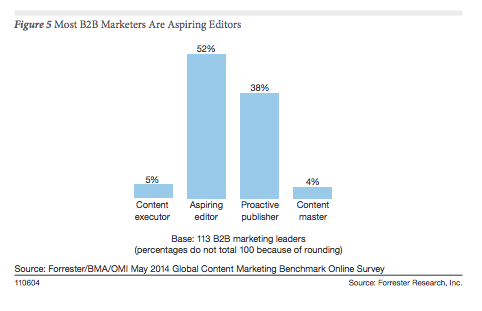
For the “Compare Your B2B Content Marketing Maturity” study, analyst Laura Ramos and her team, along with the Business Marketing Association and the Online Marketing Institute, surveyed 113 senior marketers to determine their “content development sophistication and maturity.” The main takeaway: “Content Marketing practices are not as advanced as marketers believe.” Busted!

Content Marketers Have No Idea What Theyre Doing image 2u1zbEHgzBEROKNBadgp2ubg7aqri4wodtv6fQRcdSGbME3yVrXcW ZxNnW 6cAnNuTilglTmlj UrJK xrKS7hFNYgJasbuBhIjM GrzhxZ2OkhnjE56Kscl9lDq6wNJw 600x485

The analysts report that over half the companies surveyed claimed their content marketing strategy was “mature,” but Forrester counters that these marketers are far too focused on top of funnel consumers—which results in the loss of decision-makers to more strategic competitors. A massive 87 percent admitted that they “find producing content that engages buyers to be a major challenge,” with Forrester noting: “While creating great content is something even the best marketers and agencies toil over, we feel that this disconnect reveals a more fundamental problem with content marketing today.”

Disconnect is the key word.

Everyone wants to talk the Content Marketing talk, but who is actually walking the walk? Qualitative analysis is a step in the right direction, but unless you are truly measuring reach, engagement, and conversion as your content relates to your brand’s goals, you have no way of knowing if your content marketing is as “mature” as you think.

Brand Narcissism and Non-Commitment

The study also showed that most brands often create content “solely around product and brand offerings: Altogether, this data shows an acute focus on acquisition that practically ignores the rest of the buyer’s journey.” This is one of the biggest problems we see in the marketplace as well. Of course it’s important for consumers to know what you sell and offer, but Content Marketing must go beyond that.

Seventy-one percent of respondents told Forrester they “frequently” feature customer storytelling or case studies, but only three percent claimed that this was a “primary focus of their efforts.” Additionally, only 12 percent of these marketers said publishing research or industry insights was a main focus of their content, but not a single marketer said they engaged outside experts in these endeavors.

If you’re not using content marketing to make your audience better and more educated about your industry, and you’re not sharing your inside expertise on how to do great business—what exactly are you writing about?

Content Marketers Have No Idea What Theyre Doing image TAyGlkbQ1mpP6Hp0ykBdcZlIp4bcwDFvehqiatK4tITjsRaJSG347XZEIdC mRBbKGIc77uDLSc2Q 1KEMOs4b4FpKaqDqUzV8uVgw0mOnvXV7JF52I UhJAV3EVuDHcEg 600x413

It’s a strategy because I said so!

This study makes clear that there are many marketers who claim they have a Content Marketing strategy, but don’t commit. “A startling 72 percent of our respondents said that less than half of their marketing staff plays a primary role in content marketing today…content marketing quickly degrades to talking about products, features, and what the company has to offer.”

Most shocking? Only five percent of brands surveyed said that communicating and building relationships with their customer base was a priority, further proving that despite the proliferation of social, marketers still cannot commit to a brand-wide content and communications strategy in a way that has proven successful.

So Why Isn’t Your Content Working?

After not launching a comprehensive strategy, not committing their staff or efforts to Content Marketing, and only talking about themselves, these marketers wonder why their half-cocked efforts aren’t paying off:

Content Marketers Have No Idea What Theyre Doing image OmANPvGtgVzg i6mINaMAdAq u6VGWYuCIqdnu6T1fERexAXmgAvrf0lmhGWfg2wOkTWY IAtat exgzPrThShDlRQXQ9DzRThYykfh82I6RCw6PWdrH D9TQnjTf8T7Dw 600x371

“While almost all marketers say that content marketing is important, an overwhelming 85 percent admit that it is only somewhat effective — or less so — at moving the needle on generating revenue, retaining customers, or winning customers’ long-term loyalty…only 14 percent gave their content practices high marks for delivering value back to the business.” Albert Einstein once famously said that the definition of insanity is doing the same thing over and over and expecting different results. How is this different than the same old marketing that came before?

The Struggle is Real

Much like social media several years ago, Content Marketing is not a practice you can throw money at or delegate an intern to oversee and wait for the results to come rolling in. Would you read a book or article that an author sloppily researched, designed, and slapped together? That’s not how best sellers are made. Similarly, Content Marketing is a skill, a tightrope walk between message and service.

Brands need to realize that content is not a passing phase, and those who cannot devote the time and resources to real content strategy not only dilute and pollute this kind of marketing for the rest of us, but do a disservice to themselves as consumers move their business to brands with savvier more creative marketers.

Which Bad Content Marketer Are You?

Forrester breaks the marketers into four categories:

Content Marketers Have No Idea What Theyre Doing image wPznHs5xfsm7MCOR3hYaL roK61YUws2BPMXARL9eIat jsENlWdJxnqFr5ZSP1yGS0WzqeJgJZ5A TyHS6VCrB2LBhYFjeoVkutuqwPMeUGQYgD6mdAvYgdsublPGXDpA

  • Content executors: People who know they should be practicing content marketing (probably only after their CMO asked what’s happening with that “content marketing stuff”) but don’t do it consistently or reliably. Luckily, only 5 percent fell into this category.
  • Aspiring editors: Misguided marketers who think that because they know what Content Marketing is, they’re set. The truth is they’re still assembling a strategy, while their practice is inconsistent and lacks full-company endorsement. They have the foundation to build a successful strategy but aren’t quite there yet. Fifty-two percent fall in this category.
  • Proactive publishers: Thirty-eight percent of the marketers surveyed had a strategy and consistent approach to content planning, creation, and distribution. They also have a set of best practices in place and mostly follow them. They’re getting close, but are not quite there yet in terms of a measurable, successful content strategy.
  • Content Masters: According to Forrester, only four percent of those surveyed truly understand the Content Marketing ecosystem and what it takes to drive real business. These brands have “formal editorial oversight” and real processes in place—they incorporate consumer feedback into an evolving strategy, have the right tools and technology in place to succeed and can measure and demonstrate their content’s success and its impact on their overall revenue.

What can the other 96% of brands learn from the “Content Masters”?

Listen to your customers.

Since these are the people who’s affection and business you are courting, doesn’t it make sense that your strategy should start with them? What challenges are they facing in their current role as well as their overall career? What events and talking points matter to them? What are THEY talking about? Ask yourself how your brand can add something of value to that conversation.

Make a plan and stick to it.

Marketing teams should set goals and make a plan to tie content to specific business goals and aspirations. Editorial guidelines should be understood and adhered to by the entire team. Forrester calls this the “IDEA” process: “identify, develop, engage, and assess” which should be used to tie customer goals and issues to brand deliverables and solutions.

Give your team the tools they need to succeed.

How are you managing your content across proprietary platforms as well as social and other channels? How can you make sure your team is on the same page when it comes to content production and distribution? We have the technology! Use it!

Measure carefully.

Forrester noted that this is where brands most often fall short. You should measure your content strategy’s progress regularly and also measure how it correlates with retention, brand recognition, and across-the-board growth. Setting KPIs will help you set goals and measure your success as well as understanding how to pivot or predict how much you need to scale or shift your strategy. But be sure to measure the entire picture, including content traffic, organic traffic, social engagement, and brand affinity, as well as conversion and retention in content audiences as well as product.

It’s time to get real. Take a hard look at your content strategy. Are you proud of the work? Is it consistent, and does it consistently keep the end user, your consumer or your future consumers, in mind? Are you measuring your content and social goals against overall company growth? Create a content strategy you can stand behind. You’ll help your brand, your customers, and you’ll be ridding the world of terrible marketing. That’s something we can all be proud of.

28 Aug 15:20

What You Should Know About Programmatic Buying, and What It Means for Native Ads

by Joe Cardillo

What You Should Know About Programmatic Buying, and What It Means for Native Ads image

If you aren’t familiar with programmatic platforms, you will be soon.

In fact, you’re probably already being served content that uses this technology to decide what you see. Business Insider released a report recently noting it as one of the fasting growing drivers of content on the web, particularly when mobile and video are involved. According to the report:

  • Real-time bidding (RTB), the key piece of the programmatic ecosystem, will grow at a compound annual growth rate of 42% between 2013 and 2018.
  • RTB spending on mobile, video, and display ads will account for over $18.2 billion of US digital ad sales in 2018, up from just $3.1 billion in 2013.

What You Should Know About Programmatic Buying, and What It Means for Native Ads image CFZb4wZ Ullewwjn7VigmWX0l9nMfS rcQ SSPmEE3eCLqronewB4jZ5mwvjokW1rjriDvv3WbuE0kTgLAA8oMnOVkQTtd6abNZsjXDwbBu8Lk If2UU58YjcGzwQhDH w 600x453

Descriptions of programmatic advertising or buying can be both confusing and varied – but at heart it simply means that pieces of software are talking to each other, and using data about the who, where, and when to buy and sell what you see.

In other words, it’s about using data to find the right audience at the right price at the right time.

The implications are deep and long-reaching, and it’s not just for the traditional banner ad either: formats like television are starting to move toward programmatic technology, too.

That may all sound appealing – but it’s early, and even the sheer number of pieces that need to be connected suggest that automated and programmatic buying of non-traditional content is still in the experimental phase. Included in those pieces are demand and supply side platforms, as well as legacy ad exchanges that are geared towards very specific types of ad units, and content.

Another problem is that the amount of data available and variety of players involved comes with (at times convoluted) concepts like first, second, and third party data. It makes for a complex environment where signal is easily confused for noise, and of course there’s the potential for fraud on a large scale, particularly because, like micro-trading on the stock market, the buying and selling happens at very high speeds and in high volume.

What kind of content fits into programmatic buying?

So far it has been mostly focused on serving things like display and banner ads, but it’s likely that programmatic will eventually encompass any sort of content.

One of the most interesting angles involves the potential for data informed programmatic buying developed for native advertising.

This is still largely in a trial and error phase – the primary reason for this has to do with the difficulty of aligning content with a specific publication, and feeding back data that allows you to adjust what you create over time. If you’re just one buyer dealing with one advertiser or publication, this is a fairly manual but doable process. Applying this at scale, which is what programmatic buying by its nature would require, is much more difficult (though not impossible) to achieve.

At NewsCred we’ve had a few experiments with native advertising, including one that wasn’t so successful…

What You Should Know About Programmatic Buying, and What It Means for Native Ads image DsElCKogCrC82yH ckJGlW10lzbGflJqd3z5AjjvTO28VQL2QPaU 614vW0tkk2Ea0kJlGZgN8CMUIc DhlfBPT5Ms8Uq1qbSJQIy jXt d0cOZq 5SBMGlIl30x8ND2g 600x378

A not awesome "Sponsored" article on @adweek about creating awesome content. http://t.co/GvoedbfNMY #IFearTheFuture

— Eric Wittlake (@wittlake) March 26, 2014

@dannywong1190 @wittlake Yuck. Any article that abruptly ends with a link 'for more' is bad. Especially when it had nothing to offer.

— Chris Boyles (@chrsboyls) April 2, 2014

Ouch.

While it didn’t elicit as spectacular a response as the Atlantic’s native ad for the Church of Scientology, it was a bit hard to swallow, and we were forced to go back to the drawing table.

Among the things we learned: understanding and using the language and tone of a publication is a must have for native ads.

We also know from experience that storytelling, context, and ideas matter, and that the quality of the content has to be good enough to fit in with the other stories the publication is running.

Once we figured out how to better align ourselves with Adweek and their audience, we tried again:

What You Should Know About Programmatic Buying, and What It Means for Native Ads image 2N41IJFyv5FyX4TBLP17CFJTm UP0m07IuscnWyTbVthz HKBL4VR3K 3NpfTkEDbfBhrwPsQiOs TtWKbN1qZ N9FbSVCNWgVC8qbdlH6GOrDGTNQDlFYBMPXIzkKMSYA 600x372

This time the reception was much better, and neatly dovetailed into one of our most successful partnerships – a visual storytelling project with Getty Images.

Neat @awbrandshare: 4 principles of visual storytelling marketers need to know: http://t.co/sDU4G96CEI via @newscred pic.twitter.com/AHqMPGGUjx

— Andy Cowles (@andycowles1) June 10, 2014

4 cool storytelling images, plus principles #marketers need to know about. @NewsCred http://t.co/hVbPLzmSHZ pic.twitter.com/ynPFjCgmHo

— Patricio Pagani (@patpagani) June 20, 2014

How will programmatic buying evolve to better serve native ads and other non-traditional content?

One thing that will help is transparency around pricing, as well as making it clear where and when content is running.

What You Should Know About Programmatic Buying, and What It Means for Native Ads image CLCy8YkfCLDHPhc5qjoykMUWWwGS OukxC9pRuKzrmjsYvxZ0hb09R2DkWA5JkATIGPQaLiTf5XU2xYEf aDjluwVdSmRzFNYO3 V6OA zms4 KH3R7zVDOC9yK7oT7UDA

Native ad platforms like Syndicateare starting to address the transparency issue with pricing directories, and while it’s not yet a complete solution, it is an important step forward.

Ultimately, programmatic buying platforms will need to evolve in a few areas in order to ensure that the process is scaleable:

  • Aligning with the language and tone of a publication, as in the Adweek example above, is difficult to achieve at scale with programmatic buying.

In addition to targeting via demographics – when making ad buys, programmatic platforms will need to find ways to align data from automated and semi-automated content discovery. In other words, helping buyers both place content and understand where it might get the most traction or response, since that has implications for what they license and create on the front end.

  • Actionable, clear reporting and feedback is a must have.

Because no two companies are alike – and their content will always vary – strategies for programmatic buying will probably always need to have at least a human hand at the very beginning. Having useable reporting will be crucial for buyers or brands when creating their programmatic strategy.

  •  Providing some degree of control and transparency to all parties involved – including end audience, publishers, advertisers, platforms, and brands – is essential.

For now, placing native ads into a programmatic strategy is something that brands can do – but they are wisely being careful about its application so far, since getting this right is ultimately about providing content that audiences actually want.

And that’s worth more than anyone can imagine.

28 Aug 15:20

3 Ways to Grow Revenue with LinkedIn

by Kurt Shaver

3 Ways to Grow Revenue with LinkedIn image four fingers dreamstime xs 17684794There Are Four Ways to Increase Revenue

There are four classic ways to increase revenue:

  1. Sell To More Customer
  2. Sell More Products/Services To Current Customers
  3. Sell More Frequently To the Same Customers
  4. Raise Prices

LinkedIn can help with the first three. Here’s how:

Sell to More Customers

This is the most common use of LinkedIn for social selling. There are two approaches. LinkedIn can be searched as a massive, up-to-date database to find new customers (outbound prospecting). Identifying prospects then leveraging one’s own network for introductions and referrals is an effective technique. LinkedIn can also be used as a social publishing platform to attract buyers with content (inbound marketing). Content can be obtained from internal sources (i.e. Marketing), external sources (i.e. industry news site), or created from scratch (i.e. brain). Getting brand new customers is typically the role of a sales hunter.

Sell More Products/Services to Current Customers

As a supplier grows its product line, sometimes business comes from the same people who are buying now and sometimes it comes from new people in different department. One of the worst things a salesperson can hear from a loyal customer is “Oh, you sell that, too, now? I wish I’d have known before I place the order with [competitor] XYZ.” The drip-marketing aspect of social content sharing helps keep existing customers informed of expanding product lines. Finding new opportunities with new departments can be accomplished using the same prospecting techniques as described above. This is important in industries like Information Technology where the “consumerization” of technology has resulted in decision making moving away from IT departments to Business Unit executives. Often, expanding revenue with existing customers is the role of an Account Manager (farmer).

Sell More Frequently to the Same Customers

One way to encourage more frequent orders is by helping your customer grow their business. That requires understanding their business better. That is where the social listening aspects of LinkedIn can be a benefit. Follow your customers’ LinkedIn company page to see updates on your LinkedIn Home Page. Connect with more people at your customer companies to increase individual updates, too. You can even use the LinkedIn news feature (Pulse) to follow news about their industry. By becoming a business consultant to your customers, you are not only building competitive barriers but you increase the opportunities to help them grow which may result in more frequent orders.

I have not figured out how LinkedIn can directly help you raise prices, but strengthening your relationships using all the above techniques if a good place to start.

Can you think of any other ways that LinkedIn can help you increase revenue?

28 Aug 15:18

Here's How The World's Richest Terrorist Group Makes Millions Every Day

by Amanda Macias and Jeremy Bender

ISIS is now the wealthiest terrorist organization on the planet, according to Foreign Policy. And the Al Qaeda offshoot has the ambition and perhaps even the organization needed to put its piles of oil and smuggling-related profits to work, as its several-hundred page-long annual report from this past March demonstrates.

For example, ISIS brings in nearly $12 million a month in revenues from extortion and other shady practices in the Iraqi city of Mosul alone in addition to $1 million to $3 million a day selling oil illegally

Some experts believe that the group's power is virtually unprecedented, at least among jihadist organizations. According to Janine Davidson and Emerson Brookings of the Council on Foreign Relations, ISIS sits atop "a volume of resources and territory unmatched in the history of extremist organizations." The group controls approximately 60% of Syria's oil fields and several oil producing assets in Iraq.

Syria Iraq MapLuay Al-Khatteeb, founder of the Iraq Energy Institute and visiting fellow at the Brookings Institution, estimates ISIS's total revenue from oil production at approximately $2 million a day. 

Oil Wealth

"Put simply, ISIS is in a position to smuggle over 30,000 barrels of crude oil a day to neighboring territories and countries at a price of between $25 to $60 per barrel depending on the number of middle-men involved," Khatteeb wrote for Brookings.

ISIS allegedly sells much of its oil production to intermediaries in Syria, who then transport it to refineries in Turkey, Iran, and Kurdistan, Foreign Policy reported. 

Robin Mills, a director at Manaar Energy and author of The Myth Of The Oil Crisis, explained that individuals and nations involved in the sale of oil on the black market would be open to U.S. and EU sanctions as well as Iraqi legal action, if the state were ever to re-establish control over areas that ISIS now rules.

"The practical impact of this may not be much given the small volumes and the difficulty of tracking buyers and sellers," Mills told Business Insider by email. 

Control Of Water, Wheat, And Electricity 

iraq wheat

Oil isn't the only resource that ISIS has leveraged to its advantage. In a recent interview with Der Spiegel, Brookings Doha Center fellow Charles Lister explains how ISIS uses its control of food and water supplies to further its goals:

Money is key here. It is well-known that the IS is almost entirely self-financed. Its money comes from the control and illicit sale of oil and gas, agricultural products like wheat, the control of water and electricity and from imposing taxes within areas it controls. It is literally earning millions of dollars each week, and a great deal of this money is pumped into social services.

ISIS's advance throughout northern Iraq has put vast quantities of prime farmland under the control of the militant organization. Large portions of five of Iraq's most fertile provinces are currently under ISIS control.

These provinces are collectively responsible for producing 40% of the country's wheat crop. The militants have also raided between 40,000 and 50,000 tons of grain from government silos in the north of the country. 

Al Arabiya reported that ISIS has transported at least 700 tons of grain from western Iraq into Syria for milling and refining. ISIS then proceeded to sell the grain to the Iraqi government through third-parties in order to raise further funds. 

ISIS has expanded this effort recently by making flour using the grain it stole from government mills throughout Mosul. 

#ISIS Began producing flour from government mills in #Mosul,and libel it under their name. pic.twitter.com/JgCnqglAbS

— Ammar karim (@ammar_afp) August 27, 2014

A source at Iraq's Agricultural Ministry told Reuters that ISIS has placed close to 30% of Iraq's entire farm production at risk.

This scarcity and food insecurity has driven up prices and increased the windfall that ISIS receives from its wheat trade. 

mosul dam isisControl of water resoucres and hydroelectric power stations provide further funding for ISIS.

The control of massive pieces of infrastructure, such as the Tabqa Dam outside of ISIS's de facto capital of Raqqah, Syria, along with the group's short-lived seizure of the Mosul Dam in Iraq, further demonstrates ISIS's capabilities and ambitions.

Ariel I. Ahram, an assistant professor at Virginia Tech's School of Public and International Affairs, notes that the Tabqa Dam provides a steady stream of revenue for ISIS.

The dam generates electricity for Aleppo and the surrounding region. ISIS fighters made sure that the dam's staff was left relatively unmolested, in order to ensure that the dam remained operational. 

A Mafia-Like Organization

isis iraqISIS collects taxes on a variety of commercial items, such as trucks and cellphone towers, according to Ahram. Raqqa's Credit Bank has transformed into a functioning tax authority, with shop owners paying $20 every two months to ISIS in exchange for utilities and security.

ISIS functions a lot like a criminal syndicate. "The group is like the Mafia. It really doesn’t discriminate in how it gets its money," Colin Clarke, an associate political scientist at Rand Corporation, told CBC News. "Anything that's a revenue-generating activity, this group is engaged in."

ISIS has branched out into for-profit crime, engaging in extortion, carjacking, and kidnapping. Kidnappings have become an especially lucrative source of funding for the organization as the group targets foreigners, an attempts to ransom them.

ISIS demanded a $123 million ransom for journalist James Foley before executing him. The militants have set a $6.6 million ransom for the release of an American aid worker they had kidnapped in Syria.

As ISIS militants continue to rule sections in Syria and Iraq, these history-rich regions have spurred a black market for ancient artifacts, which ISIS has reportedly taken advantage of. One senior intelligence official told The Guardian that ISIS (back when it was known as the Islamic State of Iraq) had used looted antiquities as a revenue source when its members began moving into eastern Syria in late 2012.

In all, estimates place ISIS' total revenue at somewhere between $1 million and $4 million daily. Some of that money goes towards paying fighters and building their "caliphate" to resemble something like an actual state. But the group has a massive and ever-growing war chest to match its weapons stocks, territorial domain, and propaganda

It's little wonder that some commentators believe the group could become more dangerous than Al Qaeda itself.

SEE ALSO: Five myths about the Islamic State

Join the conversation about this story »

28 Aug 15:16

These 4 Companies Prove That Content Marketing Is Essential to Startups

by Mason Lerner

It’s no secret that the odds of a startup hitting it big are not that good no matter what industry it’s in. That hurdle to success, though, often isn’t a matter of technology, but attention.

The competition for people’s attention on the web has grown fierce. Gone are the days when a startup could just throw content out there and count on keyword optimization to drive fresh traffic and leads; the digital landscape has grown more competitive, and publishers of all kinds have had to up their game to stand out.

Various startups are realizing there’s a great upside to doing just that.

Unbounce, a startup that builds landing pages for marketers, has created more than 23 million leads and built up a base of over 6,000 customers. Their blog, which gets 140,000 unique visitors per month, has been a big part of that success, and it’s been a top priority for Unbounce since the company’s early days.

“At the very beginning, we really relied on our in-house thought leader when it came to landing pages and conversion rate optimization, which was our co-founder Oli Gardner,” explained Unbounce content strategist Dan Levy. “He was blogging at least once a day in order to make sure all of the content was 100 percent credible and entertaining.”

Once Unbounce began to grow, Gardner was able to let go of the reins, but the company’s commitment to quality has remained. “As we’ve grown, we’ve grown our content team around the principle of maintaining that level of quality and level of credibility,” Levy said. “What we’re trying to do now is to get great writers to basically be conversion beat reporters.”

Likewise, analytics platform KISSmetrics produces one of the best data-driven marketing blogs around and is a firm believer in the continuous rewards of a strong content marketing platform. Their blog currently attracts 500,000 readers each month.

“Attention is one of the most valuable commodities right now,” said Lars Lofgren, growth manager at KISSmetrics. “Getting people’s respect and making sure they’re willing to pay attention to what you’re doing is very difficult because we are bombarded with so much stuff all the time. First you have to earn that attention.”

Of course, creating high-quality content is easier said than done. Ginny Soskey, section editor for HubSpot.com’s marketing blog, explained what separates good content from bad content. And she should know. HubSpot gets around 1.5 million readers a month. That’s a lot of eyeballs.

“I think that content that focuses on your audience and on your audience’s needs ends up being quality because it’s serving them,” Soskey said. “I would say bad content is that self-serving content that is really focused on you as the writer or you as the company instead of focusing on the people you’re trying to reach.”

Lofgren agreed. He said people know right away if content was published to benefit them or simple to promote the company.

“The vast majority of our content, probably 95 to 98 percent, doesn’t even mention the KISSmetrics product,” he said. “Most of it is us simply trying to help people solve their problems and make our content as valuable as possible.

“Once you earn their attention and their trust, then you can start talking a little bit about yourself,” he added.

Content isn’t only a key to building trust at a steady rate. Steady, consistent blogging is important—in part because it ups the chances of a single post breaking through and maybe even changing the trajectory of a startup’s business. A perfect example of this is social media scheduling app Buffer‘s famous “30 Things to Stop Doing to Yourself” post.

Buffer’s blog posts generally earn thousands of shares, but the the “30 Things” post broke the mold, racking up 500,000 Facebook likes, 20,000 Tweets, and over 400 comments.

Buffer co-founder Leo Widrich looked into what made the post so successful and was surprised by what he learned. First of all, he saw that contrary to conventional wisdom, a very long post can generate large amounts of traffic. He also noticed the subtle psychology that goes into a successful post.

“If you are writing something that’s unique that people might have a feeling of otherwise missing out on, then this is a fantastic trigger to get people interested in your content,” Widrich wrote.

Startups must also understand that it’s not enough for content to be well written. Having “beat” writers is pointless unless they are covering the right topics. Soskey said that talking to the business side can help the content team figure out what those topics are.

“A great way to figure out what people want to read about is to talk to the sales team about what people are asking them on the phone and then address those questions in your blog,” she said. “You already know people want this information because they have been asking for it.”

KISSmetrics, Hubspot, and Unbounce all use freelancers and guest bloggers for their blog, but they depend on their in-house content creators to direct their content strategy. Lofgren stressed the value of a startup having a writer/editor on board full-time.

“I’ve seen it work most effectively when there is someone on the team who is a good writer and can just own the blog and drive it,” he said. “If a team wants to build a content strategy but can’t write and depends solely on contractors, usually the quality is subpar.”

These days, a startup can’t earn the attention and trust it needs with subpar content. You only get one chance to make a first impression. And if somebody’s first impression is that a startup’s content is junk, why would they think the rest of the company is any different?

28 Aug 15:16

How To Analyze Your Marketing Strategy: A CEO’s Guide

by Laura Hogan

How To Analyze Your Marketing Strategy: A CEOs Guide image analyze your marketing strategy ceos guide 6

You might look at your marketing team one day and think… what am I paying you for exactly? Sure, they’re bringing in traffic to your site, but are these people staying? Sure, they’re bringing in leads for your sales team but are they quality? So when the time comes where you want to dig in to your marketing strategy and see if it’s working, here’s some tips.

How To Analyze Your Marketing Strategy: A CEOs Guide image how to analyze marketing strategy why 600x96

The first step is to access your main goal. This could be a revenue goal you’d like to reach or simply just a monthly lead goal. No matter what it might be, it should be stated to the point that it will resonate with your marketing team.

What to analyze

This will be different for every business but I suggest you analyze what would grow your business and make that your goal.

How To Analyze Your Marketing Strategy: A CEOs Guide image how to analyze marketing strategy who 600x96

Based off of that goal, you should be assessing who will help you reach it. Bringing your target audience to your website helps so focus on website visitors and leads. There are two ways to categorize them.

What to analyze

Unique or returning traffic

A unique visitor is someone who found your site through organic search, paid ads, social media, or referrals from other websites. These people are generally looking for some sort of information on your products or services.

A returning visitor is someone who found your site before and has come back to any given page. Returning visitors normally find your content resourceful and authoritative, therefore wanting to come back for more information.

Qualified or unqualified traffic

From those two categories you have qualified and unqualified visitors.

An unqualified visitor is someone (generally a unique visitor) that is not ready to purchase yet but is only looking for information in the beginning of the buyer’s cycle. This could also be someone who is just not interested in your products or services at all.

A qualified visitor is someone (generally a returning visitor) who spends time on your site more than once, will download numerous of your premium offers, read your blog posts, educate themselves on your services or products, and/or request a direct consultation with your business.

How To Analyze Your Marketing Strategy: A CEOs Guide image how to analyze marketing strategy what 600x96

In order to bring these types of visitors to your site you need content that they want to read and learn about.

Content

Content is key with inbound marketing. Content is what drives visitors to your site. It also helps qualify visitors and help them become sales ready. It’s the number one most important part of your business’ sales cycle and should be analyzed very closely. Content includes anything from blog posts to infographics to premium offers such as ebooks or webinars.

What to analyze

Take a look at your page performance. Your top content pages show you which pages on your website get visited the most. This is one of the most underrated and underused stats although it provides you with some of the most pertinent information about where visitors are spending time on your website.

Topics

Once you notice what content offers are performing best you’ll want to focus in on what topics those pieces of content cover. This is so you know what types of information your audience is interested in so you can create more content around it.

What to analyze

The keywords data in your analytics program displays the keywords and phrases that visitors are using in the search engines to find and land on your website.

How To Analyze Your Marketing Strategy: A CEOs Guide image how to analyze marketing strategy where 600x96

What platforms are you promoting on?

Since you already know your target audience and what kind of content they like, the next step is to figure out where they hang out. For instance, you wouldn’t pay money to put your toy commercial spots during Sons of Anarchy, you’d stick to episodes of Boy Meets Girl. The same thing goes for online advertising. If your audience doesn’t use Twitter, don’t waste money on Twitter ads.

What to analyze

To find out where your audience hides, try looking at traffic sources. Traffic sources show you where your website’s visitors are coming from. These numbers are broken down into direct traffic, paid advertising, social media, and referring websites.

How To Analyze Your Marketing Strategy: A CEOs Guide image how to analyze marketing strategy when 600x96

Frequency of content production and promotion

You want to be consistently blogging. This means pumping out blogs at a certain time on certain days of the week. This will help Google see that you’re updating your site on a consistent basis, therefore keeping you on Google’s good side. Which is always a place you want to be.

What to analyze

This depends mainly on your budget but you can also analyze your website to see when (what time of day and what day of the week) your site gets the most traffic. You can create custom reports in Google Analytics to see what days and what times your site/blog get the most views. For instance, our most visited times of the day are around 11am and 4pm. Looking at this will help you with scheduling blog posts, scheduling social posts, and times of promotion for paid advertising.

How To Analyze Your Marketing Strategy: A CEOs Guide image how to analyze marketing strategy how 600x96

Once you look at the specifics of your marketing strategy, the next step is to look at the big picture which would be return on investment. To figure that out just fill in this formula:

What to analyze

ROI = (Revenue from Marketing Campaign – Cost of Marketing Campaign)
Cost of Marketing Campaign

If your marketing strategy isn’t producing the type of return you expected overall, then you need to redirect or rethink the individual moving parts of it listed above.

Takeaway

Analyzing your marketing strategy is an ongoing process. Unfortunately it’s a task that you can’t just check off your to-do list, it’s something that should be ongoing. Hopefully this list helps you narrow down your analytics focus and improve your marketing strategy.

How To Analyze Your Marketing Strategy: A CEOs Guide image 780a856a 1a1f 4da4 b0f7 bba25f923ee72 600x161

28 Aug 15:16

Cohort Analysis: 2 Simple Steps to Better Understand Your Leads

by Joju Mangalam

Cohort Analysis: 2 Simple Steps to Better Understand Your Leads image paper dolls blue 700 wide 2 Dollarphotoclub 67745939 300x180Cohort analysis is an often-overlooked area of marketing analytics. It involves tracking a group that shares a common characteristic (a “cohort”) over a certain period of time and evaluating outcomes. In this post, we will talk about cohort analysis of leads. This involves following a group of leads which were created in a certain period, say a full quarter, until the leads become wins or losses.

A cohort analysis can provide important insights on which characteristics show that a lead has high potential for conversion to a win. These insights can then be used to determine which type of leads to focus on in the future.

While there are many ways to analyze cohort data, let us look into two areas that hold the most potential:

  • Duration from lead to win (Velocity) by Lead Source, and
  • Conversion from lead to win by Lead Source

In this scenario, “lead source” is the common characteristic for each cohort, which differentiates each from the other. We’ll be looking to answer two questions about time and volume: Which cohort showed the greatest velocity from creation to close? Which cohort showed the highest percentage of closed sales?

These two calculations are generally straightforward, and don’t require knowledge of advanced topics such as data mining. Most of the work can be done in Excel, and the resulting insights can be considered the low-hanging fruit of cohort analysis.

Cohort Analysis: 2 Simple Steps to Better Understand Your Leads image paper dolls pink 700 wide Dollarphotoclub 67745939 300x180Our recommended approach is to perform the Velocity calculations first and focus on Conversion later (for reasons that will become obvious). Each component will require a unique approach to analysis.

1. Lead to Win Velocity

This analysis is to estimate the duration in days for a lead from Creation to Win. We recommend breaking this down further to two components:

  • Lead Creation to Sales- Qualified Lead (SQL) stage, and
  • SQL stage to Win

The first component is in the realm of marketing, while the second is the realm of sales. Therefore, it is good to have them differentiated. The goal of this analysis is to create a report similar to Table 1.

Table 1: Lead to Win Velocity Report

Cohort Analysis: 2 Simple Steps to Better Understand Your Leads image GreenTable

To derive such a report, we need to look at a cohort of new wins in a specific time period. We recommend a full quarter for this analysis because the cadence of wins varies within the quarter (usually light in the beginning and heavy towards the end). Accounting for the full quarter ensures that you bring in all types of wins, which gives you a comprehensive picture. The most recent full quarter is ideal because it gives you the most up-to-date measurements.

For the analysis, we need to create a data set containing new wins with the following information:

  • Lead creation date (or Open date if it is more applicable to your business)
  • SQL date (on which the lead became an SQL)
  • Win date

Creating the above data set requires stitching together data from CRM and marketing automation systems. The process to do this will vary based your specific environment. (If you are an Act-On customer, you can easily do this analysis using the new Funnel Report, which we will discuss in the end).

It is expected that some of the win records may not have been populated with all the three dates mentioned above. If the sample size is big enough, select only the win records where all the dates are present and remove the rest. If the sample size is small, you can compromise on the “SQL date” because it is less critical than the other two.

The rest of the calculations are straightforward. Create two additional columns that derive duration in days from Lead to SQL and from SQL to Win. Then do a pivot table on Lead Source to derive average durations by Lead Source, similar to Table 1 above.

You will notice that some Lead Sources have shorter closing time than others. For example, you may see “referral” and “website” lead sources close faster than “virtual show” and “webinar”.

The overall averages are important because they are the headline messages to the marketing and sales teams, showing how long it takes on average for leads to become wins. A possible insight could be that “Leads generated in this quarter will close only in the next quarter or beyond.” This insight shows the wisdom of a long-term view for nurturing and conversion, which should lead to more appropriate, effective lead management, and be good for your business.

2. Lead to Win Conversion

Cohort Analysis: 2 Simple Steps to Better Understand Your Leads image paper dolls green Dollarphotoclub 67745939 300x180To calculate lead to win conversion, one should start with a cohort of leads based on the creation date. Again, selecting a full quarter is recommended because the cadence of lead creation varies across the quarter and selecting a full quarter gives you a comprehensive picture.

Also, the selection of a specific quarter should also account for the fact that different lead sources take different durations to convert. If you select a more recent quarter, for example, it will favor lead sources that are faster-closing; lead sources that are slower closing will show fewer than their actual conversions. This is the reason we recommend doing the Velocity calculations before doing the Conversion calculation. A good rule of thumb is to select the full quarter one year ago as the cohort.

Once you select the cohort quarter, you have to create a data set containing all the leads created in that quarter and the status (as of now) on whether individual leads have become wins. For example, you may have 10,000 leads in the cohort and 200 of them have become wins. Your overall, average conversion rate by lead source is 2%.

This data set enables you to create a pivot report similar to Table 2 that provides conversion by Lead Source as well as overall conversion rate. You can compare the data to see which lead sources perform above and below the average.

Table 2: Lead to Win Conversion Report

Cohort Analysis: 2 Simple Steps to Better Understand Your Leads image BlueTable

You can see that the above report can provide crucial insights for the marketing planning and budget allocation purposes. For example, you could try to get more leads from lead sources with higher conversion rates. This in turn guides you to prioritize marketing programs that support higher performing lead sources.

Cohort Analysis: 2 Simple Steps to Better Understand Your Leads image paper dolls YELLOW 700 Dollarphotoclub 67745939 300x180While such insights are helpful for planning, you don’t want to immediately stop the lower-conversion lead sources because they probably generate a lot of wins in absolute terms. Instead, you want to take a gradual approach to increase your investment in high-performing lead sources and decreasing investments in the lower-performing ones.

We also want to mention that the newly released Funnel Report in the Act-On platform enables you to generate Velocity and Conversion insights through a simple drag and drop interface. If you’re one of our customers, do check it out – you’ll get a lot of valuable insight with very little effort.

Hope this information is useful for your marketing planning purposes. Please provide your comments below!

28 Aug 15:15

Are You Reaching Executive-Level Decision Makers

by Wolfram van Wezel

Are You Reaching Executive Level Decision Makers image f8a458e18503c86603dc02339a944feb S

When building your lead generation system, remember that the early bird gets the worm…and the first salesperson involved in the executive’s decision-making process likely gets the sale. It’s all about “first-mover advantage.”

First-Mover Advantage Leads to Market Dominance

The theory of “first-mover advantage” asserts that the company that is first to enter a market gains a substantial advantage over potential competitors. Think of eBay, for example, the first company to offer online auctions. They defined a new market space and became the leader. There are, of course, associated risks of a first-mover strategy. If you don’t meet market needs effectively, another company can seize your idea, perfect it, and commandeer “your” market.

Applying First-Mover Advantage to B2B Sales

The same first-mover advantage applies to sales of complex B2B products, services and solutions. The first sales person to work with an executive-level decision-maker to help them solve a problem successfully is light years ahead of competitors who sit on the sidelines until they see a Request for Proposal (RFP).

And today many sales people are sideline-sitters. That’s because there’s a widely circulating myth that buyers are 60–70% of the way through their buying cycle by the time they want to talk with a sales person. So, sales people delay their sales calls.

However, according to Mark LIndwall of Forrester Research, not all buyers know what they need. Forrester’s research backs up this assertion, showing that most executive-level buyers are seeking help in understanding complex problems before they even start to think about products.

Given this, who is likely to win the sale?

The sales person who arrives on the scene once the executive and a supporting cast of managers have sorted through the dilemma, chosen a solution and are issuing an RFP? Or is it the salesperson who reaches out to the executive when his vision is clouded, and he’s seeking integrated concepts rather than a single product to untangle an intricate knot of issues?

The salesperson who waits until the company issues an RFP throws him or herself into the competitive fray, chasing the sale.

On the other hand, a salesperson who works through the problems with the executive in the early stages becomes a trusted advisor, developing a relationship and helping to shape a solution around the products or solutions that he sells. He’s able to gain a complete picture of the problems that the company faces and deduce which products could be of interest in the near future.

He has first-mover advantage…as long as he does it right.

The Wrong Way to Reach Out to Executives

While marketing and sales leaders appear to be aware that they need to include executives in the conversation, they often approach this task the wrong way.

  • Executive Events

Perhaps they organize occasional executive events. If so, they likely end up being disappointed by the low number of registrations and attendees. Some executives may not see the value in attending since events are often not scheduled at the right point in their decision-making cycle. Others, with jam-packed schedules, cannot make it to the event.

  • Product-Oriented Telemarketing

Many companies reach out to high-level decision-makers every other month through telemarketing. Rather than being proactive and helping executives solve a problem, they pick a different product each time and test the reaction to it. It’s like throwing mud against the wall to see what sticks.

The Consultative Approach that Wins the Sale

What works?

You can use telemarketing to communicate, but do it the right way. Use a consultative approach with executive decision makers. Talk with them about their ideas and goals.

Make sure your business development specialists are prepared to respond to the early orientation needs of strategic decision makers. They need to be able to look at the big picture and discover the best integrated-solutions, rather than focusing on resolving individual problems with single products.

So when building your lead generation system, find a way to use telemarketing to reach out to executives when they’re confronting tough problems with which your company can help.

28 Aug 15:15

Sales Lead Generation Activities Also Pursue Active Prospects

by Matt Ford

You’ve heard it so many times: Prospects only buy because they want to. You can’t compel them anymore. They do their own research thanks to the internet. Most sales lead generation activities should now focus on creating content that will attract prospects, give them the answers they’re looking for, and hopefully cultivate enough interest to make them buy on their own.

To summarize, it feels like you have to find a perfect match between your business and the prospect with the right set of problems to solve. On the other hand, does this fact really mean you should only rely on passive, inbound methods for generating leads or is it still possible to actively pursue active prospects?

Sales Lead Generation Activities Also Pursue Active Prospects image Inbound vs Outbound article photoFirst of all, plenty of the questions you ask during content creation are the same ones you ask when actively identifying prospects to call, email, or network with. The only real difference is the medium being used. When you’re putting up a website or writing a blog, you hope to answer questions that are commonly asked. When you’re sending out a message, your list includes only people that are likely to ask about a problem.

Perhaps it’s because when a targeted appointment setting campaign is indeed a little off-target, the consequences come in the form of people denying they have the problem, downplaying it, or de-prioritizing it enough that they don’t see a need for a buying decision. Then again, aren’t these the same thought processes that cause readers to gloss over links?

No matter how many tricks you use, the underlying principle won’t be exclusive to it. Your email copy can have the most compelling selection of words. Your telemarketing script will have its own sell that have proven to convert. The word themselves may differ but they get the job done within the context of their own channels.

So instead of focusing on what makes passive, inbound marketing different from active, outbound activities, focus on what they have in common.

  • How do you adapt? – Each prospect is different, especially with regards to problems. That’s the first step in having a serve-first-market-second mentality. Don’t stick to just one method of getting into their shoes. Make the ‘getting’ part your primary goal, not necessarily how.
  • How do you handle cynicism? – Sometimes your solution has already been tried before and prospects are not convinced that it works. Have the humility to admit that you’re not perfect but that your main goal is still to help. Try this whenever you follow-up with calls, emails, or content.
  • How do you celebrate your success? – It may seem counterintuitive to talk about yourself when trying to solve the problem. But when you use your success for the sake of sharing experience, that’s more information for prospects to chew on.

Inbound and outbound can work easily in tandem if you learn to keep both strategies focused on the same goals. Problems arise when you focus on the means of finding a matching prospect instead of actually working on the prospect.

28 Aug 15:15

Easy Ways to Use Social Media for Sales

by Tibor Shanto
CC Aug 14

The Pipeline Guest Post - Megan Totka

Let’s face it; social media is the future of sales. Actually, it’s the right now of sales, too! Social media is an inescapable force in the lives of billions of people. Are you harnessing its power for your sales initiatives?

There are so many different social networks; truthfully, it’s hard to keep track of them all. I think in general, unless you have a very specific business type, that it’s best to aim for the biggest social networks that people frequent. Facebook is an obvious one, but others that are popular in the business and marketing world are LinkedIn, Twitter, Google+, and Pinterest.

Here are a few easy ways that you can harness the power of social media for sales:

Facebook’s graph search. Use the graph search function to narrow down people who might be interested in your product or service. You can search by the company people work for, their interests, or the state/region/city that they live in. This can be really helpful when it comes to looking for a specific type of person that you want to sell your company to.

Twitter’s advanced search. Twitter offers users the opportunity to search for keywords or phrases that people have tweeted. For example, if you own a hair salon, you could search for people in your area that have recently tweeted that they need a haircut or are looking for a great salon or stylist. Twitter users will often reach out to their followers when they need a recommendation for a product or service. Be on their list!

Google +. While Google + may not have as many users as Facebook, it’s definitely a powerful influencer when it comes to search engine results. Add influential people in your industry to your Google + account and share, share, share.

LinkedIn. Arguably (or, really, not so arguably) the dominate social media force in the business world, LinkedIn has the one of the better search features that you can utilize to find new sales leads. LinkedIn’s advanced search can help you to find and target people in a certain job, field, by interest, or in a certain radius or zip code.

Using social media to increase your sales reach is a no-brainer. Use the networks that you are likely already a part of to boost sales.

Image via Shutterstock

About Megan Totka

Megan Totka is the Chief Editor for ChamberofCommerce.com. She specializes on the topic of small business tips and resources. ChamberofCommerce.com helps small businesses grow their business on the web and facilitates connectivity between local businesses and more than 7,000 Chambers of Commerce worldwide.

27 Aug 16:50

22 Executives Who Wake Up Really Early

by Max Nisen, Gus Lubin and Aaron Taube

richard bransonThey say the early bird catches the worm, and nowhere is this old adage more true than in business.

Waking up early allows executives like AOL's Tim Armstrong and Pepsi's Indra Nooyi to get a head start on the day, knocking out tasks before the rest of the world is out of bed.

The extra time also gives people the chance to work out and do some of their most valuable creative thinking.

Whether they use the time to catch up on email or take their kids to school, these executives all make the most of their mornings.

AOL CEO Tim Armstrong

The former Google executive told The Guardian that he was "not a big sleeper" and wakes up at 5 or 5:15 every morning to work out, read, tinker with AOL's products, and answer emails. Armstrong has a driver who takes him to work every day, allowing him to get things done throughout his hour-long commute.


Apple CEO Tim Cook

The tech titan is known for getting up early. He starts sending out company emails around 4:30 a.m., according to Gawker's Ryan Tate. By 5, he can be found in the gym.


General Motors CEO Mary Barra

Like her predecessor Daniel Akerson, GM's current chief executive is an early riser. According to a New York Times profile, she was regularly at the office by 6 a.m., and that was before she even became CEO.


See the rest of the story at Business Insider


27 Aug 16:50

How to Create Massive Value Content & Blow Your Readers’ Minds

by Guest Blogger

HOW TO CREATE MASSIVE VALUE CONTENT

This is a guest contribution from Pooja Lohana.

Let’s face it. Your readers are selfish.

The moment they land on your blog, they look for “what’s in it for me?”.

And that’s not such a bad thing after all.

Knowledge is power. Once you know what they are looking for, you can serve it to them.

At the time of writing this, there are 152,000,000 blogs on the Net. That means every half a second, a new blog is created somewhere in the world.

It’s getting harder and harder to be found in the blogosphere and this is not changing in the future.

If you’re passionate about your topic, perhaps you won’t mind blogging without traffic. But eventually, you will end it all in frustration.

You want people to share your message and to have great conversations with.

You want to stand for something.

The only way out is to stand out by writing unforgettable content or as I like to call Massive Value Content.

What is Massive Value Content?

Jon Morrow calls it an “epic” post and prefers writing one epic post week rather than writing one mediocre post every day.

It solves you readers’ specific, burning problem.

You become a mind-reader. They relate with your post, thank you and leave tons of comments.

Here are some examples:

  1. 39 Great Ideas to Beat the Dreaded Writer’s Block
  2. 102 Quick Recipes to Prepare Your Meals Under $10
  3. The Ultimate Guide to Building a Business from $500
  4. The Reason Blogging is Dead & What to Do Instead

Get the gist? Good.

When done right, it has good chances of going viral and bring you new eye balls.

Your blog gets back-linked, a lot. Influencers in your niche love to talk about you. Other bloggers invite you over for guest posts and webinars.

Perfect, isn’t it?

There is only one question: How.

I am not going to leave you high and dry or ask you to “go create epic sh*t”. I’m actually going to tell you how to do it and get noticed big time.

The Ultimate Cheatsheet to Create Massive Value Content on Your Blog

STEP 1. Keep Calm & Create a Plan

Ever get a killer idea for a post in the shower? It hits you like a brick, and you cannot wait to run to your desk to complete your post.

You sit down, compose a cool post, add a stellar image and boom – you hit Publish.

And you wait for the comments to pour in. For a long time.

Slowly you realize that your “killer” post is actually a dud.

I’ve had that experience in the past. It still happens when I don’t pay attention to what I’m creating.

In fact, I’ve set a timer for 60 minutes in the past to write, format, and publish a post with a featured image.

The result? Only a handful of readers.

What’s missing is a concrete plan to stick to. I love how Jon stresses the importance of having a calendar. That was, all you have to do is “blindly” follow it!

Your editorial calendar is one of the simplest and most effective productivity tools out there. It’s a roadmap.

Here’s an example of a calendar for your blog:

DATE TYPE TITLE STATUS
June 02 Massive Value Content (MVC) Tentative title Published/Pending/WIP
June 09 Regular posts/Podcasts/Interview/Opinion/Video posts Tentative title Published/Pending/WIP
June 16 MVC Tentative title Published/Pending/WIP
June 23 Regular posts/Podcasts/Interview/Opinion/Video posts Tentative title Published/Pending/WIP
June 30 MVC Tentative title Published/Pending/WIP

Give yourself at least 7-8 hours to churn out each MVC post because you will need time for research and writing.

Then there’s external linking, sourcing images, social media so that that into account.

You can alternate MVCs with “regular posts” that can be shorter, quicker and easier to create. The frequency of both these posts and how you schedule them is totally up to you, but as a thumb rule, for every 3 regular posts, write at least one MVC post.

Now I know what you’re thinking – that looks like a lot of work in a month.

And I’m not going to lie to you. It is a lot of work.

If you rush a blog post, you will see mediocre results. The best advice if you’re serious about it is to be patient and focused.

STEP 2. Pick Your Type

1. Long Lists Post

People are lazy. Top it with the millions of results available at our finger tips from Google and you ought to love a shortcut.

A lists post gives your readers just that. It makes a specific promise and delivers.

How can you ever get a list post title wrong? Only when your content is not high-value.

If you are giving great value upfront, this type of post can never go wrong.

Don’t believe me? Take a look at the right hand sidebar of BBT. You’ll find it is full of list posts.

Why? Because list posts build authority. They are easy to relate with and promise juicy benefits to your readers upfront.

Here are a few tips to make your list posts even more effective:

  • Steer clear of fluff. Deliver value straight to the point. You can do this by staying focused on creating a list of steps that are fresh, effective and in-depth.
    Tell them how. For example, in this post I’m not just saying “write massive value content” but I’m also sharing how.
  • Add references. Just because you’re creating a long list post doesn’t mean you have to cover everything. Link to external sources where necessary.
  • Write more than 7 items for more eye-balls. One internal test done by HubSpot proved that list posts with less than 6 items weren’t as popular as their longer counterparts.
  • Know when it’s not a list post. Don’t try to convert every single piece of content into a list-based post. Some are better off a tutorials or “ultimate guides”. A good example is when the list is less than 6 items.
  • Use odd numbers when possible. According to a study conducted on students, odd numbered grouping worked better than even-numbered one.
    I wouldn’t take this too seriously though and I encourage you to come up with your own findings.
    And if you have 12 unique bullet points to share after multiple re-reads, by all means go ahead and share them!
  • Use fine adjectives. Strategic adjectives work like a charm.
    Think “29 Killer Exercise Rituals”, “53 Magnetic Headlines” or “10 Easy Recipes Under $10”.

2. Case Studies

If you have clients, you can use case studies and use it for dual purposes.

One, you’re creating MVC because case studies are much in-depth piece of information.

Two, you’re promoting your clients along the way.

KISSmetrics blog does this very well. They are known for rich case studies that solve a problem or deliver value.

Here’s one that explores industry-wide gender bias by WordStream.

A case study focuses on a specific example (WordStream in the above example) or a company as opposed to a white paper, which is more generic.

Using a case study boosts your credibility manifold. It shows your readers what’s possible and all they have to do is follow the exact steps you’ve listed.

Again, the magic of telling them how to do something, instead of telling them the what, is at work.

3. Tutorials & Guides

Ever seen an “Ultimate Guide”?

Perhaps the most common ones have to do with social media or marketing.

“The Ultimate Guide to Using Pinterest” or “The Ultimate Guide to Successful Email Marketing”.

A quick search for “ultimate guide” on Google returns 439 Million results on my end. Refine the search for your industry or niche to get more specific.

For example, “ultimate guide blogging” returns more than 2 Million results.

This type of MVC is a full-blown tutorial on the topic, complete with screenshots, infographics, real life examples, steps, external reference links and calls-to-action. Anything that adds value goes.

In short, as a classic MVC, your ultimate guide will detail step-by-step instructions on how to do something.

Here’s another tip: Since these posts tend to be long, sprinkle visual elements in the form of infographics, video and memes to keep your readers engaged.

83% of learning happens visually. Contrast this with people remembering only 20% of what they read every time so a visual guide along with supporting text works great.

You can always create infographics and other visually engaging content to support your articles with online apps such as Visme.

No matter what niche you’re in, you can still make use of an ultimate guide and do a few things with it.

  • Give it away to your subscribers as a PDF in exchange for their email address. (Also known as lead magnet.)
  • Split it into a series of articles and send it to your mailing list in the form of an e-course.
  • Publish it on Kindle platform (You can list it as free or paid).
  • Record it in your own voice and sell it as an audio.
  • Create a course on Udemy and give it away.
  • Hold a webinar on the same content and give the guide away to listeners after the webinar.

4. Collaborated Posts

Want to tap into other people’s audience for free?

You can. Except for the “free” part.

You see, there is no free lunch, so you have to put in some planning and effort in the mix before you can leverage an influencer’s reach.

  1. The first step is to create a list of influencers in your niche.
  2. Then split the list into tiers 1, 2 and 3 according to their popularity. The bloggers with a slightly larger email list or reach that yours will go under “1”; a more popular one will occupy “2” and so on.
  3. Start with the low-lying fruit, tier 1. (Although not absolutely necessary, you start here because that way you will be more confident when approaching more authoritative blogs.)
  4. Build a relationship with these people.
  5. When the time’s right, pick their brains on one specific question relevant to your blog post and bring all answers together for your next MVC.
  6. When the post’s live, send the contributors a link and thank them. Let them know you’d appreciate if they can tweet or post about it.
  7. Once you’ve worked with tier 1, it’s time to reach out to tier 2.

5. Curated Posts

Do you know why authorities like Oprah are famous? Because they know well to curate.

Curators are people who bring the best stuff at one place – in your case, that “place” is your blog.

Think about it – if your readers can get the best of all worlds, all well-organized, structured and ready to be served, wouldn’t the love you for it?

Curated posts, such as round-ups from the Net or resource pages listing out the best content others have spent hours creating, scream “authority”.

Here’s one: 63 Blogging Tools that Will Make You Insanely Productive.

Do you see how it’s got 171 comments? Also, it’s one of the most popular blog posts BBT’s hosted as you can see in the right-hand sidebar.

It’s actually a resource post listing everything you need for your blog to be up and running (and making money too).

6. “Start Here” Page

Although this is technically a page, you can still count it as MVC because of its nature.

Think of it as a mini-about me page. Your visitors may be finding you from literally anywhere — Facebook, Twitter or another website.

When they land on your page, they need to be held by the hand and shown around.

The Start Here page will do just that and your visitors will thank you for it.

Most of all, this page gives you a chance to gain familiarity and likeability from visitors.

The purpose of a Start Here page is twofold:

  1. Tell them why your blog exists (the benefit)
  2. Spoon-feed them your best content.

So it’s a good idea to organize everything into categories and make it easy to check things out.

And while they’re here, why not ask their email in exchange for a juicy lead magnet (a free report, an audio clip etc)?

In a pistachio shell, here are some things to consider putting on your Start Here page:

  • Why your blog exists
  • What’s in it for them
  • How can they access your content nicely tucked in one place
  • A welcome message with your photo
  • A video of you (optional)
  • Your vision, mission and values (don’t make it boring)
  • What you promise to offer
  • A reminder to join your mailing list

STEP 3. Do It Already!

It’s time to start creating Massive Value Content and claim your authority as a blogger.

Whatever your goal from blogging, the above steps will get you noticed, talked about and attract tons of eye-balls if you combine it with strategies like guest-posting and social media.

Every serious blogger wants to know when they will hit “the jackpot”.

The first 1,000 subscribers.

The first time when they hit 5,000 visitors a day.

The first mention by NYT.

The first $10,000 month from blogging.

What they should be asking instead is how to become a better writer and generate unforgettable content.

In the words of Brian Clark, here’s how:

  1. Write.
  2. Write more.
  3. Write even more.
  4. Write even more than that.
  5. Write when you don’t want to.
  6. Write when you do.
  7. Write when you have something to say.
  8. Write when you don’t.
  9. Write every day.
  10. Keep writing.

What exactly are you waiting for? Go create that piece of awesome content and make someone’s day!

Pooja Lohana is a freelance writer, ghost writer and online marketing mentor featured on Problogger, Firepole, JeffBullas, MarketingProfs, Hongkiat and more. If you’re an aspiring writer and want to become self-employed, create wealth and live a better life by launching your online writing biz, steal her free mini-course to make your first $1000 (and more) writing at home.

Originally at: Blog Tips at ProBlogger
Build a Better Blog in 31 Days

How to Create Massive Value Content & Blow Your Readers’ Minds

27 Aug 16:17

How to Use Hootsuite to Manage Twitter More Intelligently

by Laura Hampton
The value of Twitter goes well beyond selfies with your cat, and Hootsuite is a great tool to uncover the potential opportunities therein. Here's how to use Hootsuite for more intelligent Twitter management.
27 Aug 16:17

Who’s Being Left Out on Your Team?

by Carolyn O'Hara

Feeling left out or ignored at work can have tremendously negative effects on workers’ well-being. In a recent survey, researchers at the University of Ottawa found that workplace ostracism does greater harm to employees’ happiness than outright harassment. But what does feeling “included” at work even mean? And how can managers foster an environment where all employees — regardless of age, race, gender, or personality type — feel valued?

What the Experts Say
Creating a workplace where employees feel included is directly connected to worker retention and growth, says Jeanine Prime, leader of the Catalyst Research Center for Advancing Leader Effectiveness. Yet many corporate diversity programs focus more on creating a diverse workforce, and too little on the harder job of fostering inclusion. Prime’s organization recently completed a survey of 1,500 workers in six countries that showed people feel included when they “simultaneously feel that they both belong, but also that they are unique,” Prime says. When managers can achieve that balance, the business benefits are profound. Employees who feel included are “much more productive, their performance is higher, they are more loyal, they are more trustworthy, and they work harder,” says Christine Riordan, provost and professor of management at the University of Kentucky. Here’s how to foster more inclusion on your team.

Set an example
Inclusive attitudes start at the top. “Most people are blind to the everyday moments that leave others feeling excluded,” says Prime. Managers should take care to constantly examine their biases and behaviors. Be on the look out for what Riordan calls “micro inequities,” which occur when people are treated differently — whether it’s overlooked, avoided, or ignored — by yourself or others. As an example, Riordan cites a woman who complained recently that when she stood with other colleagues in a group, a male colleague only shook hands with the other men. It might be an inadvertent omission, but the woman still felt excluded. “Leaders have to recognize those micro inequities in themselves and others and work to correct them,” says Riordan.

Don’t diminish differences
Helping people feel that they belong isn’t the same as making them feel interchangeable. Employees want their managers to recognize and value their uniqueness, says Prime, and that means acknowledging “the distinct talents and perspectives they bring to the table.” Leaders might want to say that they are blind to race or gender or sexual orientation, but that attitude can prevent them from seeing instances of ostracism, as well as the unique perspectives that employees can bring to problem-solving and innovation. “If you say you don’t see gender, then you might not recognize when woman scientists don’t get mentored or aren’t invited onto research projects,” says Riordan. Don’t assume that people want their differences erased in order to be part of the group.

Share the spotlight
According to Catalyst’s survey, leaders who support their employees’ development are more likely to foster a sense of inclusion. For instance, suggesting that employees rotate as meeting leaders might help an untested employee showcase her value to others. Handing some management responsibilities for a new project to a more introverted worker might help build his confidence and give him facetime with others. “Anything a manager can do to create a positive message that every person is valued and has equal access in that group is a good thing,” says Riordan.

Seek input
One simple way to make employees feel more included, particularly if they are more introverted, is to ask for their input and opinions in front of others. Listening to employees not only signals to them that you value their contributions, but also demonstrates to other employees that everyone has value. Plus, you get the added benefit of a diverse set of opinions. “Inclusive leaders do a good job of drawing out the unique perspectives of different followers and engaging with those different points of view,” says Prime. If an individual still has trouble speaking up or gets interrupted or talked over, keep offering her the floor, and don’t be stingy with deserved praise.

Keep at it
Fostering inclusion is an ongoing process. “Being inclusive is not a ‘check the box’ activity,” says Prime. “It’s a way of being, and you never stop working at it.” Changing practices to incorporate inclusive policies and behaviors can be difficult, but creating an environment where everyone feels they can speak up will only result in better business outcomes. Managers “have to be proactive,” says Riordan, because when they are, employees will work more effectively, and your business will reap the rewards.

Principles to Remember

Do:

  • Check your own behavior and biases for tendencies that might make people feel excluded
  • Empower others — it makes them feel trusted and included
  • Continually work at creating an inclusive culture — it’s an ongoing process

Don’t:

  • Gloss over differences — people want their unique contributions to be valued
  • Assume diversity is the same as inclusion
  • Leave it to chance — be proactive about promoting inclusion

Case study #1: Foster interactions
Carol* had been working at a real estate firm in Minneapolis for a year, attending nearly every meeting but rarely speaking up. Because she was more introverted than her colleagues, she was “completely ignored by the other agents,” says Andrew Thompson, a business consultant who had been hired to help the firm with strategy. However, her sales record suggested that “she had clear potential,” and the lead broker made it his mission to help her feel more included.

To get Carol out of her shell and to foster office inclusion more generally, the lead broker and Andrew launched three initiatives. First, they announced a “professional manners” initiative, ostensibly to improve relations with potential clients. The new policy encouraged “politeness” in the workplace, with everyone advised to interact more often, including saying “good morning” to colleagues. “There was resistance at first,” says Andrew, “but soon everyone was in the habit” of reaching out to at least one other agent each day, with a noticeable improvement in office sociability.

The manager also launched a policy that required each agent to lead the weekly meeting at least once every few months. As part of the meeting leadership duties, each agent was encouraged to present an idea that would make the office or work processes better. And finally, a “lunch companion program” was established with regular, rotating one-on-one lunch partners.

A year later, not only had Carol become a key member of the team, overall office sales had increased by 15%, which the head broker attributed to the atmosphere of unity and improved customer experiences. “What started as a project to rescue a single individual from isolation turned into business and social success for everyone,” Andrew says.

Case study #2: Help people shine
David Schabel was a senior project analyst at an Ohio-based enterprise software company when Robert* was hired as part of an expansion. Robert “came in with a lot of great ideas,” says David, but he was quiet and shy, and didn’t always know how to interact with his mostly Type-A colleagues. As a result, Robert was soon being left out of discussions, meetings, and working dinners, which meant that he was losing out on new assignments and work projects. “We needed to identify how to enable him to succeed,” David says.

David soon realized that one major reason for Robert’s solitude was that he felt out of his depth. “We had hired Robert for a role that didn’t match his skills and interests,” David says, “so he was being brushed aside by coworkers because he couldn’t do what came easily to them.” After several months of meeting Robert for coffee with a handful of other colleagues, David assigned him to a group that focused more on strategic objectives, which he knew would be a better fit based on the conversations they’d had. “Robert truly came alive in this new role,” David says. “Before long, he had assumed the position of managing the group,” and was being included around the office.

By reassigning Robert to a project that better aligned with his skill set, “the organization avoided losing a valuable person and employee,” says David. “We learned to repurpose Robert in a role that maximized not only his personal fulfillment, but also his value to the company.”

*Not their real names

27 Aug 16:16

Curiosity Is as Important as Intelligence

by Tomas Chamorro-Premuzic

There seems to be wide support for the idea that we are living in an “age of complexity”, which implies that the world has never been more intricate. This idea is based on the rapid pace of technological changes, and the vast amount of information that we are generating (the two are related). Yet consider that philosophers like Leibniz (17th century) and Diderot (18th century) were already complaining about information overload. The “horrible mass of books” they referred to may have represented only a tiny portion of what we know today, but much of what we know today will be equally insignificant to future generations.

In any event, the relative complexity of different eras is of little matter to the person who is simply struggling to cope with it in everyday life. So perhaps the right question is not “Is this era more complex?” but “Why are some people more able to manage complexity?” Although complexity is context-dependent, it is also determined by a person’s disposition. In particular, there are three key psychological qualities that enhance our ability to manage complexity: 

1. IQ: As most people know, IQ stands for intellectual quotient and refers to mental ability. What fewer people know, or like to accept, is that IQ does affect a wide range of real-world outcomes, such as job performance and objective career success. The main reason is that higher levels of IQ enable people to learn and solve novel problems faster. At face value, IQ tests seem quite abstract, mathematical, and disconnected from everyday life problems, yet they are a powerful tool to predict our ability to manage complexity. In fact, IQ is a much stronger predictor of performance on complex tasks than on simple ones.

Complex environments are richer in information, which creates more cognitive load and demands more brainpower or deliberate thinking from us; we cannot navigate them in autopilot (or Kahneman’s system 1 thinking). IQ is a measure of that brainpower, just like megabytes or processing speed are a measure of the operations a computer can perform, and at what speed. Unsurprisingly, there is a substantial correlation between IQ and working memory, our mental capacity for handling multiple pieces of temporary information at once. Try memorizing a phone number while asking someone for directions and remembering your shopping list, and you will get a good sense of your IQ. (Unfortunately, research shows that working memory training does not enhance our long-term ability to deal with complexity, though some evidence suggests that it delays mental decline in older people, as per the “use it or lose it” theory.)

2) EQ: EQ stands for emotional quotient and concerns our ability to perceive, control, and express emotions. EQ relates to complexity management in three main ways. First, individuals with higher EQ are less susceptible to stress and anxiety. Since complex situations are resourceful and demanding, they are likely to induce pressure and stress, but high EQ acts as a buffer. Second, EQ is a key ingredient of interpersonal skills, which means that people with higher EQ are better equipped to navigate complex organizational politics and advance in their careers. Indeed, even in today’s hyper-connected world what most employers look for is not technical expertise, but soft skills, especially when it comes to management and leadership roles. Third, people with higher EQ tend to be more entrepreneurial, so they are more proactive at exploiting opportunities, taking risks, and turning creative ideas into actual innovations. All this makes EQ an important quality for adapting to uncertain, unpredictable, and complex environments.

3) CQ: CQ stands for curiosity quotient and concerns having a hungry mind. People with higher CQ are more inquisitive and open to new experiences. They find novelty exciting and are quickly bored with routine. They tend to generate many original ideas and are counter-conformist. It has not been as deeply studied as EQ and IQ, but there’s some evidence to suggest it is just as important when it comes to managing complexity in two major ways. First, individuals with higher CQ are generally more tolerant of ambiguity. This nuanced, sophisticated, subtle thinking style defines the very essence of complexity. Second, CQ leads to higher levels of intellectual investment and knowledge acquisition over time, especially in formal domains of education, such as science and art (note: this is of course different from IQ’s measurement of raw intellectual horsepower). Knowledge and expertise, much like experience, translate complex situations into familiar ones, so CQ is the ultimate tool to produce simple solutions for complex problems.

Although IQ is hard to coach, EQ and CQ can be developed. As Albert Einstein famously said: ““I have no special talents. I am only passionately curious.”

27 Aug 16:16

24 ways to influence even the most resistant people

by Richard Feloni

frank house of cards

Seduction, persuading a person to yield to your advances, isn't used only in the pursuit of a love interest. Influencing others is how we get jobs and promotions, win negotiations, sell products, and gain notoriety.

In "The Art of Seduction," popular author Robert Greene explores the ruthless tactics of some of history's greatest seducers, from Cleopatra to Casanova.

We've summarized Greene's 24 rules of seduction below, adapting them to situations you may run into in your career:

1. Choose the right victim.

Your target may be a hiring manager, a potential client, or a boss in a position to promote you. He or she should be someone "for whom you can fill a void," Greene says. Don't try to get the most out of those who are too eager to please you, because they are usually looking to get something in return; instead, find those who give subtle hints, like shyness in your presence, that they are open to your influence.

2. Create a false sense of security — approach indirectly.

If you want to network with an influential executive or potential client, for example, you risk forcing them to raise their guard if you approach them and immediately ask for something. Before making a proposal, reach out to them via a third party, or develop a neutral or friendly relationship before making it about business.

3. Send mixed signals.

Once you've got someone hooked, give yourself an air of mystery to keep that person's interest. When meeting someone with a professional network that you want to access, for example, try making yourself appear intellectual and sophisticated but throw in a sarcastic comment or two that adds depth to your character.

4. Appear to be an object of desire.

In the same way that millions of people lust over the most popular celebrities, clients and customers will be drawn to the hottest companies and executives. Don't make a fool of yourself, but don't be humble when you're trying to win someone over. Show off your most important connections and successes.

5. Create a need — stir anxiety and discontent.

People cannot be seduced if they're content. Sell yourself by illustrating ways in which the other party is lacking in some respect and then reveal how you can make up for that deficiency. Perhaps you illustrate for a business the many ways in which it is wasting its money, and then how a few changes could transform the company.

6. Master the art of insinuation.

If you're too straightforward with people you're trying to influence, you may scare them away or even turn them against you. The best way to get people to work in your favor, Greene says, is by subtly dropping hints over time without revealing your true intentions. That way you can make your target think he or she is acting on his or her own initiative.

7. Enter their spirit.

If you're trying to change someone's mind and bring that person to your side, first play by his or her rules. If you want to do something like using a meeting to get a client to invest in your company further, begin by becoming a mirror, behaving as he or she behaves, and that person will open up to you.

8. Create temptation.

Determine what your target's weakness is, and play to it. Find an ideal that this person is trying to realize "and hint that you can lead them to it," Greene writes.

cleopatra

9. Keep them in suspense.

The moment people think they know what to expect from you is when your hold over them is broken. Keep their interest in you with the occasional surprise.

10. Use the power of words.

If you are giving a presentation, for example, goad the audience onto your side by telling them what they want to hear. Make your argument convincing by making it enjoyable.

11. Pay attention to detail.

Entice your target by making painstaking decisions look effortless. For a job interview, pay attention to every detail of how your present yourself, down to your smartphone case in the event that you use it in their presence. Follow up with a formalized thank-you note to complete the image you're trying to sell.

12. Poeticise your presence.

You will not win people over if you are a nagging constant in their lives. Associate yourself with enjoyable experiences so that your target misses you when you're gone. To use the hiring example, make sure each interaction shines, but don't overdo it by following up your thank-you note with another email or phone call the next day.

13. Disarm through strategic weakness and vulnerability.

Rather than overpower your target, set aside your ego and communicate how the other side is in a dominant position, even if it isn't exactly true. You will not rise through the corporate hierarchy by appearing arrogant to your superiors.

14. Confuse desire and reality — the perfect illusion.

"Remember: people want to believe in the extraordinary," Greene writes. Make whatever you're trying to sell, whether an idea or an actual product, sound dramatic yet rooted in reality.

15. Isolate the victim.

People are most vulnerable when they are shut off from everything around them. When you are applying to a job, write and speak as if that job is the only one you ever wanted to apply for; when pitching your services, make your client feel as if he or she is the only one who matters.

16. Prove yourself.

If your target begins to become insecure and pulls back from you, demonstrate your value by going out of your way to help him or her in some way.

casanova

17. Effect a regression.

No matter what relationship you are trying to strike, whether with a boss, employer, client, or anyone else, your target will have had similar relationships that worked well for him or her. Figure out what this person liked most about these previous experiences with your predecessor and do things to evoke memories of them.

18. Stir up the transgressive and taboo.

Even the most clean-cut people have a curiosity of the forbidden. You do not need to be doing anything wrong to make the other side feel as if he or she is working in a nebulous area — that can mean something as simple as hinting that a deal you are offering someone is so great that it is unprecedented and needs to be kept secret.

19. Use spiritual lures.

You run the risk of cheapening your words if they all lead to a singular goal, whether that be getting a job or selling a product. Supplement them with moral ideals that make your aim seem more important than it is. For instance, you could connect the prospect of a job with a company as the logical next step in your professional journey, or align your company's mission with a higher purpose.

20. Mix pleasure with pain.

In a business situation, this means that you should avoid being overly polite with your target, which can have the unintended consequence of making you seem insincere and insecure. Mix complimentary language with blunt, straightforward insight.

21. Give them space.

When the other side is on your side but has become used to you, re-create interest by taking a step back and having him or her chase you. If you have been going for a promotion and get a job offer from a competitor, for example, bring it to your boss as if you are strongly considering leaving, even if you are not interested.

22. Use physical lures.

Keep your target focused on you by making yourself as attractive as possible, dressing nicely, smiling, and speaking with confidence.

23. Master the art of the bold move.

When your target has demonstrated that he or she is definitely interested in you, make a final offensive move, stating your intended goal. End with a natural, bold finish, rather than awkwardly or timidly avoiding what you really want. State outright how you would be a great fit for the company to which you're applying; tell your client that he or she needs your services to beat the competition. 

24. Beware of the aftereffects.

Once you have succeeded in your seduction, employ variations of the above tactics to certain degrees to keep the other side from taking you for granted and making you disposable.

SEE ALSO: 33 War Strategies That Will Help You Win In Business

Join the conversation about this story »

NOW WATCH: Scientists figured out how to avoid making a bad first impression


27 Aug 16:09

B2B Sales Prospecting: Remember to Finish Listening!

by Jeff Shore

B2B Sales Prospecting: Remember to Finish Listening! image fully listening resized 600 300x207

“Most people do no listen with the intent to understand, they listen with the intent to reply.”

~Stephen R. Covey

Perhaps when you were a child, someone in your life tried to emphasize the importance of listening by reminding you that we each have two ears and one mouth. According to the well-known saying, we have two ears and one mouth in order that we might listen twice as much as we speak. There’s a lot of truth to that idea, and never more so than when a buyer raises objections during the sales process.

It is important to remember that when a buyer raises objections, they are not complaining, but are asking you, the sales professional, for help.

A common mistake that sales professionals make is to believe they know where a buyer is going with an objection before the person has even finished speaking. The temptation is to be formulating an answer to a question that hasn’t yet been asked. When you are busy putting together an answer in your head, you are no longer fully listening. In doing this, you risk losing your connection with the buyer. (People can tell when they are not being listened to!) And, if you jump the gun and assume you fully understand what a buyer is asking before clarifying anything with them, you risk even more.

Rushing to respond to an objection before fleshing it out is asking for trouble.

If you assume to understand what is troubling a buyer based on one small objection and hurry to respond to what they have (barely) said, you could very likely create new and bigger problems. Here’s how that works: The buyer starts to mention an objection and feeling like you’ve heard that particular remark a thousand times before, you all but cut them off with what you believe is the pertinent information they need to alleviate their worries.

But, you could be wrong… because you don’t actually know what their worries really are… because you didn’t finish listening! So, by trying to solve a problem that you don’t fully understand, you may inadvertently plant the seed for more concerns and objections.

The way to avoid this trap is to cut yourself off, internally, when you are tempted to rush in. Instead, ask your buyer a question like “Would you tell me more about that?” when they raise an objection. Everyone, everywhere likes to be listened to and a buyer with objections will respond positively to a sales professional who makes an effort to understand their concerns in depth vs. assuming they have all the answers.

Buyers aren’t making things up when they raise objections. They have reasons for their concerns that are unique to them and it is your job to understand where they are coming from.

Encourage your buyers to tell you more so that you can finish listening.

27 Aug 16:09

Meet The Publisher Who Ditched Amazon And Is Selling More Books Than Ever

by Aaron Gell

UBAMBooks_3Ask Randall White, the 72-year-old CEO of the Educational Development Corporation, an Oklahoma-based book distributor, why he decided pull his company’s 2,000 titles — including the acclaimed potty bestiary, “Everyone Poops” — from Amazon.com, and the longtime publishing executive makes reference not to a book but to a movie.

“Remember ‘Butch Cassidy and the Sundance Kid,’ when they’re on the cliff and getting ready to jump and one guy says, ‘I can’t swim?’” asks the folksy 72-year old, referring to the classic Robert Redford–Paul Newman film. “And the other guy says, ‘What are you worried about? The fall’s going to kill you.’”

That was essentially the situation White found himself in, watching helplessly as EDC’s revenues were steadily eaten away by competition from world’s most successful — and most aggressive — online retailer. “We were selling more to Amazon but our business kept declining,” he says, describing a dip of some 40% in one division alone. “I’m thinking, ‘What can I do here? This is crazy.’ You had to fix it, or you’re going to die anyway.”

Screen Shot 2014 08 26 at 4.06.37 PMWith no real choice, White took the leap in 2012 — becoming one of the only publishers in the country to spurn the “everything store.” Distributors who resell books to Amazon, including Ingram and Baker & Taylor, also soon found their supplies of books like “The Gas We Pass” and “Sticker Dolly Dressing Dream Jobs” cut off. For good measure, EDC also ditched other big-box discount stores, including Sam’s Club, Costco and Target.

In a turn of events that might offer some solace to other publishers, White recently announed that EDC has not only survived the leap into the unknown but just had its best year ever in net revenues. July sales were up 28% over the same month last year, and first quarter revenues came in 20% higher than 2013’s numbers.

This isn’t to say there weren’t some nervous moments around EDC’s Tulsa offices. Indeed, White’s audacious move meant forgoing $2 million in annual sales in one go. “That caused a little pucker in my drawstring, so to speak,” he admits. “It was a gut-wrencing decision. Most people thought I was crazy.”

One concerned observer was Peter Usborne, founder and CEO of Usborne Books, the U.K.-based publisher of children's books, for which EDC has long held U.S. distribution rights (EDC also owns the small California publisher Kane/Miller). “We weren’t involved in the decision,” says Usborne, who continues to do business with Amazon in the UK and elsewhere. “Randall just told me he’d done it. He quite likes a fight, and I think he was looking down the wrong end of a shotgun. It looked pretty grim for awhile, but now it seems he's the wind in his sails.”

EDC’s stockholders also initially found the decision alarming. “They weren’t happy,” White says. Shares had already drifted down from a high of around $12 to something like $2.50. “Fortunately, I own enough that I don’t get fired,” he notes with a laugh. “When someone complains about the price and they own 1,000 shares, I say, ‘Well, I got 800,000. I feel your pain, brother!’”

kit signingThe stock has since notched a partial recovery, recently hitting $4.75.

The success of EDC is a rare piece of good news for book publishers, who have spent most of the last two decades watching helplessly as the Seattle-based behemoth relentlessly came to dominate the industry. Although Amazon now sells more books than every other outlet combined, the entire division represents just 7% of the company’s annual revenue, according to an educated guess by The New Yorker. In his 2013 book “The Everything Store,” Brad Stone reports that Amazon’s aggressive attempts to squeeze small companies like EDC for better terms came to be known internally as “The Gazelle Project,” after Amazon CEO Jeff Bezos suggested his team negotiate with publishers the way a cheetah might negotiate with a vulnerable gazelle.  

At the moment, Amazon is locked in a hard-fought battle with the French-owned Hachette, among others, over the pricing of digital books. Its hardball tactics have included delaying shipments of some print books, shutting down pre-orders, and removing Hachette’s titles from its recommendation algorithms. As a sign of how critical the issue is for both sides, 900 writers, including Stephen King, Nora Roberts, and John Grisham, recently published a letter in the New York Times complaining about Amazon’s policies, prompting the characteristically tight-lipped tech company to publish its own open letter to book buyers, explaining how its goal of making e-books less expensive would mean more sales, benefitting readers, publishers and writers. 

Rallying the Mom & Pops

In the office of Mary Arnold Toys, a beloved local toystore on Manhattan’s Upper East Side, Ezra Ishayik says he was thrilled by White’s decision to dump Amazon.

“It’s an admirable position to take,” Ishayik declares. “Fight the beast!”

photo 2.JPGMary Arnold Toys is one of 6 or 7,000 retail shops that carry EDC’s books, many of which have watched in dismay as sales increasingly migrated online, where rivals like Amazon tend to offer more convenience and lower prices. What they don’t offer, Ezra’s daughter Judy points out, is the old-fashioned experience of shopping in a favorite store.

The fact that EDC’s books can no longer be purchased on Amazon makes coming into the toy shop even more special, she says. And sales have increased as a result. While the company used to place orders with EDC every two months, it now replenishes the stock every three weeks.

The enthusiastic response of stores like Mary Arnold was critical to EDC’s survival. “They were ecstatic,” White recalls. “They called, they blogged, they rallied. We made up that $2 million loss that first year, and this year set a record.”

Ezra, 75, who immigrated to the U.S. from Iraq in 1965, has spent decades as a neighborhood shopkeeper in New York. He’s not optimistic about the future of small local businesses. “I tell you something: retail in 5, 7 years is a disnosaur,” he says. “There will be Amazon, and that’s it. Either you fight today, or you’re gone. That’s what Bezos is aiming at — he wants to put everyone out of business. And when all the stores are closed in your neighborhood, you will see him raising prices.” 

An Army Of Home Sellers

EDC has a few advantages that publishers like Hachette don’t. For one, the company does not acquire titles or deal with writers — except indirectly through Kane/Miller, the publisher it acquired in 2008. As a result, it does not have to fear a wholesale defection of worried authors to rival publishers the way Hachette does.

Its publishing division sells not only to bookstores but also to museum shops and toystores like Mary Arnold, which cater to kids — a demographic that is at once less price-sensitive (they're not spending their own money) and considably more impatient.

Perhaps most important, EDC has Nancy Ann Wartman, a mother of five living in Taylor Mill, Kentucky. Wartman is a stalwart of the distributor’s home business division, known as Usborne Books & More (UBM), an army of some 7,000 sales “consultants” who sell Usborne and Kane/Miller books directly to their friends and neighbors, mostly through book fairs and Tupperware-style home parties (a root-beer float night is one surefire winner).

photoThe home division is a multi-level marketing organization, in which amateur sales reps around the country not only peddle books but recruit new representatives into the program. Wartman signed on 20 years ago with a goal of providing books for her own children and maybe springing for pizza a few times a month. Gradually, she rose through the ranks, from team leader to senior team leader, executive leader to senior executive leader. She is now one of a handful of directors, with a salesforce of a few thousand in her “downline” — all passionately devoted to EDC and its titles. In a good year, she pulls in a six-figure income, she says, money she and her husband credit with helping them adopt their daughter Adelie, a special needs child from China. (Unlike some MLMs, such as Herbalife, which have drawn criticism for profiting from recruits who never actually manage to sell any goods, “Nobody at EDC gets paid until someone sells a book,” White says.)

EDC’s home reps were among the most enthusiastic about the decision to ditch Amazon, which they considered unfair competition. Many had been burned by spending an afternoon talking up various titles to a school librarian or teacher, for instance, only to have the would-be customer make the order on Amazon to save a few dollars.

After a few such experiences, many of the “ladies,” as White likes to call them, were beginning to lose heart. A number dropped out of the program. Since White stopped doing business with Amazon, however, the division has reversed nine years of decline, posting 13 consecutive months of growth. Recruitment is up.   

Is EDC Unique?

Whether Hachette and other publishers can duplicate EDC’s success is by no means certain. Creating their own MLM divisions would seem to be out of the question (it’s hard to picture buying the latest Malcolm Gladwell over root-beer floats), though experiments with select imprints might be worth a try. The more important lesson may be to align themselves more aggressively the few local bookstores that still remain in business — probably the only entities more threatened by Amazon than publishers are. A strong alliance accompanied by a noisy publicity push might at least put them in a more advantageous negotiating position the next time Amazon comes around looking for better terms.

“Hachette has taken a stand, and other people need to stand with them,” White says.

RTX11L79But the real takeaway, he hastens to add, is something he’s been saying for years. “I’ve been around a long time, and I can tell you, you better be careful before you hand your business over to someone else,” he says. “A few years ago, one publisher told me, ‘You know, we love Amazon.’ And I said, ‘You’re going to rue the day you said that. Amazon is not your friend.’ And now, they’re back at him, just like with Hachette, wanting a bigger piece. They’re not making any money, so they want to take it out of the suppliers.”

Looking back, he says, going his own way was probably his only real option.

“It was like when you finally know you have a deadly disease and you have to have major surgery,” White says. “Since we made the decision, it’s been nothing but healing and improving.”


Join the conversation about this story »

27 Aug 16:05

4 Ways To Generate Leads With A Premium LinkedIn Profile

by Dan Virgillito

4 Ways To Generate Leads With A Premium LinkedIn Profile image featured

In this cold, hard, competitive online world, everyone is looking to generate leads.

And that’s understandable… your business sulks without leads… no sales, no revenue, no nothin’.

Before you even think about possibilities, there’s a lot to do. From identifying your targets, to brainstorming a pitch, to establishing a lead generation timeline based on your resources… hey, if you really want your lead to perform, you need a great game plan.

The reality is – whether you sell DIY tees or copywriting services – you have to generate leads first. How do you accomplish this vital component of boosting your bottom line?

LinkedIn, it turns out, is a happening lead generation tool. While young sellers flock to Facebook, LinkedIn is where you solve the quandary; where introducing a service can be a little more involved; and where you get recognized by real people.

As the world’s largest professional network, LinkedIn provides a great platform for networking with the purpose of generating leads. With over 3.5 million companies and 260 million registered users residing on the network, turning a blind eye to this network is a wasted opportunity and a marketing fail.

I must say – LinkedIn was the only social network that felt unfamiliar and foreign to me for a really long time. However, after experimenting a lot (and I mean a lot!), it become less scary and a lot more exciting.

But as with all those dating websites (curse me, if I am wrong), you don’t get the full scoop until you subscribe for a membership. On LinkedIn, you have to be a Premium member to reap the most benefits when it comes to lead-generation.

Sure you can network, create new opportunities and be successful with a basic LinkedIn profile, but if you really want to leverage the depth of LinkedIn, upgrading to a Premium account is something you may consider.

4 Ways To Generate Leads With A Premium LinkedIn Profile image featured1 600x192

Welcome to LinkedIn Premium

Here’s a simple way to look at the Premium account. There are five premium memberships offered by LinkedIn:

  • Business professionals (business)
  • Recruiters (enterprise recruiters)
  • Job seekers (job seeker)
  • Sales professionals (sales)
  • Talent Finder (individual recruiters)

For lead-generation, the business & sales professional categories are a good fit. With each membership category there are a different upgrade levels, which let you access more of the features accessible in a LinkedIn Premium profile (the basic difference between upgrade levels is the quantity of features you’re able to access).

What you’re really getting when you sign up for a Premium account is access to a bunch of exclusive features. And the more you upgrade, the more access you get.

That’s just scratching the surface… here are the perks of being a Premium account holder on LinkedIn:

Advanced Search

A free account lets you conduct some basic searches, but a Premium profile takes it up a notch with detailed search queries. For example, you can perform a search that includes Fortune 500 executives interested in the service(s) you sell.

Premium account holders see a gold logo beside these additional search features indicating access. The number of features you can access depends on your membership level.

InMail

Free profiles are extremely limited when it comes to sending messages to people outside your connections. Usually, you need an introduction via a mutual contact, but that all changes with a Premium account where you can send a message to anyone using the InMail feature.

InMail are credits you receive being a premium member that can be applied towards sending messages. A response is guaranteed by LinkedIn, so if you don’t get a response in 7 days, LinkedIn returns your InMail credit. The quantity of InMail credits depends on your Premium account plan.

See Whos’ Viewed Your Profile

This feature displays a list of people who have recently visited your profile. Free members can only see last 5 people who have visited their profile; Premium members can see the full list of people from the past 3 months.

So you’re now able to take a deeper look at those who search for you, view your credentials. This feature also includes a list of keywords that people have used to search when they came across your profile, and the Industry they came from, which could be a great way to fill the lead pipeline (more on that later).

Full Profile View

One of the best perks of being a premium member is that you are able to see full profiles of everyone in your network, including group members and 3rd-degree connections. This feature gives you 35x more access to profiles than you’d have with a free account. The latter includes limited access to profile information of distant connections.

The greater quantity of profile information can help you understand the makeup of a lead and his/her interest regardless of whether you do or don’t have mutual contacts, making the Premium profile a valuable tool.

Search Alerts

You can save particular searches and receive alerts for them weekly or monthly. For example, if you want to reach someone who is interesting in content marketing services, you can set that search to alert you once every 7 days with new results.

Alerts are quick and non-invasive and ensure that you don’t waste your time with disconnected results. It’s a great way to follow and message new leads, without making manual search endeavors time and time again.

Generating leads with LinkedIn premium

So how might you use these features to generate new leads, specifically? Here’s a 4-step blueprint for using LinkedIn premium features more effectively to gain new leads:

1. Build a targeted list

For any industry, LinkedIn Premium presents the Advanced Search option that includes several fields such as company size, interested in, groups in common, when joined, seniority level, location, school, past company and keywords. These fields are valuable because they give you the ability to narrow down your leads.

For example, if you are selling content marketing services, you may want to target content marketing managers of Fortune 50 to Fortune 100 companies.

4 Ways To Generate Leads With A Premium LinkedIn Profile image 1 1 600x336

For the purpose, you would type content marketers in the keyword field, choose Location Anywhere, check 2nd connections, group members and 3rd degree connections, select managers from seniority level, and Fortune 51-100 from the Fortune 1000 section.

From the search listings, you can make a list of leads you want to pitch to. Most profiles will display full information about an individual courtesy of your Premium membership.

4 Ways To Generate Leads With A Premium LinkedIn Profile image 25 600x410

Specifically, Full Profile View will display information that will help you narrow down the list further, such as avoiding prospects who work at companies you’ve had bad experiences with.

2. Set alerts for new leads

Advanced Search under a Premium account allows you to save searches. This feature remembers your search and also sends you weekly or monthly notifications of any new members that became a part of the LinkedIn network for the keywords you searched before.

4 Ways To Generate Leads With A Premium LinkedIn Profile image 34 600x208

These profiles can be scanned from the Saved Search Tab by clicking under New. Premium members can save up to 7 searches and view additional 500 profiles displayed in the search listings. You can include any suitable new leads in your list of potential leads.

3. Search for additional leads

Who’s Viewed Your Profile page is a great source of searching additional leads. This page includes all those people who have recently visited your profile in the last 90 days. From this list, you can find prospects to include in your potential lead list.

4 Ways To Generate Leads With A Premium LinkedIn Profile image 44 600x420

There’s another feature in the Who’s Viewed Your Profile page that augments your effort to cast a wide lead net: Views by Industry. This is a section that will highlight the top industries consisting of individuals who have viewed your profile.

4 Ways To Generate Leads With A Premium LinkedIn Profile image 51

If more people are coming to your profile from industries you are not selling to, this may indicate an untapped market that you should consider when searching for leads.

4. Reach out directly

Use InMail to directly send a message to your leads in your list and convert them into sales. InMail increases your chances of lead generation success as it has a higher open rate compared to traditional emails. This improves your ability to reach prospects directly and generate sales for your products and services.

4 Ways To Generate Leads With A Premium LinkedIn Profile image 6 600x264

Although a 7-day response rate is guaranteed, you would want to follow pitching best practices for best results. Also, study a lead carefully before sending out a message… don’t scare away people by making it clear upfront that you’re selling… engage first, go for the kill later.

LinkedIn returns a credit if the response isn’t received in 7 days, so you can apply that credit to another lead. InMail credits accumulate month to month – if you have 10 inMail credits to begin with, but can only reach out to 5 leads in a particular month – the rest 5 will be added to the next month’s total InMail credits, so you’ll have 15 InMail messages to send the next month.

You’re in the hot seat

Does all of this work? Of course, but with focused efforts.

You’ll only benefit from these Premium features if you put time and effort into exploiting them.

So before you upgrade (putting the experimental nature of Michael Dell aside if you’re on a budget), ask yourself – have you been making good use of LinkedIn’s free features?

You can explore LinkedIn Premium from this link.

Feel free to leave comments, ask questions, or suggest anything that knocks your head.