Shared posts

03 Sep 16:06

Who moved my cheese?

by Annmarie Hanlon

Digital change management and getting buy-in for digital marketing transformation

Digital transformational buy-in

One of the key aspects of evolving a traditional company into a digital company is getting buy-in. One of the challenges is that digital simply isn’t understood. Some Chief Executives think digital is tactical, it refers to activities like sending out newsletters, improving Facebook page or online catalogue. As a result, digital is often delegated to the most junior person in the building who is perceived to have a great understanding of the business functionality of tools like Facebook.

The exec team are missing the bigger picture. What’s worse is that less reputable agencies have constructed myths that it’s complicated and difficult and explain that only ‘masters of the art’ are able to access analytics, manage Instagram or increase Twitter followers.

The path towards digital transformation is littered with disaster. There have been many Twitter fiascos from the furniture store Habitat and McDonalds to the New York Police Department (NYPD) and you can read more examples here.

This has created fear. It’s nearly a ‘rabbit in the headlights’ moment. So how do you achieve buy-in and get the C-suite to adopt digital? Here are the 4 key elements you need to consider when getting buy-in for digital marketing transformation.

#1 Without understanding, you won’t get buy-in.

Your exec team need to get some training. Ok, it’s not reasonable to ask them to attend a full day session on how Facebook works, but you might get them to sign up for digital strategy courses, so they can see the bigger picture.

  • It’s essential that they understand that digital is about revenue, profit and growth.
  • It’s essential they understand that customers (regardless of age) are becoming more digital.
  • It’s essential they understand that the competition are probably working on their digital plan right now, if it’s not already in place.

So identify some appropriate training and organise a course. Bizarrely, I’ve found that many in-house teams have expertise, but it’s easier to engage an external expert to come in and deliver the tougher messages.

#2 Your cheese is moving and you haven’t noticed.

Who Moved My Cheese: An Amazing Way to Deal with Change in Your Work and in Your Life” was a useful management book originally popular in the 1990s that explained very simply how life changes and provided responses to adapt to the changes. It involves mice and human-like characters looking to find food as the supply changes in their maze. One of the characters highlights the attitudes and actions that are needed to respond to change.

Change Happens

They Keep Moving The Cheese

Anticipate Change

Get Ready For The Cheese To Move

Monitor Change

Smell The Cheese Often So You Know When It Is Getting Old

Adapt To Change Quickly

The Quicker You Let Go Of Old Cheese, The Sooner You Can Enjoy New Cheese

Change

Move With The Cheese

Enjoy Change!

Savor The Adventure And Enjoy The Taste Of New Cheese!

Be Ready To Change Quickly And Enjoy It Again

They Keep Moving The Cheese.


The challenge for managers in many businesses is that because of digital technology developments their world (or cheese) is moving and they haven’t noticed or aren’t prepared to take action.

Interestingly, most of these changes impact the Marketing mix of the 7Ps which highlights the need for a digital audit to see where your business is right now.

There are many examples of where companies in a sector have not been as agile as their competitors, here are a couple:

Clinton Cards – stores closing, business sold

Clintons card

Established nearly 50 years ago in the UK, now owned by the US corporation, Schurmans and as Clintons new CEO Dominique Schurman commented when interviewed on Bloomberg “to succeed an organisation needs to keep pace, stay relevant and be in tune with its customers.” While the Internet and new competitors like Moonpig weren’t the sole reason for the demise of Clinton Cards, they were certainly contributory factors to the speed of the downfall.

Moonpig

Just look at the contrast within these two Facebook pages. Clintons is focusing on a sale, it has fewer than 25,000 likes. Moonpig is focusing on the season and has over 100,000 more likes. Whilst we all know that digital marketing is not a competition about likes, it does show how Moonpig has understood and engaged with its audience.

You could argue this is about the product offer (personalised versus off the peg), place (in store or online) and promotion (Moonpig offers ‘packages’ and has an easy to use app).

Uber – disruptive new business

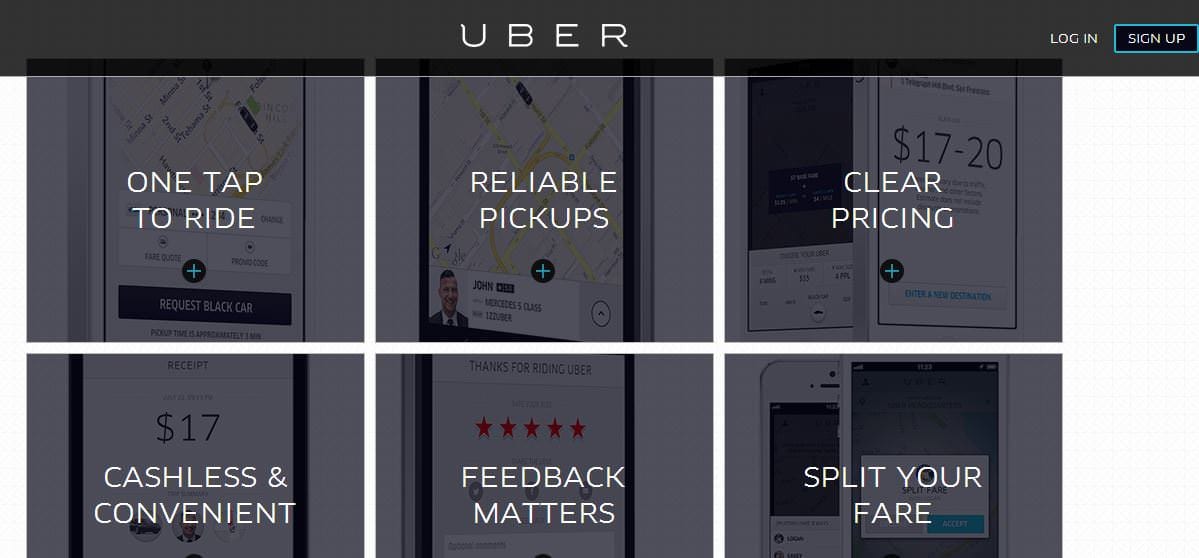
You will have heard on the news how Taxi firms in London, Berlin, Paris and Madrid are complaining about Uber, the taxi service app, which will impact their business. This is clearly a fight over processes (hail a cab in the street or use an app) but it’s also about pricing, plus cabbies have access to their own app, Hailo, but the starting price for any journey is £10.

Uber app

How many other traditional businesses do you know, in your sector, that are going through the same issues?

#3 Explore options and share the news

Change rarely happens overnight. It’s often a series of factors that have been considered for a while, but haven’t materialised. This can occur when the senior team resist change. You may hear ‘we’ve always done it this way’ or ‘it’s worked for years, nothing has really changed’.

Is this resistance or denial? In some cases it can be both.

To show the C-suite that life has changed, their cheese has moved, you can recommend ‘exploring options’. This really means capturing evidence. Here are 5 ways to do this:

  1. Commission or conduct a digital marketing audit and present the findings to the CEO and exec team. You can use PR Smith’s SOSTAC® model  to get started.
  2. Benchmark the business using this tool.
  3. Prepare a presentation to highlight how the world is changing. Dave’s blog post 10 reasons why you may need a digital channel strategy?  is a great primer for this.
  4. Share external research such as this infographic prepared by Danyl showing how marketing spend is moving.
  5. Build a business case and focus on the numbers.

#4 And here’s a key tip. Consider the timing.

Deliver your information, along with some ‘next steps’ just before the planning for shareholder, board or other key meeting stake place. There’s no better time to get a captive audience that’s seeking some good news!

Once the exec team have agreed that action is needed, you’re moving toward commitment. This is the time to catch up with the competition. More on this in my next post!

Annmarie will be facilitating the Digital Transformation breakout workshop at the Smart Insights conference where we will discuss approaches to digital strategy development and change management.

03 Sep 16:02

How to Manage Scheduling Software Fairly

by Ethan Bernstein

Starbucks workers recently scored a point against the machine. After a lengthy New York Times story, the company decided to adjust some of their controversial scheduling practices, eliminating “clopening” — when workers are required to close at night and re-open in the morning — and requiring at least a week’s notice of upcoming schedules.

In this case, “the machine” refers to a real machine: the highly sophisticated automated software Starbucks uses to schedule its 130,000 baristas, sometimes giving them less than a few day’s notice about their schedules in order to “optimize” its workforce.

Starbucks is just one of many companies using this type of technology, and it’s not hard to understand why. Until recently, determining who works when involved store managers manually slotting each employee into shifts on paper. Automation not only frees store managers to focus on customers, but can take into account much more data than a person can remember —historical customer patterns, weather, experience at neighborhood stores — so workers spend less time either with nothing to do or being completely overwhelmed with long lines and unhappy customers.

As the argument goes, that’s good for workers, who don’t want to be bored or overwhelmed, and it’s good for retailers, whose biggest cost and revenue driver is typically labor.

Our collective research has also shown that retailers really do struggle with scheduling. In a study of 41 stores of a women’s apparel retailer, for example, Saravanan Kesavan and his co-authors found that all of the stores were understaffed significantly during the peak periods of the day, while they were significantly overstaffed during the rest of the hours. The authors estimated that the retailer was losing about 9% of sales and 7% of profits due to this mismatch.

So why not implement just-in-time, software-driven staffing across the board? The problem — and one that Starbucks was forced to face first-hand— is that while scheduling software may seem “like magic,” as one of the major software vendors in the Times article put it, it’s actually not. Starbucks’ experience is common among a number of retailers who have taken their passion for engineering and optimizing schedules too far. As soon as a computer is scheduling your people at 15-minute increments to match the peaks and valleys of customer demand, employees’ desire to live a normal, predictable life becomes a barrier to profitability.

Three additional realities get in the way:

Perfect forecasts don’t exist. To produce an optimal labor schedule, the scheduling software must forecast customer patterns accurately—if you want to schedule labor at 15-minute increments, you must also understand demand at 15-minute increments. The dirty little secret is that even the most advanced scheduling software, incorporating every bell and whistle, tends to be wrong at least as often as it is right when the time intervals are short.

For example, the charts below show the variation in customer arrival pattern for a retail store on Saturdays, and then a breakdown of the same store between noon and 1 p.m. on Saturdays. The coefficient of variation, a measure of how variable the traffic is, increases from 10% to 31% as we go from daily to hourly data. This implies that it would be lot harder to predict hourly traffic compared to daily traffic, and it’s guaranteed to be lot more erroneous when predictions are generated at the 15-minute interval.

Customer Arrival Patterns Chart

Because of this, good scheduling software tends to serve the “normal” customers well (those buying cappuccinos on the way to work every morning), but it may be at least as important to serve the abnormal ones (like a person who buys 20 lattes for a single meeting).

Tracking everything is unreliable. The response to unpredictable customer behavior has been, “well, let’s just track everything more carefully.” But tracking doesn’t always yield better predictions. For one, there’s inherent variability, as shown in the arrival pattern of customers to 35 stores of a retail chain over a period of a day. The differences between the top and bottom lines – in other words, the differences between two stores – don’t offer much in the way of insights.

Hourly Variation Chart

Increased tracking can also create distortions in the data and unforeseen employee reactions, as Ethan Bernstein has found in his research. At a factory in Southern China, for example, executives thought that watching workers would help managers increase productivity and lower costs. It turns out that the opposite was true: Employees were more likely to be innovative when they weren’t being monitored, and production slowed when all eyes were on them.

A lot of flexibility isn’t necessarily a good thing. Saravanan Kesavan, Brad Staats, and their co-author have shown that temporary and part-time workers can help improve sales and profitability up to a point. For example, store profits were found to increase when the number of part-time and temporary workers was increased from zero to 4-5 for every 10 full-time workers. But beyond that point, any further increase in the number of those workers decreased store profits as the intangible costs of lower motivation and greater coordination dominated the benefits of scheduling workers to meet unpredictable demand.

So what should retailers do? To start, they can learn a lot from the considerable variation in how these systems have been implemented across companies. We see them as falling somewhere in the spectrum of purely creating value for management and purely creating value for workers.

The systems designed solely to create value for management fail to take into account so many unpredictable (and human) variables that they often result in public failures. In 2011, over 4,000 workers from Macy’s threatened to go on strike, in part because employees felt that the management was pushing for an online scheduling system that would make their schedules unpredictable. Walmart has often been accused by working mothers that the unpredictable schedules and low wages hurt their lives. The story of Jannette Navarro, the Starbucks worker profiled in the Times, absolutely rings true.

At the same time, strictly human-centric approaches can be problematic: If store relies on a remote scheduler, that’s a person who isn’t spending time with customers or employees. Like the scheduler Ms. Navarro had to beg in order to get 40 hours, he or she may also exert unfair power over workers.

Some systems, however, are implemented to create value for workers while simultaneously taking advantage of software’s benefits. If a store has a scheduling system that is accessible to, and modifiable by a team of corporate managers, store managers, and workers, it can balance human needs, customer needs, and company needs in a fair, transparent, and more informed way. These implementations can make ordinary workers, even part-time workers, better at managing themselves.

In other words, the best kinds of scheduling systems involve both managers and software, not for the purpose of more tightly controlling workers, but to inform them on how optimal schedules stack up against predicted forecasts. For example, what if store-level employees could edit the schedules produced by the machine, but were held accountable for the ultimate effectiveness of them?

This is the exact approach taken by Belk, the largest family owned and operated department store in the United States. Before their tool was implemented, scheduling was performed by store managers and schedulers who balanced profits and worker needs to create a “fair” schedule that worked for everyone — incorporating preferences and an equal amount of weekend work. These types of nuances, with lots of variation, were too complicated for any workforce software to take into account.

So when Belk implemented their new tool, employees saw its failure to create fair schedules as “bugs” in the software.

But unlike other retailers who take an iron hand to push compliance with a new system, this retailer let the team at the store “edit” the system to “fix” the “bugs” — essentially, they allowed workers and their supervisors to ensure they had the days or hours off they needed, more than a week in advance, by overriding the system.

At the same time, a central workforce team at corporate was tasked with analyzing a sampling of edits to understand their reasons and benefits. Some edits were, of course productive; others involved resistance to change or misunderstandings and miscommunications. Belk then worked with its store managers through weekly meetings to encourage compliance in areas where the scheduling system made sense, and at the same time provided feedback to the scheduling company to update its software where the schedules did not make sense.

Belk now revises about 50% of its scheduling based on this new approach, a healthy balance between the efficiency you get from a machine and the intelligence you get from human intervention. And the company reported a 2% increase in gross profits several months after implementing the override system.

Ultimately, the success of scheduling systems depends on whether they serve as tools for or against the workers. In many ways, data-driven scheduling software is attractive to retailers because it gives them unprecedented transparency. But the ultimate success of these systems depends on this same transparency being available to employees as well. When management takes enabling its workers seriously — when these tools become an experiment in worker learning rather than top-down compliance — results can far exceed even the most magical predictions that scheduling software initially promised.

03 Sep 16:02

Here's why Whole Foods lets employees look up each other's salaries

by Business Insider

Whole Foods employee

Have you ever wondered how much money your boss makes? If you worked at Whole Foods, you could look it up and find out.

Leaders of the supermarket chain believe in keeping employees as informed as possible, even when it comes to pay. Under the company's open policy, staff can easily look up anyone's salary or bonus from the previous year — all the way up to the CEO level.

The unusual Whole Foods policy is designed to both encourage conversations about salary among staff members and to promote competition within the company, according to "The Decoded Company: Know Your Talent Better Than You Know Your Customers," a new book by entrepreneurs Leerom Segal, Aaron Goldstein, Jay Goldman, and Rahaf Harfoush on innovative management practices.

Whole Foods co-CEO John Mackey introduced the policy in 1986, just six years after he co-founded the company. In the book, he explains that his initial goal was to help employees understand why some people were paid more than others. If workers understood what types of performance and achievement earned certain people more money, he figured, perhaps they would be more motivated and successful, too. 

"I'm challenged on salaries all the time," Mackey explained. "'How come you are paying this regional president this much, and I'm only making this much?' I have to say, 'because that person is more valuable. If you accomplish what this person has accomplished, I'll pay you that, too.'"

Beyond making compensation data available to all employees, Whole Foods also has its managers post their store's sales data each day and regional sales data each week. Once a month, Whole Foods sends each store a detailed report on profitability and sales at each of the chain's locations. In fact, in the late 1990s the widespread availability of so much detailed financial data led the SEC to classify all of the company's 6,500 employees as "insiders," according to a 1996 story by Fast Company.

Mackey and others at Whole Foods believe that a culture of shared information helps create a sense of a "shared fate" among employees. "If you're trying to create a high-trust organization, an organization where people are all-for-one and one-for-all, you can't have secrets," he says in the book.

For their part, the authors applaud Whole Foods' practices. They contend that its open policies prove the benefits of experimenting with data and using information to establish a "direct relationship between an individual's decisions and their impact on the business" — something the grocery chain accomplishes by giving each employee high-level access to the company's financial data, and therefore a greater stake in the business.

"Whole Foods is an intriguing example of a company that has successfully bridged the gap between soft-hearted values and logic-driven business acumen," the authors write. "The combination has resulted in a highly motivated workforce with a deep sense of community who value productivity."


NOW WATCH: Here's How Elon Musk Can Tell If Job Applicants Are Lying About Their Experience

<div>Please enable Javascript to watch this video</div>


SEE ALSO: This One Simple Management Change Saved Bank Of America $15 Million

Join the conversation about this story »

NOW WATCH: How To Respond To 8 Illegal Interview Questions


03 Sep 15:47

How to Get the Best Click-Through Rate

by Dave Wheeler

How to Get the Best Click Through Rate image Numero Uno 08 29 14 300x199A click-through is when a visitor of a web site clicks an ad, taking them to the site the advertisement was promoting. Here’s what you need to know to be successful at obtaining click-throughs.

1.  Observe Click-Through Rates

The more clicks you get on your PPC online ads, the more sales conversions you get. A business’ click-through rate measures how well a site and its marketing material are doing at attracting visitors and buyers and can serve as a guide to what you need to change to raise click-throughs. Research your click-through rate before making any changes to existing ads; after all, “if it ain’t broke, don’t fix it.”

2.  Setup

Your PPC campaign is simply a normal advertising campaign, just online: you create ads, put them up, and pay a fee for them to appear in organic searches. Therefore, your ads have to be positioned high in those searches, meaning your ad copy has to be unique while still utilizing the right keyword phrases. Like with SEO, you might have to experiment a bit to see which keywords and content generate the most click-throughs.

3.  Consider Positioning

“Conversion optimization” is a term used to describe the methods used to turn a site’s visitors into customers. This can be accomplished by placing your PPC ads at the highest positioning you can. If your PPC strategy is stagnant and failing to get your content to the top, it’s time to revise it. Remember: you want to appeal to and obtain the over 90% of the online search audience that clicks on the top-ranked ads.

4.  Find Your Niche

How do you get to become the top-ranked? By not trying to appeal to everyone. Niche markets for whatever you are advertising are the key to getting a good ranking. Your PPC campaign and PPC strategy should utilize the right language, including jargon and information. Using that market’s specific language will narrow down your PPC materials in terms of content—and with it, your competition.

5.  Use Low-Competition Keywords

Something every PPC company should know is the importance of low-competition keywords. You’ll likely notice via your click-through rankings that you have to keep track of how much you spend, so to save money and appeal to your niche market, always take note of low-competition keywords and related phrases that can appeal to your particular market area and save you money.

This article How to Get the Best Click-Through Rate was originally published at Numero Uno Web Solutions and has been republished with permission.

02 Sep 15:46

The Myth About Sales Pipeline

by Carlos Hidalgo

Most sales managers or Sales VPs will tell you that in order to meet their quota, they must have a pipeline of X.  Whether it is a three X, five X or seven X pipeline, these sales people have a formula that they follow that knows what they need to get them to their stated goal.  Having worked with many sales professionals over the years, this X Factor is closely monitored and is one of their top KPIs.  However, what if this approach was wrong?  What if the whole idea of a three, five or seven X multiple in pipeline was misguided?

shutterstock_69470824
I am not advocating that sales managers and Sales VPs not monitor or be concerned about pipeline.  What I am advocating is that heads of sales should be much more stringent about what they allow to be put into their pipeline.

Many sales pipelines today are full of “opportunities” that will never close, yet they are in the system and calculated as part of an X Factor.  The way most companies deal with this is they reduce the percentage of that deal closing based on the stage of the opportunity.  However, what if that deal never has a real chance of closing?  If this is the case, it does not matter what stage it’s in or the percentage probability assigned. . . .  it’s still bogus.

I was speaking with a company this week that was saying their close rates on qualified leads was less than 30%.  Pretty anemic if the leads are indeed qualified (we will not explore this on this post as this is not the overall point). If less than one in three deals are closing for this organization the typical sales approach would be to have a three to five X in pipeline to play to the odds that from this large pipeline, quota will be met.  This approach is faulty (and just a bad business practice) as salespeople are now spending time chasing deals that will ultimately yield nothing — or perhaps continuing to include deals in their pipeline that they know are simply not going to close.

How would the game change if — in addition to the qualification criteria assigned to leads that were passed to sales from marketing — sales were more stringent on those leads that were developed into opportunities?  Let me explain a bit further.

I recently worked  with one client who took a very different approach to lead qualification.  In addition to the typical lead qualification criteria, we established a certain set of criteria – a litmus test – on the sales side that would be used for every potential deal.  Throughout every phase of the process, sales was required to look for certain signs and signals that would indicate if this qualified lead would, ultimately, make a good customer.

Sales was trained to find out early on if the customers were bought into the organizations approach, if there was alignment among the decision makers, taught steps to take on how to circumvent potential competition, etc.  Each step along the way this criteria was applied and <insert gasp here> there were a fair number of qualified leads that were told they were not a good fit, and that it was not in the best interests of the company or the potential customer to try and work together in the near or long term.  This is integrity in selling!

A few things happened as a result of transforming this organization’s sales approach:

–          The long-term relationships with clients greatly improved
What used to be a vendor-customer relationship turned into a partnership, and was spoken of positively by many of their customers. As a result, there was an exponential improvement in customer lifetime value.

–          Sales win rates increased dramatically
By not having to worry about chasing down deals that would never close simply to satisfy the X Factor requirement of the pipeline, sales was able to focus on the deals they knew they would close, which caused their win rates to climb to approximately 80%.

–          Pipeline measurement changed
Sales management was no longer worried about a “five x multiple” (the goal they had previously).  With stringent criteria being applied and as one sales leader stated, “we only issue SOWs to those that we know we will win” – the entire pipeline measurement has changed.

–          Improved alignment with marketing
As sales continued to hone their approach, the information was shared with marketing, which then implemented changes to the lead qualification process and standards.  This resulted in a much higher qualified lead delivered to sales, thus reducing time wasted on deals that may have a number assigned, but not have a true chance of closing.

–          Average sales prices increased
As the sales organization truly became more consultative during their sales process and was more “selective” in the deals they engaged with, they were able to sell a long-term approach and saw the average deal size increase dramatically.

Focus on reality, not the myth of the X Factor sales pipeline.

The impact on this organization has been dramatic and the sales team has truly been transformed in the process.  The days of measuring a multiple within the pipeline are gone and the company is seeing benefits in terms of record bottom line revenue.   Sales organizations need to be willing to change their approach, define what customer success looks like and sell to that, rather than stuffing a pipeline and hoping the odds pay off in their favor.

Author: Carlos Hidalgo @cahidalgo is CEO and Principal, ANNUITAS

02 Sep 15:46

The evolving role of savvy business technology leaders

As the chief executive at your company, if you discovered that you had some major financial standards compliance issues within your organization, would you be concerned about the risks associated with that exposure?

If your designated outside auditor had bypassed your internal finance department and chose instead to work directly with your individual Line of Business leaders, would you want to know why? Moreover, would you intervene?

Yes, it's a rhetorical series of questions. And I think we all know the answers.

Did you know there's a movement that's already in progress that could impact your company's provision and consumption of IT services, with a corresponding potential exposure concern that's related to compliance issues?

Have you heard about the Shadow IT phenomenon? According to the assessment of several leading IT market analysts, it's a trend that's already quite pervasive across a broad cross-section of industries. It’s also been a hotly debated topic.

Who is championing this cause from a horizontal organization perspective? According to market research from last year, it's primarily the marketing leadership.

The Need for Greater Speed and Deep Knowledge

Granted, some of the inherent friction within the ongoing quest for strategic business technology competitiveness can be uncomfortable for some people. But in the grand scheme of things, it's all good. This is the path to progress. Let's consider the upside opportunities.

IT used to be primarily about operations, cost reduction, and management controls. That's no longer the scenario at forward-thinking companies. Today, corporate IT departments are being asked to plan, build or procure, manage, and continuously improve upon their organization's business technology infrastructure and associated processes.

As if that weren't enough, you will likely also expect your re-energized IT leadership team to help your organization innovate, grow, and deliver unique customer experiences. If you haven't yet reached that pivotal point, don't fret…you will soon.

Besides, you're most likely to be highly motivated to navigate this key market transition. As an informed executive, you've made it a personal goal to insure that you surround yourself with the best available talent.

While business technology deployments can't provide you a permanent competitive advantage, the timely deployment of new IT systems can enable you to build a strong competitive position that will stand the tests of time.

Moreover, while cloud service adoption moves towards ubiquity in the global marketplace, the ability to perform the essential task of crafting a unique and powerful business application development environment is still somewhat scarce. Again, that's an opportunity, not a problem.

IT Talent with New Skills and Big Aspirations

Granted, we've already reached an inflection point where software-as-a service offerings have made it easier for any Line of Business leader to deploy an IT solution, just-in-time. However, being able to attain the much broader business agility benefits -- that are truly possible with cloud computing -- requires a comprehensive strategic plan.

Now's the time to encourage and coax your business unit leaders and open-minded IT managers to work together and collaborate on mutually beneficial projects. If you need help to bring this essential project orchestration together, then consider seeking out an accomplished pioneer.

Companies with an evolved ecosystem of integration channel partners, such as Cisco, has the depth and breadth of information, education and guidance resources that today's forward thinking leaders need to execute their multifaceted cloud-enabled strategies.

Why Cloud Service Brokering Really Matters

By increasing their inherent sourcing flexibility, your current business technology managers can more successfully assume the role as a broker of IT services -- thereby increasing transparency, and better aligning your business and IT agendas into a cohesive plan.

A valued and trusted broker, in this context, is an individual or group within your own IT team that acts as a mediator between the Line of Business end-user of a managed cloud service capability and the providers of that service offering.

But how does a top performing IT department gain the trust to carry out this evolving role?

What's needed is a comprehensive, consistent cloud strategy that will offer an enlightened perspective, provide compelling direction, and build confidence in your IT team's enabling platform procurement decisions.

As an example, when acting as a credible service broker, just imagine how your IT team can now take full advantage of multiple sourcing options and become a value-added intermediary of cloud services for their Line of Business internal customers. Now, that's the makings of a solid foundation for a meaningful partnership and substantive progress towards your bold goal.

So, are you ready to enhance your business flexibility with a choice of consumption models in the world of many clouds? Are you fully prepared to embrace the emerging hybrid cloud era?

02 Sep 15:46

How to Retain Top Sales Talent

by Prialto

Top salespeople are notoriously difficult to retain. The demand for experienced salespeople is extremely high and good salespeople are very difficult to find. According to CSO Insights, turnover among sales reps is 25.5%, nearly double the national average across all industries. Below are four ways that your organization can beat the odds, retaining tops sales talent for lasting success.

Set Realistic Expectations – It’s best to start a relationship off on the right foot if you want to increase its chances of succeeding. Once a new sales rep is brought onboard, the sales manager should develop realistic goals and objectives, which should be discussed and mutually agreed upon with the salesperson. You both should be on the same page about what needs to be done, how they should go about doing it and what resources you will provide to help them to be successful. Then, the progress of these goals should be monitored in an effort to help the sales rep stay on track and so that you may tackle any obstacles together.

Provide Ongoing Training and Development – Your salespeople need to see that you are making an investment in them, that you are playing a key role in their success. There needs to be a solid talent development program within your organization that not only caters to your A team, but also builds up your B team because they are the future sales leaders of your company.

Offer Administrative Support – It’s important to show your top talent that you value their time. As a sales manager, you almost have to treat your sales team as the sales team treats their clients. You need to woo them a little by offering them incentives and showing them that you care about their needs and want to keep them around. You need to offer a solution to their problems. One of the biggest problems facing sales reps is that they don’t spend enough time selling. This is due to time spent on meetings, prospect research, administrative duties and a whole host of other things that they are responsible for.

By offering them administrative support, it helps to take some of the mundane tasks off their plate and it frees them up to do the one thing that they love, the one thing that fires them up – closing more sales.

Conduct Exit Interviews – Perhaps the most important thing that you can do to retain top salespeople is to learn from past mistakes. When you do lose a top sales rep, take the time to find out the reason why they are leaving. You may be surprised to discover that it usually has little to do with monetary gain. A survey of 1,000 employees by human resources software company BambooHR revealed that the top two reasons employees resign are issues with bosses and co-workers and a skewed work-life balance, while money lagged behind at number three.

In most cases, people don’t leave companies, they leave people. They leave managers and they leave colleagues. Perhaps there’s a recognition issues, a cultural issue, a respect issue, a communication issue or a work/life balance issue. No matter what the issue is, it’s important that you care enough to ask about it. If you continuously hear your top sales reps citing the same reasons for leaving, it’s time to make a change within your organization, quickly if you want to stop the bleeding.

The only thing that would be better is if you received this kind of feedback and acted on it BEFORE it got to the point of resignation. It’s important to address complaints in a timely manner as opposed to turning your back and hoping it gets better. The best way to retain top sales talent is by having a proactive approach to setting expectations, ongoing professional development, offering support and soliciting feedback on a regular basis.

02 Sep 15:45

Here's All The Incredible Wildlife In Britain You're Missing

by Dina Spector

The winners of the British Wildlife Photography Awards were revealed on Monday. 

"The Awards celebrate both the work of amateur and professional photographers and the beauty and diversity of British wildlife," the organization said on its website.

The winning images in 16 different categories were chosen from thousands of entries.

You can check out all the winning images and a selection of highly recommended photos on the award website, and check out our favorites below.  

The winning image of a greylag goose, called "The Tourist," was taken by Lee Acaster. "It was a real privilege to have such a close encounter with a wild bird in the very heart of London," he said, "I vividly remember the excitement I felt as she patiently waited for me to get the shot, and I knew immediately this was a once in a lifetime opportunity."

ANIMALS_GOOSE_3020723k

Steven Fairbrother captured this image of a shag, a good-sized bird, resting in the Farne Islands of England. 

ANIMALS_BIG_BLACK__3020761k

The "Otter and the Puffin" was taken by Richard Shucksmith in Scotland. 

ANIMALS_OTTER_3020757k

A close-up of a grey seal claw taken by Jim Greenfield in England. 

BWPA

"Cairngorms" was photographed in Scotland by Peter Cairns.

BWPA

Susie Hewitt snapped an image of a gnat in a window in northern Ireland. 

BWPA

"A life at Sea for Nesting Gannets" was taken in Scotland by Ruth Asher.

BWPA

A black and white photo of a blue shark was taken by Alexander Mustard in Cornwall, England. 

BWPA

A red telephone box overgrown with vegetation was snapped in London by Philip Braude. 

BWPA

Brown hares photographed by Andrew Parkinson in Derbyshire, England. 

BWPA

SEE ALSO: Stunning Images From The 2012 Wildlife Photo Competition Of The Year

Join the conversation about this story »

02 Sep 15:26

Panama Canal cost untold billions and thousands of lives. But will route that changed the world soon be obsolete?

by Alastair Smart, The Telegraph

Vasco Nunez de Balboa had never known such excitement. Leader of Spain’s new colony of Santa Maria la Antigua, on the Atlantic Coast of the Isthmus of Panama, he’d heard thrilling tales from local Indians about a great ocean across the mountains – one which roiled towards a magnificent gold kingdom in the south.

With an expedition of 190 fellow Spaniards, he began a trek inland – into the sweltering jungle and the unknown. Some three weeks later, at noon on September 25 1513, Balboa reached the summit of a mountain, whence he set eyes on an ocean as boundless as he’d been promised. Falling to his knees in wonder, he hailed “the great maine heretofore unknowns”. The Pacific Ocean had been discovered.

AP Photo/Panama Canal Authority
AP Photo/Panama Canal AuthorityThe S.S. Ancon sails through the Miraflores locks during the opening day of the Panama Canal in Panama City, Aug. 15, 1914.
AP Photo/Panama Canal Authority
AP Photo/Panama Canal AuthorityGatun Locks stand under construction near Colon City, Panama.
AP Photo/Panama Canal Authority
AP Photo/Panama Canal AuthorityWorkers stand near a landslide that destroyed digging machinery, during the construction of the Panama Canal at Culebra Cut in Panama on May 29, 1913.

Upon descending to the shore itself, Balboa walked knee-deep into the water and claimed possession of the new sea for the Spanish crown. He sent joyous tidings to King Ferdinand in Spain, including the suggestion that, even if a narrow strait of water between the two oceans were never found, “it might not be impossible to make one”.

Fast forward four centuries and the dream of Balboa – and scores of successors – would finally become a reality. For, on Aug. 15, 1914, the first ship crossed the Panama Canal, a route that changed the world. It is hailed as one of the greatest engineering achievements in history, yet the path to its completion was tortuous, often brutal, and took various innovations in mechanization and medicine – and the birth of a whole new nation – to happen.

What’s more, it is no relic. Today, the canal is still a thriving commercial artery, ushering cargoes of bananas, coal, steel and other materials from the west coast of South America to the UK, and accounting for around five per cent of world trade. To keep it that way, the Panamanian government is currently overseeing a $5 billion canal expansion, which is proving every bit as fraught as the original construction. Intended to open for business in time for the centenary this month, delays have put the date back to 2016 at the earliest.

One only has to look at a map to understand why an isthmian canal was considered so important. For the Spanish conquistadors, uniting the Atlantic and Pacific oceans at the American continent’s narrowest point would enable the easy passage of silver and gold from Incan territory. Similarly, during the 19th-century gold rush, Americans saw the opportunity of swift transfer between West Coast and East, at a time when much of America was still wilderness. A canal would cut days – and 12,874 kilometres – off voyages around the southern tip of the Americas, at Cape Horn. In short, the notion of cutting the continent in half attracted capitalists from generation after generation. From Britain alone, Sir Francis Drake and Henry Morgan both tried to seize Panama from Spanish hands. Most infamously, in 1698, Scottish entrepreneur William Paterson convinced his government to invest half the national savings into setting up an isthmian colony at Darien. A coast-to-coast canal would, he said, yield “the gates to the Pacific and keys to the universe”. Yet, within months, his 1,200-strong expedition had been defeated by the twin enemy of tropical disease and Spanish defence forces – one crucial consequence being the decision of impoverished Scots to sign the Act of Union with England.

It wasn’t until the 19th century, though, that technology finally caught up with aspiration. This was the peak of the “canal age,” as man-made waterways – such as the Erie, joining New York to the Great Lakes – slashed journey times and transport costs in Europe and North America.

Perhaps the key canal of all, however, was the Suez, in Egypt, which from 1869 allowed ships to travel between Europe and east Asia without navigating around South Africa. Its pioneer was Frenchman Ferdinand de Lesseps, who, riding a wave of confidence in Victorian technological progress, soon set his sights on Panama. His aim? To build “a bridge across the Americas”.

Parisians queued around the block of their stock exchange, the Bourse, to invest in the scheme. But, despite the task – creating a waterway just 77 km in length – looking relatively simple, it was anything but. De Lesseps had insisted on a sea-level canal, just like at Suez, rather than a lock-operated one – failing to appreciate the unique geography of Panama, not least the mighty Cordillera, the range of mountains that runs down the country’s spine.

In part, this was a hubristic belief in man’s power to tame nature; in part, it was a commercial decision, believing that a sea-level transit would be both swifter and more profitable. However, at the notorious Culebra pass, through the Cordillera, depths of around 90 metres had to be dug – for 14.5 km – and de Lesseps’s men and machines just weren’t up to it, especially in rainy season when mudslides and flooding kept returning all the earth they’d just removed.

AP Photo/Arnulfo Franco
AP Photo/Arnulfo FrancoWorkers from the Panama Canal Authority weld a gate at the bottom of the Miraflores floodgate during routine maintenance on the Panama Canal in Panama City, Friday, Aug. 29, 2014.

The heat blazed too, and the soil – with its 17 different rock formations – was like nothing geologists had ever seen. There seemed no solution either to yellow fever and malaria, diseases which were killing off workers at a terrifying rate. During the eight years of French excavation from 1881, more than 20,000 workers died.

Against such odds, the project was doomed to failure, though de Lesseps periodically served up false, optimistic reports to keep investor confidence high. The crash of his Compagnie Universelle du Canal Interoceanique was the biggest of the 19th century. The savings of 800,000 private investors (totalling 1?billion francs) were wiped out.

It’s testament to the sheer power of the canal as a concept that anyone would want to tackle the Herculean task again so quickly. Yet that is exactly what America would do, flexing its muscles beyond its borders for the first time. Having gained independence from Spain in 1821, Panama was now part of Colombia. Yet, rather than cooperate with Bogota, President Theodore Roosevelt opted to incite a nationalist insurrection, and gave crucial support to Panamanian rebels fighting for independence. The Republic of Panama was born in 1903, though a slender “Canal Zone” was handed over to America in perpetuity.

For Roosevelt, control over both the Atlantic and Pacific grew increasingly important – for which an isthmian canal would be crucial – and he asked William Taft (his eventual successor as president) to oversee the project. Learning from the French debacle, Taft backed a lock-canal system, and thanks to the healthy wages on offer, there was no shortage of construction workers, many from Europe. One of them was Pedro Hernandez, an olive-picker from northern Spain. “Opportunities at home were scarce,” says his great-grandson Jaime Massot, 55, a hydrologist at the canal today. “The Panama Canal represented a bold, new start for him.”

Ed Grimaldo/AFP/Getty Images
Ed Grimaldo/AFP/Getty ImagesGeneral view of the Miraflores locks western gate during maintenance works, on August 29, 2014 in Panama City.

Yet, Roosevelt’s chief medical officer, Dr William Gorgas, knew that success could only be achieved if yellow fever was eliminated first. “Trouble was, no one knew what caused it,” recalls Massot. “Some attributed it to dirty water, others to poisonous airs,” some even to the debauched, late-night pursuits in Panama City.

Working at Culebra, 10 hours a day, six days a week, Hernandez caught yellow fever and “became so lifeless, the hospital doctors thought he’d died”, says Massot. “They placed him in a coffin. Thank goodness, though, one of the nurses heard a knocking sound on the wood – somehow my grandfather had found the energy to let them know he was alive, and they let him out.” Hernandez made a full recovery and ended up settling in Panama for the rest of his long life. The less fortunate had their cadavers sold to medical schools in America for dissection classes.

Gorgas was adamant that mosquitoes were the disease carriers. Given a blank cheque by Roosevelt, his tactic of fumigating cities and persuading Panamanians to stop storing water in open containers proved a masterstroke. Within six months, yellow fever had been eradicated and malaria sent into steep decline, meaning the engineers could now, at last, concentrate on the task at hand.

For starters, Roosevelt’s chief engineer, John Stevens (the man behind America’s Great Northern Railway), installed an efficient railroad. By coordinating steam-shovel and train movements, he kept the soil moving out and away with the efficiency of a conveyor belt.

Ed Grimaldo/AFP/Getty Images
Ed Grimaldo/AFP/Getty ImagesPanama Canal's workers inspect sewers in Miraflores locks western gate during maintenance works, on August 29, 2014 in Panama City.

The blasting and excavation of the Culebra Cut – aka Hell’s Gorge – would still prove a construction headache, involving, as it did, the transformation of a mountain into a valley. Mercifully, the lock-based system – in which the canal rises 85 m on the way up from one coast, crosses the Cordillera, then drops back down 85 m towards the other – meant much less digging than a sea-level system. The Americans also had the advantage of bulldozers, steam-powered cranes and hydraulic rock-crushers to make their job easier – all newly pioneered in America in the Second Industrial Revolution. Back home, the press gleefully reported on every breakthrough.

The engineering genius of the canal lies in its sheer simplicity – with no pumps, just a reliance on gravity and climate. At 33 m wide and 12.5 deep, the canal’s three sets of locks were the largest in the world, their filling achieved through the abundant Panamanian rainfall and culverts which channel water from damned lakes. The largest lake of all, Gatun, was created by damming the temperamental River Chagres, using the soil and rock excavated from Culebra. In rainy season, a flooding Chagres was lethal – and so the engineers made the cute decision to exploit the river rather than battle it.

After nine years’ labour the canal finally opened, and man’s greatest victory over nature until the moon landings was complete. World trade was opened up and transformed forever. It also confirmed the rise of America as the world’s pre-eminent power in the very month that Europe descended into carnage. With the Panama Canal, the American century had truly begun.

The opening-day celebrations were largely subdued, as it was less than a fortnight after the declaration of the First World War. No international dignitaries came and news was barely reported: “The Panama Canal is open to the commerce of the world,” announced The New York Times, almost apologetically, on page 14.

AP Photo/Arnulfo Franco
AP Photo/Arnulfo FrancoA crew of workers from the Panama Canal Authority clean the bottom of Miraflores floodgate during routine maintenance on the Panama Canal in Panama City, Friday, Aug. 29, 2014.

The first trading ship to travel from San Francisco to New York via the canal, the Pleiades, arrived on August 24 1914. The isthmus would remain of major economic and geopolitical importance to America for the next 85 years – not to mention an imperial symbol through which American power and prosperity flowed. It linked their navy’s Atlantic and Pacific fleets, ferrying men and resources during the Second World, Korean and Vietnam wars. However, with the tailing off of the Cold War, America agreed to hand over control of the canal to Panama, on Dec.31, 1999.

The transition was seamless. The autonomous government agency, the Panama Canal Authority (PCA), has proved a steady hand on the tiller. The canal largely functions as it did a century ago, a typical crossing taking between eight and 10 hours, and remains a vital avenue of world trade, connecting 1,700 ports in 160 countries. An average of 40 ships cross daily, each one earning Panama approximately $50,000 (which, altogether, makes Panama more than $1.3 billion a year).

In many ways, the canal has been a victim of its own success. In a bid to cash in, China is now investing $50?billion to construct a waterway across Nicaragua. And there are talks of other projects across Honduras and Guatemala.

What’s more, time waits for no man. At the turn of the 20th century, the canal could easily accommodate any vessel yet built (the mighty Titanic, at 27 m wide, could fit with plenty of room to spare). Now, however, companies are building ships a quarterof-a-mile long, wider than a motorway and capable of carrying up to 18,000 containers. Known as “Post-Panamax”, they are too big for the canal as it stands, so the PCA is expanding the waterway to double its capacity.

Ed Grimaldo/AFP/Getty Images
Ed Grimaldo/AFP/Getty ImagesGeneral view of the Miraflores locks western gate during maintenance works, on August 29, 2014 in Panama City.

“It was no good resting on our laurels,” says Diego Miguez, the PCA’s vice president of finance. “The canal was a masterpiece of engineering, but it gives us no divine right to future trade. We’re an entirely commercial operation, and must keep up with the developments in 21st-century shipping and commerce.”

Expansion work, to the tune of $5-billion, was approved in a national referendum in 2007, to accommodate the new Post-Panamax ship. However, just like a century or so previously, progress hasn’t been straightforward. First, the workers downed tools to strike for better wages; then the Spanish firm contracted to provide the new locks, Sacyr, refused to foot the bill for $1.6-billion cost overruns. Jorge Quijano, the PCA’s CEO, responded by accusing Sacyr of racism, disrespect and treating Panamanians “like a bunch of American Indians still wearing feathers on our heads”. All disputes seem to have been resolved now, and the work is 80 per cent complete, but the opening date has been put back to January 2016.

Other challenges remain too. How long, for instance, can Panama afford to keep widening its canal as ships get bigger and bigger? Certain vessels are already too big even for the new locks. What’s more, climate change experts question whether the rainfall in Panama will persist at levels to keep the canal operational and also whether the melting of polar ice caps might enable a new, rival navigational route through the Arctic to open up.

Miguez, however, is optimistic. “We have a long-successful operation and a strong, satisfied customer base,” he says. “Our aim is to continue to be major players in maritime trade worldwide.” Certainly, many of the canal’s trade routes are still booming: raw materials like coal and iron ore from Latin America – and liquefied natural gas from America – head to China and its fast-industrializing neighbours, just as manufactured goods are heading back in the other direction.

It remains one of history’s tragic coincidences that the Panama Canal should open just as Europeans were deploying new technologies for mass slaughter, thus shattering faith in progress and mechanization. For, if the First World War marked the end of an era, the Panama Canal represented its final, brilliant hurrah – an age of manned flight, submarines and the Kinetoscope, of confidence and can-do, when nothing seemed impossible. Not even a bridge across the world.

 John Chalmers / Postmedia News
John Chalmers / Postmedia NewsA view of the Panama Canal locks from onboard the Summit, where passengers crowd in to get a close-up look.
02 Sep 15:13

Tesla has ‘proved’ electric cars are better, analysts say

by Antony Ingram, Green Car Reports
Tesla has ‘proved’ electric cars are better, analysts say

Above: Somewhere over the rainbow, there's a Tesla Model S.

Image Credit: photo credit: jurvetson via photopin cc

When industry analysts, financial analysts and the motoring press have all lavished praise on a car, there’s a fair chance it’s a pretty good car.

That’s the case for the Tesla Model S electric car, particularly as two market analysts from Credit Suisse have seen fit to provide a point-by-point breakdown on just why the car is so good.

They even go as far as to say that Tesla has proven electric vehicles are “inherently better,” even if the general public doesn’t know it yet.

That raises an interesting point. Tesla might well have an excellent product, but if the public doesn’t know that, has it really been proven?

According to Business Insider (via Charged EVs), Credit Suisse’s Dan Galves and Shreyas Patil say the fight between combustion cars and electric vehicles will “not be a fair” one.

The analysts cite everything from the Model S’s high performance, through its low center of gravity-aided handling, to the room of an interior not encumbered by packaging typical drivetrain components as its successes.

In addition, the cost of running a car with comparatively few moving parts will be low, and that upcoming regulations will really begin to hurt regular combustion-engined cars that Tesla will be unaffected by.

And of course, ‘fuel’ costs are low, as electricity costs less than gasoline. Battery prices should come down once Tesla’s gigafactory opens, bringing down the up-front cost, too.

All this has led the pair to award Tesla an “outperform” rating, meaning it will outperform a benchmark indicator for market return.

“If Tesla can get to cost parity with an inherently better product, they will maintain the pricing power they currently enjoy,” the pair adds.

But that does rely on the wider industry and the wider public knowing that Tesla, and electric cars in general can be better.

Relatively few people read car magazines and automotive news websites. Many that do aren’t in a position to buy a Model S. And while Tesla has a high profile for such a small company, it’s comparative minnow in terms of global reach.

In other words, Telsa might well have a vehicle out there that can hold its own and even beat combustion-engined equivalents.

But if the public is unaware of the benefits, Tesla is a long way from proving it.

This story originally appeared on Green Car Reports.


Tesla's goal is to accelerate the world's transition to electric mobility with a full range of increasingly affordable electric cars. Palo Alto, California-based Tesla designs and manufactures EVs and EV powertrain components. Tesla ha... read more »


02 Sep 15:12

On Sept. 15, Google Will Make A Massive Bet Against Apple's iPhone 6 Strategy (GOOG, AAPL)

by Jack Dutton

Android One

Yesterday, Google started sending out press invites to the launch event in India for Android One, its new super-cheap smartphone. 

Google is hoping to deliver a solid smartphone experience for less than $100.

Google's strategy is to work with smartphone developers in emerging markets and to provide them with up-to-date versions of its free Android software so they can make great phones and low prices. It's the polar opposite strategy of Apple, which is gearing up the release of the iPhone 6, which is likely to cost $700. 

The market for cheap smartphones is burgeoning. In the West, smartphones are ubiquitous, but in the developing world, most people don't have them.

It is not just Google moving in on the emerging market for budget smartphones. Mozilla is launching a $33 phone in India. Microsoft has pushed down the price of its Windows phone. Xiaomi and Motorola have been launching smartphones in India too, including the Redmi 1S and Moto E costing Rs 6,999 ($115) and Rs 5,999 ($99) respectively. 

spain android share9to5Google noted that Google has already partnered with manufacturers Karbonn, Micromax and Spice for the first Android One devices. Karbonn are the manufacturers who made the A50S, the smartphone priced at only $43 dollars.

The bet here seems to be that in the future, it will feel weird to pay large sums of money for a phone. Generally, the history of computing shows that prices drop over time even as devices become ever more powerful. Eventually, Google and its Android manufacturers seem to be hoping, people will face a choice: $700 for an iPhone or $100 for an Android that does the same thing.

Some people think that Android phones only compete with other Android phones, and that Apple functions like a separate market. In that scenario, Apple is happy to exist as a minority brand as long as the minority it serves remains highly lucrative.

Right now, that strategy is working for Android, too. Apple remains strong in the U.S. where a huge chunk of the market buys iPhones. But in Europe, Android is taking over. In the top 5 European countries, Apple's share is only 7-11% of the market.

Of course, Apple's iPhone 6 is likely to be a huge seller — so after Sept. 9 expect these numbers to change drastically.

SEE ALSO: Android One Will Help Google Protect Against Forked Android Phones

SEE ALSO: This Is The $33 Smartphone For India That Could Ruin Samsung's Android Business

SEE ALSO: Apple's iPhone 6 Faces A Big Pricing Problem Around The World

Join the conversation about this story »

02 Sep 15:10

11 Actionable Writing Tips [+Examples]

by Jonathan John

Engaging a blog reader is a hard thing to do, especially in this digital age. As more and more content is produced on the Internet, people are less and less likely to read your blog in particular and stay interested in it.

To keep ahead in the blogging rat race, you need to be constantly improving your writing. Here are 11 actionable writing tips to help you do just that.

1. Be Statistic-Friendly

When you’re a blogger, statistics are your best friend. Including them in your blog posts makes you sound smart, informed, and authoritative.

Simply source statistics on a certain topic from online case studies, white papers, and other blogs, and put them in your blog post whenever relevant.

Example: It’s a good idea to blog often since 92% of businesses that blog multiple times daily has acquired customers through their blog (HubSpot).

2. Write in Solitude

11 Actionable Writing Tips [+Examples] image solitude

Image source

The space in which you write has more to do with the quality of your output than you think. The more you are able to concentrate on your blogging (that means nobody else around, the T.V. off, and the writing space clear and clean), the higher the quality of the final blog post.

Example: When writing, shut yourself up in a soundproof room that has good lighting. Your desks should be clear of everything except your computer and basic necessities.

3. Be Descriptive

Anton Chekhov once said: “Don’t tell me the moon is shining; show me the glint of light on broken glass”. The latter phrase is much more descriptive and much easier for the reader to imagine.

Example: The moon is shining [incorrect] vs. Broken glass on the road gleamed with the light of the moon [correct].

4. Write at an 8th Grade Level

Big words and long phrases in your blog posts only make you sound pretentious. Whenever possible, exchange words that are 3+ syllables with ones that are two or less syllables long.

Example: Pretentiousness can be injurious to the prosperity of your blog [incorrect] vs. Big words hurt your blog’s success [correct].

5. Avoid Wordiness

Do I really need to expound further on this tip? The basic principle of blogging is to always use the bare minimum of words. Conciseness is key to engagement.

Example: Extreme and unnecessary increases of length of articles can lead to the eventual failure of a blog post [incorrect] vs. Wordiness hurts blog posts [correct].

6. Open with a Story

Storytelling has remained popular throughout the ages, and today it’s a fantastic way to start your blog post and introduce your topic. Stories instantly catch people’s attention and, if they’re good enough, will hold that attention throughout the post.

Example: If you’re blogging about Monaco as a travel destination, start off with an anecdote of a humorous experience you had at Monaco.

7. Steal Blog Post Ideas

Your senior competitor blogs have been out there for a long time — they know which topics work and which don’t when it comes to your niche. Piggyback off their expertise by stealing the topics of their most popular blog posts, then out writing their post on the subject.

Example: If a lot of SEO bloggers have popular posts on keyword research, steal that topic and write the best possible post on keyword research.

8. Use Word Limits

By setting yourself a word limit when you write a blog post, you unconsciously start to do your best to make each sentence as concise as possible. True, word limits sometimes hinder flow of thought, but the gains in terms of conciseness far outweigh that disadvantage.

Example: Set yourself a 1500-word limit when writing a blog post on a certain topic. Give yourself no more than a 50-100 word leeway.

9. Stick to Your Topic

There are few things worse than a meandering blog post. Once you select a topic for your post, stick to it no matter how many irrelevant ideas start bobbling into your head.

Example: If you’re writing about social media marketing, don’t go off on tangents about complementary email or blog marketing unless your post title encompasses those topics.

10. Never Forget Call to Actions

Call to actions are important! Without an appropriate CTA, you’re practically wasting your readership — you don’t even get a chance to convert them into completing a certain desired action, whether that be subscribing to a mailing list, buying a product, or even just commenting.

Example: End with a question and a “Let us know in the comments!” CTA if you’re trying to convert readers into writing comments.

11. Link Out Often

One quick and easy way to increase the value of your blog posts is to link out to complementary posts from other authors very often. Not only will it help to put you in good favor with Google, but it will also help your readers to understand topics that you don’t extensively cover on your blog, but others do on theirs.

Example: When writing a post on tips to improve social proof, link out early in the post to another blog post about exactly what social proof is and psychology behind it to give your readers a fundamental understanding of the topic.

Which of these 11 actionable writing tips were your favorite? Let us know in the comments!

02 Sep 15:10

Keyword Research Made Easy With These 3 Tips

by Jonathan Long

Many business owners get stuck when they performing keyword research for their paid search marketing campaign. Many will use Google’s Keyword Planner tool, but most of the times that isn’t enough. If you want to take your keyword research to a higher level take a look at these very simple tips to improve your research.

Tip #1: Curate Keywords From Successful Sites

There is a good chance that you can quickly name off a half dozen websites that appear to control the paid search space in your market. You might notice that they are always occupying the prime real estate.

They either have an unlimited advertising budget, or they are running a very smart, and well executed PPC campaign. Google’s Keyword Planner will display a list of keywords that are leading visitors to a particular URL. All you have to do is copy and paste the URL into the ‘Your landing page’ section and then click on ‘Get Ideas’ and it will display the data.

You can then look at keyword ideas as well as ad group ideas, which is a great option for uncovering new topics that you might have overlooked or not thought about targeting.

Keyword Research Made Easy With These 3 Tips image keyword planner ad group ideas 600x379

Once you find an ad group that looks promising you will want to look and dig deeper to look into the keywords included in the group.

Keyword Research Made Easy With These 3 Tips image keyword planner ad group 600x314

Now, before you just start adding keywords into your campaign take a minute to see who/what is ranking on top for the particular keywords that interest you. There is a chance that they have an offer running that simply can’t be beat and that ad spend would be wasted. In this example we are looking at the keywords triggering Travelocity.com, so let’s look at the key word “cheap travel” in this ad group.

Keyword Research Made Easy With These 3 Tips image keyword research analysis 600x317

There are some big names occupying the top paid search positions, so if you are running a PPC campaign for a small travel agency that can’t compete with the discount websites this might not be a smart keyword to target.

Tip #2: Use Realistic & Calculated Research

There are going to be some keywords that need to be eliminated and never thought of again simply because there is so much competition that they will not be cost-effective. The highest search volume keywords aren’t necessarily the most profitable. They are definitely the most costly though!

Focus on finding keywords with some search volume and lower commercial value. Many people simply look at the data that the Keyword Planner provides on the screen and go by the competition levels “low,” “medium,” and “high.” Did you know you can get more detailed information on the competition?

You can get a better look at the competition by exporting the report. As you can see, there is a more detailed competition breakdown in the spreadsheet, with a rating between 0 and 1. Make sure to go by these numbers when determining the real competition of a keyword, and don’t base your decisions on just the “low,” “medium,” and “high ratings.”

Keyword Research Made Easy With These 3 Tips image keyword competition 600x222

Tip #3: Use Google Suggest

This one is so simple, yet so many people still ignore it so we figured we would mention it again. When you begin to type in a search query into the Google search bar it will provide you with suggestions. Here is an example.

Keyword Research Made Easy With These 3 Tips image google auto complete 600x124

So, continuing with our “cheap travel” theme when we type that into the Google search bar it provides some suggestions. The “cheap travel trailers” and “cheap travel sites” aren’t great, but the “cheap travel deals” and “cheap travel destinations” suggestions would be worth looking into in this situation.

You can then take the good suggestions and search using them. For example, if we type in “travel deals” into the search bar we will get more Google Suggest options. This is a good way to come up with really targeted ad group ideas.

Keyword Research Made Easy With These 3 Tips image google suggest example 600x126

These tips don’t require any special software or top-secret methods to uncover great keywords. By using common sense and logic along with some readily available resources you can begin to fine-tune your PPC campaign and find some excellent keywords to target.

02 Sep 15:09

The Overview of Mobile Apps Market: Why You Should Enter Now

by Sasha Zinevych

When I first thought about entering the mobile app market with a new app service, I scratched our heads over the real volume of the market and its potential. Mobile is very much a hot trend but there was not enough classified information on:

-       who are the key market players;

-       how big the market is in terms of money;

-       how much you can earn in the mobile app market;

-       why a business should opt for mobile apps in general;

-       ways to make a mobile app.

How profitable is the mobile app market?

The mobile app economy was worth $53 billion in 2012, and the forecast for 2016 is that it will grow to $143 billion. The figures vary slightly from researcher to researcher but the fact is that mobile is really big. Revenue is generated through in-app purchases, in-app ads, and big data accumulation. The most promising sections are social networks, utility, advertising, and productivity. The fastest growing markets are APAC and Latin America.

The Overview of Mobile Apps Market: Why You Should Enter Now image market14 600x438

Above: Digi-Capital tracks huge mobile apps growth. Image Credit: Digi-Capital

The estimated number of mobile app developers is 2.3 million, which means that one developer out of eight is dealing with mobile apps. Apple, during its WorldWide Developer Conference, talked about 1.25 million apps in the App Store accounting for 50 billion downloads and $5 billion paid to developers last year. The average revenue for a developer is shown in the table below.

The Overview of Mobile Apps Market: Why You Should Enter Now image market24 600x226

The Overview of Mobile Apps Market: Why You Should Enter Now image market34 600x132

Source: Forbes, How Much Do Average Apps Make? 

It is expected that app downloads will grow to 200 billion while mobile app revenues in 2017 will be as huge as$63.5 billion. The transaction value for global mobile payments is projected to grow from $235 billion in 2013 to$721.3 billion in 2017.The main trigger behind rocketing mobile app usage is the growing sales of tablets, smartphones and other mobile devices.

The Overview of Mobile Apps Market: Why You Should Enter Now image market44 600x451

The Overview of Mobile Apps Market: Why You Should Enter Now image market54 600x449

Source: Ben Evans, Mobile is Eating the World, 2013.

The growth is evident in all app categories. It is clear to mobile researchers that mobile apps are turning into huge distribution channels themselves, rather than staying as independent instruments of marketing communication. The reach, the frequency, and the retention rate are fascinating for mobile apps. It is significant that mobile app usage dominates the overall time spent on daily media consumption at 82%.

The majority of available apps are B2C since B2B mobile apps are only now starting to enter the mobile app market. The potential for growth is huge. Although the forecasts and the statistics from each research company are slightly different, you can still conclude that the app market is really big.

The Overview of Mobile Apps Market: Why You Should Enter Now image market65 600x428

Who can you reach through mobile apps?

In the US, 67% of people use smartphones to access the Internet every day, and the majority won’t leave home without their phone. As the PewResearch Internet Project indicates, about half of all cell phone users have mobile apps installed, and two-thirds are regular mobile app users. Most users of mobile apps are between 25 and 30 years old, are married, live in suburban areas, and have had at least four years of college education. Mobile app users are generally younger, more educated and have higher income than other cell phone holders. Businesses that integrate mobile into their strategy can engage an entirely new type of customer – an instantly connected one. Smartphone users generally prefer to multi-task and be on-the-go.

Users who you can reach through mobile apps are more engaged and ready to communicate with your business as long as the channel of communication is accessible and they can find all the product info needed.

The Overview of Mobile Apps Market: Why You Should Enter Now image market75 600x421

The Overview of Mobile Apps Market: Why You Should Enter Now image market85 600x367

Mobile apps work to increase customer loyalty (especially in retail). Loyal customers tend to download free branded mobile apps more often and spend twice as much time on them than on a mobile website.

The Overview of Mobile Apps Market: Why You Should Enter Now image market93 555x600


What are your development options for mobile apps?

Once you’ve decided to construct a mobile app, you ought to know who to turn to for assistance. The market players in mobile app development fall into six categories: management consultancies, mobile specialists, product development specialists, digital agencies, telcos, and systems integrators. According to Forrester Mobile Research, the market for mobile engagement providers will grow to $32.4 billion by 2018. The types of product that they offer are mostly app builders of varying designs and functionality. The services they provide belong to three categories: mobile engagement services, mobile app and device management, and mobile app development services.

  1. Mobile engagement services include demographic research, mobile strategy, user experience design, analytics, business process re-engineering, upgrades to back-end services and system consolidation.
  2. Mobile app and device management often comes with per-device fees.
  3. Mobile app development services include developing and maintaining native or hybrid apps for tablets and smartphones along with mobile websites and responsive design versions. Existing APIs are used to connect to back-end systems. These services do not include user experience design.

The Overview of Mobile Apps Market: Why You Should Enter Now image market105 600x498

Source: Forbes, Mobile Engagement Providers Will Be A New $32.4 Billion Market By 2018.

Launching an app can be difficult for medium and small businesses but the main problem is maintenance. According to research from Distimo, only 2% to 3% of the top publishers in Apple’s App Store and the Android Google Play store are newcomers, which indicates the toughness of the challenge to build something exquisite and useful for users. The trick is that building an app and including all the necessary elements into it is only a small part of the job, as you also need to think about registering a developer’s account at Apple’s App Store or Google’s Play Market, submitting the app, hosting it, regular notifications, engagement, maintenance, minor bug fixes, adapting it to new operating systems, etc.

A survey among 100 iOS, Android and HTML5 developers demonstrates that the average time for building version one of a native mobile app takes 18 weeks. The work includes back-end tasks (data storage, user management, server-side logic, data integration, push, and versioning) and front-end tasks (caching, synchronization, wireframing, UI design, UI development and UI polish).

The Overview of Mobile Apps Market: Why You Should Enter Now image market113 600x333

Source: visual.ly, How Long Does it Take to Build an iOS or Android App? 

When small and medium businesses, freelancers and bloggers decide to build a native mobile app, they will most likely find app building services on Google offering a bunch of functions. Subscription plans vary from $10 to $1000 and no coding skills are required. Meanwhile, custom apps requiring months of development cost from $100,000 up to $2 million depending on the complexity of the app. The pricing strategy is quite complicated because, for instance, the relative cheapness of DIY services is driven by poor design, low technical quality, and maintenance issues with content updates, version updates, etc., which can cost a lot.

We saw a market niche for ourselves between custom development (with its huge budgets and time frames) and simple inconspicuous online builders. This is how our motto “Ready Mobile Apps” was born – you don’t need to mess about with settings and you can just enjoy beautifully framed content. Moreover, you can distribute the content using your brand without spending a good deal of money on designers and developers.

Huge corporations can afford to generate their own native apps with zillions of integrated elements, making the customer experience as flawless as possible. In the meantime, for small and medium businesses, and even freelancers connecting to a customer through content, a branded native mobile app might be a better choice.

Let us know what you think in the comments below.

02 Sep 15:09

10 Advanced Twitter Growth Hacks to Increase Your Follower Numbers

by Ernest Thompson

Growing a larger and active Twitter following is the goal of many online marketers, bloggers, social media experts, and people with the time to say something in 140 characters or less often.

Here are 10 Twitter growth hacks that you may not be using already, and advice on how you can put them in play.

10 Audience growth hacks on Twitter

1. Be a big tease

Maybe ‘tease’ isn’t the right word, but building anticipation for new products and services is a great way to not only have fresh content, but to give your Twitter account relevancy. If Twitter users get the idea that you’re going to be giving out useful information about your business, they’re going to tune in more often.

Use this opportunity to send out “Hints about the unveiling next week” types of tweets. Reveal a little more, but don’t give it all away so that your Twitter fans start following this chapter in your brand story.

More details about the upcoming UMG Nashville event will be released a bit later this week! :)

— UMG Events (@UMGEvents) August 26, 2014

2. Get outside and tweet live from industry events

Going to events in your industry is a great networking opportunity in the real world, and in the Twittersphere. When people who are interested in your industry see that you regularly attend conferences, events, parties, and other functions in the field they’ll start turning to you as a trusted voice in the industry.

Can’t make it? Watch Twitter for those who can and join in on their conversations. Twitter is one big public conversation, you’re allowed to join in!

3. Make powerful friends

A big part of viral marketing is having friends in high places. Companies like Nike can go viral easily because they have the resources and fan base built up. You can do this too by finding other people in your industry with large audiences and establishing a connection with them.

As the two of you grow more acquainted with one another they’ll be more prone to sharing your content with their large audience. A large base of people that you can connect with is a viral essential as it’s hard to go viral with only 25 followers listening to you!

4. Examine the power of social proof

Connected to the point above is social proof. This concept in a Twitter concept looks at Twitter follower numbers. Higher numbers lead to more people believing that your account is worth following on first glance. More followers, bring more followers.

5. Only pay to promote your best tweets

When you are paying to promote a tweet with Twitter’s Promoted tweet ads you had better have something great in mind with it. Tweeting about a blog post may not get you anywhere. Tweeting about that new blog post may not be your best strategy. A better use of that money would be to pay to promote your next big sale, event, or give-away.

Brands, take note. This is how you do a promoted tweet. pic.twitter.com/WGJhHcqLMm

— Jake Beckman (@jakebeckman) August 25, 2014

This comes from the fact that Twitter followers are more likely to click on a promoted tweet saying “Check out the savings on our new iPads,” over a tweet which says “Click on this blog post about our newest deals on iPads.” Don’t make them work for it, just send them to the sale!

6. Send your best content out repeatedly

No, I’m not talking about spamming your Twitter followers with the same message over and over. I’m talking about tweeting your best videos, blog posts, sales, and events throughout the day to hit people in different times zones, or who may have missed it.

Be sure to hit the message from a different angle, and use a tool like HootSuite or Buffer to schedule these tweets for later in the day so you don’t spend all day on Twitter.

7. Twitter exclusive content

This is another exercise in creating value for your Twitter followers. If they can get it on Facebook, or your website, why would they bother following you on Twitter too? You can send out promo codes, images, and exclusive bargains so that Twitter users clearly see that following you is worth their time.

Be sure to mention that it is Twitter exclusive. Don’t be modest, Twitter users want to know when you’re spoiling them!

We will be running competitions as well as exclusive offers for our twitter followers throughout July, so keep your eyes peeled! #eatprimal

— Primal Feast (@PrimalFeastUK) August 28, 2014

8. Try a Flock to Unlock campaign

This tip isn’t a sure thing as it’s somewhat new, but Flock to Unlock can help you build interest in your account. Flock to Unlock is a contest the happens on Twitter. The point of the contest is to have a certain number of retweets happen in order for exclusive deals, contests, and content to be unlocked.

Not only will Flock to Unlock activate your fans, but it will also help find new fans. This can be a great viral tactic for your best content.

9. Tweet out other’s user content

You’ve read this far so you know that this Twitter stuff takes some time. You can’t always have fresh content, and frankly you shouldn’t always send out your own content. Many Twitter marketers follow the 80/20 rule – that’s 80% other people’s content, and 20% your own.

No one likes the guy who only ever talks about themselves in the real world. Why would Twitter be any different? Find the content of other Twitter users, give them a @mention, and send it out to your fans. It can earn you a retweet from the user who created it, an aspect of point three above!

Thanks for the mention @lucyhandley in @high_50 today! Great article on 5 ways to #finance a #startup: http://t.co/kjDGDBFEr0 #Crowdfunding

— Crowdfunder (@crowdfunderuk) August 28, 2014

10. Haaaaaave you met Twitter advanced search?

Twitter advanced search is for Twitter users who want to get serious about finding the right people to speak with. You can go beyond following the trending topics, you can go beyond waiting for retweets and new fans, and you can go right to the people that matter.

Twitter is a noisey, noisey place. Twitter advanced search cuts through all that and finds you This Mashable article gets more in depth than I can in this article. Give it a read if you’re looking for some true Twitter growth hacks!

Grass picture by Polly Dot.
Growth arrow from OpenClipArt.

02 Sep 15:08

7 Essential Habits of Successful Business Owners

by John Jantsch

7 Essential Habits of Successful Business Owners written by John Jantsch read more at Small Business Marketing Blog from Duct Tape Marketing

I’ve owned my business for over twenty-five years and I’d like to think I’ve learned a thing or two about what it takes to survive and, perhaps even, thrive as a business owner.

Oh, I have lots left to learn and even struggle with doing some of things I have learned, even though I know better, but I’ve also acquired a few traits and developed a few habits that I believe serve me well.

Some of these habits don’t come naturally to many folks, but one thing I will give us business owners, we’re an adaptable lot. Sure, maybe we can be stubborn and even slow to change, but change we will in the name of the beast we serve.

Below are seven habits I’ve seen show up in most of the successful business owners I know.

success habits

Get up early

So, let’s start with a tough on right off. Successful business owners get a tremendous amount of focused work done from about 5am to 7am. Now, this may or may not be client work. It’s just as likely to be journaling, meditating or planning the week, but it’s how they get a jump on the coming storm of the day.

I started this habit myself in an attempt to get a few things knocked out before my children got up and it stuck even after they moved on. For me it seems like the only quite time that exists in the day.

Focus on important first

This one is so hard because Twitter and Facebook and email just don’t want you to do this. Successful business owners ignore distractions and focus on the highest payoff work first. This may include doing the grunt work they don’t really want to do, but, say, the IRS has deemed important for some silly reason.

This a mental win as much as a physical to do list win. There’s something really freeing about realizing you’ve conquered the toughest thing you have to do that day by 9am! On the days I actually do this I get so much more done in total because I don’t fuss around trying to figure out how to put off what I know I should do.

Obsess over value

A lot people preach the idea of obsessing over the customer, but I’ve found that real success comes from obsessing over value – valuable products, processes, communication, follow-up, service, content, connection and context.

When you obsess about delivering value, measuring value and increasing value in everything you do, you start to realize that everything matters and there are no small things – and there’s no better way to serve your customers than that.

This is a subtle thing – the best way to serve your customers is to obsess over value.


the best way to serve your customers is to obsess over value
Click To Tweet - Powered By CoSchedule


Take care of the plant

Running a business is physically demanding and mentally stressful. Yes, it’s also a pretty awesome ride, but only if you maintain the stamina to put in long, high energy days.

The most successful business owners I’ve worked with take time to recharge, reenergize and refuel through things like exercise, healthy eating,  and rest. Once you’ve been doing this for a while you start to realize that the time you invest in these kinds of things pays some pretty hefty dividends in terms of productivity.

This is pretty easy one to develop bad habits around too, so finding ways to create accountability is essential.

Fill the gaps

Successful business owners seem to always be asking what’s missing. This can develop into a distraction, but when you stay really, really close to your customer you can start to recognize gaps in what you have, how you communicate and what they want. There are few better ways to succeed in business than to find a need and fill it – all the better when that need exists in people who already trust you to serve them.

The key is to understand your customer’s world and journey to get the information, products and services they seek.

Get out of the office

These days you can run your entire business without actually interacting with other human beings, but human beings need to interact in order to live.

If you’re to grow, feel, learn, and understand you’ve got to get out of the office. Go to a conference, grab coffee with a customer, mingle with people who are weird (your definition.) It’s how you find strategic partners, new perspectives and opportunities to learn and grow.

Love to learn, learn to teach

Some of the most successful business owners are really great at selling, but they don’t sell so much as passionately teach. Here’s the funny thing though, many don’t actually like to teach. Just ask someone who works for a small business owner. They are rarely very good at teaching employees how and why to do things, but they are generally insatiable learners who realize they need to figure out how to teach and tell stories in order to succeed.

So, what traits have you developed, willing or otherwise, that serve you?

Related posts:

  1. The 3 Essential Elements of Successful Content Marketing I’m taking some vacation time this week and I’m actually...
  2. The Three Natural Phases of Successful Small Business Growth I’ve owned a small business for many years and have...
  3. We Are a Collection of Our Habits Marketing podcast with Charles Duhigg (Click to play or right...
02 Sep 15:07

4 Simple Ways to Tie Video Marketing to ROI

by Kaitlyn Smith

2013 was a year that marketers want to forget.

One of the major findings identified by The Fournaise Marketing Group through its 2013 Global Marketing Effectiveness Program was that over 70% of marketers failed to deliver the real and P&L-quantifiable business results expected by management. Whether it was more sales, market share, sales-ready prospects or conversions—you name it—marketers came up short.

With the growing popularity of video as a go-to marketing strategy, how can marketers avoid another scolding?

2014 is already off to a good start, but the secret to an even better Q3, Q4, 2015, 2016, and beyond is no secret at all; it’s all about connecting video marketing directly to ROI.

Well, that’s easier said than done. But here are four ways to optimize video content for real, bottom-line business results:

1) Create Clear CTAs

Call-to-Action (CTA) is a frequented term when it comes to text-based content, but it’s often missing from video content. The end of a video is a prime opportunity to transform an empty black screen into a meaningful and measureable activity (i.e. free trial, request demo, download content, etc.).

CTAs provide marketers with the power to guide audiences through a strategic content path. Adding these actionable steps to a consumer’s viewing experience can prompt viewers to consumer more content, which is yet another opportunity to educate customers on the unique offering of the business.

2) Use Email Gates

Video may be an important asset to any marketer’s strategy; however, that asset is simply a form of engagement to the greatest link of all: the customer. Gating video content allows marketers to weed through viewers—who is seriously looking to learn versus who is looking to watch funny videos on the Internet.

One piece of content—video especially—can inform many other forms of content that a business has. At the same time, producing un-gated content, like blog posts, can help drive attention toward a bigger, more valuable, gated piece of content. This constant exchange increases the visibility of insightful content that can propel the true value of a business.

3) Connect to CRM

The most simple and direct way to influence sales with your video content is to integrate it with the Customer Relationship Management system. For instance, the viewership history can be pushed into Salesforce. This would enable marketers to create reporting to monitor which videos perform best with sales leads, how much content they are watching, and whether or not they are watching to completion.

Video marketing is one of the best ways to answer key questions surrounding sales leads, such as:

  • Who are my most qualified prospects?
  • What are they most interested in?
  • What can I say to get them even more interested?

4) Track Performance with Analytics

Marketers can’t simply try media techniques; they need to quantify their success. While tracking content, marketers should pay attention to specific metrics that relate back to the idea of turning an audience into a customer base. Some key metrics to keep an eye on include the following:

  • Geographic location of viewers
  • Device types (smartphone, tablet, desktop)
  • Click-through rates on CTAs
  • Drop off rates
  • Audience attention span

Ultimately, the key to understanding the impact of video on ROI is achieved by using measureable goals. It’s vital to review the performance of video content in detail through data and analytics to make sure the content being produced is the right content distributed to the right audience, and that it’s beneficial to the overall objectives of the business.

02 Sep 15:07

What Is LinkedIn? The Basics Your Business Needs To Know

by Kate Rose

What Is LinkedIn? The Basics Your Business Needs To Know image linkedin blogLast week, Claire presented to members of the Cambridgeshire chamber of commerce on the subject of social media and its implications for HR professionals.

Of all the social media platforms, it was LinkedIn that dominated the discussions, but in our informal chats afterwards it became clear that many of the attending professionals weren’t sure what exactly LinkedIn is, or is for.

They’re not alone

According to Google’s keyword search tool, there were 1.8 million searches in the UK, last month alone, for “what is linkedin”. So, here’s our absolute basics guide to LinkedIn – we’ll follow it up with a second part in the next few weeks, looking at strategies for the more advanced user.

What is Linkedin?

So, to start with that question! LinkedIn is a platform to help you connect with people you know in a professional capacity – old or current work colleagues, suppliers, or networking contacts.

If you’re familiar with using Facebook, the easiest analogy is that it’s a “business” version of Facebook.

Beyond the basic functions of keeping in touch with, seeking help or assisting those in your wider professional network, you are also able to see your contacts’ contacts (LinkedIn calls those your “2nd level network”) or even their contacts (your “3rd level network”). If you’re comfortable doing so, you may ask your immediate contacts to introduce you to particular people who are relevant to your business.

In addition, the site hosts tens of thousands of special interest, sector and geographic forums (“groups”) worldwide, has a Q&A function if you’re looking for answers to a specific question, and even allows you to create highly targeted advertising campaigns.

Should we be there?

In May 2011, LinkedIn recieved just under 3.6 million unique visitors from the UK. So yes – LinkedIn is fast becoming a “hygiene factor” for professionals and businesses; potential contacts or customers are highly likely to look you up on the site.

If your business isn’t there, the details are poor, or the key messages are contradictory to the impression you give offline, that can be detrimental to your business.

Getting started

We advise all our business customers that they should have a complete, professional looking Company page on LinkedIN, supported by good personal profiles for at least their senior managers. LinkedIn is another shop window for your business, and one which goes beyond the standard corporatespeak that many fall into on their websites. That way, even if you don’t (yet) plan to use LinkedIn for specific business objectives, it will be working positively for you.

A quality company profile

The Company page should be properly linked to the employee profiles, and copy provided for the appropriate sections on each of your key products and services – if someone has made it as far as your company page, why waste the opportunity to show them what you can offer?

Fine tuning personal profiles

Employee profiles should include a clear, professional head shot, and be reasonably fully completed – not necessarily including every detail of their past working life, but giving a full picture of their skills and experience.

Most importantly, their background information – skills and past employment history – should ideally be phrased in a way which shows the value they add to your existing customers. A personal profile isn’t just the same as a CV!

For both personal and company pages, there are applications within LinkedIn which allow you to significantly enrich the profile, using everything from slide packs to blog posts.

Join the dots

Next, you should try to connect with as many relevant people as possible. One way to do this is to export your personal email database and load it into LinkedIn, which will then show you who you already know on the site. You’ll start to receive invitations to connect, so you might want to give some thought to your personal policy around this, too.

Once you’ve got a credible presence on LinkedIn, you’ve taken the basic opportunity to give yourself and your business a positive representation on the web, away from your corporate website. The next stage is to start using the site strategically – take a look at How to be a star on LinkedIn.

Need to look great fast?

We offer inhouse, private LinkedIn training courses – a few hours up to a full day, depending on what you need!

02 Sep 15:05

Maximizing Event Effectiveness 3 Ways

by Erika Goldwater

Fall is on its way and that means industry events season is about to start. This September kicks off with some of my favorite events including Content Marketing World, Inbound14, MarketingProfs B2B Forum, and then of course, Dreamforce and the list goes on. It’s a pretty exciting time for marketers as we both attend and exhibit at these leading industry events.

Maximizing Event Effectiveness 3 Ways image shutterstock 177317231Attending events is usually pretty great, engaging sessions, networking and often one… or even a few eventful nights out. However, when you are exhibiting at the events, the months of planning, creative development, production, scheduling the staff, shipping crates, not to mention the content marketing strategy to drive attendees to your booth and how to Engage them once they are there…well, it can be a bit much.

Why do we exhibit at these industry events? According to a recent post via Content Marketing Institute, Take Your Event Beyond the Venue: 4 Content Marketing Ideas, 70 percent of marketers rated in-person events more effective than nine other tactics for generating demand….four years in a row. That’s why we do it. Results.

We know in-person events are effective. However, most marketers treat events as one-off, ad-hoc events, rather than viewed within the context of a holistic Demand Generation Strategy. If this were done, not only would the event yield a greater ROI, it would provide a better overall experience for your Buyers and customers.

Here are three tips to maximize your event ROI and connect with your Buyer:

Strategy and goals:
When developing your strategy and goals, remember events are not a strategy, they are a highly effective tactic to Engage with your Buyer and need to be incorporated into your broader Demand Generation Strategy. However, you still need to set objectives and goals for the event and measure diligently (number of leads, accelerating deals in pipeline, new partnerships or customer meetings). When done correctly- you not only achieve your goals, but stand out from the crowd. As my favorite marketer Seth Godin says, “Strive to be missed.” Make people remember your booth message, your unique offer that “spoke” to them or the insightful content. It matters, and all helps to attain your goals.

Market to your Buyer:
The reasons we choose to exhibit at certain events is because we have identified a unique opportunity to connect with our Buyer. As in everything we do in this buyer-centric world, develop pre and post-show content that speaks to your Buyer. What motivates them? What are their pain points? Remember that when you develop your signage and content. Where are they reading or learning about industry solutions? Develop thought-leadership content and offer it there to help increase your visibility at the event or drive more traffic to your session. Don’t forget to market to your Buyer at events with the Buyer Insights you already know.

Get a jump on it :
This sounds obvious, but despite the months of planning that is generally necessary to execute an event well, most marketers don’t give themselves enough time to plan effectively. The best advice I can give is to plan backwards once you have decided on your event schedule. Think about who needs to be involved in every detail of the event from new product demos that need to be built, to training required for new demos…it’s generally a cross-functional team that makes an event a successful component of your Demand Generation Strategy. Plan early as it always takes longer than you think.

To drive ROI from an event takes a holistic approach to Demand Generation. It starts with choosing the event that helps you best Engage with your Buyer, a clearly defined event strategy, extensive cross-functional team planning, and a focus on details. The next show you attend, look for the organizations that run their events the right way. Make note of what you like, how they organize their booth, their messaging or what makes them unique. It’ll be obvious who is doing things well and who is not. Strive to be the organization everyone looks for at the next event…strive to be missed by your Buyer and it will have a positive impact in the form of revenue.

02 Sep 15:05

5 Vital Classes of Content: A Simple Framework

by Jeff Freund

rugby team-palm frond hatsI have a picture sitting on my desk of my college rugby team. In the picture, there are two rows of a total of 18 young men in red and white striped uniforms, each with a very serious look on his face, as the team is about to take the field behind them. What makes this picture unique, and what often captures the attention of passersby, are the hand-woven, flower-adorned, palm frond hats each man is wearing — obviously not typical of the standard rugby uniform! 

Recently, someone asked me about that picture and I found it difficult to explain, as the story behind the photo has several layers to it:

The abbreviated version is that we were on a rugby tour in New Caledonia, about to play its under-23 national team. But we weren’t just college rugby players quickly passing through for a game — our team was on a several-weeks-long tour of the South Pacific. We frequently found ourselves in the position of serving as cultural ambassadors to the places and people we visited. After this particular game in Nouméa, local children crowded around us for autographs. Several of my teammates literally gave the shirts off their backs and the shoes off their feet to these children who had so little to call their own.

As for the hats, they were woven by the women of a small, remote village we had visited the previous day. We spent the day playing touch rugby barefoot with the villagers and kids and were treated to a traditional feast as thanks. This particular village was close to a military base where U.S. troops had been staged for the invasion of Iwo Jima during World War II, and we were thanked by the village chief for the role the United States had played in those times — a particularly moving gesture to those of us whose grandfathers had fought in the Pacific, including one player whose grandfather had actually been stationed in New Caledonia, just a few miles away.

To me, the picture represents so much more than just a rugby team wearing funny hats. Had I not shared all parts of the story, my description of the picture would have had significantly less of an impact on my audience. It was this situation that spurred me to think about storytelling in the world of content marketing and its impact on prospects in the buyer’s journey and, ultimately, it became the inspiration behind my developing a framework for content with a purpose.

Content with a purpose

Content is the vehicle by which a company tells its story. It highlights the products, the team that stands behind them, and everything else that business has to offer — and is, ultimately, responsible for driving conversions. Creating content is a role that cannot be ignored; after all, it is what today’s prospects solely engage with during the first 70 percent of their buyer’s journeys. That means that if content doesn’t do its job well, potential buyers will move on to the next vendor before even speaking to a sales rep.

Just like my rugby picture, there are multiple layers to effectively telling the entire story of a company, and as such it is necessary to employ multiple classes of content. In fact, there are five vital content classes, and employing them together is essential for telling the full story. Think of these content classes as a pyramid with five layers moving from the base to the tip. At the bottom of the pyramid is the foundational content that highlights the product and company, and moving up the pyramid is content that engages audiences on a deeper level, motivating them to act.

Each content class in the pyramid is defined by its purpose, or the specific effect on the buyer that it is aiming to achieve. Why define class by purpose? First, content is developed more effectively when you know its end goal. And second, defining content classes by purpose will help ensure you’re engaging buyers on all levels, which will ultimately keep them moving through the buying cycle and on to conversion. The pyramid, therefore, acts as a framework for creating content with a purpose.

colorful pyramid-inspirational to informational

A simple framework for creating content

Content Class No. 1: Informational

Purpose: To build confidence and knowledge in your product

Informational content includes the facts, figures, details, and explanations of a company and its offerings. Types of informational content include data sheets, product pages, case studies, and press releases.

Successful informational content helps your buyers understand how your product fits their needs, how it works, and how it resolves their problems, resulting in the mindset: “Your product is great.”

Content Class No. 2: Contextual

Purpose: To build confidence and respect for your company and its position in your industry

Contextual content includes thought leadership; best practices; and market trends, insights, and analyses. It shows that your company is an industry authority on relevant subject matter. Types of contextual content include blogs, white papers, solution pages, webinars, and contributed articles.

Effective contextual content proves to your buyers that they can trust your business for the best innovations and for reliable advice. Not only does it convince buyers that your product will meet their needs, but also that your team understands the market and the best ways buyers can tackle their challenges, resulting in the mindset: “Your company is great.”

Content Class No. 3: Emotional

Purpose: To instill feelings of goodwill and affinity in your buyers

Emotional content includes anecdotes and imagery of everyday life and successes and situations that people can relate to and connect with. Types of emotional content include images, videos, and blogs.

Emotional content represents a big leap, from highlighting a company and its product to focusing more on the audience. It causes buyers to feel good about the company — not so much in that they can trust and rely on it, but in that they feel the company can relate to them and their interests. Emotional content drives positive vibes that result in the mindset: “I feel connected.”

Content Class No. 4: Motivational

Purpose: To incite your audience into taking a desired action

Motivational content includes stories of courage to pursue what’s new and different and pushes buyers to take on big challenges — and to push the boundaries themselves. Types of motivational content include case studies, research reports, and industry stories.

Successful motivational content propels buyers into motion by showing them the impact they can make, resulting in the mindset: “I am going to take action.”

Content Class No. 5: Inspirational

Purpose: To influence your buyers’ beliefs on what is possible

Inspirational content includes novel perspectives and stories of dreams and visions. It focuses on the human condition and often aims to change how readers think, what they do, and how they relate to others. Types of inspirational content can include videos, blogs, and microsites.

Inspirational content drives buyers to think beyond their direct role and impact, progressing to thoughts on how they can bring significantly larger benefits to their company and their own customers as a whole, resulting in the mindset: “I am going to change the world.”

Content purpose and the buyer’s journey

The stages of any buyer’s journey typically include discovering, learning, choosing, and procuring.

By leveraging a framework for content with a purpose, you can provide a balanced content approach that ignites intellectual, emotional, and passionate engagement with your buyers — all of which are imperative to keeping prospects moving through the buyer’s journey. Conversely, if you do not employ all classes of content, you will lose prospects at some stage.

Indeed, every marketer and sales rep has likely encountered three common content pitfalls that result in losing a potential buyer at some stage in the cycle to a competitive alternative.

  1. Focusing purely on creating informational content. Your product may sound great to the buyer, but they leave your funnel in the choosing stage, stating, “Nice product, but we have gone with another vendor that understands our needs better.” 
  2. Providing both informational and contextual content that makes no emotional connection to the buyer, leading them to exit your funnel very late in the sales process — in fact, you may be left guessing as to why they chose a different product because they simply disappeared.
  3. Providing too much fluff content, causing your buyers to immediately leave during the learning stage because they “don’t understand what your product can do.”

The better solution is to provide buyers with informational and contextual content and start to establish an emotional connection as well. The buyer reaches the procuring stage, stating, “I want you guys to win, to be the vendor I work with.” And when you engage your buyer leveraging every class of content, right up through motivational and inspirational, the buyer gloriously declares, “Let’s find a way to do business together.”

When creating content — especially in the B2B world, where long buying cycles mean that the role of content is stretched over a wide length of time — it’s absolutely essential for marketers to employ all five classes of content, each of which has its own specific purpose or desired effect on your buyers. When used in its entirety, the content with a purpose framework ensures that you engage with prospects in all the ways you need to in order to convert them. As a result, you establish a more relevant and powerful connection with buyers, from understanding your product and company, to feeling good about your company, and finally to being motivated and inspired to act.

Looking for more guidance on creating content that drives buyers to conversion? Don’t miss Content Marketing World 2014, September 8–11, 2014. We’re less than a week away from this year’s event, so register today!

02 Sep 15:05

Elementary Sales Preparation: Guidance Matters For Sales Reps

by John Fakatselis

Elementary Sales Preparation: Guidance Matters For Sales Reps image 78484725We’re onto the third and final element of sales preparation: guidance. It’s what closes the gap between your promising sales team and those begrudging sales quotas.

RECAP:

We’ve been discussing the science of sales enablement for sales reps, outlining the formula’s three chief variables: planning, preparing and engaging, as well as their essential elements.

So far, we’ve broken out the initial variable, sales planning, into three elements – visibility, analysis and prioritization – and the second variable, sales preparation, into its first two elements, resources and collaboration.

So, as previously stated, we’re up to guidance: the third and final element of the preparation stage for sales reps.

Sales preparation: resources, collaboration and GUIDANCE.

Forrester Research tells us that the inability to deliver effective value messages is the main hindrance between the sales team and its sales quotas.

  • What to say to buyers is key.
  • When to say it is key.
  • How to deliver it is key.

Short story even shorter: Every aspect of messaging in the sales process – from what to say to when and how to say it – is critical to sales enablement and, ultimately, sales success.

  • “The biggest inhibitor to achieving sales quotas is the inability to communicate valuable messages.”
    Forrester Research
  • “75% of sales reps believe that their approach differentiates them from their competition, but only 3% of customers agree.”
    Trust And Value: New Insight On Timeless Selling Principles via Sales 2.0 Conference
  • “Only 17% of existing sales reps score high on the competencies required for success in insight selling.”
    Dismantling The Sales Machine via Harvard Business Review

Sales reps need fast and easy access to the right marketing content, sales materials but coaching and conversation guides to address each buyer’s needs and answer any question he or she may have. Top reps go way beyond product information, tapping into educational insight and challenging perspectives that help buying teams understand risks, unearth opportunities and uncap competitive advantages. In return sales reps need their own coaching and guidance to offer that experience to buyers.

When preparing the sales strategy, guidance matters.

Here’s how a Sales Enablement Platform brings guidance to the table for sales preparation:

Coaching on opportunities.

  • Get coaching on opportunity specifics, e.g., how to turn a negative buyer positive or how to overcome a competitive challenge.
  • See clearly into each situation and inject your own guidance on opportunity strategy.

Coaching on context.

  • Capture and spread coaching points across the sales team with recommendations based on the data-driven success of specific guidance regimes.
  • Unlock automated coaching for fast, frontline support during more run-of-the-mill situations.

Coaching on value messaging.

  • Leverage conversation guides and value message cards to guide sales reps in asking the right questions and making the right points.
  • Ensure that all messaging is consistent, cogent and marketing-approved.

Coaching on sales plays.

  • Use the Sales Plays tool for guidance on how to handle specific situations and achieve precise opportunity objectives.
  • Give sales reps the instructive insight they need to move deals forward quickly and confidently.

Ask the coach.

  • Give reps the option to “ask the coach for advice” when they hit a speed bump.
  • Get answers quickly and easily after the coach reviews your situation, conducts a quick analysis and gets a feel for what’s going on.

Imbed your training.

  • Watch a quick video on how to answer a question, present a product or handle a negative situation.
  • Never block out a two-day training session again. Context-based training is always there, when you need it and when you have time for it.

This marks the end of our sales preparation articles.

Resources, check.

Collaboration, check.

Guidance, check.

Next up in the sales enablement formula is the engagement variable.

Stay tuned to dissect the first element in sales engagement: DELIVERY.

02 Sep 15:02

Creating Content for Every Stage of the Customer Lifecycle

by Tim Asimos

Content is useful for attracting prospects and generating and nurturing leads as they move through the stages of the buying cycle. But don’t stop at sales; instead, create content to continuously engage throughout the entire customer lifecycle, from awareness to advocacy.

Creating Content for Every Stage of the Customer Lifecycle image customer lifecycle 600x122

The average company’s content is almost entirely focused on the purchase stage of the customer lifecycle. Think about a typical company’s website, emails and social media posts; they’re primarily focused on company information and selling points, assuming that everyone is ready to make a purchase right then and there.

What about the 96%?

Only about 4% of visitors to your website are actually ready to buy. So what is your content doing for the other 96%? With few exceptions, a prospect goes through a journey, as they move from awareness about your company to the point where they decide to buy your product or service. And content should play a critical role in every stage of the buying cycle to help create awareness, generate leads and convert leads into customers.

Mapping content to the stages of the buying cycle

Certain marketing channels will play a role throughout the entire buying process, such as blog posts or social media. But the information prospects are seeking varies greatly in each stage of the buying cycle and the types of content you should use are often very different from each other as well. So it’s important to create the right type of content for every stage of the buying cycle by considering your buyer personas and identifying the key information your prospects are seeking as they move through the cycle or down the sales funnel.

Creating content for unknown visitors and prospects

There are many different ways to slice and dice the stages of the buying cycle, but we’ve condensed it down to three primary stages of a typical buying cycle:

1. Awareness

In this stage a prospect becomes familiar with your company and/or realizes that they have a need for your product or service. They’re trying to figure out what options exist and become familiar with the landscape. Blogging is the primary type of content to use at the awareness stage. It will help you get found in search results and help position you as a subject matter expert once they get to your website. Other content to consider would be infographics, articles, videos and online news releases. Social media is useful to promote your content and to start building awareness and rapport with prospects.

2. Interest/Consideration

It’s at this stage that a prospect has identified a need and does research for potential solutions or partners. They have interest in your company to some degree, but are not ready to sign on the dotted line just yet. They’re looking for information to help them make a better decision once they are ready to purchase. This is the stage where lead generation happens. Once you have gotten a prospect to your website through blogging or social media, you need content to convert the unknown visitor into an identified lead. Content that is critical in this stage would be eBooks, whitepapers, reports, research studies and webinars.

3. Evaluation/Purchase

Once a prospect has considered their options, they begin to narrow down the choices and ultimately determine who to buy from. This is where more traditional content plays a role. They are looking for detailed product information, data sheets, project profiles, demos and free trials. They’re interested in reading case studies and testimonials, and are interested in sitting through a presentation or product webinar. And last but not least is the proposal. Yes, even a proposal should be viewed as content. It’s your last chance to add value and make a case for your company, so look for unique ways to add more to the proposal than simply a scope and fee estimate.

Creating content for clients

Up until this point, we’ve only considered the buying stages of the customer lifecycle, and for good reason. Content marketing is very effective for demand generation and lead generation and the nurturing leads until they become clients. The usefulness of content marketing doesn’t stop at the point of sale; it extends far beyond business development and is also valuable for ongoing client development. Consider the last two cycles of the customer lifecycle.

4. Satisfaction/Retention

Don’t stop engaging once you’ve closed the deal. Continue to show your knowledge and expertise and keep adding value to the relationship. After all, you want them to be satisfied and remain your customers for the long haul. Consider holding seminars or other events specifically for clients. Or create user guides or FAQs to answer any questions or issues that typical new customers may have about your product or service. And be sure to continue to publish helpful blog posts that customers and prospects alike will find valuable.

5. Cross-selling/Up-selling

It’s a known fact that it’s easier (and cheaper) to sell to an existing customer than it is to convert a new one. This only further reinforces the need to engage your customers with the goal of generating repeat business. And don’t underestimate the power of word-of-mouth. A solid content marketing program (combined with a quality service or product and outstanding customer service) leads to passionate brand advocates who do the selling for you. Consider holding workshops specifically for clients to educate them about a particular area of interest, offer promotions or set up an ongoing drip email campaign that sends them valuable insight on occasion.

The goal: turning prospects into influential brand evangelists

You’ve probably heard that it’s easier and less expensive to keep an existing client than it is to gain a new one. In fact, research from Bain & Company found that it costs up to 7 times more to acquire a new client than retain an existing one. So if your content marketing is solely focused on the front-end of the customer lifecycle or the sales funnel, you’re missing out on a massive opportunity to engage your existing client base with the aim of retention, cross-selling and advocacy.

As you create a content marketing strategy and a content roadmap, be sure to carefully consider your audiences needs and interests throughout the entire lifecycle, not just the front end or the tail end. Because ultimately, the end goal of content marketing and the reason for creating content for every stage of the customer lifecycle is really quite simple: to continuously deliver valuable content that solidifies profitable, long-term client relationships and creates influential brand advocates.

Face-to-face and personal relationships are still critical in business, but the right kind of content can be one of your greatest assets as you continuously nurture both prospect and client relationships.

02 Sep 15:02

Ways To Set Up Your Business’ Sales Goals

by Yoav Vilner

Achieving goals is a vital part of improving any business; however, in sales, where specific targets need to be met and numbers are (hopefully) in a constant state of improvement, setting goals is a bit different than other types of work. In sales, there are specific tips that can help you realize your sales-specific goals. Here are 3 steps that will help you set up your sales goals so you can sail off to sales success.

Ways To Set Up Your Business Sales Goals image Stress management8

1. Know thy numbers

It’s impossible to set tangible sales goals without knowing numbers. Identify your past and current sales numbers so you know what targets you can set that are both reasonable and achievable. Today, most companies use order taking and sales management apps on the likes of WRNTY , iPO or Brandwise  - which makes it easier to round up data and sum the numbers up. Additionally, think beyond target numbers for sales and understand that when setting goals, simply saying “get more sales” doesn’t lead to increased sales.

The sales business relies on a wide variety of factors leading up to the final sale – for example, look at numbers for your company’s social media engagement to see who you are reaching online and what can be improved, and look within your own company to realize valuable information about what leads to the final results. If a certain team is outselling another, find out why. Do they have better communication methods within the team? Better teamwork or work-life balance? Think outside of the final numbers and use statistics to gain a comprehensive understanding of where you should strive to improve.


2. Know thy reasons and methods

Saying you want to achieve a goal is great, but unless you have a strong reason why and methods in place to get there, you will never reach the finish line. Why is this?

Quite simply, anyone can say they want to do something, but without a plan, bad work habits, productivity lags, and outside affects can get teams off track. At the end of the monthly or yearly target date, bosses are left scratching their heads wondering how everyone who got off to such a great start failed to meet their goals, but the reality is, it’s not just about wanting to achieve – it’s about knowing how to. No matter what your goals are, whether they are to increase monthly sales for a specific team or have better follow-up communications with potential leads, none of these will be achieved without a clear plan of how to get there. Look for productivity apps, presentations, or blog articles that can help give you the tips and tools you need to make a comprehensive plan of what you will change to get to your goal.

Remember, insanity is doing the same thing over and over again expecting different results.


3. Know thy effectiveness

In order to achieve both short and long term goals, you must consistently check in on how you are doing to assess your progress and adjust methods if necessary. Sales is about both quick achievements and patterns formed over time, which is why it’s even more important to set weekly, monthly, and yearly targets, and then check in daily to see how you are doing.

Forgetting that the tiny choices affect the long-term goals is one of the biggest hindrances to achieving goals of any types. However, in sales, tiny day-to-day fluctuations may entirely unrelated to long-term achievements, but they are still important to note so you can see why numbers went up or down.


There you have it, the 3 steps to get you started so you can make and achieve sales goals that will propel you to the top. Remember that a huge part of achieving goals is simply having the motivation to try, and even if you don’t meet your exact goal, you will have been further than you were if you never attempted to strive for more. If you have any questions, feedback, or tips to add, we would love to hear your thoughts!

02 Sep 15:02

Two Social Media Mistakes You Can’t Afford To Make

by Nolan O'Brien

Two Social Media Mistakes You Can’t Afford To Make image toaster1 300x168

We all share a common objective in our use of social media: we want to generate real, tangible, bottom-line value for our business or organization. The challenge, of course, is that it can be really hard to create value and show ROI. After all, it’s not like we’re selling toasters online.

But even if you are, you may be making a pair of social media mistakes that undercut the value you create.

There’s a joke that I heard a couple years ago. It’s not funny, but it resonated with me, partly because I know it happens.

“How do you know your CIO is trying to tank your social media effort? … When she asks to see ROI.”

The point is that proving the value of communication efforts can make or break the level of resources at your disposal. The irony is that it’s this need to prove a return on investment that often acts to undercut the amount of value you actually can create; it’s the driver for the first devastating social media mistake you’re probably making right now.


Mistake #1: Focusing on lead generation (over engagement)

When was the last time you went to Twitter because you wanted to buy something?

Sure, social media can be a powerful way to generate leads, but prematurely trying to send people down your funnel destroys credibility.

How to sell toasters at a party

If you were a toaster saleswoman at a party, would you walk up to a random group of people and jump into the conversation with, “Come to my toaster store. We’re having a sale!” Ridiculous, right? Instead, you would want to steer the conversation toward a debate over which is best: butter, jam or Nutella. (It’s Nutella, obviously. But that’s not the point.)

Two Social Media Mistakes You Can’t Afford To Make image image 11 451x600

How sharable is this Food Bible tweet?

In order to get party goers into a toaster store, you would need to develop two things:

  1. A relationship that isn’t immediately predicated on selling
  2. A desire for whatever it is that you are selling

In this case, make them long for toast by getting them to talk about how their favorite spread fills the crevasses of a fresh slice of still warm toast, just before melting away into their taste buds.

What are you doing to making your fans salivate?

  1. Craft posts so the call to action encourages people to like, comment or share.
  2. Reply when people talk about you.
  3. Limits “sales posts” to a minority stake of your content ratio.
  4. Monitor for social media buy signals to hyper target individuals as potential leads.
  5. Leverage remarketing on social platforms like Facebook to make sure sales language only shows up for those who have already entered your funnel.
  6. Develop Twitter referrals that decision makers can’t refuse. (There’s actually a dead-simple way to do this. Here’s my cheat sheet.)

Mistake #2: Writing for potential customers (instead of influencers)

The second common social media mistake I see people make is that they target potential customers. I can hear you now: “What? How is that a mistake?!!!”

Just hear me out. I’m not off my rocker.

The truth of the matter is that writing for potential customers is less effective than writing for those who may influence them.

It may seem like a very minor distinction, but the difference can be immense when it plays out in your content. And it turns out that social platforms are the ideal place to unleash your word of mouth strategy.

  1. Enable fans by giving them an opportunity to engage with the brand. (Example: Nutella-fight photo contest)
  2. Reward those who do share with personal attention from the brand itself. (Example: Promise to send the winner a free toaster)
  3. Activate fans as brand ambassadors by giving them a reason to share amazing brand experiences. (Example: Show up at their door with paparazzi and a year’s worth of toast too)

Two Social Media Mistakes You Can’t Afford To Make image image 2 600x598

Your fans want to have fun with your brand.

The power of word-of-mouth marketing (It’s science!)

Forbes recently reported that 92 percent of consumers believe recommendations from friends and family over all forms of advertising. (What kind of friends do the other 8 percent have, right?)

And AdWeek published an infographic recently that states 89 percent of millennials trust family or friend recommendations over claims by the brand in question.

So, why is it that so many of our posts try to make the claims for our followers and fans. Let them say it for you and then put it on a shiny pedestal. By focusing on engagement and creating active influencers, you will find the increase in engagement drives up your reach and delivers leads that outperform your current conversion rate.

Lead generation is not bad. It has an important place in social media. But nobody likes the salesperson at the party, and people don’t buy from brands that their friends don’t like.

So when you think about bringing a new post into this world, understand that its nature, its purpose in life, is to help you show that pesky CIO who really knows best. Make it likeable, sharable and comment worthy, and you will have unleashed its full potential.

Disclaimer: No CIOs were harmed in the making of this blog post. I actually like my CIO.

02 Sep 15:02

Money Monday – Lead Like Artie T

by Lori Richardson

Lead in Sales like Artie TIt is easy to lead when all is going well – and challenging when there are issues. That’s when true leadership really shows. Today’s post is for sales professionals and sales leaders, because at one time or another everyone leads.

You could not have been in New England this summer without hearing about the big Market Basket grocery chain and all of the turmoil when the board of directors fired their current president, Arthur T Demoulas. It became a national story due to the workers walking out for so long The family business had in-fighting between cousins in power – and Artie T as he is affectionately called, was fired. Much more can be read about the story in the Boston Globe’s account here. 

What was so surprising to me and many others was the loyalty of the employees and customers for their company president, Arthur T. Employees staged a walk out – and were out for six weeks. The company hemorrhaged money and finally Artie T was brought back in a buyout to lead Market Basket now and into the future.

Usually employees complain about something for a while, then if it hits too hard in the wallet, we back off. Not in this case. People were SO loyal to the cause, it was truly amazing and will surely be a Harvard Business School case study in the future about loyalty toward a strong leader. Why did employees stand behind Artie T so fiercely? Who has heard of a worker revolt at a non-union company?

Artie T. tells employees he loves them – and it appears that he really does. He claims to be equal to everyone at the company – including the customers, vendors, and employees. He was responsible for above average wages at the grocery chain – and responsible for keeping prices lower than other grocery stores in New England.

People said that Artie T knows many employees in the  chain by first name, and is a hands-on leader.

A big take away from this summer-long saga is that actions really do speak louder than words.

How are you leading today?

If you are a sales rep, are you leading with your prospects and existing customers?

If you are a sales rep, are you updating your sales manager before he or she comes to you for updates?

If you are a sales leader, are you leading your team by example?

Now is the time to show up and stand up – and let your actions speak loudly, not your words.

Lori Richardson - Score More SalesLori Richardson is recognized on Forbes as one of the “Top 30 Social Sales Influencers” worldwide. Lori speaks, writes, trains, and consults with inside sales teams in mid-sized companies. Subscribe to the award-winning blog and the “Sales Ideas In A Minute” newsletter for sales strategies, tactics, and tips in selling. Increase Opportunities. Expand Your Pipeline. Close More Deals.

email lori@scoremoresales.com | My LinkedIn Profile | twitter | Visit us on google+

The post Money Monday – Lead Like Artie T appeared first on Score More Sales.

02 Sep 15:01

Why Social Listening Will Drive Social Business

by Dan Newman

Over the past decade social media has increasingly consumed our lives as we have hit a point where we cannot eat our favorite foods, spend a night at a hotel or even consume a television show without being bombarded by social media queues.

Like us, follow us, join the conversation and so many other flares are sent screaming across our viewing plane that we have literally embedded the social media lexicon into our everyday vernacular. Yeah…try and say that fast five times.

I mean, we have songs and memes making an absolute mockery out of the hashtag, and let’s face it, our children under the age of about 15 don’t even know what a pound sign is. It’s just “The Hashtag.”

But before dance music anthems were named after a new favorite past time (#Selfie) and our fun friends at Esurance mocked us further with their “Hashbrown Selfie” campaign, there was a point, a purpose and a meaning behind the hashtag. It was designed to search through millions of pieces of publically shared content so we could find others who were talking about things that we wanted to listen to.

At first this was for the users. The socialites and early adopters, but later it became more; it became a tool for the next frontier of social media connoisseurs known as “Brand Marketers.”

While the Hashtag may serve as the favorite phrase and now most recognizable queue for social media search and listening, the viability of social listening has continued to gain momentum, as marketers are more and more eager to find out what their prospects, customers and competitors are saying.

Essentially social listening has become an integral part of the entire customer lifecycle.

  • Market Overview: With social listening it is easier than ever for a brand to gather insights that can help them understand a market for a new product or service. For instance, an app builder may be considering a new productivity tool. They can listen to user-generated content across dozens of networks to seek out what buyers of similar products are seeking in a new application.
  • Competitive Analysis: Never before has competitive intelligence been so widely available for businesses. Much like the market overview, social listening can provide clear insights into who your competitors are and what they are doing. Imagine knowing before you launch a new service exactly what the market is willing to pay for your service or what else they are looking for that your competitors aren’t offering. With social listening it is like 24x7x365 competitive intelligence gathering all by the marketplace of customers you wish to serve.
  • Customer Sentiment: Have you ever wished you could quickly gather insights as to whether or not your customers are happy? Social listening provides a forum for customers to share their experiences and sentiment for a product or service. Many brands create communities online so their customer can talk and share their ideas, but the real magic for a brand is filtering that content to better understand how happy their customers are.
  • Pre-Sales Support: When a potential client is considering a complex purchase a few of the things they immediately turn to are content and social media. This is where influence can play a big role, but social listening also has a big impact here. Consider how a potential B2B buyer goes into a group on LinkedIn to discuss the pros and cons of a new software package. If you are engaged in social listening you may have the chance to pull that interested buyers conversation and turn it into a dialogue with a sales engineer. You now have a buyer moving through the cycle that you have now connected to your brand
  • Purchase Signals: Another key insight businesses are often seeking is what are the last signals of a purchase, both of their product and others. What leads one to buy and one to stray? Social listening tools enable companies to monitor those purchase signals and ascertain what a serious buyer is looking for. Perhaps what is the last content that a buyer liked on LinkedIn or shared on Twitter? Can they sift through these behaviors to determine commonality at the end of the purchase cycle? Social listening makes this possible.
  • Customer Service and Retention: Last, but by no means least is customer service and retention. Social listening gives companies the ability to listen and monitor owned and shared channels to make sure they quickly respond to the requests of their customers. Given that customer acquisition is 6x more expensive than retention, social listening provides a consistent platform for brands to actively connect and converse with their customers to not only solve problems but to keep customers. Many consumer brands like Comcast, Zappos and Bluehost are known for highly engaged teams that manage, monitor and respond to social queues. This has also been a quickly growing trend in other service industries like air transport and hotels as they seek to build strong communities of active brand evangelists.

Social Listening May Just Be The Ultimate Enabler Of Social Business

Why Social Listening Will Drive Social Business image Social Media Listening Livingston 600x450

As you can probably tell, I don’t for even an instance doubt the power of social business. I believe emphatically that a social business enables greater connectivity between employees, customers and stakeholders. Having said that, what may lack in more businesses than anything else when it comes to social business is a defined strategy by which to become a social business.

After all, there isn’t a social business switch, and even a certificate from your favorite social media expert doesn’t really make you a social business.

Perhaps what makes a business truly social is how they utilize the vast platforms, tools and user generated content to better search, listen, engage and enchant their customers. By understanding what is possible by properly using social listening tools, it enables a business and its employees to truly march in harmony with their customers. And not just for part of the buyer’s journey, but from the first step until well, that is for each and every business to decide.

What we do know is that for a business to be social, it needs social employees and perhaps more than anything it needs to move from product or service centric to customer centric. Because the root of social business is social employees that wake up every day striving to create better more meaningful customer experiences.

Image: Courtesy of Creative Commons via Flickr

02 Sep 15:01

Five Ways to Remove the Guesswork from Sales

by Gerhard Gschwandtner
Amanda Kahlow is CEO and founder of 6Sense. She will speak about sales and marketing alignment at the Sales 2.0 Conference during her session "Using Big Data to Create a Sales-Marketing Handshake Relationship." To attend, register here: https://www.regonline.com/Register/Checkin.aspx?EventID=1488784. Sales used to be something of a guessing game. It was difficult to look at a list of leads and determine which among them might be the best prospects. Today, predictive-intelligence solutions can tell you which prospects are in the market to buy and identify net-new prospects who have not yet raised their hands. It works by aggregating disparate data sources across...
02 Sep 15:01

Are You Ready For The Future of Email?

by Sherry Lamoreaux

Are You Ready For The Future of Email? image Heather R MorganHeather R Morgan is an economist, writer and entrepreneur. She is the principal of SalesFolk, an agency that helps companies win friends and influence people (and increase leads and conversion) through persuasive, captivating sales and marketing copy.

Recently Heather sat down with our own Aaron Bolshaw, Act-On’s Group Manager of Database Marketing, to talk about email. Email has been the stalwart producer for the most marketers for years, with the highest ROI of all channels, but it’s undergoing the same kinds of changes that other tactics are. Here’s the conversation Heather and Aaron had about email, edited for length.

HEATHER: So Aaron, where do you think the future of email sales and marketing is heading?

AARON: Someone recently said, “It’s not inbound, it’s not outbound. It’s ‘all-bound.’ You’ve got to do all these things and more.” Business email has been around forever, but inbound is about the strategies and tactics that get people to come to your website and fill out a form. We refer to that as “attract and capture.” We run email in conjunction with all those tactics and strategies. Maybe what’s most important is this: Email is still the way people say they want business to communicate with them. So it’s not going away in the foreseeable future.

HEATHER: What have you learned about creating effective email campaigns since you joined Act-On?

AARON: I actually had a long history as an email marketer – and as an Act-On customer – before joining the company, and I’ve had the opportunity to learn a lot all along the way. Here are the things I think are most important:

Are You Ready For The Future of Email? image Aaron Bolshaw1#1) Always test—try a few different tests right away: Do a plain Jane text email (make it HTML, but make it look like text), and test engagement of a straightforward email vs. the fun graphic kind.

#2) As you go up the scale in titles (like CEO) in an organization, people don’t care as much about seeing their name in subject lines as their business name.

#3) Really understand what the motivators are for your audience – when we go after a sales audience we very much talk about sales (their wallet motivates them). CEOs, on the other hand, are very interested in understanding how to do online marketing because their role is expanding bigger than ever before; they need to tackle more with less and still remain stewards of the company. Marketers are the easiest crowd. We like content, and LOVE design, so it’s important that things look pretty because we judge books by their covers very quickly.

#4) Use responsive design in your emails! If you’re not, you’re missing out on half the engagement you should get, because you aren’t getting across all the devices that your prospects are engaging with content on.

HEATHER: Data’s become a key piece in effective email outreach. What are some helpful takeaways for leveraging data for email?

AARON: Before you decide to grow your database, first look at the data you already have. If you don’t understand what you have, you’ll be in a constant loop of doing the wrong thing. Ultimately when it comes to data and emailing, make sure you have complete “profile information.” You want their title, position, who the person is – this is contact-level data. You also want the data of who they work for and what industry they work in. If you don’t have these things, you’re not ready to begin running smart email campaigns to these people.

Also, behavioral data is a goldmine. The most effective email combines profile data and behavioral data with where your prospects are in a buying cycle. You need to understand what your prospects are doing, and when, and what they’re interested in. Once you have these, you can create more targeted messaging for those folks who actually care about what you’re talking about, so they engage more with your content, which really powers up an email program.

HEATHER: What aspects of behavior are most crucial to the buying process? What should people try to figure out?

AARON: Who’s opened what and who’s clicked on what has been around for a while, but unlocking this to show a history of it to see what they’ve engaged with, and when, is really powerful.

I might send an email message out in week 1 that talks about SEO 101, and I’ve got a bunch of people that click, open and download that eBook. That’s great. Then in week 2 I send something out about landing page optimization, and I’ve got a different set of people that are engaging with that.

Being able to capture that over time and still show a holistic view of each person’s journey and what they’re interested in is extremely important. But going beyond email clicks and downloads, I need to know who’s on my website, when, what pages they’re looking at, and be able to assess the heartbeat of their interest level quickly.

For example, suppose you go to my website right now and visit the Act-On pricing page. There’s a really good chance that you’re going to get a call in about 10 minutes. It starts with us knowing that you’re doing this, and we get that information from the behavioral data. That’s how organizations are scaling faster and faster. For software-as-a-service companies, you’ve got to have this – or it’s game over.

HEATHER: Fast response time makes a huge difference. Inside Sales and MIT did a study showing the longer you wait the chances of you closing a deal decrease, which makes sense. After you wait a certain amount of time, response actually negatively affects your chances of closing a deal.

AARON: Yeah, I remember reading that. The first person who reaches the prospect has a 70% chance of qualifying the lead and also closing the deal. We are very cognizant of those response times. We like to be the first to contact our leads. We know when we beat our competitors to the phones, it gives us a better chance at closing the business.

HEATHER: So how are you so quick with the phones? Is a lot of that using account-based marketing/sales?

AARON: No, because ultimately the behavior rests on the individual. Yes, you have to understand who they are and where they work, whether there might be a fit there. Act-On isn’t going to do well with government-owned waste treatment centers. But it starts with the behavior of an individual at a micro level.

HEATHER: How do you get all the data you need from people? Are you giving them long forms to fill out, or filling in most of their data using other technology like scraping or databases?

AARON: All of the above. On a form you want to make it short and have the bare minimum possible. There are some technologies we use that, on the back end, will try to assess where you are and fill in a lot of the gaps for us. When you talk to data providers, you’ve got to figure out what’s the unique identifier for a person and a business. A person’s easy; that’s their email address, but businesses are starting to line up behind websites for their unique identifiers. We try to ask for that for sure, which also helps prove that the company is mature enough in business for us to be able to help them out. You also want to do the sniff test, and if their website looks like Windows 95, that company has bigger problems than marketing automation can fix.

HEATHER: How are you using firmographic data to enhance your outreach and campaigns?

AARON: One example is how we integrate very select data partners with our CRM. This helps us understand more than just your industry and SIC codes for targeting. It gives us a huge leg up and enables us to do some really cool targeted campaigns. In late June we did some technology-focused campaigns on companies that were using a CRM, and also did not have marketing automation. We had crazy engagement on these campaigns; 3x higher than expected. That’s because we were calling out (without being too spooky) that this class of technology users can really benefit from marketing automation.

HEATHER: Well, that makes sense, because it’s completely relevant to your audience. Great email campaigns need messaging that resonates with their audience.

I was talking to a prospect the other day at a well known tech company, and they were sending the same email to everyone from a CEO to a CTO, IT manager, and more. I doubt the average CEO would be at all interested in that email. It wasn’t even the best email for an IT manager because it looked like an essay with blocks of text. Their response rate was pretty bad, and when they showed me everything it was pretty obvious why.

AARON: Oh no! I hate stories like that. We can do so much better with the right tools. We do a careful job creating and delivering messages out by who’s going to receive them. We have a great story to tell each of our three personas, but each of those stories is vastly different. What’s nice is that it can be basically the same information, but we can use dynamic content in our emails that says “if the title is this, then show them this message;” “if the title is sales, show them this message;” “if the title is marketing, then show them this message.” A few years ago, at another company, I used to do batch and blast messages. I had one shot, and that’s how I lived. I knew there was going to be a lot of crossover, but I just accepted it and said, “That’s all I got.” Now, it’s much more like programming. I can now say “send this message out to this persona at this specific time.” It’s really cool.

HEATHER: The last time we talked, you mentioned having different messaging through the funnel, and scoring leads as they move through funnel. Are you scoring those differently?

AARON: The difference is more in messaging than in scoring. Downloading a white paper at the bottom, top or middle of the funnel gets scored the same way. At the top of the funnel the messaging is much more bite-sized, with quick actionable value. In the middle of the funnel we beef up our messages a bit to show we can really address the problem we believe causes your pain. At the bottom we give them very solution- and decision-specific material such as data sheets, advice on how to select a vendor, buying checklists, that kind of thing.

HEATHER: Aaron, it’s been great having this discussion with you today. Any parting words?

AARON: My pleasure, happy to share with you what’s cooking in email marketing. If readers are interested in diving in further … we’ve put together an Email Marketing Toolkit. It’s got a 15-minute Getting Started video and three white papers: one about email basics, another about building a list, and the third about email deliverability, so you get an end-to-end look at what it takes to do email well. Just click the image below to get it.

Are You Ready For The Future of Email? image Email Toolkit CTA v1 300x94

02 Sep 15:01

The Anatomy of a Solid Inbound Marketing Campaign

by Dolly Howard

Inbound marketing campaigns. You’ve heard the phrase; you know you should use them, but what are they? What components are included in the campaign and how do you execute the appropriate steps to be successful?

What is an Inbound Marketing Campaign?

An inbound marketing campaign is a set of steps and tools used to reach a desired marketing goal such as increased visit-to-lead conversion rate, marketing qualified leads, or total customers. By integrating today’s most relevant online tools inbound marketing campaigns become measurable and provide marketers with an ability to show detailed ROI statistics on their efforts.

The Structure of an Inbound Marketing Campaign

Before you start building your campaign, it’s important to know how the campaign is structured. It looks something like this:

The Anatomy of a Solid Inbound Marketing Campaign image Inbound Marketing Campaign SmartBug 600x401

Each steps is tied to the next step and will help you meet the goals you’ve set out to achieve.

10 Components of a Successful Inbound Campaign

1. Personas

You should have clearly defined personas before creating an inbound marketing campaign. Once you have your personas in place, decide which one you would like to target first. Having a persona in mind will help you tailor your messaging and create a focused campaign across all channels.

2. S.M.A.R.T goals

If you’ve ever taken a HubSpot Academy class you know the term SMART goals. SMART is an acronym meaning Specific, Measurable, Attainable, Relevant, and Timely. Setup SMART goals for every campaign, so that when you’re finished you have tangible results to impress your colleagues (or boss) with.

3. A remarkable content offer

Will your offer be an ebook, webinar, podcast, checklist, or something else? When choosing a content offer make sure it is something you know your persona will need, that is engaging and is written extremely well! It should be educational and helpful, not a sales pitch.

4. A conversion path that works

A conversion path consists of a call-to-action (CTA), landing page with a form, thank you page, and thank you email. This pathway is how people are going to become leads from your website and other promotional assets. You cannot miss this step. If you’re thinking, “I don’t want to burden my website visitors with a form to fill out” reevaluate your goals. Without a landing page and form, you will not be able to capture leads which in turn makes your campaign less measureable overall.

5. An automatic lead nurturing campaign

When a visitor becomes a lead on one of your landing pages it’s imperative that you have a way to automatically follow up with them. These emails bring the leads through the buying process all the way down to a marketing qualified lead, thusly providing you with a great marketing ROI to report.

6. Engaging promotional emails

Now that you have your campaign assets in place, it is time to let the world know what you have to offer! Segment your leads and send targeted emails to promote your new offer. Remember: if your offer applies to more than one of your personas, tailor the language of each of your emails so that it speaks to specific pain points of each persona. This means you might have to create more than one email.

7. Long tail keyword strategy

Before you can start promoting your offer through other channels, such as blogging, you will need a solid keyword strategy.  You should be asking yourself, “What are my personas typing into search engines? Are these keywords attainable for my website to achieve? How can I use these keywords in other marketing efforts?” If the keywords you’ve chosen target the right persona, have a difficulty of 60 or less (as given by the HubSpot tool) and contain at least a few monthly searches, you’re on the right track.

8. Blog posts that drive interest and educate readers

Use the long tail keywords you decided on in the previous step to create enticing blog titles that educate your persona on topics within your offer. Stay away from posts that sell the reader on the offer. At the bottom of the blog post include your call to action to capture the reader as a lead. You can even repurpose articles within your offer to help create content faster than ever.

9. Social media campaigns to create awareness

Always promote your offer and other components of your campaign (such as blog posts) on social media. When promoting your offer, choose the social media channels where your personas are engaging the most. If your persona is on LinkedIn, spend more time there. If they are on Twitter, promote there. If they are on all channels, promote to all. You decide where your biggest reach is and allocate your time accordingly.

10. Data that backs up your assumptions

Data is key to any successful inbound marketing campaign. Sometimes this is difficult to obtain, so it is recommended that you use a marketing tool like HubSpot to help consolidate data and track campaigns. You must analyze your efforts. Once you’ve analyzed your campaign and figured out what it takes to make your next even better, you can report this back to your team and other colleagues.

Are you excited to start your first campaign? Let us know how yours turns out in the comments!

02 Sep 15:01

Last Mile Delivery with Marketing Automation

by Debbie Qaqish

Last Mile Delivery with Marketing Automation image last mile 300x200We have a client who has built an entire business on the concept of last mile delivery. You’ve probably experienced this type of service if you’ve ever bought something from Lowe’s, Home Depot or Ethan Allen. This service is responsible for delivery and custom setup of products you have purchased. Your washer and dryer set is delivered, installed, tested and working before the delivery company leaves. That bedroom suite is hauled up the staircase to the bedroom, set up and placed exactly where you want it to create the perfect space. This type of white glove service is the only link in the supply chain that directly touches the customer. It represents a unique opportunity to create an experience that leads to customer delight, additional business and loyalty.

The last mile concept is a key ingredient to marketing automation success because it helps to deliver the ultimate promise of marketing automation and because it takes into account the concept of sales as the ultimate customer in a “lead” supply chain ecosystem.

Marketing Automation as the Backbone

The promise of marketing automation is that marketing will become a revenue-driving element in the company’s overall revenue engine. We call this Revenue Marketing™ and further define it as transforming marketing from a cost center to a revenue center. Marketing automation is the technology backbone of this transformation.

Inherent in the definition of Revenue Marketing is the concept of sales as the ultimate customer in a “lead” supply chain ecosystem. Once marketing begins the shift to drive revenue, shifting their focus to sales is critical. Just like marketing creates personas for the people they market to, marketing needs to create the persona of the sales team too understand who they are and what they need.

Finally, marketing is also responsible for building a “lead” supply chain ecosystem. This is often called the lead funnel and it is characterized by repeatable and predictable conversion rates at different points in the lead supply chain, and how the overall lead supply chain is scalable to additional markets and bigger volumes. Again, marketing automation is the backbone of this lead supply chain ecosystem.

So, how valid is this analogy? How are elite revenue marketers using marketing automation to treat sales as the ultimate customer, to build a “lead” supply chain and deliver last mile service? And what impact is this having on revenue and the company?

Four Last Mile Strategies

As part of the research for my book, The Rise of the Revenue Marketer, I recently conducted 24, one-hour interviews with marketing executives. This wasn’t a random sample. It was a carefully selected group of elite revenue marketing executives who are using marketing automation to help transform their marketing organizations from cost centers to revenue centers. A strong and recurrent theme across all the interviews was the absolute requirement of treating sales as the ultimate customer in a “lead” supply chain ecosystem by creating an ongoing series of delightful customer experiences, powered by the optimal use of marketing automation. That’s a mouthful!

To make it easier to digest, here are four Last Mile Strategies you can put into action using your marketing automation system.

  1. Start with the first mile
  2. Deliver what the customer asked for per the signed order form
  3. Be responsive to customer changes
  4. Ensure client satisfaction with every delivery

Start With The First Mile

Starting with the First Mile refers to keeping the customer first in everything you do. From a Revenue Marketing perspective, this emphasis is essential and many of the marketers I interviewed were almost rabid around their focus on the sales team as the ultimate customer. More importantly, when marketing steps up to the plate to take revenue responsibility, the focus shifts immediately. Sally Lowery, of Appia, understands this dynamic very well.

“When you take responsibility for revenue, it’s a very different conversation than we want to buy this marketing automation system and put out these campaigns,” said Sally. “I don’t talk about leads anymore with sales – I talk about revenue and how to meet our joint acquisition and revenue goals. As you get that alignment with sales, everyone is speaking the same language and sharing the same goal. Then the vision is more easily accepted at the C-level and everyone gets really excited about it.”Sally Lowery, Serial Revenue Marketer and Senior Director of Marketing, Appia

Deliver What The Customer Asked For Per The Signed Order Form

Sounds simple, doesn’t it? Yet, for many marketers, they simply do not understand what sales needs, they don’t understand the lead supply chain and exactly what needs to be delivered to the sales team. One of the great features of marketing automation is the ability to score a lead based on their demographic data (company size or vertical) and online behavior (what they downloaded or what page of your website they visited). Lead scoring provides the ability for sales to tell marketing exactly what they need and allows sales to sign the order form on the purchase. Now this can only happen if you create lead scoring in a joint activity with sales. Eva Tsai, at Citrix, has won awards for her work in lead scoring. Eva and her team reviewed four years of online behavior to create a structured, validated, and predictive model of online behavior that was translated into a highly successful lead scoring model.

“Once you have the data and access to the digital body language, you should be able to do a regression analysis correlated to conversions. It’s not rocket science. Honestly, I am surprised that we have won awards for this work. Why would anyone do otherwise?”Eva Tsai, Director of Marketing Operations at Citrix

The concept of the order form is also important to Revenue Marketing success and it translates to Service Level Agreements signed by both marketing and sales. Just ask Liz McClellan, at PGi. One of her first actions once she came into the company was to talk to sales about helping with revenue and lead quality. To operationalize this conversation, both in the marketing automation system and in process, Liz set up a two-day workshop attended by both sales and marketing.

“To kick it off, sales and marketing leaders attended a two-day workshop and came up with 16 agreements on the lead management process. They hammered out what a lead looks like, who should get it and when, how sales will work it, and the results they expect to show. Today, these are called service level agreements (SLAs) and are an integral part of the sales and marketing infrastructure. Sales and marketing meet monthly to talk about results and how to tweak and improve the process.”Liz McClellan, VP of Field Marketing, PGi

Be Responsive To Customer Changes

Just because you’ve ordered that bedroom suite and have an idea for where to place it, doesn’t mean there might not be a better way once you actually get it in the room. The same thing applies to campaigns you create in your marketing automation system. Even if you work with sales to define what they need, once the campaign starts, sales might gain a better understanding of what is working and what is not. This is often a key role played by a telemarketing group, a team that sits between marketing and sales. Your ability to quickly adjust based on this feedback is critical. Kristen Wright, at Pinstripe, uses telemarketing to quickly respond to changes.

“With the complexity of our industry and how high touch our salespeople are, bringing tele-services inside improved the hand off and maximized use of our technology. Now we actually research before calling, capture accurate notes and put leads in the right nurture track. We use social media, email and the phone as channels, as opposed to focusing so much on just the phone.” Kristen Wright, VP of Marketing at Pinstripe

Ensure Client Satisfaction With Every Delivery

In the beginning of this article, I began by talking about one of our customers and how they have built their business around last mile logistics. Key to their success is also ensuring client satisfaction with every delivery. They use technology to provide a survey within 15 minutes after every delivery is complete, they run their business based on these customer evaluation scores, and further, everyone’s compensation is tied to these key metrics. For the marketer using marketing automation, the best way to score is to measure metrics that matter. The combination of marketing automation integrated with CRM allows key measurements such as: Number of leads accepted by sales, conversation rate of leads to opportunities and close, and finally, percentage contribution to pipeline and closed business from marketing. Finally, tying marketing compensation to this ultimate measure of client satisfaction is the key factor in changing behavior. Patty Foley-Reid, at Iron Mountain, knows this first hand.

“We have an additional incentive compensation for hitting our revenue number that is anywhere from 10-20% of our salary. We’ve been doing this for three years now and it’s a little scary because it’s so highly dependent on the data, but it has made everyone hyper-focused on revenue.”Patty Foley-Reid, Director of Inbound and Content Marketing at Iron Mountain

Conclusion

I’ve seen many marketing teams do a fantastic job of producing qualified leads and have next to nothing to show for because that “last mile” was not set up properly. What have you seen? I’d love to hear about your experiences!