
Your tweet can easily go unnoticed in the fast-paced updates of a Twitter timeline. To stand out and grab eyeballs, try using special characters, says media coach Shawne Duperon.
Your tweet can easily go unnoticed in the fast-paced updates of a Twitter timeline. To stand out and grab eyeballs, try using special characters, says media coach Shawne Duperon.
Authentic marketing and dealing with audience perception
Overview
In an online world where you can watch secrets unravel with just a click of the mouse, transparency – especially transparency in business – is integral. It’s no surprise then that the linchpin of successful content marketing is authenticity.
To gain trust, brands need to consider what their brand advocates – including their internal stakeholders – and their consumers truly value. With brands increasingly taking a transparent ‘glass house’ approach, such as McDonald’s Our Food Your Questions and Volkswagen’s “least anticipated automotive unlaunch”, is it time to look at how transparent your brand really is.
Our panel at the Sydney event, ‘How to be an effective content marketer’, held in conjunction with Warc and TrinityP3, dived into the nitty-gritty of authentic brand storytelling.
Here Darren Woolley, Founder & Managing Director of TrinityP3, Todd Wheatland, Head of Strategy at King Content, Ed Pank, Managing Director of Warc Asia Pacific, and Luana Zugman, (previously) Senior Manager, Marketing & Demand Generation at Thomson Reuters, talk about the merit of transparency.
Q: They say branding really hinges on what customers say about you after you leave the room. So, how can you encourage your client to acknowledge the positive and negative perceptions consumers may have about their brands before you end up telling a story that may not resonate with the public?
Todd: Identify the problem the brand is trying to solve; this will help drive thinking around what the keywords might be. What questions are people typing into search engines to try and find the client? You will get an idea of what questions the sales people are hearing when they’re engaging with their audience.
People want to hear the real stories; practical tips from people who are actually taking notice of their problems. This is the sort of practical problem-solving content that will get your brand noticed. In B2B, at least, problem solving is a big differentiator between companies. Everyone wants to do field leadership; everyone wants to say, ‘we have very worthy content’, but this kind of content can show people how clever the brand is.
For example, no one talks about pricing because it’s confronting, but people are searching for pricing. People are searching for your competitor’s names. You should be writing about these things because that’s how you capture traffic and can challenge perceptions.
Ed: Consumers are mistrusting of brands these days, so if you open yourselves up with good intentions and you preserve your brand’s integrity, then consumers will respond to that and they will feed off that.
Luana: It’s about people-to-people rather than the brand speaking to people.
Darren: The thing about content is that it’s so inextricably linked to sharing and social. The lesson of social is you need that authenticity. If someone challenges you, you have to be prepared to answer those criticisms honestly. As soon as you shut it down or evade the question your brand will look like it has something to hide. You have to be a personal brand.
Todd: Another example in transparency is Wal-Mart. In 2012, it broke that there was a bribery scandal in Mexico where Wal-Mart spent either $20 or $50 million bribing their way into locations and fast-tracking development projects.
The key thing with is that Wal-Mart’s entire PR focus is around positioning themselves as trustworthy and supportive of the local environment. The scandal is the antithesis of their aggressive marketing position of ‘doing the “right” thing’. As a result, their market cap decreased US$12 billion in one day.
At some point, transparency is going to make the truth come out, even if this is some time after the fact. It’s harder and harder to hide from these things.
I founded Knowtify.io to help app developers easily build beautiful and engaging e-mail digests for their users. The goal of Knowtify is to help app makers keep their users engaged, drive retention and prevent churn – the fundamental building blocks of any good SaaS business.
Our main product is a SaaS app with a free trial period and self-serve monthly pricing tiers. One of the main points we talked about very early on with the founding team and investors was the plan for building out our company. One of the more “controversial” decisions we made was to build out our Customer Success team before we build out a Sales team.
This may sound a bit odd or downright crazy for those who are accustomed to an older model for company building, but for those who really understand the nature and structure of the SaaS model, it’s not crazy at all. In fact, it’s really common sense.
The introduction of the SaaS business model ushered in, what I call a “Post-Sales World” which is, in many ways is defined by a new customer journey and a new value capture model. In this model, ‘post-sales’ activities are just as, if not more important, than ‘pre-sales’ activities. Which is very different than the way it was in the old world. There weren’t any “pre-sales” activities until a sale was made.
At the same time, the vast majority of the value captured by a software vendor in the old world was captured at the time of the sale – making the importance of post-sale activities very low. This is very different because in the old software world, there was no “post-sale” activity without an official sale. But today, with social media, a freemium model and world-class demand-generation tools, it’s easier than ever to get people to try your product without Sales involved. Even heavy B2B software doesn’t need heavy Sale processes these days.
Even so, you still see companies approaching organization building with the structure and mindset as the old, on-premise software world. Someone recently asked me why I thought that was – and I really don’t know. I guess it’s just inertia. Old habits die hard. I remember a board discussion a little while ago with a company that was having a churn problem. The main board member (an old software veteran) was convinced that the solution was, “Add more salespeople!”
The problem with that is that Sales isn’t suited to handle churn. For Knowtify and many other SaaS businesses, it’s more important to develop and optimize a model that gets your customers to success quickly. This must also be done in a repeatable, scalable way. That’s not the domain of Sales, but it’s where Customer Success shines. That’s why I think it’s important to build out a Customer Success infrastructure before building out sales.
Not only is this approach the best approach for many businesses, but it also has the nice side effect of creating a customer-centric culture. The decision of what roles to hire first sends a strong message to the team about what’s important. If you hire a large engineering team early, you are planting the seeds of an engineering-based culture. If you hire a large Sales team early, you are planting the seeds for a sales-based culture. By hiring Customer Success early, you are … well, you get it.
It’s a really nice effect. And it also means that the voice of the customer is deeply integrated into the company. That deep relationship with the user provides a ton of feedback and insights that can and should impact every aspect of your business. This is not meant to downplay or dump on a Sales. Not at all.
I love Sales. I love salespeople. Hell, I am a salesperson (not a great one, but one none-the-less). We will have a Sales team here at Knowtify. Just at the right time, doing the right things. Early on, our main focus will not be selling a product – our main focus will be “selling” success to our early users. And this is why a strong Customer Success team will be absolutely key for us.
Hiring Sales first will definitely get you to revenue faster but it also has the potential for creating a shaky foundation. Think about it: You can keep cramming in new users at the top of the funnel but if they’re not achieving their business goals with your product, they’re not going to stick around for long. Adding Sales before you have the right process for getting customers to success is a potential recipe for churn.
And churn can be deadly - not only for the financial health of the business, but for moral as well. It sucks having people dropping off and cancelling their accounts. People get frustrated. Finger-pointing starts. Early public feedback from frustrated users may kill momentum.
So, only when we figure out how to get people who are signed up as successful as possible does it make sense to add new users to the funnel at the pace that Sales would provide. As I mentioned before, this approach may not fit every type of product or SaaS company, but we’re convinced that it’s the best way forward for us.
It wasn’t even that difficult to sell this to our board, as they believe in our vision. This is definitely a direction in which many SaaS companies are moving and I definitely expect to see many more following suit in the near future.
This post first appeared on the Bluenose Blog, and it is reprinted here with permission.
(photo credit: Flickr user D I)

A well constructed sales pipeline is a potent management tool. It helps:
Here are four steps to construct a sales pipeline:
I will use a sample pipeline to take you through the process. Click here to see the sample report.
The sales leader (the Sales VP or CEO, depending on the organization) must design and manage the pipeline process. It should be standardized, giving sales reps limited latitude in assigning deals to specific stages or determining closing probabilities.
Step 1. Define Sales Stages
At the first step of building a sales pipeline, the sales leader defines the stages. Here’s a possible set of stages for a software business:
Stage Sales Rep Activity #1 Lead Identifies lead #2 Qualification Determines if prospect meets target criteria (size, industry, etc.) #3 Meeting/Demo Demonstrates software – Determines need, budget, timing #4 Proposal Sends proposal if there is a good fit #5 Negotiation Negotiates pricing & terms #6 Closing Secures a signed contract
Step 2. Assign Closing Probabilities
Next, the sales leader assigns a probability of closing to each stage of the sales pipeline. This requires some research using the company’s past record of closing deals at each stage of the sales cycle. Wherever possible, it’s best to use actual records rather than guesses or rough estimates to identify what percentage of past proposals turned into closed business.
The sales leader should also use company records to determine the number of days the sales team took to close deals in each stage. For instance, a deal in Stage #3 (Meeting) may have a 30% likelihood of closing. Also, a Stage #3 deal, if it closes, usually takes 90 days to do so.
Stage Close % Days to Close Rationale for Close % #1 Lead 0% Too little information to make forecast #2 Qualification 10% 120 Prospect meets criteria but little else is known #3 Meeting/Demo 30% 90 Rep determines if prospect is serious #4 Proposal 60% 60 Only serious prospects get proposals #5 Negotiation 80% 30 Looks promising but could still fall apart #6 Closing 100% Very likely to get signed contract
Step 3. Populate the Pipeline
The sales leader can enter the stages and associated probabilities into the CRM system. Next, he or she would assign each open opportunity in the CRM system to its correct stage. The CRM system should now be able to generate pipeline reports on demand for each sales rep, territory, manager, or the company.
Step 4. Create the Sales Forecast
Finally, the sales leader creates the sales forecast by consolidating all of the deals from the individual sales rep pipelines into a summary. Below is the consolidated sales forecast for our sample pipeline.
The CEO makes strategic decisions and directs actions based on the sales forecast. So do other members of the executive team.
The CFO projects cash flow. The HR VP makes hiring decisions. The Production VP buys raw materials and schedules plant capacity. The Customer Service VP assigns the service technicians. The Marketing VP identifies market trends and adjusts product plans. The list goes on.
Sales Forecast ($000)
Stage # of Deals Potential Revenue Close % Weighted Revenue Days to Close 30 60 90 120 #2 Qualification 6 $1,700 10% $170 $170 #3 Meeting 4 $1,200 30% $360 $360 #4 Proposal 6 $1,800 60% $1,080 $1,080 #5 Negotiations 6 $1,600 80% $1,280 $1,280 TOTAL 22 $6,300 $2,890 $1,280 $1,080 $360 $170 Potential $ $1,600 $1,800 $1,200 $1,700
Accurate Pipelines: Everyone Wins
A complete and accurate sales pipeline helps everyone involved in sales, or with an interest in the sales “number,” do their jobs better. The Sales VP can manage more effectively. Sales reps can sell more effectively. Management can plan more effectively.
There is one added benefit for the Sales VP: job security. Nothing undermines a Sales VP’s credibility faster than inaccurate (usually overly optimistic) forecasts.

Hint: it is probably not because of the quality of the coffee.
This post was inspired by a question on Quora that asked if Starbucks coffee was really superior and how the company made it addictive. What i found very interesting about this question is that the quality of the coffee is not really that important. There are other psychological and emotional reasons why Starbucks is so successful worldwide.
After all, contrary to what most people believe, we all make purchase decisions emotionally and then (sometimes) justify them rationally. This is true in B2B and B2C, it is true for $1 or for $1 Billion purchases. And it is critical for all marketers to understand.
Is Starbucks Coffee of Better Quality?
When Starbucks launched, there were not very many places in the US where you could get espresso-based coffee like Lattes or Cappuccinos. this was a big part of Starbucks’ novelty.
Starbucks takes pride in their own roast, which is darker than most coffee shops – in between normal roast and French (espresso) roast which results of more of the oils coming out of the bean and caramelizing but also slightly more bitter taste. Just recently Starbucks started selling its blond roast, which offers a more traditional flavor.
Given the company size, it would be difficult to maintain top quality, even if they tried. In general, most people who know about coffee would agree Starbucks is never as good as fresh roasted premium coffee you can get at many small coffee shops. One exception is the coffee you can find at certain Starbucks locations that use the Clover brewing machine, which is quite good.
Blind taste tests have shown the average American prefers Dunkin Donuts or McDonald’s coffee to Starbucks coffee.
So why are so many people addicted to Starbucks? There is nothing extraordinary in their coffee beans, and no special coffee or extra ingredients that that produce addition aside from caffeine. Their success, and customers’ addiction with the brand does not come from the coffee…
Coffee Experience is more Important than Actual Coffee Quality.
Three main factors contribute:
1. Coffee Buying Experience. Howard Shultz (Starbucks Founder) spent a lot of effort not only in the beverage itself but in the entire coffee buying experience.
This is why Starbucks locations around the world consistently have a good atmosphere, indirect lighting, relaxing music in the background, great aromas, and friendly ‘baristas‘.
This is also why their coffee has unique names. At Starbucks you don’t order a simple black coffee, you order a Pike Place blend venti. Rites, names and processes are important part of customer experience.
2. Personal Reward . Psychologists believe a big part of Starbucks’ success comes from the desire to reward yourself. Before a long day of work, you deserve to treat yourself to a nice Grande Cappucino. It’s a little daily splurge that most people can afford.
Behavioral psychologist Dan Ariely has proven how our brain tricks us into enjoying things more if we believe they are better. This means that even if the coffee at Starbucks is not actually scientifically better than the average coffee, the combination of the brand, the experience and your belief that it is probably better makes your brain actually taste it as better coffee and enjoy it more than an average coffee. This is why blind tests are important, because your taste buds will go with your brain bias.
In other words, perception is reality.
3. Familiarity – When you are running to work, and you need your morning Joe, it is hard to think about multiple coffee shops, evaluate them and decide on one. The default answer to ‘morning coffee’ is ‘Starbucks’. This is the power of branding and positioning.
When you are in a different city, going to Starbucks is lower risk: you know the coffee is OK (at least, or at least you think that), you know what to expect, you know they probably also have pastries and other items you may be looking for. It is a decision with lower risk than going to an unknown place that may or may not have good coffee.
So no, Starbucks does not have better coffee, but it will taste better for you if you believe it. I drive an extra 5 minutes to get to the best coffee I can find, but I am as susceptible to my brain driving and my emotions driving my buying decisions as anyone else.
Commodities and Differentiation
Before Starbucks, Coffee was a commodity. Most restaurants or diners would sell a cup for about a buck. It was a commodity. Coffee was just coffee. After all, coffee beans are traded in commodities markets around the world with fairly standard pricing.
And yet, Starbucks charges $2, #3 up to $6 for a cup of coffee that has the same basic commodity ingredients. The genius of Howard Shultz was looking at emotions and experience to create value for customers.
A commodities market is one where marketers have run out of ideas to create value for customers.
The most important lesson is that marketing, brands and experiences create real value for customers beyond the intrinsic value of the product. Marketing should be the value engine of your company.
CMOs and Marketing Leaders should ask themselves: Do I understand how my products make your customer feel? Have I explored all the emotional and experiental ways to create differentiated value around our products and services?
Enjoy your next cup!
 Google+ is a great social network. I can’t count the number of people I’ve said that to and they didn’t really believe me. People are constantly dissing this particular network even though it really has more intelligent conversation going on than many other networks. Why? Maybe it’s because you just don’t get how it works or how to use it! Frankly it’s not the most intuitive network and there aren’t a lot of tools that make the UI easier to manage.
Google+ is worth the effort
I like to say Google+ combines the best of Twitter and Facebook on one network. The quick link or the witty comment shared on Twitter has the shelf life of maybe a couple of minutes before it’s buried in the Twitter stream. Responses to that tweet also disappear into the stream of news and are often swallowed up whole without being seen by the intended recipient. Twitter chats help contextualize Tweet conversations, but even they fade away away afterwards and everything is discovered out of context.
Facebook’s unruly algorithms judging the value of your posts aside, a Facebook post lasts a bit longer than a Tweet, and as people comment on it or share it with others the post develops into more of a conversation and it’s threaded, making it easier to follow and see who is engaging.
With Google+ you can toss off a quick comment on a link you’ve shared and find thoughtful commentary building on it for days, in a threaded format just like Facebook and popular forums.
But nobody uses Google+
Oh yeah, I hear that one a lot too. Here’s the thing. You have to understand one of the best and least understood features of Google+ and that’s the “Circles”. Circles allow you to segment your friends on Google+ into groups similar to lists on Facebook. One list for foodies, one list for hardware geeks, a list for social media folks, a list for news and on and on. Now when I want to share a post that’s all about a new recipe I’ll share that with my foodies circle and know the people within that circle who get it are actually interested in that piece of content. If I don’t share it in public only those within the circle will ever see it, so I may also choose to share it publicly so anyone can see it and deepen the discussion.
Here’s the important part
If I never share anything to the public and only share to circles then nobody knows I’m active on Google+. it looks like I have a profile and never use it at all. And that’s why a lot of people who are very active within the network could look like they rarely use it at all.
Ah, but within the Google+ circles and communities there are some great discussions going on and you’re missing out. Do a lot of people like me share to the public as well as to circles? Yes, and you should too. How are we going to see what you think if you only share in circles that we aren’t a part of? How are you going to get added to circles if we don’t know who you are and what your interests are?
Get in some circles
It’s important to post public posts on occasion to be visible in your area of interest. Use hashtags so people find your posts through the hashtags. Sure you still post to your circles too, but share the same post to public to find more people to add to your circle based on their interests and value to your network. They’ll likely reciprocate and voila! you’ve got a better conversation.
The SEO card
There’s been a lot of buzz around how Google+ is a goldmine for Search Engine Optimization and it’s true. This post in Search Engine Journal points out that “When businesses join Google+ they are given prime placement on the right hand side of search results, complete with photos and user reviews.” Even with the downgrading of Google Authorship in search results, the data Google is mining from conversations on the network gives them unprecedented knowledge of your value and the market that is likely to be interested in your goods and services. Then you can use Google’s Interactive Posts to trigger users to take specific actions like Subscribe, Watch, Listen etc. to an App or Website.
It’s still about the content
There are lots of people who are famous on Google+ for the volume and quality of the animated gifs they post. If that’s your thing go for it. If what you really want to do is build your brand and grow visibility for your business you might want to share more pertinent information. Be the first to share news in your field of expertise and others will share it too. Share the same tired post a day late and you may not get as many shares.
Finding People to Circle
Obviously watching your favorite hashtags and doing searches for things you’re interested in is the first step. Look for people you can learn from. You can also use a tool like CircleCount to find relevant users and the Chrome extension Circleoscope to find more people and see how much they engage with other users (in public anyway). Here’s a video on how that works.
One of my favorite examples of someone who gets Google+ and how to use it to promote his business is Mike Allton of The Social Media Hat. Mike knows that Google+ is a visual platform and he creates posts that tell the story of his post then shares it with the Pinterest URL too, leveraging the two platforms together to spread the word about his work. It’s no surprise that Mike has over 170,000 people following him on Google+. I suggest you do the same. Watch what Mike does and give it a try for yourself!
 Surprisingly, people love or hate their jobs based on their interaction with their immediate supervisor. An amazing boss is also a great leader and has the ability to connect employees to an organization. The boss is likened to an umbilical cord for the employee to the organization. If that cord is damaged, the employees will eventually leave. An amazing boss helps employees develop a strong sense of self-esteem, gives employees the tools they need to succeed and gives people the space to show their talents.
Great supervisors or bosses share many of the same character traits. They gain loyal followers because they focus on the big picture and the needs of their team. They can dream big, allow others to dream big with them and help their subordinates get things done. They cultivate an atmosphere that’s fun to work in. Great bosses invest in their employees’ physical and emotional well-being and reward and promote those who excel at what they do.
If your goal is to build a great company, one that attracts the best talent and retains them, then it would make sense to know how to become an amazing boss. A great supervisor creates a team of inspired, highly engaged employees who become stars in every position and help each other to be great. Your company will be more likely to thrive (assuming you offer a product or service that’s in demand) because people will become inspired to follow you. The next thing a great boss needs to do is to build trust.
Building trust doesn’t happen overnight–but there are important steps leaders can take to foster a more trusting climate that will positively impact business results. So what are the steps to building trust?
3 important steps to building trust:
1. Involve people in decisions that directly affect them
When people are involved in a decision, even if they don’t make the final call, they are more likely to support the decision. This means bringing people in before you’ve made the decision. If you’ve already made the decision, and you’re not open to changing your mind, don’t go through the motions of bringing people into the process. You won’t strengthen your connection with those people. In fact, people will feel ‘conned.’ On the other hand, treating people as capable decision makers shows you trust them to be part of good decisions. They’ll be more inclined to trust you when you treat them as equals. This shows respect and ultimately giving respect results in gaining respect.
2. Be transparent and consistent in your actions
We tend to focus on outcomes and ignore the process. Understanding how a decision was made, and the thought process behind that decision, can have a huge impact on how people feel about the decision. In one study, employees who understood how their performance bonus was determined were more satisfied than employees who received more money, but didn’t know how the bonus had been determined. If you are transparent and consistent, people will see your motives and learn to rely on you.
3. Foster relationships
The connection between employees and managers make a huge difference in the degree of engagement and involvement people will feel. If people know, understand and care about what matters to them, they’ll trust you to act in ways that align with their interests. Showing genuine concern for your employees perpetuates a positive cycle of caring in the office. What matters to you will also matter to them more when they see you are a genuine ally.
Forbes recent research noted that organizations that give regular thanks to their employees far out perform those that don’t. Those who recognize the importance of recognition and appreciation as integral components of a winning strategic reward system tend to attract top talent and retain them.
Not surprisingly, another part of joy comes from a simple pat on the back. Globoforce, a software provider of social-recognition solutions, said 82% of employees it polled said that receiving recognition makes them more satisfied with their jobs. “A workplace is far likelier to be a happy place when policies are in place to ensure that people regularly get acknowledgement and praise for a job well done, and where people feel that their happiness at work matters to their employers,” says Gretchen Rubin, author of the best-selling Happiness Project.
Recent gallop poll research shows that if your boss ignores you, your level of disengagement goes up by 45%. If your boss criticizes you, it goes down to 25%, because you’d rather be criticized than ignored. If your boss notices your strengths, your rate of disengagement goes down to less than 1%. How we treat people has huge economic implications and yet many leaders totally ignore this dynamic in the corporate world. One of the fastest ways to change a business is to find ways to engage people emotionally.
Implement peer to peer recognition, not only top down
Recognition from leaders has less of an impact than you may think. While HR managers believe this is a key criteria for success, employees told Forbes researchers that they feel much better when they are recognized by their peers. Why is this? Peers know what you’re doing on a day to day basis, so when they “thank you” for your efforts the impact is much more meaningful. Top-down recognition is often viewed as political and it rarely reaches the “quiet but critical high-performers” in the company.
Asking how you can help an employee engenders a connection.
Employees want more than just a paycheck. They want to work with and for people they respect and admire, and with and for people who respect and admire them.
That’s why a kind word, a quick discussion about family, an informal conversation to ask if an employee needs any help, make more of an impact than any formal meeting. A true sense of connection is created when there is a personal connection. That’s why exceptional bosses show they see and appreciate the person, not just the worker.
Every job should have the potential to lead to greater things. Exceptional bosses take the time to develop employees for the job they someday hope to land, even if that job is with another company. LinkedIn does this by offering career paths within the firm and actually asks new hires what they would do if they were to leave the company? The point is, the best way to learn what an employee hopes to do someday is to ask them. Employees will only care about your business after you first show you care about them. One of the best ways is to show that while you certainly have hopes for your company’s future, you also have hopes for your employees’ futures.
LinkedIn offers an exceptional model for how to develop a work environment that encourages creativity. Employees there get dedicated time to work on special projects. For example, they offer employees free time to work on projects outside their normal daily grind. For LinkedIn, these are called “inDays” and they happen one Friday a month.
LinkedIn’s spin is to give each one of them a different theme. For instance in July, the theme was “LinkedIn for Good” where LinkedIn employees worked on 54 projects that got them out volunteering in their communities.
Employees also get inspired by world-class speakers.
YouTube/Linked LinkedIn is also known for its Speaker Series, which it makes available to the everyone via YouTube.
Every month, LinkedIn hosts up to three of these lectures. Past speakers included Seth Meyers (head writer at NBC’s Saturday Night Live), Fred Kofman (the author of the book, Conscious Business), new age guru Deepak Chopra, and Martin Luther King III. LinkedIn employees get $5,000 per year for professional education. They also offer online training tools like “LearnIn” which offers all sorts of courses, and “ManageIn” which is a months-long manager trainee program. Employees get to pitch and run startup-like projects.
Another thing LinkedIn does to inspire creativity is something called “Incubator.” Once a quarter, any team of LinkedIn employees can pitch an idea to executives. If the execs like the idea, the team gets to spend up to three months of dedicated time working with a mentor to develop the idea.
That’s how UI designer Hans van de Bruggen got to work on on his project called “Hopscotch” which gives step-by-step tours of new features on LinkedIn. It was launched in August when LinkedIn introduced a new search tool.
The top companies for leadership don’t just talk about talent development. They are far more likely than other companies to have formal leadership training programs in place and to offer mentoring by senior managers. Hay Group research shows that top leadership companies are more collaborative and more encouraging of outside learning, and they more often reward employees for novel business ideas than other organizations.
Top companies take a holistic approach to leadership, employing strategic practices aimed at developing and motivating up and down the organization. The Hay Group report says that 73% of what it considers the Top 20 leadership companies make development opportunities available to every employee, compared with 47% of other companies.
The best companies for leadership “recognize that many of the skills once required solely for senior leadership roles – high levels of emotional intelligence, commitment to continuous learning, analytical thinking – are now critical at every level of the organization,” Ruth Malloy, global managing director of Hay Group’s Leadership and Talent practice, said in a news release.
Proctor & Gamble, Microsoft, G.E., Coca-Cola, and Unilver were ranked the top 5 companies for leadership.
Deepak Chopra, the new age guru, business professor and best-selling author of The Soul of Leadership, says that the leader is the symbolic soul of a group consciousness. That group could be a family, a political party, or a business. When you as a person represent the dreams, longings and aspirations for those you care for, you are in a sense in touch with their soulful existence. Chopra suggests that managers get in touch with their core consiousness so as to develop a spiritual bond between them and their employees. He says, ‘Every leader has the opportunity to help make their employees whole.’ And in doing so will automatically increase employee engagement. He suggests you can do this by incorporating these six behaviors:
Listen in a way that shows you care and appreciate people. This creates a bond with your employees.
Be Aware: Understand people’s needs and find ways to meet their needs. This gives others hope, compassion, trust and stability at work.
Empower: Use their strengths to empower people. Good leaders nurture employees strengths and understand their values. Help them live up to their values, and use their talents. This will boost their self-esteem and empower them to achieve.
Dare to Dream a new reality and do it: Help employees stretch themselves to achieve goals beyond their immediate responsibilities. Then set limits on their time frames for achieving these bigger goals so they happen.
Invest in your employees health by giving them the time and a place to exercise every day. This helps energize them and allows them an outlet to release stress.
Great leaders realize that the nature of the universe is connected to everything else. They inspire others to act like owners and pursue excellence.
An employee’s relationship with his or her direct manager is the most critical single factor in employee engagement. If your managers are doing their job (assuming of course you offer products or services that people want and need), you’ll have a productive work force. Employee engagement is strengthened when employees are asked what matters to them, and are offered training to achieve their goals. Engaged employees are happier and more productive. Disengaged employees are frustrated and more disruptive.
Oshkosh Corporation offers lots of training classes so that employees can get promoted quickly. Trainings can be instructor-led, web-based or video-based, and the company also offers tuition reimbursement for advanced degrees.
They list job opportunities specifically for internal candidates, and host a Rotational Engineer Program that gives engineers the ability to learn multiple skills in a variety of different units.
They also encourage employees to continue their educations, and offer tuition reimbursement. Hess, a leading independent energy company shows loyalty to its employees through extensive training and advancement opportunities. They offer recent college graduates and highly motivated students the chance to take on meaningful roles and make a difference right away. Every Hess employee is encouraged to continually learn and develop. New graduates participate in formal training and development programs designed to take their career to the next level. The Hess Global Professional Development Program is a two-year program for all Hess university graduate hires. The program helps entry-level employees expand their understanding of their company and build their baseline professional skills – providing a solid foundation for successful careers.
Managers who delegate work that is challenging and interesting are known to be more successful at engaging employees.
Another way to reduce employee apathy and disengagement is to cultivate a culture of mindfulness and meaning, according to Jennifer Aaker, General Atlantic Professor of Marketing at Stanford Graduate School of Business. “New research shows there is a strong correlation between happiness and meaning–in fact, having a meaningful impact on the world around you is actually a better predictor of happiness than many other things you think will make you happy,” Aaker says. “When we can cultivate mindfulness and meaning in all that we do, including our work, we have the opportunity to influence not only our own well-being, but also the well-being of our family, friends, coworkers, and wider community.”
The most exceptional managers recognize that a happy employee is a healthy employee so they encourage their employees to take time to improve their physical health and provide services that could reduce stress in their daily lives. For instance, Campbell Soup offers childcare. Cisco, LinkedIn and Hershey Foods Corp. have their own fitness centers for employees. Hershey extends membership to family members and dependents. Google has a bowling alley and bocce courts; Boeing gives its employees 12 paid holidays and a winter recess between Christmas and New Year’s Day; Johnson & Johnson offers private concierge services to its employees; Mattel, Inc. allows its employees to take paid time off for their kids school field trips. Employees at these firms give high ranks to their bosses.
Great leaders combat complacency and reduce attrition by paying close attention to the needs of their employees. They don’t just talk about improving employee moral, they actually take action to understand their employees’ needs and create ways to help them live a more enriched and purposeful life. These exceptional leaders consider people’s emotional, physical and even spiritual well-being (at least in a general sense of helping them to see their own value and encouraging each person to develop his strengths).
Over time, investing in workers pay off; as what’s good for individuals is also good for business and the effect is greater engagement, motivation and increased productivity.
 Don’t get me wrong, I love LinkedIn. In fact, it’s my social channel of choice when it comes to networking, lead generation, and watching people do it wrong. But let me let you in on a little secret fellow marketers. Come in close, I want to make sure you hear me. It’s called inbound.org, and it’s about to take the marketing world by storm. Brought to us by Dharmesh Shah and Rand Fishkin, Inbound.org has LinkedIn-esque elements. It is also different, it’s dedicated to the world of inbound marketing and technology. LinkedIn is a networking tool for all industries. Inbound.org focuses on being a place for inbound marketers to find content, connect with peers, and talk shop. Let’s run through some of the key elements of inbound.org and you’ll be running to sign up by the last paragraph.
Let’s be honest, LinkedIn is your resume on steroids. It’s a great tool, but who’s to say the endorsements you get for SEO expertise are legit. Let’s be fair, they are a single click and your endorsement from a relative stranger is added to your profile. Member profiles on inbound.org are robust and aimed at showing your investment as an inbound marketer. At a glance a person can see how involved you are the marketing world, how many comments you’ve made on content and how many people have up-voted your comments. But here’s the even more exciting element of the profile- tools and badges. Your profile will showcase the certifications you have and the tools you know how to use. What a great way to show a potential employer how qualified you are for a new marketing job.
Content marketers are good at creating content. To the extent that the volume of marketing content to read is pretty darn difficult to keep up with. And it’s even more difficult to find the “must read” content that every marketer should know about. Inbound.org is making it easier to get to the good stuff, the game changers, the innovators by allowing a peer review to like or not like content. Like reddit, Inbound.org shows you articles that are trending, most discussed, and must read to name a few. Your fellow marketers, including the big names like Rand and Dharmesh, are taking part in the vote. You no longer need to weed through the wealth of marketing content and get straight to the good stuff.
Not only can you find content Rand Fishkin ranks as worth reading, you can also share your own content with the group. As marketers we all know the value of getting your content in front of a larger audience. Inbound.org is targeting 100k memberships by the end of 2014. That’s a lot of potential eyes on your blog post, not to mention the potential for those peers to share your content. It’s a great opportunity to get your content in front of a community that is passionate about your topic and willing to offer feedback.
Some days you just have a question about the best SEO tool to use and you’d love to get input from professionals. Inbound.org is also a forum dialogue and thought sharing. You have access to a community of marketing experts who are happy to help think through challenges with you or brainstorm. Some of the big names in the world of inbound marketing and a wealth of passionate marketers are available to ask questions and talk about marketing. Story sharing, talking about tools, asking for feedback on a campaign, in a friendly community forum. You can join LinkedIn groups to get in touch with the business community. But why not join a forum of digital marketers that are as excited about marketing as you to and willing to share their experience?
These are four of my favorite features of inbound.org. I’ve scratched the surface of why it’s awesome and why you need to be a member. LinkedIn is still a must for business networking, but why not have a business network AND a marketing network? Join inbound.org and become part of something great. Something designed for the community of inbound marketers. Inbound marketers can come together to share ideas, promote their experience, and connect with their peers.

Gif credit here.
GUEST POST

Google Analytics is a powerful and free service that businesses often use to measure the effectiveness of their online marketing campaigns. The system is genuinely intuitive and offers many services that businesses have used since it first debuted.
Many companies use Google Analytics for these more well-known features.
While these well-known features can help you determine the success of past campaigns and adjust for the future, they are only part of the story. Many users are nowhere near accessing the full potential of Google Analytics. A number of underused gems can propel your analyses to the next level. Here are six of them:
1. Attribution modeling
A useful way to track a customer’s relationship with you, attribution modeling lets you plot out all existing touchpoints with customers to know when, where, and how potential leads are being reached and which are being converted. A touchpoint is any place where your customer makes contact with your website. This could be through social media, search results, email newsletters, or a link from someone’s blog.
For example, let’s say an e-commerce clothing company sees a number of hits to its site from a blog that talks about summer fashions. Through attribution modeling, the company can determine that of the nine hits to the site through this blog, six converted into purchases. This can help the company make decisions about backlinking and where to place marketing focus for future leads.
With the rise of email marketing as a popular and effective marketing tactic, attributing email list signups to their source is a common request from marketing decision makers. GetResponse blogger Kristi Hines offers a comprehensive set-up guide for integrating Google Analytics with email list signups in her article “How to Set Up Google Analytics Goals to Track Email Signups.”
2. E-commerce tracking
This real-time revenue measurement feature lets you track all purchases to date. Many companies use this feature to understand the breakdown of online versus in-store revenue or to better understand changes in their online selling success rate.
3. Goal flow
In an ideal world, customers would navigate to your site, move through the finely tuned steps you have fostered for them, and make plenty of purchases. The flow feature allows marketing analysts to take snapshots of the progression customers are actually taking, including whether they loop back, get redirected, or exit midway.
This explains customer behaviors and shows areas of your website where customers are getting confused or losing interest or where steps in the process are becoming entangled. When paired with the visualization funnel tool in GA, the goal flow feature is a great way to streamline online processes for better customer interaction.
“You want to use that goal flow feature because a company’s content can sometimes be geared more towards sending the customer down a specific path,” Tyler Brown, social media specialist at Checks-Superstore.com, told me. “If the customer leaves that path, you may instantly need to know why, and plug those gaps so to speak.”
4. Assisted conversions
Wouldn’t it be great if you could tell whether your current influx of customers came from your recent debut of an Instagram page or a well-crafted MailChimp campaign? You can. The assisted conversions feature sources your leads, conversions, and customer loyalty; it can also show where your customer base found you or what specifically inspired them to buy.
Keywords and ads sometimes work together to convert leads. It’s possible that your appearance in results for “Dentists in Seattle” helped the customer link to your site, but it was your ad in the margin of these results that helped the customer choose you over your competitor. This means that being #1 in results is not the only thing bringing traffic or conversion.
5. Advanced segmentation
Segmenting your users and customers into useful groups can help motivate action. Creating a subset for those users who visited your website from a search result as opposed to those who visited it directly will enable you to analyze how efficient your SEO campaigns have been or how familiar your URL has become to visitors. In addition, tracking brand-new hits to the website as opposed to return visitors can help determine if you need to put more funding into acquisition or retention.
6. Analytics alerts
The beauty of alerts for analytics is the customization they allow. In a general way, analytics alerts will let designated people know precisely when valuable changes have been made in traffic patterns or other data. The feature can be fully customized to register alerts when certain shifts occur.
Some companies may choose to be alerted any time a new hit happens on the website. If that’s too much for you, there’s an option to focus your alerts on a given marketing facet, such as social media, and be alerted every time someone clicks through to your website from Twitter, Facebook, and more.
Google Analytics is a strong tool for marketing analysts and offers a variety of data that can serve almost any industry. The platform can be rather exhaustive so there is a lot to explore. With a little bit of investigation, you can access tools that truly make a difference for your company’s bottom line.
John Boitnott is a longtime digital media consultant living in San Francisco. His writing has appeared in NBC, The Village Voice, FastCompany, and USAToday.


Choosing the right copywriter can transform the efficacy of your content marketing material, communicating your messages in a manner that connects with customers and converts leads. But, in an age when sites like Elance and Freelancer make it simple to find a copywriter for next to nothing, the temptation to settle for the cheapest option is all too common. The likes of David Ogilvy and Bill Bernbach would undoubtedly be spinning in their graves knowing that, for $5, an inexperienced writer has secured the chance to rush out a poor, uninspired strapline that deserves time and careful deliberation to devise.
Having worked as a marketing professional managing monthly budgets, it’s understandable that value for money is high on the list of priorities; but, as a seasoned copywriter, knowing that the quality of content being produced is sacrificed in preference of ‘saving a quick buck’ is enough to drive me to the brink of despair. Thankfully, there are many within the marketing and SEO industries that still value the services of experienced and professional copywriters, and place quality of work above cost savings, aware that paying a little bit extra has the ability to return greater value.
Whether you’re planning on recruiting an in-house team of copywriters, or wish to invest in the services of a copywriting agency, we can provide a few tips on how to choose the copywriting option to best suit your business.
The nature of your business should dictate who you plan to employ to work on your company’s marketing material. While experienced copywriters have the ability to deliver high-quality, creative work regardless of subject matter, it is only natural that recruiting those with experience in the industry represents a wise choice. You may, for example, require a specialist technical copywriter. Selecting a candidate – or an agency – with a portfolio that demonstrates experience in the field will represent a lesser learning curve than for a copywriter with no experience. Studying a portfolio will also enable you to ascertain the quality of work you can expect from your chosen provider, and can help you gauge the level of creativity they offer.
If the advent of social media has taught us anything, it’s that word of mouth remains the most valuable form of product endorsement. As such, when looking to collaborate with writers, you should take the time to view testimonials from past clients. While positive reviews will undoubtedly take prominence on the websites of copywriting companies, you can still use social media profiles and search functionality to determine an honest appraisal of the services provided. Similarly, you may choose to contact past clients direct or review the work provided; doing so will enable you to ascertain precisely how good – or bad – the working relationship might be.
The old adage ‘you get what you pay for’ is as true when you invest in a copywriter as it is when you invest in any product or service. As such, you should be prepared to look beyond the quoted price of potential copywriters. If something is too good to be true, it usually is, so don’t expect to be able to pay peanuts for copywriting and content marketing services and receive the best in quality. It’s essential that you get the best ROI from any working relationship, so make sure you compare the cost of one copywriting agency to another to determine what is reasonable, and what seems too good to be believed.
An effective working relationship is essential to the success of any business and, when it comes to communication, it’s important that you are comfortable with those you plan on entering a professional contract with. Before you decide on whom to employ or work alongside, you should be clear on the working process you wish to follow. Some agencies, for example, may not allow returns or revisions of the content provided, while others will have full briefing, editing, and proofreading services included in the price of the work. Always draw up a detailed contract featuring everything you expect and require to be delivered; with the right provider, you can ensure that the working process will meet your needs.
Communication of your brand message is fundamental to business success. By selecting copywriters and content providers that are able to create compelling content that connects, you can look forward to successfully reaching your desired audience in a manner that prompts the response you require. Invest time in researching your options and ensure that you’re receiving the standard of service your company deserves.
Most sustainability leaders recognize that one company cannot reach its goals alone. Synergetic partnerships are crucial to success. Coca-Cola CEO Muhtar Kent calls it the Golden Triangle. Nike calls on the organization to “actively collaborate with others, including governments, NGOs, activists and…long-time competitors.” Unilever CEO Paul Polman states that change must happen at a systemic level, which will happen only if all major players in society commit to change and collaborate.
Collaborations are happening in all kinds of industries. Coca-Cola partnered with the World Wildlife Federation and the Nature Conservancy to address climate change. At the same time, they collaborated with Pepsi Cola in BONSUCRO to address sustainable agriculture for organic sweeteners. Boeing and BMW are teaming up to address recycling of carbon fiber. SABMiller has partnered with the World Wildlife Federation. Greenpeace finds itself in more corporate boardrooms than it ever would have been able to imagine in its wildest dreams (or nightmares). Honest! No kidding! Really, all of these are facts.
I would love to have been a fly on the wall when some of these collaborations were first discussed, especially those that involved competitors. No doubt in my mind that collaboration is not easy. It takes work. Cultures at partnering organizations can be wildly different, creating potential conflicts that can undermine any and all efforts. However, after careful study, it appears that most successful relationships follow these guidelines to build successful, valuable partnerships:
Always begin with the end in mind. Set clear goals for the partnership, which can be tracked and measured. Full agreement is crucial
This is especially important when competitors are involved. Trust comes from knowing intention and having clear expectations.
It is not surprising that collaborations often lead to a list of expected outcomes, many of which may not be unanimously accepted. Unanimous (or near unanimous) agreement on the top 2 or 3 expected outcomes would go a long way in eliminating problems later on.
Often times, an NGO or not-for-profit can be identified with the expertise to help accomplish the tasks at hand. In other cases, it may require the creation of a new NGO to help you accomplish the task. Though NGOs are the best independent partners, they work within their missions, and understanding the relationship of your task with their mission is critical for a long-term synergetic relationship.
You could call this “sweat equity”. Unless everyone is providing real value to the coalition, there is the risk that the non-investing partner will soon be gaining at everyone else’s loss. However, it doesn’t mean that money or extensive staff support is necessary. Sometimes lending one’s “image or brand” is enough to bring other critical partners and resources to the table.
It is important to be realistic about your involvement. There must be a real willingness to act on the results of the partnership to be sure that time, money and value has not been wasted. Two negative outcomes would be to walk away from a partnership feeling like it was a waste of time, or being perceived as refusing to accept the outcomes
Be transparent in your motives and actions. Remember, coalitions are based on trust first, and with competitors, it is even more critical. Be trustworthy and trusting of others. Hidden agendas or latent mistrust have no place in a successful partnership.
The single biggest challenge both communications professionals and the business leaders they answer to have to overcome is understanding business metrics. There are generally two kinds: Those related to revenue and those related to intangibles. When you’re measuring revenue, you can calculate return on investment (ROI). When you’re not measuring revenue, you can’t.
Yet both communications professionals and their managers somehow still think it’s okay to hold us to ROI standards for any and all business objectives.
The manifestation of this conflict reared its confusing head last week in an article by Jonathan Rick that made its way to CMO.com. The piece appeared to be about measuring ROI in communications. Unfortunately, none of the metrics he discussed had anything to do with revenue.
 Measuring ROI means your goal must be money. (Photo credit: Wikipedia)
 It’s not Rick’s fault. For some reason, the industry has never been good at getting this through its collective thick skull. And that’s partially because the CEOs, boards of directors and other executives we answer to haven’t either.
Let’s enumerate the clear and inarguable facts of this topic:
ROI is a financial equation. It is the amount of money you made (let’s use M), minus the amount of money you spent (C), divided by the amount of money you spent (C).
ROI = (M-C)/C
The resulting number will be a number with some decimals. If you move the decimal point two places to the right, it reads as a percentage. Anything over 100% is positive ROI. Anything less is negative.
These are indisputable facts. They are a part of a magical world called math. Neither you nor I can argue these.
So, in order to calculate ROI, you must know how much money you spent and how much money you made. The problem comes when communications professionals are tasked with goals like increasing awareness, changing consumer behavior, influencing public opinion and enhancing the company’s reputation – which are, by the way, commonplace goals for a communications effort.
The problem is that none of these are measured in terms of dollars earned or made. Thus, based on these business goals, you cannot measure return on investment.
You can measure the levels of awareness before and after. You can measure the effectiveness of your messaging in changing consumer behavior. You can measure the shift in public opinion. You can measure the positive or negative ratio of a company’s reputation among a stakeholder group before and after an effort.
But none of those are returns on investment. Those are results of business activities.
And shockingly, they are perfectly good reasons to hire, fire, fund, expand or support a campaign, department or employee.
For us to stop having debates around measuring ROI, we need to focus on the facts. If the metric in question is not dollars made or earned, then ROI is the incorrect result to report. For under those circumstances, you cannot report it.
If, however, you report the results of the business goal – did you achieve it or not, or how much progress did you make toward it – and know that result is just as important as ROI, we can start to accomplish goals and quit arguing about how to measure them.
Are you or have you been held to only the almighty ROI metric? How can we educate and communicate to our powers that be so they also value the intangible business goals we’re in charge of? The comments are yours.


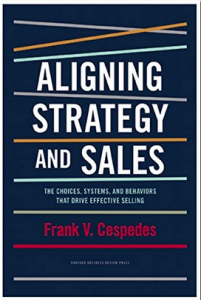 This week sees the publication of a new book I want to bring to your attention. It’s by Frank Cespedes, a professor at Harvard Business School, and an old friend from our mutual consulting days. The book is called Aligning Strategy and Sales, and it might have been called “The Massive Business Gap Sitting Right Before Your Eyes.” To use an overly simple athletic metaphor, the handoff from strategy to sales is the source of a great deal of lost value.
I hesitate to call it a revolutionary book – but you haven’t seen anything like it. It’s very important. Especially for those of you in sales, I recommend it.
Meanwhile, here’s Frank.
————————————————————–
CG: What brought you to this topic of aligning strategy and sales?
FC: My academic research always focused on go-to-market elements, including channels and sales management. Then, when I left academia and ran a business for 12 years, I had to meet payroll and sell. Then, after getting lucky in business and returning to academia, I taught Strategy for a few years. Despite decades of attention to planning, there is remarkably little research about how to link strategy with the nitty-gritty of field execution, especially sales efforts. If the gods of strategy even mention sales, it’s typically advice from a fortune cookie: get incentives right, or work as a team, or re-organize. In other words, do good and avoid evil.
CG: That sounds about par for the course.
FC: Conversely, there’s a vast literature about selling. Much is anecdotal, but some—Neil Rackham’s work is still the best, in my opinion—is grounded in good research. However, this advice is misleading in a different way: the consultants and trainers who make their living this way tend to promote the universal applicability of a particular selling methodology (again, Neil is an exception), and they treat sales in isolation from strategy. The result is that much sales training has a perverse effect: people work harder but not necessarily smarter. Selling, no matter how clever and creative, can’t generate sustained returns if it’s not linked to good strategy. That may sound obvious, but it’s not been discussed actionably.
CG: Let me get this straight: you’re saying there’s a big fat chasm of under-performance in business because strategy and sales don’t align? Just how big a deal are we talking about?
FC: None of this would matter much if de facto alignment were the norm. But it’s not. The research results are cited in my book and, as they say, they speak volumes. Studies find that few strategies—some research indicates less than 10%–are executed successfully and that, on average, firms deliver only 50-60% of the financial performance that their strategies and sales forecasts promise. That’s a lot of wasted money and effort. Ever wonder why I-Bankers and other capital-market analysts tend to be a cynical bunch? Companies regularly over-promise and under-deliver in their espoused strategic goals and sales forecasts.
CG: So, why does this happen?
One reason is that the strategic planning process in firms generates a disconnect with the requirements of sales decision making. About two-thirds of companies treat strategic planning as a periodic event, typically as part of the annual capital-budgeting process. Companies tend to do plans by business unit or P&L unit, even when sales sells across those units. The average corporate planning process takes an estimated 4-5 months per year. While this is going on, the market does what the market will do, and sales must respond issue by issue and account by account. In other words, even if the output of planning is a great strategy (clearly, a big if), the process itself often makes it irrelevant to sales executives.
CG: OK, I get the time disconnect. Give us a simple real world example of how all this can go wrong?
FC: Here’s an example I discuss in more detail in the book. It’s unfortunately representative. For many years, a company I’ll call Document Security Management (DSM) had a great business in retrieving, shredding and/or securely storing organizations’ documents. Executives and their assistants loved its one-stop-shop value proposition, and DSM’s sales force cultivated good relationships with them. DSM provided a complete service and their customers could then dedicate their high-paid lawyers and other professionals to better uses. By the early 2000s, however, cheaper digital storage technology, especially the cloud, changed the market. DSM’s CEO was determined not to be fatally “disrupted” by an emerging technology, and DSM introduced its own cloud-based storage and directed the sales force to bundle it with traditional services.
The results were awful. Many of the salespeople lacked the technical knowledge to work with clients’ IT departments. Pricing was a problem, because the physical and digital services had very different cost structures. And in spite of repeated training efforts, reps often sold only the lower-priced digital service, not the bundle. Contract renewals for traditional services fell sharply, as did profits. So DSM modified its sales compensation plan, but then digital sales declined and emerging competitors established strong footholds with multiyear contracts, effectively locking DSM out of accounts as storage increasingly migrated to the cloud. Ultimately, DSM spun off its digital unit and remains a much smaller company.
What’s the problem here? Surely, you can’t disagree with the basic strategic intent. Anyone who has absorbed the lessons of Clay Christensen’s work on disruptive innovation would find it hard to argue that DSM should not have responded to emerging market reality. That’s a recipe for becoming yet another case study about market myopia. The ultimate problem was senior leaders embarking on a strategy without considering the field realities facing the people key to executing that strategy at customers. And this occurs, very often, in many situations: M&A situations where the investment thesis rests on cross-selling or packaged solution bundles, entering a new segment with different buying processes, introducing a new product, scaling a business beyond early adopters, or dealing with new entrants.
Many senior executives, years removed from actual customer contact, are often blithely unaware of the embedded strategic commitments that sales activities daily represent. For example, executives can worry prudently and diligently all they want about disruptive innovators; you need a sales force aligned with strategy to do something about it. Otherwise, all you’re doing is worrying in a currently respectable manner.
CG: Wow. So, where do these disconnects happen? The subtitle of your book is “The Choices, Systems, and Behaviors that Drive Effective Selling.” What are they?
FC: The basic idea is this: In any business, value is created or destroyed in the marketplace with customers, not in planning meetings or training seminars. The market includes the industry you compete in, the customer segments where you choose to play, and the buying processes at customers that you sell and service. Those factors should inform strategy and required sales tasks—what salespeople must be good at to deliver and extract value and so implement your strategy effectively.
Then, the issue is aligning selling behaviors with those tasks. Managers basically have three levers to do that. People: who your salespeople are, what they know, how you hire and develop their skills so they can execute your strategy’s tasks, not those of a generic selling methodology or what they learned at another firm with a different strategy. Control Systems: performance management practices, including sales compensation and the metrics used to measure effectiveness. Sales Environment: the company context in which sales initiatives get developed and executed, how communication works (or not) across organizational boundaries, and how sales managers (not just reps) are selected and developed.
Ultimately, selling effectiveness is an outcome of these factors, not only the result of heroic efforts in the field. And this has very practical implications. If you’re a sales manager, this way of thinking may change how you select and use available selling resources, how you develop your people, and how you look at your own career and development needs. And if you’re a CEO, strategist, or Board member evaluating sales numbers, it can help you to avoid being a sucker for glib generalizations about selling–and, believe me, as someone who works with PE firms and has served on Boards, it happens.
CG: Can you say more about that? It seems that we hear daily about how social media and online technologies are “disintermediating” sales forces and transforming how companies sell.
FC: Yes, based on the business press, you could easily assume that proficiency with social media or digital marketing now determines business success. But consider the basics: US companies spend, annually, more than 3X on sales forces than they spend on all media advertising, 20X more than the total spent on digital marketing, and more than 100X what they currently spend on social media ads. Whenever I see those numbers, I always think about Mark Twain’s comment: “If you’re gonna’ put a lot of eggs in one basket, then keep your eye on that basket!”
CG: But what about all the claims of the Death of the Salesman? Just four years ago this was a big headline in the sales industry.
FC: It’s simply not true that sales forces are being replaced by ecommerce, social media, or other elements of the internet. According to US Bureau of Labor Statistics, the number of people in sales occupations in 2012 was virtually the same as in 1992—before the rise of the internet. And this almost certainly understates the real numbers: as you know, business developers in many firms, especially professional services firms, are called Associates, Partners, Vice Presidents or Managing Directors, not placed in a “sales” category for reporting purposes.
In fact, if you peek behind the server farms of online firms themselves, you find face-to-face and inside sales organizations as the engine of profitable growth. At Groupon, over 45% of employees are in sales; at Google, it’s about 50%; and at Facebook, the sales force’s ability to translate “likes” into advertisers will make or break that company’s valuation going forward.
The internet is realigning sales tasks. For example, relatively few cars are actually bought online. But about 90% of Americans research the purchase via Edmunds.com or other online source before going to a dealer. The average car shopper now spends more than 11 hours online and only 3.5 hours in trips to dealerships. But this makes selling more important, not less, because it puts more pressure on the sales person’s value-added during the shorter sales experience. Smartphones, online reviews, social media blogs—all these tools are having a similar effect across many buying/selling situations.
But, perhaps focused on technology or the media buzz, many execs ignore the implications for sales tasks and the links between Sales and other parts of their companies that deal with customers before and after actual selling takes place. Don’t believe the hype: salespeople, and the customer trust they do or don’t generate, are not becoming obsolete. With Paul Nunes of Accenture, I wrote an HBR article over a decade ago—at the height of another hype cycle when most commentary was predicting (in fact, assuming) disintermediation of sales forces. The article attracted a lot of attention, most of it very negative. We were labeled as reactionaries, oblivious to ‘disruptive innovation,’ and so on. But look at empirical reality years later: they were wrong, and we were right.
CG: What’s the biggest, over-arching problem or issue you see in the field of selling?
FC: Selling is probably the most contextually-determined set of skills in a company: what works there does not necessarily work here. There’s now a century of research about salespeople. Sales talent comes in all shapes and sizes, because selling jobs vary hugely in the kind of product or service sold, price points, the customers a rep is responsible for, the numbers and types of people contacted during sales calls, the relative importance of technical knowledge, and so on—in other words, selling effectiveness depends on the particular sales task. You wrote an excellent piece about this last year (“Half of What You’ve Learned about Sales is Wrong,” TrustMatters, April 15, 2013), and I agree with you: one size doesn’t fit all.
Yet, sweeping generalizations and outright stereotypes about “sales personalities” and the alleged core “traits” of effective salespeople still dominate the field. Why? The novelist Saul Bellow liked to explain the difference between ignorance and indifference this way: “I don’t know and I don’t care.” Many executives and sales managers don’t know about this research. In fact, as others have pointed out, many sales managers have a classic cloning bias: they hire in their own image. And many trainers and consultants just don’t care: they have a hammer, and everything looks like a nail.
In my experience, these generalizations are destructive and not just abstractions. They encourage quick-fix approaches that substitute for more fundamental sales and strategy issues confronting firms. Those approaches may be quick but rarely a fix. The stereotypes also blind managers to the interactions between strategy, sales tasks, and selling requirements that they are, presumably, paid to manage.
CG: OK, time for some key takeaways about aligning strategy and sales. Let’s focus first on the Strategy side.
FC: I don’t think I’m saying anything truly original about effective strategy formulation. But I don’t apologize for emphasizing the fundamentals because, for various reasons, executives and sales people tend to forget them. Many companies confuse strategy with things like purpose, vision, or values. That’s bad news for your firm and your career. It’s the responsibility of those crafting strategy to insist on those distinctions. Any organization’s strategy, purpose or vision cannot be independent of how the world changes. If you simply cling to those abstractions, you’re just stubborn, not principled, or you may believe your aspiration is just too big to fail; it’s not.
Then, you must communicate what your strategy means for market priorities, who are and are not your customers, and the implications for sales tasks. Most firms don’t do this—either because leaders are not clear about strategy or they worry this information will get to competitors. If the issue is the former, then clarify strategy: it’s hard for people to execute what they don’t understand. And if the issue is the latter, you have bigger problems to worry about than competitors reading your strategy documents if your salespeople don’t understand them.
CG: And the key takeaways for those carrying a bag or managing a sales effort?
FC: First, as always, People: You need disciplined hiring that’s linked to your strategy, focused and customized training initiatives, and on-going attention to broadening salespeople’s skills as markets and sales tasks change. Sorry, but almost all serious research about people in business underscores these fundamentals and debunks glib prescriptions about talent acquisition.
Second, Performance Reviews are still grossly underutilized levers for influencing behavior in many sales organizations. Busy managers treat them as drive-by conversations that are really about compensation, not review, evaluation, and development. But so much of strategy – sales alignment is only visible and manageable through on-going account and performance reviews. This is a trainable skill and there’s lots of room for improvement in most sales forces when it comes to conducting performance reviews.
Third, Perspective: Strategy is about confronting external market facts, and customers ultimately determine what are relevant selling behaviors today, not yesterday. It’s not the responsibility of the market to be kind to your strategy or current sales model. It’s your responsibility to understand the evolving market and its sales tasks. And you can’t do that from headquarters, the branch office, or solely through data analytics. A character in a John le Carre novel says something that every sales leader and C-suite executive should engrave on their desk or tattoo on some prominent body part: “A desk is a dangerous place from which to watch the world,” especially the sales world.
CG: Frank, this has been great. I’m still kind of amazed that there is such an enormous opportunity that’s been relatively overlooked; but there it is, and you’ve laid it out very clearly.
FC: Charlie, it’s truly been my pleasure. You’ve made TrustMatters a wonderful, straight-shooting medium for people to engage about sales. I thank you for the chance to add to that dialogue.
Both the sales and marketing functions have been significantly impacted by the arrival of the connected customer plus a new set of digital tools, devices and platforms.
Brand marketers and sales teams need to adopt to the new world order or risk serious business consequences. At its core, the change required is one of mindset. There is no prescribed path, so brands need to experiment and teams need to be in a constant learning mode.
Whenever one tries something new, failure is a very real risk. Yet, it’s not because we might fail that we should not act.
These days, there is a plethora of choice. There are myriad new tools, platforms and systems from which to choose to help drive the business.
However, whichever digital option a brand selects, most companies are failing to act on one very central theme for survival: customer centricity.
While many senior executives are speaking about being 'turned toward the client' unfortunately, it’s a clear case of easier said than done.
What are the keys to converting into a truly customer-centric organization? This is the question that I'll explore in this article, co-written by Stephen Gresty...
Whether it is called digitalization or digital transformation, few are the companies not looking at the impact of digital on operations.
Change management programs are afoot wherever you look. Executive teams are mobilizing and companies are needing to find new ways to drive the business. Whenever one tries something new, failure is a real risk.
Yet, it’s not because we might fail that we should not act. These days, there is a plethora of choice. There are myriad new tools, platforms and systems from which to choose to help drive the business.
However, whichever digital option a brand selects, most companies are failing to act on one very central theme for survival: de facto customer centricity. While many senior executives are speaking about being 'turned toward the client', unfortunately, it’s a clear case of easier said than done.
Many companies suffer from being overly product-centric or channel-centric (or both), where internal politics and processes as well as legacy systems dramatically impair a company's ability to become truly centered on the customer.
What are the keys to converting into a truly customer-centric organization? This is the question that this article would like to explore.
The first port of call is to take stock of where the organization stands. There are several notable ways to determine the customer-centricity of an organization:
As much as executives are aware of the need to be more competitive, innovative and responsive, the challenge is making customer centricity a de facto experience.
The intention is often there; but the actions too regularly don’t match. Consumers are prone to judge by what you do, not by what you say. Consumers have developed a very palpable mistrust of marketers and executives, to say nothing of customer-facing salespeople.
Customer centricity has been rendered enormously complex by the conjunction of three factors:
There are two very distinct areas where customer centricity takes all its weight in today’s business environment: sales and marketing.
This is nothing new, you might say. However, reality is that both functions have changed dramatically over the last decade. In the case of sales, there has been a decided throttling of the sales function in an ever more intense search for increased sales productivity.
As a consequence, widespread salespeople headcount reductions and multiple shortcuts have been embedded into the business cycle. In the process, the customer has often been given a scaled back customer service.

Like sales, the scope of marketing has had to be rethought to encompass the digital tools and opportunities.
Driven by a Taylorian approach looking for greater efficiencies and productivity, and seeking an immediate return on investment, marketers and sales teams alike have catered to short-term results. In the process, they have betrayed the consumers’ trust.
In this paper, we believe there are two very concrete paths to getting on the right path to customer centricity. The first is via a reconfiguring of the salesperson’s role and mindset. The second is by integrating and embedding digital marketing upstream in the marketing strategic planning.
In either case, the process toward developing a customer-centric organization starts with concrete, baby steps.
Notwithstanding the new marketing tools that are available in the portfolio, marketing in the digital era requires a new mindset. This includes the need to be able to act and respond in real time at the customer-facing end of the chain.
Because of the surfeit of information and ability for customers to express their opinions publicly and quickly, marketers now need to align their message with reality.
Marketers need to have the agility to respond via multiple channels and know how to manage the risk of making errors. They need to define their voice in such a way that resonates with authenticity in the customers’ mind, all the while being congruent for the engaged employee.
Aside from improving the oft-discussed storytelling techniques, a strong brand marketer is required to create content that speaks to the customer base.
The only way that will work is if the marketer develops the empathy to understand the customer’s point of view. The modern marketer will de-emphasize the display (banner) advertising option in exchange for more targeted, personalized and relevant search.
In essence, the modern marketer who is integrating digital marketing upstream, will need to understand better both the brand’s installed base as well as the targeted new audience.
Whereas spray and pray marketing methods depend on impersonal statistics, digital marketing in the area of big data allows for intelligent and real-time data.
Engaging with customers in the digital sphere in ways that demonstrate value in exchange for personal details (including an email address and/or mobile number) is the real way forward.
For a brand to improve, the first step is to experiment. Having set out some clear objectives that, ideally, can be related to a valuable return on investment, the modus operandi must follow the pattern: Act, (Fail), Learn and Improve.
Because digital marketing speaks directly to the customer and because that customer is impatient and expecting greater transparency, a brand embroiled in internal politics, without a clear voice or sense of direction will inevitably break down if it is not customer centric.
Customer service departments know this only too well. Marketing in its new incarnation must consider customer service an extension of its tools. And, of course, digital marketing must be a part of every marketer’s repertoire.
As we like to say, we’d rather see a company where everyone is 1% community manager, than have a dedicated community manager, 100% responsible for managing the online community.
Once digital marketing is integrated into the fabric of the organization, there is an inevitable process that requires the entire organization to re-organize to channel the right information in real-time to the people who are manning the customer-facing platforms and networks.
An area that sits between sales and marketing is the point of sale. As companies grapple with integrating digital tools and systems into the point of sale, the issue is how to make the new tools seamless and effective.
In this nascent area, digital is still rarely present on the high street, even though the customers are fully equipped. A successful integration of digital tools and systems at the point of sale requires a high degree of coordination between four key departments: marketing, IT, sales and HR.
Marketing needs to onboard the IT department to make sure that the infrastructure works. Retail is detail and a small bug on an in-store tablet can be a big deal from the customer’s perspective.
The staff on the sales floor needs to feel empowered by the digital tools, not disenfranchised. Hiring the staff with the right attitude is 90% of the battle, but providing the right training is also vital.
Enter a number of high street stores or sales environments and the customer is greeted by a smiling “salesperson”, because this is what the personnel have been told to do! Depending on the remuneration (salary or commission) and training, the smile can quickly become pushy or stand-off.
Where the customer centricity starts to break down is when the customer starts to need assistance from the busy staff that is focused on tidying racks or occupying themselves with paperwork rather than dealing with a customer. This is usually driven by the fact that the employees are told “what and how” to behave, but don’t really grasp the “why?
The minute the salesperson is trapped in the world of “I’m going to earn this much bonus/commission from this sale,” they are lost. If, however, they focus on the customers’ needs and desires, they won’t have to sell anything, the customer will want to buy. Then the bonus/commission becomes a simple bi-product of looking after the customer.
Below, Stephen recounts two recent personal experiences where digital tools were used to 'aid' the salesperson, but with two completely different outcomes.
Whilst waiting for a salesperson to raise their head and acknowledge that my wife and I were standing by his desk, I noticed a tablet (iPad) set on a stand next to a new vehicle. I had a quick browse to see what it had to offer. The tablet let you configure your new car, look for used vehicles and, as you would expect, provided a complete digital offering.
Finally the salesperson asked the $64,000,000 question: “Can I help you?” It would have really helped the process if he had bothered to introduce himself and attempt to enquire who I was. But it was not to be.
Rather than consider building personal rapport as one might in any social situation, the salesperson was programmed to create a selling situation.
I asked him a technical question on a particular model (which I’d already been researching). He then moved to the tablet to search for the answer, not making any reference about it or what he was doing until he said, “this is quite new and I’m not sure how it all works!”
Suffice to say, he did not secure a sale as he might have hoped. He also knew nothing of me as a potential customer.
My wife spent a Saturday afternoon searching for a particular pair of shoes. They were shoes that my wife desperately wanted (not needed!). Finally, she found a shop with the correct shoes, in the right color, only to be disappointed to discover they were out of stock of her size.
This sales assistant was a pleasure to deal with. “No problem, let’s just take a look on this tablet and if they are in stock at another branch we can get them to you by Monday....” She even tried to upsell us to another pair when my wife commented that she also liked another style she saw as the assistant used the tablet to search for the shoes. The rest is history. My wife got the shoes she wanted and the car was purchased from another dealership.
The first example raises a number of questions: what training did the car salesperson have when the digital sales tool was introduced? More importantly what ongoing training is in place to build the skill level? Why was there not a simple data-capture question when he went to use it? Does this person have the right attitude to be in sales?
The shoe salesperson, on the other hand, clearly knew how to use the digital tool to secure and possibly increase the customer spend. She also secured enough data to keep my wife on their mailing list.
Salespeople often blame marketers for not being in touch with reality, whilst marketers often point the finger of blame at the salespeople when a campaign doesn’t have the success they had hoped for.
These two functions have to work closer than ever before, when building “stories” and additional sales tools. They need to be sitting down together, planning together and using their “Collective Intelligence” to stand out from the crowd. Today’s customer is far better informed than they were a few years ago.
To keep the customer-centric approach, sales and marketing should be looking at how to help the customer buy, rather than focusing on 'helping the salesperson sell'.

To continually produce more and more sophisticated sales tools in order to be technologically ahead of the competition is good. However, if there is not enough investment in teaching the people why and how to use them, then are we not just spending money to support the company ego?
On a recent field visit with a salesperson, who was equipped with the latest digital tools, Stephen was fascinated to see that he used the tablet to rest his paper on while he wrote some notes. He then finally opened it to check the date of his next visit.
At no stage during the interaction with the client/customer did he use the tablet to assist the sales process, either by way of demonstration or reinforcing a message. Rather than a smartphone, it is a dumb tablet.
There is still a long way to go and much work to be done before digital tools are having the desired impact and adding value to the sales process in the way that many companies hope for.
Co-author Stephen Gresty is owner of coaching and training consultancy Stephen Gresty R.O.I Ltd.
What's a value proposition—and why is it important? It's a clear statement of the tangible business value that companies get from using your product or service. It's the outcome of using your offering—not what your offering is.
Offering free programs to prospects is a massive waste of resource: not only are you trying to get prospects you don’t know to spend time they don’t have to do something they don’t think they need, it becomes a double sale – you must then discard ‘no-sayers’ from your list of perfectly good prospects who might have bought.
 You could convince me if it worked. But the prospects that show up are either merely looking for a freebie (and possibly send lower level people) or are actually trialing several solutions.
It’s possible to use the phone to actually sell your solution! You do not need to give anything away for free! The sales problems you are facing are ‘sales model’ problems. You’re just not facilitating the comprehensive buy path, and assume that by letting prospects experience your solution you’ll bias their decision in favor of you.
But until buyers have all their ducks in a row – assemble everyone who will touch the final solution, compare internal fixes with current providers with external providers – they cannot buy regardless of whether your freebie is terrific. So they might attend your free program, love you, love the program, love your solution – and not buy because they aren’t ready, because they haven’t managed their internal politics, or have their ‘need’ misdefined because HR was brought in too late, or they might fire someone. None of which, obviously, is connected to your solution.
The last step a buyer takes is to choose an external solution. Where are they along their buying decision path? How many of the influencers and decision makers have agreed on an external solution as the most effective fix? How will those issues be addressed? Because until they are, you have no idea who you are inviting into a free program.
Connect by facilitating change and getting buy-in, and then continue speaking with those who are on a trajectory to change that makes sense. Buying Facilitation® will teach you how to do that, and to enable those who CAN buy (vs. those who SHOULD buy). That way you can begin each conversation by teaching folks to buy and get rid of those who can’t. And in either case you do not need to offer a free program. I’ll teach you. Sharondrew@sharondrewmorgen.comor www.buyingfacilitation.com.
Don’t Give Away Free Programs is a post from: SharonDrewMorgen.com
Earlier this week, I had a call with a CEO of a small technology company who was wondering how to optimize his lead generation.
He called me after two salespeople quit, and he said, “I’m about to give up on cold calling and start doing inbound marketing. I think cold calling is dead … what do you think I should do?”
I thought to myself, “It’s no wonder his sales team quit.”
There’s an old adage that says 90% of salespeople hate cold calling, and the other 10% are lying. No one really likes the idea of making or receiving cold calls.
If you’re randomly calling, emailing or direct mailing your customers and think it’s just a numbers game, then you need to stop. This type of interruption marketing no longer works.
He then asked, “What can I do instead?”
I gave him the following advice: Stop cold calling and start nurturing.
Cold calls vs. nurturing calls
Look up the definition of “nurture.”
Here’s what a quick search of the Web will tell you:
Nurture: To foster, help develop or help grow; the act of nourishing or nursing; tender care; education; training; that which nourishes; food; diet; sustenance; the environmental influences that contribute to the development of an individual
Your lead-nurturing program is all about having consistent and relevant communication with viable prospects (those that fit with your product or service), regardless of their timing to buy. Think of your phone as an extension of this program. You shouldn’t try to use pressure tactics in the first phone call; it’s about building long, meaningful and trust-filled relationships with the right people.
Be useful and help your prospects
Think about it: when’s the last time you received a cold call that you actually benefited from? Your customers feel the same way. Every time you pick up the phone — whether it be the first call or the 50th call — it’s important to create value by providing your prospects useful information in digestible, bite-size chunks.
John Jantsch writes in this post on Ductape Marketing Blog, “You don’t have to be a pest when you call people. In fact, don’t sell. Just be useful. Even useful voice message follow ups will let people know you are human and aren’t going to hard-sell anything. Reaching out via the telephone in a useful manner will help build trust for your other lead generation initiatives.”
Be relevant and uber-informed
When you’re making a call, the worst thing you can do is to contact someone without knowing anything about them. You must have a sound, working knowledge of each potential customer, the company and, most importantly, the issues they face and how your product can help solve them.
This personal interest goes a long way in establishing meaningful dialogue.
Begin by asking your sales team:
Find content — such as articles, blogs and white papers — that addresses these issues. Pass this content by your sales team, and ask them whether their customers would value it. As much as you can, repurpose content. For instance, white papers can be transformed into articles and articles into blog posts.
Marketing automation technology can also help you know what content people are engaging with on your website, emails and webinars, and you can leverage this information through lead scoring to help you prioritize when someone might be ready for a call.
Build trust with each interaction
“Tell-and-sell” is a thing of the past. Become a trusted advisor by adding value with each interaction and sharing relevant information.
By providing valuable education and information to prospects up front, you become a trusted advisor. Share information that sticks with them. Give them educational content that helps them grow as an individual or a company. Salespeople who become trusted advisors and understand the needs of economic buyers are 69% more likely to come away with a sale.
Here’s a nurturing litmus test: Can prospects benefit from the information you provide, regardless of whether they buy from you?
The goal of lead nurturing is to maintain a relevant and consistent dialog with viable future customers, no matter where they are in the buying pipeline. It’s about relationships. If you follow these ideas, you’ll start thinking about how you and your salespeople can be a relevant resource. When you do that, you don’t have to sell to people. They will come to you first when they are ready.
Photo attribution: Poetic Home
You might also like
Lead Nurturing: Build trust, win more deals by helping prospects – not selling them [More from the blogs]
Creating Customer-centric Messaging for Optimal Lead Generation [MarketingSherpa webinar archive]
Customer-centric Marketing: 7 triggers to engage customers and build loyalty [More from the blogs]
Competitive Marketing: How do you grab customers’ attention?[More from the blogs]
 Ask any Sales Manager, and she will tell you that her team closes 1 in 4 (or 3 or 10, whatever it is, they usually know the number). Ask a marketer what his click through rates on emails are, and again, he will know (maybe 4-5% of successful sends). But ask them how many names they need to add to their 'engine' next month, and how many deals need to close that month, and you'll probably get a "good question" response.
Ask them to give you conversion rate by stage in funnel, and they'll blink and smile. Oops.
Ask them to do this from the buyers' perspective (rather than our perspective as seller), and we won't even raise a grin. You take my point, I think.
If marketing and sales are ever to become respected management sciences around the world, we need to get good at calculating, and improving, our closure rates by stage.
In this week's show, we'll show you how to calculate your sales conversion for each stage in the buyer's journey, and how long it takes, and why lag is death.
Ask any Sales Manager, and she will tell you that her team closes 1 in 4 (or 3 or 10, whatever it is, they usually know the number). Ask a marketer what his click through rates on emails are, and again, he will know (maybe 4-5% of successful sends). But ask them how many names they need to add to their 'engine' next month, and how many deals need to close that month, and you'll probably get a "good question" response.
Ask them to give you conversion rate by stage in funnel, and they'll blink and smile. Oops.
Ask them to do this from the buyers' perspective (rather than our perspective as seller), and we won't even raise a grin. You take my point, I think.
If marketing and sales are ever to become respected management sciences around the world, we need to get good at calculating, and improving, our closure rates by stage.
In this week's show, we'll show you how to calculate your sales conversion for each stage in the buyer's journey, and how long it takes, and why lag is death.
We encounter several small business owners that come to us looking for help after Google has penalized their sites because of low quality and spammy SEO services. So many business owners simply hire the first company that they come in contact with or they opt for the lowest priced service assuming that all search engine optimization is created equally. This is not the case at all and selecting the wrong company can end up costing more money in the long run, as well as a possible ruined domain. We have said it before, and we will say it again…outsourced SEO needs to be avoided if you are serious about your business.
While your business needs SEO, it also needs to be diverse when it comes to online marketing. Imagine if Google one day decided to announce a brand new algorithm update that sent your website to the bottom of the search results? Would you still be receiving website traffic from other sources or are all of your eggs in one basket? While you should always want to improve your SEO, you need to make sure that your online marketing is diversified.
If you are worried about a possible Google penalty then you might have too much SEO risk, and need to consider concentrating on some additional marketing avenues to drive traffic to your website. Here are three tips to help diversify your risk.
Many small businesses forget about traditional public relations and get completely wrapped up in SEO and Google rankings. A good old fashioned press release is a great way to generate a buzz and attract website visitors. Many SEO professionals will advise against press releases for link building purposes, but there is no doubting that they can deliver real targeted website visitors when done correctly.
A high quality press release can get published on websites that receive a high volume of traffic, pushing heavy amounts of referral traffic to your website. You can also share them on social media, providing you with additional exposure and traffic. Using a press release to announce a new product or service also gives you a great “in” to approach relevant websites. This can result in additional press and more traffic.

Unlike SEO, PPC advertising can guarantee you relevant website traffic. Yes, you pay per visitor, but when done correctly it can help a business start to produce leads, sales, and revenue almost instantly.
It is extremely effective and it can eliminate the waiting period required with SEO. Many business owners will create ads and drop in some keywords that they think will attract buyers, only to watch the advertising budget disappear without any results to show for it. PPC requires experience and knowledge in order to create a successful campaign, along with ongoing testing and optimizing.
Several businesses will waste a high percentage of their PPC budget because of poor management. If you don’t have the luxury of a full time in-house pay per click employee you will want to consider hiring a PPC agency to handle your campaign management.
You could have an insane amount of organic SEO traffic and you could have an unlimited PPC budget, but all of the website traffic in the world is useless unless it is converting into leads and sales.
Every business is going to have a different goal, whether that is generating leads or capturing sales. Your website layout, offers, and funnel process will all impact your conversion rate. It is important to test several different options and collect data to improve your conversion rates.
Focusing on your conversion rate will help you convert more traffic, so in the event that your traffic slows down you will still generate leads and sales.
Google is always going to take steps to provide their users with the most relevant and high quality websites available. If you have used low quality SEO in the past then you might want to consider a SEO audit to evaluate and clean up your link profile.
Being proactive and removing and disavowing spammy links can help you avoid being penalized. Including PPC advertising and public relations outreach will help to diversify your risk, and focusing on improving conversion rates will help to make the most out of your website traffic.
It’s official. Summer is over. You’ve got to hand it to kids for thinking (albeit naively) they’re the only ones who think it’s the ultimate bummer. But of course, we all know the truth. It’s a bummer for everyone. While junior dreads going back to school bullies, Ms. Crankmunster, and Principal Partypooper, you’ve got your own office versions.
So knowing that, would you think it’s a bad idea to look around for software leads right when everyone’s hitting the desks again?
 The good news is that it’s not completely that simple. Sure, it might feel really bad to call up a prospect and then hear about how they just got back from the Bahamas. What may follow is a long, drawn out conversation when they’ll just inevitably say, “Call again.”
(And that’s if you’re lucky.)
On the other hand, Labor Day does offer some hidden opportunities when you’re trying to discover the pain points of a potential customer. Examples include:
There’s a lot of reasons to feel bad about summer ending. Kids aren’t alone in this. However, it’s precisely these reasons that can reveal new sales opportunities for your software firm. You don’t have to be an office supplies store to be Labor Day’s silver lining.

Selecting an inbound marketing agency is just like dating. And just as some women fall for the slick and charming bad boys, the most common mistake companies make is to fall for a slick agency presentation without taking the time to understand the character, quality, and many nuances of the agency. And although you can divorce your ineffective marketing agency, this process is often not without days of headache and frustration while still partnered with your bad choice and seeing pitiful results. So make the right choice from the get-go. Ask yourself the tough questions before you sign the dotted line:
Don’t fall in lust at first sight.
1. Do you jive with the people at the agency and the company culture? In other words, are you culturally like-minded? Keep in mind, you don’t want your client-agency relationship to be like Jenko and Zook in the latest movie 22 Jump Street; you don’t want to be so alike that its as if you two are twins separated at birth. Just like in the movie, sameness breeds banality and would defeat the purpose of hiring an agency to contribute fresh ideas. Nonetheless, you want to ensure that you can work smoothly together.
2. Do the representatives sound intelligent and creative? Can the person presenting the reports articulately convey and interpret the information. What are their marketing experiences? You don’t want interns to be doing the work or new graduates with little experience and have only taken one marketing course to be proposing the strategies.
3. Do they demonstrate a good general understanding of your industry? The last thing you want is for you to be halfway into a campaign and then realize that the buyer persona you are targeting is wrong. Or that the keywords are not searched by your target.
4. Are the representatives passionate about what they do and the company they work for? A happy worker is a productive worker, plain and simple.
Just like a person’s online dating profile, some inbound agencies can be full of misrepresentations.
5. Does the agency practice what they preach? Admit it, if you’ve ever done online dating, you’ve also done a little cyber stalking to check out the prospect before the first date. So why not do some research into the inbound marketing agency’s online presence? Google is an amazing and meticulous cyber stalking tool. (So I’ve heard. Not that I’ve ever cyber stalked any of my online dates before in my life.)
A strong indication of the potential outcome of a relationship is to look at the past to see the patterns. This is also applicable to choosing an inbound marketing agency.
6. What was the longest time they’ve worked with a client? If most of their clients have only lasted one project and there are no clients who have renewed their contract…this is a serious red flag. You could be in bed with a serial dater in terms of marketing agencies.
7. Ask for client references. A good inbound marketing agency will readily have several lined up for you to connect with.
8. Read their case studies and pay particular attention to those that are similar to your company/industry or have a similar scope. By looking at the case studies that relate to your company, you’ll have a better picture of the agency’s understanding of your industry, challenges, and needs.
Honesty is a must-have in any type of relationship—romantic or professional.
9. Is the agency straightforward about how they bill for its work? Do they share the details of the billed hours for their work?
10. Does the person you primarily work with speak her mind when asked about her opinion rather than say what she thinks you want to hear? For me at least, I feel that if someone tells me “no, this is not the right direction to go” or “this is not within our capabilities”, the frankness and honesty wins my trust any day over a yes-man.
11. Do the tactics recommended seem ethical and honest? If the suggested marketing ploys seem deceitful or misleading, what’s to prevent them from being underhanded with you?
Typically when you are in a serious relationship, there is typically an end goal in mind such as marriage. Transfer this thinking to marketing—do they have an end goal in mind for you?
12. Can they clearly define your goals? One of the first questions any decent inbound marketing agency will ask is “What are your goals?”
13. Do they understand your challenges and needs?
14. Do they have a firm grasp on your sales process? The best marketing agencies will understand your sales process and develop campaigns that integrate the two—marketing and sales—together.
Working with an agency whose sole ambition is to execute top of the funnel marketing is like dating a commitment-phobe—your leads go nowhere.
15. Do they have a clear path to conversion? This is what bridging marketing and sales is all about. They should not only focus on top of the funnel marketing, but should have a big picture approach. You want an agency that is well-rounded and can execute targeted content to guide your leads across that finish line.
When the honeymoon phase fades in a relationship, you want a partner that can suggest new ideas, new places to visit, new things to try to make things interesting and avoid the disease of same ol’ same ol’. A good marketing agency will not let your campaigns go stale.
16. Is the agency strong in strategy? Has the agency suggested good ideas that you had not previously considered? In the marketing proposal, does it focus on meeting all of your needs rather than your budget? How do they propose to reach your target audience? High-level strategy should be instilled in every inbound marketing agency, but unfortunately this is not always the case.
Sorry, but most sane individuals are not attracted to couch potatoes. You want a partner that will wash the dishes when they say they will, am I right? You should expect the same promptness in keeping promises with your chosen marketing agency as you would in any relationship.
17. How efficient is this agency? Do they use marketing automation software tools? Like it or not, software tools are a critical component of successful inbound marketing.
18. How long have they been using the software? Time should be spent on actual work and not project management or learning a new software. These tools should make things faster and simpler, not harder.
Men and women alike appreciate a partner that has some life ambition who works to achieve those goals. Let’s apply the same quality to inbound marketing agencies:
19. Do they stay up to date with marketing? What ongoing training do they provide their staff? How do they ensure they stay current on the latest and greatest marketing tactics? Knowing the answer gives you an indication of how progressive the agency will be.
20. How do they apply the new changes, test out new processes, and integrate new thinking into client work?
In every relationship book, you will be certain to find the key to a strong marriage is communication. This is no different for your relationship with your chosen inbound marketing agency.
21. Do they know the statuses of the projects and when they will be completed? Or do they stutter and give vague approximations heavy with excuses?
22. Have they been prompt in returning your calls or emails during the review process?
23. Who do you call if you have a problem?
24. How often will you and your primary contact touch base?
25. What tools or resources do they use to share information? You want to make sure that the tools used to manage approvals and communication is user-friendly.
A healthy relationship will continue to grow. Growth comes from regular evaluations and improvements. Same goes for your marketing campaigns.
26. How do they determine the success of a campaign?
27. What metrics do they track?
28. How often will you receive a report?
29. Are the analytics report presented in a simple and intelligible manner?
30. Do they reassess the effectiveness of the campaigns and offer suggestions to improve or reinvent the strategy for increased conversion rates?
Choosing a lifelong partner is a critical decision and deserves extensive time and effort to determining the rightness of the match. That same exhaustive selection process should also be applied to choosing an inbound marketing agency. Don’t get in bed with the wrong agency too quickly and later regret your choice having spent a vast amount of money and time.
What other questions do you ask before signing with an inbound marketing agency?

Data is a critical part of any effective sales and marketing strategy. GreenRope helps you organize, track, and utilize your data to help grow your business and provide the best customer experience to all of your leads and clients. However, data is only useful to you once all the information you have collected is organized properly.
Most of our users fall into two categories before implementing GreenRope: either they have data in a system or they don’t. Now, we know that you are excited to get the GreenRope ball rolling, but in order for you to grow in the future, it is important you start with a strong foundation. So, to help you as your GreenRope journey commences, here are a few tips for organizing your data before you import it into your GreenRope Account.
Establish goals
First things first, you must establish your goals. What are your main goals for implementing a CRM? You do not have to jump in and use all of it at once, you should build upon with each feature you implement. Is your initial goal to start sending out email broadcasts, lead acquisition, workflow automation, or maybe simply building your new website? Regardless of what it may be, you must establish what it is you want to accomplish first and use that as the foundation for organizing your data.
Decide on the data you want to collect
Start with the data you have already, then think about the data you would like to collect about your leads and customers. Beyond name, email, address, etc, what are the custom data sets relevant to your business that you want to be able to collect and store in your CRM?
Examples of custom user-defined fields:
*Because these are custom user-defined fields, select as many data fields that are relevant to your business. If you are a doctor and want to record a patient’s blood type, then that would be one of your custom user fields.
Segment your lists
Not every lead or customer is at the same stage, nor do they necessarily want to receive the same information. GreenRope allows you to easily segment your lists and target each with valuable and relevant content and information.
Remember, leads and clients can flow in and out of groups based on their behaviors, so keep this is mind when you are developing your segmented contact lists.
Once you establish your goals, user-defined data fields, and segment your contact list, then you are ready to import your contacts into GreenRope.
Tips on segmenting your lists:
Because each group can have their own signup forms, drip campaigns, tracking, etc, there are endless possibilities for how you can setup your sales and marketing strategies.
For more information on organizing your data before the import, please review this GreenRope webinar.

There are millions of blogs on the internet and new bloggers are getting started everyday. A good amount of these blogs are making money, but the majority of them simply have no idea how or even know what they are doing.
The sad thing is that “make money blogging” is one of the most sought after keywords and topics online, but so many bloggers are still struggling with the method.
In this post I will break down three different ways bloggers can make money with their sites and get back on the right path.

The best approach when building a blog is to try and build an authority blog. It sounds a lot earlier than it is. Remember when I said there are millions of blogs in the world today and more are going live every day?… well, all of them are your competition.
The best way to start your journey to eventually becoming an authority blogger is to find a niche and own it. By focusing on smaller niches, this will allow you to keep your content focus tight and have to compete with less sites in the search results.
Here’s a few things you will need to get started.
One of the biggest problems for bloggers is that they know how to write content, but they don’t know how to find advertisers or build their own products. Fortunately this is where affiliate marketing comes into play. Affiliate marketing is the concept of linking to a site and earning a commission for any sales or leads that are as a result of traffic from your site.
I’ve listed some of the most popular affiliate programs for you below.
Just like there are affiliate networks, there are also networks that connect bloggers with advertisers as well. Some of these networks will allow you to join their directory, set your own price for a “sponsored post” and make the process of collecting money from advertisers much easier. The benefits of joining a sponsored posts ad network is that you will reach a whole new audience of advertisers that you probably would never receive directly.
Again, I’ve listed some references for you below.
The hardest part for most bloggers is all of the work in the beginning and not seeing immediate results. Blogging definitely takes a lot of effort and time. Create a blog around something you are interested in so you don’t get bored with it, then you will see the massive influx of traffic, revenue and growth as the site continues to grow and age.
Embrace storytelling for your social media channels with a defined strategy, not nebulous guff.

Marketing has moved on, the traditional sales funnel on the verge of extinction. Instead, consumers are using social media to engage with your customer services team, to research products and services and to share opinions about you with other consumers.
It’s the customer’s journey now.
To engage successfully with wired customers in this new world of consumer-empowerment and social media,more and more marketers are turning to ‘storytelling’ to capture their attention.
It’s a technique the team at Oracle has embraced. Oracle has just launched its ‘Percussion’ campaign.
New era, old era
Storytelling is nothing new – TV ads have been using stories for decades to engage with customers and snare their imaginations. And using storytelling to increase consumer engagement via your company’s social media channels is based on a tradition that has evolved over hundreds of thousands of years.
Storytelling vs. scepticism
But there is a problem – how to create a social media storytelling strategy in the first place. Insights into marketing storytelling can seem nebulous and pretentious, phrased in ways that threaten to leave the C-Suite shaking its head as yet another self-proclaimed marketing ‘visionary’ tries to sell the Emperor another empty wardrobe.
It’s imperative that you create a clearly-identified process that you can use not only to win over the C-Suite, but everybody in the company – because you’re going to need their input to tell stories about the people, situations and dramas behind your company’s products.
Stage 1
“Listen, listen, listen”
Listen to what your existing customers and employees are already discussing in the online space. What themes are predominant about your company? What issues are being talked about? This initial listening phase is essential for creating a road map for the kind of content you will be producing for your initial storytelling engagement strategy.
“Content can create leads if your storytelling captures the customers’ imaginations.”
Stage 2
“Forming the Right Mindset”
Form a team that will be responsible for creating your stories and content strategy. Think community managers, social media analysts, journalists and the right tools bought in from social media software vendors – they are all essential to creating content that is story-, not marketing-driven.
“These editorial teams can brainstorm initial ideas and angles for content, based on research into customer and employee stories and themes.”
Stage 3
“Generating Your Stories”
The people who know the most about your company are your employees – so your storytelling should come from inside your company, not a third party supplier. From employees at the coal face to directors in the board room, everyone has a tale to tell about their job and the company they work for; a story which they would love to share if given the opportunity and the platform on which to tell it, and one that reflects what the company and its ethos and products are really all about.
It’s these kinds of personal stories that will engage customers. Offer the storyteller guidance on how to get their thoughts down and what channels are available to them:
The bottom line is anyone can contribute, anyone can tell a story – and your team is there to help them express it via collating, editing or even ghostwriting.
“Test major storytelling content on a small-scale first to see how it engages customers.”
Stage 4
“Creating Your Channels”
How you deploy your storytelling across various social channels is just as important. Judge how your company views each social platform – for instance, Twitter could be used for a news-style ‘headline’ to attract interest while the Facebook version of the story could focus on the human element. Alternatively, LinkedIn’s more professional approach could focus on a long form, more detailed version of the story.
“Ensure your story plays to the individual strengths of each platform to exploit its maximum potential.”
Stage 5
“Gaining Traction”
Social media storytelling is a two-way street; in the beginning, you’ll be telling the stories that engage customers. But as the process evolves, customers will start sharing their own stories, thoughts, feelings and experiences. After all, we love sharing stories with each other and the great thing about social media channels is that it can be done instantly, almost as an ongoing conversation between you and your customers – and between customers themselves.
“Make your stories about people, not products. Customers don’t relate to products.”
Stage 6
“Monitoring Your Channels”
Use metrics and data analysis to break down which customers are using which channels; from here, you can target different forms of storytelling to suit their preferences. For instance, LinkedIn traditionally attracts experts and dedicated customers to its forums whereas ‘fans’ of your company are more likely to populate Facebook. And how about employees? Use metrics to identify and cater to different readers.
“Metrics can help identify the types of stories that are engaging people too – or are falling flat – and such findings can be used to inform your future editorial plans.”
Stage 7
“Preparing For The Future”
There’s one simple rule: there are no hard-and-fast rules, no strategies that should be carved in stone. Your process will be in constant flux, changing and evolving over time. That might sound like grappling with a wet bar of soap – but it’s actually what makes telling stories so dynamic, so engrossing, so exciting.
“With the right mindset and protocols in place, you will be in a position where you can adapt your strategy on the fly, adjusting your storytelling to suit you and your customers’ needs.”
This article first appeared on #TheSocialInfluencer microsite
I probably don’t need to convince you of the value of content marketing as much has been written on the topic in the past few years.
However it can still be difficult to measure the precise ROI of content marketing, as one can’t simply point to a blog post or YouTube video and say it definitely led to someone making a purchase.
However there are methods of proving the value of content marketing to an organisation, as highlighted by these case studies.
And for more on this topic, download our content marketing periodic table or the skills matrix.
And head over to our new(ish) Case Study Database if you need further real world examples...
A common marketing tactic is to draw a tenuous link between a product and seasonal or newsworthy events – step forward software company SunGard AS and its campaign describing how to survive a zombie apocalypse.
The zombie-themed content was used to generate awareness among IT professionals for SunGard AS cloud products in the run up to Halloween. It included an ebook on zombie apocalypse survival as well as an infographic.
Both were tied back to SunGard AS’s product offering with a CTA that directed users to a landing page detailing how to improve resilience without breaking the bank.
Overall it achieved a 150% greater clickthrough rate than the company’s other campaigns and delivered a 200% higher click-to-open rate.
Most importantly, the zombie content generated 24 leads.
Logicalis used content centred around thought leadership to help build up its HP sales pipeline among existing contacts.
The marketing department designed six email creatives, an ebook and an eight-page microsite that enabled the telesales team to personalise messages based on a prospect’s participation in the campaign.
Logicalis targeted 2,000 existing and prospective customers, with these results:

Blogging has been a spectacularly successful marketing tool for Econsultancy, but even we can have problems giving a specific ROI on our endeavours.
However online retailer Zagg’s blog apparently delivers 10% of the site’s traffic and an ROI of 172%.
The mobile device accessory provider publishes 25 to 35 posts each week that are targeted at its tech-savvy audience.

60% of blog traffic comes from new visitors, so it’s an important way of bringing potential customers to the site.
Zagg pays three writers who are tasked with producing content that is shareable, popular, and also promotes its product range. This includes news, how-to articles and entertaining posts.
But the initial investment in hiring staff and building up the blog has clearly paid off.
Infographics have been overused in recent years, but they’re still an effective medium for content marketing.
HCC Medical Insurance Services (HCCMIS) managed to increase blog traffic and email revenue using an infographic aimed at its travel customers.
The graphic had three sections:
The idea was that the content becomes more interesting and shareable if there is an element of interactvity.
Once it was completed the graphic was initially shared with HCCMIS’s list of influencers before being shared more widely across social and via email.

Compared to its normal sales emails the infographic achieved a 96% lift in email revenue, while on Facebook the post that featured the graphic had more than 2,000 interactions compared to an average of 10.
Overall HCCMIS’s blog post featuring the graphic achieved 3.9m views, of which 90% were new visitors.
Content marketing can even work for industries that might not appear to be all that sexy, as demonstrated by Fisher Tank, a company that makes giant, above-ground welded steel tanks.
As you can imagine, Fisher Tank’s products have a long sales cycle and it has traditionally relied on cold calling or referrals from existing clients.
However the company altered its approach to include a greater focus on its new website, blog articles, and downloadable content such as a free comparison guide.
Just 12 weeks after launching the new site it achieved the following results, though it’s obviously important to note that not all of this can be directly attributed to content marketing necessarily:
ShipServ is an online marketplace for the marine industry, connecting suppliers and ship owners around the globe.
Its online offerings include a trading platform, supplier search tool, ordering guide and an ad network.
The problem ShipServ encountered was that its customers weren’t always that tech-savvy so many had issues with the switch to an online marketplace from more traditional purchasing channels.

To remedy this, the company implemented a content marketing strategy in 2008 with an initial budget of $30,000. ShipServ launched a new website, started blogging, published a series of white papers and created a LinkedIn group.
After three months ShipServ had broken even on its investment and achieved the following results:
 How do you think content marketing will change — and what do you need to know to approach your job more successfully?
This question was recently posed to 27 marketing leaders during a series of in-depth interviews conducted by CMI, and a few key themes emerged. For example, we found many content marketers want to improve their editorial processes and centralize their content planning efforts; others took this a step further and were looking to integrate their editorial and demand generation processes so the content they publish can drive better business results.
At the crux of all of these desires for change is a fundamental need to transform an organization’s culture — a challenging prospect for enterprises to achieve, given that silos and strong histories often hold sway.
In Part 2 of our CMI Executive Research series, we explored the best ways for businesses to shift to a content marketing mindset. Given how closely this is tied to transforming the culture of an organization, as a whole, it’s not something that happens easily or quickly — especially in large organizations.
Check out the full report on our findings, below (you can also download the PDF by selecting Save via the SlideShare link). You can also read the first part of our series, How Enterprises Structure, Scale, and Spend on Content.
But for a quick snapshot, here are six of the key insights and recommendations I took away from our conversations with marketing leaders at the inaugural CMI Executive Forum.
Getting buy-in is a recurring theme at CMI, as we often talk about the importance of executive support. While this is obviously critical to the success of a content marketing plan, it’s equally as important to get buy-in from sales, your other team members, and anyone else who might have a role to play in the content marketing process (think: subject matter experts, IT, etc.).
Not surprisingly, the principles of content marketing may be exactly what marketing leaders can use to get buy in. Ask yourself: “Who needs to buy in, and what does each person care about?” Market your content marketing efforts internally, with a dedicated focus on how this transformation will positively impact the core teams’ top priorities.
In short, figure out what content effectiveness would look like from management’s perspective, and tailor your presentations and communications to focus on that. (Our full report provides some additional ideas on how to get sales to actually use the content you create.)
If your organization needs to “raze the silos” and get everyone on the same page, there is no better approach than in-person workshops. As one marketing leader explains, the outcome of these workshops should be a decision on which campaigns and initiatives the team should be working on. Instead of having everyone go out and do their own things, workshops allow team members to collaboratively determine these priorities in person, which gives everyone a sense of ownership and clarifies the themes that should be used consistently across the organization.
When executed successfully, content marketing touches many departments across an organization. While workshops on the discipline can help teach basic concepts, to truly get all teams working toward the same content marketing goals, you need to make sure everyone is being recognized and/or rewarded based on the same outcomes. For example, you may have one team focused on using content to drive website traffic and another team focused on content that directly leads to sales. This strategic conflict impacts content creation and could mean that instead of meeting both goals, you may not meet either one. As a general rule, it’s best if organizations align team metrics with enterprise-wide budgets and priorities.
Some marketing leaders who don’t yet have buy-in or who are still trying to expand content marketing within their organization are finding success by creating a “pocket.” This is a way to start to experiment with content marketing, show early successes to executives as proof of the potential this discipline has, and then apply what you’ve learned as you ramp up content marketing efforts within the organization. Without sounding trite, it’s often more useful to ask for forgiveness instead of permission, and these “pockets” can help you move content marketing forward even if you haven’t been able to get full buy-in in advance.
Agile marketing is a trend in which small teams work closely together to create marketing programs that go through many tests and iterations on the road to finding the plan that works best. By learning and adapting quickly after each test project, agile marketers are able to continually improve their outputs. It’s an approach that is starting to gain favor among marketing leaders: As one participant at our CMI Executive Forum explained:
I think agile marketing is one of the keys to making the transition from marketing — changing the culture to be a more accountable one that really is focused on results and outcomes, and not just lists of deliverables that someone asks them for.
Marketers, by nature, are positive and ambitious and (sometimes) structured; yet, content marketing can be a messy, challenging, and unpredictable endeavor, at times. As backwards as this may sound, embracing failure and uncertainty can be an attribute of a strong leader. People are attracted to those who are honest and human, so if you want to get your team behind you, be decisive and confident, but be open to sharing failed experiments, as well. In turn, your team will be more likely to experiment.
Which of these approaches has worked for you — or, do you have others that you can share? Let us know in the comments.
View the full report to get additional ideas on how to transform your organization. And, for even more executive-level insights, subscribe to CCO magazine.
Cover image by MeganY via pixabay.com
 Indispensable leaders make employees better, they drive revenue and maintain a sense of optimism around the office.
They understand that each day of leading is a challenge and embrace the hurdles they encounter rather than circumvent those obstacles.
These are the individuals who accept full responsibility for the performance of their people. They embrace the fact that the buck stops with them.
Most importantly, indispensable leaders leverage their influence, knowledge and experience in order to make the companies they work for win.
They share an unwillingness to accept defeat. As a result, they figure out what must be done in order to achieve uncanny monetary improvements.
Below, you’ll find a few key implementations that will not only propel you to the next level, but that will also make you invaluable and indispensable to any company.
Remember, the more important an applicant is to their company, the more options they have upon working with recruiters, HR managers or executives upon searching for other jobs.
Personal success without leadership brings only limited effectiveness. Without leadership ability, a person’s impact is only a fraction of what it could be with strong management.
When average leaders depart from an organization, it is an annoyance to that company. HR may have to take significant time and energy to find a replacement, people around the office may have to take on extra responsibility.
Though, it does not hinder the “big picture.” The more difficult you are to replace, the easier it is to negotiate raises, start entrepreneurial ventures within the company and gain the respect of both your subordinates, bosses and clients.
Prior to requesting a promotion, asking for a raise or leveraging another job offer, you have to gauge how crucial you are to the company’s success.
For measurement purposes, there are a few questions that are imperative to answer. Be honest with yourself and, where you fall short make the necessary adjustments to improve your skills, work ethic and sense of character as the greater the consequences for the company, the greater your leverage is in a myriad of areas.
1. Create an unified vision among your subordinates. A team doesn’t win the championship if their players are working from conflicting agendas. Getting everyone on the same page will allow you to become a key part of the company as the organization risks losing clients, employees and moral if you leave.
2. Develop a good relationship with those under you. People want to go along with those whom they get along with. Build trust by being honest and authentic.
3. Become cognizant of market changes. Really strong leaders have a special capacity to anticipate the radically unexpected. Start to become cognizant of the moves made by your competitors and be aware of new entrants and threats to the industry.
Companies live and die by their ability to alter business strategies with changing market conditions. Often, the individual who can do this is worth their weight in gold to the company.
4. Surround yourself with people better and smarter than you are. A good leader has the courage to surround themselves with people better than themselves.
5. Gain a heavy duty resilience. Every leader makes mistakes, every leader stumbles and falls. Indispensable leaders learn from mishaps, regroup and then get going with a renewed speed, conviction and confidence.
Work on improving yourself before you attempt to improve others. Find a job that you are passionate about and an industry you are happy with. Know where your time goes.
Remember, becoming an integral part of a company will not only provide you with a happier, more lucrative career, but it will also foster self-confidence and a sense of well-being.

Each week, our friends at Backerjack bring us updates on some of the most successful gadget crowdfunding campaigns.
iGuardian is a device only slightly larger than a pack of gum that connects to your network before any other device and monitors the data going in and out from connected devices. Using the most recent security protocols, and with the ability to be updated as necessary, iGuardian serves as an Internet doorman of sorts, keeping an eye out for threats and denying them any kind of access whatsoever. iGuardian is easier to set up than any kind of software firewall, just needing to be plugged into the same network that others are plugged into. From there, iGuardian can protect not only computers, but smart home appliances, smartphones, and any other products connected to the network as well.
Thus far, iGuardian has raked in enough to beat its goal with time to spare. Because iGuardian is a physical device that monitors data being sent and received at the point of entry, it allows for strong security, peace of mind, and simple setup without sacrificing processor power or access to favorite social media sites. The presentation is very basic and no-frills, but the freedom that iGuardian opens up is enough to brag about once the home network is free from threats of malware and data theft.

Bleep is a hybrid smartphone cable that can charge your iOS or Android phone and back it up at the same time. By condensing the charging cable with USB storage, bleep backs up your data every single time you plug it in without affecting charge time. With the data securely stored right on the cable, you’ll be able to recover relevant data to any smartphone even after losing your own. Its physicality also allows you to do all of this even without an internet connection or computer. In addition, bleep has created a mobile app on which you can manage your backups and set your own security parameters, giving users full control over how exactly their data is protected.
Bleep has already exceeded its goal with over a month left to go on the campaign. The bleep is an innovative take on the humble charging cable. Bleep intelligently adds utility to the charging cable while remaining unobtrusive. It would be nice to see more color choices and there’s some legitimate concern that a cable is often easier to lose than a phone itself. But the extra premium that bleep commands seems with it in terms of convenience and piece of mind.

Slice is a hard drive-based media player designed to be snappy and easy to use. It’s a minimally designed black box outfitted with an array of usual ports along with a customizable LED ring that changes color depending on its current action. This adds a unique aesthetic twist to an otherwise unassuming design. Slice also ships with a custom-made RF remote, giving you the flexibility to be anywhere in your home and still command Slice.
Slice has already slammed its goal with weeks left to go on the campaign. One of Slice’s biggest draws besides its simplicity is its openness. Since it’s built atop a Raspberry Pi and uses the XMBC software, Slice is open and hackable, allowing more creative technical individuals to do pretty much whatever they’d like that’s within the device’s capabilities. Slice will have the most appeal to those who have large collections of movies that lack copy protection or who like a bit of a light show with their home video entertainment.


Every business can use more leads, and business owners are constantly searching for new ways to increase the number of leads that their website generates. There are two things that will help increase leads. The first is to increase website traffic, and the second is to increase conversion rates. This sounds great (and completely logical), but many business owners struggle with both of these.
The only way to increase your conversion rate is to drive more traffic, and it needs to be targeted traffic. You could drive thousands of visitors to your website daily, but if they have no interest in what service or products you provide your conversion rate will be nonexistent. In an effort to help your business generate more leads we have put together a list of nine tips to help increase your traffic and conversion numbers.
A slow loading website will turn away prospects extremely fast. Nobody has the time or patience to sit there and wait for your pages to load. There probably aren’t too many business owners that test their page load speed or look into what is causing performance issues. This isn’t because they don’t care, as most are unaware that there are potential speed issues and a way to improve the problem.
There are two great free resources that can help identify issues that are causing page loading delays as well as provide solutions to fix the problems. The first is GTmetrics and the second is Google’s PageSpeed Insights. Simply enter in your URL and they will provide you with a score and suggestions to help improve your speed.
If your visitors aren’t sticking around long it is very unlikely they will convert into a lead.


It is so important that your website is accessible on mobile devices, as 61% of mobile users are likely to leave a website that is not mobile friendly, and 88% of consumers who search for a type of local business on a mobile device call or go to that business within 24 hours.
If the user has trouble navigating your website on a mobile device do you think they are going to go out of their way to interact with any of your calls-to-action? Of course not! Give them a pleasant mobile experience and watch your conversions increase.
When you create content for your blog don’t worry about SEO. Worry about whether or not it is going to provide value to the website visitors that stop to read it. Are they going to learn something or are they going to view it as overly promotional?
Often times we have business owners ask us how long their content should be. There is no right or wrong answer. Do you think a website visitor is going to finish reading your blog posts and say to themselves, “Well I am very interested in this business but this blog post was only 800 words and I only interact with companies that produce a minimum of 1,200 words per post.” How ridiculous does that sound? Focus on providing value and watch your leads increase.
You have social media accounts and you are creating content for your website, correct? Are you sharing it on social media after you create it? As obvious as this question might appear, there are several businesses that do not share their own content across their social media profiles.
This results in more sharing and introducing additional consumers to your brand. It is also important that you make your content easily shareable by your visitors. We use a very simple plugin that displays eye appealing share buttons and allows our visitors to share our content with a single click of their mouse.
When your content is shared across social media it begins to drive traffic to your website that is interested in your brand. This will naturally result in more leads being generated.

Nearly 70% of all email is opened on a mobile device, so it is important to make sure that the email management program you are using is sending mobile friendly emails. If you are using calls-to-action in your emails you want to make sure that the reader can quickly identify them and click through to your website.
This also goes back to point #2 above. If someone can read the email on their mobile device and then they click over to a website that isn’t mobile friendly they are going to leave. Make sure that the entire flow, from email to website visit, is pleasant on mobile devices to increase the number of leads you generate.
Every business is starting to blog now, and while it is a very effective way to get website visitors interested in your brand, sometimes you need to stand out. Nearly every website is publishing blog posts, and infographics allow you to use visual content to really grab the attention of your visitors.
Not only will more visitors interact more with an infographic when compared to a regular blog post, but they will also be shared more across social media. A well thought out and clever infographic can go viral, especially if it is related to a current event. Companies that use strategic infographic marketing can really drive a lot of targeted website traffic, resulting in more leads.
Not only should you have calls-to-action on ever single page of your website, but you should have multiple CTAs located all over your website to increase your lead conversion rate. There are multiple action examples, such as downloading a free eBook, subscribing to a newsletter, signing up for a webinar, or filling out a contact form.
It is important to have them located throughout your website. We have three CTAs on every page. We have a free eBook offer, a newsletter subscription offer, and a quote request option located in our sidebar and then we also have an option to subscribe to our newsletter in the footer of our site. This enables visitors to sign up that reach the bottom without having to scroll back up.
One of the CTAs mentioned above was for a free eBook download. This is a great way to generate more leads, as your visitors will be happy to give up their name and email address in exchange for something that they see value in. Both sides get what they want. Your business generates a new lead and the visitor receives something of value.
There are many different incentives you can offer. eBooks, webinar access, special discount coupons, access to locked content, or special reports are just a few examples. Every website is going to have a different market and target customer, and by using common sense you can identify some attractive offers to entice your visitors with.
Often times businesses will launch huge online marketing campaigns and drive the traffic to the home page of their website even though they are using keywords and ads related to specific products or services that their business sells.
It is important to send traffic to the most relevant page of your website. For instance, if you are running a pay per click campaign and targeting keywords related to a particular product that your website sells you would want to send those visitors to the actual product page on your website where they can read more information about it. This increases the odds of them completing one of your CTAs and turning into a lead.

At age 89, Larry South would have been forgiven if he had chosen to retire on a sunny beach in Florida. Instead, the former MPP from Kingston, Ont., recently embarked on a political battle to overhaul the municipal property tax system. South had been growing increasingly concerned that elderly homeowners on fixed incomes were struggling to cope with rising property taxes because of the soaring value of their homes, while at the same time he fretted that young workers, with their stagnant wages, were being shut out of the housing market. And so South proposed replacing property taxes with a tax equal to 4.5 per cent of a homeowner’s yearly household income. Doing so would make it easier for young workers to afford the cost of owning a home, while struggling seniors, he believed, would be the biggest beneficiaries.
But in his quest to change the tax system, he has come across an unlikely foe—his elderly friends. Like South, a former engineer who estimates he earns a retirement income that’s 30 to 40 per cent above the $86,000 household average in Kingston, many of his friends also pull in six-figure retirement incomes. Thanks to their high earnings, many would end up paying more in taxes under South’s plan than they do under the existing property tax system. Some, he says, resent the idea of paying more in tax than their younger, lower-income neighbours. “There’s not many that would have an income much less than $100,000, so their taxes will go up,” he says. “But they shouldn’t expect to be subsidized by the poor.”
South’s struggle to reform the property tax system, and the resistance he’s found among his affluent elderly friends, underscores what has been a remarkable shift in the nature of wealth in Canada. Seniors have long been considered society’s most vulnerable citizens, fragile pensioners on fixed incomes in need of a financial helping hand from both government and agile younger workers. That was true decades ago, but not anymore. Thanks to stock market booms, economic growth, a soaring real estate market and a major expansion in both private and government pension plans, today’s seniors are arguably the wealthiest generation in history. The changing fortunes of the elderly have been both swift and profound. In the 1970s, nearly 40 per cent of Canadian seniors lived in poverty. Today it’s five per cent, half the poverty rate of the working-age population and one-third the rate of poverty among children.
Seniors have seen their wealth quadruple since 1984, according to a Bank of Montreal study released last month, far outpacing the growth of wealth among younger Canadians. The stunning transformation of the balance sheets of the elderly is thanks to a combination of financial discipline, public policy and good timing. Many of today’s seniors were the babies born in the aftermath of the Great Depression who learned to abhor debt and save aggressively. (The average Canadian senior has a debt load equal to just five per cent of their total wealth, compared to a 99 per cent debt-to-wealth ratio for their Boomer children.) At the same time as they were socking away their hard-earned money, seniors got a major boost from the introduction of public benefits like Canada Pension Plan, Old Age Security and taxpayer-funded health care, which has helped push the poverty rate among elderly Canadians to one of the lowest in the Western world. Many benefited from decades of economic growth while being spared the brunt of the 2008 meltdown because they had already shifted their savings into low-risk investments when they retired, says Goshka Folda, senior managing director of research firm Investor Economics. During the depth of the recession in 2009, 86 per cent of retirees told Statistics Canada researchers that they weren’t financially stressed and were living better in retirement than they had expected.
Not everyone is benefiting from these changes, however. The fortunes of younger Canadians haven’t improved nearly as much as they have for the elderly. In the 1980s, the typical senior was four times wealthier than the average 20-something. Today’s seniors are now on average nine times richer than their Millennial grandchildren. In fact, many of the trends and policies that have worked in favour of seniors have come at the expense of younger generations. That’s led some to warn of a coming generational war if public focus and resources aren’t shifted away from seniors to younger workers who are struggling far more than their parents ever did.

“This seems to be the golden age of seniors,” says Roger Gibbins, who retired as the head of the Canada West Foundation think tank in 2012. “Not in the advertising sense like life begins at 55, but in the sense of economic circumstances that have come together that make it a pretty good time to be old in Canada.”
Forget fears about a retirement crisis in Canada—the one where cash-strapped seniors will outlive their savings and suck the government coffers dry. Seniors may eventually become the only thing that drives the economy. Canadians age 75 and older make up less than seven per cent of the population, but control more than a third of all financial assets in the country—roughly $1 trillion worth of stocks, bonds, mutual funds and cash, says Folda. That figure doesn’t even include the money locked inside their homes, which have more than quadrupled in value since the 1980s. Far from running out of money, many seniors actually continue to save well into their golden years. Malcolm Hamilton, one of Canada’s foremost experts on retirement, has estimated that senior couples save or give away an average of 18 per cent of their incomes—rising to 30 per cent for the wealthiest families. That certainly makes them generous, but does it mean they should continue to get seniors-only discounts or qualify for government benefits like CPP and OAS?
The dramatic change in the fortunes of seniors, from the impoverished pensioners of yesterday to today’s wealthy retirees, is among the greatest policy success stories in Canadian history. Yet there’s a dark side to the success, one that threatens to spark an ugly generational crisis, in large part because governments continue to focus so much of their resources on supporting the plight of economically fragile seniors at the expense of their far more fragile children and grandchildren. “We are mistaking physical frailty for financial frailty,” says Fred Vettese, chief actuary of Morneau Shepell and co-author of The Real Retirement. He estimates that fewer than 10 per cent of seniors actually fit the description of pensioners living on fixed incomes anymore.
Seniors’ incomes have jumped 40 per cent since 1984, says the Bank of Montreal, compared to 21 per cent for Baby Boomers and just three per cent for younger Canadians. Today, the average Canadian man aged 65-plus earns $45,817 a year compared to $42,160 for men aged 25 to 34. More than 40 per cent of Canadian millionaires are 65 and older. The median net worth of seniors has similarly jumped 70 per cent since 1999, but hardly risen at all for those younger than 35. Meanwhile, those under-35s have seen their debt rise almost as quickly as their grandparents’ wealth. Retirement savings accounts have shown the same troubling divergence. Since 1999, the proportion of seniors who have RSPs has grown 30 per cent, while it has fallen five per cent among younger Canadians.
Despite their affluence, seniors remain disproportionately the beneficiaries of government subsidies and tax breaks. German think tank Bertelsmann Foundation has called Canada among the “least intergenerationally just” countries in the world, with a troubling large gap between the poverty rates of seniors and children and a strong “elderly bias” among government programs and tax systems. It found we spend nearly four times as much on support for seniors as we do on children and have roughly $250,000 worth of government debt for every child, an indication that future generations will be paying for the excesses of previous ones.
From seniors-only tax breaks to free transit passes, Canadian governments now spend a collective $45,000 a year per senior in Canada compared to $12,000 for those younger than 45, says Paul Kershaw, a professor at the University of British Columbia who founded Generation Squeeze, an organization that advocates for generational equity. Most of the difference comes from big-ticket items like health care, along with CPP and OAS. But governments also spend an average of $613 per senior on tax breaks for housing, compared to $354 for similar housing tax breaks for younger Canadians, and offer seniors another $1,123 in age-related income tax credits. The federal government is increasing its spending on seniors at a rate of $12 billion a year, Kershaw says, while adding very little new spending for younger Canadians.
“We developed a sort of mythology of seniors as being very dependent or very vulnerable,” says Gibbins, 67. “I think to some degree that image of seniors living in unheated apartments eating cat food has been maintained almost as a way to protect a group of people who are actually doing very well these days.”
Many point to changes in the economy that are working to effectively shut out younger Canadians from the economic windfalls of their parents and grandparents. Increasingly, the retirement dreams of younger Canadians are resting on the foundation of an economy that is shifting toward low-wage service jobs—many of them for services catering to their affluent grandparents. “I go for my Starbucks every day and I can afford the price to keep that part of my lifestyle going,” says Gibbins. “But I need young people who are prepared to work at Starbucks for a pretty low income. It makes me feel a bit uncomfortable in this advantaged situation. I’m not sure it reflects my own hard work; it reflects the demography.”
Younger Canadians will inevitably be working longer than their parents and grandparents, given the age to qualify for CPP and OAS is rising from 65 to 67. Folda points out that more than 40 per cent of existing private sector defined pension plans, which have guaranteed a secure retirement for thousands of today’s retirees, are now largely closed off to new employees. Vettese thinks the longer working life won’t be an undue hardship for future generations since they’ll be living longer. But it will reverse a long-standing trend that has seen the median retirement age in Canada actually fall by two years since the 1970s. The idea of having to delay retirement is still likely to come as a surprise to young Canadians, a third of whom told researchers from the Bank of Montreal that they plan to retire before the age of 60.
At the same time, the end of mandatory retirement means more and more seniors are working long into their golden years. The employment rate for seniors has more than doubled since 1988, from 6.7 per cent to 13.2 per cent. That’s fine for those who need the extra income, but there is evidence that many seniors aren’t working because they need the money. While the share of seniors in the workforce has gone up, the share of those working full-time has actually gone down over the past 25 years, suggesting that many seniors aren’t staying in their jobs longer, but are instead turning to part-time jobs in retirement. Last year, the Municipal Retirees Organization Ontario studied public servants who continued working in retirement despite earning government pensions. More than half said their main motivation was to get out of the house. Just 16 per cent said they worked because they needed cash. Anger over the growing legions of older workers has flared up in the United Kingdom, where youth advocates have called on the government to scrap its discounted transit passes for seniors, arguing that the country now spends nearly $130 million (71 pounds) to help seniors to commute to work for free while unemployed young workers have to pay the full fare. It’s only a matter of time before similar generational conflicts over the workplace emerge in Canada as young people fight with their grandparents for the same jobs.
When it comes to the tensions between young and old, however, there’s no greater battlefield than the housing market.
Incredibly, the age gap is growing even when it comes to housing. Despite low interest rates that have allowed legions of young Canadians to qualify for large mortgages, it’s seniors who have experienced one of the biggest increases in home ownership of any age group. In 1981, just 66 per cent of those over the age of 70 owned their homes. Today it’s 72 per cent. Meanwhile, over the same period, the home ownership rate has actually gone down slightly among Canadians in their 30s and 40s. “Housing has kind of created this generational tipping point for an inequality in wealth that is playing out,” says Kershaw.
Like many his age, Martin Petter sees his children graduating from university into a vastly different world than he experienced in his youth. Armed with a Ph.D. from Oxford University in the 1970s, Petter had little trouble finding an academic job at McGill University with a salary that easily allowed him to afford to buy a house and interest-free government student loans that cost $15 a month to repay. Now 71 and retired as vice-president of North Island College in B.C., he worries about the fact that his daughters, both educated and ambitious women in their 30s, have amassed large student debts in order to find jobs. His youngest has recently gone back to university to train as a physiotherapist, and Petter helps her pay her student loans.
“The thing that particularly concerned me was hearing them talk about being able to one day buy a house and their almost fatalistic feeling that this really wasn’t something their generation could hope for,” he says. “I felt, why shouldn’t it be reasonable to hope for?” Every generation of young people faces challenges starting out in the world, he says, “but I think the hurdles I faced were much more surmountable and much more dependent on one’s individual ability than the current generation. So many of the things they face are beyond their ability to change.”
The fact that many young people are now digging themselves deeply into debt to buy a home is also engineering a massive transfer of wealth from young buyers to older sellers. Last year, University of Toronto geography professor Alan Walks mapped out a detailed geography of household wealth and debt in Canada. Walks found that cities with a high proportion of seniors also had higher levels of household debt. But when he looked closer, he found that it wasn’t the seniors who were deep in debt, but their younger neighbours, some of whom had debts worth more than 300 per cent of their incomes.
Far from trading in their suburban houses for quiet retirement communities, Walks found wealthy seniors have instead been competing with younger homebuyers for homes in the same sought-after cities. That has helped push home prices sky-high, particularly in mild-weather cities in B.C. “Wealthy seniors have been able to externalize much of the costs related to their stimulation of local housing demand onto the entire metro housing market,” he wrote, which has helped foster what he called “a new dynamic of generational inequality” that has transferred the financial risks to younger buyers while shifting the wealth to older ones. “Efforts on behalf of policy makers to maintain high real estate values in this context thus work to enlarge generational disparities,” he wrote, “as seniors are then able to cash out at elevated values while new families have to take on unsustainable debts to become homeowners.”
Eric Swanson knows that phenomenon all too well. Recently, he and his wife made an offer on a small house in Victoria, a popular destination for Canadian retirees who have been flocking to Vancouver Island from oil-rich Alberta. “There are a lot of retirees also looking for small houses on small lots, so it’s making it a bit more difficult,” says Swanson, 31-year-old executive director of Generation Squeeze. Growing up, Swanson’s parents, both working professionals, seemed to have little trouble buying large houses close to downtown. It’s a different world today. “There’s a big part of us that feels we’re assuming a lot more risk than we may be able to handle down the road compared to the experiences of our parents,” he says.
Others argue that the fact that many seniors have amassed sizable real estate wealth is less important than it seems since it means that plenty of seniors have become millionaires on paper, but with no way to cash out their housing wealth. Retirees who sell their suburban homes are often moving to the city, where they’re paying equally high prices for urban houses and condos with high maintenance fees, says Folda. “What we’ve seen really in the past decade is that the strategy of downsizing from grand houses to condominiums actually released very little liquidity to finance retirement,” she says.
But the fact that some seniors have trouble cashing in their real estate windfalls pales in comparison to the issues facing young workers trying to afford their first home, says Gibbins. “I’d much rather be in the situation of trying to squeeze some financial gain out of a property than be somebody just starting out with a young family and trying to buy a house in Vancouver.”
When it comes to housing, governments may be exacerbating the tensions between young and old. Several provinces offer property tax credits and subsidies that are only available to seniors. Earlier this year, Alberta launched a program that allows seniors to defer their property taxes until they sell their home or die—when the back taxes can then be taken out of their estate.
Such preferential treatment isn’t limited to property taxes. Politicians of all stripes compete to promise new programs and tax breaks for seniors, while programs that would benefit younger Canadians, such as tuition and daycare subsidies, are considered too expensive for cash-strapped governments. Even programs that have proven uncontroversial when introduced for seniors can spark a political battle when governments try to expand them to younger Canadians. The Harper Conservatives introduced pension income splitting for seniors back in 2007, and heard no one object. But income splitting became a political nightmare when the government tried to expand it to families with children. Just as the proposal was seen to be supporting rich couples at the expense of poor single moms, the Canadian Centre for Policy Alternatives estimates that income splitting for seniors has disproportionately benefited the wealthiest retirees—allowing them to qualify for an extra $250 million in Old Age Security payments next year.
It’s easy to blame seniors for stacking the deck in favour of their own generation. But in many ways, says Kershaw, it’s actually younger Canadians who are to blame for the lack of public support for their issues. Turnout among younger voters is notoriously low, so politicians naturally target their campaigns to the seniors who actually show up on election day. Many young Canadians also seem to support the idea of boosting spending on seniors—even at the expense of their own generation. Kershaw has polled Canadians, both young and old, asking them which age group should be the top priority for government. Not surprisingly, 70 per cent of seniors said politicians should focus on them. But he found that younger Canadians were just as likely to say governments should prioritize seniors as they were to say they should help their own generation. “Younger Canadians, like older Canadians, believe the stories about who is most vulnerable still in society,” says Kershaw. “These stories are increasingly outdated because they’re based on the big policy challenges of the past and a failure to recognize that the situation has really changed.”
However, institutions that have tried to shift spending away from older Canadians often face a fierce public outcry. The B.C. government sparked protests when it announced it was scrapping the seniors discount on its ferry service. Seniors complained bitterly earlier this summer when Mount Allison University in New Brunswick said it would start charging them to attend university alongside their tuition-paying grandchildren. Calgary Mayor Naheed Nenshi has said he’s opposed to a plan by the city to scrap a discount that allows low-income seniors to pay $15 a year for public transit even though younger low-income residents pay $44 a month. “I can still not understand why someone living on $1,500 a month should be treated different if they’re 55 or 65,” Calgary alderman Jim Stevenson told council during the vote.
Kershaw’s answer to the growing generational tensions is to try to turn Generation Squeeze into an organization for young Canadians that can rival the powerful seniors’ lobby group Carp (formerly the Canadian Association of Retired Persons). One idea the organization is taking directly from Carp is a membership card that would offer discounts on products and services, sort of a seniors discount for the under-45 set. Unlike Carp’s membership card, which offers deals on things like home insurance, fitness plans and travel discounts, a Generation Squeeze membership could include discounts on youth-friendly services like car-sharing programs and “mixer mortgages” that allow friends and roommates to co-own a house. By boosting the market clout of younger Canada, the organization hopes to force governments and corporations alike to start catering to their needs.
But for there to be any meaningful change, governments will likely need to rethink the perks they give to their elderly voters and instead tailor their programs to those who really need the help, regardless of age. Gibbins thinks wealthy seniors may need to start covering more of the cost of their own health care to free up government resources for struggling younger workers. Despite the inevitable political blowback, governments may also need to start subjecting sacred seniors’ benefits like pension income-splitting or CPP and OAS to a “means test”—a sliding scale based on income. Today, a couple can earn a combined retirement income of $140,000 and still qualify for full Old Age Security. They can earn as much $230,000 before those benefits are clawed back entirely. In a study last year, the Fraser Institute proposed that lowering the clawback threshold for OAS benefits to $102,000 for a couple (or $51,000 per person) would free up $730 million in federal cash every year.
The idea of also clawing back CPP for high-income retirees might seem inherently unfair given that those seniors paid into the system when they were working. But it wouldn’t be the first time affluent Canadians have paid more in taxes than they’ve received in benefits in order to support the less wealthy. “If we can just change that focus of vulnerability from the old to the young, I think we would really have accomplished something important,” says Gibbins.
The battle over how cash-strapped governments should divvy up their limited resources between young and old is only likely to heat up as the biggest wave of Baby Boomers enters retirement over the next decade. But it’s a battle worth waging—unless we want today’s seniors to be the last generation of Canadians living in retirement bliss.
The post Seniors and the generation spending gap appeared first on Macleans.ca.
