
We've covered before that you can ask for cash instead of a voucher when you get bumped from a flight . Now here are some tips on how to figure out how much you're owed
We've covered before that you can ask for cash instead of a voucher when you get bumped from a flight . Now here are some tips on how to figure out how much you're owed

The internet is a wonderful thing: it allows anyone with a thought and a keyboard to become a writer. Unfortunately, it also means there's a lot of bad writing out there—most of which, says Steven Pinker, stems from the "curse of knowledge."

The Canadian Coast Guard icebreaker Louis S. St-Laurent makes its way through the ice in Baffin Bay on July 10, 2008. A lack of vision for the future of Arctic shipping is reflected in archaic maps and survey data, outdated navigational aids and icebreaking services that are being stretched too thin, Canada’s environment commissioner says.(Jonathan Hayward/The Canadian Press)
OTTAWA – A lack of vision for the future of Arctic shipping is reflected in archaic maps and survey data, outdated navigational aids and icebreaking services that are being stretched too thin, Canada’s environment commissioner says.
Julie Gelfand’s fall audit, released Tuesday, paints a startling portrait of decades of neglect in a strategically vital region of Canada long described by the federal government as a political and economic priority.
Despite frequent Harper government talk of resource development and Arctic sovereignty, the area has been “inadequately surveyed and charted,” with some Arctic maps dating back to the early 1970s, the report found.
“This means that many charts available to mariners are not current or reliable,” Gelfand told a news conference after the audit was introduced in the House of Commons.
“The charts based on data collected through hydrographic surveys that do meet adequate or modern standards generally have a high likelihood of undetected hazards and uncertainty in position of the data.”
Growth in marine shipping in the Arctic has meant a commensurate spike in demand for more accurate, detailed surveys and maps based on more efficient, detailed multi-beam sonar, the report noted. However, the Canadian Hydrographic Service lacks the resources and the logistical capacity to adequately conduct such surveys.
Gelfand’s report acknowledges the challenge the CHS faces, noting it would be unreasonable to expect the entire Arctic to be surveyed to modern standards. But the high-risk, high-traffic areas, particularly near communities where vessels come in to port, should be thoroughly mapped, it said.
Between 2002 and 2013, there were about 100 small mostly oil and gasoline spills in the Arctic, according to coast guard data.
Shipping in the fast-melting region is expected to increase and “given the fragile environment, harsh weather conditions, limited infrastructure, and the direct dependence of communities on those ecosystems, marine spills as a result of shipping are considered one of the most serious threats to Arctic ecosystems,” said the report.
Gelfand said the opening of just one mine project could increase traffic significantly.
“The numbers could increase pretty quickly,” she said.
“We’ve made a series of recommendations to the government and they have accepted all of those recommendations. I take on faith they will implement those recommendations.”
The report also found the Canadian Coast Guard has not responded adequately to growing demands for improved fixed navigation aids in the Arctic, such as lights, beacons and buoys.
And it says the coast guard’s capacity to provide icebreaking services is stretched to capacity and likely to decline due to planned vessel refits, which come at a time of unprecedented demand and shipping seasons that grow longer each year.
Since 2007, commercial vessels have entered the Arctic earlier and left later than coast guard icebreakers. Concurrently, the icebreaking service has also reduced the number of days it operates in the Far North.
“This reduced presence in the Arctic means that icebreakers serving the region may have to cover more territory and may take longer to respond to user requests for icebreaking services,” said the report.
The federal government has responded to and agreed with Gelfand’s conclusions, promising to prioritize hydrographic surveying efforts, review navigational aid systems and consider “modern and efficient solutions” for coast guard service delivery.
The post Audit: Canada lacks vision for Arctic shipping-traffic growth appeared first on Macleans.ca.

(Justin Sullivan/Getty)
The accelerometer in the original iPhone served a basic, albeit important, function. It told the device whether it was upright or sideways, allowing proper orientation of the screen. But over seven years and 10 iPhone iterations, the tiny sensor has fuelled myriad innovations, by both Apple and outside developers. There are now apps that work as pedometers, flight simulators, sleep monitors, CPR instructors and earthquake detectors—all thanks to some keen minds who saw unexploited potential in a single smartphone component. Apple’s products famously come in all-white boxes. Despite their well-earned reputation as control freaks, Apple personnel build technology with some white space as well—room for someone else to draw in something new.
That’s what makes it difficult to join the knee-jerk pessimists who dismiss the Apple Watch as a novelty product. The device, announced in September but not available until next year, needs to be judged on its promise as much as its initial abilities.
Apple is clearly counting on both consumers and, perhaps more important, app developers to look past the Watch’s short battery life and missing cellular connection to see what it could become. Apple is giving a head start to any industrious programmer who looks at the Watch and thinks, “hmm” rather than “blech.” As tech writer Ben Thompson recently noted, releasing the Watch now allows the company time to hone its interface and apps. “Then, whenever the Watch truly is standalone, it will be a complete package,” writes Thompson. As with the iPhone and iPad, Apple is betting users will discover its utility over time.
MORE: Apple’s new payment system will finally give digital wallets critical mass »
Compare that with the recently announced BlackBerry Passport. Unveiled 15 days after the Watch, the latest product from the Canadian tech behemoth has clear utility. Its large screen will immediately appeal to anyone who’s ever tried to read a spreadsheet on an iPhone; other features, like a virtual assistant and refined physical keyboard, are similarly squarely aimed at the executive set. It’s a smart product designed to fill a very clear niche. If Apple’s Watch offers ambiguous possibilities, the Passport has immediate practicality.
The problem for BlackBerry is that the Passport, at the end of the day, is just another smartphone. It’s unlikely to catch the imagination of developers looking for new places to play. What BlackBerry has built is a beautifully appointed (if slightly boxy) downtown condominium, perfectly suited to its demographic. In contrast, Apple is selling a half-finished rooming house, with plenty of potential for tenants to move in and turn it into something special.
MORE: The three big obstacles to success for the BlackBerry Passport »
This points to a fundamental divide. There are companies that develop a product, then innovate by endlessly refining it to its perfect state. A decade after its founding, Facebook is still essentially a single SKU business, forever tinkering with the product that made it famous. Google, on the other hand, is constantly throwing new ideas into the world, hinting at an incomplete future in which we wear computers on our faces and let the cars drive themselves. The most exciting aspect of BlackBerry’s recent announcement was Blend, its new technology that allows file sharing among its devices and operating systems—from Windows to Android to iOS—without a cloud connection.
That tech writers struggled to explain the exact utility of Blend is a good thing. It’s an idea with a little white space around it, waiting for somebody else to colour it in.
The post How great innovators leave themselves room to grow appeared first on Canadian Business.
VANCOUVER – A new Fraser Institute paper suggests that the recent stand-off between Netflix and the CRTC provides an opportunity for the government to dismantle barriers that prevent open competition in Canadian television broadcasting.
A senior fellow with the Fraser Institute, Steven Globerman, says existing regulatory and legal barriers could be dismantled to relieve conventional broadcasters, cable and satellite companies of their Canadian content obligations.
He also advocates lifting restrictions on foreign ownership of Canadian broadcasters to allow for takeovers by more efficient businesses and suggests that Canadian cultural programming requirements should be left to the CBC-Radio Canada.
The Canadian Radio-television and Telecommunications is in the final stages of a major review of its policy framework for the television industry.
Netflix and Google refused to release some information demanded by the CRTC last month during two weeks of hearings on the future of television and the commission responded by saying it would remove their presentations from the public record.
The regulator had ordered Netflix to provide confidential information related to its business operations in Canada, including the number of Canadian subscribers and how much money it spent producing Canadian video content.
It had also asked Google to spell out the amount of content uploaded by Canadian users of its service, by how much it expected its advertising to grow and what advertising revenues it generated in Canada.
Both Netflix and Google had appeared voluntarily before the commission but said they had concerns about whether the information could be kept secret.
Netflix also questioned the authority of the regulator to impose demands on it, suggesting that the video streaming service did not fall under the Broadcasting Act since it is not a conventional broadcaster.
Globerman writes that it could be up to the courts to decide whether the Broadcasting Act applies to Netflix but suggests that “serious consideration” be given to the option of of dismantling the existing regulatory and legal arriers to open competition.
Globerman writes in his analysis for the Fraser Institute that Canada’s conventional broadcasts “have a legitimate complaint that meeting the regulation imposed on them, but not imposed on Internet broadcasters, puts them at a competitive disadvantage, and the asymmetry invites the possibility of inefficient competition.”
“The preferred policy option in this context is to deregulate the conventional broadcasting sector,” Globerman writes.
“In particular, Canadian content rules should be eliminated along with requirements that cable and satellite distributors carry a preponderance of Canadian programs. Foreign ownership restrictions in broadcasting should be eliminated, which would expose existing broadcast distributors to the threat of unwanted takeovers by more efficient foreign companies. The latter initiative would further increase de facto competition in the broadcast industry.”
Globerman is a business professor at Western Washington University in Bellingham, Wash., about 90 kilometres south of Vancouver, where the Fraser Institute has its headquarters. The think-tank describes itself as an independent, non-partisan policy group but frequently publishes articles that advocate reduced government regulation and increased competition.
The post Fraser Institute: Netflix-CRTC standoff is chance to open Canadian TV system appeared first on Canadian Business.
Business owners, especially startup entrepreneurs, face agonizing dilemmas. When should you break your own rules? When do you let yourself be flexible with customers, vendors, employees — and yourself? On the other hand, when should you hold firm? There’s no easy answer. Yet getting it right can make a big difference in your business success, and in life.

Rules Set Expectations
Consider the role that rules play. “Rules are tools.” They set expectations, and boundaries of behavior. By making people’s actions predictable, rules reduce uncertainty and enable organizations to function and grow. Without rules, human life would be chaos, and business impossible. Even dog packs have their own rules.
Once your rules set expectations, there’s danger in too much flexibility. It can set new and unwelcome expectations. “Give and inch, and they’ll take a yard.” Break your own rules too much, and they don’t serve you anymore.
In business, too much flexibility can erode customers’ expectations about pricing, vendors’ expectations about delivery and terms, and employees’ expectations about salary, benefits, workspace, scheduling, assignments, you-name-it. A common example: do you stick with your published pricing, or discount it to capture the business? When are customers willing to pay full freight, and when must you bend or lose out? Perhaps it’s better to lose out in the short term, and maintain the integrity of your pricing. In other words, maintain the expectation. Otherwise customers might walk all over you, expecting discounts all the time. It can set a new, lower threshold for what people are willing to pay you.
When you Can Skirt the Rules
Here are ways you might be able to skirt some “break your own rules” dilemmas. Remember, the real objective is all about managing other people’s expectations.
Flexibility Frontier
Richard Branson, billionaire owner of Virgin America airline and space tourism venture Virgin Galactic, announced in September 2014 that his office staff could now take as much vacation time as they want, whenever they want. “Treat people as human beings, give them that flexibility and I don’t think they’ll abuse it,” Branson told CNN. “They’ll get the job done.” Branson said he was inspired by Netflix, which has a similar employee policy. In a blog post discussing his move, Branson quotes Netflix’s employee manual: “We should focus on what people get done, not on how many hours or days worked.”
If you throw away the rule, as Netflix and Virgin are doing, is it still a rule? Yes. Employees still have to deliver all the value they’re being paid for. And that’s the power of changing expectations on the frontiers of flexibility, if it’s done right. Bottom line: rules still, well, rule. You can make them and break them — as long as you always set the right expectations.
So what’s the ultimate answer about breaking your own rules? As we said, there is none: just a constant flow of opportunities to use wisdom, diplomacy and the power of expectations to make the most productive deal you can, and keep relationships positive as much as possible.
Whether you’re selling content products, training courses or exclusive services, launching a membership website is now easier than ever before.
Caveat: You still need the right tools for the job.
Since email plays such a vital role in growing a membership site, knowing which membership services will plug right into your email marketing gives you a big headstart.
That’s why we asked four of the top membership site software providers to describe their product, and extend a special offer to our readers. So if you’re looking to launch a new membership site, or exploring new options for an existing site, you can find a platform that works for you.
Tracy Childers, Co-Founder of WishList Products, Inc. Twitter: @wishlistproduct
Who is WishList Member best suited for?
Anyone that wants to protect their online content on their WordPress-powered website.
What sets WishList Member apart from other, similar apps?
It’s a premium WordPress plugin with no monthly fees, currently trusted by over 53,145 online communities and membership sites worldwide.
What benefits/results can marketers expect from using this integration?
With the WishList Member-AWeber integration, you can add anyone from a membership level to a specific list within your AWeber account. If the status of a member changes in WishList Member (such as a cancel) they will also be removed from your AWeber list.
This effectively lets you communicate with your members using the power of AWeber’s email tools.
Why should AWeber customers connect to WishList Member right now?
To take advantage of the custom communication and deliverability of AWeber, within each specific membership level inside of WishList Member. Automatically updating AWeber lists keeps you in synch with your membership audiences.
What’s the pricing model? Is there a special offer for AWeber clients?
WishList Member is offered in two different license formats: 1) Single Site Licenses are $97 one-time fee, and 2) Multi-Site Licenses are $297 one-time fee. The Multi-Site License allows for an unlimited number of membership sites owned by a single person, but is not intended for webmasters building client sites.
Special bonus offer for AWeber customers: First-time WishList Member users will receive a special plugin called WishList Scheduler ($40 value).
WishList Scheduler lets you set up membership content that will appear to members on a scheduled basis. For instance, you can schedule content to show up on the same days that your autoresponder messages are delivered for maximum impact. This creates an automated delivery system for protected members-only content.
Create your account with WishList Member here (plus bonus offer)
Get step-by-step help integrating AWeber with WishList Member here
Dan Caron, Chief Marketing Officer of MemberMouse. Twitter: @membermouse
Who is MemberMouse best suited for?
MemberMouse is an easy-to-use WordPress membership plugin that helps you sell products, subscriptions and memberships.
With it, you can setup a password-protected member’s area, offer one-click upsells and downsells, manage customers, automate customer service, track critical retention metrics and more.
MemberMouse was designed to be easy-to-use, but has a powerful feature set that allows you to maximize your revenue and lifetime customer value. It also includes an extensive API and Push Notification System to allow for custom business automation rules and 3rd party integrations.
What sets MemberMouse apart from other, similar apps?
MemberMouse is more than just a script to provide a password protected member’s area. It’s a business platform that tracks all the critical metrics associated with a subscription business.
Want to know your customer lifetime value? Want to know your retention rate? Without these numbers, it’s impossible to make decisions, improve weaknesses, and intelligently scale your business. If you’re not using data to drive your marketing decisions, or paying attention to the numbers, you’re wandering in the dark. Many other membership plug-ins don’t provide you with this depth of direct-response analytics.
What benefits/results can marketers expect from using this integration?
MemberMouse only integrates with best-in-class service providers such as AWeber. The MemberMouse and AWeber integration makes it easy to assign members to an AWeber mailing list, no matter if they’re joining a membership level or subscription, or purchasing a one-off product. Members are also automatically switched to the appropriate mailing list when they change membership levels.
Why should AWeber customers connect to MemberMouse right now?
Whether you sell digital products, subscription content, software as a service, or ship physical goods, MemberMouse provides a flexible platform that you can quickly shape to your business, with no programming required. The software gets you up and running quickly, and handles many of the common tasks in your business, freeing you to focus on your value proposition. Simply put, MemberMouse is one of the easiest ways to start your own online business.
What’s the pricing model? Is there a special offer for AWeber clients?
MemberMouse pricing is designed to be affordable for businesses of all sizes. If you’re just getting started, the Starter Plan will get you off the ground quickly from $19.95 per month. For more powerful features, you can upgrade to Advanced ($99 per month) or Premium plans ($299 per month). All MemberMouse plans come with a 14-day free trial.
Create your account with MemberMouse here
Get step-by-step help integrating AWeber with MemberMouse
Andrew Hunter, Chief Executive Officer of Plugin Results. Twitter: @pluginresults
Who is MemberSonic best suited for?
Internet marketers, coaches and personal trainers, looking for an easy way to deliver secure online content and products to their customers. Built on WordPress, this rapid content delivery plugin will allow anyone to create a complete membership site in less than 5 minutes using our wizard setup tool.
What sets MemberSonic apart from other, similar apps?
MemberSonic boasts all the core must-have features of a premium membership site software, with numerous integrations to extend the functionality. The intuitively designed user interface allows for any function to be performed in four clicks or less, making for fast deployment of any membership site.
What benefits/results can marketers expect from using this integration?
With this integration, new members will be automatically added to any AWeber mailing list specified. Membership site owners can better communicate with and engage members, thus increasing member retention and residual revenue.
Why should AWeber customers connect to MemberSonic right now?
Integrating through the AWeber API means a more secure and consistent method of adding new members to your mailing list. Direct integration means fewer steps for your customers and a better overall purchasing experience.
What’s the pricing model? Is there a special offer for AWeber clients?
MemberSonic is a one time purchase of $97 (includes lifetime customer support and product updates) for a personal use unlimited domain license. AWeber customers can save 50% with code AWEBER50 through October 31, 2014.
Create your account with MemberSonic here (use AWEBER50 to save 50%)
Get step-by-step help integrating AWeber with MemberSonic
Alex Scott, Owner of CGI-Central. Twitter: @cgicentral
Who is aMember best suited for?
Website owners who want to sell subscriptions or other digital products. A typical e-commerce setup with us includes WordPress (not necessary but recommended), aMember Pro and AWeber for email messages.
What sets aMember apart from other, similar apps?
If you need something complex, such as integration with forums, third-party systems, or selling software via subscriptions or group access (courses, for example), aMember is for you. We love complex tasks and working with clients to implement all their needs.
Another important benefit for customers is full control. aMember software is open source and installed to the customer web site, with no monthly fees.
What benefits/results can marketers expect from using this integration?
aMember Pro is a comprehensive ecommerce system that includes membership management, customer profile management, help desk, payments and subscription handling for over 100 payment systems, even an affiliate management module. Optional modules also include public members directory and software license handling, plus more than 60 integrations with popular website software titles like vBulletin, XenForo, phpBB, Joomla and other scripts. Of course full-featured WordPress integration is also available.
Why should AWeber customers connect to aMember right now?
To start selling e-commerce content or subscriptions, protect content and communicate with customers.
What’s the pricing model? Is there a special offer for AWeber clients?
Pricing is simple and flat. aMember costs $179.95 (one-time fee) for a lifetime license, including free installation and configuration by our professionals. We are happy to provide a $20 discount for AWeber customers: Use coupon code AWEBER2014, through October 15, 2014.
Create your account with aMember here (save $20 with AWEBER2014)
Get step-by-step help integrating AWeber with aMember
Check out these awesome services and send us your feedback in the comments. If you’re building a new membership site, let us know your results or questions. Or if you’re already using AWeber with one of these services, tell us what’s working and what challenges you’re facing.
Also, if you missed our recent apps roundups (September, August, July, June), check out the AWeber App Showcase to see more of our third-party integrations.
Olivia Dello Buono contributed to this post.
Invoicing is a time-consuming and tedious activity. You need to ensure the accuracy of all the information and the payment terms. Any discrepancy or error can result in an inordinate delay in payment.
When freelancing or running your small business there are a million things demanding your attention and it is not always easy to juggle your roles with equal élan.
There are many Web-based invoicing and accounting solutions in the market that cater to the demands of harried small business owners and freelancers.
Here are a few of them and let’s look at their main features.

Cloudbooks is a cloud-based accounting app that has all the features necessary to help small and medium sized businesses manage their invoicing and accounting.
Estimates can be customized to meet you customer’s requirements and approved estimates can be converted to invoices in a single click. Outstanding and delayed payments can be easily tracked. Payment reminders can be automated and you can also send automatic thank you notes once the payment is made.
Recurring invoices can be automated so that you need not waste time creating similar invoices periodically. PayPal and Authorize.net integration make online payment easy and convenient for your clients.
Cloudbooks possesses strong project management features. It allows you to assign tasks to team members, track progress and log in billable hours. Invoices can be generated from finished projects in a single click.
The in-built timer helps you track time even on the go. Time can be billed to particular projects and clients in the project module. This can be automatically added up to generate invoices.
Cloudbooks also supports expense tracking and automated expense recording.
Cloudbooks has a free plan which supports 1 client and allows you to send 5 invoices. The monthly subscription plans are for $2, $10 and $20 respectively.

Invoicemachine is a simple and straightforward online billing and invoicing service suitable for small businesses and freelancers.
Invoices can be easily created. You can apply discounts, multiple tax rates and add notes. Invoices can be generated in foreign currencies. The invoice can be directly mailed to the client or attached as a PDF file to the e-mail.
Invoices can be customized with your logo and colors. E-mails can also be customized.
You can automate recurring billing and payment reminders. Invoicemachine automatically sends out a thank you note once payment is received.
The project module stores all the relevant information like project details, status, billable hours and rates. The product list allows you to enter the product type, the description, the quantity and the price. It does not, however, have an advanced inventory management tool.
Invoicemachine has a built-in timer that runs in the background and helps you log in hours. This is especially beneficial if you work on time-based projects or services.
The small plan is free and allows you to send 3 estimates and 3 invoices per month. It supports a single user.
The monthly subscription plans cost $12 for the medium plan, $24 for the large plan, and $48 for the extra large plan.

BillGrid is a cloud-based invoicing, billing and time tracking solution that is delightfully simple and quick to use.
It is tailored to meet the demands of time-based project work.
Estimates can be easily generated and when approved are converted into invoices in a single click.
Invoices can be created, duplicated and marked paid. Color coding helps you differentiate between paid, pending and partially paid invoices.
Invoices can be customized with your logo and made to look professional, and well-made. BillGrid also offers you several styles and templates to choose from. Attachments can be added as files and you can also add images of items to invoices.
Payment reminders can be automated. Online payment is made easy through integration with PayPal and Authorize.net. Strip and Google Wallet are other payment gateways.
BillGrid contains an efficient and advanced time tracking tool. Active timer runs in the background as you work and you can manually enter the start and finish time.
The client portal allows you to schedule e-mails and invoice reminders, and invoice multiple contacts within the same client. You can view all relevant information including payment history, company and contact details, project summaries and invoicing details in the client page.
BillGrid offers you a free trial period of 30 days. The two monthly plans are for $8/month and $20/month respectively.

SimpleInvoices is a Web-based open-sourced invoicing application and is very easy to use. It is developed by the user community for the community.
Estimates can be easily created and when approved can be converted into invoices. You can export the invoice to PDF or send the invoice as PDF attachment to the client via e-mail. You can also export the invoice to plain text, MS Word or Excel.
You can select from a variety of layouts and customize your invoices. Recurring invoices can be automated. You can save product details and applicable tax rates and there are custom fields for data entry. You can also add in notes.
SimpleInvoices offers basic inventory support. Multiple currencies are also supported.
SimpleInvoices has great reporting features. Reports are generated based on the generated invoices. You can also view monthly reports for individual clients and invoicing details.
Your customers can make payment online through PayPal.
SimpleInvoices is a free and open source software. It will always remain free of cost and open to development.

Bill.com is a cloud-based accounting solution that manages accounts payables and receivables, and also integrates with many financial applications.
Invoices can be easily created for individual clients. You can customize the invoices with your logo and colors. Bill.com allows you to e-mail your invoices and if you choose, it will be printed and delivered by postal mail for you.
Invoices are tracked and marked as sent, viewed, outstanding and paid. Online payments are accepted by ACH and credit card.
The client portal allows your customer to text his queries to which you can send your reply.
Recurring invoices and payment reminders are automated. You can also set up automatic transfers from your customers’ accounts.
Bill.com offers a free trial period of 30 days.
The subscription plans are priced per user per month. The basic plan costs $19 per user per month, the team plan $29 and the premium plan $49. Custom pricing with additional features are also available.
All the above products offer unique features and facilities. Don’t hesitate to take a free trial and decide what suits your business best. You can always use any help you can get while managing your growing business.
DemandGen Report recently released the results of its 2014 B2B Content Preferences Survey. The 2014 survey received responses from 105 buyers of B2B products and services. It asked survey participants about their use of content in making purchasing decisions. About 38% of the survey respondents held C-level or VP-level positions at their companies, while almost 27% held director-level positions.
The results of the 2014 survey are not terribly surprising. For the most part, they are similar to the findings of DemandGen’s 2013 content preferences survey, and they are also similar to the results of several other research studies, such as the 2014 B2B Technology Content Survey conducted by Eccolo Media. Still, the 2014 DemandGen survey provides several insights for B2B marketers. Here are a few of the survey’s major findings:

One important takeaway from the DemandGen survey results is that white papers authored by third-party experts are still one of the most powerful and effective types of marketing content that B2B companies can use.
You can get a copy of DemandGen’s 2014 B2B Content Preferences Survey report here.
Do you know who and where your buyers are? What types of content they consume? What their main pain points are? What industry events they attend? Where they spend time on the web? Who makes up their buying committees? These sound like simple questions, but the answers hold the keys to developing essential Buyer Insights which are critical to your Demand Generation Strategy.
 If you don’t know the answers to these questions, how do know how to solve your buyer’s problems? Not knowing where your buyer consumes content or their preference for content format will significantly hinder your content marketing effectiveness. If you spend a lot of time and resources on social media, and your target buyers rarely have Twitter accounts, you are wasting your time – no matter how great your tweets may be. Your buyers just aren’t on Twitter. Maybe not even LinkedIn…so don’t assume they are. You need to be sure of it. You would be surprised by the number of marketing and sales executives that are not engaged in social media, including LinkedIn.
According to the 2015 B2B Content Marketing Benchmarks, Budgets and Trends –North America Study published by Content Marketing Institute and MarketingProfs, marketers are not nearly as effective as they need to be when it comes to content marketing effectiveness. Why? Although they continue to invest time and money in content marketing, almost half of those surveyed don’t have a documented strategy. They might have an editorial calendar, or a plan they come up with weekly on the fly, but not a strategy.
Are you one of 48 percent of marketers the study reports that say you have a Content Marketing Strategy, but just haven’t written it down? Come on. This has to be documented in order for it to be effective. You need to spend time and map out the various pieces of content, based on timing, content consumption in the buyer’s journey, not to mention, understanding the strategic level pain points or triggers of your buyer and align it to your content offers.
Before you do anything to improve your Content Marketing Strategy, start with understanding your buyer. You need to do some heavy lifting to accomplish this so prepare yourself.
Start with this short list for your internal and external interviews:
Ask your customers what the first step was in their buying process. Ask them who was involved in the process, what issues they were trying to solve, and how long the purchase process took? And don’t stop at customers either. Interview prospects and competitors customers and ask them the same type of open ended questions that will provide you with the necessary Buyer Insights. Ask your teams open ended questions about customers and prospects to understand the questions they are asked during the sales cycle.
Think your customers might not want to talk to you? Give it a try- you will be surprised how many buyers want to share their stories. Your customers will talk to you because they want to help you, help them. After all, in the long run, that is your goal in delivering content, isn’t it? Take the first step to becoming more effective with your Content Marketing Strategy. Understand your buyer – everything about your buyer- and then work on developing a documented, Content Marketing Strategy that aligns to your buyer. Don’t be one of the 48 percent – aim higher and your revenues will increase as well.

Money and budget issues are tricky, and they are almost never what they first appear.
When buyers say some version of "Money is going to be a problem," they often mean something else. The following are 7 common price objections we hear and what buyers are really thinking when they say them...

Image via BigStockPhoto.com
 Virtual conferences just may be my favorite marketing tactic that I have clanging around in my tool box.
Through two online events that I’ve organized for my company, GroupHigh, I’ve been able to generate more leads for my sales team than any of my other strategies combined.
The recent Outreach Marketing Virtual Summit took place at the end of the September and was our best online event yet! It featured over 30 presentations from thought leaders in the marketing world, including Convince and Convert’s very own Jay Baer, while over 2,000 people tuned in to presentations throughout the day.
The sentiment on Twitter was pure awesomeness:
.@grouphigh‘s #OutreachMarketing Virtual Summit selfie @mcc! pic.twitter.com/ckkPC37K1p
— Rachel David (@RachDavid) September 23, 2014
A lot of this was a result of finding the right conference hosting platform. In a previous event we used a tool that did not work well for us. In this one, we used VConferenceOnline which was phenomenal.
This tactic of brand recognition and consumer acquisition through virtual conferences encompasses two very strong principals of outreach marketing: First, it helps you find the right people at the right time and second, you position your brand as a resource for your consumers.
So other than GroupHigh, plenty of other businesses and niches and seeing success with virtual events. To highlight a few:
While virtual conferences largely live in the B2B realm right now, I can see them working their way in to a fun and effective B2C tactic as well. Think about fashion brands getting together and hosting a day of style trends and tips for fashion savvy consumers. Or foodie influencers collaborating to share an entire day of their favorite recipes, tips and brands they like most in the kitchen. Or crafting brands teaming up to do a full day of educational sessions with DIY enthusiasts?
Oh, yeah, the possibilities are endless…
Though I’m a huge fan of human to human interaction, an online conference is pretty darn close when the face-to-face events aren’t practical. The ability to tune in from anywhere is pretty cool. A treehouse, coffee shop, bed, bus station, or living room is very convenient – not to mention the elimination of wardrobe woes. I didn’t wear shoes all day at the conference I hosted and many people reported that they tuned in wearing pajamas.
@KristenWords virtual conference tuning in selfie hehe #outreachmarketing pic.twitter.com/SGOnwgqx2Q — Nicole Westley (@nikkiwestley) September 23, 2014
Getting some deep food for thought at the #outreachmarketing virtual summit @grouphigh pic.twitter.com/MyGqJPHhEC
— Julia C. Campbell (@JuliaCSocial) September 23, 2014
@KristenWords really loving the social media tips! #outreachmarketing pic.twitter.com/Vh8JkhLuCD
— Marqana Digital (@MarqanaDigital) September 23, 2014
Enjoying GroupHigh’s #outreachmarketing virtual summit! pic.twitter.com/P8E8GKCS8x — Noah Selzler (@NoatherOptions) September 23, 2014
Watching the outreach marketing virtual summit hosted by grouphigh! #outreachmarketing pic.twitter.com/LN7Jnu1Bwi — shanegarnett (@shane_garnett) September 23, 2014
Let’s talk money for a second.
These conferences cost drastically less money to put on, most are free to attend, and there are obviously no travel expenses involved.
One of many goals with all conferences is to have attendees, right? Virtual conferences boast more attendees—up to 5 times more attendees, in fact.
Not to mention that this whole not commuting all over the world to network is great for our mother earth!
With the ability to have multiple tracks, you can create an event that engages all educational levels and all stages of the consumer’s. Plan ahead to make sure you have the presentations to please a variety of people.
Through The Outreach Marketing Virtual Summit, I was able to get my brand in front of thousands of new marketers and communications professionals while simultaneously providing valuable information to our current clients. I received thank you emails and tweets from all stages of contacts.
What are your thoughts on the virtual conference model? Please share in the comments below, I love hearing from you!


Over the past seven years, Funny or Die has built a viral media empire, home to Internet sensations like “The Landlord” and “Between Two Ferns.” But rapidly, they’re also becoming a viral branded content shop.
Funny or Die’s vice president of branded entertainment, Chris Buss, shed some light on their approach at this year’s Advertisement Week. “Advertisers less and less want to put their logo on something,” he said. “They want a piece of content that is funny and entertaining, but they also want it to stand by its own.”
That’s why Funny or Die embraces the ‘brand’ in branded content.
“What we’re doing is not just content. It’s content and advertising together,” Buss explained, adding that the success of Funny or Die’s branded content comes from taking a proven strategy and adapting it to suit brands by adhering to that brand’s core values.
But to do that, the brands need to buy in to the content creation process.
“Branded entertainment is hard to sell and hard to buy,” Buss said. “We know it won’t work unless the partners are there for the process.”
In 2012, Turner Broadcasting System and Funny or Die made an ad sales partnership to air Funny or Die branded content TV as commercials on TBS and Adult Swim. Ed Wise, SVP of Turner’s digital and branded entertainment, helped lead that initiative, and agrees that close partnerships with brands are key.
“You’re only as good as the information you get,” said Wise.
Take when Coca-Cola released its 2013 Super Bowl ad, “Coke Chase,” in the lead-up to the big game, for example. Funny or Die and Pepsi were in close communication and wanted to retaliate.
In just 10 days, Funny or Die was able to conceptualize, write, and produce a parody video of Coca Cola’s ad:
The video was aired on the morning of the Super Bowl, and it was a big hit. As Mashable reported, the parody outperformed the original Coke Chase commercial on digital channels.
Funny or Die also produces web series for brands, like Glad Canada’s “Trashy Affair.” The videos show a husband’s infatuation with odor-guard trash bags, and both the series itself and the behind-the-scenes clips are hilarious.
Funny or Die also created Fiat’s “Neighbors,” a web series about a sexy Italian couple that moves into a dull suburban neighborhood. The six-episode series was actually a spin-off from another viral Funny or Die and Fiat partnership, “Backseat Italians,” and has racked up millions of views on the Funny or Die platform.
“The reaction to our ‘Backseat Italians’ video proved the power of great content and a passionate fan base that Funny or Die brings to the partnership,” Olivier François, head of Fiat’s global brand, said in a statement. “Since the launch of this latest series of videos, we’ve seen an uptick in Web traffic, and this deeper engagement with our brand ultimately leads to Fiat Studio visits.”
Funny or Die is delivering those kind of results on a consistent basis, and it shouldn’t come as too big a surprise. With a devoted audience that includes over 9 million followers on Facebook, 8 million followers on Twitter, and over 1.3 million YouTube subscribers, Funny or Die provides a powerful platform for branded content, and they’ve built up a high level of trust with their audience.
“When you cultivate that audience,” Buss said, “then they will say: ‘Yeah, I trust you and I know you’re going to put something in front of me I care about.’”
 A very interesting post on FastCo.Create theorizes that automation will eventually put all humans (or at least most of us) out of work. As a practitioner of marketing automation, it got me thinking, we are actively pursuing this through the very work that we do. We are contributing to our own inevitable obsolescence!
The creators of this video (Humans Need Not Apply), CPG Grey, explain that the fundamental determining factor for robot adoption isn’t perfection, but instead, that robots are slightly better than humans and marginally cheaper. This basic economic tenant is their driving force for the robot uprising.
Automation integration
Humans – excuse me – modern marketers, serve as a critical integration point between marketing automation, the audience, and the user experience. As a two-way integration, it’s cyclical. We program the MA tool, deploy, evaluate information provided by MA, reprogram, deploy, evaluate, reprogram, deploy, and so on. With every iteration, the MA tool is directly and indirectly influencing future programming. We’re the ones pulling the strings, though. Still sounds like we’re in control, doesn’t it?
Let’s throw in a nifty tool called Lattice Engines. Lattice Engines performs predictive lead scoring by combining marketing automation data with thousands of additional attributes to expand a firm’s lead definition beyond direct interactions with that company. This provides marketers with a predictive distribution of their database, designating which leads are sales-ready and which need nurturing. By weaving in a predictive element, we concede insight to robots that was once the purview of marketing. And your audience likes this.
A robot could do your job better than you
Consumers increasingly see themselves as the one point of truth – not your CRM or MA or any other data set. And with the volume of information they’re sharing all the time, they want companies to anticipate their needs and deliver customized experiences and insight. That’s a task uniquely suited to a robot. A machine can integrate multiple data streams, analyze, predict, and deliver in real time. You simply can’t. Even if you could perform this unique skill, it would be nearly impossible to scale. It would be a great parlor trick, but not a career.
How long do we have left?
Most of this change is driven by consumers, basic economic principles, advances in technology, and increasing comfort with robot-driven experiences. So how long will we have modern marketing jobs? I have no idea – I’m not an information-crunching, predictive robot. But I know it’s coming and we’re partly to blame.
The number one objective for inbound marketing efforts in the year ahead is to increase conversion rates, according to an August 2014 survey by Ascend2/Research Partners. The same survey also found that 90% of companies are now integrating social media and other marketing tactics for inbound marketing purposes. Still, the most challenging obstacle to inbound marketing success reported was the lack of an effective strategy. Some brands and businesses have wisely turned to social media as a direct funnel to sales, creating a lead generation mechanism that collects data and directs traffic to the website at the same time. Yet many are still unsure of how effective or measurable this tactic could be for them.

Social media marketing efficiency and efficacy can often get lost in the shuffle of your day-to-day efforts: earning customers’ attention, producing interesting content, and making sure users can find you easily online. Here are three distinct ways marketers can make sure they are exploiting social and inbound to their utmost:
Be genuine. Have a genuine voice and message that consumers will relate to. If the goal is to convert customers from social properties, then your brand should have a genuine message, creating a platform where consumers can easily show interest and intent.
For example, this summer Cinnamon Toast Crunch ran a sampling campaign through social media, with the goal of getting samples into the hands of their most engaged followers. Rather than pushing the product on all consumers, they ask their fans if they want it, and give them a direct way to raise their hand and ask for it. Consumer-powered offers that a brand can use to boost conversions and benefit their followers create a win-win situation.
Use social as a point of conversion. Merge your social and content marketing, giving consumers a way to opt-in via social platforms. Try using unique content opportunities – behind the scenes, newsletter sign-ups, exclusive opportunities, and the like. Since you are likely already producing this type of content, don’t work for the easy ‘like,’ but instead aim to get to know consumers better. Gather information (email address, interests, feedback, etc.) that will help you further the conversation with the consumer as they progress down the path to becoming a loyal customer.
A great example: adidas soccer gave their social followers a first chance to win an Argentina Messi jersey during a season match. Rather than creating a landing page, they gave fans this opportunity directly in social, reaching them where many were already talking about the game. This way they were able to capture the data of fans who were specifically interested in a particular product, all while creating buzz around a timely soccer event in exchange for an item of high value to its audience.
Create programs that incorporate social actions into your broader inbound marketing activities. When you give the power to the consumer to take action for an offer within the channel (social media) that they like to use, the consumer is able to easily engage, immediately seeing the benefit from your offers. No pushy sales pitch necessary. Simultaneously, brands see their marketing message move from private to public spaces (i.e. from email or direct mail to Facebook or Twitter).
For example, TaylorMade Golf activated their email marketing promotion by telling consumers to enter to get a sample via social media. This allows marketing messages in an offline channel to be actionable for the consumer, no matter where they see a marketing message. It also gives the brand the ability to reach out to the qualified consumer and ask, “Would you like to try?” and also the ability to then fulfill those requests. Importantly, it also allows marketers to move the conversation to a consumer’s interest stream, wherever that may be, so there aren’t any major hurdles between the consumer and the action.

While there may be a turf war of sorts going on over social media within marketing departments everywhere, at the end of the day, social can drive interest, intent and conversion. Inbound marketers should have a role in ensuring that social media is part and parcel of their marketing mix, working in coordination with brand marketers and direct outbound marketers. The more concerted the effort, the higher the likelihood that social marketing efforts will drive distinct, measurable business outcomes.
Interested in using social to reel in better, more detailed leads? Watch this class, Social Media Tools to Build Your Audience, where you’ll learn the most efficient social media tactics to increase your online presence and simultaneously drive response from your target demographics.
Every year HubSpot publishes a benchmark report on the state of inbound marketing. It is based on primary research from hundreds of marketing professionals. This year the report has widened the survey sample to include sales professionals and has been renamed The State of Inbound 2014 – note the dropping of the ‘of inbound marketing’.
It now contains useful benchmark data on inbound sales uptake and habits.
The four top takeaways are as follows:
Bridging the information gap between buyers and sellers
It is commonly accepted that buyer behaviour has changed. Certainly in the technology market buyers will spend time researching both the issues and the potential solutions before ever coming to a sales conversation. However the seller may not have access to the same level of informative content about the buyer that the buyer has about the seller. Until this information/insight level is on a par the seller will not be able to accelerate the deal easily.
Social Selling is still not popular with sales people
The problem is that most successful salespeople have done well without social media and so they do not see why it is now necessary. The only way that this perception will change is where sales people start losing deals on the feedback that the winner was more responsive and collaborative to the buyer’s signals online (social, email, website, campaigns etc).
The data integrity and availability challenge
Sellers are discovering that if the contact information in their databases is not earned and nurtured then it will be unresponsive and potentially counter productive. The answer to this challenge lies in an inbound marketing process that attracts and engages the type of people you can really help with your product or service. Building up a database of contacts like this and continuously adding value to them is the how you solve this.
CRM utility is low
The CRM system is not there for the benefit of the sales person nor is it designed to help them sell more quickly. In fact manual data entry into CRM systems eats into daily selling time significantly (HubSpot quotes almost 20% of their sales people’s time is spent on updating CRM). The answer to this problem is to integrate CRM into other systems which will intelligently auto populate it with relevant and accurate data.
For more detail on these points please feel free to download the full report and my thanks to Joe Chernov from HubSpot for putting this together.
 “A buyer persona is an example of the real person who buys, or might buy, products like the ones you market,” according to Adele Revella, who also advises that you hold direct interviews with real buyers and build your personas based on what you learn in those meetings.
Those buyer personas you create are indispensable tools. You can use them to develop marketing programs that aim to fulfill the needs of all the different specific demographics within your audience. Creating a content marketing strategy based on a buyer persona is a multi-step process. This post looks at the hows and whys of each of these steps.
Your customer base is not a monolithic, homogenous mass. Every audience can be divided into groups by attributes such as industry and title, characteristics such as “Twitter user”, commonalities such as obstacles, and so on. When you create a range of personas that represent the actual customer groups you sell to, you can then reach each group more effectively by tailoring content to the persona.
Start by creating a few distinct responsibility groups, such as “coordinator,” “manager,” and “executive,” and then decide what questions you’d like to ask about each group. For example, what is their business background? What responsibilities do they have? What keeps them up at night; what challenges do they face, and what do they need in order to overcome them? If you understand their profiles, you’ll be able to market products and solutions that can help each persona (and the members of the group they represent) with their specific challenges, which will lead to you generating and converting more leads and prospects. As an example, suppose you sell software. The coordinator, who will use it, cares about ease of use and speed. The manager, who is accountable to an executive, wants results that are tracked so she or he has something to show the boss. That executive cares about the return on investment, so he or she can prove that they made a good business decision when they acquired that software.
You want these persona groups to be as different from each other as possible, so the messages you choose for them can be distinctly different. This enhances the tightness of the targeted message, and provides more guidance for creating copy and images.
Once you’ve assigned characteristics to each persona, use a matrix to summarize them. Using matrices to organize this data makes it a lot more readable, concise, and easy to reference than a long list of characteristics for each persona, and sales and marketing teams will also be able to compare details and spot connections between the different segments. Here’s a sample matrix that uses six characteristics to describe a marketing agency’s marketing coordinator, account manager, and president.

Of course, your can go into more detail, but usually the simpler the better. You want major factors, and hope for major differences between the groups.
Use another chart to map out the steps a buyer goes through, from identifying a need to making a purchase. This provides the framework for creating the right marketing content at the right time during that buyer’s journey. The steps below illustrate the journey of a marketer who has a problem: she needs to generate more leads. Once that problem is identified, she begins to consider making a change in her marketing automation platform. By stage 3 she’s got a short list of features she wants, and she’s giving some consideration to which vendors she will talk to. So far, her journey has been entirely online. Her opinions have been formed by the content she has found when she searched for a solution.

If you create a map like this for each of your personas, you’ll find it easy to…
Using the buyer’s map, you can assign relevant content for each stage of each persona’s journey. If we look at the example above:
There a stage for every piece of content, and vice versa; with just a little planning, you can be ready to meet that customer or prospect wherever they are, with something that speaks to them and their needs.
Want to learn more about using buyer personas in your marketing strategy? Get Act-On’s free Buyer Persona Toolkit: a 13-minute video, plus guidance in building personas with a questionnaire and a persona template, and tips to use personas to blast your nurturing campaigns to higher results. Check it out!


In this post, I will provide a comprehensive inbound marketing audit for Etherios.
This example is full of details and examples of the right and wrong ways to do things. I have also shared a number of the tools that I used to do my analysis.
Before we dive into the inbound marketing audit, let’s cover the basics…
Etherios is a Salesforce.com Platinum Cloud Alliance Partner that I selected from the Salesforce AppExchange.
Like everyone working in inbound marketing, we all overlook or miss things (even the basics). The goal of this post is to help Etherios, and others, to learn ways to improve their online marketing, as well as to give a third-party perspective on a successful company.
To be fair, “audit” sounds like a terrible word, but in this case I ask that you think of “audit” as a metaphor for “being helpful”. The purpose of this audit is to give an outsider’s view of a great company. I hope that Chuck and his marketing team find this post helpful.
Before I jump into the nitty gritty of the inbound audit, it’s important to note that I have no affiliation with Etherios. Etherios did not ask me to perform this audit. As a result, I don’t have access to any of the site’s analytics or webmaster tools accounts, and I don’t have access to any of their back end marketing automation systems – if they even have one.
In a typical audit, I would begin by sifting through the data and then narrowing in on problem issues. So, if I make wildly inaccurate observations, I blame my data from third party tools (Quicksprout, Moz, etc…). These tools are very helpful; however, first party tools do provide better information.
The goal of this audit is to help Etherios. The aim is never to critique in a non-constructive, harmful way, but instead, to help Etherios to improve their inbound marketing by giving them the perspective of an objective third party. With those disclaimers out of the way, let’s begin.
Note: If you have questions, please use the comment form below.
Since this post will be fairly long, here is a summary of what I’ve covered to help you understand where you are throughout this audit.
As the website is the core of any inbound marketing strategy, we’ll start with there.
For the vast majority of websites, the home page receives the most traffic. For this reason, it is absolutely critical that a company’s home page make a good first impression.
To make a positive first impression, the following visitor’s questions must be answered in less than 30 seconds.
If this objective is not achieved, the probability that the visitor will leave the site is very high.
Below is a screenshot of the “above the fold” portion Etherios’s home page as of Sept 24, 2014. (I use a large monitor, so the portion on a smaller monitor is even less than what I show below)

At first glance, it is easy to see that they are owned by Digi International and that they are a Salesforce.com partner.
What is less obvious are the answers to the 3 main questions that I highlighted above.
What does your company do?
As a first-time visitor, I can tell that they do something with solutions for the connected enterprise, and they must use Salesforce.com to do it.
Unfortunately, that is pretty vague.
Making matters less clear to me is the main headline (which I have put a red box around). The problem is that the main headline is all about Etherios. It tells me they are a Fullforce MASTER Partner…which is all fine and dandy, BUT, as this is my first time to their site, I don’t really care too much about THEM yet.
Instead, the only person I care about is ME. How can they help me? Am I the type of person that should be talking to this company? How are they going to make my life easier?
Sadly, the section in red (which actually rotates through several images) doesn’t do an effective job of answering these questions, and as a result, the bounce rate for the home page is probably higher than it would otherwise be. (Bounce rate is the percentage of visitors that leave without visiting any other pages.)
Below the section in red, is more content that I have highlighted in blue. Unfortunately, this section of content really doesn’t do very much to provide answers to the first time visitor’s questions either.
Whenever I see a home page like this, it’s generally because they don’t have a strong understanding of their buyer personas (or if they do have a strong understanding, they haven’t used this information to craft their home page copy).
Now let’s look below the fold….

Below the fold we have two main sections; a customer testimonial and the list of bullet points (orange checkmarks).
Using customer testimonials is a very good idea, so I give them top marks for that. The headline, “We Enable Business Transformation” is a bit odd though. What does that mean? Why is it above a customer testimonial? Why not just say, “See What Our Clients Think” or something along those lines?
The next section (the orange check marks) is all about Etherios. “We do this…., we do that”….etc…
When you spend too much time talking about yourself, prospects lose interest. Instead of talking about themselves, it would be much more effective to provide answers to questions prospects are asking. Questions like the the ones I outlined above (What does your company do? What problems do you solve? Why do I need your help?).
If you doubt this, read all six bullet points and then ask yourself: Do you feel more inclined to contact them to learn more? If the answer is no, the copy is not effective.
It is true that at some point prospects are going to be interested in your company’s credentials…but that comes later, and that home page isn’t necessarily the best place for that.
What problems do you solve?
The only reason people buy products and solutions from companies is because they have problems to solve. In the case of Etherios, it’s not immediately clear what problems they solve – at least not in the language that a potential customer might use.
For example, in his book, Same Side Selling, author Ian Altman talks about a concept called Entice, Disarm, Discover. Using Ian’s framework to speak in a client’s language, here’s how we at Groove share what problems we solve for our clients:
Companies come to us when they are having trouble generating qualified leads for their sales team. We can help them to uncover the deficiencies in their online marketing, create an inbound marketing game plan, and then implement that plan in such a way that lead generation becomes predictable and automated – all for less than it would cost them to do with internal resources.
The key with the statement above is that it is written using language that a client would use to describe their marketing problem – not the other way around.
To see an example of one of Etherios’s competitors describe the problems they solve, have a look at Appirio’s home page.

Highlighted in red, we see a section of text and icons devoted to giving the visitor some clues as to what problems they can help you solve. While it’s not perfect, it does a better job than Etherios’s home page.
In addition, I’ve highlighted another section in green. Here, they are offering a free download that also gives a clue as to one of the problems that they can help a client solve. We’ll talk more about the value of free downloads later on in my audit.
Why do I need your help?
There is an old expression that says, “facts tell, but stories sell.”
On Etherios’s website, when I clicked the Customer link on the navigation bar, I was taken to what you see below.

There is some great content here! Obviously, Etherios is a successful company with plenty of clients. Why not put some of this on the home page instead of some of the content that is less effective?
When a prospective customer sees a success story of another company that is even remotely similar to them, it makes it much easier to understand how Etherios could help them.
For example, take a look at Bluewolf’s home page below and pay special attention to the areas that I have highlighted in red. To see these things, I didn’t have to click anything on the navigation bar.

There is a video that is going to tell me why clients choose Bluewolf. To the right of the video is a button that will take the visitor to a page of client reviews (stories). There are many reviews on this page that, in aggregate, provide a great deal of social proof.
Below these two buttons is one of two client quotes that automatically change back and forth. While neither quote is particularly descriptive to the layperson, to someone looking for the solutions Bluewolf offers, the text is likely more meaningful.
Had I not clicked the Customer link on Etherios’s navigation bar, I would have never seen the information about the clients they work with.
Now that we have spent some time reviewing the home page let’s have a look at what Etherios is doing to generate traffic.
As you can see below, Etherios’s traffic rank (data from Alexa) is 465,240. In other words, they aren’t getting very much traffic.

To give you context on this, Groove’s site, which is ranked at 104,805 for traffic, received 10,277 visitors in the 30 days leading up to Sep 22, 2014.

Traffic to GrooveDigitalMarketing.com over last 30 days
As you can see from the screenshot below, blogging can have a dramatic impact on the amount of traffic and leads generated.

Source: Hubspot’s 2013 Marketing Benchmarks Survey (click this image to get the survey)
The reason that Etherios’s site receives so little traffic is because the content they are publishing to their blog isn’t getting traction. While I don’t have access to their analytics, I’m quite sure my assumption is correct because the posts that they have published don’t have any social sharing either. If they were getting read, people would be sharing them on their social networks.
There are a number of possible reasons why their blog isn’t getting traction.
The most likely reason is because they are publishing content that no one cares about. Whenever I see this, it’s generally because they haven’t invested the time to create an inbound marketing strategy. There is a very specific process to be followed with inbound marketing, and it starts with strategy.
The very first step in creating this strategy is to understand who you are trying to attract (buyer persona), what they care about, and the questions they are asking. Skip this, and your efforts are likely to fail – as appears to be the case with Etherios’ blog.
Getting traffic isn’t hard once you understand the process, and you avoid some pretty common mistakes. The key is to be interesting to your target personas.
When it comes to getting traffic, more content is better.

Source: Hubspot’s 2013 Marketing Benchmarks Survey (click this image to get the survey)
With more content, you create an opportunity for more inbound links, and as you can see below, Etherios’s site has only 207 back links.
A low number of backlinks is another indicator that very few people are interested in the content you are publishing.

While not as important as they used to be, inbound links do still play a role in SEO.
More important than ever for SEO is on-page optimization. Etherios’s two biggest technical mistakes are using page titles that include their company name and not using unique page descriptions.
Omitting the company name from page titles is important because 60% of all organic clicks go to the top three organic search results, you need to do everything you can to nail one of those top spots. Optimize your page titles and use compelling meta data to get off on the right foot.
Unique page descriptions are important because 75% of users never go further than the first page of search results. You’ve got to do what you can to stand out in the pack of results, and compelling page descriptions are important.
Technical glitches, while important, are not actually their biggest problem.
The biggest SEO problem is just a lack of relevant content that is optimized for SEO. In our case, regular blogging has produced the results you see below.

Groove’s Traffic from Organic Search Since Inception
If Etherios were to do a better job of creating optimized content targeted for their buyer personas, and these folks were to read and share the content on social networks, their organic traffic would begin to steadily increase like has happened for our blog.
When it comes to lead generation, the #1 influencer is content (more content = more traffic), and the easiest way to consistently create more content is to have a blog.

Source: Hubspot’s 2013 Marketing Benchmarks Survey (click this image to get the survey)
In looking at Etherios’s blog posts, I noticed that none of the ones that I looked at had a graphical call to action. They do have a page with several ebooks that can be downloaded; however, they haven’t put appropriate graphical calls to action at the bottom of their blog posts to promote these eBooks.
This is very likely killing their conversion rate.
If you are going to successfully convert a portion of your website traffic into leads, there is a specific process to be followed in order to maximize your conversion rate. To see a shining example of perfection, have a look at any blog post on HubSpot’s very popular blog.
When you do, you will see that there is a compelling Call to Action at the bottom of every blog post.

Here’s an example of a call to action. We put these at the bottom of every blog post. So does HubSpot. So does Appirio on this post.

Without a proper call to action in place, it’s very unrealistic to expect that more than about 0.5% of your total traffic is going to convert to leads. With optimized calls to action in place, converting 2-3% of total traffic to leads is quite achievable.
When it comes to quickly increasing conversion rate, adding blog articles with calls to action is the low hanging fruit.
As with content, the more landing pages a site has, the more leads it will generate.

Source: Hubspot’s 2013 Marketing Benchmarks Survey (click this image to get the survey)
When clicked, a call to action should take the visitor to a landing page.
Below is a screenshot of one of Etherios’ landing pages. I have highighted in red the clickable areas that should be removed. Whenever a visitor has too many options to click, the conversion rate goes down.

With a properly optimized landing page, conversions should be in the 30-50% range.
Premium content is most typically a downloadable eBook that is offered on a landing page (like the one above).
As I mentioned previously, Etherious does have a page devoted to premium content offers, however, they have failed to use graphical calls to action at the bottom of each blog post to bring attention to their premium content offers (eBooks). As a result, I’d guess that their site-wide conversion rate is well under 1%.
When it comes to premium content, the more offers you have, the more leads you will capture. Helping our clients to figure out what types of premium content to create is just one of the things we cover in an Inbound Marketing Game Plan.
There is no more powerful way to increase the flow of qualified leads than to build an email list. The easiest way to build an email list is to offer premium content for download via landing pages.
When a visitor downloads a free report from your site, they convert into a subscriber, and when that happens, all sorts of amazing things start to happen.
With a list of subscribers, you can:
By offering downloads, Etherious is building an email list; however, they don’t appear to be using a marketing automation solution (at least that is what my analysis tool told me). Without a marketing automation solution in place, it’s very likely that leads are not being nurtured down through the funnel.
A top of funnel lead is a very different lead than a bottom of funnel lead.

The goal of using a marketing automation system is to automate a lead nurturing process that will convert as many top of funnel leads into bottom of funnel leads as possible. Without having this in place, conversion of leads to customers is likely much lower than it otherwise could be.
When it comes to driving traffic by promoting your content, social media can be a very powerful tool. For B2B companies like Etherios, Twitter and LinkedIn are the way to go.
The greater a company’s Twitter reach, the more traffic they will get.

Source: Hubspot’s 2013 Marketing Benchmarks Survey (click this image to get the survey)
As you can see below, Etherios’s has just 870 followers. Despite this, there are recent tweets in their feed.
With so few followers, tweeting really isn’t going to do them much good.

Appirio has done a better job of building a following of just over 11,000.

To improve their results from Twitter, some of the activities that Etherios should pursue include:
Etherios’s LinkedIn company page (shown below) suffers from some of the same problems as their home page – in that it talks about them too much, instead of talking about what’s in it for the customer.
The only other issue is that their follower count is just 1,125. With that said, I have no way of knowing if they built this following in the last 30 days, or the last 6 months. If it was just 30 days, they are definitely doing something right.

Probably more important than improving their company page would be to improve the LinkedIn profiles for their staff. In looking at Chuck Malone’s (Director of Marketing) profile, it is little more than an online resume for him.
By only using LinkedIn profiles in this way, Chuck is missing out on several opportunities. Below are some suggested ways to improve their use of LinkedIn.
Syndicate Blog Content: Etherios should take advantage of the new publishing capabilities of LinkedIn and syndicate their blog posts to each executive’s user profile. (See my profile as an example.)
Promote Premium Content: This is the byproduct of syndicating blog content; however, as I have done on my profile, Chuck and his colleagues could also be promoting their premium content offers on the publications section of their respective profiles. This would create opportunities for lead capture every time someone viewed their profile.
Optimize the Summary: In the image below (highlighted in red) is a section of Chuck’s profile that he is not optimizing.

Instead of just a single sentence, this section would be better used as I have done on my profile.

If you have read everything in this audit example, I am truly impressed. If you have skipped straight down to this section, that’s ok, too. Either way, this section contains a summary of my most important observations for Etherios and tips for you as you audit your own site.
What You Can Learn form Etherios’s Inbound Marketing Strategy #contentmarketing
Click To Tweet – Powered By CoSchedule
Inbound marketing, when done correctly, can have a dramatic impact on website traffic and lead generation. I hope this audit has given you insight into how to succeed with inbound marketing. Building a successful company is a huge challenge for anyone, and I have the utmost respect for the entrepreneurs behind Etherios for building a successful organization. My hope is that they will be able to use this information to become even more successful.
This audit has proven three things:
I will be doing a limited number of inbound marketing audits each month. If you would like to request one for your firm, fill out the form here.
If you are with Etherios and wish to call me to talk about this audit, I can be reached at 208-391-2057.
If you need any help with content creation, we have tons of free resources to get you over the hump. Please subscribe to this blog to ensure that you never miss an article.
Have questions or comments? Please use the comment form down below. We read and reply to every comment.
If you really enjoyed this post, please help us to spread the word by clicking one of the social media sharing buttons.
Thanks so much!


Seventy percent of marketers are creating more content than they did last year — so what does this mean for the future of content marketing? Content marketing is reaching a pivotal point in time — as more marketers focus on content creation, the competition becomes more fierce. Content consumers are being exposed to more content than ever before on the Internet making it more difficult for brands to stand out from all the noise; some in the space have referred to this trend as “content shock,” suggesting that the content bubble is close to bursting. However, according to Content Marketing Institute’s 2015 B2B Benchmark Report this hasn’t prevented more marketers from creating and publishing content than previous years. It’s encouraging to see that content marketing is rising in popularity. Eighty-six percent of marketers surveyed by Content Marketing Institute said they use content marketing in their marketing efforts — as defined as: “A strategic marketing approach focused on creating and distributing valuable, relevant, and consistent content to attract and retain a clearly defined audience — and, ultimately, to drive profitable customer action.” This only validates the important of content in any marketing strategy.
 The fifth report released by CMI has shed light on various aspects of the industry, confirming suspected trends and challenges. But what exactly do these new findings mean for the future of content marketing? And what can we expect to see change and trend in the next 12 months? Below are a few predictions.
More B2B brands will be on the hunt for smart and savvy content strategists in 2015. Why? Because strategizing continues to be a pain point for B2B marketers — even when the data clearly indicates that having a documented strategy is a major key to success. Only 35 percent of B2B marketers surveyed claim to have a documented content marketing strategy while 48 percent claim to have a strategy, but say it’s “not documented.”  This is a concern because B2B marketers who have a documented strategy are “more effective and less challenged with every aspect of content marketing,” according to the report. Looking to get your foot in the door in the content marketing space? Then make sure you have a plan about how you’re going to document a concrete and effective strategy.
Gone are the days of relying on Facebook for a spike in blog traffic or leads — LinkedIn has now become a B2B marketer’s best friend. According to the report, 94 percent or marketers use LinkedIn compared to the 51 percent of marketers who used it in 2010. The growth of LinkedIn usage has been positive and consistent, suggesting that it’s an effective way to distribute content — more so than Facebook and Twitter.  Sixty-three percent of the marketers surveyed also cited LinkedIn as their most “effective” social media platform — Twitter and YouTube consecutively followed. Only 32 percent cited Facebook as an effective B2B social media platform.
When asked about publishing frequency, 60 percent of the marketers surveyed said they publish content on a weekly basis. Sixteen percent publish content on a daily basis, 26 percent said they publish “multiple times per week” while 17 percent said “weekly.” This is a solid indicator that a consistent, weekly schedule will continue flourish — whether that means constant updates to a company blog, or daily updates to social media channels. 
It’s never been more evident than now that high-quality, original content will drive the most success in a company’s content marketing efforts. Fifty-four percent of the marketers surveyed claimed “producing engaging content” as their biggest marketing challenge, followed by “producing content consistently” and “measuring content effectiveness.” It should be no surprise then that 69 percent of the marketers surveyed said “creating more engaging, higher-quality content” is a content challenge they’re currently trying to solve. Why all the focus on quality and consistency? Because marketers know that’s what will reap the biggest rewards. 
Additionally, the report states that over 50 percent of the B2B marketers surveyed plan on increasing their content marketing spend over the next 12 months — it should be no question where this money will go given the top documented challenges.
Despite the fact that only 21 percent of marketers admit to successfully tracking their content marketing ROI, there are three success metrics under the microscope: website traffic, sales lead quality and higher conversion rates. Interestingly though, “higher conversion rates” was new on the list this year — ranking as the third most-looked at metric. This is very indicative of what will be important to content marketers in 2015.

2015 is bound to be an eventful year in the content marketing space. While both content creation and measurement remain challenges in B2B content marketing, you can expect more movement towards solving these problems over the next 12 months. What do you think content marketers can expect to see change in 2015? Share your thoughts with us in the comments section below.

For countless small business owners, marketing is an unessential expense – it’s something that the budget isn’t always able to accommodate.Business owners on a tight budget may wonder if it is even worth the cost to spend money on something that can seem so erratic when it comes to return on investment.The good news is with the right metrics in place; small business owners can better measure and target the right audience. If you’re new to the business arena, or simply ready to revamp your current marketing strategy, take a look at these five marketing metrics you need to measure:
Total Visits
Typically your website is created with your potential and current customers in mind.It’s also the place you can measure the total visits to every location on your website that’s pertinent to your marketing strategy.Through measuring the total number of site visits, you can see the big picture of how effective your marketing campaign is generating traffic. If you have a strong month, then the following month the number of visitors decreases, you will know to examine one of your marketing avenues to discover the reason why.A healthy campaign will see steady growth.
New Sessions
Found in Google Analytics, the number of new sessions tells you the number of new site visitors and the number of new visitors. This metric is important to understand because it shows you your site’s ability to bring back customers, and also the efficiency of your outreach efforts.As an example, if you make changes to the content of your site and your ratio of returning visitors to new visitors plummets, it may be an indicator that your website needs to work on its effectiveness to encourage repeat customers.
Bounce Rate
Your bounce rate shows you how many prospects visit your website, but leave prior to navigating it. As an example, if a prospect performs a search and locates your homepage, then leaves your page prior to clicking on other links, they have “bounced.”Ideally, you want your bounce rate to be very low – the more time an individual spends on your website, the greater chance they will convert and take action.
Total Conversions
An extremely important metric to measure the profitability of your marketing efforts is total conversions – which is also why most business owners work diligently to find more ways to convert browsers to buyers.While a conversion can be defined in several ways, through the eyes of a marketer they are viewed as a victory. Based on how your website is built, you may have the ability to measure conversions right on your site, or you can head to Google Analytics to set a goal to track your progress.
Customer Value
It’s a bit tricky to calculate customer value. You won’t learn the health of your marketing campaign through calculating these metrics, but you may be able to better determine your return on investment.Understanding customer value can also help you as you set your company goals.To determine your customer value, take into consideration all sales an average customer will instigate throughout the duration of your relationship.This is nearly impossible for startups, but if you have a new business, you can still produce a general estimate founded on the amount of transactions you anticipate per customer each year.
Frequently examining these metrics will offer you a good baseline of the health of your marketing campaign.Eventually, your findings can help you perfect your strategy, closely scrutinize which marketing tactics work best for your business and why, and you will end up with a marketing campaign that can produce plenty of leads to go above and beyond your marketing costs to deliver you a substantial profit.
How has measuring metrics helped you improve your marketing efforts?

Tackling our inboxes has become a daunting task. First off, it seems impossible to keep up with the flood of incoming messages (check out our recent blog post on how to try and address that problem with your team). But the more intimidating part comes after an email cull: writing up your own. Who do you include on the cc list for this update? How do you respond to a question from your boss that you don’t yet have the answer to, or phrase a request to a busy coworker? And then there’s follow-up culture — if they haven’t responded, should you send another?
Streamlining Your Email Sending Process
You’re sending an email for a reason, so you already know how to streamline the process. Most overthinking of email can be simplified by articulating the three elements of your message upfront: content, recipient(s), and tone.
1. Content: First, determine the minimum amount of information you can include to get to your point. No one likes receiving long-winded emails, and you probably don’t like writing them. If you know your key points going in, that will knock out a lot of your post-writing editing.
2. Recipient(s): Once you know what you’re saying, you need to decide who should hear it. If someone needs to, include them; if you want them to, weigh that desire against the recipients’ desire to keep their unread count down.
3. Tone: With all of your recipients in mind, how do you phrase everything you need to say? When in doubt, keep your email formal and to the point. If Mr. Smith wants you to call him John, he’ll sign off that way. If he wants more background information, he’ll ask for it.
Each of these steps flow into each other, which means distilling your message down to its crucial content is the most important part of curing your habit of email overthinking. Once you decide content, you can better decide who to contact, and then you can generally tell how formal to be.
Use a Different Communication Tool
However, some messages are just better off being sent through other means: these are messages that need to get the point across quickly and get immediate responses. This need grows as you and your team become more mobile: there is just so much less attention you have to devote to formatting emails when you’re moving. Your messages don’t need to be overthought: speed is of the essence here, as well as the accountability that the messages have gotten through. In such cases, what you need is a tool that:
1. Lets you select recipients quickly
2. Lets you fire off your message quickly, wherever you are
3. Lets you know if the messages have been read
Thankfully, mobile messaging has emerged as the answer. With efficiency and accountability embedded in every message, and optimized for mobility, messaging eliminates the long pauses you might experience throughout a workday staring at your email draft, and enables you to focus your attention right back on maximizing productivity.
(Image (c) Jorge Cham at PhD Comics)
Travel booking site Skyscanner released a report earlier this year predicting what travel will be like in 2024.
To compile the report, Skyscanner teamed up with 56 experts to analyze and present the breakthrough technologies and exciting new destinations that will shape the global travel industry over the next ten years.
Among many other things, Skyscanner predicts that by 2024 we'll all have personal digital assistants that will know every intimate detail of our traveling style, hotel pillows that will give us neck massages and wake-up calls, and resorts fully submerged under water. Many of these technologies are already being developed and are likely to be highly advanced by 2024.
Here are some of the coolest travel features we can expect in the next 10 years:

Everyone will have digital personal assistants that will live on wearable tech devices, such as watches or jewelry. These digital buddies will act as a kind of electronic travel agent, making personalized itineraries, acting as a tour guide, and translating languages in real time.
The assistants will also come to know you and will be able to recommend destinations based on your preferences. They'll be constantly connected to the web, providing 3D travel inspiration through holograms and images that you can actually touch.
These high-tech travel assistants are already in the works: Desti, a conversational travel app from SRI International (the same institute that developed apple's Siri), personalizes travel through artificial intelligence, natural language understanding, semantic search, and new interaction technologies. Samsung's SAMI is another interactive device that monitors the lifestyle and health needs of its user. Apple, too, is reportedly developing a next-generation smartwatch that could contain 3D holographic displays complete with streetscapes and terrain schematics to help make travel easier.
Skyscanner predicts that by 2018, annual sales of wearable technology such as the Sony SmartWatch and Samsung Galaxy Gear will reach 485 million.

Passengers are typically advised to get to the airport at least two hours before their scheduled flight — three hours if it's international. But in many airports, there isn't much to do after you've checked in.
Singapore's Changi Airport, which is regularly named the World's Best Airport, is trying to change that, and Skyscanner predicts that other airports will follow its lead. At Changi, passengers can choose between strolling through world-class art exhibits, swimming in a rooftop pool, or seeing a movie in one of four of the airport's luxury cinemas. Amsterdam's Schiphol Airport has a library and museum that features Dutch masterpieces borrowed from the Rijksmuseum. And Munich Airport has doctors, including ophthalmologists and dentists, who practice right inside the airport.
"Airports will be about giving people a better sense of well being during travel," Melissa Weigel, Senior Multimedia Director at Moment Factory, the company that redesigned the international terminal at LAX, told Skyscanner. "They will be uplifting and beautiful with intelligent architecture that influences the mood of the space.”
Airports are experimenting with outdoor terraces and open-air parks that will allow passengers to get some fresh air before or in between flights. The new Kuwait International Airport, expected to open in 2016, will feature cooling internal waterfalls and oasis-style gardens.
Airports are also using new technology to become even more efficient. At London's Heathrow and Frankfurt airports, iQueue, a Bluetooth-based product, has been designed to measure and monitor passenger lines at airport security checkpoints, incoming Immigration, and outgoing border control. At Incheon Airport in Seoul, South Korea, a self-service kiosk allows three-minute check-in with eight major airlines.
Greg Fordham, Managing Director of Airbiz, told Skyscanner, “In five years’ time, there will be no need for a single human agent in the terminal. An entirely automated airport journey will see the passenger take complete control."

Soon you will be able to say that your vacation was "out of this world" and actually mean it.
Private companies like Virgin Galactic are working to make commercial trips into space a less elite endeavor. By 2016, anyone with a mere $75,000 to spare will be able to buy themselves some orbital space travel and a whole lot of bragging rights. Virgin Galactic's first space tourism flight out of New Mexico's Spaceport America has been repeatedly pushed back, but Richard Branson, Founder of Virgin Group, said that he hopes to take the first flight into space early next spring.
For those who still can't afford it, space hotels will be popping up right here on earth. These hotels will come with zero gravity spas, space gliders, and observatories with lifelike views of the galaxies. Barcelona, Spain, may be the first city to have its own space hotel: Plans have been proposed for the massive Mobilona Space Hotel, which would give guests an authentic space-travel experience, with a zero-gravity spa and other futuristic features.
The only way isn't up, though: The popularity of underwater resorts is expected to increase dramatically over the next ten years. While hotel rooms and suites roughly 31 feet under the sea already exist in Florida and Dubai, innovators want to scale up the concept: The Water Discus Hotel in Dubai, due to open in 2015, will be a rotating hotel almost a mile below sea level with aquarium-style windows in 21 suites and facilities. In case of emergencies, the hotel will be able to rise to the surface in less than 15 minutes and will contain a spa, garden, and pool.
SEE ALSO: The 10 Hottest Travel Destinations Of The Future
Follow us! Business Insider Is On Instagram
Do you know who and where your buyers are? What types of content they consume? What their main pain points are? What industry events they attend? Where they spend time on the web? Who makes up their buying committees? These sound like simple questions, but the answers hold the keys to developing essential Buyer Insights which are critical to your Demand Generation Strategy.
 If you don’t know the answers to these questions, how do know how to solve your buyer’s problems? Not knowing where your buyer consumes content or their preference for content format will significantly hinder your content marketing effectiveness. If you spend a lot of time and resources on social media, and your target buyers rarely have Twitter accounts, you are wasting your time – no matter how great your tweets may be. Your buyers just aren’t on Twitter. Maybe not even LinkedIn…so don’t assume they are. You need to be sure of it. You would be surprised by the number of marketing and sales executives that are not engaged in social media, including LinkedIn.
According to the 2015 B2B Content Marketing Benchmarks, Budgets and Trends –North America Study published by Content Marketing Institute and MarketingProfs, marketers are not nearly as effective as they need to be when it comes to content marketing effectiveness. Why? Although they continue to invest time and money in content marketing, almost half of those surveyed don’t have a documented strategy. They might have an editorial calendar, or a plan they come up with weekly on the fly, but not a strategy.
Are you one of 48% percent of marketers the study reports that say you have a Content Marketing Strategy, but just haven’t written it down? Come on. This has to be documented in order for it to be effective. You need to spend time and map out the various pieces of content, based on timing, content consumption in the buyer’s journey, not to mention, understanding the strategic level pain points or triggers of your buyer and align it to your content offers.
Before you do anything to improve your Content Marketing Strategy, start with understanding your buyer. You need to do some heavy lifting to accomplish this so prepare yourself.
Start with this short list for your internal and external interviews:
Ask your customers what the first step was in their buying process. Ask them who was involved in the process, what issues they were trying to solve, and how long the purchase process took? And don’t stop at customers either. Interview prospects and competitors customers and ask them the same type of open ended questions that will provide you with the necessary Buyer Insights. Ask your teams open ended questions about customers and prospects to understand the questions they are asked during the sales cycle.
Think your customers might not want to talk to you? Give it a try- you will be surprised how many buyers want to share their stories. Your customers will talk to you because they want to help you, help them. After all, in the long run, that is your goal in delivering content, isn’t it? Take the first step to becoming more effective with your Content Marketing Strategy. Understand your buyer – everything about your buyer- and then work on developing a documented, Content Marketing Strategy that aligns to your buyer. Don’t be one of the 48% – aim higher and your revenues will increase as well.

Sales Middle Managers
Middle managers are the key to implementing C-Suite strategic initiatives. In 2011, Wharton’s Ethan Mollick shared that mid-level managers could have greater impact on company performance than almost anyone else in an organization, yet they are “often overlooked and sometimes maligned.”
The importance of middle managers can be especially significant in industries and fields that value innovation, like computer games, software, consulting, biotech and marketing, according to Mollick. It is in these knowledge-intensive industries where variation in the abilities of middle managers has a particularly large impact on firm performance. As a matter of fact, a larger impact than that of individuals who are assigned innovative roles.
Middle manager influence stems from their key role in project management, including tasks such as resource allocation, team collaboration and managing deadlines. Although these responsibilities often are perceived as bureaucratic, routine and less than glamorous, they are pivotal for bring innovation to life.
So getting the middle management right is a big deal for every company. What are some things we know about making that happen? The Becker Hospital Review shared the results of a 2014 Insigniam study that focuses on middle managers.
Insigniam asked middle managers to think about what they find most motivating in the job environment, whether external factors that encourage top results or internal motivations that give them drive to succeed.
The results are part of Insigniam’s 2014 Middle Management Survey, which is based on responses from 200 managers in Global 1000 companies from several industries, including healthcare, pharmaceuticals, chemicals, energy, manufacturing, and biotech. These middle managers reported at least two levels of management between them and the highest executive in their company.
And the findings …
The percent of managers most motivated by:
The survey also revealed that while many middle managers are motivated by the type of work they do, significant issues exist among many of those occupying the middle management ranks, related to:
According to Insigniam, the ultimate insight from the survey – “the bigger and more plentiful the opportunity for making a meaningful contribution to the future of their enterprises, the more satisfied the middle manager.”
Although all of this was not related specifically to front-line sales managers, we thought the tale was right on the money for that pivotal job. Companies cannot develop and sustain a superior sales force without putting great emphasis on the importance of the front-line sales manager role. Unfortunately, we have seen a fair number of companies that failed to do so.
Our best suggestion is don’t fall into that trap – invest the time, effort, and money to recruit, develop, and retain the best possible cadre of front-line sales managers in your industry – the results will be such that you will never have to look back.

A few days ago I started reading Dr. Robert Anthony’s “Magic Power of Super Persuasion” and surprisingly, I found out something really useful that can be applied online.
Let me explain.
People who listen to others and show an interest in their stories tend to attract more friends. These kind of people are also perceived as trustworthy. On the other hand, people who talk only about themselves, either of good or bad, are perceived as weak, shifty or untrusty.
The same thing happens with websites.
Remember that the “www” is only a protocol, a communication bridge between the information provider and the consumers. If the website’s owner is shouting out loud how great his products or services are, he is often confronted with rejection. On websites and blogs this is called “bounce rate“. They come to your site read one page and bounce out without reading anything else or clicking on other pages.
This is one of the key performance indicators of a website or blog and it is a major issue. This is a big problem on many websites but their owners don’t know it.
Let me take a guess. It’s because you want more from your online business.
Your most precious tool is the website that helps you to achieve the business objectives. In order to get to the desired goals, you need to define metrics and set up a target value to see how are you doing against your objectives. I know that this may sound like a first year college marketing class, but it is essential to understand the importance of measuring the right metrics.
A 70% Bounce Rate is telling you that more than half of the website’s visitors are going away without visiting more than one page. Ouch! This is terribly bad, especially if you don’t manage to do micro-conversions such as Facebook Likes, Newsletter subscriptions, etc. The fact is that you probably constantly lose prospects for your business without having a hook or idea about how to make them return to your website ever again.
This will cost you.
Log in your web analytics software – I’ll use Google Analytics as an example. You can access the following reports by going to Behavior>>Site content>>All Pages.

Moving forward, you need to find out why are these things happening on your website. You have two simple and cheap ways to get this kind of information:
Figure out bounce rates for each important page of the website.
If it’s an ecommerce, include in the analysis the homepage, category page, product page. Don’t try to look at the cart page, because it has to deal with another metric – the cart abandonment rate.
On the other had, if you run a blog check the homepage and the pages with the highest traffic volume.
Pro tip: Only analyze the most popular pages. These pages need to be optimized either to increase the time on site or to optimize conversion rates. This is a matter of prioritization based on potential, importance and ease.
Use surveys to find out directly from visitors what’s making them to run away from your website. A few examples of questions to discover abandoning reasons and get insights:
Question 1: What determined you not to subscribe to one of our plans?
Question 2: Can you tell us what would you like to see on this page?
Open answer: [...]”
There are a few key causes for high bounce rates.
You have only a few seconds to convince people that your site is credible. If its design isn’t appealing, you need to consider some fixes. I don’t recommend you to do a entire website redesign, because it may lead to a drop in conversion rates. The main reason for this drop is the sudden change that would confuse people who visit the website regularly and who is are already consuming your content or products. My advice is to use conversion optimization tactics to improve the design step by step without wondering how a change would affect the website’s key performance indicators.
People arrive on the website and they don’t know what to do. If they’re not encouraged to do anything, they’ll consume the information they need and then go away.
Create a conversion funnel and make sure to track each goal. For example, in the first phase, your goal would be to transform visitors into subscribers. Here, you can apply some email collecting tactics that I’ve talked about in a previous post about growing an email list. But collecting emails is not enough. You need to move subscribers to the next funnel stage and transform them into leads. In case you have a complex product, you may want people to sign up for a free trial and try your product.
This may take you back to defining your business objectives. What’s the website’s role in the business? How does it support your business and how do you make money with it? If these questions don’t have clear answers, you wouldn’t know where to work on improvement. Another reason would be that your Adwords Campaigns are poorly managed.
Have you tested the website at its launch? Are you sure that people don’t get stuck when they navigate on its pages? Consider a usability testing or a flow analysis in Analytics to spot the blockages on your website.
Create a plan for conversion rate optimization and then start to improve the website step by step. I encourgae you to bookmark this link; it’a a complete guide to creating an effective A/B testing plan and it includes tips on how to integrate A/B testing in the conversion rate optimization strategy.
Third party plugins have a negative effect on load time. Check out this infographic to learn more about what’s causing pages to load in time and how to fix speed page issues
Analyze bounce rates by device, resolution and other similar segmentation criteria. Go deeper with the analysis to figure out the anomalies and fix them.
Figure out how easy is to follow the links to the conversion page/thank you page and ensure that visitors can intuitively click through without thinking too hard.
Remain committed to what you promised to the visitors in the ads. Also, keep the same tone of voice, fonts and colors on the landing page. Don’t drive visitors that clicked on one of your ads on irrelevant pages because it increases the chances to bounce.
Have clear call to actions on each important page of your site.
Notice that these guidelines can help you in your attempt to reduce bounce rate, but remember that your website is unique and there is no “one size fits all” solution. You just have to start analyzing your website and see why are things happening like this and not in the way you want them to happen.

The S&P 500 and Dow Jones indexes have hit all-time highs in recent weeks.
According to Goldman Sachs' David Kostin, this five-year old bull market has further to run.
But even Kostin and his team believe some stocks are trading way above fair value.
In his new quarterly chartbook, Kostin lists 40 stocks that are the most overpriced in the market relative to Goldman Sachs analysts' price targets.
Tech companies dominate this list.
What follows are the 19 stocks that Kostin says have at least a 15% downside relative to their recent prices.

Ticker: MU
Price as of Sept. 30: $34.26
Downside to target: 15.4%
Comment: "Revenues for the fourth quarter of fiscal 2014 were $4.23 billion and were 6 percent higher compared to the third quarter of fiscal 2014 and 49 percent higher compared to the fourth quarter of fiscal 2013," Micron noted in its fourth-quarter earnings statement.
Source: Goldman Sachs

Ticker: CLX
Price as of Sept. 30: $96.04
Downside to target: 15.7%
Comment: In September, Clorox discontinued its operation in Venezuela after government restrictions made its business there unprofitable.
Source: Goldman Sachs

Ticker: CPB
Price as of Sept. 30: $42.73
Downside to target: 15.8%
Comment: Last month, the company launched a brand of ready-to-use soups called "Campbell's Soups for Easy Cooking", which it calls the "perfect secret weapon for today’s busy parents."
Source: Goldman Sachs
Bringing advanced analytic tools into your organization can help you clone your best decision makers so that you get better, faster decisions in every situation that requires human judgment. But you may have to revamp your decision processes to make the tools work smoothly. And you will certainly have to confront that pesky human factor: people’s natural reluctance to adopt new ways of doing things.
Companies that are most successful at getting employees to use the new tools seem to rely on a three-faceted approach:
They co-create analytics-based solutions
People often fear analytic tools because they don’t understand what’s inside the “black box” or why it’s important. So some companies have learned to involve employees who will be affected by the new tools in designing and refining the tools’ applications.
A property-and-casualty insurance company, for instance, knew that business customers who invested in risk management were longer tenured and more profitable than others. So it naturally wanted to know which prospects in its database would be most likely to implement safety recommendations. It began creating a predictive analytic model — but what were the right variables to use?
The company ran a series of workshops involving salespeople, claims adjusters, site-inspection engineers — anyone who might have a point of view on the issue. Participants came up with idea after idea that the analytics designers might never have thought of: whether the prospect had favorable employee ratings, what percentage of its management team held technical degrees, whether the company had a senior risk-management executive, whether it invested to protect its brand’s reputation, and others.
The analytics folks tested many of the group’s hypotheses and eventually rank-ordered the variables; they also kept asking workshop participants whether the results and rankings made sense in light of experience. Eventually, participants became convinced that the model outputs matched their experience and intuition. Involved from the outset, they became advocates of the new tool throughout the organization.
They involve marketing in the rollout.
The tech-savvy experts who create and introduce analytic tools aren’t necessarily the best people to tell everyone why the tools are important. Social and communications skills, after all, don’t always go hand in hand with an advanced engineering degree. Marketers, however, are professional communicators — which is precisely why many companies rely on their marketing departments to develop a rollout plan for analytic tools.
At one company, many employees were concerned about the privacy implications of tools relating to collections. Wouldn’t customers feel annoyed that the company had so much data about them and was using it to customize the collections process? In introducing the tools, marketers emphasized that the tools made life better for everybody, agents and customers alike. If high-value, high likelihood-to-pay customers got special white-glove treatment, for instance, they would be happier than if faced with a one-size-fits-all collections protocol.
They make a game out of it.
One company wanted to introduce a new predictive tool to help its sales representatives identify promising prospects. But it was afraid the reps would never use it. So executives identified a unit that was far behind plan, where the reps were unlikely to earn their bonus.
It gave this unit the tool first, saying, in effect, “Try this. It might help.” The reps, desperate for anything that might help, eagerly tried the new tool. When they discovered its power — and saw their unit’s results improving — they began talking it up to their colleagues in other units. Before long, every sales agent in the company was clamoring for it.
Every tool and every introduction is, of course, different. Early in the process, you will want to assess the specific risks you are likely to encounter. But these three approaches have helped many once-skeptical people overcome their reluctance to put today’s analytic tools to work.
Your email signature may be the last thing on your mind when sending out sales letters, yet it is actually one of the most cost-effective marketing tools at your disposal. A well-written email signature can increase the response rate and client interaction with your business by adding valuable information, and a sense of trust and professionalism at the end of every message sent. Below are some best practices for an email signature that will garner you more replies, more leads and more sales.
Include the essentials
The main purpose of your signature is for your recipient to easily contact you and get to know more about your company, product or service. Including your business contact details and your website allows prospects to get back to you if they have questions or concerns related to your email. Additionally, it should prompt them to visit your company’s website to learn more. Ideally, from there they could subscribe to a newsletter, sign up for a free demo or download your new white paper, sending them deeper into the sales cycle.
Keep it compact
Short and simple is the way to go when creating your email signature. Choose one contact number, one email address and a website. Aside from keeping the info concise and to the point, see to it that your layout is compact and easy to read. Instead of using a new line for every piece of info, use vertical bars or semi-colons to separate details in a single line. Below is an example of well-utilized space:
Name | Title
Name and address of Company
Phone | Email | Website
Forget about “fake-it-until-you-make-it” locations and phone numbers
Not so long ago, multiple office locations and certain key (212, 415 and anything that required a 011 for international dialing) area codes were a sign of prestige. It gave you and your business a certain heft to suggest you were more dependable to do business with.
Today, however, even the smallest companies can afford to be distributed over a large geographical distance. And most anyone can secure an area code from nearly any location and point it to someplace else.
Having multiple office locations and phone numbers in your email signature does not make one look bigger in this new landscape. It just makes one look dated and out-of-touch.
Link to social media ONLY when appropriate
Some companies choose to link to their social media accounts in their signatures. But it’s not for everyone. Linking to social media accounts like Facebook, LinkedIn or Twitter may be a good idea if a lot of your products, announcements and interaction with clients happen on social media. It is best to limit links to such pages if your company isn’t very active on social networks, posting only a few times per month or less.
Include additional details
Without making your email signature too long, it’s possible to include one or two additional details that you want your clients and prospects to see. Perhaps it’s a link to your blog, a newsletter subscription, a product explainer video on YouTube or an offer to download your new white paper. This additional information can change as new sales and marketing campaigns are launched. This can help to drive more traffic to certain pages and boost conversions.
Use images cautiously
Images may look cool, but they can sometimes mean trouble for email signatures. Images add to the size of your email and may make loading your email slow and difficult for some. What’s more, if your contact details are part of your image, it will be difficult for the client to copy and save those details. This creates a hurdle for easy communication between you and your prospect or client.
Your email signature is a great tool to communicate sales and marketing messages to prospects and customers. A good email signature can help to create brand awareness, increase engagement and ultimately close more sales.
There’s a huge irony in marketing now – I feel – one that ignores understood, proven mantras of direct, or one-to-one, marketing stretching back decades.
“Your future prospects resemble your best customers, and that’s the place you should start.”
Holger Schulze, vice president of eG Innovations
It doesn’t matter how advanced modern marketing gets, how intelligent our advertising, our targeting and re-targeting, our key-phrase strategies in search and our use of social and mobile advertising. Marketing success and commercial growth rely on strategic thinking and most importantly begin with customer retention and loyalty before acquisition. Yet how much marketing spend do we see launched into cold reach and acquisition compared to the spend volumes in how we add value to our customers and leads? Is it possible then that we’re over-spending on acquisition and underspending on the sustainable opportunities in customer engagement and retention as outlined in our new customer retention guide?
Cost effective acquisition requires that we start with understanding and engaging the current customer base, using this customer intelligence as our start point in acquisition to best:
Only by driving the best value in our current database can we then demonstrate that spend is best moved to new, cold acquisition – where modelling on the success that we already understand can once again aid in laser targeting spend in the appropriate channels and platforms. So before we tail off with budgets aligned to acquisition and growing new reach from cold – regrettably too often with a disproportionate spend in paid media – how about starting right back at home with who you already have proven to be your profitable customer segments?
Plan for success by starting with customer lifecycle economics at the heart of strategic planning – this has long been promoted as key to growth and profit, indeed Harvard Business Review back in 2000 demonstrated that increasing customer retention by 5% increases profits somewhere between 25% and 95%. Research only last year by Econsultancy revealed that though 70% of respondents agreed that “it is cheaper to retain than acquire a customer,” only 30% of the same respondents were committed to investing in customer retention. 22% stating they undertake zero relationship marketing spend. So, when will we learn and apply what’s long understood – and dare we say it, pretty obvious?
“You can’t keep putting the same stuff on all these channels, or it’s going to get annoying…. We need to aim for ‘distinctive ubiquity,’ so we need to be everywhere but we need to continue to surprise and delight our customers in a relevant and consistent way wherever they are.” — Mark Schaefer, author and executive director at Schaefer Marketing Solutions
Know your brand, values and positioning. A common throw-back of avoiding a commitment to content relationship marketing is actually knowing what to communicate about – outside of product and promotions. “We’re not Coke, we can’t do that, it’s expensive”. Knowing your brand, where it’s credibility and position is – vs where it can be – as well as it’s values and areas of expertise defines the space where your brand can create focussed content that resonates. This is not just a ‘Coke’ or ‘Dove: Real Beauty’ theory – any and every brand can design a space to connect with consumers outside of just product. This is where relationships, over product promotion can open up digital marketing. And where content marketing opportunities abound across the full lifecycle of a consumer, when the prospective buyer is not in “’buy mode” – let’s face it that’s 99% of the time.
Do you know who are you serving? Customer or consumer segments enable the understanding of unmet needs and motivations, as well as the delivery of a personalised experience. Relevancy is key, and that is where personalisation comes in. What data do you hold about your consumer that enables segments, or personas, to be clearly defined – which are the priority personas that offer commercial value, and how will you ensure you’re relevant in those first 5–10 seconds? A/B testing will help to ascertain what is effective for each segment or persona, and it’ll help your business personalise your site’s experience to attract and retain relevant customers.
Marketing as service, entertainment or both.From McKinsey Loyalty Loop’s to Google ZMOT – customer engagement through content or utility remains a key digital marketing strategy, but what are the key areas to develop understanding and get else started? Becoming a trusted advisor to your consumer or customer base is a well understood but little fellowed strategy – equally adding value to their world in the form of entertainment. After all we still hark to the same old brands who nail it – from Dove to KLM, Red Bull to Coke. There’s never been a time like now that enables not only the access to know-how, technology and resource – but the blueprint of other brands to deconstruct how to add value
Hone in on your customer lifecycle. Where we may profess to be customer-centric, the truth is organisations tend to focus on a pretty linear view of new customer acquisition. We largely ignore, or at best assume, if, how and when the customer wants to interact with our brand. Forrester’s Customer Lifecycle report in 2011 asked markers to think about the four dimensions of Discover, Explore, Engage and Buy. This is a great start point to consider the dimensions and related strategies that alter at different stages – considering channel, device type, needs and motivations, and content relevance.

“We need to engage consumers emotionally. We need to give consumers a reason to listen to our message. This is about seduction — not repetition.”
Michael Aidan, head of digital and vice president of digital brand platforms at food corporation Group Danone
Build relationships over individual transactions. This is where the Paid, Earned and Owned media model can be really destructive – though I love it for different reasons – because it does not represent how customers perceive and use media. POE is helpful for our marketing convenience in media planning – and nothing else! We need to design communications programmes that add value and put the customer in the middle. Worry not, Forrester can help us again with their RaDaR model – this helps us to see how the Reach, Depth and Relationship model can be made practical.
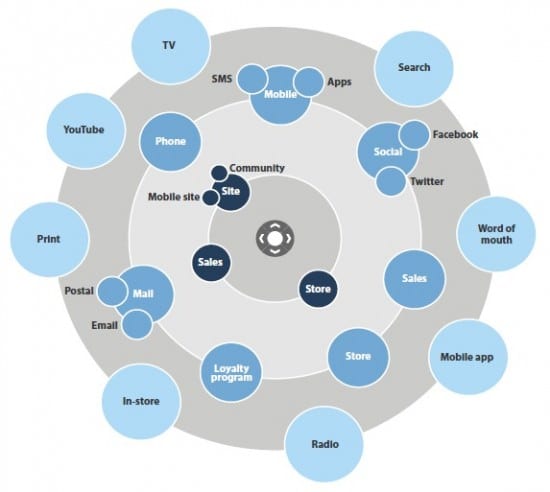
A commitment to data and measurement. There’s no one piece of the Forrester model that is more important at any one time, they simply come to the fore at different stages in the customer lifecycle. Ignoring one or more of those Reach, Depth, Relationship stages is going to leave you under-performing. Using data is therefore the critical success factor so that you know, through both implied and explicit behavioural data where your prospect, lead or customer is at – and how you might best serve them.
What’s your experience – how do you see the importance of relationship marketing alongside the reach and acquisition focus that dominates our industry?
 Follow Us
 Like Us