
Shared posts

14 Oct 19:20

Alternatives to Basecamp: The Real Truth About Project Management App Choices

by GetApp

Alternatives to Basecamp: The Real Truth About Project Management App Choices image basecamp 493x370.jpg 300x225How did Basecamp get to be a 600-pound gorilla in the project management app space – and does that mean that you still have other choices? After all, with one of the largest user bases (over 9 million by current estimates), this cloud-based app can make it onto users’ shortlists about what to choose by its sheer market share if nothing else. However, we’re still some way away from the kind of dominance that Microsoft still has over the PC operating system market, for example. And even there, Apple, Linux and tablet PC systems like Android are living proof that viable alternatives can also exist. Today we talk about that gorilla and then iterate the alternatives to Basecamp.

First, the Good Points about Basecamp

Credit where credit is due. People wouldn’t use Basecamp unless it brought them at least some advantages.

  • It offers simple functionality. In a world where just the words “Project Management” strike fear in to the hearts of many, this is a key advantage. Basecamp aims to do a few things well, rather than trying to do everything.
  • Easy to use. Basecamp appeals to web agencies and web designers with a clean, user-friendly design.
  • Affordable. Pricing comparisons change daily, but Basecamp certainly started life as an eminently affordable project management solution. Its monthly fee appeared modest in comparison with the functionality it offered.

What’s Missing for Many Project Managers?

Basecamp’s “Less is More” strategy was bound to leave some users out in the cold. 37signals, the maker of the Basecamp solution, has resisted calls to extend functionality. Even though it has produced other sibling applications like Campfire and Highrise (and who knows what’s going on with Highrise) to plug some of the gaps, Basecamp in itself has not had any major additions in terms of functionality. That means that it’s missing:

  • Gantt charts, those visual helpers see at a glance if overall project scheduling looks healthy
  • The possibility to allocate tasks to multiple people
  • Tracking of time against estimates/quotes
  • Any real sense of agile project management

What to Look for in Project Management Apps as Alternatives to Basecamp

Basecamp isn’t perfect, but that doesn’t mean that any other PM app is perfect either. What you need is a PM app that is affordable and reliable, and that meets your requirements today with a growth path for tomorrow. If you find your current PM to be too limited, you might look at these alternatives to Basecamp:

  • Wrike. Besides offering fuller PM functionality including interactive Gantt charts, Wrike also has features such as the creation and updating of project tasks via email. Task management functions and collaborative tools are also part of the lineup.
  • Mavenlink. Gantt charts again (what else?!) and this time extensive time and cost tracking, synchronization with Calendar, Contacts and other Google Apps, and invoicing functionality to bill for client projects.
  • AffinityLive Projects. Project planning includes Gantt charts, and milestone, task and budget tracking. Client authorization processes can be managed within the software with storage of notes and tools for forecasting, reporting and invoicing project progress.
  • Clarizen. Collaborative planning is a big feature, while extensive functionality is also included to track tasks, time, budget and issues. Extends to project portfolio management too. Real time team updates and financial indicators help all stakeholders to stay aligned with project objectives.
  • JIRA. Not just Gantt charts, but also tools targeted at Agile, Scrum and Kanban style project management. JIRA is a shoe-in for managing software projects, but is also widely used in other production and service environments. Also offers help/service desk functionality with issue tracking.
  • Intervals. Offers comprehensive time, task and project management capability that is suited to the type of market that Basecamp addresses (designers, web developers, consultants and creative agencies). Also helps IT services firms and SMBs in general. Document versioning and extensive visual reporting are standard parts of the app.

Further Options for Moving Beyond Basecamp

  • Easy Projects. Shows users the critical path for optimizing project delivery within interactive Gantt charts. Offers resource loading/balancing management. Online and phone conferencing are built-in for enhanced collaboration, goal setting and end-results.
  • Zoho Projects. Offers a variety of add-on modules, including chat, wikis, calendaring and CRM. Basecamp may have 9 million users, but Zoho Projects already claims 3 million. Besides containing Gantt charts and email collaboration, this app also interfaces with cloud services like Dropbox for storage and Github for document versioning.
  • ProWorkflow. From mobile working to an open API to integrate with other applications, ProWorkflow facilitates project scheduling, tracking, notification and alerts for the project team. Gantt timelines are also part of the functionality for global optimization of both projects and processes.
  • Genius Project. Includes project portfolio management for mid-sized enterprises that want to balance resources and results between several projects simultaneously. Social team collaboration, and risk and change management are accompanying features. Agile working is facilitated through support for Scrum methodology.
  • AtTask. Down to earth and effective project management functions that take into account team dynamics and the best way to achieve superior project results. Gantt charts are part of the package (of course!) and so are enhancements such as process improvement and capacity planning tools.
  • LiquidPlanner. With a highly visual approach, this app offers project scheduling, time tracking and wide-ranging graphs and analysis. It’s also user-friendly with its drag and drop prioritization and workspace chatter tools.

Next Steps for Enhanced Project Management

Whether you’re looking for alternatives to Basecamp or whatever you’re already using, or deciding for your first project management application, remember via GetApp, you can also make the most of free trials of different project management apps to see what suits you best.

14 Oct 19:20

The Complete Sales Professional

by Dave Brock

Dreamforce is coming up next week. As a result, I’ve been inundated with emails from people and companies inviting me to one of their presentations or to their display or for any other type of meeting.

They leverage data to help entice me. For example, I see LinkedIn data that says, “Sales professionals who use social selling are 51% more likely to exceed their quotas.” Or CEB data saying, “Sales reps who challenge customers’ assumptions make up 54% of high performers in a complex sales environment.”

The data point are all interesting, absolutely valid, and compelling. They usually have a format like, “High performers are X% more likely to exceed quota when they [Do this, Use that] than sales people who don’t [Do this, Use that].” Or they have this format, “World class organizations out perform their peers by Y% when they [Do this, Use that.]

The invitations come from people selling all kinds of tools — Content management systems, compensation/incentive systems, account planning, territory planning, social selling, analytics, pipeline management, research systems, prospecting tools, proposal/configuration management, pricing. They come from people providing services, sales training/methodologies, hiring/recruiting, or any number of things. (I’m waiting for an email from some enterprising dentist who has bought some booth space, 99% of high performers brush their teeth daily.”)

The impression one gets is, “If I only do this, then I will be a high performing sales person. For example, based on the LinkedIn data, one might think, “All I have to do is use social selling, and I’m more likely to exceed my quota.” Or with the CEB data, “If I challenge my customers assumptions, then I am more likely to be a high performer.”

Too often, perhaps it’s human nature, we tend to think, “If only I do this or that, things will be much better.” It’s kind of a silver bullet mentality.

But high performers know that it can never be reduced down to just doing this or that. High performers know they can’t just be doing “social selling,” or just be “using CRM well.” or just “doing pre-call research,” or “using this methodology,” or “leveraging this tool,” or “doing that methodology.”

High performers leverage everything. They will be the best users of all the tools and systems you have. They will be the people in the front row of every training session you have. They will be leveraging social media/selling far more and better than anyone else. Likewise, they are likely to use the telephone, mailings, tradeshows, industry events, and everything else very well. They will leverage their sales process, add things they have learned from various methodologies. They will be early adopters and power users of every tool they can leverage. They know they have to be constantly learning, improving, reinventing themselves.

The “complete sales professional” — the highest performers know that it’s not just one technique, or one tool, or one of anything else that gives them an edge or provides an advantage.

The highest performers don’t need these, so they don’t use having them or not having them as excuses.

It isn’t these things that make you a top performer. But top performers know how to exploit them to continue to OutSell everyone else.

14 Oct 19:20

Pinterest Smart Feed: Implications For Businesses

by Anna Bennett

 Pinterest Smart Feed: Implications For Businesses image 0001 24166996 400x600

Did you know Pinterest changed the way they display pins on your home feed?

They don’t even call it a home feed any more… they call it smart feed.

 Pinterest Smart Feed: Implications For Businesses image Screen Shot 2014 10 13 at 5.30.24 PM 600x309

Their goal is to make the feed more of a reflection of what each user cares about.

The change is very important to understand because it has serious implications for businesses using Pinterest as a marketing engine.

The old way:

The Pinterest HOME FEED showed you pins from the people that you follow. Plus related pins.

The new way:

Pinterest engineers have now changed that. They now call SMART FEED.

You will now see pins based on a blending of 3 factors:

  1. highest quality pins from those you follow
  2. related pins based on what you pin and those who you follow
  3. interests you’re following

What this new algorithm means to you and I is that we will have to get much more serious about pinning tactics if we want to rank high on Pinterest’s search engine.

Pinterest Management: 12 Expert Actionable Tips

  1. Check your analytics once a month to see what your audience’s INTEREST’s are and pin content around that.

Pinterest is telling you, this is what your audience wants so give them what they want or you risk the smart feed filter screening you out and not showing your pins.

 Pinterest Smart Feed: Implications For Businesses image Screen Shot 2014 10 11 at 2.07.10 PM 600x319

2. Fill in your pin descriptions with searchable keywords that encourage or inspire pinners to repin and get click throughs.

It seems to me that many pinners are in speed pinning mode or are just too lazy to change those captions. The new Pinterest smart feed filer is looking for this and is partially selecting what to show because of it.

According to Pinterest’s software manager Anna Majkowska hashtags serves no Pinterest purpose and too many will result in not ranking high on Pinterest’s search engine.

However I think using hashtags on Pinterest are helpful in two ways: When sharing your tweets directly from Pinterest and tracking short term campaigns.

3. Make your Pinterest board titles clear, simple and to the point.

For example if you’re a denim company and you have a board titled Bootylicious that will not rank high on Pinterest’s search. The most obvious key words to use would be denim jeans.  Do you get this?  People who are on Pinterest looking for denim jeans are typing in some form of key word that includes denim jeans.  Cowboy denim jeans, denim jeans for girls, denim jeans for kids, high fashion denim jeans.  No one is typing in Bootylicious to look for jeans.  Pinterest will not show your pins under a denim jean search.  Quality is the new buzz word at Pinterest.

4. Optimize your username.

Your username is your Pinterest URL and you only have 15 characters to work with so choose wisely. Unless you are a blue chip, house hold name brand like Home Depot, Nordstrom’s, or NY Times no one is going to search for your company name.  Add keywords that people will look for when searching for your kind of product or service.

 Pinterest Smart Feed: Implications For Businesses image pinterest username 600x126

 5. The “about” section within your profile should include your business name and a searchable keyword that spells out what your business is about.

6. Verify your website.

It’s not just because you’ll get access to Pinterest’s analytics which show you how your site is performing but more importantly Pinterest accounts that are verified have more of an authority in the Pinterest search tool. They rank you higher.  You want to rank higher.  Quality is everything now on Pinterest.

 Pinterest Smart Feed: Implications For Businesses image Pinterest page verified 600x133

7. You probably have more followers in other socials so make sure you leverage that by promoting your top pins.

Ask your fans to follow you on Pinterest and include a reason why. For example, if you are in the fashion or home decor vertical you could post something like “For more style tips follow us on Pinterest”.

8. Install the PIN IT button close to your images and your blogs.

Position them at the end of the post as well. According to Anna Majkowska, a software manager on Pinterest’s search team, pinning content from your website helps you rank higher on search.

 Pinterest Smart Feed: Implications For Businesses image Pinterest pin it button 600x584

9. If you have a blog or you have an ecommerce site apply for the Rich Pins.

They help you to stand out from other pins and get you higher click-through rates. More importantly it helps you rank higher on Google.

The cool thing about Rich Pins is that brands can include data such as real-time pricing info. Pinners also get email notifications when Product Pins they’ve added to their boards drop in price by at least 10%, which encourages buying behavior.

 Pinterest Smart Feed: Implications For Businesses image Screen Shot 2014 10 13 at 2.02.15 PM 600x453

10. To get more Pinterest followers add the “FOLLOW” button on every page of your web site.

You can customize the words on the follow button. So instead of just having the word FOLLOW add your business name as well. Having a lot of followers matters because it helps you rank high and more likely your pins will rank high in Pinterest’s search tool.

11. Don’t pin or repin pins that have dead links or expired pages because it will hurt your rank in the Pinterest search tool and annoy users.

 Pinterest Smart Feed: Implications For Businesses image no source link hurts ranking on Pinterest1 600x337

 12. If you want to out compete your competition in search engine rankings, and let’s face we all want to rank as highly as possible so we can get more traffic, think of creating a board with narrow content focus. For example, if your competition ranks highly in a specific theme like GOLF OUTFITS you can create a board called MEN’S GOLF SHIRTS. It is more narrow and specific; in this way you can get the edge and increase your odds of ranking higher and capturing more qualified traffic.

There you have it folks.  It’s called smart feed, not home feed.  Pinterest did it to make the feed more of a reflection of what each user cares about.

You now know how they filter and what tactics to employ yourself to rank as highly as possible  which helps you increase your exposure.

What do you think of Pinterest’s strategic move with smart feed? Love it or hate it?

If this is overwhelming for you and you feel like you are going around and around with Pinterest and not getting anywhere contact me contact me about my Pinterest management services or to learn more about my Pinterest Marketing Course for Business.

14 Oct 19:18

These Two Guys Have Figured Out How To Make Your House Key Obsolete

by Steve Kovach

jason johnson and yves behar august smart lock foundersIt sounds like science fiction.

You walk up to your front door. There's a small chime, a whir, and your door unlocks. And it only works for you or the people you approve. No one else can get in.

That's how the August lock, made by a startup of the same name, works. Using a combination of a smartphone app and a Bluetooth connection, the August lock eliminates the need to use your house key. It also lets you generate new virtual keys that people — guests, the plumber, your housekeeper — can use during specified times.

The company was co-founded by Jason Johnson and the designer Yves Behar. (Behar is known for designing tech stuff like the Jawbone UP fitness band, PayPal's new logo, and the computer for One Laptop Per Child.) August goes on sale on the company's website and at the Apple Store this week for $250. Business Insider spoke to Johnson and Behar a few weeks before the launch.

Below is an edited transcript of our interview.

Business Insider: What kind of problem does a smart lock solve? I can get into my apartment just fine with my key.

Behar: Two million people get locked out of their homes in New York every year. Four people out of five own a key that they don’t know what it does. The thing Jason and I have heard constantly for the last two years every time we show this project is "I hate keys." So it seems like a good problem to solve, especially in light of the sharing economy, the Airbnbs of this world. I think we're social people also. We want to be able to invite people and give access without having to make keys every time.

BI: Do you see this as a singular product, or will you eventually make other smart gadgets for the home?

Johnson: The company is called August. It’s also the adjective “august,” which means majestic, grandeur, and beauty. So we are making something that we believe is beautiful and adds to the home. We’re very focused right now on redefining what is the entry method to the home. Traditionally, we’ve had these locks, which are really designed to keep people out, and what we really wanted to do was flip that around and say, “Can we create a system that brings people in, and how can we reduce the friction to access to the home by making it easy to give a key to someone you want to give access to your home, whether it be a family member or a friend or a service provider and make it really simple?”august smart lock with app

BI: Technology moves quickly. We upgrade our phones every year or two. You're likely going to keep improving August, so does that mean we'll constantly have to upgrade our homes in the future too? 

Behar: I’m a huge fan of the ability for hardware to constantly get better. We recently announced with Jawbone a firmware update that doubles the battery life. We did the same with the big Jambox speaker. So there will be a lot of things we can do, whether it’s improving the software or the firmware as the product and the service evolve. The other thing for Jason and I is — no pun intended — this is sort of the entry into the smart home. How it connects with other things within the home, other utilities within the household, and how it’s linked to an individual rather than just presence. A lot of devices can tell whether there’s a human moving around the house. But that’s not the same for me or my teenage kids. They want different things. They want the music to be different or the lighting to be different. There’s a lot of connectivity and a lot of things that start with coming into the house every evening and knowing who it is.

BI: A lot of people are working on the connected home and creating wireless standards to make sure all these gadgets can talk to each other. How do you decide which one to pick? Or do you just accept them all?

Johnson: We have an API and we will allow most of these standards to work with our API. And many companies are working with our API. But one thing that’s very important, of course, is that this isn’t just a lightbulb or something inside your home. This is the entry to your home. So security is of the highest importance to us. We have to make sure the people who use our API are doing it in a very safe, trusted, reliable way, so there’s a set of processes that we’re putting in place as we work with these different partners to make sure they follow those guidelines.

BI: What about Nest? They just make smart thermostats and smoke detectors now, but they have Google's backing. What happens to you if they decide tomorrow to make a smart lock?

Johnson: One thing we know for sure after working on this for two years is that making a smart door lock that is reliable and as feature-rich as what we’ve developed is a tremendous amount of work. It’s not a trivial thing. And there will be people who make similar products and in many ways I think that will be good. This is an entirely new product category and it will help educate consumers on the value of smart door locks, but we think we’ve developed the most sophisticated and reliable and secure smart door lock and we’re very excited to bring it to market.

Behar: We’re also focused on building a great brand. This is not a techie product that’s just talking to Silicon Valley. This is a mainstream product and we want to address a lot of people and their needs. There may be products at some point that do similar things, but we also believe people will rely on us and trust us in the way they trust other great brands out there.

BI: What happens if the device runs out of batteries? Am I locked out of my house?

Johnson: We like to remind people that August an additive. We don’t take away from your existing experience. So you can still use your key, and we encourage you to keep your key somewhere, just in case you ignore all the battery warnings we give you. So every time the app connects we pull the battery life and we report that in the app and we send you push notifications letting you know your battery is getting low. So you’ll have multiple opportunities to replace the batteries. If you ignore all those warnings, you can still use a key. We also use AA batteries. One nice thing is when you do take off the cover to replace those batteries, you can just grab some out of a TV remote control or something like that.

august smart lock installationBI: A gadget that's going to be displayed in the home is a very personal thing. How did you make the August look like something most people would feel comfortable showing off?

Behar: From the very beginning we got excited about August because it is a new space. Bringing technology into the home is very different than bringing technology that people have in their office or on their bodies. We really wanted to consider every member of the family. This is not something that just the tech person in the household is going to install and use. This is something everybody is going to use. The design is really based on discretion in every way. The user interface is discrete, the feedback on the product is discrete and subtle. The app is sort of beautiful. We’re working on the user interface and user experience together. The other part is the materiality. We really wanted it to be about a level of quality similar to what you have currently on your door. So the product is all aluminum and steel. It has to reflect the taste of the homeowner, so we have four different colors.

august smart lockBI: But it doesn't look like a traditional lock.

Behar: It looks like something new, something you’d be excited to have and something you’d be proud of. It doesn’t look like a 1920s Victorian door handle. I don’t think that would be right for a product that has all this incredible technology embedded in it. To me, it looks like contemporary furniture or a contemporary home accessory.

BI: Suddenly, it seems like everyone and their mother is trying this "smart home" stuff. Is it ever going to be mainstream? Or will it just be something geeks use?

Johnson: There are a lot of people trying a lot of different things, and I’m personally excited about some of those new products. Now, the truth is, the average, mainstream consumer has tried a lot of different gadgets in the home over the years, and there have been a lot of broken experiences with a lot of home technology and home automation. When Yves and I were thinking about the product we wanted to make sure for our first project that we really addressed a real problem. We didn’t see, necessarily, having remote-controllable lights as being something that was a real problem for the average person.

Behar: We also thought that this was the most important part. When you enter and pass through the threshold of the door into your home, this is the starting point of when you can sort of trigger other things. So it seemed like if we solve this hard problem, there are a lot of other easy problems we can address. I think for technology to enter people’s lives it has to be timed right and it has to be the right technology. There has been a lot of complex, very finicky kind of home automation products in the market. There have been a lot of very expensive ones. Home automation was really a rich man’s playground for a long time.

BI: Does that mean home automation is possible now because we all have a smartphone?

Behar: The fact that you have computing on you and around you certainly is. I think when you try to create a technology that will sort of come into people’s everyday life, it has to be the right time. I do think it’s the right timing, the right price point, the right kind of technology that we can bring to the market today. Had we tried to do that 10 years ago it probably would have been more work, actually, than using a regular key. And our standard for success is: Is it easier than what’s out there? Is it easier than the current sort of behavior and complexity of having to manage a door? And we certainly think we got there.

Join the conversation about this story »

14 Oct 19:18

Brilliant management advice from Google's former CEO on how to build a $300 billion company (GOOG)

by Jillian D'Onfro

Google Chairman Eric Schmidt

To be successful in the technology-driven internet age, a company has to attract "smart creative" employees and then create an environment where they can thrive. 

At least that's the argument that Google's Eric Schmidt and Jonathan Rosenberg make in "How Google Works."

In the book, executive chairman and former CEO Schmidt and former SVP of product Rosenberg outline what they learned while building Google into a company now worth hundreds of billions of dollars

The duo created a fun, illustrated presentation to highlight the main principles of the book.

Google gave us permission to republish those slides here.


See the rest of the story at Business Insider
14 Oct 19:18

This Agency Manages 93 Social Media Profiles: Learn The 8 Essential Tools That Keep Them Going

by Kevan Lee

You compete with millions of other blogs on creating and sharing craveable content.

You manage multiple social accounts, seeking that sweet spot of targeted, valuable, engaging updates.

You do this all day, day after day.

Imagine having some tools on hand that make these daily activities even easier.

Tony Restell understands these challenges of social media sharing like few others. As founder of Social-Hire.com, Tony works with multiple recruiting clients at a time on their social media strategy, and his Social-Hire content competes with the likes of LinkedIn, ERE, and other heavyweights for views and shares.

Tony is managing 93 social media profiles for his agency and its clients. Wow!

He’s found a way to keep it all organized, efficient, and successful. Social-Hire’s content draws 10,000 social media shares every month, and these shares alone generate more than 25,000 visitors to the blog. Tony sees over 90 percent of new business come from social media.

How does he do it? And what can we learn from the amazing way he keeps everything top-notch and together?

At the heart of his awesome system are a handful of Tony’s go-to tools. Here’s a look inside his process.

This Agency Manages 93 Social Media Profiles: Learn The 8 Essential Tools That Keep Them Going image Copy of Quick Wins Social Media 42.png 600x300

7 essential tools that no agency can live without

1. Buffer

For complete social media management, Tony relies on Buffer.

Here’s why:

  1. Easy to use
  2. Easy to explain to clients
  3. Simple interface
  4. Quickly add team members with custom roles
  5. Awesome customer support

Agency work requires that the tools you use for collaboration with clients are easy not only for you but also for everyone else who may contribute. The simple, intuitive Buffer interface makes for a great entry for clients who may not be as familiar with social media dashboards. Tony can quickly and easily get clients up to speed and involved.

Seeing on one dashboard that we have sufficient content queued up to our clients’ accounts and our own accounts is both a major time-saver and stress-buster!

The Buffer for Business plan welcomes team members to contribute to a social profile. Tony manages each profile and invites the client to contribute as a team member. The client can view all the activity on the profile and contribute as they see fit.

This Agency Manages 93 Social Media Profiles: Learn The 8 Essential Tools That Keep Them Going image TEAM members 1024x729.png 600x427

And perhaps most importantly, Tony trusts the team behind the product.

Buffer is an essential tool in our business for a whole host of reasons. But what I’ve valued the most is the customer service and responsiveness. The team always want to learn from you what would make the product better and are always on hand to help whenever that’s needed.

I shudder to think what life would be like without Buffer!

Start your free 7-day trial of the top social media tool for agencies!

2. Feedly

A big part of Tony’s strategy is content. Feedly’s RSS management tool is ideal for discovering and staying on top of industry-specific content that fits a particular niche. Tony’s biggest use of Feedly is for finding and monitoring this content to share easily on behalf of clients.

He’s got an especially neat tip to get content from Feedly into a social queue super fast. Keep reading below.

3. BuzzSumo

The content analysis tool BuzzSumo is a huge resource for Tony to find key influencers in each of the niche markets that his clients serve. Simply search the keyword terms for the niche, and BuzzSumo returns the most popular content and sources.

This Agency Manages 93 Social Media Profiles: Learn The 8 Essential Tools That Keep Them Going image home 1024x500.png 600x292

4. ManageFlitter

This suite of Twitter tools provides easy follow/unfollow action, search of user bios, and Twitter analytics.

5. Circloscope

Much like ManageFlitter for Twitter, Circloscope is ideal for managing an audience on Google+.

This Agency Manages 93 Social Media Profiles: Learn The 8 Essential Tools That Keep Them Going image cshp.png 600x369

6. Hootsuite

Social media listening is an important part of Tony’s agency work. Hootsuite helps with monitoring and replying to mentions on social accounts.

7. vCita

vCita provides real-time consultation scheduling, which is great for agencies wanting to allow both clients and prospects to schedule in calls at their convenience.

How to find and share niche content in a snap

When you share to 93 social media profiles, you’ve likely figured out quite a few time-saving tips. Here’s one of Tony’s favorites, involving Buffer, Feedly, and IFTTT.

Subscribe to industry-specific, niche blogs in Feedly.

Create custom tags in Feedly to tag content that is to be shared to a specific social profile.

Create an IFTTT recipe with Feedly and Buffer. It’ll work like this …

IF you tag a cool story in Feedly with Tag A, THEN add the story to Buffer Profile A, using this particular message style.

This Agency Manages 93 Social Media Profiles: Learn The 8 Essential Tools That Keep Them Going image Screen Shot 2014 10 06 at 8.48.16 PM 1024x214.png 600x125

You can customize the text that appears before the story as well as how the story itself appears (e.g., story title and link). If you run out of Buffers to connect to Feedly, you can try a Feedly and Email integration using your secret Buffer email address that adds updates directly to your profile.

Here’s the awesome benefit Tony gets from this tip:

That allows us to really streamline the time we spend on our Social-Hire profiles which is crucial as we want our experts focused on serving up a great social experience on our clients’ accounts!

Tony’s social media strategy – unpacked

The agency work that Tony undertakes relies on a couple of building blocks for his company.

1. The recruitment content that Social-Hire creates must be shared in the industry more widely than content from heavyweights like LinkedIn and ERE. This is key to building client trust in Tony’s abilities as a social media expert.

2. Once Tony starts working with a client, he must have a seamless integration with his team and the marketing and recruitment teams of the client. It’s best when there’s no stepping on one another’s toes or over-posting to any accounts.

Buffer and the other tools Tony uses help with both of these needs.

The social media strategy for Tony’s agency comes back to these two challenges. Here’s his three-pronged strategy for both his own social media accounts and for his clients.

  1. Focus on making your social profiles valuable (or entertaining) for the target audience you want to attract
  2. Ensure you take the steps needed to get your social profiles in front of your target audience so that they have the chance to see the value you provide and to choose to follow you
  3. Set aside the time needed to properly engage with your followers and those sharing your content (that’s what usually prompts client wins and successful candidate hires)

This Agency Manages 93 Social Media Profiles: Learn The 8 Essential Tools That Keep Them Going image Valuable Content 1.png 600x600

One way in which Tony is able to make good on these strategies is the contribution and analytics tools inside the Buffer dashboard.

For example, he can allow clients to easily contribute content to their profiles (via the team member settings in Buffer for Business). This content gets approved and added to the queue rather than publishing right away into a feed. The benefit here: No over-sharing.

Taken a step further, Tony and his team can analyze these shares along with the client to see which type of updates and articles perform best. Buffer analytics can be as informative and deep as you want—either with top-level “Top Tweet” styled notifications or full, in-depth analytics.

From Tony:

Buffer makes it super easy for any of our client contacts to contribute content to be shared on their social profiles – but in a way that doesn’t risk over-sharing or appear automated. It then provides the data and insights we need to see which types of updates are really generating the most interest and sparking the most conversations, so that we’re continuously optimizing what we share on behalf of our clients.

The recruiting industry is a results-driven sector, so being responsive like this is key.

Final takeaways

A series of helpful tools have helped Tony take his social media expertise and his growing agency to new heights.

He relies on Buffer for simple, well-organized social media management. He counts on tools like Feedly and IFTTT for making content curation and sharing as easy as possible.

He gets a lot done—sharing to over 90 social media profiles. And he does so with an amazing level of success—10,000 social shares and 25,000 new visits per month.

Can Buffer help your team or individual social media strategy, too? We’d love to help you find out. Why not give Buffer a try?

This Agency Manages 93 Social Media Profiles: Learn The 8 Essential Tools That Keep Them Going image Screen Shot 2014 08 18 at 1.53.21 PM.png

14 Oct 19:17

Taking A Closer Look At Tech Conferences: The Nitty Gritty Details (A Study)

by Jan Constantin

As I was flying back from the Smashing Conference in New York, I wondered whether it was a success. This wasn’t an original thought. We are always wondering what makes a conference good and what elements will make industry workers stay away.

Good and bad are such subjective terms, though, with almost as many expectations as there are attendees. We decided that just looking at the numbers instead might be a good idea. This article will not present best practices for planning a conference1, but rather will look at how it’s actually done most of the time. While this is not a guide to putting together the perfect conference, it gives a good overview of what seems to work and which elements are so unpredictable that they do not serve as reliable guidelines.

The Aspects Considered

I analyzed the statistics of about 85 different conferences. I looked all over the world, looking at everything from big well-known events to small non-profit community meetings. I chose conferences that have been around for years and that have features that set them apart from other events.

Some of the data is straightforward, such as dates, number of speakers, tracks and workshops. Other aspects yielded much more varied and specific data (such as themes and technical considerations). So, I’ll present some fairly solid figures about some aspects, and convey just a sense of the variability of others. You can find the results in this PDF2.

The Questions

  1. How many speakers were invited to the conference?
  2. How many days did the conference last?
  3. How many tracks were offered?
  4. How many workshops were linked to the conference?
  5. How long did individual sessions last?
  6. How long were the workshops?
  7. How much did the conference cost?
  8. How much did the workshops cost?
  9. How many people attended?
  10. What were the technical details? (Was there Wi-Fi? Were videos made available?)
  11. In which month did the conference take place?
  12. Was the theme a popular one?
  13. Which country hosted the conference?
  14. In what kind of venue did it take place?
  15. How high was the percentage of male/female speakers?

First, a few things regarding the statistics. I will compare both the average and the median, because the discrepancies are at times pronounced. The median lists all values of the data set and picks the middle value. It’s therefore not influenced by extreme values, and gives better information about the real data distribution. The average value is the sum of the sample data divided through the number of values. It’s influenced by extreme values and therefore gives only information about the data distribution in theory. The difference will become clear by directly comparing the figures.

Conference Size

Anyone who is interested in organizing a conference or just attending one will notice that conferences are run in two very different styles. This has a huge impact on scale (number of speakers, choice of tracks, length of conference).

Some conferences, such as TYPO3 Conference 2013163, with its 65 speakers and multiple tracks, aim for large audiences and maximum information propagation. Others, such as the Smashing Conference4, have only around 18 speakers and a single track and set out to create a community experience. Two styles, two different goals.

The data shows a clear tendency towards smaller conferences, most likely for the simple reason that organizing a big conference is much more costly and restrictive in some ways than a smaller one.

  • Median number of speakers per conference: 19
    This median indicates that more than half of the conferences analyzed were fairly compact community events.
  • Average number of conference speakers: 31
    This shows by how much the average is skewed by the few very large events when compared with the median.
  • Median number of tracks: 1
    This is a fairly logical progression from the median number of speakers. Small conferences tend to stick with single tracks.
  • Average number of tracks: 1.9
    This average implies that two tracks are the norm. While the difference between one and two tracks seems negligible, it is anything but. A single-track event demands fewer compromises than multi-track events from both attendees and organizers. Attendees don’t have to worry about overlapping topics, speakers and interests, while organizers can set up the event days exactly as they want. On the other hand, multi-track events give attendees much more flexibility and a wider range of networking opportunities.
  • Median number of conference days (workshop days included): 3
  • Average number of conference days (workshop days included): 2.7
    Conferences rarely last longer than four days. The lower average reflects the lower number of conferences that are longer than the median.
Conference Sizes
There is a clear tendency towards smaller conferences.

Back To School

This indirectly brings us to the topic of workshops. Most events offer a certain number of workshops, usually around the conference days. Only 9% of conferences do not feature any workshops. Combining standard talks and workshops makes a great deal of sense for both organizers and attendees (and their employers!). The combination reduces yearly travel time to training events for attendees, and it spares employers’ pursestrings from the added travel expenses of repeated training excursions.

Conferences that do feature workshops around the event average five full-day workshops; the median, however, drops down to three full-day workshops. This number is not completely arbitrary. Organizers should plan according to the number of attendees expected, keeping in mind that not all of them will attend the workshops. It comes down to the desirability of the workshops, which is a difficult variable to accurately evaluate. The theme, speaker and geography come into play, in ways that are not always easy to discern.

Finally, not to be forgotten are two-hour half-day workshops and “lightning talks.” These are fairly popular, especially at big conferences. Some small conferences also prefer to feature a lot of half-day workshops, instead of highly visible full-day ones. Altogether, 13% of conferences feature short workshops, either next to the full-day ones or exclusively.

The Cost Of Learning

Evaluating conference and workshop prices is quite tricky because the spectrum is quite wide and is determined by different variables, including sponsorship deals and regional standards. A detailed analysis of the motivations behind setting a certain price for an event is beyond the scope of this article. Keep in mind that the numbers below are merely an approximation because I couldn’t find data for all of the conferences that I reviewed. Additionally, several conferences have a one-price-fits-all approach, including workshops in the conference price.

The average and median costs of workshops are very close, at $311 for the former and $307 for the latter (US dollars). This make perfect sense because the costs of workshops vary only according to the duration of the events. A few outliers are worth mentioning because of the regional considerations. Meta Refresh 20145 in India, for example, offers four half-day workshops at the relatively low price of $49 for both days. Reasons to be Creative6 in the UK comes to $399 per workshop, which is fairly standard for the UK.

Conferences are less predictable. The average and median are quite close, with the former at around $420 and the latter around $349. This, however, is a skewed representation of conference costs. For one, early-bird prices differ significantly from latecomer rates. Also, included in both figures are all conferences prices, without differentiating between one- and multi-day conferences.

Conference costs
Conferences mostly seem to cost between 300 and 400 USD.

Comparing the prices of conferences and workshops to those of other events in the same country might be more telling. This would give a good indication of whether the prices are reasonable.

We The People

Despite our figures here being very spotty, the average (840) and the median (500) number of attendees differ greatly. I would attribute this discrepancy to missing data. However, despite the spotty data, I suspect that the actual average is very close to the median that I calculated, simply because the majority of conferences reviewed here are small single-track events.

The Technical Side

There is insufficient data to make any definitive conclusions about the technical aspects of conferences. Still, several features seem to recur at almost every conference.

On the websites of the 84 conferences in this study, 14 specifically mention that they offer Wi-Fi access to attendees, and 32 promise to release videos of the talks and workshops on their website or on their YouTube or Vimeo channel.

Interestingly, despite many events offering Wi-Fi access, reliability is usually so difficult — or expensive — to guarantee that some conferences (such as Blend7) state up front that Wi-Fi access is not provided, even going so far as to prohibit devices entirely. The rationale is that the presence of devices and the cost of Wi-Fi detracts from the quality and enjoyment of the talks; some hand out pen and notebooks instead. This approach does have some merit because it frees organizers to focus on curating their themes and speaker.

The Ephemera

Finally, let’s quickly look at some figures that are relevant but difficult to evaluate: conference themes, supporting events, location and gender. These factors are mostly determined according to either convenience or the subjective perspective of the organizers.

Themes

Themes are plentiful in this industry, ranging from UX design and development tools to marketing and commerce. This chart8 shows some of the most common themes, but keep in mind that these fluctuate as our industry rapidly evolves.

Events That Round Out the Conference Experience

These are a staple. For more than 50% of conferences, this means parties. And this is the one area where organizers can get as crazy and imaginative as their budget allows. You’ll find everything from mundane and marginally productive networking parties with drinks to enthusiastically creative affairs (such as Build9’s). Some employers, the ones footing the bill, might find this to be over the top. A more psychological study might examine the value of associating pleasurable social experiences with work, but that is beyond the scope of this article.

After-parties are where — to paraphrase Pat Allen10 — organizers often make mistakes. From experience with organizing them, I know how important it is for the background music not to interfere with the conversations. Organizers should know that venues tend to get this wrong; many venues can’t seem to believe that large congregations of people don’t automatically want to “get down and boogie.” At the first Smashing Conference’s after-party, I found myself running to the DJ every half hour to ask him to turn down the volume, which would mysteriously and gradually return to the same deafening level. I insisted repeatedly that just because some of the attendees were swaying to the music while talking did not mean they were eager for a rave, but neither the venue’s manager nor the DJ seemed to grasp this.

While a few conferences focus mostly on the basic content, most offer additional experiences, most likely reflecting the idealism of their organizers. For many conference enthusiasts — including organizers — a key function of conferences is to unite the web design and development community. This is often reflected in the wording of promotional materials (“Let’s get together in the company of a few friends11”).

Some discussion lately has focused on reevaluating these traditional events, such as after-parties, which some argue betray some insensitivity. For instance, alcohol is, to put it mildly, not everyone’s cup of tea. As Sara Soueidan explains12 in an interview for CSSconf EU, that is a reason why some attendees or speakers do not attend certain events. JSConf US 201413 provides bikes for people who want to explore the area, and it even offers a “Significant Other Track” for the families of attendees. There are definitely alternatives to the traditional approaches that generate a different ambience.

Locations

Below are some figures related to location.

  • 52% of conferences are in Europe, 38% in the Americas, 6% in Asia, 3% in Australia and New Zealand. None are in Africa!
  • 34% are set in the US, more than half in the east (see map).
  • 18% take place in the UK.
  • 14% are set in Germany.
  • Just one is set in Southern Asia (India), and one (not on the list) in Southeast Asia (Philippines).
  • The five biggest conference cities on the list also host the most conferences for their region.
  • Among the five biggest cities are the three cities that host the most conferences (New York, London and Berlin).
  • The fourth most-frequented city, however, is also one of the smallest on the list. With only 156,000 inhabitants, Brighton is only more populous than Faenza, Columbia and Osijek.
The US and EU are the two hottest spots for web conferences.
The size of the city doesn't seem to be the deciding factor for choice of location, but it is relevant.
The size of the city doesn’t seem to be the deciding factor for choice of location, but it is relevant.

Gender

I’ll devote a short space to the statistics for the most debated topic of this study, gender. While a gender count among attendees has proven to be impractical, I was able to count — by hand! (never has a more repetitive endeavor been undertaken since Sisyphus’ boulder roll) — the number of male and female speakers at almost all conferences. I found that 22% of speakers were female. Or, to put in in hard numbers, the median number of speakers at the conferences was 19. Of those, 5 were women.

This subject has been heavily discussed in our community recently, with some of the biggest tech firms disclosing their gender-related statistics. According to John Mindiola in an article from 201014, 82.6% of web designers are male. However, while this is the current reality, the issue has reached popular awareness, leading some organizers to actively try to incorporate an equal number of male and female speakers. Such efforts are not only attributable to small conferences either, which can pick their speakers much more carefully; colossal events such as WebTech Conference 201315 and TYPO3 Conference 2013163 are trying to even out the playing field, too (see study PDF).

Gender disparity in the web industry is not a myth. That being said, the percentage of women in content-generating areas is higher than that of men. And while the area of web development boasts a frighteningly antiquated male-dominated environment17, many hope that conferences — being the public face of the industry — will lead by example.

Conclusion

To sum up (pardon the pun), the majority of conferences are small, with around 20 speakers. Most are single-track events, except for those that are 10-plus-track affairs. Many offer workshops to round out the experience. The events usually cost around $500 and offer a slew of fun activities to complement the learning experience, following the proud tradition of “work hard, play hard.”

The full range of the web industry’s work is covered, although the latest advances are getting the most attention, such as the mobile web. Most conferences take place in the EU, but the US hosts the most events of any single country. Finally, the web industry still needs to work on the male-female disparity, which is reflected in the ratio of female-to-male speakers at conferences.

(ml, al)

Front page image credits: Marc Thiele18.

Footnotes

  1. 1 http://www.smashingmagazine.com/2014/08/15/plan-and-run-a-great-conference/
  2. 2 http://www.smashingmagazine.com/wp-content/uploads/2014/10/conferences.pdf
  3. 3 http://t3con13de.typo3.org/
  4. 4 http://smashingconf.com/
  5. 5 https://metarefresh.in/2014/
  6. 6 http://reasons.to/
  7. 7 http://www.blendconf.com
  8. 8 http://www.smashingmagazine.com/wp-content/uploads/2014/10/conferences.pdf
  9. 9 http://2013.buildconf.com/
  10. 10 http://freelancing-gods.com/tags/conference
  11. 11 http://2013.buildconf.com/
  12. 12 http://2014.cssconf.eu/news/meet-the-cssconf-speakers-sara-soueidan
  13. 13 http://2014.jsconf.us/schedule.html
  14. 14 http://www.smashingmagazine.com/2010/11/12/gender-disparities-in-the-design-field/
  15. 15 http://webtechcon.de/2013/
  16. 16 http://t3con13de.typo3.org/
  17. 17 http://archive.aneventapart.com/alasurvey2011/01.html
  18. 18 https://www.flickr.com/photos/marcthiele/14444487112/in/set-72157644792424680

The post Taking A Closer Look At Tech Conferences: The Nitty Gritty Details (A Study) appeared first on Smashing Magazine.

14 Oct 19:17

Quarter of new Canadian oil projects vulnerable if oil falls below US$80: IEA

by Financial Post StaffReuters

One in four new Canadian oil projects could be vulnerable if oil prices fall below US$80 per barrel for a extended period of time, according to the International Energy Agency.

The Paris-based agency said that “…in terms of production with breakevens exceeding $80/bbl, Canadian synthetics projects have the highest percentage of production of the types examined here (about 25%) that would fall into a negative net present value if there were to be an extended period of prices below that level.”

While oil sands projects benefit from longevity and “predictable output,” new projects will have to make a careful forecast of oil prices, the IEA said, quoting data from the Canadian Energy Research Institute, which forecast that new mined bitumen projects requires US$100 per barrel to breakeven, whereas new SAGD projects will need US$85 per barrel.

However, Canadian oil sands investment bank Peter & Co., estimates breakeven on new SAGD bitumen projects at US$75 per barrel.

“Some planned projects with high costs have been cancelled or postponed of late, such as Statoil’s Corner project. Producers must also be concerned about transport, as there is very limited access to markets beyond North America with current infrastructure,” the IEA said.

All in, nearly 3% of global oil production is vulnerable to cuts if prices fall to US$80 per barrel, making some projects in Canada, Angola, Brazil and Norway unprofitable, the IEA said.

The estimate was included in a monthly report in which the IEA also cut its forecasts for oil demand and said prices may drop further.

A tumble in the price from the year’s high above US$115 per barrel to below US$90 has focused investors and oil companies once again on the breakeven level — the point at which net return on a project turns positive.
“All told, roughly 2.6 million barrels per day of world crude oil production comes from projects with a breakeven price in excess of $80 per barrel,” the report said on Tuesday.

This represents 2.8% of the 93.2 million bpd of production in the third quarter of 2014.

Projects with high breakeven rates are scattered around the world, however.

“Places as diverse as onshore China, offshore shallow-water Malaysia, Nigeria, conventional onshore U.S., shallow-water UK and onshore conventional Russia have significant amounts of high breakeven production,” the report said.

It noted that some planned, high-cost projects had already been canceled.

In the United States, slightly more than 4% of shale oil production requires a breakeven price of more than US$80 per barrel, the IEA said.

A large proportion of deep-water exploration operations have high breakeven rates, the report noted, though the picture is mixed.

“Some 8% of deep-water crude oil production is adjudged to require a breakeven of US$80 per barrel or higher … totalling some 1.05 million bpd or 1.1 percent of liquid production,” the report said.

“For ultra-deep-water alone (more than 1,500 meters), the results are, perhaps surprisingly, that very little of current output from those depths, less than 1 percent, requires such a breakeven price.”

More than 80% of deep-water production is based in Brazil and the U.S. Gulf of Mexico, where cost discipline ensures projects tend to be less exposed to higher breakeven levels than in Angola, Brazil, Norway and the United Kingdom.

With files from Reuters

14 Oct 19:17

Want to Ruin Your Omni-Channel Customer Service? Just Ignore the Contact Center

by Kirsi Tarvainen

Want to Ruin Your Omni Channel Customer Service? Just Ignore the Contact Center image omnichannel service 300x199The variety and possibilities of new online and social channels are stunning, and companies are eagerly building  omni-channel customer engagement programs for marketing, sales and service. Travel is one example of an industry having heavily invested in these new online and social channels. The results are great and booking a vacation on the Internet is amazingly easy. Just a few clicks and you have a flight, hotel and a rental car booked.

As for the customer experience, while the booking part works nicely, what happens when something goes wrong? If you choose a wrong date and want to change that? Or, what if you just have queries about your reservation? Is it also that easy? Ideally, it should be.  The customer service contact center should work as efficiently as the online booking.  According to Aberdeen, companies should integrate contact centers within their omni-channel efforts in order to maximize the benefits from their customer engagement initiatives. Makes perfect sense, right?  However, when that integration doesn’t exist, it can cause a great deal of hassle for customers as I recently learned when planning a vacation.

I booked a hotel for our family, and after receiving the email confirmation I realized that I had made mistake and booked a family room for two persons instead of four.  As this was a family vacation, there was no chance to leave the children at home and I needed to confirm whether the room had enough beds for us all. The website offered a chat option, so I asked my question via chat. The customer service representative replied to me and said she would research my question and get back to me via email. Afterwards, I heard nothing from them for several days, leading me to wonder whether I should contact them again or call the hotel directly. I did not know if there was somebody actually taking care of my request or ignoring it. I did not know if we had a four-person room booked or if I needed to find another hotel. This was just before the summer holidays when I certainly had other things to take care of rather than worrying about the reservation.

Finally, just a few days before the holiday, I got an email confirming our reservation was fine and there were beds for us all in the room. It took me 5 minutes to book our hotel, but 5 days to get a reply to my email. The funny thing is it would have been easier for me to cancel the reservation and book a room in another hotel – via another booking service.

Contact Center is a Key Element in Effective Omni-Channel Strategy
According to Aberdeen, companies who integrate contact center with their omni-channel strategy have higher customer retention rate and higher customer lifetime value. That is easy to understand. Companies have put great emphasis on online services, making it very easy to buy products and services online. However, customers often have questions or problems with their order, and it should be just as easy for customers to get a reply to these inquiries –no matter which contact channel they use. We have all become accustom to the speed of the internet and as a result, we don’t have much patience in waiting for a response.

In the end of the day, our hotel was very nice and the room was perfect for us. I have definitely learned my lesson:  check my reservation more carefully before pressing “confirm”, so that I get it right the first time. However, companies have much to learn about delivering efficient omni-channel customer service.  This Aberdeen research report is a good place to start: The Business Value of Integrating Your Contact Center within Your Omni-channel strategy.

This blog post was originally published at custedge.com. Republished with permission.

14 Oct 19:15

Don’t Confuse Content Marketing and Thought Leadership

by Kevin Lynch

Don’t Confuse Content Marketing and Thought Leadership image Road sign 2.jpg

The tsunami of social platforms and networks for sharing content has greatly expanded the opportunity for “thought leaders” to spread their gospel. But has this proliferation of information provided clarity or is it simply more noise than substance? I believe the jury is still out. Confusion over the difference between thought leadership and content marketing is part of the problem. Too often the terms are used synonymously. Although similar, they have distinct roles in the content ecosystem.

True thought leadership needs to take the long view on topics and issues. It’s typically not a prescription of granular solutions to specific problems or generating immediate leads. It’s about building reputation and authority over time and across multiple digital, social and offline channels. Enabling the organization’s subject matter experts (SMEs) to act as trusted advisors who offer helpful, responsive, generous and useful advice will establish them as true thought leaders. As they participate in online and offline conversations, they will steadily build their credibility through affinity, authenticity and trust. And that value accrues to the brand.

Content marketing is often associated with generating leads through a steady stream of on-message demand gen assets. But a strategic program takes an immediate, mid-term and long-term view. In fact, the output of thought leadership efforts should be an integral component of the overarching content marketing plan.

Ensuring that both marketing disciplines are optimized for their respective roles is vital to a brand’s success, especially in the B2B space that often involves long sales cycles, complex product specifications and multiple decision-makers or influencers. Content must answer the disparate needs of all those in the Buying Center, which has emerged as the predominate way companies determine their preference set of products or services. An IDC study shows that over 80% of C-level executives rely on social media to support their decision process, for example. In this increasingly self-serve content world, the vast majority (70%) of the purchasing decision research is completed long before the prospect ever reaches out to the vendor.

Success is determined by how well the vendor is seen as a solutions provider and that ‘proof’ will be found at the nexus of authentic thought leadership and relevant content marketing. Many firms are moving in that direction. Moving forward will prove the difference between which organizations gain and keep market share.

14 Oct 19:15

Benchmarking Performance: Your Options, Dos, Don'ts and To-Die-Fors!

by Avinash Kaushik

MellowWe are all blessed with more data than we know what to do with, and all for the price of a few lines of JavaScript added to your website. In this type of an environment, I've frequently stressed the value of identifying targets for your key performance indicators.

[See step four in the process for creating your Digital Marketing and Measurement Model.]

If you have set the targets for your KPIs up front (Unique Visitors for Sept. should be 1,356,000), you've set a clear line in the sand as to what performance will be declared a success or a failure at the end of the measurement time period. In turn, that will help you figure out where and how much to dig to understand performance.

Make sure you don't have anything on your strategic dashboards that does not have a pre-identified target.

Let me admit right away that setting targets is a complex art and science. Yes, and I've said this frequently, if all else fails just set your target for a 10% improvement. Anything, absolutely anything, can be improved by 10% with just a small amount of effort. But, you likely want to do something more complicated, and more sound, over time.

One of the key elements in the process of setting targets for your own performance it to collect benchmarks from others (competitors, industry-level, etc.) related to their performance. And, if you've met any boss, at any company, in any country, then you'll never go a few days without them asking for benchmarks (turns out they are also very interested in knowing if the performance they are seeing is good or bad).

So, in this post let's look at the options at our disposal in getting benchmarks we can use to set targets. I'm planning to cover the four different strategies at your disposal to collect benchmarks. Yes, four!

1. Own data benchmarks

2. Industry analyst data benchmarks

3. Competitor data benchmarks

4. Vendor data benchmarks

In each case you'll learn how to use each source, the pros and cons of each, and by the end of this post you'll never have an excuse not to have rock solid (or, ok, just a tiny bit squishy) targets for your company's digital performance.

1. Own data benchmarks.

There is a tendency to believe that if we need benchmarks we need to go outside. Yes, there are benchmarks outside, we will cover them in this post. But it is often a million times simpler to create your first set of benchmarks using your own data/performance. If you've read my first book Web Analytics: An Hour A Day, you know that I've advocated this strategy since 2008! See Page 269. :)

This recommendation also valuable for companies that have very unique business models, or face other unusual circumstances (geographic, size, amount of innovation, and many others).

So how can you use your own data?

Here's a simple trend that shows visits to your website, in this case for one year through September…

analytics partial year trend

You now want to create a target for the number of visits (/sessions) to your site through the end of the year, a simple goal.

The most straightforward thing to do is to look at the trend for last year, and look for insights. Here's the complete year 2013…

analytics full year trend

While the numbers for individual month are different, you can see that October spiked and then things came down to below Sept performance by December.

There, some primitive benchmarking information you can use. Export the data into Excel, look at month over month trends for each year, look at month over month trends across years, and you have a fat set of numbers that can serve as benchmarks…
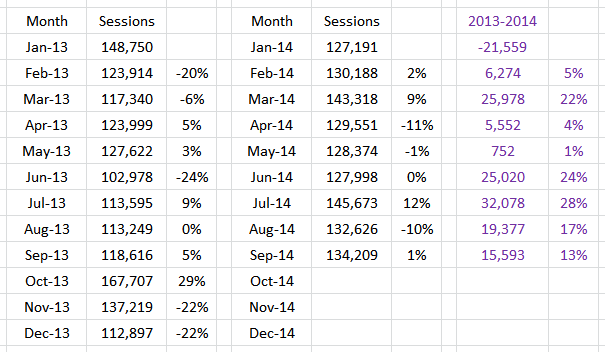
monthly trends

Exactly which cell's you'll end up using to lay out expectations for Oct, Nov, and Dec 2014 will depend on a number of factors and your insider knowledge and your forecasting savvy. But remember, even if you just say I expect this year to be roughly like last year, you are not going to go terribly wrong if company is not running a terrible business. If you don't stink completely, things on the the web always go up and to the right over time – the argument is simply about the slope of the line and short term fluctuations.

If you want to learn about how to do simple forecasting and trend analysis, please see the official forecast function in Excel post on the Microsoft website, and this handy tutorial on trend lines and forecasting in excel.

In an ideal world as you do the above exercise, you'll take into account:

1. Any big changes in your marketing/customer acquisition strategy over the last time period (more money doing Search, less money in Email, elimination Facebook as it does not work, etc., etc.).

2. Any big shifts in investment (marketing, customer experience, team sizes, tools).

3. Outcomes of the conversations with your Finance team and Sr. Leaders (company is leaving China, our IPO is next week, 1,800 new stores are being opened in 180 days, our new IRR is 8%).

And other such things. They will give you context you need to add to the numbers above to ensure the art part is also taken care of when you do the science part.

My advice to you above is perhaps a bit primitive. But, please be assured that you'll be surprised how much value it will bring as you get going on this journey. Give it a fair shot, before you go on a long quest to find the best benchmarks in Babylon.

Couple of other examples of going to your own data to identify your benchmarks.

Conversion rate is one of those metrics that I strongly encourage you only create benchmarks for from your own data. None of the four other methods are advisable. Even if they give you conversion rate benchmarks.

There are four reasons, again from Web Analytics: An Hour A Day, from 2008 (!):

1. Clean measures of conversion rates require a clean and standard implementation of the ecommerce tags. This has never been true – not even for people who use the same analytics tool.

2. Conversion rates reported by asking a group of companies what they are for their company, are hugely suspect.

3. Competitive intelligence tools have a very poor capabilities to measure conversion rate accurately.

4. Even exactly similar companies (think KMart – Wal-Mart, Expedia – Orbitz, American Express Credit Cards – Chase Credit Cards, Red Cross – ALS Association) have a profoundly different digital strategy. So the fact that Expedia has 5% conversion rate and Orbitz has 102% is like comparing apples and monkeys. Don't do it.

Hence, if outside providers give you Conversion Rate Benchmarks, avoid them like you would avoid cocaine. Addictive, not good for your health and will lead you astray.

But, you have your own data! Use that because you know your strategy and your implementation.

Look at the overall conversion rate over a long period of time (a couple of years minimum if you can)…

goal conversion rate

And you can go through the exercise above to come up with your benchmarks.

In the case of Conversion Rates, I would encourage you to create benchmarks for the overall conversion rate, rather set it for your most important acquisition strategies. In my case I'm looking at Social Media (boss LOVES social!), Direct Traffic (I get a lot of it!) and Organic Search Traffic (can't ever have enough of that!)…

goal conversion rate segmented

You can see the wisdom of not just setting a 20% aggregate conversion rate, based on the above benchmarking data. For Social you'll fail miserably (the hill is too high to climb!) and the target for Organic Traffic might be be too low!

Another reason to identify separate ones for each of your major marketing strategy is that this will also provide you very specific and clean guidance when you do advanced segmentation to understand performance. What's good an what's bad will jump out at your significantly faster.

As you can see above you can leverage benchmarking even if you are not an ecommerce website (above data is for non-ecommerce site), or indeed you have any type of business.

A couple more tips on benchmarking using your own web analytics data, this time the performance of your content on your site – mobile or desktop, site or app.

One of the easiest ways to improve outcomes on your website, it is great to make sure that people don't say this via your bounce rate metric: I came, I puked, I left.

Get the big trend over a large period of time for a specific page. This graph is for the home page of a website…

bounce rate trended

You can use the above data for benchmarking, following a strategy similar to the one described above. (On that note a question that might have jumped out at you is why is the Sept. bounce rate going up, when for the entire last 12 months, the rates have going down steadily!)

Since this is such an important page (home pages, FTW!), we will follow the strategy we've learned from conversion rate analysis: segment the data by your most important segments coming to your home page.

bounce rate trended segmented

For my business Direct Visits are very important, a much higher % of people see the home page of the site, as are mobile and tablet combined have a very desirable audience. I also love Canada because of the traffic, and I want to know if I can expect high conversions. And who does not love Organic?

The above graph shows you the dangers of setting targets on aggregated benchmarking analysis. The best way is to segment these metrics and then set individual targets for your most important segments.

One more metric I love and adore highlighting to the senior leaders in companies is the KPI Page Value in Google Analytics. I can't think of a better way to identify which content we create (pages, videos, interactive quizzes, comparison charts, op ed articles, flash magic thingies) is adding the most value…

segmented page value

Again, same strategy. Get to pages/content you've invest the most money in, identify the segments that will high a light on your victor or failure.

Finally, one small bonus, if you are amongst the absolutely most sophisticated Analysts/Marketers in the world, you'll create desired targets for your Assisted Conversion performance…
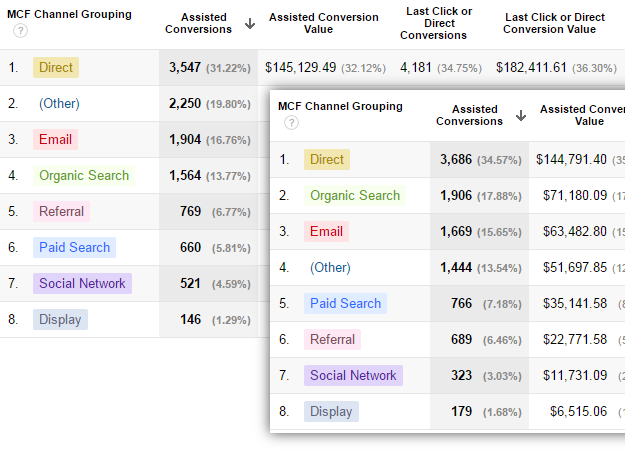
assisted conversions google analytics

Most companies continue to use the awful last-click attribution model (see more: Multi-Channel Attribution Modeling: The Good, Bad and Ugly Models). Focusing on Assisted Conversions, will first help your company move away from last-click but in the long run empower your teams to solve for getting an immediate conversion, but also valuing the longer-conversion cycle.

I hope you are convinced that our first source to benchmark ourselves, because it is within reach and you can teach the entire company a new habit pretty quickly.

2. Industry Analyst Data Benchmarks.

The place where we traditionally turned for benchmarks were industry analysts, associations, groups of people talking to top people at companies. This would include lovely organizations like Gartner or Forrester, Consumer Electronics Association, eMarketer/eAnythingelse, lone cowboys and cowgirls sending out surveys seeking input on various questions (in our case including "What is the current conversion rate for your website?").

The result would be a note you might get whetting your appetite like this one… usually offering you a full report in exchange for a reasonable amount of your funds or signing up for consulting services or purchasing software of one kind or other other…
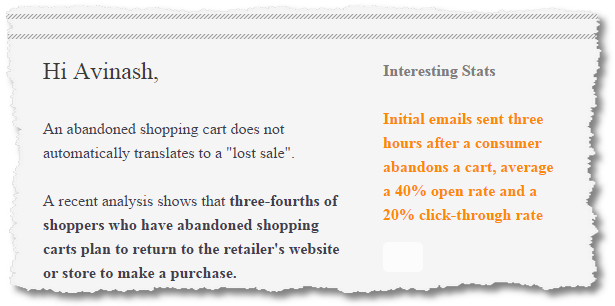
self reported benchmarking

In the past when we had little choice such reports, collections of benchmarks, held an incredible amount of value and sway in the industry. We have a lot more access to a lot more information, including our industries and performance. Hence, over time, though the costs were reasonable, I've become shy about these resources as a source of value/quality.

The sources providing this information continue to be insightful in many services they offer, and you should definitely hire them if you need those services. Just skip the we can give you data and benchmarks on performance bits.

If you do use them, please consider the data collection methodology.

A common source of such benchmarks (be it digital marketing or SEO or Landing Pages or anything really) is extensive surveys an organization might send out to a hand selected group or tweeted to the masses via social media. This creates a sample, sampling and self-reported biases.

survey based benchmarks

Please make not mistake, the organizations producing this data do a lot of math work, they apply great models, the amount of effort is wonderful. But, input influences output more than the processing of the input. So, be aware of those three biases, and do your best to accommodate for them if you do use this data for anything.

Sometimes the data you see is omg so tempting (!), dig deeper into the source of the data, the methodology used to collect the data and the assumptions that were applied when processing it and the limitations that are mentioned in small font size in footnotes.

facebook ads benchmarks

Net, net. These were more important in the past. You have too many other more valuable alternatives today. Exhaust those first.

3. Competitor Data Benchmarks.

After exhausting the value of strategy one, own data benchmarks, my next go to place is industry and individual company/website performance data collected by competitive intelligence vendors.

CI vendors have lots of interesting ways in which they collect data. (The Definitive Guide To (8) Competitive Intelligence Data Sources!) The processing is very apples to apples for any site (or if you prefer, rotten apples to rotten apples). They have extremely large datasets to play with, or provide to use for analyzing performance.

The only caveat to internalize is that the larger the size of your website, or your competitor's, the better the data you'll see in CI tools. For any site that receives less then 50k Unique Visitors a month, you are looking just looking at noise, any resemblance in numbers to reality is purely coincidental. Above 100k Unique Visitors a month, you are looking at good noise, kind of useful data, use it with just a little caution. Above a few hundred thousand UV per month, things start to get really interesting.

If your direct competitor, or you, have under 100k Unique Visitors, look at overall industry level data or a competitor that is much bigger than that. You can still learn from both.

With that, let's look at the first rich source of benchmarking data in CI tools, the industry and sub-vertical reports.

This is a report for Beauty and Fitness industry websites in the UK from the paid version of SimilarWeb (how they collect data pdf)…. and notice it includes the confidence building number – how many sites they have in the dataset…
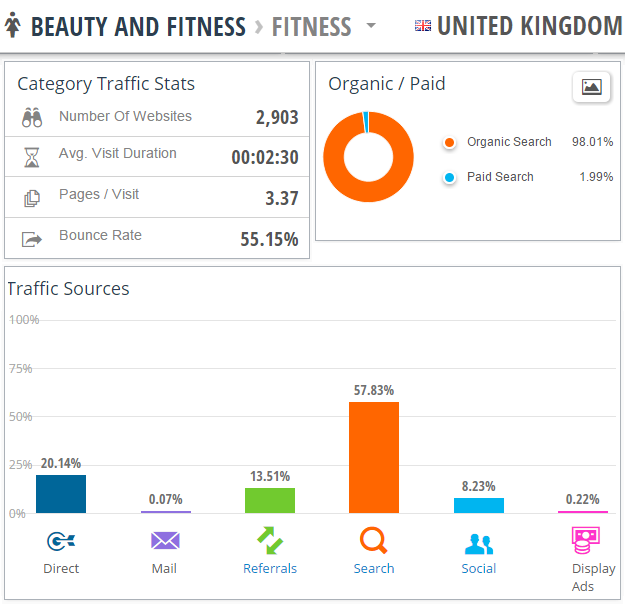
similarweb industry benchmarks

If you are the Marketer/Analyst for Virginactive.co.uk or Weightwatchers.co.uk or Stylist.co.uk, you have very good context frame your own performance. You have the standard metrics like Time on Site, Pages/Visit and Bounce Rate. And you also have, perhaps more useful, the industry wide acquisition strategy distribution.

Now you can ask yourself the question, how come we only get 12% search traffic and 70% display ad traffic? That could be the secret to your rousing success! But even then, I think it gives you context for the opportunity you are leaving on the table.

So three valuable metrics, and two distributions ppc/organic (though I have to admit this is weakest element in SimilarWeb) and traffic sources.

Since SimilarWeb has international data, you can run these reports for any country and for extremely specific or broad industries and sub-verticals.

As an example, here's the report for the Real Estate sub-vertical in Canada, the same set of actual performance that we can use to create our benchmarks…
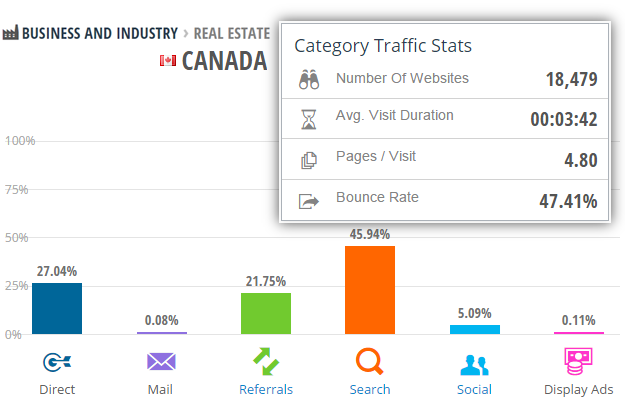
similarweb real estate canada

My favorite strategy for creating benchmarks is to take the above actual performance as layer one of context I need, and then I look for my big competitors as layer two.

For example, I've been working hard to crush Remax in Quebec. I want to crush, crush, crush them, and take over their business!

So after downloading the above data, I can also type in their URL into SimilarWeb and get their individual performance report (the link takes you to a free report, the one below is for six months from the Pro version).

I get the standard three metrics, and a trend for Monthly Visits. It delights me that my crushing seems to be working, their trend is down!

similarweb remax quebec

Ok, so my Quebec real-estate website is just getting 500k visits a month so it is unlikely that I'm causing the above. :)

Additionally, I also get the all important distribution of traffic to help me get context for my acquisition strategy/benchmarks.
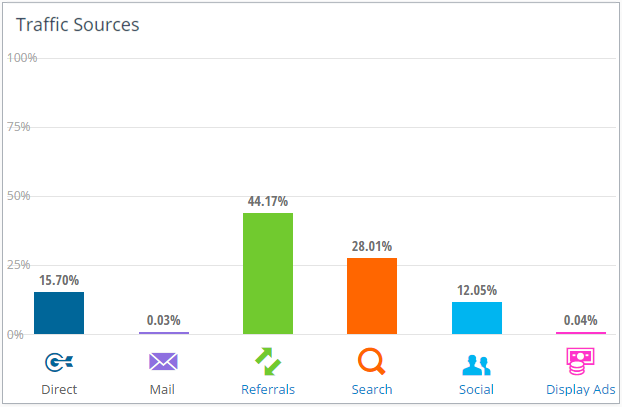
similarweb remax quebec traffic

There is a lot more information available to me (psychographic, geographic distribution, keywords, referring sites, and on and on). But I'll only look at that information when formulating how to meet or exceed the benchmarks I've created for my company.

For the benchmarks, I just need the highest level of info that you see above.

Use the data in the industry report and the individual reports of a few competitors (not just one!) to create benchmarks based on observed performance (rather than self-reported survey performance as in strategy two).

You'll be amazed at how much more focused your digital execution is.

Compete is another source of competitive intelligence data that you can use for the exact same purposes. (How they collect data.)

The limitation of Compete is that it only has data sourced from US audiences (so if you type in www.vodafone.co.uk, you are seeing the data only from American visitors).

I can run industry specific reports (Pro version) that will share the overall Unique Visitor trend for the industry (gives you a sense for the overall size of the pie – excellent context), along with the four key metrics (though not bounce rate, that's ok)… like this one for the Jewelry industry…

compete jewelry benchmarks

In the industry view you can click on the Traffic Dashboard tab, to get the traffic sources presented as one of my favorite visualizations, the treemap…

compete jewelry benchmarks traffic sources

You can click on any one of the the cluster's you are interested in, say, Miscellaneous, and drill down into the source that form that bucket….
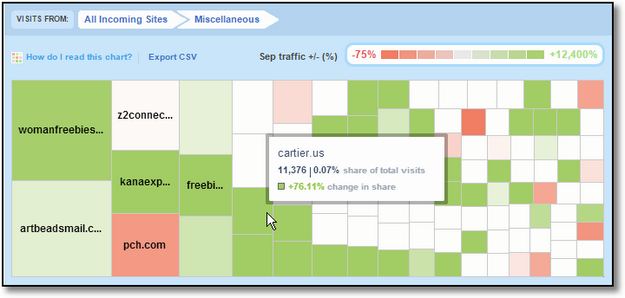
compete jewelry benchmarks traffic sources details

You get extremely detailed data. You will likely use the above level of detail in your execution strategy, it is nice that it is right there waiting for you.

As mentioned above, I'll use the above information as layer one of context. I'll focus on my big competitors and their specific performance for layer two of context.

Here's that report for bluenile.com, helzberg.com and kay.com….

compete website analysis

Clearly Kay is killing it. It is pretty interesting that while bluenile kissed kay in Sept 2013, it never comes close to Kay, who is pulling way in 2014. (Nice set of benchmarks for people at bluenile to shoot for, no?)

For my search benchmarks (total, just organic or just paid), I can drill down into search referrals report.
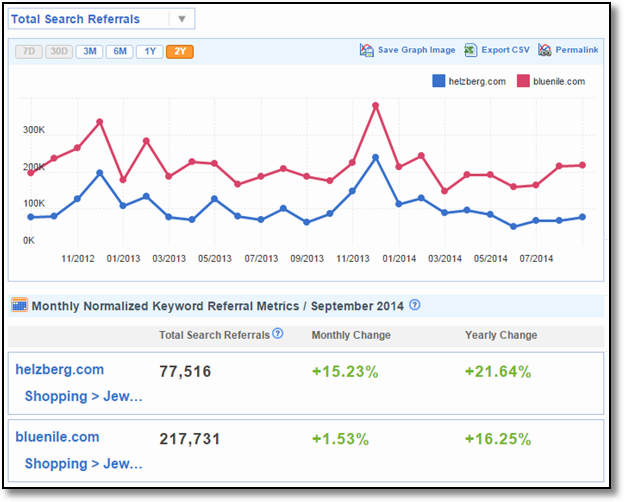
compete search analysis

Lots of good data. Lots of good benchmarks. From observed performance and not self-reported performance based on a survey or via other such methods.

There is a lot more you can clearly do with competitive intelligence data, it will help you focus in on strategies you need to execute to meet the new benchmarks you've set for yourself. Use it for that as well!

(In case you skipped ahead to this part of the post, please try not to get or use Conversion Rate numbers you might get from CI sources. Scroll back to the own data benchmarks section and see the four reasons for why not. Thank you.)

4. Vendor Data Benchmarks.

Perhaps my favorite source of data for benchmarks, data from our web analytics vendors!

It is better than the observed data from CI vendors because this data comes from the same tags as you are using on your own website from the vendor you use. And rather than someone observing it from the outside, CI tools again, you have volunteered to share this data with other users of the tool. Hence it is the best possible source of data.

You are in the data, and your competitors are if they are using it too! As close to apple to apple as you can get.

So log into your lovely digital analytics tool and if you see this, rejoice!
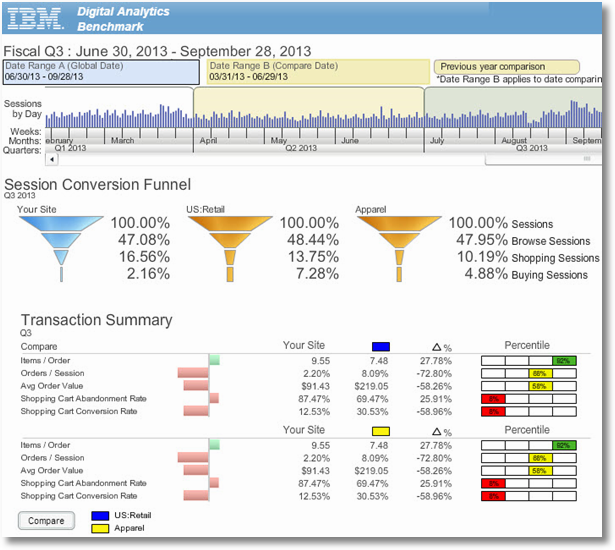
ibm conversion rate benchmarks

With the lovely IBM tool you can get abandonment rate and conversion rate (see caveat above) type metrics. You can also get session metrics and other behavior metrics. There are other things like browser types etc. which might be useful to our IT friends only.

Use the data to create your own benchmarks.

Benchmarks are not only available from web analytics vendors, any one who is the primary source of data collection can provide them. Some of these include MailChimp, for Email Marketing Benchmarks, and iPerceptions, for Customer Satisfaction Benchmarks.

I am also quite fond of the newly revamped v2.0 of the benchmarking reports in Google Analytics. The team has learned lots of valuable lessons from v1.0 and have come back with a bang with data that is even more insightful.

You'll currently find the reports in the Audience folder and the Benchmarking sub-folder.

Clicking on Channels shows you the first report.

Google Analytics will auto-detect the type of website you are based on an advanced algorithm that analyzes content and business type. In this case it, rightly detects that my site is a shopping website.

google analytics benchmarking ecommerce

The second thing it does is create a benchmark for you based on its understanding of your size, and only compares you to websites that are similarly sized. You can see that I'm around 25k – 50k Visits a month, it compares me to other sites, 2,623 other sites to be specific, that are in the 10,000 – 100,000 daily visits range.

As in the case of SimilarWeb above, I love knowing how many other websites are contributing to the benchmark. Very confidence building.

For this blog, Benchmarking classifies me into Internet & Telecom vertical. I can see that I'm totally crushing it (again after crushing remax! :)).

google analytics benchmarking telecom

Until I notice that the benchmark daily session size GA has chosen for me is 1,000 – 5,000 daily visits. I switch to the next level up. I'm not crushing as much. Boo! But no worries, what does not kill you makes you stronger. Watch out 100,000 daily visits people, I'm coming after you!

Google Analytics allows you to change your industry vertical by clicking on the first box. There are 1,600 different verticals, sub-verticals, sub-sub-verticals and sub-sub-sub verticals included. You can get pretty darn specific in terms of getting benchmarking data now.

analytics benchmarking options

As you can see above, you can also limit the data to a specific country. Guyana, anyone?

And you can choose from the seven traffic size categories (with the one GA has chosen for you by default clearly labeled).

Unlike the competitive intelligence tools, you can be pretty small and Google Analytics will still give you benchmarking data. Sweet.

Here's how the power of leveraging various controls works… Here's my ecommerce website as I see when I look at the standard benchmarking report…

google analytics benchmarking shopping

I've made a major push in my acquisition strategy in the United Kingdom, so I can switch Geo to the UK and after a few seconds of waiting with a bated breath, I get my current performance benchmarked….

google analytics benchmarking shopping-uk

Not as cute as I would like it to be. But, I now know where I stand, and where I need to get to for other sites in my industry vertical who also get traffic from the UK. Given something magical we did in mid-Sept (remember that is your real actual data), I need to repeat that or learn lessons and hustle.

But traffic is not the only thing you get in the new, improved and better smelling Google Analytics benchmarking reports. You also get lovely stuff in a super cute heatmappy table!

google analytics benchmarking detailed report

Remember how enamored I was with strategy three of CI tools with traffic sources to improve acquisition/marketing/advertising? Boom! You have it here, with actual self-reported data.

The Default Channel Grouping the same as in your Acquisition > Channels report. You get two six metrics: Sessions (visits), New Sessions, New Users, Pages/Session, Average Session Duration (time on site), and Bounce Rate.

You get your overall performance against the benchmark in the first row of data (gray boxes), and then individual segmented performance.

The cool part about having this built into your analytics tool (GA or IBM or whatever enterprise tool you are using) is that all the computations are done for you already. Look at the green, white and red cell colors to focus on certain zones and get a sense for your performance.

(In case you are curious, like I was, as to why the arrows are there, they are there for our color blind peers. Clever addition.)

We are doing better at Search and Social, getting lots of new visitors, but at a much higher bounce rate and lower site engagement. So we are better at acquiring irrelevant traffic. Oops!

Without the benchmark, you would not know. At least now you know, even if you are crying. Remember, you are just the analyst. Someone else is going to pay for this. :)

There are two buttons at the top left of the table in your benchmarking reports. The first button is pretty nice, it gives you the precise numbers. For example, showing me that I had 243,985 visits vs. the benchmark of 100,725 visits.

google analytics detailed benchmarking data

I find this to be distracting, the report has too many numbers by default and it looks like one big data puke. Hence I take advantage of that first button and turn the numbers off.

The second button, next to my mouse cursor above, turns off the heat-map on and off. When it is pressed off you get a nice clean table with just the arrows.

When you choose to geographically focus your benchmarks, you also the detailed data along with the overall session performance.

For the above website, I've chosen to zero in on Canada and you see all my numbers, and indexed performance, changes dynamically…
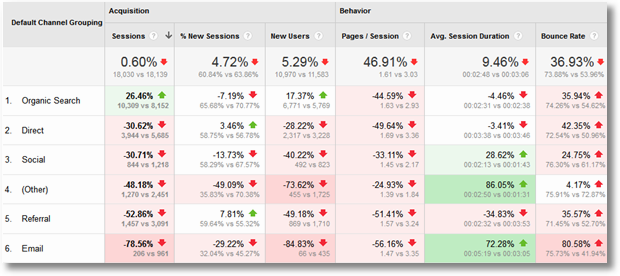
google analytics benchmarking detailed canada

If I choose to obsess about my Canadian strategy (and I do obsess about it!), I can do so with a unique set of benchmarks to inform targets I'm going to shoot for in my Digital Marketing and Measurement Model.

Channels is the first benchmarking report in Google Analytics. The second report is Location. It shows my performance segmented by countries. The same six metrics (I've excerpted only four below for the sake of image clarity). The same feature-set (including the ability to drill-down by industry vertical, size, etc.).
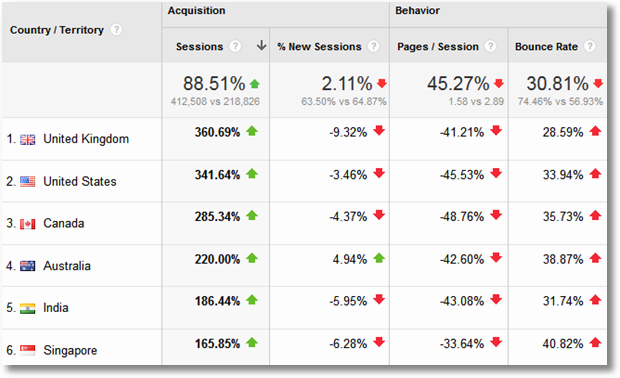
google analytics geo location benchmarking

The above is my standard view of the benchmarking report. I've turned off the precise numbers comparison and the heat-map (though I love the latter, I think the arrows suffice).

The third and final benchmarking report in Google Analytics won't surprise you. Given all the, deserved, hoopla around mobile, the third report shows device benchmarking information.

And…. I'm getting crushed. Really crushed!

benchmarking analytics device type shopping

Just look at all that red. Blood everywhere. Sure, of the low number of visits I have, many are new sessions, but how is that any solace.

Particularly crushing is the mobile battle. By end of Dec 2014, for most major websites mobile traffic will be greater than desktop permanently. So the fact that I'm -59% and -62% respectively for mobile and tablet should light a fire under our collective rear-ends at the company.

And yes, sometimes we all know that mobile is important. It takes this type of very specific mobile data for the message to be heard.

In order to make it more meaningful, and hoping less painful, I drill-down to the Women's Clothing industry vertical (my website's niche).

Sadly…
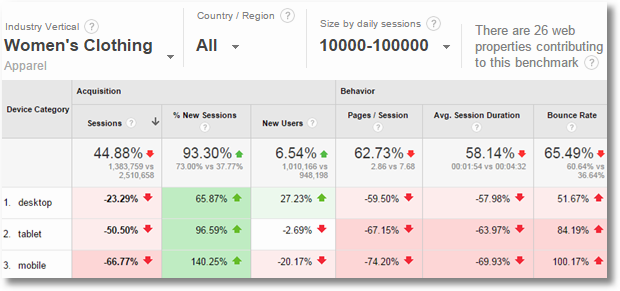
benchmarking analytics device type shopping apparel

Our benchmarked performance on mobile becomes worse, tablets a little better, and we stink a lot less at desktop (-23% to -44%). So some benefit from being able to be specific about the benchmarks.

Finally, just to bring this whole thing home properly… I focus on the country of Iceland because… well, why not… and in a few seconds I have my report….

benchmarking analytics device type shopping iceland

We are crushing it in Iceland! All three people. : ) Ok, not three, 1,353, but crushing is crushing.

I hope you see the power of having access to this data, and being able to focus very quickly on how we are doing as a company on the web. I hope you see, regardless of which strategy you use (one, two, three or four), that you can make your dashboards that much more meaningful, get your leaders and your peers to take action faster, and be smarter about getting relevant customers to engage with you and by delivering relevance and satisfaction, create higher business profits.

Benchmarks help create meaningful targets. Meaningful targets help with clearer understand of success, or failure. And that… is awesome.

Go, win smarter!

As always, it is your turn now.

Does your analytics practice include setting targets for your critical few KPIs? If you use benchmarks, which of the four strategies do you currently leverage? Which one has given you the most trouble? Of the strategies outlined above, which one do you dis-trust the most / find least valuable? Which one is your favorite? If you were to give advice to your web analytics vendor, which metric would you love benchmarking data for next?

Would you please share your guidance, advice, kudos, critique and life lessons via comments below?

Thank you.

Benchmarking Performance: Your Options, Dos, Don'ts and To-Die-Fors! is a post from: Occam's Razor by Avinash Kaushik

14 Oct 19:15

Write Effective List Posts For Your Blog Using These 10 Tips

by Jonathan Long

It is a good idea to learn how to write effective list posts for your blog, because after visual content like infographics, they receive the most traffic and generate the most social shares and inbound links. Their popularity has resulted in everyone putting together list posts, but simply throwing together a list and publishing it on your blog will not guarantee website traffic, links, and social love.

We have put together a list of 10 tips to help you write effective list posts for your blog and attract the kind of engagement that you desire.

Write Effective List Posts For Your Blog Using These 10 Tips image Write Effective List Posts For Your Blog Using These 10 Tips.jpg 600x319

Tip #1: Write an introduction

This blog post that you are reading right now is a list post, and you can see above that it was started with a brief introduction that explains what the post is all about and what the reader will gain by reading it. Many blogs will have a great concept but they start with point #1 without an introduction. All you need is a simple paragraph that lets your reader know what it is about and why they need to read it.

Tip #2: Include visual elements

At the very least your posts should contain at least one image, as readers prefer to read content that has some visual elements, even if it’s just a simple image that relates to your list post topic. Use tables, graphs, and even infographics whenever possible to really enhance your post. Using visual content is extremely effective and really helps to emphasize points that you want to make sure the reader picks up.

Tip #3: Keep your points on topic

Focus on creating content that is jam packed with information, eliminating any fort of fluff. Many companies are so focused on the length of their content that they fail to make sure that the reader is going to be able to read through it quickly and pick up all of the points, even if they just briefly scan through it. Most individuals are going to do just that – skim through it, so make sure that they can absorb the key points without reading every word.

Tip #4: Make your blog post shareable

You should want your blog to attract social shares from every piece of content you publish. List posts are very popular and they will tend to get more social attention than a non-list post, so make sure that your readers can quickly share the post on their favorite social media network with a single click. Determine the best position for your social sharing tool, either at the beginning of the content or at the very bottom by split testing locations. Take a look at some of the most popular websites like Mashable and Entrepreneur – the most popular posts are typically list posts.

Tip #5: Don’t write a generic blog post — speak to your reader

Instead of writing a generic blog post put some character and personality into it. Using words like “you” let the reader know that you are speaking to them and not just publishing a boring information list post. You can increase engagement by asking questions to your readers that cause them to continue to engage with your brand. Adding some personal flare always produces better results.

Tip #6: Experiment with different numbers of items

You will notice that the majority of list posts include 10 items (including this post!) because it appears to be the magic number. It draws attention and list posts that feature 10 items always perform well. This isn’t to say you shouldn’t test different numbers. Use the number that is going to allow you to fully get your point across. Also, don’t be afraid to use larger number, such as 37 or 52, for example. List post headlines with large numbers like that command a lot of attention.

Tip #7: Write descriptive list points that summarize each point

As mentioned above, a large percentage of the readers are going to skim through your list post, so make sure that your title for each list point is descriptive enough that the readers can get the point simply by reading the title of each point. This is going to benefit you, because if someone skims through it and just reads the headings for each point and still feels that they received something of value they are going to hit the share button.

Tip #8: Make sure your topics are compelling

Unfortunately many companies will just throw together a numbered list post without putting much thought into it. Just like a regular blog post, a list post needs to be compelling! You want people to stop in their tracks and click your blog title because they are interested in reading more. Get creative and come up with topics that your audience will be interested in reading about. A list post alone isn’t going to bring traffic — a great topic is.

Tip #9: Build you post specifically for your audience

Publishing a list post geared towards a business owner requires a much different approach than writing a list post for a consumer. A business audience composed of CEOs and executive level personnel will respond better to data numbers and stats, while a post that features more fun facts or a compelling infographic will engage your audience better. Just be aware of who your audience is and create your content specifically for them.

Tip #10: Write a conclusion

After your last list point you need to write a small conclusion that summarizes the message again, just as you did in the introduction. Your conclusion also gives you the opportunity to insert a call-to-action – either encouraging the reader to interact with other pieces of your content or to complete an action such as filling out a lead capture form or contacting your company.

Writing effective list posts for your blog is a great way to pull in new readers, introduce new audiences to your brand, gain social media love, and even earn inbound links. Using the tips listed above will help you craft more effective content, so make sure to use them next time you sit down to publish a new list post for your blog.

14 Oct 19:15

This Guy Quit His Job At Twitter To Make Vines Full Time — Now He Earns Thousands Per 6-Second Video

by Katie Richards

You may not recognize the name Ian Padgham, but you've probably seen some of his Vine videos. One of his biggest videos, and one he says he's most proud of, captures his wife’s pregnancy in just six seconds. 

Padgham started making Vines right around the time Twitter launched the platform on January 24, 2013. He was a video producer for Twitter at the time, putting together product release and promotional videos, including the Twitter recruitment video that went viral.  

Now he runs a Vine creation company — essentially an ad agency for marketers who want Vine videos. It's a business in which a good Vine can fetch up to $30,000 per client.

"I’ve had some really awesome opportunities," Padgham tells Business Insider. "I went and I did the Olympics for Visa so I was in Sochi for a month. I have an ongoing contract with Sony where every week Sony sends me a box with a product in it and I open it up and I get to make a video about it."

When Twitter rolled out Vine, Padgham put together a video of how the six-second video platform worked. He made his first Vine video from the Twitter headquarters the day it launched.

Form there he kept experimenting with Vine. Sometimes he put together Vines for the company itself when updates rolled out. Those would show users how the updates worked and would provide tips and tricks for using the platform. Other Vines were embedded into Twitter blog posts. When Twitter wanted to put together a post with Twitter stats from the NBA finals, Padgham put together a Vine for that as well.

He was on Vine from day one and was fast becoming a master of the platform, but it wasn't until Robot Chicken, an animated stop-motion comedy show, visited Twitter's office that Padgham knew it was time for him to take the next step. 

The guys from Robot Chicken offered a simple piece of advice to Twitter employees: success comes to those who hustle and work hard. 

"For whatever reason it was this a-ha moment for me," Padgham says. "I think in a lot of stuff I do I’m kind of a perfectionist. I decided, you know what, I am going to use Vine to change the way I produce because I was over-thinking things and killing projects with revisions."    

Padgham decided to wake up an hour earlier each morning and make a Vine video. He made a Vine a day for a year and a half, many of which featured his signature wooden man as the central focus. Over that year and a half period Padgham watched his number of Vine followers skyrocket. Right now he has over 360,000 followers.


That's when brands took notice, and the offers from marketers started to pour in.

His first big offer came last August from country singer LeAnn Rimes. Rimes saw some of Padgham's work on Vine and loved it. She called him up and asked Padgham to work on her music video for "Gasoline and Matches" in the stop-motion style he used for many of his Vines.

Even though the music video wasn't his first big break using the Vine platform, he still thinks it helped kick off his career. The video is shot entirely via an iPhone.

After working on "Gasoline and Matches," Padgham got more involved on the brand side. But working with brands while still at Twitter became a conflict of interest because some brands wanted to pay to promote their videos on the social platform, while paying him to create them, at the same time. It was time to make a tough decision and Padgham left the company in August 16 2013, although he still freelances for the video team from time to time. 

After leaving Twitter he founded his own company Origful, whose main focus is to create Vines for brands. In the past year the team has worked with Visa, Airbnb, Sony, and a handful of others.  

One of his most recent projects Padgham has taken on is a series of videos for the San Francisco 49ers, named the "Forty Viners." Any time the SF football team has a home game, Padgham ventures down the team's Levi's Stadium and puts together a 6-second video for the Vine page. 

Recently Padgham says he brings a plush puppet of the opposing team's mascot along and uses it to playfully mock the other team.  

There are so many opportunities to create content that's artistic, but it can also bring in a steady income. We asked Padgham about what kind of money is involved in making Vines, although he declines to be specific about his own fees:

This whole process is still really new. It’s really shaken up the way things work in terms of advertising. The prices are all over the place. When you put into perspective the cost on these Vines, there are people who say a Vine is 50 bucks to make, but when you think of the impact of some of these Vines, they get hundreds of thousands, if not millions of loops, tons of likes, huge ROI [return on investment]...There have been a lot of stories that have come out and people say they are paid anything from $1,000 to $30,000. 

SEE ALSO: These Are The 10 Most Popular Brands On Vine

Join the conversation about this story »

14 Oct 19:12

The Container Store Training Philosophy

by johnmoore

We continue our series sharing summaries of principles The Container Store follows to achieve its long-lasting success. These principles are detailed in the book, UNCONTAINABLE, written by Kip Tindell (co-founder, ceo and chairman, The Container Store).


The Container Store Employee Training Philosophy

uncontainable_150The Container Store trusts its employees to make meaningful connections with customers and to share their organizational expertise at every opportunity with customers. This trust comes from knowing they’ve hired great employees and trained them well.

Astonishingly, full-time employees at The Container Store receive close to 300 hours of paid training in their first year. Read that again… nearly 300 hours of paid training. Not 30 hours, but 300 hours. Part-time employees get almost 200 hours of training and no employee gets put on the sales floor without first receiving 40 hours of training.

That’s a major commitment to training. A commitment very few retailers have the courage to do.

The Container Store training philosophy is about building an employee’s intuition muscles.

Kip Tindell explains it this way, “We want our employees to use their intuition—their wonderful life experience—to anticipate the needs of our customers and to recommend the appropriate solutions.

All the training employees receive prepares their mind to handle most any situation at the store level. It also prepares employees with product knowledge and organization expertise that helps them to explain to customers some of the complicated products The Container Store sells.

As it relates to training employees, Kip Tindell stresses its importance by saying…

One reason training is more important at The Container Store than at other retailers is because our motto is ‘We sell the hard stuff.’ We actually tell our buyers to look for products that are hard to sell. Why? Because we know other retailers won’t touch those products, giving us an exclusive and yet another reason for customers to shop with us.

Let’s revisit the nearly 300 hours of training full-time employees receive at The Container Store. How can a retailer justify such an outrageous expense?

For The Container Store, training employees so well results in a turnover rate of less than 10%, which saves the company millions of dollars in recruiting, interviewing, hiring and training people. And since they sell complicated products, vendors can trust employees at The Container Store to tell the story and purpose behind each of the products sold in the store.


The Container Store posting series:

  • Hiring (Oct. 13)
  • Training (Oct. 14)
  • Selling (Oct. 15)
  • Leadership (Oct. 20)
  • Vendor Relations (Oct. 21)
  • Retailing (Oct. 22)
  • Manifesto (Oct. 23)
  • The post The Container Store Training Philosophy appeared first on Brand Autopsy.

    14 Oct 19:12

    Buyer refuses to answer your questions? Do this!

    by steli@close.io (Steli Efti)

    I recently got an email from Vivek, one of my blog readers, who had to pitch to a massive car company. It was a high-pressure sales situation for Vivek. The stakes were high as a lot depended on this deal and he had just one shot. 

    As soon as Vivek opened the presentation with a qualifying question, the buyer interrupted him: 

    “Listen, Vivek. You are here to present to us. We would like to not have to answer any questions. Why don’t you just go ahead and make the presentation? We will ask the questions. And then when you leave, we can determine whether we want to move forward with this or not.”

    How do you, as a sales person, deal with this challenge?

    In this post, I will tell you what you can do to turn an unfavorable sales presentation around and win over your prospective buyers.

    Should you fight or follow?

    Properly qualifying your prospects is a crucial step in sales. Asking questions and listening to answers is one of the most important aspects of your interactions with a prospective customer. 

    Your ability to do your job well is squashed when the buyer tells you:

    “You’re not allowed to ask any questions. I just want you to present, and I’ll make my choice afterwards.”

    refusetoanswer

    What do you do?

    Do you:

    A. Fight for your right to ask, or
    B. Sell the way your prospects want to buy?

    If you think that a large enterprise has its own way of making purchasing decisions and it’s easier for you to adapt to its buying process than to get the enterprise to adapt to your sales process, you might choose option B.

    I, however, would strongly advise you to choose option A.

    But how do you fight for your right to ask questions without creating an argument?

    You can't just insist on your way of selling. You can’t declare:

    “No way! This is how I present and sell, and I need to ask you these questions!”

    Instead, your goal is to demonstrate to your prospects that answering your questions will benefit them. You have to disagree without being disagreeable.

    Plan A: Turning your meeting around

    Here is a step-by-step process you can follow to convince your prospects to let you lead the conversation.

    Step 1: Make a supporting statement:

    “That makes perfect sense. In a typical vendor and buyer relationship, that’s a really good process, and it’s served you really well.”

    Step 2: Re-frame the issue:

    “But we like to be more than just a vendor. We actually want to be a partner.”

    Step 3: Make your case:

    “In order to be a partner, it’s important for us to truly understand what the needs of the people who use our software are. Only this way we can make really good recommendations and focus on what’s most important.”

    Step 4: Sell your prospects on an additional benefit of green-lighting your questions:

    “So, I would suggest we just take five minutes to explore how our product would actually relate to your initiatives and needs. These five minutes will either make the next 45 minutes more productive or it will save both of us a lot of time because in five minutes we might discover that we’re not the right fit. If we discover quickly that we are not the right fit, I won't waste your time with a long presentation.”

    Step 5: Transition into your first question (without waiting for permission):

    “Does that sound fair? I have three really crucial questions that will influence the way I present our product, and I think it’s going to make a big difference.”

    Executing plan B

    If you manage to convince your prospective buyers to answer your questions, great!

    If they interrupt you again and refuse to provide you with any information, you’ll have to make your next decision.

    Do you now:

    • Play by their rules, or
    • Insist that the questions are of vital importance?

    From my personal experience, I’d advise against pitching to a buyer who is totally closed to receiving your questions and treats you like a commodity.

    But if you want the deal to happen so badly that you’re willing to tolerate such treatment, then proceed as they instruct you.

    Be aware, however, of the disadvantaged position you will find yourself in.

    You’re throwing darts in the dark. You don’t know your prospects' decision-making criteria. You don’t know their pain points and objectives. You’re treating guesswork as gospel, flying blind.

    My question to you is: if you’re flying blind, should you make your presentation as short as possible or as long as possible?

    Think about that for a minute. What’s the better strategy here?

    You might be thinking that it makes sense to squeeze as many case studies and convey as many different benefits of your product or service as possible into your presentation. You hope that among the great number of value propositions you showcase, at least one will hit your buyers' sweet spot.

    If you think making your presentation longer is the right choice because it allows you to cover more ground and talk more extensively about the topic, think again.

    Why?

    Large amounts of information will overload and bore your prospects. They won't pick up on the things they like. Instead, they’ll focus on the elements of your presentation they dislike.

    That’s why you should keep the presentation short. Take 10-15 minutes to highlight the most important facts about you and your solution in general. Tell a quick, 2-5 minute, story of how adopting your solution helped a company similar to theirs.

    End the presentation by saying:

    “At this point, I think it’s a good time to actually have you ask some questions to make sure I answer and address everything that’s important to you.” 

    And then let them drive the conversation by asking questions.

    Answering follow-up questions will give you the opportunity to ask clarifying – read qualifying – questions.

    Buyer: “Well, how do you ________?”

    You: “You know what, that’s an interesting question. Let me make sure I understand it correctly. Is this important to you because of X or because of Y?”

    That’s how you secretly present a qualifying question to a buyer who resists being asked qualifying questions.

    You have to be attuned to the subtle dance between you and your prospects. Let them guide you in the direction they want the presentation to go while keeping your goals in mind.

    Conclusion

    When your ability to ask qualifying questions during a sales pitch is hampered by the uncooperative prospect, try to reframe your request as a benefit to them.

    If your attempts fail and you don't want to walk away from the meeting, comply with the proposed format but make your presentation short. State the most relevant facts and insert a case study to support your points.

    Use follow-up questions as an opportunity to ask your qualifying questions and transform the presentation into a productive conversation for both sides.

    14 Oct 19:11

    The Gives & Gets of Negotiations

    by John Barrows

    *Editors Note: John Barrows is the top sales trainer for industry leading tech companies. He trains reps from Salesforce, LinkedIn, Box, Marketo, Zendesk, and more. Come see him speak and attend his exclusive Prospecting Workshop at the Sales Hacker Conference in SF on November 6th/7th.

    It’s All About the Win-Win

    True negotiations are all about coming to a mutual agreement on something where both parties feel like they got something out of the deal. Contrary to popular belief, you don’t “win” a negotiation by making the other person lose.  Both parties need to give and get along the way. The more equal those gives and gets are, the healthier the relationship is and can become.

    The problem in sales is that we tend to be ‘givers’.  We give and give and give and expect one very large thing in the end as our ‘get’ (i.e. signed contract) and we think we’ve earned it because we did everything they asked for. However, if we give throughout the process without getting much in return, we condition the client to treat us like a doormat.  They end up having little respect for us towards the end which is why they either keep asking for things (discounts) or they just flat out disappear on us and don’t even give us the courtesy of a call back.  We need to find a way to create and condition equality from the start of the relationship.

    Creating Equality in Negotiations

    To create equality, most negotiations focuses on a quid pro quo approach to getting things in return for what you’re giving away which is necessary sometimes but tends to lead to a more contentious relationship.  There is something else that can be even more powerful to leverage which is a human condition called the Rule of Reciprocity.  This rule effectively states that we (as humans) are all bound, even driven to repay debts.  We don’t like owning anyone anything.

    If someone asks us for something, the receiver actually feels obligated to give them something in return. The sooner we ask for something in return, the easier it is for us to get. By understanding all the gives and gets along the way and matching them up, we can know exactly what and when to be asking for in order to move the deal through the pipeline to closure, or get out before it’s too late.

    Don’t Jump to Discounting

    Often times people jump to discounting to speed up negotiations. Discounting has such a negative impact in so many ways that it’s worth pointing out a few things to gain some perspective.

    • The average S&P 1000 company would suffer a 12.8% drop in profitability by giving a mere 1% discount assuming no increase in volume
    • Salespeople make a bigger deal about price than buyers do (Salespeople (8.3) Buyer (6.9)
    • Whoever feels the most pressure will make the most concessions
    • Discounts kills credibility and creates a negative perception of you and your solution
    • Discounts set the stage for future discounts

    So what’s the best way to combat discounting you ask? Well, there are some negotiation and objection handling techniques that can help but the best way I’ve ever come across is quite simple, just have a BIG FAT PIPELINE.  The more legitimate, healthy deals we have in our pipeline the less desperate we are to close deals, and the more confident we are in dealing with people who are trying to squeeze us. We can also work more along the lines of the client’s buying cycle than our selling cycle. Too often we try and force a client into our buying cycle which typically is driven by the end of the month or quarter. We all know Sales should be about the client and not about us, so we need to do what we can to get them to buy when they’re ready to buy, not when we’re ready to sell.

    This is why prospecting on a regular basis (even month or quarter end) is so critical. Spend 30 minutes a day prospecting in some way shape or form. It can be cold calls, direct e-mails, searching through linked in, asking for referrals, whatever, just do it.  If you’re sick of feeling cheap and using discounts to close all your deals then prospect every day to have a consistently full pipeline and see what happens to your confidence and abilities to deal with discounting. I’m running an exclusive Sales Hacker Workshop in SF on November 7th where you can learn all of my best tactics and strategies for prospecting and building massive pipelines.


    If you’re interested in learning how to develop a simple scorecard that you can use to objectively measure the health of any opportunity in your pipeline and improve your forecasting accuracy you can join me where I’ll be speaker at the Sales Hacker Conference in San Francisco on Thursday, November 6th, 2014.

    The post The Gives & Gets of Negotiations appeared first on Sales Hacker.

    14 Oct 19:11

    The Inability To Communicate Value Messages – Biggest Inhibitor To Sales Success 2014

    by Tamara Schenk

    At the MHI Research Institute, we have asked this question in each of the past three years: What are the biggest inhibitors to sales success?
    Our 2014 data delivers a consistent message: The “inability to communicate value messages” is again the biggest inhibitor to sales success, as it was in 2013 (22%) and in 2012 (23%). The second biggest inhibitor is the “inability to attract new clients” (16%) followed by “more complex buying requirements” (15%).

    Value messaging needs a clear design point – the customer

    Before the Internet existed, a salesperson could create value for customers by presenting functions, features and benefits. But now buyers can find all this information online, and value messaging has to change. Executive buyers in particular are not interested in what a product is and what it does; they need to know what it means for their business and their desired outcomes. This evolution in the buyer’s world changes the design point for value messaging. It’s no longer the product; it’s the customer. The customer’s journey and the different buyer roles along the entire customer’s journey are the main design point for value messaging.

    Value messaging needs to be dynamic

    The times when static value propositions were successful are gone. Value messaging has to be dynamic to address the customer’s different focal points along their customer’s journey. In the beginning of the customer’s journey, value messaging has to focus on the customer’s context and the stakeholders’ different concepts regarding how to fix a problem, how to avoid a risk or how to accomplish a goal. Salespeople can create significant value if they help customers to better understand their challenges, the root causes and the real business impact, and if they can provide tailored perspectives on how to approach the challenge in different ways to achieve the desired results. In these stages, there is no room for product-focused messages.

    This changes in the actual buying phase. Here, the decision dynamics have to be orchestrated. Value messaging often has to address additional stakeholders with very purchase-focused concepts. Competitive and product-oriented messages are now more important, but must always be mapped to the customers’ desired results and wins. The goal in this phase is to be perceived as the buyer’s best option against all competitors to achieve their desired results and wins.

    It changes again in the implementation and adoption phase. That’s right: value messaging doesn’t end when a deal is closed. Now, it is important that the value gets delivered as promised. Owning the customer’s outcome means making sure that they can achieve their desired results and wins. Furthermore, it’s important to orchestrate the value dynamics during this important phase. Different stakeholders will perceive value differently, based on their different roles and concepts. And often, projects are delegated for execution. So, it’s even more important to make sure that the stakeholders and the initial executive buyers know how the value was delivered and which customer results were achieved. Following these steps can easily open a window for new opportunities within this account.

    Value messaging and creating new business

    The inability to communicate value messages is not only the single most important challenge year after year; it’s also the underlying cause of at least two other inhibitors. Those are the inability to attract new clients, (reported by 16% or our survey respondents) and the inability to expand in existing accounts (7%). Taken together, these three factors comprise 48% of the inhibitors to sales success. This makes value messaging a top priority for every sales leader to care about.

    Value messaging, sales enablement and homework

    As described above, the secret to successful value messaging lies in a dynamic customer core approach. It is sales enablement’s responsibility to provide messaging frameworks that are easy to access and to customize. Sales enablement and sales training have to make sure that salespeople know how to use the messages effectively, and that they are trained to present messaging that’s focused on business issues rather than on product. Messaging training has a lot to do with role plays and simulations, ideally based on real opportunities. As in sports, it takes a while to get familiar with the basics of a new sport. It’s the same with new value messaging that’s focused on business issues. It requires a different language that addresses different patterns. New skills have to be learned to achieve a certain level of proficiency.

    Furthermore, creating new business begins very early along the customer’s journey. First, your strategic account planning must lead to a solid account growth strategy. And the customer has strategic initiatives of their own; it’s essential to understand these and to connect the dots to your own capabilities. Identifying the right buyer roles within new accounts and also within existing accounts is critical to success. Then homework and research has to be done to identify a valid business reason for the first conversation, and all conversations must be prepared for in advance. At that point, value messaging can work successfully—if all other selling competencies are in place.

    Related blog posts:

    The Biggest Inhibitors to Sales Success

    “The Expert” – Why Understanding The Customer Is Key To Provide Perspectives

    Providing Perspective – A Customer Core Principle


    14 Oct 19:10

    Why Your Content Marketing Should Alienate (Some) Prospects

    by David Dodd

    Recently, I attended a webinar presented by Doug Kessler titled Insane Honesty in Content Marketing. If you’re not familiar with Doug Kessler, he’s one of the co-founders of Velocity Partners, a content marketing agency based in the UK. Velocity consistently publishes great resources regarding content marketing, and this webinar is a must-see for B2B marketers.

    According to Kessler, insane honesty in content marketing consists of:

    • Actively seeking out your weaknesses and sharing them openly; and
    • Strategically putting your worst foot forward.
    Obviously, this approach runs counter to a whole laundry list of widely-accepted marketing principles and practices, and the idea is probably difficult for many marketers to swallow. In the webinar, Kessler shared several examples of insane honesty at work, which is another good reason you should view the presentation.Six Reasons to Practice Insane Honesty
    Kessler identified six reasons to practice insane honesty in your content marketing:
    1. It surprises and charms - Because this type of content is rare, it is more likely to capture the attention of potential buyers.
    2. It signals confidence - Kessler contends that confidence is the most powerful attribute of all effective content marketing.
    3. It builds trust - If you’re insanely honest about the weaknesses of your solution, potential buyers will be more likely to trust what you say about the strengths and benefits of your solution.
    4. It alienates less likely buyers.
    5. It attracts your ideal prospects.
    6. It focuses your sales and marketing team on the battles you can win.
    All of these reasons are important, but I want to focus on reason #4 in this post. Marketing content that is insanely honest will alienate some of your prospects, and that’s a good thing because of the economics of B2B demand generation.Insane Honesty Supports Economic Demand Generation
    The diagram below illustrates the point that your investment in a prospect increases as the prospect moves through the marketing/sales funnel. On average, you will have much more invested in a Sales Opportunity than you will in an Inquiry. Therefore, it’s important to determine whether your solution is a good “fit” for a prospect as early as possible in the prospect relationship.
    Why Your Content Marketing Should Alienate (Some) Prospects image EconomicsofDemandGeneration2.jpg2 600x448

    Marketing content that is insanely honest serves two critical marketing objectives. It functions as a magnet that simultaneously attracts prospects who are a good fit for your business and repels those who aren’t. The result is a more effective and efficient demand generation process and a lower likelihood of winding up with frustrated and unhappy customers.

    14 Oct 19:10

    Successful Negotiations: Why it’s Critical Not to Lose Sight of the Big Picture

    by Dario Priolo

    Successful Negotiations: Why it’s Critical Not to Lose Sight of the Big Picture

    “Are we negotiating?”

    “Always.”

    That succinct bit of dialogue from the 1997 movie “The Devil’s Advocate” serves as a good reminder for sales professionals to heed when selling to prospects or existing accounts. Don’t take for granted that it is a mere formality or confined to the period leading up to inking an agreement. You are constantly negotiating and should not only realize this, but practice their approach.

    Negotiating is certainly about prices and fees, but also about so much more. What’s negotiable? Pretty much any aspect of a sale can be negotiated from delivery date, warranty, and payment or service terms to product features, account team, and the like. What’s important to realize is that each bit of dialogue and revelation throughout the sale process enlightens both seller and buyer alike with information that will influence this deal – or the next.

    It’s the tail end of the contract building process, but as the quote above suggests, negotiating really starts at the beginning of the relationship and continues long after the deal is done. Off-hand comments, questions, and observations made by your clients can cue what they’re thinking about when the time comes to re-up. How you approach them can either shore up or undermine the chances for future success.

    Ingredients of Successful Negotiations

    When negotiating, keep these points in mind to avoid derailing while strengthening your relationship:

    • End-game. Have a clear image of the end. What do you want to achieve as a result of the sale? What does a successful agreement look like for you? For your buyer?
    • Dialogue. Negotiating is an art that requires a delicate but effective touch. Realize that even when the deal’s done and the ink has dried that further negotiations are happening. The trick is to keep a checklist of variables and factors that could change or impact the deal, but don’t waive it in your client’s face at every opportunity. This gets old fast and makes you seem like you’re constantly keeping score and not focused on the big picture. Rather, focus on a fluid dialogue that recognizes variables and addresses them more naturally between contracts and more directly when negotiating an agreement. All dialogue should happen in a friendly, relationship-building manner.
    • Flexibility. You don’t want your sales professionals to be pushovers, so you must train them where they need to stand fast and where they have wiggle room. Always maintain some area of flexibility and maneuverability. If you’re completely inflexible, then your buyer might assume that you’re not even making an effort to meet their needs or requests.

    What Not To Do: Successful Negotiations Do Not Look Like This

    There are several things that you should not do when negotiating in order to avoid torpedoing the deal and thus your relationship. Here are a few examples:

    • Don’t be adversarial or combative or try to get one over on them. If you’re adversarial in negotiating, you risk blowing up the deal and relationship. That’s akin to winning the battle but losing the war.
    • While you don’t want to be unfair to your clients, you also can’t go back to your boss and say that you’ve given away the store. Your company is in business to make a profit, which is not unreasonable. Don’t allow your desire to please your client undermine your ability to be effective.
    • Don’t weigh deals down with goods or services that are unwanted or needed. This “bloatware” will go unused, will be unappreciated, and cause the buyer to feel like they overpaid for the value they received. If something is truly necessary, then make sure that the end users know what it is, why it is important, and how to leverage it. Otherwise, they’ll be skeptical and resent it making future sales or renegotiations difficult for you.

    The Ultimate Goal: Create Value and Build Trust

    Both parties in a negotiation have priorities: the buyer to receive something of value for a reasonable price, the seller to deliver services or goods for a reasonable profit. The key elements in this exchange are value and trust. If either is missing, called into question, or obviously deficient, then closing the deal becomes more difficult (and could cause the relationship to falter).

    Encourage your sales reps to structure deals in a manner that highlights the value that you will bring to your buyers and the trust you hope to instill in them by delivering as per the terms of the agreement.

    At the end of the day, your goal should be for the long-term success of the relationship you’ve developed and cultivated. If your mindset is focused on a transactional sale, then your goals and motives are one-sided and clearly not in the interest of your buyer. Sellers with a lock on the market might be able to get away with that for a time, but as soon as a viable alternative appears, what respect have you shown by taking advantage of them?

    Negotiate for the sake of the relationship, not the deal, and both parties will win.

    ———————————————————

    LEARN MORE ABOUT RICHARDSON’S NEGOTIATING TRAINING

    To Learn more about how you can partner with Richardson’s to raise the quality of your team’s negotiations with your clients and prospects, please click here.

    successful-negotiating


    The post Successful Negotiations: Why it’s Critical Not to Lose Sight of the Big Picture appeared first on The Richardson Sales Excellence Review™.

    14 Oct 19:10

    How to Be Famous for Your Business Content

    by Jeff Korhan

    How to Be Famous for Your Business Content image 2014.10.13 Business Content 600x502.pngAs a marketer you no doubt are familiar with the expression “Content is King” – but do you know who is credited with first coining it?

    I posed that question to my audience at a recent content marketing conference here in Chicago. To my surprise, nobody knew the answer. While it is sometimes disputed, Bill Gates is most often credited for one simple reason:

    He published it.

    This is why your business needs to get serious about publishing business content.

    Claim Your Signature Content

    New ideas often slowly emerge from everyday circumstances. This is why they seem common to those that are aware of them.

    What is uncommon is doing the work to claim at least partial ownership of these ideas. This is the basis of every copyright.

    To establish a copyright one only needs to package and publish his or her original idea on a medium that is available to the public.

    You are surrounded by abundant knowledge that everyone in your industry believes is common, and it is, until someone puts their signature perspective to it.

    That’s the publishing opportunity available to every business in every industry. It’s almost as if we have all run a race and are standing at the finish line waiting for sometime to claim victory.

    Package and Publish Business Content (or Perish)

    In the world of higher education there is a frequently used phrase: Publish or perish.

    College and university professors are expected to originate new ideas, ways of thinking, and solutions to problems. However, if they do not publish content in academic journals they are not appropriately credited, and that puts their career at risk.

    The same holds true for every business these days.

    Your business experience doesn’t matter if the marketplace cannot readily connect you with it. You have to get out there and be well known for something.

    What is your business famous for (or should be)? You only have to neatly package and publish it to claim it.

    Fame is the result of what people are saying about us and our businesses. Therefore, use your media to give people something to talk about.

    That’s how this content marketing game works.

    Start by considering what your ideal buyer should know about your business if they were to compare to others. Many buyers do not know what they need to know to make better decisions. Help them.

    The One That Names the Game Owns It

    Here are examples of signature business content that will give you ideas for getting started. Publishing this content helps your future and current customers, while also claiming your ownership to it.

    1.Your “secret sauce. Unique business methods – and why they matter

    2. Answers to common questions about your services

    3.“Did you know?” – Tips and advice about your services that buyers need to know, such as why your slightly higher price promises a product whose longevity is twice that of others.

    4. Aha moments or stories that humanize your business

    5. Uniquely favorable experiences customers have had with your business

    My favorite is #1 because every business employs a process that is its own. It often has the fingerprints of the business founder all over it, and that alone makes it unique.

    When your business names that process it owns it. To accomplish that, distill it down to its most essential qualities and amplify how it consistently delivers exceptional customer experiences. More on this in future issues of Web Marketing News.

    For now, just remember this: The one that names their process creates a new game and owns it. If your organization or members really want my best on this, contact me about my Relationship Selling in the Trust Economy workshop.

    When Bill Gates coined “Content is King” in 1996 he claimed at least partial ownership for a game that is practiced by virtually every successful marketer today.

    What’s the game your business wants to own?

    14 Oct 19:09

    25 Ideas to Transform Ho-Hum Infographics into Something Extraordinary

    by Barry Feldman

    illustration of a brain generating ideas

    A few weeks ago here on Copyblogger, Demian Farnworth presented the infographic as the Salvador Dalí of content marketing — the most interesting person at the cocktail party.

    More than just a superficial presence, an infographic is a significant asset pillar with diverse possibilities that help you grow your media empire.

    Today, let’s equate the Internet to the world of pop music. In this case, infographics are The Beatles.

    They’re irresistible. They create massive hits. At their best, they balance style and substance.

    They can be relentlessly imaginative. And like John, Paul, George, and Ringo, they can communicate sophisticated ideas to a mass audience.

    Yep, they’re lovable. How lovable?

    The factoid below comes from a 2012 infographic by NeoMam Studios.

    google-infographics

    Even stories about infographics sizzle. I wrote “The Most Important Thing You Need to Know About Infographics” and it climbed to the number one spot on my chart last year.

    Before we brainstorm infographic ideas, let’s discuss why infographics work.

    Why do we love infographics?

    Here are 15 reasons I’ve assessed:

    1. They’re so webable. First, I must offer my theory and ask you to live with my funny new word. Although data visualizations exist in traditional media, they’ve exploded in the digital age because they perfectly suit new media and the devices we use to consume information.
    2. We’re visual creatures. The fun, interactive infographic, “13 Reasons Why Your Brain Craves Infographics,” makes this case with powerful data points.

    visual-creatures

    1. They simplify complex ideas. Infographics aid comprehension by pairing text with straightforward pictures.
    2. They’re easy to share. We love to share information we find valuable. It feeds our appetites for being conduits of wisdom. Creators and publishers of infographics encourage you to share their content and often simplify the process by providing code you can embed on your website.
    3. They’re familiar. The general recipe for infographics features ingredients we’re comfortable with: illustrations, icons, charts, diagrams, and captions. The familiarity speaks to us and obliterates any objections.
    4. They travel well. Infographics are multi-screen portable. They translate nicely to slides and also tend to work on paper.
    5. They’re fast. Up above, in Number Two, you see an interesting data point about how fast we’re able to process visual information. The process of reading takes time. Given our short attention spans, the speed with which we can absorb visual information makes infographics attractive.
    6. They’re less taxing. A related, but slightly different idea than the one above about speed is we give ourselves a little break when we digest information aided by visuals. We encounter a lot of information daily. We can only read so much. The data below comes from:
    7. information-overload

    8. People thrive on data. We’re drawn to data and proof points. I like this presentation from Juice, Inc. that explains how data drives exploration, understanding, presentation, discovery, motivation, learning, and above all, “doing.”
    9. They tell stories. A lot of infographics use storytelling tactics including characters, conflicts, problems, and resolutions. Stories hold our attention as we relate to characters and go on journeys with them.
    10. They promote branding. When infographics are republished, a brand travels with the image, which usually includes a logo and URL.
    11. People search for them. Because they’re so useful (and often entertaining), people search for infographics, as evidenced in the statistic presented above. Since search engines can’t index the content within an image, headlines often appear with the explicit label “Infographic”.
    12. People collect them. Do you do this? I sure do. I stash infographics for safekeeping on Pinterest and in my swipe files if I suspect I’ll want to reference them (or use them) again in the future.
    13. They dominate the page. I believe one of the many factors that make infographics appealing is they tend to dominate a webpage.
    14. They’re generally large and colorful. Unlike plain text, infographics defeat distractions and help us focus on the content.

    Ready to create your own infographic?

    Here are 25 infographic types, themes, and concepts:

    1. Process. Create an infographic to explain a process. They’re ideal for breaking down and simplifying a multi-step process that may otherwise appear intimidating.
    2. Comparison. These images may include sections such as: before and after, this vs. that, old way vs. new way, us and them, etc.
    3. Timeline. Infographics help illustrate the evolution of a subject matter.
    4. Roundup. Various types of roundups, such as quotes, reviews, favorites, etc. can be presented as a collection.
    5. Components. Just as it’s useful to break down a process into steps, you can decouple the components of just about anything to aid understanding, i.e., an engine, recipe, or team.
    6. Instructions. Use an infographic to simplify complex tutorials or communicate how to complete a task.
    7. Charts and tables. Simple charts or tables featuring icons or images representing a topic create visual interest.
    8. Categories. Take any category of interest to your audience and tell a story with an infographic. Check out one of my favorites, “The Genealogy of Pop/Rock Music”. Amazing.
    9. Study of a “universe.” Produce massive visual collections on: beers, bands, books, bikes, beaches, etc. Here’s The Ultimate Infographic on Infographics from Curata.
    10. Warnings. This popular article style tends to be irresistible. A list of dangers, myths, or mistakes is a powerhouse for infographics, too.
    11. Metaphor. I love it when an interesting metaphor presents a concept. I bet you do too.
    12. Résumé. Job hunting? The résumé as an infographic is such an engaging idea, services such as vizualize.me and kinzaa.com have sprung forth.
    13. Report. Research and survey results offer great value in traditional report formats, but the same information, or highlights from it, make compelling infographics.
    14. Product or service. You may not score a viral hit with an infographic that showcases what you sell, but you’re likely to have an engaging tool that presents your goods to potential buyers.
    15. Trend. Showcasing a trend in an infographic makes a newsworthy story even more fun.
    16. Past to present. This is another timeline idea that displays the history of a topic.
    17. Place or event. Any place (from a nation to a campground) or any event (from a war to a conference) can be summarized in an infographic.
    18. Guide. A rather obvious theme, I know, but any “how to” begs to be transformed into an infographic.
    19. Family tree. These can be downright intoxicating. You can use a tree, flow chart, or similar symbols to explain relationships.
    20. Cause and effect. You probably see a “this caused that” form of presentation more than you realize. It’s simple and smart.
    21. Biography. Perform a search for “biography of Steve Jobs infographic” and you’ll discover some amazingly creative graphics. Study them for inspiration.
    22. Story. Simple one here. Tell a story, like a picture book.
    23. Manifesto. This approach can be a stellar branding tool. Write a manifesto that defines what you stand for and have a great designer create an infographic that makes you proud.
    24. List. Don’t ignore this age-old, can’t-miss tactic for communicating fascinating, useful content.
    25. Acronym. Spell out an acronym or abbreviation, with pictures, of course, and you’ll have a double-whammy simplification of a robust idea.

    Grow your audience with infographics

    Which type of infographic will you make to reach and educate a larger audience?

    Share your thoughts about incorporating infographics into your content strategy over on Google+.

    Editor’s note: If you found this post useful, we recommend that you read How to Make Winning Infographics Without Risk by Demian Farnworth.

    Flickr Creative Commons Image via Saad Faruque.

    About the Author: Barry Feldman operates Feldman Creative and provides clients content marketing strategies that rock and creative that rolls. Barry also authors "Content Marketing Minds" at Social Media Today, and he was recently named a Top 40 Digital Strategist by Online Marketing Institute and one of 25 Social Media Marketing Experts You Need to Know by LinkedIn. He recently released a comprehensive strategic workbook "The Planner for Growing Your Business with Effective Online Marketing." If you would like a piece of his mind, visit his blog, The Point.

    The post 25 Ideas to Transform Ho-Hum Infographics into Something Extraordinary appeared first on Copyblogger.

    14 Oct 19:09

    Hiring The Right Salesperson: Sales DNA vs. The Resume

    by Eliot Burdett

    DNA vs. Resume what matters moreA few days back I was having a conversation with a B2B startup exec who is in the process of building out a sales team. The company provides a tech solution to a niche market and the primary trait the company is using to filter potential sales candidates is experience selling technology to the market being targeted – the strategy being that such a salesperson would possess a network of contacts which enable them to generate sales very quickly.

    The Rolodex Sales Hiring Strategy

    The desire to hire someone with a great network and  book of business is pretty common. At Peak, this requirement is a part of probably half of the B2B sales recruiting inquiries we receive. Can anyone blame an employer for wanting to hire someone who can generate sales immediately upon being hired? It often works. Particularly in industries where relationships are paramount and there is limited turnover in buyer organizations. Good luck getting a construction company or a military supplier to hire an account exec without industry experience (I have learned first-hand it can be folly to try).

    But there are many sectors that are less static and in which buyers change jobs and employers regularly. How much value is a rolodex worth if “friendly” buyers are regularly replaced by buyers who may have allegiances with an alternative vendors? The answer is not much unless there is concerted effort to maintain relevant contacts in every customer organization.

    Moreover, in many companies procurement processes such as open tendering and selection committees strive to select vendors based on merits and thus neutralize the explicit value of relationships. When a sales person changes from one vendor to another, deep relationships with buyers may be useful for opening the door, but won’t help in closing business unless the offering is superior to that of the competition.

    And perhaps the largest challenge inherent in hiring someone with a specific resume and set of experiences, is that it considerably narrows the pool of talent upon which to draw, which in turn creates a sellers (as in candidate’s market). Using the defense industry as an example, Peak has been involved in several searches for account executives selling into the defense sector where our customers needed us to find sales people who had sold very specific products and services to very specific customers. We successfully recruited the candidates, but when the number of sales people in the world who qualify for a specific position can be counted on one hand, the recruiting employer is going to have little negotiating leverage with the candidate on matters such as compensation and may have to compromise on key issues such as culture fit – at a certain level the employer has to take what they can get, since the number of candidates simply isn’t large enough to be picky. This may seem like an extreme example but it is not grossly out of line with the situation that many employers will face where there will be a total of 10 or maybe 20 sales reps who qualify with the right resume.

    Sales DNA Hiring Strategy

    The alternative to hiring based on experience is hiring based on sales DNA and here’s what I know from close to 30 years of sales and management experience: sales DNA almost always beats the resume. With the exception of rare instances, some of which detailed above, where domain experience and relationships are critical and hard to acquire, the right DNA, meaning personal character traits, find a way to get the job done.

    Sales DNA almost always beats the resume

    When we study the character traits of top performing sales people across different industry sectors, we see traits such as ambition, competitiveness, sense of urgency, confidence, perseverance, optimism, resilience, ability and desire to influence others. These intangible, but highly critical traits are what drive high achieving sales people to be successful. They are what allow top sales people to make good judgements, create good luck for themselves and capitalize on opportunities that average sales people miss.

    These are also the traits that allow a door to door dictionary sales person to beg their way onto a software sales team and then become the number one sales person in a matter of months. True story. These are also the traits that allow a person selling shoes come into a company selling VOIP systems and become the perennial sales leader. Another true story. These are also the traits that enable a person with a tech sales background to come into a construction company desperate for new sales and drive new sales growth. Yet another true story.

    I have seen this story played out countless times. The right sales DNA finds a way to succeed. The right sales DNA acquires the requisite knowledge quickly, figures out who they need to know and makes the connections. While they may not have a rolodex in theory, they are able to get to the buyers and influencers and find ways to make themselves indispensable, ergo building the relationships they need.

    The biggest upside of hiring based on sales DNA is that the talent pool is exponentially larger than if hiring based on sector experience. So rather than being limited to a small number of candidates that qualify, an employer is in a far better position to hire someone that fits the comp plan and more importantly, is a fit with the employer’s values and culture, which is the primary basis for a long and successful relationship with a sales hire.

    DNA vs. Resume?

    Every sales situation is unique and each sales manager will know whether their sales team members really have to have the sector experience in order to be successful, but in my experience, more often than not, sector experience is not the determining factor in who is at the top of the sales team leaderboard.

    To your success!

    The post Hiring The Right Salesperson: Sales DNA vs. The Resume appeared first on Peak Sales Recruiting | Sales Recruiter.

    14 Oct 19:09

    The Real Cost of Sending Bad Email

    by Neej Gore

    The Real Cost of Sending Bad Email image iStock 000017497201 Medium 300x199.jpg

    Behavioral personalization is fundamentally shifting the landscape of customer communication. It’s giving marketers an unprecedented level of control over the levers that drive The Big 4: user acquisition, engagement, retention, and monetization.

    One of the biggest beneficiaries of this new technology is email marketing. It’s not uncommon to see case studies reporting transformative results like100-150% increases in click thru, 10-20% decreases in churn, and 2X or 3X increases in average revenue per customer.

    So what’s the real cost of sending bad email?

    How much harm can it do? After all, many of us have been sending irrelevant and poorly timed emails for years, and have learned to accept relatively dismal performance as the norm. Sending an email costs fractions of a penny while developing and implementing behavioral personalization is much more pricey — right?

    Wrong.

    To use a battlefield analogy, sending a bad email is not a “whoops we missed” scenario that only costs you the price of the bullet. In reality, missing the shot is has a ricochet effect that can damage or destroy two critical things: your customer relationships and your bottom line. We need to start seeing failed customer communications as negative not neutral events.

    Communication gone bad.

    Failed communication has a negative impact on your organization because:

    1. Negative Brand Perception = Decrease in Revenue

    Negative experiences decrease the value of your brand. The amount of time and money a consumer will spend on your brand is correlated to the emotional value they ascribe to it.

    2. Lowered Expectations = Increased Churn

    One irrelevant email sets a lower expectation for the next, creating a downward spiral of decreasing engagement, which ultimately can lead to churn.

    3. Irrelevant Content = Decreased Engagement

    You get a finite amount of your customer’s mental bandwidth to try and engage with them. Wasting it with irrelevant content reduces your mind share and ultimately takes away from your bottom line.

    4. Failed Communication = Increased Customer Acquisition Cost & inability to activate signups into repeat buyers

    Those pennies spent failing to acquire new customers add up, and if you aren’t learning from your mistakes, you end up throwing good money after bad.

    Customers don’t grow on trees!

    Let’s say you have 1M email subscribers, 15% of which are “repeat buyers” spending $70 annually. Let’s also assume that the average cost to acquire and annually service a “repeat buyer” through paid and organic channels is $15. Your Average Customer Value (ACV) is $55 for the first year. That’s your return on investment from one customer.

    The short-term consequence of a bad email is that it creates a lack of interest. A customer won’t disown you because you sent one irrelevant communication, but it decreases the relevance of your brand. Now, imagine that you send 5 emails over the course of a month, and 4 of them are not relevant or timely to the user causing the user to unsubscribe. Accepted standards indicate that a good unsubscribe rate is less than 0.5%, so let’s say 0.25% of total unsubscribes were attributed to this vicious cycle, after the course of the year, you have churned over 29,591 subscribers, of which 4,438 (15%) were “repeat buyers”. Here’s the cost:

    • You spent $66,679 to acquire those 4,438 users.
    • Over the course of 12 months, with an attributable 0.25% churn each month, you just lost an additional $112,497 in “recurring” revenue.

    And that’s not including the cost of acquiring and then failing to activate the 25,152 users not classified as “repeat buyers”. Simple back of napkin calculations shows that the cost to acquire could be around $20,000 and opportunity cost of not activating them could be in excess of $1,000,000.

    You’ve lost hundreds of thousands of dollars (at least $179,077) of investment and revenue. You’ve also lost access to a key channel through which you could have fostered strong relationships. Customers have lots of options online, and we know that there will be other brands waiting to claim the consumer mindshare you’ve forfeited.

    Sending good email is easier or more affordable than ever before

    As the technology matures, behavioral personalization is more accessible and affordable. You no longer need to hire machine learning PhDs to write algorithms, developers to integrate your different databases, or specially trained analysts to run reports… there are companies that do it for you.

    We don’t need to accept poor email performance anymore. Today, marketers have access to incredibly powerful behavioral analytics that come in off-the-shelf, plug-and-play packages. The power to deliver better customer experiences and transform your performance is within reach.

    How have you started to personalize your customer communications? Have you seen any immediate improvements? Share your story in the comments below.

    14 Oct 18:55

    Convert Social Media Leads Into Sales

    by Personal Branding Blog

    Convert Social Media Leads Into Sales image shutterstock 156442793 300x210.jpgHow can your personal brand bring in more sales with social media?

    The answer is through targeted strategies, stellar content, and consistent communication. A simple share or retweet is not enough to build relationships online, but rather it’s being an active participant with your community.

    In the age when all the big brands are on social media, it is important to make sure you connect your personal brand with your followers in a way that builds trust. In order to convert leads into money making opportunities you need to build a strong rapport.

    Today’s social media world is all about meeting the needs of your target market, and making adjustments when necessary. Here are several ways to build your personal brand and convert leads into sales online.

    Building Great Relationships Through Social Media

    Smart social media marketing for your personal brand begins with a focused strategy. Start these steps today to make lasting connections:

    Promote your content – Once your brand has published an article whether this be on your blog or a guest post you will want to spread the word across all of your active social networks, especially Facebook, Twitter, and Google Plus. Starting with at least three articles a week is a good start to building a reputation and connecting with a wider audience.

    Encourage your readers – Social media makes it simple to engage with your fans and followers and ask them for their feedback. A strong call-to-action such as asking for a retweet will help promote your content and support word of mouth marketing, which is far more valuable than spending money on advertising.

    Include relevant hashtags – Depending on the topic of your content you will want to research the appropriate keywords that are trending on social media, and include these with your posts and tweets. Not only will this help build traffic to your website, but it also increases the chances of your information being shared.

    Demographics are important – Pay attention to who your personal brand’s target audience, especially when it comes to their location. Tap into analytics tools, which are available on the major social networks like Facebook, Twitter, and Pinterest. It is good practice to track and monitor your activity and conversations at least twice a month in order to make changes where necessary.

    As social media marketing becomes the main hub of customer service and sales for a personal brand, it is important to build authentic and trusted relationships. By staying in communication with your leads and customers you can attract a larger following for lasting and sustained growth.

    14 Oct 18:55

    Important Lessons Learned Growing From 0-80 Reps in Under a Year

    by Sam Blond

    *Editors Note: This is a guest post from the current VP of Sales at Zenefits and former Director of Sales at Echosign, Sam Blond.


    When I joined Zenefits last December, there were only 18 employees and just two people actually selling. Fast forward 11 months and we’re closing in on 350 employees, including more than 100 in our sales department.

    As the VP of Sales for an organization undergoing such dramatic change at so frantic a pace, I’ve learned a lot about how to grow and, just as importantly, how to manage this increasingly large and complex sales force.

    I’ll share more about what’s worked well for us in my presentation at the Sales Hacker Conference on November 6th in San Francisco. In the meantime, here are some quick-hitting best practices I’ve had success with.

    Lessons learned growing the sales force

    1)   Use multiple recruiters – and get to know them all!

    If you’re scaling quickly, align yourself with several external recruiters. Even if you’re already working with someone and he’s been excellent, don’t put all your eggs in one basket. At Zenefits, we use five recruiters and very rarely do two of them send us the same candidate.

    By the way – do what you can to make friends with these guys! Get to know your recruiters. Take them out for a drink, meet up for lunch, stay in touch.  That way, you’re top of mind when they find the best candidates.

    2)   Talent costs money

    It’s so important to pay high-performing sales reps well. In order to attract great sales people, you must become known as a place that pays well.

    Feel free to reward performance in other ways like award ceremonies, Presidents Clubs, etc. if you wish, just remember – money comes first. People might stay with their company if they feel like they’re well recognized for a job well done, but they don’t take a job for the award ceremonies, they do it for the money.

    Building Zenefits’ reputation as a place that rewards its sales people has been a big focus of mine and I’m proud to say that in my time here we’ve had just one person decline an offer… and they called back a few months later asking to get on board.

    3)   Hold off on hiring a sales exec until you’re big enough to attract a “real” one

    It’s always dangerous to put make hard-and-fast rules that will be appropriate for everyone, but in general, I recommend companies get to at least $1 million in recurring revenue with at least two reps closing business and a good pipeline of leads before they bring on a VP of Sales.

    Why?

    Because, quite simply, that’s what the candidates are looking for from you. And until those things exist, it will be difficult to attract a qualified candidate.

    Another side note here – Often times when a VP of Sales comes aboard they bring some sort of team with them. So, all you individual contributors reading – align yourself with your VP because at some point they will probably move to a new company and take you with them. Three of my best sales reps came with me to Zenefits and they now have equity in a great new company.

    Running a rapidly growing sales force isn’t just about effectively recruiting talented sales reps and sales leadership. It also requires managing a frequently changing and increasingly complex organization, and that starts with an effective sales structure and compensation plan.

    Lessons learned managing a growing sales force

    1)   Specialization is good…generally speaking

    About half of our sales staff is comprised of “Sales Development Reps” who do the cold calling and lead creation. The other half, our so-called “Closing Reps” are responsible for – you guessed it – closing deals.

    The idea is fairly simple – if you’re focused entirely on uncovering leads, you will be better at uncovering leads. If you focus entirely on closing deals, you will be better at closing.

    However, as we’ve grown we’ve recognized an opportunity for a hybrid role. Previously, our customer acquisition cost made it unproductive for our SDR’s and Closing Reps to spend their time on deals of $10,000 or less, even though we had a sizable number of those opportunities.

    Now, our team of hybrid reps focuses solely on those smaller deals and works them from start to finish. This allows us to capitalize on all of those smaller opportunities without pulling the SDR’s and Closing Reps away from larger deals.

    More recently, we’ve added sales support staff to further help all of our reps focus on their specific responsibilities by taking much of the non-revenue generating sales tasks off their plates.

    2) If you want your reps to listen to you, set realistic quota targets

    My philosophy is that at least 70% of reps should be hitting their quota. If a solid majority is not, your quota becomes unenforceable – not to mention discouraging. Think about it, if a sales rep isn’t close to hitting her number but the rest of her teammates are in striking distance of their quota, she’s likely to blame her own performance. But if she sees that half of her team is in the same position, naturally she will focus the blame on the quota (and probably rightfully so!)

    Check out more of my lessons learned at the Sales Hacker Conference in San Francisco on November 6. In the meantime, share your thoughts! What’s worked for you? What hasn’t? Let us know in the comments!


    The post Important Lessons Learned Growing From 0-80 Reps in Under a Year appeared first on Sales Hacker.

    14 Oct 18:54

    5 Business Blog Optimization Tips You Absolutely Need To Implement

    by Jonathan Long

    You have undoubtedly heard the term “content marketing” used over and over throughout the past couple of years. As marketing strategies focus heavily on content publishing, it becomes mandatory to have an active business blog. With so many businesses turning to content marketing to attract customers it increases the competition. The days of simply creating content and posting it to your blog are long gone. Great content alone doesn’t do the trick — you need to make sure that your blog gives your audience an entire content experience.

    So, what does an entire content experience include? To start, you can make sure that your business blog is utilizing the following five optimization tips.

    5 Business Blog Optimization Tips You Absolutely Need To Implement image 5 Business Blog Optimization Tips You Absolutely Need to Implement.jpg 600x348

    1. Tailor Your Content Around Your Buyer

    There is a lot of content being published on a daily basis, and many businesses are looking to see what their competition is doing and simply mirroring it, assuming that it will work. This is the wrong approach. Don’t write blog content that competes with other blogs — instead write your content for your target customer. Create your content around what they want and need, and focus on delivering content that they are going to enjoy enough that it keeps them coming back to your website. If you don’t produce what they want they will find it elsewhere.

    Want to know what your target customers want? Ask internally and then give them exactly what they are looking for. Talk to your sales team. Talk to your customer service representatives. These are the people that interact with your target market on a daily basis. Figure out what questions you can answer for them and identify points that you can address to make the purchase process easier for them. Remember, your blog is a conversion tool. You are ahead of the game if you can craft blog posts to push readers to convert by answering their questions before they have to ask them!

    Make sure that you dive into the data to see how your blog is performing. Google Analytics can show you how long the visitors are engaging with the blog posts, what pages they are viewing after, and whether or not they are converting into leads or sales. This data can be used to tweak your blog until the desired conversion rates are met.

    2. Simple Blog & Website Navigation

    The hard part is getting visitors to your website, so once they are there don’t push them away with poor navigation. You want your blog readers to not only interact with more blog content on your site, but you want them to venture off to other sections as well. You want them to venture to your contact page and your offers. This is how they turn into leads and sales for your business. The longer someone stay on your site, the better chance you have of them not only returning at a later date, but also converting into a lead or future sale.

    Make sure your blog has a separate dedicated section for those that just want to interact with your blog content. Also, make sure that your main website navigation is easily accessible from every blog post. You want to make sure that someone reading your blog can quickly learn more about your business with a simple click if they desire.

    Your website should have several calls-to-action, which should also be accessible from blog posts. These should be located either via the sidebar or after the blog posts. If your content is good then you will see high conversion rates. Don’t make your blog readers have to search to find your CTAs. Put them right in front of their face!

    3. Visible Social Share Icons

    If your blog readers totally love what they are reading what are they naturally going to do after they fishing? They are going to click either the Facebook or Twitter share icon. It has become such a standard practice, yet so many blogs make it nearly impossible to share their content! Your readers are able and willing to basically promote your content for free, so make sure they can do it with ease!

    There are so many social sharing tools that can be easily added to your blog in minutes. Don’t miss an opportunity to get your message in front of a larger audience — when a reader shares your blog posts across their social media they are essentially promoting your business for free. Need some inspiration for social sharing icons? Take a look at some of the most popular blogs with the highest traffic stats and see where they are including their sharing tool.

    4. Responsive Blog

    Years ago most of your visitors would originate from a desktop or laptop computer. Today, a large percentage of traffic comes from tablet and mobile devices. You have to make sure that your blog content can be read easily regardless of what type of device is browsing it. A responsive blog will adapt to any screen size and provide a great user experience on any device.

    You could have the best blog content with the most valuable information, but if your readers have to zoom in, scroll around and fight their device to try to read your content it isn’t going to produce favorable results. If your blog design isn’t responsive have it converted. It is a very small investment well worth it for businesses that are serious about their content marketing.

    5. Work in Relevant Offers

    Your blog is a tool that helps potential customers connect and engage with your brand. Sometimes prior to a purchase and sometimes after a purchase, resulting in multiple purchases. While many marketing experts will stress the importance of split testing CTAs and aspects such as button color and call-to-action headings, it is important that you first make sure that you have the correct offers.

    Step out of your business owner shoes and step into the shoes of your potential customers. Does your offer make sense? Is it something that gives them value and entices them to take action? Don’t just throw out a random offer and assume it is going to convert. You need to create an offer that is going to be well received and you need to present it to your blog readers in multiple ways to trigger a response.

    On our blog we give away a very popular online marketing strategy guide. The offer is visible on the sidebar of every blog post, but we also offer it through an exit popup. This ensures that our blog readers come in contact with the offer. Ultimately this increases our conversion rate.

    Taking these very simple blog optimization tips into consideration can really help to improve the effectiveness of your content.

    14 Oct 18:53

    The Sound of Your Phone Not Ringing

    by S. Anthony Iannarino

    The Sound of Your Phone Not Ringing is a post from: The Sales Blog | S. Anthony Iannarino

    That silence you hear is the sound of your phone not ringing.

    Maybe you don’t want to pick up the phone and make your calls. Maybe you think you should have enough inbound to keep you busy. Maybe you believe social selling is going to generate more than enough leads.

    Maybe you believe that the guys and girls in product are supposed to design products that people clamor for. Maybe you believe that marketing is supposed to craft the irresistible offer. Maybe you believe that your prospects are supposed to beat a path to your door.

    I know one company that has so many inbound leads now that their management reached out to tell me that they’re scared that their sales force has completely lost any ability (and all willingness) to prospect on their own. That isn’t your company, is it? And it isn’t going to be.

    Today I am at Dreamforce and some cat named David shows up at my table while I am eating lunch to interrupt me and hand me a slick, four-color, glossy card about his company. Then he hands me another card which is an invitation to see a demo at a fancy restaurant tomorrow. David doesn’t have the money for the big booth. So David goes guerrilla.

    You might be unhappy with David interrupting your lunch. You might be put off by the idea of hustling people into a lunch somewhere to pitch them. But David isn’t, and over time, David just might beat you. David knows his phone isn’t ringing, and he is acting accordingly.

    14 Oct 18:53

    Love & Measurement: A Startup Case Study

    by Tracey Parsons

    Measurement scares the snot out of a lot of marketers. I’ve written about it here and here, in case you forgot. Sometimes is scares me, too. The thing about tracking things is you never know what you’re going to see. It’s like stepping on a scale. When you know it is going to be bad, you won’t look at it. When you know you’re doing awesome, you can’t wait to peek.

    But, sometimes, you’re not sure how you’re doing. On those days, it just feels better to guess. Because guessing means you can’t see the holes in your product or campaign’s funnel. And that means you don’t have to actually DO anything about it. But then you think better of it and put on your brave pants and look, for the stuff you can cheer about as well as the areas that offer you an opportunity to improve and grow. You know, like I did recently. Like many of you reading this, I have a passion project. And after months of development and bootstrapped marketing, it was time to really look at the data. And I admit I was pretty scared to look.

    Pull the bandage RIGHT off

    Google AnalyticsSo, we started digging into the data on CredHive over the last few weeks, we’ve been live and in beta since early this year. We were looking at Google Analytics and saw that we were converting at a nice 17% clip from visitor to join. That felt really good and the celebrating ensued. We continued to pat ourselves on the back when we saw that about 81% of people authenticated their account. And because we are bootstrapped in our marketing, we were pleased with a cost per join of $2.14! WOOHOO! Based on these surface metrics, people want what we are offering, which felt really validating. But, we all know that’s only half the story because our team is never satisfied.

    We got comfortable with our conversions and so on. But we collectively recognized a need to dig deeper into the data. Because we know it isn’t always about traffic and conversions, it is also important to look at loyalty. In the start up game, to make an impact, you need to get people to LOVE your product. Not the idea (which they seem to like), but the product. We needed to make sure that people LOVED using this platform.

    Beyond basic conversion metrics

    So, we started looking at people who were actively using the platform. Were they uploading work and building Creds? How were they using the tool? What didn’t they understand about how it works? Nuggets can be gleaned from this data alone. SO we gleaned ‘em!

    We found that there is a subset of people who might not understand how the tool works. This is low hanging fruit because we can tweak messaging to help people understand how it works once they’ve signed up. We found that there was a nice group of very active people on the platform. They are frequently visiting and uploading work. But, they are not recommending us to others because there is no mechanism to do that. Duh! Guess what’s in the next release? And we found an even larger group that was not active. If we were to compare our platform to a sales funnel, where we could use the most development is converting leads (people who join) into sales (people who are active) so that’s where our focus is 100% now.

    Taking action

    Never be satisfied with your “good” metrics, there is always something to work on until the whole world LOVES your product, which is a heavy lift, but it is the lift that can only happen if you are measuring AND doing something about it. Which, let’s be honest, is the hardest part. Because any fool can measure their activity. The bravest of the brave not only measure, but also closely monitor and choose to take action. But, the data is not the only part; you have to give your data context by talking to real customers.

    Remember, it isn’t enough to measure, those metrics have to drive action and drive improvement, or you will be stuck in the “meh” category, where no one loves you or hates you, but you are barely a consideration.


    Comments

    Related Stories

    14 Oct 18:53

    Do B2B Buyers Really Fill Out Web Forms To Download Content?

    by Tess Kennedy

    Do B2B Buyers Really Fill Out Web Forms To Download Content? image IMG 5951.jpg 300x199At this point, you’ve probably heard from many sources about the usefulness of forms on your website. They’re great for collecting information, and they don’t force your visitors to reach you by phone call or email. Great, right?

    Maybe you have a form on your contact page, but haven’t added forms on landing pages. Or maybe you haven’t been totally convinced of the usefulness of forms on a B2B site anywhere. Buyers don’t download things from your website, do they? I’m here to tell you that buyers really do fill out forms to download content they find useful.

    Lead forms by the numbers

    HubSpot compiled some statistics related to landing pages and lead generation that might help convince you of the benefits of forms on your B2B website. First, 68% of B2B companies use landing pages to gain new sales leads. That is, a majority of all B2B companies are utilizing landing pages (forms implied) as a way to generate leads from their site.

    That being said, your site and its landing pages are in good company.

    80% of B2B marketers require information from visitors if they want to download content.

    Further, they found that companies with 30 or more landing pages generate 7 times as many leads as site with fewer than 10. Even further, sites with over 40 landing pages garnered 12x more leads than sites with 1 – 5 landing pages.

    You better get to work creating more good content offers and landing pages.

    If you need more evidence that landing pages for your content are the way to go, StarFleet Media’s 2014 Benchmark Report found that 80% of B2B marketers gate nearly all of their content and require information from readers if they want to download.

    Gating your content behind a lead form is a surefire way to ensure you’re getting the most from the ebook, infographic, or other premium content you spent so much time on.

    Contact forms are not enough for B2B lead generation

    B2B companies who don’t gate their content with forms are hemorrhaging possible qualified contacts and warm leads. These days, a passive approach is not enough. You can’t sit back and expect your prospective buyers to fill out a “contact us” form on your website. In fact, fewer than 0.5% do.

    Visitors to your site are more likely to fill out forms to get content because they want the information you have the ability to provide, and they want it immediately, without having to talk to a salesperson. People fill out forms to get specific content at a much higher rate than they fill out contact forms.

    Fewer than 0.5% of website visitors fill out the standard “contact us” form.

    From a buyer’s perspective, it’s daunting to fill out a form requesting contact. The second they hit send, they’re expecting you to call and ask them questions they may not be ready to answer. Most people not ready to make a decision. They don’t want a hard sell, and they want to do their research on their own.

    Best practices for lead forms

    Now that I’ve piqued your interest, you may wonder how to put lead forms on your website to generate leads. Here are a few best practices to follow.

    • Keep it short: Limit the number of fields that the user needs to fill out to receive your content. People don’t want to spend 5 minutes filling out a form to download a simple infographic, so weigh the importance of information you’re requesting against the benefits of the content.
    • Use “smart” forms: Some lead generation tools, like HubSpot’s “smart forms”, help your consumers fill out forms quickly. Smart forms remember information that has been entered before, making it easy for consumers to download multiple pieces of content.
    • Build your email list: Use any form on your site as a chance to build your email newsletter list or blog subscriber list. We like to have readers answer a blog subscription question with either a “yes” or “no, I don’t want free advice.”

    Once your content is gated behind a landing page with a form, you’re well on your way to generating leads on your website. Be sure to follow up with contacts quickly after they fill out a form in order to stay fresh in their minds. Personalized, automated emails are a great way to manage the contacts who come in through forms.

    Do B2B Buyers Really Fill Out Web Forms To Download Content? image c58c52d7 f7e3 40ca 9cc1 49a1ff3ffc57.png

    14 Oct 18:51

    When do B2B Tech Companies Need Content Marketing? Inspiration for 2015 Marketing Planning

    by Lee Odden

    B2B technology content marketing

    Speaking at both a B2B Marketing and a Public Relations conference in the space of a week has yielded some insightful discussions. Many of those conversations have focused on the transition from where the B2B companies are today – a mix of tactics directed squarely at the C-level customer – and where a content marketing strategy might take them.

    With my involvement in the B2B marketing space, I get to talk to a lot of marketing and PR professionals about marketing and communications programs. The desire to “do more” and innovate marketing isn’t unique – it’s pretty common across the board, especially with 2015 planning under way.

    In the B2B technology world, traditional digital marketing tends to focus directly on the customer as defined by sales. Investments are made in advertising and editorial in the appropriate publications, speaking and sponsoring at the right events and creating a mix of owned media such as white papers, case studies and reports in the hopes that a C-level executive will find, read and be inspired by them.

    That’s a tough hill to climb.

    Creating a mix of content assets that describe a tech company’s products and services is not content marketing in the way that we practice it today.

    Content Marketing is Strategic

    Content Marketing is an approach and commitment by a brand to understand the specific needs of a target audience segment and to plan, create and promote content that addresses those needs. Content Marketing programs reaches, engages and inspires buyers as well as those that influencer buyers. The editorial plans that drive a strategic approach to content marketing include specific goals right along with the ability to adjust and optimize program performance.

    What many B2B companies are doing with their marketing and content is to execute tactics – create a blog, videos, microsite, articles, and other content without necessarily connecting those tactics to an overarching business goal (outside of hoping for leads).

    Content, media and advertising directed only at the C-level buyer misses two important points:

    1. Every other B2B technology company is doing the same things, going after the same C-level executives, creating information numbness
    2. Actual users of the technology are more influential on C-level decisions to buy than most B2B vendors think

    There are so many B2B technology companies with terrific products and services following “the way we’ve always done it” marketing, it represents an huge opportunity for education and change. Differentiation of message and means to connect with B2B tech buyers isn’t just aspirational, it’s a necessity. Identifying, qualifying and engaging internal and external influencers is also essential.

    When is it the right time for a B2B technology company to commit to a content marketing strategy?

    Right now of course. 

    Guided by a strategy that answers why, for who and to what end, tech companies can plan and implement content programs accountable to how buyers discover, consume and act on information that will lead to engagement and sales – even advocacy.

    For example, a white paper authored with an industry analyst for the B2B company can be joined by an eBook c0-created with customers and influencers that serves as a resource for the industry. Not only are thought leadership objectives served with such an eBook, but so are customer acquisition and advocacy as the eBook is customized for specific customer segments and repurposed across channels from social networks to email to paid search ads.

    I’m a firm believe in content marketing as a “right now” strategy, but I’m even more bullish on the notion of co-creation and what I like to call “Participation Marketing”. With co-created content marketing, not only do you create a higher quality content asset that participants are inspired to help promote, but you create an experience for the customers, influencers and prospects involved with it.

    This is exactly what we do with conference eBooks. Over the past 3 years, we’ve not only connected with over 100 Fortune 1000 marketing executive decision makers, but we’ve created memorable experiences by co-creating content that helps advance our mutual goals. This type of approach is entirely transferrable to B2B companies that engage in industry events.

    Informing buyers and constituents about your technology solutions isn’t enough to be competitive in the B2B space. Humanization of B2B content is essential to differentiate and create more relevant and meaningful experiences.

    What I love about working with tech companies in the B2B space is that they often have great products, an impressive roster of customers and important insights about those customers. More often than not, they also need someone with a strategic perspective that can pull all those important ingredients together to create content marketing strategy.

    Creating such a strategy and introducing creative ideas from other industries and engagements is exactly what I find so compelling. As B2B companies undergo their planning for 2015, I hope posts like this one provide some perspective on the role that a content marketing strategy can play in the marketing mix for next year and beyond.

    Photo: Shutterstock


    Email Newsletter Gain a competitive advantage by subscribing to the
    TopRank® Online Marketing Newsletter.

    © Online Marketing Blog - TopRank®, 2014. | When do B2B Tech Companies Need Content Marketing? Inspiration for 2015 Marketing Planning | http://www.toprankblog.com