Shared posts

03 Nov 17:58

Put the “and” Back in “Sales and Marketing”

by Jenny Cermak

Nowhere else in the executive suite of a typical corporation are two functions as closely intertwined as sales and marketing. Yet for all the shared responsibility, the marketing and sales relationship has often been a contentious and lopsided one, with sales dominating in B2B sectors while marketing leads in B2C ones.

The joint challenge today for CMOs and heads of sales (or CSOs – Chief Sales Officers) is how they can work together to discover insights that matter, design the right offers and customer experiences based on those insights, and then deliver them effectively to the right people across multiple channels to drive growth. McKinsey research shows that companies with advanced marketing and sales capabilities tend to grow their revenue two to three times more than the average company within their sector.

But to get to that top tier, marketing and sales executives can no longer afford the inefficient silos that have long characterized the relationship. Here are three important elements of the CMO-CSO partnership to get right:

1. Build a joint local strategy. CMOs and sales leaders need to become experts at identifying and tapping micromarkets where there are often significant overlooked growth opportunities. But the real power of the partnership comes from their ability to bring the best of each of their departments—as well as pricing, operations, and other groups—to bear in exploiting those micromarket opportunities.

While that might sound obvious, heads of sales tend to set their goals geographically while CMOs often target segments, making it difficult to have a common baseline for comparing and checking progress. Leaders need to focus on how to create meaningful targets that use the best of each approach.

Consider the case of an Asian telecommunications company that found 20 percent of its marketing budget was being squandered in markets with the lowest lifetime customer value. The company shifted resources to its most lucrative markets, where two-thirds of the opportunity lay. Marketing then partnered with sales to reset customer acquisition goals at each micromarket, basing them on each market’s potential. They set, and met, revenue targets that were 10 percent higher than in previous years.

The CMO and head of sales should take the lead in pulling their departments together to jointly identify the best growth opportunities and translate the resulting insights into tools and plans the marketing and sales teams can use.

One important way to focus the effort is by managing the sales pipeline together. “It is very important for the head of sales and the CMO to have ongoing discussions about pipeline strategy and how the pipeline gets built,” says Linda Crawford, EVP and GM, salesforce.com. “People nailing that are taking the lion’s share of the business these days.”

We have found that when this process works well, marketing often takes on an expanded role by, for example, providing sales with data analytics and by supporting the development and testing of sales plays for a specific micromarket or customer peer group.

2. Collaborate around the customer decision journey. “Because customer expectations have changed so much, it’s even more important that marketing, sales and even service work closely together,” says Lynn Vojvodich, CMO for salesforce.com “Ultimately, you want to create personalized customer journeys that seamlessly integrate touch points across these functions.” The best CMOs and sales leaders are putting mechanisms in place to create a consistent experience for their customers, and identifying which marketing and sales investments will yield the greatest returns. That starts with developing a deep understanding of how customers behave and make decisions. While hardcore data analysis will get you partway, interviewing sales reps is also crucial to uncovering what customers want. “You’ve got to listen to the guys who are taking calls 24/7 and dealing with a customer every two or three minutes,” says Gary Booker, CMO for Dixons Retail. “They really know what the customer wants.”

Marketers and sales people should together be spending a significant percentage of their time with customers to understand current and emerging needs. One well-known product company, for instance, bypassed its distributors and embedded some of its engineers in paint shops because customers had reported having trouble keeping the walls clean. While there, they discovered dust in paint bays was causing defects. So they created a new system for their distributors that reduced paint job defects by 49 percent.

For this sort of collaboration to succeed, the CMO and head of sales need to be deliberate and visible in working with each other. This needs to go further than simply sending out joint emails and joining each other’s meetings. The CMO and head of sales should map out skills and capabilities needed to reach their goals, identify the skills that currently exist and where they reside in the organization, and identify and plan to redress talent gaps.  In addition, the two leaders need to identify disconnection points between the two groups and develop processes to bridge them.

When it comes to data, marketing insights teams have to adopt more of a customer service mentality, approaching sales reps on the front lines more like customers. From the sales side, teams need to be trained to take the insights generated by marketing and act on them. Teams from each function can also participate in joint assignments, and team members can be rotated through each other’s departments. Field marketing can also bring marketing closer to the sales force — and the customer. One European retail bank, for example, set up “opportunity labs” in its branches and agencies—i.e., at the point of delivery to the customer—where marketing could come together with sales to develop new customer programs.

3. Create a technology engine that powers the front lines. Investing in better and more useful technologies is critical for sales to move more quickly and effectively on the leads that marketing can uncover. That means investing in technologies to help turn ubiquitous mobile devices into sales tools and becoming more sophisticated about collecting data. In some industries (e.g. high tech), marketing can work with sales to define what data would be valuable then work with product development to create sensors that provide that data. Products can then provide feedback on when to get maintenance and when the product will have reached the end of its useful life.

But for all the potential technology provides, it’s important not to lose sight of what the point is. The fundamental truth about technological innovation is that it needs to help sales people make better decisions on the front lines. In the rush of excitement to build great tools, the resulting analysis is often either too complex for sales people to use or isn’t relevant to the immediate business opportunity. The challenge for the CMO is to reduce all the heavy backend analysis to a set of simple actions and guidelines that front-line sales people can use. And the challenge for the head of sales is to effectively articulate what insights are needed to make better decisions.

Caesars has taken that point of view to heart. When a guest has entered one of their hotels or casinos and interacted with it (through use of their loyalty card, or increasingly, based on beacons and similar technology throughout their properties), a host (the person responsible for helping and serving customers) will be alerted on their Blackberry or iPhone. That alert displays their historical behavior, what they have been interested in, what experience they had when they were last there, what food she or he likes, and where to find that person.

A cargo airline provides another example. Their marketing team developed a complex model that took all the frequently changing dynamics of the cargo industry, as well as opportunities for different negotiation strategies based on supply and demand, into account. But that wasn’t the real win. The company then took all that complexity and hid it behind a simple dashboard that it gave to the sales force. This dashboard provided simple guidelines on flight capacity, corresponding pricing, and competitor options. The result? A 20 percent boost in share of wallet.

The CMO and head of sales stand on the front lines of growth. They are best positioned to spot and understand emerging trends, build strong bonds with customers, and distill new opportunities into real action. But finding above-market growth will remain elusive until CMOs and heads of sales take the lead in developing a more cohesive approach to the marketplace.

03 Nov 17:57

The Problem With A/B Testing Success Stories

by Grigoriy Kogan

The Problem With A/B Testing Success Stories image bigstock Truth Torn Paper 52352908.jpg 600x400

Like many, I learned about the principles and practicalities of A/B testing from online articles and resources. From the time I was first introduced to split testing, I’ve made conversion optimization my full-time profession.

A year later, I noticed something alarming about the stories I was once so excited to read: success stories about A/B testing are bad for you.

Continue reading to learn why they’re bad, how to reverse their damage, and how to multiply the value of your tests without the help of success stories…

The Problem with Success Stories

Wildly successful A/B test results are like lottery winners: They make the news, while the millions of losers are never mentioned.

Unlike the playing the lottery, A/B testing is something many people are still learning about, and they’re learning from online resources just as I did. Unfortunately, those resources and articles tend to boast of winning tests and variations, while rarely mentioning the neutral and non-winning tests that are a vital part of the process.

This leads to survivorship bias — the formation of expectations and impressions based solely on exceptional winners (the “survivors”) and not from the whole picture.

Unrealistically high expectations by you, your company, or your client about A/B testing can result in:

  • Getting discouraged and giving up on A/B testing too soon.
  • Ignoring neutral and negative tests, sweeping them under the rug thereby missing opportunities to learn from those results.
  • Mistakenly evaluating the conversion optimization process only by the number of exceptional wins.

If not addressed early enough, these false expectations can stop conversion optimization efforts in their tracks, resulting in lost time, lost money, and missed opportunities.

What A/B Testing is Really Like

The first step of a successful conversion optimization effort is setting proper expectations.

  • A/B testing is a marathon, not a sprint. It’s a powerful and cost-effective way of improving conversion rates (and therefore revenue), but that improvement happens as an aggregate result of many tests, over many weeks, following a disciplined process.
  • Neutral and negative results occur happen just as often as positive results. Even with experience, you can’t predict how they’ll turn out, and that’s okay because neutral and negative results are just as insightful as positive results.
  • Huge wins, such as the 20x and 50x improvements you read about, are uncommon. Assess the wins on their added value, not just their number. For example, a +15% improvement in checkout rates might not make for an exciting blog post, but it could mean many thousands of dollars in additional annual revenue.
  • An A/B test that worked for another company isn’t always repeatable. Don’t blindly copy tests from success stories expecting similar results. Instead try to understand why it worked for them, and what lessons you can draw from it.

Although most tests aren’t going to be massive wins, things aren’t so dire. You can get tremendous value from paying attention to tests with neutral or negative results…

Embrace Non-Winning Tests

If expectations are set properly, neutral or losing tests shouldn’t be seen as a failure or shortcoming. In fact, they can be a source of important information that will ultimately help your conversion optimization process.

Getting Value from Neutral Tests

When a test results in neither a winner nor a loser, it’s easy to dismiss it as a strike-out and try something else. Instead, you should stop for a moment to analyze the neutral test:

  • What hypothesis, if any, does the neutral result invalidate? The problem might not be what you thought.
  • Was the variation drastic enough to have an effect? You may need to be more creative or increase the scope of the experiment.
  • Should the test be targeting specific user segments to find significant results? Maybe the A/B test affected a user segment, but that change isn’t visible in the average.

Case Study: A Neutral Test That Won

I recently ran an A/B test on Ruby Lane, one of the largest e-commerce sites for vintage and antique items. We tested a simplified checkout page with just the most essential information, and with a more prominent checkout button. The hypothesis was that giving the user an obvious next step and removing distractions will increase checkout rates.

The Problem With A/B Testing Success Stories image ruby lane case study 1024x534.png 600x312

After a significant amount of traffic, the test remained inconclusive. To my surprise, the simplified variation seemed to have no effect.

If our expectation was only to see wins, then this test would’ve been quickly discarded and we’d be back at the drawing board. Fortunately, we treated the test as a learning opportunity and took a closer look at the targeted audience.

That scrutiny paid off: We found that due to a slight difference in checkout flows between existing users and guests, some guests never saw the new variation but were included in the results anyway. This skewed the results in favor of existing users, who were much less affected by a new checkout page.

After learning this, we restarted the test with a more precise activation method (using Optimizely’s manual activation). On the second run, we found that the variation did indeed improve checkout rates by +5%. For an e-commerce site of their site, that’s a significant increase in revenue.

If we only chased big wins, we would’ve overlooked the first inconclusive test and missed the opportunity to increase checkout rates and revenue.

Getting Value from Negative Tests

When a test variation results in fewer conversions, there’s a temptation to stop it immediately and move on without ever mentioning it again, lest someone thinks you’re doing something wrong.

Resist that temptation. Let the test run until you reach your sample size necessary to reach a significant conclusion, then interpret your results:

  • Was your hypothesis wrong? Instead of creating more variations, you might need to reevaluate the factors you thought were affecting conversion rates.
  • Why did the original version perform better? Try to understand what made the original version more effective than the variation, and consider that for future tests.
  • What does this result teach you about your visitors? For example, if adding pricing information to your service’s homepage results in more bounces, what does that suggest about their expectations or understanding of your service?

Key Takeaways

  • Successful A/B testing begins with proper expectations.
  • Be careful with success stories. Don’t let them influence expectations about A/B testing and conversion optimization.
  • A/B testing is an effective but long-term process to grow business. It’s not a quick and cheap “growth hack.”
  • You can get exponentially more value from A/B testing by analyzing your neutral and negative results.
03 Nov 17:56

A Month After Pandora’s CFO Was Hired, His Boss Got Fired — Then The CFO Saved The Company (P)

by Nicholas Carlson

For its first year and a half as a public company, internet radio provider Pandora struggled to get its revenues higher than its expenses.

This chart from the first quarter of 2012 says it all:

Pandora revenues versus expenses

On February 4, 2013, Pandora hired a new chief financial officer to help with the problem. 

That CFO was Michael Herring.

Here's Herring:

Pandora CFO Mike Herring

Herring's tenure got off to a shaky start.

On March 7, 2013, the CEO who hired Herring, 10 year Pandora veteran Joe Kennedy, suddenly resigned.

Fortunately for Herring, his original introduction to Pandora had come through board members who had worked with him in the past.

So for the time being, his job was safe.

Herring was named interim CEO.

But Herring knew that the gig would go a way in a snap if he wasn't able to somehow fix Pandora's margin problems.

Herring was confident he could do it. His plan was to attack the problem in the exact opposite way Pandora had be attacking it so far.

Prior to Herring's arrival, Pandora management believed its biggest problem was the amount of money it had to pay out to musicians.

Like any radio station, Pandora had to pay music copyright holders a small royalty every time their songs played on its stations.

Over the years, that fee had, on the aggregate, risen pretty much in lockstep with Pandora's revenues.

When Herring took over, Pandora was generating $22 for every thousand streams and paying $21 out in costs.

Prior to Herring, Pandora management believed the best way to widen that $1 gap was to fight the music copyright holders over their fees, and potentially lower Pandora's costs.

Pandora management spent a lot of time fighting the musicians for every penny.

Herring believed this was a mistake. He believed Pandora's high costs could actually be an advantage — a moat to keep competitors out of its business.

He thought most of all, Pandora needed to improve its monetization.

Here's how he set about doing that:

  • He set a cap on the number of hours non-paying Pandora users could listen per month at 40.
  • This put a limit on the amount of advertising inventory Pandora was able to supply to advertisers.
  • With demand from advertisers remaining steady, Pandora's ad pricing rose. 
  • Revenue per 1,000 streams rose from $22 to $38.
  • Herring took the extra revenue generated and invested it in building out a local sales force for Pandora.
  • He put bodies in all the big local radio markets and went after Clear Channel and CBS Radio's customers.
  • He invested in educating the ad agencies on Pandora, and the tech needed to plug in their spreadsheets.

With pricing established, Pandora removed its cap on free hours. Demand rose to meet new supply, and now generates $44 per thousand streams. Costs are now $22 per thousand.

Nine months into Pandora's tenure, the company hired a permanent CEO, Allan Leighton.

Usually, new CEOs fire all the executives from their old regime and hire their own "people."

Not Leighton. Herring remains Pandora's CFO.

Makes a lot of sense when you look at this chart:

Pandora's stock chart

SEE ALSO: Why people pay $5,000 to go to tech conferences

Join the conversation about this story »

03 Nov 17:35

5 Things Your Sales Team Needs To Do To Sell To The Connected Buyer

by Rachel Clapp Miller

5 Things Your Sales Team Needs To Do To Sell To The Connected Buyer image lock and key for blog.jpg 300x203By the time a B2B buyer is on their first sales call with your organization, it’s likely that more than half of their buying process is already complete.

Connected B2B buyers are more informed than buyers of the pre-internet era, and this economy of connectivity impacts the way they make their buying decisions. Sirius Decisions reports that 67% of the buyer’s journey is now done digitally, and that online searches are an executive’s first course of action when looking for a B2B solution.

That’s why, in order to sell to the connected buyer, you have to be aware of how you’re selling, even when you’re not “selling.”

Connect With The Connected Buyer

Here are five things your sales organization needs to do to establish relevance before the first sales call, and maintain it long after.

1. Understand Buyer Expectations

The connected buyer expects to be able to go online, research your solution and find the necessary information about the problems he/she is trying to solve. If they aren’t able to find the benefits of the solution you provide, they’ll turn to your competitors and will be unlikely to invest more time into learning about what you have to offer.

Think of your digital content as the hook that gets a buyer interested, and the value-based sales conversation as the line that draws them in.

2. Build Alignment With Marketing

Since the connected buyer spends so much time online before the initial sales call, it’s vital that sales and marketing be in alignment around the goals of your customer-facing content. That content provides the on-ramp to the value-based sales conversation. The sales and marketing organizations need to ensure that the content attracts the right type of buyer and is in line with what is articulated in the actual sales conversation. The end result should be a smooth and consistent handoff to the sales department.

3. Manage The Message

In the same way that there should be consistency between the goals of sales and marketing, there should also be consistency in sales messaging at every customer touch point. Organizations must develop a way to continuously create and capture value for their customer.

Ensure that your messaging, whether in the form of sales or marketing collateral, actual sales conversations, or throughout the customer engagement lifecycle expresses your company’s value drivers, differentiators, and compelling proof points.

4. Leverage Social

Social selling is not fad. Connected buyers look to an organization’s presence on social media to establish relevance in the digital age. Eighty-four percent of B2B Buyers at the CEO or VP level use social media to make purchasing decisions. If your sales organization wants to be part of that decision process, you need to enable your team to leverage social in their sales process.

Social selling is important to your overall sales process because it meets the buyer where he/she is. It reaches the connected buyer in the moment they’re looking for solutions.

The ability to answer questions and demonstrate your organization’s unique value in real time proves to the connected buyer that you’re engaged and connected, which builds credibility and ultimately benefits the initial sales call.

5. Differentiate Yourself In The Marketplace

In today’s marketplace, unique differentiation is fleeting. It’s rare to come across a company whose product or service is so distinctive that there are no direct competitors. Because of this, your ability to differentiate your value proposition early in the sales process is paramount.

By highlighting your differentiators early in your messaging process and establishing yourself as an expert in your field, you communicate trust to prospective buyers that you have a solution for their business problems – which is ultimately the value they’re looking to gain.

Use your online presence to articulate your unique and comparative differentiators so that by the time a prospect is on the phone with you, they already see you as a beneficial resource for their needs.

In today’s sales landscape, every buyer is a connected buyer. To not sell accordingly is to not sell at all.

03 Nov 17:35

I’m Sorry Content, I’m Just Not That into You

by Todd Cameron

I’m Sorry Content, I’m Just Not That into You image commit to content 600x300.png

It’s not you, it’s me. To be honest, I love the idea of you, but I’m just not ready to commit to a long-term relationship. I hope you understand. Oh, and if anybody asks, I hope it’s cool if I tell them that we’re still involved—I don’t want to be singled out.

Sound familiar? Do you have commitment issues? It’s okay. I get it; you’re scared. Change is hard, like really hard.

And let’s be honest, product-focused marketing is comfortable.

After all, who knows more about our products than us? We’re the experts, we created them and we can talk about them six ways to Sunday.

But here’s the thing, our product-focused messaging is like that blind date who won’t stop talking about their cats…how intuitive they are, how funny they are, how they are just like people, and then spends the next 20 minutes sharing photos of them. Okay, we get it, these cats are amazing. They seem to be gifted, truly beautiful feline specimens. And guess what? We don’t care. We look for any opportunity to excuse ourselves so we can text a friend to save us.

This is the problem with the way we’ve been doing things in marketing, too. Even if we have the perfect product or service, marketing messages are often lost in the delivery. Marketers are trained to talk too much about themselves and how cool their products can be.

Here’s a hint: Stop talking about yourself (and your cats), no one cares. People want to talk about themselves and issues that relate to them.

If you want to get serious about content marketing, it takes commitment—just like good relationships.

As a client-facing member of an organization that strongly believes in content marketing, I spend a lot of time talking with companies about their desire to become more buyer-centric and the internal challenges they face. In fact, I’ve been called a “content therapist” on more than one occasion, because I listen to new client concerns and provide new ways to think about framing their challenges.

Therapy can be incredibly helpful to a relationship, even content adoption. Content marketing and first dates boil down to the same thing: Communication. 

The question you must answer is if the switch to buyer-centric marketing and away from product-centric marketing is important within the company. Does the C-suite value how much this can impact revenue? Do they understand that this is a big shift in messaging strategy and will impact how a lot of people have been doing their jobs? And finally, will they stand behind it when you roll it out?

“I’ve been called a ‘content therapist’ on more than one occasion.”

While content marketing is not as difficult as learning to code in Ruby, it is a change, and that requires support and a thoughtful change management plan.

Think how much better that blind date would have been if you sat down and they said, “Tell me about yourself,” listened to what you had to say, and found areas of common interest. You wouldn’t tune out, send incognito bathroom texts, or look for an excuse to leave. Instead you’d be engaged, interested in learning more, and may even consider a second date.

Your buyers’ journeys are no different.

They want you to address their needs, listen to them and provide interesting, informative or humorous content. Demonstrate that you understand them and they may go on a second date with you. And before you know it, you’ve entered into long-term relationships with more customers than ever before.

Here’s the catch, if you want them to commit to you, you need to commit to them first. That’s what content marketing is all about, putting the buyer at the center of your communications.

So are you ready to stop flirting with the idea of a content marketing approach and commit to it?

03 Nov 17:35

Here’s the Number 1 Reason Why You Can Never Seem to Increase Online Profits

by Neil Rimmer

If you own a website and want to increase online profits, then you have two basic options:

Option 1: Increase Sales Volume by Boosting Traffic Levels

When a site first launches, the one and only way to increase online profits is to grow sales volume. For an online business, that means you need traffic. Just a few of the most popular strategies to generate online traffic for your website include:

  • Pay-Per-Click Advertising
  • Content Marketing
  • Search Engine Optimization/Marketing
  • Social Media Marketing

Unfortunately, just because you boost overall sales volume does not mean you will actually increase online profits. In fact, the ROI from different traffic generating strategies can vary dramatically so that even a high sales volume might produce little if any online profits.

Option 2: Reduce Costs

Lowering expenses while maintaining current revenues is a tried and true strategy to increase online profits and can be accomplished using a wide range of strategies, including:

  • PPC Optimization to Eliminate Non-Converting Keywords
  • Eliminate Unprofitable Traffic Channels
  • Increase Operational Efficiency to Reduce Labor/Fulfillment Costs
  • Invest in Time-Saving Technology
  • And Many, Many More Options

To some degree, most website owners have already tried both methods and rightfully so. But here’s the rub: You’ve probably already tried both strategies and yet you still can’t seem to increase online profits. What’s going on here?

The truth is, there’s a thief that has been stealing your online profits from day one. And regardless of your traffic source or how much you cut expenses and improve operational efficiency, the “thief” continues to suppress your profits. That thief:

Is Your Website.

It’s not a joke. Specifically, your conversion rate is simply too low which drives up customer acquisition costs and kills profits—on all traffic sources and across all of your sales and landing pages. Now before you think I’m crazy or making radical assumptions without knowing a thing about you, check for yourself:

Average Conversion Rates for All Google PPC Search Traffic In 2013 for Main Industry Niches

Travel/Hospitality:                          1.5%

Banking/Finance                            6.1%             

Retail:                                             3.5%             

Education/Employment:                 6.0%             

Telecom/Internet:                           6.2%             

Electronics:                                     4.7%           

B2B/Industrial:                                4.3%             

Home & Garden:                            2.2%             

Auto & Vehicles:                             4.2%             

Health and Beauty:                        4.5%

*Source: Adwords Performance Grader

Now please be aware: Your site should most certainly have a higher conversion rate because these are strictly PPC conversion rate averages. A site with diverse traffic streams including SEO, social media, content marketing, and PPC will always have a higher conversion rate if proper keyword research and targeting has been performed.

So if you are selling apps and generating a 4% conversion rate and think you’re doing well: Think again. That would mean that your site is fully underperforming by 50% or more in terms of converting visitors into buyers or qualified leads. So how are you going to increase online profits by investing in new traffic sources when you are already 50% behind in terms of conversion rate?

The short answer? You won’t. Like now, any addition of new sales will require increased marketing costs and with the low conversion rate: Those sales won’t move the needle in terms of your actual profits. Yes, you’ll generate more revenue and some traffic channels will actually be slightly profitable but overall: Your profits as a percentage of overall sales will not increase until you fix the conversion rate problem.

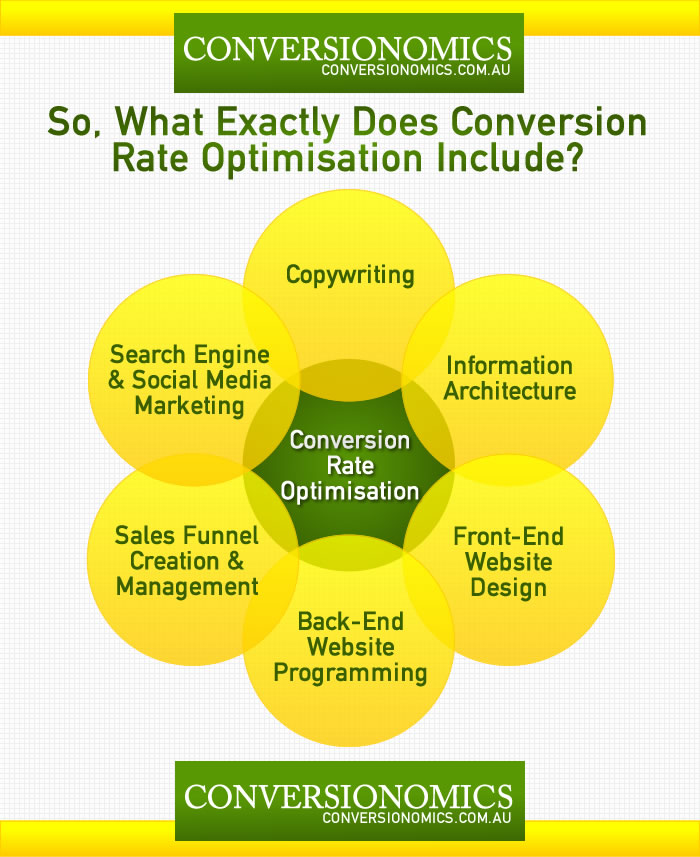
Conversion rate optimisation firms specialise in helping websites permanently increase conversions by optimising major site components, such as:

  • Direct Response Copywriting Specifically On Landing, Sales, and Squeeze Pages
  • Site Design
  • Shopping Cart Configuration and Implementation
  • Social Media Integration and On-Site SEO
  • Paid Traffic Channels
  • Website Programming
  • CMS Configuration

To efficiently find and ultimately fix issues that are killing sales, conversion rate optimization experts employ website traffic analysis. Once fixed, the new baseline conversion rate is confirmed over a large sample size of 500-1000 visitors or more, depending on price point and business model.

Here’s the Number 1 Reason Why You Can Never Seem to Increase Online Profits image conversionomics infographic parts of cro 490x600

Conversion rate optimization requires the coordination of several highly skilled website specialists to permanently fix the problems that are suppressing online sales and stealing all of your profits.

After a site has been optimized, you will see more conversions squeezed out of the existing traffic streams which ultimately increase online profits dramatically. After all, you aren’t paying any additional marketing costs for those increased sales. Plus, all future investments in SEO, PPC, content marketing, etc. will ultimately be more profitable as well due to the increased conversion rate. Best of all: You can increase online profits for long after the project is complete because the higher conversion rate will continue generating higher sales for years potentially after the job has been done.

Concluding Thoughts

It’s quite simple: If your conversion rate is lower than the average conversion rate for your niche listed in the chart above, then you’re leaving loads of money on the table each and every month. Massive corporations like Apple and Google have admitted to hiring conversion rate optimization companies to improve their own conversions and boost online profits. And they only do so for one simple reason: To increase online profits.

So before you invest another dime in a new SEO campaign, social media marketing campaign, etc., consider hiring a conversion rate optimization consultant to see how much they could boost your conversion rate. Just imagine how much you could increase online profits if you squeezed 50% more sales out of the existing traffic. If your conversion rate is lower than the average c/r for your niche, then it’s not a question of “if” you’re losing money: It’s a question of figuring out how much.

03 Nov 17:35

Is there a future for native apps?

by Danny Bluestone

Recent research seems to casts doubt on the future growth of the once-thriving app economy.

According to Deloitte, almost a third of UK-based smartphone users no longer download new apps in a typical month. This finding has been replicated by Comscore in the US.

Worryingly, Deloitte also reported that nine out of ten users never spend money on apps. Even the seemingly infallible Candy Crush Saga profits are slumping much faster than expected. 

So, has the notoriously short digital attention span already moved on? What are the reasons behind this 'app fatigue', and are there any implications for the place of native apps in future business models?

App fatigue

The smartphone market is close to saturation in developed countries, with roughly half the number of first time buyers in 2013, as there were between 2010 and 2012.

Many will remember the 'honeymoon' period playing with their very first smartphone or tablet, actively exploring the features available - but this lasts as little as four months for individual devices.

Over time, the 'wow' factor of the platform itself declines, and the novelty of discovering and downloading new apps wears off. Apps that are heavily integrated with social features face an even greater challenge, as people tend to download apps that their friends are using. 

Long-term users often start to treat their device as more of a utility, and stick to a preferred set of apps with a range of functionality. Some become so comfortable with what they have that they are even reluctant to update their apps unless there is a clear and significant benefit to doing so.

Device storage space can raise further issues, with apps competing against music, videos, and photos. 

iPhone - Default Apps

Users will lose the ‘wow’ factor and novelty of downloading apps in as little as four months

Further ‘fatigue’ can be attributed to people’s heightened concern about app security, given that apps are more connected to precious personal data stored on phones than merely browsing the web.

Many apps request ‘permission’ to access data and functions from phones before use – however, users are increasingly objecting to this and refuse, judging by this summer’s Facebook Messenger controversy, users are increasingly aware of the security problems apps can pose.

These were realised in the recent Snapchat hack, linked to a third-party service. During October 2014, Wired  capitalised on this point, demonstrating how free apps can syndicate personal data to developers and other third parties.

The fatigue trend is especially pronounced for paid apps, occupying just 10% of the market by the summer of 2013. Unless operating in very targeted (often productivity-based) markets, encouraging downloads is a challenge without offering apps for free, or using the freemium model.

Furthermore, revenues from comparably popular paid apps are now much less than they were just a few years ago. 

All this seems to back up John Allsopp’s prediction that we may have reached ‘Peak App’: as the amount of smartphone providers, models, OS versions, and apps available increases, extracting value from the market as a whole becomes increasingly tricky and expensive. But, that doesn’t mean it’s impossible, or not worthwhile. 

The maturing app economy

There’s no need for app developers to panic just yet – the real story is far more complex. After all, Apple did reach 75bn downloads from the App Store this summer – a 50% increase on last year.

Furthermore, Comscore found that the American audience now spend 52% of their ‘digital time’ on mobiles and seven out of eight mobile minutes are spent on apps, with 57% of users accessing them every day. Social networking, games and radio dominate this use, suggesting mobile could be a more entertainment-led platform than desktop.  

So it seems the app economy is maturing, rather than in decline. With more digital time spent on mobiles, people are increasingly defining their devices as entertainment platforms and committing to a smaller list of apps for constant use, instead of exploring new releases. 

When to use native apps

When aiming to capture the elusive mobile audience, in the past some marketers have assumed that native apps are preferable to responsive websites – but this is a false choice. 

With mobile usage expected to overtake desktop by the end of the year, I’d always advise making the main website for your business responsive.

It can feel like a substantial investment, but your website will be your main ‘shop window’ in most cases, and shifting to responsive means it will always display at its best, no matter what device it is being viewed on.

Additionally, you will no longer need to update separate mobile websites.  In contrast to native apps, responsive websites are accessible through search engines and will be more accessible to Google by default, than a native app alone.

Desktops should never be disregarded completely, as 40% of digital time remains on this platform, and they still are the traditional workplace-based tool. 

Cyber-Duck - Responsive Web Design

As one of the main ‘shop windows’ for your business, responsive web design ensures your website displays at its best across devices

Instead, native apps should only be developed to fulfill a specific need for mobile users: delivering a mobile-tailored experience that draws on the device’s features, in an environment where desktop connectivity may not always be available.

In these instances, apps are a powerful way to build a relationship with the members of your audience who are enthusiastic enough about your business offering to access via a dedicated app. After all, using your app is much more of a commitment and connection to your business, compared to briefly visiting your website. 

Our UX Companion app, which achieved over 7,000 downloads in just one week, is a great example of this. Built to demystify the jargon in the User Experience (UX) field, we felt this glossary of UX terms lent itself to an app format, so that users could quickly access the content in meetings or when travelling. 

Our UX Companion app has been highly popular with the digital community, able to compete in the crowded App Store by having a strong use-case 

Breaking into the native app market

Even if you’ve discovered a unique, mobile use-case worth capitalising on, there are further issues to consider with native apps.

While discovering and downloading apps from the Apple or Google Play Stores is a familiar process for users, it’s a difficult market for new companies to enter.

Of course, the wider web space is similarly over-crowded and competitive – but the complete control of Apple (and Google Play, to some extent) over the marketplace presents unique barriers. While websites can raise their rankings in search results using transparent and established search engine optimisation (SEO) practices, app discoverability remains a problem that Apple is trying to solve. There are far fewer guidelines for new entrants on how to improve their visibility.

App Store - User Experience

There are fewer resources available covering how to raise ranking in the App Store for popular keywords, than traditional SEO practices. 

Furthermore, Apple and Google Play can act as ‘gatekeepers’. They regulate what is available in their stores by carefully reviewing each app before giving permission for its release. They even charge revenue on paid apps. Apps too similar to their current offering can be rejected, and Apple has courted controversy in the past by removing any apps involving Bitcoin. 

Lastly, developing native apps opens up tricky questions about which smartphone platforms to provide for. Unlike responsive websites, which automatically optimise according to screen size, native apps interact more closely to the core operating systems and features offered by different smartphone providers.

Consequently, developing across platforms requires additional design effort, specialist programming knowledge, and additional QA and testing time. The iOS vs. Android debate is a common one for start-ups, who may not have the resources available to target both. It may be wise to choose one of these markets initially, catering for the other only once it’s clear that it’s financially worthwhile to do so.

Final thoughts

Although Deloitte’s data hinted that new app downloads may be waning, the market as a whole certainly isn’t in decline. The true story is far more complex, with an immense amount of digital time being spent on mobile apps. 

Given the continued rise of mobile traffic, a responsive web design for your website is a must – one of the main focuses of your digital presence. However, native apps can still be a fantastic addition to your digital strategy. They are perfect for relationship-building and can draw on the device’s features to deliver a truly enhanced, mobile and cross-channel experience. 

But watch this space as technology is moving fast and this could all change. HTML5 websites can also access smartphone functions, and with 4G, WiFi increasingly available even on the Tube, free roaming overseas, the provision of offline experiences may no longer be so necessary in two to three years.

03 Nov 17:34

Better Lead Generation Starts at Home – 3 Homepage Hacks

by Alisa Meredith

Better Lead Generation Starts at Home   3 Homepage Hacks image GoogleHomePage.png 600x336

Capturing more leads on the most-visited page of your website is often a matter of making some very simple changes to your home page. So let’s jump right in to the easy homepage hacks that can make a world of difference in your lead generation success.

Make it Easy for People to Become Leads

If your website isn’t bringing in as many leads as you would like, it could simply be because no one can find your premium content and sign-up forms. Make opportunities for lead conversion impossible to miss by adding more calls to action (CTAs)!

Don’t limit your CTA placement to just one “resources” page (though those are a good idea) or a couple of links in the side bar. Make sure your best offers are on your homepage as well. You might want to consider offering a sampling of offers for each stage of the buyer’s journey. For instance, you could feature a whitepaper for the first-time “just looking” visitor, a case study video for the visitor looking for viable solutions, and a “get a quote” form for people who are ready to talk.

Review Your Home Page Messaging

Your homepage messaging needs to be quick and to the point. Your visitors should know what they’re going to get out of your site immediately. Otherwise, they’ll be presseing that “Back” button faster than you can say, “sit down and stay awhile.”

Messaging for the content on your homepage matters too. If you have plenty of quality content, but your messaging isn’t effective or motivating, you still won’t get the leads you’re after. In everything you do, keep in mind your buyers and what they need to know to accomplish goals and overcome challenges.

Keep it Simple

If your website navigation, design, and layout aren’t visitor friendly, people will not stick around long enough to become leads.

Here again, the buyer’s journey comes in to play. What do they need to know at various stages of their buying cycle and what content can you provide to answer their questions? Answer those questions and use your homepage to funnel them through the entire buyer’s cycle, giving opportunities for them to convert and reconvert as leads along the way.

Homework

  • Add great CTAs to the home page – for all stages of the buyer’s journey.
  • Address “What’s in it for me?” right on the homepage.
  • Keep it simple.

Implement those three changes and you’re going to get more leads from your website. We promise.

Better Lead Generation Starts at Home   3 Homepage Hacks image 780a856a 1a1f 4da4 b0f7 bba25f923ee71.png1 600x161

03 Nov 17:34

These Illegal Businesses Are Thriving On 'Dark Net'

by Business Insider

hackers working

The first ever e-commerce transaction, conducted by students from Stanford and MIT in the early 1970s, involved the sale of a small quantity of marijuana. For decades afterwards, the online drugs trade was severely constrained by the ability of law enforcement to track IP addresses and the means of payment.

The trickle of transactions threatened to become a flood with the emergence a few years ago of Silk Road, a drug-dealing site on the “dark net”. These e-depths cannot be reached through a normal browser but only with anonymising software called Tor. Buyers and sellers transact there pseudonymously in bitcoin, a crypto-currency.

Silk Road was shut last year with the arrest of Ross Ulbricht, the 29-year-old American whom investigators believe to be Dread Pirate Roberts, the site’s founder. Mr Ulbricht is due to stand trial in New York next January on charges that include computer hacking and money laundering.

But law enforcers who predicted that Silk Road’s demise would mark the beginning of the end for online black-market bazaars were wrong. Instead, dozens of dark-net Amazons and eBays (also known as crypto-markets) have sprung up to fill the void. They are not only proving remarkably resilient but expanding their offerings and growing more sophisticated.

The number of for-sale listings in the 18 crypto-markets tracked by the Digital Citizens Alliance (DCA), an advocacy group, grew from 41,000 to 66,000 between January and August. The largest market until August, Silk Road 2.0 (whose logo, like its predecessor’s, features an Arab trader on a camel), has since been overtaken by two upstarts, Agora and Evolution, whose combined listings have grown by 20%, to 36,000 in the past two months. Each of these three has more listings than the original Silk Road ever did (see chart). It is unclear whether listings are a good measure of sales, which the markets do not disclose.

Vendors vary in size: the largest turn over several million dollars a month on a single site, the smallest a few hundred. They pay a fee to register and a commission per transaction, typically 3-6%. Buyers come from all over the world. Their purchases are sent by post—the vast majority appear to arrive undetected. Customer satisfaction is high.

Illegal and prescription drugs are the largest product category. (Some sellers are crooked pharmacists.) Silk Road 2.0, whose operators are avowedly libertarian, focuses almost exclusively on weed, powders and pills. Agora, whose mascot is an armed bandit, sells weapons, too. These are marketed mostly to Europeans, who face strict gun-control laws.

The fastest-growing of the big three, Evolution, is the least principled. Though, like the others, it bans child pornography, it hawks stolen credit-card, debit-card and medical information, guns and fake IDs and university diplomas. One-fifth of its listings are in its “Fraud” section or in “Guides and Tutorials”, which often explain how to commit crimes. Some see Evolution’s rapid growth as a worrying sign that cyber-criminals are looking to fuse their identity-theft operations with the “victimless” online drugs trade. (It is not, however, the most unsavoury corner of the dark net, where some make markets in contract killings.)

For drug buyers, online markets offer several advantages. They are less physically dangerous than street trades. This goes for dealers, too: a recent study found that a third or more of sales on Silk Road were to “a new breed of retail drug dealer”, a transformation of the wholesale market that “should reduce violence, intimidation and territorialism.” 

20141101_IRC121Product quality is higher, largely thanks to an Amazon-like five-star customer-review system. With 29 reviews for the average listing on Silk Road 2.0, a high score provides reassurance. MDMA (or ecstasy) is particularly popular on the site, presumably because the street version can be laced with lethal impurities. The dark net’s hundreds of forums provide further intelligence on dodgy gear and scammers. The FBI made over 100 purchases on Silk Road before closing it down. An agent testified that these showed “high purity levels”.

High ratings are sellers’ lifeblood. Reputation is crucial when clients know they cannot fall back on small-claims courts or arbitration. “It’s the ultimate irony: a den of thieves who don’t know each other but need to trust each other,” says a researcher with the DCA who requested anonymity for reasons of security. 

Dark-net Amazons and eBays (also known as crypto-markets) are not only proving remarkably resilient but expanding their offerings and growing more sophisticated.

As drug sales move online, power is shifting to buyers. The big markets’ customer service and marketing strategies increasingly resemble those of legitimate retailers. They are quick to apologise for technical glitches. Two-for-one specials, loyalty discounts and promotional campaigns are common (on Smoke Weed Day, say). Other methods borrowed from the corporate world include mission statements, terms and conditions, and money-back guarantees. “It has become so prosaic it could be shoes,” says James Martin, author of “Drugs on the Dark Net”.

Markets are also innovating to cut fraud. In the free-for-all in the months after Silk Road’s closure, thousands of buyers lost bitcoins that were supposedly held in escrow, either because markets were hacked or because their administrators ran off with the money. The emerging solution is “multi-signature” escrow, from where funds can be moved only with the approval of a least two of the three interested parties (buyer, seller and market). Some markets are trying to build a community of trusted buyers and sellers with invitation-only participation. Those whose customers had bitcoins stolen have begun to devise schemes to make them whole.

Sites that specialise in stolen card data display their own brand of customer-friendliness. Some offer a service that allows buyers to verify purchased cards are still active, using compromised merchant accounts. The client’s balance is automatically refunded the value of cards that are declined. (Cards sell for anywhere from $10 to $100 each.) Others batch their cards for sale according to the location of the hacked retailer, says Brian Krebs, a cyber-security blogger.

Buyers favour cards stolen from consumers who live nearby because banks often treat transactions as suspicious if they take place far from the legitimate cardholder’s home address. A site that has pioneered this segmentation is McDumpals. Its logo features a gun-toting Ronald McDonald and its motto is “I’m Swipin’ It”.

Several factors make life hard for those looking to crack down on the dark net, including its technical complexity, the physical separation of buyers and sellers, and their mobility (vendors typically post on more than one market, allowing them to keep selling if a site goes offline).

Tellingly, the only market forcibly closed since Silk Road was Utopia, which was shut by Dutch authorities soon after it opened in February. Some law enforcers want to target Tor, but even if that were technically possible it would cause “collateral damage”, points out Nicolas Christin of Carnegie Mellon University, because the software has worthy uses, such as to protect whistleblowers.

Moreover, the deep web’s denizens will continue to adapt. Jamie Bartlett, author of “The Dark Net”, predicts: “The future of these markets is not centralised sites like Silk Road 2.0, but sites where…listings, messaging, payment and feedback are all separated, controlled by no central party”—and thus impossible to close.

Join the conversation about this story »

03 Nov 17:31

Selling Value With Insight Storytelling

by Michael Harris

Selling Value With Insight Storytelling image Whiteboard IS pse copy 1024x768.jpg 600x450

Imagine if your salespeople could shine a light of insight on today’s empowered customers so that they no longer underestimate the cost of the status quo and the benefits of change.

Your salespeople would no longer have to chase these empowered buyers down the road of commoditization and discounting, because they would know how to sell value and differentiate your product.

As your customers discovered the unique value of your product on their own terms, your company would achieve higher win rates, shorter sales cycles, and higher margins.

This vision could become a reality if the following three hypotheses are true:

  1. Salespeople must deliver insight to sell value.
  2. The best way to deliver insight is through a customer story.
  3. The executive buyers in Gartner’s survey said that the best way for a salesperson to provide differentiation that they trust is to share a customer story.

Hypothesis 1: Salepeople must deliver insight to sell value.

We’ve all heard that today’s empowered buyers are 60% of the way through a buying cycle by the time they meet a salesperson, because they prefer to do their own research online. But if this self-serve model works so well, then why do 60-70% of enterprise sales opportunities end with the buyer deciding to live with the status quo? Why would a buyer waste all that time and effort only to do nothing?

I believe it’s because buyers lack the time and expertise to form an accurate buying vision on their own. In the interest of expediency, buyers dumb everything down to where all offerings become commoditized, so the only differentiator is price. Unfortunately, what they find is that the dumbed-down version doesn’t solve a problem that they don’t fully understand, so they stick with the status quo or buy the cheapest suboptimal solution.

It’s like when I’m sick. The night before I visit the doctor, I go onto WebMD to figure out what’s troubling me. So by the time I show up at the doctor’s office, I am just looking for him to write me a prescription. Sure, the doctor could have tried to influence me online through blogs, etc., but like buyers today, I don’t have the time or expertise to become a doctor online overnight. So, I need the doctor to shine a light of insight on my incomplete buying vision so that it more closely represents the truth.

Admittedly, for less complex products, I believe buyers can successfully buy online, because they can form an accurate buying vision on their own. But for complex products, I believe salespeople must shine the light of insight on the buyer’s incomplete buying vision so that they can fully appreciate the value of your product.

Questions for you to consider:

  1. What percent of your sales opportunities end in no decision?
  2. What percent of your deals are based on price vs. value?
  3. What percent of your salespeople use insight to reframe the customer’s buying vision?

Hypothesis 2: The best way to deliver insight is through a customer story.

Even though insight may be what buyers need, it may not be what they initially want. By the time a buyer engages with a salesperson, for instance, they may already have an idea of their needs, the solution they believe they want, and what they are willing to pay. So it’s difficult to directly deliver your insight to these buyers, because it will just bounce off of their established filter of what they believe they need. It can also come across as an attack and make the buyer feel badgered or manipulated.

Imagine, for example, that it’s 8:30 a.m. on a Tuesday, and your rep is riding the elevator up to the 35th floor to meet one of your largest prospects. They’re about to sit down with a C-level executive with 20 years of experience at the boardroom table, and your 26-year-old rep is going to deliver insight about the error of their ways. How do you think that conversation is going to go? I call that the black eye and bloody nose approach.

An alternative approach is to wrap your sales insight up in a customer story. Because the message isn’t directed at them personally, buyers are less likely to see the insight as an attack, feel offended, and shut down. It’s like putting your sales insight inside a Trojan horse so that it makes it past the buyer’s defensive wall.

Question for you to consider:
1. What percent of your salesforce is comfortable challenging customers with insights?

Hypothesis 3: Gartner’s survey of executive buyers concludes that facts tell but stories sell.

In the Gartner survey, 74% of executive buyers felt salespeople spend too much time talking about their product. But without the context of a story, salespeople are leaving it up to the customer to figure out why they should buy their product. This product strategy is not successful, because only 34% of executive buyers felt salespeople could articulate value. If salespeople want to sell value, 70% of executive buyers said that the best way for salespeople to provide differentiation that they trust is by sharing customer stories.

I can remember how excited I was to finally be able to afford to hire a salesperson with more industry expertise than anyone our team. But after three months, he wasn’t getting any traction with customers. So one afternoon I asked him how his meeting went. He said, “You can lead a horse to water, but you can’t make it drink.” I said, “I can send someone from telesales to do that. Your job is to make them thirsty.”

He gave me a blank stare, so I decided to use a metaphor: “Right now, you’re like a rescue boat salesman, trying to rescue customers who are only ankle-deep in problems. No wonder they are clipping you at the knees, because they’ve got no skin in the game. Instead of giving them a lecture on our product, why don’t you tell them a customer story that packs so much insight that they realize they’re not ankle-deep, but that they’re out in the middle of the lake drowning in problems before you try to rescue them with your product? That’s when they’re ready to believe in the viability of our product, not before. “

So not only do stories help customers to internalize the value of being rescued by your product, but they are also 12X more memorable than facts. In one Stanford University study, for example, only 5% of the audience remembered facts, but 63% remembered stories.

Questions for you to consider:
1. What percent of your salesforce can articulate value and help your customers to get it?
2. What percent of your sales team share customer stories? Are they effective?

Hypotheses: True or False?

I believe these hypotheses are true, because without providing insight scenarios to today’s empowered buyers, salespeople are forced to follow the customer down the path of commoditization and discounting.

03 Nov 17:31

Message To B2B Marketers: Go Digital Or Go Home

by Sarah Goodall

Message To B2B Marketers:  Go Digital Or Go Home image digitalmarketingbox.jpgLast week I presented my views on digital marketing at the B2B Marketing Conference in London – you can view the presentation on Slideshare here. I’ve spent 18+ years marketing in the B2B tech industry in all kinds of companies. Small and large. Software and hardware. I’m a classically trained B2B marketer from a traditional ‘sales led event driven’ environment that seemed to be a winning formula a few years back.

In recent years I’ve shifted my skillset into digital and social marketing. No other reason than because I’m curious, nosey and like to learn new things. Now I’m totally converted.

Call it what you want…New Marketing, Digital Marketing, Inbound Marketing, Pull Marketing. The point is, the buying process within B2B has changed and marketing needs to adapt.

The digital buying habits we use in our daily lives have transferred to the B2B buying environment. We naturally seek recommendations, reviews and want to research our options when purchasing holidays, goods and services. The B2B space is no different. Research shows that 60-90% of the B2B buying process is complete before a buyer contacts a vendor (Source: Google & CEB). 81% of the time they start searching online (Source: Demand Gen Report). Of those, 75% don’t look any further than the first page of results.

Knowing how to win eyeballs in this digital playground is essential.

Message To B2B Marketers:  Go Digital Or Go Home image rethinking the funnel.gifThe linear funnel that we classically took our prospects through has now become a complex journey of digital enlightenment. Just to make it more complex, every content discovery journey will be different with people finding and reading their own way through content in order to educate themselves.

For every 1 piece of content a business provides a prospect, they will end up finding 3 pieces of content themselves online about the company (Source: Forrester). If marketers continue to push the “event driven” tactic to prospective buyers who are early in their search process, they’ll find it increasingly difficult to engage people to attend.

Inbound marketing is no longer an option. It’s the changing nature of our profession.

Sure, handing it to a digital agency to will help in the short term but how will you know if you’re getting value for money? You could pass the responsibility of digital marketing to the ‘millennial’ that recently joined the team who understands all that “social stuff” but those guys can sometimes lack business experience, so be careful.

At a basic level, a digital marketing strategy should consist of 3 components:

  • Paid – PPC, Paid Media, Contextual Advertising, Paid Search
  • Owned – Your .com property, blogs, branded social channels
  • Earned – Your potential advocates including employees, partners and even customers

Integrate these three elements into a campaign driven model and you’re on the road to success but before you do any of that, focus on content.

Use social listening to see what’s trending, what’s topical with your audience, what themes are bubbling up. That should drive your content strategy which should be filled with the relevant keywords and phrases you know resonate well with your audience.

Once you have the content, fire up the amplification engine – an integrated set of tactics from the Paid, Owned and Earned mix that gives your content a chance to fly and get noticed. Choose what’s relevant to your audience E.g. The Paid element could be Direct Sponsored Content in LinkedIn or for a more targeted approach, sponsored InMails in LinkedIn.

Constant learning and continued development is essential for any profession. A lady I met last week gave me a great analogy. Her sister-in-law is a doctor and she asked “If you had an illness relating to your kidney, would you want to see a doctor that had 40+ years of experience or a doctor who had just graduated” which apparently most folks answer “the doctor with more experience…naturally?” Her reply “No, the doctor who has just left university has the latest knowledge, research and case studies. Experienced doctors must work continuously to keep topping up their knowledge to the same level.

So, to bring this back to marketing – it’s important to keep topping up your knowledge. In a few years’ time the ‘millennials’ entering the workforce now will have gained the business experience they sometimes lack today. Their skill-set will be in demand as the search for digital marketing expertise increases. Don’t miss out. Get reading.

Here are some resources I regularly check in with to top up my ‘digital knowledge’

Any others you would recommend?

03 Nov 17:24

Finish Strong: Your End Of The Year Marketing Plan

by Leslie Truex

Finish Strong: Your End Of The Year Marketing Plan image shutterstock 180173555 300x249.jpgThe end of the year is busy with holidays, travel, and gatherings. Many business owners get caught up in the busyness and become lax in their marketing. However, the end of the year is a great time to finish strong and prepare for a more profitable first quarter in the next year. Here are some tips for marketing during the end of the year:

1) Review what worked and didn’t work during the last quarter in the previous year. Did sales increase or decrease? Where did the slow down occur? For example, were you generating the same number of leads, but converting fewer to sales?

2) Beef up what did work and shore up or get rid of what didn’t work. You’ll spend less time and money during the busy holiday season by focusing on marketing tactics that work and fixing, or eliminating, those that don’t work. For example, maybe your website traffic drops during the holidays, but response to your email marketing picks up. In that case, focus on your list and look for ways to boost traffic.

3) Tie in your marketing with holiday themes. Even if your product or service isn’t something people might give as a gift, you can use the end of the year to maintain or increase sales. You can make sales during the holidays by providing people services or products that will save them time and money, or offer convenience, all things people need during the holidays.

4) Do something special for your current clients or customers. Offer discounts or special offers to loyal customers, clients or email list subscribers. Being extra kind to your clients and customers not only generates sales, it’s also a great way to get referrals.

5) Use a variety of methods to reach and engage your market. Your market is busy and won’t be seeking you out. Instead, you need to reach out to stay engaged with your market, reminding it you’re ready to help.

6) Get social. The end of the year is filled with events and functions. Attend local networking events, volunteer activities, and other in-person gatherings.

01 Nov 17:47

Here’s who will win if B.C.’s LNG boom comes to life

by Geoffrey Morgan

CALGARY – Fred Hensel can’t offer any insight on when major, multi-billion-dollar liquefied natural gas projects will begin construction on the B.C. coast. He doesn’t know.

What Akita Drilling Ltd.’s vice-president of marketing does know, however, is that his company is nearly finished work on a state-of-the-art $35-million drilling rig for one LNG project proponent that will be ready to drill for liquids-rich natural gas by next month.

He also knows that his company currently has two drilling rigs working for Progress Energy Canada Ltd., a subsidiary of LNG project proponent Petronas, and more rigs drilling for other LNG hopefuls such as Shell Canada Ltd.

“We’ve been focused on working with operators that are in those LNG areas,” Mr. Hensel said. “I think we’re positioned well if we get some positive [final investment decisions].”

Analysts focused on the energy service sector seem to agree. A number of investment read-throughs released last week pointed to Akita and a number of its oilfield service peers as companies that stand to directly benefit from the growth of B.C.’s LNG export industry now that the provincial government has introduced a lower-than-expected tax rate for LNG.

AltaCorp Capital Inc. analysts in a research report this week said that the stock prices of many oilfield service companies have significantly declined since the summer, which could provide a “compelling entry point” for investing in companies levered to LNG.

The investment firm said that drilling companies, hydraulic fracturing companies and camp providers — and their shareholders by extension — were well positioned to benefit from projects such as Petronas’ proposed $11-billion Pacific Northwest LNG project. Petronas has signalled it will make a decision on whether or not to go ahead with the project in December.

Similarly, a research report last week from FirstEnergy Capital Corp. said that a green light for one or more LNG projects would have a “positive impact for essentially all services.”

A consensus pick among analysts at National Bank Financial, FirstEnergy and AltaCorp is Trinidad Drilling Ltd.

Lisa Ottmann, Trinidad’s vice-president of investor relations, confirmed Friday that the company is on track to bring a new, ultra-deep drilling rig into service for an LNG project proponent by the end of the year. Trinidad is also one of the most active drillers for Petronas’ Canadian subsidiary.

“We typically have four to six rigs operating for them at any one time,” Ms. Ottmann said. “If they do make a final investment decision and it’s positive, they have talked about needing additional equipment.”

That equipment includes bigger, better and deeper-reaching drilling rigs. It also means more of them.

An AltaCorp report released the week of the B.C. tax announcement pointed to Western Energy Services Corp., CanElson Drilling Inc., Ensign Energy Services Inc. and CWC Energy Services Corp. as companies that could also see increased activity if Petronas green lights its LNG project this year — as all those companies are already drilling for the firm.

The wells they drill will also need to be fracked. Calfrac Well Services Ltd. and Canyon Services Group Inc., analysts said, are in the best position to be the frackers of choice if the Pacific Northwest LNG project goes ahead.

Aside from fracking and drilling equipment, each LNG project will require a more straightforward type of equipment: beds — by the thousands.

Between the liquefaction facility and the pipeline needed to deliver natural gas to the west coast, FirstEnergy expects a single LNG project could require as many as 15,000 beds.

Camp providers such as Horizon North Logistics Inc. and Black Diamond Group Ltd. have had their share prices whipsawed following the delay of a number of highly publicized oil sands projects in recent months.

But National Bank Financial research shows that both companies have been actively looking to grow in the “LNG fairway.”

MNP LP national oilfield service leader David Yager said the drillers, frackers and engineering service providers are among the sectors poised to see the first financial benefits of an LNG project going forward, followed thereafter by the smaller-scale transportation and logistics firms needed to get people and equipment to site.

Should the projects not go ahead, however, these oilfield service companies may be among the first to feel the pinch.

As National Bank Financial pointed out, Progress has been spending $2-billion on its upstream operations per year in the absence of LNG — buying drilling services from companies such as Trinidad and Akita.

“In the absence of the [Pacific Northwest LNG] consortium giving the go ahead, we see roughly $2[-billion] in annual upstream spending coming off,” the report says.
twitter.com/geoffreymorgan

31 Oct 22:33

Put the “and” Back in “Sales and Marketing”

by Jenny Cermak

Nowhere else in the executive suite of a typical corporation are two functions as closely intertwined as sales and marketing. Yet for all the shared responsibility, the marketing and sales relationship has often been a contentious and lopsided one, with sales dominating in B2B sectors while marketing leads in B2C ones.

The joint challenge today for CMOs and heads of sales (or CSOs – Chief Sales Officers) is how they can work together to discover insights that matter, design the right offers and customer experiences based on those insights, and then deliver them effectively to the right people across multiple channels to drive growth. McKinsey research shows that companies with advanced marketing and sales capabilities tend to grow their revenue two to three times more than the average company within their sector.

But to get to that top tier, marketing and sales executives can no longer afford the inefficient silos that have long characterized the relationship. Here are three important elements of the CMO-CSO partnership to get right:

1. Build a joint local strategy. CMOs and sales leaders need to become experts at identifying and tapping micromarkets where there are often significant overlooked growth opportunities. But the real power of the partnership comes from their ability to bring the best of each of their departments—as well as pricing, operations, and other groups—to bear in exploiting those micromarket opportunities.

While that might sound obvious, heads of sales tend to set their goals geographically while CMOs often target segments, making it difficult to have a common baseline for comparing and checking progress. Leaders need to focus on how to create meaningful targets that use the best of each approach.

Consider the case of an Asian telecommunications company that found 20 percent of its marketing budget was being squandered in markets with the lowest lifetime customer value. The company shifted resources to its most lucrative markets, where two-thirds of the opportunity lay. Marketing then partnered with sales to reset customer acquisition goals at each micromarket, basing them on each market’s potential. They set, and met, revenue targets that were 10 percent higher than in previous years.

The CMO and head of sales should take the lead in pulling their departments together to jointly identify the best growth opportunities and translate the resulting insights into tools and plans the marketing and sales teams can use.

One important way to focus the effort is by managing the sales pipeline together. “It is very important for the head of sales and the CMO to have ongoing discussions about pipeline strategy and how the pipeline gets built,” says Linda Crawford, EVP and GM, salesforce.com. “People nailing that are taking the lion’s share of the business these days.”

We have found that when this process works well, marketing often takes on an expanded role by, for example, providing sales with data analytics and by supporting the development and testing of sales plays for a specific micromarket or customer peer group.

2. Collaborate around the customer decision journey. “Because customer expectations have changed so much, it’s even more important that marketing, sales and even service work closely together,” says Lynn Vojvodich, CMO for salesforce.com “Ultimately, you want to create personalized customer journeys that seamlessly integrate touch points across these functions.” The best CMOs and sales leaders are putting mechanisms in place to create a consistent experience for their customers, and identifying which marketing and sales investments will yield the greatest returns. That starts with developing a deep understanding of how customers behave and make decisions. While hardcore data analysis will get you partway, interviewing sales reps is also crucial to uncovering what customers want. “You’ve got to listen to the guys who are taking calls 24/7 and dealing with a customer every two or three minutes,” says Gary Booker, CMO for Dixons Retail. “They really know what the customer wants.”

Marketers and sales people should together be spending a significant percentage of their time with customers to understand current and emerging needs. One well-known product company, for instance, bypassed its distributors and embedded some of its engineers in paint shops because customers had reported having trouble keeping the walls clean. While there, they discovered dust in paint bays was causing defects. So they created a new system for their distributors that reduced paint job defects by 49 percent.

For this sort of collaboration to succeed, the CMO and head of sales need to be deliberate and visible in working with each other. This needs to go further than simply sending out joint emails and joining each other’s meetings. The CMO and head of sales should map out skills and capabilities needed to reach their goals, identify the skills that currently exist and where they reside in the organization, and identify and plan to redress talent gaps.  In addition, the two leaders need to identify disconnection points between the two groups and develop processes to bridge them.

When it comes to data, marketing insights teams have to adopt more of a customer service mentality, approaching sales reps on the front lines more like customers. From the sales side, teams need to be trained to take the insights generated by marketing and act on them. Teams from each function can also participate in joint assignments, and team members can be rotated through each other’s departments. Field marketing can also bring marketing closer to the sales force — and the customer. One European retail bank, for example, set up “opportunity labs” in its branches and agencies—i.e., at the point of delivery to the customer—where marketing could come together with sales to develop new customer programs.

3. Create a technology engine that powers the front lines. Investing in better and more useful technologies is critical for sales to move more quickly and effectively on the leads that marketing can uncover. That means investing in technologies to help turn ubiquitous mobile devices into sales tools and becoming more sophisticated about collecting data. In some industries (e.g. high tech), marketing can work with sales to define what data would be valuable then work with product development to create sensors that provide that data. Products can then provide feedback on when to get maintenance and when the product will have reached the end of its useful life.

But for all the potential technology provides, it’s important not to lose sight of what the point is. The fundamental truth about technological innovation is that it needs to help sales people make better decisions on the front lines. In the rush of excitement to build great tools, the resulting analysis is often either too complex for sales people to use or isn’t relevant to the immediate business opportunity. The challenge for the CMO is to reduce all the heavy backend analysis to a set of simple actions and guidelines that front-line sales people can use. And the challenge for the head of sales is to effectively articulate what insights are needed to make better decisions.

Caesars has taken that point of view to heart. When a guest has entered one of their hotels or casinos and interacted with it (through use of their loyalty card, or increasingly, based on beacons and similar technology throughout their properties), a host (the person responsible for helping and serving customers) will be alerted on their Blackberry or iPhone. That alert displays their historical behavior, what they have been interested in, what experience they had when they were last there, what food she or he likes, and where to find that person.

A cargo airline provides another example. Their marketing team developed a complex model that took all the frequently changing dynamics of the cargo industry, as well as opportunities for different negotiation strategies based on supply and demand, into account. But that wasn’t the real win. The company then took all that complexity and hid it behind a simple dashboard that it gave to the sales force. This dashboard provided simple guidelines on flight capacity, corresponding pricing, and competitor options. The result? A 20 percent boost in share of wallet.

The CMO and head of sales stand on the front lines of growth. They are best positioned to spot and understand emerging trends, build strong bonds with customers, and distill new opportunities into real action. But finding above-market growth will remain elusive until CMOs and heads of sales take the lead in developing a more cohesive approach to the marketplace.

31 Oct 22:33

Three Ways to Use your Demand Funnel Part 2. Get your Leads Moving Again.

by Steve Turley

Three Ways to Use your Demand Funnel Part 2. Get your Leads Moving Again. image Green Light.JPG

It is great to have an accurate diagnostic tool that will effectively tell you what is wrong with your Demand Gen programs. However, diagnosis is not very helpful if you do not have a treatment plan to solve the problem. The good news is, no matter the diagnosis, your Demand Gen problem has a cure! Matching the fix to the problem is usually not at all difficult. Let’s look at the proper approach.

Get Started
First, let’s recall the three things you can affect relating to total Demand:

  • The number of Contacts in each stage (the sum of those representing the entire Funnel).
  • The conversion rates from stage to stage.
  •  Time in stage, which reveals the Funnel velocity.

Understanding these metrics also provides us with the diagnostics necessary to understand our funnel problems and remedy those problems. We’ll look at three common problems and the remedies you can apply to each. Before we address those remedies, let’s recall a few principles of our demand funnel, so we can properly diagnose the problem and apply the remedy.

  • The funnel should always be shaped like a funnel. That means early funnel stages should always contain more Contacts then later funnel stages. Although the exact numbers will vary from organization to organization, the general shape should be constant.
  • Conversion rates should get higher as the Contact gets lower in the Demand Funnel. This should be universally true, since Contacts only progress as they become more and more likely to purchase. It would be highly unusual to find a higher conversion rate for MQLs than SQLs, for example.
  • Time in stage will vary from organization to organization, with one exception. MQL-to-SAL should never take very long. In general, an MQL sitting in stage awaiting acceptance by Sales should not last more than 7 days. Otherwise the buyer’s interest level could wane and he or she moves on or forgets about the interest. We will look at this in our cases below.

 Case 1: Stuck Inquiries

This case often happens when organizations do not have a content strategy. Without that strategy, communication is often also stuck in first gear, with messaging focused on attracting net new contacts into the funnel, rather than converting those already in the funnel. This is remedied with a comprehensive contact strategy that targets specific messaging to Contacts at every stage in the funnel, rather than sending the same message to everyone every time. Conversions from inquiry to MQL are all about offering additional information about reasons to move now.

Case 2: Stuck MQLs

This should be the simplest case to solve. If your organization has proper agreement between Sales and Marketing on the attributes of a “qualified” lead and the SLAs for Sales acceptance, nothing should ever get stuck in MQL state. If MQLs are getting stuck, it is most likely a process issue in which the responsibility for sales acceptance is not properly understood. Training and close management of the process will remedy this situation.

The second possibility is a technical process malfunction. Lead routing (usually performed on the CRM side) may not be actually sending MQLs to the proper queue or individuals. This is usually easy to diagnose by the complaints coming from the Lead recipients who are not getting the expected MQLs in their queues. Fixes usually need to be made in the Lead Assignment rules or MAP-CRM integration.

Case 3: Stuck SQLs

SQLs should never be technically “stuck.” If your product or service requires a long sales cycle, consideration for the length of cycle should already be in place. However, when leads do get stuck, in nearly all cases it can be tracked back to lack of discipline in dispositioning lead or opportunity status (see this {Demand Gen Brief} article: Four Ways You Are Marketing Backwards). Dispositioning leads in SQL stage is critical to the health of your demand funnel.

Change the conversation.

When Sales wants more leads, the conversation almost always ends up addressing adding new leads to the top of the funnel. Rarely does an organization take the time to examine what is going on mid-funnel and address concerns there, even though this will almost always provide a faster, cheaper and higher quality lift in lead flow. Although we’ve addressed some common fixes there, there are always considerations unique to your organization’s process and lead flow. Take the time to examine what is happening mid-funnel before rushing to add more leads to the top, which may only compound your problems.

Notes:

Your Demand Funnel is your chief diagnostic tool for Demand Generation.
Diagnose first, and only then apply the solution to the trouble spot.
Mid-funnel fixes are often faster, cheaper and of higher quality than top-of-funnel.

Now we’ve learned how to use our Demand Funnel as a diagnostic tool and how to apply remedies to the problems we’ve found. These are critical steps to maintaining the health of your Demand Funnel. However, we don’t want to just maintain our Demand Funnel, we want to improve it!  Next week we will look at ways to improve our overall Demand Funnel performance in: Three Ways to Use Your Demand Funnel, Part 3. Optimize Your Lead Process!

31 Oct 22:33

How to Write Emails that Make Your Marketing Team Shine

by Angela Vuona

How to Write Emails that Make Your Marketing Team Shine image blog write emails.jpg

Should you nurture your email subscribers with monthly newsletters or digests? Are dedicated emails about a new whitepaper coming available or upcoming tradeshow a better use of time for optimizing your sales and marketing funnel? Both are valid questions to consider as a marketer, and once you have nailed down which email format helps you meet your marketing goals, the next step is to start writing.

Writing a great email comes down to a few copywriting best practices. From the subject line of your message, to the message body itself, there are many guidelines to follow no matter what type of email communication you send.

Here are some helpful tips on how to write emails that will make your marketing team shine:

  1. Focused call-to-action (CTA) – A call-to-action is an image or text that prompts subscribers to take action. It is recommended to keep the CTA front and center on your email where it is easily visible and makes sense for someone to click on it. An effective CTA should be persuasive and compelling, not simply “click here”.

  2. Use a real reply-to email address – Using a “no-reply” email address is an email marketing no-no. If anything, you should be use “please-reply”. A real reply-to email address adds credibility that you’re willing to go above and beyond to connect with your subscribers.

  3. Customize the sender name – This goes hand in hand with the above. If possible, try to coordinate the reply-to email address with the sender name. A custom sender name is known to increase email open-rates and click-through rates. In fact, according to an A/B test conducted by HubSpot’s marketing team, they found that emails sent by a personalized name resulted in 7.1% open-rate and .96% click-through rate compared to 6.57% open-rate and .73% click-through rate of a business sender name.

  4. Get personal – When crafting email copy, it is important to write with your recipient in mind. You can personalize the email by including their first name or other relevant information you have collected in the past. Be sure to use the word “you” (2nd person) as this tends to be conversational and very persuasive as well.

  5. Write a compelling offer – First, don’t shove too much information into the email message. Start by considering your value proposition, and aim to present it as clear and brief as possible. This allows your recipients to pick out the most important information and click-through easily.

  6. Make the subject line count – No one gets to read your compelling offer if they aren’t interested enough to open your email in the first place. Email subject lines should be clear and use actionable language. If after you’ve drafted a clear subject line, you can also make it catchy, funny, cute, etc. To find what really works for your open-rates, try out different subject lines with A/B testing.

  7. Empower evangelists – Enable evangelists to share your emails with others by including social sharing buttons and an email forwarding option.

What other writing tips can you think of to make your marketing team shine?

How to Write Emails that Make Your Marketing Team Shine image 501989b8 12f8 405c 8c6e a7e5f0e325e4.png2 600x114

31 Oct 22:33

Digging Up Old Sales Leads And Piecing Them Anew

by Max Stinson

Most people regard the tale of Frankenstein’s monster as a cautionary one, a warning against those who defy boundaries of life and death. You can even see a parallel with the unwise resurrection of dead sales leads.

But you know, there’s always room for revision and reinterpretation. (Look at Dracula Untold.) What if you can actually piece together your old sales leads and put your monstrous creation into good use?

Digging Up Old Sales Leads And Piecing Them Anew image Stf165 skaabgoliath.jpg

Good boy! Drive away those pesky peasants!

Before going any further, here’s a bit of geek trivia. Ever heard of a flesh golem? More often than not, Frankenstein’s monster would perfectly fit the description. More than that, these stitched up bad boys have been put into surprisingly handy use. Like zombies, they don’t need to eat. They make for excellent guards. Plus, there’s always a chance of recycling them from their old pieces.

It’s really like having your own robot (except the robot is magically made of dead people). On that subject though, too many naysayers are focused on the graverobbing and the body desecration (sometimes even murder). In the same way, too many people are hesitant about recycling their sales leads for fear of reawakening some untameable beast. (Yes, I’m talking about disillusioned former customers and prospects way too touchy about their privacy.) Why call someone who clearly doesn’t want to be called?

Answer: You don’t. You just stitch back the right pieces.

Most people prefer a boomerang track when it comes to recycling their leads. But when you take a second look at the process, it’s really just the same as reviving someone who isn’t actually dead. It’s not necessarily the same as picking up this arm, this leg, and this chest before heading back to the mad lab to make a new creation.

So if that’s not the sort of recycling I’m talking about, then what is?

  • Really, it’s about the pieces – Instead of the wholeness of the dead lead, you should see it in pieces. For example, what industry was it from? What position were they in? How can you apply this knowledge when targeting another?
  • Fill in what’s missing – Do you think that the only thing you need to know are the things that come out of your prospect’ s own mouth? Think again. There are still many gaps being left open but the answer you’re looking for could be lying around, attached to a dead lead.
  • It’s mindless so give it jolt – Perhaps the biggest mistake Frankenstein made with his monster was not that he created it. It’s that he neglected the poor thing. You can easily avoid the same thing by putting a mind into your own monster of mashed up data. You never know what shocking discover you’ll make with a good second analysis.

Recyling isn’t just limited to whole items being recycled. In fact, by their very nature of the process, it makes use of its components and not necessarily the compound. This applies to the data in your dead sales leads as much as it does to dead bodies.


31 Oct 22:33

Activity Based Planning Leads to More Consistent Results – Fact!

by Jonathan Farrington

Although the debate has been raging since someone first sold something to someone else, it is my personal belief that selling is both an art and a science.

To put it another way, a salesperson’s skills determine their level of artistry at selling and their strategic planning provides a scientific platform for their sales activities.

One of the characteristics that make a salesperson successful is careful use of their selling time: Time is something that doesn’t stop, yet how it’s used affects performance that can leverage the impact of sales activities.

To influence sales results you need to work on your sales activities. For example, all the sales activities you have undertaken in the past have produced your current results. So then logically, the sales activities you perform today will create your future results. Therefore, there is always a time delay between activities and results. Focusing on activities in a well-planned way naturally increases results.

The Sales Platform concept is a sophisticated process for analysing, planning, directing and monitoring the activities of sales people.

The Sales Platform features three main elements:

  1. Buying Platform – This comprises of existing customers who are purchasing from you on a one-off basis or a regular basis. This segment of the platform requires two strategic sales approaches:
    • Sales actions that reduce the risk of losing customers (a proportion of customers are lost over time due to a variety of reasons)
    • Sales actions that can generate incremental business from existing customers (it’s easier to get new business from existing customers compared to prospects)
  2. The Working Platform – This comprises of prospects that have been visited, yet aren’t currently buying. This segment of the platform is extremely time intensive, yet is a crucial part of the development of an ideal customer base. The sales approach in this segment is to accelerate prospects through the pipeline until they become a customer.
  3. The Market Platform – This comprises of leads that have not yet been qualified as prospects that have the potential to become customers. This segment of the platform is the vital preparation phase to replace lost customers and grow existing business in the longer term. The sales approach in this segment is to select the right type of opportunities that have the potential to become prospects. Banks of qualified prospects can be built up if appropriate – ready for a concerted attack on a targeted part of the market place.

In an ideal situation and based on the market conditions there should be a good balance between all three platforms.

Excess Buying Platform activity will constrain the growth of the business into those areas that are identified as the opportunities of the future. It is also a symptom that the organization has got itself into a rut or a ‘comfort zone’ that the communication of policy is poor, that management is not controlling the work, or that people lack the confidence to tackle new areas (or a combination of all of them).

Too much emphasis on the Market and Working Platforms is inefficient and will increase the cost of sales unnecessarily. Without a strong base of long-term customers, this will dramatically reduce the potential for growth, and could well lower the reputation of the organization.

In my experience, the quality of the planning phase significantly affects the quality of the final result …

31 Oct 22:32

Sales Process Best Practices

by Prialto

“Anything worth doing, is worth doing right.” – Hunter S. Thompson

As they scale, many organizations find they don’t have the processes to support rapid growth. Sales process is an area that is critical to get right early. We have worked with hundreds of companies to scale sales processes and frequently see a few basic mistakes. Below are four simple best practices that can help you get started toward a scalable sales model.

1. Classify all leads/contacts/accounts

As your organization scales, you will rapidly add leads and contacts into your CRM. While most CRMs force you to categorize the status of each lead and opportunity (deal), contacts and accounts often don’t have defined statuses. This mistake will quickly compound as you multiply the size of your contact base. While you may not have an active opportunity with a company, it is important to be able to categorize your relationship with every person and company in an effort to target, nurture, and prioritize them. To address this, add a status field to each record type in your CRM and make it a required field.

2. Optimize your CRM

It is important to have a person/team charged with constantly streamlining your CRM to eliminate unnecessary fields and make it as simple as possible for your sales team. See our article on 9 Simple Tactics to Optimize your CRM.

3. Define sales stages

Sales stages are the key to establishing a good workflow. Each sales phase should have a pertinent name and clear definition, and completion of each stage should signify progress. Upon identifying and defining the different stages, document these for your team and ensure that they are programmed into your CRM.

4. Track and manage a few key metrics

With so much data in a CRM, it is tempting to report on every metric. However, to drive sales success, it is critical to define a few key metrics, and then:

  • Review both the dashboard and underlying reports weekly
  • Confirm your team is entering data correctly
  • Review regularly with your team
  • Ensure metrics are effective at driving sales performance
  • Review metrics/reports as needed to properly incent your team

Never stop improving

Sales processes should not be static but should be constantly reviewed to improve team productivity.

31 Oct 22:32

Sales Thinks The Leads Are Weak - Well Are They? 12 Power Opinions (Pt 2)

by dan.mcdade@pointclear.com (Dan McDade)

The leads are weak? You’re weak!

If you have never seen the movie/play “Glengarry Glen Ross,” do yourself a favor and watch it. Alec Baldwin rips into the late Jack Lemmon for commenting, “the leads are weak,” with a classic Baldwin-esque tongue-lashing: “The leads are weak? The <expletive> leads are weak! You’re weak!”

31 Oct 22:32

5 Things That Scare Most Sales Leaders (and What To Do About Them)

by Rachel Clapp Miller

5 Things That Scare Most Sales Leaders (and What To Do About Them) image halloween shadow.jpg 300x202Hitting your quarterly sales goals can be an arduous task. If you don’t have the right mindset, process and tools, the consequences can be downright spooky.

Here are five things that scare most sales leaders and if you are experiencing the same problems, what you can do about it.

1. Your sales team has a lack of understanding when it comes to your value and differentiation.

Without an understanding of value and differentiation, your sales organization doesn’t have the ability to articulate the benefits of why a prospect should do business with you. As a result, your prospects have no reason to buy from you over your competitors. Here are some ways to tell if your sellers are struggling with your value and differentiation message:

  • Do they sell on features vs. business value?
  • Are they selling too low in the organization?
  • Are negotiations based on price instead of value?

If you answered yes to any, or all, of the above, you need to create value-based messaging for your sellers to use, and go to work using it consistently throughout your company.

Ask yourself:

  • What problems do we solve for our customers?
  • Specifically, how do we solve those problems?
  • How do we solve those differently or better than everyone else?

The answers will reveal your value drivers, and differentiators and, when put to use with your prospects, will result in higher competitive win rates, an increase in average deal size and greater deal margins.

2. Your organization is lacking a repeatable sales process that’s used consistently

Without a repeatable sales process, you don’t have the ability to qualify, advance, and close opportunities consistently. Are you experiencing these chilling occurrences on a regular basis?

  • Reps taking shortcuts during the sales process
  • Frequent losses to “no decision”
  • Lengthy sales cycles
  • Inconsistent opportunity qualification criteria

If so, it’s a good indication that you’re lacking a repeatable sales process. To create one, consider these questions:

  • How aligned is our selling process with our customer’s buying process?
  • How do we ensure opportunities are qualified?
  • How do we ensure reps don’t skip sales steps?
  • What are the customer outcomes that move an opportunity to the next sales process stage?

By building a process from these answers, you’ll begin to see an increase in qualified leads advancing through the sales funnel.

3. You lack line-of-sight into critical sales planning activities

Without a sales planning process in place, your sales leaders lack the ability to coach your sales team on leveraging potential opportunities within their territories. You can’t hope to achieve increased sales and overall business growth when these hair-raising problems happen frequently:

  • Reps missing quota goals
  • Inaccurate revenue forecasting
  • High percentage of deals closing late in the quarter
  • Inadequate territory & account penetration

The good news is that you can ward off the spirits of poor sales planning with… good sales planning. Spend some time determining:

  • How do reps build their pipeline?
  • How do reps ensure that they achieve their quarterly and annual quota goals?
  • How well are we covering our territories?
  • How well are we covering our key accounts?
  • How accurately do we forecast revenue?

When you improve your sales planning process with this kind of a focus on building your sales pipeline, you’ll enjoy higher quota attainment, healthier pipelines and more cross-sells and up-sells.

4. You’re not sure if you have the right people on your sales team

Perhaps one of the most horrifying sales problems of all is the inability to recruit, hire, develop, and motivate sales talent. The result is a tangled web of organizational nightmares such as:

  • Frequent mis-hires
  • Loss of key talent to competition
  • Lengthy time to productivity
  • Insufficient bench strength for growth
  • Low accountability for performance results

Fortunately, you can escape this snare by building a foundation for a strong sales hiring process. Ask these essential questions:

  • What does success look like in a role?
  • Why have we hired the wrong people in the past?
  • Why do we lose key talent to the competition?
  • Why would someone want to work here?
  • How do we hold people accountable for results?

When you hire people based on clearly defined roles, responsibilities, and behaviors, you’re able to hire talent that understands your expectations, demonstrates “best-in-class” behaviors, sets development goals and mentors others without being asked.

5. You have great processes and tools, but no one is using them.

Each one of the four points made above are important by themselves. But without the ability to drive their use on your team, your organization will experience alarming frustration with:

  • Ongoing investment into sales improvements that never stick
  • Inability to move your entire team toward the same goals
  • Consistency in closing your most profitable sales opportunities

Begin working on adoption and reinforcement of a holistic sales process by asking yourself these essential questions:

  • What are your goals for implementing a sales improvement initiative?
  • What is your bandwidth to be able to pull off this kind of transformation?
  • Which business leaders need to be aligned with your new initiative to push it forward?
  • How will you reinforce organizational adoption of this new process?

By finding a way to implement company-wide sales transformation, you’ll quickly begin to see improvements in overall alignment and the ability to set and meet higher sales goals.

5 Things That Scare Most Sales Leaders (and What To Do About Them) image 0af20216 9ebb 4e72 82c5 65f1a668ef90.png 600x251

31 Oct 22:26

12 LinkedIn Secrets You Need To Start Using

by Ronan Keane

12 LinkedIn Secrets You Need To Start Using image 2a8960b 600x399

Are you a lurker on LinkedIn? 80% of us are. We watch and read but we’re not proactive and and we don’t use LinkedIn’s newest and best features to our advantage. If you’re in the business of creating new business, then you need to start using these 12 LinkedIn

LinkedIn Secret #1 – Message People in Groups for Free

12 LinkedIn Secrets You Need To Start Using image 1cca351

This is InMails unlimited. Use ‘Send Message’ to send a message to any LinkedIn Group member. Just search for their name in a group and click “message”. However, this LinkedIn secret should be used very judiciously. I’m not condoning SPAM. Your message must be relevant, useful and needs to add value to the recipient. The person receiving it should think, “This is really helpful” or “This is great! I didn’t know that.”

LinkedIn Secret #2 – Follow, then Like, Share and Comment

12 LinkedIn Secrets You Need To Start Using image 2065411

Again in Groups, when you follow 2nd. and 3rd. degree people you’ll see their updates on your homepage like they were 1 degree connections. You should strategically follow Group members. This LinkedIn secret is incredibly useful when you’re looking to start conversions with prospects or prospective business partners. Like, Share and Comment on their updates and interact in ways that will generate new connections and new business relationships.

LinkedIn Secret #3 – Make Your Value Interactive

12 LinkedIn Secrets You Need To Start Using image 1112e17 600x196

Upload and add videos links and presentations to your profile. Communicate your value interactively. Multimedia can be much more compelling than words. People can view all of this content without leaving your profile. You can also load all kinds of call-to-actions (CTAs) within your content to get people to contact you for the services you provide or the products you sell.

LinkedIn Secret #4 – Trigger Events: Powerful Reasons to Reach Out

12 LinkedIn Secrets You Need To Start Using image 24e321f 600x72

Although these aren’t LinkedIn features, it’s possible to use these platforms with LinkedIn.

Wouldn’t it be great to know if a particular person clicked on a link you sent them? It’s possible with bit.ly. Create a free account and send each prospect a custom link.

GageIn.com is extremely useful for tracking people and company in the news. It includes many custom filters to choose from for different trigger events. The platform is extremely useful for people in sales or business development.

LinkedIn Secret #5 – Collect Leads Directly from Your Profile

12 LinkedIn Secrets You Need To Start Using image 3cacfa9 600x324

Are you collecting leads directly from your LinkedIn Profile? It’s very easy to do. If you’ve got a white paper or ebook that you or your company uses for lead generation, why not use it on your Profile. Build a free web form with Google Drive. Place the links to the form as content on your Summary and share the links as updates once a day every day. This is my favorite LinkedIn secret.

LinkedIn Secret #6 – Use Newsle.com to Pay the “Price of Admission”

12 LinkedIn Secrets You Need To Start Using image 34a8fd6 600x268

What about easily knowing when your 1. degree connections and others appear in the news? Congratulating your connections on earned media (appearing in the news) is a nice ego stroke. I use Newsle to monitor 1, 2 and 3 degree connections.

Make sure that every contact with your prospects has value and meaning for them. Do your due diligence and pay the “price of admission.” Connect your LinkedIn with Newsle.com and quickly see if your prospects have been in the news. Reference that in your message to them. BTW: LinkedIn just acquired Newsle.com.

LinkedIn Secret #7 – Share Valuable Breaking News with Prospects

Custom Sections on Google News are a powerful way for you to build news that your prospects and network will find incredibly useful. Once built, you can get industry and competitor news that can be easily shared on LinkedIn. All you need to begin building custom news sections is a Gmail account. Love this LinkedIn secret.

Share news as status updates and send to individual prospects. You’ll be the man…or the woman!

LinkedIn Secret #8 – Stay Organized with FiveHundredPlus

12 LinkedIn Secrets You Need To Start Using image 0586f6b

The more you do on LinkedIn the harder it will be to track everything and stay organized. That’s why you need a tool like FiveHundredPlus. Connect your LinkedIn account and start tracking who you need to contact and when. Use Tags to stay organized.

LinkedIn Secret #9 – Premium Account – Yes, Worth Every Penny

I get asked all the time whether a Premium Account is worth the money. If you’re in sales or business development the answer is an emphatic yes! Which account? The Basic. It’s got everything you need including Advanced search. Advanced search is very powerful. Got more questions about a premium account, email me your questions.

LinkedIn Secret #10 – Teach, Don’t Sell with Content Curation

12 LinkedIn Secrets You Need To Start Using image 1fc0e02 600x251

In a Corporate Executive Board survey of 1,000+ IT leaders, it was found that people who teach and provide insights were perceived as a far more valuable resource than someone pushing a new product or service.

Stop leading with your services and lead to your services. Very targeted content curation is one of the most effective ways to move your prospects into a sales funnel. You’ll need to create free Paper.li and Scoop.it accounts to easily find content to share. You should also set up a custom news section on Google News to find relevant industry research and competitor news.

LinkedIn Secret #11 – Prospects WANT to Connect with You

It’s essential that you connect with as many new prospects as possible. In the new comScore report titled, The Social Bridge to the IT Committee, 2 out of 3 IT professionals are open to connecting with vendors on LinkedIn. That means people who look and sound professional. You should also focus on connecting with people in Finance and Operations, and Marketing.

LinkedIn Secret #12 – Make LinkedIn Your Professional Website

This is not so secret but by far the most ignored factor to using LinkedIn effectively. Far too many professionals don’t care about or pay any attention to their Profile. Consider this: 9 times out of 10, your LinkedIn profile is the one place prospects, customers, partners and future employers are going to go to find you and judge you online. Use it to your competitive advantage.

31 Oct 22:26

What bankers can learn from startups about sales [Workshop]

by steli@close.io (Steli Efti)

Earlier this year I gave a workshop in Austria for the probably coolest bunch of bankers I've ever met.

Erste Group, which is one of the world's largest financial service providers and has been in business since 1819, created a subsidiary that operates more like a startup than a bank - and it's those people from BeeOne who invited me to share my sales insights.

Here's a 20 minute excerpt. (If you've been following us for a while or read The Ultimate Startup Guide To Outbound Sales, you'll be familiar with most of it).

They also had an artist from LiveSketching there who turned the talk into a painting. 

Click on the image for full size: 
BeeOneStartupSalesBootcamp640

 (They even drew my two little boys, because I always show them off when I speak. Obviously, that makes me love the drawing even more) :)

Transcript:

Steli: In case I fall asleep, somebody throw something at me. Aim at head. I am jetlagged as hell. I had only two hours of sleep last night and only two hours of sleep tonight or yesterday.

So I’m really feeling it. So here’s how I’m going to do this. I’m going to go through those slides and really you guys should shout out when you have questions, when you disagree, when you want to comment and make this as interactive as possible.

Yeah, we don’t have to wait until the end for questions. That’s basically what I’m saying. The next thing is I’m going to curse a lot. So I apologize to everybody in advance. The guys that invited me, saw me on stage, I always curse – nobody told me not to do it. So just expect a lot of curse words.

About Steli Efti

So a little bit about myself first. My name is Steli Efti. I'm originally from Greece. I was raised in Germany, in the south part of Germany. For the past eight years, I’ve been living in Silicon Valley in San Francisco. So you take the Greek culture, the German one and the American one and it turns into something interesting.

So I’m going to tell you a little bit about my background. I’ve been a serial entrepreneur my whole life. Another way to say this is I’m totally unemployable. I have zero credentials. None of you would ever hire me for anything. I dropped out of high school when I was about 18 years old, started my first businesses, did a few small businesses back in Europe.

Then in 2007, I had this idea. As an entrepreneur, you have this idea sometimes that could change the world that you think would be your legacy and if you’re really a hardcore entrepreneur, you have an idea like that, that’s going to be world-shifting about every two weeks or so.

So I thought back then this would be the legacy of my life. I was in technology and I had no background in technology. Up to that point, I spent maybe five minutes a month online. I got my first computer which was a laptop when I was 22. 

So knowing nothing about technology and having nobody in my network that did, I decided the best course of action was to buy a one-way ticket, sell everything I had and fly to San Francisco.

It turned out to be a pretty good decision. My only goal was really to be the stupidest person in the room and for eight years, I’ve accomplished that mission every single day. 

The first startup that was supposed to change the world finally failed. It took me another two years to realize that. So I was kind of a living zombie startup founder. Then I did something else that I want to share with you guys.

Building SwipeGood

So in 2011 – this kind of relates to Fintech. That’s why I’m even bringing it up. I’ve never had this on a slide deck in a long time. This is a company called SwipeGood. That’s how we started in 2011.

I have two co-founders, Thomas and Anthony. Thomas is Swiss. Anthony is actually really American from the real America, so the real America, so the heartland. [0:02:52] [Indiscernible]. Almost.

So we’re like one-third American, two-third European. The first idea that we had was a simple idea. It was a company called SwipeGood. The product was called SwipeGood and what it was, was we allowed people to go online, put in a debit or a credit card. 

Every time your made a purchase, we would round up that purchase and keep the change and give it to your favorite charity or cause. The Bank of America has a Keep the Change Program in the US, which is basically the same mechanism but it goes to your savings account versus going to a cause or charity.

They’re making over $10 billion a year in those transactions on to saving accounts. So we wanted to do something similar at a larger scale, because we would include all banks. But instead of giving it to your savings account, we would actually want to give it to a charity or a nonprofit.

The mechanics were really simple. Average round-up amount would be about $20 per month per consumer in the US. Those were the numbers that we were seeing through our users. We would take a five percent cut. That’s a dollar per use per month. We would basically introduce the nonprofit and charity world with something they’ve never had before which is recurring revenue.

Not every six months you throw a huge party and you do all the money, fundraising at one big event. Then you have to find a way to allocate all the money and then rinse and repeat. You have to another big fundraising event.

No. Month by month, 20 bucks per person. In a way, that eliminated friction so people didn’t have to make a decision. How much do I want to give? What can I afford? I could always round up to the next dollar, a few cents here or there.

It means if you purchased something for hundreds of thousands of dollars, the roundup can – at a maximum it will be 99 cents, right? So that’s how we started.

[0:04:39] We got into a Y Combinator which some of you might know, which is kind of a pretty prominent accelerator if not the premier accelerator in the world and went off to the races. Our growth was amazing until it wasn’t. Now I won’t bore you because that story alone would be an hour.

But we had even people like Ashton Kutcher who’s pretty awesome in person by the way. He was like – his charity was on SwipeGood and we met with him a couple of times. We had Oprah’s team on there. We had a lot of celebrities. We had tons and tons of nonprofits on this. We got press, crazy press, our growth... it was like off the hook until we raised a few million and the timing was perfect.

Just a few months afterwards, our growth started flattening out because our initial distribution channel didn’t work out. I’m not going to tell you why unless somebody really wants to know.

So we tried all kinds of different ways and eventually we arrived at the idea of actually focusing on the B to B market and go to corporations, have them sign up with our credit cards and then promote it and match their employee cards and do acquisition that way.

Building a sales force for startups

Around that time, we started thinking about the challenges of startups that actually do distribution, especially the B to B world and the challenge of actually building and creating a sales force to do so.

So we thought, “Why isn’t there an Amazon AWS for sales?” Why isn’t there a place where a startup founder could just go in? There are a million salespeople. A salesperson equates to a server and I can just say, “I want 10 of them and they should call this kind of people. I want to have all the recordings of the call and all the real time analytics. If it works, I want to scale up. But if it doesn’t, I want to scale down.”

Then we realize that doesn’t exist because it’s fucking hard, right? It would be pretty fucking amazingly hard to do. We thought, “Yeah, that’s kind of a lame excuse not to do it. If nobody has done it, let’s just do it ourselves.”

So that’s what we did. Basically it was the same company but we started a product or a service called Elastic Sales. What we did basically, instead of wasting any time researching the market and creating PowerPoint presentations or a website or a logo, find a name, what we did is on a Tuesday morning we decided, “All right, let’s just fucking do this. Let’s try it out.”

What we did is we spent Tuesdays scraping some list off CrunchBase. Series A companies in the B to B space that we didn’t know. Our network was pretty extensive in the US. So we’re like we don’t want the world to know yet. Still we’re SwipeGood. We’re getting press and all this. We don’t want the world to know that this model is failing yet. We don’t want the world to know that we’re experimenting with new things.

So they just cold called a bunch of technology companies with more than 10 million in the bank, that sell to enterprise clients and that we don’t know. We will use fake names and we will pitch them on the service.

Let’s have the market educate us why this is not going to work, right? Let’s find out – we will just price it and we will just throw something at them and see what people say.

We did this for about two weeks. The idea was we will do it for a month. If we get one customer, we might want to actually do this.

We did this for two weeks and had seven companies that wanted to pay us money and our scalable sales force was like myself and one other guy. So we’re like, well, there’s this beta program and it’s very exclusive and you can only reserve your spot until this time. Once we have two spots reserved, everybody else has to wait. We’re only going to give you one salesperson to do a pilot with, to test this.

What we basically did is we took two of the most random ones. We said, “Let’s just start with those guys,” and see if we can actually deliver what we promised.

So we ended up working with over 200 venture-backed startups in Silicon Valley. We worked with some international startups, usually when they wanted to enter the US market.

Building sales software sales people love 

What we did from day one is basically we started developing an internal piece of software called Close.io. You can find it. It’s public now. We have a lot of European customers.

So we started – because two of the three co-founders – I’m non-technical. The other two guys are technical. Because of our bias towards building product and our hate for sales software that’s out there, we’re like let’s just fucking do something ourselves.

I’m not going to use Salesforce for 10 hours a day. I’m not going to use any other CRM off the shelf for 10 hours a day. So let’s just build something ourselves. We started doing that and we called it our secret sauce and that’s how we were recruiting salespeople, how we’re retaining them.

We basically for the first time ever started building software for salespeople, basically by the salespeople and even the engineers in our company have a pretty high sales IQ. The way they were building it is basically sitting in the sales room next to the salespeople and going, “Wait, why are you doing this?” Well, because I have to go here and log this and do this.

That’s fucking stupid. All right. Let’s fucking fix this. This should not be four clicks. Oh, why are you taking notes while you’re making the call? What is all this fucking paper on your laptop? What is this? Well, no, this fucking sucks. We need to fix it.

It took us a few months to actually really have a vision. When we started, we just knew we hated everything. But we really didn’t have a product vision. But then as we were doing more and more and more sales campaigns and we had more and more salespeople doing different kind of sales into different markets with different products, we actually started developing a real vision for what the sales software ought to be. The software started becoming better and better.

I launched him two years ago and him five months ago. I’m actually the non-technical founder here. So my wife actually launched them but I was doing the business development and the marketing for it.

So there’s no real reason. I love my children so I show them off whenever I can.

Sales exploration vs sales execution

So let’s – so I will start with a little bit of high level sales process and then I will go move – to do in the sales exploration phase, this is very much like product/market-fit for sales. You have to focus on learnings, not yet on execution.

As a startup, you always have to do both. You can’t just be like, “We’re just learning a lot. This is great.” You also have to have some results especially once you launched.

But you have to focus on figuring out a model that’s predictable, repeatable and scalable. Once you have that … [recording interrupted]

[...] those customers, with like a quarter. Some people are like, “I’m not exactly sure what I would do,” accounts and sales, blah, blah, blah, right? To some people. How many people do sales over email? Real quick. That’s the same amount, different distribution.

How many people actually have to go to their customers and sell them in person? All right. So it’s equal. If it wasn’t, I would actually lean one way or another in terms of what I’m talking about.

So really, I’m going to go just really …

People are coming to me and saying, “Oh, we are going to be calling 100 people per day. I think we can convert about 10 of them every day. This is the average customer lifetime value. This should be what we pay our salespeople. This is how it scales, Steli.” Oh, cool. Yeah, you’re calling 100 people and you’re going to close 10. Awesome. You’re never going to close 10. You know why? Because the average reach rate if you’re doing cold calling for instance is 10 to 15 percent.

So you’re only going to reach 10 people. You’re not going to close 100 people of the people you reach. So if we actually apply your logic of 10 percent, then you would close one person and even that seems unreasonable, right? Depending on the factors.

But how does that now work your math into how scalable this is? Oh, shit. If that’s really true, then the math doesn’t work at all. Yeah, exactly. All right. So you need to actually figure out how to reach people. If you do cold call, you have to figure that out. It should be above 15 percent. If you’re below that, you’re dead in the water usually.

If you’re above that it could really work. The other thing is if you’re calling inbound leads of people that sign up, I want a demo or something else, do yourself a favor and call these people within five minutes of sign-up. If you use Close.io, shameless plug, we can actually do that real easily. We have calling integrated into the sales software. So we get another notification. Somebody just signed up. You click their phone number and you’re calling them. It’s recorded and tracked into the software …

You want to call within five minutes because your reach rate is going to be 100 times higher than when you call them an hour later or a day later because people are on their computer right now. They don’t do – they’re not in meetings. Some of them might but most of them not in meetings, not anywhere else. They just filled out this thing. They have the contacts and everything.

You have their attention. You called. You’re saying, “Welcome to the platform. I wanted to personally say hi. How is it going? How did you find out about us?” Just qualify them, if you know who they are and if it requires any more work.

So first, you always need to reach people. You need to sound good and this is just generically something. It was great! It was great chatting with you! Let me know if you have any more questions. Then they hang up and then they’re like, “I hope it’s going to become …”

I’m really confident this guy is going to be a customer. He loved it. How about asking the person if they want to buy? That’s a crazy idea. How about embracing – so what if they say no? It’s a good thing. Ask them even before you make a presentation. Before I present anything, do you want to be a customer of ours? No. OK. I was just checking. Let’s go through this. How about embracing them, that no is not the end of the world.

It’s just a part of the process. Don’t hide from it. Don’t run from it. Embrace it. Make it part of it.

Sales emails

Sales emails, similar thing. First thing, people. I get like multiple people. Today I got like five people sending me emails saying, “Steli, can you give me feedback on this sales email that we send?”

There’s no subject line. It’s the first thing I look for. When you don’t include a subject line, my reply which is autocanned is, “Where the fuck is the subject line?” I don’t care about anything. If the email isn’t opened, it doesn’t exist. If your subject line sucks, nobody reads the email, right?

If you’re doing really well, your open rates are going to be like what? Thirty percent? Forty percent? If you’re like at the top of the mountain of open rates. If you’re doing cold emails, you might just have like a 10, 20 percent open rate.

That means out of 100 emails you sent, only 20 will even open to have a chance to look at anything you’ve written. So you need to optimize them for the open first. That’s the top of the funnel, not only like whatever the content is.

People think because the email has the most text, it surely is the most important thing. It’s not. It’s just like with ads and everything else. Optimize the subject line first. Then they have to read whatever you’re writing them. Yeah.

Participant: So what are your tips for optimizing the subject line?

Steli: So don’t make it sound like a marketing email. "Here are 100 reasons why Close.io will change the life of all salespeople in the world." It doesn’t sound like a human being. It doesn’t sound like I would write that email to you. It’s a fucking idiotic subject line. I would never write this to a human being, right?

So it needs to sound like it comes from a human being. It needs to sound like it’s from person to person. You don’t want to do HTML. Anything that suggests that this was sent to multiple people will drop your open and your conversion rates immediately.

Following up

[recording interrupted]

...Interact. You seem interested in what I have to offer. We exchange business cards or whatever. I sent you an email. Hey, it was so great to meet you at this event. I don’t hear back from you.

If I’m amazingly aggressive, I will send you another email. I don’t hear back from you. Now I’m going to start making up a story. That story is going to be like, “Well, I think that he really hates me. He thinks that my hair is ugly and my feet are too big and he thinks that we will never make it. He had this look in his eye that was telling me he fucking hated me.”

I will make all these stories about why you fucking hate me and then I’m going to be like, “He’s actually an asshole. I never liked him.” We’re going to create all these fucking wasted energy and I will stop following up with you.

That’s where 90 percent of all deals are lost is because you’re not following up rigorously enough. Here’s my simple follow-up strategy. When I meet with somebody and we have a positive interaction, I will follow up with you indefinitely. That means forever until I get a result.

Forever. I don’t care about the result. Yes, no, I don’t give a fuck. It doesn’t matter. As a startup, all that matters is creating outcomes, creating results. I can deal with nos. No as a result is an outcome. Cool. I can deal with it. Yes, obviously that’s a better outcome. What I can’t deal with is the “maybe” or “I don’t know,” because that shit is – I can’t do anything with that. I can’t make any decisions on that.

I haven’t learned anything from that. That is the slow death of every startup. Lots and lots of activity that creates lots and lots of non-outcomes. How are you going to progress with anything that way?

Most people are afraid of inconveniencing other people, seeming needy. Oh my god, I don’t want to be that guy that …

Deliver the baby in a Ferrari and then it never cries and sleeps from day one and everything is just simple. No. Fucking birthing a company is hard. Get over yourself, right?

You know what? It’s good that it’s hard because it means that all your competitors are like little whiny babies. They’re like “I don’t want to follow up anymore!” while you’re following up. You know what’s going to happen? You’re going to be winning those deals when they lose.

One of our investors invested in the company. He wanted to make an intro to a guy whose product all of you have used and it’s in the payment space, so you guys put one and one together. You will figure out who I’m talking to.

So billionaire, amazing guy. He sends an email to me and he says, “Hey! You should meet with Steli. These guys are awesome.” The guy responds and says, “Awesome Steli. Yeah, let’s meet.”

We are high fiving each other. We are throwing a party. This is going to be amazing. Best investor ever. I reply, “How can we do this time or that time or that time? What’s happening?” No reply.

I sent another email, no reply. I sent another email, no reply. I sent another email, no reply. Forty-eight emails later, 48, I get a reply. You know what the reply was? "Fuck Steli! Thank you so much for following up. I was traveling. We had this crisis with this and this to deal with. Can you show up tomorrow at 1 p.m. in my office? I did. We closed the deal and he invested in the company.

All the other people that were like, “Oh, he doesn’t like us. Oh, what an asshole. He doesn’t even respond to me,” get over yourself. Like all these people didn’t even get a chance to present, right?

So you want to follow up relentlessly. When somebody tells me no, I start following up. Yes.

Selling to large organizations

Large organizations. You’re never selling to Coca-Cola or IBM or Deutsche Bank or whatever. You’re always selling to a human being, to Bob, Mary, another human being.

I did an interview with Gary Vaynerchuk. Some of you might know him. He’s an awesome guy. You can look him up online if you don’t know him. You should. He went from like a fucking wine store, a liquor store at the corner, to making it a big wine business. Then now he has basically an ad agency, a social media ad agency that has 500 employees and is growing like crazy. There’s going to be 1000 employees by next year. He’s a multi best selling author and all that shit. When I was talking to him, I was like, “Hey Gary, how did you go from selling fucking wine to selling multimillion dollar ad campaigns to high level executives? What’s the difference?”

He’s like, “There’s no fucking difference. Always sell to Bob. Always sell to Mary. Always sell to people. People are people. They have needs. They have fears. They have emotions. You need to connect with them and need to understand them. It doesn’t matter if you buy wine or something else. It’s always a human being on the other side.”

When you’re selling to large organizations, you need to understand that you’re going to have to sell to lots of people. You might just have been seeing Bob but Bob is not the only person involved. Bob’s …

[recording interrupted]

Managing objections with friendly strength

I’m really concerned about X, Y and Z. I’m not sure if we can do this. Listen, the last 10 people that we did business with said the exact same thing. You know what? At the exact same time. So here is what usually happens next.

We’re going to do X and Y and Z. It’s going to eliminate most of the security issues. Then we’re going to do this and then we’re going to get into business. Because you know what? This is going to be life-changing for you guys. We’ve established it. This is the right fit. So let’s go ahead. Let’s go through all the steps we need to take. See? I have no doubt. I’m telling you, this is what’s going to happen. You know what? People love that.

People love to deal with people that have clarity, that have strength. Oh, this guy seems to know what he’s talking about. Let me just do what he says, right? So you want to have strength coming from a good place, coming from a loving place

[recording interrupted]

… out of this talk, write down three people, three people that you wish you would have closed, or had a meeting with, or something, but you never heard back from them, write down three names, and then send them a fucking follow up email today.

The other thing is, there's a simple tool, you can use Close.io for this, but if you don't want to do that, there is a tool called FollowUp.cc, it's the simplest tool there is for follow ups, it's an amazing tool. All of you, you're crazy if you're not using it.

Here's how it works... they just became a customer of ours, but besides that, I've been recommending them for a long time. Here's what it does. You sign up for followup.cc. You then import... it's about 10 bucks a month... you then import the followup.cc email addresses into your email address book. And then everytime you send someone an email, you can actually BCC like 1day@followup.cc or 1week@followup.cc or whatever you want the followup reminder to be.

Here's the beauty of this. When the reminder hits, it actually hits in the thread. So what happens is, if we had like three emails, and then I bcc 3weeks@followup.cc, because I want to follow up after 3 weeks on the third email I sent you, and in three weeks, that email will pop up, and in the email thread the email is like "hey, you wanted to be reminded", and I can just click a single button and email the guy... or there's a little button that says snooze, snooze for a day, a week, a month or whatever. And that way you don't have to use any other tool, software, it's in your inbox, it happens beautifully in the email thread...

 Prefer to listen? Here's the audio-only version of the talk:

31 Oct 22:25

How To Optimize Mobile Pages To Drive Phone Leads

by Tommy Walker

How To Optimize Mobile Pages To Drive Phone Leads image Mobile Landing Page Header Image.jpg 600x206

According to a study of 3,000 mobile searchers by Google & IPOS, nearly half indicated that they are more likely to convert elsewhere if they can’t call a business directly from the search result.

How To Optimize Mobile Pages To Drive Phone Leads image No Call Button.png 600x450

That same study shows that phone calls are a powerful measure of purchase intent and are most likely to happen when a prospect is ready to convert (see the full study here).

How To Optimize Mobile Pages To Drive Phone Leads image When is the ability to call most important.jpeg

While the study is focused on mobile search, let’s do some critical thinking about the behavior & mentality behind why people respond this way.

Personally, I know when I’m on my phone, there are times when I’d much rather just talk to someone because it’s way faster to finish what I’m doing. For example, If I’m ordering a pizza, I don’t want to spend 5 minutes building a pizza & filling out a form, when I could just call and place my order with the person on the other side of the line.

While this isn’t the case for everyone, it was found that over half of the respondents said they always or frequently need instant access to the business they’re searching for.

How To Optimize Mobile Pages To Drive Phone Leads image More than half use mobile search.png

In another study that examines our multi-screen behavior, we see that even though a large percentage of behavior starts on a smart phone, the majority of traffic eventually moves over to the desktop.

How To Optimize Mobile Pages To Drive Phone Leads image start on a smartphone continue on a computer e1407345361426 1.jpg 600x342

This could be for a number of reasons, ranging from wanting to get more in-depth descriptions to it being easier to enter personal details with a mouse and keyboard.

But could it also be that 96% of users reported encountering websites that were not built with mobile in mind?

While making mobile convert is a rabbit hole on it’s own, one of the benefits of a smartphone is that you can, you know, call someone when you wanted to.

Pillar 1: Turn Your Mobile Landing Pages Into Call-Drivers

If your business is already seeing success from phone leads, testing mobile landing pages that focus on getting your visitor to call in might be the perfect next step.

For example, this case study from String Automotive shows just how much impact focusing on Click To Call from a design standpoint has been able to increase conversions to inbound phone calls for their car dealership clientele.

How To Optimize Mobile Pages To Drive Phone Leads image Anatomy of an Effective Landing Page Infographic 680x1024.jpg

Read the full study here

With mobile, it’s imperative you recognize that a different canvas means different tactics. What works on the desktop might not be as effective on a handheld screen.

For instance, Neil Patel at CrazyEgg postulates that pages with multiple calls to action placed near persuasion points might convert better- especially when there is a lot of information to take in – because it’s easier to take action when there’s a button right there. But this may not be the case on a 5 inch screen.

Take a look at this call-to-action filled homepage from Dish:

How To Optimize Mobile Pages To Drive Phone Leads image DISH 1024x508.jpeg 600x297

In just the above the fold area alone, there are 8 different calls to action.

If this page were directly translated to a smartphone it would be a mess, as you’d likely click a button while scrolling down the page.

Dish is smart though, because when they re-imagined this page for mobile, they tightened up the language & only focused on 2 calls to action. You can tap Call or Explore Packages – that’s it.

How To Optimize Mobile Pages To Drive Phone Leads image Dish Mobile.png

While studies show that on the desktop, longer, content-rich pages can dramatically increase conversions for products that cost more or need more explanation, with mobile ( and especially with visitors from mobile ads) it’s been observed that longer call times can correlate revenue increases.

In other words, the need to gather information is the same, but the method of which it is gathered is different, given that your visitor is on a mobile device.

How To Optimize Mobile Pages To Drive Phone Leads image Call Time.png

If call leads are important to your business, you’d be wise to rethink mobile analytics all-together, as understanding a person’s behavior when they have their phone in their hand is a hell of a lot more complex than when they’re tethered to a desk somewhere.

Give Your Visitors a (Good) Reason To Call

Here’s the thing that most developers I know take for granted. Mobile isn’t just a smaller version of the desktop, there are technologies that are unique to mobile that can really encourage the visitor to want to call.

For instance, when Dish worked with agency amobee, they created a 3D banner ad campaign that took advantage of the smartphone’s acceloromter & pinch to zoom to make for a memorable brand interaction and significant lifts in interactions.

How To Optimize Mobile Pages To Drive Phone Leads image dish multiscreen.png

How To Optimize Mobile Pages To Drive Phone Leads image Dish Testimonial.jpeg 600x148

“On average, mobile users spent 90+ seconds in-ad, beating industry benchmarks by 3X. Mobile users clicked on in-ad hotspots over 16,000 times, with an overall engagement rate of 83%”

While it’s unclear if/how this translated into phone calls, it is clear that the campaign went beyond expectations & delivered an enjoyable experience for users that was unique to the mobile device.

Something else to consider is the user’s real world environment.

Are they watching television? Are they reading a magazine? Are they in an urban environment? Are they coming from relatively new advertising medium like and NFC Poster?

How To Optimize Mobile Pages To Drive Phone Leads image NFC Poster Adoption 11.jpg

Depending on the environment, a “good” reason to call will be highly contextual, so it’s important to tailor your value proposition to the environment.

In a hypothetical scenario, let’s say this poster for The Black Keys concert were NFC enabled, posted around the city, and prompted visitors to use their device to purchase concert tickets.

How To Optimize Mobile Pages To Drive Phone Leads image The Black Keys concert posters 61 copy.jpg 415x600

Mockup of original poster

After placing their phone on the poster, and landing on the site, visitors would have the option to order tickets by phone or via mobile checkout.

How To Optimize Mobile Pages To Drive Phone Leads image The Black Keys Order By Phone.jpeg

Please Note – This is a Mockup

Having this option to order by phone would allow the mobile visitor to carry on with the transaction without having to stare into their screen or mess around with clunky mobile interfaces in a potentially busy environment.

Use A Vanity Number As A Branding Opportunity

A recent study by RingBoost found that vanity phone numbers were 33% likely to drive clicks in mobile ads than their generic counterparts.

Even though the context is through ads, it’s important to consider the underlying reasons behind this.

According to a 2011 study, vanity phone numbers had a 75.4% higher recall rate than standard 1-800 numbers, and for Home Health Associates, their 1-800-HomeCare lead to a 38% increase in call volume.

How To Optimize Mobile Pages To Drive Phone Leads image Find Home Care Agencies Providers By Calling 1 800 HOMECARE.com .jpeg 600x79

Make The Number Instantly Clickable

You would think this goes without saying, but it amazes me just how many mobile sites don’t even make their phone number clickable.

How To Optimize Mobile Pages To Drive Phone Leads image How Is This Still Possible.gif 600x338

I’ll just assume that if the number on your mobile landing pages isn’t clickable, it’s because you don’t know the proper code to make it work.

If that’s the case, here you go:

<a href=”tel:+1-800-555-5555″>Call 1-800-555-5555</a>

You’re welcome.

Pillar 2: Analyze On-Page Behavior

Once you’ve designed your mobile landing pages, you already know tracking their performance is essential to making improvements down the road.

But, as you may already know, tools that are really good at tracking behavior on the mobile are harder to come by.

Yes, tools like Inspectlet & SessionCam allow you to filter sessions by screen size, but these can be somewhat limited when it comes to mobile as they don’t also let you know which elements resulted in a call or track that call to the individual user. So while they’re extremely effective for the desktop & form behavior, they become somewhat limited once the CTA becomes calling in.

Implement a Call Tracking Solution

Since you’re optimizing for phone calls, the first step is to employ a call tracking system to understand how your web pages are leading to conversions.

Most platforms work by provisioning phone numbers for every visit, which contradicts our recommendation for a toll-free number, above. If branding is a concern, and/or you’ve invested in a memorable phone number, you might consider a single-number tracking system.

With a single-number system, you’re able to retain your vanity number while also marrying the call data to the caller. There are many other benefits to call-tracking in general, for example, being able to view your calls as events in Google Analytics:

How To Optimize Mobile Pages To Drive Phone Leads image Screen Shot 2014 10 09 at 6.27.59 PM 1 1024x511.jpg 600x299

Identify Which Elements Drives Calls

Another reason for using a tracking system that integrates tightly with web analytics is that you’ll be able to tell which buttons drives the most phone calls.

With traditional methods, this would require assigning a different phone number to each element, which disrupts branding and easily becomes a hassle, especially if you use multiple calls to action on a single page.

A new breed of heat maps, known as “call heat maps”, solve this by linking web clicks to the phone calls the clicks generated. Outleads’ platform shows a heat map report that aggregates all calls, as well as the element click associated with each individual call.

How To Optimize Mobile Pages To Drive Phone Leads image Screen Shot 2014 10 09 at 6.30.06 PM 1 1024x451.jpg 600x264

These systems track any web element and easily scale to support an unlimited number of elements on any given page. The catch? It only works on mobile devices, though these comprise a sizable – and growing – share of phone call volume.

Analyze In-Page Behavior

By showing you how far visitors are scrolling down your pages, you can confirm that visitors are seeing your full pitch – or understand which content causes them to stop, convert, and/or abandon your site.

Combining call heat maps with scrollmaps and/or classic heat maps would be an ideal, all-in-one analytics solution.

Pillar 3: Optimize For Call Quality

Phone calls are expensive, and optimizing for high-quality, new lead calls – as opposed to generic service or general information calls – will help you mitigate costs and filter out junk phone leads.

One of the best ways to accomplish this is through a call tracking system that tracks call outcomes.

The ability to record phone sales, which is starting to surface in some platforms, is one way to distinguish quality calls from lesser ones. Outleads records phone and offline sales as eCommerce transactions in Google Analytics:

How To Optimize Mobile Pages To Drive Phone Leads image Screen Shot 2014 10 09 at 5.27.23 PM 1 1024x465.jpg 600x272

If you’re tracking calls internally, and are able to accurately map phone calls to web visits, you might also consider using Google Adwords’ offline conversions tool to selectively import only quality calls into your account.

Another method, involves a subjective determination of call quality. Using web tags, call operators can label a call as “quality” which can later be analyzed in conjunction with other data (such as heatmaps) at a later date.

This is typically performed while updating a call record in another dashboard, such as a call center management software (e.g., Zendesk or Five9) or a CRM (e.g., Salesforce).

How To Optimize Mobile Pages To Drive Phone Leads image pngbase64a9b70d9823f73edd.png 300x140

Labels are sent to a web analytics system, as extensions of the visits that triggered the calls. In Google Analytics, you can then segment the visits with these labels, and analyze them as a group, whether on its own or in comparison to your site visitors as a whole. You can even create a remarketing list from these segments.

You can also set goals to be automatically completed when a label is applied to a visit as an event, which can be imported into Adwords.

Consider this your final “Aha!” moment: you’ve optimized your pages, and can now evaluate exactly which changes are not only driving phone calls – but drive quality ones that increase your bottom line.

Conclusion

Once you’ve successfully optimized for phone calls on your landing pages, you can use many of the same techniques to drive more phone calls from additional mediums. Consider incorporating click-to-call in your e-mail marketing, Facebook posts, Tweets, videos and other properties.

Call tracking plugins like this one for Mailchimp, or this one for Constant Contact are propping up everywhere, and it’s only a matter of time before they become standardized as a part of the “essential” marketing toolbox.

Big thanks to Dorin Rosenshine, the CEO of Outleads for suggesting the topic and providing the research for this article.

31 Oct 22:23

Sales and Marketing Alignment Leads to Success [Infographic]

by App-Data-Room

We talk a lot about how mobile is making it easier for sales and marketing to work together. In the sales and marketing industries, we hear all the time how important that inter-department collaboration is. We don’t always hear hard facts that confirm why it’s so important for sales and marketing to work together in the first place. This infographic, based on a study done by Marketo, shows the real impact that a collaborative sales and marketing team can have on your business. When marketing is involved in the sales process early on, more leads are closed. And when sales is involved in the marketing process, sales tend to be larger. Aligning those two processes not only allows for more frequent and more significant leads, but also enhances performance and decreases friction in your organization. If you’re looking for a great way to get your marketing and sales processes aligned, we suggest that you add mobile to the mix. You can even try it out for free with a small team of people to see how it works in your organization before you roll it out! Learn more here. If you have questions, Tweet them to us at @AppDataRoom!
30 Oct 17:21

The real story behind why oil prices went down so far so fast

by Isaac Arnsdorf, Bloomberg News

The reasons oil prices started sliding in June were hiding in plain sight: Growth in U.S. production, sputtering demand from Europe and China, Mideast violence that threatened to disrupt supplies and never did.

After three-and-a-half months of slow decline, the tipping point for a steeper drop came on Oct. 1, said Ray Carbone, president of broker Paramount Options Inc. That’s when Saudi Arabia cut prices for its biggest customers. The move signalled that the world’s largest exporter would rather defend its market share than prop up prices.

“That, for me, was the giveaway,” Carbone said in an Oct. 28 phone interview from his New York office. “Once it started going, it was relentless.”

The 29% drop since June of the international price caught traders and forecasters by surprise. After a steady buildup of supply and weakening demand, the outbreak of an OPEC price war is casting doubt on investments in new oil resources while helping the global economy, keeping inflation in check and giving motorists a break at the pump.

Brent crude, the global benchmark, declined to US$82.60 a barrel on Oct. 16, the lowest in almost four years, from US$115.71 on June 19. In the U.S., West Texas Intermediate touched US$79.44 on Oct. 27, the lowest since June 2012. U.S. regular unleaded gasoline is averaging close to a four-year low of US$3.01 a gallon nationwide, according to AAA.

The bear market exceeded the decline anticipated in exchange-traded futures, used by producers to hedge price swings. As recently as a month ago, Brent for delivery in November traded at US$97.20 a barrel, 12% above the current price.

Following Market

OPEC Secretary-General Abdalla el-Badri denied the existence of a price war. “Our countries are following the market,” he said Wednesday at the Oil & Money conference in London. “People are selling according to the market price.”
Officials from the Saudi oil ministry could not be reached for comment after hours.

Prices stayed higher earlier this year as traders focused on the risk that armed conflicts in Libya, Iraq and Ukraine could interfere with oil production, according to Jeff Grossman, president of New York-based BRG Brokerage. The disruptions never materialized.

“This one caught a few people off guard because they were still worried about some of these geopolitical things that were happening all over the world that never came to fruition,” said Grossman, a New York Mercantile Exchange floor trader. “We probably never should have been over US$100.”

FP1031_Not_Oils_year_620_AB

Libya’s Output

Libya’s production tripled since June to about 900,000 barrels a day, still 40% lower than two years ago, according to an official with direct knowledge of the matter. War hasn’t stopped production in Iraq, which is pumping 3.1 million barrels a day, within 10% of February’s 13-year high. The Organization of Petroleum Exporting Countries boosted September production to an 11-month high of 30.9 million barrels a day.

London-based Barclays Plc cut its oil-price forecasts on Oct. 28 for the second time this month, citing a global surplus. Brent will average US$93 a barrel in 2015, while WTI averages US$85, down from previous estimates of US$96 and US$89, respectively, the bank said.

The revision follows Goldman Sachs Group Inc. cutting its 2015 forecasts a day earlier, to US$85 a barrel from US$100 for Brent, and to US$75 a barrel from US$90 for WTI. Brent will average US$99.65 a barrel in 2015, down from a September prediction of US$105.50, according to the average of 46 analyst estimates compiled by Bloomberg.

Horizontal Drilling

OPEC faces increasing competition from the U.S., where technological breakthroughs — hydraulic fracturing and horizontal drilling — have enabled domestic production to replace imports at a historic pace. Output surged 14% in the past year to 8.97 million barrels a day, the highest since the U.S. Energy Information Administration’s weekly estimates began in 1982.

Yet U.S. production has been booming for years now without setting off a bear market, said Katherine Spector, an analyst at CIBC World Markets Corp. What changed this summer was macroeconomic data indicating weak demand in Europe and Asia, she said in an Oct. 16 report.

The International Monetary fund this month cut its forecasts for global growth in 2015 to 3.8% from 4%. The Paris-based International Energy Agency predicted world oil consumption would expand at the slowest pace since 2009 after cutting its forecast in October for the fourth time in a row, to half what it predicted in June.

Price Cut

On Oct. 1, Saudi Arabia lowered prices on its crude exports to Asia to the lowest in more than five years. Iraq and Iran followed. Frankfurt-based Commerzbank AG called it a price war.


Brent crude for December settlement fell 72 cents to US$86.40 a barrel on the ICE Futures Europe exchange as of 10:47 a.m. in London. West Texas Intermediate lost 71 cents to US$81.49.

“That’s where the perception of their action changed overnight,” said Ole Hansen, head of commodity strategy at Saxo Bank A/S in Copenhagen. “They must have been aware how the market would interpret that when they’d been such a guarantor of stable prices for so long.”

The plunge does not accurately reflect the balance between oil supply and demand, OPEC’s El-Badri said at the London conference Wednesday.

Growing Demand

“We see that demand is still growing, that supply is also growing, but the magnitude in the increase in supply does not really reflect this 25% change in the market,” he said. “Unfortunately, everybody is panicking.”

As Saudi Arabia tolerates lower prices to protect its market share, the kingdom is also testing the level at which higher-cost U.S. production remains profitable, according to the IEA. As much as 50% of shale oil is uneconomic at current prices, El-Badri said. New York-based Sanford C. Bernstein & Co. estimates about a third of U.S. production from shale loses money at US$80 a barrel.

“We think there’s a lot of economic oil at US$75, economic meaning we earn 15%, 16%, 17% returns,” Stephen Chazen, chief executive officer of Houston-based Occidental Petroleum Corp., said during a conference call with analysts Oct. 23.
Other U.S. drillers have already altered plans due to lower prices.

Consumer Celebration

Dallas-based Exco Resources Inc. will defer some drilling in North Louisiana because of lower prices, President Harold Hickey said on a conference call Wednesday.

“We’ve used US$100 Brent as the basis for our plans even as Brent has averaged nearly US$110 for the last three years,” John Hess, New York-based Hess Corp.’s billionaire CEO, said on a conference call Wednesday. “However, with Brent now at approximately US$87 per barrel, we are reviewing our plans and actions that we might take in a lower price environment.”

Al Walker, chairman and CEO of The Woodlands, Texas-based Anadarko Petroleum Corp., said on a conference call Wednesday that the company will “watch this for a few more months and when we announce our capital plans in March, we’ll have a much better idea of what we expect.”

Consumers, on the other hand, have cause to celebrate. A 20% drop from the average oil price of the past three years amounts to a US$1.1 trillion annual stimulus to the world economy, Citigroup Inc. estimates. In the U.S., gasoline continuing at the current level would add 0.4% to annual economic growth, according to Joseph LaVorgna, New York-based chief U.S. economist at Deutsche Bank Securities Inc.

“Historically, when price changes kick in, they are usually more violent than the forecasts,” said Torbjoern Kjus, senior oil market analyst at DNB ASA in Oslo. “It’s difficult for analysts to see such a massive drop, as you will look like a conspiracy theorist.”

Some analysts do, however, see a price rebound. Brent will climb to as much as US$100 a barrel next year, according to London-based Standard Chartered Plc, Sanford C. Bernstein and Barclays.

Bloomberg.com

30 Oct 17:14

Why Cost Per Lead Can Be a Bad Metric

by Carlos Hidalgo

A recent study by Ascend2 shows that 25% of respondents state that their cost per lead (CPL) is increasing. Interesting statistic. However, the real response to this is what does that really mean?

shutterstock_151323908For years marketers have been keen to show cost per lead (or in the words of Jon Miller from Marketo – investment per lead) as a metric that has meaning. If that metric is shown in isolation, however, it does not mean anything. The value of the metric needs to be shown in comparison to average deal size as a result of marketing’s demand generation program to have context.

About 15 years ago I was leading a business unit marketing group for a software company. During one of our meetings with a prospective agency, they were thrilled to inform us that they could get us to an average of $175 cost per lead. This was a big selling point for them as they pitched our business. Trying to prove a point, I asked the following:

  • “Is that a good cost per lead?” They were quick to respond with comparisons to other software companies and how this was a good CPL as compared with our competitors.
  • I then asked “how do you know that?” Again, thinking I was quite ignorant I was given a primer in software CPL benchmarks for the software industry.
  • After the explanation was finished I asked them, “do you know what my average deal size is?” They did not have an answer and therefore could not accurately tell me if my projected cost per lead was good or bad.

In that particular instance there was a segment of the market we sold at an average deal size of $5,000 and there was another solution set where the average deal size was $125,000. To be honest, I would have been more than happy to pay $175 (.14%) to get a lead that could drive a deal of $125,000. In fact, I would have been more that happy to pay 3x that to get a truly qualified lead that could gross $125K.

However, I was not keen on paying $175 (3.5%) for a deal that was going to gross only $5,000. It was time to go back to the drawing board and make sure there was context behind this measurement.

It is imperative that marketers begin to approach their metrics with some meaning and context behind them. If not, they just become isolated data points on a slide that as a whole, do not really enable us to optimize marketing.

Cost per lead can be a great statistic, as long as it is used in context to an average deal size. If the average deal size is climbing, then perhaps it is reasonable to expect the cost per lead to increase as well. However, measuring this metric in isolation means nothing for marketers or their marketing effectiveness.


30 Oct 17:14

When Real-Time Intel Still Isn’t Fast Enough

by Jason O’Connor

We now live in a world where both man and machine can access data on almost any topic at any moment. Documentation of our world happens in real time, through a constant, autonomous torrent of ones and zeroes — and research and recall of that information have been reduced to mere mouse clicks. With all data available at all times, opportunities — and adversaries — can also move in real time. So we should ask ourselves, “How do we move faster?” This is the domain of predictive analytics — a concept that isn’t new, but the potential of which, in a world not limited by data or processing power, is expanding rapidly.

I’m at Lockheed Martin where we focus relentlessly on expanding and improving the technology and tradecraft to remain ahead of adversaries. Our investments in predictive analytics primarily serve the goal of anticipating threats emerging from dynamic environments, and being able to do so faster than others. (it would be naïve to think that our adversaries are not finding opposing uses for these technologies). From predicting the locations of roadside bombs to pinpointing the next government collapse, exploiting available data requires high-performance collection and rapid, thorough, and transparent analysis.

It is fascinating, however, that the solutions we’ve developed have also turned out to be effective in fighting other threats to safety and wellbeing – among them, criminal networks and bacterial infection.

Granted, the political and military turmoil right now in Syria and Iraq is a more typical focus of the analysts using something called LM Wisdom, the solution we developed to automate the collection of data and subject it to advanced processing and analysis. LM Wisdom is being used to monitor events in real-time, and correlate, aggregate, and index massive sets of multi-language data. By using processing steps and filters, analysts can collect information and integrate everything from locations to tonality of messages to modes by which people are communicating with one another. Once a model of what’s happening right now is created, correlation algorithms tailored to specific problem sets enable the prediction what might possibly happen next. Information processed through LM Wisdom augments traditional intelligence gathering, so decision makers can understand various threats and what they could rapidly become.

For over half a century, the aerospace and defense industry has been at the forefront of defining advanced analytic techniques, because we needed them to address highly complex engineering challenges. Some of these challenges are well known, such as propelling a man faster than the speed of sound and safely landing a man on the moon. Countless others may never fully be appreciated by the public at large. Perhaps the most impressive aspect of these early solutions was that they all relied on a multi-disciplinary approach, combining mathematics, engineering, computer science, and physical sciences.

What has become abundantly clear across the decades is that any application of analytics to a complex problem relies on three essential components. Analysts need to acquire meaningful and abundant data sets, often from multiple sources internal and external to the organization. Algorithms are then needed to weed out the noise from high-value information and “connect the dots” across the information. Lastly, analysts must rely on their tradecraft – the investigative skills required to ask the right questions of big data.

What is new, however, is that we are no longer limited by data or processing power. Data is enormous and available in real-time — we are now, as many have observed, in the era of Big Data. Processing power, meanwhile, is now so immense that we can capitalize on this abundance. It might seem that more data would increase the unlikelihood of finding the proverbial needle in the haystack, but this challenge is largely overcome by the sheer processing power available in modern computing platforms. The true value of expansive data is in the enablement of analytic prospecting — quickly identifying and recognizing patterns and connections within the data. We can look beyond finding the needle to finding patterns that might indicate the presence of a needle. We can truly start going faster than real-time.

Moreover, the same multi-disciplinary approach and computational ideas used to simulate airflows of fighter jets or predict missile trajectories can now be applied to harness data and unearth actionable intelligence in previously intractable areas. For example, we have employed data analytics to assist in the discovery and identification of criminal networks responsible for producing and distributing counterfeit drugs. Using essentially the same tools we use to make sense of political and military turmoil, we were able to discover the true identities and aliases of key players as well as the flow of money through the illicit network.

It turns out, too, that the same toolkit can be applied in medical settings.  We found that the signals that human bodies constantly emit can be tracked just like a missile or satellite. For example, our team developed an algorithm that detects sepsis, a potentially fatal blood condition, in patients’ bloodstreams up to 14 hours faster than currently employed techniques. Our bodies give off signals like temperature, blood pressure and white cell count, and using these signals, the algorithm can help health care systems and providers deliver more personalized medicine with higher likelihood of improved outcomes.

The power and applications will only continue to grow and spread. Big data will only get bigger. The more computing devices we connect to the internet of things and the more areas to which we apply complex algorithms will only expand the information we have prior to making decisions. As data and processing power cease to be a limiting factor such analysis will revolutionize the way we interact with the world and measure the risks of our decisions.

Of course, these growing capabilities are also available to people who mean to cause us harm. Meeting the challenges that they will present will always be a matter of staying ahead. In a world not limited by data or processing power, real-time awareness will not be sufficient. We will need to be faster.

For more expert insights on the power of predictive analytics, see HBR’s Insight Center, Predictive Analytics in Practice.

30 Oct 17:13

What’s the Best Way to Spend 30 Minutes of Your Time on Social Media Marketing?

by Kevan Lee

Social media management can be a full-time job, and even for those who do social along with any number of other tasks, social media marketing can still take 10 or more hours every week.

So what would you do if you only had 30 minutes to spend on social media?

How would you prioritize your tasks so you make the absolute most of your valuable time?

I tend to find pockets of time throughout the day where I wish I could be as productive as possible in windows here and there. When a 30-minute window opens up, what should I be doing to maximize my time on social media?

Here are some ways I’ve attempted to use my 30-minute chunks, and maybe they’ll spark some ideas for your marketing spurts as well. I’d love to hear what solutions you’ve found, too!

What’s the Best Way to Spend 30 Minutes of Your Time on Social Media Marketing? image social media plan.png 600x300

Crazy fact: We’re on social media for 3.6 hours every day

A study by Ipsos found that the average social network user spends 3.6 hours on social media every day. Considering you may only be awake for 16 hours each day, that means nearly 25 percent of our waking time is spent on Facebook, Twitter, and the rest.

The age breakdown shows the average daily use for younger social media users is even higher.

  • 4.2 hours per day – age 35 and under
  • 3.1 hours per day – 35-49-year-olds
  • 2.8 hours per day – age 50 and over

Wow! Thirty minutes per day in social media marketing suddenly seems quite small.

The daily tasks of a social media manager

Social media managers do not sit around playing on Facebook all day. They have a schedule crammed full of activities and tasks and to-dos. In our post about social media managers, we identified 12 elements of their job that get handled on a daily basis.

What’s the Best Way to Spend 30 Minutes of Your Time on Social Media Marketing? image social media manager tasks.png 600x451

Again, here’s the list:

  1. Curating
  2. Crafting
  3. Posting
  4. Scheduling
  5. Measuring
  6. Analyzing
  7. Responding
  8. Listening
  9. Engaging
  10. Helping
  11. Planning
  12. Experimenting

Whew! Now imagine finding a way to identify the most vital parts of this 12-step schedule and perform them in a 30-minute window. It’s a tall task.

So let’s break things down.

Let’s take the list from above and see if we can chunk it into manageable sections. Consider it like batching the tasks of social media marketing.

What’s the Best Way to Spend 30 Minutes of Your Time on Social Media Marketing? image social media manager highlighted.png 600x451

Curating, crafting, posting, and scheduling all fit within a common task of content.

Measuring, analyzing, planning, and experimenting go hand-in-hand with growth.

Responding, listening, engaging, and helping seem to fit with community.

Now things seem a bit more doable. Instead of trying to force 12 tasks into a 30-minute window, you can take things in bits and pieces. Combining and batching the work makes it all the more efficient to get all your many tasks done.

Of course, there could still be days when 30 minutes is all you have and all you’re going to get. It’s nice to have a plan for those days, too.

Here are some ideas about what you might try. Feel free to adjust and iterate until you find the best mix for you.

Spend 30 minutes to queue a day’s worth of epic content

How to spend the 30 minutes:

  • 5 minutes collecting stories
  • 15 minutes reading
  • 10 minutes composing and scheduling

Helpful tools:

  1. Buffer
  2. Feedly
  3. Nuzzel
  4. Digg Deeper
  5. Swayy
  6. Pocket
  7. IFTTT

What this looks like:

There’s an epic amount of fresh content to be shared. The key if you’re time-strapped is in finding the content that’s right for you and your audience. This is where tools come in.

Feedly can be a waystation for all the blogs you admire and enjoy. Nuzzle and Digg Deeper and Swayy are tools that bring you the content shared by your Twitter followers and social media connections. All you need to do to keep these tools full with great content is to be judicious in the RSS feeds you add to Feedly and keep an eye on who you follow on social media.

In the five minutes you have to collect stories, you can grab anything and everything that catches your eye or seems like it might be helpful for your audience to read. In Feedly, you can set up an automatic integration with Pocket so that you can click the Pocket icon to save articles to read later. With Nuzzle, Digg Deeper, and Swayy, you may need to click through to the post itself, then save to Pocket via the Pocket browser extension.

When the five minutes are up, you’ll likely have a huge stash of content waiting to be read.

Next, hop into Pocket, and start reading. Be quick to toss out anything that doesn’t seem like it will work (and save for later the stuff you want to read but might not want to share).

Here’s where an IFTTT recipe will come in super handy.

What’s the Best Way to Spend 30 Minutes of Your Time on Social Media Marketing? image pocket to buffer.png 600x117

Mark an article as a Favorite in Pocket (by clicking on the star icon), and IFTTT will send those starred articles straight into your Buffer queue.

Once you’ve spent 15 minutes reading through articles and starring the ones to share, head over to your social media management dashboard. Ours is Buffer.

The IFTTT recipe will have placed all your starred articles into your queue. Now it’s your turn to compose an awesome update.

Take the original article and reframe the title or add some commentary or create an image to go along with the share. Since IFTTT won’t add an image attachment automatically, you can visit the article itself to grab a quick graphic, or you can create something fast and simple using tools like Canva, Spruce, or Share As Image.

In Buffer, you can drag-and-drop articles among your various connected profiles. So if your IFTTT is only connected to your Twitter profile in Buffer, you can easily share all these same articles from Twitter to your Facebook, Google+, and LinkedIn simply by dragging.

What’s the Best Way to Spend 30 Minutes of Your Time on Social Media Marketing? image drag and drop2.gif 600x231

Compose an original update for each network, and you’re done.

Spend 30 minutes to find and clone what’s working well

How to spend the 30 minutes:

  • 2 minutes measuring stats
  • 15 minutes analyzing stats
  • 3 minutes planning experiments
  • 10 minutes implementing experiments

Helpful tools:

  1. Twitter Analytics
  2. Facebook Insights
  3. SumAll
  4. Bitly
  5. Spreadsheets
  6. Buffer

What this looks like:

Step one—measuring—is super fast. Log in to the various places where you collect stats on your social media marketing—Twitter Analytics, Facebook Insights, Buffer, and others. Pull the reports for the past 24 hours (or any timeframe you choose).

The analysis step will go smoother if you know ahead of time your desired metrics. Which stats matter most to you? In our case at Buffer, we place high value on clicks back to our website. So when I’m analyzing the performance of our social media shares, clicks weighs heavily.

Another note, when you’re looking at the stats, keep an eye on your rates and not your totals. If you happen to have a huge number of clicks one day, that’s great—unless you also happened to post way more than a typical day. Looking at the rate—clicks divided by views—could be a more accurate stat.

By the time you’re finished analyzing, it’d be great to have a single view of everything that’s working well. If you can get this view from inside your analytics, this would be ideal. For instance, in Buffer for Business analytics, you can sort the posts according to clicks or any other engagement data.

What’s the Best Way to Spend 30 Minutes of Your Time on Social Media Marketing? image buffer stats.png 600x354

If you aren’t able to see your top-performing content all at once, then toss these posts into a spreadsheet for easy viewing.

Here’s where the analyzing and planning steps overlap a bit. When you’re looking at these top-performing posts, check for these elements specifically.

  • The type of post—Was it an image, a link, a video, or a status update?
  • The timing of the post—When was the post published? (Even more helpful when looking over a long period of time)
  • The content of the post—What words were commonly used in these updates?
  • The formatting of the post—How does the post look? Check for punctuation, where and how a link was places, hashtag usage, etc.

By this point, you’ll have about 10 minutes left in your 30-minute window. Time to implement your ideas.

Take the common factors that you found from your popular posts, and integrate as many as possible into future tests with your content. For instance, if you discovered that link posts tend to do really well on Facebook, then you can edit some of your upcoming day’s content to be link posts instead of photos.

Make the changes, set your experiments, and you’re done!

Spend 30 minutes to listen, engage, and deliver happiness

How to spend the 30 minutes:

  • 5 minutes to check your mentions
  • 5 minutes to check your notifications
  • 15 minutes to respond to questions and seek out VIPs
  • 5 minutes to delight and be human

Helpful tools:

  1. Mention
  2. Commun.it
  3. Manage Flitter
  4. Email notifications

What this looks like:

For your first five minutes, dive into Mention to see all the times your name or your brand’s name has appeared on social media, in blogposts, and across the Internet. Mention will track everything, and you can respond and reply right from your Mention dashboard.

What’s the Best Way to Spend 30 Minutes of Your Time on Social Media Marketing? image mention dashboard.png 600x412

There’s integration with Buffer, too, so you can schedule out your interactions for the best times.

For the next five minutes, hop into the notifications section inside Facebook, Twitter, Google+, LinkedIn, and your other social media channels. For everything that slipped through the cracks with Mention (direct messages or being added to Twitter lists, for instance), here’s your chance to follow up.

Next, the 15 minutes to respond and react can include a bit of carryover from the first two items. If you happen to have a sea of notifications or mentions, definitely spend the time addressing each one. Then, hop onto your account and start engaging.

  • Respond to the comments on your posts
  • Respond to any direct mentions and @-mentions
  • Answer any questions that involve your product
  • Answer questions about your niche and industry (tip: use a saved hashtag search to track these)
  • Engage with your VIPs, be it customers or influencers (tip: create a Twitter list for these)

The last five minutes can be spent being free. You work hard to automate so much of social media that it’s nice to pop in and out every so often and experience social media in real-time, responding and engaging with whatever catches your eye at the moment.

The best way to spend 30 minutes on social media

How to spend the 30 minutes:

  • 5 minutes rescheduling popular content
  • 15 minutes queueing content from your go-to sources
  • 10 minutes responding to mentions on social media

Helpful tools:

  1. Twitter, Facebook themselves
  2. Buffer
  3. Feedly

What this looks like:

OK, it’s time for the lightning round. You’ve got 30 minutes to spend on social media, and a whole plate of possibilities to choose from. If 30 minutes is all you get, here’s how I’d choose to maximize it.

Start by resharing your most popular content.

You can find popular content by checking your social media stats to see which posts performed well the last time you shared them. When we do this at Buffer, we’re looking for our blogposts that really resonated in terms of clicks or shares. We’ve found that resharing content gives you the advantage of reaching people who may not have seen the content before, including those in other time zones and new follows who have joined since.

In Buffer, this process is really simple. Find the posts that are great. Click to re-add to Buffer. You get a chance to compose a new message for the update—a new spin on what’s worked before. It can all be done in seconds.

What’s the Best Way to Spend 30 Minutes of Your Time on Social Media Marketing? image re buffer.png 600x184

Next, visit your most-trusted sources of content. For me, this means my Feedly list, which contains the blogs that churn out consistent quality and on-topic articles. If you’re strapped for time, it helps to go with the best of the best in terms of trusted blogs so that you can maximize chances in your search for good content.

You can go the Feedly > Pocket > IFTTT > Buffer route as highlighted above, or for a really fast solution, you can go straight from Feedly to Buffer. Read an article in Feedly, and if it’s worth sharing, send it straight to your Buffer queue. If you want to hop into the queue afterward to edit the update or add photos, you can do so in a snap.

What’s the Best Way to Spend 30 Minutes of Your Time on Social Media Marketing? image feedly buffer.png 600x456

And the last component is to respond and engage on social media. Here I’d recommend going straight to the sources—the social channels themselves.

  • Check your Facebook notifications.
  • Check your Twitter notifications (tip: click on “Mentions” specifically).
  • Follow up with new connections on LinkedIn.
  • Welcome new additions to your circles on Google+.
  • Reply to all the comments on your posts.
  • Like, favorite, retweet, or comment on posts from VIP lists.

Basically, hit this list in order, from your most valuable social channel to your least, and get as far as you can before you run out of time.

Then give yourself a high five. You did it! Maximum impact on minimum time.

What does your best use of 30 minutes look like?

How would you go about spending 30 minutes of your time on social media?

Do you find that these 30-minute spurts come and go for you, too?

I’d love to hear your thoughts and learn a bit about the way you do things. It’s always really inspiring to see how others get work done on social media. If you’re open to sharing, please do leave your thoughts in the comments!

Image sources: Blurgrounds, IconFinder, Refe

30 Oct 17:06

Finding Time For The Decisionmakers

by Dave Brock

I wrote Finding The Decisionmaker to discuss the consensus buying process and the increasing number of decisionmakers involved in complex B2B sales (average of 5.4, according to CEB.) My good friend, Martin Schmalenbach, always calls BS on me in such interesting ways.

Martin posed the issue, “Think of the poor sales person reading this. They are already overwhelmed with deals/opportunities and managing what they have going on. Now you are asking them to call on 2-3 times more people. How are they going to do it? How are they going to research, prepare and manage their time with the increase number of calls they have to make on each deal?”

It’s a fair concern. I can imagine all the sales people rolling their eyes, wondering, “Oh sh@t! How do I possibly do this? How do I find them? How do I talk to them? How do I find the time?”

After reflecting on Martin’s challenge a bit here are some thoughts.

First, burying our heads in the sand/avoidance is not a solution. Yeah, I know you’re saying, “Thanks for the sensitivity and understanding Dave!” But the reality is consensus based buying is how customers are making decisions. More people are involved, it is tougher for them to buy, customers are increasingly risk averse. That’s fact, avoiding it doesn’t help us win or help the customer buy.

In fact, ignoring this reality causes our win rates plummet! The natural behavior this drives, is to find and qualify more deals, chase more opportunities, try to fill the gap so we can make our numbers. Ultimately, this leads us into a death spiral.

So what if we changed our perspective. The reality is, we have to engage and work with all the buyers (all 5.4–and more). By working with all of them, by recognizing the reality of the difficulty customers have in buying, by facilitating their buying process, by engaging more deeply, we actually increase our ability to win and reduce no decision made.

Increasing our win rates, mean we have to chase fewer deals. We have the time to engage all the buyers in those fewer deals. We have the opportunity to work with them, building greater value and differentiation.

So this part of the argument is simply engaging all the decisionmakers in the deal drives win rates ups, meaning we have to find and qualify fewer deals to make our numbers. At least the math is going in our favor.

But there’s a lot more than saying “Just do it.”

We have to provide the sales people the tools and skills to do this. We’re asking them to call on many more stakeholders–people they may not understand or have discomfort in working with.

Reasonable questions like: “Who are they? How do I access them? What do I talk to them about? How do I work with the buying team, facilitating their buying process? What if I can’t access them?”

We need to provide sales people tools, training, coaching, and support to help them do this. A lot of the work being done on “Personas” helps. It helps us understand the buyers/stakeholders and how we engage them. Much of the “Persona” work focuses on marketing content we provide these stakeholders directly. We need to extend this work to the sales person, helping them identify, access and engage these buyers. We need to embed this in the training, tools, and coaching we provide sales people.

We now have this buying group, we have to engage and manage. Herding cats is easier! Facilitation, collaboration, project management, and problem solving skills become critical for sales people. We need to be training. tools, and coaching sales people in how to do these. Without this, we send them in naked–they can work with individuals, but they can’t work with the group.

Managers need to be deeply involved, not only coaching, but in helping to open doors and setting the example for their sales people. (Which makes me wonder, how many sales managers can do this, how do we train, coach, develop them to set the example, and lead their people their people?)

I’ll stop here. Buying has changed (I feel like a broken record), so how we sell, who we sell to, how we engage, and the skills we need have to change. Our mentality has to change. Chasing more deals–the natural reaction may not be right. Chasing fewer deals, engaging more deeply is perhaps the better strategy.

Finally this creates another challenge for managers. What happens to all the deals we aren’t chasing? How do we pursue those?

If by chasing fewer deals, engaging more deeply, driving higher value, increasing win rates is working. Then it’s an easy problem for managers to solve in looking at those deals we don’t have the resources to chase. We now have a great business case to grow and expand our teams.