Shared posts

11 Nov 22:06

How To Scale Your Content Across Regions – Lessons From “Global Content Marketing”

by Rachel Foster

How To Scale Your Content Across Regions – Lessons From “Global Content Marketing” image Global Content Marketing e1415175527188.jpg

Much has been written on content marketing.

However, there’s not a lot of information for marketers who need to scale their content across regions.

Pam Didner’s new book, “Global Content Marketing,” fills this gap.

The book defines global content marketing as “the process of developing and sharing relevant, valuable and engaging content with target audiences across countries with the goal of acquiring new customers or increasing business from existing customers globally”.

The book outlines the four P’s for global content marketing – plan, produce, promote and perfect. These four P’s serve as a guide to help you do everything from creating a content marketing strategy to optimizing your content for better results.

Here are five tips from the book that will help you produce successful content for all your global audiences:

1. Focus on your website.

Since your website is your hub, it contains all your key content. For this reason, you should focus on auditing your website’s content over your paid media, social and third-party content. “It may be important to know what content has been promoted or syndicated on other sites, but it’s hard to gather content lists from external third-party sites,” says Didner. “It’s even harder to get content performance from these external sites.”

2. Map your content to key personas.

Didner recommends creating global personas and deciding which ones to target. Mapping your content to specific personas will keep your global content production teams on track and help them see what’s coming. You can also map your content to specific products. However, it’s more important to help your key personas than discuss your products.

3. How you format your content is irrelevant to the purchase journey.

Some marketers align their content formats with each stage of the sales cycle. For example, they only produce white papers for leads who are in the awareness stage. However, Didner states, “The way to map content to the purchase cycle is to ensure you deliver the appropriate information to your target customers at each stage, not by content format or type.” Therefore, a customer in the evaluation stage will view a white paper if it is relevant.

4. Your word choices matter.

The words you use have the power to motivate your target audience. Didner states, “The words you choose will channel your audience’s emotion and influence their decision-making process.” She recommends understanding which words resonate with your target audience based on their challenges, pains and needs. When you’re marketing to global audiences, you might need to localize your content so it resonates with each audience.

5. You need both curated and original content.

Didner recommends using original content during the ‘create’ stage and a mix of curated and original content in the ‘promote’ stage. Original content is best for improving your SEO and driving social shares. However, curating content is a quick and low-cost way to enhance your thought leadership and engage your audience. Your local teams can curate content, as they are the most likely to know what will resonate with their local audiences.

Each chapter of the book also contains tips specific to enterprise marketing managers, small businesses and marketing agencies/consultants. To learn more, check out “Global Content Marketing”.

Next steps to apply this information:

1. Read “10 Steps to an Effective B2B Content Marketing Strategy“. Marketers who document their content marketing strategy achieve better results with their content marketing.

2. Download Content Marketing Quick Fixes to learn 10 things you can do improve your B2B content.

3. Click to share this article on Linkedin. Sharing quality content increases your visibility and credibility with your existing contacts, creating conversations and potentially new business.


How To Scale Your Content Across Regions – Lessons From “Global Content Marketing” image How To Scale Your Content Across Regions – Lessons From “Global Content Marketing” image How To Scale Your Content Across Regions – Lessons From “Global Content Marketing” image How To Scale Your Content Across Regions – Lessons From “Global Content Marketing” image How To Scale Your Content Across Regions – Lessons From “Global Content Marketing” image How To Scale Your Content Across Regions – Lessons From “Global Content Marketing” image

10 Nov 23:11

Five top job paths of the future

by Gregor Davidson

Job paths of the future

Here is a selection of top job paths that are inventive – even humanitarian in nature – and as a bonus, each is paired up with practical courses from one of Canada’s premiere innovative learning institutions to get you on the road.

Job Path 1: Environmentalism & Sustainability

Career Perspective: With the recent UN Climate Change Summit reaching top news placement worldwide about the fragility of our planet, there’s no avoiding this pressingly hot topic. The urgent calls from environmentalists, citizens and leaders to implement immediate solutions to this burgeoning global crisis is the reason this job path climbs into our top spot.

Helping nurture leaders in environmental education as well as sustainability is beneficial for every Canadian, including future generations.

Recommended roads to get you there:

Job Path 2: Data & Technology

Career Perspective: Let’s take the example of the wearable tech wristband, Jawbone®, and how much information can be stored about its wearer. It tracks sleep, movement and eating patterns. That’s just one device charting one person with exportable graphs tracking all these metrics. Now, imagine how much data is being processed globally?

The term “Big Data” refers to mass collections of data so large that companies have to find new ways to process the information (Check out this topical article via Macleans.ca, a practical application of this idea). Being able to analyze results and make decisions based on data will be critical to businesses moving forward.

Recommended roads to get you there:

Job Path 3: Global & Humanitarian Causes

Career Perspective: Now more than ever, the need to promote human security and resolve conflicts in today’s world has never been more prominent.

With Canadians so highly respected as global peacekeepers (the list of Canadian peacekeeping missions is remarkable), it’s no surprise that we’re at the forefront in global initiatives. Coupled with humanitarians like JP Taschereau and Terry Fox, what’s better than promoting our homegrown talent to take dynamic and compassionate leadership roles abroad, eh?

Recommended roads to get you there:

Job Path 4: Leadership & Corporate Management

Career Perspective: From global management to management consultation and beyond, businesses are constantly looking for new ways to succeed. Learning how to be an effective leader takes a clever combination of people-skills, understanding how businesses work and creating an overall vision to unify employees.

Recommended roads to get you there:

Job Path 5: Entrepreneurial & Start-Up

Career Perspective: Ever thought to yourself, “I should invent something like…” or uttered the popular phrase “There’s an app for that”? There’s an innate passion in all of us to pioneer a new product or idea and see it come to fruition.

Empowering future generations to reach their innovative goals and take the plunge to come up with something better can breathe new life into products and ideas that can help optimize our everyday lives. This quest for innovation is the reason this path rounds off the five top future careers.

Recommended roads to get you there:

There’s a wealth of undergraduate and graduate studies at the prestigious Royal Roads University in scenic Victoria, B.C. With the convenience of both on-campus and online study for many programs, it makes the grade in higher learning!

Experience your future at Royal Roads University.

The post Five top job paths of the future appeared first on Macleans.ca.

10 Nov 23:09

In bid to counter ISIS’ rise, Jordan gives new marching orders to clerics: Preach moderate Islam — or else

by William Booth and Taylor Luck, Washington Post

ZARQA, Jordan — Several hundred robed Muslim clerics recently packed themselves into an auditorium to hear the minister of Islamic affairs issue their new marching orders. The meeting was mandatory.

“You clerics are our ground forces against the extremists,” Hayel Dawood told them.

Then he made himself clear: Preach moderate Islam — or else.

“Once you cross the red line,” Dawood intoned, “you will not be let back in.”

Stunned by the rapid advance of the Islamic State in neighbouring Syria and Iraq, Jordan has fortified its borders and put its air force and intelligence service to work in the U.S.-led alliance against the self-declared caliphate in Syria and Iraq. To counter the low thrum of support for extremist movements on the home front, the kingdom is not only prosecuting Islamic State recruiters and cracking down on anyone waving an Islamic State banner, but it has turned its attention to the nation’s 7,000 mosques.

Jordanian authorities have begun a campaign to coax — and, when necessary, pressure — Muslim clerics to preach messages of peaceful Islam from their pulpits. The main targets are Jordan’s more than 5,000 imams, including lay clerics and those on the government dole, who give the traditional sermon that follows Friday prayers.

Jordan’s security apparatus has always kept a close eye on known radicals and has pursued a policy in the past of allowing even prominent Al-Qaeda-affiliated clerics to preach as long as they watched what they said. The idea: It was best to grant opposition figures a sliver of political space, to better monitor, co-opt and control them.

But with the sudden rise of the Islamic State, Jordan’s religious authorities are taking a more active stance. The Islamic affairs minister is touring the kingdom to announce new rules in a remarkable series of meetings for anyone who wants access to the Friday flock.

Specifically, Jordan is demanding that preachers refrain from any speech against King Abdullah II and the royal family, slander against leaders of neighbouring Arab states, incitement against the United States and Europe, and sectarianism and support for jihad and extremist thought.

Dawood also suggests that clerics keep sermons brief.

“Fifteen minutes is OK,” he told the crowd in Zarqa. He reminded them that the prophet Muhammad “was short and to the point — often 10 minutes, no more.”

For those who adhere to the new guidelines, there are government salaries of about $600 a month, religious workshops, travel assistance for pilgrimages to Mecca, and weekly guidance.

The ministry is providing suggested topics for Friday sermons, available for download from the government’s Facebook page. Recent suggestions included:

—Oct. 17 — “Security and Stability: the Need for Unity in a Time of Crisis.”

—Oct. 24 — “The Hijra New Year — Lessons Derived From the Prophet’s Flight From Mecca.”

—Oct. 31 — “The Beginning of the Rainy Season — Safety Measures in Preparation for Winter.”

For those who stray? Banishment from the pulpit for life.

The worst offenders, those who openly praise the Islamic State, might be hauled into the newly empowered State Security Court to face charges under the country’s enhanced anti-terrorism law.

Jordan’s soft-power press for moderate Islam, a personal project of Abdullah, has been applauded by U.S. officials for its proactive approach and its emphasis on Islam’s positive messages of charity, respect and tolerance.

Some clerics, though, bristle at being told what to preach. What some see as “moderate Islam,” others decry as “state Islam,” foisted on them by a pro-Western monarchy kowtowing to foreign powers.

“They’ve left no space for us in the mosques,” said Mohammed al-Shalabi, a senior leader of ultraconservative Muslims known as Jihadi Salafis in Jordan. “They’re not even allowing anyone to use the words ‘Islamic State.’ “

Shalabi complained that the mosques were filled with informants from the Jordanian intelligence agency. “They write down everything you say,” he said.

That is probably an exaggeration. Currently, Jordan employs 60 “monitors” to listen in at the country’s 5,500 mosques that regularly host Friday sermons. Dawood told the meeting in Zarqa that he was planning for 200 monitors but thought he needed 400 to do the job right.

In an interview, Dawood said he was “limited by budgetary and logistical constraints that is making policing the mosques that much more difficult.”

Vadim Ghirda / The Associated Press
Vadim Ghirda / The Associated PressSmoke and flames rise from an Islamic State position in the town of Kobani during air strikes by the U.S.-led coalition.

State control of religious life is nothing new in the Middle East. Close monitoring of sermons is common in the oil-rich states in the Persian Gulf. Likewise, many of the region’s current and former despots, in Libya, Algeria and Syria, were obsessed with imprinting their message on Islam.

THE CANADIAN PRESS/Jason Franson
THE CANADIAN PRESS/Jason FransonCF-18 Hornets fly in formation on their the departure for Operation IMPACT, in Cold Lake, Alberta on Tuesday October 21, 2014. The Canadian CF-18 Hornets are making their way to Kuwait, to join the fight against the Islamic State of Iraq and Syria.

But message control has grown in the wake of the Arab revolutions and the rise of the Islamic State. Recently, state-sponsored clerics in Jordan — long at the forefront of promoting religious moderation — and throughout the region have been especially vocal in denouncing the Islamic State.

Arab media report the Saudi Interior Ministry may require clerics to pass a security screening before they can preach. Egyptian authorities have banned tens of thousands of unlicensed clerics, especially imams linked to the Muslim Brotherhood.

“Centralized Islam is not a new policy,” said Omar Ashour, a senior lecturer in Middle East politics at the University of Exeter. But, he added: “It has been tried before, with mixed results.”

“You have a segment of society that will seek out other messages, other voices,” he said, perhaps in underground settings with outlaw imams. In an earlier age, extremist messages on cassette tapes were passed hand to hand; now, all it takes is typing a few search terms on YouTube.

Jordan employs about 3,400 Muslim preachers — about 2,000 clerics and 1,400 caretakers — to staff the country’s 7,000 mosques. The deficit has forced the Ministry of Islamic Affairs to grant more than 2,200 permissions for sermons to “unofficial clerics” — educators, tribal sheiks and ordinary citizens.

Those wishing to ascend the pulpit are supposed to register with the ministry’s directorate. Applicants are subject to a security check and must receive approval from the intelligence service. Even so, Jordanian officials say dangerous preachers have slipped through their filters.

“We have preachers using the pulpit for political means, to launch attacks on private individuals and the state,” Dawood said. “This will not be tolerated.”

Jordan has barred 30 preachers from delivering sermons so far this year. The ministry banned six clerics in October for allegedly denouncing Jordan’s participation in the U.S.-led coalition against the Islamic State, referring four to the State Security Court for attempting to “disseminate terrorist ideology” and “gathering support for the Islamic State.”

Ahmed Abu Omar was among them. The Amman cleric, who declined to use his full name out of concern for his safety, said he delivered a Friday sermon on Oct. 3 denouncing coalition airstrikes he feared were targeting Syrian and Iraqi civilians.

“I was only speaking the truth, that Jordan should not participate in the killing of civilians, which is forbidden in Islam,” he said. “I was told later that this was ‘inciting terrorism.’ “

According to people who attended the sermon, Abu Omar went on to call on Jordanians to “show solidarity with the Islamic State,” which was “defending Islam against the United States and the crusaders.”

The meeting outlining the do’s and don’ts appeared to be welcomed in Zarqa, long a bastion of al-Qaida supporters, including an eclectic mix of salafists, sufis and jihadists who, some state-supported clerics said, have posed a challenge. (Abu Musab al-Zarqawi, the al-Qaida in Iraq leader who was killed in an American airstrike in 2006, hailed from the city.)

“We have extremists come to our mosques. We know who they are, and they make their presence known,” said Mohammed Mushagbeh, 70, a cleric in the village of Hashmiyeh, outside Zarqa. “But our words can only go so far; we cannot just be in the defensive, we must go on the offensive.”

According to Mushagbeh, a ministry-employed cleric for more than a decade, extremist preachers in Zarqa have also used the pulpit to attack Jordanian authorities.

“It is up to all of us to root them out,” he said.

10 Nov 23:07

President Obama wants to turn the Internet into a utility to ensure equal access for everyone

by Lisa Eadicicco, Business Insider

President Barack Obama wants to reclassify the internet as a utility, he said in a new statement released by the White House on Monday. This would allow the Federal Communications Committee to enforce heavier restrictions on it and protect net neutrality.

“The time has come for the FCC to recognize that broadband service is of the same importance and must carry the same obligations as so many of the other vital services do,” Obama said in his statement.

Obama is officially supporting net neutrality, writing that internet service providers should not be allowed to control, or “pick winners and losers” in the online marketplace.

Obama’s statement comes after the FCC said back in April that it was working on a new set of rules that would allow internet service providers to treat web traffic differently, potentially prioritizing large companies. Basically, the new rules would allow big companies to pay extra to receive faster internet connections than the rest of us.

Instead of treating all users equally, ISPs would only be required to offer subscribers a “baseline” level of service. Larger companies would be able to pay more to get faster service.

Here’s what the FCC said back in April:

The NPRM [the FCC] will propose … that broadband providers would be required to offer a baseline level of service to their subscribers, along with the ability to enter into individual negotiations with content providers. In all instances, broadband providers would need to act in a commercially reasonable manner subject to review on a case-by-case basis. Exactly what the baseline level of service would be, the construction of a ‘commercially reasonable’ standard, and the manner in which disputes would be resolved, are all among the topics on which the FCC will be seeking comment.

Obama said he believes the internet should be reclassified as a utility. This means access should be equal and open to everyone — an idea known as net neutrality.

Here’s the full statement from Obama.

An open Internet is essential to the American economy, and increasingly to our very way of life.  By lowering the cost of launching a new idea, igniting new political movements, and bringing communities closer together, it has been one of the most significant democratizing influences the world has ever known.

“Net neutrality” has been built into the fabric of the Internet since its creation — but it is also a principle that we cannot take for granted.  We cannot allow Internet service providers (ISPs) to restrict the best access or to pick winners and losers in the online marketplace for services and ideas.  That is why today, I am asking the Federal Communications Commission (FCC) to answer the call of almost 4 million public comments, and implement the strongest possible rules to protect net neutrality.

When I was a candidate for this office, I made clear my commitment to a free and open Internet, and my commitment remains as strong as ever.  Four years ago, the FCC tried to implement rules that would protect net neutrality with little to no impact on the telecommunications companies that make important investments in our economy.  After the rules were challenged, the court reviewing the rules agreed with the FCC that net neutrality was essential for preserving an environment that encourages new investment in the network, new online services and content, and everything else that makes up the Internet as we now know it.  Unfortunately, the court ultimately struck down the rules — not because it disagreed with the need to protect net neutrality, but because it believed the FCC had taken the wrong legal approach.  

The FCC is an independent agency, and ultimately this decision is theirs alone.  I believe the FCC should create a new set of rules protecting net neutrality and ensuring that neither the cable company nor the phone company will be able to act as a gatekeeper, restricting what you can do or see online.  The rules I am asking for are simple, common-sense steps that reflect the Internet you and I use every day, and that some ISPs already observe.  These bright-line rules include:

  • No blocking.  If a consumer requests access to a website or service, and the content is legal, your ISP should not be permitted to block it.  That way, every player — not just those commercially affiliated with an ISP — gets a fair shot at your business.
  • No throttling.  Nor should ISPs be able to intentionally slow down some content or speed up others — through a process often called “throttling” — based on the type of service or your ISP’s preferences.
  • Increased transparency.  The connection between consumers and ISPs — the so-called “last mile” — is not the only place some sites might get special treatment.  So, I am also asking the FCC to make full use of the transparency authorities the court recently upheld, and if necessary to apply net neutrality rules to points of interconnection between the ISP and the rest of the Internet.
  • No paid prioritization.  Simply put: No service should be stuck in a “slow lane” because it does not pay a fee.  That kind of gatekeeping would undermine the level playing field essential to the Internet’s growth.  So, as I have before, I am asking for an explicit ban on paid prioritization and any other restriction that has a similar effect.

If carefully designed, these rules should not create any undue burden for ISPs, and can have clear, monitored exceptions for reasonable network management and for specialized services such as dedicated, mission-critical networks serving a hospital.  But combined, these rules mean everything for preserving the Internet’s openness. 

The rules also have to reflect the way people use the Internet today, which increasingly means on a mobile device.  I believe the FCC should make these rules fully applicable to mobile broadband as well, while recognizing the special challenges that come with managing wireless networks.

To be current, these rules must also build on the lessons of the past.  For almost a century, our law has recognized that companies who connect you to the world have special obligations not to exploit the monopoly they enjoy over access in and out of your home or business.  That is why a phone call from a customer of one phone company can reliably reach a customer of a different one, and why you will not be penalized solely for calling someone who is using another provider.  It is common sense that the same philosophy should guide any service that is based on the transmission of information — whether a phone call, or a packet of data.

So the time has come for the FCC to recognize that broadband service is of the same importance and must carry the same obligations as so many of the other vital services do.  To do that, I believe the FCC should reclassify consumer broadband service under Title II of the Telecommunications Act — while at the same time forbearing from rate regulation and other provisions less relevant to broadband services.  This is a basic acknowledgment of the services ISPs provide to American homes and businesses, and the straightforward obligations necessary to ensure the network works for everyone — not just one or two companies.

Investment in wired and wireless networks has supported jobs and made America the center of a vibrant ecosystem of digital devices, apps, and platforms that fuel growth and expand opportunity. Importantly, network investment remained strong under the previous net neutrality regime, before it was struck down by the court; in fact, the court agreed that protecting net neutrality helps foster more investment and innovation.  If the FCC appropriately forbears from the Title II regulations that are not needed to implement the principles above — principles that most ISPs have followed for years — it will help ensure new rules are consistent with incentives for further investment in the infrastructure of the Internet. 

The Internet has been one of the greatest gifts our economy — and our society — has ever known.  The FCC was chartered to promote competition, innovation, and investment in our networks.  In service of that mission, there is no higher calling than protecting an open, accessible, and free Internet.  I thank the Commissioners for having served this cause with distinction and integrity, and I respectfully ask them to adopt the policies I have outlined here, to preserve this technology’s promise for today, and future generations to come.

10 Nov 23:06

Trans Mountain expansion would be of far less benefit to B.C. than Kinder Morgan says: report

by Lauren Krugel, Canadian Press

CALGARY — A new report says Kinder Morgan is overplaying the economic benefits, and downplaying the costs of its proposed Trans Mountain pipeline expansion.

Simon Fraser University’s Centre for Public Policy Research teamed with The Goodman Group Ltd., a California-based consulting firm, to examine the estimated impacts of the project.

The authors dispute Kinder Morgan’s claim that 36,000 person-years of employment would be created in British Columbia during the project’s development.

More like 12,000, tops, they say — which is less than 0.2% of total provincial employment.

We were very surprised the company has exaggerated the short-term jobs

“We correctly anticipated that the benefits from the pipeline would be small in the context of the overall B.C. economy and mostly short-term,” said Ian Goodman, president of the Goodman Group.

“But we were very surprised that the company has exaggerated the short-term jobs associated with building the pipeline by a factor of three.”

The long-term jobs are also overstated, according to the report.

Kinder Morgan has projected 50 direct full-time jobs once the pipeline is up and running, with 2,000 resulting from the project’s spinoff benefits. The report pegs the spinoff jobs at closer to 800.

The report’s authors say B.C. government coffers will get a “tiny” benefit from the Trans Mountain expansion, with Alberta and oil sands producers the main beneficiaries. Property tax benefits for B.C. communities along the route would average less than 1% of current total municipal revenues.

On the cost side, the report also takes issue with Kinder Morgan’s numbers. The company’s most expensive spill scenario puts the cost at $100 million to $300 million. Goodman and Simon Fraser figure it would be in the “multibillion-dollar range” if oil spills in a populated area.

FP0507_TransMountain_C_JR

“KM has vastly underestimated the worst-case costs for a catastrophic pipeline rupture. Contrary to KM’s findings, damage and cleanup costs for major accidents are highly correlated with population density,” said Brigid Rowan, Senior Energy Economist at The Goodman Group, Ltd and co-author of the report.

“So a worst-case scenario for TMX would involve a major accident in a more densely populated area (such as Metro Vancouver) damaging and disrupting key infrastructure, and possibly resulting in a spill to water and losses of human life.”

Doug McArthur, director of the graduate school of public policy at SFU, said the project is “highly questionable from a public policy point of view.”

“These findings, along with the increasing evidence from interveners in the NEB pipeline hearings that Kinder Morgan is not providing accurate and complete data and information about the pipeline, make it difficult to see how the NEB can approve this pipeline while fulfilling its obligation to uphold the public interest.”

Make it difficult to see how the NEB can approve this pipeline

The Trans Mountain pipeline currently ships 300,000 barrels of petroleum products per day from the Edmonton area to the West Coast. The $5.4-billion expansion would nearly triple its capacity to 890,000 barrels a day.

Past research by The Goodman Group has taken aim at other projects’ stated economic benefits, such as Enbridge Inc.’s Line 9 reversal between southern Ontario and Montreal and TransCanada Corp.’s Keystone XL pipeline to the U.S.

10 Nov 22:56

How to Gather Voice of Customer

by Michael Webb

Step-by-step instructions for improving customer value

10 Nov 22:56

Tiered Link Building: Good or Bad for SEO?

by Christopher Jan Benitez

Due to the competitive nature of SEO, you may find yourself using different link building strategies to outrank your competitors. Some tactics are highly acceptable and even add value to your site, while others are outright spammy and only do harm to your site in the long run.

However, there are tactics that lie in the middle – not bad enough to get your site penalized, but not good enough to be used without reservations. One of these tactics is tiered link building.

The Number One Thing Free e-book

In this post, you will learn everything you need to know about this SEO strategy and how you can implement it on your site correctly.

What Is Tiered Link Building?

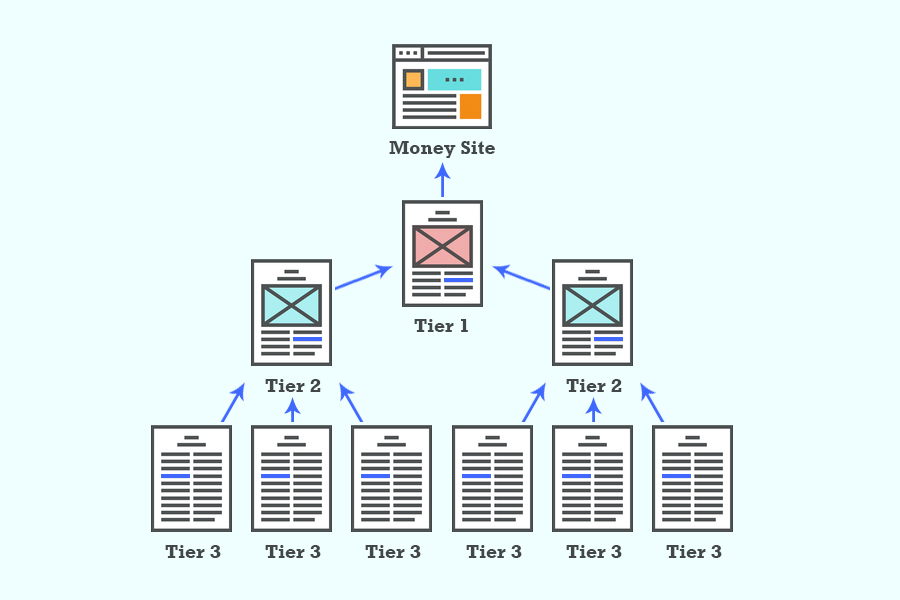
Tiered link building refers to the process of creating levels of links pointing to each other down to your money page. The goal is to increase the strength of the links pointing to your site by building backlinks to those links.

Below is a visual representation of tiered link building:

Source: MarketingHack.net

First, you need to create first-tier links or tier 1. The perfect first-tier link type you can get is via a guest post, where you submit content to other sites that include a dofollow link to your website in the content’s body or author byline.

The thing about guest posts is there’s a chance that your article might be rejected. To ensure this won’t happen, make sure you write quality content and observe the site’s editorial guidelines. Doing so increases the chances of securing quality links to your site.

At the same time, you don’t just write a post for any site. You first need to know if the site is worth writing for. To do this, you need to check the site’s authoritativeness and trustworthiness.

For instance, sites like Thrive Global, Enterpreneur, Inc.com, and others generate lots of traffic because people trust them. Therefore, you’d want to reach out to and write for them as much as possible.

 Get free access to the largest backlink database for a limited time only!

To help you identify a website’s authoritativeness, you can use SEO metrics like Ahrefs’ Domain Authority (DA). It measures the quality of the site based on how many good backlinks it has.

The higher the DA, the more authoritative the site is. And because other people like you are trying to land a guest post on these sites, assume that the barrier of entry is very high. That’s why it’s important to find as many authoritative sites related to your industry to reach out to. This will help increase your chances of landing a guest post.

Once your guest post is successfully published, the dofollow link from the guest post will pass “link juice” to your website. This should help generate more organic traffic to your website by rank higher on Google.

After securing first-tier links over time, boost their authority with help from second-tier links, also known as tier 2.

Unlike your first tier, you can build links pointing to your tier 1 from the following aside from just guest posts:

  • Social media (Twitter, Facebook, etc.)
  • Profile links (discussion/forum sites, Q&A sites)
  • Web 2.0 (WordPress.com, Blogger, Tumblr, etc.)

You can continue expanding the tiers over time by adding a third tier of sites that link to the second-tier sites, and so on. In doing so, you help increase the strength of the first-tier links by building an army of tier links pointing up. Your site can then rank even higher as a result!

Tiered link building can be implemented in just about any blog or online business. Whether you’re an affiliate niche blogger who wants to generate more commissions or a law firm looking for more clients, this link building strategy is a good place to help get your links up nice and easy.

Write Better Headlines That Boost Your Traffic

The Thing About Tiered Link Building

The problem with tiered link building isn’t because of how it works and is structured. As with most link building tactics, it depends on how people use this framework to rank their website on search engines.

For example, some people use article spinning tools like The Best Spinner or Spin Rewriter to generate thousands of articles from a single piece of content. They will then upload these articles on different web 2.0 sites to generate tier links in a short period of time.

Because the links are built unnaturally and not acquired organically, this makes tiered link building a black hat SEO strategy. And while some may claim that Google has yet to penalize them, they soon will eventually as with most websites who are using this tiered link building method.

Using This Link Building Strategy Ethically

The principle of tiered link building is fundamentally sound, but the tools mentioned used are what make this link building tactic a problematic one.

Instead of using an article spinning tool to generate hundreds of content, write a high-quality and informative post related to your website.

Instead of using an article spinning tool to generate hundreds of content, consider repurposing the content into various formats.

For example, turn an article on your website into an infographic as use it as a selling point to get your guest post published. You can also convert the article into a video and upload it on YouTube with a link to the original article.

content spinning


Source: Orbit Media

The idea here is that publishing meaningful content at sites that receive high volumes of traffic, most of which are your target audience, is better than producing low-quality, spun content on web 2.0 sites that pass little link juice to your site, if not at all.

Conclusion

If you want to grow your website’s traffic, link building will help you achieve that. At the same time, you need to know how to build “white hat” links the right way if you want to stay on Google’s good side.

Tiered link building is one of the many tactics that allow you to build backlinks at scale. And, as you saw above, it’s also easy to misuse this tactic into black hat SEO territory and get your site penalized down the line. Therefore, you must make sure that you acquire links organically and provide value to your audience. If done correctly, tiered link building will help you achieve that.

More on link building:

Link Building With the Cold Call Guest Post Method

The Psychology of Link Building

First published in November 2014; updated August 2021

10 Nov 22:55

Turn product demo fails into sales

by steli@close.io (Steli Efti)

I was demoing a product to a person I’ve been following for a long time already. Not just some random prospect - someone very accomplished whom I’ve looked up to for a long time already. Let’s just call him Mr. Mysterious.

Just as I was getting into the groove of the demo, a red bar appeared on the screen with an error message. What to do?

How can you proceed when you’re giving a product demo, and you’re really eager to close that deal, and then your product fails in front of the prospect?

The single biggest mistake you can make during a demo fail… is exactly what most people do during a demo fail!

Fumbling around like an amateur.

They get thrown off their game and desperately hope things will go back to normal.

They click around and try to assure: “Hm, wait, I think this just takes a moment.” Click, click, click.

“Uh, let me go back here, and try this again.” Click, click. Wait.

“Uhm, this is embarrassing. Let me log out and log back in again, that should do.” Click, click, click, clack, clack, clack.

Click, click. Nothing.

“Uhm, you know... well... I think we should, erm, reboot the system. One moment here, I’m going to invite you again in a couple of minutes.” 

Then they try to bridge the waiting time with a bunch of senseless smalltalk, trying to appear calm while you can literally feel how adrenaline transforms their tension into anxiety.

Stress is contagious.

When the sales person is nervous, the prospect often picks up their agitation.

Do you think that uneasiness is a mental state which helps you to close the deal? Of course it won’t - people shut down their gates and put up a wall when they’re feeling stressed.

In order to make them feel relaxed - you need to be relaxed first.

“This has never happend before.”

Almost everybody says that when a demo fails. Almost nobody believes it.

Even if you have never encountered that particular, specific bug before… you surely have dealt with failures and crashes and outages before. So don’t act as if this is the first time ever.

Every experienced professional knows things go wrong. 

Remember Murphy’s law: Anything that can go wrong, will go wrong. 

There's a reason why this law has gained popularity in the IT field.

From failed demo to fortunate deal

So how should you respond when your product fails during a demo?

Take a step back and think how you can turn this into an opportunity to connect with your prospect and demonstrate the strengths of your company.

Rather than staying focused on this one occurrence of a bug, make it about something bigger. Here’s how I did it with Mr. Mysterious when that red error bar popped up on the screen.

Step 1) Instead of stuttering and mumbling, be enthusiastic about it:

I told him: “See, this is the most important part of the demo. I didn’t plan for this, but I’m glad it happened. I’m going to show you what we do when things go wrong.”

Step 2) Re-focus on the big picture:

“Our app is pretty reliable. We process over 300,000 calls on Close.io every single month, and millions of emails are being sent and received on our platform. We growing rapidly all around the world. Thousands and thousands of sales people rely on us every single day. A lot of heavy users who spend many hours every day calling."

Step 3) Disarm them with honesty:

“We’re a crucial piece of software. We deliver on that promise but we’re also realistic, and acknowledge that once a while something might go wrong.” 

Step 4) Walk them through your support experience:

“We take this responsibility very serious, and that's why we're always here for you. Let's go through this together. You click on the little "Help" button. Do you want to contact us by email? Our average response time is between two to three hours. But if you want immediate help, go into our support chat."

"These are not some outsourced support agents. These are the engineers who built the product! Not some agent who will look through a database of prewritten answers, but someone with the technical expertise to understand, analyze and resolve your issue. So let's do this together now."

Step 5) Unleach the support beast:

In the support chat, our Product Lead guy was able to fix the issue right away.

Step 6) Explicitly spell out the value:

"Mr. Mysterious, I hope you see how dedicated we are to taking care of our customers. How many companies will actually go to that extent? We can't promise you that everything will always be perfect. Nobody can. But we'll always be ready to fix any issue you have. You'll always have access to us."

Bonus: Be playful!

If you can have some fun with it, do so. In this case, I was making a joke out of the fact that the prospect would chat directly with the engineer who was responsible for the bug - and that if he couldn't fix it, he'd be out of a job. (Real CEO-humor!) 

If it gets your prospect to laugh, that's funny enough. Helps to get rid of any tension.

In fact, the exact words or sequence you walk a prospect through during a demo fail isn't that crucial. These six steps are just one example of how you can turn a product demo into a sales opportunity.

What's much more important than the exact wording or sequence, is the state you're in: calm and collected, not falling apart. The message you want to implicitly convey is: This isn't a big deal, it can easily be fixed.

Be the kind of company people want to do business with.

Mr. Mysterious ended up buying. Not just despite the bug, but because of how we handled it.

He had witnessed first hand how level-headed we stayed when things went down.

Demonstrate that you’re going to have clarity and focus and fix the issue promptly.

When was the last time you had to deal with a demo fail?

Think back to the last time you were demoing your product, and something bad happened.

  • How did you handle it?
  • Did you react emotionally, or did you handle the problem professionally?
  • What could you have done better?

Replay this event in your mind, but re-write the script so that next time, you’ve already trained your mental muscles to handle demo fails like a seasoned pro.

Prefer to listen? Here's the audio of the video:

Related reading:

10 Nov 22:53

Four Quality Tactics To Establishing Friends with Business Benefits

by Ross Simmonds

People often obsess over the unfairness of being well connected. We’ve all heard the silly statement; it’s not what you know – it’s who you know. And we’ve all heard the people who say this sentence with a sense of bitterness in their voice. In reality, who you’re connected with does matter and it’s not fair or unfair – it’s just the world we live in. Relationships matter.

In business, relationships can be considered the number one driver of organizational and career success. The relationship with your customers, boss, employees and colleagues is a very important factor in business. Establishing these connections take time and a conscious effort to ensure that the relationships are well nurtured and maintained.

The best relationships in business are those who you have a real connection with. The following are five ways that you can establish friends with business benefits:

Share Value Regularly

If you can’t meet with your clients or prospects face to face, another great approach to keeping your relationships strong is sharing value. If you don’t do this already, it’s something you can start today by sending them one of the many blog posts or infographics from our site. In a nutshell, it’s about sending your contacts an email that includes a link or report that they would find useful. Constantly adding value to your prospects or clients lives will assist in building a reputation as a valuable resource. You will be seen as someone they can trust and ultimately someone who they will see as a valuable ally.

Understand the various types of content that will resonate with your audience is very important but more than anything, ensuring that the content aligns with their current situation is even more important. For example, if you’re trying to show your client that Snapchat is a great marketing tool, it makes sense to share a Guide on Using Snapchat for Marketing but it doesn’t make sense to share an article on social media 101.

Remember The Little Things

I know this might sound a little bit stalkerish but you should look up your contacts birthdays. It’s really simple to do if you’re connected to them on Facebook but if you’re not connected to them there, you could always ask in a conversation. From there, plug it into your calendar and set a reminder so you don’t forget it. From there, you can send an email on the day of their birthday or even schedule a tweet months in advance. It’s a simple yet effective way to show that you care and remembered their special day.

Be Informal When Appropriate

Embrace the idea of being informal but never embrace the idea of getting sloppy. In conversations with colleagues or at events with peers, it’s okay to let your guard down. It’s okay to talk about things outside of business and it’s okay to laugh at their jokes. Too many people think that business is all Tuxedos and Bowties, when in reality; it’s what you make of it.

Don’t Avoid The Face to Face

Technology has done a lot of great things for business. It’s allowed for brands to tell their story more effectively through social media and provide sales teams with the tools they need to truly unlock the power of their relationships. At the same time, the internet and technology has resulted in creating a world of emails, messages and chatter instead of a world of calls, meetings and discussions. Don’t underestimate the power of meeting face-to-face or picking up a phone to chat.

Social media hasn’t replaced face to face interaction. More than average, I’m actively leveraging opportunities to build connections with people I meet on Twitter, Forums and LinkedIn. I’m grateful for the hundreds of relationships I’ve been able to maintain through technology along with the individuals I’ve met using these tools. But I know that face to face trumps everything. I know that one meeting in person can be more valuable than twenty tweets. That’s the world we live in. That’s the world we must navigate and embrace.

If you want to succeed in business, you need to invest in your relationships. In today’s world, your net worth is directly related to your network. As such, it’s important to be smart about whom you’re spending time with and which connections are authentic, mutually beneficial and established on a sense of trust.

It takes a lot of work to build a relationship but only a second to ruin one. The tactics above will help any professional be smarter and more effective at maintaining positive relationships throughout their professional careers.

10 Nov 22:53

Why Your Small Business Should Be Part Of The Video Marketing Revolution

by Simon Dunant

It was only a few years ago that any sort of film or video making was inherently expensive and using moving images for marketing campaigns was confined to the large corporations with pockets deep enough to hire a big London based ad agency.

Whilst the blockbuster video advertising is still a part of that corporate world, the cost of video technology has reduced so much that it’s now possible to create high quality movie content at an incredibly reduced budget. Reducing that budget doesn’t mean compromising on quality either, as the simple camera built right into your iPhone can produce high quality video suitable for web distribution

So why should you start using video in your marketing mix? Here’s some incredible statistics that answers that question.

  • By 2018, 79% of all consumer internet traffic will be video content (Source: Cisco)
  • More than 1 billion unique users visit YouTube each month (Source: YouTube)
  • Over 6 billion hours of video are watched each month on YouTube—that’s almost an hour for every person on Earth (Source: YouTube)
  • A picture paints 1,000 words however one minute of video is worth 1.8 million (Source: Forrester)

And it appears to be the web that’s driven this video marketing revolution. No longer do you have to compete to purchase expensive TV advertising slots on prime time, you can film your own video content with a webcam, iPhone or other low cost digital camera, publish it on YouTube, distribute links or embeds on social media with a relevant hashtag, and build an audience around your brands new online TV channel.


You can be more creative online too. Rather than simply delivering advertising messages, you can use video to educate your customers and release content that’s useful to your potential customers.

Why Your Small Business Should Be Part Of The Video Marketing Revolution image TomBailey.jpg 300x300

Video marketing for small business doesn’t have to be difficult. “Keep it simple and plan, plan plan” says Tom Bailey of Shy Camera.

The democratization of video marketing also means that you can get closer to the customer, add more value and tailor your content to the exact target market you’re aiming for. No more expensive scatter gun advertising approach, just the ability to speak directly and authentically to your ideal customer.

However if you’re thinking you have to be the next Steven Spielberg to succeed with video marketing, think again. We film our own “On The Social Sofa” series with a simple webcam, laptop and basic lighting rig.

You don’t have to produce a Hollywood movie to get started in video marketing, start where you are with what you have and expand as you go.

At the 2014 Content Marketing Show, Tom Bailey of Shy Camera, a video production company based in Brighton, gave a passionate talk on how smaller businesses can get the amazing results with their video marketing thanks to the increased quality and lower cost of technology.

5 key takeaways from Tom’s talk that could help small businesses thinking of creating video content in-house are:

1) Don’t be scared to replicate other people’s formats. If someone’s worked out a successful use of video marketing then reverse engineer the content. Study some of the methods, shots, camera angles and production they’ve used and see if you can replicate the format with your own original content. In the same way that stories are derived from just 7 basic plots, most video content has been shot in certain ways for good reason.

2) Sound really matters. It’s no good having the best polished video and story if no one can hear your soundtrack or the words the presenter is saying. Tie clip mics are available at very low cost (search for lavelier or tie clip microphones on Amazon) or we’ve even used the microphone from our iPhone headphones pinned to a lapel and connected straight into a laptop with an audio cable extension as a quick and cheap way to get good sound for pieces to camera.

3) Plan, plan and plan again. Before you pick up a video camera and start filming, have an idea on what you want the end result to be. In TV and Film it’s standard to use storyboards (a series of sketched or photographic images) put together as a sequence to illustrate the shots. You don’t have to go this far if you don’t want to, writing down the ideas on a notepad will suffice, although visual images (even stick men sketches) will help visualise what you’re trying to achieve. It’ll save you so much assembling and editing time after filming if you work from a plan.

4) Pay attention to lighting. Tom’s advice is that natural light is usually never enough, the more control you have over lighting the better. Lighting doesn’t have to be expensive either, we’ve used industrial work lights from the local hardware store to light videos before (even when working on music videos) and they’ve worked well for simpler projects. If you do want to invest in some professional video lights though they’re still affordable enough to be within reach of a small business.

5) Pick the right people to present. If you’re working as a team don’t let egos get in the way. Run screen tests on the people in your company to see who works best on camera. Tom’s advice is that it’s not usually the showy salesman types that will come across the best on screen, you may find that the shyest of your team could be the most genuinely connected front person for your project.

The biggest advice from Tom’s presentation was to enjoy the video journey and have fun. Ultimately make it a team project, and if content production using video is new for you use it as a fun learning experience that will benefit both your own growth and your businesses growth too.

If Tom’s slides inspired you and you’d like read the full transcript of his talk from this years Content Marketing Show head over to his in depth blog post based on the slides at the Shy Camera blog.

Lead image credit: saine


Why Your Small Business Should Be Part Of The Video Marketing Revolution image twittercheatsheet1 1 3d350 215x3002.png2

Drive New Customers From Twitter!

Want the inside secrets on getting new business using social media? Get this FREE eBook series delivered to your inbox and start getting maximum engagement on Twitter today!

10 Nov 22:53

9 Best Practices For Becoming A Successful Social Brand

by Phillip Agnew

9 Best Practices For Becoming A Successful Social Brand image IMG 7415.jpg 600x336

Today, social networks are revolutionizing how the world communicates and shares information.

They’ve given us all a platform to voice our opinions to hundreds, if not thousands of people at a time. Brands who are aware of this can use these conversations in a targeted, productive manner to uncover true competitive advantage.

In fact, our latest report explains how Microsoft considerably changed their latest console, Xbox One, due to poor reviews on social networks.

Moreover, our Travel & Hospitality report describes how Expedia filmed and aired replacement adverts to appease negative online posts about their original ad.

9 Best Practices For Becoming A Successful Social Brand image collage.png 600x222

Brands now have a responsibility to use social networks to listen, analyze and act.

In this post, we’ll present nine best practices for launching your brand into the upper echelons of social media greatness.


Best Practice #1/ Make being social an enterprise-wide revolution

Brands should not mistake social media as just another channel for marketing your products. Social interactions should involve a variety of disciplines such as customer service, new product development and PR.

Take Monster who use social media engagement to help match those looking for jobs with the relevant Monster recruiters, whilst also carrying out customer service and marketing.

Best Practice #2/ Establish social media goals before jumping into the fray

Know your purpose and make sure your social media campaigns are all seeking to achieve an objective or goal.

For example, are you looking to gain mindshare for a specific product or service, build brand equity or find new leads?

Devise a way to categorize the types of social content you want to post and allocate necessary time to them. Follow a 70/20/10 principle: you should spend 70% of your time on the objective based content and only spend 10% of your time on high-risk, unrelated content.

Best Practice #3/ Listen well

You simply cannot succeed in social media without a comprehensive and structured listening process.

Just like with the Microsoft and Expedia examples mentioned previously, listening helps you understand what your audience thinks about you and lets you act on it.

Social listening tools enable you to know who is saying what about you, where, when and why they say it. From this, you can form a optimized strategy to reach your targeted communities with messages intended to win them over.

Best Practice #4/ Monitor broadly, but with focus

Conversations about your brand can take place almost anywhere online, so make no assumptions about where you will find the most crucial ones.

Make sure to make your listening as broad as possible – covering not just your own brand, but your competitors and your industry.

Think about what terminology people use when talking about your brand online, what names they have for your products, services, products, events and campaigns. Once you’re comfortable with your broad results, you can start refining your data set.

9 Best Practices For Becoming A Successful Social Brand image CocaColaProducts.png 600x226

The Coca-Cola product range.

Best Practice #5/ Broaden your internal audience

Gone are the days when brands would monitor social media solely for marketing communications and PR purposes. The majority of brands now bring multiple departments into the fold. Social media teams can involve anyone from customer support, right the way up to VPs.

You should assign owners to each functional area of your organization to streamline your responses to different social situations.

This gives you a full armory of responses to any problem or opportunity you’re presented with.

Best Practice #6/ Engage and respond to add value

Many brands have found out the hard way that they are not always welcome participants to conversations online.

To make sure your contributions are welcome, you need to put your consumers at ease with a robust social engagement strategy.

Be transparent and honest, add value to the conversation, inform and educate without selling, and of course, never lie.

Best Practice #7/ Customize social media monitoring by discipline

Utilize the customization tools within your social media listening platform to create charts and metrics that relate to a specific users across your enterprise.

For example, categorize your social media performance by product:

9 Best Practices For Becoming A Successful Social Brand image 1.png 600x193

Or group your social mentions by location:

9 Best Practices For Becoming A Successful Social Brand image 2.png 600x248

Once your dataset is segmented in these ways, you can start to find patterns and glean insights about the social side of your company’s performance.

Best Practice #8/ Measure what you have heard

Social listening allows you to show and demonstrate clear progress or regress, whether that be in total reach or negative sentiment.

By drilling down to this level of data, you will be able to backup your activities with a host of social data, and significantly, the more data you collect, the more reliable it is.

9 Best Practices For Becoming A Successful Social Brand image Screen Shot 2014 10 22 at 10.png 600x242

Best Practice #9/ Continuously improve through measurement

The ability to measure allows for continuous improvement.

You will quickly see what is working and what is not, allowing you to optimize the right and get rid of the wrong.

The likely result will be one or more important discoveries in areas your social media teams never considered. By being “plugged in” you will naturally make your social team and the wider company more responsive and higher performing.


By following these best practices, you’ll be well on your way to becoming a successful social brand for you, your customers and your prospects.

Now you know.

10 Nov 22:52

How To Think Like A Big Brand

by Catalin Zorzini

What do big brands do before they start to market their products? They brand. While employing marketing tactics, such as Facebook ads, to gain traffic is a worthy strategy for ecommerce stores, it tends to discount the importance of the message they want to send.

Online stores can learn something from big brands that use branding before marketing to inspire their audience. Online retailers tend to think marketing first, branding second. Big brands know that all marketing activity stems from branding strategy. First you have to discover who you are before you try to sell yourself. Big brands think deeply about who they are, and what they stand for.

So, what can smaller ecommerce brands learn from the big guys? Here are some steps online stores can take to focus on branding to gain a larger more committed audience.

How To Think Like A Big Brand image trust.jpg 600x400

Build Trust

At the core the branding paradigm stands one powerful truth; trust attracts business. It is often said that the purpose of branding is to create trust, and that in turn; this trust enables brands to command a higher price and generate more demand for their products and services. While this is true, very few resources come to the rescue of small online brands that desire to start on the journey of “self” discovery of a diligent branding endeavor. Yes, branding is all about shaping the identity of your products and services while keeping in mind that trust is built through the degree to which your ideas, beliefs, and core values resonate with your audience. Ideas are powerful and inspire people to action. The power gained through the sharing of life ideals is a force to be reckoned with and the most critical concept to understand in establishing a sound and effective branding strategy. Brands who connect with their natural audience and nurture the relationships will surely get rewarded for their efforts. Each brand must stand for an ideal, and mean it. Brands who inspire help create a better world.

How do you build trust? Take a look at these brands and some methods they use. Starbucks uses communication to build trust with their fans. By retweeting fun audience-generated content they speak to their audience just like a friend would.

How To Think Like A Big Brand image starbucks tweet.png

How To Think Like A Big Brand image bellroy.png

Bellroy, the makers of thin leather wallets, builds trust through being authentic to their core values. This tweet is about something that obviously they feel passionately about to share with their audience. It also is authentically them. Nature and sculpture is what Bellroy does. They craft nature, the finest leather, into sculpture, thin functional wallets.

How To Think Like A Big Brand image stop collab listen.jpg 600x450

Stop Selling Stuff… Start Promoting Ideals

If you think of your business in terms of being only a provider of products or services, you’re surely not doing as well as you could. This is an opportunity for you to take a few steps back and start asking some fundamental questions related to your products identity, namely brand, and also to attempt to better understand how it is perceived by your audience. A product is merely a physical and utilitarian object, which is difficult to relate to. The purpose of the brand is to allow for beliefs, core values, and even personality traits to be associated to the product on the same basis as those attributed to people. How attractive and relatable is your brand’s proposition. Consider your products name, core beliefs, personality traits and even recognizable physical features each as key elements of your overall branding strategy.

How To Think Like A Big Brand image datsusara.png 600x70

Datsusara, which produces MMA gear made from hemp fabrics, is a perfect example of an ecommerce brand doing just that. The name “Datsusara” translates from Japanese into, “to leave the salaried workers’ life”. Chris, the guy behind Datsusara, is the personification of the idea of leaving the salaried life. Not only has the brand he’s built allowed him an entrepreneur’s lifestyle free from corporate tyranny, but he also promotes this ideal through his brand. The name obviously, but also through his blog by writing with a clear message on what he stands for. People attracted by his ideals will bond with his brand.

Personality… Where to begin?

People who aren’t convinced that brands actually have personalities will be stunned to learn that scholars from top business schools have already developed and refined a framework over the last 17 years, which establishes five dimensions in the identity of brands. According to their research, the focus of your brand will either be Sincerity, Excitement, Competence, Sophistication, or Ruggedness. Of course, your job as a brand owner is to make your core values as specific and meaningful as you humanly can. Make a list of values and constantly refine it to see which one comes out on top. And little by little observe your brand’s personality and core values emerge seemingly out of nowhere. Answering questions such as “What does our brand stand for?” will also keep you on path toward bringing your brand to life.

What brands have personality? Here are some big brands that fit into the 5 dimensions.

How To Think Like A Big Brand image Brand pentagon.png 600x403

How To Think Like A Big Brand image mantra.jpg 600x600

The Mantra, Your Gospel

Once you’ve established the core values of your brand, it’s time to synthesize it into a short, congruent, and powerful mantra. Ideally consisting of three words or less, no more than five, your mantra represents what your brand stands for. It is kept short so people can remember it. The attention span of online shoppers is incredibly short and you’re doing yourself a huge disservice by trying to cram more information into your audience’s minds. The only possible outcome of such a strategy is confusion. Start paying attention to the mantras of big brands. Trying to remember one of your favorite brand’s mantras will also be a good exercise and should convince you of the importance of keeping it as concise as possible. Keep in mind, your mantra, being a reflection of your core identity, is your brand’s purpose or reason to exist. Focus on being genuinely authentic and dedicated toward the realization of your brand’s ideals.

Some big brands mantras you can learn from

How To Think Like A Big Brand image Apple Think Different.png

How To Think Like A Big Brand image BMW.png

How To Think Like A Big Brand image kickstarter mantra.png 600x201

And some parody ones too. Wouldn’t it be great if one day your brand grew big enough to be parodied?

How To Think Like A Big Brand image Tic Tac.png How To Think Like A Big Brand image toblerone.png

In the End: Let Branding Guide Your Marketing Efforts

A solid branding strategy coupled with a well-executed marketing plan can be a great combo in the quest for brand value creation. But don’t forget, branding is about who you are, and marketing is what you do. Branding is about evolving, becoming, and growing, while marketing is simply the collection of actions that take you there. Brand is value, marketing an expense. The ecommerce environment is filled with marketing tools ready to help online brands do more to promote their businesses, but to be truly successful; you must first do your branding homework. Follow the steps above to start thinking of branding like the big boys and watch your brand flourish.

Author Bio: Max Gaudet is an Asia based MBA educated marketing specialist passionate about entrepreneurship and branding across cultures. He is co-founder of brandkoop.com and essentially believes in the driving force of positively channeled human creativity and dedication to shape a better tomorrow.

10 Nov 22:51

6 Signs That An Inbound Marketing Agency Can’t Handle Your Project

by Angela Vuona

6 Signs That An Inbound Marketing Agency Cant Handle Your Project image inbound marketing agency blog.jpg

Are you experiencing signs that it is time to outsource your marketing? Is your revenue growth stagnant? Is your marketing staff overworked or consistently running behind? If you answered yes to all of these questions, there are many inbound marketing agencies who can help you properly strategize an integrated marketing plan and deliver the results you’re hoping for. However, it is encouraged to be mindful of which agency you pick to work with, as you want to ensure your experience is a positive one.

Once you narrow down the list to a few potential options, be sure to look out for these signs that may indicate the inbound agency can’t handle your project:


  1. Lack of communication – A timely response by your agency is not only professionally polite, it is 100% required. You should never feel ignored or as if you’re bothering them with questions. The agency should be thought of as an extension of your team and open communication is crucial for the success of your collaborative relationship.


  1. Limited analytics and reporting – It’s never a good sign if an agency can’t provide you with standard analytics like average visit-to-lead or lead-to-customer conversion rates on a landing page and/or site pages. It is even a worse sign if they can’t provide you with previous client reporting, which means they probably aren’t measuring in the first place.


Important note: Data should drive an agencies decision-making process for your marketing strategy. For example, an agency can measure your landing page performance by looking at click-through rate (CTR) percentages. If one or two pages have a significantly higher CTA rate, there is something to be said here. A consultant would most likely ask why are these pages converting higher: page layout, value proposition, or CTA language? Whatever the reason is, it could now be incorporated on other pages to increase overall conversion rates.


  1. Lack of client testimonials – A solid inbound marketing agency will be able to provide success stories. This ties into the above about the importance of analytics and reporting. Client testimonials not only provide proof of happy clients, but also it validates that the inbound agency can perform and deliver results.


  1. Poor project management – At all times, you should know exactly what project deliverables are in-progress, completed, and what’s on the agenda for next month. There are many different types of project management software programs, some more complicated than others. And, on top of that, agencies have their own project management style. Be sure to ask what their process is, and make sure it’s clear. Here are a few red flags:

-No project management software

-No calendar of monthly initiatives (showing status of projects)

-No repeating weekly/bi-weekly/monthly calls scheduled

-No follow-up emails


  1. Walk the talk – Do a little homework about the inbound marketing agency itself. If an agency does a great job marketing themselves, they will do the same for you. Check out their blog and social channels to see if it is updated regularly. Also, be sure to ask about their personal challenges and successes, and how they have applied those lessons to their clients’ marketing.


  1. Interns – This is a touchy subject. For larger agencies, it is encouraged to bring on interns to pass off legwork of your project like research, social media, and copywriting. However, this is how mistakes can be made. Ultimately, you want to pick an agency who has experienced consultants with past (real-world) marketing experience who can guide you, and personally work on your project.


There are many factors to consider when choosing an inbound marketing agency. Be mindful of the signs listed above before you sign the contract. Alternatively, if you are currently working with an inbound agency and experiencing any of these warning signs, it may be time for you to start looking elsewhere.
Have you experienced any other signs that an inbound marketing agency can’t handle your project?

10 Nov 22:51

Meet The 12 People Who Won $3 Million For Their Breakthroughs In Science And Math

by Dave Smith

breakthrough-prize-2014A record 12 Breakthrough Prizes were announced on Sunday.

Created by Silicon Valley giants from Facebook and Google in February 2013, the Breakthrough Prize is a $33 million annual pot that is split among 11 people — or in the case of this year, 12 people — to reward life science and math researchers. An individual Breakthrough Prize is worth roughly three times the value of the Nobel Prize. 

This year, six Breakthrough Prizes went to researchers in the life sciences, and five mathematicians won for their work; though in the future, just one prize a year will go to a mathematician.

“Alim Louis Benabid, Joseph Fourier University, for the discovery and pioneering work on the development of high-frequency deep brain stimulation (DBS), which has revolutionized the treatment of Parkinson’s disease.”


“C. David Allis, The Rockefeller University, for the discovery of covalent modifications of histone proteins and their critical roles in the regulation of gene expression and chromatin organization, advancing the understanding of diseases ranging from birth defects to cancer.”


“Victor Ambros (left), University of Massachusetts Medical School, and Gary Ruvkun, Massachusetts General Hospital and Harvard Medical School, for the discovery of a new world of genetic regulation by microRNAs, a class of tiny RNA molecules that inhibit translation or destabilize complementary mRNA targets. Each received a $3 million award.”


See the rest of the story at Business Insider
10 Nov 22:51

Stop Losing Online Customers To Your Competition

by Amanda Willigmann

Stop Losing Online Customers To Your Competition image Stream Blog Graphics IntegrateSEOinSocial 5 14 300x300.jpg

We commonly hear from our auto dealership clients that they have trouble finding ways to get their happy customers to share their thoughts online. In addition to providing value for your SEO and AdWords campaigns, online reviews are important for encouraging new consumers to visit your dealership. More and more people are using online reviews to determine a dealership’s reputation and other customers’ experiences.

Online reviews, both good and bad, are incredibly influential in the customer decision-making and buying process, and they need to become a priority action item for the sales team and managers at every positive customer touchpoint.

Not sure how to get started when it comes to encouraging customers to write reviews? Think about the many happy customers you see in a week. Have you asked any of them to write a review about their experience? Think about how many reviews you could generate for your business if you asked every happy customer to write one. People want to share their thoughts and the positive experiences they’ve had with others, but they typically only follow through when prompted.

Here are three actionable steps you can implement today within your dealership to start encouraging more happy customers to leave positive reviews:

  1. Begin with leaders at the dealership. Assigning this task to leaders first will encourage the habit to cascade throughout your dealership. Have them start the trend of asking customers to post an online review. To make things interesting, create internal incentives and encourage friendly competition among the team members. If each leader can get just three reviews per week, they’ll add up quickly. Discussing this with a customer doesn’t have to be awkward. Explain how easy it is to go onto sites such as Google or Yelp and write a review about your business. Let them know how important it is to you and how much you’d appreciate it.
  2. Post a sign. The simple method of printing out a request and displaying it on the door or counter of your dealership can prompt happy customers on their way out. Make sure you give them direction about what sites to visit by adding logos of major reviews websites, such as Google and Yelp.
  1. Add links to your email signature. Think about the many emails that you send each day. Set up a link to your online profiles with a message such as “We want to hear from you! Let us know about your experience.” It will show up in every email you send, right in front of customers, so all they have to do is click the link and review your business.

When car shoppers are interested in buying a car, they go to the internet first to research which dealership is the best option. Many times, having no reviews can have the same detrimental effect as negative reviews, driving shoppers away from your dealership and through the doors of your competitors. Keep in mind, people love to share their thoughts and opinions and to offer recommendations, so make sure you’re asking for their feedback and directing them on how to share their experiences.

10 Nov 22:49

Peter Thiel Explains How An Esoteric Philosophy Book Shaped His Worldview

by Richard Feloni

Peter Thiel

Billionaire Peter Thiel is as well known for being the cofounder of PayPal and the first outside investor in Facebook as he is for his free thinking.

He outlines many of his contrarian views, such as why successful companies should strive to be monopolies, in his book "Zero to One."

Thiel has previously said that the contemporary French philosopher René Girard has had a tremendous impact on his life, and he told author and investor Tim Ferriss that he considers "Things Hidden Since The Foundation of the World" to be Girard's masterpiece.

Girard's main concept is "mimetic theory," which states that most of human behavior is based upon imitation. The imitation of desires leads to conflict, and when a buildup of conflict threatens to destroy all involved, they use a scapegoat to return to balance.

Much of Girard's work delves into Christian theology, which has also had a profound effect on Thiel.

We had a chance to ask Thiel how his favorite Girard work has shaped his worldview, career, and even his faith. Here's what he said.

Business Insider: When did you first read "Things Hidden Since the Foundation of the World"? Has your interpretation of Girard's philosophy changed as you've gotten older?

Peter Thiel: I first read "Things Hidden" when I was an undergraduate at Stanford. Girard ranges over everything: every book, every myth, every culture — and he always argues boldly. That made him stand out against the rest of academia, which was and still is divided between two approaches: specialized research on trivial questions and grandiose but nihilistic claims that knowledge is impossible.

Girard is the opposite of both: He makes sweeping arguments about big questions based on a view of the whole world. So even when you set aside the scandalous fact that Girard takes Christianity seriously, there is already something heroic and subversive about his work.

"Things Hidden Since the Foundation of the World" is an intimidating book. Girard warns on the very first page that he has "deliberately left out all concessions to the reader." However hard it seems at first, Girard's philosophy always stresses a few key points. Simplest of all is the idea that imitation is at the root of all behavior.

I've noticed that it takes a long time to really sink in. You can understand what his words mean as philosophical concepts without understanding how those concepts play out in life. It's hardest of all to see how they apply to yourself. I would say that there is no difference in my interpretation of Girard at the level of ideas, but now I have a better sense of how deep his ideas go.

BI: You've mentioned that you are conscious of your desire to not become distracted by competition in your pursuits. How much has Girard's theory of mimetic desire and its negative outcomes influenced this approach?

things hidden since the foundation of the world

PT: According to Girard, imitation is inescapable. As a rule, we do what we do just because other people are doing it, too. That's why we end up competing for the same things: the same schools, the same jobs, the same markets. Economics will tell you that competition dilutes profits, and that’s one big reason to question it.

Girard gives at least two more reasons: (1) competitors tend to become obsessed with their rivals at the expense of their substantive goals, and because of that (2) the intensity of competition doesn't tell you anything about underlying value. People will compete fiercely for things that don't matter, and once they're fighting they'll fight harder and harder. You might not be able to escape imitation entirely, but if you're sensitive to the way it drives us then you're already ahead of most.

BI: How have you seen both the theories of mimetic desire and the scapegoat mechanism manifested in Silicon Valley?

PT: When the payments company Square came out with its flagship credit card reader, competitors jumped in one after the other to do the same thing with triangles or half-moons instead of squares. That's the comical example I cite in "Zero to One." A more dangerous phenomenon is the desire for the same position within a company: startups are small, they move fast, and roles are fluid, so there is lots of potential for conflict.

As for scapegoating, what happened to Bill Gates during the antitrust prosecution of Microsoft is a great example of the tendency to gang up and blame one person.

BI: How has Girard's interpretation of Christianity affected the way you practice your religion? Has your spirituality influenced the ways you've decided you would like to leave an impact on humanity?

PT: To see the difference Girard makes, consider the Book of Revelation. It's the last thing in the New Testament. It's very strange. What could it mean to someone today? There are two common views: Secularists see a bunch of crazy gibberish that should be ignored or mocked. Fundamentalists see an authentic prophecy of divine vengeance.

Girard says there is another, deeper answer: The destruction that Revelation describes is real, but we can't blame it on an angry, violent deity. We have created weapons capable of violence on a biblical scale. In the event of apocalypse, we will be responsible. Blaming the gods for our own violent acts is what humans have done throughout the whole history of religion.

But as Girard reads them, the Gospels reveal that God is not violent. He has no need to get into a fight. He is not our rival. What God actually is and what it means to be created in God's image is not something to capture in a sound bite, but it certainly begins with creation and continues with life.

BI: Is there a particular section of "Things Hidden Since the Foundation of the World" that has particularly influenced you or that you suggest readers new to Girard become familiar with?

PT: There's not an easy way into "Things Hidden." It's not obscure; it's just densely packed. The best place to start reading Girard might be with whatever part of culture you're most interested in, because he's probably written about it.

If you like classic novels, read his first book, "Deceit, Desire and the Novel." If you're interested in mythology, read "Violence and the Sacred." If you like Shakespeare, read "Theater of Envy." If you know the Bible, read "I See Satan Fall Like Lightning." If you want a view of his whole career over time, look at "The Girard Reader." And if you want to immerse yourself in all his ideas at once, stick with "Things Hidden."

SEE ALSO: Billionaire Peter Thiel Explains Why He Would Tell His Younger Self To Be Less Competitive

Join the conversation about this story »


10 Nov 22:49

LinkedIn For Education: What’s In It For Alumni?

by Alicia Dodd

LinkedIn For Education: What’s In It For Alumni? image alumni1 300x200.jpgWe’ve now come to part three of the five part series on LinkedIn’s “YOUniversity” Dashboard. In part one and part two I covered how the dashboard works with prospective and current students; helping them to do things such as rank universities and find their first job. In part three I’m going to explore the question: What’s in it for alumni?

The LinkedIn “YOUniversity” dashboard is great for not just students, but alumni as well. I know that it’s easy to forget about your college or university once you set foot out into the “real world”. For many, the only time we interact with our alma mater is during homecoming or a similar special event. I urge you all to not leave your school ties in a cobwebbed corner (with your spark notes and APA style guide), when you graduate from the institution. Instead, follow what LinkedIn has mapped out for Alumni, which is designed to help you find your next great opportunity.

LinkedIn’s Alumni “YOUniversity” section breaks out an alumni’s journey into the following three parts:

University Pages

LinkedIn For Education: What’s In It For Alumni? image Screen Shot 2014 11 03 at 10.08.06 AM e1415138481791.png

Begin by following your school’s University page. This is the best way to keep an eye on campus and alumni news and possible new opportunities to join a board, volunteer, or even get a job.

I’ve highlighted the different sections that make up University pages in part two of this series.

The Alumni Tool

LinkedIn For Education: What’s In It For Alumni? image Screen Shot 2014 11 03 at 10.09.17 AM e1415138510642.png

The Alumni tool is most easily accessed by hovering over the “Connections” tab and clicking on “Find Alumni”.

LinkedIn For Education: What’s In It For Alumni? image screenshot e1415138431421.png

Once you are taken to the alumni tool, you can then use the dashboard to find useful information on Alumni such as:

• Where they live
• Where they work
• What they do
• What they studied
• What they’re skilled at
• How you’re connected

Looking to relocate? Consider tapping into your Alumni network in that area. Thinking about taking a job with a certain large corporation? Check to see what alumni already work there and reach out to get an insider opinion.

Looking to use this tool even more strategically? Click here for Whitney Harmel’s post on how to find others through the LinkedIn Alumni Tool.

Jobs

LinkedIn For Education: What’s In It For Alumni? image Screen Shot 2014 11 03 at 10.09.08 AM e1415138562401.png

Last but not least, LinkedIn reminds us all to take a look at our alumni network when actively applying for a new job. “It’s not what you know, but who you know.” We’ve all heard this saying and LinkedIn reminds us how true it is with this stat – “Over 80% of jobs are landed through networking”. Why not tap into your alumni network when prospecting for a new job? When applying through LinkedIn, look to see who has posted the job and then look to see how you are connected to that person. As you connect with more alumni, you’ll commonly see them as the link between you and the hiring manager.

Other Features

In addition to using these three sections on LinkedIn to help give you leverage when looking to land new business, make new connections, or get a new job, LinkedIn reminds alumni that they still have access to the tools designed for prospective and current students. So lets say you are thinking about online classes or maybe going back to school to get a graduate degree. You can definitely use the “YOUniversity” dashboard to find different universities, see how they rank, examine different fields of study, and even create a decision board to get other people’s opinion before deciding upon which degree and institution is right for you.

I hope that this post helps you to see the value of your alumni status and alumni connections on LinkedIn. Take a look at the areas I mention in this post and begin by just exploring one area. After a week or two, evaluate your efforts. Have they made a difference in how LinkedIn worked for you?

If you are enjoying this series, stay tuned as next week I’ll discuss how LinkedIn is making a difference for schools.

10 Nov 22:48

Microsoft Office Apps Skyrocket To The Top Of The App Store Following Pricing Changes (Sarah Perez/TechCrunch)

Sarah Perez / TechCrunch:
Microsoft Office Apps Skyrocket To The Top Of The App Store Following Pricing Changes  —  Nothing sells like “free.”  Microsoft Word is now the number one free iPhone and iPad application on iTunes, closely followed by other Microsoft Office apps including Excel and PowerPoint.

10 Nov 22:47

What Is the “Race to Zero” and Why Does It Make Tech Companies Nervous? - Slate Magazine (blog)


Slate Magazine (blog)

What Is the “Race to Zero” and Why Does It Make Tech Companies Nervous?
Slate Magazine (blog)
Cloud computing has completely changed the tech industry, but it has a dark side for the companies competing in the market, something those in the industry call “the race to zero.” There's so much competition in the cloud industry that cloud companies ...
Google Slashes Cloud Prices, Refuels Price War with AmazonNewsFactor Network
CommVault Automates Data Protection for Workloads Running on Amazon Web ...Las Vegas Blog (blog)

all 33 news articles »
10 Nov 22:39

Back To The Future Of Social Business

by Rachel Miller

It’s that time of year when many bloggers start to stare aimlessly into the murky depths of their proverbial crystal balls in hopes of getting glimpses of inspiration that can be artfully crafted into next year prediction statements. But me, I’m going to look to the past and highlight a significant prediction for sales, social media, and customer relationship management that came to fruition.

Five years ago, which is eons in technology time, sales expert John Golden predicted that successful sales professionals would rely heavily on social networks and tools built specifically for sourcing, collating, and analyzing social data. In his article, Sales Professionals Must Embrace Social CRM — or Risk Extinction, John highlights a very important change in the customer journey and acknowledges that buyers will most definitely source opinions from their social networks before continuing conversations with a seller.

In essence, the seller must respect that the buyer to a large degree owns the conversation and will dictate where and when it happens and, indeed, when the seller is a part of it and, just as important, when they are not. In other words, there may be parts of the sales process that the seller is completely shut out of, such as when a buyer, unknown to the seller, uses their LinkedIn professional network to perform some due diligence.

This significant shift in buyer behavior has had many repercussions for sales professionals. And, sadly many are failing to see the need to adapt to this new buying cycle. Today’s self-educated buyer is better suited to a cyclical sales approach versus the more structured funnel of the past. Similar to select your own ending books from childhood, buyers like to choose their own path and engage with sales representative via the communication channel of their choice and at any time they have the need.Back To The Future Of Social Business image Screen Shot 2014 11 04 at 10.53.08 AM 300x300.png

The modern buyer is more likely to be engaged and stay engaged by a marketing-enabled sales process. Sales and marketing must firmly align strategies to achieve a consistent customer experience. And, sales professionals must understand that even though their role has changed, it is no less important. This change in process does not diminish the relevance of sales professionals in an organization — in fact, it plays to their strengths. Salespeople naturally forge relationships — and leveraging social will allow them to scale their networking efforts exponentially.

Social is not going away and what we currently refer to as social selling techniques will eventually become business standards. In much the way email has grown to be an integral part of business communication, so will Twitter, LinkedIn, and all the “who can guess” future networks. It is incredibly important for businesses and employees to embrace social as a communication channel. Because, as John so wisely states in his post, “…there is a need to identify that which has had an enduring impact and will continue to do so…”

What do you predict will endure in the future of business?

10 Nov 22:39

B2B Buyer Behavior: Timing is Everything

by MattWesson

B2B buyer activity and research peaks at different times of the day, week, month and year. To understand those idiosyncrasies, Software Advice conducted a study gathering data from six million unique visitors to their site to discover when B2B buyers perform research on the web, when they convert on a website, and when you can get them on the phone.
10 Nov 22:38

What Beer and Content Have in Common

by MattWesson

When your blog post, eBook, infographic, webinar, or email campaign hits the spot, when people find value in the information shared, and when lead and revenue numbers prove it makes a difference to your business—well, it feels as good as a cold beer on a hot summer day. So let’s hop to it, content marketers! Check out the infographic below, co-created by Kapost and the good folks at Salesforce ExactTarget Marketing Cloud. The goal: to help you brew the best content for both your buyers and your business.
10 Nov 22:38

The New Marketing Landscape: Why Hoarding Information Will Cost You Sales Leads

by Tom Martin

The New Marketing Landscape: Why Hoarding Information Will Cost You Sales Leads image information content marketing tom martin.jpg 600x204

Everything you once knew about marketing and sales prospecting is wrong.

Or at the very least, social selling is quickly rendering it obsolete.

Once upon a time, companies treated information about their product as sacred. After all, information is power. The traditionally held belief was that a company’s marketing efforts should force prospective customers to call and talk to a salesperson in order to gain almost any useful information. Marketers believed that if they could force prospects to talk to a member of the sales team one on one, they could control the sales experience by carefully disseminating information in a way that would convince the prospect to make a purchase.

The Age of Social Selling

As marketers, we have to abandon that point of view to stay competitive in the modern age of technology.

That systematic hoarding of information made sense once upon a time, but it’s totally obsolete in the search engine age, self-educating buyer age. Today your buyers believe that all information is and should be freely available on the Internet. In fact, research shows that B2B customers are now 57% of the way through their purchase decision before they ever make contact with a salesperson and over 70% of consumer buyers consult reviews before buying anything.

Google and Bing are training them that the answer to every question is at their fingertips. And a plethora of freely available online content is ready and willing to provide educational content that they (the websites) can monetize via advertising.

So there’s no question that a prospective buyer can and will find the information they seek without accessing a salesperson; it’s only a matter of where. Today’s successful sales & marketing teams are leveraging content and highly evolved social selling techniques to better position themselves to win the sale.

The Google Effect

This “Google Effect” has a profound impact for marketers. It means information hoarding is no longer an effective strategy. Your prospects aren’t going to call you with their questions. Prospective buyers will do almost anything to avoid giving you the opportunity to make the hard sell. So if you don’t make information about your product or service readily accessible online, they’ll find someone who will—and that competitor will win the sale that could have been yours, nearly every time.

That it is why it is so important to create digitally accessible, findable content published at key Propinquity Points that answers specific questions. In the age of Google, this content is your salesperson. And when published on other platforms (not your blog/website) this content acts as a welcomed cold call.

In fact, your online content more effective than any sales team. It never eats or sleeps, and works 24/7/365 to connect with an unlimited number of prospects at any given time. That’s why your catalog of content should seek to answer any and every question a prospective buyer might pose, no matter how niche or how mundane. Any question your company has ever received can be excellent material for a blog post, newsletter, video, or podcast.

This free dissemination of information will feel counterintuitive at first. But if you set up your content correctly, you are getting something in exchange for sharing that information, even if it’s not an immediate conversion to sale. Every time a prospect clicks an article or post, downloads a buying guide, or watches a video tutorial, that person sends you a trackable buying signal. That signal helps your company understand the prospect’s pain points and key decision drivers, increasing the likelihood of a successful sales call that will result in a purchase. While giving your prospect the information they need, you’re getting important information, too.

Armed with this new plethora of helpful content and trained in the proper use of social media platforms, your human sales team can leverage social selling efforts to scale their sales prospecting efforts in a way heretofore unimaginable.

Aikido Selling

Remember, social selling isn’t about using online content as a sales pitch. The goal is to help the customer. Buyers don’t need one more channel filled with aggressive, high-pressure sales rhetoric. They just need answers. Give your customers the answers they’re looking for, and then help them decide for themselves that your product or service is the right fit.

Don’t fight their need to self-educate. Instead, leverage the principles of social selling to help them discover their information blind spot and then turn the tables by using 2nd Click Content to complete their education. In the end, you’ll close more sales faster and with less effort.

[Photo Credit: Shawn Harquail]

10 Nov 22:38

Re-Thinking Corporate Communications

by Jesse Noyes

Re Thinking Corporate Communications image evolution of corporate communications.jpg

No matter how you slice it, marketing boils down to communication. It doesn’t matter if the role is articulating the value of your product, demonstrating the intelligence of your team, or broadcasting the success of current customers. All of these jobs hinge on communication.

But something funny happened as the marketing landscape fragmented.

Individuals and teams became highly specialized. The result: one group is “responsible” for communications, but, actually, every team in the company is doing it.

Corporate communications. The very phrase can strike fear into the hearts of some marketers.

The individual or group running corporate comms is often the shaper of the brand, the liaison between internal and external stakeholders, the keeper of guidelines and approvals. And if you’re in another marketing group, particularly if you need to release an asset to bring in some valuable leads, they can feel like an obstacle.

It doesn’t need to feel this way.

The role of corporate communications is an essential one—but it also needs to be an evolving one.

The department needs to evolve because both the means of communicating and marketing as a function of business are rapidly evolving.

For one, the number of places to communicate our businesses’ value and identity is expanding. It’s not all Super Bowl ads and brochures anymore. The fast growth of digital and social media means more outposts for sharing a brand’s message. Commanding attention across a widening number of channels is proving more difficult.

Simultaneously, the responsibilities marketing bears is growing. It’s not only about the crafting and deployment of messaging, but also ensuring the success of that messaging in driving leads through every stage of the buying journey. So naturally, marketing teams have split into tribes, each responsible for the continued movement of prospects through individual stages of the brand’s pipeline.

To reach buyers across all these channels and propel them forward, marketers need content. Content serves as the connective tissue between the buyer and the seller. At most organizations, a corporate communications team should be leading this charge, providing a unique messaging skill-set with brand know-how to empower teams to create compelling content for every stage of the buyer’s journey.

Sadly, at many companies corporate comms is seen more like a strict cop, touting “brand guidelines,” than an enabler of original, imaginative content.

But this perception can be shifted. Corporate communications could become the overseers of a content factory within their enterprise.

Here’s how.

Loosen the Grip, Get Better Results

It’s not a question of whether content is released without approval or “off message,” it’s a question of how much and where.

If corporate communications teams want to get a better hold on these situations, they need to loosen their grip—not tighten it. 47% of B2B marketers, for instance, create content to fill up the channels they manage, according to Forrester Research.

When you’re charged with managing a channel or executing a particular tactic, you’re going to need content as fuel. And brand guidelines be damned.

47% of B2B marketers create content to fill up the channels they manage

Doubling down on governance is not the answer, though. The key is to acknowledge the needs of all the various stakeholders and bring them into the process. They need the content, so it’s not about saying “no”; it’s about saying “yes” in a strategic way.

You need to make it possible to develop content that fits various needs all the way through the customer lifecycle—from the awareness stage through customer support—and consistently meets with the organizational identity and key themes.

This is where corporate comms plays point.

Gather Stakeholders to Identify Needs

Now, I’m not saying just hand all your marketers a set of brand guidelines and set ‘em loose. That turns one problem (filling up channels) into another (a disorganized, disorienting buyer’s journey).

The key to providing consistent content for teams across marketing is gathering all the constituencies together to identify the main pain points and come up with a plan. We encourage the creation of a content board, a cross-functional group that meets regularly to pinpoint key themes and priorities for content production. By assembling such a group, you’ll start to see patterns of key needs or themes emerge.

Once you have these, you can come up with integrated content campaigns that provide much-needed content to these teams, address buyer concerns at all stages of the customer lifecycle, and remain true to your brand.

Then everyone is stocked with the content they need, and the buyer isn’t served up discordant messaging.

Perform an Audit to Identify Outdated Messaging

No matter what role you play in marketing, this step is critical. But it’s probably most important to the success of a corporate communications team.

I’m betting most marketers feel like they don’t have enough content. More likely, your organization has lots of content that’s going unused. (SiriusDecisions estimates as much as 70% of B2B content goes unused.) Much of that content is outdated. Plenty of it still lives on your website.

Before creating more content, run a content audit to find out what you have, what is still useful, and what can be retired. This will ensure your content operation is only producing relevant assets and addressing real gaps, not assumed gaps.

Create Workflows to Establish Clear Approval and Release Structures

Staying “on message” can’t depend solely on a set of guidelines and approvals. You should have these, and they should be clear and accessible. But you can’t assume everyone in your organization will follow them for every asset they create.

You need to establish workflows for every type of asset, delineating a clear path for how ideas are gathered and which steps content needs to go through to get made. These workflows should include the enforcement of targeting buyer personas and specific sales stages, and they should include the people who will give the necessary approvals to get your content out the door.

Without such workflows, guidelines are an afterthought. Putting them into a repeatable and visible process means they can’t be ignored.

Marketers are adapting to a landscape where buyer-centric content is crucial to meeting organizational goals. That makes corporate communications teams more important than ever. But if they want to be relevant, they need to enable collaboration around content, not stand in the way of it.

Corporate communications must shift in mindset from protector of the brand to facilitator of the buyer’s journey.

10 Nov 22:36

10 Key Rules to Scale Sales

by PipelineDeals

*Editors Note: Live updates from the Sales Hacker Conference San Francisco are brought to you by PipelineDeals. PipelineDeals is sales and CRM software trusted by thousands of companies to increase sales. Follow us @pipelinedeals.

This session is titled 10 Key Rules to Scale Sales by Kris Duggan, CEO of BetterWorks.


 #1 – Decide what kind of company you are

Are you free to paid? Do you work with small business? Do you work with mid to enterprise?

Make sure that you are playing to your strengths. It helps to have empathy for the types of organizations that you are working with. My past experience working at Cisco Webex and starting Badgeville has helped me develop empathy for the challenges in enterprise.

When I started Betterworks, I thought that I would focus on businesses that were 500+ people up. I found that I was pulled up market fast. We focus on selling up into the enterprise space and that’s our focus.

#2 – Target your initial customers

As a general rule, we’ve found that it takes 100 outreaches to get 10 conversations to get 1 deal. Our first 10 customers came from 10 different sources. We obtained customers from email, LinkedIn, conferences, referrals, and social. I had to go out and target customers where they were at.

One key learning that I have had at Betterworks is that your CEO has to do your sales early on. Don’t rely on a hired gun to get your first 10 sales. As you start to scale and gain some repeatability, you can start to bring in more salespeople.

#3 – Always be listening and tuning your message

When you get started with sales, you need to iterate your messaging and work on improving it by listening. The first pitches that many salespeople use have lots of jargon. Don’t fill your pitches with jargon. Speak plainly.

I recommend using what I call the Grandma test, aka the 2 beer test. How would you explain what you do to your Grandma?

A lot of times, I hear people give a pitch and then follow-up by saying “What we really do is __________.” Rather then having a really complicated pitch, say what it is you actually do.

At Betterworks, we started with “Fitbit for work,” and we’re now “Enterprise goals platform.” It’s clear, and explains exactly what we do.

#4 Scaling requires inbound leads

It takes a lot of effort to spin up your content marketing machine to obtain inbound leads. You need to have blogging, social, PR, Newsletter, Nurturing, Whitepaper, eBooks, etc. We focused on developing thought leadership and providing original thinking in the space.

It took us a year to launch and we just had a landing page during this time. We got approximately 15 leads per day. Now that we’ve launched, we have 100 leads per day. Focus on building up this inbound content engine early on.

#5 Scaling requires outbound sales

There is a lot of latent demand out there for better solutions. In order to be successful with outbound sales, you need to tighten up your target market definition. By tightening up your target market, you will be able to develop better personas to contact.

I think of my phone as an ATM. I know that outbound reps can turn 10 numbers into dollars. There is so much opportunity out there.

Remember – with inbound leads, businesses already know that they have a problem and they want to know why they should choose you. With outbound leads, you need to identify that there is an issue and then transition to why you’re the best solution for them.

At Betterworks, we started our outbound sales with two reps.

#6 Figure out the pricing

Early on, I hear a lot of entrepreneurs jumping too quickly to a pricing model. If you haven’t come up with a pricing model, a better question to ask your prospects is “How much would ______ be worth to someone like you?” Keep it simple and always charge something.

Overtime, master the elements: per user fees, commitment term, volume tiers, payment terms, and services.

Our experience – $15 per user per month, now $20 per user per month. Anchor to a comparable service if you can.

#7 Invest in customer success

Invest early on in customer success. This will help you to drive word of mouth, referrals, etc. Additionally, it enables you to be able to create case studies and get references. Finally, it ensures that you can get renewals, upsell, and cross-sell. We care about this so much that we have one of our co-founders focus solely on customer success

#8 Takes a lot of work

You’re creating something from nothing with a startup. Remember that practice makes perfect. This is going to take sheer effort in order to become successful.

#9 Focus on customers, and you end up getting investors too

“Ask for money, get advice. Ask for advice, get money.” We spend 10x more time on customers then we do on investors.

#10 Goals and Metrics

Make sure that you have specific measurements for your sales progress. You want to get your startup to operational excellence and getting better all the time. Our 5 goals are focused around the following:

  • Bookings $
  • Pipeline Creation $
  • Quarterly Program
  • Top 20 Targets
  • # of Meetings Target

The post 10 Key Rules to Scale Sales appeared first on Sales Hacker.

10 Nov 20:45

How to Use Channel Partners to Expand Internationally

by Giuseppe D’Angelo

How to Use Channel Partners to Expand Internationally image d383d2a7f18b38f50f531c6f6759cc5a S.jpg

To accelerate growth, you may want to expand your business geographically. For example, because emerging markets are less mature, they are likely to be on longer growth cycles. While these regions may be attractive, there are risks. These include lack of understanding of:

  • Local competition and pricing
  • The legal environment
  • Delivery channels
  • Culture

With a do-it-yourself approach, you’ll have to spend money on overhead items such as new regional offices. To mitigate these risks and move into new markets more rapidly, you can use channel partners.

How to Set Up a Channel Partner Program

Take this step-by-step approach to creating a channel partner program that gets results.

Do Your Research

Use geo-specific-search to collect and analyze online data that’s local to the area where you want to expand your business. Learn how potential channel partners go to market and which are most successful.

Create a Channel Partner Profile

Create a profile of an ideal channel partner. If you already use channel partners in other geographic areas, look at those that perform best in terms of sales, growth, and other metrics that are important to you. Once you’ve selected the top performers, describe the characteristics that they have in common.

This description serves as the basis for your channel partner profile. Layer on top of this profile anything you’ve learned about attributes that lead to success in this region.

If this is your first venture with channel partners, you will need to create the partner profile based on your research.

Develop a List

You can either develop a list of potential channel partners via your research or buy a list based on the parameters you’ve developed.

Recruit Your Partners

Now it’s time to dial the phone and learn more about potential partners. Where are the synergies? How could your company help their business grow?

Savvy partners will also want to know how you plan to help them with product training, sales support and marketing programs. If there seems to be a good fit, let the prospect know how you believe partnering with your organization can benefit them.

Don’t expect immediate results. It may take several months and multiple phone calls or meetings to iron out business goals and how to approach the market.

Cement Your Relationship

Once you seal the deal with a partner, the hard work is just beginning. Now you have to make the relationship work for both parties. That means providing necessary support.

For example, you’ll need to make changes to localize your marketing initiatives. You may need to translate your website and other materials into additional languages and do keyword research and optimize your site for terms used locally.

Test your marketing outreach—emails, phone calls and more. You’ll likely discover that what works in one country may backfire in another. By testing the fine details of marketing tactics, you can ensure you’re providing plenty of qualified leads to help partners to be successful.

10 Nov 19:10

The 2 Things You Must Nail For Lead-Generating B2B Content

by Douglas Burdett

Are you overwhelmed with the complexity of creating B2B marketing content that generates leads? A focus on two things can help it all fall in place.

The 2 Things You Must Nail For Lead Generating B2B Content image Lead Generation B2B Content.jpg 600x367

The way people buy has changed dramatically. Studies show that 60% of the B2B sales cycle is over before a prospect first talks to a salesperson (Corporate Executive Board). Most every other study pegs that percentage even higher.
The 2 Things You Must Nail For Lead Generating B2B Content image Screen Shot 2014 05 26 at 3.13.53 PM resized 600.pngSalespeople used to be the information gatekeeper. Product information was once not so easily accessible to buyers who wanted it – they had to call a seller to get it. That’s why buyers used to contact the seller early in the buying process.

Now the customer has the power to get nearly all the information they want before finally speaking to a sales person. This sea change in how customers buy is why sales and marketing is going through a dramatic, wrenching transformation.

As marketing continues to evolve, the most successful marketers are keenly aware that the core restraints of marketing have shifted from space to attention.

For ages, marketing was constrained by space limitations (i.e. ad size, commercial length, trade show booth size, etc.). This space was normally rented from a gatekeeper who could control access and exposure. Or in the case of media relations, an editor had to be pitched (or begged) to gain exposure.

Because of the Internet, space is now almost limitless. Web pages can be added with minimal incremental cost. Video and podcast lengths can be as long as necessary. Companies can communicate directly with their audiences.

With unconstrained space, marketers now must fight for attention. To get attention, marketers need remarkable content to move their prospects through the traditional steps of awareness, interest, desire and action

Rebecca Lieb from Altimeter Group sums up the relationship of content to modern marketing: “Content is the atomic particle of all digital marketing.” 

The 2 Things You Must Nail For Lead Generating B2B Content image Rebecca Lieb.png
For successful lead generation content, here’s what marketers need to keep in mind: Remarkable Content Is Solution, Not Product Based.

Just like at a cocktail party, if you only talk about yourself, others won’t find you very interesting. Companies who talk only about themselves and their products are largely ignored.

Instead, focus on the problems your prospects are facing and how you can help them. Pay attention to their core pain and how they feel. What is making it hard for them to do their jobs?

B2B Content Marketing: Easier Said Than Done?

According to the B2B Marketing Benchmarks Study by Content Management Institute and MarketingProfs, while 93% of B2B marketers use content only 42% say they’re effective at it.

While 93% of B2B marketers use content marketing…

The 2 Things You Must Nail For Lead Generating B2B Content image B2B Content Usage.png

…only 42% of B2B marketers say they are effective at content marketing.

The 2 Things You Must Nail For Lead Generating B2B Content image B2B Content Effectiveness.png 600x477For effective B2B content marketing that generates quality leads, there are a growing number of moving parts to master. So how do you get a handle on it? With a focus on the two things that matter most. The things that make everything else fall into place. The linchpins.

The two things you must nail for successful lead generation content are 1) deep insights into your buyer persona and 2) an understanding of the buyer’s journey. If you master most aspects of B2B content marketing but miss the mark on these two, you will be much less successful.

Alternatively, if you master these two aspects and screw up some others, you’ll still have a fighting chance at attracting more traffic to your site, converting visitors into leads and nurturing those leads into sales and happy customers.

1. Buyer Persona

Buyer personas are semi-fictional representations of your ideal customer based on real data and some select educated speculation about customer demographics, behavior patterns, motivations, and goals.

A focus on the buyer persona is the basis for all successful content marketing. You cannot create effective content without a deep understanding of your buyer persona.

Here are some questions about buyer personas to help guide your initial discovery:

  • Who is your ideal customer? (It might not even be your current customer.)
  • What problems does she face at her job?
  • What questions are your sales and customer service people getting? This can provide insights into what’s keeping your buyer persona up at night.
  • Who does your buyer persona report to at work?
  • What function do they have at their job?
  • How much budget control do they have?
  • Who else is involved in purchase decisions for products like yours?

One of the most important things to do in buyer persona research is to interview your ideal customers. Make sure to include people who are not your current customers. And if you can interview people who decided not to buy from you, the insights gained can be even richer.

2. The Buyer’s Journey

In B2B marketing it’s often said that “Content is king, but context is queen.”

In other words, while you might have great content, if it doesn’t get to the right person at the right time, it’s not likely to be very helpful in closing sales.

This is particularly relevant after you’ve attracted a prospect to your website and want to convert them into a lead and then nurture them toward a sale. For this content marketing-assisted sales approach to work effectively, however, the content needs to synch up with where the buyer is in their research or “buyer’s journey.”

The buyer’s journey is not the same thing as the sales funnel. A sales funnel, according to HubSpot is “a predictive analytics model used by businesses as a marketing or sales pipeline predictor and tracking mechanism.”

So while sales and marketing people might refer to where a prospect is in the funnel (top, middle, bottom), a buyer doesn’t think that way. Ever.

The buyer’s journey consists of three broad stages:

The 2 Things You Must Nail For Lead Generating B2B Content image the buyers journey resized 600.png

1. Awareness

This is where a buyer is expressing the symptoms of a problem or an opportunity. The problem doesn’t have a name yet and they aren’t sure what their problem is. They probably need more educational research to get their arms around the problem.

An example would be a company owner with declining sales and a gnawing feeling that their company’s marketing efforts are not generating the number and quality of leads it once did. They might start to research things like “improving sales lead quality” or “modern lead generation methods.”

The type of information that is most helpful at this stage is vendor-neutral information that helps identify problems or symptoms. Examples would be analyst reports, research reports, eBooks, editorial content, educational content, etc.

What he doesn’t want at this point is lots of information about the company that is providing the content (e.g. pricing, testimonials, case studies, etc.). The prospect doesn’t even know what options exist to solve their problem and they probably don’t understand how the content producer could help. Slow down!

2. Consideration

Once the buyer has given a name to their problem or opportunity, they then start to consider all the available approaches/methods to solving their problem (or exploiting their opportunity).

An example for this business owner with declining sales might be to hire a marketing person, reassign roles of existing staff, or outsource to a marketing agency or consultant.

Content that is most relevant to the buyer at this stage would help him weigh his options such as comparison white papers, expert guides, webinars, videos, etc.

3. Decision

The buyer has reached this stage when they have defined their solution strategy, method, or approach. They are starting to compile a list of available vendors and products within their solution strategy.

Here, they will need supporting documentation, data, benchmarks or endorsements in order to make or recommend a final decision.

The right content for this stage includes vendor (or product) comparisons, case studies, trial download, a live demo, product literature, etc.

The 2 Things You Must Nail For Lead Generating B2B Content image mapping marketing offers rev resized 600.png

Creating B2B content in a world where your prospect’s attention is scarce is complicated and seemingly impossible. However, armed with keen insights into your buyer persona and their buying journey, you’ll be surprised at how effective your lead generation efforts can be.

10 Nov 19:10

Demand Generation Goes Back to the Future

by Cheryl Goldberg

If you’re like me, when you see a Model T driving down the street, you do a double take. You may even grab your companion’s arm, and say, “Wow! Look at that!”

Yet if you’d happened upon a Model T between 1908 and 1927, when 15 million were on the road, you’d have hardly noticed.

History is repeating itself with the phone and direct mail.

Where once customers were besieged by the constant jangle of the phone and drowned in stacks of junk mail, use of these tactics has screeched to a halt. Ironically, it’s the very abandonment of these marketing “vehicles” that’s making people more likely to pay attention when they do encounter them.

And this is paving the way for their resurgence.

“When you look at allocating marketing spend, you need to figure out where your competitors are spending. Instead of going toe-to-toe, see where they’re underinvesting and where you can capitalize on that,” explained Kitty Franklin, a marketer based in Southern California.

You’ve Got Direct Mail

One marketer who’s seeing success with direct mail is Kieran Taylor, CMO of Blucarat, a solution that brings social media to eCommerce sites. For some of his demand-gen campaigns, Taylor’s currently using snail mail to reach trendy, upscale fashion retailers in New York City. Taylor sends a large dimensional item that stands out from the rest of the flat pieces. Said Taylor, “It looks like a gift, so it gets by the gatekeepers and isn’t opened by the admin. When we have a clever and compelling message, or practical information they can use in their current role, we’ve gotten a response rate of 10-15 percent.”

Todd Craig, an Atlanta based marketing consultant and Oracle Modern Market Leader finalist, takes the notion of direct mail a step further. For a former client, Craig’s team built a webinar that told the story of how one of its customers was better able to deliver on its brand promise with the help of their technology. Craig then sent A-list prospects that signed up for the webinar some item that, he said, “They can hold in their hand that helps them connect the dots between the customer and our product.”

“When you are marketing in a B2B environment,” Craig explained, “it’s easy to get caught up in what the software solution does for the prospects. But software doesn’t really produce anything physical. If you can show how a consumer product was produced through better systems and processes, the prospect can relate to the information you’re presenting. In the end we’re all consumers, so if you can tell your story in reverse starting with the produced products, you have a better chance of connecting with your audience.”

Combining Voice Mail with Direct Mail

David Hazeltine, Director of Demand Generation at Fiserv, which makes enterprise software for financial services firms, also believes in sending dimensional items to high-level execs, and adding other elements to the marketing mix, to ensure the mail piece gets noticed.

“We recently sent a package through an overnight service, so that it was tracked and we would know who signed for it,” said Hazeltine.

Hazeltine prefaced the direct mail with a voicemail campaign. A third-party vendor left a voicemail message on the target’s (usually a C-level executive’s) business line saying that Fiserv would be sending a package that would arrive in their office tomorrow via overnight. When the prospect got back to their desk, they’d listen to the voicemail – and see the package in a small pile of mail. In this case, the package contained a compelling case study and a personalized letter, inviting them to call or email a salesperson assigned to the prospect. Since prospects are unlikely to want to talk to a sales rep, the letter referred to the sales person as a Market Technology Expert.”

Two days later, if the prospect hadn’t responded, they’d receive an email follow-up, reminding them of both the voice mail and the DM piece. The follow-up asked them to contact the Fiserv Technology Expert to learn more about how their financial institution could experience similar results as the Fiserv client outlined in the case study.

The initial response to the campaign was good, although the verdict is still out on its overall success. Hazeltine is testing a few other outbound campaigns that include dimensional mail, accompanied by both pre- and post-mail messaging in various forms.

Yikes! It’s the Phone

Even the phone still has its place in the lead-gen processes. While you may not want to lead with a phone call, you can certainly use it successfully later in the process.

For example, Victoria Grey, Chief Marketing Officer of Gridstore, does standard email campaigns that invite prospects to a webinar. To register for the content, prospects go to a landing page and answer qualifying questions. Since Gridstore provides data-storage solutions specifically for Microsoft Hyper-V, these questions ask whether the prospect has Hyper-V. If they do, Grey’s team scores the lead based on factors such as demographics and the content they download or view. Analytics defined through careful collaboration between marketing and sales tell her team which of these leads are good prospects.

“At this point, our inside sale reps dial for dollars,” says Grey. “While people are engaging in a variety of ways now and are less dependent on the phone, our metrics haven’t changed in the last 5 years. If we make 150-200 dials, we’ll have 10-15 conversations and will end up with 1-2 good leads.”

The Upshot?

It pays to be a contrarian. If everyone thinks that a particular channel is dead, now may be just the time to give it another look.

10 Nov 19:10

Could Direct Mail Make a Comeback?

by Margie Clayman

Could Direct Mail Make a Comeback? image 4167497394 481e85604c m.jpgA recent issue of Adweek dedicated a lot of attention to email. “It’s not dead!” They reiterated.

Indeed, we certainly continue to see email as a strong component of the marketing toolbox. However, there is also no question that a lot of other companies do as well. If your inbox is anything like my inbox, you kind of hate email sometimes, right? There’s just too much of it, and even if a lot of the emails you get are really informative, you still don’t have enough time to catch it all. It’s like that Netflix Queue. You can never keep up.

We saw an article recently that suggested that given how many emails everyone is receiving, now might be a good time to revisit direct mail. There was a time when people felt about direct mail the way we feel about emails today. “Too much crap, I throw most of it away, I don’t have time to look for it.” The pendulum has swung the other way, however. Inboxes are crammed and postal boxes are far more empty than they ever have been. A direct mail piece done well (and we mean done well with an exclamation point) could really stand out.

Not your grandfather’s direct mail

When we say that direct mail should make a comeback, we don’t mean you should go back to your original direct mail methodologies. There is no reason, for example, for your direct mail to be untrackable insofar as ROI goes. Direct Mail pieces should link to a special hidden landing page on your website so that you can easily track how the campaign is performing, and that online landing page should provide a mechanism for converting leads into sales. This could include an RFQ form, a sample request form, or a discount coupon for your e-commerce store.

In addition to tracking, there is no reason for your direct mail campaign to look like campaigns of yore. Make sure you carry your branding through all of your marketing efforts including your direct mail pieces. Don’t be overly “selly.” Just as people don’t like spammy emails, they don’t like spammy mail. Instead, talk to your customer from a problem-solving point of view. How can you help them work more efficiently and effectively? What resources can you provide in addition to the products or services you’re obviously trying to sell?

Don’t forget your brand

This may seem like a “Captain Obvious” story, but it truly is something I have seen a lot of companies miss with their direct mail efforts. The latest example is a publication that actually put together a very clever direct mail campaign. They are promoting a rate freeze, so they sent a box decorated with snowflakes that had really nice gloves inside and followed that up with another box that had a thermal lunch bag. Great tie-ins and great gifts, no doubt, but none of the give-away items had the publication’s name. What’s the problem with that? Even though I thought their idea was good, I can’t tell you which publication has the rate freeze or which publication had the innovative concept. In the long run, their direct mail efforts would not pay off with me because they failed to brand what they were giving away.

If you are going to included give-away items as part of a direct mail effort, make sure your name and website at the least appear on those items. That way whenever someone uses said items they will remember you and how clever your company is.

There is a lot of room for creativity in just about every marketing channel you can think of, and direct mail is certainly no exception. Just be sure that you don’t get so excited about the creative part that you miss a common sense detail.

Image Credit: https://www.flickr.com/photos/keller_postal_express/4167497394 via Creative Commons

10 Nov 19:10

Are We Speaking The Same (Marketing) Language?

by Bill Faeth

17 Commonly Misunderstood Marketing Terms

Are We Speaking The Same (Marketing) Language? image Confusing Marketing Terms Image.jpg 600x398

CTR. Algorithm. MQL. Are you feeling confused yet?

The world of inbound marketing is rapidly changing, and some pretty confusing terminology has popped up along with it.

If you’re wondering whether marketers should really understand all of the latest acronyms and terminologies, they definitely should. Not only will it give you the power to seem smarter, keeping an up-to-date professional body of knowledge is crucial for staying abreast of the latest advances in SEO, web, and content marketing best practices.

Here are 17 terms that are often misused, and even more often misunderstood:

  1. SERPs As strange as it may sound when spoken out loud, SERPs is simply an acronym for search engine results page. When a consumer types a query into Google, Bing, or another search engine of their choice, the links and meta descriptions that appear in the results are often called SERPs.
  2. SEO Search engine optimization is the dynamic practice of optimizing your website to rank well in SERPs. It’s a rapidly-changing field of practice which has evolved significantly over the past few years as major search engines update their algorithms to best meet consumers’ need for quality content.
  3. MQL Marketing qualified leads are more likely to become customers once they’re passed to your sales team. By analyzing the data of your existing customers, you can adjust your lead generation and nurturing strategy to capture the best-qualified prospects possible. Alternatively, MQL can stand for metaweb query language, which highly technical marketers can use to perform data mining actions on Freebase.
  4. SQL Sales qualified leads have been designated by your organization’s sales team as being worthy of further communication. Creating transparency between sales and marketing teams when it comes to lead qualification factors can help marketers generate the best possible leads. In the technical realm, the structured query language is a common way marketers can query relational database management systems (commonly abbreviated as RDBMS).
  5. XML One of the most-hyped web technologies, extensible markup language is a way of adding tags to written content in order to ease transmission and display in web browsers. HTML is the basic language of the web, while XML is it’s more sophisticated cousin.
  6. SLA Service level agreements are a contract between a service provider and their client. Marketers often have SLAs in place with their web hosting and marketing software providers. SLAs typically set guidelines availability, speed, and other service attributes.
  7. Blog The term “weblog” was first coined in 1997, 3 years after the first dynamic website was created. It was a few more years before dynamic content management systems were created that allowed non-technical types to publish frequent content updates to the web. As I’m sure you know, the term since been shortened to “blog,” and “weblog” is pretty much only used ironically these days.
  8. Vlog The term for video blogs (or video weblogs if you’re in the mood to be a little fancy) was first included in the Merriam-Webster dictionary in 2009. It can be used to describe blog content on a website that includes video or stand-alone videos hosted on YouTube, Vimeo, or other sites.
  9. CTR Click-through rate is a catch-all phrase for viewer-to-click conversions commonly used to measure the success emails or call-to-action buttons on a website. A/B testing is one of several methodologies that can improve click-through rates.
  10. Bounce Rate Google defines bounce rate as your website’s percentage of “single page sessions.” In other words, it’s the visitors who read a single blog or view your homepage, but don’t do anything else on your site. Reducing bounce rate is crucial for positive SEO and improved conversions.
  11. Remarketing Content remarketing is the idea of “tagging your site visitors and targeting them with content after they leave your website,” with an end goal of converting one-time visitors into loyal customers. It may sound a little creepy, but it can be a powerfully effective to build relationships when done right.
  12. SMarketing Smart marketing? Nope. Sales and marketing alignment. This marketing practice forces sales and marketing teams to work collaboratively, and creates better continuity for leads during their buyers’ journey.
  13. Split Testing Also known as A/B testing. This process is a randomized experiment to test two variables’ relative performance. In simpler terms, it’s a method to control for optimal performance among web page layouts, calls-to-action, emails, and other marketing elements. While it may sound complicated, with the right marketing software it isn’t.
  14. Webinar This term is a portmanteau of the words “web” and “seminar,” and falls under the umbrella of content marketing. Organizations can provide real-time, interactive screencasts to prospects and customers, which may be recorded and replayed at a later date.
  15. Robots.txt Robots.txt files allow website owners to communicate directly with search engine bots, by communicating which web pages should and should not be indexed in search. These files are commonly used by technical SEO professionals.
  16. Permission Marketing First coined by marketing legend Seth Guru in 2008, permission marketing is closely tied with inbound marketing. It’s the idea of communicating to consumers with their permission, instead of broadcasting marketing messages.
  17. Algorith Algorithms are complex sets of instructions, used to guide computers in achieving results. All major search engines have algorithms, which are closely-guarded trade secrets, and may be updated hundreds of times each year.

What are some of the marketing acronyms and terms you commonly confuse? Share your favorites in the comments!

[Photo credit: kurichan+ via photopin cc]