Shared posts

15 Nov 01:12

How to Decide Whether You Need Rental Car Insurance

by Maxime Rieman

How to Decide Whether You Need Rental Car Insurance

When renting a car, combing through the fine print of insurance coverage options can be daunting and, let's face it, not all that stimulating. It's not as exciting as choosing between a flashy convertible, a sensible compact or the seven-seat mammoth SUV.

Read more...

15 Nov 01:03

BlackBerry partners on mobile security delivery with Samsung Electronics

by CB Staff

BlackBerry Ltd. (TSX:BB) is partnering with rival smartphone maker Samsung Electronics Co. in an agreement that will see it provide mobile security technology for the Android operating system.

Starting next year, business customers will have access to software on Samsung Galaxy smartphones and tablets that is linked with BlackBerry’s new mobile security software.

BlackBerry chief executive John Chen told investors at an event in San Francisco that BlackBerry Enterprise Service 12 will serve as an “anchor” for a plan to roll out more software to users.

The BES12 service will allow large organizations to manage both older BlackBerrys and more recent versions of its smartphones, as well as smartphones that run software from competitors like Microsoft, Google and Apple.

It will be made available through numerous carriers, including Rogers in Canada and Vodaphone in the United Kingdom.

The partnership will combine the BES12 technology with Samsung KNOX, which is the company’s own mobile security platform.

BlackBerry is in the midst of a turnaround plan that has involved Chen scaling back the size of the company while refocusing its priorities on corporate clients, rather than the consumer market.

“Next year is about growth. We’re going to focus on growing not only the top line, we’re going to focus on growing the profit,” Chen said in his speech.

“But you’ve got to give us a little bit of time to get there.”

One of the BlackBerry’s biggest challenges has been keeping ahead of its competitors in the enterprise services market. Both Apple and Samsung have developed their own enterprise security platforms in an effort to lure a larger chunk of BlackBerry’s customer base.

Shares in the company were 4.5 per cent higher near midday Thursday, rising 57 cents to $13.33 on the Toronto Stock Exchange.

— Follow @dj_friend on Twitter.

The post BlackBerry partners on mobile security delivery with Samsung Electronics appeared first on Canadian Business.

15 Nov 00:43

McDonald's CEO Reveals Why Customers Are Eating At Chipotle Instead

by Ashley Lutz

don thompson mcdonald's ceo

McDonald's has been losing market share. 

The fast food giant's sales are declining as Americans choose fast-casual options like Chipotle and Panera Bread. 

The changing attitude of US consumers is one of greatest challenges for McDonald's right now, CEO Don Thompson said in a call with investors.

"Customers want to personalize their meals with locally relevant ingredients. They also want to enjoy eating in a contemporary inviting atmosphere. And they want choices; choices in how they order, choices in what they order and how they’re served," Thompson said. 

This experience perfectly describes Chipotle Mexican Grill, which offers antibiotic-free meats and complete customization of food. 

"These things make up the McDonald’s experience of the future, and we‘re building the future today," Thompson said. 

McDonald's has been testing a build-your-own burger concept, with toppings like jalapenos and bacon. The company is also letting franchisees tailor their offerings to accommodate customers in different regions. 

In a new series of videos, McDonald's shows how items like its hamburgers and McRib are made.

Finally, McDonald's is remodeling restaurants for a more modern feel. 

Chipotle CEO Steve Ells recently criticized fast food companies, saying they were out-of-touch with American consumers. 

"Despite offering dollar menus and frequent discounts, many of these chains also scored poorly in terms of value," Ells said. "The bottom-line customer wants delicious food, served quickly and in interactive format, and they are increasingly unwilling to compromise."

chipotle tacos

Ells said that his chain also ranked highly among millennials and teens, which bodes well for the chain's future. 

"They are more concerned with how food is raised and prepared than previous generations and are willing to seek out and pay a little more for something they recognize as better, better tasting, better for the environment, and better for their well being," he said.  

SEE ALSO: How The McRib Is Made

Follow Us: On Facebook

Join the conversation about this story »

15 Nov 00:43

Apple Has Rocketed To A New All-Time High Market Valuation (AAPL)

by Jay Yarow

Tim Cook Apple Mac

Apple's shares are up 1.64% today to $113.45.

This is a new all-time high for the stock. More importantly, its pushing Apple's market cap to its highest ever value at $663.2 billion. 

Apple's previous market cap high was $658 billion in September of 2012. 

After that, things got ugly. It crashed to $373.65 billion in June of 2013 before resurging. 

When Apple was crashing many people thought Apple was doomed. They thought the iPhone business had run its course. They thought growth was over for Apple. 

They were wrong! 

The iPhone business has proved resilient. Sales are growing at a double digit pace which is incredible considering the big numbers were talking about.

Apple's iPhone revenue was $27 billion last quarter, which was up 21% year-over-year. You try growing a $27 billion 21%.

This quarter, Apple is forecasting more revenue gains. It doesn't break out iPhone sales in it forecast, but its overall revenue forecast is $63.5-$65.5 billion. If it hits the top end of its guidance, sales would be up 15%. 

Screen Shot 2014 11 13 at 1.19.01 PM

Join the conversation about this story »

14 Nov 18:05

Google mobile ad chief to app makers: Stop concentrating so much on installs

by Mark Sullivan
Google mobile ad chief to app makers: Stop concentrating so much on installs

Above: Google's VP of Performance Media Jason Spero.


SAN FRANCISCO — Google ad man Jason Spero says mobile marketers are too focused on getting customers to download and install apps, and not focused enough helping them actually do stuff.

As the head of performance media at Google, Spero leads the search giant’s strategy on mobile advertising.

“My fear is that we as an industry have over-indexed on app installs as the goal, when what we need to focus on is the mobile consumer who wants to solve real-world problems like booking a flight or buying makeup,” Spero said.

He spoke to a crowd of 400 at the Mobile First Summit today.

Spero says Google is trying to help its merchant partners reach customers at that magic — and increasingly, mobile — moment when they make a decision on how to buy a certain product or service, or when they decide between one app and another.

“It’s about recognizing that moment and recognizing what they want and need in that moment,” Spero said.

He gave as an example a person who wants to get into fitness and wants to quickly research and choose an app to track workouts. Spero says app developers need to be visible during that process.


Want to make sure your app shows up first?
Get our free report on seven proven tactics to boost your apps rankings.


Spero says app developers should focus on enabling offline purchasing decisions, not just online ones. The example he gave for this was a mobile app that helps car buyers get the best deal while they are negotiating on the dealer’s lot.

Spero was a key member of the AdMob team that Google acquired in 2009 to put it in front-runner status on mobile app monetization.

AdMob technology has been woven into Google’s Display offerings and has also accelerated other offerings, including Google Analytics, ad-serving, and exchanges. More than 650,000 apps use AdMob to monetize across iOS and Android, and the AdMob network reaches 900 million unique devices a month.


Mobile developer or publisher? VentureBeat is studying mobile marketing automation. Fill out our 5-minute survey, and we'll share the data with you.


14 Nov 18:05

5 Strategies For Key Account Growth

by Louise Stafford

5 Strategies For Key Account Growth image understand your buyer.jpgThere are five strategies for selling more business into your key accounts, but many companies only utilize one or two. It begins by understanding who your buyers are and why they would buy from you in the first place. Forrester Research has identified four distinct patterns of decision-making by buyers who are involved in allocating resources and funds to meet a specific business goal. These “buyer archetypes” are determined by the outcome motivations of the people who are involved in the decision, and the information they require to make their decision.

To determine your strategy for account growth, it’s important to understand your current and desired relationships. Here’s a framework to help you choose the right strategies for growing your key accounts:

Enrich And Enlarge

Many key account relationships are stuck in the bottom left quadrant with price-focused procurement buyers. These buyers simply want a sales rep to deliver specs, pricing and other information to make a decision between vendors. If you sell commodity offerings, then you are likely selling to this type of buyer. Here you have two growth strategies to work with: enrich (sell more of the same products to existing buyers) or enlarge (sell new or complimentary products to existing buyers).

Extend

The buyers in the top left quadrant are typically sourcing groups that need salespeople who understand procurement and governance process, and who can assemble a financial case for purchasing a large volume of services. To build more volume, though it won’t address your margin issues, you can equip your salespeople with the skills and tools to execute on the extend strategy; to help these source groups consolidate spending across multiple buying centers to your company.

Expand

Most companies want to move their relationships from transactional, low-margin business, to larger revenue and higher-margin deals with higher altitude buyers. The first way to do this is to expand, by getting your salespeople focused on working with the executive buyers who typically fall into the lower right quadrant. These buyers are trying to solve complex business problems, and need salespeople with relevant expertise who can help diagnose and solve their problems. Using the expand strategy, salespeople can sell process solutions to current or new departments.

Elevate

The second way to move to this desired relationship level is to elevate. This means working with the buyers in the upper right quadrant. These are typically senior executives/board members looking to salespeople with expertise and business savvy, who understand how to lead initiatives and transform a business. Through the elevate strategy, salespeople can work with these buyers on cross-organizational transformation projects. Keep in mind; this strategy is really reserved for companies that have true business transformation capabilities.

Again, planning for growth begins with honestly assessing your current relationships within all of the entities in an account, and understanding what motivates their decisions. Then you can determine a realistic and phased plan to move your relationships to the types of buyers and businesses where you want to focus. Realize that this almost always requires new skills and different kinds of messaging/content to help salespeople align to these different kinds of buyers.

14 Nov 17:57

Setting The Right Marketing Budget For Your Business

by Jess DelBalzo

Setting The Right Marketing Budget For Your Business image MarketingBudget blog.png 600x400

There’s an old adage that says, “You have to spend money to make money.” While that’s certainly true, even the most successful businesses have to be careful just how much they spend in their quest to turn a profit.

Of course, one major component of “spending money to make money” involves setting a marketing budget. No matter how you approach it, marketing is the key to making your product well-known and accessible to your audience. You can build the best widget anyone has ever seen, but if no one knows about it, you won’t make a dime.

We’ve updated one of our most popular blog posts to illustrate the finer points of setting – and adjusting – a marketing budget. Read on to learn more about setting your business’ marketing budget, and get tips for successful marketing on any budget.

Percentage Of Sales vs. Goal-Based Marketing Budgets

The tried and true advice for determining how much to spend on marketing is to base your budget on a percentage of the previous year’s sales. Most established businesses do this, and they spend an average of 1-15% on marketing each year. The U.S. Small Business Administration (SBA.gov) notes that B2C, retail, and pharmaceutical companies often spend more than 20% on marketing when they’re in the middle of “peak brand-building.”

However, when you’re just getting started, your previous year’s sales may be non-existent or they may reflect how few people knew about your business during that time. Most companies struggle through the first five years or so, and part of that struggle comes from balancing the financial limitations of being a start-up with the need to market your products and services to your target audience.

If your business is new or currently reinventing itself, you’ll need to think about marketing on a wider scale. Consider your goals for the coming year. How many new clients do you need in order to make next year a success? How many products do you need to sell? Think about how your leads are converting at the moment, and consider how many leads you might need in order to reach those sales goals.

A goal-based budget tends to be more effective than simply choosing to work with a percentage of previous sales, but it can require trimming costs in other areas to ensure you have enough to spend on marketing. Many businesses fall into the trap of setting a marketing budget by using up the funds that remain once all other expenses are covered. This just isn’t sustainable!

Marketing is a key cost of doing business, and if you base your efforts on leftovers, you’re likely to be left behind by the competition.

For a quick overview, take a look at what others are spending based on revenue:

Revenue

Marketing Budget

Less than $5 million

7–8%

$5–10 million

6–7%

$10–100 million

5–6%

$100–300 million

3–5%

More than $300 million

3-4%

But don’t let something so rudimentary define your budget. The SBA website can help you out with more industry-specific information, or you can contact our experts for a thorough review of your goals and expectations.

Is A Big Marketing Budget Out Of The Question?

Talk to us. Growing your business with baby steps may take longer than you’d like, but there are plenty of low-cost ways to spread the word about your company. If you have a small local business, advertising via local search directories like Yelp and YellowPages.com can help attract your target audience. If your business is highly specialized, we can probably find some industry-specific ways to raise awareness. Viral marketing, events listings, and social media marketing can also bring attention to your company without breaking the bank.

Failing businesses have proven time and again that “fly by the seat of your pants” marketing just doesn’t work. A small budget is better than none at all, and crafting a strategy to accompany that budget will help you achieve better results than if you simply trudge along and

Think Of Your Marketing Budget As A High-Interest Loan

When you set a budget and work to create a marketing strategy, you’re loaning money toward the success of your business. When your marketing campaigns work, they bring back the money you spent – and they bring a lot more with it!

Of course, some strategies have higher “interest” than others, and which “loans” will result in the highest interest depends a lot on your business. That’s why a good marketing firm takes the time to perform a thorough discovery before embarking on any actual marketing. Only then can the best strategies for your business be determined.

Whether you’ve been coasting by without any specific marketing goals or your current plans aren’t yielding the results you need, reevaluating your budget, and how you spend it is a good place to start. Come back next week for Part 2, where we discuss how to spend your marketing budget (no matter how big it is)!

13 Nov 16:54

Ask "What Problem Am I Solving?" to Refine Your Projects

by Eric Ravenscraft

Ask "What Problem Am I Solving?" to Refine Your Projects

Anyone who's ever lived through a Facebook update knows that sometimes projects move forward even if people don't want them. While you're working on yours, stop periodically to ask if what you're working on solves a problem people have.

Read more...

13 Nov 16:52

Breaking down the Conservatives’ shaky federal surplus

by Chris Sorensen
Chris Wattie/Reuters

Chris Wattie/Reuters

Federal Finance Minister Joe Oliver stood before a packed hotel auditorium in downtown Toronto Wednesday and delivered what amounts to a key plank in the government’s re-election campaign: a budget surplus. Not much of a surplus, mind you. Only $1.9 billion. And not until next year. But according to the government’s projections, part of a fall economic and fiscal update, that figure will slowly grow to $13 billion by 2019—providing Canada doesn’t get caught up in the economic malaise affecting most of the rest of the world.

It may already be too late. Since the government conducted a survey of private sector economists in early September, the price of crude oil has fallen another 12 per cent. In response, finance department officials were forced to slash about $3 billion from their GDP forecast for 2014 and $16 billion per year going forward. As Bloomberg noted, the cumulative surplus predicted for 2015-18 has been cut nearly in half from the $33 billion forecast delivered alongside the budget back in February. Still, a surplus is a surplus.

Related:
What a commodity bust would mean for Canada’s economy
Why falling global oil prices aren’t hurting Alberta

“It’s a prudent projection adjusted for the decline in oil prices,” Oliver told the largely Bay Street audience (assuming, of course, oil prices don’t fall any further). Oliver went on to say that the government’s handling of its finances—which includes a recently announced package of new tax cuts—was a “remarkable achievement” in the face of a shaky global economy.

It’s also true that the forces dictating Canada’s future economic performance are largely beyond Ottawa’s control. The federal government’s outlook assumes a relatively healthy U.S. economy that grows at a rate of about three per cent over the forecast period. That’s key because, other than housing, rising U.S. demand for Canadian exports appears to be that main contributor to the country’s anemic, but still positive, GDP growth, as well as a falling unemployment rate, now at 6.5 per cent. It also assumes Ottawa can continue to keep a lid on spending as it heads into an election. Already, Prime Minster Stephen Harper has announced a package of tax cuts aimed at families that have essentially tipped what might have been a surplus in the current budget year into a small $2.9-billion deficit, although that could still end up being erased because of a $3-billion contingency fund.


LISTEN: Rogers Radio’s Cormac MacSweeney in conversation with Finance Minister Joe Oliver

It’s also worth noting that the gap between EI premiums and benefits paid out is expected to yield a $2.5-billion surplus in the account by 2015-16. A report last month by the parliamentary budget officer claimed a decision to freeze premiums at higher-than-required levels until 2017 is effectively padding the government’s books.

Equally curious is the relatively short shrift Oliver gave to some of the non-oil challenges facing the Canadian economy. In the “risk factors” section of the government’s documents, finance officials suggest that “in the U.S. the recovery appears to be gaining traction,” but they also note a troublingly consistent pattern of real U.S. GDP growth coming in below expectations every year since 2011. As for Canada, only a single paragraph is devoted to the country’s bloated household debt-to-income levels, with Canadians owing roughly $1.63 for every dollar they earn, and the country’s soaring housing market—two clear economic risks that all but consumed Oliver’s predecessor, the late Jim Flaherty. “There remains the risk that, given the ongoing low-rate environment, stronger-than-expected underlying momentum in the housing market could translate into further debt accumulation,” the document says. “As well, the lack of momentum in business investment, if maintained, would pose a downside risk to Canada’s near-term growth prospects.”

So there you have it. Oil prices are falling, Canadians are creaking with debt, house prices continue to skyrocket and businesses refuse to spend their cash hoards. But the promised federal surplus remains—at least for now.

The post Breaking down the Conservatives’ shaky federal surplus appeared first on Macleans.ca.

13 Nov 16:42

Tesla Battery Report Predictions

by noreply@blogger.com (brian wang)
There is a 39 page Tesla Battery Report by Total Battery Consulting Inc.

Tesla Gigafactory

* It represents a huge risk and a tremendous amount of cash investment
* It depends largely on Panasonic’s willingness to invest
* If 35 GWh are indeed installed and utilized, pack pricing for the 2025 time scale could be as low as $167/kWh, $8,400 for a 50-kWh battery and $11,700 for a 70-kWh pack
* Battery cost per kWh will go up slightly in 2017 due to high depreciation charges, but larger capacity per cell will neutralize the increase by 2018
* Tesla’s 35-GWh plant will be about 10X larger than any existing plant

* Pack cost much below $200/kWh is unlikely before 2020, which brings the cost of the proposed 70-kWh pack for a 240-mile D class EV to $14,000 (or higher). Tesla could offer an entry-level version with 45-50kWh (at $9K to $10K per pack) but such a vehicle would not quite attain 200 miles per charge in most real-life driving conditions

In 2025, they could get to a cost of $117 per kWh.


Read more »
13 Nov 16:42

Finding cheap and underowned U.S. stocks

by Jonathan Ratner

Valuation multiples expanded across most sectors as the S&P 500 rebounded from its mid-October lows, with only telecom and materials seeing a contraction in forward P/Es.

Most sectors are trading close to their historical average in terms of relative forward P/E, but Bank of America Merrill Lynch strategist Savita Subramanian highlighted a few exceptions.

Utilities, for example, trade at a premium of more than 20% to its historical average relative P/E and the sector is at its highest absolute P/E since 2001.

Energy, however, is trading at a discount of almost 15% to its long-term average relative multiple. It’s also the only sector (other than health care) trading at a large discount to history on a relative price-to-book and relative price-to-operating cash flow basis, along with relative forward P/E.

BofAML energy analysts believe many of these energy stocks are pricing in oil below US$70 per barrel.

If interest rates rise and oil prices rebound, Ms. Subramanian thinks the valuation moves for utilities and energy could be dramatic.

The strategist also highlighted the importance of positioning among active fund managers this year.

In October, the performance spread between the most overweight and underweight stocks by these managers was roughly eight percentage points — near the widest so far in 2014.

Ms. Subramanian identified the industries that are most underweight by managers and inexpensive versus history on a relative forward P/E, as well as those most crowded and also expensive using the same measure.

Metals and mining, autos and communication equipment proved to be the most inexpensive and neglected, while aerospace and defence, textiles and apparel and luxury goods were the most expensive and overweight.

13 Nov 16:39

Embrace Voice Interactions To Drive Brand Value And Optimize Marketing, Sales, And Support

by Jane Intrieri

Embrace Voice Interactions To Drive Brand Value And Optimize Marketing, Sales, And Support image embrace voice trusted brand 300x300.jpgBusinesses are built on conversations. A person comes up with a business need and shares it with a business partner, the partners pitch the idea to an investor, and the partners then build a team of people to get their business running. This team of people builds a product or service and markets the product; the team then sells it to build a customer base and when those customers need assistance they call in for support. Business is all about people, and most business relies on voice interactions to build an idea, a brand, and a customer base.

Zappos is the perfect example of a business that has built and sustained a successful brand by embracing voice within their organization. Unlike most call centers, Zappos measures time spent on calls, rather than average call time. What’s the difference? It means that Zappos call center employees are expected to, encouraged, and rewarded for spending the majority of their working day on the phone with customers, rather than getting customers OFF of the phone as quickly as possible. When an organization, such as Zappos, embraces voice it is able to build a brand with influential value. Below are ways your business can embrace voice to optimize marketing, sales, and support.

Call Tracking To Help Marketing Optimize Brand Elements That Drive Interaction

The first step in embracing voice to drive successful brand value is to make it easy for customers to get in touch with your business and get their questions answered. The simplest way to accomplish this is by having your marketing team prominently display a unique trackable phone number in all of their marketing materials. From the website, to print mail or magazines, and marketing email communications, call tracking phone numbers make it easy to provide prospects and customers a fast way to get ahold of someone at your business when they need assistance.

Why a call tracking number instead of your regular phone number? Well, if marketing doesn’t know which campaigns are the ones driving calls, then marketing won’t be able to optimize the right campaigns to drive more. Each year in the U.S. alone, billions of sales calls are generated from marketing campaigns, and those calls often convert to revenue 10x more than any other lead type. Optimizing campaigns to drive sales calls, and making sure your marketing spend is going to the right channels that drive these calls, will mean more revenue for your business and improved marketing ROI. But call tracking does more than help marketing. Call tracking technology also shows the call center agent (sales or support) exactly what marketing source and web page a person saw before they picked up the phone to call. This helps the call center agent personalize the customer’s call experience that reflects the brand’s values. This is the initial top-of-the-funnel activity when building a brand focused on human interactions.

Back to the Zappos example: they include a customer service phone number in their organic listing on Google – customers don’t even have to visit the Zappos website in order to find a phone number. By making it so easy for Zappos customers to call them, they build brand value: customers know they can always get in touch with the business when they have a question.

Embrace Voice Interactions To Drive Brand Value And Optimize Marketing, Sales, And Support image zappoes phone number search.png 600x146

Intelligent Call Management To Improve Agent Productivity And Close More Sales

Embracing voice in your business means, first and foremost, encouraging customers to call you when they have questions or need assistance (see above: marketing). The next step is critical: managing what happens after the customer picks up the phone and dials your business. These steps are what happens as prospects, opportunities, and customers trick down through the funnel. Intelligent call management starts with a cloud-based call center, where agents can answer calls on any phone from any location. With BYOD (bring-your-own-device) virtual call center technology and intelligent call routing, agents can have calls delivered to any device they choose (office, home, cell phone, Skype) no matter where they are located.

Businesses that embrace the BYOD contact center not only make it easy for their customers to get in touch, they make it easy for their agents to perform successfully. Contact centers in particular have embraced work-from-home policies over the past few years: more than half of the contact centers in the U.S. today have agents working from a home office, and this number is expected to grow annually at least 36% (National Association of Call Centers, Ovum). By enabling work-from-home agents or agents travelling on business to connect with customer calls on any device, productivity is increased as well as connectivity with customers. Calls never get missed and customers or prospects are never left hanging.

Voice-based marketing automation (VBMA) is the technology that makes it easy for companies to embrace voice interactions in their business. VBMA offers a direct lens into how voice is performing on both the employee end and the customer end within a business. To learn how to implement the VBMA techniques outlined in this blog, download the free guide, “The Definitive Guide to Voice-Based Marketing Automation.

13 Nov 16:38

Just Because We Have The Ability To Do Something Doesn’t Mean It’s Best Practice

by Dave Brock

I’ve been writing about customer experience, bad prospecting, and other bad sales and marketing practices for some time. I continue to be amazed by the ever increasing volume of bad practice—from both the naïve and from those who should know so much better.

Technology enables us to do wonderful things. In can dramatically increase our productivity, effectiveness, and efficiency. We can do things faster and in higher volumes than we have ever done before. We can dramatically reduce the costs and of our content development/delivery, marketing, demand gen, marketing programs. We can customize everything–though we seldom to.

Technology not only increases the speed, volume, and decreases the costs of many of our programs, it enables us to do things we never could do before. Analytics provides us insights and understanding about our prospects and customers. We can measure everything. We can slice, dice, pivot, and do all sorts of things with data.

Today we can engage and be engaged in ways never before possible. Connecting and being connected enables outreach to people and organizations we may have never been able to reach or even known about.

Today, we have the opportunity to create and deliver value in very powerful ways.

So we have tremendous capability and potential. But somehow, we go off the track more often than we leverage the real power technology brings us.

I think it’s because we have the wrong focus. We focus on ourselves, our goals, our objectives.

We want to reach out to more customers, more frequently, with more differentiated content.

We want to cast a wider net to attract new prospects.

We want to be top of mind so we put something in our customer and prospects’ devices, email boxes, text messages, social sites every day, multiple times a day.

We don’t want to be lost in the ever increasing volume of messages—remember 10’s of thousands of people and organizations are doing the same thing, so to stand out, we have to do more, more outrageously.

The focus is always on us and what we want to achieve.

We forget about our victims—I mean customers and prospects. We forget about what they want, how they want to be engaged, what type of engagement and content creates value.

We forget to ask “How much is too much?” “What is meaningful and impactful to the customer?” “Are we connecting in ways that create value or that create crap?”

I don’t need to hear from the same people trying to sell me something, every day. I don’t need to know about every seminar being held in a distant part of the world, conducted in a language I don’t understand. Things don’t change in the solutions people offer, that I may need, so frequently that I need to hear from them every week. I don’t need follow ups of follow ups, or people checking, “Did you see this?” I’m not so feeble minded, nor are most others that we need constant reminders, promotions, and communications.

We think about ourselves and what we want, not our customers and what they want/need/value. We forget to ask customers and prospects these questions, so we design based on what we want, not what is meaningful to them.

But there’s good news. Somehow customers and prospects always get it right. They know how to turn off. They probably don’t bother to unsubscribe, they just junk everything you send them an you never know it. They remember their bad experience with too much irrelevant junk coming at them through all channels so they never consider us as a solution.

Our goals and objectives are important. What we want/need to accomplish is important. But just because we have the capability to do things, doesn’t mean it is “right” for our customers and prospects. Our engagement, communications designs must start with our customers and prospects. What is impactful, what creates value, what creates the experience they want to have.

It’s interesting, despite the volumes of stuff we inflict on customers and prospects, those that have designed their engagement and communications experience from the point of view of the customer, always stand out, even if the volume of what they do is much lower.

Opt for standing out to your customers and prospects in ways that are meaningful, impactful, and create value for them. You’d be amazed at the impact it has on the attainment of your own objectives.

13 Nov 16:38

Alibaba's Seamless Marketing Strategy Helps Smash Online Sales Records

by Sophie Loras
Creating a strong value proposition and personalized mobile content were just some of the ways Alibaba helped push this year's Chinese Singles Day sales to a record-breaking $9 billion.
13 Nov 16:38

“Wow” Customers by Rewarding Social Action

by Jessica Williams

For most businesses, your competitor is only a click away. And with that single click of a mouse (or increasingly a smartphone button) goes the investment you’ve put into building that customer relationship. To combat the ease of desertion, marketers are increasingly looking to technology to help them deliver on their goal to make personalization and customer centricity a top priority, according to an August 2014 study by Econsultancy in association with Teradata.

“Wow” Customers by Rewarding Social Action image b2c image hotel 300x205Tailoring customer communications is important and necessary as consumers have more choices at their fingertips than ever before. Automated journey building tools can play a key role in helping brands “surprise and delight” their customers by marrying data for personalization—even down to how that consumer likes to receive their information—with the right message at the right time.

Personalization at the macro and micro level is important for brands focused on customer retention above and beyond new customer acquisition. And, personalizing communication to existing customers is a smart fiscal approach as marketers have long known that the cost of new customer acquisition is significantly more than the cost of customer retention – up to 7x according to Kissmetrics. As a result, meeting the always-on consumer with always-on technology is imperative to maximize lifetime customer value.

The strategy to ‘wow’ customers can happen in digital channels but also in-store to drive purchases. Brand and tech marketers are getting smarter at recognizing organic consumer actions (like social posts, check-ins, etc.) and using them in a way the consumer feels rewarded and the brand stays top-of-mind. Personalized technology is allowing consumers to opt in to rewards programs on behalf of the brand, allowing companies to surprise and delight their consumers when they take particular actions.

For example, a hotel has information on consumer “Mike” who has opted in his social ID and email, and has frequently stayed at this hotel chain before.

When Mike visits a hotel down the line, he checks in. The brand is able to listen for that check-in action and piece it together with his consumer data that has been stored. New tools can allow the system to recognize that it was Mike who checked in and automatically send him a personalized (mobile) email, thanking him for his stay and rewarding him with 10% off dinner at the hotel restaurant. In fact, Forbes recently reported that 84% of consumers say they would spend more with brands who offer programs that reward them for social and other non-purchase actions. It is not just discounts that delight customers, but the opportunity to be rewarded for social participation.

Yet another way to think about brand/consumer loyalty, social rewards have the opportunity to really wow customers and simultaneously grow lifetime value. Gilt and other sites exemplify how personalizing the experience for consumers can lead to monumental success. So, it’s little wonder that eConsultancy found that 59% of marketers it talked to were investing in technology to increase customer retention.

As consumer communication channels proliferate, the need for a solid omni-channel marketing approach grows. While this inverse relationship is clear, the implication is that marketers have to meet customers where they are at with the right message and continue to wow them. Marketers who have begun personalizing customer communications across channels and devices have a head-start on personalization that drives customer retention and lifetime value.

13 Nov 16:38

A Rather Incomplete List of My Beliefs on Sales

by S. Anthony Iannarino

A Rather Incomplete List of My Beliefs on Sales is a post from: The Sales Blog | S. Anthony Iannarino

  • Both businesses and salespeople have to make a choice as to whether to be transactional or whether to create some higher level of value.
  • An individual salesperson has the power to create a higher level of value for their clients. But doing so requires that the salesperson knows and understands their role, as well as developing their ability to create value.
  • The nature of the relationships between sales organizations and their salespeople with their clients has changed. It is no longer enough to have a relationship based solely on a personal relationship. Lasting business relationships require an economic benefit as well.
  • All things being equal, relationships win. All things being unequal, relationships still win. It is the salesperson’s role to ensure that all things are unequal and, by doing so, tilt the playing field in their direction.
  • It is better to do battle for mind share than it is to do battle on a spreadsheet. It is better to have a relationship that enables value creation, value conversations, and collaboration than it is to compete on measures that ignore subjective decision criteria and over weight allegedly objective criteria.
  • A process that enables opportunity creation is more powerful than a process that favors responding to existing client needs. Effective salespeople sell from in front of the buyer’s process, not from behind.
  • Business acumen and situational knowledge are more important than sales acumen.
  • Effective salespeople can explain the process of change to their clients. They share the value proposition for every sales interaction, deliver that value, and gain the commitments necessary to moving the process of change forward.
  • The foundation of every relationship is trust. The foundation of trust is caring. Effective salespeople create trust by being other-focused as opposed to self-oriented.
  • It is no longer enough to react to your client’s needs once they have recognized some form of dissatisfaction. Salespeople must now be proactive and lead their clients to the new outcomes they need, guiding their thinking and managing change.
  • The best opportunities are future-oriented, helping the client with their current challenge or opportunity as well as building a platform for future initiatives and future results. The best salespeople generate new ideas and present new initiatives quarter after quarter.
  • Sales organizations and salespeople own the outcomes they sell. They are now accountable for the outcomes, regardless of the product, service, or solution they sell.
  • Decisions that are expensive, complex, and risky require consensus. Salespeople need to enter into opportunities with the goal of identifying stakeholders and helping them build consensus.
  • If you create value, you are entitled to capture a fair portion of the value that you create.
13 Nov 16:37

Email marketers – how would YOU answer these questions from your boss?

by Tim Watson

7 key email strategy questions every email marketer should be able to answer

Company owners and marketing directors won’t want to get into the details of your email marketing like your click-to-open rates or your deliverability. But in my experience, they will often know the important questions to ask . Here are 7 tough questions that as an email marketing specialist you should be able to answer, plus my suggestions of how you should answer.

7 key email marketing questions

Q1. How do you manage our email strategy?

Good answer
Strategy is determined by a review of all opportunities to improve our email marketing based on marketing objectives. Each opportunity is reviewed against all others rather than trying to evaluate improvements in isolation. As resources are limited, we balance effort between activities that will bring fast return and those are of part of long-term vision and require more investment. Business and revenue value is predicted wherever possible to ensure we spend in those areas that provide best ROI.

Bad answer
We’ve some great ideas and work on those items which are currently hot topics. Focus changes week to week as new opportunities are found. We try to do lots of different things and keep many plates spinning, but faster progress would be made with more resources.

Q2. How do you know if you are succeeding?

Good answer
Because we drive ecommerce we are measuring total monthly revenue from email marketing. We also measure revenue per email and revenue per mailable customer.

Or, as we aren’t driving ecommerce tracking direct revenue is more difficult so we focus on metrics including list growth, how many qualified leads are delivered each month and the number of customers who engage with one or more of our emails each period.

Bad answer
Our primary focus is campaign metrics and improving our open and click rates. Our challenge is getting more people to open our emails. Its typically 15% but we aren’t sure if that’s the same 15% for every campaign.

Q3. How do you set contact strategy?

Good answer
We are trying to find ways to communicate as much as possible with our customers whilst continuing to keep inbox placement and increase our business metrics. The impact of frequency has been measured and we understand how to set this sensibly.

Bad answer
We think we are at risk of annoying our subscribers so are looking at ways to reduce how often we communicate. We’re looking at using email automation as a way to reduce the amount we communicate.

Q4. How are you growing the subscriber base?

Good answer
Multiple methods are used on our website to capture email addresses. All online and offline customer touch points have been reviewed and list growth objectives integrated into those that can generate the most new subscribers.

Bad answer
We’ve a signup form on our website. Not sure how long it’s been there and it’s not been changed or reviewed for quite some time.

Q5. How are you segmenting and targeting our emails?

Good answer
A key part of our strategy is to increasingly use behaviour as the main way we target and segment emails. Behaviour is driving both trigger emails and bulk campaigns.

Bad answer

We haven’t yet looked at how we can use behavioural triggers and our bulk campaigns use little segmentation. We are building a preference centre.

Q6. Are you designing for mobile users?

Good answer
We’ve reviewed how our emails look on mobile devices and on which clients our subscribers read emails. Our emails are usable for the devices our customers use. As templates are being updated we use appropriate design approaches for mobile devices, such as scalable or responsive.

We’ve noted that even though increase in mobile viewing has gone up radically our campaign performance isn’t dropping, so we don’t believe we have a big issue in this area.

Bad answer
A major priority has been getting all our emails re-designed to use responsive templates because all reports are that mobile device use will be more important than desktop.

Q7. Are you split testing to optimise email marketing?

Good answer
Our lists are relatively small currently and split testing is not appropriate as we won’t get sufficiently fast learnings to make this a sensible strategy for us.

Or, with our large lists continuous improvement is worthwhile and we have a test plan and process that delivers a regular cycle of learning.

Bad answer
We don’t need to test, we know our customers perfectly and what works in email marketing!

How easy do you find these questions to answer? Are there any other questions a marketing director should be asking?

13 Nov 16:37

“So… Why Do You Want To Work Here?”

by Amy Edwards

Whatever kind of new job you’re looking for, you’re bound to end up at a job interview sooner or later – and, inevitably, there are some questions that are bound to pop up, regardless of the industry you’re hoping to work in.

Now, being a jobs and careers blog, we’ve covered a lot of these fairly generic job interview questions before such as: “What attracted you to this job?”, “What has been your biggest achievement?” and “Where do you see yourself five years from now?”, so today I thought I’d have a look at another question which sounds fairly simple but can actually be quite tricky to answer – the “Why do you want to work here?” question.

As I just said, this question sounds fairly simple and as such, the answer should be fairly simple – but that isn’t necessarily the case. Why? Because it’s really easy to get this answer wrong – so much so in fact that a terrible answer could bring your interview to a pretty swift end and could actually end up costing you the job.

This question is tricky to answer because it’s really easy to just fall into the trap of listing all the material things and benefits the business offers such as 30 days holiday, a pretty nice bonus scheme and private health care. Yes, OK – they might be the reasons that you work for that company but it’s probably not a good idea to say that! Why? Because the interviewer will think you’ve only applied for the job for the perks and not the career progression and opportunities that are available.

“So… Why Do You Want To Work Here?” image sponsor 300x228.jpgWith this question, the employer is trying to find out how much you know about the business and how you see yourself fitting in – not how attractive you think their benefits are – so you need to carefully craft an answer that demonstrates your knowledge of the business and the role on offer.

When preparing your answer for this question, it’s really important to do your research. Find out where the company has come from (ie. their history), where they are now and where they plan to be in the future. Try and find out what they’re doing differently to their competitors (ie. their USPs) and how they treat their staff and consider how their business fits into your overall career plan.

Ask yourself honestly why you applied for the job with the business and really what it was that appealed to you. Was it the opportunity to work for a major global brand? Was it the opportunity to work for a brand that is becoming the market leader in its industry? Or was it the opportunity to join an already established team who have a clear roadmap and KPIs?

There’s no harm in mentioning the benefits that are on offer, such as free gym membership or a day off for your birthday, but be sure to balance the answer out with valuable comments about their business as a whole and the opportunity on offer. This shows that yes, while the benefits are impressive, they’re only a small part of the reason you applied for the role and why you want to work the company.

With this question, it’s best to be honest – because if you fib here, the answer could come back to bite you on the bum should you get the job. What do I mean? Well, if you don’t really care about their training and progression plan, don’t say you do because your new boss could expect you to go on every training scheme available…. not fun if you’re not a big fan of training courses!

When answering this question, it’s important not to sound too selfish – so try not to make it all about you. That might sound silly since they’re asking you a personal question – but what I mean is try and bring your answer back to the company and what you can bring to them. So, for example, you could say “I applied for this job because I’m a big fan of your brand and respect your business values…” and then you could finish the sentence off by saying “… and I think I could bring a fresh perspective and new skills to the company that could really help the business progress in a competitive market”. This answer demonstrates your knowledge of the business – but also shows the interviewer that you’ve thought about how you could fit in and bring value to their business overall.

All in all, the best advice I can give you for this answer is to do your research, be honest and try and always bring the answer back to how you can benefit the business overall. This way you’ll demonstrate to the interviewer that you’re enthusiastic about their brand and you could become a real asset to their business should they choose take you on.

Have any more tips on how best to tackle this job interview question? Leave a comment below.

13 Nov 16:37

A popular currency trading website vanished overnight and $1-billion of investors’ money disappeared with it

by David Evans, Bloomberg News

The first time Rajibuddin Mandal, a family doctor in Birmingham, England, tried his hand at trading currencies online, he lost 2,000 British pounds. From that experience, he concluded that the foreign-exchange market was too big, too complex and too hazardous for amateur investors like himself. He decided he needed help from the professionals.

One site he found on the Internet in early 2013 seemed to be speaking directly to him. Called secureinvestment.com, the website acknowledged that currency trading was risky.

“Ninety percent of traders in forex end up losing money,” it said. Secure Investment said it offered something safer: It made trading decisions for investors and guaranteed their principal. That meant, Mandal thought, that even if he didn’t make money, the worst that could happen would be that he would break even, Bloomberg Markets will report in its December issue.

Domain Tools
Domain Tools


Secure Investment said that it traded in excess of $4.8 billion daily for more than 100,000 investors in 140 countries. The company said it posted all of its trades every day, showing which ones were winners and which were losers. The site said investors had averaged net gains of 1% each trading day during the past five years.

Mandal viewed video testimonials by satisfied customers, including one who said he had watched his investment grow for years, preparing him for a stress-free retirement.

‘Nothing I Saw’

Over three months, Mandal, 41, says he carefully followed Secure Investment’s trading results on its website.

“There was nothing that I saw that led me to believe there could be any kind of problem,” he says.

The site said that those average gains of 1% daily couldn’t be compounded into an annual return. Even without compounding, those kinds of daily returns would amount to an annual gain of about 250% — or more than 25 times the average annual return of the Standard & Poor’s 500 Index, with dividends reinvested, for the past 50 years. Secure Investment didn’t provide that kind of context.

In May and June last year, Mandal and his wife, Wasima, 37, also a physician, invested $30,000 each with Secure, which required customers to use U.S. dollars. The Mandals swapped pounds for $60,000, using a bank. Following instructions from Secure, they then wired the money to banks in Australia and Cyprus to open their accounts.

Logging into the company’s website regularly, they watched as Secure traded the dollar versus the euro. Secure’s website showed that their accounts had soared in value to a total of $245,000 — a fourfold increase — in just 10 months.

Bloomberg/Screen shot
Bloomberg/Screen shotMichael Sterling, identified as Secure's CEO on an infomercial that aired on the site before it disappeared in May said: "It's really a special feeling when you are doing something new, something unusual."

Irrelevant Law

Mandal says he decided to withdraw some money in March. In an e-mailed response, Secure said he’d have to wait. It cited issues with the U.S. Foreign Account Tax Compliance Act, which is a Treasury Department rule that applies to U.S. citizens using foreign accounts — a law that was irrelevant to Mandal, who’s a U.K. citizen. The March 5 e-mail said Mandal would get the money in a few days.

“Thank you for your patience,” it said.

Mandal says he wasn’t yet suspicious. He got another e-mail from Secure on April 30.

“Our Technical Department is currently working on system updates,” it said. “Our company sincerely apologizes for any temporary glitches that may occur.”

The next day, the website went offline. It never returned. Neither did the Mandals’ investment. As far as he knows, their entire $60,000 has disappeared forever.

“Every day, I saw they were making me profits,” Mandal says. “And then it’s suddenly gone. It gave me psychological pain and stress. I feel very embarrassed.”

Nancy Newberry/Bloomberg Markets
Nancy Newberry/Bloomberg MarketsDavid Kane, a single dad with three boys, says he'd hoped his Secure investment would fund their college educations.

Plenty Others

If their money is lost for good, then the Mandals may have plenty of company. Investors around the world may have lost more than $1 billion, based on data posted on Secure’s website and viewed by Bloomberg Markets two months before the site shut down.

“This type of forex fraud is an assault on the international financial system — victimizing investors in multiple countries while concealing where the wrongdoing took place,” says U.S. Senator Carl Levin, who is chairman of the Permanent Subcommittee on Investigations and became aware of Secure Investment when asked about it by Bloomberg Markets.

Customers in 11 countries on five continents say they have seen their money evaporate with Secure. Twenty-five investors interviewed say Secure, which was incorporated in Panama in 2008, had instructed them to wire money to banks in Australia, Cyprus, Latvia and Poland.

The company’s website provided an explanation: “From time to time, Secure Investment may change bank account information, because it chooses the financial partner that currently offers more profitable cooperation conditions.”

Never Revealed

Secure never revealed its true location and provided its clients with only some bank and related-company names, along with its call center’s toll-free phone numbers in Australia, Canada, Hong Kong, the U.K. and the U.S.

Secure Investment lured customers by creating its own good reputation and by publishing a seemingly successful trading record on its elaborate website. It was all a lie. The company’s claims to have offices and a large staff were also false. At least some of its so-called customer testimonials were actually delivered by actors.

The deception worked — for a while. In March, Secure’s website was more popular than Forex.com, run by Gain Captial Holding Inc., the second-largest U.S.-based, over-the-counter forex trading firm, according to Alexa.com, a unit of Amazon.com Inc. that tracks page views of millions of websites.

The most common search sending traffic to Secure was the phrase “secure investment.” The average visitor to Secure’s site stayed for almost seven minutes and viewed seven pages, according to Alexa.

Financial Web

Secure crafted a tangled financial web to harvest and hide investor money by setting up companies with different names incorporated in Belize, the British Virgin Islands and the U.K. Secure asked clients in e-mails to wire money to bank accounts held by those firms.

By using related companies, Secure obscured the paper trail of investor funds that would end up with the firm.

The only public evidence that authorities have looked into Secure Investment comes from Panama. In July 2013, the website of Panama’s securities regulator, SMV, warned that the company wasn’t licensed or authorized to trade currencies.

The regulator also said Secure Investment listed a false Panama City address as its headquarters.

The office addresses that Secure’s website listed in Hong Kong, London and Sydney were also phony. All of those were at sites run by international office leasing company Regus Plc. London-based spokesman Andrew Brown researched his company’s records and found that Secure never used any of those locations.

Video Testimonials

Secure’s website included 54 video testimonials, supposedly from investors; a six-minute infomercial; and three animated cartoons.

One testimonial is from a bearded man wearing a jacket and tie. After introducing himself as Michael, he praises Secure in an 80-second video. He says he’s pleased with his return on investment.

“Every year, I’ve watched my ROI grow,” he says. “I’m getting closer and closer to my retirement goals. They take all the stress out of it.”

Michael is actually Al Eddy from Chattanooga, Tennessee. Eddy, 42, who has recorded video endorsements for a fee, says he was hired by an intermediary for Secure and paid $20 to perform as Michael. He says he’s never invested with Secure, nor traded forex nor even purchased a share of stock. Nothing he said in his endorsement is true, Eddy says, adding that he no longer does testimonials.

‘Actors Lie’

“I’m an actor; actors lie for a living,” says Chuck Hall, another paid performer who did a testimonial for Secure. In his endorsement, Hall, 64, of Fernandina Beach, Florida, didn’t give any name. He told viewers he easily withdrew money from Secure.

“Had no problem at all doing that,” he says in the video. “I’m thinking now about investing in forex again. I think they’re pretty dependable.” Hall now says Secure’s intermediary paid him $4 and gave him a script. “I don’t even know what forex is,” he says.

The Rules

The U.S. Federal Trade Commission prohibits false endorsements and requires disclosure if the advertiser pays for approbation. The Secure testimonials didn’t say the company had paid for them. In the U.K., the Advertising Standards Authority, an industry self-regulator, bans fake testimonials.

A two-minute animation distributed by Secure depicts a chance meeting between two friends stuck in traffic on a highway. Pale-faced Ben, driving a beat-up brown subcompact with a dirty windshield, pulls up beside his tanned friend Nick.

Nick, driving a shiny new green convertible, says he’s just returned from a Caribbean vacation and recently moved to a house by a lake. The men have the following exchange:

“How can you afford all this?” Ben asks in a nerdy voice.

“I invest online in forex,” Nick replies in a deep baritone. He sports a pompadour and an unbuttoned red Hawaiian shirt.

“So you’re a forex trader like that guy Paul at the gym?” Ben asks. “I heard he lost a lot of money.”

‘No Risk’

“No, I am not a forex expert,” Nick says. “If you’re not a forex professional, chances are you could lose your money. My money is managed by professionals from Secure Investment.”

Ben asks whether it’s very risky.

“There is no risk to the initial investment,” Nick says. “In the past five years, they have had only a few days with negative results. I’m earning about 1% of profit daily.” He adds that he can withdraw his money at any time.

Ben has heard enough. He asks Nick how he can get started.

Mandal, the U.K. doctor who, along with his wife, invested $60,000, followed Secure’s postings and studied its advertisements. The details of daily trading results, the pitches in the videos and the testimonials won him over.

“I think they did it very cleverly,” he says.

Mandal runs a family practice under contract with Britain’s National Health Service. He, his wife, another physician and two residents tend to 5,000 patients.

Now that Mandal realizes he was duped by Secure, he says the company should be held accountable.

Put Into Jail’

“I want these people to be stopped so in the future, nobody will dare do this again,” he says. “It is very important to do something against them. I think they should definitely be put into jail.”

Because Secure had no real headquarters and existed on the Internet only, an investigation would be challenging.

“Law enforcement will have to focus on the bank accounts, wire transfers and financial transactions that — with international cooperation and some luck — might be used to get behind the anonymous shell companies hiding the perpetrators and stolen funds,” says Senator Levin, a Democrat from Michigan.

David Kane, a Houston oil industry technical support manager, says he found his way to Secure because he had stopped trusting bankers and brokers after the 2008 financial crisis. Kane, a single father raising three teenage boys, invested $2,500 in Secure in July 2013. His account grew to more than $4,000 by February 2014, according to his online statements.

In an interview on March 10, seven weeks before secureinvestment.com vanished, Kane, 52, said he was comfortable with his investment.

‘Very Responsive’

“I e-mailed a number of times with questions and concerns, and they’ve been very responsive in answering them,” he said.

He was hoping his gains would fund his sons’ college tuition.

“I would like to think that this is the trading vehicle for the next millennium,” Kane said. “People have been ripped off for so long by brokers, 401(k) managers and mutual fund managers.”

Kane made a successful withdrawal in February.

“I wanted 500 bucks as a test to be sure I could get it back,” Kane said in March. Secure wired him his cash through a money-transfer company, Mayzus Financial Services Ltd., from Czech Savings Bank in Prague. “I almost kicked myself in the ass for pulling that out, because that’s $500 more that could have been earning me 1.21% per day,” Kane said.

By May 13, two weeks after the website shut down and two months after his first interview with Bloomberg Markets, Kane had a different view.

‘Too Good’

“We suspected it was too good to be true,” he said. “I’m glad I pulled out $500. What is most bothersome is the loss of the dream.”

Jaron Mark, a medical resident at a hospital in Tampa, Florida, says he spent nine months seeking a safe investment before he chose Secure. During that time, he monitored Secure’s website routinely, watched the daily trading reports showing consistent success and decided to invest with the company.

In April, he wired $10,000 to a bank in Latvia so that Secure could trade forex for him. Two weeks later, the Secure website was gone. At first, Mark, 31, says he wasn’t too concerned.

“They’d go down for maintenance temporarily,” he says. “Then they’d come back up, like clockwork. This time around, they didn’t.” He says he lost the majority of his savings. “I don’t make a lot of money,” he says. “It took me a long time to earn it. I’m hurt and upset. I don’t have much hope. I feel like a fool.”

The man identified by Secure as its chief executive officer used the name Michael Sterling. A Secure infomercial on the Web featuring Sterling begins with an exterior shot of the New York Stock Exchange. It shows gray-bearded Sterling describing his excitement about Secure.

‘Very Special’

“It’s really a very special feeling when you are doing something new, something unusual, which differs a lot from what others are doing,” he says.

Sterling then addresses Secure employees at their modern office building, as meetings in glass-walled conference rooms are shown. Interspersed through the infomercial are 30 more scenes of Manhattan, including Wall Street, Times Square and the Waldorf Astoria hotel. Secure’s customer-service center never responded to repeated requests for an interview with Sterling.

Early on May 1, just hours after Secure’s website was gone, Bloomberg Markets was able to reach a customer-support representative. Francisco Ramirez was still staffing the site’s chat function. He was asked what happened.

“At the moment, there is technical maintenance going on with our website,” he said. “It will be back at any point of time. We are sorry for the inconvenience. After some time, it should work fine.”

No one at Secure Investment has responded to calls or e- mails since that day.
Bloomberg.com

13 Nov 16:36

A Call for Marketing Enablement

by Carlos Hidalgo

ANNUITAS recently published a B2B Enterprise Demand Generation Survey. The study was focused on companies that had revenues above $250 million to gain an understanding of  their unique approach to Demand Generation.

SCORCH_ANNUITAS_WPSocialOpt_LINK2
Among the many insights that came from the study, there were two in particular that stood out from the others in terms of the ability for B2B marketers to perform at a high level within their roles.

  • When asked “How Effective Are Your Demand Generation Programs at Achieving Your Primary Goals”? Only 2.8% said effective
  • When asked the “Rate the skill set of the marketing personnel in terms of executing their Demand Generation Strategy”, only 7.5% stated their teams were highly skilled while 55.7% rated themselves as unskilled.

This is an issue that must be addressed given that according to Forrester, 96% of CMOs have stated that their departments are being asked to do things it has never been asked to do before. If organizations are expecting more from marketing (demand generation being one of the biggest asks) and yet programs are ineffective because more than half are unskilled to do their jobs, then marketing enablement must come quickly!

Imagine if these were responses from a sales organization survey? One out of two reps saying they are unskilled and only 2.8% of reps saying they were effective? This would never be tolerated and swift action would be taken in the form of sales training, finding skilled resources to replace the ineffective ones (this is not so easy in marketing) and money would be spent on sales training to ensure that sales had what they needed in order to be successful.

So why is this not the case when it comes to marketing?  Why is there no Marketing Enablement function to ensure that marketing has the right skills, knowledge and resources to do their jobs?

Consider that according to CEB, that 57% of the buyer’s journey is complete before they ever speak to a sales representative. With this being that case, how important is marketing when it comes to ensuring the right content is developed and aligned to that 57%?  The paradigm has shifted, marketing needs to be able to account for that 57% and the majority of them have stated that they do not know how to do this effectively and do not possess the skills to change it.

As we head into 2015, many organizations are in the throes of planning and defining their budgets. Rather then spending money on the creation of new content, more tactics and more head count, CMOs need to consider spending more on enabling their marketing teams to do the jobs they are required to do. Marketing is now a strategic department for any B2B enterprise organization and to not spend the money on enablement will only hamstring those who are trying – many in vain – to drive more value from their efforts.

In order to win in today’s rapidly changing market, there needs to be Marketing Enablement.

Author: Carlos Hidalgo @cahidalgo is CEO and Principal, ANNUITAS

13 Nov 16:35

Successful Content Marketing Is Not Rocket Science

by Kevin Howarth
Joe Pulizzi

Joe Pulizzi

According to Joe Pulizzi, Founder of the Content Marketing Institute, B2B enterprises tend to operate on the “follow the leader” mentality. If one big mechanical engineering company starts using a specific content platform, all of their competitors say, “We’ve got to use that content platform.” Then everyone starts using similar content platforms. But the Content Marketing Institute’s recent B2B Content Marketing research for 2015 suggests that enterprise content marketers need to be leaders—not followers.

In this discussion, Pulizzi draws out some of the most important highlights from CMI’s recent B2B research, talks about the critical importance of documenting a content marketing strategy, and offers some insights into why B2B enterprises fail to measure their content marketing effectiveness. Pulizzi says that effective content marketers—as leaders—need to ask, “What’s a problem no one is covering? And how can we tell our story a little bit differently?”

What most surprised you about this year’s content marketing survey?

First, we’re not seeing content marketing effectiveness go up. That’s a concern. Second, we saw two critical differentiation points that lead to content marketing effectiveness. We featured some different questions this year around the idea of not only documenting a content marketing strategy but also following it. If any two things make the difference between the not-so-good to great content marketers, it’s documenting a strategy and then following it. I’m surprised because it’s not rocket science but just something that good marketers do.

If it’s clear that documenting a content marketing strategy is more effective, why do so few B2B companies do it? What’s the obstacle?

The number one reason is always culture. At large enterprises, content marketing is difficult and still relatively new, like an unused muscle. Plus, the barriers to entry for publishing are so low that content marketing often becomes a shoot first, aim later activity. Most enterprises are decades old with set processes and silos. Inserting a new approach introduces something different, and that’s harder at an enterprise.

Compounding that problem, enterprise marketers dealing with content marketing often have no publishing content creation or content strategy background at all. Many are capable of performing these tasks, but they often lack the right skill sets, understate the value of content marketing, and don’t totally buy into it. As a result, many still just test content marketing initiatives. If they tested properly, they would have a plan and a roadmap similar to R&D or product development—instead of just one or two people working on a blog.

Also, most enterprises are sales-driven without giving marketing a place at the table. For example, I recently met with a Fortune 500 company that set up a content marketing department as a service department. If you set it up as a service, you’re just taking orders from product marketers without any content marketing expertise. Content marketing needs some kind of strategic say about the enterprise’s goals, and we’ve got a ways to go.

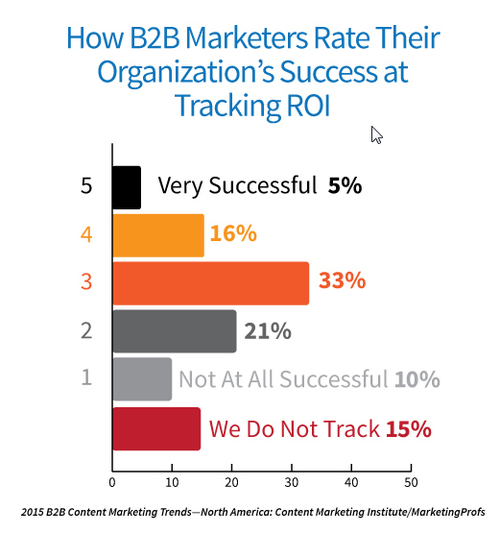
Your research notes that only 21% of B2B content marketers are successful at tracking ROI. Why should that lack of content evaluation concern those companies?

21% is a really eye-opening number, and it’s horrific to see how bad we are at measuring ROI. Many marketers still think of website traffic as the most important metric. While traffic might indicate things like subscribers or engagement, website traffic in and of itself is a meaningless metric. We’re challenged as content marketers because we’re measuring the wrong things.CMI 2015 B2B ROI

We conduct some exercises with companies where they list all of the content activities they’re doing. Then we ask, “Why are you doing these things? What is the overall business purpose behind them?” Content creators often don’t know. They don’t know how the content ties to revenue, creates happier customers, or connects to any other important goals. Website traffic may contribute to those goals, but it may not. In many cases, these companies need less overall website traffic and more of the right website traffic.

For B2B enterprises, what three takeaways would you most highlight from the research?

1. Stop creating any more content until you form some kind of strategy. I don’t care if you write your strategy on a napkin. You don’t have to create a six-page report, but you need some direction.

2. Examine integration issues by having a content champion look at collaboration within the enterprise. Who are your content leaders in each of your silos? Those people need to talk to each other. And your content marketing champion needs to talk with the person leading content on social, email, and other channels. Too often, those people don’t talk to each other, and in enterprises they may have never even met each other.

3. Open yourself up to “strange” tactics that others don’t focus on. We saw the biggest gap in effectiveness for content marketers with two specific tactics: podcasts and printed books. We tend to focus on what other enterprises do such as getting blogs up and posting to social media. Effective marketers focus on outlier channels that cut through the clutter, and podcasts and printed books have recently risen to the top as tactics for content marketing leaders.

For more B2B content marketing insights, delve further into CMI’s B2B research.

13 Nov 16:35

40- to 50-year-olds cost more to reach than millenials — and other mobile advertising surprises

by -

SPONSORED POST

40- to 50-year-olds cost more to reach than millenials — and other mobile advertising surprises

This sponsored post is produced in association with Ampush. 

Many marketers believe the most valuable demographic on Facebook are millenials between 20 and 30. After all, they’re the most common users.
But a recent Mobile Advertising Trends Report flies against this. The most expensive targets from a media buying perspective are an older demographic. “Some of the most important users now are women between the ages of 40 and 50 and it surprised me that we saw the trend going in that direction,” says Jesse Pujji, CEO at Ampush, publisher of the report. As the report shows, while marketers could reach users between the ages of 25-34 for a CPM of $4.53, getting to 35-54 year-olds costs $6.36 per CPM.

Ad spending by age group tells another story. Budgets targeting 13-17-year-olds grew the fastest in Q3 at 369% year-over-year. Gaming advertisers are largely responsible, putting big money into reaching their demographic sweet spot.

The report also shows that the mobile advertising ecosystem is maturing. CPMs were up quite a bit, but customer LTV (lifetime value) and CPIs not nearly as much. “That’s a signal that Facebook’s system and approach is getting better  at putting the right ad in front of the right person at the right time,” Pujji explains, “which is ultimately the holy grail of marketing.”

Another holy grail for marketers is simplicity. It’s one of the biggest current pain points because of how fast things are moving in the mobile advertising space and how much activity there is. “It’s unclear who’s driving real value and who’s not,” says Pujji. “Marketers want it be simple and straightforward, and that’s not always the case.”

Other highlights from the report include:

  • Mobile advertising budgets increased 233% in Q3 2014 year-over-year
  • CPM pricing increased 23% year-over-year to $4.90 driving be a continued adoption of high-performing mobile ad units
  • Mobile app install CPIs grew 39% to $3.48 year-over-year alongside increased competition for new users

Mobile adGet more details and insights. Download the full Mobile Advertising Trends report here.


Heading into 2015, Pujji sees important changes both for his own company and for the industry at large. In the next three months, Ampush expects to expand its in-feed advertising channels to include several Google properties, followed later by Pinterest and LinkedIn.

As for the industry, Pujji see the infrastructure for ecommerce finally catching up to users’ willingness to buy via mobile. “Mobile shortens the funnel pretty fundamentally,” he says, “ and I really think the chess pieces are in place for mobile ecommerce.” He also points to developments with deep linking and the ability for mobile apps to soon be able to be linked together the way web pages are linked. Currently, if you see an ad for a product and click, you’ll typically go to the web browser experience, or maybe the mobile app’s home screen. But with deep linking, users will be able to go directly to the product in an app with one click and buy it with Apple Pay.

“When you think about the implications of that as we turn the corner into 2015, I think next year will be the year of global ecommerce,” says Pujii. “But that’s just one man’s perspective,” he says with a smile.


Sponsored posts are content that has been produced by a company that is either paying for the post or has a business relationship with VentureBeat, and they’re always clearly marked. The content of news stories produced by our editorial team is never influenced by advertisers or sponsors in any way. For more information, contact sales@venturebeat.com.


13 Nov 16:32

When Organic Isn’t Enough: Facebook Advertising For Facebook Events

by Tara Banda

When Organic Isn’t Enough: Facebook Advertising For Facebook Events image small business open house blog 200x133.jpg

When it comes to using social media to engage with consumers, part of the challenge is to make sure consumers see your content. With the various changes in the way Facebook displays content in its users’ News Feeds, both large and small businesses are finding it more difficult to get their organic content seen by consumers.

That’s where Facebook Advertising can really help. A good Facebook strategy will use both high-quality organic posts along with advertising strategic content to make sure your brand is visible to target consumers.

In this series, I’ll be covering multiple ways local businesses can benefit from using Facebook Advertising to build a strong social presence, drive traffic and engagement, and ultimately increase leads and sales, starting with promoting Facebook events.

Why Create An Event On Facebook?

When you have an event at your business how do you promote it? You probably put up signs, send out flyers, post information on your website, share about it on social media, and send out emails. So, why not set up an event on Facebook as well? Facebook events offer great mechanisms for allowing attendees to help organically share about your event. Plus, once you create an event, you can then use Facebook Advertising Event Response ads to drive awareness and attendance to your event.

Who Should Event Ads Target?

Facebook audience targeting is arguably the most powerful feature of Facebook Advertising. That’s because there are literally hundreds of targeting options to choose from based on the information users enter in their profile and their behaviors on the platform.

What targeting options do you have?

Custom Audience

A custom audience is a great way to reach consumers who have already shown interest in your business. For example, you can use this by targeting consumers who have already visited your website or uploading an email list of interested prospects and customers. A custom audience gets your event in front of Facebook users who are familiar with your business without necessarily already liking you on Facebook.

Location

If you wanted to throw a Small Business Saturday “Meet and Greet” with the owner at your location in say, St. Louis, you likely only want to spend money targeting an audience within your local area. For this, you can target users based on specific ZIP codes or within a certain radius of your town (ex. St. Louis+10 mi).

General Demographics

Is your target comprised of a demographic such as a specific age or gender? By choosing factors such as a range of ages, you can target your event to consumers who are most likely to buy from you. You can also select to target females or males, and consumers who speak certain languages if your target audience includes non-English speaking consumers.

Advanced Demographics

Here’s where things start to get interesting. In the “More Demographics” tab, Facebook enables you to target users on more specific characteristics. For example, if your business is a home remodeling business, you may want to target home owners who are part of Generation X, who have an estimated household income of $75 to $700k per year (based on Acxiom data) , and who have recently moved to your city.

Or, if you own a local bakery and are hosting an open house, you could set your targeting to anyone with a birthday within a week, expectant parents, and people who are newly engaged. The options are vast.

Interests & Behaviors

To expand your audience, Facebook has included and continuously updates its targeting options in both Interests and Behaviors categories. For events, this means that you can reach consumers who may be interested in your type of business but may not fit within what you identify as your target audience. Facebook collects users interests based on what pages they like or show interest in while spending time on the site. Similar to Demographics, Behaviors are created based on a wealth of outside data from Acxiom and Epsilon, and include very specific data points such as “People in households that are heavy buyers of baked goods.”

What About The Ad Itself?

When creating an ad, Facebook provides a fairly easy-to-follow template for making sure your ad fits within a certain set of limitations and standards. For your event ad, all you have to do is create copy to pique users’ interest to check out your event.

Facebook does the rest, automatically pulling the image and event information from the event you originally set up. So, make sure you’re using compelling images when setting you your Facebook event, and include important details like the time, date, and location of your event.

How Much Should I Spend?

This is a difficult question to answer (along with “What’s a good conversion rate?”). That’s because it all depends on your audience size and budget. It’s probably not a bad idea to start out with a smaller budget and add more if you are satisfied with your results. You can select an amount to spend throughout the entire campaign leading up to the event, or choose to spend a certain amount of money per day.

When it comes to optimizing your budget, Facebook will do the work for you, optimizing your ad for event responses (“Yes, I’m going”), clicks (“I’ll check out more information”), or just impressions (“I saw it on my News Feed”). For most events, the timing is most important as you want to get the news out soon enough so that people can get it on their calendars, but not too soon that they forget about it when the time rolls around. Advertising your event couple of weeks before it happens should be a decent amount of time for optimal impressions and to drive more event responses.

When using ads to promote your business, a successful campaign really comes down to this: targeting the right audience at the right time and tracking what works (and discontinuing what doesn’t work.) Facebook itself has some great resources on how exactly to go about setting up campaigns and ads themselves that you can use to get started.

Like any type of advertising, the more campaigns you create and the more you track the activity and results, the better you will become at determining how Facebook Advertising works to help your local business. Stay tuned for the next part of the series, where I’ll discuss using Facebook Advertising to drive consumers to your website.

Have you ever used Facebook Advertising? Do you have any specific questions about how Facebook Advertising can help your local business? Let us know in a comment.

13 Nov 16:25

Cold Calling Is Dead

by David Meerman Scott

Cold Calling Is Dead image 2dfe394d 2ec2 4a77 81d9 f184c1de7595 728.jpg 600x247

My first sales job required me to make cold calls to bond traders and convince them to buy our economic consulting services. We had lists of names and numbers to contact that came from directories of people who worked in banks, securities companies, savings and loan associations, fund managers, and government agencies.

My sales colleagues and I would psych ourselves into the right frame of mind each morning by drinking a few cups of coffee, maybe telling each other a few off-color jokes (common in the 1980s testosterone-fueled Wall Street markets portrayed in the recent Wolf of Wall Street book and film), and discussing the latest stories in the Wall Street Journal. On a typical day we might set a goal to contact every person overseeing trading at all the savings and loan associations headquartered in Arizona.

It was brutal work. Most people were unaware of our firm. And my call was but one of the many sales intrusions each prospect would receive during a business day.

We hated cold calling—“dialing for dollars.”

But the technique was necessary because in the years prior to the Web, there were few other ways a potential client might learn about our company.

Everybody Is Selling. But How People Buy Has Changed!

Unfortunately, many organizations are still operating as if it were 1986, and they continue to focus massive investments on interrupting people with an army of salespeople making cold calls.

Companies like the one I worked for in the 1980s relied on direct sales efforts that invested lots of money. The sales commissions were high. (A big reason I stuck with my sales job even though I hated it was that I made good money for someone who was in his early twenties.)

The Sales Cycle Has Transformed Into A Buying Process Led By The Customers

Fortunately, today we no longer have to rely on the cold call, because buyers are looking for what we have to offer! And they know what they want.

Today, how do you buy a car? Do you blindly go to visit the dealership to ask the salesperson? Or do you spend hours on the web learning as much as you can and only visit the dealer when you are ready to buy and already know everything you need to get a good deal?

In a world in which buyers have the ability to do their own independent research, many customers are more educated than the salespeople they do business with. Now the buyer is better informed than the seller.

However, many companies and the salespeople they employ have not adjusted their strategy accordingly. They still rely on cold calls, and they still approach the sales process as if they have the informational upper hand in the relationship.

The New Rules Of Selling

Today, the buyers decide when they want to engage a salesperson. When the salesperson was in charge, the old CRM work flow model—charting a path from initial lead, to the first call, to a face-to-face meeting, to the negotiation phase, and ending with the close—made sense.

No longer.

Consider my business of delivering speeches. I rely on my own content to drive the majority of leads that result in me getting booked for a paid speech. Perhaps people have read one of my books. Or they follow me on Twitter, my blog, or another social network. Or maybe they Google a phrase such as marketing speaker and find me. These methods generate hundreds of leads for me a year. And in ten years of paid speaking, I have yet to make a single cold call.

I also rely on speakers bureaus who represent me to book me for speeches. Like me, the best bureaus rely on content to attract people looking to book a speaker. Perhaps the bureau owner has written a book about how to plan a great meeting. Or they bureau has great informational content on their site. Or they participate in the social networks where people who organize meetings hang out to discuss their work.

Today, if an event planner interested in hiring a speaker, they go to a dozen websites and do the research. They read independent blogs. They visit speaker websites. And they study the speakers bureau sites.

And then at some point when they have built up a body of knowledge, the reach out, typically electronically, and tell the bureau or speaker that they are ready to take the next step.

The old CRM systems focused on cold calling don’t manage this process well.

How To Move Beyond The Dusty Old Paradigms

Any new initiative to attract new business should start with buyers. What problems do your buyers have? How can your company solve those problems? How do your buyers describe the solutions?

Consider refocusing your efforts to blogging or a content-rich website or other online initiatives to reach buyers.

In the past 20 years or so, information has become largely free and two-way. The long-term ramifications are huge.

One thousand years from now, the two things that will be remembered in the history of the time period we are living through right now will be the first lunar landing of Apollo 11 on July 20, 1969, and the development of real-time communications instantly connecting every human on earth with every other human on earth.

Now any person with an Internet or mobile phone connection can communicate in real time with virtually any other human on the planet. Talk about a revolution!

Even now, nearly 20 years into the revolution, many organizations still aren’t communicating in real time on the web. Their sales organizations remain stuck in the past. They’re still cold calling like I did in the 1980s.

Are you one of the revolutionaries? Or do you support the old regime?

13 Nov 16:25

Could Inbound Marketing Support You In New Market Expansion?

by Vlad Bodi

It’s no secret that once you’ve succeeded in one market, opening new markets does not simply mean replicating the model you’ve perfected for your current business. Expanding in new markets is expensive, therefore before investing time and money it is important to consider the options.

Could Inbound Marketing Support You In New Market Expansion? image airplane business man 527.jpg 600x400

Over the past years your business grew and with time, your efforts started paying off. Managing profitability, growth, production and growing customer base was a challenge, and so is taking your product or service in a new market.

What basic things you should consider?

Let’s start with the beginning and look into what are the main things you should take into account when expanding your business into new markets.

Define and select a market

Begin by establishing criteria a new market should meet in order to consider it for expansion. Look at what characteristics it should have – review everything from geographical location, potential customer characteristics, size, how developed or sophisticated it is. Don’t miss anything as this will serve as an input for the selection.

Perform market analysis

Gather information about the selected market and compare the findings with the defined criteria. The best way to do this is use existing market research and combine with available online data. You should now have a picture of the attractiveness and dynamics, as well as what challenges you might face when starting operations.

Check entry barriers

Analyze what are potential barriers to entry. There are a series of factors that could affect your expansion; you should look into governmental policies, especially important for technology based businesses, product differentiation, access to distribution or how costly it is for a customer to switch between suppliers. The internet has helped at reducing the barriers to entry, but did not remove them.

Review local nuances

Pay attention to the less tangible items that can make the difference between success and failure: cultural traits in doing business. Although you will certainly find reviews of how to do business in a specific country, you should learn about how customers perceive certain products, does your name mean something else in your new market, do they mainly do business in local language, etc.

Check competition

Research the existing competition and learn everything you can from number of competitors, their products, strategies (what can be learned, of course), pricing policy and online presence.

Setup partners and channels

How will you place the product into the market and what strategic partnerships you need in order to succeed? Identify the channels that best serve your interests in order to reach your potential clients. Will you address them directly or associate with an existing business? Will the customer be able to access your product online or through points of sale? Your existing business model and achieved successes should help you define that.

Develop market entry plan

A market entry plan will take all the knowledge you gathered and structure it. How will you position your product or service? What about segmenting the market? What pricing policy will you adopt? Write things down and make sure you are aware about each step.

Can Inbound Marketing be used for any of the steps?

Inbound is great for developing a long term and sustainable marketing strategy, but we wanted more. Our goal was a simple and sustainable way to use the same marketing techniques in the first stages of market research. Within the next blog series, we will go in depth to show you how inbound marketing can be used in market expansion.

How Inbound is currently used

Preparing the internal engines for scaling your business is a project that goes beyond the borders of marketing, though ensuring internal communication is important. The basic approach to understand and validate a market is hiring a local company for advise, doing online and offline market research studies, spending in brand awareness, managing calls and emails to potential partners and attending trade shows focused on the region or industry.

Once these steps are done, you can successfully use Inbound to enter the market and:

  • attract people to your product / service
  • convert them into qualified leads
  • close leads into sales
  • and maintain customer loyalty

The twist

But inbound marketing can be applied also for many of those initial steps that are so time consuming. Evaluating the market, exploring the challenges, learning about the client requirements in the new market are all achievable. Even more, it can be used not only for assessing and generating sales leads, but also build interest in a partner and re-seller channel.

While conducting a proper research to learn about the target market should not be completely discarded, Inbound Marketing, though not the most obvious choice for research and evaluation, can deliver great results both in the planning as well as in the execution phases of your market expansion.

13 Nov 16:23

Why Are You Trying To Kill Me?

by Tibor Shanto

By Tibor Shanto - tibor.shanto@sellbetter.ca 

Horrorfilm

Said the Cold Call To The Socialite.

Recent headlines about AC/DC’s drummer brush with the law, got me thinking why would someone want to kill someone? Such a passionate act must be a result of some big or egregious cause, or at the very least a means of avoiding harm. Then I remembered that in sales we see this all the time, over and over, people are trying to kill cold calling.

The most recent would be assassins are Socialites, social selling advocates, who seem to spend as much time sniping at and proclaiming the death of cold calling as they do speaking about what they sell, social selling products, seminars, remedies and dreams. I wish them all the luck, capitalism rules, everyone is allowed to make a buck, I just don’t understand why cold calling needs to be dead for their stuff to work. Cold calling does not present danger to them, in fact it complements and adds to social selling, just as social selling adds to cold calling success, so what’s the deal here Socialites?

You know I have never read an article or a post that was written by an advocate of cold calling, suggesting that social selling is bad, ridiculing people who use the practice to engage with prospects, suggest that it is inadequate, or about to die. Even though you can find stats that would suggested that on its own, it is not all the Socialites will have you believe.

I suspect the main reason is that cold callers do not see social as a threat, is because we do see it as a great addition to an existing set of tools and techniques we use to drive business. We cold callers seem to take a more inclusionary approach to engaging with clients and driving revenue. I would argue cold callers have taken a much more “social approach” than many Socialites who seem to either proclaim or wish that cold calling was dead. Now we all know it is not, you wouldn’t need to keep saying it if it was, it would be self-evident, when was the last time you read a piece about Plato being dead?

Let’s Spin Some Stats!

(Step back you don’t wanna get any on your shoes)
 

To start with not every buyer has a Twitter, Facebook or LinkedIn account. Not only that but depending on who you are prospecting, it is important to note that some groups’ social media activity is in decline. According VentureBeat’s summary of the 2014 CEO.com Social CEO Report “an annual survey that investigates the social media habits of business leaders, has been released. The results show a depressingly small increase in social activity from Fortune 500 business leaders over last year’s analysis.” Further, “Amazingly, the CEO.com report shows that 68 percent of Fortune 500 CEOs have no social presence on any of the major networks. Taking a deeper dive into the data reveals that while there has been significant growth in the number of Fortune 500 CEO accounts created versus last year’s results, the number of “active” accounts grew marginally. This suggests that nearly as many business leaders with existing accounts abandoned their use of social media.”

I’ll be the first to admit that you can probably find stats to the contrary, which just goes to show that sales and sales people are just as susceptible to hype as the next group. But hype is something decision makers have a radar for, serious decision makers want facts not hype, they want tangible things that help them achieve their objectives. This leads to the fact that the most effective means of communication with senior leaders is direct. And while 68% may shun a social presence, 100% have telephones and e-mails. The key is to have a meaningful message that leads to engagement.

Here are some famous stats that keep getting dragged out (and abused):

Corporate Executive Board reported that B2B buyers are 57% of the way to a buying decision before they are willing to talk to a sales rep.
• “A survey by DemandGen Report, reported that 77% of B2B buyers said they did not talk with a salesperson until after they had performed independent research, and 36% of buyers said they didn’t engage with a sales rep until after a short list of preferred vendors was established.”

I am not here to argue the stats, but I do want to point out that both stats refer to BUYERS. These are people who of their own volition initiated a buying cycle. Which means that by the time they are 57% – 77% of the way there, they are not looking for a sales person, but more an order taker. Sad but true. Sales People are paid to persuade and influence, not accept orders from someone who has for the most part made up their mind and is now looking to see which models are available and for someone to negotiate price and terms with. Definition of selling:

To Sell –
-   to persuade or induce (someone) to buy something:
-   to persuade or influence to a course of action or to the acceptance of something

The real problem with waiting for buyers, is that according to Chet Holmes and other sources, “About 3 percent of potential buyers at any given time are buying now” (The Ultimate Sales Machine – by Chet Holmes). Only 3% of your target market are active buyers, even if you social sold your share and then some, are you near quota? These 3% are the people calling you when they are more than half way through their journey, most are past persuasion or influence. If you want to talk SALES or SELLING, you need to be talking about the other 97%. If you want to sell to that 97%, you are likely going to have to pick up the phone and say something other than #wannabuy?

Since we are on stats, allow me to digress for a second. This is one quoted by a Socialite as proof of the “paradigm shift in the sales industry”

“10.8% of social sellers have closed 5 or more deals attributed to social media.” Or looked at from the other end, maybe it can be phrased “89.2% can’t attribute deals to social media”; and “54% of social salespeople have tracked their social selling back to at least 1 closed deal.” I bet the I can find unhyphenated sellers who can track a lot more deals to cold calling, and even more to just selling using all the tools available to them instead of just some.

Let’s look at the “short list claim”, and decision makers. DiscoverOrg surveyed 1,000 IT decision makers at Fortune ranked, small and medium-sized companies. It shows how outbound – today’s euphemism for cold – sales calls and e-mails affect and “more importantly disrupt vendor selection.” Further, some “Seventy-five per cent of IT executives have set an appointment or attended an event as a direct result of outbound email and call techniques.” Finally, “nearly 600 said an outbound call or e-mail led to an IT vendor being evaluated.”

So if you did cold call along with your socializing, you’d be in much better shape than narrowing your chances to one vs. the other, Socialite style.

“But I don’t sell to Fortune 500” I hear you say, “I target Small Business”, the other end of the spectrum. Well small business is only selectively accessible via social.  At a conference last summer, where attendees were owners or senior managers of business that were for the most part under $25M, way less than half said they were using LinkedIn. I am a firm believer in the value and power of social and selling, but if they are not there, there is not much point. And it will not surprise you that all of them had telephones and e-mail.

Oh yes, referrals. There is no denying that a warm referral is like first prize, and an indirect referral, second prize. But cold calling usually shows up as third in terms of return on time and effort. Me, I like to bet safe and spread my risk across all three rather than betting on just one. Besides, not everyone is in a position to get or generate referrals. If you are in a more transactional sale, a new rep to the company, in a new territory, referrals will have limited utility early on. Sure you can generate some from existing “happy” clients, but you may find your probation and bank account run out first. You will need to incorporate all tools available, including the dreaded cold call.

Dreaded being the operative word. Most people who kill cold calling suck at it, makes them hate, makes them bitter. Like overweight people looking for that magic pill, instead of understanding that the magic pill combined with regular exercise and activity will always deliver a slimmer tummy, and healthier state. Sure the Atkins Diet worked for some, but it worked better for those who combined it with exercise.

I don’t like cold calling any more than the next person, but I do it, and I do social, and I do it well, or so I am told. But I don’t need to insult or undermine anyone in the process of executing my total approach to prospecting. Why do Socialites?

Kumbaya Time

The point is to use all tools available, not just one or some.  The only reason for camps, social killing cold calls is to sell social products.  And that’s one thing that has not changed, “Buyer Beware”.  Few sales people I have met can live off referrals only, or off their base. Not everybody is selling social media strategies, inbound programs, or content. Way more sales people have to sell in the trenches, selling traditional products and services, where social has a presence, referrals may play a role, but new business success includes cold calling.

Cold calling is not dead, it just smells funny when done wrong, but done right, it has the sweet smell of sales success. So let’s break down the walls, let’s get rid of the camps, stop thinking about killing or dead things, and make some calls.

That’s my two cents, what about you?

What’s in Your Pipeline?
Tibor Shanto 

13 Nov 16:23

Reinforce Your Sales Revenue Chain For 100% Lead Approvals

by Emma Vas

For your business to grow, your sales revenue chain can’t be broken – especially if it’s in multiple pieces.

Reinforce Your Sales Revenue Chain For 100% Lead Approvals image 516214867 e1415285669445.jpeg

To repair the broken links in your sales revenue chain, see our previous post. This week’s post focuses on reinforcing potential weaknesses before they break down, so that your revenue generation continues smoothly and seamlessly.

Reinforcing links in your revenue chain means you’re continually strengthening them against the changing trends of the market and the shifting tactics of your competitors.

How does bolstering weak links in your sales revenue chain result in a 100% lead acceptance rate? You’ll have to dive into these two in-depth strategies to find out:

1. Reshape Your Definition Of Success

Your sales data and metrics are a link you can’t ignore if you want to keep your revenue chain strong. After all, what gets measured gets done, so it’s important that you internally define various metrics for your sales process.

For example, to determine whether a particular lead is actually qualified, your team should come to a consensus on whether a lead’s top-line revenue or its budget that make it truly qualified to continue in the sales process.

Whether you already have an inside sales team or you’re looking to outsource your team via a sales partner, it’s critical to your sales revenue chain that you clearly define your sales metrics. These metrics ensure your team is continually on track to achieving the same goals – and not just goals with individual definitions of success.

Some critical sales metrics to clearly define with your team include:

  • What indicators delineate a perfect appointment
  • What specific measures define a qualified lead
  • What metrics identify a successful sale
  • What characteristics describe an excellent long-term client

When a company defines its lead qualification metrics with its outsourced lead generation partner, (such as with many Invenio clients), the partnership often results in a close to 100% lead acceptance rate – reducing wasted time on poorly qualified leads and boosting revenue.

2. Reimagine Your Sales Fulfillment

Your sales revenue chain ultimately comes down to this essential link: closing the sale and fulfilling the client order. While every other link in the chain is necessary for more effective closing and fulfillment, your efforts at this stage are indispensable to generating revenue for your business.

Closing The Sale:

When looking to improve the close rates on your leads and appointments, ask yourself these two questions about the final stages of your sales process:

  • Are your leads converting in your sales pipeline and closing at an acceptable rate?
  • Are your sales personnel closing on the warm leads they’ve been provided?

If your answer to either of these questions is “No,” you need to go back and strengthen earlier links in your revenue chain. Whether reinforcement takes the form of generating more leads, hiring better salespeople, training salespeople with better closing tactics or qualifying leads more accurately, your investment in these earlier links increases your close rate more effectively than mere myopic tactics focused solely on the close. A holistic approach to your sales process keeps your close rate high because the rest of your process runs smoothly for both your prospect and your sales team.

Fulfilling The Sale:

After the initial close, many sales representatives hand off the new client to fulfillment and forget to follow up on the customer. Not only does this increase the chances of miscommunication from your own internal teams, but it also leaves the customer feeling more like a simple transaction rather than having a living, active relationship with your business.

Instead, your sales people should be following up on order fulfillment both internally and externally. First, your sales team should communicate with your fulfillment team to double check that the customer’s order was properly fulfilled according to the agreement. This reduces your chances of error considerably and opens the lines of long-term communication between sales and fulfillment. Second, each sales team member should personally follow up with their new customers to ensure the customers have received everything according to the original specifications. This outreach helps customers voice their complaints early and gives your team a chance to correct any mistakes before the customer decides to switch vendors.

Bolstering your sales revenue chain today is easier than repairing the broken links in your revenue chain tomorrow. In the end, a robust and reinforced revenue chain keeps your business running strong in the present and gives you the opportunity to look to the future with confidence.

13 Nov 16:20

How To Maximize The Potential Of Your Landing Page Leads

by Avi Kaye

A couple of months ago, I ran a campaign for a real estate agent in New York. He wanted to attract people who weren’t just interested in cheap housing, but in changing their whole life style. Money wasn’t the issue or the message. Everyone is offering houses for cheap (even if they aren’t). He wanted to sell the quality of life, a quality that would make people want to buy the properties he had to offer.

We created several landing pages to deliver the message with slight variations, drove traffic to those landing pages via Google Ad campaigns, and built up a nice list of potential customers who left us their contact information.

So now what?

Reach Out To Them

How To Maximize The Potential Of Your Landing Page Leads image Lead Management Reach Out.jpg

First of all, reach out to them. In our case, people left us both their phone number and their email address, but in most cases, you’ll have your landing page leads email addresses. Send them an email reminding them who you are (they may have signed up a month ago) and what you are offering.

It’s a good idea to have the email ready before the campaign begins, but sometimes that isn’t always an option. When you do decide on the content of the email, make sure that you are echoing the message and design that made your landing page leads want to sign up in the first place. If they were interested in the quality of life that a new apartment was offering, don’t start your email with ‘The cheapest location in New York’.

Use The List To Create A Lookalike List On Facebook

Facebook has a neat feature where you can use a list of emails to create a Custom Audience. Once you have a Custom Audience, you can create a ‘Lookalike’ audience – meaning people who are similar to your existing audience in terms of interests, behaviors, and more. Once you have your Lookalike audience, you can then create an advertising campaign that targets people who are similar to your existing landing page leads, and generate new traffic (and even more leads) at a much lower cost.

Keep Your Landing Page Leads Updated

Don’t leave your landing page leads in the dark. After the initial email, make sure you keep your leads fresh and up to date with the latest information that can help convert them into satisfied customers.

In our case, we made sure to let them know of every new property in the area that the real estate agent found that was in their price range, or that he thought was a good fit for their tastes. And yes, he managed to close more sales that way, even with landing page leads who didn’t respond to the first email we sent.

Segmentation

Not all landing page leads are created equal. Some are just browsing while others are looking to buy a house today. Some are older and have more financial capital, while others are younger and looking to leverage their existing funds with a mortgage. Some are men, and some are women. Some came via Google Adwords, while others came through Bing searches.

In other words, different people will be looking for different content. Segmenting your lead database will help enormously when sending content, as you will be able to send the right content to the right people, at the right time.

Add ‘Share’ buttons

Make it easier for landing page leads to share the information being sent to them via email. It’s an effective tactic as email is seen as a form of social proof — the concept that “if other people are reading this information, and I trust those people, that’s validation that I should read it, and it will be valuable to me.” In our case, the landing page leads that we generated for the real estate agent may not have been interested in the new property that he found, but their friends were just looking for a new apartment.

Add a ‘Share This’ on Facebook or an ‘Email to a Friend’ button to the email that you send to your landing page leads. It’s easy, and it leverages your existing landing page leads to do a bit of online marketing for you.

Using these 5 tips you can use your existing lead database to reach even more leads, and usually at a cheaper cost. So don’t wait – start the lead nurturing process today!

Start creating high converting landing pages today!

13 Nov 16:20

5 Common Mistakes That Will Kill Your B2B Content Marketing Results In 2015

by Rachel Foster

5 Common Mistakes That Will Kill Your B2B Content Marketing Results In 2015 image Dollarphotoclub 72556157 e1415771794728.jpg

Many B2B marketers go year after year with their marketing on autopilot. They run ads in the same magazines, promote themselves on the same social channels and push out the same sales messaging.

If it’s working, that’s great.

However, the tides are turning. B2B buyers don’t want to be sold to and are getting better at tuning out ads. This means that what worked in the past may not work now.

Here are five mistakes that will harm your B2B content marketing results in 2015:

1. Bad writing

In 2015, good writing will be more important than ever to differentiate yourself and engage your audience. This doesn’t just apply to your blog, but across all of your channels.

During the keynote session at meshmarketing Toronto, Ann Handley stated that, “writing is the lifeblood of our content marketing”. If you cover the logo on your website, would you sound different, or would you sound just like your competitors? She recommended writing useful, empathetic and inspired content to engage readers. And of course, be concise.

2. Not being human

As B2B marketers, we sometimes forget that we’re marketing to people – not “leads” or “users”. Spiceworks refers to this robotic content as “marketing to the Borg”.

To be successful in 2015, you need to bring some life into your marketing. This means having conversations with your customers to find out who they are, what they like and what challenges they face. It also means speaking to them in their language, not marketing jargon.

3. Focusing all your social media efforts on LinkedIn and Twitter

LinkedIn is still the #1 B2B social network and can help you connect with high-quality leads. However, savvy B2B marketers are branching out to other networks to gain an edge over the competition. According to the research from the Content Marketing Institute and MarketingProfs, the most successful B2B content marketers use seven social channels, while the least successful marketers use just four social channels.

Here’s a chart of the most effective B2B social media platforms:

5 Common Mistakes That Will Kill Your B2B Content Marketing Results In 2015 image graph e1415770662216.png

Instagram and Pinterest are on this list, because images are becoming more powerful – even in the B2B space. A single image can tell a powerful story. In addition, Google is now ranking images, which can drive lots of traffic to your content.

What social networks will your audience use in 2015? What opportunities do you have to innovate and engage your audience on new channels?

4. Driving without a roadmap

Although most B2B marketers are creating content, only 38% think it’s effective. If you’re not getting results, it might be because you don’t have a content strategy. Publishing without a strategy is like driving without a map. You’re likely to take wrong turns and waste time along the way.

The Content Marketing Institute and MarktingProfs reported that B2B marketers who have a documented content marketing strategy “are more effective in all aspects of content marketing” than those who don’t have a documented strategy.

For tips on improving your content’s results, read “10 Steps to an Effective B2B Content Marketing Strategy”.

5. Not telling stories

The more social the web becomes, the less willing people are to click ads or pay attention to traditional marketing. In fact, you are more likely to complete NAVY SEAL training or summit Mt. Everest than click a banner ad.

Stories are becoming more important to engage today’s B2B buyers.

Yesware published an interesting article about storytelling for sales. According to the article, “A series of experiments performed by neuroeconomics pioneer Paul Zak found that stories that are highly engaging and contain key elements — including a climax and denouement – can elicit powerful empathic responses by triggering the release of oxytocin. Often referred to as the “trust hormone,” this neurochemical promotes connection and encourages people to feel empathy. When released in the brain of your prospect it can help to build trust in your brand or product, and in doing so increase sales.”

Where can you illustrate some of your key points with stories? How can you tell stories with words, videos and images to connect with your target audience?

Now is the time to look at your upcoming marketing. Are you doing anything that no longer works? Do you have opportunities to try something new? How can you innovate, so you can better engage your audience and drive sales in 2015?

3 Ways to Apply This Information to Your Marketing

  1. Read “10 Steps to an Effective B2B Content Marketing Strategy“. Marketers who document their content marketing strategy achieve better results.
  1. Download Content Marketing Quick Fixes to learn 10 things you can do improve your B2B content to make more of an impact in 2015.
  1. Click to share this article on LinkedIn. Sharing quality content increases your visibility and credibility with your existing contacts, creating conversations and potentially new business.
13 Nov 16:20

Proving the Value of Your Social Media Efforts is Easier Than You Think

by Natalie Meehan

Having been a marketer for nearly ten years across a variety of different industries, I’ve found there is one common sticking point for anyone who works on the social media and communities areas. Proving the ROI of efforts on social.

Social has evolved over the years from something a little unknown, and perhaps thought of as a gamble, into a legitimate channel in a brand’s marketing strategy. With precious budget being spent on investing in the right technologies – and talent – in this area, marketers must report on and track their efforts in the same way that they would have to for say, a DM campaign, or an email drop.

Proving the Value of Your Social Media Efforts is Easier Than You Think image rsz educate.jpg 600x399

It can be seen as a tough ask. It’s certainly a little more tricky than tracking the ROI of investing time and money in a new demo request page on your website, or a print campaign.

But it can be done. And once you can prove the value of your social media efforts, you’ll be able to clarify the impact of your social campaigns to upper management, as well as arming yourself with objective data to inform you about the types of campaigns and tactics that are working for you.

Establish a baseline of key metrics

To really get to understand how well your social efforts are working, you have to strip right back.

You need to know where you’ve started, so you can track your progress. By establishing a baseline of key metrics before you kick off a social campaign, you will be able to clearly define the goals you wish to achieve and see how you’re doing against them.

Imagine your primary goal is to increase the number of social media mentions of a product that your company recently repositioned. You’d set your baseline by using a social listening tool to understand the volume of product mentions that are happening right now, today.

Proving the Value of Your Social Media Efforts is Easier Than You Think image ROI.jpg 600x411

Once you’ve established the baseline volume of mentions, you would then make sure that it corresponds to a revenue number. In this case, you would use the current revenue of the product at the latest date possible leading into your social campaign. This way, you can track mention volume in relation to revenue for the product over time.

Define where social is working for you

Once you’ve put your key metrics in place, you can begin to drill down and understand more deeply which social channels are working for you.

You might get shedloads of visits to your website from your Facebook page, but are they then converting to a sale down the line? What about that smaller number of visits from Google+? Are those visitors actually bringing in more money?

Proving the Value of Your Social Media Efforts is Easier Than You Think image happy.jpg

Use a tool like Google Analytics to track user journeys alongside a social listening tool to track sentiment around each channel to learn and adapt your messaging. Are your Facebook followers not converting? Do a deep dive into topic data and sentiment to help validate your numbers.

Develop a process to make your life easier

So you’ve developed your baseline metrics, learnt which channels are bringing in revenue and now you need to get a standardised process in place to actually measure the ROI.

If you know that Twitter is the one site yielding the majority of mentions about your brand and competition, you’ll want to be continuously monitoring the site, ensuring you can engage in the most appropriate discussions and suggest the value of your company’s services or products.

Proving the Value of Your Social Media Efforts is Easier Than You Think image social engagement.png

Once a Twitter discussion turns into a lead, you can attach a value to the progression of that discussion by applying the value of a lead. Thus, the ROI of monitoring Twitter and engaging consumers who progress into the sales cycle becomes a simple calculation: ROI = (# of Leads x The Value of a Lead) / Cost of Twitter Engagement.

The “cost” element here comes from the staff hours spent on Twitter engagement – you can minimise this using streamlined processes that leverage email alerts and smart monitoring.

A similar scenario for calculating ROI takes place when you measure responses to your own social content. For example, assume you blog on your own site and comment/participate in others’ blogs.

By simply asking new prospects where they heard about your brand, you can begin to recognise which posts and sites are working best to generate interest in your brand. The same calculation applies, with your cost factor changing to the value you place on time spent blogging.

To find out more about how you can measure the ROI of social, we’ve gone into further detail in this handy eBook. Download it for free and see working examples and other tips and tricks to ensure you’re proving the worth of your efforts. Simple!

get the guide

Now you know.