Shared posts

24 Nov 00:40

Ted Turner on the Meaning of Life, the Trouble with Religion, and His Revision of the 10 Commandments

by Maria Popova

“Our reason for being here is to have a productive, good, long life and to experience the truth that we’re in paradise right now.”

For more than half a century, media pioneer and philanthropist Ted Turner (b. November 19, 1938) has been earning his reputation not only as an extraordinary businessperson but also as a man of exceptional integrity, conviction, and goodwill in an industry so permeated by ruthlessness and unethical conduct as matter of course. (It speaks to his character that his arch-nemesis is media villain Rupert Murdoch.) Turner founded CNN, turned his massive library of animation into the Cartoon Network, and donated $1 billion to the United Nations to start the United Nations Foundation. Intensely invested in the environmental movement, he even co-created the beloved 1990s environmentally-themed children’s series Captain Planet and the Planeteers.

In 1991, Turner participated in The Meaning of Life: Reflections in Words and Pictures on Why We Are Here (public library) — a wonderful collections of reflections on the essence of existence by a humbling roster of luminaries, including Carl Sagan, Rosa Parks, John Cage, Annie Dillard, George Lucas, Charles Bukowski, Arthur C. Clarke, and more.

Turner’s short essay, reminiscent of young Jack Kerouac’s memorable clarion call — “Practice kindness all day to everybody and you will realize you’re already in heaven now.” — is essentially a case for spirituality without religion, delivered with his penchant for the punchy and with a heartfelt dose of concern for our planet:

There is nothing wrong with thinking there’s a next life, a dream-world, a happy hunting-ground, a paradise over the rainbow, salvation. But don’t go to church on Sundays to pray to some unknown being who hasn’t shown up in thousands of years to come save you. You need to get off your knees and roll up your sleeves and save yourself. Our reason for being here is to have a productive, good, long life and to experience the truth that we’re in paradise right now. In the Old Testament paradise was, at one time, here on this earth. Native American Indians consider earth as paradise. Go into the Adirondacks, assuming you’re not in an area where acid rain has killed the trees, go into the Alps, go into the jungle: Paradise is just hanging out, waiting for you…

The problem with all the world’s religions is that they have commandments engraved in stone, and none speaks about achieving paradise [now]. Christianity had a couple thousand years to try to solve the world’s problems, and we’re in a bigger mess now than we ever were as we go on killing the planet, destroying our home, devouring the host. How can Christianity address the problems of air pollution and nuclear proliferation and overpopulation when it’s geared toward the issues of Jesus Christ’s day: the domination of Rome and grinding slavery? Jesus tried to give his contemporaries hope in the next world because he could see there was no hope in the current one.

In place of the ten commandments, Turner proposes “ten voluntary initiatives” — updated versions of those timeless aspirations, geared for the problems of our time:

I suggest trying these on for size, as a way of helping foster the idea that our purpose while alive is to make a heaven here.

  1. Love and respect the planet and all living things thereon.
  2. Treat all persons with dignity, respect and friendliness.
  3. Have no more than two children.
  4. Help save what is left of our natural world and restore damage where practical.
  5. Use as few nonrenewable resources as possible.
  6. Use as few toxic chemicals, pesticides and other poisons as possible.
  7. Contribute to those less fortunate than yourself to help them become self-sufficient and enjoy the benefits of a decent life.
  8. Reject the use of force, military force in particular.
  9. Support the total elimination of all nuclear, chemical and biological weapons and, in time, that of all weapons of mass destruction.
  10. Support the United Nations.

Turner ends on an optimistic note about how the field in which he built his business could help cultivate these “voluntary initiatives.” Citing Marshall McLuhan’s notion of the “global village,” Turner writes:

I believe mass communication has helped make us all closer today than we’ve ever been. And I believe that the gathering and dissemination of worthwhile information to all the peoples of the world is the most important tool we have for achieving the end of realizing that our planet is the address of paradise.

Two decades later, much of Turner’s television business might be paying the price for his partially correct prophecy — indeed, we are more connected than ever, but in large part thanks to web video ecosystem that is cannibalizing TV. The disorienting thing today is that because scarcity is no longer the problem — abundance is — the true challenge of mastering these ten aspirations, or any set of aspirations for a meaningful life, is one of wisdom rather than information, and that is vastly harder to cultivate.

The Meaning of Life is, sadly, out of print but is very much worth the used-copy hunt. Sample it further with contributions by George Lucas, Carl Sagan, and other icons.

Donating = Loving

Bringing you (ad-free) Brain Pickings takes hundreds of hours each month. If you find any joy and stimulation here, please consider becoming a Supporting Member with a recurring monthly donation of your choosing, between a cup of tea and a good dinner.


♥ $7 / month♥ $3 / month♥ $10 / month♥ $25 / month


You can also become a one-time patron with a single donation in any amount.


Brain Pickings has a free weekly newsletter. It comes out on Sundays and offers the week’s best articles. Here’s what to expect. Like? Sign up.

Brain Pickings takes 450+ hours a month to curate and edit across the different platforms, and remains banner-free. If it brings you any joy and inspiration, please consider a modest donation – it lets me know I'm doing something right. Holstee

19 Nov 17:36

The Essential How to Guide on Generating Leads with Business Blogging

by Elena Dobre

The Essential How to Guide on Generating Leads with Business Blogging image bigstock Business man pointing to trans 75616486.jpg

Blogging is not just about content, publishing posts and hoping for the best. Done well with the right structure it can be a powerful portal for revenue.

In a previous post on this blog, I have analyzed how to collect email addresses using interactive pop ups. It made me realize that this advanced tactic may sound a bit complicated to people who are just getting started with business blogging. But I think that a complete guide to show how can the content marketer generate leads with blogging for an online business would make more sense.

This piece of content is an introduction to a series of five posts that will go through the phases of lead generation such as creating a framework, using surveys, optimizing landing pages and much more.

Here are the steps and insights into generating leads with business blogging.

The beginning

Now let’s start at the the beginning.

There are two key business models that operate well with lead generation using content marketing tactics:

  • Service-based businesses: internet marketing firms, agencies and freelancers

  • Software as a Service (SAAS) businesses that offer products for client side marketers or agencies

Business blogging is an inbound marketing tactic used to generate leads. The lead could be defined as a person who is filling out the form to get in touch with an expert or to require a service. On the other hand, the lead for a SaaS business could be a user who is signing up to try the product for free for a limited period.

How does business blogging support business objectives?

The Essential How to Guide on Generating Leads with Business Blogging image The Essential How to Guide on Generating Leads with Business Blogging .jpg

Business blogging is a marketing tactic used to increase the online visibility of the company. This tactic involves using a blog to inform people about the company’s activity, values, mission and products. It is meant to educate, inform and it also needs a persuasive component too. To become visible on the internet, you need to provide content to let people know that you have something valuable to offer to them.

The benefits of business blogging

#1. Drive traffic to the website

The ultimate goal of business blogging is to generate qualified leads. This process involves driving traffic to the website’s landing pages (e.g.: contact page, sign up page) using inbound marketing tactics.

To get traffic to the company’s website you need to appear in the search results, right? In order to get that, your website’s pages have to get indexed by Google. But how much content can you include in a website? Besides the homepage, pricing page, contact page, about us page you don’t have too many options. The blog is the only solution to provide to Google pages to get indexed. Therefore, you need to create enough content (quantity matters), to post it on a regular basis on the website (freshness) and to convince people to share it (relevancy).

To understand how people get to your website, I’ll sum up the ways visitors arrive on the company’s website:

  • Direct search: Users type in the search bar your company’s name or brand

  • Paid search: Visitors are exposed to Ads, either on Google, Facebook or other channels

  • Organic search: Users arrive on your website because you delivered relevant content that got indexed by Google in front of your competitors

To become relevant for Google, you need to become relevant for your website’s visitors. Direct traffc is the most valuable for a company, but it requires having a strong content strategy. Every new blog post is a chance to get Google to index your website, increase the organic traffic and make people aware of the company’s offering.

#2. Reduce the amount of required content

Besides the company’s blog, there are other marketing channels that could help with getting noticed on the internet: Email, Facebook, Twitter, Youtube, LinkedIn, etc. Once again, you need content. Imagine, though, how much effort you would need to invest into creating content for each marketing channel.

The company’s blog help with reducing the quantity of content required to get noticed on the internet and also allows creating targeted content for the social media traffic. Moreover it insures that people are exposed to a unique, commited message about the company’s offering.

I see business blogging as the company’s attempt to tell a story. Like regular bloggers who are writing about their passions, the companies use blogs to let people know what they do, like and expect from this world.

#3. It generates qualified leads

It would be a pity to use the blog only to drive traffic to the website because it allows you to do much more. Once people get to the blog, they can do two things:

  1. Consume one piece of content and leave

  2. Consume one piece of content and request more

It’s in your control if they will leave or stay. To convince them to request more, you need to offer more. That’s why I say that offering free ebooks is efficient to grow an email list. I guess that you don’t want to work insanely to create content and drive traffic to the blog and then let people leave once they have finished consuming it.

Let’s see the exact steps to generate leads with blogging:

  • Visitors come to the blog and consume content

  • Visitors see a Call to Action with an offer (free digital paper or webinar)

  • Visitors click the Call to Action and arrive on a landing page(download or register to webinar page)

  • Visitors fill out a form to get the offer

The Essential How to Guide on Generating Leads with Business Blogging image blogging for business.jpg

Use the company’s blog not only to drive traffic to the website, but also to generate leads for the business. As I’ve mentioned before, the blog has to support the business objectives.

#3. Create authority, differentiation and achieve other long term goals

The company’s blog becomes a valuable asset only if it delivers high-quality, relevant and targeted content. Integrated in the AIDA marketing model, the blog plays the following roles:

Awareness – the blog’s content is making people aware of a problem or opportunity

Interest – the blog’s content is making people interested into solving their problem

Desire – the blog’s content encourages people to give a name to their problem and raises the desire to solve it (you do that with Call to Actions)

Action – the blog’s content encourages people to solve their problem with the company’s products or services

As you see, business blogging requires commitment and consistency. It’s a never ending task because its role is to drive to continuos growth. Traffic, leads, brand awareness and authority are the major four outcomes of business blogging when done right.

Why does the company’s blog need optimization?

As I’ve mentioned earlier, the goal is to drive people who want to solve their problem with the company’s products or services on the website.

But writing content is not effective if it is not integrated with smart ‘Call to Actions’. You will be wasting all that traffic and tose visitors you have been working so hard to acquire.

Remember that people who have identified a problem after they have consumed your content will want to learn more.

This is what you have to do:

  • Offer them more, otherwise you’ll see them go to the competitors to get information about the problem and purchase their products instead of yours.

  • Optimize the blog’s design for conversions (i.e.: conversion is a qualified lead that arrives on the website’s landing page to sign up for a free trial or request a service). Optimization involves aadjusting the website to achieve your goals. Website optimization has to be sustained by content marketing, email marketing and landing page optimization efforts to give results.

The 4 steps process to generate leads with blogging

Optimization techniques help with adjusting the blog to achieve the blog’s goal – to generate leads for business. In order to achieve that, you should focus on the conversion funnel. When creating it, have in mind the AIDA model to define the exact steps the ideal customer has to follow to close.

Generating leads with blogging is a continuous process and requires taking one step at a time. Therefore, I have included in this beginner’s guide four steps:

  1. Measurement – analyze data, set up goals and target metrics to see how you do against your objectives now and where you want to get.

  2. Listen to the customer’s voice – Google Analytics is telling you what’s happening on the website. To find out why, you need to use surveys.

  3. Grow the email list – you’ll find out the exact steps you need to take to get email subscribers. This post will also show how to test CTAs and landing pages and use advanced techniques to get more subscribers.

  4. Convert subscribers into leads for business – learn how to use email marketing tactics and landing pages to increase the number of blogging conversions

These being said, hope this guide will help with having a clear, informed idea about what you need to do to get conversions from blogging and become a successful content marketer.

Cartoon source:

19 Nov 17:36

Why Facebook’s War On Marketing Is A Good Thing

by Rohit

Facebook has brands worried … again.

A recent article headline from Ad Age magazine summed up this concern perfectly, announcing that “Facebook Cuts Brands’ Reach Once Again.

Of course they did.

One of the biggest issues facing the largest social media platforms today is how to monetize their offerings. Facebook, Instagram, Twitter are all working on a solution to this same challenge, and it has marketers justifiably worried. What will they start charging for? And how will they ransom the data they have collected?

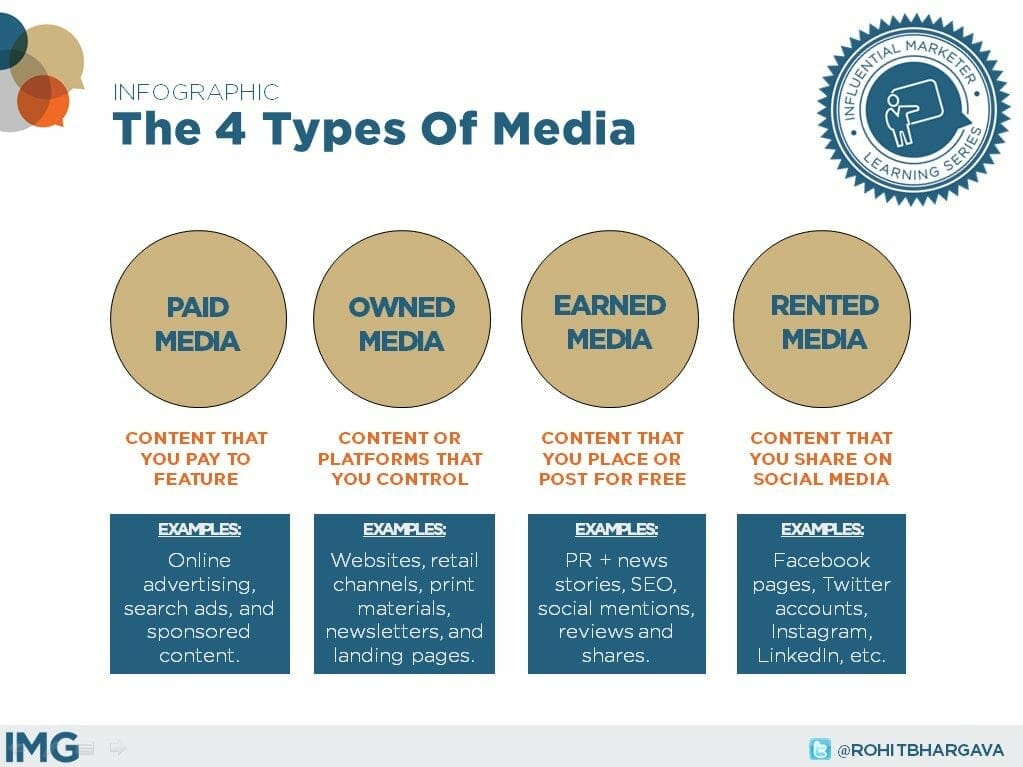
Infographic of 4 Types of Media - Paid, Owned, Earned and Rented

The 4 Types Of Media – Paid, Owned, Earned and Rented

The problem for brands is that we no longer live in a “paid, owned and earned world” of media. A growing amount of media and audiences are rented. Space on Facebook is rented. Tweets and Twitter audiences are rented. Instagram pages, vine videos, and YouTube channels are all rented. What this fourth category of media means is that all the associated data and insights generated from users doesn’t belong to brands. That insight, also, must be rented … usually in the form of advertising.

So when Facebook announced last week that they are making another change to further hide “overly promotional posts” from brands, it was widely seen as another move from the platform to try and steer brands towards spending more money on advertising. And it may work.

It is tempting to see this as a bad thing. After all, the more money Facebook can extort from brands in order to reach consumers or access deeper data and insights the worse it will be, right? No one wants a world where Facebook can control the pricing for all digital advertising and effectively charge whatever they want.

Yet the signs are already on the wall that this is not the world we are heading for. Instead, Facebook (and others’) war on marketing is causing an unexpected side effect: it is challenging brands to create better marketing.

Great marketing isn’t overly promotional. In fact, it usually doesn’t seem like marketing at all. It solves a need. It provides value. It entertains. Great marketing is immune to algorithmic shifts for a very simple reason … consumers actually like it and want to share it.

This is one of the reasons why content marketing has become such a powerful tactic in the world of marketing. It is not about creating more blog posts or videos. It is about creating something substantial. Something that is more than an ad or a promotion. The good news is plenty of brands are rising to meet the challenge.

Revlon is partnering with Refinery29 to create a beautiful curated series featuring trendsetters, musicians, entrepreneurs and entertainers called Beauty Nation. The effort features amazing photography, engaging editorial and appropriate and interesting product integration from Revlon.

Refinery29-Revlon1

A few months ago, HP partnered with Vine video star Robby Ayala to produce several videos featuring one of their tablets in an entertaining way that was looped more than 12 million times and became one of the most popular videos on Vine.

Robby Ayala - HP

Just last month, Honda released a mind bending two sided video promoting the new Civic which is sure to win some marketing awards and rapidly went viral on YouTube with millions of shares and plenty of media coverage.

Each of these efforts succeeds because of brilliant creativity, smart product integration and a focus on providing an entertaining story and experience that people are highly likely to share. It also happens to be the kind of marketing that is immune to getting filtered or hidden by algorithms.

The panic marketing teams are feeling at the recent Facebook announcement is certainly understandable. But I think it may not be solely driven by the fear that Facebook will be able to charge and make more money through advertising. It may also come from the realization that boring, lazy marketing is now actively getting filtered, forcing brands to get more creative and produce better marketing.

For that reason, Facebook may just be doing us all a huge favor.

19 Nov 17:36

6 Reasons Your Conversion Rate Is Not-So-Great

by Brooke Oliveri

6 Reasons Your Conversion Rate Is Not So Great image g4TMlh3i 820x326.png 600x238

As I said in Intro to Conversion Rate, CR is one of the most popular key performance indicators out there. It tells you how many people have done what you wanted them to.

A high conversion rate sounds like a good thing, right? It usually is. That’s why conversion rate optimization is usually pretty important to advertisers and other marketers.

But what about when it’s low, maybe even on a steady decline? What’s causing it to drop and what can you do about it? Let’s get to the bottom of it and talk about five big issues that could be the cause of your low CR.

1. Lack Of SEO

If your website and landing pages aren’t optimized for search engines, you might not be getting as much traffic as you could be. When it comes to search engine optimization (SEO), ask yourself:

  • Do you tend to neglect SEO because you think it’s a waste of time?
  • Are the majority of the keywords you bid on long-tail or exact match, and thus super specific?
  • Is your website only optimized for search engine bots instead of visitors and mobile users?

If any of these are true for you, they could be contributing to a low CR. Check out what Brittany Berger has to say about the dos and don’ts of modern SEO here.

2. Poor Calls-To-Action

If users are unsure about what your CTA is asking of them, there’s no doubt they’re going to move on. That option is much easier than trying to figure out your puzzling message.

Evaluate your CTAs’ weaknesses by asking:

  • Is the desired action unclear?
  • Is the CTA hard to find on the page?
  • Are my CTAs irrelevant to my target audience?

If you answered yes to any of these questions, your CTAs might be inhibiting conversions. It’s important to figure out how to get crafty with your CTAs so that you’ll get people to click and convert.

3. Too Broad Of A Target Audience

When it comes to your target audience, quality triumphs over quantity. Appealing to a broader audience with a more general ad? You’re better off targeting a more segmented audience with a more specific ad if you’re looking for conversions.

Do you find that you are trying to appeal to a lot of people with varying demographics, buying history, and backgrounds? If so, potential customers might see your ad as impersonal and irrelevant, making them not want to click.

It’s important to figure out the specific group you want to target, and then do your best to appeal to them in a relatable, personal way.

4. You’re Not Persuasive Enough

A low CR could be the result of a lack of persuasion. If your ads and CTAs implore the user to complete a desired action without some incentive, people will be less likely to click.

It’s important to let your audience what’s in it for them. Here are some copywriting tips, brought to you by Michelle Brammer, that can help you get persuasive:

  • Write a great headline
  • Use differentiating characteristics to set yourself apart from the competition
  • Add pricing to your ads

5. Poor Message Match Between Assets

Say you’ve got a killer CTA that really makes your potential customers want to click. That’s awesome, but it won’t work to your advantage if your link takes them to an irrelevant landing page that confuses them.

Like with a confusing CTA, if a user clicks your ad and is confused by your landing page, they are more likely to leave it than to stick around to figure it out. This is why it’s important to give users what they’re looking for and make sure that there’s a cohesive message match between your ad and your landing page.

6. Lack Of Follow-Up

If you’re not following up on your advertising endeavors, it will be difficult for you to understand what’s working and what’s not. Using an analytics program makes it easy to measure your success and find the root of your issues.

Google Analytics, for example, is a popular analytics program. It has a whole bunch of features like advertising reports, campaign measurement, and advanced segments. Some of the features could even help you to discover one of the other issues I’ve already talked about.

Carefully looking at all your analytics gives you a better chance of diagnosing and fixing a low CR.

Getting To It

So if you’ve got a low CR, you could be having any one of the problems I’ve just told you about. With some investigation, you’ll be on your way to diagnosing and repairing your issues in no time.

By the time Thanksgiving rolls around, your CR might be something else for you to be thankful for!

19 Nov 17:34

Are You in a Race to the Bottom with Your Sales Approach?

by michael.riksheim@salesbenchmarkindex.com (Michael Riksheim)

“When a sales team has the same strategy as the competition, the sales experience becomes a commodity.  When this happens, there is no longer the ability to differentiate on anything other than product or price.  Unless the company is lucky enough to sell a product superior to others, an advantage that is likely to be short lived, the pricing pressure will result in missing the number.”

-SBI’s 8th Annual Research Report 

19 Nov 17:09

Rethinking Renewals

by Tamara Schenk

A big deal is in the funnel; a must win, a secure deal – it’s a renewal. This one will make the quarter a great success. We all know this situation and the feeling when such a “must win deal” is lost. Hectic win/loss reviews are conducted to understand what has happened. Often, a competitor came out of nowhere, changed the game and won the deal.

Every customer makes every decision differently – every time

Underestimating this fact – that every customer makes every decision differently, every time – can lead to four “renewal pitfalls,” especially in complex sales:

  • The sales team feels over-confident and doesn’t pay enough attention to the current buying situation. Copying the previous approach is a dangerous behavior. Every buying situation is different.
  • Sales managers don’t pay enough attention to renewals, especially in the early phases of the deal when coaching can have the most impact.
  • Sales professionals are not involved early enough, based on the false belief that there is no customer awareness phase in the renewal. That’s dangerous, too. The awareness phase for renewals exists, but it is different.
  • If the renewal is based on an RFP, many sales organizations have a tendency to declare the deal a must win deal and to announce executive sponsors. But that’s too late to make a real difference in terms of approach and value creation. The customers have already made up their minds how to approach the situation this time.

The lesson here is that a renewal is a deal, and it must be sold, just like any other deal.

Context matters, and context is different in every buying situation

The sales team has to engage with existing customers very early in their new customer’s journey. The key is to analyze the current customer’s context precisely, from an environmental and a situational perspective. What has changed and what hasn’t? Are the decision makers the same? What is different or no longer relevant to the customer? Is the capability being used to its full potential? How happy is the customer? Has the expected value been created? What are their desired results and wins this time? Analyzing the customer’s current financial situation and how it may have changed since the previous contract is an essential foundation. Understanding the current business strategy is another key element. The approach has to be connected to the customer’s business strategy and to their financial situation. Often, a deep understanding of these elements opens additional possibilities for creating new value for the customers. A renewal should be treated as a new opportunity with all the advantages of knowing the past and the ambition to create extraordinary value for the customers.

Orchestrating the customer community to build a shared vision of future success

In complex buying environments, sales teams have to orchestrate and lead many different stakeholders that build the customer community. If buying decisions involve different functions, such as technology and business, very different buyer roles with different concepts about this particular purchase have to be aligned. The challenge for any sales professional is to establish a shared vision of future success, together with the network of stakeholders, the customer community. Based on the unique context and understanding the stakeholders’ different concepts leads to a deeper understanding how this customer community is going to make a decision this time. Building a shared vision of future success requires a salesperson’s individual expertise to address each buyer role with content and messages they need to feel comfortable in their role to make a decision to change. Without this shared vision of success – that will be different from the last contract – the customer community will never make a buying decision. Some salespeople believe that a renewal has nothing to do with changing the current state or solving an issue. That’s not the case. If your services are not required to achieve a certain result or a better future state, customers will never buy. Why should they?

Developing a customer community by providing perspective

Developing a customer community doesn’t happen by accident. It’s based on a systematic customer core engagement and messaging principle called providing perspective. Dynamic value messages play a central role, tailored to each stage of the customer’s journey and to each buyer role. Sales enablement not only has to provide those value messages; it also has to make sure that salespeople learn how to apply those value messages effectively. Sales professionals who can successfully provide perspective bring to the table their experience and professionalism, their skills and competencies, their knowledge base and their adaptive competencies. They know how to quickly adjust behavior, activities and messages to a specific situation. That also includes addressing different buyer roles, even if it feels uncomfortable. Sales enablement’s job is to develop salespeople’s messaging capabilities to feel comfortable in those conversations. Applying providing perspectives as an engagement and messaging principle helps to establish a shared future vision of success and to win the customer’s business – again.

Change the renewal game on your own – before a competitor does!

19 Nov 17:09

Best Practices for Buying Marketing Technology: David Raab and Atri Chatterjee Discuss

by Sherry Lamoreaux

Best Practices for Buying Marketing Technology: David Raab and Atri Chatterjee Discuss image Act On Sales Marketing Conversations 250x2432.png2

Editor’s Note: David Raab has thirty years’ experience as a marketer, consultant, speaker, and analyst. He’s the author of The Marketing Performance Measurement Toolkit, and the Raab Association’s reports and guides, including the B2B marketing automation vendor selection tool, the VEST report. You can keep up with David at his blog, Customer Experience Matrix. Atri Chatterjee is Act-On’s Chief Marketing Officer. They held a three-part Act-On conversation which covered the obstacles to buying technology; common mistakes in buying technology; and best practices in buying technology. This blog post is an edited transcript of the third portion. You can listen to the Conversation on the audio player below.

ATRI: David, in our last two meetings we talked about why it was hard for people trained as marketers to make the right technology purchasing decisions, and the most common mistakes people make. This time we’re going to focus on the positives and talk about ways that people can get it right. So David, tell us: How best can we make this purchasing decision?

DAVID: Atri, there are quite a few things that people can and should do, to end up with a system that actually is going to be the right system for them, or at least an adequate system for them.

Determine your business goals

DAVID: We talked in the earlier sessions about defining goals, but we didn’t really talk much about what it meant to define goals. A goal is not general; you won’t say, “Oh, my goal is to make money.” Your goals need to be very specific things like the “specific kinds of marketing programs that I hope to execute with this system.” And furthermore, as that marketer, I want my goals be quantifiable. I want to find something that will drive a 10 percent increase in retention, not just in revenue, even “revenue’” is too broad a goal. But a 10 percent improvement in my conversion rate, or 10 percent increase in leads that are qualified and sent on to marketing, those are examples of specific and quantifiable goals.

Define your processes

Best Practices for Buying Marketing Technology: David Raab and Atri Chatterjee Discuss image Raab headshot cropped2.jpg2DAVID: Then once you have the goals, you begin to define the processes that you need to achieve those goals. And then once you’ve defined the processes, now you can begin to think about requirements. Because the process is what actually drives your requirements. You lay out the process and you say, “Okay, to do this process, now the system has to do this to do step one, and the system has to do that to do step two, and so on.”

You have to be very, very granular to translate those general goals into specific processes, and then the processes into the requirements. Again, your requirements are absolutely the key things that drive your vendor selection. So that’s the first thing.

ATRI: I’m hearing this: business goals need to be quite specific and they can be intermediate goals, because something as generic or broad based as increased revenue is too broad. You should be able to say “I want to improve campaign performance,” or “I want to improve the responses to my emails,” or “I want to get more social interaction,” or whatever it is. These intermediate goals translate into the specific system requirements.

Use scenarios to test processes step by step

DAVID: Exactly right. Once you know your requirements, you can begin to think in terms of use cases and scenarios. The biggest mistake in this area, and one of the most common, is that marketers don’t develop specific scenarios based on those processes, and then lead a system through it as part of their evaluation process.

You can create as many checklists as you like; you’re still not necessarily going to capture everything. And honestly, vendors will say yes to a lot of things that are on the checklists and truthfully say yes. But it may not really work quite the way you expect it to.

So we really strongly urge all of our clients to insist on having actual scenarios so that we can see how a system walks through them. Then you can see how the steps all fit together, and you see how things are connected, and you see if there’s a bit of awkwardness. It comes right up there. So that’s probably the second major thing that I would urge people to do. Really work up those use cases and scenarios, and then just put the systems through their paces when you’re making a selection.

ATRI: That’s very wise. I think one common question that’ll come up with marketers, say in a situation like marketing automation where not a lot of people have necessarily used it in the recent past or they have not used it at all. They may not have all the well-defined processes that they want to take a system through their paces. What advice would you give them in the cases where they’re largely doing things manually, or using a potpourri of different systems to try to achieve that? How best can they define their process so they can actually judge a system better?

DAVID: To a certain extent – I hesitate to even say this – but you can usually rely on the vendor to show you how it’s done in their system or how other people do it among their clients. Again, what you’re really solving for is the step by step process. Say you want to create a personalized email campaign for cross-sell. You have a certain amount of data analysis to do. You have a certain amount of segmentation. You have a certain type of email to create, and a certain kind of personalization within that email. There are going to be many different ways to do that in different systems. So you can let the vendor walk you through the best way to do it in their system, and that may not be the same best way in some other system. But you at least see the outcome and can say, “Okay, yeah, that process would lead me to what I want.”

Of course the other thing you can do is hire consultants like Raab Associates, who do have that more detailed experience. And (we’re) more than happy to help.

ATRI: I think the value of the consultants is that they’ve seen a much broader picture and they’ve seen a variety of different environments. They’re in a unique position to really compare and contrast and also I think give marketers the business advice based on best practices that they’ve seen in other places.

DAVID: That’s absolutely true. Also, often there are people on your team who have experience in some previous job or previous life, to do this sort of thing. Among the people around the table, everybody usually has some experience. It’s relevant even if the company itself hasn’t done something before.

Other considerations

DAVID: Another thing that’s really important is to not just look at the scenarios, not just look at the process, but also to look at underlying technologies and scalability. And we talked a little in the earlier session about integration.

Some other things that are really important that don’t necessarily show up include support and training. These wouldn’t show up in a scenario but are really important. You have to address those somehow in your selection process – because they certainly will impact whether or not you succeed in the long run.

Best Practices for Buying Marketing Technology: David Raab and Atri Chatterjee Discuss image Atri tight crop2.jpg2ATRI: We often get caught up in speeds-and-feeds feature sets, and ask whether a system meets every single requirement that we’ve got. But we don’t really spend enough time on thinking, how will I be judged at the end of the day? How do I define success? What kind of support and training am I going to get? How can I be assured that I’m going to be made successful and the vendor that I’m going to work with is going to ensure my success? Oftentimes that is more important than having every last feature and whiz-bang capability that may be in the product. Because let’s face it, most of us don’t use a system to its fullest degree. And to be successful, we don’t necessarily have to use all the features of a product.

DAVID: That’s right. And often we’re going to end up using the product in some other way that we hadn’t anticipated. That’s just how it works. So you do want to make sure that you have a strong foundation – I won’t use the word “platform” because that has a more technical meaning – but you want to make sure that the system is going to be able to accommodate those unanticipated requirements that are going to turn out to be really important.

If I were listening to this, I’d be wondering, “Well that’s nice, how do I find out if support is good? I can ask the vendor and they’ll tell me, yeah our support’s great.” That’s probably not a real helpful data point. But this is where references matter, and references are very underutilized. People often forget to ask for references. Of course the vendor’s going to give me a happy client. But you can still ask useful questions – get details like how quickly does the phone get answered, are the people knowledgeable, even a happy reference often will give you some pretty good insight into that.

Of course today we also have our friends in social media who are not vendor-supplied references, who are more than happy to give us feedback. You have to be a little careful, because the people who reply may have their own little motives. It may not be a totally unbiased source of information, but it’s definitely a source of information; people should not be reluctant to use it. It’s extremely valuable, and too often ignored. References and social comments are very, very important, as a way to identify issues, particularly those soft things like service and support.

ATRI: It’s very interesting that you bring that up. Just like in an interview, when a candidate gives you references. I find I get a reasonably balanced view from the reference, because I specifically ask the question “How can the candidate get better?” which is analogous to “What could be improved in this system?” A good reference will typically be pretty impartial and say areas where there’s potential or improvement, or things that could be made better. That at least gives you a balanced view of knowing about something before you get into it.

DAVID: Yes, it gives you a perspective that otherwise you wouldn’t get until weeks or months even after you’ve signed a contract and are deep into it.

Plan for deployment and growth

DAVID: Which brings us to yet another – possibly the final – point about long-range planning and the whole deployment process. We talked earlier about requirements being the critical thing. The nice thing about defining requirements in use cases in advance, is it also gives you a roadmap for what you’re going to do after you buy the system. So you get a twofold benefit. You’re going to do the work anyway. You’re going to have to design those marketing programs in order to use the system. So why not design them sooner, so you can use them as reference points for your requirements?

Then when you do buy the system, you have everything all laid out, you have your planning in place, so you know what to do. You’re not scratching your head saying, “Wow, I’ve got this cool system here, what am I going to do with it?” We’ve seen in our research that people who took a longer time to prepare their purchase could then deploy quickly, with a relatively large number of features out of the box, and were much happier. Basically, that was because they really knew what they had and they’d thought it all through in advance. Then they just executed, as opposed to making it up as they went along.

ATRI: That’s very insightful. I got two main things out of the paper you did with VentureBeat (Buyer Survey: 5 Worst Mistakes in Selecting a Marketing Automation System). One was that those who spent a little longer doing their evaluation were usually much more satisfied. The other was that those who did their evaluation in a more holistic way were also more satisfied than those who focused on just the technology requirements, and the bits and bytes and the speeds and feeds.

DAVID: Yes. That’s true. It’s a deep relationship. It’s not just this collection of features, you really do need a company –it’s a cliché but it’s true – that you can partner with. And you have to assess all that up front as best you can.

ATRI: Just as a takeaway, I got five things out of this conversation.

  • Start with defining your business goals. Figure out what it is you’re trying to achieve and try to find intermediate goals. Don’t try to solve just massive goals of increasing revenue because those are very hard to measure. But figure out what those intermediate goals are, like campaign performance, response rates, whatever it is, depending on the context of what you’re trying to do.
  • Fit those goals into the requirements so that now you know what sort of requirements you have from the system.
  • Go through a thorough evaluation process. Consider multiple vendors. Get expert help if you need it because people who’ve had experience doing this have got a much broader perspective and can give you help with best practices and so on.
  • Go beyond just the system that’s in front of you, beyond the features and benefits, and look at what’s going to happen after the sale. What’s the support going to be like, what’s the training going to be like? The best way to do this is to talk to other people who’ve used it. Talk to the references the vendor supplies, and use social media to get a better sense of what’s going on.
  • Finally, of course, the long range planning. It’s not totally about how the system works today and what it’s going to solve for you today, but: is it going to grow with you into the things that you want to do in the future?

So if all of us follow these five things, we’d do pretty well; we’d not make any mistakes finding a new system.

DAVID: We’d make fewer. [LAUGHTER] That’s about all we can hope for.

ATRI: Well thank you very much, David. This has been great. We’ve talked about all the challenges, the common mistakes, and now you’ve given us some words of wisdom on how to get it right – how to get it as right as we possibly can. Thank you.

DAVID: My pleasure.

Want to read parts 1 and 2 of this series?

Part 1: Why Buying Marketing Technology is Hard

Part 2: The Biggest Mistakes Marketers Make in Buying Technology

Want to read the paper this discussion is based on?

Click here to get When Markets Buy Technology:Issues, Obstacles, and Solutions

Best Practices for Buying Marketing Technology: David Raab and Atri Chatterjee Discuss image Thumbnail cover image When Marketers Buy Technology.PAGE CURL 250x3192.png2

19 Nov 17:09

What I Really Want To Know About My Sales Reps’ Qualified Leads

by Kim Staib

What I Really Want To Know About My Sales Reps Qualified Leads image qualify.jpg

If you follow the Sales Prospecting Perspectives blog, you are aware that the subject BANT has been extensively covered, and the acronym has been deemed “dead.”

The sales term “BANT qualified lead” has become the bane of my existence since becoming an inside sales manager at AG Salesworks, a client-based organization.  When it comes down to it, there are components of BANT that are valuable.  Of course a sales rep would want to know a prospect’s Budget, Authority, Need, and Timeframe, but let’s be honest: despite how good the lead is, chances are that one or more of these components will be missing.

So I started asking myself: What is it I really want to know when I’m reviewing a lead from one of my sales reps, and how do I communicate that to a client to get them to modify their opinion of “BANT qualified?”

How Are They Handling Current Processes?

The first is a response to the simple question, “How?”  No matter what service or technology my sales rep is calling on, the first thing I want to know is how prospects are handling the management of their current system now.

Getting an understanding of current processes helps lay the groundwork to discovering pains or needs they may be experiencing within that particular process.  It also gives the sales rep who will be fielding the lead proper context for the next step conversation.

Are They Experiencing These Challenges?

The second criteria I look for is whether a prospect is experiencing certain pains and challenges our product or service can alleviate. This substitutes for the “need” portion of BANT. Once you know the answer to your “How?” question, you can ask further questions about their current situation, and whether it’s actually working efficiently for them.

How is this best achieved with a difficult prospect?  Throw everything against the wall and see what sticks.  Have a researched list of common pains and challenges associated with that process in your sales arsenal at all times.  It is likely that one or more will get your prospect talking and your pain/challenge question will be answered.

Are They Fully Qualified?

During implementation week, clients will often list a myriad of qualification questions that B2B inside sales reps must ask prospects on a call.  Unfortunately, the reality is that prospects don’t have the time to run through half a dozen questions about their environment, especially when that information is easily gleaned elsewhere.

I have found that prospects are comfortable with three well-crafted questions and one make-or-break qualifying question.  What I want to know from the client is, What is the most important piece of information you need to have in order to sell to this prospect? Is it a number of users? A specific version of salesforce.com?  An open-mindedness toward outsourcing? I want to see this in the lead write-up from an inside sales rep. Essentially, you should have one non-negotiable aspect that qualifies this company in or out.

What Is Compelling Them To Move Forward?

The budget and timeframe portion of BANT is a huge sticking point for my clients.  It’s really hit or miss from an information gathering perspective.  Some prospects are happy to give you that information freely, but others are hesitant to reveal the answers to these questions on a cold call.

Instead of sending over a lead that a client/sales rep could argue is not “BANT qualified,” I urge my reps to uncover a “compelling event.” The goal of uncovering the compelling event is to find out what it is that’s compelling your prospect to take the next step and move forward with your product or service.  If you cannot get a grasp on a definitive timeframe or budget, the next best thing is simply finding the answer to these questions: “What will happen if you don’t put a system in place to manage xyz? What impact could that have on your business? How important is it for your organization to address these issues?”  If a sales rep is curious and confident, they should be able to take the answers to those questions and run with it.

These questions will hopefully help you redefine BANT’s rigid structure for lead criteria, allowing for a more fluid process for lead qualification and passing leads. What do you look for in qualified leads besides the usual BANT criteria?

19 Nov 17:09

How To Build Campaigns Into Your Marketing Budget

by Annie Zelm

How To Build Campaigns Into Your Marketing Budget image Marketing campaign budget.jpg 600x246

Black Friday shopping, holiday emails and building your marketing budget for the new year—these are a few of your favorite things, right?

Maybe not, but it’s time to tackle them anyway.

As you look at your overall budget, you’ve probably built in plans for print advertising, social media, and events. These things all build awareness. But have you considered how all these factors will work together to support campaigns that generate leads?

Failing to build long-term campaigns into your marketing plan and set realistic budgets for them is one of the most common marketing mistakes businesses make.

And it can lead to lackluster results and overspending later.

Here’s how to plan for your marketing campaigns in the coming year.

Define The Objective

What is the goal of this campaign? Are you trying to raise awareness of a new product or service? Re-engage stale leads?

Determine who your target audience will be and what its demographics are. Where do members spend most of their time online? In person? How will you attract their initial attention and then follow up?

Don’t forget to define how you’ll measure the success of the campaign. What metrics are most important? Which ones does your boss need to see to justify the expense?

Before you can determine how much to spend, you need to answer these critical questions.

Consider The Elements

A campaign is much more than a single piece of content. Of course, the content itself has to be produced, and it’s almost always a team effort. If your campaign involves a series of content marketing pieces, you need to allow time to plan the concept and strategy, time to arrange and conduct source interviews, time for writing the piece and time for edits, review, and approval.

The piece then needs to be professionally designed or produced, which can require several days from a graphic designer or video editor.

Next, there’s the time involved in integrating the piece with your website and optimizing it. That usually means creating calls to action, dedicated landing page and a series of emails, all of which should be tested to ensure the messaging is enticing enough to get readers to click.

Finally, it takes a dedicated effort to promote your content through email, social media outlets, and even traditional outbound marketing channels. These efforts often run over several months, sometimes an entire year and beyond. The campaign should be integrated with a marketing automation system that allows you to easily track the response.

All these steps can be overwhelming to someone who doesn’t have a dedicated writer, designer, web developer, and social media manager. If you don’t have the time or the resources to do it all (and still keep up with your other responsibilities), consider working with an inbound marketing agency.

Set Realistic Costs

A few questions Kuno often hears from its clients:

  • How much should we budget for a marketing campaign?
  • Does our budget include the costs of campaigns?
  • Can we save money by not including campaigns in our budget?

The short answer on what you should budget, of course, is that it depends on the size and scope of the campaign and how much additional paid advertising you decide to build into it. Our service agreements with clients generally do factor in the costs of inbound marketing campaigns; we usually recommend anywhere from one per month to two per year.

Here’s an example of how monthly content costs over a six-month term, including campaigns, might look for a mid-sized SaaS company:

  • 4-8 blogs per month
  • 2-3 pieces of premium content (eBooks, guides, videos or anything requiring some production) per quarter
  • 1 email campaign per month, which includes promoting premium content
  • Smart content (calls to action that vary depending on the buyer’s journey)
  • Social media

Total budget per month: $8,000 to $12,000

Notice the costs of campaigns are being spread throughout the six-month term, rather than budgeted for separately. This is because we typically factor campaigns into the work we’re already doing. With each piece of premium content, we write blogs to promote it, schedule social media posts around it, and make sure we’re sending the appropriate emails. At every stage, we’re giving your buyers the opportunity to contact you if they’re ready or the opportunity to receive more information if they’re not.

Something that isn’t included here is paid advertising. That could be social media advertising through Facebook, LinkedIn, or Twitter, paid TV or radio ads directing traffic to a campaign that’s hosted on your website, print ads or billboards. Don’t forget about press releases if you don’t already have a contract with a distributor, such as PR Newswire or Cision.

Here are some advertising estimates from an actual campaign that’s being proposed over several months:

  • Flyers/Mailers-$2,500
  • Sponsored emails-$4,000
  • Retargeting ads for current database-$500-1500/mo.
  • Facebook Ads-$500-1500/mo.
  • TV Commercial-$10,000/mo.
  • Press Release-$500

Some of these costs may not be relevant to your campaign; others may actually need to be higher. If you’re planning a series of press releases over several months, for instance, you’ll need to budget closer to $1,500 or $2,000.

Think Long-Term

Your campaign isn’t likely to reach its full potential within a week or even a month of when it’s launched. It takes time for people to digest your information, consider it and make decisions. In many cases, it could be an entire committee making the decision. If your typical sales cycle is six months or more, for instance, an effective campaign should reduce it, but it’s probably not going to cut it down to one month.

Think of your campaign in terms of three-month, six-month, and 12-month milestones.

Are you increasing the number of qualified leads? Reducing your customer acquisition costs?

So what results are realistic to expect with your campaign?

Here’s a look at actual results from a campaign Kuno Creative ran for three months. We created a piece of content and spent $4,000 per month to distribute it through sponsored emails, in addition to promoting it through the usual campaign channels.

Within the first three months, this campaign generated:

  • 652 leads
  • 78 marketing qualified leads
  • 23 sales qualified leads
  • 18 opportunities
  • 7 new customers

The results continued to accumulate over the entire year. Within 12 months, we had:

  • 815 leads
  • 247 marketing qualified leads
  • 52 sales qualified leads
  • 29 opportunities
  • 11 new customers

Want to know more about setting a solid marketing budget for the coming year? Check out our 30-minute webinar, Creating an Inbound Marketing Budget for 2015.

19 Nov 17:08

Is Your Data Taking The 5th?

by Angela Hausman, PhD

Is Your Data Taking The 5th? image Slide1.png

Some businesses struggle with the basics of social media analytics — getting past measuring likes, follows, RT. Meanwhile, leading firms moved well past these descriptive analytics — and even more substantial statistics that help optimize post times and determine where leads come from. Leading firms use predictive statistics to go beyond what worked, to help decide with will work.

Because, face it! Data is totally meaningless.

Unless we can make our data talk, we can’t discover actionable insights to improve performance. The days of relying on manual processes to collect and analyze descriptive statistics are gone; replaced by more sophisticated efforts to predict what WILL happen rather than simply understanding what DID happen.

Making data talk isn’t easy. It relies on systematic data collection in real-time, translating data into meaningful insights with predictive analytics, and data visualizations that reduce mountains of data into pretty pictures to ease interpretation.

Making data talk

What is the secret to making data talk?

That’s not a simple answer, as members on an IBM roundtable admitted today. Among the problems:

  • No analysis tool works right out of the box
  • Unfreezing existing business practices
  • Separating insights from random relationships among data points
  • Getting out of our silos – understanding that social media metrics contribute to overall BI (business intelligence)

Despite these problems, firms using advanced analytics get a 5-6% increase in productivity over those who don’t — a result that dwarfs the problems involved with using them.

The right stuff

Putting together the right team is essential for making data talk. BI requires analysts schooled in sophisticated business modeling using tools such as Modeler, SPSS, SAS, Hadoop and other tools designed to handle “big data”.

Recognize, making data talk is part art and part science. Thus, your team shouldn’t just be geeky and smart, they need to understand how people think — much like in the new hit series Scorpion they need Paige to interpret the world around them despite the others in their high IQ team. Plus, there’s an art to understanding (and predicting) the needs of internal users and creating reports they can understand.

And, these tools change all the time, so investing in ongoing training is a must.

Increasingly, those of us working in the analytics space see recommendations for BI teams to think more like academics. B2BMarketing has these recommendations about the science of data:

Modern social media monitoring and analysis demands a disciplined, scientific approach, rather than a non-scalable, miscategorised overview of online opinions. Social media is now sufficiently mature and pervasive that the only sensible approach is to develop quantitative analysis methods with teams of mathematicians, social scientists and statisticians; applying statistical theories and unique algorithms to analyse huge volumes of unstructured text. You’ll benefit most from systematically implementing a scientific methodology that moves from mere social listening to social intelligence. This means analysing the content of the social landscape, respectfully extracting meaning from public conversations, and making actionable sense of what is being said.

Unfreezing existing practices

Making data talk requires the right processes for collecting “clean” data. And, that’s hard. I once visited a client to help them understand why profits were shrinking. As I waited for my appointment, I saw employees in their inbound call center collecting orders on paper forms with their computers pushed to the forward edge of their desks.

We’d implemented a EDI system the month before, so I couldn’t understand why employees continued to use paper. We’d done everything right. We got buy-in from employees, we trained them, and worked together for awhile answering any questions. We hoped over to the inbound call center to ask employees why they still used the paper forms.

We’re afraid the orders will get lost in the computer, then we’ll have no record. This way, we enter the order into the computer in the evening and have a paper backup in case something happens to the computer.

Wow, this just goes to show how hard it is to break old habits in an organization.

Another client stopped efforts to introduce advanced activity-based costing software because his older employees just couldn’t get the hang of the computers.

Unfreezing problems occur when departments become territorial about their data –refusing to share it with the rest of the organization.

Sensible insights

It’s not enough to make data talk — you need to get accurate insights not nonsense.

Underpinning most predictive analytics are relationships among your data. Some of these make sense, like the relationship between age and income (in general, our income rises as we get older). Some data relationships provide meaningful insights, so a relationship between # of years as a customer and AOV (average order value) create opportunities.

Some data relationships are simple nonsense, such as buying a ballet shoe and a fishing pole. Does this mean there are a lot of fishing ballerinas out there? More likely the individual purchased 1 or both products as gifts for someone else. We call these spurious correlations and they’re dangerous. Planning based on spurious correlations is likely to fail.

Getting out of functional silos

Many organizations still organize around function — operations, marketing, finance … While modern management theory suggests these organizational structures don’t work very well, they’re deadly when it comes to making data talk. Not only does data get embargoed within the functional group so others don’t even know it exists, but functional thinking pervades the organization making it hard for everyone to think about how x is related to y.

Organizations are like ecosystems — every area contributes to the success or failure of every other area. They depend on each other. For instance, social media isn’t just a communication channel, it’s the source of consumer insights. When Mark, from Microsoft, noticed comments surfacing about the Surface computer right after it launched, he shared insights with the operations groups working on the next iteration of the Surface so they could enhance its user experience.

Examples of firms making data talk

Forbes demonstrates how a telecommunications company combined big data across all marketing channels — social and traditional media spends with sales and customer use data across social platforms to build a model quantifying the impact of their marketing spend. Results showed the importance of customer engagement with the firm’s call center — which performed poorly in the eyes of customers. By shifting spend from traditional media to improve call center performance, the firm improved customer sentiment and increased revenue by millions of dollars.

The key to using big data is to keep it simple — and manageable. Tahari, the women’s clothing company, found the benefit of KISS (keep it simple, stupid) early in their BI journey. Using visualizations to summarize a 200 page report brought actionable insights to managers who failed to find the same kernels in the longer report. After building a predictive model based on 3 years of sales data, managers better predict which sizes and styles will sell to a given retail store and how a retail sale impacts demand from their retail buyers. Armed with this knowledge, the company does far less air shipping (at 3X the cost) and more shipping by boat from their manufacturing sourced in the far east.

Some final thoughts on making data talk

Yesterday, I went to an analytics roundtable organized by IBM, which prompted this post. They obviously touted their own tools, but a number of companies make products that create similar insights for your business. In fact, Predictive Analytics Today curated a list of the top 21 brands, including not only IBM, but SAP, SAS, Oracle.

19 Nov 17:08

Lights, Camera, Action – Time to Audition for the Role

by Jim Lobaito

It dawned on me the other day that I have been auditioning most of my life.  I auditioned for plays in high school.  I auditioned for the varsity offensive tackle position.  Every week in wrestling, I had to “audition” to keep my position on the varsity team. Today, I audition with prospects about my training, consulting or recruiting services.  But when I started my professional career and was seeking employment, I stopped auditioning and started interviewing.  Why did the auditioning stop and the interviewing start?  It does not make sense.

The roles I auditioned for had specific requirements.   The offensive football team I played for had a strong-side tackle position.  As the name implied, you had to be strong but it also required a quick first step because it was also the pulling tackle.  I was both – but I had to prove it.  

Interviewing is the weakest form of identifying if a person can execute on what the job requires, especially when you are interviewing salespeople.  Chances are very good that you were never taught how to properly interview.  Because of that, you ask the same questions everyone asks so candidates have developed the responses you want to hear.  Add the fact that salespeople are taught to sell.  Typically, they sell you in the interview to get the job and that is the last sale they make when they come to work for you.  

Why not bring back the audition as part of your screening process? Lights Camera Action 

I was talking with a company president the other day and he was lamenting that he has had five people turnover in an inside sales position.  Because of this, he has never been able to build momentum with the thousands of leads he has developed.  He stated in frustration; “They just won’t pick up the phone!”   

I stated; “Why don’t you add an audition to your candidate selection process?”  I went on to say: “Put them in a room with a phone, a list of names and phone numbers, your introductory script and turn them loose for an hour and see how many times they pick up the phone and how many times they connected with the decision maker.  Record the calls and listen to them with the candidate and gauge his response to hearing themselves on the phone.”  

Sales is a challenging profession because most of the time you are battling yourself. Being organized, being focused, being brave, being persistent, being smart, being adaptable, being quick, being humble, are all tough requirements.  All of those characteristics can be identified in a one-hour phone audition.

19 Nov 17:08

7 Steps to Master the Google Display Network

by Margot daCunha

Starting this blog post on Halloween took me back to the days of wandering up and down the streets of my childhood neighborhood. At the ages of 7,8, and 9 my neighbors and I were perfectly content with collecting Skittles, Starbursts, and giant candy bars from the house on the corner (that lady was the best), but as the years past we yearned for more. We started branching out to the surrounding neighborhoods, even pleading with our parents to drive us to houses past walking distance. We graduated from small plastic pumpkin bowls to oversized pillow cases to accommodate the massive amount of sugary heaven we anticipated collecting.

7 Steps to Master the Google Display Network image google display network candy1.jpg1

Image via Andre C

This is typically how advertisers feel when they hit a wall with search. Similar to a child’s need to branch out of their neighborhood on Halloween, advertisers need to expand their reach outside of search. Many advertisers get to a point where they have perfected their account structure, targeted the perfect keywords, created unicorn ads, and are dominating the search results, their competitors mere specks on the horizon. Of course search is always in need of consistent TLC, but when there’s leftover budget and hours in the day, it’s time to jump on the display bandwagon.

What Exactly Is the Google Display Network?

According to Google, the Display Network (GDN) reaches over 90% of global internet users expanding across 2 million sites! For those of you unfamiliar with the difference between display and search, let me give you a quick recap. Google’s Search Network targets users typing directly into Google’s search engine or Google partner search sites, if you opt to expand to Google Search Partners (like AOL). In contrast, think of the display network as a more passive form of advertising. You’ve likely already seen many display ads today, for example while perusing the Huffington Post or skimming your favorite blogs. You may or may not have noticed banners or small boxes promoting a product or service, above and to the side of the articles you were reading – those are display ads.

WordStream’s Erin Sagin states, “When users are on the GDN, they may not necessarily be in ‘shopping mode.’ Instead, they are going about their daily internet activities—catching up on news, reading blog posts, watching video clips, etc.” You may be thinking, if they’re not in shopping mode, then what’s the point?

Hesitation to jump on the display network bandwagon is not uncommon, but as Paid Search Strategist Sergey Rusak explains, “Look at how much you spent in one month and how many impressions you received. You might be able to get the same amount of impressions in a local newspaper or a billboard on a highway, but you’ll end up spending hundreds upon thousands of dollars. With Display, you promote your brand and don’t even pay for these impressions.”

To get a clear picture of what works and what doesn’t work on the Google Display Network, I spoke with a few of WordStream’s top-notch PPC experts. All four of the people I interviewed work on the Managed Services (MS) team, where they are fully emerged in Google AdWords accounts every day. Our MS team operates similar to an agency, managing AdWords accounts for clients and helping them achieve their business goals. Essentially, the experts on MS spend 40+ hours a week working directly in Google AdWords across the search and display networks, helping clients from a variety of industries. So yeah, they know a lot!

Here are 8 bits of display network wisdom I learned from these experts.

Tip #1: Start with Remarketing

All experts unanimously agreed that remarketing is the place to start when it comes to the display network. Paid Search Strategist Mark Irvine says, “If you’re ever going to see any kind of return on the display network you’re going to see it from remarketing first.”

For those of you unfamiliar with remarketing, it is essentially when you cookie your past site visitors to follow them around with ads on various sites they browse. It might sound a bit creepy, but it works – because the people you’re remarketing to have already expressed a genuine interest in your business (because they visited your site, duh).

7 Steps to Master the Google Display Network image gdn remarketing obsessed1.png1 900x428

Remarketing is used to keep your past visitors engaged, “completing the whole circle of engagement,” says Paid Search Strategist Caleb Hutchings. The majority of those reading this post have likely been successfully remarketed to. Just the other day I was shopping for a pair of fall boots when a few days later that stylish high-kneed suede pair of black boots would not leave me alone. They kept appearing on multiple sites that I was on at various points during the week, until I finally gave in and took the plunge. If I wasn’t remarketed to, would I still have bought the boots? Probably, because I actually needed fall boots, BUT the chances of me getting that pair from that domain would have dropped significantly if remarketing was not in place. This is just one example of the power of remarketing, which has been seen to work across a variety of industries.

“Remarketing is always a good idea. Your CPA’s are generally much lower, you’re keeping people engaged. It’s essentially free advertising,” Caleb states.

Tip #2: Utilize Managed Placements

Managed placements is the only targeting method that gives the advertiser granular control over where their ads are being placed. If you use methods like interests or topic targeting, Google is basically doing the decision-making for you and guessing which sites are relevant. Managed placements allows you to pick and choose exactly the sites that you want your ads to be displayed on, which is why it’s a safe bet when branching out into display. According to Caleb, “It’s the best way to have control because the people you’re targeting and conversions are consistent, so it tends to cost less.”

WordStream Paid Search Strategist Mike Griffith explains the process he uses with clients new to the Display Network: “We start as granular as possible, identifying 5-10 domains that are very applicable to the product or service and start serving up ads on those specific placements first. If the volume is limited, then we expand to other related sites.” But how do you know which sites are relevant? If you’re struggling to make that decision, Griffith advises digging into your top referral sites in Google Analytics.

7 Steps to Master the Google Display Network image display network tips managed placements1.png1

Tip #3: Let Your Budget Guide You

“Since display is such a large space (reaching over 90% of the U.S. daily!) you need to be extremely careful when it comes to setting your budget,” Mark Irvine explains. He recommends starting out small with an amount that you are comfortable testing with.

Caleb explains how setting up a new display campaign is all about budgets. For example if you have a great list of managed placements, allocate more of your budget towards that campaign, and separate the different placements into their own ad groups so you can feed more money into the ad groups that contain the placement providing the best return.

Once you get a campaign or ad group running successfully and providing remarkable returns, the next step is to feed more money into it. Mark told me about one client who took their remarketing campaign from $1,000/month to $50,000/month and still saw great ROI! Another client in the travel industry was seeing such great return that they stopped running their search campaigns and reallocated that money to further grow their reach on display. “Remarketing and display are wonderful because once you hit it right you can just give it more money and get even more return. Your reach is pretty much unlimited,” Mark says.

Tip #4: Create Ads in Every Format Available

I know what you’re thinking … isn’t it a waste of time and resources to create an ad in EVERY format? Why should I create a text ad if image ads statistically outperform this format?

I understand these concerns, but the majority of WordStreamers agree: having an ad in every format is critical due to the fact that some websites will only support one format.

“Some people feel strongly that you shouldn’t include text ads. I’d say include them and make that decision later. Some placements are only going to support text ads and it could be a junk site or it could be Pandora, so just do it,” says Mark. “If you’re the only advertiser with a specific format, you’re going to get more exposure at a discount.”

Caleb recommends utilizing both image and text ads, but splitting them into different ad groups. “Text ads are displayed so often, but people prefer image ads because it resonates with them and tells more of a story.”

Tip #5: Create Ads That Are Simple and Visual

This tip seems obvious and yawn-worthy. That’s what I thought as well until I found out that 67.5% of ads on the display network are plain text ads! This is shocking, due to the fact that text ads have much lower click-through rates than image ads. Just check out this table from WordStream founder Larry Kim’s recent study.

7 Steps to Master the Google Display Network image google display network text vs image ads1.png1

This brings me to my next point: as important as it to include text ads in your display campaigns, image ads are a necessity! Sergey says “Ads need to be simple, visual, and easy to read.” Sergey goes on to explain how image ads perform best for visual industries that are naturally appealing, such as travel, where the destination can essentially sell itself. But even B2B companies see success with image ads. For one of Sergey’s clients, he tested out a banner ad with a “Download Now” image that linked right to a product page. This visual format far outperformed the text ads running and helped the company generate more leads.

Don’t have the bandwidth to create visual ads? Is outsourcing too expensive? Use Google’s display ad builder. According to Larry, this tool is shockingly under-utilized, especially since you do not need “superstar Photoshop or design skills” to create a wide variety of display ad formats through the tool. Check out Larry’s post to find out the variety of possibilities the display builder can provide.

Tip #6: Give Your Display Campaigns the Same Love You Give Search

For those of your running successful search campaigns, you have likely learned that continuously monitoring and adjusting your account is critical to continue knocking it out of the park. You can’t just rest on your laurels. You likely spend time each week evaluating your account, scraping through search query data, adjusting keyword bids, setting new negatives, restructuring campaigns, tweaking under-performing ads, and the list goes on. This should be no different with display!

“Look at last week and ask, how did it perform? Similar to how you want to add negative keywords with search, you might want to exclude placements with Display,” says Mark. “Display is a slightly different animal, but needs the same love.”

To see where your display ads are being placed, navigate to the “Display Network” tab in AdWords, making sure your Display campaign is selected on the campaign tree, and then select “Placements.” If you want to exclude a certain site, select the site and use the dropdown to change it to “Excluded” (see image below).

7 Steps to Master the Google Display Network image exclude placement on google display network1.png1

Sergey explains why monitoring this report and making sure your settings are correct is critical: “The majority of your impressions could come from weather.com, where people go for 3 seconds before work – they don’t have time to check out your product. Make sure you’re getting the right placements. You don’t want to be selling life insurance to 18 year olds or serving banners for college to people who are 60+.”

In addition to investigating these placements, monitoring and tracking your campaign to the best of your ability is essential to making changes and improving your return. “Tracking needs to be consistent. Google isn’t consistent with their algorithm so you could be showing on one site for a long period of time and then suddenly lose that placement due to an algorithm update,” says Sergey. “The metrics to focus on depends on your goals. For branding purposes, focus on impressions and clicks, and for sales-oriented goals focus on view-through conversions.”

Caleb recommends looking for conversions, but also looping in analytics to see metrics like time-on-site. Take a look at the top conversion paths to see how these different channels impact your overall conversions. “If you see display is helping organic or even paid search, it’s making an impact by introducing your brand,” he states. “This starts painting the picture of how display is working.” He goes on to explain that tracking is so critical because with Display, “you’re trusting Google to define your audience, but they’re not telling you how they define that, which can be tricky.”

Tip #7: Put Aside a Small Amount of Your Budget for Testing

As I’ve started time and time again, the Display Network is HUGE, which means your reach is pretty much endless. Google also continues to release new features and targeting methods to reach people, so if you’re not testing some of these options, you could be missing out on a plethora of potential customers.

“Once you’ve hit your main goal, use the leftover budget for testing,” Mike Griffith says. He explains that if your Display campaigns are performing well, then YouTube will probably work as well. Mike recommending setting 10-20% of your budget aside for testing.

Sergey likes to start testing right off the bat by creating separate ad groups for contextual targeting, topics, interests, and managed placements. Why? Interests could work great and topical targeting could be a budget-eater with no return. “Normally we don’t know what’s going to work and what’s not, so we need to figure this out,” Sergey says.

Mark makes a valid point as well: “Google Display is SO big and no advertiser can completely own it all. It’s all about finding your niche and using existing data from smaller campaigns to build your next larger campaign.” In order to do so you need to experiment!

3 Google Display Network Mistakes to Avoid

7 Steps to Master the Google Display Network image just dont do it1.png1 800x600

Now that we’ve gone over the best strategies to get the most out of your Google Display campaigns, let’s review what not to do. The experts here at WordStream have hit many bumps in the road while setting up and managing display network campaigns. So avoid these three display faux-pas and DON’T do the following:

1. DON’T Utilize Display Select

If you’ve been doing paid search you likely (or hopefully) know that combining search and display campaigns is a big no-no. I’ve caught clients who are confused as to why their click-through rates are so low and their budgets are being eaten up, but they’re not getting any conversions, and typically this is due to the mistake of advertising on both networks simultaneously.

In November of 2013, Google released a solution to combat these issues called Search Network with Display Select. Display Select essentially tells Google to use the majority of your budget on search and then the leftover advertising on display. They may have marketed it as a great solution, but it turns out Display Select isn’t all it turns out to be.

7 Steps to Master the Google Display Network image dont use display select1.png1

According to Mark, “Display Select is essentially letting Google figure out ‘what is good for you,’ which is never a good idea.”

Mike agrees: “Display Select blends your search ads into the Display Network and since it’s blended, I almost never see good performance with these campaigns.”

Google even discourages it themselves: “If you currently run Search and Display campaigns separately, we recommend you keep them separate for greater bidding, budgeting, and targeting flexibility.”

Moral of the story? Always keep Search and Display campaigns separate!

2. DON’T Over-Layer

As we’ve discussed, there are many ways to home in on your target audience within the vast sea of display; due to the massive size and diverse audience of the network it is necessary and critical to target appropriately. With so many options to choose from, some advertisers decide to layer methods on top of each other – for example placements, keywords, topics, interests, etc. – believing this will reduce unqualified impressions and clicks.

In reality, over-layering can cause a lot of problems. Mark explains that this is one the biggest issues he finds in client accounts: “When someone creates a new campaign and they go after so many different types of targeting at once, layering upon layering, they typically do not understand how this targeting works when layers are added on top of each other. If you want to do all of these options, test them out in different campaigns.” Over-layering can significantly reduce reach, negatively impact results, and lead to trouble tracking which methods are working or not.

3. DON’T Let Mobile Games Eat Up Your Budget

Did you ever think that kids could be the reason you are wasting a huge chunk of change on AdWords? Well, they could be! Toddlers are stealing their parents’ smartphones to play app games where unfortunately your ads are being displayed through the Display Network.

This is an issue that has appeared time and time again. The most common culprits are the Flashlight App, Flashcards for Babies, Photo Frame Editors, Doodling Apps, and Random Games. Sergey is all too familiar with this problem. “Within all those games the kids are moving their thumbs as fast as possible, clicking your ads by accident. This can cost you a lot! For example if you run a very expensive competitive banner (i.e. personal injury, rehab, law, etc.) each click can cost you a lot; a thousand impressions could transfer to around a thousand clicks on these apps.”

Check out Caleb’s recent blog post where he outlines how to exclude these mobile games so you’re not wasting your budget on toddlers. “A lot of people see they’re getting clicks and therefore don’t exclude these placements, not realizing these clicks are worthless. This in turn will botch all of the statistics you’re looking at it,” he says.

7 Steps to Master the Google Display Network image exclude mobile games on gdn1.png1

Now that you’ve heard from the experts, jump on the Display Network and start expanding your reach! Your audience is out there just waiting to be marketed to.

As Mark says, “Once you put your faith in it, Google Display is your ocean.”

19 Nov 17:07

Salesforce brings Social Studio deeper into its Cloud family

by Barry Levine
cloud familycloud family

In May, Salesforce announced that it was combining the social technologies from its Radian6 and Buddy Media acquisitions into a new Social Studio suite inside its ExactTarget Marketing Cloud.

Today, the company unveiled Phase Two, with a more complete integration into the Marketing and other clouds that populate the Salesforce universe, a new interface designed for simplicity, and new features.

The deeper integration means that there’s now a single sign-on and a unified navigation across the Marketing Cloud. There’s also a newly rebuilt social listening engine, which had been part of Radian6 and which monitors a billion data sources across the world of social. It offers such new-to-Salesforce views as a word cloud of conversations around a given topic.

Two of the social channels — Twitter and Facebook — can be turned on for free, VP for product marketing Gordon Evans told VentureBeat. Google+ and Chinese microblogging site Sina Weibo are also being added to the channel groupings. And a new Analyze Module lets you analyze the sentiment of a conversation.

A screen from the updated Social StudioA screen from the updated Social Studio

Above: A screen from the updated Social Studio

Image Credit: Salesforce

But the Marketing Cloud isn’t the only one getting attention from Social Studio. Social content from Social Studio can now be monitored inside the company’s Social.com social ad solution, enabling better coordination of ad placement and timing.

Integration with the Service Cloud lets companies more easily monitor social communications so that they can route issues to customer support.

New leads from social conversations can be routed directly in the Sales Cloud, and social data can be added to the B2B side of the house, over in Pardot marketing automation.

How does this “next generation” of an integrated Social Studio stack up against competitors?

“Customers are telling us why they’re choosing us,” Evans said, because “listening, engagement are all in one place.”

“You don’t have to have multiple tools,” he said, adding that this empowers “the head of digital marketing to drive social marketing into sales and services, and [provides] a single view of the customer.”

The pricing for the Social Studio remains the same, about $1,000 month. This is roughly equivalent to the pricing for the enterprise version of, say, cloud-based social media management platform Hootsuite, and it’s less than the $2,000/user/month for Oracle’s enterprise-grade Social Marketing Cloud.

But Salesforce retains one key advantage its competitors will never have: the integrated family of its particular clouds.


VentureBeat is studying mobile marketing automation. Chime in, and we’ll share the data.


18 Nov 18:15

5 Easy Tactics for Successful Online Marketing

by Chitraparna Sinha

Successful online marketing relies heavily on your willingness to commit to consistently producing high quality content and networking via social media in order to make new and valuable connections.

This article will provide you with five tips that apply to any online marketer, regardless of your specific industry and goals.

5 Easy Tactics for Successful Online Marketing

Here we go.

Online Marketing

1. Use rich media to attract clicks as well as readers.

Today’s marketers aren’t just sharing brief quips and content with witty titles. They’re also sharing content like press releases, interview transcriptions, and even recorded sound and video clips.

If you run a blog that is adjacent to your website, consider recording 3 to 5 minute videos instead of spending an hour or more writing a blog post.

You’d be surprised at how readily thoughts may come to your mouth instead of the delayed amount of time it takes to mentally transcribe thoughts into written words.

Bonus: search engines are picking up on media, too.

2. Create online marketing digest.

Make it easy for your readers to see, at a glance, what you’ve been up to on your website and/or blog.

Consider daily or even weekly digest letters that provide a quick summary (no more than 1 to 2 sentences) of that day’s or week’s updates. Format digests in bullet form, with links in bold and bold or italicized text to emphasize important pieces of info.

3. Be active on Facebook.

According to recent surveys, literally everyone as well as their mothers are on Facebook – which means you should be, too!

Use your Facebook Page as more than a place to throw links to new products and the occasional coupon or sale. Participate on Facebook daily by creating your own threads, responding to other ones, and simply sharing relevant or amusing content that will capture the attention of your fans – and bring them back to you.

Blend your local marketing efforts with your online ones by friend-ing not just interested customers and affiliates, but by connecting with shoppers in your own community.

4. Compete with the big boys.

While it’s true that in some cases you simply won’t be able to beat the low-low-low prices on eBay and Amazon, it’s also true that you have plenty to offer your customers.

If you can’t beat them at the bottom dollar price, beat them in other ways: offer free and/or fast shipping, coupons for subsequent orders, and always offer personalized shopping services and support that is just a click or call away.

5. Focus on brand awareness.

Ideally you want to be the go-to brand for the products you sell or you’re affiliating. This means you need to brand yourself.

This doesn’t mean you shouldn’t emphasize the hot sellers in your store – by all means, do so! But you should make it clear that you are the go-to brand for certain products, as well as an excellent shopping experience.

Takeaway

Online marketing is a huge subject. I have tried to encapsulate some basic points. What you need to do is research extensively and understand what kind of online marketing strategy will suit your blogging business.

The post 5 Easy Tactics for Successful Online Marketing appeared first on Blogging Tips.

18 Nov 18:14

The Internet of Things and the Future of Storage

The Internet of Things will touch every industry and organizations of every size, writes Stefan Bernbo of Compuverde. So how will service providers accommodate the incoming data deluge at a price they can afford? Read More

18 Nov 18:11

Which are the Best B2B Demand Generation tactics? [#DigitalInsights]

by Susanne Colwyn

Which ‘Demandgen’ channels and content marketing techniques are most effective for B2B marketers?

Allocating budget and resources to the right channels is always a challenge, even after fully analysing your personas, past campaigns and competitor activity. The B2B Demand Generation Report from SoftwareAdvice.com explores what companies are investing in to ‘fuel their Demandgen’.

Which are the most effective channels for generating high quality leads?

This four quadrant presentation can help prioritise your focus according to your business goals. For generating high quantity and quality leads, Trade Shows, Referral Marketing and in-house email marketing were the best channels. Bear in mind, that this is from a sample of 200 B2B marketing organisations in the United States.

B2B Demand Generation Channel Effectiveness

Which content formats generate a high quantity of leads?

The top 2 channels are videos and surveys. This is a little surprising, but perhaps shows that videos are becoming more focused towards lead generation, in addition to creating trust, as companies are incorporating CTAs, lead capture forms for ‘gating’ and annotations are being added to YouTube.

Content Development Director at the CMI, Michele Linn says  that surveys are a type of content that ‘people don’t mind [registering] for,’ thanks to the high value of quality, original research. In addition, she emphasizes the value of surveys as content that ‘you can repurpose in a lot of different ways,’ such as by creating an infographic from the data collected. ChannelleadgenYou can read the full report on the Software.advice.com website.


18 Nov 18:09

Sales Fail: 5 Surprising Questions Sales People Can’t Answer

by Keenan

I just stumbled across this from Forrester Research. It’s appalling, and unfortunately way too true. I have argued since day one, that it’s not about the product or what you’re selling. It’s all about the customer and what the customer wants.  Unfortunately, it appears sales people aren’t getting the message.

Screen Shot 2014-11-17 at 6.05.57 PM


Notice the abysmal response percentages for the MOST CRITICAL elements of selling. Sales people can’t provide value if they can’t answer the questions above or if they are uninformed about the world their customer lives in.

If your sales organization isn’t providing this information to the team, they’re not getting the support they need. If sales people are part of the 70+ percent in the last 5 questions, they’re not sales people, they’re pitchmen and that’s a problem.

It’s time we start shifting how we send sales people out into the world. Imagine if we never taught them a thing about the product, only what it can do. I wonder how that would change things.


18 Nov 18:09

The 10 Latest And Greatest Social Media Strategies To Boost Your Results And Save You Time

by Kevan Lee

I’m constantly amazed and inspired by the way that others go about experimenting, testing, and trying out new methods to get more value out of their social media marketing.

Constant testing is something we love to do at Buffer. So I’m always keen to hear about new tests to try.

There’s no shortage of intriguing new social media strategies.

I’m excited to share 10 of the latest ones I’ve been interested to try here at Buffer. Do you think these might work for you and your social media marketing?

The 10 Latest And Greatest Social Media Strategies To Boost Your Results And Save You Time image social media strategies.png 600x300

1. An animated way of saying thank you

The strategy: Include an animated GIF in “thank you” tweets

In our latest Twitter strategy post, Nicole Kohler shared that thanking Twitter users for sharing her content led to 1 in 4 of those thank you tweets resulting in a follow. A 25 percent conversion rate is incredible!

To boost this even further, Jason at GrowthHackers.co adds an extra element: an animated GIF. Click the picture below to see the animation.

@iii__vii . Thanks for the #follow… If you need anything just holla at us @ http://t.co/murHEoBlyD http://t.co/05q93TAYd4

— StreetExclusives.Net (@StreetExcIusive) November 9, 2014

In the post explaining his strategy, Jason mentions that he uses an automated system of including this GIF in a thank you to each new follower.

  1. He connects Zapier to Buffer so that every time someone follows him, a thank you tweet is sent or scheduled.
  2. The tweet includes a fun animated GIF from giphy.com, hosted on Jason’s website.
  3. After a certain period of time, he has Tweetdeleter.com delete older thank you tweets so that the Tweets & Replies timeline stays relatively clean.

Whereas Nicole’s strategy was to thank curators for sharing her content and hope for a follow back, Jason’s strategy is to thank those who have already followed his account and hope for a retweet, which will lead to more impressions for his brand. The GIF appears to work:

In our tests approximately 65% of all new followers either Favorited or Retweeted or both.

The takeaway: A mix of the two strategies—Nicole’s and Jason’s—could lead to some interesting results. Try thanking those who share your content, and include a fun GIF in your tweet reply.

2. Share & schedule 150 tweets in 5 minutes or less

The strategy: Upload your scheduled tweets in bulk to a social media scheduler like Buffer

Michael Grubbs has fine-tuned a system that helped him go from spending three to five hours of content distribution each day to 30 minutes. At the core of the time-saving tips is this bulk upload feature.

Michael created a spreadsheet that contains tweets to blogposts and pages on his website. Each blogpost/page has three variations of tweet. Using a randomizer in the spreadsheet, Michael pulls a balanced mix of tweets into a new sheet and exports the list. He then uploads the list to BulkBuffer, which adds all the tweets to his Buffer queue.

The ability to just “drop” a big list of Tweets into Buffer and it will sort them into our pre-defined time-slots is huge for us. While everyday we put out fresh Tweets with the new content, 150 other Tweets are scheduled between the 4 accounts and are slotted to be published with only about 5 minutes of work.

The 10 Latest And Greatest Social Media Strategies To Boost Your Results And Save You Time image ru8V686cSGby 800x381.png 600x285

The takeaway: If you plan on resharing content to Twitter, you can plan ahead and save time by queuing content in bulk.

3. Where do your social share buttons belong?

The strategy: Experiment with the placement of your social sharing buttons on your site.

The 10 Latest And Greatest Social Media Strategies To Boost Your Results And Save You Time image ventureharbour.jpg

Venture Harbour tested the location of the social share buttons on their blogposts, finding that a floating sidebar with sharing buttons increased the rate of sharing by 52%.

They went on to conclude that there is no single best position for share buttons. The right answer will depend on your specific blog.

We’ve adopted the floating sidebar with share buttons on our Buffer blogposts. Copyblogger shows its share buttons exclusively at the top and bottom of posts.

Then there’s an even more outside-the-box strategy: Removing share buttons entirely. Blogs like James Clear, Paul Jarvis, and others have adopted this strategy. Smashing Magazine is one of the biggest names to do so. Here’s their result:

The 10 Latest And Greatest Social Media Strategies To Boost Your Results And Save You Time image Screen Shot 2014 11 11 at 8.49.04 PM 800x350.png 600x262

The takeaway: Test the best spot for your social share buttons. Maybe it’s a floating sidebar. Maybe it’s no share buttons at all!

4. Tweet the same content six times or more

The strategy: Tweet the same content more than once

Wisemetrics analyzed 1 million tweets of reposted content to see the impact of a reposting strategy. The results:

On average, the second tweet about a news get 86% as much performance as the first one

The more one repeat the less the performance he gets, but even after 6 repetitions, we’re still at 67% of the first tweet.

The 10 Latest And Greatest Social Media Strategies To Boost Your Results And Save You Time image twiiter perf repeat.jpg 600x521

Wisemetrics’s analysis of Facebook posts led showed that you can still get engagement on reposting the same content on Facebook, although with greater drops at each successive update. For instance, the second repetition on Facebook drops 38 percent, compared to Twitter’s 14 percent.

The takeaway: Share content more than once on Twitter and Facebook.

5. Are you trying too hard on social media?

The strategy: Be conscious of the way you compose your social media updates

Back in May, Axe body spray partnered with a marketing agency to create a fun tool called Social Effort Scale. In effect, it told you whether or not you were trying too hard with your social media sharing on Twitter, Facebook, and Instagram.

The scores are based largely on the way you format your updates. Some of the factors include:

  • Number of hashtags
  • Percentage of capital letters
  • Amount of emoticons
  • Exclamation marks
  • Punctuation

The resulting score gives you an overall view of how hard you’re trying on social media, plus individual scores for each of your updates.

The 10 Latest And Greatest Social Media Strategies To Boost Your Results And Save You Time image social effort scale chart.png 600x275

The takeaway: It appears there are several factors that could make your social media posts come off wrong. Be aware of hashtag use, emoticons, capital letters, punctuation, and exclamation marks.

6. More followers might not mean more shares

The strategy: Don’t chase a high follower count. Focus on quality content.

BuzzSumo studied the content and shares of two of the biggest marketing blogs—Social Media Examiner and Coypblogger. One particular area of focus was on follower count on social networks and share count.

According to BuzzSumo’s findings:

The number of shares on each network does not appear to have a direct relationship to the number of followers the publisher has on that network.

For instance, one network in particular that confirmed this finding was Google+.

The 10 Latest And Greatest Social Media Strategies To Boost Your Results And Save You Time image Screen Shot 2014 11 11 at 9.09.31 PM 800x291.png 600x218

Takeaway: Promoting you content is valuable on every network, no matter your follower size.

7. Take advantage of what’s happening right now

The strategy: Use current events to boost your Facebook post visibility

Among the many considerations in the Facebook News Feed is timely, trending content. Current events are a great source for this kind of post.

Aaron Lee is a big proponent of this strategy for sharing on Facebook.

Why should you post about current events on your Facebook page? The main reason is they are the stories your fans are already talking about!

Aaron has three categories of current events that he thinks of when sharing timely content.

  • Holidays – Christmas, New Year’s, Thanksgiving, etc.
  • Special events – The Oscars, the Super Bowl, Cinco de Mayo, etc.
  • Special interest – No shave November, Origami Day, etc.

The takeaway: Find a current event that applies to your audience, either a broad holiday or a specific special day. Create content around the event.

8. Influential people love your content

The strategy: Find the biggest influencers who are sharing your content

A strategy used by many marketers—Michael Grubbs mentioned it in his post above, too—is to find influencers in your niche by searching BuzzSumo’s content analysis tool. Generally-speaking, you can search keywords and URLs for stories that get the most social shares. On a deeper level, you can see the influential people sharing the type of content that is most relevant to you.

BuzzSumo’s Steve Rayson shared this tip in a SlideShare on content research and planning. The influencer strategy begins at slide 25.

Content Marketing Research & Planning with BuzzSumo from BuzzSumo

Basically, you’ll perform a search for a certain keyword that fits your niche (“social media” or “content marketing” for us) or for a certain URL, either your own or that of a competitor.

On the search results page, you can click the “View Sharers” button to see who has shared the content. On the sharers page, you can refine and sort the results by the following:

  • Page authority – The Moz page authority for a user’s URL
  • Domain authority – The Moz domain authority for a user’s URL
  • Followers – The total number of followers each user has
  • Retweet ratio – The percentage of the user’s tweets that are retweets
  • Reply ratio – The percentage of the user’s tweets that are replies
  • Average retweets the user gets

The 10 Latest And Greatest Social Media Strategies To Boost Your Results And Save You Time image BuzzSumo screenshot 800x386.png 600x289

The takeaway: Go deeper into who is sharing your content to find influencers to connect with.

9. Custom messages on the content you curate

The strategy: Add your own personal messaging to the links you share on social media

A super neat tool that has helped a lot of marketers get more return on the links they share, Snip.ly shortens link and adds a custom message that you control onto the page you’re sharing. Brad Knutson describes the tool in this way:

Snip.ly gives us the opportunity to place any call-to-action on any website.

To see a live example, you can click through to this link and view the bar at the bottom of the page.

The 10 Latest And Greatest Social Media Strategies To Boost Your Results And Save You Time image sniply example 800x393.png 600x294

Where this might come in handy is with sharing links to social media, and adding additional calls-to-action on the content you share. If the strategy seems a bit too intrusive, you can add the Sniply box or bar only to the content from your own site. If you wish to capitalize on other content you share, you can add a Sniply box or bar to any link you find interesting or that meshes well with your company’s niche and product.

The free Sniply plan comes with all the basic features you’d need to test out this strategy and see if it works for you. Paid plans include additional features like integrated forms for email capture as well as custom short URLs.

The takeaway: Make sure your links are well-optimized for conversions by adding a Sniply call-to-action either to the content you share from your site or the content that fits your niche on other sites.

10. A reservoir of tweets and updates that work

The strategy: Save your best tweets and updates in a waiting room

One strategy that I’ve come to quite enjoy lately has been creating a backlog of tweets and updates that have done really well on the Buffer social channels. I can then pull from these greatest hits when I’m doing my reposting on social media.

The trick for me was in finding a fast and efficient way of going about it. Here’s what I’ve tried so far.

  1. I created a test account on Twitter and a test page on Facebook and connected both to Buffer.
  2. Once per week, I’ll go into my Buffer analytics for the Buffer Twitter and Facebook profiles and see which posts performed the best—in our case, it’d be 200 or more clicks on Twitter and a Facebook post that reached 1,000 or more people.
  3. When I find one of these posts, I drag it into the test account.
  4. Then later on when I need to fill the queue, I drag the post from the test account over to the main account, edit the update text a smidge, and I’m good to go!

The 10 Latest And Greatest Social Media Strategies To Boost Your Results And Save You Time image Screen Recording 2014 11 12 at 06.38 AM 800x337.gif 600x252

Note: On the test accounts, I remove the schedule so that none of the updates ever actually post. This keeps everything I save in the main queue. I can also then shuffle all these updates to get fresh ideas on which greatest hits to reshare.

The takeaway: Find your best content and keep it in a place that’s easy to reshare—a test account on Buffer, a spreadsheet, or anywhere that best fits your workflow.

Conclusion

It’s a privilege to learn from the awesome strategies of others to see if we can improve our social media marketing. There’s so much interesting and useful advice out there.

Did you see a favorite new strategy to try from this list?

What strategies have you been experimenting with lately?

I’d love to hear what you’ve been working on! Please do share any thoughts at all in the comments.

18 Nov 18:09

8 Ways to Get More Value from Your Next Trade Show

by Martin Laetsch

8 Ways to Get More Value from Your Next Trade Show image Dollarphotoclub 71233246 700x467.jpg 300x200Trade shows can be valuable investments that get your brand in front of hundreds – and sometimes thousands – of prospects. In fact, according to the Content Marketing Institute, 76% of best-in-class B2B marketers rate in-person events as one of the most effective tactics for generating leads. Attending a trade show can build business relationships; if your organization goes the extra mile and becomes an exhibitor, a show can also be an excellent opportunity to position your brand as a thought leader.

However, without the right strategy, these events can be a waste of time, money, energy and patience. Trade show success is about more than remembering to bring business cards, keeping a pen in your pocket, and maintaining a pleasant expression. It’s about demonstrating value, showcasing your ability to fulfill your prospects’ needs, and setting the stage for long-term customer relationships.

Here are eight tips to help you get better results from every trade show you attend:

  1. Have a purpose. When preparing for the event, determine the goals first. Examples of goals include growing relationships with current and prospective customers, marketing a new service, generating a certain number of new leads, or building brand awareness. Simply attending a trade show to hand out business cards and candy isn’t effective unless it’s Halloween and your prospects are trick-or-treaters.8 Ways to Get More Value from Your Next Trade Show image woman bizcard 54413185 v2 700x421.jpg 300x180Most business cards end up in the circular file – the “recycle bin” if it makes you feel better – without ever being used by anyone to make any connection. So if your goal is lead generation, consider this crazy-like-a-fox strategy: don’t hand out your business cards. Instead, focus on collecting the cards of your prospects. Those cards become a nice stack of leads that you and your team can quickly begin to nurture.
  2. Pick a target. To get the most ROI from a trade show, you have to talk to the right people. As you plan for the event, consider the industry, company size, and specific professional title and role that will help your team fulfill its identified purpose. Then examine lists of attendees who participated in past trade shows to find those who fit the criteria and who are likely to attend the upcoming conference. Reach out to your targets before the trade show begins and invite them to your booth, to coffee or dinner, or to breakout meetings during times when the exhibit hall is closed.
  3. Prepare your answers. Booth visitors tend to ask the same types of questions. After preparing a list of questions that prospects tend to ask, review the answers with your team to ensure everyone communicates the same message. Practice your talk tracks in advance to make sure you’ve got them down. Most importantly, remember to listen carefully first and tailor your responses, rather than just waiting for the person to stop talking so you launch into your script. A thoughtful, relevant answer that’s a little rough around the edges is worth much more than a polished pitch that doesn’t answer an actual question.
  4. Give relevant freebies. When you give away swag, it should be useful and appropriately represent your company. It’s also a good idea for it to be different than what the other vendors give away. With trade shows filled with T-shirts, stress balls, lanyards, and drink cozies, something as simple as a branded stylus or cell phone holder may be the trick to driving traffic your way. If you have relevant content, such as white papers, brochures, or eBooks, print out a selection and hand them out to interested parties. If there’s a lot of down time between sessions, you may have the chance to educate and nurture your prospect right away.
  5. 8 Ways to Get More Value from Your Next Trade Show image Dollarphotoclub 7891602 700x468.jpg 300x200Use active media – your voice. Traditional marketing starts with mailers, phone calls, and social media connections in hopes of getting a face-to-face meeting. At trade shows, you can skip the passive media and immediately get face-time with decision makers. Take advantage of this opportunity to make a personal connection with the targets that your team identified. Sometimes a confident conversation and a firm handshake is all you need to gain a new client or meet a valuable partner.
  6. Trade leads with other vendors. Not every person that you meet at a trade show is a good match for your company. The same is true for other vendors at the event. When you get a business card from someone who isn’t a target, give it to a fellow vendor who may benefit from it and ask for the same favor in return. In addition to generating more high-value leads, the vendor may become a good client or partner.
  7. Follow up fast. When you generate a lead, follow up with the individual as soon as possible, if not immediately. When someone is interested in what your company offers, for example, go to a meeting room and have a discussion straight away. If the individual is pressed for time, schedule a follow-up meeting for a day during or immediately following the show. At a minimum, follow up the same day with an email and a social media connection request, and call the person the next day. And remember: even if you’ve acquired leads during the trade show, it doesn’t mean they’re all ready to buy. Put a lead nurturing program into place before the event, so you’re ready to start it up right after the show is over. You need to communicate with your leads while the event is still fresh in their minds, and a series of emails delivering relevant content can help cement the relationship.
  8. 8 Ways to Get More Value from Your Next Trade Show image Dollarphotoclub 50220026 700x466.jpg 300x199Take advantage of technology. To the extent possible, use technology to gather leads faster. Many trade shows have bar codes on attendee badges, making it easy for vendors to capture their information. If not, use a business card scanner to turn the paper-based data into searchable, actionable information right at the point of capture.

Trade shows don’t have to be about sore feet or putting on exhausting productions. They can have great potential if you choose the right ones, plan strategically, and stand out. So put these strategies into place, and turn every event into an opportunity.

8 Ways to Get More Value from Your Next Trade Show image 240x234 8 Ways Maximize Events 150x150.png

No matter what types of events you’re planning, the right approach to data management and marketing automation can eliminate potential issues while maximizing your event ROI. Read this guide to get eight important tips for taking an automated, data-driven approach to your events.

18 Nov 18:08

6 Ways For Brands To Show They Care

by Eric Ng

Brand cynicism is abundant in today’s society and brands must do everything they can to stay human and prove they truly care about their customers. Here are 6 suggestions for showing your brand cares:

1. Live Genuinely.

You’re probably familiar with the phrase, “Actions speak louder than words,” and this is true for customer relationships, too. You can talk all you want about how great your company is, but you’ll be appreciated much more if you simply do it in the first place. Your customers will really value that you took the care to show good service in the first place without being reminded to do so.

2. Commit To Being A Peacemaker.

Arguments cause problems with customer relationships just as they do in any other relationship. Deliberately choose to watch out for potential arguments and when you sense you are entering into an argument, just stop. Not every argument is worth engaging in and most probably aren’t worth the risk of harming the customer relationship. Take online conversations offline where they can cool off, and always try to see issues through the customer’s perspective. Rarely is an argument worth losing business over, and the little ones can contribute to gradual erosion.

3. Apologize Generously And Give Up The Need To Be Right.

Many people have a hard time apologizing for something they don’t feel responsible for in the first place, but customer relationships are too valuable to lose over petty arguments or miscommunications. Is being “right” more important to you than your customer’s feelings? In the long run, your customers will be happier and you will feel better after an apology. It shows you care about them more than winning and argument. Obviously, this requires discretion, but the main idea here is to not let stubbornness get in the way of a happy customer relationship.

4. Do Something Unexpected.

Most people love a surprise, especially when that surprise is something that helps them or makes their life a little bit easier, even if it is just for a minute. It could be as simple as a card to show appreciation “just because,” or offering a coupon or promotion to get something extra. Even simple actions can speak volumes, especially if the customer has had an especially difficult day. It’s a great expression of caring, even when it appears to be simple or obvious.

5. Give Freely.

This doesn’t mean give away your time and talent in a way that lets others take advantage of you. It just means that people appreciate giving. Find a great shortcut that could save others time? Send a tweet or shoot over a quick email. Come across an article you think would be particularly helpful for a client? Send it their way and let them know you were thinking of them. It’s easy to overlook simple acts of kindness but they can make a big difference.

6. Start Every Day With Customer Appreciation.

Being grateful for your customers is one of the simplest ways to achieve positive brand associations and better customer relationships. You don’t have to do anything over the top. Simple actions like saying, “thanks” or acknowledging the customer as an integral role in your success may be all that’s needed. Often we may find that working with a customer a day in and day out can lead to a feeling of familiarity. Be mindful of this and make sure you treat them with the same level of quality and respect you would show a new client or even a prospect.

Showing your customers you care on a regular basis is less challenging than it sounds. While it may be easy to overlook the little things in daily or weekly customer relationships, it’s often the little things that make a difference and create customer loyatly. It simple takes a conscious effort and may even require formal processes to ensure customer relationships are never sacrificed and always nurtured.

18 Nov 18:07

Tony Robbins Reveals What He's Learned From Financial Power Players Like Carl Icahn And Ray Dalio

by Richard Feloni

tony robbins

For the past three decades, Tony Robbins has reached millions through his books, audio lessons, and presentations.

The life coach to the stars has personally coached some of the world's most powerful people, including President Bill Clinton, and has been dubbed by Fortune "The CEO Whisperer."

This week, Robbins' first book in over 20 years, "MONEY Master the Game: 7 Simple Steps to Financial Freedom," comes out. It's a personal finance book that draws upon interviews Robbins conducted with 50 of the world's most talented investors, including billionaires Carl Icahn and Ray Dalio.

Robbins tells us that he wants the book to bring sophisticated money principles to a mass audience, delivered with his signature inspiring voice.

We spoke with Robbins about the book, how he works with CEOs, and what he's learned from them. We also got some insight into what makes him such an effective public speaker.

The following interview has been edited for brevity and clarity.

Business Insider: Why did you write "MONEY Master the Game"?

Tony Robbins: I wanted to do something that would help the masses. I've been teaching these principles for decades, but the system has gotten more and more complex, as you well know. There are just unlimited terms that people don't even understand anymore. And because of the complexity, people don't usually take action.

What pushed me over the edge more than anything else, honestly, was 2008.

I grew up really poor. I couldn't answer the door because of bill collectors, our cars being repossessed, things of that nature. Just pure suffering for my family. Then 2008 happened, and I started seeing people losing their homes — you know, people that were really good human beings and now couldn't put their kids through college or lost their retirement. And when the system hadn't changed two years later, I became obsessed with watching every documentary and reading every book about how it occurred.

And the tipping point for me was watching this documentary called "Inside Job," which eventually won the Academy Award. What was amazing about it was probably the best of all the documentaries showing systemically how a small number of people almost blew up the entire world economy. And the "punishment" was they got bailed out and put on the path to recovery. So that leaves you feeling either really angry or really depressed because there are no solutions.

I thought to myself, "You know, I have a unique gift." Most people have no idea but for the last 21 years I've been coaching Paul Tudor Jones, one of the top 10 financial traders in the history of the world. This is a guy who in 2008, when the markets were blowing down to the floor, he made 28%, and the market was down 51% from top to bottom. Twenty years of being with him and he's made money every single year.

So I thought if I interviewed 50 of the smartest people in the world and asked, "Can the average person still win? How can they?" then I'd have something of value for people. And that's what made this journey happen.

money master the game

BI: Did you have a specific type of person in mind as you were writing the book?

TR: When I started to do this, Paul Tudor Jones asked me the same question. I said, "I want to get everybody." He goes, "Tony, you can't take something this complex and get everybody." But now he and Ray Dalio both said, "We've done it."

What I really want to do is reach the millennial that might just be getting out of school with a huge amount of debt and they're going, "How am I ever going to turn this around?" I want to reach the baby boomer who maybe took a hit in 2008 and they don't think it's possible to retire. And I want to hit the sophisticated investors who are like, "Holy shit, I don't have $5 billion and $100 million to start with, but I'd like to know what Ray Dalio actually does so that I can add some of those tools to myself." All three types of people can get great value out of this book.

BI: What's the main takeaway you want to leave readers with?

TR: I want you to feel like you're in charge of your life — and not just feel it, no. I want you to know that you can win.

Every form of power comes down to language. In law, there's all kinds of words you don't know if you're not a lawyer and that gives them power. In business, it's the same thing. If I said to you last year the third largest cause of death in the United States was iatrogenic causes, you might go, "Is that some form of Ebola?" No, it means physician or hospital induced. That's the third biggest cause of death. Well why don't they write that? Well, because it's not to their benefit. The financial world is full of "iatrogenic language."

I want to take what's complex and make it simple so that anybody can execute it. I want people to read this saying, "I'm in command of my financial future, and there's zero question I can be financially secure and/or financially free."

BI: How did you end up developing powerful long-term relationships with the likes of Paul Tudor Jones, Richard Branson, Marc Benioff, and Ray Dalio?

TR: I don't mean to sound corny, but it's one word: results. If you get results, you can get anyone.

I got Paul Tudor Jones because I helped Pat Riley turn things around. He became the coach of the New York Knicks, and Paul was going through a difficult time, so he said, "You gotta talk to Tony." Jones said, "I don't need motivation." Riley goes, "He's not a motivational guy, just try him out, and he'll turn you around."

And then Paul led me to Ray Dalio, who was already a fan of the rest of my stuff.

And with Benioff, he got one of my products, and it changed his life. Then I started helping him grow Salesforce in the early days.

So, when you can produce results and you're sincere and you're committed and you can do anything you can to support these people, the doors open for just about anybody.

BI: In a general sense, what's the main problem your clients have, regardless of their status or industry?

TR: I would say two things: Self-control and the threshold of control. Let me explain what I mean. Time is one of the biggest issues you'll see. People just do not know how to maximize their time. If you're going to be paid in the business world, you have to add value.

The way in which you execute and utilize time is everything. And most people push up against the threshold of their control. There's a certain level they know how to manage, in terms of people, their activities, their resources, their results. And when we go past these, they get overwhelmed and have regrets.

The ability to connect and influence people, that's the job of a leader. And we're all leaders at some level. It's not leadership by position that allows people to succeed; it's the capacity to influence the thoughts, the feelings, the emotions, and the actions of other human beings.

So those two skill sets: mastering time (and mastering yourself to do that) and mastering the ability to influence. I think they are really critical. And they show up for just about anybody who is on a growth path.

BI: What is the main problem you see among CEOs?

TR: It's two things. It's threshold of control and engagement.

They're engaged, but how do you engage people when you have an organization that is growing dynamically at 20% or 30% or more? How do you achieve and have the depth of impact and have your culture spring from that and grow when more and more people are being added to it?

Or when you're in an industry that is aging, what do you do when the mindset of people is, "This is how we've always done it"? How do you turn it around? So it comes down to how do you engage, which really comes down to how do you influence.

And secondly, it's threshold of control for every business that I've ever helped to turn around — whether it's a multibillion-dollar company or it's an army of three from a dentist's office. How do you turn them around? How do you get them to grow 30% or 130% within each year when they haven't even grown 5% prior? I do that by realizing that the chokehold on the growth of any business is always the leader. It's their psychology and their skills.

Whether or not [the company] maximizes resources, that's the job of the leader. How do I get greater results using less resources? That requires an enormous psychology when the economy is changing, the technology is changing, and the competition is worldwide.

So the [CEO's] psychology is 80%, and 20% is the mechanical skills. I look to see what aspects of psychology have to be straightened out in this individual, what skillsets might be missing, and then I get a plan to help them implement that and help that leader become strong.

tony robbins oprahBI: What is the first thing you do when you're meeting a new client?

TR: I look to find what is it they're after. What is it that they want? What's missing? What do they fear? What do they desire? I would say that life is a dance between what you desire most and what you fear most. Because those are the limits of the human being.

And once I know what's really driving them, what they're really after, now I dig underneath and I try to figure out what are the obstacles. How much of them are skill-based, how much of them are psychology-based?

Then I develop strategies and plans of how do I lead that person to their own resources. Because if I tell you something, you can easily doubt it; but if you tell me, it's true. So my job is to help that leader crystallize what they're really after. Oftentimes they're obsessed with the problem. Great leaders spend 5% of their time on the problem and 95% on the solution, but we all get stuck at times. Something can rattle us a little bit.

So I uncover what those barriers are, and then I develop a systematic approach to basically violate the limitations that they have, while having them be the person in charge to make that happen. And how I do it changes with every person in every way. That's what makes what I do interesting, because it's never the same. It's never boring.

Carl IcahnBI: When you did these interviews with some of the greatest financial minds in the world for your book, what was the most surprising thing you learned, and what were common themes?

TR: Yes, there were both common themes and great differences.

By the way, I asked for 45 minutes, but the average interview went three hours. Carl Icahn was the most extreme because I showed up with a video crew and he goes, "I don't want the video crew." He threw them out. I go, "Carl, you agreed to this." And he goes, "I don't care. I don't want 'em." So I said, "Okay, let's make it an audio tape." And he goes, "No audio tape!" I said, "What am I supposed to do?" He goes, "Bring a pen and paper. You've got 10 minutes." Three hours later, he's my buddy. He wrote an endorsement for the book.

So what did I learn? Paul goes and shakes the building to find why they're not maximizing resources — that's his strategy. John Templeton, before he died, it was, "Buy when there's blood in the streets."

All of these people have completely different strategies in what they do, but what they have in common is all of them are obsessed with not losing.

Paul Tudor Jones has been my client for 21 years — I mean, he hasn't lost money for 21 straight years since we started working. How do you do that? You've gotta be obsessed because you know when you lose 50%, you have to make 100% to get even.

[Warren Buffett's advice mentioned in the book] came from Ben [Graham], his teacher. It's, "What's rule number one in investing? Never lose money. What's rule number two? Don't forget rule number one."

That would be boring if that was the only universal piece besides the other one, which I find fascinating, was that they're not giant risk takers, most of them. They believe in asymmetrical risk reward. It simply means they take the smallest risk possible for the largest return possible.

The average person goes out and invests a dollar hoping to make 10% or 20%, if they're lucky — so if they're wrong they're in the hole majorly. Paul Tudor Jones [had a principle he used to use] called 5:1. And 5:1 is this: If he invests a dollar, he doesn't part with that dollar he's investing unless he feels certain he's going to make five. He knows — he's not stupid — he knows he's going to be wrong [sometimes] so if he loses a dollar and has to spend another dollar, spending two to make five, he's still up $3. He can be wrong four out of five times and still be in great shape.

Most everybody thinks that if I want to get big rewards I need to take huge risks. But if you keep thinking that, you're gonna be broke.

BI: What is your biggest financial regret, and what did you learn from it?

TR: I don't think I have any regrets, but I can tell you what I learned from mistakes or failures. I've had plenty of those. I just don't believe in regret, and my economic world is not what I would ever have imagined; I'm financially free. How can you have any regret when everything worked out fine? But why I think it worked out fine is due to the lessons I learned along the way. And one of those involves listening to experts.

I'll give you a silly one. I have a resort in Fiji, and there was a little company that bottled water. The bottle looked cool, and the water tasted really incredible — you could tell the difference. I hired a guy to give me research [on the business]. He was a so-called "expert." And I said, "I think I can make an investment in this. I think I can get 30% of the company for half a million dollars."

He came back to me and said they don't have the resources or capacity to make it. And I accepted that. I look back on Fiji Water and anytime I grab one I say, "Holy shit!" So use your experts as coaches and do your own homework and dig deep.

BI: What is the smartest thing you've ever done with your money?

TR: I don't think there's one. I'll give you three.

My first is investing in myself through education. I think self-education is the greatest and best thing you could ever make. Everything in life and business, you only earn more if you become more valuable. Because if you can do more for people than anybody else does, you can prosper. But you can't do that unless you're constantly educating yourself with the cutting edge. My whole life, even when I had no money, I would invest in education.

The second thing I'd say, and this is something I did early on, was the result of meeting Ken Blanchard. He told me, "Tony, your business will eat up whatever cash you have available when you're growing a business. You've gotta take something off the table...and make that investment money you never touch." And that money, quite frankly, at early stages in my business, when there are scary times, that money kept me afloat. I wouldn't have had that if I left it in the company to eat up.

And the third one, maybe one of the more valuable ones, is early on I decided to invest in what I also enjoyed and what I thought would create a great lifestyle. I was just recently on a trip, with I won't say who, but there was a multibillionaire on the trip with me. I flew in there early. He showed up almost a day late! The reason is he didn't want to take his Global Express [business jet]. He was going to fly publicly, and then he didn't even fly first class — it was too expensive so he flew business class. This person has more money than he can spend in a lifetime. So I thought to myself, "You're getting older in age! What is missing?"

Early on, I just decided, "You know what? I want my family to enjoy this. I want to be able to give to people I care about. I want to go make an investment and buy a home for my mom who doesn't really have much money." The gift of that — she's now passed away — brings me joy for the rest of my life.

I bought an island in Fiji when I was 24 years old. It was insane; I stretched. I bought it — it was just a little backpacker's resort, but over the years I've built it into the top resort in the country, top 10 in all the South Pacific. Last year Oprah [Winfrey] rated it the No. 1 place to go. I've preserved that 525 acres; I've got three miles of ocean frontage. I've got this extraordinary place that gives me joy when I go there.

In the end, money should serve something greater than just money. It should serve you, your family, the people you want to touch. Money can't be cared about — it's got to be a tool that you use, because if you don't use it, it will use you.

mans search for meaningBI: You mentioned education. What are five books you think everyone should read?

TR: My number one is "Man's Search For Meaning" by Viktor Frankl. And the reason is because what this man lived through in WWII, he was in Auschwitz, and he studied what made people survive versus the people who didn't. [He offers] insight into how to find meaning in the middle of suffering.

I don't give a damn how rich you are financially or how abundant you are with your family or love, we all experience extreme stress in our life at some point. It's the ultimate equalizer. If it's not you, it will be someone in your family, and so the ability to find meaning in the most difficult times, I think, is one of the most important skills of life and there's probably not a greater example than that book.

One of my favorite books from the past that I often give people when they're in a tough place because it's so small and easy to read and so profound — I've read it at least a dozen times — is "As a Man Thinketh" by James Allen. It's the whole concept of understanding that your thoughts really, truly shape everything in your life that you feel and experience.

I'd recommend "The Singularity is Near" by my friend Ray Kurzweil. I believe anticipation is power, that if you are going to have a great life, you don't want to react to everything. Where the world is going and what technology is leading us to in terms of the evolution of humanity is an incredibly valuable thing to understand.

Another one I'd recommend is "The Fourth Turning," or alternatively "Generations," both written by William Strauss and Neal Howe. "Fourth Turning" is really a book that shows you how history goes in cycles. A thousand years of Roman history went through specific cycles. They still happen today. They happen in 80-year cycles versus 100-year ones. It helps people understand that winter is going to come, but winter isn't forever. Winter is always followed by spring. And it's how to take advantage of whatever season you're in.

The last one would be [Ralph Waldo] Emerson's essays. Earlier in my life those essays played a huge role. Self-reliance is a theme all human beings, especially those living in the Western world, have to fully understand if they're going to do well in a world that's changing constantly.

BI: Who have your mentors been? Is there one that you have now who keeps you in check?

TR: Your question is a presupposition that I need to be kept in check!

Along the way, I've had many different ones. My first mentor was a man named Jim Rohn. He was a personal development speaker that really touched my life. He's the one who taught me fundamentally that if you want anything to change, you've got to change it. If you want things to get better, you've got to get better. And the only way to really do well in life is to find more value than anybody. So he philosophically shaped me.

John Grinder was the founder of neuro-linguistic programming (NLP). He taught me how language affects the human nervous system. I made partners with him when I was in my early 20s. He played a huge role in my life.

Today I have several, but there are two main ones. The biggest one is Peter Guber, who is a dear, dear friend of mine. I coach him on things, and he coaches me. He's the owner of Mandalay Pictures. He owns the LA Dodgers along with Guggenheim as partners. He's one of the owners and partners of the NBA's [Golden State] Warriors. He's just a genius and for two and a half decades, he's been a mentor for me. I've tried to be a good support for him as well.

And the other one is Steve Wynn of Wynn Resorts, who's just one of the most brilliant human beings I know. He's strong, incredibly smart, deeply caring, and loyal.

BI: Since you spend your career helping others, does it ever become difficult to work on yourself?

TR: Actually no, quite the opposite. Because to help other people, you've got to be able to help yourself. You go to a psychiatrist, and they're on this Prozac, Effexor, and antidepressants, you may have picked the wrong person. If you go to somebody who's broke who's selling you financial services, that might not be a good thing. You go to somebody who's fat to help you lose weight... And a lot of people ironically do these types of things.

But for me, it's expanding the threshold of control. I can help someone grow their business 130% in 12 to 18 months only because I've done that with so many of my own and have faced so many challenges. Early in my career, when $50,000 was my threshold, and I had a $50,000 problem, I was like, "Holy shit, I might go under."

And then it was $1 million. And then it was $5 million. And then I had a situation with some partners where people were not truthful, and I had a $100 million debt overnight. And I realize, "Holy shit, I can handle $100 million." And that allows me to now handle businesses, with revenue all together, that bring in $5 billion. You learn through time.

Things happen in my physical body, in my relationships. I've buried three fathers and a mother. I've had a doctor tell me I've got a tumor in my brain. And when you face those situations, they transform you, they change you, and when you're able to break through them to a new level, they allow you to have gifts to give other people.

I can't give other people what I've not experienced to some extent myself. It sharpens your game and also, like any athlete, you're more fit because you have to be. You're getting ready because you have a reason to. I've got a mission to help people improve and massively change their lives and create breakthroughs, so I'm always looking for them and I'm the first guinea pig.

Bill Clinton Global Initiative CGIBI: What was it like reaching a breakthrough with Bill Clinton?

TR: Well, my clients, unless they talk about the depths of what we do personally, I never speak about them. That's why they reach out to me, because they get privacy.

But I can tell you, when he first called me, it was Christmas and I was in Peter Guber's house in Aspen, and he says, "The President is on the line," and I said, "President who?" He goes, "The President of the United States!"

I answer the phone and President Clinton came on. He was having a very tough time, and it was his first year in office. He had run on "it's the economy, stupid," and he had kind of lost his way with the public. And he said, "People told me I should talk to you. Would you come to Camp David and have a meeting with me?"

And I said "When?" and he said, "Tonight!" And I go, "Tonight! Mr. President, I'd be happy to do it, I'd be privileged to serve you, but I want to you to know I'm not a fan." I'll never forget, Peter Guber looked across at me and he was mouthing to me, "You're talking to the President of the United States!" I said, "I'm not being disrespectful with you, but if you want someone to tell you what you want to hear, I'm the wrong guy." He says, "No, I don't want to hear that."

While I may not have started as a fan, it was hard not to become one. Because regardless of politics, he sincerely cares about human beings. He is one of the politest, most scary human beings you'll ever meet in your entire life.

So what did I do with him? I can't tell you what I did with him, but I can tell you the structure.

The structure was the process of very quickly going deep. No soft talk. Just penetrating, provocative questions to get to what the real challenge is, and what the real opportunities are. And then unleashing within that individual their real resourcefulness.

It's really a process of uncovering, being provocative, being real, being raw, making the environment safe, and then looking for the real answers and solutions and then developing a system, because most things you can't just solve them through one conversation, you've got to create a system that causes that person to act differently, speak differently, so something differently than they have in the past in order to create a new pattern that gives them sustainable success.

BI: What year was that when you met Clinton?

TR: It was 1993, it was right after his first year in office. And then of course you know the story of his administration, and so I was brought in multiple times. We're still friends to this day.

BI: You have one of the most-viewed TED Talks ever. Before you go, could you give us three public speaking tips that anyone could use?

At the most fundamental level, I really believe that you have to know and really respect your audience. That might sound basic and corny, but I don't see it that way. I want to know, just like when I work with an individual, what do they desire, what do they hate, what do they love, what are they hungry for, what's missing?

Because the more you understand what somebody wants, needs, and fears, the more you can figure out how to add value. I do my homework about the company, individuals in the company, leaders in the company, so I dig in. I interview people. I have a team of people who do homework for me, as well.

The second thing is to add more value than anybody would ever expect. That's what will make you memorable. That only comes about, truly, when you understand those people and when you're willing to live by the rule that I have: "Don't ever speak publicly about anything that you're not passionate about and that you don't actually believe you have something truly unique about it to deliver." Don't get roped into talking about something that you don't really have passion for, and don't get roped into something you don't have expertise in. Why should somebody listen to you? If you're going to take somebody's time, you better deliver.

And then thirdly, you've really got to touch their heart, not just their head. We've all been put to sleep by somebody who's told us all these wonderful facts that didn't matter because information without emotion is not retained. What you are as a communicator from the front of the room is you're emotional transportation. That's what a movie does, that's what music does, it transports us from one state of being to another. And if I said to you, for example, "Where were you on 9/11?" You remember where you were, the moment you heard, am I right?

You've got to bring the emotion, and you have to understand that you can't touch other people if you're not touched. You can't move other people if you're not moved. So if you're just giving some frickin talk you've memorized over and over again, you're going to have a flat affect. If you've just got a bunch of visuals on the screen that are leading your talk, hang up your shoes and get the hell out of there.

You need to be in the moment and flexible to make it real and raw. You'll enjoy it, they'll enjoy it, and you'll be memorable.

SEE ALSO: Why Oracle Founder Larry Ellison NEEDS To Have The World's Greatest Competitive Team

Join the conversation about this story »

18 Nov 18:06

Is Email Marketing Effective? Three Examples That Prove It Is

by Dan Shewan

Email marketing gets a bad rap. Sure, it’s not quite as embarrassing as direct mail (which is somehow a $12 billion per year industry), but it’s pretty close.

Is Email Marketing Effective? Three Examples That Prove It Is image is email marketing effective bad email.jpg 600x327

Many marketers have been seduced by social media advertising, perceiving it to be not only “cooler,” but also more effective than email marketing. There’s no denying that social media gets a lot more media attention than email marketing. However, claims that email marketing is no longer effective are simply not true, and any marketer worth their salt will tell you that email remains a cornerstone of their campaigns.

Not convinced? Then check out these three examples from some of the world’s leading email management companies to see what makes email marketing so effective.

1. Email Newsletters Can Be Awesome

Let’s face it – most email newsletters are crap. Far too many companies see email newsletters as another way to push sales, even though many people who sign up for a newsletter are not looking to actively make a purchase. This can result in low sign-up volumes, high rates of subscriber abandonment, and “newsletters” that are light on news and heavy on pushy sales tactics.

However, as Southern lifestyle magazine Garden & Gun demonstrated in a case study for email management service Emma, email newsletters can actually be awesome, when handled correctly.

Is Email Marketing Effective? Three Examples That Prove It Is image is email marketing effective garden and gun newsletter.png 551x600

Garden & Gun is the country’s leading Southern lifestyle magazine. With a diverse readership and an equally broad editorial focus, Garden & Gun focuses on everything from Southern heritage and culture to fine dining and trends in agriculture.

The magazine and website have attracted a loyal audience thanks to the quality of its journalism, something that Kim Alexander, Garden & Gun’s digital media editor, also wanted the newsletter, Talk of the South, to represent.

“We are at heart a print publication, but we only print six times a year,” Alexander said in an interview on the Emma blog. “So we use email to stay in touch with our readers and drive traffic to our website.”

Garden & Gun has grown its online audience considerably through Talk of the South. According to the Emma blog, the subscriber base of the average email newsletter will shrink by 30% every year, but Garden & Gun has managed to actually increase its newsletter readership by 40% since partnering with Emma three years ago.

Talk of the South is also a source of revenue for Garden & Gun. As you can see in the screenshot above, the newsletter features advertising, just as the print and online editions of the magazine do. However, the ads aren’t intrusive and are highly targeted and relevant to Garden & Gun’s readership. I’d be very interested to see the CTR data of these ads, as I suspect it would be high in comparison to traditional website banners.

Is Email Marketing Effective? Three Examples That Prove It Is image is email marketing effective garden and gun.png 578x600

A great example of the kind of articles that appear in Talk of the South

Overall, the quality of Talk of the South is excellent. As a Garden & Gun reader myself, it’s one of the few newsletters I genuinely look forward to reading, and serves as a great example of how email newsletters can make everybody happy if they’re produced to a high standard and serve an editorial purpose.

2. Social Media And Email Marketing Aren’t Mutually Exclusive

As the recent midterm elections demonstrated, virtually everything can be reduced to a zero-sum, adversarial battle. However, it doesn’t have to be that way.

Just because email marketing might not be as “sexy” as social media doesn’t mean that the two can’t play nice. In fact, combining email marketing with a strong social media strategy can really pay off, as sustainable living blog DIY Natural discovered.

Is Email Marketing Effective? Three Examples That Prove It Is image is email marketing effective diy natural.png 600x447

DIY Natural was borne of founder Matt Jabs’ passion for self-reliance and sustainable living. Even in the site’s early days, DIY Natural was attracting a great deal of traffic – a fact that forced Jabs to seriously consider how social media could expand his audience, and how email marketing could help him monetize his burgeoning blog.

In an interview on the AWeber blog, Jabs said that combining social media with email marketing allowed he and his wife Betsy to transition from a passion project into a full-time business.

“As our traffic and email list grows, our social media lists grow organically and consistently,” Jabs said. “At first, our Facebook page was growing like mad. We went up to about 80,000 likes on Facebook.”

Although he might not have intentionally set out to combine social media with email marketing when he launched the site, the fact that Jabs adopted the two strategies in tandem early on allowed DIY Natural to grow incredibly quickly.

Is Email Marketing Effective? Three Examples That Prove It Is image is email marketing effective diy natural butter ghee.png

Of course, the site’s commitment to quality content was a major factor. In fact, I actually signed up for the DIY Natural newsletter as I was researching this article. My wife and I share similar views on self-reliance and sustainability as Matt and Betsy, and we already make our own laundry detergent and other household items (including ghee). As such, DIY Natural’s content is perfect for us, and exactly the type of content I’d like to see in my inbox every week.

Matt and Betsy’s success just goes to show that you don’t need to rob Peter to pay Paul when it comes to email marketing.

3. Email Marketing Is PERFECT For Small Businesses

One of the most stubborn misconceptions about email marketing is that you need an entire marketing department to handle running effective email campaigns.

Although a large dedicated team doesn’t hurt, it’s by no means a requirement. Email marketing can be a huge boost for small businesses. Case in point, family-owned business Goat Milk Stuff, a business that sells – you guessed it – products made from goat’s milk.

Is Email Marketing Effective? Three Examples That Prove It Is image is email marketing effective goat milk stuff.png 600x443

Like many small businesses, Goat Milk Stuff wrestled with the desire to grow beyond small craft fairs and trade shows and their commitment to offering outstanding, personalized service to customers.

In a post at the MailChimp blog, Goat Milk Stuff cofounder PJ Jonas said that while she and her husband Jim (and their eight children, who also help run the company) diligently collected emails during trade shows, they wanted to expand without compromising their business’ approachable, family-friendly values. Surprisingly, email marketing allowed them to do both.

“We sent some newsletters where we gave customers a choice of which special they wanted,” said PJ. “Either a 20% discount or free shipping. What we discovered was that some people always choose the discount, and some always choose the shipping—it’s not necessarily which special saves them more money. So we took that information and now we alternate our specials.”

Is Email Marketing Effective? Three Examples That Prove It Is image is email marketing effective goat milk stuff goats.png 600x333

Some of the goats that help make the goat milk stuff.

So, despite spending most of their time actually making their products, tending to their herd of goats, and somehow managing to run an eight-child household (seriously, bravo), Jim and PJ also manage to operate highly successful email marketing campaigns that offer their customers genuine value while keeping things simple – all without a formal marketing department in sight.

How Do You Launch An Effective Email Campaign?

So, now that we’ve learned some valuable lessons in how effective email marketing campaigns can impact different types of businesses, how do you go about launching your own?

Obviously every email marketing campaign is different. There are, however, some “rules” that can help you make some headway.

Bonus Tip #1: A/B Test Your Email Marketing Campaigns

You know what they say about assumptions, right? Don’t make an ass out of yourself and tank your campaign in the process – test early, and test often.

Many email management tools include built-in A/B testing functionality, allowing you to test specific aspects of your email marketing campaigns to ensure maximum impact. MailChimp, for example, wrote about the results of several A/B tests from successful campaigns to show how a rigorous approach to testing can yield substantial improvements.

Is Email Marketing Effective? Three Examples That Prove It Is image is email marketing effective mailchimp ab testing.png 600x391

Bonus Tip #2: Keep Subject Lines Short And Sweet

We’ve written about email subject lines before. Like a good chili recipe, everyone seems to have their own preferred way of doing things, but when it comes to the “perfect” subject line, shorter is best – specifically, between six and 10 words.

Is Email Marketing Effective? Three Examples That Prove It Is image is email marketing effective retention science.png 600x408

This data from Retention Science indicates that email subject lines between six and 10 words consistently have the best open rates. Compare the open rate of these subject lines with that of subject lines between 21 and 25 words in length and you’re talking a major drop-off.

Of course, there are many other factors that contribute to the success of an email marketing campaign. To read more about how to improve your open rates, check out Retention Science’s full study here.

Bonus Tip #3: Send Emails On Thursday Mornings At 8 a.m.

This is pretty specific advice, right? For sure, but we’ve also covered the best times to send email campaigns in the past, and we’ve found that Thursday mornings between 8-9 a.m. is an ideal window of opportunity to increase your open rates.

Of course, what works for us might not work for you (see Bonus Tip #1), so be sure to experiment with the timing of your email campaigns to discover what times result in higher open rates.

Email Like A Boss

Email marketing can – and often is – highly effective. However, just like anything else worth doing, it takes time, effort, and sometimes, making a lot of mistakes before you discover the secret behind the Colonel’s 11 secret herbs and spices.

Hopefully this post has given you some ideas on how to improve your own email marketing campaigns. As always, if something has worked for you that I haven’t covered, I’d love to hear about it in the comments.

18 Nov 17:52

Why the Sales Team Will Win

by john.kearney@salesbenchmarkindex.com (John Kearney)

A top SBI client just rolled out a new customer engagement strategy. 5-10% growth will not happen next year without an executable process. Teams nationwide were trained by their peers on Social Selling and Opportunity Management. The client has determined that success is contingent on superior customer intimacy. They have created a Prospecting and Sales Process aligned to the Buying Process. They are dedicated to engaging with buyers the way buyers want to engage.

18 Nov 17:51

Content Marketing NEXT: How to Get a Greater Return on Your Content

by Pamela Muldoon

A Crestodina CMNEXT Image 11-18-14

In this week’s episode of Content Marketing NEXT, I talk with Andy Crestodina, Co-Founder and Strategic Director of Orbit Media Studios, a web design and development agency located in Chicago, Illinois. Andy’s presentation at Content Marketing World 2014, Content Marketing 201: Optimized and Advanced Analytics, was standing room only, a testament to his knowledge and ability to take an often-confusing topic and make it easy for anyone, at any level to digest. He has written literally hundreds of guest blogs and is the first to say this content tactic is not only alive and well, but that each of us should consider doing more of it.

What’s new, what’s now, what’s next

What’s new:

In a word: Mobile. Andy shares that his clients are seeing more than 50% of searches coming from a mobile device. There are two big implications for marketers:

  • You need to modify content for mobile devices. (In fact, Orbit Media now only works in responsive design.)
  • You need to focus on faster site speed. Since sites tend to generally load slower on mobile devices, Andy and his team need to be ready to do what they can to alleviate this challenge for their clients.

Natural language search is also the most current successful form of search on the web. Because people are searching in full sentences or questions, content should be created in the same way. Try this: Write out customer questions in plain English and then write out the answers in plain English as well. This will increase the chance that your content will more closely align with what your future customer is searching for.

What’s now:

The volume of content on blogs is exploding every day. So, content creators who spend more time with their content tend to see a greater return. Content formats such as case studies and research that take longer to produce, are more in-depth in quality, and are longer in form tend to be more interesting and have a higher qualified conversion for the audience.

Andy encourages content teams to ask these two questions when developing content ideas:

  • What is the sales cycle of my product/service?
  • What is the buying interval or how often does my customer purchase my product/service?

Tune your content to the sales cycle and buying intervals to better align what you have to say so it will be helpful to your prospects and current customers.

What’s next:

In terms of analytics, Andy encourages you to keep an eye on Google Tag Manager. This Google tool allows you to manage your tags and configure your mobile applications yourself with an easy-to-use interface. The potential of this tool could be a big game-changer for marketers.

Andy also believes people will continue to place more emphasis on higher value formats of content such as live events and podcasts. The live event format is so much more interesting and the quality of those connections is so much higher. With more content intake being done not only on mobile devices, but also on wearable technology and in car dashboards, podcasting as a content form will continue to be in demand.

Blast the buzzword

Andy’s Buzzword: Solutions

In Andy’s opinion, this word basically tags you as a salesperson. As soon as you say ‘solutions’ you sound like you’re pitching something. Even more important: Very few buyers ever use the word solutions, and it’s a terrible phrase for targeted search (not to mention that it’s meaningless jargon). There is almost always a shorter and more specific word that can be used. Talk like a person. Use natural language

In the hot seat

Here’s a recap of Andy’s hot-seat Q&A:

Q1: What innovation in the last five years has made your life as a content marketer better?

Andy thinks contributing to other people’s sites and guest blogging has made a big difference. Two-thirds of the articles written by Andy are on other people’s blogs. He has made so many friends and received so much benefit from the guest blogging process. By working with other editors, he also gets to see how they approach writing and continues to learn from these folks all the time. Content collaboration is the most fun he has had as a marketing professional.

Q2: What is the most valuable piece of advice you have been given, either personal or professionally? And who gave this advice to you?

Andy said his most valuable advice is to be empathetic. This key life lesson that was handed down from his mom is, obviously, very applicable to content marketing as it’s important to get into the mind and perspective of your audience.

Another important piece of professional advice comes from his friend, Ian Cleary, of Razor Social: “Get up early”. Get to bed early and get up early. When you get up early you should do something awesome before you check email. Do this every day, and you will improve your creativity and content output.

Q3: What book have you read that still stays with you today?

“Getting Naked: A Business Fable About Shedding The Three Fears That Sabotage Client Loyalty” by Patrick Lencioni. It really gets to the importance of collaboration and not fearing competition. It reminds us to have humility and honesty. Andy proclaims this book to be a fantastic, quick read that will remind you to be a real person regardless of the role you play in your organization.

Listen to Pamela’s full interview with Andy Crestodina here:

How do I subscribe?

Subscribe_at_iTunes

Subscribe_via_Stitcher

Cover image courtesy of Joseph Kalinowski/Content Marketing Institute

The post Content Marketing NEXT: How to Get a Greater Return on Your Content appeared first on Content Marketing Institute.

18 Nov 17:51

How to Become a Wicked "SMAHT" Sales Rep

by gkarelitz@hubspot.com (Gregory Karelitz)

Modern day sales is much different from sales in previous decades. Prospects no longer want to listen to your pitch or hear a laundry list of product features. Instead, they want help, transparency, and most importantly, honesty. Traditional sales tactics are becoming less and less effective as buyers do more research

18 Nov 17:51

Google SEO and the Marketing Aftermath – 4 Foods For Thought

by Luana Spinetti

Google SEO and the Marketing Aftermath – 4 Foods For Thought image social media 500x270.jpg

On June 29th I met with two friends who work in the web design field in addition to being talented musicians.

We talked about SEO and marketing until midnight and my head is still high on all the good topics that came up from the discussion.

The topics break down like this:

  1. Old SEO Practices and the New Google
  2. Good Old Socials Gone – What Now?
  3. Marketing Without Google
  4. Sponsorships

Let’s see them all, one by one.

1. Old SEO Practices and the New Google

“We could exchange links, find partners,” said one of my friends, “Or can you write a post on your blog to help our client?”.

I’m afraid that SEO is long gone for Google. And the second would be risky for the client, because I’d have to disclose the sponsored relationship behind the post.

I told my friends that the new Google is about earning links, not building them. They looked back at me in bewilderment.

Heh. I know.

If you want to build relationships with other webmasters through link exchange, don’t do it for SEO.

Do it for the wealth of ideas, connections and the human exchange you would get from the practice, disregarding Google altogether (hence, not minding the penalties) or using nofollow tags to keep your website in the search engines’ good book.

Are there link building methods that still work for SEO?

Yep! And they are—

2. Good Old Socials Gone – What Now?

Some old, good socials don’t exist anymore or have been replaced by different services, and the new ones may be gone tomorrow, too.

“How to keep results over time when you don’t know tomorrow?”

Good question, my friend. One idea is to not focus on a single solution. Whether you choose to work with mainstream social, little known social networks or a mix of those, don’t just use Facebook or Twitter or Google+.

Find 3-4 platforms you really like — and where you know your audience will hang out on the most — and get in touch with users.

Most of all, be friendly and helpful, because when a social network closes down, people will still remember you for who you are— and they will follow you elsewhere.

3. Marketing Without Google

“Our client can’t get to place their site in Google,” one of my friends said (and reiterated recently), “What to do?”

Since they didn’t know how, they asked me if I’d take their client up for a consultation about non-Google marketing.

“Sure,” I said, “as soon as I have an opening in my schedule.”

I visited their client’s website and I know why Google isn’t impressed— unless the owners add more helpful copy and maybe an interview and a backgrounder, their site falls under what Google defines “thin content”.

My friend’s client may use better website copy and good calls to action to motivate prospective buyers, but since the business is of a kind (artistic furniture) where you don’t need a lot of copy, it won’t work unless you play it smart… and that’s not easy.

All in all, I thought this business is better off without Google— and with Social Media Marketing, instead. It would be easier for them to find buyers and brand ambassadors, because there are people who love eccentric furniture on social– perhaps even more than they would get from search.

How can this business market without Google?

  1. Get a Social Media presence. As I mentioned above, social is the best bet for this kind of business, because users express strong interests in groups and on fan pages (hence, many opportunities for branding and selling of custom furniture).
  2. Produce videos and webinars that would attract (and motivate) their target audience. Funny furniture geared for happy lovers of fun-looking furniture makes good material for funny videos. A certain, little-known technique for designing custom furniture may be what you need to produce an educational video or a webinar. Educate and sell.
  3. Get Sponsored. By friends and family members (if they have a blog) and by influencers (behind payment). The more sponsorships you get a year, the more you keep your business name circulating. Also, see the next section in this article.
  4. Advertise (in the right places). Websites, yellow pages, magazines and blogs. The right places, where you know your target audience spends most of her online time. Analytics, engagement and social analysis will help you in this sense much more than SEO.
  5. Speak at industry conferences. Bring your brand in front of influencers, professionals and amateurs in your industry. Industry conferences have the “right people” for your brand— if you want buzz and new customers, you’ll find them there.

Our Jerry Low recently published an enlightening post at TwelveSkip on how to grow your blog traffic without Google. If you’re like my friends’ client, you may want to read it (even if you don’t have a blog).

4. Sponsorships

Google SEO and the Marketing Aftermath – 4 Foods For Thought image sponsorship.jpg

Who’s afraid of sponsored links?

My friends were when they learned that some advertising practices are surefire ways to Google ban. Unless you consider the ways I listed under “Marketing without Google”, you can use sponsored links only with a rel=nofollow attached if you want to remain in Google’s good book.

But, you can get creative with sponsorships!

  • You can give away booklets that will go viral — Every time your booklet gets reshared, you up your chances to make a sale or build your subscribers list, because the booklet contains your promotional call to action at the end.
  • You can give a special discount on your services to current customers who are willing to promote you. — Fair exchange, after all. :)
  • You can hire bloggers to write about you… even without links. — You can use infographics, banners, or offer the blogger to interview you. As long as you get the word out about your business, it’s all fair game. You don’t need link-based SEO (besides, a brand mention still comes up in SERPs for brand or industry search if you use your keywords well).

Ultimately, my friends’ client has the last word about what they want for their website – but they will have to accept the limitations (and the lack of guarantees) of optimizing for Google.

As for my friends, I think they now know this isn’t going to be an easy job. I’ll try to help them along the way, if they need.

Do you only optimize for Google or do you try to distribute your eggs in more baskets?

Share your story in comments.

18 Nov 17:51

What’s Your Business Really Worth?

by Bill Walls

My Friend’s Company Sold for 4 Mil, So Mine Has To Be Worth 5 Mil!

The big wave is coming! Like many other facets of society the “Baby Boom Generation” will have a tremendous impact on the small business environment in the United States.

Big Dreams or Big Nightmare?

It is estimated “over the next decade, six out of ten U.S. business owners plan to sell their companies – a noticeable increase over previous years. Many are baby-boomers, with an eye on selling their businesses to fund their retirement.” (Source: BizBuySell.com)

What’s Your Business Really Worth? image Whats your business really worth.jpg 600x168

The challenges for potential sellers are twofold:

  1. Many small business owners are preparing to sell their operations during a period of unprecedented competition. The sheer volume of businesses that hit the market due to aging boomers looking to cash out for retirement will mean that potential buyers will have a multitude of opportunities to choose from. More supply of businesses for sale with fewer potential buyers will inevitably lead to downward pressure on prices.
  2. It is a commonly held belief that many business owners are not adequately prepared to sell their businesses. Unlike real estate or stocks, closely held businesses require 1 to 2 years or more of planning to sell and owners must continue to build value even after the decision has been made to list the company for sale. This may be counter-intuitive thinking for business owners who have made the decision to sell and who may be applying the brakes on their businesses at the most inopportune time.

Unrealistic Expectations: Are You Sane or Delusional?

The biggest challenge for “boomer business owners” however may lie with completely unrealistic expectations as to the value of their companies. Most small business owners do not know how to properly value their businesses and many grasp onto delusional valuation figures based upon money invested into the business or worse on their needs for retirement.What’s Your Business Really Worth? image Delusion.jpg

Noted small business coach John F. Dini provides a great example as to how and why company owners place unrealistic valuations on their firms.

An owner runs into a long-time colleague at a trade show. In reply to the “What’s new?” question his friend says “Well, I just sold my company. I got $4,000,000.” The owner knows that his company is about 25% larger than his friend’s, so $5,000,000 must clearly be his market value.

Any seller will always claim the highest number he can justify. After a lifetime of building a business, our egos are heavily invested in the bragging rights. The pleasure lies in telling the number, not presenting the details. So that $4,000,000 includes assumption of the company’s $700,000 working capital line, purchase of $1,000,000 in accounts receivable (which were collectable by the seller anyway), and payout of $500,000 in loans that the owner made to his company with post-tax dollars. Of the remaining $1,800,000, some may be conditional on future company performance, tied to continuing employment, in the form of an installment note, or in restricted stock.

Yet our business owner confidently walks away knowing that his company is worth $5,000,000. It must be accurate, since his friend wouldn’t lie and that selling price was determined in an arms-length transaction. Our owner begins planning his future around the day he receives a check for $5,000,000. (Source: Awakeat2oclock.com)

When it comes time to sell many business owners will be SHOCKED to find how little value they may have in their company and be completely underfunded when it comes to their retirement needs because they put all of “their eggs in that basket.” 

Business Valuation: Part Art and Part Science

Many valuation experts and business brokers commonly start with a multiple of gross revenues to place a sales price on a company. However, this is just a starting point to the discussion as there are many different factors that go into placing a value on a small closely held business.

All companies have different moving parts and no two are alike. Factors that should be considered when placing a sale price on a business include:

  • Dependence on a handful of customers
  • Financial structure, level of indebtedness
  • Historical growth rates of the business
  • Quality of product pipeline
  • Competence of second tier management
  • Market share
  • Minimum size, attractive valuations are difficult to achieve when sales are less than $10m.
  • Sales pipeline
  • Share structure
  • One year of losses will require at least 2 great years of profits immediately after those losses

Owners must dig deeper to unlock the true value or kick start it into action, because in the grand scheme of things it is not what the owner thinks the business is worth, but what someone is willing to pay for the business that matters.

What’s Your Business Really Worth? image sales dropping.jpgIs a potential investor going to look favorably at a company with stagnant sales, one or two customers providing 10%-20% of revenues and is not considered somewhat of a leader in their industry?

Where is the value that will make your business the one to buy?

Where Do We Go From Here?

Those businesses that carefully plan for their ultimate exit will be the most attractive in a crowded marketplace. Those that do not give careful attention to their exit plans may find themselves holding a fire sale for their companies, or worse simply folding up the tent and going home.

To sell a business in the coming years, owners must be able to determine what would make their businesses attractive to prospective buyers and begin their planning process with that in mind. Owners must also focus on growing the key drivers of their businesses and invest in sales, marketing and business infrastructure if necessary.

The BOTTOM LINE for business owners planning on listing their businesses in the near future (within 5 years), it is vital that the process begin NOW!

What’s Your Business Really Worth? image 7ff4243d 2de0 4aed 8916 a7495be14723.png

18 Nov 17:49

11 Google Analytics Metrics Bloggers Should Track

by Roy Povarchik

Hi there.

Let me ask you a question and, be totally honest with me, or even better, with yourself.

Are you running a successful blog? If so, kudos! I’d love to know what you categorize as successful and learn as much from you as I can.

Most bloggers I encounter don’t know how to give a straight answer to this question.

Most of them answer with their gut feeling:

“We’re doing pretty well, we were mentioned on X blog last week, so I guess we’re doing fine”.

“We’re doing great, we’re posting about 4 posts a week!”

“Honestly? I’m not sure, we have good content but, I can’t really tell you how many leads it brings us”.

Those are just 3 examples of some of the answers I get.

11 Google Analytics Metrics Bloggers Should Track image blogginganalytics.jpg 600x402

11 Google Analytics Metrics Bloggers Should Track

The truth is that, unless you set objectives and keep track of your blog’s analytics, you can’t really answer this question. Are you growing on a monthly basis? Are you producing interesting content? Are you leveraging SEO? All these questions can be answered by a simple look at your analytics dashboard.

I want to share 11 of the analytics metrics I use to track my blog to guide my growth and measure success.

11 analytics measurements to track for blogging success.

1. Unique visitors- The first step towards a successful blog is getting traffic and new, unique visitors. Unique visitors are the indicator of how many individuals see your content. If you’re not getting enough traffic and not enough people are coming to your blog, you need to put more work into increasing your reader acquisition and invest in promoting your content better.

2. Pages per visit – Tracking the number of pages each visitor views when they visit is an indicator of how good your blog’s content flow is and, how interested and focused your topics are. If you’re writing content that really hits your buyer’s personal needs, your number of pages per visitor should be quite high. If not, it can mean that you need to focus your topics a little more, or do a better job of inter-linking between articles (or optimize your usage of ‘related post’ like features).

3. New vs. Returning visitors - Building a strong following requires an increasing number of both new people discovering your blog, and returning visitors. Getting new users is important to keep building reach and getting new eyeballs onto your content. Getting more new visitors means you’re doing great work in promoting your blog. Returning visitors is an indicator of content that works well. It means people who visited your blog have enjoyed your content and keep coming back to read more.

11 Google Analytics Metrics Bloggers Should Track image Screen Shot 2014 11 11 at 10.43.03 AM 300x280.png

New visitors VS. Returning visitors

4. Bounce Rate - Bounce is measured in one of two ways: Visitor who only view 1 page then left the site, or a visitor stayed on site for less than 10 seconds. Measuring your bounce rate is very important in terms of understanding if your content is delivering on its promise and how scannable it is. If a visitor gets to your website and automatically leaves, or doesn’t even scroll down the page, it means they did not find what they came in for.When researching your bounce rate, you should differentiate between Website and Blog bounce rate – Usually when people click a link to a blog post, they are looking for a very specific answer in a very specific format, so it’s likely you’ll get a higher bounce rate. On a website, people come to explore and learn a little more about you, so the bounce rate will probably be a little lower.

5. Visitors coming from search engines – When most people think about SEO, they are thinking about ranking high on Google. The actual importance of having great SEO is simply getting more traffic through the keywords and terms people are searching. If the traffic you’re getting for search engines is too low, then you should try to focus your content more on hitting the right keywords and terms your target audience is looking for.

6. New subscribers – For a blog, getting more subscribers is the main goal for getting readers hooked and establishing a large readership (If you’re using a blog to sell a product or an online course than this is your break for sales as well). Measuring how many new users have subscribed to your blog or newsletter is an import goal to track. Set up your conversion as a goal funnel (I use the ‘Thank you page’ as my end url goal) and start measuring how many conversions you are actually getting from your blog.

7. Popular posts / pages – To really know what content works best for you, either in terms of topics or headlines, you should keep track of the most popular content on your blog or website. These are the pages that currently attract more users. They might be an indicator for the type of content that works best for your website and you would want to create more posts around that topic. Or, simply learn what headline structure wins over your readers. Either way, you’ll know where to focus your efforts.

8. Social interactions – How good was your latest post? Well, one of the best ways to measure, is by how many people interacted with it – How many people shared it? Tweeted it? Pinned it? Gave it a + or commented on your post? These are all proof of how engaging your posts are. The more engaging, the more viral they will probably be. Learning where your social interactions were greater will also help you understand which topics or blog structures are more popular with your readers.

11 Google Analytics Metrics Bloggers Should Track image Screen Shot 2014 11 11 at 11.30.59 AM 300x186.png

Social Engagement

9. Referral traffic – Looking at your social media and search engine traffic is very important, and always keep track of where your referral traffic is coming from. Where you should place your backlinks? Which guest post got you the most visitors? You want to know which channels are the most valuable to you in terms of traffic and try to get more links from there. For me, being mentioned on Buffer or Kissmetrics gave me much more traffic than when I was mentioned on TheNextWeb.

Pro Bloggers Bonus tips

10. Mobile vs. Desktops – Session duration – I learned this trick from my head of analytics, Meni Lavie. Your site might be open as a background tab in the user’s browser for a long time without any interaction, i.e. being read. You don’t know what the reader is doing while on your site, so the fact that they stayed longer doesn’t necessarily mean they read your content. On the other hand, on mobile devices, you don’t have that downtime, so if someone is spending time on your posts, it means they are reading them. Period.

11. OS X vs. Windows / iOS vs. Android, etc. – No, it’s not a trend thing, it’s a utility metric. Let’s say you are doing a ‘best tools’ roundup, you have a different set of tools for your Apple,Android or Windows loving audience. If you have a majority of OS X users, you’d want to do more posts helping them and providing them with OS X functioning tools. If you have more Android using readers, you’d want to give links to Android apps more often than iOS apps. You get where I’m going with this.

What metrics are you currently monitoring? Share your tips in the comments

18 Nov 17:48

Perfecting the Art & Science of Engagement Marketing at Panasonic

by Shyna Zhang

Perfecting the Art & Science of Engagement Marketing at Panasonic image science ideas 300x191.jpg

When I think of Panasonic, I think about the TVs, cameras, camcorders, and headphones that fly off of Black Friday shelves. If you have the same impression, you’d be just as surprised as I to learn that over 70% of Panasonic’s revenue stream actually comes from their B2B business – selling automotive & industrial systems, high end projectors, electric batteries, inflight entertainment systems, etc. Panasonic was the #1 patent producer in 2013 with 2,000+ patents and is investing hundreds of millions of dollars in Tesla’s gigafactory to product the lithium-ion batteries for Tesla’s electric cars.

I had the chance to chat with Stephen Yeo, Panasonic’s European Director of Marketing about how the marketing team has helped support Panasonic’s growth. Here is a brief excerpt of our conversation:

Q (Shyna Zhang): Tell me about your role at Panasonic Europe.

A (Stephen Yeo): Panasonic Europe covers every country in the European Union, Turkey, and the CIS; we have about 10,000 employees. I am responsible for the marketing of our B2B products including high end projectors (we brought you the London Olympics), broadcast equipment (think FIFA World Cup), and security products & cloud surveillance. We have about 464 products, are constantly innovating, and need to be marketed in Europe.

Q: How large is your marketing team and what is the coverage model?

A: We have about 50 people in the marketing team across 25 countries between product marketing and in country field marketing managers. And we run 72 websites across 22 languages, with 63,000 pages that need to be kept up to date and running 24/7.

A: How do you measure your success?

A: We measure a breadth of metrics from customer satisfaction and share of voice in the press, web traffic, search traffic etc. The most important metric for us is ‘Campaign Contribution’ – how much of the sales pipeline over a defined period has been triggered from some sort of a marketing campaign. For example, if we generate 100,000 Euros of marketing pipeline, what percentage of that was triggered from marketing campaign? We measure our entire field marketing organization on this metric, which is the key to generating a marketing first organizational mentality.

Q: When you came into role, what were the challenges that Panasonic’s marketing team was facing?

A: When I started, the marketing team was fragmented and lacked a central marketing organization. Some teams reported into sales, some reported to other geographies, and there was no common structure or system in place. Marketing wasn’t even part of the Senior Leadership Team – we had to shift our mentality to become a marketing first culture.

We implemented CRM and joined 3 different companies (disparate customer and sales teams) into 1 organization to represent the B2B part of Panasonic. We put in a common customer database. When we implemented our CRM solution, we knew that we wanted an engagement marketing solution, because CRM alone only measures your pipeline and customer database, it doesn’t manage acquisition, or the renewal opportunity.

Q: How does Panasonic Europe leverage marketing automation today?

A: We installed Marketo and have built a library of approximately 300+ campaigns in different languages (emails, newsletters, tradeshows, list uploads, etc.) that field-marketing managers can leverage and clone to quickly execute professional, local, campaigns. These campaigns are linked into the Sales Pipeline. This got the visibility of sales and senior management and helped change the organizational mindset to be more marketing first because the sales pipeline is now generated quickly and efficiently from our consistent campaigns.

Q: What has success looked like over the past 18 months?

A: When we started, marketing’s contribution to the company’s total revenue was at about 7%, many of product categories were not growing and not reaching our business goals. We’re currently at 26% and we’ll close this year at 30%+. These are big numbers. Our Campaign Contribution is worth $250M to the sales pipeline. With less marketing budget and people, we’ve had a fivefold increase in the number of campaigns being executed. Currently, we’re executing about 100 campaigns a month, which is about 1 campaign every 2 hours. We’ve doubled the size of our CRM contacts in the system and we’ve generated 800 qualified leads that are going to the Sales and Channel organizations. This is breaking new ground, it’s something our organization has never had before.

Q: Those are amazing numbers Stephen, if you had 1 piece of advice for marketers, what would it be?

A: I cannot stress the importance of measurement. If you don’t measure what’re you’re doing, you cannot show the organization the benefits of what you’re bringing to the table – the pipeline, the leads – you will remain a cost center that makes mouse pads, golfing umbrellas and does pretty advertisements.

Want to hear more? Check out this webinar to hear the full conversation I had with Stephen. How is your marketing organization leveraging engagement marketing to show your campaign contribution?

18 Nov 17:48

4 Blogging Best Practices for B2B SaaS Start-Up Companies

by Allison Tetreault

4 Blogging Best Practices for B2B SaaS Start Up Companies image wordpress 265132 1280.jpg

I follow a few key topics on Quora, and I try to answer a question over there at least once a week. My inclination is to answer B2B inside sales and sales topics, since AG Salesworks has such an arsenal of resources for everyone. But every so often, I also foray into the B2B marketing topics, such as content marketing, SEO, and blogging. This question piqued my interest, and I thought I’d share with our readers my response:

What are blogging best practices for a B2B SaaS start-up wishing to generate industry visibility?

As the coordinator for Sales Prospecting Perspectives, a B2B blog that also strives for industry visibility, I thought I’d share a few pieces of advice I’ve learned after a year of doing this.

1. Write helpful content.

I see a lot of SaaS blogs that only feature their product. Every blog post looks like a demo! No, no, no! Imagine that you’re a top-of-the-funnel prospect. You’re not ready for that consideration stage. But you may be interested in reading something that’s helpful to you. For example, at our blog, we have a variety of articles about inside sales tips, B2B lead generation advice, etc. It’s not all about our service – outsourced teleprospecting. While we do have a few pieces of content geared towards those in the decision stage, most of our blog posts are geared towards those who aren’t yet interested in our services, but are interested in reading helpful, valuable content on the topics that matter most to them.

2. Be smart about SEO.

I attended HubSpot’s Inbound ’14 earlier this year, and I made it my mission to see Rand Fishkin of Moz talk about SEO practices to love & practices to leave  (see his presentation here). Long story short: Optimize for the searcher, not for the search engine. So stop “cheating” the search engine by creating manipulative links. Think like the person you want visiting your website, and optimize for him or her. As they say in marketing, you want to envision that one specific type of person you want to market to. The same applies for SEO. With almost 600 billion queries a day, in the long-term you will succeed by creating one-of-a-kind, uniquely valuable and relevant content that fits the searcher’s queries in an efficient manner.

3. Leverage collaborations and guest blogs.

Referral marketing is as big as referral selling. If you want visibility, keep a master list of the top bloggers in your industry and reach out to them. Ask them for advice. Ask them for a guest blog. Feature and share their content. You’ll be pulling visits and possibly leads (you do have an email subscription form on your site, right? any eBooks or whitepapers for prospects to download?) from their audience, and you’ll also be creating valuable relationships with the top experts in your industry. Who knows – they could become evangelists for your product.

4. Share on prominent B2B social media sites.

I know this isn’t specific to the blogging platform, but I still think it’s necessary. As a B2B SaaS company, your best bets for social media sharing are LinkedIn and Twitter. Remember: people on LinkedIn are looking to do their jobs better. People on Twitter are looking to share valuable content. Use Twitter Ads and LinkedIn Analytics to track views and engagement with your content, so you can see what performs best where and then analyze why.

Most important of all – as Matt Heinz wrote – don’t give up on content marketing! The world of content marketing is exciting, but it will take a while to see real results. Be patient, and continue leveraging your content marketing machine. Good luck!

4 Blogging Best Practices for B2B SaaS Start Up Companies image 69c62658 77fa 4737 a984 8789b256e91e.png