Shared posts

24 Nov 21:38

7 Important Questions to Ask Before Outsourcing

by Arline Ramirez

In its simplest form, outsourcing is just delegating. You can hire someone to make a logo on the fly while you check your online business on a fancy tablet as you stroll around with the kids. It’s not as easy as that, but totally plausible.

Before you dream about the cost savings for hiring that $8 per hour customer service rep, here are important questions that you must ask yourself before outsourcing:

Can you quantify your project goals?
You need to be specific about your service level requirements to achieve exactly what you want.

What kind of pricing structure do you want?
Pricing affects the direction of the outsourcing engagement. Input-based pricing focuses on tasks such as volume of work. This provides cost savings but does not promote transformational change. Output-based pricing focuses on desired outcomes. This provides strategic value but can be challenging to set up.

Do you know the exact timeframe needed for the outsourcing contract?
The timeframe of a contract has a big effect on the value of the engagement. Currency fluctuations, technology, consumer buying behaviour, and industry trends can all impact your business needs.

Do you have the resources to manage the outsourcing engagement?
You still need to liaise with the service provider and engage your offshore team. You need to ensure that requirements are met but you can’t micromanage. You need to trust your offshore staff but you also need to motivate them to work for a virtual employer.

How will you deal with potential setbacks?
There are plenty of scenarios that can throw a wrench in the gears:

  • If you get project overruns and delays, would you still be able to achieve your calculated cost savings with $X per hour offshore worker?
  • What if the cost of labour suddenly increases?
  • What if a breach of contract occurs?
  • What if you score a big client and you need to suddenly increase your requirements?
  • What if you need to terminate the contract early?
  • What if your service provider subcontracts work without your knowledge?
  • What if your service provider is not delivering the results you need?
  • How will you retain the knowledge gained from the outsourcing engagement?

On top of these, you also need to consider areas that are vulnerable to issues such as intellectual property rights and data security.

Do you know how to handle disputes?
It’s nearly impossible to pursue litigation overseas. You can use a binding arbitrary clause, but this is very time-consuming for small businesses. You need to come up with a security, contingency, and business continuity plan to reduce risks.

Are you willing to deal with extra commitments?
Outsourcing engagements such as vetting service providers, on-site visits, culture awareness, and due diligence need to be set up and managed well.

Before setting up an outsourcing deal, you must first consider if you are suitable for it, rather than just finding outsourcing companies that fit you.

24 Nov 00:38

Ursula K. Le Guin on Where Ideas Come From, the “Secret” of Great Writing, and the Trap of Marketing Your Work

by Maria Popova

“All makers must leave room for the acts of the spirit. But they have to work hard and carefully, and wait patiently, to deserve them.”

Since long before the question of where good ideas come from became the psychologists’ favorite sport, readers, fans, and audiences have been hurling it at authors and artists, much to their frustration. A few brave souls like Neil Gaiman, Albert Einstein, and David Lynch have attempted to answer it directly, or in Leonard Cohen’s case to delightfully non-answer it directly, but none have done so with greater vigor of mind and heart than Ursula K. Le Guin — a writer of extraordinary wisdom delivered with irresistible wit, and the eloquent recipient of the National Book Foundation’s 2014 Medal for Distinguished Contribution to American Letters.

In 1987, Le Guin addressed the eternal question in an essay titled “Where Do You Get Your Ideas From?,” found in the altogether fantastic 1989 collection of her speeches, essays, and reviews, Dancing at the Edge of the World: Thoughts on Words, Women, Places (public library | IndieBound).

Noting that audiences frequently ask her the canonical question after lectures and talks, she considers the two reasons that make it impossible to answer:

The reason why it is unanswerable is, I think, that it involves at least two false notions, myths, about how fiction is written.

First myth: There is a secret to being a writer. If you can just learn the secret, you will instantly be a writer; and the secret might be where the ideas come from.

Second myth: Stories start from ideas; the origin of a story is an idea.

Well before psychologists’ pioneering findings to that effect, Le Guin writes:

I will dispose of the first myth as quickly as possible. The “secret” is skill. If you haven’t learned how to do something, the people who have may seem to be magicians, possessors of mysterious secrets. In a fairly simple art, such as making pie crust, there are certain teachable “secrets” of method that lead almost infallibly to good results; but in any complex art, such as housekeeping, piano-playing, clothes-making, or story-writing, there are so many techniques, skills, choices of method, so many variables, so many “secrets,” some teachable and some not, that you can learn them only by methodical, repeated, long-continued practice — in other words, by work.

[…]

Some of the secretiveness of many artists about their techniques, recipes, etc., may be taken as a warning to the unskilled: What works for me isn’t going to work for you unless you’ve worked for it.

Seconding Jack Kerouac’s question of whether writers are born or made, Le Guin considers the role of what we call natural talent and what it lies beneath it:

My talent and inclination for writing stories and keeping house were strong from the start, and my gift for and interest in music and sewing were weak; so that I doubt that I would ever have been a good seamstress or pianist, no matter how hard I worked. But nothing I know about how I learned to do the things I am good at doing leads me to believe that there are “secrets” to the piano or the sewing machine or any art I’m no good at. There is just the obstinate, continuous cultivation of a disposition, leading to skill in performance.

She then turns to the second central fallacy of the origin-of-ideas question, namely the notion of the “idea” itself:

The more I think about the word “idea,” the less idea I have what it means. … I think this is a kind of shorthand use of “idea” to stand for the complicated, obscure, un-understood process of the conception and formation of what is going to be a story when it gets written down. The process may not involve ideas in the sense of intelligible thoughts; it may well not even involve words. It may be a matter of mood, resonances, mental glimpses, voices, emotions, visions, dreams, anything. It is different in every writer, and in many of us it is different every time. It is extremely difficult to talk about, because we have very little terminology for such processes.

Echoing Einstein’s idea of “combinatory play” and artist Francis Bacon’s notion that original art is the product of finely “grinding up” one’s influences, Le Guin speaks to the combinatorial nature of the creative process:

I would say that as a general rule, though an external event may trigger it, this inceptive state or story-beginning phase does not come from anywhere outside the mind that can be pointed to; it arises in the mind, from psychic contents that have become unavailable to the conscious mind, inner or outer experience that has been, in Gary Snyder’s lovely phrase, composted. I don’t believe that a writer “gets” (takes into the head) an “idea” (some sort of mental object) “from” somewhere, and then turns it into words and writes them on paper. At least in my experience, it doesn’t work that way. The stuff has to be transformed into oneself, it has to be composted, before it can grow a story.

Mystical as the process may be, Le Guin goes on to outline its “five principal elements,” which must “work in one insoluble unitary movement” in order to produce great writing:

  1. The patterns of the language — the sounds of words.
  2. The patterns of syntax and grammar; the way the words and sentences connect themselves together; the ways their connections interconnect to form the larger units (paragraphs, sections, chapters); hence the movement of the work, its tempo, pace, gait, and shape in time.
  3. The patterns of the images: what the words make us or let us see with the mind’s eye or sense imaginatively.
  4. The patterns of the ideas: what the words and the narration of events make us understand, or use our understanding upon.
  5. The patterns of the feelings: what the words and the narration, by using all the above means, make us experience emotionally or spiritually, in areas of our being not directly accessible to or expressible in words.

Artwork from Stefanie Posavec's 'Writing Without Words,' visualizing the patterns of sentences, paragraphs, and words in a text. Click image for details.

Echoing T.S. Eliot’s notion of idea incubation, she adds:

All these kinds of patterning — sound, syntax, images, ideas, feelings — have to work together; and they all have to be there in some degree. The inception of the work, that mysterious stage, is perhaps their coming together: when in the author’s mind a feeling begins to connect itself to an image that will express it, and that image leads to an idea, until now half-formed, that begins to find words for itself, and the words lead to other words that make new images, perhaps of people, characters of a story, who are doing things that express the underlying feelings and ideas that are now resonating with each other.

Considering the lopsiding of that five-point balance, Le Guin speaks to the importance of failure in growth:

If any of these processes get scanted badly or left out, in the conception stage, in the writing stage, or in the revising stage, the result will be a weak or failed story. Failure often allows us to analyze what success triumphantly hides from us.

In a sentiment that Rebecca Solnit would come to second decades later in reflecting on the shared intimacy of reading and writing, Le Guin deploys one of her characteristically animated metaphors that can’t help but put a smile on the soul:

Beginners’ failures are often the result of trying to work with strong feelings and ideas without having found the images to embody them, or without even knowing how to find the words and string them together. Ignorance of English vocabulary and grammar is a considerable liability to a writer of English. The best cure for it is, I believe, reading. People who learned to talk at two or so and have been practicing talking ever since feel with some justification that they know their language; but what they know is their spoken language, and if they read little, or read schlock, and haven’t written much, their writing is going to be pretty much what their talking was when they were two.

Illustration by Emily Hughes from 'Wild,' one of the best children's books of the year. Click image for details.

She returns to the vital balance of those five elements:

There is a relationship, a reciprocity between the words and the images, ideas, and emotions evoked by those words: the stronger that relationship, the stronger the work. To believe that you can achieve meaning or feeling without coherent, integrated patterning of the sounds, the rhythms, the sentence structures, the images, is like believing you can go for a walk without bones.

Le Guin considers the epicenter of that relationship — of the elements, of reader and writer:

Imagery takes place in “the imagination,” which I take to be the meeting place of the thinking mind with the sensing body… In the imagination we can share a capacity for experience and an understanding of truth far greater than our own. The great writers share their souls with us — “literally.”

[…]

The intellect cannot do the work of the imagination; the emotions cannot do the work of the imagination; and neither of them can do anything much in fiction without the imagination.

Where the writer and the reader collaborate to make the work of fiction is perhaps, above all, in the imagination. In the joint creation of the fictive world.

With a self-effacing wink at her profession and the odd creative rituals of her ilk, Le Guin considers the writer’s eternal tussle with his or her consciousness of, and often self-consciousness about, the audience — an audience that, today, is exponentially more able and willing to make its presence and opinion known via likes, tweets, and other innocuously named, spiritually toxic Pavlovian mechanisms:

Writers are egotists. All artists are. They can’t be altruists and get their work done. And writers love to whine about the Solitude of the Author’s Life, and lock themselves into cork-lined rooms or droop around in bars in order to whine better. But although most writing is done in solitude, I believe that it is done, like all the arts, for an audience. That is to say, with an audience. All the arts are performance arts, only some of them are sneakier about it than others.

Illustration by Jim Stoten from 'Mr. Tweed's Good Deeds.' Click image for details.

But her most piercing point — one she would come to echo three decades later in her National Book Award acceptance speech — is a monumental disclaimer:

I beg you please to attend carefully now to what I am not saying. I am not saying that you should think about your audience when you write. I am not saying that the writing writer should have in mind, “Who will read this? Who will buy it? Who am I aiming this at?” — as if it were a gun. No.

While planning a work, the writer may and often must think about readers: particularly if it’s something like a story for children, where you need to know whether your reader is likely to be a five-year-old or a ten-year old.* Considerations of who will or might read the piece are appropriate and sometimes actively useful in planning it, thinking about it, thinking it out, inviting images. But once you start writing, it is fatal to think about anything but the writing. True work is done for the sake of doing it. What is to be done with it afterwards is another matter, another job. A story rises from the springs of creation, from the pure will to be; it tells itself; it takes its own course, finds its own way, its own words; and the writer’s job is to be its medium.

And yet the reader, Le Guin argues, is an essential piece of the telling of the story. The writer’s work should extend an invitation for collaboration to the reader:

The writer cannot do it alone. The unread story is not a story; it is little black marks on wood pulp. The reader, reading it, makes it alive: a live thing, a story.

[…]

It comes down to collaboration, or sharing the gift: the writer tries to get the reader working with the text in the effort to keep the whole story all going along in one piece in the right direction (which is my general notion of a good piece of fiction).

In this effort, writers need all the help they can get. Even under the most skilled control, the words will never fully embody the vision. Even with the most sympathetic reader, the truth will falter and grow partial. Writers have to get used to launching something beautiful and watching it crash and burn. They also have to learn when to let go control, when the work takes off on its own and flies, farther than they ever planned or imagined, to places they didn’t know they knew. All makers must leave room for the acts of the spirit. But they have to work hard and carefully, and wait patiently, to deserve them.

Dancing at the Edge of the World is a glorious read in its entirety. Complement it with Le Guin on being a man and on aging and what beauty really means.

Complement for more timeless wisdom on writing from some of history’s greatest authors, see this ongoing omnibus of advice, including Elmore Leonard’s ten tips on writing, Neil Gaiman’s eight pointers, Nietzsche’s ten rules, Walter Benjamin’s thirteen doctrines, Henry Miller’s eleven commandments, and Kurt Vonnegut’s eight tips for writing with style, Zadie Smith on the two psychologies for writing, and Vladimir Nabokov on the three qualities of a great storyteller.

* C.S. Lewis would beg to vehemently differ, as would Tolkien, and Maurice Sendak would practically leap in protestation.

Donating = Loving

Bringing you (ad-free) Brain Pickings takes hundreds of hours each month. If you find any joy and stimulation here, please consider becoming a Supporting Member with a recurring monthly donation of your choosing, between a cup of tea and a good dinner.


♥ $7 / month♥ $3 / month♥ $10 / month♥ $25 / month


You can also become a one-time patron with a single donation in any amount.


Brain Pickings has a free weekly newsletter. It comes out on Sundays and offers the week’s best articles. Here’s what to expect. Like? Sign up.

Brain Pickings takes 450+ hours a month to curate and edit across the different platforms, and remains banner-free. If it brings you any joy and inspiration, please consider a modest donation – it lets me know I'm doing something right. Holstee

22 Nov 19:08

14 fascinating stats from around the digital world

by Christopher Ratcliff

Stats the way I like it.

There’s been a shift in command here at stats HQ, which has left this guy (lifts hand from keyboard briefly to point at self) in charge.

So from now on you’ll be seeing a few changes around here. Number one: more terrible puns. 

And that’s about it. Wouldn’t want to rock the boat too much. Now on with the statalaunch!

Christmas shopping forecast

The UK is going to spend £17.4bn online this Christmas, which is almost one in every four pounds. This is according to the Centre of Retail Research. 

The research also revealed some global spend forecasts…

  • Tablets to account for £2.1bn of all sales
  • Smartphones to account for £3bn
  • Total sales to reach £74bn
  • Online sales to reach £17.4bn
  • Average UK household to spend £775 on the festive season.
  • The UK is the biggest spender in Europe, followed by Germany (£61.2bn) then France (£54.9bn)

Ecommerce is predicted to account for 23.4% of Christmas sales this year, up from 20% in 2013, while brick and mortar sales are expected to decline by 2.1%.

The full Monty

I’ve got your big John Lewis Monty the Penguin numbers for you right here (courtesy of Amobee Brand Intelligence).

  • Monty the Penguin saw a 903% increase in online brand consumption for John Lewis.

Comparing this to similar retailers, House of Fraser increased 610% and interest around Debenhams increased 160%.

  • There have been 178,000 tweets around #MontyThePenguin since the campaign began on November 6.
  • 3.5 positive tweets for every negative tweet
  • The sentiment is 35% positive, 60% neutral and only 5% negative around the penguin campaign.
  • As of 20/11/14 there have been over 15,684,747 views of the advert on YouTube.

The consumer perception of online vs. offline

Displaydata uncovered the following statistics around multichannel retail and consumer perceptions...

  • 48% of UK consumers think retailers don’t offer the same promotions in-store as they do online.
  • 76% of shoppers research online before heading into store when buying products, which is driving increased expectations around pricing synergies across channels
  • Yet, almost half of shoppers (46%) think retailers offer different prices online and offline
  • Shoppers now demand higher levels of product information in-store. 42% consider staff to be poorly informed, while almost a quarter (28%) wanted more information around stock availability.

And here’s a handy infographic for your tired eyes…

Tech wars

Purch discovered a lack of brand loyalty this approaching holiday season with 52% of 3,373 tech ‘enthusiasts’ considering a new smartphone are happy to switch carriers.

The report also discovered that…

  • Wearables are losing: interest in smart-watches is a low 9%, with fitness trackers at just 8%.
  • The top brands are: Samsung (50%), Asus (40%), and MSFT (38%), all of which beat Apple in interest (28%).
  • Advertising failure: only 12% of those surveyed rely on advertising when shopping for tech
  • Multichannel shopping: 74% said they prefer to do their shopping online AND in-store. 

The not-so humble power of Shakira

Drum roll… It’s Shakira’s music video ‘La La La’ for Activia and the 2014 World Cup, with 5.8m shares. This is more than double the amount of second placed “Devil Baby Attack’ (2.1m). 

Head over to the 20 most shared ads of 2014 to see the rest of the chart. 

She blinded me with neuroscience

News UK Commercial looked at how print and tablet advertising and content deliver levels of engagement and memorability.

It basically discovered that they all deliver the same.

Also the position of content on the page, whether it’s on the right or left, has no impact on attention levels.

This challenges the general industry view that the platform drives behaviour, rather than the content. 

Although there are some minor physical differences in how people access newspaper content on different platforms, if it is presented consistently, the way they process the information is similar across both content and advertising. 

We are the voice

Our new Voice of the Customer report highlights the need to manage customer experience.

This is key in driving loyalty, retention and high CLV.

In the report we asked our respondents what do you see as the business benefits of an integrated customer experience?”

88% of companies and 83% of agencies said ‘improved customer retention and brand loyalty’.

Non-marketing stat of the week

13 people are killed every year by vending machine’s falling on them.

Little fish, massive pond

Unruly revealed that just 17.9% of internet users account for 80% of video shares

Almost one in five online users share videos with their social networks more than once a week. The majority of video shares may occur on Facebook (59%), for the remainder there is a fairly even split across multiple platforms.

Who’d be a digital marketing manager?

Marin commissioned Censuswide to gather the views of digital marketing managers and discovered that nearly three quarters of them (72%) believe their job has become more complicated in the last year.

67% say online needs to be better integrated with offline marketing, and two thirds (66%) say more needs to be done to integrate different digital marketing disciplines (paid search, social, SEO and display) with each other.

The respondents also revealed their five top priorities in 2015: 

  • Better integrating our on and offline marketing efforts (46%)
  • Creating campaigns based on deeper understanding of audiences (41%)
  • Better integrating our digital marketing disciplines (37%)
  • Cross-channel digital marketing (35%)
  • Working more closely with our IT/tech team (29%) 

Non-marketing data-visualisation of the week

Taken from the excellent Information is Beautiful site (which I covered here in 10 beautiful data visualisations) here’s a chart that proves how inexplicably overrated bulldogs are.

Umbrellas at the ready, mobile saturation is imminent

The Ericsson Mobility Report predicts that the number of mobile subscriptions will grow from the current figure of 7.1bn to 9.5bn by 2020

Smartphone subscriptions are forecast to grow three times as fast to reach a total of 6.1bn by the same year.

During the Q3 2014, there were 110m new mobile subscriptions globally, with Asia-Pacific accounting for nearly half of these and Africa almost one quarter. 

You sort of complete me

More than three quarters of video ads were played to completion during Q3 2014, according to latest figures, but only one in five was actually in view to the user.

According to Integral Ad Science, the fact that overall video completion rates were much higher than viewable video completion rates was "indicative of significant frequency of autoplay and of disruptive user-behaviour, such as scrolling videos out of view as they are playing". So there, that’s what you get for ignoring all those cat videos on Facebook, confusing science.

You Get What YouGov

Much like the rest of the internet this week, we’ve been having some fun with the YouGov Profiles tool. 

Here anyone, including marketing teams, can extrapolate data from the YouGov vaults in order to segment and target relevant customers more accurately.

So basically, if you type in a brand or famous person into the tool, you will learn what the quintessential fan of that particular search term also likes.

Here’s what we discovered… 

  • The quintessential fan of He-Man and the Masters of the Universe believes that religion has done more bad than good.
  • The quintessential Pac-Man fan works in a shop in Yorkshire and enjoys the music of LL Cool J.
  • The quintessential consumer of Tangy Cheese flavour Doritos has a crush on Drew Barrymore and could probably throw you over their shoulder Judo-style.
  • The quintessential Iron Maiden fan loves onion rings and thinks adverts are a waste of time.
  • The quintessential fan of Jeremy Clarkson is in fact Jeremy Clarkson…

22 Nov 19:07

Do You Think THESE Are Advantages or Disadvantages?

by Steve Gumm

(dis) Advantages

One of the most difficult things to do is put yourself in the shoes of a customer.

The customer wants to know one thing: “What’s in it for me?”

You have only a few seconds, if that, to feed relevant data into the mind of a potential customer. The subconscious will immediately determine if the information is something they should pay closer attention to or delete and ignore.

There’s typically a disconnect between the things owners want to brag about and shout to the world and the things that inspire potential customers to become long-term clients. OR the hard truth is a business has no advantages over the competition, or at least none they can think of.

In either case, this is where you’ll see the chest pounding mantras that are meaningless to the consumer.

Any of these sound familiar?

• Committed to providing our customers with the best (fill in your service here)
• We Carry The Best (products) At Surprisingly Affordable Prices!
• We’re Passionate About (product or service)
• We do amazing (product or service)!
• Avoid the Hassle and Confusion, Hire a Quality (service provider)
• We’ll Save You Time and Money
• #1 in Customer Service
• Huge Inventory
• We are 50 years old and family owned
• We Use Only The Best Ingredients
• Your Satisfaction is Guaranteed!
• Customer Is Always #1
• The Majority of Our Business Is Referred By Other Satisfied Customers

No one cares.

The customer wants to know “What’s in it for me?” What’s the competitive advantage and, more importantly, how does it help me?

Satisfaction BETTER BE guaranteed. You BETTER BE using great ingredients. You BETTER have the inventory I need. You BETTER BE committed to customer satisfaction.

It’s expected. This is required just to step foot in the game.

Here are two examples of competitive advantage statements. Both represent companies in the same industry.

Marketing themes: Set 1

  • We have amazing service
  • We have a ton of inventory
  • We love our customers and deliver a great experience
  • We sell a wide assortment of shoes 
for men and women
  • Check out our new website where we make it easier than ever to find exactly what you need!
  • We beat most competitor prices on all major brands!
  • We’re not satisfied until you’re satisfied!

Now let’s take a look at the second set of advantage statements by their competition

Marketing themes: Set 2

  • 365 day no questions asked return policy
  • You get free shipping both ways
  • You get free returns on anything you aren’t satisfied with. No explanation necessary
  • You get competitive pricing
  • You get a live person and customer support 24/7/365
  • You can connect with us on Social Media for deals, updates and company info
  • You can comment, review and connect with other shoe lovers

The first list showcases “phantom advantages”. This is very typical. Phantom advantages speak in generalities and lack any
authentic advantages at all. They say “just trust us, we are good”.

The problem is your competition says the same thing. You’ll never find a company that markets “our service is average”, “our inventory is basically just like our competition”, “we are understaffed but work really hard” or “we take returns but need you to give a great reason why first”.

Phantom advantages are not advantages at all, they are simply words to fill up space and avoid the need to find true, innovative solutions.

Without a true competitive advantage you will have a difficult time turning customers into raving fans!

Customers assume they will receive quick, reliable service and products. They assume you’ll get right back to them and your pricing is fair.

This has become the default mentality for consumers. You don’t have to tell me your staff is friendly. They better be! You don’t have to tell me your pricing is competitive because I can find out in mere seconds on my mobile.

Consumers want to be evangelists for brands. Everyone wants to be the person to find the next great thing or brag to friends that they’ve been to the latest and greatest place. Customers are begging you to give them something they can build a story around.

Most companies simply don’t give them a reason. In order to gain a competitive advantage, and take a bite out of the market, you have to have a real advantage. You then need to (1) communicate it clearly and (2) back it up with action. Don’t tell me you have great service. Tell me I can talk to someone 24/7/365 and return anything for any reason anytime. Now I’m interested. Don’t tell me you have had satisfied customers for 30 years. Tell me I will be satisfied and if I’m not I can make a fully refunded exchange, no questions asked for up to 365 days! Now you have my attention.

The second list is a “should ask questions” list. It speaks in terms of specific, accountable actions that you, the customer, receive. This list says, “You don’t get great service here, you get ZAPPOS service”. Notice how this list spells out clearly what I get. I don’t just get great service, I get a human to talk to 24/7/365. They aren’t just working to make me happy, they’ll take back anything for any reason for a year! Wow.

Take some time to review your marketing materials. Evaluate your competitive advantage and make sure it’s a true advantage and not a phantom. Review your competition to see what they are doing different. If they are not adding value in ways that gives them a competitive advantage, don’t get all happy and feel relieved. You may be virtual clones that are fighting on price and convenience.

If your competition looks a lot like you then it’s time to sit down with your team and lay out some true advantages you can deliver and then over-deliver. If you lay out your advantages in a clear, compelling manner, there will be little question as to who the leader in the market is. Your competition will no longer be your competition, but just another company with stuff in inventory people can buy.

Here’s a great exercise: NOTE that you’ll need some independent thinkers to evaluate this in order to get an authentic answer.

Take your marketing materials (any materials) and put them side by side with your competition. Remove any address, imagery or name recognition that signifies who the company is. Just leave the message in tact without the source.

Then ask yourself this:

  • If we asked consumers in our market which was which – would it be clear?
  • If we put the competitor logo and address on our material and ours on their material, is Is pretty much the same?
  • Is there anything in the messaging that stands out as impressive, different or intriguing?
    (NOTE: ignore the design, colors, logos. We’re talking about the message being communicated here.)

In your pursuit of greatness, make sure you have something worth talking about. Make sure you have a true competitive advantage or you’ll be stuck battling on price and there will always be someone willing to go lower than you.

Find what makes you truly remarkable, or better yet what your customers would find to be truly remarkable, and make sure everyone knows that’s why they should be working with you!

Discover other interesting entrepreneurs, stories, advice and strategy on the Make Your Mark Podcast HERE!

22 Nov 19:02

3 Pieces of Advice for Emerging Sales Leaders

by Devon McDonald

*Editors Note: Recap post of the Deck presented at Sales Hacker Series in Boston on November 18th, 2014 by Devon McDonald, Director of Growth Strategy at OpenView

1. Sending Daily & Weekly Updates 

There is something to be said about sending a daily update to stakeholders within your business with what you accomplished that day. It sounds a little bit crazy, right? We live in the day of automated reports where Salesforce can send your manager your output / activities for the day, but it’s extremely beneficial at the end of the day to reflect upon what you did, what you accomplished, and where you stand against your goals.

But more importantly, what is the context of the conversations you are having with your buyers? From those daily updates you can pull that contextual information and share it with your team(s).

The Context

  • What are Buyers Saying?
  • How are they Responding to Messaging?
  • What are their Objections?
  • What Content are they Asking for?

As a sales rep, particularly if you are a BDR, you’re having more conversations than anyone in your business with your target buyers. That’s gold. Companies that recognize that Inside Sales teams and BDRs are a huge asset to their business are the ones that end up being the most successful.

A lot of that information the reps hear, and sometimes they’ll put it in Salesforce but it doesn’t always make it up to the top, to the people that really care about that stuff. So we have our BDRs (and remember, these are often people that are fresh out school) we have them sending daily updates to their CEOs. Now, that seems a little crazy and probably pretty scary but from what we’ve seen this is gold. They want to see this!

As a result of doing this, other teams in the company get very curious about the conversations that you’re having. The marketing teams should be heavily involved so they can create content around the objections sales is getting and where people are getting stuck around the messaging.

Simple Daily Update Email:

Daily Update Email

2. Don’t Treat Marketing Like The Enemy

There is still a ton of tension between sales and marketing. If reps and managers do what they can to help bridge that gap, everyone is going to be better off. Take initiative with marketing and share with them on a regular basis what you’re hearing from prospects and what is / is not resonating with them. To take is a step further, ask marketing what you can do as a sales rep to help. Marketing teams at startups are strapped for time and it can be a very thankless role. Offer support in whatever way you think you could be valuable. Even if they don’t take it, you will still be seen as a team player and future leader.

Now, you obviously have a busy schedule so you can’t take on writing eBooks for your marketing team, but perhaps there are little things that you could do that show that you care. Again, you’re having tons of conversations with the target audience, so if you enjoy writing offer to write a blog post. Little things like that can be extremely helpful.

Share your feedback on the content they are providing you (regardless of your seniority level):

  • What are you hearing from prospects?
  • What is resonating?
  • Where are your leads getting “stuck”?
  • What do you need more of?

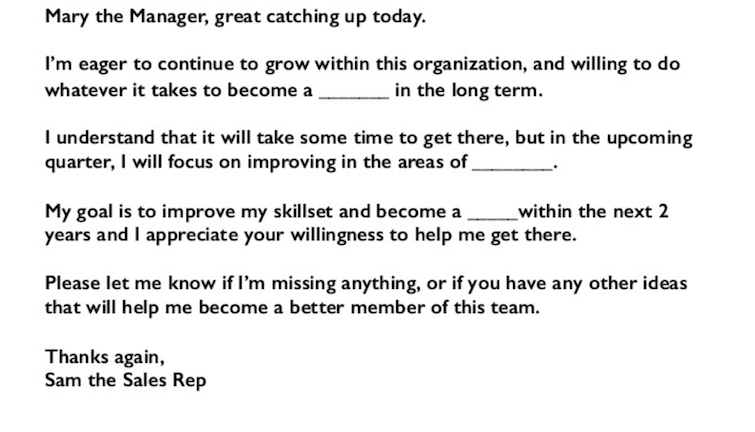
Send a recap of your conversation with the marketing team and let them know what you think would be beneficial to the sales team. Mark the Marketer – “Great catching up today. I appreciate all that you do for our sales team and getting us great content!”

3. Have a Plan for Yourself

Where do you want to be in the long-run? Now, don’t come in week 2 on the job and say “I’m ready for a promotion. I’ve nailed it.” Once you’ve proven yourself (i.e. 2-3 quarters of consistently hitting your goals) bring visibility to your manager as to where you want to be eventually and ask what it will take to get there. Don’t expect it to happen over night, but work with your manager to develop a roadmap to get to that end goal… even it’s a multi-year plan.

When you plant that seed in your managers head to where you want to go, so when that opportunity does come up for organizational changes you will be top-of-mind (especially if you’ve taken the previous two pieces of advice above).

Again, after you met with your manager – document it.

Manager Follow Up

Your managers are busy, just like your marketing leader was, and they might not remember everything you talked about. Give a recap. Too, your manager may have said things to you:

  • “Yes, I want to help you get there.”
  • “Yes, let’s do this.”
  • “Yes, you can get there in the next two years.”

Put that in writing and get them to respond to it. Save it for the future because this stuff will come back to help you.

Bonus: Find the answers to your own questions

Use the resources at your finger tips. Could the answers to your questions easily be found on:

  • Your wiki?
  • Your training docs?
  • Your website?
  • GOOGLE!?

Can’t find your answer after all that? Save a list of the questions you need to ask your manager for the end of the day.

You must self-educate. Don’t expect to be coddled.

  • Read books and top sales/marketing blogs
  • Attend networking events and meet-ups – good job, you are already doing this!
  • Find mentors/coaches who you can turn to for advice
  • Attend events that are relevant to your buyers and the industry you sell into – without being asked, and potentially without being sponsored
  • Take classes outside of work that are relevant to the role you eventually want to be in

For more Sales Hacks Follow us on Twitter at @SalesHackerConf

The post 3 Pieces of Advice for Emerging Sales Leaders appeared first on Sales Hacker.

21 Nov 21:20

Product marketing strategy and why 50% of a solution is 100% of a mistake

by Hugh Macfarlane
You sell what you are good at. The market has taught you what is attractive, and what is not. So you should gear up production and sell like crazy, right? Well, no. The product marketing strategy you have now will not be the right strategy for the next phase of the market. It is rare that a product marketing strategy deliberately only solves a half of the client's problem. But accidentally solving only half of their problem, or meeting only 50% of their need, is 100% wrong 20% of the time. There are five phases in any market, and you need a complete solution for one of those phases, and an incomplete solution for another. Pricing, bundling, and service strategies are all factors in your product marketing strategy, and all change as the market matures. In this week's blog we will explore what the right strategy is for each phase.

read more

21 Nov 21:16

Tony Robbins Shares His 3 Best Public Speaking Tips

by Richard Feloni

tony robbins

Love or hate him, there's no denying that celebrity life coach Tony Robbins is an incredibly engaging public speaker.

For the past 30 years, people have paid hundreds, and sometimes thousands, of dollars each to attend one of Robbins' high-energy seminars. In addition to personally coaching powerful people like investing legend Paul Tudor Jones and President Bill Clinton, celebrities can often be found in his audience.

Oprah Winfrey said that Robbins' Unleash the Power Within event was "one of the most incredible experiences" of her life, and Al Gore was in the front row of Robbins' "Why we do what we do" TED Talk, which has now been viewed over 20 million times online.

We spoke with him recently about his new book "MONEY Master the Game" and used the opportunity to ask how he's able to be such an effective speaker. Here are his three fundamental tips for giving great presentations:

1. Know and respect your audience.

"That might sound basic and corny, but I don't see it that way. I want to know, just like when I work with an individual, what do they desire, what do they hate, what do they love, what are they hungry for, what's missing?" Robbins says.

"Because the more you understand what somebody wants, needs, and fears, the more you can figure out how to add value. I do my homework about the company, individuals in the company, leaders in the company, so I dig in. I interview people. I have a team of people who do homework for me, as well," he says.

2. Add more value than anyone expects.

Robbins says that in order to leave a lasting impression on your audience, you need to surprise them by going deeper than they predicted. The key to doing this, he says, is by truly caring about what you're saying.

"Don't ever speak publicly about anything that you're not passionate about and that you don't actually believe you have something truly unique to deliver," he says. "Don't get roped into talking about something that you don't really have passion for, and don't get roped into something you don't have expertise in. Why should somebody listen to you? If you're going to take somebody's time, you better deliver."

3. Tap your audience's emotions.

"We've all been put to sleep by somebody who's told us all these wonderful facts that didn't matter because information without emotion is not retained," Robbins says. A great presenter draws you in and takes you outside of yourself. That's why you need to transport the audience. 

And the way to move an audience is by becoming moved yourself, which can only happen if you're being genuine.

"So if you're just giving some frickin talk you've memorized over and over again, you're going to have a flat affect," he says. "If you've just got a bunch of visuals on the screen that are leading your talk, hang up your shoes and get the hell out of there."

"You need to be in the moment and flexible to make it real and raw," Robbins says. "You'll enjoy it, they'll enjoy it, and you'll be memorable."

Watch Robbins' 2006 TED Talk:

SEE ALSO: Tony Robbins Reveals What He's Learned From Financial Power Players Like Carl Icahn And Ray Dalio

Join the conversation about this story »


21 Nov 21:16

Introverts In The Workplace: Why They Shouldn’t Be Underestimated

by Krista Wolfe

Introverts have been having a bit of a moment in the spotlight lately. (Ironic, since that’s the place they’re least likely to enjoy themselves.) A few dozen Buzzfeed quizzes, a New York Times bestselling book and even a viral TEDtalk have all recently celebrated what life is like on the shy end of the spectrum.

By now most of us have gotten the message that our introverted brethren aren’t actually confirmed misanthropes or constitutionally awkward.

Introversion and extroversion, as personality types, have more to do with how and where a person gains and expends their energy.

Extroverts get charged up around others and wind down when they’re alone, while an introvert’s emotional batteries are refreshed in solitude and used up in social encounters.

Introverts make up about a third of the population, but modern workplace cultures and practices are strongly geared towards the extroverted personality type.

The ways we traditionally assess, identify, and celebrate communication, creativity, and leadership qualities can lead to overlooking the unique and highly valuable ways that introverts can contribute.

Worse, the current workplace environment can stifle the development and expression of those qualities in introverts before they even get started.

This is a huge loss for both introverted employees and the organization as a whole. The good news is that it’s easy to adjust the way you work in order to help introverts shine.

The best bosses already make a point of valuing each worker’s individual attributes, and this is no different.

What Introverts Have To Offer

If you take a look at the qualities celebrated by management manuals and self-improvement books, you’re likely to see the portrait of an extrovert. Susan Cain, the author of Quiet: The Power of Introverts in a World That Can’t Stop Talking, describes it as:

“The Extrovert Ideal — the omnipresent belief that the ideal self is gregarious, alpha, and comfortable in the spotlight.”

From job listings to annual reviews, the language describing a “perfect” employee with leadership potential is familiar: confident, take-charge, charismatic, upbeat, team player, outgoing, enthusiastic.

While some of these are qualities that many introverts possess in spades, their expression of these traits may be very different than expected, and consequently easy to overlook.

Extroverts are happy to push their ideas forward, speak up in meetings, take a risk on untested innovation, and exploit the power of interpersonal relationships and networking.

The value of this working style is clear in a corporate environment, but a quick look at some of the biggest bungles in the business world will show how terribly wrong things can go without balance.

Unchecked egos, unbridled enthusiasm, and unbounded ambition can cause a divisive and inefficient workplace at best, and corporate scandals at worst. That’s where the introverts come in.

The specific qualities of introverts are a powerful counterweight to extrovert excess. What can look like disengagement or hesitation from a distance is actually deep listening and careful thought.

Introverts also believe in self-management/autonomy, so it makes it easier on both managers and the companies. Here’s a quick CultureTalk on the subject:

What may be dismissed as a lack of enthusiasm is actually a profound respect for other viewpoints. These quiet strengths add an amazing dimension to a team if they are appreciated.

A recent study showed that in many circumstances, introverted leaders actually produce better results than their brasher counterparts, largely because they are willing to give proactive and extroverted employees the room to run with their own strengths and ideas.

This isn’t a matter of one style trumping the other, but of the harmony that a careful recognition and distribution of complementary qualities can bring to an organization.

What We Can Offer Introverts

From hiring practices to the day-to-day workflow right through promotions, bringing out the best in introverts really only requires a slight shift in perspective and a few simple changes.

For example, you don’t have to be an introvert to find meetings challenging. Competing opinions or intense brainstorming sessions can create a pressurized environment for anyone, but for introverted team members they can be completely counterproductive.

Reducing the frequency of meetings and capping the headcount wherever possible can help a lot.

It’s also a good practice to go back around the table a few times to give quieter members a chance to speak up after they’ve had some time to process.

It may be easier for an introvert to contribute one-on-one than as part of a group, so make a point of personally inviting introverted employees to meet with you privately.

As introverts often express themselves better in writing, you may also want to consider asking for follow-up ideas by email after the meeting.

Open plan offices, despite their many weaknesses, are a fact of life in the modern workplace. While the distractions, germs, and inefficiencies of this model are a trial for everyone, they are especially detrimental to the concentration and productivity of introverts, who may be overstimulated to the point of severe stress in this environment.

You may not be able to offer a private office to everyone, but consider setting aside a conference room or other quiet space for certain periods of each day, and make it available to those who could use the time alone to think and process.

Under these circumstances, the creativity of an introvert can blossom, and they may be able to get a lot more done in a lot less time.

It’s also good to remember that the rough-and-tumble nature of a dynamic office can be especially bruising to introverts. Interactions that roll off an extrovert’s back may stick much longer with an introvert: a bit of extra attention to office courtesy can go a long way.

Contrary to stereotype, introverts are exceptional team-players. They may struggle with the social aspects of working in a group, but a recent study found that over time they are ranked higher than their extroverted teammates because of their devotion and focus to the task at hand.

Helping them flourish in a group may mean ensuring that they have time and space away to recharge.

A friendly working lunch may be heaven to an extrovert, but leave introverts feeling drained and cornered: it’s okay if they prefer to eat their sandwich alone in a private corner. They’re not lonely or left-out, they are relaxing and regrouping.

It’s also important for leaders to keep a close eye on the group dynamics. Introverts are not only more likely to be the target of workplace bullying, they are also much less likely to report it or ask for help.

In general, helping introverts feel that they are a valued part of the team is important, but may require a slightly different approach. Introverts love people, and they often love company: they just often relate better person-to-person, in a calm environment, and with plenty of time.

A boisterous breakroom or the cluster around the water-cooler that are so valuable to extroverts in building their “work family” can be intimidating or off-putting to introverts.

Taking time to regularly stop by their desk for a quick check-in, remembering special dates with a quiet card, and inviting them out for a coffee now and then are much better ways to build relationships and foster a sense of belonging.

The care and feeding of introvert employees isn’t rocket science, and introverts are not fragile or exotic specimens. Understanding their habits and ideal habitats, and making a few small tweaks to accommodate their differences can have a transformational effect on a company’s cohesion, creativity, and productivity.

Thoughts About Introverts In The Workplace?

Do you think that introverts in the workplace fare will for most organizations? What are your thoughts on the subject?

21 Nov 21:15

3 Ways To Create Thought Leadership

by Trent Dyrsmid

3 Ways To Create Thought Leadership image how to become thought leader.jpg

How would you like to be seen as the obvious expert in your space? Do you think that would make it easier for you to get clients? Do you think you’d be able to charge those clients more for your services?

To answer these questions, consider that we’re all barraged with a constant stream of problems in our lives, from “what am I going to have for lunch?” to “how am I going to grow my business?” to “that mole on my arm looks a little suspicious – should I be worried?”

3 Ways To Create Thought Leadership image derm checking mole 300x199.jpgInevitably the pain of having these problems, and the desire to solve them, causes us to search for solutions. Let’s use the example of that suspicious looking mole. In trying to decide whether there’s cause for concern, you might try:

  • a Google search,
  • asking a friend who’s had moles removed for their advice, or
  • consulting with a physician.

Which information would you value the most? Which would you pay for? Obviously the physician, especially if it’s a dermatologist you’re seeing. The reason is simple: they’re seen as experts in skin.

This tendency to most highly value advice from experts holds true for other problems as well. Unsurprisingly, the more you are assumed to be an expert – or the more name recognition you have – the more you can charge.

So how do you go about establishing yourself as an expert? Follow this simple process and become a thought leader – no medical school required.

How to Be Seen as an Expert

To establish yourself as a thought leader, you need to help your audience solve their problems, whether or not they’re related to your product/service. The bigger the problem, the better.

If you can provide information your audience wants, or that they didn’t even know they wanted but they find valuable, you will establish yourself as a thought leader in your space.

You may find that your customers actually come to you, and if you do approach them, you will be dealing with a “warm” connection. Here’s how to make it happen, step by step..

Know Your Audience

3 Ways To Create Thought Leadership image Puzzle Brain 289x300.jpgIn order to be seen as the true expert, you need to not just know your subject – you first need to know your buyer. When you truly understand your buyer, you can speak directly to them.

The more you know, the better. And more important than their demographic information is psychographics. For example:

  • what do they fear – what keeps them up at night?
  • what do they aspire to?
  • what are their biggest frustrations?
  • where did they get their information?
  • who did they trust?

It is SO important to know your prospective customer or client, because your content needs to be focused around them and NOT around your company or product.

Be Extremely Helpful

Once you’re able to peer into the mind and emotions of your customer, you should know what they want – and need – help with.

Instead of interruptive, advertising-based marketing, provide them with what they most want help with. Create content to freely give away your best ideas.

Stop interrupting people from what they are interested in… instead become what they are interested in.

– Trent Dyrsmid

Don’t worry about making it perfect, but do be sure to do your best to craft higher quality, more detailed, or more easily understandable content than is already out there. Don’t be afraid to be controversial or unique.

Give Your Customers a Way to Find You

In the age of the internet, we are all constantly looking online for solutions. Easy access to information means that when we want something, we can simply look for a solution.

In addition to publishing it on your business blog, share your content in other places your clients would expect to find it (for instance, if you’re in the B2B space, LinkedIn – or better yet, a targeted LinkedIn group – might be an excellent place to publish your content).

[Tweet “How to Establish Yourself As a Thought Leader #ContentMarketing”]

Summary

To be seen as an expert:

  • Know your audience well – understand not just their problems but who they are as people
  • Publish content that is extremely helpful to your audience
  • Share that content where they will find it online

When people who are searching for your expertise come across your helpful content, you’ll be firmly established in their mind as a thought leader.

For more information on specifically how to use LinkedIn to establish yourself as an expert, download the free guide below.

Please use the comment form down below. We read and reply to every comment. If you really enjoyed this post, please help us to spread the word by clicking one of the social media sharing buttons.

Thanks so much!

21 Nov 21:15

Shiny Object Syndrome: Why Too Much of a Good Thing Is Bad

by John Rugh

Marketing has undergone a major revolution in the last 15-20 years. The advent of the World Wide Web and its mind-boggling growth as a commercial medium, as well as the overwhelming popularity of smartphones and tablets, has opened up many exciting opportunities for marketers like you and I.

But along with all of these exciting developments and possibilities, a lot of hype bordering on hysteria has emerged. In recent years, a lot of unwary marketers have fallen prey to an insidious phenomenon – the “shiny object”. For the purposes of this article, the shiny object is any technological innovation that marketers flock to in hopes it will, by itself, bring them the marketing success they crave.

Many business owners and marketing professionals have pinned their hopes on various shiny objects, vainly wishing they could offer a solution to all of their customer attraction problems. In the process, they ignore proven, timeless principles that have helped many marketers succeed beyond their wildest dreams.

Social Media Isn’t the Only Shiny Object

When we think of modern marketing phenomena, the one that immediately comes to mind is social media. And social media is a very popular choice for those looking for a marketing “quick fix” or “magic bullet”. But many marketing tech innovations, or to quote legendary marketer Dan Kennedy, “digital doohickeys” have attained shiny object status in the digital marketing world.

Here’s a partial list:

  • Social media
  • SEO/SEM
  • Mobile marketing
  • Video marketing
  • Email newsletters
  • Blogs
  • Landing pages


”Tactics without strategy is the noise before defeat” -
Sun Tzu

I’m not saying these marketing tools don’t have solid potential in the right situation. I’m not saying to categorically ditch them. But I am saying that none of them is a complete marketing solution on their own.

Each one has the potential to be a very useful tool, but they need to be integrated with other tools. They need to be used according to a carefully crafted strategy aligned to each company’s specific situation and goals.

Warning: Marketing is Not a Function of Technology

Don’t fall into the trap of thinking of marketing as only a function of technology. With all the focus in today’s business world on big data, marketing automation and the myriad of tech tools available to help marketers do their jobs more effectively, this is an easy trap to fall into.

But if you approach marketing from this mindset, your efforts are likely to fall flat because in marketing, you are dealing with people, and people have emotions. Their emotions influence their buying decisions, whether you are marketing baby accessories to new moms or petroleum products to manufacturers.

Not only do your customers make buying decisions with a largely emotional mindset, they also engage with and respond to marketing messages that influence their emotions (one reason storytelling is such a powerful marketing tool). If you treat marketing only as a function of technology, your lead generation and nurturing efforts won’t win your prospects’ hearts and minds.

Another warning: Don’t Be A Laggard

Something else to keep in mind: as you’re diligently avoiding shiny object syndrome, don’t let the pendulum swing too far in the other direction. Don’t categorically reject any tool unless you are absolutely confident it will be of little or no use to you.

Indeed, you should harness the power of technological innovation to help make your efforts more successful. Use the tech tools that will help you enjoy the results you want.

Use social media to gain attention, build your brand and drive traffic to your website. Use email marketing to gain more website traffic, keep your brand in the forefront of your readers’ minds and drive sales. Use video to capture and keep your audience’s attention in a fresh, interesting way. And use targeted landing pages to remove distractions and increase your conversion rates.

As marketers, we have a mind-numbing number of golden opportunities in front of us, but we have to act wisely. We have to avoid the urge to invest all of our marketing hopes and dreams (and budgets) in the shiny object. Instead, collectively embrace all of the tools required to help us reach the results we want.

21 Nov 21:15

Google Will Give You A Ton Of Free Storage If You Buy A Chromebook This Year

by Jillian D'Onfro

Google just announced a holiday deal giving away 1 terabyte of Google Drive storage for two years to anyone who buys one of its Chromebook laptops before the end of the year.

Chromebooks run Chrome OS, an operating system based on the Chrome web browser. Everything you want to do on your Chromebook, you have to do on the web. So instead of writing something in Microsoft Word and saving to your desktop, you use Google Drive to store your Google Docs, Spreadsheets, Slides etc. in the cloud. For that reason, the free data is a big win. That amount of space would usually cost $240. 

According to Google, 1 TB of data storage gives you enough room to take a selfie twice a day for the next 200 years and still have space left over. 

Here's the full post announcing the deal: 

Chromebooks make day-to-day computing fast, simple and secure, whether you’re searching for a great pumpkin pie recipe or sharing a family photo from Google Drive. And now, as a bonus for the holiday season, new Chromebook buyers can get 1TB of Google Drive storage for two years — a $240 value — absolutely free.

That’s enough space to keep more than 100,000 awkward holiday sweater pics safe and shareable in Drive. With that much free storage, you can use your Chromebook for work, play and pretty much everything else you’ll do this holiday season.

The 1TB comes with the purchase of a new, eligible Chromebook for as little as $199. You’ll find them at these retail stores and online outlets or on Google Play. Just be sure to redeem the offer before January 1, 2015.

Happy holidays!


Join the conversation about this story »

21 Nov 21:13

Training is Sales and Marketing’s BlindSpot

by Christine

Despite rapid advances in technology like Big Data, behavior based marketing automation, customer engagement platforms and intent data through content consumption marketing; the lament of CEOs and Boards of Directors on the ineffectiveness of marketing is growing.   Their beef with marketing is over a disconnect between budget, priorities, and revenue ROI.   For CEOs the only thing that matters is revenue – driving quality leads, getting sales in front of the prospect, and helping them to close the deal.  While every CEO likes to see his or herself on TV and mentioned in print, in the end their own jobs depend on meeting revenue numbers.  The vagaries of marketing’s metrics around visitors, conversions, likes, etc.  and the black art of attribution doesn’t create a sense of formulaic predictability CEOs are looking for.

While much of the conversation is focused on marketing’s challenges, Sales is not immune from the same complaints.  In the era of the customer and social selling, CEOs are baffled by less sales productivity where more is expected.  The battle over lead follow up, forecast accuracy, opportunity aging and understanding the customer’s needs should be won already rather than becoming harder.  Sales methodologies have been changed, predictive technology that helps Sales to respond more effectively to customers based on behavior patterns has been implemented, and coaches employed to work mano-a-mano with sales teams.

No one is claiming that the world of B2B marketing and sales has gotten easier and that technology makes these jobs a cake-walk.  Nor is the claim that CEOs and Boards are, more or less, unreasonable or forgiving than in years gone by.  But it does beg the question why Sales and Marketing keep struggling.

One reason is training – or the lack thereof.

According to ANA and McKinsey’s 2014 Marketing Disruption study, 77% of marketers recognize that they need to deeply understand customer journeys and how to align their programs to them. Yet only 13% “have reached a point where they’re taking action and achieving measurable impact.”   What’s holding marketers back from stepping up is a dogged addition for outdated best practices and marketing models but also an alarming reticence to invest in learning new skills and methods.

According to ANA/McKinsey, 89% of marketers admit that training and skills development is critical to being successful in the future.  Yet training investment are anemic and often the first line item to be cut when funds get tight.  No wonder a third of marketers are unable to make data-driven decisions and don’t know what tools to use or how to use them.

Sales believes in training but has not evolved their content to meet the needs of front-line sales staff.   Brainshark’s recent State of Sales Training study highlights a startling discrepancy between what needs to get done and what’s actually getting done. For example, 38% of sales training professionals say their organization’s training content needs quarterly updates. However, 42% say that, in reality, their organization’s training content gets updated once a year at best – leaving them open to inconsistent, incorrect and/or outdated messaging, and even potential compliance violations.

“Engaging, timely content that is accessible when needed is vital to sales training and overall sales success,” said Brainshark Inc. CEO Joe Gustafson. “The survey results highlight a great opportunity for organizations to meet this need – with stimulating sales content that’s both easy to access and consume. For organizations, this often means taking advantage of rapid content authoring and updating capabilities and ensuring just-in-time training delivery – to make sure that training works and sticks, and help reps be better prepared to close more deals.”

Part of the problem is that the most prevalent methods of sales training for organizations today include: Live classroom training (80%), live Web conferencing (65%), on-demand training (67%), video (49%) and social learning (28%).  Struggles related to live training include:

  • Difficulties aligning schedules (61%)
  • Reps easily distracted (45%)
  • Lack of coaching and reinforcement (35% and 36% respectively)
  • Lack of rep engagement (36%)


The track record for on-demand training isn’t much better.  Organizations face challenges including deadlines not met (25%) and an inability to track completion/progress (23%).

Both Marketing and Sales need to get with the times and deliver ongoing training, coaching and onboarding support in order to effectively understand and respond to customer lifecycle engagement expectations, increasing uncertainty and digital transformation.  While in-classroom training will never lose its effectiveness, it needs to be supported with just-in-time, bite sized consumable training units.

According to the Brainshark study, the two areas where pace-setters are reversing the skill gap are with video and mobile-based learning.  “Consider providing just-in-time learning content within the context of workflow as a form of performance support,” shares Joan Babinski, VP of Corporate Marketing, Brainshark. “So when reps have to do somewhat tedious or confusing processes, give them content that can pop up on their screen right when they need it – rather than making them wade through materials or try to recall hours of previous training.”

For training to be effective, it needs to be viewed as a strategic enabler. While who owns the training problem may vary within any organization, all parts of the organization have to align and work together to improve training content effectiveness.  As long as Sales and marketing don’t address the link between training, performance, and meeting customer engagement expectations, the greater this blindspot will result in a redefinition of their perceived value; one neither function will relish.


First published in my Forbes blog “Outside the Box”

The post Training is Sales and Marketing’s BlindSpot appeared first on Christine Crandell.

21 Nov 21:12

7 Tips to Kick Start a Video Campaign

by Colin Osing

7 Tips to Kick Start a Video Campaign image Tips for Video 300x208.jpg

If you’re a digital marketer who is somewhat new to video marketing, you can take some comfort in the words that follow. First of all, you’re not alone! While 52 million US adults watch professional video content every month, online video marketing is still largely viewed as the new kid on the digital marketing block.

However, setting up a video campaign doesn’t have to be difficult. In fact, it’s not so different from creating any other marketing plan – except, you know, a lot cooler.

Just answer these seven questions to create a well-defined strategy and ensure that your video marketing investment doesn’t go to waste.

1. What are your goals and expectations?

The first thing you need to ask yourself is why you are creating a video campaign. While this sounds like the most obvious question, it’s the most important step in framing your campaign. Do you want to promote a product or service to help educate your customers? Do you want to drive new leads or nurture existing prospects? Be specific with your KPIs – if you want higher sales, by how much? If you want to go viral, how many views would that entail?

2. Who’s your target audience?

An effective video campaign requires you to segment your audience and target your video content accordingly, by factors like age, industry type, stage in the buying cycle, etc. The ability to target effectively relies on the quality and accuracy of your company’s data, along with the marketing tools you use, such as your marketing automation platform.

There are also some video players that offer advanced targeting capabilities when embedded on your web pages. With these players, you can control which viewers see your videos, targeted by geography, device type, or even by browser type.

3. What is the creative concept behind your video campaign?

Whether you’re interested in creating customer testimonials, scripted ads, eye-catching animations, or instructional videos, your creative concept should make sense for your audience and the story you’re trying to tell. Keep in mind that you don’t need to try to be funny or overly creative to produce an effective marketing video and get your message across. In fact, researchers found that adult consumers watch instructional videos the most, followed by product/service videos, then humorous videos.

You certainly want to look professional, but if you’re drawing too much attention to the production of the video itself, it may come at the expense of your message. Your budget may help drive that decision. Figure out the story you want to tell, how best to tell it, and gauge whether your concept is budget-wise.

4. How many videos will you need?

Generally speaking, a video campaign consists of a series of related videos distributed over a predetermined timeframe. There is no hard or fast rule that stipulates how many videos you should be producing; it really depends on your goals, timeline and types of video you are using. If your campaign is testimonial-driven for example, you probably don’t need more than five testimonials, deployed once per week.

Whereas if you want to create short profile videos for all your products, or create how-to videos, then the sky’s the limit. Luckily, there are video companies today that can produce any number of videos in a short period of time, from one to 100, so it’s important to think about the volume of videos before choosing your video provider.

5. Who will create the videos for your campaign?

If your company has its own video production department, it doesn’t necessarily mean you’re in the clear. Capacity or timing issues might force you to seek out an outside video production company to create your video content. You will want to find a video partner who is able to address four key production issues:

  1. Volume – How many videos can be produced at a time, and how long will it take until completion?
  2. Reach – Is the video team you’re working with able to shoot and produce video content wherever it’s needed?
  3. Management Scale – How easy is it to efficiently manage high volume video production? Since there are a lot of moving parts to manage, from ordering to script-writing, filming to feedback, it’s vital to source a video partner that offers a scalable video production platform and tools that enable you to effectively track and manage multiple projects from start to finish.
  4. Cost – What is your budget and how can you get the most bang for your buck? After factoring in your time, what will be less costly – producing in-house or outsourcing?

6. How will you distribute your videos?

A well-planned distribution strategy is necessary to ensure your video gets noticed by your target audience. A great place to start is with your website—from your home page, to your blog, and to your landings pages—this will help with SEO and encourage prospective customers to convert.

Then you will want to consider which social channels you should add your video to, such as YouTube, Twitter, Facebook, LinkedIn and Tumblr. This is the best way to get your fans and customers engaging with and sharing your content.

Videos should also be added to emails campaigns, which can increase email CTRs by 96%. Consider including video in your press releases, newsletters, and sales assets you send. If your company is leveraging marketing automation platforms like Marketo, all of this becomes much easier and more efficient.

7. How will you measure performance and ROI?

Before you start your campaign, consider the variables you want to track and how you will measure them. Google Analytics or platforms like KISS Metrics will work great for your website, but you will also want access to specific video analytics. By adding your videos to free advanced video players, you can find out how your videos are performing in general – who’s watching, for how long, when they stopped watching, etc.

Having this information is vital for understanding the needs of your audience and optimizing your videos. For example, if viewers are constantly clicking away from your video after only a few seconds, you need to consider whether you have the right concept, the right messaging or the right thumbnail.

The Secret to Video Marketing Success

Now that you know what questions to ask yourself and your team, we have one final tip for creating a great video marketing plan. It might sound very basic, but it’s often overlooked by many smaller companies or departments – put your plan in writing. While it’s great to ask yourself these questions, the best way to frame your video marketing strategy is to write a formal plan. Then you can meet with your team to finalize the details, make any adjustments, and make sure everyone is on the same page. And if anyone gets side-tracked or is unclear about the expectations, they can always refer back to the plan.

At the end of the day, if there’s one secret to creating an effective video marketing strategy, it’s this – when you fail to prepare, prepare to fail. Plan ahead, define your KPIs, and take the time to find a great video provider that can bring your unique vision to life.

I’d love to hear your video marketing stories and answer your questions — please share them in the comments section below.

21 Nov 21:12

Lead Scoring Strategies for Agencies: Best Practices

by Lisa Cannon

Lead Scoring Strategies for Agencies: Best Practices image Dollarphotoclub 69070215 700x725.jpg 289x300How can agencies help businesses develop lead scoring strategies that get results? To find out, I talked to Sam Boush, President of Lead Lizard, a marketing automation agency (and Act-On partner) based in Portland, Oregon. Lead Lizard serves clients from a multitude of industries around the world, and they’re dedicated to helping these organizations get more value out of their marketing automation and CRM systems. (They also have a great logo.) The conversation was an excellent opportunity to learn about Lead Lizard’s unique approach to lead scoring, and to get an up-close look at the methods they use to help their clients create a score that quickly identifies good prospects.

Sam’s team has extensive experience combining demographic data with online behavior in order to build successful lead scoring campaigns for their clients. They help organizations define what a qualified lead looks like, determine how qualified leads interact with their marketing programs, and bring in best practices from a deep well of experience with lead scoring campaigns.

Settling the Score

There are many benefits to having an agency manage lead qualification for your organization. During our conversation, Sam outlined several of them:

  • Agencies have experience in navigating marketing and sales alignment issues. Those concerns often involve terminology, service level agreements, metrics and reporting, revenue attribution, follow-up times, and really just a host of potentially troublesome issues.
  • They’re familiar with the systems being used. A skilled demand generation agency can make sure that the marketing automation (which is the system marketing usually uses for lead qualification) and CRM (the system of record for sales) are properly integrated and configured to execute on the strategy both teams have agreed to.
  • It’s an approach that drives better lead response. Leads that have been scored and/or nurtured are leads that the sales team really wants to reach out to, using an agreed-upon follow-up that makes marketing happy, too.
  • Agencies provide improved reporting and campaign attribution. When the strategy and execution is done well, marketing has better insight into what’s working and what’s not. They also gain better visibility into how the marketing department is contributing to organizational revenue.

Lead Scoring Strategies for Agencies: Best Practices image SamBoush 005 Edit1 700x465.jpg 300x199“Really, it’s about looking at the bigger picture,” Sam told me. “Many times, organizations focus on ‘lead scoring’ or some other tactical elements of lead qualification. But a skilled agency knows that the goal isn’t just to score leads, it’s to get the right leads to sales. Arming – and aiming – sales is the primary job of a B2B marketing team.” And of course, for the agency, the goal is always to help clients succeed. The more a demand generation agency can be part of the lead lifecycle, the more it can help clients meet their goals.

5 Steps to Better Lead Qualification

According to Sam, the foundation of a successful scoring model relies on a strong relationship between marketing and sales. Here are the five steps they’ve identified to ensure more precise lead scoring:

  1. Form a small committee. Make sure that this group represents (and understands) both your sales and marketing teams. Ask them to define the attributes – both demographic and behavioral – of an ideal lead.
  2. Build a scoring framework. Your committee will need to identify behaviors and demographics that add to a lead’s score—as well as actions and attributes that subtract from it.
  3. Write your lead scoring formula. Assign scores to each attribute and action. These scores will help you create a formula that identifies where a lead is in the buying cycle
  4. Build a service level agreement (SLA). Lay out what happens to a lead once it enters the sales funnel through marketing and the next steps for how sales will follow up – along with a timeline.
  5. Test before you implement. It’s always a good idea to test a program before you open the floodgates. Run a random assortment of leads through your scoring model, including leads from each stage in the buyer’s journey.

Lead Scoring Strategies for Agencies: Best Practices image Lead Scoring 101 250x325.pngThe entire process is laid out in this white paper on lead scoring from Lead Lizard, so take a look and get some valuable tips for developing your own lead scoring framework.

Going Negative

Of course, it’s important to remember that not all prospects visiting your website or filling out forms will fit your definition of a qualified lead. For example, if a person indicates her job title is “student,” she’s probably just doing research for a paper (or looking for a job). You can use negative behaviors and traits to your advantage by deducting points from a lead’s score.

But don’t be so quick to discount a prospect who visits your careers page, Sam cautions. “A very engaged prospect will probably want to know all about your organization, which includes looking to see how many job opportunities are posted.” This information can demonstrate whether your company has a strong plan for growth as well as whether or not there are any headcount issues. No jobs might mean zero expansion. Too many might mean the organization is overworked and understaffed.

According to Sam, inactivity can be a better indicator of a negative score. “If a lead doesn’t demonstrate any behavior for a few months, you might want to apply negative points to that lagging interest.” The length of time between behaviors is important. For example, if two leads have the same behaviors, but one is quicker to act, that lead is hotter, which calls for more points.

More Ways to Score

Lead Scoring Strategies for Agencies: Best Practices image Dollarphotoclub 42634070 700x464.jpg 300x198“There are often a lot of stakeholders in an account,” Sam points out. “If multiple stakeholders are coming to a digital property, it should be a flag.” That means you’ll want to increase the score of individuals within that organization if you receive multiple leads from the same company.

“Take a look at creating priority accounts as well,” Sam told me. “Organizations should build a list of accounts that the marketing and sales teams have identified as great prospects that you’d want to do business with. It might be a high-profile company in a certain sector, or a Fortune 500 organization.” A lead from one of these accounts would immediately get a flag attached to them which would lead to an increased score or an immediate contact from sales.

Most of all, it’s important to remember that lead scoring is a dynamic system, not a machine where you assign points for certain behaviors and then expect it chug away. It’s an ongoing process, and if you let it run without fine-tuning it, it will break down. But if you continually revisit your lead scoring program and check in with both sales and marketing to make sure they’re satisfied with the outcomes, you’ll have a powerful lead-nurturing engine that can drive superior results.

Ready to dive in to lead scoring? Download this toolkit to find out how to implement a lead scoring program that can identify and target likely buyers. If you’re just starting to consider leveraging the power of marketing automation in your agency, this eBook outlines the 9 essentials to grow your business and help your clients succeed.

Lead Scoring Strategies for Agencies: Best Practices image Agency eBook CTA.jpg

21 Nov 21:12

Tips for Taking Care When Stepping Into a Personalised Approach

by Lucy Hardaker

Personalisation has always been more traditionally associated with our B2C cousins, but that doesn’t mean us B2B Marketers shouldn’t reach out to prospects on a personal level too. Especially when 64% of web users say it’s important that companies present them with offers that are relevant to them as an individual.

And when personalisation is one of the top 3 most significant trends for B2B marketers this year, it’s definitely time to become a little more human with your marketing campaigns. Follow our top tips to get started with a personalised approach and set yourself apart as the B2B brand with a difference.

Tip 1 – Get data rich with digital tools

70% of B2B buyers rate how vendors engage with them as more impactful than what they were actually selling. With the growing capabilities of digital marketing tools and data available, there’s no better time to get personal and offer products, information or content that you know is relevant to them and their stage in the buying journey.

Get data rich by using tools like Lead Forensics to learn how individual  prospects interact with your website and digital marketing campaigns. What product did they spend the most time looking at? Were they interested in pricing? Or did they read your latest blog?

Use this insight to target communications and deliver timely and relevant content based on what you know they’re researching, rather than batch-and-blasting information on what you think they’re interested in.

Tip 2 – Become smarter by targeting using Buyer Personas

Effective list segmentation is the key to delivering more personalised experiences to your leads and customers, but before you dive in, you’ll need to get smarter at identifying these segments first.

Get your sales and marketing teams together to build core key buyer personas. You’ll better understand your audience in terms of their personal and professional habits, social presence, and preferred communications. Where do they consume content? Are they likely to be on the road? Do they use tablets or desktop PCs?

Once you understand this, you can take personalisation to a deeper, more human level across every channel. And don’t forget to test, analyse and re-test to find what works for you and your audience too.

Tip 3 – Dip your toe in with personalised email marketing

In terms of starting out with a personalised approach, (if you haven’t already) email is definitely the best and most accessible place to start for B2B marketers. And when 64% of respondents prefer emails with a personal touch, we’re not just talking about inserting personalisation tags into your email templates.

80% of marketers agree that prospects expect them to provide relevant information across any digital marketing channel.

Use your buyer persona’s and data on what you already know about subscribers to create high impact and relevant email communications. Rather than segmenting your contact list by job function or industry alone, treat your email prospects as individuals and split data by content downloaded, stage in the buying cycle or products previously purchased. Our B2C cousins Amazon and Tesco have it nailed – read about their personalised approach here.

Tip 4 – Be personable as a B2B brand

As well as personalising your marketing campaigns, don’t forget that your wider business can be personable too. People prefer to buy from people. Think about how you can take a more personable approach with social media activity, your sales approach and even your invoicing processes too.

Discover your company’s fun side and set yourself apart by promoting your company’s unique culture and personality- you’ll welcome your prospects to be part of your brand, and they will want to buy from you too.

Tip 5 – Build on your learnings

Once you’ve taken your first steps into personalisation, measure, analyse and report on your learnings to build a more integrated approach business wide. If you can make use of new data and cutting-edge technologies to personalise your marketing communications and content in innovative new ways, and you’ll set yourself apart as the B2B brand with a difference.

Want to become the Ultimate B2B Marketer? Download the Ultimate Content Planner and build a personalised content strategy for 2015.

Have some more tips on becoming a more personalised B2B brand? Tweet us your thoughts @LeadForensics using #UltimateContent.

21 Nov 21:12

Increase Employee Satisfaction By Recognizing Hard Work

by Bill Faeth

Using Incentives To Motivate Your Workforce

Increase Employee Satisfaction By Recognizing Hard Work image Employee incentives can work1.jpgA company without incentives is a static enterprise that appeals only to robots, not people with feelings and dreams. Capitalism is built on the notion that if you work hard, you will be rewarded. A savvy business owner takes his employees’ desire to achieve and—instead of crushing it—fuels it to allow that department or sales team to lift the company to new heights.

What are good criteria to judge against? Highly niche-specific, a sales team should obviously be judged by different criteria than a group of lab researchers or even support and management staff.

Some of the most common cross-department criteria by which incentives are allocated include:

  • Sales performance
  • Job accuracy
  • Job safety (a big one)
  • Leads acquired
  • Documents processed
  • Operations completed
  • Process efficiency

When a suitable metric is determined, then software such as Salesforce can be used to quickly and easily monitor those metrics, determine the best performing parties—even with unusual analysis criteria—and then provide results accurate enough to dole out rewards fairly. Even across seemingly contradictory departments and fields, Salesforce accurately tracks general metrics such as growth, value of contributions, and other more obscure metrics to allow a marketing department to compete with sales for the incentive.

Excellent Incentives Are Company Specific

While knowing to whom you are going to give the rewards is valuable, it is necessary to determine what your employees could possibly receive to peak their interest and make them feel like their hard work has paid off? Not every company is the same, look to what employees are lacking to see where to furnish incentives.

The obvious first two incentives are monetary and paid time off. These are also some of the most expensive for the company and usually are reserved for the highest achievers on a managerial or sales force, or are distributed evenly across a company that is showing stellar lateral performance. While this kind of incentive is great at riling up a storm on the sales floor or in the bullpen: if a company uses this too much, it could suffer huge financial loss after a while.

Other companies use their company resources to cleverly motivate their employees. Some of the common alternative incentives include:

  • Company Parking Space: Sometimes a $5,000 bonus to a woman living in New York just isn’t much of a leg up, but having access to a parking space on a daily basis could be a prize worth fighting for.
  • Open Endorsement: Especially in temporary and contract positions, offering the best on a team an honorable mention on the company website or a direct endorsement from the company is worth standing out from the others, even after the bidding is over.
  • Greater Degree Of Autonomy: What’s better than a small raise or lump sum incentive to an individual who truly cherishes their career? Give them a chance to do their job better. Take the highest earners, most creative marketers, fastest management staff, or other elite team and give them the autonomy to drive the company forward in their own way. Allow them to shape something according to their vision and apply their unique skills. The process might be rough at first, but eventually, the team will be proud to provide their skill and become a company’s best asset.

Managing An Online Marketing Presence With Gusto

As a special note, for small to medium sized sales teams—especially those with heavy integration into the social media and digital sales worlds—a software called Constant Contact makes the entire process easier.

Constant Contact manages the feedback of customers online through polls and can monitor employee interaction with the web presence, as well as their overall success engaging the audience. Even some companies that utilize Salesforce or NetSuite use Constant Contact to better track their online-oriented employees to dole out incentives.

Top-Down Large-Scale Incentives

One of the most dangerous cancers that creeps over larger businesses is divisional or department apathy.

Department apathy occurs when a division of a company is so stacked with employees that it is hard to achieve individual recognition. Employees suffering from this will trek on through their day meeting their minimum requirements knowing that to work any harder wouldn’t result in any accolade and that monetary awards are only given to an elite few whose work performance is in a tier above everyone theirs.

This disease is dangerous as it weakens the overall efficiency of a division. As more employees fall into apathy, more employees are brought in to eventually be lost to apathy as well.
The natural cure to this is to make every day at work count more and be more fulfilling.

With good analytics, this can easily be done by providing department-wide incentives. Taking into account the sales or workforce contribution of a division, adjusted to factor in team size for fairness, a company can easily track performance at any fork in a company’s management structure and take control of apathy and wasted performance.

When a quarter’s results come in, the best performers could be enticed with a division wide monetary bonus or extra time off. If every division did well, a business owner could reward everyone with time off or shares in the company. The key to large incentives is to get creative, and reward fairly. In extreme cases, when one division performs abysmally at their sales or other quota, management can step in and impose discipline in whatever way they see fit.

One of the most popular software programs for implementing this highly effective employee motivation and retention strategy is the well-regarded NetSuite. NetSuite is popular also because as a company grows, so do the data and analytics tools available. While some software programs manage growth in a clumsy manner, NetSuite is designed for growth, making it suitable for both large and small databases as it utilizes sales data in a manner that can easily determine worthy parties of the incentives at any stage of growth.

Small Rewards Create A Major Impact

Large or small, incentives are necessary for employees to feel like their hard work and valuable contributions are both seen, and have consequences. When employees see the feedback system, they will try to play the game by working harder. Only through properly implementing incentives can a company expect to grow steadily and keep employees motivated.

21 Nov 21:12

How To Prepare Your Business For Sale And Get Top Dollar

by Bill Walls

The marketplace is starting to look more promising for small business owners that are looking to sell their businesses. 2013 showed a noticeable increase in the amount of closed transactions, up 41.7% from the prior year period ending September 30, 2013. An increase in the number of small businesses listed for sale and qualified buyers is being attributed for the spike in transactions, according to BizBuySell.com the internet’s largest business for sale marketplace.

How To Prepare Your Business For Sale And Get Top Dollar image selling your business for top dollar.jpg

As we discussed in our previous posts, “Will My Business Help Fund My Retirement”, and “Is Your Business Worth as Much as You Think It Is,” preparing your business for sale takes preparation and a good hard look at yourself and your company. In order to set your business up to receive the best possible price, we have identified 3 essential areas you need to address.

Top 3 Areas To Concentrate On:

  1. Operations
  2. Financial
  3. Sales

It is estimated that it requires 1 to 2 years to prepare a business for sale. Remember, that’s preparing it, not selling it. It may take several more years to actually sell it. If you are looking at selling your business within the next 5 years, the time to begin preparing your company for sale is NOW.

Operations

Companies that have strong operational controls across all aspects of their business are attractive acquisition targets. Key areas to focus on are:

  • Is your product pipeline streamlined, efficient, and effective?
    • Will a new buyer need to buy new equipment, hire additional workers and train them or revamp your production process?
  • Do you have an effective marketing and sales process?
    • How are leads generated and moved to sales?
    • Does the owner take most of the sales leads and limit the effectiveness of the sales force?
  • How effective is your 2nd tier management?
    • Do you have a good management structure involving people who have the authority to make business decisions?
    • Are your managers being micro managed by you?
    • Do you have unmotivated and undisciplined workers? This may be a function of poor leadership and managers not having enough authority.
  • Do they have a great deal of experience in the industry?
  • Do you have an Operational Control Procedures Manual?
  • Do you have a clear focused plan for growth?

If you are not there, will the business function just fine without you? If the answer is no, you may have time to correct this issue.

It should be noted that businesses that are highly dependent upon the owner will be less valuable when it comes time to sell.

How To Prepare Your Business For Sale And Get Top Dollar image preparing your business for sale.jpg

Financial Controls

Two very common mistakes that many business owners make are maintaining sloppy books and being very liberal with taking personal expenses as tax write-offs within the business.

It is crucial that you have strong financial statements and can readily present a clear and accurate picture of the financial health of your company to a prospective buyer.

From BizBuySell.com, “To help make their businesses more marketable, owners thinking of selling should begin keeping complete, detailed financial books at least three years prior to a sale so that all income is accounted for and can be properly evaluated by the buyer.”

“This includes removing all unnecessary expenses from the books, such as a “company car” that isn’t actually used for business purposes. A higher tax bill might follow, but it will also result in a higher sale price once a transaction takes place.”

In order to give your prospective buyer faith in the validity of your financial statements it is also good practice to have either “reviewed” financial statements from an independent CPA firm, or if you can afford to, provide “audited” financial statements. This should go a long way in providing your buyer with confidence.

Here are several tips to get you financials in shape in preparation for a sale:

  • Prepare 2-3 years of tax returns and financial statements. (Be organized.)
  • Focus on physical assets for Debt Financing – Businesses with tangible assets capital equipment or owned real estate, have greater success securing business loans and can be used as collateral for securing those loans.
  • Offer seller financing – Banks are still reluctant to lend for business acquisition and the economy is still difficult. Sellers willing to offer financing over a period of time with interest are seeing more success with selling. It also gives you a fixed income annuity stream.

Remember, if you cannot prove the numbers, a prospective buyer won’t make an offer!

How To Prepare Your Business For Sale And Get Top Dollar image to seel your business the numbers must add up1.jpg

Sales

Perhaps the most crucial area to examine when preparing your company for sale is your company revenues. For privately held companies, sales revenues are usually the first figure that a prospective buyer will look at when considering your company as an acquisition target, and determining the value of your company.

If your company revenues have been stagnant for the past several years, few buyers will be excited about the prospect of acquiring your business.

When evaluating your revenues, here are a few questions to consider.

  • What is your present market share compared to your competition?
  • Is your business outperforming the overall economy?
  • Is your business recession proof?
  • Businesses that outperform during periods of recession may indicate less risk for perspective buyers.

For business owners that are dependent on the sale of their business to provide for their retirement needs, a key question to ask is:

Are my current revenues enough to provide a valuation figure capable of satisfying my retirement needs?

For many of you the answer is NO!

Let’s look at a brief scenario.

Your business is tight as a drum in terms of operations and financial controls. You have loyal employees and a general manager that runs the business when you are not around for day to day operations.

However your business was impacted by the most recent downturn and sales have been off for the last several years. Your current valuation comes in at $1 million. Your financial advisor reminds you that your need to account for taxes associated with the sale of your company and estimates that your business needs to sell for twice that figure to net you enough to satisfy your retirement needs.

Unfortunately this is the dilemma that many small business owners will find themselves in, in the coming years. The number just won’t pencil out.How To Prepare Your Business For Sale And Get Top Dollar image prepare your bsuiness for sale.jpg

If your current sales don’t provide for a sufficient valuation to meet your retirement needs then increasing revenues will be a necessity.

Business owners will need to look at either investing in sales and marketing programs designed to increase business revenues thereby increasing business valuation, or face a diminished lifestyle in retirement.

You have to spend money to make money. However, you don’t have to spend it needlessly!

Other factors with respect to sales include:

  • Composition of your customer or client base.
    • Dependence on a handful of clients will increase risk and lower sales price.
    • Customer sales contracts.
    • Experience of your sales force
    • Marketing and sales pipeline
    • Online vs. offline marketing programs

Business owners should be looking to grow their revenues not only in the years prior to listing the company for sale, but throughout the sales process. As discussed earlier, business sales transactions can take some time, and owners should manage as if the sale were not happening at all. A promising deal can turn south in an instant.

Final Thoughts

The marketplace is changing and the next 5 to 10 years look poised to be a buyer’s market. With the sheer volume of businesses hitting the market from boomers looking to retire, competition for the attention of qualified buyers with adequate resources to pull the trigger will be fierce. Only those that have put in the time to evaluate their companies and make the appropriate changes will reap the rewards.

Remember when preparing your business for sale, think like a prospective buyer.

21 Nov 21:11

How to Combine Content Marketing and Marketing Automation for Maximum Impact

by Megan Tonzi

How to Combine Content Marketing and Marketing Automation for Maximum Impact image b2b marketing.png 297x300Marketing automation platforms can boost leads, brand awareness, conversion rates, and more, and it’s an expense that most companies see as a valued necessity.  Content marketing, another marketing strategy that has been on the forefront of everyone’s minds since Content Marketing Institute’s B2B Content Marketing Benchmarks, Trends and Reports, is also a must for marketers today. However, don’t let your marketing automation get in the way of your content marketing, or vice versa. In fact, when pairing both content marketing with marketing automation, you can nurture accounts and pass more qualified leads to your sales development reps.

Companies that use marketing automation are three times more likely than companies without automation to track and attribute their content-marketing efforts to multiple touch points (36% to 11%), according to  The Lenskold and Pedowitz Groups. Here are my three tips for maximizing your content marketing efforts using marketing automation.

1. Use buyer persona content to your advantage

As noted in most best practices for content marketing, each piece of content should be written for specific buyers with specific challenges, who are looking for tailored solutions. After publishing a handful of guides, eBooks, and case studies on your website… well, now what?  Take a look at all the content you have for each buyer persona, and see how they map together. Think linearly: Should “Megan the Marketer” read your Ultimate Marketing Guide before reading a series of strategic email marketing templates, or after?

Once you can see the relationships between your content, start with each piece and ask yourself: If “Megan the Marketer” downloads this piece of content first, what secondary piece of content would be most helpful to her next?  Then, as you map out a trajectory of your buyer persona’s path through your content, move to your marketing automation system.  Set up an email to be sent to “Megan the Marketer” a certain amount of days after her initial download.  In that email, summarize how the first piece of content relates to the secondary piece, and how it could personally help them given their specific responsibilities and challenges (here, use your buyer personas sheets to go more in-depth).  Try to make these emails as specific as you can; focus on why your suggested content is helpful to them.

2. As marketing strategies progress, update your automation to reflect them

You published a stellar eBook last year, so you have a few programs geared towards your targeted audience suggesting them to download it; brilliant!  However, within a year’s time, new strategies or updates have been published, and as a result content can become obsolete or outdated.  Repurpose your content to illustrate these new strategies through follow-up guides or blog posts, and then send that additional content to your followers and prospects via marketing automation.  This way, their interactions with your company are tailored to them and based on the principle that keeping your audience up to date with timely insights is a company priority.

For example, AG Salesworks has a great guide featuring prospecting strategies in our arsenal. However, that was published a few years ago now, and it was due for a facelift.  Since then, we have updated the strategies and incorporated social selling.  Now, after someone downloads the older version (which is still pulling in quite a few leads), they will be sent an email after a few days thanking them and offering them the updated version too, with an explanation of what’s new in the updated version.  The old version may not be wrong by any means but you may have a more comprehensive report or guide that compliments the first piece.  It’s nice when B2B companies continue to update their content in order to stay relevant and to keep their audience in the know.

3. Suggest content for your buyer persona’s teams

Buyer personas such as VP of Sales, Chief Marketing Officer, or other high-level positions usually head up a team or help a group of employees grow. Using your content, why not help your buyer personas help their teams and their overall performance?  We’re currently in the fourth quarter, and sales execs are evaluating their team’s progress.  If their reps aren’t on target for goal, they’re most likely trying to help their team with year-end strategies for closing those last few deals.  Why not take a look at your specific buyers and ask: What content do we have that can help them with their team?

While working within your marketing automation program to generate emails and social engagements, offering your prospects further insightful information, don’t forget to use progressive-profiling or smart forms to garner additional information from your leads.  With this additional information,you can gain deeper insight into your prospects and help further qualify them.

Dedicate an hour next week to analyze your content and find paths for conversions specific to your buyer personas. Your marketing automation efforts can help your content marketing efforts, and vice versa. In fact, B2B marketers cite the number one benefit of marketing automation as the ability to generate more and better leads, according to Pepper Global. What other strategies would you suggest?

Use Salesforce for tracking your marketing automation and content marketing efforts in the free RingLead and RingDNA ebook.

How to Combine Content Marketing and Marketing Automation for Maximum Impact image marketers salesforce Blog2.png2

21 Nov 21:03

Twitter Engineer Turned VC Mike Abbott: How To Get In On A Multi-Billion Market

by Mike Abbott, Partner, Kleiner Perkins Caufield & Byers

Mike AbbottIn the Valley, Mike Abbott is known as the former vice president of engineering at Twitter who grew the team from 80 to more than 350 engineers and cured its "Failed Whale" problem.

Before that he was known for his engineering roles at Palm and Microsoft, for a couple of startups he co-founded, and for some angel investing.

He's been a VC at Kleiner Perkins Caufield & Byers since 2011 and lately he's been focused on the area known as "big data."

Here he shares his thoughts on this hot technology which lets businesses collect massive amounts of data (everything from documents to tweets) and sift through it all to instantly find insights. Much of this advice is good for any startup.

Launching Your Big Data Startup

Big data keeps getting bigger. Last year, VC firms invested $3.6 billion – 75 percent of what they invested in the previous five years combined. The pace has continued this year, with several firms announcing new funding rounds in the tens and even hundreds of millions of dollars.

For aspiring big data entrepreneurs, it’s exciting – and intimidating. I meet a lot of smart, talented engineers who want to work in big data but don’t know where to start.

I tell them to focus on an area where you can have a big impact, including feature engineering, mining email for B2B, applications for CRM, data governance, vertical integration, health care solutions – big data can drive health care savings of $300B according to a recent study – and tying into existing consumer properties such as Facebook or LinkedIn to drive sales leads.

Other areas, like data visualization or databases, are important but saturated, though there may be an opportunity to build next-generation databases using time series data. Still others, like personalization technology, are better for established companies like Google and Facebook that have the data to train their image and voice recognition models.

Once you focus and develop your big data idea, how do you turn that idea into a company?

Turning Your Big Data Idea into a Company

My advice in brief: be a painkiller rather than a vitamin, build and sell for enterprise customers, and remember that even with big data, less can be more.

Be a Painkiller, Not a Vitamin

Like so many entrepreneurs, I love the technical challenge of programming. I started coding in fourth grade and have never stopped. So I understand how founders can be enchanted by the technical wizardry behind their products, especially in fields like data and machine learning.

But the corporate customers who are deciding whether to buy the product will be asking a set of questions with a very different focus. Questions like: What’s the ROI here? Will your proposed solution integrate well with our business culture? Will it help move my production workloads?

One way to stay focused is to remind yourself to be a painkiller, not a vitamin. Vitamins are great, but painkillers are vital. Use technology to build a product that customers need – now.

I always ask founders in our first meeting why they made certain technical decisions. If you don’t know why you selected a particular technology and how your decision helps the customer, I would be hard-pressed to back your company.

Build and Sell for the Enterprise

Startups need to sell. In big data and machine learning, most customers will be enterprise customers. And most startups greatly underestimate what it means to be enterprise-ready.

My two bits of advice: First, if you’re an engineer, be sure to work closely with a product person, business person, or CIO so that you understand what it really means to sell to the enterprise. As a venture investor, I often introduce people to one another for precisely this purpose.

Second, manage the gap between perception and reality. There are so many possibilities for big data, but there is also a lot of hype. Manage the expectations of CMOs and CIOs so that you do not under-deliver at the start of what may otherwise be a lucrative long-term relationship.

Understand the “Why” of Data Storage

We all know how easy and efficient it is to store data today. In three decades, the cost of storing a gigabyte has gone from thousands of dollars to a few pennies. But now people have a tendency to store data without knowing how they want to use it. At some point, you enter a “data obesity” state where data storage, maintenance, and upkeep cost too much and slow you down.

Even in a data-driven world, you shouldn’t default to storing every bit of data. Instead, stop and ask yourself: Do I have an idea of how I or somebody else in my company wants to use this data in the future? Data storage still consumes energy and resources. Before you store data, consider whether it will ever help you make a decision or deliver a product or service.

Whether it is the onrush of data from sensors, advances in machine learning and deep-belief nets, or new modes of virtual reality, we are swimming in new information and need to imagine what will create the next wave of extracting knowledge and insights from all of it.

As I learned at Twitter, building tools that allow more people to access and ask questions of the data enables everyone to make better decisions more quickly. As an investor, I often wonder: What are the new opportunities that will be created that we haven’t even thought of?

SEE ALSO: The 25 Best Tech Employers For Women [Ranked]

Join the conversation about this story »

20 Nov 18:44

15 Women Who Rock Social Media at Top Tech Companies – Career Advice & Insights

by Lee Odden

Women in Tech Social Media

To honor women who “rock” the social web, we’ve been publishing a list for the past 4 years and  2014 marks the 5th. That’s about 100 social media pros we’ve featured ranging from marketers to business owners to those using social media to advance a cause. Many of those honorees have reached out to share they’ve benefitted in many ways from those lists ranging from general notoriety to career advancement.

During research within my own personal network for the 2014 list, I noticed an impressive group of social media marketing pros in the tech space that represent some of the top brands from IBM to Adobe to Intel. This group of 15 women represents some of the talented executives and practitioner social media smarties that me or my team at TopRank Online Marketing have had the good fortune to work with, collaborate with on projects or meet (IRL or virtually).

For anyone interested in advice from some of the most successful executives and managers in the social media marketing world, this is a great group to follow.

Amber Naslund
Amber Naslund – SVP Marketing – Sysomos

@AmberCadabra – /in/ambernaslund

Career tip: Immerse yourself in as many other areas of the business as you can. Finance, sales, product, operations. Understanding your and social’s role in the bigger picture helps you make smarter decisions and broad perspective always makes you a more valuable contributor.

Becky Brown
Becky Brown – Director of Media at Intel Corporation
@beckybrown/in/rebeccaannbrow

Insight: Organizations are filled with exceptional young adults with great ideas and a new approach. Embrace the young minds and foster ways to co-create project and ideas across the teams. Source

Deanna Lazzaroni
Deanna Lazzaroni – Manager, Global Content Marketing & Social Media Strategy – LinkedIn  (client)
@DigitalDL – /in/deannalazzaroni

Career tip: Social has a powerful way of connecting great minds. Don’t be afraid to tell the world why you’re one of them. Build your brand.

Jeannine Rossignol
Jeannine Rossignol – Vice President, Marketing Services for Large Enterprise Operations – Xerox
@j9rossignol – /in/jeanninerossignol

Career tip: Use your social media skills to understand what drives key execs in your business – what are their hot buttons and interests, what are the best ways to engage them?  Having these insights will make you more relevant, more effective, and (important to your career) more memorable.

Jeanne Quinn
Jeanne Quinn – Manager, Social & Digital Experience Strategy, Global Partner Marketing – Cisco Systems
@JeanneQuinn – /in/jeannefoggquinn

Insight: Be the cornerstone for developing a social strategy and work collaboratively with communication teams to ensure there is a cohesive message to partners. Reaching social media excellence is a combination of skills: listening, content development, amplification, listening/engagement. Source

Jennifer Mesenbrink
Jennifer Mesenbrink – Senior Manager, Digital and Social Content Strategy – Motorola Solutions
@EditorThink – /in/jmesenbrink

Career tip: Use every avenue you have to stay abreast of what’s new and next with social media. Read articles and blogs, follow key influencers and pay attention to both big platforms and new sites like Vine and Instagram as they emerge. Consider how you can best leverage these platforms for your own company.

Kelly Ripley Feller
Kelly Ripley Feller – Senior Community Manager – Emerging Products & Services – Autodesk
@kellyrfeller – /in/kellyrfeller

Career tip: Corporate social media is often about change management. Start small and build on the little wins. Take the time to nurture relationships with peers. Those connections can often make the difference in how open others might be to hearing what you have to say.

Lauren Harper
Lauren Harper – Senior Manager Social Marketing – Oracle Marketing Cloud
@LaurenEHarper – /in/leharper

Career tip: Ask questions, listen, and network. It’s important to build a network of people both internally and externally that you can lean on for help and expertise. Be empathetic to the people you’re connecting with whether they are friends, coworkers or customers. Honesty and transparency go a long way on social media.

Marchell Gillis
Marchell Gillis – Social Media Manager – McKesson Health IT
(client)
@MarchellGillis – /in/marchellgillis

Insight: For career success in social media, have a healthy respect for the discipline of communications, be a lifelong student of learning and understanding how to leverage social media in your company.

Maria Poveromo
Maria Poveromo – Senior Director, AR, PR and Social Media – Adobe
@mariapoveromo – /in/mariapoveromo

Career tip: Try not to let fear of failure get in the way.  We need catalysts for change and social is a great place to be a corporate change agent.  Have the courage to try things that haven’t been done before.  Think about the culture of your company, who do you need to persuade and influence in order to advance your programs?  Start small and don’t boil the ocean.  Pick one area and do that so well that the program (and you along with it) will shine.  Build on that success and you can chart your own career path.  And don’t forget to promote your accomplishments in way that will make an impact – if you don’t promote your successes it’s as though they never happened.

Michelle Killebrew
Michelle Killebrew – Program Director, Strategy & Solutions – Social Business – IBM
@shellkillebrew – /in/michellekillebrew

Career tip: When you think of social media in a marketing context, think about how your marketing efforts can create authentic engagement with the audience. Companies need you to do more than help them be present on social networks, so think beyond social media itself to conversations and interaction experiences.

Nazli Yuzak
Nazli Yuzak – Senior Social Media Strategist – Dell
(client)
@NazliYuzak – /in/nbyuzak

Career tip: Be prepared to fight the good fight! Social media is still about building human to human relationships. There may be a lot of content to share from your organization but you have to defend the customers’ perspective and make sure that they are being presented with the most relevant content to where they are in their journey.

Saba Mohammad
Saba Mohammad – Director of Social Media and Online Marketing – EC-Council
@saba711

Career tip: One thing I recommend for women who are getting into the corporate social media world is to have their own brand out there (Twitter, LinkedIn, a blog, etc) and be aware of the newest trends in whatever field you are in!

Suzanne Doughty
Suzanne Doughty – Social Media Program Manager – Dell (client)
@suzanne_doughty – /in/suzannedoughty

Insight: Always think of the audience and customer first.  They care about solving problems and feeling good about their decisions. Find a way to help them do that. And – don’t be afraid to be yourself, show the human side of your company and even provide a little comic relief!

Ursula Ringham
Ursula Ringham – Director, Global Indirect Channels – SAP
@Ursula_Ringham –  /in/ursularingham

Career tip: Don’t be afraid to engage socially with people at all levels of your organization and beyond.

In the coming weeks I’ll be publishing the 2014 edition of our 25 Women Who Rock Social Media in partnership with our friends at Traackr.  It’s a list that will go beyond social media for marketing and will include women who are creating business impact as well as making a difference using social media. Be sure to watch for it!

Top photo: Shutterstock


Email Newsletter Gain a competitive advantage by subscribing to the
TopRank® Online Marketing Newsletter.

© Online Marketing Blog - TopRank®, 2014. | 15 Women Who Rock Social Media at Top Tech Companies – Career Advice & Insights | http://www.toprankblog.com

20 Nov 18:43

Impact! NYU Scales the Lean LaunchPad

by steveblank

NYU has adopted the Lean LaunchPad® class as a standard entrepreneurship course across twelve different schools/colleges within the University. Over 1,000 students a year are learning lean startup concepts.

Impact!shutterstock_132023192

—–

In August 2011 I received an email from someone at NYU I never heard of. Frank Rimalovski, the Executive Director of the NYU Entrepreneurial Institute, had just read about the National Science Foundation Innovation Corps (I-Corps) in my blog, and he absolutely had to meet me. To Frank’s credit he wouldn’t take no for an answer. When I said, “I’m too busy,” Frank said he’d fly out to fit into my schedule. When I said, “I’m at my ranch on the coast,” Frank promised to drive to Santa Cruz as soon as he get off the plane.

I figured any academic who was as persistent as an entrepreneur had earned my time.

So we met, and I learned a lot. First, I learned that Frank was not your typical academic. He was a career VC, now at NYU and charged with building an entrepreneurial ecosystem across the university. Frank’s goal in the meeting was to figure out how to ensure that NYU would be one of the new universities selected when the National Science Foundation scaled the Innovation Corps nationally. (The Innovation Corps, or I-Corps for short, is my Stanford Lean LaunchPad class offered by the National Science Foundation to our leading scientists. The Lean LaunchPad class teaches students how to build a Lean Startup using business model design, customer development and agile engineering. Teams have to get out of the building and talk to 10-15 customers a week.) I gave Frank the same advice I offered all the other universities who asked. But the difference was that Frank took it and made it part of the NYU proposal.

In 2012 NYU partnered with the City University of NY (CUNY) and Columbia University, and in early 2013 they won a grant from the National Science Foundation to build the Innovation Corps in New York City and jointly create the the NYC Regional Innovation Node (NYCRIN).

Spend it Wisely
As part of the National Science Foundation I-Corps program, NYU was responsible for training our country’s top scientists – and they’ve taught 170 of them so far.

But what NYU did with the rest of their grant dollars was simply brilliant. Over the last two years they used part of the National Science Foundation funds to send eight NYU faculty to California attend the Lean LaunchPad Educators program. (The Educators Program is a 2½ day class that teaches faculty how to create and teach their own Lean LaunchPad class.) In exchange the faculty had to agree to teach a Lean LaunchPad class at NYU within the next year. Unbelievably, they’ve delivered – and more. By this spring there will be 9 different Lean LaunchPad classes with 12 NYU instructors (and several more gearing up) teaching Lean at 12 of the schools/colleges within NYU. Some of these were brand new classes while others adapted existing business, design and engineering curricula to utilize the Lean approach.

NYU Lean 2

Spread it Widely
In two short years, the Lean LaunchPad has had a major impact on teaching entrepreneurship at NYU. Starting this year all 750 incoming freshman at the NYU Polytechnic School of Engineering take the required Innovation and Technology Forum class. The class has been updated to cover the key elements of the Lean Startup (customer development, customer segments & value propositions, product/market fit, and minimal viable products)!

In addition, 165 students from twelve different schools/colleges within the University took the full Lean LaunchPad class this year. And in each of the past two summers 10 teams with 30 students participated in the NYU Summer Launchpad accelerator program. Frank even convinced me to come to New York and teach a five-day 10-hour-a-day Lean LaunchPad class with him and his team each August.

Student Impact
While classes offered and curriculums built are impressive, what really matters is whether we had any impact on the students. Did we open new eyes? Encourage new startups? Change lives? To my surprise the impact has been clear and immediate. A few of the students wrote blogs about their experience in the classes.  Here are a a few quotes that stand out:

Tlacael Esparza recently received his masters in music tech from NYU Steinhardt and is the co-founder of Sensory Percussion.  “…I found the idea of doing 10-15 customer interviews a week daunting and distracting. How can I commit to “getting out of the building” when I have so much more work to do building and improving our first product? … However, going through the customer development process showed me the danger in that kind of thinking. In talking to musicians and music producers…there was a lot to be learned about how our competitors’ products are perceived and used and how Sensory Percussion would fit into the current eco-system.” Read Tlacael’s blog post about his Summer Launchpad experience here.

Fang-Ke Huang is a postdoctoral fellow in NYU Langone Medical Center, applying the proteomic approach to understand the brain’s functionalities such as learning and memory.  “(The) class taught me not only the importance of customers, but also the application of the scientific method to the business model...I also learned that an entrepreneur should have a productive attitude towards setbacks. …, I started to view setbacks as a chance for feedback and as opportunities to redirect my efforts.”  Fang-Ke’s blog about the class is here.

Make it Better
Last but not least, Frank thought that neither the Four Steps to the Epiphany nor the Startup Owners Manual had enough specific advice on Customer Development. (Ouch.) I told him that if he thought he could do better he should write his own book. So Frank did. He collaborated with Giff Constable and wrote Talking to Humans: Success Starts with Understanding Your Customers to guide aspiring entrepreneurs through the process of securing, conducting and synthesizing early customer discovery interviews. And you know what? It is a great book. I used it in the I-Corps @ NIH program, and it’s now one of my class texts.

What’s Next?
From my time at NYU last summer, it was clear there is already a growing demand and interest from faculty and administrators alike to apply Lean in life science and healthcare at NYU. Now that the National Institute of Health has run an I-Corps class specifically targeted for Life Science and Healthcare (therapeutics, diagnostics, medical devices and digital health), there’s now a Lean LaunchPad curriculum for Frank’s next target –  bringing the Lean LaunchPad class into the NYU Medical Center in 2015

Lessons Learned

  • The National Science Foundation Innovation Corps has been a great investment for the country
  • It’s spurred a renaissance in entrepreneurial education
  • NYU has grabbed the opportunity with both hands
  • They’ve made one heck of an impact in just two years
  • I can’t wait to see what they do next

Filed under: NSF (National Science Foundation), Teaching
20 Nov 18:42

Sales: The Least Taught Profession in the World

by QBS Research, Inc.

As I was preparing to work with a new client–one of the many who has recently adopted The Challenger Sale concepts–I spotted an article in last week’s Sunday paper called "Building a Better Teacher." Since one of the main tenants of The Challenger Sale is to Teach, Tailor, and Take Control, I read it with interest. There was one passage in particular that got my attention. The passage simply read:

"The natural born teacher has proven to be a myth. Those studies looking for the personality traits of a great teacher don’t pan out. Researchers have found that the most effective teachers can be extraverts–or they can just as easily be introverts. Some are humorous, but others are serious. Some are as flexible as rubber, and others are as rigid as a ruler. It’s not personality that makes a teacher great, but a specialized body of knowledge that must be learned–and that often goes against what comes naturally."

From my perspective, that same conclusion can be applied to sales. There are very few naturally born salespeople. Success in selling is a function of having the skills necessary to cause prospects to "want to" engage with you, as opposed to the countless other sales callers, coupled with the ability to earn credibility, convey value, create a sense of urgency, qualify, secure commitments, etc. Other than attending a few seminars and whatever experiences you’ve had, how are people who are given the responsibility of producing revenue supposed to learn how to sell?

If we dig deeper, we quickly discover that sales is the least taught profession in the world. To become a practicing attorney, for example, you must first pass the Bar exam. To become a licensed pharmacist, you must pass the boards in the state in which you wish to practice. Accountants, doctors, architects, and professional engineers all must pass some kind of competency test in order to call themselves a professional. Even kindergarten teachers must complete their master’s degree within ten years to continue in their jobs.

What do you have to do to become a sales professional? The answer is: print business cards. In the state where I live (Georgia), you have to have a license to catch a fish or own a dog, but you can sell nuclear parts without any sales training whatsoever. Something about that doesn’t seem right.SarahHoorayCropped

And just this past May, when our oldest daughter graduated from the University of South Carolina, as we sat in the stands waiting for her name to be called, it occurred to me that all of those kids wearing caps and gowns (or their parents) have invested $100K+ to get an education and presumably a head start into their chosen careers, yet the very first thing they will have to do right out of school is to sell–themselves. And the kicker is, after 17 years of formal education (13 years of regular school, and then 4 years of college), most of these graduates haven’t been taught the first thing about how to sell, even though sales is the fuel thing drives revenue in every company. Furthermore, one’s ability to communicate effectively will not only affect their ability to land that first job, it will likely determine their success in life. Hmmm.

There are so many sales training courses out there that it has become VERY unclear as to which option will provide the best fit, especially given all the conflicting information floating around the marketplace.

While some of the more well known courses like Solution Selling, Strategic Selling, Value Selling, SPIN Selling, Target Account Selling, and Power-Base Selling focus on defining the sales process, sellers are left to their own devices to figure out "how” to execute the various objectives that have been defined. This creates a series of questions like:

-       How do you penetrate new opportunities given decision makers are more standoffish toward vendors than ever before?

-       How can you differentiate yourself and your products when everyone is using the same industry buzzwords?

-       How can you create a sense of urgency so that internal champions are able to secure approval?

-       How can you leverage an initial success to get deeper, wider, and more strategic within your current accounts?

-       How can “I” increase my R.O.I.S.E (Return on Invested Sales Effort)?

For some unexplainable reason, sellers are expected to know the answers to these and other questions that deal with execution and productivity. Really? Wouldn’t it make more sense to teach best practices so that your entire sales team can take a giant leap forward as opposed to slowly ramping up via trial and error? Ironically, this thought was the genesis of QBS.

In two days or less, we can give sellers an unfair advantage in their respective markets just by teaching them superior strategy using specific sales techniques. And even though some of these techniques “go against what comes naturally,” if a salesperson tries something new and different and it works over and over, it will become natural to them very quickly.

Now the question is, what are we waiting for? When sales managers call me and we go back and forth looking at the calendar to figure out when they want to schedule their training, I ask, “Rather than worry about logistics, can I ask, when would you like to see a significant boost your sales team’s production?”   The most common answer is…yesterday.

Does any of this sound familiar? Let me know how we can help.

20 Nov 18:41

Making The Impossible Possible: How I Created A Full Time Blogging Income With No Qualifications

by Guest Blogger
Image via Flickr user Susy Morris

Image via Flickr user Susy Morris

This is a guest contribution from freelance writer Stacey Corrin.

It was a dark day in November 2012 when I first began to blog. Rain lashed the windows of the home we’d just moved into. Removal boxes lay strewn across the floor and the cries of my newborn twins rang shrill in my ears.

I felt trapped, with no escape plan.

Being a new parent can do that to you. It can make you feel like the only person in the room. It can sap your energy, your personality, your identity. Yet it can also put you on a path you might never consider possible.

Today I want to share how I got from that wretched point to my life now. Three years later, I’m now a successful ghostwriter, blogger and full time freelancer.


It Began As A Cry For Help

My foray into blogging began like most peoples does. It was expression, even a cry for help. Most importantly it was an outlet for the turmoil and confusion of young parenthood.

I set myself up with a free WordPress blog and proceeded to spend any spare time, jotting down my thoughts. Off they would go into the ether and I’d feel a little lighter, a little more relieved for having let it all out.

Little did I know that there were people reading my musings. They introduced themselves, faceless entities going through similar situations. They provided support, insight and friendship I’d never found offline.

These people introduced me to a whole community I never knew existed. People from all walks of life were doing just what I was doing. They were baring their souls to the internet and finding comfort in the practice. What’s more, they were making a living from it too!


I Immersed Myself In All Things Blogging

That realisation was a revelation to me. Immediately I set about learning all that I could about blogging, SEO, and how to build an audience. It wasn’t an easy process. I learned some terrible blogging habits along the way but I also found that there was so much help out there if you knew where to look.

I discovered sites like this one. I haunted the big names on Twitter and Facebook yet also took stock of the little ones who were making waves. Sites like Blogging Wizard who at that point was still fresh and new.

What was it that made them so successful? What were their secrets? What made them stand out?

And then it dawned on me. These people stood out because they didn’t follow the crowd.

Well, I knew a thing or two about that. Always the oddball at school, I spent the majority of my teenage years sticking out like a sore thumb. So how could I do that with my own blog? How could I stand out and make a living at the same time?

By this point I’d spent two and a half years figuring this blogging thing out. My twins had grown to the point that afforded me more freedom, so one evening I sat down with a notepad and wrote out the things I was good at.

Three things stood out at me:

  • Writing
  • Blogging
  • WordPress

A thought began to blossom. What if I did something drastic? What if I started all over again and built a new blog from scratch? This time I’d do so with the aim of sharing everything I’d learned over the last few years. At the same time I’d market my skills to those who needed them – my blog a testament to them.


How I Turned My Passion Into Profit

I realised that through helping others with their own blogs, I could show off what I’d learned along the way. Let’s face it, not everyone has time to write blog post after blog post, on a daily basis. Unless of course like me, you love to write. Thus blogging about blogging and offering my services as a ghostwriter seemed like a smart move.

Through the power of Selz, a simple and free eCommerce platform, I was able to create product listings for my services. People could buy these from my new blog. With a few clicks of a button they could get a ghostwritten blog post and within a matter of days, have it land in their inbox. All attribution would go to them, no strings attached.

The services I offered included:

  • Ghostwriting
  • WordPress content management
  • Virtual help
  • Social media management

These were things that people needed. I knew I could provide them as I did those things every day and over time the word spread. Recommendations came in, people gave great testimonials and I built a small client base.

That was over three months ago.

In that time I’ve written over 80 blog posts of 900 words and over (excluding my own). My blog has grown from zero traffic and shares to posts with over 800 shares alone. I’m now in a place where people want to read what I’m writing. Not because they sympathise, but because they can learn something valuable from my words. Needless to say the clients have poured in too, coinciding with an income that’s sustaining five people.

How did I do it? I listened to what people wanted. Then I promoted the pants off what I created.

  • Jump into Facebook groups and Quora discussions related to your niche and listen to what people are talking about.
  • Talk to people on Social Media instead of just link dropping
  • Offer up solutions through your blog posts, which answer people’s most pressing questions
  • Forget word counts when you’re writing. A post should be as long as it needs to be, to get your message across.

When promoting your content:

  • Join places like Triberr and follow tribes with similar interests. Here you can connect with influencers who will help your posts reach a wider audience.
  • Use the power of imagery with networks like Pinterest. This can be a massive source of traffic if you create excellent visuals to go with your posts.
  • Don’t forget your email list! Provide incentives like content upgrades for subscribers only. Follow up with personal emails that provide value to your list.

The best way of exposing my blog to new readers, was to guest post for other blogs. This has been my biggest source of repeat clients and traffic. By keeping some of your best work for other people’s blogs, you’re making a bold statement. You’re telling people that you care about quality, that you’re not just about self-promotion.


It’s Been A Humbling Experience

Looking back to that November day, I don’t recognise the person I was. Blogging lifted me from a hopeless situation into a life that’s rich, vibrant and full of opportunity.

If I can offer any advice to anybody, it would be this:

Always believe in the impossible. No matter how hard it might seem, there is always a way if you’re willing to dream big and work for it.

Stacey is a Ghostwriter and Blogger who creates content for influencers in the digital marketing and WordPress community. When she’s not blogging elsewhere, she hangs out on her own blog, sharing visual content and blogging tips.

Originally at: Blog Tips at ProBlogger
Build a Better Blog in 31 Days

Making The Impossible Possible: How I Created A Full Time Blogging Income With No Qualifications

20 Nov 18:41

3 Reasons Every Small Business Should Care About Millennials

by Megan Totka

3 Reasons Every Small Business Should Care About Millennials image e5d640ee bfd0 4dfe b7b8 1b7c1333512f 728.jpg 600x247

The term “Millennial” is pretty all-encompassing. On the most basic level, it describes the age group of Americans that are currently between the ages of 18 and 34, covering the youngest group of adults and measuring 76.6 million strong. It seems that Millennials are simultaneously praised and criticized for everything from their work ethics to their views on family, politics, and education. One thing is certain though. The ways that Millennials spend money matters. Millennials add an estimated $1.68 trillion in purchasing power annually to the U.S. economy and as their wealth grows, so will their financial influence.

Take a look at what small business owners should keep in mind when dealing with this up-and-coming group of spenders:

Millennials Value Experiences Over Financial Advantages

A study from Eventbrite found that 75 percent of Millennials would rather spend money on doing something, rather than owning something. They take trips, go out to eat, and are comfortable spending money on experiences. As a result, they care about how they are treated and how they feel at the places where they do spend money – and this is where small businesses have an advantage with this young-to-mid adult demographic.

Millennials Are More Electronically Connected Than Ever

Almost 90 percent of Millennials who own smartphones say that they have them at their side all of the time, even when they are sleeping at night. Small businesses need to find ways to have a presence on smartphones, tablets and devices, even if they do not have a dedicated application for their businesses. This can be accomplished through strong social media accounts that prompt engagement, weekly e-newsletters and even opt-in choices for text messages. In order to really reach Millennials, small businesses must be mobile.

Millennials Like Customization

Millennials appreciate when brands really understand who they are, and what it is that they want to buy. Targeted marketing is effective and they say that they would gladly trade personal information, like contact details or social media accounts, with brands in exchange for incentives (like coupons, discounts, or insight into products that are a good match). Small businesses should get to know their Millennial customers and their needs as intimately as possible – whether that be through careful product purchase history tracking or occasional electronic surveys – in order to keep them informed of products or services that benefit them.

It’s important for small business owners to not simply write-off the Millennial generation when it comes to a mobile presence, retaining customers, and daily operations. Even the smallest companies can tap into their marketing techniques to better reach this growing group of spenders and maximize revenue in the process.

Do you target Millennials specifically in your marketing strategies?

20 Nov 18:41

Three Things That Will Accelerate Growth For Your Business

by Ian Altman

Three Things That Will Accelerate Growth For Your Business image 11112014 AccelerateRev.jpg

I was speaking at a conference, and as is often the case, someone approached me later to discuss their business. I’ll call him “Tom…” mostly because that was his name. Tom said “We’ve have a great company, but we just can’t seem to grow. I’m the person responsible for most of our growth. The problem is that our clients see us as a commodity – they think we do the same thing as many other companies. On top of that, I’ve struggled to add a salesforce. We’ve spent a small fortune over the years hiring salespeople or sales managers. It never ends well.” I asked Tom a bunch of questions and then offered some advice to help him achieve greater success. Hopefully, the same concepts with resonate with you.

1. Engage Non-Salespeople

Tom cannot grow his business by doing all of the selling himself. Customers don’t want to meet with salespeople, they want to meet with subject matter experts. In order to grow, Tom needed to engage his non-salespeople. I’ve helped many organizations grow without a single person who is solely responsible for selling. The challenge is that most professionals see themselves as trusted advisors. They don’t see “selling” as very honorable. In her book Selling with Noble Purpose, Lisa Earle McLeod illustrates how important it is for your team to “sell with a noble purpose.”

2. Establish A Consistent Process And Language

If Tom is going to engage non-salespeople, then he needs to create a simple, integrity-based process for his team to follow. This meant taking his gut-feeling and on-the-fly approach and create a repeatable, teachable process. In my previous companies, I realized that I had to define the criteria to uncover the right opportunities. I mistakenly felt I had to create a process to get others to “be like me.” The reality is, I didn’t need them to “be like me.” Rather, I needed to empower them to be themselves. They needed to use their own style to uncover WHY customers needed what we offered. In a meeting with a client, each team member would collect four key pieces of information: 1) The Issue the client was facing; 2) The Impact of NOT solving that Issue and its’ relative importance; 3) The Results you and the customer could jointly use to measure success; and 4) Who else is impacted by the Issue and Solution. This gave us incredible value. We could quickly see which opportunities were real, and which were pursuit of a pot of gold at the end of a rainbow.

3. Agree To NOT Pursue Weak Opportunities

The hardest piece to implement is the discipline to walk away from weak opportunities. Sales managers and executives often embrace narrowed-focus in principle. Once they struggle to hit their numbers, some will make excuses about why they want to keep weak opportunities as active pursuits. Once you define a process to narrow your focus, I explained to Tom that he has to follow that process and agree to not waste time chasing opportunities that are not compelling for the client. This same approach has led to companies (including ones I mention in both of my books) sharply increasing their growth rate while pursuing fewer opportunities.

Avoid Founder Syndrome

One unique element for Tom is that he is a founder of his company. In my prior businesses, I took great pride in the fact that I played a major role “making rain.” For years, almost every major deal was successful based on my direct involvement. My business partner used to jokingly say “Ian makes it rain, and we mop up the puddles.” Occasionally, he would say, “Next quarter is not trending too well. Why don’t you get out there and bring in some new deals.” I could generate revenue on demand. My ego and I would hit the road and deliver results. The problem was, I had not built a business to scale. Our growth was entirely dependent on me. I was a great asset for growth, and a huge bottleneck at the same time. If we wanted to accelerate growth, I had to turn what I was doing into a process. The three components above ended up helping us achieve extraordinary success.

Summary

When you struggle to grow, remember to engage your non-salespeople by collecting simple, integrity-based information that helps you determine which opportunities are real. Once you create that process, trust it. Don’t get caught chasing flawed deals. Finally, if you are a founder, be sure to recognize that your greatest strength could also be holding back your business from attaining its potential.

It’s Your Turn

What’s been your experience trying to engage non-salespeople.

20 Nov 18:41

This Study of 500 Publishers Reveals How Marketers Can Get Other Sites to Write About Their Content

by Kelsey Libert

There’s a lot of talk about how the rise of content marketing is impacting, well… marketers.

Less addressed? The impact on publishers, our partners of necessity in the branded content boom, and what happens when we pitch them tons of stories without really thinking first.

There’s little doubt that marketers need publishers. They amplify our content and help us reach vast audiences. And right now, they are also the victims of thousands of freshly minted content marketers flooding their inboxes with an escalating number of story pitches.

To help our industry ensure that we are stewarding this trend to the benefit of both publishers and our brands, BuzzStream and Fractl collaborated to survey more than 500 publishers to learn more about the pitching influencers that can make or break a content promotion strategy. Here we share what we’ve learned in this two-part series on the state of content promotion and improving pitch open rates.

Publisher pain points: Quantity and quality

In 2011, something radical happened in the marketing world. A drastic shift took place in online outreach, with content marketing and blogger outreach skyrocketing seemingly overnight.

Clickbait_graphs.png

While the trend opened up new opportunities for brands and companies to connect meaningfully with audiences, there was also a significant consequence: Top-tier publishers now receive an average of 26,000 emails a year (that’s roughly 500 pitches per workweek) from people competing for press coverage.

When you consider that 45 percent of writers only publish one story per day, it becomes clear that from the perspective of publishers, the supply of pitches significantly outweighs the demand. This is even more true for certain verticals. Top-tier lifestyle, entertainment, and technology publishers told us that they receive more than 300 pitches per day, or 1,500 per week. With so much competition for so few story spots, the inevitable result is press release fatigue.

Clickbait_graphs_2.png

But if that sheer volume isn’t exhausting enough, the content of these pitches is also a major point of contention. For every one editorial voice in the inbox, there are now five PR professionals asking for time and attention. Sadly, many PR pitches are not offering high-quality, value-added content. As TechCrunch aptly put it, “Too many submissions we get are clearly just pitches for a company, attempting to masquerade as thought pieces.” Even worse, many—if not all—of the publishers in our survey reported that a large percentage of the pitches they receive have nothing to do with their beat.

Clickbait_graphs_1.png

Solving for quantity: Improving outreach

Trade that shotgun for a laser. Though publishers had many complaints about off-beat pitches, they also had quick suggestions how marketers can break through.

1. Better pitch targeting

If publishers could give a single piece of advice to the marketing world, this would be it: Do more research on the publishers you’re pitching. This doesn’t mean just learning the general vertical they write in, but going further to find which specific topics they’ve covered recently. A one-off article they may have written several years ago won’t be relevant for a pitch sent today.

Carefully reviewing the publication you’re pitching can yield important insights that will help determine the appropriateness of the campaign, assets, and pitch, such as:

— Tone/style of most published or popular articles

— The visual or interactive assets that work for the site

— Whether they appear to publish syndications or only exclusives

Consider these other key findings: Nearly 50 percent of publishers reported rarely or never being open to syndications of stories that have already gone live. Ninety-six percent aren’t interested in quizzes. Marketers who do their homework and learn the types of content their targets employ will earn not only more consideration for their pitches, but also the respect of publishers who appreciate not being pitched with inapplicable assets.

And if you’re pitching lifestyle, tech, and entertainment verticals, it might be time to get creative and consider how you can appeal to other verticals. Our study also found that some verticals receive far fewer pitches than that popular trio. Climate, animals, and jobs typically receive less than 10 pitches a day. Just be sure your pitch is authentically aligned with the vertical, not a stretch or wild toss.

Clickbait_graphs_3.png

2. Improve personal connections

Sixty-four percent of publishers think that establishing a personal connection before receiving a pitch is of some importance, and 66 percent said they’d be more likely to open a pitch if a past relationship is mentioned in the subject line. Why? Marketers who take the time to reach out to writers and editors via social networks, blog posts, or other online touch points are signaling that they have taken the time to research their target’s work. Keeping in touch with the personal side can also serve to let marketers know when a contact might be traveling, in which case they can plan their outreach accordingly.

Although publishers said that they would like marketers to follow their Twitter or blog accounts to get to know them better, neither of those avenues were preferable as pitching channels; less than 10 percent said they want to receive pitches through social media or contact forms. Although the personal connection is important, publishers made many heated comments about “phony friendliness”—there is a fine line between acknowledging someone’s interests and work, and pretending to be their best friend. Ultimately, the best way to develop relationships with those on the publishing side is simply to offer them juicy content of true value.

3. Limit follow-up

Finally, there are times when a campaign may be a good match for the vertical, the asset is appropriate for the publication, and the pitch has been tailored to the writer; yet the publisher won’t respond to the marketer. There are many reasons for this. He or she could be traveling, the pitch might be lost among the inbox clutter, email follow-up could have slipped under the priorities of more pressing deadlines, or there’s simply no room on the publisher’s edit calendar for the story. Although it is acceptable to send one or two follow-up emails just in case any of those scenarios are holding up progress, 87 percent of publishers agree that any more than two follow-ups is too much. At that point it’s time to accept that the publisher just isn’t interested in the pitch.

Clickbait_graphs-06.png

Solving for quality: Content they want

After the barrage of irrelevant pitches, the next biggest complaint from publishers was the type of content they get pitched. To learn more about what publishers actually want, we asked them about the content they want to work with marketers to create.

Seventy percent said they’d rather collaborate on an idea than receive a finished asset. Publishers feel strongly that they shouldn’t be expected to simply reprint a press release. (In fact, 95 percent said they weren’t interested in receiving press releases at all.) Instead, publishers prefer to work with marketers who bring ideas and assets to the table that can be further researched and expanded based on the writer’s interests.

Sixty-six percent prefer exclusive research and breaking news over emotional stories. Although particularly well-executed human interest pieces can be captivating, the majority of publishers would rather work with marketers on verifiable data and trends.

Eighty-five percent want raw data along with the pitch. Whether it accompanies a finished asset or not, publishers are keenly interested in investigating the raw data behind a campaign idea. This allows them to both follow up on areas of their own interest, and verify that the information is accurate before publishing it.

Sixty-five percent are interested in data visualizations. Data visualizations of all types, ranging from infographics to videos to interactive maps, are the most requested content formats. After that, 19 percent of publishers are interested in articles. Widgets, badges, flipbooks, quizzes, and press releases fall to the bottom of the list; none of these earned more than 5 percent interest.

The third variable: effective pitching

Crafting targeted outreach and desirable content is the best formula for working successfully with top-tier publishers. But once the best contacts are established and the data has been crunched and visualized, still left is the task of pitching in a way that will pique the publisher’s interest.

Eighty-one percent of publishers prefer to receive pitches via email, and 85 percent say they open an email based on the subject line. This means that all the time and effort that research and creative teams put into marketing campaigns hinges on the effectiveness of 10 or so well-written words. Why 10? 75 percent of publishers told us they prefer subject lines or ten words or less. More than 50 percent said that subject lines should also let the publisher know exactly why the pitch is relevant to them, quickly and specifically.

Clickbait_graphs-03.png

A well-written subject line can benefit from good timing, too. Sixty-nine percent of publishers would rather receive a pitch in the morning than any other time of day.

When it doesn’t add up

Publishers also told us that there are consequences beyond not obtaining a placement for marketers who fail to adhere to best practices. Off-beat angles, too many follow-ups, and bad grammar were all reasons publishers gave for blacklisting people; in fact, 30 percent said they’d blacklisted three or more marketers this month alone due to bad practices. The impact of being blacklisted may also affect more than the individual marketer, as blacklisting can result in an entire domain being blocked from a recipient’s inbox.

These insights are the product of a two-part study by BuzzStream and Fractl. Download the free white papers on pitching influencers and subject line open rates to learn more about the content types and pitching methods that publishers are looking for.

Kelsey Libert is a marketing VP and partner at Fractl. She is a viral marketing and media relations speaker, and she contributes to the Harvard Business Review, Marketing Land, and HubSpot. Connect with her via LinkedInTwitter, orKelsey@frac.tl.

20 Nov 18:37

The Maclean’s 2014 Power List, Part 2

by macleans.ca
Maclean's Power 50 (Pt. 2)

The second third of Canadians named to the 2014 Maclean’s Power List: Jean-Marc Vallée, Naomi Klein and John Baird

Check out the first part of our 2014 Power List, those ranked #50-35, here.

This year’s Power List—the second annual compilation by Maclean’s writers and editors of this unapologetically subjective ranking—highlights the clout of a truly diverse selection of 50 influential Canadians. Our list ranges from household names to: who’s that? Pinnacle corporate predators rub shoulders here with non-profit paragons. To help you understand how we picked them, you’ll see, beside each name, three icons. We’ll be unveiling more and more of our list every day until Canada’s 15 most powerful people are revealed on Friday.

In the meantime: Are you annoyed by our choices? Angered by our omissions? We invite you to write in our comments and offer your own powerful case for a different list.

POWER50_ICONS__SOLO

This symbol indicates our weighting of the individual’s institutional standing. No surprise that the newly named head of Canada’s biggest bank ranks the maximum five. On the other hand, while we detect serious power in the creative clout of a certain movie director, he doesn’t head a studio or produce his own films, so we award him only a single blue pillar icon.

POWER50_ICONS__SOLO2

This tells you how much timing mattered in our choice of a given individual, based on the way things look to us in late 2014. Power expresses itself, after all, through the tasks of the moment. You won’t have to read very far into our list to see that we recognize the pressing priority of the Ebola challenge: Five clocks to a doctor near the centre of the crisis. The same principle works in reverse: Names from sports that made our 2013 list because we were looking ahead to the 2014 Winter Olympics in Russia have fallen off entirely.

POWER50_ICONS__SOLO3

The power that flows from great ideas is perhaps the most appealing kind. So we enjoy awarding multiple light bulbs to, as you’ll see, a university resident with new notions about linking academia to the community, or a young doc with new ways of thinking about the health of old folks.

Maclean’s 2014 Power List, Part 2

#34: Lisa LaFlamme
Anchor-in-chief

POWER50_ICONS_INST_3
POWER50_ICONS__TEMP_2
POWER50_ICONS__IDEAS_

Lisa LaFlamme with her award for best National News Anchor at the Canadian Screen Awards in Toronto.

Lisa LaFlamme, 50, has been the face and voice of CTV National News, Canada’s most watched news show—with more than one million viewers per night—since she succeeded Lloyd Robertson as chief anchor in 2011. She’s the second woman to anchor a weeknight national newscast in Canada, this year winning the RTDNA award for best newscast for the third year in a row. LaFlamme, originally from Kitchener, Ont., spent 20 years as a foreign correspondent, never saying no to an assignment. She has reported from places such as war-torn Afghanistan—where in 2008, she was shot at by Taliban fighters—and Iraq, where she caught a parasite that ravaged almost half of one kidney. LaFlamme told a magazine at the University of Ottawa, her alma mater, her secret to success: “Keep your head down, work hard, don’t expect anything, don’t get too big for your boots.” — Rachel Browne

Back to top

#33: Heather Reisman
The best seller of bestsellers

POWER50_ICONS_INST_3
POWER50_ICONS__TEMP_2
POWER50_ICONS__IDEAS_2

MAC47_POWER_LIST46_THUMB

The chief executive officer and owner of a chain that moves almost half the books sold in Canada will always have literary opinions of significance to the entire book trade. But Heather Reisman, 66, is no aloof, profit-focused CEO. Indigo’s self-described “chief book lover” is the very face of her company and a voracious, wide-ranging reader: “Novels, poetry, biography, business stories, all kinds of books,” she says. Her intense personal interest means Reisman’s take matters like no one else’s, right down to individual titles. More than anyone else in the country, Reisman can make a bestseller, says one publishing industry observer, “as she did with Lawrence Hill’s Book of Negroes through her enthusiastic early adoption in her Heather’s Picks and in-store interviews.” Meaning, of course, that her silence can also be deadly.

For everyone in the book trade who snarks over the increasing space in Indigo stores devoted to candles, yoga mats and dinnerware, there is an admirer to praise Reisman’s business acumen—and what that’s meant to books in Canada. “If bookshops are still alive here—hers particularly, but also others that have learned from her,” says the publishing executive, “it’s because she was one of the first anywhere to bring in other items to support the core business. Now she’s an international trendsetter in that area.”

The effort to keep her chain flourishing isn’t just a labour of love, says Reisman, who with husband Gerry Schwartz, 72, the billionaire owner of Onex Corp., forms one of Canada’s more formidable power couples. “I totally think the book business has a future. Physical books will be with us for a long time to come—there’s something about their physicality—and Canadians’ commitment to reading will only grow. That’s just who we are.” — Brian Bethune

Back to top

#32. Rob Merrifield
Pipeline politics

POWER50_ICONS_INST_2
POWER50_ICONS__TEMP_4
POWER50_ICONS__IDEAS_

Rob Merrifield

By retiring from federal politics to become Premier Jim Prentice’s man in Washington, Rob Merrifield trades second-tier status in Ottawa for a front-line post as Alberta’s envoy in the fight to get Canadian oil to the U.S. market. A former co-chair of the Canada-U.S. interparliamentary group, Merrifield arrives at an interesting time to continue the six-year battle to make Keystone XL a reality: a newly elected Republican majority takes power in the U.S. Senate in January, eager to legislate the cross-border pipeline into reality. One obstacle: a potential veto by President Barack Obama, who wants a lengthy review by the State Department to be completed and is under pressure from environmental groups to reject the project. Merrifield will have to walk a fine line between exploiting Republican attempts to use the pipeline as a partisan weapon, while preventing Canadian oil from becoming politically toxic for Democrats. — Luiza Ch. Savage

Back to top

#31. Jason Kenney
Travel, schmooze, speak, inspire

POWER50_ICONS_INST_4
POWER50_ICONS__TEMP_2
POWER50_ICONS__IDEAS_3

Jason Kenney

He’s everywhere. The minister of employment still does what he used to do when he was minister of immigration: Travel constantly, schmooze with everyone, speak eloquently on Conservative values, pick fights with Conservatives’ foes, back his leader faithfully, effortlessly inspire rumours he wants the boss’s job someday. No one in cabinet has more freedom to define the job his way than Jason Kenney. Having lined up a surprisingly large fraction of the immigrant vote for the Conservatives in 2011, he’s now trying to win respect for community colleges. They deserve “parity of esteem” with university grads, he says at every stop. College alumni vote Conservative far more often than university grads do. Whatever else he does, Kenney remains the Minister Responsible For Conservative Electoral Hopes. — Paul Wells

Back to top

#30. John Baird
Bring on the bad guys

POWER50_ICONS_INST_4
POWER50_ICONS__TEMP_2
POWER50_ICONS__IDEAS_

Minister of Foreign Affairs Baird speaks during Question Period on Parliament Hill in Ottawa

When the Conservative party reaches out to its supporters via email, it doesn’t simply tout its commitments to cut taxes and get tough on crime: it also talks about Stephen Harper’s leadership on the world stage. Foreign policy isn’t an afterthought for the Conservatives, it’s a key facet they are trying to sell ahead of next year’s vote. And while most of the credit is awarded the Prime Minister, it is John Baird who Stephen Harper has entrusted as the day-to-day face of government policy. Long one of Harper’s most able combatants and talented ministers, Baird is well-suited to the task of projecting the straightforward strength in foreign policy the government wants as its hallmark. Now, instead of fending off the opposition parties in question period each afternoon, he gets to take on the globe’s bad guys and scourges—though it should also be noted that his contributions in the House of Commons in the lead-up to the launching of airstrikes in Iraq were among the government’s best moments. — Aaron Wherry

Back to top

#29. Stephen Poloz
Until things look up

POWER50_ICONS_INST_5
POWER50_ICONS__TEMP_
POWER50_ICONS__IDEAS_

Bank Of Canada Governor Stephen Poloz News Conference As Bias Drops to Lift 1% Policy Rate

The Bank of Canada governor is not on this list because he’s a reliable source of good cheer. Stephen Poloz recently gave a speech, for instance, in which he noted that some 200,000 young Canadians are unemployed, underemployed, or have gone back to school to try to somehow boost their job chances of finding a job. He didn’t make news with that speech. But he did the day after by telling a parliamentary committee that young Canadians should consider taking unpaid work until things look up. The remark wasn’t well received. But all might be forgiven if Poloz, an expert on exports, helps orchestrate a sustained recovery in Canadian sales to our biggest market. “The good news for Canada is that the U.S. economy is gaining traction, particularly in sectors that are beneficial to Canada’s exports,” Poloz said early this month. Past experience suggests Bank of Canada governors get credit when that sort of prediction pans out. — John Geddes

Back to top

#28. Brad Wall
Everything but a cup that’s Grey

POWER50_ICONS_INST_4
POWER50_ICONS__TEMP_
POWER50_ICONS__IDEAS_

Saskatchewan Premier Wall prepares to celebrate his re-election in his hometown of Swift Current

You’re tired of hearing it, but Brad Wall is still Confederation’s most popular premier according to Angus Reid’s approval ratings. Robert Ghiz’s surprise resignation in P.E.I. will also leave him as its longest-serving. Wall’s Saskatchewan Party is navigating a scandal over a SaskPower plan to install smart meters province-wide; 105,000 of the meters now have to be removed after they apparently caused nine minor house fires. But the CEO of the utility company has taken the fall, and other political conditions are looking favourable for the Sask Party. Earlier this month Wall hosted a summit with B.C. Premier Christy Clark and new Alberta Premier Jim Prentice: although he is the youngest of the trio, circumstances have made him the senior partner in a powerful western trade bloc that contains three of the four “have” provinces. Now if the only Riders could just go on another decent playoff run… — Colby Cosh

Back to top

#27. Don Iveson
Making it so

POWER50_ICONS_INST_3
POWER50_ICONS__TEMP_
POWER50_ICONS__IDEAS_3

MAC47_POWER_LIST16_THUMB

Naheed Nenshi’s li’l northern buddy? It’s an easy assumption to make. The political playbook of Edmonton’s mayor borrows heavily from Nenshi’s, and the two of them are consciously teaming up to rebalance the Alberta treasury in favour of urban development. Like Calgary’s Nenshi, Don Iveson has succeeded in rallying youth to humdrum political activity. Like Nenshi he’s not afraid to emphasize his populist credibility by nerding out shamelessly in a Star Trek uniform. What one notices belatedly is that Iveson might actually be better at all of this than Canada’s Favourite Mayor. In last fall’s municipal election, Iveson was a baby-faced two-term councillor going up against a more experienced colleague and a popular newspaper columnist. Of the city’s 219 polling stations, Iveson won an unbelievable 218. He will need time to wrestle with the legacy of debt and tied-up city revenue left by his ambitious predecessor, Stephen Mandel. But at the tender age of 35, time is something he does have. — Colby Cosh

Back to top

#26. Tom Renney
Ice-cold practicality

POWER50_ICONS_INST_2
POWER50_ICONS__TEMP_
POWER50_ICONS__IDEAS_3

MAC47_POWER_LIST92_THUMB

Long counted as one of the more progressive minds in hockey, Tom Renney is now steward of Canada’s game at its grassroots level. The well-travelled NHL coach—Renney saw head-coaching stints with Vancouver, Edmonton and the New York Rangers—was named president and CEO of Hockey Canada in July, beating out what board members described as an outstanding field of candidates.

The 59-year-old’s reputation as a conciliator and communicator will serve him well as he seeks consensus among Hockey Canada’s 13 regional branches representing 635,000 players. And there’ll be no shortage of controversy to test his judgment. The governing body is grappling with issues ranging from body-checking to concussions to the negative influence of overbearing parents. It has also grown more commercial, merchandising its maple-leaf logo, aggressively marketing its marquee tournaments and doing its utmost to capitalize on Olympic hype. Fortunately, Renney, who hails from Cranbrook, B.C., has a coldly practical side, as well as a passion for the game. Coaching in the Big Apple will teach you that. — Charlie Gillis

Back to top

#25. Marianne McKenna
Building harmony

POWER50_ICONS_INST_2
POWER50_ICONS__TEMP_2
POWER50_ICONS__IDEAS_5

TORONTO, ONTARIO, CANADA - November 13, 2014:   ( Philip Cheung for Macleans )

In the era of “starchitects”—whose sculptural showpieces often stand defiantly apart from what’s around them—her buildings can seem understated. Marianne McKenna’s celebrated Royal Conservatory Telus Centre for Performance and Learning in Toronto, for instance, elegantly combines heritage buildings and warm new spaces. It’s pure harmony. Born in Montreal, McKenna is a founding partner of architecture firm KPMB. “We’ve been embraced as a team,” she has said of the close-knit Toronto office’s influence. KPMB’s landmarks in their home city include the recent expansion of University of Toronto’s Rotman School of Management, which McKenna directed. But her reach is international. Current McKenna ventures include the Massachusetts Institute for Technology’s Music and Theater Arts Project in Walker Memorial Hall and an expansion of Orchestra Hall in Minneapolis. — John Geddes

Back to top

#24. Alia Hogben
Right voice, right time

POWER50_ICONS_INST_
POWER50_ICONS__TEMP_3
POWER50_ICONS__IDEAS_4

MAC47_POWER_LIST94_THUMB03

When Alia Hogben took over the Canadian Council of Muslim Women a decade ago as the group’s executive director, few could have predicted the long-time bureaucrat from Ontario’s ministry of community and social services would emerge as one of the most compelling liberal voices of Islam in Canada. Her moderate Muslim perspective is indispensable. As a 2012 Order of Canada recipient, awarded for her work on women’s rights and promotion of interfaith dialogue, she is only the second female Canadian Muslim to receive that honour. She also has an honorary doctorate from Queen’s University and a column in the Kingston Whig-Standard, where she’s written how she was discouraged that many people, such as members of Islamic State, use religion as justification for unspeakable crimes. Recently, Hogben told the Canadian Press she’s disheartened that Stephen Harper did not denounce the anti-Muslim backlash in the aftermath of the Ottawa shooting. But Hogben is not one to point fingers. Rather, she champions Islam’s message of inclusivity. — Aaron Hutchins

Back to top

#23. Galen G. Weston
More than that guy on TV

POWER50_ICONS_INST_2
POWER50_ICONS__TEMP_2
POWER50_ICONS__IDEAS_3

Galen Weston Jr.;

More than a pitchman for President’s Choice, Galen G. Weston cemented his reputation as a visionary corporate deal-maker after closing Loblaw’s $12.4-billion acquisition of Shoppers Drug Mart earlier this year. Now the Weston family scion is stepping further into the weeds of the business as president of the merged company, in addition to being its executive chairman. He will not only oversee the grocery giant’s overall strategy as it does battle with U.S. interlopers Wal-Mart and Target, but its daily operations, too.

With the expanded role comes increased expectations, but Weston has so far proven adept at navigating a challenging, consumer-focused industry that plays an almost daily role in many Canadians’ lives. The recent relaunch of Loblaw’s popular PC line, with a focus on removing artificial colours and flavours from everything from ice cream to spaghetti sauce, suggests a company in tune with changing tastes. A more telling moment, however, was Weston’s heartfelt response to last year’s collapse of a Bangladesh factory that churned out Joe Fresh clothing. Instead of pointing the finger at suppliers or pulling production from the country altogether, Weston took immediate responsibility and promised to be a force for good. So far that includes a pledge to compensate families of the 1,129 victims—regardless of whether they produced clothing for Loblaw or a competitor—donating to local charities and becoming one of the few big North American retailers to push for improved building and fire standards in the South Asian country. — Chris Sorensen

Back to top

#22. Jim Prentice
Man and moment’s perfect match

POWER50_ICONS_INST_4
POWER50_ICONS__TEMP_2
POWER50_ICONS__IDEAS_

New West Partnership premiers Brad Wall (Saskatchewan), Christy Clark (British Columbia) and Jim Prentice (Alberta) meet in Sas

Alberta’s Progressive Conservatives swept four by-elections Oct. 27, sending opposition parties into a spiral of soul-searching and confirming that Albertans are prepared to give their new premier a chance. Jim Prentice, 58, walked away from a seven-figure CIBC salary to rescue the ethically challenged party whose continuous control of Alberta’s legislature has entered year 44. Even those who are exhausted by one-party rule in the province acknowledge the perfect match between man and moment. Prentice combines private sector accomplishment, strong business connections from Calgary to Bay Street, and decades of working with and for First Nations, who increasingly wield a moral veto over the pipeline infrastructure Alberta wants. An old Red Tory from the Joe Clark family tree, Prentice served as a roving talent in Stephen Harper’s cabinets without making pratfalls or visible enemies. To keep the Alberta PCs from dying of complacency, he’ll need all that ability. And a bounce-back in oil prices wouldn’t hurt. — Colby Cosh

Back to top

#21. Naomi Klein
She changes everything

POWER50_ICONS_INST_
POWER50_ICONS__TEMP_4
POWER50_ICONS__IDEAS_4

Author Naomi Klein arrives for the Scotiabank Giller Prize awards gala in Toronto

Naomi Klein, 44, is one of the most internationally celebrated Canadians alive, and when it comes to influence based entirely upon persuasion—as opposed to the inherent political or economic power of a position held—she has few peers in this country. Klein is impeccably connected to counterculture royalty. The daughter of one documentary filmmaker—Bonnie Sherr Klein, famous for her anti-pornography movie Not a Love Story—Klein is married to another, Avi Lewis, son of journalist Michele Landsberg and former Ontario NDP leader and Canadian ambassador to the UN, Stephen Lewis. But her reach arguably exceeds even her father-in-law’s. From No Logo (2000) to This Changes Everything (2014), Klein’s bestselling and award-winning critiques of globalized capitalism and climate change—translated into dozens of languages—have been touchstones for the political left, not only in Canada but worldwide, and hailed as incisive manifestos for socio-economic change. — Brian Bethune

Back to top

#20. Thomas Mulcair
Betting substance trumps style

POWER50_ICONS_INST_2
POWER50_ICONS__TEMP_4
POWER50_ICONS__IDEAS_3

Thomas Mulcair

Up against Stephen Harper, a formidable long-serving incumbent, and Justin Trudeau, a flashy poll-topping interloper, Thomas Mulcair continues to more than hold his own—at least in the House of Commons. With his precise interrogative style, he’s the acknowledged master of question period. But this fall, the New Democratic Party leader is trying a new strategy—without giving up his prosecutor-in-chief mantle. Mulcair has begun, about a year before the federal election slated for Oct. 19, 2015, to roll out detailed policy. The first big push was for a federal program aimed at providing $15-a-day daycare, with any province an NDP government in Ottawa could coax into a deal. Mulcair even ventured on CTV’s daytime talk show The Social, which is co-hosted by four women, to try to sell his child care plan. So far, the polls don’t show him gaining on Trudeau, but Mulcair is betting that against a charismatic rival, his best shot at real power might just come from real policy. — John Geddes

Back to top

#19. Jean-Marc Vallée
You could be my shining star

POWER50_ICONS_INST_
POWER50_ICONS__TEMP_3
POWER50_ICONS__IDEAS_4

2014 Toronto International Film Festival - Guess Portrait Studio - Day 5

There aren’t a lot of directors in Hollywood with a reputation for turning around the careers of fading stars, but this 51-year-old Montreal native may be one of them. His second U.S. film, The Dallas Buyers Club, completed Matthew McConaughey’s transformation from affable lightweight into Oscar-winning drama star; before that, the period film The Young Victoria helped Emily Blunt erase the stigma of The Jane Austen Book Club. Now Vallée is back with the survival drama Wild, where Reese Witherspoon—who has mostly starred in failed romantic comedies since her 2006 Academy Award—stars as a woman hiking across the U.S. on a voyage of self-discovery and R-rated language. With his reputation for getting the best performances out of actors whose depths haven’t been explored, Vallée may be on the way to becoming a first-choice director: Witherspoon, who owned the rights to Wild’s source material, personally chose him over more famous names. — Jaime J. Weinman

Back to top

#18. Art Sterritt
A little louder than silence

POWER50_ICONS_INST_
POWER50_ICONS__TEMP_3
POWER50_ICONS__IDEAS_3

Anti-Enbridge protest, Kitamaat Village, BC, Canada STRRRD

It is hard to imagine a more powerful opponent to the proposed Northern Gateway pipeline than Art Sterritt. The executive director of the Coastal First Nations, an influential lobby representing nine B.C. bands, he acts as an unyielding barricade to the 1,170-km pipeline that Canada’s oil industry dearly wishes will deliver Alberta crude to the coast.

“The facts are clear. Accidents happen, cleanup is impossible,” says Sterritt, 66, noting that BP has cleaned up less than one-third of the oil discharged into the Gulf of Mexico in the wake of the Deepwater Horizon disaster. In B.C., a spill would mark “the end of the coast as we know it,” he says, adding, “the end of our livelihood.”

In a recent PR coup, Sterritt, as amiable as he is intimidating, convinced Paul Simon to lend his song The Sounds of Silence to an anti-Northern Gateway TV ad, featuring haunting images from the Exxon Valdez spill, one of history’s most devastating. He is a chief architect of the Great Bear Rainforest agreement, which protects the world’s largest intact coastal rainforest from logging. It was Sterritt who declared the ban on grizzly hunting that chased trophy hunters off the traditional territories of the Coastal First Nations, and Sterritt who barred tankers from entering their waters. Ignore him at your peril, B.C. governments have learned.

But while Sterritt, the son of a Gitxsan hereditary chief, is militant, he’s not inflexible. He’s thrown his considerable heft behind B.C.’s nascent liquefied natural gas industry, a move that has put him at odds with his allies in the environmental movement. If spilled, liquefied gas would evaporate, he explains. Bitumen, on the other hand, would be impossible to clean up. “Our well-being is dependent on the health of our lands and waters,” says Sterritt. “And our lands and waters are now dependent on us.” — Nancy Macdonald

Back to top

#17. Joe Oliver
The outsider on the inside

POWER50_ICONS_INST_5
POWER50_ICONS__TEMP_4
POWER50_ICONS__IDEAS_

Oliver

Joe Oliver, Canada’s 74-year-old federal finance minister, automatically wields clout as the man governing the economy. With an election under way, that influence extends to shaping and selling the Conservative party’s spring budget/campaign platform focused on tax cuts—along with mobilizing the party in Toronto, where he represents Eglinton-Lawrence. The Montreal native, who holds a McGill law degree, a Harvard M.B.A. and names Margaret Thatcher as a hero, exudes a staid earnestness destined to be an asset when selling fiscal probity. Oliver’s establishment insider connections don’t hurt, either: he was elected in 2009 at age 69 after five decades on Bay Street—first in investment banking, then heading the Investment Dealers’ Association. Appointed Natural Resources minister as a rookie MP, he proved a tireless, if controversial, defender of industry. He sailed into Finance this spring when Jim Flaherty left politics. Now he’s centre stage as fiscal front man—and cannily without stealing too much of the spotlight. — Anne Kingston

Back to top

16. Christy Clark
A pro at beating the odds

POWER50_ICONS_INST_4
POWER50_ICONS__TEMP_2
POWER50_ICONS__IDEAS_2

British Columbia Premier Clark addresses supporters and Liberal party caucus members at a caucus meeting in Vancouver

Christy Clark did the unthinkable in the last B.C. election, raising the prostrated Liberals from the dead, winning the election for a party whose brand was so tarnished, it was considering a name change. The B.C. premier did it by promising voters a bright, new day—100,000 jobs and a trillion-dollar economic opportunity by kick-starting liquefied natural gas (LNG) development in the province’s north. On the hustings, she is magnificent. No one active in politics in Canada today can match the 49-year-old at the old-school game of retail politicking. Her magnetism, megawatt smile and innate charisma are rare gifts. But, just as Clark’s fate rested on LNG last year, her re-election in 2017 will hinge entirely on her ability to get at least one of the potential gas projects up and running. The odds are long, especially as the price of gas continues to crater. But Clark has made a career out of beating them. — Nancy Macdonald

Back to top

The post The Maclean’s 2014 Power List, Part 2 appeared first on Macleans.ca.

20 Nov 18:35

Executive Conversations and the Power of a Great Idea

by Corporate Visions

Recall any Holiday gatherings, while growing up, when you were assigned a seat at the kids’ table?

It wasn’t the worst thing: The food was just as good, the banter often better. Still, whether you’re nine or 90, no one likes feeling inferior. So when you were at last promoted to the adult table, you were pretty thrilled. But you also knew that one mistake could get you relegated back to the short chairs.

Knowing this, you might’ve sensed it was time to elevate your conversation, realizing that if you acted and sounded like a child at the grownup table, you wouldn’t be sitting there for long. Or you’d simply be passed over as irrelevant.

Your salespeople need to adopt a similar mentality during executive conversations—those rare, potentially golden opportunities to speak to high-level prospects whose buy-in can swing the balance in your favor.

To have great conversations with executives—and to avoid getting delegated elsewhere—you have to enter their world and speak to their concerns. Just as in other phases of the buying cycle, the commodity conversation can pose a threat to your dialogue with C-suite buyers—but only if you let it.

In a recent eBook, Corporate Visions highlighted five myths that are limiting your success in selling to the C-suite. One of the myths we covered was the belief that “no budget means no opportunity.”

The persistence of this myth, according to Eric Beckman, VP of Products at Corporate Visions, is one reason so many C-suite conversations falter. Putting the brakes on the conversation this early in the cycle is always a bad idea, he explained, because it’s during these early phases of the decision-making process—the “what to do” or “should I do something different” stage—that executives are often most engaged.

“Contrary to the fact that executives are most often involved early in the decision-making process, too many sales organizations define an opportunity by whether or not the project is funded,” Beckman says. “The result is they engage way too late and miss the chance to actually create opportunities when executives are forming their vision for a new approach.”

Beckman added: “By the time an initiative has been funded, its requirements have already been defined, and possibly influenced by a competitor to align with their capabilities. You’re already late to the party.” That, he said, positions sellers to compete only on price, leading to discounting and non-differentiated conversations.

So the question of whether or not funding is available is really a distraction from what salespeople should be focusing on with executive conversations: Identifying unconsidered needs, giving buyers a compelling reason to break from the status quo, and then putting that into a meaningful business and financial context.

“Executives are the ones who set and prioritize budgets,” Beckman says. “Money will be found for investments that create measurable financial results for the business—the very results to which executive incentive compensation is often tied.”

Because executives have a personal stake in making decisions that bring positive financial results, they place a premium on good ideas. While Beckman said your idea doesn’t necessarily have to be fully developed, it should meet four key standards.

Great ideas in executive conversations should:

  • Link to an external factor or business initiative important to the executive’s area of direct responsibility
  • Represent new thinking, perhaps even a change in direction to achieve superior results
  • Seem credible, real and well thought-out
  • Not immediately be apparent that it should be delegated

By understanding what defines a powerful idea, and by proposing it early in your executive conversations, your salespeople position themselves as more than salespeople—they become consultants fit to explain the measurable business advantages of leaving the status quo.

20 Nov 18:34

Condos made up more than a third of Canadian housing starts last year, CMHC

by CB Staff

OTTAWA – Condominiums accounted for more than one-third of all Canadian housing starts last year, and more than half of the total in several of the country’s biggest cities, the Canada Mortgage and Housing Corp. says.

The federal agency says condominium apartment starts represented less than one in five Canadian housing starts in the early 1990s, but that proportion had grown to more than one in three in 2013.

Vancouver, the country’s most expensive real estate market, saw condos make up 62.6 per cent of its housing starts last year. In Montreal, condos accounted for 56.3 per cent of the starts and in Toronto they accounted for 53.9 per cent of new housing construction, CMHC said in an annual market review released Thursday.

“This long-term trend toward a higher share of condominium starts, especially in higher-priced urban centres, is likely due to the relatively lower price of condominium apartment units compared to freehold single-detached dwellings,” CMHC said in the 2014 Canadian Housing Observer.

“In addition, in most large urban centres, the secondary rental condominium market has become an increasingly important complement to purpose-built rental housing.”

CMHC said the share of purpose-built rental starts was about 20 per cent of total starts in the early 1990s, but fell to 14 per cent in 2013.

Vancouver saw rental starts make up 16.8 per cent of total, while 15 per cent of the starts in Montreal last year were purpose-built rental properties. However in Toronto, just 2.1 per cent of the housing starts were purpose-built rental starts.

The report also noted that after taking into account differences due to exchange rates, inflation and other factors that affect the purchasing power of home buyers, Canadian home prices remain higher than those in the United States

“This Canadian ‘premium’ could be a cause for concern, because it may indicate that house prices in Canada are overvalued,” the report said.

“CMHC is analyzing these differences, in order to understand the reasons for the price differential, be they structural, temporary or reflective of relative overvaluation in Canada.”

The strength of the Canadian housing market and concerns about a possible housing crash have garnered much attention.

Last month, the Bank of Canada raised concerns about the “renewed vigour” it detected in the housing market and consumer spending since the summer.

However, both Bank of Canada governor Stephen Poloz and Finance Minister Joe Oliver have downplayed the susceptibility of the Canadian housing market.

Oliver and most analysts have predicted a soft landing for the real-estate market.

The post Condos made up more than a third of Canadian housing starts last year, CMHC appeared first on Canadian Business.

20 Nov 18:30

Generating Sales Leads When Your Own Fans Sell You Short

by Matt Ford

Another popular marketing tactic that’s often blogged about is getting your own customers to market you instead of just your own marketing department. But while it’s true that referral marketing does help generate more B2B sales leads, there’s still a chance you’re being sold short by your own fans.

Generating Sales Leads When Your Own Fans Sell You Short image justin bieber fans nyc.jpg 225x300Look at celebrities. Ever wonder why some love them and others hate them? How many times have you heard a Justin Bieber joke that involved his fans? No doubt a lot.

Whether or not you even agree with loving or bashing doesn’t change the fact that someone’s fans do have an impact on how a brand is perceived. Put in the context of B2B marketing, sometimes your own customers could really do a worse job of marketing compared to your own team (or even that of an outsourced team).

Say you’re going around promoting an insurance package with a pricing model that’s to die for. All of your customers agree. For a while, you’ve been generating more sales all the while your lead generators can take it easy as your customers do the job of helping you convert.

Time goes on though and you’re noticing a gradual rise in hostility and skepticism towards your brand. You ask your marketers to investigate and what do they find? They realize they’re no longer convinced because your own customers are not matching up to your value proposition!

Why does this happen and how do you fix this?

  • Reinforce shared values – You may not be a non-profit organization but there is still merit to reinforcing the values you share with your target audience. It also helps you understand your target market more deeply and discover what associations have cropped up.
  • Intervene – It’s also about time you started speaking for yourself as an organization and not simply allow your own customers create versions of your company that are not always accurate. Intervene and speak out whenever you think there’s no other way to convince prospect of your value proposition.
  • Set guidelines – Even celebrities set out guidelines for fans to follow during concerts and autograph signings. Why should you be afraid to set up some rules or even a policy for customers involved in your referral marketing program?

For all the value of referral marketing, it shouldn’t blind you to the possibilities of misrepresentation and abuse. Be responsible about how you’re being represented even when you don’t like to exercise too much control.