Shared posts

08 Dec 20:23

This New Microsoft App Highlights The End Of The Windows Empire (MSFT)

by Julie Bort

Satya Nadella Microsoft CEO

One of the ways Microsoft grew itself into a $87 billion company is by making people pay to use Windows on each device they used.

Today, Microsoft quietly announced a new service that radically changes that. 

With the geeky sounding name of Microsoft Azure RemoteApp, this app is not a dramatic new technology.

In fact, it's a pretty hum-drum tech that's been available for years. It allows business customers to stream any of their Windows apps to any device (Android, iOS, Mac, Windows) over the cloud.

The change is how Microsoft will sell it. Microsoft is charging "per user" not "per device." 

To unpack that: the same employee can use this app to access Windows apps on an iPad at home and on their Windows PC and Microsoft won't charge extra for that. In the past, Microsoft charged separately for both.

Microsoft is also using "pay as you go" pricing with Azure RemoteApp. Companies pay a set fee for up to 40 hours a month, then additional fees for each hour, up to a maximum of $23 per user per month. This is how a lot of cloud products and consumer services work, but it's brand new for Windows.

Back in the old days, if you wanted to use a Windows app, like Office, you had to pay a set fee for Windows for every PC you bought.

When new app streaming technologies were developed, Windows no longer had to be loaded onto the actual device. So Microsoft set up some new pricing plans to protect its Windows revenue. Companies were still required to pay Microsoft for a Windows license for every device that used Windows apps. This made it pretty expensive for some companies to stream Windows apps, and opened the door to cloud-based operating system competitors like Google Chrome.

As Microsoft sells more cloud services like this app, it makes money even if the device isn't Windows. In fact, the more non-Windows devices using Microsoft's cloud software, the better.

Microsoft's new CEO Satya Nadella understands this. So he's beginning to unwind the licensing traps that have prevented enterprise customers from using the cloud, even Microsoft's cloud.

This app isn't the first one to experiment with per-user licensing. That change happened quietly in October, when for the first time ever, Microsoft changed some of its other enterprise licenses to allow Windows to be streamed by the same user to unlimited devices.

There are still plenty of licensing complications that make buying Microsoft's software expensive. But this is a solid step towards turning Windows into a cloud service. And after that, who knows?

Join the conversation about this story »

06 Dec 03:04

Amazon cuts the cost of sending data out from its cloud by as much as 43%

by Jordan Novet
Ethernet switches Cloned Milkmen Flickr

Market-leading public cloud Amazon Web Services is at it again, reducing the price of its services. Today it’s networking costs that are getting lower.

The new price cuts affect the process of pushing data from Amazon’s cloud services onto the Internet. Amazon is also decreasing the price of sending data out from its CloudFront content-distribution network onto the Internet. Percentages for the price cuts vary in each geographical region or cluster of Amazon data centers. In the Asia Pacific region, for instance, the cost of transferring data out is going down by 43 percent for the 40TB following the initial 10TB. But in the US West (Oregon) region, the price for that data transfer is falling by 6 percent.

Across the board, Amazon will no longer charge customers for moving data from Amazon cloud services onto CloudFront.

The pricing changes are backdated to Dec. 1, according to a blog post today from Amazon cloud chief evangelist Jeff Barr.

And they’re the latest instance of Amazon attracting developers and companies by lowering prices, among other tactics. Other price cuts in 2014 have lowered the cost of Amazon cloud services like its Domain Name Service and core EC2 computing instances — effectively, slices of physical servers.

One downside of this strategy is that, as prices go down, revenue might be impacted. Amazon’s cloud revenue growth has been down for two consecutive quarters.

Meanwhile competitors like Microsoft and Google have also been cutting prices again and again.


06 Dec 03:04

How to Fix a Broken High Schooler, in Four Easy Steps Full Transcript

by Freakonomics

This is a transcript of the Freakonomics Radio podcast “How to Fix a Broken High Schooler, in Four Easy Steps

[MUSIC: Two Dark Birds, “Ill Wind Again” (from Songs For The New)]

Carolyn ACKER: My name is Caroline Acker. I was the executive director of the Regent Park Community Health Center.

Stephen J. DUBNER: Regent Park, in downtown Toronto, is known for having one of Canada’s oldest, biggest – and toughest – housing projects.

ACKER: So, we’re doing all this work, we’re investing more and more dollars. When I went to Regent Park Community Health Center in 1992, the budget was about 2.8 million. By about 1996, ‘97, the budget was close to 6 million. Instead of things improving, things were getting worse in terms of crime and murder, violence – this kind of thing. We were very distressed over what was happening to our young people, and we didn’t really understand it. We were doing more and more – always investing more – and we weren’t seeing an improvement. There were about nine murders in Regent Park in 2000, which was the year before we started Pathways To Education.

DUBNER: Pathways to Education was a voluntary program for high-school kids in Regent Park. It wasn’t an education program, exactly; it was more like life support.

Philip OREOPOULOS: The Pathways Program, they say, has four pillars. Those are counseling, academic, social, and financial.

DUBNER: That’s Philip Oreopoulos. He’s an economist at the University of Toronto, with a particular interest in education. Over the years, Oreopoulos had heard about Pathways to Education, that it was something of a miracle cure for low-performing high-schoolers. He wondered if that could possibly be true.

Philip OREOPOULOS: Pathways to Education had a pro bono study done in the mid-2000s by a consulting firm. And the director that did the pro bono study was a member of the board of Pathways and came out with a report …

DUBNER: I can feel your antenna as an empirical economist already going up, right? A nice report done by a consultant — this was Boston Consulting Group I believe, right?

OREOPOULOS: It was Boston Consulting Group, and –

DUBNER: Who are good and reputable, but still — a pro bono report commissioned by someone who’s also sitting on the board of the nonprofit that’s running the thing. You might be a little bit skeptical, yes?

OREOPOULOS: Well, what was striking about the report was it suggested that before Pathways, the dropout rate was 56 percent, and very soon after Pathways was introduced, the dropout rate was 10 percent. So you had a 46-percentage point fall in the dropout rate, and the report was attributing it to the introduction of Pathways. And this type and magnitude of effect is virtually unheard of in the education literature. It’s like the Holy Grail of programs that try to improve outcomes, especially among disadvantaged households. And if these results were true, we should try to figure out exactly how to replicate them across the country and in the U.S. because they’re so large it would solve a lot of our problems.

DUBNER: So, on today’s program: were the results true? If so, how did it happen? And, most important, where do the rest of us sign up?

[THEME]

ANNOUNCER: From WNYC: This is FREAKONOMICS RADIO, the podcast that explores the hidden side of everything. Here’s your host, Stephen Dubner.

[MUSIC: Ruby Velle & The Soulphonics, “It’s About Time” (from It’s About Time)]

DUBNER: Carolyn Acker was running a community health center in a Toronto housing project.

ACKER: I was driven to break the cycle of poverty. How do you break the cycle of poverty? Well, education and income are the two most powerful determinants of health.

DUBNER: We talked about this in our last episode – the huge returns to education, especially if you’ve got a good teacher:

PRESIDENT OBAMA: We know a good teacher can increase the lifetime income of a classroom by over $250,000.

DUBNER: We also talked about how U.S. teachers, on average, aren’t as good as we might like – and that it’s not necessarily their fault:

Dave LEVIN: So I think yes, the way we train teachers is fundamentally broken in this country.

DUBNER: But teachers, and schools, are only one side of the education equation. There’s also the students and their families. And the schools don’t have much to say about how well-equipped, or motivated, those kids may be:

Joel KLEIN: We often used to jokingly say, you know, parents give us the best kids that they have for us to educate. And by the same token, kids come with the best parents they’re going to get, and we have to take them where they are.

DUBNER: So here’s the paradox: the returns to education are huge, but the kind of kid who really need those big returns – a kid from a poor, maybe broken family – is least likely to get a good education. As much as the school system might want to help, they’re not really setup for it. So what about a community health center in a housing project? It wasn’t an obvious idea, in the beginning at least, even to Carolyn Acker…

ACKER: And the community had quite a stigma, and it was sensationalized — it made a lot of headlines, right? Regent Park is this horrible place, and look what’s happening there. Now we never felt that way. We felt a privilege to be able to serve the community, and very distressed by the fact that we were working harder and expending more efforts and investments to improve the health of the community and we weren’t seeing it improve at all.

DUBNER: They kept trying new things:

ACKER: And we were doing our third or fourth strategic plan.

DUBNER: Finally, they couldn’t help but notice the relationship between school and the bad stuff happening in Regent Park.

ACKER: So we worked with the Toronto District School Board – they told us we had a 56% high school dropout rate, and that only 20% of the kids were going on to postsecondary. And when the director of the program came and told me that, I said, “Now I know why these kids are shooting each other. They have no hope and no future.”

DUBNER: Acker and her colleagues changed their focus. Rather than dwelling on all the bad outcomes in their neighborhood, what about the good outcomes, as rare as they might be?

ACKER: And we brought in focus groups – we did the young people who grew up in Regent Park who had made it through university, were doing well. We asked them what made the difference in their lives and every one of those people told us somebody took them under their wing. It was either a teacher, it was either a Parks and Recreation person, and they taught them and they helped them all the way. Now this only happened to a handful of people spontaneously, but we were listening – listening is exceptionally important – and we determined they lack academic support. There is absolutely no one they can go to for help with homework. They lack social capital – they have no networks whatsoever. They go from one house of poverty to another. There’s no aunt or uncle that can help them get a job. So I was thinking, “I have to make an old boys’ network here.”

OREOPOULOS: And she and her staff came up with basically the Pathways to Education model…

DUBNER: That’s Philip Oreopoulos, the University of Toronto economist:

OREOPOULOS: … with the idea and the motivation being that if they could break the cycle by reducing the dropout rates and encouraging individuals within the community to go on to doing well in their careers and then give back to the community that they came from that would be a way to try to turn the community around.

[MUSIC: The Diplomats of Solid Sound, “Cookie Time” (from Instrumental, Action, Soul)]

DUBNER: Pathways to Education would be a voluntary program, funded primarily by the government and non-profits. All you had to do to qualify was be a high-school kid in the neighborhood – and sign a contract, along with a parent, that you’ll do everything you’re supposed to do. In 2001, when Pathways began, 115 incoming freshmen signed up. Every year, a new cohort was added; within a few years, more than 600 kids were participating, and the program spread to two other housing projects in Toronto. The take-up rate was about 85 percent.

OREOPOULOS: It’s unique in that the origins of the program are neighborhood-based. It’s not directly, explicitly tied to the schools. And yet they coordinate a lot with the schools. The neighborhood source is important because it helps give the students a sense of community even away from the school that they’re part of this group on or off the school grounds. And that it’s the community really paying attention to them, it’s the community trying to get them to sign up for the program, and it’s the community providing the support.

DUBNER: That’s what Carolyn Acker means by an “old boys’ network.” To get Regent Park kids to go to school, to do well in school, it would take more than just one or two lines of intervention. In fact, it took four: counseling, academic tutoring, social activities, and financial incentives.

OREOPOULOS: On the counseling side, every student that enters grade nine gets assigned a student/parent support worker. And they call them SPSWs. And the SPSWs are paid advocates who meet on a regular basis with the students to check in with how they are doing and it’s their job and role to help ensure the academic success of the student. The next pillar is on the academic side, where tutoring services are available up to four nights a week. Students have to visit their SPSW twice a month. And they’re expected to attend tutoring services twice a week unless their grades are above a certain amount, around 70 percent. And as incentives to do those things, there’s the financial pillar. So as long as a student continues to participate in all the activities in Pathways, they’re eligible to receive free public transportation that can get them to school and back and also a college scholarship that builds up to $4,000 by the end of high school.

DUBNER: $4,000 for each year of college, or total?

OREOPOULOS: Total.

DUBNER: So financial incentives, but let’s be honest, not huge. Free transportation is certainly not huge, but something. And $4,000…

OREOPOULOS: And yet when interviewing the students participating in Pathways it’s clear that the public transportation is a big deal to them, that they feel that they have to participate in order to get the public transportation tickets, or else that they would be walking to school. And when they see their friends getting the free public transportation as well, I think that they see that as a big advantage that they want to do.

ACKER: We have a contract – parents sign it, because we needed permission to look at the grades, look at the marks. So that when a parent called up and said, “You didn’t give my Johnny enough bus tickets” we would say, “Well. Johnny skipped school on Wednesday – that’s why he didn’t get two for that day.” “Oh, he did, did he?!” The kids told me they’d get the bus tickets and they’d sell them for cigarettes only the first time because they would learn right away – now they can’t get to school.

OREOPOULOS: And then the last pillar is the social pillar, where Pathways students are eligible and required to go to at least one group activity a month. And these group activities are designed, one to keep them out of trouble and encourage them to hang out with also academically interested students. And two, to have fun, or even learn something along the way, develop a new hobby. And so the activities can range from a sporting event, or bowling night. Sometimes they can even be more sophisticated where they will have cognitive behavioral therapy and encourage students to think about managing their stress.

[MUSIC: Susie Ibarra, “Lakbay Ang Sayaw” (from Folkloriko)]

DUBNER: Coming up on Freakonomics Radio: we’ll learn just how effective Pathways to Education was – and, what we really want to know: of all these different interventions, which ones were doing the heavy lifting?

OREOPOULOS: I think it’s virtually impossible to even imagine setting up the ideal experiment to investigate that.

[UNDERWRITING]

ANNOUNCER: From WNYC: This is FREAKONOMICS RADIO. Here’s your host, Stephen Dubner.

[MUSIC: Carson Henley, “Fire” (from 100 Hours)]

DUBNER: Philip Oreopoulos had heard that Pathways to Education was phenomenally successful at helping kids stay in school, and do well. But the source of this rumor was a report that had been commissioned by a Pathways board member. Oreopoulos, as a research academic, wanted to look at the data for himself.

OREOPOULOS: Right, so I started engaging Pathways on possibly working with their data a while back. It took me a few years to convince them that I was genuinely trying to evaluate the program and look into the program from a non-partisan perspective. And I think to their credit that they were also interested in having a third party evaluate the program.

DUBNER: Oreopoulos was able get hold of some publicly available data, but it was when Pathways started feeding him their data that he could really measure what was going on:

OREOPOULOS: Just prior to the introduction of the Pathways program in 2001, the entering grade-nine students in 2000, the eventual graduation rate, five-year graduation rate for them, was 40 percent. And two years later it does jump up quite a bit to almost 60 percent, so a 20 percentage point increase in the graduation rate for students who were entering from Regent Park. And keep in mind the program was phased in starting from grade nines entering in 2001. So grade tens in 2001 were not eligible, but grade nines were. And then all the grade nines entering afterwards were eligible for Pathways. And so you compare that to the change in the graduation rates for the students from other housing projects. The increase in graduation was less than five percentage points. So you had the 20-percentage point increase over a two-year period for students from Regent Park, and then you had only a three or four-percentage point change in the other projects. So the estimated impact of the program was about 15 to 16-percentage point increase in the high school graduation rate.

DUBNER: Which is huge, yeah?

OREOPOULOS: It’s huge. It’s still, it’s not the large effect that the Boston Consulting firm was finding, but still it’s a large enough effect to get really excited about. So not only do I find large increases in the high school graduation, but also about a 20-percentage point increase in college-going as well.

DUBNER: So, one would think that educators and politicians around the world are looking at this as a beacon of light and saying, hey, let’s replicate, replicate, replicate, or adjust to our own needs. Is that the case, or no?

OREOPOULOS: Well sometimes I describe the Pathways program to people outside of Canada as the Harlem Children’s Zone of Canada. We have this interesting program that’s relatively young that people are becoming more aware of that seems to be successful, at least in the setting that have been so far examined. I think the program is certainly intriguing to want to consider a possible expansion both in Canada and the U.S. I think overall there is some effort to try and disentangle what parts of the program what are the key ingredients that are really driving these positive impacts and taking from that knowledge ways to expand the program.

DUBNER: Philip, in the paper, you with your coauthors write, “It is not possible to tell from the results,” in this paper, “whether only a few components of the program drive the results, or whether its integration is crucial.” So can you talk to me about that for a minute, why you can’t tell which of these different interventions are the ones that are moving the needle, and which of these perhaps you suspect are driving the gains?

OREOPOULOS: Because the analysis simply looks at what happens to these graduation rates or college-going rates before and after the program compared to some comparison groups, the main estimated effects are on the overall impact of the program, what happened when the program was introduced. But of course that doesn’t really say even with these large impacts what’s driving that, whether it’s just one component or one pillar of the program or whether it’s really important that all these services are provided at the same time. I think it’s virtually impossible to even imagine setting up the ideal experiment to investigate that. The title of my paper is “An Integrated Approach for Helping Disadvantaged Youth.” Integrated because I think it may well be that a student who goes to see his SPSW gets advice to make sure that they’re going to tutoring, and while they’re going to tutoring, they meet some friends who are students, and then they get encouraged to go to the group activity. And then they keep doing this because they want the incentives. So everything is sort of working together to help ensure the participation.

DUBNER: Philip, you write that the cost of this program is nearly $5,000 per student per year. This of course is on top of the cost already going to the public school, through taxes and so on. And that doesn’t include pro bono tutoring and so on. So in some places, you know, $5,000 a year on top of all those other things that are not counted in a dollar fashion here, that buys a kid a good private school education. So considering the cost of this program per head, what can you tell us about overall ROI? So you’ve said that you’ve found that Pathways to Education really increases high school completion and postsecondary enrollment a lot. But as large as those gains seem, you know first of all it’s relatively expensive. And second of all it’s still barely half of these kids are finishing high school even so and or going to college.

OREOPOULOS: If the impact that we’re finding from Pathways is really correct, in terms of a 15 percentage point increase in the high school graduation rate, a 20-percentage point increase in the college going rate, if these translate to higher earnings, say 10 percent a year, 15 percent a year and possible non-pecuniary benefits as well — better health, lower crime rates, more social participation — these benefits are huge because they’re added up over a lifetime. Whereas the cost of Pathways is, you know, only for a four-year or five-year period. The potential impact from just a small increase in rate of return from these would lead to an increase in lifetime wealth that is likely to be quite substantially more than the $20,000 total cost of the program. And in fact, with some back-of-the-envelope estimates, I find that the tax revenue alone from the higher earnings is enough to cover the present value of the program.

[MUSIC: The Gravitons, “Sky Train”]

DUBNER: Philip Oreopoulos wanted to measure the efficacy of Pathways to Education not only because he’s an economist who pays attention to education, but because he thinks that most economists who pay attention to education are missing the point.

OREOPOULOS: For the longest time, economics has modeled education as a well-thought-out investment. And so all decisions are the right ones. If a student decides that he or she doesn’t want to study, or she wants to drop out of high school, our traditional models say that that’s the right thing to do, that they’re doing the best that they can under their circumstances and their ability, and whatnot. And more recently, economics has started incorporating elements of psychology, and sociology, and neuroscience to recognize that we don’t always get it right when thinking about long-term investment decisions, especially when it has to do with ourselves, and these kind of things.

DUBNER: In one of your papers you make the point that young people, while needing education to do well later, are kind of the worst candidates for understanding how much they need education to do well later. And you open with a quote from Aristotle, which I’ve never read, which I love, “The roots of education are bitter, but the fruit is sweet.”

OREOPOULOS: Right, my father always mentioned that quote when I was a kid to remind that however bitter the experience of education was right now, the effort from staying home on a Friday night, or doing something that doesn’t really seem that exciting or fun and requiring concentration and thinking, however tedious, the benefits are long-term and they’re big. And the difficulty in making these types of decisions is especially true for children and adolescents whose brains are just not even developed at that point when the cortex, the parts of the brain that are really focused on trying to imagine a future and think about the consequences are taking many years to develop.

DUBNER: Is this do you think a problem that we’re only starting to realize now, or is this something, look Aristotle knew it, did we forget it for a few thousand years and we’re getting back to it, or is it something you think education folks and ed. reform people have known all along?

OREOPOULOS: I think we’re starting to pay more attention to the possibility that a more behavioral model might be a better way of describing how individuals are making schooling decisions. And that opens up to a lot of possibilities for policies. So on the one hand, students might not be getting it always right, not to stay that they always get it wrong. But on the other hand, there’s room with this knowledge to come in and think about alternative ways to help them, that we haven’t thought about before.

[MUSIC: The Mag Seven, “Ether Cheeks” (from Cotton Needle Sessions)]

DUBNER: So if you think of education as a form of investing – and, as we know when it comes to financial investing, there are all kinds of mistakes to be made — what kind of mistakes do students make in thinking about education?

OREOPOULOS: I guess I boil it down to four points. One is students are often too focused on the present. They deemphasize the future or they don’t think about it as much as they should. The second is that students tend to over rely on routine, just keep doing what they’ve been doing and not realizing maybe other routines might be better for them. Three is that students sometimes think too much about negative identities. They focus on what they’re not good at or they might hang out with the wrong crowd and be influenced negatively that way. And the fourth one is that mistakes are more likely when in stressful situations or in situation where there’s not enough information.

DUBNER: Right, so when you talk about that integration and you talk about all the different components of it, there’s the social worker that’s attached to the student and the parents, there’s the academic tutoring, there’s the financial incentives, there’s the group activities, and the social pillar, when you describe it like that and when I read about the program itself, it strikes me that basically this program is performing the function of a community and the family within the community. So I’m just curious, I know it’s attractive because it works well and because it’s relatively unusual, but did it strike you at any point that holy cow, what this program is doing is essentially backfilling for what society and families used to already be doing on their own without a special program designed to achieve it?

OREOPOULOS: It’s possible. It’s possible that the program is succeeding because there’s not enough support at home or in other parts of the community. I think all households to some degree or another sometimes miss out on providing encouragements or that nudge towards using services that students themselves may not feel that they want to use. I think one interesting possibility is that the program is working essentially by mandating that some students see someone on a regular basis to talk about their academic goals, to get reminded about why they’re in school and where they are going. And to get mandated to use tutoring services even if they don’t really feel that they have time or that they need the help.

[MUSIC: Nathan Mathes, “Exploding The Home” (from American Whitecaps)]

DUBNER: Carolyn Acker, who helped set up Pathways to Education, was instrumental in making the tutoring mandatory. And she’s not even a behavioral economist. Nope, her background was nursing. Maybe that’s where she learned to listen so well:

ACKER: The kids actually told us to make tutoring mandatory. After our first year, which we called a Pilot Year, we brought in the youth, we did focus groups with the tutors, the mentors – how do we improve this? And we asked the young people, “How do we increase attendance at tutoring?” And the naughtiest boys of all looked at us and said, “You have to make it mandatory!” So, you see, the young people want structure, and they want to know that somebody’s caring about them – we care if you skip school!

DUBNER: Thanks for listening to this episode, which followed on last week’s episode. And these two episodes follow on the nearly 200 episodes of Freakonomics Radio we’ve done since the beginning. You can find all of them at Freakonomics.com/radio, then click on the “Archives” button. And if you subscribe to Freakonomics Radio on iTunes or some other podcast app, we will sneak into your phone every Wednesday at midnight, Eastern Time, and deliver a new episode, just for you.

CREDITS

This is a transcript of the Freakonomics Radio podcast “How to Fix a Broken High Schooler, in Four Easy Steps

06 Dec 03:03

Why Acquaintances Are More Valuable To Your Career Than Your Closest Friends

by Richard Feloni

Networking laughing

You can probably remember a time when a mentor, close friend, or family member made a career-defining connection for you. It can make those networking events where you make small talk with others in your industry seem trivial and even meaningless.

Research has consistently found, however, that the weak ties you have with acquaintances will most often help you get ahead.

In the 1973 research paper "The Strength of Weak Ties," Mark Granovetter of Johns Hopkins University writes that interpersonal ties come down to those that are strong, weak, or absent.

He conducted a study among 282 white-collar professionals in a Boston suburb to determine the influence of these ties. For those that stated they got their current job through a contact, 16.7% said they saw this contact at least twice a week, 55.6% said they saw this contact more than once per year but less than twice a week, and 27.8% said they saw this contact once per year or less.

Further research resulted in similar conclusions. Granovetter explains in the paper:

In many cases, the contact was someone only marginally included in the current network of contacts, such as an old college friend or a former workmate or employer, with whom sporadic contact had been maintained. Usually such ties had not even been very strong when first forged. For work-related ties, respondents almost invariably said that they never saw the person in a nonwork context. Chance meetings or mutual friends operated to reactivate such ties. It is remarkable that people receive crucial information from individuals whose very existence they have forgotten.

The reason for this is more simple than you may think. "The closely-knit groups that you belong to, though they are filled with people eager to help, are also filled with people who know roughly the same things that you do," Cornell University's David Easley and Jon Kleinberg write in their 2010 book "Network, Crowds, and Markets: Reasoning about a Highly Connected World."

Today it's much easier than in Granovetter's day to maintain connections with weak ties, mainly through social media.

interpersonal tiesAs part of Business Insider's "21-Day Plan for Radical Self-Improvement," we're challenging our readers to become more aware of their relationships by reaching out to three people you haven't talked to in years, such as a former coworker or old college buddy.

It's up to you whether to call, text, or email. If you're unsure, you're probably best off using email, since you can always schedule a follow-up meeting or phone call.

Be genuine, and don't force an interaction with someone you'd rather not talk to. You can't really go wrong grabbing a beer with an old friend, and who knows, he or she may eventually put you in touch with the person who gets you your next job.

SEE ALSO: Take Our 21-Day Plan For Radical Self-Improvement

Join the conversation about this story »


06 Dec 03:03

5 Ways Chromecast Grew Up This Year

by Adriana Lee

Google’s cheap Chromecast TV stick was a hot item from the moment it launched last year. Before then, no major tech maker had ever offered a living-room streaming device for a measly $35. 

See also: TV Streaming Gadgets: ReadWrite's 2014 Holiday Gift Guide

For Black Friday, some retailers slashed the price even further, to an absurd $24. But even at the original price, the value is still remarkable—especially considering how much the little stick grew up this year. Let’s take a look. 

5 Ways Google Improved Chromecast In 2014

  • Released software tools so that more apps can support Chromecast. Initially, the stick only worked with Netflix, YouTube and a couple of Google Play services. New streaming sources dribbled in after, but when Google released software tools to other developers in February, it threw open the door to hundreds of other apps. Now Chromecast can stream Hulu, HBO GO, ESPN, Showtime and loads of other sources, while apps like Plex and Bitcasa let users cast their own media files.
Chromecast apps—now so numerous that Google organized them into categories
  • Put casual gaming on TV. Last month, Chromecast got a completely new feature—gaming! Download and launch a compatible game app on a mobile device, fling it to the TV, and use those phones or tablets as controllers. Titles include Wheel of Fortune, Hasbro’s Monopoly Dash, Scrabble Blitz, Connect Four Quads, Simon Swipe, Just Dance Now, Emoji Party, or Big Web Quiz, powered by Google's Knowledge Graph.
  • Made group casting with pals easier. Soon, friends won’t have to join the same Wi-Fi network to cast to a single TV. This summer, Google introduced its grand plans for ultrasonic pairing—a sound-based proximity technology that can tell who’s in the room and which Chromecast is there, to link them up. The feature's not available yet, but it will be soon, says the company. More importantly, the effort proved Google's commitment to improving the Chromecast experience. 
Chromecast's Backdrop
  • Launched Backdrop, giving your TV a better screen saver. In October, the new Backdrop feature turned Chromecast-equipped televisions into the biggest digital picture frames imaginable. Now, when users aren't casting, select artwork and news headlines can grace the screen, as well as the user's own Google Plus photos.
  • Gave Chromecast powers to Nexus Player. It's not a direct change to the TV dongle, but it’s still a great development for it. The company’s clearly dedicated to Google Cast, the technology that powers the Chromecast and now Nexus Player. That should allay any concerns about these devices going the way of the doomed Google TV and Nexus Q, two previous TV devices Google began, then dumped.

Holiday shoppers should note that the device doesn’t come with a remote control. If that matters to you or your gift recipient, competing products like the Amazon Fire TV Stick and the Roku Streaming Stick may be better picks. 

But if a remote control’s not essential, and flinging online media from a phone to the big screen sounds appealing, then penny-pinchers need look no further than Chromecast. Google’s smallest device can ably handle that and more. Much more. 

Photo courtesy of Netflix

06 Dec 03:02

So How Do You Increase Mobile App Retention?

by Sasha Zinevych

Even if you have broken the ice and finally got your mobile app approved by the App Store, your first thousand downloads are just the beginning. The competition in the world of mobile apps is crazy – just think about the number of apps you open daily. I bet just a few of them have won your heart, and the rest remain there just because you have no time to delete them.

What your app users actually want is the inspiration to open your branded app every day, regardless of whether this is the first, second or twenty-third time they’ve used it. Retaining your customers via mobile is your way finally to monetize a loyal audience and to foster a long-term relationship with your brand. Finding out what actually pushes your customers to use your app will quite often show you the ineffective elements or chapters, and allow you to add more value to the really efficient ones. So how do you measure this thing – mobile app retention?

1) Analytics. By creating specific events in Flurry, Google Analytics or other tools, you can track the behavior patterns of your users inside your app, just like on your website. The data that consumers leave after each interaction will also give deep insights into what happens in your app when they launch it – for instance, the entry and exit pages.

You can use the well-known RFM analysis (recency, frequency and monetization) to classify your customers into groups. Your app analytics should answer the following questions: When did the customer last use the app? How often does the customer use the app? How much money was spent or how many products were bought?

So How Do You Increase Mobile App Retention? image Retention 23.png3

Image courtesy of AppTweak

Various services offer amazing possibilities for tracking the app experience. By analyzing this data, you could become the leader in your industry in a matter of months. For example, visual app analytics such as Appsee give you a video of real user sessions for successive modifications of your app content, UX or UI at any point. For instance, if users keep clicking on an attractive image, you might want to add a real button action there. Touch heat maps work in a similar way.

2) Feedback. Consumer engagement is a viral phrase but there is certain specificity in this concept for mobile app marketing. Every app should have some kind of feedback form that is accessible and easy to use. Customers who are empowered to share their vision and experience of a product feel more attached to it because of this small but important investment.

3) Customer research. Once you’ve built a more or less stable and loyal audience, you can dig deeper into their reaction to any new features or functions that you add to your mobile app. Customers who feel directly involved in product generation will definitely stick around longer. It can be very helpful to calculate the life-time value of each customer depending on the specificities of your products or services (whether you sell them through the app or just use the app to inform customers about them). You can add free features for premium app users, offer unique content, or try many other creative ways, including those connected with social media CTAs. You are limited only by your imagination.

So How Do You Increase Mobile App Retention? image user recordings2.png2 676x600

4) Customization. The most important feature of the mobile experience is that it is extremely personal. And marketers need to make a few changes to their traditional old-school Internet tactics. Spamming a huge mailing list of clients with text messages and emails and intrusive advertising are not useful on mobile phones. Instead, based on the in-app actions of your users, you can build smart communication forms to gather feedback and send personalized follow-ups. Remember that people download mobile apps because it’s not desktop – the amount of information should be significantly different to what is shown on your web pages. Make the experience as personal as possible by showing only those things that a customer needs or wants to see.

5) Inbound marketing techniques. You can drive inspiration for mobile engagement from your own marketing experience. Being social, telling your own story and giving your clients tools to share stories about your brand more actively are great to include in your strategy. You need to be engaging but not to overwhelm your customers with excessive information they don’t really care about. The app’s onboarding experience should be exquisite. It’s extremely important to show value before you actually get customers to sign up.

Coupons are another great way to engage customers, along with promotion push notifications – the schedule will mostly depend on your RFM analysis that I mentioned earlier.

What are your thoughts on increasing mobile app retention? How would you solve this problem? Let us know.

06 Dec 03:02

2015 Content Marketing Editorial Calendar Template and Tutorial

by Pam Moore

2015 Content Marketing Editorial Calendar Template and Tutorial image content marketing editorial calendar.pngContent marketing is not just a fancy buzzword or a shiny object invented via Mark Zuckerberg and Facebook.

Smart marketers and successful brands have learned that they are the media and that thinking and working like a publisher helps them inspire and connect with their audiences, customers and stakeholders in ways they could never do with traditional, “throw the social content spaghetti at the wall and hope it sticks” style of marketing.

Content marketing is at the foundation of every business of every size. Regardless of your industry, niche, age of company or primary communication medium used, you better have a content marketing strategy to connect you and your brand with your target audience, customers, partners and stakeholders.

This episode of the Social Zoom Factor podcast provides a tutorial for how to use our new 2015 Content Marketing Editorial Calendar. Download the calendar here-> 2015 Content Marketing Editorial Calendar Template

What is content marketing?

2015 Content Marketing Editorial Calendar Template and Tutorial image content marketing nutshell.pngContent marketing is an umbrella term encompassing all marketing formats that involve the creation and sharing of content in order to engage current and potential consumer bases. Content marketing subscribes to the notion that delivering high-quality, relevant and valuable information to prospects and customers drives profitable consumer action. Content marketing has benefits in terms of retaining reader attention and improving brand loyalty.
*Source: Wikipedia

Editorial calendars are important because they:

  • Help you focus on needs of your audience
  • Help you inspire and connect with your audience
  • Help you provide value to your audience
  • Force you to think further than today and tomorrow
  • Help you integrate across mediums
  • Leverage across mediums, different audiences
  • Create once, use many (= increased ROI)
  • Streamline resources
  • Drive internal teamwork
  • Fuel idea generation and innovation
  • Create a drumbeat approach to content development
  • Help set expectations with your audience
  • Help you create loyal brand evangelists

Editorial Calendar Highlights

  1. Monthly conversation theme.
  2. Weekly conversation theme.
  3. Blog post title.
  4. Target audiences (primary, secondary & tertiary)
  5. Author
  6. Editor
  7. Purchase cycle (awareness, consideration, preference, purchase, loyalty)
  8. Draft due date
  9. Primary keywords (5-10)
  10. Blog categories
  11. Supporting image(s)
  12. Other supporting media (image, video, podcast)
  13. Embed in other resource kits or publications
  14. Syndication
  15. Possible whitepaper (y/n)
  16. Client testimonial / graphics
  17. Call to action

Episode Highlights

  • Tutorial for how to use our new Content Marketing Editorial Calendar Template for 2015
  • Content marketing definition
  • Why you manage your content marketing like a publisher
  • Benefits of using a content marketing editorial calendar
  • The importance of knowing your audience
  • Leveraging content you already have to increase business results and ROI
06 Dec 03:02

The Top 4 Lessons in Behavioral Economics From Dilbert

by Shane Jones

Believe it or not, you can learn a lot from fiction. Some might say that’s because fiction often imitates real life. Of course, that doesn’t necessarily help explain why some of the silliest comic strips have lessons embedded in them.

Dilbert, the infamous comic strip written and drawn by Scott Adams, is a humorous look at office life, but it also offers some remarkably useful insight on behavioral economics. As a basic definition, behavioral economics is essentially the study of how social and psychological factors can affect the market and its resources. More often than not, the effects are brought on by a decision made by an individual,  institution or business.

In fact, if we look at just Dilbert alone there are four clear lessons we can take away and apply to our business.

The Top 4 Lessons in Behavioral Economics From Dilbert image Dilbert Overconfidence

  1. A Lesson in Overconfidence

It doesn’t matter what market you work in, overconfidence can plague you. And it can affect upper-level management as well.

In this strip, Dilbert’s boss shows overconfidence by assuming that all management is – himself included – above average. This is hardly the truth as we’ve all encountered employees and managers who are well below average in terms of skill and knowledge. As for Dilbert’s boss, he completely misses the jab attacking his math skills because he’s too focused on himself.

A recent study conducted by the Universities of Missouri, Georgia Tech and Texas-Arlington have revealed that CEOs who exhibit overconfidence can end up involving their companies in risky ventures that may or may not hurt the business in the long run.

We all need to take some time to cool our egos and look at the world around us more realistically. In terms of behavioral economics, overconfidence or an excessively large ego can cause you to slack in our own work ethic or take uncalculated risks. It doesn’t matter how good your company or business is doing, you should always work to the best of your abilities and make decisions objectively. 

  1. A Lesson in Framing

Framing refers to various scenarios where decisions we make are influenced by presented information. In other words, if the information is presented in an off-kilter manner it could have a negative effect on a decision, as opposed to a positive one. To put it bluntly, framing can alter whether we see the glass as half-full or half empty.

In this strip, Dogbert and his client mock customers chasing after a deal that actually isn’t a deal. They go so far as to call customers “dumb” for purchasing products marked as “50 percent off” because they in fact believe they are getting great value. Yet, the client thinks of himself as intelligent even after it is revealed that he has fallen into the same trap.

The Top 4 Lessons in Behavioral Economics From Dilbert image Dilbert Framing

If you go into a situation thinking positively, the outcome is more likely to be positive. This strategy can also be used to your advantage to engage with customers. Depending on how you frame your messages, it can also be used to make the best of a bad situation.

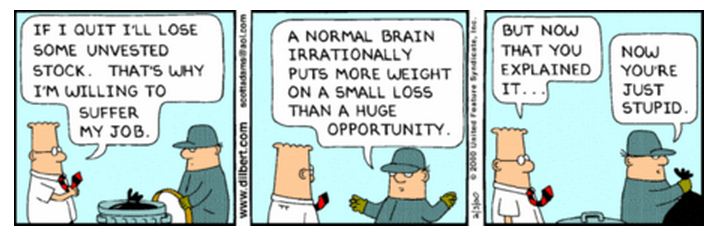
  1. A Lesson in Loss Aversion

    The Top 4 Lessons in Behavioral Economics From Dilbert image Dilbert Loss Aversion

Sometimes, a loss can feel more powerful than a gain of the same magnitude and vice versa. Considering the pain of a loss – or euphoria of a gain – can weigh heavily on future decisions it can cause more harm than good.

In this strip, Dilbert converses with a garbage man who clearly understands that sometimes losses are necessary. Interestingly enough, the discussion is about greener pastures in terms of work and many would consider sanitation an undesirable job.

4. A Lesson in Confirmation Bias

Confirmation bias is when you actually seek out evidence to support a predisposed belief.

The Top 4 Lessons in Behavioral Economics From Dilbert image Dilbert Confirmation Bias

In this strip, Dilbert’s boss believes that his managerial skills can affect the company stock. His belief is later reinforced, mostly by coincidence. However, because he was affected by bias he mistook the research as confirmation.

From a business perspective, this can affect your decisions and the future of your company. You should spend time and attention on the right elements. It also means you cannot ignore minor issues, because they could snowball into more severe problems. The best way to combat this is to get an outsider’s perspective or a second opinion before taking action – especially if you feel that your decision may be influenced by a personal bias.

Look to Dilbert in the Future

Of course, these lessons aren’t the only ones you can glean after reading Dilbert. Have you discovered lessons in other Dilbert strips? Will this information aid you in the near future?

06 Dec 03:01

Brand logos in a responsive design age

by Christopher Ratcliff

You will no doubt notice that we have a new site design. It’s a completely refreshed and fully responsive experience that should hopefully put the user first.

It’s also a work in progress.

We of course value your feedback, and as evidenced by the huge amount of comments left on our first article published after launch, you’re not shy about providing it. This means we can improve the site based on the experience of its actual users.

So with that transparency in mind, let’s talk about another element of our redesign: the Econsultancy logo.

A brief history of the Econsultancy logo

The big red dot wasn’t always a big red dot. In 2002 the very first Econsultancy logo was this ‘definitely of its time’ version replete with unnecessary hyphen and an ill-behaved ‘y’.

Later in the same year we added a touch of blue…

Then in 2008 we adopted the red circle, added the strapline “Digital Marketers United” and finally dropped the hyphen.

In late 2013 we changed the strapline to “Achieve Digital Excellence” to reflect a wider online culture, and this the one we still use today…

The problem with responsive design and logos

Responsive design loves square shapes. They shrink down or automatically rearrange themselves easily when a screen size is altered for a different device. As for round shapes… they're not quite as amenable. 

So what do you do if a circle is integral to your brand? How do you manage this aspect of your visual identity across different channels? Do you change it wholesale across the board or do you vary it according to where it's being used? (Note that we still retain the round logo offline and even in the website footer.)

Here are some of the ways the issue has been tackled...

Round peg, square hole

Check out one of my favourite online entertainment sites, A.V. Club, as it adapts to different sizes from desktop...

To tablet...

To mobile...

It’s a joy to watch as the flat tiles shrink and reorder themselves. However did you notice what happened to the AV Club logo?

The once proud and round logo turned into a rectangle block of text. From this...

To this...

This change occurred just as the screen shrank down from ‘tablet’ to 'mobile' size. 

It’s a necessary change, as retaining the round shape would have rendered the text inside illegible and the original logo would have taken up valuable space on the mobile screen.

It's hip to be square

Brands, publishers and businesses that arrived after the domination of mobile devices as a primary screen, realised they had to use a logo that worked across multiple screen sizes.

Let’s take a brief look at some of these newer sites on mobile…

Even brands that existed before the internet have adapted to the change.

This year our sister publisher Marketing Week unveiled this redesigned logo as part of a complete brand refresh across print and digital.

Other brands which are fortunate enough to contain just a block of text as their logo have also been spared this responsive trip-up...

Let's go round again

But what of the venerable organisations where their spherical logo design is as famous as the brand name itself?

Yes these may be incredibly famous logos, which consumers can spot from a mile away, but here they feel somewhat lost. The Ford logo in particular looks like it’s struggling to find a comfortable resolution.

Some companies have managed to adapt its logo as the years have passed and design trends have come and gone.

Microsoft has gone from wavy or circular…

to this modern, flat design...

Back to us…

So where does this leave your favourite digital marketing resource and its big red dot?

As you can see we’ve had to go rectangular too. This is how the new logo appears on the blog homepage on a mobile…

However we’re not just a blog, we have an entire portfolio of training courses, research and reports to offer our customers, so our homepage needs to reflect this.

In the current iteration of our refreshed design, the homepage shrinks down from the desktop to mobile, from this…

to this...

On the homepage we’ve retained the circular logo as well as the new rectangular one in the top right.

And this is where your thoughts come in… Do you think we need this twin-attack of branding here? Does it work better for the desktop, where the smaller logo is possibly a bit lost? Which do you think is more appropriate for mobile? And how much does it even matter? 

Please let us know your opinions in the comments below… 

06 Dec 03:01

Apple Is Building A $161 Million Theatre (AAPL)

by James Cook

Apple Campus

Building permits have shed new light on what's going to be inside Apple's giant new "spaceship" campus in Cupertino.  

Re/code is reporting, citing documents published by BuildZoom, that Apple's new office will include a $161 million private auditorium. 

Apple has previously used public event spaces in the city of Cupertino for its big events. The company's most recent announcement, the Apple Watch and iPhone 6 unveiling, took place at the Flint Center for Performing Arts.

But a building permit for the new Apple Campus shows that the company is investing $161 million into building its very own event space. 

Here's the building permit for Apple's new theatre:

Apple auditorium building permit

Building its own venue means that Apple will be able to keep more control over its events. Executives like Tim Cook and Eddy Cue will be able to rehearse their speeches without worrying about venturing outside and being spotted by the public. Additionally, Apple can install a permanent livestream set-up in the theatre, which should help prevent mishaps like the streaming troubles encountered during the iPhone 6 event.

Join the conversation about this story »

06 Dec 03:01

Sales Advice for Startups (& Small Biz Too!)

by jillkonrath@jillkonrath.com (Jill Konrath)

Today I spent 30-minutes on the phone with a startup company that's soooo excited about their new offering. In our short time together, they tried to tell me everything it could possibly do.

They even talked fast to cram as much in as possible. I had to slow them down to so I could digest what they were saying – and try to figure out the business value.

06 Dec 03:00

Strap with a display turns any analog watch into a smart one

by Springwise
kairos

This is part of a series of articles that looks at entrepreneurs hoping to get their ideas off the ground through crowdfunding. At the time of writing, each of these innovations is currently seeking funding.

The popularity of smart wearables in 2014 is undeniable. Smartwatches are not only an entirely new product in themselves, but theyr’e also reviving the analog wristwatch market. While those with expensive Rolexes or precious heirlooms with sentimental value won’t be looking to replace them with a digital alternative, there are ways they can benefit from smart functionality. Currently seeking funding through Indiegogo, the Kairos T-band is a stylish strap for existing timepieces that features a small screen and standard smartwatch functions.

Each T-Band E is equipped with a special clamp design that allows it to adapt to any watch, regardless of the style of its strap attachment. That means that even vintage analog watches can be updated with smart functions. The T-band itself comes in three different models.

The standard T-band OD features a portrait PMOLED touch display, as well as an array of sensors and Bluetooth connectivity so that wearers can track their health data, control music and get GPS directions, among other features. The T-band HD — which stands for ‘Hidden Display’ — replaces the standard screen with a text-and-numbers LED screen that disappears when not in use. Finally, the T-band ND doesn’t feature a screen for those that want a more subtle look. However, it does feature single LED and vibration notifications, while also featuring all of the capabilities of the other options when connected to a smartphone or device.

Watch the following video to see the Kairos T-Band in action:

Providing the capability to keep their favorite watch while also taking advantage of new technology, the Kairos T-band offers a middle ground between analog and smart, potentially making it easier for consumers to make the jump to a fully-fledged smartwatch in the future. Backers can pre-order the T-band ND from USD 129, while the full-function T-band OD is available from USD 179. The Indiegogo campaign runs until 31 December.

Indiegogo : www.igg.me/at/kairostband
Website: www.kairoswatches.com
Contact: christine@kairoswatches.com


06 Dec 03:00

How Much Can You Save?: A BYOD Cost Analysis

by Nancy Chen

How Much Can You Save?: A BYOD Cost Analysis image Dollar red.pngBYOD (Bring Your Own Device) has been increasing in popularity as more and more companies are seeking to cut costs and boost productivity. However, there have been arguments that implementing BYOD has hidden costs that could outweigh its benefits. How much does BYOD save your company, and is it worth it to implement?

Time Savings:

BYOD does indeed improve worker productivity. According to Cisco, the average BYOD user in the US saves 81 minutes per week. In addition, BYOD sparks employee-led innovation in developed countries and reduces productivity losses in emerging markets (Cisco IBSG 2013). Cisco also found that 36% of users are “hyperproductive” with their own device, saving at least 2 hours per week. 21% save at least four hours per week.

How Much Can You Save?: A BYOD Cost Analysis image DSLLs3rQTAgUR7q1VUXIKSTGGz ByvOgXJyVkWGopWad8y9WKSajQynAgJPzJ2TxWFUHbyonngOR35Dbnlb1twQ6klTT8AdFZUkRSD0z3v2Jx0p644TLKFmjw4zILSlDyA

In addition, with the implementation of BYOD, you will save training time as well. Employees are already familiar with their own devices, so any apps or new software you choose to install on their phones will not seem as foreign. Employees also typically have the most up-to-date technology, so the time it takes to complete each activity will also be reduced.

As is seen below, 65% of iPhone users have the iPhone 5 or iPhone 6, with the average device age under 800 days. Almost users have iOS 7 or 8, which are the two newest iOS updates to the software.

How Much Can You Save?: A BYOD Cost Analysis image Av8Z8g5UY6U5YcQtfn kVvWs2FOqkTfXZsEEortIrRGpEBd2a7wvRfDt1cy6k2NL 38vpDrMcEivq77dPUqqNb2GRadfYFuDnaBH sA9 aLcfByg0mRw1TeshcgLfveVfg

Source: david-smith.org

Android users have similar statistics. In addition, 81.1% of Android users have the 4.1x or newer operating platforms, suggesting that they not only upgrade their phones regularly, but also their operating systems.

How Much Can You Save?: A BYOD Cost Analysis image s3OWMCNjW NzLVmJ2WsiUw3V5K7IIkjwrdtgkVS3caAbBe 0Ymkb4YF1KLDWQiVIcmD8HVxFZEu07b4urA1TT50gbRbieGlhf6JaXtCshSYSN2SLiK6hhV LPmZrgoWuAg

Source: developer.android.com

Financial Savings:

Companies save on costs in three categories: hardware, support, and telecommunication.

  • Hardware: The average user will spend $965 on their device. This is a cost that is now moved from the company to the employee. Also, companies have to purchase new phones periodically in order to stay up-to-date on technology. This cost will be eliminated by BYOD because the user automatically will update their phone if they are not content.
  • Support: By implementing community support, wikis, forums, and other streamlined support options, companies can save $26 per user in the US and $8 per user across all the countries.
  • Telecommunication: Since you will be moving employees from corporate data plans to self-funded plans, you can save an average of $734 per user. Companies can typically migrate 20% of corporate users to a self-funded plan.

Additionally, with the 81 minutes of time saved, this amounts to $1,518 saved (based on the average salary), according to Forbes magazine. If you combine this with the money saved from the actual cost of the device ($965) and the cost of the data plan ($734), employers save $3,217 per user.

Cost Increases:

BYOD doesn’t come without increased costs – your company may find that application security, back-end infrastructure, policy development, program management, and regulatory compliance fees will increase. A big part of this cost increase is the implementation and management of a MDM (mobile device management) system.

In addition, BYOD policies often lead to employees filing more expense reports since they have more control over their phone. According to the Aberdeen Group, one expense report costs about $18 to process.

Corporate discounts are a big factor to those who argue for COPE (Company Owned Personally Enabled) devices. Since companies can take advantage of volume discounts on devices and have corporate discounts on voice and data plans, it costs less for them to purchase devices and plans than it would for employees. With company discounts, a plan would cost around $50 per user, while a similar plan would cost an employee a minimum of $80 per user. This would amount to $360 more per employee per year. Companies using COPE would not have to pay stipends to employees for devices or subsidize plans.

How Much Can You Save?: A BYOD Cost Analysis image Qaz0ZdROBSF6uARhlbY54egkXhd65xF3Pxi00iCc3 iNLm8jxSGytBV7loldK7CQUvhMqAnSNu2C6zrCPcha5i9nCwUR5gYWTNegXkTLfMOWeJyLQ HUadZ2pATHpr1xXA 656x600

Ultimately, BYOD saves companies on capital expenditures, while COPE may save companies on operational expenditures. It is important to analyze which will save you more in the long-run, but also to determine which is better suited to your company and its culture.

The Final Verdict

Although companies can take advantage of discounts on device and data purchases, BYOD cost savings far outweigh CYOD or COPE cost savings. With BYOD, you can save money on the cost of the device, the support and training for the device, and even the telecommunication. More importantly, BYOD increases productivity and innovation among workers, saving you and your employees valuable time. These factors, in addition to the research that employees prefer using their own device, cause an increase in employee satisfaction and happiness.

By clearly defining BYOD use and creating an acceptable use policy, you can counteract many of the infrastructure and management costs. If you ensure accountability using Field Activity Management software that reps can download onto their phones, you can take advantage of additional cost savings, as Field Activity Management software is cheaper than CRM. Take this cost analysis into consideration when you perform your own cost analysis on your company and determine if BYOD is the right policy for you.

06 Dec 03:00

17 People Whose Incredible Work Ethic Paid Off

by Aaron Taube

tim cook

It's nice to be talented, but the old saying is true: "Hard work beats talent when talent doesn't work hard."

Despite their obvious gifts, successful people like Kobe Bryant, Tim Cook, and Sheryl Sandberg wouldn't be where they were today without having insane work ethics.

This is an update of a post originally written by Max Nisen. 

Apple CEO Tim Cook routinely begins emailing employees at 4:30 in the morning.

Steve Jobs left incredibly big shoes for Cook to fill. However, the man got the top job for a reason. He's always been a workaholic, and Fortune reports that he begins sending emails at 4:30 a.m.

profile in Gawker reveals that he's the first in the office and last to leave. He used to hold staff meetings on Sunday night in order to prepare for Monday. 


Mary Barra rose to the top of General Motors after 33 years at the company.

Barra started at the very bottom of General Motors at age 18, when she enrolled in an engineering college sponsored by the company. There, she spent half the year inspecting parts at a Pontiac plant, according to Fortune.

She worked her way up the ladder with smart decision-making and a willingness to give the company everything she had. The Financial Times reports colleagues recall her being the first person in the office every morning and responding to emails after 11 p.m.

In 2013, her dedication was rewarded when she was named GM's first ever female CEO.


Dallas Mavericks owner Mark Cuban didn't take a vacation for seven years while starting his first business.

At first glance, Cuban's amazing success looks like a stroke of luck. He sold his first company at the peak of its value and got into technology stocks at exactly the right time.

Cuban writes on his blog that it took an incredible amount of work to benefit from his luck. When starting his first company, he routinely stayed up until 2 a.m. reading about new software, and went seven years without a vacation. 


See the rest of the story at Business Insider


06 Dec 03:00

The Best Budget Airlines In The World

by Melissa Stanger

Norwegian Air airplane

Airlines that offer great deals and customer perks have a competitive edge in the marketplace.

AirlineRatings.com recently released its list of the World's Top 10 Airlines, including the best low-cost airlines. The site looked at four regions — the Americas, Asia/Pacific, Middle East/Africa, and Europe — and named the best budget airline in each.

“These airlines may not always offer the lowest fare, but what they always do is deliver the best value,” said AirlineRatings.com Editor-in-chief Geoffrey Thomas.

Americas: jetBlue

Primarily connecting big cities around the United States, Caribbean, and Central America, jetBlue regularly features new, low fares online, and all passengers have access to personal TVs and free Wi-Fi on every flight. JetBlue has "brought a touch of class to the US domestic airline market while delivering fares that are amongst the lowest," said an AirlineRatings.com editor.

Asia/Pacific: Scoot

Scoot launched in 2011 and operates dozens of flights to 13 different locations in Asia, Australia, and the Pacific. Scoot is known for providing better-than-average leg room and its flexible flight change policy. The Singapore-based airline is owned by one of the world's best airlines: Singapore Airlines. An editor at AirlineRatings.com noted, "Travelers tell us — and we have found — that Scoot is full of value surprises that turn low cost travel into a pleasure."

Middle East/Africa: Kulula

Flying in and around South Africa, Kulula's flights are almost entirely direct and non-stop. When booking other travel accommodations like hotels and car rentals through Kulula, travelers can save up to 15% on the total package. "Kulula is a breath of fresh air in the African market," said an AirlineRatings.com editor, "combining safety, technology and humor."

Europe: Norwegian

Norwegian is the third largest low-cost airline in Europe, but it ranked No. 1 in the region by AirlineRatings.com for the other benefits it offers. Norwegian offers high-speed, in-flight Wi-Fi and on-demand video that passengers can stream directly to their own personal devices. "Norwegian is a breath of fresh of air in the airline industry combining excellent staff/management relations, technology, and a passion for passengers," said one editor at AirlineRatings.com

SEE ALSO: The 20 Best Airlines In The World

FIND US ON SOCIAL: Business Insider is on Pinterest!

Join the conversation about this story »

06 Dec 02:59

7 smart ways to use mobile app analytics

by Jason Wilson
7 Smart Ways to Use Mobile Analytics
GUEST:

Knowledge is power.  This is especially true when talking about the future of your mobile app. Informed, data-driven decisions are always better than reacting from the gut. Analytics help paint a clear picture about your app’s performance and can increase the value of your app as well as address potential challenges before they happen.

Below are several smart ways app developers can benefit from analytics to help deepen user engagement, increase revenue, and prepare an app for success.

1. Conserve time and resources

Knowing which app features people are using most and how often is valuable because it can tell you where you may benefit by focusing your development efforts as well as suggest areas of your app that shouldn’t get as much attention, saving you time and resources.

A good analytics tool helps you track specific user behaviors, or “events,” each time a someone interacts with a certain feature of your app. Imagine being able to pull up this data for a specific date range and being able to sort by different criteria, like how many times people purchase a weapon in your game, or any other feature of your app during a specific day, week, or over time. And if the data reveals that no one ever uses the specified feature of your app, you can avoid wasting time further developing the feature.

2. Make your app easy to use

  • User flow: One way to find out if your app is easy to use is to view each stage from the context of the user experience. For example, if you have a game and people are abandoning the app before completing a level, it can be helpful to find out exactly when and why they’re not advancing. Once you identify a stall in flow, uncovering the root of the problem — like a bug on certain mobile devices that doesn’t allow them to complete the level — becomes easy. The use of mobile analytics enables you to easily pinpoint obstacles or barriers to a successful user experience so you can improve outcomes of each app interaction.
  • Engagement: User engagement is another way to determine whether or not your mobile app is easy to use. Getting someone to download your app is one thing, but whether or not they use it is another matter entirely. With mobile analytics, you can track how often people use your app as well as how long they interact with it in a single session. This data can let you know if you’re moving in the right direction or not when it comes to design and functionality.

Tip: Identify multiple user events (e.g., answering a question, clicking a button, downloading an item, etc.) to create a funnel of desired activity/behaviors.

3. Track ROI (Do you know who your VIPs are?)

As the saying goes, you need to “spend money to make money.” But if you’re not optimizing your marketing channels (e.g., inventory sources)  all of the time, you’re likely needlessly wasting some of that cash. Here’s the basic process for tracking ROI:

  • Install tracking: You want to be able to know with certainty where your users are coming from before they download your app. In other words, you want to know the accurate source of your referrals – which ad networks are sending you the most new users.  Further, by knowing the lifetime value of users from particular sources, you’re going to identify the source of your most valuable customers.
  • Study Results – By separating marketing channels and tracking them individually, you can find out which campaigns are working and fund them with more money. And for channels that aren’t converting, you can spend less money.

Knowing the lifetime value of your users is an essential piece of data that enables you to successfully track your return on investment. It may seem obvious, but some are VIPs.  Knowing who is making frequent purchases or using your app most loyally enables you to market to them differently than you would a one-time user (or one that does not repeatedly return to your app).

4. App downloads vs. app usage

It’s important to note the difference between app downloads and app usage. Of the people who download your app, only a certain percentage will open it up and actually use it. This is why incentivized downloads/environments are not a very good idea. While incentivization may increase the number of times your app gets downloaded, if a user is merely lured by a one-time perk, there’s a chance that their interest in your app will be fleeting. And when this happens, the lifetime value of your users will sink like a rock.

5. Build a marketing strategy

Don’t act on a hunch. To build a successful marketing strategy that results in a nice ROI, you need to make data-driven decisions based in reliable, accurate analytics. This can help you establish clear goals that are measurable. If you don’t know which features users are interacting with the most and the source of your most valuable traffic, you’re just throwing money at advertising which isn’t smart.

6. Detect crashes and problems with certain devices

While it would be a much better world if developers could build one version of an app and have it work exactly the same on the myriad of mobile devices that are currently in use — not to mention future ones — we accept that this is just not possible. Help is available, however, for those who track crashes in order to find out which devices are having problems, and the areas within the app that are affected. Crash reporting is very important.

7. Drive conversions

Knowing what factors drive purchases/conversions so that you generate revenue is important. While bringing a great app to the world can give you a warm and fuzzy feeling, bringing in revenue is going to allow you to continue making the app better – not to mention put food on your table. By looking at individual user behaviors and in-app events as well as user flow funnels, you can identify the factors that trigger purchases, conversions into a sale or specified action so you can make a commission.

From increasing app usage to creating more revenue with better conversions, mobile analytics is the smart way to make decisions. Going with your gut feeling may work occasionally, but if you’re making decisions based on cold, hard data, you’re going to be more successful.

Dale Carr is the founder and CEO of Leadbolt, the mobile marketing platform. Ernst & Young named Carr its 2013 Entrepreneur of the Year for Technology in Australia.


VentureBeat is studying mobile marketing automation. Chime in, and we’ll share the data.


06 Dec 02:57

Oil projects worth more than $150-billion face the axe in 2015 because of plunging prices

by Ron Bousso, Reuters

LONDON — Global oil and gas exploration projects worth more than $150 billion are likely to be put on hold next year as plunging oil prices render them uneconomic, data shows, potentially curbing supplies by the end of the decade.

As big oil fields that were discovered decades ago begin to deplete, oil companies are trying to access more complex and hard to reach fields located in some cases deep under sea level. But at the same time, the cost of production has risen sharply given the rising cost of raw materials and the need for expensive new technology to reach the oil.

Now the outlook for onshore and offshore developments — from the Barents Sea to the Gulf or Mexico – looks as uncertain as the price of oil, which has plunged by 40 percent in the last five months to around $70 a barrel.

Next year companies will make final investment decisions (FIDs) on a total of 800 oil and gas projects worth $500 billion and totalling nearly 60 billion barrels of oil equivalent, according to data from Norwegian consultancy Rystad Energy.

But with analysts forecasting oil to average $82.50 a barrel next year, around one third of the spending, or a fifth of the volume, is unlikely to be approved, head of analysis at Rystad Energy Per Magnus Nysveen said.

“At $70 a barrel, half of the overall volumes are at risk,” he said.
Around one third of the projects scheduled for FID in 2015 are so-called unconventional, where oil and gas are extracted using horizontal drilling, in what is known as fracking, or mining.

Of those 20 billion barrels, around half are located in Canada’s oil sands and Venezuela’s tar sands, according to Nysveen.

ASSESSING THE ECONOMICS

Geographically, the projects on the balance are widespread.

Chevron’s North Sea Rosebank project is among those with a shaky future and a decision on whether to go ahead with it will likely be pushed late into 2015 as the company assesses its economics, analysts said.

“This project was not deemed economic at $100 a barrel so at current levels it is clearly a no-go,” said Bertrand Hodée, research analyst at Paris-Based Raymond James. He estimates a development cost of $10 billion for Rosebank, with potential reserves of 300 million barrels – meaning the Chevron would only recoup $33 a barrel.
Even with oil at $120 a barrel, the economics of some projects around the world were in doubt as development costs soared in recent years. Chevron’s Rosebank project has already been delayed for several years.

In response to a question from Reuters, the company said “the Rosebank project is in the Front End Engineering and Design phase. The review of the economics and the additional engineering work is progressing… It is premature to make any statements on an FID date.”

Hodée said any offshore project with a development cost above $30 a barrel would most likely be put on hold in current oil prices.

Norway’s Statoil this week said it had postponed until next October — a six-month delay — a decision to invest $5.74 billion in the Snorre field in the Norwegian Sea as its profitability was under threat.

New oil fields typically require four to five years to be developed and billions before the first drop of oil is produced.

Any cutbacks in oil production bodes ill for international oil companies that are already struggling to replace depleting reserves as exploration becomes harder and discoveries smaller. It also points to tighter supplies by the end of the decade.

LEAST LIKELY

Projects in Canada’s oil sands, which require expensive and complex extraction techniques, are the most unlikely to go ahead given their high investment requirements and relatively slow returns. Total recently decided to postpone the FID on the Joslyn project in Alberta, the cost of which Hodée estimated at $11 billion.

Shell’s liquefied natural gas (LNG) project in Canada’s British Columbia, already under pressure from a looming supply surge, faces further strain in the current price environment, analysts said. According to research by Citi, the project requires oil at $80 a barrel to break even.

Royal Dutch Shell’s chief financial officer Henry Simon indicated in October that it was “less likely” to go ahead with unconventional projects in West Canada if oil falls below $80 a barrel.

Asked by Reuters what the company’s current thinking was, a Shell spokesman would not comment on “internal decision-making.”

Reuters
Reuters

Even in the Gulf of Mexico, one of the most attractive oil production areas in the world, projects are facing challenges.

BP last year put on hold a decision on its Mad Dog Phase 2 deep water project in the Gulf of Mexico after its development costs ballooned to $20 billion and the oil major is now expected to further delay an investment on the field’s development.
“BP were talking positively about bringing it back, but now it may be put on hold,” BMO Capital Markets analyst Iain Reid said.

BP’s chief financial officer Brian Gilvary however said in an analysts briefing in October that he expected Mad Dog Phase 2 to be sanctioned in the first quarter of 2015.

Statoil’s Johan Castberg field in the Barents Sea, which was expected to get its FID in 2015, seems unlikely to get the go-ahead at the moment given it has an estimated project cost of $16-$19 billion, Hodée said.

Statoil said that the final project design is due in the summer of 2015. Its giant Johan Sverdrup field in the North Sea is still on track for development with a price tag of $32.5 billion.

© Thomson Reuters 2014

06 Dec 02:56

10 Tips for Getting What You’re Worth – Negotiation & Objection Handling

by Dan Thompson

*Editors Note: Recap post of the Deck presented at Sales Hacker Series in New York City on November 20th, 2014 by Dan Thompson, East Sales Director, Smarsh.

Objection Handling vs. Negotiation

Objection Handling:

  • Addressing your prospect’s concerns about your product or service in order to create technical, organizational, and personal buy-in
  • You are still selling at this stage in the process

Negotiation:

  • Attempting to reach mutual agreement about the value of your product or service
  • You have already been selected as the vendor of choice

Remember: Don’t negotiate before the prospect is sold, and don’t revert to “selling” once you’re in negotiations.

Overcoming Objections

Objection Handling: Tip #1

Learn From Your Losses

  • Review your lost opportunities over the past year and look for themes
    • Which objections came up most often? Which ones were the deal breakers?
    • What areas will require product development? What can you work or talk around?
  • Review your near-losses and close calls; opportunities you won but almost didn’t
    • What were the biggest hurdles to closing the sale? How did you overcome them?
  • Use these insights to create a “cheat sheet” of common objections and craft 2-3 potential responses for each. Test them out and revisit them often.

Objection Handling: Tip #2

Understand Your Prospect’s Real Concerns

  • Why is the objection an issue for them, and why are they bringing it up now?
  • No assumptions. Guessing at the prospect’s intention can put the deal at risk.
  • In order to truly understand, you must:
    • Validate and acknowledge the prospect’s concern (nurture)
    • Understand the problem they’re facing and the reasons behind it (ask why?)
    • Respond only once you’re sure you understand the real concern
  • Never answer a question without understanding the context behind it!
  • When in doubt, place the ball back in the prospect’s court. It’s their job to clarify.

Objection Handling: Tip #3

Stop Putting up Speed Bumps

  • All prospects have a vision of their ideal solution. This gets them ready to buy.
  • Your job is to help them realize that vision, not distort it.
  • Salespeople distort their prospects’ visions by:
    • Answering un-asked questions
    • “Pitching” unwanted features and benefits
    • Generally misaligning your solution to their pains or use case
    • Saying anything that creates unnecessary risk in the prospect’s mind

Objection Handling: Tip #4

Go for the “No”

  • “Is it over?” “is this going to be a deal breaker?” “should we just call it quits?”
  • “Walking away” tests an objection’s importance and identifies the prospect’s real concern
  • When there’s a particular objection that comes up repeatedly, don’t wait for your prospects to bring it up. Get it on the table early and seek resolution.
  • This builds genuine credibility and rapport
  • Don’t worry: Just because you’re walking towards the door doesn’t mean you have to go through it… unless, you want to.

Objection Handling: Tip #5

Understand That Pricing is NEVER the Real Issue

  • There is a direct correlation between pricing and conviction (value)
  • Less certainty your product will solve their problem means greater pricing pressure
  • Solution: Learn what your prospects would need to see to justify paying more, then show them you can deliver (ROI)
  • In other words: Let your prospects answer their own objections.

Better Negotiation

Negotiation: Tip #1

Have a Game Plan

  • Determine your pricing “envelope” – your best, worst, and most likely scenarios
  • Create a list of potential negotiables – setup fees, minimum commitments, etc. – and assign trading values. Remember that contract terms have value too.
  • Know your non-negotiables and stick to them
  • Remember your prospects will have their own envelope and negotiables too.

Best and Worst Case Scenarios in a Negotiation in Sales

Negotiation: Tip #2

Consider Your Prospect’s Environment & Business Drivers

  • What do you believe is of value to this particular prospect? Why?
  • Internal & external factors influencing their decisions may include:
    • Buying team, business challenges / goals, and individual motivators
    • Short- and long-term strategy – expansion, relocation, new technologies, etc.
    • Competitive pressures, market trends, and general business environment
  • Determine their most likely alternative – a competitor, develop in-house, or doing nothing
    • What unique advantages does your product or service provide?
    • This will determine how much leverage you have

Negotiation: Tip #3

Never Give Anything for Free

  • Always get something comparable or greater in return when you give concessions
  • Know what items could sweeten the deal for you:
    • Commitment to sign within an agreed-upon timeframe (EOM, EOQ, etc.)
    • Longer initial term (annual vs. monthly contracts, multi-year agreements)
    • Case study or reference account, use of logo in marketing materials
    • Introduction or referral to other potential clients
    • Better payment terms (upfront vs. monthly payments, shorter collection times)
  • “Freebies” lower your solution’s (and company’s) perceived value

Negotiation: Tip #4

Know When NOT to Negotiate

  • Providing certain concessions create undue risk to the business, regardless of how much you may want the deal, the new logo, or the revenue
  • Owners and Sales Managers: It’s your job to know when these times are.
  • Set guidelines, implement check-and-balances, and stick to them.
  • This is easy if you’ve done a good job creating your pricing envelope and valuations
  • Live to sell another day…

Negotiation: Tip #5

Quarterback the Process

  • Consider the various buying centers involved: project sponsors, technical buyers, legal, procurement, etc.
  • You must always be working these functions in parallel
  • As the seller, it is your responsibility to drive the procurement process

One Final Tip:

Keep Calm and Don't Take it Personally

In Summary

Successful objection handling and negotiation ultimately comes down to:

  • Knowing yourself, your customers, and your marketplace
  • Remembering that “pricing” is really about conviction
  • Having a game plan and never giving anything for free
  • Owning the process and maintaining control
  • Never taking things personally

The post 10 Tips for Getting What You’re Worth – Negotiation & Objection Handling appeared first on Sales Hacker.

06 Dec 02:55

CEO Secret Ingredient For Revenue Growth

by Dave Hubbard

What is preventing most companies from increasing revenue growth?  The answer is not as obvious as you may think.

Some CEOs have figured out the secret ingredient needed to solving this issue regardless of industry or economy or company size, and they are enjoying sustained double digit growth.

Before we jump to solutions, however, let’s try to get on the same page regarding the root cause of lackluster growth.

The Most Common CEO Action For Increasing Revenue

CEO Secret Ingredient For Revenue Growth image CEO Secret Ingredient For Growth Image 300x171

CEO Secret Ingredient For Growth

Five or ten years ago, it used to be that the Sales leader was automatically held accountable for lackluster growth.  It made sense: Sales did the lion’s share of new business development while Marketing focused on marketing communications and Product Management focused on features.  Sales leaders are still being held accountable for sales growth, and the average tenure for the CSO/ VP Sales has dropped to 18 months, but revenue growth hasn’t improved.  What’s next?

CEOs then turned to their Marketing leader.  Marketing bulked up on technology, staffed up for new initiatives, and focused more on demand generation.  They generated lots of leads, likes, followers and tweets.   While engagement increased, revenue growth did not meet expectations.  Marketing leaders are now being held more accountable for revenue growth and the average tenure for the CMO/ VP Marketing has started to drop.  In a recent IDC survey, 50% of the companies surveyed had changed their CMO in the past two years.  Is this the right solution? No one will really know for another couple of years.

As CEO, can you wait another couple of years before knowing whether your company is on the right track with your latest executive replacement?

Stay Focused On Your Goal: Increased Revenue Growth

Holding executives accountable is an admirable CEO trait, however, simply replacing one or two executives may not ensure company revenue growth.

If you want growth within the next 12 months, you need a better solution.  Even if you are convinced that a new CMO or new CSO will add new value, you should always hedge your bets.   Dig deeper into the issue.

Whatever has changed in the past five to ten years, it is impacting more than just your company. Most companies are struggling with revenue growth rates and are replacing their leaders at a faster pace. Yet some companies have figured out how to grow faster than their peers:

  • most salesforces are having great difficulty generating sufficient new business (yet those with the right sales process achieved 18% more revenue growth according to the Sales Management Association)
  • most marketing groups are increasingly unable to demonstrate ROI (yet high growth companies have 47% of the sales forecast originating from Marketing leads according to a study by Aberdeen Group, and, firms generating 40% or more of their new business leads digitally grow 3 times faster according to the Society for Marketing Professional Services)
  • most new product launches are not dramatically improving revenues and profit (yet those with the right focus had products that produced 50% of the company’s sales and profits according to the Product Development & Management Association).
  • most sales and marketing technologies are not driving dramatic growth (yet companies that successfully aligned cross functional business processes to fully leverage these technologies consistently grew over 13% faster according to Aberdeen Group).

Clearly, something has changed in the marketplace that is affecting most companies regardless of industry, economy or company size.  Some companies have adjusted to this market change, others have not.

Your Company Is No Longer Aligned To Your Buyer

Your company recognized early on that buyers were taking full advantage of internet, social, and mobile technologies.  As a result, you invested heavily in digital technologies and social expertise to keep pace.

However, these investments have not increased your revenue growth rate:

  • Sales increased their focus on cold calling and social selling to increase new logo business, but it has not resulted in sales growth. In fact, sales forecast accuracy and reliability have dropped in recent years.
  • Marketing increased their focus on branding, engagement and demand generation with investments in both marketing expertise (social marketing, email marketing, digital marketing) and marketing technology (analytics software and marketing automation). Yet revenue growth rates are disappointing. In fact, marketing still has not been able to demonstrate Marketing ROI.
  • Product Management increased the breath of the product line, the complexity of the product line, and the rate of new product introductions according to a recent study by CSO Insights. However, these increased product launches haven’t produced the revenue bump CEOs were hoping for.
  • And finger pointing is at an all-time high. Sales is complaining about low quality of Marketing leads and too many un-compelling products from Product Management, Marketing is complaining about lack of Sales follow-up on leads, and Product Management doesn’t think Marketing or Sales are focused enough on new product launches.

The buyer purchasing process is evolving as fast as the internet is evolving.

Your company’s revenue strategy and process has not kept pace with the digital changes within the marketplace. Your three primary revenue-generation functions are no longer aligned by a common revenue strategy and process.

By aligning your company’s revenue strategy and process to the evolving buyer purchasing process, you will be leveraging the successful strategies that high growth companies demonstrated in the above-mentioned studies by Aberdeen Group, Sales Management Association, Society for Marketing Professional Services, Product Development & Management Association, and others:

  • Product Management will launch products that meet the buyer team requirements
  • Marketing will generate an increased number of high quality leads by helping the buyer team move through their purchase process
  • Sales will spend much more time closing business with the help of the right information from Marketing and Product Management
  • Alignment: Since all three functions are aligned to the same buyer profile by the company revenue strategy, they become more aligned with each other, and better able to align the cross-functional revenue process quickly.

Your Next Step?

As most CEOs know from experience, “alignment” is often code for changing cross-functional business processes, integrating systems cross-functionally, modifying organization structure, adjusting budgets and/or tweaking incentive plans.

You don’t have the time or energy to lead such an initiative.  Or, maybe you lack the Sales and Marketing expertise to tackle such a project.   However, delegating cross-functional leadership to a senior executive is problematic.  As soon as someone other than the CEO tries to impact change to a function’s budget, compensation, or priorities then productive change seems to grind to a halt.

The Chief Executive Officer is the cross-functional leader and must lead such an important initiative if you really want to see meaningful change within the next 12 months.

The CEO Secret Ingredient For Revenue Growth 

CEOs must have a “change agent” who can be their lieutenant to design and implement the needed changes.   It could be one of the company executives, or an outside consultant, as long as the person:

  1. has cross-functional revenue generation experience, and
  2. can design and implement a successful plan of action, and
  3. will roll up their sleeves to help the CSO, CMO, Head of Product Management, and their senior staff, execute a successful plan within the next 12 months.

The marketplace has changed. For your company to increase revenue faster than its competitors, your revenue-generating groups must stay aligned to your evolving target buyer.  A detailed discussion and outline of a CEO Action Plan for growth can be found here.

The pressure on the CEO and Board of Directors to achieve sustainable growth continues to increase. Simply replacing the CSO and/or CMO is not working. What will happen next?


Was this helpful? Then please share it with your colleagues.

06 Dec 02:54

Sales Leads and Sales Teams – You’re Really Just Getting a Job

by Matt Ford

There are two ways to interpret the phrase, “Got a job.” One is the usual, “Hooray, I got employed!”

The other is the kind you hear when you’re watching a movie about hired mercenaries or bounty hunters. Expendables. Charlie’s Angels. A-Team. All these action flicks feature really rugged business relationships where ‘jobs’ are in fact complex assignments or missions (oh yeah, and full of shooting stuff).

But you know, the same thing could apply to sales teams and sales leads.

Sales Leads and Sales Teams – You’re Really Just Getting a Job image jpgYou don’t have to risk an early grave just to appreciate the level of heavy work required to win certain B2B sales. Your salespeople may not have guns but they’re just as armed with their capacity to research buyers, figure out who’s who, and come out with a big payout.

At least, that’s the ideal.

Unfortunately, most people still think the work of sales teams isn’t that much different from that girl at the cash register. Worst still is that this mentality carries over to the ones responsible for qualifying sales leads and marketing complex products. The end result is that you’ve oversimplified your value proposition and your ‘leads’ produce almost to zero sales.

You’ve heard this story before. And frankly, you might even want to trade it for the clichés of action movies. But here’s the good news: You don’t have to quit. Your sales team can work as if their work was its own movie.

  • Redefine the size of your sales leads – Some sales leads are only as good as the extra work put into them prior to the sale. Other times, just a name and a few rumors are enough for a top class sales team to go by. The trick is knowing how much work your lead generator has to do prior to your team.
  • Count how many moving parts – You really wouldn’t be having trouble getting sales out of low quality sales leads if your sales process was as simple as advertising and selling. Otherwise, always be wary of the many moving parts to a B2B prospect’s buying decision. Think of your lead generator as that one bartender with all the connections or the personified ‘word on the street.’ They can drop the names and brief your sales team on the situation but always be prepared to do more research.
  • Align lead ‘quality’ with sales ability – But above all, sometimes the best leads can be difficult for particular type of sales rep. Don’t waste sales leads by mismatching them with the wrong people. Instead, always keep your marketers and sales close so that they can assign the right tasks that will lead to a close.

There’s a reason why sales and marketing are both better off as one department instead of two different silos. (In fact, you’d best get rid of silos. Period.) Lead generators may just be getting a job but in that could be a lot of work with a lot of payout.

06 Dec 02:54

Never mind the marketing message, what about the sales conversation?

by bob@inflexion-point.com (Bob Apollo)

If your organisation has a complex sales process that requires a series of interactions over several months with a range of different stakeholders, there’s one thing that matters above everything else - the effectiveness of your sales conversations.

This_is_the_good_stuffNot how much you spend on marketing, or how clever your campaigns are, or how distinctive your logo looks, or any of the other things marketers are tempted to spend time and money on. Nothing matters more than setting the scene for a series of effective sales conversations.

But here’s the problem: far too many marketers seem to believe the job is done when their message has been delivered to the target audience, or a “lead” has been generated - but at that point the real heavy lifting has only just begun…

I believe that this “message-out” thinking is so engrained in so many marketers thinking that only a radically different perspective can overturn it. I am absolutely convinced that B2B marketers in complex new business environments need to turn through 180° and switch to to a “conversation-first” approach.

Four key questions

Rather than pivoting around the message they intend to deliver, B2B campaign planning must start by answering four key questions:

  • What sort of sales conversations do we intend to stimulate?
  • Who do we intend to have these conversations with?
  • What do we need to do to make more of these conversations happen?
  • What do we need to do to make these conversations more effective?

Defining the desired conversation

When we start by thinking about the desired conversation, we are forced to pay attention to whom we want to talk to and what we want to talk to them about, and what we need to do to equip our sales people to have a productive discussions with them.

When I talk about a “productive discussion”, I mean that the conversation proves to be a valuable use of both the prospect’s and the sales person’s time, and that if interest is successfully stimulated, the prospect happily agrees to take a defined next step.

Getting under the skin of the stakeholder

But if we’re to achieve this, we need to really understand who our target stakeholders are and what they are likely to be interested in. It requires that we develop a set of insights that are going to pique their interest and make them want to hear more.

And it requires that we equip the sales person with a bunch of relevant insights, facts, anecdotes and stories that are going to engage the prospect’s attention - and it requires that we equip them to ask thoughtful, relevant questions that both parties end up learning from.

Re-prioritising our demand generation and thought leadership

Armed with this understanding of the outcome we want to create, we can work backwards to lay the foundations for the conversations we want to have. Our demand creation campaigns can be crafted with the prospect interaction in mind.

Our understanding of the conversations we want to stimulate can also help to inform our choice of thought leadership programmes, and help shape and prioritise the themes we want to communicate to the marketplace.  It all comes from working backwards from the conversation.

Eliminating wasted effort

One of the great benefits of this conversation-first thinking is that it can help to avoid a huge amount of wasted effort in creating marketing materials, campaigns and programmes that do nothing to set the scene or provide support for these all-important conversations.

And because this approach is impossible to execute without very close collaboration between the sales and marketing organisations, it facilitates a level of sales and marketing alignment that remains unfortunately all-too-rare in traditional B2B marketing organisations.

What you need to do now…

I suggest that you start by asking your field sales people how many of the “leads” from your current marketing campaigns are resulting in the right sort of sales conversations - and how well equipped they feel to convert their initial conversations into well-qualified opportunities.

The answer - unless you’ve already adopted conversation-first thinking - is that there is probably a heck of a lot of scope for improvement. Involving the sales team might feel like an unnatural experience to start with. Thinking backwards from the desired conversation isn’t the classical way to develop marketing campaigns.

But perhaps it ought to be. You’ll almost certainly end up executing fewer but more effective campaigns. Your sales people will inevitably have more of the right sort of conversations. And the results - in terms of pipeline value and revenue generated - will indisputably be worth it. 

Identifying Your Ideal Customers

06 Dec 02:54

Want More Leads But Don’t Have A Blog? Here’s How To Get Started

by Douglas Burdett

Did you know companies that blog have 55 percent more website visitors and get 70 percent more leads than those that don’t blog? Here’s how to get started.

Want More Leads But Don’t Have A Blog? Here’s How To Get Started image How To Start A Lead Generation Blog.jpg

Content is the fuel that drives successful marketing. Marketing analyst Rebecca Lieb from the Altimeter Group puts it this way: “Content is the atomic particle of all digital marketing.”

By creating valuable, high-quality content that is targeted at a specific audience (like your prospective customers), you will attract more visitors to your website. More importantly, you will attract the right visitors because they are likely to convert into leads and customers.

Creating helpful content will also help with your search engine rankings. Other sites are more likely to link to yours if you are publishing helpful content – and that boosts your rankings and helps improve your website’s discoverability.

By far, the most effective way to increase site traffic and leads is with a company blog. A blog makes your site dynamic by injecting new content every time an article is published. Search engines reward websites that consistently add fresh content. And that translates into more visitors and leads.

The secret to blogging success, however, is to think like a magazine publisher. The goal of your blog is to publish valuable, nonpromotional posts just as an industry magazine that runs fresh or newsy articles.

Write for your customers. When blogging, make sure to avoid industry jargon that’s understood by your employees but not by prospective customers.

So what do you blog about? If you want more traffic and leads, don’t write about your company and its products. Instead, write about the problems your potential customers face.

The best way to start a company blog is to answer the 10 most common questions you get asked by prospective customers. Query your sales team and customer service people for the most common questions. Once you have those 10 questions, you have your first ten blog posts.

Now publish one a week. After 10 weeks, look at your analytics to see which ones got the most traffic, comments and shares on social media.

A blog post doesn’t need to be a complicated magnum opus. Here are the five most important things you need:

  1. A compelling title – Take as much time as you need to create a great title. It needs to clearly indicate what the article is about, including the benefit to the reader. Remember that clarity trumps persuasion.
  2. Well-written and formatted text – Use headers and bullet points to break up the content into sections. Online, readers scan more than they do with print.
  3. Multimedia content – This can make a blog post more memorable and fun to read. It also helps break up the text, making it more pleasing to the eye. Aim to have a least one relevant image per post. But don’t stop there if you have other relevant information in the form of slideshow presentations, videos and infographics.
  4. Links – In-text links to relevant content can help readers dig deeper into the resources they are most interested in. You can point to other content on your site and landing pages to help you generate more leads.
  5. Call-to-Action (CTA) – A CTA is a website button, image, or text link that encourages a visitor to take an action by typically clicking on the button, visiting a landing page, and filling out a form in return for some kind of content. Often, that content is a white paper, e-book, webinar, or a newsletter.

That last one is real important. EVERY blog post should include one or more CTAs to help boost lead generation. Include CTAs in the sidebar of your blog as well as at the end of every post. You can also include text CTAs within the body of your blog content.

Want More Leads But Don’t Have A Blog? Here’s How To Get Started image Starting A Blog Inspiration.png
Before launching your blog, make sure to prepare at least one piece of in-depth, lead-generation content like an e-book that will prompt an “information exchange” on a form behind the CTA. Other types of premium content that can be offered include white papers, research reports, how to videos or recorded webinars. Effective lead generation content is something your prospects might be willing to pay for.

06 Dec 02:53

How to Close a Sale in 5 Steps [Infographic]

by esnider@hubspot.com (Emma Snider)

how-to-close-sales-deal-steps-916800-edited.jpeg

Sales is definitely part science, but it's not rocket science. If reps adopt effective processes, it becomes much easier to prospect, qualify, and sign new buyers.

Closing sometimes seems like the most mysterious of all sales activities. Some reps are great at knowing intuitively how to close a sale, and others ... not so much. With a solid procedure, you don't need good instincts to close effectively (although they'll still come in handy, of course).

This infographic from Refresh (acquired by LinkedIn) presents a five-step approach to winning deals, complete with data on why each action is necessary and effective.

The next time you might be tempted to send a boilerplate email or pick up the phone without researching your prospect's industry, think again.

how-to-close-a-sale

Editor's note: This post was originally published in December 2014 and has been updated for comprehensiveness and accuracy.

HubSpot CRM

06 Dec 02:53

Inbound Selling Has Evolved. Have You?

by dtyre@hubspot.com (Dan Tyre)

When we started calling on inbound leads in 2009, prospecting was a little awkward. After we received an inbound lead, we would pick up the phone, introduce ourselves, and start explaining HubSpot. Talk about old school. Show up and throw up.

That is until Katharine Derum, one of the first 40 employees of HubSpot, came up with one of the seminal changes in inbound sales.

06 Dec 02:53

Lessons In Qualifying Leads From The Walking Dead

by Matt Lipson

What does surviving a zombie apocalypse have to do with qualifying leads? More than you’d think! 

The Walking Dead TV series wrapped up its midseason finale last week. The plot revolves around the life of former Atlanta Police Chief Rick Grimes, who has been placed in charge of a group of survivors comprised of family and friends he’s made since the zombie outbreak first started. In this new world, where thousands of hungry zombies are trying to eat people any chance they get, it is fascinating to learn that what Rick and his group fear the most is the savagery of other human beings.

Due to this fear, the process for admitting new survivors into the group has changed dramatically from “the more the merrier” to an intense, albeit brief, character evaluation.  To become a member of the group, Rick has decided that there are only three questions to judge if a candidate is worthy of admittance:

  1.      How many walkers (zombies) have you killed?
  2.      How many people have you killed?
  3.      Why?

Based on the answers to these three questions, Rick and his group are able to efficiently determine whether or not each candidate is a good fit.

Lessons In Qualifying Leads From The Walking Dead image walking dead.png

How Sales Reps Qualify Leads

Now, imagine if your sales reps were able to able to qualify and disqualify inbound and outbound leads with a comparable level of efficiency? It isn’t inconceivable to get this kind of productivity from your sales team, but in order to do so, your sales and marketing teams will need to align on the following:

  1. Ideal Customer Profile- This is based on demographics, psychographics, and behaviors that indicate a high level of buying intent for your company’s product or service.  Defining your ideal customer is critical and will help both sales and marketing focus on selling to the right people.
  2. Essential Discovery Questions- Once you have your ideal customer profile, you need to pinpoint the questions that your sales reps must ask leads in order to determine whether or not they are qualified.
  3. Qualifying & Disqualifying Answers- What responses to discovery questions are indicative of a warm prospect? What responses are indicative of a cold prospect? What responses warrant further questioning?

Just like Rick, your business can’t afford to waste resources on the wrong people.  Whether it’s finding shelter away from zombies or separating yourself from competitors, there is no time to waste, and efficiency is everything.

06 Dec 02:53

4 Types of Content That Every Business Must Create

by Patrick McFadden

Selling with educational content (via a blog, webinar, seminar, newsletter, magazine, workshop, report, eBook, tip sheet etc.) is not about convincing someone to buy something that they don’t want or need. Rather, it’s about overcoming objections to buying from you.

4 Types of Content That Every Business Must Create image how to content 300x154

Effective marketing now requires that educational content is part of the strategy conversation in almost every business. ( Get more insight into this here: 7 Components of a Successful Marketing Plan)

The word content itself has a lot of hoopla around it today making it difficult for many organizations to view it with the granularity needed and discover the role it plays in the customer life cycle.

On a strategic level, content must mean more than a blog post, status update or tweet. You must think about your content achieving a strategic business goal or objective. Building an asset to serve your organization over time.

You must also think in terms of your content as a marketing tool that moves suspects to prospects, prospects to customers, customers to advocates and in this effort there are at least four types of content that you must address.

Here are some ideas to get you started:

Suspect Content – Everyone in your target market

When your entire target market is not aware of your company, product, service or the benefit it offers, then the first objective of content is to simply build trust.

Trust can be built through:

  • Blogs
  • Customer Reviews
  • Articles

At the heart of every transaction is TRUST and in general, trust is what’s in short supply. If more people trust you more, everything else will fall into place. There’s a really big gap between someone being aware of you (which is really hard) and someone trusting you, enough to invest in you or buy from you.

Prospect Content – Anyone who has taken action to solve a problem that you can assist them with

There’s an huge difference between awareness and action. Putting something in the world for awareness is useless if it doesn’t lead to taking action.

As the market begins to trust you and competitors enter that market. Prospects will seek a differentiation….your unique approach, your solution, your message and your organization.

At this stage you need to you need to educate about that differentiation:

  • Special Reports
  • Marketing Kit
  • Seminar

People want to be educated not sold. They will sell themselves if you just stick to educating.

Customer Content – A person or organization that has bought products or services from you

You’ve done all this work attracting and educating now show your customers how to get the most out of what they just bought. This builds loyalty and community.

  • How to get the most out of – product or service information
  • New Customer Kit
  • Q&A Sessions

This is were most organizations stop their marketing but you should continue it if you want repeat sales.

Advocate Content – A person or organization that tells others and basically sells for you

This last stage of the customer lifecycle is one that gets overlooked in view of content. Ultimately, great content has the ability to help your advocates spread the word and increase awareness, generate leads and convert prospects .

  • Referral coupons
  • Access to “behind the scenes” content
  • Customer appreciation events

Think about this

Here’s the deal. This closely resembles the customer life cycle for every market. It begins in stage one and closes in stage four As you can see this presents some challenges for business owners and organizations, namely, they must adapt or perish.

You may enter a new market and clean house, only to fall behind when competitors enter and steal market share. The business of successful marketing and selling is about constant improvement. Constant change.

06 Dec 02:52

5 Reasons Why Blogging Matters to Your Business [Infographic]

by Will Blunt

There is an ongoing debate about the validity of blogging for business. Today there are so many other trending forms of content such as podcasts, video campaigns, infographics and Slideshare’s that many people question whether blogging is still important.

Do you think blogging is still important to the success of your business?

I certainly do. In fact, the irony of writing a blog post about the death of blogging always amuses me. Blogging is far from dead, it is still a crucial element in boosting the visibility of your website. I decided to jot down a few points about why I think blogging is still important for businesses. Here is what I came up with (backed by some cool stats)

1. Search engines love your blog

Why do search engines love your blog?

Because blogs give them so many chances to figure out what your website, and each page on it is all about. By including ‘long-tail keywords’ in your blog content, you predict what your customers will type into search engines and improve your chance of appearing on the first page in a search query.

2. Social networks crave blog content

After search engines, social media delivers the most traffic to websites. If you write highly engaging content that people want to share on social media you will drive a significant spike in your website traffic. Have a look at the screenshot below of a post I wrote here at Business 2 Community. It has been shared over 2,000 times on social media! Imagine the traffic spike from that post alone.

5 Reasons Why Blogging Matters to Your Business [Infographic] image B2C Blog Social Shares 1024x8277.png7 742x600

Pure web traffic is not always a good thing unless you can convince those readers to do something more meaningful; be that a social share, comment, email sign-up or purchase. That is why it is essential to optimise your blog posts with call-to-actions.

Here is a nice post with ‘15 Call-To-Actions for Blog Posts I found over at Writtent.

Also if you use WordPress, I recommend getting the calls-to-action plugin from ‘Inbound Now’ – it will help you convert more traffic into leads.

3. Helpful blog content drip feeds quality leads into your sales funnel

A sales rep is only contacted after a customer has independently completed 60% of the purchasing decision process. (Source)

Your goal when running a business blog should be to provide helpful content to your customers at every stage of their sales journey. Whenever your potential customers have a question about your product or service, and they type that question into Google, wouldn’t it be great if you had written a blog post to answer it for them?

An example of this is to write a blog post that compares your product or service to a competitor. Your average customer who is researching a purchase decision will value this type of information, but be careful not to over-sell your side of the equation. Be objective and it will build trust with your customer.

Business Blogging Case Study

I urge you to read the Groove HQ blog if you get a chance, it is the perfect example of successful blog marketing. It proves the value of blogging for business growth and delivering quality leads into your sales funnel, check out this post to see what I mean;

The ROI of Blogging – Groove HQ

4. A successful blog saves you money on traditional marketing techniques.

Outbound marketing costs on average 2.7 times inbound marketing per lead. (Source)

Outbound marketing techniques, such as pay-per-click advertising, assume that to get people’s attention you need to pay for it. Inbound marketing flips that assumption on its head. Instead of exchanging money for people’s attention you exchange valuable content that solves their challenges. This content requires an investment of time, not money.

Every time one of your customers reads or shares the content you provide, you place a trust deposit. The more deposits you place, the higher the trust, and the less work you need to do to convince those customers to buy your product or service. With paid advertising, once you stop paying, people stop listening. But with inbound marketing you build a castle of content that accrues value over time.

Helpful content creates trust. This trust then becomes the cornerstone for customer advocacy.

Your blog is one of the easiest ways to provide helpful content to your customers.

5. High quality blog content helps you stand out from your competition as an expert.

“You can’t be a thought leader without being a writer” – Ann Handley

Creating a reputation for your brand that commands authority in its field requires a number of factors to be in alignment. Perhaps the most important of these factors is your ability to write high quality content backed by original ideas, research and practice.  Your blog is the perfect channel for distributing this thought leadership content and increasing your credibility. In fact thought leadership is one of the top reasons companies choose to blog. (Source)

I created an infographic of the above blog post from Bluewire Media below;

5 Reasons Why Blogging Matters to Your Business [Infographic] image Why Blogging Matters to Your Business1 e1417329604917.png
This infographic was originally published at Blogger Sidekick.

My Verdict

Blogging isn’t dead, it is just getting harder.

Your readers have an exorbitant amount of choice for what they read, and it is extremely easy to get lost in that noise. Therefore it’s never been more important to create fantastic blog content. If you consistently create high quality blog content you will;

  • Develop a lasting relationship with page one of Google
  • Maintain a full sales funnel
  • Be a rock star on social networks (and get the added web traffic as a result)
  • Save money on expensive outbound marketing campaigns
  • Build authority in your industry

Is blogging still a big part of your marketing strategy?

04 Dec 18:16

10 Business Resolutions for Salespeople in 2022

by dan@danwaldschmidt.com (Dan Waldschmidt)

New Year's eve isn't the only time you can set resolutions for yourself or your business. When you're noticing a slump in performance, a lack of motivation, or an opportunity to grow in your career, try putting some business resolutions in place to get back on track.

In this post, we give you 10 of the most revitalizing business resolutions to work toward this year.

Free Download: Sales Plan Template

1. Commit to your why, what, and how.

From the outside looking in, sales can seem like a stroke of luck rather than a skill that's practiced over time. The truth is, to become a successful salesperson you need to understand why you're selling.

Take a moment away from the phones, your quota, and your team to reflect on why you chose sales as a career path, why you chose the company you work for, and why you believe in the product you're selling.

Your personal why will put your what and how into perspective.

From there, be consistent. And to be consistent, you need to set benchmarks — that's your what.

Creating a sales plan gives you a way to organize these benchmarks into goals, objectives, and tactics.

Keep in mind that setting your goals and benchmarks is not the same as planning a list of tasks for the week. When you lead with your sales plan, you're leading with what you need to accomplish on a macro level. From there, you can decide how to accomplish your plan on a micro level.

This framework puts first things first and helps you become a more agile professional. As long as your why and what are fixed, you can adapt your how to to meet the needs of the business.

2. Form an SLA with the marketing team.

There's no such thing as "enough" leads that marketing could supply to the sales team, and sales would love to close deals every hour if they could. But thanks to reality, that just can't happen. But both teams can get relatively close to this by creating a customer flywheel. This happens when marketing and sales are moving in lockstep.

When the marketing team attracts prospects, they pass the baton to the sales team to engage them. Over time, your business will consistently deliver a remarkable customer experience.

A positive relationship between marketing and sales is paramount to the success of the business. This year, make a commitment to forming an SLA with the marketing team so that everyone understands who's responsible for what.

3. Form an SLA with the service team.

Remember the customer flywheel we mentioned earlier? One third of it includes your customer service team.

The handoff of a customer's account from the sales team to the service team can reveal a lot about the customer culture of your business.

A smooth handoff can indicate that your sales and service teams are working in tandem to serve the customer. A frictional handoff can expose some gaps in your sales and onboarding process, leaving customers to pick up the pieces.

To avoid a frictional handoff between these two teams, take a day or two to workshop an SLA with the service team and revisit it often to make sure it's serving its purpose.

4. Commit to prospecting a percentage of your leads.

Now that you have a business resolution for developing a marketing SLA, that means you can watch the leads roll in right? Not exactly.

Your sales goals should be your main priority and as a result, you'll want to hold some control over how you meet them. Making a commitment to prospecting some of your leads not only gives you more control over your pipeline, but you'll build your network as well. We know that not every prospect becomes a lead, but they may be able to make referrals for a person who is a better fit for what you sell.

5. Track your sales pipeline.

Sending out a series of emails to prospects and keeping your messages in the same thread is not the same as tracking your pipeline. Tracking your pipeline is a way to view, in real time, how close you are to meeting your goals.

To do this effectively, start with a sales software that you can use to track each prospect through the entire sales process. HubSpot's Sales Hub is an affordable CRM that you can set up quickly to start this new year on the right foot.

HubSpot's Sales Hub CRM software

With a tool like this, you can add new prospects manually or set up a workflow to automate the process for you. As you move through each step with the customer, you can set automated tasks on their account like "Check in with Sandra on April 11th" or "Include the CFO on the meeting invite with ABS Enterprise", that way, you never miss an opportunity to close a deal.

6. Automate your workflow.

Speaking of automation, automating your sales workflow should be top of mind as you set your business resolutions for the year. Work smarter, not harder by creating workflows, email sequences, and chat conversations.

Each of these touch points is an opportunity to engage a prospect to become a lead who, in turn, becomes a customer. And all of this can be accomplished without manual work on your end.

That means you can spend more time making genuine connections with potential customers and less time on administrative tasks.

7. Join a book club.

How many times have you heard a friend say they wanted to read more in the new year? Reading more books is a popular resolution for folks of all career paths, including salespeople.

If you want to read more but aren't sure where to start, set a resolution to join a book club. Whether it's through work, a social book club, or one with your family and friends, you lean on your support system to achieve your goal of reading more.

Plus, reading in community can help you form a deeper understanding of the content and make connections you otherwise wouldn't have on your own. If you're looking to strengthen your emotional intelligence with your prospects and leads, this is the way to do it.

8. Commit to mentoring new reps.

New sales reps don't start the job knowing all the tips, tricks, and best practices for selling — especially if they've never sold or even used your product before. But all too often, new reps are expected to learn on the job and fail forward.

Even if you're not a sales manager, make a resolution to mentor a new rep on your team. Showing them the ropes will only help your team become more successful.

Taking on this extra responsibility can help your career as well by giving you leadership experience and showing your higher ups that you're a true team player.

9. Grow your network.

This one's obvious, but it's worth a spot on your new year's resolutions list. Growing your network is a goal that you shouldn't dismiss as a passive outcome of selling. It's an opportunity to actively give back to your community both virtually and in person.

Expanding your network should be altruistic. Serving others with your content, ideas, stories, and even your own network can have tremendous benefits for you in the long run when it's time to close a deal.

Wouldn't it be nice if a customer came to you ready to make a purchase because they heard great things about you from a friend? That's what growing your network is all about.

10. Measure your performance.

The final business resolution we recommend for sales reps is to measure your performance. You can take a three-pronged approach to this:

  1. Track your metrics using your CRM software. You'll want to review numbers like your closed-won deals, and time-to-close. This gives you a black and white view of whether or not you're meeting your goals.
  2. Next, get more subjective feedback from your manager and team. Are you a team player? How are your deals affecting the larger team's KPIs? What could you be doing better in their eyes? Measuring your soft skills in this way keeps them top of mind so that you don't sacrifice them in order to hit your numbers.
  3. Check-in with your family , friends, and other non-work stakeholders in your life. Are you showing up for them or is your work standing in the way? There's no right answer here, but it's worth checking in to see if you're happy with your work-life balance or if your other resolutions should be revisited.

Measuring your performance in each of these areas is sure to give you a well-rounded view of how you're really doing both in and outside of work.

By setting business resolutions now, you have an opportunity to become an even better salesperson for this year and the years ahead. Don't get too ambitious, however — choose one to three goals this year and add more as you achieve them. Soon enough, you'll be on your way to your most successful year in sales yet.

Editor's note: This post was originally published in [Month Year] and has been updated for comprehensiveness.

sales plan

04 Dec 18:16

How to Make Every Sales Touch Count

by andy@zerotimeselling.com (Andy Paul)

If you want to amp up your sales in 2015, it is absolutely essential to make each and every sales touch count. 

This may seem like obvious advice, but it is wisdom too many salespeople overlook. Your buyers are busier than ever which means they have less time to pay attention to you. This puts the pressure on you to be 100% certain you will make interactions worth the prospect's time.

04 Dec 18:03

Disney swoops into education business with ‘Imagicademy’ apps like Mickey’s Magical Math

by CB Staff

NEW YORK, N.Y. – Mickey is getting into math — and science, art, reading and even teaching social skills.

The Walt Disney Co. is launching a new line of learning tools designed to help parents encourage kids 3 to 8 to learn outside of school. Disney Imagicademy begins with a series of mobile apps but will later expand into other products such as books and interactive toys. Over time, the target age will also grow to include older kids.

To start, Disney is launching an iPad app called “Mickey’s Magical Math World” on Dec. 11, focused on math-based activities such as counting, shapes, logic and sorting. Within the app, there are five add-on activities such as “Minnie’s Robot Count-Along” and “Goofy’s Silly Sorting.” The basic app is free to use, but the enhanced activities cost $4.99 each or $19.99 for all five. Future apps, on subjects ranging from life science using characters from Disney’s “Frozen” to creative arts, will be similarly priced. The apps are ad free, keeping with laws that prevent targeting online advertising at kids under 13.

A companion app for parents lets grown-ups follow along with what their kids are doing even if they are using a separate mobile device. It also suggests a bevy of offline activities, such as creating “rocket racers” using toilet paper tubes, duct tape and balloons, or making a colorful “quilt” out of tissue paper to learn shapes.

Disney’s entry into the learning app market comes at a popular time for educational apps, thanks to the proliferation of mobile devices and as more parents grow comfortable letting their kids use them, at least with limits in place. The American Association of Pediatrics estimates that children spend an average of seven hours a day on “entertainment media” that includes TVs, computers, phones and other electronic devices. It recommends no more than two hours a day spent consuming and engaging with “high-quality content.”

Disney Publishing Worldwide, the creator of Imagicademy and also the world’s largest publisher of children’s books, hopes that its content will meet the high-quality barrier that is entertaining as well as educational. Disney is betting that its brand recognition and the quality of its apps will help them stand out from a crowd of more than 100,000 learning apps aimed at kids. That said, there are other big name brands in the learning app space, including Sesame Street.

Bob Chapek, president of Disney Consumer Product, says what the company heard from parents is that it was difficult to find high-quality apps among the thousands out there. And once parents did find an app they liked, “there was no logical progression” to other levels and subjects.

“What really makes (Imagicademy) different is that it’s done with a very compelling curriculum-based approach,” he said. “And the fact that it’s based on characters and mythologies that kids love.”

Shortly after the math app, Chapek says Disney will launch a creative arts portfolio, then science, reading and social skills. The latter, he says, is “the outgrowth of our work with experts” who specialize in early childhood education and believe that social skills are as important as the “1,2,3,4,5 things” when it comes to learning.

Kara Norman, a mother of two and founder of Empower Her that focuses on supporting women and girls, said she likes that the apps show Minnie Mouse building a robot. She also appreciates the parenting portal of the apps.

“It’s helpful, especially for younger parents,” she said. “It’s hard to manage what your kids are doing but not take (the iPad) from them.”

The post Disney swoops into education business with ‘Imagicademy’ apps like Mickey’s Magical Math appeared first on Canadian Business.