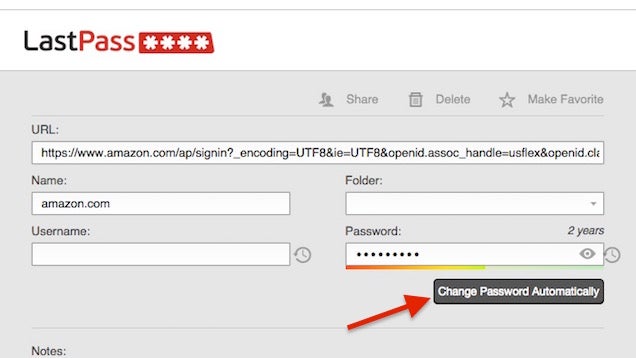
LastPass just announced a new feature for the password manager that automatically changes your password for sites when a hack is reported.
LastPass just announced a new feature for the password manager that automatically changes your password for sites when a hack is reported.

Whether you're haggling for a deal on a car or trying to get your desired salary , there are variety of situations in which you find yourself negotiating for what you want—or what you don't want to give. And if you keep these common mistakes in mind, you can improve your negotiation skills and come out on top.
Do you really understand the products you sell? Surprisingly, many business owners get into a business because they believe that there’s money in it, not necessarily because they’re truly passionate about the product. Unfortunately, this kind of attitude is common in the coffee shop business, for example, as well as many types of retail businesses like restaurants. But, it doesn’t have to be this way. If you truly want to boost your products, develop a passion for them.
It should go without saying that one of the first things you need to do when starting a business is to understand the basics of your products and services. Every good tutorial on how to start a retail business covers this. If you’re currently “shooting from the hip,” go find yourself a good guide and start studying.
Product guides don’t have to be complex. Often, they’re written for the consumer, so they’re easy to read. They will give you the basic idea of the product, what problems it solves, possibly pricing for the product, and key features.
What you’re after is this information, and more. The product brochure for the products you’re selling should be readily available for all employees too. No one should be “ummmm”ing when a customer asks how something works, what it’s used for, and pricing and options.
Beyond the basics, you’ll also want to know a basic or general history of the product, why it came into being, and who typically buys these products and why. Finally, understanding demographics for your product will help you put together effective marketing plans.
Of course, when you’re starting a new business, or even if you’ve been around for a little while, it’s not enough to know your own products. You also have to know your competition. They’re out there, and they’re more than willing to take your customers away from you.
If you don’t know what other options or alternatives to you that your customers have, you’re at a severe strategic disadvantage. For starters, you could have a vastly inferior product or be selling an outdated model and not realize it. You could also be missing trends that other retailers have picked up on before you.
Obviously, it’s better to be a leader than a follower, but that’s not always possible. And, when you’re new in business, it’s all but impossible. There are leaders already in your industry. Ignore them at your peril.
The specific things you want to know about your competition include its products’ strengths and weaknesses. It may also help to know how the products are constructed and their history.
Even when your competition is no serious threat, it doesn’t mean that customers will buy from you. You have to give them a reason (positive reasons) why they should buy from you or take action. The alternatives aren’t simply “buy from me or my competition.” The customer may opt to not buy anything or devise a different solution to whatever problem he’s having.
As an example, suppose you run a paint store. Your customer may come in thinking about painting his home. But, of course, it all depends on the cost of paint. Your competition sells a wide range of paints and offers manufacturer’s discounts.
You’re a new paint store, you’ve done some basic market research, and you know the price points where sales occur in your community. At the same time, you know your competition’s products are of lower quality and you have to sell your product at a higher price to make up for that quality and the higher cost of the raw ingredients (e.g. the tints and stabilizers).
But, assuming your competition has a bad reputation, or your customer simply isn’t interested in a low-quality solution, you still have to contend with the fact that your customer could opt to put vinyl siding on his house or just do nothing this year and wait until next year to make a decision.
You have to be ready to offer positive benefits as to why the customer should buy your paint and buy it right now.
Most new business owners get caught up in features. They believe a long list of features helps make their products, and by extension their business, look legitimate. It’s an understandable mistake. New businesses don’t have the clout of older, more established businesses.
However, customers will buy from new businesses and they typically buy based on benefits to them, not features of a product. In other words, a customer walks into a hardware store and buys a drill not because of its features (i.e. a full drill bit set, a warranty, etc.) but because of its benefits (e.g. it will drill a hole that the customer needs for some project). Sell “the hole,” not the drill.
 In this week’s episode of Content Marketing NEXT, I sit down with Ann Handley of MarketingProfs. A pioneer in content marketing, Ann was the first to take on the title of chief content officer. This entrepreneur, author, speaker, trainer, and dog lover is all about helping people write well. Her latest bestseller brings it all together: Everybody Writes: Your Go-To Guide To Creating Ridiculously Good Content.
What’s new:
Frustration can be an excellent motivator. Based on her experience editing marketing content for more than 15 years, first with ClickZ and now with MarketingProfs, Ann realized that marketers really needed a writing handbook and Everybody Writes was born.
Ann believes writing is the heart of content marketing: If you can’t write well, you’re not a good content creator. Fortunately, because writing is a skill, not an art, people can improve their work over time, she says.
Her first book, Content Rules, co-authored with C.C. Chapman, debuted in 2010. At that time, companies were thinking about how to rewrite their websites and how to take on the idea of becoming a publisher. Today, content is a cornerstone of marketing. Brands are creating interesting content programs and organizations are empowering departments with resources to execute their content-related work. Writing, and content creation in general, is much more at the forefront of marketing conversations.
What’s now:
A big challenge for content marketers today is creating engaging content. Some content marketers are struggling to answer:
Discussing the need for “storytelling” may seem frivolous in the B2B space because the word doesn’t connote seriousness. Ann reminds us that it’s not so much about storytelling as it is about telling a good story well. Tell the stories of your customers. Make the story all about them, and how your product improves their lives.
Tell the story to make the emotional connection. Take your stories outside of the boardroom and create interesting ways to deliver the brand point of view. Align the story with a longer-term business strategy. This allows interesting stories to evolve.
For more on what’s now, read CMI and MarketingProfs’ B2C Content Marketing 2015: Benchmarks, Budgets, and Trends—North America.
What’s next:
This next evolution of content marketing involves more education and training. MarketingProfs is making that its main focus and continues to offer both digital and in-person educational opportunities.
MarketingProfs is looking to expand its B2B Forum in Boston in 2015 to a new space to accommodate more people and equip marketers for what comes next. Ann sees the more intimate conference experience for B2B marketers as a way to provide high-quality content and give attendees the ability to connect directly with speakers and other professionals.
Ann’s word: Too many to list
She really wants to blast clichés, such as “ready, aim, fire” and “open the kimono,” which make her skin peel (her words). However, she says using some buzzwords or phrases in funny and surprising ways can add value to content creation.
She also would blast the number of words. Why use so many when one or two will do? Learn to self-edit and lose the unnecessary words, she says.
Here’s a recap of Ann’s hot-seat Q & A:
Q1: What innovation in the last five years has made your life as a content marketer better?
Ann credits Instagram with bringing out the visual content creator in her and forcing her brain to frame things differently.
Q2: What is the most valuable piece of advice you have been given, either personal or professionally?
“Do one thing every day that scares you.” – Eleanor Roosevelt
Take smart, informed risks. As content creators, we do have to take some risks with our writing. This is also the case in life. Ann has taken some risks, such as leaving journalism to go into online publishing, as well as selling ClickZ and joining MarketingProfs.
Q3: If you weren’t doing what you are doing today as a marketing professional, what other career would you have pursued?
A professional dog walker. At one point, she had five dogs and was a little envious of her dog walker. The work combined two of her favorite things: Walking in the woods and dogs.
Listen to Pamela’s full interview with Ann Handley here:


Cover image courtesy of Joseph Kalinowski/Content Marketing Institute
The post Ann Handley Talks Writing Ridiculously Well appeared first on Content Marketing Institute.

Your employees need you. But not in the way you think.
Leadership is no longer about being the center of decision-making, expertise, and problem solving. Instead, today’s leaders work in such complex, variable environments that they simply can’t be as central as they have in the past. If they take on this role, they risk becoming bottlenecks and getting in the way of progress. Today’s leaders need to do things differently.
In the last post, I reviewed the leadership behaviors of clarify and connect. This post focuses on another important behavior that tops employees’ wishlists: caretaking.
Caretaking isn’t mothering or patronizing. Instead, think about the caretaking work a gardener does. She prunes weeds that are choking plant growth, protects them from frosts, and fertilizes them when needed. That’s the kind of caretaking leaders need to do. What does caretaking look like in practice?
Caretaking – making sure that groups are freed from constraints that get in the way of doing work well.
Jenna leads a multi-national PR team. She’s had three bosses over the last year, but it’s barely impacted the team. She’s kept the group focus clear, maintained priorities, and ran interference so team members wouldn’t get caught between the turf battles that arose between her new bosses and their peers.
What Jenna does represents a great deal of what teams need from their leaders. Assuming that you have competent, motivated people, one of their biggest needs is someone who clears away the, remove obstacles, and maintain focus. They need you to break down the barriers so they can do their work.
Here are three ways you can help buffer your team from harm:
The next important function that leaders can play for their teams is ensuring that people have what they need.
Carl led a team in a bio pharma manufacturing environment. He noticed that, while his people did excellent work, they were rarely recognized. He started watching interactions between team members and organization leaders. He noticed that team members consistently failed to articulate the value of their work in terms the leaders could understand. Instead, they usually lapsed into tech-speak, which left the leaders cold. Carl began working with team members to help them prep their messages before meeting with leaders, which greatly improved leaders’ impressions of the group.
Leaders need to be aware of what people need. They may not know how to articulate what they need—how do they know what they don’t know?—so you have to articulate it for them. Here are four ways you can help ensure your people have what they need:
The third thing your employees need is help connecting in smart ways so they can access information and expertise when they need it.
Shawn, HR director at a pharmaceutical company, knew that staff members were incredibly smart and accomplished. He also knew that they were terrible at planning and facilitating meetings. The result was that people uniformly hated meetings and complained about how much time was wasted in meetings. Shawn implemented across-the-board meeting planning and facilitation skills training. Not only that, he repeated the training quarterly and encouraged people to attend as many times as they wanted. In addition, he set an expectation that people would attend short refresher courses every year. As a result, meeting quality increased, the number of meetings decreased, and satisfaction with meetings improved.
Shawn saw that people weren’t connecting in smart ways so he did something about it. Your job is to help make sure that people can share their expertise and ideas effectively. Here are four ways you can help your team connect:
How well do you serve as a caretaker for your team? Download Taking Care of Your Team to assess your leadership practices.

Best Buy is selling the HTC One M8 for just $30 on a two-year contract with Verizon or through the carrier's early upgrade Edge program (via Android Authority).
That's $170 less than the phone's usual on-contract price of $199.99.
It's an incredible deal, and Best Buy is throwing in a $150 gift card whenever you buy a Verizon phone too.
Based on the HTC One M8's product page on BestBuy.com, it looks like you'll get both the gift card and the $170 discount.
If you purchase another Verizon phone through Best Buy, you'll get the $150 gift card, but it's unclear if you can use that value directly toward your phone purchase. We've reached out to Best Buy for clarification on the promotion and will update this accordingly with more details.
The HTC One M8 has been praised by critics as one of the best Android phones you can buy ever since it launched earlier this year. Like its predecessor, the One is among the only Android phones that looks and feels as gorgeous as the iPhone.
The screen is sharp and HTC's skinned version of Android is a bit lighter and easier to use than some of its rivals. Not to mention, reviews have said the One gets great battery life, and its front facing speakers offer louder and more vibrant audio than any other phone we've tried.
If you're a Verizon user trying to save a few bucks and are in the market for a new Android phone, this is an excellent deal.
SEE ALSO: A Chinese Startup Made The Thinnest Smartphone In The World — Here's What It Looks Like
Tow-truck drivers snarled traffic around Queen’s Park in Toronto on Tuesday to protest new provincial regulations, but another, potentially more disruptive force is poised to hit the industry: tech startups.
Towing may not be the first business that jumps to mind when one thinks of innovative technology, but new apps on both sides of the border are taking aim at roadside assistance, giving customers more choice and potentially threatening traditional motor clubs like the Canadian Automobile Association.
“We’re big believers that the on-demand economy is going to revolutionize every service industry in North America,” said Chris Spanos, CEO of towing app Urgent.ly. “We think roadside assistance is ripe and ready for that revolution.”
Washington, D.C.-based Urgent.ly — often referred to as the Uber of roadside assistance — connects stranded motorists with the nearest tow-truck driver through its mobile app. Using GPS and a partnership with MapQuest, it allows customers to pinpoint their exact location and see how far away help is.
The company, which was founded in 2013 by a group of former AOL executives, plans to enter Canada in the first half of 2015 with a trial run in Toronto, Mr. Spanos said. The app has already raised US$2-million and, while it doesn’t disclose its financial results, Mr. Spanos said it has “engaged many thousands of customers” in the U.S., where the roadside assistance industry is estimated to be worth US$10-billion annually.
Unlike automobile clubs, which collect an annual membership fee, Urgent.ly charges flat rates, keeping approximately 25% for itself and giving the rest to the towing company.
“The pay-on-demand model, as we gain traction and that gains traction, will become a serious threat to the legacy subscription model,” Mr. Spanos said.
But Doug Nelson, executive director of the Provincial Towing Association of Ontario, said he’s worried that startups like Urgent.ly will undercut the towing companies.
“I’m not sure it would be well accepted, simply because there’s a tendency for these people to negotiate less than retail rates,” he said.
Besides, tow-truck drivers in Ontario are preoccupied with new regulations — the source of Tuesday’s protests — that Mr. Nelson said could hurt customer service and increase the cost of towing by restricting the number of hours drivers can work, among other things.
Urgent.ly isn’t the only app that’s aiming to disrupt the Canadian towing scene. A new startup called Rapitow launched in Ontario earlier this month. Unlike Urgent.ly, it charges a membership fee — $9 a month for up to four tows a year — but it makes use of similar technology.
As is the case with many startups, Rapitow stemmed from a nasty personal experience.
“I was on my way home one day and I had a problem with my car out of the blue,” said Rapitow founder Waheed Subhani.
“I waited an hour and 20 minutes for a tow truck to come pick me up, and as I was being towed away, I saw a tow truck less than a kilometer away. I thought to myself as we passed him, ‘If he knew I was there, I would have waited five minutes.’”
This gave Mr. Subhani the idea to use GPS to connect stranded drivers with the nearest tow truck instead of the typical call-centre model used by motor clubs like the CAA.
But CAA spokesman Jeff Walker said he’s not worried about new apps like Rapitow and Urgent.ly.
The CAA grows its membership base by approximately 2% a year and its renewal rate is close to 90%, he said, adding that members get additional benefits including discounts on gas, hotel rooms and even electronics.
“We think that our value proposition is very strong, and that our technology is actually comparable to some of the things they’re talking about,” Mr. Walker said. “We feel confident we’re going to be just fine.”

There is only one first impression you need to make as a sales person. It’s the impression you can deliver value.
Any other impression is immaterial.
The next time you meet a buyer for the first time, you’re only goal should be to get the buyer to say,
Man that person was impressive, they could make a serious impact on my organization.
You can make other impressions. You can make the impression you’re fun. You can make the impression you’re smart. You can make the impression you know the product. You can make the impression you’re a good salesperson, but if you don’t make the impression you can deliver value, no other impression matters.
Our jobs as salespeople is to deliver value to our customers and buyers. Therefore, that should be the first and only impression you’re leaving?
I get asked to read more sales books than I could possibly get to. And of those I do read, very few get my endorsement or shared with you here. Well, this past week I finally got my hands on a new book that I’ve been eagerly anticipating.
 I like everything (the layout, accessibility, smooth writing, short, punchy chapters, practical approach, valuable insights, meaty advice) about Andy Paul’s superb, practical, valuable new book, Amp Up Your Sales: Powerful Strategies That Move Customers To Make Fast, Favorable Decisions.
In the name of full disclosure, I’ve known Andy Paul for several years and have great respect for his experience and sales acumen. He’s one of my favorite people, and a sales guru with whom I love to talk Sales. And anyone who reads Amp Up Your Sales will not only gain a similar respect for him as a sales expert, but as an author. This book is so well organized and well written; it’s a joy to read. And what’s even better? It’s no-nonsense. There’s no hype or hyperbole, no shiny new toys and fake new theories – just really solid, really helpful sales advice for today’s sellers.
Paul’s long-time premise has been that we can accelerate the speed of selling and our own sales performance by helping buyers make good decisions faster. That theme permeates the valuable tips throughout the book. Paul delivers not just the theory, but the “how.” He implores sellers to turn off the auto-pilot and become more thoughtful, aware, intentional and deliberate about every interaction with the customer. Customers have limited time and many people and tasks competing for that time. That means that they must receive value from every interaction with a salesperson.
While there is much to love in this book, Chapter 37 may be my favorite. If you’ve been around my site for any time at all, you’re well aware of my strong feelings about the critical topic of the “sales story.” Paul makes a strong case about the need for a compelling, customer-issue-centered message. I absolutely love the way he challenges the reader to think hard about how you answer the question “what do you do?” And, for the record, I am in complete agreement with his recipes for strengthening your story.
I strongly encourage you to grab a copy of Amp Up Your Sales – not because Andy’s my friend (which he is), because it’s published by AMACOM (my publisher, too), or because I get paid if you link over to Amazon (because I don’t – Missouri residents can’t be Amazon affiliates). You need this book because it will challenge you to rethink your role as a seller, and because it more than delivers on its promise to help you help customers to make fast, favorable decisions.
About the Author:
 Andy Paul is CEO and founder of Zero-Time Selling, Inc. and author of Amp Up Your Sales: Powerful Strategies That Move Customers to Make Fast, Favorable Decisions. When you order your copy now, you will get instant access to Andy’s 6-part video series with big-time sales gurus like Jill Konrath, Jeffrey Gitomer, Anthony Iannarino, Art Sobczak and more.
What does 2015 have in store for the world of marketing? Based on what we’ve seen in 2014, plenty of changes – a few potentially big. The following details seven marketing trends and predictions for 2015.
The success of Facebook’s “boost post” advertising program will prompt more social media networks to offer similar marketing opportunities. That’s a given, but “social boosting” won’t stop there. Online magazine publishers, bloggers, and other content creators will offer paid social boosting opportunities via their platforms, email lists, and perhaps even print distribution. Content is only king when it can be seen, and in our “keep it simple” society short blurbs will get the opportunity to achieve the exposure enjoyed by long-form articles and posts.
Everyone knows content marketing works, but many companies don’t understand how well it works. How do blog views translate into sales? Can you track specific readers through the purchase cycle? What types of content yield the most buyers? The greatest profit? New solutions will be created for tracking content as it relates to sales and profit, and collected data will be employed to strategically develop content with those end goals in mind.
I don’t know what it will be, exactly, but many marketers have been frustrated with QR codes and the slow adoption of Augmented Reality. The major problem is these marketing tools aren’t instantaneous: they require the end-user – aka potential customer – to download apps, carefully make scans, then make any number of choices before they’re exposed to advanced advertising. Perhaps some expanded form of near field communications will make mobile marketing effortless and instantaneous for both companies and customers.
Big Data will begin to fulfill its promises of increasing profits, especially for small businesses with limited marketing budgets. Whereas marketers can now target forty-something male homeowners with children, they’ll soon be able to target forty-something male homeowners with children who spend at least $50 per week on entertainment, dream of visiting Hawaii, and just received a big Christmas bonus. Think I’m stretching things too far? With the ability of Big Data to track everything from basic demographics to online searches to social media activity, I don’t think I’m stretching things far enough.
The accessibility of advanced data as described above will open new markets for small businesses, which can focus on small, yet profitable, niche segments ignored by larger mainstream companies. They won’t sell sandals online; they’ll sell green and pink sandals with sunflower patterns. And they’ll sell them to women whose favorite colors are green and pink, who have sunflower gardens, and who wear sandals more than 50 percent of the year – because they’ll know how to target them.
Sure, the web has vastly increased the amount of available data, but much of that data is far from expert. Digital publishing is gaining more mainstream acceptance. Everyone’s an expert on something. Combine those facts and just about anyone can write – and sell – an ebook, website content subscription, or print-on-demand material. Self-publishing is the future, and more and more people who have great stories to tell and expert advice to share will cash in on that fact. It’s not about proliferating information – we already do that – it’s about proliferating accurate information. The distinction will become significant.
Search engine optimization will continue to stress marketers, but the savviest content creators will realize that the “rules” of SEO are constantly evolving to reward quality content. The greater the quality, the more likely a given piece of content will rank well years down the road, regardless of Google’s infamous algorithm. Moreover, ever-increasing social opportunities are helping even the smallest businesses thrive without regard to SEO – that is to say, social media is word-of-mouth, and the best businesses (those that have the greatest quality) can bank on it.
Developing content that will create meaningful engagement with potential buyers is a perennial challenge for most marketers. In all five of the annual content marketing surveys by the Content Marketing Institute and MarketingProfs, respondents said that producing engaging content was one of their top three challenges.
Thanks to numerous research studies, we now know that most B2B buyers are turned off by content that is overly promotional. For example, in a recent survey by The Economist Group, business executives were asked to identify the main reason that a content resource does not make a positive impression. Seventy-one percent of the respondents said content that “seemed more like a sales pitch.”
Creating content that does not “seem like a sales pitch” is unfamiliar territory for many marketers because the use of promotional content is deeply ingrained in the culture of marketing. For decades, marketers have been trained to use forceful, unequivocal, and/or dramatic language and images in order to make their content as persuasive as possible. A significant body of “persuasion research” supports the general principle that strong, forceful content is more persuasive that weak or tepid content.
In reality, however, forceful and unequivocal content is not always the most engaging and persuasive content. Research by Zakary Tormala, an associate professor of marketing at the Stanford Graduate School of Business, and Uma Karmarkar, now an assistant professor of business administration at the Harvard Business School, has demonstrated that a small dose of uncertainty can actually make marketing content more engaging.
Tormala and Karmarkar conducted multiple experiments that tested the impact of three elements of a persuasive message – the strength of the arguments used in the message, the perceived expertise of the message source or provider, and the certainty with which recommendations in the message are expressed. One surprising finding of these experiments was that “experts” are more persuasive when they qualify their arguments or otherwise express some uncertainty about their opinions.
Professor Tormala says that incongruity between the source’s perceived expertise and level of certainty makes a message more intriguing. He says, “Whether it’s a person without established expertise in a given domain expressing very high certainty or a person with clearly established expertise in a domain expressing low certainty, the inconsistency is surprising. It draws people in. And as long as the arguments in the message are reasonably strong, being drawn in leads to more persuasion.”
This research has important implications for B2B marketers. Most importantly, it means that your content will be more effective at creating engagement with potential buyers if it embodies a more reserved tone and minimizes the use of broad, absolute arguments and recommendations. This is particularly critical for content that’s primarily designed for potential buyers who aren’t familiar with your company. In this circumstance, understated content works better to create engagement because it’s not what potential buyers expect from a vendor, and therefore it causes them to think about the arguments that your content makes.
The critical point is that marketing content must engage before it can persuade and that objective and balanced content if often more effective at creating engagement than content that makes unequivocal claims and recommendations.
Amazon is rolling out its new "make-an-offer" system, which finally allows buyers to negotiate prices with sellers. For the time being, the rollout seems to focus on fine art and rare coins, though it will expand in 2015.
The post Want to make an offer sellers can’t refuse? Amazon now allows it appeared first on Digital Trends.

Historically, the typical sales rep thinks that prospecting and December do not mix. The mindset is that generally the last month of the year should be spent getting deals in and preparing for the following year. No one really picks up the phone this time of year, right?
Wrong. And I’m not just saying this from the perspective of AG Salesworks, a B2B lead gen company that prospects year round.
One thing I fully admit is that it is harder to get a hold of people during this time of year. You could spend your entire day calling and end up with half the conversations you’re accustomed to seeing from your efforts. With that being said, even though prospects are elusive, the quality conversations you do have historically end up having a much higher hit rate than what we see during the rest of the year. Bottom line is that people do want to talk now; you just have to be prepared to work harder to get them live.
To prove this, I went back and looked at our team’s performance over the last three Decembers. (P.S. If you want to learn the best reporting metrics to use to benchmark your outbound sales team, download the new Outbound Index™.) Fortunately the numbers proved that I’m not crazy.
The two metrics I evaluated were:
Based on the calling efforts of approximately 45 Business Development Reps over the course of the 2011-2013 timeframe, the blended average worked out to:
Based on what this is telling me, we’re seeing only a 3% drop-off in conversation rate. Our lead rate, on the other hand, jumped up just north of 3%, which clearly proves that though less people are answering the phones, those who are are willing to talk about possible solutions.
I also took it a step further by looking at the lead conversations we ended up having in Decembers past. In most cases, the common themes I saw were that prospects, not surprisingly, were currently in planning mode for the following year. We would set preliminary meetings before year end and then set the full-blown demo for the first few weeks of the New Year when all the decision makers were in the office. Meanwhile your competition is calling after the first of the year, trying to set the initial meeting, and you’re already a few steps ahead.
In the decade plus that we at AG have been B2B sales prospecting, we’re no longer surprised to see our lead volume has remained just as consistent this month as it has every other month during the year. I think maybe it has something to do with the fact that we’re still out there pushing while everyone else is already getting ready for 2015.
Long story short…pick up the phone.
Whether your an enterprise or a small-to midsize-sized business (SMB) in the business-to-business (B2B) space, you know how messy the digital revolution has been for marketing and sales.
Not long ago, a sale needed some sort of human interaction — even with the web. Now, from fact-finding to brand-relationship building, your customers rely on the Internet to do it all.
How can a small B2B-focused company get back into the discussion in this age of digital selling? Here’s a guide to help your company be found, seen and heard online.
Most companies know they need to have a website but don’t recognize just how critical it is. Your website is your digital kingdom, a place where you can share your brand story, connect people directly to your company and make that all-important first impression. Make sure your online presence is up to par by having an engaging customer experience, top-notch branding and easy navigation.
Most companies do a great job of explaining what they do but fail when it comes to using more dynamic content (blogs, videos, infographics) to show how they can help. Customers respond to relevant information and education, products and services come later. If you haven’t already, begin telling your story in various formats. The more often you tell, the more likely your story will be heard.
Being found through search — via search engine optimization (SEO) — requires a regular stream of high-quality and relevant content, as well as social media to boost authority and visibility. Social media often gets pushed to the side but according to this study, seven of the top eight SEO factors are tied directly to social activity. So, get social! But keep in mind, you need to be on these social-media channels on a regular basis, otherwise, you will lose your customers’ interest.
Strategic social media use starts by listening to your competitors as much as your audience, so you have a complete view of what’s going on in your industry. Watch what industry players and influencers say and do online, and pay attention to the tactics that engage thought leaders, competitors and consumers. A great place to keep tabs on your competition is their blog. See what they are talking about, what their customers are saying and what pain points are occurring.
There may be no better way to connect your ideas with the world than through social media. It can be a terrific way to boost your company’s visibility online. One of our strongest recommendations is to focus on sharing highly useful and targeted content that’s of interest to the people you want to connect with.
For potentially just a few dollars a day, paid advertising on platforms like AdWords along with social-media ads can have their place. If you narrow your focus to a very specific keyword or phrase that your typical client is looking for, an ad that sends them to a strategic landing page can be well worth the investment. If you have no clue what keywords your target demographic is searching for, Google provides information on this through its AdWords platform.
Content is often written, shared and quickly forgotten. Upcycling is a trend to reuse and rebuild previously published information to extend shelf life and boost visibility. For example, you can take a blog post you wrote six months ago and expand it in these ways:
While social selling allows salespeople to use social channels to share company’s content directly with potential or current customers, it must be better than spam. There has to be context for the information being shared, and the focus should be on starting a discussion, not pushing for a sale.
The path doesn’t end when someone finds your company online — your efforts are wasted if someone shows up then leaves. Build commitment by making it easy to stay in touch.
Digital marketing is about driving a better customer experience, earning sales and retention by focusing on the importance of one-to-one marketing. Your end goal is to start and continue discussions that lead to new brand advocates, new customers and long-term clients that ultimately become referral generators.
Competing in the digital economy can seem overwhelming, but in many ways the web levels the playing field. After all, the best content doesn’t cost the most, rather it makes the most effective connection with the reader. By focusing on the essentials of being found, seen and heard online, it’s possible to not only succeed in the digital economy, but to relish in growth and visibility.
If you enjoyed this article, check out this slideshare presentation that goes along with it…
The Essential Guide To B2B Marketing In A Digital Economy from Daniel Newman
 How do you learn a new sport? You attend regular training sessions to learn techniques and methods, you practice regularly and you figure out what works and what doesn’t.
You get coaching sessions to adjust your practice based on specific lessons learned and your individual progress, and you get coaching to focus on specific skills that are complemen-ting the practice to leverage your potential. And all these elements of practice, training and coaching are well connected to each other.
In sales, people are sent to training sessions that are perceived as events rather than elements of an ongoing development journey. Often coaching doesn’t happen. If coaching happens, it is often disconnected from salespeople’s daily practice and the training sessions they attended. Furthermore, the trained sales methodologies are not reflected in the enablement content salespeople should work with. The problem is that all these elements are isolated; not based on one integrated approach to drive sales execution. The big picture is missing. A general design point is missing. What happens is that salespeople cannot get the expected value from all these different elements that should help them to sell, and guess what – they don’t use it. They just switch off the noise.
Enablement and coaching frameworks have to be based on one design point – the customers
A customer core approach is one of the non-negotiables to evolve sales enablement to the next level, to sales force enablement. That means, to focus on the entire customer’s journey and all relevant buyer roles at each stage and at all levels. Given this customer’s journey as a core design point, enablement services have to be tailored to the specific phases and the relevant buyer roles. That’s true for client-facing content and pure enablement content. Additionally, sales training (sales process, sales methodology, product training, and competencies) has to map all their services the same way, to be clear about what is only relevant at a specific phase of the customer’s journey and which services are relevant for all phases.
When it comes to frontline sales managers’ regular coaching practice, we focus on tactical coaching that’s based on leads, opportunities and accounts. If we want a frontline sales manager to coach their salespeople along the entire customer’s journey, it’s obvious that the coaching framework has to follow the same design point – the customer’s journey. If we look at the enablement services as the specific services for salespeople, the frontline sales managers’ coaching guidelines work as an embedded reinforcement element of implemented enablement services. Coaching guidelines are a natural mirror that helps to reinforce and to sharpen the impact of the implemented and provided enablement services. Designed this way, both services – enablement and coaching – reinforce each other and make sure that the investments create sustainable business impact.
Connecting enablement and coaching – mapping the customer’s journey
Connecting both services requires mapping the customer’s journey to the internal process landscape that covers processes from marketing to sales and to service/delivery. The relevance for enablement and coaching is to get a clear understanding of the gates between the different phases of the customer’s journey. What is it we need to see fulfilled; when is this phase fulfilled? How do we know that this specific gate has been passed? An example could be that we look at the end of the awareness phase for signals that the customer community (not only an individual) has confirmed organizational pain. Additionally, we want to see a decision to change the current state and to enter the actual buying phase. Additional criteria can be defined. Defining the gates that mark the passage from one phase to the next one simplifies the mapping to the internal processes. Adjustments, if necessary, should be done internally, as customers won’t change how they want to buy.
Having defined these gates opens the way for another level of clarity for enablement services (gate descriptions are definitions of purpose for enablement services) and for coaching guidelines. Questions can be designed to lead coaching conversations towards this clarity – where are we really along the customer’s journey. What has to be adjusted, what needs to be improved and what’s just fine.
Customer journey mapping is often a challenging step. Performed correctly, it is the foundation for connected enablement and coaching services. I t is the foundation for simplicity, clarity and highly valuable services that reinforce each other. Connecting enablement and coaching this way is a steppingstone to World-Class Sales Performance.
Related posts:
Frontline Sales Managers – Key Role, But Poorly developed And Enabled
What Triangles Have To Do With Frontline Sales Managers
Frontline Sales Manager’s Mantra: Managing Activities and Coaching Behaviors
We’re not just a pretty face.
As a regular visitor to the blog, you’ll no doubt be aware of the magnificent free content on offer to you from our small band of marketing and digital experts here on the blog.
This is just scratching the surface of what Econsultancy has to offer though...
If you scroll up to the little ‘research’ tab on the top lefthand side you will enter a whole world of comprehensive research into marketing and ecommerce providing all the information you will ever to need to help you achieve digital excellence.
Whether you are looking for up to the minute data on market trends or informative guides on business strategies, you will find it here. This year we published a wealth of market data, best practice guides, buyer’s guides, surveys, trend briefings and more.
Here are a few of our key takeaways from 2014, with links to the respective reports for further insight.
In order for companies to create a sustainable competitive advantage from conversion rate optimization (CRO), a strategic approach must be taken. This is according to our 2014 Conversion Rate Optimization report. A key facet to this strategy is testing. Companies that test more often, derive greater rewards for their activities.
Companies that saw a significant increase in their sales conducted 6.45 tests per month, compared to just 2.42 tests among organisations that saw their sales decrease.
More than half (57%) of companies surveyed cited a “lack of resources” as a barrier to improving conversion rates, by far the most common barrier.

Testing effectively requires companies to do more than just conduct the test to achieve better rates. Organisations must review their results and use these insights not just to inform processes and activities that are thought to have already been ‘optimised’, but also to fuel further tests.
It is only through this process that companies will remain agile and responsive to consumer demands and competitive pressures.
It’s no surprise that marketers are taking personalisation very seriously. The ability to tailor the digital experience at scale is now a reality for businesses that have the right technology and processes in place. Personalisation can lead to a much deeper brand loyalty and higher CLV.
As the chart taken from our latest Quarterly Digital Intelligence Briefing on Personalisation shows, digital marketers are 7% more likely than in 2012 to agree that the ability to personalise is “fundamental to their online strategy” and 13% more likely to agree that they are “committed to providing a personalised web experience”.

As the link between an improved customer experience and better commercial performance becomes clear, the ability to personalise is a vital way for businesses to differentiate themselves from the competition.
Budgets for digital analytics technology and consultancy services are rising, but the pace of change has led to a skills gap in many companies according to our latest Measurement and Analytics Report.
As the chart below shows, the use of rapidly changing analytics technology is the skills gap most widely identified by respondents. Using digital analytics tools was selected by almost half (47%) as a top-three area of skills deficiency, with 20% seeing it as their biggest gap.
Statistical modelling, another core analytics skill is the second most-selected gap, chosen by 40% of respondents as a top-three problem area.
In which areas are the biggest skills gaps? (company respondents)

This is despite the fact that 82% of companies agree that retention is in fact cheaper than acquisition. A figure up from 70% last year, and certainly bolsters the notion that on-going profit from a customer lifetime is higher than any one single transaction.
Is your company more focused on acquisition or retention marketing? This is one of the questions asked by our third annual Cross-Channel Marketing Report.

Since 2013, the proportion focused on acquisition has reduced but is still the dominant proportion of respondents. In turn, the proportion of those with an equal focus on retention and acquisition has increased to 45%. Marketers are even less likely than last year to be more focused on retention.
Obtaining a single customer view remains a huge challenge for marketers in spite of the ever-improving capabilities of digital technologies. But unified marketing is a nirvana worth striving for according to our Path to Unified Marketing report.
Respondents were asked to identify what they perceive to be the top three benefits of integrating their marketing applications and data.

Interestingly, the rankings of the benefits are largely in line with one another, so the perceived advantages of unified marketing turn out to be true in practice.
Targeting and optimization at a customer level achieved the highest score for both groups, with better customer service and segmentation rounding out the top three for those who have achieved significant integration
The internet has created a massive increase in the volume of customer feedback data. Social media, product reviews, customer ratings, online surveys, net promoter score… all these communication channels mean that companies are increasingly having to make their businesses customer-centric.
Managing customer experience is key in driving loyalty, retention and high CLV, however it’s the most progressive businesses that have taken the insights from feedback and used it to acquire new customers and drive change within functions of the business outside of customer services. This is according to our new report Voice of the Customer: Listen, Measure, Act.
Improving the customer experience will also lead to many business rewards. We asked our respondents “what do you see as the business benefits of an integrated customer experience?”

The wealth of data that can be derived from the mobile activities of consumers is continuing to increase at a staggering rate. With mobile empowering consumers to engage in several digital activities at any time of day, there is a clear opportunity for businesses that are appropriately equipped.
Although spend on mobile analytics is increasing, this does not necessarily translate to a greater understanding of the mobile user, as our Finding the Path to Mobile Maturity report shows...

Organisations that are able to maximise the mobile opportunity are those that have an understanding of the mobile user journey and how it fits into the context of the broader user experience.
In the past digital analytics mainly focused on desktop activity, but now businesses have to employ a broader range of analytics products to measure activity across relatively new channels such as mobile and social.
Our Measurement and Analytics Report examines the extent to which different analytics tool are used by surveying more than 1,000 digital professionals.
Web analytics predictably came out as the most widely used (36%) followed by Excel (90%). The fact that Google Analytics is available for free is clearly an important factor behind the almost universal use of web analytics.
Which data-related tools or types of technology do you use?

Two-thirds of respondents (65%) use some form of social analytics while 27% are ‘planning to use’ them, which is indicative of the fact that businesses see value in social media interactions but are still getting to grips with how to measure the ROI.
It’s difficult to think of an ecommerce vertical that has a better fit with content marketing than fashion. Following trends and making purchases are often classed as a form of entertainment in their own right, therefore it’s not surprising that a lot of fashion ecommerce websites have invested heavily in online content. This is according to our Fashion Ecommerce and Content Marketing report published this month.
One of the key ways that fashion brands distribute content is via email. Email is one of the most popular online activities, with 90% of UK consumers signing up to receive email from brands, despite the continued surge in usage of social media.
The author of the report James carson signed up to 20 different website’s email communication, but only received communication from 17 over the period.
The customer relationship is the single path to sustainable growth and reliable retention. Improving this customer relationship can be achieved through understanding the customer and their context.
Whatever location they’re in, at whatever time and how far down the sales funnel they may be, marketing data is the key way to accurately target the customer.
This has driven a huge need for technology in every industry to help them understand, capture and manage data.
According to our Enterprise Priorities in Digital Marketing report these are the plans for future technology investment...

Marketing attribution systems, marketing clouds and audience management systems are the top three near-term priorities. All technologies designed to determine, manage and influence the customer journey on multiple channels.
Our brand new B2B Real-Time Marketing Report reveals that more than a third of respondents (35%) said that real time means the ability to respond to customers in the same online session, i.e. within a minute or two. 11% of respondents however took 'real time' perhaps too literally and defined it as the ability to respond in less than a second.

This instantaneous response is certainly unrealistic within the hands of a mortal human, so clearly any response such as this would have to be the work of marketing automation.
Personalisation, empathy and speed are all absolutely integral to getting real-time exactly right, so is the correct use of available data. Technological solutions must be deployed to automate at least a base-level response, be it email, SMS or through search marketing, however a human interaction must occur soon after.
As you can see by the following chart taken from our Where Content and Commerce Collide report, there’s an even split between revenue and engagement when it comes to setting content marketing goals.

It should be noted that those that focus on engagement also see revenue as a likely by-product of providing good content. If your customers or followers are happy with your content and are sharing it across channels with a positive message, then revenue won’t be far behind if it’s linked to a relevant product.
Revenue is a goal for every ecommerce team, but there is a split in the intention behind creating content. However does this really matter if engagement eventually leads to the same outcome? These engagedcustomers will also be more loyal to your brand and tend to come back to you for repeat purchases.
A further 22% of UK businesses have 'non-existent' mobile email strategy according to our eighth annual Email Marketing Industry Census. Among those that do have a mobile email strategy we asked "what have you done to optimise email marketing for mobile?

More than half (52%) have adapted their email design to have a simpler template that renders well on all devices. A further 39% of respondents have created a mobile responsive email template.
Compared to last year, many organisations have made great strides in creating a more mobile-friendly experience.
It is, however, an ongoing and complex challenge even for the most clued up companies according to our Delivering Digital Experiences briefing.
Fewer companies than last year agreeing that ‘delivering optimal experiences across all screens and devices’ is a major challenge (60% this year compared to 70% last year).

57% of marketers using faster email technology report higher conversion rates
Conversion rate is one of the most important metrics in email marketing. It speaks to marketers’ ability to turn engagement into revenue. However with 42% of marketers who use slow email technology reporting lower than average conversion rates, it seems that revenue is being lost through outdated, sluggish systems.
The Email Marketing Speed Imperative study looked at how much impact the ease and speed of use of email marketing technology has on the channel's success. Among the questions asked: “how does the speed of email technology relate to ROI?”

Those with fast systems report an average ROI for email of $38.80, nearly 33% higher than the $26.20 reported by those with slow systems.
Lead generation is important for any business. Without leads (or referrals as they are sometimes called) you would have nowhere to start. Leads (referrals) can come from friends and family or a business organization or even online via social media. You may have a portion of your clients that found you on their own but at some point every business will have to go after clients, either through advertising, social listening or your traditional sales call.
Recently I was asked to list out some ways that people could use social media for referrals. As I created the list I realized that are numerous ways one could use social media for lead generation. I know I am not inventing the wheel here, but these are common ways people are using social media to generate leads.
Post QUALITY content that shows you are an authority in your industry and you really do know what you are talking about. After time (this doesn’t happen immediately), you will have people approach you to hire you for your services. I recognize this is a long-term plan, but it’s highly effective.
Example: You are an insurance agent. You go to Twitter and search “my rates are too high” or “I am so mad at my insurance agency”. You can search worldwide or locally. Reach out to those who are complaining with a simple “Hey! I saw you are unhappy with your rates. If I can ever be of help, just let me know.” You do NOT want to start off with a sales pitch, just broach the topic gently.
ALWAYS, ALWAYS, ALWAYS create a personalized connection message. Do not use the generic, standard message. You are trying to reach out and connect, so personalize it.
Be careful not to spam or give a hard sell to these groups. Most have rules against it.
The more you are out there, the more people will see you and request information for your services. If you choose not be active (and I’m not sure why you would) how will people find you?
Facebook ads give you the ability to target the specific person you want to reach. Using their Power Editor can give you even more targeting options.
For those unfamiliar with opt-in, they are something of value that people will give you their email address for.
Example: You are in pest control. You have a place on your website for people to get a copy of a white paper you have called “10 Simple Ways to Keep Your Home Bug-Free”. People would give you their email address and in return, they would receive this piece. You then have their email address to contact with new customer specials, on-going offers and general information.
Opt-ins can be promoted with a Facebook ad directing them to sign-up on a custom tab on your Facebook page, a sponsored tweet with the link, or just a simple post on your various social media profiles.
There are many, many ways to generate leads using social media so these 7 are not the end-all. Let me ask you, how do you generate leads via social media?
A lot of companies selling complex, technical products spend weeks, or even months, training new sales reps before they let them interact with real prospects.
You don’t need to do that, because today you’ll learn how to train sales reps to make sales calls from day one. Turn new hires into product experts at the speed of startup, so they'll be able to answer any question right away.
It’s a scalable strategy for training and onboarding new sales hires a lot faster.
Don’t just shove training materials down their throats, but expose them to real-world scenarios.
It’s like learning to swim - you can’t learn it by reading about swimming. You need to actually get in the water.
The documentation you give them is just a life jacket to keep them afloat, not a boat that prepares them for getting in the water.
What are the 20% of questions that prospects ask 80% of the time? What are the 10 to 20 most common things they want to know?
Write down these questions.
Then write down the short and concise answers.
(Involve the most successful members of your sales team in creating this training guide for new sales hires). You’re basically creating a sales objection management document.
Have your new sales hires study this document, so that they can confidently answer the majority of questions prospects ask.
What if a prospect asks a question the new sales rep hasn’t been trained on?
Train your new sales reps to say this:
This accomplishes two important things:
Some questions are so basic that it can be almost embarassing if a sales rep doesn’t know the answer. Things like: “How long has your company been in business?”
How should a new sales rep respond if he can’t answer such a simple question?
Same formula, just add these words after “I don’t know the answer”: “...because this is my first week. I just got started here.”
Nobody is mad at people who are new at a business. Everybody has been in that position and knows what it’s like.
Don’t expect your sales people to be perfect and know all the answers. It’s going to create pressure for them to bullshit when they don’t know the answer.
They will just say things like: “Oh we have been around for three years.” - “Why did you say that?” - “Well, I didn’t want them to know that I don’t know and embarrass us.”
You know what's embarrassing? Having to make up lies instead of giving forthright replies.
Just be honest. It’s an opportunity to stand out from the crowd, and it starts with the way you onboard new sales reps.
Don’t require them to have all the right answers - require them to have the right attitude.
Here’s how you take this to the next level. Have your sales reps respond to questions they can't answer as follows:
That fourth and fifth step is where the magic happens.
Have them tell you what they want and then ask them why.
Flip the question around, and turn it into an opportunity to learn more about your prospects, to understand them better, to qualify them.
Here’s some questions that will be helpful for this step:
Typically what happens with new sales hires who don’t ask these questions, is that they don’t provide enough context.
They’ll go to the engineer and say: “Somebody ask me, how do you configure this on the API level?”
Engineer: “What’s the use case for this question? Why is this relevant?”
New sales rep: “I don’t know, I just put down the question, I didn’t ask them anything about it.”
And then an engineer can’t provide them with a good answer, because they lack context.
Most sales leaders teach new reps to give the right answers. Great sales leaders teach new reps to ask the right questions.


It's time to start thinking about planning your dream trip next year. So where should you go?
We looked at major developments, cultural trends, and global festivals to find the hottest places to travel around the world in 2015.
From the Philippines to Peru, here are the best places to travel next year.

Tourism in Japan has taken a hit since the 2011 tsunami hit the country's coast and ricocheted into a nuclear disaster at the Fukushima Nuclear Power Plant. Since then, the Japanese government has cleaned up the countryside and launched a massive public-relations campaign encouraging tourists to come visit. Pair that with a sharp decline in the value of the Japanese currency, and you get a country that's ripe for tourism.
Traditionally one of the most expensive countries in the world, Japan is quickly becoming a bargain destination that's luring in travelers looking for a deal. More than 11 million visitors have traveled to Japan so far this year, with more expected. Most tourists are heading to Tokyo, which is also busy preparing for the 2020 summer Olympics.

Lima, Peru has been slowly building its reputation as a city for foodies, cementing its status most recently when the Latin America's 50 Best Restaurants Awards gave the coveted top spot to the city's Central restaurant. In total, eight of 50 restaurants on the prestigious list were in Lima.
The Peruvian city is home to everything from Michelin-starred restaurants to hole-in-the-wall cevicherias that will continue to draw in foodies from around the world.

"Frozen" has made over $1.2 billion for Disney, and with its increased merchandising and rumors of a sequel, the "Frozen" craze will only continue to grow. Set in Arendelle, a fictional kingdom in Norway, "Frozen" shows a gorgeous landscape of lakes, waterfalls, mountains, and fjords. Fans of the animated film are now seeking out real-life Arendelle in Norway. The country has seen a huge growth in tourism since the release of the film, with tour operators reporting a 40% increase in sales.
Bergen, a city on the west coast, was the inspiration for the film. Voss is also popular with fans for its nearby fjords, glaciers, rivers, and lakes. With its small fishing villages and breathtaking cliffs, the Lofoten Islands will also attract Frozen fans.


Welcome to the latest edition of our brand new weekly series, Break the Rules. Each week our plan is to highlight something you will have heard from some marketing expert as a best practice to be disobeyed at your peril. And we’ll tell you why it’s a rule you should break.
Last week’s rule was Charge Enough to Cover Your Costs.
This week’s rule = Offer Discounts
Special offers bring in new business. That’s a fact. It’s been tested and proven over and over again.
But not every company does it. You would think that if discounts work to bring in customers, everyone would offer them. But they don’t. Why?
The answer to that question is the reason I’m telling you to break this rule.
Discounts and special offers can carry a negative connotation. In the mind of the consumer, you are changing the value of what you offer. And offering too many discounts can train consumers to look for discounts, meaning fewer and fewer people pay full price.
It’s a nasty spiral that many companies get caught in. Business is slow, so they start discounting to drive new business. It works so they start offering more discounts, bigger discounts, more frequent discounts. Soon, you have no choice but to continue to offer discounts because stopping would mean no more customers.
Companies that don’t discount at all are protecting their brand’s integrity. Luxury brands don’t discount, because discounting would mean they are no longer luxury.
So you have to decide as the marketer or brand manager how you want the consumer to view your company. If you want to compete at the high end of the price scale in your market, own it. Don’t fall into the discount trap when business slows down. All of your marketing efforts should go toward supporting the value you offer over and above the competition. If you succeed in that effort, you won’t have to discount.
So decide, and decide fast. Because once the discounting bug takes hold, it’s hard to shake it off.
Don’t believe me? Ask JCPenney.
Have a “rule” you think we should write about? Share it with us in the comments below or post it to Twitter @zheller using #marketingrules

For over a decade I’ve been fortunate enough to work with some amazing people located across the planet. This world first opened up to me back in 1999 when we setup an office in London for our Cape Town based startup. And I quickly learned the value of consistent communication in a distributed team.
Back then we didn’t have video chat tools to keep in touch. In fact, I recall two wonderfully talented people from our team jumping over to join a startup called Skype.
We did however have email, the Internet and telephones – those things with the buttons that used to sit on everybody’s desk.
I learnt early on that daily communication between the teams in Cape Town and London was essential. So, every morning, without fail, we picked up the telephone and did a catch up call. A kind of telephone standup, during which we reviewed progress of each project aligned our efforts for the day ahead.
That routine has stuck with me over the years and I firmly believe that consistent communication is at the core of any high performance distributed team.
Today I work with a truly global team. I’m drafting this post from a coffee shop in Toronto (a great foodie city), my partner is in Santiago and the rest of our inbound marketing team spread across Romania, the U.S. and South Africa.
I’m often asked how we manage to remain productive with such a geographically distributed team. How we create and foster a great company culture with such limited face time. And why on Earth we work such weird hours across multiple timezones.
It’s hard to come up with the perfect team formula and that’s mostly because every team is different. But I’ll share some of the most important things I’ve learned through trial and error over the years:
Trello is a productivity tool that uses cards and lists to keep you organized. On Mondays we review all the cards on a board, agree on the tasks for the week and then everyone cracks on with getting the work done.
This us how our internal board looks like, where we track our inbound marketing efforts.

We use GoogleDrive for collaborating on documents, proposals and content creation. We were an early Google for Business adopter and use Google’s tools to collaborate on getting the job done.
And, lastly, Skype. There are all sorts of video and call conferencing tools that you can use from your computer. Skype is just simple and everyone seems to know how to use it for running a quick call. There are loads of other great tools out there like Google Hangouts, Join.me and Sqwiggle.
There’s no magic formula to help your distributed team be the best. But you can create an environment that will give them the opportunity to kick ass. Keep up consistent communication. Give everyone a voice in the direction the team is taking. Give everyone the opportunity to cultivate their passion and develop their core skill sets.

*Editors Note: Recap post of the Deck presented at Sales Hacker Series in New York City on November 20th, 2014 by Jake Dunlap, CEO at Skaled. Check out the other recaps from the Series in New York City by Dan Thompson and Dave Govan.
People buy because they have a need. It’s our job as salespeople to find that need and that’s what most of us are trained to do. Find the need. But there’s more to it than that.
What most people don’t address when it comes to their actual sales process are the other factors involved:
Without these other two pieces the sale won’t happen. We all have wants, needs, desires, etc. but do we actually want them solved? Not always. It must be a problem that the customer wants solved. As salespeople we need to raise the importance of not solving certain issues. As far as next steps go, are they comfortable with what needs to happen next to move along in the process?
Our job is to:
First, your pitch is too tailored or overwhelming. In other words, we talk about what we do, our solution and the amazing things that it does. On the prospect side, they’re thinking “Yea, that’s great but I have these other 4-5 things that I care about more…” Second, is that we don’t spend enough time talking about implementation. Third, is you have a lack of knowledge of the buying process. You think that you’re dealing with the individual, but in today’s modern buying climate how people buy is equally – if not more important – than the actual decision maker. People generally make consensus decision making.
Guess what? They do have budget….they just don’t want to give it to you or can’t commit to what you asked.
Try these tactics when you run into budget objections:
Try and reiterate the issues and ask if they are no longer a priority.
Likely causes:
The final way to solve this problem is to train your people to not come to you if they haven’t gotten these details figured out:
The post Objections… Symptoms of a Broken Process appeared first on Sales Hacker.

I caught up with CMI’s Chief Strategy Officer Robert Rose, to discuss some of the trends from the survey and their implications for marketers. The conversation looked quite broadly at the state of content marketing today, and we’ve broken it into two parts. We highlighted the biggest challenges facing content marketing. If you saw yourself in any of those points, rest assured you are not alone—but you also don’t have to continue down the same obstacle-laden path ad infinitum.
Start with content, start with: what can I do well right now?
Rose highlights that many marketers have not even dipped their toe into content marketing and promotion simply because the options can be overwhelming.
“One of the reasons I hate the word omni-channel is that it encourages us to be everywhere, and no one can,” says Rose. “We must pick and choose strategically.”
As marketing increasingly focuses on the buyers’ journey, “one man shops” and smaller teams can be facing a mandate that they must produce content for every stage of the journey, every time. The real answer to this challenge, says Rose, is to focus on producing only as much content as you can be great at.
If you’re confused as to where to start, focus on your area of expertise and value and ask yourself where in your existing process does it hurt the most? Are you struggling to generate awareness for your business? Challenged with nurturing leads? Facing high rates of churn? Start there. Develop great content first, then move toward a channels strategy. Once you’ve got that going, you can turn toward building out a paid promotion strategy that makes the most sense for your efforts.
No budget? No excuse.
If you don’t have budget now, start testing your efforts on owned and social channels to inform hypotheses at a micro-level.
Take the data you’ve gleaned from your content efforts on owned and social channels and analyze it to distill your findings down to actionable insights. Based on that information, make a “paid media wish list” and start matching potential channels with existing high-quality content. Ultimately, continued success—and planning for success—starts with an ongoing evaluation of where you were, where you are and where you’d like to be—and what steps you’ve taken to get from A>B and beyond.
Plans grounded in data will help you make a business case for a content promotion budget, or investment from other functional groups.
Mean Girls is so 2004: you can sit with us.
Stop focusing on credit and start focusing on success. Too many businesses have operated on –and suffered from—a siloed model where one hand doesn’t know what the other is doing. Marketing and PR are natural complements when used correctly, and content marketing is perhaps the most convincing case for integrating efforts.
Guess what? Promotion and distribution might be new for your content efforts, but they’re practically ancient concepts for many of your colleagues in PR. Collaborate with the people and teams that have a promotion budget to build a compelling business case for investment. Also, jump on opportunities to insert your content into their traditional product or sales focused efforts.
Measure, test, then invest.
Rose’s previous advice, though applicable to all marketers, will perhaps most resonate with those in the early stages of their content marketing and promotion efforts. The next point, which Rose indicated applies to all spectrum of content marketers, from novice to veteran, is the struggle with measuring efforts and defining success.
Rose suggests that to effectively understand the results of content marketing and promotion efforts, businesses have to move beyond measuring the teams producing content and instead measure the effectiveness of the content itself.
If you want to improve, ask yourself: can you actually measure your efforts in a way that allows for experimentation?
Bottom line: If you want to be a leader and drive increasing returns on your content efforts, you cannot afford to fall prey to what Rose calls “up and to the right syndrome:” always doing what has worked* before and not testing anything. Rose points to Jonathan Mildenhall, currently CEO of Airbnb, who has long advocated a policy of dedicating 70% of resources and efforts toward known (read: effectively guaranteed) wins, 20% toward “out-of-the-box” tests and the final 10% to weird, might exponentially succeed or might exponentially fail efforts. There will always be new channels, but if we can understand our core and at least allow for that 10%, Rose says this is the mandate for PR and marketing today.
Are CMOs wasting their budgets on failed marketing initiatives? According to a recent Forbes Insight Study 69% of CEOs either agree or strongly agree they certainly are.
The leading cause of this sentiment is a lack of customer insight. The study reports that 74% of CEOs have “limited insight” into how customers are engaging with their products and what their likes and dislikes are. Plain and simple, CEOs do not have confidence that marketing knows their buyers and this has them wondering, rightfully so, why they should be investing any more money on marketing activity that simply misses the mark?

The authors of the study go onto show that big data is the savior to the CMOs ills when it comes to knowing your customer. The numbers show that companies that “know” big data have more success with their marketing as well as a better relationship with their customer. However, big data alone will not entirely close the gap on customer insights and knowledge. While data analysis can and should be a marketers right hand, there are a few other steps marketers need to take to get a very clear picture of their buyer:
1. Ask Them
I am continually amazed at the number of marketers that do not connect with their customers/buyers on a regular basis. Of those that do, I find many ask leading questions such as “what did you like about our product that made you choose us?” That’s not a question that really gives the buyer a chance to be honest; it virtually forces them into a “well your product is so great” kind of answer.
If, as a marketer you are not in the habit of talking to your buyer, start now. If you are and ask leading questions, change now and ask more open ended questions such as:
These kind of open-ended questions will not only give you great insight, they will allow your buyer to truly open up and tell you all about a day in their life. This is vital information that data cannot tell you.
2. Ask Those Who Are Not Your Customers
If you truly want to get into the mind of your ideal buyer, ask those folks who are not your customers. Similar to the questions you ask your buyers, keep the questions open-ended and not so focused on “why did you not choose us?”
While there is great likelihood you will find similarities in the feedback you get from your customers, there is also information you will glean that is far different as there is no bias to your companies’ products or services.
3. Talk With Sales
No other department has as much interaction with customers (except customer support perhaps) than sales. Yet for some reason, many marketers I meet are loath to sit down and ask sales about their view of their customers. This should be a common occurrence between marketing and sales as it will provide another dimension to the persona that marketing is developing.
4. Do The Research
There are many factors that go into why customers do and do not interact with organizations. Many of these are a result of what is going on in a specific industry. Last week I was speaking to a client who informed me of new legislation that had been passed in a number of states that was now changing the buying behavior of their ideal buyers.
While some of this information may be brought to the surface by the interviews with customers and non-customers, marketers need to begin doing in-depth research on the world in which their buyers live. It is important to understand at a market level budget forecasts, regulation and legislation that may impact buyers and their unique business challenges. This will only be accomplished by researching your buyers’ industry.
While having big data on your customer and “knowing” that data is a big competitive advantage for marketers, true customer knowledge and insight cannot simply stop with data, it must go further. We will not get a clear picture or build strong relationships with our buyers (who lest we forget are human) by reducing the relationship to a data set. Marketers must do more than analyze their customer data, they must truly get up close and personal with their buyers. The combination of the two is what makes the difference.

Seek too hard and you may not find
This morning, Mike Kunkle wrote an excellent article about sales discovery, which is something that sales professionals generally don’t do as well as they should. Mike gives solid actionable advice on how to improve the process, but there is an important distinction I would like to add.
There are two ways to go about the discovery process: you can search or you can explore. Each has its own strengths, but most salespeople do too much searching and not enough exploring.
I would argue that most salespeople go into a conversation with the intent not to explore, but to find. Exploring is truly open-ended: it’s a search for the actual truth, whether or not the truth actually leads to a sale. Finding is getting the answers you are looking for so that it leads to a sale.
Most salespeople don’t do exploring well because they’re not paid to find the truth; they’re paid to find customers.
The difference is that they know what they are looking for, so they craft their questions specifically to lead towards the answers they want. That’s not necessarily a bad thing, but unless the truth contains a real need that they may be qualified to address, “searching” questions become patently obvious to the prospect and breed distrust. Even if there is a real need, impatience or lack of skill and subtlety can rush the process and generate resistance.
And if it’s true that your ultimate goal is to jointly create value in which both parties can share, too much of a laser focus can cause you to overlook unexpected opportunities. Indeed, many scientific discoveries came about when a scientist got a fully unexpected result and had the curiosity to pick up the new thread to see where it led. How many of those types of opportunities have you left on the table by ignoring those threads? As Churchill said, “Man will occasionally stumble over the truth, but most of the time he will pick himself up and continue on.”
The difference between exploring and searching, as I see it, is that exploration requires an open mind and a willingness to face up to unlooked-for and unexpected answers—those that might indicate to you and to the prospect that there is no current need for what you’re selling. Exploration requires a different mind-set than searching; it requires humility to recognize you don’t automatically have all the perfect answers; curiosity to ask the extra why; and courage to confront unwelcome answers.
Exploration is less about SPIN and more about humble inquiry, asking questions when you don’t already know the answer you want.
Exploration may be a less efficient and direct path to the sale you’re after, but when your counterpart senses that you’re honestly seeking understanding and not just another handle to grasp the sale, it fosters the trust, transparency and teamwork that leads to mutually profitable long term relationships. It’s the best way to jointly create and share new value.
The paradox is that the best way to get what you want is to be prepared to hear what you don’t.
For a multiplied effect, consider merging inbound and outbound strategies.
For B2B companies that sell products or services with a lifetime value of greater than $5k, outbound marketing and selling are a required part of doing business. Outbound selling and marketing are not going anywhere although the role of the outbound sales rep is clearly evolving. Aaron Ross has built a successful model around this that he calls Predictable Revenue which you can read about on his blog or in his book.
Conversely, be weary of the ‘inbound solves everything’ pitch from app vendors, too. Don’t go firing your outbound sales team or ceasing your outbound marketing efforts just yet, either.
The changed consumer behavior ripples through selling and marketing and general business communication. It impacts customer communication expectations as much as prospect communication expectations. So inbound marketing, the pragmatic approach of providing consumers ‘personalized’ content when they want it, is really a communication approach that applies to every human communication for a business.
For the sake of expediency I’m briefly outlining what an outbound-inbound, marketing/selling campaign looks like today. In a later e-book I’ll dive deeper into the process.
Here’s the outline:
1. KNOW YOUR AUDIENCE. Develop targeted personas. For example: financial executives in the software industry, company revenue between 50-100M, largely male, age 45-55, with kids, risk averse, strategy-focused not historical… Develop these personas for each role involved in the sales cycle.
2. DESIGN AN EFFECTIVE CONTENT STRATEGY YOUR CAN MANAGE. I’m not a huge shop and don’t have a budget for a team of writers today. I will, but not yet. My content strategy today is as follows: I write one foundational piece (eBook, white paper, video) per persona per 6 months. I reformat the content for use in alternative mediums like infographic, blog posts and video.
3. BUILD A HIGHLY ACCURATE EMAIL LIST. There are some cool list sources out there today that crush the lists of yesterday. A free way to reach an audience is through LinkedIn connections (or groups if you are the group owner). Alternatively, a subscription based service called SalesLoft automates the collection of public contact information utilizing LinkedIn as the the basis for segmentation. There is an abundance of options but I suggest not skimping here because the results from outbound will be directly proportional to the quality of the contact database.
4. KNOW WHERE TO FIND YOUR AUDIENCE. On which social networks do they spend time? On which digital publications and content aggregators do they read content? This is how you will distribute your content to get in front of them.
5. BUILD A HIGHLY TARGETED LANDING PAGE WITH UNGATED CONTENT AND AN OFFER. The landing page gives something of value for nothing but offers something more valuable in trade for their contact info (from the content library you created) that will help the contact further. The rule for marketing is Always Be Helping. Be concise but compelling in your messaging.
6. BUILD A PERSONALIZED EMAIL WORKFLOW. Once a contact takes the offer, they are enrolled in an email workflow that continues to 1. collect data 2. make more personalized offers 3. help them 4. compels them to WANT to do business with you.
7. SEND A HIGHLY PERSONABLE, SUCCINCT, OUTBOUND INTRO EMAIL. With a link to a highly target landing page. Your target list must contain industry or some personalized data from which you can build a compelling landing page and offer. Aaron Ross suggests a simple ‘can you help me find the right person’ type of message but I also offer something of value behind a link for that specific audience.
8. CREATE LINKS ON SOCIAL AND SYNDICATED BLOGS OR GUEST BLOGS. Drive your target audience back to valuable blog posts with CTAs leading to the same landing page. If you know where they live and you are writing great, compelling content, they’ll respond by reading and clicking your Call To Action.
9. BE HUMAN AND CREATIVE IN MESSAGING.
10. CAPTURE RESPONSE DATA. By capturing opens, clicks, submissions (for the offer) and site page visits you’ll have a slew of data for your sales team to expand their profile of the person and company.
11. BE SURE TO OFFER HUMAN INTERACTION. On emails and on landing pages be sure to utilize a secondary CTA for a human interaction. There is low hanging fruit out there. So make it easy for these leads to identify themselves.
12. MAKE CONTACT. At this point the sales team should be focused on providing the contact helpful information and nothing more. This builds trust while making a human connection with your business. If the contact wants your product or service, they’ll let you know.
13. INTEGRATE CRM AND MARKETING DATA. For lack of having a single customer record, there should be as much transparency as possible between both systems to ensure marketing can target as much as possible and sales has the most relevant contact/company info for selling.
14. Use real time tracking tools like Sidekick. Your sales guys will be able to tell when contacts (already in the marketing database) are revisiting your site, which pages and other metrics in real-time.
The key is to get your sales team and your marketing team working in tandem. It starts with the same target audience and personas. Activity is driven down from that common point into both sales and marketing. Your sales teams will be stoked to get contact and company-wide activity metrics to make cold calls warmer. Combining that information with LinkedIn data makes a true cold-call a rare occurrence.
If I missed something be sure to keep me honest in the comment below the post.
DOWNLOAD THE INBOUND GUIDE TODAY!

 As a marketer thinks, so he is. Of course this is a take-off on James Allen’s work in his book As a Man Thinketh, when he says “All that a man achieves and all that he fails to achieve is the direct result of his own thoughts.” If a marketer concentrates his thoughts on creating qualified leads and revenue growth, and serving his sales force, he or she (and the company) will enjoy a yield not unlike a gardener who cultivates his plot, weeds it and nurtures it toward perfection; they’ll both experience a bumper crop.
If, however, the marketer fails in his thinking, does not create qualified leads, refuses to believe his job is to create revenue, and avoids using the tools that make a market share grow (CRM and marketing automation to name two), the yield will be small and unproductive. Marketing expenses will be high, sales turnover greater than expected, and forecasts unmet.
Some marketers are defeated before they begin because they don’t think their job is to create revenue. They don’t think that they can create a better lead. Recently I overheard a marketer say, “I can’t do this (create revenue growth) because my company doesn’t believe it can happen. They won’t give me the budget or the tools. We’re in an industry that is behind the times; sales management has not grown and matured, and they’re still working as if they’re in the last century.”
My reply to her was that it’s her own thinking that is holding her back, not the company or its managers. Her thinking is holding back the company. She must put thought into action, regardless of those who doubt it can be done. Cause and effect are more apparent in marketing today because the tools exist to show that the fruits of a marketer’s labor can be proven.
Allen said, “He who cherishes a beautiful vision, a lofty ideal in his heart will one day realize it.” My advice to the marketer is that she must lead by example. She must show that revenue is tied to her marketing programs. Her ability to create qualified leads is not restricted by anyone but herself. Thinking this way, she will constantly seek better ways to serve the company, the customer and the salespeople.
Her thoughts and confidence will bring about a direction of purpose that others will copy and understand. Her results will demonstrate that the consequences of marketing properly applied will always produce sales. Sooner, rather than later, her ideals will force management to give her the tools to do more, create more, and serve her sales channel.
And all of this is the result of Allen’s most famous phrase, “As a man thinketh in his heart, so is he.” If the company, regardless of the thoughts put into action on their behalf, doesn’t recognize what she has done for them, it is her obligation to seek out a company that thinks the way she thinks; acts with purpose the way she acts; embraces the tools in marketing that bring about their growth.
Marketers are the masters of their thoughts, the creators of their future and the future of their company. They know that if they can “think it,” they can create revenue and prove it. As Allen said, “They themselves are the makers of themselves.”
If you already thinking that you can create revenue and results with the right tools, and you’re ready to get everyone else on board with your marketing strategy, check out this eBook on making the Business Case for Marketing Automation.

Photograph of Auguste Rodin’s “The Thinker” by innoxiuss. This file is licensed under the Creative Commons Attribution 2.0 Generic license.
How many times have you or your team created an awesome piece of content, posted it to your site, and sat back in complete confidence, only to see a few weeks later that only a handful of visitors even saw your content?
You may have asked yourself,
If you are one of the 86% of marketers who use content marketing today, there is a 93% chance that you DO NOT consider your content marketing efforts “very effective.” There are many ways to fail at content marketing, but one of the most common ways is by starting and ending with content creation.
Doing that is the equivalent of producing the greatest TV commercial of all time and then only airing it for 1 day, between 2 a.m. and 5 a.m., to the local news station in a town of 10,000. You, and the rest of your team who had a hand in creating the commercial, may stay up and watch it live, but you can be pretty certain that almost nobody else in the world will ever see it.
So how do you skyrocket your content to reach more of your audience so you can actually create those relationships that turn prospects into loyal customers? How can you show your boss that content marketing is really worth it?
Like any holistic content marketing effort, strategy is critical to driving a successful paid content promotion campaign, especially one focused on providing measureable results. A good content promotion plan can be simplified into four major sections:
Setting goals is a critical first step and should be openly discussed and understood by all parties involved, prior to kicking off work. Setting and communicating goals helps align expectations, focus efforts, and drive optimization.
Goals should be:
ROI-driven does not mean that direct sales need to be measured from day 1, though this would be a long-term goal. Because content marketing often times reaches prospects in the very early stages of their decision making process, capturing email addresses or other contact information is a common goal.
Determining the value of an email subscriber can be a bit more difficult, depending on what email provider you use and how well you are tracking your current email campaigns. Keep in mind that someone who completes your “Contact Us” form likely has a very different value than someone who opts-in to your newsletter, and should be treated differently.
How to calculate (roughly) the value of an email subscriber:
If it is determined that an email subscriber is valued at $15, you will need to determine what your ROI goal is and ultimately your cost-per-email subscriber.
In this context, understanding your audience means more than just demographics and purchase behavior. Those are important and will be helpful later, but at this point what you really want to know is:
What are your audience’s pain points?
More specifically, what are your audience’s pain points that are so painful that they would be willing to provide you with their email address (or whatever info you’re looking for) in exchange for the answer?
Common audience pain points are:
This deep understanding of customers will help you not only determine what content makes the most sense to promote, but also what language and tone should be used on the landing page in order to maximize conversion rate.
Depending on your goals, not all content makes sense to promote. Especially with increasing web security concerns, users are placing higher and higher value on their email addresses. Along with higher value comes higher expectations.
If you want to turn prospects into customers, it’s critical to surprise and delight with your initial content and never underwhelm. A 600-word PDF that doesn’t provide much unique value probably shouldn’t be gated behind an email form.
If you want to capture an email address the following must be true:
Perceived Content Value > Value Of NOT Joining Your Email List
Your audience is smart and knows very well that an email sign-up means joining a marketing list. Although the content may be free, the barrier of email privacy must be overcome with content that is so tempting it cannot be turned down. When this correctly executed and perceived content value is greater than the value of NOT joining your email list, conversion rates can exceed 20%.
Every situation is unique, but some of the content types that we have seen the best results with are (and are my personal favorites):
Adding value through an initial content piece and then building upon that relationship with a well-thought-out lead nurturing process is what will ultimately lead to content marketing success.
Let’s now discuss the specific platforms you can use to promote your content online. We usually move to this step when we see that a piece of content starts to gain some traction from either an organic or a pilot promotion program – or both.
A few years ago, you could cost effectively rely on key influencers to help your content get some attention online. Today, it has become more cost effective to use paid promotions. Below I cover various platforms for you to consider using in order to get your content the visibility you were hoping for when you created it.
As ad networks have become more sophisticated, audience targeting has improved dramatically. The ability to granularly target your exact audience is critical to ensure your content’s promotional budget is not spent targeting the wrong people. The key is knowing your audience, understanding their behavior, and promoting your content where they are, not where you hope they will be.
Though we will explore Google remarketing, Google display, and Facebook in more detail as they tend to work well for the majority of advertisers, some of the most popular networks for promoting content are:
Social Networks
Native Advertising
The conversion rate for most sites typically falls somewhere between 1%-10%, meaning that a whopping 90-99% of your website visitors don’t convert.

Some of your site visitors intentionally chose not to convert, but most likely just weren’t far enough down the buying process to pull the trigger. This audience is your “lowest hanging fruit” as they have already expressed interest and are already familiar with your brand.
Remarketing is a display network targeting option that allows you to re-engage users who have previously visited your site. Instead of worrying about finding new visitors, focus on those who have already shown interest in your brand. It’s cheaper and you’ll find that they are you’re best prospects.
Google’s display network is the world’s largest and reaches 94% of U.S. Internet users. Google display ads are available on 65% of comScore’s top 200 websites, giving you the ability to show your ads alongside the web’s best content.

Most B2B and B2C content marketers.
Setting up a remarketing campaign in Adwords is simple and just requires a small snippet of javascript code on your website. Targeting strategies can be as simple as “All Visitors” and as complex as you’d like. It’s generally best to target audiences of no less than a few thousand users for data collection purposes.
Your remarketing campaign’s targeting can be aligned extremely granularly with the on-site browsing habits of the audience your content is designed to help.
While CPC can vary quite a bit, $.50 is a fair estimate for most advertisers. Remarketing is almost always a very cost-effective lead generator due its granular targeting options and pre-qualified audience.
You can also target remarketing ads to users that have already converted into a lead. These users are your highest value prospects, and re-engaging them through a channel other than email may help push them to become a customer. Here are some additional targeting options:
Targeting visitors who did convert AND
Content designed to help convert prospects into customers or turn first-time buyers into lifelong customers can add tremendous revenue to your business and efficiency to your sales cycle. By allowing content to tell a story and educate consumers, your sales team can spend more time closing sales and less time with unqualified leads.
Most B2B and B2C content marketers.
Google’s display network provides a great opportunity to get your content in front of a targeted audience that isn’t searching Google for information related to your business, but is reading about it elsewhere on the web.
Ads can be targeted on the Google display network by any combination of the following targeting options, which can be found under the ‘Display Network’ tab in Adwords:
CPC can vary dramatically depending on your industry and competitive landscape. Expect CPCs between $.25 and $3.00, though it is not uncommon to reach outside of that range. The Google display network provides a great opportunity to expand your reach and capture prospects that otherwise wouldn’t necessarily be searching for your product/service, though they may be interested.
If budget is limited, starting with Remarketing is a good idea, though there is substantially more opportunity on the greater display network.
Be very mindful of mobile performance, especially on the display network. If budget is limited and your site does not convert mobile traffic particularly well, opting to target only users searching on computers is a best bet.
 Just about all B2B and B2C content marketers. Facebook performs especially well for those whose audience is highly targeted by demographic.
Most marketers know that you can target by Facebook’s basic targeting option, such as:
But, you might not have known it’s possible to target audiences on Facebook based on:
This doesn’t even begin to crack the surface of the advanced targeting options available on Facebook but should provide some insight into what is possible with advanced behavioral targeting.
On Facebook, a high click-through-rate is vital to keep traffic volume high and cost-per-click low. Because of “ad fatigue,” or a gradually reducing click-through-rate caused by the same users seeing the same ad over-and-over, updating ad copy regularly is critical.
As a general rule of thumb, anytime ad frequency gets near or above 5 in a given 7 day period it’s likely time to update your ad copy.
Ideally, frequency is in the 1-2 range, to keep ads fresh and users from getting “ad blindness.”

Results
With well-crafted targeting and copy, a cost-per-click below $.10 is very attainable. Considering that content creation may have cost you thousands, $.10 to reach your audience is a great investment.
By leveraging content promotion, you don’t have to get stuck alongside your competition, following the “if you build it, they will come” mantra. Five years ago, yes, your audience likely would have come. In today’s competitive landscape, it takes a little something extra to be heard among the noise.
With great content comes great opportunity. With great content and content promotion comes great content marketing.


