Sway could be a PowerPoint killer, and oddly enough, the free presentation tool is from Microsoft.
Shared posts
17 Dec 21:21
Microsoft Sway Helps You Effortlessly Create Multimedia Presentations
by Melanie Pinola
17 Dec 19:37

The ‘crude’ reality of what weaker oil means for Canada: CIBC
by Pamela Heaven
The 40% dive in oil prices over the past four months is an unprecedented situation for Canada and its impact on the economy will be much greater than thought, CIBC economists predicted Tuesday.
In a report entitled “No barrel of fun: What weaker crude means for Canada,” the team of economists estimated that the real hit to the nation’s growth would be closer to 2%, rather than the quarter or third percentage point earlier predicted by the Bank of Canada.
In fact the dent from declining oil prices to the country’s national income is already approaching the damage inflicted by past crises, as the chart below shows.

What makes this rout different, says CIBC, is that it is led by supply shock, driven by OPEC’s refusal to cut output in an oil glut, rather than the sharp declines in demand of past corrections. As well, Canada is now a much bigger exporter than it was, making it more exposed to oil’s fortunes.
The CIBC model doubles the impact to real GDP of the Bank’s quarter point to half, but says the hit to nominal GDP and net national income could be as much as 2%.
Related

The impact for Canada’s three oil producing provinces, Alberta, Newfoundland and Labrador and Saskatchewan, will be much worse. While the energy sector accounts for 10% of Canada’s GDP, in oil producing provinces, it’s more like 25-30%. While this decline will not be as ugly as 2009 (when the WTI fell 40% year on year), it will be large enough to tip the robust GDP growth of Canada’s three oil-rich provinces into negative territory, CIBC said.
On the bright side, cheap oil prices, a low Canadian dollar and interest rates will boost Ontario’s economy to become the leader in GDP growth next year.
“The bottom line is that references to a few decimal places in real GDP miss the point,” write CIBC economists. “The value of what Canada sells to the world, not just the volumes, is what filters into wages and profits, government revenues, and economic well being.”
Even if oil hangs on to US$70 a barrel, the government sector stands to lose $10-$13-billion in revenue, with Ottawa’s share in the loss at $5-billion.
Because of falling oil prices, CIBC has pushed back its forecast on the Bank of Canada’s first rate rise to the last quarter of 2015. It also sees the loonie bottoming lower at 81 US cents, about 5% below than prior estimates.
17 Dec 18:27
Finance and Sales – Never the Twain Shall Meet
by Ian Moyse
Sales and Finance are two separate departments and by default have contrasting agenda’s and yet they represent the two parts of the business closest to the commercial customer interaction, albeit it typically at each end of the engagement. Despite each affecting the other these two functions have typically experienced a tenuous if not difficult relationship. At a simplified level one’s goaled on generating sales and the other is tasked to collect funds and report on them accurately. Sales people are of a very different breed and motivation than finance people, have different goals and use different systems. Business transactions all end up in a debit and credit model and in effect sales job is to create work and challenges for finance, Sales to get sales out of the door and finance to get payment in as efficiently as possible and to ensure that sales does not sell to bad debt customers.
Sales HAS to have a relationship with finance to be effective and to avoid bad customer interactions, invoicing mistakes and impacted clients. In the UK the challenge is compounded by the fact that more than half of small size firms do not utilise any solution that enables the running of an efficient organisaiton. Research conducted online by YouGov for Workbooks.com, revealed that 51% of small enterprises, have not implemented any software to help streamline their business processes or provide access to real-time business management information.
Sales has their systems and finance have theirs, both serving different needs, with different functions, interfaces and often much duplicated information. Sales tends to rely on a good CRM solution and finance on a good accounting system with both serving different masters needs. You do not want sales having access to the finance system or the issue of training them how to use it and finance rarely will use the CRM system. Now is the time to end the war between sales and finance and get them interconnected and on the same page.
There are many real world example stories that most companies will recognise which in the cold light of day we all know shouldn’t be so. There is the sales department being in the throes of a large customer sales opportunity only to find the finance department causing bad feeling at the client chasing a minor unpaid invoice to the value of simply tens of pounds. And what about the one further on where sales closes the order at month end only to find out when taking it to finance for processing that the customer is on hold and the deal cannot go through, if only they had visibility of that in their own system during the negotiation stage!
And the more common one of multiple duplications and re-entry of data. A lead comes in from the web site for marketing to load into the CRM, manually or by re-keying. Sales then runs the sales opportunity in the CRM until the point of closing and taking an order, often quoting in an external package such as word and that information simply being an attachment in the CRM. An order comes in via email or fax and this is then walked to the finance department who re-key it into the finance system to raise an invoice on the customer. Often this is not even the end of it as the customers details may even need to be entered into a support/helpdesk system and added to a renewals list (often still a spreadsheet in the smaller business). So much duplication, risk of error in the re-key and dispersed data that is difficult to keep up to date at the best of times, let along a customer requests an address change in how many systems and lists?
‘Joined-up’ marketing, sales and finance teams will inherently lead to greater internal efficiency and improved customer consistency in communications. Business managers need the kind of easily manageable solutions offered by the cloud, tailored to meet their needs as the business grows. Linking CRM and Accounting together in synch delivers more accurate data and client interactions and less surprises along the way and with some work more harmony between sales and finance in their shared objectives, sell a lot , but make sure you get paid for it in a timely fashion!
Many things can be done to join up sales and finance. A good start is having IT systems that provide a shared view across the two, avoiding the need for re-keying and giving a consistent view of customer information in a system familiar to the relevant users. Leave finance in finance systems and sales in sales systems, but let the technology empower them both with the information they need to share. How useful for sales to have visibility of what a customer has ordered, whether they have paid, their credit limits and to not have to remember to go ask or re-check time after time on the client accounts financial status.
Sales should be able to quote from the system they use, in a way that the data and metrics can be analysed and not flattened into an attached document. Have visibility of up to date and accurate information on their customers financial profile, payments and credit status, in effect having the answer without having to email finance and wait for a response or work from a regularly distributed spreadsheet of overdue clients! Sales having visibility of finance issues enables them to more proactively engage with their customers at the right time and in the right way to progress a successful outcome for both parties with no sudden shocks or panics at inappropriate times. We have all seen sales getting involved at break neck speed at end of month or quarter to try and resolve a payment issue to enable their new order to be processed in time for their sales cut off and commission counting period!
Implement a CRM system that enables quoting and even orders and invoices to be issues from within it – combine this with a product book and pricing schemes and you have a far more effective sales tool. Now all you have to do is have this talk to your accounting system and transfer data to and fro and finance gets the outcome they desire, accurate accounting and reported data and sales gets full visibility of their clients financial profile to help both in backwards and forward customer engagements. Bridging the departments isn’t hard or unaffordable even for the smallest business, it just takes the desire to achieve it.
A joined-up approach helps to place more focus on the underlying business process rather than on individual deals, which improves efficiency and enables more time to be spent on bringing in new deals than back tracking on those already closed.
17 Dec 18:26
Is Marketing The Same As Selling?
by Dr. Brian Monger
Many people think that marketing and selling are interchangeable, that it is just a different way to say the same thing. In fact, in many ways, marketing and selling are very different and require different skills and a very different approach. Of course they lead to the same end but the way that each approach progresses can be very different.
Is Marketing the Same as Selling?
Only is a broad, somewhat simplistic concept, where “selling” is thought of as the exchange activity. Marketing is an overall Organisational activity (the planning, pricing, promotion, packaging, advertising and selling of any Value Offer (Product. Selling is therefore only a part of the overall Marketing of any Product and therein lies the difference.
Are Marketing and Sales Different?
This is a perenial topic in forums and will get lots of responses – particularly I have found from sales folk. Their basic message is that Sales and Marketing are different. Marketers don’t understand Selling. Sales people are important and underappreciated.
The basic problem with the topic and discussion is that very few participants understand or use the terms correctly. They only think of “sales” and “marketing” as organisational departments, not as functions.
It is difficult to have a useful discussion if the key terms are not understood and agreed
So here are a few useful definitions to help (I hope) the discussions
Marketing
The process of exchange of value between Provider (Seller) and Customer (Buyer). Involves creating and providing what customers want in return for something they are willing to give (money, time, or membership)
The systematic planning, implementation and control of a mix (see Marketing Mix Strategy) of business activities intended to bring together buyers and sellers for the mutually advantageous exchange or transfer of products (Sale, Hire, Acquisition) for some form of Payment. The process of planning and executing the conception, Product Pricing, Promotion and Place (Distribution) of offers (ideas, goods and services) to create exchanges that satisfy individual and organisational objectives.
(1) The management process responsible for identifying, anticipating and satisfying customer requirements while achieving organisational objectives (including profitably).
(2) Fundamental policy-forming activity devoted to selecting and developing suitable products for sale – promoting and distributing these products in a manner providing the optimum return on capital employed. (Teach Yourself Marketing, John Stapleton, 1975.)
(3) Marketing starts in the market place with the identification of the customers’ needs and wants. It then moves on to determining a means of satisfying these needs and of promoting, selling and supplying a satisfaction. The principal marketing functions might be defined as Marketing Information and Research, Product Planning, Advertising and Promotion, and Distribution.
Marketing is generally thought of as one of the three or four basic activities of all organisations. Thus – Marketing; Finance and Operations (or Production and HR)
Marketing Department
A division within a company with responsibility for the planning and coordination of all marketing activities
Marketing Department Orientation
A term used to refer to the orientation of an organisation which has established a separate department to look after its marketing activities, but which is not totally imbued with the marketing philosophy. An orientation in which all marketing activities are brought under the control of one department to improve short-run policy planning and to try to integrate the firm’s activities.
Sale
A sale relates to someone or some organisation buying something. Sales are often confused with the process of Selling. Result – or pinnacle activity involved in selling products (goods and services) in return for payment (money or some other compensation of value to the seller).
The amount of Products (both goods and services) sold in a given period of time. Sales are operating revenues earned by a company when it sells its products.
Sales
The amount of Products(all forms) sold in a given period of time
The simplistic term to mean the “Sales Department. This is OK except where it confuses the overall activity of the organisation in the Marketing function
Sales Department
Sales department is the division of a business or an organization accountable for selling services or products. The department responsible for planning, organising, controlling and evaluating the activities of the sales force.
Selling
Process of persuasion leading to an exchange or trading arrangement.
Personal Selling
One of the possible activities of the Promotional Mix.
The process of making oral commercial representations during a buyer/seller interview situation. Direct, face-to-face communication between buyer and seller. Personal selling is a basic activity and is old as marketing itself . Colloquially referred to as face-to-face selling. Sometimes known as buyer/seller interface.
Conclusion
Marketing and selling are not the same although they are both extremely important parts of the entire process. Each one requires a detailed level of expertise and an approach that is effective and compelling. One cannot exist without the other if you expect to be successful at selling your offerings and your brand to other people who are made to feel that they can’t live without them.
We are pleased to provide you with the insightful comments contained herein. For a complimentary assessment of your online presence, let’s have coffee.
17 Dec 18:24
When All Else Is Equal, The Lowest Price Wins!
by Dave Brock
When the customer perceives little difference between alternative solutions from vendors, the lowest price wins! And that’s how it should be, it would be insane for the customer to do anything else.
Now before you start leaping to conclusions thinking that I’m promoting rampant discounting to win business, let me clarify things.
Too often, we fail to differentiate our solutions and value in meaningful ways. As the customer compares both our offerings and their buying experience with other alternatives, it’s difficult for them to find any meaningful differentiation. As a result, the only substantive differentiation is pricing. So when the customer perceives everything as being equal, then the lowest price will always win.
So how are we to compete in this environment?
It’s pretty simple, it’s our job as sales people to make things unequal–and biased to our offerings.
Too often, however, sales people look in the wrong places to tip the scales. They get into endless checklists of features and functions—“We have 10 more features and 3 more critical functions than the competition!”
Sometimes, rarely in my experience, you may win on this–but product based differentiation is seldom enough and never sustainable over time.
We make things unequal–dramatically so–when we focus on the customer and their business. When we focus on how we can improve their business, help them more effectively achieve their goals/dreams. While our competitors are focused on their products and solutions, we focus on what they mean to the customer and their impact on the business.
We make things unequal by facilitating the customer buying process. By helping them in the difficult tasks of organizing themselves to buy, align disparate agendas, goals, and priorities in their own teams.
We make things unequal by getting the customer to think differently. By challenging them, by getting them to say, “I’d never considered that before. That’s a very interesting idea.”
We make things unequal by collaborating with the customer, co-creating value, doing things we couldn’t do individually, but together can have great impact on our organizations.
It’s our jobs as sales professionals to make things unequal–to become the standard the customer evaluates everything else against, but making it impossible for competition to match.
What are you doing to tilt things in your and your customers’ favors? What are you doing to make things unequal?
17 Dec 18:24

A case study of a Black Friday retail campaign
by Marie Page
An integrated small business campaign example
I awoke on the last Friday of November to the usual Black Friday hangover. On checking my emails I was inundated an avalanche of offers in relation to that American import which, like Halloween, is now huge over here in the UK too: Black Friday. With the Argos, Currys, Tesco and Boots' websites all experiencing outages due to weight of demand, the British public appears to have got over its aversion to this American celebratory holiday of all things consumer.
I run a niche ecommerce business that has a big US subscriber base, and based on previous Thanksgiving weekends it was clear that we needed to have a planned approach to the "holiday" season. As the day drew nearer we had customers emailing asking what we had planned as offers - it was going to be a big sales day.
Now we are a small business, our turnover isn't huge but we are the market leader in our sector worldwide. I have access to a designer and I run the website, email marketing and social media myself. I do also consult extensively in said fields (I wear a number of hats as well as running Musicademy) so I am also our in-house expert but the point here is that we're not working with a specialist agency. This is in-house DIY internet marketing so accessible to any marketer with a bit of digital savvy hence why I want to share what is quite a lengthy post with you.
What to offer on Black Friday?
The big retailers Asda (well they are owned by Walmart), Tesco, Amazon, John Lewis et al. all led with targeted big discounts including the aforementioned flat screen TVs. We have previously done spot sales on particular items but we've also tested blanket discounts across the entire webstore and have found average order value considerably higher as a result.
So we went for a 20% blanket discount off every product. With some of the existing sales and offers (we already reward bulk buyers) this represented a significant saving on RRP for many products.
Messaging
I like to think that people buy from people, not websites so we decided to go with a personal "With love and thanks from us to you" message which focussed on "Thanksgiving". We incorporated a "Thanks for subscribing to our updates" message and chose "THANKFUL" as our coupon code. We genuinely feel that way about our customers, and we also felt that this approach would go down well with our North American Christian market.
We have a sister company, Worship Backing Band, that targets a very similar audience so a similar campaign was also created for that.
Design
We stuck with a variant of the design style we've been evolving in recent months which reflects our corporate colours and other key elements. We have two image styles we tend to work with - one is a white silhouette of the different instruments we teach and the other is a series of pack shots. I wanted to use this campaign to test the effectiveness of each of these, and also to enable a variety of images across different platforms.
We tend to use a tinted image in the background of a lot of our ads so for these we chose some pumpkins - again reflecting the Thanksgiving occasion.
Choice of platform
In keeping with most ecommerce retailers email marketing is our normal workhorse channel so a Thanksgiving email duly made its way out at 8am on the morning of Black Friday to our 27,000 subscribers.
We also booked in third party emails with two partner organisations. One a big magazine which we've used extensively in the past with great results (we actually write a regular column in the magazine so their customer base is well aware of us) and the other with a specialist forum with a decent mailing list (with this one we offered a reciprocal deal and had sent out an email to our list over the summer that had featured their site).

In retrospect I think the masthead here (in the partner email) was wrong - we should have stuck with the Thanksgiving image.
The website home page featured the Black Friday offer and a blog post (see below) was made live. This would also be useful for social sharing later. As people are now on-site the image shifted to pack shots.

Facebook marketing
As anyone will know that has read my previous posts here, I'm a power user of Facebook both as an organic platform and for targeted ads. In previous years we've trailed our Black Friday offers with teasers but for a number of reasons elected not to do that this year (it is a good approach though).
My Facebook strategy was fairly complex. I knew that organic reach levels on what are quite promotional messages would be low so advertising was going to be essential. I therefore created a logical but complex campaign as follows:
Facebook targets
At Ad Set level I created an approach that targeted some distinct segments (all of which had been tested and proven in previous campaigns)
- Exisiting fanbase
- Existing mailing list using the website custom audience tool
- People that "Like" relevant other brands
- Lookalike audience (using the custom audience tool again these were lookalikes of my mailing list - they equally could have been fan lookalikes)
- And of course Facebook will often surface messages about new likes and shares of ads to friends' newsfeeds
- Age and geographic location (UK, US and Canada) was layered on every ad in order to focus our targeting at those individuals more likely to respond
Facebook positioning and pricing
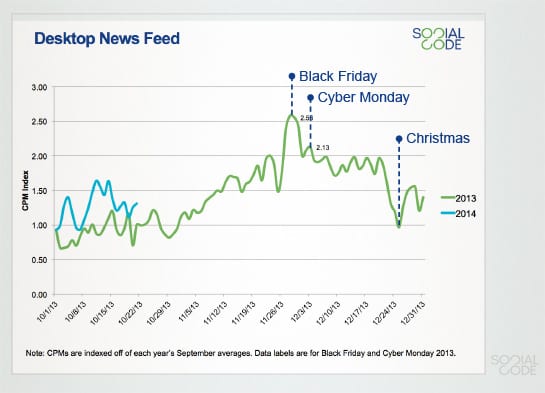
I know from recent testing with the targets above that right hand ads just aren't working for us so I opted for desktop newsfeed and mobile newsfeed. Again as a result of testing I know that CPC works better for us so I initially set the ads up to that with the intention of shifting to OCPM if Facebook wasn't playing ball by showing the ads (this does happen sometimes, even with ads with good CTR, and I anticipated a huge demand on newsfeed ad space over the Thanksgiving weekend). See this graphic from SocialCode which (as Jon Loomer points out in an intelligent article on why Facebook holiday ads fail) shows that it cost x2.58 more to show an ad to 1,000 people on Black Friday.
Incidentally, if you are allocating budget to desktop vs mobile newsfeed I'd suggest something like a 70/30 split in favour of mobile. Mobile ads are really working for us at the moment. And especially in the US at holiday time when people aren't at their desks, a focus on mobile is essential.
Facebook ad types
Hugely relieved that we don't have to jump through the faff of unpublished (dark) posts to get the kind of ad I was wanting, I set about creating my ads. These were created earlier in the week and scheduled for the Friday morning. The beauty of these new Power Editor ads is that you can change the copy at any point so from the Saturday onwards these ads lost the "Black Friday Flash Sale" message and instead reverted to "Thanksgiving Weekend" or "Cyber Monday offers" or "Pre Christmas Flash Sale". Again testing variants is useful.
Here's an example of one for Worship Backing Band:

Note the use of a call to action and the different text utilised in the different places on the ad. You only get this level of flexibility by using Power Editor.
With Musicademy I tested two different ad images (see below - both complying with the 20% text rule). Depending on my results mid way through the Friday I could then turn off the one that was least effective.


I also created blog posts with the relevant images and some informative text which were used organically on Facebook as link posts and turned into ads during the weekend. Note that I never use the Boost Post button. Instead I will go into Power Editor and create an ad form that organic post.
Facebook Offers
I LOVE Facebook Offers. They are massively under utilised so are quite a novel item for users in newsfeed. Reach is not too shabby and it's easy to add a little ad budget to them to further extend their reach. The other very nice thing with Offers is that they are a lot stickier in terms of viral reach because Facebook surfaces messages about offer claims in friends' newsfeed and also asks the user if, having clicked on the offer, they want to share it.
And the other great thing about Offers is that Facebook emails your offer to those who click on it plus sends another reminder email just before the offer expires. What's not to like?
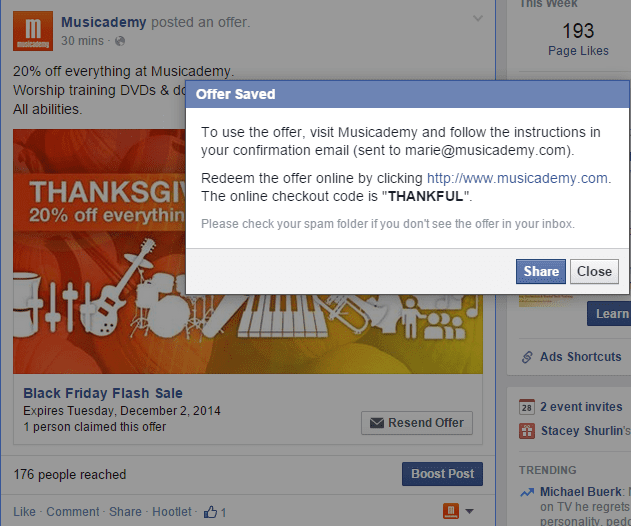
The offer also meant I had something unique to put on the newsfeed at 8am UK time (I know I can target organic posts but geography but people don't see comments and likes from other terrotories and unfortunately you have to list each recipient country individually).
I created the Offer in Power Editor (effectively as an Unpublished Post) and scheduled the ad for the afternoon of Black Friday. On the actual morning, however, I nipped into the "Manage Pages" area on Power Editor (top left) and "published" the dark post to extract a little organic reach out of it first. The Offers were created using optimised bidding.
The results
The results weren't exactly what I would have predicted and it felt a lot harder work this year than last. On the positive, we spent about £175 on Facebook ads and had a very healthy boost in sales. Email marketing was the most effective medium (particularly to our own mailing list).
The UK seemed to have really embraced Black Friday and Cyber Monday with stores reporting record sales. However, in the US the New York Times cited Black Friday Fatigue as responsible for an 11% decline in sales since last year. Other possible factors cited were the residual effects of recession, deep discounts in the run up to Thanksgiving and the conditioning effect of continual sales leaving shoppers holding out for even better offers. We certainly saw plenty of that. Despite a bigger advertising push than last year, our sales were a fair bit lower (the majority of our customer base is in the US). And despite a near identical offer to last year, it felt from emails had a lacklustre response, as if customers were wanting something more.
Firstly, there was clearly a lot of competition on newsfeed over the entire period so I went in on the Friday morning and upped my bid price on all ads. This worked to increase my paid reach to more acceptable levels.
My A/B split test showed a clear winner in CTR and conversion (the silhouette image rather than the pack shots) so the loser ads were switched off.
My organic posts got very poor reach. I wasn't entirely surprised to see this. Firstly they are promotional (and I suspect that the algorithm was adjusted down for words like "Sale" "Black Friday" and other discount indicators). Secondly, whilst we have plenty of paying customers, our marketing emphasis is that of delivering great content. Reach of good quality posts is often over 35% and often well above that but I've never found that posts about products get many clicks or likes and the viral reach of them is virtually zero. Similarly the open rate on the email was much lower than our usual content driven weekly newsletter. I'm sure as well that a good proportion of people were simply sick of all the promotional messages being bombarded at them over the weekend.
Also we know that Facebook dislikes multiple uses of the same image. So once the images were out in one format (say an ad or offer), organic posts using the same image would suffer from poor reach. This is useful learning for the future - when you are using an image in an ad, make sure you create something different for organic posts. And the beauty of this approach is that your organic posts can have as much text on the image as you like (although arguably Facebook isn't keen on images with lots of copy - certainly penalises any it thinks are meme like).
In terms of audience, our Lookalike audiences worked really well for CTR and conversion. We'll definitely continue to craft ads for them in the future. We'd expect fans to respond and they did, but mainly in response to email marketing. I suspect that the Facebook ads merely acted as a reminder to them (perhaps when they were on mobile and out and about) and when back to desktop settled down with the email to make their sale purchases.
The initial Musicademy Offer got some good traction (34 offer claims from a Reach of 6,276 and spend of £40) so I decided to re-work the idea on Cyber Monday for the Worship Backing Band brand. Again I created an unpublished page post offer, made it live on the Page then scheduled the Offer Ad for a few hours later.
Here's the Worship Backing Band Offer and the email Facebook sends to those who take it up:
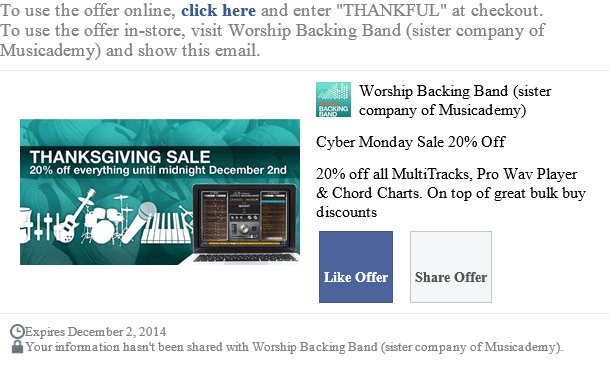
(Don't you just hate Facebook's default typeface and styling of this message?)
Customer reaction
There was the inevitable set of moaning from British customers about why we (as a UK brand) were embracing this American import and bowing to the gods of consumerism. It was great to see British fans coming to our rescue without us having to justify our actions (see a snippet from the conversation below).
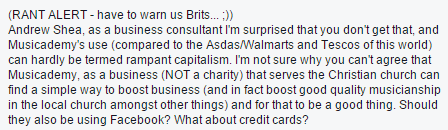
We also had the odd email from people miffed that they'd purchased at full price a few days before (we sent them some free stuff as a consolation and to our delight they ended up buying even more). One emailer told us we were being tight at only offering 20%. I didn't see many retailers being that generous across their ENTIRE RANGE (including titles that had only been released a few weeks previously). On reflection I think we could have played the game most retailers do in sales and simply cherry pick a few key products (many of which were already on half price sale) and slash the price dramatically to get the headline effect. But much of our objective was to increase average order value which a blanket discount offer had previously achieved.
Again we were able to counter this a little with our Cyber Monday email where we hit hard on the messaging to do with additional in-store discounts. The headline read "Did you think our 20% off Black Friday coupon wasn't generous enough?"
In terms of purchases the Cyber Monday email was twice as effective as that of Black Friday but do remember that it may also have served as s useful reminder to those that may still have been waiting to act on the Friday email.
So lessons learned for the future.
Reflections
Responsiveness was crucial throughout the campaign. Sure the ads and organic posts were scheduled but we benefited from me dipping in and tweaking copy, bids and targeting based on what real time results were telling me. I was also learning over the weekend from customer reaction, what other brands were doing and how the algorithm was working - all this informed the content I created for the last big push that was Cyber Monday.
This has also given us a glimpse of the future for promotional posts. Facebook is very much Pay To Play unless you have non-promotional content but with a clever use of budget (and for clever read putting in the hours researching, testing and setting up ads) you can get good results on very small budgets.
Comparing what I paid for the third party email list and Facebook ads I'd choose the ads every time. And I will continue to invest in building our own list organically and focus on serving them great quality content, building up trust and permission to occasionally talk to them about products. Pretty much the same way I feel about my Facebook newsfeed.
17 Dec 18:24
Three Tips For Improving Twitter Ad Campaigns
by Eric Wittlake

You could say I’ve become mildly addicted to Twitter ads recently. Without the benefits of business information, like LinkedIn, or granular interest information, like Facebook, Twitter ad campaigns are a unique challenge for B2B marketers, and that makes a successful program that much more rewarding.
Over the last 12 months, there are a few tactics that I’ve found can consistently improve the performance of Twitter ad campaigns. You probably won’t hear these tips from someone at Twitter (I know I never did). In fact, they run counter to what Twitter sometimes recommends. So try them out and share some of your results and some of your favorite tips is the comments.
Tip 1: Get granular with handle targeting
One of the best ways to target an audience on Twitter is handle targeting. This lets your target based on who people follow.
Finding out your audience follows TechCrunch, CNN or Guy Kawasaki isn’t going to do you any good. You need to find the accounts people in your target audience follow but who are largely unheard of outside of the audience you care about.
How can you find these accounts? Today, Little Bird is my first stop. The team at Little Bird has built the best solution I’ve used yet for finding the people that are influential on very specific topics along with the context needed to see if they have an appropriately focused audience.
(Disclosure: Regrettably I have no stock or other financial interest in Little Bird).
Tip 2: Step carefully with mobile
85% of Twitter’s ad revenue in Q3 came from mobile. Yes, Twitter is mobile, but maybe your Twitter ads shouldn’t be if you want to get people to your site or content. Stick with me here.
If you are running Twitter ads today, look at your reporting by device. Chances are you will see mobile platforms have engagement rates as much as 10 times higher than desktop. And remember, you pay per engagement, so that high engagement rate looks great, but it has a big budget impact.
Now flip over to Google Analytics, or whatever site analytics solution you use, and compare desktop and mobile engagement numbers in Twitter to desktop and mobile traffic numbers from your Twitter ads. You will see a huge difference between engagements and visits from mobile devices, and a much smaller difference when you compare the desktop numbers.
Why is this happening? People are “engaging” with your ad, which includes simply tapping on your Tweet from a phone. No, that isn’t much of an engagement, but unlike some other social ad platforms, Twitter charges for every engagement, not just a click.
If you are driving people to your content outside of Twitter, sadly, targeting only desktop users will generally improve campaign performance significantly.
It is worth noting, Twitter announced objective-based campaigns, with additional pricing models, about four months ago. While this program is still in beta and hasn’t been rolled out to all advertisers yet, thankfully Twitter is beginning to address these challenges with mobile ads.
Tip 3: Use handles as keywords
Are you using Twitter ads to seed content you want people to discover and share? Instead of just targeting the type of people that will be interested in your content, you can target ads based on the kind of content people share by using the handles of publishers as keywords.
Would people sharing articles from HBR or Fast Company Design be interested in your content, and likely to share it? Then target ads to @HarvardBiz or @FastCoDesign.
In one recent program I saw this approach to handle targeting drive dramatically higher additional organic sharing of our content than any of the other targeting approaches we used on Twitter.
Your turn
These are some of the tricks I’ve picked up over the last year, what are some of your favorites, or what else should I be testing? Please share in the comments below!
17 Dec 18:23

Oil prices are now unsustainably low: So where do we go from here?
by John Kemp, Reuters
Comment
LONDON — Oil prices have now fallen to an unsustainable low level. Futures contracts for Brent and WTI have fallen below US$60 and US$55 per barrel respectively but many crude producers are receiving much lower prices.
Plains Marketing, for example, is now offering just US$39.69 per barrel for Williston Basin Sweet crude and less than US$50 for a wide range of other U.S. crude oils, according to its latest pricing bulletin, published on December 15.
Billions of dollars of capital expenditure projects have been or will be postponed by the major international oil companies, independents and shale producers, which, if they all remained canceled, would generate an enormous shortfall in oil supplies by the end of the decade.
At these prices, shale production on most leases across the United States cannot breakeven. Only a few of the most favorable areas with the best geology and low transport costs remain profitable. Even in these cases profit margins are razor thin.
If posted prices remain at current depressed levels, almost all shale drilling activity will eventually cease, and U.S. oil production would start to fall rapidly towards the end of 2015 and into 2016 as output from existing wells starts to decline.
Just as prices were unsustainably high when Brent was trading above US$100 throughout most of 2011-2014, encouraging too much drilling and conservation, oil prices have now plunged to an unsustainably low level.
The market has over-reacted to signs of an impending surplus in production in 2015 by cutting prices to a level that will cancel not just marginal projects but almost all new drilling given enough time.
It is a classic bubble – the mirror image of the frenzied rise in prices towards their peak at US$147 per barrel in July 2008 (“Oil market is trapped in a negative bubble” Nov 14).
Like any bubble, it is impossible to predict how long it will continue to inflate or how far prices might eventually be distended before the bubble bursts.
In a bubble, prices tend to become far more distorted than rational observers thought possible before correcting, so there is no reason why oil prices cannot fall further in the short term.
Related
But bubbles also tend to be fairly short-lived because their internal dynamics are so unstable and the divergence between market prices and underlying supply/demand fundamentals becomes too stretched to ignore (“Behavioral explanations make sense of oil’s plunge” Dec 1).
In 2007/08, it took Brent prices nine months to double from around US$75 in Oct 2007 to peak just below US$150 in July 2008. In 2014, it has so far taken six months to halve from US$115 to US$59.
If it is impossible to predict how low prices might fall before correcting it is at least possible to surmise the turning point is not far off in terms of time.
The four previous plunges in oil prices over the last four decades (1985/86, 1997/98, 2000/01 and 2008/09 were all quickly followed by price rises after the market over-reacted on the downside.
The market appears to be headed for something similar in the current environment as prices fall to levels which are simply unsustainable for more than short period of time.
© Thomson Reuters 2014
17 Dec 18:23
Nine Application Performance Management Apps for the Changing World of IT
by GetApp
 The world of application performance management software is experiencing a shake-up of sorts, spurring great changes not only in the industry itself (see also: the breaking up of Compuware into two entities), but also in how IT professionals look at the Web. The average webpage is simply more complex than it was a few years ago, when all the code that comprised a typical webpage all resided in one place.
Now, webpages are almost always a hodge-podge conglomeration of different applications and resources working in concert to bring the page to life. Web and mobile sites are driven by local and cloud-based third-party applications, and that places a strain on the application performance management software you use.
So we’ve put together this list to highlight nine of the top application performance management tools on the market. These apps are swimming with the current – keeping pace with the rapidly evolving IT landscape.
Here are the top nine application performance management software providers.
 Stackify
Stackify makes it easy to monitor all your apps, servers, and databases. The software is a robust, comprehensive tool that offers error detection, performance logs, in-depth analytics, and user accesses, all from its eye-appealing interface.
Stackify works on Windows and Linux. Pricing for Stackify starts at $15 per month. A no-credit-card-required trial is available.
 New Relic
New Relic is an application performance management tool equally suited to Web and mobile, the cloud and the data center. New Relic offers 24/7 monitoring and diagnostics (to code level) for your IT infrastructure. New Relic works with cloud-based and mobile apps. New Relic also provides enhanced vendor visibility for many third-party applications, giving you unparalleled insights into performance for many popular apps.
New Relic works on the Web, Windows, Linux, and Mac, as well as on iOS and Android devices. Pricing for New Relic starts at $24 per month. A free, no-credit-card-required trial is offered.
 Datadog
Datadog provides performance metrics and event monitoring. Datadog sports more than seventy integrations and a powerful API to help your create custom graphs. Datadog offers a simple, single-screen overview of local and cloud-based assets, giving you a clear picture of how well everything in your IT infrastructure is working together. Datadog provides excellent visualizations of network performance and events, complete with colorful charts and graphs.
Datadog is a Web-based application. Datadog is priced from $15 per month. A free, no credit card required trial is available.
 BigPanda.io
BigPanda.io quiets the den of noise that is your operations alerts system. BigPanda.io makes it possible to use Big Data to automate incident management – meaning the never ending stream of alerts can come a halt, with routine tasks placed on autopilot.
BigPanda.io works on the Web, Windows, Linux, and Mac, as well as on iOS and Android devices. Pricing for BigPanda.io starts at $199 per month. A free trial (with no credit card required) is available.
 LogicMonitor
LogicMonitor helps your team separate the wheat from the chaff with regard to your IT infrastructure. Some issues are simply more urgent than others, and addressing those most pertinent of problems is increasingly challenging for IT professionals. LogicMonitor helps you get right to the root cause of the problem, making it easy to identify trouble.
LogicMonitor is a Web-based Windows application. Pricing for LogicMonitor starts at $249. A free trial is available (no credit card required).
 Site24x7
Site 24×7 is an application performance management tool that keeps the user experience top of mind – just like you and your IT team. Site24x7 provides information on the performance of third-party apps, servers, databases, and mobile sites. By gathering info from more than 50 data centers, as well as from popular wireless carriers, across the globe, Site24x7 lets you know how your users see your webpages and mobile sites.
Site24x7 works on the Web, Windows, Linux, and Mac, as well as on Android devices. Pricing for Site24x7 starts at $5 per month. A free, no credit card required trial is available.
 ManageEngine OpManager
ManageEngine OpManager is an application performance management tool that can handle networks of any size and configuration. ManageEngine OpManager offers comprehensive network monitoring and fault identification. It sports an easy-to-use interface that keeps your network up-and-running with optimal up-time.
ManageEngine OpManager works on Windows, Linux, and in your Web browser. Pricing for ManageEngine OpManager starts at $1995 per license.
 Load Impact – Performance Testing
Load Impact – Performance Testing is a popular load testing application in use by companies around the world. Load Impact lets you establish benchmarks and measure performance across millions of users. Load Impact also helps you drill-down into the route of the problem, when issues emerge. Load Impact – Performance Testing presents global information in easy-to-understand maps, to help you figure out where in your network things are reaching a bottleneck (or breaking down). This provides you with an unparalleled, global view of your network, end-to-end.
Load Impact – Performance Testing works on Windows and Mac. Pricing for Load Impact starts at $299 per month. A free, no credit card required trial is available.
 vFabric Hyperic
vFabric Hyperic is a customizable monitoring app for Web applications. vFabric Hyperic helps you identify problems in custom Web apps, whether they are physical, virtual, or in the cloud. vFabric Hyperic tracks server performance and helps you reduce downtime, in in high-stress networks.
vFabric Hyperic is Windows-based. Pricing for vFabric Hyperic starts at $149 per year. A free, no credit card required trial is offered.
Have You Outgrown Your Old Application Performance Management Tool?
If your network infrastructure has changed with the times, then it’s time your application performance management software gets with the times!
The entries on this list are some of the most popular and powerful application performance management applications around. If you’d like to look at other choices for application performance management, be sure to check out GetApp’s complete list of all the current ones on the market.
17 Dec 18:17
Five Marketing Measurement Trends to Watch in 2015
by Ben Sidebottom
With the explosion of marketing channels and resulting data, marketers face an increasingly complex challenge of delivering personalized, contextually relevant experiences for each customer, while ensuring that every marketing dollar spent is effectively contributing to the bottom line. Advanced attribution has become an enabler of success, providing a sophisticated approach to measuring, optimizing and activating marketing campaigns. But the world of attribution measurement is constantly evolving. Here are five key trends to watch in the coming year:
First-Party Data Will Become Critical
To truly engage with consumers, you need to deliver highly relevant, personalized messages to each potential customer. In 2015, the ability to leverage first-party data stored in your customer relationship management (CRM) and enterprise data warehouse (EDW) systems will become essential for building customized audience targeting strategies. By using this data in combination with advanced attribution, you can gain a much richer understanding of the “right” audiences to target, what products or services are most relevant to them, when they are most likely to buy, and the optimal combination of marketing tactics needed to convert them.
Investment in Cross-Device Advertising Will Continue to Grow
As advertising dollars continue to shift from desktop to mobile, first-party data can also help you overcome the limitations posed by cookies when it comes to tracking consumers across multiple devices. For instance, when an individual uses their email address to log into their respective accounts across mobile, tablet and desktop, this data can be used to connect the same individual as they move across devices. By combining this cross-device mapping approach with advanced attribution, you can gain insight into the true effectiveness and ROI of any combination of media, whether served on a desktop, tablet, or mobile device, and make spend decisions based on those insights.
Cookies Will Live On
Despite the limited capabilities of cookies to connect a single user to a number of different devices, the “death of the cookie” will remain overhyped hyperbole in the coming year. Even with the proliferation of mobile devices and cross-platform marketing, cookies still remain the most commonly used technology to collect anonymous data about a user’s browsing behavior, and adopting alternative mechanisms will take time. However, going into 2015, expect to see user-based tracking supplement cookie-based tracking as the mechanism through which audiences can be targeted. A user-based approach provides more accurate data on consumers as they interact on the web, mobile devices and third party websites, enabling you to create personalized, relevant experiences that engage consumers in the right place, at the right time and with the right message in order to drive a conversion.
Media Spend Will Continue to Focus on Programmatic
Investment in programmatic media buying will continue to increase in 2015, particularly as these platforms enhance audience targeting with first-party data and other real-time third-party signals, such as sporting events and weather. In addition, as the popularity of online video content continues to grow, so will the buzz around programmatic video. Although the wholesale move from TV to digital video is unlikely, 2015 will see increased investments in programmatic video advertising as a tool for generating greater audience insights and the ability to reach consumers across multiple platforms and devices.
But while overall investment in programmatic will increase, expect the amount of inventory purchased per advertiser to decrease. First and third-party data enrichment increases the value of the inventory – and thus the cost per impression (CPM) – by enabling advertisers to better target their audiences. However, it also enables buyers to be more selective in their purchase. Look for advertisers to spend more on high impact buys, while purchasing less inventory overall.
Programmatic will drive demand for advanced attribution
As marketer investment in programmatic buying for display and video continues to increase, so too will the demand for advanced cross channel marketing attribution. Attribution plays a central role in measuring and optimizing programmatic buying strategies, as it ingests data from various advertising platforms (data-management platforms, demand-side platforms, etc.), quantifies the true impact of every marketing touchpoint across the entire purchase funnel on producing a conversion, and then transmits attributed data back to the media buying solutions to deploy optimized buys. As more and more advertisers acknowledge the measurement biases posed by last click, advanced (algorithmic) attribution will become a must-have capability not only for achieving more efficient media spend and growth, but also for delivering personalized, contextually relevant experiences for each and every customer.
17 Dec 18:16




Wendell Berry on Solitude and Why Pride and Despair Are the Two Great Enemies of Creative Work
by Maria Popova
“True solitude is found in the wild places, where one is without human obligation. One’s inner voices become audible… In consequence, one responds more clearly to other lives.”
 “One can’t write directly about the soul,” Virginia Woolf wrote in her diary. Few writers have come to write about it — and to it — more directly than the novelist, poet, and environmental activist Wendell Berry, who describes himself as “a farmer of sorts and an artist of sorts.” In his wonderful and wonderfully titled essay collection What Are People For? (public library), Berry addresses with great elegance our neophilic tendencies and why innovation for the sake of novelty sells short the true value of creative work.
Novelty-fetishism, Berry suggests, is an act of vanity that serves neither the creator nor those created for:
Works of pride, by self-called creators, with their premium on originality, reduce the Creation to novelty — the faint surprises of minds incapable of wonder.
Pursuing originality, the would-be creator works alone. In loneliness one assumes a responsibility for oneself that one cannot fulfill.
Novelty is a new kind of loneliness.
Wendell Berry (Photograph: Guy Mendes)
Berry paints pride and despair as two sides of the same coin, both equally culpable in poisoning creative work and pushing us toward loneliness rather than toward the shared belonging that true art fosters:
There is the bad work of pride. There is also the bad work of despair — done poorly out of the failure of hope or vision.
Despair is the too-little of responsibility, as pride is the too-much.
The shoddy work of despair, the pointless work of pride, equally betray Creation. They are wastes of life.
For despair there is no forgiveness, and for pride none. Who in loneliness can forgive?
Good work finds the way between pride and despair.
It graces with health. It heals with grace.
It preserves the given so that it remains a gift.
By it, we lose loneliness:
we clasp the hands of those who go before us, and the hands of those who come after us;
we enter the little circle of each other’s arms,
and the larger circle of lovers whose hands are joined in a dance,
and the larger circle of all creatures, passing in and out of life, who move also in a dance, to a music so subtle and vast that no ear hears it except in fragments.
Illustration by Emily Hughes from 'Wild,' one of the best children's books of the year. Click image for more.
Echoing Thoreau’s ode to the woods and psychoanalyst Adam Phillips’s assertion that cultivating a capacity for “fertile solitude” is essential for creative work, Berry extols the ennobling effects of solitude, the kind gained only by surrendering to nature’s gentle gift for quieting the mind:
We enter solitude, in which also we lose loneliness…
True solitude is found in the wild places, where one is without human obligation.
One’s inner voices become audible. One feels the attraction of one’s most intimate sources.
In consequence, one responds more clearly to other lives. The more coherent one becomes within oneself as a creature, the more fully one enters into the communion of all creatures.
The return from such humanizing solitude, Berry cautions, can be disorienting:
From the order of nature we return to the order — and the disorder — of humanity.
From the larger circle we must go back to the smaller, the smaller within the larger and dependent on it.
One enters the larger circle by willingness to be a creature, the smaller by choosing to be a human.
And having returned from the woods, we remember with regret its restfulness. For all creatures there are in place, hence at rest.
In their most strenuous striving, sleeping and waking, dead and living, they are at rest.
In the circle of the human we are weary with striving, and are without rest.
Indeed, so deep is our pathology of human striving that even Thoreau, a century and a half ago, memorably despaired: “What business have I in the woods, if I am thinking of something out of the woods?” But the value of such recalibration of our connectedness in solitude, Berry suggests, is that it reminds us of the artist’s task, which is to connect us to one another. He returns to the subject of despair and pride, which serve to separate and thus betray the task of art:
The field must remember the forest, the town must remember the field, so that the wheel of life will turn, and the dying be met by the newborn.
[…]
Seeing the work that is to be done, who can help wanting to be the one to do it?
[…]
But it is pride that lies awake in the night with its desire and its grief.
To work at this work alone is to fail. There is no help for it. Loneliness is its failure.
It is despair that sees the work failing in one’s own failure.
This despair is the awkwardest pride of all.
But Berry’s most urgent point has to do with the immense value of “thoroughly conscious ignorance” and of keeping alive the unanswerable questions that make us human:
There is finally the pride of thinking oneself without teachers.
The teachers are everywhere. What is wanted is a learner.
In ignorance is hope.
Rely on ignorance. It is ignorance the teachers will come to.
They are waiting, as they always have, beyond the edge of the light.
All of the essays in What Are People For? are imbued with precisely this kind of light-giving force. Complement it with Berry on what the poetic form teaches us about the secret of marriage, then revisit Sara Maitland on the art of solitude, one of the year’s best psychology and philosophy books.
Donating = Loving
In 2014, I poured thousands of hours and tons of love into bringing you (ad-free) Brain Pickings. But it also took some hefty practical expenses to keep things going. If you found any joy and stimulation here over the year, please consider helping me fuel the former and offset the latter by becoming a Supporting Member with a recurring monthly donation of your choosing, between a cup of tea and a good dinner.
| ♥ $7 / month♥ $3 / month♥ $10 / month♥ $25 / month |

You can also become a one-time patron with a single donation in any amount.
 Brain Pickings has a free weekly newsletter. It comes out on Sundays and offers the week’s best articles. Here’s what to expect. Like? Sign up.
Brain Pickings takes 450+ hours a month to curate and edit across the different platforms, and remains banner-free. If it brings you any joy and inspiration, please consider a modest donation – it lets me know I'm doing something right.

17 Dec 18:16
How to Find Your Great Work (and Change Your Habits)
by acr
This past week has seen me popping up in interviews, and I wanted to share them with you…
Wisdom Heart: What’s Your Great Work?
First up, my friend and member of my mastermind group, Eric Klein, invited me to be a part of his What’s Calling You (WCY) Dialogue podcast. I’ve had the pleasure of interviewing Eric many times. He’s a leading voice in the movement to bring greater spirit, meaning, and authenticity to the workplace through his company Dharma Consulting.
In this interview, we discuss:
- Why you don’t need to save the world ‐ but you do need to make a difference
- The importance of not doing your Great Work too well
- How to discern your Great Work
- Eric’s learning edge . . .
Click here to listen, or visit the Wisdom Heart website.
Inspirational Creatives: Building Lasting Habits (in Less Than 60 Seconds)
Inspirational Creatives is a great podcast that features conversations with successful artists and entrepreneurs who offer ideas and stories to help you create the life and business you want. Rob Lawrence is the host of these intimate chats and it was a pleasure to speak with him about the value of saying no, Great Work and how to change your behaviours that aren’t serving you well…
In this episode you’ll learn:
- How to permanently change your habits in 60 seconds or less
- How to get to your goals faster by doing more Great Work
- How to get results by saying ‘no’ to more people, requests and opportunities
17 Dec 18:13
What Sales And Dating Have In Common
by Steven Tulman

I’ve been in corporate sales since I was 21 years old, and in the dating scene since I was 16 years old. I’ve had successes and failures in both my career and my dating life and I’ve learned from both worlds how to improve my abilities, style, and approach in order to increase the chances for success. The main thing that I’ve learned over the years is that being successful in both dating and sales uses a very similar skillset.
Here’s what I’ve discovered:
Be Genuine:
The first and most important element of both sales and dating is to be genuine. People are smart and can usually see through lies and false acts. Sincerity is key when establishing a relationship with the intention of exploring a potential partnership down the road.
Emotion Always Trumps Logic:
People “buy” products or other people based on their emotions more so than on logical thoughts. The study below, performed by the Corporate Executive Board (CEB), demonstrates how the emotions impact our buying decisions twice as much as logic. If that’s the case in the business world, how could it be any different in the dating scene?
In addition to demonstrating how your product or service will help your prospect’s business, be sure to speak to their personal motivators also (that’s the emotional side of things).
Similarly with dating, make them laugh, smile, and let them see the fun person, not just your serious and intelligent side. Of course you need to show them both sides, but lead with the fun and interesting element first.
Making the First Move (Prospecting):
Introducing yourself to a stranger at the bar or online is no different then cold calling, sending an intro email to a prospect, or approaching someone new at a business function.
The first few seconds of your introduction will either set you up for success or destine you for failure. The pressure is on and you need to engage the other person by conveying your value early on in order to earn their permission to continue the conversation.
Don’t be Desperate, Sleazy, or Pushy:
No one wants to buy from a desperate, sleazy, or pushy sales person, nor do they want to go on a date with someone who comes off as dishonest, fake or who is trying too hard to “win the deal”. Don’t be over zealous and just ramble on about yourself or your product with shameless self-promotion. That’s the easiest way to scare someone off forever.
Instead, approach a new “prospect”, business or otherwise, with confidence and demonstrate your value by talking about interesting adventures, fun stories, and so on. I emphasize again the importance of showing your fun side early on, but always be yourself. Drop tidbits of info that help raise your value without coming off as bragging.
Don’t be a “Yes” Man or Woman:
Even though most people like being right, what benefit do you bring to someone in the long run if you’re always agreeing with them? None really. By always agreeing with them, you might make them feel good at first, but you’ll quickly end up boring them and falling into the same pile as all the other “yes” people.
Having your own opinion, different from theirs, adds value to yourself. By respectfully challenging some of their views and opinions, provided you can back up your own point of view, you greatly increase your chances of keeping them intrigued into hearing what you have to say and getting them thinking a bit differently and out of their comfort zone. This will help set you apart from the rest of the crowd.
Sealing the Deal (Going in for the kiss):
If you’ve conveyed enough value to your prospect and have gained enough trust and interest from their part, then by this point you should have received all the right buying signs and are in a strong position to seal the deal. In both the business world and the dating world there are several ways of approaching this depending on the circumstances.
You might feel confident in simply using an assumptive close, or in dating life going in for the kiss. Certain situations might call for you to ask for the sale, or “Would you like to kiss me now?” – bold, but highly effective in the right circumstances. Sometimes you might require a follow-up meeting, or a second date. Sometimes many meetings will be necessary, and depending on the culture of the organization, or your potential future girlfriend/boyfriend, you may need the approval of a committee, or a large family. Either way, learning how to accurately gauge the situation is of most importance.
Communication is Key:
If you’re lucky enough to have met a good match and approached them the right way, you might find yourself forming a partnership. From this point forward it’s mostly about effectively communicating with one another and setting expectations that you both are willing and able to meet. This applies to building either an ongoing business partnership or an ongoing romantic relationship.
Know When to Move On:
Finally, no matter how good of a sales person or “catch” you are, you will not be a match for everyone every time.
Unfortunately, not everyone is straight forward with their intentions, nor does everyone have the courage to face a situation directly and let you know where you stand. Sure it would be great if everyone who wasn’t interested in you or your product would kindly tell you so and let you down gently. The truth of the matter is that it’s rarely the case and your prospect, or the object of your affection, is more likely to go silent, not return your calls or emails, or simply keep telling you that now’s not a good time, call back later. If this happens over and over again, they’re probably not interested in what you have to offer.
Know when to call it quits and how to do so gracefully without burning bridges and with your dignity still intact. There are few things worse and more painful than walking away without your self-respect.
Once you’re in a healthy relationship, you’ll quickly learn a very important phrase: “I’m Sorry”. To get a head start on this one I suggest reading my article, The Power of an Apology.
What tips do you have for dating and/or selling?
Happy Selling (and Dating)!
17 Dec 17:44
5 Tips to Crush Your Year-End Quota
by Micheline Nijmeh
Why do only 50% of salespeople hit their year-end quota? The biggest reason is that most don’t fully understand prospects’ needs, and – without a systematic approach to gain those insights – it’s impossible to figure out where, when, and how sales reps should focus efforts.
To help keep your eye on your sales target so you can crush your year-end quota, consider the following statistics and the tips that sales reps can take away from them.
Sales Tip #1 – Prioritize your prospects
15% of clients make up 65% of sales
Sales reps that can quickly and easily spot their best opportunities – and eliminate least likely opportunities – have more success. Sales reps must take the time to prioritize – it will pay huge dividends! To hit your year-end goals, focus on the most probable deals. Use tools that instantly rank prospects according to their level of engagement with digital content to get a better qualified sales pipeline and reduce time wasted on prospects that aren’t the right fit.
Sales Tip #2 – Get maximum insight into a prospect’s problem
70% of people make purchasing decisions to solve problems
A sales rep’s first job is to understand a prospect’s needs. What problem are they looking to solve? Sales reps need to understand a prospect’s specific pain points to tailor engagement. Sales acceleration tools can give you deep insight into a prospect’s interaction with content – letting you measure exactly how much time a prospect spends on each page of a proposal to reveal what issues are most important to them. Through better digital listening, sales reps can garner real-time intelligence for a more complete profile.
Sales Tip #3 – Adapt your selling processes
Inside sales is growing 3x faster than outside sales
Self-informed buyers are fueling this growth, forcing sales reps to find new ways to engage with customers. Sales reps need to have a plan in place. Improved communications, document sharing and tracking and other new technologies have become critical in this shifting sales environment. Sales tools need to capture real-time intelligence and deliver it in a usable way for sales reps to harness full value.
Sales Tip #4 – Focus on core selling activities
Sales cycles have increased nearly 25% due to non-core selling tasks
If a task is non-sales related, obliterate it from your to-do list. Get the tools that streamline processes, so you aren’t wasting time and can be the first salesperson to make the call. If a new sales tool requires that a sales rep manually inputs data into CRM, that’s a time drain taking away from selling. Make sure sales tools work seamlessly with your other existing everyday work tools to increase productivity.
Sales Tip #5 – Respond at the moment of interest
50% of sales go to the first salesperson to contact the prospect
Wherever you are, you need to be able to engage at the right time with prospects. You need to respond at their moment of need, and that demands a fast and frictionless mobile experience – delivering the same capabilities as seamlessly on mobile as in the office.
By making some strategic decisions and setting goals now, you can improve your productivity, focus on the deals that matter, and increase your odds of success.
To learn more, feel free to download this free eBook “Top 5 Tips for Crushing Your Quota.”
###
This blog originally appeared here.
15% of clients make up 65% of sales: Ken Thoreson, author, “Leading High Performance Sales Teams”
70% of people make purchasing decisions to solve problems: Impact Communications
Inside sales is growing 3x faster than outside sales: Inside Sales Market Size Study (InsideSales.com, 2013)
Sales cycles have increased nearly 25% due to non-core selling tasks: Sirius Decisions
50% of sales go to the first salesperson to contact the prospect: InsideSales.com
17 Dec 17:44
2015 Sales & Marketing Predictions
by Laura Hogan
 Ahhh, New Year’s Resolutions. Those pesky little things we make and never do, make and overdo until motivation dies out, or don’t make at all.
That’s why we don’t want to make New Year’s Resolutions, we want to make New Year’s Predictions… marketing ones to be exact!
You may think 2015 could be the year that a certain actor finally gets the big gig, the year the zombies finally come, the year that we cure cancer, or maybe even the year of the flying car… too soon? But when it comes to marketing we couldn’t just decide on one prediction, we asked the team and came up with your Top 7 Marketing Predictions for 2015!
#1 Content Prediction
 Laura: I think marketing will move far, far away from the generic ebook or whitepaper mentality. Our audience is consuming things in different ways and we need to give them all the options. Which means creating one piece of content in 10 different ways to meet their specific preference.
It’s not just about creating an ebook and giving it to your audience in the same old boring way. It’s about creating an ebook, a webinar, a slideshare presentation, and an infographic. Then making awesome social posts about it, cool advertisements, and exciting emails that showcases every possible way they can get the information on every possible platform!
#2 Social Prediction
 Kelly: Social Social Social! More and more companies are beginning to catch on to the fact that social media is not just for teenagers trying to tweet Justin Bieber. Social media is one of the most effective ways to get infront of your auidence on the internet. I think more CEOs and local business owners will begin to become advocates of social media in 2015. Once they get a taste of the value they will focus a big portion of their marketing strategy there.
#3 Sales Prediction
 Rick: I predict that we will see the rise of the hybrid salesperson. More and more salespeople will become effective at running their own social media/marketing campaigns. This will be driven by two forces. The need for salespeople to inject themselves into to the buyers journey at a much earlier stage and the democratization of online marketing tools that are now crossing over into sales.
#4 Online Advertising Prediction
 Cody: Marketing strategies will become more synced across the multiple platforms used in order to personalize the information a consumer receives. With all the data being collected, marketers will be able to increase the ad personalization within search engines, social platforms, apps, etc. The intent of consumers will be tracked closely in order to optimize ads. Generic advertising is a thing of the past and relevant marketing in real time will be the biggest goals of marketers.
#5 Oldschool Made New Prediction
 Mary: I see a return to using advertising, but tailored/adapted to the Internet — native advertising / brand journalism / sponsored content. This trend has been growing for awhile and I think it’s going to grow exponentially in 2015. That’s because there’s so much noise on the Internet. Everyone’s publishing content causing a content glut and fierce competition for search engine rankings, and people’s attention.
Publishing companies have the expertise, processes, editorial resources and impartial credibility that advertisers’ brands lack (both B2B and B2C). Publishers have been at this for hundreds of years — the only thing that’s changed is adding a new delivery mechanism, i.e. the Internet vs. newsstands, bookstores, and the mail. B2B and B2C brands are hungry to get in front of the right audiences — a perpetual challenge and no different today than seven hundred years ago. As periodical publishing houses become more sophisticated in capturing data about their audience and segmenting it, there’s no limit to the value they can bring to their advertisers. Instant access to a receptive, interested audience will always be valued.
#6 Marketing Automation Prediction
 Zack: Programmatic advertising is going to take over the world in 2015. Global spending on programmatic is expected to be over $50 billion in 2015. How we buy and sell media on the web is going to complete a dramatic shift to an automated, computerized approach.
For those that don’t know, programmatic advertising is a method of digital online advertising that uses algorithms to determine where and when to purchase ads.
One big benefit of programmatic ads is they are more effective at targeting the right audience across multiple platforms. Because it’s handled by computers, it’s also faster and more efficient than if humans did the work. In 2014, lots of publications have already invested heavily in programmatic solutions for their ad sales. It featured heavily in the FutureM track at the Inbound conference this year.
#7 Standing Out From The Crowd Prediction
 Alisa: I predict a continued move to the visual in social media. Companies are really going to need to step it up to get their content noticed, and a huge part of that is going to be creating outstanding visuals. This is one trend I don’t think is ever going away (and you can quote me on that).
Niche social networks (like Houzz) will continue to pop up and provide a valuable platform for certain industries. Business owners will need to keep on top of those to make sure they’re where the customers are.
Podcasting! 2014 saw an explosion in new podcasts. In 2015, it won’t be enough to just host a podcast. Companies will have to find new ways to stand out and provide value as this avenue becomes nearly as crowded as the blogging world.
Takeaway
One thing we always know is that marketing continues to improve for the end user to give them everything they want… despite what new improvements there might be, trends that might and go, or completely brand new ways of thinking.
What do you think?
What do you think about our predictions? Are we spot on? Did we leave some out? Let us know your thoughts in the comments below!
17 Dec 17:43

Managing sales team morale when your reps lost faith
by steli@close.io (Steli Efti)
Managing a sales team has its own set of challenges, one of them being sales reps who don’t believe in your sales strategy anymore.
This happens often when you develop a new sales approach or experiment with a new tactic. If it initially doesn’t work as well as you anticipated, if unexpected obstacles get in the way of closing deals… it can affect how your reps think and feel about this new idea in general.
Doubts creep in and spread.
Once your reps start telling the story of ‘This isn’t working, and it never will’, they’ll start selling like a sorry bunch.
When they lose faith in a strategy, they will create the result that proves them right. What the thinker thinks, the prover proves.
What should you do in a situation like this?
Motivational pep talk?
Ordering your reps to keep on going, no matter what they think or believe?
Listening to the people who execute your idea in the field, chalk it up as a failure and move on to another new approach?
Discussing and arguing with them why they shouldn’t doubt your strategy?
I’ve tried all of these ways to manage sales reps who lost their faith. And none of them worked. To succeed in sales, you need to believe, you need to be able to see the vision and be inspired by the potential. So you can’t just expect them to execute your strategy robotically. It has to come from the heart.
So how do you make them believe again?
Suspend their disbelief.
When they lose faith, show them a miracle.
Here’s two examples to restore their faith:
Bring in new blood
Hire some temps who have some background in sales. They don’t need to be great sales people. They should just have done some kind of selling in the past. When you bring them in, don’t let them get in contact with your actual sales reps. You want to put them in quarantine, because the virus of doubt is highly infectious.
Get the temps in a room and tell them:
- Here’s the result we expect you to achieve. [an “unrealistically” high quota]
- Here’s a step-by-step process how you can achieve it. [the exact same process your sales reps failed with]
- Here’s everything you need to get it done. [phone, script, leads, etc]
- Now go do it.
Most of these temps will fail at this. That’s just how it works.
But every once in a while, you’ll have someone who just kills it.
That’s all you need: one person who can make it work.
We once hired a temp who had a very unpromising resume. Nothing about her indicated that she’d pull it off - but for some reason she did.
When you have that one person, you let her work together with your regular sales reps. Have them witness how she’s making the magic work.
When they see how she’s getting results and closing deals… a funny thing happens: they’ll start seeing the potential again, their doubts wither away and new hope arises.
Then, miraculously, it starts to work.
In this video, I share the story of a startup that made use of the same principle to turn underperformers into serious producers:
Ultimately, it’s about getting rid of limiting beliefs, and exploring more of what’s possible.
Maybe you’ve heard this story before:
A young college student was working hard in an upper-level math course, for fear that he would be unable to pass. On the night before the final, he studied so long that he overslept the morning of the test.
When he ran into the classroom several minutes late, he found three equations written on the blackboard. The first two went rather easily, but the third one seemed impossible. He worked frantically on it until — just ten minutes short of the deadline — he found a method that worked, and he finished the problems just as time was called.
The student turned in his test paper and left.
That evening he received a phone call from his professor. "Do you realize what you did on the test today?" he shouted at the student.
"Oh, no," thought the student. I must not have gotten the problems right after all.
"You were only supposed to do the first two problems," the professor explained.
"That last one was an example of an equation that mathematicians since Einstein have been trying to solve without success. I discussed it with the class before starting the test. And you just solved it!"
Even though it didn’t happen exactly like this, it’s based on the true story of Georg Danzig who came late into the classroom, saw two formulas on the blackboard, jotted them down thinking this was their homework, and solved them - not knowing that these were examples of two “unsolvable” problems of statistics.

17 Dec 17:43
A Sales Makeover, 35 Tips
by Erin Dore Miller
 I have always been around salespeople. I actually like most salespeople. If they’re any good, they’re hardworking, tenacious, personable, smart, and intentional. They, like me, actually like selling.
Selling: the art and science of moving another person or organization toward you and/or your organization for a specific business purpose.
Doesn’t sound so hard. After all, our entire economy is based on, not the bartering of products and services, but the exchange of dollars for a product, service, or intellectual capital.
Why then is it such a painful process? Why are there so many mediocre salespeople and why are so many sales conversations between salesperson and prospect, or salesperson and their manager, so painful?
Sometimes we just need a makeover. A fresh perspective, new ideas, and approaches. We need to expand our mind and our skills.
This is a post designed to get you past the painful. Take stock, pay attention and see where you, as a sales or business development professional, can improve. You owe it to yourself, your family, your company, and your prospects.
Don’t do them all at once. It’s too hard and success or sustainability too difficult. Choose a tip, consider it, study it, apply it, master it, and move on to another.
35 Tips For Your Sales Makeover
- Own the fact that you are responsible for, and control, your financial security and career path.
- Know who you are –
- Take work assessments (here’s a few)
- Study the results.
- Create an action plan based on the results
- Know your:
- Strengths
- Talents
- Skills
- Maximize your strengths and people will spend little time on your weaknesses.
- Surround yourself with optimistic, successful people who are passionate about what they do.
- Cast off the economy as an excuse for lack of sales.
- Refuse to believe you are too busy to prospect and sell.
- Prospecting is the foundation
- Outbound and inbound strategies go together
- Understand the preferred communication of your buyer and prospect
- Understand industry trends and how your product or service leads or meets upcoming trends.
- Realize the past is not an indicator of your future, good or bad.
- Every day is a chance to do better, until someone else (said manager) says you don’t.
- Don’t wait too long to get serious.
- Study your craft carefully.
- Track and review:
- Successes
- Failures
- Habits
- Listen to how others sell well.
- Position yourself beyond the fray; Don’t sound like the others in your industry.
- Read –
- A Whole New Mind, Drive and To Sell is Human by Daniel Pink
- The Start Up of You by Reid Hoffman and Ben Casnocha
- The Alliance by Reid Hoffman and Ben Casnocha
- Follow:
- Industry leaders
- Research through Google
- Notice who speaks at your industry conferences
- Follow their blogs
- Sales leaders, trainers and bloggers (all of these folks provide free insight)
- Industry leaders
- Take online classes. (Many are free).
- Coursera
- Skillshare
- Udemy
-
Dale Carnegie
- Apply one or two nuggets of learning
- You learn better when you have to teach, share your knowledge with other salespeople
- Unhappy with your company? Leave. Do everyone a favor.
- Set goals and meet them. That in itself, is an accomplishment.
- Read Michael Hyatt’s post on goal setting
- Read and try out the app, Commit
- Reach high and believe you can, with great effort, attain stretch goals.
- Believe karma, luck, faith, and hard work win races, build careers, and distinguish you as a leader.
- Be prepared…Actually, be over prepared and you won’t need a Monday morning quarterback session.
- Don’t ever say, “I’m not tech savvy,” “I don’t like the computer” or anything that resembles that; you date yourself.
- Learn to be computer proficient.
- It’s more important to be respected than liked in sales. Buyers want people that can solve their problems. They don’t necessarily need a new friend.
- Don’t say, “they love me,” or “they love us.” They may until they don’t. Go for respect.
- Know the tools that make you look smarter and more productive than you looked last year; among your peers and in the world. (see tips above)
- Not so curious? Find a coach who will help you with the tools, accountability and strategies that keep you current and relevant for a wired, knowledge-packed buyer.
- Know:
- Your products and services inside and out
- What differentiates you
- Who you should be talking to
- Know why you should be talking to them
- Share specifics (proof points are critical)
- Give more than you think you should
- Know where they are socially
- Be there
- Get serious about your digital profiles and presence.
- You might not like LinkedIn. That’s okay.
- If your buyers are there, you need to be
- You don’t have to like it, it’s part of your job
- Pay up. Upgrade your LinkedIn membership for greater accessibility
- Build a strong, up-to-date, professional story.
- Connect strategically with the right people. Your network is your currency.
- Buyers
- Customers
- Strategic Partners
- Influencers
- Weave your online and offline activities together.
- Follow up through LinkedIn (B2B)
- Personalize your messages, 95% of the time
- Be real
- If you wouldn’t say it in person, don’t say it online
- Participate.
- Post, like, comment, and share content, yours and others
- You might not like LinkedIn. That’s okay.
- Be more than knowledgeable, be:
- Interesting
- Interested
- Mindful of time and effort; not every meeting needs to be an hour.
- Diligent. Fortitude should be a salesperson’s middle name.
- Organize. It’s liberating!
- Yourself
- Your data
- Your process
- Check out a CRM (customer relationship management tool)
- Contactually
- Nimble
- Solve360
- LinkedIn (lite version)
- Salesforce
- Check out a CRM (customer relationship management tool)
- Learn how to ask great questions. A series of great questions creates a conversation. A series of first level questions is an interview.
- Google this topic:
- 21 Powerful Open-Ended Questions
- Talk to your operations, customer service and marketing colleagues to understand things from their perspective.
- Never stop learning.
If you take an assessment and sales is really not your thing, it’s good to know. Selling is demanding, relentless and one of the greatest professions there is, if it’s for you. If not, it’s really grueling. If I managed your sales team, LinkedIn and several of the other tips would be key KPIs.
Do you have a professional development budget for yourself? Better, does your organization have one?
If so, great. If not, no worries. There is a free version for every tip. Just remember, the free stuff is what everyone can learn. It’s what gets you started but may not take you to the top. You decide. Start somewhere. You will reap the benefits.
This is not an exhaustive list, not by any means. We will continue to add to this post and keep you up-to-date on how the buying process has changed.
Now that you have your makeover plan, what’s stopping you? Don’t be schooled by your competition, your peers, your boss. Do the schooling.
These tips might get you through a bit more than a month, a quarter, or all of 2015. I’d love to hear your sales tips. What makes you great? What differentiates you?
17 Dec 17:42
Infographic Inspiration From The Best Brands In Content Marketing
by Anne Murphy
Infographics are heavy hitters in content marketing. And their popularity continues to skyrocket. As a tactic, infographics saw the biggest rise in usage amongst B2B marketers, jumping from 51% to 62% this year.
Visuals are, hands-down, the best way to grasp the attention of buyers. They into reader emotions, satisfy their short attention spans, and ensure your content sticks. Infographics take it a step further. They marry two powerful elements: visuals and data. They turn bland data into engaging, compelling content that’s easily to digest and remember.
Infographic Inspiration from the Best Brands in Content Marketing by @amurphias
They’re also pretty fun to conceptualize and create.
Here are 5 examples of infographics created by the best brands in content marketing.
1. LinkedIn – The Most Inspired Sales Professionals in the World
Why it works: This infographic ties together the emotional (feeling inspired by your job) and business (inspiration leads to productivity leads to revenue). It also slices and dices information in resonant ways—by region, gender, company, and role—so the viewer can easily see themselves represented by this data.

2. HubSpot – How to Get More Blog Subscribers
Why it works: HubSpot combines clear, actionable advice with data to back up the power of following these tips.

3. Allstate – My Identity Was Stolen: Now What?
Why it works: Allstate hits on a very important pain point for their target audience, and provides clear information about a complex and scary problem.

4. Intuit – How Startups Get Started and Succeed
Why it works: This infographic from Intuit showcases a clean, well-designed look and interesting stats that paint a picture of the startup scene in the US, and give innovators and startup folks some benchmarks for business.

5. ThoughtWorks – 100 Years of Computer Science
Why it works: It’s beautifully simple, and this infographic is a great resource for programmers and computer science folks. And the criteria for the included papers are pretty impressive: “The paper must have changed the world. The paper must have changed my perspective. Only one paper is allowed from each decade.”

17 Dec 17:42

How to establish your business blog as an authority in your industry
by Seb Atkinson
Readers of Social Media Explorer will already know how content marketing can improve your site’s SEO, but what else can a blog do for your business? A blog is more than just an SEO tool, it can also be a valuable asset to your business, demonstrating your authority in your industry and helping you to generate leads online. In this article we will look at how you can turn your business blog into a valuable lead generation tool by building your company’s authority in your industry.
Building Trust with Your Blog
 When it comes to online marketing, many of the same concepts of offline sales and marketing apply. No one is going to buy from a person they don’t trust, whether that’s via a website or face-to-face in a meeting.
Nowadays, it’s essential to overcome any trust issues with your customers before you even make contact with them. In the old days, sales reps would diagnose customers’ needs, align products and services to those needs, then sell these solutions. But with the wealth of information that the internet provides, customers now define solutions for themselves, contacting vendors much later in the buying process. In fact, a study by CEB showed that 57% of B2B customers typically made a decision on a purchase before even speaking to a supplier. This means your blog and website content needs to assure visitors that you are a credible business before they will even contact you, and you can do this by building trust with your content.
Using Offline Trust Signals
A lot of the same trust signals for the offline world also apply to the online world when it comes to B2B sites. Ultimately, the purpose of your business blog is to generate leads and enquiries for your services, so the trust signals that you use to show the quality of your offering can also be used on your blog.
For example, suppose you were a management consultant or other business service provider. You may therefore want to use your blog to build trust with potential clients, showing your service is high quality and can easily compliment your clients existing processes. One way of doing this is becoming ISO 9001 certified, which is often a prerequisite to working with government and blue chip contracts.
If you already have ISO 9001 certification to work with these types of businesses, make sure your blog talks about your certification! This is because as the CEB research shows, the majority of potential clients will be conducting their own research prior to contacting a supplier, so it’s essential that they are made aware of your certification if this is an important factor in their decision. Similarly, for potential clients where ISO certification isn’t a make or break factor, your blog needs to have content to show why being certified sets you above the competition.
Therefore, a great starting point for your business blog would be to consider all the factors that are important in a client’s decision to choose you, as well as ‘nice to have’ benefits of your service. Then, ensure you have a detailed blog post on each of these, optimized for relevant keywords. For instance to capture management consultancy buyers where having a quality management system in place is essential, your may want to optimize a post for “ISO 9001 Certified Management Consultancy”.
Blog about Case Studies
Client case studies are another great topic for blog posts. Chances are, however, that you already have case studies on your site; however, if you’re not repurposing content for other channels, then the cost of your online marketing is multiplied.
So how can you repurpose case studies into blog content? One way might be to group several case studies that used a common service or strategy to deliver results. You could convert those three case studies into a single article that specifically talks about that single strategy used as part of all three campaigns, and how this helped each of the clients. This post can then be optimized for a keyword relevant for that particular strategy.
An example of this in the SEO industry could be to write about three clients who each had link building as part of the SEO strategy. A new blog post could be crafted to explain the importance of link building in SEO and three examples of how this tactic specifically helped improve their online visibility.
Ensure Articles Live Up To the Promise of Their Titles
A business blog is a great way of humanizing your brand, which means similar rules about promises made by sales people in face-to-face meetings need to be adhered to online, as well. For example, if you were in the market for a new car and the sales person made exaggerated claims about its mileage or performance which you knew to be false, you’d likely be skeptical about anything else they said. Similarly, anything you convey about your brand is a promise. Every conversation, download, or subscription is an agreement that you promise to provide something of value, while they promise to engage with you as a result.
In a study by Salesforce of over 400 B2B buyers, 71% had been disappointed with the content they downloaded from a business, with 25% of those saying they would never read content from that business again due to disappointment.
This also applies when it comes to writing your blog content. To establish your blog as an authority in your industry, building trust is essential, meaning your content needs to live up to every promise you make. That means if you write an article about “how to double your revenue in 5 steps”, be sure to have evidence to back your claims up through citing external resources, studies, or case studies of your own clients or projects.
Without credible content that lives up to the promises you make, your authority can be eroded in time, negatively reflecting on your brand. Over time, this can cost you traffic and sales.
Wrapping Up
Ensuring your blog presents your business as an authority in your industry is essential if you want your blog to become a lead generation tool. A great way to apply the advice above is to consider all your brand values, write them down, then look at your blog content and decide whether it conveys those values. However, beware of being overly bias about your own site. One way around this is to utilize User Testing, a service allowing you to recruit people in your target market to test your website. You are able to design a test for them with questions to establish whether they trust the information presented or if they are unsure about its credibility.
What advice do you have to establish your business blog as an authority? Feel free to share your tips in the comments below!
17 Dec 17:41

6 investing strategies for 2015
by Bloomberg News
In its 2015 Annual Guide, Bloomberg Markets spoke with six investors and strategists on what they’re expecting from various sectors of the financial markets next year.
1. Don’t Bet the Farm on China
Frances Hudson’s investment horizon stretches to decades. One reason, says the global thematic strategist at Edinburgh- based Standard Life Investments Ltd., is that demographics and other long-term drivers of securities markets are easier to predict with accuracy than factors that affect markets during shorter periods.
For example, many market watchers expect that China’s growth will lead to an increase in global demand for food commodities, Hudson says. The thesis is that the world “needs more food to satisfy growing middle-class appetites for meat—which I think is wrong,” she says.
Why? Consider a population pyramid for China, Hudson says. The biggest slice in the graph represents people born around 1985. That bulge in the population is forecast to remain the largest segment until 2065, meaning that China will become an increasingly elderly society.
Put that together with the fact that aging populations tend to consume less, and it leads you to a forecast of declining demand for meat, milk and other agricultural commodities in China over the next few decades. “Culturally, China is far more likely to have appetites that evolve in the direction of, say, South Korea than to have appetites that evolve in the direction of America,” Hudson says.
China’s per capita protein consumption is already very close to the level of South Korea, Hudson says, evidence that its demand for meat is near a peak.
Related
2. Put Half Your Money in Emerging Markets
Eighty-five percent of the people in the world live in emerging markets, Jerome Booth says. They account for more than 50 percent of global gross domestic product, more than 50 percent of energy consumption and more than 50 percent of industrial production. So the emerging markets are not an asset class, he maintains: “It is the bulk of humanity, the bulk of economic activity on the planet.” They’re collectively huge and individually multifaceted, he says, and should be treated as such by investors.
Booth is the former head of research at emerging-markets fund firm Ashmore Group Plc and the author of the recently published Emerging Markets in an Upside Down World: Challenging Perceptions in Asset Allocation and Investment. He retired in 2013 and now manages his own money through London-based New Sparta Ltd.
He warns financial professionals against using asset classes and indexes as the building blocks for investment decisions. They should instead focus on what investors typically want, which is future income, he says. The best guide to future income is past income, and the best measure of that is GDP. “That means you need to be 50 percent in EM—not 5 percent,” he says.
The shunning of developing nations comes down to prejudice, Booth says, as all countries are inherently risky. “The emerging markets are the ones where that risk is priced in,” he says.
3. Beware of Regulatory Risks
Sonia Kowal, the president of Zevin Asset Management LLC, says her firm’s focus on environmental, social and governance factors has helped reduce risk in client portfolios. Analyzing ESG factors, she says, can help flag companies likely to fall under regulatory scrutiny for polluting, for example.
Managers and analysts at Boston-based Zevin begin with companies’ self-reported ESG data, but that’s just a starting point. “It also has to be counterbalanced with an external view,” she says. To do that, her team checks news stories and consults with nongovernmental organizations.
Zevin oversees $550 million and categorizes itself as a socially responsible investment company. That term traditionally means that a firm imposes limits on its investment universe, excluding companies involved in such industries as tobacco and firearms. Focusing on ESG, by contrast, means using nonfinancial indicators, such as the ratio of greenhouse gas emissions to sales, to evaluate companies. “You can do both, but they’re not necessarily two sides of the same coin,” Kowal says.
When applying ESG factors to investment decisions, a piece of data may be more important for one company than another. Exposure to carbon taxes and climate regulation would be critical for an oil producer, Kowal says, whereas supply chain management would be more relevant for a maker of consumer goods.
“If you’re really going to do it properly, you have to do a deep dive into every metric that you find important,” she says.
4. Make a Run at Frontier Markets
Heidi Richardson is preparing for an ascent in Kenya. Richardson is training for the Kilimanjaro Marathon, and as a global investment strategist at BlackRock Inc., she also expects stocks to climb in the east African nation. “For longer-term investors, I like the frontier markets very much,” San Francisco–based Richardson says, singling out Argentina, Kuwait and Nigeria as well as Kenya. “Those are the truly emerging of the emerging markets.”
Exchange-traded funds are an easy way into those four markets, Richardson says, although she cautions that the liquidity is critical. Investors who have been out of the broad emerging markets should build up there first. “Valuations of emerging markets haven’t looked this attractive, on a relative basis, in the last 10 years,” she says.
Among developed markets, the U.S. and Japan are the best bets, while Europe will struggle, Richardson says. Within the U.S., she recommends a tilt toward extra-large companies that tend to pay high dividends and are more resilient in a time of market gyrations. “Managing volatility is going to be an important consideration,” she says.
Within the ETF market, a notable trend has been the use of fixed-income funds by institutional and retail investors. Bond ETFs can provide a “parking space” when moving money between managers and strategies.
A veteran of marathons on seven continents, Richardson says running and investing have something in common. “If you can pace yourself and be disciplined, then you’ll easily finish the race,” she says.
5. Count on Another Strong Year for the Dollar
The U.S. dollar’s world-beating rally has only just begun, Sue Trinh says. The senior currency strategist at Royal Bank of Canada says the greenback’s surge in 2014 was driven mostly by investors exiting bullish bets on other currencies, including the euro, yen and Australian dollar. The second leg of the U.S. dollar’s gain will come when the Federal Reserve begins its tightening of monetary policy, she says. “That’s going to be the only game in town, really, with the rate hikes that we expect from June onwards,” says Hong Kong–based Trinh. The dollar climbed against all its major counterparts in 2014, and the Fed’s actions in 2015 will continue to ripple through currency markets, Trinh says.
The yen fell to a six-year low in 2014, reaching RBC’s end- of-2015 forecast of 110 per dollar ahead of schedule. South Korea’s won has also suffered versus the dollar, though the currency is likely to benefit as the nation’s economy shifts toward a service-sector model, Trinh says. “That’s going to put it in good stead to be able to compete meaningfully with China by moving up the value chain,” she says. “The longer-term story for Korea is still quite positive.”
As for China, the yuan is likely to weaken to 6.20 per dollar in 2015, but that doesn’t indicate bearishness on the economy. “That reflects our broader cyclical view that the U.S. dollar is going to enjoy a modest uptrend throughout 2015 right across the board,” Trinh says.
6. Prepare for a Big Drop in U.S. Stocks
The surge in market volatility that saw $5.5 trillion in global equity value wiped out from September to October in 2014 is just a harbinger of things to come, Gerald Buetow says. Stock valuations are still too rich and are artificially supported by central bank stimulus in the U.S. and Europe, says Buetow, chief investment officer at Innealta Capital.
Investors are waking up to the reality that monetary policy is ill-equipped to fix the problems plaguing developed economies, he says. “Once the markets understand that basic fact, they will react violently negative,” he says.
Buetow founded Innealta in 2007. It was acquired two years later by Austin, Texas–based AFAM Capital Inc. Innealta is a quantitative firm that manages four mutual funds made up entirely of exchange-traded funds. The firm’s traders look at the risk/reward characteristics of sectors and countries and rotate investments among them. Given Buetow’s dour assessment of equities, it’s not surprising that the funds were heavily weighted toward bonds as of the end of the third quarter.
Most of the opportunities for stocks lie in developed Asian economies and in emerging markets, he says. Innealta likes Russia, which Buetow acknowledges is a head-scratcher for some. Russia’s resources put it in control of the energy supply across its borders. “That opportunity is going to pay off in the not- too-distant future,” he says. Risks are turned the other way in the U.S.
“It’s going to unwind very noisily,” Buetow says. “That’s when the opportunities are going to present themselves.”
17 Dec 17:41
Tons of Traffic, Zero Sales? Why Website Traffic Doesn’t Matter
by Rick Whittington
 You’ve been working hard to optimize your company website for search engines using the keyword research that your marketing specialist has done for you.
You’ve been writing blog posts on a regular basis, and you’re sending out a robust email newsletter to drive more traffic to your website.
You’re even using paid media like Google AdWords to get more website traffic.
Finally, your efforts are working, and you’re starting to get an uptick in visits to your website. But after you’ve completed all of that hard work… I’m writing today to tell you that website traffic doesn’t matter.
You Can’t Get Leads From Your Website Without Qualified Visitors
Having evaluated hundreds of B2B marketing campaigns and websites, one of the largest areas of opportunity I see is getting more leads.
As a marketing leader in your company, you have lots of tools at your disposal to get more eyeballs. But what happens when they get to your website?
As I teased in the introduction, a general boost in “more” website traffic doesn’t matter; qualified website traffic matters.
As a marketer, I would much rather see 20 qualified website visitors per day than 100 unqualified website visitors per day. And to reach that goal, you can’t simply boost your marketing efforts anywhere and everywhere. You must make strategic, consistent choices that build profitable traffic and focus on metrics other than website visits.
Look For Action, Not Attention
Here are two important questions you need to answer in order to decrease your overall traffic and increase your qualified lead traffic:
- Do you know the exact number of leads you get from your website (can you measure it rather than taking a guess)?
- When your website traffic increases, does the amount of qualified leads increase as well?
The vast majority of SEO firms are focused only on rankings and website traffic volume. The problem with this model is that it totally ignores what your website visitors are doing once they’re on your website.
Your company website’s #1 ranking for a word that is not commonly searched, has little relevance, or has little commercial intent isn’t going to help your business grow. A much better situation is when your website has a decent ranking for a highly-searched word your target customer uses when he is ready to make a purchase.
While I do personally advocate measuring website traffic, what really matters is what the people that visit your website do, which is ultimately how you’ll get new sales opportunities.
Whether you decide to outsource your SEO or do it in-house, be sure that you’re measuring the number of leads and contacts that you’re getting from your website traffic. If you see more visitors and more leads, you’re getting qualified website traffic.
What To Do Next
If you are going to get more qualified buyers to your website, you have to first define who they are. Need some help with this? Try our blog on how to create buyer personas for your company. Once you have these defined, re-evaluate the information on your website. Does it focus on the needs of your buyer personas?
How closely do you follow your website traffic? Do you measure it on a regular basis? How can you tell if your website visitors are qualified to do business with you?
If you need more relevant, qualified traffic for your website in order to start realizing business opportunities, click the following graphic to download our guide to attracting the right people to your website.

17 Dec 17:40


How To Avoid Leads From Your Website Getting Wasted
by The Leads Explorer
Lost leads
More than often when you fill out a contact or inquiry form on a website you never ever hear back from the company. Apparently often something goes wrong in the process and you as a lead for the company is lost.
Moreover it is rather unlikely you will contact the company again and you will probably not consider buying from this company because of the perception of lack of interest in you as a potential customer.
Online form Process flow
When a online contact or inquiry form gets completed it ends up in a digital file on a server – it might even get printed on a sheet of paper. The issue is then how it gets distributed to the salesman who should contact the potential customer. The process step from the automatic append of the file on the server to getting distributed to a salesman that requires human interaction.
In case this process flow is executed then the salesman needs to see or perceive enough interest in this lead to actually take action. Why should he invest time for calling or emailing the potential client ? The salesman has more deals and potential customers on his hand than he can handle and all these have had already human interaction: the salesman can put a face or event on each of the potential deals.
Chances are that in case of lack of time or insufficient apparent interest or insignificant deal the salesman will forget about the website lead as he doesn’t know the person which can be an additional hurdle.
Solution
One way to check or even recoup the deal is by sending an automated email response after 2 or 3 business days to the potential customer to inquire if his inquiry has been followed up or answered. This is relatively easy to organize and has the potential to obtain more information on the almost lost deals as they haven’t been followed up.
Additionally a system can be installed that reveals the companies visiting which allows the salesman better estimate the level of interest and the value of the potential customer of his leads from the contact and inquiry forms as he can see how often and how many pages have been visited by how many people of the company are actually interested.
How do you handle website leads ?

17 Dec 17:39
How To Build A Successful B2B Demand Generation Marketing Program
by Trent Dyrsmid

If you are an executive tasked with creating demand for your product or service, there is a very strong possibility that what was working quite well for you in the past isn’t working nearly as well today.
If that is the case, this post is for you!
As the host of the Bright Ideas podcast, I have the good fortune of being able to use interviews to tap into the minds of some of today’s smartest marketers. Many of these marketers work for venture-backed startups with very ambitious growth objectives.
In other words, I get to pick the brains of some pretty smart folks on a regular basis.
In recent interviews, it has come to my attention that outbound marketing is far from dead. In fact, if done correctly, and supported by content, outbound marketing is still very effective.
Before we get into all the nitty-gritty details, let’s first make sure we are on the same page with the terminology.
What is Demand Generation Marketing?
In a nutshell, demand generation marketing is the collection of strategies and tactics that are used to create qualified sales opportunities. Demand generation programs can help your company attract new customers, tap into new markets, promote new products, build consumer buzz, generate press, and re-engage your existing customers.

For the sake of simplicity, let’s break these activities down into two buckets:
- Inbound Marketing
- Outbound Marketing
I have already written extensively on how to succeed with inbound, how to define a target audience, and how to blog effectively, so in today’s post, I’m going to share with you the details of how to build a successful B2B demand generation marketing program using outbound marketing.
When we first developed our program, here were the key questions we wanted to be answered:
- How do we find our list of targets?
- How do we get their contact information?
- How can we create a system that our Business Development Reps (BDRs) can rely on for consistent outreach?
- What technologies will be required for this?
- What should we say and what mediums should we use? (What language will resonate?)
- How can we track our results?
In the remainder of today’s post, I’m going to share with you all the nitty-gritty details you need to succeed. Ready?
How Do We Find Our List of Targets?
If you haven’t yet defined a specific niche market to pursue, do that first. Once you have a target audience defined, your next step is to build a finite list of suspects.
There are plenty of list vendors out there; however, I would strongly suggest you avoid buying a list, and instead, task your BDRs with building their own lists that match the criteria you give to them.
To build the list of companies and individuals, the tool that we use is a LinkedIn premium account. The great thing about LinkedIn is that it is extremely accurate, and with a premium account, you can create (and save) very granular searches.

How Do We Get Their Contact Information?
The primary piece of contact information we are looking for is their email address. A direct line is also a plus, but not mandatory as we can most likely just call the company’s main number and use the auto-attendant to direct us to their extension.
There are a number of ways to make a very educated guess for an email address. I will cover two of them.
The first way is to use HubSpot’s Sidekick. This wonderful tool costs just $10/mo and makes guessing an email address pretty darn easy to do.
Once the Sidekick browser extension is installed in Chrome, all you need to do is visit the company’s website, click the Sidekick button and enter the name of the person you want an email address for. Sidekick will do the rest.
As if that isn’t enough, Sidekick will also give you a bunch of helpful stats on whether or not recipients are opening your emails. Plus, if you are using HubSpot’s CRM, you can eliminate the painful manual data entry and just click one button to add this person into the CRM.

While HubSpot’s CRM is very affordable (freemium model), the downside is that it isn’t (yet) nearly as advanced as Salesforce.com. There are a number of pros and cons to Salesforce; however, I believe the pros (integrates with almost everything) outweigh the cons (higher price, more complex).
If you are using Salesforce for your CRM as we do, the tool that we have found to be ideal for capturing contact information is called Prospector by Salesloft. If you are a fan of Aaron Ross’ Predictable Revenue methodology, you will love how Prospector can support you in this regard.
When using Prospector, your BDRs’ productivity will increase significantly. For example, when searching on LinkedIn as I have described above, Prospector will allow you to very easily add these folks to Prospector with a single click.

Once you have clicked the button to add the people you want into Prospector, you will be taken to a page that looks like the one below. As you can see in this example, Prospector has accurately guessed Kyle Porter’s email (green) and it has generated an email address for Hannah Lewis that has a very high probability of being correct (orange).
You can now either add these contacts as leads into Salesforce one at a time by clicking the little button to the right of the email address that looks like a cloud, or you can export them to a .csv file for mass import into Salesforce.

How Can We Create a System That Our BDRs Can Rely On For Consistent Outreach?
Now that you have built a list, got their contact info and imported them into Salesforce, it’s time for your BDRs to start the actual prospecting activities.
There are a number of ways to systematize the outreach. You could create a campaign in Salesforce, or, if you want to use a more BDR-friendly tool, I would suggest you use Salesloft’s second application, Cadence.
As the name suggests, when it comes to outreach, your BDR’s will be most successful if they follow a cadence (sequence of activities) that you have designed.
Cadence makes this very easy to do.
Below is a screenshot of our 7 x 7 basic cadence. As you can see, it is made up of a combination of emails, phone calls (we expect to get voicemail), and social media.

The goal of creating a sequence of activities like this is to both systematize the activities our BDRs must do, as well as to increase our chances of making contact with our prospect.
If you are going to use Cadence for this, there are a few things to note:
- The emails are sent from your inbox (we use Google Apps) so they don’t look like they are automated (they are only “semi-automated”).
- Each day before your BDR sends out the batch of new emails, they should look at each one, make any edits to customize it, and then once happy, they can click a “send all” button; hence my calling it “semi-automated.”
- Cadence provides wonderful reporting.
- When you get replies, it is very easy to pause the sequence of activities for that prospect so no more emails are queued up and your BDR can now manage communications either with Salesforce.com or whatever CRM you happened to be using.
- With the Cadence browser extension installed, you will see a blue button in Salesforce that will add each prospect into Cadence, or if you attached the contacts to a Salesforce Campaign when you originally imported them, you would be able to import all contacts from that Salesforce campaign into Cadence with a single mouse click.
What Should We Say?
Knowing what to say to your prospects is both an art and science; however there are some rules of thumb that I would suggest.
First, if you have done your homework with social listening, you will already know what language your prospects are using to describe their problems. When talking about your solutions, you will want to use that same language.
With that said, I would suggest that you don’t begin the conversation by talking about you!
Instead, focus on the problems, interests, and priorities of the people you are reaching out to.
As you might imagine, the subject lines you use are pretty important. Here are a few ideas from HubSpot. As you can see, none of them are about anything the sender is trying to sell.

Assuming you succeed at getting your emails opened, make sure that your first sentence accomplishes two critical things:
- It’s about them or their problems.
- It immediately lets them know that you had to type it manually.
Here’s a good example, in the email below, both the subject line and the first sentence are all about the person that I’m trying to connect with. This is the right approach.

How Can We Track Our Results?
Numbers that are measured tend to improve, so when creating your B2B demand generation program it’s vital that you pay very close attention to your key performance indicators.
The best way to do this is with a dashboard of some kind. There are many different ways to build dashboards. As this post is already getting pretty long, I’m only going to show you an example of one that I’m familiar with from Guiding Metrics. There are many others in the Salesforce AppExchange.
In the screenshot below, you can see the current month’s revenue is $85,460, up 16% vs. last month and down 4% from the same month last year. We can also see the projected revenue for the month is $529,852.
Even more helpful is the weekly sales summary by rep. Here we can easily identify problems that need to be addressed.
In this example, we can see that Liz is struggling to make her numbers, and by taking a closer look we can see that while her connect rate of 75% isn’t great, the real problem is her proposal close rate of just 25%.
Given that Joe has a close rate of 67%, it would be a good idea to get Joe to do some training with Liz!

As you can see, there is plenty of important information presented on this dashboard. Some or all of it might be right for you. The key is to determine your most important KPIs and have them displayed in a way that they are readily visible.
Let’s Review
As you can see, there is no lack of affordable tools to help you create a highly effective B2B outbound marketing demand generation program.
In addition to these tools, the key to success is going to lie in your ability to attract, train, and retain people who can succeed as BDRs within your organization. I have conducted several interviews for my Bright Ideas podcast with sales leaders that have succeeded in this regard and can share these tips:
- Always hire in pairs so each new hire has someone to compete with.
- Consider hiring college grads eager for a career in sales.
- If possible, plan to promote your new hires who make their numbers to a more senior sales role in 9-12 months (and share this with them when you hire them).
- In most markets, base salaries for this work are $40-50K with total compensation coming in at $60-70K.
Hey, thanks for the info. Now what?
If you need any help with content creation, we have tons of free resources to get you over the hump. Please subscribe to this blog to ensure that you never miss an article.
Have questions or comments? Please use the comment form down below. We read and reply to every comment.
If you really enjoyed this post, please help us to spread the word by clicking one of the social media sharing buttons.
Thanks so much!
17 Dec 17:39

Do Inbound Leads Cost Less? Maybe.
by David Dodd
Advocates of inbound marketing frequently assert that leads acquired through inbound tactics cost less than leads obtained through outbound marketing techniques. The research usually cited to support this claim is the annual inbound marketing survey conducted by Hubspot. In the State of Inbound 2014 study, Hubspot found that in B2B companies having 51 to 200 employees, the average cost of an inbound lead was $70, while the average cost of an outbound lead was $220. Hubspot went on to say, “We did find that leads sourced through inbound practices are consistently less expensive than outbound leads, regardless of company size.”
Hubspot has been conducting annual surveys for five years, and all have consistently shown that inbound leads are less expensive (on a cost-per-lead basis) than outbound leads.
Measuring the relative costs of acquiring leads through inbound and outbound marketing techniques can be useful and valuable, but marketers must keep two important points in mind. First, it’s obviously critical to have an accurate picture of the costs. In many companies, inbound marketing work is done by internal employees, many of whom have other job responsibilities. Therefore, unless a company tracks labor costs on a activity basis, the costs associated with inbound marketing will often be understated.
It’s also critical to remember that understanding the relative costs of acquiring leads through inbound and outbound marketing programs will not, in itself, tell you whether inbound marketing or outbound marketing is more valuable for your business.
To accurately measure the value of any lead generation tactic, you also need to know what quality of leads the tactic is producing. In this context, lead quality refers to the likelihood that a lead will actually make a purchase and become a customer. To incorporate lead quality into your evaluation, you need to use lead conversion rates to “translate” lead acquisition costs to the customer level.
I can illustrate how lead conversion rates impact lead costs with a simple example. The table below compares the costs of inbound vs. outbound leads at various stages of the lead-to-revenue cycle.
In this example, I’m using the following lead stages:
- Inquiries
- Marketing qualified leads (MQLs)
- Sales accepted leads (SALs)
- Sales qualified leads (SQLs)
- New customers
The cost-per-inquiry values used in the above table are based on research by SiriusDecisions, and the conversion rates in the table for inbound leads are the conversion rates that SiriusDecisions says are achieved by the average B2B company. For illustration purposes in this example, I’m assuming that outbound leads convert at slightly higher rates than inbound leads – 2 percentage points at each lead stage.
As the table shows, the cost-per-inquiry for inbound leads is significantly lower than for outbound leads. At $25.00 per inquiry vs. $41.50 per inquiry, inbound leads are about 40% cheaper than outbound leads. However, when measured on a “per new customer” basis (which is the most important number), outbound leads in this example actually cost about 3% less than inbound leads.
Please understand, I’m not arguing that outbound marketing is “better” than inbound marketing. The conversion rates for outbound leads used in my example are for illustration purposes only. Your conversion rates for both inbound and outbound leads will almost certainly differ from those used in my table. In addition, research by SiriusDecisions has indicated that inbound leads cost less and have higher conversion rates, on average, than outbound leads.
The important point here is that you can’t evaluate the value of inbound vs. outbound marketing for your business until you measure your lead acquisition costs at the customer level.
15 Dec 20:36
Are You Converting Inbound Leads?
by Ryan Estis
 About 6 weeks ago, I downloaded an e-book sponsored by company that offers a B2B software solution. Within minutes, Stephanie (the sales pro with a new “qualified lead”) attacked.
I responded to her first sales email indicating I was really only interested in the e-book. Getting an A for persistence, Stephanie ignored that email and kept pressing each week with another email prompt trying to move to a phone call or a demo. She sent articles, links, press releases, case studies — even access to their developers’ site.
Yesterday, I finally responded. More than that, I offered her a wide-open lane to really advance this time. “My only real need/interest was the e-book,” I wrote. “But since you mentioned it, what examples do you have in ‘my space’ — or what do you consider to be ‘my space’?”
This was her shot. And she came back with … nothing. My engagement is actually what finally shut her down. That isn’t sales. I like to simply refer to this approach as, “hiding behind the screen.” This is clearly not the best way to convert new leads that download your content. It’s actually a colossal waste of time for everyone involved, even when it’s “automated.”
Marketing and sales professionals have access to a dazzling array of technology options to capture contacts and both analyze and automate the sales process. Let’s review a better approach to put that technology to work to drive your business forward — and convert!
Have a plan and a process
Your organization needs to have a process in place to respond to every inbound lead it gets — an action plan for every step the potential customer takes.
Stephanie didn’t have a coherent process, and it showed. She wasted her time pushing when I wasn’t responding — and wasted my time further when I did. Quick responses, like the one Stephanie gave me, are ideal, but your salespeople need to know what to do after making that contact. In hindsight, I am actually neither qualified nor do I resemble a good fit for the software solution.
Share information and ideas
Sales and marketing need to work together; it’s a basic idea that’s forgotten again and again. Does your sales team know where inbound leads are coming from? Do they understand the personas your marketing team has developed to reach out to potential customers?
If Stephanie had known what kind of personas her company was marketing to, she may have been able to identify what “my space” was, instead of offering radio silence. Bottom line, sellers have to know a little more about their prospective buyers before they engage. You’ll easily offend today’s savvy buyer otherwise. Nobody wants to be sent irrelevant e-mails that amount to little more than spam every week after downloading content online. That doesn’t work.
Collect data — and use it
Response rates and lead origins are important, but only if you pay attention to what it’s telling you. My lack of response after several tries should have been all the data Stephanie needed, but she was either desperate or simply wasn’t paying attention. Typically, it’s the latter. I can tell you from experience that consistently converting prospects to customers today requires more care, consideration and customization than any time previously. If you cannot make the introduction relevant to that specific buyer, perhaps it might be wise for you to pause and consider whether the introduction is the worth the time at all? Nothing will annoy a prospective buyer more than wasting their time.
Continue the conversation with a focus on value
Inbound leads often aren’t looking for a sales pitch right away. Instead of pushing for a demo, engage the leads around the content in the download. Stephanie unleashed an avalanche of other resources instead of offering a follow-up response about the content I had already shown interest in. And when I gave her a chance to continue the conversation about something important to me, she dropped the ball. A better move: as a question! Was the content useful? Would I be interested in related content in the future? What are my 3 biggest challenges/opportunities related to her software in 2015? Would I respond to a short survey. All reasonable options to initiate a dialogue and advance the relationship.
Contact marketing can be a catalyst for getting found. I’ve shared previously that next to getting referred, getting found is the the strongest way to sell in the new economy. However, it still requires a strong sales process that puts the customer needs front and center. Technology helps. Don’t let it become a replacement for you.
Are you a revenue leader looking to jumpstart sales performance in 2015 or an HR leader looking for ways to motivate your company’s sales team? Join me and Modern Survey President Don MacPherson in a free, one-hour webinar on Tuesday, Dec. 16, and learn what you can do right now to improve your sales team’s engagement and performance.
15 Dec 20:36
Mark Cuban: People Need To Learn That No Email Is Safe
by Aly Weisman

Last week, Business Insider uncovered an email exchange between Sony Pictures Television president Steve Mosko, Mark Cuban, and Cuban Companies general counsel Robert Hart that revealed the billionaire investor's contract negotiations for his role on hit TV show "Shark Tank," which is distributed by Sony Pictures Television.
Cuban wasn't pleased with Sony's offer of $30,000 per episode for season 5, $31,200 for season 6, and $32,488 for season 7, and responded via email:
seriously?
no chance... this is beyond an insult and it shows no one cares about the investments I have made or the entrepreneurs
now it's really business..
I will negotiate like any other deal I would do
you may want to start cutting me out of the promos
m
When we asked Cuban for comment on his salary negotiations, he simply responded:
I look at it as a positive that I had direct access to Steve [Mosko]
Now we communicate via Cyber dust
Cyber Dust is Cuban's new free texting app. Described as "WhatsApp meets Snapchat," it allows users to send messages and photos that disappear after 30 seconds.
After the above leaked Sony email was made public, Cuban eventually responded this weekend with a mass statement sent out to his Cyber Dust followers:

But as proven above, even content sent over Cyber Dust, as with Snapchat, can be recorded and leaked, if not also hacked.
SEE ALSO: Sony Emails Reveal Mark Cuban's Anger Over 'Shark Tank' Compensation Talks: 'Beyond An Insult'
15 Dec 20:36
How Small Businesses Can Hack Their Marketing by Turning Customers Into Influencers
by Aubre Andrus
As we learned in a recent post, brands are buying audiences instead of advertising—and it’s paying off. Here’s how it works: Brands partner with industry influencers who already have engaged audiences. Then, the influencer endorses the brand by sharing branded content with followers. As a result, the followers listen and the brands gain a new audience because they respect the influencer. But how can a small business use the same influencer marketing strategy? Don’t think big—think small. Thanks to the Internet, your reach is endless. But there is a very specific group you should be targeting.
Here’s the secret: Instead of partnering with big names, form personal relationships with your biggest influencers… customers. According to Jay Heinrichs, an author and content consultant, that’s the secret to success for small businesses—not traditional mass marketing campaigns like flyers and radio advertisements, which often don’t have much of an impact.
“Your best customers are your greatest influencers,” Heinrichs says. “If you’re a small business, you don’t have to be scalable. Your personal relationships are going to get you more customers.”
According to the Pew Research Internet Project, 71 percent of adults online use Facebook. According to Pew’s Social Networking Fact Sheet, 46 percent of adult Internet users post original content online, and those who are active online have almost 700 connections in their personal networks.
What it comes down to is this: Everyone is an influencer to someone. Whether a customer mentions your business to one person or one thousand, the word is getting around.
The key is getting them to mention you and say all the right things.
Take inventory of your best customers
Small business owners should already know who their best customers are—they’re the people who buy the most frequently and spend the most money. To find them, dig through your email list, social media following, and point-of-sale systems to discover who they are.
Author Perry Marshall says this small group, or the top 20 percent of your customer base, generates 80 percent of your yearly sales. These “superconsumers” can offer great insights, which can reinvigorate your marketing efforts and help you reach a new audience, according to the Harvard Business Review.
Once you’ve gathered the data on your best customers, Heinrichs suggests business owners ask themselves these questions:
— How do your best customers feel about you?
— Are you treating them better than any other customer?
— Are you reaching out to them consistently, in a helpful manner?
— How can they help you find those customers that ought to be buying from you but haven’t yet?
— Are they spreading the word, and are you rewarding them for doing it?
It’s important to not only identify but also to understand your best customers. Dig deeper than age, location, and purchasing behavior. Learn about their wants and needs and problems. How can you become their solution?
Activate your best customers
There’s a difference between identifying your best customers and activating them. Put simply, brand loyalty is a two-way street. You need to interact with customers and give them special treatment, and they’ll give you brand loyalty in return.
Once they’ve been activated, they’ll become the best kind of customer there is: brand activists. Brand activists are happy to be featured on your blog. Brand activists will agree to a video testimonial. Brand activists will let you use their quotes on your homepage. They’ll review your products or services before they come out. They’ll give you a peek into the mindset of your customer. And all you have to do is ask.
But activating a customer takes time. If someone writes a positive review or sends an affirming Tweet or consistently purchases new products, that person is not yet activated. You need to reward those people first. Heinrichs suggests following up with a thank-you note and an offer for VIP service. The thank-you is “the greatest marketing technique that’s ever been invented,” Heinrichs says. Sometimes that’s all it takes to activate a customer, and a “thank-you note mentality” should never be underestimated.
Once you’ve given the note, it’s time for the big ask: Will you help me out? This could happen in person or via email—just make sure your outreach is personal and meaningful. Share your goals, whether it’s getting more foot traffic or email subscribers or Facebook followers. Ask the customer to generate content on your behalf: write a testimonial on Yelp, use a certain hashtag on Twitter, or share an image on Instagram. It not only has the potential to generate more business, but also shows customers you value their opinions.
Once you’ve shared that give-and-take experience, you’ve got a customer for life. That’s the kind of brand loyalty larger companies would kill for.
“If you do someone a favor, it makes you feel closer to them,” Heinrichs says.
He points to TripAdvisor as an exemplary phenomenon. Some hotel managers respond to each and every comment—good or bad. They offer a discount on a return trip. They request honeymooning customers to return on their first anniversary. They ask if they can share the photos or language customers posted to the review site. Not only does this fulfill the needs of past customers, it makes potential customers more likely to book because they know someone on the other side of the screen cares.
“That’s what people want more than anything else,” he says, “that personal content that’s so scarce these days.”
Be your best
Engaging with customers is hard work, and the results are hard to measure. But really, a successful influencer marketing strategy comes down to a habit that any company can start practicing: make friends. Focus on making quality connections just as much as making quality products or services, and you might discover that the biggest influencer is looking right back at you in the mirror—it’s yourself.
“This has always been true. if you have a lot of friends, you’re more likely to win,” Heinrichs says. “If you’re an influential person yourself, then you’ll be successful. That’s the total win.”
15 Dec 18:44
Move Quality Content Out The Door (Fast!) In 2015
by Lucy Hardaker
As we dive head first into 2015, B2B Marketers throughout the UK will be focusing on driving engagement, leads and sales with their content & digital marketing strategies. And that means creating more quality, relevant content assets in order to drive those results. But when 30% of B2B Marketers cite ‘time and resource’ as their biggest challenge this year, one of the top issues with creating more content is having the resource to maintain high levels of content quality in the year ahead.
Hit the ground running in January with these top tips to help you get quality content out the door in 2015, maximise your current resource, and save you time in creating top-notch assets.
1. Speak to people! Speak to your Sales team, your IT team and Finance – What are they reading about right now? What issues do they face? What issues or topics are their clients or prospects facing? You never know what golden nuggets you could uncover.
2. Following up on speaking to people, ask for contributors to submit content that you share on their behalf – Maybe your sales managers could submit their top 10 motivating blogs, how about collaborating with key clients to co-create a content project?
3. Use Tools like Buzzsumo or Followerwonk to search for key content trends that relate to your industry. What ideas can you identify from the results?
4. Video is a quick and easy content asset to create in-house, and can drive some awesome results – 50% of those who view a b2b marketing video go on to make a purchase (what’s not to love with those odds!). Don’t forget to use your outtakes as bloopers too – humour is too rare in B2B media, so inject some fun and make the most of the engagement that follows!
5. Get recycling – You’ve heard this tip recycled (Doh!) again and again because it’s true! Repurpose older blog stats as an infographic or visual diagram. Consider translating a 5-page guide or ‘how-to’ into a digestible Slideshare presentation. Try to look at the content you’ve already produced for quick recyclable opportunities.
6. Don’t shy away from curating high-quality content. B2B marketers are time-poor souls – over half report to having responsibilities in 7 out of 10 extra areas of marketing! Content that recommends resources, tools, blogs, and websites is valued in the B2B community. Just remember to add extra-value by commenting on why you would recommend these sources.
Content marketing for the B2B industry in 2015 is all about creating timely and relevant content that speaks to your personas on a personal level. It’s also about getting as creative as possible and making the most of every opportunity to be innovative – so make the most of it!
Want to create the Ultimate Content Marketing plan in 2015? Download the Ultimate Content Planner here.
Share your content marketing tips with us on Twitter @LeadForensics #UltimatePlanning.
15 Dec 18:42
5 Ways to Use Marketing Automation to Re-Convert Your Un-Converted Email Readers
by Daniel Faggella
When I was a kid, I listened to a lot of classic rock, thanks to my Dad’s preference for the classic rock radio station on his car radio. During those rides, one song I heard quite a bit was Van Halen’s Finish What Ya Started. And, while I’ve developed my own musical tastes as an adult, when people ask me the best way to use email to market their online business, I tell them they need to help their customers finish what they started.
A weekly or monthly email newsletter is a good common practice (when it’s done properly), and nearly everyone is familiar with the use of auto-responder campaigns. The specific strategy I’m writing about here is less well-known, though it’s one of the simplest and highest-ROI activities you can use email for.
To do that, and help turn your email marketing into a money-maker, you need to utilize a “pull-back” email campaign. That is, initiate an email campaign that will bring a subscriber or customers back to a point in a transaction where they didn’t previously take the desired action.
For example, if someone clicked on the registration page for your webinar page but didn’t register, or put an item or two in the cart but didn’t proceed to checkout, they can often be coaxed to take that important next step via a few well-placed and automated messages.
In essence, your pull-back email(s) serve the role of asking your subscriber or customer, “Why didn’t you finish what you started?” You’ll want to be a bit more subtle than that, but the ultimate goal of your pull-back email is to encourage that subscriber or customer to come back and complete that desired action, to give them a reason to come back or to simply find out if something went astray during the registration or checkout process.
Though it may appear to be a gentle reminder email on the outside, it’s likely your pull-back email will need to include some additional incentive to get that desired action and drive conversion. That means you’ll not only be reminding your recipient of what brought them to your website in the first place, but you’ll also need to add some extra incentive that you may not have offered in your previous email’s call-to-action.
Again, while the gist of your pull-back email is get your customer or subscriber to come back and finish what they started, there are several different approaches you can take to with your pull-back email campaign to get that desired action:
- A polite reminder. While this is a fairly common and very simple approach, it’s not the most effective of the marketing tools available to you. It is, however a good way to at least push traffic back to your site. Using subject lines such as “Your weekend webinar registration” or “Here’s the course your were looking for, John” are gentle, soft-sell approaches to getting subscribers or customers back to your site and, hopefully, creating another opportunity for them to click “Buy.” Frankly, I don’t recommend this as a first choice unless a sensitive topic or bureaucratic politeness keep you from the other strategies.
- Urgency. If someone didn’t close the deal on your website, whether it was an item left in a basket or unfinished registration, leveraging a limited time offer can often be the fastest way to get action. Use subject lines such as “John, the Save 30% offer ends today” or “Last Call for webinar registration” to create that urgency as soon as they see your email in their mailbox.
- Concern or caring. This pull-back approach works as a nice way to get your foot back in the door, as it expresses your concern over why your subscriber didn’t take that action. Saying “John, I saw this today and wanted to reach out” in your subject line not only shows you care, but will also simultaneously provide you feedback on why your subscriber didn’t act. Asking, “Did something go wrong?” in the subject line is another way to encourage both action and feedback, while simultaneously reinforcing the benefits you offer and personalizing your message to the user. Don’t forget that you’ll always get better open rates if your email comes from a person rather than a company. I’ve used this consistently in my own 40-50k/mo online martial arts membership business – and I’ve talked about these specific email marketing approaches at length in previous interviews.
- Extra or premium offer. Sometimes, getting your customer to act requires you to sweeten the pot. That can take the form of an extra bonus in the subject line or a hint of what you’re giving away in your webinar. While it might be a free add-on item, a free e-book download for registering or another bonus discount with their order, an “Extra” bonus pull-back email will put a little more carrot on the stick and get your subscriber signed up for your webinar or get your customers clicking “Buy.” Note that, when used sparingly, this approach can be highly effective in pull-back email use.
- Other benefit. In lieu of giveaways or discounts, the other benefit pull-back approach simply frames your offer or an action in a different way and reinforces whatever it was that got your customer or subscriber to click on your link to begin with. It can be as simple as a testimonial-type subject line such as “Here’s why others loved our last event” (social proof) or as specific as “Big Problems we can help you solve now.” Either approach allows you to re-state your original call to action and reinforce the benefits you offered that brought that user to your website in the first place.
Now, with your pull-back email campaign approaches in hand, consider which pull-back action will have the best response rate or highest impact on your bottom line. Then ask yourself, “What kind of motivation and length of campaign do I need to attain the impact on my bottom line?” While there’s no one single answer for every business, determining the highest ROI pull-back method is vital for making your campaign a success.
So, how many emails should you send? Though the term “campaign” implies an extended program, a pull-back email campaign should be limited to three or four emails, spread out across a week or so. Sometimes, even a single email can be effective. The message in those emails should be equally as brief, as your focus should be pulling your subscriber back to that point on your website where they were ready to act while also encouraging them to take that action.
With your approach and subject line set, consider the body/content of your email. Before you hit “Send”, look at that content and ask:
- How does my email speak to my customer/subscriber’s needs or wants?
- What’s the benefit to them?
- What is my message saying that will encourage them to act?
- What incentive do they have to act?
Finally, whether it’s a bonus offer, a feedback request or an urgent deadline, before you pull the trigger on your pull-back email, make sure it includes a “motivation trigger.” You may not be able to apply it in a “reminder pull-back” but, use of a motivation trigger in the other approaches is vital to pull the customer back to your site, and to also motivate the subscriber or customer to actually act on your offer once they get there. A strong “reason why” will go a long way in making your call-to-action strong.
At the end of the day, if you can automate an action in your email marketing program to turn even 5-10% of your “clicked but didn’t buy” or “clicked but didn’t register” into buyers or registrants, you can see massive return on investment on your email marketing efforts.
15 Dec 18:41
(Sales) Interaction Design
by Donal Daly
 I had an interesting discussion just the other day about the [putative] rise of social selling; increase in virtual, rather than physical, sales engagement; and the rush to redeploy field sales resources to inside sales. The topic being discussed was how, or if, a company should adjust its sales strategy to accommodate or leverage these new capabilities. I have a few thoughts about this and I would welcome your opinion.
There is a growing body of opinion that these “trends” (social, virtual, inside) are the ‘new normal’, and unless you quickly adopt them, and switch your investments from other (possibly successful) models, that you are doomed to failure. I shudder at the thought of this.
With any ‘new paradigm’ in sales and marketing there is a need to consider why the paradigm is emerging and how this new facility, or modality of engagement, impacts the blueprint for the interaction between buyer and seller.
I refer to the creation of this blueprint as Interaction Design, a term perhaps more frequently used by UX or other professionals who concern themselves with how a user will interact with technology.
Interaction Design focuses on creating engaging interfaces with well thought out behaviors. Understanding how users and technology communicate with each other is fundamental to this field. With this understanding, you can anticipate how someone might interact with the system, fix problems early, as well as invent new ways of doing things. (Ref: usability.gov)
Shouldn’t sales and marketing professionals be concerned with understanding the communication with their customers? Isn’t there great value to be had if you could anticipate how a buyer might interact with the [sales and marketing go to market] system, fix problems early, as well as invent new ways of doing things?
Interaction Design should be applied to how a sales person, or a whole company’s sales and marketing organization, interacts with customers throughout all of the phases of a selling or buying cycle. We know that the combination of company, brand, or product impacts customer loyalty less that the sales experience – the actual interaction with the seller. So shouldn’t we be looking to provide our buyers with a great ‘user experience’?
I am not saying that there is not value in social, virtual and inside – not at all. But in the absence of deeply considered deployment, we run the risk of damaging the buyer’s user experience. We first need to design the sales interaction in painstaking detail. Otherwise we will burn cycles, prospects, customers, and the careers of our sales people, in pursuit of these latest trends. Thinking long and hard about how the customer will want to engage in the buyer/seller interaction is not necessarily easy, but as a carpenter, tailor or surgeon will tell you, it is always better to measure twice and cut once.
The challenge we now face is that with the proliferation of automation fueling social, inside and virtual, we have an opportunity to screw up our sales efforts really quickly. Just because it scales, doesn’t mean we should do it – at least not until the design work has been done. The corollary of this of course is that if your competitors have figured it out before you before you do, then you will be a competitive disadvantage. That’s one of the conundrums we face in a world with such advances in technology and rapidly evolving dynamics. Still, better to be late than to destroy what you have while trying to be early.
Interaction Design, when applied to the sales engagement, is something we at The TAS Group consider to be part of Smart Sales Transformation, and can be something as fundamental as building a smart sales playbook that guides the sellers to anticipate buyer actions, or a system that connects your solutions to the customers business problems.
Taking a customer-first perspective in all that you do helps to ensure that your buyer has a better user experience. Once the ideal interaction has been designed, you can visualize how the engagement happens – from the customer’s perspective – see what outcome you want at each point in the interaction, and then see how social, virtual and inside can help accelerate the velocity of the interactions for increased effectiveness or equal effectiveness with greater efficiency.
At one time while Ron Johnson was Senior Vice President of Retail Operations at Apple he challenged Steve Jobs with an Interaction Design problem. As the company was just about to open its first retail store in May 2001, Johnson was riding with Steve Jobs to a weekly planning meeting. “We’ve organized it like a retail store around products, but if Apple’s going to organize around activities like music and movies, well, the store should be organized around music and movies and things you do,’” Johnson confessed. Jobs turned to him and said, “Do you know how big a change that is? I don’t have time to redesign the store.”
Ten minutes later, Jobs walked into the meeting and said, “Well, Ron thinks our store is all wrong. And he’s right, so I’m going to leave now. And Ron, you work with the team and design the store.” That lesson of doing things well “carried through to so many things I’ve done,” recalls Johnson. “It’s not about speed to market. It’s really about doing your level best.”
Well said. “It’s not about speed to market. It’s really about doing your level best.”
Sometimes starting over can be the best place to begin, and sometimes you can leverage what you have already in place. You just have to design for the interactions you are looking to accelerate, and understand the capabilities (or deficiencies) in new technologies or trends. The story begins and ends with the customer.