People have been taking dips in ice cold water for generations, both for pleasure and for generations-touted health benefits. It may seem crazy to plunge into freezing water for any length of time, but this video from the folks at DNews runs down some of the benefits—and sets the record straight on the dangers.
Shared posts
07 Jan 01:23
The Best Tools for Finding Information When Google Isn't Enough
by Eric Ravenscraft

Google is so entrenched when it comes to finding information on the internet , we named the act after it. However, there are a ton of other tools and tricks that can get you answers to your question when Google doesn't have the answer .
07 Jan 01:09
Part 1: Sales in the Age of the Buyer
by Maxim Baeten

This is the first post in a 2 part series about how your sales approach affects your customers. The current B2B landscape is filled with examples of poor sales processes. Too often, salespeople meet with customers who are better prepared than they are for that meeting. Imagine how this is perceived by your buyer. This isn’t just lip service, a bad sales meeting can have a lasting effect on your bottom line.
So, perhaps it’s worth taking a closer look at some of the bad habits that you might want to consider in the early stages of your sales process which lead to bad sales meetings. Let’s start selling in the age of the buyer.
Don’t trick the buyer
Buyer’s are oftentimes more informed than sales people that service them. That’s because your buyers spends most of their time online doing research into your product. Research shows that 87% of B2B buyers search the web for information on the product they’re buying before they reach out to sales. Content marketers have made this very easy to do by supplying buyers with more information than ever. However; this also results in the fact that almost half of the sales professionals meet with customers who are better prepared.
The buyer asks about your product via social media, they look on your website or simply spend 20 minutes scrolling Google for relevant information. They’ll look for tutorials, testimonials, product features and most importantly, pricing to get a general sense of cost. This shows the importance of creating strong, relevant content. Especially in B2B marketing where the perceived risk is higher and the decision making unit is oftentimes larger than just one person.
That’s why simple, intuitive, communication is so important. In this case, your website should have number 1 priority. Which shouldn’t be a problem in this day and age of the digital marketer. In fact, 60% of companies have implemented some element of inbound marketing. This could be SEO, blogging, usability, content development etc.
The journey continues offline
After doing their research online, the buyer continues offline to continue the process with sales. Unfortunately, for a lot of companies, there is something lost in translation between online and offline communications. The quality of online buying experience is not always the same as offline. The slick buying experience your website produced is lost when they meet a sales rep from the stone age. The quality of your online brand is often diluted when prospects talk to a salesperson that doesn’t know their product.
That’s because for most salespeople, it’s hard to keep up with the marketing automation system used by online marketers. Sales reps have to stay on top of all their accounts, they’ve got to follow-up, update the CRM, visit the customers etc. These actions quickly ramp up, asking for a lot of sales rep’s time.
In other words, the higher in the funnel, the better the brand experience. Yet, once prospects move further down the funnel, companies fail to deliver the same value. That’s a shame, since these interactions are the ones that matter the most. The result? A troubled brand image.
Over to you
Put yourself in your customer’s position and go on a journey. How easy is it to find information about your product online? How’s the quality of your content marketing? Is it easy to schedule a meeting? Do you have a hard time finding the phone number or the exact address? Next, follow your sales reps for one day. How do they sell? Is it in line with your brand? Is the messaging correct? What are their pains? And most importantly, why do they fail to close deals? Try to find out where you see misalignments between your online marketing and your offline sales.
To enhance your content marketing for offline sales, we’ve created an ebook that’ll turn you into the master of the craft. Learn how to create sales driven marketing.
This article originally appeared on the Showpad Blog.
—————————————
Image source: www.gratisography.com
07 Jan 01:09
Mysterious Startup Gogoro Quietly Raises $150 Million, Launches An Electric Scooter You'll Never Have To Plug In
by Taylor Lorenz

Gogoro, a mysterious startup that raised $150 million and has been working in stealth mode for the past four years, is launching its first product at CES.
That product is a smart, electric scooter that you'll never have to plug in to charge.
Instead, the scooter is powered by a small, portable battery that you can swap out at battery-swapping stations across major cities, Greg Kumparak at TechCrunch reports.
"By 2030, there’s going to be 41 megacities, the majority in the developing world," Gogoro CEO Horace Luke tells The Verge.
The battery-swapping stations would initially just provide batteries for scooters, however as Gogoro builds out a wider range of products, the batteries could also power other vehicles.

The batteries are built with the same lithium-ion cells used in the Tesla Model S. They contain a couple dozen sensors inside and each one weighs about 20lbs.
When your Smartscooter runs low on juice, Gogoro’s complementary smartphone app redirects you to the nearest “GoStation” hub where you can swap batteries. Each weather-proofed hub can hold and charge eight batteries at a time.
When you purchase a Gogoro Smartscooter you’re also sold a subscription plan that gives you access to the charging hubs. The subscription cost theoretically replaces what you’d spend on gas, though Gogoro hasn’t announced pricing on either the scooter itself or the charging costs.
Aside from its plugless charging, the scooter is similar to other electric scooters. With a max speed of around 60 mph and a maximum range of around 100 miles, it’s ideal for short trips and commuting. Its system connects to the cloud via cellular network and provides onboard diagnostics through a connected smartphone app.
Additional Smartscooter specs and information can be found on Gogoro’s website.
07 Jan 01:08
How to Set Better Expectations During Your Sales Pitch: 13 Tips
by Young Entrepreneur Council
From pain points to pricing, these 13 tactics will help alleviate any miscommunication during the sales process.


07 Jan 01:07
Marketing Has No Definition And No Rules: Pt. 2
by Angela Hausman, PhD

I’d like to start the new year off by expanding on the post that ended the year — marketing has no definition and no rules.
This post generated a bit of discussion on LinkedIn, including this comment (user name omitted for privacy):
There is a lot of principles and concepts in marketing, but there is a lack of methods and technical tools creating added value! the discipline requires a tremendous theoretical rebuilding, and research should focus more on pragmatic and real problems and get emancipated from the gate keepers that are encouraging for example this jeopardization of discipline! i think, the first step to get on our feet is to have a self critical look on our practices! there is a great opportunity for marketing, but the way work is done should change! even great scientific journals are driven by names and “academic brands” and we do not see a clear contribution for articles extremely reputed and cited
Now, I think the author is right about some aspects of marketing. Getting published in top journals (or any academic journal for that matter) means getting past gatekeepers who have a vested interest in maintaining the status quo and show their risk aversion by accepting papers from known “brands”. But, reducing marketing knowledge to a few top tier marketing journals under represents the state of marketing knowledge. Many academics, like me, publish respected blogs — like Hausman Marketing Letter, where we expand marketing knowledge unfettered by gatekeepers. And, many of us maintain extensive consulting practices that ground our research in cutting-edge marketing practice.
But, I think his major premise — that marketing lacks methods and technical tools for creating value — is totally without merit. Today, I’d like to focus on value-creating tools and methods within marketing. Recognize, however, that all the concepts from my earlier post link to specific tools and methods for implementing the concept.
Marketing Tools And Methods
Here are just a small subset of the plethora of marketing tools and methods that create value.
Customer lifetime value
The concept of lifetime value shows that not all customers are equally valuable to a firm and, in fact, some customers should be “fired” because they cost more to maintain than to lose. Other customers represent so much value that firms should expend additional efforts to keep these customers.
Here’s a basic formula for Customer Lifetime Value (CLV):
(Average Value of a Sale) X (Number of Repeat Transactions) X (Average Retention Time in Months or Years)
Firms can segment customers into groups based on the value they bring to the firm and strategies developed to retain the most valuable customers while discouraging customers who represent little or negative value. That’s what your bank does with all those seemingly stupid rules. For instance, if you have very little deposited you may pay a fee or have limited services (such as a maximum number of checks written per month). That’s because you represent a negative CLV with your small balance. Meanwhile a larger depositor gets free stuff and more personalized services.
Wanna calculate your customers’ lifetime value? Here’s a great resource to help. Learn more about customer lifetime value from this resource, which includes an example using Starbucks.
4-Factor model to assess digital marketing performance
The 4-factor model is my own concoction, building on a model designed to assess sale force effectiveness. The model looks like this:
sales = amplification X sentiment X marketing intensity X close rate
Using this model requires some work as most of these values aren’t readily available, but sums of other values. For instance, amplification is a reflection of the reach your posts get across social media sites, so you’d need to sum up the engagement you get for posts on each network across some time period, such as a month. The same is true of marketing intensity where you need to sum up your marketing efforts both online and offline by adding in coupons and other promotions, advertising costs, as well as the cost of content marketing efforts.
Using the 4-factor model not only shows how successful you are over time, it provides actionable insights to increase your market performance by highlighting where you’re efforts fall short and which factors have the greatest impact on marketing performance in your market.
SERVQUAL
Now, let me say upfront that I’m not a big fan of SERVQUAL, but it is a marketing tool that gets a lot of respect in certain corners. SERVQUAL stands for service quality and is a means for assessing how consumers feel about your service.
SERVQUAL can be used to assess performance over time, but it’s real strength is in highlighting which areas of performance need additional work.
Perceptual mapping
A perceptual map is a tool for evaluating how customers feel about your brand compared to competitors.
Building a perceptual map requires consumer data regarding the most significant factors driving customer purchase — such as price and quality. Traditional perceptual mapping could only use two factors, but newer computer visualizations allow multiple factors as input for 3-D maps.
Perceptual mapping identifies where your brand is weak compared to your competition. Perceptual mapping also identifies gaps where new products might be successful in generating profits.
Text analytics
Analyzing consumer utterances has a rich history within marketing that was borrowed from cultural anthropology. Ethnography, the study of cultures, applies to studying subcultures of consumption and it’s been used to draw important insights into the beliefs and values of subcultures such as the Harley Owners Group, Jeep owners, people at flea markets, Nike and Apple enthusiasts, and many others.
Harnessing these tools to understand social media posts offers great insights into not only how consumers feel about brands, but what problems they face and where existing products fall short in providing solutions to those problems.
IBM estimates that 80 percent of data is text data, so having the tools to analyze this data is increasingly important.
Pricing
Within the pricing element of marketing, a number of tools exist and that list is expanding every day. For instance, psychological pricing works. Professors also study how consumers respond to incentives like coupons, rebates, and free products to predict which will be most effective with a particular target market.
Closing Remarks
These are just a few of the hundreds (maybe thousands) of marketing tools and methods creating value for firms using them correctly on a consistent basis. In fact, I would argue that marketing, which once looks more like it’s cousins in psychology, is looking a lot more like its more quantitative economics cousins.
A subtle shift began about 10-15 years ago and is strong now than ever before. That shift means marketers need to prove their strategies are successful. But, more importantly, marketers must be more data-driven in predicting successful strategies.
07 Jan 01:06
Be the Best at AdWords Keyword Bidding
by Caroline Moore

Bidding on keywords is a bit different than heading to a cattle-auction, listening to the auctioneer rattle off words and numbers at an alarming speed and raising a paddle to signal what you want.
It’s way more complex, but probably smells better (we are talking animals here).
Chances are you’re using Google AdWords. Man, it has a lot of settings that make keyword bidding seem overwhelming!
Well, I’m here to give you the rundown, the 411, the inside scoop, on some bidding strategies and when to use them.
Set Goals
First, figure out the goals of your campaign! What do you want it to do? Send traffic to your site? Increase brand awareness? Generate conversions? Decide why you’re advertising in the first place, and we can move on from there.
What your campaign’s goal is will determine what kind of keywords you’re using. If you’re targeting people further down in the sales funnel, long-tail keywords are your friend. But if the goal is to get as many impressions as possible, you’ll want to try all different kinds of keywords.
Then you have to think about pricing models. If you’re trying to generate traffic, CPC (cost per click) is for you, since you’ll only pay when someone clicks through. If increasing brand awareness is what you want, CPI (cost per impression) is the way to go, so you pay whenever someone sees your ad. And if your main goal is conversions, then CPA (cost per acquisition) will get you there. You pay when someone converts.
Let’s focus on CPC, since we’re talking PPC:
Automatic Vs. Manual
When it comes to CPC bidding, you can either bid manually or automatically:
Automatic
Automatic is simple. You just set a daily budget, and AdWords will do the rest. This is best if you’re on a strict budget or don’t have the time to closely watch your campaigns all day. You set what you want to pay, but don’t have to do as much work.
You can also set a bid limit, which makes sure you won’t exceed that set CPC. This way, you know you’ll never pay more than you’re willing to.
On the downside, automatic bidding doesn’t allow you to keep a consistent ad position or time of day. You also can’t bid more or less on specific terms. If these features are important to you, don’t use automatic bidding.
Here are some useful features you get with automatic:
- Bid optimization: With automatic bidding on, things don’t just run at random, or robotically. AdWords will adjust your bids to ensure that you get the most clicks and make the most of your budget. This may be helpful if you’re not yet a pro at optimization.
- The efficiency factor: Campaign optimization can be its own full-time job. If you’re managing a bunch of huge accounts, automatic bidding won’t do everything for you. But it will save you some time to focus on things you can’t (or really, really shouldn’t) automate.
Manual
Manual bidding allows you to fine tune your bids more. You can set different bids for different ad groups and individual keywords. If a keyword is performing well, manual bidding lets you bid more for it. Good idea, since you know the investment will get results.
With manual bidding, you decide the most that you’re willing to pay. But with automatic, AdWords calculates that for you based on your budget.
A drawback of this feature is that the costs will vary day-to-day. One day you might pay the max bid and the next you might not spend enough to meet a goal. It’ll fluctuate.
You also may have to bid more to pay less. It’s common to set a maximum bid for a term, but the “auction” doesn’t actually run that high. If you decide that your budget is $4 for the word “oysters”, you may still need to bid $8 to reach that.
You also run the risk of having to pay the highest bid at the end of the day, when you weren’t expecting to. In cases like these, it’s easier to use automatic because of the budget optimizer.
But manual bidding allows you to customize a couple features that automatic bidding doesn’t:
- Position preference: This helps you change your bid limits to get your ad to appear in certain positions. If there’s a particular position or sweet spot that you know you gets a lot of traffic, you’ll want to take advantage of this tactic.
- Ad scheduling: Turn your campaign on and off throughout the day. Say there’s a specific time of day or week that has the masses flooding to search for your keywords. Use ad scheduling to make the most of it by scheduling your campaign or increasing your bids around those times.
So How Do You Know When To Lower or Raise Your Bids?
Automatic bidding does this for you, but you also lose control over changing bids on specific terms and ad groups. That’s why some prefer keeping control by using manual.
Figuring out when to raise or lower your bids can take a ton of time, which is why many people turn to automatic bidding. But then you run the risk of ‘setting and forgetting,’ and paying for it later.
Basically, you want to bid more on high-performing keywords. Then you can increase impressions, clicks, and conversions. Lower bids on terms that aren’t performing as well. That way, your campaign is focused on the terms that will help you meet your marketing goals.
Wordstream has an awesome tool called Optimize Keywords Bids. Try it. It identifies these trends, and then makes suggestions for when to raise and lower bids. The best part is that it’s only a suggestion, where automatic bidding will raise and lower your bids without asking you.
When raising or lowering a bid, you want to be sure that you can afford it! Check your ROI to make sure that you can still meet your goal once you’ve made adjustments to your bid.
Tip: Watch out for keywords that bring in lots of search volume, but few conversions. Raising your bid won’t help you gain conversions, it’ll just cost you money!
Effects of Quality Score
Right off the bat, you’re going to want your ads to have a high Quality Score (anything over 5). And if it’s not high, you’ll want to improve it. It can really affect your CPC.
Your Quality Score is how relevant your ad and keywords are, mixed with user experience. (Meaning, are people clicking on your ad and finding it helpful?).
Cool things a high QS can get you:
- Lower costs per click (CPC)
- Better ad rank
- Increased market share
- Lower CPA
You Got This, Cowboy
I know it seems like a lot to wrangle. But as long as you know your goals, and how to break down your bidding process, Google AdWords isn’t nearly as complicated as it seems.
Use these strategies and you’ll be able to walk into the cattle-auction and wave your paddle around with the rest of the pros. Or, uh, something like that.
I’ve got three dollars from the PPC gentleman in the back. Now, four? Will ya give me four? Four? Going once, going twice, sold!
07 Jan 01:06


How to Create Effective Competitor Campaigns Without Pointing Fingers
by Chris Lucas
Image via BigStockPhoto.com
When it comes to lead generation, you’ve probably got your bases covered with digital ads, SEO optimization, and lead generation.
But what if your competitor’s customers could become yours? No, we’re not talking about poaching their satisfied clients. But what if you could introduce yourself to those already looking to leave your competitors?
It was this strategy that led Formstack to create our competitor alternative campaign. We didn’t want to point fingers at our peers in the industry, but we wanted to offer our product as a viable alternative to those seeking a change.
So, we drafted unique landing pages, such as our Wufoo alternative page. We include a comparison chart for easy scanning and highlight a few benefits we offer our customers. Then, we encourage visitors to start a free trial and try out our product on their own.
Here are a few things we learned about effective competitor campaigns that won’t endanger your reputation.
Do Your Research
Don’t just create landing pages that shout “We’re better than they are!” Another page that hypes your benefits doesn’t differentiate this campaign from the rest of your site. Instead, research the real differences between your product and its competition. Then, share your findings.
On our Google Forms alternative page, we outlined the comparison, so users could easily see the differences between our tools.
Since many products release new versions, it can be a challenge to keep up-to-date on every detail of your competitors’ products. Make it easy for their team to contact you if the data is incorrect. We do our best to represent our industry peers fairly, so if we’ve made a mistake, we want to know! We include a link underneath our comparison chart where visitors can report errors in our research. Anyone can use it to help us stay up-to-date on the facts.
Tell Your Story
It’s doubtful your product is best for everyone. As you compile your research, consider who would benefit from the uniqueness of your product. Who are you the best tool for? Find your angle, and build your page for those customers. Let them know how your product solves their problems in ways your competitor cannot.
There may be areas where your competitor offers features your product does not. The purpose of a competitor campaign is not to compare products point-by-point. That’s just boring! You want to share the situations where your product is a better fit.
When we created our SurveyMonkey alternative campaign, we didn’t go head-to-head on building surveys. SurveyMonkey is a great tool for that purpose. Instead, we addressed customers looking to build more than one type of form. We spoke to those users seeking a SurveyMonkey alternative. An effective comparison campaign will craft a narrative highlighting your product for those who would most enjoy it.
Be Transparent
Honesty, even when revealing where your product is weaker, goes a long way in establishing trust and building customer confidence in your data. It’s not necessary to spotlight areas where your competitors outshine you, but you can share a balanced view.
One of the earlier versions of our Wufoo alternative campaign offered a low-down on the pricing plans. Our tool cost a little more, which we shared openly. We didn’t want to hide the investment differences, but we offered it in context for what each tool offers. For those looking for our unique features, the comparison is helpful and clear.
Focus on Keywords
You’re not trying to steal your competitor’s customers. You are trying to introduce yourself to people already looking for an alternative. That’s why it makes sense to focus on keywords in competitor campaigns.
Do the SEO research to find out what your customer base is searching when they are looking for a replacement for your competition. Then, be strategic in your copy to help them find you.
Our initial creation of competitor campaigns actually came from the suggested Google Search. We learned that after simply “Wufoo,” the second search was “Wufoo vs Formstack.” It let us know that there was an interest in this topic but no page already addressing it head on. So we decided to create one!
Competitor campaigns help dissatisfied clients find a company that better suits their needs. (click to tweet)
At the end of the day, you and your industry peers want happy customers. Competitor campaigns help dissatisfied clients find a company that better suits their needs. And if they ever need to switch again? We’re sure your other competitors will politely introduce themselves.

07 Jan 01:05
Does Early Academic Prowess Predict Later Success?
by Art Markman
As you probably know, I am interested in smart thinking. I spend a lot of time writing about how to improve your thinking skills. I also argue that anyone can get smarter by learning more about the mind and how it works.
One of the things we value in the modern world is academic success. The people we think of as smart are often the ones who do well in school settings. An open question is how early success in school settings affects success in later life.
Early in the history of the study of intelligence testing, Lewis Terman followed the careers of a number who scored at the genius level on the IQ tests that he helped to develop. Many of these high-IQ individuals were quite successful in their careers, though others were not. And there were also very successful individuals who did not score highly on the IQ tests.
As interesting as the Terman Genius study is, there are few studies that have looked at people who score well on tests of achievement and aptitude early in life. So, it is hard to get a clear sense of how early academic success predicts later performance in life.
A fascinating paper in the May, 2013 issue of Psychological Scienceby Harrison Kell, David Lubinski, and Camilla Benbow does just that. They tracked a group of people who took the Scholastic Aptitude Test (SAT) at the age of 13. The SAT (as it was given back then) had two scores—a verbal score and a math score.
The people they tracked were those who got a score that placed them in the top 0.01% (that is 1 in 10,000) on either the verbal or math portion of the test (or both). So, these individuals were not just high-scorers for their age group, but extremely high-scorers. Twenty years after taking the SAT, this sample of 320 people was surveyed about their achievements. In addition, the researchers used databases to get additional information about employment, publications, patents, and awards.
Several interesting things emerged from this analysis.
The people who did extremely well on the verbal section of the SAT tended to go into careers in the arts, the humanities and the social sciences. Those who did well on the math portion of the test tended to go into STEM (Science, Technology, Engineering and Mathematics) fields. Many of those who became lawyers did very well on the verbal section of the SAT, and moderately well on the mathematics section of the test at age 13.
This group was highly accomplished in their fields. The group that did well in mathematics generated large numbers of patents and large numbers of publications in journals in the STEM disciplines. Those that did well on the verbal section of the test went on to publish books, plays, short stories, and publications in the humanities at a high rate. These individuals also received a number of grants and awards to support their work. Finally, many of these individuals went on to get tenure prestigious research universities.
There is no comparison group in this study. The researchers just tracked the accomplishments of this group. However, the rates of publication and achievement of tenure are higher in this group than in the general population, so this group of individuals was clearly operating at a high level.
What kinds of conclusions should we draw from data like this?
On the one hand, kids who show high levels of academic achievement early in their careers are on a path toward greatness. If we nurture those students, they have the study skills and interest in learning that will allow them to work at the highest levels of the fields they choose. It is well-worth finding ways to help these students to continue their studies and to make their contribution to the world.
On the other hand, that does not mean that we should focus selectively on high achievers at the expense of everyone else. Smart thinking is ultimately a skill that anyone can acquire. Anyone who is motivated to learn can ultimately do great things in a field of study. Early success may be a marker of great things to come in the future. But, a person who is not in the top 0.01% at the age of 13 is not destined for mediocrity.
One danger in labeling certain kids as “gifted” early on in their lives is that the kids who do not get that label can believe that they do not possess the talents required for greatness. With effort and guidance, there is greatness in all of us. And for a fascinating discussion of this issue, check out Scott Barry Kaufman’s new book Ungifted.
07 Jan 01:03
8 Stats on Podcasting, the Dark Horse of Online Marketing
by Katrina Pfannkuch
To podcast or not to podcast—that is the question.
With the right people, strategy, and tools, a podcast can be a unique way to connect with prospects and clients. The format blends human connection and branded content, and provides a listen-when-you-want, on-the-go option for reaching your target audience while commuting, exercising, or spending the day out of the office. A podcast can also refresh a tired content or social media strategy.
Now, podcasting may not be right for every business. But if you’re considering starting a podcast, check out the 8 stats below on why you might want to back this dark horse of online marketing.

1. 79% of marketers report their organizations are shifting to branded content. Tweet This!
Why does branded content matter? Well, there’s a lot of content available on the Web. With so many things competing for attention, customers forget where they saw or heard something of value. If your competition is in all the same places you are, why not be the first to take a step forward by creating a podcast?
Want a more passive marketing opportunity? Research popular podcasts and serve as a show sponsor for a relevant show with lots of listeners in your target audience. For a small fee, you are able to get into the ears of listeners whether the show is live or played on-demand, and you get a special shout-out during the program.
2. Global smartphone use will reach 2 billion by 2015. Tweet This!
Smartphones change content consumption habits dramatically. With more powerful phones available people can access richer online resources including video, radio, and podcasts. More baby boomers are also choosing to move ahead with a smartphone purchase. This means more sets of “ears” in a variety of age ranges with the right tools to listen to a podcast. This also equates to a huge opportunity for companies to do market research on the topics, issues, and challenges relevant to a diverse client age groups.
(Source)
3. Only 3% of marketers use podcasting in social media marketing, but 32% have a desire to learn how to use podcasting and 23% have plans to increase podcasting. Tweet This!
Companies already see the untapped value of expanding into podcasting, but here are some specific value points:
- Podcasts offer a way to build recognition for certain SEO keywords
- Podcasts appeal to people who like to listen instead of read
- A podcast is like a TV show that offers a weekly reason for listeners to come back, and allows hosts to break content up into key talking points to expand on throughout the show.
- It’s very easy to share a link to a podcast on social media, encouraging social shares.
(Source)
4. 67% of podcast listeners don’t mind sponsorship messages and occasionally find them useful, compared to 6% of television or commercial radio listeners. Tweet This!
While this may change as podcasting grows in popularity, it’s an interesting behavior shift. If consumers are listening to specific content they find interesting and learn from, they’re more willing to listen to the subtle style of sponsorship promotions—especially if targeted to fill specific customer needs.
(Source)
5. Podcast consumers index very highly for social networking behaviors. Tweet This!
This is the “gold mine” niche of online users—tech-aware, social media savvy, and well-connected online. Podcast consumers often become regular listeners on specific podcasts, which means they are more likely to trust in the sponsors featured in a show they already enjoy. It also increases the odds listeners will share information with their curated social media circles.
(Source)
6. 1 in 4 podcast consumers plug MP3 players or smartphones into the car audio system “nearly every day.” Tweet This!
The available market share comprised of commuters and travelers is enormous, and on-demand consumption of content is on the rise. Podcasts offer something fresh for people to passively consume, and they give listeners a reason to keep coming back.
For example, going to the gym? Cue up yesterday’s podcast. Trouble finding anything interesting on the radio while you drive to visit family? Search for interesting podcasts about something you always wanted to learn. There’s a lot of untapped potential here.
(Source)
7. During an annual survey, 15% of adults listened to a podcast in the month prior to the survey in 2014, up from 9% in 2008. Tweet This!
Podcasting is becoming more mainstream. More adults are listening to them on a monthly basis (at least) and, as the stats above show, those who do listen are a socially connected and engaged group—a powerful audience to tap. This makes podcasts a strategic part of a social media strategy, and opens up the opportunity for companies to leverage or invest in sponsorship as part of their online marketing.
8. Apple has surpassed 1 billion subscriptions for podcasts via iTunes. Tweet This!
While I’ve focused on the podcast itself, there’s an improved ease of access for people who want to share great content, too. Centralized podcast repositories like iTunes, Stitcher, and live streaming apps offer a simple way for people to find content of interest, especially when it’s supported by an effective SEO strategy.
(Source)
As podcasting transitions from a platform into a niche marketing stream, it’s worth looking at strategic ways it can support your online marketing efforts this year. Even giving podcast sponsorship a try can help your company access to a new crop of interested, active consumers.
07 Jan 01:02


Engage or Die: John Hagel of Deloitte on The Next Era of Marketing
by Sanjay Dholakia

Author: Sanjay Dholakia
This is going to sound like a bit of a no brainer, but I love the holidays. Largely because I get an opportunity to spend time with my family and friends but also because it’s the perfect time to take a really deep breath, wipe the slate clean and collect all the learnings from the past year. And I have to say, I’m truly excited for 2015.
For those of you just joining us (and perhaps still devising your New Year’s resolutions), welcome. I encourage you to check out my post kicking off this series. The posts are focused on conversations that The Economist Intelligence Unit has had with six marketing visionaries, folks like Seth Godin and Aditya Joshi, who discuss the next era of marketing.
During a recent conversation with the EIU, John Hagel, co-chairman of Deloitte’s Center for the Edge, shared his “formula” for marketing success in the future. Here are some of his key points that resonated with me:
- “From Push to Pull”: Traditional marketing has typically focused on the three “I’s” – intercept, isolate and insulate. I don’t know about you, but none of those jump out to me as having a positive connotation or strike me as the ideal way to deal with our company’s most valuable resource – customers. Rather, John says, we should be looking to employ the power of the three “As” – attract, assist and affiliate. If marketers don’t make this shift and engage customers, they will be displaced by entrants that will.
- “There is a new ROI metric”: According to John, the “I” stands for information. It’s about “return on information” versus investment. With so much data available, marketers must start to carefully track how much it costs to accumulate information about a customer and divide that by what they can earn by using that information more effectively.
- “Privacy is different under pull”: John notes that privacy is a core issue in collecting information – but, that in a ‘pull’ model, the marketer is serious about being more and more helpful to the customer. And, that most people don’t care about disclosing information if they are confident it will be used to help them. I often talk about this as the ‘relevancy’ factor. If it’s used for relevant and useful purposes, you actually will find people wanting to give you *more* data.
So much more on each of these points in the full interview below. Give a read and let me know what you think. I’d love to hear what you or your marketing teams are striving to do better, more of, or less of in 2015. And, for more great stuff, visit www.marketo.com/next-era.
Economist Intelligence Unit: Marketing has changed pretty dramatically in the past five years. Where do you think it’s going to be five years from now?
John Hagel: Oh [chuckles], it’s definitely heading for a major transformation. If you think it has changed over the past five years, you ain’t seen nothin’ yet. Part of it is the technology–the evolution of the Internet, digital, mobile and so on. But the more fundamental part is the fact that over time more and more people and companies are going to be competing for our attention. If you’re a marketer, you’re going to have to do some fundamental rethinking of your approach to marketing.
The three I’s…
One way to frame it is to say that we’re moving from push to pull. The traditional marketing model has been driven by what I call the “three I’s”: intercept, isolate and insulate. “Intercept” means getting people’s attention wherever they are and whenever you need them. My favorite example is video screens above the urinals in the men’s room. Talk about a captive audience.
First you intercept. Then you “isolate”. It’s you and me and nobody else, I’ve got you and I can get my message to you without interference or distraction. Finally, you want to “insulate” people over time– create a walled garden where it’s just you and me forever.
EIU: But people won’t stand for that anymore. That’s going to annoy them and drive them away.
…versus the three A’s
John Hagel: That’s right. The three I’s are increasingly challenged. So let me pose an alternative. Instead of the three I’s, think about three A’s: attract, assist and affiliate. “Attract” means motivating people to seek you out, to find you. “Assist” means finding ways to help people, both before and after a purchase, to get more value and use from the product or service.
Ultimately that leads to a third “A”, which is “affiliate”. Instead of one-to-one marketing, the affiliate idea suggests bringing in any and all participants that could be helpful to the prospective buyer at relevant points in time. It’s about creating a broader ecosystem of participants who can be more and more helpful to the customers you’re trying to reach.That’s a very different model that goes against the most basic assumptions of traditional push-based marketing.
EIU: That’s a pretty radical change. How would it happen?
John Hagel: The market will force us to change. The traditional approach of push-based marketing is not going to work as well as it has in the past when there are more and more things competing for our attention. It’s going to be a painful migration. Companies are going to have to walk away from a method that got them where they are today.
Engage or die
EIU: And if they don’t?
John Hagel: They’ll be displaced by entrants who will come in and engage the attention of the people they’re trying to reach.
EIU: What do you think the most effective marketers will be doing five years from now? What should marketers be doing now to make sure they’re in that group?
John Hagel: Technology is a key catalyst for these changes, so marketers are going to have to become more and more focused on the Internet to connect and build relationships. The core of the marketing budget used to be traditional media; now that will migrate to the periphery. And what used to be on the periphery will become more and more central to how you pursue these pull-based models. Mobile phone technology will be very important. And we’ll have to figure out how to co-ordinate activity across a large number of participants to build relationships with the customer and ensure that they’re getting the value at the appropriate time.
EIU: How will the way marketers use data change?
John Hagel: The Internet allows you to collect rich records of interactions, which can lead to much more insight about customers and their needs in real time. That requires deep skills in terms of taking what is usually not very clean or comprehensive data and finding patterns that can be helpful.
Waiting to be asked is not enough Assistance is not just waiting for the customer to ask you something; it’s being proactive and becoming in effect a trusted advisor to the customer who says, “You know, I have some information about you and based on that information I can give you some recommendations that are going to be really valuable to you and save you time and money.” That requires a different level of skill than waiting for the phone to ring and taking an order. It’s being thoughtful.
The risk is that if you misuse the data and bombard the customers with unwanted recommendations, they’re gone. The challenge is how to be helpful in modest ways initially and use that as a basis to build trust, get permission to access more data and become even more helpful.
One of the things that I recommend is using a different set of metrics. We all know traditional metrics like ROA and ROI. The new metrics measure what I call “return on attention” rather than return on assets.
EIU: So the numerator is how much it costs to get the attention of a customer. What’s the denominator?
John Hagel: It is the economic value of that attention, which is the value of the relationship that you can expect based on that attention. It may be a small number, but the cost of attracting that customer attention is also low under the pull-based model.
The new ROI
EIU: Are there any other new metrics that you recommend?
John Hagel: The other measure is ROI, but it’s not return on investment. It’s return on information. It’s starting to track carefully how much it costs to accumulate information about a customer and divide that by what I can earn by using that information more effectively.
Both metrics are central to pull-based marketing. Both help executives start to think about a pull-based versus a push-based approach.
EIU: To make your initial recommendations, you need information about the customer. But the customer may not want to give it to you. How do you deal with privacy concerns?
John Hagel: I think the privacy concerns are more of an issue with the push-based model. I have an incentive to generate revenue not just by selling you more products, but also by selling the data that I’ve accumulated about you, the customer, to as many third parties as I can.
Privacy is different under pull
Pull is different. With pull, you’re serious about being more and more helpful to the customer. Your focus is on, “How do I take this data that I have acquired through prior interactions with the customer or third parties and use that to be helpful?” Most people don’t care about disclosing information if they are confident it will be used to help them. Their concern is “Are you going to take advantage of this data to do something that’s not in my interest?” or “Are you going to give this data to somebody else who will misuse it?” That’s the privacy concern.
You overcome this by taking action in small steps. You think, “What small steps using existing data can I take to demonstrate how helpful I can be to a set of customers?” That builds trust. They think, “They had information about me and were able to give me advice that I hadn’t thought of.”
That’s ultimately going to be the key to addressing the privacy issue: demonstrating through action that the data you’re accumulating is for the benefit of the customer.
EIU: How would you define the concept of engagement marketing or customer engagement?
John Hagel: This idea of anticipating needs and getting permission to make recommendations is one level of pull-based marketing. A further dimension is inspiring people to act and motivating them to learn. That’s engagement.
The power of narrative
EIU: How do you get engagement?
John Hagel: One way is to move from stories to narratives. We’re all familiar with the notion of stories as a powerful way to attract attention and create emotional engagement. But I make the case that there is an even more powerful approach, which is what I call “narratives”. Most people use these terms interchangeably.
EIU: I certainly do. How are they different?
John Hagel: Stories are self-contained: beginning, middle, resolution. Something happened, here’s how. A story is about me, the storyteller, or some other people over there. It’s not about you, the listener.
EIU: You can certainly put yourself into the story. That’s a key to good storytelling: a character that the listener can identify with.
It’s not about you
John Hagel: You can use your imagination and figure out how you might have acted, but the story is not about you. In contrast, a narrative is open-ended, about some opportunity, and whether the listener gets the benefit depends on the listener’s choices. The resolution has not yet occurred. You’re talking about some opportunity that hasn’t yet materialized and the ability to embrace this opportunity hinges on the listener’s actions. A narrative is a call to action. It says, “How it ends is up to you. What are you going to do?”
It’s a different approach. I don’t deny the power of stories, but millions of people have given their lives for narratives–religious narratives, revolutionary narratives, social narratives of various types–that are so powerful they move people to actually sacrifice the most precious thing, their life, in order to influence the ending.
Very few companies have harnessed the power of narrative. Apple is one. The narrative of Apple’s early days was captured in a tight slogan: “Think different.”
EIU: What is it that gives that slogan its power?
John Hagel: The short form of the narrative was the idea that generations of technology had forced us to become cogs in the wheel, standardized units, numbers in a big machine. For the first time we now have technology that enables each of us to achieve our unique potential. But this is not a given. It is not going to happen automatically. It requires you to think differently. Are you going to think differently? The choice is yours.
The narrative wasn’t about Apple. It was about the people that Apple was trying to speak to. It was a call to action: “Think different.”
EIU: Apple is almost a religion.
John Hagel: That’s how many people perceive it. Few companies have been able to create the inspiration, motivation and engagement that Apple has. A lot of it has to do with the narrative Apple communicated every day.
EIU: So when you make your pitch about the power of narrative, how narratives are more motivating and inspirational than stories, how do businesspeople react?
John Hagel: They say, “This is great. I’m going to call my PR department and my marketing people and get them to write me a narrative.”
Narratives don’t come from PR
But narratives don’t work that way. Your PR people may be able to come up with a good story. But with narratives you’ve got to demonstrate day-to-day your own commitment to that narrative. One of the things that made “Think different” so powerful was the examples of Wozniak and Jobs. Those two guys were the perfect examples of people thinking different and expressing their unique individuality. They lived the narrative. How is a big company going to live a narrative that will engage and motivate the audience they’re trying to reach?
EIU: One of the other challenges that marketers always face is getting people in the company to keep the focus on the customer–the outside-in perspective. You said that the narrative is about the listener, not the speaker. That has to be difficult for executives whose first impulse is to tell customers how great their company is.
John Hagel: I also see that when I speak to executives about narratives. They often have this reaction, “Oh, we have a narrative. We came from humble beginnings. We overcame incredible challenges. We did awesome things. And our story is open-ended, because who knows what kinds of awesome things are yet to come?” But the problem with that narrative, of course, is it’s not about the people you’re trying to reach.
EIU: You’re asking the audience to sit there in wonder and awe at all the amazing things you’ve done. And of course buy your products, which is the unstated goal here.
Do something extraordinary
John Hagel: The narrative is a call to action that says, “You have an opportunity to do something extraordinary in your life, but you’ve got to make choices and take action that go far beyond the purchase of anyone’s products.”
EIU: Let’s get back to nuts and bolts for a minute. How do you see marketing operations changing over the next five years? How the function is organized, the skills marketers are going to need, budgets, that kind of thing.
John Hagel: From an operations viewpoint, I see three big changes. First, finding better ways to integrate technology with marketing initiatives. Second, learning how to identify relevant third parties–influencers or potential affiliates, for instance–and motivate them to get onboard your platform and find ways to help them become more helpful to customers. It’s a job of orchestration. Third, getting up to speed with the analytics around big data is going to become more and more critical. My experience is that most marketing departments have very limited capability on that front.
EIU: How is the skill set of marketers going to change? Either the type of person who works in marketing or people who bridge marketing and other functions?
If you have the passion, you’ll get the skills
John Hagel: I think it’s less about skills and more about passion. Ultimately what we need in marketing departments are people who are really passionate about the customer and can cross the table and put themselves in the customer’s shoes and say, “What does the customer need and how can I help the customer get it, wherever it resides?” or “How can I motivate the customer through a narrative that identifies an opportunity that’s meaningful to the customer?” or “How can we act in ways that will again communicate and demonstrate that narrative?”
At the end of the day passion trumps skills. If you have a passionate commitment to make an impact on the customer by being more and more helpful to them, you’ll either develop the skills yourself or you will find ways to connect to the skills wherever they reside. It may be in other functions within the organization. It may be in third parties. If you have the passion, you will find a way.
Engage or Die: John Hagel of Deloitte on The Next Era of Marketing was posted at Marketo Marketing Blog - Best Practices and Thought Leadership. | http://blog.marketo.com
07 Jan 01:02


How to Promote Every Piece of Content You Create
by John Jantsch
How to Promote Every Piece of Content You Create written by John Jantsch read more at Small Business Marketing Blog from Duct Tape Marketing
You’ve written a series of useful blog posts and done everything you’ve told to optimize that content for your most important keyword phrases. Now it’s time to post it to your social media profiles and sit back and enjoy the rush of traffic.
Several years ago this scenario may have been true, but today content marketing has become so competitive that you must include significant promotion as a core element of your editorial process.

Yes, of course, tweet your blog posts several times (I love using the Buffer Scheduler as you can add a tweet now, in 10 hours, in a day and in a week all at the same time.) Add Facebook, LinkedIn and Google+ posts that highlight why someone might want to read your posts and then go to work on getting your posts in front of other people’s targeted audiences.
When we build content plans for our clients today we always include what we call an influencer program that over time can help us significantly increase the reach, traffic, engagement and leads from the content our clients produce.
Below are five steps we take in building an influencer program
Find Influencers
Step one, of course, is to find the Influencers we want to target. By Influencer, we loosely mean other content producers in our chosen industry who we believe to have a following in our ideal client pool.
There are a variety of tools you can employ to find such folks. Currently, I’m quite fond of BuzzSumo’s influence ranking tool but I also employ Topsy and Followerwonk to help validate and expand my list of potential partners. (Inkybee and BlogDash offer powerful paid plans as well.)

BuzzSumo shows me what kind of content Jim Connely – a small business influencer – shares so I can know what he reads and where he likes to get his information.
Segment Influencers by customer persona
Next we build a spreadsheet of influencers segmented by our client’s differing market segments or personas. Many businesses seek to gain influence with different levels of stakeholders. For example, a company might need to interact with the CFO and the purchasing agent, and we need to create profiles of influencers for both. This is true as well for businesses that serve significantly different industries of market demographics.
We add as much social information as possible to the spreadsheet as well as relevant notes. This process can be automated to some extent using a CRM with unified communications and social built in. Tools like Nimble are very powerful for this purpose.
Build relationships first
Now that have our list we go to work on building relationships. We never pitch story ideas or ask for links or tweets until we’ve established relationship based on value. One of the first things we do in most cases is to follow every member on our list by putting them in Twitter lists and Google+ Circles. We also subscribe to their blog feed using Feedly, as well as their newsletters and other forms of content. Obviously if you want to build a relationship you must take the time to get to know their content habits, behaviors, and needs.
Next we begin the practice of sharing their content with our follower, posting relevant and useful comments on their content and, where appropriate, featuring their content in our own blog posts, emails, and newsletters.
All of this effort is aimed at gaining some recognition and building a relationship based on mutual content goals. At this point, we may reach out and directly share something that we think they might find extremely relevant – hopefully something they might want to blog about or use as a data point in an upcoming post.
Add guest blogging to your editorial plan
In addition to our targeted Influencers, we also build a list of potential guest blog post opportunities. We are looking both for places that we can post and potential writers that may have great content to share on our blog. The reason this is such an important element is that we can often find blogs that won’t respond to covering some topic, but would love a well thought out blog post.
In addition, when we add guest posts to the mix of content on our own blog we often find that our content is more diverse and we start to build relationships with bloggers who wish to promote their content featured on our site. Of course, we also vigorously promote our guest posts run on other blogs.
You may find there is some cross over here from your influencer list, but we also use keyword searches on BuzzSumo and Topsy adding the term “guest post” to help build our guest post plan.
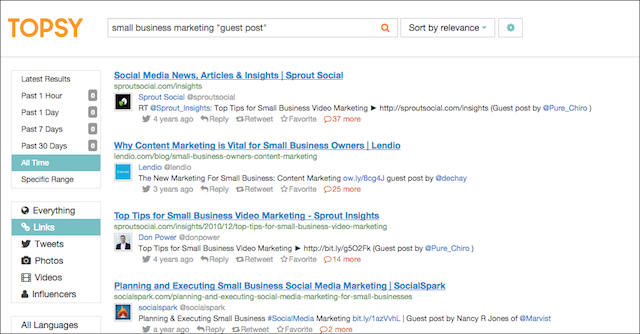 Searching Topsy to turn up guest post possibilities for my chosen topic.
Expand with strategic partnerships
Finally, we look to blow up one or two significant pieces of content every so often. We’ve found that one of the best ways to do this is through collaboration and cobranding.
Our first approach is to take an eBook, tip sheet or case study and offer to let a strategic partner or Influencer cobrand the already proven content to share with their audience. This often allows us to gain introduction to large groups of prospects and is welcomed by partners who know they should be producing more content.
Another approach is to jointly create a long form post, infographic of even eBook with a strategic partner. Quite often one partner may have big data to share while another wants to showcase their killer graphic design skills and collaboration creates an impressive end product that just may get picked up by numerous blogs and influencers as you co-promote with your partner or partners.
Yes, content marketing is work, but it is the most effective way to generate leads for any business that wants to compete on expertise and authority rather than price.
Related posts:
- 5 Ways to Share Content to Create Referrals Creating valuable, education based content is half the ticket to...
- How to Get More From Every Piece of Content You Produce This post is sponsored by Viewbix – Easily add apps...
- How to Use Content to Generate Referrals You do good work and people want to refer you....
07 Jan 01:02


If You Can’t Fix It; Feature It: Part 4
by valueacceleration
 Those words said to me several years ago by Roy Fields have been golden. This is the fourth post on this specific topic, and you can find the others with a quick search of the key phrase.
This one is about Spirit Airlines. First disclaimer: I have never flown on the airline. However, they are considered by some reports to be the most hated US Airline. That’s possibly saying something … or maybe not.
Spirit asked travelers to tell them all the things they hate about flying, and they then created a State of Hate reference. The report states that 60% of the responses to Spirit’s survey mentioned other airlines. Air travel is a hassle “no matter which airline you fly,” Spirit concluded. And I will second that one.
One of the big reasons people hate Spirit even more is apparently because of all their “added” fees. Spirit considers them options. “Our experience shows once customers understand how much money they save with our model, they like it a lot.”
Bottom line is that Spirit is what it is, and apparently enough people value what it offers to make it a profitable, if hated, business. And, as Roy said: “If you can’t fix it; feature it.
Happy New Year.
Mitch
07 Jan 01:02
2015 B2B Marketing Strategies – What You Need and How To Do It!
by Scott Margenau

Marketing b2c is very different from b2b, so the focus of this article is solely on b2b (and somewhat b2g) customers. We will publish a b2c list early in 2015. It is also important note that in order for any marketing to work properly, you need solid branding and very good WUX (web user experience). All the marketing in the world won’t help a bad user experience.
1. Email Marketing- Duh right? But very few companies use this tactic properly. In fact most don’t even use it consistently. In order to truly benefit from email marketing, you need to commit to three types of email marketing AND encourage visitors to WANT to join your list, which means offering something of value.
1. Email Nurturing via an automated series. This is where you articulate your value props and share key webpages and content types with visitors. They won’t remember their 2.333 min visit anyways…so you need to keep in front of them.
2. Email Blasts. These are focused on exact goals. A webinar, an invitation to a trade show event, a downloadable white paper, a special offer or coupon, etc. These blasts should be used with landing pages that allow the user to see the special offer without being distracted by the rest of the site or complicated navigation.
3. Email Newsletters. Visitors retain very little from their initial visit to your site, so keeping in front of them and repurposing key service or product pages is a must-do. Share your last 3-4 blog articles and/or subpages you feel are essential in the conversion process. These should be educational in nature, not “salesy.”
2. Organic Search Engine Optimization (SEO) – Google is actually making this easier these days. No more link farms, no more offshore tricks that get you banned….just straight up great content and on-page optimization. The pages need continual optimization as the algorithm changes almost daily, and the competitive landscape changes hourly. Citation building is also essential. Generating off page content that links back to your target page is a tactic that also should be practiced, especially for competitive terms. These count as “votes” and he with the most votes gets placed in the top 10!
3. Online Advertising/PPC – This isn’t for every b2b but most can benefit tremendously. These days we can target exact terms, roles, positions, geographic areas and more. We recommend a combination of advertising on Google, LinkedIn, Yelp, Twitter, Facebook and Google+. Depending on your business, there are advertising plans that are both cost effective and measurable as far as ROI.
4. Content Marketing – Sharing relevant content with your customers and prospects is essential in today’s marketing ecosystem. These count as “touches” with your customers, and they will also bolster your organic SEO. Provide content that will solve customers’ pain points, help them understand how something works, explain your product and service benefits, or offer insight on subjects that are timely or useful. Content types include articles, press releases, infographics, videos….to name a few. ImageWorks offers packages where we take care of this for our clients so they can sit back, relax, and know that they are constantly nurturing their customer base.
5. Social Media Marketing – Engaging with your customers and fans on various social networks is essential to marketing success in 2015. People spend the majority of their time online using social media, and companies need to keep up if they want to stay relevant. You need to make sure your brand is represented well on these sites AND constantly updated as these media giants often have 5-10 style and functionality updates per year. What’s the best strategy? Create ultra-cool and unique designs within the media and commit to content you can actually produce. If you only interact once a month, it’s of no value. Use short updates and share relevant articles, infographics, pictures, re-purposed subpages, news, videos, etc. This can be done in-house or outsourced. It’s tough to do a great job keeping this task in-house, and the time your employee loses may cost more than if outsourced.
6. Trade Show Marketing– Of all the offline media, we love trade show marketing the most. It’s specific, focused, and allows you to get in front of hundreds of people each day. The problem is most companies don’t have a plan to pre-market and post-market the event. Many times the branding message and customer experience are disappointing and appear as if they were thrown together thoughtlessly. ImageWorks provides all kinds of trade show design, marketing, and fulfillment services.
7. Direct Mail & Print Ads – Another awesome offline media. Getting the right piece of media in front of the right audience can grab a prospect’s attention and make a memorable impression. Additionally ads and mailers can be used to target specific audiences of various sizes and demographics and are used to drive relevant traffic to your website or phones.
So make 2015 the year you commit your business to effective, measurable marketing. ImageWorks is happy to help, and if you are reading this article, we will give you a free review of you current online brand and suggest which marketing tactics will work best for your business.
07 Jan 00:59
Top 5 Marketing Predictions for 2015
by Steven Tulman

The New Year has arrived and we have rounded up the hottest trends in marketing for 2015, that any brand could benefit from:
1. Mobile is going to change the way brands do business
Mobile is growing at a rapid rate – purchases made by smartphone or tablets rose 48% year over year in the second quarter to $8 billion, which is three times faster than purchases made at a desktop computer.[1] 2015 will see this number continue to rise as customers employ an omni-channel approach to shopping. Shopping habits are evolving as customers become smarter about the way in which they do their shopping – retailers are now beginning to see the benefits of having both a physical and online store. To stay on top of this trend, online retailers will have to optimize their websites for mobile, ensure fast load times, a user-friendly presentation and expert customer service. With how much technology is available, the customer in 2015 should be able to research a product on their mobile phone, look at in store and then make a purchase on their tablet without any interruption to the buying cycle.
2. Social signals, particularly Google+, will become increasingly important in organic ranking
The value of social signals for organic search has long been debated, but with Google+ it is clear that to at least some extent, ranking can be improved. It is logical to believe that Google properties do the best to increase organic ranking and would be favoured in Google search results. For 2015, it will be a must that all businesses have Google+ pages for SEO. One of the original goals for Google+ was using it to power real-time search. Currently Google has been using Google+ to discover new content. Compared to other social media platforms, such as Facebook, where there are privacy settings and restrictions on data sharing, Google+ data is immediately and fully accessible to the company that built it. In addition, pages and posts on Google+ not only accumulate PageRank, but because links to posts are followed, they pass link equity as well. As well, unlike Facebook and Twitter, each post you make in Google+ has most of the characteristics of a blog posting, including a unique URL, which has the potential to send strong semantic signals to Google’s search algorithm. In addition, once a business page reaches over 1,000 followers it gains access to +Post ads, which greatly increases content reach and helps improve search engine rankings for the website; in essence, a Google+ page becomes an ad on Google’s Display Network.
3. Personalized content is the way of the future in e-commerce
For 2015, it will become crucial for all content to be personalized to the customer’s needs and wants. For retail, this means customizing the online shopping experience for the individual visitor instead of offering a single model for all customers visiting the website. SailThru, RichRelevance, and Triggered Messaging from bubblebox:media, are just a few examples of tools that use customer’s shopping habits and historical patterns to adapt the product range represented. From a retailer standpoint, customizing content this way is invaluable because it ensures a higher likelihood of customers purchasing items in their shopping basket. Going hand-in-hand with personalized content is location data, and the ability to leverage it for increased conversion. For 2015, more and more retailers will leverage this data to gain a better understanding of who the shopper is, where they shop, where they linger, and how far they travel for certain products. With the ability to accurately track, and, in turn effectively target users based on device, intent and demographic will be critical to success.
4. Big Data will be a driving force for future conversions
The Big Data trends for 2015 reflect strategic and operational goals. Retailers will intensify their efforts to analyze customer behaviour in order to better understand their intentions and habits. Real-time data is key for businesses to succeed. Two of the most prominent real-time big data applications in business are online retail and supply chain management. For managers, this means that they can respond immediately to supply chain blockages, such as supplier failure or a disaster that impacts supply chain flow, which could affect customer response time and the ability to ship items in a quick manner to shoppers. With how short shopper attention spans are online, it is more crucial than ever that all data displayed be as accurate as possible, including inventory control and availability. For 2015, there will be an increased emphasis on speed and accuracy at checkout, including faster shipping and using third party shipping services to make turnaround time even faster and more accurate. Not just inclusive of research and analytics, big data also means a deeper understanding of customer insight. With the introduction of wearable technology, marketers now have even greater access to customers, who can receive rapid updates on price changes, promotions, marketing incentives and location-based deals that take into account the real-time location of the customer.
5. Social selling is no longer just for big brands – sales representatives will continue to build authorship through content marketing
The sales executive is just as important to growing a business as the product or service that you’re selling. Social selling is a true science, and for 2015, the trend will be an increased emphasis on building stronger relationships with potential buyers, based on an authentic sense of empathy and a deep understanding of the problems they face. Creating a real connection with the client is the key to success. Discovering a common value or shared demographic will help not just in selling your product but in selling yourself. Researchers from the University of British Columbia have shown that incidental similarities between a buyer and seller are enough to establish a personal connection and increase the likelihood of purchase[2]. These similarities include a shared first name, birthday or birthplace. Within an organization, social selling also includes becoming a thought leader through content marketing. There is an inherent need to make online writing more transparent, and Google’s Authorship technology now let’s brands and other publishers put a face to their articles in search. This will undoubtedly improve the content writers’ SEO presence and build credibility for the author. The key for 2015 will become to not just pump out content, but to pump out interesting and relevant content to audiences and potential clients, and have it be easily accessible. LinkedIn continues to be a great resource for creating virtual relationships with potential clients, instead of the typical cold-call. By publishing new and interesting content, business leads are likely to read what you’re saying and recognize the value you can provide to their company.
For more information on digital marketing and #BigIdeas2015, connect with me on LinkedIn.
07 Jan 00:58
Why World Class Sales Performers Are Always Keen To Learn
by Tamara Schenk
 It rarely happens that I’m impressed by motivational speakers. Too often, they cannot build a bridge that enables people to tap into their wisdom right after the conference. Steve Backley, English javelin athlete and three-time Olympic medalist, offered a very different experience at our Miller Heiman Sales Performance Summit, based on his book, The Champion in All of Us.
“Clever people, like you, value relationships and develop a team of people around you whom you trust. You will understand the power of perspective and, therefore, will be keen to understand the ideas of others.”
Relationships do matter – in sports, and across the sales team and the customer organization. The team you prepare yourself for the Olympics with and the sales team you work with – it’s a similar situation. Even if you are opponents during a competition or when it comes to promotions, you work together to get better every day, led by a coach. This is how we all can learn from each other’s viewpoints, approaches, thoughts and most important – from each other’s mental attitude and professionalism. Relationships are based on being valuable for each other. That’s the same principle in sports and sales. No buyer makes time for a coffee meeting anymore, if there is nothing valuable added to the coffee. Developing existing relationships and building new relationships with prospects and new buyer roles is a key competency of any top sales performer.
Why is that so important? Look at our engagement principle “Providing Perspective.” To understand the customer’s specific context, every different viewpoint and any relevant information a salesperson can gather adds value to the big picture and enables the salesperson to provide an even better perspective. Furthermore, understanding each buyer role’s different approaches and ideas, especially if they come from different functions and have different organizational roles, is essential to co-create a shared vision of future success together with these groups of buyers. Understanding and learning from others’ ideas and taking that to the next level is a key differentiator. Therefore, analyzing, understanding, interpreting and synthesizing across the network – that’s what top sales performers do before they provide a tailored solution to help the customers to achieve their desired outcomes.
“Champions do this by seeking to consult and understand others and by networking well. You will not only learn from the relevant people around you, but will be able to reapply their skills in an even better way. The point here is not the ability to store or regurgitate facts that you have learned from others, it is the application of the understanding of the key principles that matters. Sustained performance is not about learning something parrot fashion, it is about understanding others, interpreting and then applying knowledge.”
Learning new techniques in sports or new methodologies in sales, the process is very similar. Learning and practicing to become a top performer has to be guided by regular coaching. Coaching, done well, improves the athlete’s technique and performance step by step, leveraging his/her potential. That’s always an individual journey with common milestones. The first milestone is that the athlete/salesperson can repeat and perform the new method or technique pretty well in familiar situations. The second milestone, though, is to coach the athlete/salesperson in a way that he/she can adapt the newly learned techniques in any new, changed or complex situation. That’s much more than practicing new stuff in a repeatable way. To achieve this level, athletes and sales professionals have to develop their adaptive competencies. That’s their ability to quickly adjust their behavior and their activities to different situations. Developing adaptive competencies – in sports and sales – can be done in different ways, in simulations within the same professional area or completely different areas. That means working with people, often out of the business context, so that they learn how to better connect the dots between their left and their right brains. Adaptive learning experiences in other fields may be beneficially transferred back to a business context.
A prerequisite to applying adaptive competencies successfully is situational awareness. Situational awareness means understanding a given situation and quickly noticing what’s happening in this situation. Then, adaptive competencies enable us not only to know but to understand the situation with all the involved people and elements. Even more, adaptive competencies enable us to synthesize all findings into a bigger picture and to draw the right conclusions. In sales, that means providing a tailored, differentiating and highly valuable perspective for a customer to help them to achieve their desired results.
Adaptive competencies are based on identifying the underlying principles and adopting these principles to different situations. Champions learn, practice and adopt what they learned and take it to the next level, based on those embedded core principles. That’s the main difference between the top performers and the ordinary performers on the team, in sports and sales.
“Champions also consult opinion across industries. It is never about who is right or wrong; it is about what is best.”
This article was initially written for Top Sales Magazine, January 5th 2015.
07 Jan 00:58


How to Turn Your Content Marketing Plan into A Competitive Advantage
by mike.drapeau@salesbenchmarkindex.com (Mike Drapeau)
Content creation is becoming the cornerstone of many marketing plans. With content marketing's rise, organizations are struggling with using it to gain an advantage.
CMOs have a tough job balancing content needs with staff resources and the marketing budget. This can lead to sacrificing content quality to hit content production goals.
07 Jan 00:57
Are You Focusing On The Buyer’s Journey or the Selling Process?
by Gerry Moran
The buyer’s journey and the selling process terms are often confused.
However, the sales process focuses on how to push the customer to get them to buy from you.
While the buyer’s journey presents the client’s questions and needs that need to be answered and met.They need content and contacts to help them through their journey – at their own pace.

They need content and contacts to help them through their journey – at their own pace.
So, are you creating your business strategy based on the selling process or the buyer’s journey?
It’s important for you to rethink your content marketing and social selling strategy to sherpa the buyer through their decision making process.
Your Customers Are Researching For Answers To Help Them Buy
- 70-90% of the buyer’s journey is complete prior to engaging a vendor, so it’s difficult to sell to someone who is not listening to your sales tactics. (Forrester)
- B2B buyers engage with 11.4 pieces of content prior to making a purchase, indicating it takes multiple types of content are critical to touching your audience base. (Forrester)
- 76% of buyers prefer different content at each stage of their buying research, so content marketers need to (Source: Pardot)
The research suggests that decision makers are self-sherpa their way through their buyer’s journey with content. They have their own content marketing strategy to guide their purchase suggestions, no matter what your selling process.
3 Key Steps To Use The Buyer’s Journey Instead of The Selling Process
1. Focus on Content Development For Each Phase Of The Buying Process. Creating customized content is the key to joining you customer on their buying journey!
2. Deliver Content To Where Your Customers Congregate. Social selling requires more than sending out Tweets and LinkedIn posts. Marketers who map their expertise, content and connection to customers in their watering holes will cross the winners line at the end of the buyers’ journey.
3. Use Your Employee Evangelists To Go Wider and Deeper. Activating your employees and their earned networks will help you consistently connect with an incremental network (to your company’s owned channels) of buyers at the various levels of their research and decision making.
Do you have another way to map your efforts to the buyer’s journey? If so, please share below!
The Big Buying Lesson
Companies need to put themselves in the shoes of the customers. Understanding questions they will ask will help deliver the expertise on their terms vs. trying to sell them something you think they need!
07 Jan 00:56

SPONSORED:
We're studying conversion rate optimization. Take our quick survey and we'll share the results with you.


Startups are digging the data to help marketers answer tough questions
by Zack Weisfeld, Microsoft Ventures
SPONSORED:
This sponsored post is produced by Microsoft.
How much extra reach is social media adding to your broadcast advertising spend? What creative approaches are clicking with customers and turning them into advocates for your brand? Where are your competitors winning on social media, and where are they vulnerable? What’s the real ROI on your social media spending?
These are some of the toughest questions in marketing, the ones that lead even seasoned pros to start mumbling about “gut instinct” and anecdotal evidence. This is where the chain of hard metrics dissolves into the mists of uncertainty, the edge of the map beyond which lie monsters.
Fortunately for big brands, an intrepid band of explorers are helping to chart out this undiscovered country, applying the kind of big data analytics that has only recently become broadly accessible through the power of the cloud.
iTrend is a cloud-based competitive intelligence platform that uses social analytics to get a precise bead on the strategies of other players in the marketplace to identify potential weaknesses and opportunities. iTrend presents the data through clear visuals, dashboards and heatmaps that make it easy for business users without hardcore data skills to figure out where competitors are gaining traction, where their social influence is coming from, what people like and hate about their products and more. The company launched in 2013 and was able to rapidly deploy and scale its service by taking advantage of Microsoft Azure cloud platform. It counts the World Health Organization, Dell Computer, Couchbase and Microsoft among its clients.
ly helps brands optimize their marketing and media spend by using predictive analytics to automatically segment and value customers by where they are in the buying journey. By continuously monitoring your campaigns, media and content efforts Heroic.ly helps marketers identify when and how many customers are moving from engagement and awareness to active consideration and intent to buy. Using statistical analysis, Heroic.ly helps identify when/why/where to make campaign, media and site strategies changes in order to achieve a higher ROI. Plus, marketers will be happy to receive reports full of “customers, dollars and cents” information making budget justification requests more straightforward and spend decisions easier.
Tomorrowish is a B2B service with a consumer-facing front end product that captures, curates, and records the real-time social conversations accompanying a live or broadcast video so that time-shifting viewers can enjoy the full social experience without spoiling the ending. Think of it as a Social Media DVR. The platform displays social media comments (Tweets, Facebook posts, etc.) synchronized to a video event such as a TV show or commercial spot, with the ability to search and filter based on keywords and users, and a contextually-aware filtering system that brings the best and most popular comments to the fore. As a tool for marketers, this could help put the meat on the bones of more broad-based omnichannel social analytics.
iSpot.tv connects paid TV advertising to digital media to give brands a clear picture of how their commercial spots are landing with consumers. The platform monitors the top 100 TV channels to capture which spots are running when, and correlates that information with real-time social and video analytics to measure brand sentiment, shares, mentions and viewing patterns. The result is a dashboard that gives marketers a precise read on the total paid plus earned reach of every spot, including an efficiency score that measures performance against the discrete media cost of each instance so media buyers know exactly what networks, time slots and versions of each spot are getting them the biggest bang for the buck. The dashboard also provides an industry-wide view of who’s on the air when, so brands can rate their performance against competitors.

These are just a few of the startups using the power of the cloud and advances in data analytics, visualization and machine learning to solve some of the enduring mysteries of marketing and media.
For CMOs and others tasked with attaching real ROI numbers to marketing spend, services like these are one way organizations can get fast answers to critical questions.
However, these kinds of tactical approaches are the only the beginning of the larger conversations that big organizations need to have around data-driven marketing processes. The real progress starts when brands are able to systematically and strategically incorporate useful data from multiple sources, including internal systems, into all aspects of decision-making. Getting to that point will take more than just a cool startup with a clever solution.
Tzahi (Zack) Weisfeld is Head of Microsoft Ventures Europe and Global Accelerators Program. Business Insider (May 2014) named Zack as one of the 10 top Most Influential Israelis in Tech Worldwide.
Sponsored posts are content that has been produced by a company that is either paying for the post or has a business relationship with VentureBeat, and they’re always clearly marked. The content of news stories produced by our editorial team is never influenced by advertisers or sponsors in any way. For more information, contact sales@venturebeat.com.
We're studying conversion rate optimization. Take our quick survey and we'll share the results with you.

07 Jan 00:54


Lead nurturing via email series and content marketing
by bcarroll@startwithalead.com (Brian Carroll, MECLABS)
Lead nurturing involves a number of activities and channels such as “under the hood” tracking and scoring of prospects behavior and engagement with your campaigns as well as follow-up telephone at times whenever that tactic fits into an overall lead nurturing program.
However, the key channel for lead nurturing is email — particularly using email to send a series of relevant content pieces or offers to prospects as they move through the buying funnel.
In previous B2B Lead Roundtable Blog posts, I’ve offered a group of MarketingSherpa case studies based around a particular content area. Today, I’m going to highlight one case study — Email Marketing: 133% ROI for B2B’s first-ever lead nurturing program — on a lead nurturing program launched by Crowe Horwath, a public accounting and consulting firm.
Background on the campaign
Christine Elliot, Director of Content Strategy and Digital Marketing, Crowe Horwath, understood the value of lead nurturing to both fill leaks in the sales funnel and improve ROI.
When she began working with the “performance group,” a business unit within the firm, Christine was pleased to learn that she didn’t need to pitch the value of launching an inaugural lead nurturing program.
The program was based around a 12 to 18-month sales cycle and targeted C-suite executives and large financial institutions with at least $1 billion in assets.
What the team did during the campaign
The first stage was determining content for the program, in this case, based on four topic areas: Dodd-Frank, anti-money laundering, process improvement and core systems. From there the team mapped content to the early, mid and late stages of the buying cycle.
In launching the lead nurturing program, the campaign began with a list of 4,000 executives who would receive a monthly email offer for a piece of content.
To even be entered into the lead nurturing program, email recipients had to download content from an invitation email.

After engaging and entering the program, list members no longer received invitation emails and instead began receiving one email every three weeks with an offer for free content.

The team had 12 pieces of content for each of the three buying stage tracks for a total of 48 pieces of content. The nurtured leads became sales-ready after either downloading three pieces of content or just one piece of late-stage content.
How the team refined the campaign
Once the program launched, both Marketing and Sales met to review the newly nurtured leads and discuss how the program was performing. These meetings led to improvements to the program:
- Instead of filling out a lengthy form, prospects only had to answer a single question to download content. These questions even had the options of “none” and “other” so prospects didn’t even have to provide any meaningful information, but according to Christine, most did. One question asked recipients if they preferred to receive email on a different topic — a question that might change the nurturing track they were currently on.
- Lead scoring was improved after analysis of every person in the program, and the team found out that factors impacting lead quality included: asset size, title and behavior such as changing tracks, forwarding material or downloading at least three pieces of content.
How the campaign performed
What were the results of this campaign?
- 33% of invited executives entered the program
- A 75% to 80% open rate for nurturing emails
This was the first automated nurturing program at Crowe Horwath, and it became a model the team uses to deploy similar programs across the company.
“Now we’re expanding all over the firm,” Christine concluded.
If you found this short excerpt of the case study, clickthrough to read the entire case study with more detail on each step of the program.
You might also like
Lead Nurturing: Pilot campaign increases conversion 32.6% with automated emails [MarketingSherpa case study]
Lead Nurturing: How intent data lifted a B2B email campaign’s CTR 248% and forwarding rate more than 400% [MarketingSherpa case study]
Multichannel Marketing: Combining email and content marketing leads to 35% conversion rate for Elsevier [MarketingSherpa case study]
07 Jan 00:54

3 Ways to Grow Sales in 2015
by Lori Richardson
 It is a new year and a fresh start for many in the B2B sales world. Having had a monthly or a quarterly sales quota over the course of 15 years or so, I know that good feeling of have a blank slate – but it also can be a tough feeling to start back at zero.
If you are working on a calendar year, than January 5th is a fresh start. Doesn’t it feel good to get a fresh start? Doesn’t it also feel stressful because we’re back at zippo and zilch in many cases? Is this your situation?
Hopefully you have been working in Q4 to set up meetings, demos and conversations in January. This is a sales lesson for everyone. The sales opportunities you plant and nurture today – those inquiries made now – will grow and a percentage of those will evolve into deals in future months. Nothing happens overnight in business-to-business selling unless you are selling a very commoditized product. Most of us here have a complex sale – in other words, it takes multiple conversations and there are multiple people involved.
Here are three ideas to help you find buyers and see if there are opportunities in this fresh new year.
1 – Focus:
Keep your “eye on the prize” or in other words, keep focused on what it is that you will accomplish with your efforts. In order to focus, you need to know what it is that you are to do. In sales, it is primarily to create activities that lead to revenue.
Focus is a verb that means to “pay special attention to something”.
As you go about your day, you can only accomplish so many things. If everything is important, then nothing in particular is. A helpful idea is to create a list of things to do in your CRM or calendar program – but don’t stop there. Find a way to rate the activities that you need to do.
Example:
I have been given a list of new leads qualified by marketing that I need to reach out to. There are 20 leads on this list, plus I have a separate referral from an executive who was a client of mine at another company I used to work for. He is now at a new company and wants to connect me to their IT executives for a potential meeting.
What do I do first?
Leads from marketing are time sensitive, but I definitely want to call my executive referral this morning – especially because a referred opportunity is the best opportunity to have. At the same time I can’t just focus on it, so I must go through the list of leads and call them too. The answer is that I can call all of them this morning – but I lead with the referral. Makes sense?
That word focus also goes for what you do when in the office. No time to clown around or chit chat. Being cordial and friendly is great, but don’t get lured into long conversations.
2 – Actions:
As simply as I can put this I will say that you MUST take action to make things happen. Do not procrastinate. Get the tough stuff done first, and your day will go quickly.
Because you are focused, you do the work that is required to identify potential buyers and find those opportunities that are a win for you and for them. Moving these forward and working to find other potential opportunities are full time endeavors.
3 – Honest Evaluation:
Take a look at your pipeline and all of the opportunities you have been nurturing to get to this point. What is real and what is a dream? You must move those dead of faded opportunities backward so that you only have real possibilities to look at and move forward. Ask yourself the right questions to know whether your opportunities are qualified.
Also work to see what your blindspots are. Ask others whom you trust. Regularly say to yourself, “What am I missing here?”. By doing that, you’ll gain perspective and find new potential buyers and new potential opportunities. If you are stagnant, you won’t.
 Lori Richardson is recognized on Forbes as one of the “Top 30 Social Sales Influencers” worldwide. Lori speaks, writes, trains, and consults with inside sales teams in mid-sized companies. Subscribe to the award-winning blog and the “Sales Ideas In A Minute” newsletter for sales strategies, tactics, and tips in selling. Increase Opportunities. Expand Your Pipeline. Close More Deals.
email lori@scoremoresales.com | My LinkedIn Profile | twitter | Visit us on google+
The post 3 Ways to Grow Sales in 2015 appeared first on Score More Sales.
07 Jan 00:54
Are Lead Conversions Down? 5 Tricks To Boost Performance
by Lexie Carbone

You may have all your inbound marketing strategies in tact, but lead conversions are still down. Only two percent of first time visitors to a website are ready to make a decision or purchase. This means we still have a lot of work to do!
Here are five tips and tricks to boost lead conversion performance:
- Speed – This is the single most important decider in whether a lead will convert. Forbes conducted research on over 10,000 companies in fifteen different “secret shopper” studies over the last five years and found alerting results. Their “secret shoppers” submitted forms with their phone numbers and email addresses in order to see how quickly they received a response. They found companies weren’t contacting leads quickly enough, with an average response time of 46 hours and 52 minutes. By calling within one minute of form completion, you can boost your conversion probability by 400 percent! In only 24-hours, that number falls to 27 percent. By reducing response times, you’ll know your lead still has your product or service in mind and is ready to continue the conversation.
- Understand Your Audience – In order to understand your leads you must collect the right information. You can do this by making sure you’re asking the right questions in order to determine whether they’re qualified leads. You want to be sure your sales team is equipped with enough information to create meaningful contacts. Once you have a clear view of your leads, you’ll be able to quickly identify prospects.
- Be Consistent – With speed and consistency, your leads will feel appreciated and rapport is built. According to Forbes, the average sales rep only makes 1.3 call attempts before giving up on their lead and moving on. They also found that only 27 percent of leads ever get contacted, however when companies combined consistency, awareness and technology, that number rose to 92 percent. Use different forms of communication to contact your lead and always follow-up. Once you break that flow, chances are they’ve already moved on.
- Enhance Your Content Strategy – This doesn’t just mean optimizing your content, but making sure you are delivering it on the best platforms at the best time for those qualified leads. Find out what ways your personas prefer to communication. Do they like to talk on phone or do they prefer email? As for when to contact your leads, Forbes researchers say Wednesday and Thursday are the best days to call, sometime between 4pm and 6pm.
- Nurture Your Leads – Lead Nurturing is all about understanding and accommodating your leads needs and expectations. Fifty percent of qualified leads are not ready to buy – this is why lead nurturing is crucial to companies. The idea is to pull your lead through each step of the sales funnel so they become more qualified. You can create lead nurturing campaigns, tailored to your different personas and the stage stage of the funnel the lead is in. The goal is to listen to their needs, offer them educational advice and offers, qualify them with lead intelligence, then convert them into customers.
Do you have any tips for boosting your lead conversion? Let us know!
07 Jan 00:54
Steps in Turning Potential Customers Into Paying Customers. [How-To]
by GetApp
![Steps in Turning Potential Customers Into Paying Customers. [How To] image header Steps in turning potential customers into paying customers.jpg](http://cdn.business2community.com/wp-content/uploads/2015/01/header-Steps-in-turning-potential-customers-into-paying-customers.jpg.jpg "Steps in Turning Potential Customers Into Paying Customers. [How To]")
Starting a business is easier when you stay on top of your leads and turn potential customers into paying customers.
The internet has given us the new ability to track large amounts of data over time and compare it within that tracking system. With these applications, organizations are becoming more efficient and profitable by recognizing trends and streamlining their business processes. With these benefits, nearly everybody’s tracking something: Employee schedules, client appointments, attendance, inventory, time, customers, tasks, location, classroom data, or any of another hundred possibilities.
![Steps in Turning Potential Customers Into Paying Customers. [How To] image timesheets1.jpg](http://cdn.business2community.com/wp-content/uploads/2015/01/timesheets1.jpg.jpg "Steps in Turning Potential Customers Into Paying Customers. [How To]")
Because of this new consumer need, entrepreneurs are jumping on the opportunity to start data tracking businesses. If you’re one of them, you should know that following up with leads is the key to keeping business going. This can sometimes get neglected when all the focus is on the software. But believe me, it’s critical. We track time and attendance at Timesheets.com, so I know a little something about running one of these successful businesses. Lead management is huge.
There is a whole lot of competition in the world of online apps. Consumers do a simple Google search, which reveals a seemingly endless list of options relating to their need. They then browse the websites of the first and maybe second page of results. Once they’ve narrowed it down to a few choices, they provide their email address and phone number to finally enter the web application.
This is the moment when the SaaS company has a lead. But guess what, right about the same time, several other companies also have this same lead. While searching for the online service, the consumer just dropped his name into several hats. Which one is going to lock on to the opportunity?
Be Aggressive
It’s easy to neglect leads when you’re just starting out. You’ve got features to build and all kinds of website-related duties to attend to. But if you want to succeed, take customer service seriously and stay on top of those leads. Waiting an hour or even a half hour to make first contact can potentially lose you the sale. A fair amount of research has inspired the potential customer to leave his precious personal details on your website and, chances are, any of those three or four applications will work just fine for him. So, who’s going to get the sale? Probably the first one who shows him around. This means that you, the provider, wants to get him to learn your software as quickly and thoroughly as possible. You want him to invest some time in your product so that he doesn’t even bother with the others.
But don’t stop there! Don’t give one demo and assume you’ve bagged the client. Experienced marketers say that it takes on average seven “touches”, or contacts, to land a deal. Some types of businesses will need more, like B2B companies selling products in excess of $10k. Some will need less, like companies selling inexpensive products that people recognize.
![Steps in Turning Potential Customers Into Paying Customers. [How To] image 1 what counts as a touch2.jpg](http://cdn2.business2community.com/wp-content/uploads/2015/01/1-what-counts-as-a-touch2.jpg.jpg "Steps in Turning Potential Customers Into Paying Customers. [How To]")
What Counts as a “Touch”?
Touches aren’t just calls. They can be emails too. Touches to a single prospect might look like this:
- Initial email or direct mail campaign
- Welcome email after signup
- Call: Conversation or voicemail
- Day 2 or 3 in email series
- Another follow-up call: Conversation or voicemail
- Follow-up email confirming an appointment made or requesting an appointment
- Conference call held
- Personalized email follow up with relevant info. The email may include information on case studies, webinars, and web pages with supporting information about the product.
- Day 5 or 6 in email series.
The actual series of contacts will vary but you can see that it is not difficult to achieve the necessary number of contacts it takes to land a sale.
Caveat: I think it’s important to note that the rule of touches is changing in our research-driven, online landscape. Consumers are educating themselves and making decisions without the help of the sales person. The marketer’s job is critical now more than ever to produce great emails, websites, videos, and blogs because this is where consumers will learn the most about a company.
Track Your Leads
With all these “touches” you’re going to have to keep track of how many and what type you are making. At our Time and Expense Tracking company we built our own lead management software but there are a number of products designed for small businesses. Salesforce is, of course, the most well-know product. But there are many others like Zoho and SugarCRM. Don’t want to spend the time and money on Lead Management software just yet? Check out these creative lead management ideas! There are plenty of do-it-yourself options for lead management.
![Steps in Turning Potential Customers Into Paying Customers. [How To] image 2 nurture on autopilot.jpg](http://cdn2.business2community.com/wp-content/uploads/2015/01/2-nurture-on-autopilot.jpg.jpg "Steps in Turning Potential Customers Into Paying Customers. [How To]")
Write a Killer Email Series
Inevitably, the majority of your touches are going to come from your automatic emails. So you had better create good ones. This means no typos, a clear thought process, images, and further reading materials. Your emails should be professional, simple, and provide extra resources to get the client hooked on your product. We have designed and redesigned our email series several times but this last time we really paid attention to important marketing strategies in the email welcome campaign. Check out some of the examples in this blog post. They are really useful for helping you design your own.
![Steps in Turning Potential Customers Into Paying Customers. [How To] image 3 combining it all.jpg](http://cdn.business2community.com/wp-content/uploads/2015/01/3-combining-it-all.jpg.jpg "Steps in Turning Potential Customers Into Paying Customers. [How To]")
Combining All These Factors Leads to Success
You’re never going to convert every lead but with the right sales process you will definitely convert more of them than you would if you did not follow the steps I outlined. In summary, the keys to making a sale and keeping your head above water in the big wide world of online data tracking companies are the following:
- Quick Initial contact
- Seven total “touches” to the client
- Great web-based educational material
- Customer relationship management (CRM)
- An effective email series
07 Jan 00:50
8 Ways To Better Market Yourself On LinkedIn In 2015
by Brian Honigman

LinkedIn has always been the industry standard when it comes to marketing yourself professionally, but the past few years have seen the social network’s importance and reach increase dramatically. TechCrunch reports that LinkedIn has roughly 187 million unique visitors per month, and that number looks like it’ll continue to grow.
In addition, LinkedIn has ramped up its efforts to become a content platform. In the past three years LinkedIn has acquired Slideshare, Pulse and Newsle; all of which hint at a continuing push towards content distribution.
Instead of just maintaining your profile and company page and being active in LinkedIn groups, LinkedIn is now encouraging brands and individuals to leverage its robust, new publishing capabilities. It is clear that LinkedIn sees itself as a vital part of the future of content marketing.
Building out your LinkedIn presence can seem intimidating. There are so many options now that the thought of exploiting them all can overwhelm even the savviest marketers.
Keeping this problem in mind, I set out to track down the most influential and accomplished LinkedIn experts and ask them to weigh in on their recommendations for making the most of your LinkedIn Marketing.
Viveka von Rosen: Leverage LinkedIn’s CRM

Viveka von Rosen is a prominent LinkedIn expert and author of the book LinkedIn Marketing: An Hour a Day. Her recommendation not only highlights some interesting, often overlooked LinkedIn features, but also shows how they can be used to strengthen your networking connections.
Viveka notes that “LinkedIn is about building relationships, and one of the best ways of building relationships is to show your top prospects that you were listening to them.” With this in mind, she points out that LinkedIn actually provides users with fairly robust CRM tools.

She recommends leveraging these tools in five steps:
1. Research your prospect or client. (Better yet, have a conversation with them – maybe at a conference or trade show?)
2. Make your notes about the person on their LinkedIn profile. (Click on the star icon to “unfold” LinkedIn’s CRM feature.)
3. Set a reminder to follow up with your prospect.
4. Find an article of your own or search Pulse to find content you think they might be interested in.
5. You can also tag your prospects, segmenting your network in a way that makes sense to you, and that will allow you to follow up with them in smaller groups.
Brian Murray: Be Active, Get Noticed

Brian Murray is the director of talent and culture at the prominent New York-based Digital agency Likeable. Although Brian’s profession is technically HR, he is careful to note: “My audience is NOT HR professionals. It is people with agency experience who love or have a focus on social.”
This is already a powerful lesson. The first step to connecting with your audience is identifying who you are aiming to target. Once you know who you want to notice you, Brian outlines the next step: “I share relevant content that causes them to continue to see me and recognize my name. When I reach out they are a lot more likely to respond than a cold email from somebody who doesn’t regularly use the platforms.”
We tend to misunderstand why it is that we trust certain people online or give them a certain degree of credibility. Brian nails it on the head with this insight. Oftentimes it’s not the amount of followers you have, it’s how often you show up on people’s radar. Perhaps the best piece of advice Brian gives derives from an analogy to sales:
Similar to sales, the time you need to make a sale is not the first time you call or email them. They need to trust you. They need to see you.
Going further, Brian believes that the only thing people like more than seeing someone tweeting or sharing things they love is when you engage with that audience and provide personal interaction. This actually speaks a lot to another piece of advice I got from our next expert.
Stephanie Sammons: The “10 in 10″ Rule

Stephanie Sammons is a renowned LinkedIn expert, named a Top 30 Marketing Thought Leader and a Top 25 Social Media Expert by LinkedIn, who coaches professionals on how to maximize their social presence. Her recommendation for marketers and business owners who hope to build their presence is to adopt what she refers to as the “10 in 10” rule.
“While others are pumping out content and status updates to their entire network” Stephanie instead encourages professionals to “go one-to-one with 10 of your connections 10 minutes a day.”
If you spend 10 minutes a day engaging personally with 10 of your valued LinkedIn contacts, you will grow your influence.
The first step in her process is to identify your MVC’s (Most Valuable Connections) LinkedIn. “These may be prospects, clients, influencers, or advocates for your business. Next, study their profiles and learn more about who they are, what they do, and who they help.”
She continues by noting that “once you are armed with greater intelligence about your MVC’s, strive for a one-to-one engagement with at least 10 of these individuals per day. One-to-one engagement can be in the form of a personalized, private LinkedIn message, a public comment or conversation, a or even an @mention.”
The reasoning goes that a personal, intimate connection with a smaller number of followers can be much more beneficial than an attempt to please everyone. This appears straightforward, but it seems that so few actually spend the emotional energy necessary to foster these connections.
Stephanie offers the assurance that although this consistent connection is hard to maintain, it will be well worth it in the long-run and ultimately lead to social media success.
Lewis Howes: Leverage LinkedIn Pulse

While there is no denying the effectiveness of a more personal approach, LinkedIn has recently become more than a networking tool. The past few years have seen Linked grow from a job-hunting, and resume site into a publishing empire. So how can marketers or professionals leverage this increasingly important aspect of LinkedIn?
Lewis Howes is a LinkedIn expert who hosts the School of Greatness podcast and he recommends leveraging the new LinkedIn Pulse platform by consistently creating engaging content on your profile. Howes points out that until recently the publishing platform was only reserved for select influencers. However things have changed recently and this presents a big opportunity for marketers to earn the attention of the right professional audience on LinkedIn:
With Pulse open to everyone (not just influencers), it’s a massive opportunity to expand your reach.
This is not just a hunch either. Howes shared that he’s “seen a big bump in traffic and leads from this alone” and assured me that this would be the most effective way of reaching a larger and more targeted audience on LinkedIn in the coming year.
Looking at the current trend of LinkedIn’s updates and acquisitions, Howes’ prediction feels spot on. LinkedIn has already gotten hundreds of millions of users accustomed to networking on the site, and now they hope to build that same familiarity with consuming and creating content. The ability to get in on the ground floor of this kind of change is too good for marketers to pass up and should not be ignored.
Alex Pirouz: Have A Strategic Plan In Place

The previous advice has all concerned committing to continuous and sustained interactions with your professional network, but sticking to so many initiatives at once is difficult. Alex Pirouz, a serial entrepreneur who founded Linkfluencer.com, offers a bit of sobering yet crucial advice.
His advice is dead simple, but so often overlooked. “My top tip to anyone looking to use LinkedIn as an effective marketing tool is to first create a clear plan on what they’re looking to achieve from the platform.” Drafting a plan requires: “looking over [your] marketing objectives over the next 6-12 months, identifying the target market [you] would need to connect with in order to achieve those objectives and then building a LinkedIn profile that resonates with this audience.” Just like you would plan your editorial calendar, you should plan your LinkedIn posts.
Not having a plan is the number one reason businesses aren’t using LinkedIn to it’s full potential.
Alex told me that “over the past 12 months we’ve trained over 8000 businesses on how to leverage LinkedIn to grow their business and over 90% of those we speak with don’t have a plan or clear strategy.” He quipped that Ben Franklin said it best, “People don’t plan to fail they fail to plan.”
Bert Verdonck: Earn Greater Visibility With Slideshare

Bert Verdonck is the founder of the pioneering social agency ReallyConnect and a LinkedIn expert in his own right. According to him “one of the most underutilized strategies on LinkedIn today is the use of rich media and SlideShare in particular.”
Most people have no idea of the impact SlideShare can have on their LinkedIn marketing.
Besides being, as Bert refers to it, the “YouTube for Powerpoint,” he told me that “Slideshare links index brilliantly well, often ranking higher than LinkedIn or Facebook.” As if this was not reason enough to embrace the platform, LinkedIn purchased Slideshare in 2013 and has since offered substantial integration capabilities.
He notes that, “Of course, there are some SEO experts who let you pay a ton of money to artificially increase your search results, but SlideShare is for free and beats a lot of other strategies easily and in a natural way.”
His logic here is simple, but speaks to an understanding of the way search visibility works. Slideshare offers “a lot of quality content and Google loves great content, resulting in higher natural rankings. People will find you more easily for your topics.”
In other words, Slideshare helps your profile become more visible not only by putting you higher in search rankings in the search engines and LinkedIn, but by providing engaging content your potential audience wants to see when they do reach your profile. Talk about a win-win scenario.
Neal Schaffer: Embrace Long-Form Publishing

Neal Schaffer is the author of the excellent LinkedIn book Maximize Your Social as well as a social media coach, consultant and trainer. His recommendation for professionals looking to maximize their LinkedIn presence is to take advantage of long-form publishing.
Neal points out that “LinkedIn opened up their blogging platform to all users in 2014, but very few have taken advantage of being a part of the LinkedIn publishing empire.” Sure people have taken to posting some content, but the efforts of many users are scattershot or lack-luster short-form posts. Instead, Neal believes LinkedIn should be treated like a full-fledged syndicated blog.
If you are only blogging on your corporate blog you are missing out on the opportunity to get your content in front of eager eyes on LinkedIn.
This is a wasted opportunity because “when you blog on LinkedIn, your content is seen not only by your connections but also by others who are consuming news on LinkedIn Pulse.” Neal mentions that he has seen great long-form content by users that “received more views than their number of connections, and some that have literally received hundreds of thousands of views.”
As LinkedIn positions itself as a content platform, the benefits of embracing a content-centric strategy will become more and more pronounced. Stay one step ahead of the curve by creating engaging, rich, long-form content.
John Rampton: Call Out Your Profile Often

John Rampton is a social media expert and columnist for publications such as Forbes, Entrepreneur, and Inc. The advice he gave was something that frustrated him because it is so easy, yet so many people miss it. “I can never understand why people go to networking events, hand me their business card, and they don’t have their LinkedIn profile on there.”
He continued, “They have other social networks on there, but LinkedIn is THE professional networking site. When I want to size you up professionally, that’s where I go.” While it’s certainly easy enough to find someone on LinkedIn, John is right that the additional step to make people go through is an unnecessary barrier between connecting.
Don’t be shy about calling out your LinkedIn profile. Put it on your email, business card, etc… – anything with your name on it, your profile should be there too.
Another place he feels people miss calling out their profile is in their email signature. “Email is the same thing, your professional email can just as easily be an additional touch point or place to connect.”
Especially for people working in sales, John feels that having a LinkedIn profile link in email is such an easy, effective opportunity to connect that people miss all too often.
“My other recommendations would be leveraging the LinkedIn publishing platform and engaging more frequently, but these efforts are all maximized by having more connections, and calling out your profile is such an easy way to bring that number up.”
Lastly, here are these same LinkedIn marketing tips in a ready to pin infographic!

Do you have anything to add? Are there any LinkedIn strategies you’ve found successful that were not mentioned here? Let me know in the comments below!
07 Jan 00:49


See the rest of the story at Business Insider
JPMorgan's Ultimate Guide To The Markets And The Economy
by Akin Oyedele

The US economy is entering 2015 with a nice tailwind: last quarter saw growth in the gross domestic product rocket to an 11-year high as the US dollar strengthened and the S&P 500 surged to an all-time high.
But international markets are in rougher shape as Europe battles sluggish growth, Japan struggles with low inflation, and emerging markets face major deceleration.
JPMorgan Asset Management's David Kelly and team have published their Q1 presentation on the state of the markets and the economy.
Through 64 slides, packed with charts and graphics, they provide snapshots of stocks, bonds, and the economy – both in the US and abroad.
Enjoy!
Thanks to JPMorgan Asset Management for giving us permission to feature this presentation.
JPMorgan's Q1 Guide To The Markets
JPMorgan's Q1 Guide To The Markets
JPMorgan's Q1 Guide To The Markets
See the rest of the story at Business Insider
06 Jan 18:08
Walking the Tight Rope of Effective Salesmanship
by Personal Branding Blog
 Contrary to popular belief, the difference between effective, revenue driving sales professionals and those who consistently miss quota is quite small. More often than not, the loss of business has little to do with their competition.
Frequently, the problem is more internal. Because many of today’s products and services are highly similar, it’s how the individual represents that offering (as opposed to the actual service) that either drives most buyers to sign or decline their proposed agreement.
Unlike a competing product, the internal forces and actions can be controlled with some focus, will-power and drive to change.
Luckily, because the difference between sales success and failure is so minute, quick changes in beliefs, behaviors and work ethic will yield most business development representatives a significant spike in revenue generation.
I. The Issue with Over Accessibility – The majority of sales representatives whom I buy goods or services from for my recruiting firm can be overly accessible and, thus appear desperate.
At the complete opposite end of the spectrum, a significant number of sales representatives play the “scarcity card” with the intent of being perceived as busy and important. However, these individuals appear aloof, unresponsive and ineffective to any buyer.
They, too lose out to a competing vendor. The happy medium between between over-accessiblity and over-scarify makes the sales rep. appear as competent, client-focused and trustworthy. Interestingly enough, there is only a few hour difference between the two.
Less Than 30 or More Than 180
I’ve noticed that when our sales recruiting company gets back to a client lead within 30 minutes, we are less apt to receive an enthusiastic response from that prospect compared to when we return their request an hour after their inquiry.
However, when our headhunters get busy and are unable to return their call 3 hours or later after initial contact, we receive a response similar to when we appear hasty.
II. Precision – As a sales representative, being precise is the difference between writing unique emails to prospects and mass emailing a generalized note to a generalized list of random leads. Even though the former technique yields a much higher response rate from more sought after clientele, very infrequently do I receive tailored pitches from potential recruiting vendors.
When I do, I respond and when I send similar correspondence, the target typically responds back.
Take the difference between the following blurbs from sales related solicitations:
Generic – “Hi,
My peers are evaluating me in this 360* Peer Evaluation. Can you take a minute to give me a vote of confidence?”
Precise – “It has been a while since we last spoke…I wanted to send you a message to see if your company was ready to make a strong move in video on your youtube channel. I’m thinking quality, business-grade videos each week discussing anything and everything about job hunting and your company.”
It’s Not a Numbers Game
Sales professionals are wired to think that business development is about numbers. Throw enough s*** against the wall and something will stick. Yes, something may stick, but in order to get to that sale, that business development representative gave a poor impression to 30, 60 or 90 other leads.
The majority of sales representatives whom our recruiters work with should prospect 1/8 as much, but be 10x more precise per contact and their numbers through client acquisition, retention and cross-selling would skyrocket.
In the End
While there are other more complex factors involved in effective salesmanship, most difference makers are quite small, easy to implement and once done can be converted into higher commissions and a more successful sales career.
06 Jan 18:08
When Conversion Optimization Best Practices Fail
by Aviva Pinchas

There are many, many, many lists of conversion optimization best practices. Some are sacrosanct:
- Sliders distract – you should get rid of them.
- Everything needs to be shorter – cut stuff out.
- Just make the button bigger!
These practices often come from broad trends observed over many experiments and they highlight what usually and typically works. Often, they’re tapping into a kernel of persuasion wisdom.
But there’s a problem: just because it usually and typically works, doesn’t mean it’ll work for you. Websites have different target audiences, different marketing, positioning, pricing, product selection, seasonality. Your industry may be atypical. Mostly, it’s just all relative:
“Since different pages have different goals, one-size fits all strategy is never applicable.” – Greg Ciotti
And then there’s the human element. When something has been written about and tried so much, we can lose sight of the kernel of persuasive wisdom that made it initially great, and blindly follow a trend.
In other words, we’re paying attention to the symptom of success, not the cause.
In this post, we’ll cover a few examples of when best practices flat out failed, figure out where those implementations failed to understand the kernel of wisdom and see what we can learn from their mistakes to stop blindly following best practices and start making money.
Failed Best Practice #1: No Sliders
Sliders are perhaps the most universally despised design trend by conversion optimizers. But, despite this universal doubt and evidence, there have been cases where a slider worked: moving from a video to a slider increase conversions by 30 percent for Device Magic.

Why This Best Practice Failed: Sometimes Sliders Communicate Better
Usually, sliders lose out because the motion is distracting, the use of multiple headings can be confusing and often at least some of the headings are irrelevant to the user. (Longer explanation why they suck found here).
In this case, the version with the slider overcame these typical challenges by removing clutter and leaving a bold graphic with a clear, practical headline.
While sliders usually add clutter and distract from content that matters, in this case the initial slide include copious white space and the variation removes extraneous elements. This visual simplicity compared with the bullets, tabs and video of the control might be more clear and clarity is the first step to persuasion.
Beyond that, the slider version also communicates more quickly than the video. Sites only have 10 seconds to communicate their value proposition, which means the thumb nail and copy around a video that for the first impression are critical. Here, the thumbnail is cluttered and the headline is generic – not enough for a quality first impression.
Research also suggests at most 30 percent of users actually watch videos and Wistia found even users that do watch taper off pretty quickly:

The longer the video, the fast people give up. Here, the video clocks in at more than four minutes, potentially losing users and conversions.
It’s worth noting that this case study doesn’t examine how a hero image using just the first slide would have affected conversions. Users largely don’t click through sliders, so Device Magic may gotten a bigger or at least similar lift from going to an image.
Key Takeaway: Sliders May Suck, But Clutter Sucks More
In this case, the slider won by tapping into the persuasive wisdom of clear, bold first impressions – something sliders usually fail to do.
This case study shows that it’s not just about the features of a page, but how features features are implemented (imagery on slides, order of slides, length of animation, video thumbnail, quality of video, etc.) that determines how effective they are.
You can design sliders that suck less than lengthy videos or videos that are geared towards conversion, but keep in mind that implementation makes all the difference.
This is not to say that the slider version couldn’t be beat by something better, but sliders proved to be 30% better than what they had before.
Failed Best Practice #2: Trust Seals
Trust seals are heralded as key parts of a checkout flow because they increase the authority of a page. In this case, trust seals decreased conversions by nearly 1.6 percent.

Eric Hansen also tweeted about a test where removing the trust seal increased conversions by 3.5 percent.
Why This Best Practice Failed: Trust Seals Only Matter When Trust Matters
Typically, trust seals work because they make users feel safer when shopping. Users themselves indicate that trust seals are the most common way they assess security:

But here’s the tricky part: users don’t understand trust seals. In a study, the University of College London found that users have significant misconceptions about the meanings of trust seals.
That users don’t understand trust seals means that technical security is not the issue. Rather, users see trust seals as a stand-in for credibility and they are only be effective in increasing conversions when a lack credibility is holding down conversions.
More than a neutral factor, they could actually hurt conversions by introducing anxiety when security is not already a factor – WhichTestWon saw a 12.6 percent higher conversion rate on a form without a seal:

Because the information being shared isn’t highly sensitive (and the form has other, more severe problems), the trust seal was irrelevant and increased anxiety, leading to fewer conversions.
That’s likely what happened with checkout case study: the size of the trust seal suggests it’s the most important thing on the page. This draws attention to the issue of security and distracts users from the CTA.
Key Takeaway: Use A Tool Only When You Need It
Rather than relying on a best practice, optimizers should conduct qualitative user research to find out what barriers users are experiencing – and then pick the right tool to resolve that issue.
Trust seals are a tool that solves the issue of credibility, so when users aren’t questioning credibility, they are irrelevant and distracting.
Sidenote: There are a few other tools that solve the credibility issue including visual design, along with testimonials and reviews. Trust seals may also not be the right tool to create trust if these other elements are lacking.
Failed Best Practice #3: Bigger Buttons
In theory, bigger buttons draw the users eye and lead to higher conversions. In practice, this larger button decreased conversions by more than 10 percent:

The company running this test did see an increase when they made the button bigger AND changed the copy, but increasing the size alone made conversions drop by 10 percent.
Why This Best Practice Failed: Size Isn’t All That Matters
Conversion optimization wisdom dictates that call-to-action buttons that stand out from the page and draw attention to themselves convert better. Size is an easy way to show that the button is important.
However, other elements play into how users read a page and what defines visual hierarchy.
For one, users have certain expectations of where information will be. They will look in those parts of the page first, regardless of size, as VWO found out when testing a homepage change:

While the main, central CTA button is larger, the upper right button is placed where users expect to see a free trial button. Users with an intent to get a free trial may look there first, which leads to that smaller button seeing 3x as many clicks.
Playing with size in order to establish a visual hierarchy also risks adding clutter. SmartWool found when they saw a 17 percent increase in revenue per visitor when they made all the images the same size, creating a simpler page:

Variation in image sizes breaks the visual rhythm of the page, adding friction, and the simpler page saw a lift by removing the clutter and restoring the rhythm of the page.
Images that are out-of-proportion with other elements can add friction in another way: they look sales-y and unattractive.
With the longer copy, the size of the button made sense as it was needed to give space to the text. By keeping the original copy but increasing the size of the button, the attempt to draw the users eye is more transparent, obviously geared towards sales and less visually appealing.
The feelings evoked by visual design can have a significant impact on users’ actions. Using a button that drew too much attention to itself may have turned off users.
Key Takeaway: Think About User Experience Alongside Conversions
In all of these examples, a bigger size created a visual hierarchy that introduced friction for users in some way. The bigger button lost by being unattractive and creating clutter.
When designing pages, visual hierarchy has to serve the user experience, which means paying attention to expectations, visual rhythm and design in a holistic way.
Failed Best Practice #4: Only One Call To Action (CTA)
Conversion optimizers will tell you that having too many options will distract users, but one Danish e-commerce site saw a 17 percent increase in conversions by adding another CTA right above their add to cart button:

Similarly, Get Response saw a 158 percent increase in trial sign-ups with no change to sales conversions by adding a “FREE trial” button right next to their primary CTA on the home page:

Why This Best Practice Failed: Traffic Isn’t Always Targeted
To be fair, the one-CTA-to-rule-them-all statute is typically touted for landing pages, where specific traffic from particular sources is carefully led to a highly relevant page, which is the benefit of landing pages.
However, the single CTA concept is increasingly applied to home pages and other site content, and some companies have increased their homepage conversions dramatically with a single CTA that drives users to a single, clear next step.
Unfortunately, you can also swing too far – going from a page for everyone to a page for the small percent of your traffic that’s ready to make a big leap and convert right away.
Traffic to your site pages comes from a wide variety of sources, and, as Google’s Customer Journey tool shows, traffic from different sources may be in different stages of the sales funnel depending on industry, size and geography:

Image adapted from Conductor and Google.
With a secondary CTA, users who aren’t ready to raise their hand can still move forward through your sales funnel.
In the examples above, visual design creates hierarchy between the CTAs by making the secondary CTA a text link or a less contrasting color. This means users ready to convert are clear on their next step, and you’re also giving another option to traffic not ready to convert.
Key Takeaway: Adapt Conversion Strategies Based on Sources Of Pages
Focusing pages on specific actions and removing clutter can drive more users to the most desired action, but for pages with a wide variety of sources, one CTA may not be enough to capture most users.
In those cases, establish a hierarchy among CTAs with visual styles that create different weights. Also, consider how different sources convert when crafting your pages and driving traffic to them.
Failed Best Practice #5: Use Photos of People
Even though photos of women (along with babies and attractive people) sell products more according to some research, removing the photo of a person and changing CTA led to a 72 percent higher conversion rate for Felix + Iris:

Why This Best Practice Failed: Visual Cues Are Complicated And Can Distract
Human brains process visual information extremely fast. While it’s debatable exactly how fast, MIT found that we can identify images seen for only 13 milliseconds and an often-quoted 3M report suggests we process visual data 60,000 times faster than text.
Studies on brain damaged patients shows that the brain has specific pathways that respond to human faces and some brain research further suggests newborns process positive facial expressions faster than neutral or negative ones.
All of this means that visual information – particularly human faces – are like magnets for our eyes, and conversion optimizers have seen success by putting more human faces on landing pages, even testing different people and moods.
However, all of this persuasive power can be totally lost if aimed in the wrong direction. When emotion and authenticity are not the important messages, faces can be distracting:

These eye tracking heatmaps reinforce the idea that faces draw our attention, but in this case the face distracts from the product and the CTA.
The second test shows gaze cueing, where photos are looking at the key message that marketers want users to also look at. This technique may make faces less distracting, but the evidence is not clear.
Research has shown that people do look where others are looking, but that only used when deemed useful and the effect is less present in people on different parts of the Autism scale and also varies by gender and even political temperament. Futhermore, eyetracking study by EyeQuant showed that gaze cueing and faces are not as powerful as marketers like to believe.
In conversion tests, gaze cueing had mixed effects and sometimes images with positive energy looking at the user (away from the CTA) out-performed images looking at the CTA:

Taken together, these studies suggest that visual processing is incredibly complicated and must be tested.
In the Felix + Iris example, the human photo did not add anything persuasive to the page because the value proposition and CTA had nothing to do with emotion or authenticity. Switching to a product shot provided the needed clarity and removed the distraction.
Key Takeaway: Irrelevant Photos Are Distracting, Not Persuasive
Since we process images so much quicker than text, you can convey a lot information through photos, but they need to be used thoughtfully and carefully because the magnetism of a photo used incorrectly can end up being a distraction.
When choosing photos, think about how images reinforce or distract from your unique value proposition. If your value proposition is around emotions, faces could work well. If not, consider a product shot or informational graphic.
Failed Best Practice #6: Make Forms Shorter
There are lots of best case practices for form design, making forms shorter being the most popular one. In theory, shorter forms means less friction for users, but in this case, a shorter form led to a 29 percent drop in conversions.

Why This Best Practice Failed: Confusing Causation And Correlation
The shorter forms best practice is based on the Fogg Behavioral Model which states that people act when the desire to do something outweighs the barriers to action and their action is triggered.
Reducing form fields should increase action because each field is another bit of friction standing in the user’s way. However, while shorter forms are correlated with less friction, but they do not necessarily cause less friction.
Shorter forms mean increased clarity because they’re visually simple (less field, less stuff) and typical (shorter forms are becoming the norm). Simplicity and prototypicality often lead to a better ‘gut feeling’ about a site:

That positive gut feeling matters because we evaluate pages so quickly, but the whole system breaks when shorter forms fail to make forms more simple or more typical.
In this case, the shorter form collapsed three pages into one, removing the sequential order that users are used to with checkout flows and potentially making the page more unusual, increasing friction.
Collapsing multiple pages in this case study also means that the final form has more going on, and that visual clutter could mean a negative gut feeling and less conversions.
In other cases, shorter forms increased friction by removing pivotal choices. For one experiment, removing a single field led to a 40 percent drop in conversions:

In this scenario, the only change from control to treatment was removing the dropdown selection of desired subscription length, but that variable was important enough to users that conversions dropped when it was gone.
Key Takeaway: Form Fields Do Not Always Cause Friction
Friction is more complicated than a number of forms – it’s about getting users to easily and quickly understand how to meet their need. When the key option they’re looking for isn’t there or the page feel complex or unusual, added friction can drop your conversions.
When designing forms, talk to users and test different option to create the clearest form – meaning the most typical and simple.
Failed Best Practice #7: Make Pages Shorter
Much like shorter forms, many experts believe shorter pages are inherently better, yet a MUCH longer page increased conversion rate by 50 percent in the early days of Moz. The same thing happened with the early days of Crazy Egg, including an equally extreme difference in page length that increased conversions by an amazing 363 percent:

Why This Best Practice Failed: Sometimes Some Products Need More Time
Since people don’t read on the web but instead scan, the prevailing wisdom is that shorter pages can be consumed faster, so those pages convert better.
In reality, the ideal length for a page is more complicated because the time it takes to persuade a user to take an action varies based on their level of awareness, product complexity and price.
The length of a page should respond to the awareness level of your users - users who know less about your product or the problem you’re solving will need more information and thus longer pages. On the other hand, users who are familiar with your product and closer to wanting to buy won’t need as much convincing.
With both the Moz and CrazyEgg examples, the longer landing pages increased conversions during early stages of these companies. These early customers probably needed more context before converting because they had low awareness.
Building on this idea, CrazyEgg further optimized the page a few years later, now testing shorter versions:

This time, Version D (furthest to the right) won with a 13 percent lift because the brand’s longer history meant more aware consumers were visiting and they didn’t need a long explanation of why to buy.
Price and product complexity also have an impact on the length of sales pages. Simply, “the more complex or expensive the product, the more information [customers] need to make a decision.”
At the same time, brand also plays a role on consideration – industries where loyalty has a big role in purchase decisions may lend themselves more to shorter pages. As McKinsey & Company found, the percent of purchases at different stages come down to more than complexity or price:

For the auto industry, a high percentage of consumers bought at an early stage in the process, even though the product is complicated and expensive. For auto insurance, consumers shopped around.
This suggests customers may rely on brand to shortcut their research for some complex products, which means shorter pages could work.
Figuring out how much information your customer needs is a complicated mix of awareness, complexity, price, brand loyalty – and even demographics (more men buy digitally after browsing in-store) and seasonality (holiday shoppers care more about deals).
Key Takeaway: Align Length With Needed Content
Page length is just not a good metric of communication efficacy. Users looking for more information may not convert on shorter pages, as was the case with Moz and Crazy Egg.
While saying more with less is great, but sometimes you’re actually saying less with less. By the same token, you can also say less with more. If the level of scrutiny is higher, people need more information.
Instead of focusing on page length, think about what you’re trying to communicate and how to communicate that clearly – it might take a longer page.
Failed Best Practice #8: Put Your CTA Above The Fold
Despite the popular believe that people don’t scroll, moving the CTA well below the fold resulted in a conversion lift of 304 percent:

Why This Best Practice Failed: People DO Scroll
The ‘above the fold’ narrative started with newspapers and we still give about 80 percent of our attention to this placement.
Still, while users are paying attention above the fold, they may not yet be ready to take an action. If users don’t have the motivation to act, your CTA won’t be an effective trigger.
“You should place your CTA where it best compliments the decision-making process of your prospects.” – Michael Aagaard on ContentVerve
Similar to the point about page length, Aagaard observed a correlation that “between the complexity of the product/offer and the optimal placement of the CTA,” and below-the-fold CTAs converted better for complex products.
Just like page length, optimal CTA placement may also vary based on product and problem awareness, brand and industry. Lower CTAs can work when users need more information, which may have been the case in this study.
Placing a CTA low on the page gives you time to take the user through a linear AIDA process to persuade them to buy:

Illustrative image only. Don’t just copy the layout as it has many shortcomings.
With this linear persuasion process, you can increase the motivation of the buyer as you lead them to that final trigger.
Moving content below the fold also decreases clutter above the fold, which can increase clarity, creating a better first impression and increasing conversions.
However, the failure of this best practice could just come down to a change in user behaviors: users today are used to and expecting to scroll.
The often-cited 80 percent stat above comes from a Nielson Norman Group study focuses on attention, but Nielson also found that scrolling beats pagination and that pages designed to scroll did lead users downward.
Further data suggests that users scroll at least a bit 76% of the time and scroll to the bottom 22 percent of the time. Once your users are at the bottom, they are unlikely to scroll up to click your CTA button.
Key Takeaway: Place CTAs Where They Fit In The Persuasive Flow
Rather than following a best practice, consider the flow of information, and test how much content users need before converting and place your CTA accordingly.
Conclusion: It’s All Relative
Conversion optimization best practices are handy shortcuts that work on most pages for most users, most of the time. They can work well as a place to start for site with no pre-existing data or not enough traffic to run meaningful tests.
However, best practices won’t necessarily work on your pages, for your users or in your timeframe – and even if they do, something else could work better.
Rather than blindly following best practices, think about the persuasion psychology that made them best practices and pay attention to that:
- Slider often increase clutter → keep pages uncluttered and distraction-free
- Trust seals increase credibility → make credible sites
- Bigger buttons draw attention → don’t make users work to figure out the next step
- Having only one CTA increases clarity about what to do next → use visual hierarchy and design to make the next step obvious
- Photos of people are eye-catching and emotional → draw the user’s eye to appropriate appeals (emotional, logical, authoritative)
- Shorter forms should reduce friction → don’t make it hard on your user
- Shorter pages are easier to digest → make your pages scannable and easy-to-follow
- CTAs above the fold are easier to see → make your CTAs stand out from the page and put them where they make the most sense in the flow of the page
06 Jan 18:08


The Next Evolution of Content Marketing? Content Selling [Infographic]
by esnider@hubspot.com (Emma Snider)

Marketers are well aware of the power of content to attract and nurture leads. But at some point, leads get passed on to Sales, and salespeople are generally not as hip to the content movement as their colleagues in marketing.
That is, until now. Whereas marketers are usually content creators, socially savvy reps are becoming adept content curators, finding and sharing internally- and externally-sourced collateral that is interesting and relevant to prospects. Some are even taking to LinkedIn Pulse or personal blogs, writing original articles to boost their thought leader status among buyers.
However, this type of activity is still the exception rather than the rule. To show salespeople how content can be used to not just market but also sell, pass along this infographic from KnowledgeTree. It translates tried and true best practices from content marketing into a new practice: Content selling.
For example, "targeting content" to Marketing means tailoring the tone and style of written pieces to match a particular audience. What does it mean for salespeople? Sharing different articles, videos, or other content types with different types of prospects. While "measuring content results" to Marketing entails tracking the number of leads generated from a post or paper, the critical metric in content selling is how efficiently a piece of content advances buyers through the funnel.
Marketing already knows that content is king. Now unite Sales and Marketing under the same ruler by spreading this infographic among both functions. Long live content!


06 Jan 18:07
Five 2015 B2B Demand Generation and Content Marketing Resolutions
by Carlos Hidalgo
As we start 2015, the one thing that B2B marketers can be assured of is that our market and the approach our buyers take to purchase will continue to change and become all the more sophisticated. Marketers will again be challenged to keep pace with these advancements and will need to do more in order to connect with their buyers and show demonstrable ROI as a result of their Demand Generation and Content Marketing Strategies.

As we kick-off 2015, here are some key areas that B2B marketing leaders should focus on in order to ensure they have maximum results from their Demand Generation and better align with their buyers:
Move from Campaigns to Programs-
In the ANNUITAS B2B Enterprise Demand Generation study, more than 60% of respondents stated that they ran over 15+ campaigns on an annual basis. Typically these campaigns promote a singular asset or event like a white paper, webinar, or an eBook. The real question however, is what is next? Generally it is another campaign that is focused on an asset or event and lacks continuity to the action the buyer took before. This campaign approach leads to a very convoluted buying experience for the buyers.
When an organization moves to a program-based approach, there is a buyer-centric approach to how content is delivered. Additionally, programs are perpetual (always on and ready for the buyer’s next step).This means that every interaction from the buyer is met with a response from the vendor, digitally or a via live interaction. This program-based approach can only be accomplished when vendors understand the buying patterns of their buyer(s) and can then align content accordingly giving buyers continuity through every stage of their buying process. The best news? This approach leads to higher conversion rates.
Don’t Treat All Content The Same-
Not all Demand Generation content is created as equal. When a buyer first engages with your brand, they are not necessarily looking to find the latest enhancements to a vendor’s product. They may be looking to simply solve a problem and finding a vendor who can write about that issue and address it in a way that speaks to the buyer and a “day-in-their life” will go a long way to build trust.
When developing content for Demand Generation programs, think about the kind of content that will Engage buyers and build that trust while educating. As a buyer engages, the “next step” is to Nurture. This is also a different kind of content that begins to map problems to overall solutions and enables the buyer to learn more about how vendors can and will address their problems.
Lastly is Conversion content that can be used by sales. This necessitates that marketing educate sales on all of the various content that has been developed as part of the Demand Generation program again, with the aim of providing a seamless experience for the buyers.
Ensuring that specific content is created to Engage, Nurture and Convert along the buyers purchase path (currently only 28.3% of organizations do this consistently) not only allows for a better conversation with the buyer, but when mapped to the buying process, enables the buyer to self-select the content they want and signifies where they are in the buying process.
Don’t Start With Technology-
I read an article over the holiday break that spoke about how marketing automation is advancing with features, the ability to integrate and how these vendors are improving training. The author of the article made the connection between these improvements to a forecast of better Demand Generation results in 2015. Oh how I wish it was as simple as this.
According to the ANNUITAS study, less than 30% of B2B enterprise organizations are experiencing effectiveness with their marketing automation solution. One of the biggest reasons is that the technology is the starting point for many organizations when it should all start with the buyer.
While marketing technologies, like automation are important, they cannot be the focal point for companies that want to succeed with sophisticated, contemporary Demand Generation. These are tools to enable strategy and without a solid strategy, there will be very little improvement no matter what tool is selected and implemented.
Invest in Skills Development-
In Forrester’s 2013 report B2B CMOs Must Evolve or Move On, 97% of CMOs either strongly agreed or agreed “Marketing must do things it hasn’t done before in order to be successful.” Yet so few marketing budgets include training for these skills that are needed.
The ANNUITAS Demand Generation study asked participants to rate the skill set of those who are responsible for Demand Generation and only 7.5% rated themselves as highly skilled. Buyer-centric Demand Generation is surely one of the areas that “marketing must do,” yet the vast majority lack the skills to do it effectively. The education and enablement of personnel is key to any success organizations want to have in Demand Generation.
Commit to Change-
Adopting the advice that is listed above will necessitate change within the marketing organization. However, if B2B marketing departments are going to deliver on the promise of Demand Generation, this is not something that can be done half heartedly, it requires a commitment to change within the organization. This change, while at times uncomfortable, will lead to marketing being a strategic role in the organization and ensure the dollars that are invested in Demand Generation in 2015 deliver revenue and maximize Customer Lifetime Value, something that any B2B marketer should aspire to.
Author: Carlos Hidalgo @cahidalo is CEO/Principal of ANNUITAS
06 Jan 18:07
What High-Performing Marketers are Planning for 2015
by David Dodd
We’re now well into the prediction season, and it’s easy to find articles, blog posts, and webinars that focus on what will happen in marketing in the coming year. The prognostications range from timid to bold, and while I wouldn’t bet my retirement savings on most of them, some of the predictions are realistic and insightful.
Recently, I attended a webinar that featured some useful (if not completely surprising) predictions derived from solid research. The webinar was presented by Maribeth Ross, the Chief Content Officer and a Managing Director with the Aberdeen Group. The topic of the webinar was “What Best-in-Class Marketers are Planning for 2015,” and the content of the webinar was based on research conducted during 2014 in Aberdeen’s customer-facing practice areas.
In this webinar, Ms. Ross focused on two major issues:
- What were the top challenges facing marketers in 2014?
- What are best-in-class marketers planning to do in 2015 to address these challenges?
According to Aberdeen’s research, the top four pressures facing marketers in 2014 were:
- “We’re not getting the most out of our marketing automation investment.”
- “We know lead management is important, but we’re not doing it very well.”
- “Our buyers are doing more research on more channels before ever talking to sales.”
- My sales team needs different resources due to this new buyer.”
To address these pressures, Ms. Ross says that in 2015, best-in-class marketers plan to:
- Improve their use of marketing automation technologies by implementing progressive profiling, testing and optimizing landing pages, aggregating data to create account-level views, and implementing lead routing and lead scoring
- Develop clearly defined lead management processes and improve their ability to track and measure the performance of their lead-to-revenue funnel
- Double down on investing in content so that they can effectively engage potential buyers who are performing research and educating themselves
- Enhance their sales enablement capabilities by improving lead qualification processes (including, specifically, the ability to identify “hot” leads that should be sent immediately to sales), by analyzing the effectiveness of their content resources, and by leveraging technology to make it easier for sales reps to find and access content resources
As noted earlier, these predictions are not particularly surprising. The pressures that Ms. Ross identified have been building for the past few years at least, and leading B2B marketers have been focused on marketing automation, content marketing, and sales enablement for quite some time. It’s likely that these issues will remain important for next several years.