Shared posts
B.C. baker conjures up the art of custom cookies

Here’s the cheapest day of the year to buy a house, according to one realtor

Paying with a smartphone will be the biggest tech trend in 2015: Deloitte
TORONTO – More Canadians will be reaching for their cellphones instead of their wallets to pay for purchases this year, predicts a report by global professional services firm Deloitte.
The report, released Tuesday, sees 2015 as a “tipping point” for retailers, banks and telecom companies to adopt the technology, which allows consumers to make relatively small payments within seconds with their smartphones.
Duncan Stewart, a director at Deloitte Canada, said there now are more phone models with the technology, called near field communication, and more retail locations that can accept the payments.
The familiarity Canadians already have with using credit cards to tap and pay, whether in a coffee shop or at the drugstore, will make it easier for consumers to transition to using the same technology with their smartphone.
“They think: ‘If I’m doing it with my credit card, why not do it with my phone? It’s basically the same,” said Stewart.
Deloitte’s annual report named smartphone mobile payments as its top technology trend of 2015 — beating out other emerging trends such as 3D printers, click-and-collect retail locations and the Internet of Things — a term used to describe devices that communicate with each other.
It estimates that, this year, about five per cent of the world’s 600 million equipped smartphones will be used to make an in-store purchase at least once a month, a 1,000 per cent increase over 2014. By the end of the year, it expects one in 20 smartphone owners to have made a mobile payment with their phone.
Although usage will be up, it is not yet “mainstream.”
“It will be a long while before the majority of us can jettison our physical wallets,” said the report, although it noted the attraction of a higher spending limit for such payments using smartphones, around $100 versus $50 for credit cards.
Stewart said adoption will be driven by retailers who see benefits to promoting contactless smartphone payments, such as the ability to process transactions and to integrate loyalty programs and special in-store offers seamlessly.
“The real benefit to the retailer is speed,” he said. “They don’t need to handle cash, or customers typing in a PIN. It moves people through the stores faster.”
But the report also noted that one of the impediments for retailers may be the cost of installing new point-of-sale machines equipped to handle the new technology.
In addition to smartphone payments, Deloitte forecasted that the popularity of physical books will continue its resurgence in 2015 with more consumers demonstrating that they’re still willing to pay for print books after the sales of ebooks plateaued or fell last year in Canada, the U.S. and the U.K.
It also noted that those aged 18 to 34 years will spend an average of US$750 a year on traditional and digital content this year. The report said that translates to nearly US$7 billion in sales for the Canadian media industry for pay TV, music, computer games, books, live sports, streaming video and newspapers.
Deloitte’s report is based on interviews and research conducted with more than 8,000 clients, industry analysts and global leaders from June to December.
— Follow @LindaNguyenTO on Twitter.
The post Paying with a smartphone will be the biggest tech trend in 2015: Deloitte appeared first on Canadian Business.
The Big Impact of Incremental Advantages
Your training and development provides you an incremental advantage over competitors who fail to invest the time and money.
The time you spend nurturing your dream clients with ideas and insights provides you with an incremental advantage in being known–and being known as a value creator.
The work you do to prepare you for your first sales interaction, like planning your sales call, gives you an incremental advantage over those salespeople who decided to wing it.
The effort you make to collaborate with your dream client on what the right solution needs to look like provides you an incremental advantage when it comes time for your final presentation.
Following your sales process provides you the incremental advantage of creating value for your prospective client at every stage, making it easier for you to obtain a commitment to move forward together.
Spending time with the stakeholders who are ultimately going to decide to choose you–and implement your solution–and helping them build consensus around change gives you an incremental advantage at overcoming the status quo.
Leading with value and justifying the necessary investment early in the sales process provides an incremental advantage when it comes to defending the price necessary to produce those outcomes later.
None of these little advantages may seem like a big thing in the moment. But later, all of these incremental advantages provide a massive impact when it comes to creating and winning opportunities. As it turns out, the little things you do add up to a big advantage.
How do you gain a series of incremental advantages?
The post The Big Impact of Incremental Advantages appeared first on The Sales Blog.
5 Key Benefits Of Content Repurposing
 Providing buyers with quality content is part and parcel of B2B marketing, yet the process of creating content is often time-consuming and costly. One way to get more bang for your buck is by repurposing existing content into a variety of new formats and delivery channels.
For instance, one white paper can generate at least 10 other types of content, such as whiteboard videos, blog posts, infographics, webinars and more.
Here are 5 key benefits of content repurposing:
1. Better Use of Marketing Resources – Every piece of content supports multiple formats, buyers and delivery channels without having to start from scratch every time.
2. More Diverse Content – The 2014 Content Preferences Survey revealed that a higher percentage of respondents are using and sharing visually appealing content, such as videos, infographics and interactive presentations. With more than half of buyers (52%) now viewing infographics at some point in their purchasing decisions, there are now seven types of content used by a majority of the respondents. Repurposing makes it easier to create content in multiple formats.
3. Reinforced Core Messages – Using similar messages in multiple formats and channels can help to reinforce key buyer-focused themes without defaulting to monotonous and repetitive content.
4. Improved Alignment with Your Buyer’s Journey – Different parts of a key content asset can align with different stages of a buyer’s research process. A white paper, for example, might help a buyer identify a business need, but within it might be a case study or checklist that’s most useful for a late-stage vendor evaluation.
5. Higher SEO Scores – Publishing different content formats on your website, such as blog posts, videos and infographics, can be an attractive signal for search-engine ranking algorithms.
For more help kicking off your own content-repurposing program, you can download the full version of our Content Repurposing: A Best Practices Guide here.
How regular companies can gain a competitive advantage with marketing technology

GUEST:
When a new, superior technology or process comes along, early adopters often gain an outsized competitive advantage that isn’t available later.
The introduction of the moving assembly line by the Ford Motor Company reduced the time it took to manufacture an automobile from 12 hours to about 90 minutes, producing enormous cost savings and profits. In financial services, arbitrageurs compete aggressively to gain computing speed advantages of just one or two milliseconds because being faster on a trade can be the difference between it being profitable and missing it altogether. In sports, the early teams to use data had a “moneyball” advantage in evaluating players and signing hidden gems.
But later, when everyone is doing it, that competitive advantage disappears. Laggards are often in the position of having to adopt the newer technologies just to stay in business.
I recently studied the adoption of marketing technology by 351 mid-market B2B companies that operate on a global, or at least national, basis. Specifically I was looking for the use, in even the most minimal manner, of 9 marketing technologies. Each of these 9 technologies has been around for years with, like AdWords, provable ROI.
What I found was that early adopter opportunities exist for marketing technology in many industries. For example, companies that are early adopters in their industry typically can run search ads on Google, Bing, and Yahoo cost-effectively because there is less competition for keywords.
But later clicks become much more expensive. Here are some recent “suggested bids” on big-ticket B2B keywords from Google. Google doesn’t set these arbitrarily; they start around $1 a click or less and have dynamically risen to this level due to competition:
| Keyword | Suggested bid |
| Virtualization cloud computing | $108.91 |
| Load testing machines | $20.45 |
| Best IT consulting firms | $59.60 |
| Printed circuit board designers | $36.32 |
| Business online storage | $45.40 |
| Network managed services | $161.73 |
| Custom trade show exhibits | $67.11 |
| Help desk software | $53.51 |
| Master data management vendors | $52.79 |
| Search engine marketing companies | $40.13 |
Because of the money that can be made from mesothelioma cases, lawyers advertising for clients have bid up related keywords to several hundred dollars a click. Google’s keyword tool reports that two mesothelioma terms are over $1,000 a click.
Early adopters of marketing technology in their industry will also find it easier to get high search rankings, can establish a position of thought leadership, and get more high-quality inbound leads. And they can better identify and prioritize prospects and accounts through predictive analytics, thereby increasing the efficiency and effectiveness of their sales teams. And so on — there are many opportunities.
Let’s look at how this played out for one company, AFA Protective Systems, which designs, installs and services fire and burglar alarms, closed circuit TV, and related systems. AFA is about a $75 million company that has traditionally spent less than $150,000 a year in advertising. But in their 2014 annual report the chairman and CEO Robert Kleinman wrote, “Last year I reported that we began to embrace the modern age of marketing. During 2013, the Company decided to experiment on a limited basis with various forms of marketing to increase our visibility to potential customers and in turn sales. The year end results in this regard were very encouraging. In fact, we traced new booked sales attributable to these efforts and learned that they were produced at a rate of ten to one in comparison to amount spent.”
Ten dollars of revenue for every dollar of marketing is an ROI that almost any company would welcome. And using SpyFu.com, a service that tracks the Google AdWords spend of companies and the keywords that they’re using, we can see spending on Google AdWords by AFA started in late 2012 and increased significantly in 2013, finally settling in at about $10,000 a month in AdWords clicks. Search ads are definitely now part of their successful marketing mix.

AFA was not alone, though. Competitor Sentry Protective started using AdWords around the same time, advertising at about the same rate as AFA:

By late 2013 ADT started very aggressive AdWords advertising, too, at a rate 10 to 20 times higher than AFA or Sentry Protective:

(Note that SpyFu is not necessarily 100% accurate, and it can be more useful for comparative purposes and understanding the keywords advertised on than determining absolute budgets. But the trend in this industry is clear.)
It would appear that the word was getting around the industry that AdWords works, although some competitors were still not advertising in early 2014. Some of that early advantage was diluted, but AFA still reported a great ROI.
AdWords is one of the most visible forms of online marketing, so a company’s competitive advantage may be short-lived there. Just a competitive search, or search on an industry keyword, might reveal to a competitor that a company has started using AdWords. It’s easier to use other marketing technologies and remain under the radar of competitors. Digital marketing programs such as content marketing, search engine optimization, email marketing, conversion optimization, and predictive analytics can be done without so easily tipping off the competition. Similar, or even greater, ROI has been achieved with those and other marketing technologies.
And in most industries these early adopter opportunities still exist because, outside of the software industry, most companies have been very slow to embrace these modern, data-driven marketing technologies.
What I found is that while software companies are aggressive in their use of these tools, companies in other industries are far behind. Software companies are using a median of 7 of the 9 tools I studied; the companies in other industries are using a median of just 2 of those 9. Here are the tools and their adoption by software and other companies:
| Martech program | Software companies (85) | Other companies (266) |
| Website analytics | 97.6% | 87.2% |
| Search engine optimization | 67.1% | 35.7% |
| Conversion optimization | 64.7% | 24.1% |
| Marketing automation | 78.8% | 21.8% |
| Mobile-ready website | 54.1% | 21.1% |
| Content marketing | 74.1% | 18.0% |
| Search ads (e.g., AdWords) | 62.4% | 15.4% |
| Social media | 51.8% | 13.2% |
| Remarketing | 50.6% | 9.0% |
As I discuss in the report, there are various reasons for this low adoption rate, but for companies in most industries there is still a great opportunity to get a jump on the competition and reap the kinds of results that AFA reported.
If you’re in that position, how do you take advantage of that opportunity? I recently blogged for the Harvard Business Review a marketing technology starter kit of 7 technologies that companies can initially focus on to get provable ROI:
- Analytics
- Conversion optimization
- Search engine marketing
- Remarketing
- Mobile
- Marketing automation
By thoughtfully combining these tools, companies in many industries across all revenue ranges can generate significant incremental revenue, profits, and competitive advantage.
Louis Gudema is the president of revenue + associates, which helps companies increase revenue through measurable improvements in sales and marketing.
We're studying conversion rate optimization. Take our quick survey and we'll share the results with you.


Instagram’s Answer to Social Media Advertising: Like2Buy
For several years, Facebook and Twitter were the big players of social media, evolving from being an online presence for companies, to allowing them to communicate with their customers, and eventually being a source of online revenue through photo and video advertisements. It’s important not to forget about Instagram when it comes to social media marketing, because as someone once said, “a picture is worth a thousand words.” The social media platform that’s based on photo and video sharing recently surpassed Twitter with 300 million users. In a Q1 2014 study, Forrester found that brands on Facebook only generated 0.07% fan engagement, and brands on Twitter only generated 0.03% engagement from followers. Brands on Instagram, on the other hand, had an engagement rate of 4.21%, which is 58 and 120 times more effective at generating follower engagement than Facebook and Twitter, respectively.
Another report by research firm L2 found that Instagram has the best conversion rate of turning a casual browser into a shopper. The report also found that this is particularly true for luxury brands that post an average of 5.5 times a week, with 92% of them generating more customers.
At this point, Instagram is a top of the conversion funnel platform for potential customers and is about the image (or images) that your brand represents. However, if you wish to take your Instagram marketing to the next level in terms of generating online sales, check out the tactics employed by some of the most recognizable companies on Instagram:
Like2Buy
Instagram currently allows only one hyperlink to appear in the account bio, and companies have always struggled to figure out what link to display. Some companies put the landing page link of the most recently uploaded product image in their bio, but what if a user isn’t interested in the most recent photo, but in a product image that was uploaded 2 weeks ago?

To solve the problem of only one available hyperlink on Instagram, Curalate, a visual marketing and analytics firm, launched Like2Buy in September 2014. Simply put, Like2Buy is a platform that turns Instagram likes into mobile sales by eliminating the need for users to open a separate browser to search for a product. Instead, users just click on the Like2Buy link in the Instagram bio section, which leads to a page of the brand’s featured products. From there they can select any of the photos that appear on the company’s Instagram feed, and within two clicks, the user is at a landing page for a specific product. Along with the featured product tab, the Like2Buy page also has a “My Likes” tab, which keeps track of product photos that a user has liked and leads to landing pages from a company’s Instagram account in three clicks.

Like2Buy is ingenious at enhancing one hyperlink URL to lead to multiple product landing pages, and by incorporating the same photos from Instagram in the “Featured” and “My Likes” tabs. By using the same photos, the user does not feel like they are leaving Instagram, and the transition from liking an Instagram photo to actually purchasing a product on a company’s mobile website is a streamlined buyer journey. With only two to three clicks needed to get from a company’s Instagram page to their product landing page, Curalate solves user experience problems when shopping on mobile by having fewer clicks to get to a conversion than on desktop.

Since Like2Buy’s launch, Nordstrom, GAP, Target, and Charlotte Russe, among other name-brand companies, have purchased and used its services for their Instagram accounts. While the returns on this platform are still being measured, the CEO and Co-Founder of Curalate reports an 80% increase in click-through rate from the Like2Buy page to product pages, when compared to a regular link. Studies also show that users who visit a company’s mobile site via their Like2Buy page also tend to spend more time on the site than typical mobile users.
Curalate’s Like2Buy is currently marketed for large companies with established brands looking to generate sales from their Instagram followers, typically numbering in the thousands. If purchasing Like2Buy does not fit into your marketing budget, and your brand is just getting started on Instagram, there are other effective alternatives that you can use to grow your brand presence and following on Instagram, with two in particular that can help increase your online sales.
Hashtags
The hashtag was born on Twitter, but it is just as effective a tool for user-generated content on Instagram as well. Create a branded hashtag, include it in your brand’s account bio, and urge your followers to use it when they post photos with your product. You can also create hashtags for a campaign or flash sale, and some companies urge their followers to include a specific hashtag in a post for a discount or competition. According to a September 2014 survey, 35% of U.S. adults said they would include a hashtag on social media if it meant they could receive a discount on a purchase. With a memorable and influential hashtag, Instagram users who aren’t following you can come across your photos and discover your brand. While it is beneficial to include non-branded hashtags as well, make sure they relate to your post in some way and do not use more than three hashtags in a single post. Littering your Instagram posts with five or more hashtags, especially a brand account, comes across as desperate and will do more harm than good.

Blogger Influence
Most influential bloggers not only maintain websites, but they also have branched out to other social media platforms as well. Find and reach out to an influential blogger in your industry and ask them to feature your product in their Instagram photos. You will most likely have to offer them a free service or product in return, but if they have good things to say about your brand, it will well be worth the small investment. For example, if they tag you in the photo description you will be able to generate more brand awareness and followers from their audiences. If you’re working on becoming an established brand, “regramming” photos of the blogger with your products on your own Instagram account will help authenticate their credibility as an industry blogger and build a beneficial relationship. The risk that comes with asking for a product review or feature on Instagram is that influential bloggers will generally state their honest opinions about your product. Bloggers have acquired their influence by not only being entertaining and knowledgeable about a particular industry, but also by staying true to themselves. Give them the best product or service you have to offer when asking for a review or feature.

For several years, the popularity of image-based content has been trending upwards, and the careful placement of images in blog posts, websites, and social media posts can go a long way towards generating higher levels of engagement among your target audience. Instagram is different and presents a unique opportunity from other social media platforms because it is primarily based on uploading and sharing images.
Even though Instagram is a top of the funnel conversion tool, you can still use it to generate online sales and brand awareness. If you are an established brand on Instagram with thousands of followers who consistently leave comments on photos asking where to buy your products or how much they cost, then investing in Curalate’s Like2Buy could boost your sales and provide another online avenue for your target demographic to visit your website and land on your product pages. However, if you are still fairly new to Instagram, and haven’t established yourself as an influential brand with lots of followers, then focusing on your content quality with carefully thought-out hashtags and featured bloggers linking back to your products or services will be the best course of action to build your brand awareness and lead to more online sales.
How to Build a Culture of Content and Transform Your Marketing
Anyone can produce a few pieces of content, but if brands want to succeed as publishers long-term, their commitment to storytelling has to start with their company’s culture.
The question is: How do you accomplish that?
Altimeter’s new best practices report, “A Culture of Content,” written by Rebecca Lieb and Jessica Groopman, provides a framework for how organizations of any size can establish, evangelize, and foster a culture of content. Let’s take a look at the most important takeaways.
Establish a unified vision
Since your content helps establish your brand’s voice so you can build meaningful relationships with your readers, you need the right people championing your values. But before you can begin to find the best people to create your content, it’s crucial that you establish a content strategy to guide your future team of writers, editors, and strategists.
There must be a single, shared purpose that unites company members and everyone involved in creating content. This commonality will also help each person understand how their day-to-day tasks impact the big-picture business goals of your company.
The brand vision can be spread throughout the company with training and evangelism—more on that later. And above all, this unified brand message provides an editorial game plan. Creators should only produce content that supports this vision.
Invest in people and creativity
Not everyone in your company will be a content creator, but each employee can still contribute to the cause. Content marketers often receive tips and ideas about potential story ideas, strategies, and pain points from customer support and sales teams.
For example, here at Contently, we noticed clients were expressing interest in paid social distribution, so we launched the “Distribution 101″ series, which serves not only potential clients but also readers of The Content Strategist who may be fortifying their own content operations.
At Wells Fargo, the marketing team noticed some employees were working on inspiring projects during their free time. Wanting to celebrate and share these good deeds, the marketers launched Wells Fargo Stories, an online multimedia magazine that highlights how team members are positively impacting communities across the world.
In a similar vein, quite a few companies, such as IBM and Airbnb, invite their employees to blog regularly.
Fill your company with these kinds of people—doers, makers, inspirers—and you have an internal pool of engaging stories ready to be mined for publication. In order to create this type of altruistic culture, qualifications for new hires will be less about aptitude and more about attitude. In order to contribute, company members must have a passion for participating in the brand storytelling operation.
Evangelize content
Company-wide enthusiasm for content marketing doesn’t materialize overnight—it requires constant communication and reinforcement. And this reinforcement is crucial because in order for a culture of content to thrive, each company member must play a part.
This responsibility generally falls on what the report calls the “Content Leader.” I’m more comfortable using the term “content team,” because, as the report also notes, there is much debate among companies about the definition of who the Content Leader is and how far that person’s authority stretches. At Contently, our content team consists of a chief creative officer, VP of content, editor-in-chief, associate editors, assistant editor, and a badass intern or two.
As the report notes, whoever leads your content operation should be responsible for proving the value of the content, creating and employing a strategy, coordinating across departments, and nurturing the creative talent. For us, that’s our VP of Content, Sam Slaughter.
Senior leaders, meanwhile, won’t necessarily implement the content, but their support is crucial to its implementation. They need to be on board with the marketing efforts in order to fund projects and back ideas that might go against the status quo. For us, that’s our CCO, Shane Snow.
How can the content team make this happen? “By providing metrics of actionable results,” the report states, “and proving that building a portfolio with small, well-performing projects over time can lead up to a larger, more ambitious campaigns.” If you can prove your content campaigns lead to increased sales and brand lift, how can any executive possibly say no? More importantly, why would an executive want to say no? That’s the challenge for us, just as its the challenge for every content team that’s telling stories on the business side’s dime.
The content team must also be sure that customer-facing groups within the company (support, sales, subject-matter experts, IT, researchers, legal) are a part of the process. Check out John McRory’s “How to Get Legal to Say ‘Yes’ to Your Content Marketing” for more on this.
How can the content team motivate these groups? Mainly by tying content into each department’s objectives and developing metrics everyone can easily use and follow. This is all much more effective than just saying, “Hey, can you do us a favor?”
Once the content team has the support of internal departments, they must get external partners involved in the culture. Homegrown content can be crucial to effective outreach, but sometimes in-house resources aren’t enough to scale an operation. Many brands are partnering with agencies, content services, and analytics platforms to build out their brand newsrooms.
Getting everyone involved in the culture of content will require certain education and training. Anyone who holds a stake in the company’s well-being has to understand the importance of content in order to support it. At Contently, we hold “Lightning Talks” during lunch on Fridays, when company members and departments can share their latest project developments or expand upon industry-related topics of interest.
For more on how to evangelize content, check out “A 4-Step Guide to Evangelizing Content Within Your Brand” by Natalie Burg.
Set up a system of communication
Once everyone is well-acquainted with the advantages of a culture of content, it’s time to integrate the operation across the company. A system of governance must be set into place, establishing who does what and when. It’s crucial that the content is accessible company-wide.
Make it clear all employees have the potential to be publishers. Each expert in his/her field can write a thought leadership piece exploring the nuances of their overarching responsibilities. Experts can’t just come from the marketing department. One of the best examples of this is IKEA’s “Home Tours” campaign, which assembled a squad of employees from IKEA stores around the world to visit their customers’ homes and document their experiences.
Make sure all technology is streamlined for communication throughout the company. Set up an editorial calendar everyone can view so employees know when case studies and ebooks will be published and can be distributed to potential clients.
Final thoughts
A culture of content will benefit everyone. It will make the customer experience richer, flesh out the roles of every employee, create smoother channels of communication, pull in better engagement statistics, and convey a unified brand voice. Departments and specialists shouldn’t be duking it out for control of content. Instead, they should be combining talents and working together toward this common goal.
With 2015 being the year of owned media, it’s time to make your content count, make your voice heard, and make sure the voice people hear aligns with your brand’s values and your customers’ needs. If you create a culture from the ground up, your content will succeed organically.
An example of setting up a Marketing Dashboard with actionable KPIs
A case study example of applying the Smart Insights RACE framework to measure customer engagement and marketing success

You probably already use—or at least have thought about using—some form of marketing dashboard to track and manage your analog and digital marketing KPIs (Key Performance Indicators). But how has it impacted your decision-making ability concerning customer engagement? And do you effectively leverage that data to help you manage all the most important marketing factors that drive success for your organization?
I subscribe to the basic premise behind the Smart Insights RACE (Reach, Act, Convert, Engage) framework for organizing and tracking digital marketing KPIs as they relate to customer engagement, but I’ve expanded it to include analog marketing activities as well.
In this post I'll explain how I have been applying the RACE marketing framework as part of an integrated model for my marketing dashboard at BearCom Wireless over the past few years and have been very pleased with the actionable insights it has provided. Although the application of the various elements will necessarily vary from company to company, if you follow the basic structure laid out in part two of this blog post, your dashboard should yield similar results for you.

Organizing and presenting the metrics for your dashboard
I’ve found that the best way to organize and present the metrics related to the performance of my marketing initiatives is to relate them to the customer engagement process. That way, everyone who is exposed to the marketing dashboard understands not only which metrics have been incorporated, but how they impact customer experience, and as a result, the bottom line. This is where the RACE framework really shines.
A visual depiction of the RACE Digital Strategy framework developed by Dr. Dave Chaffey and his team at Smart Insights looks much like a traditional sales/marketing funnel, with stage 1 at the top and stage 4 at the bottom. But before we explore how those stages relate to your marketing dashboard and customer experience, let’s begin with a short discussion of one of the most difficult marketing topics to accurately measure: brand equity.
Including Brand Equity metrics
Dr. David Aaker, a renowned marketing professor and brand consultant, highlights 10 attributes of a brand that can be used to assess its strength. These metrics should be review for relevance to your dashboard. They include awareness, differentiation, personality, leadership/popularity, perceived value, organizational associations, satisfaction/loyalty, share of market, profit margins, and distribution coverage. Dr. Aaker doesn’t weight the attributes or combine them in an overall score, as he believes any weighting would be arbitrary and would vary among brands and categories. Rather, he recommends tracking each attribute separately.
Depending on the size and type of the organization you work for, measuring brand equity using all—or even some—of these attributes may be difficult or even impossible. But do the best you can, as tracking the value of your brand is an important element of the overall picture of your brand’s health.
Applying the RACE Framework to create a dashboard
Now back to our discussion of the RACE framework
Stage 1: Reach
This initial phase in the customer engagement process is where your prospects are conducting research and exploring their options. Your primary goals should be to publish quality content and use effective direct marketing techniques to build awareness of your brand, products, and/or services. The KPIs associated with this step for different media channels include:
-
Analog marketing
-
Advertising
- Impressions
- Response rate
- Cost per conversion
-
Direct mail
- Delivery rate
- Response rate
- Cost per conversion
-
Trade shows and other events
- Registration
- Attendees
- Satisfaction
-
Public/media relations
- News releases
- Journalist inquiries
- Interviews
- Pickups/coverage
- Positive mentions
- Endorsements by journalists/influencers
- Share of voice
-
Advertising
-
Digital marketing
- Website and blog
- Search engine optimization effectiveness
- Pay per click advertising efficiency
- Impressions
- Cost per click
- Cost per conversion
- User sessions
-
Webinars
- Attendee rate
- Drop-off rate
- Engagement rate
- Conversion rate
-
Social media
- Connections
- Website and blog
Stage 2: Act
During this phase, it’s all about persuading prospects to start interacting with your brand and begin making buying decisions.
Your primary goals should be to continue publishing content and using direct marketing techniques, but also to engage directly with your prospects—online and offline.
In addition to the KPIs associated with stage 1, you should include:
-
Analog marketing
- Inbound phone calls
-
Digital marketing
- Website and blog
- Subscribers
- Backlinks
- Time on site
- Downloads
-
Social media
- Engagement: likes, shares, retweets, comments, etc.
- Sentiment
- Conversions
-
Leads
- Quality
- Conversions
- Website and blog
Stage 3: Convert
During this phase, your prospects become your customers.
Your primary goals should be to generate purchases and integrate various nurturing, marketing automation, and remarketing techniques to ensure relevance and drive repeat sales.
In addition to the KPIs associated with stages 1 and 2, you should include:
-
Digital marketing
- Website and blog
- Return visitors
- E-commerce transactions
-
Leads
- Cost per lead
-
Orders
- Revenue from purchases
- Average order value
- Website and blog
Stage 4: Engage
During this phase, your focus should be on creating repeat customers and leveraging your relationships with those customers over time.
Here is where you build and expand customer engagements and measure customer lifetime value, not only from individual customers, but from the value of the customer advocates you’ve created.
In addition to the KPIs associated with stages 1, 2, and 3, you should include:
-
Digital marketing
-
Website and blog
-
E-mail
- Open rate
- Click-through rate
- Bounce rate
- Unsubscribe rate
-
E-mail
-
Social media
- Customer advocacy
-
Orders
- Revenue from repeat purchases
-
Website and blog
-
ROI
- All marketing campaigns and initiatives
- Customer lifetime value
The Bottom Line
As you build your marketing dashboard, incorporate as many of the elements as possible from the four stages of the RACE framework detailed above. And tie your dashboard as closely as you can to the customer engagement process, as doing so will make it more meaningful not only to you, but to the rest of your organization as well.
When it’s all said and done, the impetus for creating and using a marketing dashboard should really be about measuring results—effectiveness, efficiency, and bottom-line ROI—not just activity. If at all possible, make your dashboard available publicly, and tie the goals to the compensation program for your marketing team. You’ll be amazed how that will help drive marketing and sales alignment, as well as the specific results most important to your organization’s success.
Before I look at this First, a few thoughts about Marketing Metrics and Analytics
5 lessons to improve metrics and performance
Creating the Dashboard is only the beginning of using it to improve the business - it's how it's used for decision making that is important. It's as well to remember these five key lessons suggested by Marketo to improve your performance, profitability, and credibility with marketing metrics and analytics:
1. Plan for future success:
- Reporting for reporting’s sake is less important than the decisions reports enable to improve profits, so find not just what works, but what works better. Focus on improving ROI, rather than just proving ROI.
- Set goals and run scenarios for all marketing programs—prior to spending money.
- Design all programs to be measurable.
- Apply the insights from prior measurements in the current cycle of planning.
2. Maintain financial integrity:
- CEOs and CFOs care about growing revenue and profits, so use the hard financial metrics they value to build credibility.
- Be comprehensive in accounting for all marketing-generated costs.
- Model the stages of your revenue cycle. Understand your lead flow, conversion rates, and speed of closing sales.
3. Measure strategically:
- Identify measurement priorities in advance of campaigns, and incorporate campaign-specific measurements into the planning process.
- Integrate diverse measurements to determine how to best leverage the unique strengths of each methodology and to allow multiple measurements to have a cumulative effect.
- Delve into all expenses involved in customer value, and improve the profit potential of each individual account—and improve targeting for new accounts.
4. Create an environment to succeed:
- Enable access to critical marketing, sales, and financial data. Employ tools to display what’s urgent, important, and relevant.
- Implement marketing technologies to use staff and marketing assets more efficiently.
- Enhance data analysis capabilities to advance precision of ROI analyses.
- Train and hire experienced, tech-savvy people with a bias for experimentation.
- Create a virtuous cycle of communication with your C-suite.
5. Cultivate a culture of continuous improvement:
- Establish a roadmap for increasing marketing ROI and measurement capabilities over time.
- Develop a process that aligns marketing and measurements to sales and business objectives.
- Run pilot initiatives to introduce new capabilities.
- Build momentum by acting on insights for initial wins.
- Continuously evolve the marketing ROI process—it’s a journey, not a destination.
A final thought, well known, but worth repeating:
“What gets measured, gets managed.”
Peter Drucker
 Thanks to Kent Huffman for sharing their advice and opinions in this post. Kent is Global Vice President, Marketing of Servergy and author of 8 Mandates for Social Media Marketing Success - read his updates and book details on this blog. You can follow Kent on Twitter or connect on LinkedIn.
White Papers: Pros, Cons, Examples and Best Practices

Not every piece of content we produce resides at the top of the sales funnel spinning up awareness. If that were the case, our jobs as marketers would be much easier.
When digital marketers roll up their sleeves and generate leads, many have found that white papers provide a utility for which potential customers are willing to give up a name and email address. White papers are more substantial pieces of content that allow customers to solve an information problem that represents the solutions your company can offer.
Do marketers still use white papers?
A 2014 study conducted by Content Marketing Institute and MarketingProfs showed that 64% of marketers use white papers. Among those are marketers tasked with conveying more in-depth, complicated information to potential buyers. Those marketers recognize the impact that white papers can have on a consumer’s buying decision. When used effectively, white papers can serve as and anchor to a longer content marketing campaign. Here’s how:
White Paper Pros:
- Leads. While white papers do not need to be gated to generate leads, most marketers use them as such.
- White papers attract decision makers: White papers are the type of content that gets consumed by buyers. Those with a handle on a company’s budget, those who make strategic decisions for their organization are also likely to appreciate a fact-based, detailed report.
- White papers set you apart from the competition. Who would you rather buy from? A company that went through the trouble of producing a multiple-page report that walked you through a solution, or one that didn’t?
- Lead generation: White papers are seen by many consumers as “problem solvers.” Consumers are willing to share information because they are getting a solution in return.
- White papers get shared. If Consumer 1 downloads and prints a white paper in the office, he may just use it to solve his problem and be done. When Consumer 2 comes across the same problem and uses Consumer 1’s copy of the white paper, she may be in a better position to visit your company’s site and make a purchase.
- White paper content is recyclable. Repurposed content in the form of blog posts, infographics and more can be used to help drive traffic to your white paper landing page.
White Paper Cons:
- White papers need a lot of care after they are created. Just posting it to your site and sharing it once isn’t enough. You’ll need to continually drive traffic to the landing page in order to demonstrate return on investment.
- White papers can be perceived as dry and boring. Effective white papers are loaded with data, research and statistics.
- You need to speak your buyer’s language. For example, an engineer looking to buy electronic equipment will likely see right through a white paper written by an marketing rep may not have done the research. Long content like white papers can take up a lot of resources in research.
What Marketers are Saying:
“You can attract more leads by posting your white paper to a syndication service. These services will promote your white paper, and you usually pay for every lead they bring your way. Just be sure that your syndication service can get your white paper in front of your ideal customers and that you’re not paying for bad leads such as your competitors, students and consultants.”
— Rachel Foster, 7 Ways to Promote Your White Papers to Get More Downloads, Leads and Shares
“A truly great white paper is educational and even groundbreaking. It should have your prospects nodding in agreement as they read it. They should come away better informed and believing that you clearly grasp their problem and understand how to fix it.”
— Justin Pugsley, How to Use White Paper to Sell to Businesses
White Paper Examples:
By exchanging contact information for an opportunity to download content, buyers are expecting that content to be useful and beneficial to their situation. White paper content should answer questions or solve part of a problem that consumers are facing. In the following example, companies understand the pain points that buyers face and offer solutions through white paper content.
To attract clients struggling with running a social businesses, Hootsuite offers a white paper 8 Tips for Social Business. The 7-page white paper includes a closing page further describing the company as well as showcasing some of Hootsuite’s top clients.
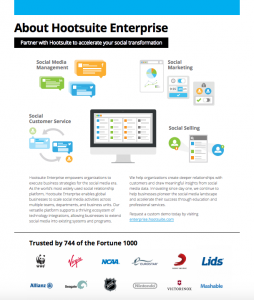
Adobe, in an effort to reach business professionals searching for detailed information about document security, published the white paper Global Insights on Document Security.

The white paper is 15 pages and contains the type of research and data an IT professional will be looking for when making decisions on his company’s document and file security practices.
Atalasoft, a document imaging company partnered with the digital publisher Software Development Times to release the white paper Scanning on the Web.

The 7-page white paper details four separate options for web scanning and offers readers a 30-day trial of Atalasoft’s latest scanning solution.
Best Practices
Good white papers should be a part of any sales process in which purchase decisions are made across a longer sales cycle. In your effort to always being the best answer for your customers, consider these best practices when writing white papers.
- Answer specific questions. Know what your customers are searching for and craft your white paper with buyer insight and data-driven topics.
- Ask for just the right amount of data in return. What you ask for in a customer registration is up to you: It could be email address, name, phone number or mailing address. Beware that asking for more information than necessary will turn many people away.
- Integrate. White papers works best in concert with other paid, earned and owned tactics.
- Don’t push too hard for the sale. Present the information that you believe is required to help your customers solve the problem that brought them to your download page. Beyond that, any appearance of over-selling is probably a turn-off. Let your helpful content speak for itself.
- Be visual. Use graphs and charts that can easily represent data.
- Prove it. White papers are often formatted like more academic reports, with attribution of sources and footnotes if needed. Your customers want to know that the detailed information you are sharing is well-sourced.
- Repurpose. Make the most of the time you put into your white papers. Content developed for your white paper can be used in smaller blog posts or condensed into infographics. Think of your white paper as a campaign anchor and develop resources around it to drive traffic and optimize performance.
Have you been successful using white papers in your marketing mix? What are your tips and tricks?
For more content marketing best practices, see our full list of content marketing tactics with links to in-depth articles on each tactic just like this one.
Top image: Shutterstock
 Gain a competitive advantage by subscribing to the
TopRank® Online Marketing Newsletter.
© Online Marketing Blog - TopRank®, 2015. | White Papers: Pros, Cons, Examples and Best Practices | http://www.toprankblog.com
4 Steps To Improve Your Sales Reactions In 2015

According to Google, one definition of a reaction is a mode of thinking or behaving that is deliberately different from previous modes of thought and behavior. To become the Sales “Magnate” that you want to be this year, great results will stem from deliberately taking actions around thoughts and behaviors.
Dissect Your 2014 Results
- When were your best months?
- What factors influenced those months? Was it increased activity, consistency in your approach, or improving your sales fluencies? What would you do differently, and why?
- Take the time to analyze what worked for you, what did not, and reflect on how you can carry over the positives and create momentum.
Set Goals, Write Them Down, And Share Them
According to a Dominican University Goal Study, those that write down and share their goals experience the positive effects of accountability and accomplish significantly more those that do not write down their goals.
(Source: Summary of Recent Goals Research (PDF here: Gail Matthews Written Goal Study Dominican University), by Gail Matthews, Ph.D., Dominican University)
Evaluate Existing Pipelines
- Quickly address those that wanted to “wait until the new year”
- Seasonality exists in all business verticals to a certain extent. Evaluate when will be the best times to continue a conversation or steadfastly push for the close.
- Not all 2015 budgets have been locked down depending on the prospect’s fiscal year. Acquiring new customers often hinges on set purchase timeframes for new customer acquisition and cross sell/upsell opportunities.
- Reconnect with your nurtured prospects (Happy New Year!)
- Review Q4 and 2014 in total.
- Cover the type of year it has been with your prospects.
- Tie together the evaluation and consideration of your product/service into what their 2015 will look like at the end of this year. If you can connect the lack of advantage your prospect had without your product in 2014, they can envision the advantages in their favor throughout all of 2015. This could be bottom line immediate financial impact, increased efficiency or pure ROI.
- Lastly, drop those prospects in your pipeline that are not progressing to a sale. Do not let dead weight drag you down. Leave a drop message (“This is my last attempt to connect with you …”) and move forward.
Fervently Build New Pipeline With Focused And Purposeful Activity
This sounds obvious, but it’s critical to your entire year. Your pipeline may have suffered through the holidays. Know your personal bests in terms of activity, strive to reach beyond those and then set out to become more efficient within the sale. Knowing your numbers is a key aspect to a productive and successful sales career. Any sales person can tell you sales is a numbers game; those that understand their opportunities for improvement within those numbers are the ones who progress and earn the most.
By looking back and reflecting, looking forward and then applying what has been learned to your pipelines you will deliberately create positive sales reactions in 2015.
[Photo Credit: Kiva.Dang]
How Pinterest has vastly improved its searches with data

Pinterest has accumulated a great big heap of data in the course of running a website where users can pin, like, and simply click on a smorgasbord of content. And that data is going to good use. It’s enabled Pinterest to build a very smart search box.
In a blog post scheduled to go live today, Pinterest details the complex “data collection” underlying its search engine, called QueryJoin.
The system seems to be encouraging engagement with Pinterest. Since Pinterest launched its Guided Search in April, the number of searches each user conducts has gone up by 25 percent, according to the blog post.
Facebook, Twitter, Google, and other web companies take user engagement data into consideration as well. But Pinterest is younger, and it needs to keep usage going up quickly. It’s growth time. So an engineering feat of this nature, which can impress users and get them to come back again and again, are critical.
QueryJoin draws on data collections that Pinterest has previously talked about, like PinJoin and UserJoin, which take boards and re-pinning activity into consideration. The system also draws on demographic information, as well as searching usage itself.
For example, QueryJoin looks at all the search queries a user makes during a single visit to Pinterest — “to learn how users refined their search queries to find things they were looking for,” Pinterest software engineer Dong Wang explains in today’s blog post.
Things become more involved from there, Wang writes:
We extract search activities from the session logs on a daily basis. For each search activity, we extract the information needed to build the QueryJoins and store them keyed by the date.
Every week, we create a partial QueryJoin by aggregating daily search activities together. For the Pins in the QueryJoin, we join them with PinJoins by image signatures. For each query, we find a set of PinJoins related to the query and then calculate the most relevant Pins and classify queries into categories. We also join the QueryJoin and the UserJoin (the collection of a user’s information such as their boards and Pins) by identifiers and calculate the gender and country stats.
In addition to powering Guided Search, the QueryJoin data collection also contributes to the knowledge base for search autocomplete and relevance, Wang notes.
For more on the data engineering at work for Pinterest’s search capability, check out the entire blog post.

THE AD-VIEWABILITY REPORT: The top statistics that illustrate the growing problem of unseen digital ads

Marketers are spending more than ever on digital advertising, but there are growing concerns over whether digital audiences actually see many of these ads.
Consider:
- Users are often served an ad that appears in an inactive web window or an out-of-view part of their screen.
- Viewability is particularly challenging for online video ads, since these ads are meant to be seen, heard, and played-through.
- Automated platforms for buying and selling online ads also tend to aggravate the viewability platform.
In a new report from BI Intelligence we look at how industry groups, advertisers, and ad tech vendors are defining and fixing the viewability problem.
Access The Full Report And Its Downloadable Charts By Signing Up For A Risk-Free Trial >>
- Video ads present a unique set of viewability challenges. Video ads are meant to be seen, heard, and played through to the end.
- A number of ad tech companies have developed viewability-tracking tools, and many publishers already fold in viewability guarantees when they sell directly to advertisers, but these safeguards are offered on an ad-hoc basis.
- Industry groups are working to create standardized definitions for viewability, and are endorsing accredited viewability-measurement specialists. The Media Rating Council (MRC) recently established new viewability guidelines.
The report is full of charts and data that can easily be downloaded and put to use.
- Defines the viewability problem, and explores its root causes.
- Lays out the unique viewability challenges for digital video ad units.
- Examines how viewability performance differs based on how ad units are sold, including publisher-sold, network and RTB-sold inventory.
- Outlines new viewability guidelines from the Media Rating Council (MRC).
- Analyzes how pricing/costing models impact the viewability problem.
Crossing the Experience Divide: Creating positive, lasting experiences is a crucial mandate for any brand

The Technology of Us
I’ve been in the technology business for a long time and what I can tell you is this: Technology enables us to invent new products and services at rates that humans never before experienced. Whatever the next big thing is in tech doesn’t matter as much as the fact that anyone today has the power to disrupt entire industries with a single, smart idea.
In fact, resilient companies, whether they’re startups or they merely acting like one, will intentionally break their business models in anticipation of what customers want and need.
Look at the “sharing economy” — companies like Uber, Airbnb, TaskRabbit and other services that allow people to rent or share their cars, homes or skills has taken off because technology empowered a few upstarts to take on the taxicab and hotel industries. In fact, mobile, social and geo-location technology have made using, renting or borrowing these products and services as easy as the Internet once made buying them. Yet it’s more than just an idea driving all that — evolving consumer values and aspirations have as much to do with this phenomenon as technology. So what does the rise of the sharing economy say about businesses today? That there is a massive disconnect between what consumers want and what companies are delivering. That anyone with vision and empathy can upend entire industries.
That’s one reason why I believe we’re on the cusp of a new wave of rapid creative destruction in business unlike anything we’ve seen before — a form of Digital Darwinism not unlike the forces that have shaped human evolution. The companies that emerge from this tumult won’t be the “living organisms” that businesses have been called — ones that simply learn, adapt and eventually die. Instead of fiercely protecting their business models, they will tear them down and build new ones. This is creative destruction as an intentional strategy, rather than creative destruction as it has long been defined — as an economic threat. To succeed means thinking about customers differently, as groups of connected people and not simply demographics. It requires a level of leadership that can see something others don’t or find inspiration in what others feel or hope to feel. These traits — not the technology itself — are what will define the most resilient companies in the years to come.
Plugging into your customer’s ‘ego-system’
Netflix is held up as an example of a company willing to risk cannibalizing itself for the future. When the company saw a decade ago that DVDs were rapidly becoming obsolete, it built a thriving online streaming business to replace it. Now it is pushing into content origination with shows like “House of Cards.” That’s not a bad idea, obviously, but it’s not sufficient for the level of creative destruction I’m talking about.
To be successful, companies will require more than just a focus on scale, profit and the next big thing. It requires true empathy for what your customers are thinking and an ability to identify what they want or need even before they do. Apple consistently did it with the Mac, iPhone and iPad. Twitter did it with the 140-character message. Airbnb is doing it with homes. WhatsApp did it with data messaging. The challenge is that there is no one-size-fits-all solution. You have to see your customers for who they are becoming, not just who they are today.
My generation was taught to follow a linear path to success: go to school, get a job, own a home, buy 2.3 cars, have children and save for retirement. Young consumers today think differently. They’re more connected, empowered and concerned with what I call their own “ego-system.” With technology’s help, people can create a world in which they are at the center of their own universe and brands are in orbit around them, not the other way around. Eventually, customers are going to expect products or services in whatever form they want them. If a company can’t deliver on that, they’ll rely on their connections to find a company that can.
Consumer values are changing, too. Buying a house is no longer the American dream. Consumers may not even need a car. And when they walk into Starbucks, they’re looking for more than a decent cup of coffee. They want an overall satisfying experience — and this means more than just chatting with a friendly barista. They want to feel connected to Starbucks or any other company they deal with in the same way they feel connected with their friends or peers.
Crossing the experience divide
Behind the rise of Uber and Airbnb is a collective sense that, with technology, we are building a better community. No matter where we go with new technology, whether it’s social, mobile, wearable or Big Data, it won’t matter until companies learn to temper their profit goals with empathy and look at the bottom line as part of a larger mission, doctrine or ethos. Simply put, you’ve got to care about your customer and make the people around you care, too. Airbnb doesn’t actually stock inventory. Uber doesn’t technically employ a fleet of cars. They built a seamless platform for connecting people with people to deliver new experiences.
In the case of Uber, taxi companies could have changed their business model all along, but didn’t. What this demonstrates is that if you do not disrupt, someone else will disrupt for you. And, Uber’s not done. The company recently changed its tagline from “Everyone’s private driver” to something much more disruptive: “Where lifestyle meets logistics.”
Start by defining the experience you want your customers to have. How do you want them to feel? What should they share? Define it. Build it.
Often, what customers are likely to share is not in alignment with your brand promise today. What you say your brand is and what others may share are different. To what degree? Well, that’s what determines what I call the experience divide. In a sharing economy, it’s not just places and things that we share. We depend on the shared experiences of our peers to help us make informed decisions or investments. If we’re not creating the types of experiences we want people to have and share, we’re simply reacting to them.
The most obvious example of it is our propensity to share negative experiences. People vent to get resolution to feel better. It’s cathartic. Social and mobile amplify these experiences, making them more influential than ever before. But what about the positive experiences? They feel good to express outwardly, too, though we’re not innately inclined to share them. Even so, it’s in the business’s best interest for consumers to share these positive experiences, because we know that they define the ultimate moment of truth — the moment when the consumer enters into a partnership with the brand.
This is where positive conditioning comes in. If the future of a company’s brand is dependent on shared experiences, it is important to adopt positive reinforcement and positive psychology in order to create shareable, meaningful moments. This means that companies must invest in the consumer as well as in these positive moments. If I, for example, value you as a customer, but I ask you in return to share a great experience you’ve had with my brand, I should have a loyalty program that rewards you for your advocacy. This new strategy for loyalty and advocacy determines the future of the brand. It’s not going to be defined by the company, but by everyone.
Embrace the change
The creative destruction that I’m describing won’t be easy. As humans, we tend to fear change. As we grow, we develop neural pathways that dictate how we respond to life events, and these neural pathways become harder to tear down and recreate as we age. Change can be intensely uncomfortable at first, especially when nothing appears to be broken.
Companies, too, develop neural pathways. They identify and develop products, processes and philosophies that allow them to flourish at first but later cause stagnation. History is rife with examples of businesses that built great products or services — usually by challenging the status quo — only to become paralyzed by their success. Think Blockbuster, BlackBerry or Kodak. Kodak invented the first digital camera, but didn’t change the prototype into an actual product. Why? For fear of eroding its film business. A “Kodak moment” no longer suggests capturing a moment to be remembered and shared; it refers to any business that misses new opportunities to disrupt itself.
The root problem is that most companies are built on a platform of critical thinking — built to keep things from going wrong, not to try to break things apart. When technology pushes us to move forward faster and faster, the first reaction is usually to go back before moving forward. Creative disruption becomes a business strategy to either invest in or acquire the very things you feared, rather than simply protecting what it is you have.
Creative disruption at the rate I’m describing requires a different kind of business leader than what we see today. Managers are great at running and growing a business, but they’re not likely to break new ground. Future business leaders will develop a strong sense of urgency, and they’ll be able to sell that need for immediate change to other stakeholders.
I may not be able to predict what technology we’ll be using 5, 10 or 20 years from now. But I can tell you this: If there’s one thing I’ve learned as a digital analyst, it’s that the future is going to happen to you or it’s going to happen because of you.
And guess what? The future is happening right now.
The full version of the essay above is available here (complete with videos!).

Get the ebook!
If automation was the mantra for technology to date, is humanization the calling for technology in the future? The Technology of Us, a new ebook, explores this question from the perspective of top intellectuals, scientists, designers and business innovators. This collection of essays and interviews demonstrates how technology is pushing humankind into a new stage of evolution, with as many massive implications for modern business as for our individual lives. If you want a peek at the future of human innovation, this selection of stories will prove to be essential reading.
I’m proud to be part of this amazing lineup of contributors that includes George Lucas, Don Tapscott, Don Peppers, Doc Searls, Rachel Armstrong, Janine Benyus, Erik Brynjolfsson among several other amazing minds.
You can read it online or offline via iBooks, Kindle and Nook.
Connect with me… Twitter | LinkedIn | Facebook | Youtube | Instagram | Pinterest

10 Things To Make 2015 Your Best On LinkedIn
 The New Year kicked in last week, we all enjoyed the party, made the resolutions, and probably half of you have already broken them! Hence we thought we would give you a quick ten things that will make a huge difference to your LinkedIn.
Most common approaches to LinkedIn are driven by a tick mentality – done profile (tick), connect with people (tick) – get success from LinkedIn? Hmm.
Let’s stop ticking boxes and start thinking about LinkedIn differently, it is just you as you are in real life when you go to meet a room of people you know, network, or attend a conference.
- Take time to refresh and review your profile – The new profile format has made changing your profile even easier! Think about your summary – it’s important to be you. Ensure your profile reflects you, your brand, your style and the reasons people engage with you.
- Look like you do in business life – You are fourteen times more likely to be looked at on LinkedIn with a photograph, but not just any photograph, look professional, up to date so you look like you do at work, not one of these twelve profile photographs I never want to see on LinkedIn! Invest some time or money in a good picture, not just for LinkedIn either but for use across your media.
- Only join the right groups – You should join groups not just full of peers, but those where your people of interest or clients go to. Comment and interact, be yourself, be professional, and get involved. Demonstrate your expertise, your insights, and demonstrate your value to others. If it is a dead group then leave.
- Do status messages – It would be great to think everyone remembers you, your value, and all you do, but get real – they don’t. You need to remind people, tell them the latest positive news updates regarding you and your work, remind people you exist and your value, not in a salesy way, just share a bit like you would if you met people and they asked “what are you up to …” – simple and quick to do.
- Get written recommendations – Skills endorsement does not carry the same weight as a written recommendation. Don’t forget a written recommendation makes you three times more likely to be viewed on LinkedIn and enables you to share the opinion of your happy clients of your work and provides yet more credibility to your brand, but there are good and bad recommendations.
- Include a phone number in your contact information – You don’t want a relationship with your connections based on messages only do you? Talk to people, perish the thought meet them and share some time, some views and build the relationships in real life over a coffee. Makes it really difficult for a connection to call you if you don’t have a telephone number!
- Identify easy to reach referrals – One of my frustrations with how others use LinkedIn is that they haven’t realized it is the best sales tool no one uses. Just imagine LinkedIn can send you a list of potential clients that your closest connections already know and would happily introduce you to if you just asked them to and it’s free.
- Learn about how LinkedIn works – Make time to learn how the platform works, LinkedIn provides some free low-level videos, there is the help centre, my blog, or you can learn more on a good course. Look for providers with good company profiles, recommendations, and more.
- Review your connections – I dare you to review all of your connections and see how many of them you actually know well enough and could pick up the telephone too. LinkedIn is not a collecting exercise it is about leveraging your relationships to make social selling and social success real. If you don’t know them then should you have them? If they have got a new role and you never knew take some time to get in touch.
- Get profile feedback from teammates, customers, and people you know – I know you think your profile is fabulous, but perhaps you ought to ask around, ask your boss, your clients, your friends, colleagues and those around you to be critical. Ask them to tell you what you missed and make suggestions to make it better. Listen and act on them! Frustratingly often they come up with great ideas. You can also try our free profile checker online.
Let’s make 2015 the year you are making the best use of LinkedIn for you and your business – forget the diet but see great results if you stick to these throughout the year.
We wish you a fabulously successful 2015 and if you need any help then just ask.
Why Multichannel Marketing Matters
Customers don’t want to be told what they can do. What they can buy, or where and when they have to do so. They want to be able to choose. That’s why choice, to the modern consumer, is so important.
Multichannel marketing is about choice – giving your customers the choice to interact with you in a way that’s convenient for them: at a time of their choice, at a place of their choice, and on a device of their choice.
By using the right platform(s), you can integrate your digital and traditional marketing activities and reach the right customer with exactly the right message at exactly the right time.
So, what’s the challenge for marketers today?
Research shows that, increasingly, more and more customers are using more and more channels to engage with their desired brands. But ironically, this amount of freedom and choice can cause marketers a few problems:
- How do you make sure your multichannel customers are having the same experience across all channels?
- Do you know where and when and how your customers are interacting with your brand?
- Are you ready, there and then, to engage with them where they’re most likely to engage with you?
You can benefit from a multichannel marketing strategy. Here’s how.
A multichannel marketing strategy is indispensable when trying to connect with your customers. You’ll know their value, you’ll deliver consistent experiences (the most powerful competitive differentiator!) and find it easier to see results. Here are some of the benefits you can expect to gain from implanting a successful multichannel marketing program:
- Know which channels contribute to qualified conversions or sales and how and why every customer is different.
- Have the ability to engage, acquire and retain different demographic groups according to their behavior within specific channels.
- Engage with your customers wherever they touch your brand.
- Identify the most common touch points a buying customer has with your brand, and plot for prospective customers to increase conversion rates.
- Spend less time creating campaigns and get better response rates.
- Strengthen your brand by creating consistent customer experiences across all channels.
- Reach your customers when they’re ready to engage.
- Boost revenues.
- Retain happy customers.
- Identify and connect with new prospects.
Some choice tips for creating a successful multichannel marketing program.
- Make sure all your messages, across all the different channels, are on-brand and personalized.
- Target each customer with an offer, message, and even imagery that is relevant and targeted to them.
- Understand that people are individual: we all have different tastes. That way, you’ll market to them better and keep them engaged with your brand.
- Marketing is not about one-off campaigns. Plan follow-up messages to every campaign you send out.
And what to avoid:
- Choose to ignore this advice at your risk! We’d highly recommend you avoid making these mistakes at all costs:
- Failure to send relevant messages.
- No personalization (or worse, the wrong personalization!).
- Forgetting to create and nurture a natural, on-going conversation with your customers.
- Neglecting to gather more info on your customers at every opportunity.
- Forgetting to plan follow-up messages.
Keep an eye out for our next blogs. They’ll follow shortly with an in-depth look at the planning, execution, and development needed to create a successful multichannel marketing campaign.
Ethical Consumerism Isn’t Dead, It Just Needs Better Marketing

Ethical consumerism is the broad label for companies providing products that appeal to people’s best selves (for example, fair trade coffee or a purchase that includes a donation to a charitable cause). Now that the general idea of combining ethics and shopping has become a mainstream concept, there is a developing a backlash against the idea that consumers might effect change through their purchasing habits. This pessimistic stance stems primarily from the lower sales of ethical brands. “If consumers cared about moral issues,” the argument goes, “then companies and brands that did the right thing would have a larger market share. It is clear people must not care about these issues and so ethical consumerism is going to fail. We cannot shop our way to a better world.”
I understand the attraction to markets and their efficiency; I am a marketing professor. I am also a psychologist, though, and a “behavioral economist,” which in my case means someone who studies the psychology of market decisions with an eye to economic theory and when it does (and does not) explain what people do.
I worry that the pessimism about ethical consumerism gives companies the idea that they should not actively pursue the moral high ground because consumers will not reward them for it. I also worry that consumers will give up on trying to effect change through purchasing, because they believe that the aim is hopeless. On the flip side, it is pleasing to imagine the market fixing societies’ ills, to provide a nice antidote to the common idea that the marketplace and consumers are amoral and solely profit-driven.
And yet the hopelessness of ethical consumerism is echoed everywhere, in the business press, in (some of) my students’ resistance to studying moral issues in a business framework, and in conversations I have on airplanes, at parties, and with colleagues. An often-quoted 2010 Wall Street Journal article, “The Case Against Corporate Social Responsibility,” laid out the argument clearly: “the fact is that while companies sometimes can do well by doing good, more often they can’t. Because in most cases, doing what’s best for society means sacrificing profits.” Indeed, regulation would be a more immediate and effective solution to unethical consumerism than hoping for market change. But let’s be honest– widespread sustainability regulation is not coming any time soon and would likely have some negative consequences even if it did.
So, for now we are stuck with hoping that consumers will drive change. I’m still optimistic about this, for one primary reason: Even though market share for sustainable brands is not always as high as for other brands, I do not think current sales are the best barometer of ethical sentiment. Until marketing practices do the best that they can to guide ethical consumerism, we can’t really draw any conclusions about what current market share means.
My first piece of evidence may seem obvious, but it seems to get lost whenever people discuss market behavior. The truth is, most people will (at least sometimes) behave ethically even when they have to sacrifice something, usually cash, for their morals. Billions are given to charity every year ($335.15 billion in the US alone in 2013 according to Charity Navigator). This past year, thousands of people dumped ice water on their heads and then gave a total of $115 million (as of this writing) to help support research for ALS. So clearly there is some human willingness to part with one’s money for an ethical cause.
And yet sometimes it is tempting to believe that shopping behavior is more indicative of people’s “real” selves than behaviors such as giving to charity, because market tradeoffs are expected to be more accurate revelations of deep, actual sentiment that strip away any nonsense and get to the real, perhaps ugly, truth. As economist Paul Samuelson explains, market preferences are “revealed preferences” that make people put their money where their mouth is.
But people regularly buy hybrid cars, organic foods, environmentally-friendly detergents and Warby Parker glasses. Why? I would chalk a lot of it up to really effective marketing. Yes, there are other benefits to those products – saving money on gas, health benefits, style, and comfort – but isn’t it a marketer’s job to tout those and other benefits, too?
Pessimism about ethical consumerism rests firmly on the assumption that consumers have one, stable utility structure and they express that utility in their purchasing. The problem is, human psychology does not work like that—people do not have only one value for things and they do not have a stable and consistent utility structure. Modern treatments of economic behavior have rejected the simplistic one-preference idea of human values and decisions for quite some time. As Daniel Kahneman’s explains in his wonderful book, Thinking Fast and Slow, a survey of all of his (Nobel-prize winning) research over the last forty years or so: “it is self-evident that people are neither fully rational nor completely selfish, and that their tastes are anything but stable.”
My primary research area has been how ethical decisions are especially squirrelly and inconsistent, flip-flopping all over the place, depending on the situation. To provide a personal example, I was just on vacation at Disney World and was offered the “green package,” which would mean not washing the towels while I was there, and also not tidying up the room. Consider: I not only value being environmentally sensitive, but also was in the middle of writing this very article. Nevertheless, I rejected the green choice, because I wanted them to tidy the room and they had mentioned the room tidying last, so I weighted that information more highly in my decision.
One of my favorite quotes, by Mark Sagoff, expresses this type of inconsistency: “I love my car; I hate the bus. Yet I vote for candidates who promise to tax gasoline to pay for public transportation. I send my dues to the Sierra club to protect areas in Alaska I shall never visit…I have an “Ecology Now” sticker on a car that drips oil everywhere it is parked.” Sagoff is focusing on inconsistencies between political and consumer behavior within a person, but the inconsistencies exist even across purchasing contexts.
For example, in a paper published in the Journal of Marketing Research with my colleague Rebecca Naylor, we showed that how much people cared about whether a shampoo company conducts animal testing depended on a simple shift in context. We asked participants to consider a set of actual shampoos that differed on many attributes including animal testing. There was a large set that, we told them, would need to be narrowed down before they picked one shampoo to keep (and we did actually give them the shampoo they chose). We instructed half of them to indicate which shampoos they wanted to consider further, and half to indicate which ones they did not want to consider further. Consistently, and surprisingly, the shampoos picked for further consideration (i.e., those that were included versus those that were not excluded) differed. In the including case, ethics played very little role in choice but in the excluding case it loomed significantly larger. In the end, being told to think in terms of excluding led to more ethical decisions.
In another paper, published with Kristine Ehrich in the same journal, we showed that people who care about ethical issues such as child labor will, strangely enough, avoid finding out whether their products are made using child labor. But then if you give them the information they will incorporate it into their purchasing. Ethical information is difficult to process and it is common for consumers to want to remain willfully ignorant of it. I myself behave in this manner at least once a week.
I could list a half dozen or more other examples, but suffice it to say that there is ample research to match the anecdotal evidence that ethical consumer values exist, but the context has to draw them out. This is the marketer’s task. I think a useful analogy to ethical consumerism is the tradeoff between vices versus virtues. Decades of research in psychology and economics (nicely summarized in Richard Thaler and Cass Sunstein’s book, Nudge) establishes that people often want something different in the short term (e.g., chocolate cake) versus the long term (e.g., being skinny). Likewise, people both want to be ethical and they want to ignore ethics. As Thaler and Sunstein explain in the context of virtues such as eating healthy, exercising and saving money, sometimes all that is needed is a contextual push toward better behavior — a nudge.
Marketers are all about nudging, so why not use it to promote more ethical consumer behavior? Consumers are likely to be especially brand loyal if their deeply-held values are engaged in their purchasing. Consumer engagement and commitment is priceless: ethical brands are more likely to encourage this engagement. Consumers walk around with Whole Foods branded merchandise all the time; it is difficult to find similar examples for less ethical retailers focused solely on price. If low price is all a company offers, it is easy enough for the consumer to walk away when a lower price comes calling.
Imagine if your competitors have all fallen prey to pessimism about ethical consumerism, but you know better. You know consumers have ethical motivations, and you know you can help them express those motivations. You realize that past market share doesn’t have to mean consumers aren’t hungry for the chance to do good while they spend money. By remaining optimistic, you have both made a difference in a larger sense, and you have found a sweet spot in the competitive landscape where you can grow profits and your brand.
An All Too Typical Sales Prospecting Phone Message
One of many webinars I attend was a lead nurturing webinar recently. I’m always looking for insights, especially about how companies are thinking about content to support their many use cases. I also like to experience selling from a buyers perspective. I get many sales prospecting calls, but usually for products or services I could care less about. I delete and forget. But this was a topic I’m really interested in. While I’m not a prospect for this company, I think I am an important influencer, and potential referral source for them. This is the follow up message that was left on my voicemail. After you listen to this 35 second recorded message (slightly edited to remove identifying marks) — and before you read on — take a moment to write your impressions of the message, and what you would do differently. (Play in separate webpage.) Now let’s compare. Message Diagnostic “I wanted to have the opportunity …” As a result of years of work with a fascinating breakthrough business coaching firm Gap International, I’ve learned that language betrays true intention. Now I instinctively recoil when people begin their sentences with “I want.” Next: “… to speak more about the common frustrations that most organizations face …” OK, now I’m listening. But rather than share an understanding and perhaps perspective about those frustrations, they are left un-mentioned because we want to move quickly into … “… and how our ‘end-to-end marketing solutions can help alleviate these headaches …” Pretty much […]
The post An All Too Typical Sales Prospecting Phone Message appeared first on Avitage.

Does Length Matter? – Sales eXecution 281
By Tibor Shanto - tibor.shanto@sellbetter.ca

Does length matter, or is it more a question of how you do it?
Get your mind out of the gutter for a second, and thing length of sales cycle.
I was recently approached to write a piece examining how to reduce the length of the sales cycle, or as some like to say increase the velocity of a sale, something I have written about in the past. But I am convinced that this is a red herring, a false premise or trap many in sales fall into.
Right off the top I will tell you that shorter cycles are not better, the goal is to understand your “optimal” cycle, and then focus your efforts on efficiently executing it. If your optimal cycle is three months, you really are going to gain little by trying to shave a couple of weeks off that.
When you ask people why they want a shorter cycles, the answers are usually more subjective than objective, and usually reflect their bias, or often fears of the person looking for a shorter cycle. Some will tell you that they believe it will drive more revenue, not true, because if you shorten a cycle for the sake of shortening, you will take shortcuts that will either cost you sales, or more often, you’ll have to go back and do things you should have done in the first place, leaving no gain or worse. Other reasons include ability to scale, greater focus, increased market share, but usually these things are more an element of execution than things impacted by the length of the cycle.
When it comes to executing sales fundamentals, it is better to focus on quality of execution, not speed. People tell me they can shorten their cycle by targeting the right prospect, duh! Or solve buyers’ problems rather than sell them product, double duh. Let’s not confuse optimization with acceleration.
What I have found and most don’t like, is the real question here is one of prospecting. If you have the right if you know you conversion rates between stages of the sale, and your close ratio, you will worry less about how fast you are closing deals. It is much more about metrics and accountability than speed. If you know how many prospects you need to close one deal, then it is much better to ensure that you maintain that level prospects, rather how fast you chew through them.
Once I know my quota or goal, I can use my metrics to chart a path to that number. If close one of every five prospects I engage, and I successfully engage one prospect each day of the working week, each is a cycle, and I do this consistently every week, it really does not matter who long my cycle is. But people would much rather spend time and effort shaving minutes off their cycle than prospect consistently. Once you have that down, it takes the pressure off closing faster, and allows you to fully sell the right prospects, and better yet, the permissions and means by which to disqualify less than optimal prospects.
What is ironic is that often it is the same voices who tell you that sales is not a numbers game, are the very ones who advocate for shorter cycles. But when you look at it, focusing on shortening the cycle, leads to much more selling by numbers, than the discipline of consistent and efficient execution of your sale, using metrics, data.
Tibor Shanto

Four important reasons why marketing should be personal
Personalisation is a fundamental part of digital strategy and a strong commercial case for using it is as follows: a reported 14% uplift in sales.
This stat comes from our quarterly digital intelligence briefing Why Marketing Should be Personal produced in partnership with Adobe.
Why it might be a good year for investors to go against the grain
Contrarian investors had a tough time making profits in 2014, but this year may be different for those who go against the grain, says Robert Buckland, global strategist at Citigroup Global Markets.
“After hefty losses in 2013, global contrarians were punished again in 2014,” said Mr. Buckland in a note to clients. “Their biggest mistake was (again) to try to call the bottom in commodity-related stocks and markets. Going short US Health Care was also very painful. However, 2015 offers one ray of hope: since 1998, contrarian stock pickers have never underperformed for three years in a row.”
Mr. Buckland said simple contrarian strategies can perform “spectacularly well at big macro turning points,” but tend to underperform the rest of the time.
In 2015, he expects contrarians will try to call a turn in battered global commodity stocks and financials, but take a bearish stance on U.S. heath-care and IT equities. Moreover, he expects contrarians to be buyers of Europe, especially the United Kingdom, and sellers of the U.S.
“US contrarians will be buying energy and selling health Care/IT,” he said. “In Europe, they will be buying commodity stocks. In Japan they will be buying Financials, while in EM they will be buying Russia, Brazil and Korea.”
As for other asset classes, Mr. Buckland expects contrarians to be bearish on global bonds given their decent returns in 2014 and will try to call a reversal in oil and gold. They would also be sellers of the U.S. dollar.
“Given 2014 was a big momentum year, the contrarian trades for 2015 look similar to those from a year ago,” he said. “Die-hard mean-reverters rarely give up.”

How To Write A Case Study

Adding a case study at the end of our blogging frenzy helped our traffic spike over 1,000%
Knowing how to write a case study can drive tremendous results for your inbound marketing. Not only do we see our biggest traffic spikes when we publish new case studies, but leveraging case studies as a sales tool helps close deals much faster and easier.
Being able to prove your value with previous performances will help you raise your position as a thought leader in your industry as well as separate yourself from the competition when talking with prospects.
Elements That You Need To Include In Your Case Study
- Case Study Title
- Quotes About The Project
- Visuals Supporting Your Text & Data
Pages That Your Case Study Needs To Have
- High Level Overview
- About The Project/Client
- The Problems You Are Solving
- How You Solved Those Problems
- The Results Of Your Work
- A Call To Action For The Reader
How To Write A Title For Your Case Study
 Just like anything you need a title for, you want your case study title to pique interest of whoever sees it and intrigue them enough to want to read it in full (or skim through it, 2015 web-reading style).
An easy way to write a solid title for your case study is to include the results that you achieved followed by the work that you did. For example:
“600% Increase In Leads From New Website Design”
While you can spend a ton of time trying to come up with a great headline for anything, I like to go with the KISS method and Keep It Stupid Simple. This formula is super simple and does the job.
If you want a little more on how to write headlines, check out Kevan Lee’s post, “30+ Ultimate Headline Formulas for Tweets, Posts, Articles, and Emails.”
Getting Quality Quotes For Your Case Study
Since you presumably did a great job for your client (or boss) on this project, which is why it’s worthy of a case study to begin with, it should be easy to get some quotes that are relevant and provide social proof to your readers.
Sean D’Souza gives us these 6 Questions to Ask for Powerful Testimonials:
- What was the obstacle that would have prevented you from buying this product?
- What did you find as a result of buying this product?
- What specific feature did you like most about this product?
- What would be three other benefits about this product?
- Would you recommend this product? If so, why?
- Is there anything you’d like to add?
We can use this same approach (rewording to make more sense for your company) to get quotes to insert in our case study.
Options To Add Visuals

Don’t get lazy with your case study graphics. It’s easy to create 3D charts in Excel to make them (literally) stand out more.
Including visuals with your case study, whether graphically or with photographs, will help improve the overall quality of your document for the reader. Plus you can leverage graphics to backup your data while providing some aesthetical relief from blocks of text.
3 options for adding visuals to your case study:
- A photo of your product or someone providing your service
- A chart or graph showing your performance, or even a screenshot of your analytics
- Add photos along with your quotes
Writing Your Case Study Overview
Your case study overview is like the executive summary of a business plan. It should introduce the problem, then hit all the key points very quickly for someone who is just looking for the highlights.
Writing under 100 words for your case study overview is fine, and even including a few bullet points works well to introduce the results that you’ve achieved.
What To Include In Your Overview
- Introduce the problem and why it’s a problem.
Example: ABC company had a website up for a few years, but never really got any benefits out of it, such as generating quality sales leads. They saw overall sales starting to decline as more potential customers were finding their competition online instead of them. - Introduce your solution.
Example: Knowing they needed to do something different, ABC Company hired Tresnic Media to help plan and execute a new website strategy that would help get them back in front of their target market and growing sales again. - Metrics of success.
Example: 600% increase in leads. 1,200% ROI
About The Project/Client
If you are working on with a client, this is easy. You can snag the description from your client’s LinkedIn page or website. If you’re writing a case study about an internal project, then put together a short paragraph describing the project.
Make sure you cover who the client is/what the project is, the problems you faced, and the goal of your work.
The Problems You Are Solving
Now it’s time to get into it! What problems are you helping to resolve? Write a short paragraph or two that describes what issues your client was having and why they are significant. Here is where you can begin implementing the classic copywriting formula of Agitate – Solve.
Bullet points to hit here are:
- What problem was your client having?
- Why are those problems significant?
- What consequences was your client facing if this problem wasn’t resolved?
How You Solved Those Problems
Here’s the second part of the formula where you solve that agitation.
Describe how you worked with your client to find, plan, and execute your solution.
Be concise. Try to keep this section to 2 or 3 short paragraphs.
Some suggestions to cover when talking about your solution:
- What did you find in your research that was relevant?
- How did this information play a role in your strategy?
- What was the strategy and how was it executed?
The Results Of Your Work
Time to show off!
In your conclusion, write about the performance of your strategy and how it made a positive difference for your client. Don’t worry about repeating the metrics you may have mentioned throughout writing the case study.
Add in some visuals to increase the impact of the text. Show a graph that conveys the tremendous success that you were able to deliver for your client (and that you can deliver for other potential clients reading your case study!).
*Make sure it’s not a flat looking graph, there are several easy ways to make compelling visuals with your data in Excel, don’t be lazy!
Call To Action
Like any piece of content that you publish, you want to end with a relevant Call To Action that will give your reader a next step to take.
You have just worked so hard on showing them why they should hire you and the success you can help them achieve, don’t leave them without a way to move to the next stage with you.
Ideally, you’ll have a relevant landing page that you can link to from the end of the case study that speaks directly about the specific service that you covered. That landing page should have a form and your contact information so that the visitor can quickly go from reader to sales ready lead!
15 Tips to Generate More Leads in 2015 (Part 1, featuring tips 1-5)
It’s a new year, and you’re likely kicking off marketing and lead generation programs to drive more new leads for 2015. Most new leads go nowhere. Why? Often, it’s because Sales and Marketing have not agreed on a true lead definition and have not created a joint process for finding who’s ready to buy and building relationships with those who aren’t.
It’s not about more leads; it’s about doing better with the ones you already have. Here’s how. In this extended post, I’ll share 15 ideas on how to make your lead management more effective. Because there’s so much to share, I’m splitting this post into three parts of five tips each with today’s post featuring the first five.
 1. Create a marketing funnel, not just a sales funnel.
Most organizations don’t have a marketing funnel. Instead, they have a sales funnel that looks more like a bucket with lots of holes in it where leads leak out. Marketing needs to create its own funnel to understand whether leads are Sales ready or not.
The purpose of the marketing funnel is to bring leads into one spot and qualify them. By qualifying them, I mean that they are ready to talk to a salesperson. Then, there is the hand-off process between Marketing and Sales to consider.
I find that connecting the marketing and sales funnels together is really a big challenge and that is a big stopgap for most demand generation programs. You have to understand your sales process to know at what point the sales team views a lead as an opportunity and begins actively pursuing it.
The bigger and better you make your marketing pipeline, the bigger and better you make your sales pipeline. In the end, this isn’t about generating more leads; it’s about generating actionable leads. The marketing funnel creates sales-ready leads while nurturing the leads that aren’t sales-ready.
2. Create a universal lead definition.
If you are trying to measure lead generation and you don’t have an agreed-upon definition for the word, you won’t be successful — especially in high-growth organizations where the number of leads is growing all the time. In this situation, salespeople will have a tendency to focus on those companies they already know and relationships they already have, ignoring the others. They need to keep their numbers up and not trust uncertain leads to move the needle.
To get past this, you have to sit down with the sales team and ask, “What are the major things that you need to know in order for you to feel that something is viable?”
In my work with one organization, these are the key points of information that Sales often wants to know about a lead:
- Role in the organization
- Authority is in the buying process
- Business need
- Timeframe for buying
- Defined internal initiative
- Stage of investigation
It’s important to remember that the lead definition process is iterative. It’s not a one-and-done thing. Revisit the definition and make changes. Also, make sure you’re asking questions, such as are we asking the right questions?
3. Use the phone.
The phone is the gold standard for qualifying most leads. We found that you can email, you can do Web profiling, you can measure all these touch points, but in the end if you want to know something, you need to talk to someone and engage them in conversation.
For further reading on this, you might also like to check out: How to Put the Customer First in Lead Generation and Stop Cold Calling and Start Lead Nurturing.
4. Ask about goals — don’t sell.
One of the mistakes we see in lead handoff is that Sales sees that someone downloads a whitepaper, so they do a follow-up call and want to set up an appointment. That’s not going to get you anywhere. You want to be able to engage them in more of a discussion rather than trying to make an immediate qualification.
To do that, you need to ask a question: What question were you hoping to answer by downloading our white paper?
The next question is, was that you asking the question, or was that someone else in your company asking the question?
The goal is to be a trusted advisor or a relevant resource to your audience until they move to the point of being ready to talk about initiatives or even a specific project.
5. Create a process for re-engaging “dead” leads.
Consider going back to your year-old or older leads and re-engage them in some meaningful way. I shared this case study at MarketingSherpa B2B Marketing Summit.
At InTouch, we helped a partner re-engage 2,500 leads by simply calling them based on what we knew from their profile data on the Web form. We reminded them of the interaction they had had and asked if we could be a resource for them.
The follow-up touch was an email. Of the group, 40% were people that were still interested but had no defined initiative. They were prime candidates to be nurtured. A further 15% were ready to become sales leads, and 7% converted into sales. In total, we invested $40,000 to do this work, and the business was worth $1.2 million.
You might also like
A/B Testing: How to improve already effective marketing (and win a ticket to Email Summit in Vegas) [More from the blogs]
Lead Generation: How to empower your program like Siemens Healthcare [MarketingSherpa webinar archive]
B2B Lead Generation: 6 social media tactics from 7 experts [MarketingSherpa how-to article]
Marketing Research Chart: SEO most effective tactic for lead gen, but also among the most difficult [MarketingSherpa chart]
How Trend Hunter uses big data to forecast the next big thing

(Illustration by Shout)
It’s a little after 9 a.m. on the Friday before Thanksgiving, and Jeremy Gutsche is holding court in his Toronto office, talking about cupcakes. Bacon-flavoured cupcakes, to be specific, and how restaurants can use them to generate interest in their brands. The meaty-sweet treats are among the thousands of wacky ideas, products and fads catalogued on Trend Hunter, the website Gutsche launched in 2006.
At 36, Gutsche is quoted regularly as an expert on such topics by the likes of CNN, the Guardian and the Globe and Mail. He’s the author of two books, including the forthcoming Better and Faster. His first, Exploiting Chaos, was named one of the Best Books for Business Owners by Inc. magazine. “I like to say it’s half pictures, so you know it’s good!” he quips, fanning the pages to demonstrate.
On this day, Gutsche has just returned from a speaking tour that took him to Atlantic City, Dallas and New York—a mere fraction of the 60-odd keynotes he gives each year. One CEO described him as “an intellectual can of Red Bull.” And there’s not a hint of fatigue in his voice as he preaches his vision for changing the way companies find new ideas. Trend Hunter, he explains, is more than a website: It’s a market research firm for the digital age, with a data-driven model that contrasts with more traditional “cool gurus,” who identify trends and dispense insightful pronouncements based solely on observation and “gut instinct.”
The company’s Soho Street office is located a short distance from Toronto’s hip Queen West shopping strip and has the exposed brick and informal vibe of a startup. Candy apple–red walls and couches abound. At long wooden tables, eight millennials are clicking away at laptops, well on their way to crafting the 85 or so posts added to the website each day. Browsers open, earphones in, they sweep the corners of the Internet for concepts and products that might appeal to the roughly three million web surfers who land on Trend Hunter’s articles each month. Once a team member finds something worth sharing—Ron Burgundy–branded holiday tree baubles, perhaps, or a photo gallery of a light festival in Prague—the concept is quickly written up in a 120-word article to add to the 250,000-plus that already populate the website. It gets a formula-following title (“Famous Reporter Christmas Ornaments” or “Spectacular Luminous Events”) and 10 hand-selected links to push visitors further down the site’s rabbit hole of weird, buzzy content. A global network of contributors and tipsters ensures that few ideas, however outlandish, escape Trend Hunter’s notice.
A monitor in the centre of the room acts as a digital scoreboard, ranking staff in real time on the quantity of articles they’ve written, the amount of online traction their work is getting and how much it’s being shared on social media. At 9 a.m., only a couple of names appear on the display; by noon the number of contributor avatars and their associated progress bars has ballooned.
Trend Hunter’s readers are a captivated bunch, looking at an average of 20 articles per visit—a staggeringly high number for any website. To those eyeballs, the site appears not unlike fellow click-mills Buzzfeed and Mashable. But every article view and click on Trend Hunter’s litany of listicles and galleries is fuel for its data machine. “When you’re running thousands of people through these articles and tracking what they’re choosing next, you start to get a sense of preference,” says Gutsche. The company uses the data it gleans to compile what it calls Pro Trends, sets of related concepts and ideas that Gutsche believes expose gaps in the consumer market. That Ron Burgundy Christmas ornament isn’t just a novelty purchase—it’s an example of “modernized tradition,” which, according to Trend Hunter’s analysis, is an indication that younger consumers don’t much care for the rigid formalities of the holiday season.
It’s these kinds of insights that Trend Hunter’s clients—a roster of major brands that includes Samsung, Kellogg’s, Crayola and Nestlé—are paying for. For a starting price of $24,000 a year, subscribers receive a customized monthly report from an analyst detailing Trend Hunter’s findings. Brands can use their reports to answer specific questions (“What’s new in holiday products this week?”) or find inspiration (“We’re launching a line of winter clothing, so show me examples of loud sweaters”).
Figuring out what customers want is a $21-billion industry in the U.S., according to IBISWorld, and many major brands solicit advice from polling firms such as Ipsos Reid or the legacy research arms of advertising agencies like JWTIntelligence to help them spot the next big thing before it arrives. More and more, brands are turning to big data to find market insights, in the hope that it will yield more scientific and more granular views into consumer behaviour. But just as it takes a master craftsperson to cut, polish and give a rough diamond its shape, raw data ultimately requires a human being to make it shine. Data might add scientific sparkle to the business of finding the next big thing, but there’s still an art to telling us what the numbers mean. And that too is what companies pay people like Gutsche to do.
Trend Hunter is privately held, and Gutsche won’t disclose revenues, but he claims he’s had “eight-figure” takeover offers. “A lot of people were interested in Trend Hunter for the eyeballs—as a media site,” he says. “But I believe the power of the research model is much more interesting long term.” He claims that replicating his massive experiment in consumer preferences would cost about $30 million. Gutsche is betting on a revolution in the way brands find out what the cool kids are doing.
The business of trying to divine customers’ desires has been around almost as long as there have been customers, but market research as an industry began with the advent of modern magazine ads and radio commercials in the early 20th century. George Gallup was the first director of market research, appointed by Young & Rubicam in 1932. Though he’s better known for his innovations in political polling, which showed that a relatively small sample of respondents could reflect public opinion just as well as the million-person surveys conducted at the time, he also developed methods to reliably measure the size and makeup of radio audiences. By mid-century, firms like Yankelovich, Skelly & White had begun sending out annual questionnaires to a representative set of Americans in order to track shifting opinions and fashions. Comparing one year’s responses to the next was a statistically sound approach in a world where western consumer markets were the only ones that mattered and one-third of Americans tuned into Bonanza on a Saturday night.
But by the 1990s, the fringes of popular culture began to assert themselves, and with them came a new method of tracking consumer behaviour. The idea of trend hunting started out as an insurgency on the edge of the staid, respectable market research industry. Immortalized in a 1997 New Yorker article by Malcolm Gladwell, “cool hunters” searched the streets of large urban centres for young people on the borders of the mainstream whose choices would inspire their peers—like the Reebok exec Gladwell writes about who used a group of teenagers in the Bronx as a flash focus group to review the footwear brand’s latest creations.
The persisting uniformity of popular culture at the time Gladwell was writing helped cool hunters find their subjects. “It was a lot easier to tell who the influencers were, because they were so distinctly different than the rest of the population,” explains Kristin Jones, senior account executive at Los Angeles–based Trendera, an agency that, like Trend Hunter, employs data in its market research. “Now it’s a lot harder, because the general cultural narrative is more expressive and inclusive.” Being unique, in other words, has become mainstream.
Ironically, this cacophony of niches, countercultures and innovations has been magnified by the very same force that Trend Hunter is using to make sense of the chaos: the Internet. Social media in particular has democratized influence, allowing any one idea to quickly gain momentum online. Thousands of fashion, food and technology trends pop up seemingly overnight and disappear just as quickly. A fad like the flash-in-the-greasy-pan cronut craze of 2013 might have lasted years in another era.
Researchers can’t simply compare annual survey data as they might have in the 1960s and ’70s, because no trend or market stays the same for anywhere near that long. Being fast and nimble is paramount in the new cool hunt. “It’s important to recognize which trends are fleeting things that are cool right now but might not be worth talking about next month,” says Jones, “and which things have the potential to be a movement of how consumers are thinking and acting.”
In a way, the fragmentation of the mainstream represents not so much a qualitative shift in pop culture as a quantitative one. We may not all buy the same Michael Jackson albums or sit down at the same time to watch Cheers, but ultimately there are more consumers listening to music and watching TV shows than ever before. Big data represents an evolution in the scale, not the scope, of market research.
“The term just refers to the quantity of information and the number of users,” notes David Soberman, the Canadian national chair of strategic marketing and a professor at the University of Toronto’s Rotman School of Management. “There are all sorts of places that are sources of big data.” Large retailers are likely to collect their own information, and many are digitizing existing rewards systems (such as the revamped Canadian Tire “Money”) to more easily do just that. Internet titans like Google and Facebook already sell search and interactivity data to other corporations.
But having the spreadsheets and the statistics has never been enough. “Big data can be very helpful in testing ideas that you have or getting basic information, but it’s not predictive,” notes Jones, adding that “so much of trends is about creativity.” In other words, data might tell us what’s worked before and what’s working now, but it has a hard time inventing something new.
Even a data evangelist like Gutsche admits his clients are looking for more than numbers. Until last year, what Trend Hunter sold was access to its analytics platform, providing users with a personal dashboard that allowed them to explore patterns and see how individual ideas were faring. But clients were requesting someone to tell them what the data and patterns meant.
Back then, the massive number of website hits Trend Hunter logged translated into significant advertising revenues, but the bottom fell out of the banner ad market in the fourth quarter of 2013. “We had an ad agency that once paid us $1 million a year, and we’ll make $50,000 from them this year,” Gutsche explains. “Trend Hunter was looking at its first loss, which would have been $700,000.” Facing questions about the sustainability of its business model, Trend Hunter added an advisory arm, helmed by president Shelby Walsh. Named one of Marketing Magazine’s 2013 Top 30 Under 30, Walsh had joined the company in 2009 fresh from university; she was previously a scriptwriter and editor for the website. Just 26 years old, Walsh is the person clients call when they have research questions they want Trend Hunter to answer.
After a period without any new sales, Trend Hunter signed up two brands in one month, five the following month and a dozen the next. As of October of this year, the company had about a hundred clients.
If the platform identifies what consumers are searching for, then Walsh’s team of advisers tries to answer the question at the heart of all market research: Why? That’s where things get less scientific.
Soberman believes real-world smarts are a vital skill for anyone trying to explain and interpret customer behaviour. “The number one thing you need is experience in the actual universe,” he notes. “And you also need to have some understanding of how business works.” Gutsche certainly has experience in the corporate world, having spent time as a management consultant at Monitor Group after completing his MBA at Queen’s University and having built a billion-dollar portfolio for Capital One Canada. (“Which sounds great on your resumé, but if I was talking to my 12-year-old self, I’d have to say, ‘Hey, you grew up to be a banker,’” he jokes.) He says Trend Hunter’s client advisers are company veterans, editors who have published thousands of articles and, perhaps most important, are young enough to identify with the audiences that brands are hoping to reach.
“When we write our reports, we try to think about why,” Gutsche explains. “We use our patterns to think about the social influence causing them.” But Trend Hunter’s advisers are not trained data scientists or psychologists, so while their conclusions might be based on a sound data foundation, they’re ultimately the product of deduction and intuition. That sounds awfully like the kind of “gut instinct” Gutsche is fond of railing against.
The Globe and Mail once called Gutsche an “oracle,” and he has all the hallmarks of a public intellectual. But Gutsche waves aside suggestions that he’s become something of a guru himself. “The guru, that’s our competition, and we believe in the power of the crowd,” he says.
Who the crowd consists of may present another problem for data believers. The cool hunters of the 1990s focused on the increasingly individualistic generations X and Y, and the audience from which Internet-based research dredges its data skews young as well. “When you start looking at the people who are active online, they tend to be demographically younger, much more electronically active than the average in the population, more educated,” notes Soberman. Companies may be keen to target those kinds of customers, but the concern remains that consumer insights are being based on a self-selecting audience of young people. It’s not quite the know-everything-about-everyone promise of big data.
In this way, we might not have come all that far from those late-century cool hunters after all. “There’s definitely an art to it—you need to have an eye for recognizing what’s different and popping,” says Jones, whose firm, unlike Trend Hunter, still does the kind of street interviews Gladwell was writing about. “You’ve got to know how to spot the cool kids.”
Trendera and Trend Hunter share some corporate clients, including Target. That’s par for the course in the market research industry, because every firm offers something slightly different. At $24,000 a year, Trend Hunter absorbs a miniscule fraction of the marketing and product-development budget at most major corporations. “For a company like Samsung, this is a no-brainer,” says Soberman. “This is definitely something you’d buy, because the price point is pretty low. If I’m a small entrepreneur, a two-person startup in Toronto, it may be a somewhat different question.”
Perhaps companies are motivated by a trend that is just as rooted in the Internet age as big data: fear of missing out. No brand wants to be the one that failed to ride a consumer wave because it wasn’t willing to spend the equivalent of a rounding error in research costs. “If your approach is to just buy a bunch of reports to see what’s going on in the marketplace, that’s not as likely to get you a return on your market research dollars as a specific need,” says Robert Rubenstein, who spent three decades in the market research business at Canadian corporate heavyweights Molson Breweries and TD Canada Trust before recently founding his own startup, Horizn. “There has to be a concrete project or objective that leads you to at least the hope of profitability, as opposed to jumping on a bandwagon.”
Gutsche believes Trend Hunter’s offerings stand out in a crowded field. “Most of these companies will subscribe to all sorts of different trend services that have been feeding them trends for decades,” he notes. “The word ‘trend’ is almost ruined in a way, because they’re just overwhelmed by information.
“Everybody is telling them everything, so we’re kind of like a chaos filter.”
MORE:
- Internet advertising is a Ponzi scheme
- How Stewart Butterfield built a billion-dollar company in eight months
- Bring back the two-martini lunch
- How Indigo plans to become the world’s first “cultural department store”
 Follow Us
 Like Us
The post How Trend Hunter uses big data to forecast the next big thing appeared first on Canadian Business.
How Much Copy To Write On Your Home Page?

If you’ve looked at enough SaaS websites, you’ve probably noticed a bit of a theme: home pages designed to act as landing pages.
They have minimal top navigation. Or in some cases, they have none at all. Their intent is to get their visitors to take a very specific action – usually sign up for a free trial of a service.
For conversion purposes, they can be a dream come true. Having a page that funnels people directly from offer to customer means less steps in the website journey process for them to get lost.
At least, that’s what they’re designed to do – making them a desirable option for any business that wants it’s visitors to take one action on the page.
The problem is writing copy for them can be a confusing process because it’s too easy to forget they often function more like a long form sales page than a traditional home page.
How much is enough copy?
Time and time again I get asked this along with it’s corollary: “How do I decide what’s most relevant to include in my copy?” It’s the classic long copy vs short copy debate.
My stock answer: It depends.
In fact, it depends on a lot of things – things like what you want your visitors to accomplish on the page, what information they need to make a decision to take action, or how aware they are of the solutions that exist to their problems.
And, you’ve got to consider all of these things while taking into account the fact that…
People don’t read online… except, when they do
This question of how much is enough copy keeps cropping up because conventional wisdom along with past research tells us that we’ve become a generation of scanners.
Back in 1997, the Nielsen Norman Group conducted the first study to determine how users read on the web. In their words, “They don’t.” Seventy-nine percent of the people in their study scanned, taking in only bits and pieces of the content on the page.
They tested how manipulating the copy on a particular website would improve users’ ability to perform assigned tasks. They found that by making the copy more scannable, concise, and devoid of marketing hype, usability increased by 124 percent.

Measured usability of improved web copy from Nielsen Norman Group study
More recently, the same group analyzed 1.5 million eyetracking fixations from hundreds of sites to find out why certain pieces of copy do get read. They concluded that a combination of good information architecture, good page layout, and good writing were critical to converting scanners into readers.
Website visitors will read when they can quickly find the information they’re looking for and it’s presented in such a way that provides them with what they need.

Eyetracking example from Nielsen Norman Group study
Make the page as long as it needs to be, aka The Goldilocks Principle
So you’re probably thinking, if people only read what they want to read and scan the rest, keeping your online copy as brief and to the point as possible is the way to go.
Unfortunately, it’s a bit more complicated than that.
For conversion purposes, it requires as much copy as is necessary to help people complete the task at hand.
So if you’ve got a landing page directing people to opt-in to your mailing list, you’ll need to provide them with the words necessary to move them through the decision making process to share their email.
As the eyetracking studies show, just because people scan doesn’t mean they don’t read. Giving your visitors too little information or not enough of an argument to convince can be as much of a turnoff as being too wordy. The key is striking the right balance.
Which begs the question: “How do I figure out how much copy is just right?”
Start with identifying 4 key components
The length of your page is determined by a combination of what action you want your ideal customers to take and what information those people need to achieve their goals.
Your first step in making that determination is an understanding of the following:
#1. Goal of the page
Every page needs to have a reason for being – without one it just takes up space. Whether it’s an independent landing page designed to generate sales of a particular product or a cart page on an ecommerce site, each has a purpose.
Getting visitors to take action – or complete the goal you’ve set out for them – will require a different level of persuasive argument simply by virtue of what you’re trying to get them to do.
Take a look at Flow’s homepage. Flow, a task management software solution company, has made signing up for their service the overriding goal of the page.

While signing up for Flow is free, it still comes with the expectation that an account will be created and a service used. That entails a much larger sense of commitment than simply agreeing to be on an email list.
Scroll down the page and you can see how the amount of copy reflects this. The copy sets up the argument about the benefits of task management solutions and then gives the reader all the reasons why Flow is the one to choose.

#2 Your customers’ motivations
Know what makes your customers tick. It’s the cornerstone of all conversion rate optimization. And, it’s critical when determining how much copy you have to include to persuade your visitors to trip that trigger.
Why? Because without speaking to what brought your visitor to your page in the first place, there’s no way you’ll be able to tap into what they need to take action.

Whether you subscribe to developing customer personas or the “Jobs to Be Done” framework, using a tool that helps you get to the heart of why your customers want what they want will give you an insight into what and how much information to provide in your copy.
#3 Your customers’ fears, hesitations, concerns
Alleviating friction is an important part of increasing conversions. Friction associated with the copy on your page arises when you don’t adequately address the impediments to your visitors taking action.
This can be as simple as including a couple of bullet points near a button letting people know that a software trial is free and doesn’t require a credit card. Or, it can involve multiple paragraphs of body copy to back up your argument.
For instance, the folks over at Basecamp have made a point to nip common concerns about project management software in the bud on their page.

Clearly, they’ve found that people considering signing up for their service worry about ease of use, reliability, if others are happy with it.
#4 Your customers’ state of awareness
The last item to consider is how aware your ideal customers are of both their problem and the solutions available. How much persuasion involved in convincing a farmer that lives in Iowa to purchase an app that predicts rainfall will be far different than a surfer who lives in LA.
The famous direct response copywriter, Gene Schwartz, laid out the primary states of awareness that customers have in his book Breakthrough Advertising. Brian Clark of Copyblogger does a nice job in his synopsis of them:
- The Most Aware: Your prospect knows your product, and only needs to know “the deal.”
- Product-Aware: Your prospect knows what you sell, but isn’t sure it’s right for him.
- Solution-Aware: Your prospect knows the result he wants, but not that your product provides it.
- Problem-Aware: Your prospect senses he has a problem, but doesn’t know there’s a solution.
- Completely Unaware: No knowledge of anything except, perhaps, his own identity or opinion.
Thinking in terms of our farmer and surfer, the farmer is Most Aware while the surfer is more likely Solution Aware.
We need far less of an argument to convince the farmer of the utility behind knowing precipitation amounts. His livelihood depends on the whims of the weather growing crops in an unpredictable climate. The surfer… not so much.
Needless to say, this will directly impact how long our copy is.
For an extremely helpful way of looking at customer states of awareness, check out Aaron Orendorff’s post on using it to craft headlines.
Real world application: Analyzing the Quadjobs home page
My good friend Betsy – partner at the startup, Quadjobs – kindly agreed to let me use her home page as an example. I’ve been giving the group feedback on their site’s copy since it’s launch a few months ago.

Quadjobs home page above the fold
The Quadjobs home page is similar in structure to a long form landing page as home page model. There’s no upper navigation and it moves the visitor down the page through a series of sub-headlines and design elements. There is meant to be one overriding call to action – namely, signing up for an account.
Breaking the copy down, point by point
Point #1: Defining the goal – getting employers and students to sign up
Quadjobs has one service – connecting students with part-time and odd jobs that individuals and small businesses post on the site. The primary call to action they want their visitors to take is signing up for the service.

Scroll down just below the fold to see the main call to action
The challenge for Quadjobs or any other business that needs to speak to two distinct audiences on one page is making it clear what you want each to do (I could write an entire post on this.) Suffice it to say, they take the route of dividing the page down the middle – addressing each equally.
And, they do it well.
Where the copy can be improved?
They have placed a “Learn More” button front and center in the hero section above the fold. Click the button and you’re taken to their About Page. This takes their visitors off the straight line to account creation.
Solution: Build the argument for taking action on the Home Page and get rid of the “Learn More” button
Because these types of home pages act as a kind of sales landing page, you’ve got to do a bit of “selling” if you expect people to take action. The Quadjobs About Page does some of that by laying out the why behind the business and the benefits of using it in more detail.
Unfortunately, to get that information you have to leave the path you’ve already started down. Altering course leads to distraction, which inevitably leads to compromised conversion rates.
I would suggest reworking the copy on the home page so that it better tells each audience what that they need to know to move on to the sign up page. This would include how Quadjobs:
- Understands their problems
- Has a solution that will fix them
- Is the best solution out there
Point #2: Keying into what motivates employers and students while alleviating their concerns
So far, the majority of the traffic to the site has been warm with nearly 60 percent of it direct. Bounce rates are fairly low which means visitors have a good idea of where they’ve landed and what they will be doing there.

Move further down the page for benefits of signing up
Where the copy can be improved?
While visitors aren’t necessarily bouncing off the home page, employer sign ups are lagging behind those of students. Feedback via email and through a network of friends and family using the service has made it clear that employers want to know three things before they give up their credit card numbers:
- How many students are on the site
- What schools do the students attend
- What kinds of jobs are being booked
While all three touch on anxieties about using the service, they also go to a confusion about how the service works and the motivating factors behind using it.
Solution: Tell employers how others are using Quadjobs and highlight real students
One of the biggest places where the site falls down is a lack of testimonials, stats on user counts, and photos of real customers. Simply by adding in photos of employers describing the types of jobs they have had done and the positive outcomes, motivation and hesitation could be addressed.
As well, I would consider adding bullet points at the beginning of the Employer section that tell visitors who should be using the service, i.e. busy moms and dads, small business owners, etc. This provides context and makes it clear who the ideal customer is.
Two sets of prospects with two states of awareness
The partners ran a series of focus groups and informal interviews to pin down who their ideal customer would be and the best way to target them before developing the website.
While I haven’t looked at data from the research, my sense from our conversations about it is that we’re dealing with one set of prospects that are Solution Aware (students) and another that is Problem Aware (employers).
The students are more likely to have used a similar service to find part-time work, while individuals interested in posting jobs have not. This means students need less of an argument and verbiage on the value in signing up.
Where the copy can be improved?
Not only does the headline and sub-headline in the hero section not adequately reflect Quadjobs’ value proposition but it doesn’t balance what’s most important to both audiences.
Writing a great headline isn’t easy. When you have to speak to two audiences at the same time, it can be more than a little challenging.
This is where looking at the overlap between the needs of both the students and the people hiring them occur.

Solution: Give both sets of visitors a value proposition they can sink their teeth into so they keep moving down the page
What makes Quadjobs unique is also what makes it so appealing. Finding someone to take on an odd job either around the house or in your small business – that’s intelligent and reliable – is easier said than done.
I would consider a headline/sub-head combination along the lines of:
The Place to Find Hardworking College Students
for the Jobs You Need to Get Done
From babysitting to catering… and everything
in between… tackle your to do list with flexible and smart help right in your backyard
By pulling together the attribute that sets Quadjobs apart and the problem it fixes in a new headline, it gives their visitors a more compelling reason to move down the page.
Once they do, it’s a matter of building that argument discussed in Point #1.
Conclusion: Sometimes less is more… and sometimes it’s just less
Whether you’re writing copy for a straightforward landing page or one of these hybrid home pages, there’s no one size fits all. It all depends on what you want your visitors to do and what they need to do it.
So before you decide the copy for your page should fit on one side of a Post It note, make sure you know what motivates and concerns your visitors first. Understand their state of awareness and how that might affect what to include or cut from your copy.
In the end, it’s not about short or long copy. It’s only about writing just enough to get the job done.
Best "Opener" for New Sales Reps Calling Old Accounts
Sales Question: "What is the best opening call for a new sales person to make to lapsed customers they have inherited?"
SalesBuzz Answer:
Couple questions...
One... You said "lapsed customers" so just to clarify, you want them calling on clients (rather than leads) who used to pay you, but no longer do so, is that correct?
And Two... What is the overall goal of the sales call that you want your new staff member to make? If you're hoping that the old customer is going to say "oh, hey, thanks for calling, we wanted to renew" forget about it.
PLEASE tell me they aren't calling now, saying "I'm your new account rep and just wanted to check in blah blah blah."
Identifying if A) they truly are a previous client and B) what your overall objective is of the sales call, those two things will help you create a winning opening value statement, as long as you remember that the objective of the opener is to PIQUE INTEREST first.
And in order to do that, you have to lead with a WHAT'S IN IT FOR THEM statement.
Saying "I'm your new account rep" does NOTHING for the prospect and that's why those openers fail way more often then they work.
For me, I've found it better to simply ignore the fact that I'm a new account rep to them or that others from my company have worked with them before.
Instead, I've found these two OPENER "templates" work the best:
The POSSIBILITY Opener
As in, "Hi (PROSPECT'S NAME) this is (YOUR NAME) with (YOUR COMPANY NAME). Reason for my call is there's a possibility we may be able to help you _____________."
Now that blank is where you enter your targeted prospect's hot buttons / pain points.
You business is only in business because it solves specific problems for a certain targeted audience. If you don't know what those are, you better ask you sales manager, top sales rep, the person that started the company OR contact the top 5 clients and ask them why they chose your company over the competition.
The COMPETITION Opener
All C-Level Execs want to know what their competitors are up to. So calling and saying:
"Hi (PROSPECT'S NAME) this is (YOUR NAME) with (YOUR COMPANY NAME). Reason for my call is we recently helped (competitor) _______ and wanted to see if this may be of some help to you as well..."
Again, the (_______) is where you enter your targeted audiences pain point(s)/hot buttons.
These are just a few approaches that have worked great for me. Hope this helps.
10 Steps to Revolutionizing Your Rainmaking
 Forecasts of up to 10% growth in 2015 construction starts harkens back to the prerecession salad days. But many A/E firm leaders and business developers still aren't feeling it. They continue to struggle despite the reported market growth, finding that the competitive dynamics have shifted against their favor. They need a jump start, or even a makeover in how they approach winning new business. Maybe your firm needs the same.
That's what this post is all about, 10 steps that you can take to revolutionize your rainmaking and dramatically improve your success rate. Yes, that's a bold claim. But I can attest to the efficacy of each and every step, through both my experience and research. The real revolution, though, comes in combining these steps in a cohesive, game-changing business development strategy. Here's how to win more than your share:
1. Stop selling and serve buyers instead. There's a reason most technical professionals are uncomfortable with selling: They've been on the other side of the transaction! If you don't like being sold, what about prospective clients? The best way to sell is not to sell. Serve the buyer instead. Focus on meeting needs. Become a trusted advisor, a valued resource. Never waste the client's time, but always bring something of value to every sales call.
2. Make relationship building a priority. Despite claims to the contrary, building relationships in the process of selling is still a vital objective. While you're likely to agree with that statement, your sales approach is probably more transactional than relational. That's the norm in our business. We focus on identifying leads, tracking RFPs, and writing proposals. The best firms, however, have a deliberate process for seeking and building relationships with buyers (and clients). They recognize that the secret to sustainable success is building more long-term relationships that produce a continuing stream of revenue.
3. Stop self-promotion and provide valuable content instead. The usual marketing activities suffer the same fundamental flaw as the traditional sales approach—they're self-centered. Brochures, newsletters, email campaigns, websites, advertisements, trade show exhibits, all with the same central theme: Look at us! A better approach is to divert most of that investment (say 70-80%) to creating content that informs, advises, and equips clients to succeed in their business. This approach obviously complements the service-driven sales philosophy described above.
4. Build your brand around distinctive customer experiences. Brand is all about perceptions, and perceptions are shaped by the direct and indirect encounters one has with a company, product, or service. You can't create brand in the marketing department. It's rooted in substance, not image. That's why most branding initiatives in our industry have negligible impact. If you're serious about your firm's brand (and you should be!), start by assessing the experiences clients have with your firm and devise ways to improve upon them. Then embody your brand in the way you market and sell—by serving the buyer.
5. Go beyond just meeting technical needs. Our tendency to focus predominantly on technical issues has had a profound effect on our industry. I think it's a key reason why A/E firms cannot command as high a labor multiplier (or profit) as most professional service firms do. If you want to distinguish your firm and increase the value of your services, learn how to address needs beyond the technical issues your firm specializes in. This will include meeting strategic needs—financial, competitive, political, and operational factors that impact the client's overall success. And don't neglect the personal needs of the client, including the buyer's desire for responsive service and a positive experience with your firm.
6. Encourage employees to nurture their network. Ultimately the things of enduring value that most of us take from our careers are the relationships we develop and the people we help along the way. That puts a different spin on networking. No longer should it be viewed as merely a business development activity designed to generate contacts and leads. Rather it is a commitment to build and maintain relationships (see above)—and that should be a goal for every member of your firm. Encourage them to establish the discipline of nurturing their network weekly. Relationships are the wellspring of both business and personal success. Multiply these benefits by fostering firm-wide involvement in networking, and watch your rainmaking take off as well.
7. Manage business development like project work. In most firms, marketing and sales by technical staff is done with leftover time. You would never handle project work that way. So why relegate so critical a function as bringing in new work to secondary status in your resource allocation? Business development tasks should be assigned and managed just like project tasks, with individuals' time specifically budgeted for that purpose. Since deadlines largely drive project commitments, you should also establish deadlines for business development tasks. These tasks and deadlines deserve equal priority with project activities.
8. Involve staff at all levels of the firm. You can increase your business development effort without increasing your costs by redirecting more existing nonbillable hours to it. This is more easily accomplished when you recognize how the varied skills across your organization could be applied to winning new work. For example, administrative staff could conduct client and market research on the internet. Junior technical staff could create tools and resources for clients (as part of your service-centered approach to marketing). Spreading the effort no only enables you to get more done, but it promotes a "rainmaking culture" in which everyone is encouraged to contribute to meeting one of the firm's greatest needs.
9. Increase your win rate by doing fewer proposals. Most firms submit too many proposals, pursuing opportunities they really have no chance of winning. This often results in spreading their proposal preparation staff so thin that they can't put together a strong proposal even for their best opportunities. With limited resources, you need to keep in mind that every hour spent on a losing proposal is time diverted from more productive tasks. The key principle here is this: Do fewer better. In my last job as corporate proposal manager, we compiled a 75% win rate by limiting our best proposal resources to only our best pursuits. Fewer proposals also allow your seller-doers to spend more time selling and less time working on losing proposal efforts.
10. Make your proposals client-centered and user-friendly. If you want to distinguish your proposals from everyone else's, this is a good place to start. The vast majority of proposals focus on the submitting firm rather than the client (yes, I understand that RFPs encourage this) and almost none of them are skimmable. The prevailing theme of your proposals should be how you will address the client's needs, concerns, aspirations, and priorities. Don't let RFPs fool you; clients care more about their interests than your firm. So keep the focus of your proposals on what matters most to them.
Making your proposals skimmable not only makes them easier for clients to review; it facilitates good communication. Few clients read your proposals front to back, word for word. Yet most firms write them as if they think clients read them that way. If you make your proposals concise, skim-friendly, and easy to navigate, clients will notice. It's the competitive advantage that no one is talking about.
So there you go: 10 steps that can dramatically improve your rainmaking success. Radical ideas? No, mostly common sense that is strangely uncommon in the A/E industry. Your firm can take advantage of this shortcoming and stand out from your competitors. That is the objective, right?
The senior sales hire that will DESTROY your startup
You’ll believe this sales person to be your startup’s savior. He’s got an incredible rolodex and 30 years of relevant industry experience.Let’s call him Charlie Charlatan.
Charlie knows how the game is played in the big league. Yet, he chose to play with you in little league. Why? Oh, he can explain sure! Reasons you’ll enjoy listening to: he believes in your vision, he can see the potential in your idea. He thirsts for the speed and spirit of a new startup.
You’ll meet Charlie when you need him the most: early on when your startup is struggling to find product/market fit, struggling to grow consistent revenue and sign up new paying customers.
These are the kinds of thoughts you’ll be pondering in your mind:
- Why is sales so difficult?
- Why don’t we have more customers?
- We need someone who can close more and bigger deals.
There he is: Charlie - your knight in shining armor, ready to slay the monster that’s holding you back from explosive growth.
If this sounds like a cheap fairy tale… that’s because it is!
Here’s what will happen:
Charlie will join your team, and he’ll negotiate as much money and equity out of you as you’re willing to give up. (But hey, that just shows what a great sales person he is, right?)
Charlie will start calling, reaching out into his network, building a stellar pipeline. You’ll hear him talk much about prospects, leads and opportunities.
All that’s needed to turn these opportunities into customers is…
- more and higher quality sales materials
- expensive steak dinners
- a “slight” tweak to your product, an added feature, a different UX (Charlie knows what will make prospects buy because of all the conversations he’s having, so of course you should listen to him)
- a redesigned website
- a better drip campaign
- a new piece of sales or marketing software (“Yes, $15,000 looks like a lot, but that’s just the price of doing business, trust me on this.”)
- hiring an outsourced lead generation company
- spending $60,000 on AdWords
- feeding a unicorn with magic barley on full moon night
Charlie will initially make little asks, reasonable requests, but they’ll increasingly turn into bigger and bolder demands. After all you’ll have invested already, you would not going to suddenly pull out. All of it would have been wasted.
All those hot deals he’s working on take forever, and never materialize. “It takes time to close those massive deals”, he’ll tell you. Which isn't wrong, but you need to be involved, to have a read on the temperature of the deals yourself and not just trust someone else’s judgement at the super early stage.
At one point, most likely when it’s already too late, you’ll realize: inside that shining armor is no a knight, but a black hole that devours all your startups’ resources, until there’s nothing left of it. Charlie will be on to the next startup, peddling his counterfeit sales expertise.
Why do so many smart founders fall for Charlie Charlatan?
For the same reason smart people have fallen for con mens’ schemes since hundreds of years: they want to believe them! The shysters’ promises sound so good, we desperately want it to be true. That desire overrides all the sophisticated processing going on in our neocortex.
Even Charlie often believes his own bullshit. From his point of view, it’s always forces outside of his control - the founders, the market, the VCs, the other reps, the incompetent VPs, the CEO - that prevent him from the breakthrough success he’s chasing.
The simple truth is: a truly great, successful senior sales person won’t join your scrambling little startup. That sales person would earn hundreds of thousands, maybe millions of dollars a year, without the stress and uncertainty of startup struggle.
But shouldn’t you hire people above your own weight class?
Common hiring advice is: Recruit someone who’s better than you doing _____ (sales/product/management/marketing/etc).
It’s great advice, but there’s an important clause that needs to be added: Recruit someone who is a little bit better than you at doing _____.
Hiring people below your own skill level is fairly easy.
Hiring people in the same level as you is hard.
Hiring people who are a level above you, a bit more experienced, a bit more skillful, a bit better at what they do than the things that you are doing, that’s crazy hard.
But hiring two or three classes above you? Impossible.
If you’re a scrappy little startup with a handful of employees, you won’t be able to recruit Tim Cook as CEO, and you won’t be able to recruit a top VP of Sales.
The one exception
If that VP of Sales rockstar is someone you’ve known all your life. Your brother, your mother, your cousin, your childhood friend from school? Different story.
But anything other than that? Almost certainly a pipedream. You’ve got better chances of success driving to Vegas and betting all that equity and money on red.
Reality check
If you ever find yourself in a situation like this, and you’re still tempted after reading this, you’re too scared to lose the great opportunity to bring that sales rockstar on board… put your Charlie to the test.
Don’t hire nor reject him yet. Instead, say this:
“Hey, Charlie, before you leave your amazing job and join our high-risk venture… let’s make sure that this is really the right opportunity for both of us. I know you have this incredible rolodex, deep industry knowledge and valuable experience. Let’s close one deal together before we do this.”
That’s it. If they are really that excited about joining your startup, it’s not too big an ask. In fact, it’s in their own interest. Have them close a deal for you.
Not promises, not a pipeline, not a partnership proposal. Have them bring in real revenue from paying customers.
Can they do it? Great! Disregard everything I told you and hire them. (Also, send me an email to tell me about it, I want to hear THAT story!)
What should you do instead?
Now you know that when a senior sales person wants to join your startup, you should turn around and run the other way. But where should you run to? That still doesn’t solve your problem, does it?
Sales are still slow.
You still need bigger deals.
You still need more customers.
So what do you do? I’ve outlined the complete gameplan in my post on sales hiring for startup founders.

5 Ways to Reboot Your Content Strategy in 2015
 2015 is a new year, which means content marketers have the opportunity to start fresh with their content strategies. In fact, 50% of marketers say they have a content strategy but it is not documented, and as we create more content this year (69% are doing so), there’s no better time to refresh our strategies. Below are 5 ways marketers can reboot their content strategy in 2015. Hint: an overarching theme is personalization, which – thanks to the availability of increasingly advanced data – allows marketers to create and deliver more relevant content to their customers.
Write Your Content Plan Down
It may seem like a no brainer, but you’d be surprised how many businesses fail to put pen to paper and document their content strategy. It’s easy to get swept up in the flurry of the New Year and planning, but detailing your strategy from the get-go means you know what you’re working on, when you’re working on it, who you’re working on it for, and how you’re going to measure it. You inherently build accountability within your business and are better able to provide your customers thoughtful content. These are just a few items to keep in mind when planning:
- Goals: Is the ultimate goal for our content to drive conversions or education and awareness? If conversions, what does that represent to our business?
- Formats: What kind of content do we need to create in order to reach our different audiences?
- Topics: What topics will be relevant to our customers? And how can we extend the lives of some of these topics?
- Calendar: Do we have initiatives to align content with? Otherwise, with what frequency does it makes sense to disseminate content for our business?
- Success Measures: What represents ROI on content for your business? Is it a download, a phone call, a sale?
Curate Your Content
One piece of content can go a long way. In the New Year, focus on ways you can expand the life of the content you put together. Taking existing content and repurposing it in various formats helps you stay on track with the plan you have outlined and goals you have set – and makes your content work harder for you. Added bonus: you free up some of your brainstorming time by repurposing content in different formats.
Content curation is especially important with the way customers consume information; it can vary on an individual basis. Breaking down a larger piece of content into a variety of formats helps you reach deeper into your customer base and is a simple way to incorporate personalization into your content strategy. It’s important to remind ourselves of this as we plan for 2015 – it not only helps us work more efficiently but also helps us engage (and reengage) our customers.
Align Content With Your Sales Funnel
Customers are going to respond to content differently based on where they are in their path to purchase. Delivering relevant content when your customers need it (and before they even know they need it yet) epitomizes personalization. While an easy-to-digest infographic may be a good way to draw in prospects, a white paper serves to nurture existing customers by providing them more in-depth information on a topic relevant to them.
Content marketers should be helping customers in their buying process, not just trying to sell them. Aligning useful, relevant content with your sales funnel helps establish you as a partner and resource to customers. This then leads them to a predetermined desired response, whether a download or other action (which you’ve already outlined in your strategy).
Place Your Content Strategically
It’s no longer enough to simply create great content and push it out into the vast ethers of the Internet, hoping it reaches your customers or draws interest from prospects. In 2015, content marketers need to focus on the strategic distribution of the content they create. Think about different audiences, channels, or devices – each offer a unique platform to engage your customers. Strategic placement optimizes your content (by varying where, when, and how you deliver it), driving a personalized content experience and greater engagement.
Thinking about the way different content will render on desktop vs. mobile devices is especially important for your content strategy. Take smartphones: smaller screens have led to people digesting content in streams of quick-hitting information. It will be more strategic to deliver content such as blog posts, infographics, and other easy-to-read content on people’s mobile devices. And why not get creative? Content marketers don’t have to sit on the sidelines of emerging technology (beacons, for one). This kind of innovation can help us drive strategic placement and personalization for customers through geographically-relevant information.
Measure, Measure, and Measure Some More
As focus continues to be placed on content marketing in 2015, we can’t lose sight of measuring the ROI of everything we’ve created. Only 23% of marketers feel they are successful at tracking the ROI of their content. Understanding how well our content engages people, and what platforms are the best for distribution, is the only way we’ll be able to accomplish all of the above – and know enough to personalize both the material and delivery.
The standard opens, clicks, downloads, etc. will give you a good foundation for understanding where, when, and how people are engaging with your content. But, as previously mentioned, with more content being consumed on mobile devices (and content marketers who are strategically placing it there, right?), tracking the calls driven from our content on this platform will be just as important as measuring the standard metrics.
If you’re interested in learning about the ways you can generate more leads from your content and improve your content marketing ROI, check out our white paper, “Marketer’s Guide to Proving (and Improving) Content Marketing ROI.”
The Complete Guide to PPC for Startup Marketing: 9 Tips to Grow a Startup with Paid Search
Communities like Silicon Valley and movies like The Social Network have glamorized the idea of working at a startup. There’s a stereotype that startup employees spend their days pouring cup after cup of locally brewed drip coffee, napping in their companies’ lava-lamp and hammock filled “nap rooms,” coding late into the night on their Macbook Airs, and concluding their day by paddling home on their eco-friendly bicycles.
Unfortunately this lifestyle might not be all it’s cracked up to be. Working at a startup typically means high risk and low pay. The chances of success are limited, with several studies declaring that over 90% of startups fail. There’s even a global conference called FailCon where failed startups share their stories (seems sad, doesn’t it?). This is why employees and founders need to be overflowing with passion for their products or services and comfortable with uncertainty.

Image from Flickr
What’s the Definition of “Startup”?
But when is a company truly in startup territory? The true definition is unclear. According to the Business Dictionary a startup is defined as the “early stage in the life cycle of an enterprise where the entrepreneur moves from the idea stage to securing financing, laying down the basic structure of the business, and initiating operations or trading.” Forbes wealth writer Natalie Robehmed declares that the typical life-span of a company to still be considered a startup is approximately under three years. “This often coincides with other factors that indicate a graduation from startup-dom: acquisition by a larger company, more than one office, revenues greater than $20 million, more than 80 employees, over five people on the board, and founders who have personally sold shares,” writes Robehmed.
As to be expected, startup companies are typically swimming (or drowning) in an ocean of problems, the majority of these issues relating to money. So where does this leave marketers when it comes to using paid search to gain traction for their startups? Should they just ignore AdWords all together or blindly throw a chunk of their budget at it while crossing their fingers and hoping for return? I would argue that if PPC is ignored all together, these startup companies are going to lose a huge chunk of their potential business, and their growth rate and future hope of graduating from startup territory (rather than plummeting to the bottom of the failure backlog) will become even smaller specks on the horizon.
Now that ignoring PPC is no longer an option, where in the world do startup marketers start in the competitive and complicated world of pay-per-click advertising? I have a few tips up my sleeve, but to get an even sharper idea I spoke directly with some local Google-Glass wearing startup marketers to get a sense of their unique challenges and the tactics they used to perfect their paid search efforts.
PPC Marketing Tips for Startup Companies
#1: First Learn PPC
Stop smirking, I’m aware this is obvious, but a major reason why companies fail with PPC is because they don’t take the time to learn how to properly create, manage, and optimize paid search campaigns. Caroline da Cunha, Performance Marketing Manager of the Startup Institute (and my sister!), understands the challenges of learning PPC. The Startup Institute is a 40-person-company that runs an immersive eight-week program which prepares people for a career at a startup. Caroline runs all paid search and PPC campaigns including AdWords, Facebook, LinkedIn, and Twitter. “It’s a steep learning curve, and there’s always more you can learn about how to optimize and take your campaigns to the next level,” she states. She goes on to stress the importance of taking the time to learn PPC. “If I didn’t spend a lot of time learning paid search I would’ve likely wasted our limited budget by making simple mistakes.”
So hit the library, put your reading glasses on, and start studying. Start by learning the fundamentals of Google AdWords, including how the ad auction works, how to properly structure an account, the different keyword match types, how to identify and set up negative keywords, determining your budget and first time bids, how to set up conversion tracking and optimize your account on an ongoing basis. WOW, that was a mouthful. Is sweat dripping from your forehead yet?
I recently spoke with Ad Optimization Specialist Stephen Plesko, who works for OrionCKB, a startup agency that specializes in Facebook and PPC advertising. The agency is a true startup, born in 2013 with only thirteen employees, but Stephen didn’t always spend his days optimizing PPC campaigns. “I was introduced to it at a high-level beforehand, but most of my training was on the job. Once I actually took the time to dive into real accounts and learn the principles of structuring campaigns to ensure they run efficiently, everything slowly started tying together,” stated Plesko. “PPC isn’t something I learned overnight.”
But when the majority of startup employees are all-in-one wizards whose bandwidth is expected to stretch across multiple facets of the business, when could one possibly have the time to learn these concepts? Well, you simply need to carve it out for PPC to function properly. Here are a few resources to get started:
- PPC University: We’ve created this online campus at WordStream to guide you through the scary woods of PPC and make sure you get out of the trenches with an A+ to set you on the track to PPC success. Explore our courses starting with PPC 101 to learn exactly how the Google Ad Auction works and nail down important PPC concepts and definitions. I’d recommend moving through the content in chunks while simultaneously poking around in AdWords or WordStream’s PPC Advisor to familiarize yourself with the platforms. Once you’ve gotten through PPC 101, 102, and Advanced check out some of our most highly-attended webinars and white papers that spark your interest.

- Check out Google’s Exam Study Guides: I’m not suggesting you strive to become a partner and get certified (although that would great), but if you’re in the startup world again, I understand your strapped for time. Instead browse through the exam study guides and dig a bit deeper into concepts that you’re not familiar with or you need some clarification on.
- Explore the WordStream blog by category: Not to sound cocky, but the WordStream blog is pretty spectacular, although you may have noticed our topics are all over the map when it comes to online marketing. The PPC and AdWords specific blogs are typically written by our most knowledgeable customer success representatives who spend 40+ hours a week working with paid search and helping clients of various sizes in a huge span of industries. They’re all AdWords and Bing certified, receive continuous education, and are required to keep up-to-date with new AdWords features and algorithm updates. Put lightly, they are all PPC experts so visit our blog and filter by category to browse through our AdWords Tips and Paid Search Marketing libraries. (You’ll also find tons of articles by our brilliant founder Larry Kim.)

#2: Address What Problem Your Business is Solving (rather than solely pushing your products or brand)
No one knows your brand yet because you’re a startup (sorry to be blunt) and a lot of startups have niche products that their target audience might not even realize they need, so you need to find keywords that appeal to what they need, and then demonstrate that your product or service fulfills this need through your ad text and landing pages. When a user goes on Google they are searching directly to find ways to solve their problems, and if your offerings can provide a solution then your chances of gaining their business will increase substantially. For example let’s say you sell a weight loss tracking bracelet, similar to a Fit Bit; instead of targeting the keywords “weight loss bracelet” you’d likely have more luck targeting “weight loss help” or “trouble losing weight.” You might even want to try bidding on more established competitor keywords and then creating ad text that outshines theirs. Highlight the benefits of your product that solve the problem the searcher is having.
Entrepreneur Thomas Oppong says it well, “Anybody who has ever made a decision to purchase a product already has an existing problem. Find the problem, offer the benefit and explain why your product will solve it.” He stresses the importance of easing in before pushing your offerings: “Your first goal is to attract attention before you even present your product.”
How do you apply this tip to your PPC campaigns?
- First, think like the searcher (your potential customer) and brainstorm what problems they’re trying to solve
- Conduct keyword research using problem related keywords to find words and phrases that have decent search volume and will get traction to your ads
- Create ad text that speaks to the searcher and explains that you’re aware of their problem and that you can fix it
- Keep the entire experience relevant and consistent so the user realizes throughout the search, click, and landing page that you’re aware of their problem and you can solve it
#3: Start Small
A major red flag that startups make with PPC is creating a dictionary long list of keywords and shoving them into multiple campaigns and ad groups. Not only does this waste hours of your precious time, but it’s unnecessary and likely sets you up for failure. Why? Because startup budgets are small and jam packing your account with fluff is going to stretch your budget and utilize it on keywords and ads that yield no return. Instead start with one or two campaigns with around 2-4 ad groups under each campaign. Your campaigns should likely be determined by budget and product, so for example if you sell outerwear and your highest selling e-commerce product is ski jackets then create one campaign around that product. Then create ad groups that group similar keywords together for example (ski jackets, men ski jackets, women ski jackets, junior ski jackets) and then direct traffic from each ad group to the most relevant ads and landing pages.
“We recently had to do a major restructuring of our account,” stated Caroline. “Before I really dove into PPC I inherited our AdWords account set up beforehand. It was jam packed with ad group after ad group and an extensive keyword list. This made it not only difficult to manage, but overextended our budget. Now we’ve drilled down to really focus and hone in on the keywords that are a major priority for us and that we’ve researched to ensure they have a high enough search volume to generate relevant traffic.”
I’ve come across startup accounts that have several campaigns with about 50 ad groups under each campaign and thousands upon thousands of keywords. And guess what the result is? Google looks down at your teeny unknown winter apparel shop with blurred vision. They instantly become confused as to why this no-name newborn business is building an account as large as REI’s with a budget as small as Joe’s mom and pop shop around the corner. So pump the breaks, start small, and then as you see success continue to build and test your account structure to gain more profitability and grow as your company grows.
#4: Keep Your Offers Educational
As we went over in tip #2, people are typically searching to solve a problem on Google. All-too-often I hear that a client’s goal is to make money. I get it! We all want money for booze-filled vacations, steak dinners, or assistance with that college debt that continuously thins out your bank account. But with paid search, startups again need to realize that their brand is not well-known – it’s actually likely not known at all by about 99.999% of searchers. If your brand isn’t established then you need to evaluate where your searchers are in the funnel, and that is at the tippity top. The trust factor is at below 0 so your offers need to be adjusted accordingly. This is where education is key, and I’m not talking about cheesy marketing language like “We’re #1 in the industry” or “Results guaranteed.” Don’t make these bold claims without statistically significant data to back them up. “We tested the strategy of directing candidates to our application pages, but found they weren’t quite ready to commit,” Caroline stated. “Now we’re focusing on increasing awareness and driving more potential candidates to the top of the funnel so that we can then nurture them through other outlets like email marketing.”
Follow these tips to cater your offers to your Google searchers:
- Evaluate your ads and landing pages. Are you offering a 30-day free trial for your new no-name financial software? Well, your Google searchers are probably not even close to ready to committing to a 30-day trail when they know jack about your business. Instead reflect the search terms used to find your ads in the language of your ads and landing pages. HelloFresh does a great job at this. As you can see the in the example below I Googled “Meal Subscription Service.” While Googling this I’m not at all ready to commit, but more looking to see what’s out there. Hello Fresh’s ad perfectly reflects my search terms in their headline. They also display all of the benefits and unique selling points of their service and have sitelink extensions (which I highly recommend enabling) so I can gather additional information on how it works, what recipes are used, what the boxes look like, etc.

- Create calls-to-action that appeal to learning. This goes along with the bullet above of not being overly eager when it comes to attempting to shove new leads down your sales funnel. For example utilize an educational CTA such as “Download this free e-book” or “Learn more today” rather than “Start your 30 day trial” or the even more aggressive “Buy now.” Think of your call-to-actions like the very beginning of a new relationship, you’re not going to ask someone you just met to move in with you, but a cup of coffee or casual phone conversation are likely options. Then you can nurture the leads that have already shown interest with more aggressive offers.
- Provide phenomenal content: Conduct original research, data-driven studies, and come up with out-of-the-box ideas that show that your company is a thought-leader and soon to be big player in your industry. If you offer a product that is more complicated, like a specific healthcare platform or accountant management software, then create content that educates your potential customer through in-depth e-books, whitepapers, or educational video tutorials, and promote those offers through your ad text and landing page CTA’s rather than shoving a longer commitment in their face from the start. Startups offering more straightforward products still have an opportunity to educate. Rent the Runway, a popular dress rental company founded in 2009, has grown substantially partly credited to their fantastic website experience and engaging content. They provide some phenomenal content, much of which is visual, which makes sense for the industry. From their blog to their social media channels, their messaging is clear, concise and thoughtfully crafted. Take a look at this landing page below; it’s the perfect non-committal pre-transactional call-to-action for the searcher that is not quite ready to commit. The content of the page is visual, has minimal text, but includes the necessary copy for someone new to the service to understand how it works, and the call-to-action is there to answer any questions that arise like what happens if I spill on my dress or if it doesn’t fit properly? If someone is new to the service they are much more likely to investigate before making a rental purchase.

#5: Keep a Constant Eye on Your Competitors
Stalk them at all waking hours of the day! Show up at their headquarters and sneak into their company outings. Clearly I am kidding, please do not do any of those things; There are much easier ways to keep a close watch on your competition and ensure you’re staying in (and hopefully ahead) of the game. But first you need to identify the companies you are competing with. Going back to our ski apparel example if you’re a Startup in the industry then you don’t want your ads showing alongside Northface or Patagonia, but in contrast with some local or small/new-to the industry type brands. If you’re a small Startup with a unique offering you might not have any direct competitors, but you likely have awareness of companies that are in a comparable industry and similar in culture, size, etc. Use these companies to inspire you, but also differentiate you by highlighting the components you offer that your competitors do not to appeal in a distinctive way to the searcher (think free shipping & returns? 24-hour customer service? Huge holiday discounts?). Ask critical questions like, “do other startups offer a benefit for which you offer a strong differentiation? Are they bidding on keywords you’ve missed? How are their ads and landing pages different from yours?” writes Marcel Pirlich, CEO of Adspert. To stay ahead of your competitors:
- Utilize Google’s Ad Preview & Diagnostic Tool: This tool allows you to conduct Google searches using the keywords your bidding on and locations/device preferences you’ve selected to find not just your ads, but also the competitor ads surrounding yours without racking up impressions. This will give you an idea of who your ad is appearing alongside and what you need to do to highlight your unique selling point. “A lot of my clients are fighting for the same space, and their competitor’s ad copy is right next to theirs,” states Plesko. “You need to be far more intriguing.”

- Monitor impression share and identify opportunities to improve this metric: Impression share is the number of impressions you’ve received divided by the estimated number of impressions you were eligible to receive. Therefore if your impression share is low then you’re not getting the exposure that you should be and that your top competitors likely are. So you need to get back in the game, but how? Some strategies include adjusting your ads targeting settings (you might be limiting your reach by targeting too narrowly), ensuring all of your ads, keyword, etc. are approved by Google, raising bids that are too low, and working on improving the quality score of your ads overtime. I recently chatted with another Boston-based startup employee, Alex Raymond, an Ad Operations Specialist at the data-driven marketing startup Social Fulcrum. He explained that abusing geo-targeting is something he sees his clients struggle with often. “Intensively geo-targeted products are usually the most difficult because it really restricts visibility. We’re a startup working with other startups so exposure is critical,” explains Raymond. “I’ve found accounts that are geo-targeting very specific areas around New York and then realize that they’re missing out on a population of 3 million plus people. Once their reach is expanded the results have the potential to reach new heights.”
#6: Track & Test
You’ve heard it before and it’s critical for every industry so why am I repeating this over-used marketing mantra? Well, it’s that much more important for startups where uncertainty of success is on the fence and budget is precious (as in limited). But what should be tracked? Well, this is going to vary across industries, but in the end for startups it’s all about the return on investment. According to Raymond, CPA is typically the most important metric to measure and move the needle on. “These guys are startups so everything comes down to dollars and cents because they need to make money to stay in business,” he states. Yes, impressions, click-through-rates, quality scores, all of these numbers are important, but if you’re only throwing money at your PPC efforts and getting nothing in return then you’re doing something prevalently wrong. When it comes to tracking, there a few critical things to keep in mind:
- You absolutely must set up conversion tracking if it’s not already. Follow the steps in this post to start tracking.
- Keep track of conversion paths in Google Analytics to get a much clearer picture of the value of your paid search efforts (as well as the other channels that are driving conversion). According to WordStream’s Dan Shewan, “Wouldn’t it be wonderful if prospective customers saw your ads, visited your site and ultimately made a purchase – all in one sitting? Well, it rarely works like that which is why understanding conversion paths is so important.”

- Don’t jump to conclusions. If you’re ads have been running for a week, and you’re not seeing conversions then don’t freak out and pause everything. Instead give time for data to accumulate. Also once enough time has gone by (as a rule of thumb, typically a minimum of 30 days), and data has accumulate see if there are tweaks you can make to higher your chances of gaining conversions. For example if you’re not getting much exposure (i.e. impressions) change your targeting settings and add some broad match keywords. In contrast, if you’re getting lots of exposure, but its irrelevant review the Search Query Report to identify negatives, bid on more restrictive match types, pause keywords that are underperforming and raise bids on keywords that are performing well.
Testing goes hand in hand with tracking. Once you track and perhaps realize your return is essentially non-existence then you need to test a new strategy whether it be focusing on a different campaign, ad group, or set of keywords or testing variables within your ad copy and landing pages to improve return. Raymond’s experience at Social Fulcrum has taught him the value of testing. “We test everything – creative, headlines, footer combinations. Instead of making a beautiful ad, shoving it in people’s faces and saying trust us, we’re experts, we’ll sit there for two hours coming up with 30 ideas and we’ll test every single one, and tell you which one is the best,” states Raymond. He goes on to stress, “Don’t be afraid to test, but remember to follow the rules of testing, as in testing one variable at a time. If you’re testing too many things at once this can become confounding and confusing.”
#7: Create an All-Visitors Remarketing Campaign
As we’ve gone over time and time again nobody knows you yet! As a no-name company you need to get out there and strut your stuff. I understanding that you might be intimidated by the bigger fish in the pond, maybe a bit self-conscious? Well, this is where remarketing plays in as a risk-free way to expose yourself to the people that have already expressed a certain level of interest by visiting your site. For those of you not aware, remarketing advertisements are those mind-reading ads that you see across the internet after you’ve visited a website. No, those Gucci heels that you looked at 3 days ago did not just appear as a meant-to-be type coincidence (although feel free to tell your significant other this when they arrive at your doorstep). “Retargeting has been proven to be an effective digital marketing tool,” writes serial entrepreneur, Adam Toren. He concludes that it’s also become shockingly inexpensive.
All-visitor remarketing campaigns are super easy to set up, and a great way to gain safe exposure. Why all visitors though? Isn’t it better to segment by audience and target those more likely to convert? Well, yes, in theory, but being a startup I would recommend starting with all-visitors to get the maximum amount of exposure possible. Once you’re comfortable with search and remarketing, I’d recommend branching out to the Google Display Network.
#8: Utilize a Third Party Management Platform (like WordStream)
Every startup employee that I’ve spoken to stresses how thin their bandwidth is and how they constantly have a laundry list of items on their to-do list, which makes prioritizing PPC a major challenge. “Having to learn the technical skills to manage paid search on my own in the mist of the million other tasks on my plate has been the most challenging part,” states Caroline. “It’s hard to block off specific time to work on PPC because high-priority items consistently pop out of the wood work so time blocks are never guaranteed.”
Are you juggling an oversized bag of tasks simultaneously and about to spin off your tricycle into the wheel of fire? Then it might be time to invest in a third-party to either help you maintain your account or manage your account for you. In my personal opinion maintaining control of your own paid search efforts is critical for one legitimate reason – no one knows your business like you do. This is why a third-party self-management platform is the perfect solution because it guides you with account-specific recommendations while giving you the ability to keep control of your account and reach your goals on your own terms.
#9: Advertise on Other Channels, Such as Facebook, to Increase Brand Awareness
Of course I am always going to preach that advertising on Google AdWords is critical for business growth, but you should never limit your paid ads to one platform. Social media, which is now the top internet activity according to a study by BI Intelligence, is one place where you should invest a portion of your budget. Facebook happens to be dominating the market with seven times higher engagement then Twitter. Many startup employees preached that Facebook has yielded the greatest return for their startups or their startup clients. Raymond told me the story of his client that sells SAT and other testing preparation materials. “We started off with them a long time ago and they didn’t know if they should do AdWords, Facebook, or LinkedIn and how the pricing worked,” he states. “Facebook ended up being their main money-maker. Over the course of a year we’ve gotten their cost-per-lead down by over 90% and their close rate has improved substantially.”
Plesko has found that Facebook and AdWords work well together for several of his startup clients. “Facebook tends to be more direct and puts the product in front of an audience and combining that effort with the people searching directly on Google, it can work wonders,” says Plesko. “Facebook can also be easier for startups who have to fight a little bit stronger since they have no brand recognition. If people are unaware or their products are very unique, the majority of people who will likely be interested are on Facebook.”
Now that you’re fully versed in what you need to do to succeed with PPC in the startup environment it’s time to get to it so that you don’t fall into the 90% failure rate that most startups do. Raise above, put yourself out there, and take over Google with your enticing entrepreneurial presence.