Shared posts

19 Jan 19:17

How To Create Facebook Ads That Drive Sales

by Business.com

Facebook offers a powerful tool that can be a cost-effective advertising solution if leveraged intelligently. To start, set measurable goals for your Facebook campaigns so you can track success and generate the most engagement and ROI.

Create more quality conversions by establishing the focus and main objective of your campaign, such as increasing engagement with current followers or attracting new audiences. Once your marketing goals are established, leverage the tips below to increase the return of your social advertising.

Target Smart

Facebook’s targeting features are a unique asset to marketers that allow content to be very personal and specific thanks to user-generated information collected by Facebook’s Open Graph.

As users share information on Facebook, and within platforms connected to Open Graph, marketers can use this data to target specific audience segments and increase relevancy. Break campaigns into niche segments to explore which ad content, features, images, and copy create the highest engagement.

Continuously test adjustments in targeting and content to expand the quality and reach of your campaigns. Take full advantage of the many unique features Facebook offers to keep targeting specific, including the ability to upload mailing lists to target current users and leverage database information.

Be Relevant

Once you’ve established the right targeting for your segmented campaigns, it’s important to deliver personalized content and messaging that will help generate conversions. Offer niche-focused ads with specialized copy that speaks to individual segments in order to increase quality leads.

Craft your content and offerings to your audience interests and behaviors. Understand what users expect from your brand on Facebook and what they are willing to leave Facebook to engage with. To increase conversions, use unique landing pages with messaging focused on the content of the ad.

One of the best Facebook advertising features that help marketers stay relevant is retargeting. Leverage Facebook’s retargeting platform to follow customers who have visited your site and remain top of mind with relevant ads.

Stay Actionable

Increase user engagement by keeping ads actionable with ad copy, landing pages, and promotions. Use strong calls to action in your ad copy that offers clear, concise, and compelling drivers. Echo your call-to-action in specialized landing pages to compel users to take the next step after clicking an ad.

To gauge the engagement of particular messaging and ad campaigns, track conversions by creating a conversion pixel for each of your campaigns. This will allow you to see which of your conversions came from Facebook, and specially, which individual campaigns generated the most action so you can identify top performing campaigns.

Offer Value

Offer users a reason to click your ad by providing them something in return for their time. Leverage promotions, discussing unique value propositions, or offer value through entertainment and education. Include exclusive promotions in your Facebook ads with Facebook Offers. Try using unique promotion codes to track sales or give away a free download in exchange for a user’s email to grow your database.

Keep It Simple

Simplicity is key for developing conversions from Facebook campaigns. Your ad content, customer flow, and expectations of users should all be kept simple in order to keep engagement high. By overwhelming and complicating the process you will lose customers along the way, and complex ads may never peak interests to begin with.

To keep ads simple, use imagery that is easy to identify at a glance. Creative imagery tends to be more effective at provoking action than lifestyle imagery. Keep text short and simple to increase action and visibility amongst the large amount of ads and news feed content you compete with. Test your own conversion process from a user perspective to eliminate any obstructions that might prevent users from converting.

Conclusion

The key to building quality Facebook ads that drives sales lies in these five principles of targeting, relevancy, action, value and simplicity. By constructing a strategy that includes these elements, your campaigns will generate higher engagement that leads to sales. Experiment with what works best with your brand and continually adjust your campaigns to reflect audience behaviors.

19 Jan 19:17

Three Marketing Metrics To Stop Tracking In 2015

by Heidi Schmidt

marketing metricsI’m calling it now – 2015 is going to be the year of Marketing ROI Measurement. No longer is it enough to count “likes” and follows. Companies and organizations want to know how their marketing spend is translating into revenue, sales, membership, etc. – in other words, how is marketing impacting the bottom line?

There are so many notions about what the best analytics are to track when it comes to analyzing your marketing. Click-through-rates, unique visitors, Facebook likes – but how do you know which ones really matter? And which ones should you be tracking that are going to showcase the results your marketing efforts are really having?

Social Media Metrics

Stop tracking your fans and followers

A few years ago, companies were jumping on Facebook and Twitter with the goal of maximizing their fans and followers. Now, no one really cares how many likes you have. And given how Facebook keeps changing its algorithm and people are seeing less and less unsponsored content from brands, the number of Facebook fans you have has very little impact on who sees your social content. So instead of tracking fans and followers…

Track your reach

How far is your content going? How many interactions is it generating? Now that you can also track your analytics on Twitter, look at your impressions. If your posts aren’t generating any interactions, maybe you need to change something up. Is the problem the call to action you’re offering (or not offering) or is it the content? If you have a lackluster reach, look at why. Is it the time of day you’re posting or is it what your posting? Remember, especially with Facebook, the quality of your content goes a long way in achieving the kind of organic reach that can convert fans into buyers or customers.

Email Marketing Metrics

Your List Size Doesn’t Matter

You’ve heard that old saying “size doesn’t matter”? Well, its true – the size of the list that you’re emailing doesn’t matter – really! You could have 10,000 contacts, but if you have a low open rate or a lower than average click through rate, it doesn’t mean a thing because those contacts aren’t converting. Instead of buying more (or bigger) lists, focus on…

Track your click throughs

It’s all about quality over quantity. Instead of just adding more contacts to your list, look at the interactions. Click through rate is a huge thing because while its great to send someone an email, it’s a waste of time unless the recipient actually opens it and does something (whether that something is click through and read your article, visit your website, register for your webinar, or purchase the product you’re promoting).

Website Analytics

Stop Tracking your visits and visitors

You heard me, I said it! Your visits and unique visitors don’t matter. Why? Because increasing traffic may show the effectiveness of your traffic, however, these are broad analytics. They don’t really tell you whether all that traffic is going to bring you business. Your social media or pay per click campaigns may be effective, however are people converting from visitors to leads? These campaigns can inflate traffic numbers but not convert visitors if not designed properly. A better metric than visitors is…

Instead look at page performance and sources

Hopefully you’ve got a good analytics program (such as Google Analytics, HubSpot, etc.) that you can use to track the performance of your website. If you do, remember that while information of how many visitors are coming from the different sources is interesting, a better metric is the percentage of visitors who convert into leads by channel. Which pages are performing best and converting visitors and how can you improve the sources and the pages that aren’t converting visitors?

Stop wasting your valuable time tracking metrics that don’t matter. At the end of the day, you want to be measuring the impact of your marketing efforts and how these efforts are impacting your bottom line. If your efforts aren’t converting visitors to leads, then how do you know your marketing is really effective? Track the analytics above to learn the real effectiveness of your marketing so you can make sure you’re getting the most of your efforts.

Download Measuring the Effectiveness of Inbound Marketing

17 Jan 19:23

Facebook doubles its office space in Seattle, where it has grown from 90 to 400 employees in two years (Todd Bishop/GeekWire)

Todd Bishop / GeekWire:
Facebook doubles its office space in Seattle, where it has grown from 90 to 400 employees in two years  —  Facebook soars to 400 employees in Seattle — and now it's doubling its space to make room for more  —  Facebook's Seattle office has reached a whopping 400 employees — and it's showing no signs of slowing down.

17 Jan 19:14

A free climb of Yosemite Park’s Dawn Wall was once thought impossible. Here’s how it was done

by Steven Gelis, National Post Staff

This week, Tommy Caldwell and Kevin Jorgeson made history by completing a 19-day, 3,000-foot free climb of Yosemite Park’s Dawn Wall. The Post‘s Steven Gelis breaks down what’s been called the most difficult climb in the world.

The Climbers

Tommy Caldwell, 36, and Kevin Jorgeson, 30, are professional rock climbers known for pushing the boundaries of their sport. Mr. Caldwell began climbing at the age of three and won a national climbing competition at 16. In 2000, while climbing in Kyrgyzstan, he and his group were taken hostage by terrorists. They escaped when Mr. Caldwell pushed their captor, who survived, off a cliff. In 2001, Mr. Caldwell lost a portion of his left index finger in a home improvement accident. Doctors were able to reattach the digit, but he removed the finger when it became a hindrance to his climbing. In 2007, Mr. Caldwell made it his mission to free climb the Dawn Wall. In 2009, Mr. Jorgeson, who started climbing in gyms at the age of 11, joined the project. Mr. Jorgeson has  climbed in Yosemite every year since he turned 16, but had never attempted the Dawn Wall when the pair began their quest. Brandon Pullan, editor of Gripped Magazine climbed with Mr. Caldwell in 2011. “Tommy’s precisions and systems are so dialled,” said Mr. Pullan. “I consider him the best climber in North America.”

AP Photo/Ben Margot
AP Photo/Ben MargotTommy Caldwell, left, with fellow climber Kevin Jorgeson on Thursday, Jan. 15, 2015, with El Capitan in the background.

The rock

The giant 3,000-foot granite monolith known as El Capitan in California’s Yosemite National Park is one of the holy grails of rock climbing. There are many routes up the daunting face — the first of which was scaled in 1958 — but the Dawn Wall is considered the most difficult, and free climbing the route was once thought impossible. In the climbing community, the challenge of the Dawn Wall is seen as stemming from the number of extremely difficult segments stacked one on top of each other. “I’m fairly confident this feat won’t be repeated for a long time,” said Cort McElroy, general manager of the indoor climbing facility Rock Oasis in Toronto.

The grade

Difficulty of a climb is measured by length — the number of pitches — and the grade on the Yosemite Decimal System (YDS). A pitch is a section of a cliff that is climbed between two belay points. Belay points are where climbers attach themselves to the rock to protect themselves in the event of a fall. The YDS is a grading system used to gauge the difficulty of a climb. Class 5 represents technical free climbing involving rope. Of the Dawn Wall’s 32 pitches six are classified as 5.14 — including two 5.14ds that are now considered Yosemite’s most difficult pitches. Mr. McElroy estimates there are only about 200 people in the world that can climb 5.14d and 5.15a pitches.

AP Photo/Ben Margot
AP Photo/Ben MargotKevin Jorgeson, left, and Tommy Caldwell climb El Capitan, Jan. 14, 2015, as seen from the valley floor in Yosemite National Park, Calif. They used ropes and safety harnesses to catch them in case of a fall, but relied entirely on their own strength and dexterity to ascend.

The technique

Free climbing involves using ropes and harnesses only to protect climbers against injury from falls, which are sometimes expected. Mr. Jorgeson and Mr. Caldwell used a procedure called “redpointing” meaning they would have to start each of their route’s 32 segments, or pitches, over from the beginning after a fall, no matter where it occurred on that particular pitch. The pair took multiple attempts to complete a number of pitches during their ascent: For example, Mr. Jorgeson attempted the difficult 15th pitch 11 times over the course of seven days. By contrast, in free soloing, it is just the climber and the mountain.

AP Photo/Tom Evans, elcapreport
AP Photo/Tom Evans, elcapreportKevin Jorgeson gets a grip during what has been called the hardest rock climb in the world.

The lifestyle

The men camped in “portaledges,” a suspension sleeping system on the side of the mountain. Mr. Pullan says Mr. Jorgeson and Mr. Caldwell set up a base camp when they reached the first traverse of the Dawn Wall.  The men dined on bagels topped with salmon and bell peppers that were brought to them by photographers. Mr. Pullan says climbers have to use “poop tubes,” which are fashioned out of PVC, to relieve themselves. “You get really comfortable with each other,” says Mr. Pullan. Mr. Caldwell and Mr. Jorgeson would climb at night when the rock was coolest to avoid slipping from sweaty palms. The men used tape and super glue to combat wounds on their hands caused by sharp rocks.

The help

Mr. Pullan said the pair was very “self supportive” and set up portaledges themselves. A camera crew who ascended and descended on a fixed rope line would bring the climbers food. Mr. Pullan said anywhere from two to six camera people would be on the Dawn Wall at a time. Climbing was strictly a two-man operation. When Mr. Caldwell finished the 15th pitch faster than Mr. Jorgeson, Mr. Jorgeson would use the fixed ropes to advance up the mountain to belay. He would then go back down the fixed rope and free climb from where he left off.

National Post

El-Capitan

17 Jan 19:07

Comparing Social Curation Tools: A Review of RebelMouse, Tint and Chute

by Stephanie Bousquet

Keeping up with the overwhelming demand for content was a major obstacle for brands in 2014.  How can you produce massive amounts of engaging, authentic contentwhile under seriously limited time constraints?  One solution is to leverage existing social content from your brand and your customers.

Many brands are turning to social media aggregation platforms to collect, organize and display social, user-generated content.  The end result is a well-curated social hub that looks similar to a digital magazine full of engaging content and conversations around a particular topic or brand.

Now comes the tough part…deciding which social feed curation platform to use.  The number of companies that offer this type of tool or service is extensive and continues to grow.  Each platform has its own strengths and weaknesses so I always recommend evaluating tools based on an individual basis based on the brand’s specific needs.

In this blog post, I compare three of the leading platforms for creating social hubs: RebelMouse, Tint and Chute.  Additional platforms on the market include: Postano, Twine, Offerpop, Votigo and more.

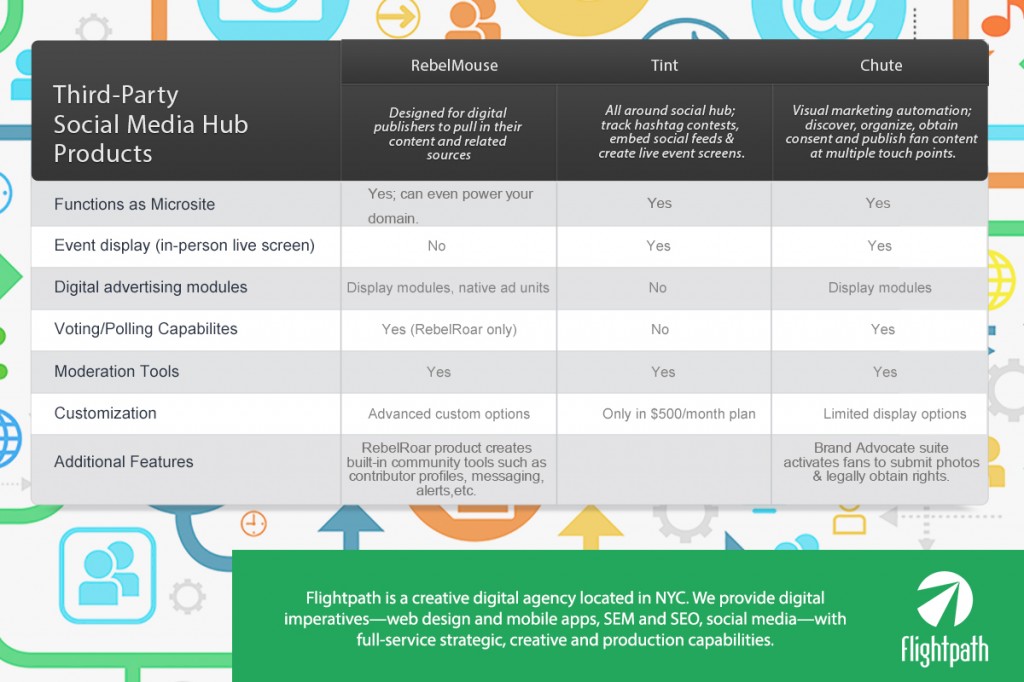
Below is a chart I created for a client to compare the three social feed platforms based on general service needs and product offerings.  In addition, I’ve included my own reviews and takeaways of each platform.

SocialHubChart

Platform Conclusions & Takeaways

RebelMouse: Launched in 2012, RebelMouse has always referred to itself as a ‘social front page’.  It allows brands and publishers to create very well curated sites, similar to a Tumblr, centered on a topic or news vertical.  Recently, RebelMouse has expanded its focus from solely being a social aggregator to being a full-fledged publishing platform with custom editorial tools, detailed analytics tools and community/contributor profiles.

Tint:  This relatively new platform is self-service and does a little bit of everything when it comes to displaying social feeds.  Its strength lies in curating content from a specific social feed or hashtag versus a general topic.  It is also a very useful tool for event marketing or retail–just think of how interactive the content becomes when shown on a huge projector, in-store screen, or jumbotron.

Chute: Chute’s major function is gathering user-generated visual content and obtaining rights to ‘publish fan photos and videos at every customer touch point — as a mobile app, photo gallery, banner ad or even a billboard in Times Square.’  In addition to using Chute to repurpose UGC content, brands often employ this platform for specific campaigns or contests (both short-term and ongoing) because of how easy it makes it for consumers to submit photos via hashtag or just click a button directly on the microsite to upload.

***It’s important to note that my review of these platforms is not comprehensive.  To get full information about each platform, it is always best to reach out to a company representative for more information about product details, new updates and pricing models.  I also highly recommend signing up for a free trial or demo of the platform to get the full experience and gain perspective into usability and performance.

Note: This blog was originally published on Flightpath’s blog.  

17 Jan 19:07

Why Your Content Marketing Team Needs to Act Like a Rock Band

by Jess Ostroff
Tweetable Moments

The answer is not more content. It’s more relevant content.

JasonMillerCATweet This

Jason Miller is the Senior Content Marketing Manager at LinkedIn, where he leads the global content marketing and social efforts for LinkedIn Marketing Solutions. He is also the author of the Amazon #1 Best Selling Book, Welcome to the Funnel.

In Welcome to the Funnel, and in life, Jason advocates for content marketing teams to be put together like rock bands, specifically KISS

1. Paul Stanley (guitar) = Social Media. Entertaining, out there in front.

2. Gene Simmons (bass) = Content. Writing the bulk of the songs/content.

3. Peter Criss (drums) = SEO. Laying the beat/foundation for everything. He’s a part of the band, as an SEO person should be part of the marketing team, not off in a corner somewhere.

4. Ace Frehley (guitar) = Demand Gen. Pulling it all together.

5. Doc McGhee (band manager) = PR. PR and marketing need to work together to make sure they’re not mixing messages.

6. KISS Army (fans) = The community. Like Seth Godin says, if you don’t have somebody to consume your content, you don’t have anything.

Each person in the team has an individual role that comes together to create a beautiful final product. For KISS, it’s a record. For marketers, it’s “Big Rock” content, content that has high value and can be repurposed and “sliced and diced” over and over again.

What did you want to be when you grew up?

 It won’t shock you to find that Jason wanted to be in a hair metal band when he grew up. He actually was a bass player in a hair metal band, but eventually gave it up. The metal lifestyle and college-going lifestyle weren’t meshing. The final straw was when a record company came to their show, saw the opening band, signed them, and left before Jason’s band went on. It all ended well though, as Jason says now, “I’ve never been happier with my career.”

       
17 Jan 19:07

Get Adjusted: Making the Most of your Bottom Line

by Andrew Silver
7 common add-backs that boost EBITDA and company value


17 Jan 19:06

Ikea’s strategy for becoming the world’s most successful retailer

by Ashley Lutz, Business Insider

Ikea’s forward-thinking strategy made it the top furniture seller in the world.

It also changed retail forever, analyst Warren Shoulberg writes on industry website The Robin Report.

“There is perhaps no other retailer on the planet that has moved its basic model into so many places with so much success,” Shoulberg writes.

The furniture store has an impressive 298 stores in 26 countries, selling US$36 billion a year.

Here are a few crucial aspects to Ikea’s success.

1. Solving the worst part of buying furniture.

Before Ikea existed, people saw furniture as an investment for the next 20 years.

This resulted in a lot of anxiety and indecision, according to Shoulberg.

“They created products that were nicely designed, if not particularly durable, that were intended to be used immediately… and disposed of when they wore out or, more likely, when the user had moved on to a different taste level or purchasing strata,” he writes. “It’s a seminal change in the home business and one that conventional furniture stores are still trying to come to grips with.”

2. Hitting the right demographic.

Stringer/AFP/Getty Images
Stringer/AFP/Getty ImagesIkea resonates with young people.

Ikea resonates with young people, according to Shoulberg.

The products are clean, with a simple aesthetic and “whimsical” names.

Ikea is also known for paying workers a living wage and being transparent about the production process.

“They have Gen Y written all over them,” he says.

3. Not expensive, but not too cheap.

Ikea’s price point is perfect, according to Shoulberg.

While prices are cheaper at deep discounters like Aldi, shoppers feel they are getting a good value at Ikea.

Still, Ikea is much cheaper than competitors like West Elm and Bed, Bath & Beyond.

4. Stores are a destination.

As e-commerce becomes more popular, shoppers need incentive to come into stores.

With its elaborate showroom and cafeteria, Ikea has become a unique destination for shoppers.

While many retailers enter shopping centers hoping for traffic, Ikea is a standalone store that shoppers seek out with a specific goal in mind.

“There is no mistaking why you are there,” Shoulberg says.

Read his entire analysis here.

17 Jan 19:06

How to Reactivate Your Email List in 5 Steps

by Kristen Dunleavy

According to Marketing Sherpa, “A company that maintains a clean list of quality subscribers, to which it only sends relevant content, will outperform a rival that does not maintain list hygiene and sends batch-and-blast communications.” Considering that the average email marketing list depreciates by 25 percent every year, how can you be sure that the people on your list really want to be there? With a reactivation campaign, of course!

A reactivation campaign gives you the opportunity to win back and increase engagement with inactive subscribers. It’s the best way to ensure a healthy email list, which is the foundation to your email marketing success. And hey, it’s never too early for spring cleaning.

Getting Started

First, you’ll want to identify your inactive subscribers.

Inactive subscribers are people who are subscribed to your email list with a valid email address, but haven’t opened any of your emails in a long time. There are a lot of reasons why people go inactive – their interests may have changed, they may have signed up just for an incentive offer, or they simply don’t have time to open your emails.

To identify these people, just look at your subscriber stats over the last few months to see who is opening emails and who isn’t. Don’t forget click rates. Even if people aren’t clicking the links in your emails, they are showing some level of interest since they’re opening your emails. You may want to segment them from the totally inactive subscribers.

It’s up to you to define what “inactive” means for your list. If you send weekly newsletters and you have subscribers who have opened less than 10 emails over the last six months, you’ll probably consider those people inactive.

Reactivate Your Inactive Subscribers With These 5 Steps

1. Take a closer look at your inactive subscribers

How did they sign up? If, for instance, they subscribed after signing up for a free eBook or webinar, their interest may have waned after they received their freebie. Look at the content you covered in the incentive you offered – can you send them similar content again?

2. Segment your list based on activity

Now it’s time to separate the active from the inactive. As mentioned earlier, you may want to take one extra step by segmenting the totally inactive from the semi-active, or those who have opened your emails but haven’t clicked your links.

3. Reach out to your inactive subscribers

There are a few ways you can do this:

  • Send a survey asking what they’d like to see from you in the future.
  • If you already have an idea of what kind of content they want, send them related content.
  • You can try sending them a freebie – an eBook, checklist or another electronic download – to remind them of your value.
  • For those who have opened your emails but haven’t made a purchase from you, a coupon might be the nudge they need.

For any reactivation message, keep these things in mind:

  • Your message should be super compelling and remind your subscribers why they signed up in the first place.
  • Your value proposition should align with the “What’s in it for me?” rule.
  • Make your subject line pops – remember, these are people who haven’t opened an email from you in a while.
  • Let readers know how they can reach you on other social sites. If a reader checks Facebook more than email, it makes more sense for them to stay in touch with you there.

4. If the inactive subscribers still aren’t biting, it’s time for a cut-off email

Send a message to those who were unresponsive to your reactivation email asking them to reconfirm their interest in your mailing list. Remind them about all the valuable content they’ll miss out on from you.

5. Remove those inactive subscribers

At this point, you’ve given your inactive subscribers plenty of chances to reconfirm their interest in your list. It’s time to say goodbye! It might hurt at first, but inactive subscribers can only hurt your email marketing. Here’s why:

  • They skew your email analytics in terms of opens rates and click throughs, hurting your deliverability and preventing you from getting an accurate picture of your emails’ success – and that negatively impacts your entire campaign.
  • You’re better off having a small list of active subscribers than a large list of dead email addresses.
  • It’s the best way to ensure the overall health of your email list.

Reactivating your inactive subscribers is one of the best ways to reinvigorate your email marketing performance.

Already an AWeber customer? Learn how to start re-engaging your inactive subscribers here.

17 Jan 19:06

The 1-2-3 Method For Lifecycle Email Marketing

by Jimmy Daly

The Jackson 5 said it best: “Easy as 1-2-3.”

You knew they were talking about email marketing, right?

Seriously though, this is one of the easiest and most effective ways to craft a great lifecycle email. We use it ourselves and I really think you’ll find value in it.

First, a bit of context.

Lifecycle emails are meant to keep people moving in the right direction. A good lifecycle email earns you a second date, not marriage. Like bumpers in a bowling alley, lifecycle emails just keep the ball out of the gutter.

It’s not that you shouldn’t be aiming for a conversion – you absolutely should – but you can’t go for it without laying the groundwork first. Lifecycle emails do just that.

As a rule, lifecycle emails MUST be:

  • Relevant and contextual (recipients should understand why they received the message)
  • Dead simple
  • Focused on small conversion goals

With that in mind, let’s look at one very easy way to create these emails.

The 1-2-3 Method Explained

Imagine that Tyrion Lannister was in the market for software to help manage King’s Landing’s finances. Wouldn’t that make life as Master of Coin a little easier?

Here’s what the welcome email might look like:

Dear Tyrion,

Welcome to QuickCoin, the best app for moving from coin to cloud. Here’s what you should do next to make the most of your free trial:

1. Complete your profile
2. Integrate your bank account with QuickCoin
3. Download our mobile app

If have any questions for our support team, just hit reply to this email and we’ll be happy to assist you.

Cheers,

The QuickCoin Team

That’s the 1-2-3 method. Simple and actionable.

Once people sign up for a trial, subscribe to a newsletter or create an account, you need to build on that momentum by telling them exactly what to do next. Never assume they know the next step. The longer you wait nudge them, the lower the chance they will take that action.

The 1-2-3 method works because it makes any process simple (“It’s easy as 1-2-3″). It’s easy for the recipient to process and take action. (By the way, if you’re asking them to do more than three things, you are asking too much.)

How To Get Started With The 1-2-3 Method

As part of your onboarding process, it’s a good idea to look what actions correlate with short and long term engagement.

For example, Twitter knows that they need to get new users to complete their profile. It gives Twitter additional data they can use to suggest accounts to follow and it helps get users comfortable on Twitter.com. Once on the site, Twitter can even offer visual cues to get acquaint users with all of the features.

Completing the profile opens a lot of doors so it’s no surprise that they send this 1-2-3 email to new users. Not only does it ask the users to complete three steps, it even matches the three steps with a visual guide to alleviate any anxiety about continuing with the onboarding process.

Twitter Lifecycle Email.png

Airbnb does the same thing, increasing the level of commitment with each action item.

airbnb-welcome-email.jpg

Further, Brian Clark’s new curation project, uses the 1-2-3 method in a personal, plain text welcome email.

Further Brian Clark 1-2-3 Method.png

You see where I’m going with this. Here are few more examples just for inspiration.

More 1-2-3 Email Examples

This is a great email from Pinterest. Notice how the 1-2-3 method is paired with a strong call to action.

Pinterest 1-2-3 Email.jpg

Elevate, the popular brain training app, employs this tactic masterfully. They use bullet points to address reasons that users churn. Then, they alleviate the user’s concerns with short, comforting tips about the app. Really well done.

(They send great emails. It’s worth signing up just to see how lifecycle email is done.)

Elevate 1-2-3 Method.jpg

Here’s one last example from 500px, who points users to three features of the service they haven’t tried yet. You don’t need numbers for the 1-2-3 method to work, you just need three distinct and actionable items.

500px 1-2-3 Method Email.jpg

When NOT To Use The 1-2-3 Method

It goes without saying that this isn’t a format that should be used for every lifecycle email but let me explain why.

As you test your lifecycle emails and improve your onboarding, you will discover quantitative data about what actions turn free trial users into customers. If you dig really deep, you might even be able to link the onboarding action items that lead to great, long-term customers.

When you’ve nailed down those actions, you can target users in very specific points in their lifecycle. Don’t bother with three things if you know one will get the job done.

Here’s a perfect example from Shopify.

They know that free trial users who actually add products to their online store are more likely to become paying customers. When users can sell products, the return on their investment with Shopify is obvious.

So when they send onboarding emails, they focus only on encouraging users to add products. They even give users stock images to create dummy products so they can see how the platform works.

Super smart email and a great example of when NOT to use the 1-2-3 method.

Shopify Laser Focused Lifecycle Email.jpg

The 1-2-3 method is another tool to add to your arsenal (and I bet you’ll start noticing it in your inbox all the time now).

Have you used this method before? Let us know how it worked in the comments.

17 Jan 19:06

How To Think About Mobile Advertising

by Mitch Joel

Mobile ads are not Internet ads. Mobile ads are not like other ads.

Marketers can say whatever they want about advertising. Many brands feel that it is all about the message being consistent across all platforms. Other brands believe that the message should be contextually relevant within the myriad of platforms and channels that their messages now appear. There is a case to be made for both sides. As a consumer, how often have you clicked on a mobile ad... by accident? I don't even have puffy fingers, and I find myself doing it... and being frustrated by it... with a frequency that is bordering on embarrassing. As a marketer, my gut reaction is always the same: "whoops... that was a total waste for the brand, and it's going to throw off their analytics.* Still, what we, primarily, see when it comes to measuring advertising on mobile platforms is the same as advertising on the Web.

Advertising success is classified like this:

  1. Was the ad served? As long as the ad was served, the impression is counted.
  2. Was the ad clicked on? Also known as the click-through rate. There is some kind of intent, because the consumer took the action of clicking.
  3. Was the ad acted on? Also known as a conversion. This doesn't have to be a sale. It could be a download or any form of lead generation.

Does this make any sense for mobile?

This fails dramatically when it comes to mobile devices. We have a complex enough problem, when it comes to defining what a true impression is. There are viewability, deliverability and a host of other issues when it comes to online advertising. You will see ugliness like this: Google Just Admitted More Than Half Of The Ads It Serves Are Never Seen. From a consumer perspective, they live in the flick generation, when it comes to their devices. They're not staring at a computer screen, they're flicking their way through a mobile experience. So, impressions from a branding perspective may make sense, but we're talking about a fraction of a second as the scroll flicks down a newsfeed, unless brands can create something that will make a consumer stop and stare. If you're looking at clickthroughs on mobile ads, just refer yourself back to the top of this blog post. I'm willing to bet that if you're in the fifty percentile of being lucky enough to have your ad viewed, that over half of those clicks (maybe more) are mishaps, mistakes and frustrations that, possibly, create a negative brand impression. As for conversions, every marketing professional should read the AdWeek article, Facebook Ad Clicks Are Shifting to Mobile, so Why Aren't Conversions? that was published today. Here's why: "'The disparity points to the value in Facebook advertising being closer to television or print than performance-marketing channels,' he said. 'Clicks on mobile ads are greater than desktop ads, indicating Facebook mobile ads are a great way for a retailer to build brand awareness and reach consumers on mobile devices. Consumers are not device or channel exclusive. They move from search to social sites.'" What we're seeing is a consumer demonstrating intent in a mobile ad, but driving the acquisition/conversion on their PCs. The reason why is obvious: consumers are on the go and don't want to do the work, or the user experience is too clunky for the platform.

Are mobile ads dead on arrival?

Absolutely not. This is a fertile territory, and something that every brand must be focused on. That being said, here is a more simpler way to gauge and measure success:

  1. Was the ad engaged with. This gets us out of the impression-based game, and it gets us away from the wrong people clicking on an ad by mistake. It also speak to the flick generation. Yes, each platform will need to better define what "engaged" means, but it's a start. It could be based on time, interactions, etc...
  2. Did the ad generate an action. Not all ads need to have something beyond the message that it is presenting. If a brand is looking for lead generation or a download, this is what needs to be measured. Who cares if they clicked or anything else? Was the desired action taken and completed? This is the only metric that matters.
  3. Was the ad shared. This would be the ultimate question. Because it's mobile, and because mobile is primarily a social/search-based form of engagement, shouldn't brands focus on ads, media and content that people want to share, talk about and promote in their feeds? Mobile makes sharing ideas fast and easy. Great brands and supporting ads could find a huge win in this.

A subtle shift... a big shift.

It's easy to compare both types of measurement, and see similarities. It's more of a philosophical approach to how to think about mobile in the right context of the user experience. Will they flick past, and if they do, what will grab their attention for that brief second? How can you capture a quick action, in a world where consumers are not comfortable converting in mobile? Can the ad be a piece of content that is worthy of sharing/talking about/saving for later?

This is the new creative imperative that all marketers should be thinking about.

Tags: acquisition advertising adweek analytics brand brand awareness brand impression branding clickthrough ratio content content marketing conversion creative ctr deliverability engagement facebook facebook advertising flick generation google impression internet lead generation marketer marketing media mobile mobile ads mobile advertising mobile device mobile experience newsfeed online advertising performance marketing search smartphone social media user experience viewability web analytics

17 Jan 19:05

How To Expand Your Professional Network Using Content Marketing

by Brian Honigman

How to Expand Your Professional Network Using Content Marketing via BrianHonigman.com

The tools and technology at our disposal have made connecting with other people easier than ever. We can tweet from the train or blog from our living room and contribute our opinions and thoughts to individuals who share our interests and passions. However, all this expanded access is wasted if we squander our opportunities to make meaningful connections.

There’s something about getting behind a screen that makes people behave differently than they would face-to-face. I’ve always found that the secret to successfully building a professional network online is to try and fight that tendency to be impersonal. Instead of selfishly trying to promote your brand or make connections, the key to effective networking is being generous.

Generosity is something rarely associated with networking and that’s a real shame, because networking should be all about other people. The only way a meaningful connection can happen is if both parties feel equally acknowledged and valued.

An unlikely medium for expressing generosity and making your networking personal is content marketing. This post will highlight a few ways that you can combine effective content with a generous attitude to expand and enhance your professional network.

Create Round-Up Posts

Round-up posts are a great way to use your content to extend generosity, create value for all parties involved and flesh out your editorial calendar. For those who don’t know, a round-up post is when you propose a single topic then reach out to multiple people to weigh in on their opinions, answers, thoughts, or beliefs.

Just in that description, one begins to get a sense of why round-up posts are great for extending a sense of collaboration and generosity. These posts, by definition lend weight and credence to the opinions of others. Sure you claim some degree of authorship, but really what you are offering is a platform for others in your field to voice their opinion and have their thoughts heard on a particular topic.

Not only is the final outcome of a round-up post great for networking, but even the process of putting one of these posts together affords you a great networking opportunity. Typically, the creation of a round-up post begins by deciding on a topic, then searching the web for the most relevant experts in the field or individuals that already comprise your network.

Once you have identified a group of people you hope to target, the next step is to send an email telling them how much you like their work and that you would love to feature them in an article. The email will likely look something like this:

Sample Outreach Email

Beyond ultimately leading to a great piece of content your audience will value, this process alone will likely generate valuable networking opportunities. Even people slightly outside of your reach professionally will be much more likely to give you the time of day if you come to them with an invitation to contribute instead of an “invitation to connect.”

Once you have a satisfactory number of contributors, the next step is to set up the post. There are many right ways to do this, but one thing they all have in common is that you should be generous and consistent in the amount of credit you give and the number of links you direct back to your contributors. The better the article is for those involved, the more likely they are to share it with their audience online and drive greater visibility to the piece of content.

@Mention @ShannnonB thanks for inviting me to contribute! it's an honour!

— Olga Andrienko (@OlgaSEMrush) December 18, 2014

A fantastic example of this process is Mention’s round-up post on social listening (which I was featured in too!). I certainly linked to the post when it was published, and so did everyone else who was mentioned. Sure, we may not have had any allegiance to Mention before, but now that we had been featured we certainly did have a stronger tie with the company and its staff.

Not only does this kind of post strengthen your connection to multiple industry influencers, it also allows you to leverage their combined followings and set your content up for success across social media.

Write Book Reviews

Another great way to use generosity to expand your professional network is to write a book review. It is now easier than ever to publish and promote a book, which has lead to an increasing amount of bloggers and other professionals using a book as a vehicle to get their name out there and better establish their brand. Chances are, if someone is influential online, they have written at least one book, and another is likely on the way.

In most cases, the people in your industry who are writing books are exactly the type of people you want to be connecting with, so what better way to start reaching out than to use your blog as a platform to review their book?

Not only will reading books written by industry thought leaders be a valuable learning tool, but taking the time and effort to write a thoughtful review might be a great way to open up a new professional relationship or strengthen an existing one since you’re helping them increase the visibility of their book and ideally driving more sales for the author.

Given how beneficial they are, book reviews are an often underutilized tactic for building your network. This gives a potential book reviewer the added advantage of providing quality and original content for their audience, while deepening relationships with others in their industry.

book review picture

However, book reviews will only work as an effective content marketing and networking tool if you choose the right book to review. When making this decision be sure to select a book your audience might enjoy as well as an author whom you might have a chance of connecting with in the future.

Sure, Seth Godin’s or Tony Robbin’s latest book might be relevant to review, but there is a higher chance that authors at their level will not take note of your review since they are widely successful authors that have had many books published under their bylines.

The ideal candidate for a book review is likely an author who is well-regarded but also at an earlier stage of their career, which will make it easier for your review to stand out and establish an opportunity to connect with them. There are a lot of authors out there in this exact position and you can be sure that they will notice your coverage if you take the right approach.

Before writing the post, consider letting the author know that you are planning on reviewing their book. This will serve as a great opener and also give him/her a chance to explore your other work. Similar to the point made about the round-up posts, writing a book review can be a good tactic for making a connection with someone who might have been professionally out of your reach otherwise.

Beyond a pure review of a book, another option could be to simply write an article focusing on a particular topic that references an author’s book. A piece that references the book heavily offers all the advantages of a book review, but is likely a more enjoyable read for your audience as compared to a pure book review repeatedly praising a particular piece of work.

One blogger who does a great job of writing reference pieces like this is my friend Dorie Clark. As you can see in this piece she wrote for Forbes, Clark places the book Hooked: How to Create Habit-Forming Products at the center of her article. Featuring the work so prominently implicitly tells the reader that this is a book worth reading, while also providing a stronger context for the use of the insights found in the author’s work.

Depending on the circumstances, either a book review or reference piece can be the appropriate medium. What makes both of these methods so effective for expanding your network is the common sense of generosity and goodwill they extend to other thought leaders within your industry.

Conduct Interviews

One of the backbones of traditional journalism is the interview, yet so many newer writers don’t seem to take full advantage of this tried and true technique. Not only can a one-on-one interview provide great content for your readers and elicit new insights on a topic, the act of pursuing and engaging with a potential interviewee can present a great networking opportunity.

Of all the content networking methods mentioned in this post, the interview is the most personal and also the most time consuming, so it will be necessary to choose your subject carefully. Interviews are a great tool for establishing a new relationship, since it’s often an effective opening request to grab a potential connection’s attention. Interviews can also be a powerful technique for enhancing an existing relationship with someone in your network.

A great example of an interview post enhancing a previous connection is this fantastic interview of Peg Fitzpatrick by Rebekah Radice. Looking at the level of candor (not to mention the picture of the two together) it is clear that they have a strong existing relationship. However, this only adds to the quality of the interview, and the process of engaging in this quality dialogue likely only enhanced their friendship.

Peg Fitzpartick Rebekah Radice Interview

The format of the interview, as well as the way you engage your subject, is entirely up to you. Although speaking over the phone or in person is likely to elicit the most natural conversation, this is not only the option. Luckily, even an interview over email or another messaging service can be woven into a compelling narrative with proper planning and formatting.

Regardless of how you conduct and present the interview, if you choose the right subject and ask the right questions you will likely produce content that benefits your audience as well as the audience of the person being interviewed.

Looking through the comments section of Rebekah’s interview of Peg, there is an uncanny amount of enthusiasm. One noteworthy element of all the praise this post received was that commenters not only commended the advice given, but they also expressed their delight in seeing two people they respected and admired interacting with one another.

Interview comment

Reactions like the one above speak to the power of interview posts to create a quality connection with your audience and other members of your network, and they also serve as a testament to the fact that thoughtful content marketing, combined with generosity and outreach, can help expand your professional network while simultaneously enhancing your online reputation.

Have you used content marketing to expand your professional network? If so, which methods did you find most effective? Anything you think I missed? Let me know in the comments below, and as always, thanks for reading!

17 Jan 19:05

How Long Will It Take To Transition Your Business To Others?

by Jane Johnson

transition advance monopoly

The common answer that business owners give when they are asked when they plan to transition out of their business is five years and then they proceed to postpone their planning for four years as if they have plenty of time.

What they don’t know is that most owners need at least three to five years, once their plan is in place, to successfully transfer their business, especially if it is to an internal buyer. Why three to five years?

It takes time to:

  1. Build value in your business – Most businesses are not worth enough to satisfy the owner’s financial needs for the rest of their life and it takes time to increase the profits and improve the quality of the business to drive a higher value.
  2. Find the right buyer – If you decide to sell externally, you will need to prepare your company for sale and cast a wide net to create some competition or, you are going to leave money on the table.  Once you find a potential acquirer, consummating a deal can take another year.
  3. Groom your successor – If you decide to sell internally, you may or may not have a successor already on your team.  If you don’t, it can take a year just to find the right candidate and then they have to learn your business.  If you already have the right person, it can take a few years to groom them to take over.  There is a lot to learn in order to successfully run a business and experience is the best teacher of all.
  4. Minimize your taxes and fees – Most owners do not understand how much they will pay in advisory fees and how their business transfer will be taxed.  Planning in advance will allow owners take action to minimize their taxes and maximize their net proceeds.
  5. Increase net worth outside the business – The vast majority of business owners need the wealth trapped inside their business in order to fund the rest of their lives yet their business value is not high enough.  This means owners will need to save more money outside the business before they can transition.  Planning in advance will allow owners to calculate how much they need, how much to save, and how much they need to grow their business.
  6. Prepare yourself for the transition – It is common for owners’ identities to become completely intertwined with the business.  It takes time to figure out what they they want to do when the business does not occupy all of their time.

Five years goes by very quickly.  Owners that develop a business ownership transition plan will have a far better outcome than those who don’t.  The plan takes only few months but execution can take 3 to 5 years.

The next time someone asks you when you will start transitioning your business, we hope you will be able to say that you have a plan, you’ve already started executing it and it’s going very well!

Click here to download our guide to external transitions.

[Photo Credit: Michael Josh Villanueva; Flickr]

17 Jan 19:02

6 Lies About Success

by S. Anthony Iannarino

There are many lies about success. It’s easy to believe these lies, and doing so will distort your perception of what real success is.

  1. It’s all about the money. Success isn’t all about the money, even though that is what some people believe success to be. It isn’t about money, even though that is how the media portrays success. There are plenty of people with money that aren’t successful when measured on any other scale. No one would call Mother Theresa or Gandhi failures, even though they wouldn’t fare well on this scale. It’s not money.
  2. It’s not about not having money. If success isn’t only about money, money is a scorecard of sorts. It is a reflection of the value that you create. Money provides you with security, experiences, and choices. Money also allows you to give back at a greater level. Not having any money doesn’t guarantee that you are successful, and there are plenty of people with no money who also aren’t successful on any other scale. It’s not about not having money.
  3. It’s about being popular. Some people with a measure of fame are perceived to be successful. And on that one measure, you might believe that they are successful. But fame is no indication of success either. Many of the people with names that are well-recognized are not successful when measured another way. It’s not fame.
  4. It’s about being beautiful on the outside. There are people who are beautiful on the outside that are hideous on the inside. Time destroys physical beauty. Time destroys one’s athletic prowess, too. But time can never destroy true success. It’s not physical beauty.
  5. It’s about being smart. Some of the smartest people you will ever meet will also be horrible to other human beings. They might have parchment, prizes, and awards for their intellectual prowess, but none of those prove success outside of a very, very narrow measurement. It’s not intellect.
  6. It’s about natural talent. Talent is no sign of success. Many of the most talented people never do anything with their talents, and many people with far less talent do more with what little they have. It’s not about having talent.

The truth about success is that it is defined by each of us individually. My success is not the same as your success.

My success is about living up to my potential, making the contribution I am here to make, and doing something meaningful with my life.

Your success is about living up to your potential, making the contribution you are here to make, and doing something meaningful with your life.

The post 6 Lies About Success appeared first on The Sales Blog.

17 Jan 19:01

Best-Selling Author Mark Sanborn: 2015 C-Suite Predictions

by Heather MacLean

Next in the series of predictions for the C-Suite in 2015, we hear from Mark Sanborn, president of Sanborn & Associates, Inc., an idea studio dedicated to developing leaders in business and in life. He is an international bestselling author and noted authority on leadership, team building, customer service and change. Mark is an incredibly busy and active person and we were very pleased that he would take the time to share his thoughts.

Mark Sanborn

Mark Sanborn

MacLean: What is your latest project?

Sanborn: “Ockham’s razor says, ‘Make things as simple as possible but no simpler.’ That is always my goal when I speak, write or advise, so I am currently writing about the six most important questions every leader needs to answer to be effective, last for the long run and make the most positive impact possible.

As a teaser, I’ll share what I consider the primary question: “Why do I want to lead?” Without a compelling reason to lead, your motivation will be limited, and people won’t have a compelling reason to follow.”

MacLean: In your latest book, Fred 2.0, you speak of extraordinary leaders being able to reinvent themselves in order to add value for clients, tell me about that. What are the characteristics that make it possible?

Sanborn: “Reinvention is first and foremost about being relevant in a way that is authentic to you. That means finding a way to stay relevant without pretending to be who you are not.

There is an old saying that seems corny on the surface but is really quite profound: the only difference between a rut and a grave is distance and depth. If you don’t stay renewed, not only will you lose your enthusiasm for leading, but you’ll most likely kill the enthusiasm of those on your team.

Reinvention is about finding ways to stay fresh, excited and current that connect with your colleagues and customers.”

MacLean: What about people who are not in the C-Suite and/or leadership, but need to transform themselves? What can they do?

Sanborn: “My book, You Don’t Need a Title to be a Leader is based on the premise that leadership is about a set of skills, not a title or position. In other words, leadership is learned, not bestowed. My research shows that 27% of those moved into formal leadership positions don’t feel adequately prepared. The best time to learn to lead is before you’re given a title.

How? Pick a problem that needs to be solved or an opportunity that you want to seize. Use your influence to prove your ability to get results with and through others. Demonstrate your vision for identifying and addressing problems and opportunities.”

MacLean: What keeps you up at night when you think about business trends/issues that you are seeing right now?

Sanborn: “I worry most about a lack of courage among leaders, especially in Washington. Leadership is about respect, not popularity. Leaders unwilling to do what’s right—even when it is difficult and unpopular—fail those they represent. 

I also worry about our inability to dialogue. Instead, I see opposing opinions shouted down. We don’t have to agree with the opinions of others, but we can’t lead if we don’t at least understand them.”

MacLean: When it comes to 2015 what do you think will be the biggest challenge for members of the C-Suite?

Sanborn: “There are many, but here are three big ones:

  1. Coming to terms with a generation of employees and customers that think significantly differently. That may well mean “reverse-mentoring: finding a  millennial who will share his or her insights to help you understand that and lead that generation better. 
  2. Creating a culture of engaged employees. Having unengaged talent is no better than having no talent at all. 
  3. Teaching everyone top to bottom and bottom to top to do two things: build better relationships and create value. These are two things that are consistently asked of employees, but if they’ve not been taught how to do them, you are only creating frustration. Like my friend Dr. Nido Qubein says, ‘Expectation without education equals frustration.’”

MacLean: What are the biggest opportunities?

Sanborn:Global business is infatuated with “best practices.” The problem is that today’s “best practice” is next month’s “second best practice.” When you think you’ve found a best practice you become complacent. The opportunity is to create “better practices” (improvements on what everyone else has settled on doing) and “next practices” (game changers that enable you to dominate).

I challenge C-Suite leaders to be innovators, and not just “improvers.” Be bolder and aim higher. Survival isn’t an inspiring goal, and “success” is a dubious motivator. Take a chapter out of Steve Job’s playbook and try to put a dent in the universe: be a game changer for the greater good.”

MacLean: A recent global survey determined that the top four challenges for CEOs include:  access to human capital, customer relationships, innovation and operational excellence.  This is very broad.  What do you think will be the top challenges based on the businesses that you have contact with and your experiences?

Sanborn: “I think about four things:

  1. Staying relevant! You will never hear of a successful product or person that is “irrelevant.”
  2. Leading with confidence. There are many C-Suite leaders who only admit to their closest friends and advisors that they lack the confidence that they will be able to meet the demands of the future.
  3. Rethinking business models. Old business models create, at best, old results. 
  4. Time sovereignty. Learning to control your time in such a way that you aren’t balanced (life is never about perfect balance), but that you are investing your time in the areas that are most important to you and to your organization.”

MacLean: In the work that you do, what are the most important skills and assets that members of the C-Suite must have?

Sanborn: “Competence and connection – Competence is the ability to consistently get things done. Intention isn’t enough. Partial success isn’t enough. When C-Suite leaders don’t deliver, they get dumped.

But you won’t accomplish much of significance by yourself. Ineffective leaders are those that try to do it all themselves. True leaders get results through others. That means doing the hard work of building relationships and leading with the best interest of colleagues in mind. You can’t use people to get results; you cooperate and collaborate with them to get results. That’s why connection is critical.” 

MacLean: In terms of our future leaders, how do people get past career stumbling blocks such as being typecast in a role?

Sanborn:Authenticity trumps typecasting. To change perception, change behaviour. And don’t confuse style with substance. Style is the colour of the paint; substance is the quality of the house.

Also, don’t confuse “different” with “valued.” I see some doing decidedly odd things in the pursuit of creating a personal brand. If your colleagues or clients don’t value what you do differently, it won’t impact your personal brand positively.”

MacLean: In your experience what do you recommend to people who want to excel, but are held back because they think differently than the rest of the team?

Sanborn: “Different thinking isn’t problematic if united by common purpose. If you can demonstrate how thinking differently will create a better result and your team repeatedly refuses to consider it, maybe it is time to look for a different team.”

MacLean: Finally and getting back to the C-Suite, if you could give just one piece of advice to fellow members of the C-Suite, what would that be?

Sanborn:  “Go big or go home” sounds like a cliche so I’ll quote Francis Ford Coppola who said, “Work on nothing less than epic scale.”

Note: A version of this post previously appeared on the Invest NB Blog. 

17 Jan 19:01

Eight Trends That Will Impact Field Service in 2015

by John Cameron

With so many advanced tools now available to fine-tune operations, field service organizations have reached an unprecedented transformative stage. By leveraging technology trends such as the Internet of Things, advanced analytics and smartphone and tablet integration, these organizations are reinventing themselves as predictive, rather than reactive, operations.

In the coming year these organizations will assess how much they’ve evolved in the field service model and set goals for 2015 and beyond. This may mean better-equipping technicians with intelligent apps that deliver real-time data and deploy analytics capabilities to make strategic decisions, or enhancing security and IT infrastructure. No matter what the goal, the time is now to modernize operations that put you ahead of the competition.

Here are eight trends that may impact how you make those changes:

1. Robust and Flexible Platforms

Technology is moving quickly, and organizations are looking to solution providers to deliver platforms globally as the foundation for innovation. Providers have to be ready to add, extend and integrate technologies as needed, giving them the agility to adapt and innovate. What this means is field service companies require much more advanced platforms that they can leverage to manage and improve their operations. Organizations with global reach are looking to make the platform a key part of their worldwide strategy. These platforms need to be cloud-based and flexible, allowing them to configure and manipulate modules and functionality as they see fit. Customers want a single provider to deliver all the functionality and modularity they require. They want to focus on empowering field workers and driving service excellence. To achieve that, they need robust, flexible platforms backed by a reliable provider.

2. Increased Focus on Security

The increase in cybercrime, such as the recent breach against Sony Pictures, is a critical reminder of how important it is to secure company data. As more utility organizations add everything from switches to entire power grids to the Internet of Things, we’ll see a greater demand for advanced security applications and a corresponding increase in financial commitment to protect against future attacks. Security involves not only protecting and safeguarding network entry but also ensuring that every mobile device is fortified. That means equipping every tablet, smartphone and laptop with the pertinent, updated tools and protocols, and educating users on the importance of adhering to security policies.

3. Embedded Analytics

While most field service organizations have already deployed GPS and fleet management technologies,  many are now challenged by the vast amount of data they’re now collecting from these tools. The ability to analyze and act on this data continues to trend in the evolution of field services technology. Advanced analytics capabilities will allow organizations to execute on information generated from the field to become more efficient and productive. Deploying workforce management solutions with sophisticated analytics tools will enable managers to improve operations with real-time visibility into their operations. Data gathered from smarter mobile apps and equipment sensors will provide insights on performance, tasks, service quality, and new products that will enable field service managers to not only keep up with the competition but to step ahead. Analytics will be embedded and pervasive. After all, the value of analytics is in the answers, not the data.

4. More Integration

As telematics and workforce management solutions become more integrated with mobile devices, the opportunities to increase efficiency and productivity are growing exponentially. Field service managers can make real-time decisions remotely by accessing vehicle tracking and routing on their mobile devices. This allows organizations to mitigate reckless driving incidents, control wear and tear on their fleet and decrease maintenance costs, all from a handheld.

Mobile apps will continue to provide critical information such as daily tasks, customer histories, billing, and the locations of nearby teammates on demand for field service technicians. This access to real-time information empowers the technician to make strategic decisions, recruit help from teammates, and complete jobs on-time the first time, resulting in lower operational costs and higher customer satisfaction. 

5. The Internet of Everything

By 2020, Gartner, Inc. predicts 26-billion devices other than smartphones, tablets and computers to be connected via the Internet of Things. For field service organizations, connecting equipment with technicians’ mobile devices and the back office in real time is a necessity. Information captured in the field provides diagnostics and performance metrics that mitigate certain issues as well as tracks patterns and trends for long-range planning. The goal is to ensure an intelligent and preventive—not reactive—approach.

6. Enhanced Network Reliability

The daily accumulation of data from internal files, mobile solutions, cloud-based apps and email can strain networks and storage systems. As field service organizations invest in mobile and management solutions to optimize operations, they no longer can ignore the underlying infrastructure. Hybrid clouds, virtualized servers and scalable, high-capacity storage give e networks the agility they need to stay flexible, efficient and productive. Neglecting these areas can impact performance, impede productivity and escalate IT costs.

7. An Evolving Workforce

The retiring workforce has been an ongoing concern for the field service industry. As the industry evolves, however, a major trend has been the emergence of young, tech-savvy and collaborative workers. According to Aberdeen Group, approximately one-fifth of the current workforce is under 30 with the average age of a field service technician at 32 years old. Organizations must manage the way in which the new generation of field workers leverages, processes and engages with technology in order to keep them for the long run.

This new pool of workers will enable service organizations to continue their evolution in mobility and help them transform service and the relationship with customers. In fact, 62 percent of top performing field service organizations have incorporated a Bring Your Own Device (BYOD) strategy as a result of a more tech-savvy workforce and 43 percent are more likely to give technicians access to social media and collaborative tools to facilitate knowledge transfer.

8. Mobility as a Game-changer

Mobility will continue as a key enabler in addressing the competitive issues faced by field service organizations today.  The right mobile architecture can solve many of the tactical challenges of these organizations:  latent customer needs, increased competition, unmitigated churn and worker productivity. However, simply investing in mobile technology does not ensure improvement in key performance. To be successful with any deployment, organizations must choose the best field service solution and adopt the implementation best suited for their operation.

For more information on Trimble Field Service Management and its solutions, visit www.trimble.com/fsm.

17 Jan 19:01

Do Social Media Policies Stifle Innovation?

by Eric Schwartzman

Yesterday, US Chargé d’Affaires to Belarus Scott M. Rauland shared a link to a report on Internet Freedom by country.

In Belarus, they block political content and have jailed bloggers, so the report ranks the Internet in that country as “Not Free.”

I’m getting ready to go to Lithuania to advise the US Dept. of State on digital public affairs strategy in the region, so that, and the senseless massacre at Charlie Hebdo in Paris has me focused on how free speech impacts digital strategy.

I’m asking myself, is there a social media governance lesson?

Are politically correct speech codes counterproductive to the organizations they’re supposed to serve? Or are they strategically unsound?

Je Suis ChalieIs it time to reinvent the conventional approach to social media governance so as not to discourage thoughts and ideas that can lead to growth? Paul Gillin didn’t think so when we discussed it on our last B2B social media podcast, but I’m not convinced.

I’m drafting a social media policy development for a drugstore chain. Obviously, I’ll cover HIPAA, FTC disclosure guidelines, COPPA, harassment, discrimination, privacy and defamation.

But should I remove the sections I usually add in on Respectfulness and Diplomacy?

I’ve always strived to develop social media policies that encourage cooperative online behavior. But is discouraging dissension a mistake?

By trying to steer clear of any kind of disagreement and make sure everyone plays nice, are we throwing the baby out with the bathwater?

Could deterring boat rockers through social media policies designed to preserve the status quo actually wind up stifling innovation?

“Free speech is supposed to incite dispute and it is often provocative and challenging while it presses for acceptance . . . The most valuable expression may well be that which, because it is provocative and challenging, produces these emotions (337 US 1,4, 1949).”

How does all this apply to social media marketing?

When I was researching Social Marketing to the Business Customer, I spoke with the folks at the SAP Community Network, which is a private B2B online social network that’s linked to an online store, which sells only SAP products.

Interestingly enough, they decided to offer star-ratings and customer reviews above each of their products. Their thinking was that if something were poorly rated, it would motivate the product team to get customers to write good reviews, or serve as a badge of shame and get them to fix whatever people were complaining about.

SAP uses social media to improve product performance by spotlighting, rather than censoring, criticism. In this case, they use public disapproval to unlock business value.

And while we certainly enjoy unprecedented freedoms in the West, tracking a four-year global decline, the Internet in US was less free in 2014 than it was in 2013. Different forces may be at work to restrict our freedom, but the results are the same.

Arbiters regard some information as too controversial or damaging to their economic or political interests, and mobilize to sequester it.

The speed and ease with which retailers nearly blocked theatrical motion picture exhibitors from screening “The Interview” and the Obama Administration’s numerous “attempts to prosecute and subpoena journalists accused of publishing leaker information” proves that even in the land of the free, there’s plenty of room for growth.

It’s not just despots and dictators who control the films, televisions shows and websites people have access to. They don’t resort to barbaric acts of terrorism to achieve their aims, but lobbyists, employers, even educators regularly try to restrict free speech, even though the distributed nature of social web makes it almost impossible to do so.

Lobbyists censor legislation through campaign contributions, employers try to control online conversations through social media policies and schools try to control campus demonstrations through politically correct speech codes.

“The journalists at Charlie Hebdo are now rightly being celebrated as martyrs on behalf of freedom of expression, but let’s face it: If they had tried to publish their satirical newspaper on any American university campus over the last two decades it wouldn’t have lasted 30 seconds. Student and faculty groups would have accused them of hate speech. The administration would have cut financing and shut them down,” wrote David Brooks.

Would the UCLA policy tolerate incisive, religious satire aimed at raising awareness of hypocrisy? Or would that type of speech be restricted in the name of inclusiveness?

What would respectful satire look like?

Freedom of expression means freedom to agree and disagree, freedom to include and exclude, freedom to tease and offend. You can’t unlock the value of free speech if arbiters are free to pick and choose what should be censored.

So I’ve decided to revise the Social Media Policy Template in my Social Media Policy Development Training Course with this in mind.

Were do you stand on free speech in social media policies? Should some freedoms, other than those prohibited by law, be restricted by employers?

If it’s lawful, should employees be free to say whatever they want online?


Related Stories

17 Jan 19:01

This Week in Content Marketing: The YouTube Killer Is Not Facebook, It’s Twitter

by Joe Pulizzi

Episode61_YouTube-Killer-Not-Facebook-Twitter

PNR: This Old Marketing with Joe Pulizzi and Robert Rose can be found on both iTunes and Stitcher.

In this week’s episode, Robert and I debate whether B2B content marketing is a failure, and discuss why the FTC may enact regulations regarding native advertising. We also discuss the exploding landscape of marketing technology solutions and why Twitter’s planned expansion into video is going to be huge. Rants and raves include a super smart post about measurement from Medium’s Ev Williams and the evocative new “signs” campaign from McDonald’s. We wrap up the show with a #ThisOldMarketing example: Merck Manuals.

This week’s show

(Recorded live on January 15, 2015; Length: 59:08)

Download this week’s PNR This Old Marketing podcast.

If you enjoy our PNR podcasts, we would love if you would rate it, or post a review, on iTunes

1. Content Marketing in the News

  • Is B2B Content Marketing a Failure? (5:34): Michael Idinopulos, writing in the PeopleLinx blog, makes a compelling case for the idea that content as a lead generation tool is highly overrated. Instead, marketers should focus on using content to enable the sales process, which he calls “content selling.” Robert and I share some common concerns with this article, which views content marketing through a very narrow lens. We recommend one part of the sales funnel where B2B marketers can start with content marketing to demonstrate an impact.
  • Marketing Tech Landscape for 2015 – It Has Doubled in Size (15:34): Scott Brinker from the Chief Marketing Technologist blog has just released the latest version of his Marketing Technology Landscape Supergraphic, which has doubled in size since 2014. It now contains over 1,800 vendors across over 40 categories. Brinker’s conclusion about this meteoric growth: “Marketing has exploded from an ancillary function to the Grand Central Station of customer experience.” Robert and I discuss what this implies for marketers, including the need to staff up on marketing technologists.
  • What Happens if the FTC Provides Native Advertising Guidance? (25:31): The Internet Advertising Bureau (IAB) predicts that the U.S. Federal Trade Commission (FTC) will provide guidance for native advertising during 2015. Often, when the FTC issues guidance on an area of advertising, it’s a sign that they may plan to regulate it in the near future. Robert and I believe this is an enormous gray area that will be very hard to regulate. The lesson for marketers? Get good at native advertising and disclosure so the FTC doesn’t have to get involved.
  • Firing Dick Costolo from Twitter Would be a Mistake (32:53): Angel investor and entrepreneur Jason Calacanis predicts that Twitter’s soon-to-be-released native video capability will be a game-changer and will drive huge user growth. That’s why investors who are critical of Twitter CEO Dick Costolo should back off, he warns. Robert and I agree that Calacanis’ predictions are spot on and envision how native video on this popular social media channel could revolutionize not only content marketing but also real-time customer support.

2. Sponsor (40:08)

  • This Old Marketing is sponsored by Acrolinx. The Acrolinx platform helps the world’s most recognized brands create more engaging, more readable and more enjoyable content. (Most people don’t even know software like this exists.) Their new eBook called Speak with One Voice answers critical questions about how you can make your content stand out and how to create a unique advantage in the content economy. You can register for it at http://bit.ly/pnr-acrolinx2.

speak-with-one-voice

3. Rants and Raves (42:00)

  • Robert’s Rant: Robert absolutely loves this column by Ev Williams, founder of Twitter and CEO of Medium, which provides a clear, concise primer on measuring the impact of content and which metrics matter most. What happens on the platform is much more relevant than the number of users on the platform, he says. Robert talks about how marketers should select and use numbers to demonstrate success.
  • Joe’s Rave: I loved a new 1-minute McDonald’s ad that aired for the first time during the NFL playoff game on Sunday, which shows signs that franchisees for McDonald’s have posted outside their stores. Many were very emotional in nature, such as “Pray for our Veterans,” “Boston Strong,” and “Remember 9-11.” The ad includes a link to a Tumblr page where viewers can read the heartwarming stories behind the signs.

4. This Old Marketing Example of the Week (51:31)

  • The Merck Manual: Before the internet, one popular resource doctors used to diagnose and treat illnesses was The Merck Manual of Diagnosis and Therapy. First published in 1899 and now in its 19th edition, it is one of the most compact and complete medical reference books for doctors, medical students, and healthcare professionals. It addresses the mechanism and cause, symptoms, diagnosis, treatment, and prevention of over 2,000 diseases and disorders. Whenever the manual mentions medications, Merck products are formatted in all caps. It has been expanded into web and mobile versions, numerous special editions that include symptoms, home health, and veterinary care, and it has been translated into 16 languages. This is an outstanding example of content that is so good – independent of Merck’s products – that it has become a must-have resource.
The_Merck-Manual

Image source: http://www.merckmanuals.com/merckmanualpro-book.htm

 For a full list of PNR archives, go to the main This Old Marketing page.

How do I subscribe?

itunes logo

stitcher logo

The post This Week in Content Marketing: The YouTube Killer Is Not Facebook, It’s Twitter appeared first on Content Marketing Institute.

17 Jan 19:00

Marketing Trends – Negative Calls to Action

by Zach Heller

Welcome to the latest installment of our weekly blog series, Marketing Trends. Each week, we will identify a key trend in the world of marketing. We’ll discuss the trend, why it’s important, and suggest ways that you can take advantage of this trend in your company.

Last week’s trend was Peak Google.

Today’s Trend = Negative Calls to Action

We all know what a call to action is. In marketing, we use calls to action in our ad copy or on our landing pages in order to get people to take the desired action, whether that be submitting a form, clicking on a button, or any number of other actions.

But a new trend is rising through the marketing ranks that has people talking about calls to action as if they are brand new. And it’s the use of “Negative Calls to Action”.

Here’s how it works. Instead of just presenting the call to action, you give the person an option. If you want them to click on a button, you present a Yes button and a No button. You force them to choose. But on the No button, instead of just saying No, makes the person feel like No is the wrong choice.

Consider this example:

A landing page with a subscription form for a free newsletter has a place for the person to enter their email and a submit button. But below the submit button is a second button that says, “No thanks, I am not interested in free stuff”.

The change is subtle, but it forces the prospect to take notice. They must actively choose to say no, even in the face of the value being offered, made even more obvious by the way you have presented it.

This may not drastically improve your business, but if conversion rates are an issue for you, this is one test worth trying. It has been shown in testing to improve conversion rates or click through rates when applied properly.

Think about all the different calls to action you use in your marketing. They may be on your website, in your ads, promotional materials, etc. What changes can you make to highlight the value being offered from the “no” stance? What are people turning down when they say no to your company?

What marketing trend should we cover next? Now accepting submissions for marketing trends that we will cover in an upcoming installment of this series. Submit your ideas via our contact page or in the comments section below.

17 Jan 19:00

3 Business Myths That Are Completely Wrong

by Fran Tarkenton

mythbust

“aExperts” have been telling us for years that there are certain all-encompassing principles that will get you through the bad times and make your business a success.

Well, just like you and unlike many of these experts, I’ve actually gotten my hands in the soil and started a few successful businesses, and I can tell you from long-term experience that many of those truisms are just outright wrong.

Here are a few:

1. Use The Power Of Positive Thinking

The Rev. Norman Vincent Peale took the country by storm in the 1950s with this idea that everything could be solved with optimism.

Many business experts and entrepreneurs all seem to have similar mantras: “I always stay positive!” “No matter what, I always see the glass half full.” “The birds are always chirping and the sun is always shining.”

It seems everything in their business is always perfect. They have absorbed the whole notion of the power of positive thinking — but they are getting it all wrong. If you want your business to succeed, don’t just be positive. Deal with reality.

Bad news doesn’t get better with age. If something is wrong, and I pretend that everything is great and do nothing about it, things will only get worse.

But the pundits insist that if only I believed everything was always rosy, I won’t ever have to face things getting worse. All those problems will somehow resolve themselves, as long as I remain upbeat and flick away bad news or rumblings of discontent.

Of course we should be positive — when it’s warranted — but not at the cost of hiding from hard truths that will only grow larger if ignored. If your sales have increased but your customer service department makes mistakes, are you on a path to success?

If your business is growing but your employees are unhappy and have low morale, are you going to be in business much longer? Staying positive all the time but ignoring the underlying cracks in your foundation is a recipe for failure.

2. The Newest Idea Is The Most Original

No one has an original idea. Not Steve Jobs, not Thomas Edison, not Mark Zuckerberg. Nobody. We get ideas from what we see, what we hear, and what we read. I read the NY Times cover to cover every day, then I turn around and read the Wall Street Journal. I read articles that friends send me in emails, and newsletters, and books, as many and as often as I can.

But most of all, I talk to people. Every successful idea I ever had — on the football field, in business, in my personal relationships — happened because I talked to people. I talk to people every day, from every business, every age, every walk of life, because that’s how I learn and that’s how I get better.

When I played football, I talked to coaches, I talked to my teammates. I talked to anyone who could tell me anything I didn’t know, or could put a new spin on something I thought I already knew, but really didn’t.

In business, the greatest ideas didn’t come from a bunch of MBAs sitting around a conference table. Innovation came from Home Depot’s Bernie Marcus talking to the customer in the parking lot about why he bought lumber, but no nails. It was because Home Depot’s nails weren’t very good! And nobody knew it—not the department buyer, not the manager, not the salespeople on the floor — until Bernie simply talked to people in the parking lot.

All ideas grow from other ideas, but you can only get to them if you put yourself out there and engage yourself.

3. The Mission Of Business Is To Create Profit

If you ask most business leaders what tools they use to drive their team, many will say financial incentive is high on the list.

Many think that bonuses, commissions, or prizes will incentivize people to work harder or think faster. Business owners think that if they just make enough profit, either for themselves if they’re a small business or for shareholders if they’re larger, then they’d be labeled a “success.”

But profit isn’t and shouldn’t be the mission of business. The mission of business is to help people. To help your customers, your co-workers, your employees, and your partners. Success is not a number — it’s not X dollars or Y customers — it’s a measurement of VALUE.

Have you brought value to your customers and the people who surround you? If you can answer, “yes,” to that question, then the inevitable by-product will almost certainly be profit. Value is your mission, but once you offer it, then the profit will always come.

I start every day with a single drive — the drive to help people. Obsessing over my customers and the quality of my product is what keeps me going.

So I wake up every morning with a sense of desperation. How can I make my customers happy? How can I increase our value to them? Am I making my employees happy and challenged and energized? Those questions fuel my every waking moment, and they keep me from getting complacent or making careless mistakes.

I have a positive attitude because I’m doing positive things. I come up with better ideas because I’m always reading and listening and learning about other people’s great ideas. And I’m creating profit and increasing sales because I’m trying to help people.

I’ve always stayed focused on my customers and my associates, and I assure you that doing that has made me a passionate, enthusiastic, and more productive person, and so will you.

This article originally appeared at BusinessInsider.com.

17 Jan 18:59

5 B2B Marketing Thought Leaders Share 2015 Trends and Predictions

by Megan Tonzi

marketing predictions and trends 2015

What marketing trends are you implementing in the New Year?

Last week, we spoke with 5 B2B sales thought leaders who shared their 2014 trends and 2015 predictions. Their curated insights pointed towards the future of inside sales and sales development: sales tools, data, sales process improvements, sales enablement technologies, target account marketing and selling, and more.

We would be remiss, however, if we did not interview marketing leaders as well, for there will be some big changes to marketing in the future. We asked them this question:

What were the major trends in B2B marketing in 2014, and how do these trends influence your predictions for 2015? 

Marketing execs and coordinators, stay up to date on the latest trends and predictions from these marketing thought leaders.

Jay Gaines

Two major trends in 2014 are pointing to one major challenge for B2B CMOs in 2015. The first trend is the ongoing and increasingly rapid expansion and adoption of marketing technologies. The second trend is a significant increase in business optimism. In a 2014 SiriusDecisions study 97% of executives in companies over $500M in annual revenue and 92% of executives in companies under $500M stated they are either confident, or very confident their business will grow in 2015.

While both of these trends add up to good news, they also signal even greater marketing technology adoption in 2015, and therein lies the problem for many CMOs. The challenge is not the rapidly expanding universe of available technologies, but instead the lack of proper skills to get full value from these technologies. Ultimately, this problem comes down to a few common mistakes and issues. First, too many marketing organizations continue to adopt technology without changing the way they operate. Second, there’s a growing scarcity of people with technical skills who also have deep marketing experience, especially with the rise of predictive modeling and analytics. Third, most marketing leaders have no idea how to hire, onboard, and manage technical people.

That sweet new analytics platform is about as useful as a virtual paperweight if you don’t have people who can use the technology and analyze the data, as well as the processes, to do something with the findings. Marketing leaders should engage with their peers in IT and technical recruiters to find people with the right skills. Keep in mind that depending on the technology it may be necessary to forego deep marketing knowledge to find people with the right technical expertise. Finally, also tap into technology leaders in your organization to better understand how to onboard, manage, and even compensate technical employees.

Matt Heinz

I’m finally starting to see a critical mass of marketing departments embrace revenue responsibility.  In 2014, this has meant focusing on sales pipeline contribution vs lead volume, as well as taking ownership of many sales enablement functions previously owned only by sales or sales operations.  Into 2015, I expect more marketing organizations to make this migration, and I expect the level of collaboration between sales & marketing (strategically and tactically) to increase significantly.  Roles will continue to be defined and distinct, but the cross-functional behavior will increase efficiency, velocity and conversion of the sales pipeline.

Amanda Maksymiw

Predicting that predicting will be a major trend for 2015 may sound a bit meta but it was a consistent standout in 2014, thanks to the amount of data and insight we have about our prospects and customers. We’ve seen this take over in the B2C space. Just like how Amazon can predict your next purchase and Netflix recommends your next binge-watch, B2B marketers are using data and predictive analytics to identify which customers are most likely to churn, which prospects are most likely to buy and which products to pitch to existing customers. In 2015 and beyond, predictability will extend to all aspects of marketing. Marketers will have the insight to predict which content will perform best, which channels will convert the most, which campaigns will be the most successful, and so on, allowing them to make smarter decisions.

Amanda Nelson

For B2B marketers, this year was more creative and nimble than ever before. The growth of content production continues to boom, with 70% of B2B marketers creating more content than years past, including a 61% increase in infographic use, according to Content Marketing Institute’s latest study. In addition, do-it-yourself tools, such as Canva, HaikuDeck and the newest presentation features from Slideshare, made it easier and faster to execute marketing ideas in 2014, while keeping it high quality. This is leveling the playing field, enabling the small business to compete with the enterprise, and enabling B2B marketers to be as big and bold as B2C marketers. As a result, 2015 will bring more, faster and higher-quality content, all the while being relevant to the audiences that consume it.

Koka Sexton

A major trend in 2014 that started as a whisper and has become a loud drum beat is Employee Activation. This is the process which enables a marketing team to leverage their employees to share information and content through their social networks.

When a company is able to leverage their employees to share content at scale the impact can be felt company wide and positively impact their brand. By empowering their employees to become more active on social media by sharing relevant information and insights, the employees can start laying the foundation to become the thought leaders of the future.

Armed with these trends and predictions for 2015 from marketing analysts and thought leaders, you will be able to better plan your marketing calendar this year to focus on what’s important. Share your own trends and predictions below and join our sales and marketing community by signing up for own email subscription below!

Aligned Lead Nurturing for B2B Sales and Marketing

17 Jan 18:58

11 Things Every PPC Landing Page Needs

by Carly Murphy

PPC_Landing_Page_Best_Practices

Did you know that 80% of PPC traffic goes to an existing website page (typically the homepage)? If you aren’t seeing ideal conversion rates on your website from PPC campaigns, there is a good chance the landing page is the problem. Even if you’re getting numerous clicks on your PPC ads, if the page the ad is leading to isn’t converting, then you’re just wasting your money. In this post you’ll learn why you need to have separate PPC landing pages and what needs to be included to generate the leads you’re looking for.

Before diving into the specifics of an effective PPC landing page, we should first discuss what a landing page is. A landing page is a page on your site that allows you to capture a visitor’s information through a lead form. Simply put, your landing pages should focus on one offer and one conversion without any distractions.

How PPC Landing Pages Differ from Standard Landing Pages

Paid traffic is a whole different animal than organic or referral traffic. Think about the mentality of a person who clicks on a Google ad. They are on a mission to get something and are more likely to buy. They don’t want to weed through the content that typical organic search results provide. Whereas top-of-the-funnel users want more information because they still aren’t entirely sure what they’re looking for, bottom-of-the-funnel users (where many of the PPC clicks come from) are more ready to buy and are more likely to jump on offers on ads.

How to Build an Effective PPC Landing Page

Before you create landing pages, it is imperative that you know who the buyer persona is that you’re targeting and the goals you’d like for them to achieve. This will make your landing pages much more focused and specific around the personas wants and needs. Once those components are understood, follow these guidelines that apply to the majority of landing pages. Your landing page should include:

  1. A clear and concise headline that describes what you’re offering
  2. Short descriptive copy of the value of the offer
  3. Bullet points that describe the benefits a visitor will get by obtaining the offer
  4. A captivating image that revolves around the offer to keep the visitor engaged
  5. A clear call to action that directs visitors to the form where they will fill out the contact information desired by the marketer in exchange for the offer
  6. Social sharing icons that allows the visitor to share this offer with others

Note, there is one thing that should not be included in landing pages. All site navigation should be removed to avoid visitor distractions. You want their entire focus to be on the offer to improve your lead conversion rate.

A Few More Helpful Guidelines:

  1. Make sure your landing page aligns with an optimized key phrase and ad group. If you send multiple ads or key phrases to a single landing page, the message will get mixed and lost. In order to keep conversion rates up, create separate landing pages for each ad group.
  2. Segment the landing pages by demographic and offer. If you offer 15% on one ad, and a buy one get one free deal on another, you should have separate pages for these offers. They shouldn’t be funneled into on general offer.
  3. Segment the landing page by stage in the buying cycle. Depending on the ad, you may be targeting return visitors or people who have never used your product or service before. The copy on the landing page should cater to the corresponding lifecycle stage.
  4. Ensure the CTA matches the ad copy the visitor clicked on. Consistency will make the visitor more likely to convert.
  5. Create a responsive design for your landing page. While all websites should have a responsive design, it is especially important for PPC ads as they pop up on mobile search results as well as desktop.

As most marketers know, the most important things to remember is to always be reviewing the analytics of your landing pages and PPC ads and continue to test new ways to increase your conversion.

Getting clicks on your ads isn’t the hard part, converting them into leads (and eventually customers) is. What PPC landing page best practices have you found to be beneficial for your company? What do you struggle with? Please leave your comments below.

New Call-to-action


17 Jan 18:58

Improve Sales Proficiency With Relevant Sales Conversations

by Jim Burns

  Why relevant? What does relevant really mean? How would you know if you are having a relevant conversation with a buyer? How does this improve your proficiency and results? Relevant — adjective; 1. bearing upon or connected with the matter at hand, pertinent Pertinent — adjective; 1. pertaining or relating directly and significantly to the matter at hand. Being relevant is important due to the shift of the locus of control in buying/selling situations. Traditionally, buyers were dependent on vendors through their sales representatives for information. This “conversation” typically went: “Here’s what we have (product, solution), here’s what it does (features), here’s how it will help you solve your problem (benefits).” Today, buyers are conducting self-directed, online research, deep into their decision process. B2B buyers don’t need vendor/product information until later in this process. They don’t believe — often because they haven’t experienced — sales reps can provide any other useful information. This is why we hear, “I’m not ready to meet with you yet.” Unless and until sellers show up with relevant sales conversations that provide “significant” insights, delivered in the context of the “matter at hand” for each, individual buyer (redundant for a point), you won’t get in the game. Audience for this post Here’s an example. There will be people reading this post with different perspectives and interest levels. To make this more relevant, I offer two versions. Read this succinct version if you are moderately interested or time pressed. If you are seriously interested, if […]

The post Improve Sales Proficiency With Relevant Sales Conversations appeared first on Avitage.

17 Jan 18:56

Accelerators claim they are in it for the long haul — I call bullshit

by Chris Lynch, Atlas Venture
lottery scratcher
GUEST:

I’ve drawn a lot of heat for calling out the so-called “accelerators” that invite startups to “take a shortcut” to “success” using their “model” and “mentors.”

The offenders say I’m just mad because these companies are subverting the route of traditional venture relationships. Bullshit! First, it’s a moot point for my firm, Atlas Venture, as we do a lot of things that are anything but traditional; second, this is just a straight-up cost benefit analysis that anyone starting a company should be able to do from the get go. If you’re stupid enough to sign on with one of these guys, you might not deserve to be in business in the first place.

Allow me to explain.

What do companies really get for the sizeable stake they have to give up for the multi-week, one-size-fits-all, finishing school? TechStars, one of the leaders in this new cottage industry of taking money from startups, says: “We provide three months of intensive top-notch mentorship.” Three months? That’s about the equivalent time of an accredited nail-salon technician program (which is probably a better investment of your time).

It usually takes significant time to build a real company. In my experience, 5-10 years. The first 12-18 months are a steep learning curve, and there is simply no way to predict what you’re going to face. This is because, if you really have a unique idea, you’re going to face some unique challenges.

As an early stage entrepreneur and investor, I am in (and have always been in) for the entire experience — cradle to liquidity (or grave, although good fortune, determination, and hard work have saved me from having to go there so far). In contrast, “accelerators,” like compulsive lottery ticket buyers, are in it for a quick hit. With these types of accelerators, if something doesn’t go right, there is always the next class, the next scratch-ticket.

One of the problems is motivation. What matters to an “incubator/accelerator” is its own brand not the entrepreneur’s. Hence the indoctrination/brainwashing process that focuses more on branding a company as a “Techstars” or “500Startups” company. It’s in the accelerator’s best interests to make you “one of them” so in the (statistically unlikely) chance of success it looks like they were the ones responsible.


To find more exclusive insights from tech industry insiders,
explore VentureBeat’s selection of recent guest posts.


Business is Not One-Size-Fits-All

At best, this whole thing is just the watering down of ideas, the commoditization of real entrepreneurs, and the dumbing down of the startup landscape to a one-size-fits-all model. It’s this commoditization that makes it less and less likely that any of their ideas will break free and prosper. I can tell you from the past two decades of being involved with startups that plans go out the window pretty quickly when things start happening, yet these guys somehow think the path to victory lies in increasing the structure for early stage companies. Why aren’t more people skeptical of this idea?

Accelerators are simply glorified seed stage venture funds. Any attempt to position differently is completely disingenuous. Even 500 startups, one of this trendy bunch, admits to it as in the first answer of their FAQ:

“We invest in all companies at the start of the program. The accelerator investment for Batch 12 (Winter 2015) is $75k net of fees (or $100k gross — see next question) for 7% of your company.”

How much more clear can it be? Seven percent of the company for shelling out approximately the value of a higher-end BMW.

Another example, Techstars, states, “We invest $118k in each company.”

How can this be considered anything other than a seed? And how is this number determined? Is every idea, every company the same somehow? Do all ideas require the same capital to vet, from a complex B2B play to a simple consumer app? This makes no sense.

Considering this “assembly line” methodology, why do they then take such material equity (at least 6 percent very early on)? These rates seem significant for offering little real value to the entrepreneur — beyond helping to prepare a slide deck to pitch the real investors.

Getting Back to Basics

Entrepreneurship isn’t about raising money, it’s about building businesses and creating a return on investment. Neither companies, nor entrepreneurs are built in 12 weeks; further, they are never built without the knowledge that it takes perseverance, a long term commitment, and consistency through the entire process. Just raising money and putting nothing behind it is a recipe for failure. Sadly, we seem to keep getting served the same recipe again and again.

Most incubators are the proverbial “wolf in sheep’s clothing” plain and simple, so they should stop pretending. They want a cut of the action and they make their money by quantity rather than quality. In comparison, VCs are transparent about their business model and intentions. Companies are as different and dynamic as people; the one-size-fits-all model doesn’t work.

And why does everyone get the same deal in terms of equity and cash? Entrepreneurs should be evaluated based on their idea, team, market and traction; not everyone is at the same stage (or has the same capabilities) in terms of company building. It’s a profoundly poor way to start new companies, where the incentives have to be commensurate with the likely returns.

If this is how things got done, Google would have the same value as Pets.com. What kind of world is that?

Weeding Out The Wannabees

Accelerators are a sexy shortcut for people who fantasize about being a successful entrepreneur. The majority of the time spent with them focuses on how to pitch a VC to raise money, not how to deliver a return on money invested. What they should be focused on are some of the core requirements in company development, concepts such as customer interviews, validation of product/market fit, recruiting, positioning and messaging, how to build a real operating plan, competitive positioning and sales. These are the things most founders, especially if they are technical founders, have little experience in. Conversely, with incubators, the vast majority of the time is spent learning how to pitch to get more money. You end up giving them equity to learn how to get more money, so you can give them more equity.

Another point of contention I have with these guys is the “mentorship” they provide. Entrepreneurs sign up based on the advertised “mentors” and then comes the bait and switch. I’ve heard founders coming out of these things telling me about how the “mentors” assigned were not actually the few credible ones who were first listed. It’s like going to a music festival to see The Sex Pistols and never being able to get close to the headliner tent, so the only tents you can get into are The Spin Doctors and Third Eye Blind. Most of these people are has beens, never was-es, and wannabees. It’s not worth your time or the price of admission.

Those who can, do; those who can’t seem to start accelerators. Most (not all) involved in the day-to-day business of accelerators are weak. As a general rule, accelerators are not run by people who have strong track records of building and operating companies.

Simple question: How many liquidity events, IPOs, acquisitions, or growing cash flow positive companies were born from accelerators outside of Y Combinator? Anyone? Is that silence, or are my noise-cancelling Beats on?

No one ever defines accelerator success. Unfortunately for the victims of accelerators, the real world is not about making “cool” companies or about dollars raised. Success is defined by dollars returned on investment. It’s about solving real problems and making money for your investors.

Here’s the money shot because you’ve been good enough to read all this way through: Publicly available research suggests that fewer than 2.5 percent of entrepreneurs make at least $5M in companies that took the accelerator route. That’s it, plain and simple. If you want to be a one percenter, I’d recommend you plan to do it the old school way.

Maybe pursue an early stage venture firm that has contacts and is experienced in building companies.

The good ones aren’t going to give a shit about your PowerPoint slides.

Chris Lynch is a partner at Atlas Venture, where he focuses on big data and disruptive infrastructure. He has led investments in companies such as Hadapt, Nutonian, Threat Stack, and Sqrrl. He shares his thoughts on technology at appetitefordisruption.com.


We're studying conversion rate optimization. Take our quick survey and we'll share the results with you.


17 Jan 18:56

4 Effective Ways To Contact Sales Prospects

by CJ Gallopo

When an in-person meeting with a prospect is either impossible or impractical, salespeople have four main options for contacting prospects: email, phone, text, and good old snail mail (U.S. mail is actually making a comeback because no one gets paper mail anymore). Each has its own set of advantages and disadvantages.

Understanding when and how to use these channels will render you more effective with prospects.

1. Let Your Digits Do The Walking: Email

Pros

Digital correspondence is a great tool for broadcast marketing – with just a few clicks, you can send a message to a pre-compiled list of addresses, and recent advances in email marketing allow you to track the efficacy of email campaigns using a variety of metrics. Email also offers multiple avenues for engagement, from a call to action in the email body to your company website and social media accounts in your email signature.

Cons

However, the broad nature of this channel can also be its downfall; sales and marketing emails can be easily filtered into a spam folder. Even if your email is sorted into a prospect’s inbox, it is likely to get lost among the numerous emails that one receives daily.

Emails are also generally viewed as impersonal, so if you are targeting one specific prospect, pick up the phone before you hit send. Email is best reserved for broadcast marketing.

2. Pick Up The Phone

Pros

A phone call to a prospect can establish rapport, as this is the closest to face-to-face interaction. A telephone conversation is the only method out of these four that allows you to convey more than just the text of your message – tone of voice and inflection reduce the chances that your message will be misinterpreted, and real-time objection handling can overcome certain sticking points for a prospect.

Obviously, phone calls represent a much more targeted approach than a mass email, but what phone calls lack in terms of quantity of interactions is made up for in the quality of those interactions.

Cons

The phone leaves you open to certain telemarketing missteps, such as mispronouncing someone’s name or calling at an inconvenient time. Efficacy can be measured immediately – if a prospect hangs up on you, it will send a pretty clear message that he or she is not interested.

3. Textual Healing?

Pros

The use of text messaging in a business setting can be tricky. Texts are a quick and direct way of reaching a prospect if you already have a strong, personal relationship.

Cons

The downfall of text messaging to reach a prospect comes from its informal nature; a text message can appear unprofessional or even invasive if your relationship with the prospect is not on that level. Regardless of the circumstances, be wary of using text shorthand and emoticons when texting in a professional setting – every communication between you and a prospect is a reflection of yourself, and you can never benefit from coming off as less than professional.

4. Take A Letter…And Mail It

Pros

Depending on how you use this channel, it could be an ineffective broadcast strategy or a very successful targeted strategy. Direct mail to a prospect carries a certain air of importance, and can often allow your message to bypass the gatekeeper and reach the decision maker directly. A typed letter in an express envelope is exponentially more effective in engaging prospects than the exact same content sent in an email. This method can get expensive though, so be sure to reserve that trick for your best (or trickiest) leads.

Cons

While a FedEx express envelope to a prospect speaks volumes, broadcast mailings can easily be disregarded and thrown into the trash. The flyers and broadcast mailers sticking out of everyone on the block’s mailboxes are nothing more than a slight inconvenience, a piece of paper that makes sorting through mail just a tiny bit more tedious. That isn’t to say that your prospects necessarily have the same attitude, but think twice before dumping your advertising budget into “To our friends at [your address here]” broadcast mailers.

Knowing when and how to use these channels is the difference between effective marketing and wasted time and effort. Use several methods in combination to gain optimal results.

17 Jan 18:55

7 Powerful Stats That’ll Make You Better At Content Marketing

by Sarah Quinn

Stats-that'll-make-you-better-at-content-marketing

2014 was a great year for content marketers. We saw our social feeds fill up with everything from blogs, infographics and e-books, to white papers, podcasts and videos.

We created and posted more content than ever before, which has resulted in 93% of organizations now using content to market their brand.

As a fellow content marketer, I understand that you need stats to help you create powerful content that actually works. Data driven content is the only thing that people care about. It makes people sit up and listen, it adds value, and above all, it encourages people to action.

So here’s 7 stats that you need to know, if you want to be better at your job….

1. 82% of marketers who blog see positive ROI for their inbound marketing

(HubSpot)

I’m sure I don’t have to tell you how powerful blogging can be for your business, and if it’s having an impact on your ROI then it’s definitely one to be focused on in 2015.

But if you’re struggling to see the results then what can you do?

Blog content often fails to perform because it’s not something your audience is searching for. You can’t just guess at what is going to work, it needs to be relevant to your buyer personas.

Top tip: Find out what your audience is searching for in Google and use that as the topic of your blog post.

2. 70% of consumers want to get to know a company through articles, rather than ads

(ContentPlus)

You may find it difficult to create new content, but it can really help to engage with your audience. It’s good news for your marketing budget too because it means you don’t have to spend as much on ads.

So what should your strategy be?

It’s all about telling the story of your brand. Put a schedule in place to keep creating unique content that lets your audience know what you’re all about.

3. Content costs 62% less than traditional marketing, and generates 3x as many leads

(DemandMetric)

There’s not really much else that needs to be added to this stat is there? If you want to increase your leads then start increasing the amount of content you create.

If your boss isn’t convinced of content marketing then feel free to use this one to back up your case.

4. Visual content generates 94% more views than text based posts

(DMP)

Adding images or videos to your content can have a serious impact on the amount of views you get. Whether we don’t have the time, or we’re just plain lazy, it seems we’d rather share visual content ahead of anything else.

If you don’t have already, create an Instagram account for your brand. It’s a really easy-to-use app, it makes your photo’s look great and it’s incredibly engaging.

Top tip: Start creating posts with a mix of images and videos. If you don’t have an in-house designer then leverage your Instagram snaps.

5. By 2017, 87% of internet device sales will be smartphones and tablets

(Forbes)

The rise of mobile over the past 5 years has been incredible, but how much effort do you spend making sure that your content is responsive across all devices?

Blasting your email list with a monthly newsletter is a great way to engage, but if you’re not taking into account mobile users, then you’ll quickly increase your unsubscribe list.

Top tip: Use an email marketing platform that can help you create responsive templates for your content.

6. 69% of marketers cite a lack of time as the biggest challenge when creating content

(CMI)

It’s true, if you want to create valuable, actionable content that actually works then you’re going to need quite a bit of time to do it. It’s not just about creating your content either, you’ve also got to spend time thinking, researching and planning.

The answer?

If you really don’t have the time to spend on your content in-house then you need to source a content marketing agency that can help take the load off your hands. After-all, it’s too important not to.

7. An incredible 27,000,000 pieces of content are shared each day

(AOL)

Now that’s a lot of content, and the more people come to realize how powerful content marketing is, the more that number is going to increase.

So how do you stand out from all the noise?

You need to truly get to know your audience. Create a buyer persona and find out what they want to read. Make your content data-driven, actionable and shareable.

Are you tired of re-using the same old stats?

So are we. That’s why we’ve put together a survey to see what the state of content marketing is like in 2015.

But we need your help.

We want to know what your opinion is on content, how well does it perform for you? Will you be using it in 2015? What type of content do you use?

If you want to help the industry understand how content is being used then enter our survey today.

We’ll give you the stats before anyone else so you can use them in your content – and you could even win $100 Amazon vouchers for doing so!

17 Jan 18:55

13 Essential Content Marketing Tips To Convert Website Traffic Into Sales

by Sandeep Sharma

13 Essential Content Marketing Tips to Convert Website Traffic into Sales

Ever since traditional forms of advertising have started taking more of a backseat, businesses of all sizes are embracing digital marketing strategies to grow brand awareness, pull in revenue, and create impact.

While more than 91 percent of B2B and 86 percent of B2C marketers are using content marketing as the most important part of their digital strategy to garner organic visibility, traffic, revenue; creating a solid content marketing plan has become essential for doing business online.

According to the statistics collected from Kapost, website conversion rate is 6 times higher for those who’ve adopted content marketing strategy than those who haven’t and there is a whopping 75 percent increase in marketing qualified leads through content only.

It is imperative for businesses of every size to consider implementing many of these vital content marketing tips as a major part of “Conversion Rate Optimization” (also known as CRO). This in essence means converting website and blog traffic into sales, because traffic without lead generation and sales is pointless.

You also need to keeping in mind the new Panda update 4.1 and Google’s guidelines,

Content marketing tips

Here are some essential content marketing tips that you should consider if you’re looking to boost your website conversion rates.

1. Quality content matters

What you need to understand is that Panda (Google’s latest changes to its search algorithm), loves “High quality Pages” and sweeps off “Low Quality” content.

Creating high quality content should be on the top of your list because that’s the only thing that you can do to hook viewers and please Google at the same time. By producing quality content, you’re expected to come up with something absolutely unique, valuable, and interesting. To rank amongst the high quality pages and get rewarded by Google with a lots of organic traffic, hire domain specific experts to get fresh content for your website and focus on consistently posting relevant stuff that sparks interest amongst the potential customers.

2. Don’t repeat the same marketing music again and again

Do you know that an average customer is bombarded with hundreds of marketing pitches right from the start of the day till dawn? Nobody wants to hear the same marketing music again and again. You have to do something unique to “stand apart” and spark interest in your content while gradually monetizing without sounding like advertising.

3. Get the right mix between content that educates and content that sells

Often, business owners are completely ignorant of the fact that there’s a huge between creating content that educates readers and selling (advertising) content that sells to customers. So, they end up mixing both in a wrong way which affects the overall content strategy and fails to serve any of the purposes.

A good example to explain the difference between both the types of content is – Let’s say you are an ecommerce business(XYZ online store) and you want to focus on writing content that strikes a chord with visitors in a way that it hits them emotionally and logically by being interesting and relevant. So, if you’re planning a blog, you can write something like how to choose a perfect outfit for a glamorous office party and within the content, you can include some links of semi-formal dresses your online store sells by keeping a short message like – XYZ store has an amazing collection for such parties and presenting it as if it is syncing with the content and not necessarily stuffed by you to advertise your product.

4. Select the type of content that can attract customers

Selecting the content wisely can be a daunting task but it is the most important thing to consider if you’re looking to attract customers through content marketing and improve your sales funnel. Always choose trending topics concerning your industry that are relevant enough to bring value to the target audience and in turn your business. Here are some quick tactics to emerge successful.

  • Research the type of content that your competitors are posting and analyze the engagement ratio. Then, formulate your own plan by comparing SEO metrics like DA, PA, external links, etc.
  • Do thorough Keyword research by including relevant search terms that can bring traffic relevant to the business domain you’re in. Also, observe the landing pages for the keywords you select, see the metrics and figure out what is likely to work out for you.
  • Seek customer feedback through online surveys from both B2B and B2C clients.

5. Publish a wide range of content types in distinct forms

You should plan your content strategy and implement it in such a way that it turns out to be successful in covering a wide range of different content types and in different forms.

Here, I’m describing the six popular types of web content that you can create to fulfill all your online marketing needs while boosting conversions as well.

Content Type 1: Infographics

When we present data in a visually appealing form along with the text, the end result is an infographic – a powerful medium to present information and get eyeballs on your content. To have one, you can either ask a professional graphic designer to make it for you or you can also use some free or premium tools or services like Piktochart, Visual.ly, Infogr.am, and easel.ly, etc.

Content Type 2: Meme

Meme is a witty yet humorous piece of information that speaks your brand message in a logical way using a tagline written on the top/bottom of an image. Memes are most popular on social media. To create one, you can use websites like Meme Generator and Quick Meme. Here is an example of a meme.

13 Content Marketing Strategies Every Business Must Implement to Boost Conversion Rates 1

Content Type 3: Videos

Getting a beautifully animated short video (~2-3 minutes) that spreads awareness about your products/ services or simply “take a tour” type is a great way to communicate your message to your audience and persuade them to take actions. You can also share your video on Youtube and Vimeo.

Content Type 4: Case Study

A case study guides customers as to how your product or service has helped your previous clients who’re associated with you. This makes your future customers understand your worth. To write a case study, you need to start with an overview of your client, explain briefly the challenges your client business was facing and how your service/product turned out to be helpful in overcoming those problems. In the end, you can provide a conclusion and a call to action.

Content Type 5: Blogs

Blogs as you already know are a great way to express and voice your own opinions on the web and earn a lot of high quality traffic. Read this blog post on top 10 strategies for increasing visitors time on blog to get slight idea on writing an effective blog. You can use WordPress – one of the best content publishing frameworks to set up a blog for your business.

Content Type 6: Press Releases/News

Releasing press releases from time to time about the latest contracts you’ve signed up, or news about any latest activity or mergers etc is a great way to keep your customers informed about what’s happening in your business and popularize yourself in the process. While writing a press release, be very specific and stick only to providing content in the form of news.

6. Identify problems and solve them through your content

Though it all boils down to gain actionable industry insights, you shouldn’t just stop there itself. There’s no use to create endless content and perceive that it will bring you business online. You have to voice your opinions and earn a position of authority within your industry if you want to monetize your content. Try to identify which problems are concerning customers in the industry you’re in and how you can solve these problems with your content.

7. Use the best social channels for your business

Yes, even the most popular businesses put-in efforts to get their content right in front of their readers. But when it comes to distributing and sharing content on social media, reaching out to people through a right social channel is very important. However, this involves doing a lot of research and gaining enough industry insights while also considering the limits of each channel.

If you have a wide customer base, select multiple social media channels to promote your content. In case you’re considering paid advertising campaigns, you have to be very specific about what you want to do and what channel will bring the maximum returns on your investment.

8.Formulate strict editorial guidelines

Creating strict editorial guidelines around your content in terms of grammatical rules, tone, style, topic and pitching messages is extremely important if you want to please search engines. The new Panda 4.1 algorithm update by Google will take this into account while weeding out poor quality content from the search results.

9. Spark two-way conversations

Just like you’re reaching out to the audience with your content, your target niche should also be keen to interact with you. In other words, you need to carve out a viable content strategy in such a way that it sparks two-way conversations. The content that you publish should be shareable, capable of triggering discussions, encourage your customers to comment and must add value to both your target audience as well as search engines.

10. Create a content strategy for each social network

Planning a separate content strategy for each social channel will reduce the risk of losing out on conversions. How? Well, this is because each social media platform may it be Facebook, Twitter, Instagram, LinkedIn, or Pinterest has unique characteristics, posting rules and targets different demography in a different way. You can’t just post photographs of your jewellery business on Linkedin or tweet a “How to select jewellery for wedding” on Twitter. Understanding the need to create and implement a distinct content strategy for each channel is as important as it is to promote content on social media.

11. Optimize your content for search engines

It is very important to ensure that the content you’re going to publish is search engine optimized before going live. To please search engines, you should not stuff too many keywords in your content. Also, present your content in a manner that it is readable by crawlers and bots. For inbound traffic, link previous posts that are relevant to the topic and position your content at the right place. Try not to clutter or stuff everything over the whole webpage.

12. Improve engagement

Allowing customers to post comments, share valuable insights and vote for interesting news or stories about your brand will improve engagement to a great extent. Leverage the craze of people being connected all the time & cash their habit to your benefits. The more likes, shares or comments you get through your content, the more it is likely to pull-in big bucks for you. Make sure your messages revolve and affect a big chunk of people everytime you publish your content. Also, acknowledge the comments that you receive by replying and appreciating with a short “thank you” message.

13. Track success via regular content audits

Performing a content audit on your website to monitor your efforts is very important after you implement different strategies to create and promote your content. This is because while posting tonnes of content, you often don’t realize that traffic is bouncing back off your website. Schedule a content audit weekly, quarterly or at least monthly to know whether your campaign is succeeding in grabbing readers’ attention and earning you profits by converting into leads. It is very important to know whether the content you’re posting is consumable enough to keep people hooked and engaged. Based on the statistics, evolve your strategy and improve your content marketing model as per your growing needs.

Here are some pointers that you should keep in mind while performing a content audit

  • Analytics Metrics : Evaluate everything from bounce rate to average time spent on the overall site and individual webpages. Also track pageviews, pages per visit, engagement, and the time and frequency of visits to identify new opportunities.
  • SEO Metrics : Analyze where you stack up when it comes it Page Authority, Page Ranking, and linking root domains.
  • Sales : Calculate the degree upto which you were able to monetize on your content and actually convert the potential traffic into leads and leads to customers.
  • Loyalty : See if your customers are coming back and your content is retaining your clients or awakening the PR.
17 Jan 18:55

The 3 Main Functions Of A Call-To-Action (CTA)

by Shelby Clarke

CTA_BlogAs a graphic designer at Quintain, I spend a lot of time designing call to action (CTA) buttons. And I mean, a lot of time.

There is good reason for this. Marketers everywhere (especially inbound-focused marketers) have seen first-hand the return on investment that CTAs provide. This is because a CTA isn’t just another ad, it is a tiny marketing machine!

To get the most out of CTAs, you’ve got to start by understanding what they are and what their purpose is. In this blog, I’m to quickly show you the three main functions of a CTA and possible placements on the web.

But before we get there…

What Is A CTA?

Okay, so let’s start with the basics. What in the world is a CTA anyway, and why should we care?

CTA stands for Call-to-Action, and if it’s a term you’re already familiar with, your either a marketing buff or have spent way too much time around one.

Essentially, CTAs are used all across the web to grab the attention of potential leads or to convert existing leads into customers. Their purpose is literally to get the visitor to take a specific action (thus “call to action”).

CTAs come in many different shapes and sizes:

  • In-line
  • Button
  • Form
  • Pop-up
  • Slide-in
  • Sidebar
  • Blog
  • Social Sharing

Which you choose all depends on the CTA’s purpose and placement. There are many formats to choose from, so be sure you define clearly what you are trying to achieve with your CTA and know why you place one in a certain area.

Categorizing Your CTAs

I want to reiterate: The best way to maximize the effectiveness of your CTAs is to simply be aware of their purpose. Knowing your goals will help you to determine the best CTA placement on the web.

HubSpot tells us that there are 8 different types of CTAs. When looking at the list they’ve compiled, however, I have to say that these eight can be quickly narrowed down to three main categories, each with their own goals.

1. Content-Boosting

These CTAs are typically used to promote Top of the Funnel content. When someone first visits your website, your goal is usually to pull them in, get them to explore, and – ideally – convert them into a lead and capture their contact information so that you can continue to market to them. They aren’t leads yet, but they will be after they see your awesome CTA and your brilliant content. These are the easy offers and they must relate back to the content on the page on which they are located.

For example, in our recent blog on Dimensional Marketing, we have both sidebar and blog CTAs. The big blog CTA at the bottom promotes our Promotional Product Store, which is where we want to channel the target audience for this particular post. However, in case readers don’t bother with that CTA, our sidebar CTAs are a little less sales-y but still drive our prospects toward examples of our promotional products in action (or at the very least, showcase our marketing knowledge).

Oh, and by the way, that above link to the Dimensional Marketing blog is an example of an in-line CTA.

Another type of content promoting CTA that can be very effective is a slide-in CTA. See an example of a slide-in CTA in action on one of our client’s blogs, below.

slide-in_CTA

Slide-in CTAs are a great way to grab attention without being too intrusive.

2. Conversion-Generating

Conversion-generating CTAs target buyers in the middle or the bottom of the funnel. These are more directly targeted at specific audience personas. Essentially, they are your way of turning current prospects into leads, and then into customers.

Forms and buttons on your landing pages are a great example of this. And yes, buttons count as CTAs! They may seem small, but they play a huge role in driving leads. That little “download now” button creates an actionable command to clearly tell your audience how to take their next steps.

3. Business-Centered

Business-centered CTAs that are more self promotional in nature. They may relate to the content they are neighbored to, but often times they won’t.

A great example of this would be a CTA for an upcoming event or webinar – something you really want to promote, but that might not necessarily relate to the on page content of the page on which it is located.

I think it’s a great idea to always have one open space for those CTAs that focus on social sharing. A lot of sites use these to show you which of your friends support their business, and often encourage you to share their blog content right within the blog itself.

pop-up_CTA

Pop ups, when used with discretion, are great for putting important information right where it won’t be missed.

Understanding your goals when it comes to CTAs is an important starting point. This helps to determine which type of CTA you should use and where it should be placed. Once those decisions have been made, its all about design. Tomorrow, I’ll be posting another blog describing the seven essential elements that every CTA should have.

What different CTA styles do you take advantage of to promote your content and pull in leads?

17 Jan 18:55

Nurturing the Sales Funnel Using Social Media [Infographic]

by Louis Foong

How do you nurture your prospects and keep them moving forward in your sales funnel? More importantly, how do you nurture your prospects in today’s digital and social media savvy world?

This interesting infographic provides social media tactics to move prospects and leads through the sales funnel. To be clear, I do not agree we should abandon traditional tactics that are continuing to provide ROI but there is probably something new in the digital world you can add to improve your lead nurturing. I will highlight below the points which are relevant to B2B lead generation.

According to the infographic, 80% of customers expect businesses to be active in social media. I think this can extend to sales teams as well. The majority of prospects and leads expect your sales team to be active in LinkedIn at a minimum.

What does a sales funnel look like in today’s world?

Awareness is achieved through repeat visibility and engagement. How do you ensure you are uppermost in your prospects’ minds? You can:

  • create compelling content to share on social networks with creative calls to action
  • run paid targeted social ads (note: LinkedIn advertising is not included but I think it should)

How to nurture prospects in this “new” sales funnel?

1. Build a community. Do not simply post content and hope to get some engagement with it.

2. Create a social editorial calendar to strategically plan content relevant to your prospects

3. Do engage followers and the community you are building

4. Create landing pages to match the creative calls to action you are posting across social media to capture interest when prospects are ready to take the next step (note: this should include growing your email list).

5. Measure and take action through retargeting advertising for visitors who come to your landing pages, do not take action and leave. You can continue to remarket to them until they are ready to take the next step.

6. Follow a multi-channel strategy by posting relevant content and calls to action across different networks and media such as email, blog, webinars, social networks, etc.

7. Even after a sale has been completed, continue to engage with your clients through social media. Some of your new clients can become social advocates for your company.

The full infographic is below. How do you use social media to move your prospects through your sales funnel?

The Social Media Sales Funnel for lead generation

Infographic source: http://winthecustomer.com/

17 Jan 18:55

The Silliness of “Content Selling”

by John Miller

Apparently, “content selling” is now a thing. Or at least, it’s a term that people are using in an apparent effort to garner attention or rename something that has always existed… or something. But please, let’s stop.

the silliness of content selling

As near as I can tell, content selling is the creation and distribution of content by salespeople. That seems to be how they’re defining it at Hubspot. At the PeopleLinx blog, Michael Idinopulos writes that “Unlike content marketing, content selling focuses on exchanging content with the purpose of generating leads, nurturing relationships, and closing deals.”

Methinks we’re playing semantics games.

Check out the infographic at that Hubspot link, which details the differences between content marketing and content selling. To me, it looks like they’re merely saying the same thing with different words. Which is a waste of everyone’s time.

Content marketing has always been about selling things. After all, it’s marketing, and the marketer’s job is to influence an audience towards making a purchase. But content marketing extends the organization’s reach deeper into the domain of the prospect. After all, 67 percent of the buyer’s journey now occurs digitally; we all know and understand that the customer is in control of this journey now – she conducts research at her own pace, educates herself over time, and buys when she determines that it’s time to move forward. Content marketing – the creation and distribution of audience-focused content (and I would argue the content should be journalistic) enables an organization to build an audience before that audience is ready to buy. If you don’t build your own audience, you’re forced to borrow or rent someone else’s – that’s advertising, and it’s expensive.

The term content selling implies that the organization waits until the prospective buyer is ready to make a purchase. Well, that’s the way marketing used to work. And these days, that’s waiting too long. You’ll never be able to sell to someone that doesn’t trust your organization, and thought leadership-oriented content is among the very best was to build that trust. Forgoing this opportunity strikes me as willingly missing a colossal opportunity.

And if an organization wants to wait until the bottom of the sales funnel to turn on its content engine, isn’t this just the same as traditional marcomm-type content, such as sales collateral? That’s what it sounds like, and there’s nothing new about that.

Now, it’s true that marketing and sales departments need to be more closely aligned. The buyer wants a seamless experience; she comes to know a trust an organization through its marketing, and if there’s a disconnect between the personality and demeanor of the marketing and the sales effort, it can disrupt that sale.

That’s bad.

But it’s not a reason to create a new term just out of the blue.