Shared posts

19 Dec 17:57

Forget Cats, This Neural Network Spots Solar Panels

by Tekla S. Perry
Stanford’s DeepSolar neural network analyzed satellite images to count U.S. solar installations—and there are a lot more than anybody thought

There are at least 1.47 million solar installations of varying sizes in the 48 contiguous U.S. states, from home rooftop panels to utility-owned solar power plants.

That’s the conclusion of DeepSolar, a machine learning algorithm developed by researchers at Stanford University that searches satellite images for solar panels. The count is higher than some previous estimates, like the OpenPV project’s count of 1.02 million installations.

The researchers, led by Ram Rajagopal, associate professor of civil and environmental engineering, and Arun Majumdar, professor of mechanical engineering, trained DeepSolar on a set of 370,000 satellite images, each covering a region measuring approximately 9 square meters (100 square feet), by indicating which ones included solar panels. The machine-learning program then figured out how to identify solar panels, spotting them correctly 93 percent of the time. When it erred, it tended to undercount the installations, missing about 10 percent.

Selection of satellite images to show the deep learning algorithm identifying solar panels.
Image: DeepSolar/Stanford
The DeepSolar deep-learning framework analyzes satellite imagery to identify the GPS locations and sizes of solar photovoltaic panels. 

Processing the full set of a billion images took about a month. For efficiency, the system did not review the most sparsely populated areas of the United States, which the researchers estimate would add about 5 percent to the overall count. They plan to add those regions to future runs of the program, and also aim to calculate the angle and orientation of the panels to more accurately estimate power generation.

As part of this analysis, the researchers created a database of the solar installations and added in U.S. census data. They found that low- and medium-income households do not often install solar systems even when located in areas with high electric bills and lots of sunshine. They also discovered that there is a solar radiation threshold—4.5 kWh/m2/day—that triggers solar adoption, although income levels can affect that. Using this data, DeepSolar can now predict solar deployment density for a particular area.

The researchers released their results today to coincide with the publication of a paper in Joule. More information along with the raw data and an interactive map is available here. They plan to update the count annually.

19 Dec 17:55

THE INTERNET OF THINGS 2020: Here's what over 400 IoT decision-makers say about the future of enterprise connectivity and how IoT companies can use it to grow revenue

by Peter Newman
Summary List Placement

IoT systems and solutions are iterating rapidly, and providers are coming to meet more and more of companies' and consumers' needs.

total iot devices 2020

Emerging tools and technologies like smart speakers, machine learning, and 5G are enabling huge gains to efficiency and more control at home and in the workplace.

The continued growth of the IoT industry is going to be a transformative force across all organizations. By integrating all of our modern day devices with internet connectivity, the IoT market is on pace to grow to over $2.4 trillion annually by 2027.

To give companies insight into who's using IoT solutions, who isn't, and key trends in the development and deployment of IoT projects, Insider Intelligence conducted its fourth annual Global IoT Executive Survey.

The annual survey, combined with past iterations of the study, offers a longitudinal look at adoption of the IoT generally, anticipated trends and their realization, and the evolution of decision-making processes alongside other points of interest in the wider space. Our survey includes over 400 responses from key executives around the world, including C-suite and director-level respondents.

Through this exclusive study and broad-based research into the field, Insider Intelligence details the components that make up the IoT ecosystem. We size the IoT market and use exclusive data to identify key trends in the connected devices sector. And we profile the enterprise, governmental, and consumer IoT segments individually, drilling down into the drivers and characteristics that are shaping each market.

Here are some key takeaways from the report:

  • We project that there will be more than 41 billion IoT devices by 2027, up from about 8 billion in 2019.
  • 5G networks will figure into many companies' IoT projects before the year is out, with 39% of respondents to our survey saying they plan to support 5G in IoT products and services before 2021.
  • AI and machine learning are critical systems that are continually evolving to provide IoT users with the tools they need to parse mountains of data and quickly discern usable insights, while edge computing solutions are growing more central to IoT discussions and increasingly sophisticated as companies seek to reduce data transmission costs and lower latency.
  • The report highlights the opinions and experiences of IoT decision-makers on topics that include: drivers of adoption, major challenges and barriers, investment plans, and the types of solutions they're employing thus far.

In full, the report:

  • Provides a primer on the basics of the IoT ecosystem.
  • Offers forecasts for the IoT moving forward, and highlights areas of interest in the coming years.
  • Looks at who is and is not adopting the IoT, and why.
  • Highlights drivers and challenges facing companies that are implementing IoT solutions.

Companies mentioned in this report include: Alibaba, Alphabet, Amazon, Apple, AT&T, Attest, Audi, AWS, Baidu, Blink, Carbon Black, China, Mobile, China UnionPay, Cisco, Cimcon, Deutsche Telekom, eero, enSilo, Ericsson, Etisalat, Foninet, Goldman Sachs, Google, Google Cloud, Honeywell, Honeywell Connected Enterprise, Huawei, Internet of Things Consortium, Intersection, Jacuzzi, Michelin, Microsoft, NEC, Nest, NXP Semiconductors, Oracle, Orange, Particle, Qualcomm, Ring, Salesforce, Sidewalk Labs, Sigfox, Singtel, SoftBank, Software AG, Sprint, STMicroelectronics, T-Systems, Telefonica, Telstra, Tenable, Tencent, Tolaga Research, Verizon, VMWare, Z-Wave, ZigBee.

Interested in getting the full report? Here's how to get access:

  1. Purchase & download the full report from our research store. >> Purchase & Download Now
  2. Sign up for Connectivity & Tech Pro , Insider Intelligence's expert product suite keeping you up-to-date on the people, technologies, trends, and companies shaping the future of connectivity, delivered to your inbox 6x a week. >> Get Started
  3. Check to see if you already have access to Insider Intelligence through your company, or inquire about access if you don't. >> Check If You Have Enterprise Access
  4. Current subscribers can read the report here.

Join the conversation about this story »

19 Dec 17:32

How automated saving and investing really works — and why more of us should be doing it

by Eric Rosenberg


hands typing on cell phone

  • The best way to build your savings is with automation.
  • When you automate contributions to your savings, investment, or retirement accounts, you'll be able to put away a little bit from each paycheck with virtually no ongoing effort.
  • Without thinking about it, your accounts and your net worth will grow.
  • One technique is to use a dedicated long-term savings account, so that you aren't tempted to withdraw from it — unless it's to invest funds.

In best-selling books "The Automatic Millionaire" and "I Will Teach You to Be Rich," authors David Bach and Ramit Sethi explain their unique approaches to managing your money with as little work as possible and a focus on long-term success.

One major tool these money pros both love is automation.

But how do you take this idea and apply it to your actual money? Let's put theory into action and build a money blueprint you can use to automate your savings and investments — making it easy to build up the value of a savings account or investment portfolio.

Put your paycheck in the right places

The automated money process starts with your paycheck. According to the National Payroll Association's annual Getting Paid in America survey, 92.8% of Americans get paid via direct deposit. If you are a part of this group, you may have more options than you realize when it comes to how you get paid.

For example, you should start with an automatic 401(k) contribution from your employer, taking at the minimum the full employer match. You may have other payroll deductions available for investments, including employee stock purchase plans and health savings accounts.

Next, you can split your direct deposit into more than one account. In this case, you may want to split your direct deposit to fund an IRA or Roth IRA account. For those up to 50 years old, you can contribute a maximum $6,000 in either IRA in 2019. If you are paid bi-weekly with 26 paychecks per year, a contribution of $230.76 per paycheck will give you the maximum savings rate per year. The maximum you can save for 2018 is $5,500, or $211.53 per paycheck. If you are 50 or older, you can contribute an additional $1,000 per year.

Once it's there, you can automate the investments with a recurring monthly investment of your choice, or just log in to your investment account periodically and funnel the money into your favorite low-cost mutual fund.

Alternatively, or in addition, you can direct funds to a cash savings account to build an emergency fund. Then, as your savings build, you can periodically take some funds and move them into an investment account.

Automate your recurring bills

If you have good credit card habits and pay off your bills in full every month, you should consider a rewards credit card and put every possible bill on your card. Trash service, utilities, mobile phones, home telecom services, and other bills often give you the option to pay automatically with a card. If you can, take advantage!

Other recurring bills can be automated for payment through your online bill pay system at your bank or through the biller's website for an automatic payment from your bank account. Again, turning these on saves you time and eliminates the opportunity for late fees.

I use my bank's online bill pay to automatically pay my mortgage each month. Without thinking about it, the payment goes to the mortgage company on time by the end of the month.

Put your credit cards on auto-pilot

Just like your other bills, you can pay your credit cards and other loans automatically. If you have any debt, the debt snowball or debt avalanche payoff methods, popularized by money guru Dave Ramsey, can be achieved with automated payments on the majority of your accounts.

If you don't carry debt, which is ideal, you can automate your payments monthly from your checking account. Just make sure you have enough cash in there to cover the payments and avoid overdrafts.

DRIP your way to wealth

In your investments, you can set up recurring monthly investments based on recurring monthly transfers or direct deposits to any investment account, just like with your IRA. In any account, you should consider turning on automatic dividend reinvestments, which keep your money working for you.

Some stocks allow automatic purchases directly through stock servicers at little to no cost. These offer dividend reinvestments through a DRIP, short for Dividend Reinvestment Plan.

As long as you have a long time horizon in front of you, most investors should focus on a recurring investment in diverse assets regardless of market conditions. Because you have the time to survive a downturn and ride the wave back up on the other side, you should just keep on investing regardless of what the market does.

Those with a shorter time horizon or more loss aversion should create an appropriate portfolio for their needs. If you have any doubt, consult with a trusted investment professional for advice or assistance.

Let the system work in your favor

Once everything is up and running, just leave it alone and let it work for you. Check in regularly with a favorite money management app, such as Mint, Personal Capital, Clarity Money, or YNAB.

At least once per year, you should check in and make sure things are running as expected. You can always fine-tune your system to better work for you. Most importantly, however, is that your debt will go down and your savings will go up without you having to remember or do a thing. Stay within budget and sit back watching your wealth grow with financial automation.

Join the conversation about this story »

19 Dec 17:31

Thought Leadership Strategy: How to Crush It in B2B Business

by Wendy Marx

Thought Leadership Strategy- How to Crush It in B2B Business

Thought leadership strategy is like climbing a mountain. There’s no shortcuts. It takes a lot of time and effort to work your way to the top, but once you’re there, you have an amazing view. Plus, you have the advantage of towering over your competitors.

But how can you know whether thought leadership is worth the time and effort involved?

A recent study from Edelman and LinkedIn may help you to see why so many B2B brands are using thought leadership to shore up their strategy. These two brands have joined forces to create the 2019 B2B Thought Leadership Impact Study. This study reveals:

  • The power that thought leadership wields over both marketing and sales.
  • How senior decision makers view thought leadership.
  • How people interact with thought leadership content.
  • What kind of thought leadership matters to B2B audiences.

What Does Thought Leadership Mean?

People use the term thought leadership to mean a few different things, so let’s first clarify the thought leadership meaning this study uses. According to the study, thought leadership refers to “free deliverables that organizations or individuals produce on a topic in their area of expertise, when they feel others can benefit from their expertise.”

Note, however, that in terms of this study, thought leadership does not include self-promotional content, which only serves the purpose of describing an organization or its products or services.

Many businesses do not see the true value of thought leadership content, according to the study.

This means that even if they do have a strategy in place to grow thought leadership, they may not put in the time and effort needed for this strategy to bear fruit.

So why should you dedicate your resources to a thought leadership marketing strategy?

The Thought Leadership Divide

The study uncovered a large disconnect between how buyers and sellers view thought leadership. While 87% of business decision makers say thought leadership increases an organization’s trust factor, only 49% of sellers agreed. Similarly, 89% of buyers say thought leadership enhances a brand’s reputation while only 55% of sellers concur.

The disconnect extended through all parts of the sales process — from awareness to consideration to purchase to cross sell.

“B2B buyers say thought leadership has more influence on their purchase behaviors across every stage of the buying process than marketers and sellers believe. This means that many marketers are likely engaged in activity that is underutilized or worse, actually detrimental to sales efforts. Companies need to scrutinize and better align internally around the “why and how” of their own thought leadership to fully harness its potential and ensure that, at minimum, it’s not harming their reputation and sales.”

— Joe Kingsbury, U.S. Managing Director, B2B at Edelman

Why Thought Leadership Marketing Is Vital to Your B2B Strategy

For years we’ve promoted thought leadership as an important and necessary strategy for B2B brands — but this study shows just how important it is.

58% of business decision makers said that thought leadership material was directly responsible for their awarding business to one organization over another. And 61% of C-suite executives were willing to pay a higher premium to do business with established thought leaders over their non-thought leader competitors.

Edelman LinkedIn 2019 Study

Another 45% of decision makers, upon reading thought leadership material, invited organizations to bid on a project even though they were previously not considering the brand.

These numbers speak to the power of thought leadership — not only as a reputation builder, but also as a way to grow your bottom line.

How can you improve your brand’s thought leadership strategy? What do B2B businesses want to see in thought leaders? Let’s look at this Edelman-LinkedIn report in more detail and see what tactics you can use to boost your own thought leadership.

8 Ways to Strengthen Your Thought Leadership Strategy

1. Create High Quality Content

The biggest factor that can impact your thought leadership goals is the quality of your content. Business decision makers said that 30% of the content they came across was either poor or mediocre, and an additional 53% rated the content as merely good.

Edelman LinkedIn 2019 Study

In another study conducted by Velocity Partners, 57% of businesses surveyed viewed the content sent to them as useless. Another 66% said that they received too much content from businesses.

Look at this as an opportunity. Put your time and resources into creating top-quality content that leaves your audience wanting more. This includes long-form blog posts, ebooks, checklists, infographics, videos and you name it. Ensure that all your content is of professional quality, both in appearance and content. And be careful not to bombard and overwhelm your audience with too much content — even if it is of top quality.

2. Address the Entire Sales Funnel

Thought leadership is a multi-layered tool that many marketers do not use to its full potential. Many use it for the top of the funnel, to gain their audience’s interest and appreciation. But when we move down to the bottom of the funnel, we see a hole that thought leadership can fill.

As people are nearing the end of their decision-making process, more in-depth thought leadership pieces can help them to make up their mind — and may help them to favor your brand over others.

3. Take the Front Seat of the Conversation

When asked in the Edelman-LinkedIn study how they viewed thought leadership material, 60% of respondents said a lot of it lacked valuable insight.

Look at your industry for areas where you can provide a fresh voice. Share insights that show how well you know your industry and will help your audience make the best decisions. You need to be leading the conversation — don’t merely comment on what other industry experts say.

4. Weed Out the Bad Thought Leadership Content

Thought leadership is a double-edged sword. Done poorly, it can harm a business. For instance, while 92% of those surveyed in the Edelman-LinkedIn study said that their respect for an organization increased because of thought leadership material, 46% of respondents said it had decreased.

Similarly, while 75% of business leaders will follow someone based on their thought leadership material, 60% said that they would stop following someone after reading their thought leadership pieces.

And even more telling, while 58% decided to award business based on thought leadership, 29% decided not to based on thought leadership content.

What do these red flags tell us? While thought leadership is an effective and important strategy, if done poorly, it can have a destructive impact on your brand.

What can you do to ensure that your thought leadership content passes the test and positively impacts your audience? Be purposeful with your creation of thought leadership material. Identify the needs of your audience and seek to address those in your content. Make every piece of content you create easy for anyone in your audience to understand, digest and value.

Edelman LinkedIn 2019 Study

5. Keep Your Content Relevant

Your content needs to be on point for your audience. It could be the most interesting, well-written content, but if your audience isn’t hungry for it, it won’t matter.

The Edelman-LinkedIn study revealed that a key factor to getting people to engage with content is choosing topics that impact their business. This means keeping your ears to ground, so to speak, to find out what interests your audience.

Look to social media research, paid services like BuzzSumo, and listening to the concerns of current customers to fill in any gaps in your knowledge of what your audience needs.

6. Lay Out Your Vision

Business decision makers like assurances — and when you have a vision statement that clearly articulates your vision for today and tomorrow, it instills confidence. This point is underscored in the survey. Nearly 9 out of every 10 respondents (88%) said it’s important for companies to have a clear vision of the future.

If you don’t already have a vision statement, it’s time to create one. Think about what values guide you toward your goals. This should not be a run-of-the-mill answer. Be creative and purposeful — it should capture the attention of your audience, but also convey sincerity.

7. Build A Foundation of Trust

Never underestimate the power of trust. In our advertising-infused culture, people feel betrayed by advertising and marketing — and more weary than ever about doing business with people they don’t know. For example, 82% of business decision makers surveyed in the Edelman-LinkedIn survey said they prefer content that is shared by someone they know and respect.

How should this affect your thought leadership marketing? Tap into the power of word of mouth marketing and other tactics that can help your thought leadership material succeed.

Make it easy for people to share your content with easy-to-see share buttons. Consider creating a rewards program that encourages audiences to share your content. Seek opportunities to post your content on influential sites.

8. Be Concise

More isn’t always better. And long-winded isn’t a sign of industry expertise. In fact, the best way to showcase your thought leadership is with succinct, to the point content.

While long-form content such as ebooks and white papers do have a place in your strategy, it should not be your only strategy. Over half (57%) of business decision makers showed a preference for what is referred to as “snackable” media formats — in other words, media that they can read within a few minutes.

Look at ways to create infographics, videos, and blog posts that are easy for busy business owners to digest.

In review…

8 Proven Ways to Grow Your Thought Leadership

B2B thought leadership does take time and effort — but it is an investment with rich rewards. Take the time to do it right, creating content that resonates with your audience and positively impacts your bottom line.

19 Dec 17:30

Pricing is Positioning

by Tobin Lehman

Lalmch / Pixabay

There are plenty of ways to come up with pricing. One of the best (and most overlooked) is to use pricing as a position in the marketplace.

Typical Pricing Thinking

For many businesses, the typical way of creating pricing harkens back to days spent in any basic economics class. The predominant method: calculate the cost to deliver the product or service, and then calculate a possible margin from there. This is a cost-focused pricing method, and it’s where most people start with pricing.

The problem with this thinking is that it is only one way of thinking. This focus makes margin a function of the gap you can create between cost of goods sold and the acceptable price in the market. This works great in commodity markets, but when you venture into other markets, it can be very limiting.

Whether your follow this model or some derivative, it’s likely that the general idea of pricing for you is to drive down the cost of production to maintain or create margin on top of it.

But what if there was another way of going about the discussion? What if you could increase the margin and the price of your product or service in the marketplace without focusing solely on cutting costs? This is what we all want to do, yet few of us know how to do it.

Value Equals Price

There’s good news: adjusting product costs isn’t our only lever to influence pricing. We can also change the price we can charge to the market if we focus on value as opposed to cost.

If you have ever tried to raise your prices, you’ve probably encountered some feedback from your clients. The main argument is typically this: “I only paid X for this two months ago, why am I paying more now? Nothing’s changed.”

Frankly, they’re right. Arbitrary adjustments, even if based on the inflation rate, rarely ever bring out warm and fuzzy responses from clients. The error, of course, was that you did not change the value of the product or service; you only changed the price.

With that, the first thing we need to adjust is our ability to create new value in the marketplace before we raise prices. To charge a higher price, we need to provide value that is unique – or at least rare – in the marketplace. There is a whole litany of things we could talk about in doing this: customer service, product enhancements, the customer experience, the delivery methods, expertise, etc. But the simple way of saying this is that Step One is to create a better value in the marketplace than anyone else, or at least better than everyone else except the select few.

You may scoff at that statement if you are a VAR or someone who deals in hardware. You have fixed costs and your competition is selling the same hardware, so the low quote always wins. I hear you.

But here’s the thing: we all understand what they’re neglecting and cutting to provide that low cost. And while it may seem like the entire market is after price alone, I promise you they are not.

Customers are always looking for value. If cost is the issue, you missed creating value.

Following that path, if we can create new value, we can dictate pricing and cost at our discretion.

Pricing as Positioning

If we have a product or service with industry-leading value, we can now begin the conversation around creating a price that matches that value.

How high is too high? I’m not sure there is a “too high” if your value and your offering are well-aligned. What value could the client expect from your product or service over time? What is it worth to them? More so, what would it be worth to others or their competition if they had it? I don’t think we have a ceiling, only a fair value of what’s provided to the marketplace.

Let’s get to the point: your price tag will serve as a position in the market. To use a very common example, let’s look at coffee. Why do you get unlimited cups for a buck at a dinner, yet each cup costs three to five bucks at the big coffee chains? It might be a marginally better product at those chains, sure. But I would submit to you that the price is reflective of the value it provides to the customer in other ways. The customer finds value in that 5 dollar cup of joe in social status, in product quality, in the in-store experience, etc.

Coffee shops have found a way to put more value into the product, and thus create more margin.

This is replicable for just about every business, even most of those that fight in the commodity space. What value can we create so that we are a high-value, high-price offering? Can we create two offerings – one at a mid value and one at a high value to provide a premium option to the marketplace?

The higher cost will serve as an indication to the market that you are a higher value. It will differentiate your product from your competition. The price itself is a way of positioning your value in the market. Under this method, rather than hiding the pricing, or making pricing the last conversation, pricing is one of the first conversations. It’s used to help position the product or service as premium or unique, and it opens the door to creating new value for your customer in the marketplace.

None of This Is New

The topic of pricing is deep and full of creative authors and thinkers. I can’t claim any of the above thinking as my own ideas, but the application of these ideas to our clients’ companies has been our trade. Look at books like The Paradox of Choice, or Priceless, or Value Proposition Design, as well as others to dig more into this topic.

The point is, the limitation on your margins is mostly in the value you create for the customer – not in the cost of creating and selling a product. Go headfirst into value creation and see what happens.

19 Dec 17:30

How to Create a B2B Word-of-Mouth Marketing Strategy in 6 Steps

by Jay Baer

How to Create a B2B Word Of Mouth Strategy in 6 Steps

Word of mouth influences more than 90% of B2B purchases. Yet, almost every B2B company takes it for granted. They just assume that customers will talk about the business. But that’s not how people really behave, is it?


Word of mouth influences more than 90% of #B2B purchases.
Click To Tweet


We discuss things that we don’t expect and ignore things we do expect.

From a word-of-mouth perspective, B2B companies almost reflexively make the same mistake: thinking that competency creates conversation. Being a “good” company might keep your customers happy, but it gives those customers no raw materials with which to tell your story.

This is why B2B companies need a defined word-of-mouth strategy: a noticeable, operational differentiator that compels conversation.

The Case for B2B Word-of-Mouth Marketing Strategy

My colleague Daniel Lemin and I detail how to create and implement a word-of-mouth strategy in our book, Talk Triggers. We also go into far greater detail in our brand-new online training course: The Word of Mouth Marketing Master Class, which launches February 1 (just a few spots remaining, if you’re interested).

But in case you don’t want to read a whole book (but you should, we have a money-back guarantee on the book), here is a summary of the six-step process for creating a word of mouth strategy.

Note that this is essentially the same strategy we use here at Convince & Convert when we create word of mouth strategic plans for our clients. If you’re interested in that type of service, take a look at our word of mouth consulting program.

But first, let me tell you the unequivocally WORST way to create a B2B word of mouth strategy: to sit in a conference room and brainstorm an idea. If it was that easy, you’d have already done it.


The worst way to create a #B2B word of mouth strategy is to sit in a conference room and brainstorm an idea.
Click To Tweet


I’ve been working on word-of-mouth strategy and the talk triggers concept for eight years, and I can tell you that this strategic planning process is not only worth the time and effort, it dramatically curtails the likelihood that your word of mouth program will fail.

Here’s our 6-step process for creating a B2B word of mouth marketing strategy:

Step 1: Map Your Customer Journey(s)

Document every touchpoint you have with customers, throughout the sales cycle and beyond (post-sale). If you have different customer types whose customer journey with you varies based on their region, product/service purchased, or some other factor, document that as well.

Step 2: Interview Your Customers

This could be the most important step in the word-of-mouth strategy process. You simply MUST have customer input, because you might think you know what’s talkable, but you are NOT your customer.

I want you to interview 15 customers. Phone is best. Email survey is possible. The 15 customers should be divided into three groups: new customers, long-time customers and lost customers. The lost customer groups could be defectors or just people that got deep in the sales funnel and then didn’t convert.

During each interview you want to review the key components of the customer journey and ask each interview subject “at this stage of the process with our company, what did you EXPECT would happen?” What you’re seeking in step 2 is to overlay customer expectations on top of your customer journey map.

This is critical because human beings are wired to talk about what they do not expect. Thus, your ultimate word-of-mouth strategy must fall into that category

B2B customer interviews

Step 3: Create Candidate Talk Triggers

Now that you know what customers expect, create between five and eight ideas for talk triggers.

A talk trigger is a strategic, operational differentiator that compels conversation. It must be repeatable, meaning every customer has access to it. The hilarious on-hold music that Uberconference uses is a good B2B talk trigger.

There are five types of talk triggers: talkable generosity, talkable usefulness, talkable speed, talkable empathy and talkable attitude. Your talk trigger ideas must fit into one of these five. Ideally, your candidate triggers should come from 2-3 of these buckets.

Step 4: Test Your Trigger

Decide on a talk trigger that your research indicates will be talkable and operationally viable for you to implement.

Take one portion of your customer base that you can segment and partition (a particular product, region, et al) and introduce your talk trigger ONLY to that segment. Do this until you have approximately 100 customers that have fully experienced your candidate trigger.

Step 5: Measure Your Trigger

In some cases, if customers sufficiently notice and talk about your operational differentiator, you’ll see the evidence right away. It will show up in social media (although that’s more often true for B2C companies). Or they’ll mention it to your sales or customer success team.

The best way to gauge the impact of your talk trigger is to survey the ~100 customers who have experienced it. Create a three-question survey (email is fine for this) and ask these questions:

  1. In the last 30 days, have you told anyone about our company?
  2. What did you say?
  3. Did you mention any of these things? (present a list of six attributes, one of which is your Talk Trigger)

If your three-question survey shows that 15%+ of your customers mention the talk trigger in question 2, and/or 25%+ of your customers select the Talk Trigger in question 3, your differentiator is talkable enough for expansion.

Step 6: Operationalize Your Talk Trigger

If your talk trigger meets the talkability threshold in step 5, roll it out to all customers, in all circumstances. If it fails step 5, go back to your list of candidate triggers and pick a new one to test, repeating steps 4 and 5, as needed.


There you have it. The abbreviated, 6-step process for creating a winning B2B word of mouth strategy. Of course, the key is to come up with interesting talk triggers ideas that customers will genuinely not expect and subsequently talk about. If you can do that, you turn your customers into volunteer marketers, which is the best way to grow any B2B company.

A lot more information (including dozens of examples and case studies) in the book. And if you’d like to work closely with Daniel Lemin and me on crafting your own Talk Trigger, consider our new Word of Mouth Marketing Master Class. It debuts February 1, and pricing goes up January 1.

The post How to Create a B2B Word-of-Mouth Marketing Strategy in 6 Steps appeared first on Convince and Convert: Social Media Consulting and Content Marketing Consulting.

19 Dec 17:29

Stupid Works in Sales

by Dave Brock

KM07 / Pixabay

I’ve been writing a number of pieces looking at the future of the sales profession. I’d be remiss not to include a discussion of stupidity in selling.

Stupid works, and as long as stupid works, we will continue to see organizations invest in doing things stupidly.

Stupid behavior exists everywhere, and selling is no more immune to stupidity than every other sector.

People respond to stupid emails. After all, people purporting to be Nigerian Princes are making money. There will always be some people that will respond to scams. And enough respond that the people exploiting these tactics to make money.

While that may be an extreme case, people will respond to bad emails, bad phone calls, bad pitches. They respond out of their own ignorance of alternatives, out of inexperience, out of haste, distraction, or for any number of other reasons. As long as “enough” respond, sales people will continue to leverage those stupid tactics.

As these techniques don’t produce enough, the easy answer is “crank up the volume.” Just do twice as many emails or twice as many phone calls. Managers will go to their management, with the argument, “Here’s what we’ve produced in the past, if you just enable me to double, triple, I can produce more……”

Sometimes, stupidity works or at least appears to. Smart buyers buy from sales people doing stupid things. The issue is, “do they buy as a result of what the sales person has done, or in spite of what the sales person has done?” For example, hot products/solutions don’t need great sales skills.

Too often, we continue to do stupid things, thinking it was because of what we’ve done, rather than in spite of what we have done.

Customers will, and should, take advantage of stupid. If they have determined the product will solve their needs, despite how they’ve been sold, it’s usually very easy to exploit stupidity to get the best possible price. Be careful here, I’m not saying that sales people, even great ones, don’t have to discount. But usually, this is a considered decision or after they have exhausted everything else. Stupidity enables discounting, as a standard, because they don’t understand value or don’t value what they sell.

However, while stupidity will always exist, it is not a strategy for growth, it is not a strategy for market leadership. It is a strategy exploited by followers struggling to survive.

Some times smart organizations do stupid things, just look at the bad emails in my Inbox. These, usually are corrected–it may take some time for these stupid things to get the right visibility. Sometimes, they run under the radar for a long time, but eventually, they get visibility to people who recognize what it is, stupid.

Stupid is sustainable only in organizations that are driven by performance. At some point, in any performance driven organization, stupidity reveals itself to be a low performance strategy. But despite, the lip service of many executives, many organizations just want to get by. So stupid can thrive in those environments.

While stupid works, it doesn’t work as well or as profitably as smart.

Stupidity will always have a place in sales, hopefully, it will always be threatened and, over time, represents a smaller percentage of sales behaviors.

Having said this, stupid is uninteresting and a waste of thoughtful people’s time. Yet it’s amazing how many smart people get sucked into discussions driven by the stupid–you can’t fight stupid or argue with the stupid. You just crush it not being distracted by stupid.

I’m surprised I’ve invested about 613 words in this (perhaps I’m being stupid).

Afterword: Thanks to Dr. Howard Dover for provoking this idea.

19 Dec 17:29

How to Create Marketing Content That Sales Will Love

by Sarah Yhann

Despite all of the effort that goes into creating content, an eye-opening 60 to 70% of marketing content sits unused. This means that a significant portion of the time and resources going into content creation is really just going to waste.

How can you ensure that your sales team will use your marketing content? Here are five tips to create content that your sales team will not only use, but love.

1. Align sales and marketing with the buyer’s journey

Because 54% of sales and marketing professionals say that collaboration boosts financial performance, it’s impossible to overemphasize the importance of communication between the two teams. This is especially true when it comes to effectively engaging buyers during the stages of their buyer’s journey. After all, marketers’ interpretation may not always match what is happening in the field.

Sales reps, on the other hand, are in the field every day, gaining valuable insight into the unique decision making processes of targeted buyer personas. Incorporating sellers’ perspective can greatly benefit marketers looking to create effective content.

Using reps’ intel to inform how you develop content that maps to each stage of the buyer’s journey not only drives better shared outcomes, but also ensures that marketing is appropriately set up to deliver the content that reps need for various selling scenarios.

2. Know what your sales team needs

Reps need to be able to anticipate and overcome obstacles that buyers will inevitably present — and marketing content is a key part of achieving that. In fact, 95% of B2B deals are influenced by content.

But how does the marketing team ensure that they’re creating the right content for the sales team? The answer is simple: ask the reps! With their experience interacting with buyers, sellers will have a clear idea of what works. Use their feedback to map existing assets to the buyer’s journey and identify content gaps you may need to fill.

Working collaboratively with sales to strategically plan content ensures that marketing is meeting defined needs, not blindly creating new assets.

3. Build content that can be personalized

Recognition of the importance of customized content has driven the digital transformation of many businesses. It’s so important, in fact, that business buyers are 65% more likely to switch brands if a vendor doesn’t personalize communications. That’s because no matter how much your product can optimize processes or eliminate bottlenecks, ultimately a human will be making the purchasing decision — not a machine. Content should not just focus on what the product can do, but how it’s going to make buyers’ lives better.

Because every buyer is going to be different, it’s important for reps to be able to customize content. One way of achieving this is by creating modular content that’s easy to remix and customize. This will help your sales team stay on-brand and, more importantly, enables reps to provide personalized value that will truly make an impactful impression.

4. Make sure sellers know where to find content and how to use it

You may be producing fantastic content, but it will all be for naught if your sales team doesn’t know how to find it and maximize its potential.

There are many ways to approach content management, but the best solution is to implement a powerful sales enablement tool. Major companies have seen huge success by empowering their sales teams this way. For instance, after rolling out Highspot to more than 1,200 sales reps, Twitter saw reps go from spending hours searching for content to finding and sending it to clients in less than 30 seconds.

Sales guidance is another important feature that you’ll want to offer to reps. Top-tier sales enablement solutions will allow you to deliver sales guidance in-step with content, so reps stay up-to-date on content updates and understand how to make the most of the assets that the marketing team creates.

Be sure to choose a platform that allows marketers to easily manage content and empowers reps to easily find what they need.

5. Use analytics to understand what works

Only 35% of teams are tracking the effectiveness of their content, meaning most marketing teams are creating assets without any understanding of their performance. Without analytics, marketers have no way of knowing whether the content they produce is actually helping sellers close deals.

Powerful content engagement analytics can help marketing teams understand how reps are using content and how buyers are engaging with it. For instance, you may find out that the top reps are closing deals with customer stories, or that whitepapers are most effective early in the buyer’s journey. Using these insights, you can build a repeatable, effective content strategy while optimizing the assets you create.

Analytics close the feedback loop, ensuring that when you make a decision, it’s backed by data—not guesswork.

19 Dec 17:29

28 Remarkable Sales Stats Leaders Need to Know for 2019

by kniemisto

It’s that time of year when sales, marketing, and business pundits share predictions for what’s to come in 2019. You can hardly open a website, newspaper, or social media site without reading someone’s forecast.

Everyone has their own opinion for what the year ahead holds. These opinions vary widely, many times contradicting one another. This leaves sales leaders scratching their heads trying to figure out where the opportunities are for their organization and what they need to prepare for going forward.

To cut through the opinions and projections, with research from the RAIN Group Center for Sales Research, we share cold hard facts from buyers, sellers, and sales leaders.

Here is what to keep in mind as you prepare for the year ahead: 

The Sales Stats You Need to Know

  • Buyers report that 58% of their meetings with sellers are not valuable.
  • The number one factor separating sales winners from the closest second-place finisher is the winner educated the buyer with new ideas and perspectives.
  • Only 36% of sales organizations have individuals with the sales skills to consistently bring new ideas to their buyers.
  • Value driving sales organizations are much more likely to:
    • Grow revenue: 90%
    • Have higher win rates: 54% compared to 46%
    • Experience lower undesired turnover (i.e. losing top sales talent): 27% compared to 39%
  • Only 17% of companies report that their sales training is effective.
  • Top performers are nearly 2X more likely to rate their sales training as effective.
  • Top performers are 1.6X more likely to have good or excellent investment and focus on sales training.
  • 66% of top performing sales organizations prioritize developing sellers to be valuable to buyers versus only 39% of companies outside of the top performer category.
  • 77% of elite performers, 61% of top performers, and only 32% of the rest agree that they are effective in maximizing sales to existing accounts.
  • 65% of top performers agree that their sellers have the skills needed to drive account growth, versus 43% of those who do not fall in the top performer category.
  • 70% of companies have existing accounts willing to collaborate.
  • 77% of top performers agree that making phone calls to existing accounts is an effective prospecting tactic.
  • 66% of companies do not believe their managers have the skills needed to manage and coach sellers.
  • Elite performers are 2.4X more likely to agree that sales managers are effective at maximizing selling energy.
  • Only 27% of companies agree that they have processes to coach their strategic account managers to be most effective.
  • 28% of companies agree that they are effective at holding strategic account managers accountable.
  • Only 25% of companies agree that they build effective plans to grow and protect strategic accounts.
  • 82% of top performing sales organizations agree that they set challenging sales goals.
  • 100% of top performing sales organizations meet their sales goals.
  • 100% of the top 5% of salespeople have written goals, compared to only 16% of the bottom 5%.
  • 71% of companies do not believe their sellers manage their time and day effectively.

Placing Value at the Center

There’s a trend that ties many of these findings together: value. Value is not only one of the 9 keys to B2B sales success, but also at the center of the sales competency wheel.Sales Competency Wheel

Want to achieve greater sales results in 2019? Put value at the center of your sales and account development process. Infuse value in everything you do, and watch what happens.

The post 28 Remarkable Sales Stats Leaders Need to Know for 2019 appeared first on Marketo Marketing Blog - Best Practices and Thought Leadership.

19 Dec 17:27

PODCAST 38: Why Selling to Your Customers Stated Needs is Completely Wrong W/ Munya Hoto

by Sam Jacobs
unstated needs selling image

This week on the Sales Hacker podcast, we talk to Munya Hoto, Digital Marketing Director at Foundry and a Founding Member of the London Revenue Collective.  

Munya is an accidental marketer who comes to marketing from an economics background and who has helped develop unique insights into how to expand the market opportunity for growing companies.

If you missed episode 37, check it out here: PODCAST 37: What Are the Key Foundational Elements of Challenger Sales W/ Brent Adamson

What You’ll Learn

  • Why selling to your customer’s stated needs is doing it wrong
  • How to uncover the 80% of opportunities where buyers choose to do nothing
  • Why loss aversion is 3x more powerful than gain seeking
  • The 3 types of unstated needs your customers face
  • How to size and scope a marketing message to compel action
  • Why “In Conclusion” are the words that wake up your brain dead prospect

Subscribe to the Sales Hacker Podcast

Show Agenda and Timestamps

  1. Show Introduction [0:10]
  2. About Munya Hoto: An Introduction [5:34]
  3. Why You’re Losing to the Status Quo 80% of the Time [16:18]
  4. Motivating People Involves Uncovering Their Unconsidered Needs [18:21]
  5. The Four Blockers to Change [27:46]
  6. Creating Demand From the 80% Who Choose to do Nothing [39:49]
  7. Sam’s Corner [48:38]

Sales Hacker Podcast—Sponsored by Aircall and Outreach

Sam Jacobs: Hey everybody, it’s Sam Jacobs. Welcome to the Sales Hacker podcast. Today on the show, we’ve got one of the founding members of the London Revenue Collective. Munyaradzi (Munya) Hoto, from Zimbabwe, is a digital marketer, has an economics degree and background, and brings a lot of really interesting insights about how to think about selling to people. Munya teaches us in this episode how to move beyond what people tell you their problems are and teach them about what their problems actually are.

Now, before we get started, we want to thank our sponsors. The first is Aircall, a phone system designed for the modern sales team. They seamlessly integrate into your CRM, eliminating data entry for your reps and providing you with greater visibility into your team’s performance through advanced reporting.

Our second sponsor is Outreach, the leading sales engagement platform. Outreach triples the productivity of sales teams and empowers them to drive predictable and measurable revenue growth by prioritizing the right activities and scaling customer engagement with intelligent automation. Outreach makes customer facing teams more effective and approves visibility into what really drives results.

Without further ado, let us listen to Munya Hoto, who’s an amazing marketer. This should be a great interview.

About Munya Hoto: An Introduction

Sam Jacobs: Hey everybody, we are really excited today to have somebody that’s been influential in how I approach the world of marketing. His insights on marketing are unique and incredibly helpful when you’re thinking about messaging. His name is Munya Hoto.

He describes himself as a Zimbabwe-born accidental marketer. Currently, he is the digital marketing director at Foundry. Prior to Foundry, he was on the founding team at Ideo, it’s a content intelligence platform where he learned the skill and the craft, and began to apply some of his ideas to marketing. Munya, welcome to the show.

Munya Hoto: Sam, thank you very much for having me.

Sam Jacobs: Excited to have you. Tell us what is Foundry. What do you do there? How big is the company?

Munya Hoto: Foundry is a producer of visual effects software, mostly focused on the movie, gaming, and episodic TV industry. If you’ve watched a movie or a TV series in the last 20 years, you’ve probably seen some of our toolkit in action. Nuke, our flagship product, has become the de facto industry standard within the movie industry for compositing, and actually won its own Academy Award at the Sci-Tech Awards at the Oscars.

Why You’re Losing to the Status Quo 80% of the Time

Sam Jacobs: How do you help the prospect (or the customer) get maximum value, and how does that impact the marketing messaging you bring, to market, as a company making a product?

Munya Hoto: It’s a fantastic question, Sam. When I think about prospects and customers, the basic premise is to think about how the brain is operating as they encounter the messages we put in front of them. Customers are three times more likely to move away from a pain than to move towards a gain. It sits in stark contrast to a lot of the messaging that you’ll encounter, particularly in B2B, where a lot of the solution providers are talking about how much they can improve certain outcomes, but that’s not actually motivating the customer or the prospect at all. It’s actually reinforcing their decision to do nothing rather than to actually make a decision to change.

The hurdle that most businesses face is not about being selected as one of the solution providers in a competitive bake off, but it’s actually getting customers to change in the first place. Most of us who are selling software to customers are losing to the status quo more than we’re losing to the competition.

RELATED: Objections… Symptoms of a Broken Process

Motivating People Involves Uncovering Their Unconsidered Needs

Sam Jacobs: How do you motivate people to change?

Munya Hoto: The first thing that most sales and marketing people do, when we’re meeting customers for the first time, is we ask them to tell us what their problem is. What are you struggling with? What’s hard about your job at the moment?

Those are their stated needs. Those are the things they know to tell you. The issue with asking about those things, is it actually reinforces them stay in their current way of working. That set of circumstances–somebody in the organization came up with a strategy, came up with a plan that has engineered them into that position. Even though they’re telling you that it’s a problem, they’re actually not minded to change very much.

In the very beginning, we’re trying to figure out what are the unconsidered needs that the customer is not discussing, or not revealing, in those conversations. The unconsidered needs come in kind of three types.

  1. The undervalued, unconsidered need – the thing where they feel like it’s a problem, but they haven’t identified the size and speed of that problem in their organization, and as such they think they can limp along with it quite comfortably and not have to change.
  2. The unmet, unconsidered need – where the organization has created a workaround. They’ve got a hack, they’ve got a manual process, that they’ve put in place, and they’re quite comfortable with that way of working. They know it’s not best in practice. They know it’s not perfect, but whose perfect?
  3. The unknown, unconsidered need – where they don’t even know they have that problem.

The Four Blockers to Change

Sam Jacobs: How do you operationalize this concept? What are the tools you give to the salesperson to help them instigate this kind of conversation?

Munya Hoto: First of all, you have to go a layer deeper in terms of understanding what are the blockers in our way. What is stopping the prospect from even making the decision to change? There’s about four things that every salesperson, every marketer should know before they launch that SDR discovery call. These are the things that, if you don’t confront these in your sales deck, on your website, in your editorial, content strategy you’re not going to be successful.

Preference stability

80% of qualified opportunities end up choosing making no decision and that’s because the customer has retreated back to their current way of working. The first thing we need to be telling our salespeople is be aware that you’re going to confront somebody whose preferences are so stable that you have to come with a provocative and unique point of view that makes them think that there is a flaw in the way that they’re approaching their current business process.

Anticipated regret

Anticipated regret is “What if this doesn’t work? I’m the one who’s on the line here as the sponsor of this deal.” How do you help your prospect feel comfortable that the cost of change is less than the cost of staying the same? They’ve got this anticipated regret if they make all of these investments, and it goes wrong, somebody’s gonna be on the line for that, “and that person looks like me.”

Perceived cost of change

“How do I get the organization, as a whole, to come with me? How do I get my fellow decision makers to come along with this?” We don’t often equip our salespeople to have that conversation that empathizes with our sponsors to say, “I want you to know that this is hard. I see a lot of people like you and it was hard for them, as well, but we gave them a structured and methodological step through to help them go from being in this position that you’re in today, to being this successful hero to the organization.”

Challenge of selection

The reason why the prospects often also fall away from doing the deal is because they’re confused. They’re overwhelmed with choice overload because initially we talk about what we’re capable of doing and then we lay down all these value-added services because we’re trying to get the deal done, but actually it’s more important to be very, very clear how you are a resolution to the unconsidered need that you’ve surfaced.

Creating Demand From the 80% Who Choose to do Nothing

Sam Jacobs: How do you take these ideas, not just from a content marketing perspective, but from a sales process, and put them into action?

Munya Hoto: As it pertains to the the 80% who choose to do nothing, in those situations, I want to partner with the sales organization carefully. I like to go along to sales meetings. I’m trying to get to the heart of the matter of why somebody took the meeting in the first place. What is actually going on in their organization that means there’s a compelling need for change that we need to articulate together. If I can figure out a formula of how to consistently get salespeople to tell me with confidence they may not choose us, but they’re definitely going to choose somebody. I was able to articulate value to them and to show them a serious flaw in the way they’re currently approaching their process, that they are now going to make a change in their business.

If we can make that repeatable across our SDR and marketing, and demand gen functions then we will be growing business. You’re creating demand for the first time. You’re not just double-clicking on somebody that’s already made the decision to change that’s in vendor selection mode.

Sam’s Corner

Sam Jacobs: Hey everybody, this is Sam’s Corner. Munya Hoto has a lot of really insightful ideas about marketing, and I hope it got your head spinning a little bit, and that you’re thinking about the concepts. Let me walk you through a couple key ideas.

We all love inbound leads–it means that they have decided that they have pain and they’re actively seeking to remedy that pain. That’s okay, but it means that you’re probably not the only person that they’re seeking to remedy that pain with. That’s why outbound is valuable, because you’ve decided that they are a fit and you can control the experience in a way that you can’t when they’re an inbound lead.

Munya pointed out stated needs, right? When you ask what’s your day-to-day like, what’s keeping you up at night? Just remember they are saying the same answer to the market, to everybody. That means that they’re already putting you in a box and that box is a commodity box. You have to be provocative and teach them something new about their business that re-frames their world.

You have to move into the undiscovered needs, right? The unknown, undiscovered needs. That’s where 80% of your CRM is lost. The 80% with undiscovered needs and choose to do nothing. Change your win-loss rate by using messaging that makes that addresses undiscovered needs rather than stated needs.

Don’t Miss Episode 39

Finally, thanks to our sponsors, Aircall, the advanced call center software, complete business phone and contact center, 100% natively integrated into any CRM. And, Outreach, a customer engagement platform that efficiently and effectively gauges prospects to drive more pipeline and close more deals.

If you wanna check out the show notes, see upcoming guests or play more episodes from our incredible line up of sales leaders, visit www.saleshacker.com/podcast-subscribe. You can also find the Sales Hacker podcast on iTunes or Stitcher.

If you wanna get in touch with me, please do it, a lot of people have been reaching out to me and it’s fantastic. Please tell your friends about the podcast, please share your feedback. I will see you next time. Thanks for listening to me talk.

The post PODCAST 38: Why Selling to Your Customers Stated Needs is Completely Wrong W/ Munya Hoto appeared first on Sales Hacker.

19 Dec 17:26

Top 10 ABM Mistakes

by Howard J. Sewell

I may not be a market analyst, but from what I see working with our agency’s B2B clients, it seems to me that, in the language of technology adoption lifecycles, Account-Based Marketing (ABM) stands at that pivotal junction – what Geoffrey Moore calls the “chasm” – between early adopters and early majority.

The hype around ABM has subsided. That mad rush to jump on the ABM bandwagon (for Fear of Missing Out) has given away to more practical considerations. Is ABM a fit for our company, our product, and our audience? How can ABM best coexist with a more traditional funnel-based demand generation model? What are the key elements that make for a successful ABM initiative? When so many technology vendors claim to be an “ABM solution,” what are the smartest investments?

ABM mistakes

There was a time, not so long ago, when Marketing Automation went through a similar transition. In the giddy, early days when solutions like Marketo first arrived on the scene, the reigning view was that the technology was all a company needed to solve their lead management and email marketing woes. But then reality kicked in, and companies realized (and are still realizing, to this day) that technology alone, without adequate resources, people, planning, strategy, content, and creative, won’t solve anything.

So it is, I would argue, with ABM. Many early adopters are showing real success, but a sizable number have seen their lofty ambitions for ABM fall short. Why is that? In talking to clients about how to better achieve ABM success, here are what we see as the most common pitfalls, misassumptions, and ABM mistakes:

1. Measuring the wrong thing.

ABM is radically different from inbound, funnel-based demand gen in many ways, and it starts with how to measure success. Not only is ABM success not measured by clicks, conversions, and leads, but the KPIs may vary according to campaign stage. For example, in the very early stages of an ABM campaign, success is best measured by Account-Based Awareness and Account Engagement. In later stages, the measuring stick is more likely to be Sales Qualified Accounts, Meetings, or Pipeline.

2. Thinking that ABM is a 60-day initiative.

One of the most common misperceptions about ABM is that it’s a quick fix. ABM is typically best-suited for companies selling complex solutions to buying committees at large enterprises. These are not impulse purchases. ABM can be a highly effective way to navigate a long, complex sales cycle, but the marketer who thinks that an ABM program is going to convert cold names to pipeline opportunities in a few short weeks is destined for disappointment. As I wrote in this earlier post, ABM is a strategy, not a campaign.

3. Lack of personalization.

One of the cornerstones of ABM is that it is primarily, if not exclusively, a “one-to-one” approach vs. “one-to-many.” Implicit in that one-to-one principle is the need to personalize messaging, content and creative in order to maximize relevance for, and engagement from, a particular account, buying group, or individual decision-maker. If you’re simply recycling the same broad messages and demand gen content for your ABM initiative, it’s unlikely to generate the results you’re looking for.

4. Failing to get sales sufficiently involved (planning, engagement)

The days of simply throwing unqualified leads “over the fence” to sales are long behind us, and marketing’s role in the sales cycle is greater than ever. Nowhere is that truer than with ABM. ABM is not solely a marketing initiative, and moreover, without the buy-in, advice, and active involvement of sales and sales management, starting early in the planning process, the performance of any ABM initiative is greatly compromised.

5. Shortchanging message, offer and creative.

B2B marketing is more technology-driven than ever, but technology without the right message, offer, and creative simply empowers you to – as industry observers have put it, “generate more cr*p, more quickly.” Like Marketing Automation before it, ABM is no exception. ABM technologies lend efficiency, accountability, and scalability to the process. But they are only part of the total investment.

6. Not having the right technology.

It may seem contrary, therefore, to argue that – message, offer, and creative aside – technology is still an essential part of the ABM puzzle. Can you execute ABM effectively without technology? Certainly. (Just as you can nurture leads without marketing automation.) But the lack of appropriate technology, and forcing legacy systems to do things they aren’t built for, can jeopardize success.

7. Attempting ABM on the cheap.

As I discussed in this earlier post, attempting to execute on ABM without careful planning, audience definition, sales enablement, executive buy-in, personalized content, and dedicated technology is a recipe for disappointment. Like it or not, ABM is an investment. Any shortcuts in planning, content and other processes and resources are likely to have a proportionate effect on results.

8. Not knowing your audience.

Creating personalized messaging and content is one thing. But personalization relies first on understanding your audience, defining an Ideal Customer Profile (ICP), defining key personas within the buying committees at your target accounts, and doing the research it takes to develop and document the pain points and value propositions most likely to resonate with those specific individuals. Relevance relies first on talking to the right person, and then knowing what makes that person tick.

9. Ignoring the buying cycle.

I’ve made the case elsewhere that part of the appeal of ABM can be attributed to 1) an inability of many companies to effectively nurture leads through the funnel, and 2) the impatience of sales executives as that process runs its course. Even the most successful ABM strategy does not eliminate the buying cycle. ABM can help generate awareness and engagement and even meetings, and bring your company to the table so to speak, but it does not inherently abbreviate the sales cycle. Many an ABM initiative fails not from lack of success per se, but misaligned expectations.

10. Approaching account selection like a wish list

ABM journeys often begin with asking sales for a list of their target accounts. And therein lies the first mistake. Account selection is not the same as compiling a wish list. Selecting a list of target accounts should revolve around finding those organizations that are the best fit for your solution, not simply those companies that sales wants most to penetrate. Look at your own customer data. Are there industries that have a higher renewal rate? Or leverage technologies like Predictive Analytics and Intent Data. They ignore assumptions and sales bias, and help marketers find the “high propensity” accounts that genuinely, and scientifically, are most likely to buy your solution.

Photo by rawpixel on Unsplash

19 Dec 17:26

Has LinkedIn Created The Illusion We’re Really Connected?

by JoAnne Funch

I often wonder if people who are active on social media sites for business feel a false sense of connection. That thought caused me to ask the question, has LinkedIn created the illusion we’re connected or do most people really feel they are connected?

I’m in the business of connecting people through networking and relationship marketing. I see how social media/LinkedIn connects us, makes us feel we have more friends, followers and connections but when I asked others, many say they don’t even know the majority of people they are connected with on their social media sites!

In an article posted in Convince and Convert, Jay Baer talks about his pre-social media friendships and how they differ from people he now calls friends met through social media.

“Is that what we want – spending considerable time building large networks of shallow connections, potentially at the expense of deepening a few cherished friendships upon which we can truly rely?”-Jay Baer

Real Engagement on Social Media

How many of us scan social media sites like voyeurs viewing what our personal and professional networks are up to. We click the occasional ‘thumbs up’ on a post we like out of habit. But think about it, what has that action really done for the person you acknowledged? They would have to intentionally go and review those thumbs up to find out who gave them. Do you go back on all your social media post and see who liked it?

It is possible to build real relationships but you have to go further than the thumbs up. It means taking time to leave a thoughtful comment or asking a question of those you want to get to know at a deeper level.

Connections Mean a Sense of Belonging

In life and in business people want to feel belonging, connection and to know we are heard.

With the growth of artificial intelligence, how can it replace the human connection? The answer is that it can’t. AI is great for routine tasks that a robot could perform. Even a chat bot might offer me an automated answer, but it can never enter into a real conversation. My iPhone assistant Siri doesn’t really understand me – more often than not she doesn’t know where to send me in town, misdials a phone number and misspells when I dictate a message.

Technology allows us to work differently and build relationships differently, but I fear we’ve lost some of the humanness along the way. Rethink technology and social media and let it lead you to the human interaction versus thinking the technology or social platform will do it for you.

Social media can never take that place of personal interactions

LinkedIn Connections Are Currency

I wrote a article on turning online interactions into real conversations because I was hearing from people that their LinkedIn connections don’t engage with them.

If you expect results from your online interactions it does require you to get into real conversations! Seems like a ridiculously obvious statement and yet people are not investing in relationship building. If you want to transform connections into prospects into customers it takes time and lots of effort! Lead generation is a process, and with any process there are steps along the journey that we need to invest time in.

It’s not realistic to think we can have a conversation with everyone who wants to join our LinkedIn network, but if you are open, ask the right questions and discern who could be a good connection, then set-up a phone call.

Bridging the Gap Between Virtual and Real Connections

I set-up a phone call with about 1 in 6 new LinkedIn connections and my life has been so enriched by doing so!
I have spoken with some very interesting people. Some became long-term connections, some business partners, other’s resources. What they all had in common is the same curiosity and willingness to explore and exchange ideas.

Here are several ways to bridge the gap;

• Connect with colleagues in your industry to exchange ideas
• Have conversations with possible referral partners
• Open a conversation with people in a regional area you want to explore
• Be curious& interested in others – ask questions!

Why Being Human is a Social Media Strategy

First, let’s put the social back in social media. Second, we used to say we were in the B2B or B2C market but we’re all really in the people to people market. If we stop for a minute and think through what I really want to ask someone when I invite them to connect on LinkedIn and say that!

Most people see and value authenticity which is very different than a sales message. I get that your business goal for using LinkedIn is to gain more leads, but a better approach is to learn about the person you want to connect with first. Find a human connection because that will drive the relationship faster than anything else will.

Being human and authentic trumps polished, professional – buttoned up every time. Yes, even on LinkedIn. Now we all know LinkedIn is not Facebook and people don’t want to see your puppy, or what you did over the weekend, but sharing how you’re human in business is great. Companies that pull back the curtains of their business to show employees and what happens behind the scenes are far more interesting to the vast majority of LinkedIn users.

Conclusion – Are We Really Connected on LinkedIn?

That depends. If your connections lead to a conversation that you mutually develop into a relationship that is nurtured over-time than yes, you are really connected. LinkedIn and the other social media sites are tools to connect and amplify your brand, company or mission. These are tools that open a world of connections to us, it’s what we choose to invest in terms of time and developing deeper relationships that builds relationship capital and in turn can pay huge dividends.

Let me know in the comments below what your thoughts are on the topic. Are you feeling connected or more disconnected these days?

*Originally posted on my blog

19 Dec 17:26

How To Reduce Costs at a Startup Without Sacrificing Quality of Work

by Tommy Wyher

The truth is that most startups do not have an angel investor that funded millions of dollars for the company to get going and become profitable. Personal funds or small business loans are startup capital for a vast amount of companies in their infancy. For this reason it is imperative that costs are kept to a minimum as a lack of cash flow can impact quality of work, employee pay, and can lead to a backlog in orders for those creating physical or digital products. Taking the time to do an inventory of costs can be shocking as many startups do not realize the amount of money being spent in one area versus another. The following are tips to help drive costs down at a startup without impacting quality of work to keep customers happy.

Allow Employees To Work Remotely

Allowing employees to work from home can do various positive things for a startup. This can be a perk given to those that might deserve more compensation for the great job they are doing but the company cannot afford it. Most people are willing to take a pay cut for the freedom of being able to work from anywhere in the world. All the startup has to do is monitor production as allowing people to work from home should not come at the expense of profits. Saving money on office space can be a huge positive aspect of allowing employees to do this. Saving monthly on rent can add up over the course of the year especially in high cost cities like that of San Francisco or New York. Allowing remote employees can also attract top talent that do not want to go to an office daily thus increasing profits through the great work they will produce.

Outsourcing and Automation

Data mining and other tasks that are time consuming but take little knowledge or skill can be outsourced. There are plenty of areas for a startup to outsource starting with the accounting department. Hiring accountants can be expensive when for a reasonable fee you can outsource accounting. Do not underestimate how much money can be saved without impacting quality of work for clients as well. Marketing often times is outsourced to professionals rather than a startup staffing a marketing department in-house.

Automation is important as it can help save on labor costs whether it is populating a sales form instead of having to do data entry or optimizing other processes. Find out where employees feel like their skills are being wasted to see where automation could make a huge difference. In some cases, automation could help a company streamline costs by eliminating the need for certain positions.

Examine Monthly Costs To See Where Money Can Be Saved

Monthly costs like that of retaining legal counsel or even a certain internet provider need to be examined. A company could find that they could save thousands of dollars per year simply by switching to another provider or enlisting the help of another law firm. Things like hosting fees can be below $5/month for a cheap web host which is a great option for certain businesses. Business like ecommerce stores need to invest a bit more into hosting and their website as this is how they generate income. Reach out to certain companies that the startup does business with to see if discounts can be offered for being a loyal customer or signing a longer contract.

Internship To Hire Programs

Creating an internship program that hires superior interns can be a great way to save on hiring. Hiring a person simply due to a good interview does not guarantee that they will be a productive staff member. Internships can be used as a tryout of sorts as the company can see the work ethic, how detail oriented a person is, and whether they would be a good fit with company culture. Internship to hire programs can coveted by college students so this can also boost the quality of applicants for the intern position.

Attend Conferences To Sign Multiple Deals In A Weekend

Spending money to make money has to be done in some instances in the business world. Taking trips to see one or two prospects is not a good investment of money as failing to close a sale with either of them will result in an empty trip. Tradeshows and conferences help bring hundreds of prospects into one area with the intention of creating new business relationships. Finding a list of attendees can be a great way to plan a strategy of high priority prospects as well as current clients that need to be met with in order to maintain a healthy relationship. Even if a deal is not signed the leads that are garnered can be invaluable so it is essential to follow up with those that gave business cards out both by phone and email. At times all an individual has to do is clear a deal with their manager so the follow up could close a deal almost immediately.

Saving money does not always mean that a company is going to come out with a cheaper product/service that lacks is previous quality. Take the time to see where costs can be reduced and start making a plan how to start saving now!

19 Dec 17:26

The Gift of Sales

by Mark Hunter

Each morning, I have the honor and privilege to engage with others. Today, like every other day I will encounter people who expect to hear from me; however, many others may not respond, answer my call or even be interested in what I have to offer.

I never view what I do as a job. I don’t even view it as a profession. To me, sales is a gift that is more like a lifestyle. It is a privilege. Each and every day, I live for the opportunity to engage in conversation with another customer or prospect.

There will be people who appreciate how I have helped them and of course many more who don’t even understand. Regardless of how someone may treat me, I never take it personally. I always continue to believe in what I do.

Each day is full of exciting, new experiences and opportunities that I savor as if it’s the greatest experience and opportunity I will ever get to have. At the end of each day, I always look back with gratitude for the people I’ve talked to regardless of how our conversation went.

Sales is like nothing else. There might be some who look down on salespeople. I, on other hand, am proud of what I do and look highly of others who feel the same way towards sales.

The challenges I face are only temporary. I view them as opportunities that help move me towards even more success. I’m proud of what I do, but humble in how I serve, because I know my success is based on the success of those I serve. As great as my success has been in the past, it is meaningless. Only what I do today or in the days to come matters.

I am thankful this is what I’ve been called to do and my prayer is that I am able to continuing doing it for years to come. I know there are many still to be served. Sales is about having influence and impact. That is my primary goal with each person I meet every single day.

The gift of sales is something I’m thankful to have received. I hope you too enjoy your gift of sales.

As we near the end of the year I can’t help but feel thankful for you. I count it an honor that you’ve chosen to take a few minutes to read my emails and blog posts. You’ve given me a gift by placing your trust in me and I hope you value my gift to you.

This time of year I often think about the ultimate gift that was given to all of us: the birth of Jesus. That is what we celebrate, because He is the gift of hope and life! May you take time this year to celebrate the true meaning of Christmas. For me, my faith is at the core of what I do and that makes my communication with all of you each week that much more important.

Wishing you the best and may we never forget the “reason for the season”!


Mark Hunter, CSP

“The Sales Hunter”


Many of you have asked if you can still take part in my master class titled “Setting Goals and Achieving Goals-Mapping Your Plan for Success in the New Year”. Yes, you can still sign up for the program. I strongly suggest you do, so you can achieve your best in 2019! Signup now!


Don’t forget a coach can help you excel in your sales career. Invest in yourself by checking out my coaching program today!

Copyright 2018, Mark Hunter “The Sales Hunter.” Sales Motivation Blog. Mark Hunter is the author of High-Profit Prospecting: Powerful Strategies to Find the Best Leads and Drive Breakthrough Sales Results

19 Dec 17:26

8 Hacks To Accelerate Your Growth in 2019

by Sujan Patel

There are only two ways to go in business: up or down.

You might think there’s a third option in doing neither, but that will eventually lead downward as your competition takes advantage of your complacency.

Up or down. That’s it. A brand that isn’t actively pursuing growth is a slowly dying business. According to TD Bank’s annual survey, 46% of American SMBs planned to grow in 2017, and 9% planned to add staff. Those figures rose to 53% and 22%, respectively, in 2018.

Grow or shrink. Flourish or perish. Succeed or fail.

And while the old adage that ‘slow and steady wins the race’ is generally true, the trend amongst start-ups and small businesses is to kick growth into overdrive.

We’re in the growth marketing age, and if you’re not playing the game, you’re going to quickly be left behind.

What is Growth Marketing?

At its simplest, growth marketing is a focus on the entire sales funnel, whereas traditional marketing limits itself primarily to just the top of it (the acquisition stage). It recognizes that retaining existing customers while acquiring new ones not only accelerates true growth, but also saves you money.

Image Source

Gain five new users while losing three existing ones, and you’ve only grown by two. Gain those same five while losing none? You’ve grown by five. That might sound like an oversimplification, but if retention doesn’t factor into your marketing, you’re cutting your acquisition efforts off at the knees.

Growth marketers aren’t afraid to experiment and get creative. They use concrete data and frequent A/B or split testing to optimize everything at every level and touch point. They track, monitor, and improve. They provide for and exceed consumer expectations to build rabid fans and advocates, not ‘just’ customers.

They are 100% about customer acquisition, customer retention, and increasing profit. Sounds good, right?

And best of all, growth marketing is perfect for companies of any size, but it’s especially well-suited to new businesses with limited budgets and resources.

For meaningful growth, startups must completely change the rules of traditional channels or innovate outside of those growth channels. They are too desperate and disadvantaged to adapt to the old rules of marketing. They have to dig deep creatively, and relentlessly test new ideas. If they don’t figure out quickly, they will go out of business.” ~Sean Ellis, Founder and CEO, GrowthHackers.com

Be More Pirate

To achieve this, growth marketers focus on five key metrics to measure their success:

  1. Acquisition
  2. Activation
  3. Retention
  4. Revenue
  5. Referral

These guiding pillars of growth have been dubbed the ‘pirate metrics’ because they create the acronym AARRR.

Image Source

You may also see AAARRR from the addition of awareness as the first step. Either way, the sentiment remains the same: acquire, retain, earn more.

Ask yourself the questions. Hypothesize and test ways to improve each stage. If you identify issues, fix them. Grow, grow, grow.

Looking to accelerate your growth in 2019? Try these 8 growth hacks.

1. Be ACTIVE on Social Media

This may seem like a no-brainer, but there are still people and businesses out there not taking advantage of social media beyond just having a Facebook page or Instagram profile. That’s not enough.

An active presence on the platforms that matter to your audience is a surefire way to jumpstart growth, and there is perhaps no faster or more affordable way to spread awareness of your brand and products.

To grow you need people, and social media has them by the billions. Facebook? 2.23 billion. Instagram? One billion. YouTube? 1.9 billion.

No matter who your ideal buyers are, they’re on social, guaranteed. Every demographic is represented, from Gen Z to Baby Boomers and beyond.

Image Source

The worldwide number of social users is expected to grow from about 2.62 billion in 2018 to 3.02 billion by 2021.

So get active. Follow the major personalities and brands in your industry. Engage with them and their followers. Share your best content. Comment on relevant posts from others. Thank people for a follow back.

An often-overlooked hack is to answer relevant questions on Quora. It’s a thriving community of roughly 300 million monthly users looking for information from experts and peers like you. Build your brand, enhance your reputation, and generate traffic to your blog or website with a link in your answers.

You can’t just ‘be’ on social media. You’ve got to be active. Use appropriate hashtags to be found more easily. Connect, engage, and grow.

2. The Eyes Have It

As a species, we’re hardwired for visuals. Our brains process visual information up to 60,000x faster than text. Charts, graphs, illustrations, photos, pre-recorded videos, gifs, live streaming, and infographics resonate with us more than words alone.

Your marketing – content or otherwise – should lean heavily on high-quality visual components. The general consensus is that we remember 10% of what we hear and 20% of what we read, but 80% of what we see.

Social media posts with visual elements get more engagement, likes, shares, and comments. In one study, Facebook posts with photos garnered 87% of all interactions, and tweets with an image generate 150% more retweets than those without one.

Live videos on Facebook have a 4.3% engagement rate (but only 2.2% for recorded ones).

Instagram – the photo and video sharing app – is the fastest-growing social media platform.

Subject lines that include the word ‘video’ increase open rates by 19% and click-through rates by 200-300%. Video in the main message is also a proven winner.

For a bit of variety, try using gifs or cinemagraphs in both email and social media.

There’s a science-backed reason we say a picture is worth a thousand words: because it is.

3. Focus on the CX

This should go without saying, but I’m going to say it anyway: focus on customer experience (CX).

CX is poised to become the main differentiator by 2020 if it’s not already. It’ll be more important than the price and the product. Are you ready?

Consumers want personalization, ease, and speed. They want options. Actively work to improve their experience at every stage and touchpoint. Improve response times. Diversify your channels. Ask for feedback, and use what feedback you receive.

4. One Word: Contests

Everyone loves something for free. Use that to gain exposure, generate leads, and create positive sentiment via contests.

Setting up a contest on social media is a breeze with services like WooBox, Shortstack, and Heyo.

People are more than happy to provide you with their name and email address, as well as share your contest announcement with their network, if it means they may win something. A $50 gift card might generate thousands in new sales from the leads you collect.

Contest, sweepstakes, or giveaway – it doesn’t matter what you call it. The results are the same: more names, bigger list.

5. Exit Intent Popup

Ever start moving your cursor towards the back or close button, only to have a pop-up stop you? You’ve just witnessed exit intent in action.

Create an exit intent popup with a valuable, high-quality lead magnet for your website. It’s a last-ditch attempt to collect contact details before a prospect disappears forever, and they’re very effective. Wisepop customers, for example, report an average 300% increase in their email list efforts.

Offer a downloadable resource (ebook, pdf, template, case study, white paper, report, or how-to guide), coupon, or special discount in exchange for their name and email address.

As with contests, most consumers are willing – even excited – to trade those details if it means they get something useful back.

Image Source

Get the details. Build and harness your email list. Growth starts there.

6. Remember the Six Weapons of Influence

Human beings are complex creatures, but we’re also remarkably similar in a lot of ways.

The more you know about how people think, feel, and make decisions, the better you’ll be able to gently nudge them towards a decision you want them to make.

Enter Robert Cialdini and his weapons of influence:

  1. Social proof
  2. Scarcity
  3. Liking
  4. Reciprocity
  5. Authority
  6. Consistency

Want to convert more (i.e. grow)? Use a mix of those six principles of persuasion in your marketing. Use them in sales. Use them in email.

Just use them.

7. Promote MORE Than You Create

It’s 10x easier to get more eyes on something you’ve already created than it is to create something new.

Stick to an 80/20 promotion-to-creation ratio, and you’ll be amazed at the traffic and leads you generate.

8. Get Trendy

Monitor and participate in relevant trending topics and hashtags on Facebook, Twitter, Instagram, and whatever other platforms you use, to be seen and heard.

Look to a service like Hastagify to find the hashtags that have people talking on Twitter and Instagram. Jump into those conversations that are relevant to you, your brand, and your products.

If you’re not growing, you’re dying. There will always be someone else innovating, entering the marketplace, and expanding – or, in other words, growing – so you can’t be complacent about your position in your niche.

Ever.

These growth hacks should be stage one of your growth marketing strategy heading into the new year. Then try some other ones. And then try different hacks after that.

Make growth a priority, and you’ll grow. It doesn’t get any easier than that.

What’s your best growth hack? Leave your comments below:

18 Dec 19:08

How to Finance a Business

by Peter Daisyme

stevepb / Pixabay

You have an idea for an exciting new business. You’ve done your research and you’ve written a business plan. Now it’s time to answer the big question – how to finance a business. Let’s take a look at your options and the things you’ll need to consider in your quest for business funding.

Business Funding

Business funding is a broad concept. It can be used to describe many the financing needed for various business situations, like starting a new company, expanding a current business, or covering cash gaps. For now, we’ll focus on business funding as it relates to financing a brand-new business.

Things to Consider When You Finance a Business

Before you dive head first into your financing options, take some time to really understand what you’re financing. This is imperative. Obviously, you need to know how much funding is required to get your business off the ground. We’ll get into that a bit later. But you also need to have an idea of how those funds will be allocated.

Whether you’re borrowing money from a bank, working with a group of investors, or getting a loan from your parents, you’ll need to be able to explain what the money will be used for in specific terms. Here are some aspects of your business that could require startup capital.

Renting or buying space

If your business will be headquartered in your garage or a spare bedroom, great. You probably won’t need to worry about money for a workspace. But look into the near future – if your business grows the way you intend, can you sustain it in your garage?

For those who need a space, like an office, warehouse, or workshop, check out your options for renting or buying and keep those figures in mind for your overall financing needs.

Hiring Staff

Unless you’re running a one man show, you’ll need employees. And unless you have a network of people lined up to work for you, you’ll have to post jobs, work with recruiters, and run background checks – all of which cost money. Many people don’t realize, there are costs associated with hiring employees, not just paying their salaries. If you’re in the market for executives, senior management, or high-level tech gurus, your costs will be even higher.

Inventory

Depending on your business model, you may require inventory to get started. Since you can’t make money without first having inventory, these costs will be part of your business financing.

Equipment

Whether it’s a simple laptop or a multi-million-dollar piece of machinery, the costs for your equipment will likely come from your startup funds. Keep a running list of all the equipment you’ll need, not just the big stuff.

Managing the Customer Journey

Not so long ago, customer service was just something that happened when a consumer called your company. Nowadays, customer experience is a huge part of the success (or failure) of any business. When you’re figuring your startup expenses, don’t forget to include the cost for consultants or third-party tools like surveys to manage your customer’s journey.

Working Capital and Day-to-Day

Remember those employees you hired? Well, they’ll be expecting a paycheck, whether your business is turning a profit or not. Consider how much financing you’ll need to sustain your employees’ salaries and benefits.

And don’t forget the day-to-day costs of running a business. Incidentals come up all the time and it’s important you have an operating fund to keep you covered.

How Much Funding Do You Need?

Now that you have a nice list of the specific costs associated with starting your business, it’s time to figure out how much money you’ll really need.

Unfortunately, there’s no magic number or special formula that will help you decide how much financing your business needs. There are some guidelines you can follow, though. Start by estimating the amounts you think you need for each of your expenses. Then compare those estimates to the following criteria.

What’s the ROI?

Figure the approximate return on investment for the funding amount you estimated. If result is an unacceptable ROI, you might need to reconsider your amounts in some areas. And remember, certain expenses will be just that – expenses. Things like your daily operating budget won’t have a measurable ROI.

How Quickly Can You Pay Off the Debt?

Debt is a pretty common part of starting a business. But no one wants to be in debt forever. Think about how long it will take you to pay off the amount you’re thinking of financing. If the term is longer than you’re comfortable with, you might need to scale back on the funding in some areas.

Will You Incur More Debt Later?

Your initial answer is probably, “Of course not!” But don’t be so hasty. Incurring more debt isn’t always a bad thing – Like when your business explodes, and you need more inventory. Other times, you might fall a little short and need some help bridging the gap.

In any case, be conscious of the potential need for more financing in the future. Be honest about whether you could manage both debts and how you would do it.

Types of Funding Available

Business funding generally falls into three main categories – debt financing, equity financing, and bootstrapping.

There is no better or worse option. Each type of financing has its place in different business scenarios. The type of funding you choose will depend on your business model, your goals, and your resources. Here’s how each of them works.

Debt Financing

Debt financing means you’re borrowing money. The word debt might make you cringe, but not all debt is bad. Most businesses in the world have been in debt at some point, that’s how most of them got started.

Business loans from a bank and borrowing money from friends or family are both examples of debt financing. In these cases, the amount you borrow must be paid back (with interest if you’re working with a bank.)

When you fund your company with debt financing, you have the distinct advantage of maintaining complete control of your business.

Equity Financing

Equity financing means you sell part of your business to investors in exchange for funding. There’s no loan, interest, or repayment involved.

Angel investing is the phrase commonly used for startups. Angel investors give business owners money to start their companies and in exchange, the investor is given a portion of the business.

While there’s no repayment needed for equity financing, you are relinquishing part of your business to your investors. Some investors may be totally hands-off, trusting you to handle all the business. Other investors may wish to be involved in some of the decision making.

Bootstrapping

The word bootstrapping means using your current resources in a situation. The term can be applied to all sorts of scenarios. In the case of financing your business, bootstrapping means you rely on your own personal finances to get your business off the ground.

It’s an attractive thought, considering you won’t be in debt to anyone nor will you have to sell any shares in your company. And you’ll be in complete control of your business. It can be a hard road to travel though, especially if your personal resources are limited.

How to Decide on Financing

Every business is different, and so is every funding situation. The type of business financing you choose will depend on many different factors. And there’s no rule that says you can only use one type.

Many startup owners opt to take on a few investors, get a small loan, and invest some of their own money.

Here are a few of the things you should take into consideration when deciding on which financing option(s) to choose.

Consider How Much Capital You Need

If you only need a small sum to get your business off the ground, bootstrapping could be an option for you. Larger amounts may require loans, investors, or both.

Reflect on Your Own Finances

The idea of bootstrapping is enticing, but it’s not for everyone. If your personal finances can’t sustain running a business and taking care of your other responsibilities, you may need to investigate other financing opportunities.

Admit Your Tolerance for Risk

Bank loans must be repaid. If your company fails, no matter how sad the situation, the bank still wants its money. If this thought terrifies you, think long and hard about your approach to financing your business.

Think About Your Relationships

What happens if you’re unable to pay back your family and friends? Will this effect your relationships? Before accepting loans from people with whom you have close ties, be realistic about how it could play out.

Check Your Credit Score

Thinking about a loan? Your credit score will be a factor is financing through a bank.

Decide on Your Willingness to Work with Investors

If you choose to go with equity financing, you’ll be giving up part ownership in your company. This is a perfectly acceptable trade-off for some business owners while others may be totally against the idea. Before you enter into an agreement with investors, be sure you understand the short-term and long-term effects it may have on your business.

Other Considerations

Once you’ve settled on the amount needed to finance your business, you can begin approaching banks or investors for funding. Be careful during this process. You may be surprised when you’re offered more money than you actually planned for.

It will be tempting to accept a larger loan or a higher amount of investor funding. But doing so could be detrimental to the long-term health of your business. Taking out a big bank loan means a longer term of payments and more money paid toward interest. Signing on more investors than you need will result in losing more and more ownership in your company.

You worked long and hard on your business plan and you should give equal attention to your financing plans. Be honest and precise about the money you need and use the funding according to your plan.

18 Dec 19:08

The Future of Payments 2018

by Business Insider Intelligence

The payments industry is transforming.

Noncash payments methods are quickly becoming the norm.Future of Payments

Business Insider Intelligence projects digital payments to continue to grow through 2023 and beyond.

This shift has created a battle between incumbents and startups vying to become the leaders of the future of payments.

While incumbents have massive scale to lean on, startups typically offer a much friendlier user experience. Whoever can master both first will win the battle.

That will require navigating four key digital transformations: diversification, consolidation and collaboration, data protection and automation.

In this FREE section of The Future of Payments 2018 slide deck from Business Insider Intelligence, we look at the first key digital transformation: diversification.

Subscribe to Business Insider Intelligence today for full access to the complete deck.

As an added bonus to this FREE section, you will gain immediate access to our exclusive BI Intelligence Daily newsletter.

To get your copy of this free slide deck, click here.

Join the conversation about this story »

18 Dec 19:07

The Future of Sales in 2019 (Part Two)

by Dave Mattson
The Future of Sales in 2019 (Part Two)

In a previous post, I looked at changes on the horizon for salespeople in 2019. Now it’s time to look at the changes faced by sales leaders. 

Read Time: 5 Minutes.

18 Dec 19:06

7 Simple Secrets to Marketing Project Management Nirvana

by Esther Cohen

Effective marketing project management can transform your agency’s productivity and effectiveness. This article shares 7 tips to better management for your marketing projects.

I’m not going to lie to you: running a marketing agency is hard.

You’ve been there before. The chaos at the start of a project, the disarray of missing deliverables, the anxiety of a looming deadline. It’s stressful, hectic, and complex.

But what if I told you that things don’t have to be this way?

What if there was a way to bring order to the chaos of marketing?

That’s exactly what marketing project management promises. By bringing project management rigor to marketing, it promises to transform the way you run your projects.

I’ll share 7 tips to help you achieve marketing project management excellence below.

1. Assess your current project management maturity

Every organization uses project management (PM) in some form – even if they don’t know it.

Maybe you have a spreadsheet to track all your projects. Maybe you have clear KPIs for every undertaking. Or maybe you have a process to assess the performance of every project at close.

All of these are steps in the project management process. They might not be best practices, but they still fall within the PM domain.

So step one in marketing project management is to assess where you currently stand.

Do you have trained project managers on your team? Do you use recognized project management methodologies? Or are you mostly winging it with borrowed project management templates?

You can score your existing PM maturity on your answers to these questions.

  • Level 4: You have a full-fledged PMO (Project Management Office) that handles PM duties in your agency.
  • Level 3: You have well-defined project management methodologies such as Agile, IPM, CPM, etc. You might also have a dedicated PM role within your organization.
  • Level 2: You don’t use any fixed PM methodologies, but have clear processes to handle incoming marketing projects.
  • Level 1: You don’t have well-established PM processes, but you use one of several project management best practices such as these.
  • Level 0: You don’t use any formal processes or PM best practices. Instead, you rely on ad-hoc processes and inconsistent practices.

Most larger agencies or internal marketing teams will likely have some project management rigor. Smaller agencies typically have some well-defined processes, if not a full-fledged PM office.

If you’ve scored yourself on the lower end of this scale, you have your work cut out for you.

2. Understand your strategy

For an internal marketing team, the primary goal is to deliver projects fast and under budget.

But as an agency, it’s not enough to deliver projects quickly; you also have to bring scale and repeatability to your operations. After all, you have to sell the same solution to countless clients.

This impacts the strategy you’ll use to develop your marketing project management practices.

So before you start developing your project management approach, outline your key immediate objectives vis-à-vis the following:

  • Scalability, i.e. whether you need to apply the same process to projects varying in size and scope.
  • Repeatability, i.e. whether you need to use the same PM process across several projects.
  • Flexibility, i.e. whether the process can be used across industries and clients.

Developing a process that checks all the above three boxes takes both time and resources.

Thus, your goal should be to prioritize.

Ask yourself: what do you want most in your marketing project management processes – scalability, repeatability, or flexibility?

For instance, a marketing agency that works with clients from a specific industry and of the same size can sacrifice scale and flexibility in favor of repeatability. In such a case, you want a process that can be repeated across several similar-looking clients.

Condense your objective into a single statement using the following template:

I want to deliver (your target solution or service) to (your target market or audience) with a focus on (your primary objectives)

Here’s an example:

I want to deliver social media marketing solutions to B2B fintech startups with a focus on custom creative solutions.

This statement would guide your entire marketing project management approach. It tells you what your approach should focus on, who it should target, and what you should optimize for.

A marketing agency that prioritizes rapid delivery would have a fundamentally different PM approach than one that prioritizes custom solutions.

It’s also okay to have multiple objective statements for different services and verticals. You might prioritize rapid delivery and repeatability for your low-value clients, and focus on custom solutions for bigger customers.

3. Develop a project charter

A new client comes in seeking help in increasing his search engine traffic. You pitch him a combined content + SEO package. You shake hands, close the deal, and walk away with a plum new contract.

But how exactly do you go about delivering results for this project?

Your first step should be to develop a project charter.

In a conventional PM process, the project charter is the key deliverable in the project initiation stage.

Since this is a client project and not an internal one, you can skip the business case and feasibility study (your sales team would have ideally known if the project is feasible or not).

Instead, focus your attention on the project charter.

This document should list the following:

  • The project’s goals, vision, and objectives
  • The project’s scope
  • Key deliverables along with their deadlines
  • Key stakeholders (on both client and agency sides)
  • Key people involved and their responsibilities (such as marketing manager, creative team, dev team, etc.)
  • Organizational structure for the project, i.e. who reports to whom
  • A brief implementation plan including any risks and possible issues

The two most important things here are the vision and the objective.

The vision defines the broad goals of the project. The objective defines the specific things you can do to achieve the goals.

For example, your vision might be to “Make Acme Inc. the best resource for project management knowledge”.

Your objective, on the other hand, would be “Create 4 project management articles every day”.

Keep this charter handy; it will guide every aspect of the project execution.

4. Create an ‘internal’ creative brief

As you might know, the creative brief is a document detailing the overall strategy for the project. It is created by the account manager in close consultation with the client.

To that effect, it is an interpretation of the client’s ideas about the brand and the project.

Here’s an example of a creative brief:
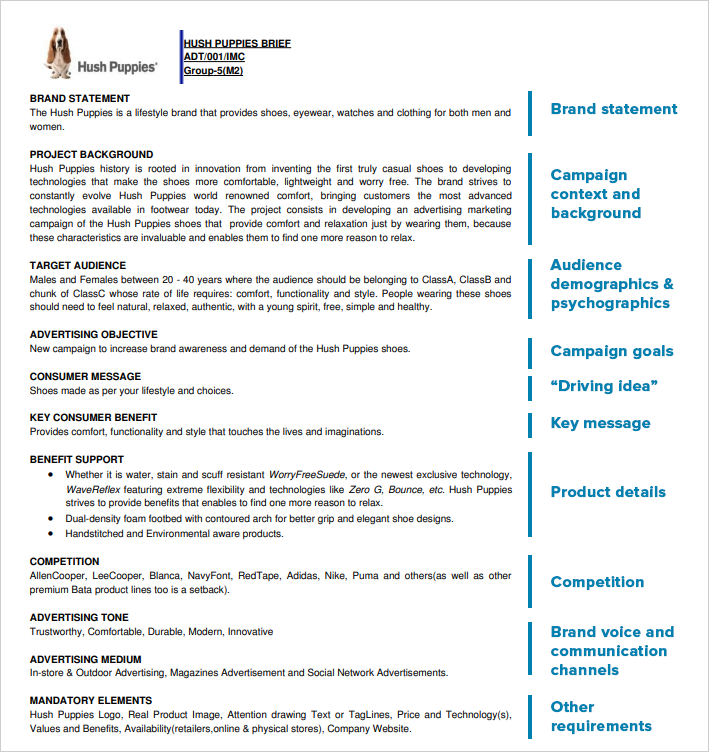
Marketing agencies don’t interact with the brand as closely as a creative agency. This is why plenty of agencies skip creating this brief altogether.

I feel that’s a missed opportunity.

An internal creative brief for each project can give your team much-needed brand information when making decisions. It complements the project charter and gives you “soft” data about the project.

So along with the project charter, create an internal creative brief as well.

Since this is meant exclusively for internal consumption, you can include anything that’s necessary in it. This includes, but isn’t limited to:

  • A client/brand statement summarizing the brand’s product offerings, target market, and key values.
  • A brief background of the project and its context.
  • The project’s target audience, including their demographic data as well as the benefits they’re seeking.
  • The brand’s overall tone and orientation (“young and modern”, “trustworthy and classic”, etc.)
  • The brand’s key competitors
  • The key deliverables at the end of the project and how they tie into the project and brand objectives

Share both the project charter and creative brief with your team. Ask them for feedback. Should there be any doubts or concerns about an objective, deadline, or deliverable, it is better to sort it out before you start executing.

5. Define and manage your requirements

A new content marketing project requires that you produce four new pieces of content every month.

But how exactly do you define whether a piece of content is good enough, and that it meets the project’s goals and brand guidelines?

This is where your requirements document comes into play.

The requirements document defines the criteria every deliverable must meet to be acceptable. This includes both ‘hard’ metrics (such as “word count over 1,000”) and ‘soft’ metrics (“professional tone”).

Your requirements will vary from project to project and deliverable to deliverable. To organize them better, create three requirement levels, i.e.:

  1. Universal requirements, that apply to every project across the agency
  2. Project-wide requirements, that apply to every deliverable in the project
  3. Deliverable-focused requirements, that apply to individual deliverables in the project

Each subsequent level should inherit the requirements from the preceding one.

For example, you might have the following requirements for a content marketing project:

  • All deliverables must go through 1 round of revisions and approvals (universal)
  • All project deliverables should include client branding (project-wide)
  • All blog posts should be minimum 1,000 words (project-wide)
  • All accompanying social media imagery should include the client’s Twitter handle (deliverable-focused).

This should be organized as a checklist so that everything you create meets your own as well as the brand and project guidelines.

When you’re listing your requirements, also ask whether you can automate or simplify the evaluation process.

For instance, if your requirements call for you to tweet links to finished blog posts at least thrice, you can use a social media tool like Buffer or CoSchedule to automate it.

The more you can automate, eliminate, and simplify, the easier it will be to execute the project.

6. Break down the project

One of the first things any experienced project manager will do is decompose a project into its constituent parts.

The result of this activity is the Work Breakdown Structure (WBS).

As we wrote earlier, a WBS:

“…defines all the things a project needs to accomplish, organized into multiple levels, and displayed graphically.”

For instance, here’s the WBS for a bicycle:

Keep in mind that a WBS only defines the deliverables, not any activities. Thus, “bicycle seat” is a part of WBS, but “stitching leather around foam” isn’t.

Creating a WBS can be slightly tricky (especially once you get into “work packages”). Unless you’re dealing with complicated projects, you don’t have to create a full-fledged WBS.

Instead, simply break down each project into its constituent deliverables. Organize this decomposition graphically and it will give you much-needed insight into the project’s requirements.

For example, here’s a broad breakdown of a content marketing project:

If you can connect each deliverable to its associated requirements, you’ll have a complete view of the project in a single document.

7. Map your workflows for each deliverable

One of the best things you can do to improve your marketing project management is to outline your workflow for each deliverable.

For example, to create a blog post, your team has to take the following steps (in order):

  • Brainstorm blog post idea in accordance with the creative brief
  • Create a title that meets stated requirements
  • Research topic and create an outline
  • Create 1st draft
  • Edit draft and make sure that it meets blog post requirements
  • Final proofreading
  • Add final draft to WordPress
  • Share published post link on Twitter

This defines the “workflow” for creating a blog post.

The workflow is inherently tied to the requirements document. You don’t just have to create a blog title; you also have to ensure that it follows the structure and tone set by the requirements.

Some to-dos in your workflow will be specific to the project (such as “adding draft to WordPress”). Others will be common to all similar deliverable across projects (such as “edit and proofread draft”).

You can streamline your projects by listing the project-specific as well as inherited “universal” to-dos for each deliverable.

Every blog post you create must pass through this checklist.

You can add further detail by identifying which team is responsible for which to-dos. In the above case, the content team will create the blog post, the designer will create the header graphics, and the marketing team will add it to the social promotion queue.

You can do this for every deliverable in a project. You can then port workflows from project to project, changing individual steps if necessary. This will not only make project delivery easier, it will also ensure that your solutions are scalable.

Bringing it all together

Marketing project management is all about documenting workflows and protocols. If you can systemize the delivery of a solution, you can also scale it while ensuring successful delivery.

Start each project by creating a project charter. This will give your team an understanding of each project’s goals, vision, and requirements.

Complement the project charter with a creative brief. This mostly identifies the subjective data about the project – brand, values, and vision.

Armed with the project charter, you can start breaking down the project into its constituent deliverables. And once you have the deliverables, identify their:

  • Requirements, i.e. the conditions they must meet to be acceptable, and
  • Workflow, i.e. the list of to-dos that have to be completed to create them successfully

Do all this and you’ll find that managing marketing projects is easier than you thought.

18 Dec 18:54

“Are You Experienced?”

by Tibor Shanto

By Tibor Shanto

There a lot of things we want to know about our buyer, role in the company, role in the decision, experience in the industry and their functional role. But there is a fundamental question that salespeople fail to take into account, and if they did, they would find it changes the way they see the prospect, and how the prospects respond as a result and become customers.

Over the years I have learned that if I were to put the question right here, most people (some would say 80%) would take the question and run with it, without first taking the time to learn the context and best uses.

Home Team Disadvantage

When you are in the middle of it, the heat of the experience, be that a sport game or sales or selling, it is easy to assume that the others involved are prepared and as ready as you are, or they should be; especially in a sales, where the buyers seem to be willing participants. But the reality in a buy/sale cycle is the exact opposite. And no, I am not going to say that it is the sellers who are unprepared, that’s not the case, it is usually the buyers. Yes, the buyers.

Contrary to the popular myth propagated and exacerbated by pundits, most buyers are not at all prepared for the purchase journey they are about to face. Even procurement professionals, who may have the procurement process down, and may put it into practice daily, “procuring” is part of the process, it is not part of the decision, especially the decisions based on the future of “the Business” and related objectives. What is missing most is “experience,” not in as “how do you feel, was that a good client experience?” But in how many times have they actually done this, this case how many times have they gone through a buying cycle?

The average B2B rep may do 10, 20 30, more deals a year, meaning that they will have initiated and gone through some portion of a sales cycle, two, three or four times their deal number. For a 20-deal rep, closing 1 of 3, we’re looking at 60 cycles started, five a month.

If we are talking about a purchase, one they may make once every three or four years, they are very inexperienced, some who may have joined between purchase cycles, have zero experience. While you and I do sales day in and day out, and only occasionally need to deal with buying a new accounting app, selecting a new internet provider or marketing firm, what we are good at is selling. No different for the customer, they may do “System Integrating” all day long, they may have trucks all over the road in every province and state, they only occasionally, like once every three or four years need to get their mind around what we live and breathe every day. And BTW, if you’re selling one of those spanking new Disruptive products, your buyers have by definition, never have bought a product like that.

One thing the pundits peddle, and sellers are happy to buy, is the notion that with the internet the information parity has shifted, and buyers no longer need sales people for critical product information. No arguing the amount of information available today is more than abundant, one can say overwhelming. But information is not knowledge, especially without context, and knowledge is not insight. Let’s not forget that much of “information” available is either produced, parsed/curated by someone with a specific agenda, usually their own. And buyers are showing the signs of fatigue keeping up with “information” while struggling to stay informed. What the peddlers of information parity missed, is that the top performing sellers always knew it was about the insight that drives the clients’ business, not information; they saw and see their roles as someone who helps buyers make sense of the information, helping turn into desired results.

I know this may seem odd at first, but the data is in, and more and more buyers are taking longer than ever to go through their buying cycle, why? I mean look at all the information available. Not having to go through a buying cycle every week, the way sellers go through their cycles, it is easy to understand why they are tentative.

Buyers are taking longer to buy because they are overwhelmed and paralyzed by confusion. I wrote about the findings of CEB/Gartner on LinkedIn, highlighting the state of buyers.

But all this is good if you are a real seller. It is an opportunity to add value without getting bogged down in product. Any way you slice it, if they haven’t bought what you are selling in over two years, then you are the subject matter expert in the process. This imparity gives you an opportunity to be a real educator, sharing best practices from other clients with similar objectives and help buyers create clarity, and build the confidence to ask questions and areas they may be reluctant to with the average rep. But by sharing your expertise in the form of uncovering their objectives, in fact shaping their objectives in a way that they feel they are buying your knowledge and insight, the product is just a means.

Finally, knowing that clients are slow to act, cautious, also gives you the luxury of time. Many salespeople rush things based on their sales process, but if you know that they are open to taking longer to make the right decision, you can use that time to relax the pace and turn up the knowledge and insights shared. The beautiful thing about this approach is that it feeds itself, the more they appreciate your expertise and different approach, the more they will open up and share about their doubts and fears, putting you in a better position to respond and build credibility and trust further.


This is my last post for 2018, off to a well-deserved rest and recharge, back in January.

I want to thank everyone for your ongoing support and for reading the blog, it is appreciated.

I want to wish you all a joyous holiday season, and a Happy New Year!

The post “Are You Experienced?” appeared first on TiborShanto.com.

18 Dec 18:54

The 2 Mobile Metrics Executives Care Most About

by Aisha Amjad

You’re a mobile marketer. Your organization has developed a mobile app and added it to different app stores, your acquisition team got people to install the app. You have users. Now, your role in the process is to activate these users, get them to come back into the app more often, make these users aware of all the features the app has to offer and eventually monetize on these users. During this process, you will be swimming in several metrics that measure the app’s success, and while all these metrics are important, executives are going to pay attention to one or two KPIs in a board meeting before they move onto another digital channel. They will be interested in the business value they are getting from mobile, in dollars. So, what should that one metric be?

Which mobile KPIs do executives pay most attention to in a board meeting?

We’ve ask around with our customers and peers throughout the mobile community there were 2 metrics executives tend to ask most about:

1.) Percentage of Users on Web vs Mobile:

This information serves less as a metric, more as insight on why your executives should care about mobile. Even if less than 10% of your users are on mobile, surfacing this percentage split is imperative as it will only grow and today is the time to set this metric as a benchmark and start planning your mobile engagement strategy.

2.) Incremental Conversion rate:

Lets discuss incrementally before the metric: Incrementality is the measure of the lift that mobile marketing (like push notifications, in-app messages, inbox messages, geofence campaigns) provide to the conversion rate (which is revenue, in this case).

To measure incrementality, marketers need to compare how they currently target users to control groups. Users who fall into the control group are composed of users who don’t see marketing campaigns. This allows marketers to compare conversion rates of users who were shown campaigns to the control group of users who weren’t shown any campaigns.

In this example, let’s compare two mobile app users who are part of the same audience, except User 1 sees marketing campaigns while User 2, who is part of the control group, does not see marketing campaigns:

Both Users visited the app, added an item to cart and left the app. We go ahead and build an audience of users who added to cart, and both users fall into the same audience. Now both users come back into the app, except User 1 sees a marketing campaign and User 2 does not, because User 2 is part of the control group. Both users however, do make a purchase.

When we measure the conversion rate of the two users, User 1 falls at 18% and User 2 falls at 14%, giving User 1 an incremental lift of 4% over User 2. Understanding incrementality allows marketers to define the impact of marketing campaigns.

Feel free to use this as a metric framework, apply to your business and use as a starting point for your next report.

Top 3 Metrics Executives Care About By Industry

Since we know that the mobile metrics that matter vary by industry, here are top three metrics, split out by their respective industry. Feel free to use this as a metric framework, apply to your business and use as a starting point for your next report:

Ecommerce:

  • % of Users on Web vs Mobile
  • Number of Transactions on Web vs Mobile
  • Incremental Revenue

Media and Entertainment:

  • % of Users on Web vs Mobile
  • Incremental Content Views
  • Incremental Subscriptions

Travel and Lifestyle:

  • % of Users on Web vs Mobile
  • Incremental Reservations

Finance:

  • % of Users on Web vs Mobile
  • Incremental DARTs – Daily Average Revenue Trades
  • Incremental Biometric Logins

Ad- based Apps:

  • % of Users on Web vs Mobile
  • Incremental User retention
  • Incremental Impressions

What other mobile metrics do your executives care most about? Comment below!

18 Dec 18:54

How Western Multinationals Are Responding to the Escalating U.S.-China Trade War

by Paul Maidment
Yuji Sakai/Getty Images

The furious reaction from China to the arrest of Huawei’s chief financial officer, Meng Wanzhou, in Canada at Washington’s request immediately raises the prospect of like-for-like retaliation against executives from North American companies, a fear reinforced by the arrests of a former Canadian diplomat-turned-NGO-researcher and a Canadian businessman.

Western business people are ensnared in low-level court proceedings in China far more regularly than is reported in the West, the risk remains low of a retaliatory move against a Western executive of similar status to Meng. It would undercut the high-ground that Beijing has occupied as self-appointed defender of “the rules-based international order.”

However, there are other ways for Chinese authorities to take reprisals against Western multinationals operating in China should they so choose. Day-to-day business operations can readily be interrupted through inspections, audits, and other tourniquets of red tape, and by the selective application of the letter of Chinese civil, administrative and criminal law. There’s also the possibility of travel bans on executives (including on those under unresolved court proceedings), and good, old-fashioned intimidation.

Add to this the current trade tensions between the U.S. and China and Western multinationals — such as the big U.S. technology companies — that use China as a source of assembly, semi-manufactures or components have an additional vulnerability: their value chain.

For every such company, especially those critically reliant on Chinese sub-contractors, their value chain is now actively at increased political risk. Local suppliers and their sub-contractors are susceptible to pressure to behave “patriotically” when authorities convey the message, however tacitly, that lack of cooperation with foreign multinationals is in the national interest. Something similar has occurred when Chinese consumers have on earlier occasions read the signals for when they were meant to boycott Japanese and South Korean products.

There are many ways to apply informal pressure along the value chain from delaying delivery to the easing of quality standards.  Suppliers and subcontractors could find themselves suffering sudden and “unexpected” shortages of inputs and disruptions from labour.

Companies need to take urgent steps to measure their potential exposure. Doubling up value chains, including alternatives outside China, would mitigate the risk of political and regulatory disruption. (It would also have the added benefit of providing insurance against ever-more-frequent natural disasters.)  In our analysis and consulting work, we have come across some forward-looking companies that have started to reconfigure their value chains where possible – particularly those who are vulnerable to U.S. national security concerns because they incorporate Chinese technology into their end products.

Doing so is neither necessarily easy nor cheap. China has accumulated a vast manufacturing ecosystem servicing foreign companies, encompassing everything from hard infrastructure to soft skills. Its growth has accelerated in recent years as China has embraced automation as way to offset rising wages that could make it less competitive as an offshoring center.

For that reason, building up a parallel value chain is not simply about shifting to another low-wage country. Both the quality and quantity of China’s manufacturing skills, particularly in the areas of automation and robotics, deter companies from relocating from China to elsewhere in South or Southeast Asia. Lower-wage countries like Vietnam and Cambodia have little spare production or skilled human capacity left, even in relatively low-skilled sectors like textiles and garments, let alone the advanced precision tooling, materials handling, and process engineering and development skills that a U.S. technology company needs. Nor do those countries have the resources to develop them rapidly.

Tim Cook, chief executive of Apple, a company so committed to manufacturing in China that it labels many of its products, “Designed in California. Assembled in China” recently noted that if he called a meeting of all the tooling engineers in the U.S., he wouldn’t fill a room, whereas in China he could fill multiple football fields.

Regardless of these impediments, and even before the heightened trade tensions between China and the U.S., there was business logic to the case for value-chain diversification — and a parallel process of value-chain reconfiguration already underway in some sectors with a regional focus. Production of end-products and components — ranging from bicycle parts to computer hard drives — has started to relocate, with low-tech production shifting from China to Indonesia, Cambodia, Bangladesh, and India, and higher-tech ones moving to South Korea, Taiwan, Singapore, and Malaysia. Vietnam straddles the two.

Burgeoning middle-classes in South and Southeast Asia provide a growing market for China’s consumer and industrial goods, especially for non-luxury goods that do not need the cache of a U.S. or European brand. Countries such as India, Indonesia, Malaysia, the Philippines, and Thailand are all forecast to be among the 20-25 largest economies during the second quarter of this century. Moving production nearer to those markets makes sense.

At the same time, for other Asian nations, China is starting to look like the “market of last resort” for selling what they manufacture. The U.S. has been that market been since the Second World War. But the Trump administration’s “America First” policy, with its emphasis on domestically produced goods, seems to put that in doubt.

Chinese companies, too, will be compelled to seek alternatives to the U.S. in response to Trump’s tariffs, especially those that have become U.S.-reliant, further accelerating the changes to regional trade and the value chains that support it.

The overall effect will be that more value chains will begin and end in China rather than beginning in China and ending in the U.S. There will be fewer global value chains and more regional ones.

Regional value chains do have an advantage: they are shorter than global ones. As global value chains have gotten longer and leaner, they have also grown more fragile, just as the pressures on them are increasing from technological change — particularly AI, robotics and big data, shifting relative labor costs, environmental concerns, such as carbon footprints, and reputational exposures.

The Trump administration’s trade policies will provide new impetus to the developing patterns of multiple, shorter regional value chains, but the transformation will not happen overnight. Value chains cannot be reconfigured any more quickly than a manufacturing plant can be rapidly rebuilt. Companies will hesitate to jump into new developing markets where investment laws can be unclear or nascent — like Myanmar, Cambodia, or Vietnam — and where labor and environmental standards lax. Nor will it be easy to replicate established relationships with factories, suppliers, and governments.

Complicated electronics value chains, in particular, are so entrenched in China, it is unlikely that all business will shift away from the country as a result of the new tariffs alone. For its part, China itself is still dependent on specific imported technologies such as chipsets and sensors. This constraint will ease as China develops, with some urgency, local capacities in these technologies, not least because the U.S. is set on preventing the export of crucial U.S. technologies and blocking Chinese companies from gaining access to them through inward foreign direct investment.

One scenario is that the current U.S. counter to China’s “strategic competition” — tariffs and technology export and investment controls — will further fracture value chains as it will lead to a dual global technology world with one part running U.S. technology on U.S. technical standards and another running Chinese technology on Chinese standards.

There would be no certainty that the hardware, software, and services of these two worlds would be interoperable, and, once a market is locked into one or other of the systems, it would be difficult for users to switch. This would add complexity to value chains, making it more likely they would default to specializing regionally.

18 Dec 18:51

4 Ways to Stay Ahead of Change Management

by Darleen DeRosa

rawpixel / Pixabay

A change initiative can test the competence and endurance of even the best companies. One of the key differentiators that set successful companies apart is their ability to effectively manage change and position themselves to capitalize on future opportunities.

OnPoint Consulting’s research into the ways top-performing companies reveals some of the ways they prepare for and manage change. Effective organizations are characterized by cultures that are flexible, adaptive, participative, and innovative—and they operationalize these cultural attributes through leader behavior. Not surprisingly, leaders in top-performing companies utilize a number of strategies that allow them to manage change successfully.

4 Ways to Stay Ahead of Change Management

Get Comfortable With Managing Paradoxes

Change imposes difficult demands on leadership. In some cases, those demands come into conflict with one another. Just because an organization is rolling out a big change initiative that will transform the way it does business within a year doesn’t mean it can simply abandon its current day-to-day practices. Leaders in top-performing companies are adaptable enough to strike the right balance between what can sometimes appear to be mutually exclusive outcomes.

In 2012, the social commerce fashion website Polyvore faced just such a problem. As the site grew and set its sights on larger advertisers, those goals conflicted with the user experience the site had originally set out to provide. The leadership team had to implement a number of changes to steer the company back to its core value of delivering a great experience while also incorporating the advertising strategies that brought financial growth.

Use the Five Keys to Managing Change

In many change situations, organizations often neglect critical management elements. These oversights can contribute to rising costs, delayed implementation, or outright resistance from vested interests within the company. Even the best change initiatives can fall victim to the “commitment dip,” a drop-off in results that typically occurs after a month or two as people return to their normal duties and begin to lose focus and enthusiasm for change.

Leaders can overcome these challenges by keeping the five critical elements of change management in mind:

  • Go beyond making the business case.
  • Prioritize and coordinate change across the organization.
  • Allocate sufficient resources.
  • Be realistic about deadlines and due dates.
  • Focus on behaviors that need to change, not just change goals.

Involve Team Members in the Decisions That Affect Them

Participation is essential to effective change leadership. Imposing a top-down change on the people in an organization without involving them in any way or giving some consideration to how the changes will impact them is a surefire method for encountering resistance. Leaders don’t necessarily need to involve employees in every aspect of a change initiative, but they do need to give people the opportunity to voice their concerns and provide feedback about the process. Empathizing with employees is vital here; if no one feels like leadership cares about how the changes impact them, they are less likely to buy in and support the change.

But it’s more than just a matter of feelings. Oftentimes, the people most directly impacted by change aren’t consulted at all before changes are implemented, resulting in serious problems that might have been averted had leadership only taken the time to consult with them. In 2006, for example, the National Basketball Association introduced a new basketball after extensive research and development. Unfortunately, the NBA never asked the players for input during that process. As a result, the players found the new ball, which was made of a synthetic material rather than traditional leather, difficult and even uncomfortable to handle. Had the league Involved the players earlier, it would likely have resulted in a higher quality ball and more players accepting the idea of using a “new ball.”

Lead by Example

Leaders in top-performing companies understand that people will not trust or follow them if they do not live by the same values and support the same priorities they require of others. It’s one thing to tell people what they should be doing or how to best adapt to the latest changes; it’s quite another to set an example for behavior and performance under those circumstances. Leading by example helps to build credibility and makes it easier for leaders to convince employees to implement much-needed changes.

Highly-visible leaders who do their best to embody the values they promote find it easier to keep people inspired and engaged in their work. They also build trust among their teams more effectively and promote better collaboration, both of which are especially valuable qualities when guiding a team or organization through a difficult change situation.

Staying on top is a challenge in the best of times. It’s even more difficult when an organization is forced to undergo difficult changes. The most successful companies have effective and resourceful leaders who find ways to distinguish themselves in good situations and bad. Having a capable leadership team in place is absolutely essential to change management and serves as one of the key differentiators between top-performing companies and their less successful brethren.

18 Dec 18:43

Levandowski’s Pronto.ai plans to ship automated driving systems for trucks in 2019

by Kirsten Korosec

Anthony Levandowski, the former Google engineer and serial entrepreneur who was at the center of a trade secrets lawsuit between Uber and Waymo, has taken his newest autonomous vehicle technology company out of stealth mode with a product aimed at the commercial trucking industry.

Technically, Levandowski’s involvement in a self-driving trucking company was first revealed by TechCrunch in July. Levandowski nor anyone else attached to the company would talk on record, leaving TechCrunch to rely on a paper trail instead.

Now, Levandowski is talking publicly about his company, including details on its mission and product, as well as a bold new claim of a cross-country autonomous drive. The Guardian was the first to report on details of the company and its cross-country autonomous drive, which was conducted in a modified Toyota Prius using only cameras, computers and basic digital maps. Levandowski says the autonomous car drove by itself the entire 3,100-mile trip without any human intervention.

Here’s the time-lapsed video of the journey. (Note the speed at which the vehicle is traveling at different spots like the Golden Gate Bridge.)

Back in July, TechCrunch reported that his company was called Kache.ai, according to paperwork registering it as a corporation filed with the California Secretary of State. That name has apparently changed to Pronto.ai, according to Levandowski, who posted a blog Tuesday on Medium. Pronto was co-founded by Ognen Stojanovski, a corporate attorney and research scholar at Stanford University who recently joined the company, TechCrunch has learned. Stojanovski headed up government relations and policy at Otto, the autonomous vehicle trucking company co-founded by Levandowski and several others that was subsequently bought by Uber.

Levandowski contends that this “race” to deploy autonomous vehicles has yet to start in earnest largely due to shortcomings from “crutch technologies,” a descriptor he uses for hardware like LiDAR and HD maps. His position is that while these provide sensing and localization for the vehicle in the present moment, they have serious compromises and don’t produce the level of predictive ability required to commercially deploy autonomous vehicles. (btw, Tesla CEO Elon Musk has also described LiDAR as a “crutch.”)

“We now find ourselves in a position where regulators, investors, and the public are waking up to the reality that nobody is ahead in the race to deliver autonomous vehicles because the real race is a marathon that has not yet begun,” Levandowski wrote. “The last 15 years we’ve mostly idled at the starting line.”

His company is focused on advanced driver assistance features built for Class 8 vehicles — those heavy-duty trucks that crisscross the U.S. carrying freight. (Trucks carried more than 70 percent of all U.S. freight and generated $719 billion in revenue in 2017, according to the American Trucking Associations.)

Pronto’s ADAS for trucks product is called CoPilot, a level 2 system designed to increase operational and occupational safety as well as increase efficiency and reduce the carbon footprint of commercial trucking companies. Pronto’s approach is in some ways similar to Comma.ai, a company founded by George Hotz that aims to bring to everyday drivers automated driving systems designed for highways.

Pronto combines the hardware such as cameras (no LiDAR here) atop neural networks for improved prediction. And that’s the big selling point, at least from Levandowski’s view.

The company plans to partner with carriers and deliver to them aftermarket solutions that are platform agnostic, according to the company. Pronto will announce its first customers in the first half of 2019. The company is offering this at a “special introductory pricing” of $4,999 per truck, a figure that includes bolt-on installation of its camera-based system, driver training and more. Pronto’s website says customers can pre-order with a deposit of $299.

“It will be the first stand-alone real product for a real market that the self-driving industry has delivered, and we are excited to be blazing the trail to the reality of how autonomous vehicles will ultimately come to fruition,” he wrote.

18 Dec 18:04

Are You Charging the Right Price?

by Dave Kosmayer

As a business owner or marketer, one of the hardest decisions you have to make is whether to raise or lower prices to make sure you are charging the right price for products. If you charge too much for your product or service, there are bound to be serious ramifications; moreover, if you charge too little, you might be out of business sooner than you can imagine. Therefore, the pricing strategy of any business model is key to ensure the profit margin is fair while simultaneously increasing your market share by attracting more potential customers.

The thing is many business owners and marketers struggle with the issue of value-based pricing. Not because they aren’t good marketers, but because they just aren’t experienced in knowing what they ought to charge.

Using Alternative Pricing Strategies

Strategically Pricing Against the Competition

If you can determine the right price to charge for your products, you can increase your revenue, sales and, ultimately, your profit. In this blog post, you will learn a few tips and tricks that will help you better understand how to price your goods through competitive pricing and the right strategy.

Using Comparative Pricing to Gain Advantage

This is one of the oldest techniques used to determine selling price. Marketers will often directly compare their service or products to their competitors’ products and drop the price of their products to get customers to choose their selection instead. Although, this may not be the best approach as it comes at the cost of the business’ credibility.

The problem is comparative pricing is not always as effective as it’s made out to be. Here’s why: if you reduce or increase the price of your products too sharply in consideration of your competition, consumers may become suspicious of your brand; thereby, lowering their consumer purchase intention.

Selling Time Over Money

According to new research, selling the experience rather than possessing the product is vastly more effective. This is not surprising at all, considering most people will keep coming back because they enjoyed the overall experience they had when using the product. Over time, most peoples’ experience with a product leads to more brand positive associated attitudes.

How to Charge More for Your Products

Narrow your target market

It’s a no-brainer: charging more for your products means that not everyone will be able to afford your products. And that’s okay. There’s no harm in alienating a few customers to focus on a specific target market. However, you will need to ensure that you are offering quality products and services. For example, when you go to the mall, you automatically expect higher priced items to be made with better quality materials than lower priced items. You want to ensure that you create a feeling of scarcity. Higher price for higher quality.

Produce a limited quantity

Now that your target audience has reduced, you don’t need to produce as many products as you did before. Just produce enough for your target market.

Limit the buyer’s choices

Giving customers too much to choose from confuses them and induces a phenomenon called decision fatigue. You can prevent this by limiting consumer choice, so they end up only selecting from a manageable product range. In doing so, the number of products you make lessens to fit your target demographic. As long as you are selling everything you are producing, you are successfully doing business.

If you are unsure whether or not your product offering is too small or large, determine whether your products have attraction or substitution effects.

Enhance your packaging

Packaging is an important part of making sales. People are often lured to pay more for products packaged in a sleek way than a product that’s not. It’s not just the product you are selling; you are also selling what it comes in. Packaging is an important part of the equation.

Stand by your products

If you’re selling at a higher price, you’re bound to receive some backlash for it. Of course, not all customers will be pleased with the transition. To convince your target market, you will have to stand by your products and the price you’re charging for them. Offer options like extended warranties, free shipping, and returns. They’ll be more willing to spend money if they feel they are getting more value for the money they are churning out.

Provide social proof

It’s all about the perceived value of what you are selling. Most customers will simply buy a product because their favourite celebrity endorsed a product directly or indirectly. For instance, the burgundy leather tote that Prince Harry’s fiancée Meghan Markle flaunted after the engagement was sold out in just a matter of hours—all because she was spotted with it!

Tips That Will Help You Determine if the Price is Right

Do your research

This may sound counterintuitive, especially if you are trying to stand out, but it’s pretty important to find out what other businesses in your niche are charging for the same products. It’s important to know how you perceive your brand and where it fits in relation to the price of the competition. You can figure this out by creating a scatter chart. First, identify the price of competing brand products. Second, create a chart with two axes: price and product. Third, insert marks for the competitions’ brand products on the chart where their prices correspond. After you know where the competition prices their products, the last step is to insert your brand’s products to a price point where you believe they fit. This will give you a rough idea where to start pricing your products.

Pricing method

If your business offers services, you may need to decide whether you are charging by the hour or using a project-based set fee. If you are charging by the hour and customers are used to a flat rate, you may be perceived to be charging higher. You should incorporate both pricing methods and test for a few months to see which method works best for your customers.

Conclusion

It’s clear that the way you price your products has a large bearing on your revenue. So, while you no doubt want to make your customers happy, you need to focus on making your business a success as well.

18 Dec 18:04

Going Viral: How Dropbox Used a Product Led Growth Strategy to Hit $10B in Only 10 Years

by Ashley Minogue

It’s a well-known story in the SaaS world – Dropbox reaching $1 billion in revenue in only ten years. But how did this online storage and collaboration startup gain the momentum to achieve this historic feat?

I had the opportunity to talk with Darius Contractor, former Growth Engineering Lead at Dropbox, to get an inside look at just what went into the making of this SaaS legend. While Dropbox is widely recognized as a poster child for product led growth (PLG), not everyone has had the opportunity to see exactly how the plan came together. Darius generously shared some helpful insights about how to identify when a company is ripe for a PLG approach and also some details about exactly what went into their own go-to-market strategy and how they built the kind of team needed to bring that strategy home.

PLG’s Bottoms-up Approach – Is It Right for You?

When a company is considering adopting PLG, one of the first questions they need to answer is whether or not a bottoms-up approach to growth will be a good fit for their organization. After all, there is no one-size-fits-all solution; you have to make sure there is true alignment between your product, business model and growth strategy.

The traditional, top-down approach to SaaS growth involves building a product and then employing a sales team to manually sell it into companies. This process usually revolves around activities including attending conferences, implementing complex marketing campaigns and maybe setting up some workflows for inbound inquiries. With a bottoms-up approach, the goal is to develop a methodology that enables people to discover and adopt your product on their own without all the hand-holding, company-driven support of traditional marketing channels.

As Darius explained, there are three key markers that indicate your company might be a strong candidate for a PLG strategy:

1. Simplicity

PLG works best when your product is simple enough that a user can not only easily understand what it is and how it works, but also be able to make a purchase decision independent of a sales person.

2. The Viral Factor

The products that see the greatest success with PLG are the ones that require sharing in order to get the full value of the product. Dropbox is a perfect example because it’s designed to facilitate collaboration with other individuals and groups, automatically creating additional users by constantly exposing new people to the product.

3. Self-serve Channel

Finally, you want to create a channel in which prospects can discover and use your product without needing support from a human being. For example, if someone is searching for a solution like yours, and lands on your website, you want them to be able to sign up and pay for your service without needing a salesperson to complete the transaction.

If your product meets these three core criteria, PLG might be a winning growth strategy for your business.

Dropbox’s One-two PLG Punch

Dropbox’s phenomenal growth is the result of using a PLG strategy that was fairly straightforward, but very effective. In the beginning, the company focused almost exclusively on growing their user base rather than monetization, which came later as the team took advantage of up-market opportunities. To drive exponential growth, Dropbox employed a one-two punch:

Step One: Deliver a simple, usable product that meets a market demand.

What initially made Dropbox an immediate success with users was the fact that it solved an existing problem with a very user-friendly UI. Dropbox replaced the onerous process of using FTP or local file servers with a simple, drag-and-drop interface that allowed instant access from any computer on the web. The product delivered an incredibly powerful and useful tool that was easy to use and free. Simply put, it was the best tool for sharing files.

Step Two: Introduce features designed to take advantage of the viral factor.

Once Dropbox had established a foothold in the market, the team launched a series of features that gave users even more reasons and ways to share the product with colleagues:

      • Shared folders allowed teams of users to sync documents from multiple sources to a single cloud location, which in turn enabled groups of colleagues to facilitate collaborative online workflows directly in Dropbox.
      • A referral program gave users an opportunity to increase their storage space by inviting new people to sign up for Dropbox. The freemium version of the product includes two gigabytes of free space, a generous amount, but is still not enough for power users. The referral program incentivized users by offering an additional 500 megabytes of free space for each referral. Users incorporated their referral codes on their blogs and shared them out to friends via email and so forth. The feature drove a lot of new users, which really increased Dropbox’s profile.
      • Shared links gave users the ability to share a file without requiring the recipient to sign up for Dropbox. The addition of this feature meant users had more flexibility to use Dropbox in a wider number of scenarios.

From day one, Dropbox focused on solving a problem for users and then making it easy for those users to share their solution with others. It was a brilliant strategy that allowed the product to promote itself through real-world use. As Darius explains, “These were three different viral sharing techniques that were incredibly helpful to users, matched their needs and also spread the word about Dropbox in simple, scalable ways.”

Team Structure and Getting Started with PLG

Even though a product led growth strategy doesn’t require an army of sales and marketing people, it does require a cohesive and committed team. The Dropbox growth team has evolved as the company and strategy have evolved. In Darius’ opinion, the smallest growth team that can still be effective is a team of two: a growth-minded product person or designer partnered with an engineer or web developer. In rare cases, the skills and qualities of both these roles can be combined in one person, but usually you’ll need two individuals to get started.

As a team expands, Darius recommends adding a data analyst who can help make the overall team more data aware. “In many cases, looking at the data is how you are able to see the opportunities,” Darius says. “Also, you need data awareness as you run experiments. You need a really sharp perspective on how to use your data and which data to look at. As the company grows, this will help identify which fires require more fuel.”

With this small, core team, the initial approach to PLG involves a lot of experimentation all over the funnel. “You want to hit early stages, later stages, new users, older users,” Darius says. “Follow the data and your intuition and explore aggressively to see what works. This will give you a good idea of what the levers are.” At this point, you may be ready to hire more people for the growth team, bolstering product, engineering and data support so you can pursue the opportunities you’ve uncovered.

Initially, the opportunities will be about making small tweaks, but as you learn more and your team expands, you can think about bigger opportunities, like exploring different pricing structures. As you scale the organization, branch out into separate growth teams, and start to make more substantial changes to workflows, it’s critical to ensure that everyone is aligned around the same metrics. The challenge, as your efforts become more complex and involve overlapping service areas, is keeping track of who owns what and how it’s all being tracked against central growth objectives.

Part of Darius’ recipe for success is in the setup of growth teams. He combines alignment on key metrics with low-stakes testing. “When I’m working with a company that’s starting growth teams, I tell them the best thing to do is find a metric everyone cares about,” Darius says. “That’s usually either user growth or revenue growth.” After that, Darius recommends identifying a surface area where you can make a lot of changes without disrupting other teams or needing to jump through too many hoops. For example, the payment page or the onboarding flow – places where you have the freedom to try out a lot of different things quickly in order to figure out how to create success.

Virality – The Secret to PLG Success

Without question, one of the most important elements of large-scale PLG success is virality. For companies looking for an initial viral hook, Darius suggests taking a look at three areas:

      • Where does your product require more than one person to work?
        “I like to say that a good viral product is broken without your friends,” Darius says. “Meaning that without your friends you won’t get the full value of the product.” Dropbox makes sharing a core part of the user experience that is front and center at all times. They feature a prominent share button on every file and a sharing tab that displays everything that others have shared with the user.
      • What are the different roles that interact with your product?
        “There are all kinds of different roles within a company who might need to use your tool,” Darius says. “See if you can surface those relationships and build features to serve the interactions of those roles.” From creators to collaborators to approvers and related teams like IT and data analysts, think about how you can deliver more value for each kind of user.
      • How can you encourage/make it easy to share?
        Darius recommends identifying “virality points” in the product and then finding ways to engage users at those points. “Take whatever you’re doing, and make it shareable,” he explains. “If you build presentations, build in sharing of presentations. If your product is a database, think about who else in the company might need to know about and access the database. Build in some virality and you build up free mind share within a company. ”

Once you’ve established some of these viral elements, it’s helpful to think about your product as a series of user reactions in order to maintain engagement and sharing. Darius uses Facebook as an example of how a user moves through a series of reactions to the initial invite, the prompt to invite friends, the prompt to begin posting. It’s a sequence of small, simple steps that get the user more and more engaged with the product. For Dropbox, the flow has to do with users becoming aware of and then using additional features such as more storage, different kinds of sharing and so forth. The trick is to make sure that one reaction leads to the next reaction so that you keep creating viral loops that lead the user deeper into the product.

User “Psych” and How to Use It

To help sustain user engagement, Darius uses a concept he calls psych. “Psych is kind of like a gas tank of user excitement,” he says. “When someone first arrives on your site, they have a certain amount of excitement about exploring it – let’s say the gas tank is at 50%. If the marketing material effectively conveys how the product can solve their problem, they might get more psyched, maybe up to 65%. Then, as they fill out your forms and get into details like the pricing page, their psych might go down. They might start to think the process is too tough. But as long as their psych is above zero, they still have gas in the tank for finishing your flow.”

To work effectively with “psych,” you need to always be cognizant of how each point of interaction is affecting a user’s level of excitement about your product. Think about each element on the page as an emotional interaction. Will it make the user more psyched or less psyched? Play around with A/B testing to help you evaluate the interactions. “Clicking the button to go to the next page takes some energy,” Darius says. “And everyone has a hundred other things to do.” Try different copy, different headlines, removing form fields – all of these tweaks have the potential to increase user psych and encourage people to complete the flow.

It’s also important to step back and think about where user psych is most valuable for your business. For instance, help desk SaaS company Intercom makes a big ask of users very early in their flow. They ask users to copy and paste their widget onto every page of their website. This uses up a lot of “gas” from the psych tank, but it’s a critical step that’s incredibly valuable for onboarding with Intercom. So, in this scenario, Intercom builds up psych and then uses almost all of it on that one action; but – once a user takes that action – Intercom is able to do all kinds of things that are really valuable to both the user and to Intercom.

And that’s really at the core of the kind of strong, sustained virality that took Dropbox to $1 billion dollars so quickly – creating something that delivers value for both the user and the company. It’s a kind of partnership. As Darius points out, “It’s very hard to get work done in the world without someone’s help.”

The post Going Viral: How Dropbox Used a Product Led Growth Strategy to Hit $10B in Only 10 Years appeared first on OpenView Labs.

18 Dec 18:04

How to Improve Lead Generation with Microsurveys

by kniemisto

What Are Microsurveys?

Generating marketing qualified leads is one of the highest priorities for innovative marketing professionals. However, over 50% of marketers admit struggling with lead generation. If this sounds familiar, then you probably also know that the key to generate well-qualified leads and move them through the funnel faster is to get to know them better and use the data to drive smarter marketing campaigns. One idea is to use data enrichment tools. However, they won’t give you the information about goals, challenges, pain points, and interests of your prospects. That’s why you need to conduct surveys. Unfortunately, lengthy and un-engaging questionnaires often experience low response rates.

Truth be told, most of us don’t enjoy taking surveys if we’re honest. But as marketers, we somehow still believe they’re going to answer our 10 plus-question forms.

People are busy, and they don’t like getting emails with “Do you have five minutes to answer our survey?” questions. They expect you to respect their time. Does this mean you should give up on surveys? Absolutely not!

Customer feedback is essential for running effective smart campaigns and converting leads into customers. You can gather insights faster and more efficiently if you forget about questionnaires and leverage microsurveys instead.

A microsurvey is a very brief form of a survey that usually consists of up to three questions, and can be fully answered in under one to two minutes. Simply put, it is quick to create and short to answer. You can embed it in your email, on your website, or in your mobile app.

How Do Microsurveys Differ from Traditional Questionnaires?

Along with digital transformation,  how we conceptualize and execute surveys changed. Everything in our communication is trending toward micro; from five-minute videos toward six-second stories and long forms into short surveys. The extended customer journey brings the opportunity to focus on in-the-moment research. Using microsurveys at different moments of the buyer’s journey lets us find out more about our prospects, personalize our campaigns, and convert leads into customers faster.

The problem with questionnaires is that you can’t make them a smooth part of your communication because by default, they are placed on separate landing pages. A microsurvey can come in the form of a short email survey or a widget floating directly on your website, as well as in your mobile app. In a micro-email survey, the first question should be embedded directly in your email. It improves response rate by eliminating the first step of traditional surveys, which is only pasting the link to your survey and asking your audience to take it.

What Are the Benefits of Their Implementation in Marketing Automation?

In marketing automation, receiving survey results fast is very important. You can choose a tool that smoothly integrates with your engagement platform and sends results in real-time. This way, you can act on feedback quickly by automating smart campaigns. Such a solution also saves your time, enabling you to keep all the insights saved in your prospects’ individual profiles, in one database.

Still, the biggest benefit of microsurveys is that they enable you to connect with prospects precisely at the moment they interact with your website in a given way, or at a specific moment after they receive your email. All this makes your surveys relevant, as you can achieve a much higher response rate than in the case of questionnaires.

Microsurveys tend to be more focused and targeted than traditional research. If you can only inquire about a couple pieces of information at once, you focus on asking more precise questions. Your survey insights become more in-depth and meaningful, so your work doesn’t go to waste. Initially, some marketers assume that a short study means less information, but in reality, it is quite the contrary. Microsurveys open the doors to more frequent interaction with current and potential customers, which aligns perfectly with a longer and more complex customer journey, and opens up the possibility to run broader research.

Generating Leads with Microsurveys

To incorporate microsurveys in your lead generation and nurturing strategy, you should start by looking for touchpoints during your customers’ journey. These points of interaction are the perfect opportunity to gather some of the most valuable insights. These, in turn, can be used to convert contacts into hot MQLs. While every customer journey is a little different, there are some typical, recurring moments when asking for insights seems very natural.

Pain Points

The first step to identify MQLs is asking your first-time website visitors about the challenges and problems they want to solve with your product. You can quickly learn the answers if you target a microsurvey, and embed it directly on your website. It is wise to place it on a high-traffic landing page, like your homepage, because that’s the first touch point they interact with. The same website survey also allows you to ask for their contact details, like email, and other relevant information, such as the industry or department they work at.

Relevant Content

Once you identify your visitors’ pain points, you can automate smart campaigns with relevant content about solutions to their challenges. Of course, this is not the end of your research. Remember to add microsurveys to your email campaigns to get even more valuable information. Ask about the kind of content, topics, and formats they need, and create them. Maybe they’d like to read a case study with someone who faced similar challenges, or maybe they prefer a full guide ebook with some theory, best practices, and use cases? Find out and deliver content tailored to their needs. Use microsurveys to create an excellent experience.

Once you provide your audience with educational content, you can also ask about their budget, when will they be ready to buy, or who’s in charge of the purchase decision. Their answers will help you assess if they are ready for the sales pitch.

Sales Enablement

Moving further, there’s finally a step when people browse through your pricing page. But what actions can you take if they don’t complete the purchase? One option is to embed an exit survey to your website and ask, “What’s stopping you from completing the purchase?” This question gives you invaluable insight into what’s blocking your potential customers from buying from you and gives you the opportunity to take the necessary steps to convert them into customers. If they are not sure how to use your product, offer them a demo, or a training course. Offer them a discount or a free trial if your survey participants feel that the price is too high. If they are thinking about choosing your competitor, send them a solid case study with an important customer. Act on their feedback to adjust your offer, and create a “wow” effect.

If someone signed up for a trial to test your product, you can—and should—send them an email satisfaction survey, like NPS, to find out whether they like your product, and if they are going to convert into customers. The results will show you who is ready to buy your product and is likely to be your promoter. It’s a good practice to run NPS research regularly, for instance once per quarter, to find out how the level of their experience changes in time.

How to Target Your Microsurveys

The power of microsurveys is that you can target them very precisely. You can interact with your prospects exactly at the moment they are engaged in any action on your website, or when they are reading your emails. You can survey visitors as soon as they land on your website. All types of visitors can be surveyed—new, returning, or known names in your marketing automation platform— as well as those coming from a specific source. You can also embed survey questions in your smart email campaigns to continuously gather insights. Targeting your surveys is the key to getting quality feedback.

Expand Your Reach Across Digital Touch Points

What is great about microsurveys is that you can also use them to run your research across all digital touch points. It means that you can reach your prospects exactly where they are, at the moment of their engagement—no matter where they are. Note that not every one of these channels will be good for your case. Be sure to A/B test to determine what works for you. Some groups of customers are more likely to respond to email surveys, while some prefer to answer questions when they are using your mobile app. There is no “one size fits all.” Remember to integrate microsurveys with marketing automation software to quickly act on feedback. Taking action on received insights is the key to generate hot MQLs.

Microsurveys for Customers to Improve Customer Lifecycle

Even after you’ve successfully converted MQLs into SQLs, and finally, into customers, there’s still a lot you can do to improve your customer retention. Don’t stop gathering insights once they become customers. Use surveys to delight your customers and to show that you care.

In your email campaigns, ask your clients about additional features they would like to find in your product. If you’re receiving similar feedback, that information will help your product team create something your customers are looking for. You can also ask about other types of products or services they need and automate smart campaigns with a tailored offer.

An interesting survey use case, which will help you improve your customer’s experience is measuring their satisfaction after a specific interaction with your company, such as a customer service experience. You can do that by sending them an email survey just after a customer service case is closed. This will help you identify strong and weak points during the support process, as well as assess the performance of the support team.

Surveys are a great way to glean information that can contribute to important business decisions. Be sure to share your results with your entire team.

Do you gather feedback from your prospects and measure your customers’ satisfaction? Have you ever used microsurveys, or are you using longer form questionnaires? Share your opinion and your use case below!

The post How to Improve Lead Generation with Microsurveys appeared first on Marketo Marketing Blog - Best Practices and Thought Leadership.

18 Dec 18:04

Top 7 Metrics to Evaluate Sales Reps’ Performance

by SalesDrive, LLC

As an effective sales manager, you are probably always on the lookout for ways to improve your sales team.

Evaluating Sales Reps team meeting

But how can you tell whether the improvements are working? 

What are the best ways to evaluate sales reps?

These days, “data overload” is a very real risk. We have so many tools at our fingertips to help us measure just about everything — so that is what we do.  The result can sometimes be an overwhelming jumble of metrics and reports that even experienced sales managers are not sure how to utilize.

How can you effectively cut through all the noise to find the information you actually need?

The key is to narrow your focus as you leave behind the urge to track everything. Instead, put plenty of effort into making sure you are tracking only the most important information.

You will more easily understand data trends and implications, come to a decision and evaluate sales reps more quickly.

No matter the details of your sales organization and industry several classic metrics are always key for sales managers:


1. Quota Attainment

What percentage of your sales team reaches their quotas?

When you answer this question, you can decipher whether your quotas are too high or low.  Conventional wisdom holds that your quotas are probably unrealistic if less than 60% of your sales reps are hitting them.

However, it is also possible you need to hire better salespeople.  Your company may also need to part ways with under-performers.

A lower-than-average quota attainment percentage can also reflect your sales compensation plan.

Does your pay structure motivate your reps to sell?

If 90% to 100% of your salespeople are hitting quota, on the other hand, you may want to increase your targets to get the most from your sales force.


2. Total Number of Deals Divided by the Dollar Amount of Those Deals

Calculate your average deal size on a monthly or quarterly basis.  This metric tells you whether your contracts are getting larger, smaller or staying the same.

Is your company trying to move toward higher-end customers? 

If so, you will want the average deal size to increase.  If your organization is trying to cultivate more small-and-medium-sized customers, you will want this number to go down as your overall revenue and number of customers increases.

Average deal size can also help you spot and evaluate sales reps whose average deal size is significantly lower than your sales team’s average.

Are these lower-achieving sales reps going after smaller deals, or discounting too deeply?

This metric can help you decide.


3. Percentage of Leads That Ultimately Become Customers

This is, of course, the classic conversion rate.  If you get approximately 250 monthly leads and on average 25 buy your product, your conversion rate is 10%.

The conversion rate metric can help you calculate:

  • How many leads you need to reach your revenue goals. For instance, if your monthly team quota is $500,000 and your average deal size is $1,000, your salespeople need to close 500 deals.  If 10% of your leads become customers, you will need 5,000 leads per month.
  • Whether your sales reps are effective. If a sales rep’s average conversion rate is increasing while closing the same or greater quantity of deals, then that sales rep’s performance is improving.  Is someone’s quantity of deals is staying stagnant or decreasing?  It might be time to take a look at your overall process, team or lead gen strategies.


4. Weak Points in Your Sales Funnel

Where do prospects drop out of your sales funnel most often?

Evaluate Sales Reps with graphs and charts

Track stage-by-stage conversion rates to find out where your sales reps might need improvement.

For example, say 40% of prospects agree to a discovery call.  Then, half of those prospects make it to the demo stage.  From there, just 4% end up making a purchase.

Why the sudden decline?

This information can help you evaluate your sales reps.  Maybe they are not qualifying prospects properly, providing low-quality demos, negotiating ineffectively — or a combination of all these issues.


5. Sales Reps’ Smaller Actions and Activities During the Sales Process

As your sales reps work opportunities and build their pipelines, tracking leading indicators gives you a chance to do mid-course corrections if necessary.

To zoom in on these indicators, ask your sales reps:

  • How many calls do they have each week? (And who is the specific target?)
  • How many calls turn into opportunities?
  • How many calls turn into conversions?

From there, you can evaluate your sales reps as you measure them against your industry’s benchmarks.


6. Sales Cycle Duration

In this context, duration refers to the average time opportunities (both won and lost) spent in each stage of the sales process.

This piece of information takes time to collect. Historical data on your average sales cycle reveals which types of prospects are likely to buy, and which are at risk.

How long can each opportunity spend in a certain stage before it has historically been at risk?

Your mission is to gain a clear understanding of how won and lost opportunities compare by stage.  From there, you can evaluate sales reps’ performance and better prioritize their time.


7. Win Rate by Deal Size

Do your sales reps have difficulty closing deals above (or below) a certain size?

Measuring how deal size affects your sales reps’ win rate is powerful information.  It can help you effectively schedule out your reps’ time, better understand the opportunities in your pipeline and identify the best deal size for each of your salespeople.


Carefully Evaluating Sales Reps is a Must

Evaluate Sales Reps and Collect Feedback

In today’s world in which companies compete from around the globe, keeping a competitive advantage can feel increasingly difficult.

But the skillful ability of sales managers to evaluate sales reps will continue to propel sales teams to maximum efficiency and effectiveness.  This will always be a competitive advantage.

The DriveTest®, our sales hiring assessment, helps you identify from the very beginning whether your sales candidates have the most critical personality trait needed for success: Drive. Learn more about this non-teachable trait here.


The post Top 7 Metrics to Evaluate Sales Reps’ Performance appeared first on SalesDrive, LLC.

18 Dec 18:04

The 7 Proven Steps and the 3 Biggest Myths of ABM

by A Guest

Guest Post by Jon Miller, CEO and Co-Founder at Engagio

ABM continues to deliver a higher ROI than other marketing activities (according to 87% of B2B marketers), and it only gets better over time. The ITSMA found that companies with ABM programs running for more than two years were twice as likely to see higher ROI.

In the last three years, we’ve seen Account Based Marketing in action across a wide range of B2B organization, and we’re more convinced than ever that this is the way virtually all big deals will be won and grown in B2B marketing

We hope the second edition of The Clear and Complete Guide to ABM helps you to realize these incredible benefits in an easy-to-follow, helpful way. Happy Reading, and let us know what you think!

The Seven Process of Account Based Marketing

When you look at the most successful ABM practitioners, a pattern emerges. Most ABM journeys follow a seven-step process.

1 – Select Account: Align sales and marketing around a list of target accounts most likely to deliver revenue.

2 –Identify people: Fill out these accounts and buying contacts for key personas based on your ideal buyer profiles.

3 – Develop account insights: Learn what matters at each account so that your interactions are relevant and resonant.

4 – Generate account-relevant messages and content:  Create or adapt content and messaging that reflects your account insight and is targeted specifically at the buying teams in each account.

5 – Deliver account-specific interactions: Manage targeted interactions that are personalized for each account.

6 – Orchestrate account-focused plays: Synchronize interactions into coordinated plays that align to account plans and goals.

7 – Measure account progress: Report on the impact of ABM efforts in terms of account engagement, impact on pipeline and revenue, and program ROI.

We can’t go through how to do each of the seven processes in detail in a blog post, but what we can (and will) do is cover the things to avoid.

The Three Biggest ABM Myths

ABM Myth #1: Buying ABM Technology Means You’re Doing ABM

ABM is not a tactic, tool or campaign, but rather an entire go-to-market strategy.A tool doesn’t make a strategy. You must put strategy first, then figure out which tools, tactics, and campaigns will best support that strategy.

That said, ABM is very hard to do without certain technologies. In our updated guide to Account Based Marketing, I’ve laid out a map containing all of the ABM vendors and the category in which they belong.

However, you don’t need to buy technology from each category to do Account Based Marketing! You can dip your toe in the water with a relatively modest investment in new technology, and then add more solutions to help scale over time.

Here are the foundational technologies you need for ABM:

  • CRM
  • Marketing automation
  • Lead-to-account matching (L2A)
  • Engagement measurement

The other ABM tools in their respective categories will enhance your ABM, but don’t think that if you don’t have them, you can’t do ABM. You can still send direct mail, hold executive events and even launch targeted ads without ABM technology.

Use the tools and technologies that you already have, but create a more targeted message and deliver it to a more targeted list.

ABM Myth #2: You Must Choose Between ABM or Demand Gen
ABM and Demand generation are not mutually exclusive strategies. In fact, when you combine the two, they have a multiplier effect.

When you’re doing ABM correctly, you have a defined list of target accounts that you are proactively going after. However, there are still plenty of accounts that are not on your target account list that will do business with you. Therefore, having “air cover” via demand generation is important for maximizing your marketing efforts.

Very rarely in B2B marketing, should you be doing ABM and not demand gen, or vice versa.

The challenge is figuring out your mix. Just like there is a spectrum for balancing content personalization, there is a spectrum for balancing ABM and Demand Gen. As a general rule of thumb, the larger and more complex your deals, the more you will rely on ABM. On the other end of the spectrum, the smaller your deals, the more you need to rely on volume, thus, you will need to invest more in demand gen.

At Engagio, even though we’re an ABM platform, our marketing team still executes demand gen campaigns. We sell to companies in the mid-market and the enterprise. We don’t believe in doing just inbound or outbound, but rather we take an “allbound” approach.

ABM Myth #3: You Must Get Rid of MQLs and Replace it with MQAs

There’s no doubt that you’re familiar with Marketing Qualified Leads (MQLs) but if you’re not familiar with Marketing Qualified Accounts (MQAs), here’s a quick definition.

When you move from a lead-centric approach (i.e., traditional demand gen) to an account-based approach (i.e., ABM), the metrics you track will also change. The challenge arises when you ask marketers to forget about MQLs – arguably the most important metric for marketers – and implement MQAs.

This is a big ask. In fact, we actually don’t recommend it. This disrupts your entire funnel, which will have far-reaching implications for everyone involved.

Rather than replacing MQLs with MQAs, we recommend implementing both. In other words, don’t reinvent your funnel. Personally, I love the approach that RollWorks takes with their “double funnel.”

According to RollWorks, “this double funnel approach helps you create organic demand for your products, while also identifying target accounts and providing them with a customized experience via account-based tactics. In a well oiled ABM program, marketers evaluate target accounts on an ongoing basis, with new high-intent accounts from the inbound demand gen funnel added as they are identified and qualified.”

This approach allows you to maximize both strategies by implementing ABM while managing inbound accounts, expressing intent, but are not necessarily on your named account list.

Beyond the ABM Hype

You’ve heard the hype all year, and there’s little doubt that Account Based Marketing is red hot. ABM is the next big thing in B2B marketing has arrived.

Now, it’s time to stop talking and start doing Account Based Marketing. Download The Clear and Complete Guide to ABM for the most current and comprehensive guide on the subject.

The post The 7 Proven Steps and the 3 Biggest Myths of ABM appeared first on Heinz Marketing.

18 Dec 18:04

The 5 Things All Great Salespeople Do

by Joseph Curtis
blackred/Getty Images

The best salespeople know they’re the best. They take pride in their art form. They separate themselves from the rest of the pack regardless of circumstance. So how do they do it? What’s their secret? Are you one of them?

I’ve spent 16 years in technology sales, with most of that spent in sales leadership at Salesforce and other technology companies. I’ve had the luxury of observing great sales professionals in tech and beyond and have observed that the top performers share some of the same patterns, habits, and characteristics. I’ve distilled them down into five major categories and have begun integrating them into my work life — practicing them, honing them, teaching them. As a result, my teams have finished consistently at or near the top of the leaderboard year in and year out. Here’s what I’ve observed:

The best salespeople own everything. I used to give a speech to new salespeople, earlier in my career, titled the “It’s your fault speech.” It was very raw and full of overconfidence (chalk it up to leadership in your twenties) but the point was simple: Your success depends on you. The sales profession exists within a meritocracy. Statistically, it is not a coincidence that the same people are at the top of the leaderboard year in and year out. Some may think it’s because certain people have it easier, or are given this, or fall into that. We all have our starting points. Regardless, the most significant difference between perennial top performers and everyone else is attitude. Elite salespeople approach their goals with a total ownership mindset. Anything that happens to them, whether or not it was their doing, is controlled by them. It may not be their fault, but it is their responsibility. In the research, psychologists call this the internal locus of control. That’s a fancy way of saying that you think the power lies inside of you instead of externally. And you know what they found? Having an internal locus of control correlates with success at work, higher income, and greater health outcomes.

You and Your Team Series

Getting More Work Done

  • How to Boost Your Team’s Productivity
    • Rebecca Knight
    9 Productivity Tips from People Who Write About Productivity
    • Ron Friedman
    How to Beat Procrastination
    • Caroline Webb

    This area has been the hardest to coach in my career because it seems to be so deeply rooted in one’s personality. The best way to self-assess is this: Take your current situation — your accounts, your role, your earnings — and ask yourself these questions: How did I get here? Did I build the right relationships? Did I put in the extra work? Did I speak up? Did I blame others for my failures but take credit for my successes?

    You must own everything.

    The best salespeople are resourceful. MacGyver was a popular show when I was in fifth grade. My friends and I would try to emulate MacGyver by turning a paperclip into a knife or a key or something, but we basically just twisted it around until it broke — we weren’t exactly aspiring engineers. But if you remember watching MacGyver, the premise was that the lead character was put in an impossible situation with few to no tools or weapons or resources, with very little time, and had to get out of the situation using only his wits and whatever he could find in his pocket or laying around near him. MacGyver didn’t stop and complain about how he only had a paper clip to work with, while other people had a blowtorch. He didn’t lament how hard his position was. He simply assessed his strengths and resources and made something happen. Every week, he figured it out. And every week he saved the day.

    The best sales people I have seen are like modern day MacGyvers, sans the life and death scenarios. They’re often faced with difficult situations and time pressures, having to negotiate seemingly arbitrary obstacles armed with only their wits and their phones. Elite salespeople almost always figure it out. Resourcefulness is as much a mindset as it is a skill. If you don’t start with the MacGyver mindset, then you will never fully develop the skills associated with being resourceful. As an exercise, seek out or fully embrace the next ridiculous or impossible situation you find yourself in and then put your phone down, close your computer, re-focus, and apply your energy to find multiple alternative routes to your desired destination. Find a colleague and draw it all out on a whiteboard.

    Embrace your inner MacGyver.

    The best salespeople are experts. Sales is less about selling and more about leading, which requires high levels of confidence, which in turn requires knowledge and experience. This concept can be expressed mathematically as Knowledge + Experience = Confidence to Lead. You can control the first part of the equation; the second comes with time. Gaining industry knowledge and a strong point of view about the products they’re selling should be the top priority for any aspiring salesperson.

    Study. Learn. Form an opinion. Expertise leads to confidence, which leads to trust, which leads to sales.

    The best salespeople help others. Regardless of where you are in your career, there is someone else you can help. There is something you know about a product, a process, or an industry that someone new or less tenured does not. The best salespeople I have observed regularly pass their knowledge on to less tenured or less experienced sales people with no expectation of anything in return. Coincidentally or maybe ironically, the act itself becomes a catalyst for building confidence within one’s self. And others take notice as well. Shawn Achor, author of Big Potential, found that people who are social support providers at work (“work altruists”) are a whopping 40% more likely to receive a promotion.

    The best salespeople move quickly. The best salespeople don’t move recklessly, but they do have a sense of urgency. I’ve often been amazed throughout my career when I’ve encountered salespeople who were slow in getting back to their clients or customers — who delayed in delivering contracts or materials needed to make a decision. Most elite salespeople get things done, to quote Norton in The Shawshank Redemption, “not tomorrow, not after breakfast, now!”

    Look at the top salespeople in your own company and see if they possess most if not all of these characteristics. My bet is that they do. And I also bet that they’d be willing to share their strategies with you.